Tag Archives: BikeTours

Biking through Albania’s ‘Breadbasket’ into Korca, the ‘Paris of Albania’

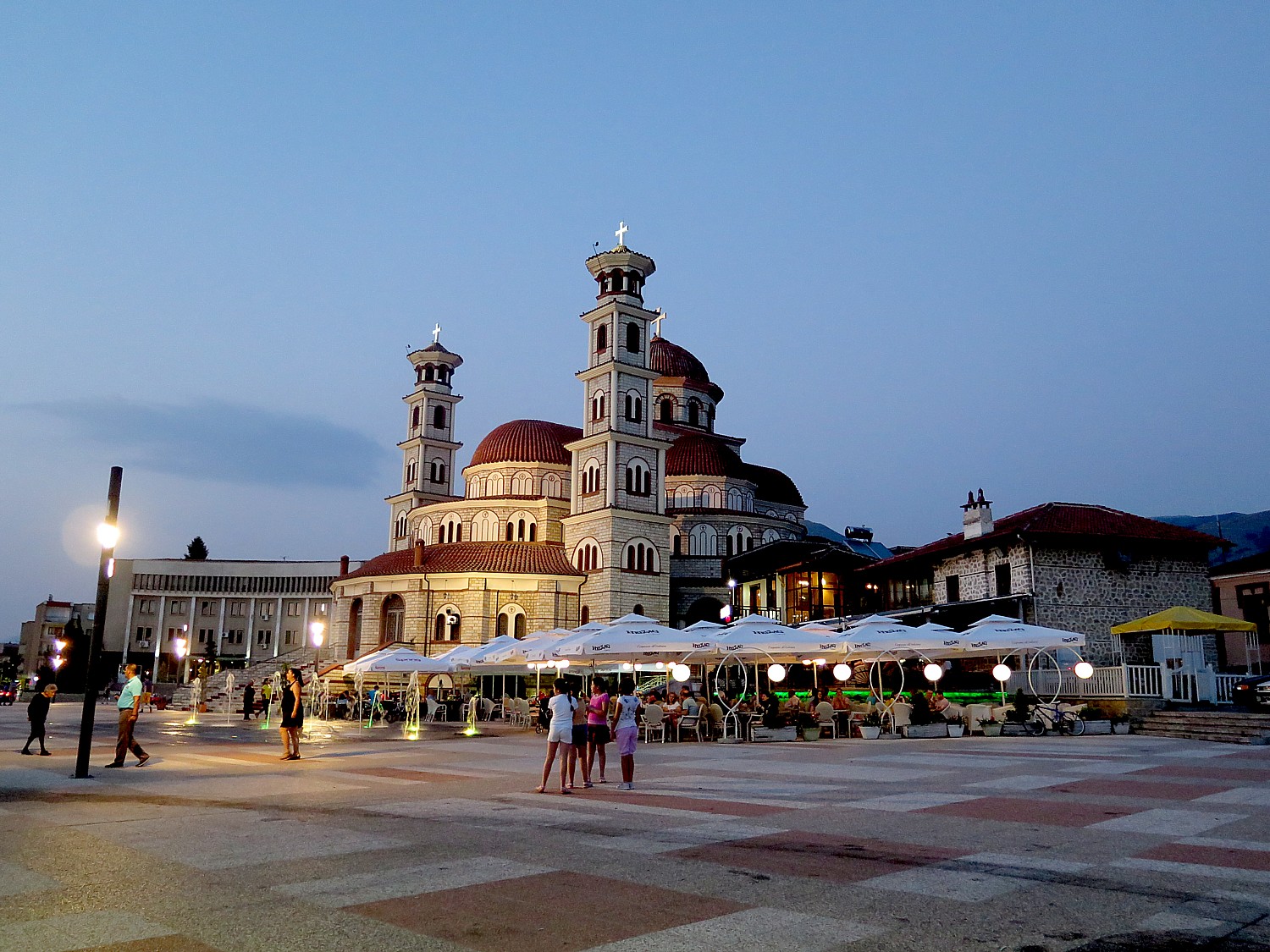
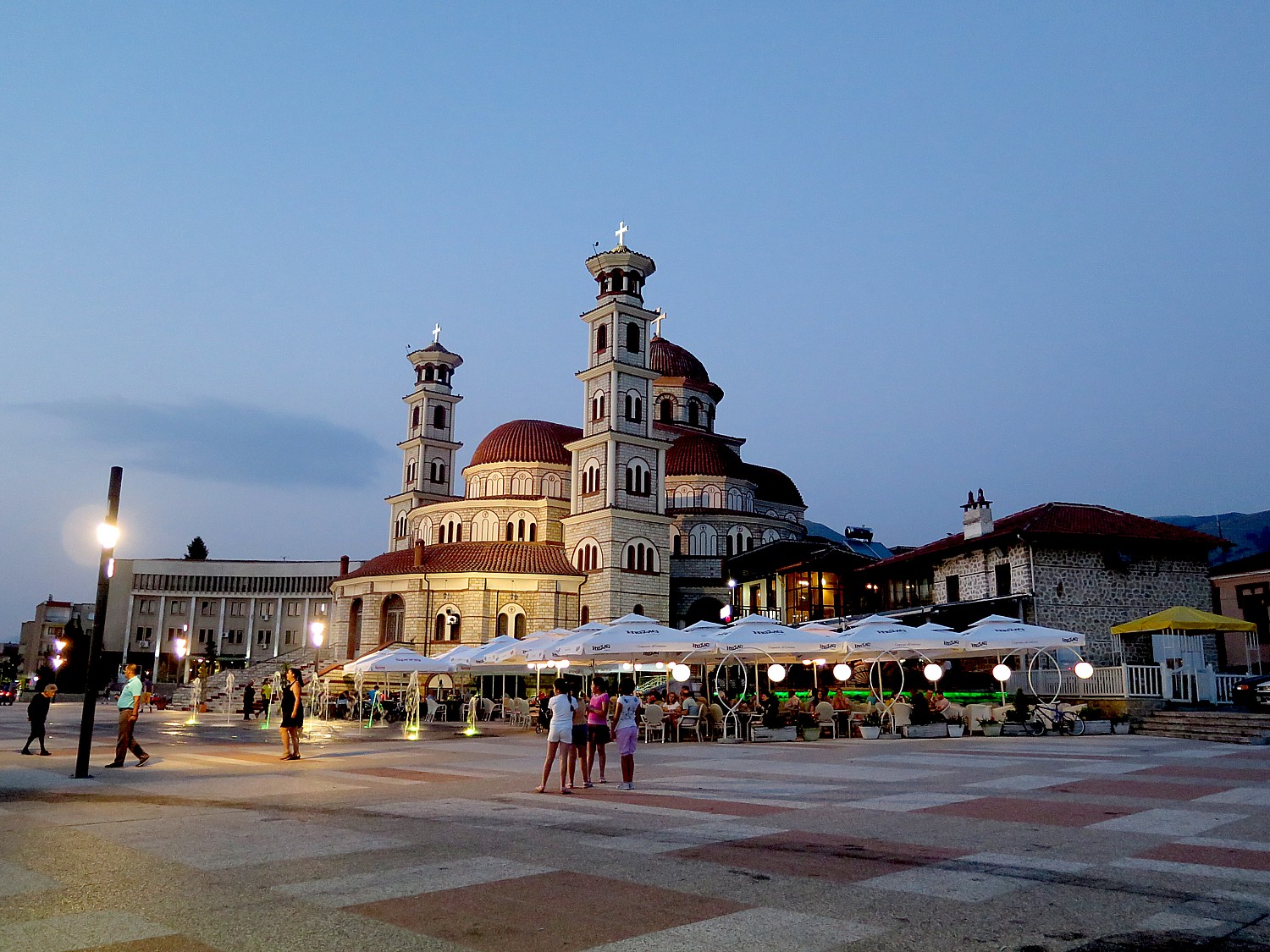
Resurrection Orthodox Cathedral, the centerpiece of Korca and the largest in Albania © 2016 Karen Rubin/goingplacesfarandnear.com

By Karen Rubin, goingplacesfarandnear.com

(I travel to Albania with BikeTours.com’s President Jim Johnson on a specially constructed “President’s Tour” itinerary that modifies the regular “Albania’s UNESCO Sites with Rivers, Valleys, and Gorges” trip.)

Day 3 of our cycling adventure (the fourth day of “Albania’s UNESCO Sites with Rivers, Valleys, and Gorges” tour) offers some of the starkest contrasts, from Albania’s rural “breadbasket” – farmland where you think you have gone back 100 years in time – to one of its most cosmopolitan and sophisticated cities, Korca, the “Paris of Albania.”
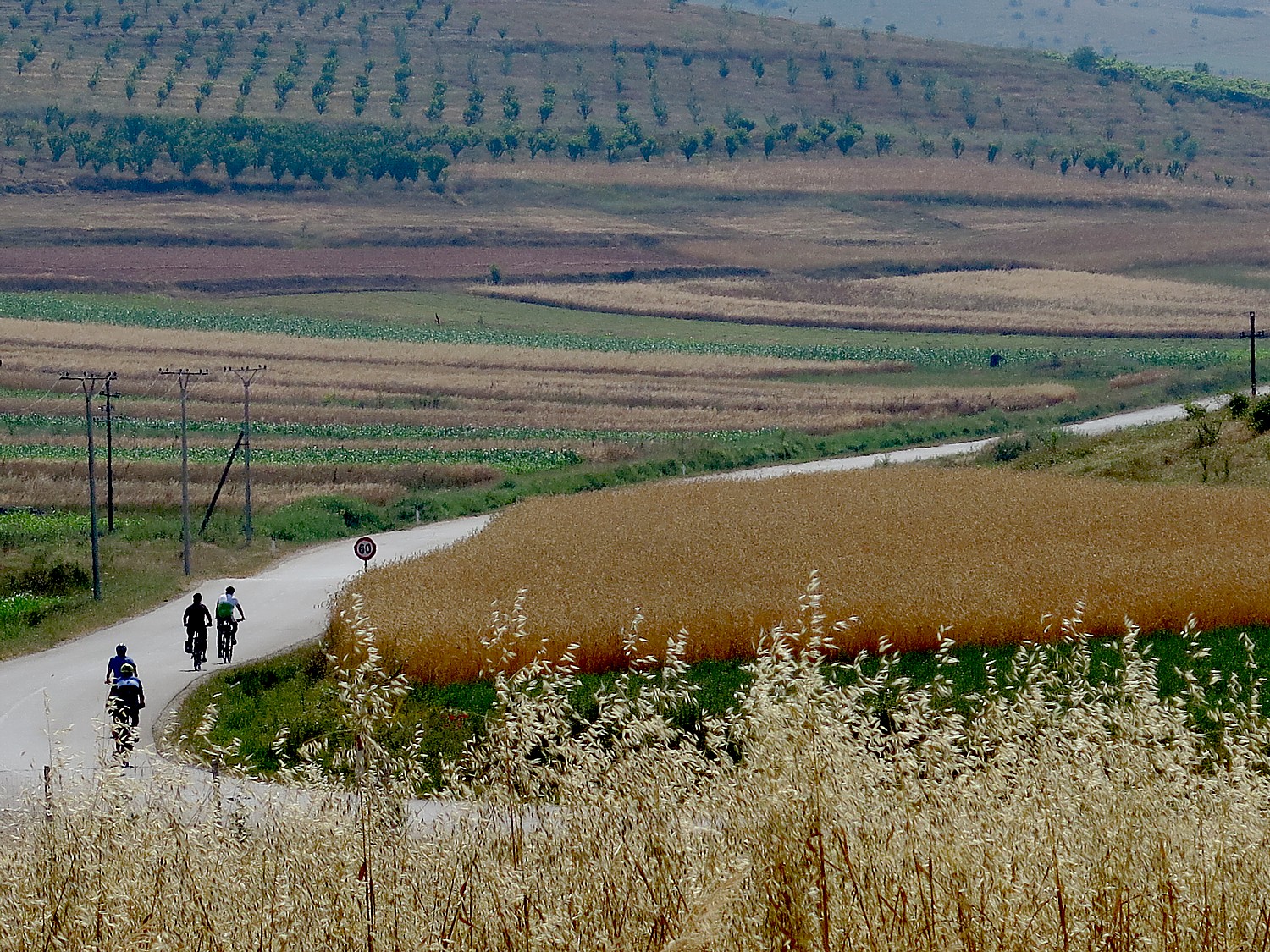
Biking down rural roads in Albania’s “breadbasket” © 2016 Karen Rubin/goingplacesfarandnear.com

This day is marked for me with some of my favorite landscapes- stunning farms laid out like a neat patchwork quilt – that show Albania’s use of traditional agricultural techniques with little mechanization. If anything, the countryside reminds me of our Amish country, with the continued reliance on donkeys and mules, hoes and spades, and how the use of chemicals and pesticides is shunned (which is why the salads and produce we eat are so fresh and pure – talk about farm to table!).
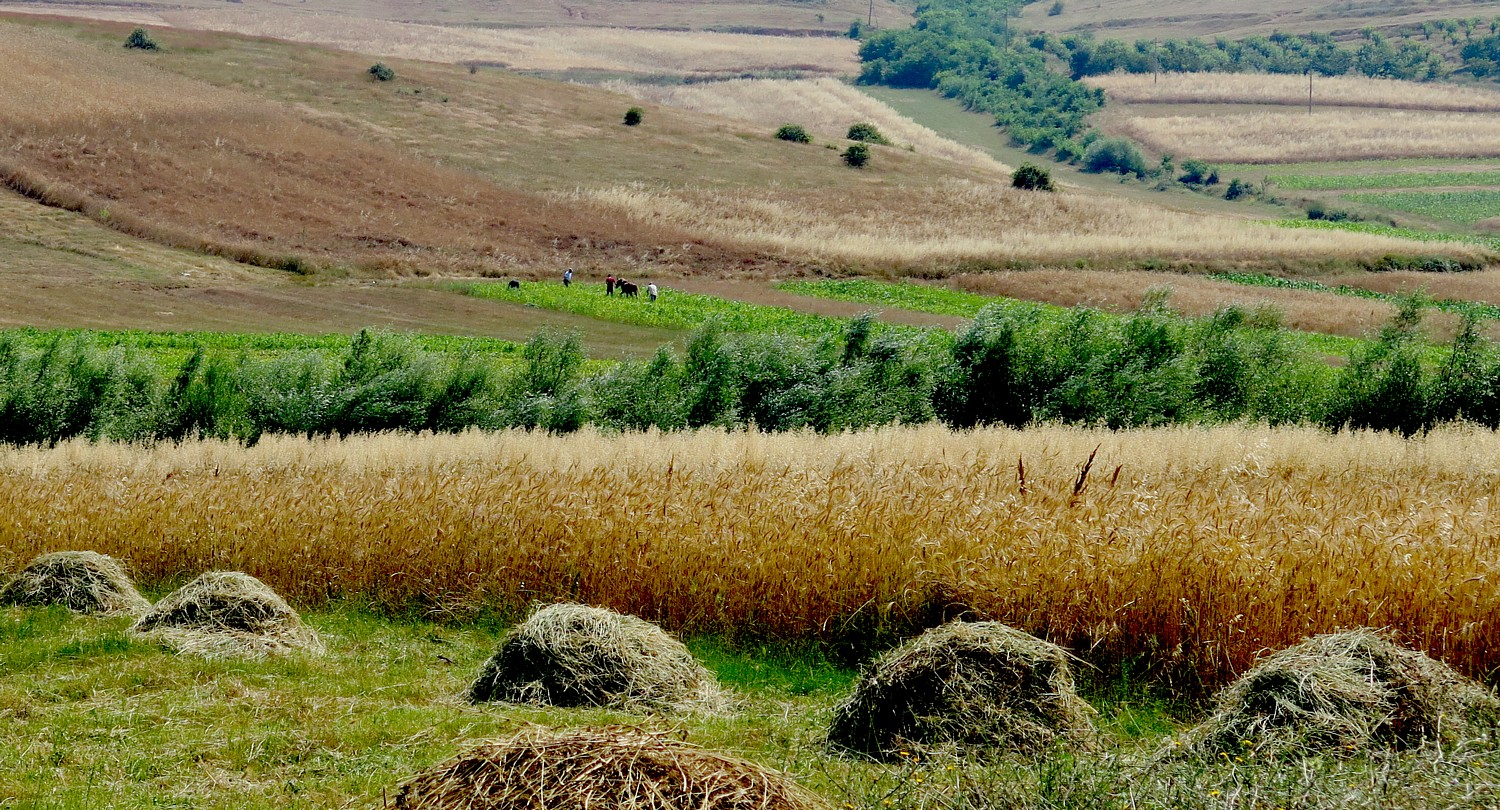
Biking down rural roads in Albania’s “breadbasket” © 2016 Karen Rubin/goingplacesfarandnear.com

Our ride is a 51 km distance, mostly uphill with a steep climb at the beginning, and then a series of smaller climbs and drops for a total elevation gain of 412 meters and elevation loss of 252 meters.
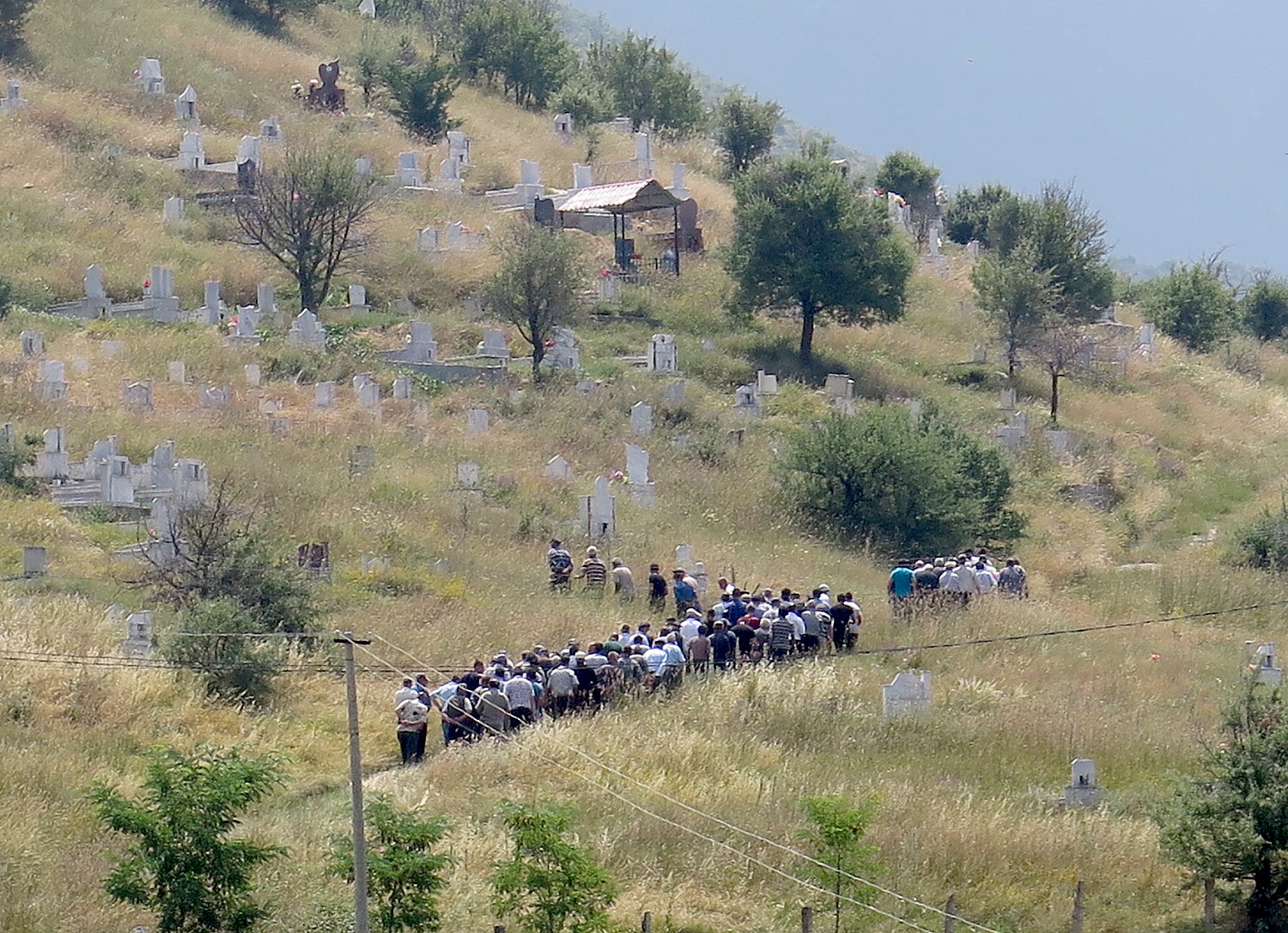
Coming upon a funeral procession in the Albanian countryside © 2016 Karen Rubin/goingplacesfarandnear.com

We start out of the hotel alongside Lake Ohrid, and cycle back to Pogradec, then head south and leave the plain, climbing to a higher one. We cycle the first half of the route along rural roads, looking at the vast plain of Korca from above, presenting these gorgeous painterly scenes of the farms.

As we come into one village, we see a funeral procession underway – a long line of people walking up a winding path to the hillside cemetery.
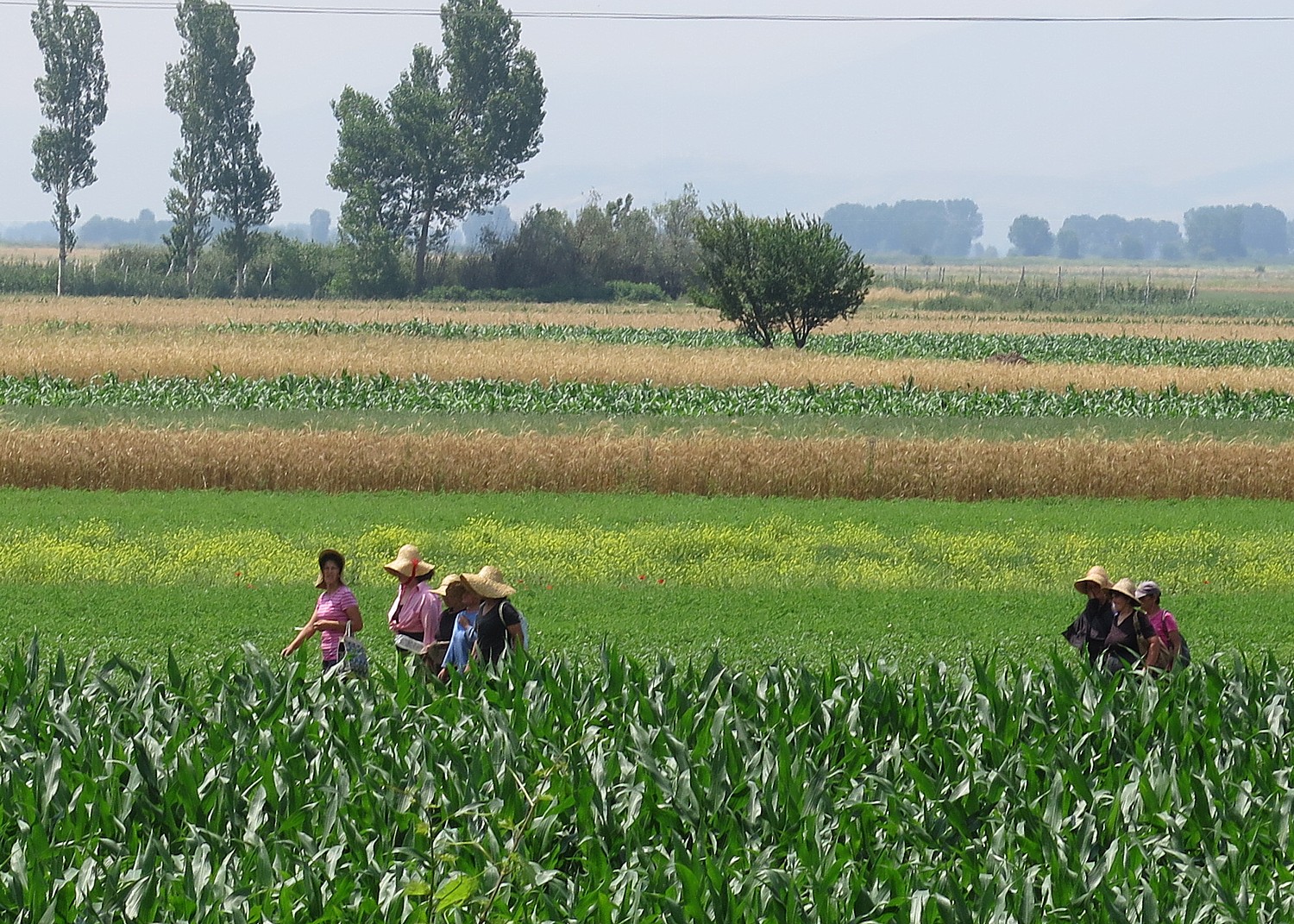
Women leaving fields © 2016 Karen Rubin/goingplacesfarandnear.com

Our coffee break stop is a delightful restaurant right in the middle of the farms; Junid, our guide, brings us a watermelon to share. Lunch is in another charming restaurant, on the outskirts of Korca, where we enjoy stuffed grape leaves, beets, fries and lamb chops.

Korca: ‘The Paris of Albania’
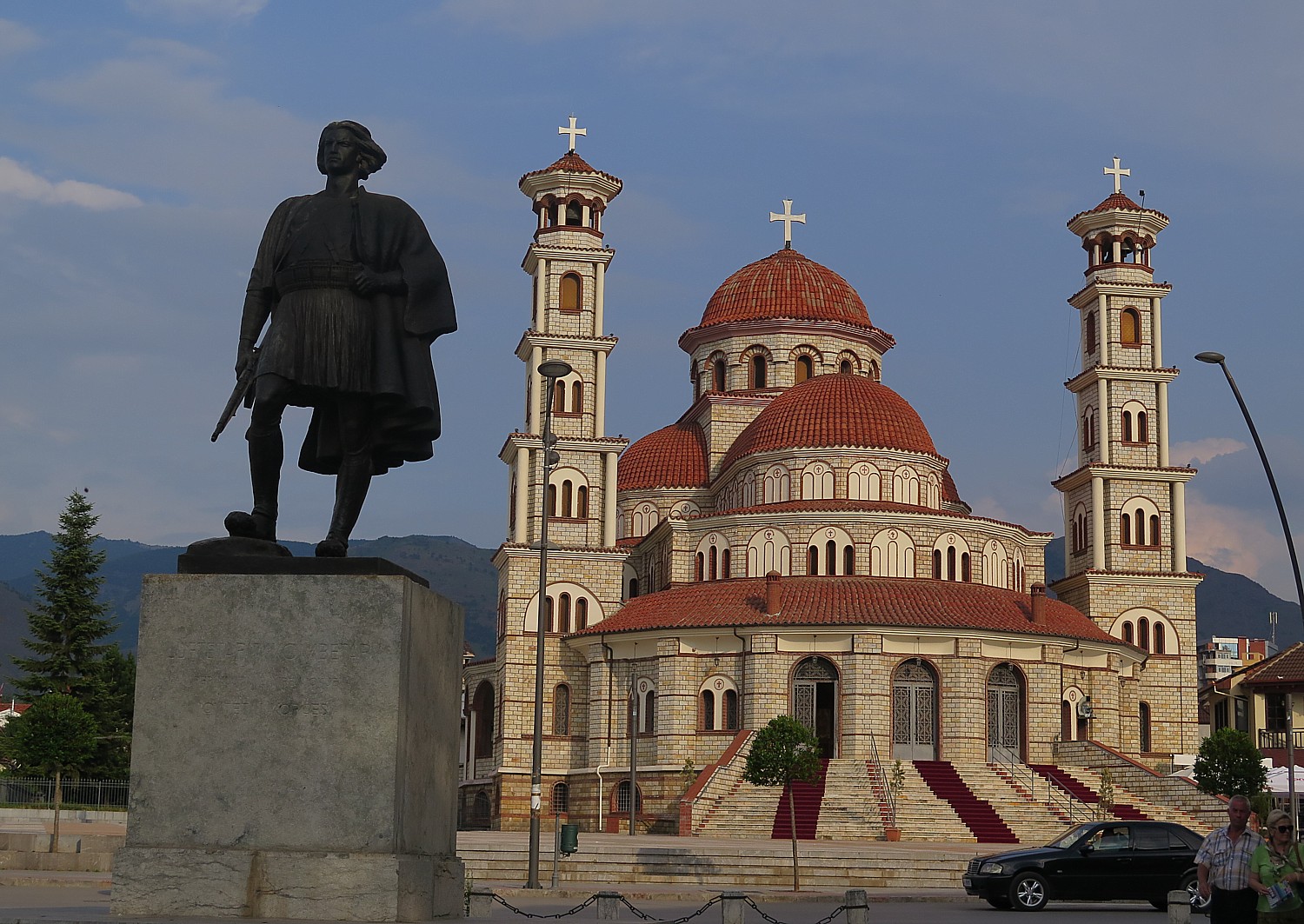
“National Hero” Monument with Resurrection Orthodox Cathedral in the heart of Korca 247 © 2016 Karen Rubin/goingplacesfarandnear.com

We bike into Korca and am immediately struck by sculptures that line the boulevard and some of the prettiest modern architecture we have seen, abutting turn-of-the-century French-influenced architecture (hence, the title, “The Paris of Albania”), from when the French controlled the region. We also pass a curious cemetery with crosses.

You immediately feel Korca’s more cosmopolitan cultural vibes, but the essence of Albania’s 19th century history also is on display here, all compressed in a compact walkable distance.
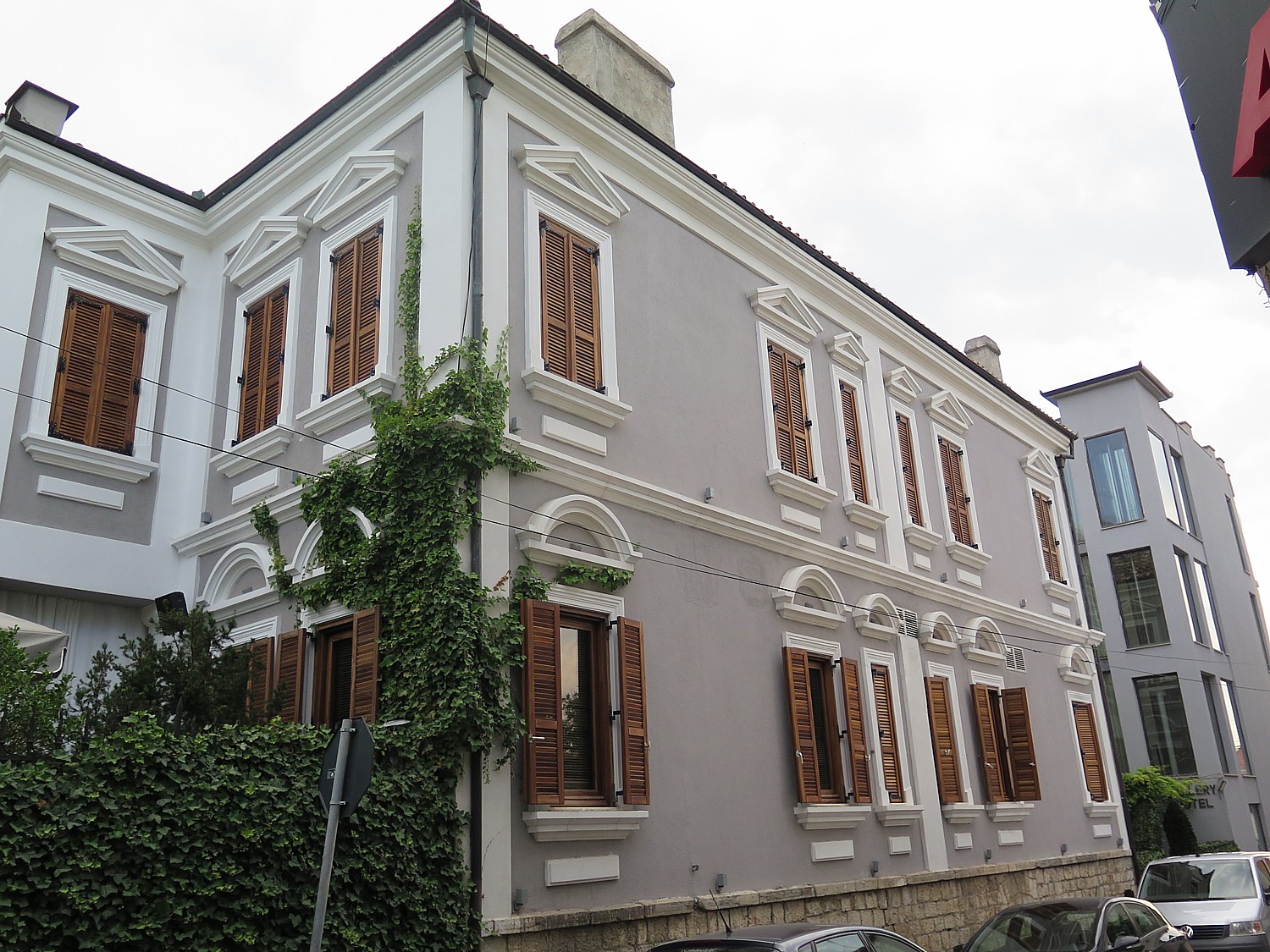
Life Gallery Hotel, Korca, Albania © 2016 Karen Rubin/goingplacesfarandnear.com

Our hotel, the Life Gallery Hotel, is, hands-down the best of the trip. It is a microcosm of Korca in that it is actually two buildings: a grand French-style building dating from 1924 and a modern, chic boutique hotel with every modern amenity imaginable (an enormous marble and granite bathroom and free WiFi), connected via an enclosed walkway and courtyard. There is a stunning beer garden, a cellar restaurant, a tavern, and even a swimming pool (and they are opening a spa).
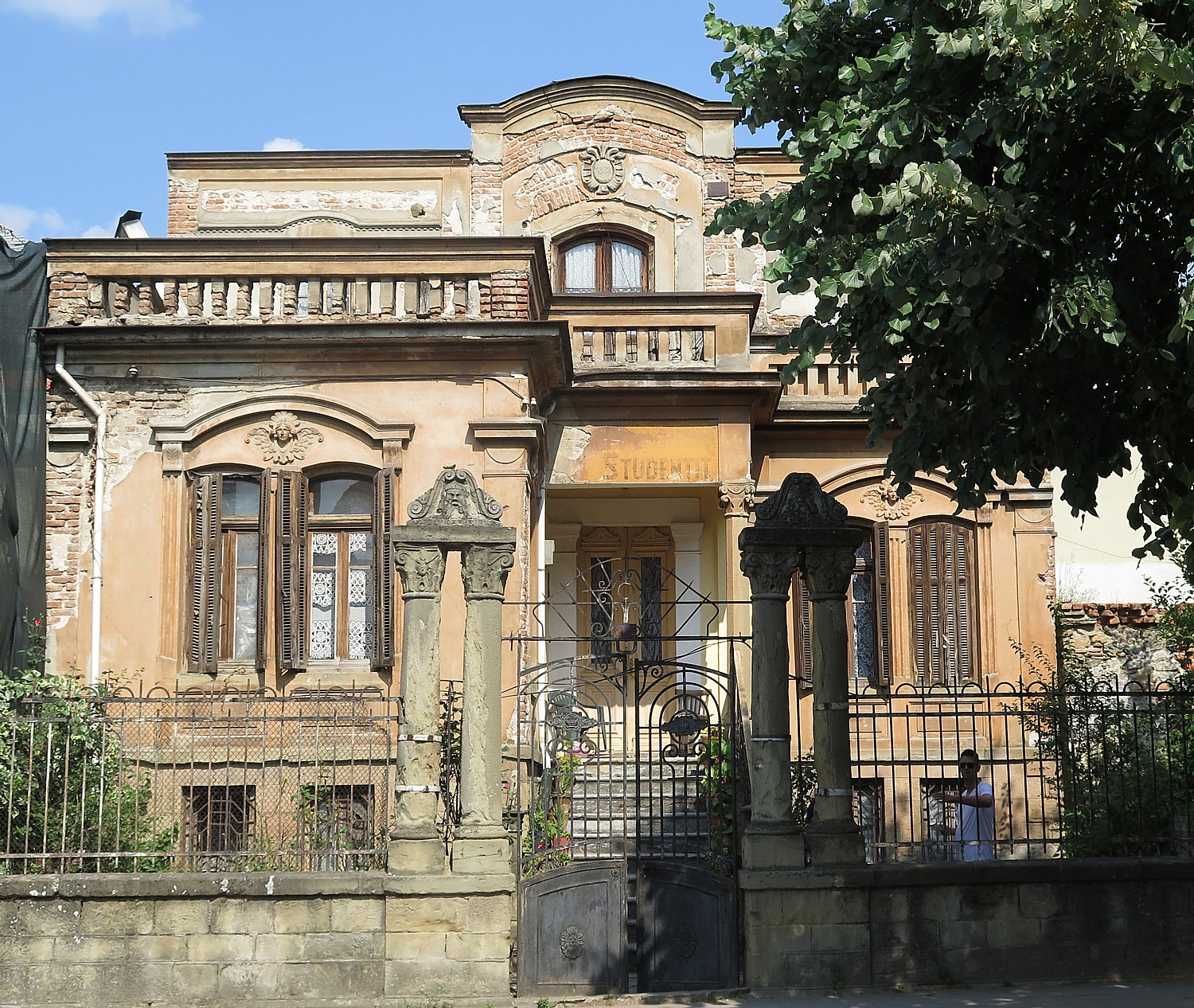
One of the European-styled buildings in Korca, Albania © 2016 Karen Rubin/goingplacesfarandnear.com

We are here early enough for me to explore on my own for an hour and a half before our group meets together for a walking tour led by our guide, Junid: the rebuilt Cathedral (largest in Albania), the First School of Albania (dating from 1887), cinema and casinos (which may actually be nightclubs) and a bazaar (closed when we come) and what passes for a small indoor shopping mall. There are also a surprising number of banks.

Indeed, Korca is one of the largest and most important cultural and economical centers of Albania and the largest city in the region. In addition to being dubbed “The Paris of Albania,” it is also known as the “cradle of Albanian culture.” Korca is named in documents dating from the early medieval period – the first half of the 15th century – when the entire province was the property of Muzakajt, one of the feudal families of that time. The city has been an important trading market: for centuries Albanian caravans began their travels from here to Turkey, Greece, and Russia. By the second half of the 19th century, the city rose to be a very important economic, trade and cultural center.

But its prime location that has made the city so important as a trading center has also brought tragedy. Albania was neutral during the Balkan Wars and World War I, yet so many battles were fought here that the country lost 10% of its population, Junid tells us.

The city also played a key role in its fight for independence from the 500-year rule of the Ottoman Empire. Korca patriots were well organized from 1906 – 1912, and took part actively in the movement to liberate the country from Ottoman occupation.

Korca enjoyed a heightened period of prosperity in the interwar period when many of its characteristic cultural institutions, mansions and boulevards were built by French and Italians.

The First School of Albania, dating from 1887, now The Education Museum © 2016 Karen Rubin/goingplacesfarandnear.com

The city also offers several museums including The Education Museum (housed in the building where the first Albanian school opened in 1887), The National Museum of Medieval Art, The Prehistoric Museum, the house-museum of the famous landscape painter, Vangjush Mio, and Bratko, the museum of the Oriental Art.

Walking Tour of Korca

The city of Korca takes great pride in being a welcoming and accessible city. You can best experience this by walking through its many parks, clean streets (we see people employed as street sweepers) and characteristic cobblestone walkways and roads. Which is what we do

Junid gives us a narration of Korca’s history as we walk passed monuments and structures:  he points out the graveyard of martyrs, located at the top of a hill above the city.

By happenstance of location, Korca has been the site of a lot of fighting.

After Albania declared its independence from the Ottoman Empire in 1912, after 500 years under its rule, it did not take part in the Balkan Wars of 1912-4, or in World War II – it was neutral, like Switzerland, Junid says. Nonetheless, armies marched through; Albania had an army for defense; 10% of the Albanian population died in battles fought on its soil. The numbers also include 700 French soldiers who are buried in the cemetery, marked with crosses, that we saw when we biked into the city earlier.

In 1913, Albania’s borders were “redefined” by a Council of Ambassadors (Western Europeans). Albania had started out as 58,000 sq km; but in their collective wisdom, Albania’s territory was cut down to 39,000 sq. km, with sizeable chunks given to Greece, Macedonia and Montenegro. Today, there is concern that Albania may want to recover its lost territory, but Junid says, “Nobody wants to reestablish Albania.”

From 1916-20, Korca was occupied by the French who built many of the beautiful buildings we see. The French also installed Albania’s president.

By 1930, half of Albania was occupied by Italy and the rest by Greece.

“The Dictator” (as Junid refers to him) sought help from Hitler to push out the Greeks and allied with the Italians. Mussolini saw Albania as a 300 km-wide buffer zone for its own defense. Mussolini armed and modernized Albania’s army.

We come to the Resurrection Orthodox Cathedral, the centerpiece of the city and the largest in Albania and second largest in the Balkans.  It was opened in 1995.

Junid explains that in 1967, under the dictatorship of Enver Hoxha (dictator from 1944 until 1983), Albania became the first atheist country – religion was banned; priests and imans who refused to close their churches and mosques were shot and their churches and mosques burned down.
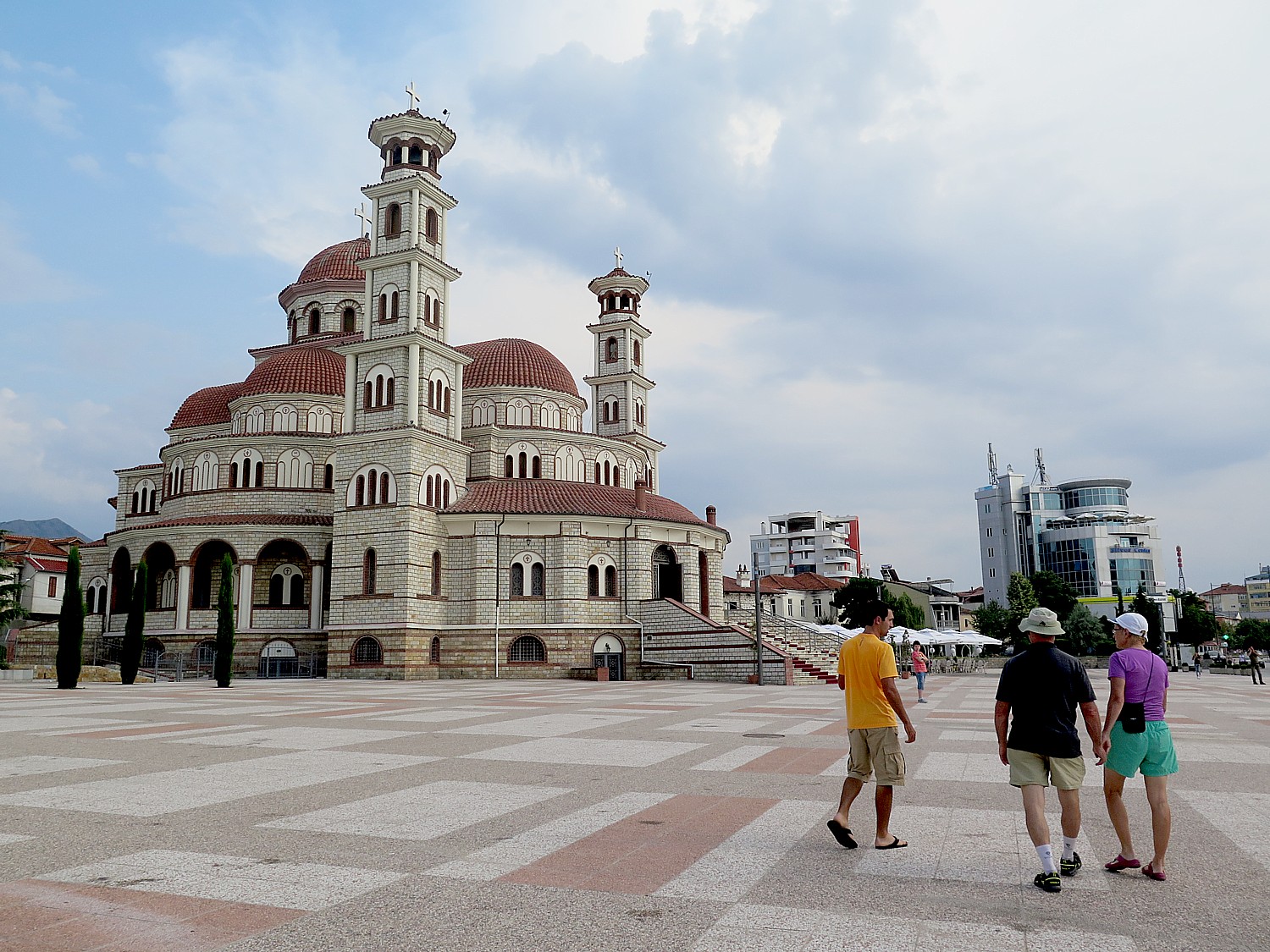
After becoming the first officially atheist country, even after the fall of Communism in 1991, it took a couple of years before Albania started to reopen its churches and mosques © 2016 Karen Rubin/goingplacesfarandnear.com

Even after Communism fell in 1991, it took a couple of more years before the people got over their fear and reopened churches and mosques. The Cathedral was built upon ruins with donations of rich families from area (they are honored inside the Cathedral). Despite the restoration of formal religion, and the fact that Muslims represent 70 percent of the country, other religions are tolerated (indeed, we see crosses topping many hilltops), the country is clearly secular, atheism is still prevalent and people consider religion a private affair.

“The religion of Albanians,” Junid tells us as we walk, “is Albanianism. First and foremost we are a nation. We all are human beings, respect each other.”

Junid gives us more of Albania’s history: he tells us that when one of the prime ministers died of heart disease (or at least that’s what they said). “Coincidentally, one of the doctors who treated him succeeded him (This reminds me of a plot of “Madam Secretary”). (I can’t reconstruct this timeline based on the list of Prime Ministers and Presidents but the only cardiologist I can find is (Sali Berisha) who became President in 1992 and later became Prime Minister, 2005-2013. Berisha was also the Prime Minister who, on 10 June 2007, met with U.S. President George W. Bush in Tirana, the first sitting U.S. president to visit Albania. But what appears to be the case is that there are a handful of politicians who move in and out of power, which accounts for a high measure of cynicism when it comes to politics.)

In 1991, a former economic adviser to Prime Minister Fatos Nano began a series of Ponzi schemes that embroiled much of the country, and when they collapsed in 1997, caused the bankruptcy of 25 firms with a face value totaled $1.2 billion and sank more than 200,000 investors who had sold off property in order to raise the capital to invest. That set off a civil war. “Almost all of Albania was burned to the ground,” Junid tells us. (What I can’t understand is why the money can’t be traced to bank accounts and recovered.)

Nanos served as Prime Minister 1997-8 (after the Ponzi schemes collapsed), was accused of corruption and remarkably, was returned to office 2002-2005, promising reforms, when new questions about corruption in government contracts emerged.

(I find it really difficult to get Albania’s history into perspective. If you look at a timeline of Albania’s prime ministers, some only served a matter of months and even days, and there was nobody in the office 1916-1918, but it also is clear that a small group of leaders dominated government for decades, switching in and out of office.)

The bottom line is that Albania’s history since 1912 independence has been one of kings, dictators, prime ministers and presidents promising reforms but rife with corruption and intrigues which led to unrest, coups and uprisings. (The current prime minister, Edi Rama, came to office in September 2013, and judging from the massive infrastructure projects underway and what I gauge is a calm in the country, seems to be putting the country’s economy back on track.

Across from the Cathedral is the promenade and a prominent “National Hero” Monument, immortalizing the freedom movement that won independence from the Ottoman Empire after a 500-year occupation. The figure wears the traditional Albanian costume with the pleated skirt (the Greeks adopted the same outfit; the more folds, the richer the man). It was sculpted in 1937 by Odhise Paskali, considered Albania’s greatest sculptor, on the occasion of the 25th anniversary of Albania’s independence.
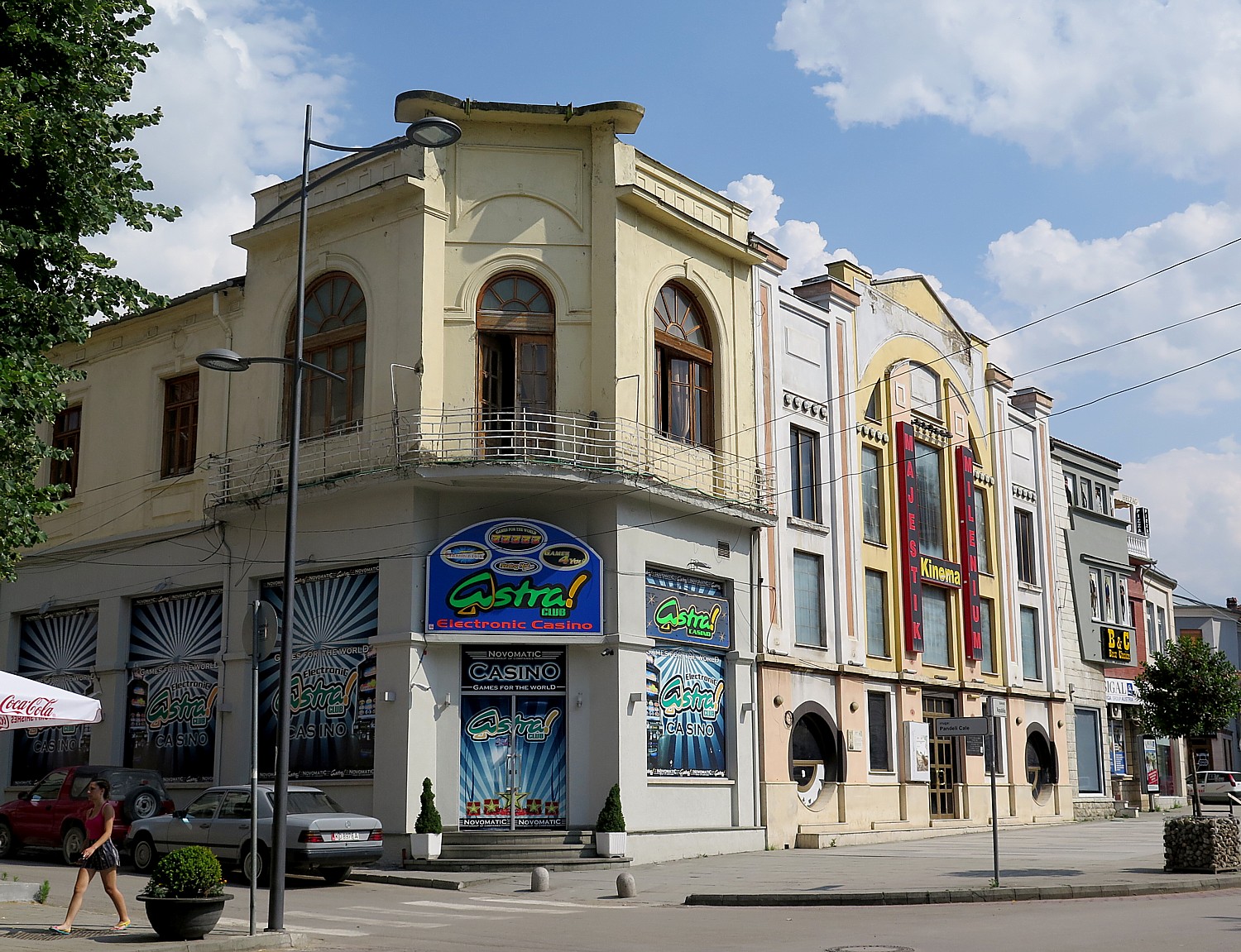
Korca’s historic cinema © 2016 Karen Rubin/goingplacesfarandnear.com

Along the promenade are important buildings – the literal ruins of a Russian Embassy (in 1957, the dictator broke off relations with Russia and allied with China) on one side, and the First Albanian School, built in 1887, which is today the National Museum of Education. Back when the school was built, under Muslim law only boys could attend, but a few years later, a girls school was built.

The promenade, Junid says, is an architectural feature common to all Albanian towns, a legacy of the Italian occupation. The promenade was designed by Mussolini’s architects in the 1930s.

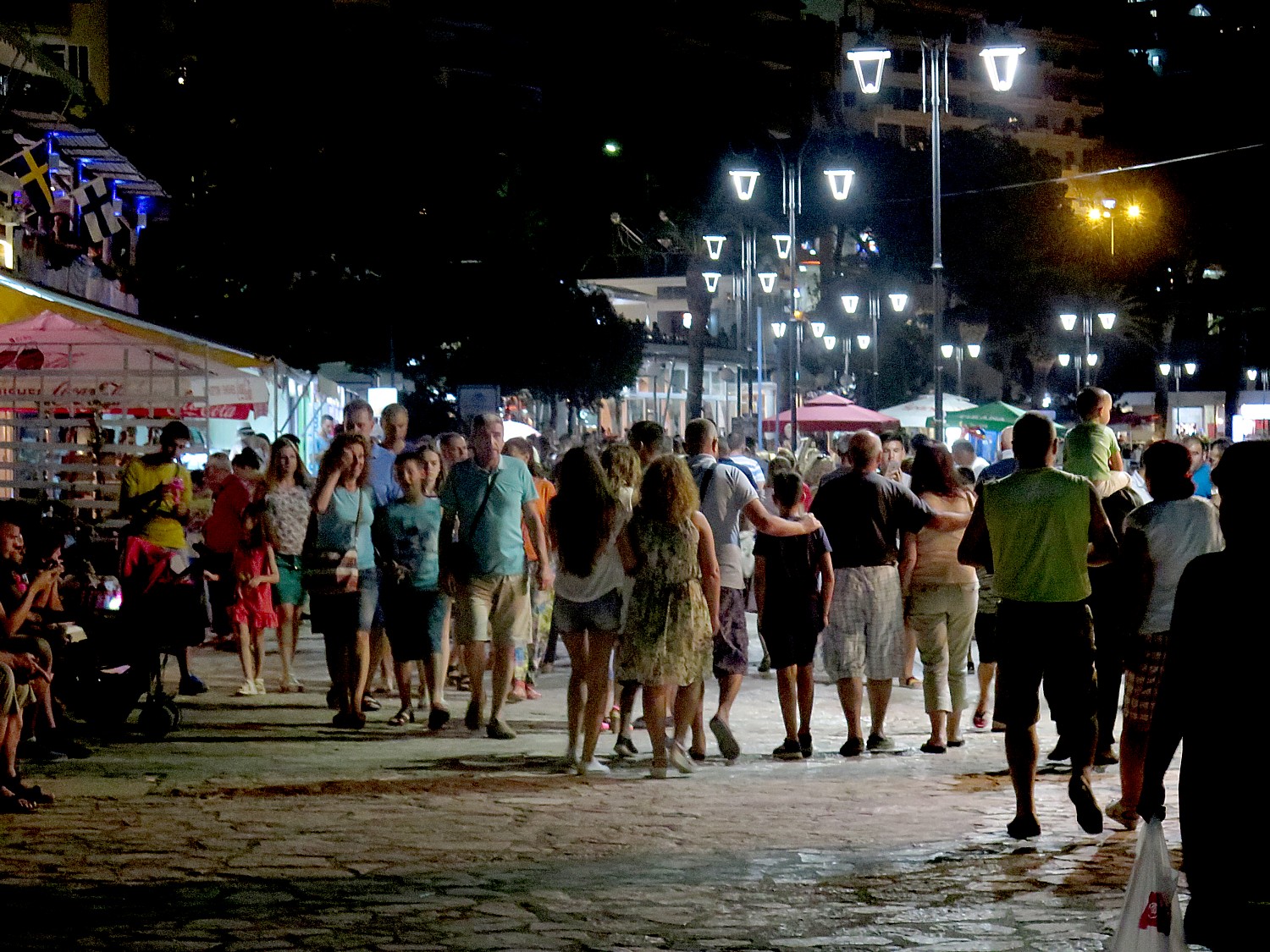
Junid explains the Albanian custom of “xhiro” (sounds like “gyro”) – evening walks. Each evening after 6:30 pm, people come out and promenade down the avenues, come to cafes, sit in parks, and chat.
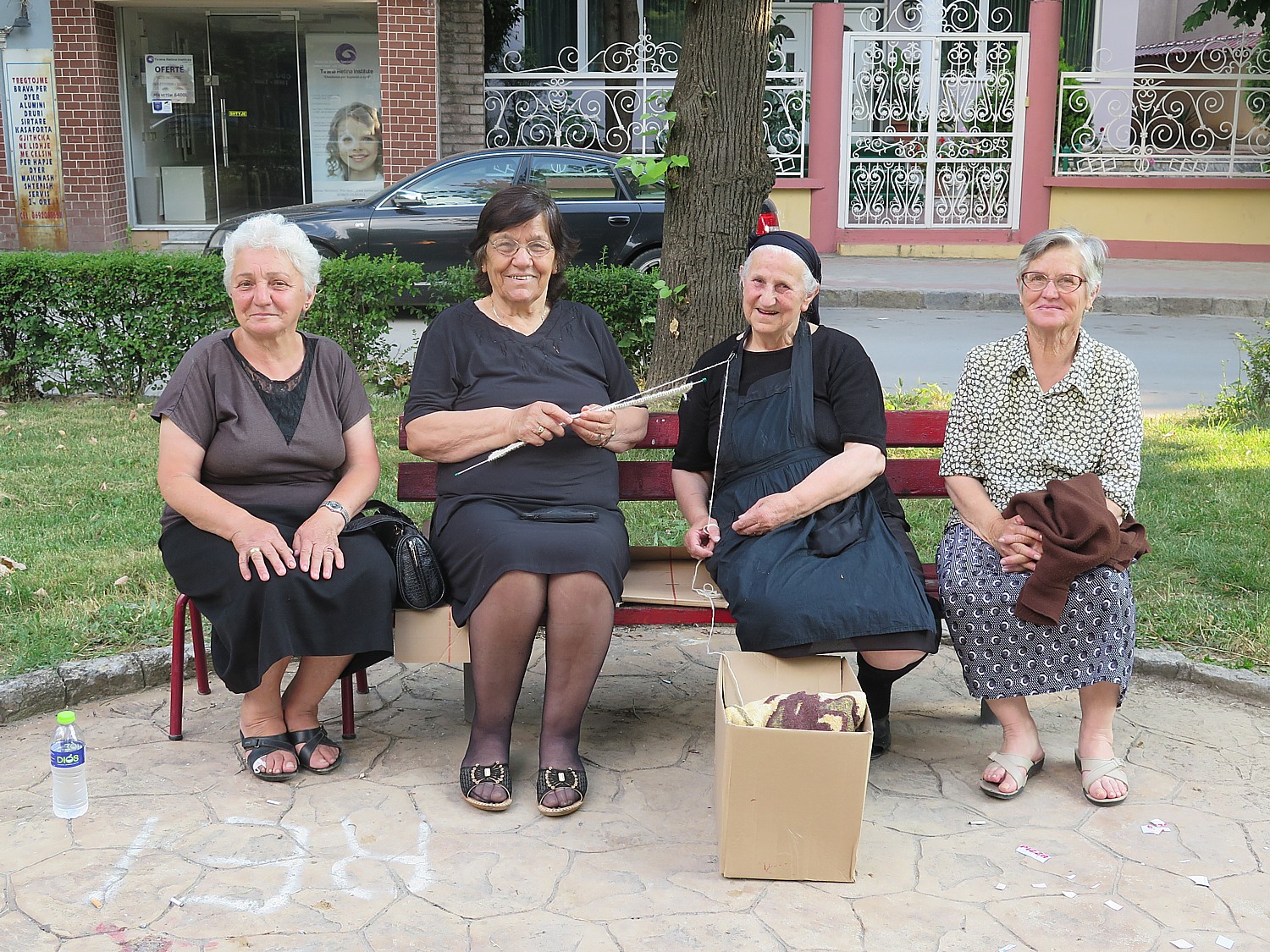
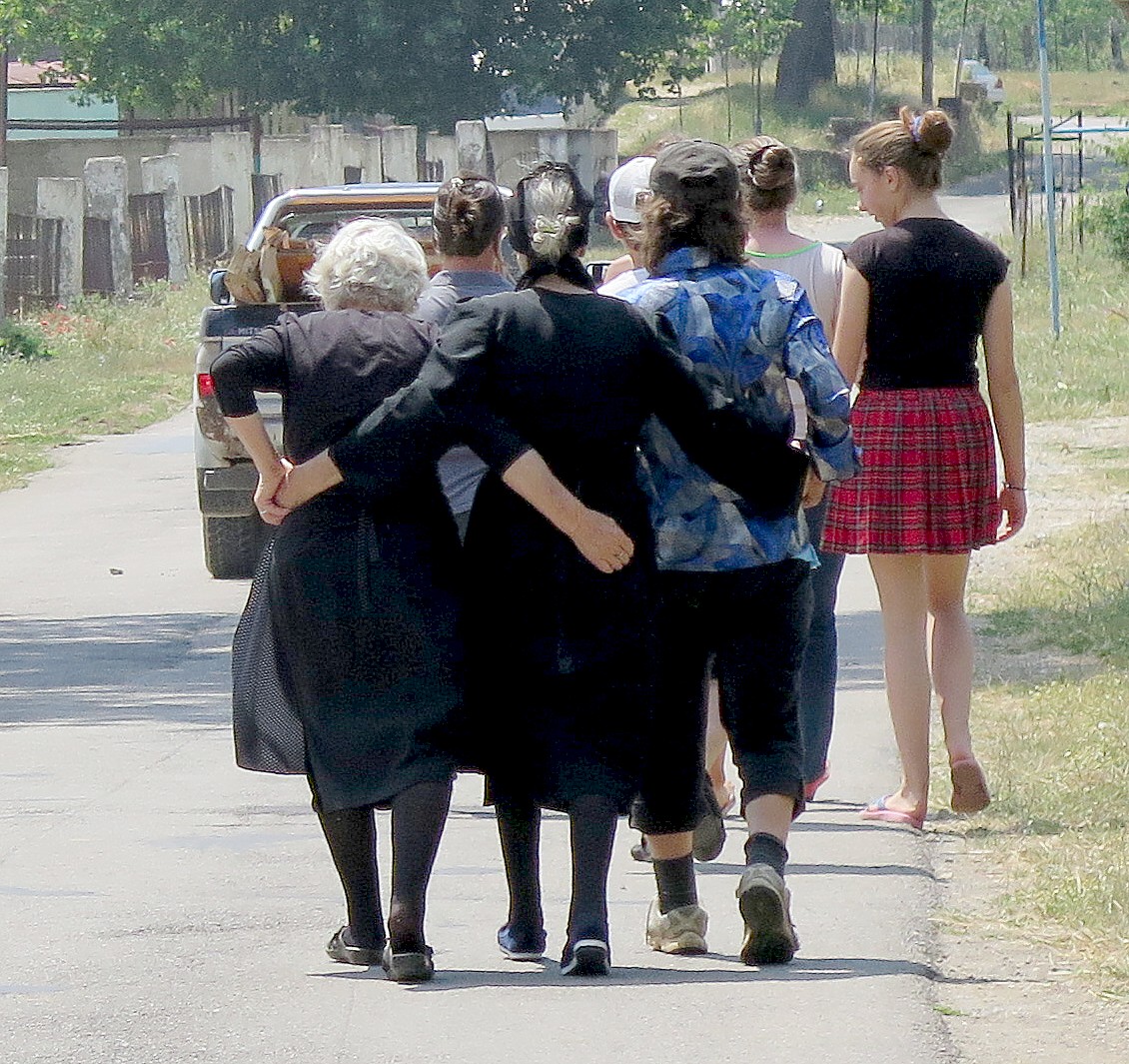
Ladies, Korca, Albania © 2016 Karen Rubin/goingplacesfarandnear.com

Our walking tour takes us through many neighborhoods. I note a small plaque dedicated by the Albanian American veterans of America in a park-like setting in the middle of a boulevard that is being reconstructed. We come upon a group of older women who are knitting and with Junid as translator, chat a bit.

Finally, we come to a street lined with beer gardens. We are headed for the beer garden right beside the Korca brewery (less than 70 cents for a mug of really terrific Pilsner-style beer).

Korca is Albania’s oldest brewery in Albania (since 1928), as well as the biggest (Tirana is the other major beer), supplying taverns and restaurants throughout the country (but not beyond). It is a traditional Pilsner-style wheat beer, full-flavored and quite good.
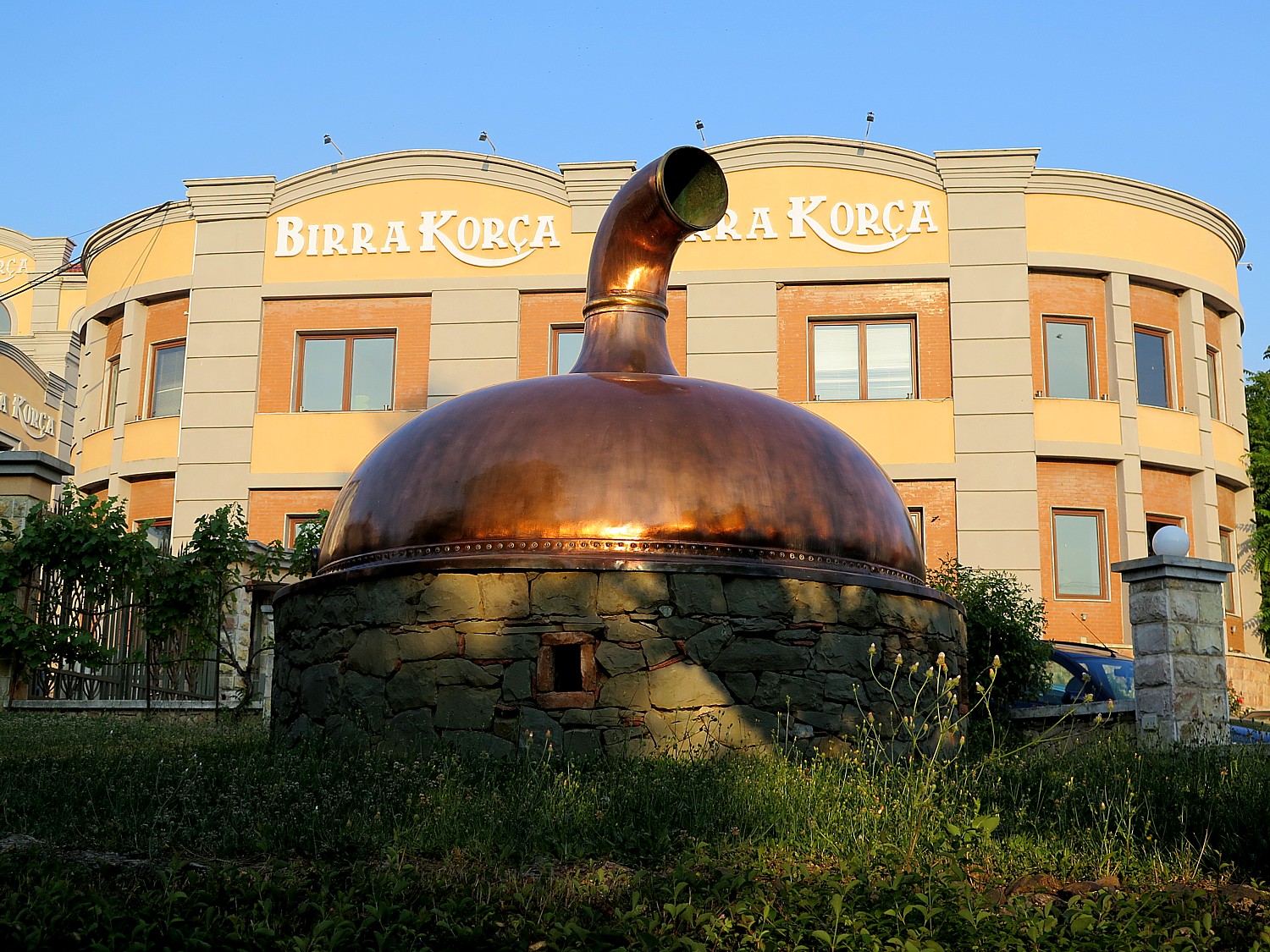
Korca Brewery © 2016 Karen Rubin/goingplacesfarandnear.com

A little research uncovers that Korca has the best conditions for making beer: cereals are widely cultivated and the water is low in calcium. Under the Hoxha Communist regime, the brewery became the property of the state. The brewery was purchased in 2004 by a local investor, Irfan Hysenbelliu, who built new buildings in the traditional style and launched a new system of beer processing set-up by Czech engineers.

The beer garden is especially fun, just below a massive copper cover to what I imagine is the still.
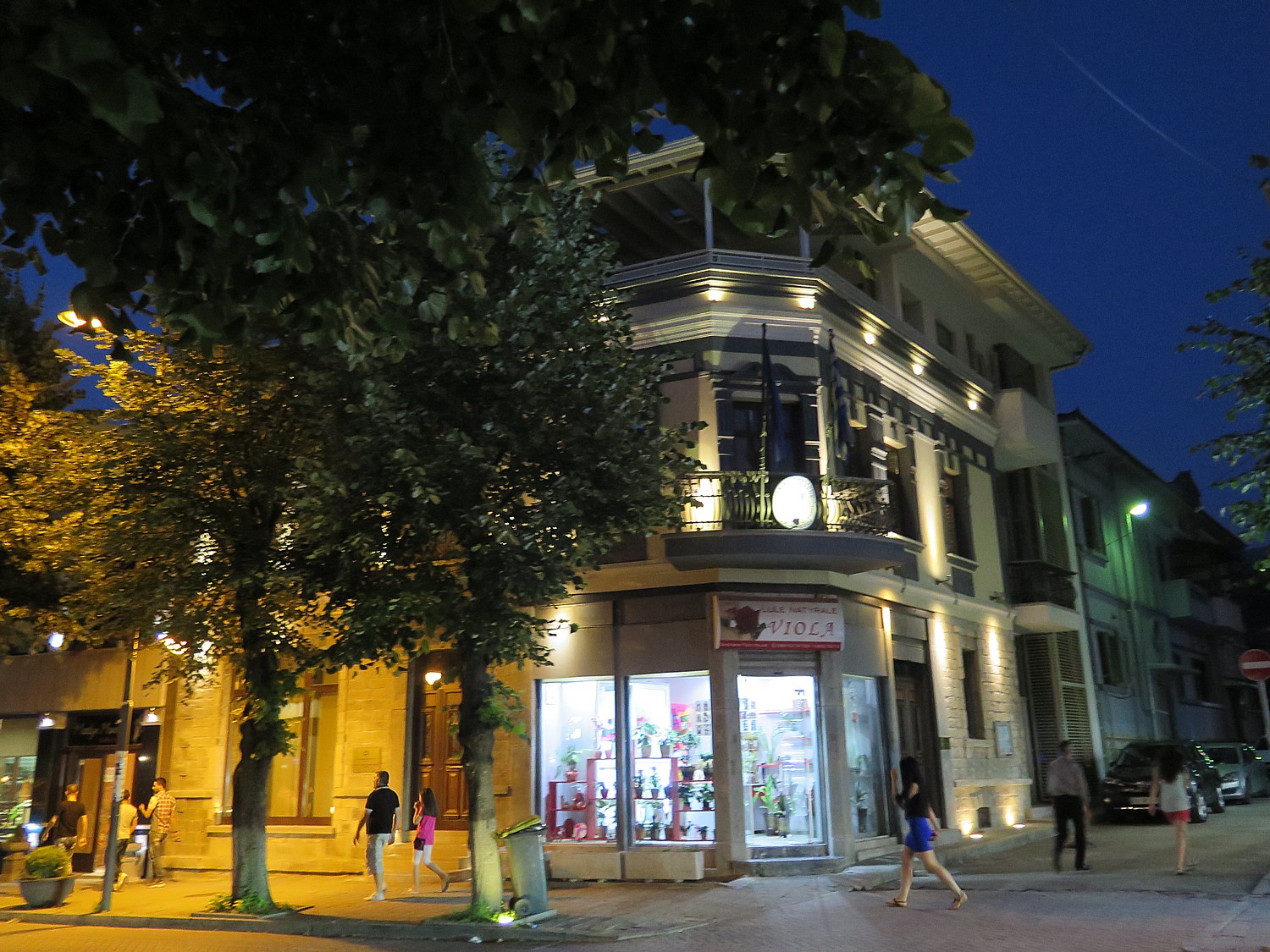
Nighttime in Korca © 2016 Karen Rubin/goingplacesfarandnear.com

Just as Yunid promised, in the evening, the streets and promenades and cafes are crammed with people, taking part in the custom of xhiro. The feeling that emanates from the streets is absolutely marvelous.

There are still some scheduled departures left this year for “Albania’s UNESCO Sites with Rivers, Valleys, and Gorges,” 9 nights, Level 4, averaging 37 miles/day (950E or about $1050) (www.biketours.com/albania/albania-UNESCO-tour). 

BikeTours.com 1-877-462-2423 or 423-756-8907, 1222 Tremont St., Suite 100, Chattanooga, TN 37405, biketours.com. 

Next: Biking Albania to Gjirokaster, UNESCO World Heritage Center 

See also:

Come to Albania Now to See Emergence of a Young Country – Best Way to Experience Albania is on Bike Tour 

Biking Albania: Exploring Heritage Sites of Lake Ohrid, St Naum, Ancient City of Ohrid

____________________

© 2016 Travel Features Syndicate, a division of Workstyles, Inc. All rights reserved. Visit goingplacesfarandnear.com and travelwritersmagazine.com/TravelFeaturesSyndicate/. Blogging at goingplacesnearandfar.wordpress.com and moralcompasstravel.info. Send comments or questions to FamTravLtr@aol.com. Tweet @TravelFeatures. ‘Like’ us at facebook.com/NewsPhotoFeatures


Come to Albania Now to See Emergence of a Young Country – Best Way to Experience Albania is on Bike Tour

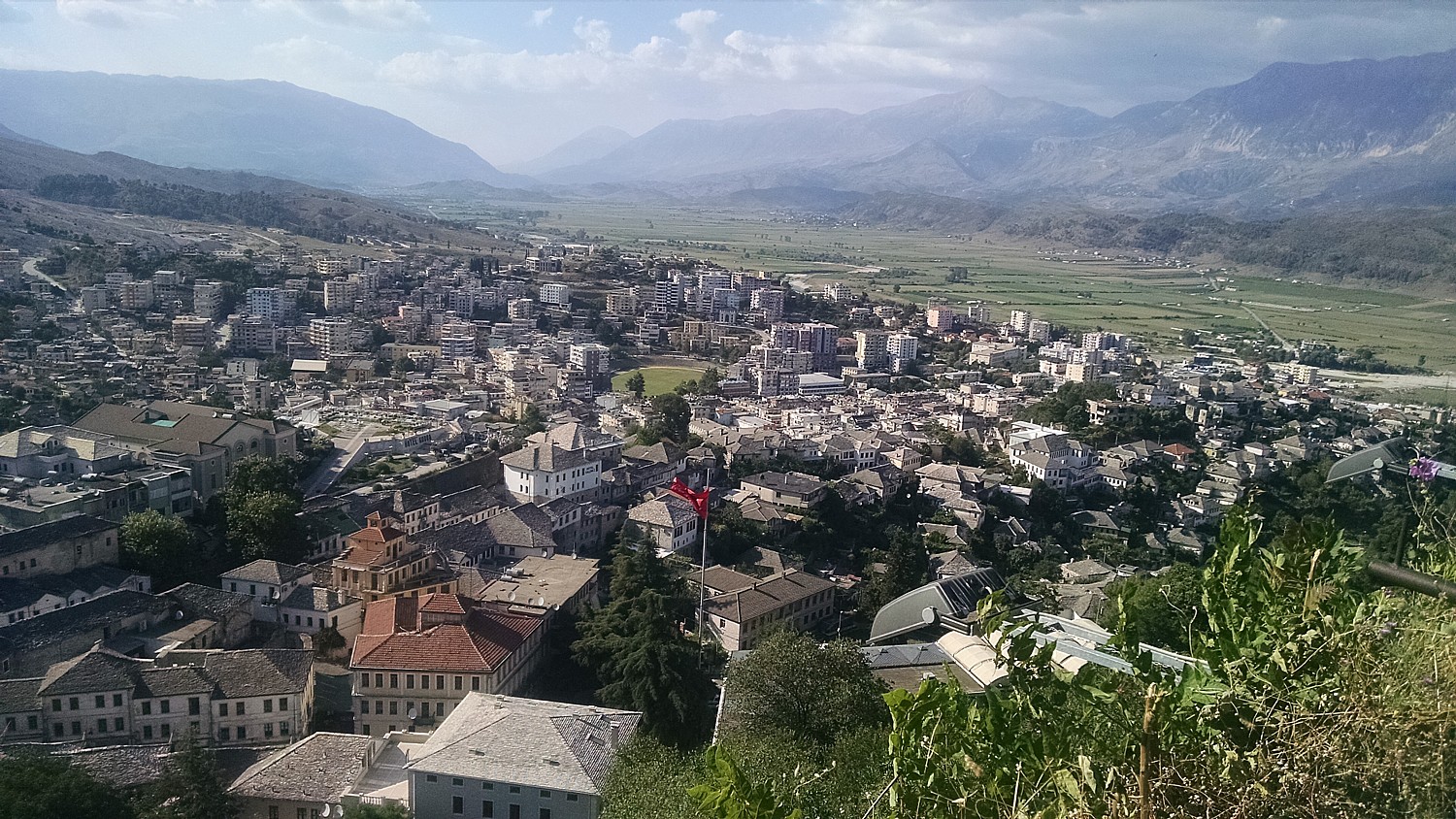
The view from the castle of Gjirokaster, a UNESCO-protected living history city in Albania, overlooks a lush valley © 2016 Karen Rubin/news-photos-features.com

By Karen Rubin, Travel Features Syndicate, Goingplacesfarandnear.com

You wouldn’t necessarily come to Albania to see monuments and fabulous architecture, for museums that hold the treasures of civilization or the artifacts that trace your heritage (though one of the surprises are the important cultural and historic sites including a Greco-Roman city reclaimed from the forest overgrowth).

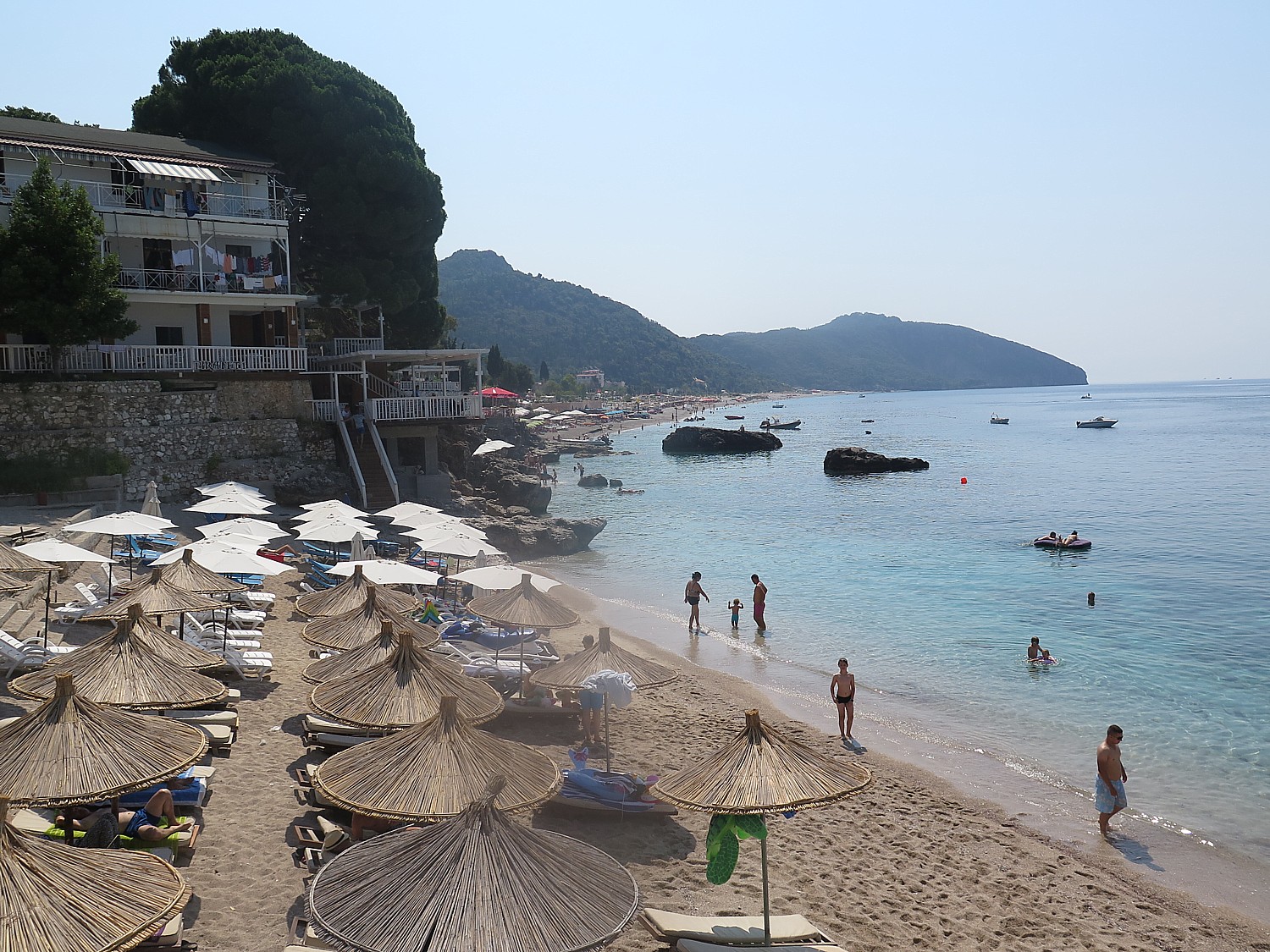
You wouldn’t necessarily come for fabulous beaches, though Albania possesses hundreds of miles of coastline along the Ionian and Adriatic Sea, and its own “Albanian Riviera” that reminds you of the French Riviera without the pretension.

You wouldn’t necessarily come for stunning and dramatic landscapes –though scenes abound of picturesque farmland that reminds you of Amish Country, dramatic mountains that reach into white clouds, sheer cliffs that drop to the sea, sunsets that take your breath away, villages carved into hillsides that look out to expansive galleys, giving a different hue to each of our days.

Beachgoers at Dhermi, on Albania’s French Riviera © 2016 Karen Rubin/news-photos-features.com

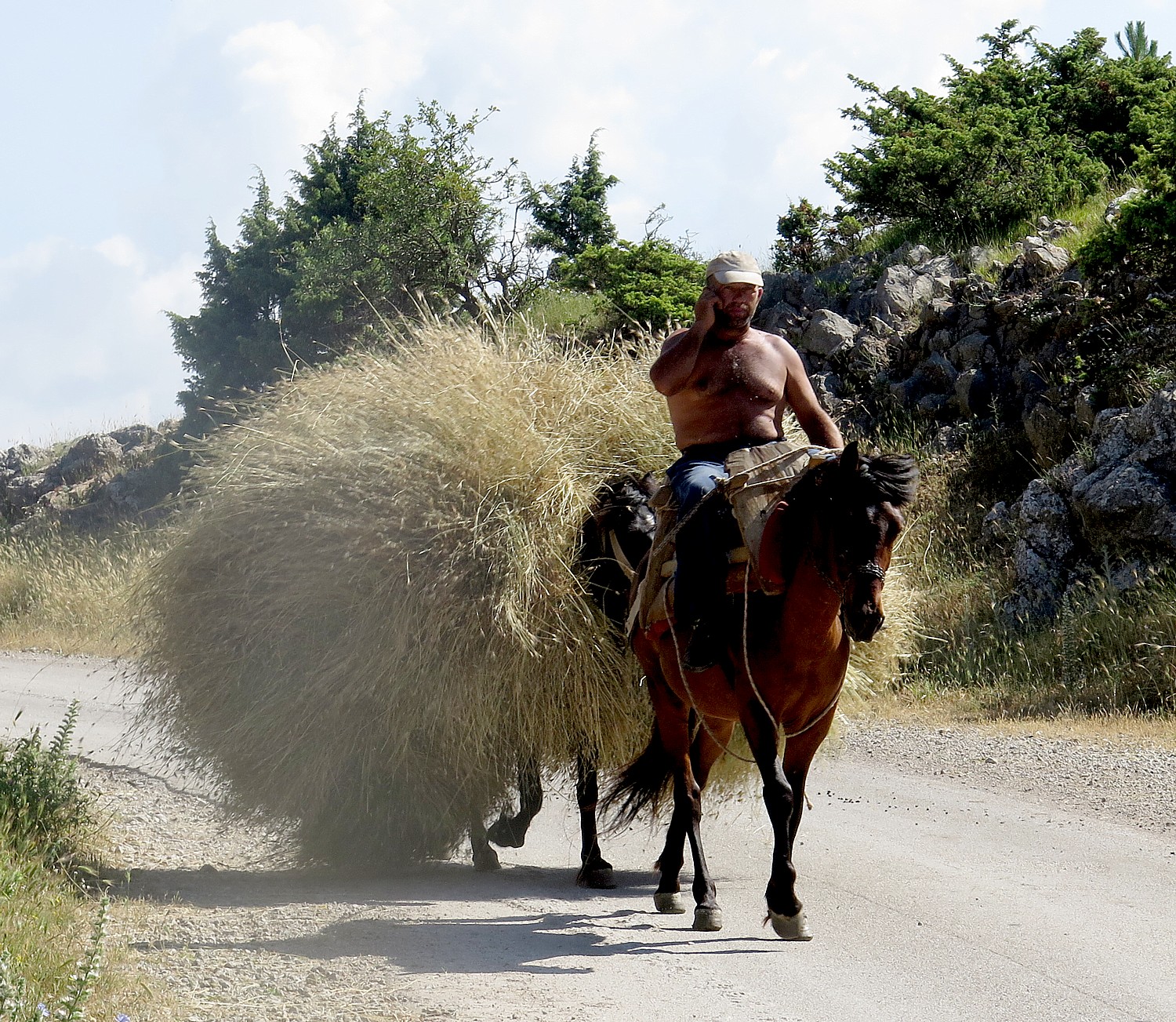
The scenery, the landscapes are strikingly beautiful to be sure – mountains that rise dramatically to white cumulus clouds, a coastline that follows the exquisitely aquamarine Ionian and Adriatic seas, valleys lush with immaculate farms with geometric patterns of color and texture. But most interesting of all are the contrasts without contradiction – farmers burnished by the sun to a leathery brown, working fields with hoes and spades or riding mule-drawn hay-carts up winding hillside roads while chatting on cell phones. In a country where a cinema or shopping mall or even retail stores are rarities, cell phones and cars (and car washes and petrol stations) are ubiquitous.

Certainly there are the beautiful landscapes, the picturesque countryside and stunning coastlines, ample historic and cultural attractions, and traditional tourist delights of beaches and sensational food.

Children playing at Lake Ohrid © 2016 Karen Rubin/news-photos-features.com

But the best reason to come to Albania is for The Now, to see a young country shaking off a tortured past – “an unlucky history/country,” is the odd phrase our guide, Junid, uses.

Come to experience a place, a people and a culture that is shrouded in mystery after decades of being imprisoned behind an Iron Curtain, closed off to the world,  under the thumb of a paranoid dictator, a place, a people and a culture that is either completely unknown or branded with misconceptions and false images.

To see that process unfolding is absolutely thrilling. Albania is not what it was 10 years ago, and is not what it will be in the next 10 years.

Surprises Abound

I was only in Albania a few minutes before I hear a story that proves foundational to my understanding: Albania, the only European country with a Muslim majority, was also the only European country to end World War II with more Jews than it had at the start of the war, because Albanians harbored Jews  from the Nazis at great risk to their own lives and that of their children.

“Every one of the 200 Jews living in Albania before the war was hidden and taken care of by their mostly Muslim countrymen and countrywomen,” Jim Johnson, president of BikeTours.com who has designed this special “President’s Tour of Albania” that I am on, tells me, as we are taken from the airport to our hotel in the capital city of Tirana. “In fact, nearly 2,000 Jewish refugees fleeing Hitler were welcomed not as refugees but as guests and were ‘hidden in plain sight’ –  made part of Albanian families and daily life. This endured even during the German occupation amid extreme threats by the Nazis.”

“The Jews were sheltered with their own children – which meant that if they were caught with Jews in their house, their own children would be killed,” our guide, Junid later relates when our group of five cyclists gathers for our first dinner together. “A lot stayed in the north – with Catholics. A lot went to Israel after the war. I’ve had groups where people went to back to the town where a family had sheltered their relatives.”

Why the Albanians would do this stems from an ancient code of honor, besa, that emphasizes “compassion and religious tolerance, that links personal honor to respect for and equality with others,” Junid explains.  According to The Code, guests must be protected, even if it means losing one’s own life. “Talk to an Albanian today, and you’ll find they still consider their compassionate role during the Holocaust to be part of their national honor.”

Biking through Albania presents dramatic scenery © 2016 Karen Rubin/news-photos-features.com

That begins a series of wondrous surprises about a country that up until now has been largely completely unknown to Americans, who either have no impression or wrong impressions of Albania.

The first surprise is that Albania is a mere 75 minutes flight past Vienna in central Europe, where I switch planes from JFK. Geographically, Albania is part of the Balkans, bordered by Greece, Macedonia, Kosovo and Montenegro, and across the Adriatic Sea from Italy’s boot.

The second is discovering this country which for so long had been kept in isolation, shrouded in mystery. American travelers have come under the spell of Cuba and Myanmar – two other nations which have emerged from enforced isolation – but Albania deserves our attention to revel in how this young country is emerging.

The third surprise is that though Albania is majority Muslim (the only European country with a majority Muslim population), it is secular and tolerant of other prominent religions (Orthodox, Catholic), with a large strain of atheists stemming from when its Communist dictator, Envar Hoxha, (dictator from 1945-1985), banned religion altogether, burned down churches and mosques, murdered and imprisoned hundreds of clerics, and made Albania the first officially atheist country in the world. Even after the churches and mosques were reopened in the early 1990s, many remain atheists or keep their religion private. Indeed, I saw more women in headscarves in four days at the Democratic National Convention in Philadelphia, than in two weeks traveling through Albania.

The rebuilt Catholic cathedral in Korca © 2016 Karen Rubin/news-photos-features.com

The fourth surprise is that Albania (the correct name is Shqiperia, or more officially, Republika e Shqipërisë) is not an extension of Greece, Turkey or anywhere else. The Albanian language, Shqip, is Indo-European in origin and bears little resemblance to any other language today. And even though the alphabet is based on Latin (with a few additions), the sounds the letters make are very different, so you can’t pronounce, let alone read the signs. (See www.omniglot.com/writing/albanian.htm).

Each day, though, Junid, attempts to teach us an Albanian word. I wind up with “gezur” (which approximates to ”cheers” when you drink).

But with only 3.5 million Albanians left in the country after millions fled when the borders were finally opened with the fall of Communism and with the way Albania was divided up shortly after independence in 1912, there are more Albanian speakers outside the country than inside (90% of Montenegro, half of Macedonia’s Parliament and 5% of Greeks speak Albanian).

Albania uses its own currency, Lek (at this writing, 1 Albanian Lek equaled 0.0082 US Dollar, or less than one penny). The median income, I am told, is $5,000 a year. I found the value of items roughly 1/5 of the cost here – so a glass of wine (actually extremely good) in a restaurant was about $2; a mug of beer (also extremely good), about $1; admission to a historic site for foreigners about $5 (about $1.50 for Albanians). You could have an entire meal in a fine restaurant for less than $8. In other words, a pleasant surprise is how inexpensive it is to travel here.

Ladies walking down the road © 2016 Karen Rubin/news-photos-features.com

Biking through the country, I am struck with how pleasant people are, how easy-going, how unstressed. We think of Albania being poor – its reputation is being the poorest country in Europe – but we have more severe and graver poverty in the US. You don’t see the extremes of rich and poor here. You don’t see squalor, hovels, hunger or homelessness (though we do encounter a few panhandlers in the popular tourist towns.)

In one of the most popular holiday cities, Saranda,  when people come out at night (a custom in Albania), strolling the promenades along the Ionian Sea, it looks like Long Beach, Coney Island or Jones Beach – families, couples, gaggles of girls or boys. They stop at vendors selling popcorn, ice cream, toys, or sit in open-air restaurants and cafes. People are surprisingly scantily clad on the beaches and just strolling about – girls in tight, short revealing dresses, bare midriffs; couples showing affection, fellows wearing t-shirts that make statements of one sort or another; young people with tattoos. Most surprising to me is seeing fathers holding their infants and toddlers, and mothers who clearly have an equal status in their family, and how parents dote (even spoil) their kids.

Strolling the promenade in Saranda © 2016 Karen Rubin/news-photos-features.com

I am struck by how relaxed people are. Perhaps this is because of the comparative stability and freedom  – especially considering that the country underwent economic collapse and a civil war in the mid-1990s and is still considered one of the poorest, least developed in Europe. The situation seems stable even from 10 years ago, Junid confirms (I can relate to this, compared to the stress, hysteria and insecurity after the 2008 financial and housing collapse in the US, compared to the way people feel more secure in their homes and jobs now).

You don’t see ostentatious wealth or abject poverty. In some ways, Albania is described as a “subsistence economy” – people seem to have at least enough to get by, if not live comfortably. The Albanian people are polite, pleasant to one another (and to us), affectionate, fun-loving, like to laugh, seem easy-going, and dare I say, unstressed. It is as if a whole weight was removed when the oppression of Communism was lifted and people could be more free to show their emotions (I had experienced something similar when I first visited China in 1978, during the transition from the Gang of Four to the Four Modernizations, and then returned two years later to find the whole country transformed, as if a blizzard of fresh air had flowed through.)

Cell phones are ubiquitous in Albania, even on a donkey cart© 2016 Karen Rubin/news-photos-features.com

Possibly the relative contentment I observe is related to the fact that there is very little consumerism – we see only one cinema (in Korca, considered the “Paris” of Albania, the most cosmopolitan city we experienced) and one place that could be construed as a “shopping mall” (also in Korca) – but what has become a ubiquitous item is cell phones. We see a man driving a donkey cart hauling hay talking on his cell phone; a woman in a field  leaning against her hoe talking on her cell phone.

Also cars, petrol stations and car washes which crop up in the oddest places. During the Communism regime, no one was allowed to own a car (except for the Communist rulers who also availed themselves of magnificent waterfront villas). That leads to incongruous sights like a man riding a donkey passing a Kastrati gas station.

Cell phones, cars are the ubiquitous consumer items. And apart from restaurants, tavernas, cafes, beach holidays and bridal gowns, there seems to be little else. Simple pleasures prevail (though in Dhimare, we see jetskis, paragliding from the mountaintop, and Mercedes cars)

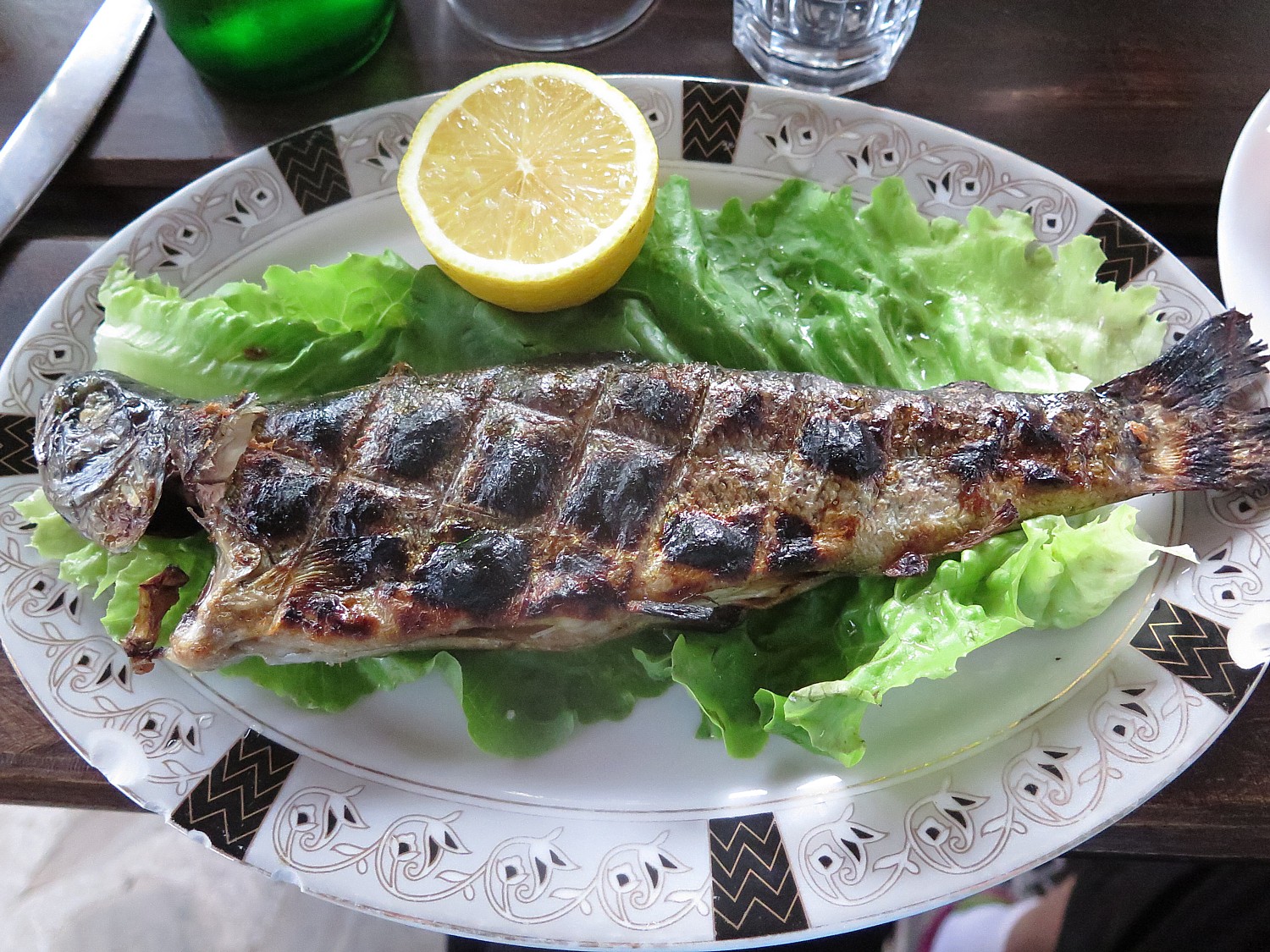
Fresh trout from the farm is served at the guesthouse at Sotire © 2016 Karen Rubin/news-photos-features.com

More surprises: how fantastic the food – literally fresh from farm or sea to table.  With 300 miles of seacoast (the Adriatic and the Ionian Sea where we bike), we are treated to an abundance of fresh fish—sea bass, mussels, shrimp, squid freshly caught from the sea, farmed trout that finds its way to our plate minutes after being netted, and a fish that is uniquely found in Lake Ohrid. The abundant farms – which use organic practices – make farm-to-table meats—especially lamb and pork— as well as fruit and vegetables plentiful. Albanian cooking blends Mediterranean cuisine with Greek, Italian and Turkish influences; seasoning is mostly subtle – garlic and chili peppers – flavorful but not too spicy.

And water! Albania is rich in water which flows from the mountain tops – we fill our bottles from eternally flowing fountains. Some 70% of the country’s electricity is generated from hydroelectric power. Every structure uses solar panels to generate hot water.

Another surprise: while few older people speak English, most of the younger generation takes English in school, and seem very plugged into the rest of the world. And they seem to be very welcoming to Americans – indeed, they named a street in Tirana, the capital, for George W Bush after he became the first sitting American president to visit Albania, and only the day before we arrived in the country, a bust of Hillary Clinton was unveiled in Saranda. People are very welcoming to us, as well, when they learn we are Americans, and many Albanians have relatives in the US.

Everything about Albania is surprising. I knew nothing about this country before I arrived (as I expect is typical of most Americans) – I didn’t even know what city to fly into (Tirana, the capital, where almost 1 million of the 3.5 million Albanians live.)

Albania is so unexpected: how fun-loving and friendly people are, how immaculate the farms and how delicious the fresh produce (organic!) we eat at each meal, how picturesque the mountains (70% of the country), how the fresh water springs just flow, we just fill our water bottles from the rushing fountains; how lush the country is, how easy-going the people are, how scantily clad beachgoers are, how women wear tight, short, revealing dresses and men wear (sometimes) t-shirts with in-your-face slogans,  and tattoos, how loving fathers are, how doting parents are of their children, how women seem to enjoy an equal relationship with their men. It is a majority-Muslim country that is secular, and tolerant; there are enormous Christian crosses dotting the countryside. How fascinating archeological sites like Butrint National Park, a UNESCO-protected city that extends back to Hellenic and Roman times (one of the most fascinating archeological sites I have ever experienced), and the UNESCO-protected Lake Ohrid area.

Other surprises we discover on our ride: Mother Teresa was Albanian (the international airport in Tirana is named for her), as was the scientist who found the drug that became Viagra (he was looking for a remedy for cardiovascular disease).

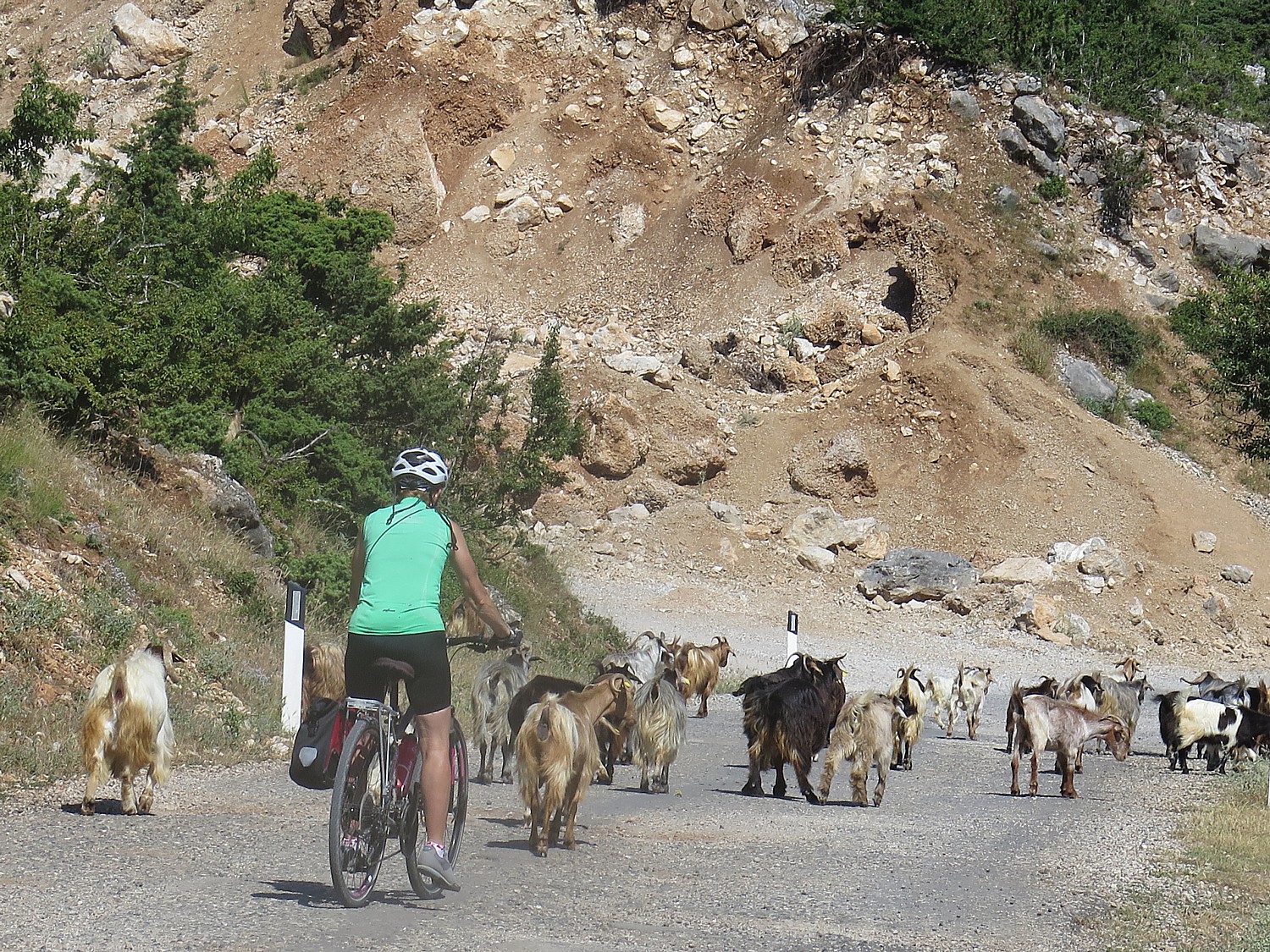
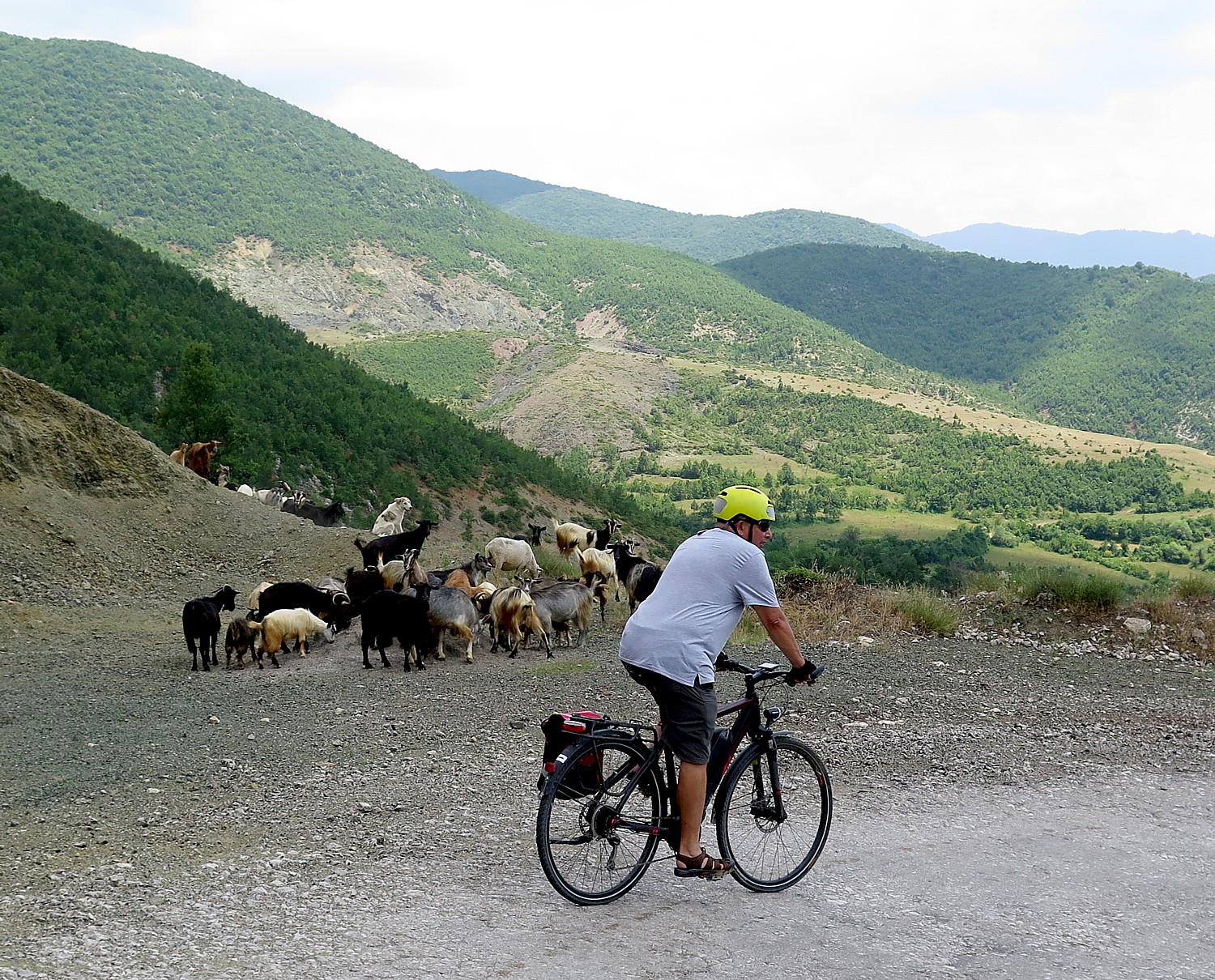
Sharing the road with a herd of goats © 2016 Karen Rubin/news-photos-features.com

And the best way to engage, to discover Albania is by bike. Cars, buses would never come to these places – these back country roads, roads that have been bypassed by more recently constructed highways. They would go too fast to get any sense at all of moments that, on a bike, you can snatch up and savor, without the distorted unreality looking through glass windows. But from the perch of a bike saddle, you move at just the right pace, hear the sounds of cows mooing, the bleating of sheep; the bells attached to goats; have to sidestep goats or cows or donkeys walking on the road. You can smell the wild sage growing beside the road, and feel the moist coolness as you ride through the forest. We wave and say a cheery “hello” as we pass, and people wave back. You can stop – even chat- with a shepherd, or take the time to gaze and a scene and capture serendipity in a photo. Such was the experience of stopping to watch a funeral procession, a ritual of walking a goat around St. Naum monastery in advance of the annual feast day to honor the saint, kids frolicking on the Lake, a bride and groom posing for their wedding photos.

Each day is marked by very different landscapes, different tableaux – geographical and social – and distinctive experiences. You never know what you will see beyond the next turn in the road.

Here is another surprise: we are oddities as we ride through. Not because we are foreigners (it isn’t obvious that we are Americans), but because we are on bikes at all.

BikeTours,com

This was my third trip with BikeTours.com – which is not the bike tour operator but a broker that has assembled a catalog of local travel companies. They’ve done the search and checked out and selected top-notch companies to feature.

These are operators that supply the best bikes, itineraries, accommodations, meals, attractions at an excellent value (ie. about $150 a day, depending on choice of accommodations, and destination – or roughly half of what other tour operators charge).

BikeTours.com also provides superb pre-trip materials, coordinates the airport transfer, and if necessary, will steer you to a travel agent to book the air.

The self-guided Danube Bike Trail trip which I did with my two adult sons – charming bed and breakfast inn, accommodations, detailed directions, the guide spent 2 hours with us making sure the bikes fit and going over the route, suggesting places to visit.

The bike/boat trip through the Greek Isles was superb – great bikes fabulous guides, wonderful boat (wood hull, reminded me of a pirate ship), a fantastic itinerary.

Biketours.com’s president Jim Johnson riding his e-bike past a herd of goats © 2016 Karen Rubin/news-photos-features.com

This trip to Albania, a specially tailored “President’s Tour” (tacking on a couple of days kayaking in the Ionian Sea and a loop around Lake Ohrid into Macedonia) is a guided trip, and included three meals daily (so much food we had to tell our guide to order less); admissions to attractions, superb bikes (hydraulic brakes, suspension, 30-gears on the hybrids, or, in my case, e-bike that gave me super powers for climbing hills), supported with a van that followed behind us, and charming, comfortable accommodations (WiFi!) – like a guesthouse on a farm and a luxury boutique city hotel.

There are still some scheduled departures left this year for “Albania’s UNESCO Sites with Rivers, Valleys, and Gorges ,” 9 nights, Level 4, averaging 37 miles/day (950E or about $1050) (www.biketours.com/albania/albania-UNESCO-tour).

BikeTours.com 1-877-462-2423 or 423-756-8907, 1222 Tremont St., Suite 100, Chattanooga, TN 37405, biketours.com.

(More to come: Day by Day Biking in Albania)

____________________

© 2016 Travel Features Syndicate, a division of Workstyles, Inc. All rights reserved. Visit goingplacesfarandnear.com and travelwritersmagazine.com/TravelFeaturesSyndicate/. Blogging at goingplacesnearandfar.wordpress.com and moralcompasstravel.info. Send comments or questions to FamTravLtr@aol.com. Tweet @TravelFeatures. ‘Like’ us at facebook.com/NewsPhotoFeatures