Tag Archives: biking trips

Unexpected Delights in Hanoi on Discovery Bicycle Tours’ 12-Day Vietnam Trip

Train Street is as colorful as it is thrilling an experience in Hanoi © Karen Rubin/goingplacesfarandnear.com
 

By Karen Rubin, Travel Features Syndicate, goingplacesfarandnear.com

Discovery Bicycle Tours’ Biking Vietnam tour is designed along the best principles of travel: to explore, discover, learn, make connections, be present, experiential, meaningful and revelatory, and do it in a way that maximizes the benefits and minimizing the negative impacts of tourism.

Taking a traditional boat ride into the Thung Nham bird sanctuary © Karen Rubin/goingplacesfarandnear.com

Of the 12 days we spend in Vietnam, traveling from north, to central, to south (flying between regions), we bike on six of them. That might seem odd for a biking tour, but you don’t travel 30 hours to Vietnam and miss the important highlights, like Ho Chi Minh’s mausoleum in Hanoi, taking a traditional row boat through the caves of Ninh Binh; cruising overnight on the Ha Long Bay; discovering the Citadel and Imperial City of Hue; walking the colorful markets and enjoying the nightlife of Hoi An; or touring the War Remnants Museum, the historic Ben Thanh Market, or miss the experience of street food in Saigon (Ho Chi Minh City) because you are obsessive about biking. We get to do all of these, and also bike through villages, stopping to learn about traditional crafts, and amid the rice paddies to learn about Vietnam’s 4000-year old wet rice culture and ancestor worship.

Riding the bus between destinations affords an opportunity to see vietnam’s countryside © Karen Rubin/goingplacesfarandnear.com

Riding in the bus between destinations lets us see the countryside (and I have set myself a challenge to get photos of people working in the fields and four people riding a motor scooter); the way the homes are laid out, the ancestral tombs in the fields, the occasional tractor, the massive, new industrial parks under construction. You see progress unfolding at the speed of the bus, all the more impressive when you realize what a young country Vietnam is, having proclaimed independence in 1945 but only “reunified” in 1975.

A family poses in traditional dress for formal photograph during the month-long Lunar New Year celebration © Karen Rubin/goingplacesfarandnear.com

The essence of this tour is about familiarizing us with the Vietnamese people (who, we learn, are a mosaic of 54 different tribes), the rich cultural heritage and today’s achievements in overcoming literally millennia of conflict, war, oppression, colonialism. When we bike, hike or walk, we barely have to think a question, let along ask it, before our guide, Nguyen Hong Phong, stops and answers. “This is normal for me, curious for you,” he tells us at the outset, as we sit for tea in the Apricot Hotel on our first afternoon together in Hanoi. “When you are curious, just ask,” he adds.

A government building in Hanoi. Political symbols are less prominent than would be expected, while motorscooters and Starbucks and KFCs are ubiquitous © Karen Rubin/goingplacesfarandnear.com

2025 marks the 50th anniversary since the Fall of Saigon that so abruptly ended an interminable war (and reunification as an independent country). You can’t escape the fact of the “American War” (which frankly was the tail end of a decades long war for independence before the United States interceded), but our tour seems to sidestep the past in favor of the present. This is probably a reflection of Discovery Bicycle Tours’ primary focus for its guests: “You’re on vacation!”

(There are several important sites that are not included in this tour that I would recommend setting up pre and post days: the Hoa Lo Prison in Hanoi, infamously known as “Hanoi Hilton” and the Chi Chi Tunnels which is an excursion from Saigon. Even the War Remnants Museum, a must-see in Ho Chi Minh City, was not on the itinerary but we visit when we could not visit the Reunification Palace as planned.)

Ho Chi Minh’s last residence, where he lived from 1968 to 1969 when he died is camouflaged and connected to escape tunnels © Karen Rubin/goingplacesfarandnear.com

Still, there is no escaping the past: in Hanoi when we visit Ho Chi Minh’s 1968 residence, built like a camouflaged bunker with escape tunnels and learn they moved his body regularly when he died in 1969; when we visit the John McCain Monument where the American hero’s plane went down and he was captured; when we see the bullet holes in the Citadel in Hue and are shown photos of fighting that took place on the very spot where we stand; and when we visit My Son, a sacred historic site outside of Saigon, and learn that the Vietnamese appealed to President Nixon to stop bombing. I think Americans who visit Vietnam have an obligation to see what was done in our name, especially because it is so important to learn from history so not to make the same mistakes, and not be duped by an administration determined to go to war for its own political agenda.

Our Discovery Bicycle Tours group gets to learn how to make rice paper during our ride in Hoi An. Americans are warmly welcomed in Vietnam and have opportunities to visit people where they live © Karen Rubin/goingplacesfarandnear.com

I frankly didn’t know how I would react coming to Vietnam – I am the generation that lived through the Vietnam War (known here as “The American War”), or how Americans would be received. My questions are soon answered – the Vietnamese warmly welcome  us Americans (and French and Chinese and a list of nationalities that have oppressed Vietnam).  Vietnam is nothing like what I expected – in a good way. It’s in this capacity that one of the important attributes of travel come to fore:  we travelers are ambassadors, promoting mutual understanding and connection.

Celebrating a birthday in Hue, Vietnam. What a difference peace makes © Karen Rubin/goingplacesfarandnear.com

In Vietnam today, you can see the impact of peace, free markets, free enterprise have to achieve prosperity – a lesson to all those who are inciting conflict and war. You see the benefits of trade and globalization – a lesson for those who would disrupt and unravel alliances and build barriers instead of bridges.

Old Hanoi

Since our group is first meeting together at 1 pm for a walking tour, I have the morning to myself to explore. I walk across the street from our luxury hotel, The Apricot, to the park that rings the small, picturesque lake.

A woman poses in traditional dress for formal photograph during the Lunar New Year celebration in Hanoi © Karen Rubin/goingplacesfarandnear.com

We are here during the month-long Lunar New Year celebration, made even more festive because of the 50th anniversary of reunification – everywhere that is possible has decorations reminiscent of how we celebrate Christmas. People dress in their formal, traditional costumes and pose for photos taken by professional photographers. People travel on holiday. There is a festive atmosphere everywhere.

There are political symbols, posters, flags and such but no more than the giant advertising billboards and the Starbucks, KFCs, McDonalds, Burger Kings. Also, I am flabbergasted at the proliferation of motorscooters and the paucity of bicycles. Crossing any street takes fortitude and a measure of fatalism, but where there are traffic signals, the systems are sophisticated and effective. Also, cell phones are ubiquitous.

The proliferation of motorscooters in mind-boggling © Karen Rubin/goingplacesfarandnear.com

I head into the Old Quarter where I am intrigued at the “old propaganda posters” shops, the coffee shops (who knew Vietnam was such a major producer and exporter of coffee?), and massage parlors as common as nail salons at home.

The Propaganda Poster Shop seems more to satisfy the American and European tourists who visit (“Make Art Not War”).

But here at the Propaganda Poster Shop I happen to see many postcards for Train Street (reminding me of Lisbon) which suggests it is an important site and inspires me to go in search of this place.

Old Propaganda Posters shop © Karen Rubin/goingplacesfarandnear.com

After getting lost (my WiFi isn’t working and I can’t figure out the map) and stopping numerous people to point me in the right direction, I look up and am drawn to colorful lanterns, walk up a staircase and find myself quite literally on the train tracks. Train Street!

Train Street is as colorful as it is thrilling an experience in Hanoi © Karen Rubin/goingplacesfarandnear.com

People have set themselves at café tables and chairs and are even hanging out on the tracks taking photos. It is all the more amazing because it turns out it is just 5 minutes before the train is due (and I am so lucky because only a few trains come through a day). With 5 minutes to go, there is even a baby playing on the track!

Train Street is as colorful as it is thrilling an experience in Hanoi © Karen Rubin/goingplacesfarandnear.com

I am standing alongside the track and a lady yells at me to sit down in one of the plastic chairs, like a kid’s chair. As the train comes tearing through at what seems a very fast speed, it is so close that had I held out my hand, it would have been taken off. I reflexively suck in my breath and try to make myself as small as possible until it passes. Unbelievably thrilling.

Train Street is as colorful as it is thrilling an experience in Hanoi © Karen Rubin/goingplacesfarandnear.com

I feel proud of myself for being able to find my way back to the hotel by 1 pm in time to meet our Discovery Bicycle group for our first activity together, a walking tour of the Old District. I have already been traveling with 8 of the group for Discovery Bicycle’s four-day Cambodia pre-tour and now we meet the other 10.

Phong leads us to the St. John Cathedral, the oldest church in Hanoi. Built on the site of the biggest, most sacred Buddhist pagodas of the Ly-Tran Dynasties, the cathedral was constructed at the end of the 18th century of wood, then reconstructed with baked clay in 1884-1888. Phong tells us that Catholics are a minority; the biggest religion in Vietnam, he says, is “triple religion” – a mix of Buddhism, Confucianism and Taoism (ancestor worship).We will see evidence of this everywhere we go.

St. John Cathedral in Hanoi. © Karen Rubin/goingplacesfarandnear.com

Phong volunteers that the Communist government “allows free religious worship and free press” (though I question what he means by “free press”), then adds that protest against the Communist Party is not allowed; nor is there an opposition candidate in elections. Vietnam has been a one-party government since 1954, but in 1986 introduced new freedom in commerce and open markets.

“We have more freedom than in China. They block media there, here they block the BBC but we can get CNN.” Whatever they block, he says, people get curious and have their ways of accessing.

Walking through Old Hanoi © Karen Rubin/goingplacesfarandnear.com

“Society is improving for ordinary people. Since 1988, we are living in peace. We feel more freedom, a peaceful country. We are now friends with Russia, Ukraine, the European Union. The USA is one of seven strongest friends. Peace is good for people, good for the country. [Tourists want to] come to a peaceful country.”

Phong tells us he learned English (as well as French and Chinese) at university where he studied tourism, but today, children are taught English as early as 3 and 4 years old in school. Public school is free he tells us, even in the mountains where parents are actually given a money incentive to send their kids to school.

Tin Street in Old Hanoi © Karen Rubin/goingplacesfarandnear.com

We walk through Hanoi’s Old Quarter where the name of the street may well describe what enterprises take place there, established generations ago by the people who resettled in the city: Tin Street, Silver Street, Basket Street, Copper Street.

We return at 3 pm for tea at the Apricot Hotel – an elaborate affair – that includes an introduction and orientation to our 12-day tour (with biking!) with Phong as our lead guide.. Indeed, we will go first thing the next morning to get sized for our rental bikes which we will use for five of the days (the driver and bike mechanic who travels will us will travel 2 ½ days to Hue, when we fly), and will pick up a different bike in Ho Chi Minh City (way too far to drive and return).

I realize that we have just enough time to see the 5:15 pm traditional Water Puppet Theater cultural show just across the street from the hotel, before we meet again to go to dinner.

I had seen this heritage show when I was in Ho Chi Minh City six years before, so was enthusiastic to see it here, and encourage my traveling companions to come.

Water Puppets Theater is a delightful cultural show © Karen Rubin/goingplacesfarandnear.com

Most of our group from the four-day Cambodia pre-tour (we really bonded) are game and we actually purchase the last tickets for this immensely popular program. The show is a cultural treasure that utilizes this traditional art form, with musicians performing with traditional musical instruments and song, fables and folk stories enacted by these marvelous puppeteers  (yes, the puppets are in a pool of water!).

Water Puppets Theater is a delightful cultural show © Karen Rubin/goingplacesfarandnear.com

Captions and notes about the theater and the scenes are flashed on the walls beside the stage. Vietnam water puppetry, I learn, was born from the rice civilization in the Red River Delta, so agriculture is vividly depicted by the puppets, with farmers and familiar images such as riding buffalo, plowing, harrowing, transplanting rice, slapping water, harvesting. (Later, when we bike among the rice paddies, we will see how this tradition originated.)

Water Puppets Theater has its origins in rural rice production © Karen Rubin/goingplacesfarandnear.com

One of the scenes enacts “The Legend of Returning the Sword by King Le Loi” where LeLoi caught a holy sword by chance as he led the resistance war. After defeating the invaders, he proclaimed himself king. King Le Li goes out boating on the Green Water Lake, when suddenly a large turtle surfaced, took the sword from King Le Loi’s belt, and dived back into the depths, carrying the glowing sword in his mouth. (This is all enacted with puppets in the water).

Water Puppets Theater is a delightful cultural show © Karen Rubin/goingplacesfarandnear.com

The humor that is integral to the culture is displayed where the puppets enact an old farmer “Chasing fox away from the flock of ducks”. “It creates Vietnamese optimistic farmers,” the notes say.

Water Puppets Theater is a delightful cultural show © Karen Rubin/goingplacesfarandnear.com

The notes for “The Spirit Mediums Spiritual Dance,” say that “Vietnam’s Mother Goddess worship has been honored by UNESCO as an intangible cultural heritage of humanity. In today’s life, Mother Goddess worship is mainly known to the community through the concept of ‘The Spirit Mediums’. Traditional cultural elements such as costumes, music, dance and folk performances imbued with Vietnamese cultural identity are created, developed and passed on from generation to generation.”

The ”Four Sacred Animals Dance” brings together Long, Ly, Quy and Phuong (Dragon, Unicorn, Tortoise, Phoenix) “praising the nature of heaven and earth, hoping for a peaceful state and a peaceful and happy life.”

Water Puppets Theater puppeteers come out for their curtain call © Karen Rubin/goingplacesfarandnear.com

There are fire effects and of course water effects and amazing choreography – you actually cannot figure out how the puppeteers coordinate so well (and underwater!) – and then the puppeteers appear for their curtain call, up to their waist in water.

The show finishes just in time for us to walk together to dinner in a charming restaurant in the Old District.

A delightful restaurant in Hanoi’s old district © Karen Rubin/goingplacesfarandnear.com

A note on the table about the apple cider makes us giggle: “Cider drinkers get more refreshment and excitement while still keeping their sanity. Especially suitable for women.”

Our lunches and dinners at restaurants are typically pre-ordered and served family style, with multiple courses so that we typically have chicken, beef, seafood, vegetable, rice, soup dishes – always with more than enough to satisfy even American appetites, and to get a really excellent idea of the cuisine.

Our Discovery Bicycle Tours guide Calista Phillips and Jake can’t resist purchasing these hats at the night market © Karen Rubin/goingplacesfarandnear.com

We walk back to the Apricot Hotel through the bustling night markets that take over the streets, brightly and colorfully lit.

The Apricot Hotel is a five-star luxury hotel set just across from the picturesque park and lake © Karen Rubin/goingplacesfarandnear.com

Exploring the Apricot Hotel (we will be leaving early in the morning after breakfast), we discover an exquisite rooftop indoor pool and bar with a giant video screen. The artwork around the hotel, the elegant (French-inspired) furnishings are gorgeous.

Discovery Bicycle Tours, 2520 W. Woodstock Rd., Woodstock, VT 05091, 800-257-2226, 802- 457-3553, info@discoverybicycletours.com, www.discoverybicycletours.com.

Next: Ho Chi Minh Mausoleum and Ninh Binh Bird Sanctuary

__________________

© 2025 Travel Features Syndicate, a division of Workstyles, Inc. All rights reserved. Visit goingplacesfarandnear.com and travelwritersmagazine.com/TravelFeaturesSyndicate/. Blogging at goingplacesnearandfar.wordpress.com and moralcompasstravel.info. Visit instagram.com/going_places_far_and_near and instagram.com/bigbackpacktraveler/ Send comments or questions to FamTravLtr@aol.com. Bluesky: @newsphotosfeatures.bsky.social X: @TravelFeatures Threads: @news_and_photo_features ‘Like’ us at facebook.com/NewsPhotoFeatures

Boat Bike Tours’ Netherlands Islandhopping: Exploring the Solar System through an 18th Century Lens

The marvelous Eise Eisinga Planetarium, the world’s oldest continuously operating planetarium in the world, dating from 1781, in Franeker visited on Day 6 of Boat Bike Tours’ eight-day Islandhopping tour of northern Netherlands. © Karen Rubin/goingplacesfarandnear.com

By Karen Rubin, Travel Features Syndicate, goingplacesfarandnear.com

Day 6 on Boat Bike Tours’ eight-day Islandhopping tour of northern Netherlands is a case when the hype doesn’t even begin to match the reality of the experience. Today’s ride will take us either 29 or 36 miles (depending on our choice of short or long routes) from Harlingen to Franeker, through the Frisian countryside and rural villages to Bolsward and into Makkum on the eastern bank of lake Ijsselmeer. Boat Bike Tours doesn’t just curate the cycling routes, they also curate experiences. In this case, our bike tour turns into an exploration of the solar system through an 18th century lens.

The marvelous Eise Eisinga Planetarium, the world’s oldest continuously operating planetarium in the world, dating from 1781, in Franeker, was built by the amateur astronomer in his house, now a UNESCO World Heritage site © Karen Rubin/goingplacesfarandnear.com

We set out biking first to the historic center of Franeker to visit the Koninklijk Eise Eisinga Planetarium (Royal Eise Eisinga Planetarium) – the oldest continuously operating planetarium in the world and a UNESCO World Heritage site. I had never heard of Eise Eisinga or his planetarium, but am instantly amazed.

Eise Eisinga was a wool-comber and largely self-taught scientist and astronomer who spent seven years, from 1774 to 1781, crafting his planetarium in his house © Karen Rubin/goingplacesfarandnear.com

Eise Eisinga was a wool-comber and largely self-taught scientist and astronomer who spent seven years, from 1774 to 1781, building a remarkable planetarium in his house! – in his living room/bedroom/dining room to be precise. We see the cupboard where he would have slept with his wife under the mechanism, the pull-out trundle bed where his children would have slept, the dining table. Above, on the ceiling, we see where he constructed a solar system where the six known planets in exact scale follow their rotation around the sun with remarkable precision even by today’s standards, using today’s instruments. The fact that the mechanism is still in working order is evidence of the ingenuity and foresight of its maker, who left detailed instructions for its maintenance.

See exhibits of early astronomical devices at the Eise Eisinga Planetarium in Franeker © Karen Rubin/goingplacesfarandnear.com

While waiting for the English-language presentation, we visit the fascinating exhibits that take up the rest of his home, starting with a delightful video interview between “Eise Eisinga” and an actual Dutch astronaut and another superb video about Eisinga’s life.

When I learn about Eise Eisinga’s biography, I am awed by his genius, bringing to my mind Leonardo DaVinci.

Eise Eisinga was born in 1744 in Dronrijp where he attended primary school. Like many children in those days who worked at home, he worked in his father’s wool combing establishment. In addition to his father’s profession, he inherited his father’s interest in astronomy and mathematics. Eise was so determined to learn that he would travel every week to Franeker, a major center of learning, to study Euclidean math with Willem Wijtses, a wool dyer. When he was 24, Eisinga married Pietje Jacobs and settled in Franeker in 1768, working as a wool comber.

On May 8, 1774,a local newspaper published a prediction from a preacher that the confluence of Mercury, Venus, Mars and Jupiter and the moon would result in the mutual forces of these celestial bodies knocking the earth off its path and cause it to be burned up by the sun (“the end of time!”). That set off a panic and seems to have been an impetus for Eisinga to begin building his model of the solar system to show the extreme unlikelihood of planets colliding.

The fascinating planetarium that Eise Eisinga built in his bedroom/dining room © Karen Rubin/goingplacesfarandnear.com

It took Eisinga seven years to construct his planetarium – a real triumph of craftsmanship to carve the wood (his father, a woodcarver, helped), create 6,000 precision nails for the cogs, and the exquisite painting. Eise would have finished sooner, but in a critical development, he had to adjust the placement of the pendulum that kept everything in motion, because his wife drew the line on allowing him to cut a hole in the floor (it was their bedroom, after all), so he had to recalculate everything and replace all 6,000 nails.

The power (and motion) for the entire mechanism comes from a clock, “like the beating heart of the machine,” our guide explains. The mechanism is powered by a system of nine weights – one for clock and 8 for different axels of system

All is built to scale to fit into the space – an astonishing 1 to 1 trillion – and everything is turning so slowly, you can’t detect motion visually. Every planet has its own calculated speed, so Mercury takes 88 days to make one full rotation; Venus takes 224 days; Earth takes 365 days plus 76 hours while the moon takes 29 ½ days to go around the earth (it shows the phases of the moon); Mars takes 687 days; Jupiter, with four moons (the number known at the time), takes 11 years, 315 ⅓ days for its rotation; and Saturn, the furthest known planet at the time, actually has rings and 5 moons and takes 29 years plus 164 days for its rotation.

The marvelous Eise Eisinga Planetarium, the world’s oldest continuously operating planetarium in the world, dating from 1781, in Franeker visited on Day 6 of Boat Bike Tours’ eight-day Islandhopping tour of northern Netherlands. © Karen Rubin/goingplacesfarandnear.com

How do they know the planetarium is still working when everything moves so slowly?

“Everything is connected, so we check what moves daily: the date, zodiac sign, day of week.” On December 31, a special nail pushes the gears into motion to flip to the new year.

Eise Eisinga was such a visionary, two years after finishing his remarkable machine, he wrote a 90-page manual explaining how to maintain it.

“Every 22 years, we follow 5 steps – take board down, sand down, paint the years, let the paint dry, then replace it in the attic,” our guide says. The wheels are so big and move so slowly, they clean the gears once or twice a year.

Eisinga’s son took over when he died, and the planetarium remained in the family for 140 years until 1922 when his great granddaughter was the last in the family to maintain the planetarium. Then the City of Franeker took over its management.

Most of the mechanism is original (Mercury had to be replaced after being damaged in World War II) but they have had to change the ropes for the gears and pulleys.

After the presentation, we are able to climb the stairs to the attic to peer into where the wheels and gears are laid out.

We are able to climb up to the attic to see the gears that run Eise Eisinga’s fascinating planetarium © Karen Rubin/goingplacesfarandnear.com

Eisinga came to Franeker with his wife because it had the second largest university in the country and was a center for learning that drew famous scientists. But you can appreciate how trade with the world not only gave Netherlands the wealth to pursue science and innovation, but the access to and transfer of knowledge, not to mention a culture of Enlightenment that was open to new ideas and discovery. And Eise Eisinga was wealthy enough that he could afford to make natural science a hobby.

It is a humbling experience to imagine such expertise and craft hundreds of years ago, before the tools and instruments we have today.

See exhibits of early astronomical devices at the Eise Eisinga Planetarium in Franeker © Karen Rubin/goingplacesfarandnear.com

The museum offers several permanent exhibits: Eisinga’s former wool combing establishment, an extensive collection of historical astronomical instruments, Eisinga’s mathematical and astronomical manuscripts which you can digitally peruse, all marvelous juxtapositions to an interactive permanent exhibition, De Ruimte (Space) that opened in 2016, as well as that delightful video conversation between “Eise” and a modern-day Dutch astronaut (English subtitles).

Some of Eise Eisinga’s manuscripts are on view at the Eise Eisinga Planetarium in Franeker © Karen Rubin/goingplacesfarandnear.com

I peek into a room to see the finishing touches on a new temporary exhibit: a spectacular astronomical cabinet from 1771 by Jean Paulus and Prof. Ghiesbregt. “After long wanderings, this Belgian instrument came into possession of Bert Degenaar, a famous Dutch antique collector. On his behalf, the instruments were completely restored and made functional again by horologist Pieter de Ruiter. The 3 meter wide and over 2.5 meter high cabinet is equipped with various globes, planetariums (including an unprecedented representation of the 5th-century worldview of Martianus Capella) and the 16th-century heliocentric worldview of Copernicus. A number of dials provide information about various time indications, calendars, the position of the planets, the phases of the moon, and the orbit of Jupiter’s four largest moons.” The exposition also includes a large collection of original drawings of the various instruments. 

Finishing setting up the new temporary exhibit at the Eise Eisinga Planetarium in Franeker: a spectacular astronomical cabinet from 1771 by Jean Paulus and Prof. Ghiesbregt © Karen Rubin/goingplacesfarandnear.com

All of this goes to serve as a literal display of what The Enlightenment was all about, which largely due to mass printing and trade, made its way to the New World, as well, and was foundational to the Founders of the United States.

Admission to Eise Eisinga’s planetarium is 6E (a HUGE bargain).

Eise Eisingastraat 3, 8801 KE Franeker, phone +31 (0) 517–393 070, info@eisinga-planetarium.nl, https://www.eisinga-planetarium.nl/en/plan-your-visit/, https://www.eisinga-planetarium.nl/en/the-planetarium/

Thankfully, we have enough time to appreciate what’s here at the planetarium (this is important), though I could easily have spent another hour.

The scene along our bike route from Franeker to Makkum on our Boat Bike Tours’ Netherlands Islandhopping tour © Karen Rubin/goingplacesfarandnear.com

We continue on our 36-mile bike route which follows much of the a famous 11-city, 200-km bike tour, and in the course of two days, we will visit six of the 11 and have the opportunity to collect stamps (like passport stamps) on postcards our guides have provided.

The scene along our bike route from Franeker to Makkum on our Boat Bike Tours’ Netherlands Islandhopping tour © Karen Rubin/goingplacesfarandnear.com

By the time we ride into Bolsward, one of the Eleven Frisian Cities, the rain has stopped. Here we see one of the art installations we have been told about – this one looks like Toothless from “How to Train Your Dragon.”.

The magnificently decorated Court of Justice Building in Bolsward © Karen Rubin/goingplacesfarandnear.com

Bolsward is really beautiful, and I am entranced by the magnificence of The Court of Justice building, now a museum, where I get to climb into the tower built on top of the Court in 1617 (a really improbable and unsafe construction).

You can climb into the tower of the Court of Justice Building in Bolsward © Karen Rubin/goingplacesfarandnear.com

But this is the first day when I see why people would get an e-bike in the Netherlands – I’m guessing I am pushing through or against 15 mph winds.

In the evening, our guide, Edith, leads a walking tour of Makkum– it’s just me and a couple from Alberta, Canada. Edith points to homes that have a Coat of Arms or some indication of who lived there, when the fellow shows us his ring with a Coat of Arms. He turns out to be a descendent of the Trip family, one of the wealthiest, most powerful families in Netherlands.

He relates more of his family’s fascinating story as we sit in a historic pub with centuries old Delpht tiles of great 17th century trading ships, noting more than once than the family fortune had been long gone and his branch of the family emigrated to Canada. It’s like having someone from that time tell their story.

Trip shows me his coat of arms as we walk around Makkum, and tells the story of his family, one of the richest and most powerful in Netherlands  © Karen Rubin/goingplacesfarandnear.com

Trip’s family’s coat of arms, he relates, has three zoltbommel (wooden shoes) – a nod to the fact that the family started by manufacturing wooden shoes.

Then, brothers Jacob and Elias Trip went into river barges, got rich, then expanded into sea trade. They had a connection with an iron factory which they parlayed into weapons manufacture, arming the Dutch rebels against the Spanish in its 80-year war for independence, 1568-1648 (apparently selling arms to both sides).

Tiles in a historic pub depict trading ships very likely belonging to the Dutch East India Company© Karen Rubin/goingplacesfarandnear.com

Trip was among the original investors of the Dutch East India Company (Verenigde Oost-indische Compagnie, VOC), in 1602, the first public company to issue stock and the first truly multinational corporation, transforming global commerce and trade (at its peak, the company would have been worth $7 trillion in today’s dollars, the most valuable company in history). The VOC was granted a monopoly on Dutch trade with Asia and also possessed the power to wage war, make treaties, govern territories, and even mint its own currency, as if a nation-state. So much of what we experience on our trip goes back to the Dutch East India Company.

Meanwhile, the Trips became one of the richest and most important families in Netherlands. Portraits painted by Rembrandt of his relatives Jacob Trip (1576-1661) and his wife, Margaretha de Geer, are in the National Gallery and Ryksmuseum. Their sons, Louis and Hendrick Trip, became fabulously wealthy arms merchants, and built the Trippenhuis in 1662 once the widest residence in Amsterdam and on the list of top 100 Dutch heritage sites.

Tiles in a historic pub depict trading ships very likely belonging to the Dutch East India Company© Karen Rubin/goingplacesfarandnear.com

Edith adds that the Netherlands was one of the first republics in the world and makes the claim that its declaration of independence in 1581, provided a model for Thomas Jefferson in 1776, and was printed on paper from a Dutch paper mill.

“We are now a kingdom, but we started as a republic. Our constitution limits the power of king, our monarchy is more about public relations, like the United Kingdom.”

The first king of the Netherlands, Napoleon’s brother Louis who reigned from 1806-1810, started an art collection, which he brought to TrippenHuis – in essence the first Ryksmuseum. Trippenhuis was where Rembrandt’s “Night Watch: hung until 1851 and since 1887, has housed the Royal Netherlands Academy of Arts and Sciences. 

Returning to our ship, Leafde fan Fryslân, after our walking tour of Makkum as the sun sets © Karen Rubin/goingplacesfarandnear.com

Biking Makkum to Stavoren, Sailing to Enkhuizen  

Day 7’s ride takes us from Makkum to Stavoren, from where our ship, Leafde fan Fryslân, will sail across lake IJsselmeer to Enkhuizen, the endpoint of our trip. There is a prediction of rain today and strong wind, so the guides suggest I do the shorter ride (19 miles) and promise I won’t miss out on anything I will regret (the longer route, 30 miles, goes along several Frisian Lakes).

Coming upon a historic windmill, De Nylannermole, which the sign says dates from 1784, with a modern wind turbine in the distance,on our ride Makkum to Stavoren on Boat Bike Tours Netherlands Islandhopping tour © Karen Rubin/goingplacesfarandnear.com

Among the highlights of the ride are coming across a house deliberately built in an upside-down version of a traditional Frisian home (a bit surreal and you have to wonder), and a historic windmill, De Nylannermole, which the sign says dates from 1784, though its history goes back to 1624 (I’m trying to figure out the Dutch). At one point, I see the windmill with a wind turbine in the distance behind it, and later, we see windsurfers and sailboats – all reflections of how the Dutch have embraced wind.

The charming old city of Hindeloopen is a popular hub for cyclists © Karen Rubin/goingplacesfarandnear.com

We stop for lunch in a tiny little village as rain comes (we sit under umbrellas outside), and then continue on to Hindeloopen (where we should have cycled for lunch), an old trading town famous for a traditional decorative painting style. Hindeloopen seems to be the epicenter for cycling.

The charming old city of Hindeloopen is a popular hub for cyclists © Karen Rubin/goingplacesfarandnear.com

This is a very charming village, where I go to explore and find the Grotte Kerk, dating back to the Middle Ages. This building dates from 1632.

One image shows the importance of wind in the Netherlands: sailing ships, wind turbines, wind surfing © Karen Rubin/goingplacesfarandnear.com

As we finish our bike tour, we come across (actually riding through) a major, 150 km, bike race.

Riding through a 150 km cycling race on our way to Stavoren (a humbling experience) © Karen Rubin/goingplacesfarandnear.com

I finish the ride 1:15 pm, hoping I made the right choice in biking the shorter route, and have some time to explore Stavoren before we sail.

There is yet another one of the art installations (this one a giant fish), but I am particularly intrigued by the sculpture of “The Lady of Stavoren” here, and the moral to the story it offers.

“The Lady of Stavoren” legend dates from when the city was the largest and richest in Friesland. Many of the merchant ships were owned the Lady of Stavoren who ordered one of her captains to “Bring me the finest treasure in the world.” He brought back a grain that transformed into pure gold in the midday sun. She forced him to throw it into the sea. A fisherman foretold that she would be punished and at some point beg for grain. Later, two of her ships were lost at sea and she became a beggar woman, while the place where the grain was tossed turned into a sandbank, where a plant that grew ears of corn grew up but yielded no grain.

“The Lady of Stavoren” statue pays homage to a legend that dates from when the city was the largest and richest in Friesland. © Karen Rubin/goingplacesfarandnear.com

We have an enjoyable sail back to Enkhuizen, a gala farewell dinner, and then I go off to explore the historic town, which is really worth more time than I will have before I have to return to Schiphol Airport early the next day. (Suggestion: arrive the day before the ship sails to give yourself some time to enjoy Enkhuizen.)

More information, Boat Bike Tours, www.boatbiketours.com, 203-814-249.

Next: Zuiderzee Museum is Not to be Missed in Enkhuizen

See also:

SETTING SAIL ON BOAT BIKE TOURS’ ISLANDHOPPING TOUR TO THE WADDEN SEA

BOATBIKETOURS’ NETHERLANDS ISLANDHOPPING: THE TEXEL ROADS YIELDS UP ITS TREASURE

BOAT BIKE TOURS NETHERLANDS ISLANDHOPPING: SAILING THE WADDEN SEA, BIKING, EXPLORING TERSCHELLING, HARLINGEN

_____________________________

© 2025 Travel Features Syndicate, a division of Workstyles, Inc. All rights reserved. Visit goingplacesfarandnear.com and travelwritersmagazine.com/TravelFeaturesSyndicate/. Blogging at goingplacesnearandfar.wordpress.com and moralcompasstravel.info. Visit instagram.com/going_places_far_and_near and instagram.com/bigbackpacktraveler/ Send comments or questions to FamTravLtr@aol.com. Bluesky: @newsphotosfeatures.bsky.social X: @TravelFeatures Threads: @news_and_photo_feature

BoatBikeTours’ Netherlands Islandhopping: The Texel Roads Yields Up its Treasure

Watching the sun set behind the historic windmill that is the centerpiece of the Museum Kaap Skil in Oudeschild on the island of Texel from the top deck of our ship, Leafde fan Fryslân on Boat Bike Tours’Islandhopping trip  © Karen Rubin/goingplacesfarandnear.com
 

By Karen Rubin, Travel Features Syndicate, goingplacesfarandnear.com

Day 3 of Boat Bike Tours’ eight-day Islandhopping tour proves to be my favorite, most perfect day – the biking, the attractions, the scenery, the gestalt of the island of Texel, even the weather, all combining for a thrilling experience. We will be biking roundtrip from and back to Oudeschild with a choice of a 26 mile or 30 mile route. We soon discover the treasures harbored on The Texel Roads.

Biking on Texel on Boat Bike Tours’Islandhopping trip  © Karen Rubin/goingplacesfarandnear.com

We start off biking together to Ecomare, a seal sanctuary and ecology center with superb displays, exhibits and notes (with English) that teach about ecology, climate change, animal and environmental conservation, focused on the local area, making clear what these existential planetary changes mean for the people living here.

Whale skeletons on view at the Ecomare marine wildlife sanctuary and environmental center on Texel © Karen Rubin/goingplacesfarandnear.com

I start in the room with skeletons of actual whales – enormous, suspended so that they look like they are swimming – then move to an aquarium where you can see rescued seals swimming under water. You go outside to the various habitats where there are excellent explanations of why the seals were rescued (and the steps they take to avoid “rescuing” a seal that is merely resting on the beach), what their prognosis is to be re-released into the wild or whether some condition, like blindness, will require them to stay.

An underwater view of seals at the Ecomare marine wildlife sanctuary and environmental center on Texel © Karen Rubin/goingplacesfarandnear.com

We see areas where baby animals are nurtured, where medical procedures are conducted, where seal pups are raised until they can be released (I wonder how they learn how to hunt for themselves), and where animals are quarantined (the sign says it’s a good thing if this area is empty!). 

Two of the rescued seal pups at the Ecomare marine wildlife sanctuary and environmental center on Texel © Karen Rubin/goingplacesfarandnear.com

I go walking on the dunes and come upon a turf hut (“zoonekeet” or “zooien huus”) of one of dune farmers, named Pagga who lived here until 1909.

Checking out Pagga’s zoonekeet at the Ecomare marine wildlife sanctuary and environmental center on Texel © Karen Rubin/goingplacesfarandnear.com

Our stay is timed so we get to see a feeding, before heading out again.

I stick with my group doing the longer ride (41 km), until we reach a delightful town of Dun Berg, where there is a huge event going on with a military band and seniors in wheelchairs who have been gathered for the concert that turns out to be the May 20 celebration of Texel’s Independence (different from the Netherlands, because it marks the day they finally expelled the German occupiers).

Biking on Texel on Boat Bike Tours’ Islandhopping trip © Karen Rubin/goingplacesfarandnear.com

I spend about a half-hour wandering the lovely town center before breaking off on my own in order to arrive back in Oudeschild in time to visit the Museum Kaap Skil. I feel very brave but use the RideGPS to give me the route, even though I find myself double-checking that I have selected the right route to follow. Because it stays light so late (till nearly 9 pm), I figure even if I get lost, I can still get back during daylight.

The gorgeous landscape as you bike around Texel on Boat Bike Tours’ Islandhopping trip © Karen Rubin/goingplacesfarandnear.com

I find myself so delighted to be doing these 12 miles on my own – it is idyllic pastoral scenery that compels me to stop to take photos – then I ride through a couple of villages, then onto the path along the dyke with the ocean on one side and the high berm with sheep (who keep the grass shorn) on the other, that takes me right to the harbor and the ship.

The gorgeous landscape as you bike around Texel on Boat Bike Tours’ Islandhopping trip © Karen Rubin/goingplacesfarandnear.com

Discovering Museum Kaap Skil’s Treasure Trove

Museum Kaap Skil is a must-see on Texel during Boat Bike Tours’Islandhopping trip © Karen Rubin/goingplacesfarandnear.com

I make it back in under two hours, by 3:15 pm, with just enough time to really enjoy this astonishing Museum Kaap Skil (do not miss it!), in which the historic windmill, so prominent in the landscape, is the centerpiece.

I quickly drop my things in my cabin, then climb the stairs up and over the dyke, down below sea level to the village and the museum.

The historic windmill is the centerpiece of a living history village at Museum Kaap Skil in Oudeschild, just a short walk from where our ship is docked © Karen Rubin/goingplacesfarandnear.com

The museum has a small village of outdoor attractions including the historic windmill and a ship, Texelse Blazer, dated 1894, that is being restored, and authentically furnished cottages, beachcomber’s shed and smithy, gives you a realistic view of island life during the Netherlands’ Golden Age of Sail.

Museum Kaap Skil in Oudeschild on the island of Texel features a living-history village © Karen Rubin/goingplacesfarandnear.com

On Tuesdays and Thursday when volunteers dress in period clothes, you can watch wool being spun, fishnets being mended, ropemaking, and taste a smoked fish (tastiest smoked fish I’ve ever had), visit the grocery store and walk into homes furnished as they would have been.

Museum Kaap Skil in Oudeschild on the island of Texel features a living-history village © Karen Rubin/goingplacesfarandnear.com

I save the indoor exhibits in the modern museum for last (the outdoor village closes at 4 pm, the museum at 5 pm). These extraordinary exhibits of artifacts rescued from shipwrecks in the Wadden Sea that were so plentiful off this port – an indication of how important a port Texel was during the Golden Age of Sail – are a fitting climax to the visit.

I start on the upper floor, in “World Voyage,” where you can follow specific ships to their destination and see artifacts obtained from them.. A centrally located compass shows the way and Texel folk from the past tell their stories, assisted by shipwreck finds. People such as Albert Gronders, who sailed the Baltic Sea yearly to buy grain in the 17th century, narrates the north shipping. about Baltic Sea shipping. If you go east, then Jacob Schagen, who, as a 15-year-old Texel man, sailed for the Far East aboard the VOC ship De Jonge Lieve in 1762, narrates about the eastern shipping routes.  Texel folk from the past also tell their stories about journeys west and southbound.

Knowing which ship these artifacts came from adds so much to the story at Museum Kaap Skil in Oudeschild on the island of Texel © Karen Rubin/goingplacesfarandnear.com

Alongside the adventurous and positive aspects of seventeenth century trade for Texel, World Voyage also explores its “shadow sides:”  “Adventure, wealth, trade and romance, but also exploitation, danger, slavery and poverty. Global trade in the 16th and 17th century knew many faces,” reads a self-aware note.

A section themed “A Complex History,” acknowledges the violence, greed and role in the slave trade that enabled Holland’s seafaring empire. Among the artifacts displayed are tools destined for  slaves to use on a sugar plantation in Suriname alongside luxury objects meant to guarantee the plantation owners a comfortable life, salvaged from a ship that sunk near Texel, never having reached the destination.

The displays are sensational, with many having interactive elements (the notes in English are much appreciated:  I also enjoy reading about “The Women Who Stayed Behind”.

The stellar attraction in Museum Kaap Skil is a 17th century silk dress “of royal allure,” salvaged from a shipwreck at the bottom of the Wadden Sea. “Every find from the Palmwood Wreck is important, but the dress has been dubbed “the ‘Nightwatch’ of the textile world.” © Karen Rubin/goingplacesfarandnear.com

The stellar attraction in Museum Kaap Skil is a 17th century silk dress “of royal allure,” salvaged from a shipwreck at the bottom of the Wadden Sea. Given the name ‘Palmhoutwrak‘ (Palmwood wreck), this was a merchant ship carrying luxurious goods, that must have been wrecked on the Texel Roads around 1650. The precious garment is still in amazingly good condition despite having lain on the seabed for almost four centuries. “It is a unique find worldwide; hardly any clothing from the seventeenth century has been preserved. Scientists expect to need years to answer all the questions that the dress has raised.” It is now on display with other textiles and artifacts in a new exhibition at the Museum Kaap Skil, kept in a protective airtight display cases, filled with nitrogen, especially designed for the fragile textiles in this exhibition.

“Every find from the Palmwood Wreck is important, but the dress has been dubbed “the ‘Nightwatch’ of the textile world.”  

The findings were so extensive that researchers had been working for years to make an inventory and only recently discovered that a second dress from the Palmwood Wreck was most probably a wedding dress, adorned with silver. This dress was less well-preserved but you can see it as well as what it would look like “restored” to its glory in an animation

The Palmwood finds are divided into four themes in the exhibition: wealth, worldly, intimate and stylish. Together they show how valuable, tasteful and exclusive the cargo was: a calf leather bookbinding and a gilded silver cup bearing the English royal family Stuart’s coat of arms in gold print; objects gathered from all corners of the globe: like an oriental rug and a caftan; intimate objects like a toiletry set, knitted silk stockings and a red silk bodice.

Merchant vessels, warships, whalers: they all anchored on what was known as “the Texel Roads.” In the 16th and 17th century this was the place to load, unload and wait for favorable winds, the notes explain. But many ships were lost in storms, which is why there are dozens of shipwrecks lying in the seabed near Texel and how it comes to be that so many of these artifacts can now be viewed at Museum Kaap Skil with such interesting detail. You have more of a  personalized connection to each object.

Watch as a ship is wrecked in a storm in the Texel harbor at the world’s largest marine model, at the Museum Kaap Skil in Oudeschild © Karen Rubin/goingplacesfarandnear.com

In the exposition ‘Ship in Sight – the Roads of Texel and the World’, the Roads of Texel come alive. A dimension has been added to what is claimed to be “the world’s largest maritime scale model.” The hidden stories about the 160 ships have become visible, thanks to new technique. They show that the Roads of Texel was the logistic hub of the 17th century.

So I find myself in this enormous room – I’m guessing over 100-feet long – that has a model of the city with all the various ships in the harbor (you can use a telescope to zero in on anything, then look up the back story of 160 ships and what happened to that particular ship). Then, extending the full length of the room, an animated film so realistically created  of the ships sailing into port, finishes with a massive storm hitting, and you watch how fast one of the ships sinks.

On large touchscreens, you see the ship models very close up, down to the smallest details. There is the Seven Provinces, the ship with which Dutch admiral Michiel de Ruyter won many navel battles, and the Petronella, a fluyt ship we learn was headed to Riga to buy grain. You can learn about the ship’s features, the routes sailed, personal stories, special facts and important events.

The exhibits make the point just how important the Roads of Texel was as the logistic hub of the 17th century.

You know what – it is spectacular to see first hand, but if you cannot visit, check out the website, https://kaapskil.nl/en/  (You can actually watch the thrilling and fascinating hour-long video on the museum website, https://kaapskil.nl/en/discover/expositions/ship-in-sight-the-roads-of-texel-and-the-world/.)

Museum Kaap Skil, Heemskerckstraat 9, 1792 AA Oudeschild, Netherlands, Phone:+31 222 314 956, https://kaapskil.nl/en/ Tickets: 12E (a bargain).

Tall ships in Texel’s harbor evoke the glory days of The Texel Roads © Karen Rubin/goingplacesfarandnear.com

In the evening, after dinner, our Boat Bike Tours guide Edith leads a walking tour of Oudeschild. After, I wander around the harbor and walk along the dyke, the colors absolutely stunning in the setting sun.

Our ship, Leafde fan Fryslân on Boat Bike Tours’Islandhopping trip docked in Texel’s harbor © Karen Rubin/goingplacesfarandnear.com

More information, Boat Bike Tours, www.boatbiketours.com, 203-814-1249.

Next: Boat Bike Tours Islandhopping on the Wadden Sea: Sailing, Biking, Exploring Terschelling

See also:

SETTING SAIL ON BOAT BIKE TOURS’ ISLANDHOPPING TOUR TO THE WADDEN SEA

_____________________________

© 2025 Travel Features Syndicate, a division of Workstyles, Inc. All rights reserved. Visit goingplacesfarandnear.com and travelwritersmagazine.com/TravelFeaturesSyndicate/. Blogging at goingplacesnearandfar.wordpress.com and moralcompasstravel.info. Visit instagram.com/going_places_far_and_near and instagram.com/bigbackpacktraveler/ Send comments or questions to FamTravLtr@aol.com. Bluesky: @newsphotosfeatures.bsky.social X: @TravelFeatures Threads: @news_and_photo_feature

Setting Sail on Boat Bike Tours’ Islandhopping Tour to the Wadden Sea

Biking through the Dutch countryside from Franeker to Makkum on Day 6 of BoatBikeTours’ Islandhopping tour © Karen Rubin/goingplacesfarandnear.com

By Karen Rubin, Travel Features Syndicate, goingplacesfarandnear.com

The Netherlands has to be the best destination on the planet for biking. It isn’t just the ubiquitous biking culture (you are greeted at Schiphol Airport with the sign, ”There are more bikes in the Netherlands than people”) and infrastructure that gives as much, if not more, preference to bikes over cars;  the mostly flat landscape,  but on top of all are the stunning landscapes, the architecture, the quaint villages, and how the Dutch show such pride and honest reflection in their heritage, culture and history.

This is my second trip with Boat Bike Tours, a Netherlands-based operator with decades of experience combining biking with boating. I loved the Bruges to Amsterdam bike-boat trip so much, I eagerly signed on for its eight-day Islandhopping Premium tour that would bring me north on a four-masted sailing ship to bike the ports and islands of Lake Ijsselmeer and the Wadden Sea, so central during the Netherlands’ Golden Age of Sail.

I expect to see stunning pastoral scenes and bike through quaint villages, and to be astonished by the preservation of architecture from the 1600s (the dates and decoration proudly displayed). But I am (yet again) delighted by the cultural sites and excursions Boat Bike Tours organizes, particularly Ecomare, a marvelous seal sanctuary we visit on our ride around Texel that offers superb lessons in ecology and climate change (I race back using the RideGPS app in time to visit the Museum Kaap Skil in Oudeschild where the ship is docked, which features mind-blowing artifacts rescued from 400-year old shipwrecks) and the utterly astonishing Eise Eisinga Planetarium in Franeker, the oldest working planetarium in the world, built on the living room ceiling of its genius creator that continues to amaze (and still works!) just as it did when Eisinga finished it in 1781. (Also, be sure to arrange time – 2-4 hours – either before you embark or after you disembark in Enkhuizen to visit the Zeidersee Museum, which is a living history museum formed as an entire village. Best to arrive in Enkhuizen the day before.)

Biking through the tranquil Dutch countryside on BoatBikeTours’ Islandhopping tour © Karen Rubin/goingplacesfarandnear.com

And then there is the pure joy of biking on the most extensive, expansive network of biking paths and roads probably anywhere in the world (even when you ride in town with cars, drivers are very considerate). For the most part, the paths are flat, though I must admit, I did not consider the force of the wind on the northern islands when I chose to ride a regular hybrid when most everyone else has an e-bike. (It’s Netherlands, I thought to myself, how hard could biking be? The fact that Netherlands is so identified with its historic windmills and sailing ships, and today’s battalions of wind turbines should have been a clue.)  But I power through, cheered by my newly acquired and supportive brethren (I estimate I only slow them down by five minutes or so.)

Biking epitomizes the appeal that has become a trend of “slow” (and “responsible”) travel at a perfect pace to be constantly interested in what is around, slow enough to really see and even “smell” the roses. Indeed, without a window as a barrier, you can feel the fresh air; hear the wind and the sea, the bleating of sheep and goats as we ride passed; smell the trees and the fields. Meanwhile, the physicality of biking after 20-35 miles– even with an e-bike (which is not like a motor scooter but just boosts the power of your pedaling) sets the endorphins firing and gives you a  physically satisfied sensation when you complete the ride.

Slow travel also maximizes the benefits of travel while minimizing the adverse impacts of tourism on the local population and environment.

The only thing better than biking in the Netherlands is biking by boat, compounding the advantages of “slow travel,” especially with a ship that uses biodiesel You can certainly enjoy biking in the Netherlands with an inn-to-inn itinerary, guided or self-guided. But doing it by boat adds an extra dimension, an ambiance  (not to mention you don’t have to pack/unpack each day).

Tall ships in the harbor at Oudeschild on the island of Texel, a testament to Holland’s past and present © Karen Rubin/goingplacesfarandnear.com

Seeing Netherlands by boat adds to the experience because sailing – that is global trade – was so important to the Netherlands and you see the islands, villages, ports as they were meant to be seen. Indeed, I am astonished when I arrive at the embarkation port, Enkhuizen and see scores of sailing ships – tjalks, fluyts, sloeps, aaks, botters, skutsjes, the traditional flat-bottomed ships designed for navigating the shallow waters of the Frisian Lakes – some 100 years old, that instantly make you think you have been transported back to the Golden Age of Sail.

Leafde fan Fryslân, claims to be the only four-masted schooner in Dutch waters and is our floating home for BoatBikeTours’ eight-day Islandhopping trip © Karen Rubin/goingplacesfarandnear.com

Our ship, Leafde fan Fryslân, claims to be the only four-masted schooner in Dutch waters. It didn’t start out that way, though. Built in 1962 to carry freight on the Baltic Sea, the barkentine was converted into a luxury three-mast passenger ship in 2006. Then, over the winter of 2023-2024, it was cut into two and extended with a 14-meter (46 ft.) section and a fourth mast installed. The ship is now 210 ft. long, 24 ft. wide, with a sail surface of 2494 sq ft.

Leafde fan Fryslân’s captain, Age, would have been right at home in that Great Age of Sail © Karen Rubin/goingplacesfarandnear.com

Our captain, Age, would have been right at home in that Great Age of Sail. We are in awe how he maneuvers this huge ship into the tight corners to park at the dock in a crowded harbor (another wonderful feature of this tour is that we always are able to walk on/off the ship into the village and have walking tours in each place).

The captain is helped by his all-purpose first mate, Lukasz, who lets us help raise the sails after giving us a safety speech that basically says he will do all the tough stuff, and describes himself as a “monkey” (we soon see why). On the days when we are able to sail (one day is spent sailing not biking), we are able to experience the exquisite, peaceful feeling of being under sail while the sea swirls.

Sailing the Leafde fan Fryslân schooner on the Wadden Sea © Karen Rubin/goingplacesfarandnear.com

The 38-passenger ship is very comfortable with 20 cabins including 4 suites on the upper deck (that have double glass sliding door and a small private balcony); all with private bathroom and air conditioner. There is a very pleasant dining room/bar on the middle deck where we enjoy sumptuous meals prepared by Chef Peter, served with white linen tablecloths, cloth napkins and beautiful china and crystal. There is also a cozy lounge area in what would have been the wheelhouse. I am surprised by how good the Wi-Fi is.

There is always coffee, tea and hot chocolate available, and we can help ourselves to wine and beer on an honor system, paying the bill on the last day.

Chef Peter offers seconds. Yes please. © Karen Rubin/goingplacesfarandnear.com

Everyone agrees that the cuisine prepared by Chef Peter, who I would have to say is the most unpretentious gourmet chef I have ever encountered, is remarkable. He prepares dishes with scrumptuous flavor (but not overly so) and gorgeous presentation befitting a fine-dining restaurant, and then would come out with a platter to ask if anyone wanted seconds.

Each evening after dinner we are given an orientation to the next day’s program and then typically invited to join a walking tour of the village.

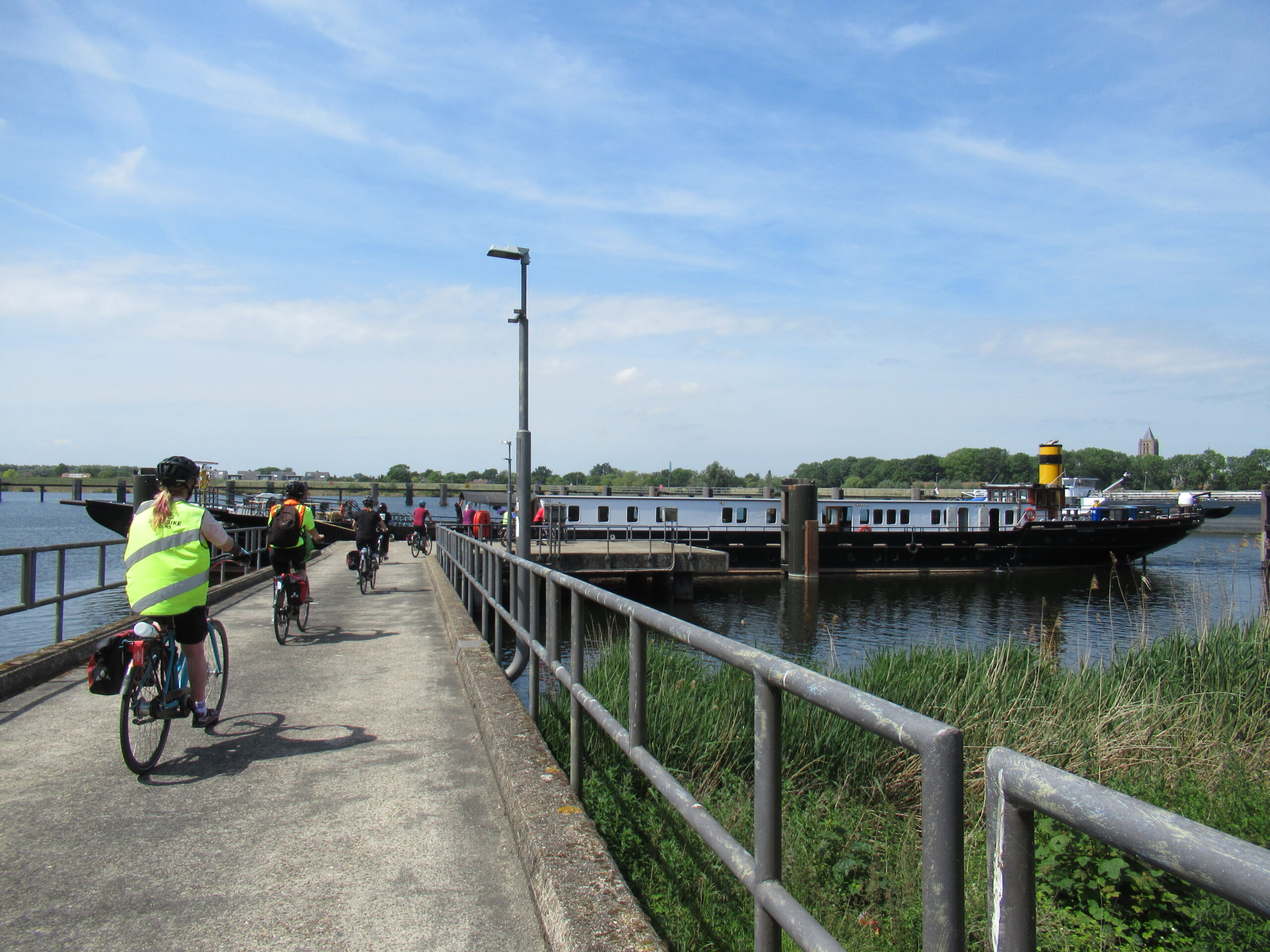
Each day, we set out after breakfast, having packed snacks and lunch, and are able to choose long or short routes, or we can bike on our own using the itinerary loaded on the RideGPS app. We divide into two groups – for long or short rides – each led by one of the guides with one of us volunteering as “sweep.”

Each afternoon, we typically have time to wander about the village (if we are not sailing to the next destination) and help ourselves to a snack, coffee, tea and hot chocolate, before dinner.

On a guided bike tour besides the benefit of a guide who may modify the route for the weather or point out significant sights, you have the camaraderie of the group. And for some reason, bike tour people tend to be the nicest, kindest, most open and interested in all that they experience

The dining room/lounge on the Leafde fan Fryslân schooner © Karen Rubin/goingplacesfarandnear.com

Our group on this Islandhopping tour is particularly great, instantly melding into a community supporting each other. This is especially interesting because we come from various parts of Britain, Germany, Canada (French and English speaking, East and West), Denmark, and from the East, Midwest and West United States. The Germans, the Dane and the Quebecois all are kind enough to speak English when we are together. And instead of sticking to their own nationality, everyone mixes up at meals, with the couples taking in the three of us traveling solo (bike tours are ideal for solo travelers). In the evening, there would be raucus laughter as people play games and share stories (two couples discovering they shared their wedding anniversary and how they both met at a disco).

Playing games in the evening on the Leafde fan Fryslân schooner © Karen Rubin/goingplacesfarandnear.com

More amazingly, I subsequently learn during an evening walking tour of Makkum, that a fellow traveler is descendent of the Trip family – one of the founding members of the Dutch East Indies Company (the first company to issue public stock) and munitions manufacturers that supplied the Dutch revolt against Spain, becoming one of Netherlands’ most powerful and fabulously wealthy families. He even has an actual coat of arms and portraits of his ancestors Jacob Trip (1576-1661) and his wife, Margaretha de Geer, painted by Rembrandt are in the National Gallery and Ryksmuseum. He is like the embodiment of the history that we see around us. He relates his family’s fascinating story as we sat in a historic pub with centuries old Delpht tiles of great sailing ships, emphasizing that the family fortune had long gone and his side of the Trip family emigrated to Canada.

Getting to the ship in Enkhuisen proves extremely easy from Amsterdam’s Schiphol Airport (instead of arriving the day before as I usually do, I take a chance and just arrive the same day). From the airport, you walk to the train that takes you into the Central Station (every 15 minutes) then change at the Central Station for a train leaving every half hour for the hour-long trip to Enkhuisen. (Be sure you buy the ticket in advance online or at a ticket machine and “check in” on a pole before you get on the train, otherwise you can be charged an extra 50E for the 16E fare if the conductor has to issue the ticket; I know because I didn’t and the conductor was extremely nice in helping me buy the ticket onboard),

The harbor is right at the station, and the ship about a five-minute walk.

We are told to arrive on the ship by 2 pm and they mean it, because the ship sails this afternoon to Medemblik. Two couples are touch and go to make it on time.

And We’re Off!

Sailing the Leafde fan Fryslân schooner on Boat Bike Tours’ Islandhopping trip © Karen Rubin/goingplacesfarandnear.com

There is great excitement as we cast off and set sail to our first destination, Medemblik. It is exciting to see the landscape from the water, and when we pull into port, the sun is low enough to make gorgeous silhouettes of the historic windmill.

Because we are heading into the wind, we use the motor (biodiesel!) instead of raising the sails (Captain Age explains a ship of this size would take a mile each time it had to tack). I am extremely happy I remembered my warm jacket.

Each evening after dinner there is an orientation to the next day’s biking and touring, and then typically an 8 pm walking tour.

And so we are met with a two local guides who walk us about, explaining the history and significance of this place.

The castle at Medemblik is one of 12 built by William but one of only two that remains © Karen Rubin/goingplacesfarandnear.com

We learn that William II came with army against farmers in 1256 and in 1289, Medemblik was made a city. William built the castle that is a prominent feature here that was less about keeping out invaders and more about keeping the citizenry inside. Most of the castle remains – one of only two castles that have survived from the 12 William built. Rembrandt’s famous “Night Watch” was kept here for protection during World War II.

Despite invading this land, William wound up being a popular ruler because he built the dykes that reduced flooding and produced better farm yields – turning the land into the shape of a bathtub – and built a court and prison.

The charming architecture of Medemblik © Karen Rubin/goingplacesfarandnear.com

Medemblik became an important trading city in the 1500-1600s during Netherlands’ Golden Age, with tall ships sailing to Eastern Europe and Scandinavia.

But in 1932, when the dam was built, splitting the Zuiderzee into Lake Ijsselmeer, Medemblik lost most of its trade because the big sailing ships could not get in; the water turned from salt to fresh (they had to devise a system to allow for fish migration. (I wonder how the people reacted to entire economy being remade.)

Eight years ago, the city built a 250-meters high wind turbine, apparently the biggest in Europe (I gather the locals aren’t thrilled, especially since he says the electricity produced is used mainly by Google and Amazon).

Following our guide through the charming alleys and streets of Medemblik © Karen Rubin/goingplacesfarandnear.com

Our guide shows us churches that changed from Catholic to Protestant after Holland’s independence from Catholic Spain, and the orphanage and the housing for widows the church community built.

The church dates from 1100 but was built to a grand scale in 1400; then in 1517, the city was invaded by the Frissons who burned the city down. The church was rebuilt but its steeple leans (like Piza). This church dates from 1570.

Churches were typically built on the highest points in town – which in this case is  two meters below sea level – so if the city should flood, everyone would go there to seek shelter. In 1945, the Germans bombed the dykes, flooding the city.

In 1800, Napoleon conquered the Netherlands, which had been a republic (first in the world! our guide Anya tells me) and made his brother, Louis, the first King of The Netherlands.

Day 2: Medemblik (17 mi. or 24.8 mi. roundtrip) then sailing to Texel 

Biking passed the castle at Medemblik © Karen Rubin/goingplacesfarandnear.com

This is our first cycling day – each day we have a choice of a long and a short route and today we can choose 24.8 or 17 miles with a group and guide, or go on our own using the RideGPS app.

Medemblik proves to be so idyllically scenic with classic Dutch pastoral scenes. Our “rest stop” is at a farm, where the farmer has left out a serve-yourself coffee maker and provides a lovely bathroom. I note an interesting playground that is inhabited by goats (really anxious to get snacks from us) and chickens.

Biking around Medemblik on Day 2 of Boat Bike Tours’ Islandhopping trip © Karen Rubin/goingplacesfarandnear.com

We soon appreciate how water management has been a singular preoccupation of the Dutch for centuries and how they have become masters at it. This entire community is below sea level – built behind dykes – as if a bathtub. The quaint, centuries-old wooden windmills were part of that water management system and today there is even a separate government agency and tax devoted to water management.

Biking around Medemblik, we appreciate the importance of water management © Karen Rubin/goingplacesfarandnear.com

We ride through the picturesque village of Twisk, a former peat mining town.

We finish the long ride about 2:15 pm, so I still have some time to wander about the charming village center before the ship sails at 4 pm for Texel (we will have dinner while we sail)..

Going through a lock as we sail from Medemblik to Texel © Karen Rubin/goingplacesfarandnear.com

Sailing is picturesque and dramatic – we go by the dam that split the sea, through a lock, and sail into Texel as the sun is starting to drop behind its historic windmill, making for a stunning scene.

Watching the sunset over Oudeschild on the island of Texel from the top deck of Leafde fan Fryslân © Karen Rubin/goingplacesfarandnear.com

I go out for a walk – you literally climb stairs to get over the dyke, then down stairs into the town of Oudeschild (below sealevel), then, a few steps beyond, to vast fields with sheep and back again to stroll along the dyke as the sun goes down.

More information: Boat Bike Tours, www.boatbiketours.com, 203-814-1249.

Next: Boat BikeTours’ Islandhopping in Netherlands: The Treasure Found on The Texel Roads

_____________________________

© 2025 Travel Features Syndicate, a division of Workstyles, Inc. All rights reserved. Visit goingplacesfarandnear.com and travelwritersmagazine.com/TravelFeaturesSyndicate/. Blogging at goingplacesnearandfar.wordpress.com and moralcompasstravel.info. Visit instagram.com/going_places_far_and_near and instagram.com/bigbackpacktraveler/ Send comments or questions to FamTravLtr@aol.com. Bluesky: @newsphotosfeatures.bsky.social X: @TravelFeatures Threads: @news_and_photo_feature

Six Days on Discovery Bicycle Tours’ Idaho Trails: Biking the Coeur d’Alenes

Biking the Trail of the Coeur d’Alenes, Idaho on the last day of Discovery Bicycle Tours’ six-day Idaho Trails trip © Karen Rubin/goingplacesfarandnear.com

By Karen Rubin, Travel Features Syndicate, goingplacesfarandnear.com

On Day 4 of Discovery Bicycle Tours’ six-day Idaho Trails trip, after breakfast at our base at the Silver Mountain Resort, we are shuttled to Shoshone Park in the mining town of Mullan for an easy downstream ride through the “Silver Valley,” home to several historic mining communities.

We soon pick up the official start of the Trail of the Coeur d’Alenes, enjoying views of the rocky, forested mountains, as we make our way to the utterly charming “wild west” town of Wallace.

Biking on the Trail of the Coeur d’Alenes to Wallace, Idaho © Karen Rubin/goingplacesfarandnear.com

We have been primed for Wallace’s character (and humor) when we had a talk by a local historian at the Roosevelt Inn in Coeur d’Alene so are prepared for the “history (and some hilarity!) that await us as citizens of Wallace have tenaciously preserved their town amidst an ever changing landscape of fortunes lost and gained.”

Now, we stroll around the town looking for some of the sights she pointed out, like the town’s last brothel, a mining museum, a silver shop, before we join the Sierra Silver Mine Tour that Discovery has arranged for us. It begins with a delightful narrated tour of Wallace in an open-air trolley that takes us up to the mine.

Who knew that Wallace was the “Silver Capital of the World” – some $138 billion worth taken out of these mines –$20 billion of metals just last year (did I hear that right?) – 1 million ounces of silver. In the 1960s, incredulously, Wallace was the “richest little city” in America with the highest number of millionaires per capita, as well as a thriving brothel industry. (The last running bordello was shut down in 1989 when the FBI raided tax dodgers – there is still resentment in the town – but you can visit the Bordello Museum.)

When mining began in 1886, Wallace’s population was 500; at its peak, in 1940, when some 200 mines were operating (quartz, gold, silver, copper, zinc), the population peaked at 4000, but, with the collapse of silver prices in March 1980, most of the mines closed, the miners left and the population fell to the present number of 800. Today, there are still four active silver mines, including the Lucky Friday and the Galina mines, and one gold mine.

In 1890, a chimney fire destroyed most of the town – the buildings we see today date from 1890-1920. Indeed, Wallace has the rare honor of the entire town being listed on the National Register of Historical Places.

Other tidbits: only one sitting president has visited Wallace: Theodore Roosevelt came in 1903 on a campaign whistle stop; the town spent $5000 just on flags to welcome him. There was a shootout on Valentine’s Day, 1951 – one of the tommy guns is on display in the museum. And Wallace’s most famous native is Lana Turner went one day to a grocery store where she was discovered.

You would be forgiven if you thought Wallace was a theme park creation (the 1997 movie “Dante’s Peak” was filmed here), but the history and the heritage are real, as is the miner, “Fast Freddie,” who is our guide into the silver mine.

“Fast Freddie” guides us on the Sierra Silver Mine Tour, Wallace, Idaho © Karen Rubin/goingplacesfarandnear.com

“Fast Freddie” is a colorful character (he looks as if he came from Hollywood casting), with a marvelous sense of humor, amusing and engaging, but most important, he is authentic, speaking of his own experience working 21 years underground in these mines. “You need a good sense of humor in a mine,” Freddie tells us. “We used to play tricks.” 

This mine was only briefly used, he says, because the silver was very low grade and not worth the expense. It was turned into a mining school, where students learned the techniques of mining and could be hired right into a job.

After the collapse of the silver market and the closure of mines, Wallace looked to tourism to compensate. This mine was turned into an attraction, getting as many as 18,000 visitors a year.

A skeleton wearing a hard hat greets us as we enter the Sierra Silver Mine in Wallace, Idaho © Karen Rubin/goingplacesfarandnear.com

As we enter the mine and pass a skeleton sitting on a chair, Freddie tells us that one of the worst mining disasters in history took place on May 2, 1972 when 91 miners lost lives and just 2 survived. ‘It took 2 weeks to recover all of them. They didn’t have a system to know who was down there.’ After that, the Mine Safety Administration mandated a tag system – larger mines have more sophisticated program.

The proverbial canary in a mine. “Fast Freddie” guides us on the Sierra Silver Mine Tour, Wallace, Idaho © Karen Rubin/goingplacesfarandnear.com

We actually see a canary cage – used to let the miners know when oxygen is low (the proverbial “canary in a coal mine.”)

In this mine, future miners were taught to run the jack, the drill, and to blast. The miners work alone at different levels, so each one has to do everything – digging, setting the dynamite charge, moving out the ore. “You have to get everything done so you can blast before the next shift arrives.”

“Fast Freddie” guides us on the Sierra Silver Mine Tour, Wallace, Idaho © Karen Rubin/goingplacesfarandnear.com

How to protect against the noise? “A cigarette butt was ear protection” (not sure he was joking.)

“Fast Freddie” guides us on the Sierra Silver Mine Tour, Wallace, Idaho © Karen Rubin/goingplacesfarandnear.com

The veins of silver go down for miles – in 1964, they were mining at 250 feet. The Lucky Friday Mine, the largest in the area, is operating at 9600 feet below ground. The deeper they go, the hotter it gets – at 9,000 ft, as much as 170 degrees – so they designed a refrigerated ventilation system to cool to 100 degrees.

After being returned by the trolley, we have time to wander around Wallace before biking back on the trail on our own to the Silver Mine Resort.

The last brothel in Wallace, Idaho is now the Oasis Bordello Museum © Karen Rubin/goingplacesfarandnear.com

Wallace is really interesting – like a time warp and not really just “tourist quaint”, quirky and fun.  Just strolling around, you find the Wallace District Mining Museum, the Idaho Silver Shop, Northern Railroad Depot Museum, and everyone’s favorite, the Oasis Bordello Museum.

Wallace, Idaho, claims to be the “center of the universe.” Prove them otherwise. © Karen Rubin/goingplacesfarandnear.com

These folks in Wallace have a sense of humor – and an eye for a profit-making tourism-promoting gimmick: they designated a manhole at the crossroads in the middle of town as the “Center of the Universe” (that’s what is engraved on it). Based on what? “What’s the evidence that it isn’t?” comes the reply.

A mummified mermaid, one of the curiosities and collectibles on view in the Trading Post, Wallace, Idaho © Karen Rubin/goingplacesfarandnear.com

I find a shop that sells guns, antiques, curios, and collectibles. In a glass cabinet is a large mummified “mermaid” (calling to mind a similar fantastical creature displayed in a store in Banff, Canada, and P.T. Barnum’s museum of oddities).

Poster above rifle barrels in the Wallace, Idaho gun shop: Americanism © Karen Rubin/goingplacesfarandnear.com

It’s a delightful bike ride from Wallace to the Silver Mountain Resort in Kellogg, where later we have dinner together in the mountain village base.

DAY 5:  39 or 46 miles, Cataldo Mission and the Coeur d’Alenes

The plan on Day 5 is to set out from the Silver Mountain Resort biking on the Trail of the Coeur d’Alenes, and after 11 miles or so, to visit the Cataldo Mission, Idaho’s oldest standing building, lunch at the Rodehouse before continuing biking, with a choice of 39 or 46 miles of cycling to Harrison, where we are to be shuttled back to the resort for a celebratory dinner in Kellogg for our last night together.  

But it is a drenching rain.

Our guide, Calista Phillips, says “There is no bad weather, only bad clothing” and says her job is to cheer lead for biking, but if we don’t want to, we can choose  to shuttle the first 11 miles instead of bike to the Cataldo Mission. After assuring us we won’t be missing much in the way of scenery and that the portion from Cataldo to Smelterville is the pretty part, we vote to take her up on her offer to drive us to the Mission. (I’m just so grateful it wasn’t raining like this when we did the Route of the Hiawatha, especially when I see another bike tour heading out there this morning.)

The visit at the Cataldo Mission starts with an excellent video that explains how the local tribe invited the Jesuits (“Black Robes”) to come here and build the mission. At the time, the introduction of the horse meant that tribes that had coexisted in their own land before, began to encroach on each other’s territory. The tribe believed that the “Black Robe” missionaries had a superior power, a Great Spirit, who would enable them to triumph over their enemies.

The Mission of the Sacred Art was built in 1850-1853, by Father Pierre Jean De Smet, chief of the “Black Robes” who answered the tribe’s invitation to come, along with Father Ravalli, an Italian-born religious leader who designed the building and supervised construction with simple tools and without nails.

Old Mission church, Cataldo, Idaho’s oldest standing building © Karen Rubin/goingplacesfarandnear.com

The Old Mission church is simple and beautiful – the wood-beamed ceiling painted blue with huckleberries, to make the native people more comfortable since they were used to praying outside. We learn that the walls were decorated with fabric bought from the Hudson Bay Company and a hand-painted newspaper from Philadelphia that Fr. Ravalli had received in the mail. Tin cans were used to create the chandeliers. Both wooden statues were carved by Fr. Rivalli with a knife to look like marble.

What I find most fascinating, though, is the museum there that better represents the tribe’s point of view – how they were initially drawn to Christianity with its values of “comfort, community” the sense of miraculous to be found in nature, and a Great Spirit with power to grant protection, like their own spirits, which seemed (at first) to conform with their own values and beliefs.

The Coeur d’Alene people – the Schitsu’umsh, meaning “Those who were found here” or “The discovered people” – were initially drawn in because the early Jesuits were tolerant of native culture and traditions, even blending the cultures together.

The mission became a stop and supply station for traders, settlers, and miners traveling on the Mullan Road, and a port for boats heading up the Coeur d’Alene River.

Old Mission church, Cataldo, Idaho’s oldest standing building © Karen Rubin/goingplacesfarandnear.com

Over time, the Coeur d’Alene people regretted the decision to give the Black Robes a stronghold when  they realized the Jesuits’ mission was to create an Empire of Christianity. At the same time, white settlers looking to exploit the region’s resources, who brought guns and small pox, were taking territory and pushing out the indigenous tribes. In 1877, even the mission was forcibly relocated from the ‘House of the Great Spirit.”

The museum displays photos and artifacts that show the effort to Christianize and eradicate native heritage and culture – but done in an understated, polite way since this museum, is apparently a partnership between the tribe and the mission. (The Cataldo Mission became a state historic park in 1935, was designated a National Historic Landmark in 1961, and put on the National Register of Historic Places in 1966.)

We have lunch at the Rodehouse, right across the road from the Trail of the Coeur d’Alenes. By this time, the rain has all but ended – it is grey and humid  – and we get back on the trail for the 16-mile ride back to the resort.  The cloud formations make for dramatic scenes.

Biking the Trail of the Coeur d’Alenes, Idaho through marshland © Karen Rubin/goingplacesfarandnear.com

We cycle along an enchanting stretch of wetlands – part of the trail is a berm with marsh on either side. We have been told “just after Metamonk Village (mile 20) to be on lookout for moose.

Biking the Trail of the Coeur d’Alenes, Idaho through marshland © Karen Rubin/goingplacesfarandnear.com

I spot an osprey with fish in its claws so heavy it couldn’t take flight so dropped it; a black furry creature (otter? muskrat?) carrying what looked like a mouse dashes across the path; a flock of blue heron, a family of deer, and finally, when we are almost at the end of the trail, we come upon a moose with her baby.

Finally! We come upon the promised moose and her baby on the Trail of the Coeur d’Alenes © Karen Rubin/goingplacesfarandnear.com

DAY 6: 16 miles to the end of the Trail of the Coeur d’Alenes

Day 6 is our final day of riding. We pack up our luggage, have breakfast, and shuttle to Harrison, the point on the trail where we ended yesterday’s ride. Today, we bike the last section, 16 miles, through a series of chained lakes to the end of the Trail of the Coeur d’Alenes. It is glorious.

Biking the Trail of the Coeur d’Alenes, Idaho on the last day of Discovery Bicycle Tours’ six-day Idaho Trails trip © Karen Rubin/goingplacesfarandnear.com

It’s a perfect day – sunshine, cool temp (60 degrees), a bit of a headwind. We ride along the Lake Coeur d’Alene, then cross over the Chatcolet Bridge, a really interesting bridge which was once a swinging trestle (the challenge is to ride over the hump), then into the forest where we climb for about seven miles, through the Coeur D’Alene reservation, to finish at the trail’s end, at a moving Indian Warriors and Veterans Memorial.

Biking the Trail of the Coeur d’Alenes, Idaho on the last day of Discovery Bicycle Tours’ six-day Idaho Trails trip © Karen Rubin/goingplacesfarandnear.com

Here we have a picnic lunch, feeling extremely satisfied and happy, before we pack into the van again for an hour-drive back at Spokane Airport or downtown.

At the end of Biking the Trail of the Coeur d’Alenes, Idaho is this monument to the Warriors and Veterans © Karen Rubin/goingplacesfarandnear.com

Discovery Bicycle Tours Merges into Active Adventures

Our Idaho Trails group. Discovery Bicycle Tours specializes in small-groups and personalized service. © Karen Rubin/goingplacesfarandnear.com

Discovery Bicycle Tours has just joined Austin Adventures, a Montana-based North America National Parks small group tour company, under the umbrella ownership of Active Adventures, a New Zealand-based small group adventure travel company. These companies primarily offer hiking and multi-sport options, and just like Discovery Bicycle Tours, focus on small groups (averaging 12 guests).

Austin Adventures is a Montana-based North American National Parks expert offering small group tours with personal touches, flexible options to do as much or as little as you want, and “wow” moments. Austin Adventures also specializes in family and multi-generational tours across North America and around the globe. 

Active Adventures, based in New Zealand, has expanded over the past 30 years to South and Central America, Europe, the Himalayas and Africa. They offer small group, inspiring bucket-list adventures worldwide, with a mix of activities ranging from hiking, biking, and kayaking to snorkeling and caving. Each trip is designed to be flexible, so if you’re a little short on time or you’d prefer to skip an activity, they can alter the itinerary to suit you.

The merger means that the teams behind Discovery Bicycle Tours, Active Adventures, and Austin Adventures are located around the world in five countries, 15 cities, and even a campervan.

“Across the three brands, we’ve been running tours in North America for 77 years, Europe for 50 years, New Zealand for 25 years, South and Central America for 20 years, the Himalayas for 14 years, and Africa for five years. That’s a world of knowledgeand deep local experience across our brands,” Scott Cone, Discovery’s owner, stated.

Discovery Bicycle Tours, 800-257-2226, www.discoverybicycletours.com

See also:

Six Days Cycling Idaho Trails with Discovery Bicycle Tours

__________________

© 2025 Travel Features Syndicate, a division of Workstyles, Inc. All rights reserved. Visit goingplacesfarandnear.com and travelwritersmagazine.com/TravelFeaturesSyndicate/. Blogging at goingplacesnearandfar.wordpress.com and moralcompasstravel.info. Visit instagram.com/going_places_far_and_near and instagram.com/bigbackpacktraveler/ Send comments or questions to FamTravLtr@aol.com. Bluesky: @newsphotosfeatures.bsky.social X: @TravelFeatures Threads: @news_and_photo_features ‘Like’ us at facebook.com/NewsPhotoFeatures

Six Days Cycling Idaho Trails with Discovery Bicycle Tours

Biking through the pitch black, 1.66-mile long St. Paul Pass Tunnel the first of nine tunnels, seven trestles on the 14-mile long Route of the Hiawatha, a highlight of Discovery Bicycle Tours’ six-day Idaho Trails trip © Karen Rubin/goingplacesfarandnear.com

By Karen Rubin, Travel Features Syndicate, goingplacesfarandnear.com

It’s pitch black as we make our way 1.66 miles through the first tunnel of the Route of the Hiawatha, except for the light on our bike. Water drips down from the ceiling, the surface is muddy and slippery, adrenalin pumping. It is hugely thrilling.

This is just the first (and the most dramatic) of the 9 tunnels and 7 trestles we go through over the course of 14 miles down, then back through again for 14 miles up. It is also the longest – a full 1.66 miles in total darkness! – but each tunnel, each trestle is exciting. You can immediately appreciate why the Route of the Hiawatha is one of Rails to Trails Conservancy’s Hall of Fame rail trails.

Starting out on the 14-mile long Route of the Hiawatha, a highlight of Discovery Bicycle Tours’ six-day Idaho Trails trip © Karen Rubin/goingplacesfarandnear.com

The experience is but one of many highlights of Discovery Bicycle Tours’ six-day Idaho Trails trip, during which we will do the 111-mile long Centennial Trail, starting in Spokane Washington to Coeur d’Alene; tackle the remarkable Route of the Hiawatha Trail; and the 73-mile long Trail of the Coeur D’Alenes where we immerse in tribal land, history and culture. Along the way, we will also have interesting experiences such as touring a silver mine in the company of a miner and a museum preserving the heritage of the Coeur d’Alene people.

Biking the Centennial Trail from Spokane, Washington, on Discovery Bicycle Tours’ six-day Idaho Trails trip © Karen Rubin/goingplacesfarandnear.com

What I love most about bike tours is that they are cerebral as much as physical. You feel the scenery; you are part of the space you occupy, engaged – not a spectator peering through a glass window, but a participant, able to smell the air, feel the sun, the breeze, the drizzle, hear the birds and the rushing water. The pace is perfect to really get places while the scenery rolls by as if a movie. And you can stop when you want to take in the scene or a photo, read a marker, or peer at a moose. You feel the satisfaction, the sense of accomplishment at the end of a day’s ride – a combination of euphoria and endorphin rush.

Bike tours bring you to towns and villages you likely would never otherwise see © Karen Rubin/goingplacesfarandnear.com

What is more, you get to go through small towns, see regular folks you would not likely see traveling by car or bus, promoting connection and understanding. And you have the added satisfaction of maximizing the benefit of your visit – providing the economic foundation that secures this heritage, these natural places, these experiences – leaving a minimal carbon footprint. This is true if you are touring in the United States or some faraway exotic land.

As we gather together for our first orientation meeting with our guides, I take note that just about every one of our group of 13 riders has taken not just one, two but several trips with Discovery Bicycle Tours.

This is my fourth, and I consistently find Discovery’s whole approach to bike touring ideal – summed up in the phrases “Ride your ride” followed by “This is your vacation!”– and how they make that happen. There are two guides (they take turns driving the van that shuttles our stuff, sets up our snack-stops, and is there if anyone needs assistance; while the other cycles along, bringing up the rear), but most importantly, we bike at our own pace. This is because we have our own Ride with GPS App, customized by Scott Cone (the company’s owner, he calls himself Adventure Consultant) for each itinerary; they even provide a phone holder on our bike.

The accommodations, restaurant choices and food are the perfect mix of charming reflections of the places we tour, and luxury (as much comfort as you would ever want without going over the top), adding immeasurably to the tour. The bikes (five of us use their hybrid, eight others take advantage of the availability of e-bikes at no extra cost) and equipment provided are top notch, and it bears noting that I consistently find Discovery offers excellent value-for-money.

Our guides, Susie Iventosch and Calista Phillips, on Discovery Bicycle Tours’ six-day Idaho Trails trip © Karen Rubin/goingplacesfarandnear.com

Our guides, Susie Iventosch and Calista Phillips, are fantastic – really knowledgeable, supportive, encouraging, accurate (I appreciate having a realistic view of what the day’s ride will be), and flexible when necessary (like when we all vote not to ride during a downpour but shuttle the first 11 miles of the day’s route).

The trips are designed for maximum enjoyment of the ride – we are shuttled when it makes sense to or from the ride, and given options of longer or shorter routes each day. And the routes they choose, as well as the added activities (a lecture one evening, the silver mine tour another day, a visit to a museum another) add dimension. I also appreciate the advance preparation – documents, itinerary – and care they provide before the trip.

Day 1: Setting Out on the Centennial Trail, 36 Miles

Biking the Centennial Trail from Spokane, Washington, on Day 1 of Discovery Bicycle Tours’ six-day Idaho Trails trip © Karen Rubin/goingplacesfarandnear.com

Our first morning starts with an early meet-up at the Hilton Garden Inn close to Spokane Airport, for introductions and orientation, and we are shuttled to Sontag Park, the start of the Centennial Trail, where we are fitted to our bikes, get the Ride with GPS app going, and set out on a really beautiful ride. Suzie notes that this first day will be the most challenging of the tour.

Biking the Centennial Trail from Spokane, Washington, on Day 1 of Discovery Bicycle Tours’ six-day Idaho Trails trip © Karen Rubin/goingplacesfarandnear.com

We start pedaling along the Washington portion of the Centennial Trail in the rocky canyons west of Spokane. The beginning of the trail is in the forest, and soon rises so that we have this gorgeous view of the Spokane River far below. And once you do the first hill, you feel you can do the second (which is the steepest of the day), then the third (the longest, but not as steep – a piece of cake).

Biking the Centennial Trail from Spokane, Washington, on Day 1 of Discovery Bicycle Tours’ six-day Idaho Trails trip © Karen Rubin/goingplacesfarandnear.com

We pass through Spokane’s urban Riverfront Park that I have so enjoyed visiting for the past three days, and end, 36 miles further down, just five miles before the Washington-Idaho state line, where we are picked up by the van and are taken to the charming Roosevelt Inn where we stay for two nights, in Coeur D’Alene. (Our next day’s ride will bring us back to this same spot, so we can ride the five miles into Idaho.)

The charming Roosevelt Inn, our base for two nights in Coeur d’Alene © Karen Rubin/goingplacesfarandnear.com

I adore the Roosevelt Inn – it is so much a part of Coeur d’Alene. Named for President Theodore Roosevelt who came through the area in 1903 on a campaign whistle stop, the building dates from 1905 when it was Coeur D’Alene’s first school, then became offices, and is now a most charming 14-room bnb. Each room is named for someone with a picture and bio, and provides plush robes and towels. The inn offers a hot tub and sauna (open 24 hours), and absolutely gorgeous gardens (life-size chess). There is a lovely parlor with gorgeous painted mural along the three walls, where there is a refrigerator guests can use; a constant supply of coffee, tea and hot chocolate; fruit and usually, something freshly baked. Each morning, we are served breakfast to order,

The charming Roosevelt Inn, our base for two nights in Coeur d’Alene © Karen Rubin/goingplacesfarandnear.com

This first evening we enjoy dinner together at a pub-style restaurant (a celebratory drink is included).

DAY 2: 14 or 27 miles, Centennial Trail

Biking the Centennial Trail along Lake Coeur d’Alene on Discovery Bicycle Tours’ Idaho Trails trip © Karen Rubin/goingplacesfarandnear.com

After breakfast at The Roosevelt Inn on our second day, we shuttle to Lovely Falls Park, the headwaters of the Spokane River. The trail takes us along the majestic shores of Lake Coeur d’Alene.

The ride today is 14 miles out and back to the endpoint of the Centennial Trail at Higgins Point, the endpoint of the Centennial Trail, mostly hugging the gorgeous shoreline of Lake Coeur d’Alene, until we come to one major hill up, then down – which means (if we are biking back) we have an even steeper return.

Enjoying the scenery in Coeur d’Alene © Karen Rubin/goingplacesfarandnear.com

We have the option to ride back in the van, but all of us choose to bike back to The Roosevelt, cycling at our own pace. It is early afternoon when we return, so we have plenty of time to enjoy exploring the charming shops and galleries of Coeur d’Alene (a hugely popular destination), swim in the lake or relax. I find a lovely hiking trail along the cliffs.

Enjoying the scenery in Coeur d’Alene © Karen Rubin/goingplacesfarandnear.com

We are treated to a talk by historian Shauna Hillman give a delightful talk about the town of Wallace, Idaho and the Silver Valley Mine which we will be visiting (‘Murder, mining, prostitution,  the mayor murdered his wife’s lover and got away with it, and was reelected twice!”) as we sit in the inn’s lovely garden – before heading out to have dinner on our own.

DAY 3: 15 or 28 miles, Route of the Hiawatha

Group photo before start biking the Trail of the Hiawatha on Discovery Bicycle Tours’ Idaho Trails trip © Karen Rubin/goingplacesfarandnear.com

After two delightful nights at the Roosevelt Inn in Coeur d’Alene, we pack up in preparation for moving our home base to a mountain resort in Kellogg for the remainder of trip. After breakfast, we shuttle 90 minutes east to the trailhead of the famous Route of the Hiawatha.

Biking the Route of The Hiawatha is an extraordinary experience in the annals of bike trails. Our guides, Suzie and Calista, prepare us extremely well for what we will do, that the first tunnel, the St. Paul Pass Tunnel, is the longest at 1.66 miles long, and is pitch black, damp and a constant 47 degrees. They have put lights on our bikes (you are not allowed to go on the trail without a helmet and bike light).

After we excitedly take group photos at the entrance, we set out at our own pace, with the caveat that we have to start biking back up at 2:30 pm (note there is an hour time change from the start).

Starting out on the 14-mile long Route of the Hiawatha, a highlight of Discovery Bicycle Tours’ six-day Idaho Trails trip © Karen Rubin/goingplacesfarandnear.com

Biking through the St. Paul Pass Tunnel is a surreal experience – you can’t see what is above or on the side, only what is lit by the narrow beam where your light shines.

Biking through the pitch black, 1.66-mile long St. Paul Pass Tunnel the first of nine tunnels, seven trestles on the 14-mile long Route of the Hiawatha, a highlight of Discovery Bicycle Tours’ six-day Idaho Trails trip © Karen Rubin/goingplacesfarandnear.com

When you get out and ride the hard-packed gravel trail, it goes steadily down a 3% grade for 14 miles. The scenery is quite spectacular, especially when you look down at a thin pencil line and realize that is the trestle you will be riding across. It looks so small, so far away and far down. And then you are there, and it isn’t thin at all. The view from the trestle is spectacular, too.

Trestles look like thin pencils from above on the Trail of the Hiawatha © Karen Rubin/goingplacesfarandnear.com

The trestles are so high above where you imagine is the valley floor, you feel you are suspended.

It is 14 miles down on hard-packed gravel to where there is a picnic table where we have a box lunch we had ordered, before riding back up the same 14 miles. If you don’t want to ride back up, you can buy a ticket ($20) to take a shuttle bus. We all bike back. (Notably, there are several bathrooms along the way and water supplied.)

Biking one of seven trestles on the Route of the Hiawatha, a highlight of Discovery Bicycle Tours’ six-day Idaho Trails trip © Karen Rubin/goingplacesfarandnear.com

I must admit I am a bit nervous to ride continuously uphill for 14 miles but it actually isn’t bad at all, and there are all these opportunities to stop for the view, or read the interpretive signs that line the trail that tell the history of the Milwaukee Road Railroad. The view and the fresh air are exhilarating.

Biking through one of nine tunnels on the Route of the Hiawatha, a highlight of Discovery Bicycle Tours’ six-day Idaho Trails trip © Karen Rubin/goingplacesfarandnear.com

The Hiawatha, considered one of the more successful rail-trail conversions in the United States, was named to the Rails to Trails Conservancy’s national Hall of Fame in 2010. It was developed from a railroad line, developed in the late 1800s, that went out of business in the 1980s. 

Biking one of seven trestles on the Route of the Hiawatha, a highlight of Discovery Bicycle Tours’ six-day Idaho Trails trip © Karen Rubin/goingplacesfarandnear.com

One of the historic markers along the way tells of the Great Fire of 1910. One of the most devastating forest fires in American history, it burned 3 million acres of forest in northern Idaho and western Montana. The fire was so huge that a massive cloud of smoke spread throughout southern Canada and the northern United States all the way to the St. Lawrence waterway. The darkness from the smoke was so bad that for 5 days, artificial lighting had to be used from Butte, Montana to Chicago to Watertown, New York. The fire completely devastated the St. Joe River valley and destroyed all of the towns except Avery and Marble Creek, many never rebuilt.

The marker tells of heroic actions by the railroad employees who drove engines and box cars filled with people through the flames to the safety of the longer tunnels, saving 600 lives.

Biking through one of nine tunnels on the Route of the Hiawatha, a highlight of Discovery Bicycle Tours’ six-day Idaho Trails trip © Karen Rubin/goingplacesfarandnear.com

It feels soooo good when I come back through that last, longest (1.66 miles), darkest tunnel, being careful not to ride up on the person in front, or slipping in the muddy surface.

At the end, it is a work out that makes you feel so ecstatic, euphoric when you finish.

You need to have a reserved timed ticket to ride the Hiawatha, which is owned by the U.S. National Forest but operated by Lookout Pass Ski Area. (Discovery Bicycle Trails has taken care of our reservations and the ticket, $20 pp; the shuttle is $20 more.)

Feeling quite elated, we pile back into the van to shuttle to the Silver Mountain Resort in Kellogg, where we stay in spacious and comfortable condo accommodations for three nights.

Discovery Bicycle Tours, 800-257-2226, www.discoverybicycletours.com

Next:  Biking the Trail of the Coeur d’Alenes

_____________________________

© 2025 Travel Features Syndicate, a division of Workstyles, Inc. All rights reserved. Visit goingplacesfarandnear.com and travelwritersmagazine.com/TravelFeaturesSyndicate/. Blogging at goingplacesnearandfar.wordpress.com and moralcompasstravel.info. Visit instagram.com/going_places_far_and_near and instagram.com/bigbackpacktraveler/ Send comments or questions to FamTravLtr@aol.com. Bluesky: @newsphotosfeatures.bsky.social X: @TravelFeatures Threads: @news_and_photo_features ‘Like’ us at facebook.com/NewsPhotoFeatures

Bruges to Amsterdam by BoatBikeTours: Dordrecht, the Birthplace of Holland

The Place Where It Happened. Dordrecht is like our Philadelphia. In 1572, a meeting was held to decide to revolt against Philip of Spain and choose William of Orange as the leader. “The Netherlands was born in Dordrecht.” © Karen Rubin/goingplacesfarandnear.com

By Karen Rubin, Travel Features Syndicate, goingplacesfarandnear.com

Day 5 on our BoatBikeTours eight-day Bruges-to-Amsterdam bike trip, we sail in the early morning from Antwerp in Belgium to Kreekrak and cycle 23 miles to Tholen (new harbor) in the Netherlands, where the ship meets us to sail on to Dordrecht – not places that I would bet most of us have ever heard of before.

We stop to visit to the Canadian war cemetery where there are 80 graves of Canadian soldiers who fought trying to free Netherlands from the Nazis. “They try to give the graves a face,” so each one is personalized.

The Canadian war cemetery has 80 graves of Canadian soldiers who fought trying to free Netherlands from the Nazis © Karen Rubin/goingplacesfarandnear.com

Our lunch stop is at Fort De Roovere, built in 1628, the largest of four forts that formed the West-Brabantse Waterline, a water-based defensive fortification. Located along the edge of a sandy embankment between Bergen op Zoom and Steenbergen, it was built during the Eighty Years’ War (1568-1648) – the Dutch war of independence against Spanish rule.

Fort De Roovere is now a very pleasant park © Karen Rubin/goingplacesfarandnear.com

After the fall of the French Empire of Napoleon in 1816, Fort de Roovere no longer had a military purpose and was reclaimed by nature. It was designated a national monument in 1975. The earthen-fortress was restored in 2010 as much as possible to its original state, along the same design configuration as in 1784, and today is a lovely park where I watch dragon flies on a lily pond, and climb an interesting modern tower to get a sense of how, in a siege, the approaching enemy forces could be bombarded from protruding bastions by batteries of cannon..

Fort De Roovere is now a very pleasant park © Karen Rubin/goingplacesfarandnear.com
Climb the tower at Fort De Roovere © Karen Rubin/goingplacesfarandnear.com

We bike into a charming village of Tholen which has a surprising windmill (converted to a restaurant), and have some time to explore.

The quaint village of Tholen © Karen Rubin/goingplacesfarandnear.com
Coming upon an artisan in the quaint village of Tholen © Karen Rubin/goingplacesfarandnear.com
Biking onto our ship, the Princesse Royal, at Tholen, after riding 23 miles from Kreekkrak, which will sail on to Dordrecht on the BoatBikeTours eight-day trip from Bruges to Amsterdam © Karen Rubin/goingplacesfarandnear.com

Our ship, the Princesse Royal, meets us here and we spend a pleasant afternoon sailing to Dordrecht, going through locks which I learn are not to level the water (like on the Erie Canal) but to keep salt water separate from fresh so the reclaimed land can be farmed. Apparently, it’s also an interesting water defense system – areas could be flooded to stop an invader.

Lovely scenery sailing on the Princesse Royal © Karen Rubin/goingplacesfarandnear.com

This day proves a nice, relaxing combination of cycling and sailing, but the highlight is yet to come.

Lovely scenery sailing on the Princesse Royal © Karen Rubin/goingplacesfarandnear.com

We are supposed to dock at the historic city of Dordrecht, but there is an important steam-engine ship festival about to get underway and the harbormaster has refused to let us dock. So Captain Roy van der Veen finds a spot at a boat-building marina across the river.

Sailing passed Dordrecht © Karen Rubin/goingplacesfarandnear.com

Our leader, Corrie Stein, not to be deterred because we can’t just walk off the ship into the historic center, organizes a ride back into Dordrecht for her guided walking tour because this is a city that is not to be missed. Dordrecht, as I learn, is like our Philadelphia in 1776, and this place and this adventure proves to be a highlight of our trip.

Bike track to come down from the bridge into Dordrecht… © Karen Rubin/goingplacesfarandnear.com
…an escalator to bring the bike up to the bridge from Dordrecht © Karen Rubin/goingplacesfarandnear.com

Here we also get to see the extraordinary infrastructure for bikes – to get up/down the very high bridge, there is actually a track and even an escalator for the bike, as well as dedicated path on the highway bridge.

Dordrecht is 800 years old, the oldest city of Holland (not Netherlands), with a population of 120,000 and some 900 monuments. It has always been a garrison town.

At the main church we learn that they wanted to build a tower 120 meters high (to compete with another city’s tower), but the ground wouldn’t support it. So with the money left over, they built four clocks and a bell. But when the bell tolled, windows broke, so they stopped.

“Schooske” – special historic sailing ships that are iconic to Dordrecht © Karen Rubin/goingplacesfarandnear.com

We see these “schooske” – special historic sailing ships that are iconic to Dordrecht (and why there is the special festival). They are allowed to stay in this marina for free.

“Schooske” – special historic sailing ships that are iconic to Dordrecht © Karen Rubin/goingplacesfarandnear.com

The original, ornately decorated entrance gate to the town is where Napoleon entered Dordrecht, Corrie says.

Napoleon would have entered Dordrecht through this historic gate © Karen Rubin/goingplacesfarandnear.com

Walking down a cobblestone street, I see stolpersteine (“stumbling stones”) – bronze plaques embedded in the sidewalk as a memorial to the Jewish families who were taken from their home during the Holocaust. There are stolpersteines to commemorate the victims of the Nazi regime in more than 1,100 locations in 17 European countries

On a street in Dordrecht, stolpersteine (“stumbling stones”) – shiny bronze plaques embedded in the sidewalk as a memorial to the Jewish families who were taken from their home during the Holocaust © Karen Rubin/goingplacesfarandnear.com

On this street, Corrie points out a special Dordrecht style façade of buildings dating from the 17th century, which she says would have been designed by a mason in order to qualify to join a guild. “There were hundreds of these buildings but they fell out of fashion.

Novice masons would have to prove their stuff in order to join a guild in Dordrecht © Karen Rubin/goingplacesfarandnear.com

We come to what seems a simple courtyard of a 1275 Augustine monastery, but here, in 1572, a meeting was held to decide to revolt against Philip of Spain and to choose William of Orange as the leader. “The Netherlands was born in Dordrecht,” Corrie tells us.

“Netherlands formed after a revolt against Spain. It started with representatives choosing William of Orange as leader and agreeing to fight for freedom – a political moment – a thought out idea – freedom of religion,” which took place right here. (It sounds so much like the Continental Congress of 1776; Dordrecht in 1572 was Philadelphia in 1776.)

The Place Where It Happened. Dordrecht is like our Philadelphia.In 1572, a meeting was held to decide to revolt against Philip of Spain and choose William of Orange as the leader. “The Netherlands was born in Dordrecht.” © Karen Rubin/goingplacesfarandnear.com

“William wanted their own church” not like Catholic churches, but rounded with 8 sides. And they wanted their own Bible translated in Dutch.”

In 2019, the King of Netherlands, a descendent of William of Orange, came here to Dordrecht with an original family bible, and computerized art projected the writings from the old text on the building.

By now, darkness has all but descended. We put on our bike lights, and ride back to the ship, everyone giggling over how we look like a line of fireflies.

Biking back to the Princesse Royal from Dordrecht at night © Karen Rubin/goingplacesfarandnear.com

Boat Bike Tours, Aambeeldstraat 20, 1021 KB, Amsterdam, Netherlands, tel.: +31 20 72 35 400,  info@boatbiketours.com, www.boatbiketours.com.

See also:

Idyllic Trip: Biking and Boating from Bruges to Amsterdam

Bruges-Amsterdam by BoatBikeTours: Biking to Ghent

Bruges to Amsterdam by BoatBikeTours: Antwerp, Medieval Jewel

Bruges to Amsterdam by BoatBikeTours: Dordrecht, the Birthplace of Holland

Bruges to Amsterdam by BoatBikeTours: The Windmills of Kinderdijk

__________________

© 2022 Travel Features Syndicate, a division of Workstyles, Inc. All rights reserved. Visit goingplacesfarandnear.com, www.huffingtonpost.com/author/karen-rubin, and travelwritersmagazine.com/TravelFeaturesSyndicate/. Blogging at goingplacesnearandfar.wordpress.com and moralcompasstravel.info. Visit instagram.com/going_places_far_and_near and instagram.com/bigbackpacktraveler/ Send comments or questions to FamTravLtr@aol.com. Tweet @TravelFeatures. ‘Like’ us at facebook.com/NewsPhotoFeatures

Bruges to Amsterdam by BoatBikeTours: Antwerp, Medieval Jewel

Antwerp’s historic center, ringed with Guild Houses © Karen Rubin/goingplacesfarandnear.com

By Karen Rubin, Travel Features Syndicate, goingplacesfarandnear.com

Our BoatBikeTours route on Day 4 of our Bruges-Amsterdam bike tour into Antwerp would normally involve going through an interesting 500-meter long tunnel. But our leader, Arnold Thurko, tells us that the 1930s-vintage elevators broke and they haven’t been able to find the spare parts to fix it, so we ride over a bridge and take a ferry into the city instead, which proves a delightful ride with gorgeous views of the city and a fun (quick) ferry ride.

Arriving into Antwerp by ferry© Karen Rubin/goingplacesfarandnear.com

We park our bikes (Arnold stays with them) and go off with our leader, Corrie Stein, for a guided walking tour of Antwerp’s historic city center.

Antwerp’s Golden Age was the 1500s (earlier than Amsterdam), largely because of the advantage its Suikerrui (canal) provided traders by connecting the city to the sea. (Today it is closed off but you can visit the De Ruien, the underground waterway. You get to walk along old vaulted ceilings, narrow canals, bridges, sewers and sluices, and see the city’s underbelly. You can visit The Ruien by booking a guided group walk, walk on your own with an interactive tablet at fixed times or navigate a small section of The Ruien by boat. Go to www.deruien.be).  I have this on top of my list for a return visit to Antwerp. 

Antwerp © Karen Rubin/goingplacesfarandnear.com

Antwerp was apparently spared bombing in World War II. As a result, we can still marvel at the City Hall, which dates from 1560, and a magnificent square ringed with Guild Houses, one for each guild and each with its own decoration.

Antwerp’s historic center, ringed with Guild Houses © Karen Rubin/goingplacesfarandnear.com

The square has as its center the Silvius Brabo statue, a mythical Roman soldier. According to legend, Corrie relates, a giant, Druon Antigoon, who lived on river, would demand a toll from people who wanted to pass the bridge over the river Scheldt. If they refused, the giant would cut off their hand and throw it into the river. Brabo killed the giant, cut off his hand and threw it into the river. This is supposed to have been the origin of the city’s name, Antwerp, translated as “hand throw.”

Statue of Silvius Brabo, a mythical Roman soldier, who gave Antwerp its name by killing a giant © Karen Rubin/goingplacesfarandnear.com

We walk over to the Cathedral of Our Lady, built 1550-1800 in Gothic style. The belfry, 1339 meters high is included in the Belfries of Belgium and France list of UNESCO World Heritage Sites. The cathedral possesses some major works of art: including three major works by Baroque painter Peter Paul Rubens (two of which were confiscated by Napoleon and moved to France but returned to the Cathedral in the 19th century).

Antwerp’s historic center, ringed with Guild Houses © Karen Rubin/goingplacesfarandnear.com

We get back on our bikes and ride to where our ship, the Princesse Royal, is tied up at the dock, and walk a few blocks away to the Red Star Museum, which BoatBikeTours has arranged for us to visit.

This is a fascinating museum that is a kind of bookend to our Ellis Island Immigration Museum in New York City. Indeed, Ellis Island is where 2 million Europeans who boarded the Red Star Lines at Antwerp to come to America would have wound up. But this museum does more – it tells the age-old story of migration through individual people, going back to the Neanderthal, and why migration is such a fundamental quality of being human.

Antwerp’s Red Star Line immigration museum © Karen Rubin/goingplacesfarandnear.com

The commentary doesn’t shy away from condemning phrases (that are factually true) – for example, describing the brutal, impoverished conditions these desperate people were escaping, or taken by force as slaves, or fleeing persecution, and up to modern day anti-immigrant policies and speech that has lead to the plight of so many undocumented immigrants.

Between 1892 and 1954, 12 million immigrants came through Ellis Island, with a whopping 1,004,756 entering the United States in 1907 alone. Of these, only 2% were turned away (and if were sent back, it was at Red Star’s expense, which is why, we learn, the line was so very scrupulous with their own medical evaluations)

Anti-immigrant fervor took hold in the United States after World War I; the Great Depression, effectively brought an end to migration to America. By then, almost 20 million Europeans had emigrated to America – settling the West, populating the factories of new Industrial cities. The Red Star Line ceased sailing in 1934.

Antwerp’s Red Star Line immigration museum © Karen Rubin/goingplacesfarandnear.com

The exhibits are candid about the difference in how the wealthy traveled in such luxury and style compared to those in steerage. You get to see how passengers in different classes were treated – ‘livid’ – don’t disguise how tough steerage was (but compared to what leaving?). The inescapable conclusion that steerage class was actually key to the company’s revenue and profit.

The exhibits are remarkably personal. It is amazing to see these old photos and recognize the buildings, to see postcards, passports, ID papers, and personal effects.

What I loved most is the display on the first floor which so vividly conveys the central theme: there has always been migration, from beginning of man – and they personalize with one representative person for each era – even Neanderthal.

They show what compels migration in a honest way.

Antwerp © Karen Rubin/goingplacesfarandnear.com

Interestingly, for many, Antwerp became their final stop and today there are some 170 nationalities in Antwerp (another similarity to New York City). You can see it in the faces of school children on their outings, in restaurants that represent all nationalities.-Vietnam, Indonesia, Argentina, Italy, France.

For many immigrants, Antwerp became their destination and their home – you can see it in school children’s faces © Karen Rubin/goingplacesfarandnear.com

This is the evening we are on our own for dinner. (I miss out on visiting the Red Building, which houses an important museum, but even though it is closed, you can take escalators up eight floors to see the photos of people, old and young, then climb two stories higher to the top for a view.

I go off to wander Antwerp myself and on my way back to the ship, find myself in Antwerp’s Red Light District.

Stumbling into Antwerp’s Red Light district © Karen Rubin/goingplacesfarandnear.com

I have a story to tell when we are all back on board.

The Oklahoma couple says they wound up at a French restaurant, Bistro de Pottenbrug. They saw steak on the menu and wind up feasting on flattened pig heads, escargots, eel soup in creamy base.

“On this trip,” Lindsey says, “I decided instead of saying ‘no,’ to say ‘yes’.”  

Antwerp’s diversity is reflected in its restaurant offerings © Karen Rubin/goingplacesfarandnear.com

She asks what others’ weirdest meals have been:  Anne’s weird meal – bone marrow from buffalo; Janet’s was fish eye. Lindsey says, “Last night’s pressed pig head – but it could have been marketed better.”

Art abounds in Antwerp © Karen Rubin/goingplacesfarandnear.com
Art – and a sense of humor – abounds in Antwerp © Karen Rubin/goingplacesfarandnear.com
Art abounds in Antwerp © Karen Rubin/goingplacesfarandnear.com

What is so notable about Antwerp, which is still a major industrial city, is that in one view, you can see dozens of wind turbines, coal being shipped, even a nuclear plant billowing smoke, which we see as we sail out of Antwerp the next morning.

Antwerp is ringed by wind turbines © Karen Rubin/goingplacesfarandnear.com
An “all of the above” energy strategy on view in Antwerp: wind turbines, nuclear plant, and fossil fuels © Karen Rubin/goingplacesfarandnear.com

Antwerp is really worth a longer stay. The Antwerp City Card provides free entrance to the city’s top museums, churches, attractions and public transport; as well as some great discounts (www.visitantwerpen.be/en/antwerp-city-card).

We leave Belgium and continue on into The Netherlands.

Boat Bike Tours, Aambeeldstraat 20, 1021 KB, Amsterdam, Netherlands, tel.: +31 20 72 35 400,  info@boatbiketours.com, www.boatbiketours.com.

See also:

Idyllic Trip: Biking and Boating from Bruges to Amsterdam

Bruges-Amsterdam by BoatBikeTours: Biking to Ghent

Bruges to Amsterdam by BoatBikeTours: Antwerp, Medieval Jewel

Bruges to Amsterdam by BoatBikeTours: Dordrecht, the Birthplace of Holland

Bruges to Amsterdam by BoatBikeTours: The Windmills of Kinderdijk

__________________

© 2022 Travel Features Syndicate, a division of Workstyles, Inc. All rights reserved. Visit goingplacesfarandnear.com, www.huffingtonpost.com/author/karen-rubin, and travelwritersmagazine.com/TravelFeaturesSyndicate/. Blogging at goingplacesnearandfar.wordpress.com and moralcompasstravel.info. Visit instagram.com/going_places_far_and_near and instagram.com/bigbackpacktraveler/ Send comments or questions to FamTravLtr@aol.com. Tweet @TravelFeatures. ‘Like’ us at facebook.com/NewsPhotoFeatures

Idyllic Trip: Biking and Boating from Bruges to Amsterdam

Biking onto our ship, the Princesse Royal at Tholen, after riding 23 miles from Kreekkrak, which will sail on to Dordrecht on the BoatBikeTours eight-day trip from Bruges to Amsterdam © Karen Rubin/goingplacesfarandnear.com

By Karen Rubin, Travel Features Syndicate, goingplacesfarandnear.com

I have been wanting to do this bike tour from Bruges to Amsterdam (or reverse) for years, and like so many having come out of the trauma of a global pandemic, decided not to it put off any longer, but seize the day! I booked with BoatBikeTours.com.

Besides offering a great biking route, the eight-day/seven-night trip is by boat – so your room (and stuff) floats along with you (in fact, we see our boat frequently from the bike trail). The boat itself provides other marvelous experiences – a couple of afternoons relaxing (there’s even a hot tub!) while watching the gorgeous scenery go by, and the camaraderie on the ship. (Even better, as it turns out, the boat meets us to pick us up on two afternoons when a thunderstorm is expected).

Iconic Holland: riding through the UNESCO World Heritage Site of Kinderdijk © Karen Rubin/goingplacesfarandnear.com

I am surprised at how many Americans there are on this biketrip since BoatBikeTours is based in the Netherlands, but I am sure the other Americans, who are in the majority on this trip, are as delighted as I am in finding this bike tour operator.

The Europeans include a couple and a group of four from England and a family of four from Dresden (where I had just visited) which adds to the pleasure of this trip. The Americans come from all over – Oklahoma (who protest that they are not like those rabidly red Oklahomans), Michigan (actually Holland, Michigan), Seattle, Washington, Idaho, Colorado, California, New York. (Two couples who were expected had to cancel for COVID.)

Relaxing onboard the Princesse Royal as it goes through a lock © Karen Rubin/goingplacesfarandnear.com

Each evening, our guides Corrie Stein and Arnold Thurkow – as pleasant and personable as they are expert leaders – discuss what we will see and do on the next day’s ride, and typically, there is a short option for the longer ride.

Everything we experience is exactly as it is presented in the brochure – which is saying a lot. Each day is an absolute delight in every respect, and my longtime dream is realized even better than I imagined it would be.

We are quickly introduced to the fabulous bike trails, paths, roadways that we will follow from Bruges, Ghent, Antwerp all the way to Amsterdam in this most bicycle-friendly region of the world, where biking is a predominant culture. In fact, it seems we see more bikes than cars in the course of our trip.

Like a Dutch painting come to life, biking from Brandwijk toward Schoonhoven after a rain © Karen Rubin/goingplacesfarandnear.com

We cycle through gorgeously scenic – and flat –western Flanders region of Belgium, famous for its medieval towns and castles, and Dutch countryside of Zeeland, a big river delta of the Rhine, Meuse and Scheldt Rivers. Among the highlights: we see Ghent by canal boat, tour the fascinating Red Star Line immigration museum in Antwerp, explore the iconic UNESCO World Heritage Dutch windmills of Kinderdijk, visit an artist’s gallery in a tiny village, and tour a Dutch cheese farm.

And then there are the serendipitous experiences – like the downpour while we lunch in a barn with cows and goats, and biking back to the boat from Dordrecht at night, our bike lights making us look like a line of fireflies, a highlight for everybody. We find something of interest around every bend, in towns, villages and landscapes you would otherwise never see – Dendermonde, St. Amands, Tholen, Breukelen (immigrants from here settled Brooklyn!).

Riding back to the Princesse Royal from our evening tour of Dordrecht © Karen Rubin/goingplacesfarandnear.com

In between cycling excursions, we cruise along these lovely canals and rivers, the scenery absolutely gorgeous. Each place we dock, we are able to get off and with marvelous narration by Corrie and Arnold that adds immeasurably to the experience.

Importantly for me, we generally spend sufficient time in places to get a sense of them – I don’t feel hurried away – like when we visit the Kinderdijk windmills and Antwerp (though this is a city I would definitely come back to, to really explore). Our route takes us passed privately owned castles (just look, don’t visit), a very unexpected farm museum, a Canadian soldiers’ war cemetery.

Our ship, the Princesse Royal, is extremely pleasant – just the right size, marvelous fun and comfortable for our travel.

The Princesse Royal, our floating hotel for the BoatBikeTours’ eight-day Bruges-Amsterdam bike trip © Karen Rubin/goingplacesfarandnear.com

Its hull is constructed along the lines of a seagoing sailing vessel, giving it a somewhat unique shape, but the vessel has been converted to a passenger barge for inland waterways. The boat was restyled and refurbished in 2010 and during the winter of 2012-3, extended by 14 meters. There is a very pleasant dining room/lounge area as well as outdoor seating area (even a hot tub!). There is even WiFi (free).

Enjoying the hot tub onboard the Princesse Royal, our floating hotel for the BoatBikeTours’ eight-day Bruges-Amsterdam bike trip © Karen Rubin/goingplacesfarandnear.com

The Princesse Royal, which sails under the Dutch flag and management, plies the inland waterways of the Netherlands, Belgium and Germany with an crew of seven, led by Roy van der Veen who is the owner and captain of the ship and not above hauling in lines himself;  a mate, a chef, housekeeper, host and two tour leaders. The crew all speak Dutch, English and German.

Princesse Royal’s captain and owner Roy van der Veen, first mate, chef, housekeeper, host and our tour leaders Corrie Stein and Arnold Thurkow © Karen Rubin/goingplacesfarandnear.com

The Princesse Royal accommodates 33 passengers in 16 comfortably appointed cabins. All cabins have portholes (which are fixed for safety reasons), shower, toilet, a washing bin, individually regulated air conditioning, flat screen TV (satellite), 220/230 Volt electric sockets, a small safe and hair dryer. The cabins are cleaned daily.

The meals are marvelous and wonderfully served – breakfast is a buffet with some special hot item each day and a selection of items laid out for us to pack a lunch to take along. In the evening the chef serves a three-course dinner – surprisingly exotic and diverse, always extremely flavorful, substantial and healthy. Though we don’t get a choice of entrée, accommodations are made for dietary restrictions with advance notice; more strict diets are accommodated at an additional charge. One evening (during our overnight stop in Antwerp), dinner is on our own (our guides offer helpful recommendations).

Coffee and tea are available all day long (there is a very sophisticated coffee maker). In addition, there is a bar serving beer, red and white wine and various kind of liquors which does a brisk business (they keep a tab that is paid in cash at the end of the trip).

Harnessing windpower then and now in Holland © Karen Rubin/goingplacesfarandnear.com

It is important to also emphasize that travelling by small ship and bike is one of the most sustainable, responsible ways to travel, with the least adverse impact on environment or community, while also providing the economic wherewithal to sustain the heritage we have come to see. The tour company notes that wastewater is collected in a separate tank that is regularly emptied; we are provided a water bottle to refill with tap water (all the ship’s water is filtered) and we are given paper bags instead of plastic to wrap our lunch. In addition, the company makes a carbon offset payment to the non-profit organization Justdiggit.

Relaxing onboard the Princess Royal as it sails the rivers and canals between Bruges and Amsterdam © Karen Rubin/goingplacesfarandnear.com

Each day, we are given written cue card directions, as well as have the opportunity to download RideGPS to our smartphones (it operates just like your car GPS, with a map and voice navigation and a means of using it off-line). But there is no need, because we follow our leader (one of us volunteers to be the sweep), though I enjoy following our progress on the cue sheets.

We are also supplied with helmet, waterproof pannier bag, water bottle, and the tour includes the fees for ferries.

I’ve done some hard trails – like the five miles up Cadillac Mountain Road in Arcadia National Park last summer on Discovery Bicycle’s Coastal Maine (you’d think “coastal” meant flat, well you’d be wrong, but this part of the ride was optional); South Dakota’s Badlands and Black Hills with Wilderness Voyageurs which featured a five-mile straight up the road in Custer State Park; Albania with BikeTours (I had an e-bike for the first time, which opened a whole new dimension).

I was in the mood for something more relaxing and the Bruges-Amsterdam bike/boat trip is exactly that.  Not only the comfort (and fun!) of being on the boat, but the itinerary is absolutely perfect – especially for first-time biketour goers, for families, and those looking for the most picturesque route you could imagine, with options for shorter or longer rides. And this route is incredibly flat and easy – the only “hills” involved riding over bridges – so that our 7-speed hybrid bikes are more than sufficient.

Belgium and Netherlands are so well organized for bikes, there is even a kind of escalator to get down and up to the bridge at Dordrecht © Karen Rubin/goingplacesfarandnear.com

The daily rides are absolutely perfect – constantly scenic, endlessly interesting, very fun.  Biking is the best – bringing you through villages, neighborhoods, even to people’s backyards and discovering places and their interesting stories – like Dendermonde, St. Amands, Tholen, Vianen, Dordrecht – that you otherwise would be unlikely to discover. You travel at a pace so you can really enjoy the view – slow enough to really observe, fast enough so there is an endless change in scene, almost like a movie. And you can stop for a photo or just to take it all in. And then there is the physical pleasure of biking – the endorphins that get revved up, the fresh air.

Cycling along the river on our way to visit Kinderdijk, as our ship, the Princesse Royal sails by © Karen Rubin/goingplacesfarandnear.com

And everybody bikes in Belgium and the Netherlands (I’m told Utrecht has the largest bike parking lot in the world, accommodating 12,500 bikes but the one at Amsterdam’s Central Station is the most enormous I’ve ever encountered). You’d see a guy coming toward you looking like he was riding the Tour de France and realize as he sped by he was a wrinkled old yet incredibly fit man; little kids bike; families had their kids in Bakfiets (literally translates as “box bike,” a popular cargo bike that the Dutch use to carry almost anything, including children) from place to place.

Biking is such a part of everyday life parents transport their kids in Bakfiets © Karen Rubin/goingplacesfarandnear.com

The trails, paths, roads, and segregated bikeways, with their own traffic signs and signals and traffic-calming systems that keep shared roads safe for cyclists, add to the absolute delight and sense of security so you can just enjoy the scene. In fact, cycling accidents are rare – the Dutch don’t even use helmets.

Everything is set up for bikes. And the rules of the road are very specific. On our first afternoon Arnold reviews all the different signs and signals (shark teeth pointing at you means “take care, give priority to traffic”). “Don’t assume,” Arnold tells us finally. “Look in the eyes of the driver, if he stops and waves you through. Don’t take the right of way. Give it.”

Signposts point the way on the multitude of cycling routes between Bruges and Amsterdam © Karen Rubin/goingplacesfarandnear.com

Our first night’s dinner sets the table for the rest: the first course is shrimp fried in garlic and white wine; the main course is pork fillet with red wine sauce, green beans, zucchini, potato au gratin; and dessert is a puff pastry with vanilla cream.

Corrie Stein leads us on a walking tour of Bruges on our first night of BoatBikeTours’ eight-day Bruges to Amsterdam bike trip© Karen Rubin/goingplacesfarandnear.com

It is followed by Corrie and Arnold leading us on a walking tour of Bruges which we enjoy measurably.

The next morning, we set out. Today’s ride takes us from Bruges to Ghent, 35 miles.

Boat Bike Tours, Aambeeldstraat 20, 1021 KB, Amsterdam, Netherlands, tel.: +31 20 72 35 400,  info@boatbiketours.com, www.boatbiketours.com.

See also:

Idyllic Trip: Biking and Boating from Bruges to Amsterdam

Bruges-Amsterdam by BoatBikeTours: Biking to Ghent

Bruges to Amsterdam by BoatBikeTours: Antwerp, Medieval Jewel

Bruges to Amsterdam by BoatBikeTours: Dordrecht, the Birthplace of Holland

Bruges to Amsterdam by BoatBikeTours: The Windmills of Kinderdijk

_________________

© 2022 Travel Features Syndicate, a division of Workstyles, Inc. All rights reserved. Visit goingplacesfarandnear.com, www.huffingtonpost.com/author/karen-rubin, and travelwritersmagazine.com/TravelFeaturesSyndicate/. Blogging at goingplacesnearandfar.wordpress.com and moralcompasstravel.info. Visit instagram.com/going_places_far_and_near and instagram.com/bigbackpacktraveler/ Send comments or questions to FamTravLtr@aol.com. Tweet @TravelFeatures. ‘Like’ us at facebook.com/NewsPhotoFeatures

Discovery Bicycle’s 6-Day Coast of Maine Tour Delights the Senses

Discovery Bicycle Tours’ cyclists bike the carriage roads in Acadia National Park © Karen Rubin/goingplacesfarandnear.com

By Karen Rubin

Travel Features Syndicate, goingplacesfarandnear.com

When I finally reach the summit of Cadillac Mountain, Acadia National Park’s highest point at 1500 ft., having huffed, puffed and sweated my way by bike up the 3.5 mile long, ever-rising winding road, little kids come up with amazement. “We passed you on the road. You rode up here!” I must confess to beam with pride while also taking in the view. Looking down to the ocean, Bar Harbor and the Bar Harbor Inn at sea level where we started our ride some 20 miles and several hours earlier, I realize, “Wait a minute, We rode from there!” (In fact, the ride is mostly uphill from mile 12 to 20) The view is amazing, but having that physical, mental achievement is all the more satisfying.

That is what a bike tour is. The scenery, the attractions, the things you see and do are all amazing, but when you bike, there is that added component of being physically and mentally engaged.

Biking up Cadillac Mountain is the pinnacle of Discovery Bicycle Tour’s six-day Coast of Maine bike tour – and a peak of personal accomplishment – but each day presents its own series of highlights and delights. After all, this is Bar Harbor and Acadia National Park on Maine’s Mount Desert Island, with one of the prettiest seacoasts anywhere. The daily itineraries are outstanding – each day’s route so carefully designed for a great ride, interesting attractions, gorgeous scenery.

John and I revel in having biked up to the summit of Cadillac Mountain.

This means we ride at our own pace, stop for photos or take a breath, take in the view, hike a trail, or just smell the roses. The guides never pressure you to keep with the group or finish the ride at a certain time. One of the two guides rides sweep to make sure everyone is okay, and the other drives the van along the route (where possible). They make every accommodation for riders, so when feasible, even shuttling some to the top of a slope, or on one day, starting three miles further. The two toughest climbs – Day Mountain and Cadillac Mountain are optional.

Stopping to enjoy the view from Thunder Hole in Acadia National Park on Discovery Bicycle’s Coast of Maine tour © Karen Rubin/goingplacesfarandnear.com

Another aspect of the way Discovery designs its itinerary is that it adds a lovely mix of other activities to round out the experience: a sunset sail on the historic schooner, Mary Todd; sea kayaking, a hike (we choose to walk across the land bridge at low tide to Bar Island) and on our last morning, they arrange a 4:30 a.m. drive up Cadillac Mountain in the van (you have to get a reservation to drive up Cadillac) for the sunrise, considered one of the primo-supremo experiences in Acadia. (Unfortunately for me, I miss out when my phone dies and I miss the alarm, but I awake just as the sun is rising out my window and dash down to the Shore Path.)

Boarding the historic schooner Mary Todd from the dock in front of the Bar Harbor Inn for the sunset sail © Karen Rubin/goingplacesfarandnear.com

Both our guides, Cindy Burke and Tom Walsh are long-time veterans and particularly of this Coast of Maine itinerary, and filled us with marvelous insights into the history and people of the island, as well as point out specific parts of that day’s ride. And they have a particular challenge, having to re-jigger the rides inside Acadia after June storms forced the closure of the Eagle Lake carriage roads.

Enjoying the view from Acadia’s Park Loop Road on our way to Cadillac Mountain on Day 5 of Discovery Bicycle’s Coast of Maine tour © Karen Rubin/goingplacesfarandnear.com

Being able to ride at our own pace is key. At the most popular Acadia sights and overlooks – like Sand Beach, Thunder Hole, Bubble Pond, Cadillac Mountain (where cars now need a timed reservation even to drive up), I can just get off my bike and strut over and spend as much time as I like, as when I wait and wait to try to get a photo of a whale’s geyser-like burst of water we spot offshore at Thunder Hole (at high tide, it is said to sound like thunder, but Cindy says most of the time it is a gurgle). Or when I just stop along the road to watch a lobsterman collect the lobsters, throwing back the ones that did not meet the rigid bigger-than-3.5-inches-and-smaller-than-5-inches regulations, and when I just want to get a better image of the stacks of lobster traps and realize Tom is waiting patiently (no judgment!) on the road until I continue the ride.

On our first day, we are encouraged to arrive by 1 pm for an orientation, getting fitted to our bikes, and then an optional 9.9-mile “Schooner Head Overlook Warm-up Ride” on the Park Loop Road in Acadia – except that it is raining. We decide to do it anyway and even when the rain becomes a real downpour, it is wonderful fun (and so fantastic to go into the Bar Harbor Inn’s heated pool and hot tub after). And it shows us, yes, we can ride hills in the rain!

Stopping at Bubble Pond before starting the hardest part of Day 5 ride, up to Cadillac Mountain on Day 5 of Discovery Bicycle’s Coast of Maine tour © Karen Rubin/goingplacesfarandnear.com

For our Day 2 ride, we are ferried in the van to the start at Seal Cove Auto Museum, where they have pre-arranged our admission. I walk in and am completely enthralled. The museum has an outstanding collection that includes automobiles that are the last of their kind (a 1913 Peugeot is worth $3-5 million; a 1905 Pierce Great Arrow is very rare). But what makes the visit even more fascinating is its special exhibit, “Engines of Change: A Suffrage Centennial.”

Who knew? At the Seal Cove Auto Museum, I learn that Bertha Benz, inventor, partner and wife of Karl Benz, was the first person to travel long distance (65 miles) by car. The museum displays the 1886 Benz © Karen Rubin/goingplacesfarandnear.com

Here I learn that Bertha Benz, inventor, business partner and wife of Karl Benz, got fed up with her husband’s endless tinkering so on August 5, 1888, grabbed her children and became the first person to drive an automobile over a long distance (65 miles), field testing the Benz Patent-Motorwagen. Her trip brought worldwide attention for the vehicle and got the company its first sales. (We actually see the 1886 Benz Patent-Motorwagen in the exhibit.)

The notes for the exhibit are fabulous: “In 1873, Harvard doctor Edward Clarke claimed that stimulating a woman’s brain would enfeeble her reproductive organs. Later, when automobiles were invented, it was a common belief that they were far too complicated for women to operate.”

he fascinating “Engines of Change” exhibit at the Seal Cove Auto Museum, shows that bicycles and then automobiles were the major force leading to women’s suffrage. “A girl who rides a wheel is lifted out of herself and her surroundings,” Ellen B. Parkhurst wrote ca. 1890.  © Karen Rubin/goingplacesfarandnear.com

Indeed, by giving women mobility, independence and an opportunity to demonstrate their capability, bicycles and automobiles were the “engines of change” that directly resulted in liberating women and winning the right to vote. Indeed, automobiles were even used in petition drives (we see examples of these cars and photos in the exhibit).

“Before 1900, few women would have had Bertha Benz’s access to an automobile. They did, however, gain greater geographic freedom through the invention of the safety bicycle in the 1880s…Early suffrage leaders credited the bicycle with doing more for women’s emancipation than anything else in the world. Women could more easily go beyond the limited areas where they could walk. This glimpse of a larger world appealed to many women and paved the way for embracing the automobile.”

The fascinating “Engines of Change” exhibit at the Seal Cove Auto Museum, shows that bicycles and then automobiles were the major force leading to women’s suffrage © Karen Rubin/goingplacesfarandnear.com

“A girl who rides a wheel is lifted out of herself and her surroundings,” Ellen B. Parkhurst wrote ca. 1890. (Bicycles also paved the way for new, liberating fashion – bloomers, bicycle pants, and pants that converted to a skirt.)

“The bicycle did more for woman’s equality than anything” and automobiles further bolstered that. On the other hand, the notes say, “the 1917 Spanish flu almost put suffrage out of business.

Meanwhile, automobiles were designed to appeal to women – the electric automobile was clean, noiseless, and slow, versus the fast, loud, gasoline cars oriented to men. (Seal Cove Auto Museum, 1414 Tremond Road, Seal Cove, Maine, 207-244-9242, sealcoveautomuseum.org).

Discovery Bicycle Tours’ Coast of Maine cyclists enjoy a classic view at Thurston’s Lobster Pound © Karen Rubin/goingplacesfarandnear.com

I spend a fair amount of time in the museum before heading out for the day’s mile ride, which takes us to charming coastal villages. A stunning scene is at Thurston’s Lobster Pound.

Bass Harbor on Day 2 of Discovery Bicycle’s Coast of Maine tour © Karen Rubin/goingplacesfarandnear.com

Another highlight is the Bass Harbor Head Lighthouse, the only lighthouse within Acadia National Park (one of the most photographed in Maine). I walk a beautiful trail to a rocky area below the lighthouse where you have to scramble over the boulders to get any view at all of the Lighthouse (the best view here would have been to get further down to the water, but it starts to rain again).

Scrambling over boulders for a view of Bass Harbor Lighthouse on Day 2 of Discovery Bicycle’s Coast of Maine tour © Karen Rubin/goingplacesfarandnear.com

I continue riding, stopping to hike the Ship Harbor trail, pass by the Wonderland Trail, and ride into the scenic Seawall picnic area, where, we are told, Nor’easters have been so powerful, they spray the rocks onto the road.

Stopping for a short hike on the Ship Harbor Trail © Karen Rubin/goingplacesfarandnear.com

Our ride ends in charming Southwest Harbor, where the van returns us to the Bar Harbor Inn.

Day 2’s Discovery Bicycle Coast of Maine ride ends in picturesque Southwest Harbor © Karen Rubin/goingplacesfarandnear.com

Almost all the rides include Acadia on the Park Loop road and on the marvelous carriage trails.

Built so that horses pulling carriages would not be strained (we even see one of the carriages as it returns to the stables in the park), much like rail-trails, they are not particularly steep but are a bit steeper and hillier than rail-trails. A good portion of the rides are also on the roads which can have longer, somewhat steeper climbs.

Discovery Bicycle Tour cyclists are instructed to walk our bikes through Wildwood Stables, so not to spook the horses © Karen Rubin/goingplacesfarandnear.com

There are 45 miles of gravel carriage trails in Acadia – the gift of philanthropist John D. Rockefeller Jr.  who wanted to travel on motor-free byways through the mountains and valleys by horse and carriage. Today, the opportunity to bike through forest is one of Acadia’s special draws.

Discovery Bicycle Tours’ cyclists bike the carriage roads in Acadia National Park © Karen Rubin/goingplacesfarandnear.com

Constructed between 1913-40, the roads were designed to preserve the line of hillsides and save trees, align with the contours of the lands, and take advantage of scenic views – hence the ups and the downs. Some 16 feet wide, they are in the style of broken-stone roads commonly used at the turn of the 20th century. Tom points out the magnificent architecture of the stone bridges that span streams, waterfalls, motor roads and cliff sides (there are 17 of them), the two gorgeous gate lodges, and the granite coping stones used as guardrails that line the roads (which Rockefeller complained were too precise, not natural enough), affectionately nicknamed “Rockefeller’s teeth.”

Biking over one of the beautiful stone bridges on the carriage roads in Acadia National Park © Karen Rubin/goingplacesfarandnear.com

Tom and Cindy had to re-jigger rides almost on the fly because sections of the carriage roads (notably the Eagle Lake carriage roads) they normally ride are closed for re-construction after a major June storm (but we hardly noticed, though I had to almost sneak through a barrier to get a photo of picturesque Eagle Lake). Of the 47 miles of carriage roads, Tom estimates we bike almost half. (I try to imagine how I would have figured out where to go in Acadia without their route maps that say, “Sharp left onto Around-Mountain Carriage Road, Post #14. Stay right at Post #1, right at Post #20, left at Post #19, right at Post #18, Left on Post #13, Left on Post #11, straight at Number #6”)

The access to Eagle Lake carriage roads is closed for reconstruction after a storm, but I manage to snatch a photo © Karen Rubin/goingplacesfarandnear.com

Day 3’s ride also begins with us being ferried to the start – on the “quiet side” of Mount Desert Island, for a delightful ride along the scenic coastal Sargeant’s Drive, passing lovely “cottages” into Northeast Harbor, a quick visit to the Asticou Azalea Gardens before we enter Arcadia National Park and ride the Carriage Roads.  We get to the renowned Jordan Pond House (famous for popovers, but the crowds are ridiculous) and here we can choose to take an 8.2 mile extension to Day Mountain, with a 694-foot elevation. (No one does the extension because there is some possibility of rain.)

Discovery Bicycle Tours arranges a morning of scenic sea kayaking © Karen Rubin/goingplacesfarandnear.com

Wednesday, Day 4, breaks up biking with a sensational day of kayaking and hiking. National Park Sea Kayak Tours does a marvelous job. We kayak about 6.5 miles, spotting harbor seals, porpoise, loons, bald eagles, and are back just in time for low tide which lets us walk the land bridge to Bar Island. (There is something very magical about a land bridge appearing every day, then disappearing back under the water, especially so when as we return, fog rolls in, blanketing the scene.).  Walking back to the Bar Harbor Hotel, you see the same image as depicted in the historic photos, from the 1940s.

There is something magical about a land bridge that opens each day to connect Bar Harbor with Bar Island, especially as fog rolls in © Karen Rubin/goingplacesfarandnear.com

Day 6 (Friday), which is the getaway day, offers a mild 10-mile ride on the Duck Brook Carriage Roads, passing beaver ponds and the scenic Eagle Lake. I take my time, really taking in the landscapes.

Witch Hole Pond offers a gorgeous scene on our last day’s ride © Karen Rubin/goingplacesfarandnear.com
Breakneck Pond, Acadia National Park © Karen Rubin/goingplacesfarandnear.com

But before, they have organized a ride up to Cadillac Mountain for sunrise, which means meeting at the van by 4:30 am (my phone dies and I miss the wake-up, but get up on my own at 5 am for sunrise, so walk along the shore path).

Watching the sunrise from the Shore Path. Cindy noted that the Native Americans who lived here for 12,000 years were called Wabanaki – “People of the Dawnland.” Discovery Bicycle Tours has arranged for us to see the sunrise from the summit of Cadillac Mountain, a highlight experience of visiting Bar Harbor Acadia National Park © Karen Rubin/goingplacesfarandnear.com

We have enough time each afternoon to really enjoy the historic Bar Harbor Inn (it dates from 1887), which hands down has to be one of my very favorite places to stay in Bar Harbor – luxurious but cozy, exquisitely landscaped, a stunning (heated) infinity pool with one of the prettiest views in the world, a spa, a dining room with picture windows out to the water where we have lavish breakfasts (and a choice to have continental-style breakfast in the pool house), magnificently poised on the point overlooking Frenchman Bay and the Shore Path, walking distance to Bar Harbor’s shops and restaurants, and all our rooms are oceanfront with a balcony (www.barharborinn.com).

Discovery Bicycle’s Coast of Maine lets us luxuriate all five nights at the Bar Harbor Inn © Karen Rubin/goingplacesfarandnear.com

Bar Harbor is bustling – some say it is the busiest summer in this popular tourist town since perhaps forever with people making up for last year and not taking a chance on putting off experiences – but we just breeze passed the crowds and the line of cars. Well, maybe “breeze pass” is an exaggeration. We pedal passed at whatever speed we can muster or choose. Also, because our lodging (in the absolutely gorgeous Bar Harbor Inn) and dinner reservations are booked well in advance, we have both when it is obvious that others, traveling on their own, do not.


The historic Bar Harbor Inn occupies the most beautiful setting on the point and looks much as it has since 1887 © Karen Rubin/goingplacesfarandnear.com

Cindy, who is a history buff, regales us with wonderful insights into the places we ride: The interesting, if disturbing, history of American Indians on Mount Desert, the Wabanaki (“People of the Dawnland”), consisting of four distinct tribes—the Maliseet, Micmac, Passamaquoddy and Penobscot – who had come seasonally to Mount Desert Island for 12,000 years to hunt, fish, harvest clams, berries and sweetgrass for basket-weaving. In the early 1900s, they had encampments on Bar Island and at West Harbor and sold baskets and goods and performed as Western Indians for tourists at the hotels. “They were allowed to stay because they had stuff the whites wanted,” Cindy says. She recommends visiting the Abbe Museum, which has a partnership with the Smithsonian Institution and holds the largest and best documented collection of Maine Indian basketry and contemporary Wabanaki craft tradition (abbemuseum.org). (I regret not having the time to visit.)

And before we head out on the Day 5 ride, which starts with a turn onto Schooner Head Road, Cindy tells the story of a woman who perished on Titanic. Her house, High Seas, on Schooner Head Road, may be haunted, Cindy says, relating her personal experience.

Celebrating at our last dinner together, at Café This Way in Bar Harbor, at the end of the Discovery Bicycle’s six-day Coast of Maine tour © Karen Rubin/goingplacesfarandnear.com

Everything about the Discovery Bicycle tour is topnotch – on three nights, we enjoy wonderful dinners in some of Bar Harbor’s best restaurants and for two of our rides, we are provided box lunches we pre-ordered to take with us.

The ride is billed as “easier to intermediate,” but it is best if you do not expect the rides to be easy or expect that “coastal Maine” has anything “flat.”  There are lots of ups and downs – mostly short – and the rides are definitely do-able if you have the right mental framework (“I can do it.”) and the guides do their best to accommodate riders’ ability.

Discovery Bicycle’s Coast of Maine tour lets you become immersed in the scenery © Karen Rubin/goingplacesfarandnear.com

Coast of Maine is a particularly relaxing bike tour – because as much as I enjoy inn-to-inn (or supported camping trips) so that every day you are moving forward to a new destination, this trip spends all the nights at the Bar Harbor Inn. That means we don’t have to pack up each morning to get our luggage out to the van and no matter how thoroughly wet we get, we can luxuriate and relax in a heated infinity pool and hot tub. (Boat/bike tours have the best of both worlds).

Discovery Bicycle Tours’ guides, Cindy Burke and Tom Walsh are long-time veterans leading bike tours, particularly this Coast of Maine itinerary © Karen Rubin/goingplacesfarandnear.com

A bike tour is also one of the best ways to enjoy traveling in these times of concern over COVID-19.

Notably, Thistle Cone surveyed all the tour participants as to our COVID-19 vaccine status and reported back to us that we were all fully vaccinated (which I appreciated knowing). A bike tour also maximizes our time out of doors, socially distanced; our hotel rooms all had our own access and really, the only times we were gathered together inside was for breakfast (if we chose), the morning meeting and the dinners in restaurants, which, notably, were also following COVID restrictions of distancing and capacity.

They are also monitoring and reacting to changes in conditions, for example, recently asking guests to wear masks in the van and where social distancing isn’t practical. “The good news is that your tour deposits are completely refundable (with no penalties for changes) until the final payment date. So you can reserve with confidence.”

There are still several departures of the Coast of Maine bike tour this season.

Also, Discovery Bicycle Tours offers what may be the first to design an itinerary on New York State’s new Empire State Trail, from the tip of Manhattan to Albany (the trail continues north to the Canadian border, and connects with the 353-mile east-west Erie Canalway).

In addition, Discovery has bike tours to Cape Cod; Idaho; Mickelson Trail & Black Hills, South Dakota; Tucson & Saguaro National Park; Lake Champlain Islands; Crater Lake & Scenic Bikeways; Texas Hill Country; as well as abroad including Bike & Barge Moselle River; Catalonia Trails; Chile’s Lakes & Volcanoes; Cotswolds & Stonehenge; and New Zealand Trails.

Discovery Bicycle Tours, 2520 W. Woodstock Rd., Woodstock, VT 05091, 800-257-2226, info@discoverybicycletours.com, www.discoverybicycletours.com.

______________________

© 2021 Travel Features Syndicate, a division of Workstyles, Inc. All rights reserved. Visit goingplacesfarandnear.com, www.huffingtonpost.com/author/karen-rubin, and travelwritersmagazine.com/TravelFeaturesSyndicate/. Blogging at goingplacesnearandfar.wordpress.com and moralcompasstravel.info. Send comments or questions to FamTravLtr@aol.com. Tweet @TravelFeatures. ‘Like’ us at facebook.com/NewsPhotoFeatures