Tag Archives: Viking Cruises

Viking’s ‘Romantic Danube’ Cruise From Regensburg to Budapest Affords Time to Explore

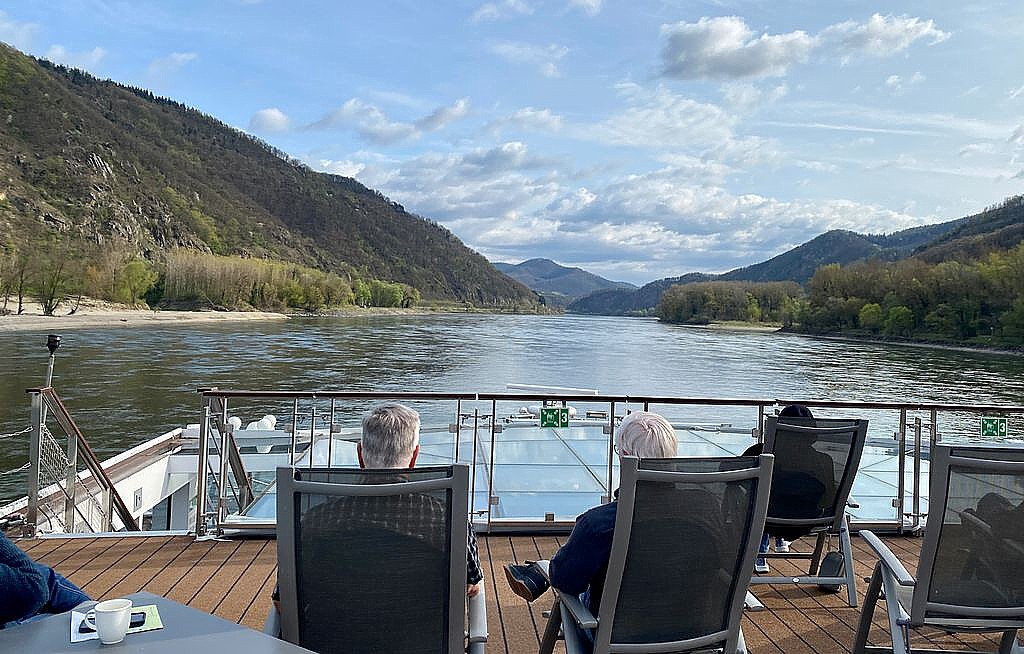
On Viking’s “Romantic Danube” cruise, we experience Austria’s picturesque Wachau Valley from the comfort of our ship.  ©Geri Bain

by Geri Bain for Travel Features Syndicate, goingplacesfarandnear.com

From our chaise lounges on the sundeck, we watch an ever-changing landscape: vineyards terraced into steep hillsides, imposing mountaintop castles, small villages built around soaring churches, and long stretches of forest and grasslands. We are cruising through Austria’s Wachau Valley on the 190-passenger Viking Tor, one of Viking’s virtually identical “Longships” that ply the Upper Danube between Germany and Hungary.

For our first three days the focus has been on two medieval German Bavarian cities: Regensburg, where we boarded the ship, and Passau. This morning, the Danube itself takes center stage. On and off, Teo, our charismatic cruise director, shares insightful stories and context about the Danube, which runs “from the Black Forest to the Black Sea.” As the longest river in Europe after the Volga and the only one to flow west to east, the Danube has been a major highway for goods and ideas since pre-Roman times.

Landmarks trigger colorful stories. Passing the ruins of Aggstein Castle, Teo tells of an infamous owner, a murderous robber baron who hijacked passing ships and often cruelly “disposed” of the crew and seized their goods. Those vineyards we see? They produce dry white Grüner Veltliner, Riesling and other acclaimed wines, and many vintners still harvest grapes by hand due to the steep terrain.

Gliding through the Wachau Valley in our moving hotel is a magical way to experience this iconic region. Its leisurely pace is the reason my husband and I chose Viking’s “Romantic Danube” itinerary. For us, it offers the perfect mix of curated and free time. Unlike many Danube cruises that spend less than 24 hours in each port, this eight-day/seven-night sailing overnights in each of its three main destinations. This gives us time to experience Regensburg, Vienna and Budapest in the evening when the squares and riverside walks are romantically lit. It also provides ample time to explore on our own, relax in a cafe, and join some of Viking’s optional excursions (at added cost), which range from e-bike tours to day trips to nearby cities to a behind-the-scenes visit to the Vienna Boys Choir.
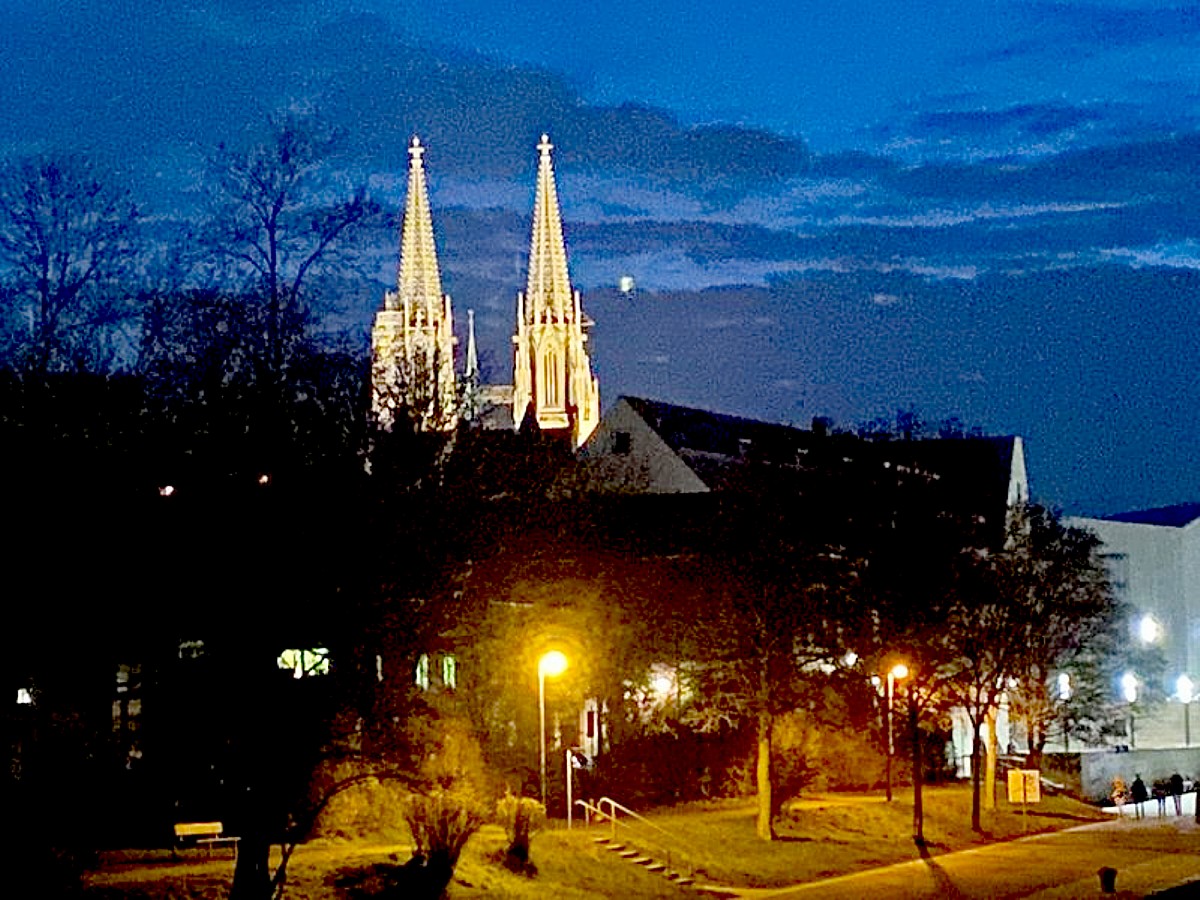
The view from our verandah of Regensburg at night is stunning. ©Geri Bain

Our trip starts with a flight to Munich where Viking meets our flight and takes us to the ship, which is docked in Regensburg. As we unpack, we are impressed with the generous storage space tucked into our 205 square foot Verandah Stateroom. In addition to a hanging closet and two three-drawer chests, there are shelves and a safe in the closet and ample space for toiletries in the bathroom. (In addition to Verandah staterooms, there are two levels of suites; 135 square foot French Balcony cabins and 150 square foot, lower-deck Standard Staterooms with a sealed-shut clerestory window.)
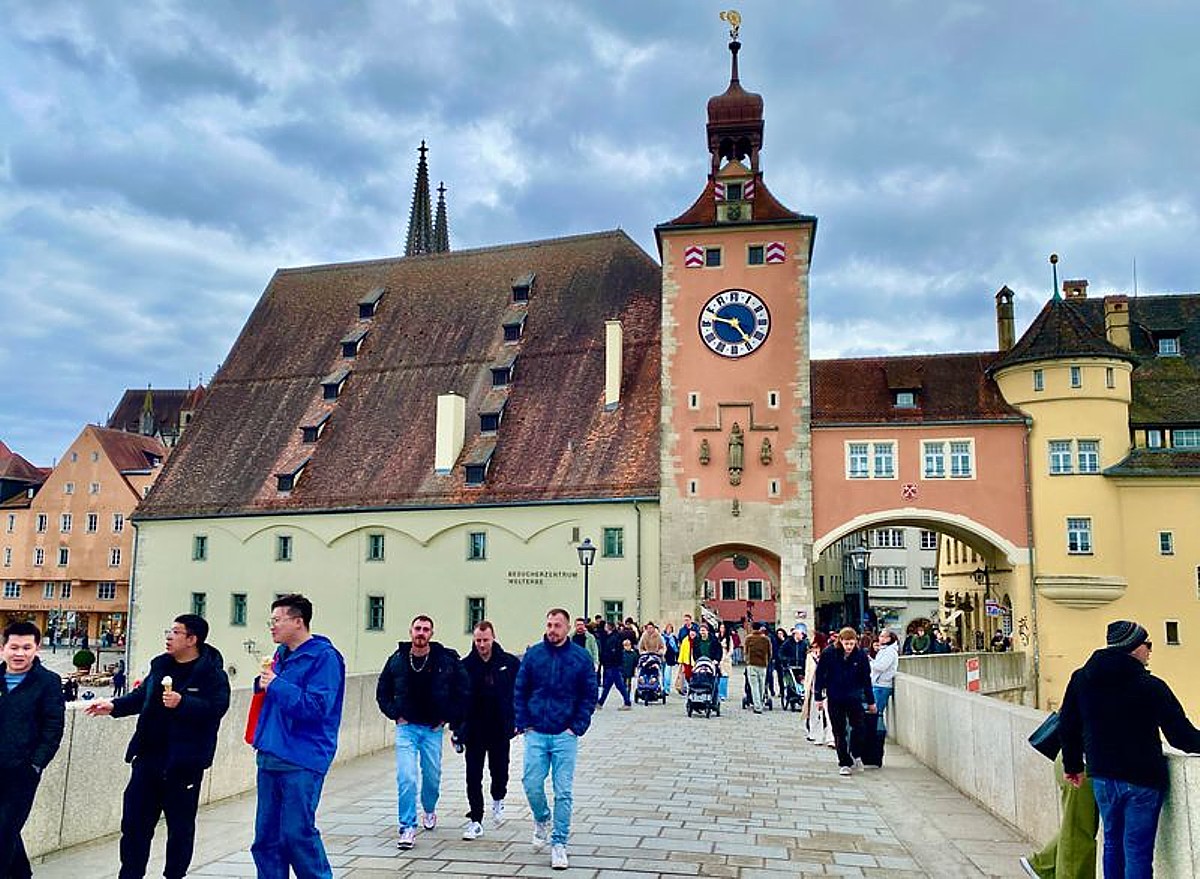
Regenberg’s Stone Bridge has been an important Danube crossing since the 12th century.  ©Geri Bain

We’re tired, but we head out to get a sense of this frozen-in-time medieval city whose town center was larely spared by WWII bombs.  A short walk along the river takes us to the graceful Stone Bridge. We dip into the small Bridge Tower Museum, whoseeasy-to-follow timeline for the region serves as a great grounding for the rest of our cruise.The nearby Historische Wurstkuchl dates back to its days of feeding the bridge’s 12th-century construction workers and its homemade mustard and sauerkraut-topped sausages have been described as “the best of the wurst”.

Back on board, we learn that cookies and local pastries are on tap 24/7 at coffee/tea stations near the library, and that meals are served both in the full-service dining room and, buffet-style, in the indoor/outdoor Aquavit Terrace.Each meal brings a selection of regional specialties and international dishes, and every evening the chef explains the featured local fare. This evening’s choices include a tasty Bavarian potato soup, pork tenderloin and sauerbraten. After dinner, several of us follow the twisty medieval streets up to the soaring Gothic St. Peter’s Cathedral.

Regensburg’s Old Town Hall had a stately Imperial Hall for formal functions and a torture chamber and jail in the basement. ©Geri Bain

On our walking tour the next morning, we see evidence of Regensburg’s long history; the remains of a Roman wall and the Porta Praetoria from 179 AD and its Old Town Hall, dating back to 1245. Most of the historic city center was built from the 12th to 16th century during Regensburg’s heyday as a prosperous trading center. We’re told residents are still proud of the city’s status as a self-governing Free Imperial City during the time of the Holy Roman Empire, and that for nearly 150 years, it was the venue for the Perpetual Imperial Diet, the Empire’s standing congress.

An ancient tombstone with Hebrew writing strangely built into the side of a house catches our eye. Our guide explains that Jewish people in Regensburg were welcomed with protected status until 1519 when their protector, Emperor Maximilian 1, died in the midst of a severe economic downturn. The entire Jewish community was forced into exile overnight. Their homes were looted, their cemeteries desecrated, and their tombstones used as building material around the city. The site of the 1519 synagogue is now a memorial park.
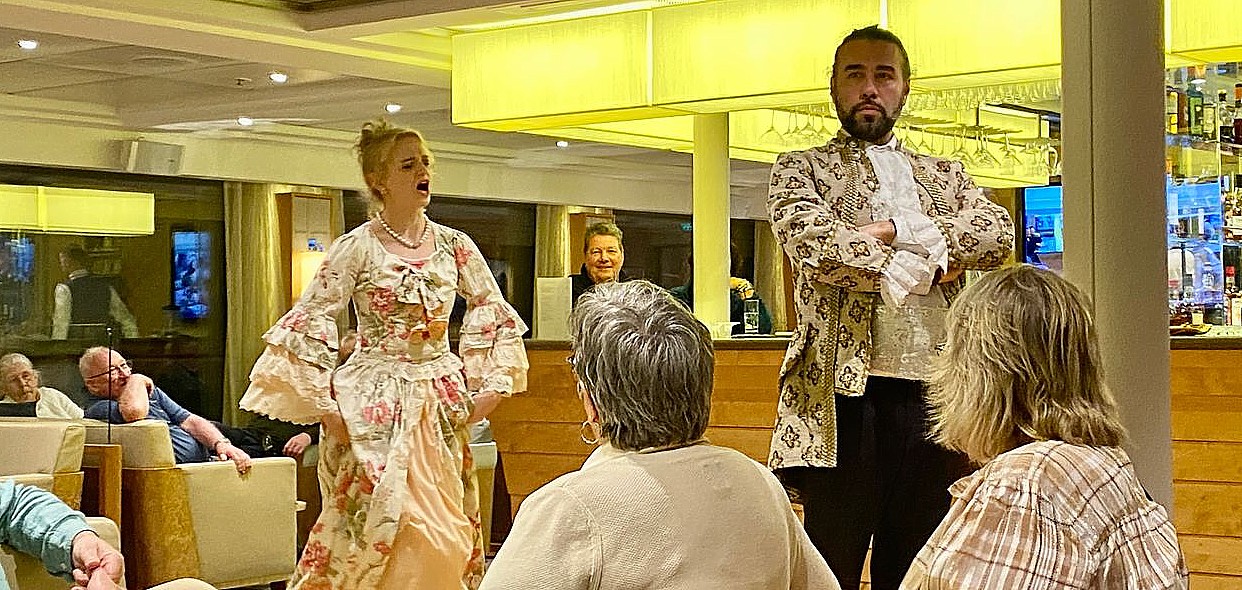
Local musicians perform on board as we sail to Passau. ©Geri Bain  

Our walking tour ends at St. Peter’s Cathedral, which boasts the world’s largest hanging organ. Between May and October, weekday visitors can join its noon meditation, accompanied by the organ. I spend our free afternoon exploring the town and the excellent Bavarian History Museum. Departure time is 6:45 p.m., and after dinner, we enjoy a musical soiree of operatic arias enacted in full costume by local performers. It feels privileged and quirky to have such quality performances in the ship’s lounge.

The next morning, we awake in Passau, the “City of Three Rivers.” Here, we see the Inn, pale green from the Alpine glaciers, the River Ilz, nearly black from the peaty Bavarian countryside, and the brown-green Danube (it turns blue farther east). Once again, we are pleased to be docked right in the historic town center.
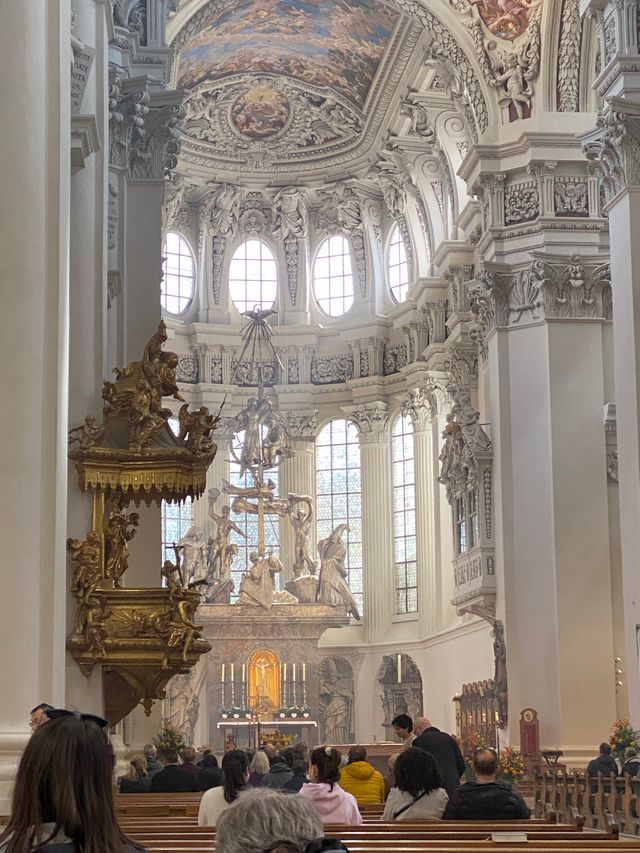
The ornate baroque St. Stephen’s Cathedral in Passau, known for its concerts, has the largest Catholic church organ in the world.  ©Geri Bain

One of the first stops on our walking tour is a giant vertical ruler that marks the height of the flood waters at various years. To this day, on streets near the Danube, the ground floors must be quickly cleared when flood waters are expected to rise. Interestingly. this lower part of the city is a trendy art district. We wind our way through quaint narrow streets up to St. Stephen’s Cathedral, whose onion dome and towers dominate the skyline. It has the world’s largest Cathedral pipe organ which, though under restoration, still sounds quite powerful.

That afternoon, I join Viking’s optional four-hour e-bike tour. We cycle through a lively park but soon have the riverside paths to ourselves and peddle to a quaint Austrian inn where we stop for drinks and pretzels before heading back.
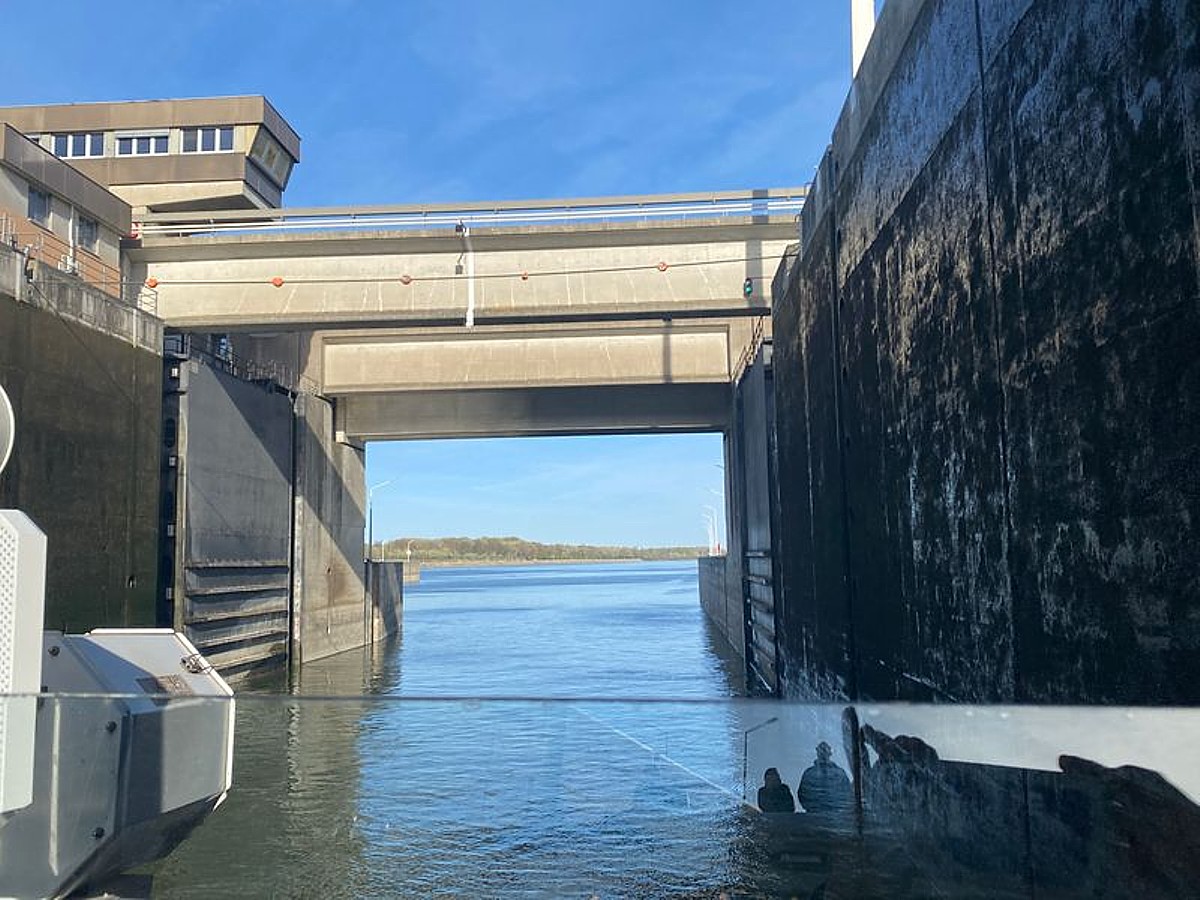
Our ship passes through many amazingly narrow locks on our journey. ©Geri Bain

Our scenic cruise through the Wachau Valley includes a stop at the vineyard-surrounded Gottweig Abbey, a Benedictine monastery founded in 1083, and sample local wines raised on its lands. Back on the Viking Tor, we enjoy a formal afternoon tea as our executive chef teaches us to make apple strudel and shares his recipe.

We arrive in Vienna in time to enjoy a “Viking privileged access” musical highlight of our trip—the vivacious 21-year-old conductor, composer and violinist Alma Deutscher presenting works by Strauss, Mozart and her own compositions at elegant Strauss House, where Johann Strauss once lived and performed.
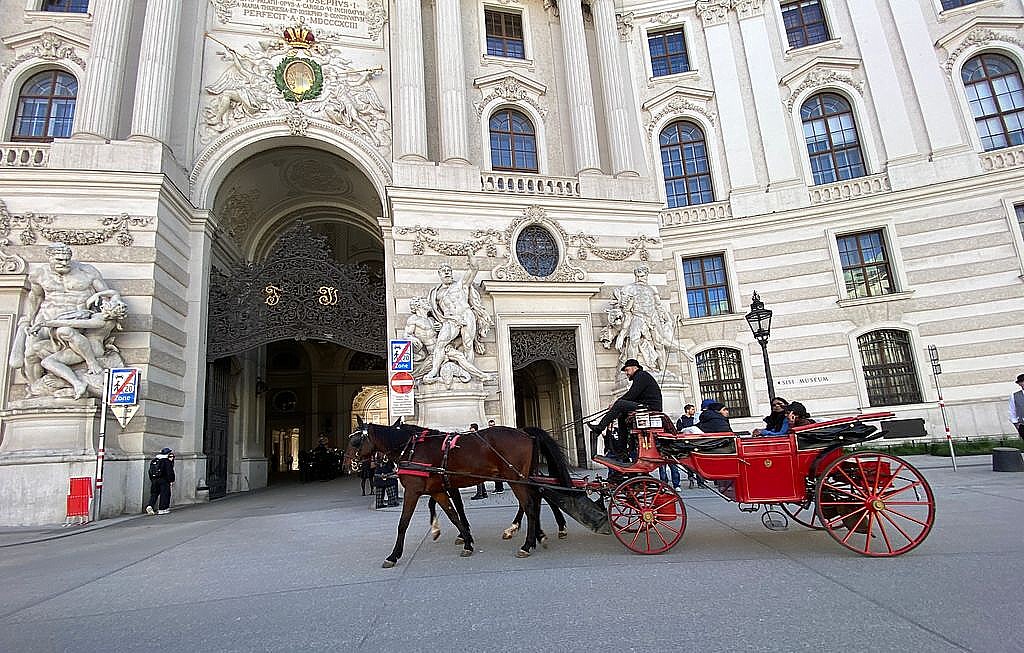
Horse-drawn carriages add atmosphere to the Hofburg Palace. ©Geri Bain

We are excited to have two full days in Vienna ahead of us. Our guided tour of the city starts at the Ring Road that cradles the historic center. This grand boulevard, home to the Vienna State Opera House, the Rathaus (City Hall), Parliament and Hofburg Palace, replaced the former medieval walls in the mid-19th century.

Our first stop is the 59-acre Hofburg Palace complex, once the winter residence of the Habsburgs. Horse-drawn carriages clip-clop through its main square and the Vienna Boys Choir and Lipizzaner stallions still train and perform here (Viking offers behind the scenes visits to both) while monumental museums showcase the Habsburg’s immense wealth, power and legacy. That evening, we head out with some new friends to retrace our steps on foot and enjoy seeing the elegant Baroque, Art Nouveau and Neoclassical architecture dramatically lit at night. 

Before heading out the next morning, we join Captain Lukas Hacunda for a wheelhouse talk about the unique challenges of navigating the Danube and its many locks and see how the wheelhouse tucks down into the ship when necessary to pass under low bridges.
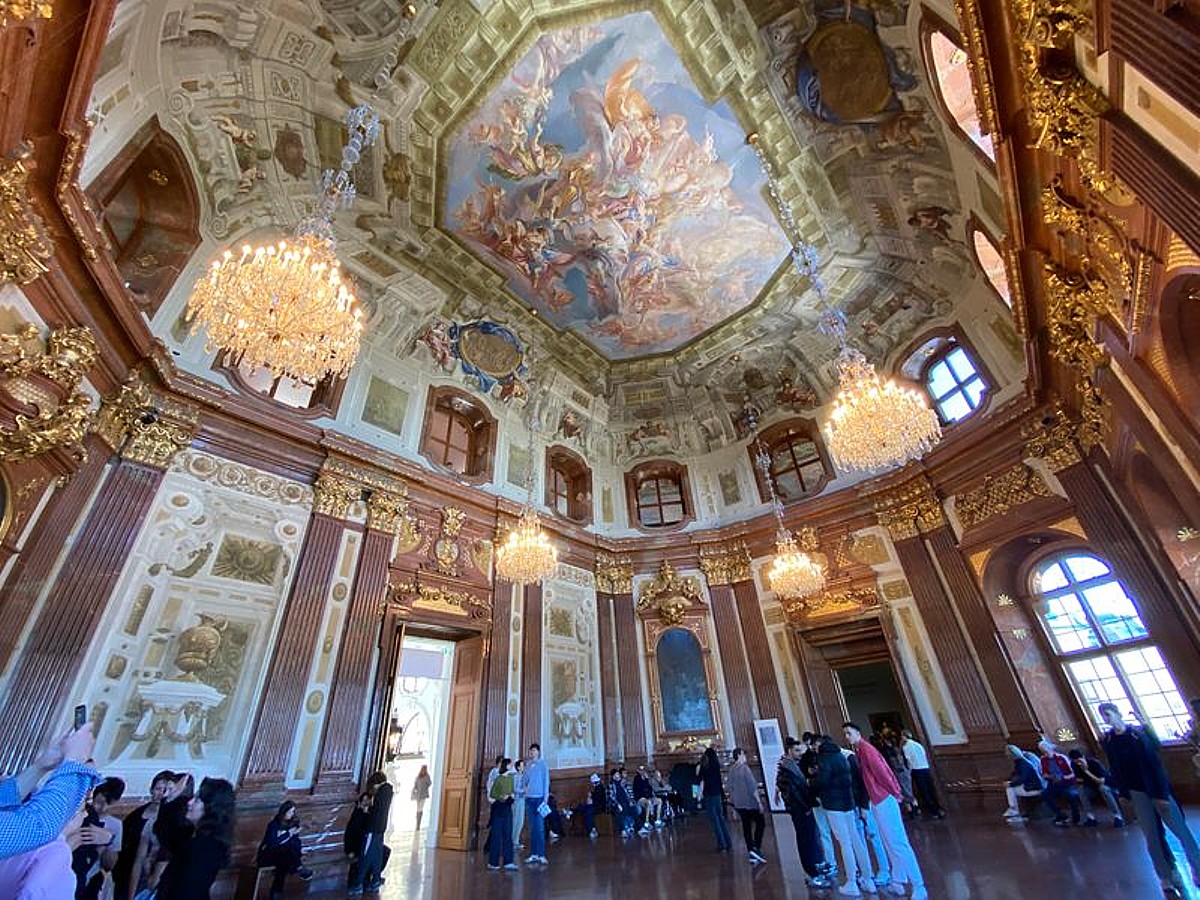
Belvedere Palace is an exquisite place to view art.  ©Geri Bain

Belvedere Palace, the opulent 17th century home of Prince Eugene Savoy, offers the chance to see world’s largest collection of works by Gustav Klimt, including the “Kiss,” so we decide to spend our afternoon there. Its gilded rooms provide the perfect setting for the works of Klimt, Monet and many other great artists, and its lovely formal gardens are an unexpected delight.

As we sail to Budapest that evening, Bratislava Castle appears, bathed in light, towering over its city. Later that evening, Teo’s unforgettable presentation on “Growing up in a Communist Country” provides a brief overview of communism in Eastern Europe brought to life by personal stories of his life as a young boy in Romania. Among the tenets of communist life: “If you see a line, get on it. There will be something you can use or trade.”

From the ship, we look out at the Chain Bridge and Buda Castle.  ©Geri Bain

We dock in Budapest near the historic Széchenyi Chain Bridge that connects the Buda and Pest sides of the city. Our city orientation starts with a bus tour that swings by the grand main streets and monuments on the Pest side of the city and then crosses the Danube and delivers us to the Buda Castle Quarter for a walking tour.

That afternoon, we reserve tickets to visit the Dohány Street Synagogue, the largest synagogue in Europe. The Moorish Revival style complex we see today was built in 1864; the temple seats nearly 3,000 people and resembles a church in its ornate decor and layout. Our guide explains that is because it was built by a “neologue” reform sect of Judaism that emphasized assimilation. In fact, until WWII, Budapest had no ghettos.

That changed suddenly in 1944, when Germany forced them into ghettos and deportation and an estimated 500,000 were murdered in just 56 days. The complex has a poignant burial ground, a museum, and the Raoul Wallenberg Holocaust Memorial Park with its weeping willow sculpture bearing thousands of leaves with the names of Hungarian victims.

A second Holocaust memorial, “The Shoes on the Danube Promenade” is a haunting array of 60 pairs of scattered cast-iron men’s, women’s and children’s shoes, marking an area where thousands of Jewish people were forced to remove their shoes before being shot and tumbling into the river. 

We end our day at a happier historic site, the Veli Bej Bath, which harkens to the 16th century when Budapest was part of the Ottoman Empire. Still popular with locals, its domed octagonal central pool is surrounded by smaller pools of varying degrees of heat fed by natural thermal springs and a selection of sauna and steam baths. Locker rooms are basic, but the timeless baths feel exotic and indulgent.

Just steps from our ship are lively sidewalk cafes, wine bars and ruin pubs. ©Geri Bain

We return to the ship for a farewell dinner where regional menu choices include chicken paprikash with potato dumplings and a yummy dessert of strawberries, caramelized pistachios in sweet Hungarian Tokaji wine sauce. After dinner, we set off with new friends on what has become our ritual evening walk. Soon, we are at Andrássy Avenue, the Champs-Élysées of Budapest. As we stroll along the grand boulevard, admiring the ornate details of the elegant Renaissance Revival architecture and delighting in our new-found friendship, we agree that our cruise has been all we’d hoped for and more.

The Basics: Prices for the seven-night “Romantic Danube” cruise start at $2,399 and include one excursion in each port, beer, wine and soft drinks with meals, port fees and taxes, and on-board lectures and entertainment. Budget extra for airfare, pre- and post- tours, additional excursions, tips, bar drinks, and transfers to and from the ship if flights are arranged independently. With recent flight issues, it’s more important than ever to plan to arrive at least a day early.

Rarely, but occasionally, low or high water levels can make parts of the Danube impassible, necessitating changes in the itinerary or a ship swap (where Viking transfers you and luggage to an identical stateroom and ship on the other side of the impassable section. Ask your travel advisor or Viking to see if your sailing might be affected.

Contact your travel agent or Viking River Cruises, 888-423-1412, www.vikingrivercruises.com.

__________________

© 2026 Travel Features Syndicate, a division of Workstyles, Inc. All rights reserved. Visit goingplacesfarandnear.com and travelwritersmagazine.com/TravelFeaturesSyndicate/. Blogging at goingplacesnearandfar.wordpress.com and moralcompasstravel.info. Visit instagram.com/going_places_far_and_near and instagram.com/bigbackpacktraveler/ Send comments or questions to FamTravLtr@aol.com. Bluesky: @newsphotosfeatures.bsky.social X: @TravelFeatures Threads: @news_and_photo_features ‘Like’ us atfacebook.com/NewsPhotoFeatures

Viking Polaris: Luxury and Learning on a Great Lakes Expedition Cruise

The Viking Polaris sails past Spirit Garden in Thunder Bay. ©Keroack Photography

by Geri Bain for Travel Features Syndicate, goingplacesfarandnear.com

We are out on deck at 7:45 a.m. to watch the weekly weather balloon launch. It’s June but still chilly on a Lake Superior morning. The crew has set out coffee and pastries, upbeat music is playing and the mood is festive as we count down to the launch. Helium carries the balloon up with its precious data collection module, which transmits detailed information back to the U.S. National Weather Service and the National Oceanic and Atmospheric Administration. After the launch, guests are invited to the Expedition Central area, where members of the scientific team are on hand to explain and answer questions. It’s exciting to learn that there are synchronous launches collecting data around the world.

Scientists offer interactive presentations throughout the Great Lakes cruise at the Viking Polaris’s Expedition Central area. ©Keroack Photography

This is one of many activities that draws us into the research being performed on-board every day during our 8-day “Undiscovered Great Lakes” cruise, which combines pristine Canadian wilderness with Midwest cities. We set out from Thunder Bay, Ontario in Canada and travel through Lake Superior, Lake Huron and Lake Michigan before ending in Milwaukee, WI.

Viking Cruises has two identical expedition ships—Polaris and Octantis. The ships are actual research vessels that partner with Great Lakes Environmental Research Laboratory and other universities and institutes to contribute data to scientific projects. Both offer itineraries of varying lengths from Antarctica to the Arctic. Each sails with a team of scientists, historians and naturalists who lead explorations and on-board hands-on educational activities, offer lively lectures, and share information about nature and citizen science apps such as iNaturalist and iBird.

The heated pool, complete with massaging jets, is part of a “Nordic Thermal Suite.” ©Viking Cruises

My husband and I are drawn to this cruise as it allows us to travel together while exploring at our own paces, sharing some activities and splitting up for others. (My ideal trip is almost non-stop activity; my husband enjoys his downtime.) I love that Viking Polaris has its own fleet of kayaks, Zodiacs and submarines and offers guided hikes and bike rides; he is excited by the chance to experience the high-speed, turn-on-a-dime, military-grade Special Operations Boats. We both look forward to basking in the Nordic Thermal Suite of steam, sauna and snow rooms, the heated pool with a relaxing area with massaging jets, and a traditional “badestamp”, a sheltered outdoor hot tub. And we both love the camaraderie of a small ship and low-key nightlife.

Kakabeka Falls, about a 30-minute drive from Thunder Bay, is among the area’s many natural attractions. ©Keroack Photography

Our cruise departs from Thunder Bay, Ontario. We arrive a day early to explore this nature- and history-rich area on our own. Our home base, Delta Hotels Thunder Bay, is a four-star Marriott with pretty views of the lake from our room and its gastropub. Before arriving, I download the local ride share app, uRide, and we find its drivers reliable and personable.

We arrive in time for dinner and a walk along the waterfront which is dotted with sculptures and art installations. We especially like the trail that winds through Spirit Garden, designed in collaboration with the Anishinaabe and other indigenous cultures with sign posts about the nature and culture of the region. On the horizon, we identify the “Sleeping Giant,” a rock formation across the bay that looks like a reclining giant.

An Anishinaabe woman shows us around her encampment just outside Fort William.  ©Keroack Photography

The next morning, we take a guided tour of Fort William Historical Park where costumed reenactors recreate daily life at an 1815 fur trading fort. At an Anishinaabe camp, women talk about how they plant and move with the seasons and insulate their wigwams to keep warm in winter. Inside the Fort, we meet a voyageur, a laborer from Quebec who does the backbreaking work of loading and transporting furs, and chat with the wife of the fort’s director who shows us around her house and talks about the difficulties of frontier life. We spend more than two hours here and we’d like to stay longer, but also want to see Kakabeka Falls Provincial Park, which has 130-foot tall falls and easy-to-hike trails.

Back in Thunder Bay, the history and art museums are closed the day we visit, but we get a sense of the vibrant art scene admiring the murals on “graffiti alley” before boarding the Viking Polaris, which is docked about a half mile from our hotel.

Our Nordic Balcony stateroom has a comfy sitting area and a floor-to-ceiling window wall that drops halfway to turn our room into a balcony.  ©Keroack Photography

We board in time for the orientation, where we learn that fitness tests are required both to go kayaking (the test consists of climbing in and out of the kayak without leaning anywhere that would tip it) and to take a submarine ride (basically the ability to squat). We love that we can attend the daily pre-dinner port talks and all the major on-board lectures either in person in The Aula, an inviting, two-deck auditorium, or on-demand in our cabin.

Our cabin’s sleek wood design feels chic yet super-functional with lots of drawers and closets, plus a special drying closet, and its heated bathroom floor and complimentary, custom-stocked drink fridge and snack drawer are nice touches.

That evening, we dine at World Cafe, the main dining room. Meal choices, surprisingly varied for a ship with only 378 passengers, are served buffet style, including every-night sushi and seafood stations where lobster is always on tap, and “The Grill”, with fresh meats, lobster and fish cooked to order. There is also 24/7 room service, two waiter-service restaurants, and Mamsen’s, a small light-bite eatery that features Norwegian recipes inspired by Viking Chairman and CEO Torstein Hagen’s mamsen (mom).

Our guide explains that the now headless Sea Lion Rock was formed from a magma intrusion, which resisted the erosion that washed away the surrounding sedimentary rock layers. ©Keroack Photography
 

We wake up to find ourselves anchored off Silver Islet in Sleeping Giant Provincial Park. We have signed on for a hike along the Sea Lion Trail. Our guide, Tom, whose wife’s family has been on the island for generations, talks about the geology and nature of the area and what it’s like to live in a tiny community with only a handful of year-round residents and a single general store. He notes that the town once supported one of the richest silver mines of the mid-19th century.

We learn more about the silver mine that afternoon on a zodiac trip that stops right over the hauntingly abandoned mine, now fully underwater. We marvel at the creativity and work it took to build an island around an underwater silver deposit and then pump out the water to build mining shafts that descended as far as 384 meters below the surface. 

Manfredi’s specializes in gourmet Italian food and attentive service. ©Viking Cruises

That evening we have reservations we made pre-cruise (allowed once here and in The Restaurant) for Manfredi’s, justifiably known for its excellent Italian dishes; my favorite is steak brushed with porcini mushroom dust. We enjoy the waiter service and we come back twice more and have no trouble being seated.

After dinner, I take off to explore the ship’s many lounges. There’s a trio playing in the Explorer’s Lounge and the game room has a competitive scrabble contest in play. My personal favorite is the Hide Lounge. Here, each evening a different crew member chats about the topic of his/her choice. My favorites were entertaining talks on sailors’ superstitions and legends of the sea. As non-gamblers who tend to watch history and nature shows at home, my husband and I find this ship exactly our style—as do our fellow cruisers.

Kayaking, zodiac and special operations boat tours generally last about an hour. ©Keroack Photography

The next day, we are anchored off Terrace Bay. Our group of six heads out on a Zodiac with Kelly, a geologist, who explains that the terraced shoreline was caused by various glacial retreats, which also allowed the land to rebound from the weight of the glaciers as they melted. He drops us off at Terrace Bay Beach, where we follow a boardwalk along the shore and then hike up to a waterfall and gorge. As we pull out, we spot a bald eagle.

McGarvey Shoal, our destination for the next day, comes with a morality tale of hubris. The luxury yacht Gunilda was shipwrecked here in 1911 because its owner declined to hire a pilot, opting to navigate his own way through this archipelago of low-lying islands. Fortunately no one died, but his boat sank. Exploring the shallows by Zodiac and kayak, it is easy to see how this could happen. In the late afternoon, we take a special ops boat ride that combines a nature tour with a breath-taking demonstration of the boat’s extreme speeds and maneuvering.

The Duluth waterfront is alive with cafes, restaurants, craft shops and two historical museums. ©Keroack Photography

We awaken in time to take in Duluth as we sail slowly along the waterfront. Since this is our first U.S. port, we need to pass through U.S. immigration, which amazingly sets up its operation steps from where we dock. After a quick pass through immigration, we join a morning tour of Glensheen Mansion, the art-filled estate of turn-of-the-century Duluth lawyer and legislator Chester Adgate Congdon. His life and wealth reflect the burgeoning mining, trade and brewing of his times.

It’s an easy walk from the ship to the Lake Superior Maritime Museum and the William A. Irvine Ore Boat Museum. We have signed on for a walking tour which provides a historic overview but does little more than take us to the two museums. In hindsight, I would have skipped the tour and explored the waterfront and museums on my own, and perhaps have added the nearby Great Lakes Aquarium, which a fellow passenger raved about.

Thanks to the Soo Locks, ships don’t have to run the rapids to safely navigate the 21-foot drop from Lake Superior into Lake Huron. Passing through the lock is an experience no one wants to miss. Since the timing is unpredictable, we have a full day “at sea.” I had worried that I’d be restless, but with expedition center activities, tours of the laboratory and The Hanger (where the water toys are stored and dispatched), and an indulgent visit to the spa, the day goes way too quickly.

I spend almost an hour at the Expedition Center, where I learn that the ship scientists collect phytoplankton, the basis of the entire food chain. A fascinated handful of us watch them dance around on a microscope slide whose image is projected on a big screen, and a few of us attempt to isolate one with a pipette. Then, touring the lab, I learn about the micro-plastics and bio-diversity studies the ship participates in and see the lab that analyzes the DNA of phytoplankton—like the one we tried to capture with a pipette.

With no cars allowed, horse-drawn carriages and bicycles are the way to go on Mackinac Island. ©Keroack Photography

We spend the next day in Mackinac Island where Viking offers bike tours and a lunch/tour at the Grand Hotel. We opt for a horse-drawn carriage ride and learn how the island was transformed from a military fort and trading stronghold to a tourist town. Later,we walk around, stopping into a few of the 17 fudge shops along the town’s main street. We arrive back at the ship in time to compete in a trivia contest and I savor one last swim and sauna before dinner. 

All too quickly, we find ourselves disembarking in Minneapolis and headed to the airport. Back home, we feel an almost mystical connection with the natural and human forces that formed and continue to re-form the Great Lakes and are looking at our local landscapes and wildlife with new eyes.

The Basics: Viking Cruises offers expedition cruises of the Great Lakes varying in length from eight to 17 nights between late May and mid-September. Prices for the 8-night “Undiscovered Great Lakes” cruise start at around $6,995 per person and include a land or shore excursion in every port including those on kayaks, zodiacs & special operations boats (with any needed gear such as dry suits for kayaking provided), port fees, gratuities, beer, wine & soft drinks with meals, access to the Nordic Spa and fitness center, self-service laundry, 24-hour room service, and more. Submarine excursions are $499 per person; pre- and post- tours and additional land excursions are available at added cost.

Helpful Links:

VikingCruises.com

visitthunderbay.com 

_____________________________

© 2025 Travel Features Syndicate, a division of Workstyles, Inc. All rights reserved. Visit goingplacesfarandnear.com and travelwritersmagazine.com/TravelFeaturesSyndicate/. Blogging at goingplacesnearandfar.wordpress.com and moralcompasstravel.info. Visit instagram.com/going_places_far_and_near and instagram.com/bigbackpacktraveler/ Send comments or questions to FamTravLtr@aol.com. Bluesky: @newsphotosfeatures.bsky.social X: @TravelFeatures Threads: @news_and_photo_feature