Tag Archives: Visiting Hanoi

Unexpected Delights in Hanoi on Discovery Bicycle Tours’ 12-Day Vietnam Trip

Train Street is as colorful as it is thrilling an experience in Hanoi © Karen Rubin/goingplacesfarandnear.com
 

By Karen Rubin, Travel Features Syndicate, goingplacesfarandnear.com

Discovery Bicycle Tours’ Biking Vietnam tour is designed along the best principles of travel: to explore, discover, learn, make connections, be present, experiential, meaningful and revelatory, and do it in a way that maximizes the benefits and minimizing the negative impacts of tourism.

Taking a traditional boat ride into the Thung Nham bird sanctuary © Karen Rubin/goingplacesfarandnear.com

Of the 12 days we spend in Vietnam, traveling from north, to central, to south (flying between regions), we bike on six of them. That might seem odd for a biking tour, but you don’t travel 30 hours to Vietnam and miss the important highlights, like Ho Chi Minh’s mausoleum in Hanoi, taking a traditional row boat through the caves of Ninh Binh; cruising overnight on the Ha Long Bay; discovering the Citadel and Imperial City of Hue; walking the colorful markets and enjoying the nightlife of Hoi An; or touring the War Remnants Museum, the historic Ben Thanh Market, or miss the experience of street food in Saigon (Ho Chi Minh City) because you are obsessive about biking. We get to do all of these, and also bike through villages, stopping to learn about traditional crafts, and amid the rice paddies to learn about Vietnam’s 4000-year old wet rice culture and ancestor worship.

Riding the bus between destinations affords an opportunity to see vietnam’s countryside © Karen Rubin/goingplacesfarandnear.com

Riding in the bus between destinations lets us see the countryside (and I have set myself a challenge to get photos of people working in the fields and four people riding a motor scooter); the way the homes are laid out, the ancestral tombs in the fields, the occasional tractor, the massive, new industrial parks under construction. You see progress unfolding at the speed of the bus, all the more impressive when you realize what a young country Vietnam is, having proclaimed independence in 1945 but only “reunified” in 1975.

A family poses in traditional dress for formal photograph during the month-long Lunar New Year celebration © Karen Rubin/goingplacesfarandnear.com

The essence of this tour is about familiarizing us with the Vietnamese people (who, we learn, are a mosaic of 54 different tribes), the rich cultural heritage and today’s achievements in overcoming literally millennia of conflict, war, oppression, colonialism. When we bike, hike or walk, we barely have to think a question, let along ask it, before our guide, Nguyen Hong Phong, stops and answers. “This is normal for me, curious for you,” he tells us at the outset, as we sit for tea in the Apricot Hotel on our first afternoon together in Hanoi. “When you are curious, just ask,” he adds.

A government building in Hanoi. Political symbols are less prominent than would be expected, while motorscooters and Starbucks and KFCs are ubiquitous © Karen Rubin/goingplacesfarandnear.com

2025 marks the 50th anniversary since the Fall of Saigon that so abruptly ended an interminable war (and reunification as an independent country). You can’t escape the fact of the “American War” (which frankly was the tail end of a decades long war for independence before the United States interceded), but our tour seems to sidestep the past in favor of the present. This is probably a reflection of Discovery Bicycle Tours’ primary focus for its guests: “You’re on vacation!”

(There are several important sites that are not included in this tour that I would recommend setting up pre and post days: the Hoa Lo Prison in Hanoi, infamously known as “Hanoi Hilton” and the Chi Chi Tunnels which is an excursion from Saigon. Even the War Remnants Museum, a must-see in Ho Chi Minh City, was not on the itinerary but we visit when we could not visit the Reunification Palace as planned.)

Ho Chi Minh’s last residence, where he lived from 1968 to 1969 when he died is camouflaged and connected to escape tunnels © Karen Rubin/goingplacesfarandnear.com

Still, there is no escaping the past: in Hanoi when we visit Ho Chi Minh’s 1968 residence, built like a camouflaged bunker with escape tunnels and learn they moved his body regularly when he died in 1969; when we visit the John McCain Monument where the American hero’s plane went down and he was captured; when we see the bullet holes in the Citadel in Hue and are shown photos of fighting that took place on the very spot where we stand; and when we visit My Son, a sacred historic site outside of Saigon, and learn that the Vietnamese appealed to President Nixon to stop bombing. I think Americans who visit Vietnam have an obligation to see what was done in our name, especially because it is so important to learn from history so not to make the same mistakes, and not be duped by an administration determined to go to war for its own political agenda.

Our Discovery Bicycle Tours group gets to learn how to make rice paper during our ride in Hoi An. Americans are warmly welcomed in Vietnam and have opportunities to visit people where they live © Karen Rubin/goingplacesfarandnear.com

I frankly didn’t know how I would react coming to Vietnam – I am the generation that lived through the Vietnam War (known here as “The American War”), or how Americans would be received. My questions are soon answered – the Vietnamese warmly welcome  us Americans (and French and Chinese and a list of nationalities that have oppressed Vietnam).  Vietnam is nothing like what I expected – in a good way. It’s in this capacity that one of the important attributes of travel come to fore:  we travelers are ambassadors, promoting mutual understanding and connection.

Celebrating a birthday in Hue, Vietnam. What a difference peace makes © Karen Rubin/goingplacesfarandnear.com

In Vietnam today, you can see the impact of peace, free markets, free enterprise have to achieve prosperity – a lesson to all those who are inciting conflict and war. You see the benefits of trade and globalization – a lesson for those who would disrupt and unravel alliances and build barriers instead of bridges.

Old Hanoi

Since our group is first meeting together at 1 pm for a walking tour, I have the morning to myself to explore. I walk across the street from our luxury hotel, The Apricot, to the park that rings the small, picturesque lake.

A woman poses in traditional dress for formal photograph during the Lunar New Year celebration in Hanoi © Karen Rubin/goingplacesfarandnear.com

We are here during the month-long Lunar New Year celebration, made even more festive because of the 50th anniversary of reunification – everywhere that is possible has decorations reminiscent of how we celebrate Christmas. People dress in their formal, traditional costumes and pose for photos taken by professional photographers. People travel on holiday. There is a festive atmosphere everywhere.

There are political symbols, posters, flags and such but no more than the giant advertising billboards and the Starbucks, KFCs, McDonalds, Burger Kings. Also, I am flabbergasted at the proliferation of motorscooters and the paucity of bicycles. Crossing any street takes fortitude and a measure of fatalism, but where there are traffic signals, the systems are sophisticated and effective. Also, cell phones are ubiquitous.

The proliferation of motorscooters in mind-boggling © Karen Rubin/goingplacesfarandnear.com

I head into the Old Quarter where I am intrigued at the “old propaganda posters” shops, the coffee shops (who knew Vietnam was such a major producer and exporter of coffee?), and massage parlors as common as nail salons at home.

The Propaganda Poster Shop seems more to satisfy the American and European tourists who visit (“Make Art Not War”).

But here at the Propaganda Poster Shop I happen to see many postcards for Train Street (reminding me of Lisbon) which suggests it is an important site and inspires me to go in search of this place.

Old Propaganda Posters shop © Karen Rubin/goingplacesfarandnear.com

After getting lost (my WiFi isn’t working and I can’t figure out the map) and stopping numerous people to point me in the right direction, I look up and am drawn to colorful lanterns, walk up a staircase and find myself quite literally on the train tracks. Train Street!

Train Street is as colorful as it is thrilling an experience in Hanoi © Karen Rubin/goingplacesfarandnear.com

People have set themselves at café tables and chairs and are even hanging out on the tracks taking photos. It is all the more amazing because it turns out it is just 5 minutes before the train is due (and I am so lucky because only a few trains come through a day). With 5 minutes to go, there is even a baby playing on the track!

Train Street is as colorful as it is thrilling an experience in Hanoi © Karen Rubin/goingplacesfarandnear.com

I am standing alongside the track and a lady yells at me to sit down in one of the plastic chairs, like a kid’s chair. As the train comes tearing through at what seems a very fast speed, it is so close that had I held out my hand, it would have been taken off. I reflexively suck in my breath and try to make myself as small as possible until it passes. Unbelievably thrilling.

Train Street is as colorful as it is thrilling an experience in Hanoi © Karen Rubin/goingplacesfarandnear.com

I feel proud of myself for being able to find my way back to the hotel by 1 pm in time to meet our Discovery Bicycle group for our first activity together, a walking tour of the Old District. I have already been traveling with 8 of the group for Discovery Bicycle’s four-day Cambodia pre-tour and now we meet the other 10.

Phong leads us to the St. John Cathedral, the oldest church in Hanoi. Built on the site of the biggest, most sacred Buddhist pagodas of the Ly-Tran Dynasties, the cathedral was constructed at the end of the 18th century of wood, then reconstructed with baked clay in 1884-1888. Phong tells us that Catholics are a minority; the biggest religion in Vietnam, he says, is “triple religion” – a mix of Buddhism, Confucianism and Taoism (ancestor worship).We will see evidence of this everywhere we go.

St. John Cathedral in Hanoi. © Karen Rubin/goingplacesfarandnear.com

Phong volunteers that the Communist government “allows free religious worship and free press” (though I question what he means by “free press”), then adds that protest against the Communist Party is not allowed; nor is there an opposition candidate in elections. Vietnam has been a one-party government since 1954, but in 1986 introduced new freedom in commerce and open markets.

“We have more freedom than in China. They block media there, here they block the BBC but we can get CNN.” Whatever they block, he says, people get curious and have their ways of accessing.

Walking through Old Hanoi © Karen Rubin/goingplacesfarandnear.com

“Society is improving for ordinary people. Since 1988, we are living in peace. We feel more freedom, a peaceful country. We are now friends with Russia, Ukraine, the European Union. The USA is one of seven strongest friends. Peace is good for people, good for the country. [Tourists want to] come to a peaceful country.”

Phong tells us he learned English (as well as French and Chinese) at university where he studied tourism, but today, children are taught English as early as 3 and 4 years old in school. Public school is free he tells us, even in the mountains where parents are actually given a money incentive to send their kids to school.

Tin Street in Old Hanoi © Karen Rubin/goingplacesfarandnear.com

We walk through Hanoi’s Old Quarter where the name of the street may well describe what enterprises take place there, established generations ago by the people who resettled in the city: Tin Street, Silver Street, Basket Street, Copper Street.

We return at 3 pm for tea at the Apricot Hotel – an elaborate affair – that includes an introduction and orientation to our 12-day tour (with biking!) with Phong as our lead guide.. Indeed, we will go first thing the next morning to get sized for our rental bikes which we will use for five of the days (the driver and bike mechanic who travels will us will travel 2 ½ days to Hue, when we fly), and will pick up a different bike in Ho Chi Minh City (way too far to drive and return).

I realize that we have just enough time to see the 5:15 pm traditional Water Puppet Theater cultural show just across the street from the hotel, before we meet again to go to dinner.

I had seen this heritage show when I was in Ho Chi Minh City six years before, so was enthusiastic to see it here, and encourage my traveling companions to come.

Water Puppets Theater is a delightful cultural show © Karen Rubin/goingplacesfarandnear.com

Most of our group from the four-day Cambodia pre-tour (we really bonded) are game and we actually purchase the last tickets for this immensely popular program. The show is a cultural treasure that utilizes this traditional art form, with musicians performing with traditional musical instruments and song, fables and folk stories enacted by these marvelous puppeteers  (yes, the puppets are in a pool of water!).

Water Puppets Theater is a delightful cultural show © Karen Rubin/goingplacesfarandnear.com

Captions and notes about the theater and the scenes are flashed on the walls beside the stage. Vietnam water puppetry, I learn, was born from the rice civilization in the Red River Delta, so agriculture is vividly depicted by the puppets, with farmers and familiar images such as riding buffalo, plowing, harrowing, transplanting rice, slapping water, harvesting. (Later, when we bike among the rice paddies, we will see how this tradition originated.)

Water Puppets Theater has its origins in rural rice production © Karen Rubin/goingplacesfarandnear.com

One of the scenes enacts “The Legend of Returning the Sword by King Le Loi” where LeLoi caught a holy sword by chance as he led the resistance war. After defeating the invaders, he proclaimed himself king. King Le Li goes out boating on the Green Water Lake, when suddenly a large turtle surfaced, took the sword from King Le Loi’s belt, and dived back into the depths, carrying the glowing sword in his mouth. (This is all enacted with puppets in the water).

Water Puppets Theater is a delightful cultural show © Karen Rubin/goingplacesfarandnear.com

The humor that is integral to the culture is displayed where the puppets enact an old farmer “Chasing fox away from the flock of ducks”. “It creates Vietnamese optimistic farmers,” the notes say.

Water Puppets Theater is a delightful cultural show © Karen Rubin/goingplacesfarandnear.com

The notes for “The Spirit Mediums Spiritual Dance,” say that “Vietnam’s Mother Goddess worship has been honored by UNESCO as an intangible cultural heritage of humanity. In today’s life, Mother Goddess worship is mainly known to the community through the concept of ‘The Spirit Mediums’. Traditional cultural elements such as costumes, music, dance and folk performances imbued with Vietnamese cultural identity are created, developed and passed on from generation to generation.”

The ”Four Sacred Animals Dance” brings together Long, Ly, Quy and Phuong (Dragon, Unicorn, Tortoise, Phoenix) “praising the nature of heaven and earth, hoping for a peaceful state and a peaceful and happy life.”

Water Puppets Theater puppeteers come out for their curtain call © Karen Rubin/goingplacesfarandnear.com

There are fire effects and of course water effects and amazing choreography – you actually cannot figure out how the puppeteers coordinate so well (and underwater!) – and then the puppeteers appear for their curtain call, up to their waist in water.

The show finishes just in time for us to walk together to dinner in a charming restaurant in the Old District.

A delightful restaurant in Hanoi’s old district © Karen Rubin/goingplacesfarandnear.com

A note on the table about the apple cider makes us giggle: “Cider drinkers get more refreshment and excitement while still keeping their sanity. Especially suitable for women.”

Our lunches and dinners at restaurants are typically pre-ordered and served family style, with multiple courses so that we typically have chicken, beef, seafood, vegetable, rice, soup dishes – always with more than enough to satisfy even American appetites, and to get a really excellent idea of the cuisine.

Our Discovery Bicycle Tours guide Calista Phillips and Jake can’t resist purchasing these hats at the night market © Karen Rubin/goingplacesfarandnear.com

We walk back to the Apricot Hotel through the bustling night markets that take over the streets, brightly and colorfully lit.

The Apricot Hotel is a five-star luxury hotel set just across from the picturesque park and lake © Karen Rubin/goingplacesfarandnear.com

Exploring the Apricot Hotel (we will be leaving early in the morning after breakfast), we discover an exquisite rooftop indoor pool and bar with a giant video screen. The artwork around the hotel, the elegant (French-inspired) furnishings are gorgeous.

Discovery Bicycle Tours, 2520 W. Woodstock Rd., Woodstock, VT 05091, 800-257-2226, 802- 457-3553, info@discoverybicycletours.com, www.discoverybicycletours.com.

Next: Ho Chi Minh Mausoleum and Ninh Binh Bird Sanctuary

See also:

UNEXPECTED DELIGHTS IN HANOI ON DISCOVERY BICYCLE TOURS’ 12-DAY VIETNAM TRIP

DISCOVERY BICYCLE TOURS VIETNAM TRIP: HO CHI MINH MAUSOLEUM BRINGS NEW CLARITY TO A CLOUDY PAST

DISCOVERY BICYCLE TOURS’ VIETNAM:  A BOAT RIDE THROUGH CAVES, BIKE RIDE TO TEMPLES IN NINH BINH

CRUISING BAI TU LONG BAY ON THE DRAGON LEGEND

DISCOVERY BICYCLE TOURS’ VIETNAM: HUE’S CITADEL, “CITY OF GHOSTS” & THE CHALLENGE OF BIKING THE HAI VAN PASS

DISCOVERY BICYCLE TOURS’ VIETNAM: HOI AN’S DAZZLING LIGHTS, TRANQUIL COUNTRYSIDE

A RENDEZVOUS WITH PROGRESS OF THE PRESENT, HORRORS OF THE PAST IN HO CHI MINH CITY

__________________

© 2025 Travel Features Syndicate, a division of Workstyles, Inc. All rights reserved. Visit goingplacesfarandnear.com and travelwritersmagazine.com/TravelFeaturesSyndicate/. Blogging at goingplacesnearandfar.wordpress.com and moralcompasstravel.info. Visit instagram.com/going_places_far_and_near and instagram.com/bigbackpacktraveler/ Send comments or questions to FamTravLtr@aol.com. Bluesky: @newsphotosfeatures.bsky.social X: @TravelFeatures Threads: @news_and_photo_features ‘Like’ us at facebook.com/NewsPhotoFeatures

Museum Hopping and Shopping in Hanoi, Vietnam

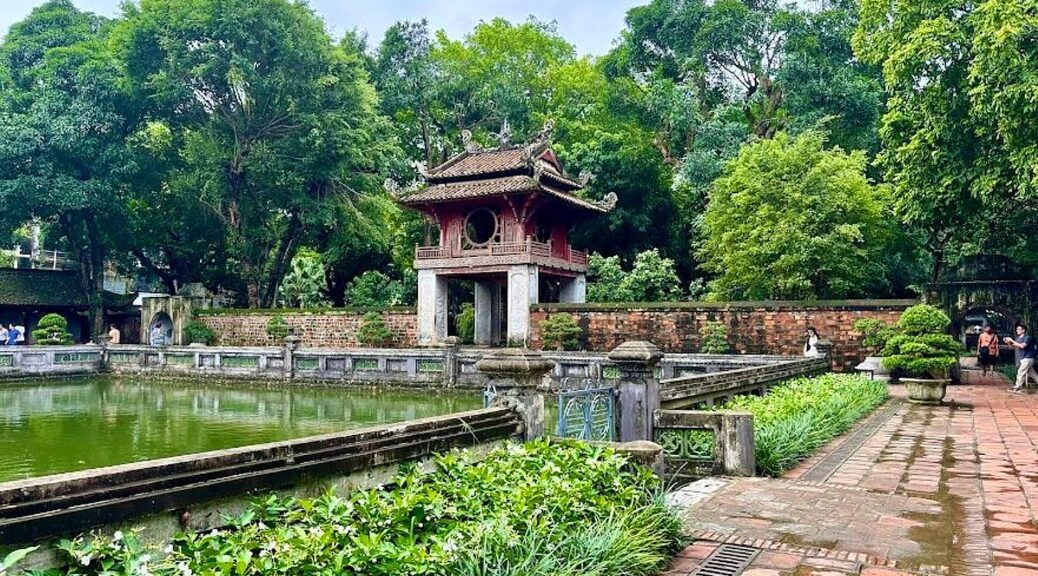
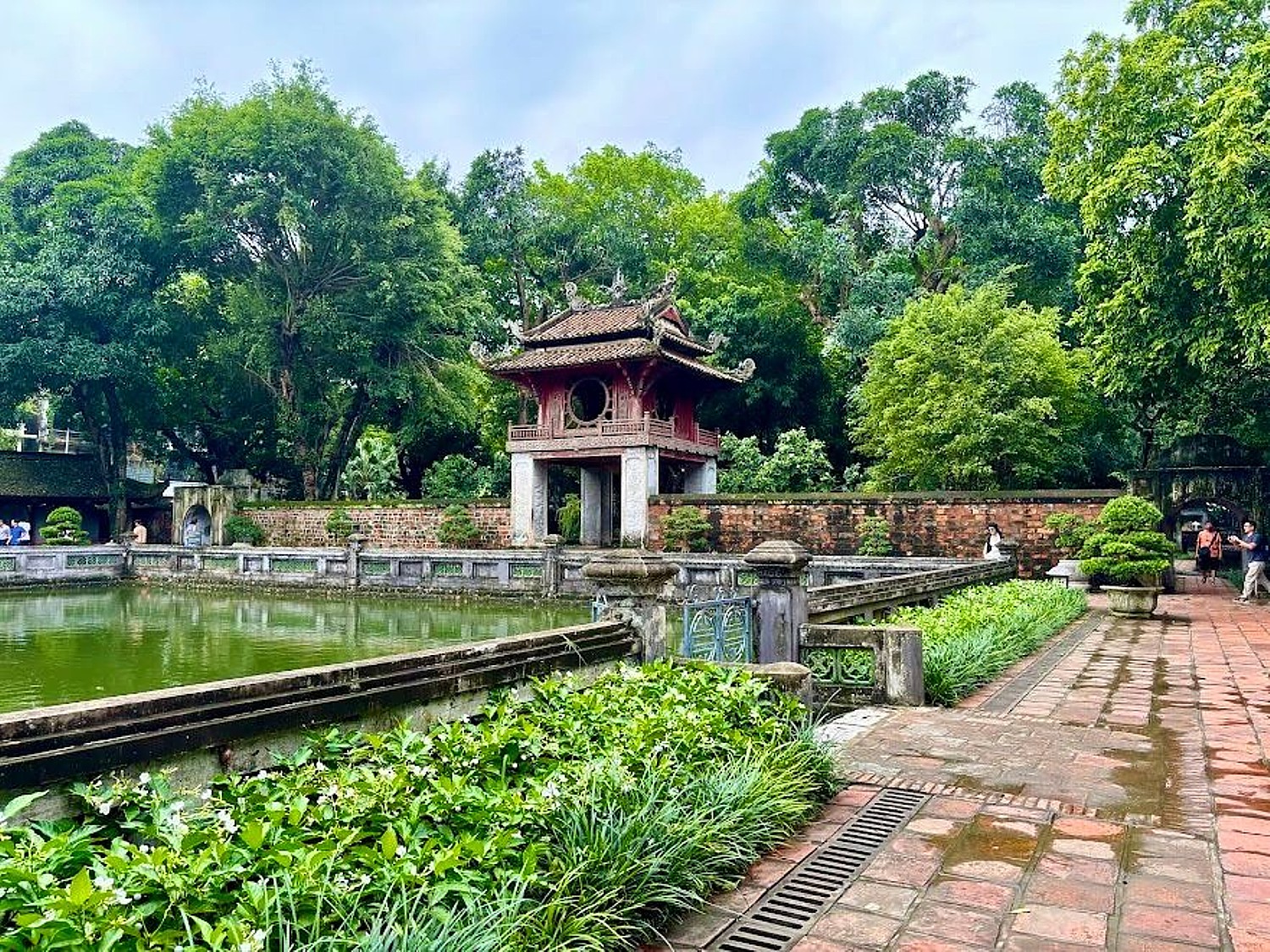
Among the museums and sites to visit in Hanoi, Vietnam, the Temple of Literature, dedicated to Confucius, is still a pilgrimage site. © Geri Bain

by Geri Bain for Travel Features Syndicate, goingplacesfarandnear.com

Hanoi is the last stop on a 16-day journey through Vietnam and Cambodia with my 30-year-old daughter. We built our itinerary around a one-week AmaWaterways Mekong River cruise (AmaWaterways.com) which began with a pre-cruise stay in Ho Chi Minh City and finished with a post-cruise stay in Hanoi. Here are highlights of Hanoi:

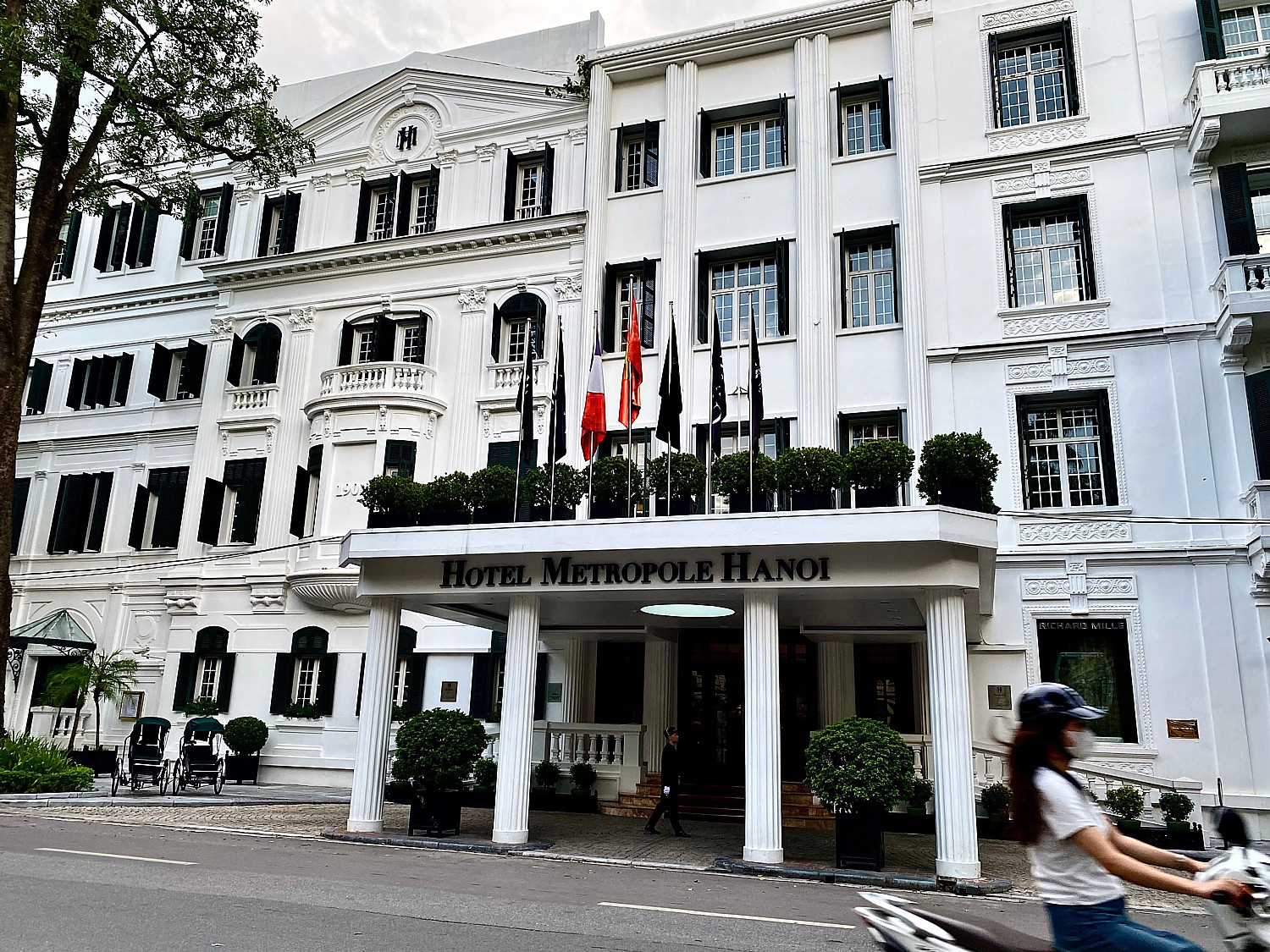
We check into our hotel, the Sofitel Legend Metropole Hanoi, happy we decided to spend three days here before flying back to the U.S. The hotel’s Heritage Wing, where we are staying, completed a full renovation last year, maintaining its luxurious French Colonial feel. We are thrilled to find that our Metropole Suite is actually comprised of three rooms—a living room with comfy chairs and a couch that is a sofa-bed, a parlor/office and a master bedroom with a king-size bed, plus two oversized bathrooms with Toto smart toilets. A nice surprise are the two balconies with great city views. (www.sofitel-legend-metropole-hanoi.com)

The recently-renovated Sofitel Legend Metropole Hanoi Heritage Wing, which opened in 1901, maintains its luxurious French Colonial feel. © Geri Bain
 

The oldest continuously operating hotel in Hanoi, the Sofitel Legend Metropole has a central location that allows us to walk to everything we want to do and offers a lovely pool and spa for recharging. Most of all, we love that the hotel’s rich history, decor, art collection and permanent “Path of History” exhibit create a kind of live-in history museum where we can relax and still feel immersed in the city. 

The hotel served as the official guest house for government guests and delegations under Ho Chi Minh. Walking through the hotel’s “Path of History” hall, we see that its list of past guests reads like a Who’s Who of the 20th and 21st century, from writers Somerset Maugham and Graham Greene to U.S. presidents. Photos of more recent political conclaves hosted here include a 2019 meeting between President Trump and Kim Jong Un.

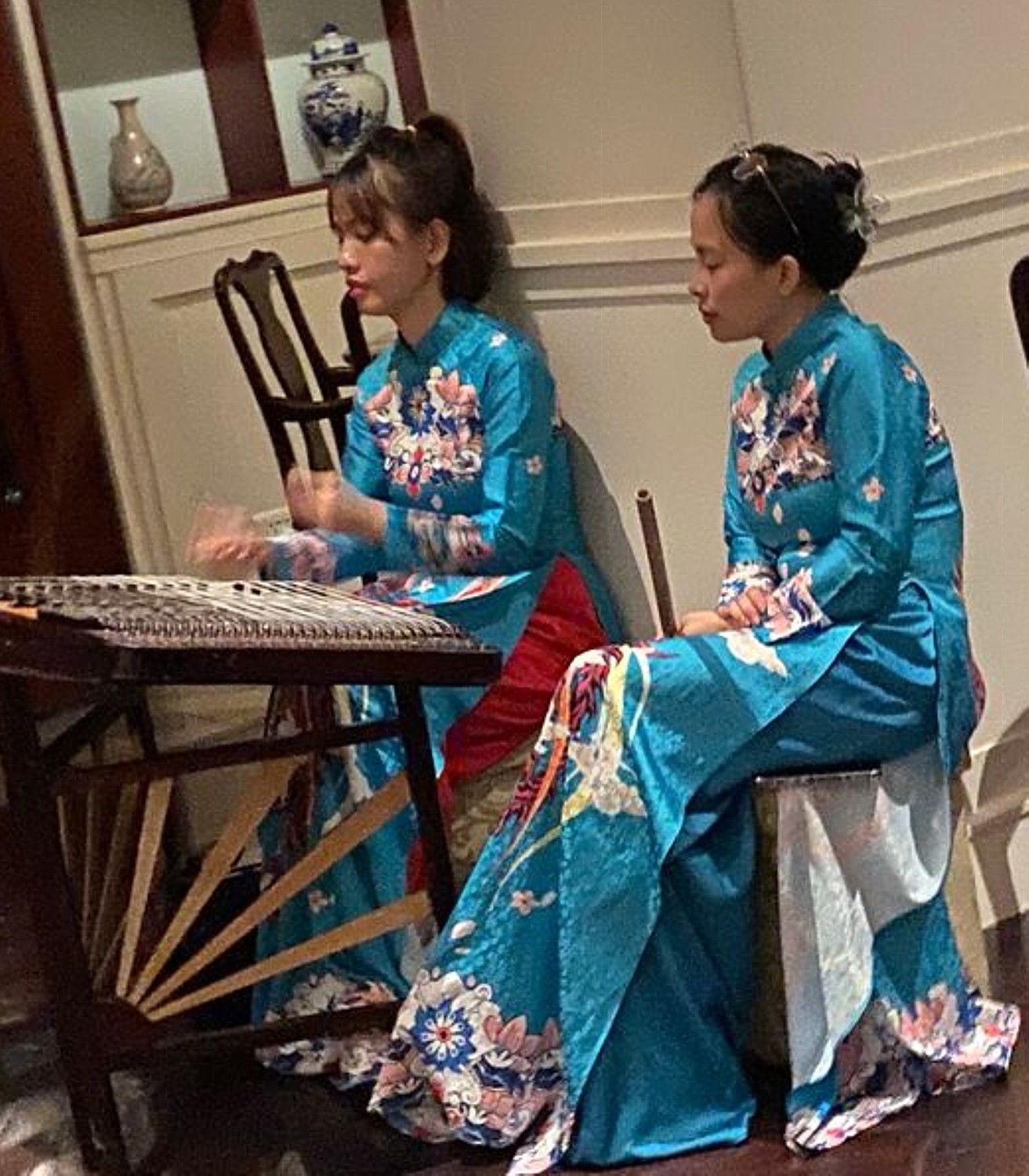
We enjoy listening to traditional Vietnamese music as we enjoy a tasting menu of specialties from different regions of Vietnam at the hotel’s Spice Garden. © Geri Bain

In addition to the actual history exhibit, over the course of our stay, we take in the entire hotel as we would an art museum, studying the sculptures and scenes of contemporary and historic Hanoi that decorate the stairwells, lounges, and other public spaces of the hotel.

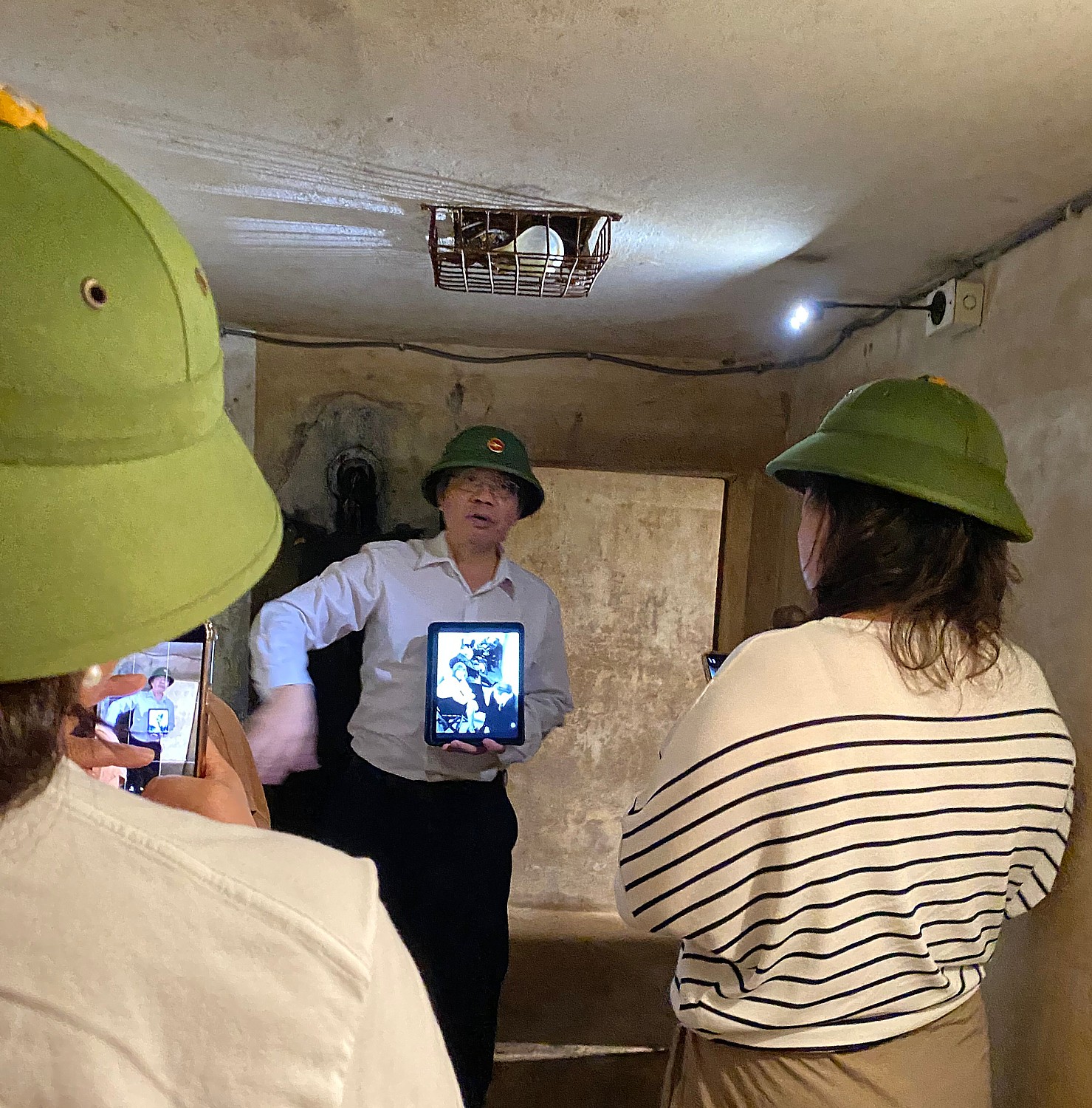
A tour of the hotel’s historic bomb shelter, free to hotel guests, turns out to be a much broader lesson in history. Our guide shows us photos of visiting diplomats and other hotel guests huddled in the small underground space during the Vietnam War (known as the American War in Vietnam); sometimes they were roused to retreat to the shelter multiple times a night. We also see heart-wrenching photos of the effects of the war on the city, its surroundings and its people.

We don helmets before descending into the bomb shelter where Jane Fonda, Joan Baez and other guests found safety during “American War” bombings of the city. © Geri Bain

Especially haunting is standing in the shelter and listening to the song “Where are you now, my son?” by Joan Baez, putting words to her experience when she emerged to witness the devastation caused by bombings.

We come to the Hoa Lo Prison expecting to learn about the American POWs held here during the Vietnam War, most famously John McCain. Facetiously called the “Hanoi Hilton” for the torture and harsh treatment that McCain and other American soldiers received here, the small area of displays and videos of happy Christmas moments and proclamations of how well they were treated is startling.

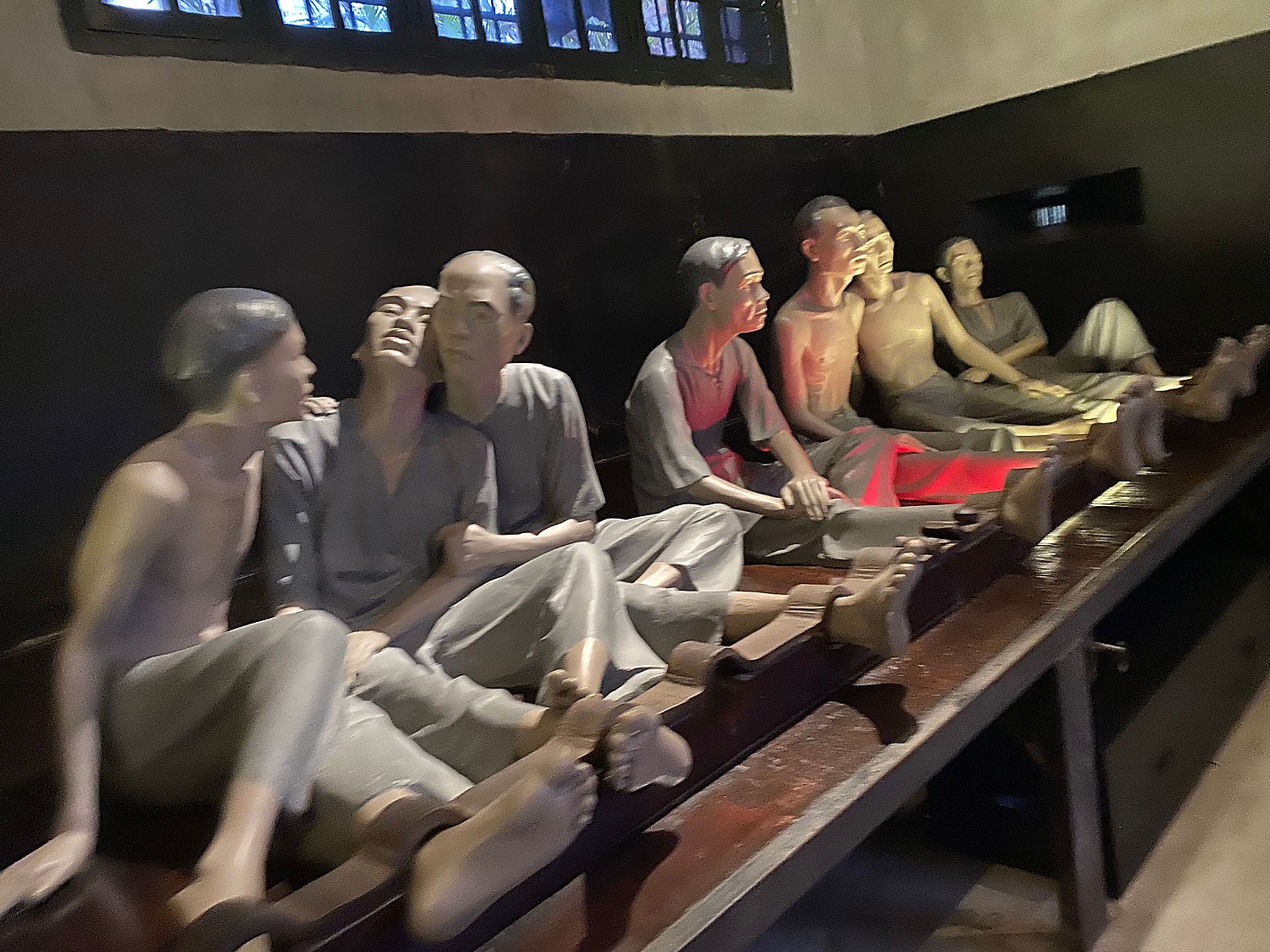
Hoa Lo Prison was built by the French to quell political uprisings; it had the opposite effect. © Geri Bain

But that exhibit is only a smidgen of the museum. Its main message is the cruelty of French colonial days. We learn that the prison was built by the French Colonial government in 1896 for political prisoners. We see a portable guillotine, torture instruments and a life-size recreation of a room lined by prisoners shackled side-by-side on long concrete slabs. The museum is mainly dedicated to the horrific treatment of the Vietnamese at the hands of the French, to the heroes who lived and died here, and to the communist education and revolutionary fervor that fomented here, making the Hoa Lo Museum a proud Vietnamese heritage site.

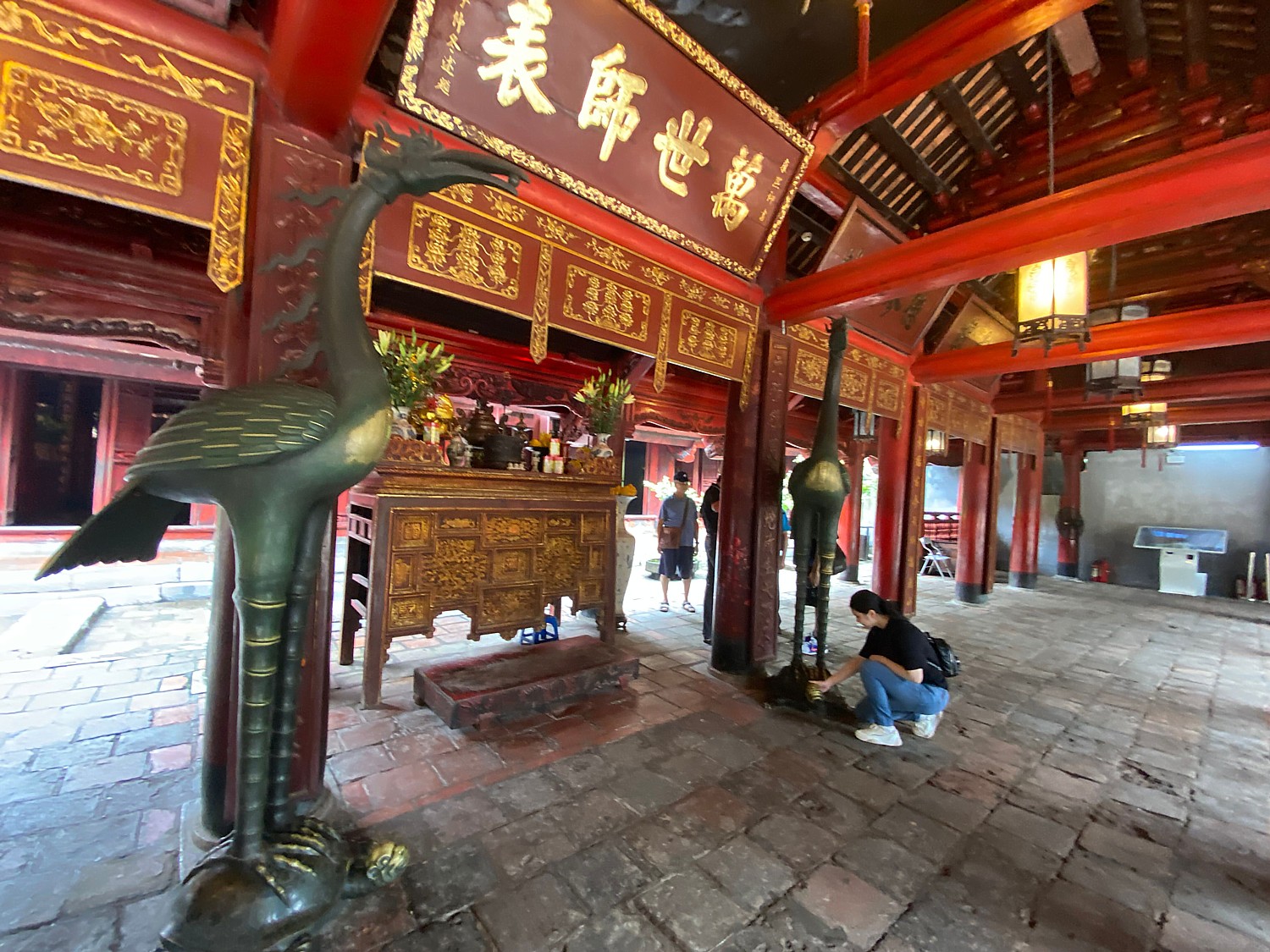
The Temple of Literature, founded in 1070, was Vietnam’s first university. © Geri Bain

As we walk through the grand Gate of the Temple of Literature, we are amazed to realize that we are entering a university that was founded in 1070. The school was first open to members of the Royal families and later to exceptional students of other social classes. It stopped serving as a university in 1779, but it has never veered from its purpose to honor, worship and provide a place to learn the wisdom of Chinese philosopher Confucius. Students and their parents still come here to burn incense, make offerings and pray for success before important exams. We see people waiting their turn to touch a statue of a crane standing on the back of a turtle. We’re told that rubbing the belly of the crane and the head of the turtle bring good luck, and not just on exams. Never wanting to pass up a chance for positive energy, we respectfully take our turns as well. 

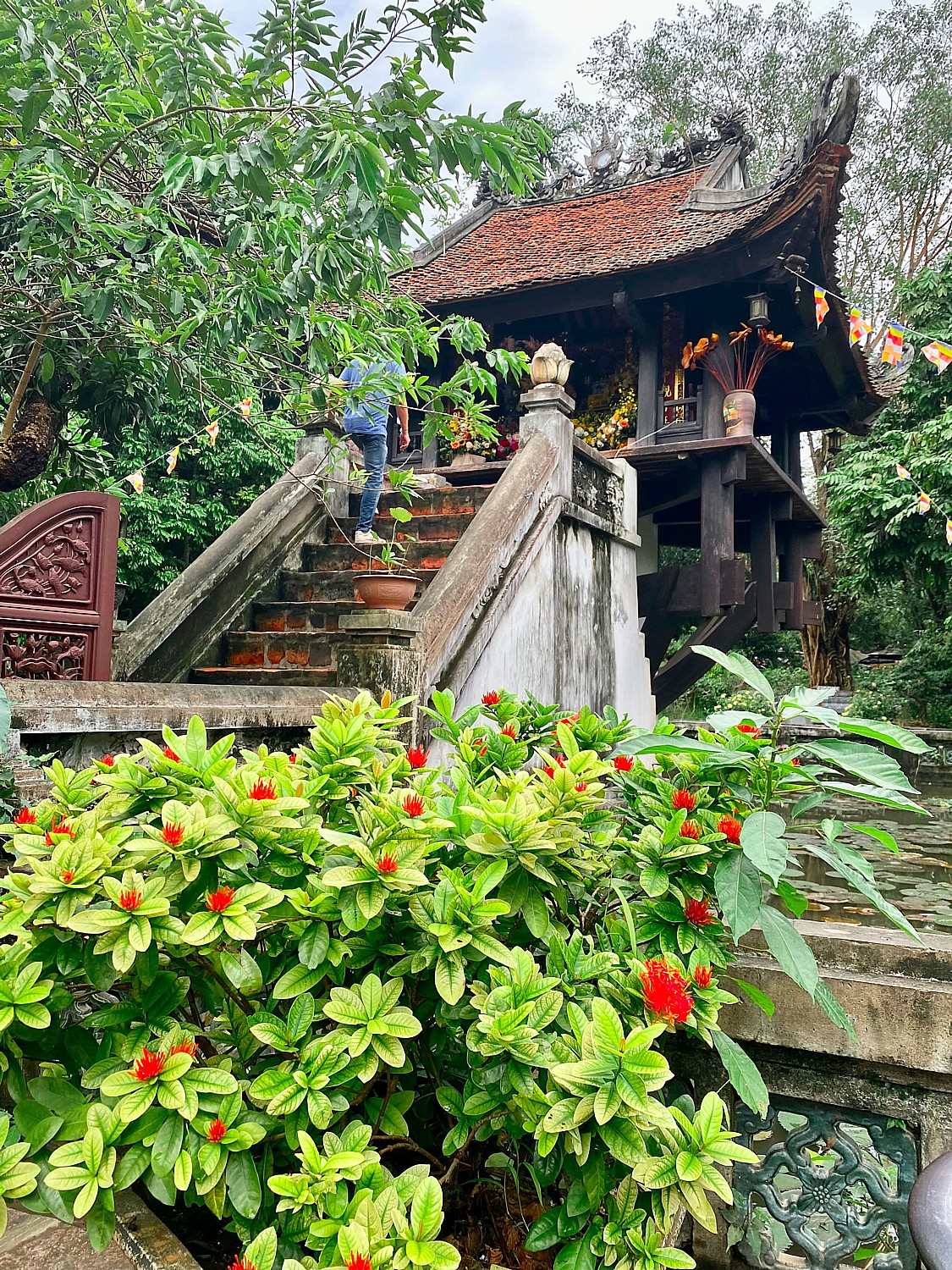
Couples seeking children are among those who bring offerings and pray at the One Pillar Pagoda, an 11th-century Buddhist site. © Geri Bain

Throughout our travels in Vietnam and Cambodia, we’ve come to appreciate how much architecture in this region is imbued with symbolic meaning. A great example is One Pillar Pagoda which dates back to 1048. The pagoda, which sits on a single pillar on a small lake, is designed to give form to a lotus flower like the one in a legendary dream by an 11th-century heirless emperor. He dreamt that the Buddhist goddess of mercy sat in a lotus flower on a lake and handed him an infant son.

When he did indeed have a son, he had this pagoda built in gratitude. The number three, which represents fertility, is symbolized by the three figures on the roof: two dragons (representing yang) gazing at a moon (representing yin). Inside, eight beams represent the eight petals of the lotus. The number of steps to the main hall—13—represents fertility and wealth. Although the temple has been rebuilt several times over the centuries, the architecture still embodies the spirit of the shrine. We observe a number of women placing offerings of flowers, fruit, wine, and trios of incense sticks in front of a shrine to the goddess of mercy to pray that they too will have a child.

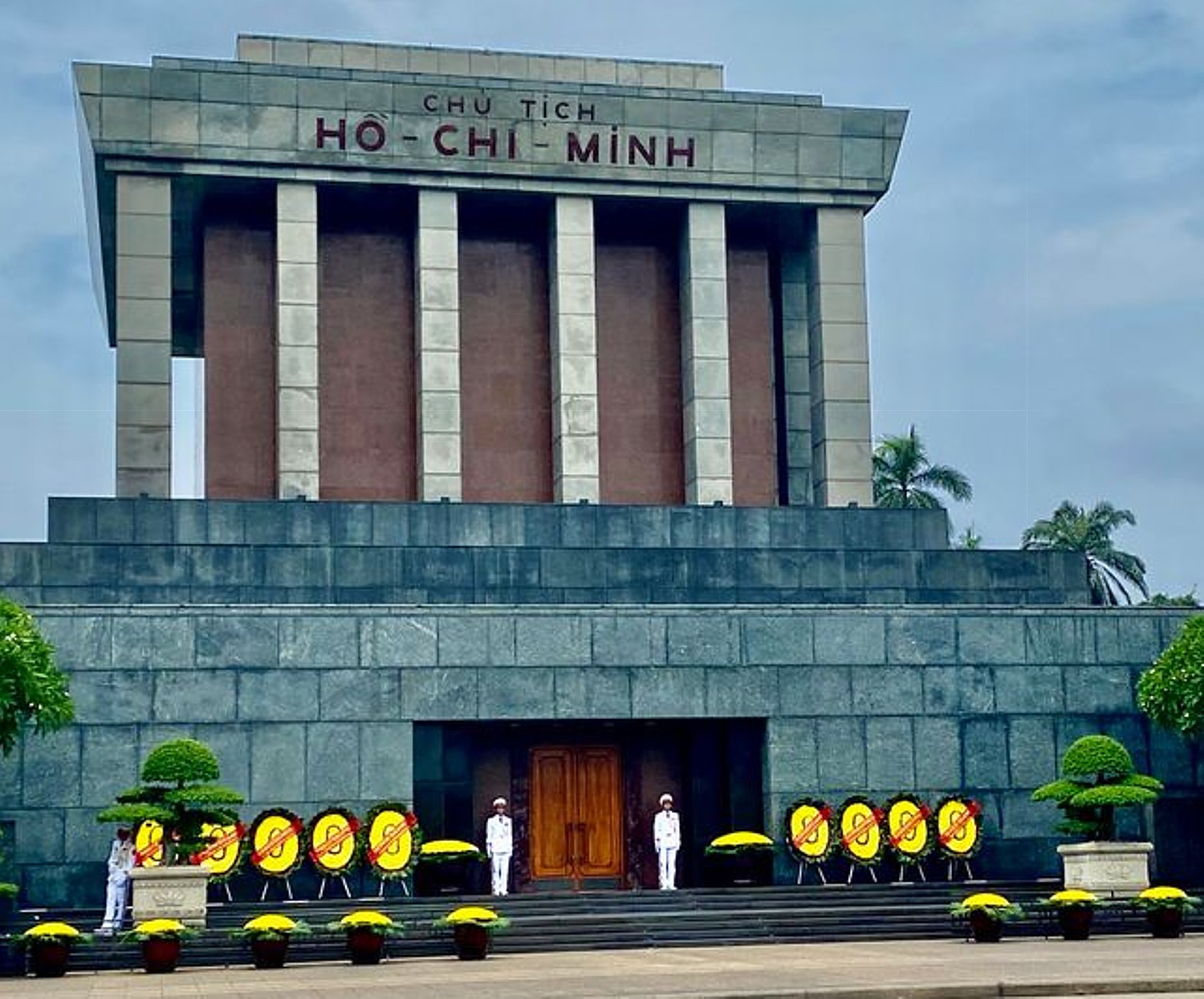
The Ho Chi Minh Mausoleum draws people from around the country who come to pay their respects.© Geri Bain

From what we’d read and seen on this trip, Ho Chi Minh–“Bac (uncle) Ho” as he is affectionately called—was a beloved selfless leader. Interestingly, he had stated in his will that he wanted to be cremated with his ashes buried in three regions of the country. But in 1969 when he died, his followers embalmed his body and built the grand mausoleum we are visiting today. We pass through security to enter the grounds of the Presidential Palace where the Ho Chi Minh Mausoleum is located. We wonder why there are no lines to enter and file past his glass coffin where people come to pay their respects and we learn that the mausoleum is closed for its annual maintenance.

Nevertheless, we’re impressed by the grandeur of the Ho Chi Minh’s Mausoleum, which was inspired by and resembles Lenin’s Tomb, but with Vietnamese flourishes, and we sense the reverence it inspires. The setting is also impressive. The Mausoleum is across a large plaza/parade ground from the National Assembly and down the green we see the imposing Presidential Palace, built by the French during Hanoi’s colonial days. Uncle Ho declined to live there as he said it was too grand for a man of the people. Instead, a traditional stilted house was built for him on the grounds of the Palace.

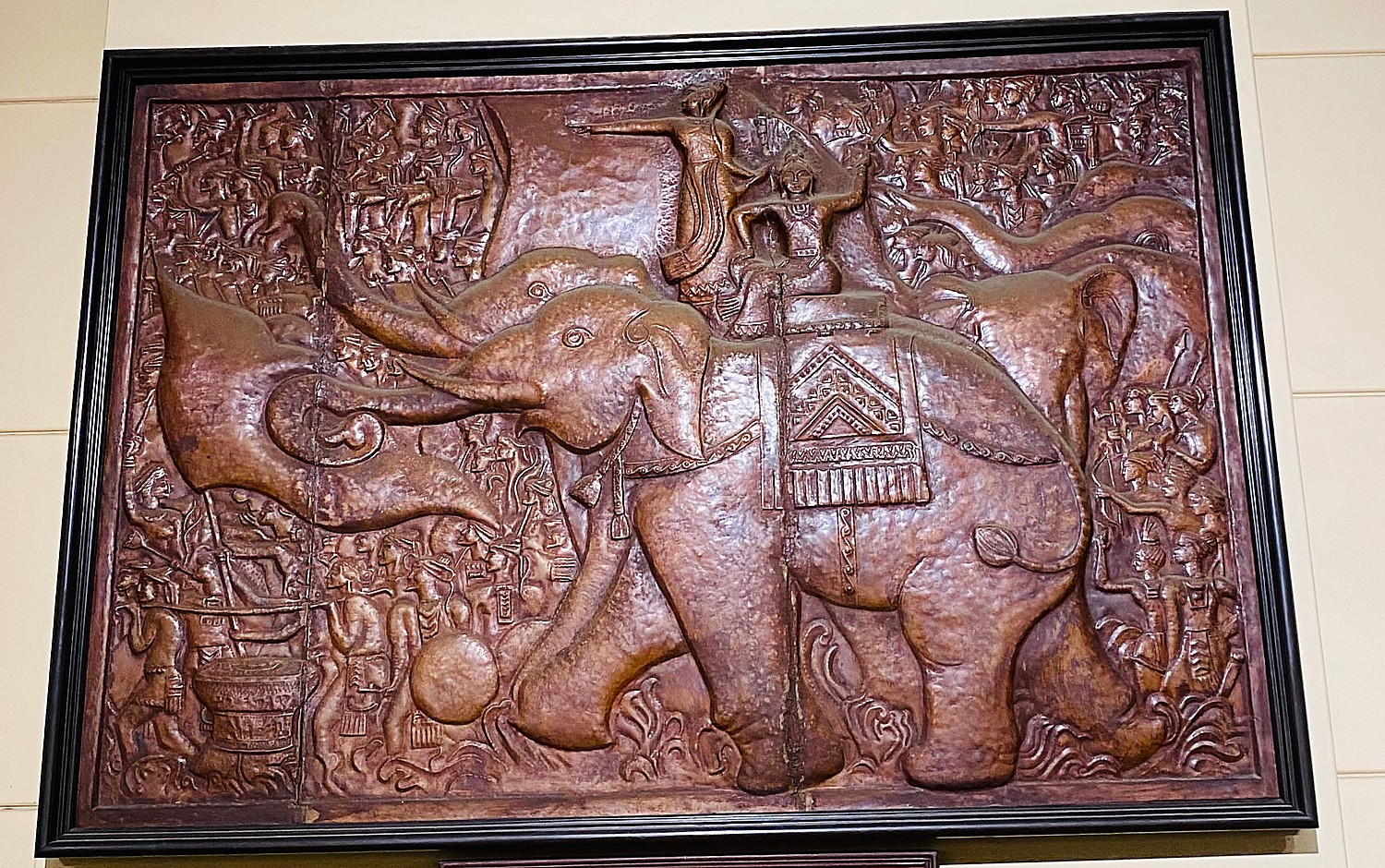
This bronze bas relief celebrates the Trung Sisters’ heroic uprising against the Chinese. © Geri Bain

I had just read “Bronze Drum” by Phong Nguyen, a historical novel about the Trung Sisters who led a women’s uprising to overthrow the Han Chinese in 40 A.D., so I am excited when my daughter points out an exhibit devoted to them at the Vietnam National Museum of History. The sisters had used bronze drums to inspire and communicate with their warriors, and we admire an array of drums with intricate carvings.

The museum is divided into two buildings. The main building takes us from the first humans through the end of the Nguyen Dynasty in 1945 and is a great consolidation of the history we’ve been learning throughout our journey. The second building takes us from 1858 and the struggle against the French colonial government to the present.

As we admire the sculptures and artifacts of the many ethnic groups and cultures throughout Vietnam’s history, we get a sense of the depth and diversity of its people today. A constant theme is the nation’s long history of fighting to maintain and develop their own unique civilization and pushing back invaders.

The second building takes us from 1858 and the struggle against the French colonial government to the present. Photos, documents, artifacts and profiles of heroes tell the story of the struggle for independence and the rise of the Vietnamese Communist Party and then, the shift in 1985 to “Doi Moi,” the fast-growing, market-oriented economy that continues to this day.

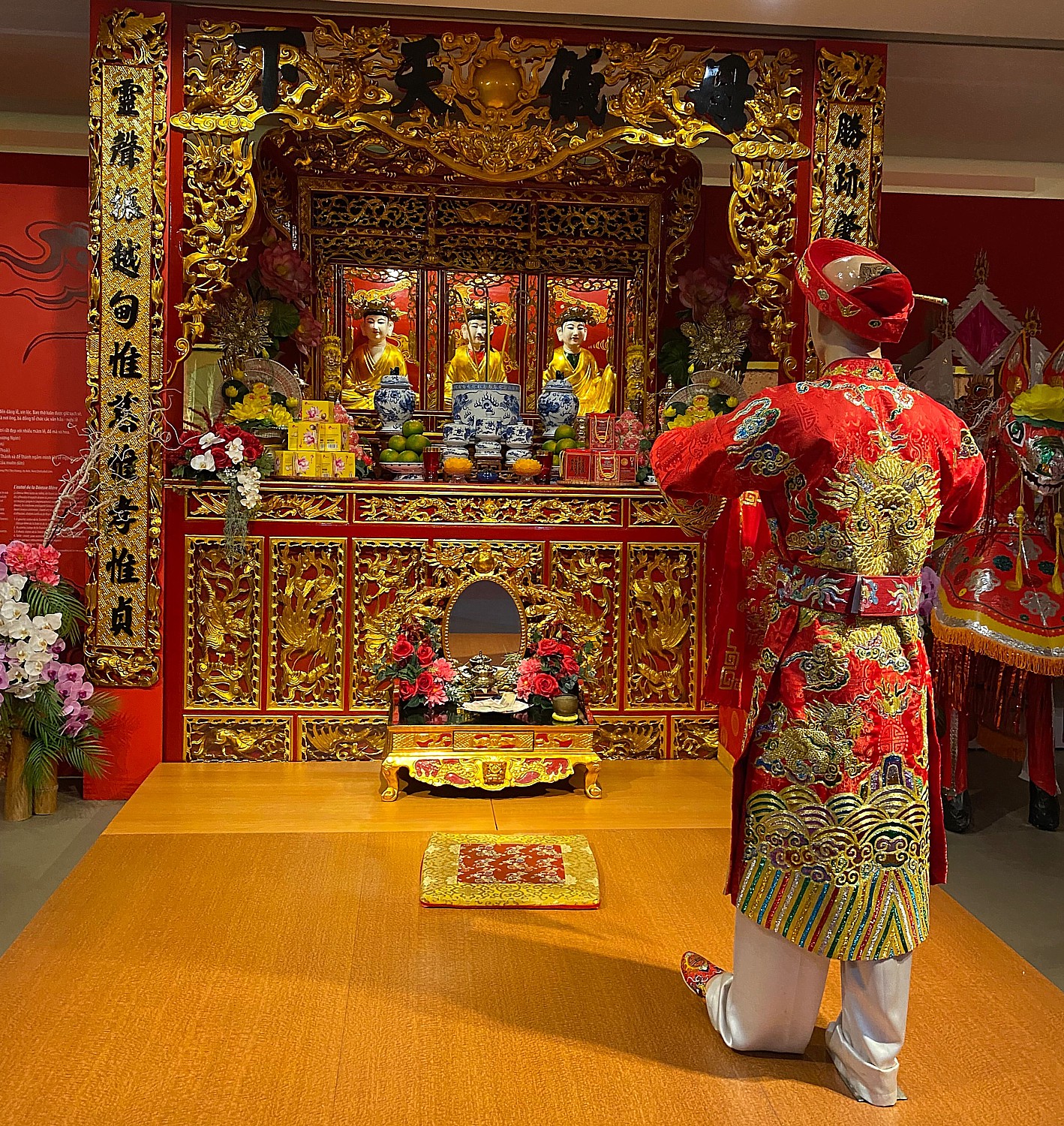
The Vietnamese Women’s Museum offers unique exhibits like this one celebrating the Mother Goddesses of Three Realms. © Geri Bain

At the Vietnamese Women’s Museum, among the fascinating customs, we learn that in some Vietnamese ethnic groups, men must move into their bride’s home for several years after marriage. In others, there is a trial sleepover when the prospective groom stays in a guest room at the bride’s home. And in at least one matriarchal group, women choose their groom, he moves to her home, and the children take her last name.

Detailed exhibits cover women’s roles in family life, heroic women in history, and both ethnic and high women’s fashion. It’s among the best small museum’s we’ve seen; it’s well organized, well-labeled with short videos, and there’s an excellent audio tour.

Its mix of architectural styles, parks and shopping make Hanoi a great walking city. One minute, we are on a wide tree-shaded boulevard lined by elegant turn-of-the-century French buildings, the next we are in a twisting medieval alley in the Old Quarter, where many streets still have the names of ancient trades. Some, like Hang Gai (Silk Street), still reflect their current shops. The huge, buzzing Dong Xuan Market sells everything imaginable, but the goods seem oriented to locals and don’t match what we saw in Ho Chi Minh City for style or price.

We head to the elegant shopping streets and dip into some luxury brand shops expecting bargains, but prices seem higher than back home. We decide the best values are found in the artisan shops. We are especially drawn to the wonderful hand-made lacquerware at Hanoia, a small boutique near our hotel, and Tired City, which sells prints, bags and t-shirts featuring the art of over 200 local artists who receive 10% of every sale.

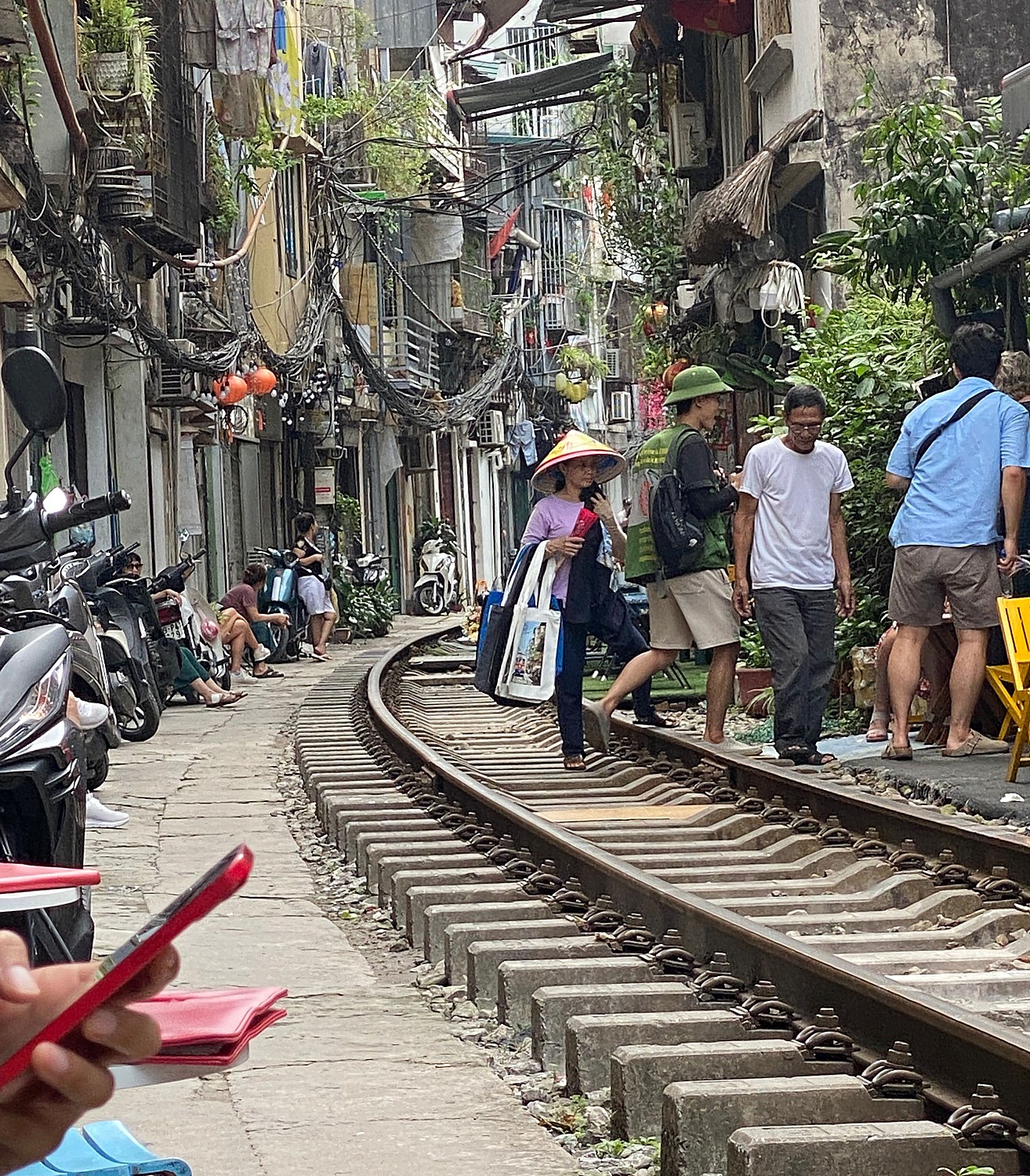
A 1902 train route that cuts through a narrow lane in the Old Quarter is still in use and now a tourist attraction. © Geri Bain

We take a coffee break at quirky “Train Street”, timing our visit for a train passage. This narrow ancient street is lined by small eateries with barely enough space for the train to zip through and it is fun to watch as we sip our new favorite drinks—hot or cold Vietnamese coffee made with condensed milk.

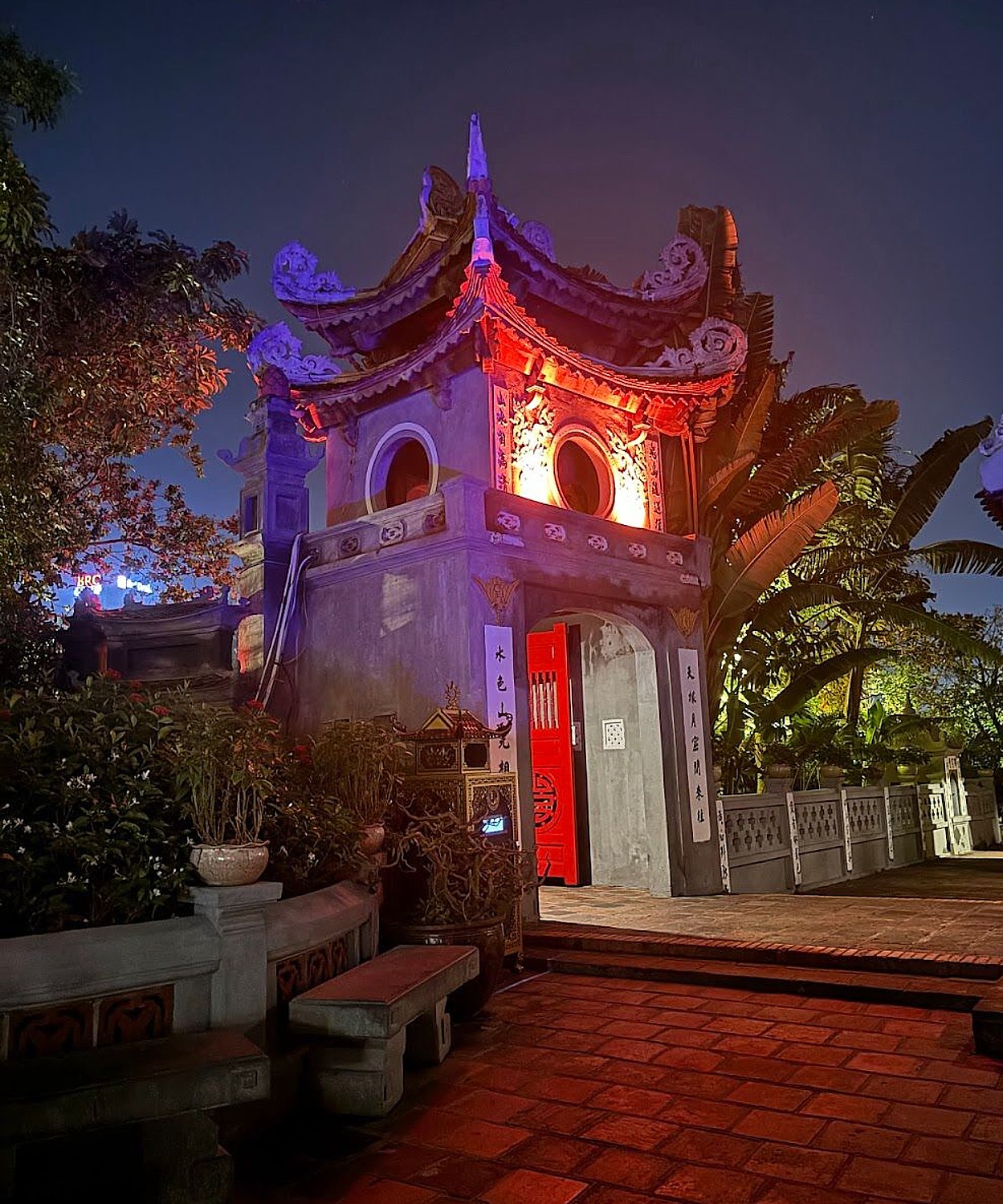
Our anchor as we explore Hanoi is Hoan Kiem Lake, just a few blocks from our hotel. Every evening, we join locals for a stroll around the lake. One night, we cross the pretty red Rising Sun (Huc) Bridge, where young couples pose for photos with the city lights as a backdrop. The bridge leads to the Ngoc Son Temple (Temple of the Jade Mountain), which sits in the middle of the lake. We are surprised to find a gatekeeper on duty at night. We pay the small admission fee and enjoy tranquil views of the city reflected in the lake. Inside, carvings depict Vietnamese history, folklore and Confucian literature.

Sitting in the middle of the lake, Ngoc Son Temple is especially lovely at night. © Geri Bain

From its start, this temple has honored both warriors and scholars, and stands as a symbol of Vietnamese resilience and pride. Built in the 19th century, the temple is dedicated to Van Xuong De Quan, a deity in charge of examination and education, and to the 13th century hero Tran Hung Dao (1231 – 1300), who led the Vietnamese army to repel two Mongol invasions.

A sign near a giant embalmed turtle and shrine explains how the lake got its name. According to legend, a god in the form of a turtle gave a magic sword to Le Loi, a l5th century leader of the Vietnamese rebellion against the Ming Chinese occupation. The sword empowered him to outsmart and defeat the Chinese. After his success, he returned to the lake and the turtle god reclaimed its sword. The lake became known as Hoan Kiem, “Lake of the Returned Sword”.  The legend is also commemorated in a picturesque monument, Turtle Tower, which sits on its own islet in the lake, one of the iconic symbols of Vietnam’s capital.

We leave Hanoi wishing we could stay longer. Another deep-tissue spa treatment. More time to relax in one of the ubiquitous cafes. More time to take in the vibes of this vibrant capital and to explore the history and legends of this fascinating and welcoming country.

Travel Tips

Many museums and sites close for lunch so check hours in advance. Also check for special shows and exhibitions; the Mother Goddess exhibition had specific but limited show times that we learned about too late.

Check with your doctor or a travel medicine specialist for recommendations on vaccinations and other health precautions, and the U.S. Department of State, CIA.gov and the CIA World Factbook for helpful country information.

Get the required visa at Vietnam’s website (evisa.gov.vn), where the fee is $25 (if you use a visa service it costs something like $197), and at Cambodia’s website (evisa.gov.kh), where the fee is $30, but give yourself enough time to get the confirmation. When filling out visa applications, flight and hotel reservations, note that dates in Vietnam and Cambodia are written day/month/year. I almost booked my flight for the wrong date. (April 1, 2025 should be written 01/04/2025).

See also:

AMAWATERWAYS’ MEKONG LUXURY CRUISE THROUGH VIETNAM AND CAMBODIA: HO CHI MINH CITY AND THE MEKONG

AMAWATERWAYS’ VIETNAM-CAMBODIA MEKONG CRUISE: THE CAMBODIAN MEKONG AND SIEM REAP

__________________

© 2025 Travel Features Syndicate, a division of Workstyles, Inc. All rights reserved. Visit goingplacesfarandnear.com and travelwritersmagazine.com/TravelFeaturesSyndicate/. Blogging at goingplacesnearandfar.wordpress.com and moralcompasstravel.info. Visit instagram.com/going_places_far_and_near and instagram.com/bigbackpacktraveler/ Send comments or questions to FamTravLtr@aol.com. Bluesky: @newsphotosfeatures.bsky.social X: @TravelFeatures Threads: @news_and_photo_features ‘Like’ us at facebook.com/NewsPhotoFeatures