By Karen Rubin, Travel Features Syndicate, goingplacesfarandnear.com
Within this one mile that cuts through Ohio forest, there are stories: reclusive Hellbender salamanders that grow to 28 inches long; a bridge where Abraham Lincoln nearly lost his life on the way to his inauguration; a rail tunnel, slightly askew, built by warring groups of Irish immigrants; a Ghost Wall, where they carved their initials that today appear, disappear and new initials reveal themselves.
It’s only a mile long now slicing through Hellbender Preserve, but it is the first new mile of multi-use trail in Jefferson County; four more miles will soon be added. Ultimately, it will be part of a 15-mile connector along the Great American Rail-Trail, a 3,700-mile network of biking/walking trails across America, from Washington DC to Washington State.
Even the story about how the Hellbender trail was re-discovered is worthy of a novel.
This was the Old Panhandler Rail Line, but after they built a new route and bypassed this one, the 273 acre-property was abandoned in 1949 and taken over by forest.
Hellbender Preserve is only one year old – it opened on National Trails Day 2025 – and within the first six months after opening, 30,000 visited.
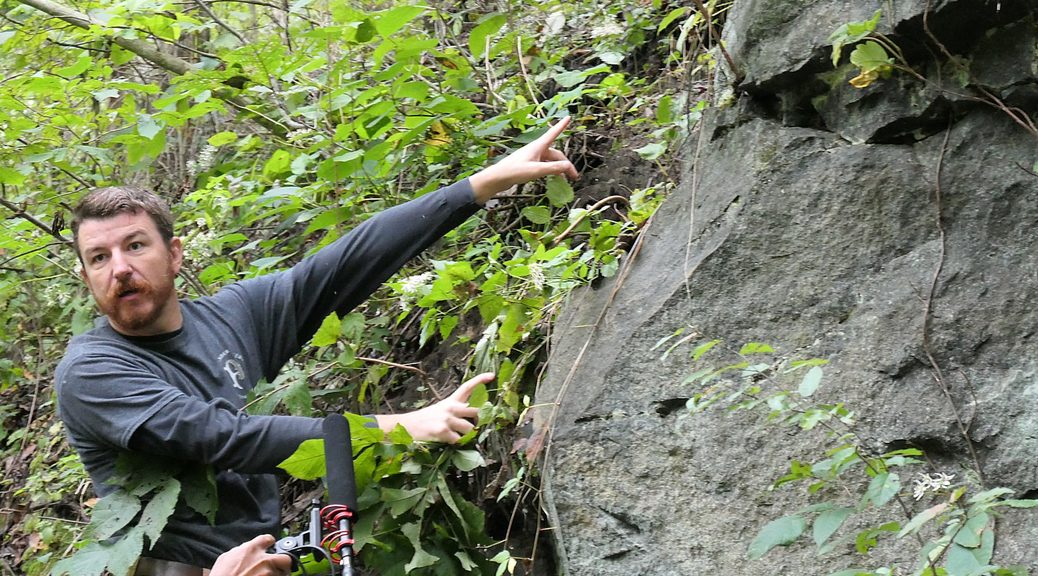
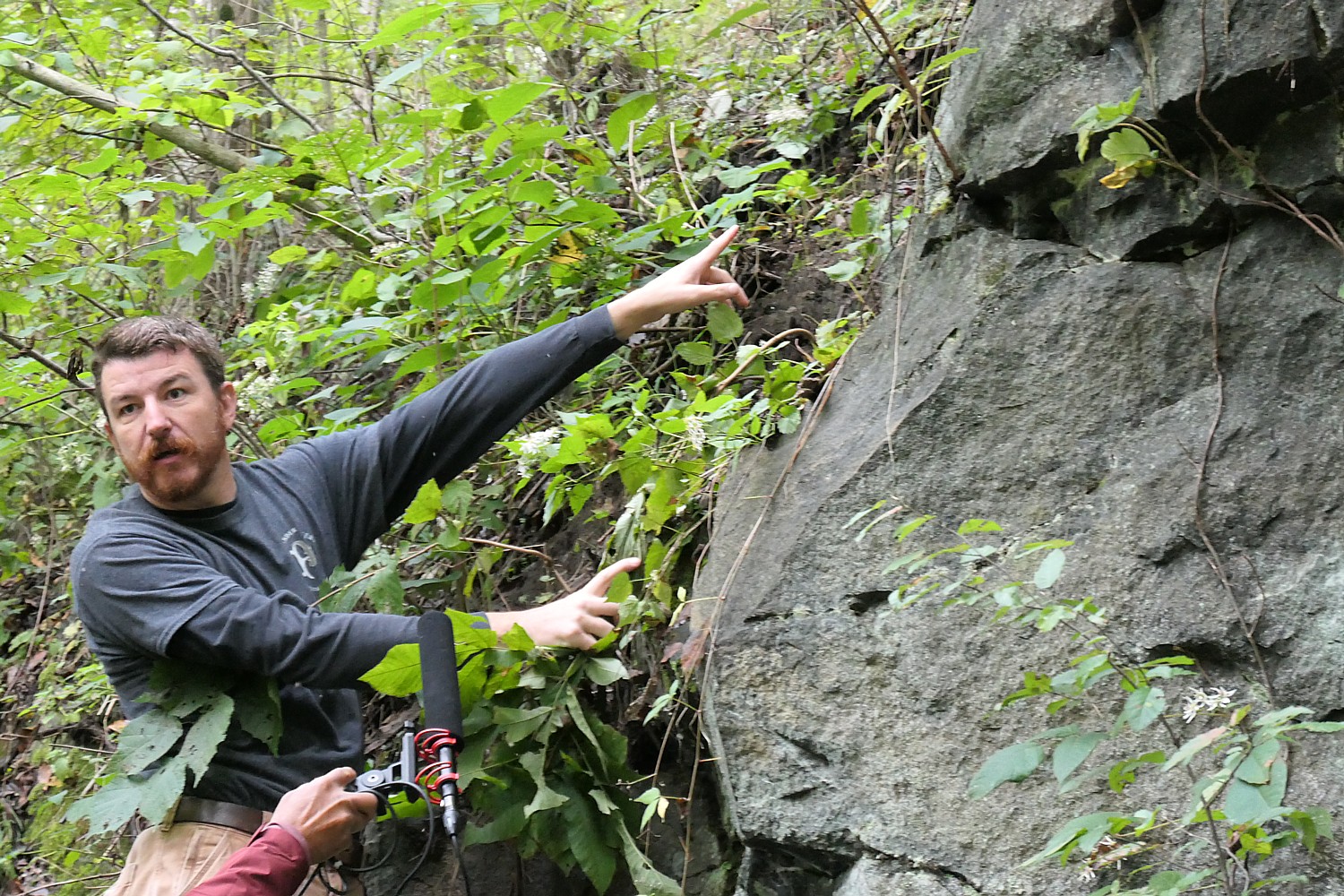
“The trail builds community, provides an opportunity to meet, get out. We’re in the Rust Belt where healthcare isn’t a priority. This is passive way to get out, get fit,” Aaron Dodds, program manager for Jefferson Soil Water Conservation District, tells us as we walk through. “It’s great for conservation and railroad history.”
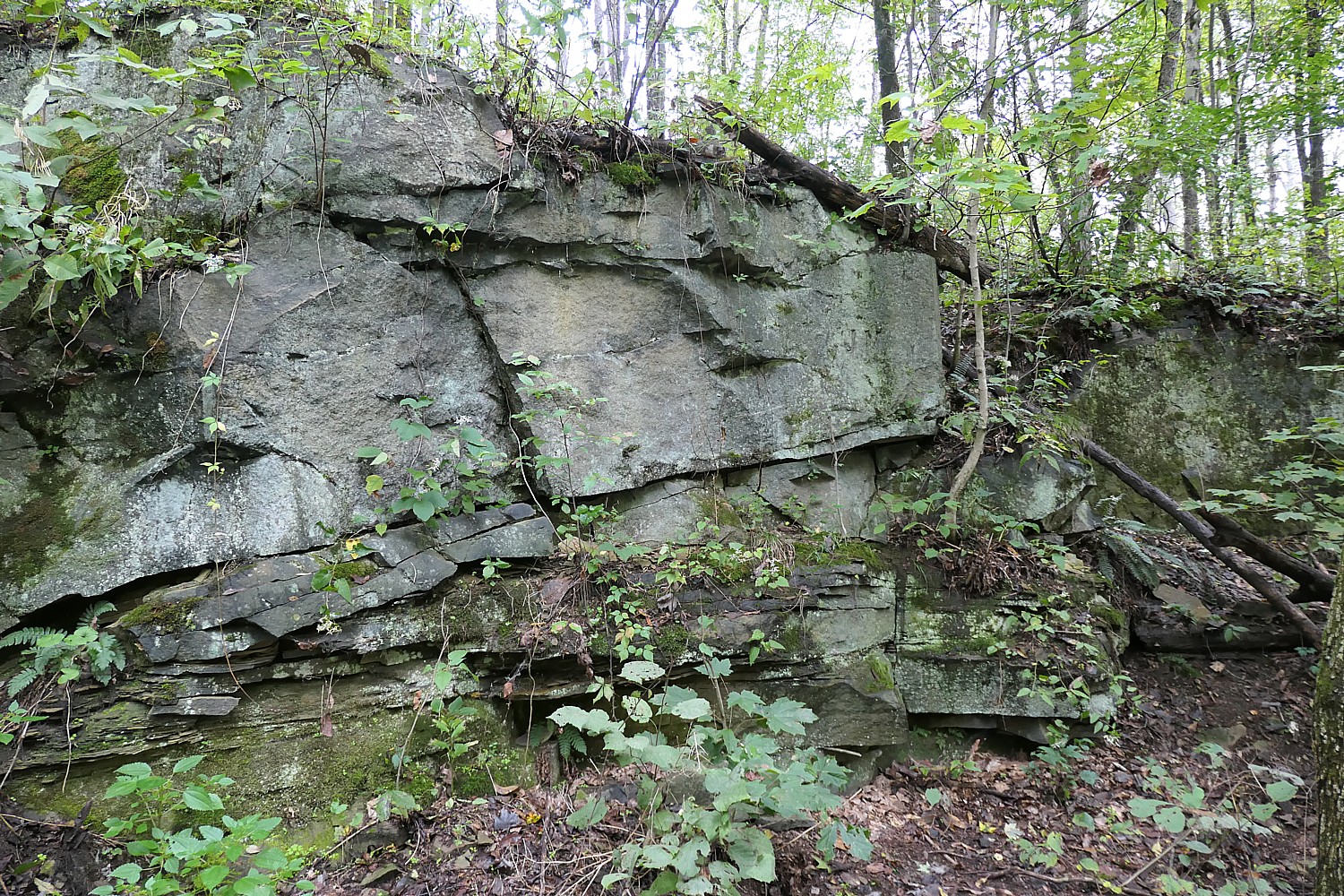
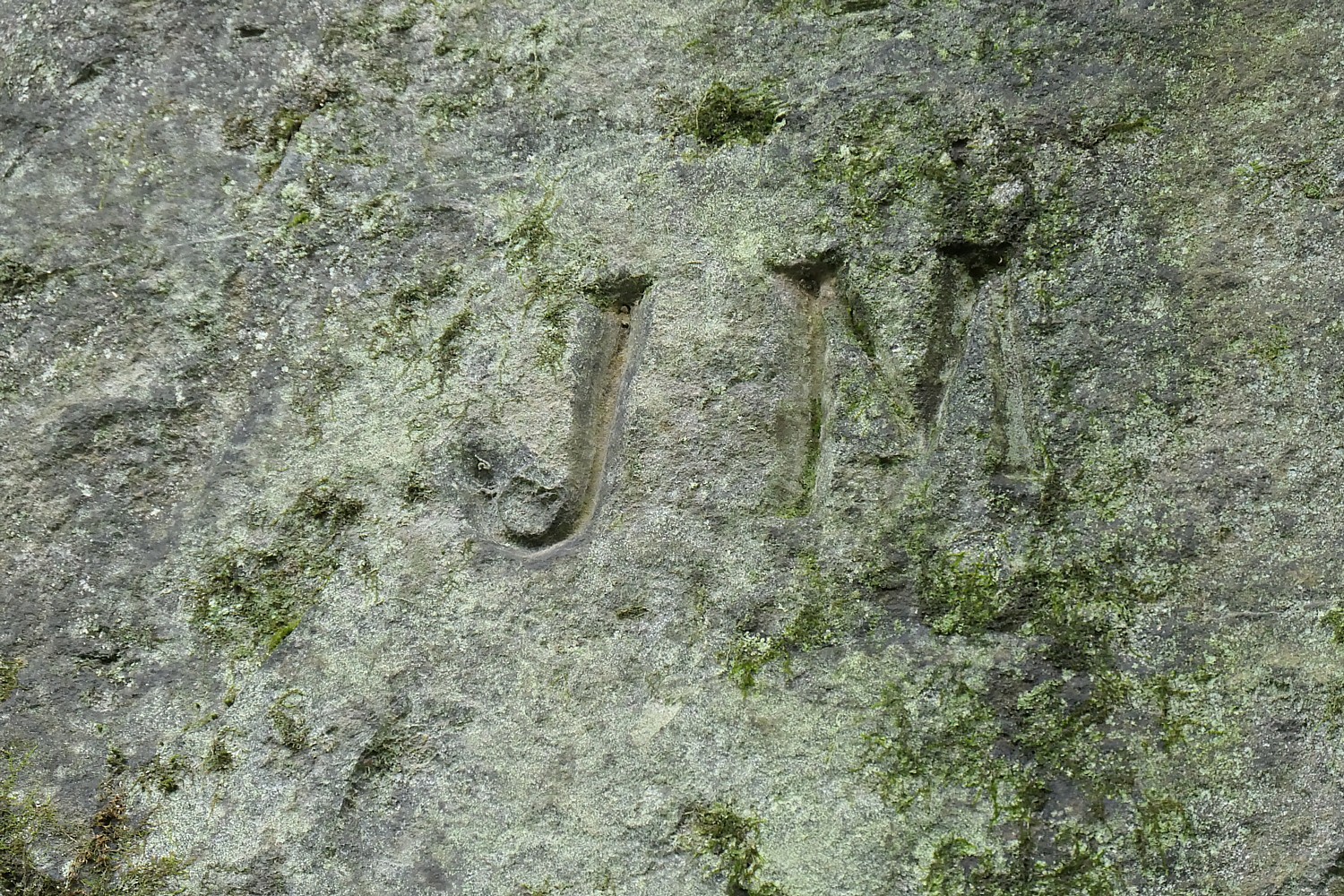
“The railroad hired Irish workers to build it because they were cheap and expendable. They came for the American Dream and carved their names and initials in the rock walls.” When they expanded the railroad from single to double track, they brought freed slaves who also carved their names. Depending on the light, you can see the names, which later disappear and other names emerge. The names come and go. They have identified 80 different names so far. That’s why they call it the Ghost Wall.
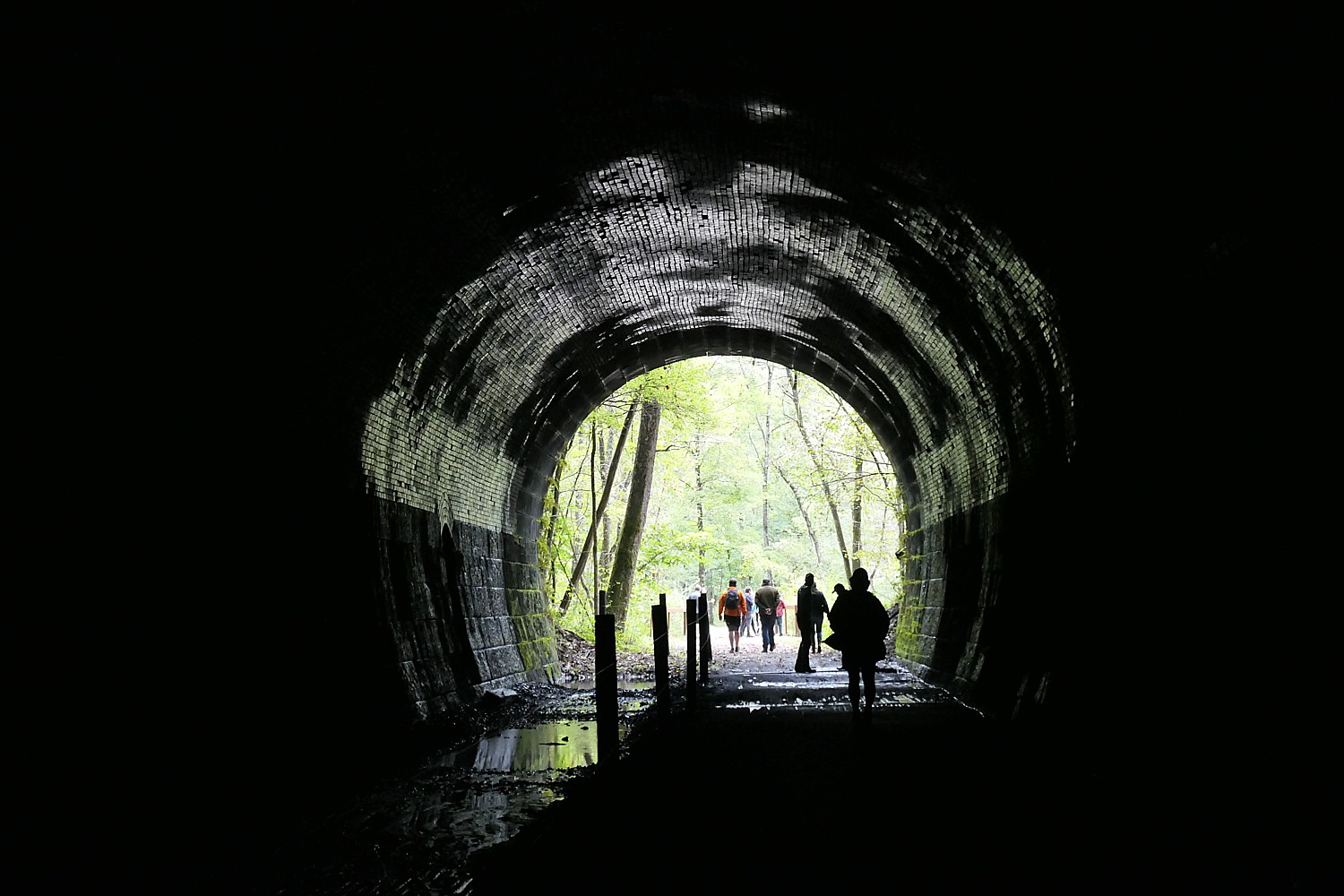
“The Irish were cheap, expendable. They first used old canal diggers from County Cork (Corkonians) and then Far Downers (from farther down Ireland). They hated each other.” They lived in separate camps and worked different sides of the tunnel. But when they came together, they found they were four feet off.
“A war broke out. They went at each other with pick axes. The Corkonians raided Far Downers, chased them to the hillsides, then throw them off.”
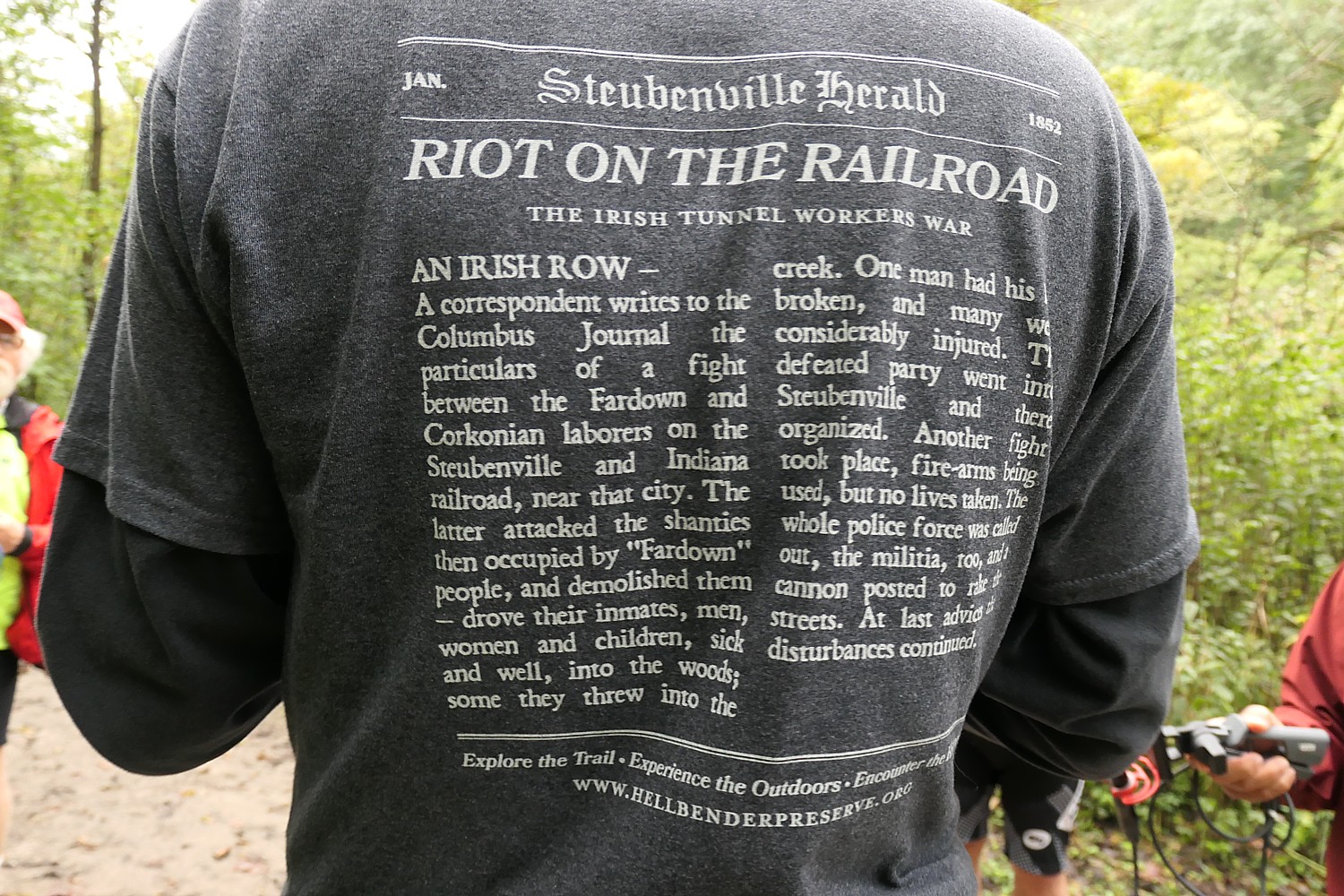
Far Downers broke into the Steubenville Armory and rolled out a cannon to Market Street, and fired on the Corkonians. The governor called in the state militia – it took four days to quell the violence. In the end, they figured out how to link up the tunnel (it is only slightly askew today). “It wasn’t worth a war.” Dodds wears a t-shirt with the newspaper clipping printed on the back,
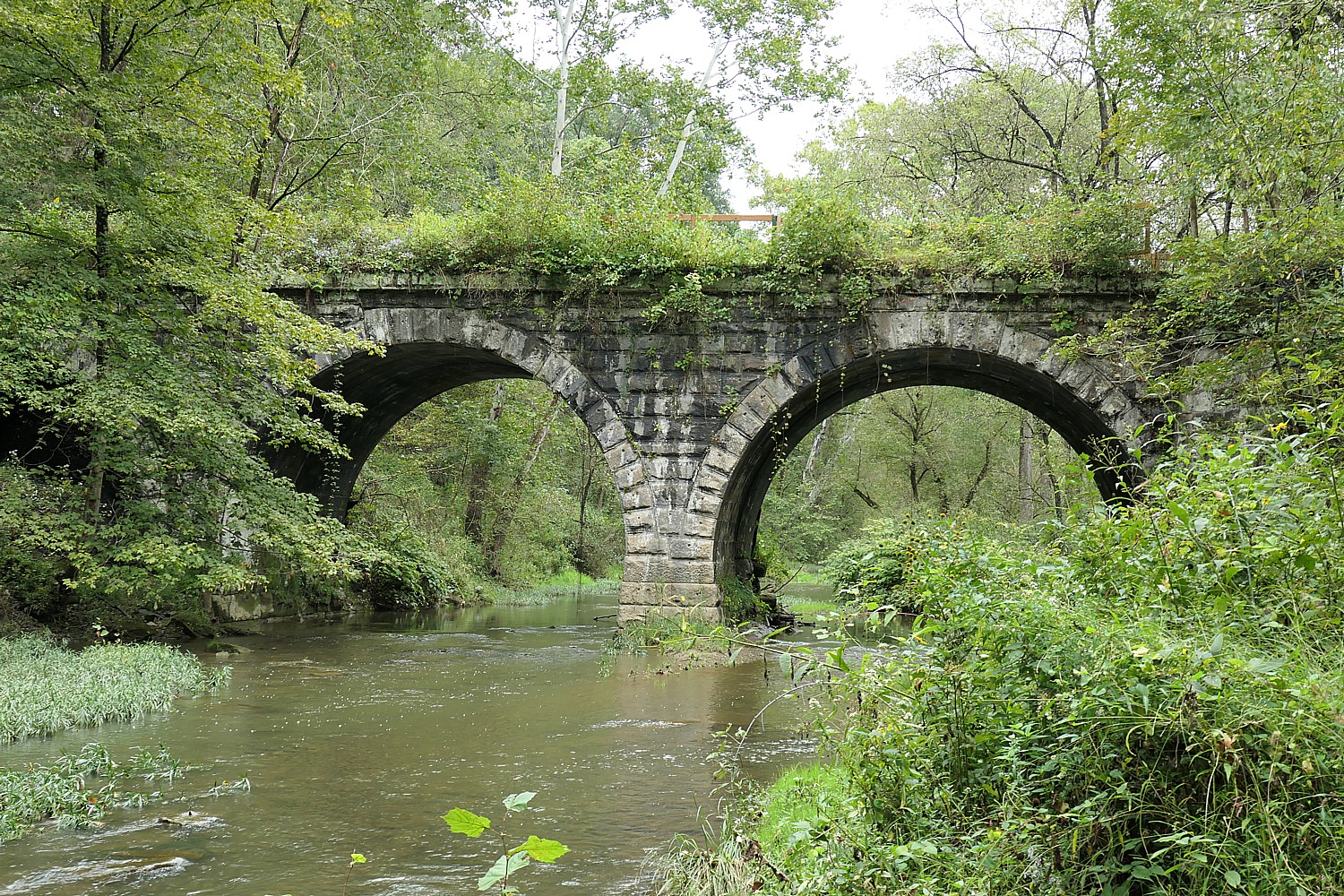
We come to the Lincoln Bridge and Dodds tells of a critical historical event that was almost lost to history – how Abraham Lincoln, traveling by rail to his inauguration, got stuck in a severe rainstorm that damaged this bridge and the passengers were told to walk over in case the train would have caused it to collapse; he nearly lost his life as he walked, holding his sons’ hands when he fell and was nearly swept into the water.
Lincoln made it to Fort Steuben in Steubenville where he gave a speech on the train platform – the first time against a backdrop of seven states succeeding from the union in reaction to his election.
“Now Steubenville didn’t love Lincoln,” Dodds related. “He was described as ugly and an awful speaker (with a high-pitched voice). That is what was reported when in fact, he was ‘workshopping’ his inaugural address,” considered one of his most important, in which he set the Constitutional and moral framework for keeping the Union together.
Remarkably, Lincoln’s speech was forgotten until they began searching for the provenance of the land to acquire the preserve. “This event was lost to history, but a railroad vice president had collected newspaper clippings” which reported the event “and a railroad engineer atlas verified it.”
After the Battle of Fort Sumter in April 1861, Lincoln remembered the bridge. The Battle of Bull Run was looming. Lincoln knew he needed to get Union troops to the east, so he directed that the bridge where he almost lost his life be rebuilt. It took just eight months with a massive workforce and now named for him.
The bridge is just before we enter the 970-foot long, double track tunnel. Just feet beyond the tunnel is where the trail ends for now.
This one-mile is in the middle of what will be a 15-mile-long trail; so far, they have three miles and are working to open five more.
The State of Ohio owned the land – acquired from ConRail – but was inaccessible to the public for all this time. The state didn’t even realize it owned it until 2015 when the commission did a title search in order to acquire it (and uncovered the Lincoln story). The state willingly donated the land to the commission for a multi-use trail, but it still took five more years.
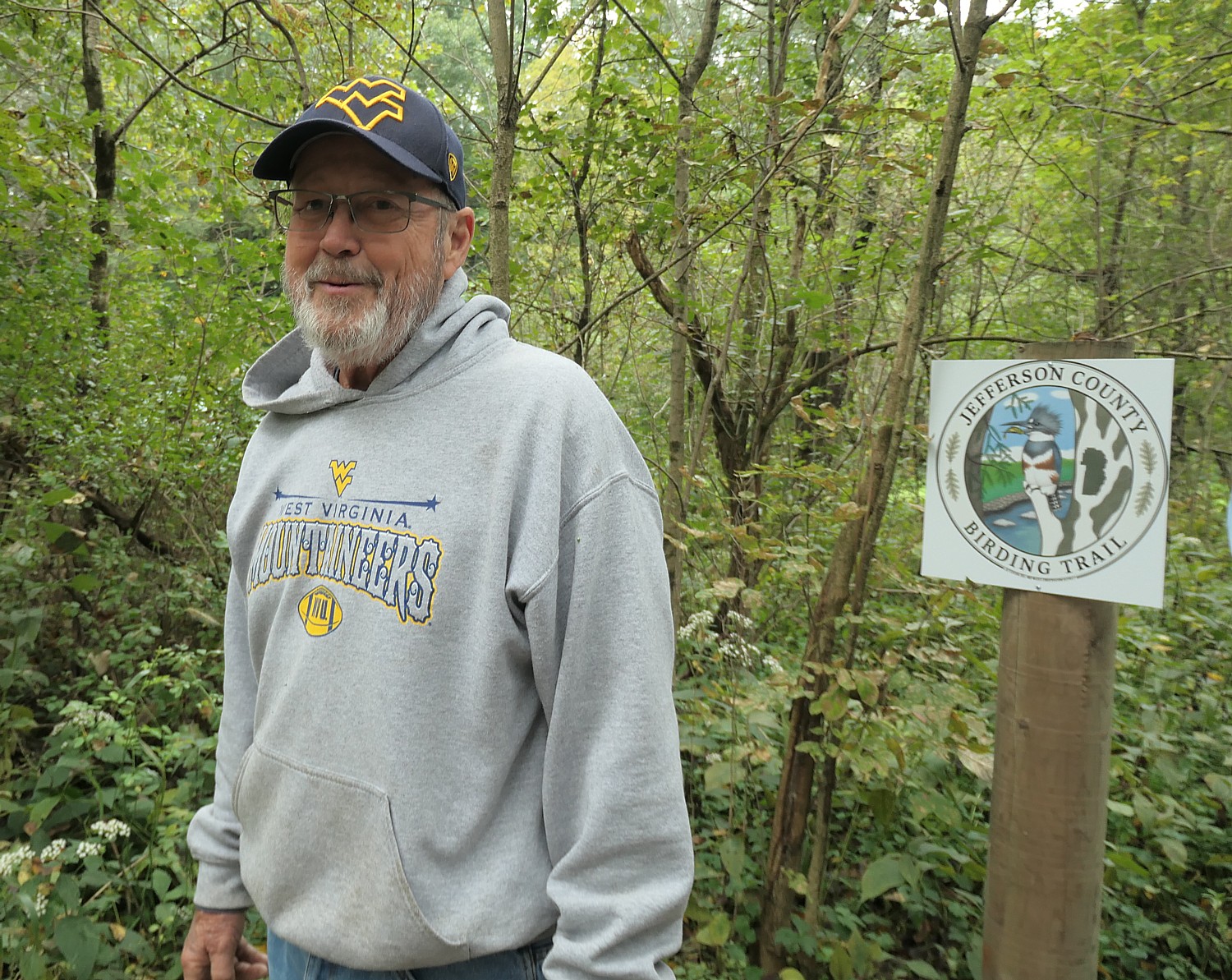
Mike Ruthen, whose gorgeous property along the creek is immediately adjacent to the property, puts bikes out for visitors to use and volunteers to help maintain the trail. “He saw the joy on people’s faces when they come,” Dodds said.
“One mile at a time. The trail builds community,” he said.
Hellbender Trail, https://www.traillink.com/trail/hellbender-preserve-trail/
Ribbon Cutting in Orrville
As we drive into Orrville, Ohio, we see Amish driving horse-drawn carriages, pass a Lehman’s store (everything you ever needed to buy is at Lehman’s), and the headquarters for The J.M. Smucker Company (Smucker’s!), where you see railroad tracks that come right up to the entrance.
We have come to Orrville to celebrate with Rails to Trails of Wayne County the ribbon cutting for 2.7 new miles of the Heartland Trail, a connector to the Great American Rail-Trail.
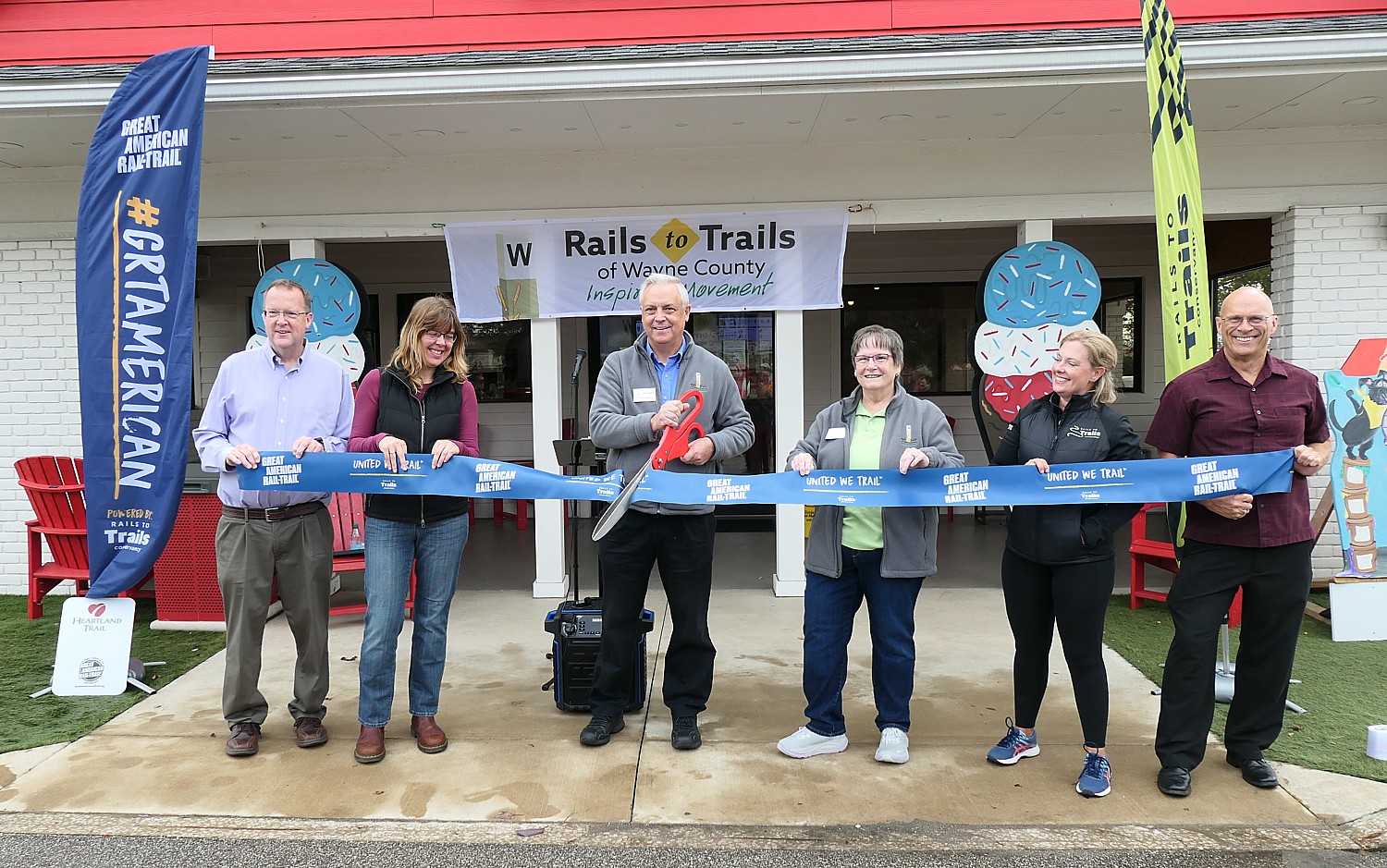
The new section begins at the downtown trailhead, just 3 blocks from the Orrville Historical Museum and Orville Railroad Heritage Society on Depot Street. The trail then threads northward through the downtown business district and Orrville Dog Park before connecting to the former Cleveland, Akron, and Columbus (CA&C) rail corridor near Little Chippewa Creek, then continues along the former railbed to Marshallville, terminating at Coal Bank Road.
Don Noble, Board President Rails to Trails of Wayne County, noted that along the trail in Marshallville, there is an unusual “geologic unconformity” dating from the Carboniferous Period (360–299 million years ago) when erosion removed older (Mississippian) rocks before younger (Pennsylvanian) rocks were deposited. The rare geologic feature was revealed during the construction of the railroad.
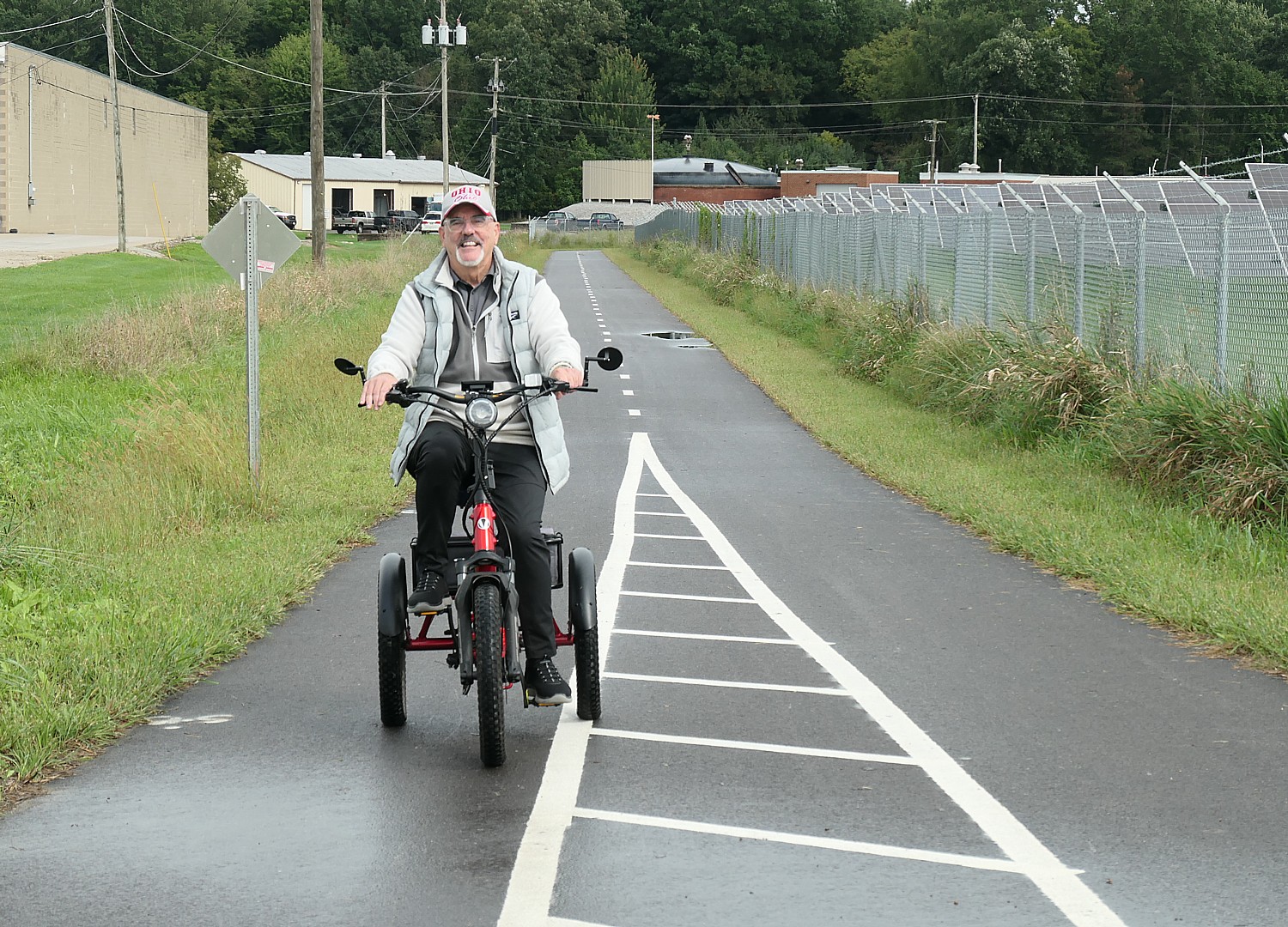
Rails to Trails of Wayne County put in an application to Ohio Department of Transportation in 2020 and received $1.33 million – 58% of the total cost – but the city and donors had to come up with the rest – Ohio Clean put up $200,000; the City of Orrville, $238,000, and a foundation gave $535,000,
The group has managed to complete two sections in one year (1.7 and 1.1 miles each), from downtown Orrville north of Marshallville – a total of 7 miles in order to eventually connect to the Great American Rail-Trail.
Rails to Trails of Wayne County hopes to complete another extension of the trail that will connect it to Clinton where it will connect to the Ohio & Erie Towpath Trail, which spans 80 miles from Cleveland to Bolivar.
“This is a great day for Orrville,” Mayor Matt Plybon said. “Years ago, people saw the old railroad bed and saw what could become. This moves Orrville closer to becoming true trail town, neighbors and beyond…We welcome people who come- shop, eat, experience community, meet people. Trails may connect place but their best value is when they connect people.”
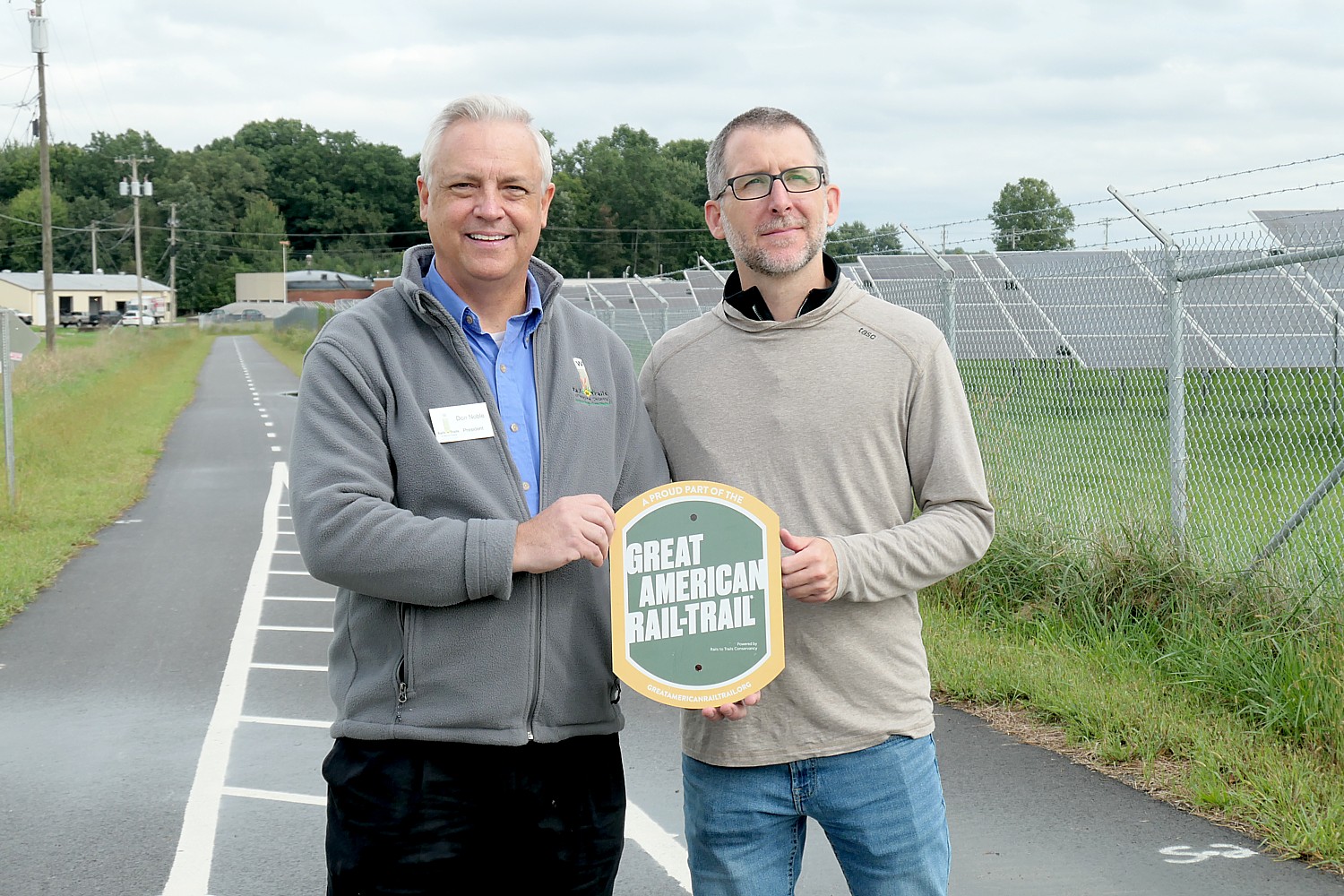
As we sit together for lunch with many of the Rails to Trails of Wayne County volunteers and officials it becomes clear: It may take years before all 3,700 miles of the Great American Rail-Trail across America are connected, but every foot and every mile of trail impacts people today in tangible ways – those who live in community and those who come to visit – economically, health and wellness, building community and social connections, and pride.
Leaving Orrville, Kevin Belle, who has spent 10 years as Rails to Trails Conservancy’s Project Director for the Great American Rail-Trail, reflected that they have successfully closed 10 gaps in less than 10 years.
“They are coming more frequently now,” he said, with the pride of a new father or more accurately, a midwife who has helped in the birth of a baby. “Close the gap. Open the trail.”
The Great American Rail-Trail will extend 3,700 miles across the USA, enabling biking, walking, hiking from Washington DC to Washington State. “This is the most ambitious public lands project in generations, but unlike other projects, this is the result of the determination of regular people, groups, private donations, working in conjunction with local, state and federal government, reflected Brandi Horton, Rails to Trails Conservancy’s Vice President, Communications.
Heartland Trail, https://www.traillink.com/trail/heartland-trail-/
For more information on the Great American Rail-Trail, visit: https://www.railstotrails.org/site/greatamericanrailtrail/
Next: Railtowns, Canaltowns, Rivertowns, GhostTowns – Now Trail Towns
See also:
Imagine Biking 3,700 Miles Across the USA on The Great American Rail-Trail
Grassroots Volunteerism Builds the Great American Rail-Trail
__________________
© 2026 Travel Features Syndicate, a division of Workstyles, Inc. All rights reserved. Visit goingplacesfarandnear.com, longislandpress.com/category/vacation-travel.com and travelwritersmagazine.com/TravelFeaturesSyndicate/. Blogging at goingplacesnearandfar.wordpress.com and moralcompasstravel.info. Visit instagram.com/going_places_far_and_near. X: @TravelFeatures Threads: @news_and_photo_features ‘Like’ us atfacebook.com/NewsPhotoFeatures. Send comments/questions to FamTravLtr@aol.com.
