By Karen Rubin, Travel Features Syndicate, goingplacesfarandnear.com
Day 3 of our six-day Wilderness Voyageurs Katy Trail bike tour 240-miles across Missouri is the most scenic, most interesting, teasiest ride, and the most dramatic for what we see. The day starts with pictographs left by the Indigenous people who populated this place for centuries before Lewis & Clark or Daniel Boone ever laid their eyes on this land, and ends with a mirror held up to Missourians, at the State Capital building, where we see Thomas Hart Benton’s stirring “Social History of Missouri” mural.
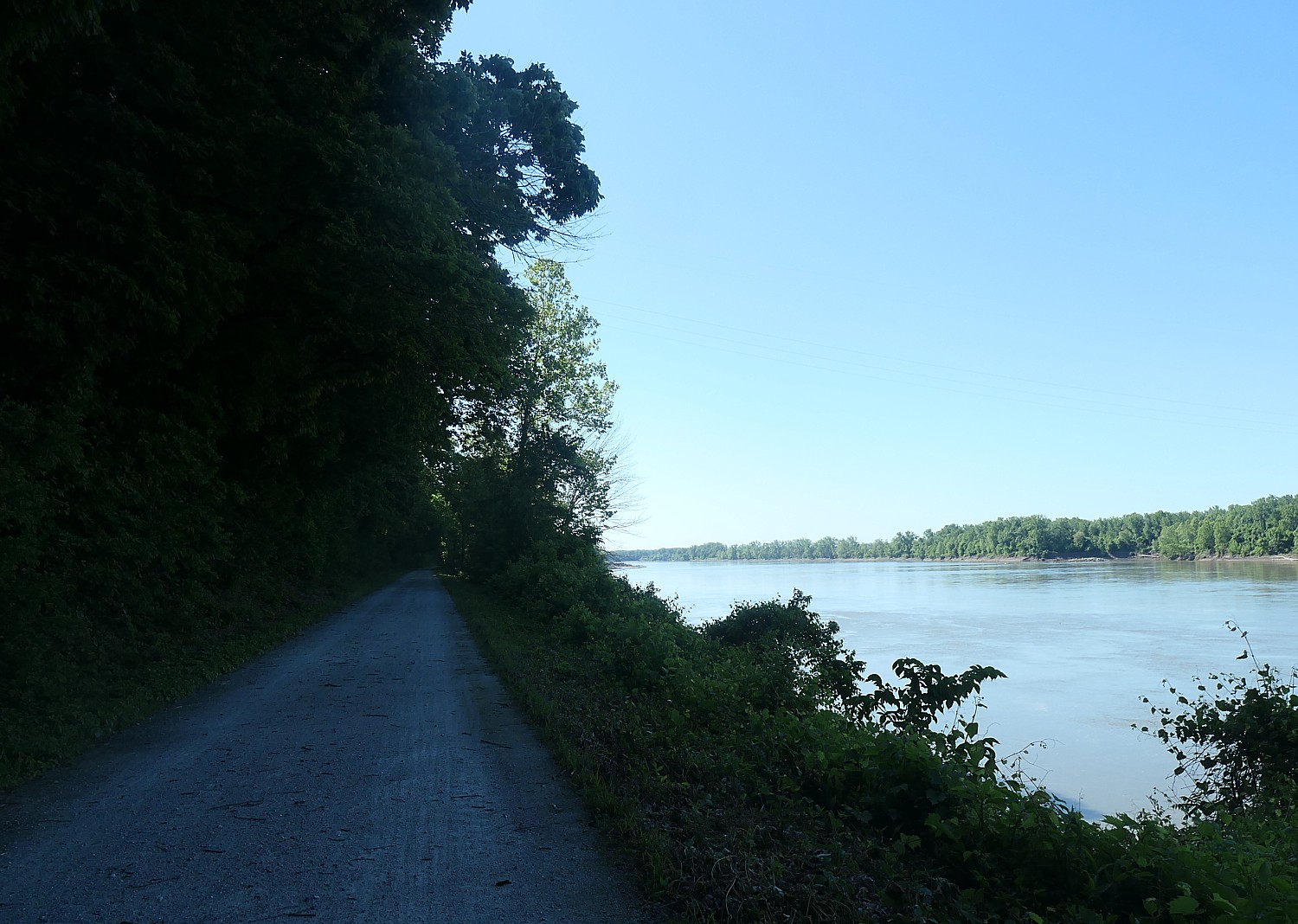
The 38.7 miles we ride from Rocheport to Jefferson City (Missouri’s capital), is almost entirely flat – a mere158 ft rise, 200 ft. decline. It also turns out to be my favorite part of the Katy Trail – much of it with limestone cliffs and forest on one side and views of the Missouri River on the other.
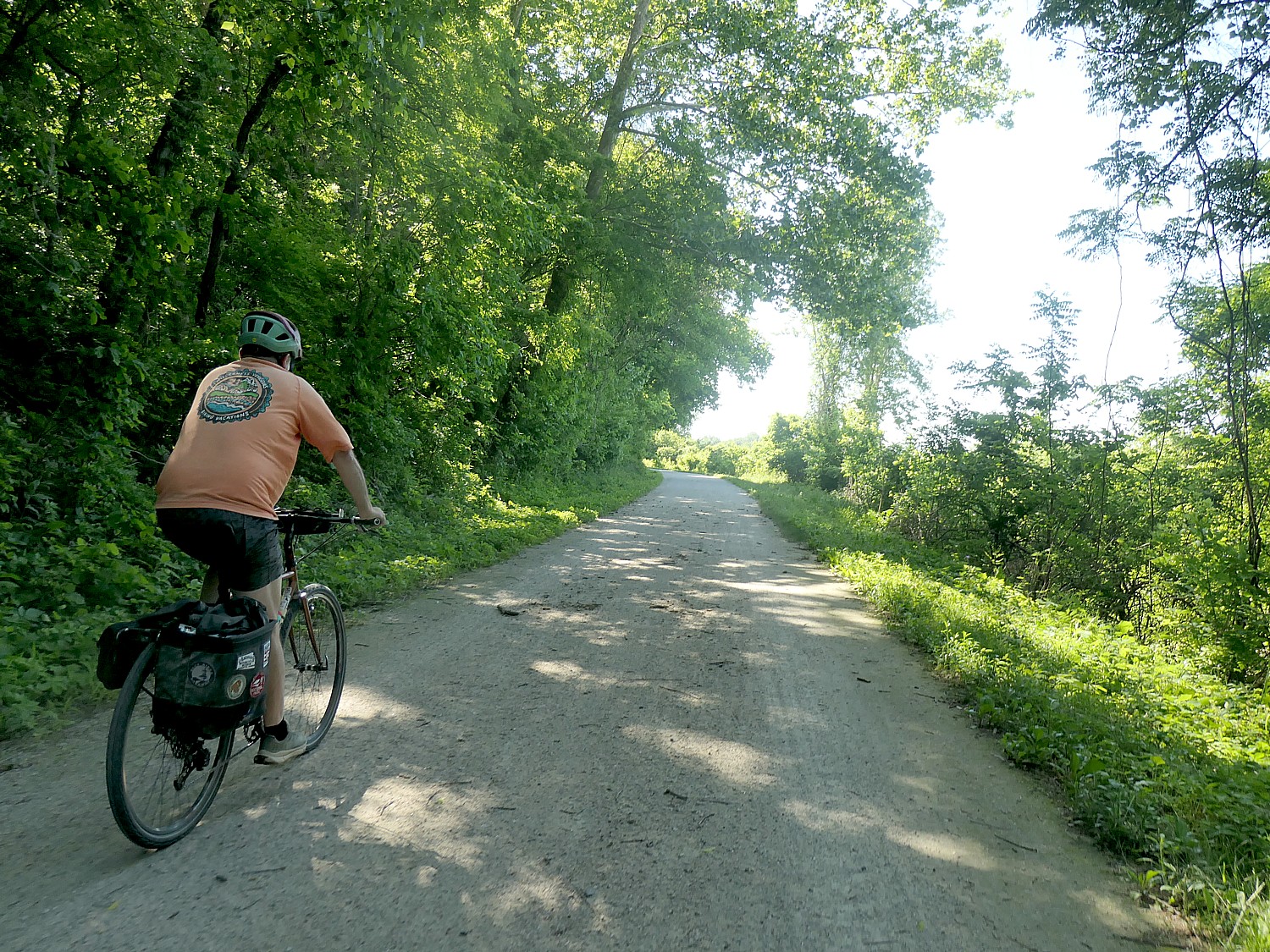
We set out from the base of the 200-foot high limestone Manitou Bluffs that towers above the bike trail. They were once sacred to Native American tribes and we spot remnants of pictographs.
They are easy to miss, but I am intent to find them (look for the marker that gives the description). Still, I might have missed them were it not for our guide, James Oerding, riding along with me (because I am last – again), who has guided for Wilderness Voyageurs for the past 13 years, pointed them out.
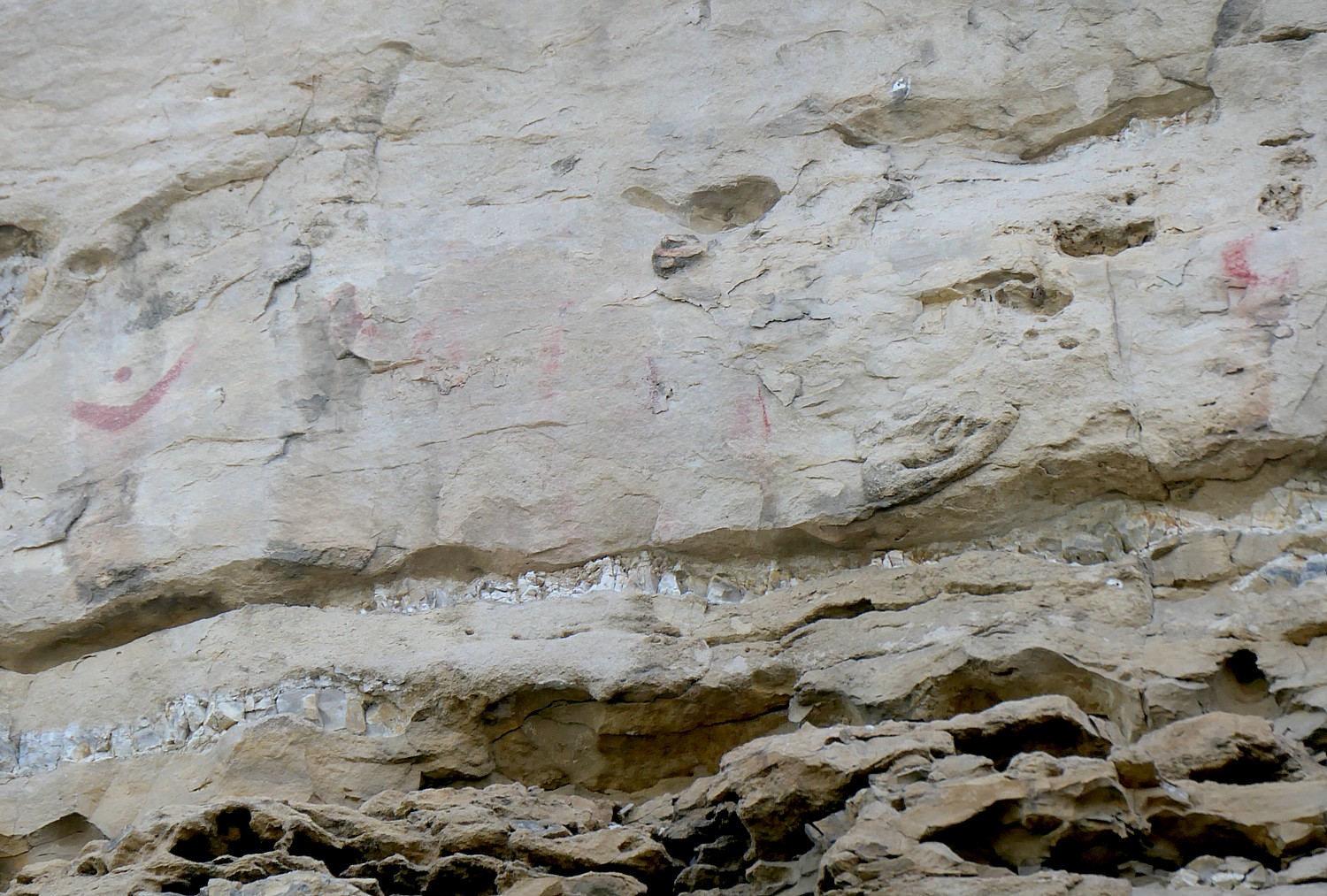
What you do see most prominently is the symbol that looks like the Nike swoosh. Then you look to the right and make out others (there is a placard that shows all the figures to look for). They were like billboards of their time (perhaps saying “We are here”?).
The notes say that Lewis and Clark expedition camped below these bluffs just downstream from here on June 6,1804.
President Thomas Jefferson had made it clear the captains should carefully observe Indians and their way of life and though Clark and others in the expedition were conscientious about recording pictographs, there were no mentions of the pictographs we see here. But the Stephen Long Expedition did make note of these Torbett Spring pictographs in 1819. It is suspected that the Sauk and Fox Indians, who lived in the area until around 1814 and likely were the artists, painted the pictographs . after the Lewis and Clark Expedition passed by.
Needless to say, I linger here awhile, reading the notes, taking photos, so am last and James, our guide, hangs with me. (The Wilderness Voyageurs guides tell us at the outset, “This is your vacation. Ride your own ride” – and isn’t normally a problem with the route on our Ride GPS app and because on this trip, for all but the last night’s stay, we are able to bike from inn to inn without needing to gather in the van to shuttle to our lodging.)
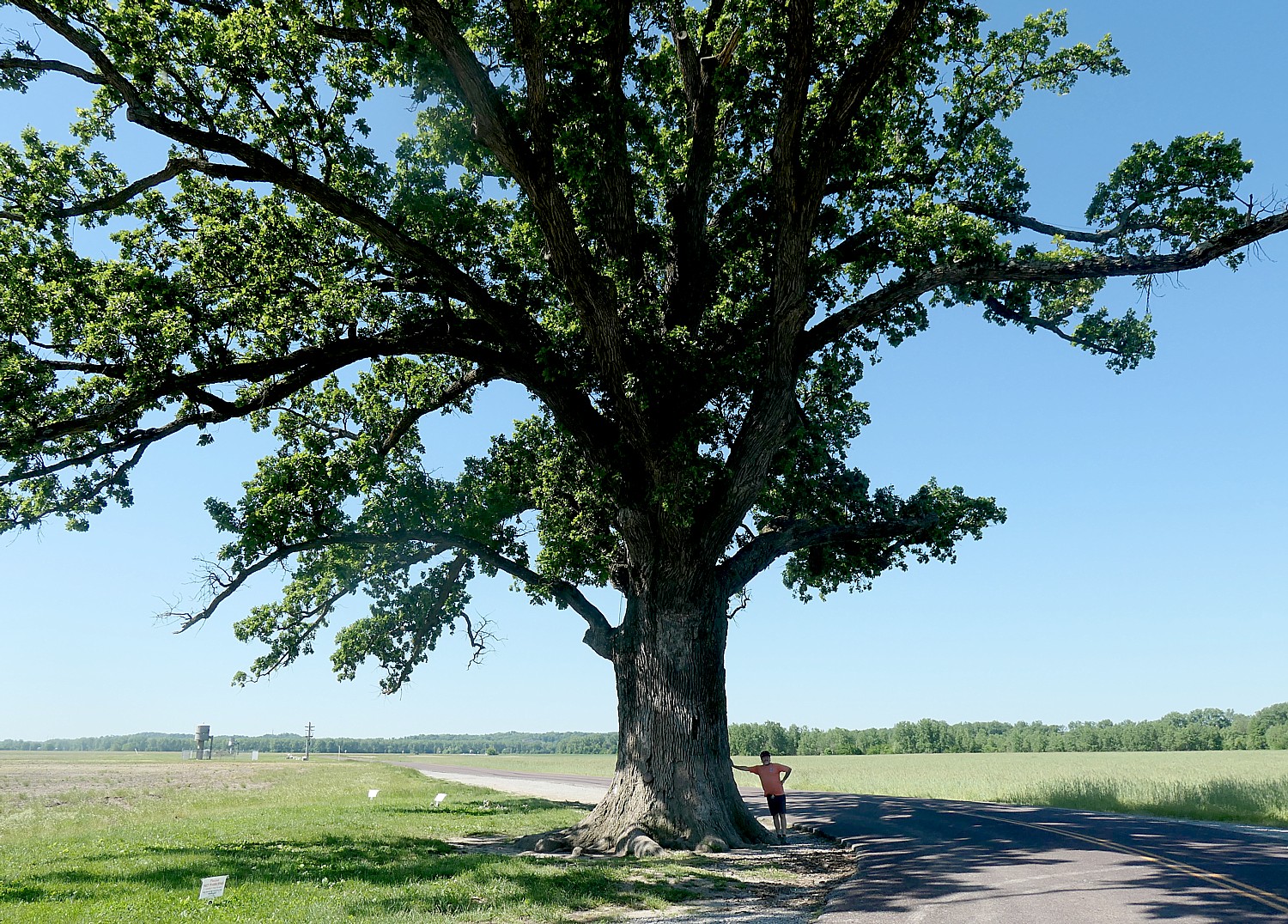
A short distance further, we veer off the Katy Trail for a quarter of a mile to see The Big McBaine Burr Oak Tree, that sits all by itself with no other tree for 1000 feet. From a distance, it is just a tree. But as we get closer, I begin to appreciate just how gigantic it is, and why it is recorded in journals: The largest burr oak tree in Missouri, it is 287-inches around, 90 feet tall with a 13-foot spread, and takes a half-dozen people to wrap their arms around the trunk. It has stood strong for nearly 400 years, withstanding storms, droughts, floods, vandalism, and development and would have been formidable even to Lewis & Clark, who would have traveled within sight of the tree, a half-mile from the banks of the Missouri 200 years ago.
At McBlaine, we take a peek at another oddity: “Boathenge” is comprised of 1950s ski boats that were swept here after a flood in 1993.
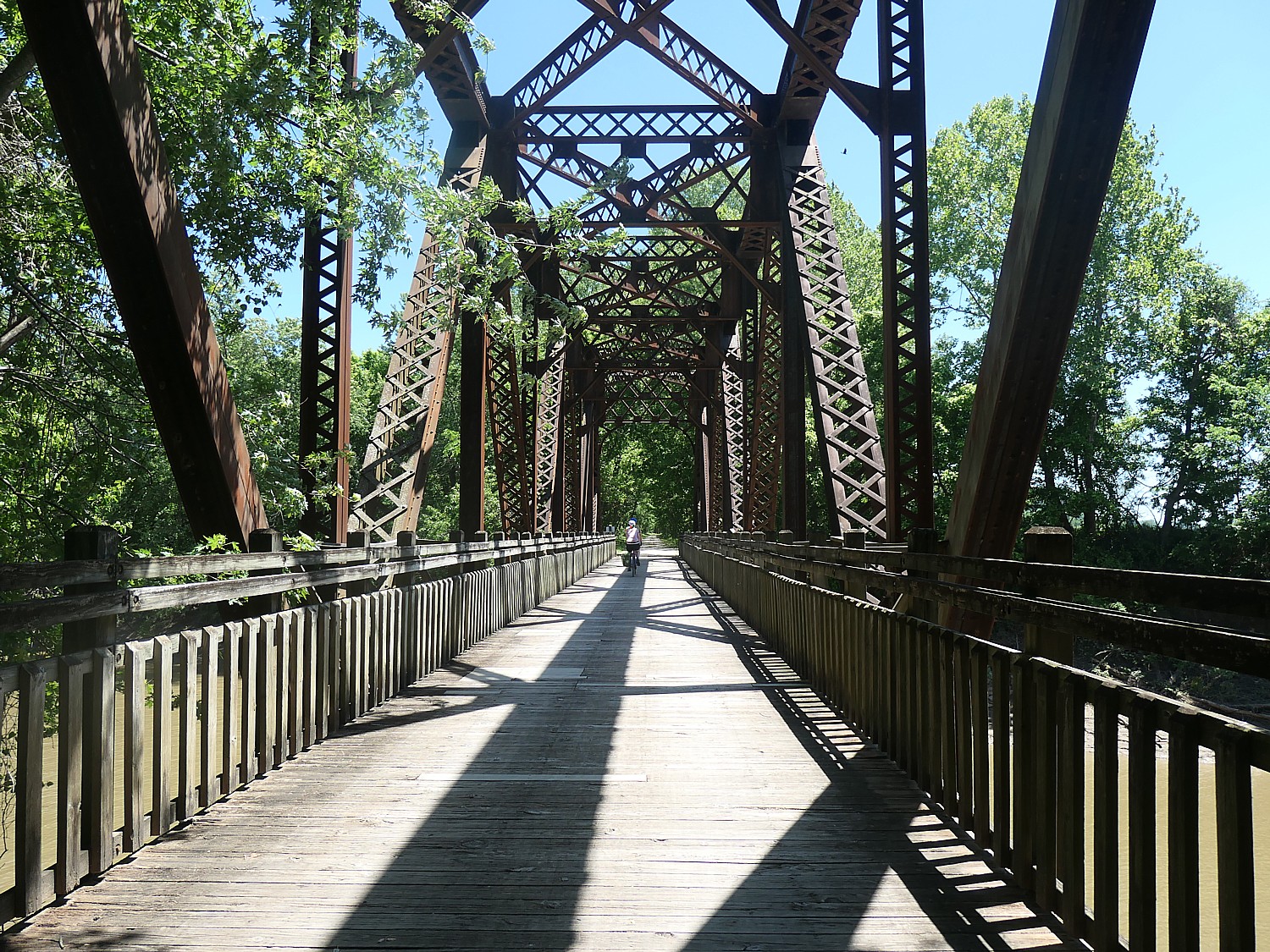
Coming into Jefferson City, we leave the Katy Trail onto a spur and bike up an extraordinary spiraling ramp onto the bridge over the Missouri River (and will return down the ramp the next morning to get back onto the Katy Trail). Riding over the bridge affords dramatic views of Missouri’s majestic State Capitol.
Jefferson City, population 42,838, is the most urban part of our ride – and having just come from such rural areas on the protected carless rail trail, it is a bit of culture shock to be riding on city streets.
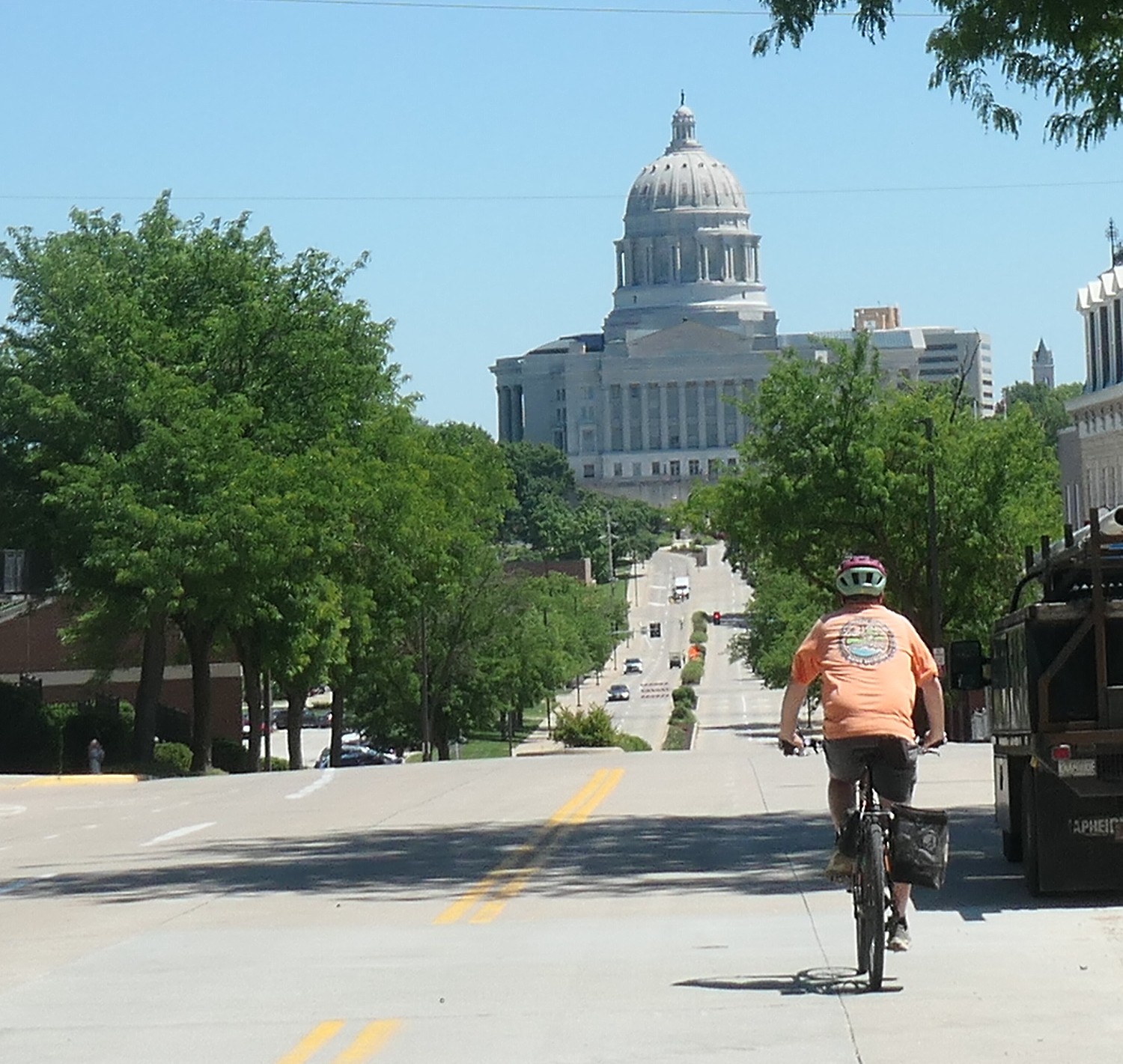
The only tricky part is getting to our hotel (the only “modern” hotel of our stay, Courtyard by Marriott), especially because of construction underway. We come down a steep sloping street, once again providing a dramatic view of the State Capital building set at the end.
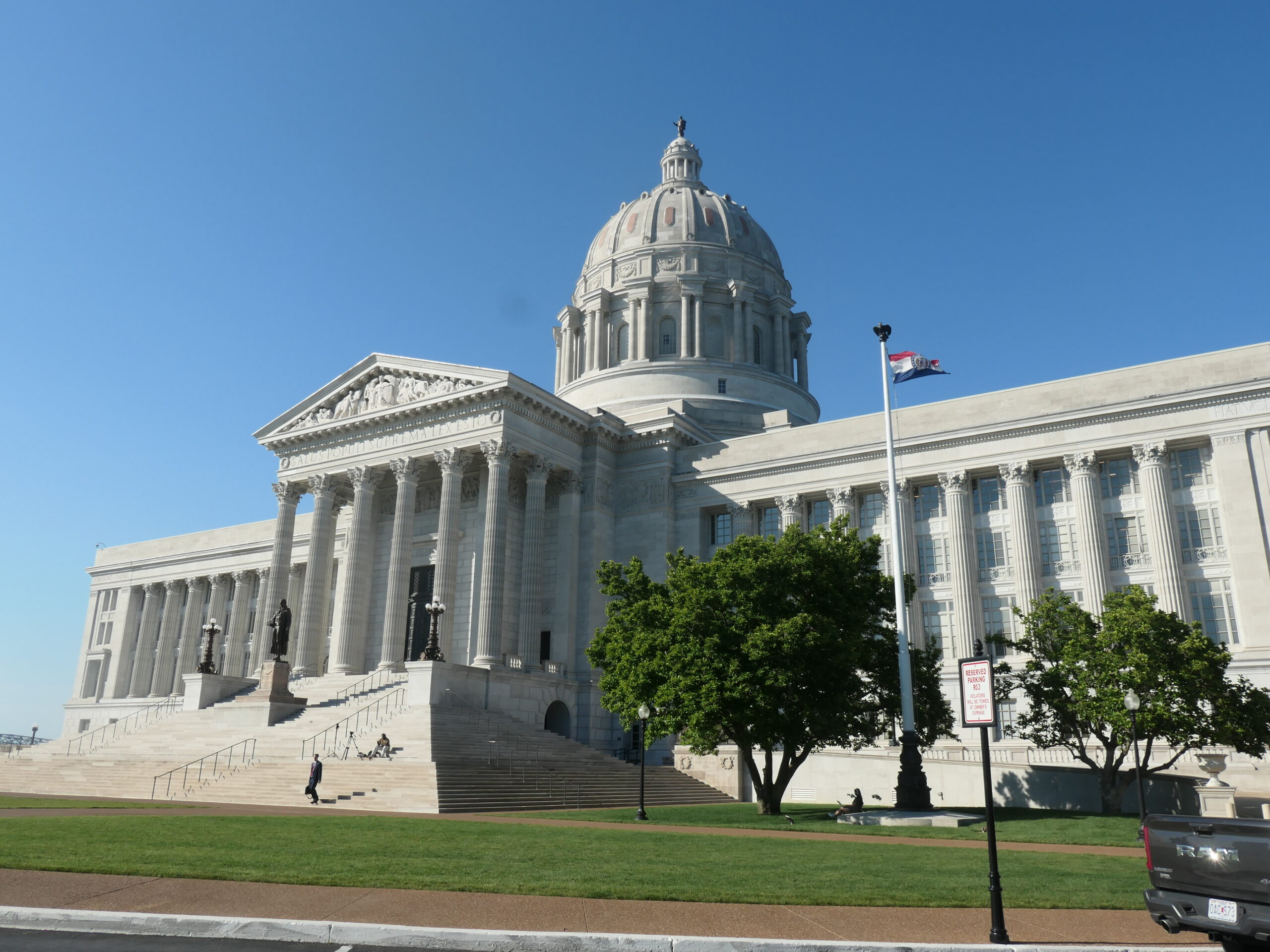
Once we are settled into the Marriott Courtyard Hotel (the only chain hotel of our trip), James offers to drive us to the State Capital Building, encouraging us to seek out the Thomas Hart Benton Murals that wrap around the walls of the House Members’ Lounge.
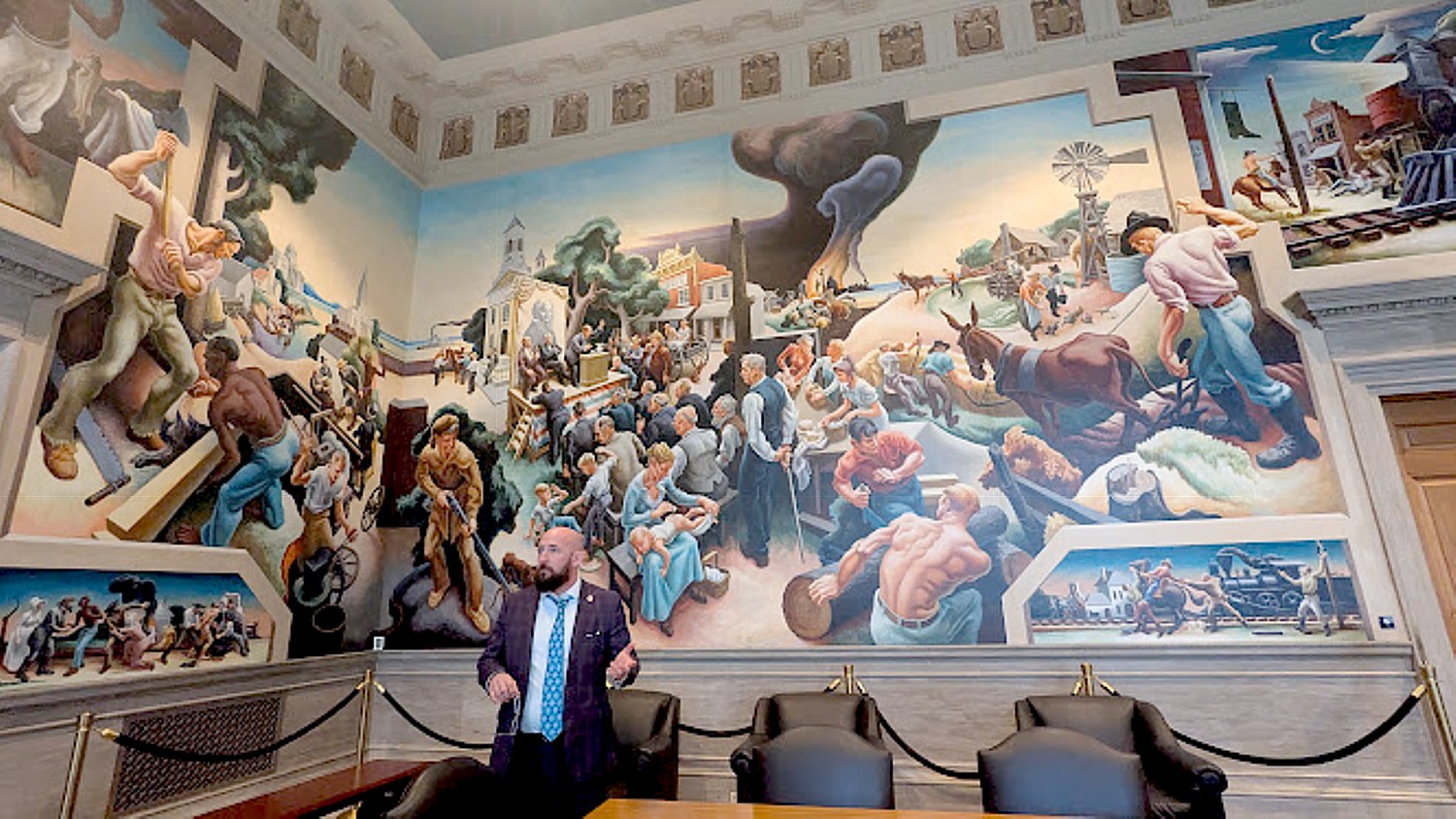
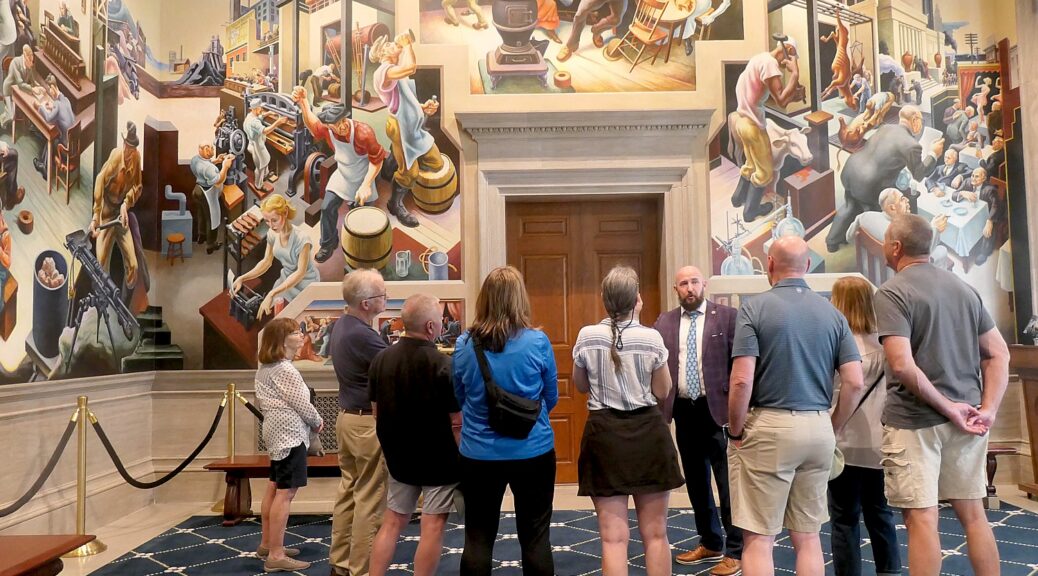
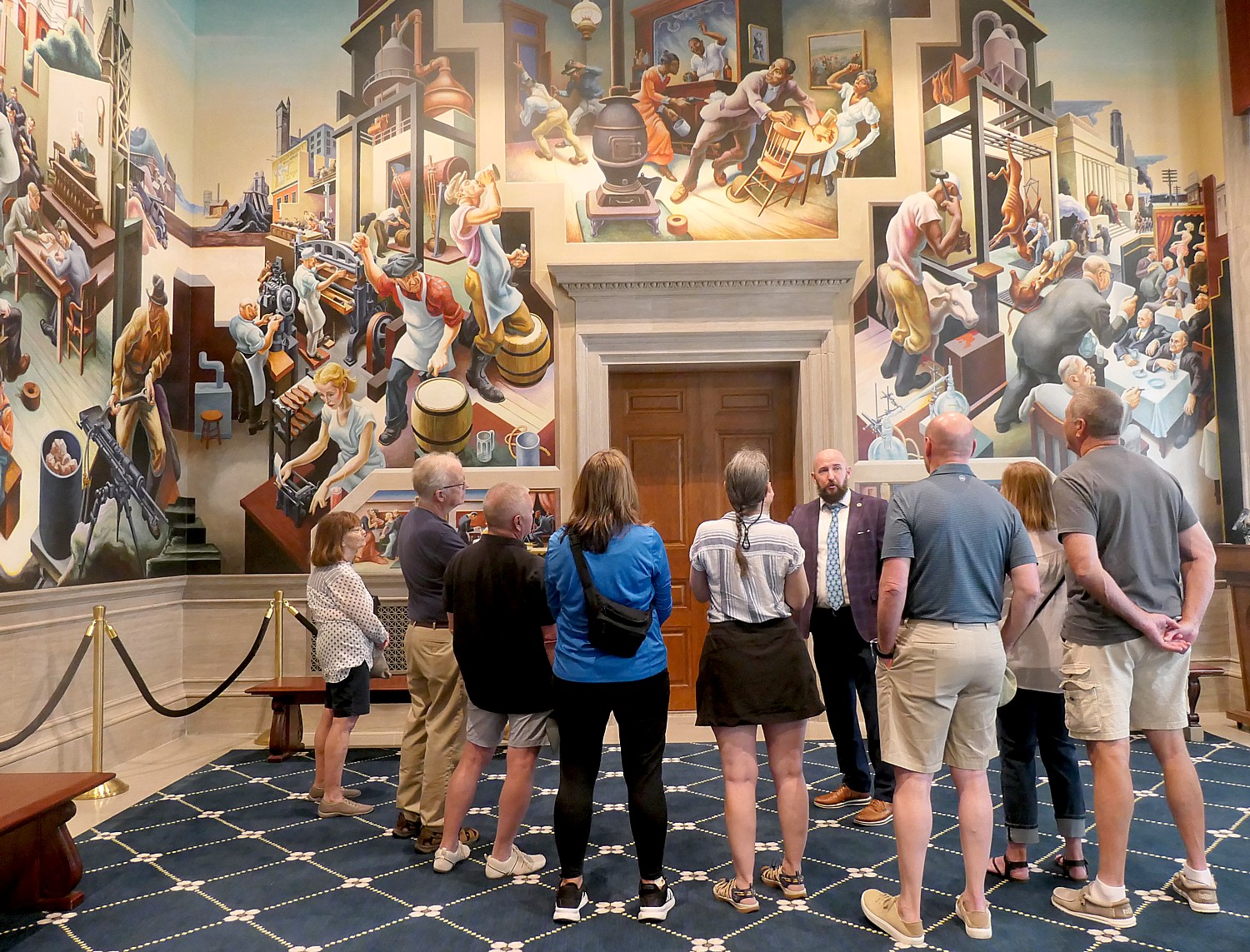
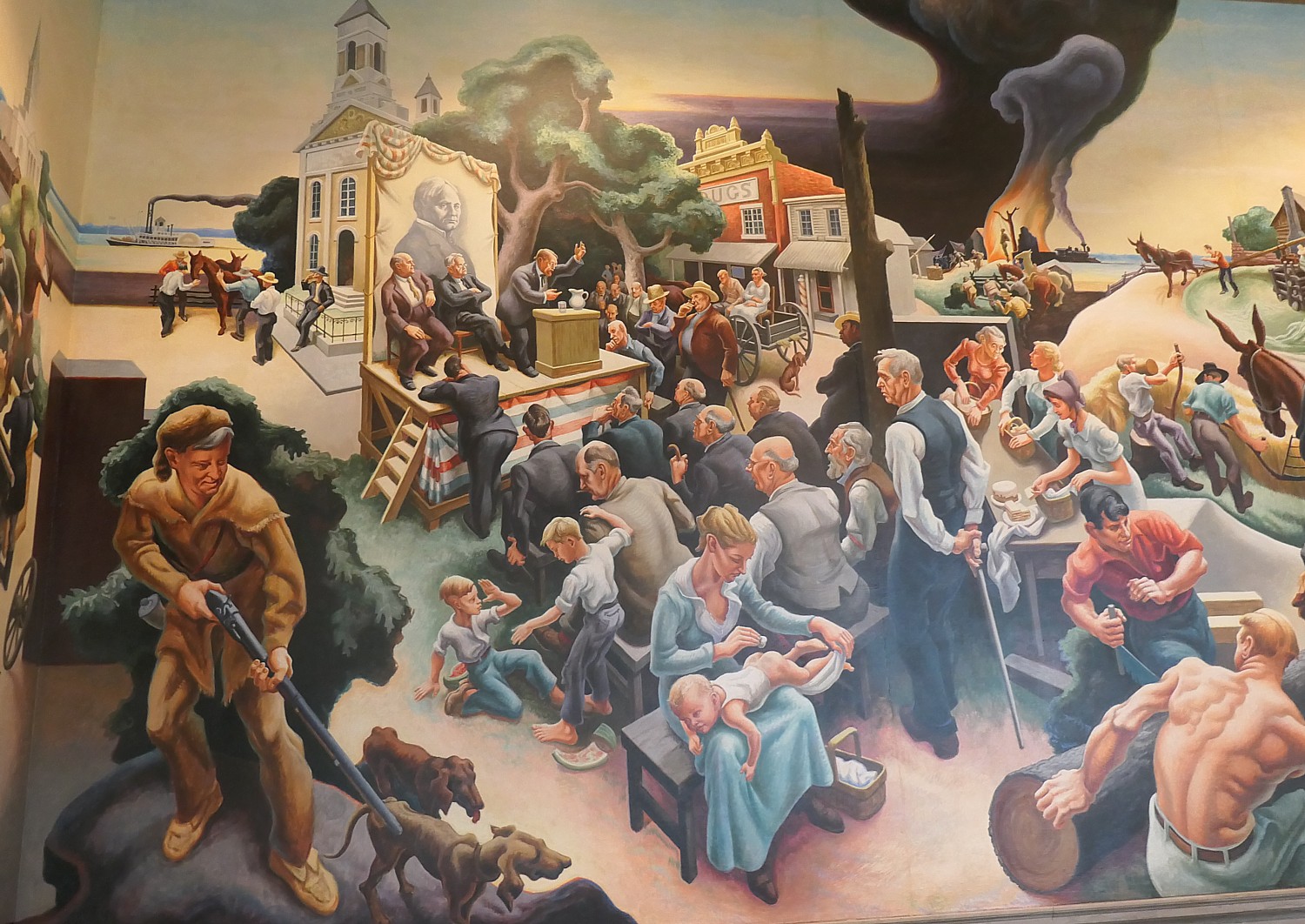
“A Social History of the State of Missouri,” Thomas Hart Benton’s famous mural, is more of an indictment than a glorification of Missouri’s history. It was 1934, in the midst of the Great Recession, when Benton got the $16,000 commission – “a prince’s ransom” at the time, equivalent to $300,000 today and more money than the governor earned – and a period of heightened racial tension in Missouri. Completed in December 1936, the state legislators immediately regretted having commissioned it and even considered painting over the murals, but feared humiliating defeats if they admitted their “misjudgment.”
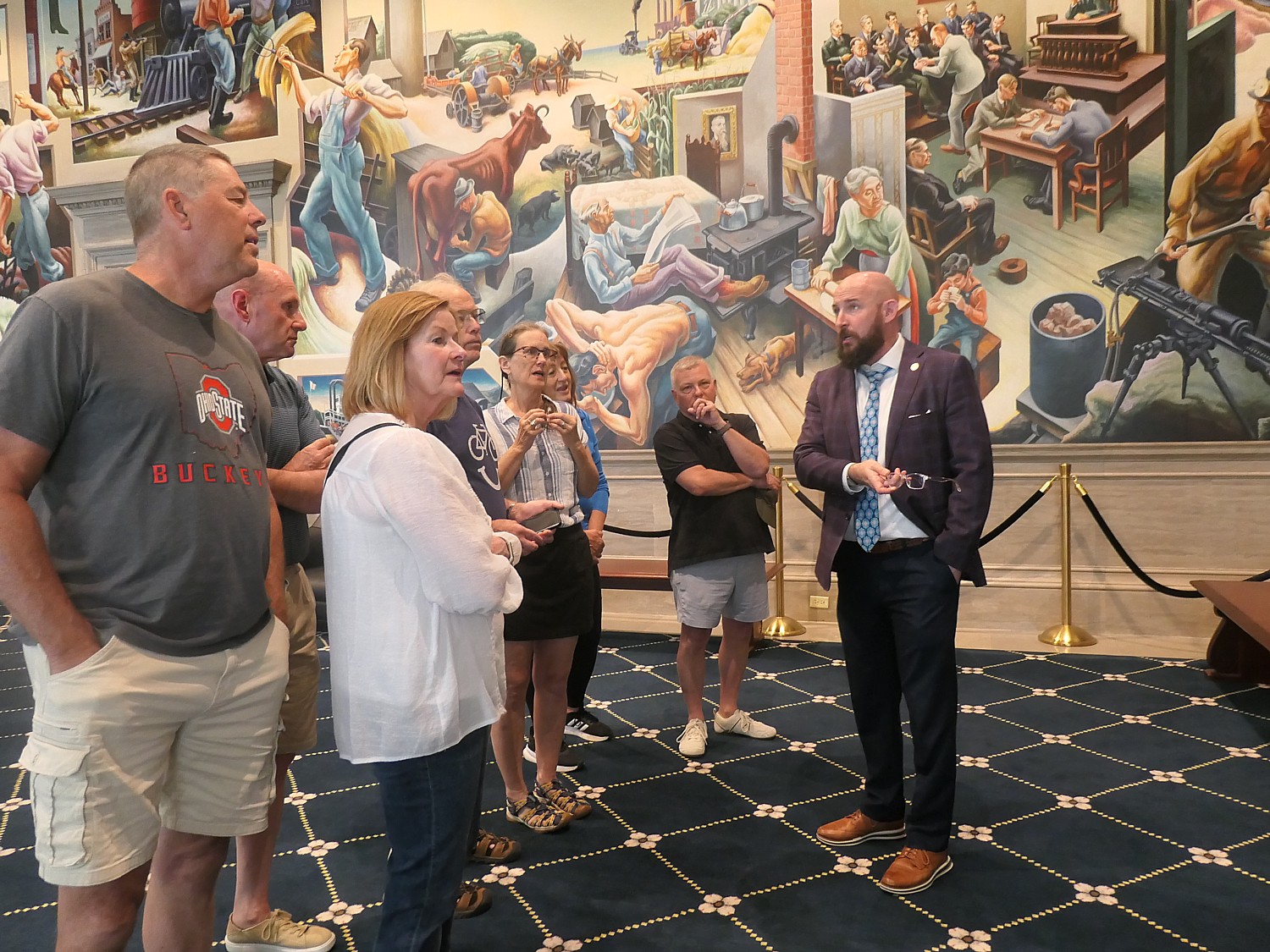
The story of this extraordinary mural is being related to us by the Chief of Staff to the Speaker of the House, Ryan Clearwater, who we chanced to ask if we could visit when we find House Members Lounge locked. He takes us in (through the Speaker’s office, no less), and proceeds to spend an hour with us.
Instead of noble figures, Benton shows ordinary men and women who built Missouri, using real Missourians including his own family, as models for the 200 figures. He also shows its villains.
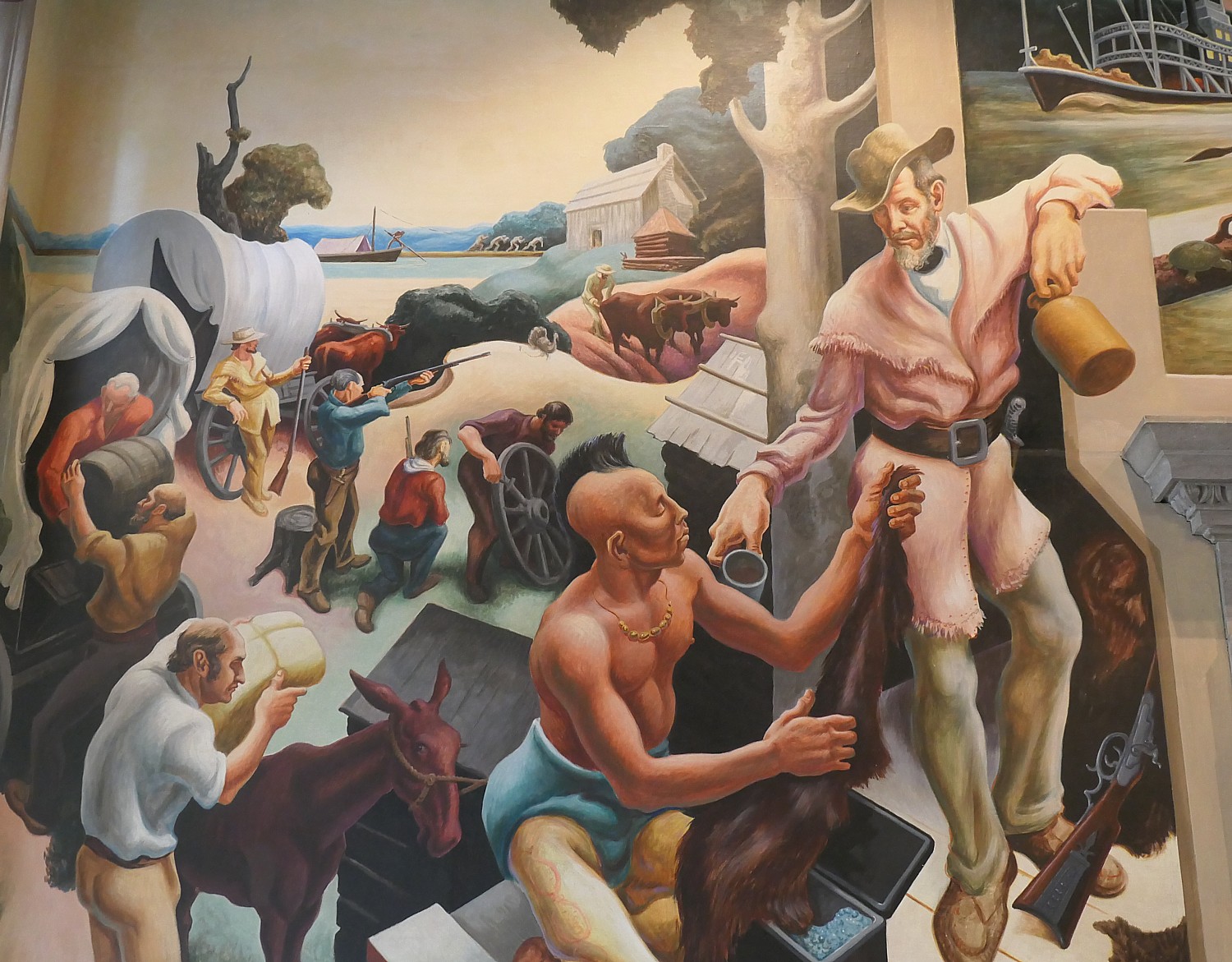
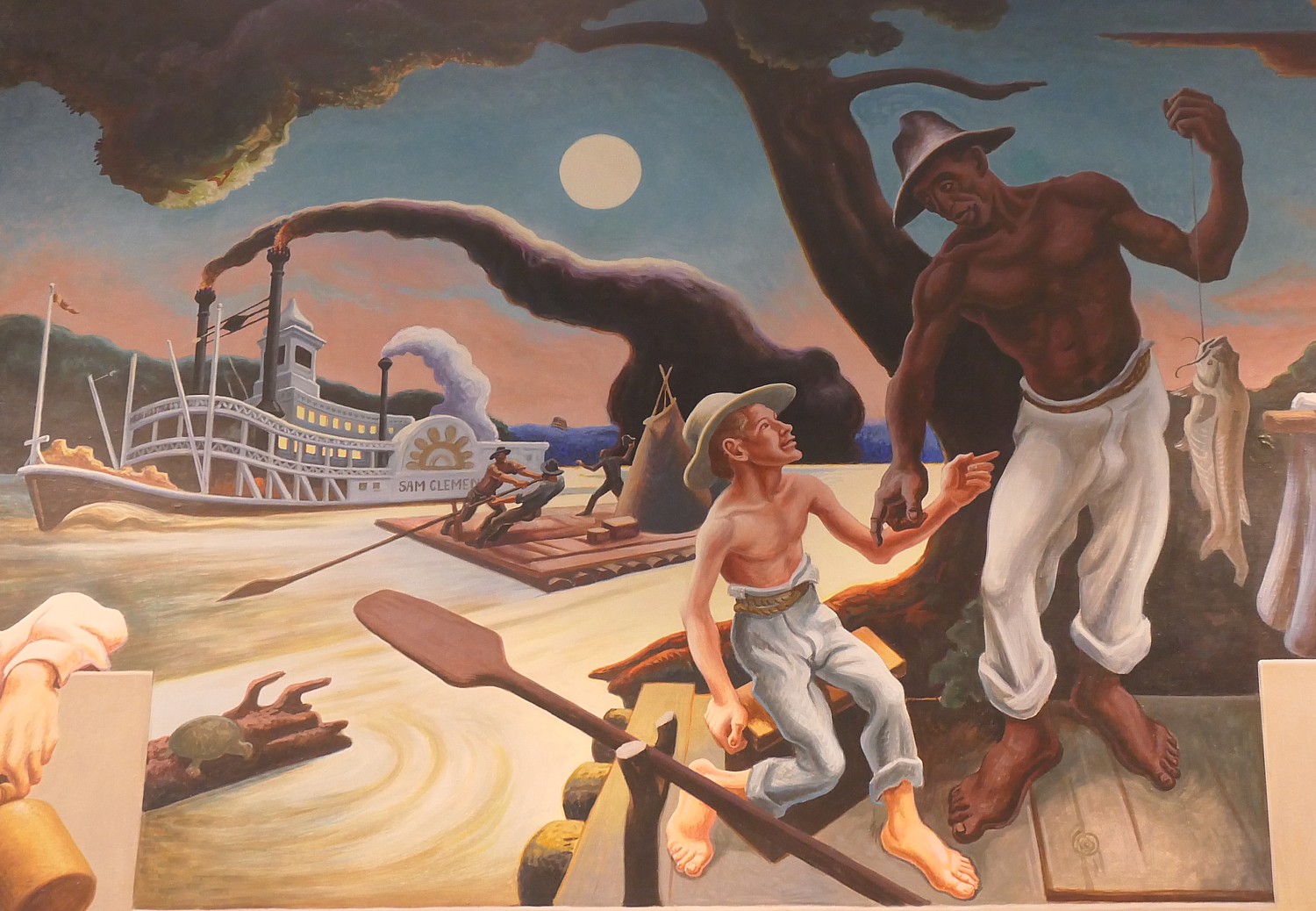
Instead of noble deeds and historic events, it depicts slaves being whipped and auctioned; a trader giving whiskey to an Osage Indian (he went to Oklahoma to find an Osage Indian to model); a Mormon being tarred and feathered (Missouri expelled Mormons and as recently as 1980s, Clearwater tells us, the state had a statute that it was permissible to kill Mormons); a settler being lynched by Civil War guerrillas while his family is turned out of their burning home; Huck Finn and runaway slave Jim on a raft escaping down the Mississippi River, the Samuel Clemons riverboat off to the side; Jesse James and his gang robbing a bank and a train; and Frankie entering the bar to murder Johnny, who did her wrong.
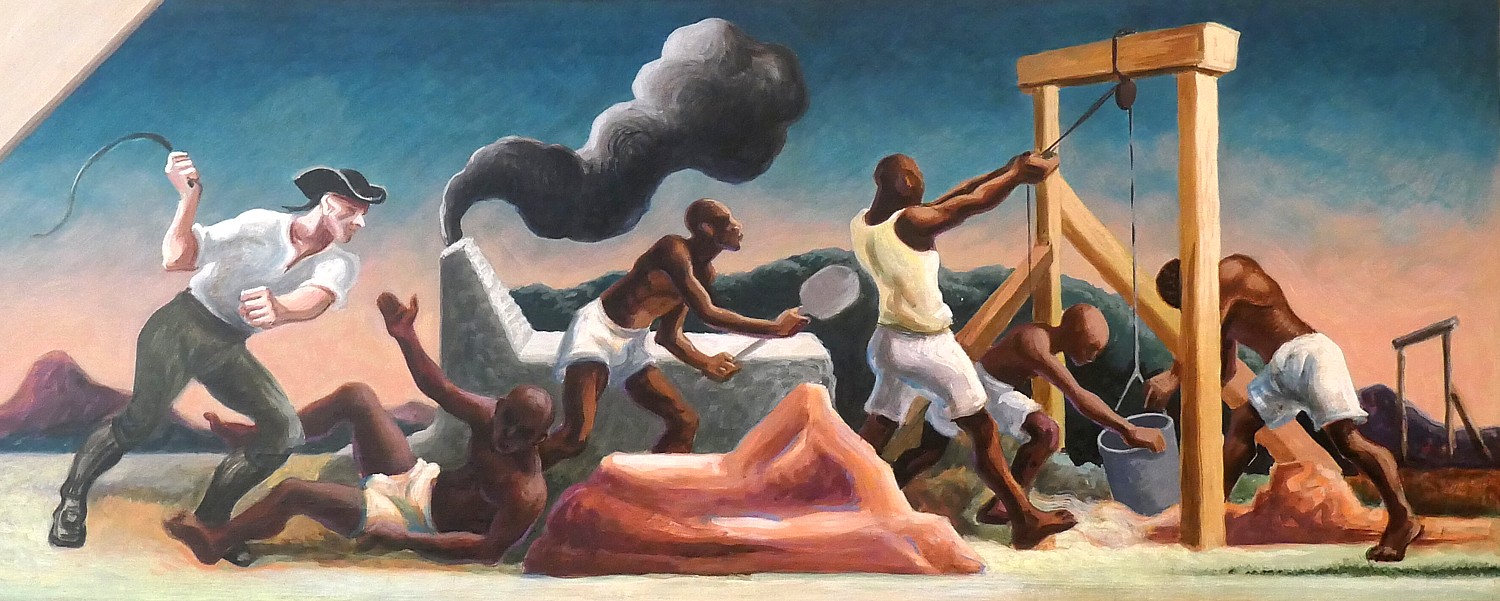
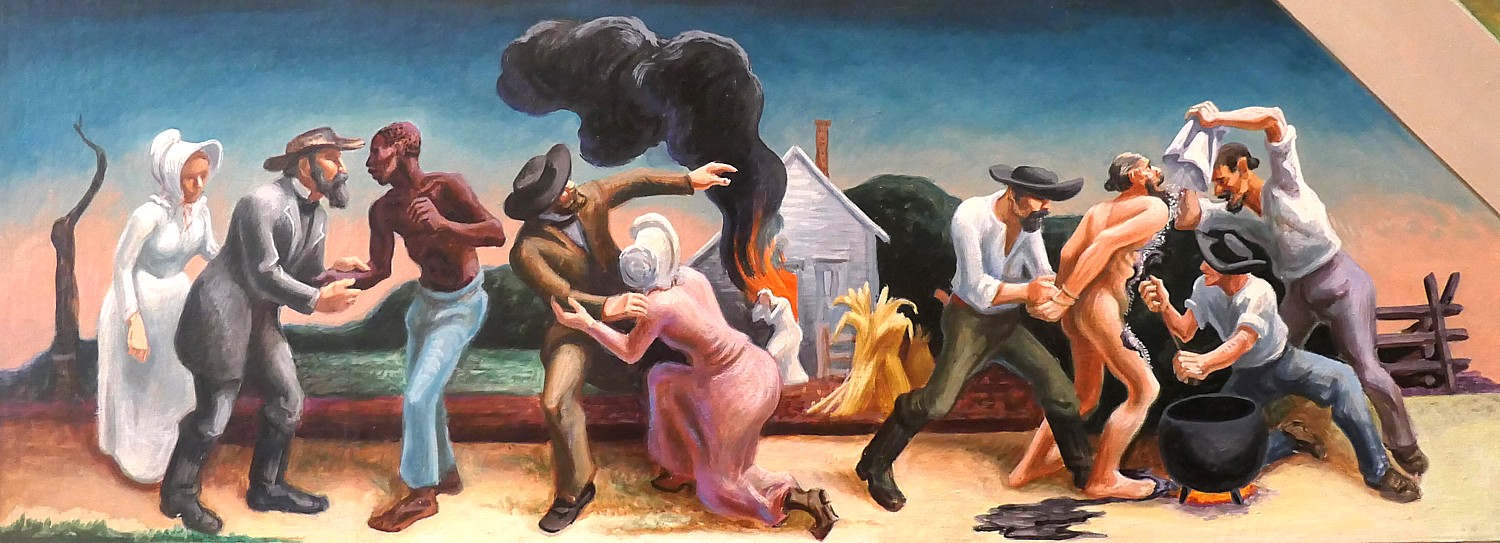
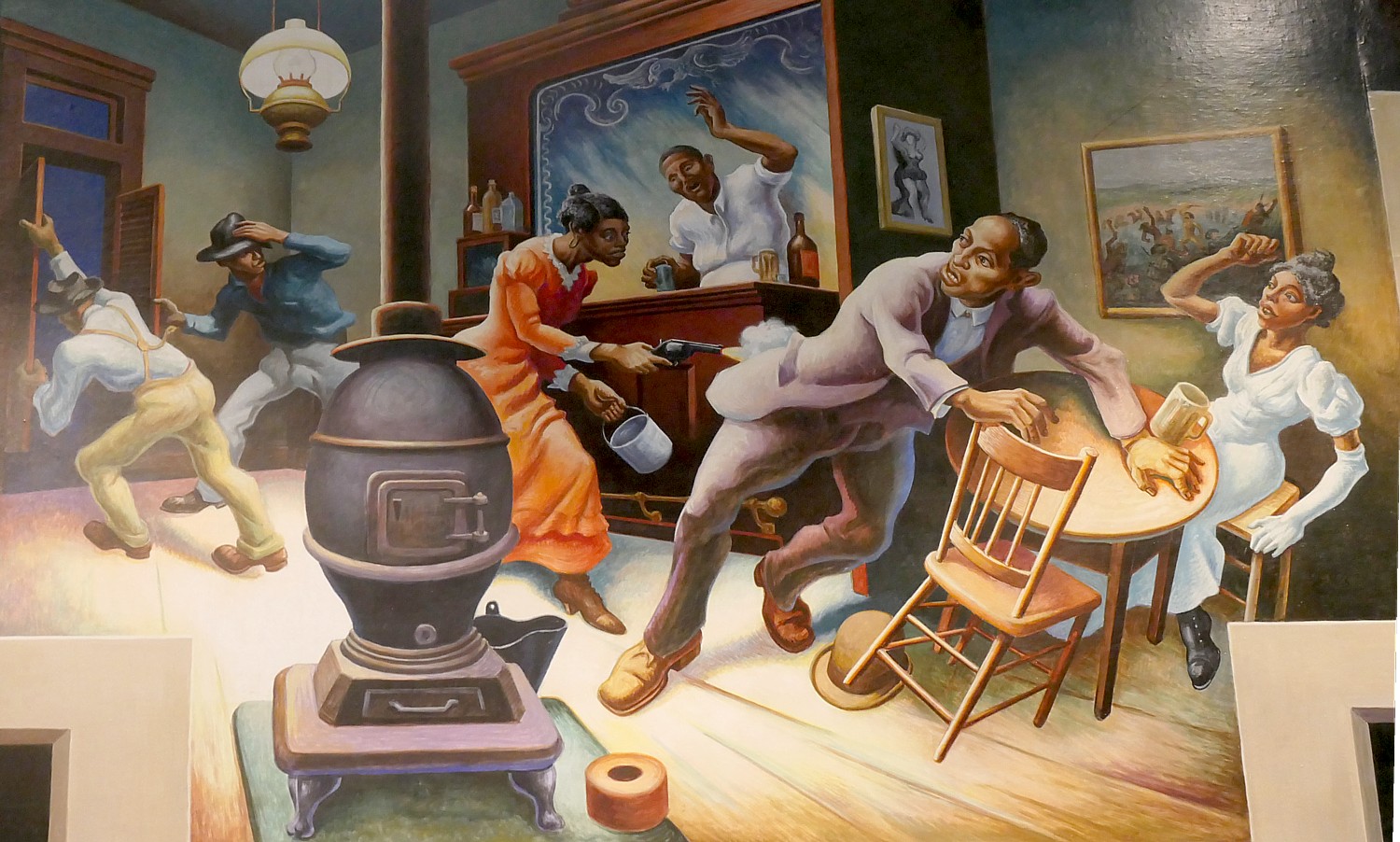
It depicts Missouri’s transition from frontier to factories, the Civil War to the Great War, people struggling and making due during the Great Depression (a comb with missing teeth as one of the symbols). One section portrays a political rally attended by all but one white man, while a woman on a bench, her back turned away from the rally, changes her baby’s bare bottom (scandalous! Benton’s nephew was the model),
The last scene, In the bottom corner, plainly depicts Tom Pendergast, at the time the boss of Missouri politics, who was so powerful, he is said to have elected his candidate governor in just 30 days and get Truman into the US Senate (a figure very much like Truman is seated in front). Then 2 years after the mural was done, Pendergast went to federal prison for corruption. Benton came back and made a couple of changes – he had to touch up where someone drew Pendergast’s prison number on his suit, and to put clothes on the burlesque dancers in the background.
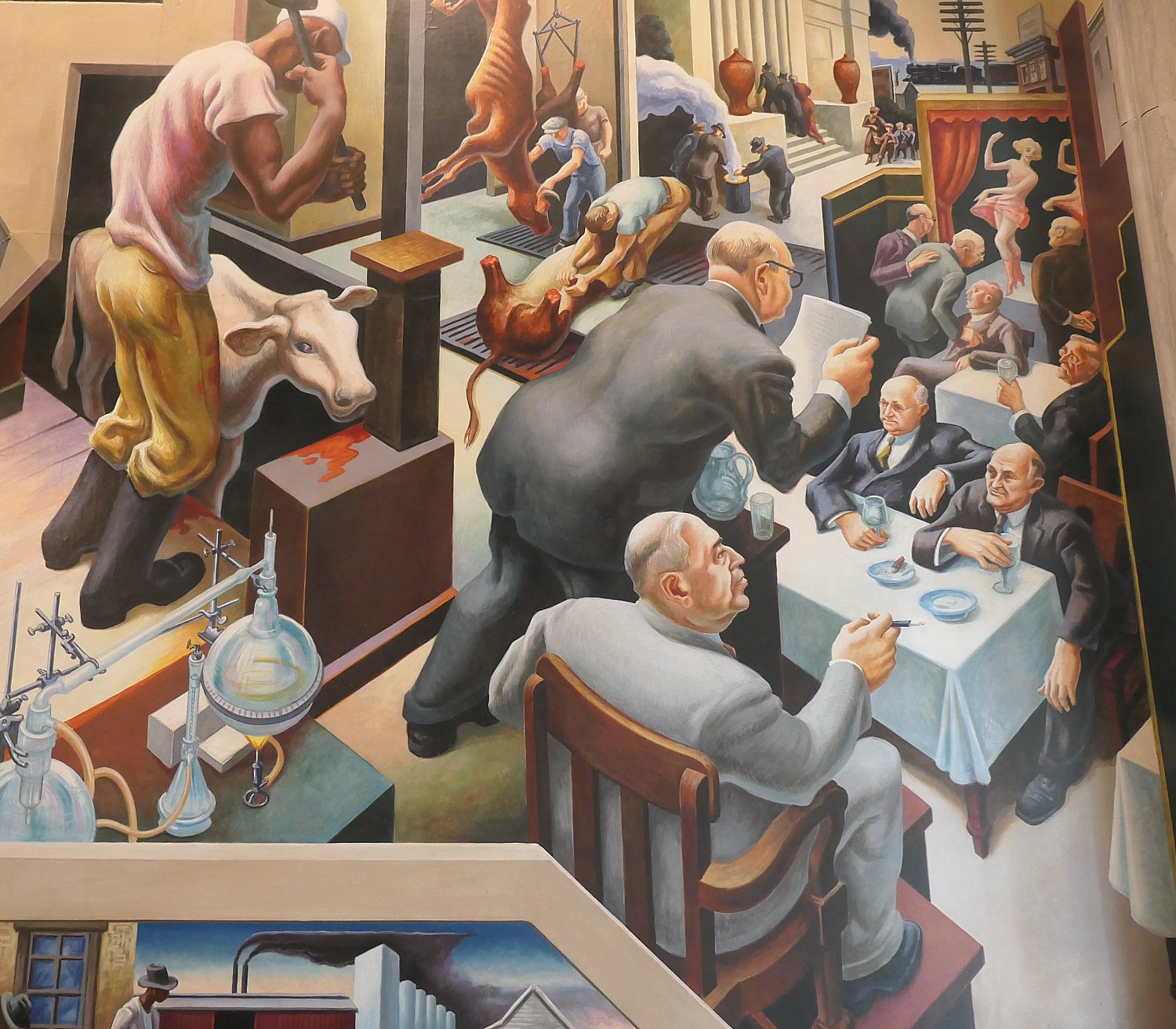
“Benton put Pendergast in the mural to let every representative and senator and the public know how some got into office,” Clearwater remarks.
The scene with the political rally depicts a black man, the only black man wearing a suit, leaning against a pole. This figure is Jordan Chambers, who was the Black political boss (“Tom Pendergast”) of St. Louis. Some claim that Jordan Chambers wanted to be in mural, he tells us, despite the association with Pendergast’s corruption.
The mural is shocking to see, even today, and you wonder how Benton was able to get away with it.
“The mural got mixed reviews – slavery, tar and feathering, lynching, murder, robbery,” Clearwater notes with an air of understatement. “They had wanted history. When it was unveiled, they talked about painting it over. But they had spent $16,000 and felt they wouldn’t get reelected, so they said, ‘We should learn from past.’” (I wonder if they also calculated that since the murals were locked away in the House Members’ Lounge, few would actually see it.)
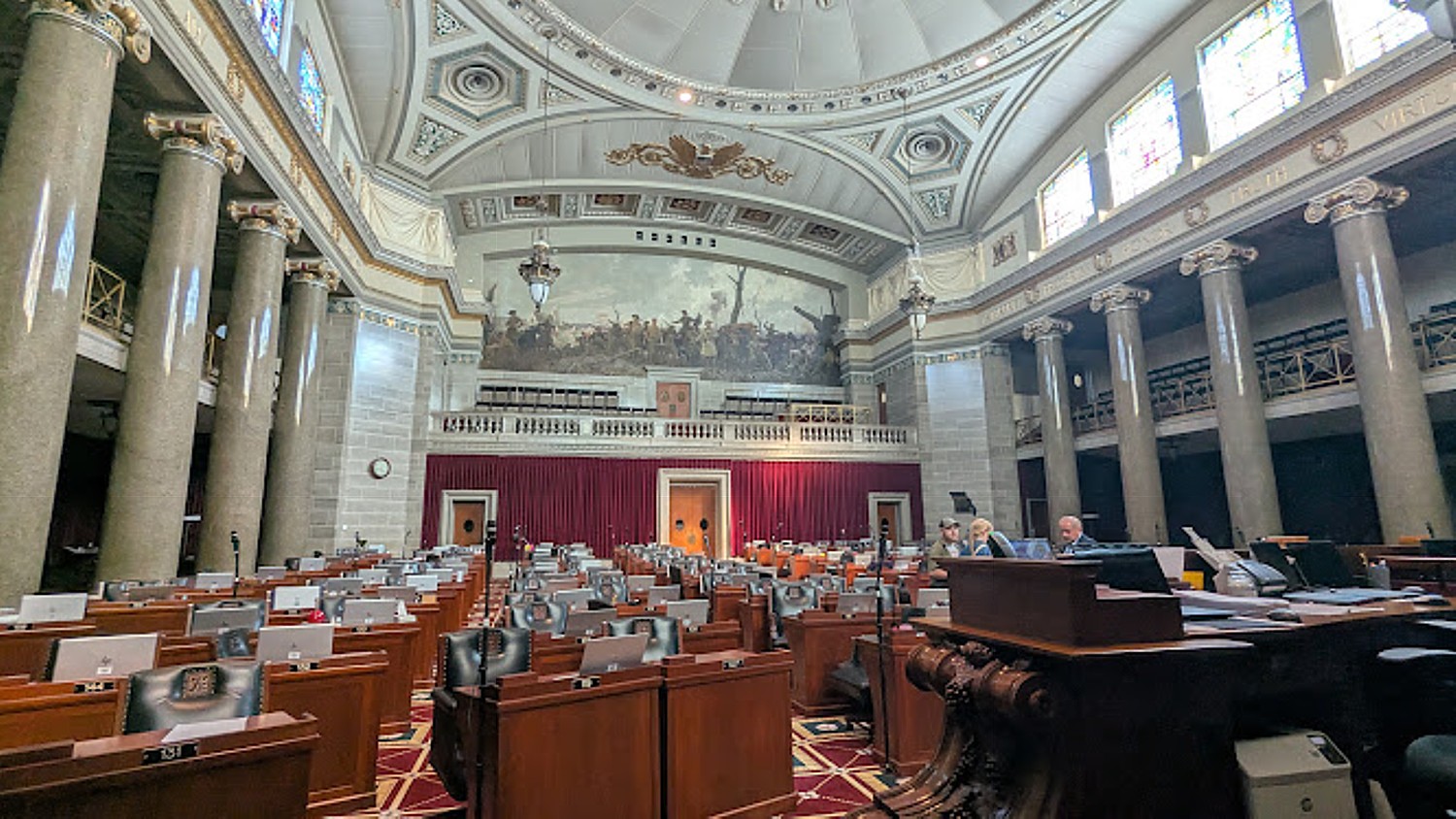
It’s 5 pm, when the building normally closes, but Clearwater takes us into the House chambers (he says that because the Senate is still in session trying to complete its business before the term ends, the building isn’t officially closed). It is a stunning, majestic room, with painted glass windows and a stunning mural (the gift of France). Clearwater says they had a $1 million budget for artwork when the building was built (the first two capital buildings burned down; this one is of “Carthage marble” – polished limestone). Missouri has the 4th largest House of Representatives per capita (163 House members and 34 Senate); a part-time position, they meet five months of the year.
I note portraits of Lincoln (“the first Republican,” Clearwater says) and Jefferson (“the first Democrat,” Clearwater says, but Jefferson was actually a Democratic Republican who advocated for states rights, agrarian interests and strict construction of Constitution, so also Republican; Franklin D. Roosevelt is probably the first modern Democrat).
The partisan animosity is practically built into the room. The center aisle is the width of “two swords”; the 7,000-page rule book includes such provisions as the member has to ask permission to speak, no member shall rattle their spittoon while another is talking, no one can intercede the line of debate.
Festooned around the room are the values these legislators are supposed to espouse for the state: Enterprise, Progress, Honor. Truth. Virtue. Temperance. Knowledge. Liberty. Equality. Justice. Fraternity. Education.
By now, Clearwater, the chief of staff to the Speaker of the House has spent about an hour with us, even though only two of us are actually Missouri constituents. He jokes, “I would rather spend time with the public than lobbyist or legislator,” (though upon leaving, I spot a few of them on the way in, and all around the Capitol building, are offices of various unions and industry and trade associations).
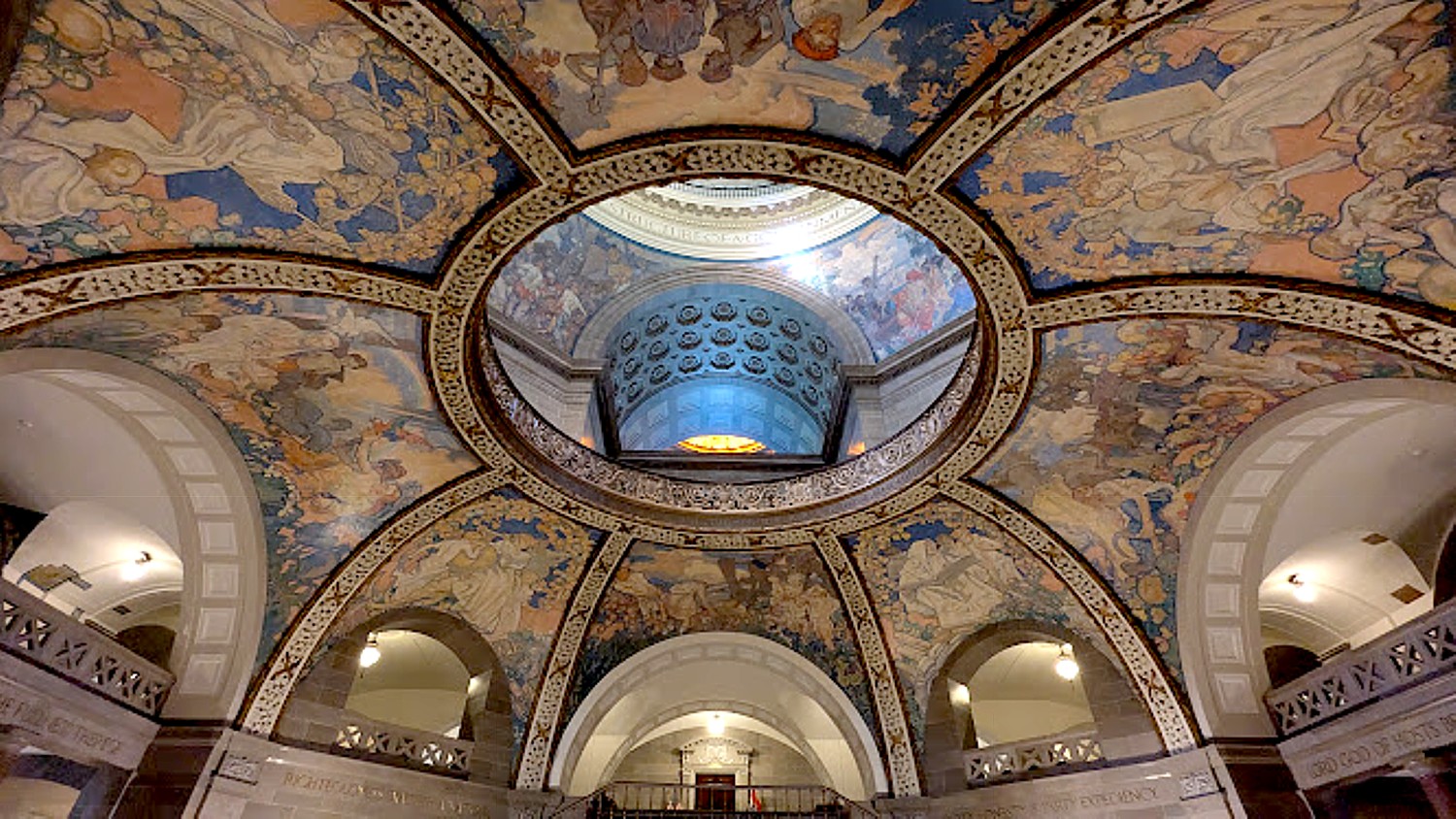
It’s after 5 pm, too late to visit the State Museum contained within the building, but we get a few minutes to admire the stunning lobby and dome, surrounded by engravings extolling the state’s (aspirational?) credos:
The Earth is the Lord’s and the fullness thereof
Righteousness exalteth a nation
Property is the fruit of labor
Where there is no vision, the people perish
Ideas control the world
Lord God of Hosts be with us yet, lest we forget
Party honesty is party expediency.
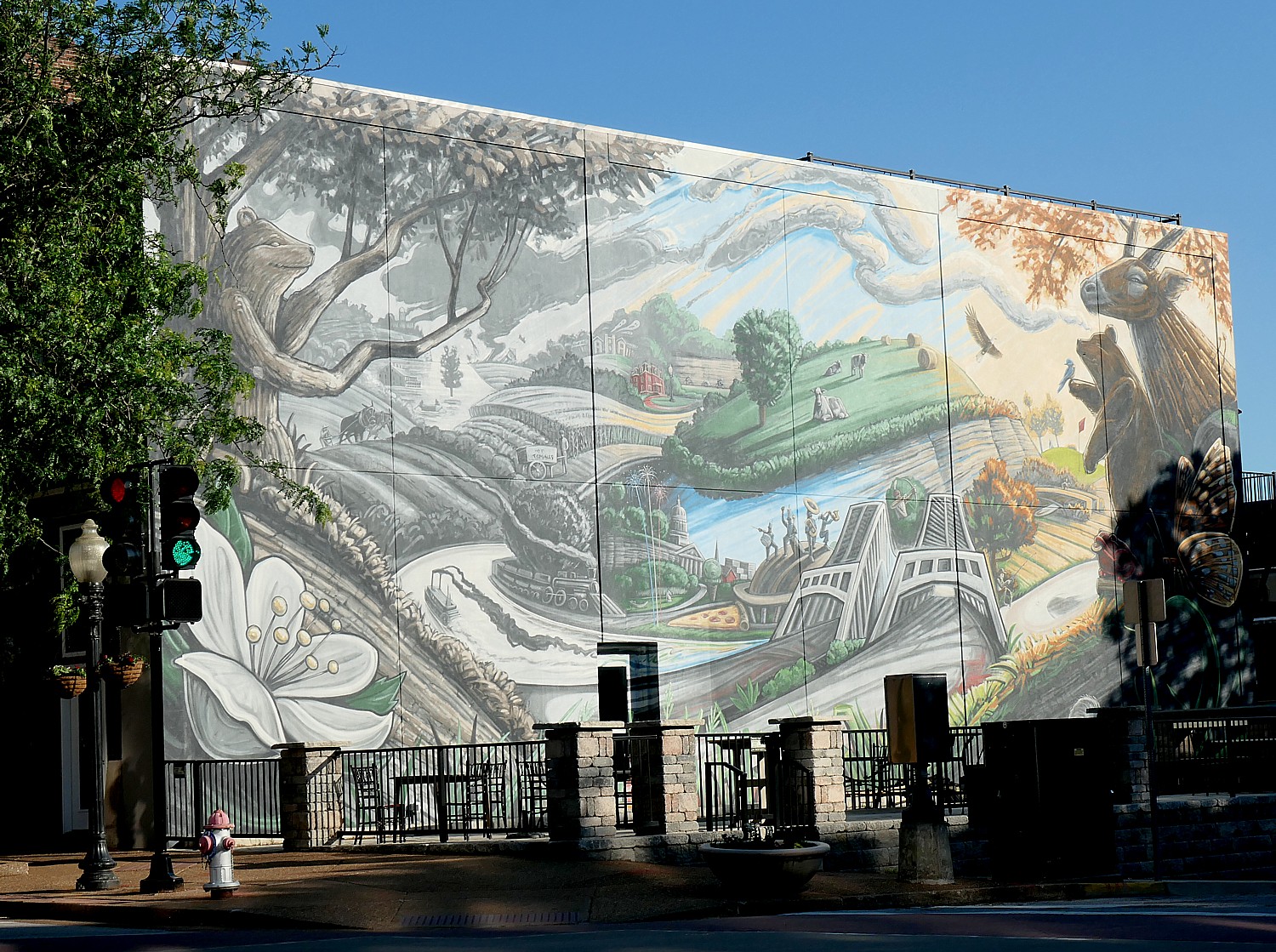
We go off to explore Jefferson City and have dinner (one of two evenings where we are on our own for dinner).
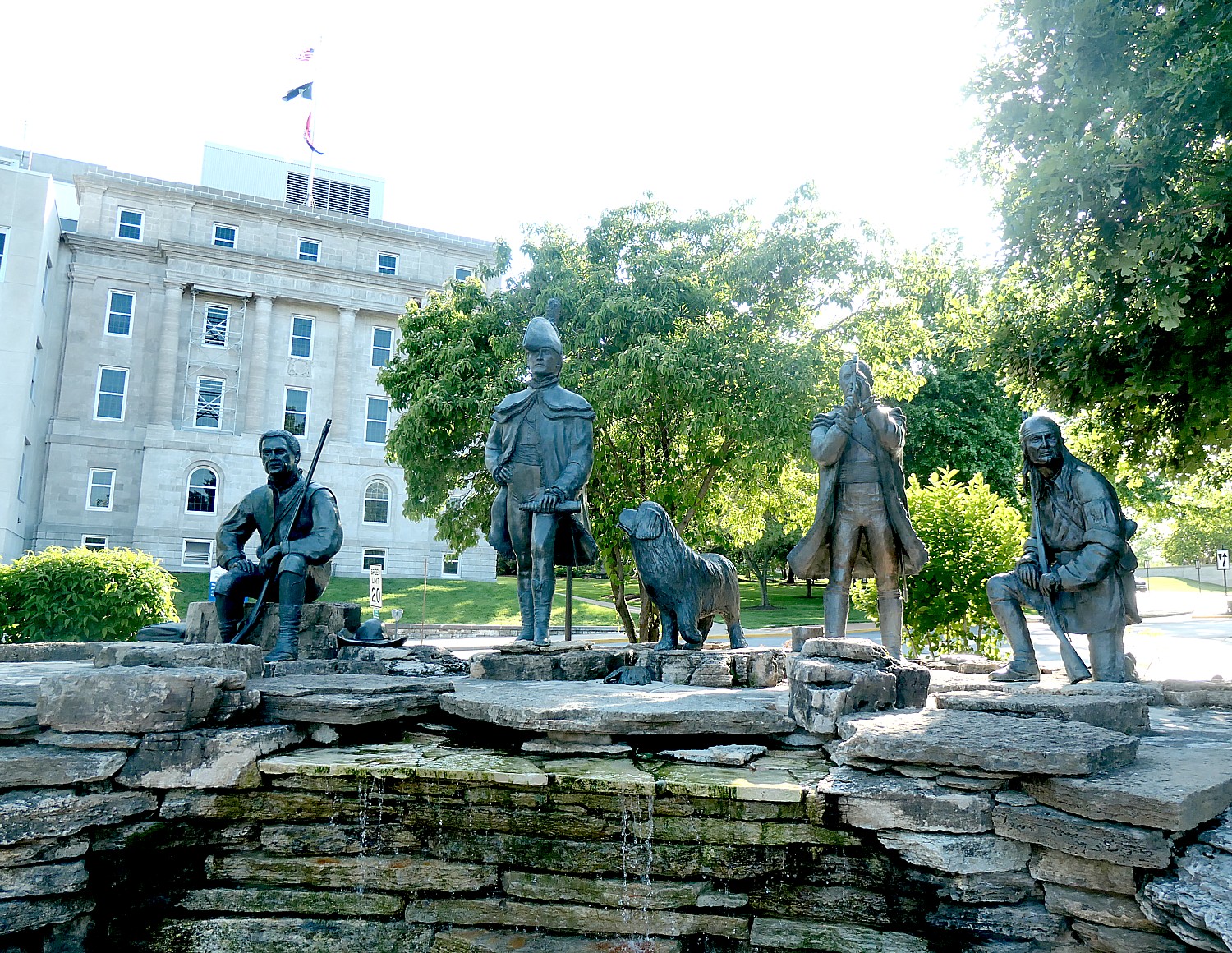
Just outside the capital building is a statue of The Corps of Discovery that passed Jefferson City June 4, 1804.
I walk back to the Courtyard Marriott, getting back early enough to enjoy the hotel pool.
Wilderness Voyageurs, Ohiopyle, PA, 15470, 800-272-4141, wilderness-voyageurs.com.
See also: Biking through History on Missouri’s Katy Trail During America’s 250th
See next: Biking Missouri’s Katy Trail Following Lewis & Clark, Daniel Boone & the Westward Expansion
__________________
© 2026 Travel Features Syndicate, a division of Workstyles, Inc. All rights reserved. Visit goingplacesfarandnear.com, longislandpress.com/category/vacation-travel.com and travelwritersmagazine.com/TravelFeaturesSyndicate/. Blogging at goingplacesnearandfar.wordpress.com and moralcompasstravel.info. Visit instagram.com/going_places_far_and_near. X: @TravelFeatures Threads: @news_and_photo_features ‘Like’ us atfacebook.com/NewsPhotoFeatures. Send comments/questions to FamTravLtr@aol.com.
