Tag Archives: Katy Trail

Biking the Katy Trail: From Cliffside Pictographs to the Capital’s Stirring ‘Social History of Missouri’ Mural

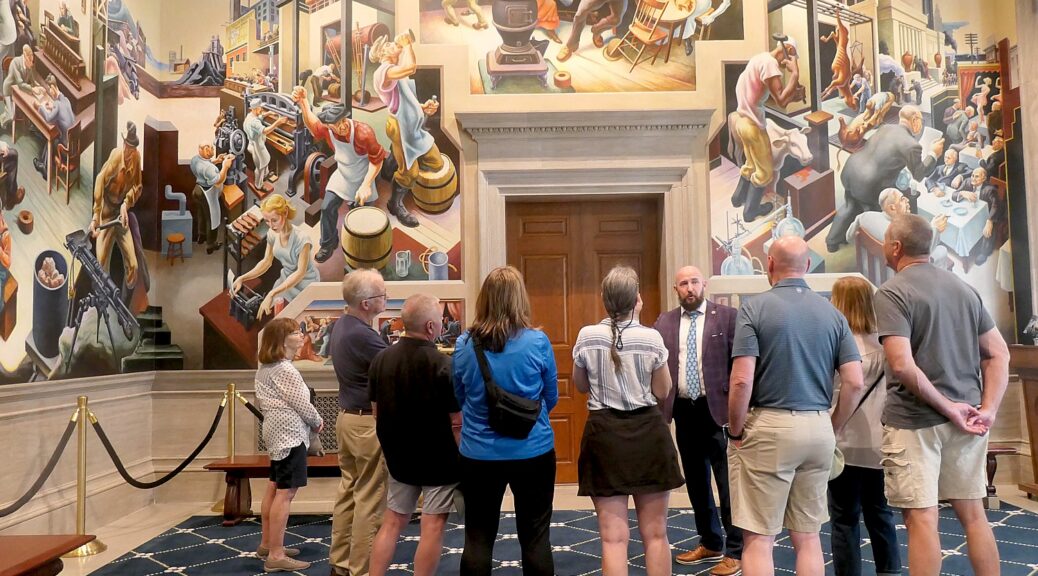
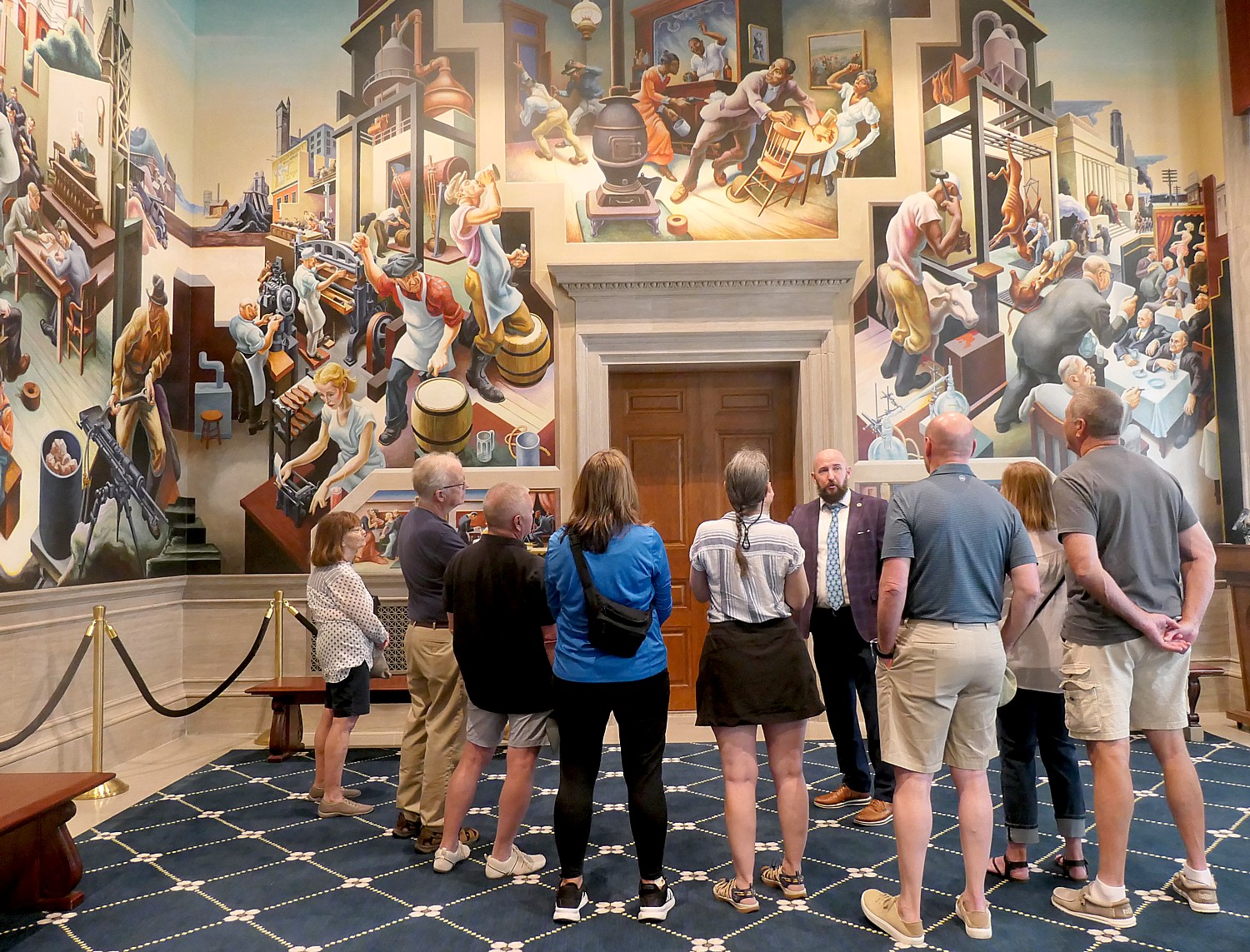
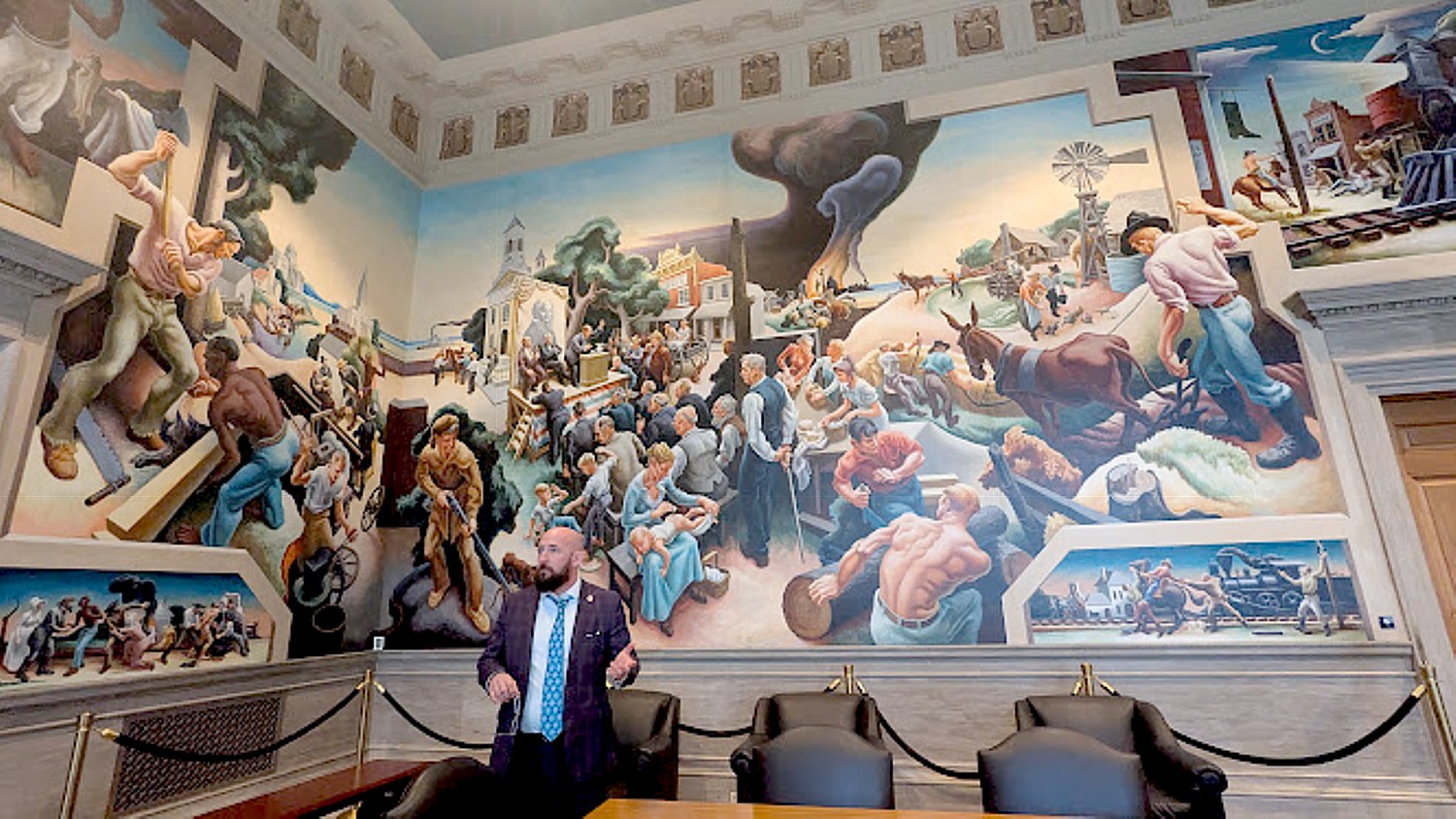
Ryan Clearwater, chief of staff to Missouri’s Speaker of the House, gives our Wilderness Voyageurs bike group a personal tour of Thomas Hart Benton’s famous mural, “A Social History of the State of Missouri” © Karen Rubin/goingplacesfarandnear.com

By Karen Rubin, Travel Features Syndicate, goingplacesfarandnear.com

Day 3 of our six-day Wilderness Voyageurs Katy Trail bike tour 240-miles across Missouri is the most scenic, most interesting, teasiest ride, and the most dramatic for what we see. The day starts with pictographs left by the Indigenous people who populated this place for centuries before Lewis & Clark or Daniel Boone ever laid their eyes on this land, and ends with a mirror held up to Missourians, at the State Capital building, where we see Thomas Hart Benton’s stirring “Social History of Missouri” mural.

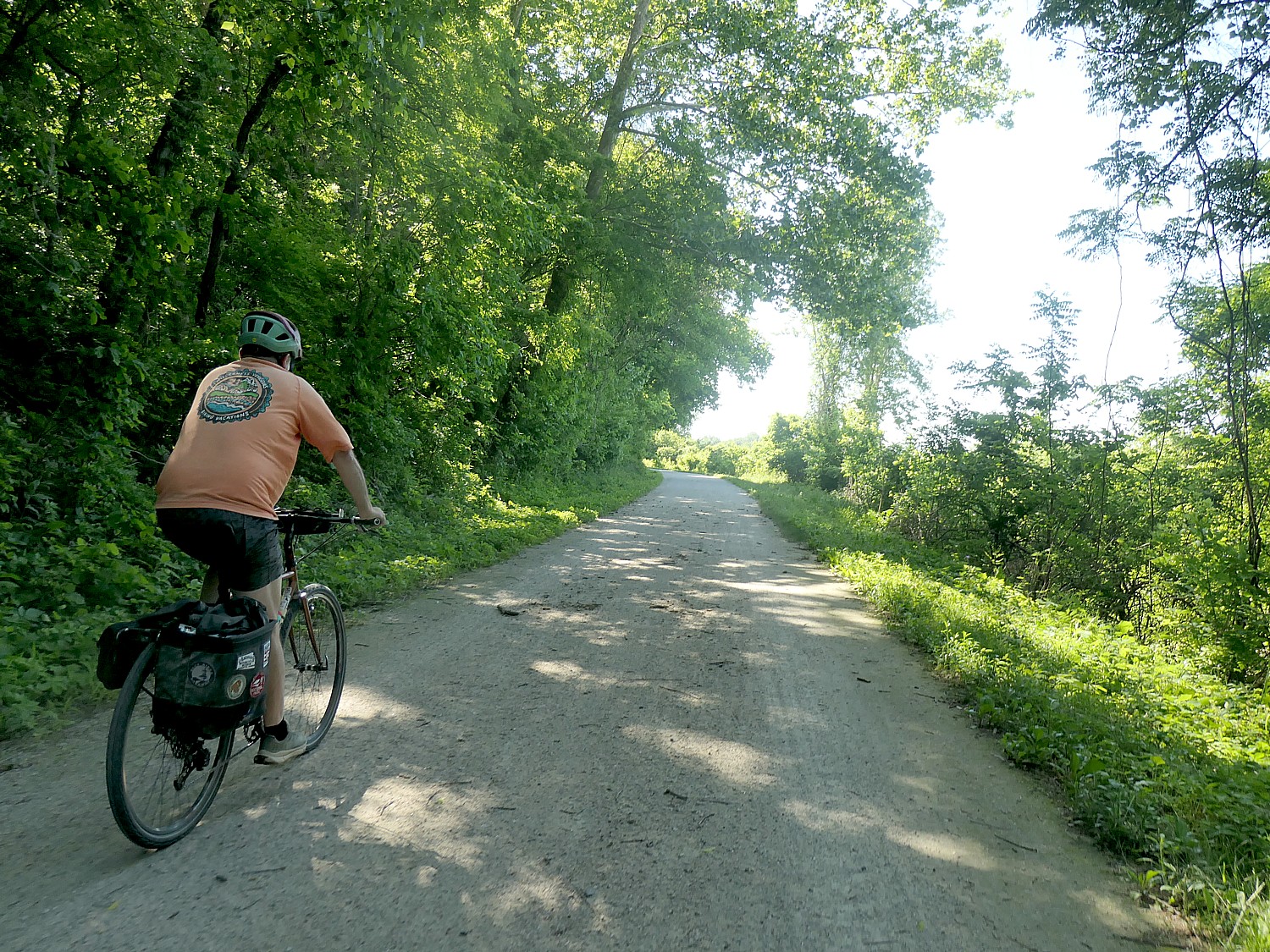
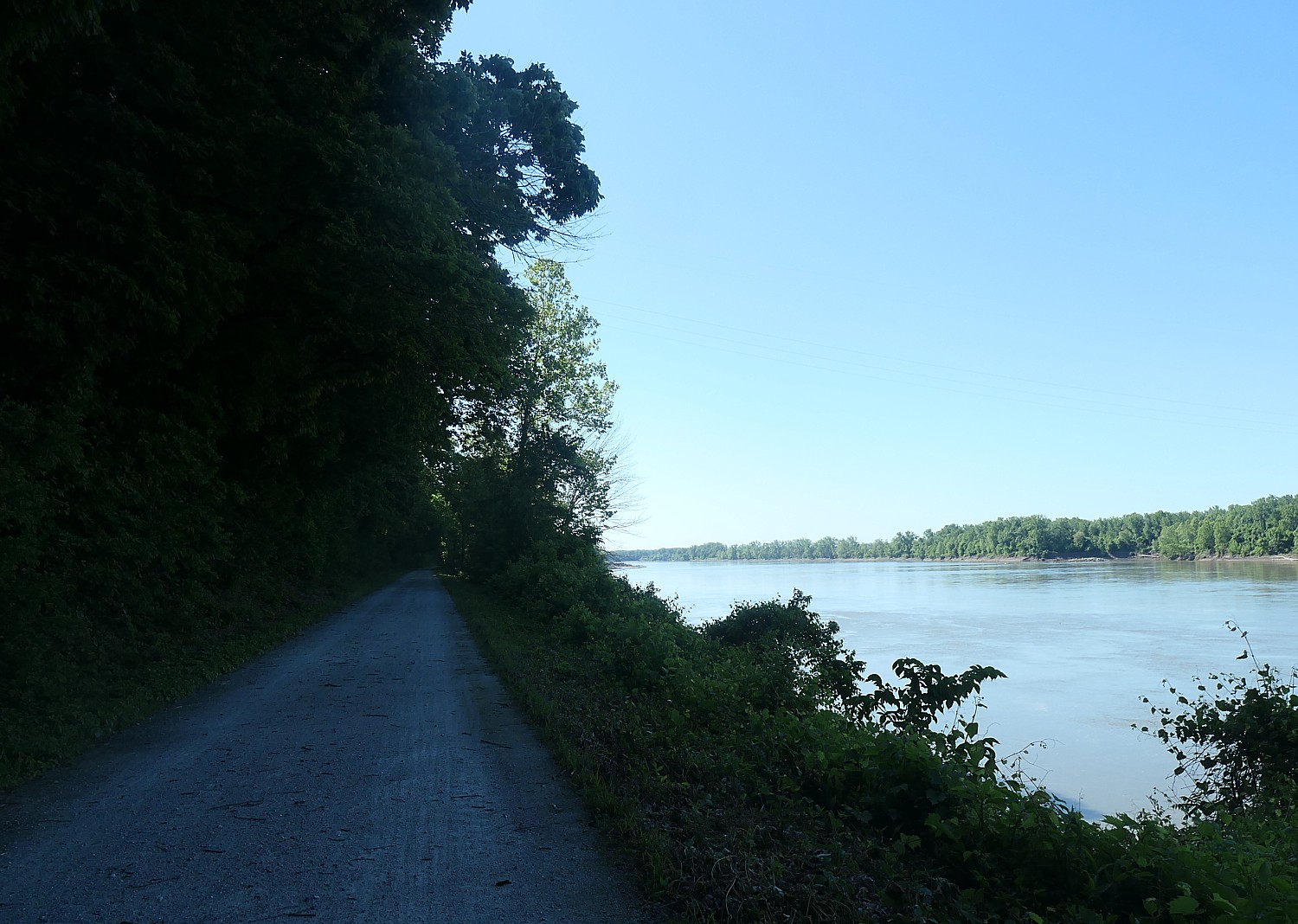
The 38.7 miles we ride from Rocheport to Jefferson City (Missouri’s capital), is almost entirely flat – a mere158 ft rise, 200 ft. decline. It also turns out to be my favorite part of the Katy Trail – much of it with limestone cliffs and forest on one side and views of the Missouri River on the other.

Biking the Katy Trail through Missouri on Day 3, with limestone bluffs and forest on one side and views of the Missouri River on the other © Karen Rubin/goingplacesfarandnear.com

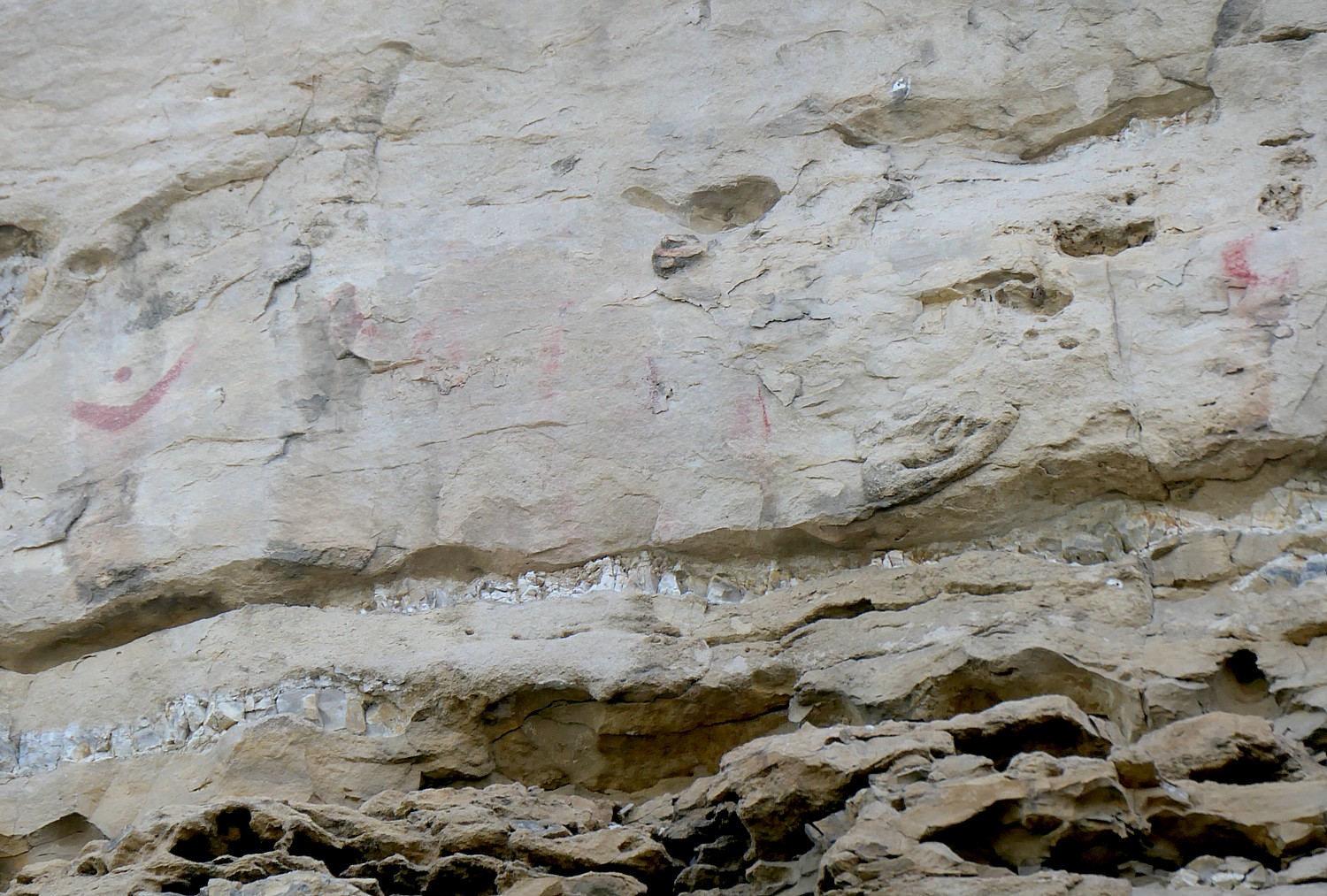
We set out from the base of the 200-foot high limestone Manitou Bluffs that towers above the bike trail. They were once sacred to Native American tribes and we spot remnants of pictographs.

They are easy to miss, but I am intent to find them (look for the marker that gives the description). Still, I might have missed them were it not for our guide, James Oerding, riding along with me (because I am last – again), who has guided for Wilderness Voyageurs for the past 13 years, pointed them out.

Pictographs that date from at least 1819 on limestone cliffs along the Katy Trail, Missouri © Karen Rubin/goingplacesfarandnear.com

What you do see most prominently is the symbol that looks like the Nike swoosh. Then you look to the right and make out others (there is a placard that shows all the figures to look for). They were like billboards of their time (perhaps saying “We are here”?).

The notes say that Lewis and Clark expedition camped below these bluffs just downstream from here on June 6,1804.

President Thomas Jefferson had made it clear the captains should carefully observe Indians and their way of life and though Clark and others in the expedition were conscientious about recording pictographs, there were no mentions of the pictographs we see here. But the Stephen Long Expedition did make note of these Torbett Spring pictographs in 1819. It is suspected that the Sauk and Fox Indians, who lived in the area until around 1814 and likely were the artists, painted the pictographs . after the Lewis and Clark Expedition passed by.

Needless to say, I linger here awhile, reading the notes, taking photos, so am last and James, our guide, hangs with me. (The Wilderness Voyageurs guides tell us at the outset, “This is your vacation. Ride your own ride” – and isn’t normally a problem with the route on our Ride GPS app and because on this trip, for all but the last night’s stay, we are able to bike from inn to inn without needing to gather in the van to shuttle to our lodging.)

Biking the Katy Trail through Missouri on Day 3, with limestone bluffs and forest on one side and views of the Missouri River on the other © Karen Rubin/goingplacesfarandnear.com

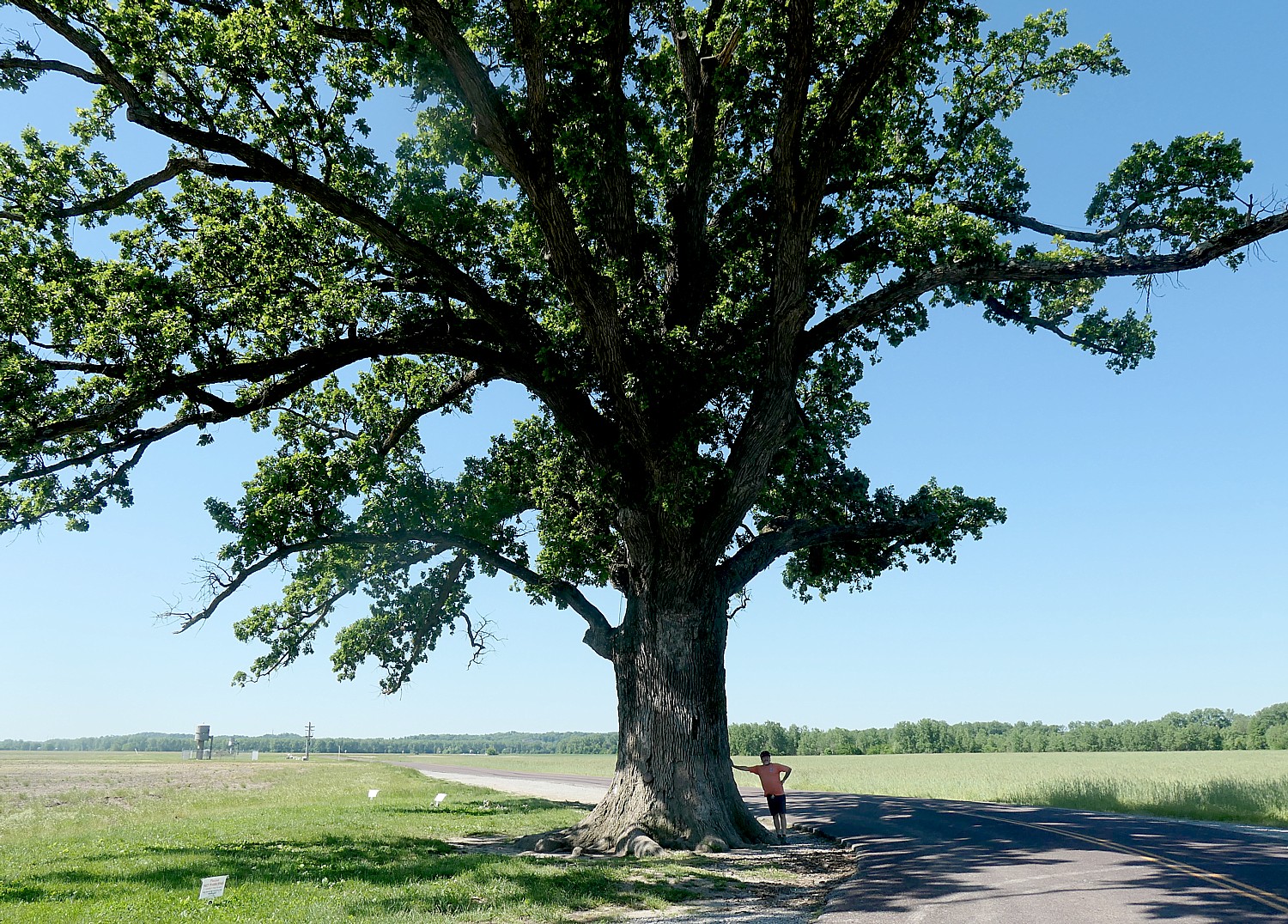
A short distance further, we veer off the Katy Trail for a quarter of a mile to see The Big McBaine Burr Oak Tree,  that sits all by itself with no other tree for 1000 feet. From a distance, it is just a tree. But as we get closer, I begin to appreciate just how gigantic it is, and why it is recorded in journals: The largest burr oak tree in Missouri, it is 287-inches around, 90 feet tall with a 13-foot spread, and takes a half-dozen people to wrap their arms around the trunk. It has stood strong for nearly 400 years, withstanding storms, droughts, floods, vandalism, and development and would have been formidable even to Lewis & Clark, who would have traveled within sight of the tree, a half-mile from the banks of the Missouri 200 years ago.

The Big McBaine Burr Oak Tree, largest in Missouri, is 350-400 years old © Karen Rubin/goingplacesfarandnear.com

At McBlaine, we take a peek at another oddity: “Boathenge” is comprised of 1950s ski boats that were swept here after a flood in 1993.

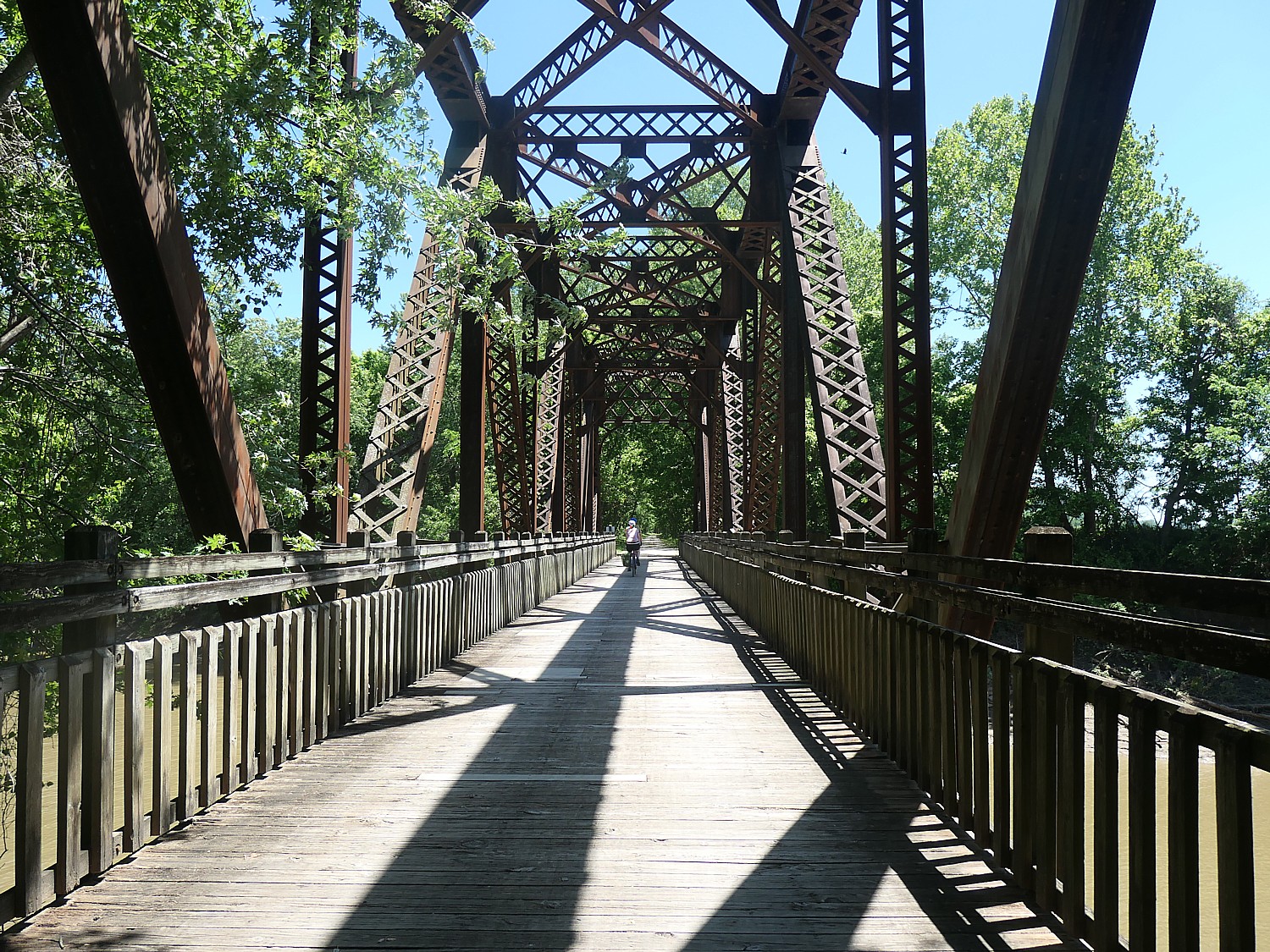
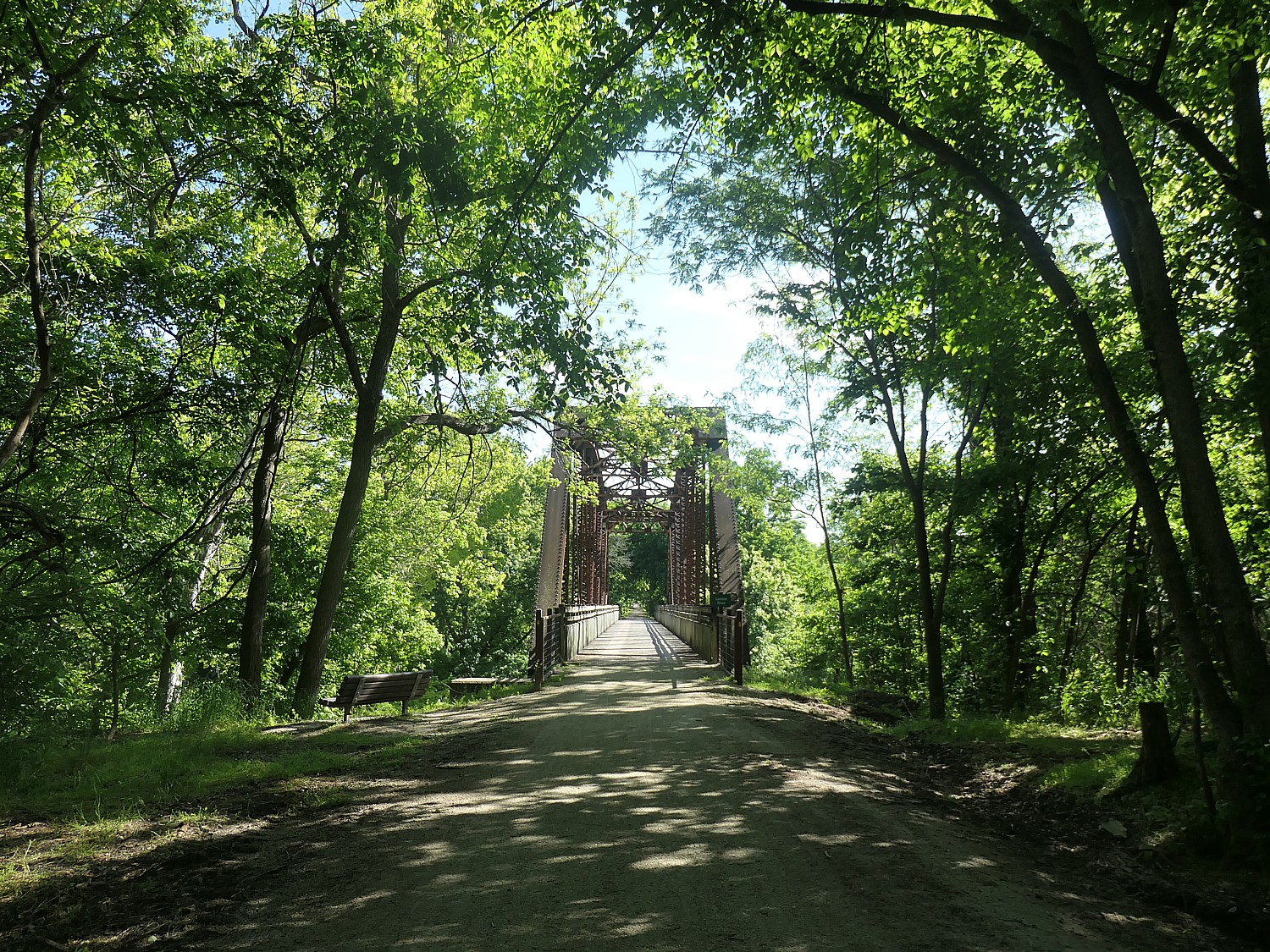
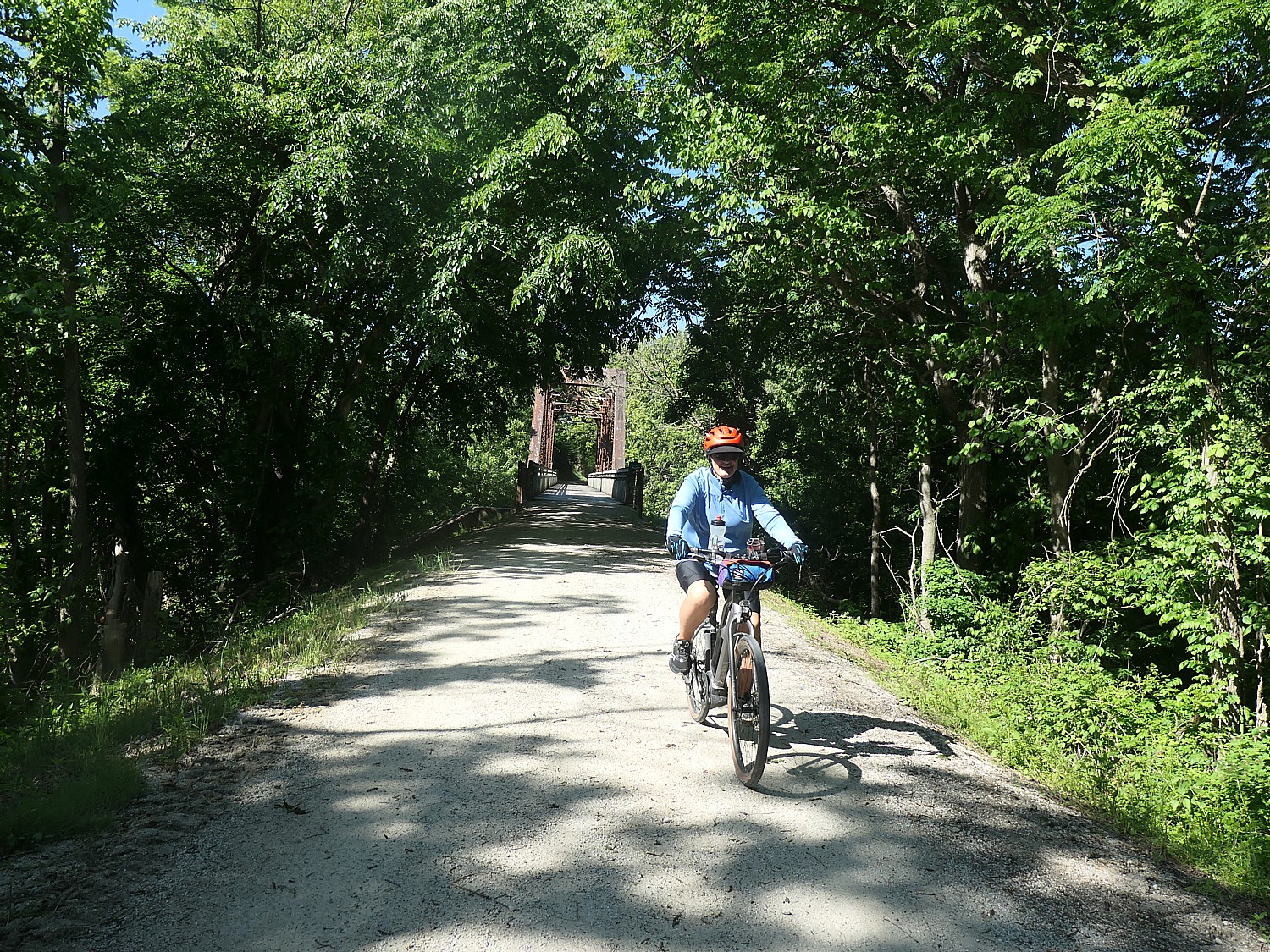
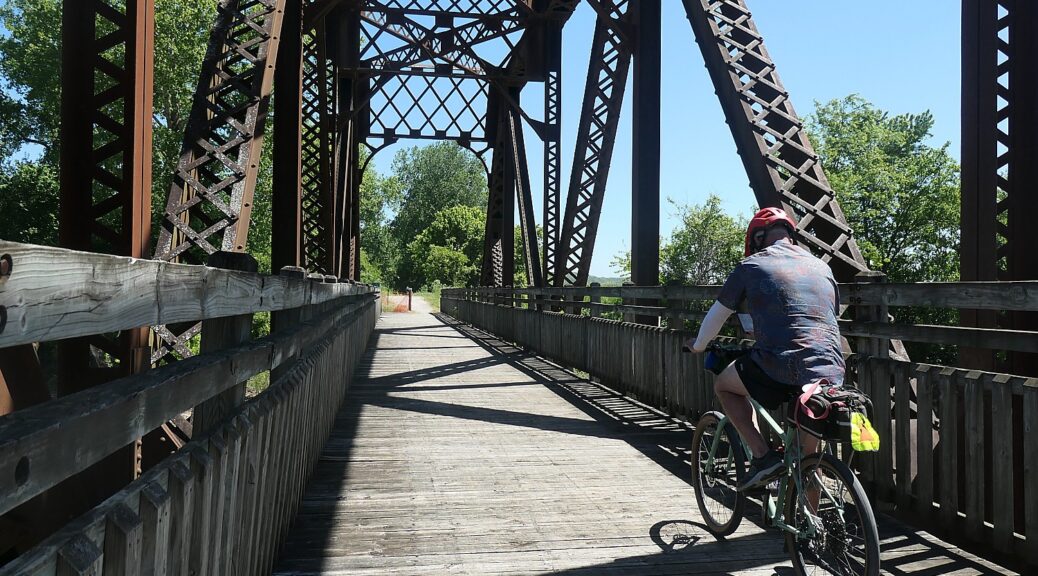
Biking over railroad trestles is one of the delights of cycling Missouri’s Katy Trail, a Rails to Trails Conservancy Hall of Famer © Karen Rubin/goingplacesfarandnear.com

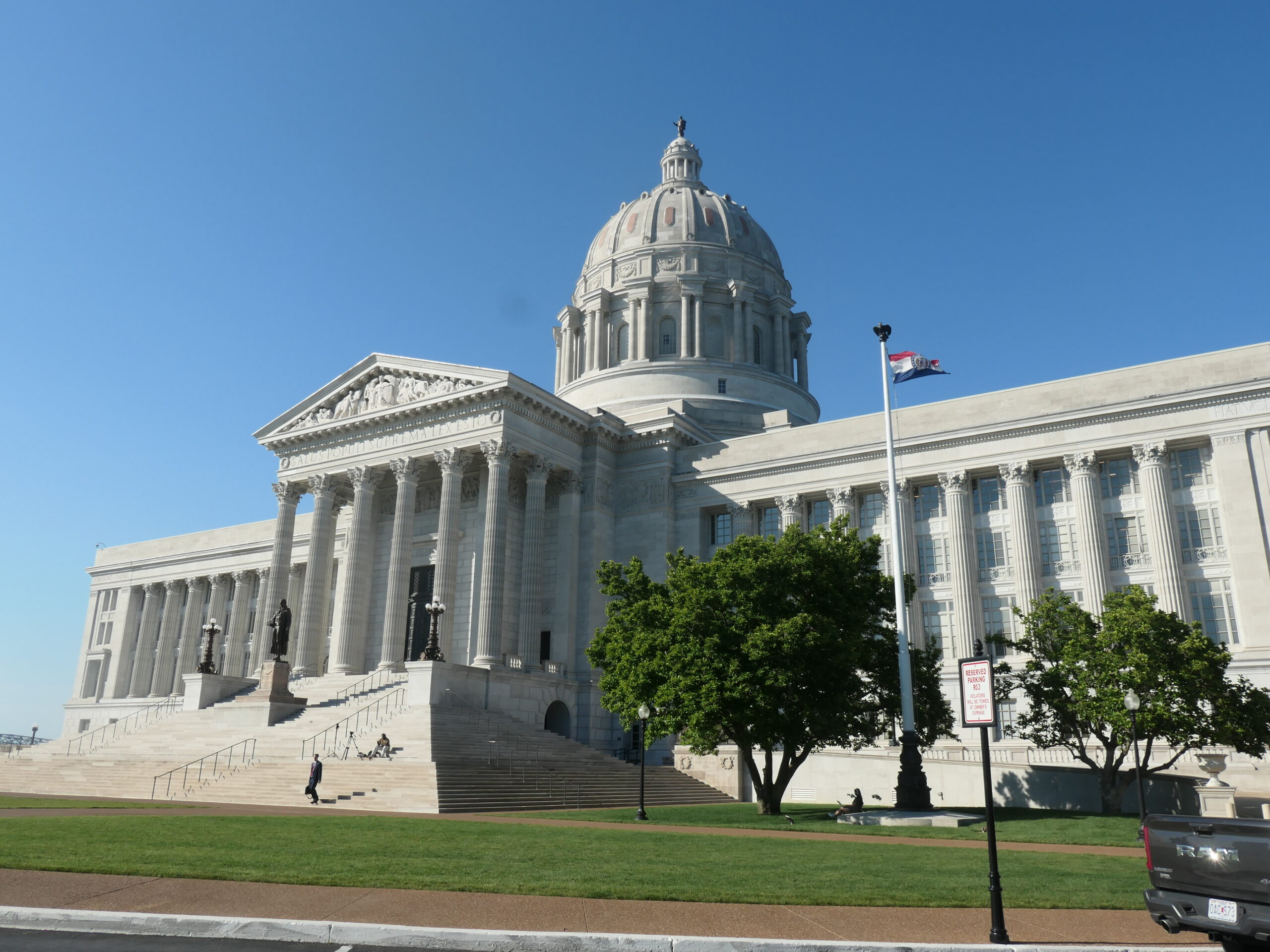
Coming into Jefferson City, we leave the Katy Trail onto a spur and bike up an extraordinary spiraling ramp onto the bridge over the Missouri River (and will return down the ramp the next morning to get back onto the Katy Trail).  Riding over the bridge affords dramatic views of Missouri’s majestic State Capitol.

Jefferson City, population 42,838, is the most urban part of our ride – and having just come from such rural areas on the protected carless rail trail, it is a bit of culture shock to be riding on city streets.

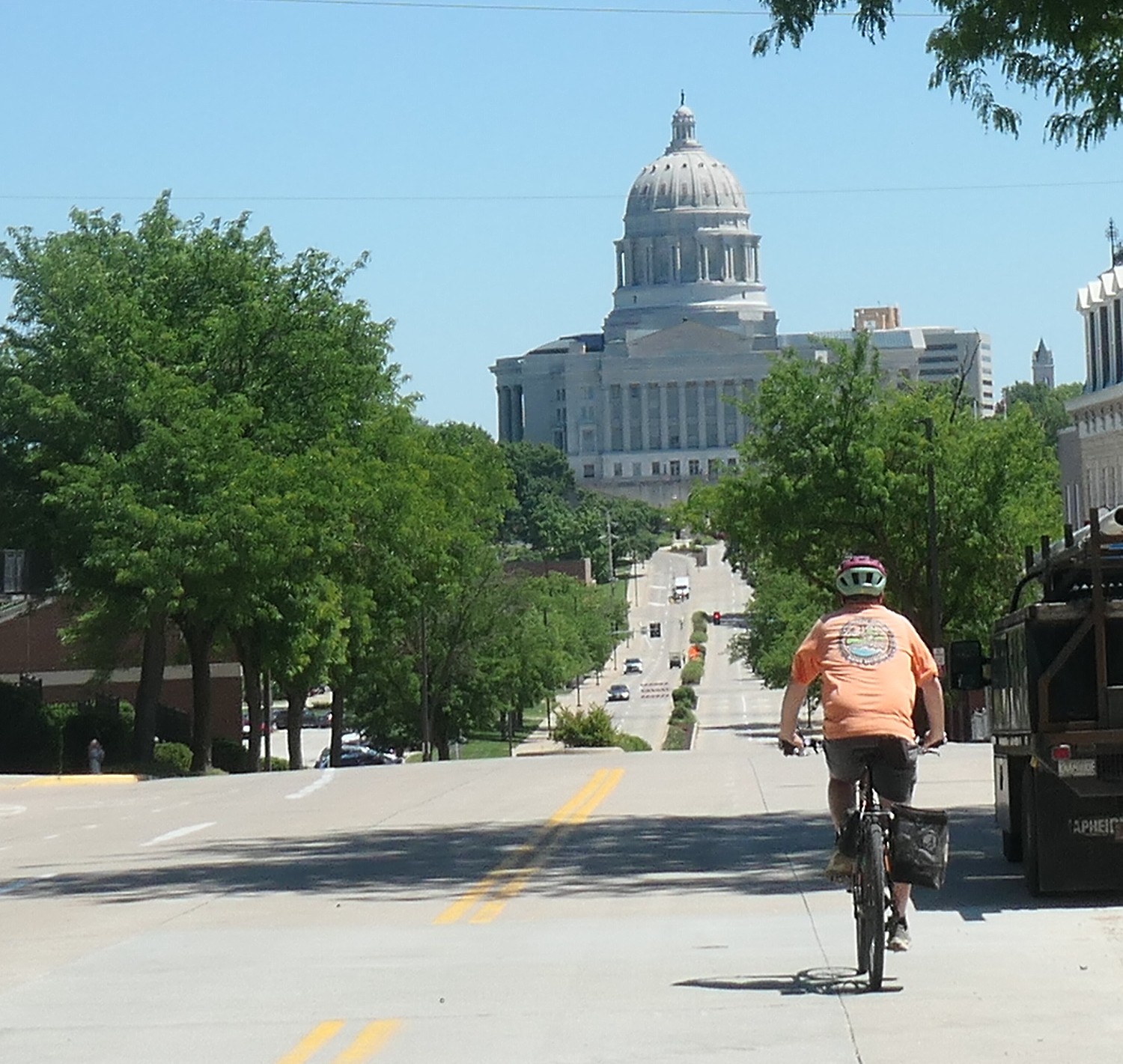
Biking into Jefferson City, after riding the Katy Trail through rural Missouri is a bit of culture shock © Karen Rubin/goingplacesfarandnear.com

The only tricky part is getting to our hotel (the only “modern” hotel of our stay, Courtyard by Marriott), especially because of construction underway. We come down a steep sloping street, once again providing a dramatic view of the State Capital building set at the end.

Missouri’s majestic capital building in Jefferson City is a “must-see” © Karen Rubin/goingplacesfarandnear.com

Once we are settled into the Marriott Courtyard Hotel (the only chain hotel of our trip), James offers to drive us to the State Capital Building, encouraging us to seek out the Thomas Hart Benton Murals that wrap around the walls of the House Members’ Lounge.

Ryan Clearwater, chief of staff to Missouri’s Speaker of the House, gives our Wilderness Voyageurs bike group a personal tour of Thomas Hart Benton’s famous mural, “A Social History of the State of Missouri” © Karen Rubin/goingplacesfarandnear.com

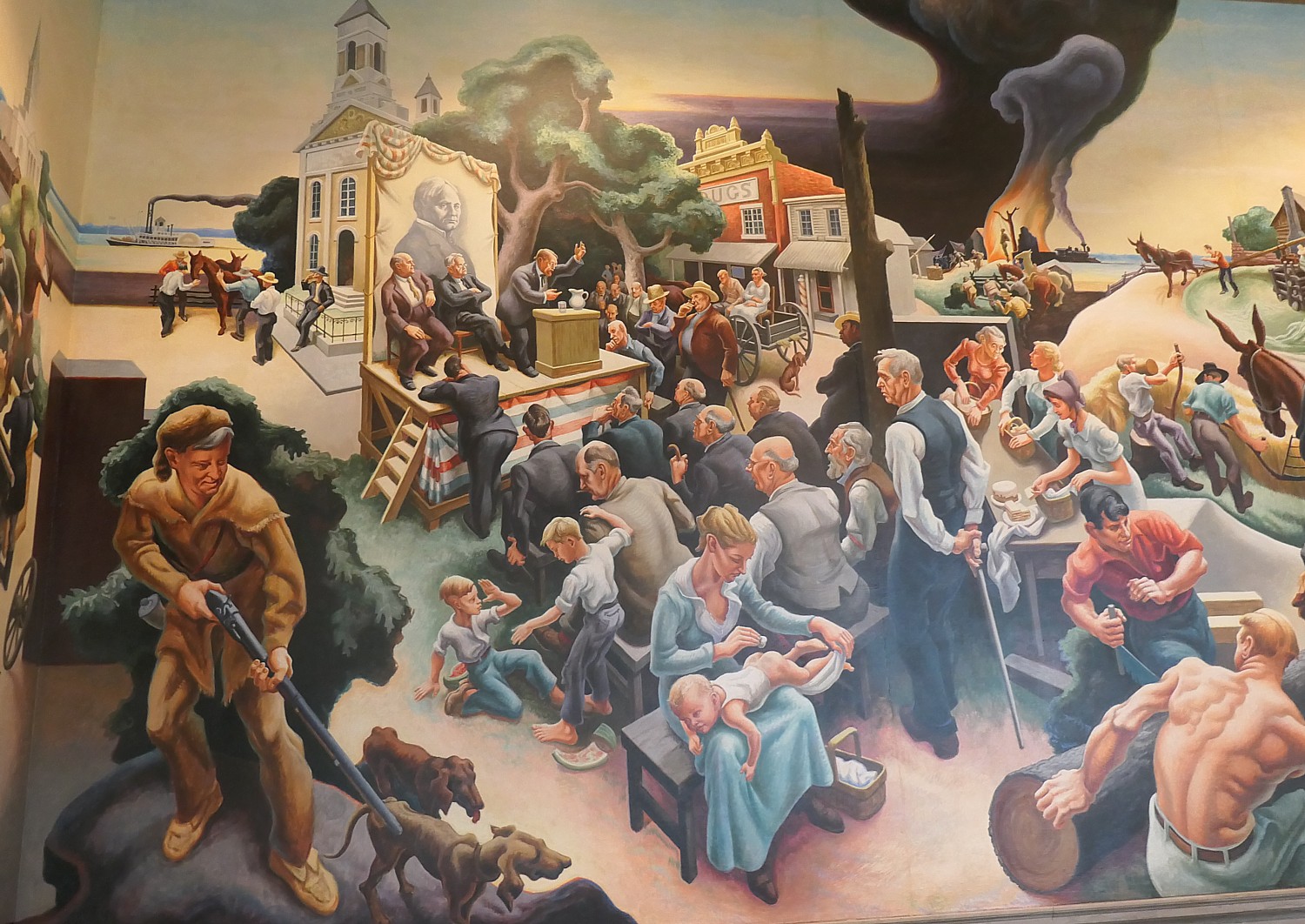
“A Social History of the State of Missouri,” Thomas Hart Benton’s famous mural, is more of an indictment than a glorification of Missouri’s history. It was 1934, in the midst of the Great Recession, when Benton got the $16,000 commission – “a prince’s ransom” at the time, equivalent to $300,000 today and more money than the governor earned – and a period of heightened racial tension in Missouri. Completed in December 1936, the state legislators immediately regretted having commissioned it and even considered painting over the murals, but feared humiliating defeats if they admitted their “misjudgment.”

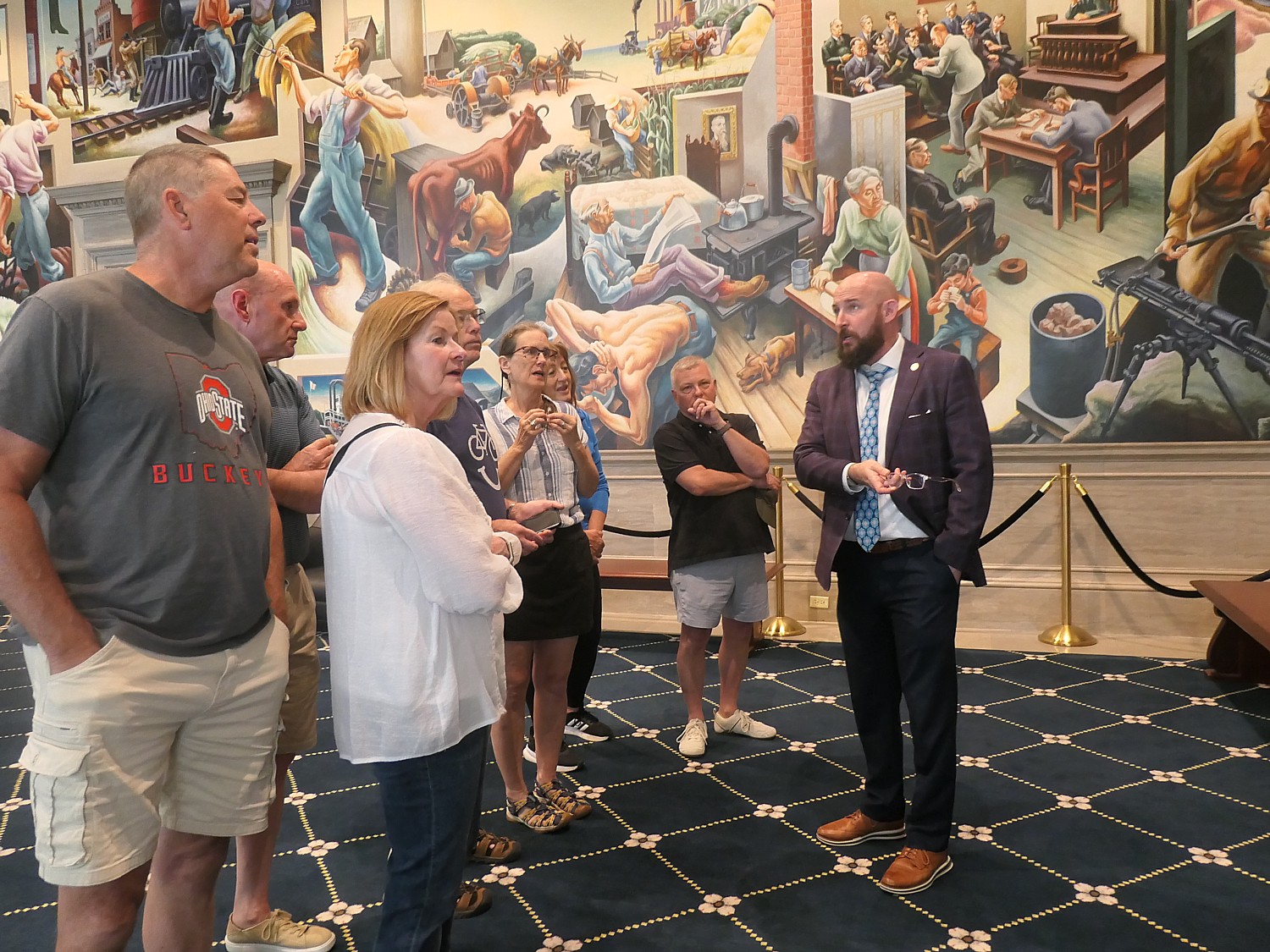
Ryan Clearwater, chief of staff to Missouri’s Speaker of the House, gives our Wilderness Voyageurs bike group a personal tour of Thomas Hart Benton’s famous mural, “A Social History of the State of Missouri” © Karen Rubin/goingplacesfarandnear.com

The story of this extraordinary mural is being related to us by the Chief of Staff to the Speaker of the House, Ryan Clearwater, who we chanced to ask if we could visit when we find House Members Lounge locked. He takes us in (through the Speaker’s office, no less), and proceeds to spend an hour with us.  

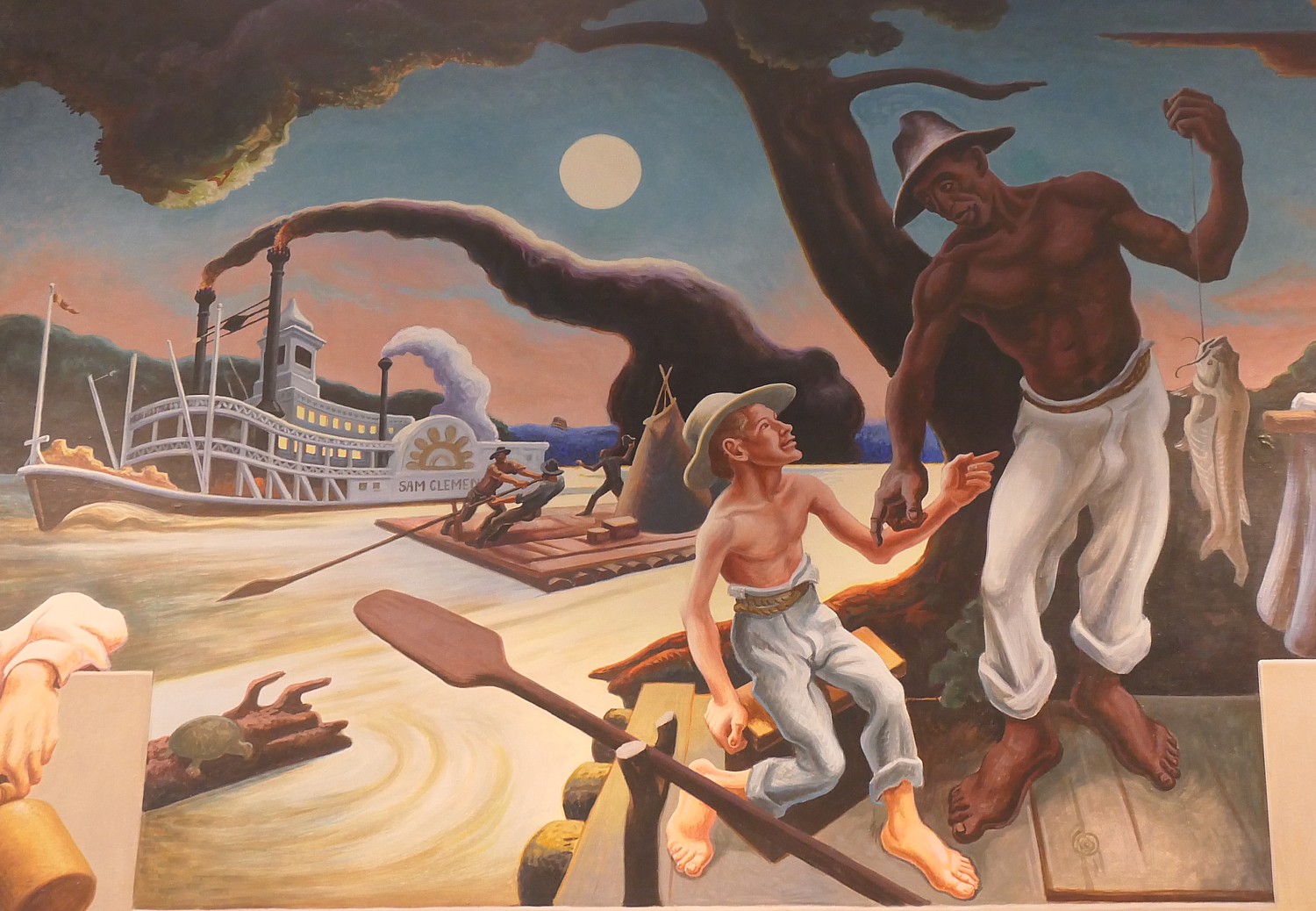
Huck Finn with the runaway slave Jim, with the Samuel Clemons riverboat, was just one of the controversial scenes in Thomas Hart Benton’s “A Social History of the State of Missouri” mural  © Karen Rubin/goingplacesfarandnear.com

Instead of noble figures, Benton shows ordinary men and women who built Missouri, using real Missourians including his own family, as models for the 200 figures. He also shows its villains.

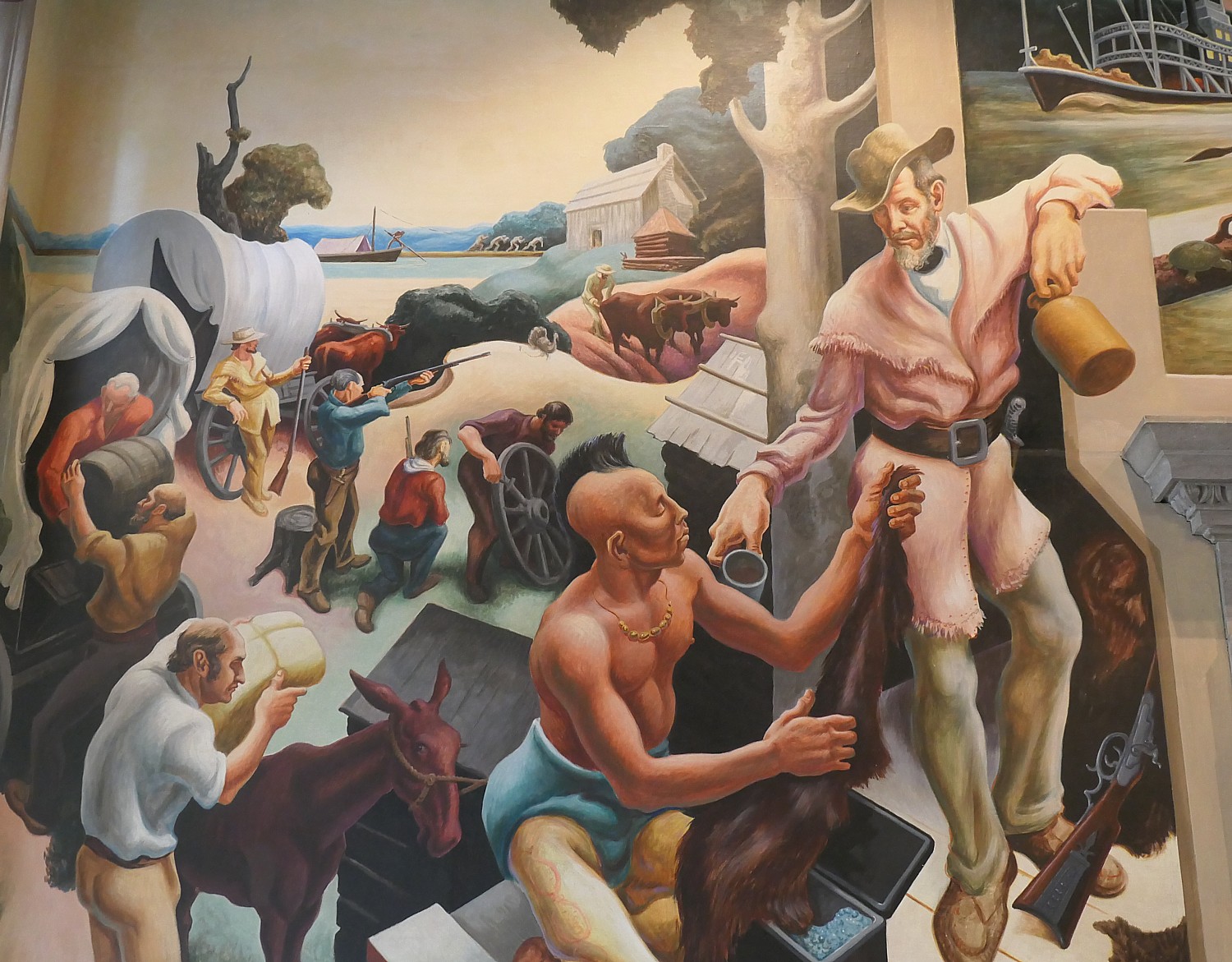
A white trader gives an Osage Indian whiskey in Thomas Hart Benton’s “A Social History of the State of Missouri” mural. Benton traveled to Oklahoma to find an Osage Indian for his model © Karen Rubin/goingplacesfarandnear.com

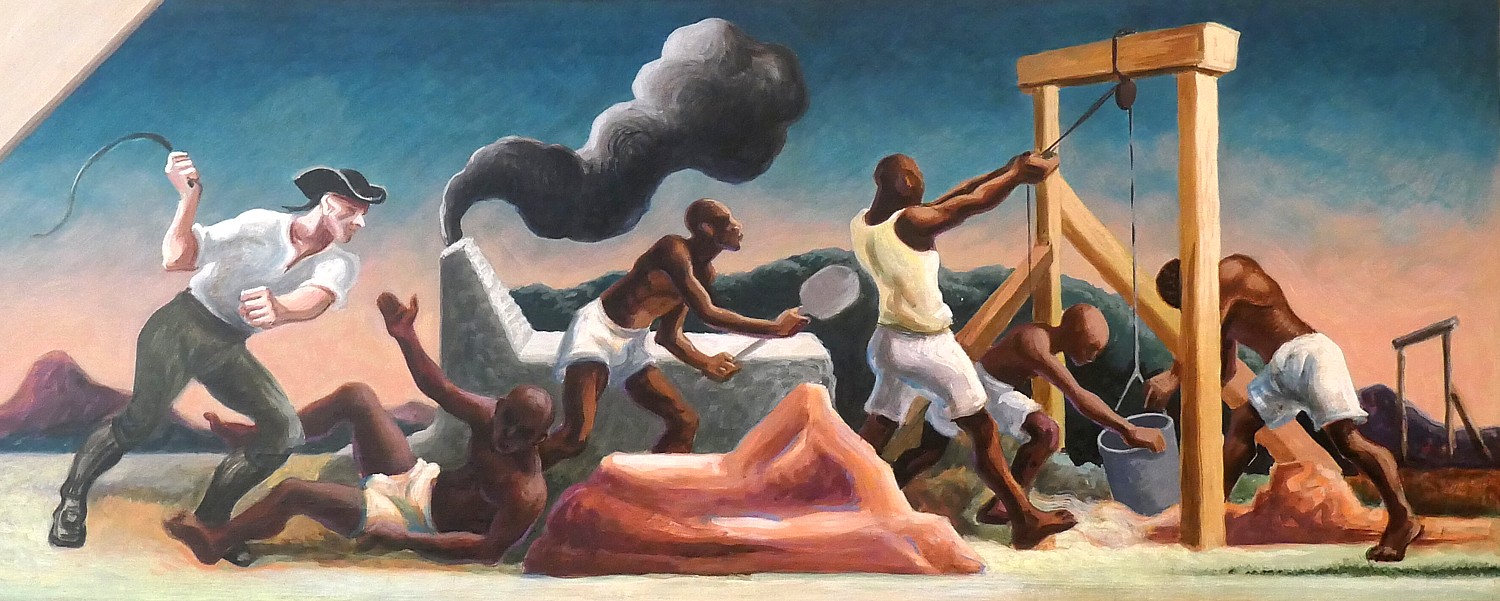
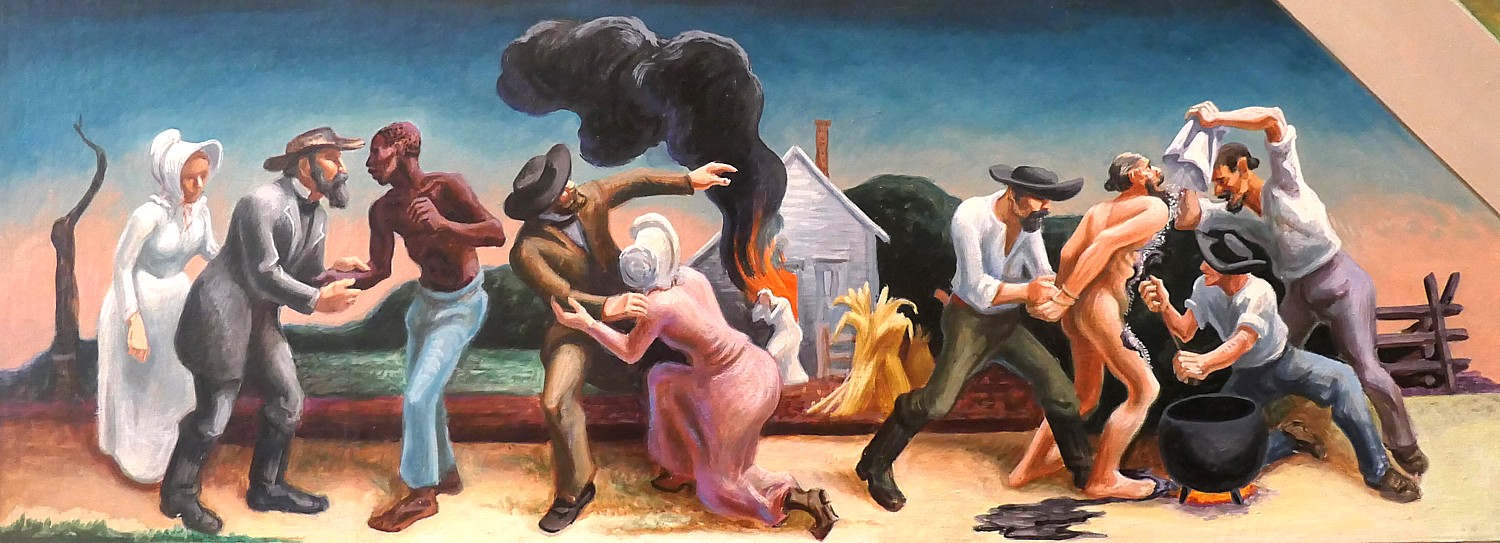
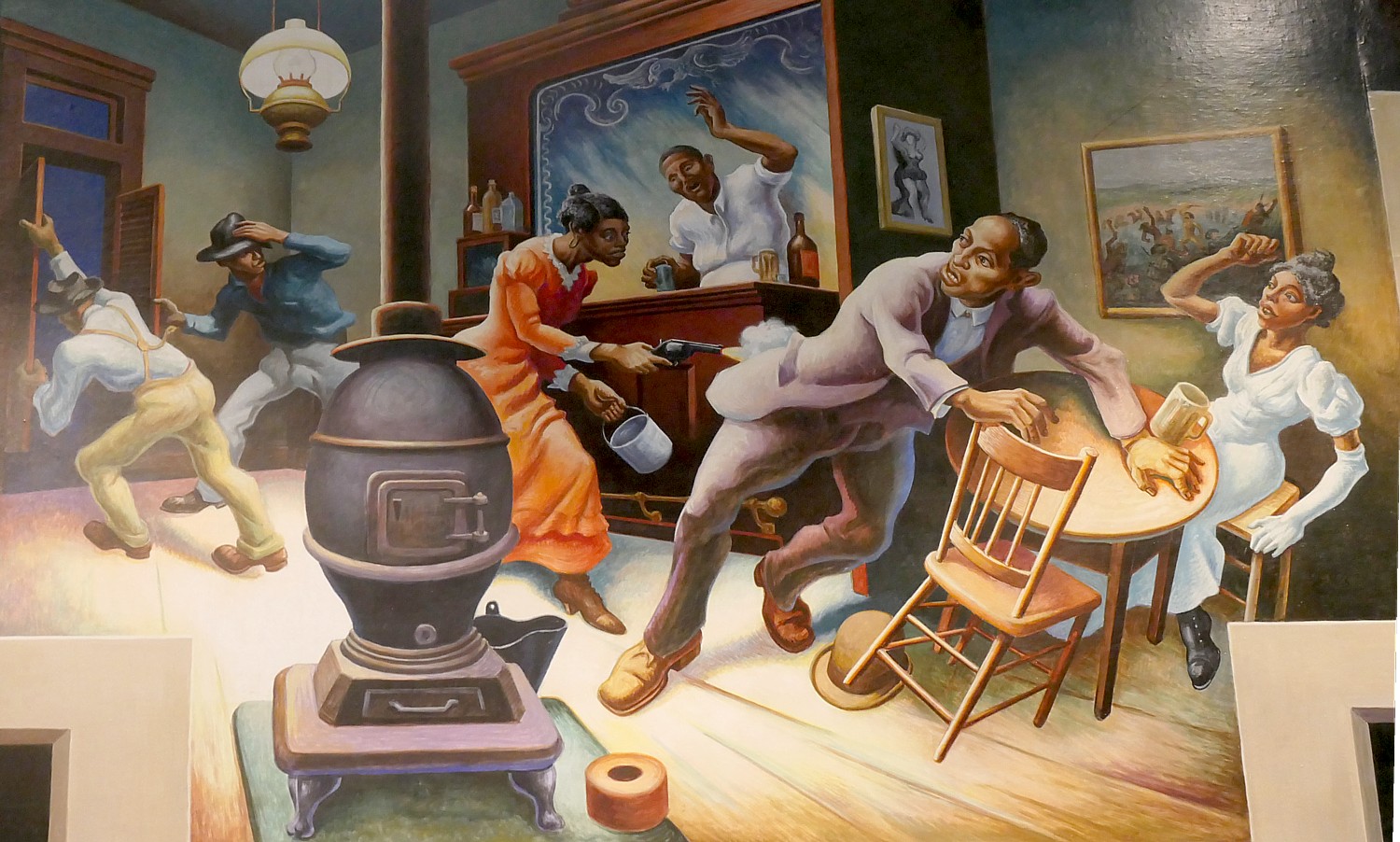
Instead of noble deeds and historic events, it depicts slaves being whipped and auctioned; a trader giving whiskey to an Osage Indian (he went to Oklahoma to find an Osage Indian to model); a Mormon being tarred and feathered (Missouri expelled Mormons and as recently as 1980s, Clearwater tells us, the state had a statute that it was permissible to kill Mormons); a settler being lynched by Civil War guerrillas while his family is turned out of their burning home; Huck Finn and runaway slave Jim on a raft escaping down the Mississippi River, the Samuel Clemons riverboat off to the side; Jesse James and his gang robbing a bank and a train; and Frankie entering the bar to murder Johnny, who did her wrong.

Instead of glorious deeds, Thomas Hart Benton depicted its ignobility in his “A Social History of the State of Missouri” mural.© Karen Rubin/goingplacesfarandnear.com
Instead of glorious deeds, Thomas Hart Benton depicted its ignobility in his “A Social History of the State of Missouri” mural © Karen Rubin/goingplacesfarandnear.com
Frankie murders Johnny in a scene in Thomas Hart Benton’s “A Social History of the State of Missouri” mural © Karen Rubin/goingplacesfarandnear.com

It depicts Missouri’s transition from frontier to factories, the Civil War to the Great War, people struggling and making due during the Great Depression (a comb with missing teeth as one of the symbols). One section portrays a political rally attended by all but one white man, while a woman on a bench, her back turned away from the rally, changes her baby’s bare bottom (scandalous! Benton’s nephew was the model),

A political rally of all but one white man in Thomas Hart Benton’s “A Social History of the State of Missouri” mural © Karen Rubin/goingplacesfarandnear.com

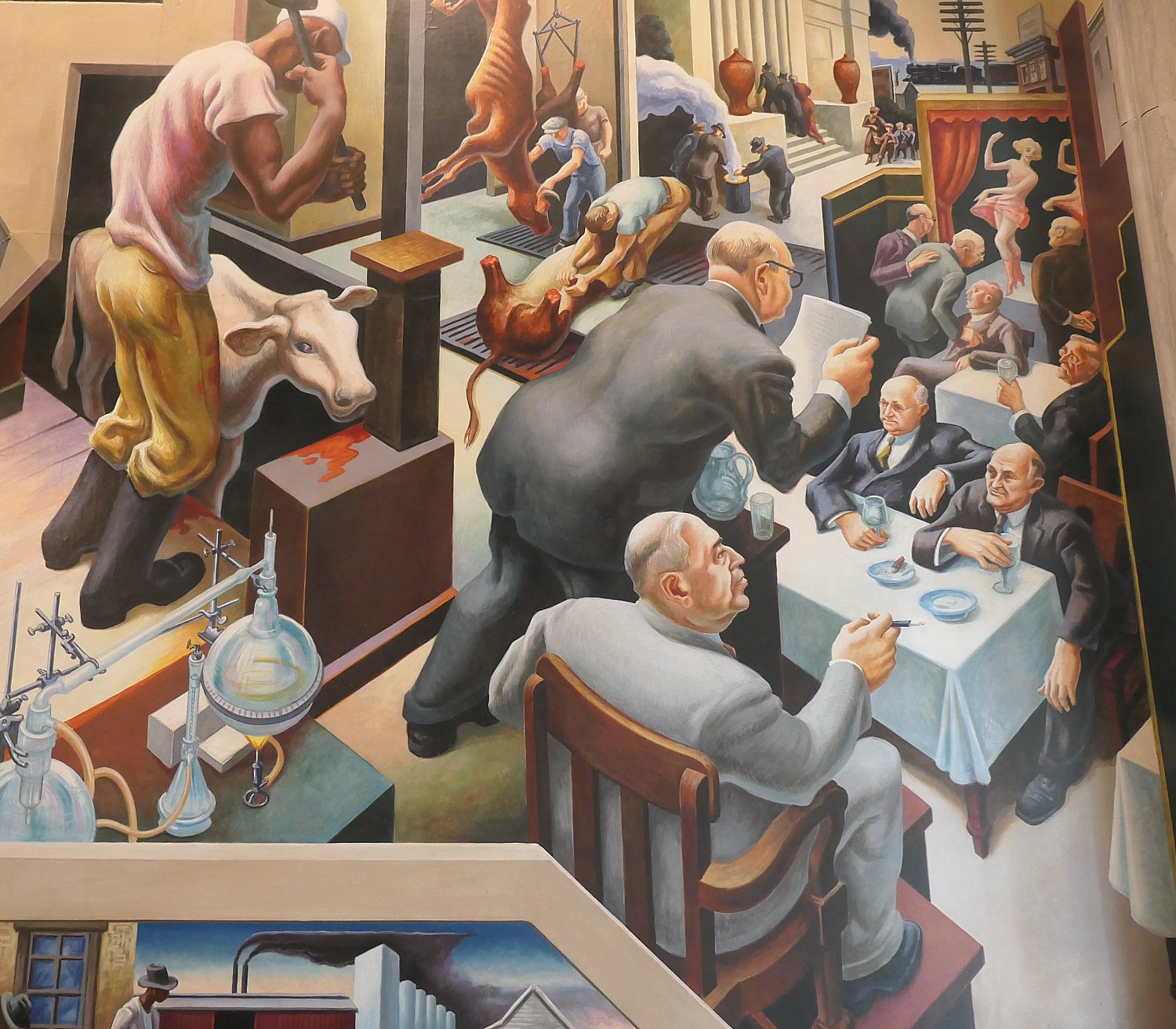
The last scene, In the bottom corner, plainly depicts Tom Pendergast, at the time the boss of Missouri politics, who was so powerful, he is said to have elected his candidate governor in just 30 days and get Truman into the US Senate (a figure very much like Truman is seated in front). Then 2 years after the mural was done, Pendergast went to federal prison for corruption. Benton came back and made a couple of changes – he had to touch up where someone drew Pendergast’s prison number on his suit, and to put clothes on the burlesque dancers in the background.

Corrupt political boss Tom Pendergast, instrumental in Harry Truman’s political career, is clearly portrayed by Thomas Hart Benton in his “A Social History of the State of Missouri” mural   © Karen Rubin/goingplacesfarandnear.com

“Benton put Pendergast in the mural to let every representative and senator and the public know how some got into office,” Clearwater remarks. 

The scene with the political rally depicts a black man, the only black man wearing a suit, leaning against a pole. This figure is Jordan Chambers, who was the Black political boss (“Tom Pendergast”) of St. Louis. Some claim that Jordan Chambers wanted to be in mural, he tells us, despite the association with Pendergast’s corruption.

The mural is shocking to see, even today, and you wonder how Benton was able to get away with it.

“The mural got mixed reviews – slavery, tar and feathering, lynching, murder, robbery,” Clearwater notes with an air of understatement. “They had wanted history. When it was unveiled, they talked about painting it over. But they had spent $16,000 and felt they wouldn’t get reelected, so they said, ‘We should learn from past.’” (I wonder if they also calculated that since the murals were locked away in the House Members’ Lounge, few would actually see it.)

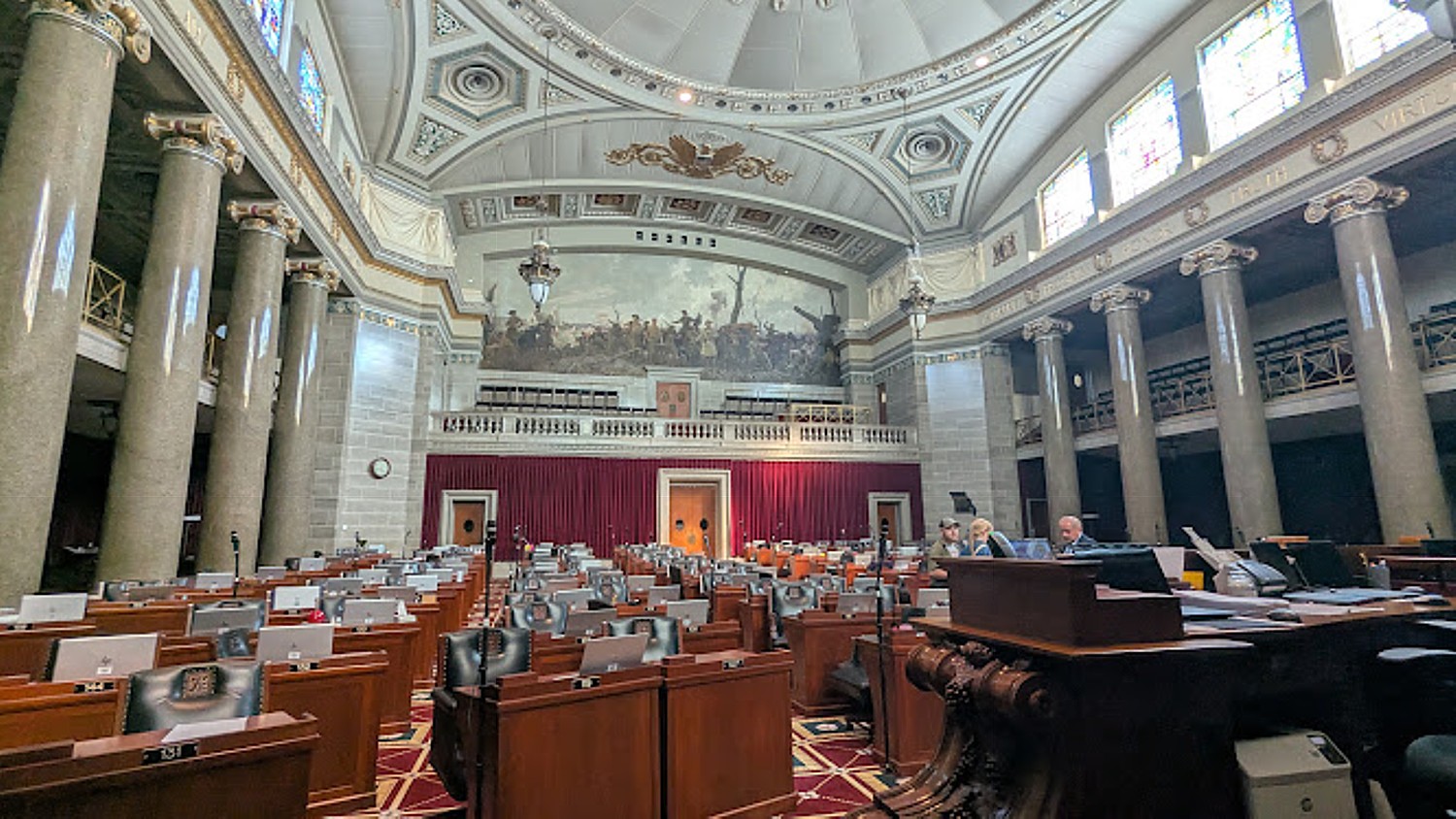
Missouri’s House of Representatives chamber © Karen Rubin/goingplacesfarandnear.com

It’s 5 pm, when the building normally closes, but Clearwater takes us into the House chambers (he says that because the Senate is still in session trying to complete its business before the term ends, the building isn’t officially closed). It is a stunning, majestic room, with painted glass windows and a stunning mural (the gift of France). Clearwater says they had a $1 million budget for artwork when the building was built (the first two capital buildings burned down; this one is of “Carthage marble” – polished limestone). Missouri has the 4th largest House of Representatives per capita (163 House members and 34 Senate); a part-time position, they meet five months of the year.

I note portraits of Lincoln (“the first Republican,” Clearwater says) and Jefferson (“the first Democrat,” Clearwater says, but Jefferson was actually a Democratic Republican who advocated for states rights, agrarian interests and strict construction of Constitution, so also Republican; Franklin D. Roosevelt is probably the first modern Democrat).

The partisan animosity is practically built into the room. The center aisle is the width of “two swords”; the 7,000-page rule book includes such provisions as the member has to ask permission to speak, no member shall rattle their spittoon while another is talking, no one can intercede the line of debate.

Festooned around the room are the values these legislators are supposed to espouse for the state: Enterprise, Progress, Honor. Truth. Virtue. Temperance. Knowledge. Liberty. Equality. Justice. Fraternity. Education.

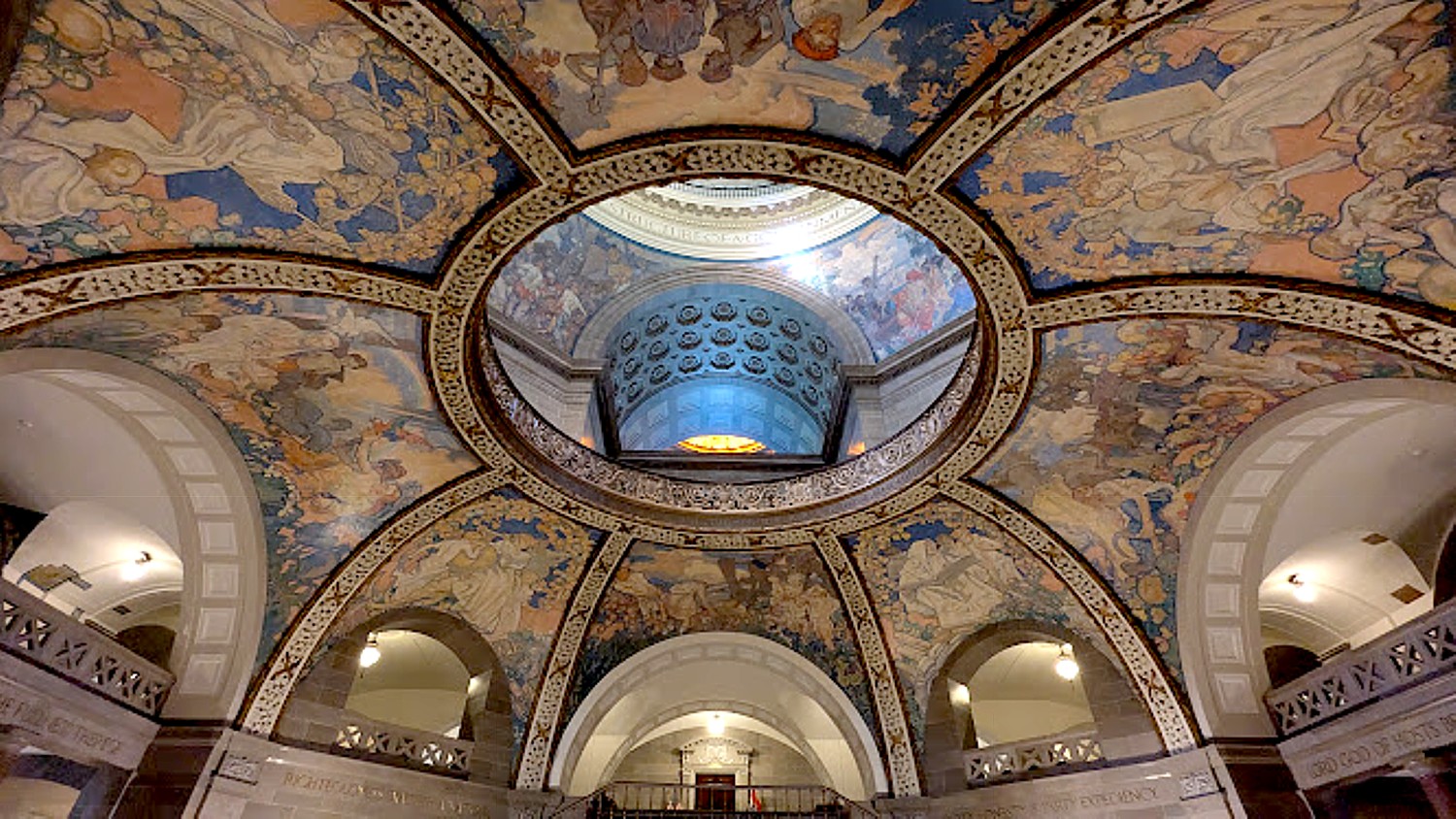
The spectacular dome of Missouri’s capital building © Karen Rubin/goingplacesfarandnear.com

By now, Clearwater, the chief of staff to the Speaker of the House has spent about an hour with us, even though only two of us are actually Missouri constituents. He jokes, “I would rather spend time with the public than lobbyist or legislator,” (though upon leaving, I spot a few of them on the way in, and all around the Capitol building, are offices of various unions and industry and trade associations).

It’s after 5 pm, too late to visit the State Museum contained within the building, but we get a few minutes to admire the stunning lobby and dome, surrounded by engravings extolling the state’s (aspirational?) credos:

The Earth is the Lord’s and the fullness thereof

Righteousness exalteth a nation

Property is the fruit of labor

Where there is no vision, the people perish

Ideas control the world

Lord God of Hosts be with us yet, lest we forget

Party honesty is party expediency.

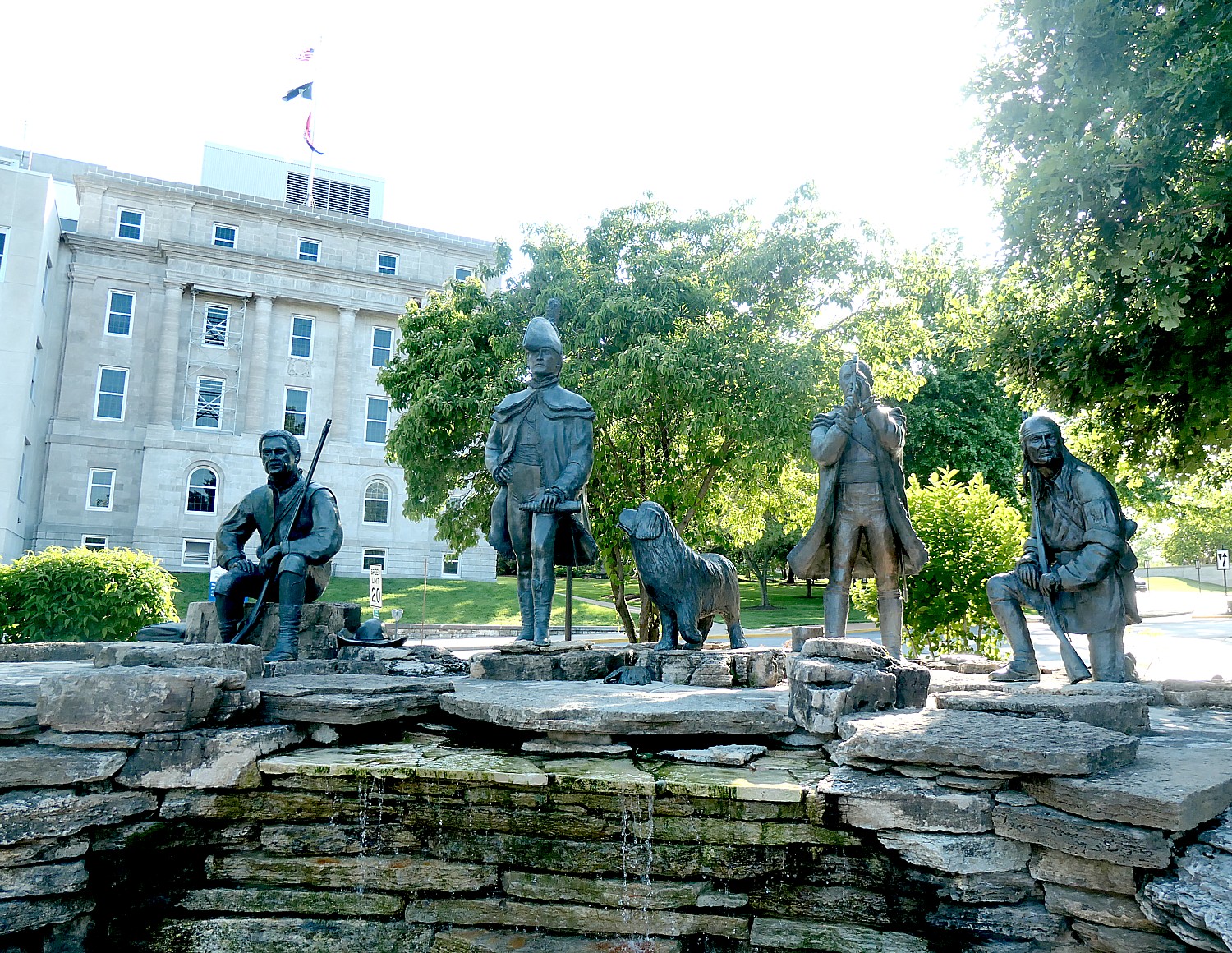
The statue of The Corps of Discovery that passed Jefferson City June 4, 1804 © Karen Rubin/goingplacesfarandnear.com
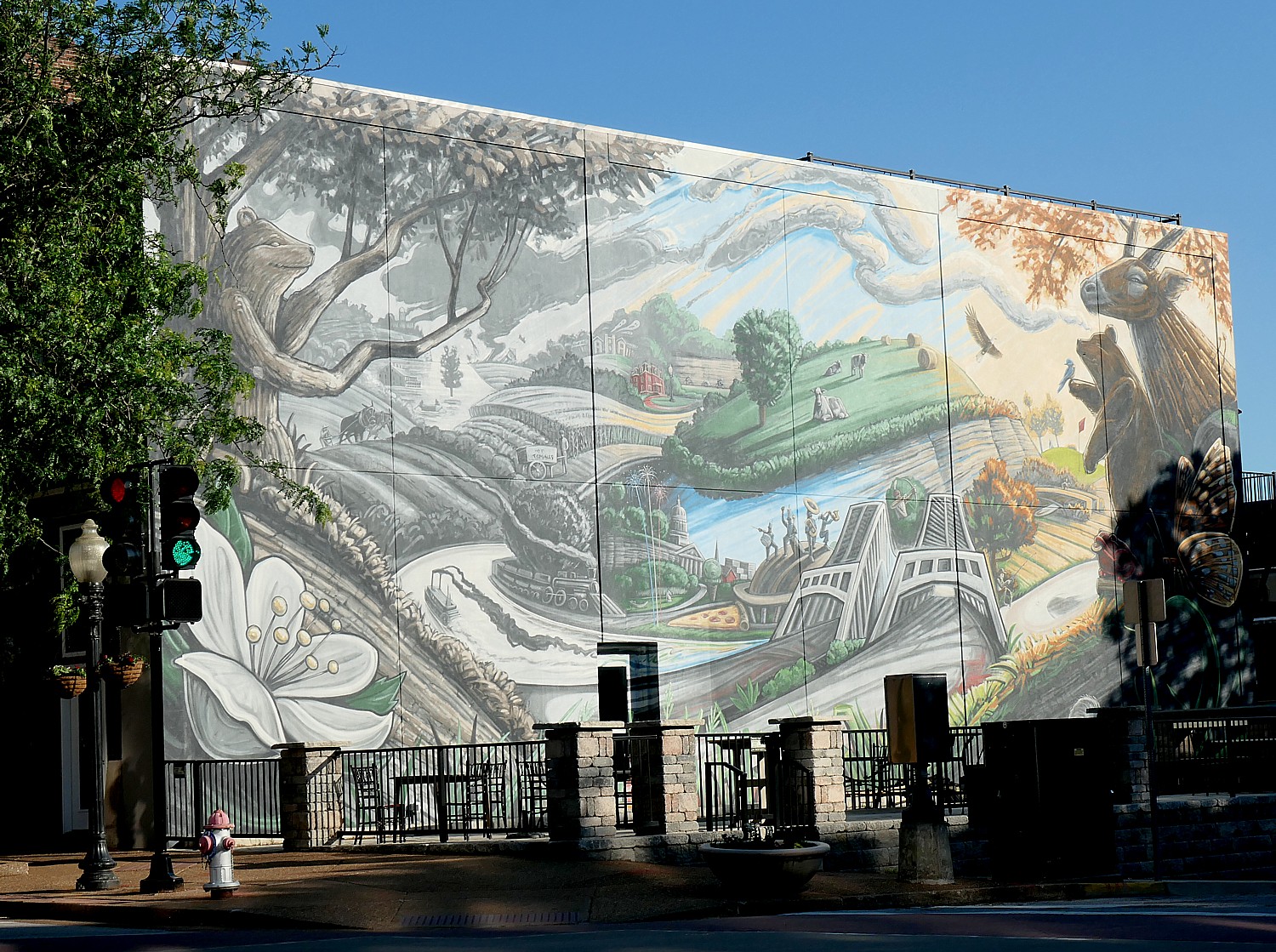
Another mural depicting Missouri’s heritage, just outside the State Capital Building © Karen Rubin/goingplacesfarandnear.com

We go off to explore Jefferson City and have dinner (one of two evenings where we are on our own for dinner).

Just outside the capital building is a statue of The Corps of Discovery that passed Jefferson City June 4, 1804.

I walk back to the Courtyard Marriott, getting back early enough to enjoy the hotel pool.

Wilderness Voyageurs, Ohiopyle, PA, 15470, 800-272-4141, wilderness-voyageurs.com.

See also: Biking through History on Missouri’s Katy Trail During America’s 250th

See next: Biking Missouri’s Katy Trail Following Lewis & Clark, Daniel Boone & the Westward Expansion

__________________

© 2026 Travel Features Syndicate, a division of Workstyles, Inc. All rights reserved. Visit goingplacesfarandnear.comlongislandpress.com/category/vacation-travel.com and travelwritersmagazine.com/TravelFeaturesSyndicate/. Blogging at goingplacesnearandfar.wordpress.com and moralcompasstravel.info. Visit instagram.com/going_places_far_and_near. X: @TravelFeatures Threads: @news_and_photo_features ‘Like’ us atfacebook.com/NewsPhotoFeaturesSend comments/questions to FamTravLtr@aol.com.

Biking through History on Missouri’s Katy Trail During America’s 250th

Biking the Rails to Trails Conservancy’s Hall of Famer, Katy Trail, a 240-mile-long linear state park, across Missouri is a delight for cyclists © Karen Rubin/goingplacesfarandnear.com

By Karen Rubin, Travel Features Syndicate, goingplacesfarandnear.com

Biking 240 miles across Missouri on the Rails to Trails Conservancy’s Hall of Fame Katy Trail is more about “being” than “seeing”. That is, the ride itself is glorious free-wheeling cycling, and when you finish being on the day’s ride in one of the charming, historic towns you get to “see”. You experience the towns and ports that grew up with the Missouri-Kansas-Texas Railroad (known as the K-T) and the Missouri River boats, that declined with the drop in rail and river traffic. These places that bring us so much delight today might well be ghost towns except for new life breathed into them by the thousands of cyclists who come through on the Katy Trail, like Rocheport, population 239.

Built between 1987 and 2011, the Katy Trail – actually a linear state park 100 feet wide and 240 miles long – is the longest continuous recreational rail trail in the United States.

It’s estimated the Katy Trail brought $18 million in spending to the area before the COVID pandemic inspired so many to discover the physical and emotional benefits of biking and being outdoors (as I learn after a chance meeting on the trail with the former state Commissioner who presided over its development). Meanwhile, the reputation of the Katy Trail continues to spread.

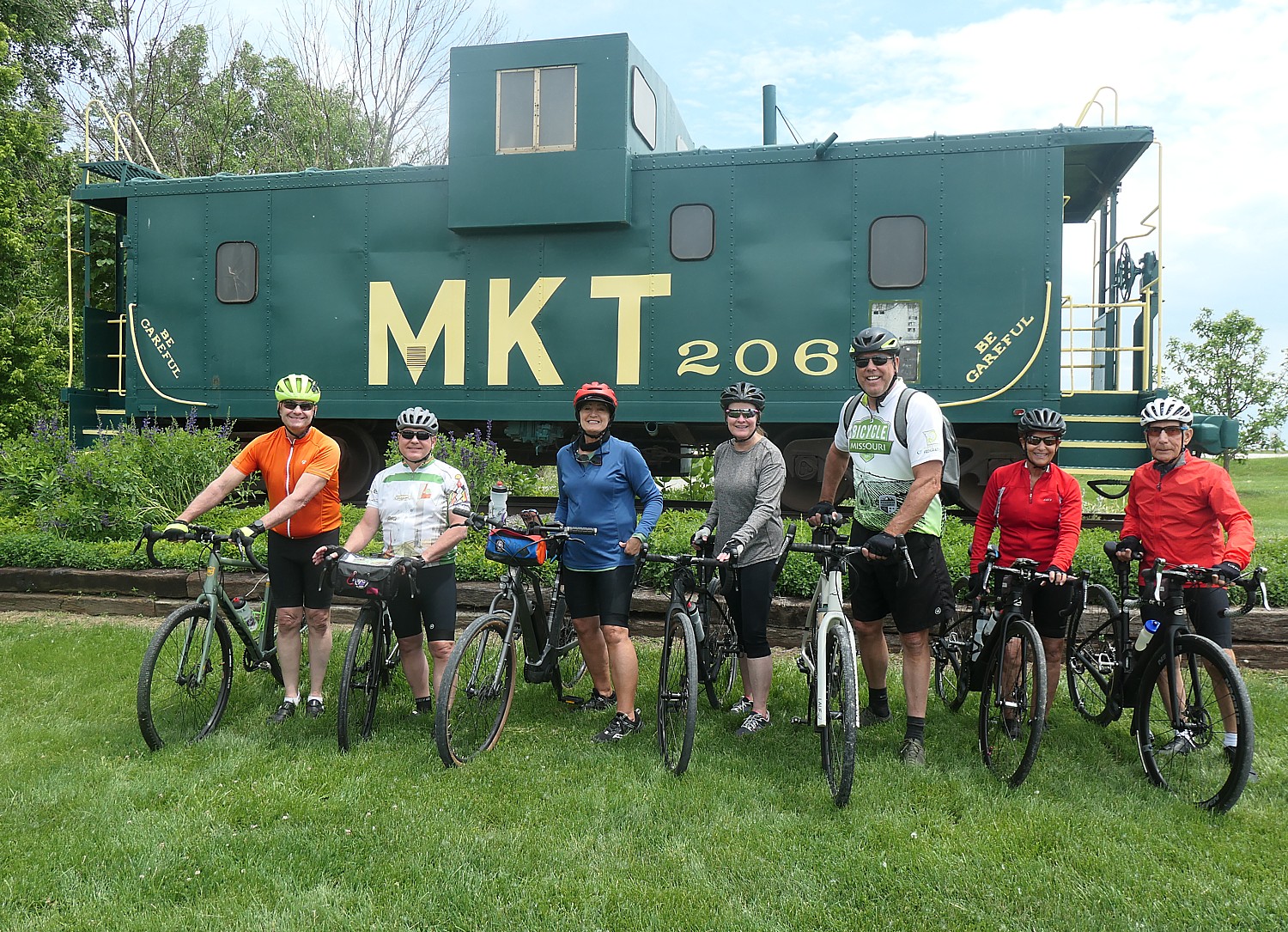
Starting out on our six-day Wilderness Voyageurs bike tour, 240-miles across Missouri on the Katy Trail, a rail trail built on the former Missouri-Kansas-Texas railroad line © Karen Rubin/goingplacesfarandnear.com

On our Wilderness Voyageurs Katy Trail bike tour, only one couple is from Missouri (they have done almost all of the trail before), the rest of us have come from Texas (doing this trip for a second time), Alabama, Indiana, California and New York, to enjoy one of the best rail trails in the country. It has the gentle slope of a rail line where there are ups and downs at all, marvelous and well maintained rest stops (every 12 miles) complete with picnic tables, depot-style benches under a canopy, where there are excellent placards describing the history, pointing to the important sites and mile markers on the coming section, and giving clear map and directions. It is such a comfortable trail that this tour is able to go for longer mileage days of 38 to 50 miles (but if you do tire, you can simply hop on the van used each day by one of the guides who sets up snack stops and lunch; e-bikes also available).

Biking 240-miles across Missouri on the Katy Trail, a rail trail built on the former Missouri-Kansas-Texas railroad line © Karen Rubin/goingplacesfarandnear.com

But it’s not just those of us who come from around the country and world to ride the Katy Trail – the trail is a string that binds and engages community and we can see how locals cherish it (even those who were skeptical at the start).  Along the way, we find a former home that was donated to the trail for use as a hostel (you just find the key and let yourself in), and a historic general store building that was donated to the park and being restored by Dan and Connie Burkhardt who run a foundation to protect and preserve the land. Indeed, the trail began with a generous donation by Edward D. “Ted” Jones Jr. and his wife, to secure the railroad’s right-of-way. All along the way you see signs of “Missouri Pride,” and “Magnificent Missouri.”

Much of the trail follows the route of the Missouri River with the river on one side and towering bluffs on the other, and takes us through forests, wetlands, valleys, remnant prairies, open pastureland and rolling farm fields.

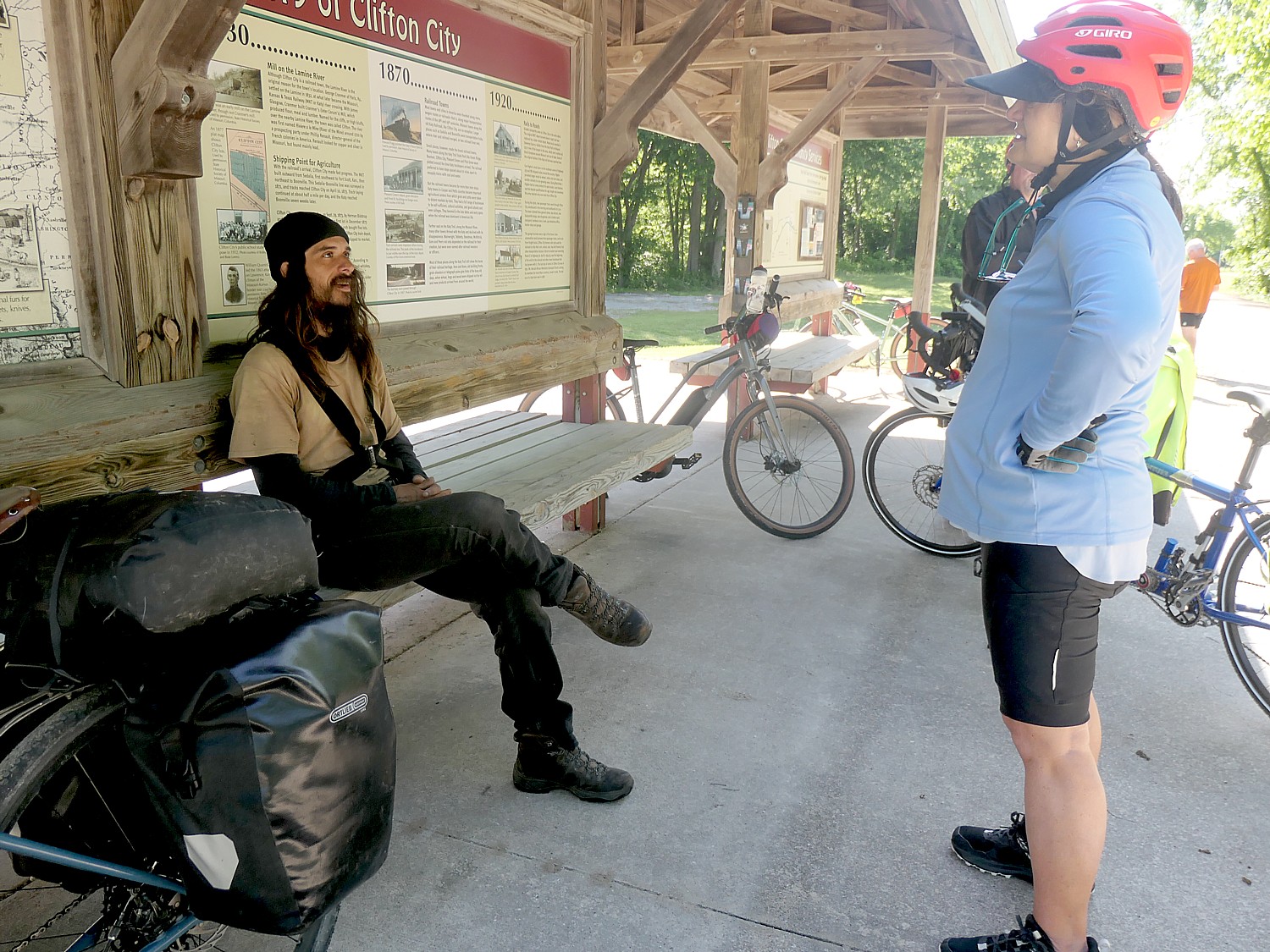
The Katy Trail, a Missouri state park, has some of the best rest stops, with historic placards, and is where you meet interesting people, like Fabio, a real-life Forrest Gump, who has been traveling for 16 years © Karen Rubin/goingplacesfarandnear.com

We cycle through towns, villages, communities and landscapes we would never otherwise see (and without looking through a glass window), at a pace that is perfect to create an ever-changing scene. You can feel the wind and smell the air, and get off the bike when you want to spend more time, take a photo, read a plaque, have a different or deeper perspective – especially since Wilderness Voyageurs provides us with Ride with GPS so we can go at our own pace.

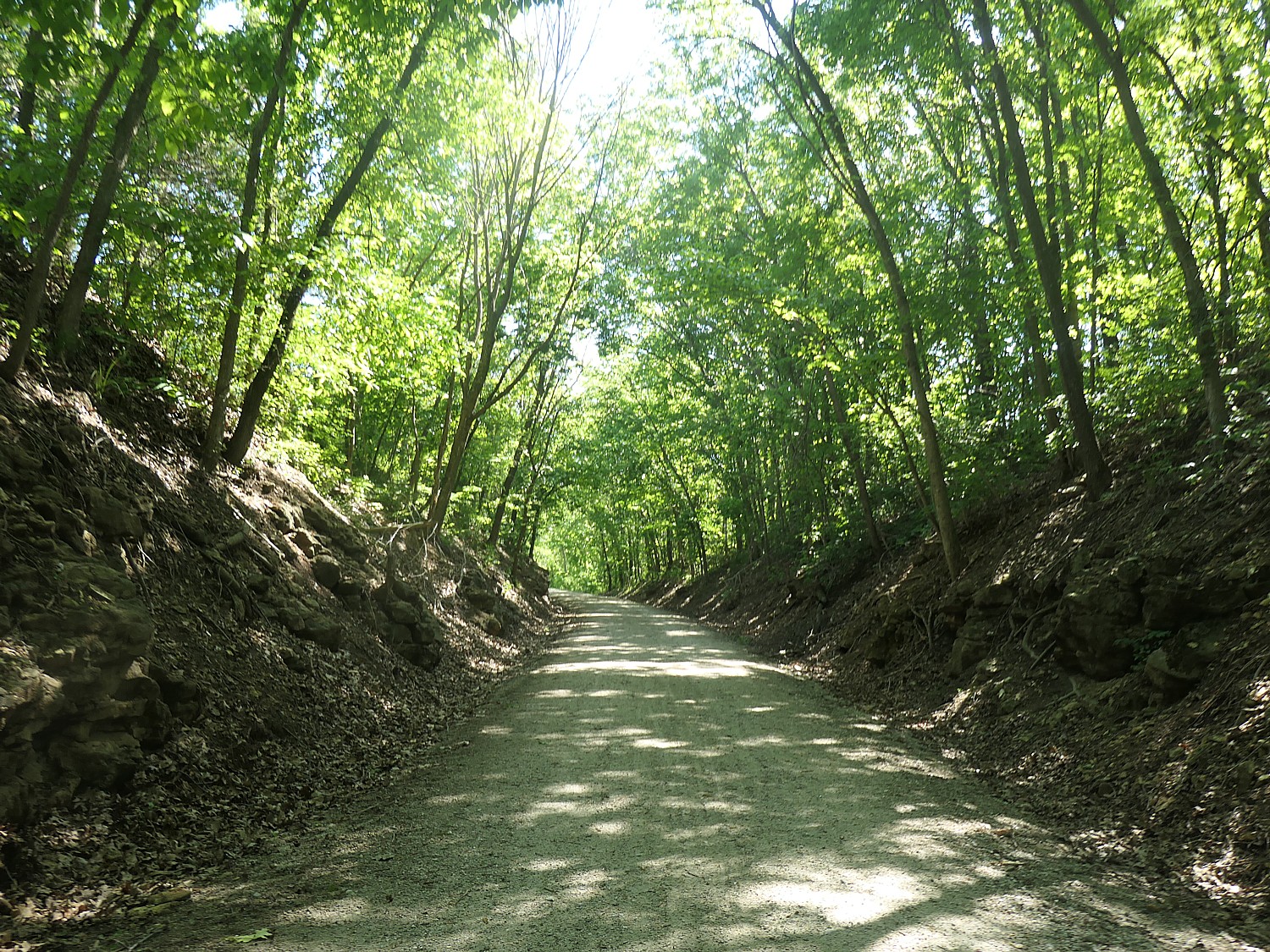
The gentle rise of the Katy Trail, built on the Missouri-Kansas-Texas railroad line  © Karen Rubin/goingplacesfarandnear.com

The pleasure of riding the Katy Trail is further enhanced this year when the nation is celebrating America’s 250th.

The Katy Trail is steeped in history, much of it following the actual route of Lewis & Clark’s expedition (part of the 4,900-mile Lewis & Clark National Historic Trail) and dotted with markers and panels recalling where they camped or where some incident happened. This place also figured prominently in the Westward expansion, led by figures like Daniel Boone and commemorated with Gateway Arch National Park in St. Louis. One of my favorite sections of the trail is where we see pictographs left by the Indigenous peoples who had lived here for centuries before any of them.

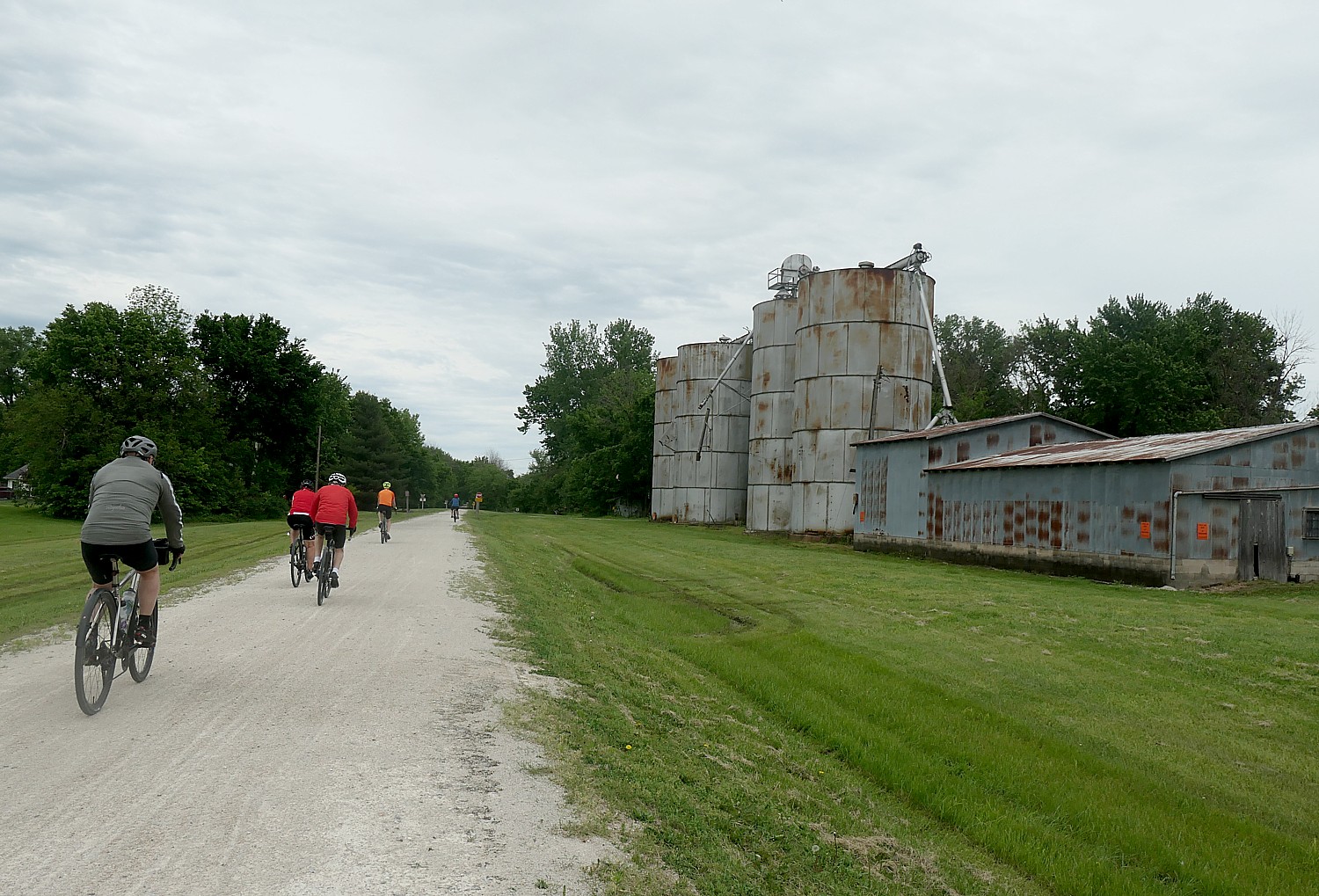
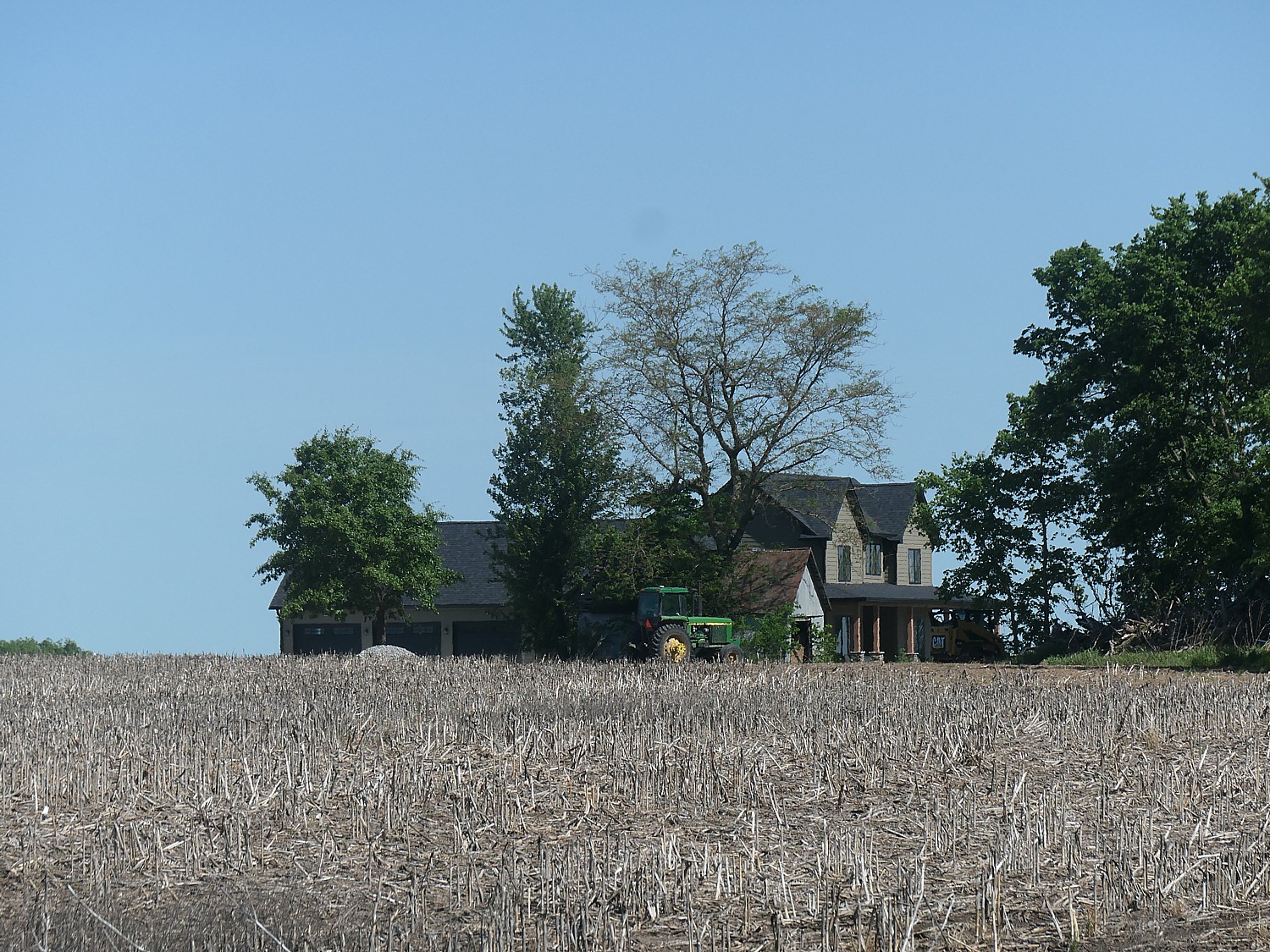
Cycling passed farms on the Katy Trail © Karen Rubin/goingplacesfarandnear.com

We go through towns that look like (should be and have been) film sets from 1930s,1940s and 1950s. I love seeing the vintage posters, paintings, murals, neon signs and shops that still have the proprietor’s family name and the tag, “Since [year]” This is small town America of myth and lore, especially when we come to our last night’s stay in Washington, Missouri, where I happen upon a community weekly concert at the Farmers Market that gets people line-dancing.

Our six-day tour begins with a 6:30 am pick up in St. Charles, so everyone stays over the night before, most in St. Charles. (I stay in St. Louis, about 25 minutes away, at the 21c Museum Hotel, a Historic Hotels of America member, to have a glorious day to explore this important city and immerse myself in history and culture.)

We are picked up at the various hotels and driven from St. Charles, where the trail and our tour ends, to where it begins, in Clinton. It is a 3 ½ hour drive, but will take us six days to bike.

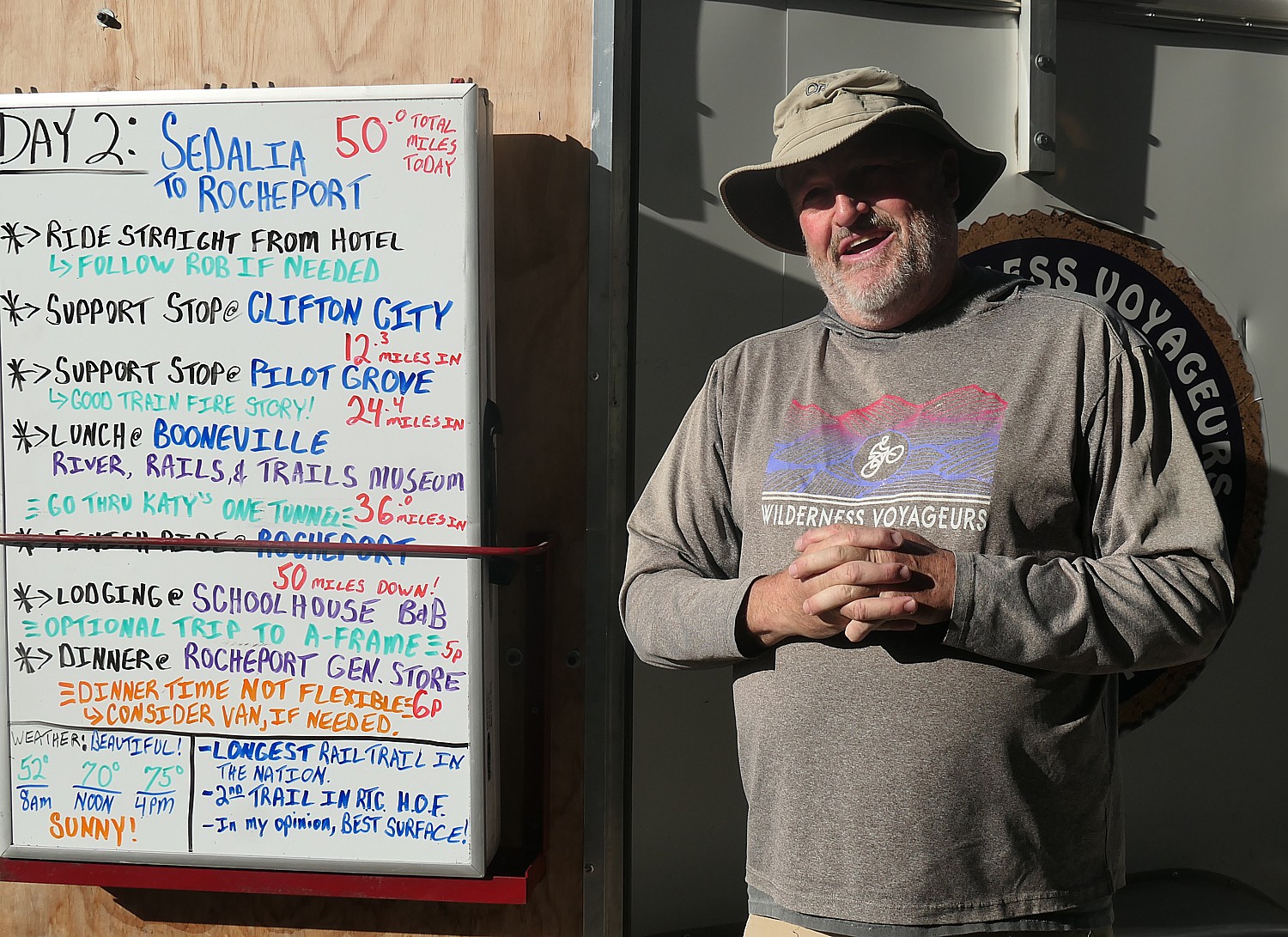
Wilderness Voyageurs guide James Oerding gives us our whiteboard review of the day’s ride on the Katy Trail © Karen Rubin/goingplacesfarandnear.com

Before we set out each day, our guides, James Oerding (a St. Louis native who has been a Wilderness Voyageurs guide for 13 years and I actually knew from my South Dakota Wilderness Voyageurs tour) and Rob Figulski, review the ride and main points.  I would also recommend reading the day’s itinerary notes that are provided on the Ride with GPS app, which have even more interesting details for people like me who love to immerse in place and time.

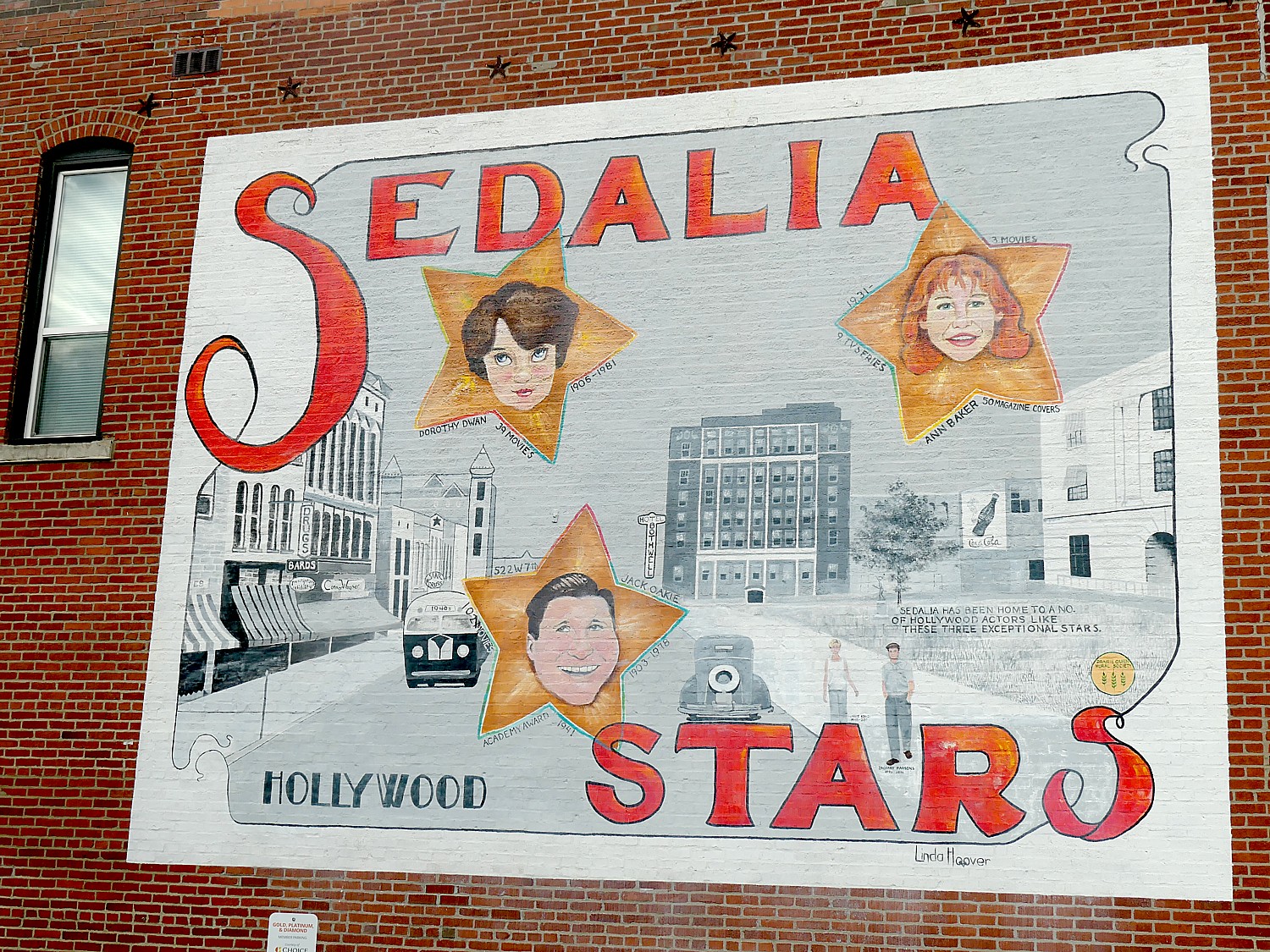
Our first day’s ride is 38.4 miles through the Osage Plains with gentle rises and trees on both sides to Sedalia, a town that looks like it was set in a time capsule (and was used as the setting for the 1950s TV show, “Rawhide”).

This day’s ride takes us to the highest point on the trail, at 955 feet above sea level (though not the most elevation of our ride – that will come on day 2).

Sedalia, Missouri is a picturesque, historic town revitalized by the Katy Trail cyclists © Karen Rubin/goingplacesfarandnear.com

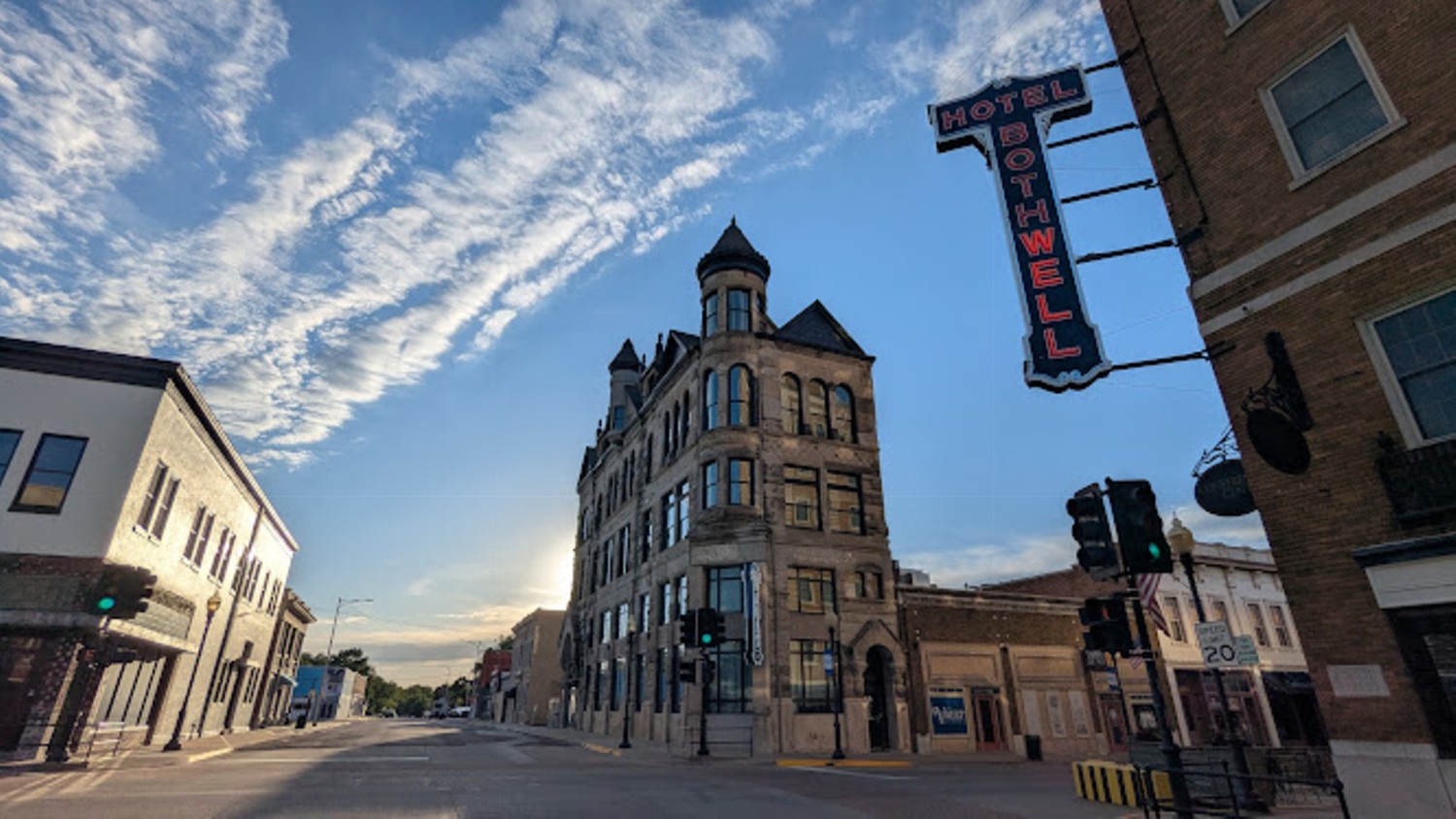
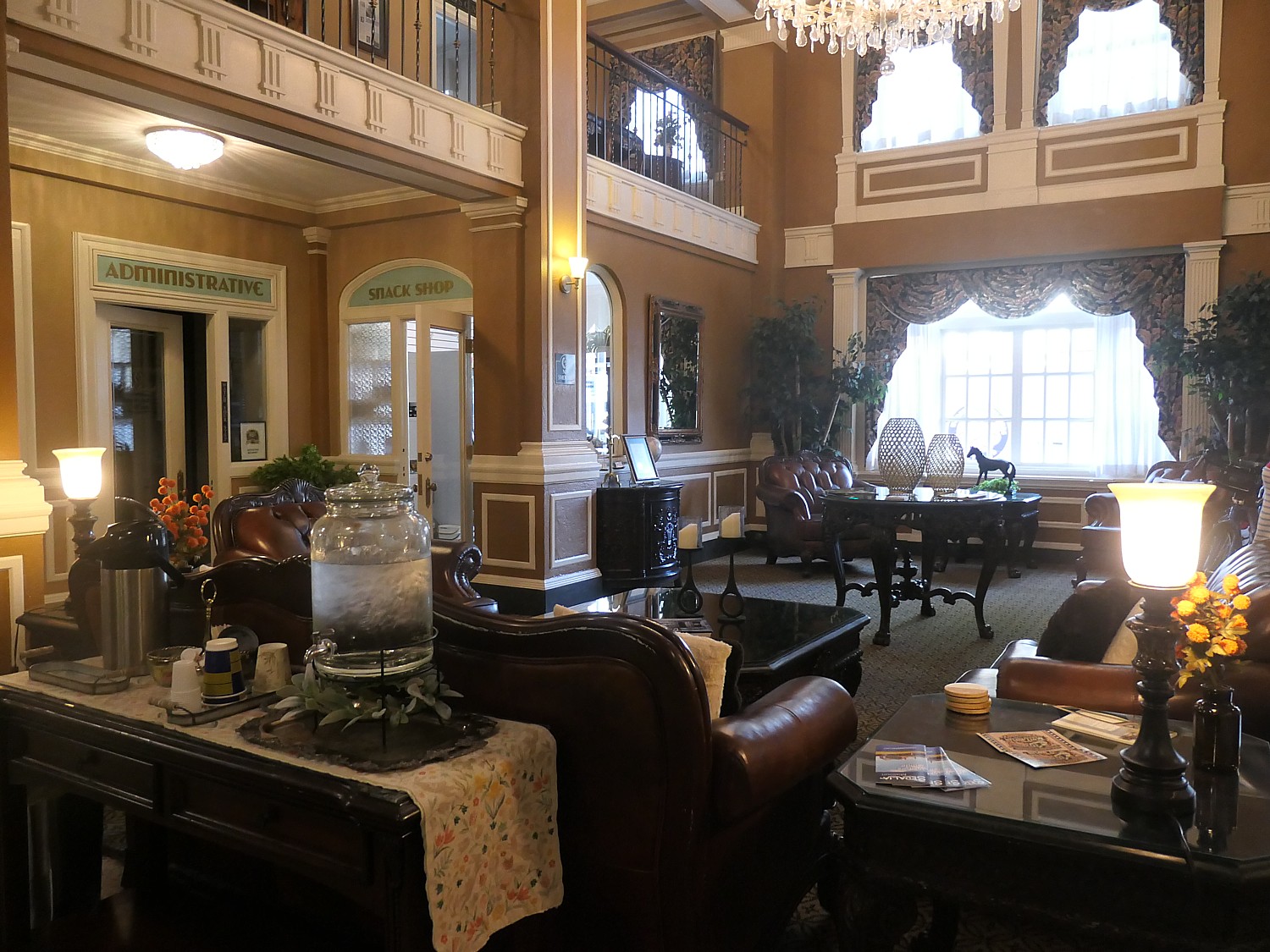
We finish at the Katy Trail Depot in Sedalia and make our way to the historic Hotel Bothwell, so perfect for this throwback experience. There are such marvelous ole-timey features – a telephone booth, elevator, mail drop, the wooden check-in desk. There are photos of President Harry Truman in the breakfast room, named for Truman, who dined in the hotel’s café in 1962.

The historic Hotel Bothwell, built in 1914, has connections to President Harry Truman, and delightful old-timey features © Karen Rubin/goingplacesfarandnear.com

A bronze plaque outside the hotel says that John Bothwell & Community Hotel Company built the hotel in 1927 for $400,000; in 1934, Harry S. Truman was here when he learned that Kansas City political boss Tom Pendergast had selected him as the candidate for US Senate; in 1942, Actress Bette Davis dined in its Palm Room; in 1959, Actors Clint Eastwood and Eric Fleming promoted the TV series Rawhide (which was set in Sedalia). The hotel was converted to senior housing in 1988 by the Westin Financial Group, then restored to a hotel by the Furnell Cos. in 1998.

Vintage poster in Sedalia, Missouri © Karen Rubin/goingplacesfarandnear.com

Sedalia also has the first Carnegie Grant public library awarded in Missouri; and the Missouri State Fair is located in Sedalia (we pass by the fairgrounds on the trail).

But most interesting is its connection to famed musician Scott Joplin, who came to Sedalia to work on the railroad and made Sedalia his home, earning his living as a piano teacher; today, Sedalia hosts an annual Scott Joplin Ragtime Festival (www.scottjoplin.org)

We have dinner together at The Vault – it’s only our first night together, but the 10 of us have already formed a tight unit. Notably, four of us are traveling solo – bike tours are one of the best ways to travel alone but together.

Biking over trestles is one of the fun features of Missouri’s Katy Trail, a rail trail built on the former Missouri-Kansas-Texas railroad line © Karen Rubin/goingplacesfarandnear.com

Day 2 is the most arduous and the most satisfying. It is our longest, hardest ride, 50.5 miles, from Sedalia to Rocheport with the most ups/downs – 1,100 ft of elevation and 1,395 ft. decline – so today is mostly about the physical experience versus the view. and ends at a place of serenity and contentment. (But you keep reminding yourself: this is a railtrail, so the uphill is very gradual, you barely feel it.)

Biking over trestles is one of the fun features of Missouri’s Katy Trail, a rail trail built on the former Missouri-Kansas-Texas railroad line © Karen Rubin/goingplacesfarandnear.com

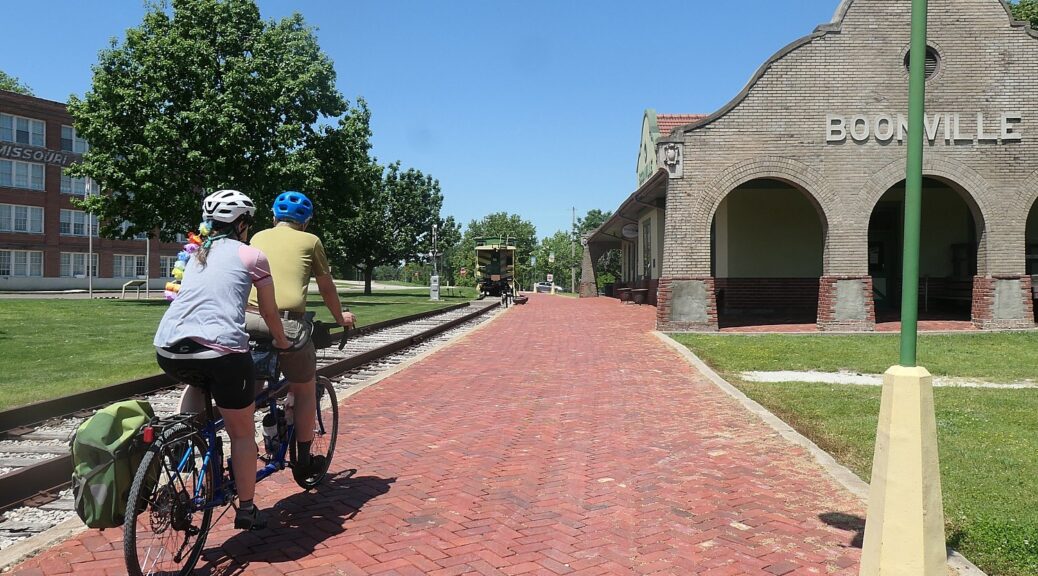
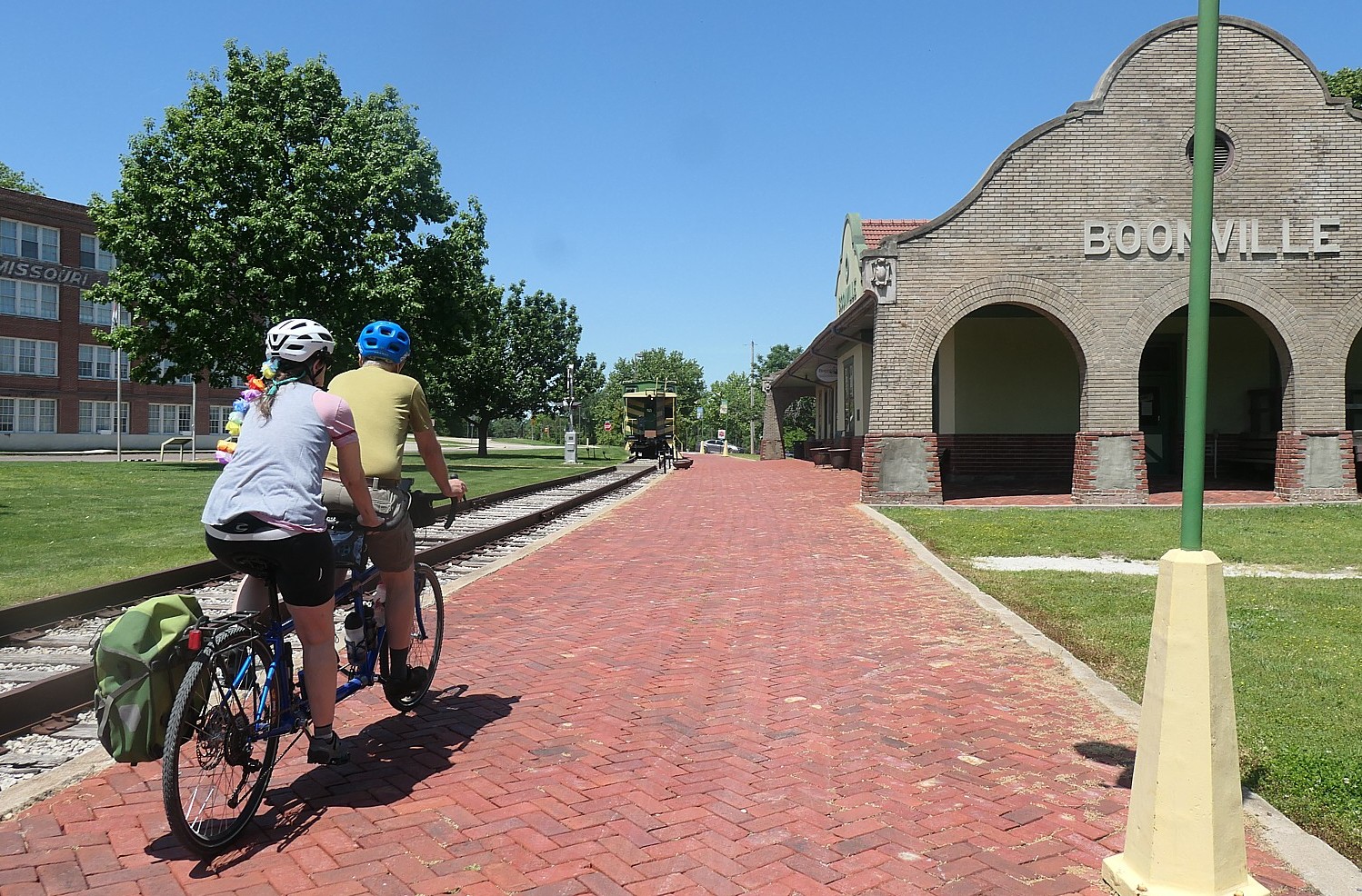
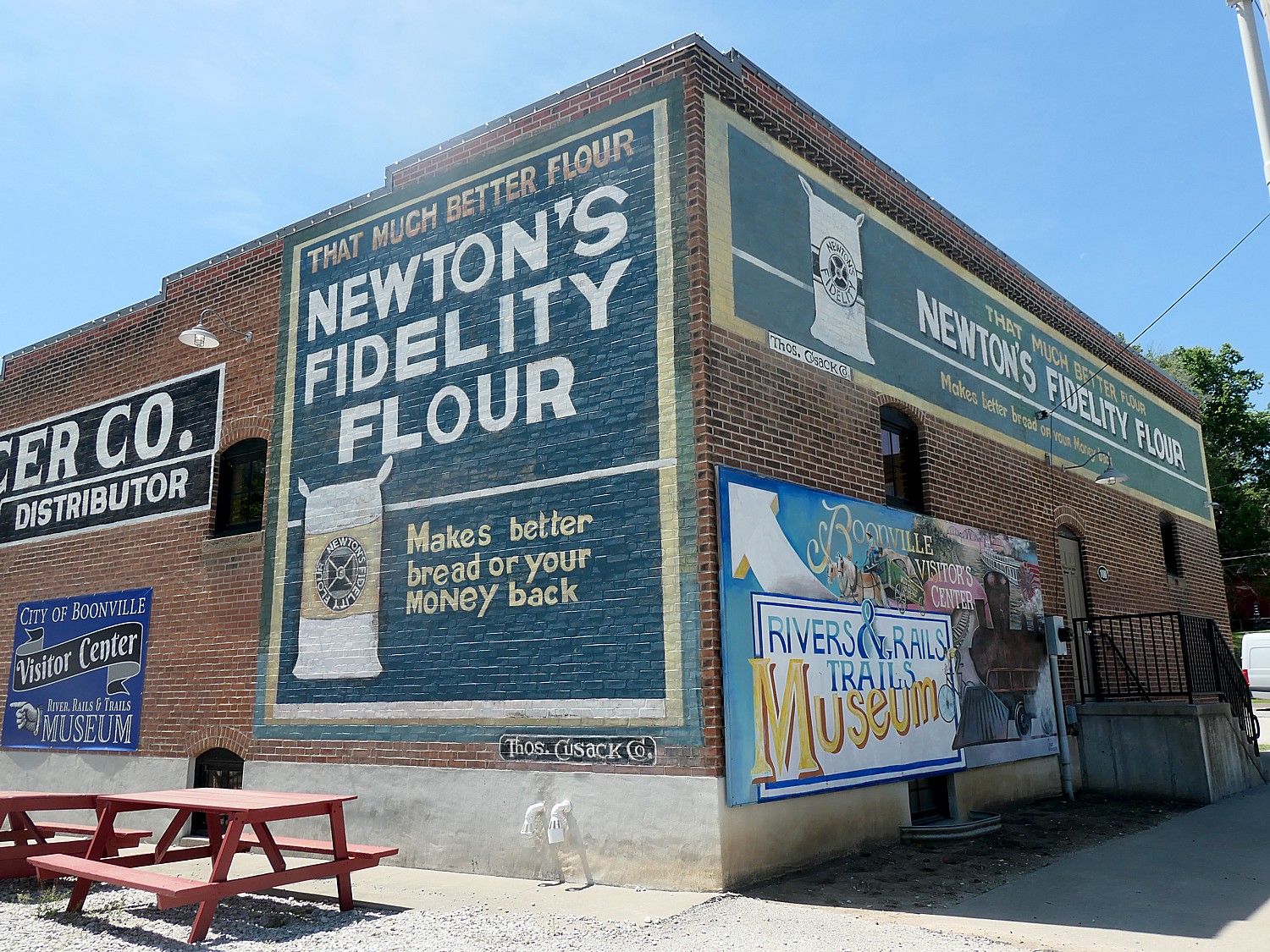
This day’s ride is organized so we have two support stops, 12 miles apart, and a very long uphill before a two-mile downhill into Boonville and our lunch stop at the Boonville Visitor Center and River, Rails & Trails Museum.

Boonville Visitor Center and River, Rails & Trails Museum © Karen Rubin/goingplacesfarandnear.com

The museum is very interesting, especially the ambiguous way it relates Civil War events – a skirmish early in the war, on July 17, 1861, resulted in Union forces defeating a small, poorly equipped force of Missouri State Guard. (It’s not clear which side the folks were on but probably the Confederate, though Missouri was officially a Union border state).

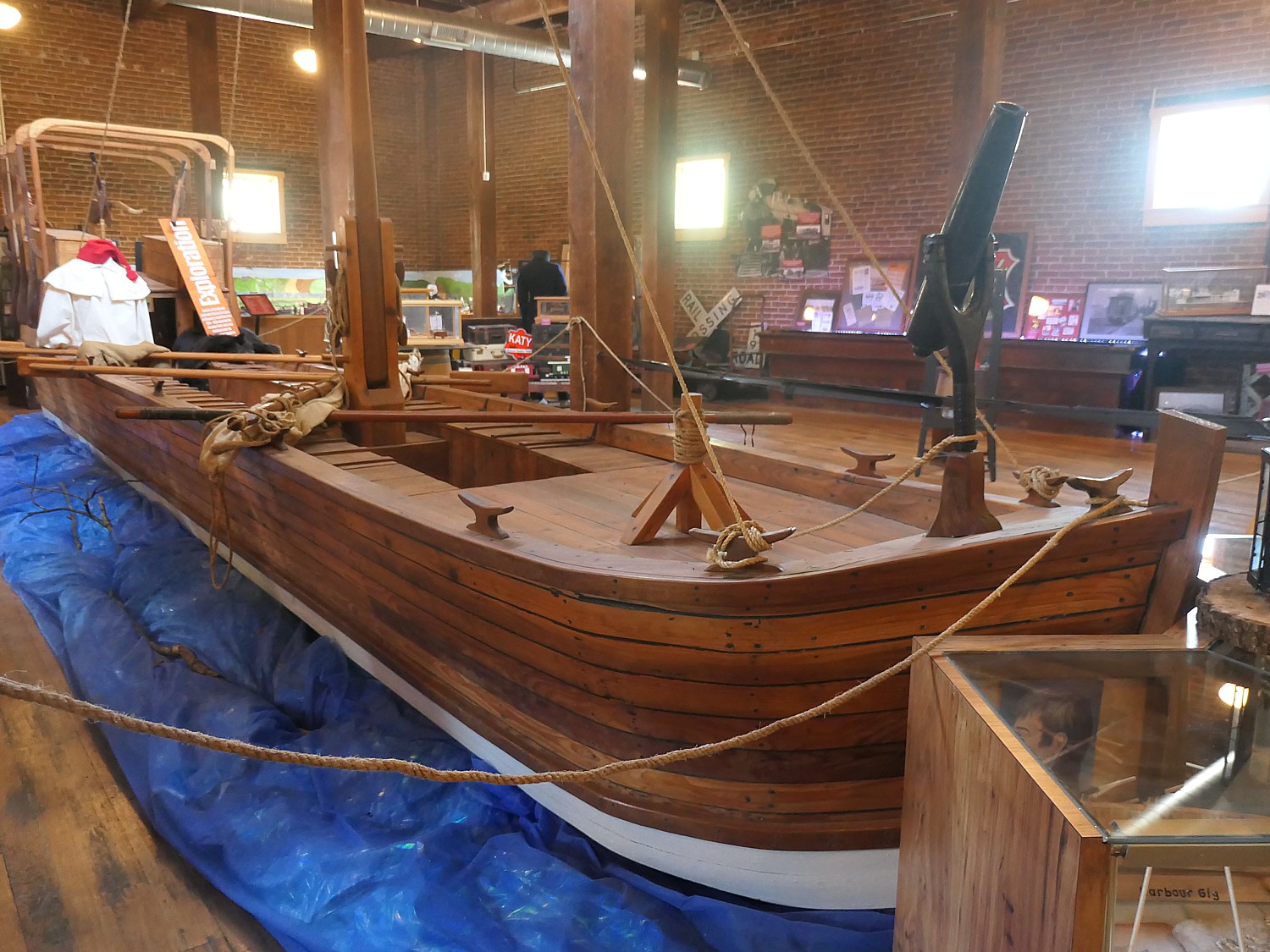
A half-scale replica of Lewis & Clark’s keelboat at the Boonville River, Rails & Trails Museum © Karen Rubin/goingplacesfarandnear.com

All along the Katy Trail there are important markers and references to Lewis & Clark, and here in the museum is a half-scale replica of the famous keelboat they used.

Boonville was named for frontiersman Daniel Boone’s sons, who established a salt business here in the early 1800s. This was the first permanent American settlement west of St. Louis. Its strategic location on the Missouri River and the Santa Fe Trail made it a crucial hub during Westward Expansion.  More than 400 buildings are listed on the National Historic Register, and Boonville has one of four restored train depots along the Katy Trail.

We leave Boonville, crossing over the Missouri River, continuing on the trail, riding over train trestles.

New Franklin, “the crossroads to the West,” is where four major trails meet: the Katy Trail, the Lewis & Clark Trail, the Santa Fe Trail and the Boone’s Lick Trail © Karen Rubin/goingplacesfarandnear.com

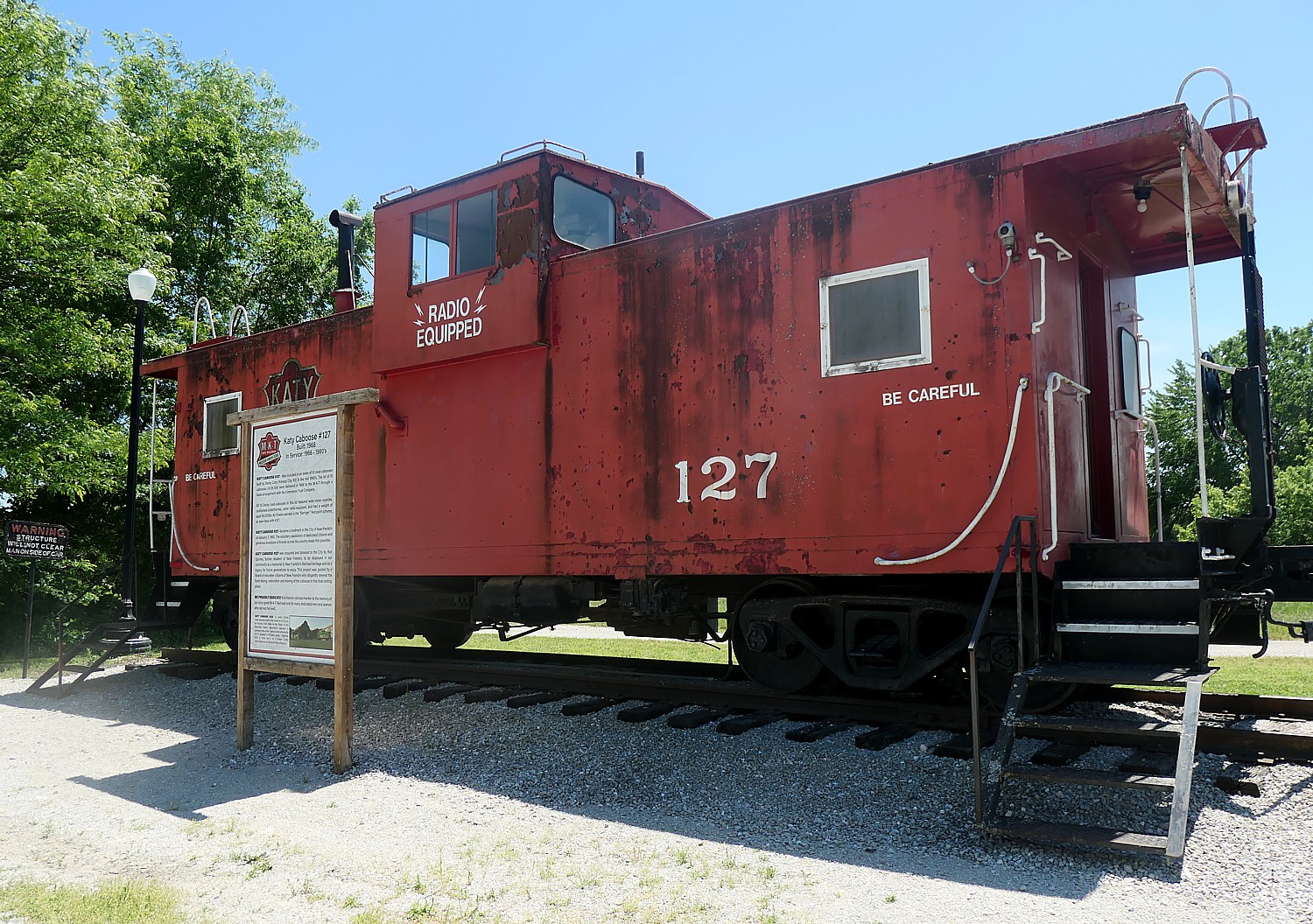
New Franklin, “the crossroads to the West,” is where four major trails all meet: the Katy Trail, the Lewis & Clark Trail, the Santa Fe Trail and the Boone’s Lick Trail. Here, we see what is left of a KT Roundhouse (there is a campground here today), a train car, and a replica of a Conestoga Wagon such as the pioneers would have used.

We end our ride in Rocheport, a trading post when Lewis and Clark’s expedition came through in 1804. It became a permanent settlement in the early 19th century. Today, the whole town is a historic district, with 239 residents and yet there is a gallery and art studio, and an inn that caters to women recovering from mastectomy.

This has been a really arduous ride, so when we arrive at the School House B’n’B at about 3 pm and congregate in its lush garden to enjoy beer and snacks the guides have purchased for us (based on a questionnaire we filled  out as to our preferences), the most perfect peace washes over us, almost euphoria. Everything about this place evokes a feeling of serenity and sheer contentment.

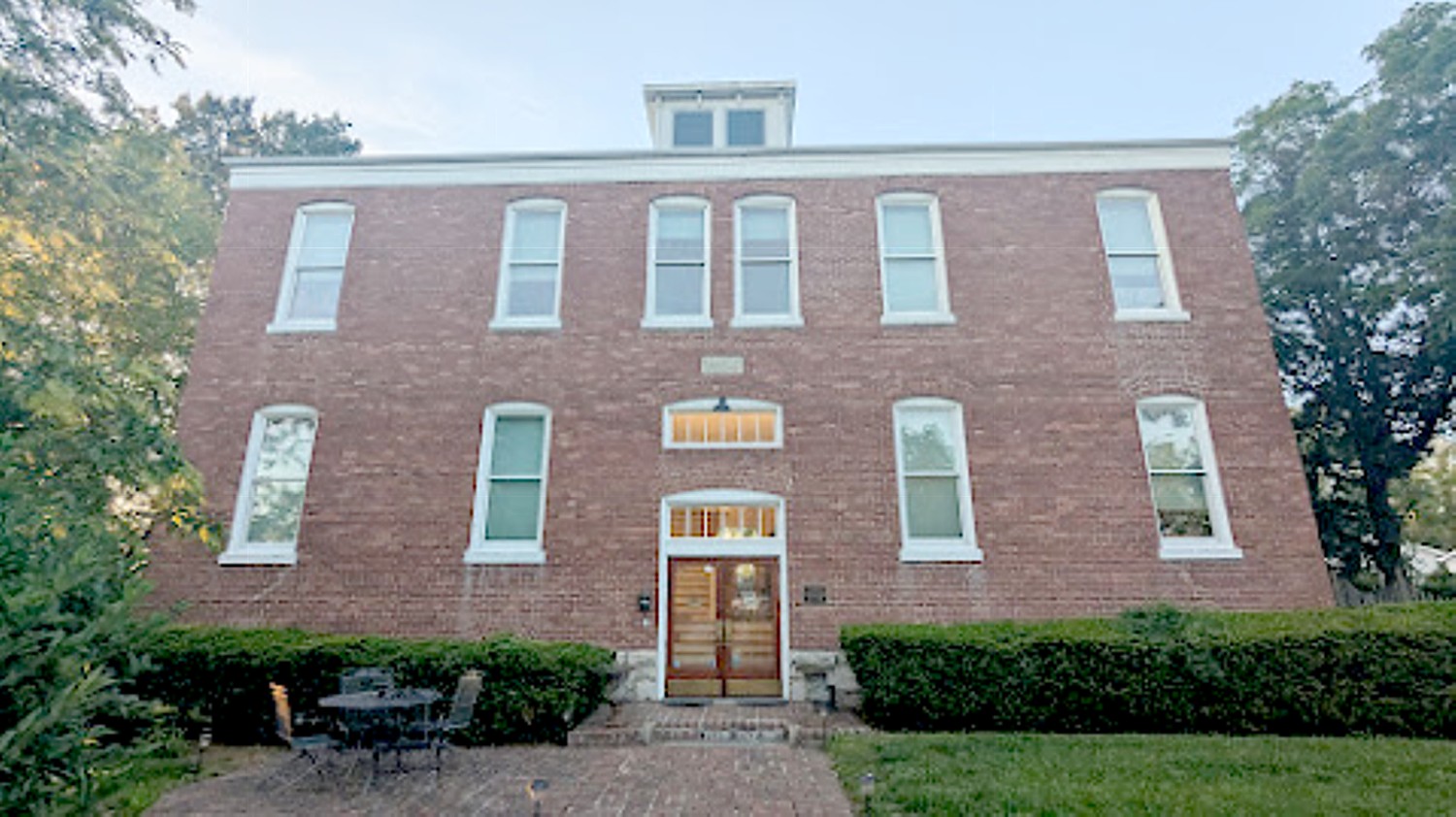
The Schoolhouse BnB in Rocheport deserves its accolades as the “best traditional bnb in Missouri” © Karen Rubin/goingplacesfarandnear.com

Listed on the National Register of Historic Places, the School House B’n’B is a restored three-story brick building that was built in 1914 and was a school until 1972 (though a school was on the site for 70 years before that). It was converted to a bed and breakfast in 1988 and expanded and improved by a succession of three owner/operators and now offers 11 accommodations including a bridal suite. (Actually, there are three properties: School House Bed & Breakfast, Clark Street Lodge, and Dormitory House properties).

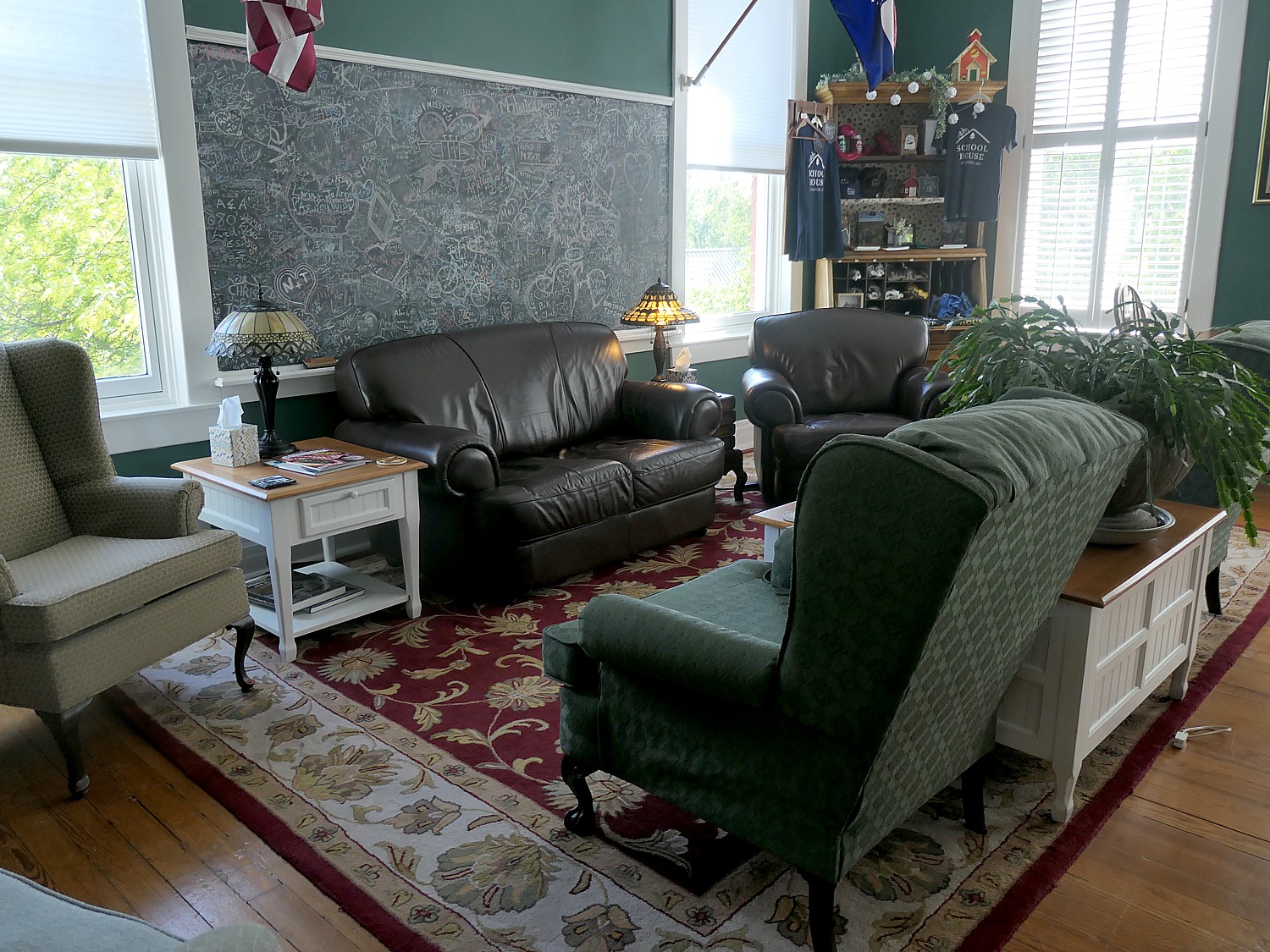
The Schoolhouse BnB incorporates delightful features of its heritage © Karen Rubin/goingplacesfarandnear.com

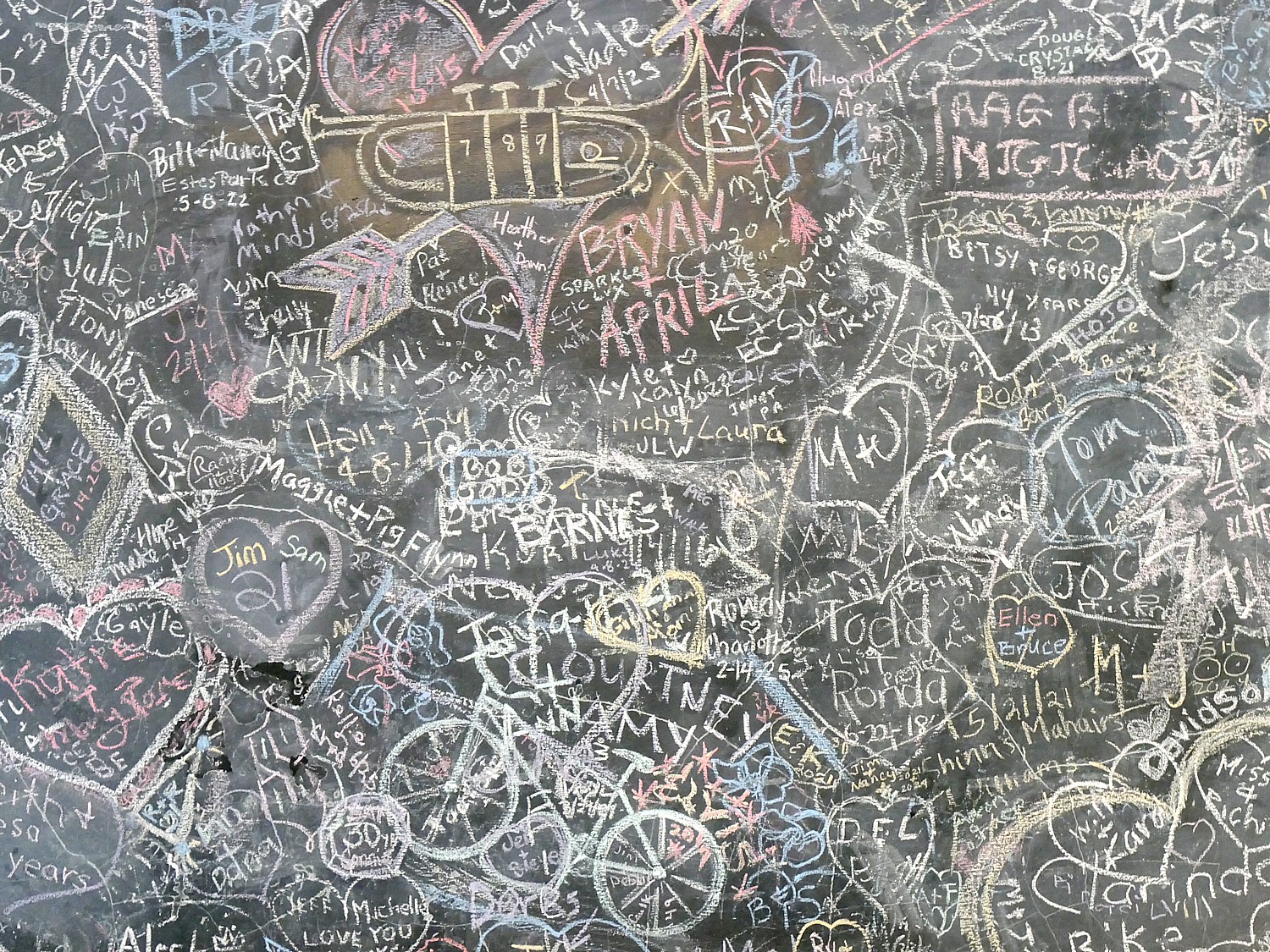
So charmingly repurposed and furnished, the School House BnB truly deserves its accolades as “best traditional bnb in Missouri”. I especially love how owner/operator Chandrika Hickman preserves the heritage – and the spirit – of a schoolhouse: the names of the rooms are delightful: Dick and Jane (which was occupied by our own Bill & Jill); Schoolmarm (which was occupied by a retired school teacher) and so forth. The parlor has a large chalkboard for guests to doodle on, and there are framed pages from old readers. A painting shows a class taking place in this very room now used as the dining room and lounge.

Schoolhouse BnB guests leave doodles on the chalk board © Karen Rubin/goingplacesfarandnear.com

At 5 pm (after we have time to refresh), we are taken for a tasting at the A Frame Wine Garden, scenically set on a high cliff above the Katy Trail affording a stunning view overlooking the Missouri River, with tiers of porches. (We will ride the Katy Trail below us, the next day).

Wilderness Voyageurs arranges a private dinner at the General Store restaurant in Rocheport © Karen Rubin/goingplacesfarandnear

This night’s dinner is the best, most special of the entire tour. Wilderness Voyageurs arranges a private dinner at the Rocheport General Store restaurant where Chef Susan Schapira prepares a fantastic meal (the seafood ravioli in a white cream sauce is out of this world; the strawberry and pecan cake, with a perfect texture and sweetness, is beyond delectable).  

Chef Susan Schapira, with assistant Sarah Kendall, prepares a five-star dinner for us at her General Store restaurant © Karen Rubin/goingplacesfarandnear.com

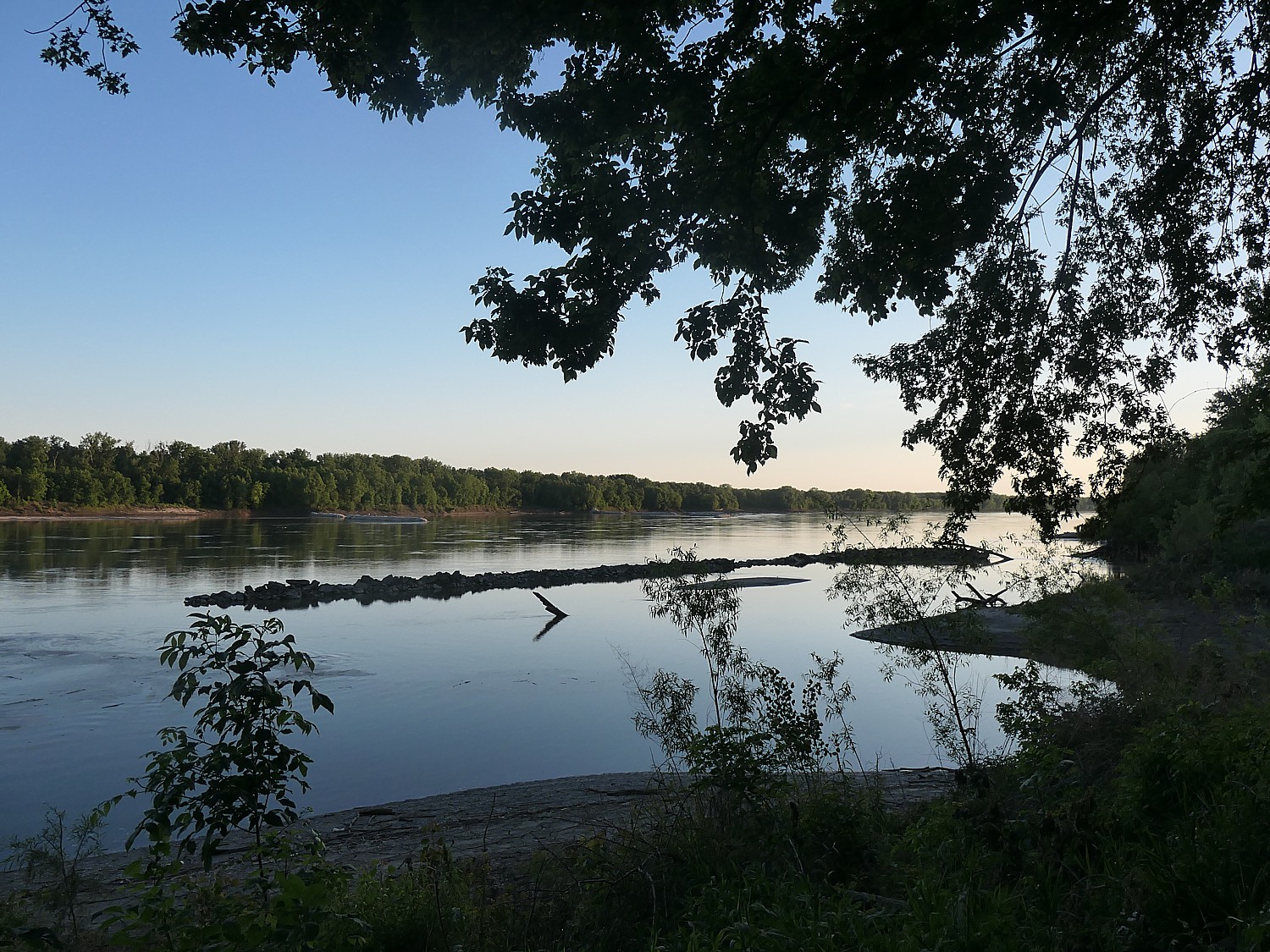
After dinner, a new friend joins me on a walk through woods to the river bank to enjoy the last rays of the sun on the river.

A sunset stroll to the Missouri River at Rocheport © Karen Rubin/goingplacesfarandnear.com

And then the breakfast at School House bnb! Incredibly scrumptious: croissant strata with bacon and cheese; maple lemon apple and pear salad; white chocolate banana muffin.

The scrumptious breakfast at Schoolhouse BnB fortifies us for the day’s ride on the Katy Trail © Karen Rubin/goingplacesfarandnear.com

It is no wonder that the School House B’n’B repeatedly is named “Missouri’s #1 traditional B&B” (schoolhousebnb.com).

We set out from Rocheport for Jefferson City, for what proves to be the most scenic and interesting day.

Wilderness Voyageurs, Ohiopyle, PA, 15470, 800-272-4141, wilderness-voyageurs.com.
Next: Indigenous Pictographs & ‘A Social History of Missouri’ Mural

__________________

© 2026 Travel Features Syndicate, a division of Workstyles, Inc. All rights reserved. Visit goingplacesfarandnear.comlongislandpress.com/category/vacation-travel.com and travelwritersmagazine.com/TravelFeaturesSyndicate/. Blogging at goingplacesnearandfar.wordpress.com and moralcompasstravel.info. Visit instagram.com/going_places_far_and_near. X: @TravelFeatures Threads: @news_and_photo_features ‘Like’ us atfacebook.com/NewsPhotoFeaturesSend comments/questions to FamTravLtr@aol.com.