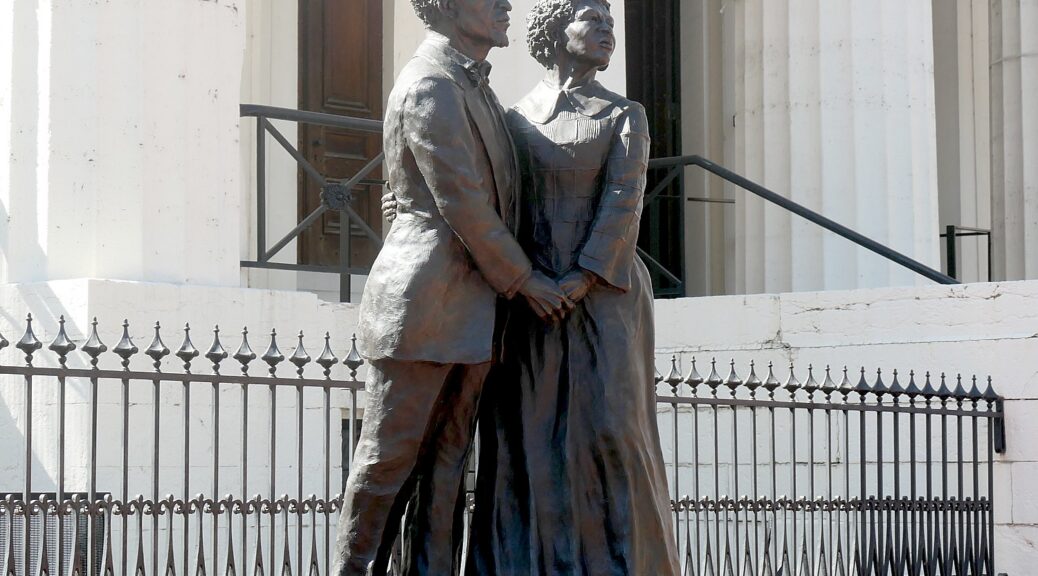
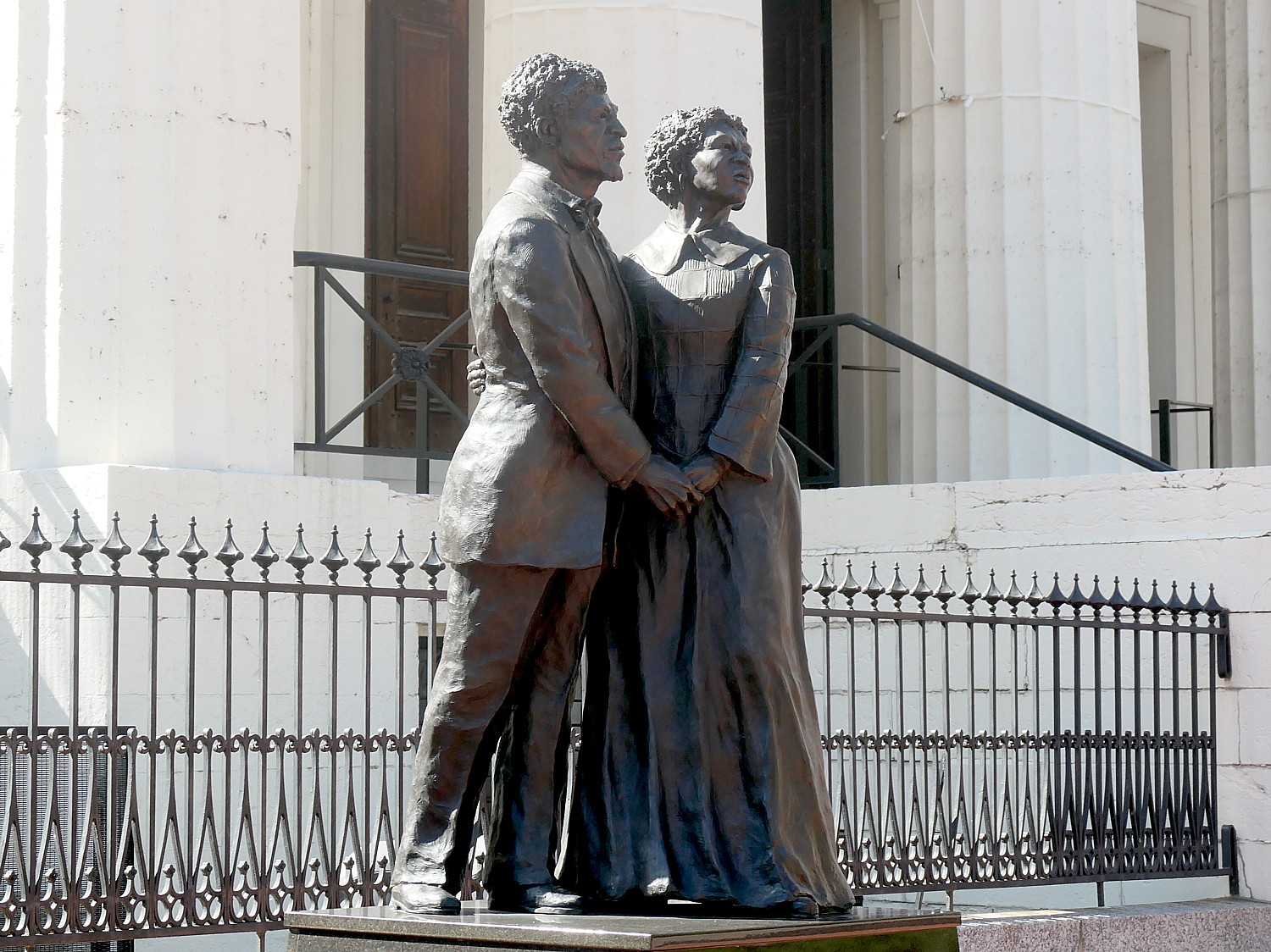
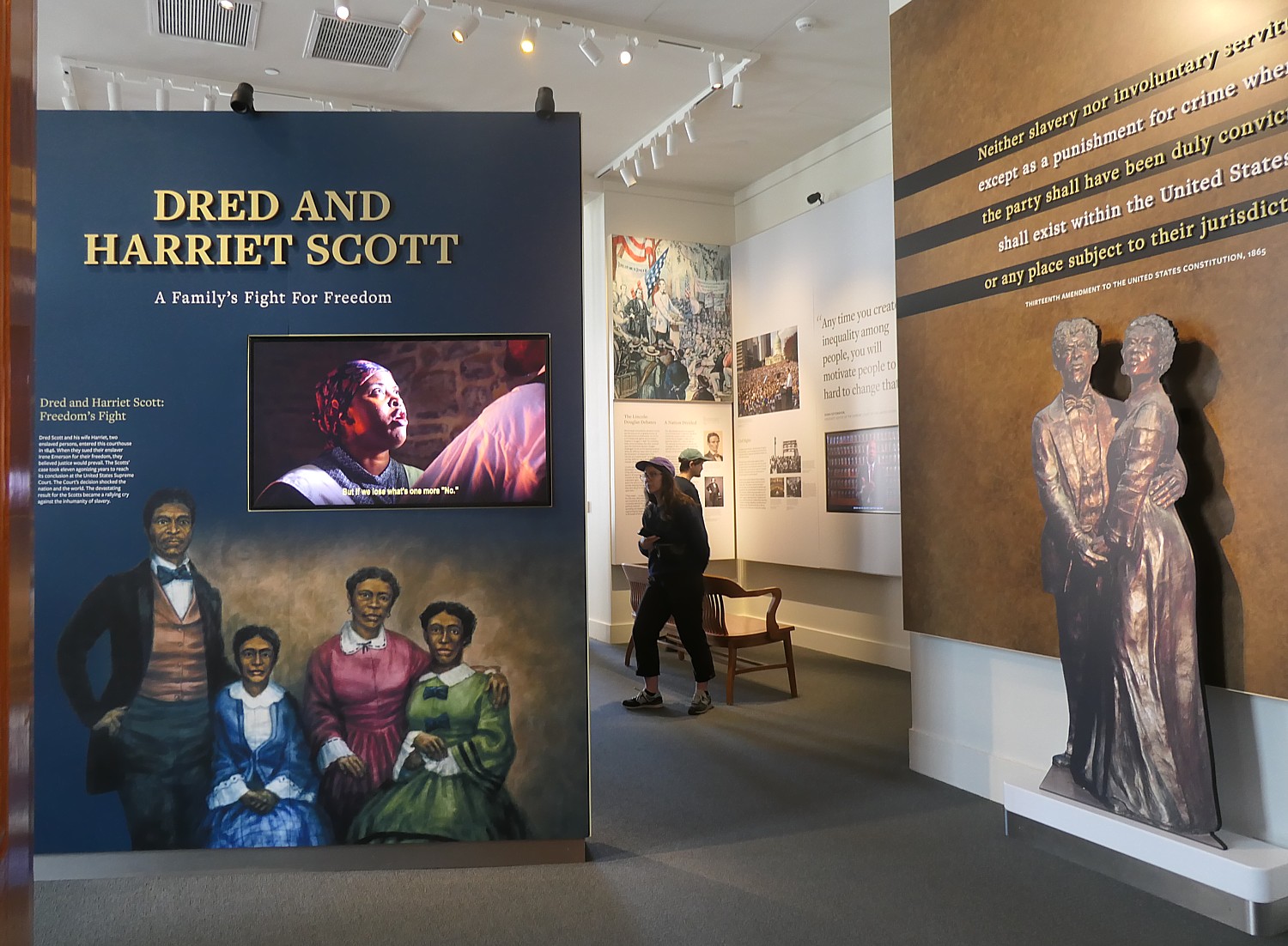
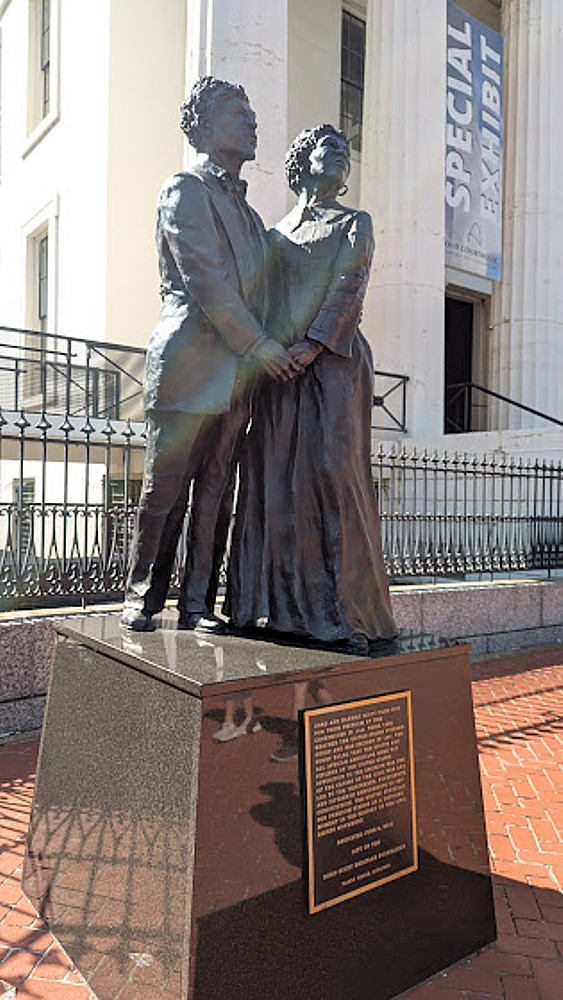
I must have spent about two hours in St. Louis’ Old Courthouse before exiting out the riverfront door to continue on to the Gateway Arch, stopping to take in the inspiring statue of Dred and Harriet Scott.
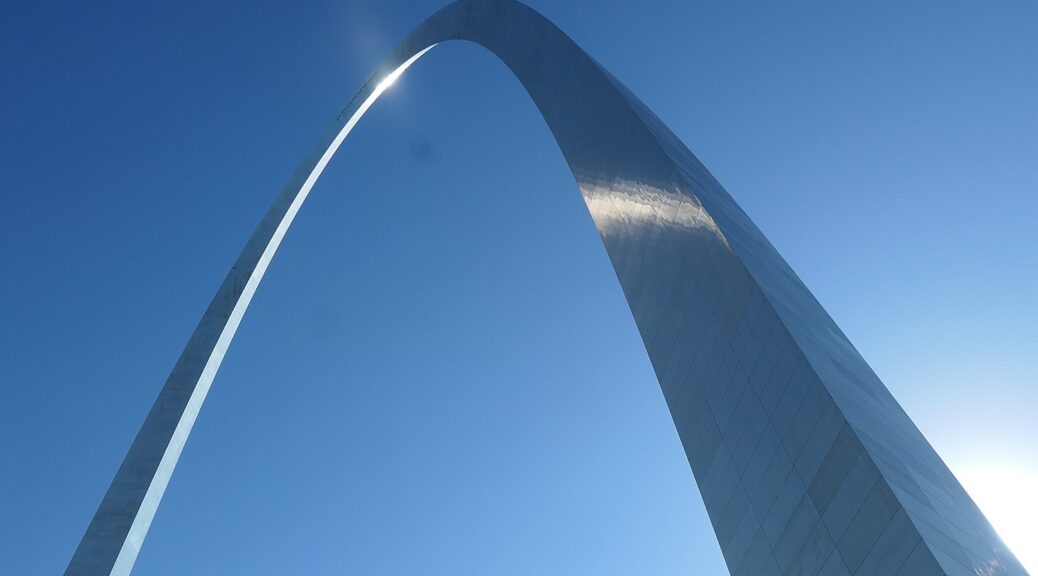
The riverfront Gateway Arch National Park, spanning 90 acres (and apparently configured on the site of the original colonial settlement) is a glorious community space, with the Gateway Arch becoming ever more monumental and striking as I get closer.
The Arch is an impossibly graceful ribbon of stainless steel, reflecting the sun.
I had been here decades ago, not realizing at the time that the Arch was actually relatively new, and an engineering marvel when it was built between 1963-5. Architect Eero Saarinen’s inspired design for a 630-foot stainless steel arch as an ideal monument to the spirit of the western pioneers was chosen after a nationwide competition in 1947-48. It was built for total cost of $13 million: 75% paid by the federal government, and 25% City of St. Louis funds; the $2 million Arch transportation system was financed by the Bi-State Development Agency.
I had not realized there is a fantastic (free!) museum beneath it, and interactive experiences, including a bizarro tram (it looks like a Woody Allen car from “Sleeper”), that takes you on a track inside the Arch to the very top where you get out for a view through windows, before riding the tram back down. (You have to reserve tickets early; they were sold out by the time I arrived in the afternoon.)
The exhibits in the Gateway Arch museum are fascinating. They trace St. Louis’ history from A French fur trading post, Colonial St. Louis, where you discover the Indigenous, French, and Creole cultures of St. Louis before the Louisiana Purchase; Thomas Jefferson’s Vision for the United States; The Riverfront Era (the first steamboat to arrive in St. Louis changed the city forever).
St. Louis was once inhabited by Native Americans of the ancient Mississippian culture. Due to the area’s proximity to both the Mississippi River that runs along the eastern border, and Missouri River that joins it just north of the city, and the Meramec River on the southern border of St. Louis County, it was not only a hub for the Mississippians, but for the European traders and later pioneers, frontiersmen and ultimately settlers. It switched hands, first being claimed by France, then Spain after the Seven Years War, then (secretly) back to France, before Napoleon Bonaparte sold the Louisiana Territory to President Thomas Jefferson in 1803, who used it as the launching point for the Lewis & Clark Expedition. St. Louis remained a gateway into the American West.
It was surprising to learn that St. Louisians went to sleep on March 9, 1804 under Spanish rule, only to wake up as American citizens. Indeed, in just a matter of days, residents were under French, Spanish, French, British, American flags. The implications were great: American land laws were different and Spanish land grants were subject to legal challenge; merchants and fur traders had new laws and trading partners; American slave law was based on British tradition, so slaveholders no longer could accept self-purchase and enslaved families could be torn apart through sale; free persons of color underwent greater oppression from the Spanish system; women had fewer rights under American law than under Spanish, and married women could no longer own property. (Now imagine what Greenlanders and Canadians are facing.)
The exhibit on Manifest Destiny, the USA’s determination to move west and control the continent, is the most interesting and relevant today, raising questions about the people who were displaced. (Trump has resurrected Manifest Destiny as his operative foreign policy); New Frontiers explores how people settled and lived in the West, the myths that became the West’s cultural legacy, and the changes caused by industry. I love the questions posed: “Because you plant a stake, does that mean you own it?” “Should the people of St. Louis have a say in who owned them?” (Spain. Britain or the US within a matter of days?. I can only wonder how long it will be before Trump shuts the exhibit down and replaces it with something akin to extolling the Divine Right of Kings.)
Building the Dreamis truly a fascinating exhibit where you learn how the Gateway Arch became a reality, from the engineering to the building. You learn that the Arch’s foundations are sunk 60 feet into the ground and the arch is built to withstand earthquakes and high winds.
But one of the most thrilling (and unique) experiences is the Ride to the Top of the Arch on a tram. It is a 45-60 minute experience (4 minutes up, 3 minutes down, 8-ish minutes at the top, plus a pre-boarding educational tour).
Each tram consists of eight capsules that have clear doors on the front and are closed on the back. Each tram car has a five-foot diameter and five seats. (Visitors with claustrophobia issues or who simply want to take souvenir pictures can sit in the replica tram car by the ticketing counter before purchasing tickets.)
The viewing area at the top was designed to hold up to 160 people when at full capacity, but with two trams operating, there are never more than 80 at the top at one time.
The Tram Ride to the Top operates rain or shine. The Arch is designed to sway as much as 18 inches in 150 mile per hour winds and it can withstand an earthquake; however, under normal conditions the Arch does not sway. It takes a 50-mile an hour wind to move the top 1 1/2 inches each side of center.
The Arch has weathered countless severe Midwest thunderstorms and is able to operate normally in all but the most severe weather. During tornado warnings, the tram rides will be cancelled as a precaution. The tram may also be shut down if it is swaying so much that visitors are having a hard time keeping their balance. This happens very infrequently.
There are 16 windows on each side of the viewing area. Each window is 7 x 27 inches and 0.75 inches thick. Over 500 tons of pressure was used to jack the legs of the Arch apart for the last four-foot piece to be inserted at the top. A larger window would not withstand that pressure.
At peak times, as many as 80 trips a day on each tram can go to the top. When operating at full capacity, 40 tickets are sold for each trip, accommodating 6400 people each day. During normal hours there are only 48 trips to the top each day on each tram, accommodating 3,840.
Tickets are sold at gatewayarch.com and cost $13-19; the Ride does sell out, so it is recommended to buy timed tickets in advance. The last tram of the day goes up approximately an hour before closing time.
Gateway Arch National Park was originally named the Jefferson National Expansion Memorial, honoring President Thomas Jefferson whose acquisition in 1803 of the Louisiana Territory from France, known as the Louisiana Purchase, doubled the size of the United States, and who promoted the Westward Expansion. An act of Congress renaming the park was signed into law in February 2018.
Walking back to the 21c Museum Hotel, I spot the Economy Museum, housed in the Federal Reserve Bank of St. Louis (free), and up Washington Avenue, a lively boulevard lined with pubs, a bowling alley, restaurants. and come across the Blues Museum (which apparently has closed after many years).
The Old Courthouse and Gateway Arch National Park are reason enough to come to St. Louis and for me are the big bonuses of having come to the city to bike the Katy Trail, a Rails to Trails Conservancy Hall of Fame trail.
With only an afternoon and evening to explore St. Louis before my six-day Wilderness Voyageurs bike trip on the Katy Trail across Missouri, I immediately set out from the 21c Museum Hotel for Gateway Arch National Park. My walk takes me by majestic buildings and monuments such as Soldiers’ Monument, many from the 1930s and through the lovely Citygarden sculpture park. I find myself across the street from the Old Courthouse, with a banner that exclaims, “Open” and “New Exhibits.”
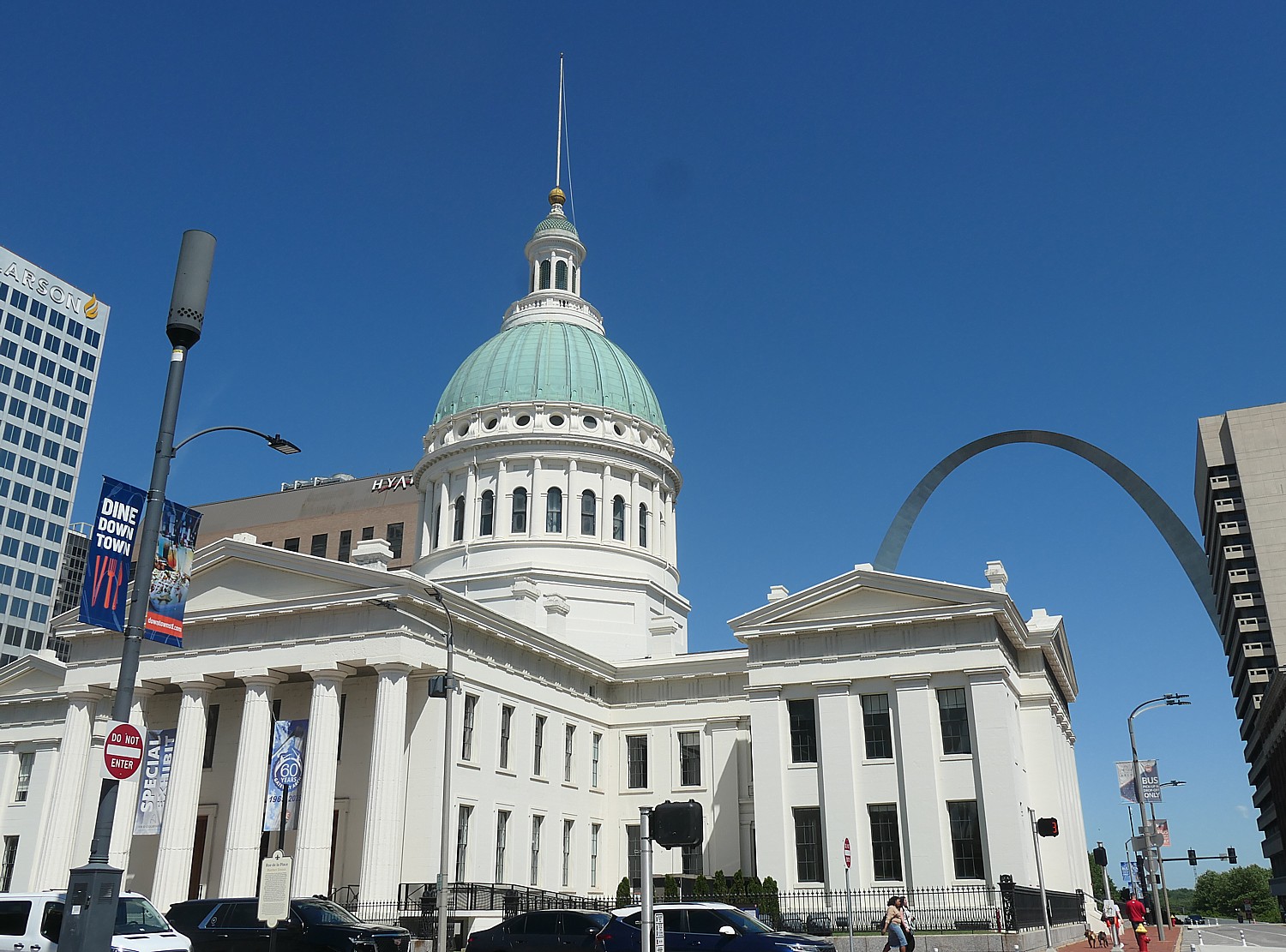
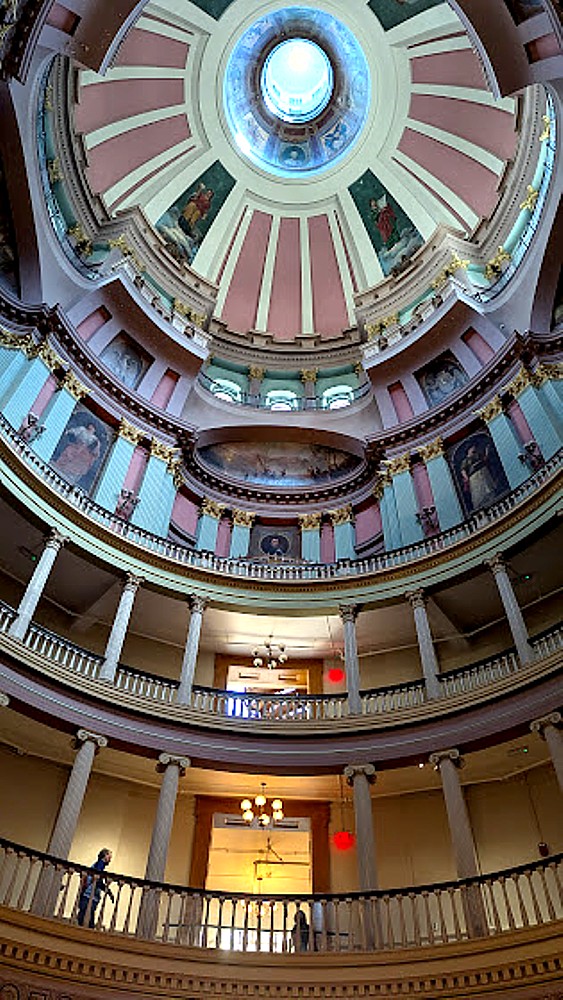
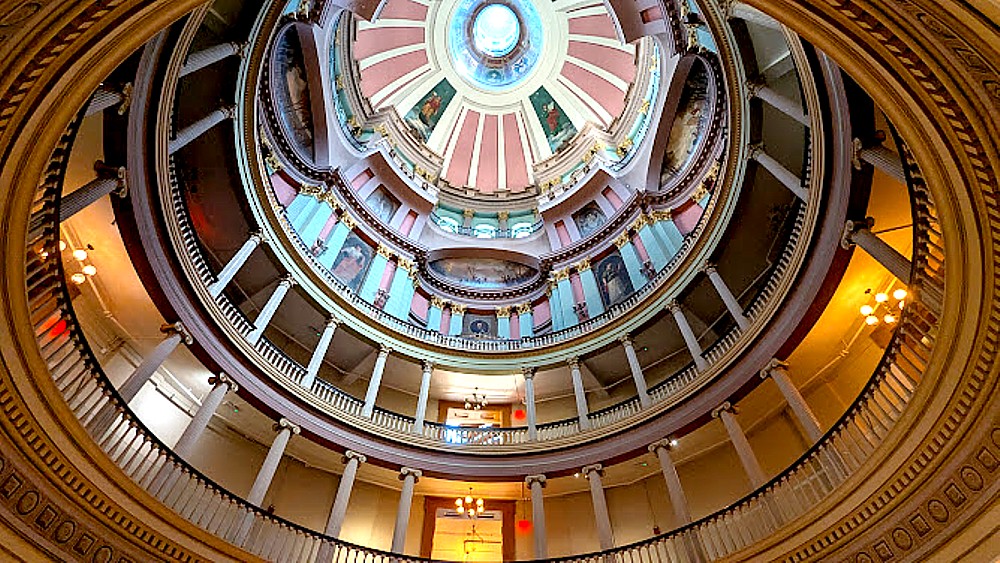
Touring the Old Courthouse is one discovery after another, beginning with its spectacular dome, architecture and stunning murals of historic scenes and important historical figures. I explore the four new museum galleries and the restored historic courtroom that opened in May 2025 after a five year, $24.5 million renovation, 2020-2025.
The Old Courthouse is actually part of Gateway Arch National Park. I find a National Park Service ranger in the spectacular lobby beneath a dome, and am amazed to learn the infamous Dred Scott case began here (two trials!) and would have ended in his favor were it not for the Supreme Court and its dastardly Dred Scott decision.
The ranger gives me a brief synopsis: The Old Courthouse was the site of the first two trials of the pivotal Dred Scott case in 1847 and 1850 before the infamous Supreme Court “Dred Scott decision” in 1857. I later learn that this was also where Virginia Minor‘s case for a woman’s right to vote came to trial in the 1870s. It was last used as a courthouse in 1930
Sufficiently intrigued, I go off to see the new exhibit, simply named, “Dred and Harriet Scott,” a detailed biography of Scott and his wife, and their legal struggle. The story is not anything that is taught anywhere else, which more typically reduce Dred Scott to the Supreme Court decision, and not a person, and, as I discover, a story worthy of an opera.
I can only wonder if these exhibits will survive Trump’s anti-DEI crusade manifest in an executive order in 2025 called “Restoring Truth and Sanity to American History” executive order directing federal historic sites to “avoid showing content that disparages past or present Americans” – in essence erasing Black history and struggle for civil rights, women’s rights, human rights, and what was and is still being done to native peoples. (In Philadelphia, the National Park Service was ordered to replace slavery interpretive panels at the President’s House.)
It would be a terrible shame, though, because the exhibit is absolutely fascinating, revelatory, and pretty much this is the only place to appreciate it. Most of us only know the Supreme Court’s Dred Scott decision and do not know what led up to it, that for the 11 years the case was being argued and decided, Dred and Harriet Scott were prisoners of the sheriff, who hired them out and kept their wages. All during this period, the Scotts secreted their daughters away to protect them from being enslaved.
I learn that Scott was suing for his freedom from Irene Emerson, who inherited him upon the death of her husband, Dr. John Emerson, on the basis that his previous owner had taken him to a free territory, and under Missouri law (and the Missouri Compromise), if a slave or freed person lived in a free territory, they could not be re-enslaved. The first case was dismissed on a technicality (“hearsay”!), but the second case, which went to a jury of 12 white men (what else?), agreed that Scott was free. But Irene Emerson appealed up to the Supreme Court.
The Supreme Court’s 7-2 decision by Justice Roger B. Taney stated that Dred Scott did not have the right to sue for his freedom because he was not a citizen and Black people, enslaved or free, were not part of the original sovereign people so could never become citizens because they were not people but property; the Constitution’s protection of property rights overruled their human right to be free.
But in a fascinating turn of events, by then, Irene Emerson had married a Massachusetts politician, Calvin Chaffee, who ran for the US Congress in 1854 on the anti-slavery America Party Ticket, and was reelected in 1856; he only became aware of his wife’s connection to the Scotts in May 1857). He would have been mortified to be found to own slaves. So, to get rid of the embarrassing, inauspicious problem, sold the “title” to the Scotts to a descendant of the Blow family which had originally owned Dred Scott and who had actually provided financial support to the Scotts while the case was going on and who purchased the couple in order to emancipate them. Meanwhile, the Scotts, who had sent their two daughters away so they could not be captured and enslaved, were reunited.
Dred Scott was 48 years old when he initiated his suit for freedom (since he was illiterate and poor, it is assumed that he was encouraged by an abolitionist who guided him through the process). The operatic tragedy continues because after finally winning his freedom, his family lived in poverty (Irene Emerson kept the wages the Scotts earned during the 11 years of their arrest) and Dred Scott lived less than a year as a free man before dying of tuberculosis at the age of 59.
What I realize is that the landmark Dred Scott decision in effect nullified the Missouri Compromise that was put into place to forestall a Civil War; the decision intensified boiling national tensions and helped spark the Civil War. You also appreciate the lasting legacy and ongoing relevance of their case today. (You can hear reverberations of the Taney decision in Trump’s effort to overturn birthright citizenship enshrined in the 14th Amendment, which states that all persons born on U.S. soil and subject to its jurisdiction are citizens, no ifs, ands or buts.)
The exhibit includes A Bid for Freedom, an excellent 4 ½ minute video reenacting a hypothetical conversation between Dred and Harriett Scott, in which they discuss the risks to their family if they sue their enslaver for their freedom at the Old Courthouse and the risks they face if they don’t.
Pathways to Freedom gallery is another eye-opener. It personalizes African American life in St. Louis during the era of slavery and beyond, tracing the struggles of enslaved individuals seeking freedom, the continued fight for civil rights after the Civil War, and the rise of the Black elite known as the Colored Aristocracy, who built wealth and influence in the 1800s. Here you get an appreciation for the resilience, resistance, and influence of African Americans in St. Louis from slavery onward, with disturbing echoes as these struggles have resurfaced throughout the country today, as if the struggles of1865-1965, and brief period of progress and societal awareness, from 1965-2025 had been erased.
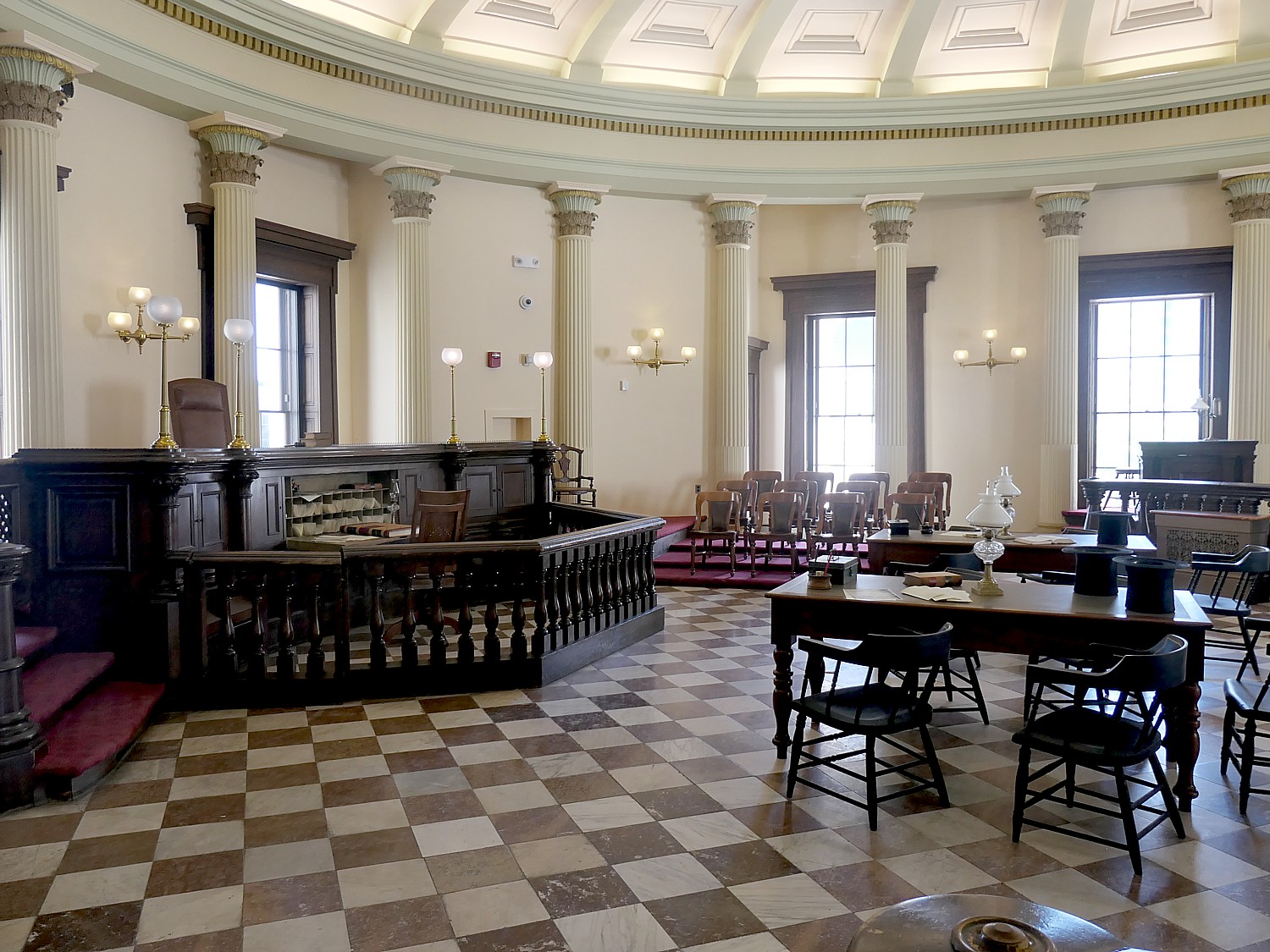
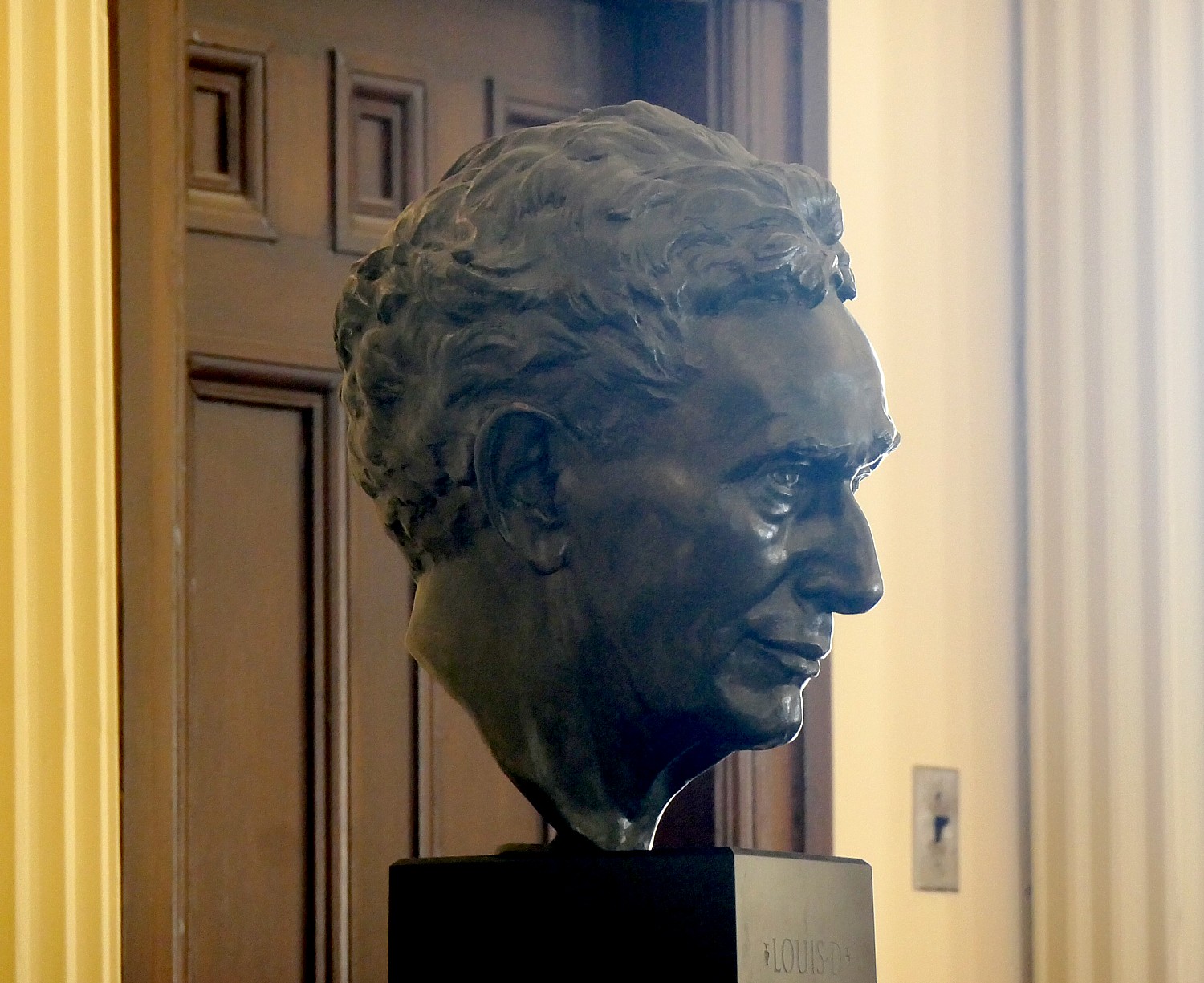
See You In Court, housed in a recreated 1850s courtroom, highlights the vital role courts have played in shaping our society, legal system, and daily life from 1839 to 1930. Visitors can explore the courtroom and even participate in mock trials, gaining a deeper understanding of how the court system helps resolve conflicts peacefully and supports the structure of our society (another important lesson for today, to remind of the foundational importance of the Rule of Law, without fear or favor.) I note the bust of Louis Brandeis, the first Jew to become a Supreme Court Justice, who was formally admitted to the Missouri Bar here on November 21, 1878.
One of the oldest buildings in St. Louis, the Old Courthouse is significant for its Greek Revival architectural style, engineered dome, and interior murals. In 1838, the County of St. Louis selected Henry Singleton’s cruciform plan with a central rotunda to replace the existing smaller courthouse. Construction started in 1839 and it opened in 1845 (just one year before the Scotts filed their suit). At this time emigrants traveling westward on the Oregon and California trails often stopped and gathered provisions in St. Louis, the “Gateway to the West,” and would meet up in the Old Courthouse rotunda. The present dome, which replaced a smaller one in 1862 (while the Civil War was going on, and the Capitol Dome in Washington DC was under construction), was designed by architect William Rumbold and was one of the first of its type. After the dome alteration, American painter Carl Wimar was commissioned to design four lunettes in the building’s interior. In 1976, the Old Courthouse was listed in the National Register as a component of the Jefferson National Expansion Memorial.
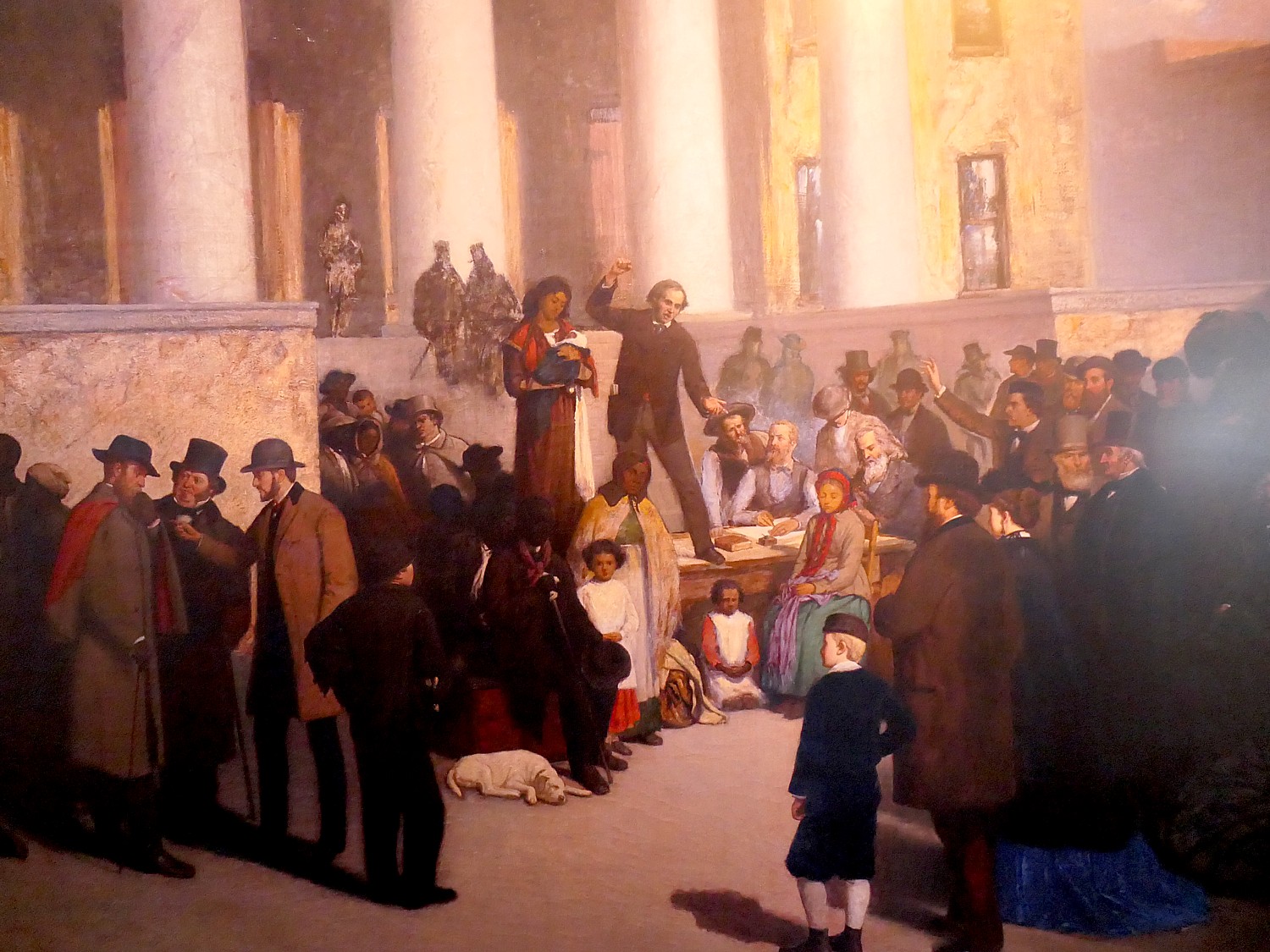
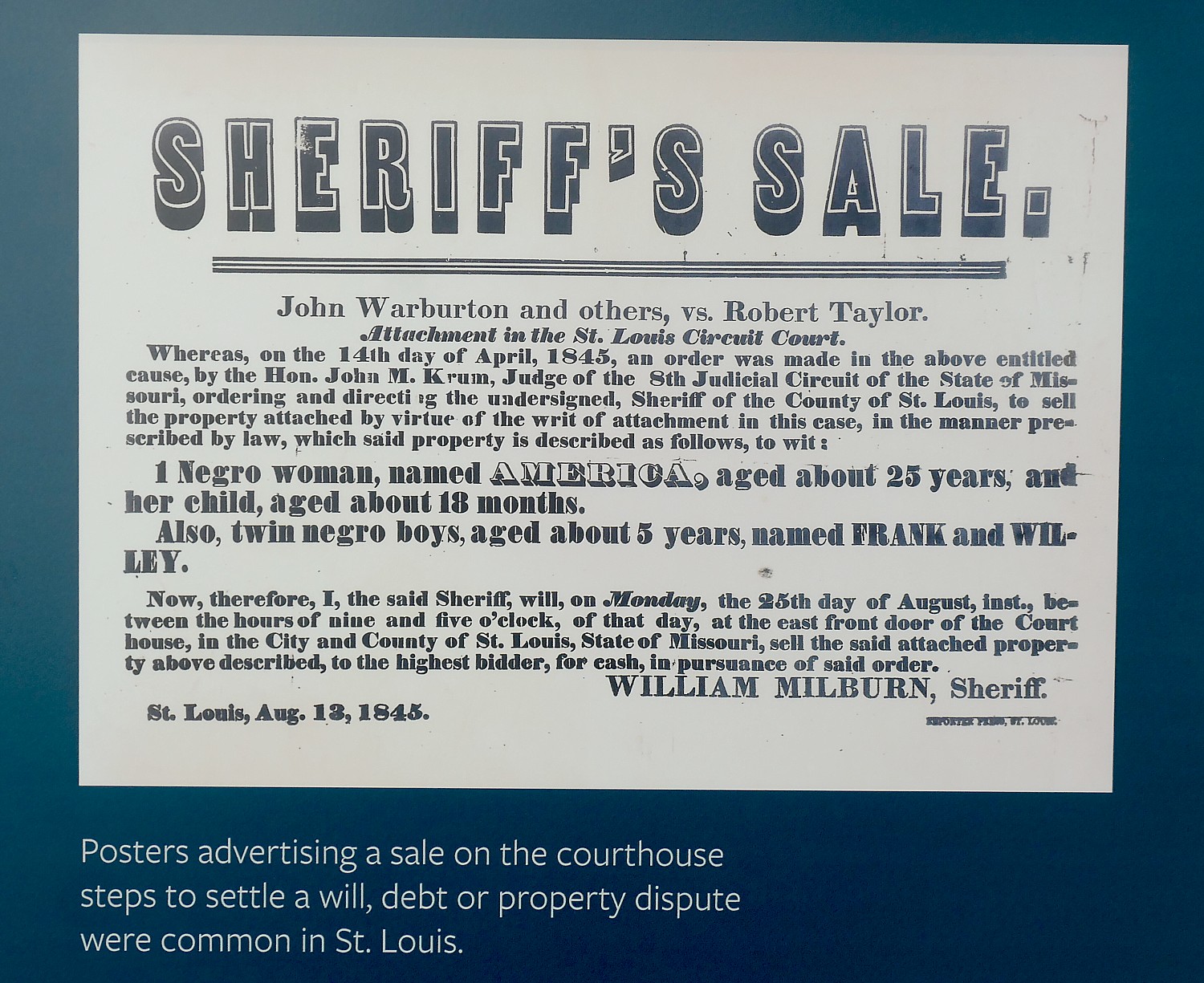
Largely because of the Dred Scott case, St. Louis’ Old Courthouse is included in the National Park Service’s National Underground Railroad Network To Freedom – places of “historic resistance to enslavement through escape and flight.” The Old Courthouse is linked with the Underground Railroad as a place associated with legal challenges to slavery. Slaves were auctioned from its steps in estate settlements, and the Old Courthouse was the site of hundreds of suits for freedom.
The city gave the Old Courthouse to the National Park Service for inclusion into Jefferson National Expansion Memorial in 1940, which was renamed Gateway Arch National Park by an act of Congress in 2018.
Plan to spend at least an hour, more likely two in the Old Courthouse.
National Park Service rangers provide guided tours of the building every day at 2:15 pm (only rarely cancelled due to staff availability). The tours cover the architecture and history of the building and the court cases associated with it. (No tickets or reservations necessary.)
The Old Courthouse is open daily from 9 am to 5 pm (closed on Christmas, Thanksgiving, and New Years Day). There is no admission fee.
From here, I leave the Old Courthouse through the riverfront exit on my way to the Gateway Arch, about two blocks further, stopping at a stunning statue of Dred and Harriet Scott.
It’s become my practice to arrive at least a day early for a tour or cruise – to take into account any unforeseen travel delays but also to spend at least a day to explore.
With a 6:30 am pick up time for my Wilderness Voyageurs six-day bike tour on the famed Katy Trail 240-miles through Missouri, this wasn’t even an option. So knowing I would be flying into St. Louis (about 25 minutes away from the pick-up), I took the opportunity to have a good portion of a day to explore this history- and culturally-rich city.
My first step is always to seek out a Historic Hotels of America member property because I know staying in a historic hotel will enhance my appreciation for a destination– these properties are integral to a place, even characters that typically play a part in its story, are always architecturally and culturally interesting and can be depended upon to be walking distance or close proximity to the what want to explore.
That was definitely the case for my stay at the 21c Museum Hotel in St. Louis, with a marvelous story, gorgeous architecture, set amid the city’s important historic and cultural structures, and most importantly, a delightful 20-minute walk to Gateway Arch National Park, which was top of my list to see. But it had something more: an important art gallery, that, I learned, is the essence of this hotel brand of six 21c Museum Hotels.
The 21c Museum Hotel St. Louis started its story as a community hub when it opened as a central branch of the St. Louis YMCA in 1926, and this year is celebrating its 100th anniversary and its third anniversary as a hotel.
You might imagine a YMCA as a modest, even institutional structure, but this one was built as an architectural gem.
It was originally constructed by architects Louis LaBeaume and Eugene S. Klein in the Renaissance Revival style as the central branch of the St. Louis YMCA, and was the organization’s largest local branch and a major community hub until 2017. Due to its architectural significance and deep ties to the city, the building was listed on the National Register of Historic Places.
21c Museum Hotels revived the 10-story YMCA building, preserving its historic architectural elements like the original indoor pool, billiards room, and gymnasium and reasserting the space’s relevance as a gathering point in the heart of St. Louis. The hotel opened and became an official member of Historic Hotels of America in 2023.
Today, the 21c Museum Hotel St. Louis is a 173-room boutique hotel which is not just a hotel with an art gallery, but houses a major contemporary art museum. It features 14,000 square feet of curated gallery space (much of it in what used to be the basketball court, and open free of charge to the public 24-hours a day (guests have to use their room card in the elevator to access the room floors).
“Infusing the extraordinary into daily life, radical access to contemporary art is the modus operandi of 21c St. Louis,” the notes read. “Dynamic and thought-provoking curated exhibitions reflect the global nature of art today.”
Indeed, I was enthralled by the exhibit on view during my stay, “The Future Is Female”; the current exhibit “Revival: Digging Into Yesterday, Planting Tomorrow” is on view through January (https://21cmuseumhotels.com/museum/revival/). (The exhibits typically rotate among the 21c Museum Hotels.)
Paying homage to its YMCA roots, the 10,500-square-foot full-service Locust Street Athletic and Swim Club boasts a stunning, tiled indoor four-lane lap pool you might confuse for a millionaires’ mansion, sauna, steam rooms and offers spa services.
Other features include the Idol Wolf restaurant serving Iberian-inspired dishes; the Good Press Café; a stunning lobby bar, and a lounge with pool table.
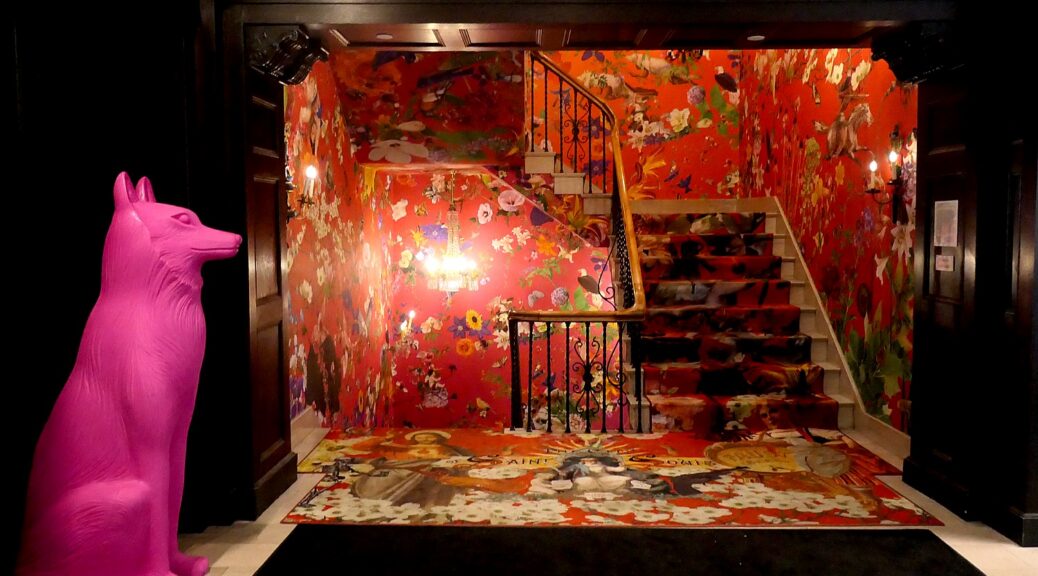
The art spills over throughout the building so you never know what you will come upon, causing surprise and delight. Even the staircase between floors is a work of art.
The property is known for its playful, colorful penguin sculptures scattered throughout the public spaces – a feature of the 21c Museum owners. Guests can even request to have one “adopted” and placed in their room during their stay.
The penguins first debuted at 21c Museum Hotel Louisville. 21c founders Laura Lee Brown and Steve Wilson had purchased the sculptures after seeing the joy they evoked from onlookers at the 2005 Venice Biennale public art project. Now perched around 21c Museum Hotels (each 21c has its own flock of penguins in the color that embodies the city’s identity), the playful penguins contribute to the hotel’s mission of making contemporary art more accessible to the public.
And while there is art everywhere and stunning interior design, it is not at all forbidding or unapproachable, but warm and welcoming, even comfortable. You feel very much a part of the “club.” And it is easy to see why 21c Museum Hotel Louisville was named to the Historic Hotels of America’s 2025 Top 25 Historic Hotels of America for a Romantic Proposal – indeed, I spot a bridal couple in an embrace, posing for their photos.
The 21c Museum Hotel also honors its original commitment to community, from its days as the YMCA, collaborating with its neighbors and community partners to ensure the historic establishment’s presence extends beyond its walls. Guests can enjoy poetry evenings, attend artist demonstrations, and support local creators during their stay.
From the hotel, I wander to see the Mississippi River as it winds through St. Louis. I stroll through the Citygarden Sculpture Park on the way to the riverfront – a green area filled with beautifully landscaped lawns, cooling water features including sprinklers for children to play in, and striking sculptures. At the riverfront, you can take a cruise on a 19th-century paddlewheel riverboat or cycle along the river on bike paths that connect Missouri from downtown St. Louis to the Old Chain of Rocks Bridge, a historic Route 66 landmark.
I am bound for the Gateway Arch National Park, coming upon the Old Courthouse, which I realize was the site of the first two trials of the consequential Dred Scott case in 1847 and 1850 (see next).
But St. Louis is, no doubt, a sports city.
Besides being integral to St. Louis’ historic and cultural attractions, the 21c Museum Hotel is close by to St. Louis’ key sports destinations that are a big lure to the city: Energizer Park, a 22,423-seat soccer-specific stadium and 32-acre urban sports district in downtown St. Louis; Enterprise Center, an 18,096-seat indoor arena located at 1401 Clark Avenue in downtown St. Louis, that is home venue for the St. Louis Blues professional hockey team and hosts major concerts, family shows, and basketball tournaments. It is also a short ride away from Busch Stadium, the 45,000-seat stadium that is home base for the Cardinals baseball team.
The hotel offers an “Ultimate Cardinals Experience” that includes a $10 Uber credit to Busch Stadium, a 4-pack of local 4 Hands City Wide brews and a $25 credit (per stay) to be used at Idol Wolf or Good Press
Year round there are special packages to meet the mood and the season. Some recent examples:
Celebrate Mother’s Day with breakfast in bed with in-room dining from Good Press café, a rejuvenating spa treatment at the historic Locust Street Athletic and Swim Club, tour the art exhibition and end with a show-stopping Spanish-meets-midwest dinner at Idol Wolf.
Yoga with Art: Beginners are welcome for Hatha Yoga Mondays and Wednesdays at 5:30 pm. (Drop-in passes can be purchased at the front desk at Locust Street Athletic and Swim Club).
Nightcap At The Museum: 21c Museum Hotel guests are invited to join the hotel every night for a complimentary late-night Angel’s Envy Bourbon sip and explore the museum exhibitions as the night winds down. Visit the restaurant bar from 8 pm-late and enjoy a pour with new friends, wandering around the galleries, or cozied up in your room.
There are currently six 21c Museum Hotel locations operating in the United States, managed as part of the Ennismore and Accor collection: Louisville, Kentucky (Flagship); Bentonville, Arkansas; Durham, North Carolina; Lexington, Kentucky; Kansas City, Missouri; and St. Louis, Missouri
21c’s chef-driven restaurants and bars highlight the brand’s Kentucky roots – so expect a healthy assortment of Bourbons behind the bar. You can explore the spirits and cocktail programs at: Idol Wolf, 21c St. Louis; Lockbox, 21c Lexington; Metropole, 21c Cincinnati; Proof on Main, 21c Louisville; The Hive, 21c Bentonville
21c Museum Hotel, 1528 Locust St., St. Louis, MO 63103, reservations: 888-831-7077, 21cMuseumHotels.com
A member of Historic Hotels of America since 2023, 21c Museum Hotel St. Louis has been named to these Historic Hotels of America Top 25 Lists:
Historic Hotels of America is a membership organization comprised mostly of independently owned and operated historic hotels but also from some 30 of the world’s major hospitality brands, chains and collections, and from 44 states, the District of Columbia and Puerto Rico. To be selected for membership into this prestigious program, a hotel must be at least 50 years old; been designated by the U.S. Interior Secretary as a National Historic Landmark or listed in or eligible for listing in the National Register of Historic Places; and recognized as having historic significance.
These historic hotels have all faithfully maintained their authenticity, sense of place, and architectural integrity. HHA members occupy buildings that date as early as 1651. Many are the site of key events in regional, national, or international history or have played host to famous figures, from heads of state and industry titans to writers and movie stars. Some hotels are also intertwined with the country’s cultural history, either as venues or culinary hotspots. As a historic preservation and hospitality program focused on experiences, Historic Hotels of America supports cultural heritage tourism and sustainability.
(Its sister organization, Historic Hotels Worldwide® is a global collection of more than 300 historic hotels in more than 40 countries, including castles, chateaus, palaces, academies, haciendas, villas, monasteries, and other historic lodging spanning ten centuries, historichotels.org.)
Historic Hotels of America® is the official program of the National Trust for Historic Preservation with the mission to increase the preservation, recognition, and celebration of the finest historic hotels in the USA.
For more than 70 years, the National Trust for Historic Preservation has led the movement to save Americas historic places. A privately funded nonprofit organization, it works to save America’s historic sites; tell the full American story; build stronger communities; and invest in preservation’s future.
Missouri’s Katy Trail, a Rails to Trails Conservancy Hall of Famer, is for bikers who want to ride 240 miles with pure abandon, with not much to distract unless you want to be distracted – such as by the historic markers that are fascinating, complete, and an excellent guide to what to look out for what I guarantee you would never have thought to look for.
Day 4 on Wilderness Voyageur’s six-day Katy Trail bike tour is another vigorous ride, 47.8 miles from the Missouri state capital, Jefferson City, to Hermann (elevation plus 772 ft, down 821 ft).
Starting out, though, we go back up that hill that provided such a dramatic view of the Capital Building the day before, back to the bridge over the river, and down the winding ramp (fun!), to the spur that brings us back onto the Katy Trail exactly where we turned off the day before.
Now we are back in Missouri’s farm land and a landscape that seems unchanged in 100 years. We ride passed fields of corn and soy, with the Manitou Bluffs in the distance beyond the plain.
What is so impressive all along the Katy Trail is Missouri Pride – it is evident in the meticulously planned rest stops and restored train depots, the historic notes at each one, the placards and markers and stories all along the trail that trigger our imagination as we ride, even on big posters and billboards and signs on buildings and silos. A city kid, I no sooner question in my mind how those grain silos work than we come upon an exhibit that explains the revolutionary invention.
That pride is especially clear here at Tebbets, our first rest stop.
Tebbets is where there is the volunteer-run Turner Katy Trail Shelter, the only bike hostel centrally located on the Katy’s 240 miles (the key hangs on a light pole), which was a home donated by its owner.
We ride through Rhineland, which I learn was the third largest producer of wine in the world before Prohibition dried it up. This is one of the few places where the Katy Trail follows a different path from the Missouri-Kansas-Texas railroad (the call sign, K-T). The town was destroyed by the flood of ’93, and moved along the bluff.
We ride along highway Route 93 (not really scary, actually, there is a wide shoulder), and over the bridge (there is a bike path over the bridge but getting there involves doing a clover leaf maneuver) that brings us into the town of Hermann.
We stay at the Hermann Crown Suites – which sounds like a modern chain hotel but is actually a charming historic hotel. It is a fun place – there is live music in its patio area in the evening, or if it is raining, in their 1837 Cellar Bar – and we are treated to a welcome drink (or ice cream, which I prefer).
We get here early enough to wander around the town checking out a remarkable selection of boutiques and shops before they close, and a beautiful riverside park. We check out the famous Hermann Wurst Haus.
The German-feel to Hermann is not imaginary – the town was founded in 1836 as the “New Fatherland” for German settlers.
We come upon the red brick German School, built in 1871 but incorporated in 1849 by the state legislature to offer classes in German and English. The structure was the only privately owned public school building in the state when it was deeded to historic Hermann Inc in 1955 to be preserved and used for cultural and civic purposes.
There is a plaque on the Monnig Family General Store which basically epitomizes America’s immigrant experience: Otto Monnig, who migrated with two of his brothers from Rees, Germany to the US in the 1840s, operated his general store from 1870 to 1890. He started with hardware and cutlery and expanded to add clothing, toys, groceries. Otto’s son-in-law, Dr. Gustave Ettmueller opened a drug store and post office in the building. Otto Monnig also founded the Hermann Savings Bank and served as president, 1867-1883.
Hermann’s historic district has many marvelous buildings to explore. They date back to early 19th century, but the vibe is 1940s/1950s – from the signs, the products.
We’ve been riding on what used to be the Missouri-Kansas-Texas rail line but In Hermann, we see an actual Amtrak train pulling out from the station just above the riverbank.
Dinner is on our own and there are lots of places to choose from, returning to the hotel for the live music on its back patio.
Day 5 is a 38 mile ride from Hermann to Augusta, almost entirely flat. We ride back on I-93 and back over the bridge to where we had left the Katy Trail.
The first support stop is at 18.5 miles (versus 9 miles which is more typical) at Treloar – and to get there, we need to make a 3 mile detour on roads because just the prior week, a storm put a tree across the trail (just ahead of the last Wilderness Voyageurs group so our guide James Oerding had to find a way around).
We stop at the Treloar Mercantile building, built around 1896 which served as the dry goods store and post office until closing in 1933. Dan and Connie Burkhardt, who created a foundation to preserve land and historic structures (katylandtrust.org), bought the building in 2018 and donated it to Missouri State Parks in 2024. It is being refurbished, and I chance upon the Burkhardts and the former state Transportation Secretary, David Kelly, who directed the building of the Katy Trail State Park and now is on the board of Magnificent Missouri, overseeing the restoration. There is a marvelous historic exhibition inside.
It is with justified pride that Kelly relates that the last economic impact study showed the Katy Trail generated $18 million for the state – a figure that is much higher after COVID. “There was a big uptick in users after COVID because people discovered the health benefits, and being outdoors.”
He acknowledges that places like Hartsburg (population 138) and Rotheport (population239) would be ghost towns were it not for Katy Trail and the tourism traffic it brings.
Of Missouri’s 93 state parks, the Katy is the most unique: 100 ft wide and 240 miles long. Missouri is now developing the 144-mile long Rock Island corridor, which opened 2021, of which 47 miles connect to the Katy Trail (so you can ride a loop).
Katy is the longest developed rail trail in US and Rock Island will be 4th largest; when combined with 13 miles in Jackson County, it forms a 445 mile long corridor to Kansas City.
Katy Trail State Park is built on the corridor of the former Missouri-Kansas-Texas (MKT) Railroad, better known as the Katy. When the railroad ceased operation on its route in Missouri from Machens in St. Charles County to Sedalia in Pettis County in 1986, the right-of-way was secured through funding from the late Edward D. “Ted” Jones Jr. (the son of the founder of Edward Jones Investments) and his wife, Pat. Construction of the Katy Trail began in 1987. The first section of trail at Rocheport was opened in 1990.
In 1991, the Union Pacific Railroad donated 33 miles of rail corridor from Sedalia to east of Clinton. Additional purchases and donations were added over the years, completing the final 240-mile trail with Machens as the eastern terminus and Clinton as the western terminus. The trail’s 25th anniversary was celebrated in 2015.
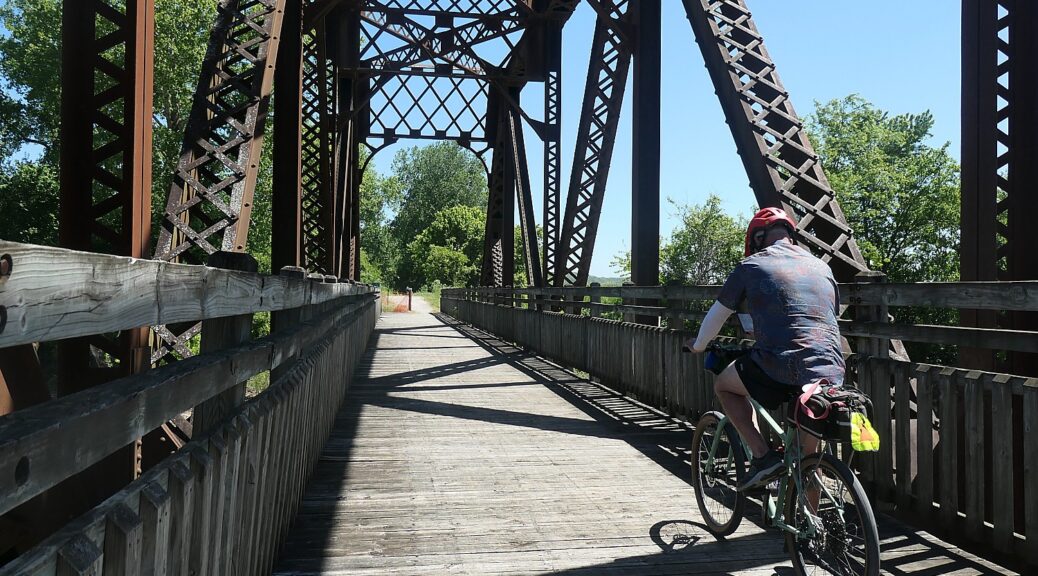
As we ride the Katy Trail, we are reminded of the trail’s railroad history, passing old telegraph poles, riding over truss and trestle bridges. Four fully restored historic depots recall the past splendor of passenger service on the MKT, while the stone railroad tunnel at Rocheport displays the ingenuity required to complete the MKT rail line.
Meanwhile, Dan and Connie Burkhardt, retired partners of Edward Jones investment company, continued Jones’ legacy by founding the Katy Land Trust in 2010, which works cooperatively with landowners along the Katy Trail corridor to preserve farms, forests and Missouri River valley (katylandtrust.org).
Four miles further is the Peers Store, the “Magnificent Missouri” outpost, with a mission to conserve and increase appreciation of the Katy Trail and the last 100 miles of the Missouri River Valley, from Hermann to Confluence. Here, there are live music on the porch from June through August, art, snacks and community (magnificentmissouri.org).
We ride through tiny towns that reflect French and Native American influence. The furthest European settlements west of the Mississippi were in this region when Lewis & Clark first passed through in 1804. French fur trappers were prevalent settlers here.
A highlight today, is taking a bit of a detour off the Katy Trail to visit where Daniel Boone and his wife were buried. (They make no bones of the fact their bodies were supposedly moved from here back to Kentucky, but leave a bit of mystery in saying that the wrong bones may have been taken and Daniel may still be buried here after all.)
I first miss the turn but convince our guide, James Oerding, to go back (again, I am last, so the guide rides behind me). And I’m glad I did.
The small cemetery is very interesting, and is adjacent to his sons’ homestead (Daniel is said to have stayed there for a short time). It is interesting to see how Boone was so revered. (I think I am the only one of our group who did the detour.)
A marker at the rest stop relates how Daniel Boone, his sons’ and daughters’ families, other relations, friends and family slaves, came to Missouri in 1799 when Boone was 65 years old and already famous in America and Europe. He had fought in the French and Indian and Revolutionary wars. In between, he explored Kentucky and Tennessee and helped blaze the Wilderness Road over the Appalachian Mountains that settlers followed. In Kentucky, much of Boone’s fame was based on battling the Shawnee Indians who (understandably) resisted American expansion into Kentucky’s “dark and bloody ground.” But Boone “soured” on Kentucky. Spain, which then controlled the Louisiana Territory. was anxious to have settlers come, especially one as respected and influential as Daniel Boone, so Spain “recruited” Daniel Boone to come to Missouri, appointing him “syndic” (a justice of the peace) and militia leader. (I hadn’t realized until I visited the Gateway Arch National Monument in St. Louis that the Louisiana Territory went back and forth from France which claimed it in 1682, to Spain in 1762 through a secret Treaty of Fontainebleau, then (secretly) back to France in1800, before France sold the Louisiana Territory to the US in 1803. The whiplash!
We ride through Marthasville (named for Martha Washington) and end today’s ride at Augusta where we are shuttled (the only time we are taken by the van to our hotel) into the charming town of Washington, where we first have lunch at a fun spot, John G’s Beir Deck (delicious bratwurst and coleslaw). We walk off lunch to where we overnight, Elijah McClean’s, a wonderful inn attached to a mansion, now a restaurant where we will have a grand dinner.
Along the way, we pass by the Meerschaum’s Corn Cob Pipe factory, the only corncob pipe factory still operating in the world (James tells us) – unfortunately, it is already closed so we can’t visit.
After settling into my hotel room, I walk back to Main Street and come upon a community concert at the Farmer’s Market, held weekly on Thursdays, 5-8 pm (for future Katy Trail riders). It is wonderful, especially when people start line dancing.
On Day 6, our last day, I have my only regret of the trip: I forget to stay for James’ whiteboard talk that would have told me to look for the spur marked “Klondike Park” just 2.5 miles from where we start, to a steep asphalt trail that would have taken me to a white silica sand lake you can ride around. (Only one of our group actually did it). The photos I see at the rest stop look amazing and I’m tempted to ride the four miles back (I was so proud of myself for being first for a change), but I think it would take too much time. People were pretty much hurrying to get to the end of the ride when they would disperse to travel back home and I feel self-conscious if I would hold people up. (Actually, we have lunch at a restaurant at the end of the trail, and people who need to leave early just don’t stay for it so there would have been lots of flexibility).
We gather there for a delicious farewell lunch at Hendricks BBQ.
Then we are shuttled back to the St. Charles hotels where people parked. Only two of us are flying (we were advised not to book our flight before 6 pm).
The Katy Trail bike tour is rated a 3 not because of the trail’s difficulty, which is as easy as any dedicated recreational rail trail 240 miles long and as superbly served and maintained can be, – but because of the daily mileage, between 38 and 50 miles each day, except for the last (vastly easiest), 27 miles level or even with a slight downward slope.
This is my third tour with Wilderness Voyageurs (my first was the Badlands and Mikkelson Trail in South Dakota – I even had James as my guide on that trip – and Wilderness Voyageurs also provided the support for Rails to Trails Conservancy’s Sojourn biking/camping tour on the Great Allegheny Passage which goes passed its headquarters at Ohiopyle, PA.
Wilderness Voyageurs consistently provides sensational support – before the trip (with planning and packing lists, questionnaires) and most especially, during the ride (I love the Ride with GPS, the notes they provide and our daily ride orientation and especially their philosophy, “Ride your own ride.”), they even have on hand cold drinks, ice water, sunscreen, chafing cream, and each day organize two rest stops (great snacks) and a delicious picnic lunch. They also book the absolutely best lodgings and restaurants, like the Schoolhouse BnB and the General Store Restaurant in Rocheport where they arranged a private dinner for us. The guides are excellent and if necessary, can pick you up in the van should the distance or the elevation be uncomfortable. All of this makes what you pay for a guided bike tour well worth it.
Indeed, bike trips are ideal for solo travelers (there are four of us on this trip) – a way to travel on our own, but not alone.
By Karen Rubin, editor@news-photos-features.com, news-photos-features.com
The US Navy Blue Angels headlined a very special Four Leaf Air Show at Jones Beach, this year honoring America’s 250th anniversary, so moved from the traditional Memorial Day Weekend to July 5 and 6. Some 268,000 turned out for the event on Monday; unfortunately, Tuesday’s show was cancelled for rain.
The Jones Beach event was special in other ways, as well, featuring more international participants than ever, including the first-ever visit to the United States by the United Arab Emirates aerobatic team, Fursan Al Emarat. The United Kingdom sent its Royal Air Force Aerobatic Team, the Red Arrows, and its British Army Parachute Display Team, the Red Devils, and Canada sent the Canadian Forces Snowbirds (431 Air Demonstration Squadron).
In a stunning and spectacular and surprising move, the Canadian Snowbirds joined the British Red Arrows to pay special honor for America’s 250th.
The event also featured Aaron Deliu, an Australian professional aerobatic pilot who is becoming a U.S. citizen, as well as local favorites, Farmingdale State College Flying Rams, historic “warbirds” from the American Airpower Museum, and the 106th Rescue Wing of the NY Air National Guard.
By Karen Rubin, editor@news-photos-features.com, news-photos-features.com
Hundreds of thousands turned out for a very special Four Leaf Airshow at Jones Beach, this year honoring America’s 250th anniversary, so moved from the traditional Memorial Day Weekend to July 5 and 6. The headliner, the U.S. Navy Blue Angels, also led the flyover at the July 4th Sail4th 250 event, leading some 200 aircraft.
The Jones Beach event was special in other ways, as well, featuring more international participants than ever, including the first-ever visit to the United States by the United Arab Emirates aerobatic team, Fursan Al Emarat. The United Kingdom sent its Royal Air Force Aerobatic Team, the Red Arrows, and its British Army Parachute Display Team, the Red Devils, and Canada sent the Canadian Forces Snowbirds (431 Air Demonstration Squadron).
In a stunning and spectacular and surprising move, the Canadian Snowbirds joined the British Red Arrows to pay special honor for America’s 250th.
The event also featured Aaron Deliu, an Australian professional aerobatic pilot who is becoming a U.S. citizen, as well as local favorites, Farmingdale State College Flying Rams, historic “warbirds” from the American Airpower Museum, and the 106th Rescue Wing of the NY Air National Guard.
The 268,000 spectators who crammed the beach and boardwalk for the FourLeaf Air Show at Jones Beach State Park on Sunday, July 5, was the second-highest attended air show in the park’s history. Unfortunately, Monday’s show was rained out.
Here are highlights of what you saw or what you missed:
To mark the opening of the Tang Wing for American Democracy, The New York Historical has expanded hours until 8 pm on Thursdays through Saturdays from June 18 to July 4. Admission during expanded hours on those dates are pay-as-you-wish admission from 5-8 pm.
Also enjoy “Songs of America,” a vibrant lineup of live music performances taking place at the Museum in collaboration with Jazz at Lincoln Center, featuring music from across 250 years of the nation. Performances are free with pay-as-you-wish admission during expanded hours from June 18 to July 4.
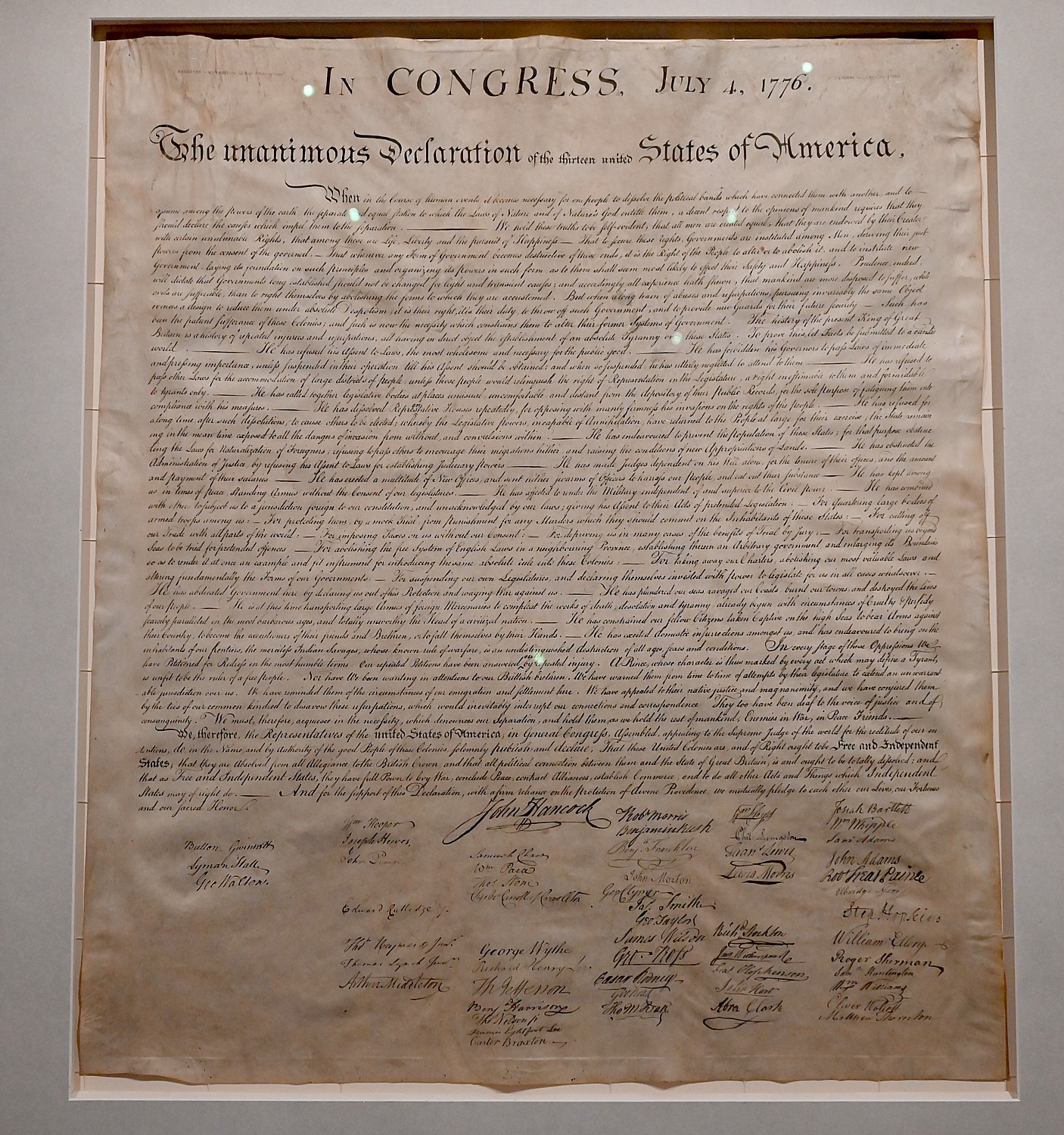
And see a rare printed copy of the Declaration of Independence, on view through July 5.
By Karen Rubin, Travel Features Syndicate, goingplacesfarandnear.com
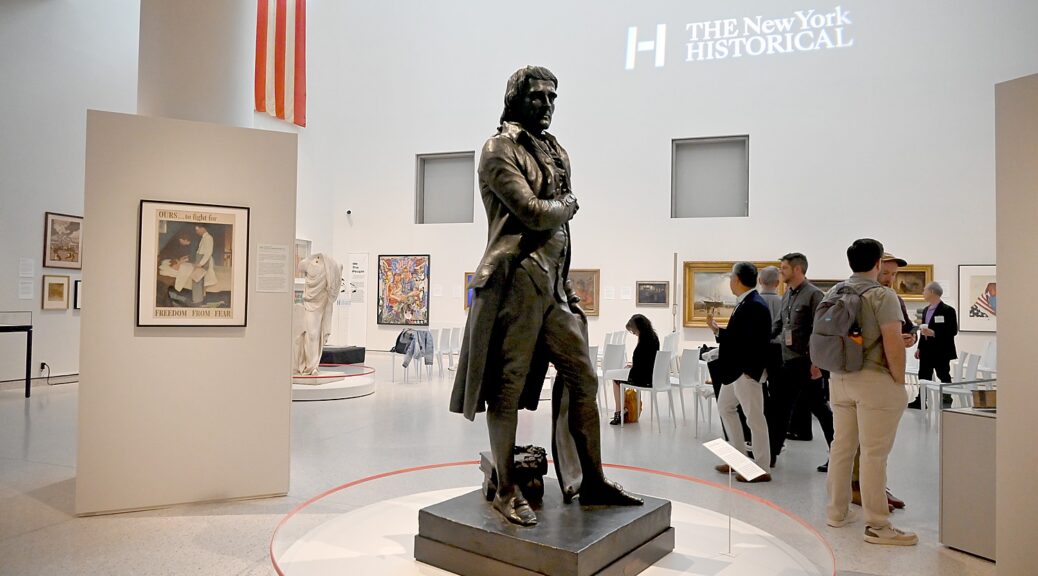
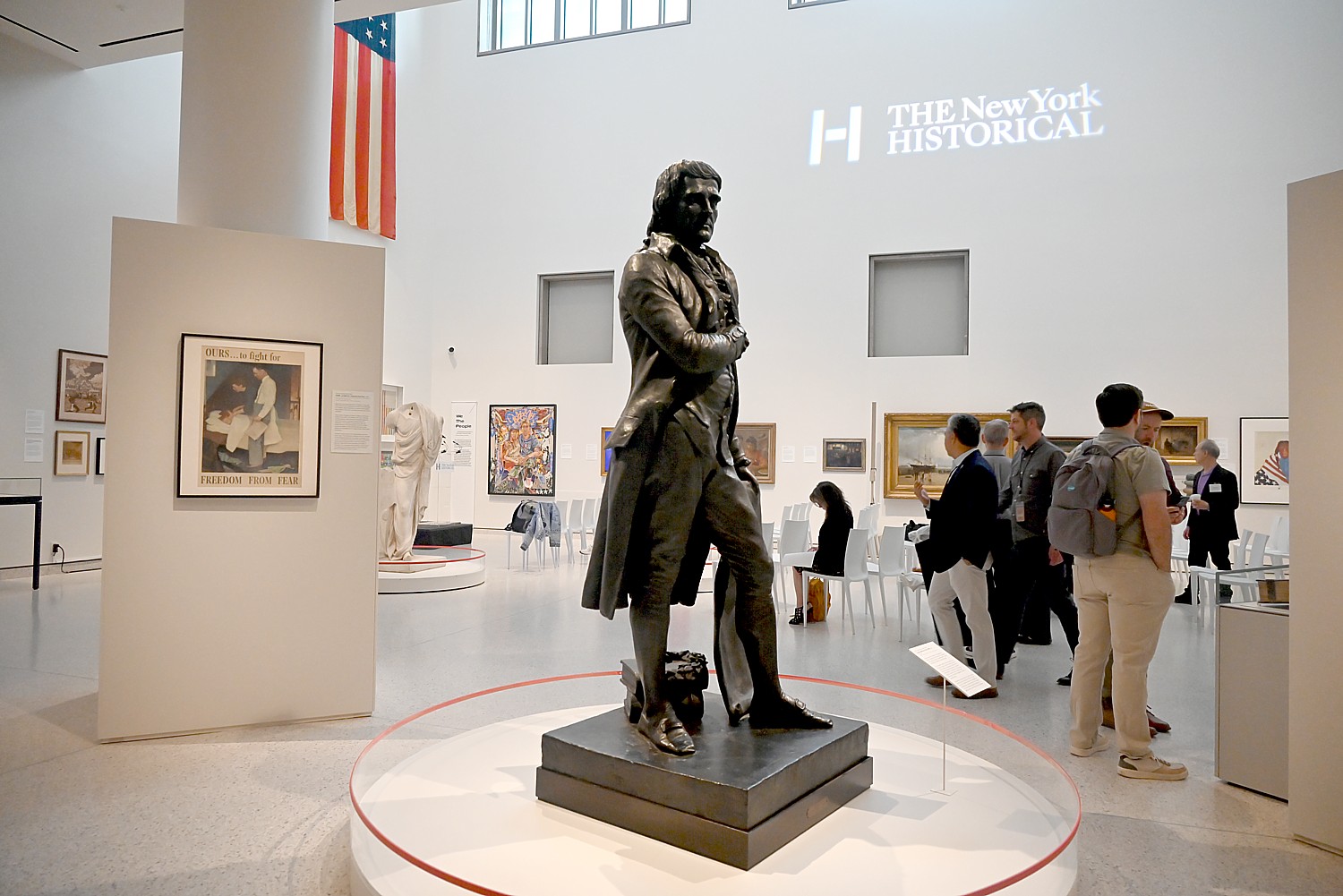
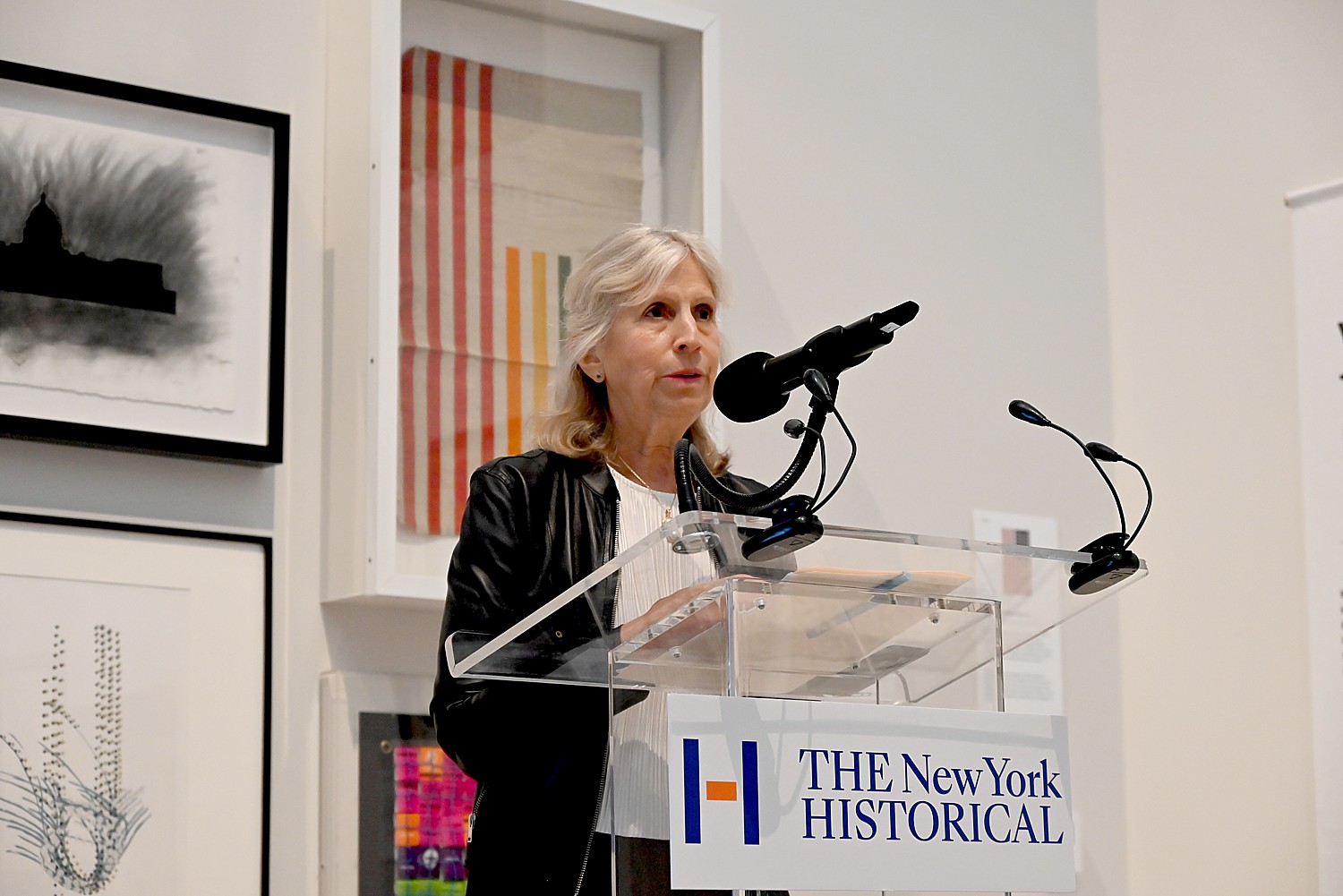
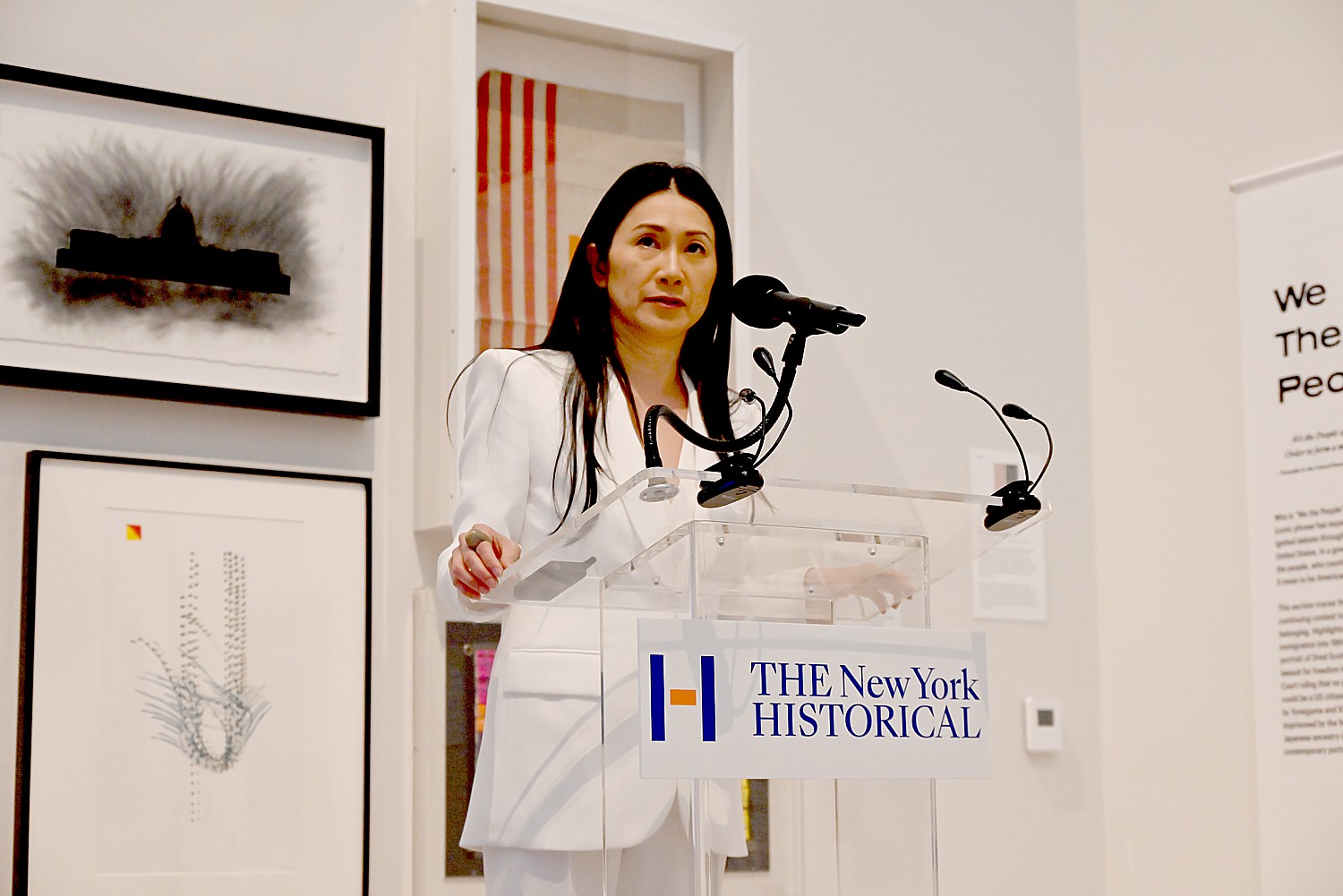
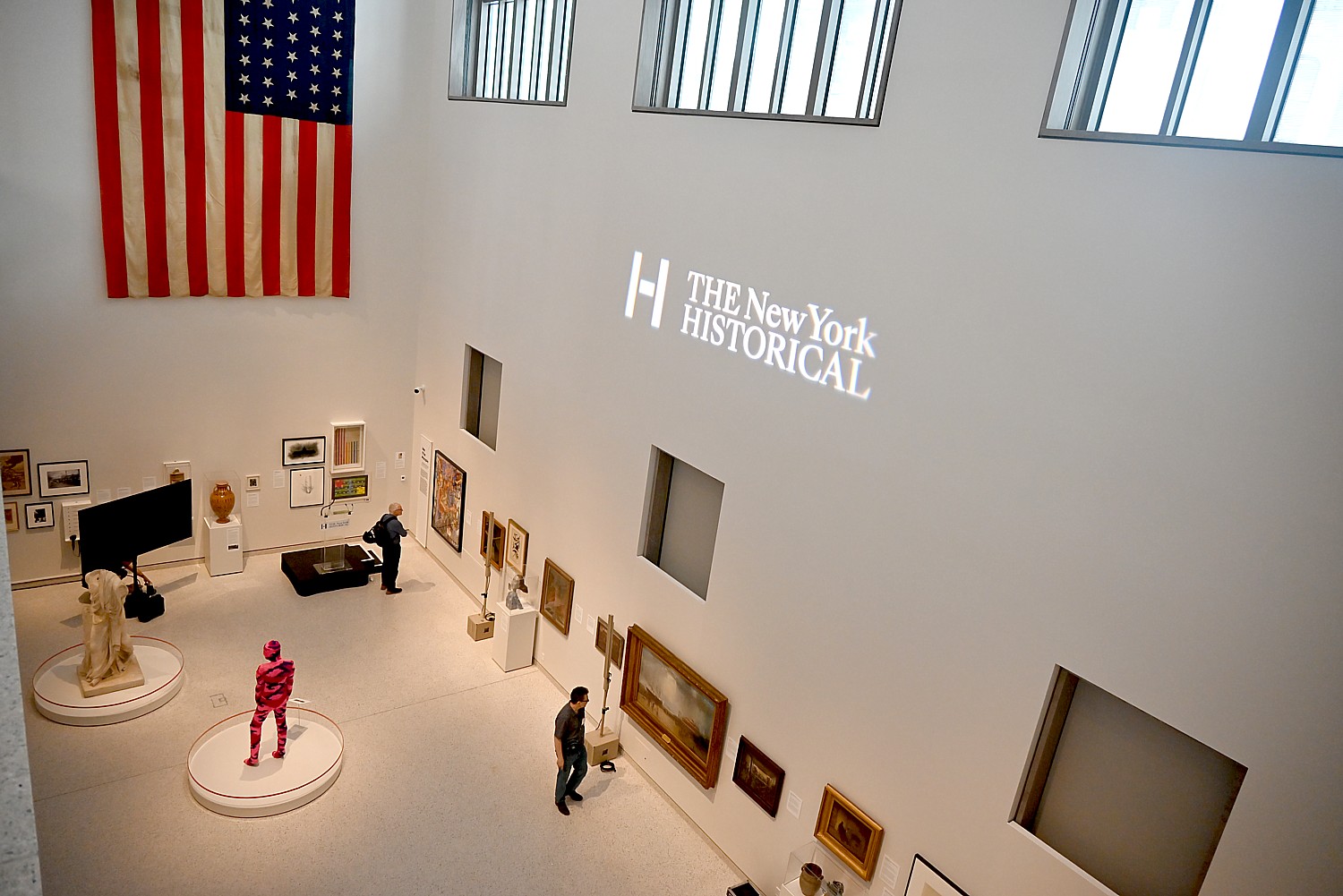
The timing couldn’t be more perfect, nor more necessary: The New York Historical, New York’s first museum, has just opened a major new expansion, the Tang Wing for American Democracy with a mission and a facility dedicated to teaching the history and future of the nation’s founding principles.
Opening in time for America’s 250th anniversary of the signing the foundational Declaration of Independence and audaciously creating the first government “of, by, and for the people” since antiquity, “This transformative new wing embodies The Historical’s mission of illuminating the complexities of the American story and inspiring engagement with the ideas and principles that define it,” said museum president and CEO Dr. Louise Mirrer. “As we approach the nation’s 250th anniversary, the Tang Wing will serve as both a beacon for civic learning and a space for reflection on the values that continue to shape our democracy. We are deeply grateful to Agnes Hsu-Tang and Oscar Tang for their extraordinary vision and generosity in making the Tang Wing for American Democracy possible.”
“The New York Historical’s origin story began with the American Revolution, and after 222 years we have achieved an institutional legacy as a steadfast witness to the history that shaped this nation,” said Dr. Agnes Hsu-Tang, who chairs The Historical’s Board of Trustees. “On the occasion of America’s semiquincentennial, this new wing shall rise as a self-evident embodiment of the American evolution—from its beginning as the world’s first modern democracy to the world’s longest continuing democracy.
“When New York Historical was founded in 1804, 222 years ago, Napoleon had crowned himself Emperor of France while Jefferson was reelected by the people of a young republic, the United States of America,” Dr. Tang said.
New York City, she noted, was the first capital of the United States of America, was where modern democracy and the American presidency originated.
“We are here today, because this very institution for 222 years has steadfastly safeguarded the evidence of our history, through wars and peace,” she said. “The new wing, dedicated to teaching of American history and democracy, is the culmination of 222 years of engaged citizenship and assiduous examination of American history – the good, bad, ugly and beautiful. Our history began as a revolution and endures and will endure as evolution of democracy for all.”
Since the museum’s founding as the New-York Historical Society, New York City has become a capital of modernity, culture and arts, Dr. Tang said. “The roots of the New York Historical are in New York City, but it has grown and evolved in mission and understanding of itself to become a national museum of national significance.”
The expanded space – 71,000 sq. ft – adds new galleries, classrooms, collections areas, a rooftop terrace and courtyard, and was designed to maintain and expand upon the Beaux-Arts style of the museum’s landmarked campus. The project also pursued LEED Gold Certification and includes state-of-the-art HVAC equipment anticipated to reduce energy consumption.
“It’s not just a new building but a tactical renovation of the existing building to knit it together with the new wing, aesthetically and functionally,” Dr. Mirrer said. “We are reimagining, reinventing this institution – what it is today and will become.”
The $175 million project represents the museum’s first expansion of its landmark campus in nearly a century and will significantly increase its capacity and ability to have exhibitions that could not be installed before, education, collections preservation and public programming. In addition to the newly constructed wing, the project included renovations to more than 30,000 square feet of existing museum space. The project was supported by $9.25 million from Empire State Development, along with $5 million from the New York State Council on the Arts.
Dr. Mirrer noted that the institution has sought an education wing going back to1937 “to educate about who we were as a people, so we can see who we should become. We sit in the new Klingenstein Family Gallery – a soaring light-filled space – where historical figures can tell their stories.”
The expansion will also support New York Historical’s education programs, including its award-winning Chang Chavin Academy for American Democracy four-day civics residency program, where 6th graders are brought to the museum to learn about democracy from its origins in antiquity – Greece and Rome – to today. With the additional classrooms – set along a gorgeous balcony – the museum expects to grow the program from 5,000 sixth-grade students served annually to 30,000 students per year. The Historical’s education programs currently reach more than 300,000 students and educators annually and help support the New York City Department of Education’s social studies curriculum.
“Hundreds of thousands of children receive education in civics here at a time when civics is under-taught in schools. New York Historical is picking up the ball, but we needed a facility,” Dr. Tang said.
Also newly opened in the Tang Wing, the Stuart and Jane Weitzman Shoe Museum, exhibits three centuries of American women’s lives through an extraordinary collection of historical footwear (check out Beyonce’s custom stiletto tour booties).
Like most of New York museums, the bulk of their collections are stored off site. The expansion includes crucial new on-site storage for The Historical’s invaluable Patricia D. Klingenstein Library, which holds the Robert A. Caro Archive, Time Inc. Archive, and Billie Jean King Archive as well as millions of manuscripts, maps, photographs, and prints documenting American history
Another significant improvement is that its conservation facilities, where its renowned collection of paintings and historical objects are restored and conserved, are now consolidated in a new state of the art facility in the lowest level.
And because the renovation has been at the highest level museum design standards, the New York Historical can now borrow rare and top quality artifacts from other institutions.
Also, the outdoor greenspace has been “recaptured” and now offers an accessible sculpture courtyard (where you will find the Hamilton and Burr statues, set at the exact distance apart as where they stood for their duel) and a new roof terrace atop the Tang Wing which will be lushly landscaped.
Interestingly, the granite used to build the Tang Wing (which was built over a vacant lot where three brownstones were razed 80 years ago) is the same as in the existing building, even though the quarry had closed in the 1920s. The quarry, on Deer Island, Maine, was reopened just for this project, architect Graham Wyatt, partner, RAMSA (Robert A.M. Stern Architects), tells us.
“Designing the new Tang Wing and related renovations for The New York Historical has been an extraordinary opportunity to engage with one of New York’s most important cultural institutions and historic landmarks,” Wyatt said.
“Our design completes a plan first contemplated almost a century ago and enters into dialogue with The New York Historical’s existing building and with the craftsmanship and materials of the original structure, while introducing new interior spaces that meet the Museum’s evolving mission and programs.” It also was the last project designed by Robert Stern before he passed away.
The Tang Wing ultimately will create the first permanent home for the American LGBTQ+ Museum – a collaborative institution that will join The New York Historical’s Center for Women’s History in advancing the narrative of civil rights for all Americans – opening in late 2027.
“New York’s cultural institutions tell our stories, strengthen our communities and power our tourism economy,” Governor Kathy Hochul stated. “For more than two centuries, the New York Historical has preserved the history of our state and nation, and the new Tang Wing will ensure that millions of visitors, students, scholars and families can continue to learn from that history for generations to come. As our nation prepares to celebrate its 250th anniversary, this expansion reaffirms New York’s role as a global capital of culture, education and ideas.”
Democracy Matters
The opening of the Tang Wing coincides with New York Historical’s exhibition, Democracy Matters, in the new Klingenstein Family Gallery. Bringing together objects from The New York Historical’s collections, the exhibition explores how the concept of democracy has stretched, contracted, and shifted through key moments in the history of the nation; how competing understandings of it have come into conflict; and how those conflicts have reshaped its boundaries.
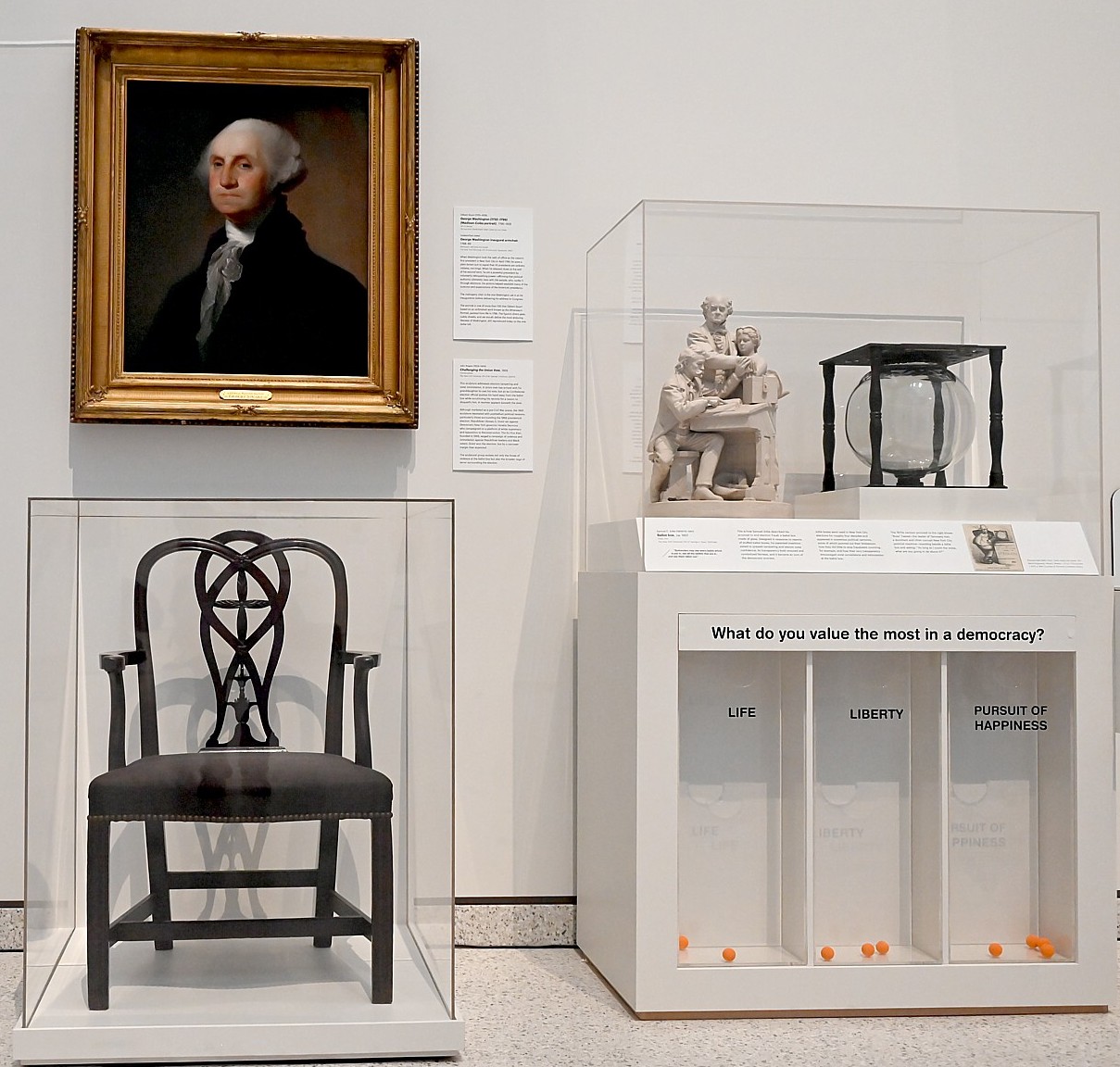
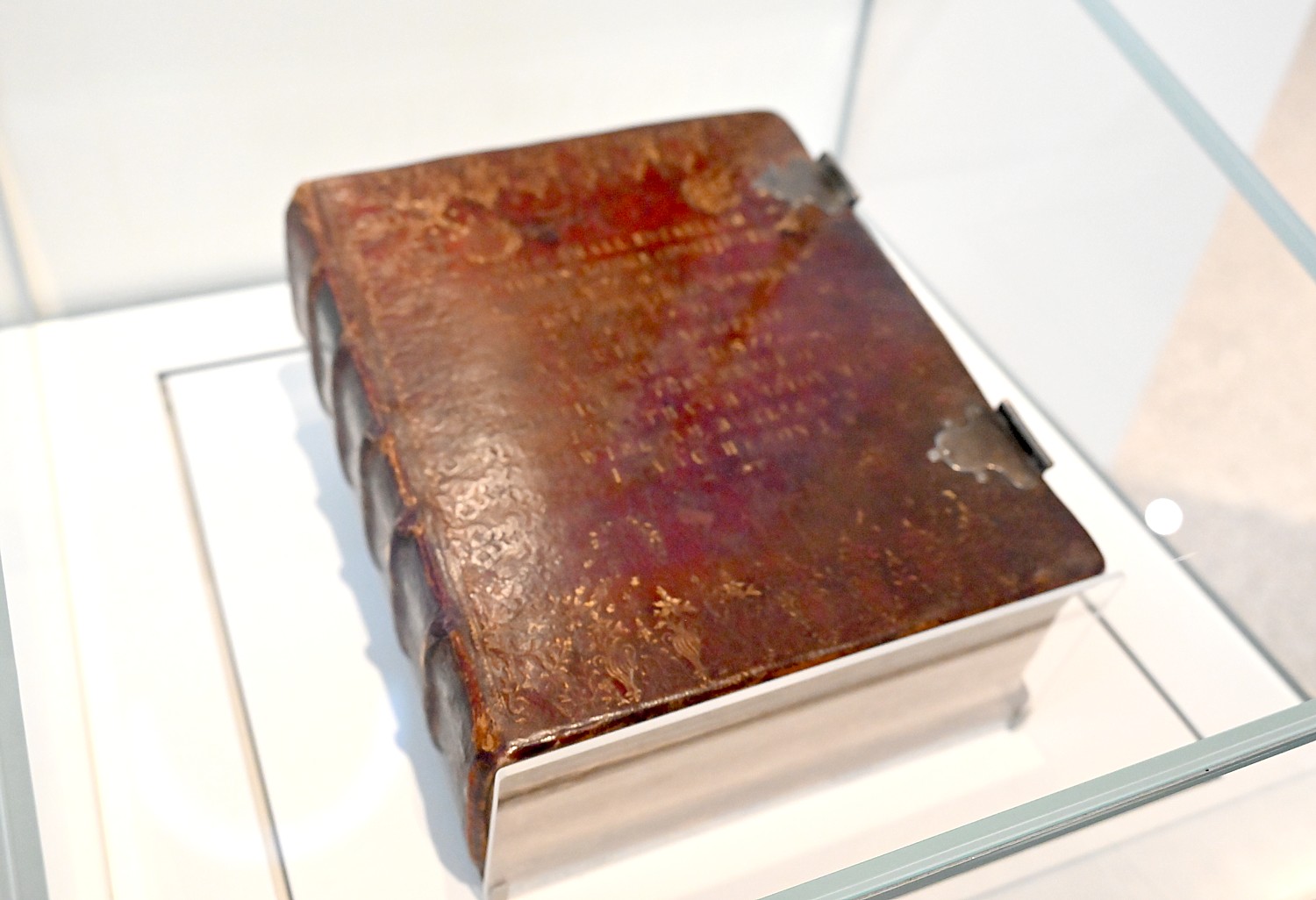
In 1789, George Washington was inaugurated the first president in lower Manhattan. He sat in a wooden chair, not the velvet cushioned, gilded throne of a king – indeed, the chair he used and the Bible he swore the newly written oath of office, are both on view in the new Klingenstein Gallery, where “Democracy Matters,” displaying essential artifacts organized around key moments in history and key pillars of our democracy – freedom of press, religion, free and fair elections, is on view through November 1.
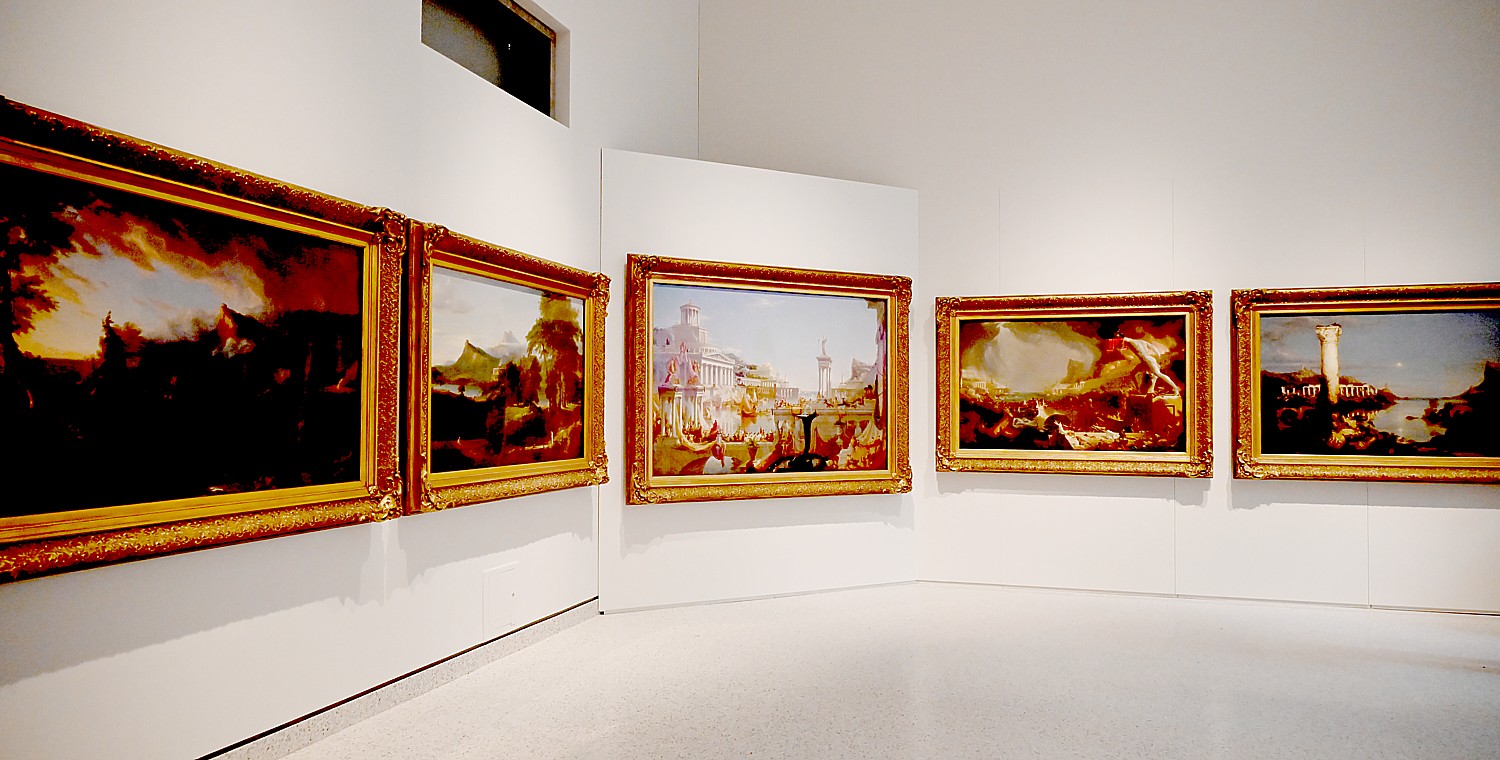
Also on view is a fragment from the King George III statue that was pulled down at Bowling Green after the Declaration of Independence was read, and a glass bowl that served as a ballot box (so votes were transparent), a Torah scroll among other religious objects that show Freedom of Religion, all five Thomas Cole’s Empire Series depicting the “Rise and Fall of Civilization.” There is also an odd, 34-star flag, dating back to the “darkest days of the Civil War. Even as the Confederacy adopted their own flag, Lincoln refused to accept the union could be broken,” Dr. Mirrer noted. The exhibits are also arranged to spark thought and interaction.
The New York Historical is continuing to present a slate of special exhibitions throughout the America 250th anniversary year, that have already included Declaring the Revolution: America’s Printed Path to Independence and Stirring the Melting Pot: Photographs from The New York Historical Collections.
Indeed, before there was a United States of America or a New York, there was a New Amsterdam, founded by the Dutch 400 years ago, which set the stage for America’s entrepreneurism, individualism and culture.
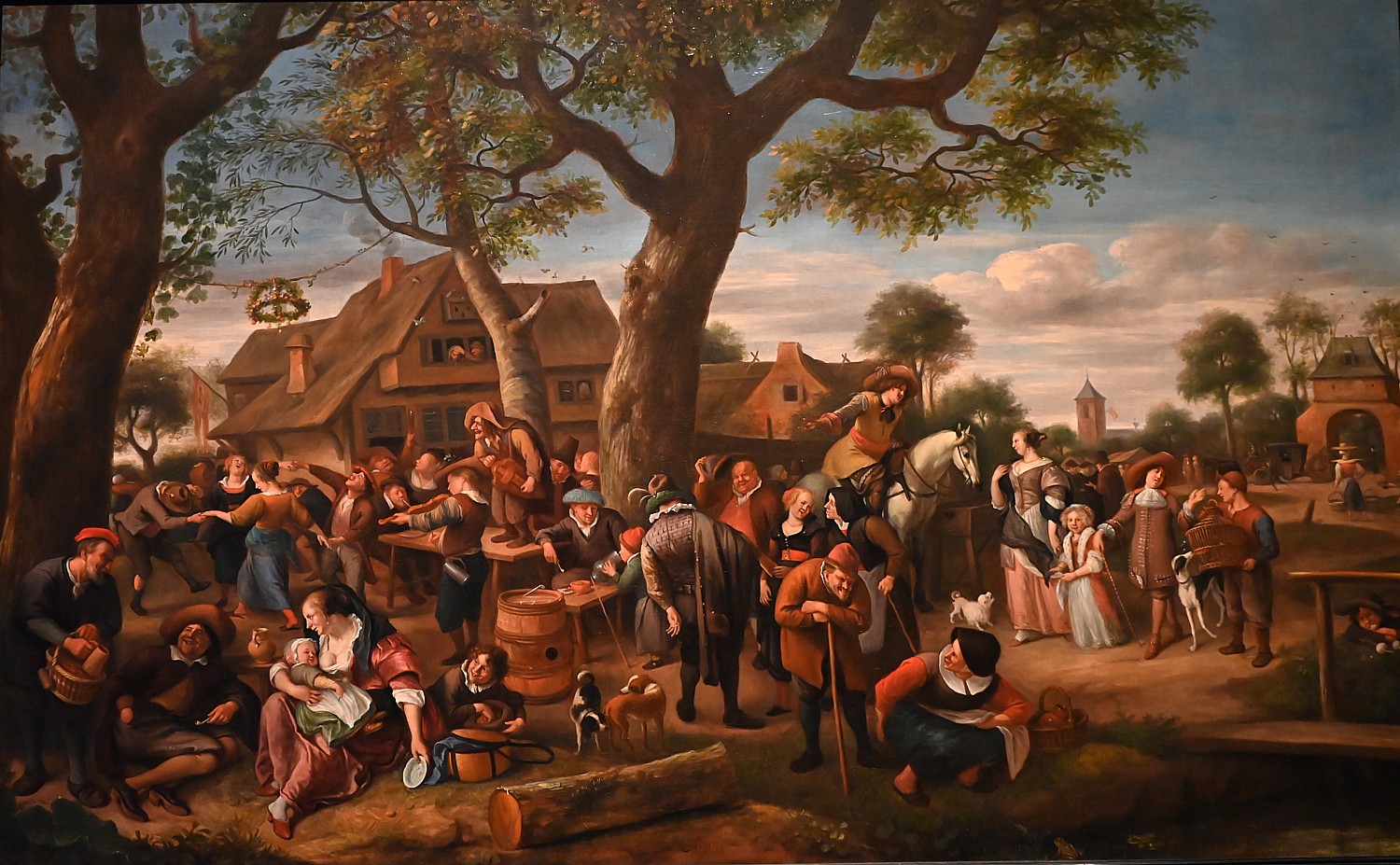
New-York Historical’s current blockbuster exhibition, Old Masters, New Amsterdam, celebrates the city’s founding 400 years ago with a fascinating look at life in New Amsterdam from the perspective of 17th century Dutch Masters including Rembrandt van Rijn, Frans Hals, and Jan Steen.
“The Dutch greatly enjoyed family festivities that included music, dancing, food, and drink,” said Arthur Wheelock, co-curator of the exhibition and senior advisor to the Leiden Collection. “Jan Steen’s joyous Peasants Merrymaking Outside an Inn, wonderfully captures the vibrancy and wide range of human interactions that could be found at a country fair, whether in the Netherlands or in New Amsterdam.”
“Four centuries ago, the Dutch founded an outpost at the tip of Manhattan Island—a humble but vibrant settlement that would give rise to New York,” said Russell Shorto, the exhibition’s co-curator, director of the New Amsterdam Project at The New York Historical. “Across the ocean, meanwhile, Rembrandt and his peers were transforming art, revealing the beauty and drama of everyday life. These Dutch artists never set foot in New Amsterdam, but their portraits, character studies, and depictions of daily life in the Netherlands provide real insight into the world of Manhattan’s 17th-century settlers.”
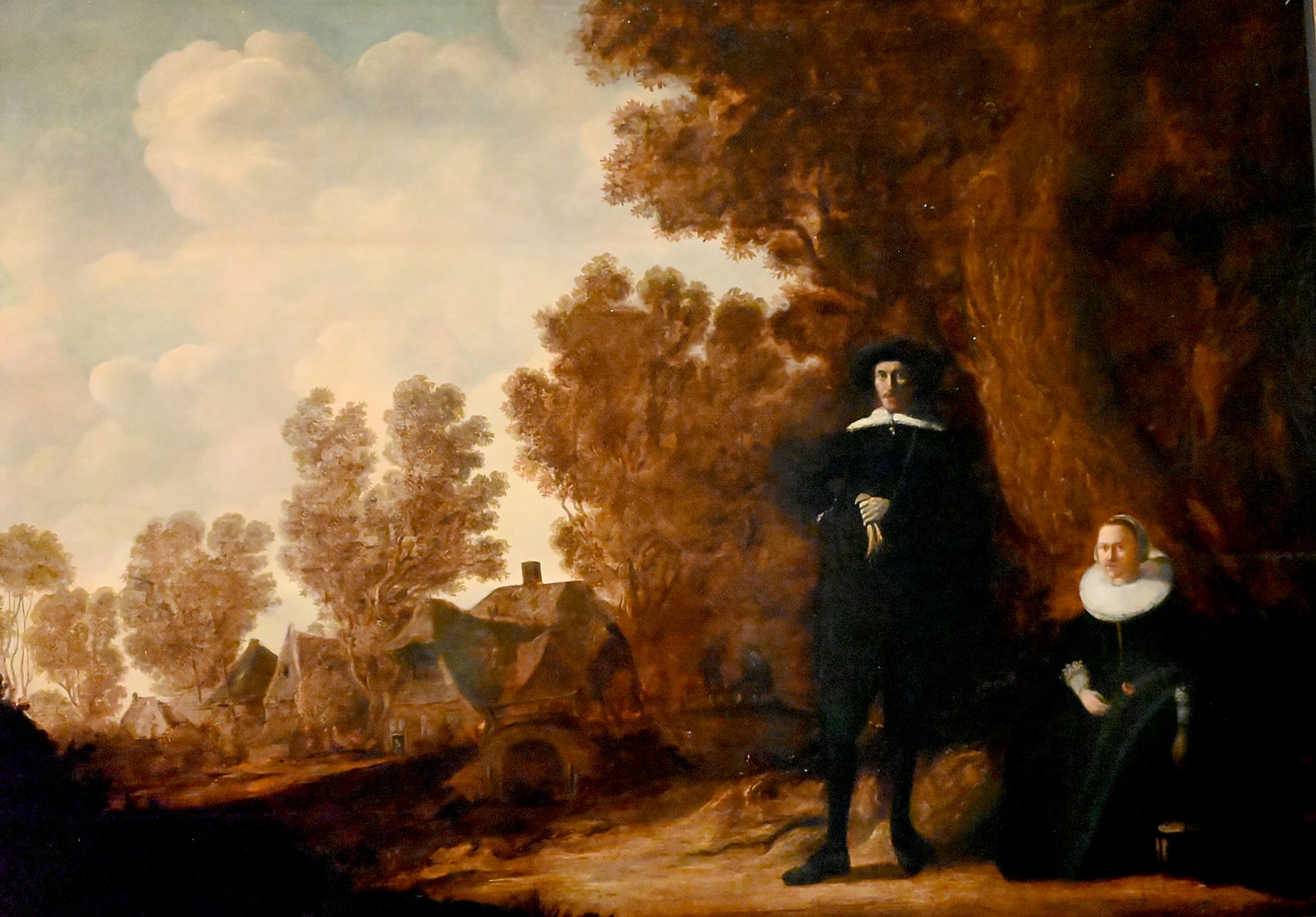
Gerard Donck and Frans de Hulst portrait of Mr. and Mrs. Samuel Bayard (1644) – Samuel Bayard and his wife Anna Stuyvesant Bayard (1644). After Samuel’s death, Anna emigrated to New Amsterdam where her brother Peter Stuyvesant was the colonial Director-General.
Some of the most intriguing objects in the exhibition are those from New York Historical’s own collection: the journal of John Bowne who was arrested for hosting a Quaker meeting and deported to the Netherlands in 1662, where the West India Company directed Stuyvesant to “allow every one to have his own belief.” setting the stage for freedom of religion in New York. Also, a property deed to Manuel de Spangle (dated January 18, 1651), who won his freedom (the first enslaved Africans probably arrived in New Amsterdam in 1627), which encouraged other slaves to sue for their freedom.
The exhibition ends with several paintings providing a glimpse into 1776 and beyond.
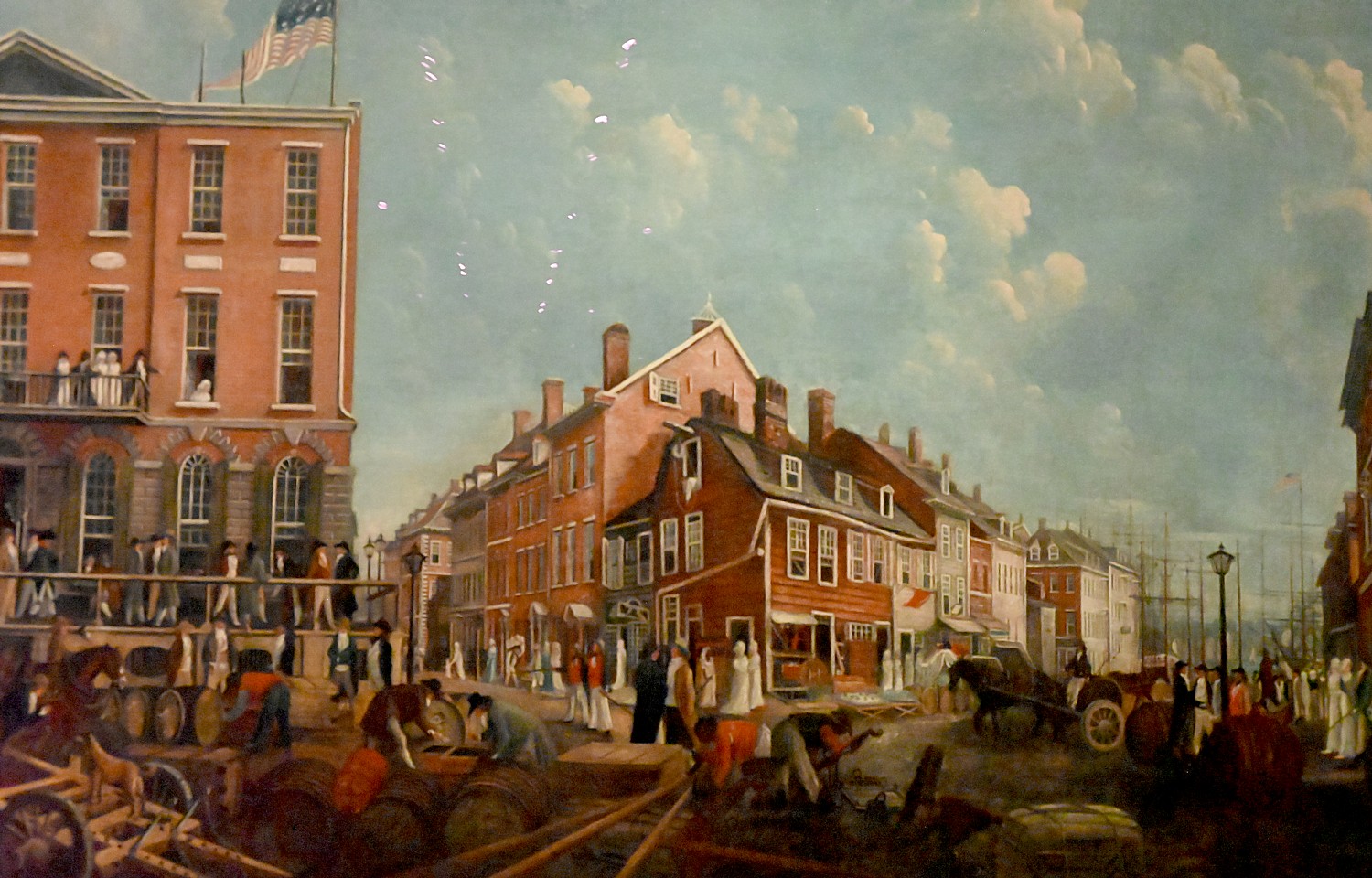
Francis Guy’s painting depicting theTontine Coffee House, NYC 1797: After American independence, merchants founded the Tontine Coffee House at the corner of Wall and Pearl Streets, as a place to conduct business. Trading of stocks in the coffee house eventually gave way to the New York Stock Exchange.
From The New York Historical’s collection, Francis Guy’s 1797 painting Tontine Coffee House, New York City, where commercial activity seemingly bursts across the canvas, shows the expansive growth of the city in the century after the Dutch founded New Amsterdam, at the place that became the stock exchange.
The individuality fostered in the Dutch era evolved into a New York hallmark: a brash, confident, entrepreneurial energy. On the eve of the American Revolution, the city’s diversity made it a cauldron of debate and unrest. Built on Dutch foundations and shaped by waves of newcomers, New York reflected the American experiment and propelled it forward.
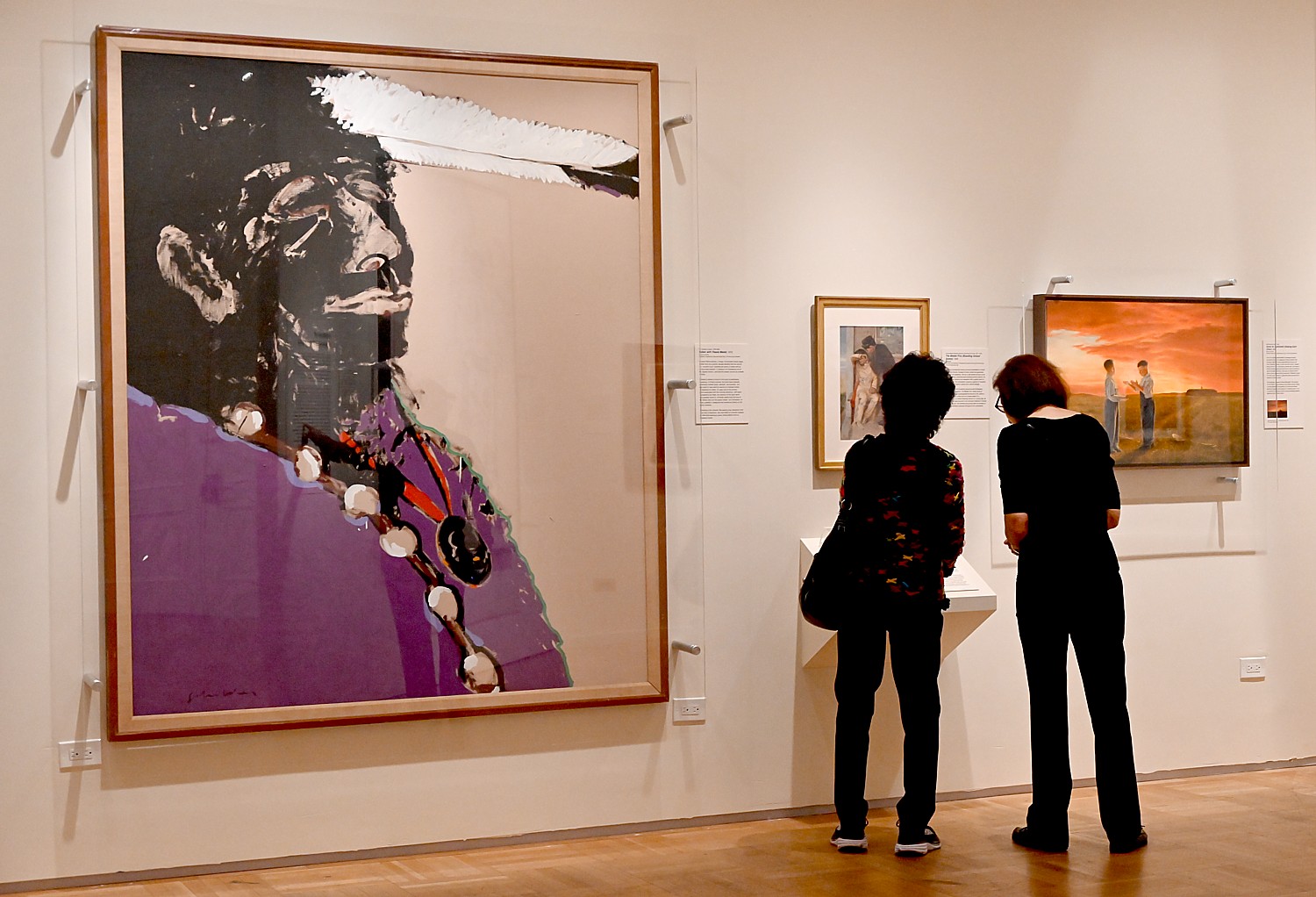
House Made of Dawn: Art by Native Americans, 1880-Now,: Drawing from a collection of more than 100 promised gifts of art, artifacts, and rare books created by Native American artists to The New York Historical by Board Chair Dr. Agnes Hsu-Tang and her husband Oscar Tang in celebration of the nation’s semiquincentennial, this exhibition presents distinct artistic expressions and practices of modernism by more than 85 artists of diverse Indigenous heritage (through August 2, 2026).
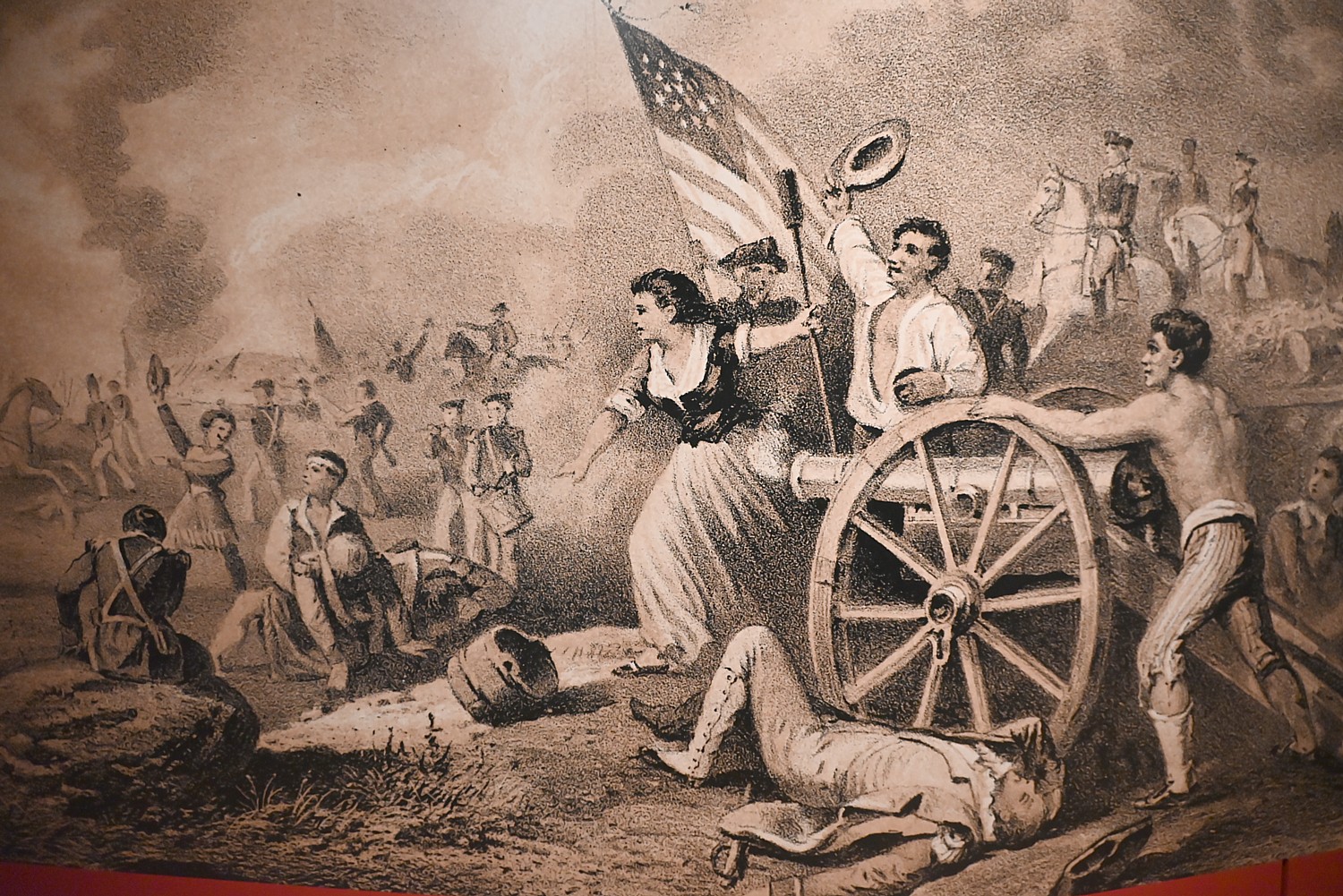
Revolutionary Women: The Center for Women’s History foregrounds the women of New York City whose contributions to the Revolutionary War effort have been little recognized—but whose experiences highlight the material realities of living in the war-torn city as well as the divergent, contested meanings of revolutionary liberty itself and its unfinished promise. Revolutionary Women dives deep into the stories of the women who left indelible marks on the fight for—and even against—independence and who helped create the foundations of a new government. Liberty, equality, and independence were key bywords for that emerging nation. But who did these concepts apply to? Revolutionary Women attempts to provide answers and deepen the history we all think we know with letters, poems, petitions, archeological objects, paintings, household objects, and more from our Patricia D. Klingenstein Library collection.
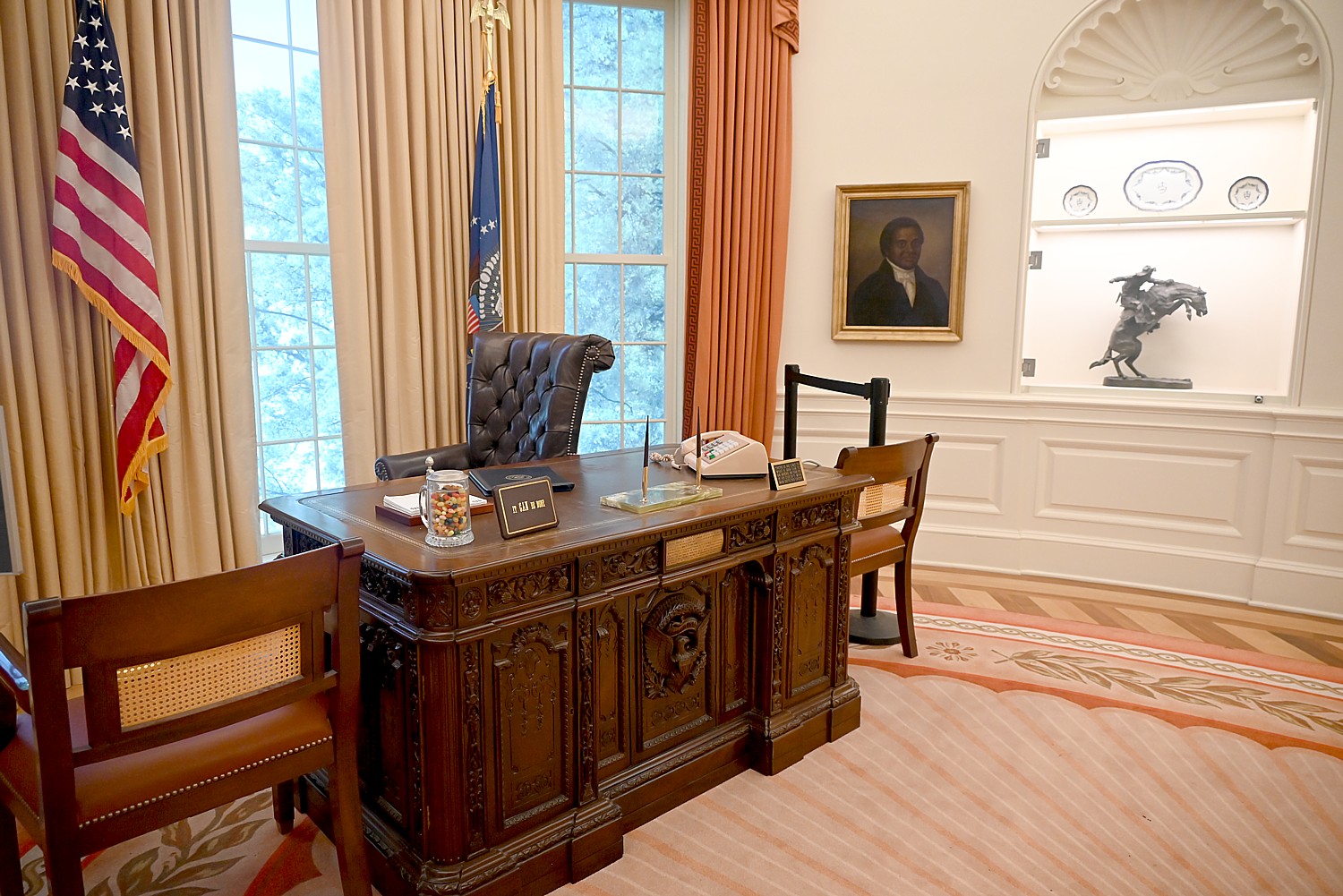
Also visit the fascinating exhibit dedicated to the Presidency (you can visit a replica of Reagan’s Oval Office and sit behind the Resolute desk) and our three co-equal branches of government.
“Songs of America,” a vibrant lineup of live music performances taking place at the Museum in collaboration with Jazz at Lincoln Center, features music from across two and a half centuries of the nation, from Revolutionary-era tunes, to blues, classic jazz, turn-of-the-century jazz, soul jazz and Americana. Performances are free with pay-as-you-wish admission during expanded hours from June 18 to July 4.
A rare printing of the Declaration of Independence, which has been in The Historical’s collections for generations though little was known about it, is on temporary view through July 5. It was likely printed by Samuel Loudon, a colonial New York printer who founded The New-York Packet newspaper. in the aftermath of July 4, 1776, and used to disseminate the new nation’s independence to the general public in town halls, houses of worship, and other meeting places.
To mark the opening of the Tang Wing for American Democracy, The New York Historical is hosting expanded hours until 8 pm on Thursdays through Saturdays from June 18 to July 4. Admission during expanded hours on those dates are pay-as-you-wish admission from 5-8 pm.
Founded in 1804, The New York Historical is New York City’s first museum and a nationally renowned research library, with holdings that include more than 14 million works of art, artifacts, documents and ephemera spanning four centuries of American history. Its collections document the founding of the United States, the evolution of New York and the stories of the people and communities that have shaped the nation.
With rising gas prices and air fares exacerbating families’ affordability issues, families are looking for ways to satisfy the desire to vacation and engage in pleasurable activities together, and themeparks and attractions – because of their proximity and location – may well satisfy those needs and criteria this year.
We asked Jakob Wahl, President and CEO of IAAPA (International Association of Amusement Parks and Attractions), to address questions about trends and forces affecting the attractions industry, and tips for travelers to enhance their visits.
How is economic uncertainty impacting the industry?
Economic uncertainty is certainly influencing how people plan, but it hasn’t diminished the desire to travel. Instead, we’re seeing consumers prioritize value and intentionality. Guests may take fewer trips, but they are choosing higher-quality, experience-driven visits.
At the same time, attractions play an important role in providing a sense of escapism. In moments of uncertainty, people are seeking opportunities to disconnect, recharge, and spend meaningful time with family and friends. Attractions offer that emotional release—creating spaces where guests can step away from day-to-day pressures and simply enjoy the moment.
In response, attractions are offering more flexible pricing, bundled packages, and added-value experiences to ensure guests feel they are getting the most for their time and money, while still delivering the memorable, uplifting experiences they’re looking for.
Tips for getting tickets, saving time, and arranging special experiences?
Planning ahead is key. Many attractions now offer timed entry, mobile apps for real-time updates, and bundled ticket options that can save both time and money.
Most major parks—and even many smaller attractions—offer premium or VIP-style experiences. These can include front-of-line access, guided tours, exclusive viewing areas for shows, and even behind-the-scenes experiences.
An important shift in the industry is how much technology enhances the guest experience—from mobile ordering to virtual queues—making visits smoother and more personalized than ever before. A few simple strategies can make a big difference:
Visit during off-peak days or seasons when possible
Purchase tickets in advance online
Use park apps to plan your day and minimize wait times
Consider bundled packages or multi-day tickets for better value
Arrive early or stay late—those first and last hours are often the least crowded
What are new trends among themeparks and attractions?
One of the biggest misconceptions is how much attractions have evolved beyond rides. Today’s parks are full-day—and often multi-day—destinations offering culinary experiences, festivals, live performances, expanded nighttime experiences, and even wellness-focused spaces (like shade and cooling) and environmentally responsible operations.
While new rides and expansions continue to be important, one of the biggest stories right now is how parks are evolving into full-scale, seasonal destinations anchored by major events.
For instance, Kennywood is introducing “Celebrate Kennywood Weekends,” adding new energy and programming to its 2026 season.
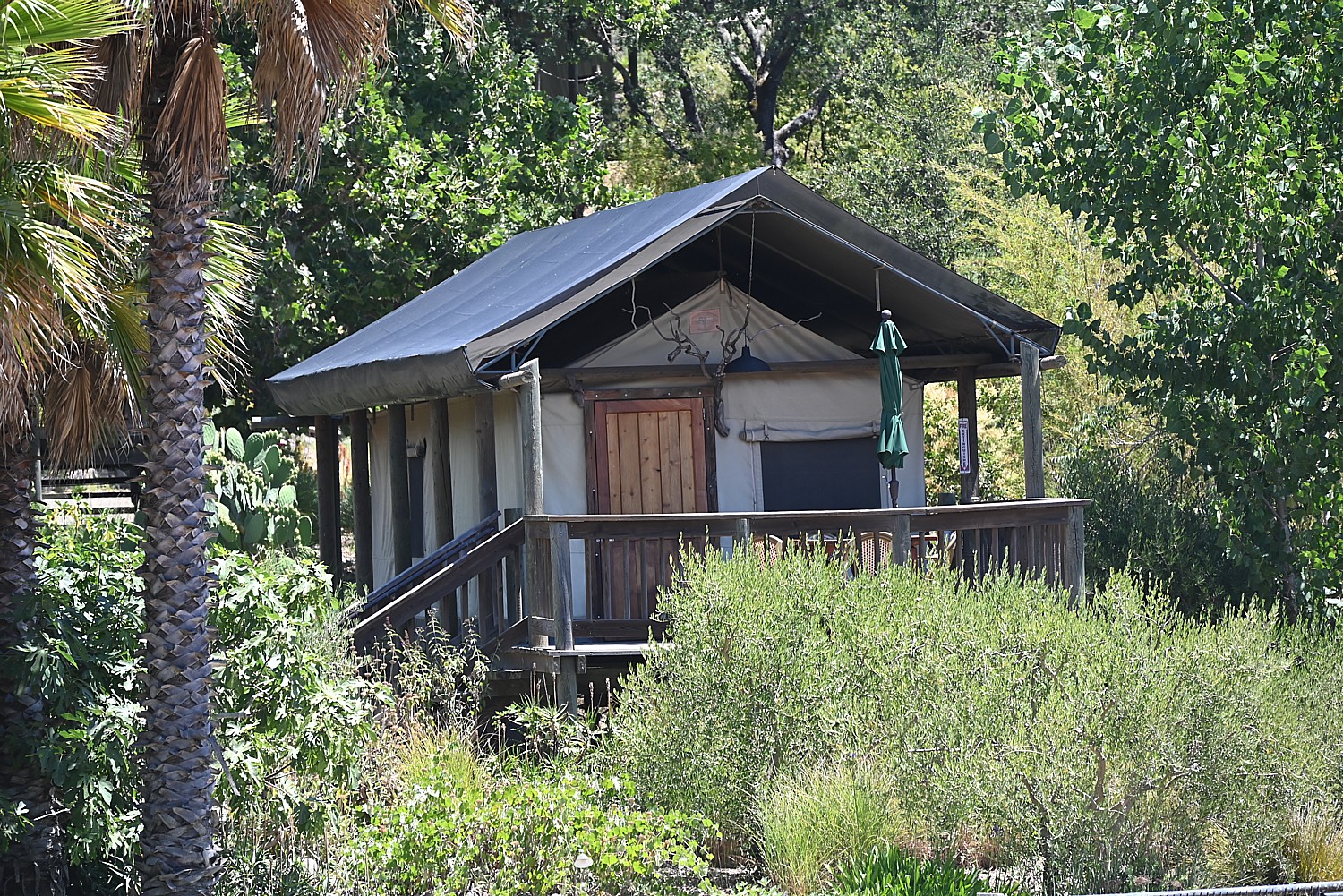
Six Flags has introduced a new Hotel Partner Program, enabling visitors to participating Six Flags parks to book their park admission and overnight accommodations at the same time. The new Hotel Partner Program complements the company’s growing collection of owned and operated resort hotels and campgrounds, like the glamping experience at its Savannah Sunset Resort within its Six Flags Great Adventure safari park in Jackson, NJ (SixfFags.com)
What trends are you seeing with this year’s celebration of, America’s 250th?
We are seeing a clear surge in travel interest tied to meaningful national moments, and the 250th anniversary of the United States is a major catalyst. Attractions across the country are leaning into this milestone with larger-than-ever celebrations and deeply immersive experiences.
Walt Disney World’s EPCOT and Disney California Adventure Park will debut Soarin’ Across America this summer, a new film experience celebrating the 250th anniversary with breathtaking scenes of landscapes and iconic cityscapes—offering an immersive way to experience the country’s beauty and spirit.
Cedar Point is hosting its Star-Spangled Celebration with skydivers, live entertainment and a spectacular July 4 fireworks finale.
Worlds of Fun is running an extended Americana celebration throughout the summer.
Silver Dollar City is honoring active-duty military with free season passes and hosting season-long patriotic programming, including concerts, drone shows, and themed culinary offerings.
Wild Adventures Theme Park is launching its Celebrate America Festival with live entertainment and patriotic experiences starting in early summer.
Overall, travelers are seeking experiences that are both celebratory and meaningful—something that brings people together and creates lasting memories.
Dollywood is a standout example of how regional parks can deliver world-class experiences rooted in authenticity. What makes Dollywood special is its deep connection to place—the Smoky Mountains—and its emphasis on hospitality, craftsmanship, and storytelling. For America’s 250th, Dollywood is embracing a full seasonal transformation with red, white, and blue décor, and its beloved Sweet Summer Nights Drone Show will feature a patriotic tribute. The park is also debuting its largest investment to date—Nightly Expedition—further enhancing the evening experience for guests.
We’re also seeing strong participation from museums and cultural institutions. Organizations like the Smithsonian Institution, The Metropolitan Museum of Art, and The Henry Ford are creating exhibitions and programming that invite visitors to reflect on the nation’s history and future.
With Families Seeking Out MicroVacations, Themeparks & Attractions Do Their Part to Promote Responsible, Sustainable Travel
Themeparks and attractions are doing their part in maximizing the benefits of travel and tourism while mitigating the negative impacts. These days, with the cost and availability of gas, diesel and jet fuel exacerbating families’ affordability issues, families are looking for ways to satisfy the need to vacation and engage in pleasurable activities together, and themeparks and attractions – because of their proximity and location – may well satisfy those needs and criteria this year.
Nearly 75% of travelers are now opting for trips of four days or less, underscoring the rapid rise of “micro-cations” and a broader shift toward shorter, more frequent travel.
Are these frequent short trips better or worse for the planet? And what are themeparks and attractions doing to enhance responsible, sustainable travel?
IAAPA (International Association of Amusement Parks and Attractions) Director of Sustainability Ylva Linderoffered these responses to our questions:
How do transportation choices, especially flying, shape travel’s carbon footprint?
Transportation is one of the biggest contributors to travel’s carbon footprint, particularly air travel. The distance traveled and frequency of trips often matter more than the length of the stay. One long trip where a traveler stays in a destination for a week or more can sometimes have a lower overall footprint than several shorter trips that require multiple flights.
That said, transportation choices within a destination also play an important role. Choosing destinations where visitors can rely on public transportation, rail, walking, or shared transit instead of renting a car can significantly reduce the overall impact of a trip. Responsible travel isn’t just about where you go — it’s about how you get there and how you move around once you arrive..
Might micro-cations help redistribute tourism or risk increasing emissions?
Micro-cations can be a positive trend if they encourage travelers to explore destinations closer to home, travel during off-peak periods, and discover places that may not traditionally see heavy tourism. This can help spread economic benefits to more communities and reduce overcrowding in major destinations.
However, micro-cations can also increase emissions if they lead to people taking more frequent flights or additional trips that wouldn’t have happened otherwise. From a sustainability standpoint, the goal isn’t just shorter trips — it’s smarter trips. Traveling less often, staying longer, choosing closer destinations, and being thoughtful about transportation choices all make a meaningful difference.
How can destinations and operators design more sustainable short-stay experiences?
Design plays a major role in sustainable tourism. Destinations and attractions can make responsible travel easier by investing in public transportation access, shuttle systems, walkable environments, and infrastructure that reduces the need for individual car use.
On the operations side, many attractions are focused on energy efficiency, water conservation, waste reduction, and sourcing food and materials locally. Capacity management and timed entry systems are also becoming more common, helping reduce overcrowding and improving the guest experience at the same time.
When sustainability is built into how a destination operates, responsible choices become the easiest and most natural option for visitors, enhancing rather than compromising the overall experience.
What does responsible, sustainable travel look like as habits shift globally?
Responsible travel today is less about telling people not to travel and more about helping people travel better. We’re seeing travelers become more intentional — choosing destinations where they can spend more time in one place, support local businesses, and have meaningful experiences rather than just checking locations off a list.
It also means being mindful of when and how we travel, for example avoiding peak times where possible, respecting local communities, minimizing waste, being conscious of energy and water use, and supporting local businesses, as well as choosing businesses and attractions that are investing in sustainable practices. Responsible travel is about making a thoughtful contribution to the destination while keeping a low overall footprint.
How are attractions driving sustainability at scale across global tourism?
Attractions are in a unique position to drive sustainability because they operate at scale and serve millions of visitors each year. Many attractions are investing in renewable energy, water recycling systems, and sustainable food sourcing.
But just as importantly, attractions can help guide visitor behavior by making more responsible choices easier, such as offering refill stations, reducing single-use materials, or providing shared transport options. These are small steps, but at scale they can help reduce impact.
Because attractions combine entertainment, education, and large-scale operations, they can play a meaningful role in moving the entire tourism industry toward more sustainable practices.
What are theme parks/attractions doing to cut down on auto travel (and the expense of on-site parking!)? For example, are they setting up free shuttles from hotel areas (like ski resorts do in Lake Placid NY, and Banff BC)?
Many attractions and destinations have partnered with hotels that offer free shuttles to and from their neighboring attractions and theme parks. Some attractions have dedicated bus routes and pedestrian-friendly infrastructure so visitors can move between hotels, attractions, dining, and entertainment without needing a car.
Most Americans might not think of New York State first in context of the American Revolution and independence – Boston, Philadelphia are more top of mind. But it will surprise virtually everyone to know that more battles – and pivotal ones – of the Revolution were fought in New York than any other. In fact one-third of the battles and incursions were fought in New York, which the British considered vital to their conquest of the continent. Here are some of the places and events commemorating America’s 250th in New York State:
Fort Ticonderoga
At the outbreak of the Revolutionary War, Ethan Allen and Benedict Arnold realized that the British Fort Ticonderoga made an easy target for the American rebels. They captured the fort in 1775 with a band of Green Mountain Boys only weeks after Lexington and Concord, making it America`s first victory in the Revolution. Visitors can tour the restored fort, research library, museum galleries, and acres of beautiful land overlooking Lake Champlain and see artillery demonstrations and frequent reenactments. Fort Ticonderoga Real Time Revolution™ Event Series(Adirondacks): The iconic historic site continues honoring its role in America’s origin story with the Real Time Revolution™ event series, designed to bring the Revolutionary War to life on the very grounds it took place through reenactments of key events. One of the highlights takes place during Independence Day Weekend, with a signature reenactment, “Return of an Army,” depicting the Northern Continental Army’s retreat to Ticonderoga during the same period that the Declaration of Independence was being signed in Philadelphia (102 Fort Ti Road, Ticonderoga, NY 12883, 518-585-2821).
Saratoga National Historical Park (Saratoga Battlefield)
Two hotly contested Revolutionary War battles here ended in an American victory which some proclaim as one of the most important in world history. Visit the Saratoga National Historical Park (Saratoga Battlefield) visitor center with film, light map, museum exhibits; tour the scenic 10-mile auto and bike road and hike historic paths. The park also has four other sites located nine miles north of the battlefield around the villages of Victory and Schuylerville: Victory Woods where British General Burgoyne’s forces made their last stand, the 155′ Saratoga Monument with panoramic views of the Hudson Valley, General Philip Schuyler’s 1777 home and estate, and the Saratoga Surrender Site (648 Rte 32, Stillwater, NY 12170, 518-664-9821, x 2980, www.nps.gov/sara to plan your visit).
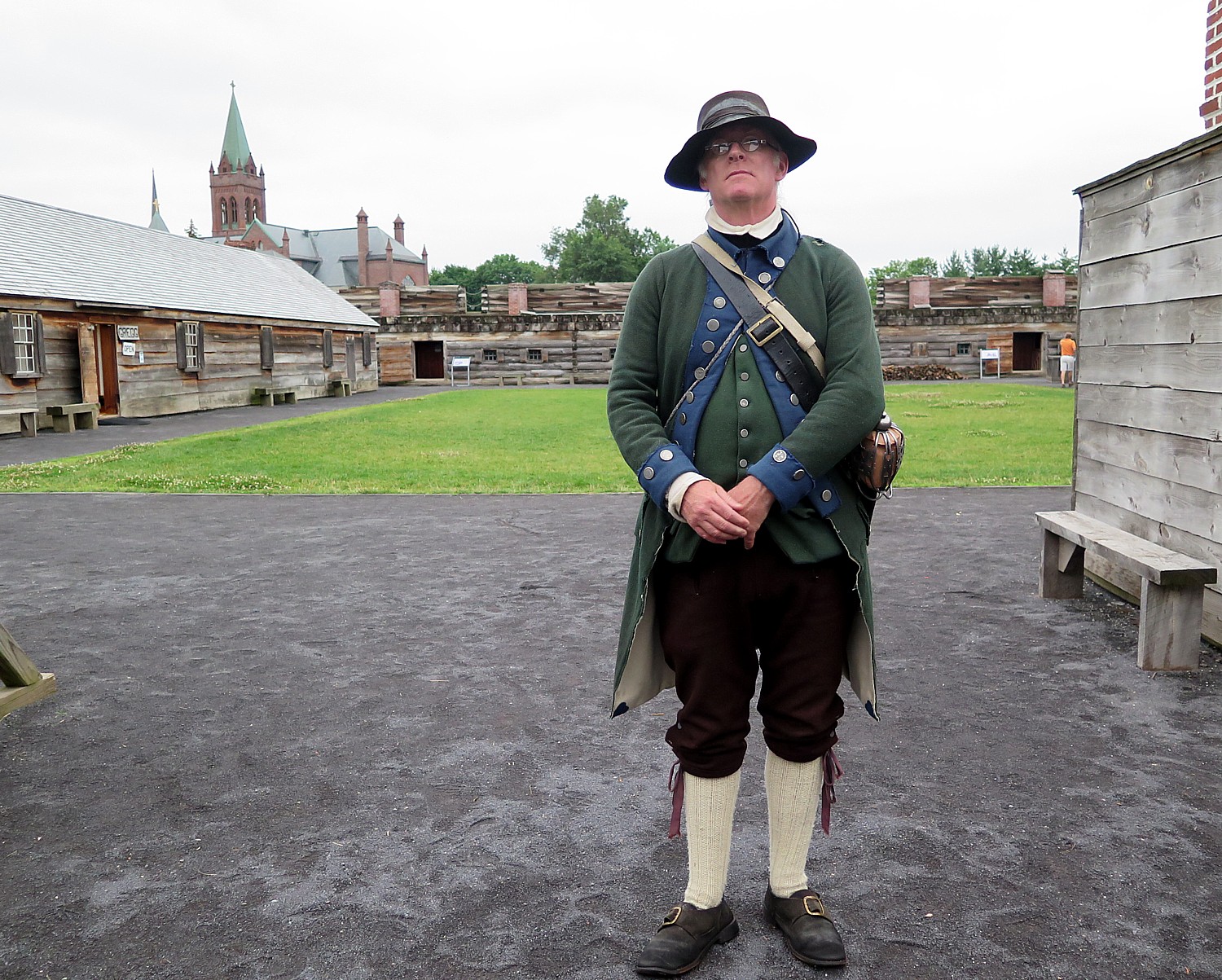
Fort Stanwix National Monument offers a full-scale reconstruction of the original fort built in 1758 by the British during the French and Indian War (re-created from the original British plans) and occupied by Americans during the Revolutionary War, where you can engage with costumed interpreters and really appreciate the complex dynamics surrounding the War for Independence.
In August 1777, Fort Stanwix, under the command of Col. Peter Gansevoort, successfully repelled a prolonged siege by British, German, Loyalist, Canadian and American Indian troops and warriors commanded by British Gen. Barry St. Leger – becoming the only American post never to surrender to the enemy throughout the entire War of Independence. Significantly, the failed siege, combined with the battles at Oriskany, Bennington, and Saratoga thwarted a coordinated effort by the British in 1777, under the leadership of Gen. John Burgoyne, to take the northern colonies. The Americans’ success (after so many defeats) led to American alliances with France and the Netherlands. Troops from Fort Stanwix also participated in the 1779 Clinton-Sullivan Campaign and protected America’s northwest frontier from British campaigns until finally being abandoned in 1781.
At the Marinus Willett Center, explore centuries of history through interpretive exhibits and cases of artifacts unearthed on the site that put into context the colonials and the indigenous people who lived here (that will surprise you), and why New York State was so crucial to the Revolution – not just logistically, but as a critical source of food supplies for the troops. The park also collaboratively manages both the Oriskany Battlefield State Historic Site and the Steuben Memorial State Historic Site, all three locations inexorably connected from the time of the American Revolution. (100 N James St, Rome, NY 13440, (315) 338-7730, https://www.nps.gov/fost/learn/historyculture/index.htm)
New York City Hosts ‘Sail 4th’ Spectacular
Statue of Liberty, New York city
New York City which celebrated its 400th anniversary throughout 2025, is where America’s entire history is on display – the indigenous people who lived here before the Europeans, the Dutch founding in 1625 with the establishment of Fort Amsterdam and how diverse cultures built the city and continue to be the hallmark – at the Museum of the City of New York (a superb film unrolls 400 years in 30 minutes) (1220 5th Ave, www.mcny.org). One of the more unexpected places to explore America’s Native American history is at National Museum of the American Indian, a Smithsonian Institution, housed at Alexander Hamilton’s Custom House on Bowling Green (right around where King George III’s statue would have been ripped down by patriots) (https://americanindian.si.edu/visit/ny).
New York City will have its share of blockbuster events celebrating America’s 250th. One of the most sensational is “Sail 4th 250”, taking place July 3-9, 2026, with 30 Tall ships and 30 Grey Hull ships from 32 nations bringing 10,000 officers, cadets, crew and diplomats to parade down the East River on July 3rd up the Hudson River on July 4. Open to free public visits through July 9 (www.sail4th.org).
Macy’s 50th anniversary fireworks on July 4th will be especially spectacular with an International Aerial Review, headlined by the U.S. Navy Blue Angels.
The Blue Angels will then headline the FourLeaf Air Showat Jones Bach State Park (date change from Memorial Day Weekend to July 5 – 6) to celebrate America’s 250th.
The New York Historical is opening its new Tang Wing for American Democracy on June 18, 2026, greatly expanding both the landmark building and The Historical’s wide-ranging schedule of exhibitions, educational initiatives, and public programs. Dedicated to the history and future of the nation’s founding principles, the 71,000-square-foot Tang Wing will open as the United States launches the celebration of its 250th anniversary. On view now: Declaring the Revolution: America’s Printed Path to Independence which features the documents that provided the ideological and philosophical underpinnings for the Revolution and the founding of a new kind of government (by the people) and that raised the rabble, forged a collective consciousness and identity, and inculcated the outrageous idea that a ragtag collection of colonial people of diverse race, ethnicity, religion and national origin could and should take on the most powerful empire on the globe (on view through April 12); also, Stirring the Melting Pot: Photographs from The New York Historical Collections. The New York Historical will present a slate of special exhibitions throughout the anniversary year. New York’s first museum, The New York Historical is a leading cultural institution covering over 400 years of American history. (New York Historical, 170 Central Park West, New York NY 10024, 212-873-3400, nyhistory.org)
NYC Revolutionary Trail: Echoes of Revolutionwill launch in June 2026 to celebrate America’s upcoming 250th anniversary. Founded by The Gotham Center for NYC History at The Graduate Center, City University of New York, the multimedia 90-minute, 3-mile walking tour in downtown Manhattan reframes New York at the heart of the American Revolution. Partnering with Video Game Publisher Ubisoft and Creative Technology Studio Sugar Creative, the Gotham Center, Echoes of Revolution is a FREE, mobile, geo-located immersive walking tour that uses augmented reality to place visitors inside Revolutionary-era New York. Starting at the Battery and ending at Federal Hall via Bowling Green, Wall Street, and other pivotal sites, visitors will relive pivotal historical moments from the founding of the United States, uncover the stories that shaped the nation’s beginnings in the actual locations where they took place, and have a close-up experience of the “city at the heart of the Revolution,” with each stop providing audio narration with site information, character profiles, videos and links to Center’s Library. Echoes of Revolution is a new version of Gotham’s original NYC Revolutionary Trail App and will also partner with the Museum of the City of New York for the upcoming exhibit, “The Occupied City,” to ring in New York’s 250th celebration (https://nycrevolutionarytrail.org)
Follow Washington’s Culper Spy Ring Trail on Long Island:
The Culper Spy Ring was an intelligence network that George Washington himself credited as crucial to the American victory over the British Empire. Largely following Route 25A (Long Island Heritage Trail), President George Washington traveled this route in 1790 by horse-drawn carriage on a mission to thank his Long Island supporters and the ‘Culper Spy Ring’ for their help in winning the American Revolution (hence the many places that boast “George Washington slept here”).
Indeed, Long Island in 1778 was largely occupied by the British (as was New York City) but there were Patriots who risked their lives to get intelligence to General George Washington. You can visit the houses where secret messages were written in invisible ink and follow the Washington spy trail map. (The AMC series TURN: Washington’s Spies, now airing on PBS was based on actual events involving the Culper Spy Ring on Long Island, focusing on farmer Abe Woodhull and his childhood friends gathering vital intelligence for the Continental Army.)
Among the Revolutionary War sites: Raynham Hall in Oyster Bay, where Robert Townsend became a part of the spy ring; the Arsenal in Huntington; the Conklin House’ Joseph Lloyd Manor, the Brewster House in Stony Brook where American patriot Caleb Brewster spied on British soldiers; and Sherwood-Jayne Farm, home of Loyalist William Jayne aka “Big Bill the Tory”. See where the Battle of Setauket was fought near the Setauket Presbyterian Church on Caroline Ave.; Strongs Neck Road, where Anna Smith Strong and Abraham Woodhull lived, a key location for the spies; Thompson House where spies’ names are in the doctor’s book. On the South Shore, Sagtikos Manor in Bay Shore is where President George Washington stayed here during his Long Island tour in 1790. See: https://www.discoverlongisland.com/plan-your-trip/famous-long-island/george-washingtons-spy-trail/; find more Long Island 250 events: https://www.discoverlongisland.com/longisland250/.
Westchester’s American Revolutionary Trail
Once the volatile “Neutral Ground” between British and Patriot forces, Westchester County was where generals strategized, spies swapped secrets and ordinary people found themselves at the crossroads of independence. Follow the American Revolutionary Trail to discover Westchester’s most compelling historic sites, among them:
Jacob Purdy House (White Plains): Washington’s wartime headquarters during key moments of the Revolution.
John Jay Homestead (Katonah): Home of a Founding Father, tracing early American politics, antislavery roots and family life.
Philipsburg Manor (Sleepy Hollow): A powerful look at slavery in the Colonial North, complete with hands-on demonstrations, one of the Historic Hudson Valley properties.
St. Paul’s Church (Mt. Vernon): A 1704 parish turned field hospital after the Battle of Pell’s Point.
Square House Museum (Rye): A historic tavern where John Adams, Samuel Adams and George Washington once stayed.
Thomas Paine Cottage (New Rochelle): Last home of the legendary pamphleteer, filled with rare artifacts.
Genesee Country Village & Museum(Finger Lakes) explores early American life through costumed interpretation, working trades and educational programs that illuminate the nation’s evolving identity. The museum, now in its 50th year, spotlights its “Seeking Freedom” initiative, highlighting stories of enslavement, freedom-seekers and abolitionists while hosting special cross-century exhibits and events tied to the national 250-year commemoration.
Commander in Cheers Augmented Reality Experience (Hudson Valley):Running through 2026, restaurants, pubs and other locations in the region offer an augmented reality experience that brings a pint-sized George Washington to life, sharing stories of Dutchess County’s Revolutionary past, by scanning a specialty coaster. Participating locations include Mill House Brewing Company in Poughkeepsie, The Tavern at Beekman Arms in Rhinebeck, Tenmile Distillery in Wassaic and Treasury Cider at Fishkill Farms. More information will be announced soon on additional programs as part of Dutchess County’s Commander in Cheers celebration.
Orangetown and the Bicentennial 1776-1976: From Democracy to Disco(Hudson Valley): On view through 2026 at the Orangetown Historical Museum’s DePew House, this exhibition highlights Rockland County’s crucial contributions during the Revolutionary War and showcases the historical and cultural impact of the 1976 Bicentennial. This spring, the Spirits of ’76 Wine Tasting companion event will feature historically inspired wines curated by Grape d’Vine, honoring Orangeburg and Tappan’s Revolutionary War legacy.
RevCon 2026 (Hudson Valley): Dutchess County hosts RevCon on June 13 at the Franklin D. Roosevelt Presidential Library and Museum in Hyde Park. The Revolutionary War reenactment and history fair brings the era to life with weapons demonstrations, military drills, camp displays and Q&A sessions with reenactors.
America’s Revolution did not end with the War for Independence. New York State has made it a mission for its America 250 commemoration to review America’s many revolutions in striving to realize the “more perfect union” the Founders could barely imagine.
“One of directives in New York State’s America 250th is to make it broad and diverse and think of the American Revolution as incomplete because it didn’t include all residents,” said Devin Lander, NYS State Historian.
Many of these revolutions were sparked or furthered in New York State, and as you travel across the state, you can see them unfold: women’s suffrage, abolition, civil rights, voting rights, environmental protection.
To see how America came to be, join Parks & Trails NY’s annual eight-day Cycle the Erie trip that takes place each July, and travel 400 miles and 400 years of history from Buffalo to Albany- 356-miles of them along the Erie Canalway. (In addition to Parks & Trails NY, bike tour operators offer guided and self-guided trips.)
You see how the Industrial Revolution unfolded, how the Canal was the ‘Mother of Cities” like Rochester and Syracuse, and birthed canal towns, united the American continent, and turned New York City into a financial capital of the world; at the Canal Museum in Syracuse, you see how immigrants used the canal to settle the West, turn the Midwest into America’s breadbasket, and unite the nation, and how the canal spurred the innovation and entrepreneurism that made the Industrial Revolution possible; how Native Americans and colonists lived side by side at Fort Stanwix and the Indian trading post at Schoharie established 400 years ago and how knowing the Oneida women influenced Melinda Gage’s zeal for women’s equal rights. You see the context for the Women’s Rights movement at Seneca Falls. (https://www.ptny.org/cycle-the-erie-canal-bike-tour/).
The 356-mile Erie Canalway is part of New York State’s 750-mile Empire State Trail network, from Buffalo to Albany and the tip of Manhattan at Battery Park to the Canadian border. It will ultimately be expanded and connected to a Long Island Greenway Trail Expansion– 200 miles of new greenspace from Montauk to Manhattan. With construction expected to begin this winter, the Long Island Greenway will connect 27 communities and 26 existing park – a route that is also rich in America’s history, from indigenous times (so many of the towns still have their names), through the American Revolution (George Washington’s Spy Trail), to the Shinnecock Indian Nation, in Southhampton.
New York State will be paying homage to its many revolutions in which the state played such a pivotal part, including linking “Freedom” to the theme of “Independence.”
Cayuga County, in the heart of New York’s Finger Lakes, is Harriet Tubman’s chosen home. Auburn is where Tubman lived for more than 50 years, continued her activism, and established the Harriet Tubman Home for the Aged. Today, visitors can explore this powerful legacy through nationally significant historic sites, museums, and landscapes that speak to freedom, abolition, and the ongoing pursuit of equality. This makes Cayuga County a particularly meaningful place to reflect on America’s 250th anniversary.
Cayuga County will be hosting several commemorative events and experiences in recognition of America 250, with more details continuing to take shape. Among those that have been scheduled:
The Harriet Tubman National Historical Park is planning programming under the banner “Freedom 2026,” which will serve as a lead-in to “Freedom 2027,” marking the 200th anniversary of the abolition of slavery in New York State.
Cayuga County is also looking to the anticipated opening of the Harriet Tubman Underground Railroad New York Scenic Byway and its first leg, which will connect Buffalo with Tubman’s chosen hometown of Auburn.
In 2026, the Finger Lakes Sweet Treat Trailwill feature an America 250 theme, with several sweetly patriotic offerings highlighted along the itinerary.
Each year, the Town of Ledyard hosts a well-attended reenactment and ceremony that includes replica parchment printings of the Declaration of Independence, a full-costume public reading, and a horseback rider arrival with classic “Hear ye, hear ye” flair.
July 4th fireworks on Little Sodus Bay in Fair Haven and at Emerson Park in Auburn are always community highlights, and is expected that 2026 to be especially memorable in honor of the 250th anniversary.
In the next few weeks, a full America 250 schedule from several of Cayuga’s historic and cultural partners, including the Seward House Museum, Schweinfurth Art Center, Cayuga Museum of History and Art, Auburn Public Theater, Harriet Tubman National Historical Park, Willard Memorial Chapel, Frontenac Museum, and the Equal Rights Heritage Center, will be available. See more at www.tourcayuga.com.
Urban Civil Rights Museum(New York City):Located within the National Urban League’s new Harlem headquarters, the Urban League Empowerment Center, the museum will be the first institution solely dedicated to the American Civil Rights Movement, when it opens later in the year. (https://urbancivilrightsmuseum.org/)
Underground Railroad & Abolitionist Movement: Saratoga in 2027 will mark the 200th anniversary of abolition of slavery in New York State; there will be exhibits at the State Museum in Albany, and state parks.
Women’s Suffrage: visit Seneca Falls, dubbed the “Birthplace of Women’s Rights” where you can visit the National Women’s Hall of Fame in addition to the Women’s Rights National Historical Park, Elizabeth Cady Stanton Home, plus :”It’s a Wonderful Life” Museum.
New York’s role in the Environmental Movement is on display at Tanglewood Nature Center Canopy Treetop Walkway opening in the Finger Lakes in late spring/early summer. This ADA-accessible forest canopy path climbs 70 feet high, offering sweeping views. Designed in collaboration with world-renowned scientist “Canopy Meg” Lowman, this treetop walkway is only the second of its kind in New York State (the first is the Wild Walk at The Wild Center). Also, travel to the Adirondacks State Preserve (at 5 million acres, the largest tract of publicly protected land in the Lower 48) and enjoy the newly opened Adirondack Rail Trail(34 miles from Lake Placid to Tupper Lake).
“As we commemorate America’s 250th anniversary and welcome the world for the FIFA World Cup, there’s no better time to explore New York State – where every corner tells a story. From the historic grounds of Fort Ticonderoga and the National Baseball Hall of Fame, to the Statue of Liberty and the thundering power of Niagara Falls, visitors will discover experiences as iconic and unforgettable as the milestones we’re honoring throughout 2026,” I LOVE NY Executive Director of Tourism Ross D. Levisaid.
An excellent source of all things historic in New York State is the Passport to History site, which can steer you to 700 destinations across the state. You can choose from themes to create your own Path Through History: https://www.iloveny.com/things-to-do/path-through-history/