Tag Archives: visit Vietnam

Discovery Bicycle Tours’ Vietnam: Hue’s Citadel, ‘City of Ghosts’ & the Challenge of Biking the Hai Van Pass

Families in traditional dress visit the Citadel of Hue © Karen Rubin/goingplacesfarandnear.com

By Karen Rubin, Travel Features Syndicate, goingplacesfarandnear.com

On Day 6 of Discovery Bicycle Tours’ 12-Day Vietnam Tour, we get to ride (22 miles for the day), biking right from the Pilgrimage Village resort in Hue along country lanes. There is only light local traffic (mainly bicycles, motorbikes and buffaloes) to the Royal Tomb of Emperor Gia Long, the first emperor of Vietnam’s Nguyen Dynasty.

One of the magnificent gates of the Citadel of Hue, Vietnam’s “Forbidden City” © Karen Rubin/goingplacesfarandnear.com

Built between 1814 and 1820, the mausoleum of Gia Long is a complex of several tombs and temples spread across a tranquil park-like setting of 42 hills and pine forest. What makes this place all the more special is the poignant love story of the Emperor and his first wife, for whom he built the tomb so she could be buried beside him (calling to mind the Taj Mahal).

A scene of Vietnam’s countryside © Karen Rubin/goingplacesfarandnear.com

Our bike ride finishes at a pleasant restaurant in an eco-resort where we enjoy a delightful lunch before getting onto a “dragon” boat that cruises along the Perfume River to visit the famous Thien Mu Pagoda. The pagoda, with its moat now filled with lotus flowers, dates from the 1870s and has become the symbol of the city of Hue.

We next board our bus and are taken to the magnificent Citadel of Hue. Set on the northern bank of the Perfume River, the walled fortress served as the capital of the Nguyen Dynasty from 1802 to 1945, the last feudal dynasty in Vietnam. The Citadel was designated a UNESCO World Cultural Heritage Site in 1993.  

This vast complex – 520 hectares – has a moat and ten ornate gates guarding a palace, temples, gardens and tombs.

The Citadel of Hue houses magnificent architecture © Karen Rubin/goingplacesfarandnear.com

Our local guide, Vinh, tells us Vietnam was independent from 1802-1883. Then the fourth king passed away and the French moved in, turning Vietnam into its colony, from 1885-1945. “With help of an ally,” the Vietnamese pushed out the French, but that lasted only a year and the French returned in 1946 for nine more years. That triggered the Second Indochina War (what we call the Vietnam War and they call the American War).

This very place where we stand today was the site of a major battle in the Tet Offensive – our guide shows us photos of the Battle of Hue, a siege which lasted from January 31 to March 2, 1968.  

One of the magnificent gates of the Citadel of Hue, Vietnam’s “Forbidden City” © Karen Rubin/goingplacesfarandnear.com

As we walk through the expansive grounds, he tells us that the restoration of the palace was only completed last year – but he points to where we can still see bullet holes.

The palaces and tombs of the Citadel of Hue manifest gorgeous decoration © Karen Rubin/goingplacesfarandnear.com

The art, the architecture, the decoration – mosaic, enamel, sculpture –are exquisite, reminding me of China’s Forbidden City in Beijing. It turns out this is not coincidence: Emperor Gia Long modeled his palace complex after Beijing’s Forbidden City.

A woman in traditional dress at the Citadel of Hue transports the visitor in time © Karen Rubin/goingplacesfarandnear.com
A family in traditional dress visits the Citadel of Hue © Karen Rubin/goingplacesfarandnear.com
Women in traditional dress at the Citadel of Hue transports the visitor in time © Karen Rubin/goingplacesfarandnear.com
Families in traditional dress visit the Citadel of Hue © Karen Rubin/goingplacesfarandnear.com

The experience is enhanced by all the families who have come in their traditional dress (which seems fascinating to me in a Communist country), to pose for photos as part of their Lunar New Year celebration. But it has the effect of completing the feeling of having been transported back in time. There are also large groups of school kids in their white shirts.

Groups of school children in white shirts the Citadel of Hue © Karen Rubin/goingplacesfarandnear.com

We have dinner this evening at the delightful Vy’s Restaurant in Hue and enjoy the bustling, festive downtown activity.

Hue’s festive, bustling downtown © Karen Rubin/goingplacesfarandnear.com
One of the Hue street merchants selling paper cut-out sculpture cards © Karen Rubin/goingplacesfarandnear.com
Hue’s festive, bustling downtown © Karen Rubin/goingplacesfarandnear.com

Covered Bridge & Hai Van Pass

Day 7 of the Discovery Bicycle Tours Vietnam tour brings the greatest cycling challenge – the seven mile climb up to the Hai Van Pass – and a visit to the intriguingly named “City of Ghosts.”

The gorgeous pool and restaurant at Pilgrimage Village, Hue © Karen Rubin/goingplacesfarandnear.com

But the day starts off with lulling ease – a delightful breakfast at the Pilgrimage Village resort, and a visit to the Vestige of Thanh Toan Tile-Roofed Bridge, a wooden covered bridge originally constructed in 1776 with seven apartments. It was dedicated to Tran Thi Dao, a child of Thanh Thuy Chanh Village and wife of a high-ranking Mandarin in Thuan Hoa Region who provided the funding. The bridge was recognized as a national heritage site in 1990 for its beautiful architecture.

The historic Thanh Toan Tile-Roofed Bridge © Karen Rubin/goingplacesfarandnear.com

We cross the bridge and enter a busy village market, and after, are brought to an agricultural museum where we are treated to a demonstration of the traditional way the villagers processed rice by a docent with a great sense of humor.

Village Market © Karen Rubin/goingplacesfarandnear.com
Playing the role of an ox at an agricultural museum demonstration © Karen Rubin/goingplacesfarandnear.com

From here, we drive to the An Bang Village Cemetery, intriguingly known as “the City of Ghosts,” for its thousands of ornate mausoleums that extend over 8 km.

Mausoleums at An Bang Village Cemetery, intriguingly known as “the City of Ghosts” © Karen Rubin/goingplacesfarandnear.com

Many of the tombs we see in this section are relatively new – dating from 1999 up to 2024 – but are fabulous and enormously expensive, costing $60,000-$70,000, and mostly paid for by relatives from the US, UK and Australia.

Mausoleums at An Bang Village Cemetery, intriguingly known as “the City of Ghosts” © Karen Rubin/goingplacesfarandnear.com

A plaque at one of the mausoleums explains it is in honor of Nguyen Van Linh, the first ancestor who established the Nguyen Van family in An Bang-An. He was born in Ky Hoi in 1539 and died in 1588.

A scene of Vietnam’s countryside © Karen Rubin/goingplacesfarandnear.com

From here, we have a picnic lunch before “hopping on our bikes to conquer” Hai Van Pass, also known as the “Pass of Ocean Clouds.” An iconic pass known around the world, it is the highest in Vietnam at 500 meters above sea level. Discovery Bicycle Tours notes that “a new tunnel through the mountain means that the 7 miles up the pass is a very quiet section of highway. The gradient is manageable, and the views are breath taking!” Actually, as I discover, the gradient is 4.6% up to 7.5%. (I think our0 Ride with GPS app even shows 12% at some points.)

Biking to the entrance of the Hai Van Pass © Karen Rubin/goingplacesfarandnear.com
Our Discovery Bicycle Tours group at the start of the seven-mile climb up to Hai Van Pass © Karen Rubin/goingplacesfarandnear.com

Now, all of our bike rides so far have been easy, with very little elevation. But today’s is an absolute challenge, even more challenging than the ride up Acadia’s Cadillac Mountain on Discovery Bicycle Tours’ Coastal Maine trip. Notably, we are the only ones doing this pass by bike (versus motorscooter or car) and I am one of the few in our group doing it with a regular hybrid bike (not e-bike).

I have my method – it may not look pretty, but it gets me to the summit: I keep looking down at the road immediately ahead of me (if you look up and see non-ending rise, you stop), try to keep my hands light on the handlebars, relax my shoulders, and think thoughts (mostly of how people have had to suffer but got through it). I stop a couple of times on a relatively flat section to refresh and then start again.

Because of this, I cannot vouch for the claim that this is “one of the great scenic drives around the world,” or a “deserted ribbon of perfection” as some have described it. It’s only later that I learn just how significant the it is: the Hai Van Pass dates back to the 1300s when it marked a physical boundary between the Champa and Dai Viet Kingdoms – you can still see an ancient grand gate at the summit which used to be a border crossing between the two kingdoms.

“Today, the road still represents a division between two distinct sides of Vietnam. Many travellers who backpack the length of the country say that the North and South of the country have two very different personalities, as well as notable climatic differences. The north is colder, more industrial and perhaps more serious, while the south is warmer, more tropical and the people are often said to be more laid-back. The Hai Van Pass is the point at which these two worlds meet.” (https://southeastasiabackpacker.com/hai-van-pass-vietnam/)

The ancient gate at the summit of the Hai Van Pass © Karen Rubin/goingplacesfarandnear.com

I make it to the top (I’ve refused invitations to ride up from our bus driver who has been assiduously following those of us at the back). I take a quick look at the fortress at the summit, and the “spectacular view” (the rest of the group have been at the top for about 20 minutes).

Our Discovery Bicycle Tours group makes it up the seven-mile stretch to the summit of Hai Van Pass, around the world as the “Pass of Ocean Clouds,” where an ancient grand gate used to be a border crossing between two kingdoms © Karen Rubin/goingplacesfarandnear.com
The view from the summit of Hai Van Pass, known as the “Pass of Ocean Clouds,” 500 ft. above sealevel and a seven-mile uphill climb by bike © Karen Rubin/goingplacesfarandnear.com

From there, we bike down the other side of the Pass. Coming down is no picnic either – controlling the speed on the switchbacks. The best part of the ride is having done it. It has proved to be as tough and arduous as I expected (feared) and as satisfying to have done it as I had hoped.

In the bus on the way into the city of Hoi An, we delight in watching the massive traffic of scooters and play a game to find fours and fives on a scooter (since it seems this is the time that families pick up their kids, it isn’t hard), and interesting, the amusing decorations on helmets that express their individuality.

A family of four on their motorscooter in Hoi An © Karen Rubin/goingplacesfarandnear.com

We arrive at the Royal Hotel Hoi An, a gorgeous, five-star luxury European-style hotel and begin our visit to this dazzling city.

Discovery Bicycle Tours, 2520 W. Woodstock Rd., Woodstock, VT 05091, 800-257-2226, 802- 457-3553,  info@discoverybicycletours.comwww.discoverybicycletours.com

Next: Hoi An’s Dazzling Lights, Tranquil Countryside

See also:

UNEXPECTED DELIGHTS IN HANOI ON DISCOVERY BICYCLE TOURS’ 12-DAY VIETNAM TRIP

DISCOVERY BICYCLE TOURS VIETNAM TRIP: HO CHI MINH MAUSOLEUM BRINGS NEW CLARITY TO A CLOUDY PAST

DISCOVERY BICYCLE TOURS’ VIETNAM:  A BOAT RIDE THROUGH CAVES, BIKE RIDE TO TEMPLES IN NINH BINH

CRUISING BAI TU LONG BAY ON THE DRAGON LEGEND

DISCOVERY BICYCLE TOURS’ VIETNAM: HUE’S CITADEL, “CITY OF GHOSTS” & THE CHALLENGE OF BIKING THE HAI VAN PASS

DISCOVERY BICYCLE TOURS’ VIETNAM: HOI AN’S DAZZLING LIGHTS, TRANQUIL COUNTRYSIDE

A RENDEZVOUS WITH PROGRESS OF THE PRESENT, HORRORS OF THE PAST IN HO CHI MINH CITY

__________________

© 2025 Travel Features Syndicate, a division of Workstyles, Inc. All rights reserved. Visit goingplacesfarandnear.com and travelwritersmagazine.com/TravelFeaturesSyndicate/. Blogging at goingplacesnearandfar.wordpress.com and moralcompasstravel.info. Visit instagram.com/going_places_far_and_near and instagram.com/bigbackpacktraveler/ Send comments or questions to FamTravLtr@aol.com. Bluesky: @newsphotosfeatures.bsky.social X: @TravelFeatures Threads: @news_and_photo_features ‘Like’ us at facebook.com/NewsPhotoFeatures

Cruising Bai Tu Long Bay on the Dragon Legend

Cruising Bai Tu Long Bay on the Dragon Legend on Discovery Bicycle’s Vietnam cultural tour © Karen Rubin/goingplacesfarandnear.com

By Karen Rubin, Travel Features Syndicate, goingplacesfarandnear.com

Soon after embarking on the Dragon Legend for our overnight cruise of Bai Tu Long Bay, we are captivated by the picturesque karst islands that dot from the water, a dreamy landscape evoking classical paintings.

It is our fourth day on Discovery Bicycle Tours’ Vietnam tour, and we had set out from the magnificent Emeralda Resort in Ninh Binh right after breakfast.

Along the drive, we see massive industrial parks being built on land that had been used to cultivate rice, big enough to have 500,000 workers.

What we don’t see, though, are housing communities and roads that would deliver those workers – so I wonder if that is because workers are housed within the industrial compounds and only see their family four days in the month? I wonder why in this freer, more prosperous, modern Vietnam they do not build industrial parks with adjacent communities with schools, groceries, parks, so that workers can have a family life, while young, single workers can live in worker housing and save money.

Friends ride along the bus carrying new military recruits to give support © Karen Rubin/goingplacesfarandnear.com

We see a bus load of young recruits starting their mandatory two-year military service. They are being followed by supportive friends on motorbikes, waving flags, seeing them off. 

As we drive through the countryside, it seems just about every square meter is farmed or built on with houses. © Karen Rubin/goingplacesfarandnear.com

As we drive through the countryside, it seems just about every square meter is farmed or built on with houses. The new industrial parks that are being constructed near Hai Phong, Vietnam’s largest port in the north. In1964, Hai Phong, the biggest seaport in Vietnam, was the supply post from Russia and China and was the most heavily bombed.

Today, our bus is traveling on the beautiful and modern 120 km long Hanoi-Hai Phong Highway.

The government is extending the highway to go all the way north-to-south and constructing an express (bullet) train “so you would be able to have breakfast in Hanoi and lunch in Saigon.” The contractors are from Japan and China.

The rest stop on the highway offers a fascinating demonstration in the technique for oyster pearl farming devised here: a method of cutting a membrane, treating the oyster with an anti-bacterial, then implanting a seed into the oyster to stimulate the oyster to produce a pearl. “Like IVF for the oyster.”

A demonstration of how pearls are cultivated in oysters with a kind of IVF © Karen Rubin/goingplacesfarandnear.com

Then the treated oyster is placed in a mesh bag (they can stay out of water for five hours), which will be put into the sea where it takes one to five years to cultivate the pearl.

A demonstration of how pearls are cultivated in oysters with a kind of IVF © Karen Rubin/goingplacesfarandnear.com

She tells us that 30% of these oysters survive; of these, only 20% produce a pearl of sufficient quality for jewelry (there are grades like for diamonds).

At another station, we get to see the oyster opened to extract a pearl. Believe it or not, the oyster can be eaten after this.

A demonstration of how pearls are cultivated in oysters with a kind of IVF © Karen Rubin/goingplacesfarandnear.com

Every part of the oyster has a use. The “irregular” ones with no shine are crushed for cosmetic pearl cream (makes you 10 years younger!); the irregular ones that have good sheen are used for earrings. “Nothing is wasted.” Mother of pearl is used for buttons and lacquerware.

Extracting the pearl from the oyster © Karen Rubin/goingplacesfarandnear.com

Some oysters only live 1 to 2 years and are implanted once, but Black and South Sea pearl oysters, which take 2-5 years to produce the pearl, can be implanted once more after extracting the pearl.

We are then invited into a massive showroom where, we are told we can get a 5% discount and use any kind of currency or credit card. Boy, these guys are really good at capitalism!

Indeed, at this popular port of Ha Long City with loads of international chain hotels, we see massive luxury buildings that are standing empty – built during a building boom to attract those who could afford the $1 million price tag.

Cruising on the Dragon Legend

The Dragon Legend anchors in Bai Tu Long Bay during our overnight cruise © Karen Rubin/goingplacesfarandnear.com

The Dragon Legend, one of the IndoChina Junk fleet, is a gorgeous ship (my room is massive) We have all the comforts we could possibly want (except WiFi).

The cabins on the Dragon Legend are spacious © Karen Rubin/goingplacesfarandnear.com

After lunch onboard the ship, we tender to Hon Co Island – one of the few (out of 4000 karst islands in the Bay) where people are allowed to hike. We hike up stone stairs into the hidden Thien Canh Son Cave, then down to a beautiful sand beach.

Kayaking during our Dragon Legend overnight cruise © Karen Rubin/goingplacesfarandnear.com

The tender next takes us to a floating dock where we get into kayaks and paddle around another small karst island before returning to the ship for the sunset (at 5 pm), cocktails, and dinner.

A scenic overnight cruise on Bai Tu Long Bay © Karen Rubin/goingplacesfarandnear.com

Back on board the ship, we are invited to a cooking demonstration while others go for massages.

The picturesque scene at night aboard the Dragon Legend © Karen Rubin/goingplacesfarandnear.com

As night descends, several boats anchor in the same cove – their lights, reflected in the water as the sun sets makes for a stunning scene.

The picturesque scene of karst islands in the bay aboard the Dragon Legend © Karen Rubin/goingplacesfarandnear.com

Dinner is marvelous, followed by a few entertainments (the GM does some card tricks). A few of us take up the invitation to try fishing off the boat using nothing but a bamboo pole and lure – a couple of squid are caught triggering squeals of delight.

Trying our hand at fishing with a bamboo pole © Karen Rubin/goingplacesfarandnear.com

A Floating Fishing Village

I get up early for the sunrise Tai Chi (so fun, except it is cloudy). After breakfast, we tender to Vung Vieng, a floating fishing village, which proves a true highlight of the cruise.

Located some 22 km from any town, Vung Vieng has been the floating home to as many as 80 families since the 19th century. The homes still have no electricity (a community center and the dock where we board the rowboats to visit the village, has solar power).

A sign on the dock as we await to board the rowboats relates that the Vung Vieng fishing village began as an anchorage to give boats a place to rest and avoid storms, but over time, some households began to settle here, increasing in number until nearly 80 in 2014.

Visiting the floating Vung Vieng fishing village © Karen Rubin/goingplacesfarandnear.com

“With the help of the people of the United States, the United States Agency for International Development  (USAID), nongovernmental organizations, and others, dozens of fishing village households have participated in Halong Cat Ba Bay Initiative Alliance with a model of sustainable aquaculture combining responsible tourism on Ha Long Bay, so that Vung Vieng fishing village can be preserved for the future,” the sign notes. The village has been bringing tourists to visit for the past 25 years, an important source of financial support.

Seeing the sign that credits the assistance of USAID, retriggers my fury at the destruction of America’s reputation and role in the world.

Visiting the floating Vung Vieng fishing village © Karen Rubin/goingplacesfarandnear.com

We are rowed around the karst island in a traditional wooden rowboat to where the modest homes (not much bigger than a shack) are on wooden floats, sheltered by the rock formations on either side. Those of the village who are not rowing us are likely out fishing, so we see only a few people still at home – there are more dogs than people.

While there is a solar panel in the community building, there is little electricity – no hot water shower, only a wood fire stove for cooking and heat. Barrels collect rainwater from the roofs for drinking. The villagers subsist on fish (halibut, snapper, mackerel, grouper, sea bass, tuna), and scuba divers gather scallops and oysters.

Visiting the floating Vung Vieng fishing village © Karen Rubin/goingplacesfarandnear.com

We also see an actual oyster farm and when we return to the floating dock we have another demonstration of the remarkable process of inserting a seed in an oyster to produce a pearl.

Back onboard the Dragon Legend, we have lunch as it cruises back to port. We depart the ship and drive to the airport in Hanoi to continue our Vietnam adventure in Hue, in central Vietnam.

Riding the bus gives us a wonderful view of farming communities © Karen Rubin/goingplacesfarandnear.com

On the bus ride to Hanoi Airport, we see pickleball and gyms, lots of bridal gown shops, a Make Up Academy. Cell phones are ubiquitous, but where are the cell phone stores? 

I’m fascinated to see large advertising billboards that remind me of the 1950s. One reads “Better Kitchen. Better Life.” 

Riding the bus gives us a wonderful view of farming communities © Karen Rubin/goingplacesfarandnear.com

We fly into Danang Airport – yet another modern, comfortable, well organized international airport just bustling with travelers from all over the world. (Normally, Discovery would fly us directly into Hue but there weren’t enough plane tickets to accommodate the group.)

Danang is a familiar name for Americans – it was a base for Americans during the War. In the last 20 years, like the rest of Vietnam, Danang has seen extraordinary growth, progress and prosperity. In 1975-80, the population was 50,000; today the population is 1.5 million and has become the fourth largest city in Vietnam after Hanoi, Ho Chi Minh City, and Hai Phong. It is a popular place to live– just 10 minutes to the mountain, 10 minutes to the beach and seaport.

We are headed to Hue, a city of 300,000, where we will spend two nights at the Pilgrimage Village, a gorgeous five-star resort surrounded by lush gardens, 10 minutes from the bustling downtown.

As it is, our truck driver and bike mechanic have been driving for two days to bring our bikes from Hanoi to Hue so we can begin the biking portion of our Vietnam cultural tour.

The colorful, bustling nightlife of Hue © Karen Rubin/goingplacesfarandnear.com

We have dinner on our own – and since the downtown is a distance from the hotel, the bus takes us and picks us up (we have a devil of a time finding our way back to where the pick-up is).

I am dazzled by Hue, a bustling, colorful, festive downtown, jam-packed with people crowding the restaurants, the merchants hawking crafts on the streets.

The lush garden  pool at Pilgrimage Village resort in Hue © Karen Rubin/goingplacesfarandnear.com

And I really love our stay at the Pilgrimage Village, with its lush garden setting – especially swimming in a picturesque pool as darkness falls and having breakfast in a lodge overlooking the water and gardens.

Discovery Bicycle Tours, 2520 W. Woodstock Rd., Woodstock, VT 05091, 800-257-2226, 802- 457-3553, info@discoverybicycletours.comwww.discoverybicycletours.com

Next: Hue’s Citadel & the Challenge of Biking the Hai Van Pass

See also:

UNEXPECTED DELIGHTS IN HANOI ON DISCOVERY BICYCLE TOURS’ 12-DAY VIETNAM TRIP

DISCOVERY BICYCLE TOURS VIETNAM TRIP: HO CHI MINH MAUSOLEUM BRINGS NEW CLARITY TO A CLOUDY PAST

DISCOVERY BICYCLE TOURS’ VIETNAM:  A BOAT RIDE THROUGH CAVES, BIKE RIDE TO TEMPLES IN NINH BINH

CRUISING BAI TU LONG BAY ON THE DRAGON LEGEND

DISCOVERY BICYCLE TOURS’ VIETNAM: HUE’S CITADEL, “CITY OF GHOSTS” & THE CHALLENGE OF BIKING THE HAI VAN PASS

DISCOVERY BICYCLE TOURS’ VIETNAM: HOI AN’S DAZZLING LIGHTS, TRANQUIL COUNTRYSIDE

A RENDEZVOUS WITH PROGRESS OF THE PRESENT, HORRORS OF THE PAST IN HO CHI MINH CITY

_________________

© 2025 Travel Features Syndicate, a division of Workstyles, Inc. All rights reserved. Visit goingplacesfarandnear.com and travelwritersmagazine.com/TravelFeaturesSyndicate/. Blogging at goingplacesnearandfar.wordpress.com and moralcompasstravel.info. Visit instagram.com/going_places_far_and_near and instagram.com/bigbackpacktraveler/ Send comments or questions to FamTravLtr@aol.com. Bluesky: @newsphotosfeatures.bsky.social X: @TravelFeatures Threads: @news_and_photo_features ‘Like’ us at facebook.com/NewsPhotoFeatures

Discovery Bicycle Tours’ Vietnam:  A Boat Ride Through Caves, Bike Ride To Temples in Ninh Binh

Our Discovery Bicycle Tours group is rowed in a traditional wooden boat into the Tam Coc (three caves) in Ninh Binh © Karen Rubin/goingplacesfarandnear.com

By Karen Rubin, Travel Features Syndicate, goingplacesfarandnear.com

One of the most heavenly experiences in Ninh Binh, Vietnam, is to visit Tam Coc (three caves), a peaceful valley set amid karst hills. Here we are rowed along a gentle river between paddy fields and through the trio of caves on a traditional wooden boat where the oarsperson paddles using her legs and feet. It is inexplicable how the oarsmen (most are women) are able to maneuver.

Our Discovery Bicycle Tours group is rowed in a traditional wooden boat into the Tam Coc (three caves) in Ninh Binh © Karen Rubin/goingplacesfarandnear.com

The endpoint of this thrilling and gorgeously scenic water route is a Tran Dynasty temple where Saint Quy Minh Dai Vuong, an earth and water deity, and his wife are worshipped. It is mind-blowing to realize the temple was first constructed 1000 years ago during the Dinh dynasty.“The Temple contains four stone pillars, each of which is a piece of art that our forefathers left behind for posterity, but which remain a mystery, with clever, artistically carved patterned borders. The spirits were known to the ancients as Long (dragon), Ly (Qilin, a unicorn, part dragon, part horse), Quy (turtle) and Phuong (phoenix) – indeed, the four sacred animals we had seen during the Water Puppet cultural show in Hanoi.

The 1000-year old Tran Dynasty temple at the Tam Coc (three caves) in Ninh Binh © Karen Rubin/goingplacesfarandnear.com

This is our third morning on Discovery Bicycle Tours’ 12-day Vietnam cultural tour, and after a fabulous breakfast at the Emeralda Ninh Binh Resort, we travel by bus through the picturesque countryside. It will also be our first day biking in Vietnam.

Our Discovery Bicycle Tours group is rowed in a traditional wooden boat into the scenic Tam Coc (three caves) in Ninh Binh © Karen Rubin/goingplacesfarandnear.com

After lunch at a local restaurant, we pick up our bikes and set out on our first bike ride.

Setting out on our first Discovery Bicycle Tours ride in Vietnam, in Ninh Binh © Karen Rubin/goingplacesfarandnear.com

We turn off local roads to cycle among the rice paddies and our guide, Nguyen Hong Phong, stops to explain the rice culture that has been so fundamental to Vietnam for 4000 years. (I can see how the “water puppets” we saw in Hanoi reflect this wet rice culture.)

Vietnam’s 4000-year old wet rice culture is still very present in modern-day Vietnam, though with new challenges of keeping workers and the rise of industrial complexes © Karen Rubin/goingplacesfarandnear.com

Before 1986, communal farming prevailed – the property was owned by the government and the farmers earned a share (theoretically equal but apparently not really, Phong suggests). But production wasn’t sufficient and people didn’t get enough rice.

Phong tells us that when he was a boy, his biggest wish at the Lunar New Year was to have enough food and clothes without stitches. When there wasn’t enough rice, they would mix in corn, tapioca, and “privately, secretly” catch snails, snakes, rats from the rice paddies. Even dogs and cats were protein for people.

Our Discovery Bicycle Tours guide explains Vietnam’s rice agriculture © Karen Rubin/goingplacesfarandnear.com

But a new law in 1986 allowed private ownership and open markets. The government divided up the land among the farmers. By 1996, Vietnam produced enough rice not only to feed its own population but to export, becoming one of the biggest rice exporters in the world.

In 1986, the Vietnamese government allowed farm allotments to be privatized © Karen Rubin/goingplacesfarandnear.com

But a new problem has arisen because young people can make more money in factories than on the farm, and farms are being abandoned or farmers have to hire workers.

Vietnam’s 4000-year old wet rice culture is still very present in modern-day Vietnam, though with new challenges of keeping workers and the rise of industrial complexes © Karen Rubin/goingplacesfarandnear.com

Phong explains the process: dropping a seed and the sprout grows, within one month to 20 cm high, then the sprout is uprooted and transplanted. They have to build fences to keep out rats, mice, and fill with water to stop snails. After 3 ½ months growing, the rice plants are put into a nursery for one month more. By the time the plant is one meter tall, ripened to yellow, it is cut by hand or machine.

We learn how every part of the rice crop is utilized. But what I don’t understand is why white rice prevails even through the lean years of hunger and deprivation, when brown rice would be more nutritious and less costly to produce.

We stop along our cycling route to visit a community cemetery for war soldiers. Between 1945 and 1975, 3 million died in war, including one million soldiers. “Each community has a memorial, with the remains and the name of the person who died for freedom.” July 27 is the Day of the War Soldier, when families come and burn incense. A white flower on the grave indicates the soldier died without a family, a yellow flower denotes the soldier had family. We see the ages of these fallen soldiers, some as young as 18.

Biking to Hoa Lu, Ancient Capital City

After pedaling through several villages set amid a landscape of magnificent limestone peaks, we reach Hoa Lu. Hoa Lu was the capital of Vietnam from 968 to 1009 during the first two imperial dynasties of Vietnam: the Đinh founded by Đinh Tiên Hoàng, and the Early Lê founded by Lê Đại Hành. When the Lê dynasty ended, in 1010, Lý Công Uẩn, the founder of the Lý dynasty, transferred the capital to Thăng Long (now Hanoi),60 miles away, and Hoa Lư became known as the “ancient capital.”

Statues memorialize Vietnam’s early kings, Dinh and Le, in the ancient capital city of  Hoa Lu © Karen Rubin/goingplacesfarandnear.com

Here, we visit two temples – one dedicated to Emperor Dinh and the other in memory of Emperor Le – both with exquisite wood carvings and statuary.

Statues memorialize Vietnam’s early kings, Dinh and Le, in the ancient capital city of  Hoa Lu © Karen Rubin/goingplacesfarandnear.com

At the entrance is the “stone dragon bed,’ where the king would have gotten off his elephant transport and walked the central path through the archway into the temple, while the mandarins entered through the sides.

Phong relates that in a feudal society, when a king passes away, they build several mausoleums so people don’t know where his actual body is buried – those that buried him are killed to keep the secret.

The thought occurs to me: To go from a king who can execute and torture at will to a dictator, even one who imprisons, tortures, and kills dissidents to preserve power but nonetheless is focused on bettering the lives of his people rather than his own aggrandizement, was a step up for the Vietnamese. But for us who are used to “rule of law”, “due process”, “equal rights”, “no man is above the war,” “justice without fear or favor,” and the ability to vote out an elected official, to find ourselves under the thumb of a dictator who politicizes justice, rules by violence, extortion, intimidation and oppression for his own benefit, is horrifying.

Also, what a difference peace makes to progress and quality of life.

We have a brief visit to the Old Palace.

We continue biking and stop at a cemetery– one of many we see in these rice paddies. Phong tells us it is common for the families to build a tomb for their ancestors within their allotment.

A cemetery within the rice field keeps ancestors close in daily life © Karen Rubin/goingplacesfarandnear.com

Driving on the highway, we stop at one of several modern rest stops which also house handicraft shops employing people with disabilities. This one employs some 500 people and specializes in really fine embroidery (others specialize in painting, sculpture, lacquerware and other crafts)

The manager who greets us explains that these handicraft shops were opened in 1996.”Before they worked here, they stayed at home and couldn’t work. Now they get trained and can support themselves and their family. They have housing and are bused from home.”

Skilled embroiderers at a handicrafts shop located in one of the highway rest stops © Karen Rubin/goingplacesfarandnear.com

We watch how these craftspeople embroider these magnificent scenes that match a photo. The manager says it can take 2 ½ months to make one smaller embroidery, 4 months for medium sized and 8 months for large; 65% of the purchase price goes to the worker.

These folks have really perfected capitalism. The general manager finishes his introduction saying, ‘It’s the new year. We give good price. No tax.” They make it easy to spend US dollars, use credit cards and ship purchases home.

It’s a private company but gets support from government, so I ask Phong, “so this is a private non-profit”?  “Nothing is ‘nonprofit’” he replies with a note of cynism. (He made a similar reply when describing how after the Communists took over government, ostensibly to give equal portions, he snidely inserted, “of course, nothing is really equal.”)

Later I ask Phong about taxes people pay and am surprised that they are similar structure to what we pay: under $500 income, no tax, then a progressive rate up to 35% based on income that includes their equivalent of social security, plus 2% for health care. With health care, they also have some covered and some out-of-pocket expense but I can imagine the cost of their health care is a fraction of what we pay in the US.

The magnificent outdoor pool at the luxury Emeralda Resort © Karen Rubin/goingplacesfarandnear.com

We stay for a second glorious night at the magnificent Emeralda Resort, sprawling like its own village with a palace-like entrance, outdoor and indoor pools, kids club, restaurants, and rooms the size of apartments. I get in a swim before enjoying a fabulous dinner together at the restaurant.

The next morning, we head to Bai Tu Long Bay for an overnight cruise on the Dragon Legend.

Discovery Bicycle Tours, 2520 W. Woodstock Rd., Woodstock, VT 05091, 800-257-2226, 802- 457-3553,  info@discoverybicycletours.comwww.discoverybicycletours.com

Next: Dragon Legend Cruise on Bai Tu Long Bay

See also:

UNEXPECTED DELIGHTS IN HANOI ON DISCOVERY BICYCLE TOURS’ 12-DAY VIETNAM TRIP

DISCOVERY BICYCLE TOURS VIETNAM TRIP: HO CHI MINH MAUSOLEUM BRINGS NEW CLARITY TO A CLOUDY PAST

DISCOVERY BICYCLE TOURS’ VIETNAM:  A BOAT RIDE THROUGH CAVES, BIKE RIDE TO TEMPLES IN NINH BINH

CRUISING BAI TU LONG BAY ON THE DRAGON LEGEND

DISCOVERY BICYCLE TOURS’ VIETNAM: HUE’S CITADEL, “CITY OF GHOSTS” & THE CHALLENGE OF BIKING THE HAI VAN PASS

DISCOVERY BICYCLE TOURS’ VIETNAM: HOI AN’S DAZZLING LIGHTS, TRANQUIL COUNTRYSIDE

A RENDEZVOUS WITH PROGRESS OF THE PRESENT, HORRORS OF THE PAST IN HO CHI MINH CITY

_________________

© 2025 Travel Features Syndicate, a division of Workstyles, Inc. All rights reserved. Visit goingplacesfarandnear.com and travelwritersmagazine.com/TravelFeaturesSyndicate/. Blogging at goingplacesnearandfar.wordpress.com and moralcompasstravel.info. Visit instagram.com/going_places_far_and_near and instagram.com/bigbackpacktraveler/ Send comments or questions to FamTravLtr@aol.com. Bluesky: @newsphotosfeatures.bsky.social X: @TravelFeatures Threads: @news_and_photo_features ‘Like’ us at facebook.com/NewsPhotoFeatures

AmaWaterways’ Mekong Luxury Cruise through Vietnam and Cambodia: Ho Chi Minh City and the Mekong

We explore the watery Tra Su Cajuput Forest by boat and on foot. ©GeriBain

by Geri Bain for Travel Features Syndicate, goingplacesfarandnear.com

Silently, our rowboat glides through waters thick with lotus flowers, water lilies, and vegetation and along narrow passageways lined by towering evergreen cajuput (melaleuca) trees whose outstretched branches host hundreds of nesting birds. Later, we hike to an observatory tower for panoramic views of the 2100-acre Tra Su Cajuput Forest and Bird Sanctuary, which shelters over 70 bird species.

We are in Vietnam, and this is one of many amazing tours my 30-year-old-daughter and I enjoy on a week-long AmaWaterways Mekong River cruise. We are traveling on the five-star AmaDara. Our cruise begins in Ho Chi Minh City in Vietnam and ends in Siem Reap, Cambodia.  Here, in the first of a three-part story, we share highlights from our journey through southern Vietnam.

The Sofitel Saigon Plaza Hotel’s welcoming elephant statue has its trunk up to convey positive energy and good fortune.  ©GeriBain

Our trip begins with two pre-cruise nights at the Sofitel Saigon Plaza Hotel in Ho Chi Minh City. The hotel is within walking distance of almost everything we want to see, and its rooftop pool and Bremiere spa are great for unwinding after our 26-hour journey from New York City.

The Sofitel reflects the city’s blend of French Colonial and traditional and modern Vietnamese influences in its decor, service and dining. The lobby has a croissant/pastry cart as well as an area displaying and selling fine local lacquerware and other crafts. It has both French and Vietnamese restaurants, and an extensive breakfast buffet that features Pho (soup) made to order, a croissant and pastry station and extensive selections of foods from around the world.

ST25 by KOTO is a high-end restaurant with the lofty mission of educating and hiring disadvantaged youth.   ©GeriBain

Our favorite meal in Ho Chi Minh City is at ST25 by KOTO, our hotel’s tony Vietnamese restaurant. It is popular with locals and guests for its ambiance and its creative twist on traditional dishes like spiced Barramundi (fish) roasted in banana leaves with mắm tôm sauce (fermented shrimp paste). It takes its name from the acclaimed Vietnamese rice variety, ST25.

One of the wonderful things about this restaurant is that it trains, hires and supports at-risk and disadvantaged youth, and the training is in life-skills, not just hospitality. Everyone working there has come through the program, including our personable maitre d. The service is impeccable and every dish is an artfully presented unique treat, from the yellowtail kingfish in avocado puree and black sesame appetizer to the Barramundi, a delicious fish roasted in banana leaves with chili, turmeric, spring onion and a mắm tôm sauce (fermented shrimp paste).

A friend had advised us to pack lightly and bring an empty suitcase because Vietnam prices warranted buying a whole new wardrobe. The values are definitely there; two shopping experiences stand out.

Phuong Giang tailor shop has books of styles and bolts of fabric to choose from.  ©GeriBain

The first is Phuong Giang, a small shop that came highly recommended, where we page through style books, select a fabric and get measured; the dress is delivered to our hotel the next day for a follow-up fitting at the time we request. The cost is under $75.

Also memorable is Ben Thanh Market, a bustling, clean and orderly indoor market that sells everything from running track suits to suitcases at jaw-droppingly low prices. For example, Nike shirts and shorts are about $5. I buy a chic pleated maxi dress for $18 USD that is similar to ones I’d seen for more than $100 in the U.S.

The Museum of South Vietnamese Women has an extensive exhibit on the many varieties of traditional women’s clothing among the region’s many ethnic groups.  ©GeriBain

Happily, the museums in Ho Chi Minh City we visit have excellent English signage. We start out at Independence Palace, a.k.a. Reunification Palace, the opulent former seat of French Colonial and South Vietnamese governments, where we see the stately meeting rooms where diplomats and heads of state were greeted, held important meetings and were entertained, and the War Remnants Museum, where news clippings, photos, munitions and other artifacts reveal the ravages of the “American War.”

Since we’re especially interested in learning more about the cultural and historic roots of Vietnam, we visit two other excellent museums: the Museum of South Vietnamese Women, which focuses on women’s roles in farming, family and war during more than 1,000 years of foreign invasions, and the History Museum of Ho Chi Minh City, whose exhibits start with prehistoric times. We spend about two to three hours in each and they provide great context for the sights we will see during our cruise.

AmaWaterways’ Mekong River cruise takes us deep into the cultures of southern Vietnam and Cambodia (Photo courtesy of AmaWaterways)

On our third morning, we meet up with our AmaWaterways group in the hotel lobby and board buses for a lively, informative ride to our home for the next seven nights, the AmaDara. Built in Vietnam, the five-star, 62-cabin river cruise ship reflects the Mekong’s French Colonial and Asian aesthetic in its hardwood floors, wood furnishings, and colorful artwork depicting local life.

Exploring the ship, we find a small air-conditioned workout space, three spa treatment rooms, a plunge pool, large indoor and outdoor cocktail/coffee lounges and a large dining room. Before dinner, Huy, our energetic and knowledgeable cruise manager, provides the first of our daily talks about the destinations we’ll visit. We begin getting to know some of our crew members, who are almost all from the region.

We appreciate that the dining room always serves a choice of several regional foods like sweet and salty pork bowl and fish “amok”, cooked in a rich, spiced coconut milk sauce, as well as international dishes. And we love that menu items are plated and displayed with a list of ingredients as we enter the dining room—especially helpful for some less familiar dishes.

After a performance by local folk musicians, we are invited to try their exotic instruments. ©GeriBain

After dinner, a group of folk musicians comes aboard to perform. The music is unlike Western music and each musician demonstrates their instrument before performing.  Then, after the performance, we are invited to chat with the musicians and if we like, try out their instruments.

The next morning, I join a pre-breakfast stretch class on the sundeck with Hanna, the ship’s wellness coach. She offers a surprising number of daily yoga, qigong and other classes, and I can still hear her gentle reminders to breathe deeply and take in the healthy air of the Mekong.

Our next two days in Vietnam are packed with adventure and our days take on a rhythm of morning excursions, a refreshing midday break and lunch on board the ship in air-conditioned comfort, and then a second set of activities in the afternoon. We opt for the active excursions which have more walking or add a second site to the standard tour.

Cobras are bottled in wine, but our guide warns about possible adverse effects of their toxin. ©GeriBain

After breakfast, we head out in sampans (traditional small boats) to a candy and rice-paper workshop in Cai Be, where we watch and sample each step of the candy process, see rice paper being made by hand, and visit their small local crafts shop. We taste some local liquors, but on the advice of our guide, we skip the snake wine.

Active travelers continue on for a guided walk through Dong Hoa Hiep, an ancient village of fruit tree groves and ornate historic homes. The highlight is Mr. Kiet’s Ancient House, a faithfully restored upper-class 1838 home with intricately carved wooden archways and doors and a fine collection of antique furnishings, many with luminescent inlaid nacre. Recognized by UNESCO as a World Cultural Heritage site, the home is still occupied by the widow of Mr Kiet, who operates a small restaurant in the orchard garden.

Mr Kiet’s Ancient House Shrine©GeriBain

Phuc, our guide, points out the three impressive ancestor shrines in the entry room which include photos of deceased relatives, religious statues, candles, incense burners and offerings of fruit and other items. He tells us that most Vietnamese homes have ancestor shrines near their entrance or in a prominent location; the richer the family, the more elaborate the shrine. He explains that departed family members are thought to watch over their descendants and offerings at the altars allow the living to show their gratitude and remain connected. The three shrines here are quite grand.

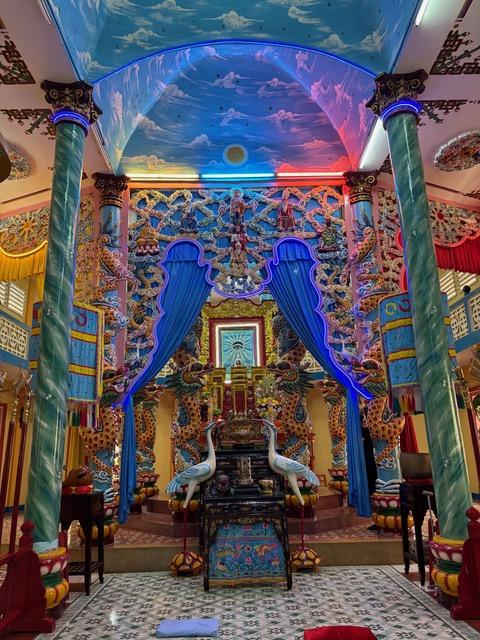
The Divine Eye looking out from behind the altar at the Cao Dai Temple is a reminder to worshippers that God is all-seeing and omnipresent.  ©GeriBain

Our afternoon tour takes us to the wet market in Sa Dec, where we see live eels, snake fish, snails and duck embryos, still in the shell, which are a local delicacy. From there, we board sampans and boat over to the Cao Dai Temple, where brilliant paintings and sculptures illustrate the beliefs of this home-grown Vietnamese monotheistic religion. Combining elements of Confucianism, Buddhism, Taoism, Christianity, Vietnamese folk religions and other practices, the Cao Dai religion is now the third largest religion in Vietnam.

On our last morning in Vietnam, we have two options: a trishaw tour of a village, stopping at silk and rattan workshops and a home visit, or an excursion to the Tra Su Cajuput Forest and Bird Sanctuary. Based on conversations with fellow passengers over dinner that evening, there was no wrong choice. We opt for nature, and are thrilled to have the chance to see this pristine eco-system.

This afternoon, we are required to remain on-board as the boat clears customs into Cambodia. AmaWaterways has collected our passports, arranges our visas and takes care of all the details. We take the opportunity to experience the region’s special deep-tissue massage spa treatments and join a cooking class. 

It’s only been three days since we set out on AmaWaterways’ AmaDara, but it feels like much longer because of all we’ve seen and done. Our guide, Phuc, who lives in Ho Chi Minh City, must leave us at the border. He has been more than our guide; he has shared stories about his family and taught so much about Vietnamese culture and everyday life in the Mekong. We are sad to bid him farewell as we prepare to sail across the border to Cambodia. At the same time, we are excited for tomorrow, when we will wake up in Cambodia’s exotic capital, Phnom Penh.

The basics:

In 2025, AmaWaterways offers one-week Mekong River trips, except during May, June, and July, traveling between Ho Chi Minh City, Vietnam and Siem Reap, Cambodia. Prices start at around $2,320 and include transfers between the ship and Ho Chi Minh City and Siem Reap and all sightseeing, wi-fi, meals, and on-board programs. Extra charges include airfare (discounted fares are available), visa fees, bar drinks (alcoholic beverages with meals are included), port charges (about $210 p.p.) and suggested tips ($80 per passenger for the crew and $20-$25 for the cruise manager). AmaWaterways also offers a choice of all-inclusive pre- and post-cruise options. The most comprehensive is eight nights, including stays in Ho Chi Minh City, Siem Reap/Angkor Wat,, and Ha Long Bay, and all transportation, priced at $2,779 per person.

Flights from the U.S. can take well over 20 hours. As with all cruises, it’s important to arrive at least a day early in case of flight delays. Considering the time change and potential for jet lag, I’d suggest a minimum two-night pre-cruise cushion—more if you have time. 

Bargaining in markets is expected. Generally, when we tell a merchant we will think about it and start to walk away, the price drops. Then, we may ask if that is the best they can do, and the price sometimes drops again. If it’s a big purchase, it’s smart to stop at a few booths to get a sense of pricing and quality.

Be sure to check with your doctor or a travel medicine specialist for recommendations on vaccinations and other health precautions, and the U.S. Department of State, CIA.gov and the CIA World Factbook for helpful country information.

Note when filling out visa applications, flight and hotel reservations that dates in Vietnam and Cambodia are written day/month/year. I almost booked my flight for the wrong date. (April 1, 2025 would be written 01/04/2025).

Get the required visa at Vietnam’s website (evisa.gov.vn), where the fee is $25 (if you use a visa service it costs something like $197), and at Cambodia’s website (evisa.gov.kh), where the fee is $30, but give yourself enough time to get the confirmation.

Useful contacts:

AmaWaterways.com

Sofitel Saigon Plaza

Raffles Grand Hotel D’Angkor Siem Reap

Sofitel Legend Metropole Hanoi Hotel

Next: AmaWaterways Cruises to Cambodia

__________________

© 2025 Travel Features Syndicate, a division of Workstyles, Inc. All rights reserved. Visit goingplacesfarandnear.com and travelwritersmagazine.com/TravelFeaturesSyndicate/. Blogging at goingplacesnearandfar.wordpress.com and moralcompasstravel.info. Visit instagram.com/going_places_far_and_near and instagram.com/bigbackpacktraveler/ Send comments or questions to FamTravLtr@aol.com. Bluesky: @newsphotosfeatures.bsky.social X: @TravelFeatures Threads: @news_and_photo_features ‘Like’ us at facebook.com/NewsPhotoFeatures