Category Archives: European travel

Setting Out on 8-Day Self-Guided BikeTour from Venice Bound for Croatia

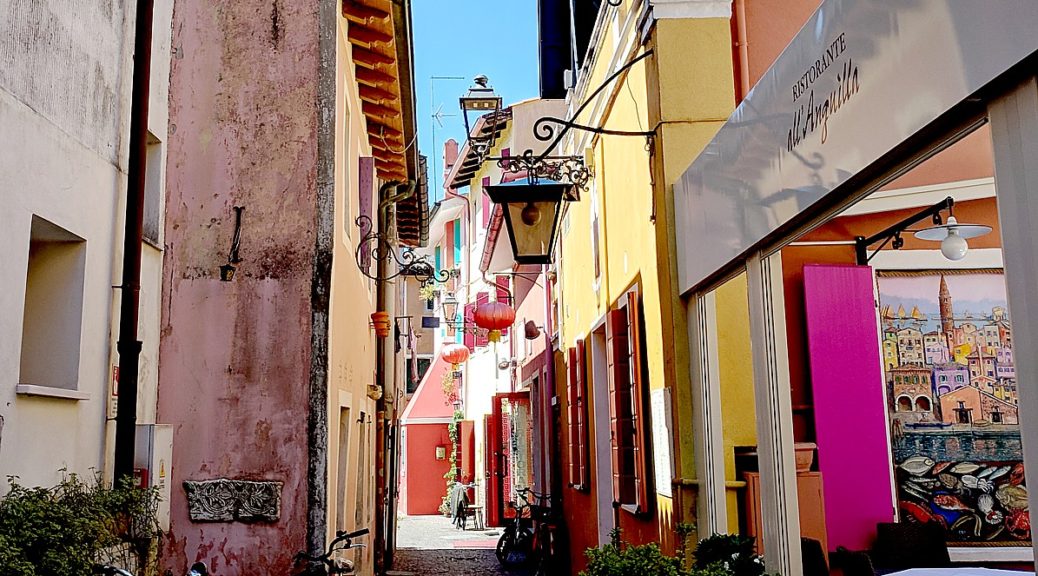
Picturesque Caorle, Day 2 of our eight-day biketour from Venice to Croatia © Karen Rubin/goingplacesfarandnear.com

By Karen Rubin and Eric Leiberman, Travel Features Syndicate, goingplacesfarandnear.com

We hadn’t biked far from the Hotel Alexander on the mainland of Venice in Mestre on the first morning of a week-long self-guided bike tour that would take us some 300 miles following the seacoast to Porec, Croatia, before I imagined: had I done this by myself as I had originally planned, I would have been found weeks later wandering in a wilderness. I was so grateful that by son could come along – his tech prowess (and insistence on getting an app of our route) made all the difference.

Each morning, he would unfurl the day’s Stage map and have his smart phone tucked into the plastic case on the handlebars. Once underway (after a delightful breakfast in the pre-arranged inns), I would be trying in vain to follow the cue sheets and do mathematical gymnastics with the kilometers, and was so consumed with these and watching for Eric ahead, and being enrapt by the scenery and taking photos, that I would miss the mark the tour operator left on sign posts for each turn.

“It’s simple,” Eric says. “If you don’t see a mark, just go straight.” © Karen Rubin/goingplacesfarandnear.com

“It’s simple,” Eric says. If you don’t see a mark, you go straight.” But what if you have missed the mark that told you to turn? You could find yourself kilometers ahead before you even have a clue you missed the turn and have no idea where to go back. At one point, Eric installs the hang-out app on my phone so he can find me on his map and I can see where he is, that comes in really handy when I miss a turn altogether in the middle of Trieste.

But all of it becomes part of the adventure – the excitement of doing, not just seeing, of becoming immersed in a place or not knowing what will beyond the next turn.

The day before we set out from Venice for the first stage ride, Anthony, the guide from FunActive, the local tour operator that coordinates the tour, had come to the hotel in the afternoon to deliver and fit our rental bikes, the vouchers and maps and sit with us for an orientation reviewing each day’s trip. He arrived specially, as we requested, shortly after Eric arrived by plane, and we rushed him through so we could have the afternoon and evening in Venice. Anthony sat patiently with us in the hotel’s lounge trying to review the route for each of the six days of riding (he would have to repeat the entire thing for the four other self-guided cyclists later that afternoon). He reviewed the particularities of the route – the recommended “options” for sightseeing and the route “variants”. He tried to give us a sense of the road, and the highlights. I took notes but we rushed him and I think we missed a few things.

Each day has alternatives of a shorter, easier ride (usually with some ferry or train) and the longer one. But one day stands out in Eric’s mind in particular when he is determined to take “the hinterland” route.

Stage 1: Venice mainland/Mestre – Jesolo/Caorle (22 or 50 miles/35 or 80 km)

I thought the thunder storm that hit during the night would mean fair weather for our first day’s ride, Venice to Jesolo, a distance of 51 km (30 miles, though there is an option to take a shorter ride, 22 miles). No luck. It is raining when we leave and surprisingly cold – about 20 degrees cooler from the day before. We set out anyway because the rain is part of our adventure, after all.

Setting out from Venice on an eight-day self-guided biketour
© Karen Rubin/goingplacesfarandnear.com

I had thought we would mainly be riding on roads with traffic but am surprised and relieved that most of our ride for the next few days are along bikeways – often paved but sometimes gravel or pebbles, but nonetheless a bikeway – or else some country roads with very little traffic. And for the next few days, our ride will be flat, taking us through farmland and along the coast.

This first day of cycling is designed by FunActive to be easy (and would be but for the rain and head wind). Our destination is Jesolo, a seaside beach town. Many of the days offer options to cut off some of the biking (or the climbing or the traffic) by taking a ferry from the lagoon in Venice to Punta Sabbioni, which would have cut the day’s ride to 22 miles). We opt to take the “hinterland” route, cycling along the river Sile, 30 miles to Jesolo, passing the ruins of Torre Caligo, a tower from the Middle Ages which is situated near the canal “Caligo.”

FunActive has given us excellent background material – a guidebook in fact (I wish I had paid more attention to it before we set out) that includes background on the landscape, history and culture of the regions we travel through, plus recommendations for attractions and restaurants in each place, along with local maps. The route map, broken up into each day’s Stage, is well marked with places to stop for food, photos, attractions.

We ride through countryside – farms and villages – we can even see the snowcapped mountain peaks of the Dolomites in the distance.

This first day is really an orientation to learn “the rules of the road” – for me, figuring out how to correlate the cue sheets and look for the trail markings. At first, I am very disoriented, but Eric manages to get us to our destination.

Jesolo, a charming family beach town © Karen Rubin/goingplacesfarandnear.com

Jesolo is utterly charming seaside beach resort that attracts local families, and despite its proximity to Venice, doesn’t seem to have attracted any foreign tourists at all (another delight of a bike tour, that brings you into local places well off the beaten tourist track). I am amazed how fine the sand is. The weather has cleared but it is rather cold and there is a red flag on the lifeguard stand, so no one is in the water this late in the afternoon. We enjoy walking along the beach, sticking our feet in the water, and taking in all the color.

Jesolo, a family-oriented beach town © Karen Rubin/goingplacesfarandnear.com

The town has a ferris wheel, amusement park, water park, go karts, arcade, lovely shops and restaurants, is loaded with surreys and bikes, and in the evening, closes the street to cars altogether. What we notice is there are few (if any) bars. This is really a family place. We love our hotel, the Marco Polo which is right on the main street, a block off the beach. The scenes evoke flashbacks to my own childhood, when our family would take trips in February to Atlantic City, normally a beach resort, and enjoy the boardwalk.

There are a plethora of restaurants – many are full and one in particular, Atmosphera, has people (including many families), lining up in the street. Lucky for us, they have a table for two. This place is a revelation – and we can soon see why it is probably the most popular restaurant in Jesolo – it has a sensational menu (pages and pages of pizza offerings, meat and fish selections), wonderfully prepared with fresh, flavorful ingredients in open kitchens, large portions beautifully presented and modest prices.

Our hotel, the Marco Polo, is most charming, and right on the main drag.

The Marco Polo, Jesolo © Karen Rubin/goingplacesfarandnear.com

Stage 2: Jesolo/Caorle to Concordia Sagittaria/Portogruaro (19 or 31 miles).

Today’s ride, 31 miles from Jesolo to Concordia Sagittaria/Portogruaro, is easy, cycling along the coast and it’s sunny! which dramatically adds to my sunny mood and puts metal to my pedal. We ride through scenic farmland and countryside. We take a slight detour into Caorle, which the FunActive guide, Anthony, has heartily recommended we do, and this proves one of the pure gems of the tour.

Venice-Trieste-Istria self-guided biketour. Stage 2-Caorle-Saggitaria-Portogruaro (c) Karen Rubin/goingplacesfarandnear.com

As we enter the town, the colorful buildings around a plaza makes me think of Sausalito over the Golden Gate Bridge from San Francisco, or, then again, of Seaside, Florida, that idyllic village in the “Truman Show,” and as soon as we make the turn into the Old District, with the warm sun streaming down, I think what a fantastic movie set this would make. It seems that all the property owners by choice or decree paint their buildings before each season, according to a certain gorgeous palette of colors.

Venice-Trieste-Istria self-guided biketour. Stage 2-Caorle-Saggitaria-Portogruaro (c) Karen Rubin/goingplacesfarandnear.com

The colors are stirring, surreal almost, especially because of the narrow alleys and the angles. A riot of color. Think Nanny McPhee. I can’t get enough of it- the scenes make my heart race, especially the narrow, angled alleys. As we walk, each new vista is like a new painting.


Picturesque Caorle, Day 2 of our eight-day biketour from Venice to Croatia © Karen Rubin/goingplacesfarandnear.com

We discover Carole in layers – first wandering through the streets. Eric has zoned in on a restaurant for lunch. We eat outside but this clever place, inside, actually has a model train set that delivers your food to the table.

Caorle has been settled for about 2000 years. Wandering around, we come upon the Cathedral San Stefano Protomartire Caorle, built in 1038.

Madonna dell’Angelo Church, Caorle © Karen Rubin/goingplacesfarandnear.com

Then we walk back and hone in on the Madonna dell’Angelo Church, perched on a cliff overlooking the water and the beach at the end of the stone promenade, wrapping around on two sides. Across the way, there are a gazillion beach umbrellas set up, but where we are, there are like random, ad hoc DIY blankets and umbrellas. Eric swims in the Adriatic while I take photos.

Keep a bathing suit handy for opportunities like this: the beach at Caorle © Karen Rubin/goingplacesfarandnear.com

We are so delighted with Caorle, we buy refrigerator magnets with the scene of the colorful buildings.

Venice-Trieste-Istria self-guided biketour. Stage 2-Caorle-Saggitaria-Portogruaro (c) Karen Rubin/goingplacesfarandnear.com

We leave this enchanting town and find ourselves in absolutely gorgeous countryside – with what I presume are the Dolomite Mountains as a backdrop. At one point, we ride along a berm that elevates us over the farmland on either side.

Anthony had strongly recommended that once we arrive at Concordia Sagittaria where our inn is, we ride the few extra kilometers into Portogruaro, and when I see the photo of the Town Hall on our hotel’s card, we race out to take advantage of the warm late afternoon light.

Portogruaro © Karen Rubin/goingplacesfarandnear.com

It is a delightful ride on a bike path along a river into Portogruaro, aglow in golden light. The town, founded in the 12th century as a port on the river Lemene, is surprisingly big and bustling, and we dash to try to capture that scene from the photo before the sun sets. We find our way to the Old City and the Plaza della Republica with its grand Gothic Town Hall, A concert is going on and we are drawn in but pull away in order not to miss the fading sunlight.

Portogruaro © Karen Rubin/goingplacesfarandnear.com

The setting is absolutely magnificent – this 12th century Town Hall with ancient watermills (one still spinning), is very Venetian in its look. I realize that the shot I want is across the river, and cross the bridge to a small park adjacent to a monastery. I get there just in time before the light fades.

We bike back to Concordia Sagittaria, a delightful village well off the tourist “beaten track,” which is why I love bike tours so much. The village sits in what was a Roman colony on the River Lemene.

Concordia Sagittaria © Karen Rubin/goingplacesfarandnear.com

By now we’re famished. It’s a Monday night and some restaurants are closed. But Eric finds a marvelous one (which turns out to be listed in the FunActiv guide): Pizzeria Al Solito Posto. All the tables have been reserved (notably, by locals), but we notice two people just finishing their meal at a table outside. There are something like four pages of pizza to choose from and I have the best pizza I’ve had in my life: cheese, olives, capers and anchovies with the freshest tomato and thinnest of crust done to perfection.

The Julia, Concordia Sagittaria © Karen Rubin/goingplacesfarandnear.com

Our inn, The Julia, is right on the river and in the middle of the square, towered over by the 10th century Byzantine Cathedrale di Santo Stefano Protomartire, dedicated to the first Christian martyr. (Inside, our notes say, is a holy water stoup in Greek marble from the 1st century and 13th century paintings). Just across the square, we discover an archeological dig with sarcophagus, on the ruins of the first basilica. The excavations have also uncovered ruins of a Roman street. Next to the church is a Roman-style bell tower from 1150. There is also a Bishop’s Palace (1450) and town hall from the year 1523.

An archeological dig with sarcophagus on the ruins of the first basilica Concordia Sagittaria © Karen Rubin/goingplacesfarandnear.com

This day has been the most magnificent. And the most interesting thing of all is we would never have seen or experienced any of it except for riding our bikes.

There are four other riders following the same self-guided FunActive itinerary as we who have started on the same day, and we meet up with them periodically in the inns and even on the trail and delight in sharing stories and comparing notes of our travels.

Concordia Sagittaria © Karen Rubin/goingplacesfarandnear.com

Next: Discovering Ancient Christian Cite of Aquilea, Roman City of Grado

(We booked our 8-day self-guided “Venice-Trieste-Istria” self-guided bike tour through BikeTours.com, a broker which has an excellent catalog of well-priced guided and self-guided bike and bike/boat trips, mostly in Europe, and has very attentive counselors. Biketours.com, 1222 Tremont Street, Chattanooga, TN 37405, 423 756-8907, 877 462-2423, www.biketours.com, info@biketours.com)

_____________________________

© 2019 Travel Features Syndicate, a division of Workstyles, Inc. All rights reserved. Visit goingplacesfarandnear.com, www.huffingtonpost.com/author/karen-rubin, and travelwritersmagazine.com/TravelFeaturesSyndicate/. Blogging at goingplacesnearandfar.wordpress.com and moralcompasstravel.info. Send comments or questions to FamTravLtr@aol.com. Tweet @TravelFeatures. ‘Like’ us at facebook.com/NewsPhotoFeatures

A Night Visit to the Doge Palace IN Venice

Doge Palace, Venice (c) Karen Rubin/goingplacesfarandnear.com

By Karen Rubin, Travel Features Syndicate, goingplacesfarandnear.com

One of the most popular attractions in Venice and dominating the most popular square, San Marco, the Doge Palace is unbelievably crowded with tourists during the day who can stand on line for a long time and then struggle inside for views of the fantastic art. But on my recent trip, I discovered that the Doge Palace and three other museums stay open on Fridays and Saturdays until 11 pm (last entrance at 10 pm) and the ticket is valid at all four of the museums and valid for three months.  The experience of visiting the Doge Palace at night is incomparable.

I waltz in at 7:30 pm without waiting at all and find myself in these rooms – grand doesn’t begin to describe them – by myself or with at most a handful of other people. All of us are breathless. No one speaks. The silence is thrilling.

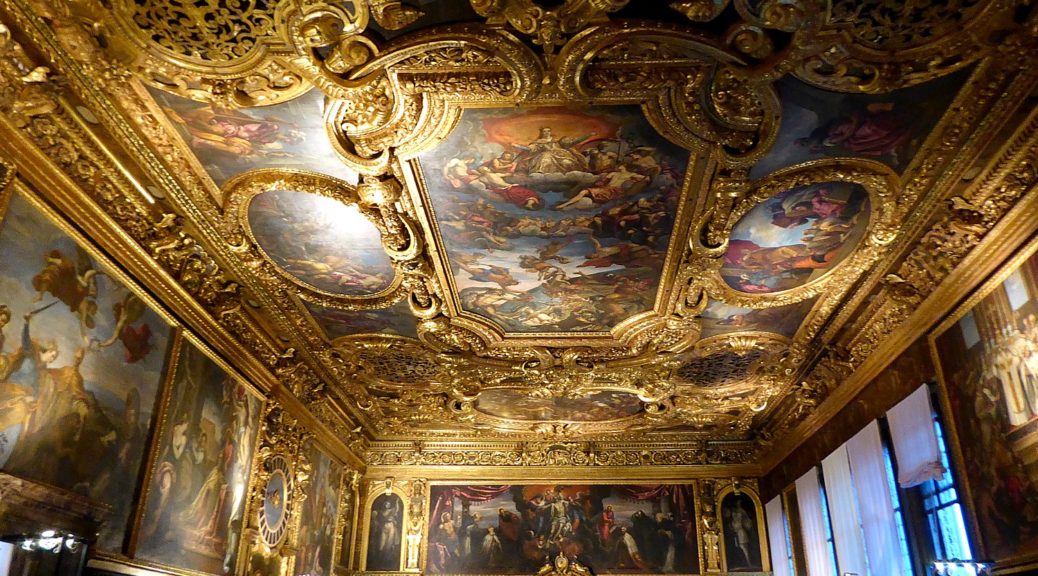
The art work – monumental pieces by titans of the Renaissance – fill the massive walls and the entire ceiling. One room is grander and bigger and more gilded than the next, and at this hour, at this moment, it feels like all of this is for me and me alone.

Doge Palace, Venice (c) Karen Rubin/goingplacesfarandnear.com

Besides the extraordinary magnificence of the artwork throughout the Doge Palace, I realize from the notes I read afterward that the palace harbors a fascinating history of government of this early republic, which for two centuries dominated trade between Europe and Asia. Venice’s powerful influence extended from the city at the western edge of the old Byzantine Empire, to the eastern Mediterranean and the Black Sea.

I go through the rooms taking in the visual sights, overwhelmed, really by the art – the majestic paintings in gilded frames that completely cover the walls and ceiling, the architectural details. The rooms are fairly dark and I don’t take the time or struggle to read the notes that are provided. Later, when I review the notes provided, I better appreciate the historical significance, where the art and the architecture were representations of the structure of government and the rulers, comparable to the Capitol Building, Supreme Court and White House, combined, though hundreds of years older.

For two centuries, the Venetian Republic dominated trade between Europe and Asia, its influence extending from the city at the western edge of the Byzantine Empire to the eastern Mediterranean and the Black Sea.

Doge Palace, Venice (c) Karen Rubin/goingplacesfarandnear.com

The palace dates back to before the 10th century but, after a fire, was rebuilt by Doge Sebastiano Ziani (1172-1178), a great reformer who also changed the layout of St. Mark’s Square. The palace had to be expanded several times “to accommodate political changes and the increase in number of people who had the right to participate in the legislative assembly meetings” (an intriguing phrase). The Chamber of the Great Council (just one room in this palace) accommodated 1,200 to 2,000 noblemen. The thought is mind-boggling.

After another huge fire in 1577 destroyed many of the masterpieces, reconstruction was undertaken immediately to restore it to its original appearance, which was completed by 1579-80.

Until then, the Doge’s Palace housed not only the Doge’s apartments, the seat of the government and the city’s courtrooms, but also a jail. It was only in the second half of the 16th century that Antonio da Ponte ordered the construction of new prisons, built by Antonio Contin around 1600, which were linked to the Doge’s Palace by the Bridge of Sighs, built in 1614. Relocating the prisons left the old space on the ground floor of the palace free, which led to the creation of the courtyard.

Looking through the Bridge of Sighs, Doge Palace, Venice (c) Karen Rubin/goingplacesfarandnear.com

The famous Bridge of Sighs dates from the Romantic period, its name supposedly referring to the sighs of prisoners who, passing from the courtroom to the cell in which they would serve their sentence, took a last look at freedom as they glimpsed the lagoon and San Giorgio through the filigree openings.

Crossing over the Bridge of Sighs is one of the most thrilling aspects of the visit, especially at night, with the golden lights reflected on blue-black water. You peer through the openings, just as these prisoners would have. It is somewhat surreal to look down at the bridge from which you saw the Bridge of Sighs hours before, and imagine what prisoners must have thought as they had their last glimpse of that glorious scene. And then going into the prison itself, surreal considering it was mere steps away from the grandeur of the palace.

Inspecting the prison cells, Doge Palace, Venice (c) Karen Rubin/goingplacesfarandnear.com

But there is still so much more to see – it seems that the palace just goes on and on.

The Chamber of the Great Council, restructured in the 14th century, was decorated with a fresco by Guariento and later with works by the most famous artists of the period, including Gentile da Fabriano, Pisanello, Alvise Vivarini, Carpaccio, Bellini, Pordenone and Titian. At 53 meters long and 25 meters wide, this is not only the largest and most majestic chamber in the Doge’s Palace, but also one of the largest rooms in Europe.

The Great Council was the most important political body in the Republic. An ancient institution, the Council was made up of all the male members over 25 years old of patrician Venetian families, irrespective of their individual status, merits or wealth. “This was why, in spite of the restrictions in its powers that the Senate introduced over the centuries, the Great Council continued to be seen as bastion of republican equality. The Council had the right to call to account all the other authorities and bodies of the State when it seemed that their powers were getting excessive and needed to be trimmed. The 1,200 to 2,000 noblemen who sat in the Council always considered themselves guardians of the laws that were the basis of all the other authorities within the State.”

This room was also where the first steps in the election of a new Doge would take place. These voting procedures were extremely long and complex in order to frustrate any attempts of cheating. Every Sunday, when the bells of St. Mark’s rang, the Council members would gather in the hall with the Doge presiding at the center of the podium and his counselors occupying double rows of seats that ran the entire length of the room.

Doge Palace, Venice (c) Karen Rubin/goingplacesfarandnear.com

The walls are decorated with works by Paolo Caliari (known as Paolo Veronese), Jacopo and Domenico Tintoretto, and Palma il Giovane. depicting Venetian history, particularly the city’s relations with the papacy and the Holy Roman Empire; the ceiling is decorated with the Virtues and examples of Venetian heroism, with an allegorical glorification of the Republic in the center. Facing each other in groups of six, the 12 wall paintings depict acts of valor or scenes of war that had occurred during the city’s history. A frieze with portraits of the first 76 doges (the portraits of the others are in the Sala dello Scrutinio) runs just under the ceiling. Though commissioned from Jacopo Tintoretto, most of these paintings are the work of his son, Domenico. Each Doge holds a scroll bearing a reference to his most important achievements, while Doge Marin Faliero, who attempted a coup d’état in 1355, is represented simply by a black cloth – a traitor to the Republic, he was not only condemned to death but also to damnatio memoriae, the total eradication of his memory and name.

Along the wall behind the Doge’s throne is one of the longest canvas paintings in the world, the Paradiso, which Jacopo Tintoretto and workshop produced between 1588 and 1592 to replace the Guariento fresco that had been damaged in the fire.

The Council Chamber was where two separate and independent organs of power, the Savi and the Signoria, would meet. The Savi was divided into three sections concerned with foreign policy, mainland Italy and maritime issues. The Signoria was made up of the three Heads of the Councils of Forty and members of the Minor Council, composed of the Doge and six councilors, one for each district of the city of Venice. The Council was organized and coordinated the work of the Senate, reading dispatches from ambassadors and city governors, receiving foreign delegations and promoting other political and legislative activity.

The Sala dei Pregadi housed the Senate, one of the oldest public institutions in Venice.  Established in the 13th century, it evolved over time until by the 16th century it was the body mainly responsible for overseeing political and financial affairs in manufacturing, trade and foreign policy. In effect, it served as a sub-committee of the Great Council and its members were generally drawn from the wealthiest Venetian families.

Doge Palace, Venice (c) Karen Rubin/goingplacesfarandnear.com

The Chamber of the Council of Ten is named for the council that was set up after a conspiracy in 1310, when Bajamonte Tiepolo and other noblemen tried to overthrow the government. “Initially meant as a provisional body to try those conspirators, the Council of Ten is one of many examples of Venetian institutions that were intended to be temporary but which became permanent.” Its authority covered all sectors of public life, a power that gave rise to its reputation as a ruthless, all-seeing tribunal at the service of the ruling oligarchy, a court whose sentences were handed down rapidly after secret hearings. The assembly was made up of ten members chosen from the Senate and elected by the Great Council. These ten sat with the Doge and his six counselors, which accounts for the 17 semicircular outlines that you can still see in the chamber.

The Compass Room was used for the administration of justice. It was named for the large wooden compass with a statue of Justice, that stands in one corner and hides the entrance to the rooms of the three Heads of the Council of Ten and the State Inquisitors. Those summoned by these powerful magistrates waited here to be called; the magnificent decor was intended to reinforce the solemnity of the Republic’s legal machinery.

So much of the exquisite decoration we see, which dates from the 16th century, was commissioned from Veronese. Completed in 1554, the works he produced are all intended to exalt the “good government” of the Venetian Republic; the central panel, with St. Mark descending to crown the three Theological Virtues, is a copy of the original, now in the Louvre.

The Chamber of Censors was an office which was established in 1517 to address “the cultural and political upheavals that are associated with Humanism.” The State Censors “were more like moral consultants than judges, with their main task being the repression of electoral fraud and the protection of the State’s public institutions.” The walls display Domenico Tintoretto’s portraits of these magistrates.

The Chamber of the State Advocacies: This State Advocacy department dates from the 12th century, when Venice was organized as a commune. The three members, the Avogadori, safeguarded the principle of legality, making sure that laws were applied correctly. Though they never enjoyed the status and power of the Doge and the Council of Ten, the Avogadori remained one of the most prestigious authorities in Venice right up to the fall of the Republic. They were also responsible for preserving the integrity of the city’s patrician class, verifying the legitimacy of marriages and births inscribed in the Golden Book.

The “Scrigno” Room. The Venetian nobility as a caste came into existence because of the “closure” of admissions to the Great Council in 1297; but it was only in the 16th century that formal restrictions that protected the status of that aristocracy were introduced: marriages between nobles and commoners were forbidden so greater controls were set up to check the validity of aristocratic titles. Golden and Silver books registered all those families that not only had the requisites of “civilization” and “honor”, but could also show that they were of ancient Venetian origin. The Golden and Silver Books were kept in a chest inside a cupboard that also contained all the documents proving the legitimacy of claims. The 18th century cupboard we see today extends around three sides of a wall niche; lacquered in white with gilded decorations.

The Armourny, Doge Palace, Venice (c) Karen Rubin/goingplacesfarandnear.com

The Armoury houses an important historical collection of weapons and armaments. The core of the collection is 14th century, dating from the time when the Armoury was under the control of the Council of Ten and stocked with weapons that would be readily available for the Palace’s guards. The collection was partially dispersed after the fall of the Republic, but still contains some 2000 exhibits, including 15th and 16th century suits of armor, swords, halberds, quivers and crossbows. Many are inscribed or painted monogram CX – for “Council of Ten” – which also appears on the door jambs, evidence of the Council’s might. The Turkish implements – weapons, standards and ships’ lanterns – that are displayed were taken from the enemy during battle. The collection also displays 16th and 17th century firearms; implements of torture; a chastity belt; and a series of small but lethal weapons that were prohibited by law.

Doge Palace, Venice (c) Karen Rubin/goingplacesfarandnear.com

The Doge’s Palace was the heart of the political life and public administration of the Venetian Republic, so after the fall of the Republic in 1797, its role inevitably changed. Venice first fell under French rule, then Austrian, and ultimately, in 1866, became part of a united Italy.

Up until the end of the 19th century, the Palazzo Ducale was occupied by various administrative offices and housed important cultural institutions such as the Biblioteca Marciana (from 1811 to 1904). But by then, the structure was showing signs of decay. The Italian government set aside sizeable sums for an extensive restoration. Public offices were relocated with the exception of the State Office for the Protection of Historical Monuments, which is still housed in the building (now called Superintendence of the Environmental and Architectural Heritage of Venice and its Lagoon). In 1923, the Italian state which owns the building, appointed the City Council to manage it as a public museum. In 1996, the Doge’s Palace became part of the Civic Museums of Venice network.

San Marco Square, Venice, at night (c) Karen Rubin/goingplacesfarandnear.com


ST. MARK’S SQUARE MUSEUMS TICKET A single ticket valid for the Doge’s Palace and the combined itinerary of Museo Correr, Museo Archeologico Nazionale and Monumental Rooms of the Biblioteca Nazionale Marciana.  This ticket is valid for 3 months and grants one single admission to the Doge’s Palace and the combined itinerary. (20E for regular ticket; 13 E for children 6-14, students 15-25, seniors over 65 and holders of International Student Identity Card) (http://palazzoducale.visitmuve.it/en/the-museum/doges-palace/the-palace/)

MUSEUM PASS The Museum Pass the cumulative ticket for the permanent collection of the Musei Civici of Venice currently open and for those connected (Palazzo Fortuny and Clock Tower not included).  This ticket is valid for 6 months and grants one single admission to each museum. The Museum Pass grants entrance to: The St Mark’s Square museums
: – Doge’s Palace – combined itinerary of Museo Correr, Museo Archeologico Nazionale, Monumental Rooms of the Biblioteca Nazionale Marciana, plus other civic museums of Venice: Ca’ Rezzonico – Museum of 18th-Century Venice; Museum of Palazzo Mocenigo; Carlo Goldoni’s House; Ca’ Pesaro, International Gallery of Modern Art + Oriental Art Museum; Glass Museum – Murano; Lace Museum – Burano; Natural History Museum. (24E or 18 E), www.visitmuve.it.

Venice (c) Karen Rubin/goingplacesfarandnear.com

I wander back through the narrow alleys of the old city, stopping to listen to a musician fill a plaza with his music, to the tram that takes me back to the Hotel Alexander in Mestre. Tomorrow, Eric and I will start our eight-day self-guided bike tour that will take us about 300 miles to Trieste, Slovenia and Croatia.

(We booked our 8-day self-guided “Venice-Trieste-Istria” bike tour through BikeTours.com, a broker which has an excellent catalog of well-priced guided and self-guided bike and bike/boat trips, mostly in Europe, and has very attentive counselors. Biketours.com, 1222 Tremont Street , Chattanooga, TN 37405,  423-756-8907, 877-462-2423, www.biketours.com,info@biketours.com).

See also: Following Whim and Whimsy in Venice

_____________________________

© 2019 Travel Features Syndicate, a division of Workstyles, Inc. All rights reserved. Visit goingplacesfarandnear.com, www.huffingtonpost.com/author/karen-rubin, and travelwritersmagazine.com/TravelFeaturesSyndicate/. Blogging at goingplacesnearandfar.wordpress.com and moralcompasstravel.info. Send comments or questions to FamTravLtr@aol.com. Tweet @TravelFeatures. ‘Like’ us at facebook.com/NewsPhotoFeatures
Following Whim and Whimsy in Venice

Wandering through Venice’s neighborhoods © Karen Rubin/ goingplacesfarandnear.com

By Karen Rubin, Travel Features Syndicate, goingplacesfarandnear.com

One of the smartest choices I make in preparation for a week-long self-guided bike tour from Venice to Trieste to Istria (Slovenia to Croatia) is to arrive a day earlier. This gives me the unsurpassed luxury of spending a day wandering around Venice without a plan or an objective, just to follow whim and whimsy and take in the incomparable essence of this enchanting city. I am transfixed by Venice – the colors, the constant motion, the angles, the architecture, how you never know what you will see around any corner, how getting lost leads to new discovery. I have that cherished time to really focus on details.

Eric, my son who will be biking with me, will be arriving the next day, and I have made my way from Marco Polo International Airport to the Hotel Alexander, on the mainland, in Mestre by public bus (following the directions provided by FunActive, the tour company). I drop my bags and have most of the day to explore on my own.

The hotel that has been selected on the FunActiv tour (self-guided means that they have booked the inns and laid out the route, provide the rental bikes and support, a ferry the luggage each day to the next inn) which I booked through Biketours.com, is well located, just a short walk to a tram that comes frequently (they tell me where to buy the ticket, at a convenience store) and whisks me in comfort to the magnificent old city in 15 minutes.

Before I left the hotel, I had spotted a flyer about a new Leonardo Da Vinci Museum and am delighted when, serendipitously, I find myself right in front of it, next door to Chiesa di San Rocco, a church where a concert is underway. I listen for awhile and then go into the Museum.

Trying out one of Leonardo DaVinci’s inventions at the new Leonardo DaVinci Museum in Venice © Karen Rubin/ goingplacesfarandnear.com

What distinguishes the Leonardo Da Vinci Museum is that it is designed as a laboratory for experimentation and curiosity – actually giving you insights into the mind of Leonardo da Vinci by bringing his manuscripts, schematics and drawings to reality. Engineers have recreated large-scale models of Da Vinci’s inventions from his own plans “created through the skillful craftsmanship typical of the Renaissance workshops” which you can touch and maneuver.  Essentially, you get to play with DaVinci’s inventions – delighting children of all ages. The museum also exhibits DaVinci’s anatomical studies. A special space is dedicated to his main pictorial works including the Mona Lisa and Annunciation, reproduced using high-resolution backlight technology.(Open daily, Scuola Grand di San Rocco, www.davincimuseum.it).

My motto, “Seize the day” (and waste no time) serves me well, because my first day is sunny, bringing out the colors of Venice – along with everyone else. Venice is unbelievably crowded with tourists– like Times Square but on a much, much bigger scale– and quite warm and humid. But I don’t mind and I find myself wandering down streets and alleys in neighborhoods (and they are really neighborhoods, where Venetians live) that are amazingly uncrowded and quiet.

Concert underway in a church provides respite for body and soul © Karen Rubin/ goingplacesfarandnear.com

I periodically take refuge in churches to get out of the heat and take a bit of a rest and often am pleasantly surprised to discover art and music.

One of the delights of Venice is that it is set up like a labyrinth of warrens, alleys, bridges over canals, so you are constantly surprised by the scenes that come into view as you walk about.

Venice (c) Karen Rubin/goingplacesfarandnear.com

The most popular is the famous view from the Rialto Bridge at the center of the city where you literally have to wait your turn to get a photo.

The narrow alleys all of a sudden open up into the famous square of San Marco and I come upon the Basilica of San Marco with its ornate decoration. There is so much to see and do here in the piazza, which remarkably has retained the same look as depicted in Renaissance paintings.

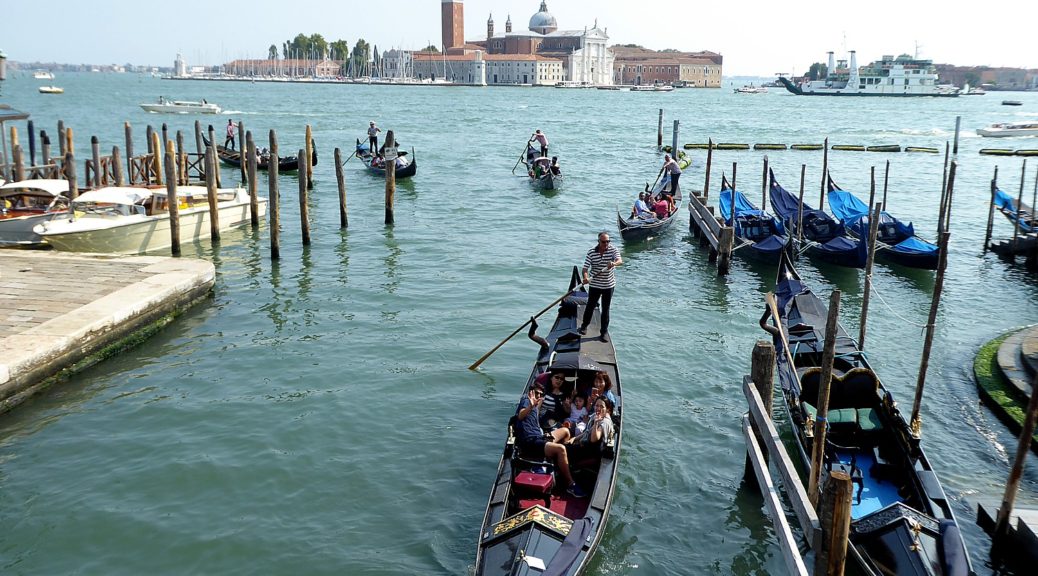
Rush hour for gondoliers © Karen Rubin/ goingplacesfarandnear.com

At San Marco, I stand on a bridge the gondoliers go under to get to the Bridge of Sighs – that famous place in the Doge Palace where prisoners would be taken to their cramped, damp cells, across this bridge with the last view of the open sky and their last breath of fresh air. It’s like rush hour of the gondolas. I admire the skill with which they deftly turn 90-degree corners and avoid hitting each other or smack into the pilings. The choreography of their floating dance is amazing – I notice the oar lock the gondoliers use, shaped in such a way that they get a different angle to control their stroke.

Bridge of Sighs, Doge Palace © Karen Rubin/ goingplacesfarandnear.com

What really strikes me is that despite the crowds, how clean Venice’s streets are (though there is graffiti, more a reflection of political climate) and how fresh. This wasn’t the case when I last visited, 10 years ago.

I linger in the Piazza San Marco for a time, and am sitting on marble benches under an archway at the Doge Palace when I hear thunder. Last time I was here, the city was flooded – platforms mysteriously would appear on the streets that you had to walk over to avoid wading in six inches of water – a worrisome warning that Venice may at some point become submerged altogether with rising sea level.


Venice’s famous Piazza San Marco © Karen Rubin/ goingplacesfarandnear.com

No one seems particularly bothered by the thunder, not even the street vendors. I take the tram back to the hotel, and just before I get there, the thunderstorm starts.

The next morning is raining, but no matter. I hop the tram again, a five-minute walk from the Hotel Alexander through the neighborhood for the ride into Venice, and this time, after crossing over the bridge that provides entrance to the Old City (and apparently closes at night to those who aren’t living or staying here) go left at the fork instead of right. I walk over a bridge and see a sign pointing to the Jewish Ghetto and follow it. I come upon a group of Israeli tourists huddled under a passageway leading into the Jewish quarter as their guide gives her talk. I walk ahead and find the synagogue, where Sabbath services are just finishing, guarded by city soldiers who don’t let me in.

The last time I was in Venice, I happened upon Chabad gathering for Shabbat dinner and was invited in. The Chabad are actively repopulating European cities that emptied their Jewish communities during the Holocaust.

Gondolier, Venice © Karen Rubin/ goingplacesfarandnear.com

I have a few hours before Eric arrives and we have our orientation with a FunActive guide for our bike tour. I make my way to San Marco again, before walking back to the depot to get the tram back to the hotel, in time for Eric and the guide to arrive.

We spend about an hour with Anthony, the FunActive guide, actually hurrying him along because we are so anxious to get back to Venice so Eric can have some time there. Anthony persists: going over the day-by-day maps, pointing out sights we might look out for, and alternative routes we can take, and then fits us to the bikes we will be taking.

Entrance to the synagogue. Venice’s Jewish Ghetto is being repopulated © Karen Rubin/ goingplacesfarandnear.com

By the time we get to Venice in the afternoon, the rain has cleared. We return together to the Jewish Ghetto and wander from there. I let Eric take the lead so he can have that same delight in discovering Venice for himself.

It is important to realize that Venice is a place where people live (signs ask visitors to respect the residents), and coming in this way, through the Jewish Ghetto, we find many streets – very quiet streets – that are simply neighborhoods off the beaten tourist track. Laundry stretched across the canal.

Dining at Al Portego © Karen Rubin/ goingplacesfarandnear.com

Eric uses his tech prowess (and the AFAR app) to find a restaurant, which gives a purpose and focus to our wandering through the streets. We arrive at Al Portego just in time before all the tables would be reserved for dinner.

After dinner, we walk to San Marco, which is especially magical at night. I have saved visiting the Doge Palace for the evening (the Doge Palace and three other museums stay open on Fridays and Saturdays until 11 pm, last entrance at 10 pm) so that Eric could see it as well. But Eric is too exhausted after having traveled all day and heads back to the hotel.

Doge Palace at night © Karen Rubin/ goingplacesfarandnear.com

I waltz in at 7:30 pm without waiting at all – such a contrast to the daytime when the lines are long and hundreds of people, including massive tour groups, funnel in at once. The ticket, I learn, is valid at all four museums and good for three months. Unfortunately, I won’t be able to take advantage, but the ticket is well worth it.

Priceless, in fact.

I find myself in these rooms – grand doesn’t begin to describe it – by myself or with at most five other people. All of us are breathless. No one speaks. The silence is thrilling.

The art work – monumental pieces by titans of the Renaissance – fill the massive walls and the entire ceiling. One room is grander and bigger and more gilded than the next, and at this hour, at this moment, it feels like all of this is for me and me alone.

Next: A Night Visit to the Doge Palace

(We booked our 8-day self-guided “Venice-Trieste-Istria” self-guided bike tour through BikeTours.com, a broker which has an excellent catalog of well-priced guided and self-guided bike and bike/boat trips, mostly in Europe, and has very attentive counselors. Biketours.com, 1222 Tremont Street , Chattanooga, TN 37405,  423 756-8907, 877 462-2423, www.biketours.com, info@biketours.com ).

_____________________________

© 2019 Travel Features Syndicate, a division of Workstyles, Inc. All rights reserved. Visit goingplacesfarandnear.com, www.huffingtonpost.com/author/karen-rubin, and travelwritersmagazine.com/TravelFeaturesSyndicate/. Blogging at goingplacesnearandfar.wordpress.com and moralcompasstravel.info. Send comments or questions to FamTravLtr@aol.com. Tweet @TravelFeatures. ‘Like’ us at facebook.com/NewsPhotoFeatures

48 Hours in Lisbon

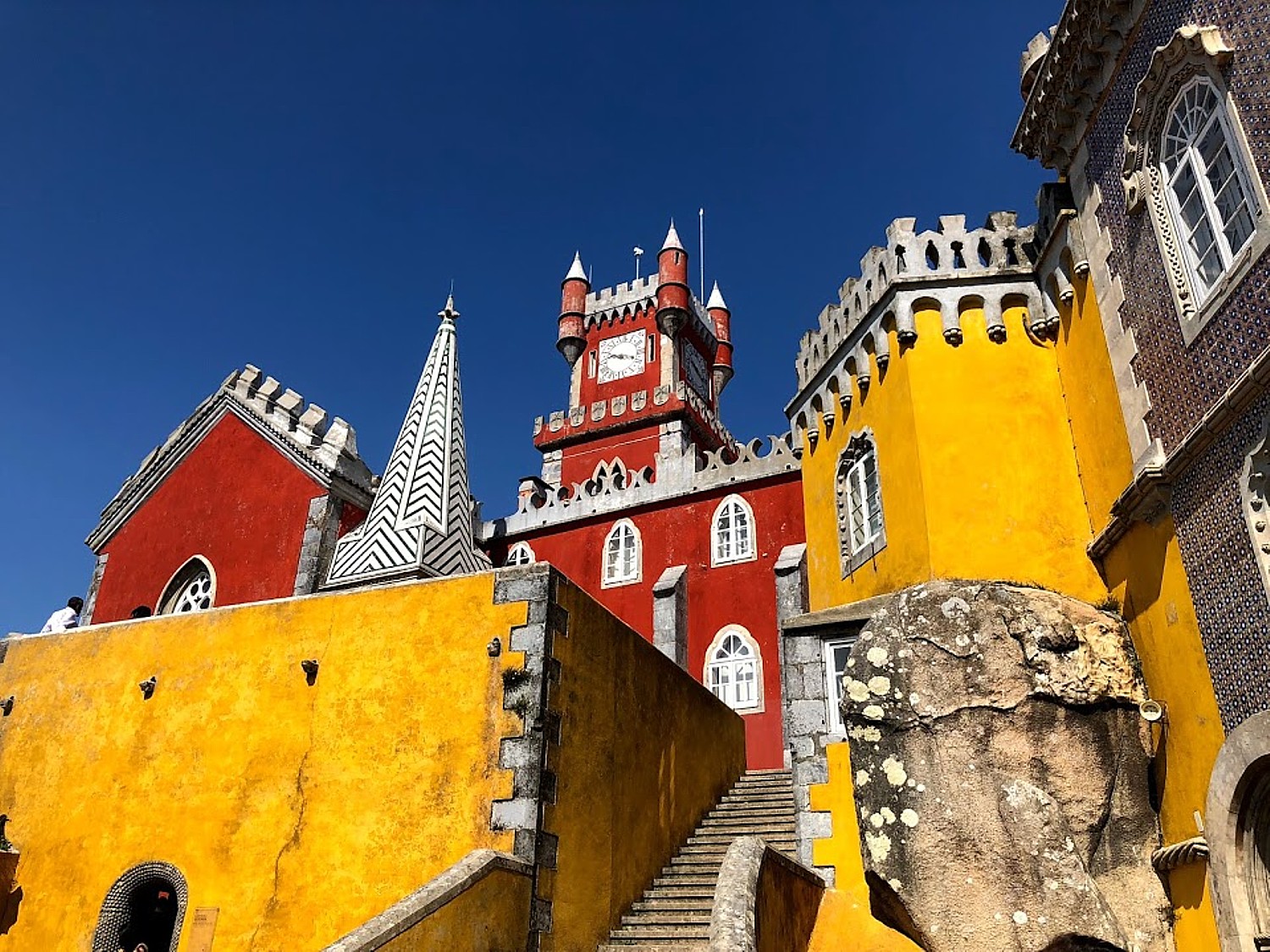
Palacio de Pena is a wildly colorful and richly patterned 19th century estate atop a steep hill offering sweeping 360 degree views of lush forest. © Dave E. Leiberman/ goingplacesfarandnear.com

By Dave E. Leiberman & Laini Miranda

Travel Features Syndicate,  goingplacesfarandnear.com

There is so much to do, see, and taste here, you should absolutely try to spend more than 48 hours in Lisbon, Portugal’s capital and one of the great European cities! That said, if you’re tight on time and just able to do a quick trip like we were, here are our recommendations for how to make the most of the destination!

Day 1

Morning: Head to Pasteis de Belem for breakfast. (open everyday 8am-11pm) Their “secret recipe” for their namesake pastries dates back to 1837 and it’s clear to see why they’ve been so famous for so long. There will probably be a line out the door, but it goes fast. And it’s absolutely worth it.

The namesake pastries served at the charming Pasteis de Belem is a secret recipe dating back to 1837 © Dave E. Leiberman/ goingplacesfarandnear.com

Afternoon: Take a train, bus, or drive to the magical town of Sintra (http://www.sintra-portugal.com/guides/Lisbon-to-Sintra.html). Parking is tough on weekends, but driving yourself is doable on weekdays during non-peak months. Once in Sintra, take a tuk tuk or bus (tuk tuk is more scenic, quicker, and about 7 Euros; bus is hop-on, hop-off and circles between Sintra, Pena Palace and Moorish Castle, 5 Euros/person. You can also hike up if you’re okay with hills.)

Pena Palace, a magnificent example of Portuguese 19th century Romanticism. © Dave E. Leiberman/goingplacesfarandnear.com

An instagrammer’s dream, Palacio de Pena is a wildly colorful and richly patterned 19th century estate atop a steep hill offering sweeping 360 degree views of lush forest. It exemplifies the 19th century Romanticism style of architecture with vividly painted terraces, decorative battlements and mythological statues. The interior has been restored to reflect the decor of 1910, when the Portuguese nobility fled the country to escape the revolution.

Outside the Palace you have several kilometers of park with lakes, greenhouses, and beautiful walking trails with ornate features and stunning views. Allow at least 2-3 hours to walk around the palace and park grounds, then go to Castillo de los Moros if you have time (we didn’t, but wished we had), or take a tuk tuk down to the village of Sintra and shop your way through the old narrow streets. The tuk tuk down the mountain was a fun adventure in itself that we’d highly recommend, even if you have a bus ticket. Just wear your seatbelt!

Entrance fee into the Pena Palace is €14.00/€12.50/€12.50/€49.00 (adult/child/senior/family); a cheaper ticket which provides access to the park and palace terraces (but not the state rooms) costs €7.50/€6.50/€6.50/€26.00 (adult/child/senior/family). This park/terrace ticket allows visitors to explore the exterior of the palace and is ideal for visitors who have little interest in the history or are limited for time. Further information regarding opening times and entrance fees can be consulted at the Parques de Sintra website: https://www.parquesdesintra.pt/en/plan-your-visit-en/opening-times-and-prices/

Return just in time for dinner in Lisbon’s Bairro Alto or Chiado neighborhoods. Bairro Alto felt a bit more touristy by day and younger/louder by night than its slightly classier next-door neighbor, the Chiado.

Visit a wine bar in the Chiado or the Bairro Alto for a more college-party-on-the-streets feel. Tasca Do Chico in Bairro Alto is a great little gem that has live fado music until 1am.

Enjoy dinner and nightlife in Lisbon’s Bairro Alto or Chiado neighborhoods. © Dave E. Leiberman/ goingplacesfarandnear.com

Day 2:

Breakfast in Largo do Carmo or the nearby Faca & Garfo.

Walk around the old streets of Bairro Alto and Chiado.

Head to the Mercado de Ribeira’s TimeOut Market to sample dishes from some of the city’s best chefs under one roof. Try Sea Me for inventive seafood from one of Lisbon’s famed restaurants, Pap’Açorda upstairs for a great view and excellent chocolate mousse, or any of the 40+ vendors lining the perimeter of the sprawling 2-floor historic Market. 

After lunch, grab a private tuk tuk to see the highlights of the city, ending up in the Alfama. Be careful which tuk tuk you hail, as some local drivers will bargain with you and charge under $15 for a streamlined guided tour, while others want to charge over $100 for a full sight-seeing route. 

Evening in Lisbon © Dave E. Leiberman/ goingplacesfarandnear.com
 

Stop off at one of many wine bars in this area and catch live fado, or try the local ginjinha liquor.

Walk to El Chapito to see some local artisan crafts and enjoy dinner in their upstairs dining room with an epic view of the city. Catch a live fado show at their downstairs bar, or wine by the glass at Tágide, just a bit further up the hill with similarly epic views, open till midnight. 

_____________________________

© 2019 Travel Features Syndicate, a division of Workstyles, Inc. All rights reserved. Visit goingplacesfarandnear.com,  www.huffingtonpost.com/author/karen-rubin, and travelwritersmagazine.com/TravelFeaturesSyndicate/. Blogging at goingplacesnearandfar.wordpress.com and moralcompasstravel.info. Send comments or questions to FamTravLtr@aol.com. Tweet @TravelFeatures. ‘Like’ us at facebook.com/NewsPhotoFeatures

Barging through Burgundy, Day 5-6: Walking Tour of Dijon’s Old City

The Caprice finishes its cruise of canals and rivers of Burgundy in Dijon © Karen Rubin/news-photos-features.com

by Karen Rubin, Travel Features Syndicate, goingplacesfarandnear.com

Thursday: Arrival in Dijon

We are only a few miles to the last lock before Dijon, the capital of Burgundy, and the French landscape, though still predominantly countryside, becomes more and more populated and commercial as we come closer.

After breakfast on board the Caprice, our charming barge hotel, we take bikes and explore a village.

Back on board the Caprice, Chef Herve treats us to a cooking demonstration – he is preparing salt-encrusted salmon, which is the lunch entree, along with a variety of salads.

The Caprice, one of France Cruises’ luxury hotel barges, floats up a canal in Burgundy © Karen Rubin/news-photos-features.com

The wine is a 2010 Musadet Sevre et Maine sur Lie, from the Loire Valley, with a fresh, sharp, neutral flavor to compliment fish; and a 2010 Burgundy red, Saint Armour, named for the village which was named for a martyred Roman soldier, with a fruity flavor of currants.

The last bridge before we enter Dijon’s port is one where we all have to duck – it seems the barge uses every inch of space above.

We come into the port of Dijon, where we will stay overnight.

Caprice’s Chef Herve serves the salt-encrusted salmon for lunch; earlier in the morning, he provided a cooking demonstration © Karen Rubin/news-photos-features.com

Guy, who has been our guide and bus driver throughout our journey, takes us for a guided tour into the Dijon’s old city, the climax to an incredible week-long journey into Burgundy’s countryside. Dijon is the crowning jewel.

The historic district is just a 15-20 minute from where the Caprice is docked, so we can return on our own and have a couple of extra hours to explore.

As always, Guy, who is a former journalist, is fascinating, illuminating with stories and anecdotes what we can appreciate visually.

He reminds us of the popular Burgundy drink, Kir, which was named for a mayor who served from 1946-1960, was a priest, a canon, and a member of Parliament- the famous drink is named for him. “He did nothing in Dijon – that was reason it is well preserved.” The current mayor, on the other hand, wants to modernize, and is constructing a street car (light rail).

The magnificent architecture of Dijon’s Old City © Karen Rubin/news-photos-features.com

Dijon is a household name because of the mustard, which is still produced here, but these days, they import seeds from Canada. It is also a center for artificial flavors and fragrances.

Dijon is the capital of Burgundy – hospitals, university, administrative services (government), and the main stop between Paris and Lyon.

Burgundy was an independent state, and allied with Britain against France. The last Duke was killed 1463 – his enemy was King Louis XI of France, known here as “the Sneaky One” because though France had a treaty with Burgundy but the King still invaded Dijon.

One of the highlights is the main indoor market – a marvel of steel architecture that goes back to Eiffel, though his colleague finished the project.

The Caprice squeaks under the bridge as we float into the port of Dijon © Karen Rubin/news-photos-features.com

It is just across from the church of Notre Dame with a marvelous bell clock. “The King of France tried to bribe a town in Burgundy to rebel, and when it did, the Duke besieged it and as punishment, in 1673, took the clock. At the time, it only had a man with the pipe; then in 17C, the people of Dijon (who have a good sense of humor), added a woman so the man wouldn’t be lonely, and in 18C, added two children.” The man strikes the bell on the hour; the woman on the half, and the children on the quarter hour.

Notre Dame has stunning gargoyles, but Guy tells us that a usurer was killed when a gargoyle broke off and fell on him. As a result, the “corporation” of loan sharks demanded they all be taken down; but finally, they were cleaned and replaced in 18C. Notre Dame was defaced during the 1793 Terror, and the anti-religious furor that swept through.

The Church of Notre Dame provides a dramatic backdrop at the end of the Rue Musette © Karen Rubin/news-photos-features.com

The owl is symbol of Dijon, and there is an owl on Notre Dame that legend says, you touch with your left hand to have a wish come true (it’s been rubbed smooth over time).

Here we come to the Maison Millière, the charming shop we had first encountered on our first afternoon in Dijon, which specializes in hand-crafted owls.

There are fabulous buildings – stately majestic public buildings, grand mansions that served the noble members of Parliament – through Dijon.

Many of the grand buildings have been “re-purposed” after the Revolution.

Guy, our guide from the Caprice, explains the legend of rubbing the owl that is on the side of the Church of Notre Dame, with your left hand: wishes come true © Karen Rubin/news-photos-features.com

The Plaza Royale was renamed Place de la Revolution, and the avenue renamed Avenue de la Liberte.

What is astonishing is how many famous people are associated with Dijon: the architect of Versailles, Jules Mansart, also designed the Plaza Royale; Francois Ronde, who designed the Arc d’Triomphe in Paris, is from here.

I wander on my own, and am fascinated with the street names, many with biographical information

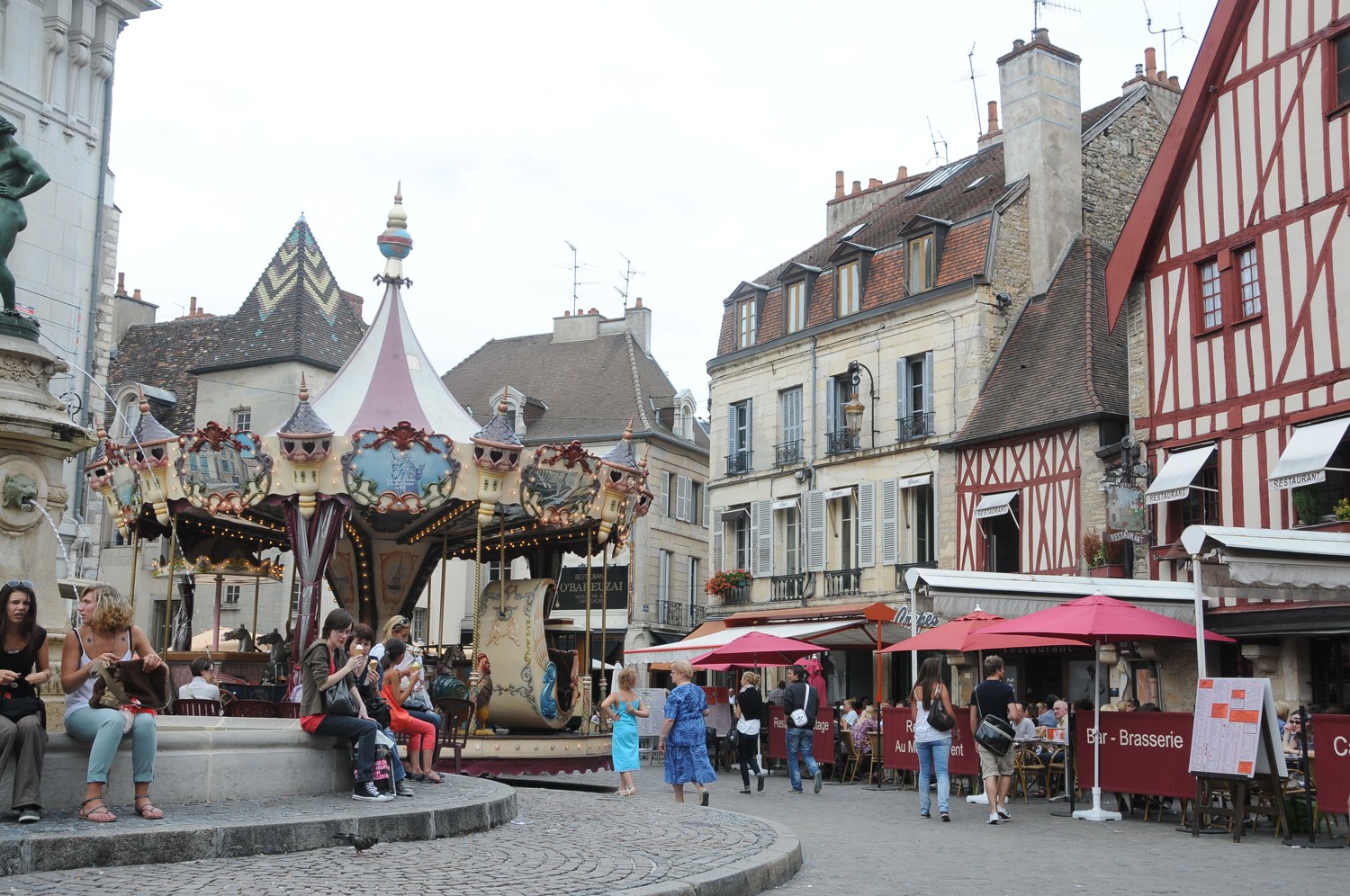
In the square of Dijon’s Old City, buildings from the Renaissance flank a carousel from 1865 © Karen Rubin/news-photos-features.com

Rue Danton was named for “conventionnel organisateur de la defense nationale, ne en 1759, mort sur l’echafaud en 1794.” I am fascinated and subsequently learn that Georges Danton was a French Revolutionary leader and orator, often credited as the chief force in the overthrow of the monarchy and the establishment of the First French Republic (September 21, 1792). He later became the first president of the Committee of Public Safety, but his increasing moderation and eventual opposition to the Reign of Terror led to his own death at the guillotine.

The clock above the church of Notre Dame, with the man who strikes the hour, his wife who strikes the half hour, and their two children who strike the quarter hour. © Karen Rubin/news-photos-features.com

I come upon Eglese Saint Philibert, originally built in 12th century, and destroyed in the Reign of Terror that followed the French Revolution. It is now undergoing a restoration.

I am so happy that I will have two extra days in Dijon (see story).

Gala Farewell

I walk back to the Caprice in time for our gala farewell dinner.

The last night of our cruise is a gala dinner (we “dress” in our finest, that is what we have with us) – the table, in a U-shaped banquet formation, is set magnificently, with fresh lilies and zinnias.

A fountain provides respite during a walking tour of Dijon’s historic district, spanning 97 hectares © Karen Rubin/news-photos-features.com

The menu consists of foie gras with leek salad with a sweet fig jam; filet de boeuf with red wine sauce, potatoes from Noirmoutier and mushrooms.

The 2007 Sainte Croix du Mont, a Sauvignon Blanc, Tina tells us, is produced at a vineyard on right bank of Bordeaux in southeast France, where there are early morning mists (usually not good for wine) is difficult to produce. “You need a lot of luck. The grapes have to develop a ‘local rot’ – a fungus – which actually produces a bursting sweetness. The yield is small – you have to pick the grapes by hand when ripest – a lot of work. It’s lighter than a dessert wine but full bodied.”

The red is a Grand Barrail Larose St Emilion 2009, a Bordeaux.

Three houses dating from the 1400s in Dijon’s Old City: the middle one is propped up by the two on either side © Karen Rubin/news-photos-features.com

The cheese tonight is a Roquefort – the quintessential sheep’s milk blue cheese from Avignon in the south of France, owes its distinctive character to a mold found in the soil of local caves

The second cheese is a Brie de Meaux, from the Ile de France, a creamy cow’s milk similar to Camembert. “King Louis XIV had 3 passions: poetry, wine and cheese,” Tina, the general manager, says. “He would send a damsel a cheese with a poem”

The dessert is a Chef’s surprise (actually a birthday cake for one of the guests).

Lunch onboard the Caprice always features red and white wines as well as cheeses © Karen Rubin/news-photos-features.com

Friday morning, after breakfast, we depart the Caprice. The whole crew, wearing their Barging Through France shirts, line up to greet us and bid us farewell. It is that most amazing and gratifying feeling that only travel provides when you get to realize how everyone has bonded and formed friendships in just a week’s time.

Incomparable Value in France Canal Cruising

In reflection, I think this is as perfect a trip as it could have been, vastly exceeding my expectations – in terms of the sights we have seen, the interesting attractions and excursions, the quality of the wining and dining, the cruise experience – France Cruises, the American agent for Barging through Burgundy which owns and operates the Caprice, really offers superb value for money.

The gala farewell banquet onboard the Caprice features a beef filet with red wine sauce © Karen Rubin/news-photos-features.com

The passengers onboard have really bonded – gives you plenty of opportunity – we are not on top of one another, but the meals, where you basically sit where you want or where there is room, so the table groupings always change, and you get to know one another, or when walking or biking along the canal, or on the bus or walking through the villages during our excursions, or in the evening sitting around in the lounge or on deck… people came from all over and many different backgrounds, but shared an interest and eagerness to learn and experience things, and we each shared from our own experience and knowledge base.

The immersion into French food and wine – especially with the selection of wines and cheeses at lunch and dinner – has been very satisfying and also interesting, since food and wine are so inextricably linked to culture and heritage of a place.

The size of the boat and the service makes it ideal for families, family reunions and groups of friends traveling together. There are barge boats that a single family can hire and guide themselves , though it seemed to me to be tricky process to go through the canals – some were automatic, operated by sensors, some had attendants, but some involved hand-cranking the bridge or pulling a chain to activate the doors.

Many people have the concern that you can get bored on a barge cruise or feel confined, but we are never bored or stir crazy – because of the opportunity to go off the boat and explore, especially by bike, and also the excursions. Those who want a more sedentary experience can have it, as well.

This size boat and the itinerary are perfect for us – not too small that you are forced to be on top of people or lacking in level and quality of service, and not too big.

The crew of the Caprice at the farewell gala banquet © Karen Rubin/news-photos-features.com

The daily excursions are marvelous and interesting and take you to places you might not have known to visit, and into the essence of what the region is -particularly the visit to the Chateau Rully with the Count – just seeing the portraits on wall of his ancestors, the very mug his 14th century ancestor had drunk from (that he still uses), the personal artifacts of the family were amazing.

Considering all that is provided, and the high level of service, the experience fulfills France Cruses’ boast that this cruise affords some of the best value in canal cruising in France (particularly with the special offers and packages that are available from time to time). I am a believer.

For information, contact France Cruises, Inc.,9901 IH 10 West, Suite 800 | San Antonio, TX 78230, 866-498-3920 or 210- 775-2184; Email:Marketing@FranceCruises.com, visit www.FranceCruises.com orwww.FranceCountryTours.com. Visit the blog The France Insider.

The cruise aboard the Caprice is now completely updated for next season:http://www.francecruises.com/barge-354-Caprice-742.html

Dijon is such a fascinating city, our exploration continues (see A Walk Through the Centuries in Dijon, France).

(Originally published in 2011)

____________________

© 2017 Travel Features Syndicate, a division of Workstyles, Inc. All rights reserved. Visit goingplacesfarandnear.com,  www.huffingtonpost.com/author/karen-rubin , and travelwritersmagazine.com/TravelFeaturesSyndicate/. Blogging at goingplacesnearandfar.wordpress.com and moralcompasstravel.info. Send comments or questions to FamTravLtr@aol.com. Tweet @TravelFeatures. ‘Like’ us at facebook.com/NewsPhotoFeatures