
By Karen Rubin, Travel Features Syndicate, goingplacesfarandnear.com
I must have spent about two hours in St. Louis’ Old Courthouse before exiting out the riverfront door to continue on to the Gateway Arch, stopping to take in the inspiring statue of Dred and Harriet Scott.
The riverfront Gateway Arch National Park, spanning 90 acres (and apparently configured on the site of the original colonial settlement) is a glorious community space, with the Gateway Arch becoming ever more monumental and striking as I get closer.
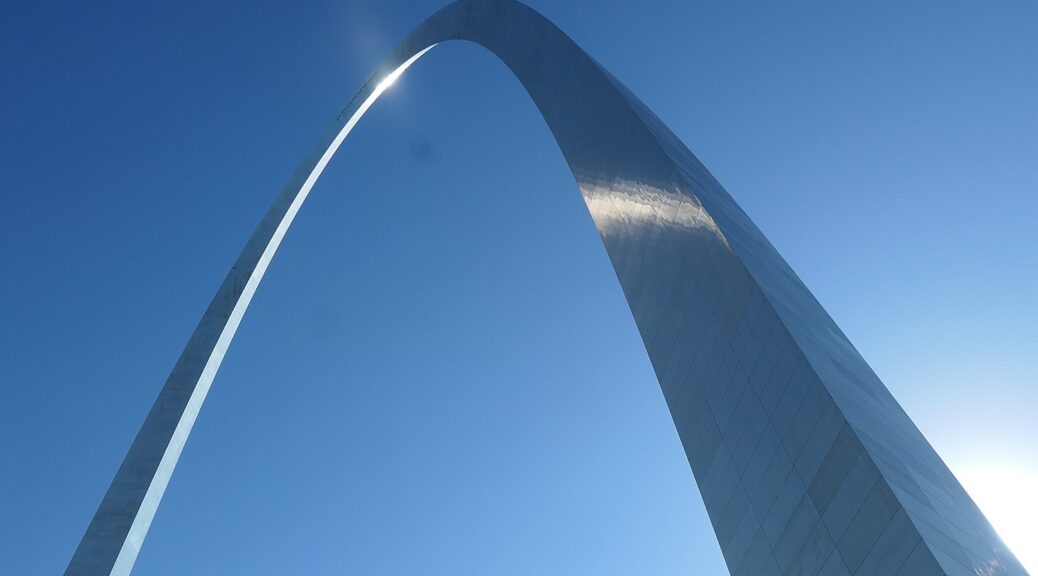
The Arch is an impossibly graceful ribbon of stainless steel, reflecting the sun.

I had been here decades ago, not realizing at the time that the Arch was actually relatively new, and an engineering marvel when it was built between 1963-5. Architect Eero Saarinen’s inspired design for a 630-foot stainless steel arch as an ideal monument to the spirit of the western pioneers was chosen after a nationwide competition in 1947-48. It was built for total cost of $13 million: 75% paid by the federal government, and 25% City of St. Louis funds; the $2 million Arch transportation system was financed by the Bi-State Development Agency.

I had not realized there is a fantastic (free!) museum beneath it, and interactive experiences, including a bizarro tram (it looks like a Woody Allen car from “Sleeper”), that takes you on a track inside the Arch to the very top where you get out for a view through windows, before riding the tram back down. (You have to reserve tickets early; they were sold out by the time I arrived in the afternoon.)
The exhibits in the Gateway Arch museum are fascinating. They trace St. Louis’ history from A French fur trading post, Colonial St. Louis, where you discover the Indigenous, French, and Creole cultures of St. Louis before the Louisiana Purchase; Thomas Jefferson’s Vision for the United States; The Riverfront Era (the first steamboat to arrive in St. Louis changed the city forever).

St. Louis was once inhabited by Native Americans of the ancient Mississippian culture. Due to the area’s proximity to both the Mississippi River that runs along the eastern border, and Missouri River that joins it just north of the city, and the Meramec River on the southern border of St. Louis County, it was not only a hub for the Mississippians, but for the European traders and later pioneers, frontiersmen and ultimately settlers. It switched hands, first being claimed by France, then Spain after the Seven Years War, then (secretly) back to France, before Napoleon Bonaparte sold the Louisiana Territory to President Thomas Jefferson in 1803, who used it as the launching point for the Lewis & Clark Expedition. St. Louis remained a gateway into the American West.

It was surprising to learn that St. Louisians went to sleep on March 9, 1804 under Spanish rule, only to wake up as American citizens. Indeed, in just a matter of days, residents were under French, Spanish, French, British, American flags. The implications were great: American land laws were different and Spanish land grants were subject to legal challenge; merchants and fur traders had new laws and trading partners; American slave law was based on British tradition, so slaveholders no longer could accept self-purchase and enslaved families could be torn apart through sale; free persons of color underwent greater oppression from the Spanish system; women had fewer rights under American law than under Spanish, and married women could no longer own property. (Now imagine what Greenlanders and Canadians are facing.)

The exhibit on Manifest Destiny, the USA’s determination to move west and control the continent, is the most interesting and relevant today, raising questions about the people who were displaced. (Trump has resurrected Manifest Destiny as his operative foreign policy); New Frontiers explores how people settled and lived in the West, the myths that became the West’s cultural legacy, and the changes caused by industry. I love the questions posed: “Because you plant a stake, does that mean you own it?” “Should the people of St. Louis have a say in who owned them?” (Spain. Britain or the US within a matter of days?. I can only wonder how long it will be before Trump shuts the exhibit down and replaces it with something akin to extolling the Divine Right of Kings.)

Building the Dream is truly a fascinating exhibit where you learn how the Gateway Arch became a reality, from the engineering to the building. You learn that the Arch’s foundations are sunk 60 feet into the ground and the arch is built to withstand earthquakes and high winds.

I was amazed at all you can do here besides exploring these fascinating exhibits in the free museum about St. Louis’s role in westward expansion (plan to spend at least an hour). You can also purchase a ticket to a 28-minute documentary movie about the building of the arch ($3-$7), a 10-minute V.R. Experience ($5-$8) and take an hour-long Riverboat Cruise ($16-$26) outside and down the grand staircase to the riverfront.

But one of the most thrilling (and unique) experiences is the Ride to the Top of the Arch on a tram. It is a 45-60 minute experience (4 minutes up, 3 minutes down, 8-ish minutes at the top, plus a pre-boarding educational tour).

Each tram consists of eight capsules that have clear doors on the front and are closed on the back. Each tram car has a five-foot diameter and five seats. (Visitors with claustrophobia issues or who simply want to take souvenir pictures can sit in the replica tram car by the ticketing counter before purchasing tickets.)
The viewing area at the top was designed to hold up to 160 people when at full capacity, but with two trams operating, there are never more than 80 at the top at one time.
The Tram Ride to the Top operates rain or shine. The Arch is designed to sway as much as 18 inches in 150 mile per hour winds and it can withstand an earthquake; however, under normal conditions the Arch does not sway. It takes a 50-mile an hour wind to move the top 1 1/2 inches each side of center.
The Arch has weathered countless severe Midwest thunderstorms and is able to operate normally in all but the most severe weather. During tornado warnings, the tram rides will be cancelled as a precaution. The tram may also be shut down if it is swaying so much that visitors are having a hard time keeping their balance. This happens very infrequently.
There are 16 windows on each side of the viewing area. Each window is 7 x 27 inches and 0.75 inches thick. Over 500 tons of pressure was used to jack the legs of the Arch apart for the last four-foot piece to be inserted at the top. A larger window would not withstand that pressure.
At peak times, as many as 80 trips a day on each tram can go to the top. When operating at full capacity, 40 tickets are sold for each trip, accommodating 6400 people each day. During normal hours there are only 48 trips to the top each day on each tram, accommodating 3,840.
On a clear day the view at the top can extend up to 30 miles in either direction, though St. Louis can be hazy, reducing visibility at the top and on cool, damp mornings a dense fog can create zero visibility at the top. Check out the Gateway Arch Park Foundation’s webcams to see what the view from the top is like on the day you wish to visit.
Tickets are sold at gatewayarch.com and cost $13-19; the Ride does sell out, so it is recommended to buy timed tickets in advance. The last tram of the day goes up approximately an hour before closing time.
For more trip ideas: Things To Do page and events calendar.

Gateway Arch National Park was originally named the Jefferson National Expansion Memorial, honoring President Thomas Jefferson whose acquisition in 1803 of the Louisiana Territory from France, known as the Louisiana Purchase, doubled the size of the United States, and who promoted the Westward Expansion. An act of Congress renaming the park was signed into law in February 2018.
More information: https://www.nps.gov/jeff/index.htm; help planning your visit: https://www.nps.gov/jeff/planyourvisit/index.htm.
Walking back to the 21c Museum Hotel, I spot the Economy Museum, housed in the Federal Reserve Bank of St. Louis (free), and up Washington Avenue, a lively boulevard lined with pubs, a bowling alley, restaurants. and come across the Blues Museum (which apparently has closed after many years).
The Old Courthouse and Gateway Arch National Park are reason enough to come to St. Louis and for me are the big bonuses of having come to the city to bike the Katy Trail, a Rails to Trails Conservancy Hall of Fame trail.
For more planning information, visit Explore St. Louis, 800-916-8938, explorestlouis.com.
See also:
St. Louis’ Restored Old Courthouse Resurrects Important Lessons of Dred Scott’s Struggle for Freedom
21 C Museum Hotel St. Louis Embodies, Preserves City’s History, Culture, Community
Biking through History on Missouri’s Katy Trail During America’s 250th
Biking Missouri’s Katy Trail Following Lewis & Clark, Daniel Boone & the Westward Expansion
__________________
© 2026 Travel Features Syndicate, a division of Workstyles, Inc. All rights reserved. Visit goingplacesfarandnear.com, longislandpress.com/category/vacation-travel.com and travelwritersmagazine.com/TravelFeaturesSyndicate/. Blogging at goingplacesnearandfar.wordpress.com and moralcompasstravel.info. Visit instagram.com/going_places_far_and_near. X: @TravelFeatures Threads: @news_and_photo_features ‘Like’ us atfacebook.com/NewsPhotoFeatures. Send comments/questions to FamTravLtr@aol.com.
