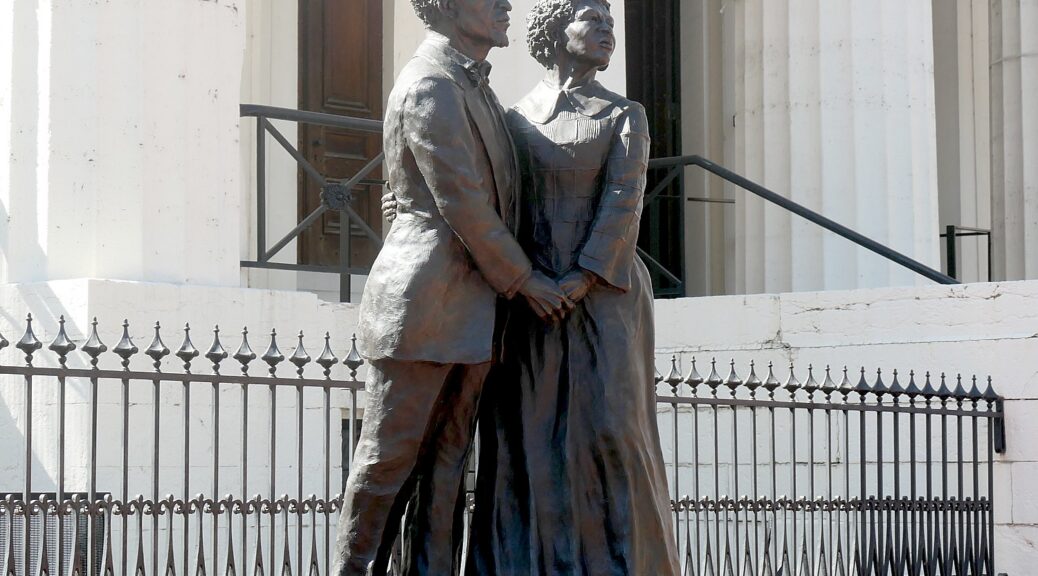
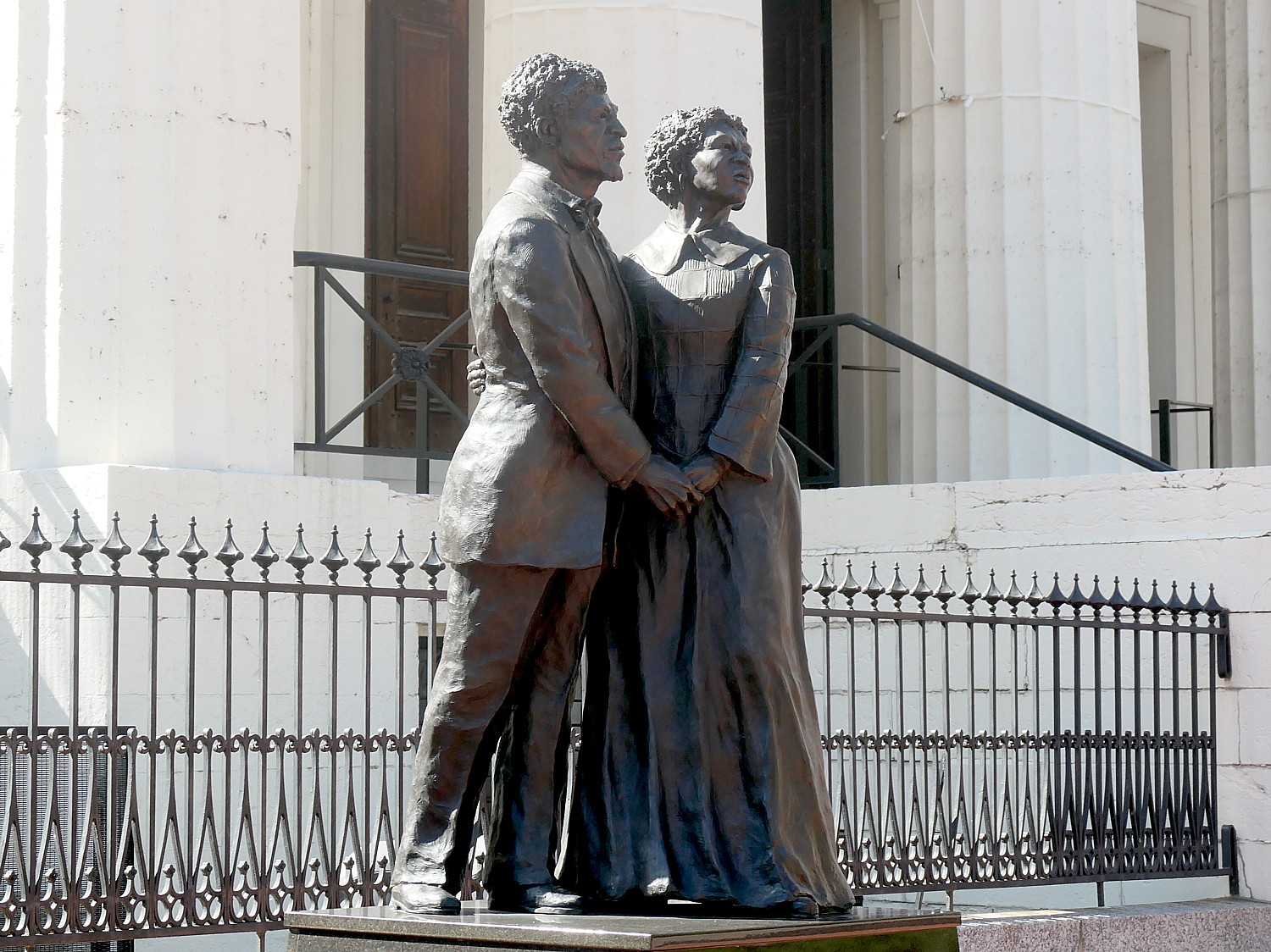
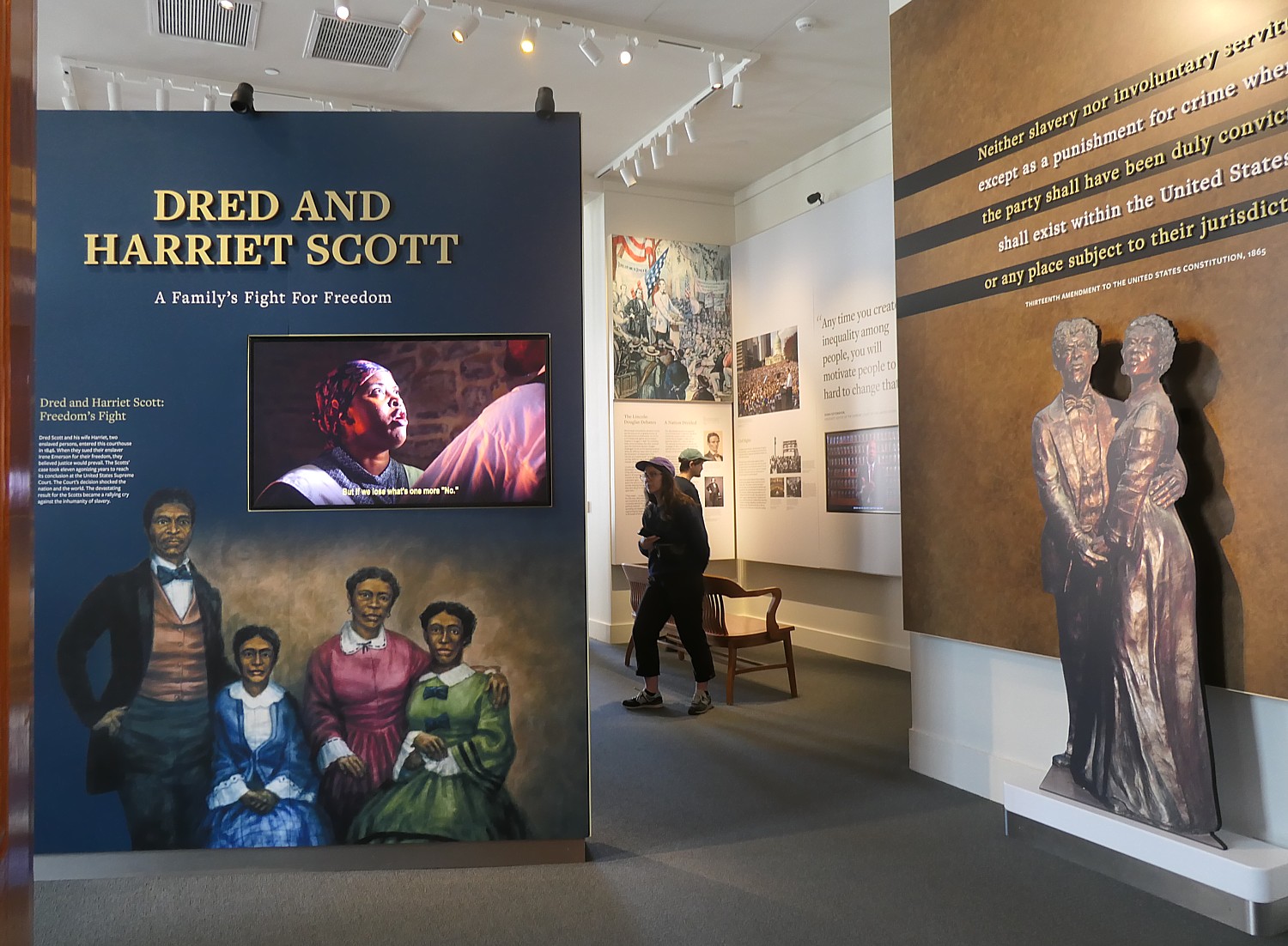
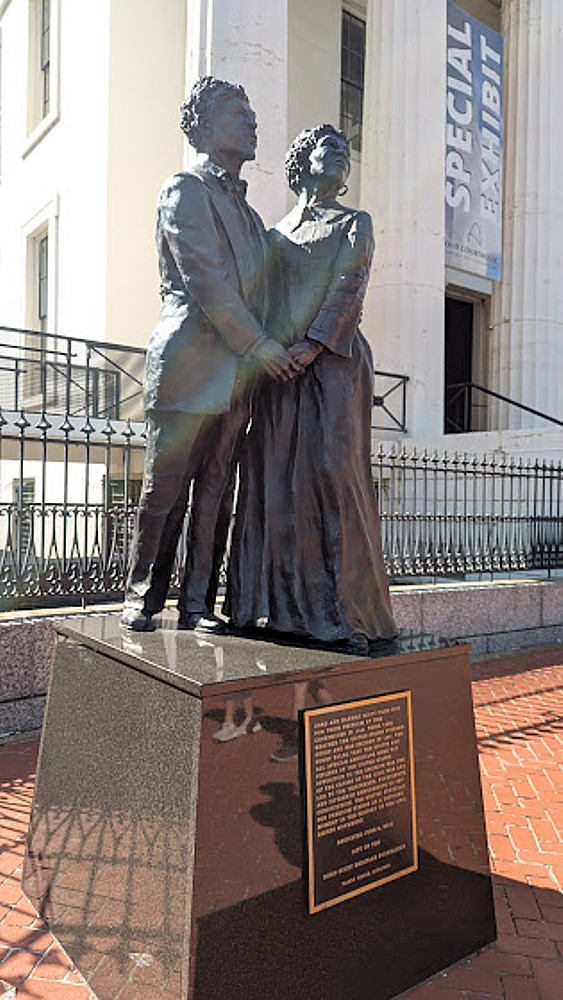
I must have spent about two hours in St. Louis’ Old Courthouse before exiting out the riverfront door to continue on to the Gateway Arch, stopping to take in the inspiring statue of Dred and Harriet Scott.
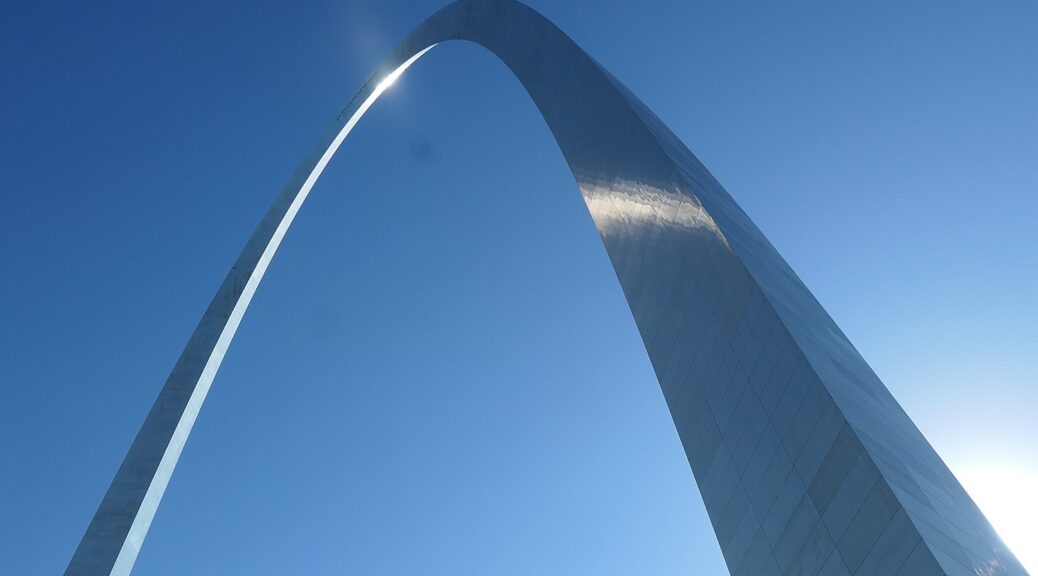
The riverfront Gateway Arch National Park, spanning 90 acres (and apparently configured on the site of the original colonial settlement) is a glorious community space, with the Gateway Arch becoming ever more monumental and striking as I get closer.
The Arch is an impossibly graceful ribbon of stainless steel, reflecting the sun.
I had been here decades ago, not realizing at the time that the Arch was actually relatively new, and an engineering marvel when it was built between 1963-5. Architect Eero Saarinen’s inspired design for a 630-foot stainless steel arch as an ideal monument to the spirit of the western pioneers was chosen after a nationwide competition in 1947-48. It was built for total cost of $13 million: 75% paid by the federal government, and 25% City of St. Louis funds; the $2 million Arch transportation system was financed by the Bi-State Development Agency.
I had not realized there is a fantastic (free!) museum beneath it, and interactive experiences, including a bizarro tram (it looks like a Woody Allen car from “Sleeper”), that takes you on a track inside the Arch to the very top where you get out for a view through windows, before riding the tram back down. (You have to reserve tickets early; they were sold out by the time I arrived in the afternoon.)
The exhibits in the Gateway Arch museum are fascinating. They trace St. Louis’ history from A French fur trading post, Colonial St. Louis, where you discover the Indigenous, French, and Creole cultures of St. Louis before the Louisiana Purchase; Thomas Jefferson’s Vision for the United States; The Riverfront Era (the first steamboat to arrive in St. Louis changed the city forever).
St. Louis was once inhabited by Native Americans of the ancient Mississippian culture. Due to the area’s proximity to both the Mississippi River that runs along the eastern border, and Missouri River that joins it just north of the city, and the Meramec River on the southern border of St. Louis County, it was not only a hub for the Mississippians, but for the European traders and later pioneers, frontiersmen and ultimately settlers. It switched hands, first being claimed by France, then Spain after the Seven Years War, then (secretly) back to France, before Napoleon Bonaparte sold the Louisiana Territory to President Thomas Jefferson in 1803, who used it as the launching point for the Lewis & Clark Expedition. St. Louis remained a gateway into the American West.
It was surprising to learn that St. Louisians went to sleep on March 9, 1804 under Spanish rule, only to wake up as American citizens. Indeed, in just a matter of days, residents were under French, Spanish, French, British, American flags. The implications were great: American land laws were different and Spanish land grants were subject to legal challenge; merchants and fur traders had new laws and trading partners; American slave law was based on British tradition, so slaveholders no longer could accept self-purchase and enslaved families could be torn apart through sale; free persons of color underwent greater oppression from the Spanish system; women had fewer rights under American law than under Spanish, and married women could no longer own property. (Now imagine what Greenlanders and Canadians are facing.)
The exhibit on Manifest Destiny, the USA’s determination to move west and control the continent, is the most interesting and relevant today, raising questions about the people who were displaced. (Trump has resurrected Manifest Destiny as his operative foreign policy); New Frontiers explores how people settled and lived in the West, the myths that became the West’s cultural legacy, and the changes caused by industry. I love the questions posed: “Because you plant a stake, does that mean you own it?” “Should the people of St. Louis have a say in who owned them?” (Spain. Britain or the US within a matter of days?. I can only wonder how long it will be before Trump shuts the exhibit down and replaces it with something akin to extolling the Divine Right of Kings.)
Building the Dreamis truly a fascinating exhibit where you learn how the Gateway Arch became a reality, from the engineering to the building. You learn that the Arch’s foundations are sunk 60 feet into the ground and the arch is built to withstand earthquakes and high winds.
But one of the most thrilling (and unique) experiences is the Ride to the Top of the Arch on a tram. It is a 45-60 minute experience (4 minutes up, 3 minutes down, 8-ish minutes at the top, plus a pre-boarding educational tour).
Each tram consists of eight capsules that have clear doors on the front and are closed on the back. Each tram car has a five-foot diameter and five seats. (Visitors with claustrophobia issues or who simply want to take souvenir pictures can sit in the replica tram car by the ticketing counter before purchasing tickets.)
The viewing area at the top was designed to hold up to 160 people when at full capacity, but with two trams operating, there are never more than 80 at the top at one time.
The Tram Ride to the Top operates rain or shine. The Arch is designed to sway as much as 18 inches in 150 mile per hour winds and it can withstand an earthquake; however, under normal conditions the Arch does not sway. It takes a 50-mile an hour wind to move the top 1 1/2 inches each side of center.
The Arch has weathered countless severe Midwest thunderstorms and is able to operate normally in all but the most severe weather. During tornado warnings, the tram rides will be cancelled as a precaution. The tram may also be shut down if it is swaying so much that visitors are having a hard time keeping their balance. This happens very infrequently.
There are 16 windows on each side of the viewing area. Each window is 7 x 27 inches and 0.75 inches thick. Over 500 tons of pressure was used to jack the legs of the Arch apart for the last four-foot piece to be inserted at the top. A larger window would not withstand that pressure.
At peak times, as many as 80 trips a day on each tram can go to the top. When operating at full capacity, 40 tickets are sold for each trip, accommodating 6400 people each day. During normal hours there are only 48 trips to the top each day on each tram, accommodating 3,840.
Tickets are sold at gatewayarch.com and cost $13-19; the Ride does sell out, so it is recommended to buy timed tickets in advance. The last tram of the day goes up approximately an hour before closing time.
Gateway Arch National Park was originally named the Jefferson National Expansion Memorial, honoring President Thomas Jefferson whose acquisition in 1803 of the Louisiana Territory from France, known as the Louisiana Purchase, doubled the size of the United States, and who promoted the Westward Expansion. An act of Congress renaming the park was signed into law in February 2018.
Walking back to the 21c Museum Hotel, I spot the Economy Museum, housed in the Federal Reserve Bank of St. Louis (free), and up Washington Avenue, a lively boulevard lined with pubs, a bowling alley, restaurants. and come across the Blues Museum (which apparently has closed after many years).
The Old Courthouse and Gateway Arch National Park are reason enough to come to St. Louis and for me are the big bonuses of having come to the city to bike the Katy Trail, a Rails to Trails Conservancy Hall of Fame trail.
With only an afternoon and evening to explore St. Louis before my six-day Wilderness Voyageurs bike trip on the Katy Trail across Missouri, I immediately set out from the 21c Museum Hotel for Gateway Arch National Park. My walk takes me by majestic buildings and monuments such as Soldiers’ Monument, many from the 1930s and through the lovely Citygarden sculpture park. I find myself across the street from the Old Courthouse, with a banner that exclaims, “Open” and “New Exhibits.”
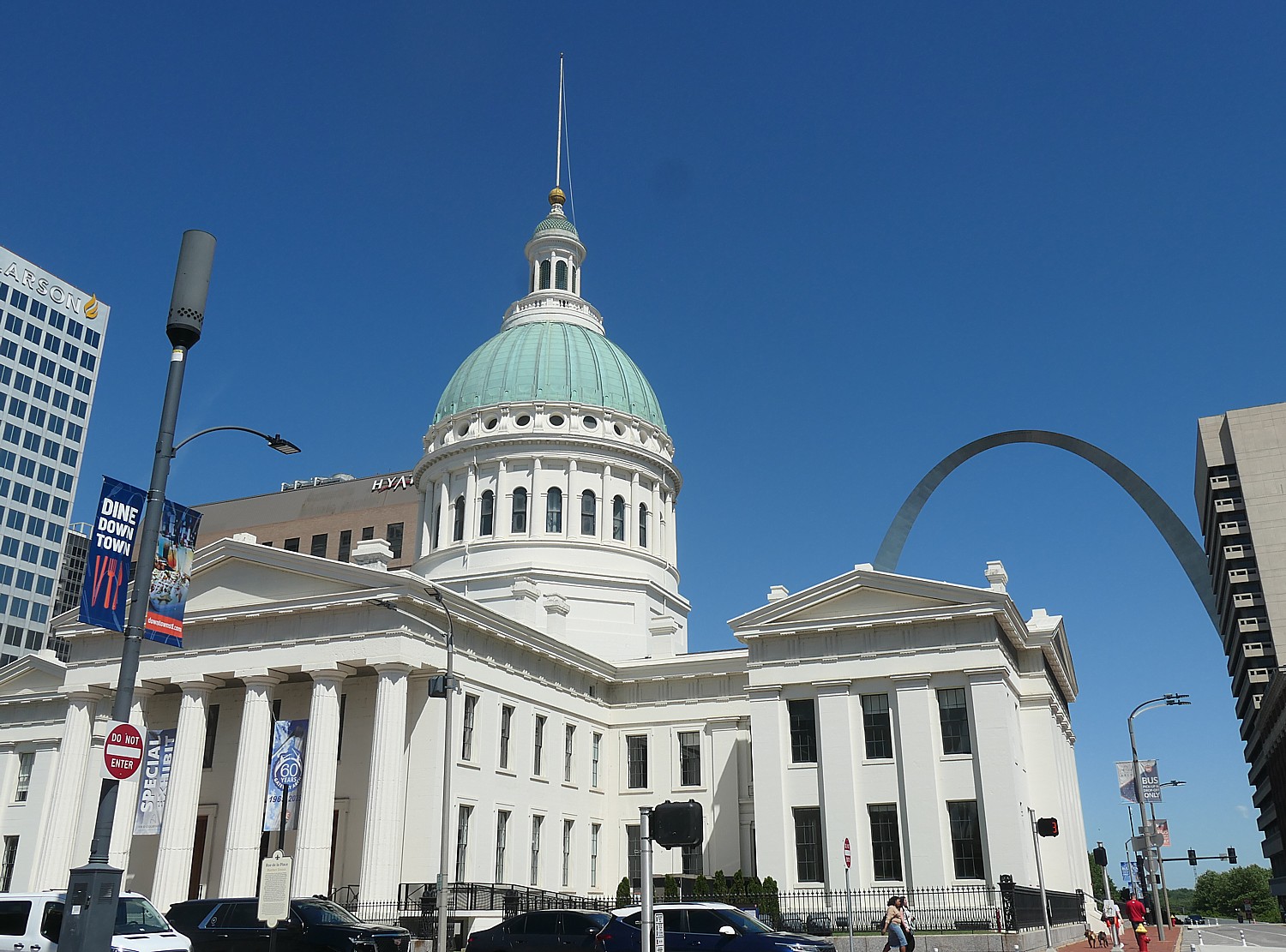
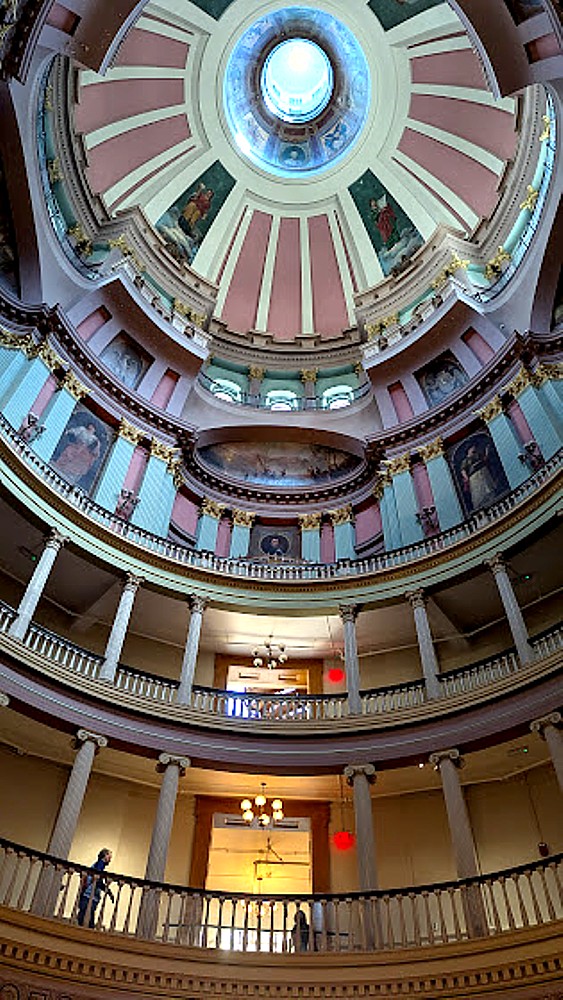
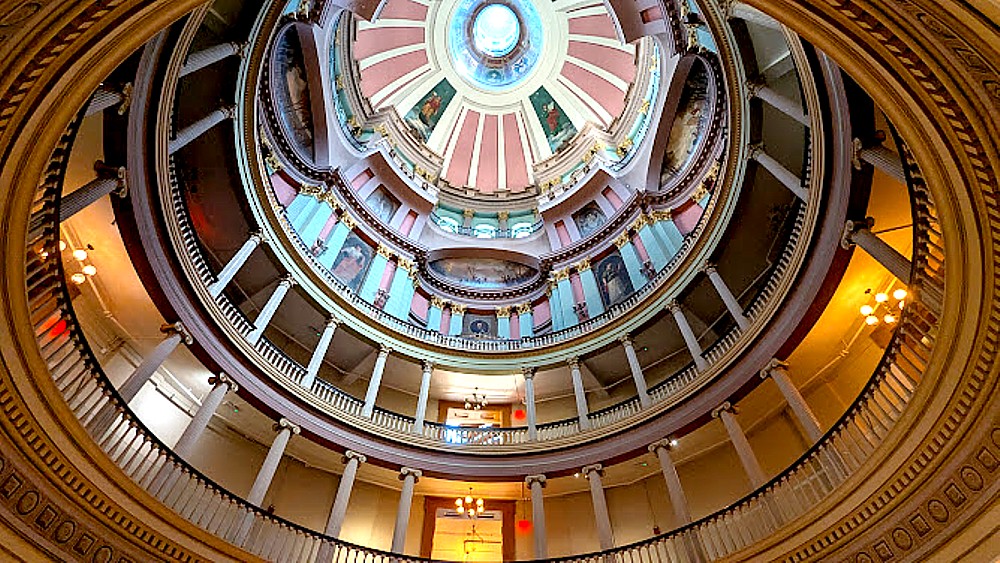
Touring the Old Courthouse is one discovery after another, beginning with its spectacular dome, architecture and stunning murals of historic scenes and important historical figures. I explore the four new museum galleries and the restored historic courtroom that opened in May 2025 after a five year, $24.5 million renovation, 2020-2025.
The Old Courthouse is actually part of Gateway Arch National Park. I find a National Park Service ranger in the spectacular lobby beneath a dome, and am amazed to learn the infamous Dred Scott case began here (two trials!) and would have ended in his favor were it not for the Supreme Court and its dastardly Dred Scott decision.
The ranger gives me a brief synopsis: The Old Courthouse was the site of the first two trials of the pivotal Dred Scott case in 1847 and 1850 before the infamous Supreme Court “Dred Scott decision” in 1857. I later learn that this was also where Virginia Minor‘s case for a woman’s right to vote came to trial in the 1870s. It was last used as a courthouse in 1930
Sufficiently intrigued, I go off to see the new exhibit, simply named, “Dred and Harriet Scott,” a detailed biography of Scott and his wife, and their legal struggle. The story is not anything that is taught anywhere else, which more typically reduce Dred Scott to the Supreme Court decision, and not a person, and, as I discover, a story worthy of an opera.
I can only wonder if these exhibits will survive Trump’s anti-DEI crusade manifest in an executive order in 2025 called “Restoring Truth and Sanity to American History” executive order directing federal historic sites to “avoid showing content that disparages past or present Americans” – in essence erasing Black history and struggle for civil rights, women’s rights, human rights, and what was and is still being done to native peoples. (In Philadelphia, the National Park Service was ordered to replace slavery interpretive panels at the President’s House.)
It would be a terrible shame, though, because the exhibit is absolutely fascinating, revelatory, and pretty much this is the only place to appreciate it. Most of us only know the Supreme Court’s Dred Scott decision and do not know what led up to it, that for the 11 years the case was being argued and decided, Dred and Harriet Scott were prisoners of the sheriff, who hired them out and kept their wages. All during this period, the Scotts secreted their daughters away to protect them from being enslaved.
I learn that Scott was suing for his freedom from Irene Emerson, who inherited him upon the death of her husband, Dr. John Emerson, on the basis that his previous owner had taken him to a free territory, and under Missouri law (and the Missouri Compromise), if a slave or freed person lived in a free territory, they could not be re-enslaved. The first case was dismissed on a technicality (“hearsay”!), but the second case, which went to a jury of 12 white men (what else?), agreed that Scott was free. But Irene Emerson appealed up to the Supreme Court.
The Supreme Court’s 7-2 decision by Justice Roger B. Taney stated that Dred Scott did not have the right to sue for his freedom because he was not a citizen and Black people, enslaved or free, were not part of the original sovereign people so could never become citizens because they were not people but property; the Constitution’s protection of property rights overruled their human right to be free.
But in a fascinating turn of events, by then, Irene Emerson had married a Massachusetts politician, Calvin Chaffee, who ran for the US Congress in 1854 on the anti-slavery America Party Ticket, and was reelected in 1856; he only became aware of his wife’s connection to the Scotts in May 1857). He would have been mortified to be found to own slaves. So, to get rid of the embarrassing, inauspicious problem, sold the “title” to the Scotts to a descendant of the Blow family which had originally owned Dred Scott and who had actually provided financial support to the Scotts while the case was going on and who purchased the couple in order to emancipate them. Meanwhile, the Scotts, who had sent their two daughters away so they could not be captured and enslaved, were reunited.
Dred Scott was 48 years old when he initiated his suit for freedom (since he was illiterate and poor, it is assumed that he was encouraged by an abolitionist who guided him through the process). The operatic tragedy continues because after finally winning his freedom, his family lived in poverty (Irene Emerson kept the wages the Scotts earned during the 11 years of their arrest) and Dred Scott lived less than a year as a free man before dying of tuberculosis at the age of 59.
What I realize is that the landmark Dred Scott decision in effect nullified the Missouri Compromise that was put into place to forestall a Civil War; the decision intensified boiling national tensions and helped spark the Civil War. You also appreciate the lasting legacy and ongoing relevance of their case today. (You can hear reverberations of the Taney decision in Trump’s effort to overturn birthright citizenship enshrined in the 14th Amendment, which states that all persons born on U.S. soil and subject to its jurisdiction are citizens, no ifs, ands or buts.)
The exhibit includes A Bid for Freedom, an excellent 4 ½ minute video reenacting a hypothetical conversation between Dred and Harriett Scott, in which they discuss the risks to their family if they sue their enslaver for their freedom at the Old Courthouse and the risks they face if they don’t.
Pathways to Freedom gallery is another eye-opener. It personalizes African American life in St. Louis during the era of slavery and beyond, tracing the struggles of enslaved individuals seeking freedom, the continued fight for civil rights after the Civil War, and the rise of the Black elite known as the Colored Aristocracy, who built wealth and influence in the 1800s. Here you get an appreciation for the resilience, resistance, and influence of African Americans in St. Louis from slavery onward, with disturbing echoes as these struggles have resurfaced throughout the country today, as if the struggles of1865-1965, and brief period of progress and societal awareness, from 1965-2025 had been erased.
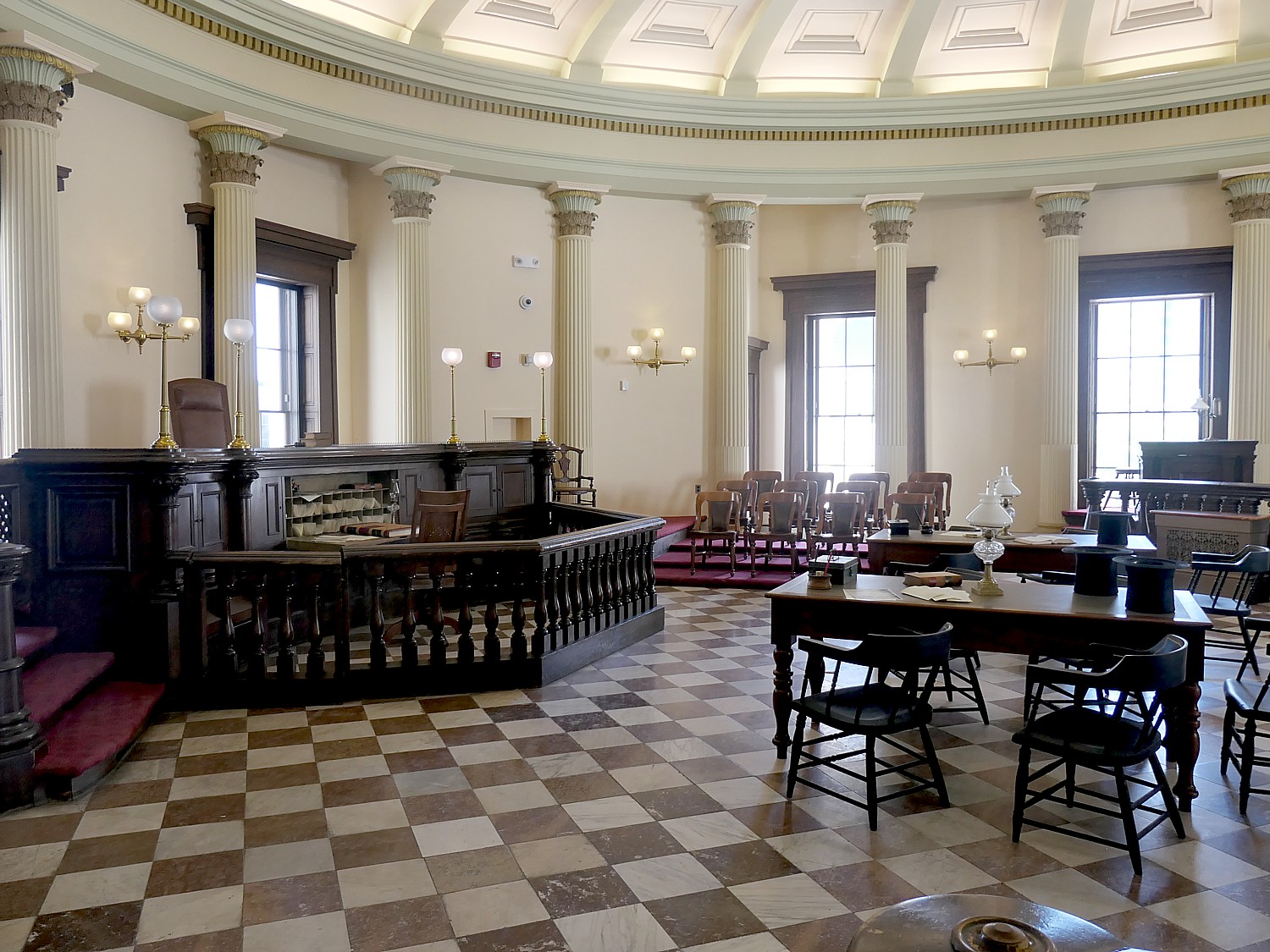
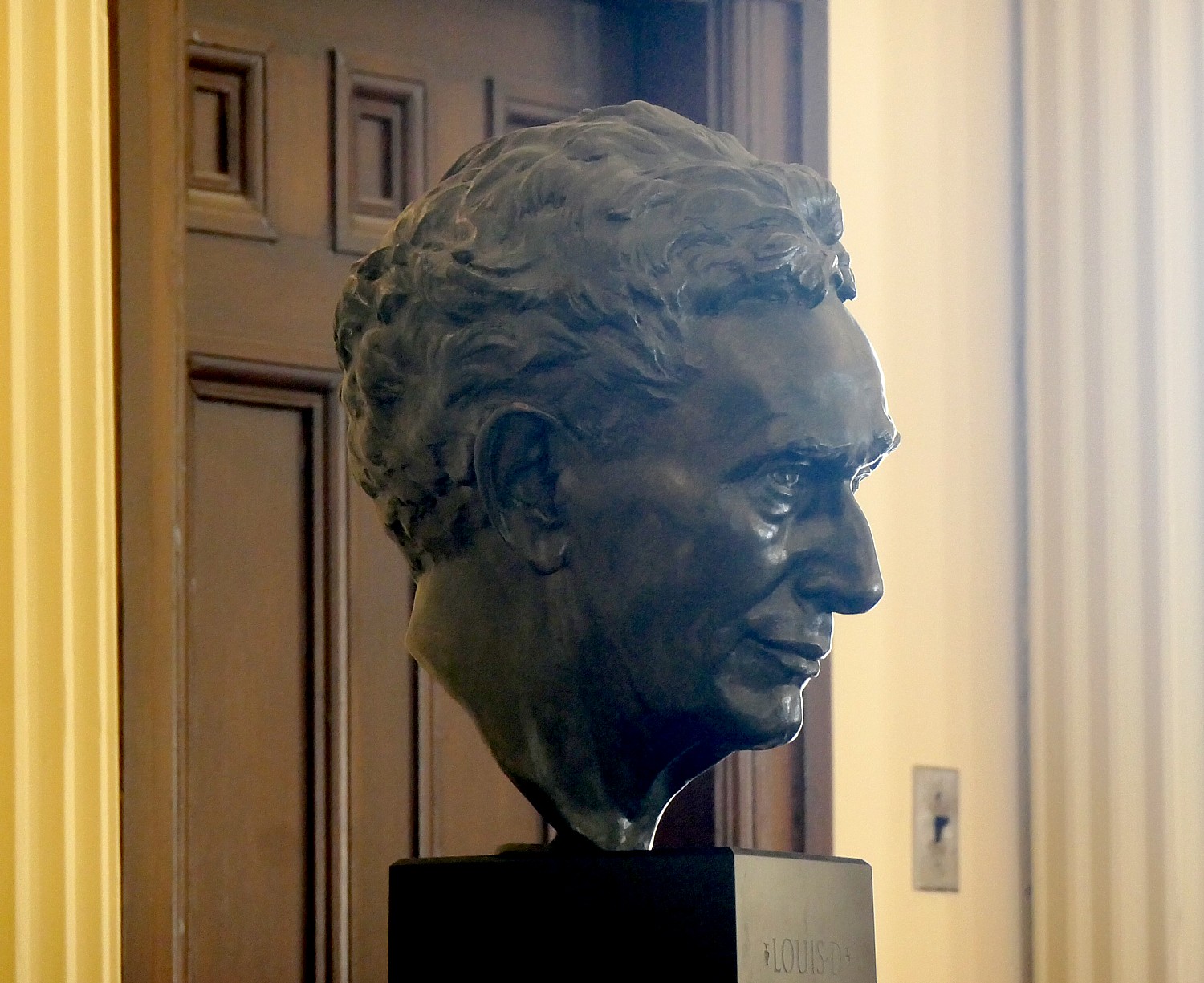
See You In Court, housed in a recreated 1850s courtroom, highlights the vital role courts have played in shaping our society, legal system, and daily life from 1839 to 1930. Visitors can explore the courtroom and even participate in mock trials, gaining a deeper understanding of how the court system helps resolve conflicts peacefully and supports the structure of our society (another important lesson for today, to remind of the foundational importance of the Rule of Law, without fear or favor.) I note the bust of Louis Brandeis, the first Jew to become a Supreme Court Justice, who was formally admitted to the Missouri Bar here on November 21, 1878.
One of the oldest buildings in St. Louis, the Old Courthouse is significant for its Greek Revival architectural style, engineered dome, and interior murals. In 1838, the County of St. Louis selected Henry Singleton’s cruciform plan with a central rotunda to replace the existing smaller courthouse. Construction started in 1839 and it opened in 1845 (just one year before the Scotts filed their suit). At this time emigrants traveling westward on the Oregon and California trails often stopped and gathered provisions in St. Louis, the “Gateway to the West,” and would meet up in the Old Courthouse rotunda. The present dome, which replaced a smaller one in 1862 (while the Civil War was going on, and the Capitol Dome in Washington DC was under construction), was designed by architect William Rumbold and was one of the first of its type. After the dome alteration, American painter Carl Wimar was commissioned to design four lunettes in the building’s interior. In 1976, the Old Courthouse was listed in the National Register as a component of the Jefferson National Expansion Memorial.
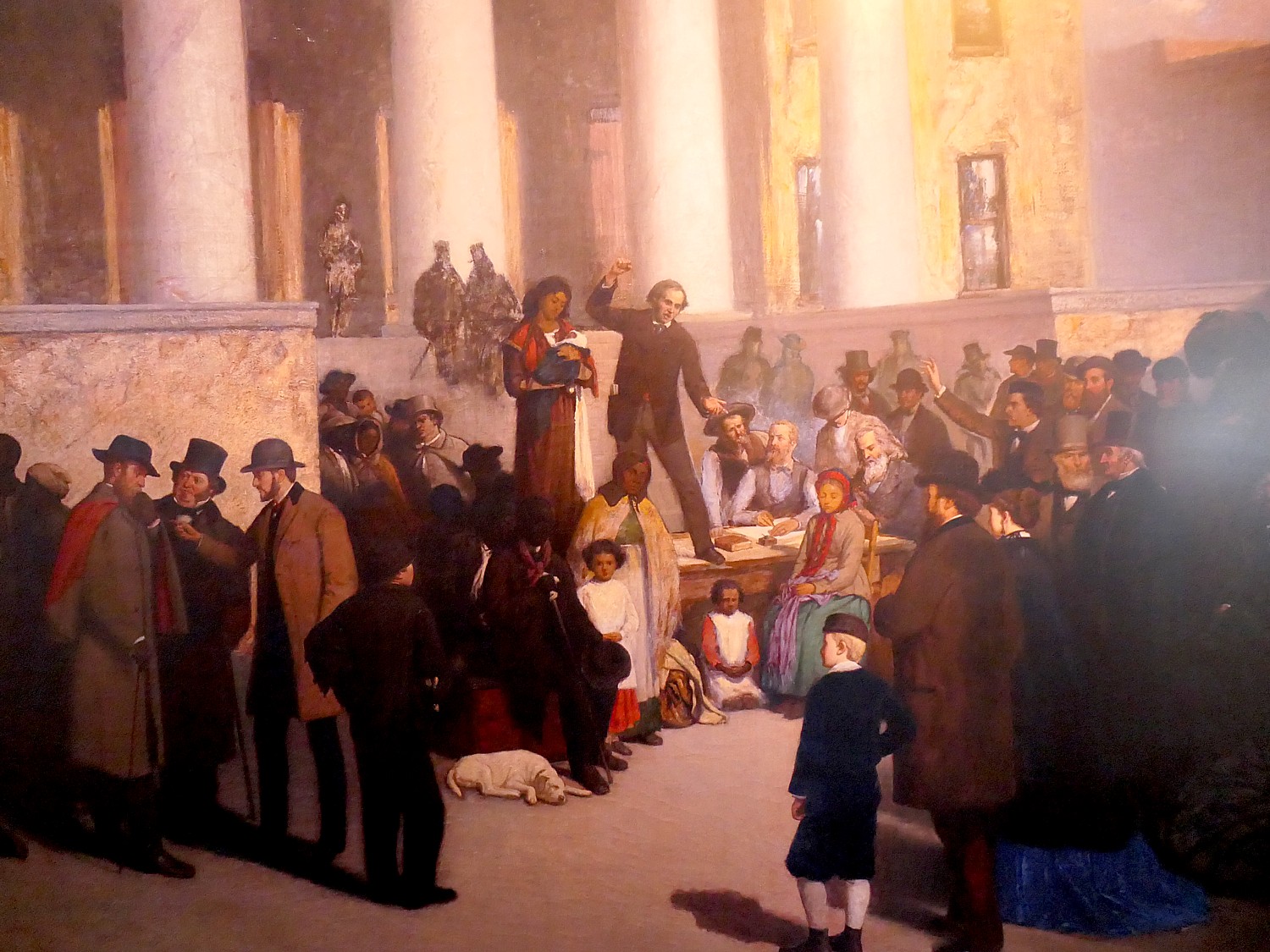
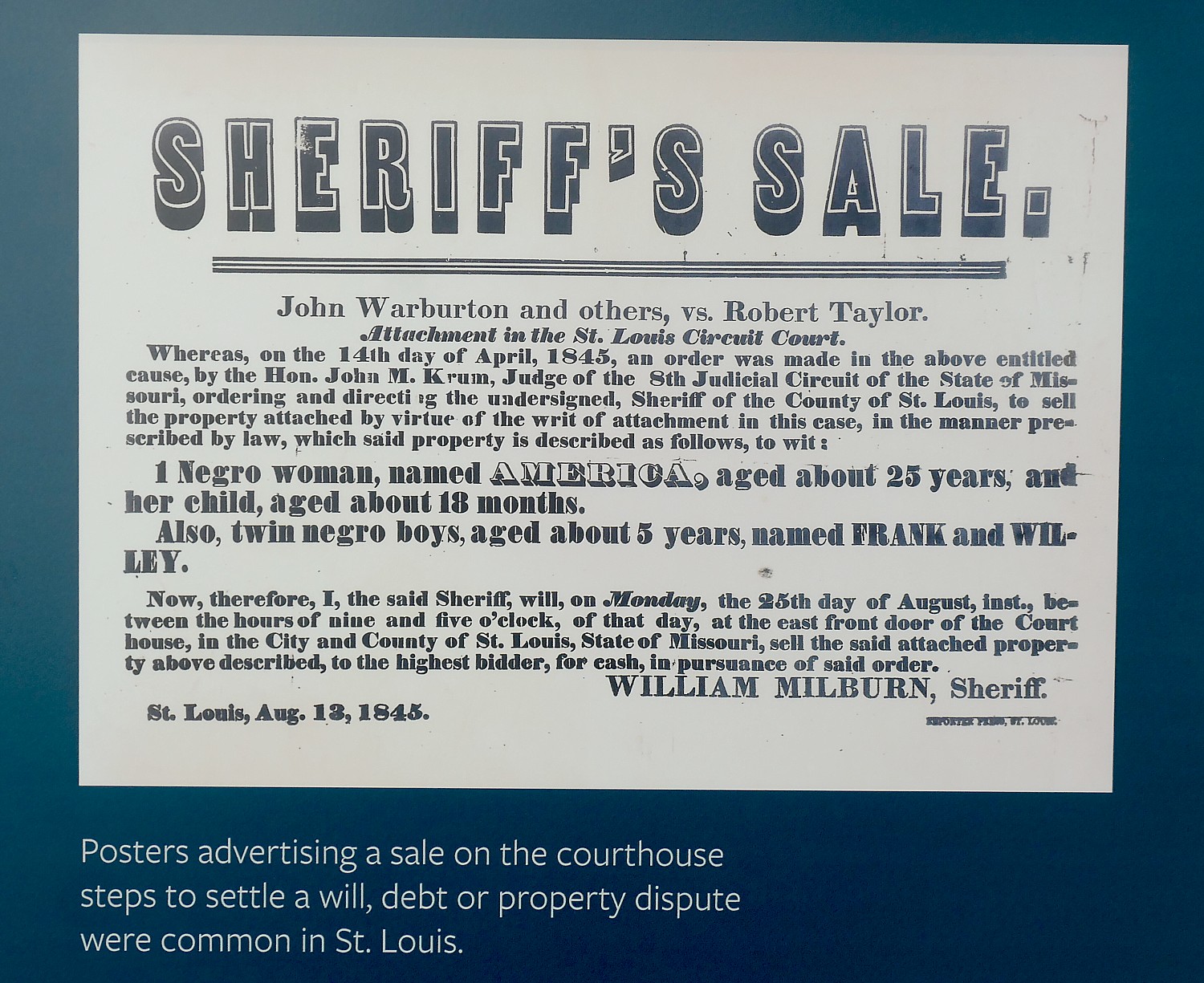
Largely because of the Dred Scott case, St. Louis’ Old Courthouse is included in the National Park Service’s National Underground Railroad Network To Freedom – places of “historic resistance to enslavement through escape and flight.” The Old Courthouse is linked with the Underground Railroad as a place associated with legal challenges to slavery. Slaves were auctioned from its steps in estate settlements, and the Old Courthouse was the site of hundreds of suits for freedom.
The city gave the Old Courthouse to the National Park Service for inclusion into Jefferson National Expansion Memorial in 1940, which was renamed Gateway Arch National Park by an act of Congress in 2018.
Plan to spend at least an hour, more likely two in the Old Courthouse.
National Park Service rangers provide guided tours of the building every day at 2:15 pm (only rarely cancelled due to staff availability). The tours cover the architecture and history of the building and the court cases associated with it. (No tickets or reservations necessary.)
The Old Courthouse is open daily from 9 am to 5 pm (closed on Christmas, Thanksgiving, and New Years Day). There is no admission fee.
From here, I leave the Old Courthouse through the riverfront exit on my way to the Gateway Arch, about two blocks further, stopping at a stunning statue of Dred and Harriet Scott.
The War Remnants Museum in Ho Chi Minh City (Saigon) evokes profound shame of the horrors inflicted in our name during the Vietnam War.
The museum is housed in what used to be the US military’s intelligence headquarters during the Vietnam War and was originally known as the “Museum of Chinese and American War Crimes”.
Now one of the most visited museums in Vietnam, the War Remnants Museum attracts 500,000 visitors every year, of whom two-thirds are foreigners. That is apparent during our visit, as well.
Exhibits relate the history of American involvement in the Second Indochina War, which began when France returned to re-colonialize Vietnam in 1946. I still do not understand how or why the US took over France’s fight (the US started direct involvement in 1950), but the displays discuss America’s anti-Communist obsession with the Domino Theory (that Indochina would come under control of Communist China and/or Russia). But I also learn something new: a display quotes Lyndon B. Johnson saying that America needs access to Vietnam’s “tin and tungsten” (echoing Trump’s insistence on the necessity of taking Greenland’s rare earth metals).
The exhibits are detailed, emotional and intense – the most stirring being the photos by photojournalists for magazines and newspapers including Life Magazine. Most affecting is a kind of shrine dozens of journalists and photographers who were killed on the field of battle in their effort to bring news of what was happening there to the world.
The photos are presented in an extraordinary way: showing the photo, then providing notes about the background, the context of the image, and the photographer. Among them is the famous Pulitzer-prize winning photo of “Napalm Girl,” a naked child whose clothes have been burned off her body by napalm, which had profound impact on influencing public opinion (this was the first war that came into family’s living rooms each night). The photos then and now are chilling, but today, they properly evoke shame and wonder why there has never been accountability for war crimes.
A moving display addresses American war crimes (dumping Agent Orange, napalm and phosphorous, bombing villages). This includes great detail – even the stone well – of the war crimes committed and later admitted to by Bob Kerrey, a Navy Seal who became a U.S. Senator (not to be confused with John Kerry who gave Senate testimony in 1971 decrying the war). There is a display that shows the impact, even generations later, of these chemical weapons on the Vietnamese, and even progeny of American soldiers. (Along Vietnam’s modern highways, we have visited stunning craft enters – subsidized for-profit enterprises – that employ disabled who embroider, paint, carve.)
Another exhibit pays homage to the peace movements that were underway.
What I don’t see in the museum is any mention of Nixon sabotaging LBJ’s peace deal in 1968 to win election. (At the LBJ Library in Austin, you can hear LBJ’s phone call to Senator Dirkson saying Nixon’s back-channel promises to South Vietnam President Nguyen Van Thieu of a better deal when he became president, was treasonous, but Johnson couldn’t publicize it because it would have revealed US spying). Think of it: the Vietnam War could have ended in 1968, the most deadly year of the entire war. Fighting between 1968 and 1975 when the war finally ended (the 50th anniversary commemorated throughout Vietnam this year) meant 40,000 more American soldiers were killed (a total of 58,000 Americans died in Vietnam and countless thousands injured); for the Vietnamese, it meant 1.5 million more deaths (3 million Vietnamese died, of whom 2 million were civilians, plus 2 million injured and 300,000 listed as missing).
I ask our Discovery Bicycle Tours guide Phong, whose father fought for the North Vietnamese on the Ho Chi Minh Trail, if he knew about the possible peace deal, and he said no, but our local Saigon guide, Li, whose father fought for the South, was aware (I guess informed by an American veteran or tourist he guided). The most despicable realization about the Vietnam tragedy is that it was all political, having little or nothing to do with the claimed “national security.”
I visited this museum five years ago, when I was similarly overcome. But now that I have seen countryside and people, I see these photos differently, more in context. The faces in the photos were real people who you see in the faces of the people today.
And what has been most revelatory during our time here in Vietnam, is that Americans are well received, welcomed. As our guide Phong has said, “We are a Buddhist country. We do not look to the past; we look to the future.”
This is what travel is about: see for yourself, engage with people, and bring those revelations, insights, lessons and first-hand experiences home.
We actually weren’t supposed to visit the War Remnants Museum. Our Day 10 Discovery Bicycle Tours itinerary would have us visit the Reunification Palace – the former Presidential Palace, renamed to commemorate the April 30, 1975 victory of President Ho Chi Minh’s forces. But by the time we finish lunch (after having flown from Hoi An), there is not enough time to visit the Palace, so instead, we visit the War Remnants Museum. But this is such an important museum that should not be missed, I would have visited on my own on my last day.
Leaving the museum, our sightseeing continues.
The first thing you notice about Ho Chi Minh City is the traffic. If we thought the traffic in Hanoi was intense, the traffic in Ho Chi Minh City is multiples of that – it is an act of courage (almost an adventure or sport) just to cross the street.
You just cannot fathom the amount of traffic, with scooters zipping by every which way (there are buses and cars, too, but not nearly as many), and somehow they manage this complex choreography. But to the extent there are traffic signals, they are extremely sophisticated, with seconds counting down and turning arrows. Trouble is, they mainly control motorized traffic and there aren’t enough of them. Pedestrians have to just assert themselves. (Mercifully, Discovery Bicycle Tours has no plan for us to bike within Saigon; we will be taken out to the countryside.)
The traffic is actually an attraction. Looking through the window from the safe perch of our bus, we enjoy trying to spot families of three, four, even five on a motor bike, or some interesting thing that is being transported like 12-foot long piping or wide/high stacks, and looking for creative expressions of individuality in helmets. There are even bike helmets for the cellphones but rarely for children, our local guide, Li, tells us (and he isn’t just joking).
People on their scooters, smile, wave and flash V signs to us when they notice us watching with fascination and admiration.
Also interesting is the equivalent of an Uber service via motor scooter.
Our local guide, Li, tells us the city’s first subway opened just 2 months earlier – another sign of Vietnam’s peace and prosperity (I make a plan to see it). It extends 25 km east of city and there are plans to build a second line to go 25 km to the west. There is also some thought to a bullet train to replace the “express train” to Hanoi that takes 32 hours.
Another indication of the economic development of Vietnam is that they are building a new international airport 40 km away – the present one will used for the military.
There is lots of Western influence here – Ho Chi Minh City is Vietnam’s largest city and its commercial capital, and had been under French and Western control for more than a century. It seems very much an international city.
We next visit the famous Ho Chi Minh City Central Post Office, unchanged since it was built in the French style in the 1880s. I had bought some really decorative cards in the night market in Hue and delight in sending them off with special stamps and post mark, racing to complete the task as the rest of the group waits. (I have a tradition of mailing cards home from where I travel.)
For dinner, we get to experience Saigon’s famous street food – we are taken by bus to Ho Thi Ky Flowers and Foods Street, a popular district for street food, and Li leads us from one stall to another. We sit at the child-sized plastic tables and chairs and sample all these delights.
The food is marvelous – in fact, we’ve enjoyed excellent meals at all the restaurants we have visited but this experience adds extra zest of the ambiance. We get to try some unusual, local foods, too.
Li dares us to try the “stinky Vietnamese fruit,” Durian, a spiky, custard-like fruit known for its pungent, almost overpowering odor (a fruit equivalent to Limburger cheese), yet considered a delicacy in Southeast Asia and stuffed snails. (It’s horrible.)
The Majestic is an elegant five-star, French-style hotel which first opened in 1925, built by the richest Chinese businessman in Saigon at the time, Bui Hon Hoa. Over the past century, it has been expanded and renovated and in 2007 became the first Vietnamese-managed hotel to earn five-star status. It has a stunning outdoor pool, a gorgeous restaurant where we enjoy breakfast, a beautiful lobby lounge.
I head out to (carefully) cross the street to a long park which lets you promenade up to the City Hall, a stunning building from the Colonial French era, enjoying the activity of families out and about enjoying the evening and some street entertainers.
Our last full day in Vietnam is spent biking but mercifully, not in the city. Instead, we are bused 2 ½ hours to the Mekong Delta countryside. Our 20-mile bike route takes us through villages, rice paddies, orchards.
We stop into a place that collects coconuts for distribution and we get to drink the coconut juice, while our rest stop affords a few of us to hang out in hammocks.
We come to Mr. Kiet’s Ancient House, a faithfully restored upper-class 1838 home with intricately carved wooden archways and doors and antique furnishings, many with luminescent inlaid nacre. Recognized by UNESCO as a World Cultural Heritage site, the home is still occupied by Mr. Kiet’s widow who operates a small restaurant in the orchard garden, where we have a most delightful lunch.
Finishing our bike ride, we board a boat for a short cruise along the Mekong River, stop into a factory that makes candy from rice (like popcorn!), and have another ride in a traditional boat.
I frankly would have preferred this last day be spent biking and visiting the Cu Chi Tunnels, which would add to understanding the Vietnam War. I had visited five years ago when I was last in Saigon (on a Global Scavenger Hunt), and found it extremely moving and frankly a unique experience.
The Củ Chi Tunnels was the Viet Cong’s base for the Tet Offensive in 1968. The site has 120 km of underground tunnels with trapdoors, living areas, storage facilities, armory, hospitals, and command centers, and were used going back to 1948 against the French, and later against the Americans.
You actually climb into the tunnels (there are different length routes you can take, especially if you are claustrophobic) and guides re-create how the Viet Cong lived there. In the visitor center, you can archival film of battles and bombings in the place where it happened. (See: HO CHI MINH CITY, VIETNAM: TRADITIONS SURVIVE IN MODERN CITY, AS DOES RECKONING WITH PAST)
(Some of our group have a late-enough flight the next day that they have organized a private tour. I would recommend you extend your stay to have this experience if it is not included in the itinerary. You can arrange one of the many sightseeing trips available through the Majestic Hotel’s concierge).
A Day to Leisurely Explore
Discovery Bicycle Tours has arranged a late check out at the Majestic Hotel to accommodate our late-afternoon and early evening flights.
I luxuriate with a leisurely breakfast in the Majestic’s lovely rooftop restaurant, go for a swim in the hotel’s gorgeous pool, then go out to explore. (Had we not already visited the War Remnants Museum, this is when I would have.)
I head out to walk to the famous historic Ben Thanh Market, considered a “must-see.”
Ho Chi Minh City just opened its first subway, so when I come upon a station, I go down to explore–I find it unadorned, totally functional.
I had hoped to visit the synagogue that I had visited five years ago, but am unable to find it (it apparently is now a Chabad; there are three other synagogues in Vietnam: in Hanoi, Hoi An and Sapa).
Instead, I stop in to the Rehahn Gallery. It is very different from the Precious Museum & Gallery in his hometown of Hoi An but another chance to admire these spectacular photographs. There is a marvelous video which describes a bit of his process. It is just a couple of blocks from the Majestic Hotel, and close to the Opera and the Post Office.
Get the required visa at Vietnam’s website (evisa.gov.vn), where the fee is $25 (if you use a visa service it costs something like $197), but give yourself enough time to get the confirmation.
It is recommended you purchase travel insurance – especially for the medical and evacuation coverage. You can check a site like travelinsurance.com to get recommendations.