Middle East airspace closures and reroutings have disrupted thousands of flights and triggered emergency consular guidance for travelers in the region due to the current Iran war, which has correlated to ItsEasy.com Passport & Visa Services experiencing a significant increase in urgent traveler support requests, especially for last-minute visa checks, emergency passport renewals, and itinerary-related document reviews.
Antoinette Leon, COO & SVP of ItsEasy.com Passport & Visa Services,elaborates on this increase, while explaining how the current global conflict has spurred delays in travel document issuance and made global routing more fragile. She also details the specific consequences of self-filing for travel documents right now and her 3 top tips for travelers navigating international trips during these conflicts.
On spikes in specific ItsEasy.com service requests due to the conflicts:
Since the latest Middle East escalation and resulting reroutings, we have seen a large increase in urgent travel document requests, especially for last-minute visa checks, emergency passport renewals, and itinerary-related travel document reviews. That increase is supported by the broader reality that Middle East airspace closures and reroutings have disrupted thousands of flights and triggered emergency consular guidance for travelers in the region.
We have seen a surge in urgent requests from U.S.-based travelers whose itineraries included Gulf, South Asia, and Europe-Asia connections, especially when airline changes suddenly altered stopovers, entry timing, or document requirements.
As many flights between Europe, Asia, and the Gulf are being rerouted via Egypt,travelers are dealing with cancellations and limited options instead of normal schedules.
People are getting stuck and suddenly needing a transit visa. We are seeing more travelers ask us to review whether a rerouted connection changes their visa exposure, if they can stilltransit cleanly, and if they need to shift quickly from self-service to expert support.
How multiple conflicts have made global routing more fragile:
The most immediate travel shock right now is clearly the current March 2026 Iran war and resulting disruption across Gulf airspace, which has directly affected airports, flight paths, advisories, and commercial operations. The attacks affected Dubai and broader Gulf aviation, while governments including the U.S. and UK have updated warnings and consular guidance for travelers in the Middle East.
That said, multiple worldwide conflicts have already made global routing more fragile, so each new escalation creates problems for visas, transit assumptions, and schedule reliability. The current disruption is intensified because airlines had already been avoiding other conflict zones, making Iranian and Iraqi overflight routes more important before this latest escalation.
How global conflicts have spurred delays in travel document issuance:
The conflict has resulted in delays in travel document issuance,even when the visa rules themselves have not formally changed. The biggest drivers are flight disruptions, changes in embassy or consular operations, traveler backlogs, and the need for emergency guidance as governments respond to evolving security conditions.
Visa demand is rising most in:
Europe (Schengen)
Asia (Thailand, Japan, Vietnam)
India
China
Brazil
The consequences of self-filing for travel documents right now:
1. Travelers often submit for travel documents based on the trip they originally booked, not the trip they are actually taking after cancellations, route changes, or emergency rebookings.
In a normal season, this can be inconvenient, but during a conflict-driven disruption cycle, it can lead to missed flights, denied boarding, incorrect visa type selection, invalid timing, or failure to prepare for revised transit or entry requirements.Governments are actively warning that conditions are changing quickly, and flights through the Middle East are not operating as they would under normal planning assumptions.
2. Self-filers may miss the insurance, advisory, and overstay implications of staying longer than planned or traveling against updated guidance.UK guidance for Oman notes overstay fines, and broader travel advice reporting warns that insurance coverage may be affected when travelers go against government advisories.
Leon’s 3 top tips for travelers navigating international trips during these conflicts:
1. Treat your itinerary as provisional until departure. Travelers should repeatedly re-check airline status, transit points, and official advisories in the days before flying because routes through the Gulf and between Europe and Asia have been changing quickly, with cancellations, resumptions, and detours all happening in short succession.
2. Review your document position against your backup routing, not just your original ticket.If your carrier diverts you through a different hub or forces an overnight connection, the key question becomes whether your passport validity, visa status, or entry eligibility still work for the revised trip. That is where professional review matters most, because conflict-driven rerouting can create a document problem even when the traveler did everything right for the original booking.
3. Avoid leaving document fixes until you reach the airport counter. In the current environment, the gap between “I think I’m fine” and “I am not boardable” can be very small, especially when advisories, airline rules, and immigration expectations are shifting. Travelers should verify requirements in advance and use expert help for urgent passport renewals, visa corrections, and application review when timing is tight.
Why using a passport, visa service like ItsEasy.com is important today:
As international travel becomes more complex, travelers often need assistance navigating visa requirements, passport renewals, and urgent travel documentation. ItsEasy.com streamlines the process by offering services such as expedited passport processing, visa assistance for numerous countries, and expert guidance on evolving travel requirements.
With constantly changing regulations and entry policies, having professional support can save travelers crucial time and prevent frustration and stress. Whether preparing for an unexpected trip, renewing an expiring passport, or securing the correct visa, services ItsEasy.com offers help ensure travelers are fully prepared before they depart. In a world where global events can quickly reshape travel plans, having reliable passport and visa support is becoming more valuable than ever.
Is the increase in passport applications related to concern over needing to prove citizenship to vote?
So far, the increase in passport applications is not related to fear of needing one to vote. The surge is mainly driven by travel demand, visa requirements, global uncertainty and proof of citizenship if stopped by ICE. Having Passport Card on you at all times is highly recommended.
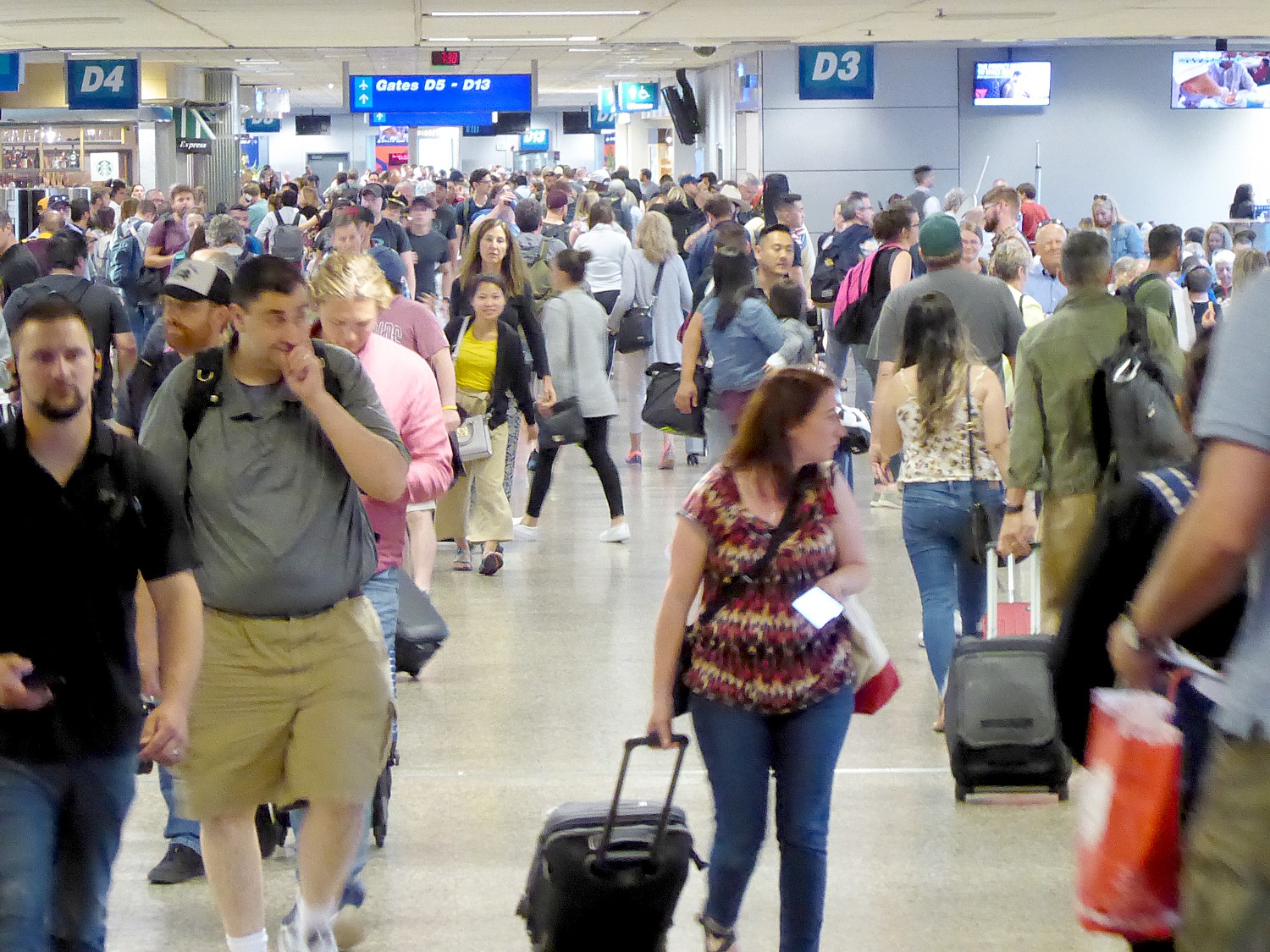
Hundreds of thousands of Americans found themselves stranded without immediate, clear evacuation plans after airspace closed and flights were cancelled in major hubs including Dubai, Doha, Amman and Tel Aviv. Some 500,000 to 1 million U.S. nationals were living in or visiting the Middle East when the US and Israel launched its attack on Iran on February 28 without warning and without preparation or planning for getting civilians out of harm’s way.
Travelers in a dozen countries were impacted: Israel, Bahrain, Cyprus, Iraq, Jordan, Kuwait, Lebanon, Oman, Qatar, Saudi Arabia, Syria, Turkey, the United Arab Emirates.
With many Mideast countries lacking a US ambassador, and many embassies closed, they had little support. As of March 7, just 27,000 Americans were able to return home. The U.S. State Department, which days later set up a telephone number for people to register for assistance, reported having “directly assisted” nearly 13,000 Americans with security guidance or charter evacuation flights.
Ongoing Situation: Thousands remain in the region under a “Depart Now” advisory, with many relying on private groups or commercial flights as they become available. Israel was providing bus transportation to Egypt and Jordan for Americans to connect to flights.
The State Department was advising U.S. citizens in Iran in need of help to call the State Department at +1-202-501-4444 to receive departure information and assistance, or contact the U.S. Embassy in Bern, Switzerland by email at BernACS@state.gov or phone +41-31-357-7011. Since the U.S. government does not have diplomatic or consular relations with the Islamic Republic of Iran, the Swiss government, acting through its embassy in Tehran, is serving as the protecting power for U.S. interests in Iran.
Also, the State Department advised that the Armenian land border at Agarak/Norduz was open. U.S. citizens entering Armenia from Iran need a valid U.S. passport and may stay for up to 180 days visa-free. U.S. dual-nationals who plan to enter Armenia on an American, Iranian or Armenian passport do not require advance approval. Taxis are available from Agarak to surrounding cities and to Yerevan.
The Turkish land border crossings with Iran are open (Gürbulak/Bazargan, Kapıköy/Razi, and Esendere/Serow) for entry by Turkish and third country nationals.
Rising Global Travel Risks Drive Increase in Travelers’ Security Membership Purchases
Growing concerns about safety, instability and unpredictability in international travel are driving a significant increase in Global Rescue security memberships. From January 1 through March 5, security + travel membership purchases increased 29% compared to the same period in 2025.
The surge reflects a broader shift in traveler behavior as individuals seek professional security support and crisis response capabilities before traveling internationally. The purchasing trend aligns with findings from the Global Rescue Winter 2026 Traveler Sentiment and Safety Survey, which showed that most travelers expect international travel in 2026 to be more dangerous or increasingly unpredictable compared to pre-2020 conditions.
According to the survey, 38% of travelers say international travel danger in 2026 will be unpredictable and 36% believe it will be more dangerous. Only 1% believe international travel will be less dangerous.
“Travelers are clearly signaling that uncertainty and instability are influencing how they plan international trips,” said Dan Richards, CEO of The Global Rescue Companies and a member of the US Travel and Tourism Advisory Board at the US Department of Commerce. “More people want professional support behind them before they travel — access to intelligence, crisis response teams and the ability to get help quickly if conditions deteriorate.”
“These perceptions are shaping behavior,” Richards said. “Travelers are not necessarily staying home, but they are becoming more deliberate about preparation and risk management. Security memberships provide a safety net that gives travelers direct access to experienced security professionals when situations become volatile.”
Global Rescue’s Security Membership includes 24/7 access to teams of military special operations veterans and intelligence experts; real-time alerts and destination-specific security advisories’ and mergency response and extraction services during conflict, civil unrest and security crises.
“Travelers are seeing increasing headlines about conflict, political instability and security threats in multiple regions,” Richards said. “In that environment, having a professional crisis response capability is becoming an essential part of international travel planning.”
With nearly 14,000 flights canceled from large airports in 10 countries across the Middle East and hundreds of thousands of travelers stranded in the immediate aftermath of the US-Israel attacks on Iran on February 28, most coverage has focused on stranded passengers and airport shutdowns.
But travelers are learning the hard way that acts of war exclusions and timing of purchase are determining who gets reimbursed and who doesn’t with their travel insurance.
According to InsureMyTrip, an insurance comparison platform that helps travelers find the most appropriate travel insurance for their needs:
Many travelers assume any cancellation is automatically covered, but standard policies don’t work that way.
Travelers who bought insurance after the conflict escalated may not have coverage for cancellations tied directly to the event.
Airlines and government repatriation efforts are playing a major role in helping travelers get home, while insurance often supports with delay benefits, assistance services, and reimbursement when eligible.
Interest in Cancel for Any Reason (CFAR) upgrades is increasing as travelers look for more flexibility in uncertain global situations.
“This moment is less about insurance failing, and more about travelers learning how coverage actually works during global disruptions,” the company said.
InsureMyTrip CEO Suzanne Morrow offered this guidance:
Travelers going to, from, or through Middle East hubs right now should stay flexible and informed. Check your flight status directly with the airline before heading to the airport, look for waivers or rebooking options, and enroll in the State Department’s STEP program for real-time updates. Conditions are changing quickly, so having a backup plan is important.
Timing of purchase matters because once an event is considered “foreseeable,” new travel insurance policies typically won’t cover losses tied directly to it. That’s why we always encourage travelers to buy coverage early, ideally right after making the first trip deposit, so they have the broadest protection and options like Cancel for Any Reason.
There’s also a difference between cancellation coverage and travel delay support. Cancellation coverage may reimburse prepaid, nonrefundable costs if you can’t take the trip for a covered reason. Travel delay benefits help if you’re stuck mid-trip, covering things like meals, hotels, or transportation while you wait. Both are helpful, but they apply in different situations.
To protect reimbursement options, travelers should review their policy now, keep receipts for any extra expenses, and document delays or cancellations. It’s also smart to check airline and hotel policies first, since many are offering flexibility that can solve the issue without filing a claim.
If you’re already traveling and a crisis happens, whether political unrest, war, terrorism, climate events, or a pandemic, safety comes first. Follow guidance from local authorities and your embassy and register for alerts if you haven’t already. Travel insurance doesn’t arrange government evacuations, but many plans include 24/7 emergency assistance services that can help you understand your options, coordinate care, and navigate next steps. Depending on the situation and the policy, some travelers may have trip interruption benefits if they need to cut a trip short, but coverage always depends on the specific policy and circumstances.
“The bottom line: know your destination, know your coverage, and give yourself flexibility whenever possible,” Morrow advises.
InsureMyTrip expects a surge in travel insurance claims as frustrated fliers try to recoup losses. While the company doesn’t handle claims directly, its experts are offering guidance to help travelers avoid common mistakes that could slow down, or sink, their reimbursement.
Here’s what travelers need to know:
Not everything’s covered: Travel insurance isn’t a “catch-all.” Always read the fine print to understand exclusions.
Paperwork matters: Missing receipts, reports, or proof of expenses are top reasons for denial. Don’t delay: Waiting too long to file can make a claim ineligible. Save everything: Receipts, doctor’s notes, police reports, and unused tickets are key for a smooth process.
File online: Digital submissions are often faster and easier to track.
Bonus tip: InsureMyTrip customers get free access to a claim advocate, a service that reviews denied claims, contacts the provider, and assists with appeals.
Cancel For Any Reason Insurance
Just three months into 2026, several global events have already upended travel plans and left many uncertain about their upcoming trips. From the ongoing government shutdown to the unrest in the Middle East, travelers are increasingly prioritizing flexibility when planning.
According to Squaremouth, a leading travel insurance comparison platform, interest in Cancel For Any Reason (CFAR) coverage has surged roughly 27% since the start of March amid recent global events.
Despite its name, the add-on offers more flexibility than travelers may realize, extending well beyond impulsive cancellations. This benefit functions as an extension of standard cancellation coverage, allowing travelers to cancel for reasons standard policies typically exclude and still receive partial reimbursement for prepaid, non-refundable trip costs.
While exact exclusions vary by policy and provider, common scenarios where standard coverage may fall short, and CFAR can step in, include:
Unsafe travel conditions, but no official government closures or travel bans
Voluntary job changes or schedule conflicts
Traveling despite receiving a doctor’s orders to remain home
Financial constraints that arise after a trip is booked
Simply changing your mind and deciding not to travel
“Travel insurance policies with the CFAR upgrade provide the most flexibility to cancel your trip,” shares Chrissy Valdez, Senior Director of Operations at Squaremouth. “This upgrade typically increases a policy’s cost by about 40% to 50%, but we’ve already seen how valuable that added flexibility can be for travelers affected by major events in 2026.”
Important Eligibility Requirements
“Travelers need to know that CFAR is not a standalone policy and is only available as an upgrade to a comprehensive plan,” Valdez continues. “In most cases, it must be purchased within 14 to 21 days of your initial trip deposit, depending on the provider.”
“That said, while this may be the only benefit that provides flexibility where standard coverage falls short, it does have limitations. CFAR typically reimburses between 50% and 75% of prepaid, non-refundable trip costs, requires travelers to insure 100% of their trip expenses, and generally requires cancellation at least two to three days before departure,” she adds.
As global events continue to impact travel in 2026, Squaremouth encourages travelers to consider adding CFAR to their coverage for greater flexibility and financial protection.
Learn more about the Best Cancel For Any Reason Insurance for 2026 here.
Travel insurance is an important investment for big-ticket trips like cruises, tours, safari, renting a home and for international travel. One of the most important reasons to purchase travel insurance is for the medical coverage – especially evacuation in the case of a medical emergency – since your health insurance policy including Medicare do not cover medical services when you travel abroad.
Squaremouth, a leading travel insurance comparison platform, wants travelers to understand how travel insurance can protect travelers if they fall ill and their trip is disrupted:
If You’re Too Sick to Travel: If you, your travel companion, or a non-traveling family member gets sick before your trip, you could cancel your trip and be covered by a comprehensive travel insurance plan under the Trip Cancellation benefit. This benefit can reimburse you for 100% of your prepaid and non-refundable trip costs, including flights, hotels, tours, excursions, and more.
If You’re Too Sick to Finish Your Trip: If you get sick while on your trip and need to go home early, the Trip Interruption benefit can reimburse you for unused trip expenses, plus the additional transportation costs you incur to get home. Typically, this benefit covers at least 100% of your unused, prepaid, non-refundable trip costs. However, some plans even cover between 125 – 200%.
If You Need Medical Treatment While Traveling: It’s important to understand that most domestic healthcare insurance plans will not cover you abroad. However, emergency medical insurance can cover the costs of medical treatment during your trip if you get sick or are injured, including hospital stays, doctor visits, and prescription medications.
More serious cases could require emergency evacuation to a suitable medical facility, especially if you’re traveling in a remote destination or on a cruise. Medical Evacuation coverage, which is included with most travel insurance plans, can pay for transportation to a hospital in the event of a medical emergency or even back to the U.S.
If You Change Your Mind About Traveling: While concerns about traveling for fear of getting sick or simply no longer wanting to travel during flu season are not covered reasons under standard travel insurance policies, travelers can purchase optional add-on benefits like Cancel For Any Reason (CFAR) and Interruption For Any Reason (IFAR). These benefits provide the most flexibility, allowing travelers to cancel or shorten their trip for any reason and receive partial reimbursement, typically 50-75% of insured trip costs. It’s important to note that these benefits are time-sensitive and must be purchased within 14-21 days of your initial trip deposit date.
Because travel insurance provides coverage for unforeseen events, it’s crucial to buy a policy early to maximize your coverage. For coverage to apply to getting sick, such as with the flu, you must be healthy and able to travel at the time of purchasing your policy.
For a more in-depth overview, Squaremouth’s ‘Does Travel Insurance Cover the Flu?‘ article provides a deep dive into how travel insurance may apply to the flu, including coverage explanations and answers to frequently asked questions.
SOVENTURE Warns Travelers of Hidden Coverage Gaps in Popular Vacation Activities
Turning now to more mundane vacation travel planning, SOVENTURE is highlighting frequently overlooked gaps in travel insurance coverage that can affect families, cruisers, honeymooners, and other leisure travelers.
Popular vacation activities such as snorkeling, ziplining, hiking, parasailing, skiing, snowboarding, water skiing, and ATV or UTV excursions are often classified as “risky” by insurers, which can lead to coverage exclusions under many traditional travel insurance policies.
Some of the most common coverage gaps involve experiences that feel routine, family-friendly, or low-risk:
Cruise and Tour Excursions – Activities sold directly by cruise lines or resorts are often assumed to be automatically covered, but that is not always the case. Even widely booked excursions can fall outside standard policy coverage, depending on how an insurer classifies the activity.
Motorized Vehicles – Another common blind spot involves motorized vehicle rentals and guided excursions. Many travelers don’t consider a scooter ride, guided ATV tour, or Jet Ski rental risky, but insurers often do, especially when traveling outside the United States.
SOVENTURE policies explicitly includes a wide range of popular vacation activities; covers excursions sold by cruise lines or resorts; offers strong medical and emergency evacuation coverage; and clearly defines what is and isn’t covered.
More information at https://www.soventure.com/explore-plans/
Finding Best Travel Insurance to Meet Your Needs
InsureMyTrip.com is one of three platforms which travel guru Pauline Frommer recommends where you can put in the details of your trip and personal details (age is key), and get a bullet-list comparison of insurance policies. The others are SquareMouth.com and TravelInsurance.com (which I used to obtain a quote, comparison and link directly to the insurance company to complete the purchase)
“No one company is best for every trip,” she advised at the New York Travel & Adventure Show. “Usually the one in the middle that covers the most things is the best.”
Also, she warns, “Never buy insurance through the company you are traveling with.”
By Karen Rubin, Travel Features Syndicate, goingplacesfarandnear.com
In our “Where to Go: International” column, Antoinette Leon, COO & SVP ofItsEasy.com Passport & Visa Services recommended five destinations (Saudi Arabia, Egypt, India, Vietnam and Brazil) to visit in 2026, which prompted these additional questions about the passport, visa process. If you are among the 50 percent of Americans who do not yet hold a passport, or among the millions who must renew after 10 years, here are valuable tips and information for anyone contemplating traveling abroad in 2026:
How hard is it to renew passports these days with all the issues of the Trump administration?
President Biden’s Executive Order enabled renewing qualifying passports online, now with limited availability, without the need to submit any documents through the mail. More recently, the Trump Administration issued a mandate for exactness and accuracy of the applicant’s identity and sex, based solely on official birth records, followed by required certified and registered official documents should there have been subsequent legal name change(s). All passport applicants must understand that routine or expedited applications can slow without much warning. Even small issues, such as a photo error, a name mismatch, or a tight timeline can become a bigger headache in a system under pressure.
How hard/easy is it to do the renewal using the online system, and what can go wrong?
Convenient? Yes. Foolproof? No. The online passport renewal system is a game-changer when it works but it doesn’t work for everyone. Name changes, lost or damaged passports, child passports are not eligible for OPR. Rejected photos and technical glitches can instantly disqualify you or stall your application. Payment processing errors and upload failures happen more often than you’d think. If you’re on a deadline and something goes sideways, a small mistake can snowball into a travel-canceling disaster.
ItsEasy.com offers a new “All Inclusive” OPR Concierge Service, where we examine each customer’s application to ensure it will be successfully renewed, and includes the required photos via the ItsEasy Passport Renewal & Photo App ($39.95).
How much in advance of the expiration date in passport do you recommend starting?
Since select countries require that a passport be valid for at least 3 to 6 months (depending upon the country) upon arrival back to the United States, it makes sense to start your passport renewal at least six months before it expires.
Many countries won’t let you in if your passport is less than 6 months away from its expiration date upon return to the US, regardless of whether your airline clears you for boarding (some countries require only 3 months).
Cut it too close and you’ll be watching your dream trip evaporate. Renewing early keeps your travel options wide open, your stress levels low, and avoids unnecessary government expedite fees.
Have any countries responded to Trump’s crackdown on issuing visas and raising fees, and country bans, with new restrictions on the US?
When the U.S. tightens visa restrictions, hikes fees, or adds new barriers, other nations often retaliate with their own requirements. This doesn’t always mean full-blown visa mandates, but you’ll see more digital registrations, entry fees, and enhanced screening for American travelers. These policy shifts can happen quickly and without much warning, so staying informed is critical before you book that flight.
What places don’t require Americans to get a visa? – like the UK, Europe?
Americans still enjoy visa-free access to popular spots like the UK, Europe’s Schengen Zone, Japan, and much of Latin America. But “visa-free” is evolving. Many of these destinations now require electronic travel authorizations, like the UK’s ETA or Europe’s ETIAS, before you arrive. It’s not a traditional visa, but it’s definitely not zero paperwork anymore. Even when you don’t need a visa, expect to register digitally in advance.
What are the advantages of getting the Global Entry, vs. TSA?
TSA PreCheck gets you through U.S. airport security faster. But Global Entry is the power move for international travelers. It includes everything TSA PreCheck offers, plus you skip the brutal customs lines when you return home. Biometric kiosks let you breeze through immigration, shaving off what can be hours of waiting. If you travel abroad even once or twice a year, Global Entry pays for itself in time and sanity saved.
What is the difference in applying for TSA vs Global Entry besides the cost? What is the renewal process like? Can you still walk into a Staples?
TSA PreCheck -Valid for 5 years, it’s a luxury which, in most cases, tends to aid the airport check-in process at ALL domestic airports regardless of Travel Destination. $75-$85.
While approval for TSA PreCheck could take up to 30 days, most often the applicant will be approved within 24-72 hours via email to which the applicant’s new Known Traveler Number (KTN) is sent. You enter this special number when purchasing an airline ticket.
Three companies have been approved to roll out the TSA PreCheck Program: Idemia; Telos, & Clear, which have partnered with Office Depot and Staples. ItsEasy.com also has partnered with Telos Corp and currently provides TSA PreCheck Enrollment Services at its Grand Central and Rockefeller Center locations.
Global Entry – Valid for 5 years, it’s designed to aid and greatly expedite the reentry into the USA at almost all domestic Airports with a provision for International Arrivals.
The application process is deep and the final interview is often only done at select major US airports by a US Customs Entry Officer trained specifically for this most critical evaluation process.
The Global Entry application process begins online only at the Government’s specific website: ttp.dhs.gov. Be aware: many applicants get lured into fraudulent online sites with GOV in the website name, release private information, and then get charged double to fill out the same government questionnaire. ONLY a dhs site ending in dot gov (.gov) will be safe.
When is it advised to use a passport, visa agency such as yours? Are there some countries that are trickier? Examples?
If your timeline is tight, the rules are dense, and a single missing detail could derail your plan, that’s when an agency like ItsEasy.com becomes essential. Countries such as China, Russia, Nigeria, Indonesia, and Kenya are known for layered visa requirements, frequent policy shifts, and strict documentation standards that can trip up even experienced travelers. Passport issues add another layer of complexity, urgent renewals, child passports, name-change corrections, or lost and damaged passports often involve rigid government rules and little margin for error. A professional agency navigates both the visa and passport compliance maze, flags issues early, and monitors changes in real time. When the stakes are high and the margin for error is razor-thin, professional guidance is worth the extra expense.
In the old days, you had to send away your passport for renewal, during which time you couldn’t travel abroad. Is that still the case? (I’m a travel writer and can’t be without my passport for any period of time).
The policy is still the same. The only new option available to renew adult passports under “select guidelines” is the OPR – Online Passport Renewal Program. However, regardless of whether you send away your passport for Renewal Processing, or you qualify for, and make use of, the new government OPR Program, your passport is no longer valid for use. Despite the fact that you are still in physical possession of your passport when using the OPR System, your passport should be considered canceled and invalid the moment you press the program’s online SUBMIT button.
Oftentimes, executives, journalists, students, etc find themselves in a situation whereby they must travel while their current passport is being processed for renewal, or has been submitted pending a foreign visa. A second valid passport is a privilege granted to those applicants that can prove that they have travel conflicts that will require the issuance of a second valid passport.
Do you have any comments about how many Americans have a passport and whether interest and numbers have increased/decreased?
About half of all Americans now carry a valid passport, and that number keeps rising. Since 2022, there’s been a noticeable surge in applications, fueled by post-pandemic wanderlust, the rise of remote work, and a generation of younger travelers eager to explore beyond borders. First-time applicants are driving much of this growth. More Americans are thinking globally, and passport ownership is on a clear upward trajectory.
Right now, these five countries are hitting the sweet spot of accessibility, value, and adventure. Saudi Arabia and Egypt are rolling out the red carpet with digital visa systems and spectacular new cultural attractions that rival much of Europe. India and Vietnam continue to deliver incredible bang for your buck, authentic experiences, electronic visa convenience, and landscapes that’ll fill your camera roll. Brazil ties it all together with competitive pricing, excellent air connections from the U.S., and a resurgence in international appeal. From ancient wonders to tropical paradises, these destinations span the globe and welcome both spontaneous weekend travelers and meticulous planners alike.
What do you anticipate for Americans traveling abroad in 2026?
If you’re traveling internationally in 2026, expect a lot more screens, scans, and verification steps. Europe’s Entry/Exit System (EES) and ETIAS authorization program will add new layers of digital checks. Airlines are leaning heavily on biometric systems and automated verification. Border agents everywhere are cracking down on overstays and incomplete documentation. The prepared traveler will breeze through; the unprepared one will get stuck in bottlenecks.
Any comments you would like to add?
With the new REAL ID requirement, for easy access to US airports, the US passport Card is a great option offered to the US consumer that deserves more attention. While it’s easy to apply for at any time, it is a $30 bargain as an additional item request when renewing your passport book.
Not only is it REAL ID compliant for US airport check-in, but it serves as the best daily Proof of ID as it does not display your home address, leaving the knowledge of where you live and how you live remaining private! Leave your Driver’s License securely in your wallet, and it will always be there when you need it.
ItsEasy.com Passport & Visa Services, founded in 1976, is a leading passport and visa expediting company that has processed over 2 million passport and visa applications on behalf of their customers. If there is a problem with an application, ItsEasy.com can interact with the U.S. Government or foreign agencies to resolve problems, for ItsEasy Passport & Photo App offers a safe and cost-effective way to renew a passport. For urgent passports needed within 14 days, ItsEasy.com offers rush services.
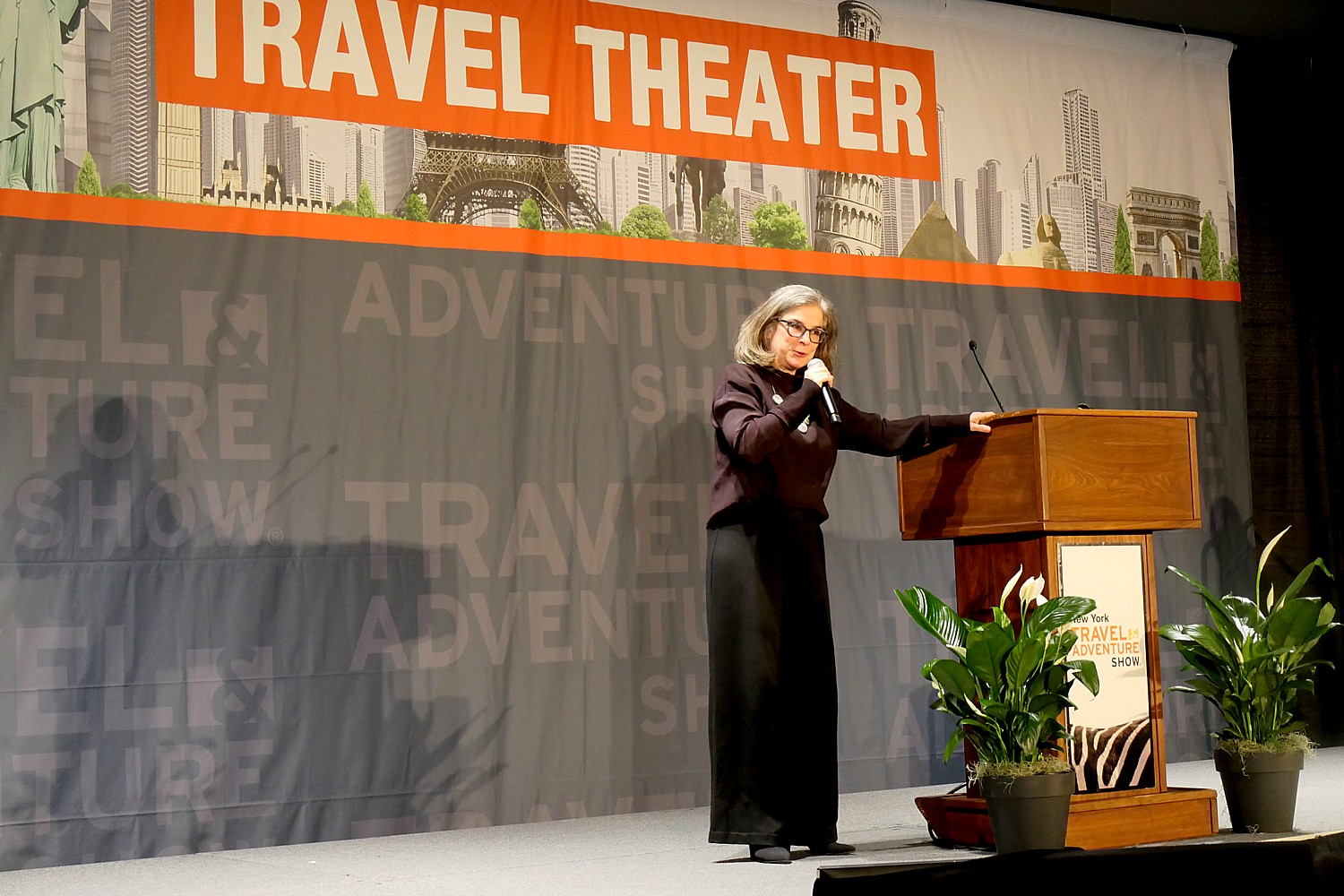
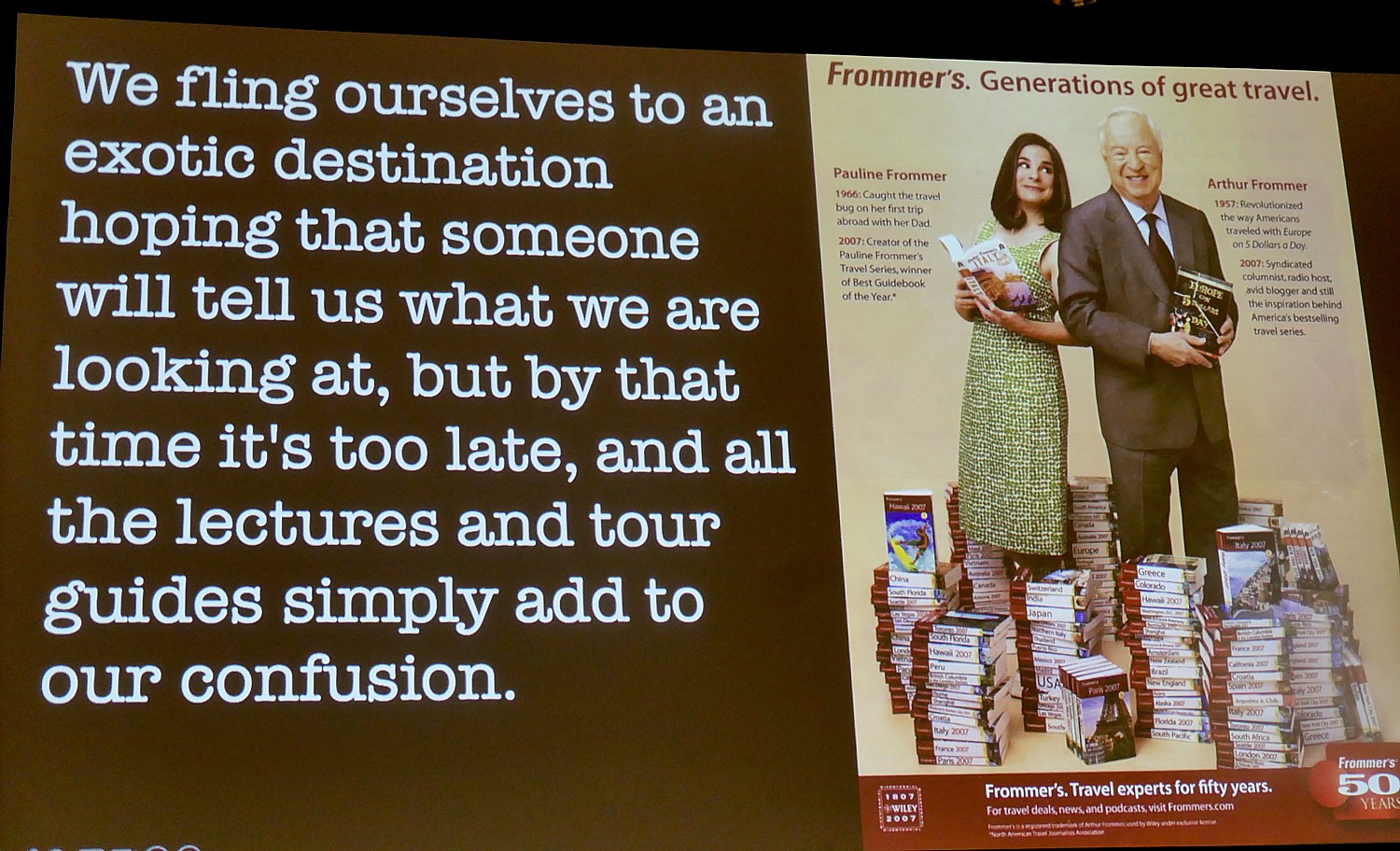
This year’s travel talk by Pauline Frommer at the New York Travel Show was a homage to her father, the legendary Arthur Frommer who single-handedly inspired generations of travelers not born into family fortune to experience the world, with his guidebooks, then radio and TV shows, starting with the iconic “Europe on $5 a Day”. His philosophy, mission and love of travel that infuse the Frommer guides have remained. He passed away in November.
At her talk, titled “Travel Lessons I’ve Learned From My Father That Will Make Your Next Vacation Less Expensive and More Meaningful,” she said, “He believed money should be used smartly. He believed travel could be a life-changing activity.”
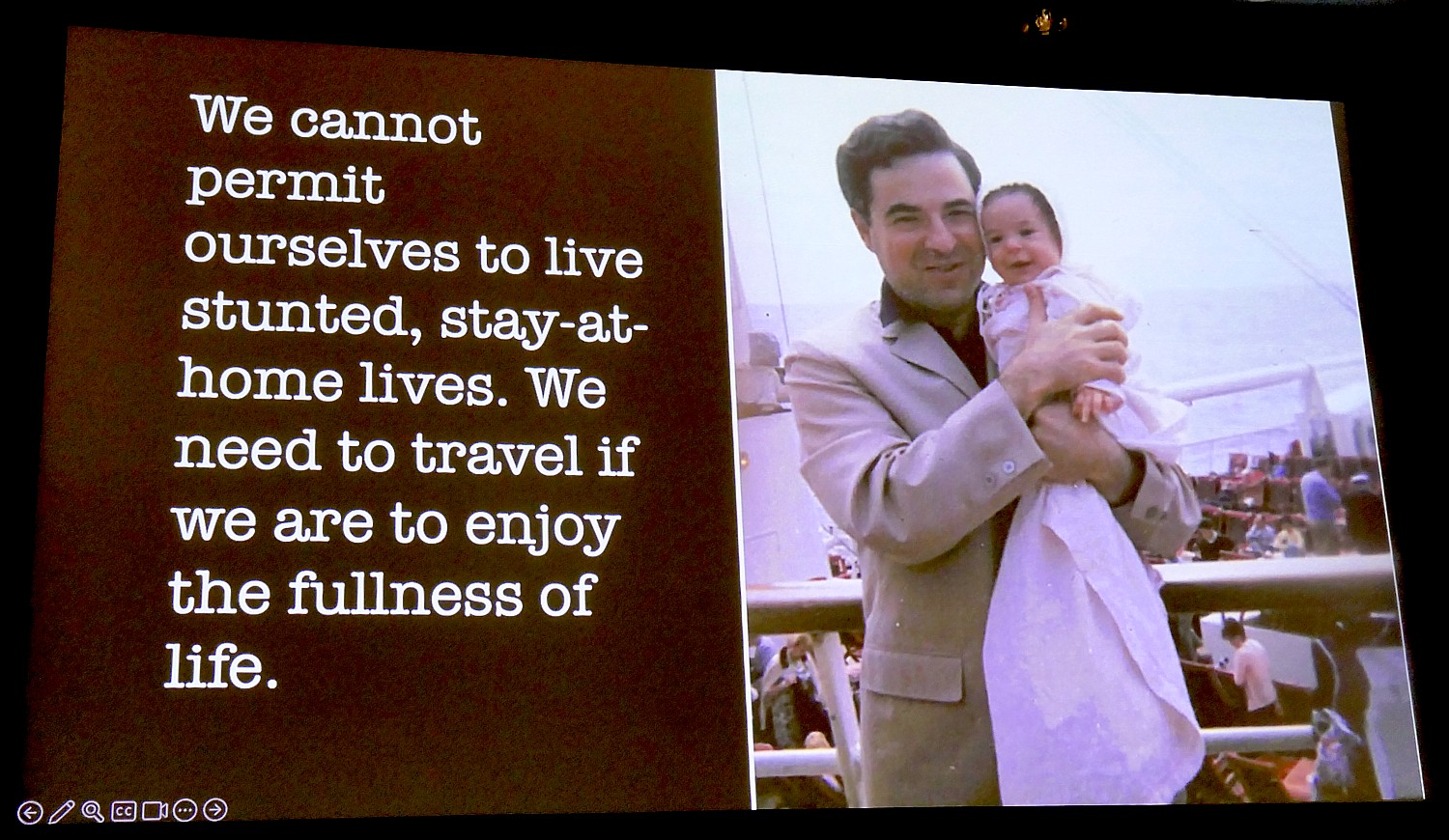
Quoting Arthur, she said, “We cannot permit ourselves to live stunted, stay- at-home lives. We need to travel if we are to enjoy the fullness of life… Contact with the new and the different is how we grow and develop. That may be possible in other ways than travel, but there is something about experiencing the world that cannot be duplicated… Nothing has the lasting impact of being there.”
Arthur Frommer, with his baby daughter Pauline, made encouraging and enabling people to travel the mission of his life.
Arthur Frommer devoted his life to guiding people how to travel inexpensively and how to have meaningful vacations, that shift who you are as a person in important
In 1957, when Arthur set out on his mission to inspire Americans to travel abroad, Americans – even middle class ones – were rich compared to rest of world – Europe was in rubble while Americans had dollars.
Arthur Frommer discovered the joys and benefits of international travel as a GI in Europe, and decided to encourage other GIs to travel as well, with the Gi’s Guide to Travelling in Europe. Soon after, he revolutionized travel with his guides, like “Europe on $5 a Day” to affordable, meaningful travel experiences.
“Now we are in the same position – currently the Euro is almost equal to the $1: $1.02 to 1e (in 2016 it was $1.36 to 1e. The Japanese yen has never been this weak, 156 yen to $1; the dollar is worth 1.44 Canadian and the Mexican peso is at 20.78. It has never been so good.”
On the other hand many travel companies are using AI to raise prices surgically, depending upon your prior buying habits – what Joe Biden’s Federal Trade Commission called “surveillance pricing.” (Biden’s FTC also went after airlines, others for junk fees, requiring rapid cash refunds, cybertheft and greedflation, during his pro-consumer administration.)
“Middle men watch what consumers are doing, creating profiles of the consumer so they can tell different industries how much to charge, individually.
Delta Airlines’ CEO, on an earnings call, boasted how the airline was profiling, using AI to float the maximum airfare passengers would pay.
Have you had the experience of searching for an airfare, finding one, but going off to think about it for awhile, only to return and find the fare $50 higher? “That’s because you are being watched; the amount of surveillance is insane.”
Frommer’s antidote? “When searching for travel goods and services, be private – hide your identity. For example, subscribe to a VPN (virtual private network) to hide who you are; clear your cache and cookies. Use a different computer.
But, she adds, “Then you don’t buy on them. There are so many issues in air travel, if you buy from a third party like an OTA [an online travel agent], you are last in line if something goes wrong. Search on the website, then buy from the airline.”
(Travel expert Peter Greenberg, at his talk at the travel show, adds that the OTAs always say there are only one or two seats available at that great price, but that is because the airline has only released that number of seats. He also advises searching online then booking directly with the airline.)
There are also days that are best to purchase air fares: Frommer recommends purchasing an airfare on Sunday can yield 6% savings on domestic fare, 17% savings on international.
Also, “buy 1-3 months out for domestic travel (for a 25% savings), 18-29 days out for international (for a 10% savings). Last year, it was 4 months out, but she acknowledges, “it takes courage to book so close.”
You get the best fares if you start your trip on a Thursday or Saturday (16% savings over flying on a Sunday), she says. “Sunday is the most expensive day to start a trip.”
Air passengers are reasonably concerned about what to expect flying this year Karen Rubin/goingplacesfarandnear.com
Also, given the “chaos in the sky” with the doubling of cancellations in 2024, she recommends, “fly before 3 pm, or up the risk of being cancelled or delayed by 50%.” If you fly after 9 pm, your risk of being delayed or cancelled goes up by 57%. Fly after 9 pm and your risk of being delayed or cancelled goes up 57%
To get the best rate for a hotel, Frommer suggests booking three-plus months in advance for resorts, but just one week before in business-travel cities.
“Always get a reservation you can cancel.” (I have had great success finding hotels at hotels.com and booking.com, that provide great tools for location, amenities, nearby attractions, easy cancellation, and helpful reviews.)
Vacation home rentals, such as through airbnb.com may not be cheaper than hotels because of housekeeping fees and taxes (unless you are a family or couples traveling together), but typically afford more space, the convenience of kitchen and laundry, and are typically in neighborhoods so you get to connect with local people.
Looking for added value in accommodations? Consider hostels: “There are wonderful hostels all around the world, where you get private rooms, private bathrooms for much less than a hotel. There usually is a common area, a place where you can cook your own meal, do your laundry.”
“Typically there are also opportunities to meet and socialize with other travelers,” she said (as I found in Quito, Ecuador, where I was invited to a communal dinner). A good source for finding hostels is HostelWorld.com.
To find a tour, Frommer recommends: travelstride.com and tourradar.com, which are marketplace sites for tours. You put in dates and where you want to go and then can compare prices, highlights, what is offered. “Often the cheaper tours are by local tour operators that don’t have an international profile but go to same places, and often stay in the same hotels and restaurants.”
Travel insurance is recommended when you are taking a long-distance, expensive tour and want protection against cancellation (but read the fine print); but what you may well want when traveling abroad is medical insurance, covering evacuation if necessary. (Medicare isn’t applicable abroad.)
You can search for the policy that works best for your purpose at:
“Put in details and it generates a list. Inevitably the best is not the most expensive, usually it is in the middle cost range. No travel insurance company is always the best.” Also, she advises, “Never buy insurance through the travel provider.”
(Recently, in preparation for Discovery Bicycle Tours’ trip to Cambodia and Vietnam, I did the search at travelinsurance.com and found the policy that best fit my needs for medical coverage was through Generali Global Assistance.)
Every year, the Frommers offer their recommendations for where to go in the coming year. The hallmarks of the list have become finding the less crowded destinations worth a visit. (See the full article frommers.com/bestplaces2025)
Crete in Greece: it is one of the least crowded of the Greek islands because it is the largest- twice size of Rhode Island, while most travelers go to Mykonos or Santorini. “Santorini got 3 million visitors in 2024 – it was so hairy on the roads, the government asked the Santorini citizens to stay off the roads at certain hours because of the traffic jams with tour buses.” But Crete is the land of “Zorba the Greek”. “It is the most Greek of Greek islands, once part of the Venetian Empire, it looks like Venice and has incredible ancient ruins from when it was the center of the Minoan civilization – think Minator and Labyrinth.”
Looking to do an African safari? A safari in Zambia, famous for Victoria Falls , one of tallest in world, is as much as 25% less costly than Tanzania or Kenya. “They have all the animals – giraffes, elephants, hippos, lions – and also have a progressive system where the rangers who stop poaching are women. It is also one of the safest countries in Africa. Support them.”
Greenland is top of mind lately. “Bizarrely, Greenland just expanded its airport, so for the first time, can accommodate large jets. For the first time, you can go to this ice-covered nation direct from New York in the time it takes to go to Iceland. 80% of Greenland is covered by ice – you can do heli-skiing, snowshoeing, glacier cruises, see polar bears.: Frommer is anticipating Greenland will be the next Iceland. “Go before it’s too crowded. It’s a great adventure destination.”
The Caribbean country of Barbuda (part of Antigua and Barbuda) is an undeveloped, beautiful, pristine island (because it never had a big airport) that made the news 40 years ago when Princess Diana visited, thinking she could escape the paparazzi. “During WWII, allied generals were worried Germans would use the Caribbean islands as bases to invade the US – so built airports on Jamaica, Aruba, Puerto Rico and several other islands; after the war, they drew tourists. Barbuda is finally getting an international airport and Robert De Niro is building a resort on Barbuda, she said. “See it while it is in its more pristine state.”
Bath and Hampshire, England are “going crazy” this year over the 250th birthday of novelist Jane Austin (“Pride and Prejudice”, “Sense & Sensibility”) – there are Empire-style costumes you can rent, special exhibits. Bath also has one of England’s most important Roman ruins.
Tucson, Arizona is turning 250 years old this year, as well, and mounting celebrations all year long. Also, Tucson is the only city in the United States that is part of the Dark Sky program. On the edge of the city, Saguaro National Park, there is a free observatory you can go at night to look at stars with astronomers. Tucson is also the place for foodies, with a 4000-year old culinary tradition. “The United Nations named it the only culinary UNESCO World Heritage site in the US. There are all the different influences in the food. There are all kinds of food celebrations for the 250th.
“My father said, ‘Don’t just go to dead sites.’ If I had never traveled, I would never have understood that all people, no matter how exotic their appearance, have basically the same concerns, the same desires. Don’t just go to see things, but meet people.”
To meet people when you travel:
The International Greeter Association connects you to people who love their home communities and give free tours. You can go to Tokyo and find a greeter to take you around Tokyo for a day, teach you how to use subway, show you a neighborhood, free.” In Chicago, Frommer took a tour of downtown to discover public art. She toured a Hispanic neighborhood in the Bronx, visiting stores and apartment buildings, to “learn about another side of New York City.”
Find other free tours led by locals through the International Greeter Association, a worldwide nonprofit organization offering private free walks with locals through some 400 cities in 60 countries. https://internationalgreeter.org). Also, GetYourGuide.com.
(Athens, Greece has a program through the tourist office, “This is My Athens,” that sets you up with a local to show you around for free, https://www.thisisathens.org/withalocal/. We have also found free walking tour programs in most cities by googling, such as in Quito, freewalkingtourecuador,com, where you just tip the guide after. )
Airbnb.com Experiences provides links to little companies with people with experiences to share. Frommer related taking her 15-year old daughter on a tour of Paris consignment stores with a fashion expert. “We have been to Paris many times but saw things never had.”
TravelingSpoon.com and EatWith.com link travelers to culinary experiences with local people, the best local cooks in different communities, home cooks. Frommer described such an experience with an “Italian nona,” whose grandson translated as she prepared the meal in her kitchen. “We all gathered for a meal. It cost as much as a high end restaurant, but it was our most memorable meal in Italy that time.”
Another way to have an extraordinary experience is to do short-term work in a foreign destination– something that is particularly appealing for young people taking a gap year – which do not require work visas. Opportunities can be found at:
Travelers are increasingly concerned about sustainability and traveling responsibly, so the benefits of their visit (providing economic foundation to sustain people living in their community, maintaining culture and heritage and sites) do not outweigh the negatives of overtourism.
Tour operators, like Intrepid Travel (intrepidtravel.com) are taking this into account in designing itineraries so they are more hub-and-spoke and less travel by bus or airline; several, like G Adventures (gadventures.com) are conscious to purchase local products and hire locals, as well as contribute a portion of the tour price to benefit the community; Seacology (seacology.org), takes you to places threatened by ocean rise then donate money back to community.
Pauline Frommer is continuing the mission and legacy of her father, Arthur, to inspire and facilitate journeys of discovery.
“At its best, travel should challenge our preconceptions and most cherished views, cause us to rethink our assumptions, shake us a bit, make us broader minded and more understanding,” Frommer said.
Her father, Arthur Frommer, “changed this industry in powerful ways, democratized travel. He was one of the first to say average people should travel, not just the wealthy, elite. Travel afforded the opportunity to expand your life, expand your mind, and do it in a way that pushes the cause of world peace. He truly believed that when we get to know other countries, wonder at the beauty of them, we won’t attack or invade, and our hearts will break when things go wrong there.”
By Karen Rubin, Travel Features Syndicate, goingplacesfarandnear.com
A clear indication that the U.S. economy is (and has been) strong is how robust the demand and spending for travel has been and is anticipated to be for 2025. Americans are traveling in surging, even record numbers, looking further afield, being more purposeful, mindful in their quest for life-changing, life-enhancing experiences, giving truth to the adage: it is the journey, not the destination.
In fact, special events – like the Taylor Swift Eras concert tour, the Paris Olympics, Formula 1, even the Total Eclipse of the Sun – are driving travel purchases, with people building trips around the events.
“People are traveling for their passions, for experiences – lifestyle, activity, food, entertainment, adventure,” observed Mandy Gill, Marriott International’s Vice President Global Marketing, US & Canada, at the Travel Media Summit. She was among the travel professionals who cited Taylor Swift’s Eras tour as a major boost to business in 2024; indeed, the tour -149 shows across 51 cities and 21 countries – sold 10,168,008 tickets, totaling $2.1 billion (boosting the GDP of countries), making it the highest-grossing tour in history.
Some 12 million people traveled into the path of totality that crossed 15 states to experience the once-in-a-lifetime April 8, 2024 solar eclipse – making it the largest mass travel event in the United States in 2024. The next total solar eclipse, on August 12, 2026, will be visible in Greenland, Iceland, Spain, Russia, and part of Portugal, https://science.nasa.gov/eclipses/future-eclipses/) and travel companies are ready – AdventureSmith, specializing in small ship adventure cruising, is offering seven solar eclipse cruises.
“Travelers increasingly are looking for alternative and authentic destinations, new destinations and adventure travel,” said Erik Evjen, Executive Vice President, Tourism Economics, at the 2025 Travel Media Summit. “Whereas in the past, people would go to a hotel, now they go for ‘what is important to me.’”
“What is important to me” is increasingly determined by “influencers” and social media, with FOMO overriding any skepticism that might arise if travelers appreciated that influencers they trust may well be paid to promote destinations (what used to be termed “advertorials”).
Influencers are the new power brokers in travel, playing a critical role in shaping consumer decisions, noted Rashaad Jorden at the Skift Megatrends event in New York. “Platforms like Expedia have already integrated influencer marketing into their booking process, allowing curated recommendations to be directly bookable. Kayak plans to employ a mass-market approach, enabling users to share their favorite destinations on social media and earn rewards if bookings are made through their recommendations.
Influencers are also playing a huge role in stimulating travel by specific interest groups, including Black, women. solo travelers, and travelers with disabilities who now have access to information about places and programs that serve their interest. This in turn, is prodding companies to accommodate these travelers. Even Googlemaps is now taking disability into account in providing directions, thanks to Googler Sasha Blair Goldenson, who became wheelchair bound after an accident , so you can now activate a toggle on Googlemaps app to access 55 million accessible locations.
The AI enhancements that are being incorporated into travel planning apps and making travel experiences accessible. “AI is enabling travel companies to tap into social media as a performance marketing channel,” Jordan said.
Accessibility to information will not only inspire travel, but help travelers better organize their itinerary, packing in more to see and do – a boon to destinations, attractions and lodging, and a key tool to mitigate against the destructive impacts of overtourism and enable travelers to find the life-changing, life-enhancing experiences they crave, fulfilling the increasing demand for experiential travel, educational travel and multi-generational and “skip-gen” travel.
Travel companies are responding to the interest in “experiential travel” that affords opportunities to become immersed in culture, connected with local people and actively engaged in the environment. Companies like Earthwatch (earthwatch.org), Audley Travel (audleytravel.com), Exodus Adventure Tours (exodustravels.com), and Village Experience (experiencethevillage.com) build their programs around experiential travel, while others are incorporating immersive experiences – biking (Discovery Bicycle Tours, VBT Biking, Backroads), hiking (Wildland Trekking, Backroads, REI, G Adventures), walking (Country Walkers, Classic Journeys), camping, adventure, ecotourism (Wild Frontiers), and indigenous tourism (Discover Aboriginal Experiences, discoveraboriginalexperiences.com) – fundamentally provide these experiences.
Travelers are also increasingly looking for sustainable, responsible travel – in hotels, tours, and destinations, and to avoid feeling guilty about contributing to the destructive impacts of overtourism (but beware of “green-washing”). Dubbed “mindful tourism,” these travelers look to avoid the guilt of destroying the most highly prized “bucket list” destinations by looking more to spreading visits to what used to be called “the off season” (there almost isn’t an off-season anymore); relatively “new,” “unexplored,” and “off-the-beaten” track (though even these are becoming well visited) places; and “detour” destinations (places within three hours of the popular destination like visiting Paris but hopping on the train to visit Strasbourg, or staying in Strasbourg and traveling less than one hour by train to Colmar). The added benefit is traveling when places are less crowded and cheaper (better value), especially as price is being used to mitigate over-crowding. Another benefit is the enjoyment of being in the vanguard with photos and social media posts.
“With overtourism putting pressure on major cities, travelers are increasingly turning to lesser-known, less traveled destinations for more authentic and mindful experiences,” said Maryanne Sparkes of European Waterways, in fact helped by the availability of technology that assists with translation, directions, money exchange and facilitates interactions while relieving the anxiety of traveling where English is not common.
“Places like Albania, Greenland, and Uzbekistan are really having a moment. People are drawn to their raw beauty, unique cultures, and opportunities for immersive, local-focused tourism—whether it’s farm-to-table dining, craft workshops, or guided tours by locals.” Sparkes highlighted the growing trend of seasonal flexibility as well. “Travelers are also exploring destinations in the off-season, which not only avoids the crowds but often comes with lower costs and a deeper connection to the place.”
Despite the desire to generate tourism revenue, governments, destinations and travel suppliers are also utilizing regulations and implementing policies promoting sustainable, responsible tourism out of realization that overtourism will literally kill their golden goose. Places like Machu Picchu, the Galapagos, many national parks, and experiences like swimming with whales in Australia, are limiting permits, requiring advance, capacity-controlled reservations, and increasing fees, while the limited spaces means higher rates for accommodation, which is itself a form of regulating access. (Here’s an idea: have an allotment of tickets at affordable prices that may be obtained by lottery so these places are not just for the elite.)
“Infinite growth is not possible,” Penny Rafferty, Executive Chair, Luxury Lodges of Australia, told the Travel Media Summit, “Our lives, our economies, our businesses need to be sustainable to survive.”
“We have to protect what we love… We have to think ahead in terms of sustainability, environmentally friendly way to operate ships, and future of cruising,” Lasse A. Vangstein, Chief Communications & Sustainability Officer, Havila Voyages said. “We borrow nature. If future generations want to experience, we need to make a conscious choice how to showcase and spread tourism.”
“Sustainability is no longer just a buzzword—it’s become essential in travel. We’re seeing airlines investing in sustainable fuels and working to offset their carbon emissions, which is such an important step. Hotels are also stepping up, with more achieving certifications like LEED and Green Globe, and even entire ‘green resorts’ running on renewable energy while promoting eco-friendly practices,” Sparkes noted.
Concern for the health and wellness in a destination coincides with continued surging interest in health and wellness tourism, as well as indigenous tourism experiences which blend together wellness and sustainability, nature and culture.
“People have increased understanding that wellbeing is linked to wellbeing of planet- why we seek connection to nature and place,” Rafferty noted.
Slow travel is another trend that meshes with the desire for mindful, experiential, responsible, and sustainable travel: biking, hiking and walking vacations, river and canal cruises on barge hotels and train travel – that provide connections to local people and places and provide a kind of serenity and peace.
“Slow travel is really taking off, with more people choosing longer stays in fewer places to not only reduce their environmental impact but also to truly connect with the local culture. It’s about making travel more meaningful for everyone involved,” Sparkes observed.
The travel industry’s embrace of AI will significantly aid travelers in their quest to find lesser traveled destinations as well as the experiences they crave and the value they want. At the same time, AI gives travel entities like indigenous tourism companies, small, special interest and niche operators and those lesser-known destinations access to customers and markets as never before – a win-win for mitigating the negative impacts of tourism while maximizing the positive economic and social benefits that sustain communities, heritage and sites.
“Technology is breaking down cultural barriers,” Sparkes stated . “Real-time AI translation tools are a huge leap forward. They make it so much easier to connect with locals, whether you’re ordering a meal, asking for directions, or just having a chat. It adds a whole new layer of richness to the travel experience.”
She added, “Technology is transforming every part of the travel experience, making it smoother, smarter, and more connected . Biometric check-ins and digital wallets are taking the hassle out of airports, letting travelers focus on the journey rather than the logistics. Even luggage is getting an upgrade—GPS tracking, self-weighing features, and built-in charging ports are becoming the norm, which is a game-changer for peace of mind and convenience.”
The concern for getting the most bang for the buck is sparking interest in all-inclusives – resorts, cruises, farm and ranch vacations, ski holidays and wellness trips. “There is a huge surge in the use of the all-inclusive filter on the hotels.com app,” noted Melanie Fish, Vice President of Global PR, Expedia Group Brands.
Booking apps like Expedia are also helping travelers save money such as flight price tracker: Expedia just launched a “flight deals departing near you” feature.
Cruising, considered the ultimate “all-inclusive”, is also seeing huge demand and at every level, from the floating resort cities with over 3,000 passengers that are so popular with multi-generational cruisers (NCL, Royal Caribbean, Disney), cruises focused on the destination (Holland America); small-ship and expeditionary cruises (Hurtigruten, Quark Expeditions, Lindblad, Sea Cloud Cruises, AdventureSmith Explorations), river cruising (AmaWaterways, Viking, CroisiEurope, Uniworld Boutique River Cruises, Amadeus River Cruises, Delfin Amazon Cruises), barge hotels (EuropeanWaterways), historic windjammers (Maine Windjammer Association) and even self-skippered canal boats (LeBoat.com, EricCanalAdventures.com) and yachts (Dream Yacht).
The travel industry is responding to another key trend: the surge in solo travel. Cruise companies are even offering single cabins or other options for solo cruisers (Norwegian Cruiselines, Holland America, Virgin Voyages, Oceania Cruises, Riviera Travel, Tauck, Cunard Line, Carnival Cruise Line, Princess Cruises, MSC Cruises and small-ship Scenic and Emerald Cruises). Tour operators, like G Adventures (gaadventures.com), Wild Frontiers Travel (www.wildfrontierstravel.com), Road Scholar (roadscholar.org), Intrepid Travel (intrepidtravel.com), EF Go Ahead Tours (goaheadtours.com), Exodus Adventure Travels (exodustravels.com) and Western River Expeditions (westernriver.com) are offering some “solo traveler” departures, waiving the single supplement or offering to match single travelers with a companion. Indeed, solo travelers have discovered the benefits of joining small-group tours so they can travel on their own, but not alone.
The rise in “solo travel” coincides with growing availability of women-only travel programs. A rise in female-focused experiences, trips, and hotel packages, empower women to explore the world, whether solo or in small groups. For example: a transformative Women-only Icelandic Adventure with Naya Traveler, while last year, Butterfield & Robinson launched a “Women-Only” collection of biking, hiking and adventure tours (butterfield.com).
The industry is also addressing the surge in popularity of outdoor expeditions – especially travelers who want to be out in the wild but not give up their creature comforts. Marriott International, for example, in December acquired Postcard Cabins, a brand of tiny cabins in the woods “to bring the passion of outdoor travel more seamlessly to the consumer.” There has also been a rise in companies offering fully outfitted camper vans, like Moterra Campervans (gomoterra.com) and Roadsurfer (roadsurfer.com), and glamping (luxury camping) with apps like Glamping Hub (glampinghub.com), Glamping.com and hipcamp.com, as well as campgrounds of America (koa.com) and even Airbnb – a trend that took off during the COVID pandemic and has continued.
Cool-cations also are in hot demand, as people seek out destinations to avoid the worst impacts of global warming – golfing in Scotland instead of Phoenix or Miami.
The travel industry was projecting record demand in 2025 (by February, Carnival Corporation said its eight brands, including Carnival Cruise Line, Princess Cruises, and Holland America Line, were 75% booked for 2025), but that was before the Trump administration took a chainsaw to the economy, with mass firings and layoffs of federal workers, imposing tariffs that will cost millions of private-sector jobs and reignite inflation and damage regional economies, while injecting insecurity and anxiety into society that already caused consumer confidence to plummet to the lowest levels in years.
When people are feeling financially insecure and are concerned about future economic prospects, they pull back on spending, and travel spending tracks most closely with consumer confidence. But travelers are resilient and because there are infinite options, opportunities and choices to accommodate any budget, when the economy falls, find ways to scale back spending but still travel. They may substitute long-haul trips by air for shorter roadtrips by car; trade resort stays for Airbnb, a camping holiday or even venture into home exchange (homeexchange.com); and look for value destinations where the dollar goes further.
“Value destinations are among the fastest growing,” said Erik Evjen, Executive Vice President, Tourism Economics, at the 2025 Travel Media Summit.
Indeed, the geopolitical climate, may well spur Americans to travel abroad even as international travelers shun the USA. The strength of the dollar (and the US economy relative to other countries) helped propel 98.5 million Americans to travel abroad, spending $215 billion, a 34% increase in American travelers’ spending abroad in 2024. The window of opportunity will remain open in 2025 – especially to places like Japan, Canada, Vietnam, and Greece where the dollar goes far, and especially among older adults who have the most time and discretionary money to spend.
For much the same reason, it is likely the US travel industry will also have to respond to a drop in international arrivals, suppressed by the strong dollar, the likely economic strains due to Trump’s tariff war, growing anti-Americanism because of Trump’s foreign policy, as well as ongoing concern (and travel advisories) about America’s gun violence epidemic.
There may well be a significant reversal from 2024, when 77.7 million international tourists visited the US in 2024, a 16.8% increase from 2023, when 66.5 million foreign visitors came, contributing $155 billion to the economy, TravelPerk reported.
Indeed, travel and tourism is a vital industry for the United States, contributing $2.36 trillion to the nation’s economy in 2024, and supporting 18 million jobs across the country.
Travel and tourism has also been a major stimulant to economic development, and yes, world peace around the globe, as travelers become ambassadors for their nations and bring back to their communities newfound familiarity of the people they visit – you can see it in Siem Reap in Cambodia, Hoi An in Vietnam, Cuzco, Peru. 1.4 billion tourists traveled globally in 2024 (140 million more than 2023), spending $1.4 trillion worldwide, according to the World Tourism Barometer from UN World Tourism Organization.
Growth in international tourism was expected to continue at a strong pace in 2025, but that was before Trump’s threats to undermine the global economy by igniting a trade war, threatening to take over Greenland, the Panama Canal and Canada, bullying allies like Ukraine and cozying up to the world’s tyrants and generally and raising the specter of World War III. International travel may still be robust, but travelers from major markets, like China, Canada, United Kingdom and Europe may detour from the USA.
There are already reports that Canadians – the biggest international market for the USA, who made 20.4 million visits to the United States last year and were responsible for $20.5 billion in spending, according to the US Travel Association – plan to pull back on travel to the United States.. Indeed, international travel is an export that contributes to the US trade balance and economy. Even a 10 percent drop in Canadian visitation would cost the US economy $2.1 billion.
“Economic and geopolitical headwinds continue to pose significant risks…. Against this backdrop, tourists are expected to continue to seek value for money,” the UN World Tourism Organization projected.
Indeed, the travel industry, adept at yield management, is also resilient and can be expected to respond to any drop in bookings with incentives, discounts and deals.
Bill Chalmers, the organizer for the past 15 years and inventor of the Global Scavenger Hunt, “a blind date with the world,” notes the rare backtracking to Bangkok from Myanmar. “Oddly, we had to fly slightly east to further our westward global trajectory…Myanmar is still hard to get into and out of with limited connections to mostly its regional neighbors…especially Bangkok and Singapore. Today we chose Bangkok as a more interesting layover in our exit strategy. Thus we a have fun 8-Hour Layover Challenge…but I am getting ahead of myself.”
We scurry about the Bangkok airport, finding a place to check our luggage for the precious few hours, finding an information counter with a map and information about how to get downtown (we discover a rail link into the city).
Besides figuring out the logistics of Bangkok without any prior preparation (because that is the essence of the Global Scavenger Hunt, an around-the-world mystery tour to determine “World’s Best Travelers”), our visit is complicated by preparations for the coronation of the new King.
Also, my teammate Margo has her own scavenger hunt going: she is trying to find chips from Harley Davidson Motorcycle dealers in every place we go. Her hunt brings us to one of Bangkok’s major urban shopping malls – every luxury and brand name in the world is represented. Harley is on a floor with Jaguar and other luxury cars. It is an amazing opportunity to view local life of Bangkok on a Sunday. (The movie, “Crazy Rich Asians,” immediately flashes in my mind.)
Margo goes off to do sightseeing by the Hop On/Off Bus; I am determined to take a water taxi. But I learn that the city has already closed off river access to the major attractions and sites that are along the river, including the Palace, and there is, in fact, a giant security cordon from the Grand Palace (later I learn that the Palace was open to visitors earlier and we just missed it). But the water taxi along the canal is still operating.
I go walking (in the intense heat) toward where I can pick up the water taxi. The time is ticking away and I have to calculate the amount of time to get back to the airport in time for our flight to Abu Dhabi. I pass interesting places, like the “Anti-Money Laundering Office”.
It is fun to ride the water taxi and I take it to a place close to the Grand Palace where there is an important temple, the Golden Mount (Wat Saket). A very nice fellow coming off the water taxi points me in a direction to the Democracy Monument. I learn that it was commissioned in 1939 to commemorate the 1932 Siamese coup d’etat which led to the establishment of a constitutional monarchy in the Kingdom of Siam. Field Marshal Plaek Phibunsongkhram saw the monument as the center of a new Westernized Bangkok, akin to the Arc de Triomphe on the Champs d’Elysees in Paris.
I see literally thousands of police, military, and what appear to be volunteers in colored shirts, the streets decorated for a parade (the administration building is nearby)– but no people on the streets waiting for a parade. The coronation is taking place in just a couple of weeks time. I assume that they are doing a rehearsal.
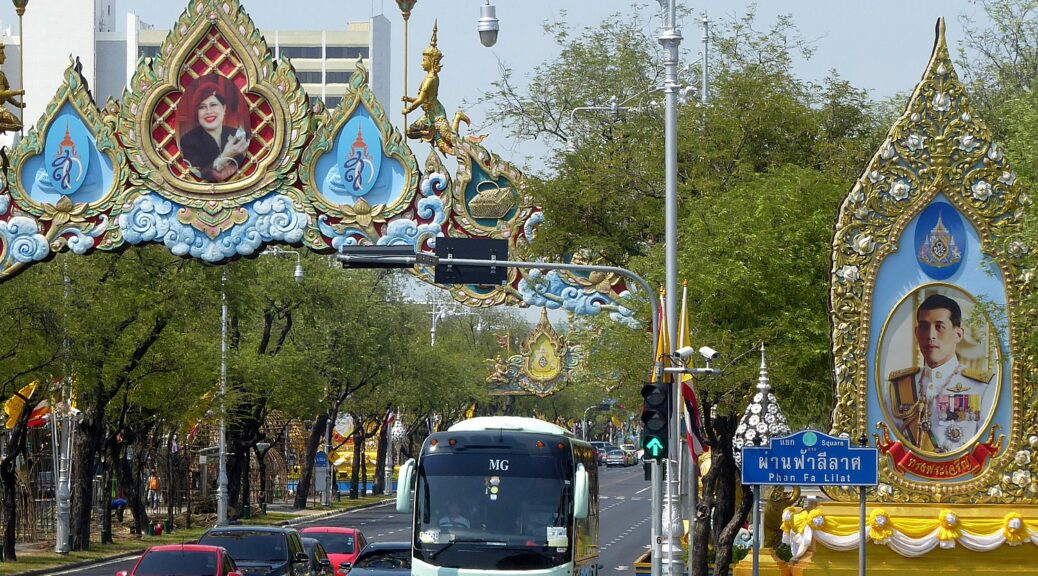
I contemplate hiring a little jitney taxi to take me close to the Grand Palace, but looking at the time and calculating how long it would take to backtrack to the airport, I just head back to the water taxi, walk through a broad shopping boulevard (big portraits of the King and Queen), to the train to the airport.
This moment in history, in fact, becomes the theme for my Bangkok visit.
At the end of it, though I did not get to see the Top Attractions of Bangkok, I fulfilled the essence of the Global Scavenger Hunt: I immersed myself in the everyday rhythm of this place and these people, exotic no longer.
The Global Scavenger Hunt is an annual travel program that has been operated for the past 15 years by Bill and Pamela Chalmers, GreatEscape Adventures, 310-281-7809, GlobalScavengerHunt.com.
Another
perfect day in Myanmar – our fourth and final day on Leg 3 of the Global
Scavenger Hunt, in which we set out from Yangon to travel about the country,
making a triangle that takes me to Bagan and Inle Lake and back to Yangon to
fulfill the Par 5 challenge on this a 23-day around-the-world mystery tour.
The
45-minute taxi ride from the delightful, five-star Sanctum Inle Resort on Inle
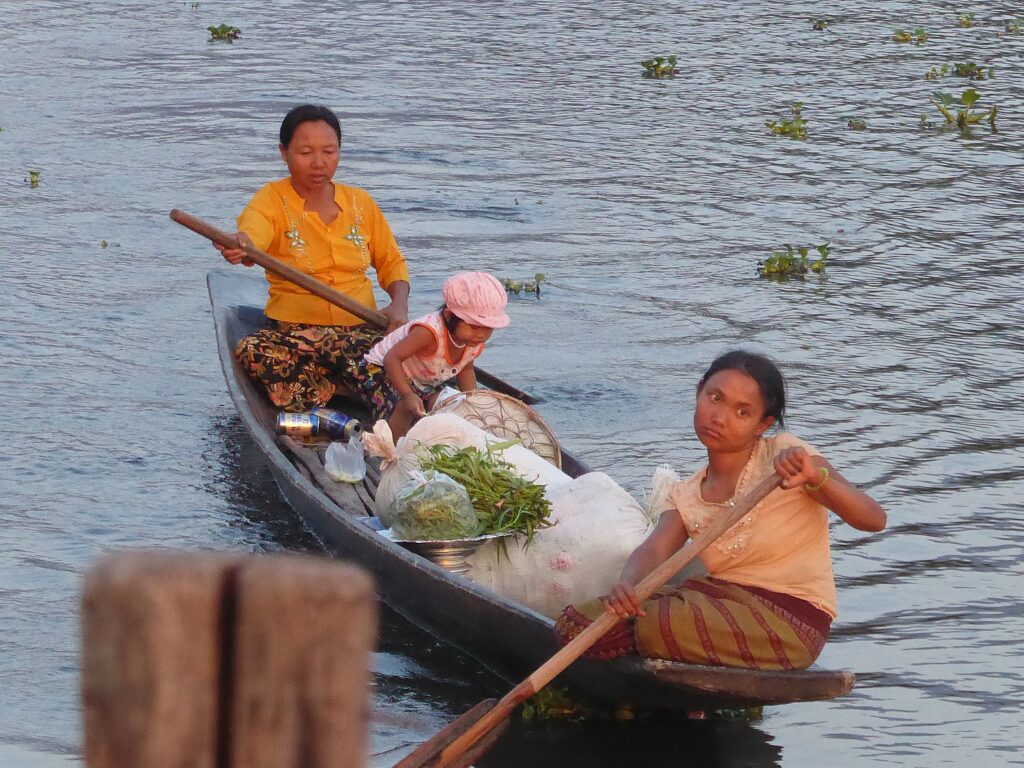
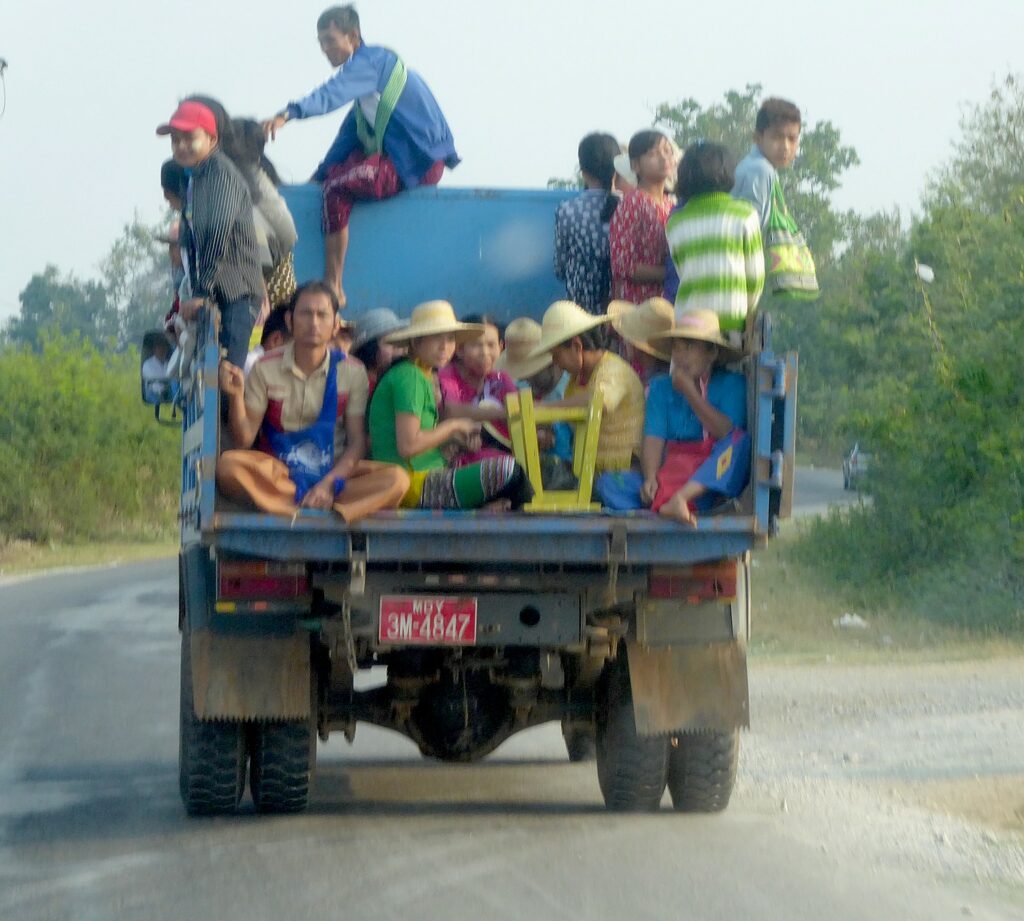
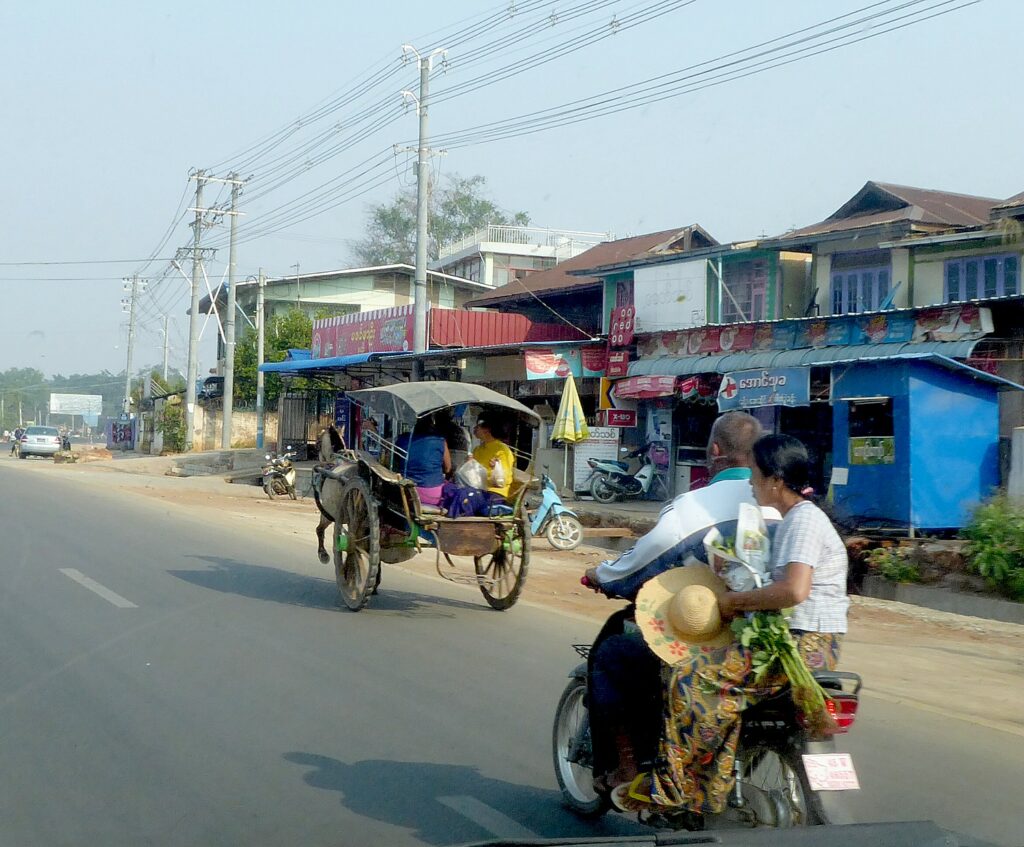
Lake is wonderful – I catch people driving oxcarts and donkey carts and people
riding the backs of trucks, villages and pagodas. But I have some trepidation
about Heho Airport because of the snafu in booking my ticket, resolved
long-distance by text to my son in New York to phone the online booking agent,
as I bounced around on the overnight bus from Bagan to Inle Lake. But I arrive,
am checked in to Golden Airlines without incident, and relax during the
45-minute flight back to Yangon.
The
morning flight gives me time to explore Yangon which I didn’t have when we
first arrived on Leg 3 of the Global Scavenger Hunt from Vietnam, and were
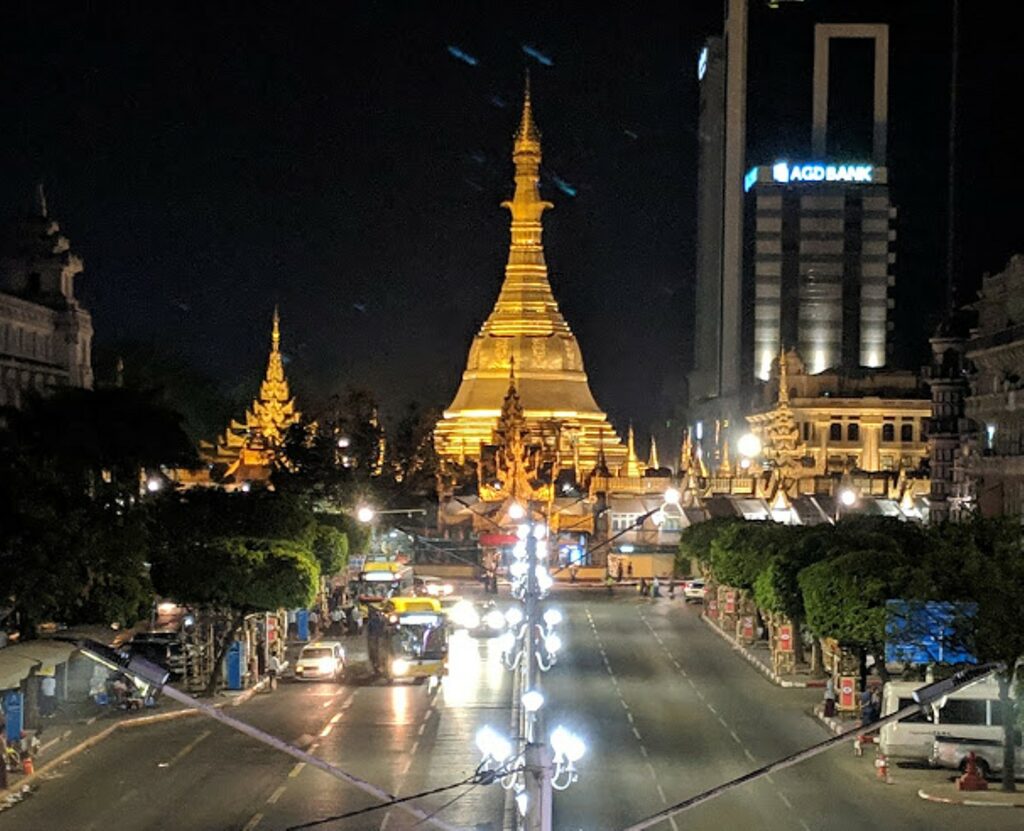
given our challenges, to travel around Myanmar and return to the Sule Sangri-la
Hotel by the 6 pm deadline.
Leaving
the airport, I attempt to take the public bus back into downtown, but after two
buses pass me by, I take a taxi instead.
Riding
back, I review a brochure I picked up at the airport which mentions a synagogue
in Yangon – in fact, the last synagogue in Myanmar. So I resolve to find it.
It
turns out it is only a 15-minute walk from our hotel, the Sule Sangri-la,
bringing me through various bustling market streets and shopping districts. The
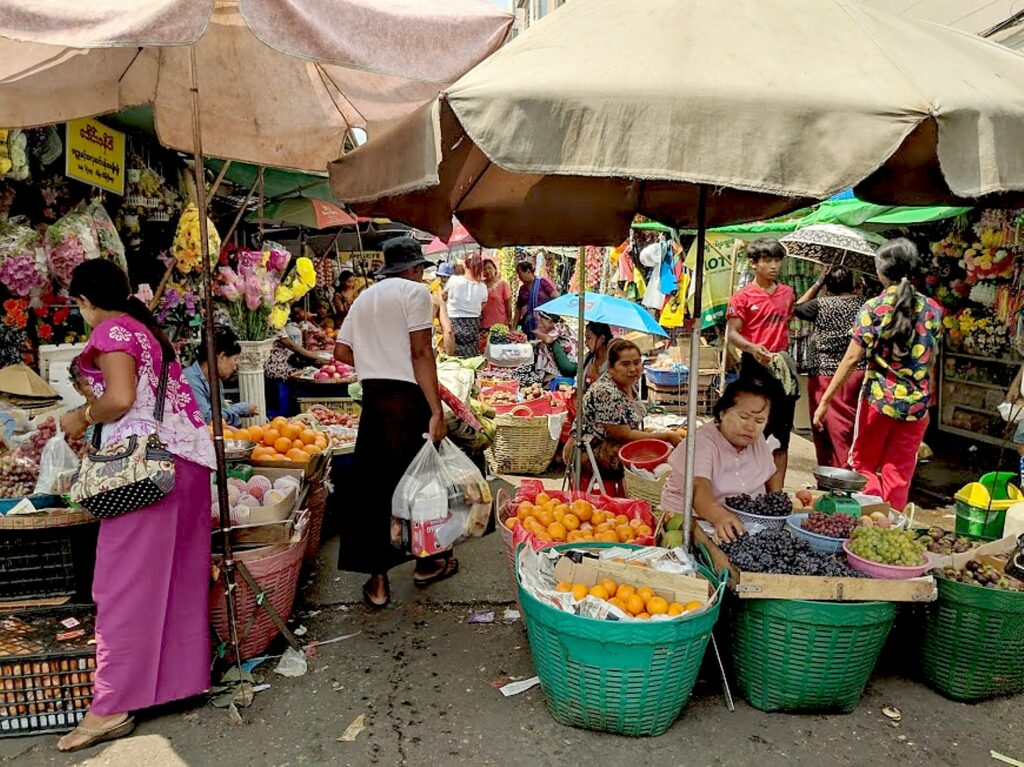
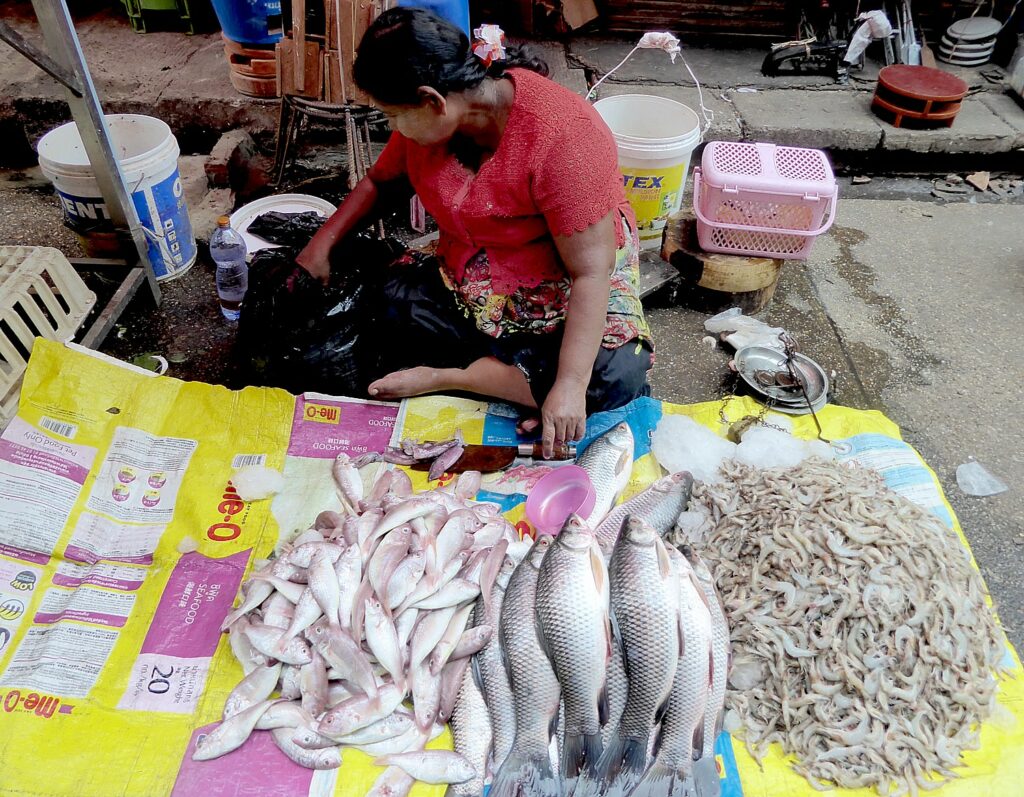
Musmeah Yeshua Synagogue itself is set on a busy market street where there are
chickens and fish for sale – the chickens clucking, the fish squirming to get
out of their container (I see one jump out of its container), the rich scent of
spices, and every other manner of item you can imagine.
By
the time I arrive at Musmeah Yeshua Synagogue, it is 1:40 pm – which proves
extremely lucky because it closes to visits at 2 pm (open daily except Sunday).
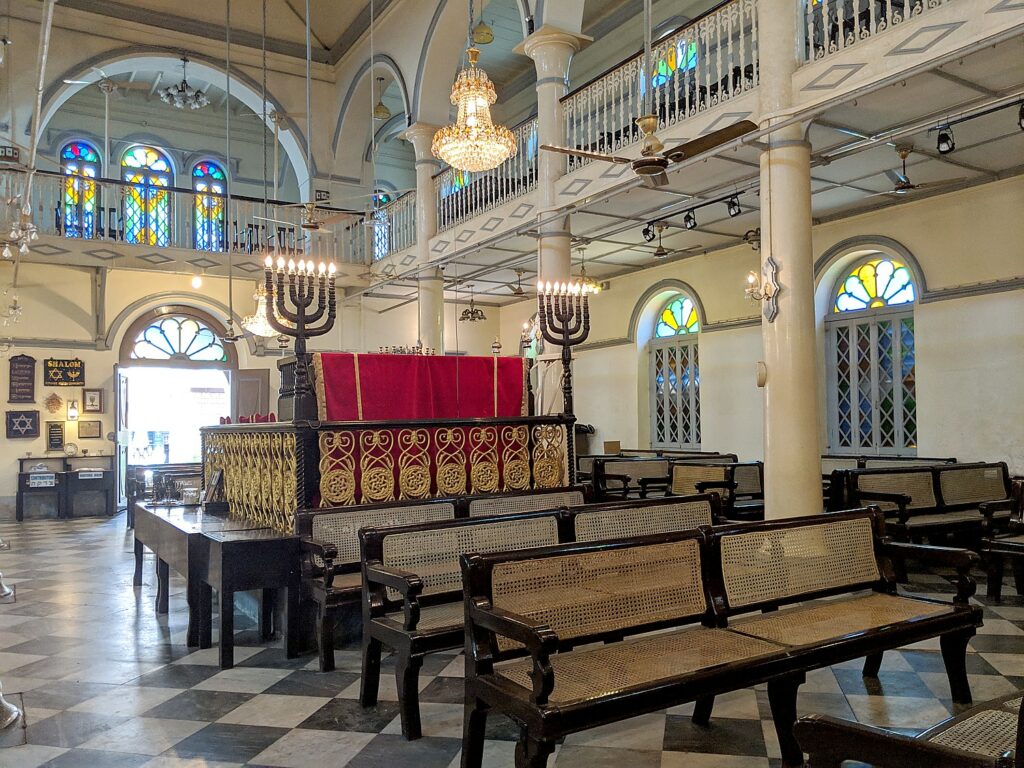
Inside, it is a lovely synagogue in the Sephardic style, built in 1896. At one
point, the Jewish community in Yangon numbered 2500 before the mass migration
of WWII; today, there are only 5 families (about 30 people). The Samuels, one
of the last remaining Jewish families, has maintained the synagogue for
generations, a plaque notes.
Perhaps
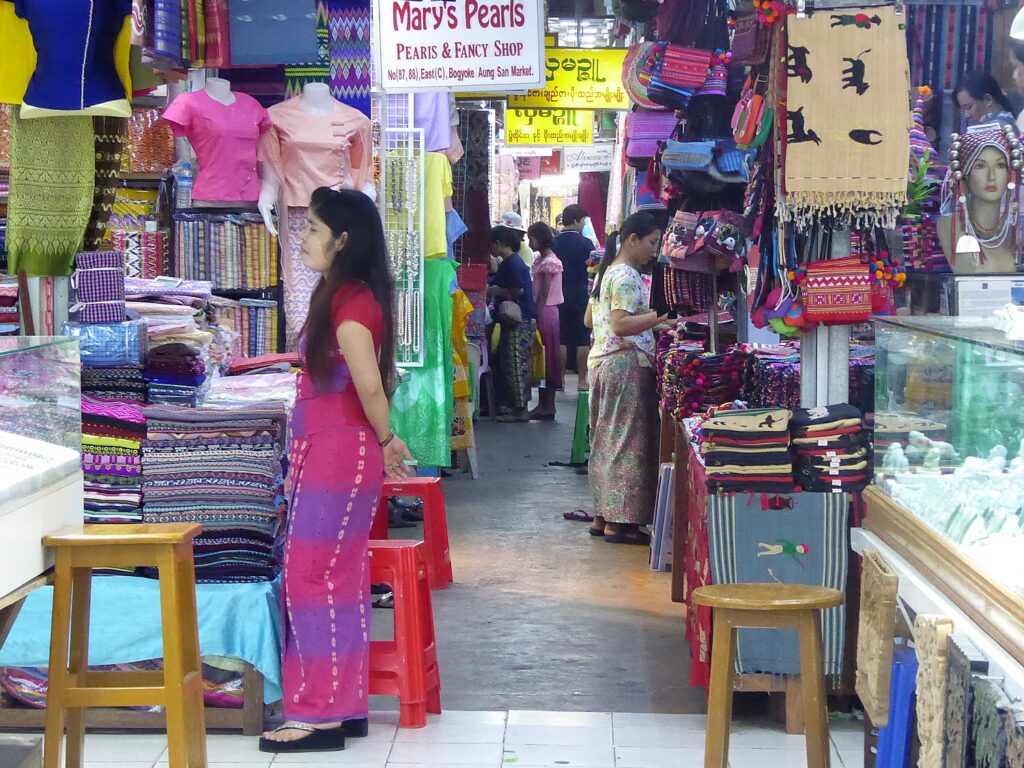
not surprising, a short distance from the synagogue is Bogyoke Aung San Market,
which since 1926 has been the city’s major marketplace. I am surprised to see
all the sellers of jade and jewelry (which is what the market is known for), as
well as traditional longyi, and just about anything else you can think of. I come
upon a seller of interesting post cards, and find the post office on the third
level (one of my traditions of travel is to send home postcards, which not only
have stamps, but mark the date and give some visual and personal notes). Also,
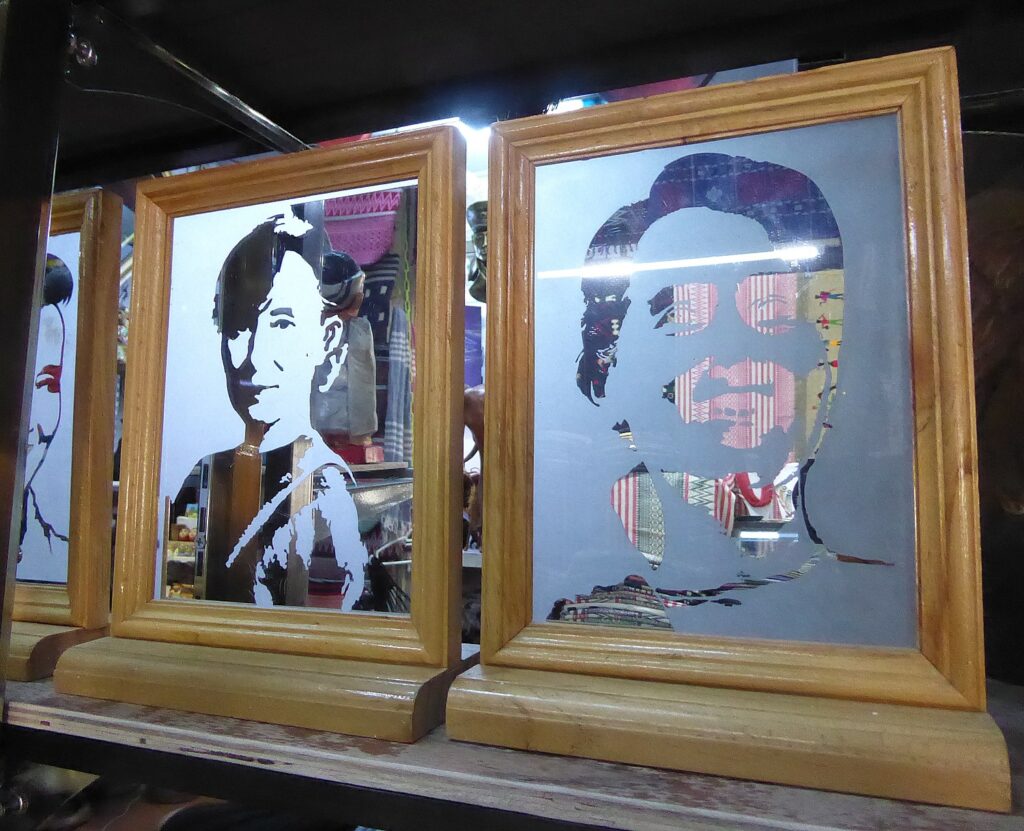
I have been impressed by the absolute lack of political messaging in the streets,
but here in the market is one art seller who has images of Myanmar’s most
famous leader, Aung San Suu Kyi. Wondering about the name, I later learn that Bogyoke
Aung San market is named for her father, Bogyoke (General) Aung
San.
I
walk back to the hotel, just a few blocks away, to refresh (it is 104 degrees),
in order to prepare for a visit to Shwedagon Pagoda, which I have been saving
for the late afternoon (one of the mandatory scavenges of the Global Scavenger
Hunt is to visit at dawn or dusk), so that I will be there at dusk (but back at
the hotel by the 6 pm deadline for the scavenges), but nothing could have
prepared me for the experience of seeing it.
Just
as I am about to leave, my teammate, Margo, who had traveled to Mandalay when I
went on to Inle Lake, walks in. She relates that after a snafu with her airline
ticket, she had to hire a taxi to drive her back to Yangon (ironic because I
couldn’t get the airline to cancel my ticket when I changed my plan to go to
Inle Lake instead, but such mishaps turn into marvelous adventures). We go off
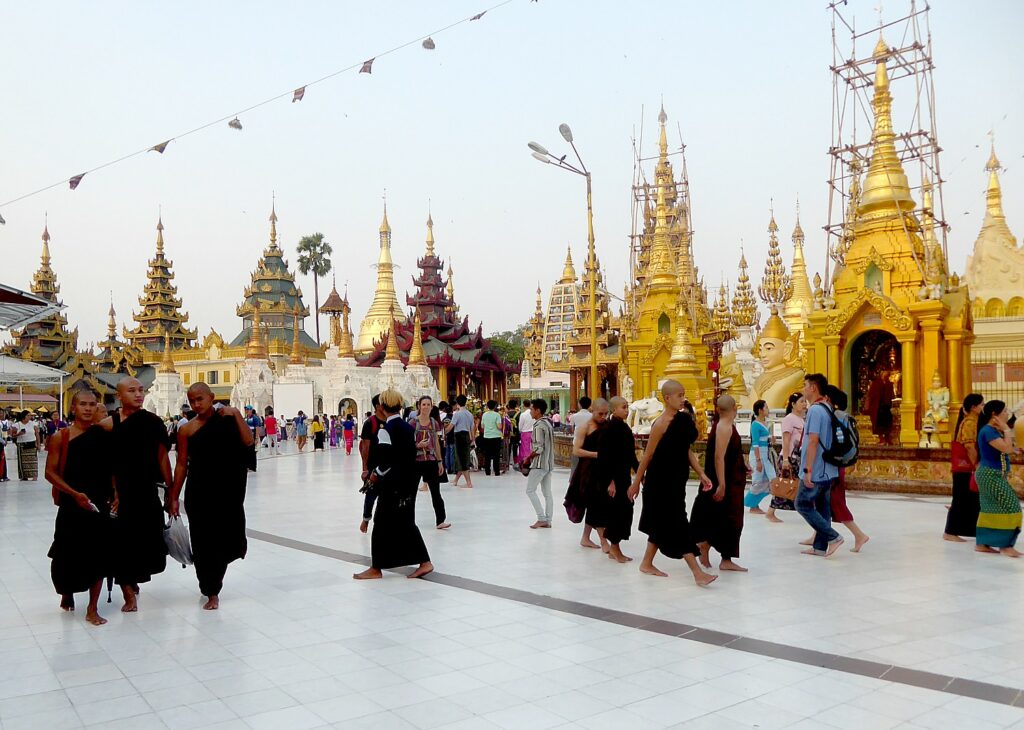
together to Shwedagon Pagoda, which is located west of the Royal
Lake, on the vast, 114 -acre Singuttara Hill.
Margo
cleverly hires a guide to show us around this vast, vast complex and it is
fascinating: this was the first pagoda in the world, he tells us.
Indeed,
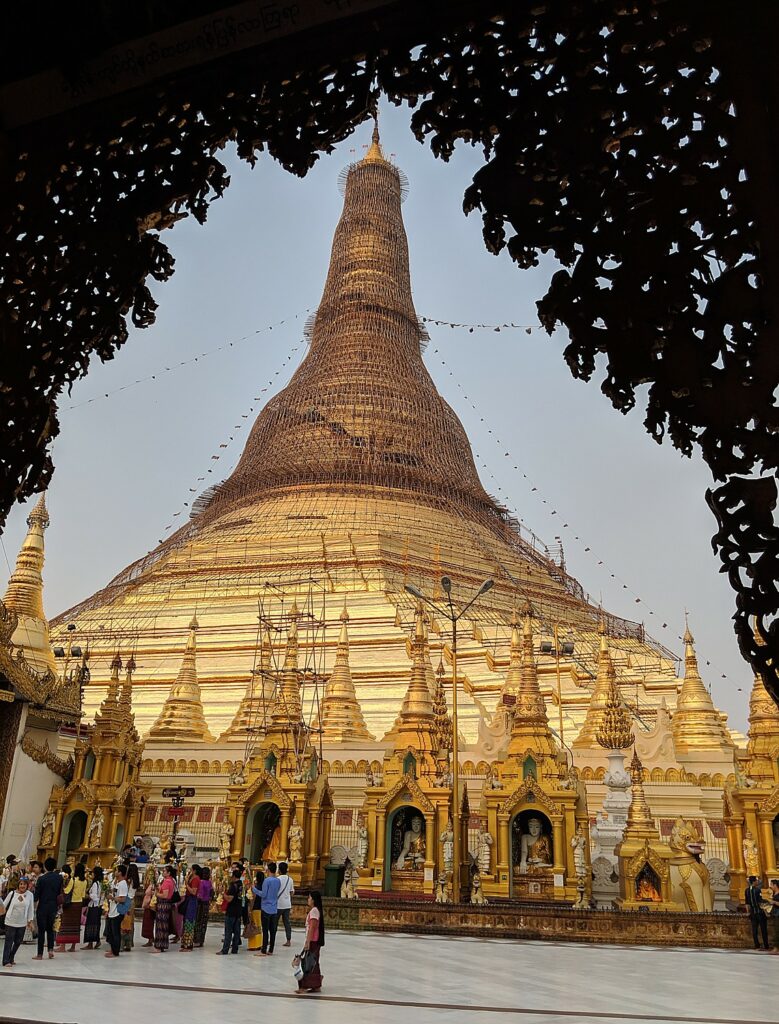
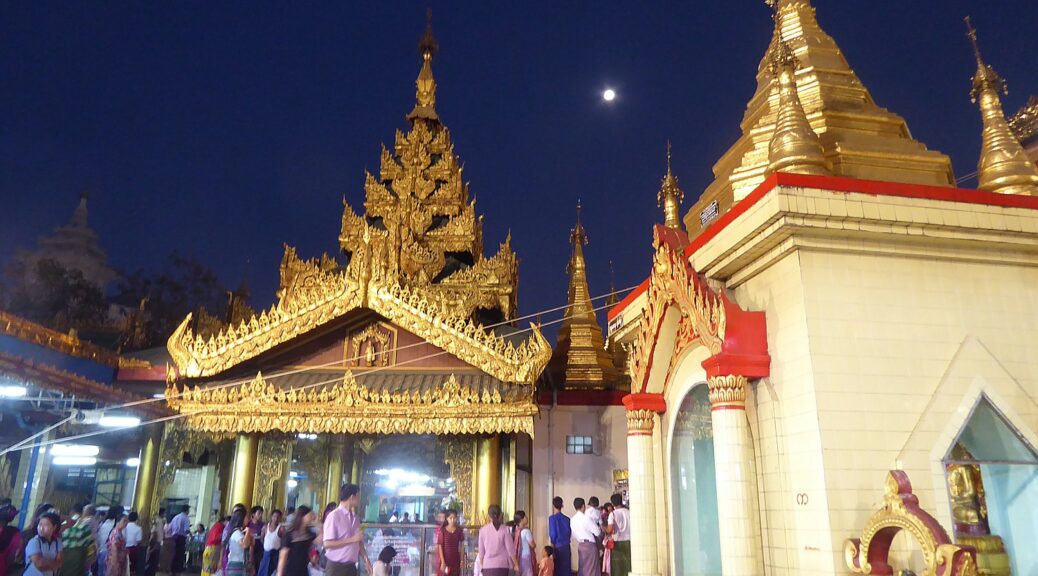
the Shwedagon Pagoda is Myanmar’s most sacred and impressive
Buddhist site. Dating back almost 2500 years, the pagoda enshrines strands of Buddha’s hair and other
holy relics. It is breathtaking.
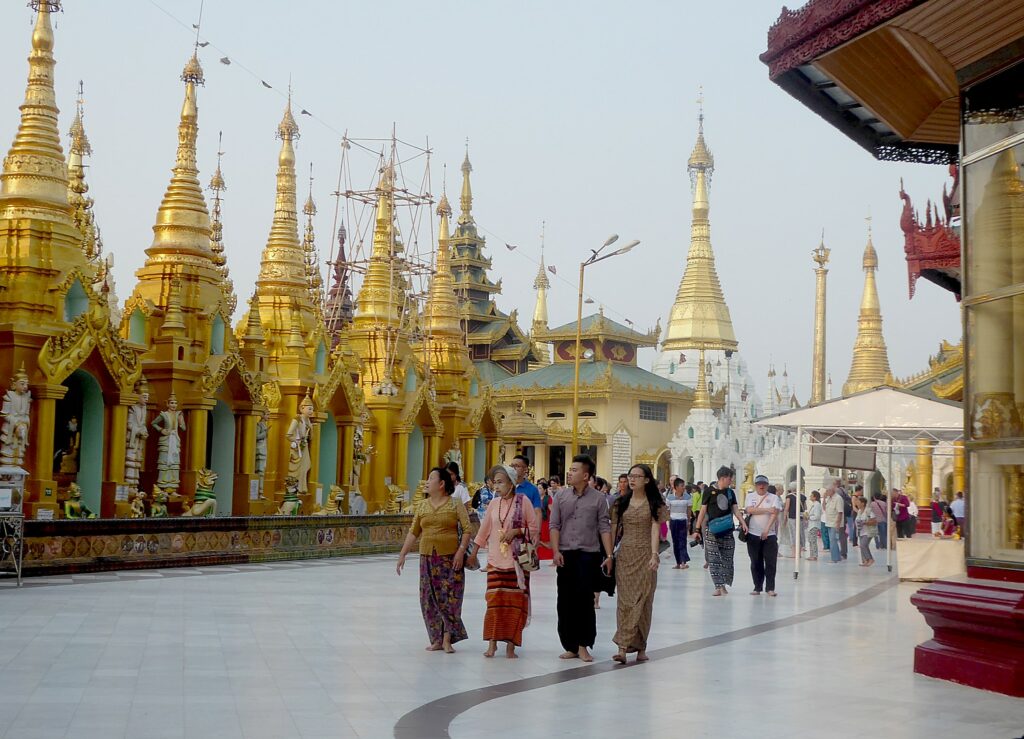
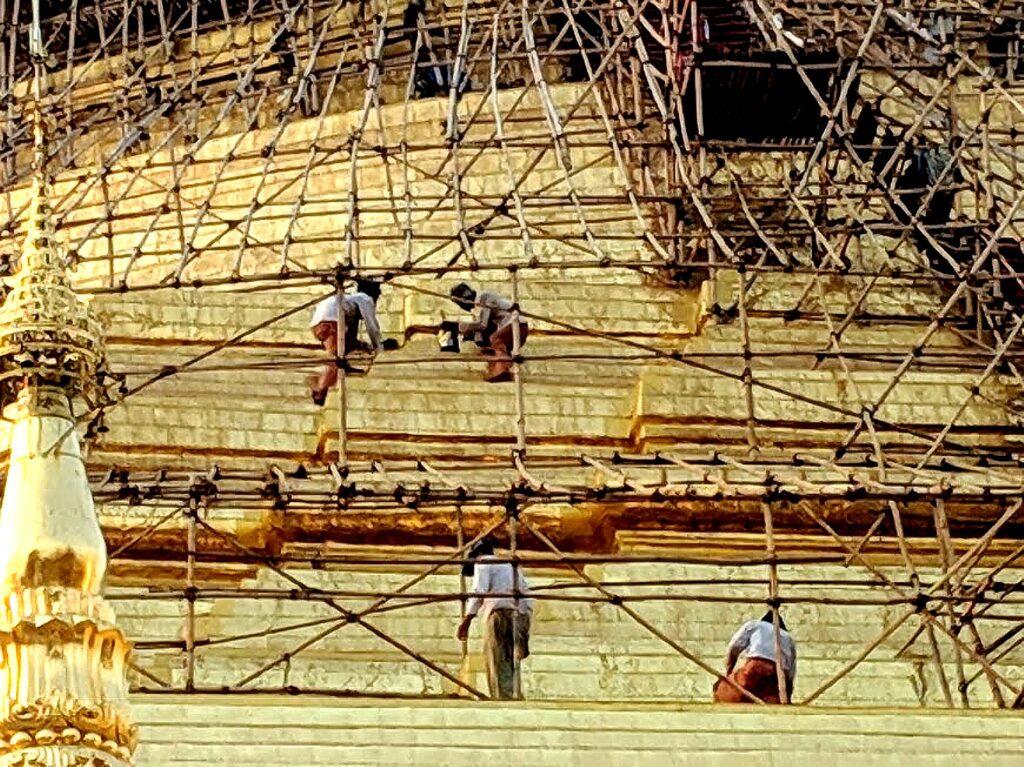
The Shwedagon Pagoda stands 326
feet high, its dome covered in 60 tons of gold (we watch workmen on scaffolding replacing some of the
gold plates). At the very top, too small to be appreciated from where we stand
at the base, is an orb, 22 inches high and 11-inches wide, encrusted with 4531
diamonds, the largest of which is a 72 carat diamond. The base is
surrounded by 64 small pagodas with four larger ones in the center of each side.
There also are four sphinxes, one at each corner, with six leogryphs (a lion-like
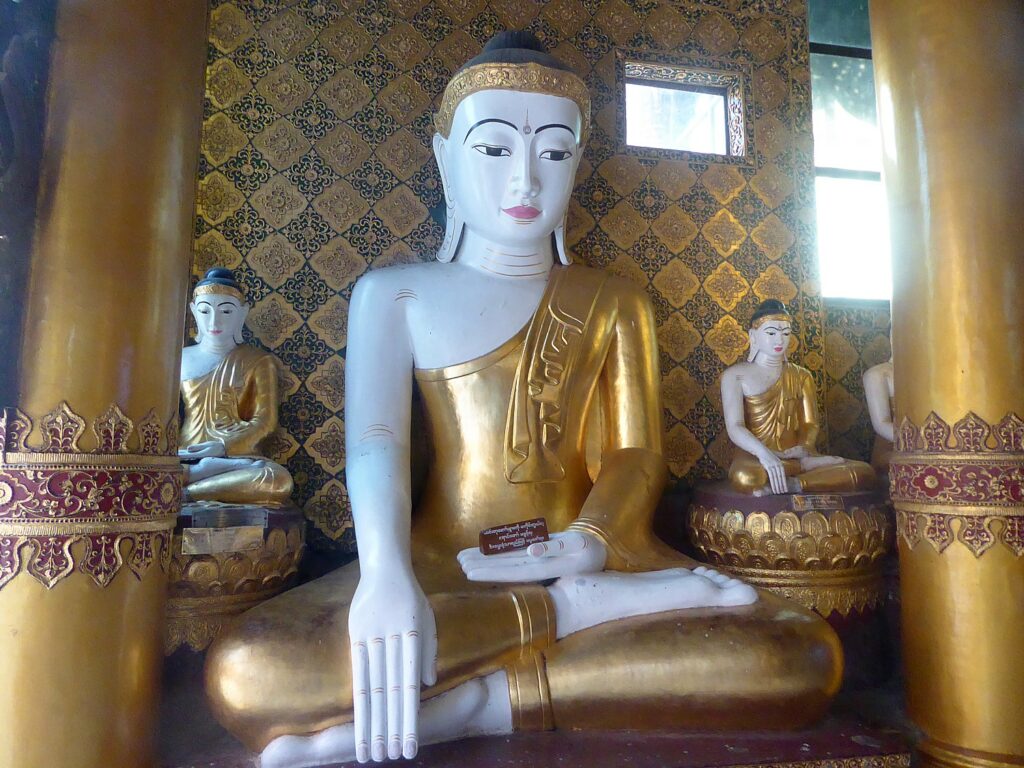
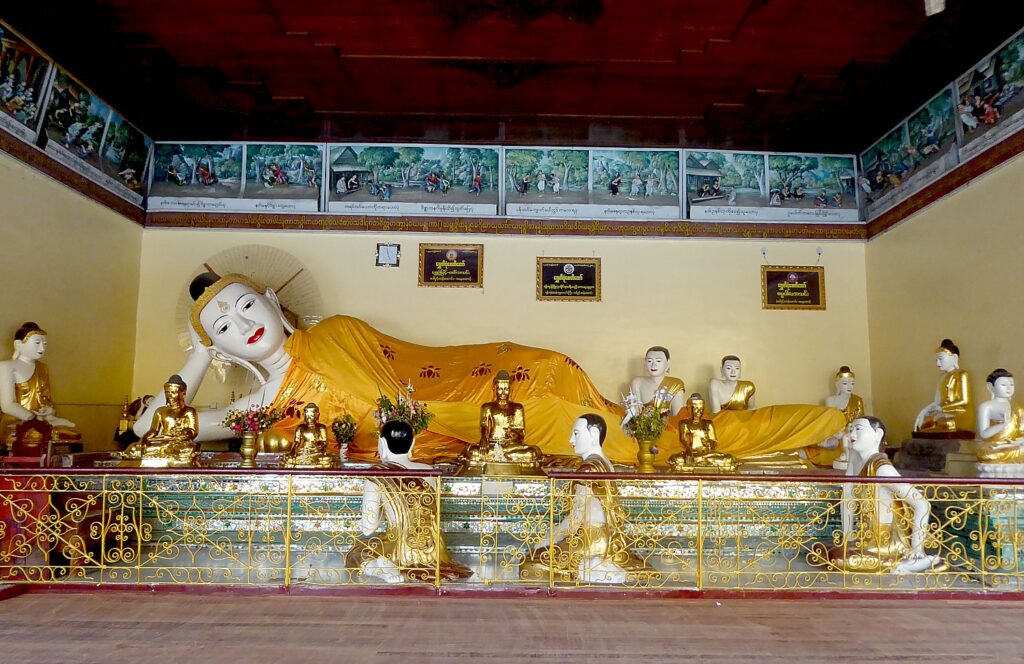
creature). Projecting beyond the base of the Pagoda. are Tazaungs (shrines) in
which are images of the Buddha and where offerings are made.
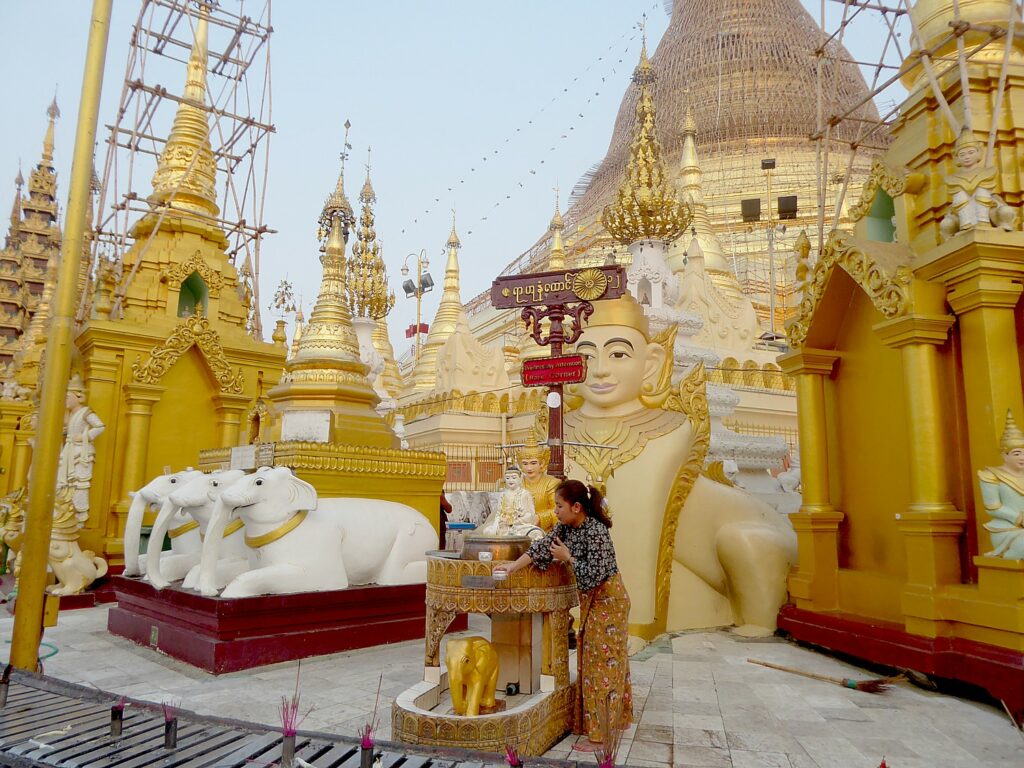
There are also figures of elephants crouching
and men kneeling and pedestals for offerings all around the base. In front of
the 72 shrines surrounding the base of the Pagoda, there are images of lions,
serpents, ogres, yogis, spirits, or Wathundari. Among the most dazzling art is
a Jade Buddha. There are also mystical and mysterious places, like the well
where Buddha’s sacred hair was washed and Buddha’s foot print.
Representing
the highest achievements of Myanmar’s sculpture, architecture and art, there
are hundreds of colorful temples, stupas and statues spanning nearly 2500 years. It
is known as Shwedagon, “the Sanctuary of the Four,” because it contains relics
of four Buddhas who had attained Enlightenment.
(The
Sule Pagoda which I visited the evening we arrived in Yangon – was it just four
days ago? – was also magnificent, but Shwedagon is on a different scale of magnificent.)
You
could easily spend hours here, but we must dash back in a taxi to get back to
the Global Scavenger Hunt group, arriving a few minutes past the 6 pm deadline
(we aren’t competing to win the challenge to be the “World’s Best Travelers,”
so we did not have to turn in our scorecards documenting our scavenges, though,
in fact, we have been doing as many as we can.
At
a hosted dinner at a Japanese restaurant, all of us trade our stories of adventure
and exploration from Yangon and some combination of Bagan, Mandalay and Inle
Lake. One of the scavenges invited the teams to take part in a volunteering
opportunity and Lawyers Without Borders, the team from Houston, volunteered at a
Youth Development monastery in Yangon. “The monks take in, house,
feed and educate orphans from far-flung and remote villages around the
country,” Zoe Littlepage writes on her blog (http://zoeandraineygreatescape.blogspot.com). “My favorite
part was eating lunch with the kids. They sing their prayers before they
can start eating.. magical.” (Zoe Littlepage and Rainey Booth, of Houston, are
on their 12th Global Scavenger Hunt, and are five-time champions,
and their law firm helps support the philanthropic works of the Global
Scavenger Hunt Foundation.)
We
return to the hotel to get our four-hour notice and learn where our 23-day
“Blind Date with the World” mystery tour continues next: an eight-hour layover
challenge in Bangkok and then on to Abu Dhabi – essentially having breakfast in
Myanmar, lunch in Thailand and dinner (or nightcap?) in the United Arab Emirates.
We
are out the door at 5:15 am (the hotel sends us off with breakfast boxes), to
get to the airport.
It
is worth noting that in addition to having a unique alphabet and language,
Myanmar (formerly Burma) asserts its identity by keeping its clocks half-hour
different from its timezone.
I
realize that time is really fluid – not really stable or fixed ordering our day,
a concept rather than an invention. We lost a full day crossing the timezone
during that first flight of more than 14 hours, and have been picking up an
hour or so here as we go.
At the
end of this Par 5, Leg 3 dash through Myanmar, SLO Folks, a team
from central California who are the returning champions from last year’s Global
Scavenger Hunt, earned the second most points with 37 scavenges in Yangon,
Bagan and the point rich area of Inle Lake for 2,055 points; and Lawyers Without
Border, a team from Houston on their 12th Hunt (they have won it
five times) had the most, completing 52 scavenges in Yangon, Bagan & Inle
Lake earning 2,745 points.
The Global Scavenger Hunt is an annual travel program that has been operated for the past 15 years by Bill and Pamela Chalmers, GreatEscape Adventures, 310-281-7809, GlobalScavengerHunt.com.
My
perfect day in Inle Lake, Myanmar, on Leg 3 of the Global Scavenger Hunt, a
23-day around-the-world mystery tour, begins the night before, on the JJ
Express bus that leaves the temple city of Bagan at 10 pm and arrives at the
bus stop (literally in the middle of the street in a small village) at 4:30 am.
It is complete darkness, not a sound or stirring besides ourselves as the bus
pulls away, leaving us there. For a moment, we feel stranded. Then, out of the
shadows, two tiny jitneys – like small tut-tut open-back vehicles – appear. The
drivers ask which hotels we are bound for so we divide up based on which side
of Inle Lake we are staying. We settle the fare (we are in a very limited
position to negotiate) and climb in.
The
jitney drops us at the Sanctum Inle Resort at 5:30 am, where the kindly hotel
clerk calls in housekeeping early so we could get into our rooms by 6 am (when
2 pm would have been normal check-in time). This five-star resort makes me feel
like I have been dropped into paradise.
I
am traveling on my own at this point, though at least one other of the 10 teams,
SLO Folks, on the Global Scavenger Hunt are here – my teammate went on to Mandalay with
another team who decided not to compete for points. SLO Folks (last year’s “World’s
Greatest Travelers” GSH champion) has been scrupulous about following rules of
the contest (no using computer or cell phone to make bookings or to get
information; the trip is designed to “trust strangers” and engage with local
people) so they arrive in Inle with no hotel, not even a decent map to start
planning how they will attack the scavenges (challenges) and accrue the most
points in the limited amount of time.
Indeed,
this challenge, Leg 3 of our trip, is to depart Yangon (the city formerly known
as Rangoon when the former British colony was known as Burma) and complete a
triangle of cities (Bagan, Mandalay, Inle Lake), allowing only two legs by air and
return to Yangon by 6 pm on Saturday, making our own arrangements for
transportation and hotel (we are reimbursed $200/night/team). I had planned to
go from Bagan to Mandalay with my teammate, but after hearing about Inle Lake
from another team (Lawyers Without Borders, a Houston team that has done the
Global Scavenger Hunt 12 times) who had been here before, I was enchanted to
see it; then, overhearing SLO Folks planning to take the overnight bus, I was
determined to see it for myself.
The description enchanted me: Located in the middle of Myanmar,
in the Shan State, Inle Lake is set in a valley
between two mountain ranges, with whole villages of wooden houses built on
stilts in the middle of the lake, floating gardens, boatmen who steer standing
up, wrapping one leg around a tall oar. There are 10 different Shan
ethnic groups living around the lake and the surrounding hills, home to many
different minorities who come down to sell their goods in the villages – like
the Long Neck Ladies. Inle Lake was designated a wetland wildlife sanctuary in
1985.
Inle Lake feels like a different world to the rest of Myanmar,
indeed, it seems like an enchanted Sangri-la.
The
Sanctum Hotel (Maing Thauk Village, Inle Lake, Nyaungshwe, Myanmar) is on the
list of suggested accommodations provided by the GSH “ringmaster” and Chief
Experience Officer, Bill Chalmers, and because I am not competing, have booked
on hotels.com ($101 for the night). I am delighted to find it is an absolutely
gorgeous five-star luxury resort (the infinity pool on the grounds with views
to the lake is breathtaking), and just being here fills me with a contented
peace. But that is only the beginning.
The
kindness of the hotel manager is immensely appreciated. For me, it means I am
able to take advantage of the hotel’s 8 am boat tour (that means a traditional
wooden boat with the modern convenience of a power motor as well as the
boatman’s long oar) because most of Inle Lake’s special attractions are
literally on the lake – whole villages, in fact, are built on stilts on the
lake; there are floating gardens which are really aquatic farms; floating
markets; the fishermen fish in a distinctive fashion with nets and the boatmen
paddle standing up, with their leg wrapped around the tall oar. The temples and
other major attractions – silversmiths, weavers, boatmakers – are all reached
by the boat.
The
full-day tour will take me to the Five Day Market, Phaung Daw Oo Pagoda, Inn
Paw Khone Village, Ywa Ma Village, Nam Pan Village (where we visit workshops to
see crafts – silversmithing, weaving, boatmaking), Floating Gardens, Nge’ Phe’
Chaung Monastery and Indein Pagoda – essentially enabling me to see all Inle
Lake’s highlights in a one-day visit ($35), though there is so much to see,
Inle Lake is worth a two or three day stay.
The
Sanctum Inle Resort is situated on the bank of Inle lake – a shallow lake
that’s over 13.5 miles long and 7 miles wide – and to begin the tour I
have booked (because I’m not competing, I can book a hotel tour, while the
competing team cannot, so they go off to find where the boatmen keep their
boats), I am escorted down to the hotel’s dock where the boat and the boatman
is waiting. It turns out I am the only one, so this is essentially a private
tour. The boatman, a young fellow named Wei Mo, speaks only limited English –
enough to tell me where I am going – but it is sufficient, I just don’t expect
to get any commentary.
It
is an amazing experience – gliding across the lake, the fresh air and cool
breeze rushing over me, especially after the debilitating 108-degree heat of
Bagan. Inle Lake is notable for the Intha, lake dwellers who have a distinctive
way rowing their wooden boats by wrapping their leg around a tall oar. At
first, the mechanics make no sense. But I realize it is a way of standing and
using such a tall oar and keeping the weight balanced on the tiny boats.
During
the course of the boat tour, I encounter a young fellow fishing (though you
have to get out pretty much at sunrise to see the fishermen), boat people
harvesting from the lake, go through an entire village built on stilts, where
there are also numerous craftsmen and workshops we visit. One stop provides an
opportunity to visit with the Long-Neck Ladies (actually only one), who come
down from their secluded village to pose for photos with tourists for money. We
also visit important pagodas and temples on the lake.
It
is remarkable to see how the Inthar make the most out of the lake – even
creating farmland where none existed. They build floating gardens out of
lake-bottom weeds and water hyacinth and grow crops like squash and tomatoes,
anchoring them with bamboo poles. I learn that these
floating islands can be cut, dragged by boats and even sold like a plot of
land. Floating gardens can be found mostly in Kaylar, Inchan and Zayatgyi
villages.
I love visiting the various workshops in the various villages
– it seems each has a specialty. We visit a silversmith workshop where I watch
the intricate process before being led into (what else) an elaborate shop,
filled with stunning creations.
Wei
pulls up to Inn Paw Khone Village, famous for
its weaving workshops, but most notably, weaving silk from lotus. Silk
weaving in Inn Paw Khon began 100 years ago. At first, they wove from cotton
fiber and then changed to silk and finally lotus fiber. and I am told that the
technique of making silk from lotus was begun by a woman now more than a
century old. I get to watch how a woman
delicately pulls a strand from the lotus plant which is wound on a spindle into
thread.
At
the boatmakers, I learn how each one is designed differently for their purpose
– a family boat, a fishing boat (7.8 meters), a boat designed for the Long Neck
people. “A boat lasts 25 years. Only men make the boats, they need to be
strong. It takes 20 days to make a boat; they make lacquer from a tree to
paint, wood powder and cotton. It takes two people to cut the teakwood,” she
tells me. There are absolutely stunning wood carvings to purchase. But I must
travel light.
We
stop in several of the region’s most important pagodas.
Shwe
Indein Pagoda is the most impressive of the attractions visited. You walk up a
covered walkway lined with beautifully painted columns, up a hill, flanked by
an astonishing 1,600 Buddhist stupas, some of stone, some intricately carved,
some gilded. Many have been restored but you also see many crumbling with age
and being reclaimed by the jungle. (There
is a camera fee, 500 kyat, which works out to about 30 cents).
According
to atlasobscurba.com, “These structures date from the 14th to the 18th
centuries and are typical of Burmese zedi. Like others found
across the region, the stupas feature fantastical creatures like chinthe –
mythic lion-like beings that protect sacred spaces. These were (and remain)
sites for contemplation and meditation and many contain relics inside their
bases. The first stupas at Indein were likely commissioned during the reign
of King Narapatisithu, although according to legend, it was King Ashoka – the
Indian emperor responsible for spreading Buddhism across much of Asia – who
first designated this as a site of particular spiritual importance. Hundreds of
years later, that distinction is completely obvious. The sea of ornate spires
coupled with the view over the lake and surrounding calm lend this spot an
unquestionably mystic, reflective air.” (www.atlasobscura.com/places/shwe-indein-pagoda) It is
breathtaking to see. Inside, people are gathering for a communal feast.
We
come Phaung Daw Oo Pagoda, one of the famous principal
shrines in Myanmar, just crammed with boats and worshippers. The pagoda houses
five small Buddha images which are much revered by the lake-dwellers. Once a
year, in late September-early October, there is a pagoda festival when four of
the five Buddha images are taken on an elaborately decorated barge towed
by several boats of leg-rowers, rowing in unison, and other accompanying boats,
making an impressive procession on the water.
Ngaphechaung Monastery is a
beautiful wooden monastery built on stilts over the lake at the end of the
1850s, the biggest and oldest monastery on the lake. The
monastery is known for a collection of old Myanmar’s Buddha images from
different eras. It is also notable because the monks have taught a few of
the many cats living with them to jump through hoops (that is the reputation,
but I don’t get to see any cats).
I
skip stopping for lunch so am able to condense the tour somewhat, which brings
me back to the hotel at 2:30 pm.
I indulge in Sanctum Inle Resort’s utterly stunning pool – I would rank one of the best resort pools in the world – an infinity pool of black and silver that shimmers as you swim, magnificently set with a view down to the lake, richly landscaped, a great size for actually swimming as well as playing around. It is also one of the most magnificent places just to lounge. I meet families from around the world.
I
am back in my room by 5 pm, to walk about a mile up the road from the resort
into the nearby village of Maing Thauk. I am bound for the Friendship Bridge
where one of the scavenges is to watch the sunset. I love to see the Burmese alphabet,
with its circles and curley-cues, on signs (few have English translation,
except for the Noble Aim PreSchool, my Rosetta Stone, and a traffic sign with a
drawing of a parent holding a child’s hand, indicating a school crossing). I
come upon a school holding a sports competition that has drawn a tremendous
audience. Even though hardly anyone speaks English, we manage to chat
(icebreaker: What is going on? Where is the bridge?). It’s a good thing I ask
the fellow if I was going the right way to get to the Friendship Bridge I am
looking for, because he directs me to turn left on the next corner (I would
have gone straight).
The
Bridge connects many structures and from which people can get onto the scores
of wooden boats that gather here, especially to offer sunset “cruises”, as well
as walk to several restaurants. The views and the evening activity are just
magnificent. It’s like watching the entire community walk by.
What
I’ve noticed during this incredibly brief visit is exactly what GSH’s organizer
Bill Chalmers had hoped when he dealt with a question of whether we should be
in a place that has earned worldwide condemnation for human rights abuses.
Travel is about seeing for yourself, but also gaining an understanding of one
another, disabusing stereotypes or caricatures, and most significantly, not
seeing others as “other”, which works both ways. In very real ways (and
especially now), travelers are ambassadors, no less than diplomats. Boycotting
destinations because of their governments, isolating people from one another,
cutting off the exchange of ideas and people-to-people engagements is not how
change happens – that only hardens points of view, and makes people susceptible
to fear-mongering and all the bad things that have happened throughout human
history as a result. “See for yourself,” Chalmers tells us.
What
I see in the people I’ve encountered is a kindness, a warmth of spirit, a
sweetness among the people here. I see it in how parents hold their children,
how the boatman, Wei Moi, shows such etiquette among the other boatmen, how
helpful people are. And how readily they
smile.
This
leg has been a Par 5 in difficulty (Par 6 being the most difficult during this,
the 15th Global Scavenger Hunt) – which has entailed us going out of
Yangon to Bagan, Mandalay and/or Inle Lake (many more rules on top of that,
including no more than 2 flights), taking overnight bus or hiring a taxi or
train, and so forth. But Chalmers devious design has worked – in just these
four days, we really do immerse ourselves in Myanmar, though our itinerary most
properly should be done in 11 days (there are several operators who offer such
trips).
The
challenge of the Global Scavenger Hunt is important to mention because Inle
Lake is worth at least a two or three day stay to be completely immersed in its
spell. There is a tremendous amount to do and experience.
You
can reach Inle Lake by air, bus (Joyous Journey Express, known as JJ Express,
provided excellent service; travel on the first-class bus geared to tourists,
www.jjexpress.net), or hire a driver to Inle Lake from various other major destinations
in Myanmar (Bagan, Mandalay, Yangon). The closest airport to Inle Lake is Heho
airport (HEH) which is 45 minutes away from the lake.
The
final challenge of this leg is to get back to our hotel, the Sule Shangri-la,
in Yangon by 6 pm, and for those competing to hand in their scorecards and
proof of completing the scavenges. That’s when we will learn where in the world
we will go next, and where we will all compare experiences.
The Global Scavenger Hunt is an annual travel program that has been operated for the past 15 years by Bill and Pamela Chalmers, GreatEscape Adventures, 310-281-7809, GlobalScavengerHunt.com.
It
is only a two-hour flight from Ho Chi Minh City, Vietnam, to Yangon (formerly
known as Rangoon), Myanmar, the third leg of the Global Scavenger Hunt, a 23-day
around-the-world mystery tour. We arrive at our five-star hotel, the Sule
Shangri-la, around noon. We will have our meeting at 2:30 pm when we will get
our booklets, spelling out the challenges we will face in the Golden Land.
After
60 years closed to the world, Myanmar, formerly known as Burma, was only
reopened to the outside world in 2011, so I am most intrigued to see it for
myself. The country has also received horrible press over the persecution of
the Rohingya people, which raises controversy for Bill Chalmers, who
meticulously organizes the Global Scavenger Hunt. But it encapsulates his
philosophy, bordering on religion, that appreciates travel as a way of forging
understanding, bringing people together and yes, fostering progress and change.
Throughout this Global
Scavenger Hunt, “A Blind Date With the World” – where we don’t know where we
are going next until we are told when to go to the airport or get ourselves
there, and along the way, complete scavenges and challenges – we are
encouraged, even forced, to “rely on the kindness of strangers,” to interact
with local people even when we can’t understand each other’s language. (Towards
this end, using cell phones or computers to research, access maps or GPS is not
allowed.)
Though it is a conceit
to think we can parachute into places and understand the nuances of complex
issues, travel is about seeing for yourself, but also gaining an understanding
of one another, disabusing stereotypes or caricatures, and most significantly,
not seeing others as “other”, which works both ways.
In very real ways,
travelers are ambassadors, no less than diplomats. Isolating people is not how
change happens – that only hardens views and makes people susceptible to
fear-mongering and all the bad things that have happened throughout human
history as a result. “See for yourself,” Chalmers tells us.
Chalmers offers this to ponder: The point of a travel boycott is
to force a government to reform their ways (corruption, human rights, democracy
and such) is based on the concept that tourism income mostly goes into the
hands of government, not the people, so enables their power and policy. But
others believe that tourism is not only economically helpful to locals, giving
them the means to improve their living conditions, but vital to pro-democracy,
humanitarian movements because of the two-way flow of information.
On
balance, Chalmers tells us, “I don’t like the idea of a boycott. Travelers are
serving as ambassadors, doing fact-finding. This country is emerging from decades
of isolation – there are problems, humanitarian problems on a large scale. It
is a troubled country with great suffering.
“Bear
witness for yourself. Enjoy the rich culture, the people, play journalist,
bea reporter, have conversations, learn
and gain perspective. Parachuting in can’t give you full expertise. All acquire
more accurate idea, local perception. Talk with locals, see for yourself.
“The
issue with not coming is you paint a broad picture about everyone. When we
travel, a lot of people disagree with our government but don’t take it out
against us as individuals. We practice diplomacy of engagement. Not coming
won’t change minds but possibly, coming can help change minds.” I contemplate
that point: imagine if the people we meet as we go around the world held us
personally responsible for caging migrant children and keeping parents
separated in conditions that wouldn’t meet the Geneva Conventions requirements
for POWs.
“Myanmar
is breathtakingly beautiful,” Bill tells us. “Say yes to things. There are
extraordinary sights.” But he isn’t naïve. Anticipating the problems,
frustrations we will have, he gives us a list of to-do’s and don’ts (buy food
and water before getting on a train, ferry or bus; Myanmar roads are among the
most dangerous; have a safe word between
teammates that is code for “danger.” Travel,
he says, is about “conquering fears, heat, holidays.” Indeed, the fact it is
Myanmar’s New Year’s Day and many services are closed becomes a major issue for
me.
The Global Scavenger Hunt is also about teamwork, and one of the rules is that you can’t separate from your teammate (Chalmers actually feels very guilty about the possible friction the competition can foment in couples). So, though we are not officially competing for points, I go along with my teammate, Margo, who wants to travel to Mandalay instead of Inle Lake, which I become extremely excited to see after hearing about this enchanting place, after visiting the temple city of Bagan.
We
learn that the Myanmar leg is designated a Par 5 (very tough, the highest is
Par 6). The challenge we are given is to spend the next two nights on our own,
that we have to go to two of the three cities (Yangon, Bagan, Mandalay and Inle
Lake), but can only take two flights (necessitating ground transportation between
two cities of the triangle) and have to be back to The Sule Shangri-la in
Yangon by 6 pm on Saturday. Chalmers spends much of the time spelling out the
special rules for this leg of the contest, the winner of which is designated
“World’s Greatest Traveler”.
“Today the real travel test will begin. Our teams collective travel savvy and travel IQ will be tested here in Myanmar… in this daunting, breathtaking, frustrating, exhilarating haunting, sacred, dynamic, traditional, thrilling, rapidly changing (and I could go on and on) destination! It will be an interesting four days. Have fun and be safe folks,” Chalmers writes on the Global Scavenger Hunt blog.
We spend the next 3 1//2 hours organizing where and how we will travel to Bagan, Mandalay and back to Yangon. Under the rules of the contest, we are not allowed to use our own computers or phones to book flights or hotels, or even the hotel concierge, but have to go out and find a travel agent. That proves problematic because of the holiday, but Kim says that a fellow on the street has told her where there is a travel agency. Sure enough, he is waiting for us on the street (internal warning light goes off) to walk us down dinghy alleys to the agency which looks and smells like a hovel. Another team is already there, handing over a wad of cash, since the agency isn’t accepting a credit card (ostensibly because of the holiday). I get nervous and suggest we leave, and make the bookings on our own (since we are not competing, we can use our computers). But this proves an interesting experience.
Sule Pagoda
By the time we finish, I only have time to walk down a modern boulevard to the Sule Pagoda, which sits at the center of the city as well as the city’s political and economic life.
According to legend, the stupa was built even before the
more famous Shwedagon Pagoda
during the time of the Buddha, which would make it more than 2,600 years old.
The Sule Pagoda served as a rallying point in both the 1988 uprisings and the
2007 Saffron Revolution.
It’s
the last day of the New Year celebration and place is packed with people
bringing offerings, lighting candles and spilling water at their Weekday
shrine. It is dusk when I arrive, and I watch the moon rise and the sky deepen
in color to azure blue, the brilliant gold of the pagoda a blazing contrast. A
guide immediately comes up to me to offer to take me around and checks his book
to see exactly what day of the week I was born, so I know which is my shrine
(Thursday is my shrine; the mouse is my animal); he shows me a photo of
President Obama striking one of the bells during his visit here.
I
have yet to see the famous Shwedagon Pagoda. Fortunately, I will have more time
to explore Yangon when we return on Saturday.
We
are up at 4 am to leave at 5 am for the airport for a 7 am flight to Bagan on
Golden Airlines. The hotel has very kindly packed a to-go breakfast. It turns
out several of us are going on the same flight to Bagan.
This
morning in clearer light, having become entranced by the description of Inle
Lake, a villages built on stilts and only accessible by boat, and hearing one
team discuss the overnight bus they will take from Bagan to Inle Lake, I decide
to go on my own to Inle Lake instead of to Mandalay. But that depends on
whether I can get seat on all-night bus, a hotel in Inle Lake and a flight from
Inle Lake on Saturday morning to be back in time for the 6 pm meeting/deadline.
The Global Scavenger Hunt is an annual travel program that has been operated for the past 15 years by Bill and Pamela Chalmers, GreatEscape Adventures, 310-281-7809, GlobalScavengerHunt.com.
Two of the Global Scavenger Hunt teams, Lawyers Without Borders from Houston, and Lazy Mondays, doctors from California, do their peer review while waiting in the airport for the flight to the next leg of the 23-day, around-the-world mystery tour to determine “World’s Best Travelers.” (c) Karen Rubin/goingplacesfarandnear.com.
On January 10, 2018, the Department of State launched changes in how information is shared with U.S. travelers, replacing Travel Alerts and Warnings for countries that warrant them to a new system where every country has a Travel Advisory with a level ranging from 1 to 4. The advisories are hosted in a redesigned hub for traveler information, travel.state.gov.
“These changes are intended to provide U.S. citizens with clear, timely, and reliable safety and security information worldwide,” the State Department stated in a press advisory.
Level 1 – Exercise Normal Precautions: This is the lowest advisory level for safety and security risk. There is some risk in any international travel. Conditions in other countries may differ from those in the United States and may change at any time.
Level 2 – Exercise Increased Caution: Be aware of heightened risks to safety and security. The Department of State provides additional advice for travelers in these areas in the Travel Advisory. Conditions in any country may change at any time.
Level 3 – Reconsider Travel: Avoid travel due to serious risks to safety and security. The Department of State provides additional advice for travelers in these areas in the Travel Advisory. Conditions in any country may change at any time.
Level 4 – Do Not Travel: This is the highest advisory level due to greater likelihood of life-threatening risks. During an emergency, the U.S. government may have very limited ability to provide assistance. The Department of State advises that U.S. citizens not travel to the country or leave as soon as it is safe to do so. The Department of State provides additional advice for travelers in these areas in the Travel Advisory. Conditions in any country may change at any time.
The Travel Advisories for each country replace previous Travel Warnings and Travel Alerts. While the State Department will issue an overall Travel Advisory level for every country, levels of advice may vary for specific locations or areas within a country. For instance, U.S. citizens may be advised to “Exercise Increased Caution” (Level 2) in a country, but to “Reconsider Travel” (Level 3) to a particular area within the country. Detailed Travel Advisories also will provide clear reasons for the level assigned, using established risk indicators, and offer specific advice to U.S. citizens who choose to travel there:
C – Crime: Widespread violent or organized crime is present in areas of the country. Local law enforcement may have limited ability to respond to serious crimes.
T – Terrorism: Terrorist attacks have occurred and/or specific threats against civilians, groups, or other targets may exist.
U – Civil Unrest: Political, economic, religious, and/or ethnic instability exists and may cause violence, major disruptions, and/or safety risks.
H – Health: Health risks, including current disease outbreaks or a crisis that disrupts a country’s medical infrastructure, are present. The issuance of a Centers for Disease Control Travel Notice may be a factor.
N – Natural Disaster: A natural disaster, or its aftermath, poses danger.
E – Time-limited Event: A short-term event, such as an election, sporting event, or other incident that may pose a safety risk.
O – Other: There are potential risks not covered by previous risk indicators. Read the country’s Travel Advisory for details.
The State Department stated it will review and update each Travel Advisory as needed, based on changes to security and safety information. Additionally, U.S. embassies and consulates will now issue Alerts to replace the current Emergency Messages and Security Messages. Alerts will inform U.S. citizens of specific safety and security concerns in a country, such as demonstrations, crime trends, and weather events.
Revamped Website, Travel.State.Gov
The Department’s newly-redesigned hub for traveler information,travel.state.gov, will host all Travel Advisories, recent Alerts issued for each country, and an interactive map in mobile friendly formats.
Country pages on the site will continue to include all travel information currently available, including details about entry/exit requirements, local laws and customs, health conditions, transportation, and other relevant topics.
To receive security and other important updates while traveling, U.S. citizens can enroll their travel plans in the Smart Traveler Enrollment Program (step.state.gov), and follow on Twitter (@travelgov) and Facebook (facebook.com/travelgov).
We posed additional questions to a spokesperson for the Department’s Bureau of Consular Affairs:
How was the new Travel Advisory system created? How has it been received by travel professionals and travelers?
“Over the past year, we received feedback about our consular safety and security messaging from State Department colleagues throughout the world and from our many outreach activities to the public and other government stakeholders. This feedback helped us tailor our new Travel Advisories to the information travelers need most.
“The revisions to consular safety and security messaging improve the Department’s ability to inform the public in an efficient and comprehensive manner. Information is easier to find, understand, and use. Travel Advisories ensure U.S. citizens receive important advice for every country, applying a consistent worldwide standard.”
“Our goal was to improve our communications with U.S. citizen travelers to provide clear, timely, and reliable safety and security information worldwide. So far, the feedback was been positive.
“One thing I’d point out: it’s important to read the full Travel Advisory for the country your visiting. In some cases, we have different Advisory levels for different parts of the country. Mexico, for example, is a Travel Advisory Level 2 – Exercise Increased Caution, but some areas of Mexico are Level 3 and 4. So it’s important to read each Advisory carefully.”
How do you determine the overall level for a country?
“We consider many factors to determine the Travel Advisory level for each country, including crime, terrorist activity, civil unrest, health, natural disaster/weather, and current events. We clearly explain the reason for the Travel Advisory level and describe the safety and security concerns.
“The information used to formulate Travel Advisories is collected from a range of sources, such as crime statistics and other information that is publicly available, information gathered from U.S. government sources, as well as assessments by our embassies and consulates. Travel Advisories also take into account decisions made to protect the security of U.S. government personnel overseas and ensure that U.S. citizens receive appropriate security information.
“This analysis is undertaken without regard to bilateral political or economic considerations. Travel Advisories represent our commitment to protect U.S. citizens traveling and residing abroad by providing them important safety and security information.
“Travel Advisories are based on safety and security conditions that could affect the lives and interests of U.S. citizens abroad, not on political considerations.”
During the Obama administration there was an attempt to make it easier for travelers to come into US. How has the Trump Administration changed the way visitors are treated? Travel into the US from abroad is down 4-6% in 2017 – an otherwise a banner year for international travel – which is estimated to cost the US economy $4.5 billion and the loss of 40,000 jobs. Is this something the State Dept is concerned about?
“The Department of State remains committed to efficiently processing applications for legitimate travel to the United States.
“At the same time, every visa decision is a national security decision, and we must ensure that applicants do not pose a security risk to the United States. We have never hesitated to spend additional time evaluating visa applications to this end.
“However, we do recognize the importance of international travel and tourism to the U.S. Economy. 75.6 million visitors traveled to the United States in 2016. These visitors spent $244.7 billion and supported 1.2 million jobs here in the United States in 2016. The U.S. travel industry (international and domestic) is a substantial component of U.S. GDP and employment, contributing $1.6 trillion in economic activity.
“Together with other agencies, we are in contact with industry groups and work with them regularly to discuss concerns and opportunities.”
Some 15 countries around the world have travel alerts about travel to the United States because of gun violence. Can you comment?
“Our responsibility is to provide information for U.S. citizens traveling overseas. We’re aware that some countries have their own travel alerts, including regarding the United States, but we’d have to refer you to those countries for information on how they develop their alerts.”
During the Obama Administration, there also were programs to facilitate and encourage young people to travel abroad, take foreign internships, join programs like Peace Corps, coordinated through the State Department. Can you comment on such programs under the Trump Administration?
“Again this year, the Open Doors student mobility numbers showed an increase in American students studying abroad, topping more than 325,000 American students in academic year 2015/16. Increasingly, U.S. colleges and universities are making study abroad an integral component of the higher education experience for Americans. And more U.S. students than ever before are taking advantage of study abroad opportunities in a wide range of countries.
“To help facilitate this growth, the State Department launched the U.S. Study Abroad Office in 2015 with the goal of further increasing and diversifying U.S. participation in study abroad, including diversity of study, geographic representation and diversity of institutional types, as well as diversity of study abroad destinations around the globe. We work with U.S. and foreign institutions to expand opportunities and highlight the value of studying abroad. Our Benjamin A. Gilman Scholarship Program increases participation in study abroad by providing resources to federal Pell grants recipients, and Critical Language Scholarship Programs provide training in over a dozen foreign languages critical to U.S. foreign policy priorities.
“Study abroad helps students understand the perspectives and values of others, enabling them to succeed in our diverse workplaces, communities and educational institutions. The State Department supports American colleges and universities in their efforts to increase study abroad. You can find more here:https://studyabroad.state.gov.”
What is the position from the State Department about the benefit of international travel – Americans going abroad and foreigners visiting the US – in terms of fostering people-to-people understanding?
“All of us who work in this field know how vital exchange programs and international study is to our shared future. It is one of the key means for the next generation of global leaders to gain the knowledge and skills they need to succeed in our global economy, foster progress in our societies, and address shared challenges.
“When people go abroad, they make connections that broaden their worldview. They become part of an international network of individuals with the shared experience of navigating new and unfamiliar languages, cultures and institutions, as they gain knowledge and develop resourcefulness and critical thinking skills. This experience is especially crucial for young people who will increasingly compete and interact in an interconnected world.
“The State Department sponsors exchange programs to increase mutual understanding and respect between the people of the United States and the people of other countries, as a goal of U.S. foreign policy. These include the International Visitor Leadership Program and Fulbright Program, our flagship exchanges, the Benjamin A. Gilman International Scholarship Program, Critical Language Scholarships, high school exchanges, as well as support for the global network of EducationUSA educational advising centers that provides information on U.S. study to international students worldwide.”