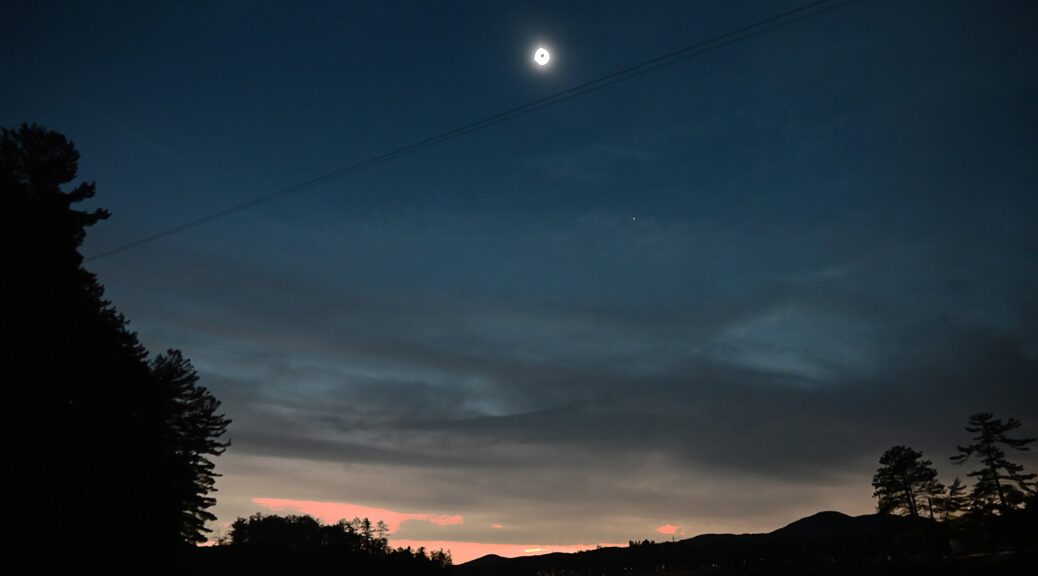
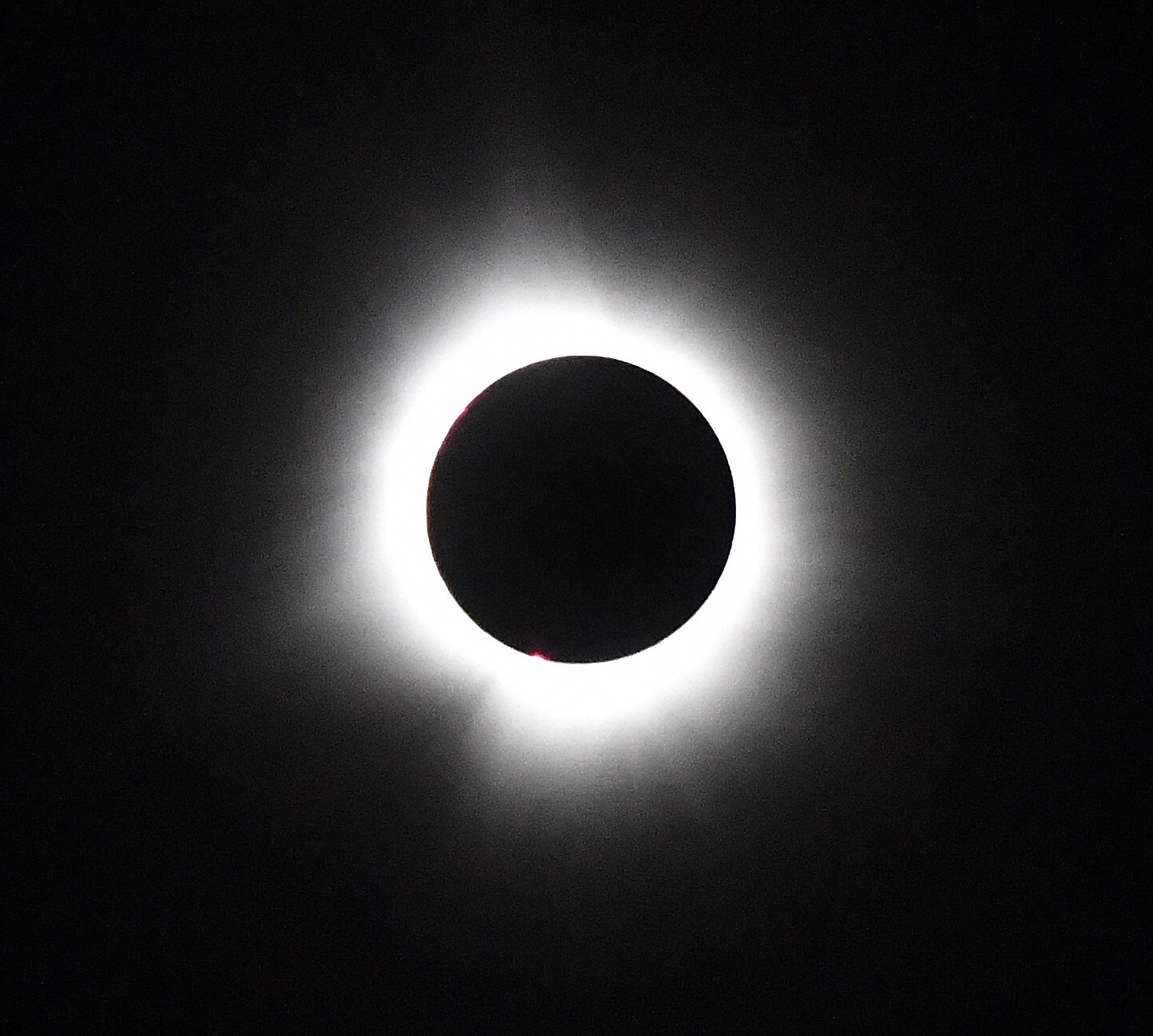
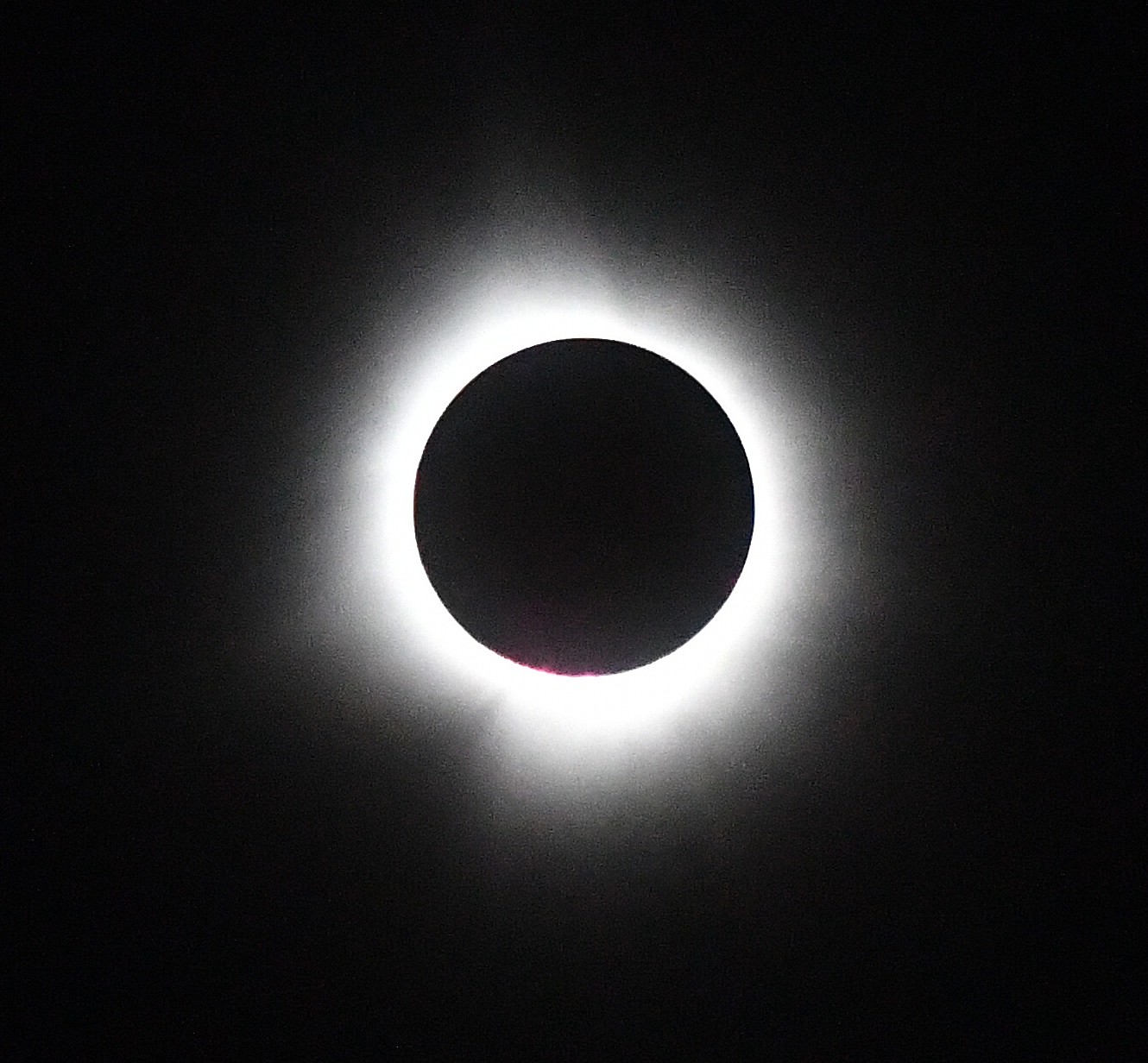
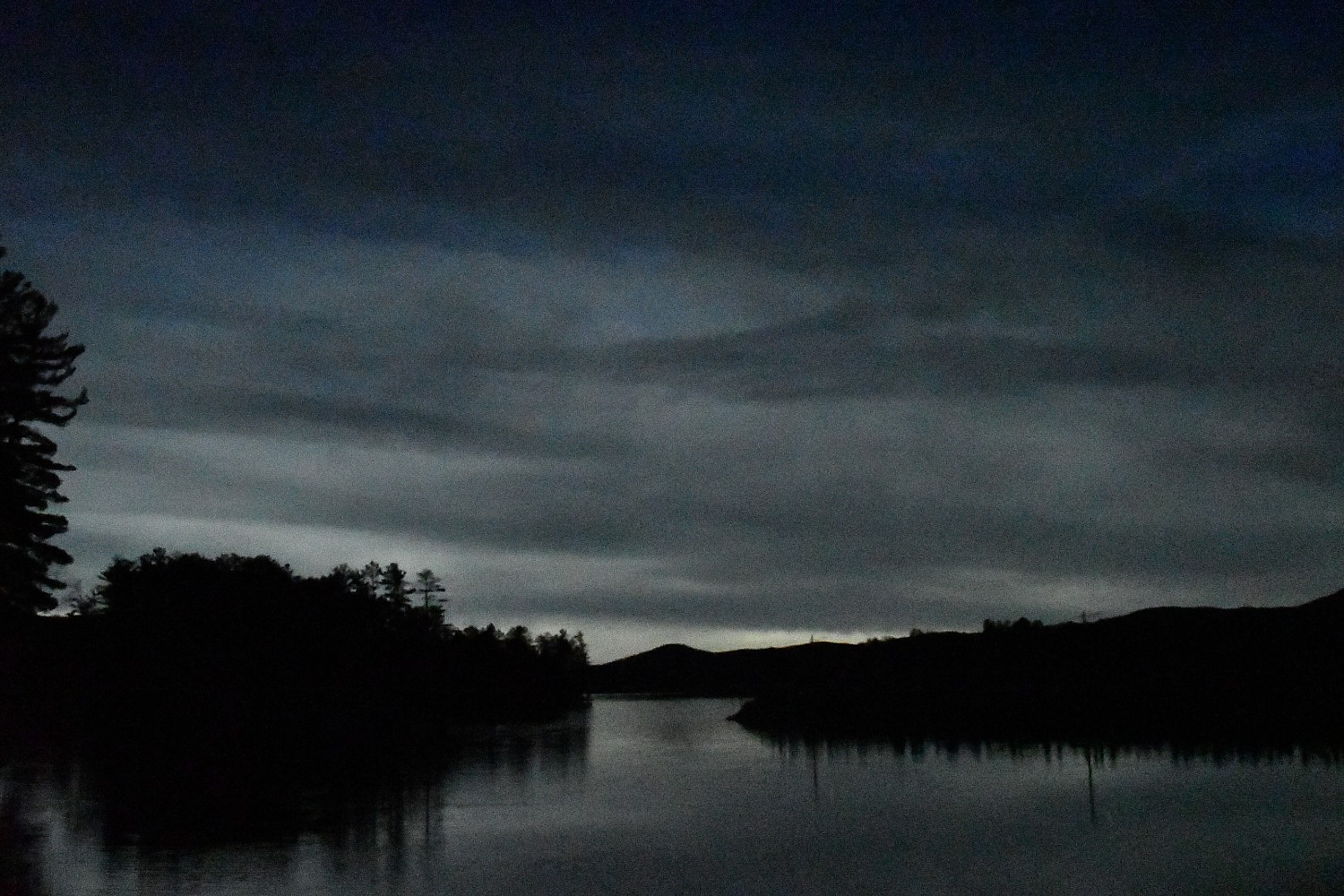
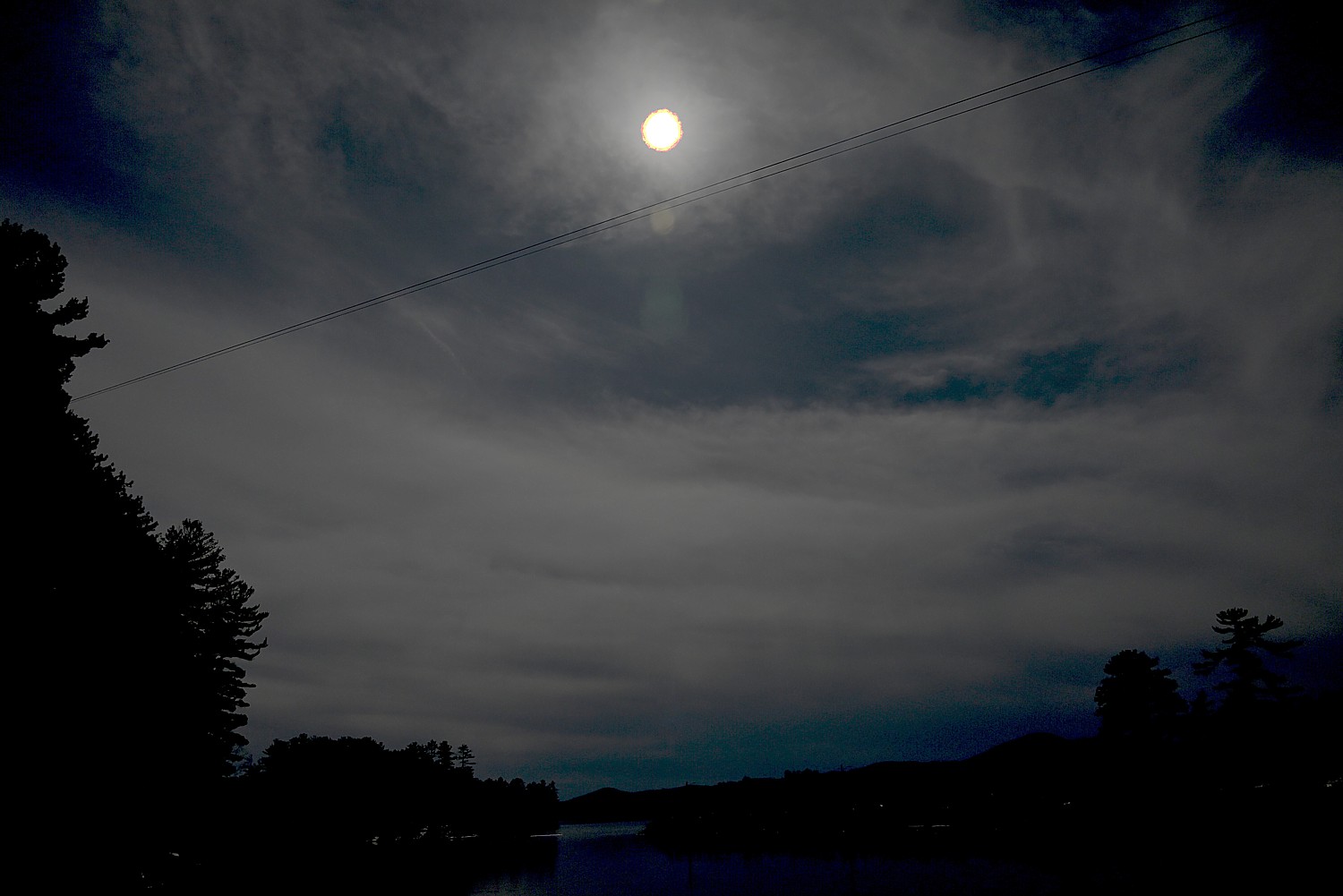
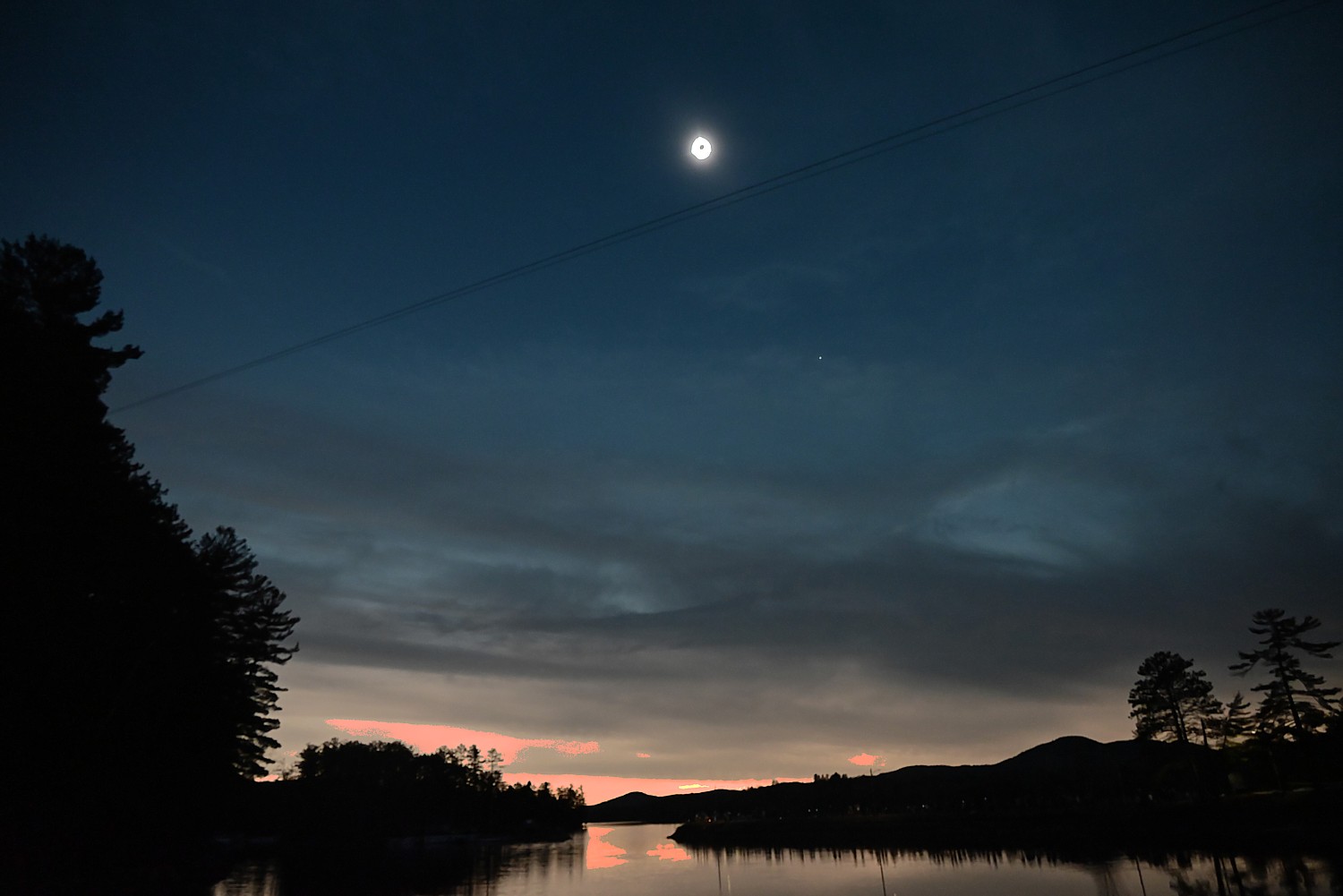
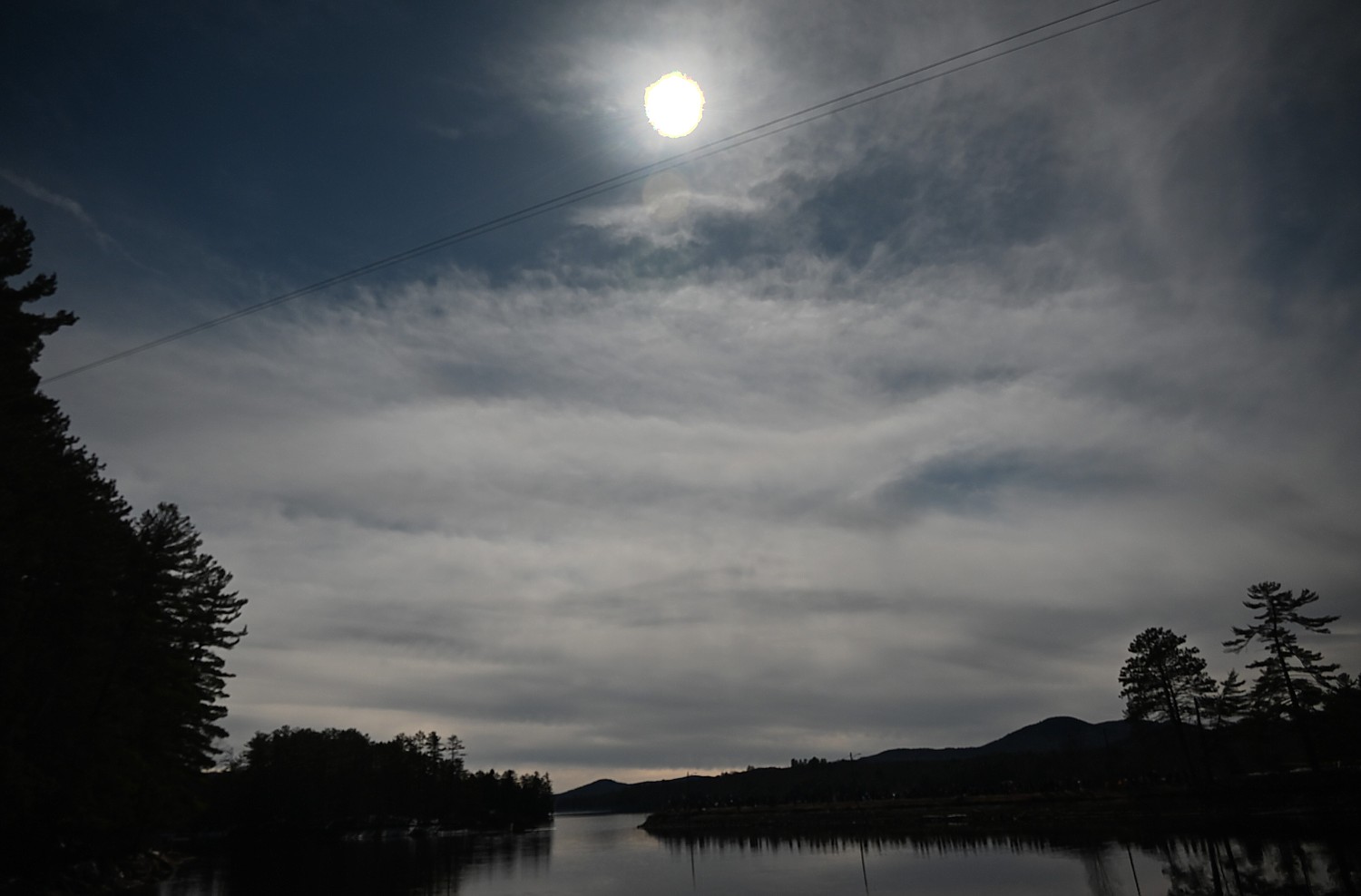
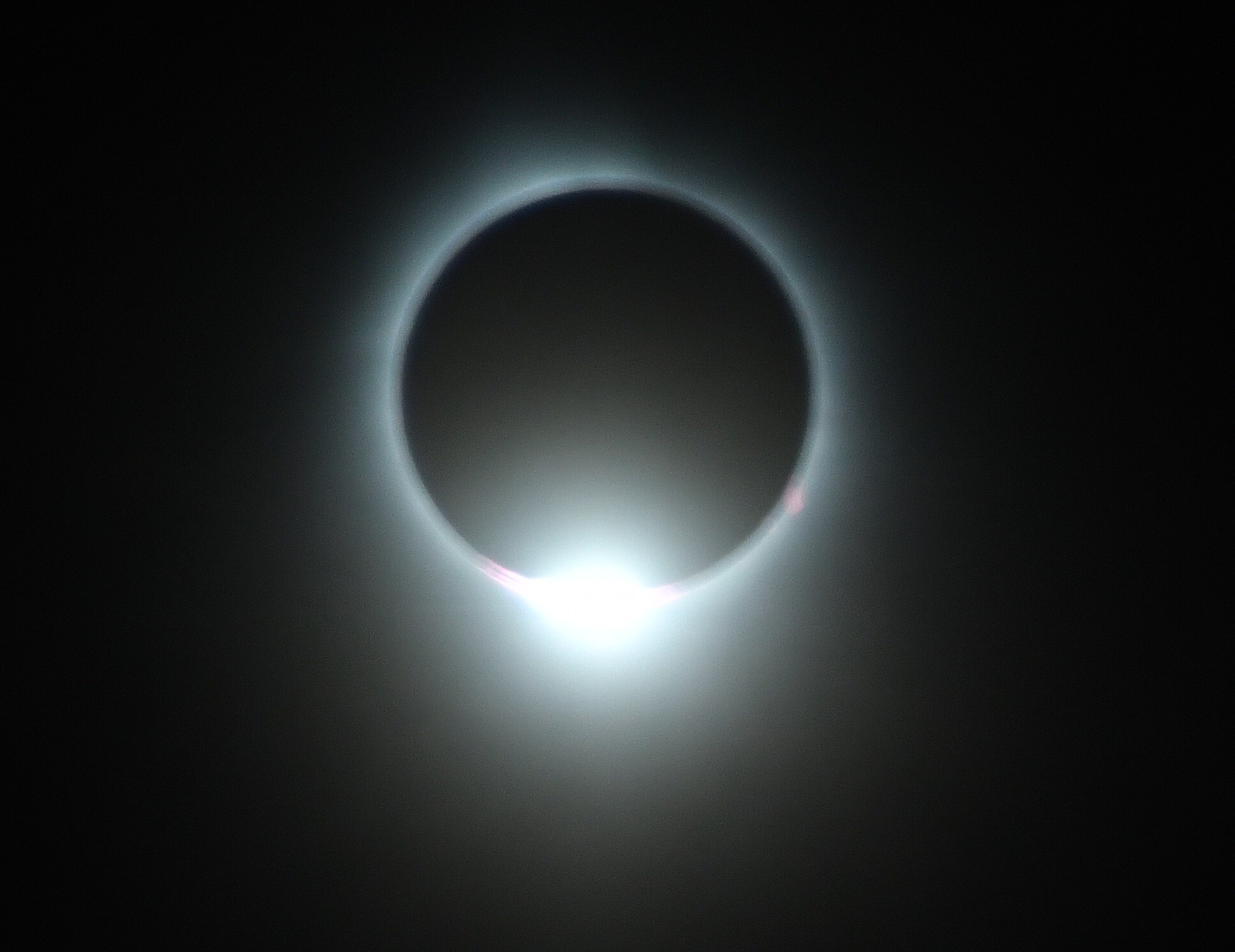
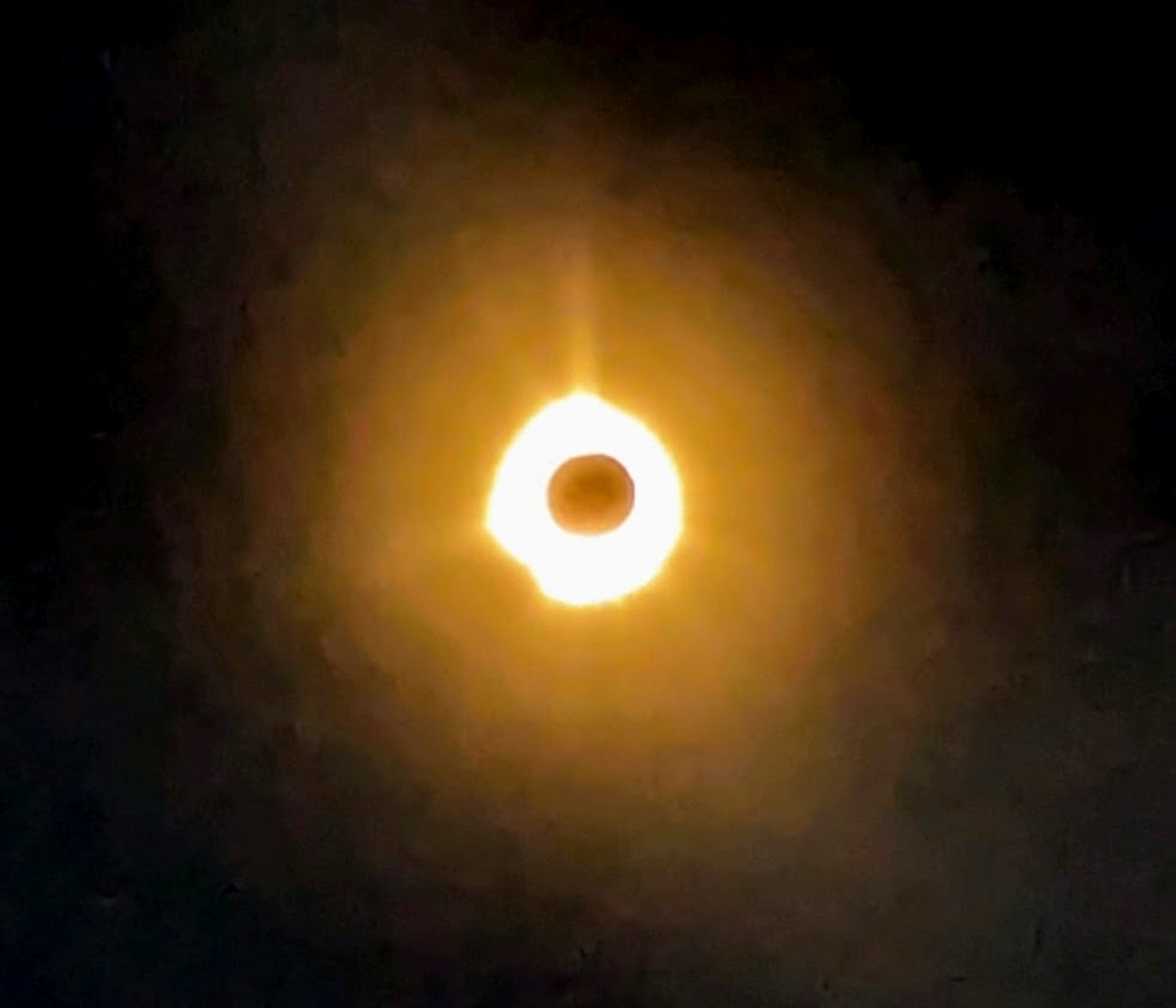
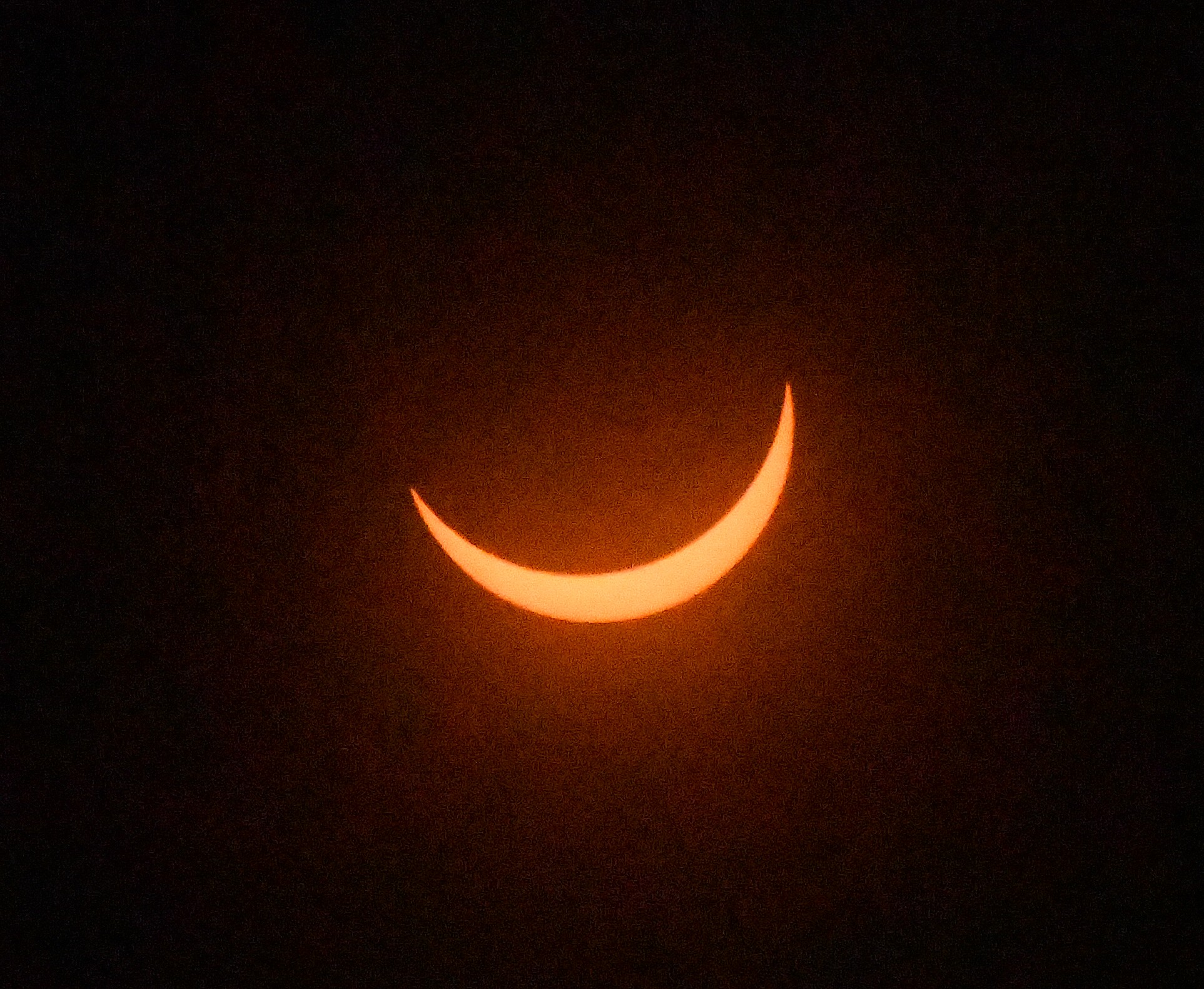
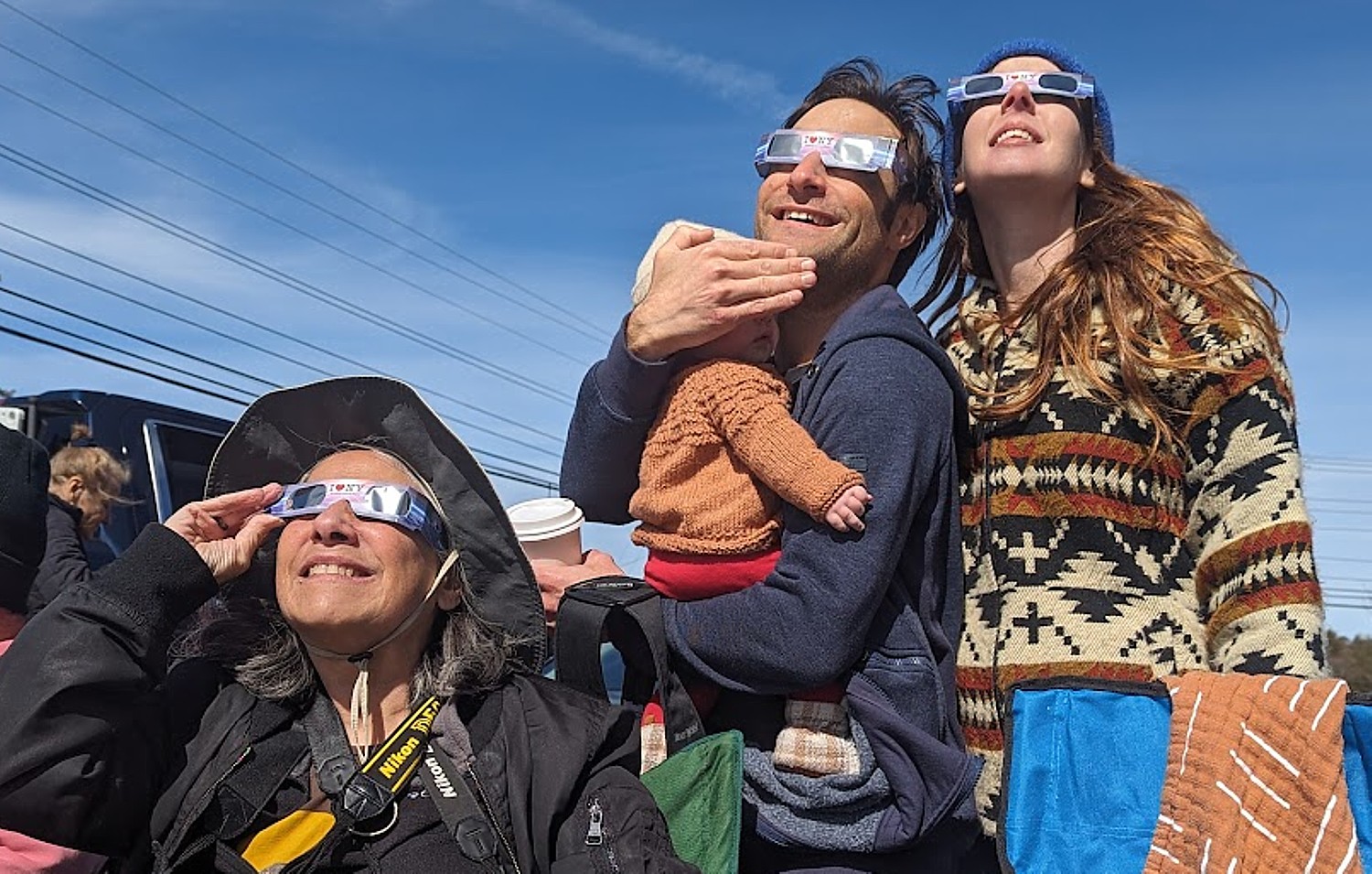
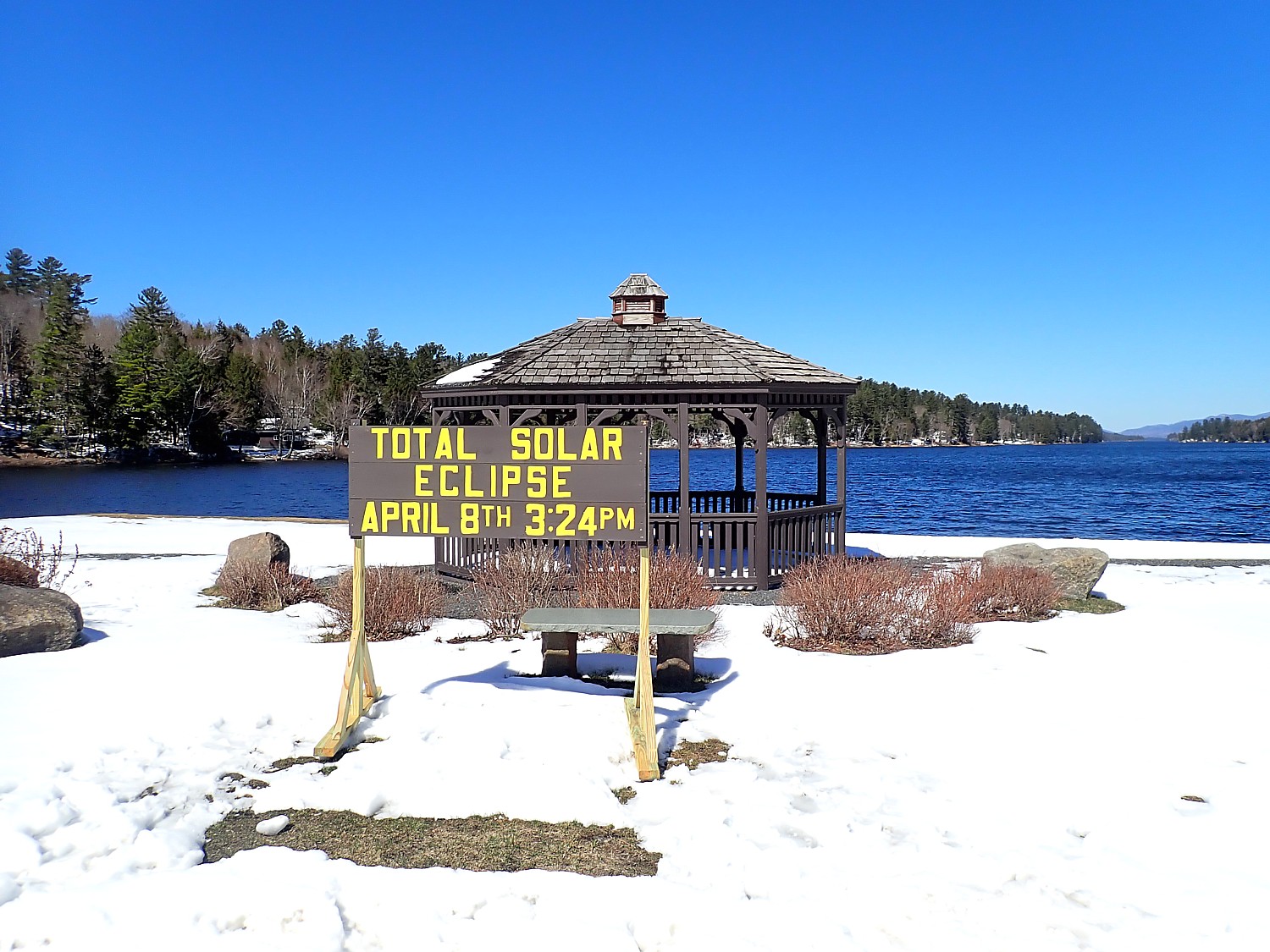
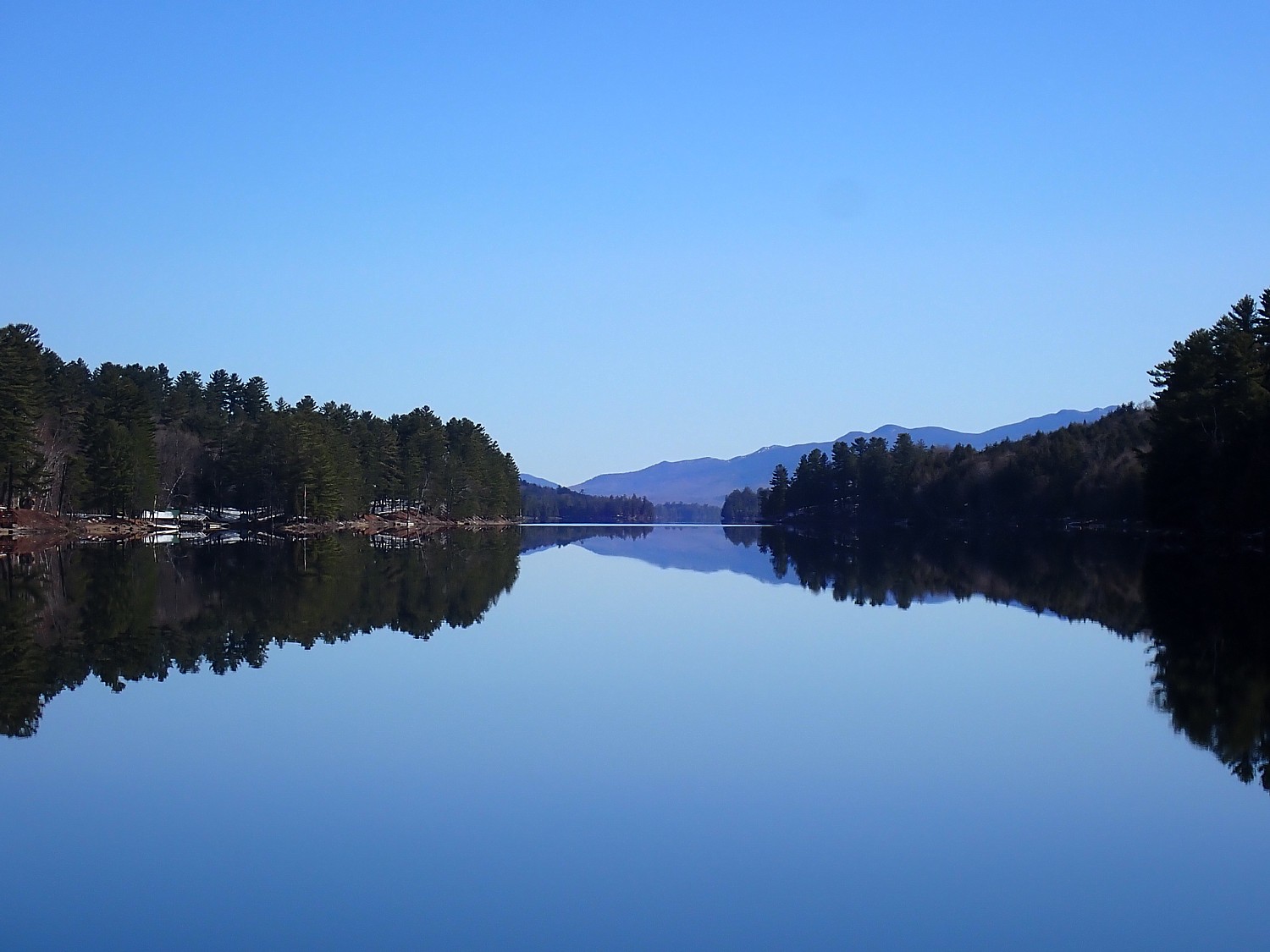
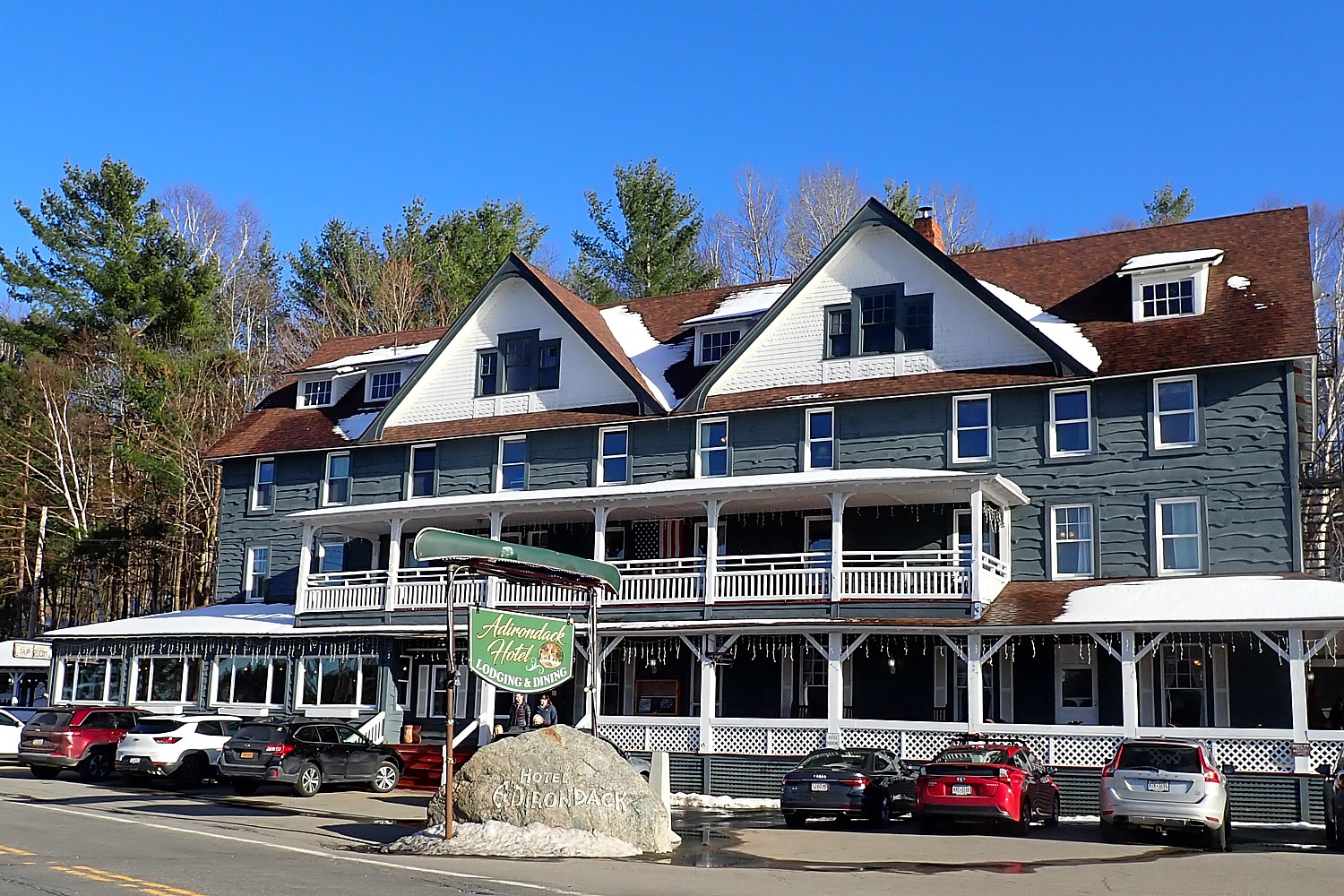
With a huge swath of New York State in the path of totality for the April 8, 2024 Solar Eclipse, we headed to the Adirondacks, cleverly basing ourselves at The Lorca on Indian Lake, which was scheduled to have totality for two minutes, with a plan to drive 30 minutes further to Long Lake, which was scheduled for totality to last a full minute longer, 3 minutes, 1 second, beginning at 3:24 pm, where we based out of the historic (140 years!) Adirondack Hotel, right on the lake.
That proved fortuitous, because though totality spanned a 124-mile wide path stretching from Chautauqua-Allegheny to the majestic Niagara Falls in Greater Niagara, over the pristine Finger Lakes, mighty Adirondacks, and magical Thousand Islands-Seaway, and while Niagara Falls and Buffalo were scheduled to have totality for as much as four minutes, the weather clouded up for most of it. New York State won’t be in the path of totality again for 400 years.
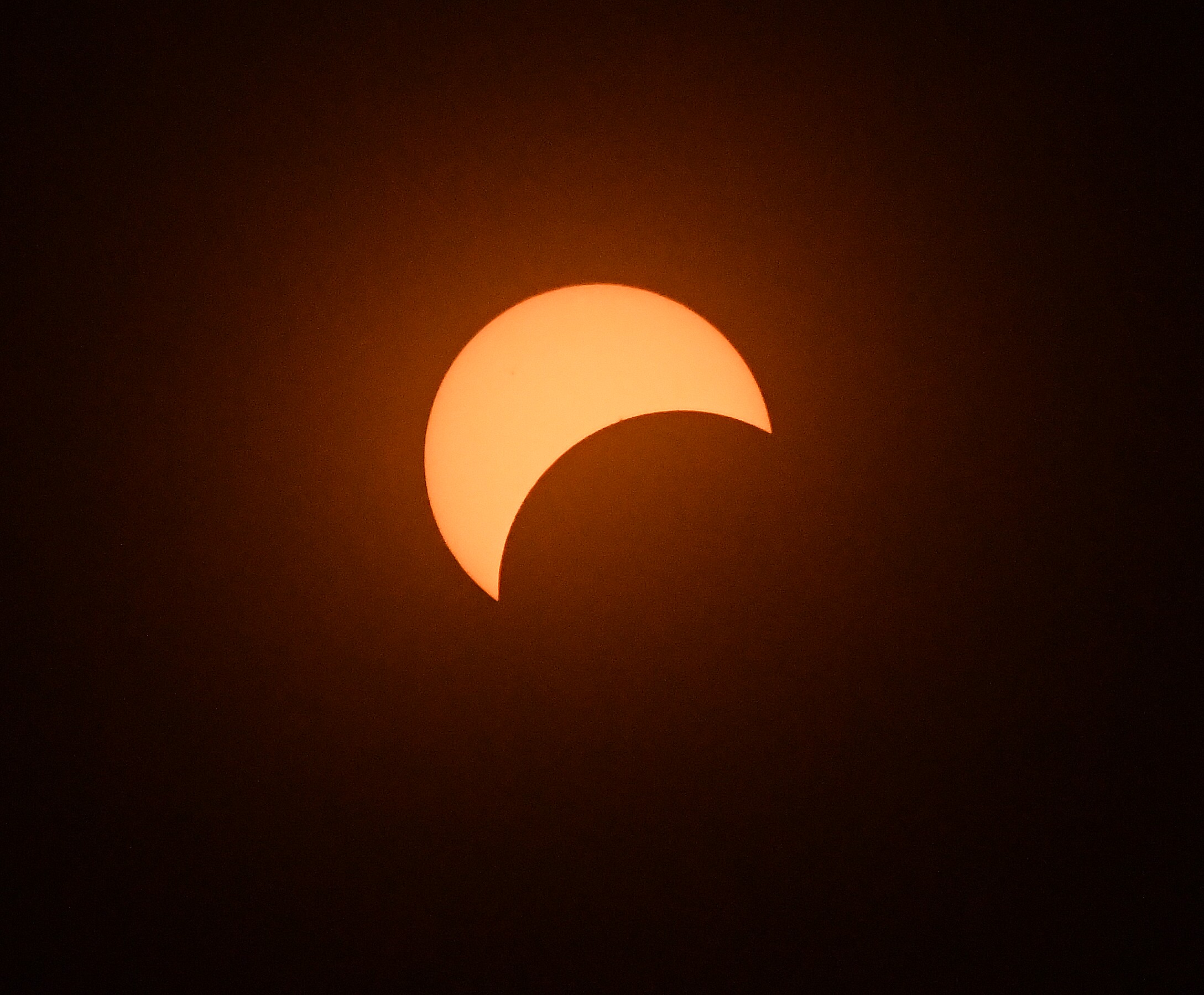
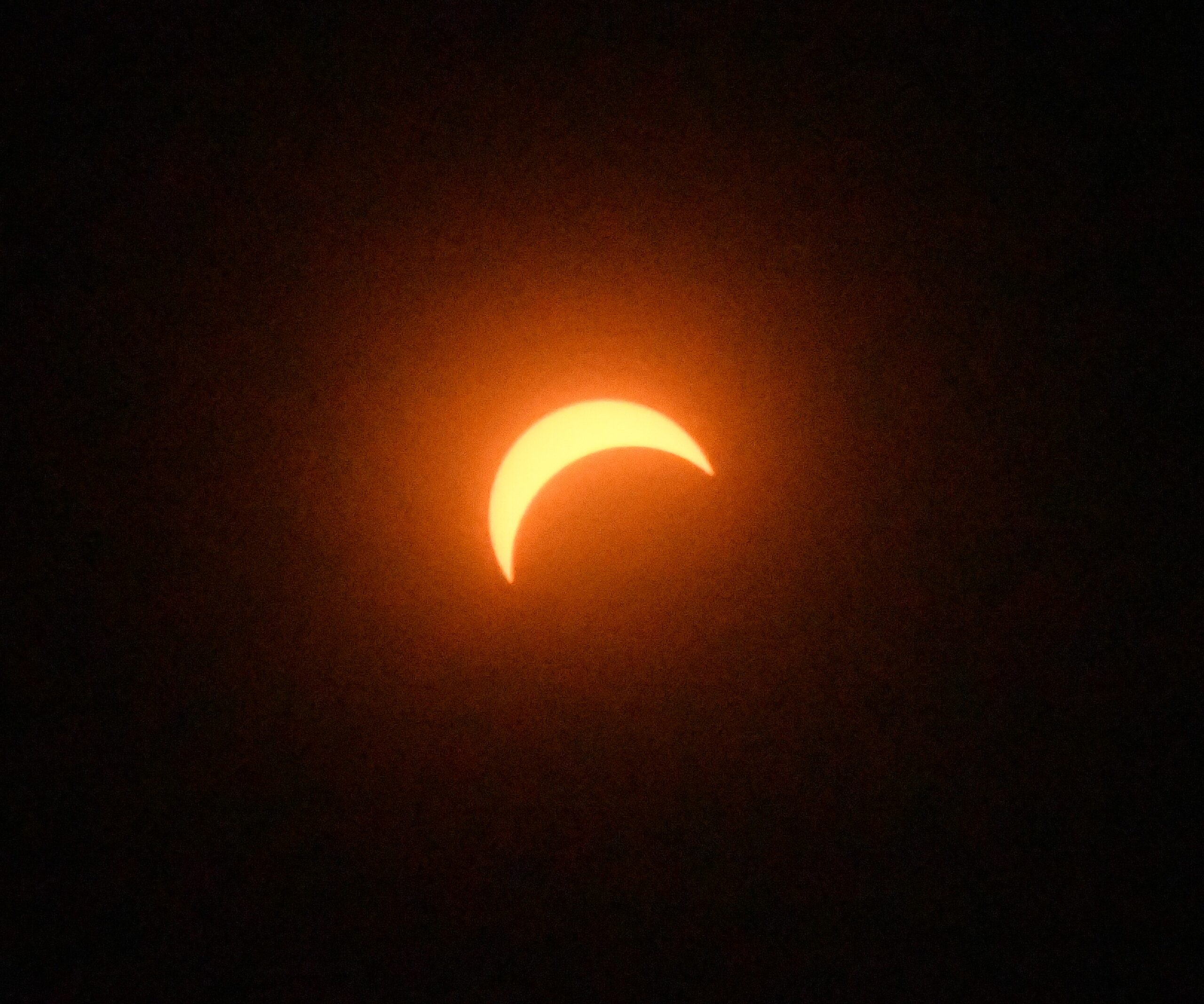
Meanwhile, we had a magical three minutes of totality on Long Lake, starting exactly at 3:24 pm, experiencing the thrill of night-in-the-daytime where you could see stars, then the Diamond Ring, and hearing a dog howl along with everyone’s collective gasps. Then, only a few minutes after, the sun’s crescent started to reappear, but was hazy behind a thin cloud cover, making us appreciate the experience we had all the more.
It may be 400 years before a total solar eclipse returns to New York State, and this may have been a once-in-a-lifetime experience for millions, but there will be total solar eclipses coming up around the world. If you are now hooked on pursuing totality or if you regret missing out:
Prepare well in advance – even a year in advance. Research ideal locations based on path of totality and duration of totality (in North America, ranged from two to four minutes, so significant difference). Scout out locations and book hotel accommodations, travel to the extent possible even a year in advance for the best locations. (See: Fjords, Pharaohs or Koalas? Time to Plan for Your Next Eclipse).
Make sure you have solar glasses and necessary camera gear (solar filters, long-focus lens, ie 300 mm. Have TAPE to attach a paper solar filter to camera, as I used, if you don’t have the glass filter, check www.bhphotovideo.com). Practice in advance (the hardest part is switching from partial to total eclipse – you have to remove the solar filter and reset the manual settings). Review videos of techniques and get a list of suggested camera settings.
Go to the location at least the day before. Scout where you will be standing. Take sample photo of where sun will be at the time of the eclipse (usually one hour before and one hour after totality). Fill up gas tank, get supplies (food, water for next day).
Day of: download maps/directions (cell service may not be available). Get to the site EARLY to get parking and a position (set up your chair, so you can roam around, use restroom). Plan for extra traffic/time to get to site. Bring chair, camera, lenses, extra memory cards, SOLAR GLASSES, SOLAR FILTER, tripod, hat, sunglasses, jacket, book, charged cell phone, food, water.
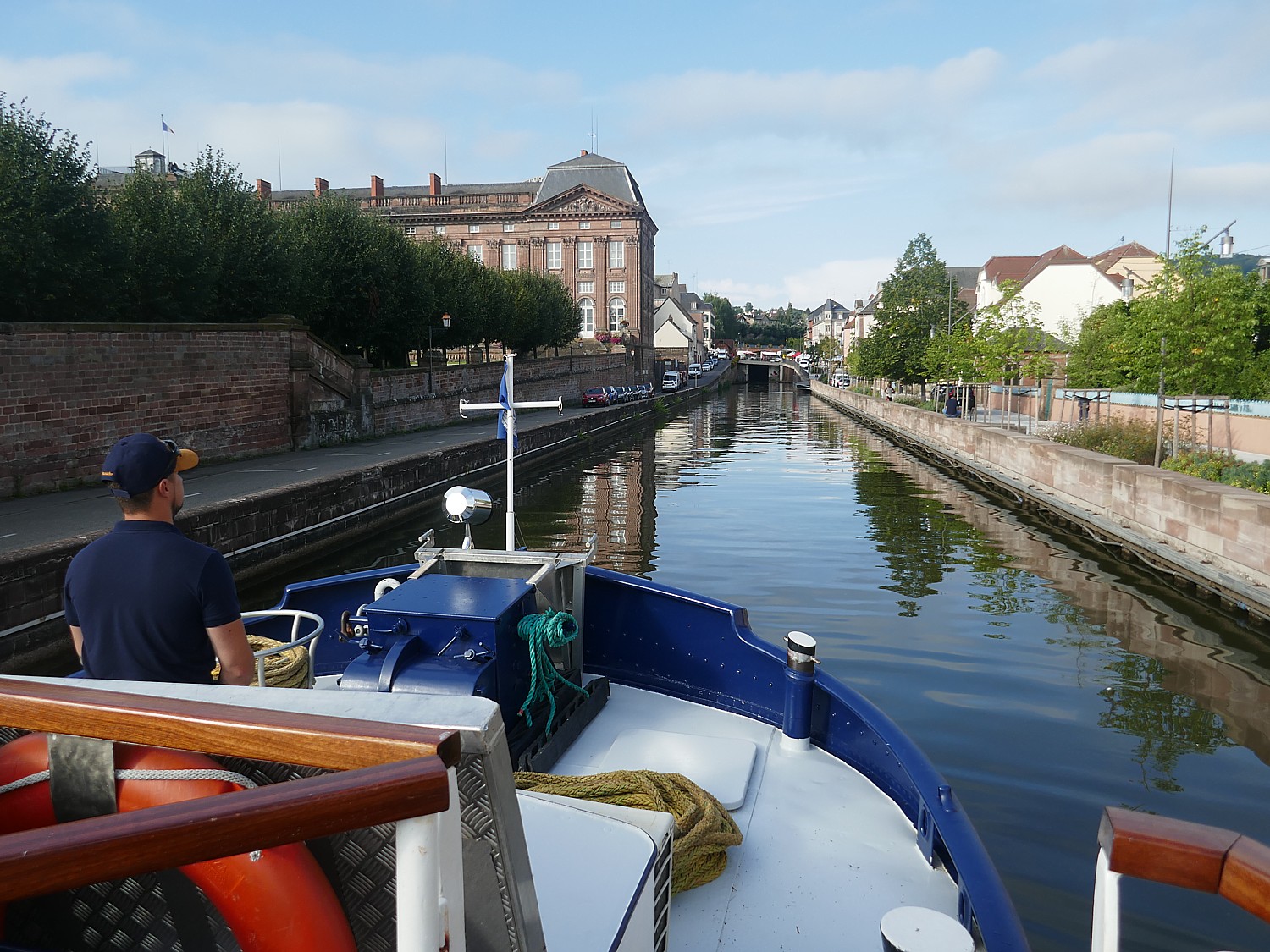
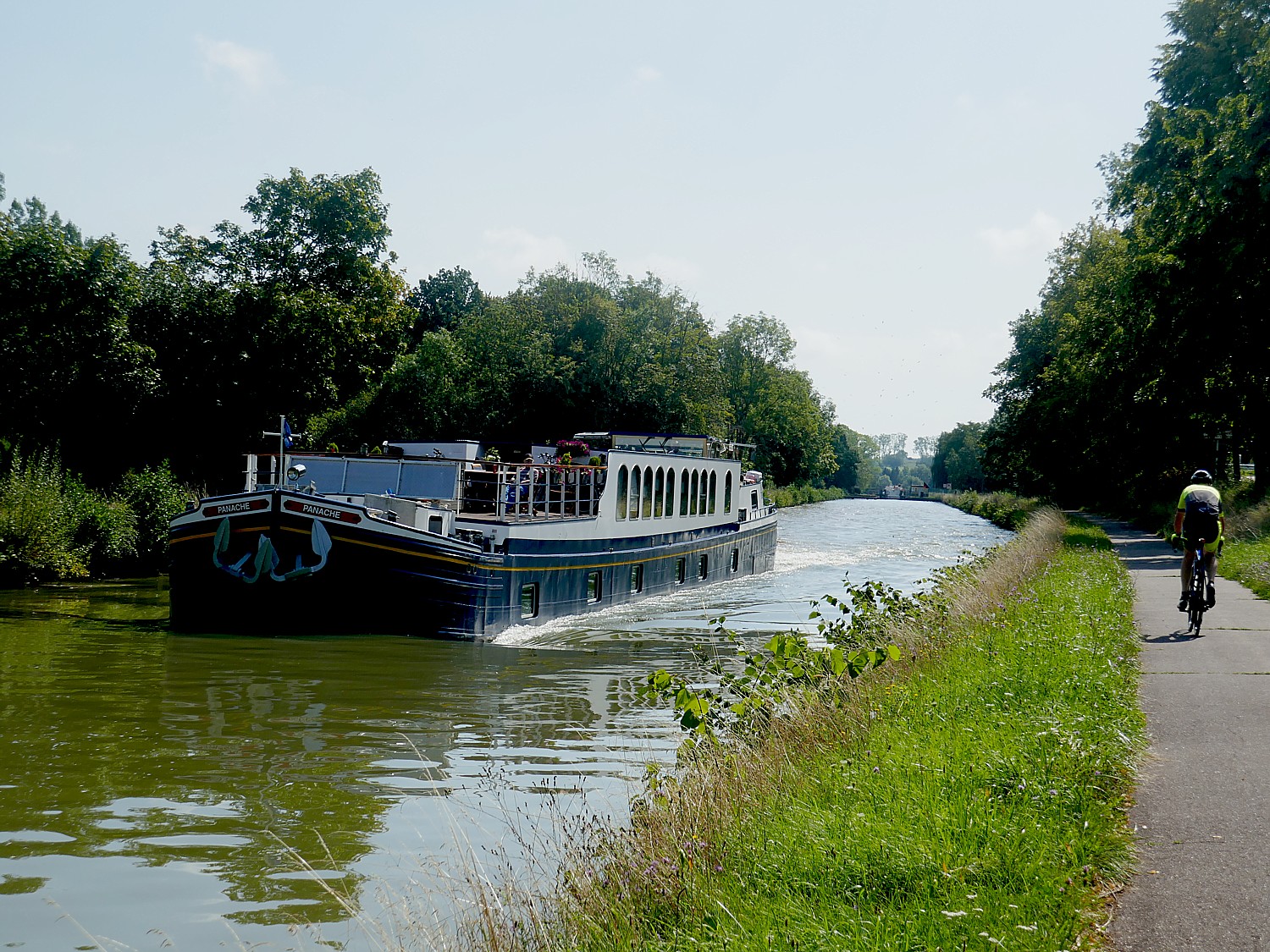
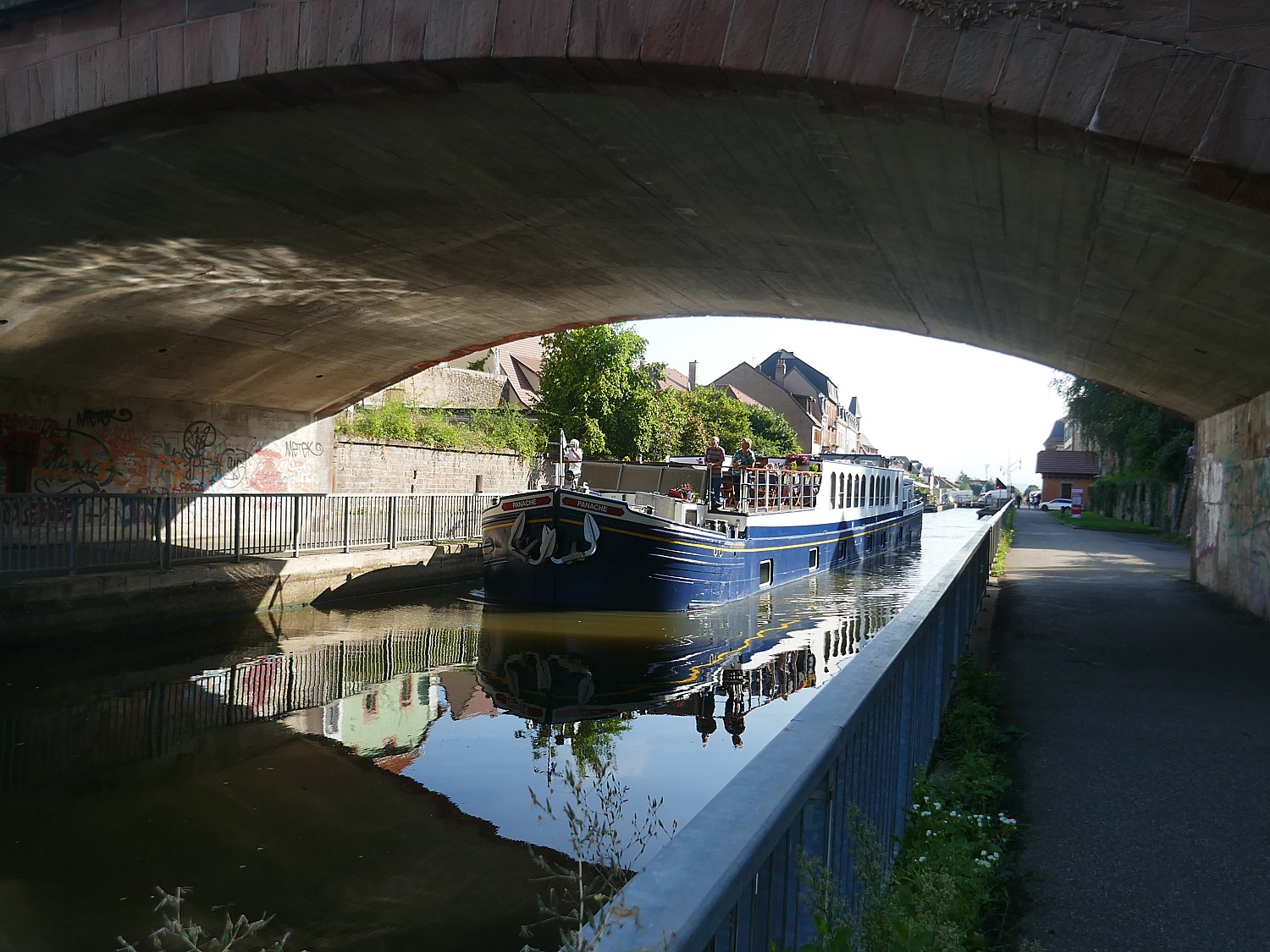
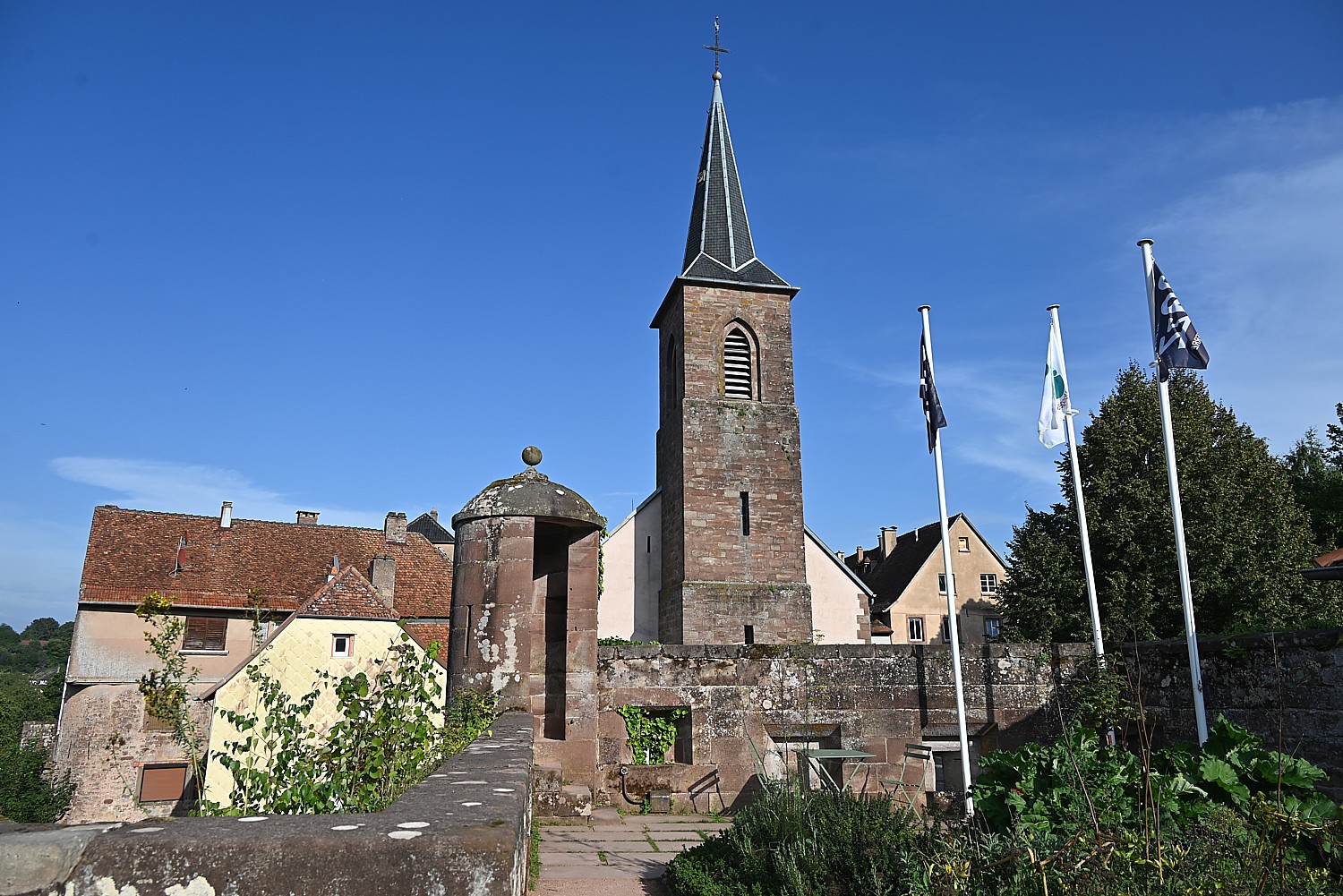
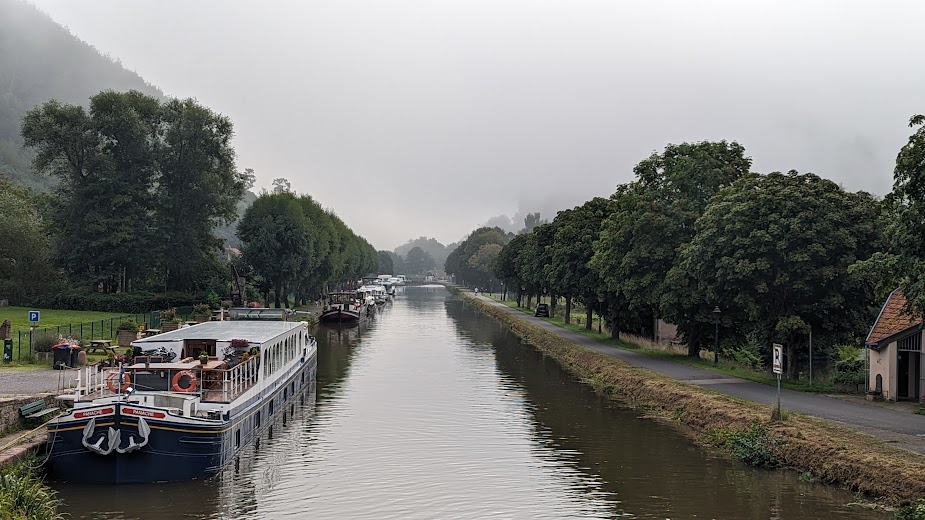
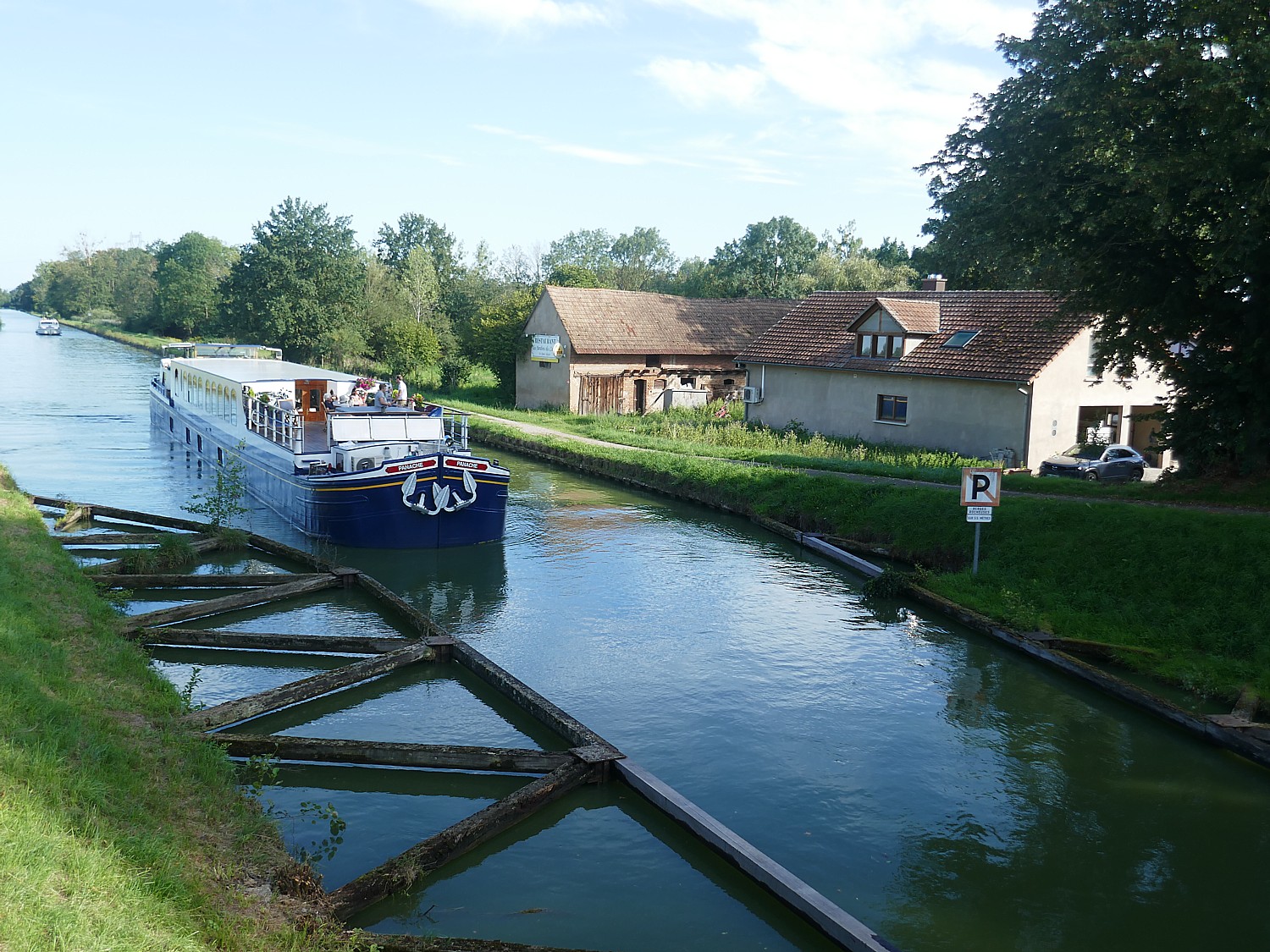
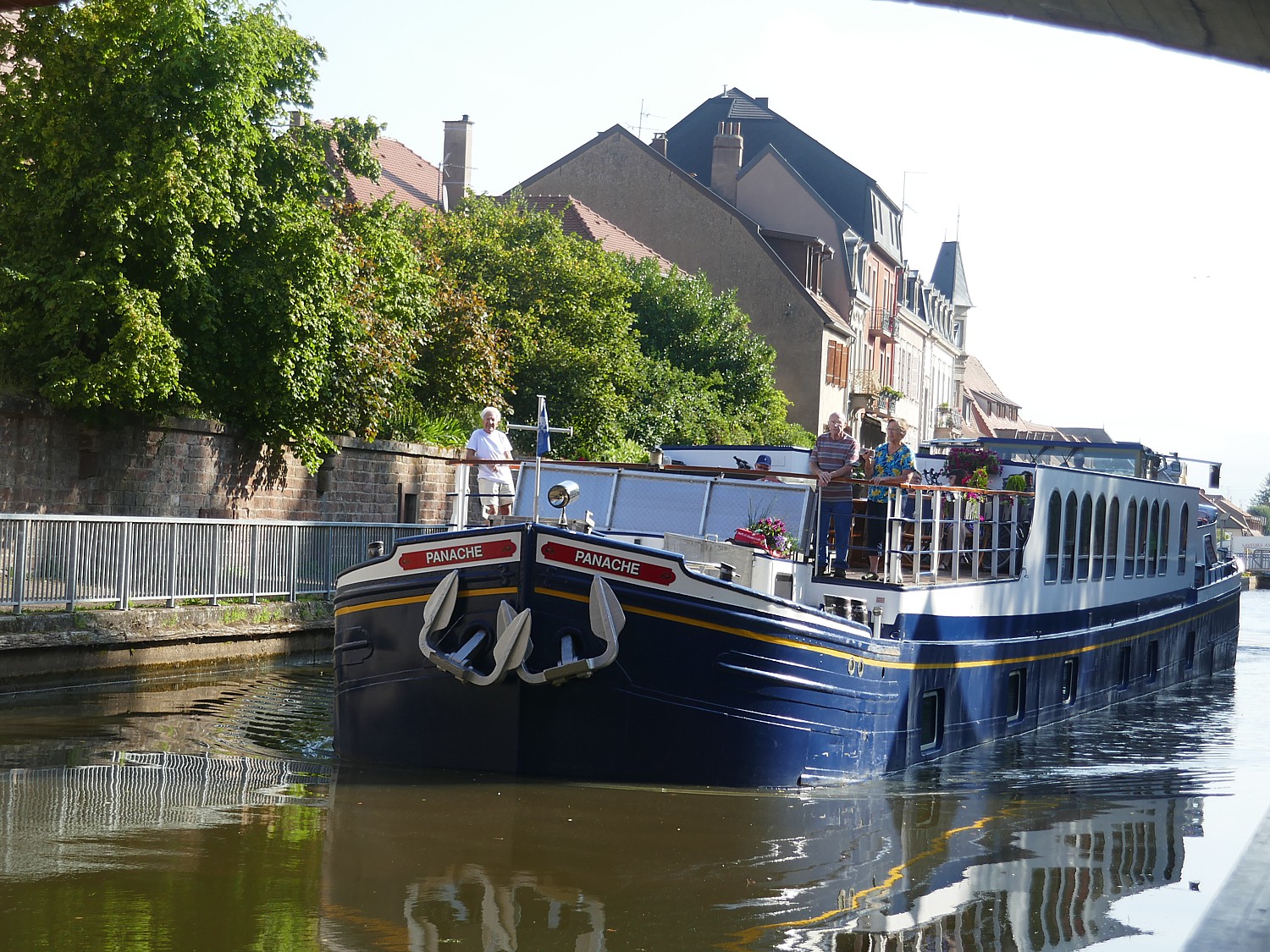
On this fourth day of European Waterways’ seven-day cruise cruise on the Marne au Rhin canal through France’s Alsace-Lorraine, the luxury hotel barge Panache cruises to the enchanting town of Saverne, boasting a history that dates back 2,000 years to Gallo-Roman times. We will tie up right in the town at the foot of the Château de Rohan, a palace built for a Cardinal that is so grand, it is known as the “Versailles of Alsace.”
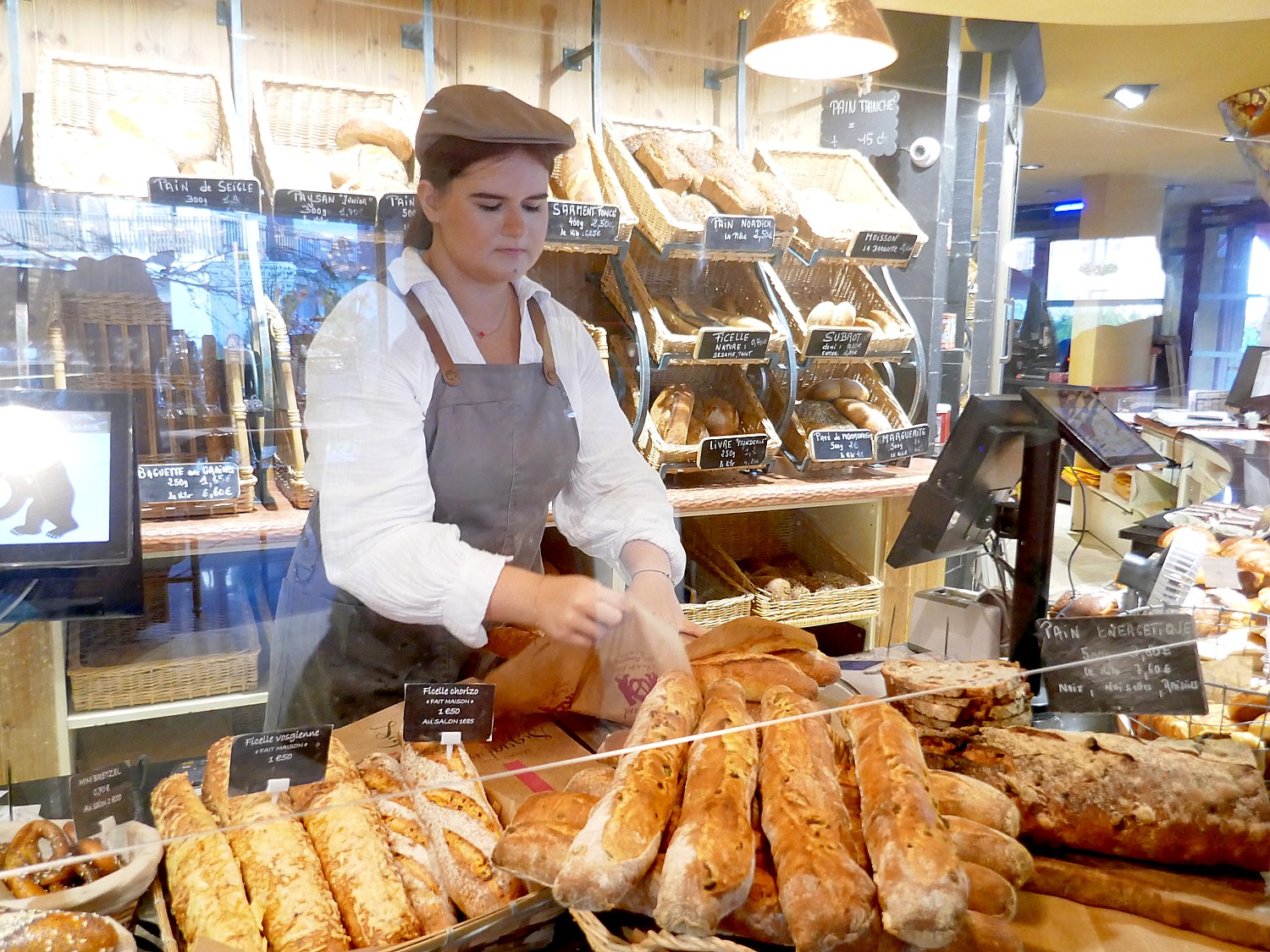
Sue, who hails from Australia, and I are up early enough to go with Captain Brian into the village of Waltenheim-sur-Zorn to the most remarkable patisserie I have ever seen to pick up breads and other delights for our breakfast. The boat departs at 8 am on the dot (I had just stepped off for a photo and got back just in the nick).
Captain Brian tells me that I can bike up to lock 32 and the boat should be there around 2 pm. I do my calculation: Locks 42-41 are 4 km apart; locks 37-36 are 4 km (we will be there around lunchtime) while it will take the boat four hours to get to 37.
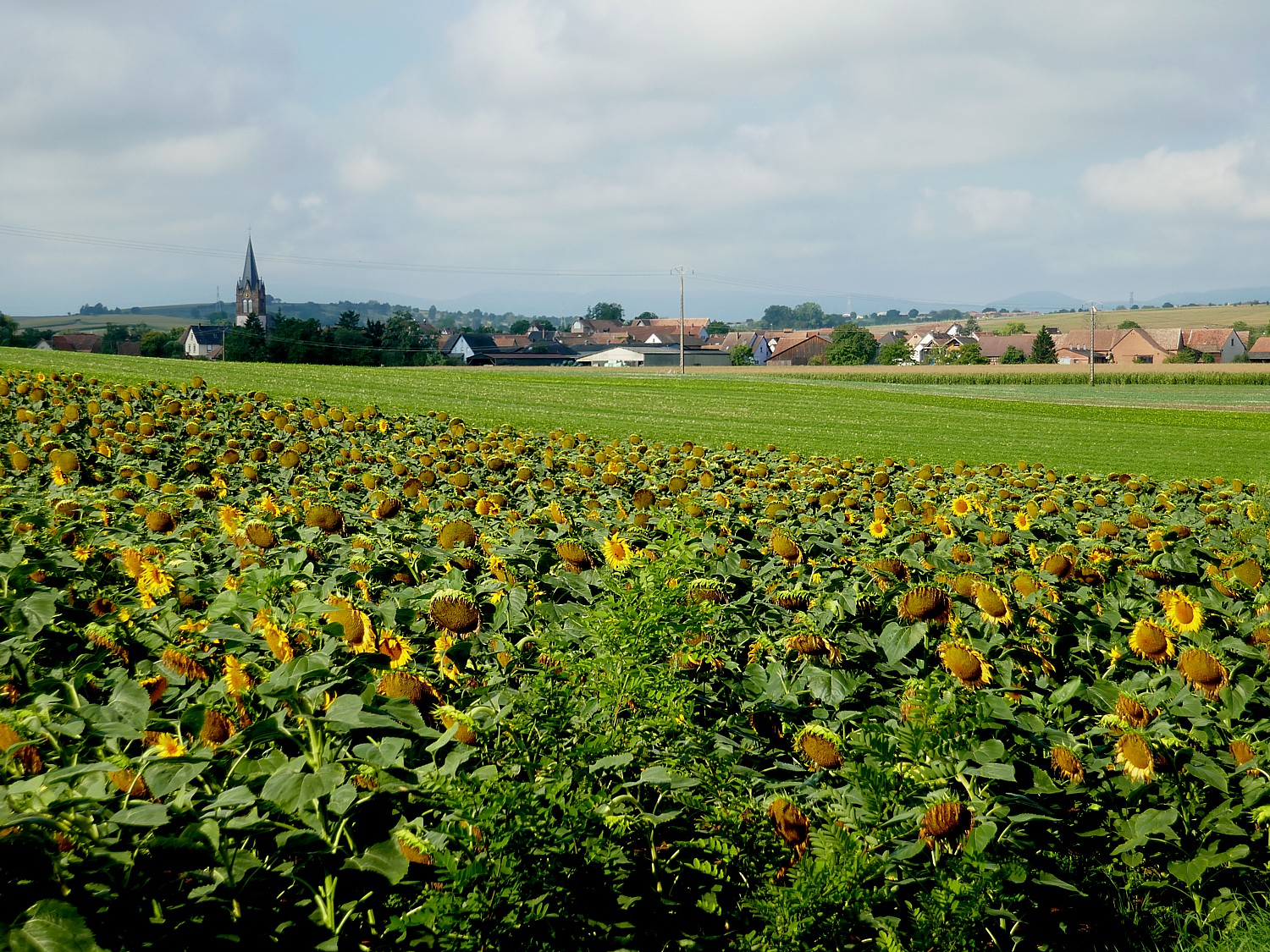
The biking on the towpath alongside the canal takes me passed some of the prettiest pastoral scenes on the route (especially between locks 39 to 37, from Lupstein to Dettwiller). It’s classic.
I think I get in 20 miles riding all the way to Saverne and doubling back to lock 36 to get back on the boat for lunch
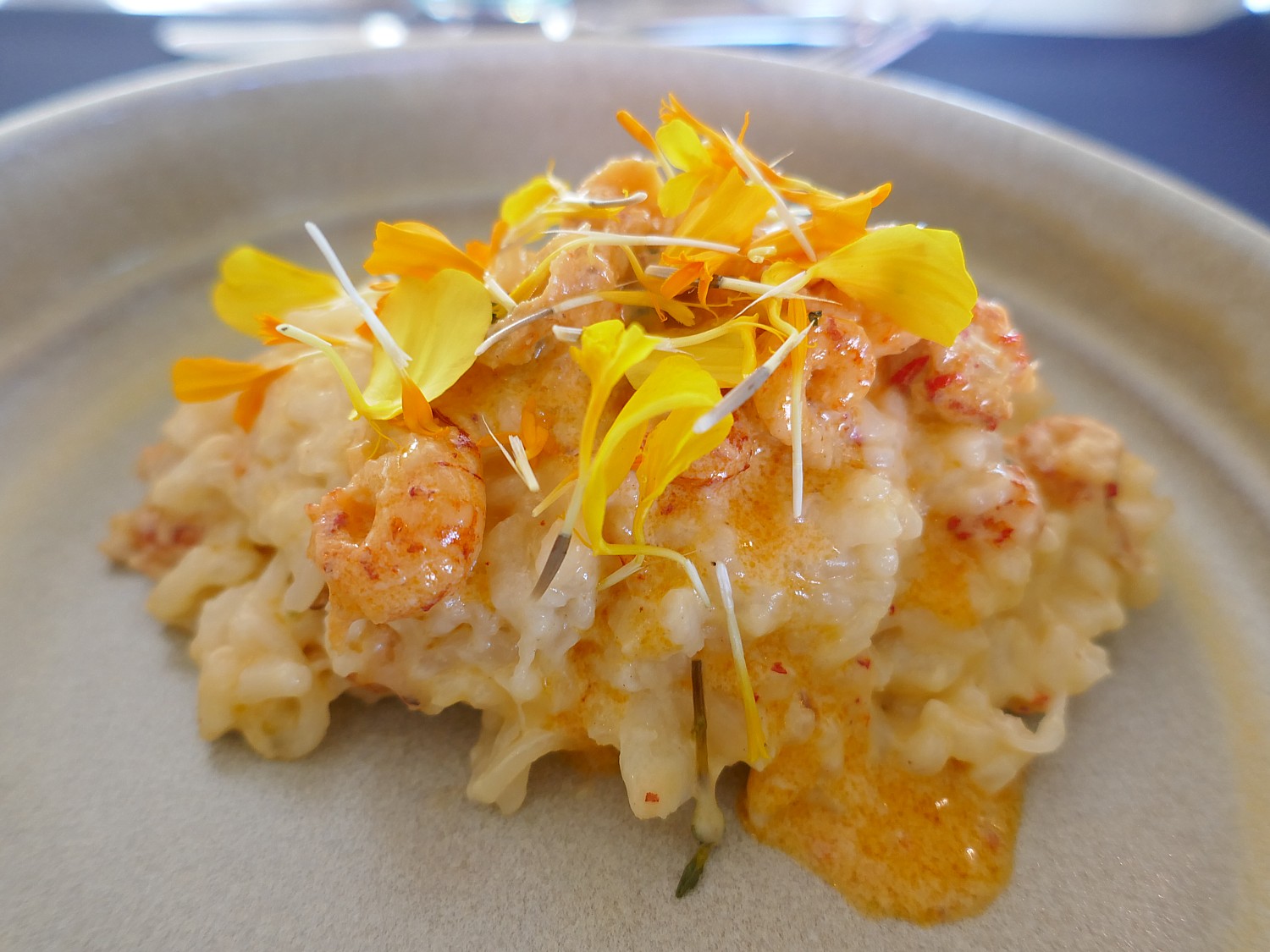
Lunch features French beans with aioli; crayfish with risotto – superb. The white wine is Sancerre La Ferriere 2021 (coincidentally, the book I am reading that day mentioned the same wine!) and the red wine-Sancerre La Louisonne (2016), a Pinot Noir from the Loire Valley.
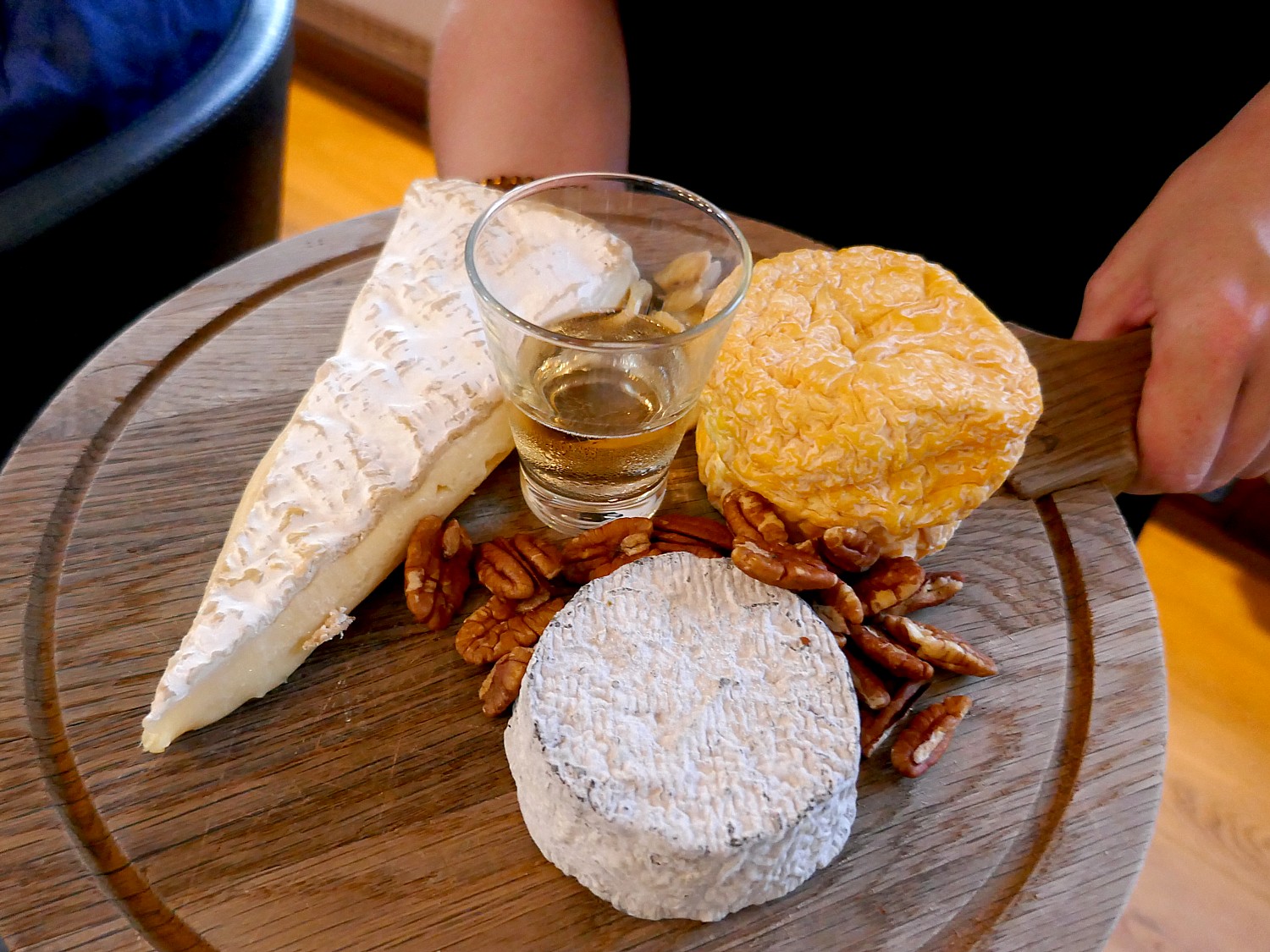
We continue our onboard discovery of French cheeses with Mimolette (also known as Boule de Lille), a cow’s milk cheese produced in Flanders and Normandy, has a marvelous story: a French version of Edam, it has a distinctive orange color that was developed for King XIV in the 18th C. A further study reveals that it was developed “on the advice of his finance minister Jean-Baptiste Colbert, that the way forward for the French economy was to export as much as possible and import as little as possible. France was pretty much bankrupt at the time and this strategy was aimed at balancing the budget. Colbert was also a big fan of taxes and micro-management.” (https://brieencounter.wordpress.com/2012/08/31/todays-cheese-is-mimolette/). We also experienceBrillat-Savarin, a soft-ripened triple cream cow’s milk cheese with a natural, bloomy rind.
At 3:30 pm, Captain Brian takes us on a delightful walking tour of Saverne, pointing out exquisite architecture – and here, I really appreciate the difference between wandering around and having someone who can point out the interesting details.
Saverne became really important for its geographical location – set where two major Roman roads converge, where you can access the Rhine and Rhone to go to the Netherlands, or where it joins the Seine to go to southern France. Not surprisingly, Saverne’s authority changed between France and Germany several times in history, and its cultural imprint – architecture, food, language – reflect both.
We come to a statue of the city’s emblem, the Unicorn, just in front of the Chateau Rohan,
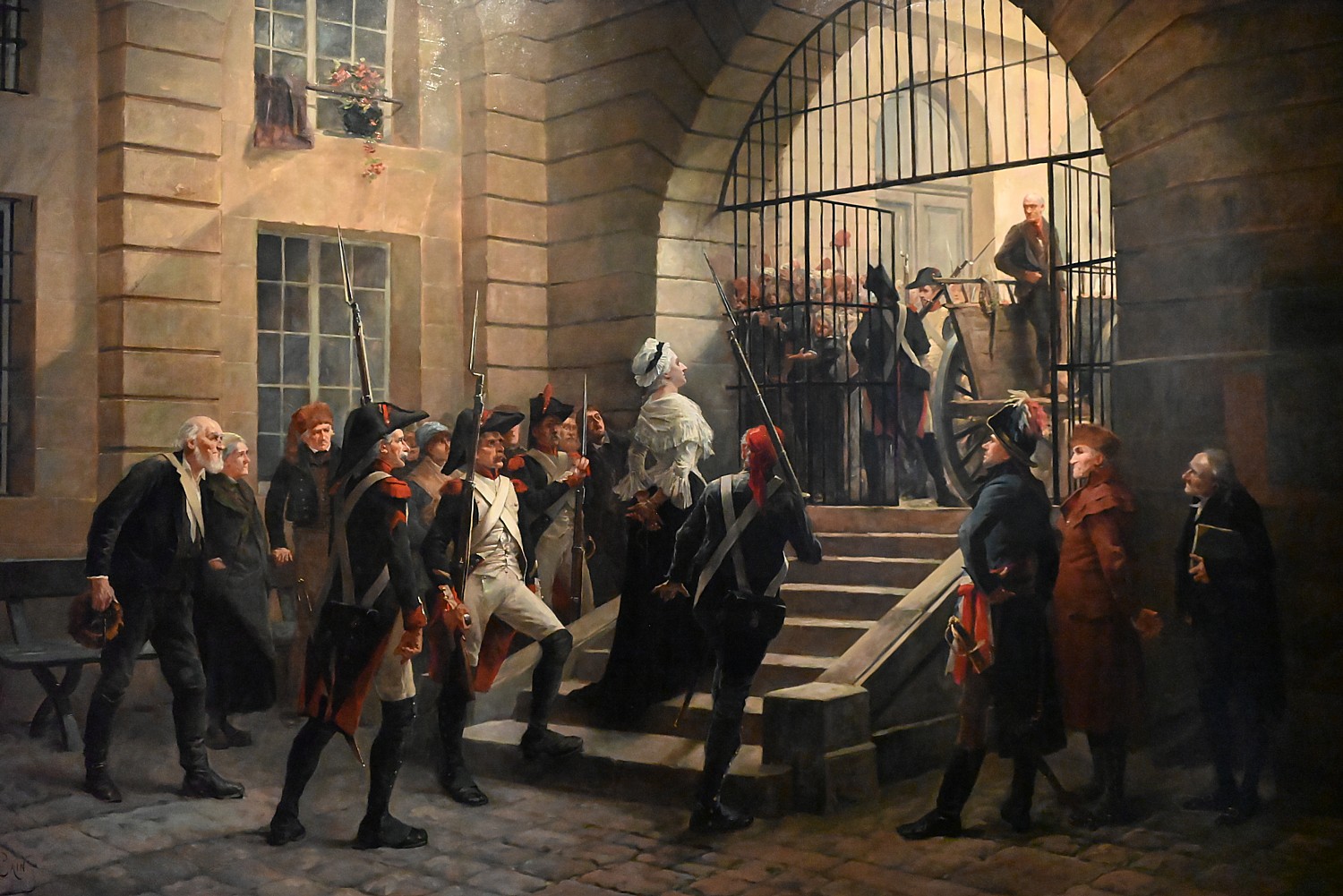
Here, Brian attempts to relay in abbreviated form the “Mystery of Necklace,” This was a colossal scandal involving “the most expensive necklace of the Middle Ages, most beautiful, with the biggest diamonds in the world” that in today’s money would have been worth $15 million, helped bring down Marie Antoinette for her perceived excess and lead, ultimately, to her execution in the French Revolution. (I subsequently learn, she actually refused the necklace, because she said her country needed ships the money would buy.) But the connection to Saverne is this Chateau de Rohan, because at the heart of the scandal was Cardinal de Rohan who built the opulent palace. The mystery comes because the necklace was stolen and never found. (The events are even more dramatic than Alexandre Dumas’ “Three Musketeers”, https://en.wikipedia.org/wiki/Affair_of_the_Diamond_Necklace)
We walk to a 14th century cloister, a stunning example of Gothic architecture with a garden where medicinal herbs were cultivated; it is ringed by a portico and impressive 17th century frescoes which tell of a trial.
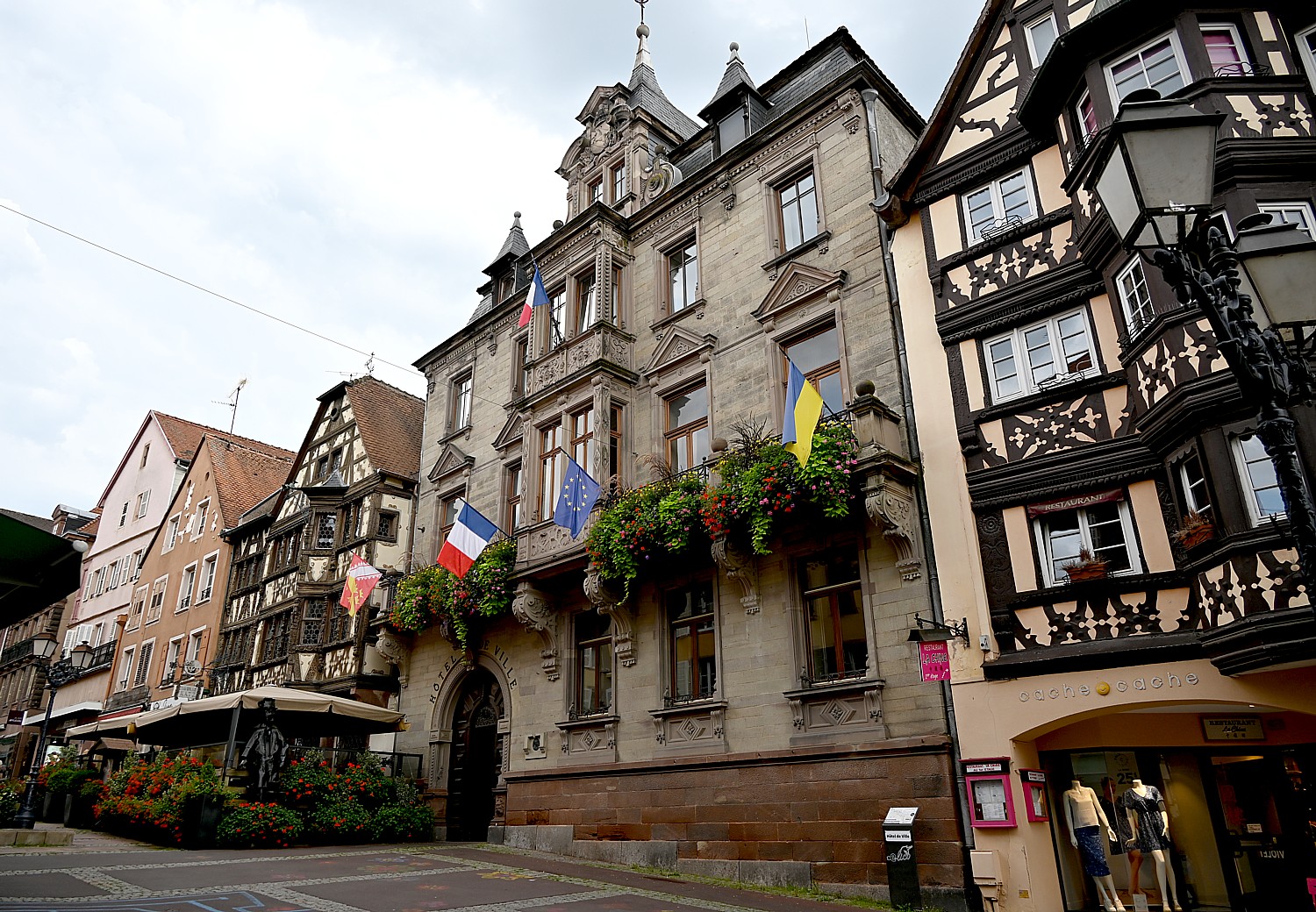
We walk to the Hotel de Ville – the city hall – a stunning historic building that manifests the city’s mix of culture: a Germanic balcony and a French balcony.
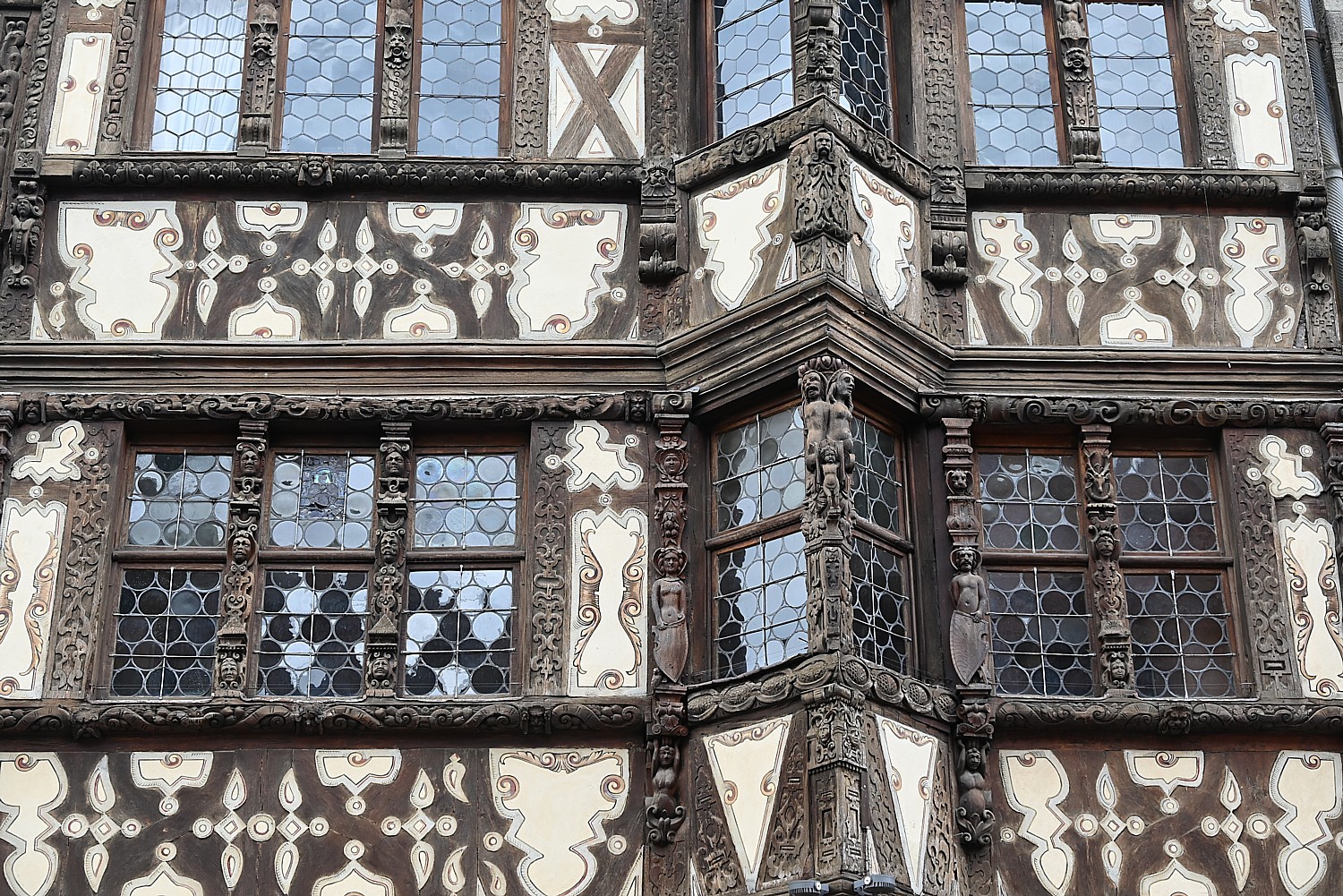
It is adjacent to the oldest and most ornate building still standing, Maison Katz. Built in 1605 by Henri Katz, the Receiver General of the Bishopric, its beautiful façade of sculpted timber is a superb example of the German Renaissance style. Today, it is a popular restaurant. (Taverne Katz, 80 Grand’Rue 67700 Saverne, +33 (0)3 88 71 16 56, https://www.tavernekatz.com/en/restaurant).
Befitting wealthy property, it is also very close to the Church Notre Dame, built in the 12-15th centuries, with Romanesque arch and a Gothic interior. Remarkably, the Chapel has the original 15th century stained glass; the rest has stained glass from the 19th century.
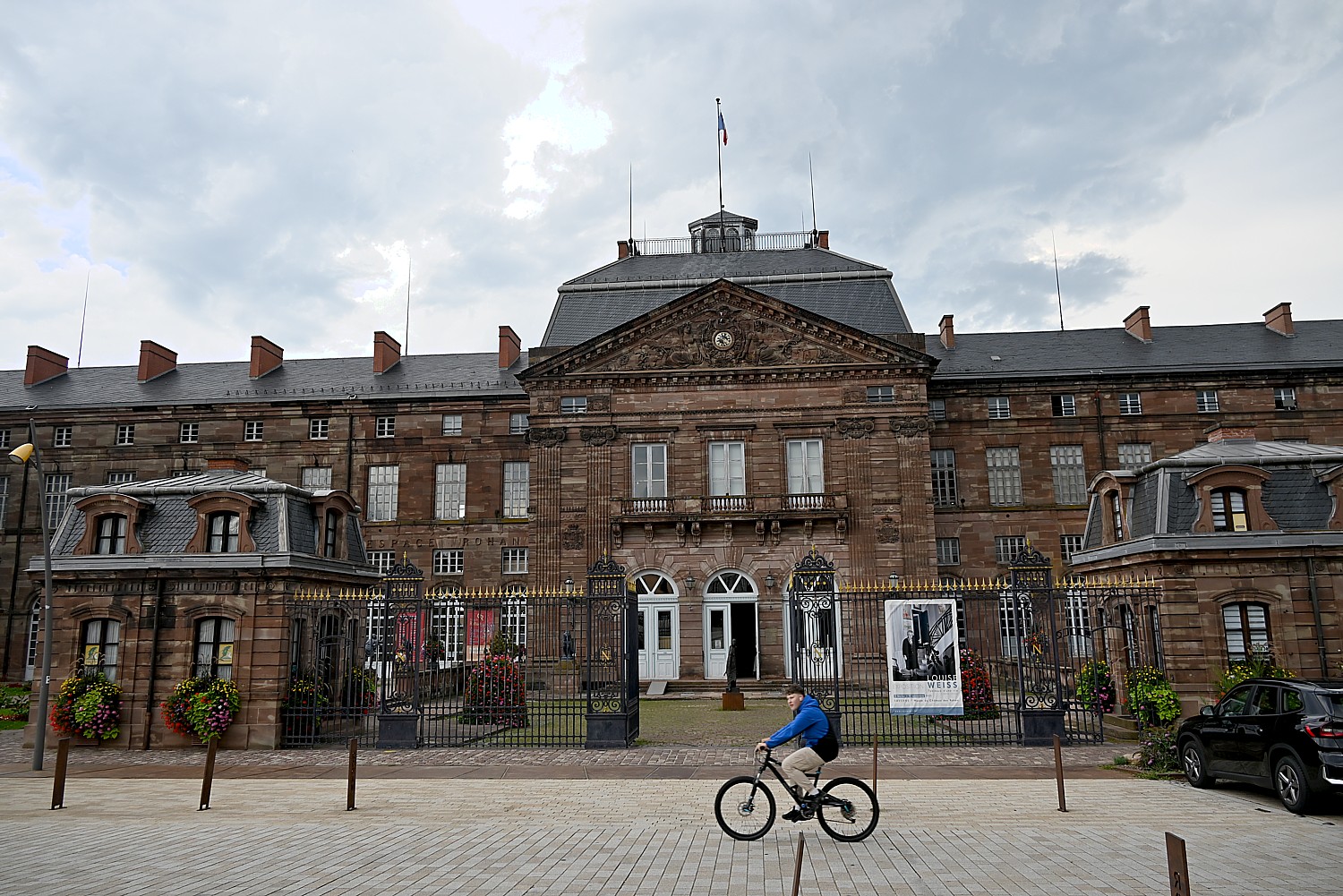
We walk next to the Château de Rohan, overlooking the Marne-Rhine Canal that we have been cruising. Historically the residence of the bishops of Strasbourg, it was rebuilt by Cardinal de Rohan in 1779 in neoclassical style with magnificent gardens and a 140-meter-long façade made of Vosges sandstone (like the Notre-Dame of Strasbourg).
The palace today houses the city museum. Founded in 1858, the museum exhibits art from the churches and castle of Saverne, a large archeological collection of Roman and Celtic artifacts from the excavation of the Marne-Rhine Canal, the collection of 20th century and ethnological art donated by feminist journalist and politician Louise Weiss, and a fascinating exhibit about her life and times.
Weiss trained as a teacher (against her family’s wishes), and throughout World War I worked as a war nurse and founded a hospital; from 1918-1934, she published a magazine, L’Europe nouvelle. In the 1920s, she left France to see the world “to discover true meaning,” spending time in Communist Russia, meeting Lenin and Trotsky. From 1935 to the beginning of World War II she committed herself to women’s suffrage and ran for Parliament in 1936. She was active in the French Resistance during the war and was the chief editor of a secret magazine. After World War II, she said she knew nothing of Asian people, and again set off to travel the world. In 1979 she became a member of the European Parliament. She died in 1983.She said her only regret in life was not being a candidate for president. She reminds me of a French Eleanor Roosevelt. (I learn later there is a statue of Louise Weiss at the fountain in the square.)
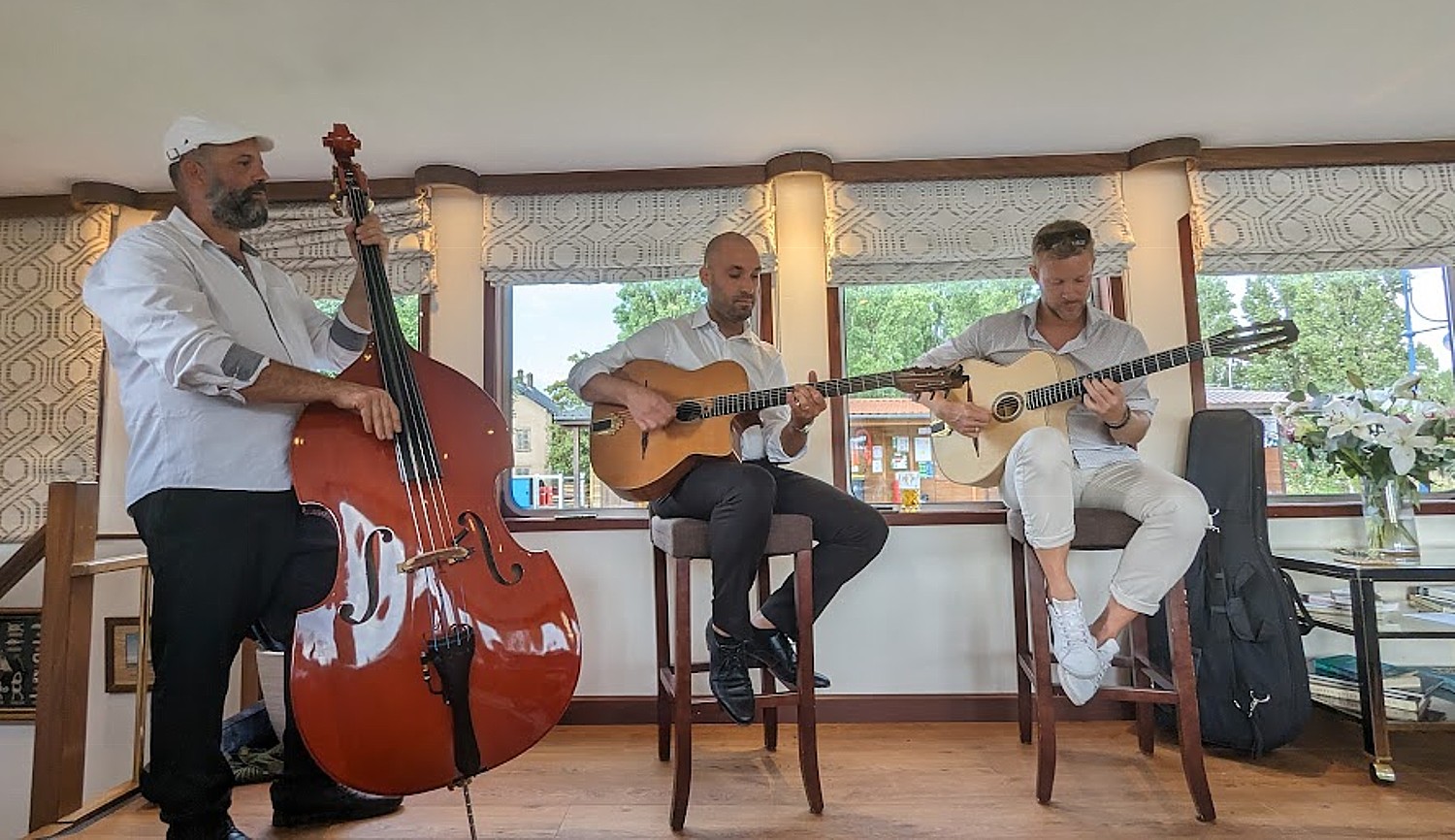
I walk back to the boat just before 6 pm, arriving as a trio comes on board, to regale us with French (“C’est si bon”) and gypsy jazz. Fabulous.
The joy from the music carries over into dinner: trout with a tomato crumble; cod with tapioca and black garlic; a scrumptious dessert of strawberry with elderflower (that Chef Leo picked from his own garden that day). Every dish is so imaginative, distinctive, and magnificently presented.
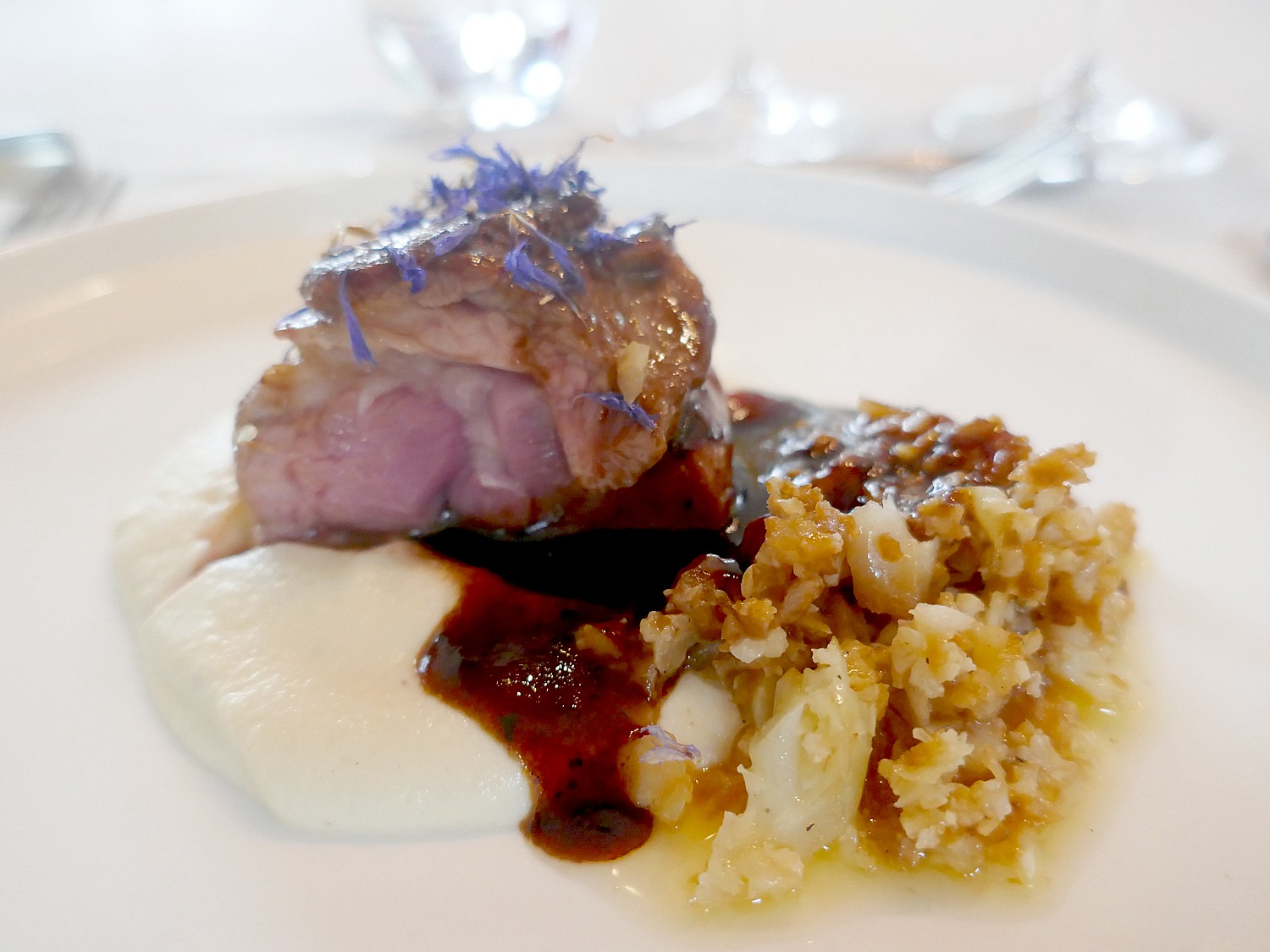
Chef Leo, who typically introduces the main course, explains that the cod is cooked slowly at low temperature, the black garlic sauce made with burnt shallots. It gives a wonderful, unexpected flavor. “I love experimenting with different flavors,” he tells us.
The white wine is Grand Cru Alsatian Reisling, House of August; the red a Grand Vin d’Alsace, Pino Noir (2012).
The cheeses this evening include a creamy, buttery cow’s milk cheese, cousin to Brie; Abondance, a semi-firm cow’s milk cheese from Haute-Savoie, aged for three months on spruce blocks that has a delightful walnut taste; and Bleu de Gex, a creamy, semi-soft blue cheese made from unpasteurized milk in the Jura region).
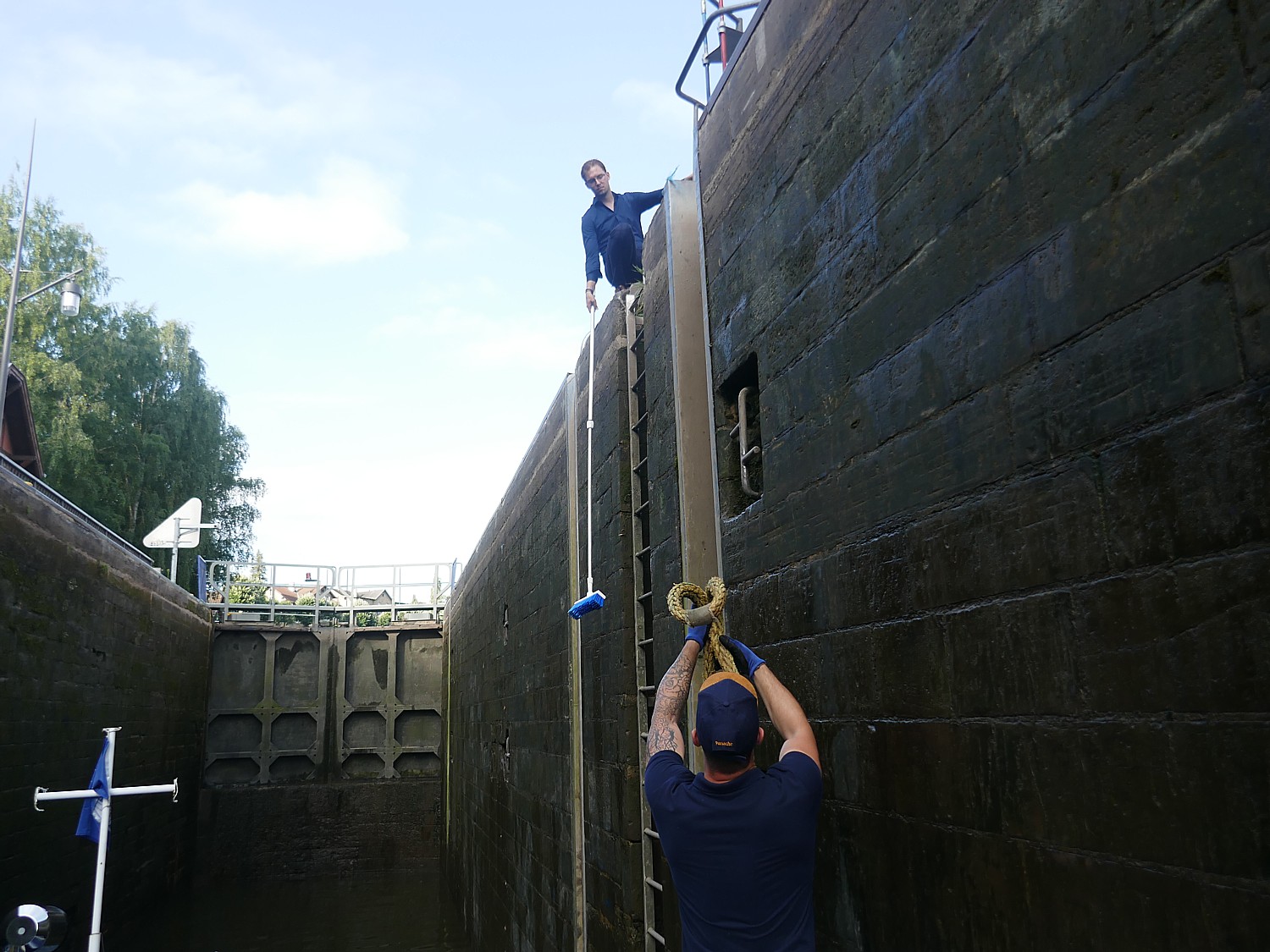
Leaving Saverne, we go through the most dramatic and highest lock of all – it must be 30 feet high. I watch this feat, then hop off with the bike to ride the route to Lutzelbourg.
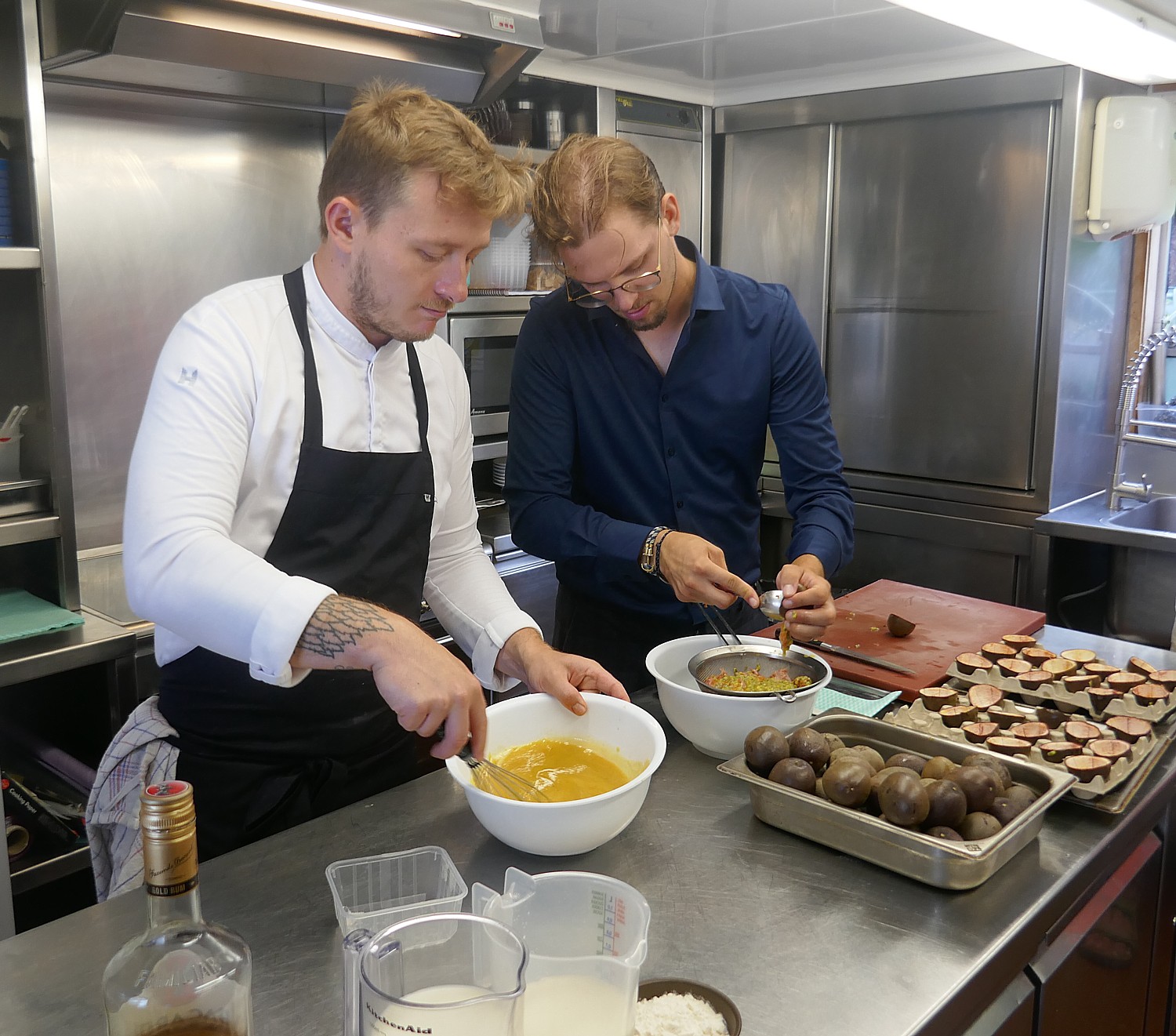
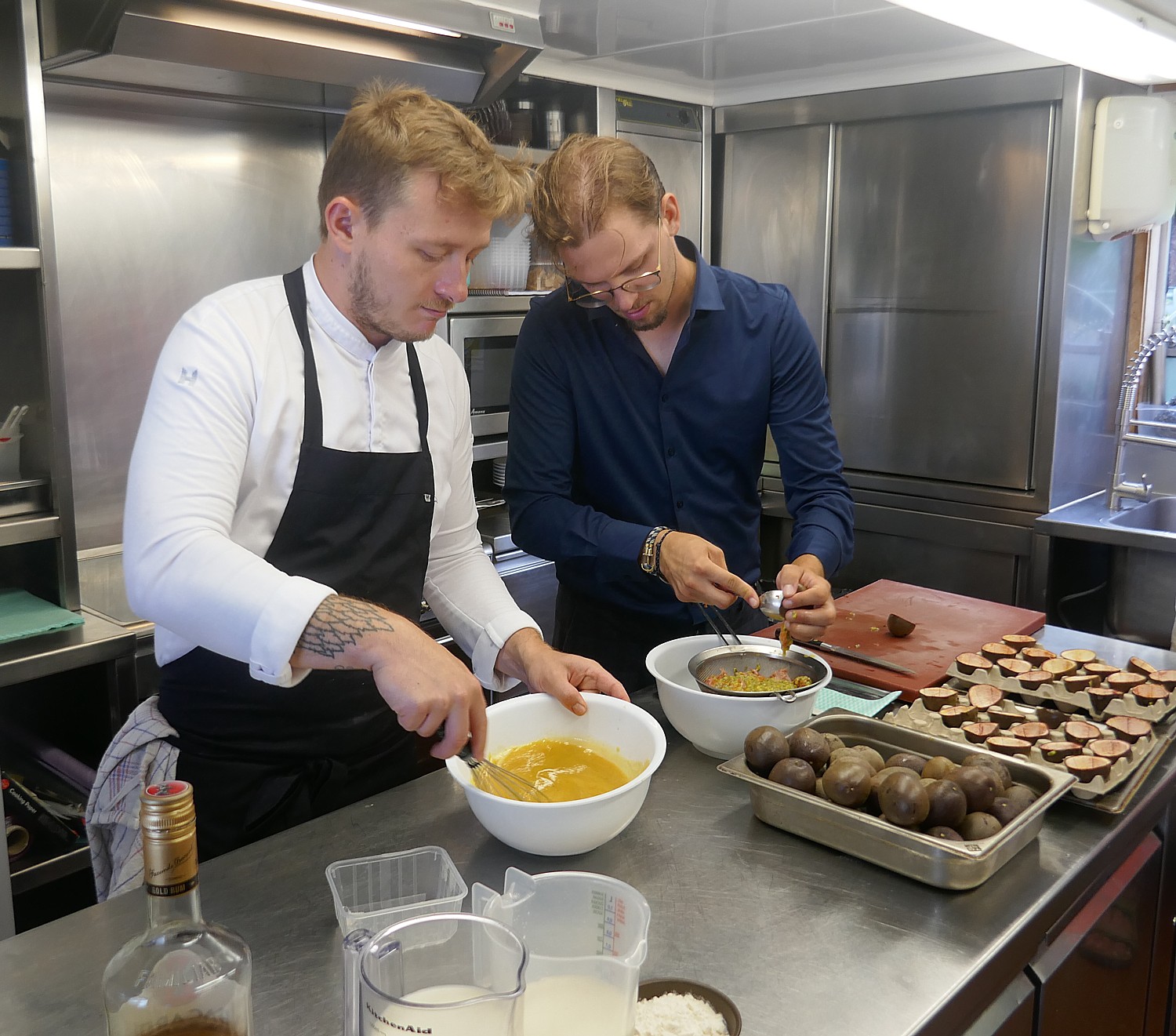
I return to the boat, just in time to see Chef Leo give us a cooking demonstration of the passionfruit crème brulee he is making in response to Sue’s request. It is so much fun to watch his preparation – Captain Brian pitches in, too.
We take note of a (tongue-in-cheek) “firing board” in which Captain Brian keeps tabs on who is in the running to get fired – whoever has the least checkmarks at the end of the quarter gets a prize.
Lunch features asparagus and cream; beef with cheesy mash potatoes (vegetarian option salmon) and the passionfruit crème brulee (parfait!). The wines are an Alsatian Riesling, Lieu Dit Burg, and an Alsace Pinot Noir (2018), Famille Hugel.
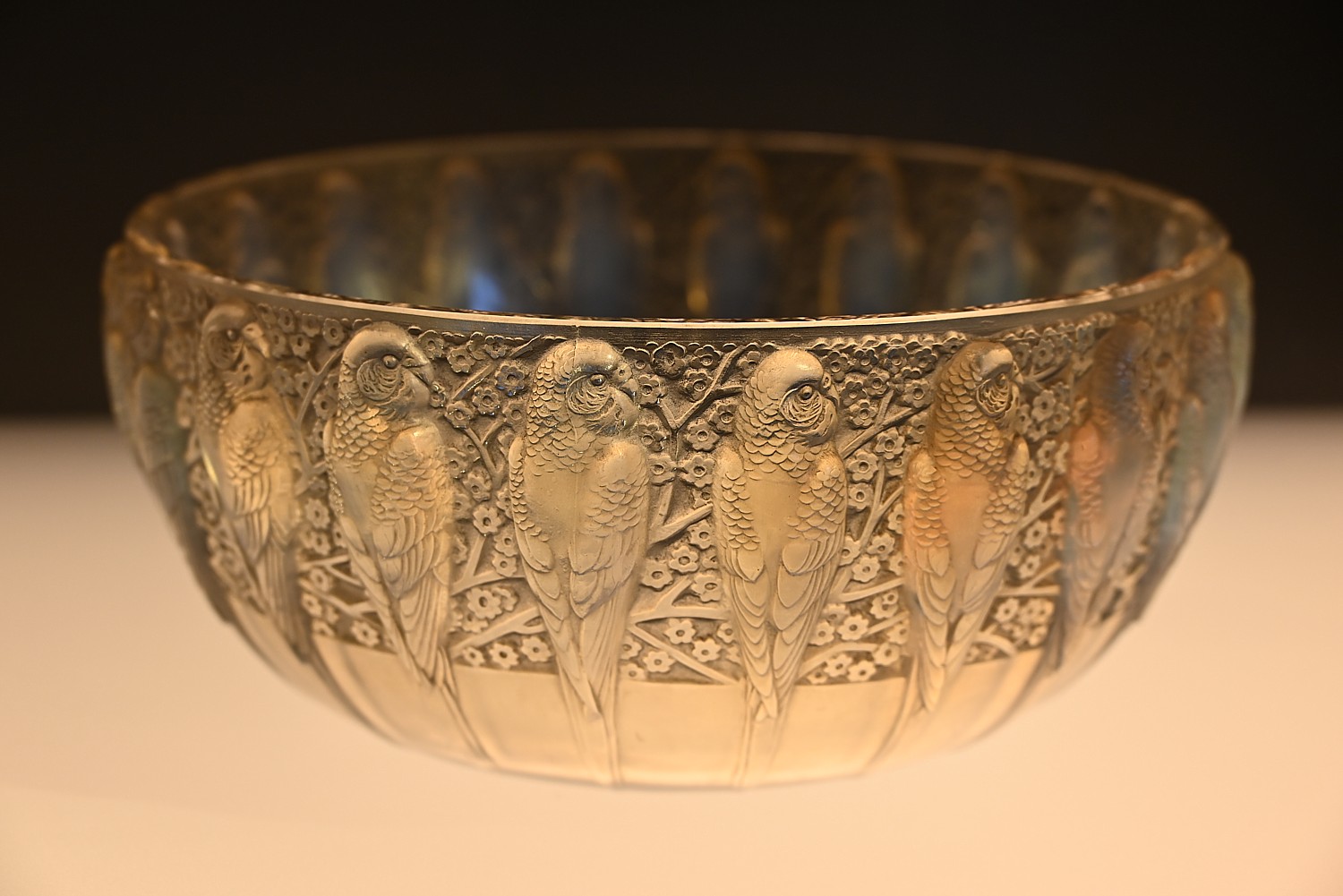
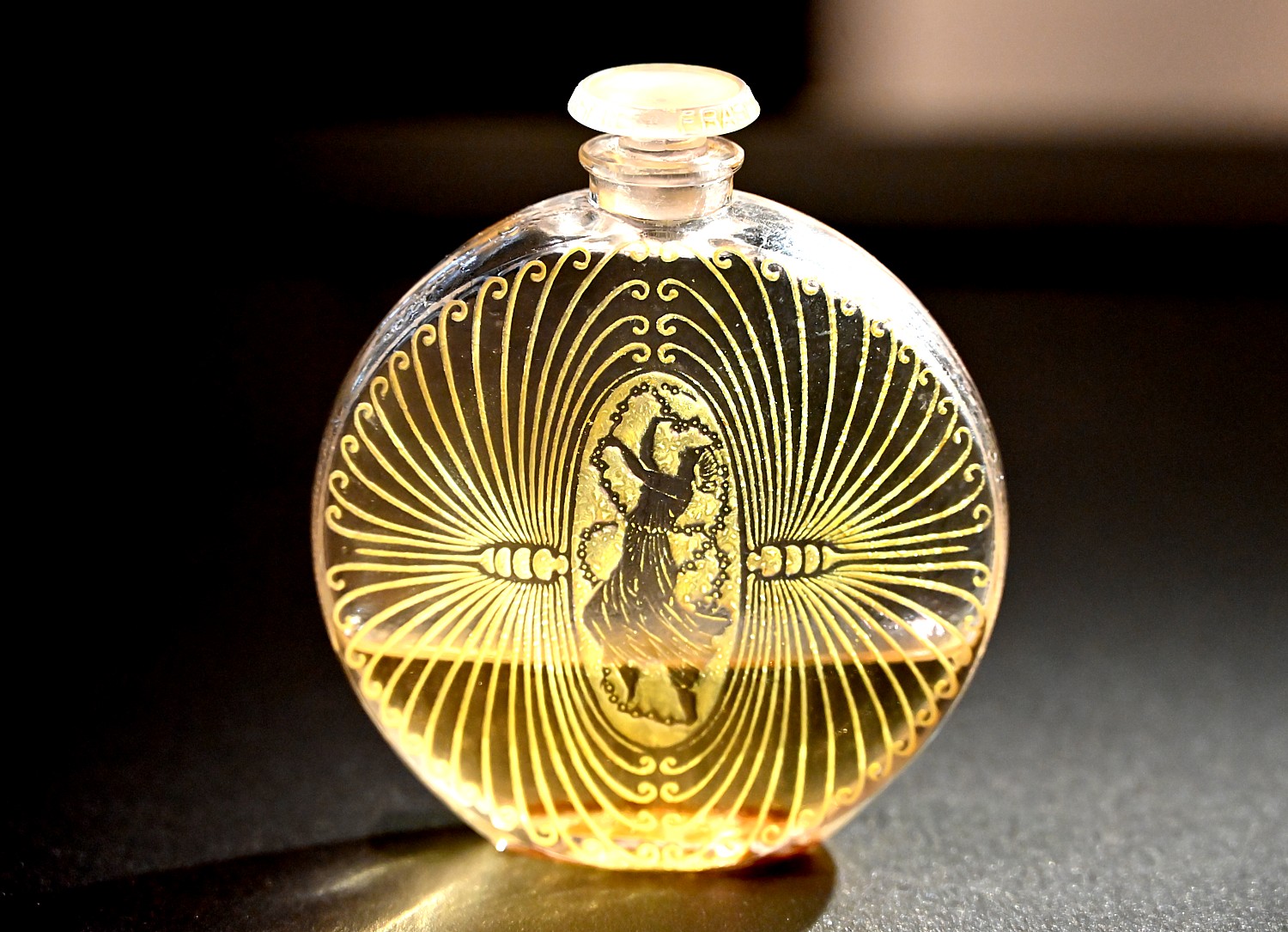
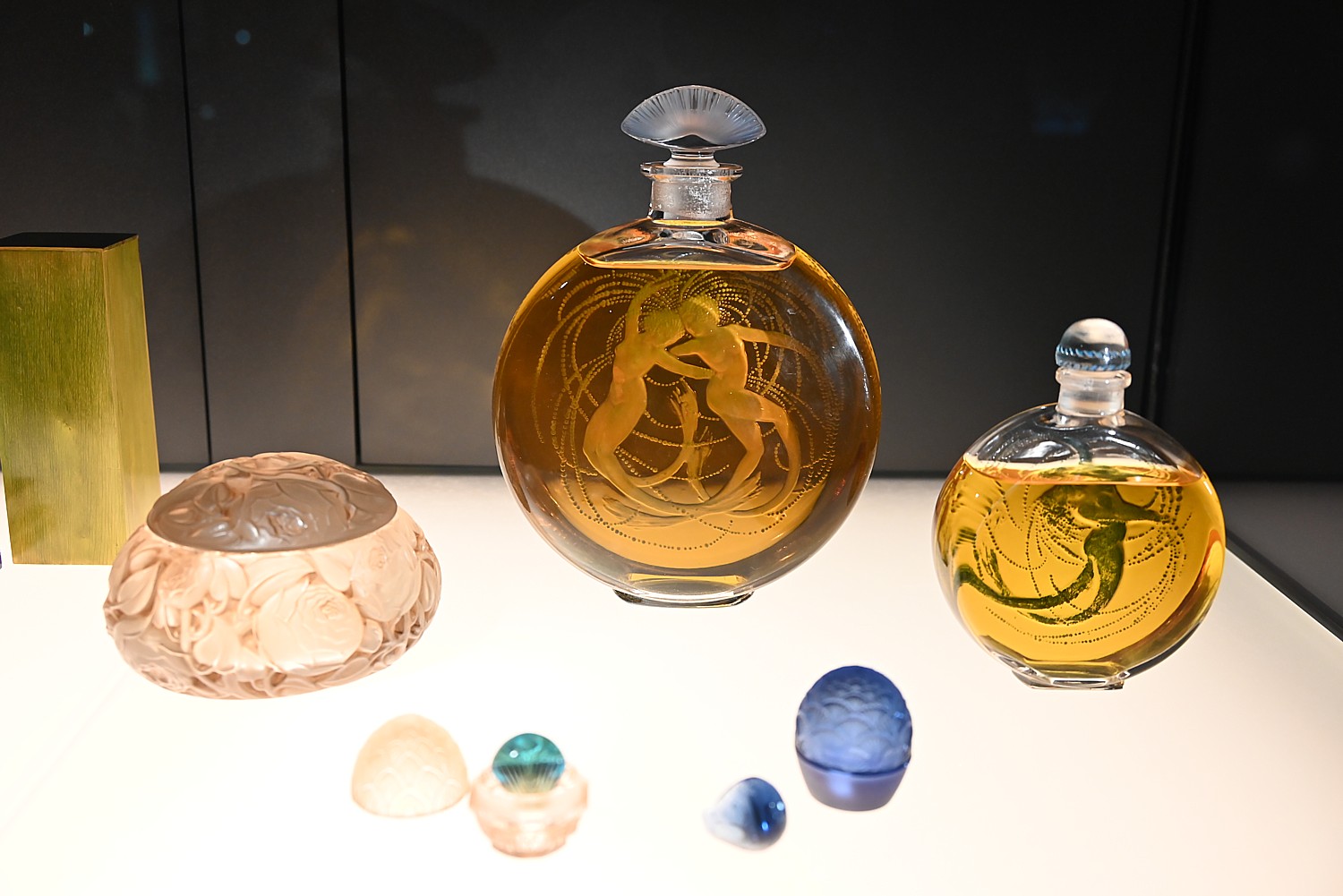
Situated in the picturesque village of Wingen-sur-Moder, Lalique Museum celebrates the work of the jewelry designer and glassmaker, Rene Lalique.
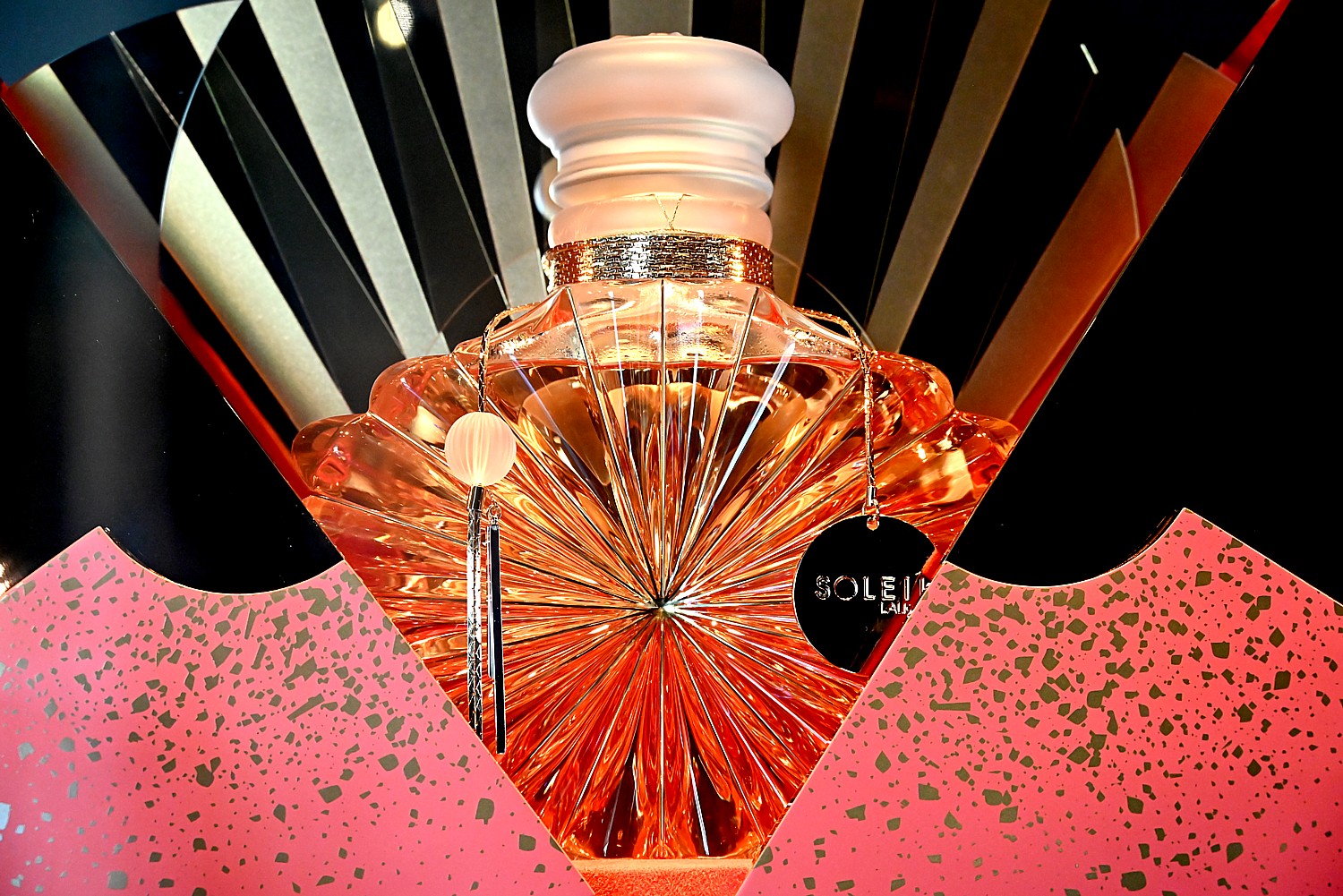
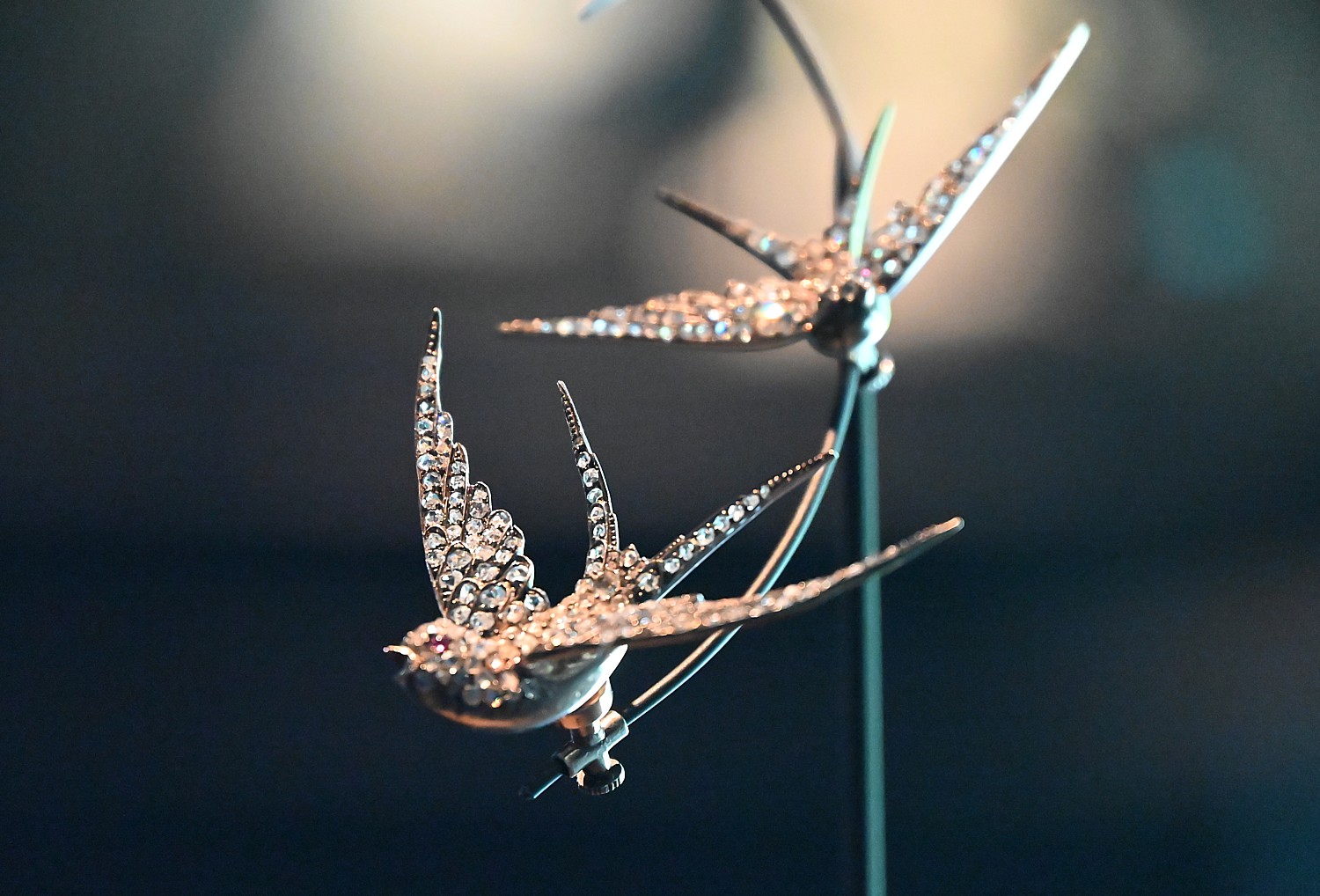
Lalique founded his workshop here in 1921. Throughout his lifetime, Lalique crafted jewelry, medals, perfume bottles, vases, chandeliers and glass, and we swoon seeing the collection of more than 650 of Lalique’s most stunning creations, which incorporate enamel, precious stones, and glass, gloriously displayed, with fascinating video projections and huge photographs to tell the story of the Lalique dynasty.
The hallmark of Rene Lalique’s jewelry design was its exquisite precision and tiny detail in the insects, fauna, flowers– you can see the wind fluttering the flower petals, every feather on a bird, a hair comb in the Japanese style has a rising sun.
“All were his ideas, his designs. He designed every piece and could name to whom sold. Renee Lalique was a control freak – he never slept more than 3 hours.”
He was on the forefront of the Art Nouveau movement but was regarded as too modern, too eccentric for Catholic sensibility, she tells us. “Too modern for Cartier. But this became the fashion.”
Rene Lalique drew his inspiration from Egypt, from Japan, from the Middle Ages, but gave these inspirations a totally new expression, his own stamp.
He became famous after winning a gold medal at the 1900 Exposition, a celebration of modernism in which electricity in Paris and the first subway were unveiled, attended by some 50 million visitors.
Rene was as brilliant a businessman as he was an artist, inventor and entrepreneur, pioneering branding, marketing, merchandising techniques. “Every perfumer demanded a new bottle, a special stopper.”
He created a joint advertising/marketing campaign (perhaps the first) with the perfumer, Molinar. “He created demand for the next collection, for perfume, then for toilet water.”
For the 1925 Exposition, he created a17-meter high glass fountain that looked like stone during the day but was lighted at night. “People then didn’t have electricity at home – it was too modern for Paris.” At the exposition’s end, he sold the statues as a limited edition.
We learn how Renee Lalique, who lived from 1860-1945, innovated new techniques and modern mass-production processes. Though Rene knew the process to turn regular glass into crystal (by adding lead), it was his son, Marc, who took over upon his death in 1945, that steered the company into crystal glass production.
There has been a glass factory in Alsace since the 15th century and they still find pieces. Lalique, who had been producing glass in Paris, came here in 1921 and built a modern factory to produce flat glass (it was cheaper here than Paris and the French government, which had regained control of Alsace after the war, provided funding to build the factory.)
The museum, which was conceived in 2000 and opened in 2011, is housed in an old glass factory that dates from 1750, producing flat glass for windows, that closed in 1868. The Lalique factory that is still in use – the only Lalique factory in the world – no longer has any members of the Lalique family involved.
After three generations of Lalique had led the company, with no heirs to inherit, Rene’s granddaughter, Marie-Claude Lalique, sold the company in 1994 to the Pochet Group; it was acquired in 2008 by Arts et Fragrance, a Swiss group owned by Silvio Denz. (Marie-Claude Lalique died in 2003.)
Because the Swiss bought the factory and exclusive rights to the Lalique name, our guide tells us, it was difficult to create a museum with Lalique name, but the museum, funded by the state, the Alsace region and the village, ultimately won.
Everything is produced here in the factory (which we don’t see) – “a timeless collection,” our guide says.
The delightful tour finishes with a marvelous video showing production in today’s factory. There is also a wonderful shop.
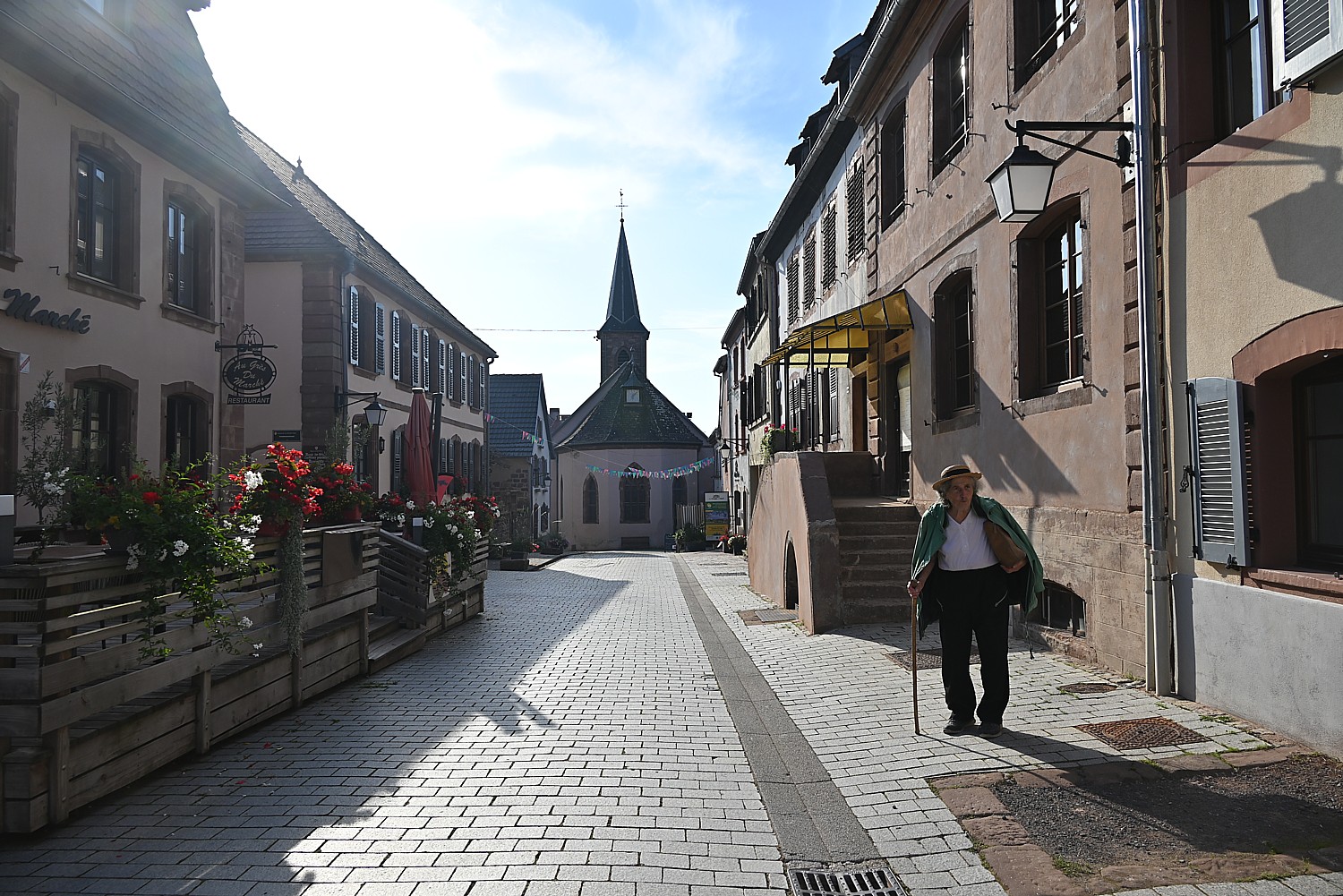
From here, we drive to the hilltop town of La Petite Pierre where there is a 15th century castle. It is late in the afternoon (the setting sun makes for gorgeous colors), and the village looks absolutely vacant, abandoned – almost like a movie set. We walk the ramparts of the castle.
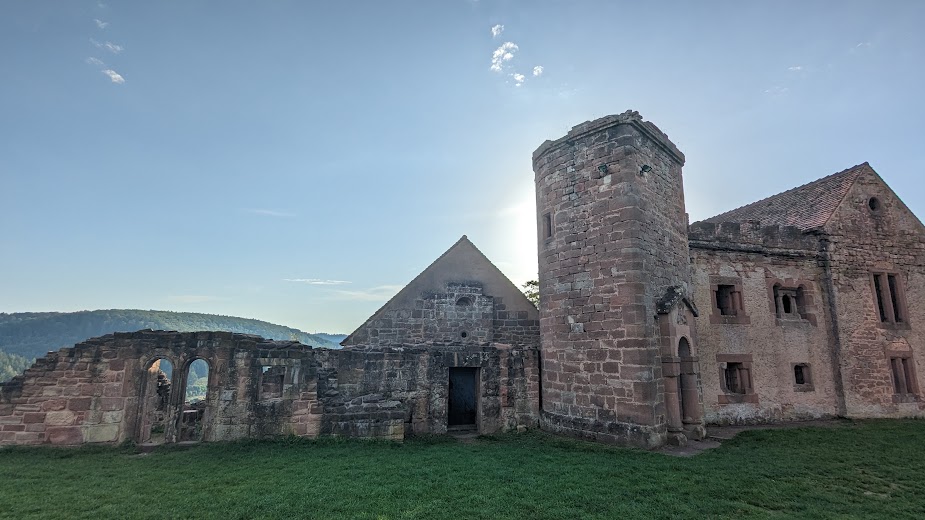
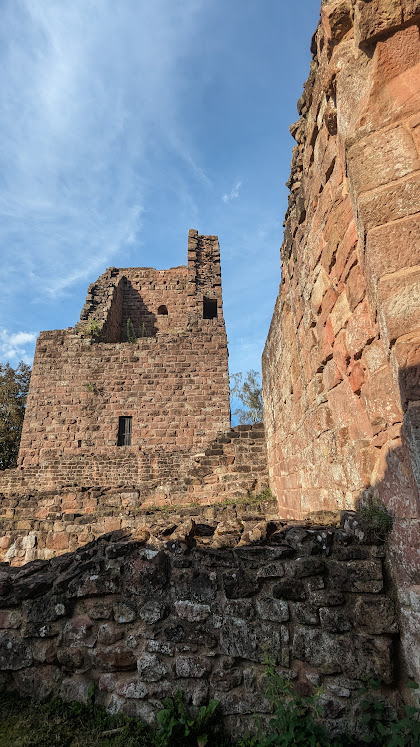
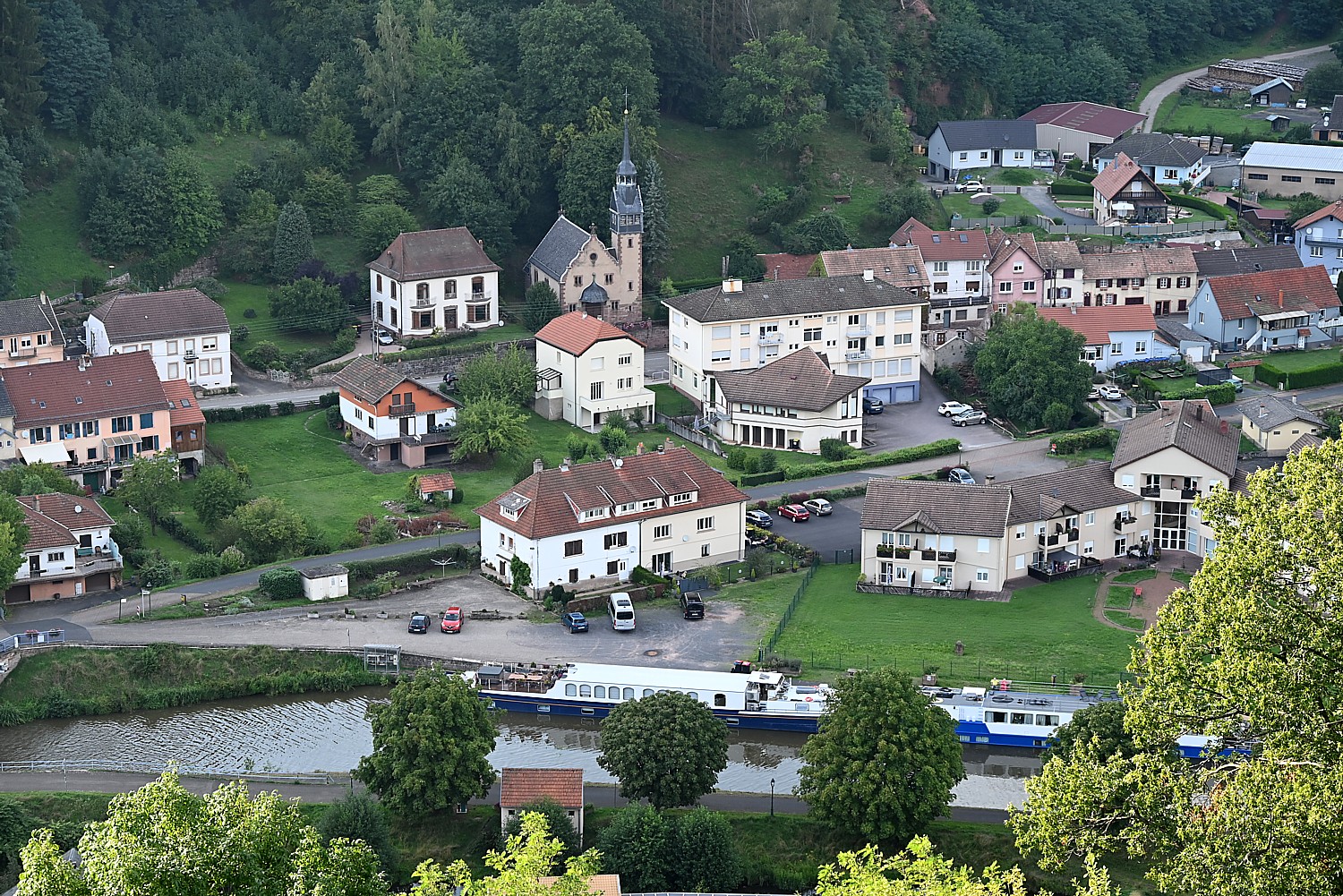
But our adventure is not over – we drive up to the top of a rocky promontory, 322 meters high, that overlooks the Zorn valley, the town of Lutzelbourg, the canal and the Panache to walk among the ruins of the Château du Lutzelbourg. Built by Pierre de Lutzelbourg in the 11th century, the castle was destroyed in 1523; in 1840, the ruins of the castle were to be sold to build the railway but saved from demolition by Adolf Germain, a notary in Phalsbourg. In 1900, the owner at the time, Eugene Koeberle, excavated the ruins. The ruins we visit are more interesting that the intact structures – especially in the late afternoon light. And what a view!
People can hike up a trail (and down) from the town, and I am itching to hike back down to the Panache, but am discouraged because it is too late in the evening.
We are greeted back on board with “French 75,” a cocktail of gin, champagne, lemon juice and sugar syrup (delicious).
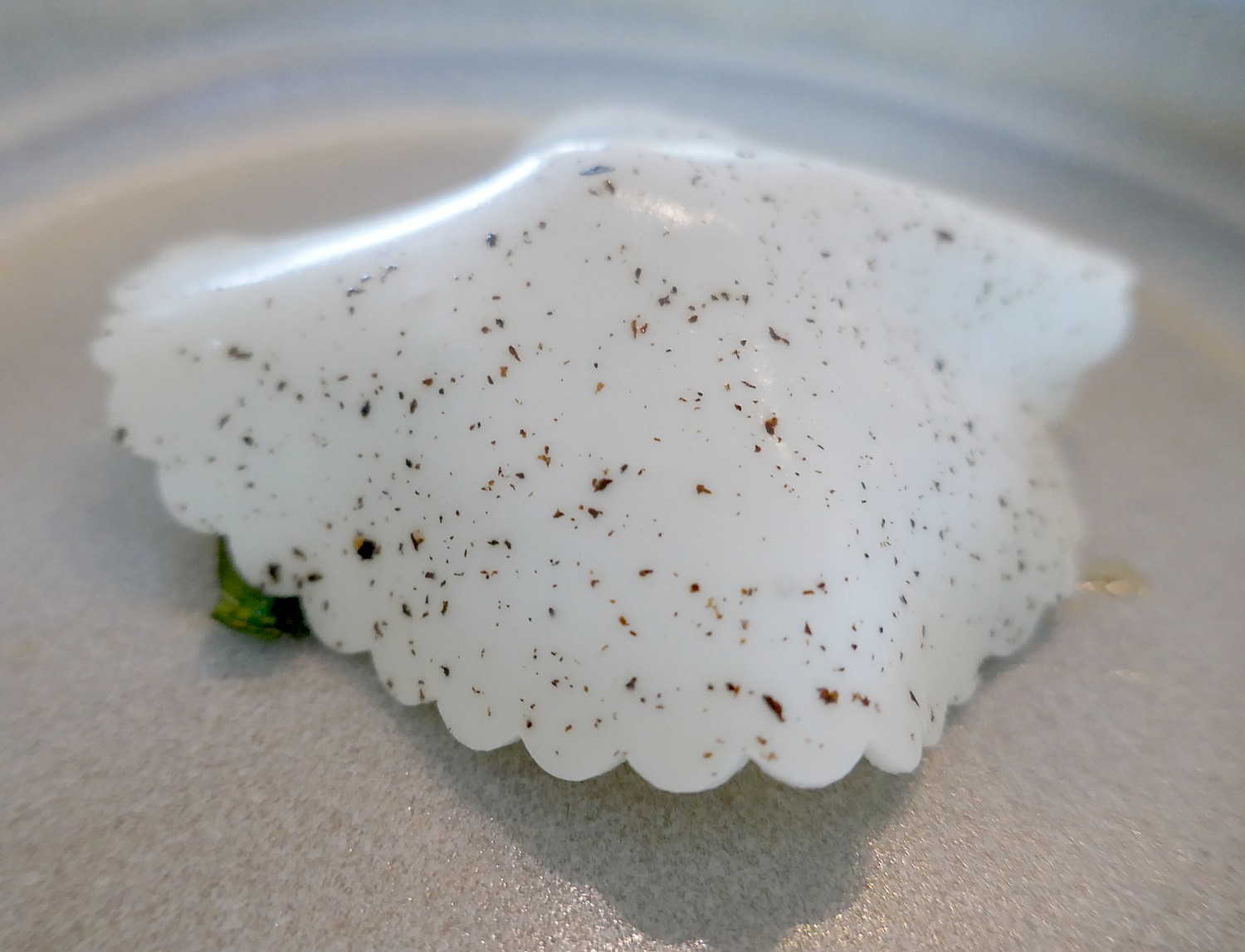
Dinner starts with John Dory served like cerviche, with mint and horseradish in a “veil” gelatin with black lemon, Chef Leo shows us the dried black lemon he uses – it comes from Iran where it is dried for month and presents a smokey, lemon flavor. It is sensational.
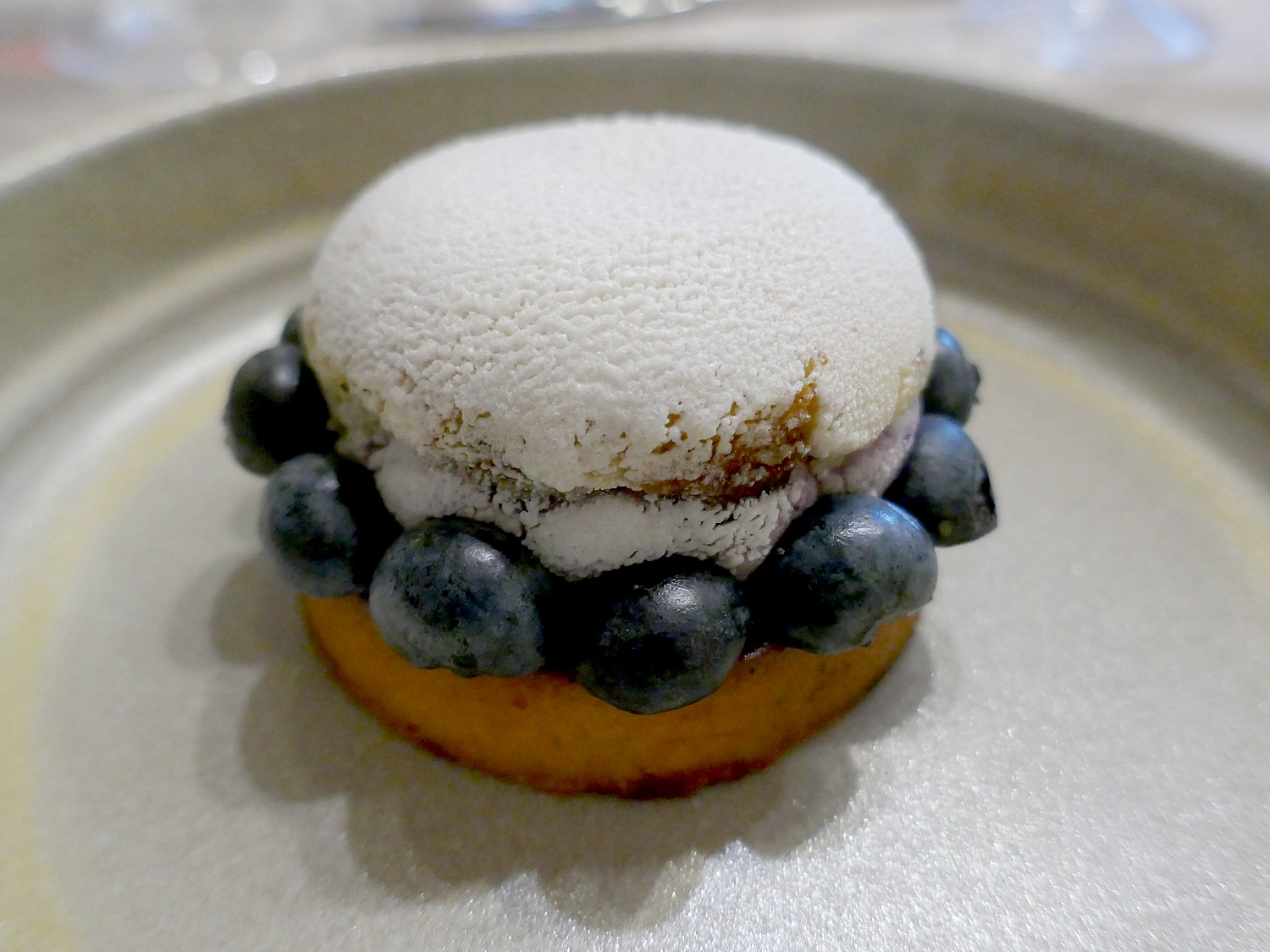
The wines are a Beaune Premier Cru Basion, 2017 Domaine Chanson Chardonnay, and Gasies Margaux 2014 Bordeaux. The cheeses tonight include Tomme de Brebis, a Basque-style cheese half cow, half sheep milk; a Munster from Alsace and Bleu d’Auvergne. The dessert is a phenomenal blueberry tart with white chocolate mousse.
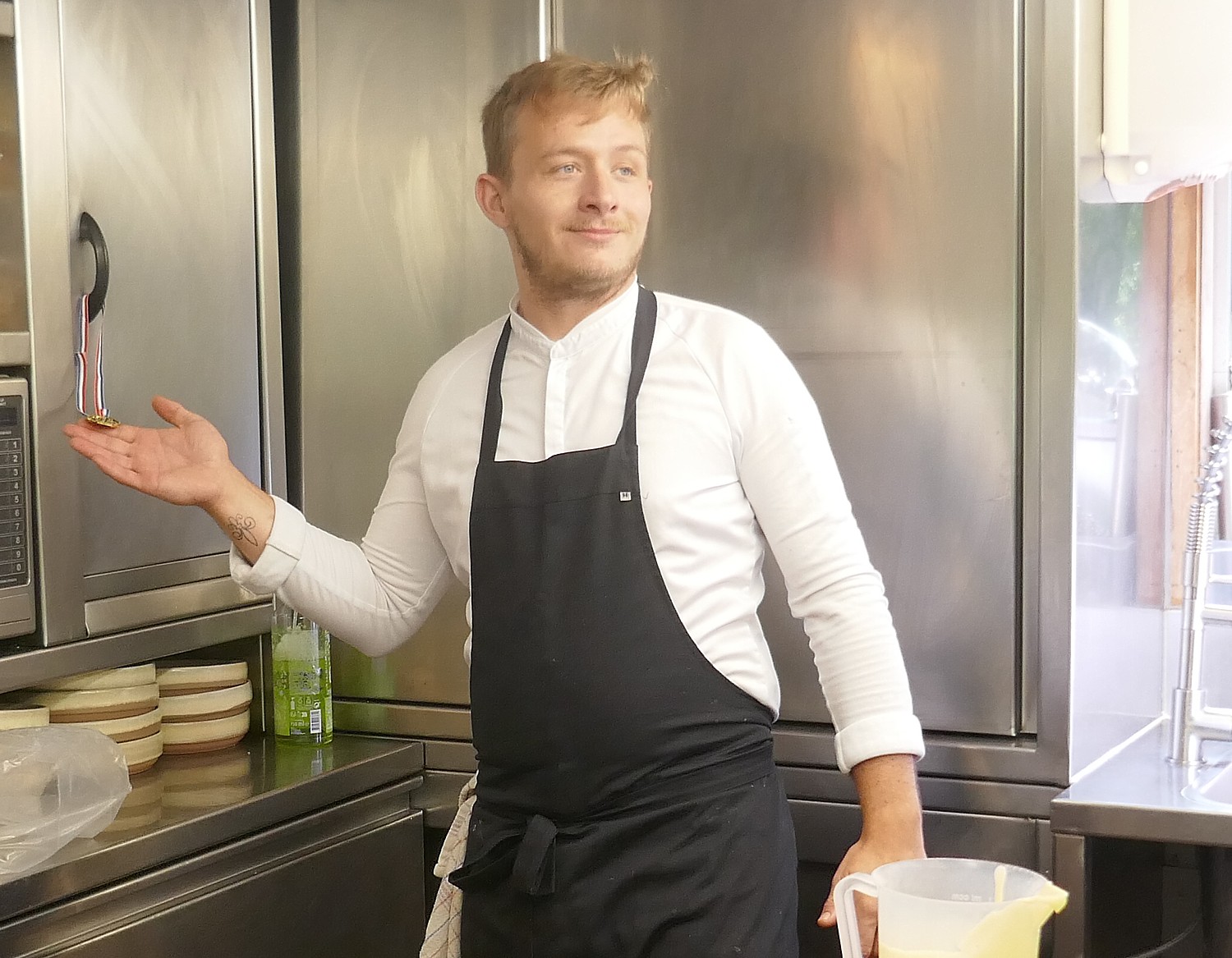
Chef Leo sits down to chat with us after the meal. The 28-year old is spending his first season on the barge hotel. Born in central France, he knew since he was just four years old that the only job he wanted was to be a chef. “My grandma cooked. I loved eating.” He moved when he was 14 to attend catering school. He spent 7 years in Alsace and 2 years in London learning pastry.
“I’ve been in many places, many helpful places.” He likes the freedom of having his own kitchen, doing his own shopping, creating his own recipes. “When I fail, it’s my fault. If I could, I would be 24 hours in the kitchen.”
He says he feeds the crew what the guests eat. “They don’t deserve it,” he jokes. “We have a budget for the crew but I pilfer to feed them the same so they understand what I am serving you.”
His dream (of course) is to have his own restaurant, near Colmar in Alsace.
I tell him his plating is gorgeous. He says his friend is a gallerist. “She helped me with art – color, textures, shapes. Presentation is half of the dish.”
I ask his flavor philosophy. “Really clear and simple – not more than 3-4 items on plate. Popping flavor. I’m always trying new stuff. On the barge, I am free to try. Every week I have new ‘guinea pigs.’ I always try to improve myself in the kitchen. It’s best to learn on my own.”
I think we really lucked out on this European Waterways barge hotel canal cruise.
The next morning, we wake to an atmospheric fog, and as the Panache cruises and I cycle away enroute to Niderviller where the cruise will end, we get a last view of the tops of the ruins of Chateau de Lutzelbourg.
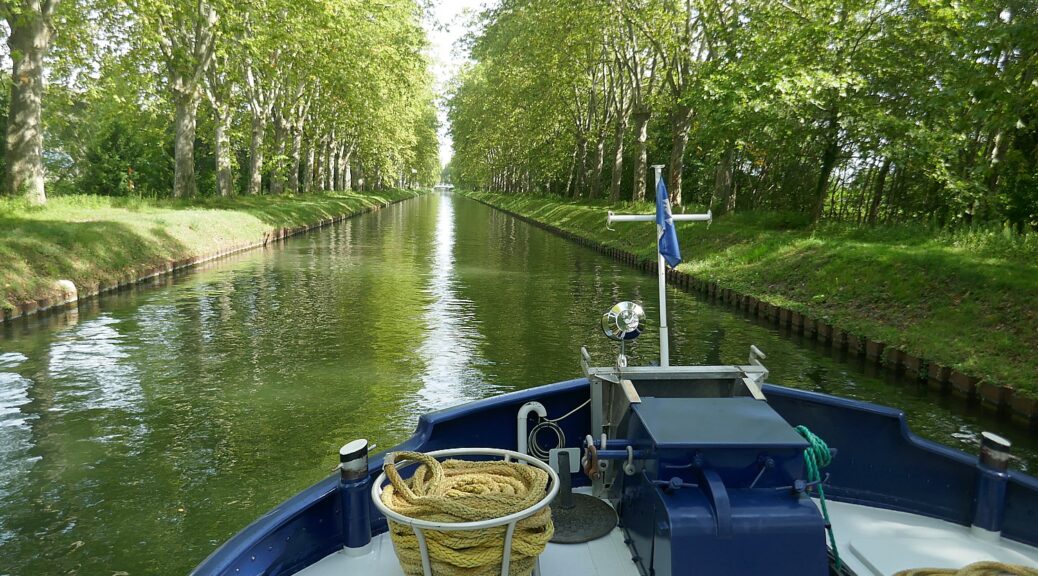
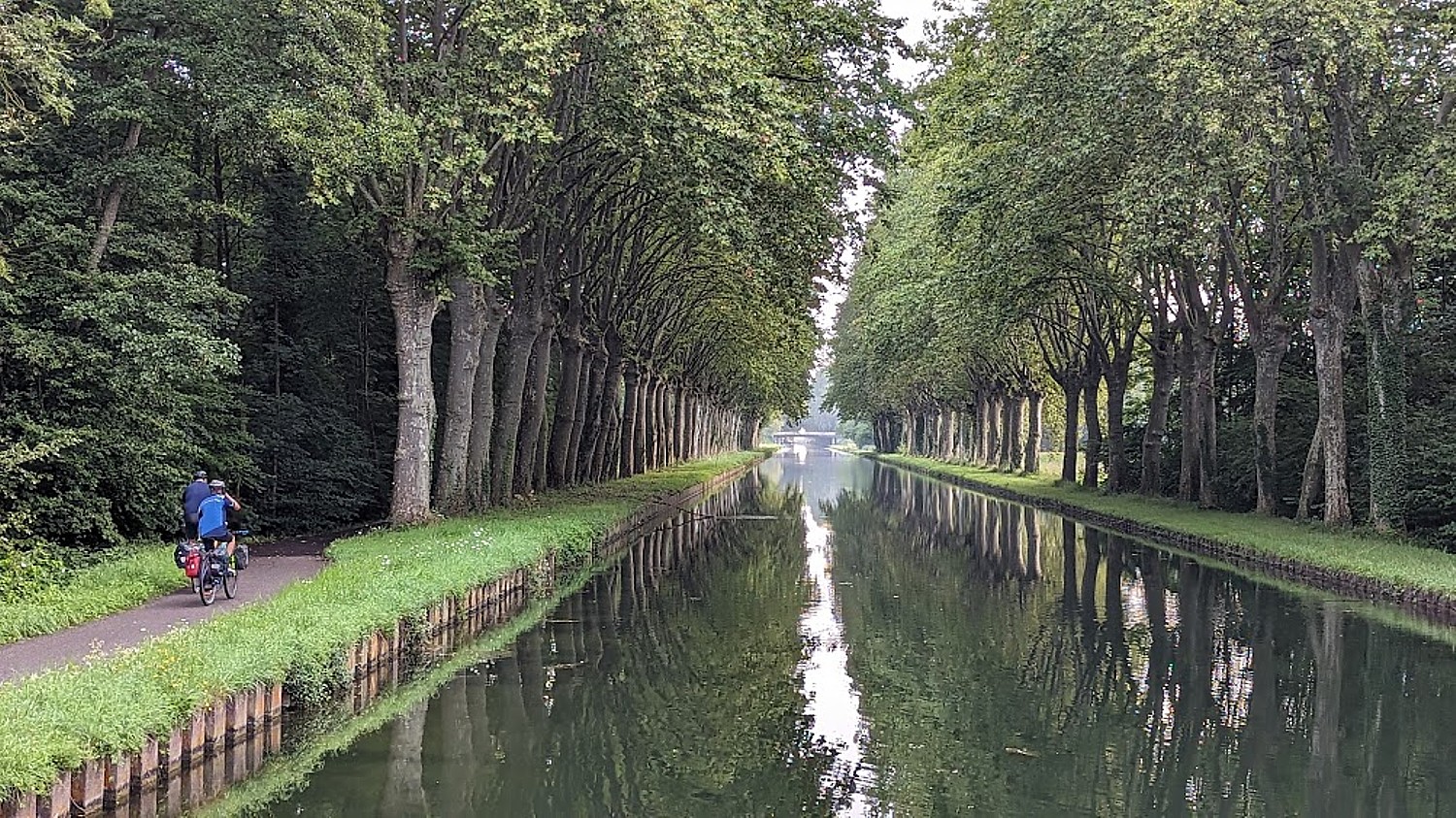
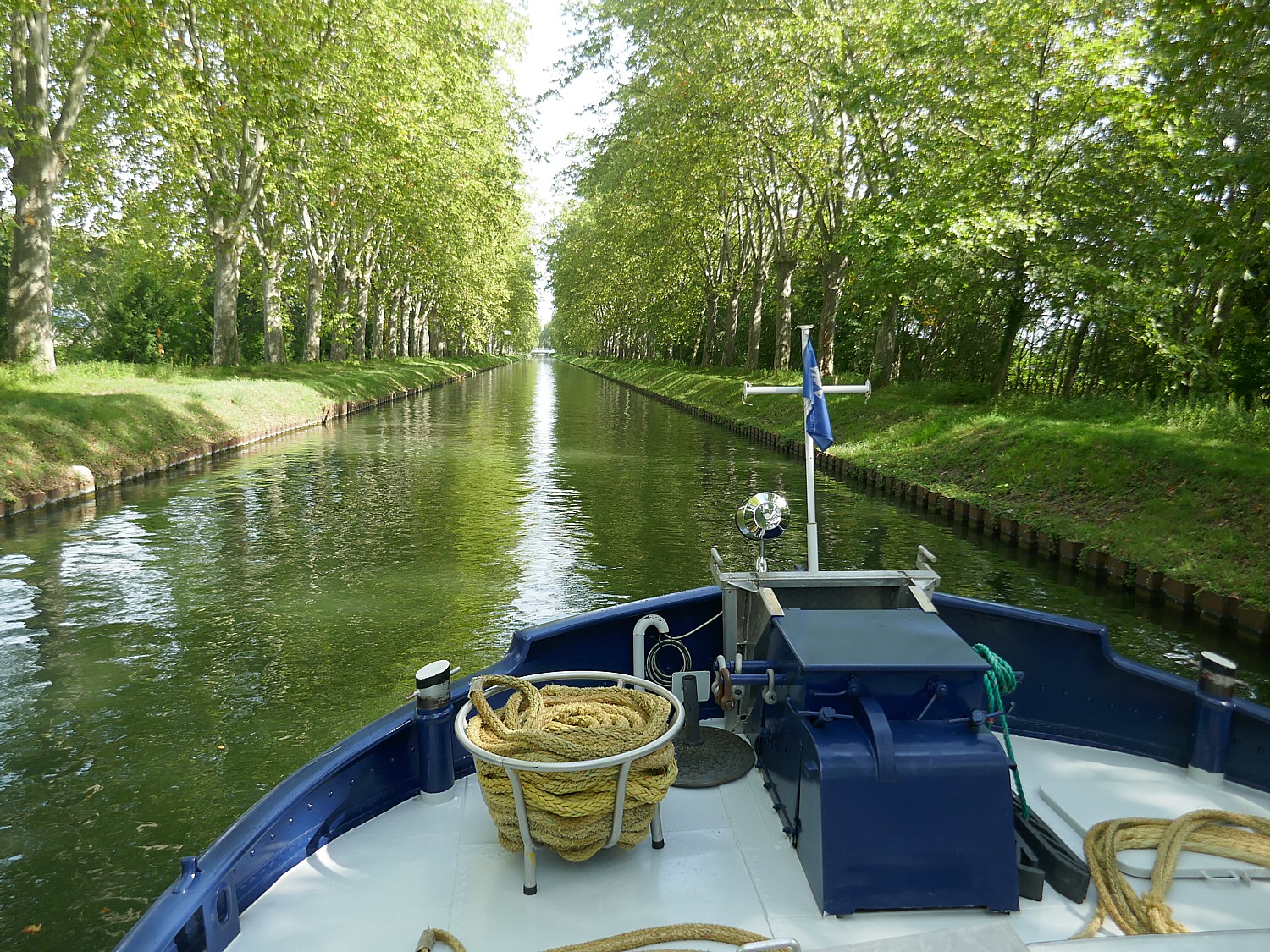
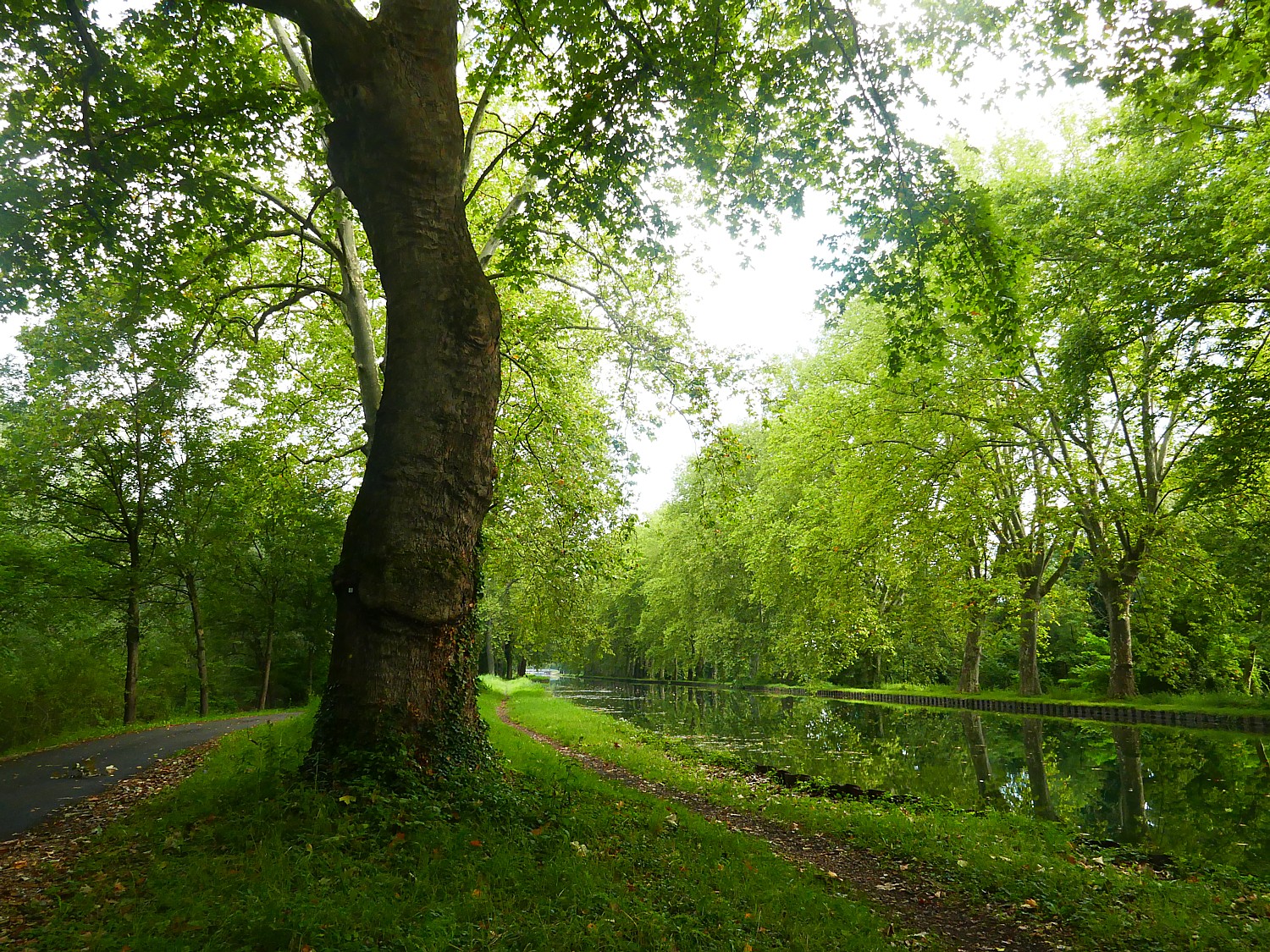
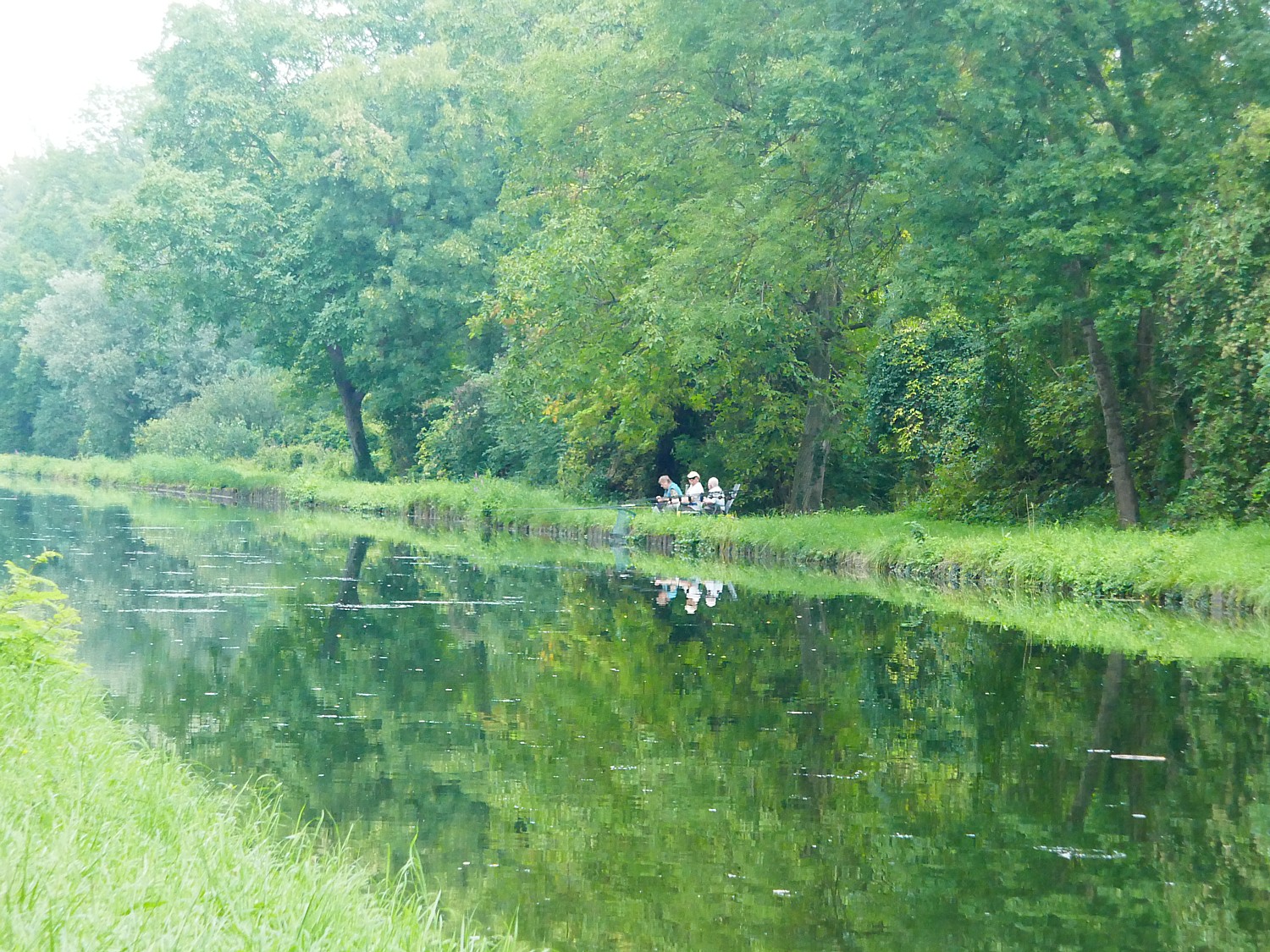
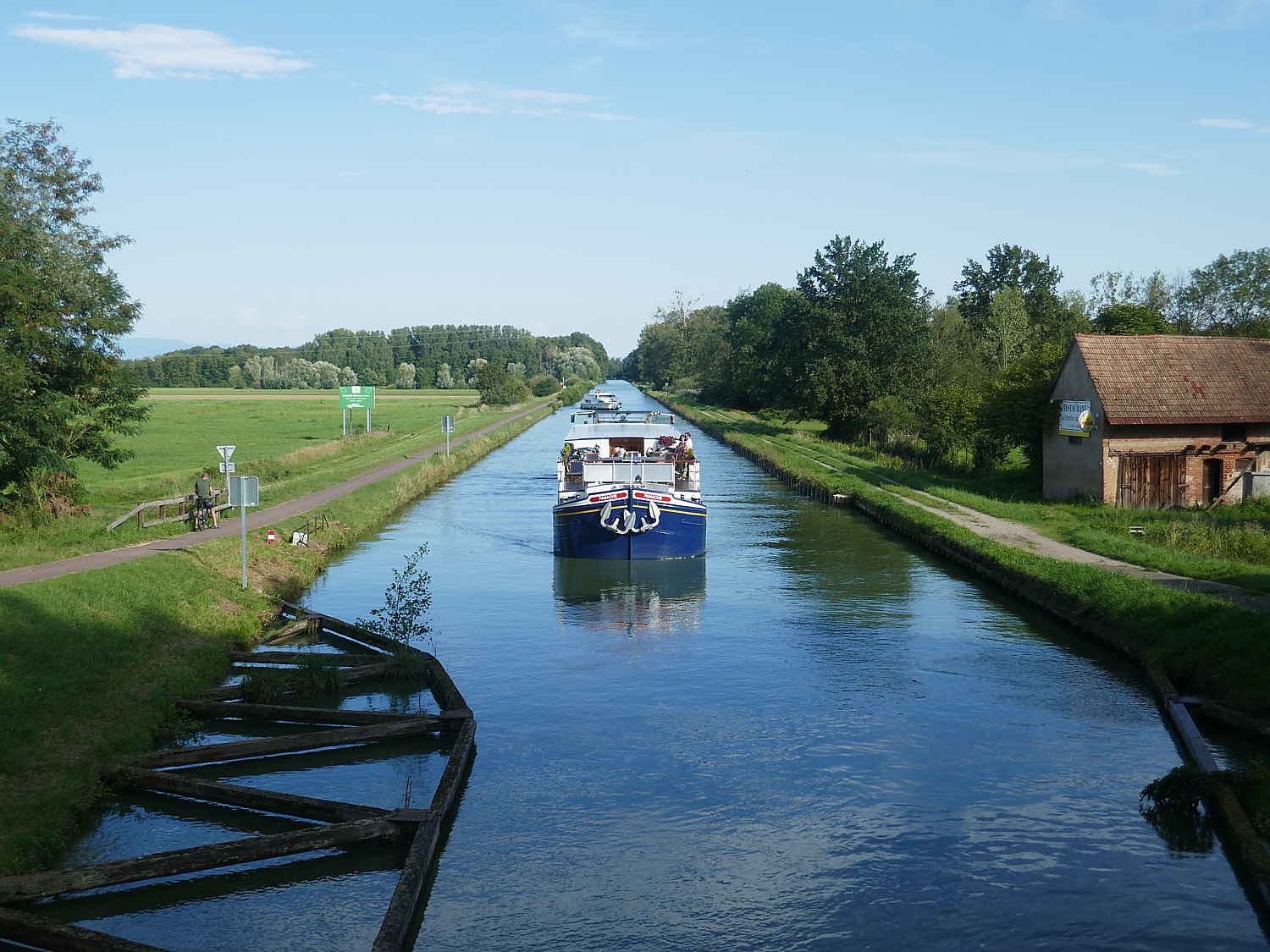
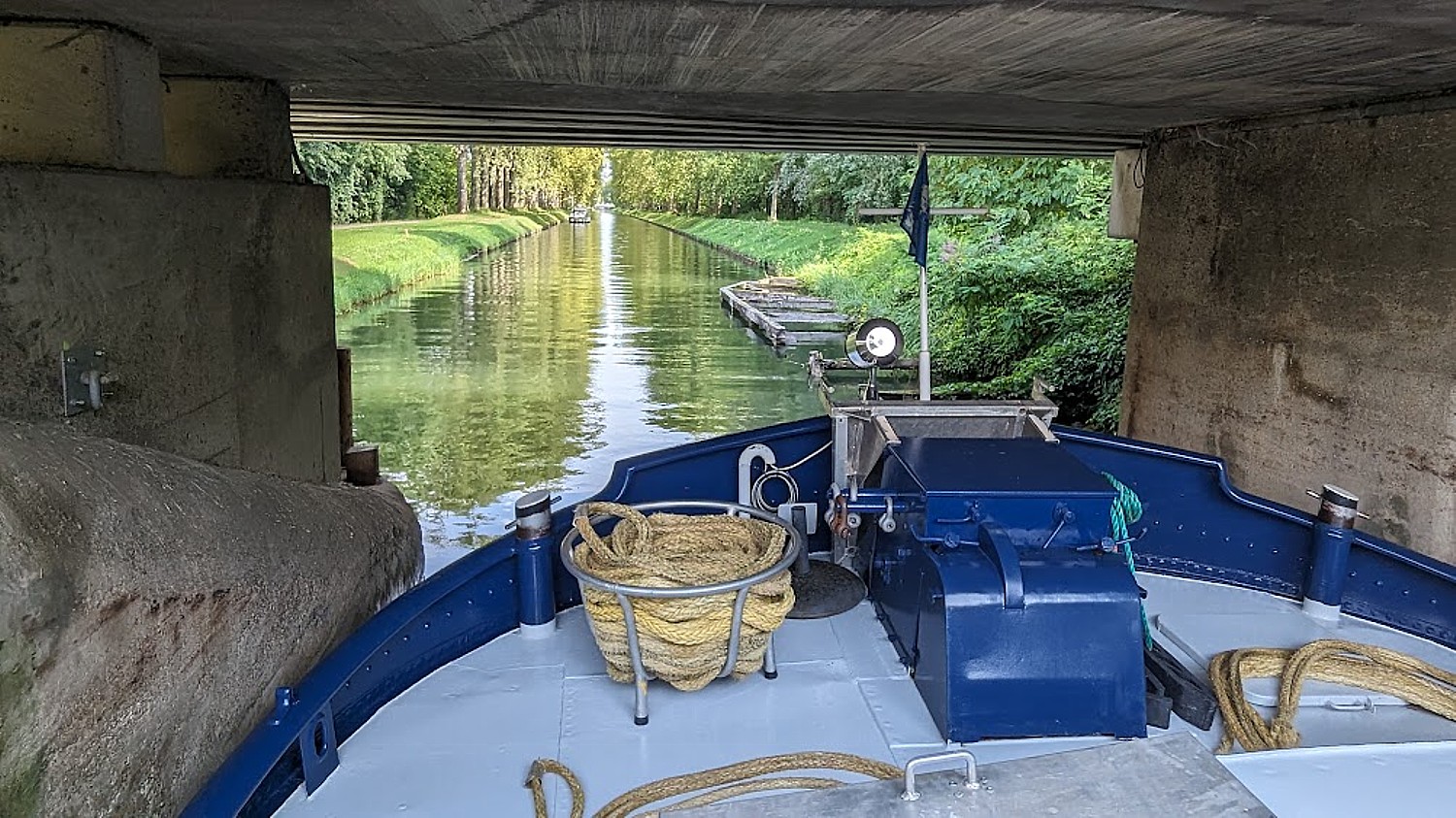
Our first morning cruising the canals of France’s Alsace-Lorraine aboard European Waterways’ luxury barge hotel, Panache, takes us from Krafft on the Canal de la Marne au Rhin toward Strasbourg. The route brings us through a spectacularly picturesque allee of trees that apparently dates back to the time of Napoleon. The landscaping of this avenue of trees is a straight line with the trees uniform in shape. You have the feeling of floating through Impressionist paintings – it is so exquisitely beautiful, especially with the morning light creating an ethereal tableau.
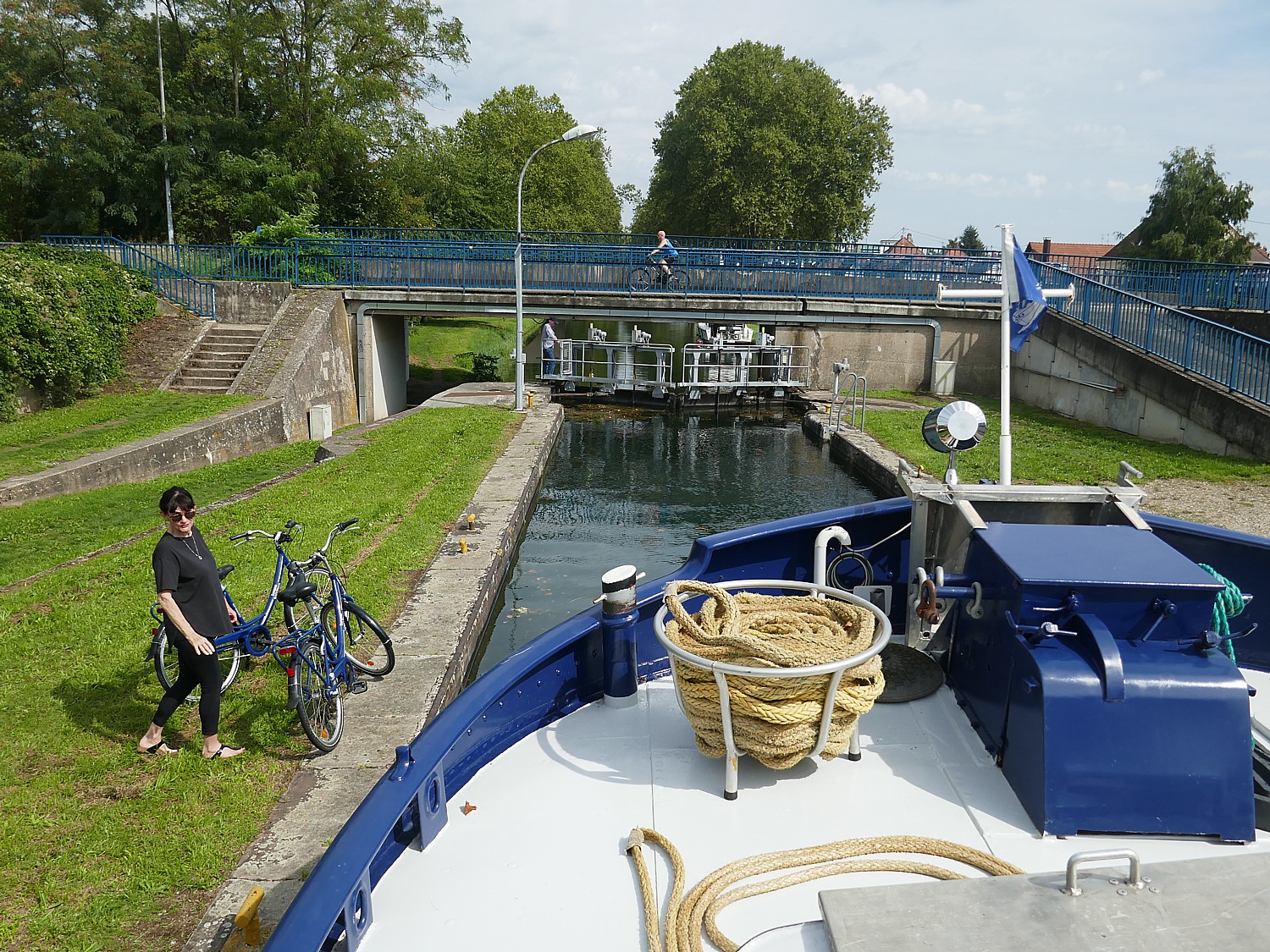
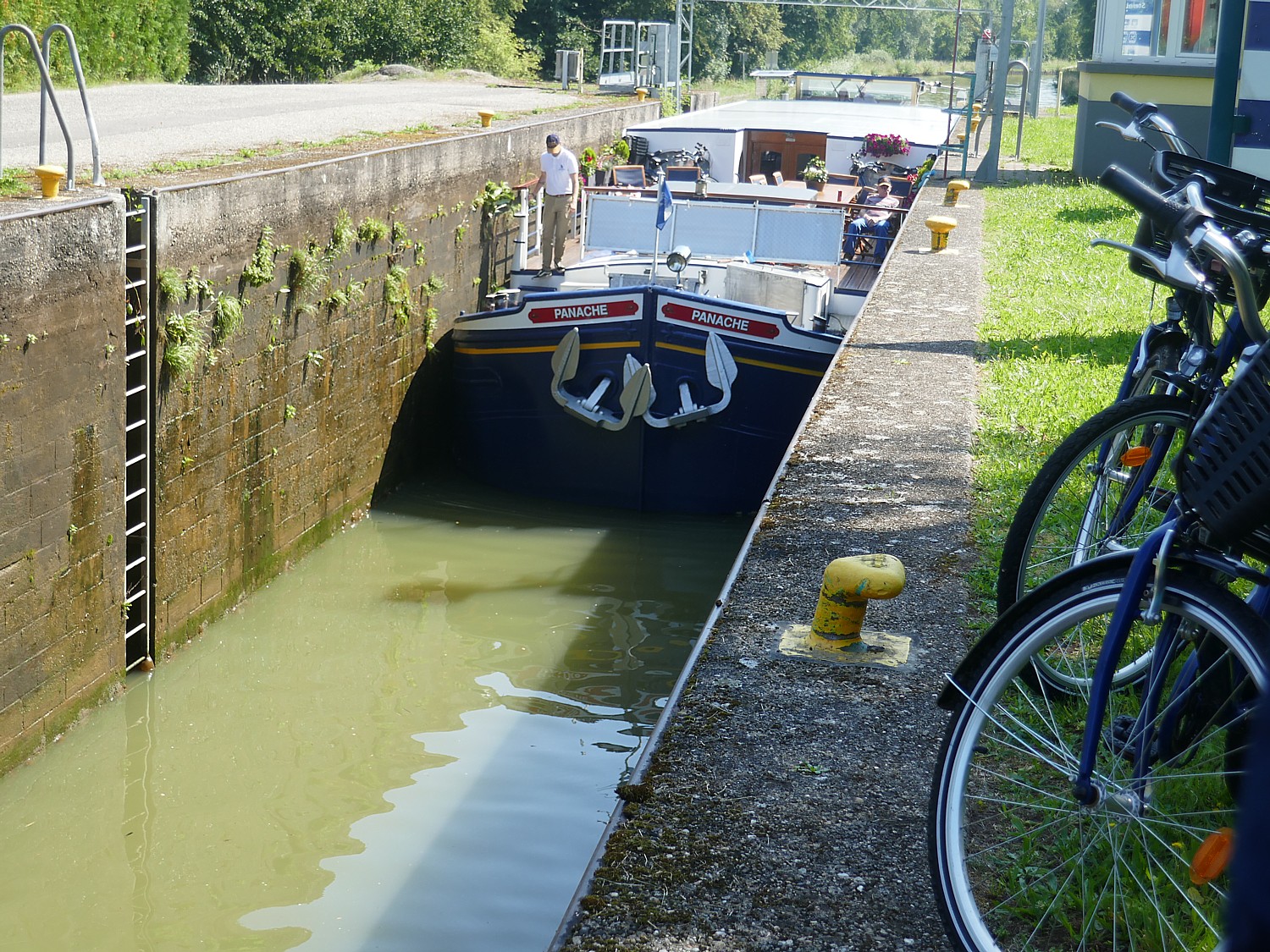
We cruise through locks 81 to 85. A towpath along the canal has been repurposed for biking and walking and I immediately set out to ride. Captain Brian readies the bikes and puts it on the bank for us – it doesn’t take long to get the hang of stepping on or off the boat as it lifts up or down in the lock. (I quickly learn by mistake to watch the signs that tell you when to cross over the canal to stay on the path.)
I soon realize that I bike three times as fast as the boat travels, especially since it also spends time going through various locks, so I can enjoy biking the route, then riding back to a lock as the boat approaches, and get to see the scenery all over again from the perspective of the boat’s sundeck (also, it is usually lunch time – don’t want to miss that).
Lunch this first day is a salad of beet root and goat cheese; chicken with a moelle sauce and polenta, served with Saint Romain Chardonnay from Burgundy and La Baronne Alaric (2014), a Syrah blend from the south of France. The cheeses we get to experience include a cow’s milk blue cheese made from a 1200-year old recipe from Auvergne; a Reblochon from Savoie, made from raw cow milk and aged (not pasteurized) for 6-8 weeks.
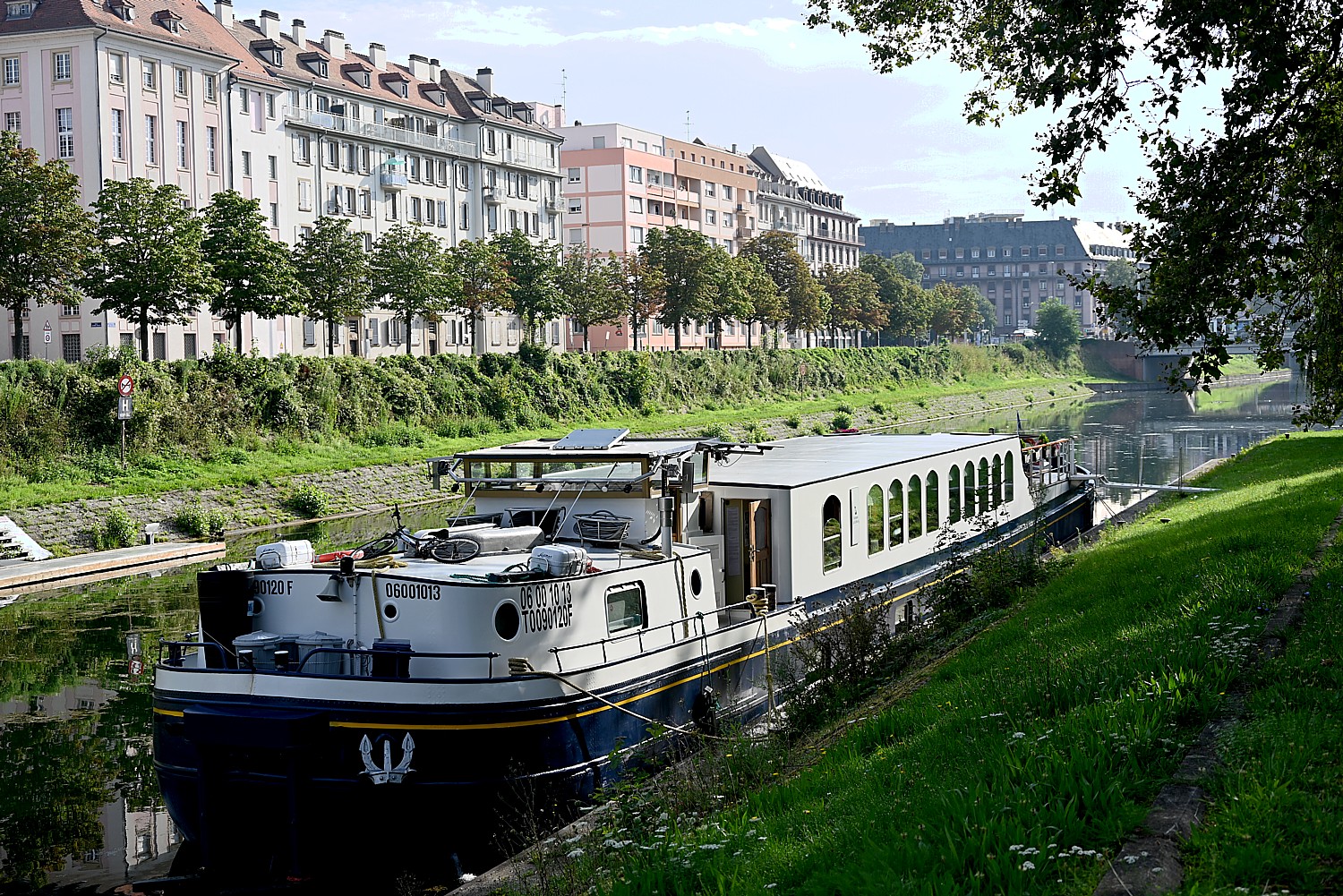
We arrive at Strasbourg, where we tie up at a canal at the outer ring of the historic center, Le Petit France, and walk off the boat to explore on our own before meeting up at Le Pont du Corbeau for a walking tour guided by Captain Brian. (I get lost and after getting directions from a local woman, am staring down at my phone when I hear my name as I am literally walking passed our group waiting at the bridge.)
Le Pont du Corbeau was originally called the Schindbrucke (Bridge of Tortures): a law from 1411 that specified that anyone sentenced to death be sewn up inside a linen sack and thrown into the river – a practice which continued until 1617. From 1466 onwards, thieves were locked up in a cage on the bridge to be mocked by passersby before being thrown into the River Ill to swim for their lives. In 1502, a stone crucifix was affixed to the beams of the bridge for people convicted of crimes to repent their acts.
I had already had a couple of days in Strasbourg to explore on my own, but really enjoy Captain Brian’s narration.
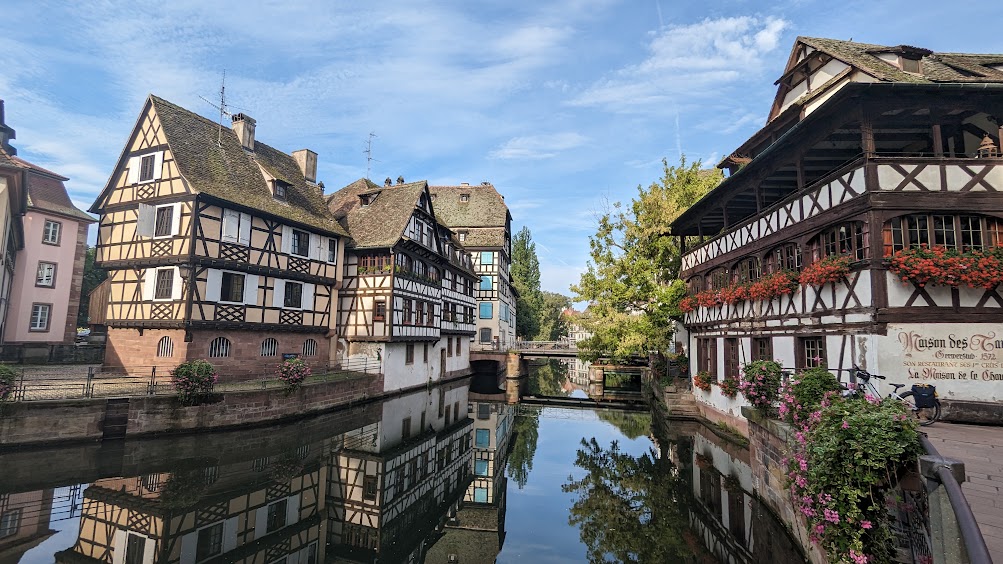
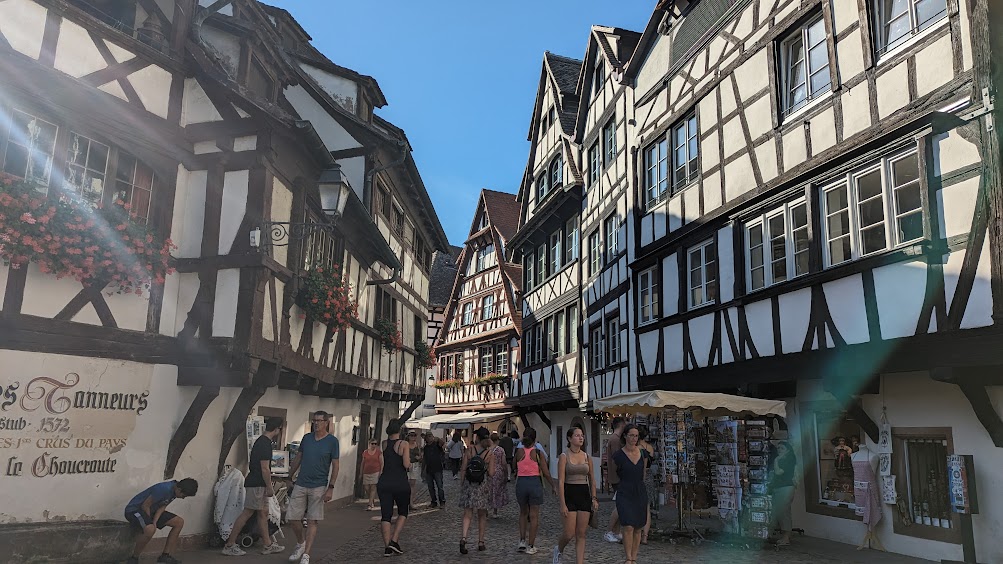
We walk through Le Petit France, the section we find so charming and picturesque with its painted houses with wood beams, floral arrangements, and immaculate streets. But Captain Brian notes, before the 18th century, this district would have been the poorest, stinkiest part of town, populated with fishermen, tanners and animals. The structures would have been made with wood beams coated with a varnish made of a mixture of blood and vinegar (“it looks good but stinks”); waste would have been thrown directly into the canal. The closer to the Cathedral, though, the richer you likely would be – the Chamber of Commerce is located a stone’s throw away.
That’s when we come to Place Gutenberg, which provides an entranceway toward the Cathedral. At the center, there is an impressive monument to Johannes Gutenberg, the German inventor of moveable type. Brian tells us that it is said Gutenberg got his inspiration for the printing press from the wine presses he saw when he lived in Strasbourg. (I learn more about this when I return to Strasbourg at the end of the cruise and visit the City historical museum.)
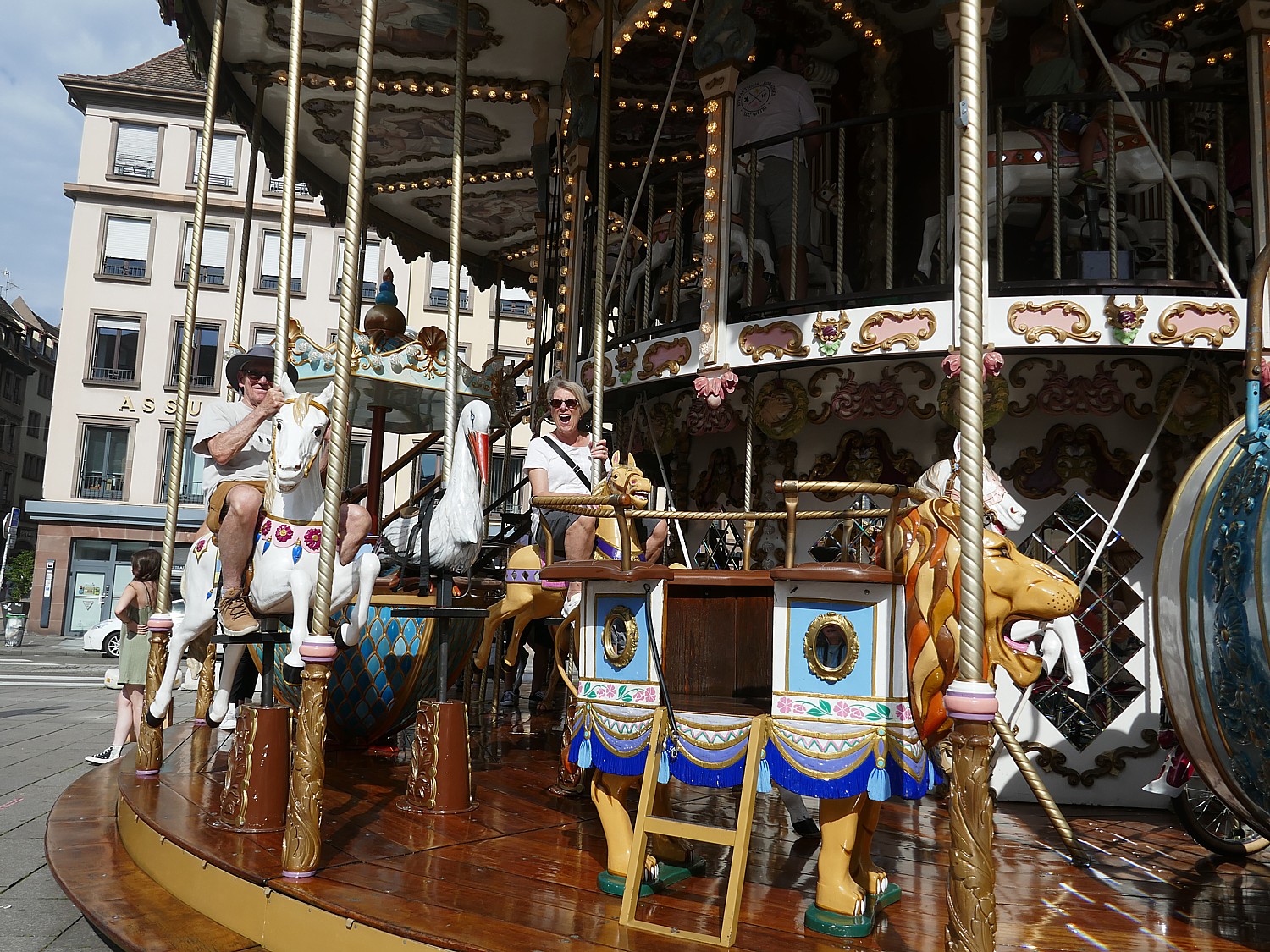
Gutenberg Place also has a marvelous old-timey carousel and since our fellow passengers, Kathy and Marc, are celebrating their 25th anniversary today and Kathy has expressed interest in riding it, we whisper to Marc he should take her for a ride.
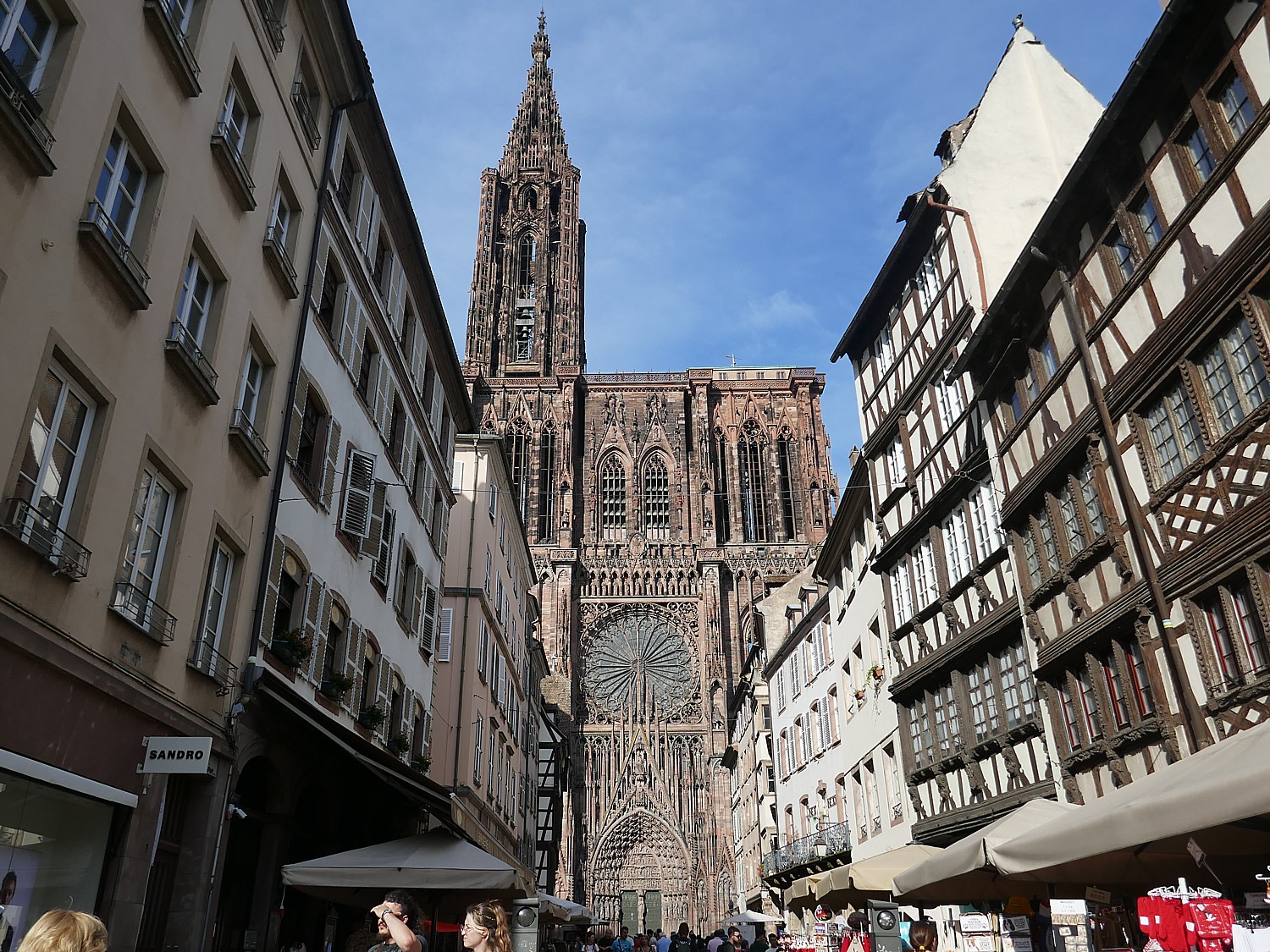
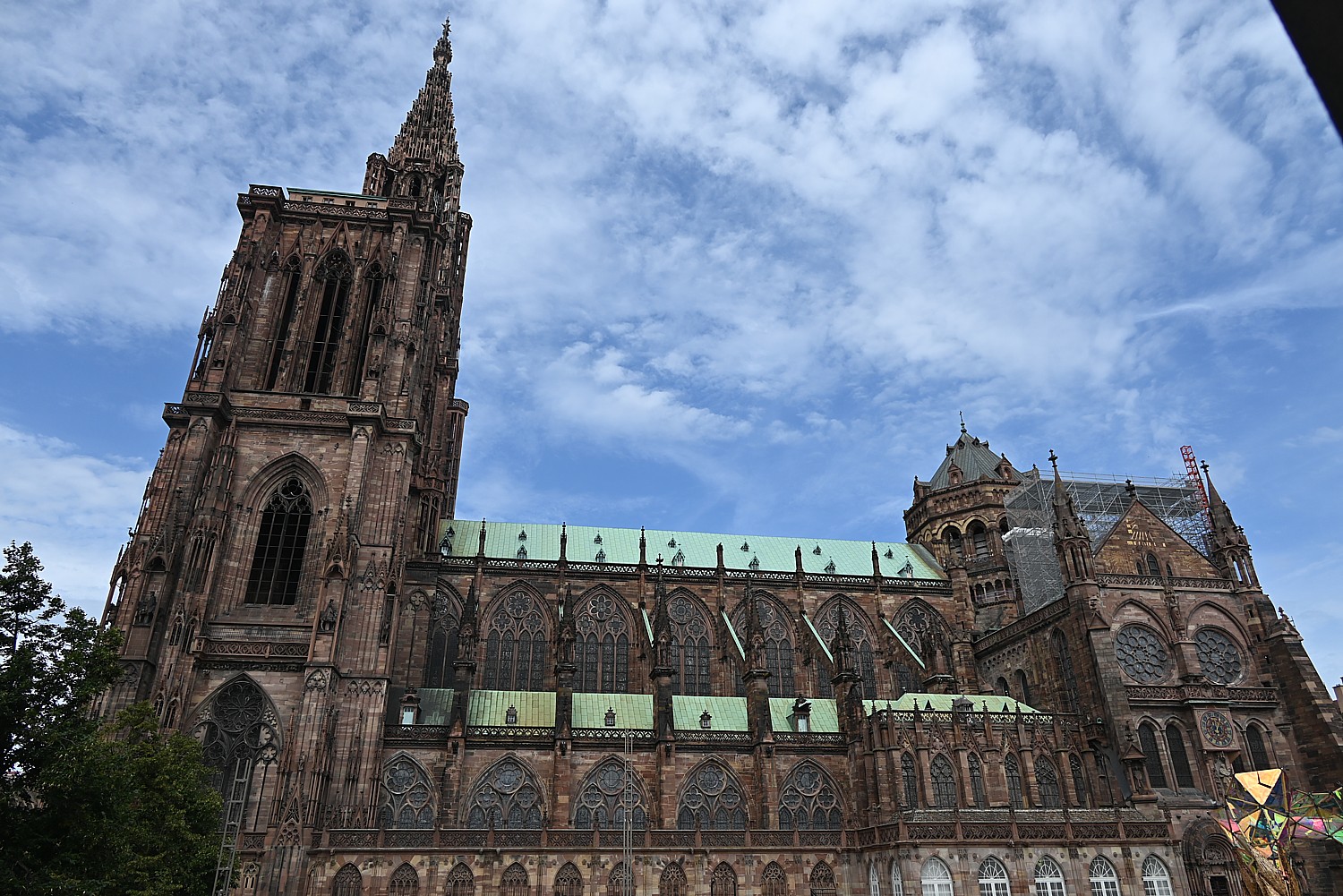
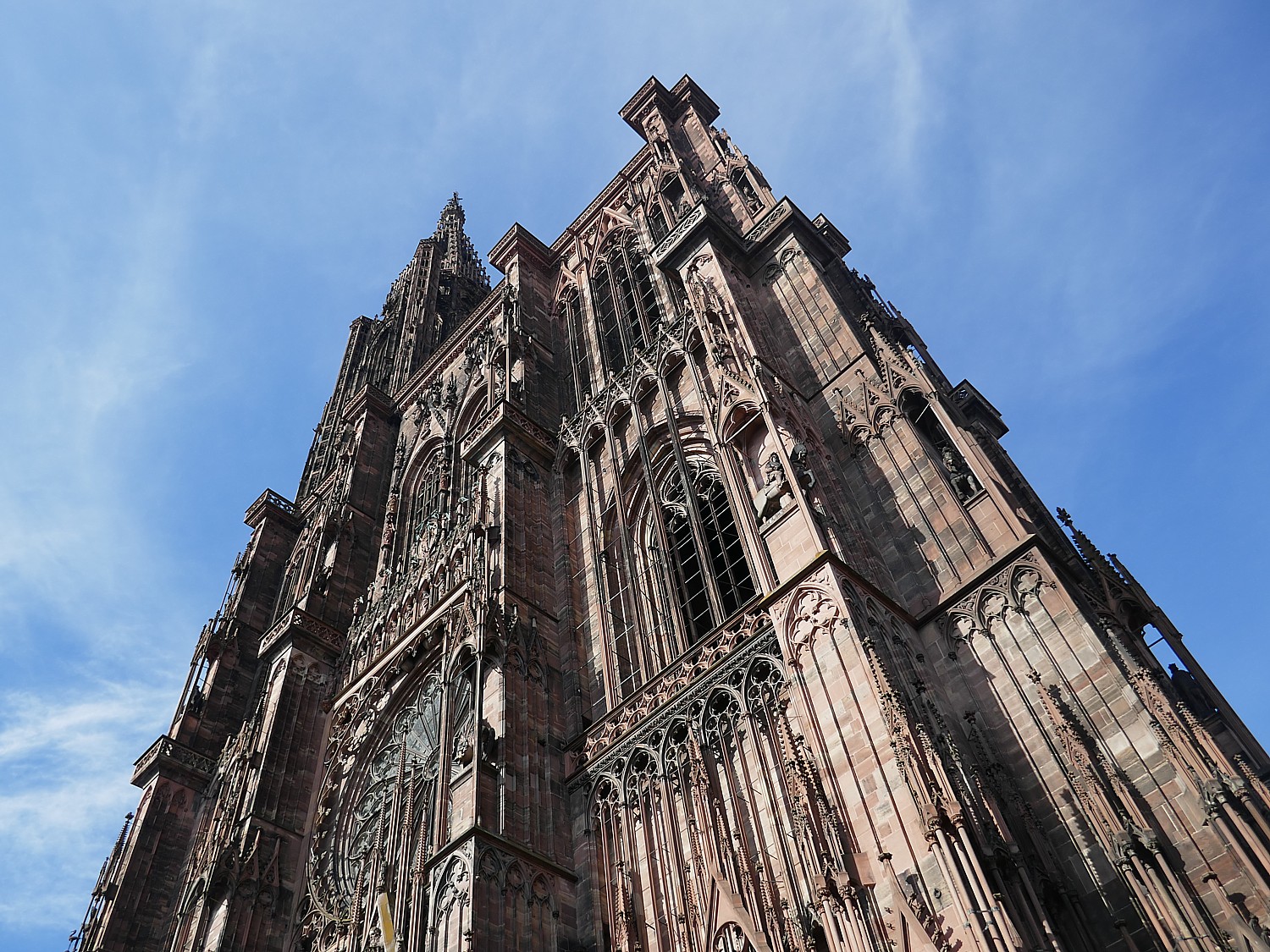
We next walk to Notre-Dame of Strasbourg, a fabulous Cathedral that is considered one of the finest examples of Rayonnant Gothic architecture in Europe, built on a site where a church has stood since the 4-5th century. Construction began in 1015, was relaunched in 1190, and finished in 1439. Erwin von Steinbach, credited as the main architect, worked on it from 1277 until his death in 1318, continued by his son Johannes and his grandson, Gerlach.
With the bell tower at 142 meters (466 feet) high, Strasbourg’s Cathedral stood as the world’s tallest building for 227 years, from 1647 to 1874. It is still the sixth tallest church in the world, and the tallest structure built entirely in the Middle Ages. It was visible across Alsace, as far off as the Black Forest and the Vosges Mountains, from which the reddish-brown sandstone that gives the cathedral its distinctive color was quarried.
The major attractions of the Cathedral include the Astronomical Clock, a Renaissance masterpiece, and its stained glass windows.
The Musee de L’Oeurvre Notre-Dame just across the square, which I visited, is where you can see the original statuary and art that decorated the Cathedral.
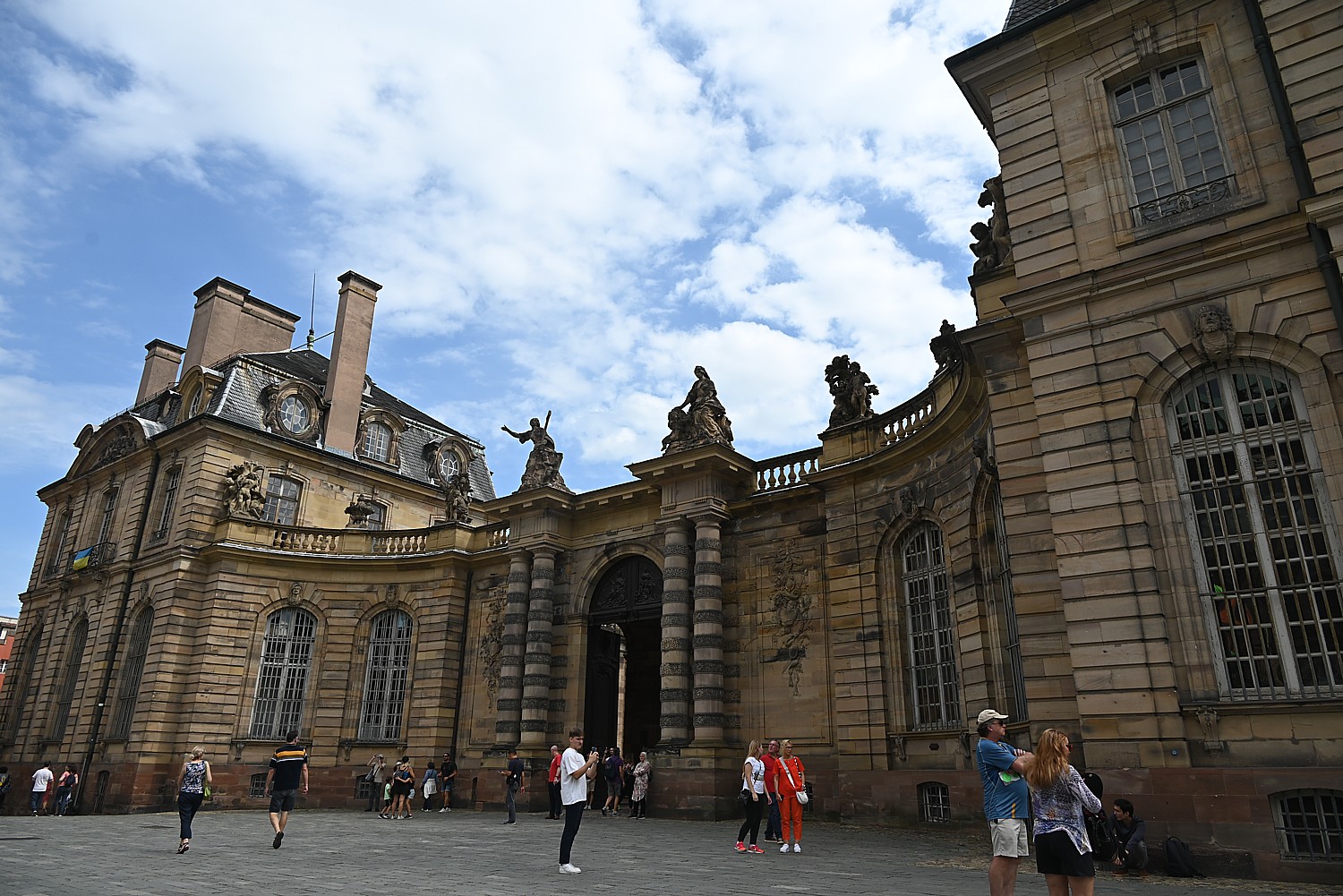
Also across the square – which is a delightfully festive place – there is the Palais Rohan, which Louis XIV built for the Bishop to cement his bond with the Catholic Church. Today it houses three important museums – Fine Arts, Decorative Arts and Archaeology – which I have visited.
We continue to wander on our own, exploring the narrow cobblestone streets, returning to the ship by 7 pm for dinner.
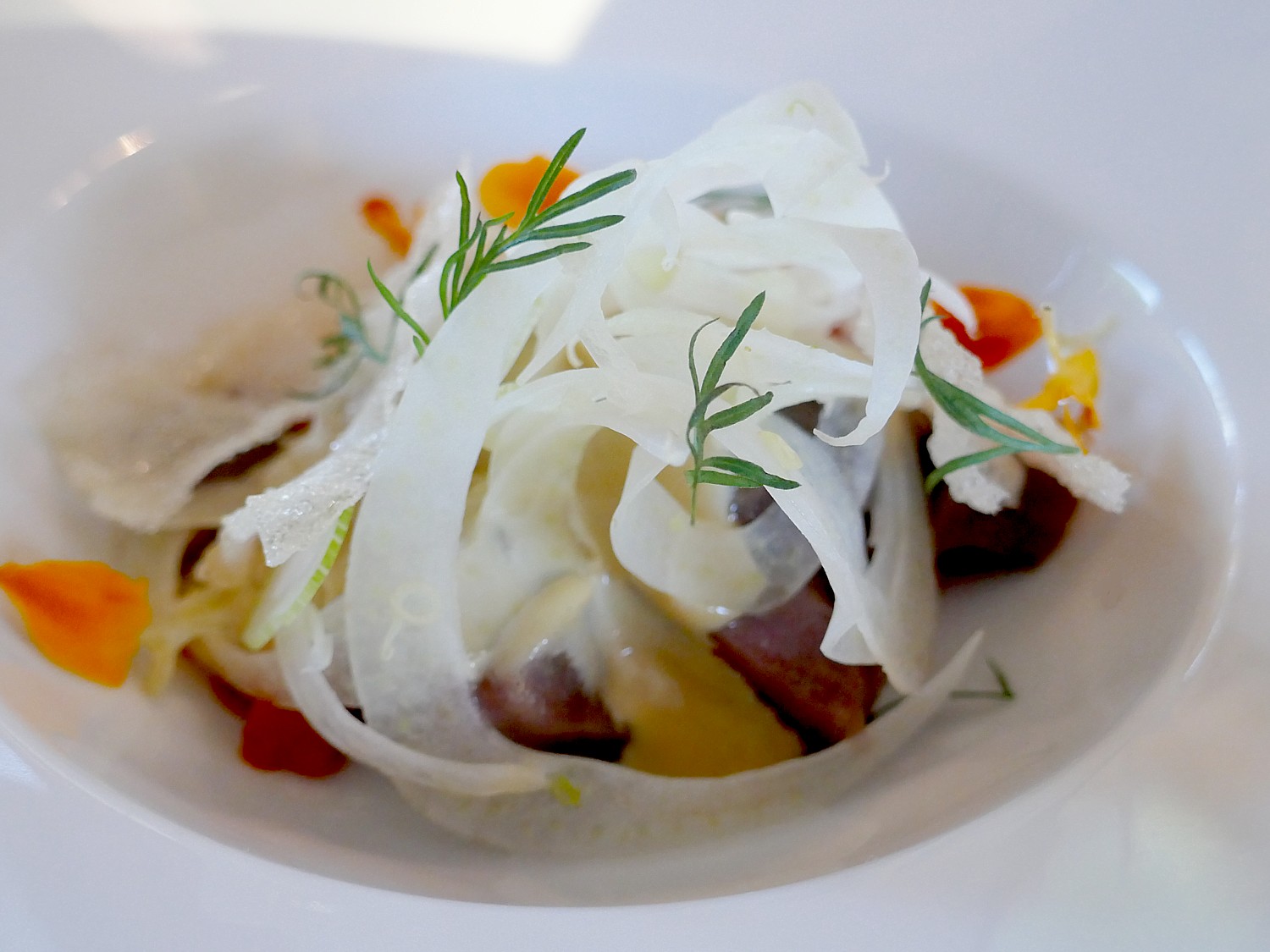
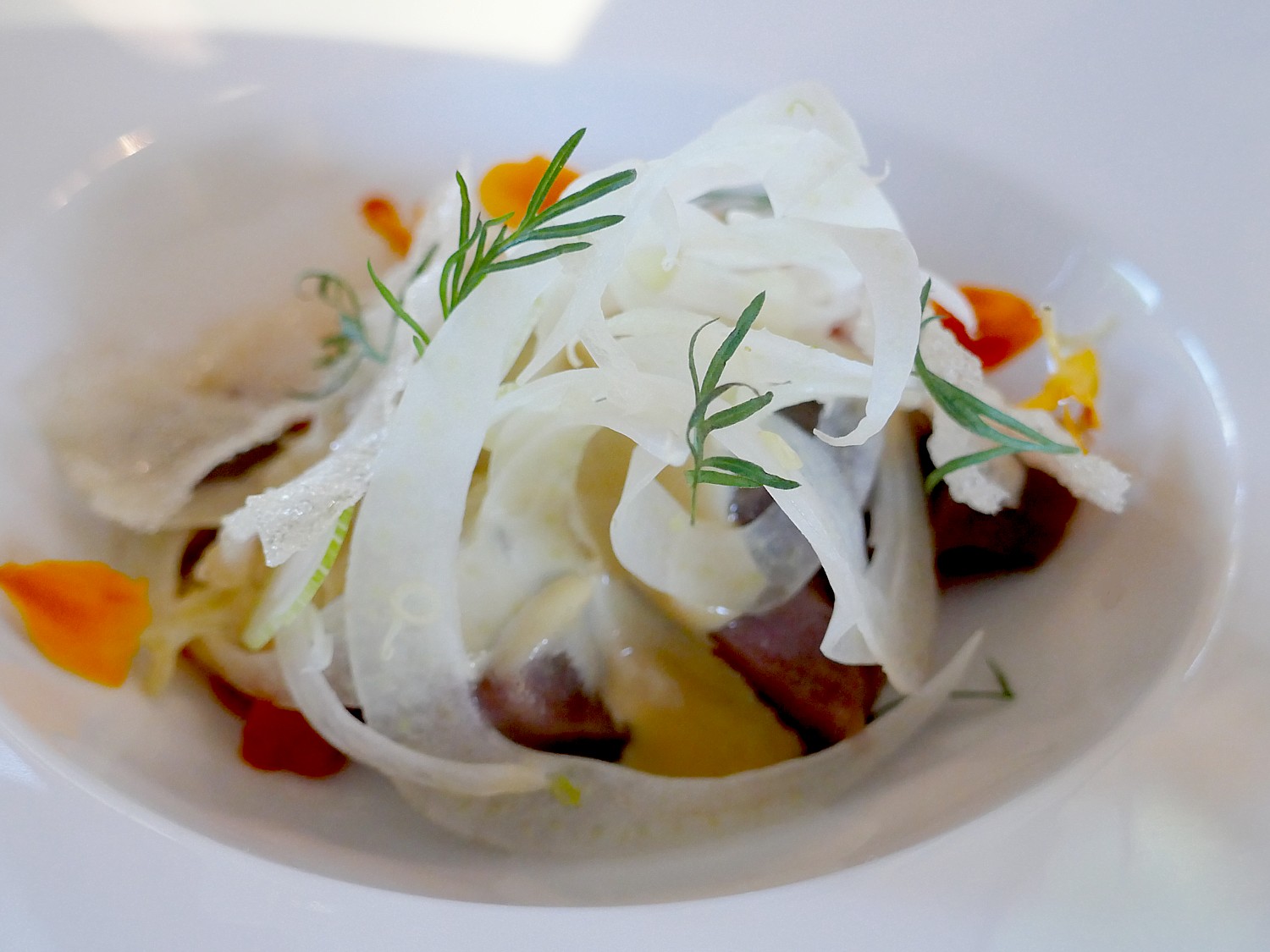
Dinner features tuna tartare with ponzu (a citrus-based sauce commonly used in Japanese cuisine prepared with soy sauce, lime and fennel), served in a rice paper cup with edible flowers (marvelous – so flavorful but not spicey); octopus in black sauce (squid ink), marinated and baked in the oven with eggplant (it took seven hours to cook). The wines are Santenay La Forge (2021) from Cote D’Or; the red is Mercurey, a Bourgogne from Louis Jadot, pairing perfectly with the meal.
The cheeses tonight include the “Queen of Cheese,” Brie de Meaux, “the most popular cheese in the world,” a salty, creamy cow’s milk cheese from Ile-de-France served uncooked and unpressed that you are supposed to hold in your mouth as it melts; Langres, a cow’s milk cheese from Champagne-Ardenne (the rind is designed to be served with Champagne put into a cross hatch on the top which is absorbed and moistens the cheese); and Selles-sur-Cher,a goat’s milk cheese from the Loire Valley, which is dusted with charcoal, to protect and seal the shape, that has a mineral flavor of rind and a briny, tangy center, served with honey.
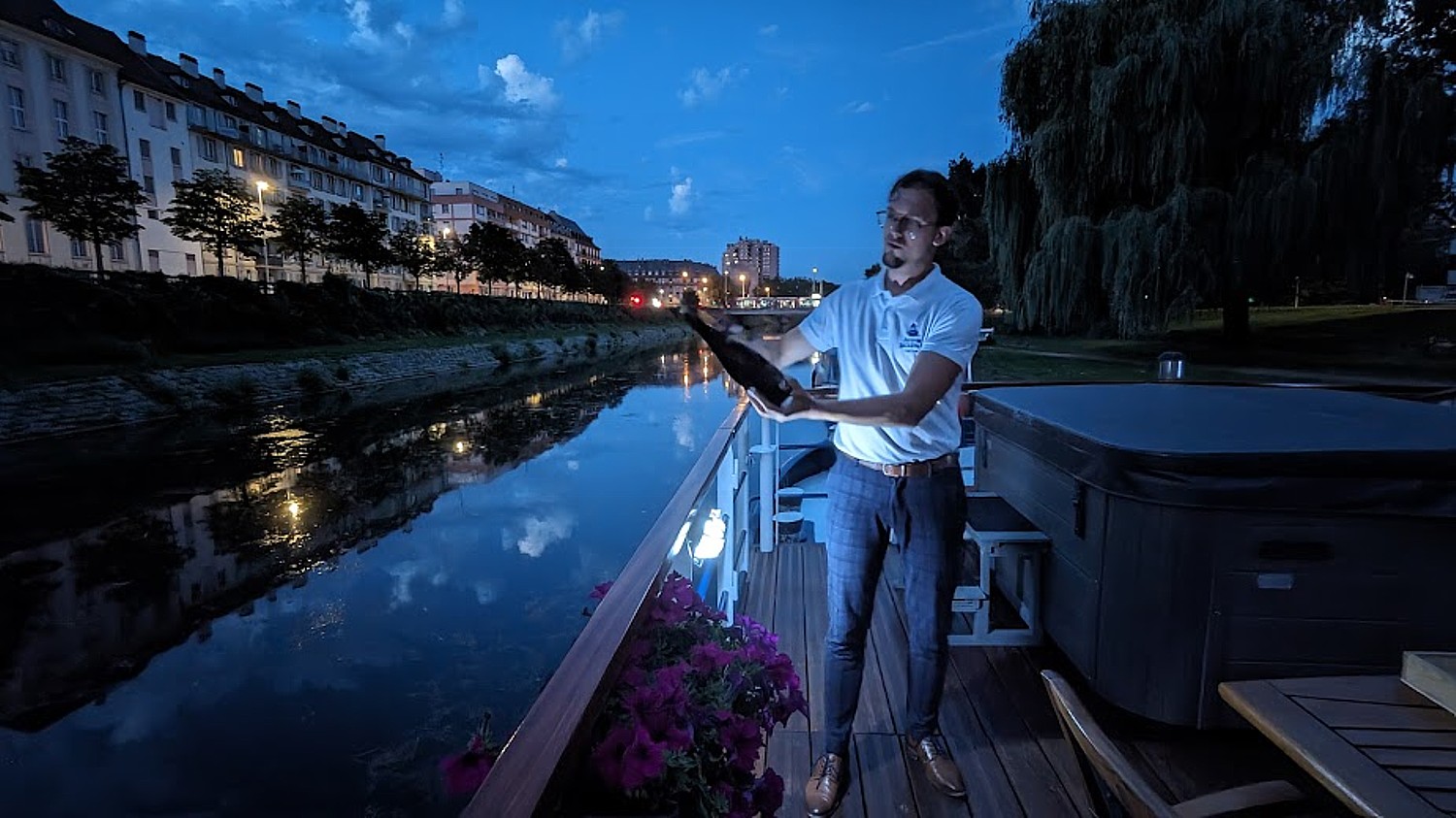
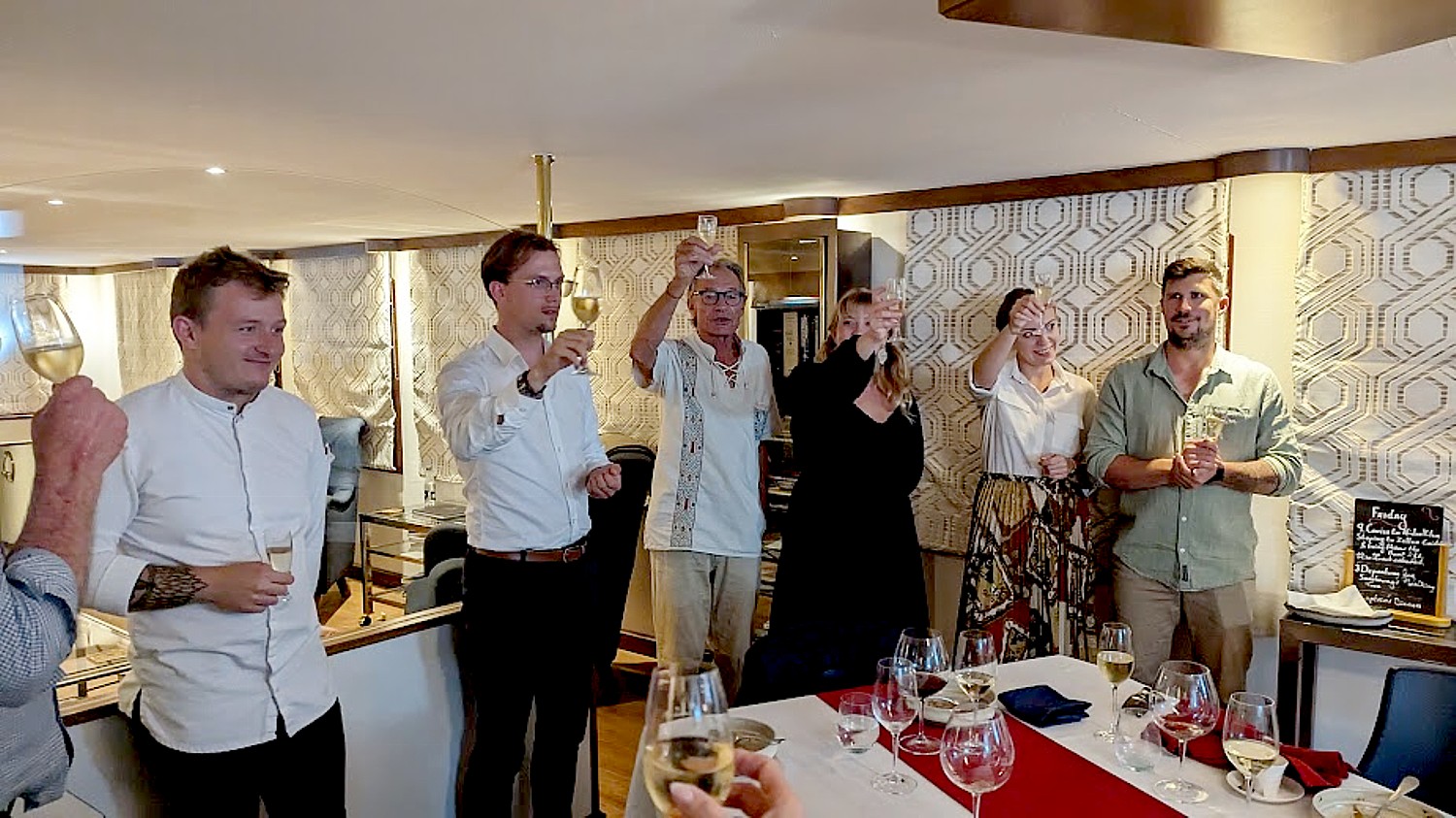
Then, Captain Brian surprises Marc and Kathy with a ritual to celebrate their 25th anniversary – he removes a saber from a box and shows Marc how to slice open a champagne bottle. Then we toast the couple with Champagne. Marc is far more thrilled with this anniversary gesture than riding the carousel.
We overnight in Strasbourg.
Day 3 Strasbourg to Waltenheim-sur-Zorn
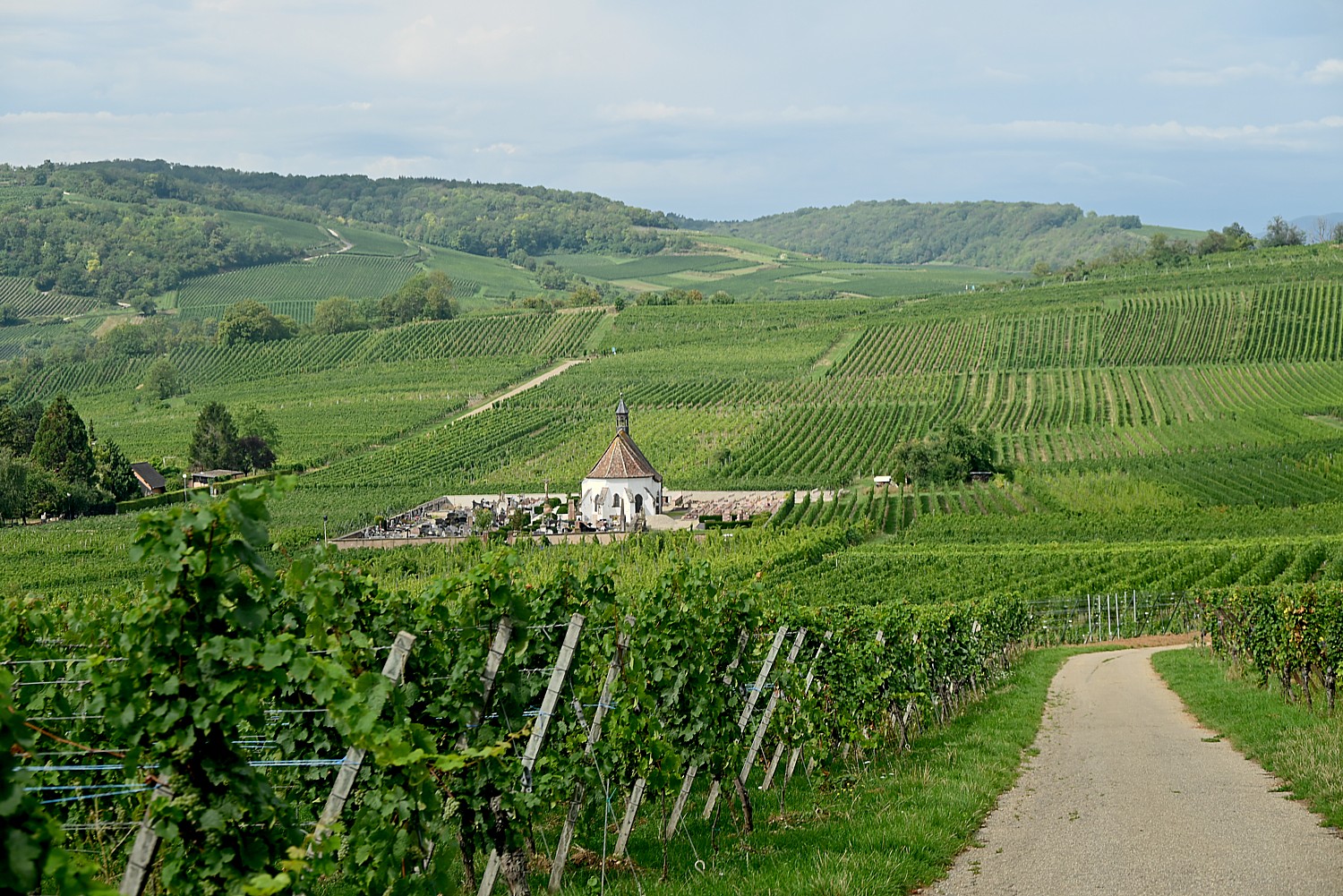
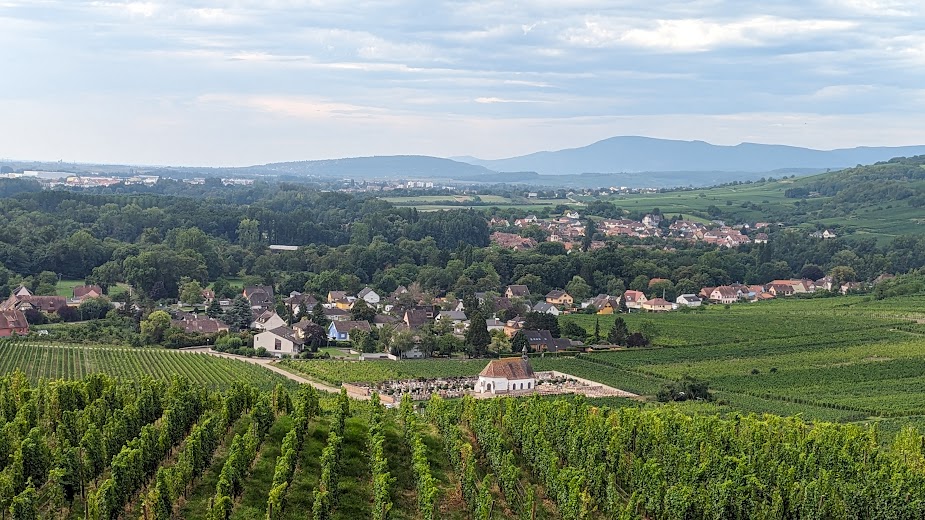
While still moored in Strasbourg this morning, we are taken on a scenic drive into the rolling Vosges hills on La Route des Vins d’Alsace, the oldest wine route in France.
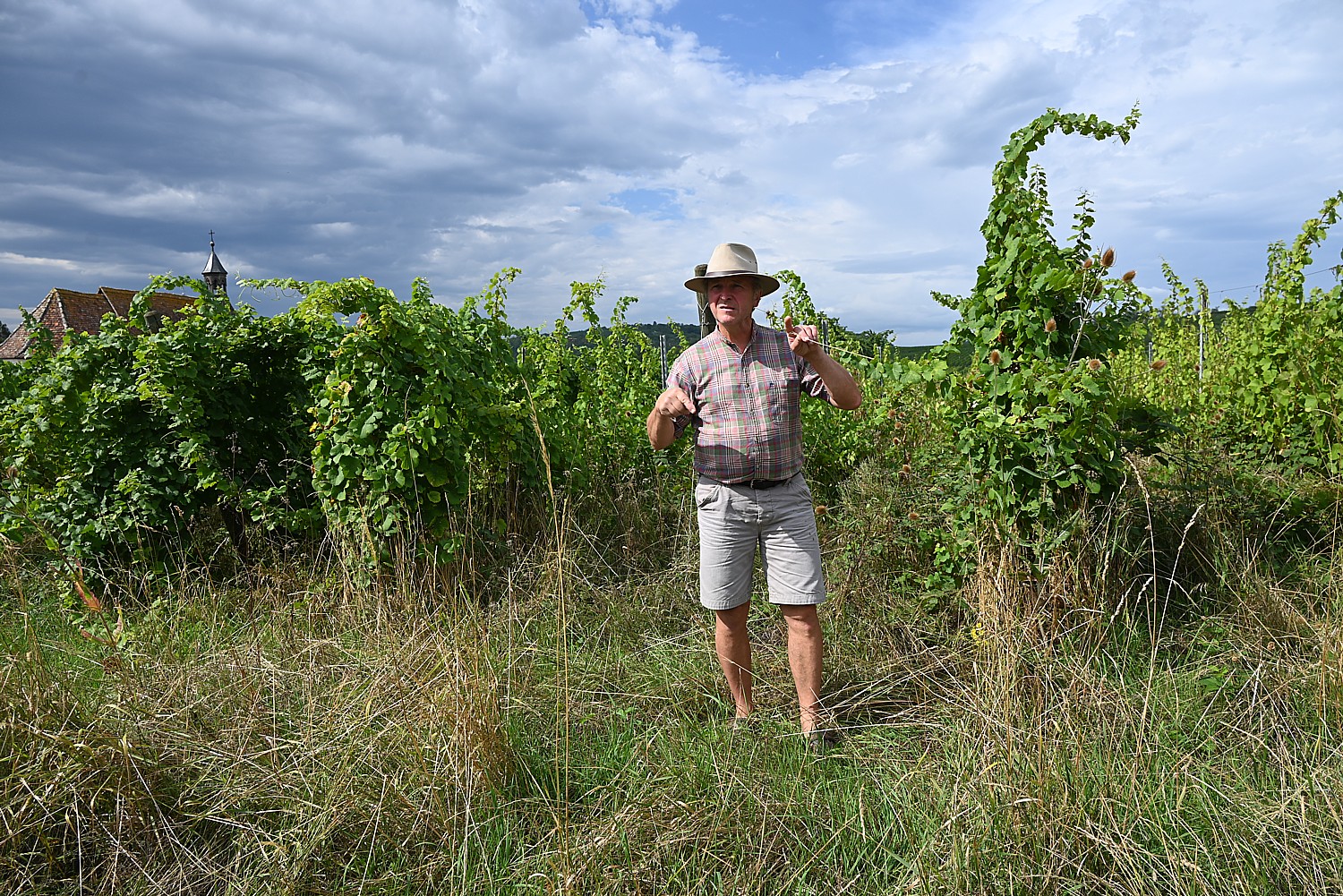
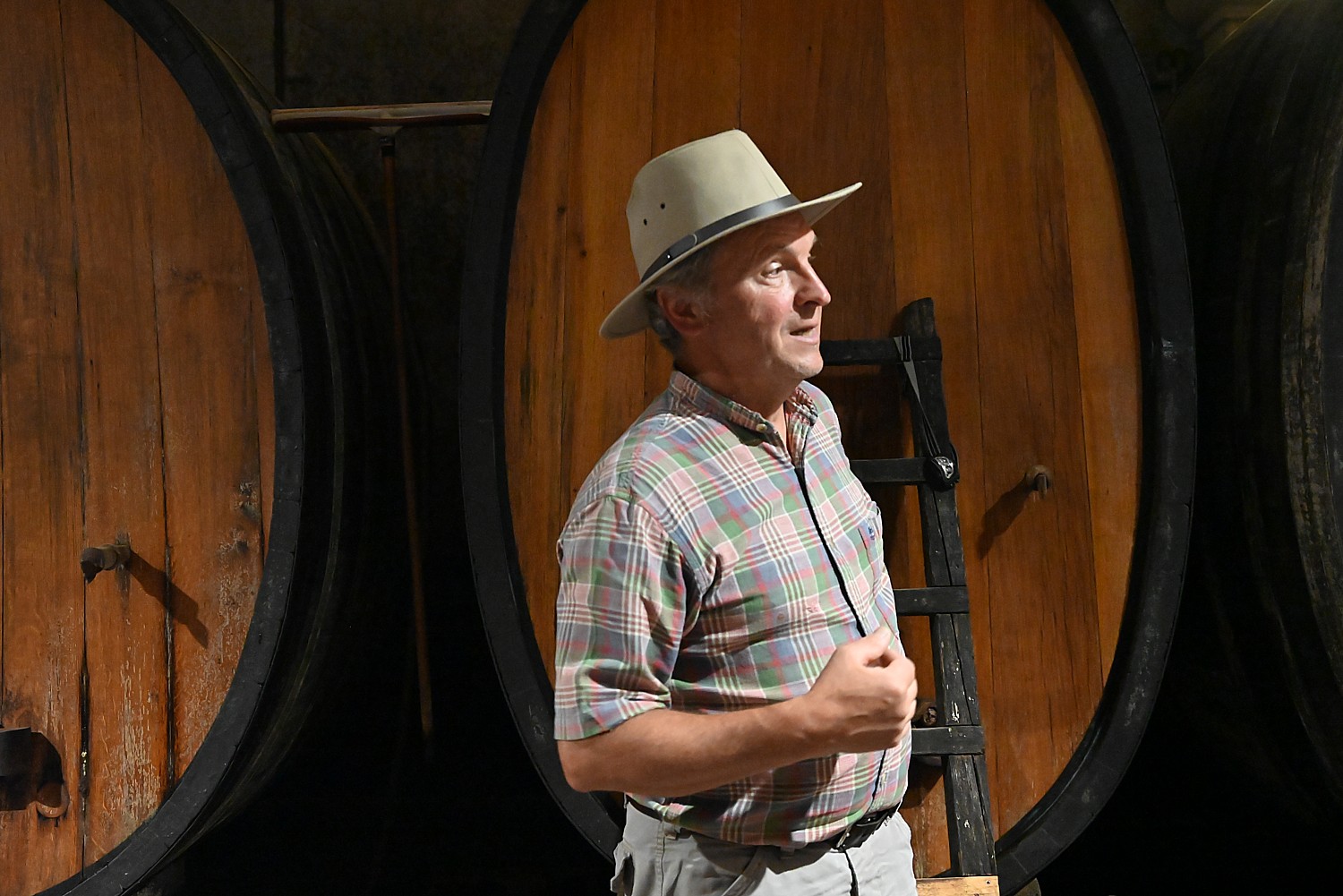
Instead of visiting a conventional vineyard and winery, Captain Brian takes us to Domaine Lissner in the village of Wolxheim to meet a renegade, a true maverick: Bruno Schloegel is on a self-appointed mission to prove how wine can be and should be produced truly naturally, truly sustainably, to protect the environment and the planet.
Bruno’s neighbors were not happy (and thought him fou) – his vineyard, which he took over in 2001 from his Uncle Clement Lissner, is a wild tangle of vines in contrast to their manicured rows of pruned vines – but some have come around. He acknowledges his yields are not as great, but it costs him a fraction to operate because he doesn’t use any machinery, any extra energy, or any irrigation or pumps, and spends less on labor. He estimates he saves 600 man-hours of work and some E60,000.
Bruno, who was a university professor and sociologist, has a deep reverence for the past and a deep concern for the future. Vines have been cultivated here since the 7th century, his family has been here since the 17th century, and this vineyard has been in his family for generations. Wine stock, he tells us, can last 800 years. “I had to imagine 2-3 generations from now,” he tells us. “I am responsible to the next generation; these vines link us from the past to the future. We have to find new ways to live in nature.”
Since taking over the vineyard, he has spent the past 22 years “rebuilding the chains of life – the birds, insects and what is under soil. It is a complex approach. I want to take you in our world, our way of thinking. Our wines are living wines- the result of animals, plants – living systems” served non-filtered. “We had to wait up to 10 years for the soil to be alive. We didn’t plant, didn’t treat, don’t put pressure on the wine stock.”
It took that long for the natural plants, animals, insects to come back and for the soil to be rejuvenated. He depends on the birds, spiders, insects, lizards to maintain the ecosystem. “If you would have to invent this machine (a lizard) to wait for fly – it would cost a lot,” he half-jokes. He stresses the importance of biodiversity, “each place another world.”
Manicured vineyards, Bruno insists, masks poor soil. “They are not close to a living system. They are ‘slave’ to the plow. What are we doing to the planet?” In contrast, “We don’t disturb the living cycle.”
He acknowledges that this was an experiment in geological behavior, but insists, “Natural methods produce more resilient vines,” and he will be in much better shape to meet the inevitable challenges of climate change. (Researchers estimate that as much as 70 percent of the world’s wine regions will become too warm this century, including as much as 90 percent of wine’s best traditional regions in Spain, Italy, Greece and Southern California.)
“Energy is not cheap – especially with climate change,” he says. “But even if the climate changes, our system will adapt. We have to find new ways – with this experiment, I can say it works.”
Sounding a bit like a Buddhist monk of winemaking, he says, “More is sometimes less. They cut from the human, machine point of view, not the vine’s point of view” and speaks of “happy vines” free to live their own cycle. “I listen to the wine stock. I let the birds have first growth of grape.” He shows us a plant at the head of a row that presents like a natural cup for birds to drink so they don’t come to vines.
“We regard the vines like a relationship with a living being. We used to have this relationship. It’s a good way to renew the relationship in next century.”
“A harvest is like a wedding – a high moment. We prepare the bride for wedding – we cut only what is dangerous, prune just to make it safe. He says constantly trimming the leaves, prevents the vines from reaching the end of their natural cycle. “There is a time when the leaves should stop growing, so all the energy of the plant goes to grape. But what they do is cut leaves just to make sugar.”
From the field, he takes us next into his wine cellar. He spent four years designing it, another year to find an architect and 40 pages of plans to build a sustainable system that relied on gravity and natural temperature control without the aid of machines or external energy. “We wanted a vertical effluent process to let yeast ferment the juice. The old system had too many steps.”
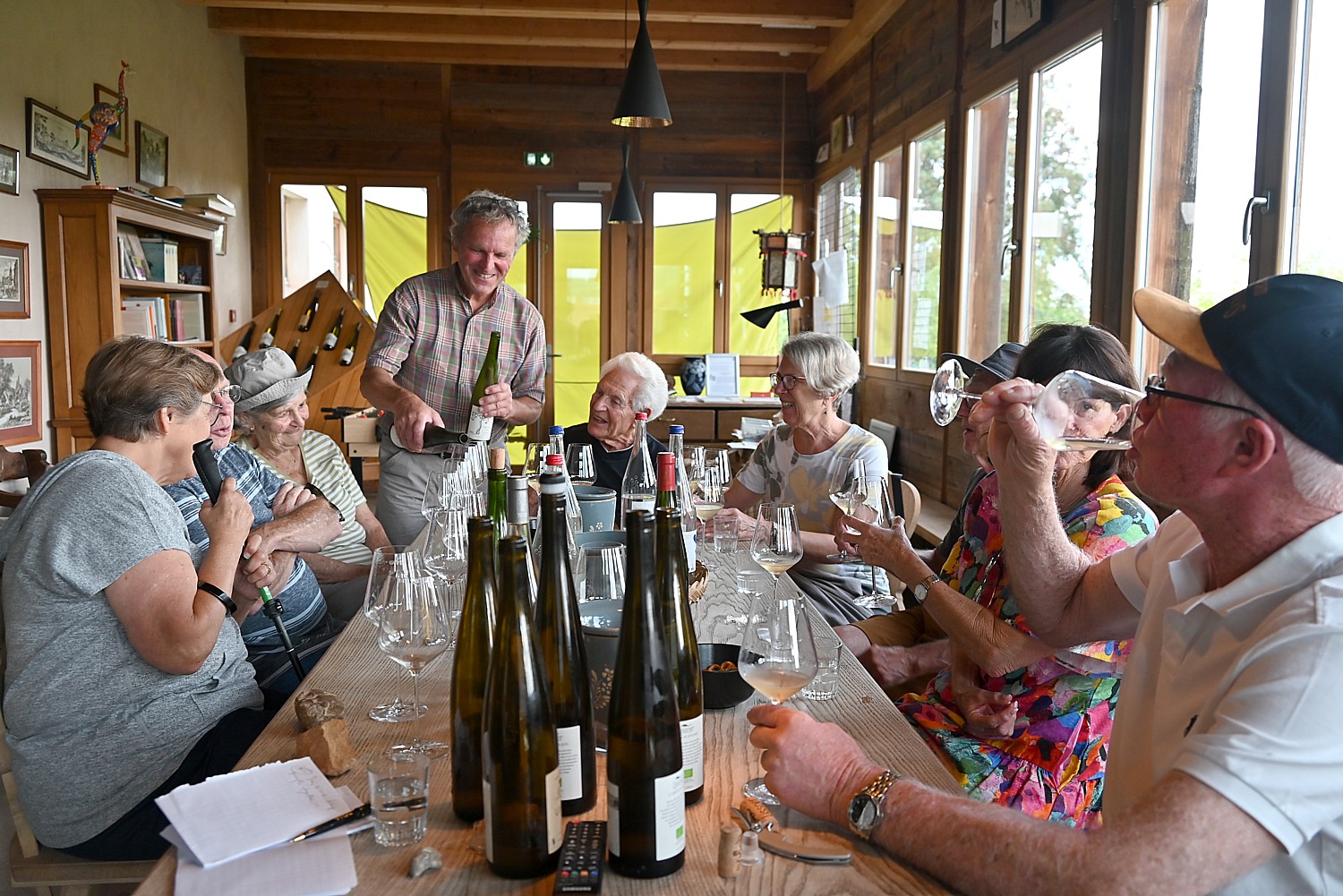
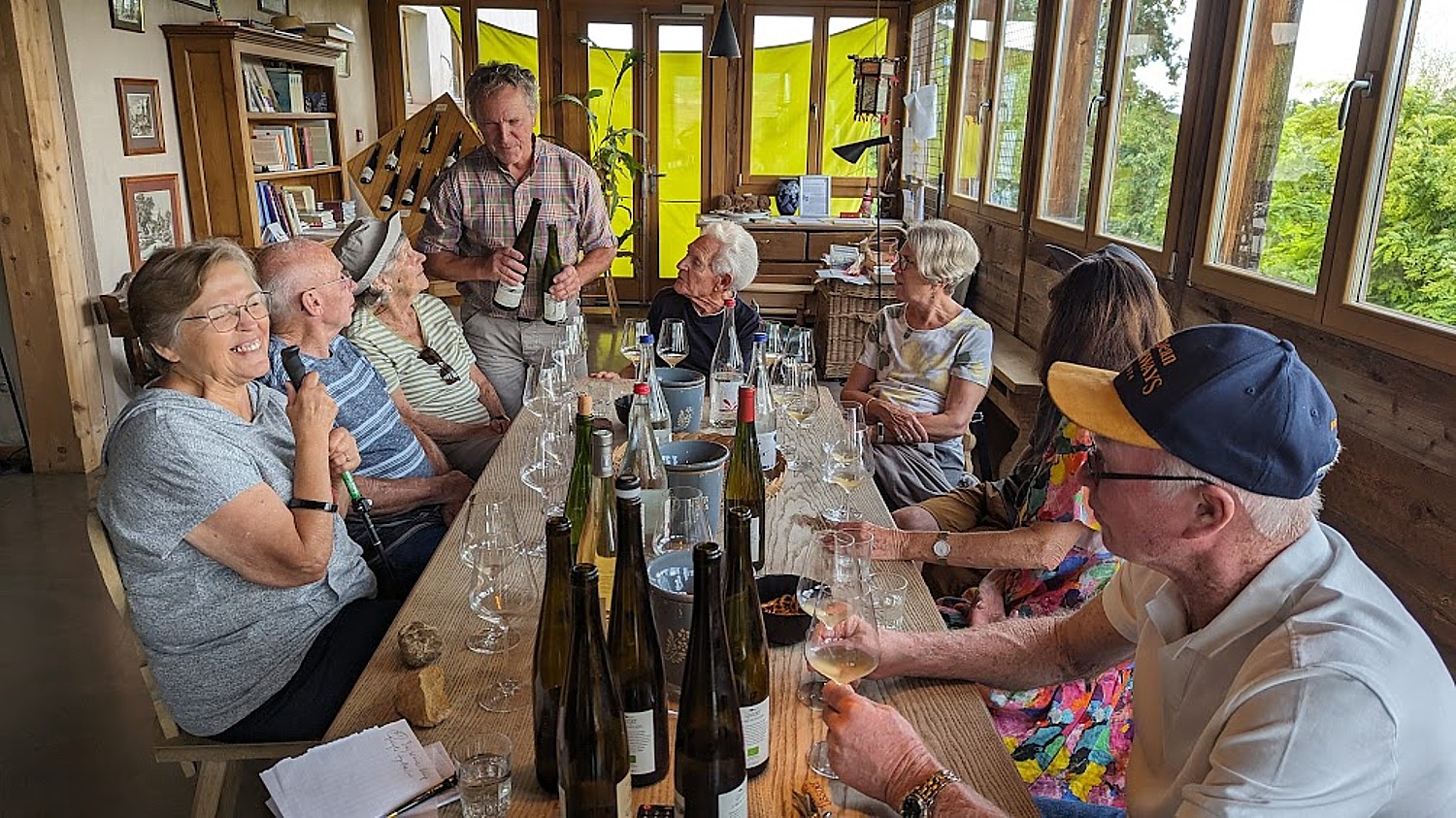
Back in his tasting room, we get to sample a dozen of his wines.
We drive back to the Panache where lunch is being served: a cold black tomato and cucumber soup; spinach and cheese quiche; smoked salmon, horseradish; marinated seabass; strawberry and goat cheese, and chocolate mousse. The wine includes Chateau Aspras, LesTrois Freres, the third generation family winery; a premiere Rose (2022) from Cotes de Provence, a lovely light wine so suited for lunch.
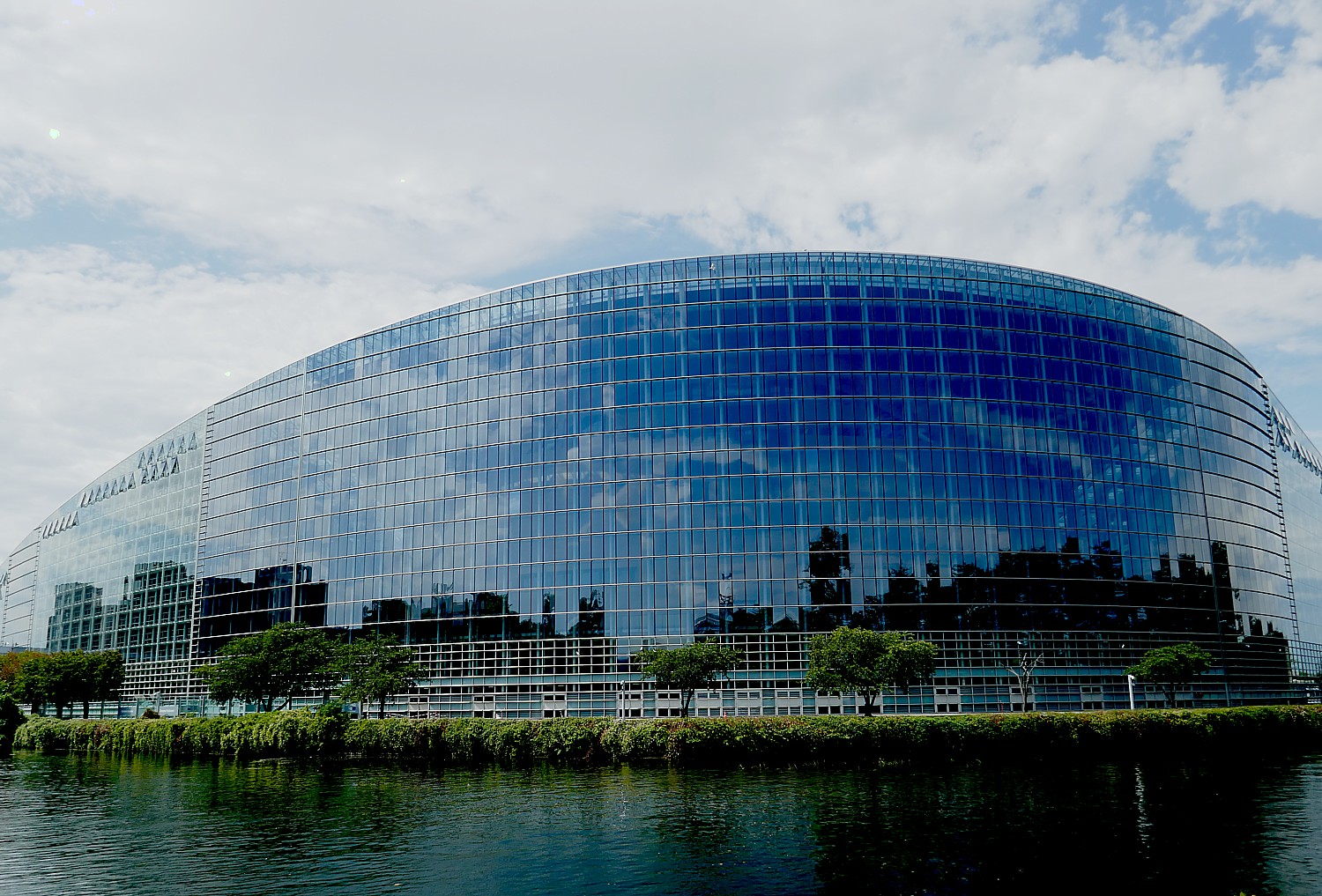
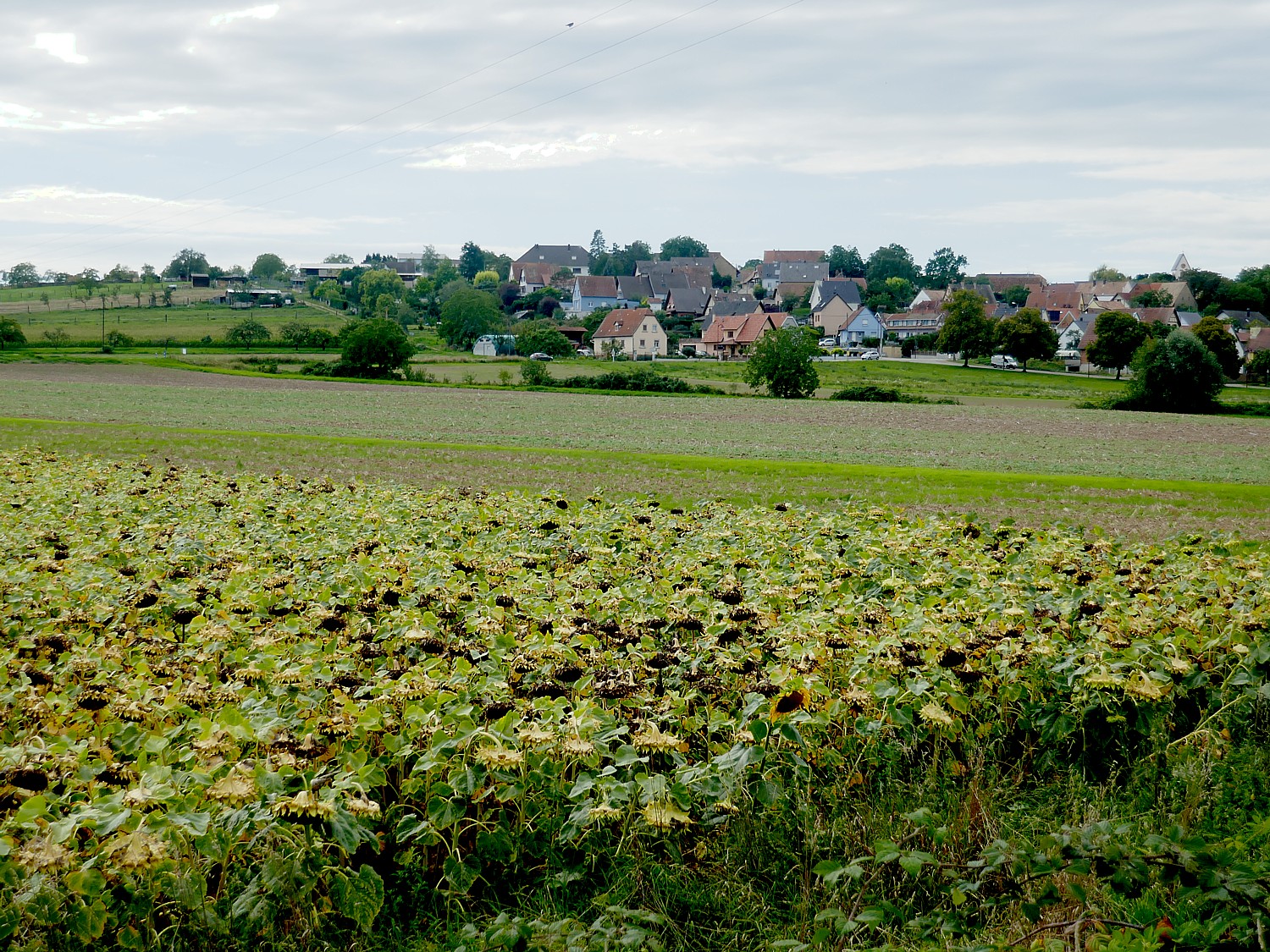
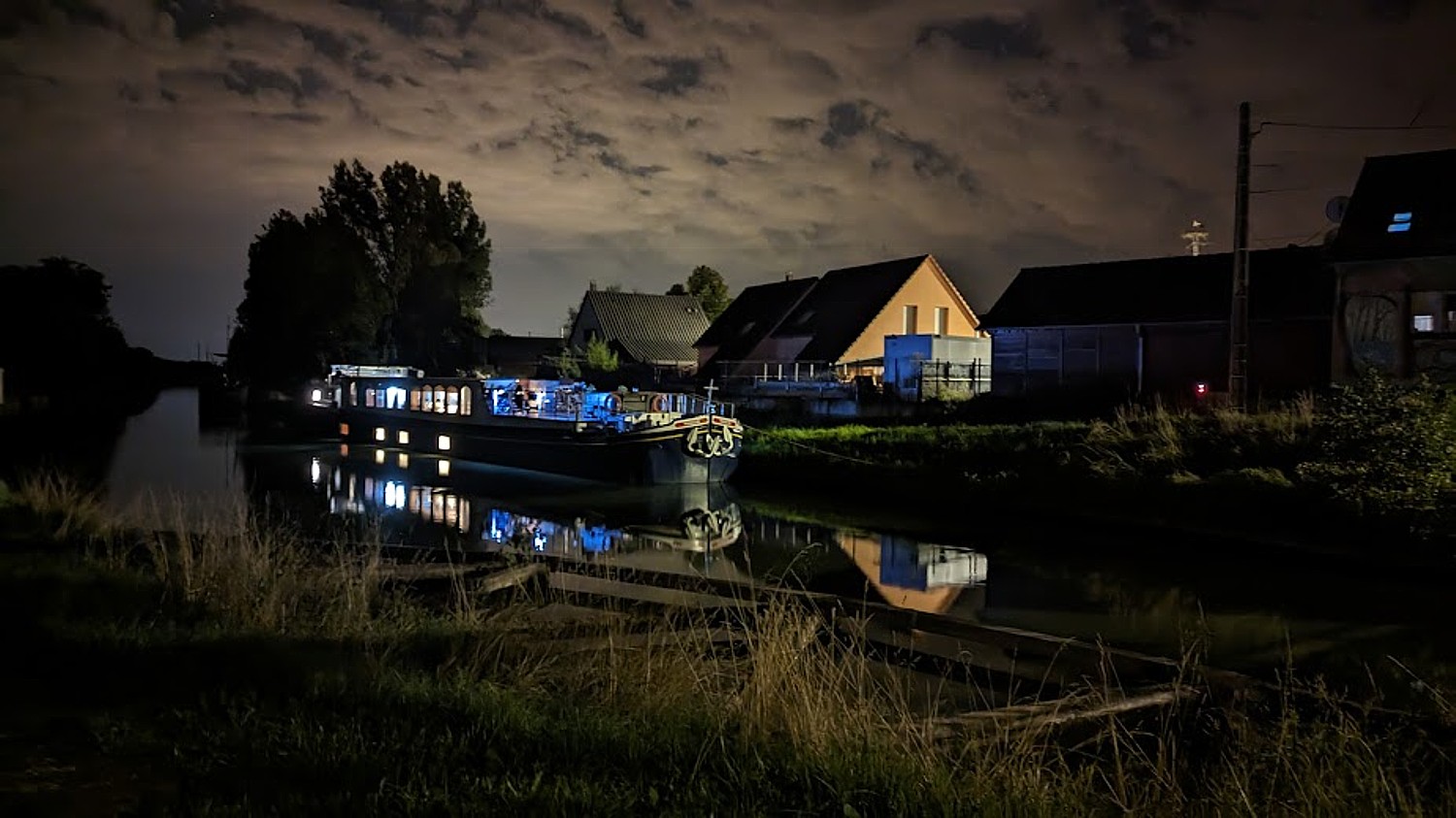
We pull away from our mooring in Strasbourg to continue cruising, taking us passed the impressive European Parliament building on the outskirts of Strasbourg and on through the Brumath Forest to the picturesque village of Waltenheim-sur-Zorn.
Tonight’s dinner is in a charming restaurant in the village, A L’Eoile, which, though very good, cannot compare with Chef Leo’s creations – clearly we have been spoiled in just these few days. We also get a view to local life – a 70th birthday celebration is going on and the dancing line carries into the street.
As we have already seen, the Alsace-Lorraine is fiercely French, but the German heritage (having occupied the region multiple times) cannot be denied – in architecture, in cooking, in language.
It is as Bruno said, The Alsace-Lorraine region has a culture that is an inescapably a melding of French and German – “still in the way of thinking, drinking, growing, living together”.
Reflecting back, it is so interesting that a trip that is so absolutely relaxing can also be filled with activity, interesting, even astonishing, attractions, scenic sights, and cuisine that is Michelin-star caliber, and how, traveling slower than 3 mph, you can see so much, experience so much in a day.
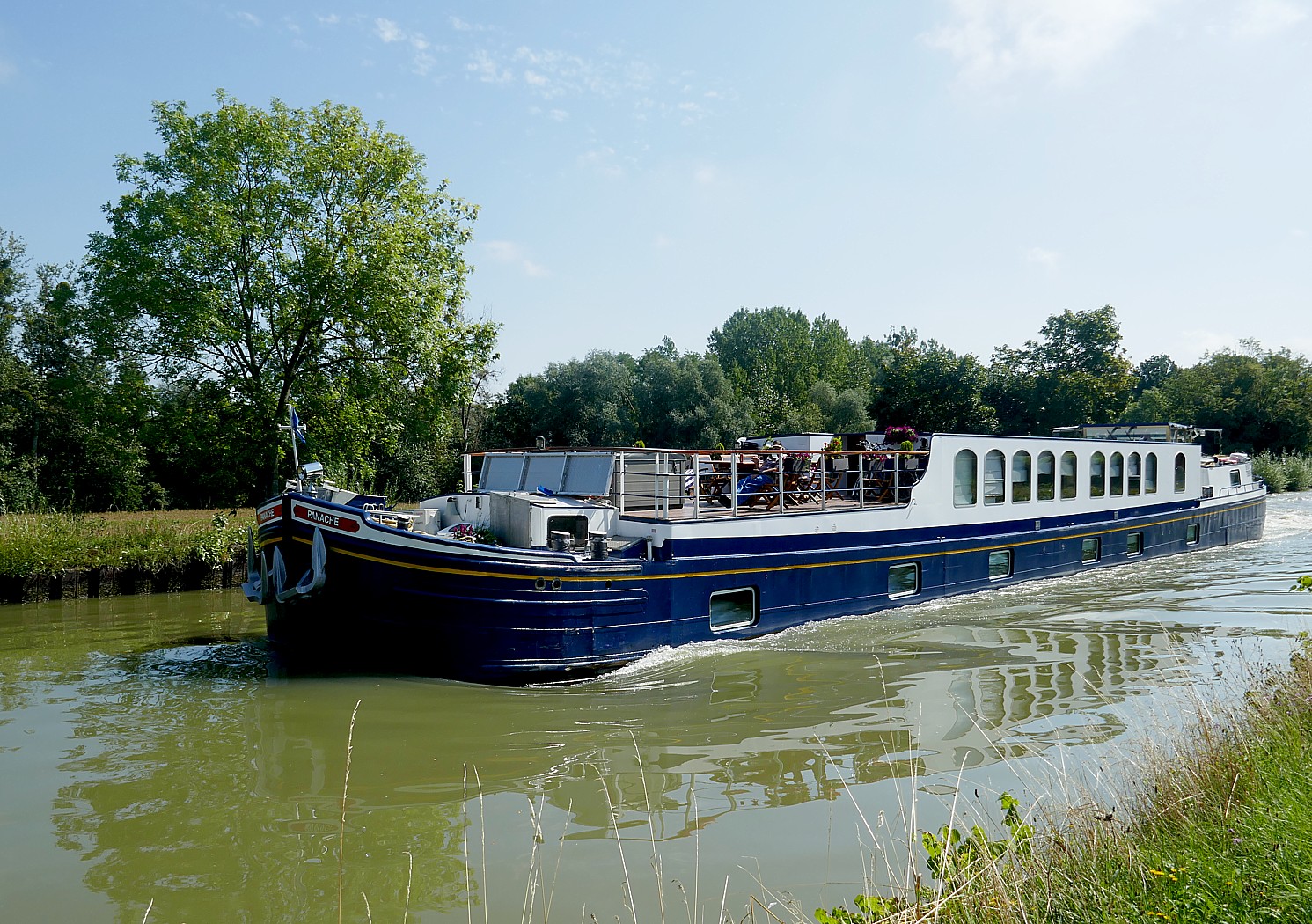
This is European Waterways’ six-night/seven-day Marne-Rhin Canal cruise through France’s Alsace & Lorraine Region, aboard its hotel barge, Panache. The boat sleeps 12 and has a crew of six, so pampering is an understatement – this is like a floating luxury boutique hotel.
Over the course of our cruise, we have guided tours of charming, colorful, historic cities including Strasbourg, Saverne and Sarrebourg, visit the Rene Lalique crystal museum, see Marc Chagall’s largest and grandest stained glass work, go through a boat “guillotine” and ascend a remarkable boat elevator, have a private tasting at what can only be described as a renegade/maverick winery on the Route des Vins d’Alsace, and so many more surprises that delight.
The slow pace of the barge proves an advantage because I also get to bike along the towpath the entire length of the route, return to the boat, and see the scenery again from a different perspective of the elevated perch of the boat deck.
The pace is so relaxed, and to be candid, the level of luxury and pampering so great, you don’t even realize how much you have done in a– whether it’s biking the route, sightseeing and visiting villages, historic and cultural places, enjoying fine wine and cuisine, and still have time to just hang out and watch the landscape go by and enjoy the company of fellow travelers.
We do so much in a day, it is mind-boggling to realize (well after the trip), what short distances we actually travel each day (several of the excursions involve us being picked up by van where the boat docks), and where we were the day before and will be the day after. Time and distance just kind of melt.
I have cleverly arranged to arrive two days early in Strasbourg, where the Alsace-Lorraine cruise starts – this takes into account any unexpected flight or travel delays, and gives me two half days and one full day in this picturesque old city (we actually will be visiting here with the cruise on our first full day).
Captain Brian picks us up at the Regent Petit France Hotel, which sits astride the canal with the most picturesque view of the historic district, and chauffeurs us to where the hotel barge is tied up at Krafft, where we are greeted by the crew of six with Premier Cru FrereJohn Freres Champagne and hors d’oeurves, and introduces to the boat, the crew and our fellow traveling companions for the week.
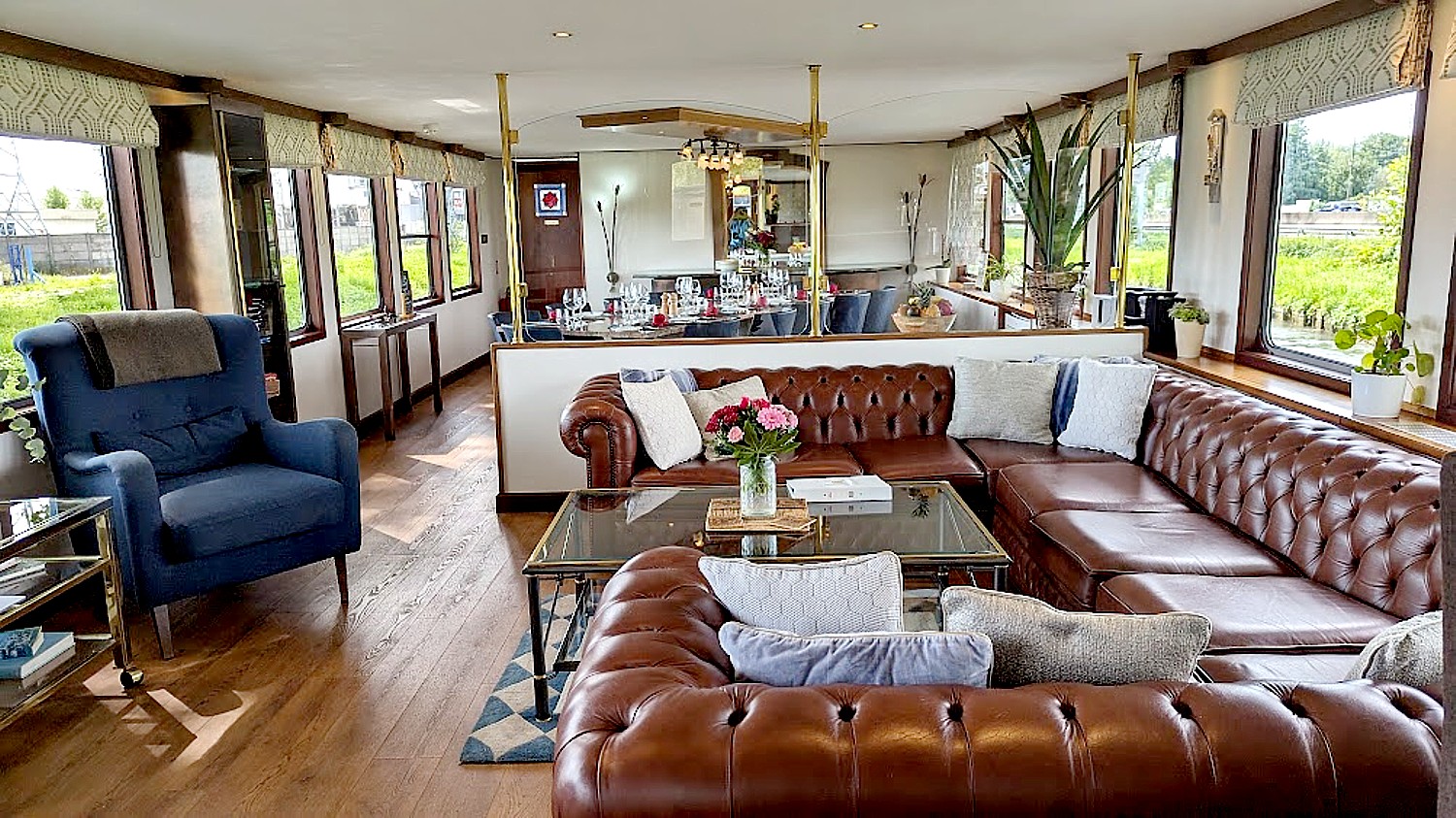
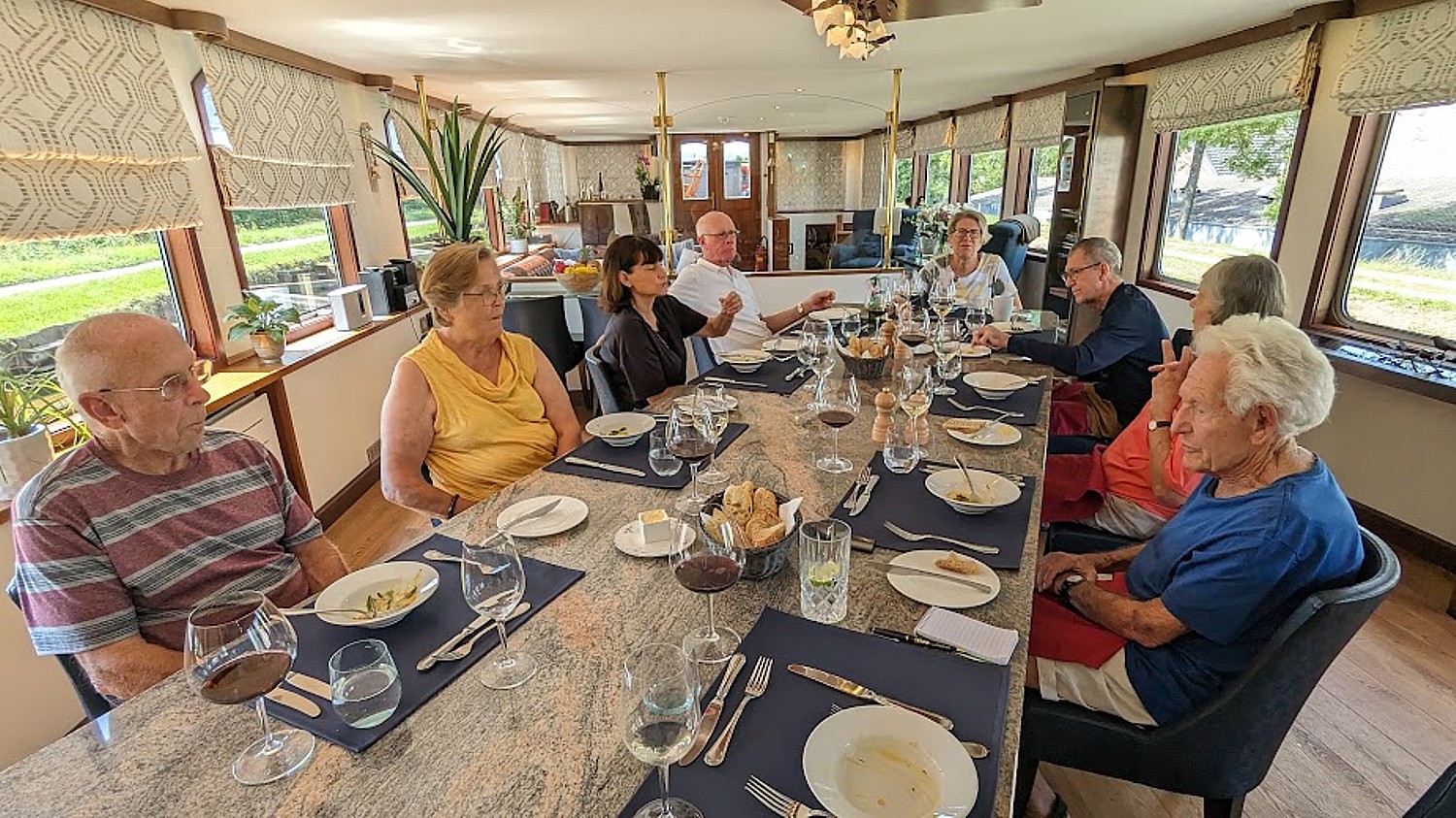
The salon/dining room is absolutely stunning, with comfortable sofas and chairs, a long dining table, large picture windows that let the light and scenery in.
Panache is a hotel barge that has been fitted out in traditional yacht style with brass and mahogany fittings and polished hardwood floors in the spacious public areas and very comfortable cabin accommodation. The salon/dining room is absolutely stunning, with comfortable sofas and chairs, a long dining table, large picture windows that let the natural light and scenery in. The separated dining area is roomy, providing a congenial setting for up to 12 to enjoy the gourmet meals and fine wines served on board at the grand table. Here we also have access to free Wifi,
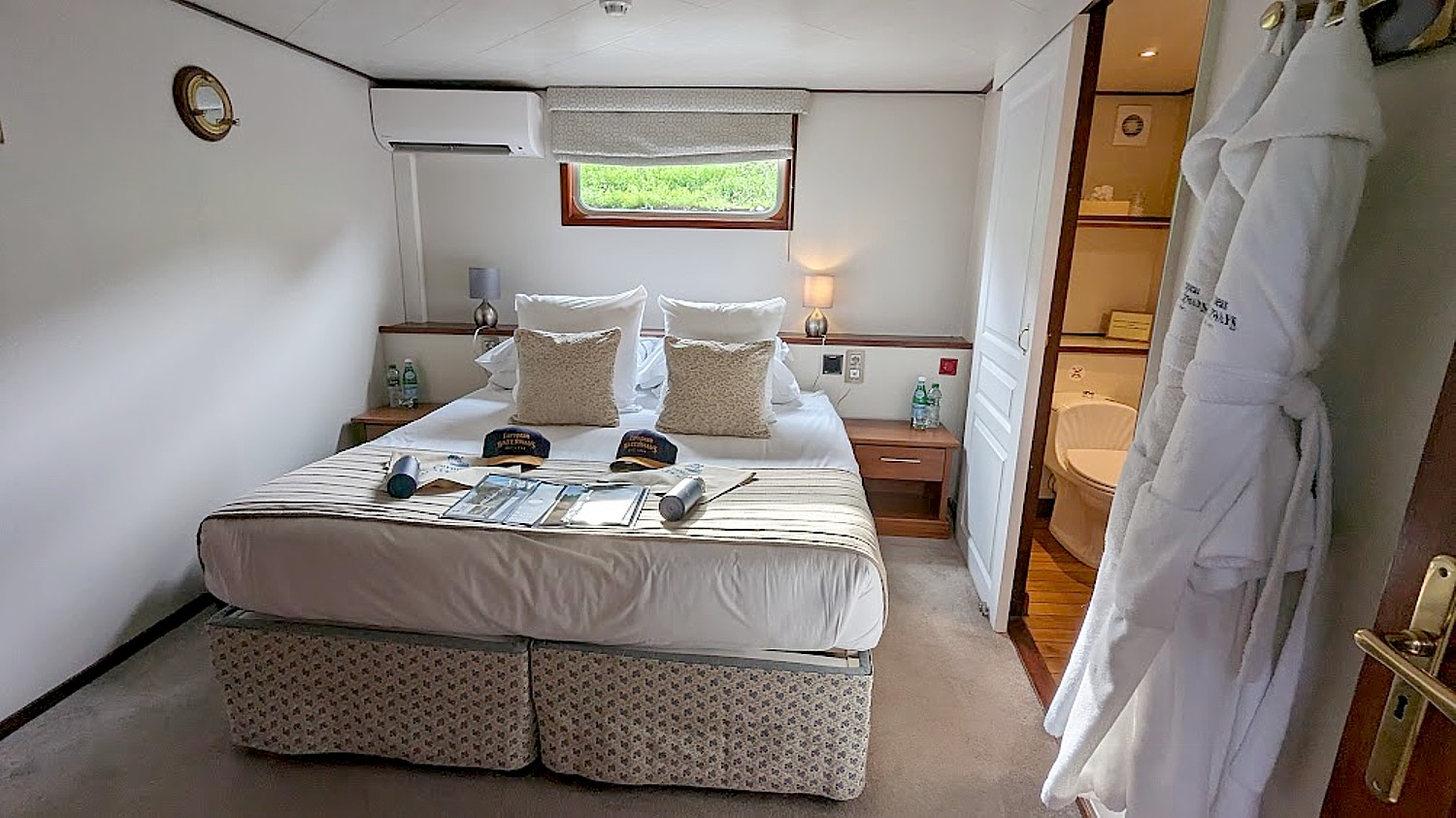
Panache accommodates 12 passengers in six spacious cabins (larger than the room at the delightful Hotel Hannong I had just left in Strasbourg), that can be configured for twin or double-bed, with plush linens, plenty of lights and electric plug-ins, our own temperature control, room to store our clothes, and private bathroom (double sinks! oversized shower!). Housekeeping comes in twice a day and leaves a chocolate on the pillow at night. Truly a boutique hotel room that floats us from destination to destination in absolute luxury.
Panache has a very comfortable sun deck with lounging chairs and table and chairs, from which you can enjoy the scenery, have cocktails and dine alfresco, and heated spa pool. There also is a plentiful number of bicycles which I take advantage of each day, virtually biking the entire route (and then getting back on board to enjoy it from the perch of the boat).
Each evening, Captain Brian (who is also the general manager, the cruise director, our tour guide and sometimes the pilot and just 25 years old) orients us to the boat and our cruise, especially the invitation that the crew “never lets a glass go empty, so if you don’t want a refill of wine, put your hand over it” (and they are only half kidding, as we discover). Each evening, he orients us to what we will do the next day – whether to visit a museum or a guided walking tour – and each day is distinguished by a special highlight.
You expect picturesque scenery and to visit fascinating cultural attractions but what is totally unexpected is the astonishing quality of the cuisine that we are treated to by Chef Leo – a young chef who, we learn, was a contestant on France’s “Top Chef”. Over the course of our six days of cruising, we experience Michelin-star quality dining, as Chef Leo enjoys experimenting. As he jokes, each cruise brings him more “guinea pigs”.
His cooking is really distinctive – it is not any particular cuisine, necessarily. He has a vibrant taste palate, likes a lot of flavor without overwhelming the actual flavor of the main item, and most important, is never too rich. He is really imaginative, creative, and the presentations are stunning. There are three courses for lunch and dinner, so each individual course is not too much, but not too little, either, with a different red and white wine accompanying each, and three different cheeses to finish.
Each meal is an event, an experience. Chef Leo comes out to explain each course, and Emily (from England) or Martyna (from Poland) introduce the wines – where produced, the vintage, the pedigree – and the cheeses (which have fascinating stories). By the end of the cruise, including the tasting at a most distinctive (progressive) winery that Captain Brian has found, we must have tasted more than 36 wines and 36 cheeses from throughout France – each perfectly paired for what is being served to bring out the best flavors.
They do their best to school us in the complicated classifications of French wines. We learn about Grand Cru and Premier Cru, which refer to official designations of vineyards and villages in a specific French region where the grapes are grown. Also “terroir” which describes the complete natural environment (ecosystem) in which a particular wine is produced, including factors such as the soil, geography and topography, rootstock and climate that impart the characteristic taste and flavor to the wine. We learn to recognize the region a wine comes from by the bottle – Alsace wines are served in a long, thin bottle, and that France has official appellations that wines and cheeses can use – so Champagne must be from Champagne, Bordeaux from Bordeaux. I may not have become a wine expert, but all the wines we enjoy are of superior quality and significantly, are paired so perfectly with the food.
When we arrive back from an afternoon tour, we are welcomed aboard with some sort of cocktail –one day it is Mimosa, another it is French 75 (an elderberry gin spritzer).
We are small enough group that our wishes are usually accommodated – Hylton, who comes from Australia, expresses a desire for steak and Sue, his wife, wishes for passionfruit crème brulee – and don’t you know, we have both for lunch – with Leo doing a cooking demonstration in the morning as we cruise to show how he creates the crème brulee. It is a first for him creating crème brulee with passionfruit and he takes it as a sort of challenge. We watch him create it, with his precise weighing and measuring, and, later, just before serving, firing it up with a torch.
In fact, the one evening we dine in a pleasant village restaurant, the meal, although very good, does not compare with Chef Leo’s creations. Clearly, we have been spoiled in just these few days.
Captain Brian gives us the safety talk – noting that some of the bridges we go under are so low, we will have to sit down and the bridge has to be taken down; the canals are so narrow, with barely an inch on either side, we need to keep hands inside the boat. And don’t block the navigator’s view of the crossbars at the front of the boat. There are life jackets, an emergency red call button in our cabins (don’t use it to call for a sandwich, it will wake everyone). And another thing, Captain Brian insists: never say the name of the animal with the bushy tail and big ears and eats carrots on a boat – it’s bad luck.
For such a small contingent, we bring an interesting variety as well as commonality. One couple is from Australia where they have an 8000-hectare farm (8 km across); another couple is from Australia as well, where he was a wine salesman and since retiring, teaches water aerobics (I have to mention he is 95 and has the body of a fit man half his age); another couple is from Minnesota who also have a farm; another couple comes from Georgia where he is a lawyer and she was a county commissioner. (All of us happen to be senior citizens but young couples, families and solo travelers would enjoy the cruise, and it is possible to charter.)
This first evening, Chef Leo’s talents become apparent: a carrot and orange salad to start with a kind of pesto sauce that surprises with flavor; roasted seabass with leek and champagne sauce, and dessert of peach tart. This evening the wines include Famille Hugel, an Alsace Pinot Blanc, 2019, and an Alsace red, Boitt Geyl Pinot Noir, 2017 (producing wines since 1775!), that pair superbly with the flavors.
The meal finishes with three cheeses: Camembert, “King of Cheeses,” from Normandy, with a golden color and buttery texture and a strong aroma (“We serve it on the first night to get it out of the refrigerator”); Morbier, a cow cheese from Franche-Comte, which traces back to the 1800s and, legend has it, a method of disguising the size of the cheese within charcoal in order to avoid paying tax; and Selles-sur-Cher, a goat cheese from the Loire Valley which, we learn is a cheese deprived of light and oxygen for 38 weeks, and is served in an edible rind.
Notably, Chef Leo doesn’t necessarily pre-arrange his menus in advance because he purchases his items fresh, bursting with flavor.
Hotel barging offers an immersive and all-inclusive “gentle voyage of discovery” of the culture, history, fine wine, and gourmet cuisine of the destinations. You cruise right into villages, step off the boat, and can wander into neighborhoods and countrysides, where people live.
European Waterways, which celebrates the 50th anniversary of its founding by Derek Banks and John Wood-Dow this year, was one of the early pioneers of hotel barging on France’s canals. They helped ignite a new niche the travel industry and cruising that proved instrumental in the revitalization of Europe’s intricate network of scenic canals and inland waterways as tourism destinations. Like our Erie Canal of New York State, these canals were no longer being used for commercial shipping; tourism and recreational boating has revitalized them, and the villages along the route.
This fascinating network of smaller canals allows for flexibility, spontaneity and ample opportunity to hop off and explore the beautiful surroundings by bicycle or on foot. The itineraries are built around daily, chauffeured excursions “off the beaten path” to wine tastings and visits to stately homes, historic and cultural treasures.
Panache cruises in Holland in the spring when the flowers are in full bloom, and in Champagne in May & June (Champagne itineraries typically include Brie cheese tastings, a tour of the Cathedral at Reims, Epernay and tastings at renowned champagne houses). In summer and autumn, Panache cruises the Alsace & Lorraine.
European Waterways launched its first Christmas Markets Cruises aboard Panache in 2023 in the Alsace & Lorraine region of France. This 6-night/7-day luxury barge cruise visits the Christmas Markets of Strasbourg, Colmar, and Haugenau, a chocolate museum, a glass bauble factory which is said to be the home of the traditional tree decoration (For more information, visit https://www.europeanwaterways.com/themed/christmas-market-cruises/)
With a fleet of 18 (with the recent launch of its ultra deluxe vessel, Kir Royale), that span nine countries, European Waterways is one of the largest luxury hotel barging companies in Europe.
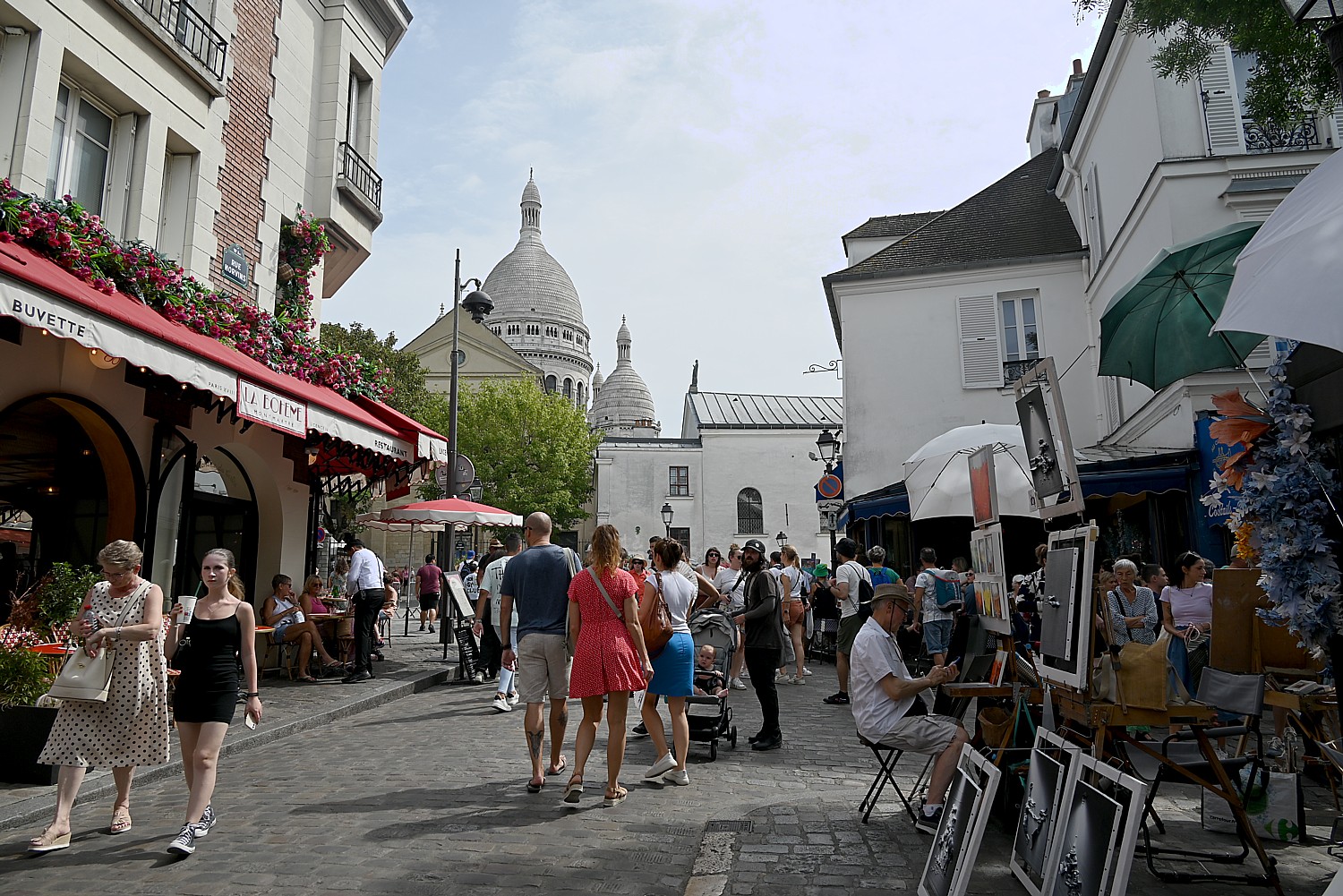
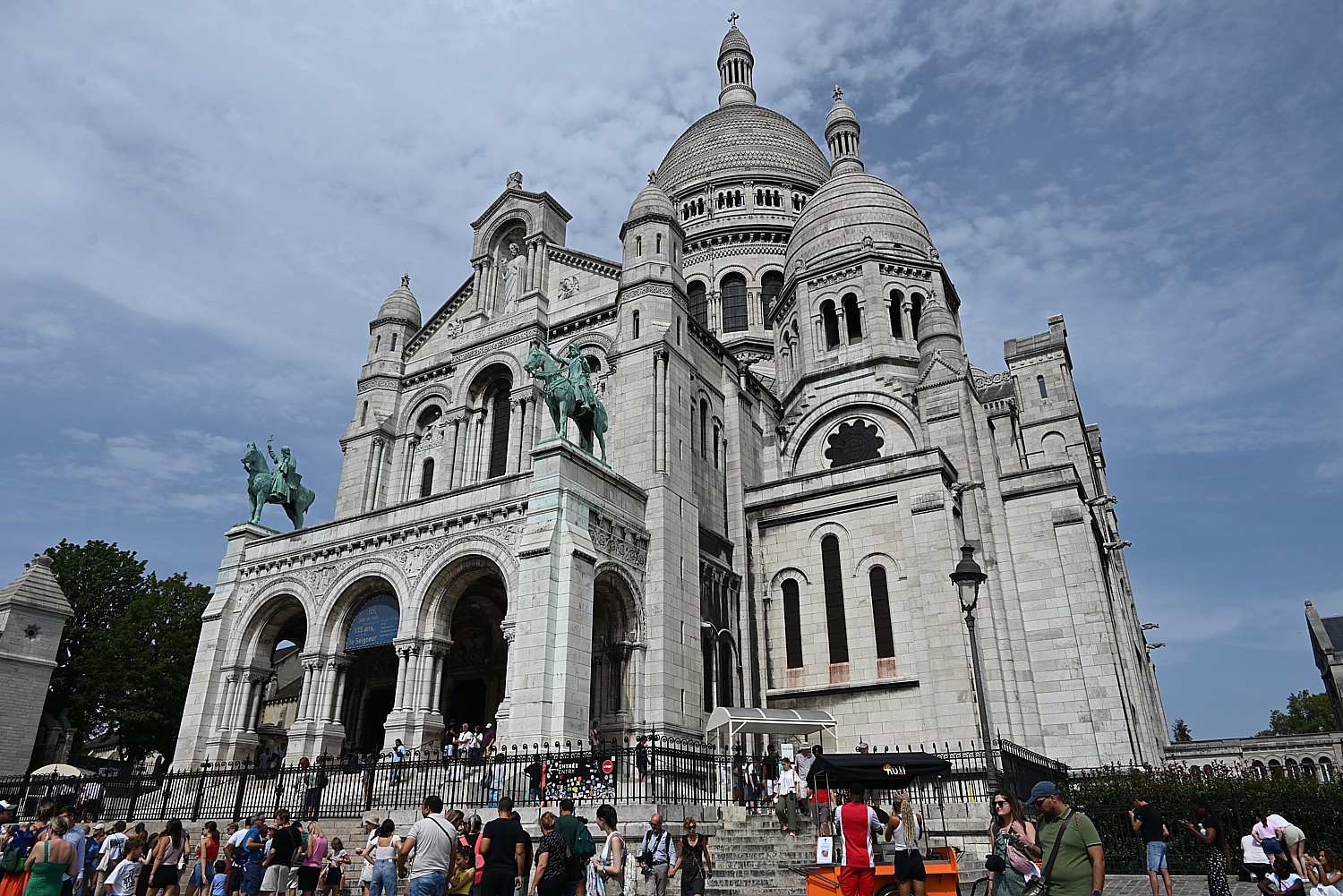
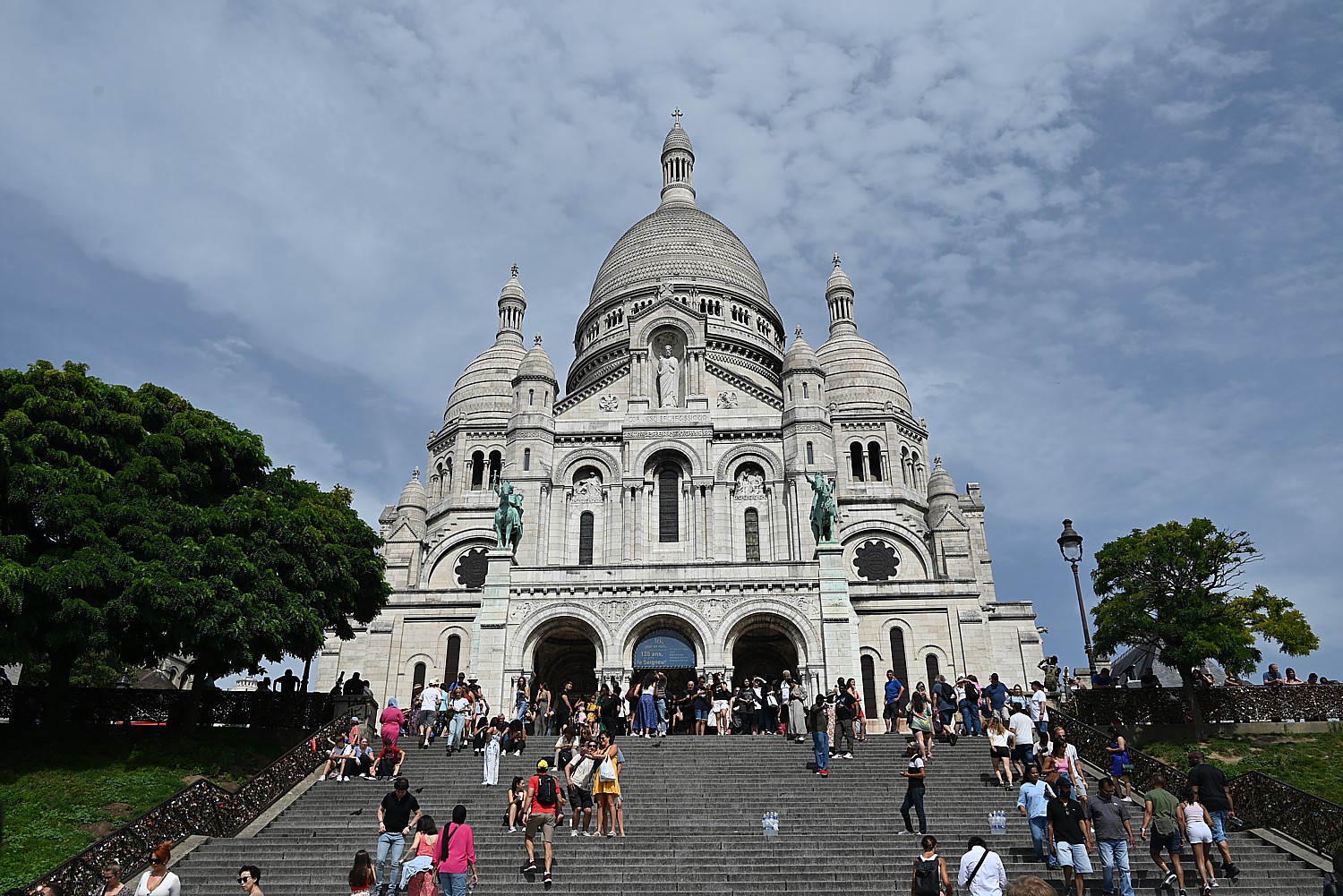
On my last day in Paris (I have cleverly booked an evening flight from Charles De Gaulle airport), I just want to lose myself in Montmartre. Perched high above Paris as if its own world, Montmartre is the place of legendary cabarets like Moulin Rouge that so scandalized Parisian society, as well as artists and cultural mavericks and renegades but also (incongruously) Sacre-Coeur, the spectacular basilica that dominates the skyline.
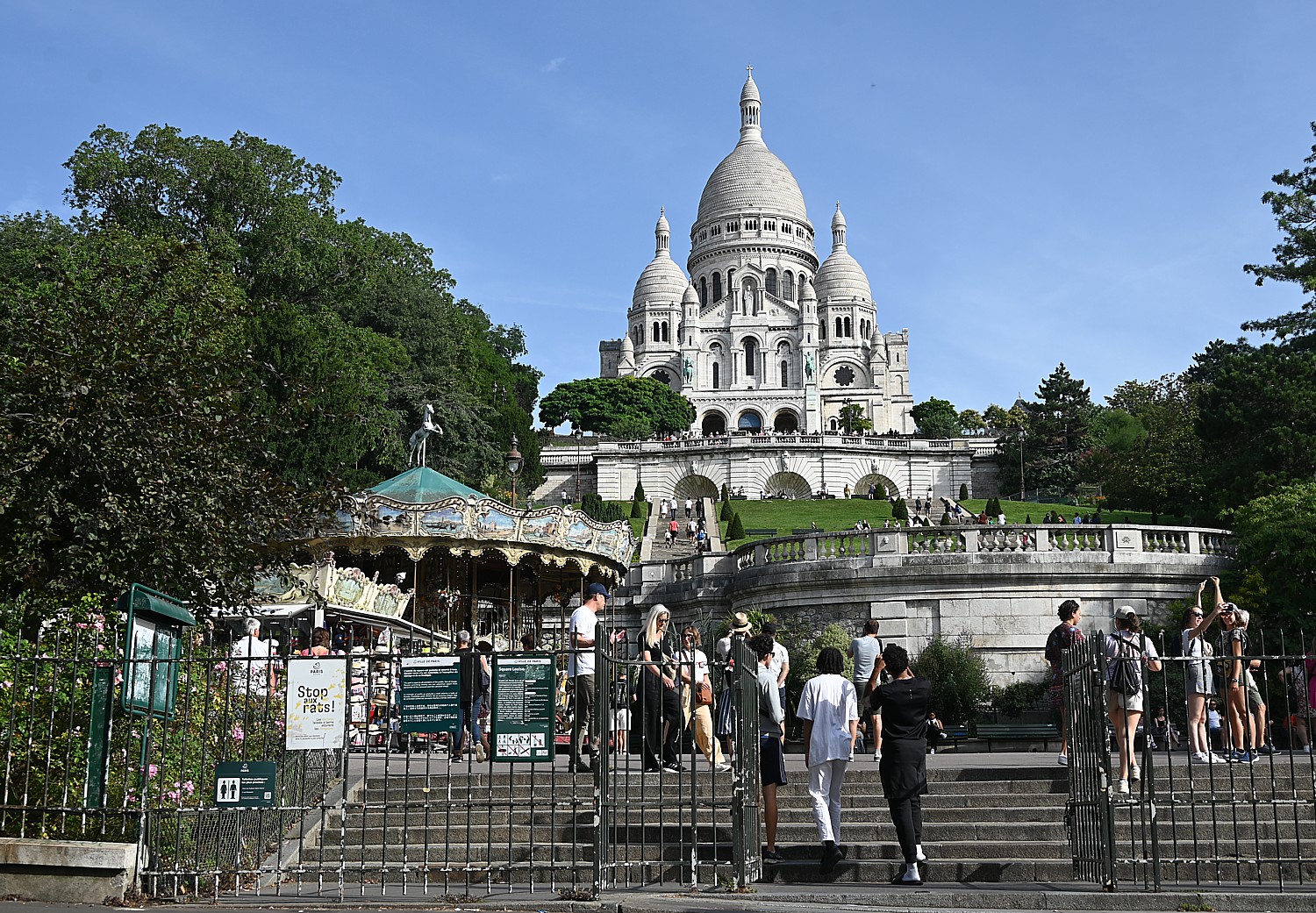
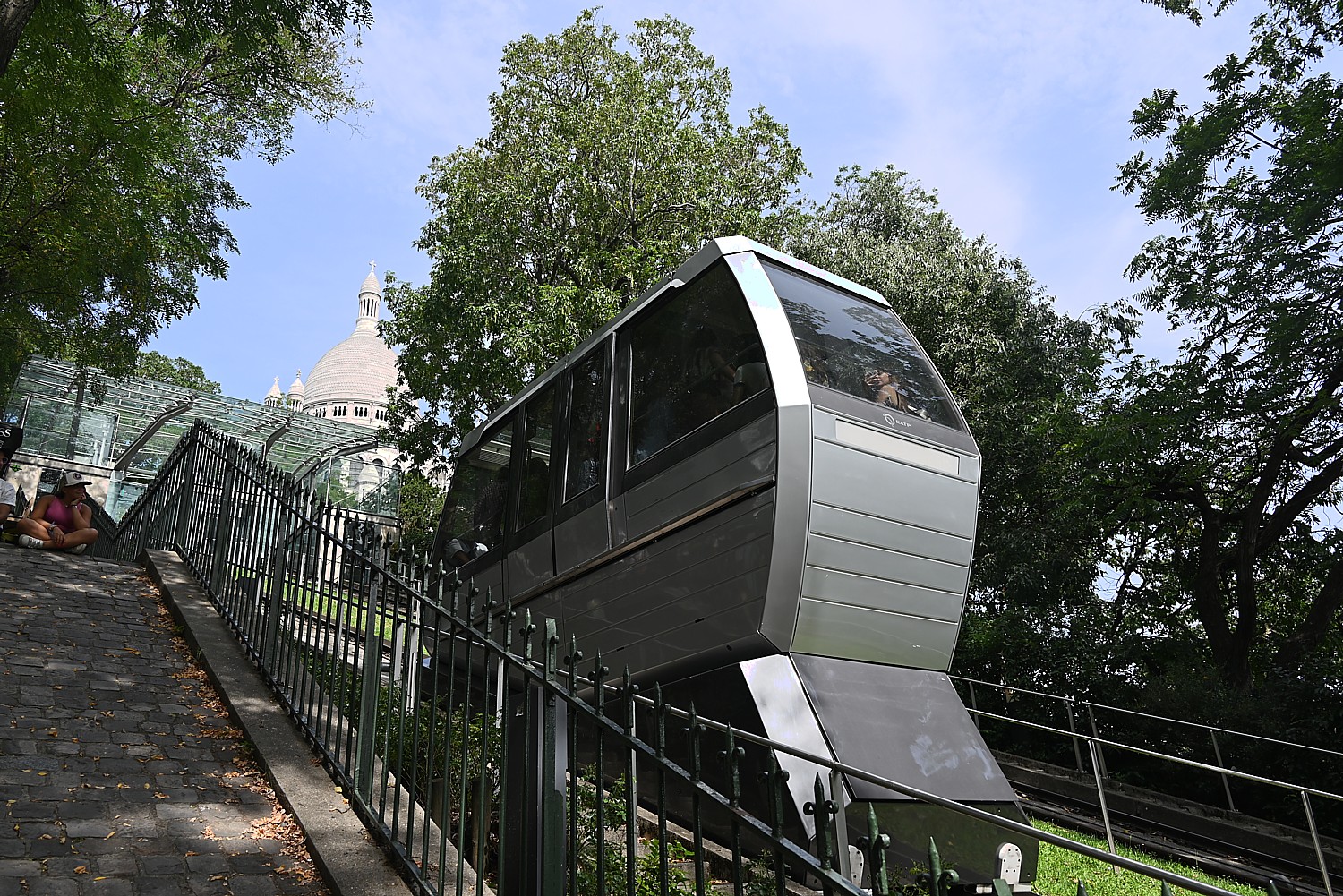
Perched on the Butte Montmartre, you can hike up the steps or take a funicular from Place Saint-Pierre, from the little public garden ‘Square Louise Michel’ (where there is also a delightful carousel).
Picasso, Modigliani, Miro and before them Manet, Toulouse-Lautrec, Géricault, Renoir and Van Gogh, were among the painters who made Montmartre their home (because being well outside of downtown Paris, it was cheap, then), met up in cafes and worked in the many artists’ studios there.
Visitors come to take in that bohemian energy, that bon vivant, creativity, joie de vivre and romance.
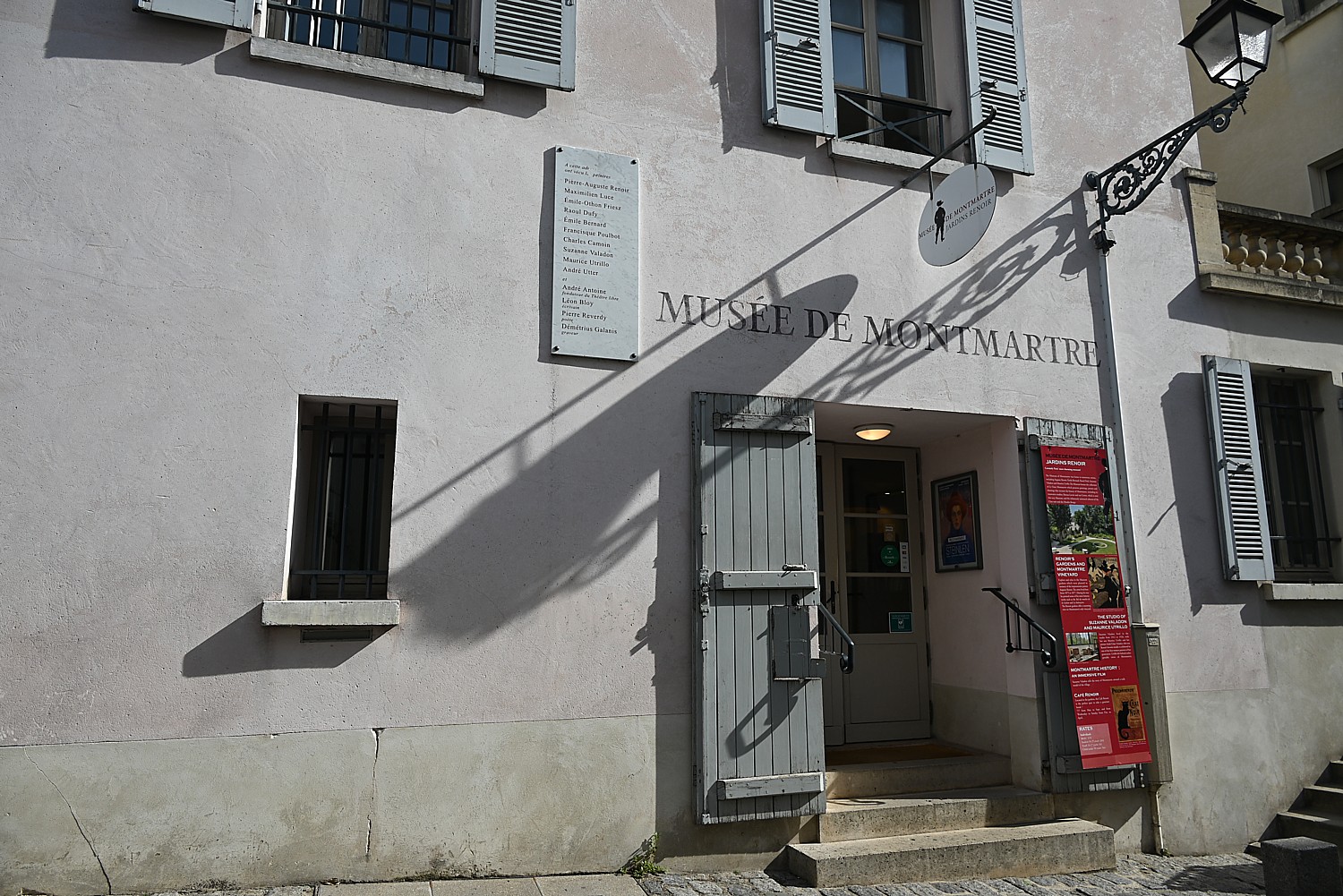
Because of all the romance attached to Montmartre, it can be over-the-top touristy (though the tourism office insists this is still a neighborhood), but the true treasure here – and one of the highlights of my visit to Paris – is the Musee Montmartre, where you can really get a sense of that free culture, and see firsthand how the artists lived, what the Moulin Rouge and the scandalous can can.
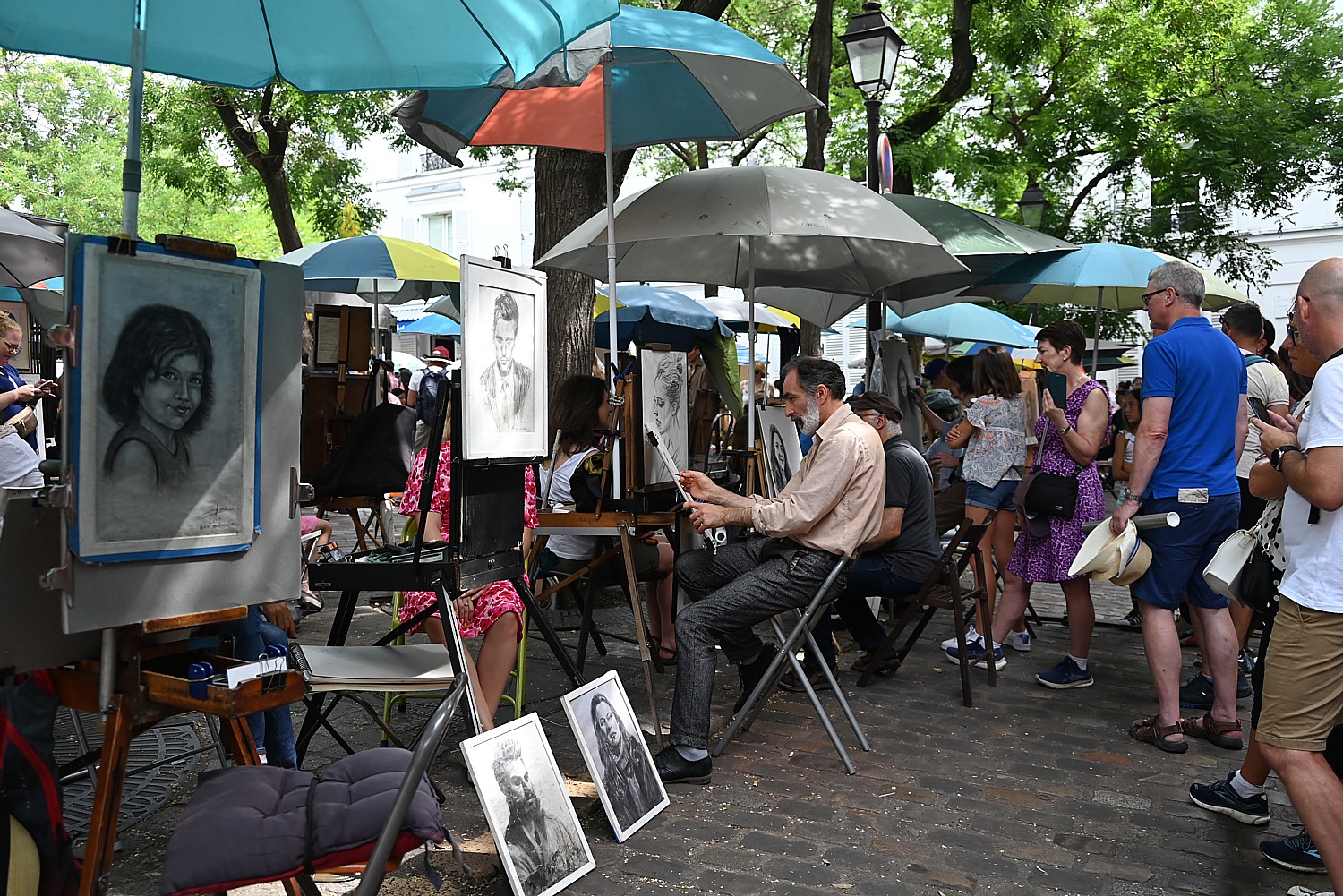
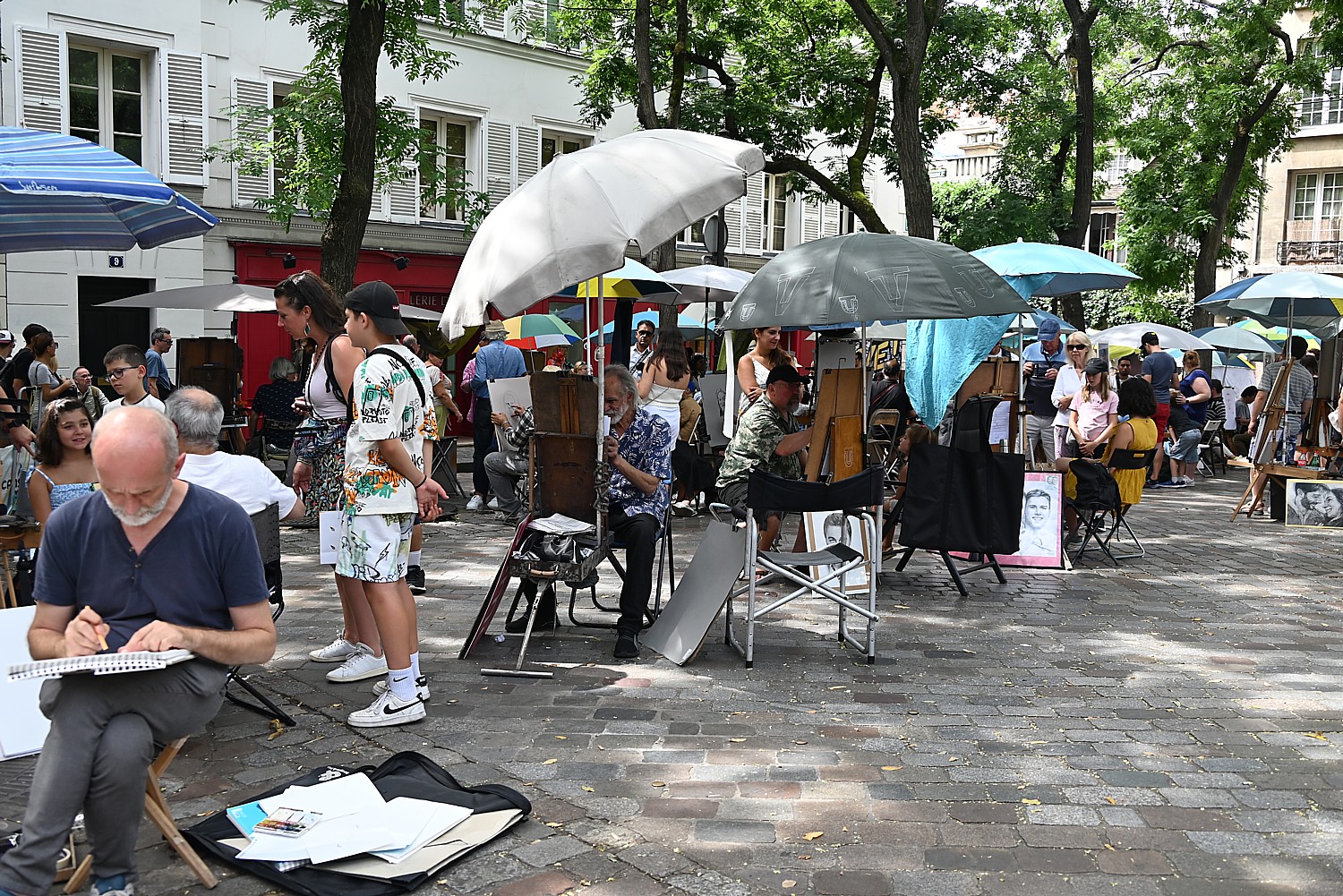
Amazingly, the Musee de Montmartre is in an unassuming house on a quiet cobblestone street only a few steps away from the frantic bustle surrounding Sacre-Coeur and the Place du Tertre where there is a hodgepodge of cafes and artists at their easels,
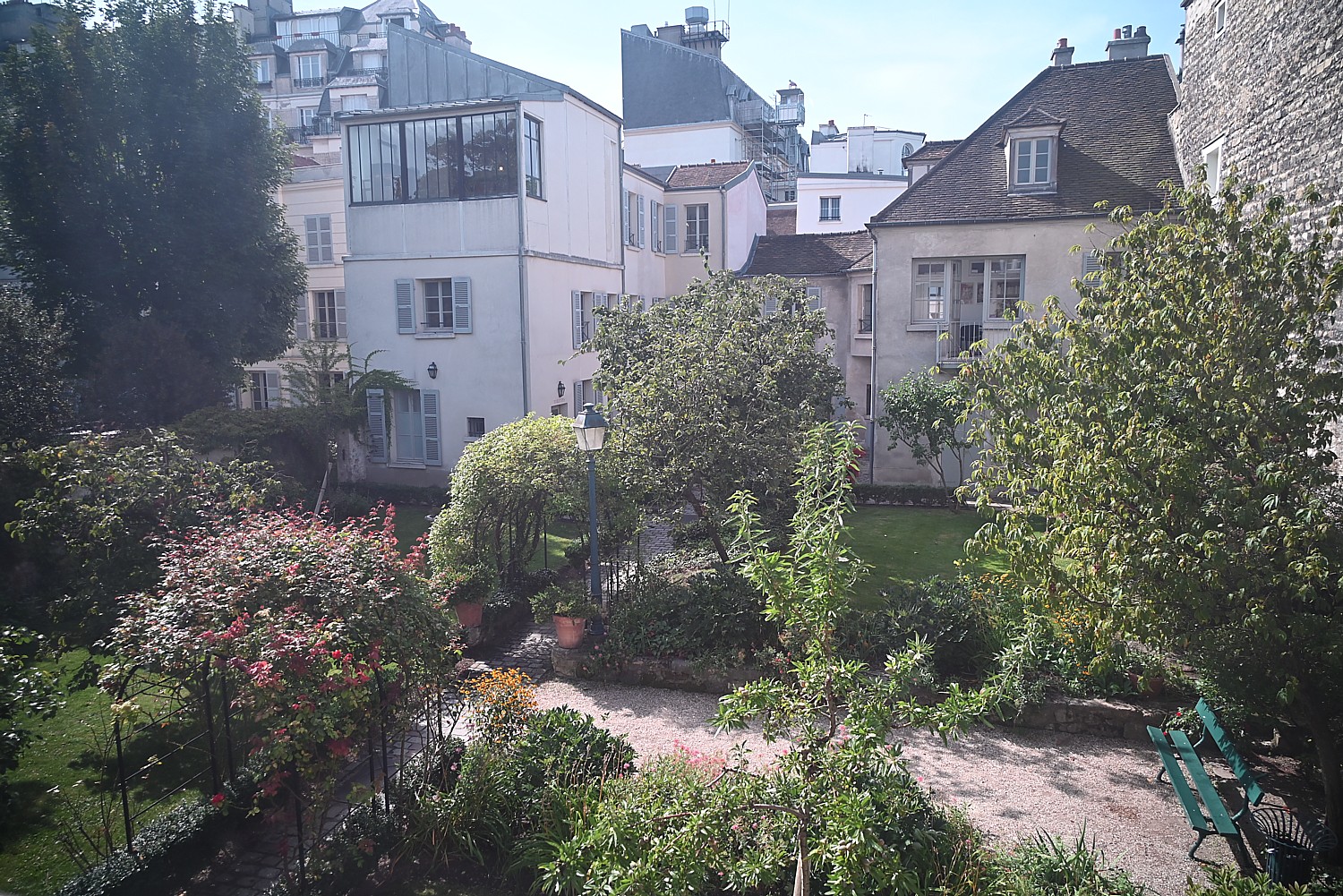
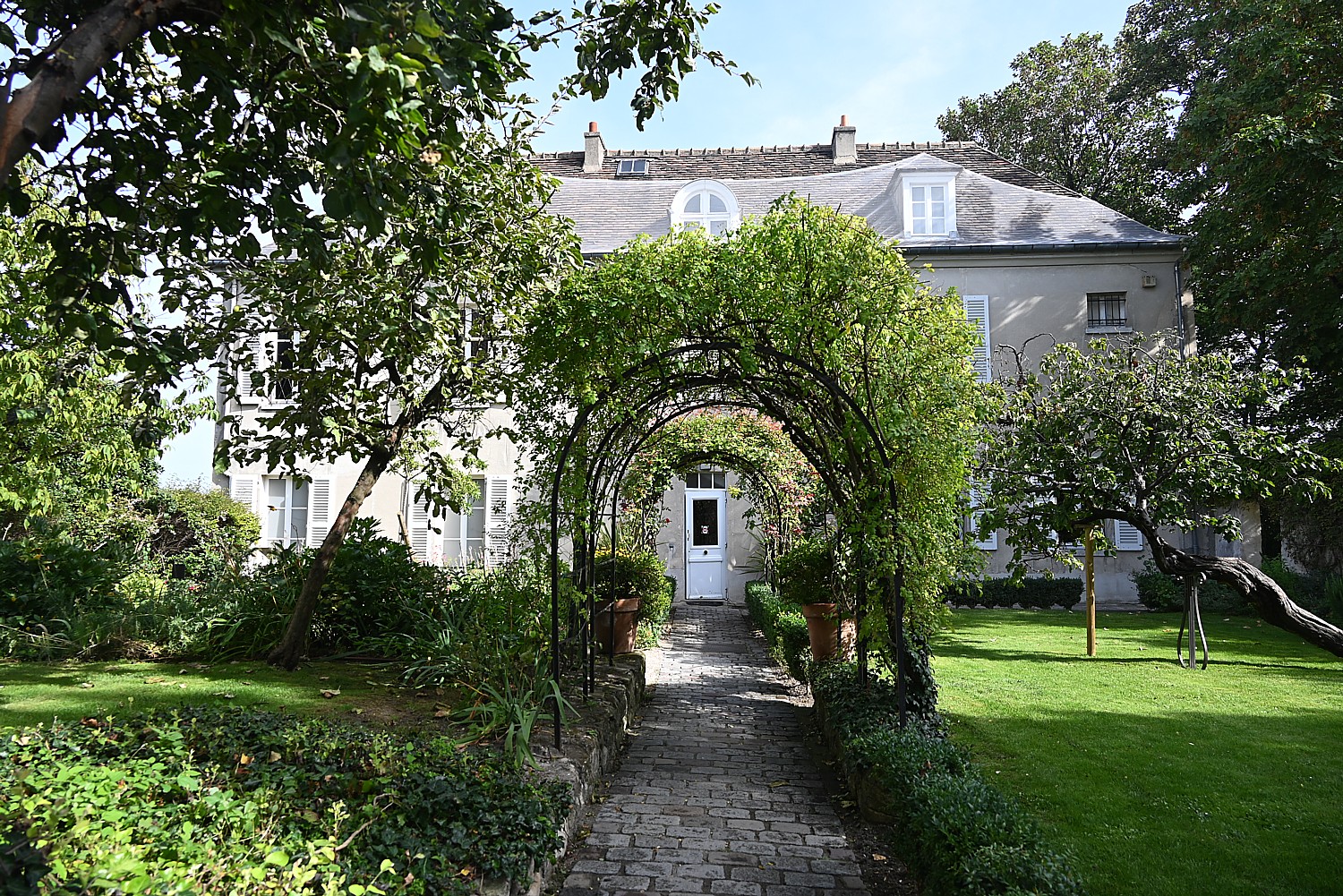
The Musee de Montmartre was created in 1960 in one of the oldest buildings on the Butte, built in the 17th century: La Maison du Bel Air. Surrounded by gardens, it was a place that would have been inhabited by artists including Auguste Renoir, Émile Bernard, Raoul Dufy, Charles Camoin, Suzanne Valadon and Maurice Utrillo,
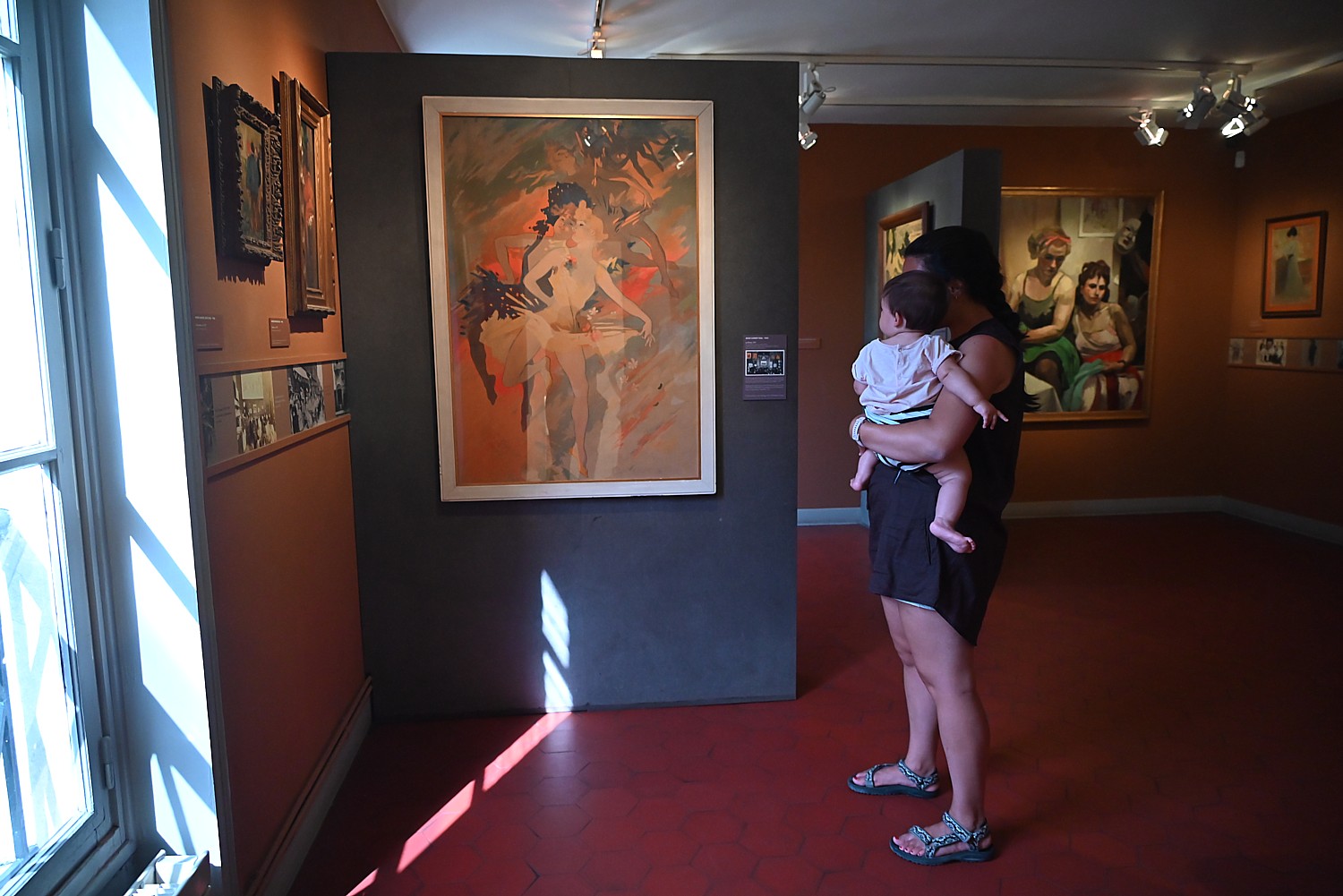
Here, you really feel the spirit of those artists, musicians, writers and cultural impresarios and entrepreneurs who made their community here – helped along by historic photos, video, recordings, sensational posters, documents and artifacts, and superb commentary.
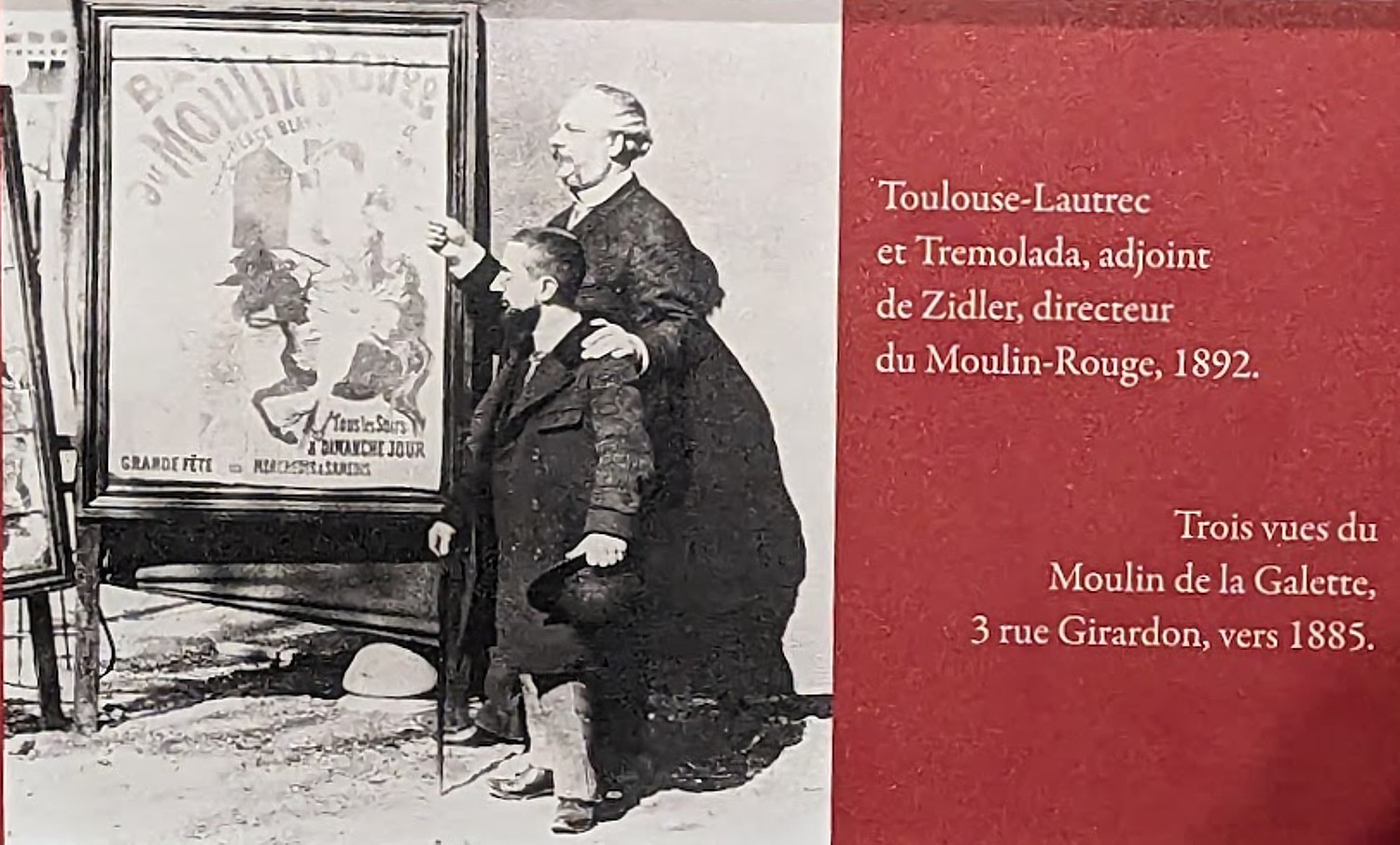
In the Chat Noir room, you hear piano music and singing; in a room devoted to the Moulin Rouge, you can see a video of French can can from the 1960 movie, “Can-Can” and see early photo portraits of can-can dancers; in another room, you get to see photos of important artists, like Toulouse-Lautrec at their easel.
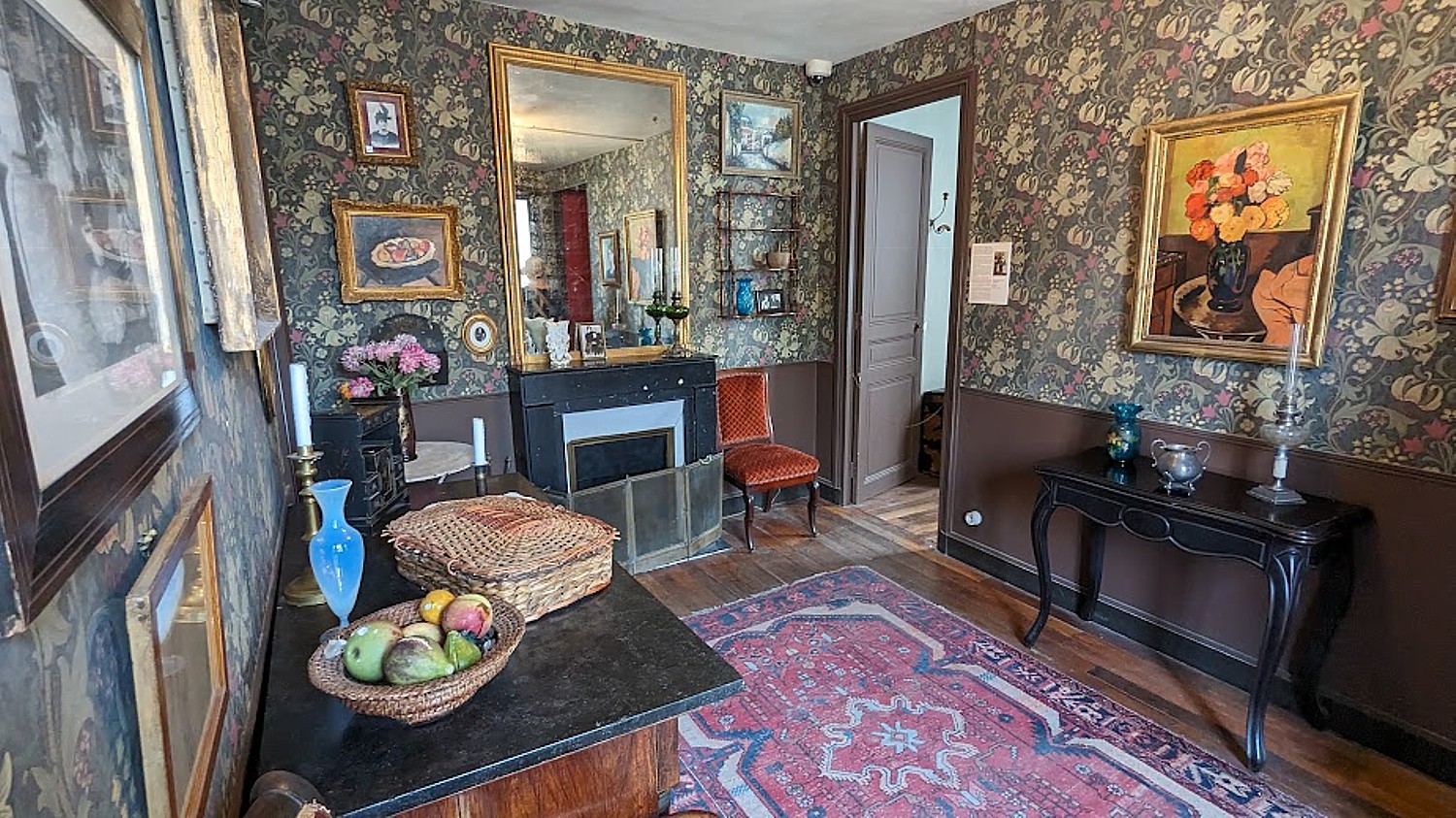
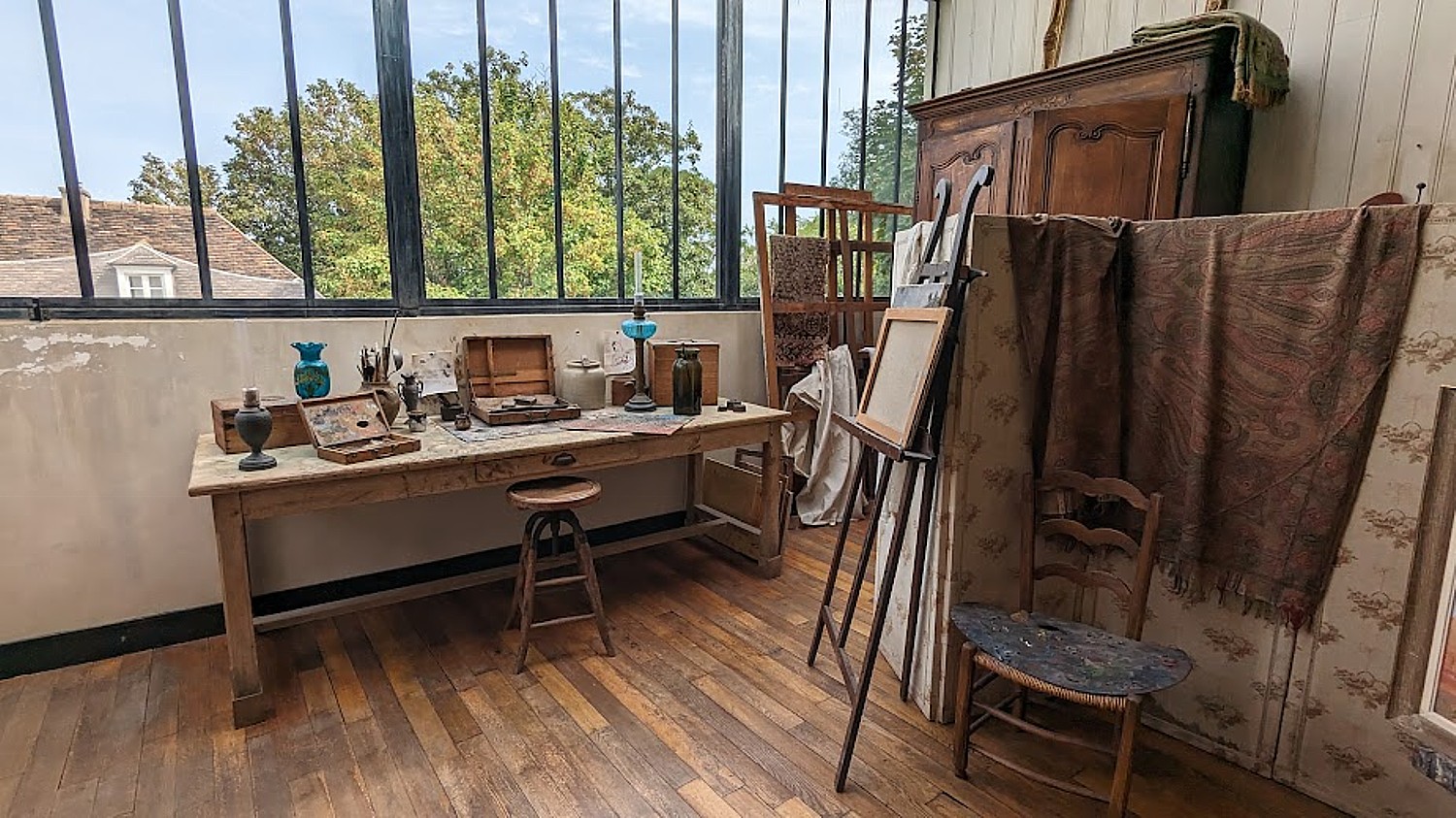
You get to visit the re-created atelier-apartment of artist Suzanne Valadon, who with her son Maurice Utrillo and André Utter settled in this apartment in 1912. Designer Huberty Le Gall, who worked with other renowned institutions, recreated the atelier-apartment faithfully based on letters, writings, historic photographs and paintings.
Here you really feel the presence of the artists. It is recreated to convey the character of the “infernal trio” – a frying pan, the recreated studio, the bedroom walls of Utrillo (an artist in his own right) still with its original paneling and wire on the windows.
The permanent collections are enchanting – paintings, posters and drawings that give you a taste of the artistic effervescence of its workshops, and the atmosphere of its famous cabarets.
The permanent collection immerses you in the history of Montmartre. During the 19th century, Montmartre was in transition the mills and the vineyards slowly disappeared due to urbanization (sound familiar?). In 1860, Montmartre was annexed to the city of Paris. Artists started to move to Montmartre in 1870 (for cheap rent) and the cafes and cabarets multiplied in the 1880’s. Montmartre became known for its bohemian spirit, its creative energy, which resonates today. This place, 12 Cortot, offered artists studio space and several painted it.
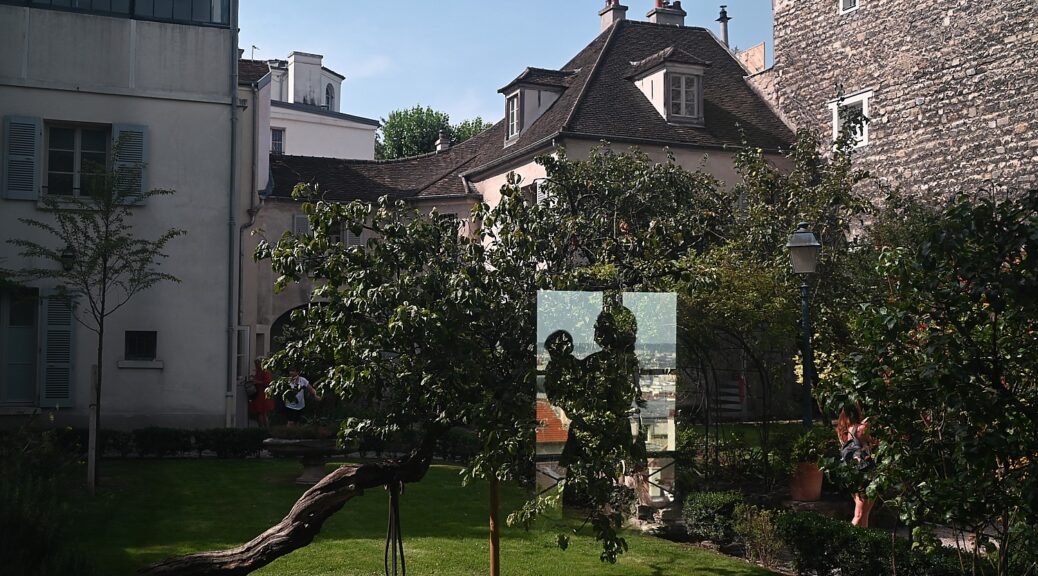
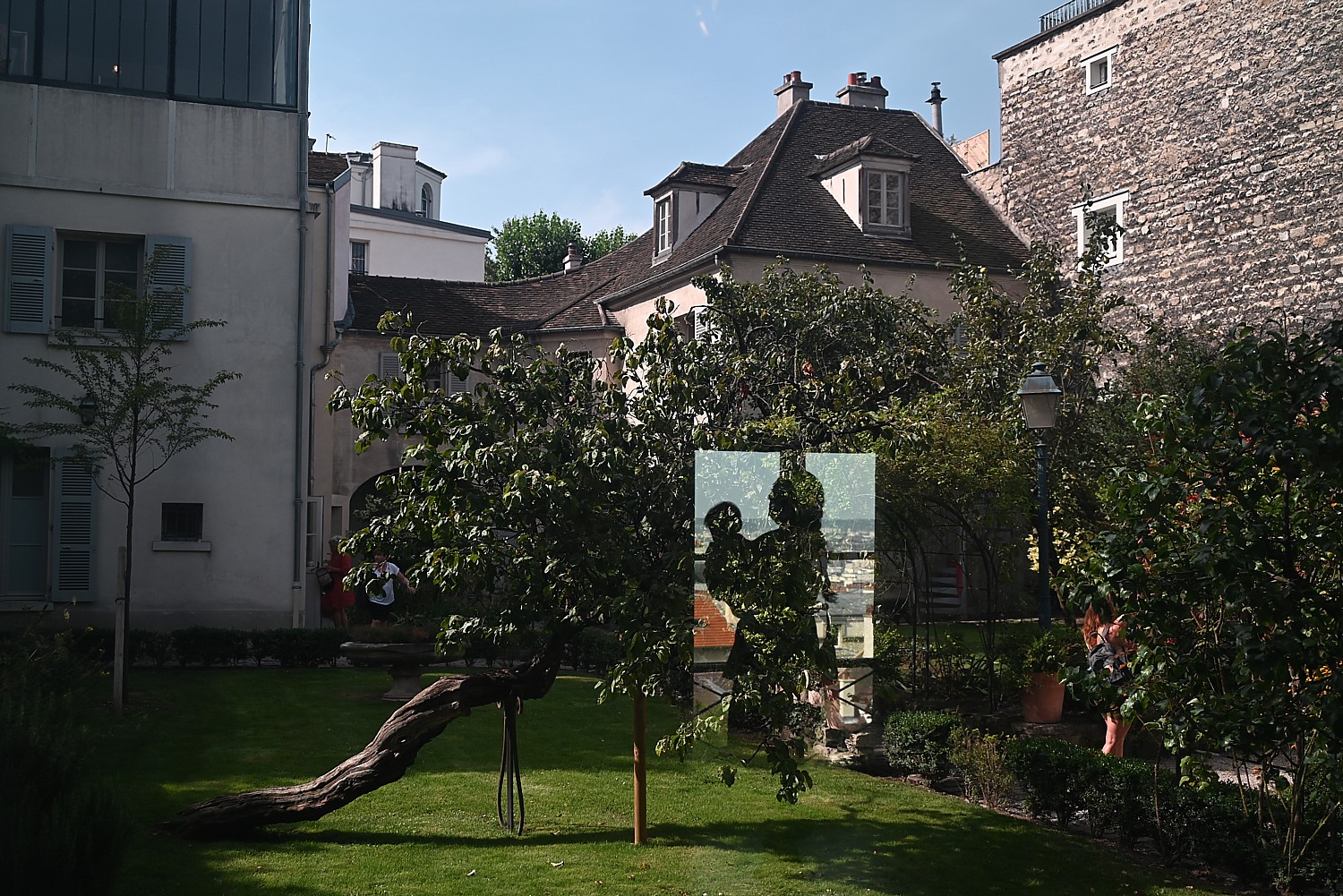
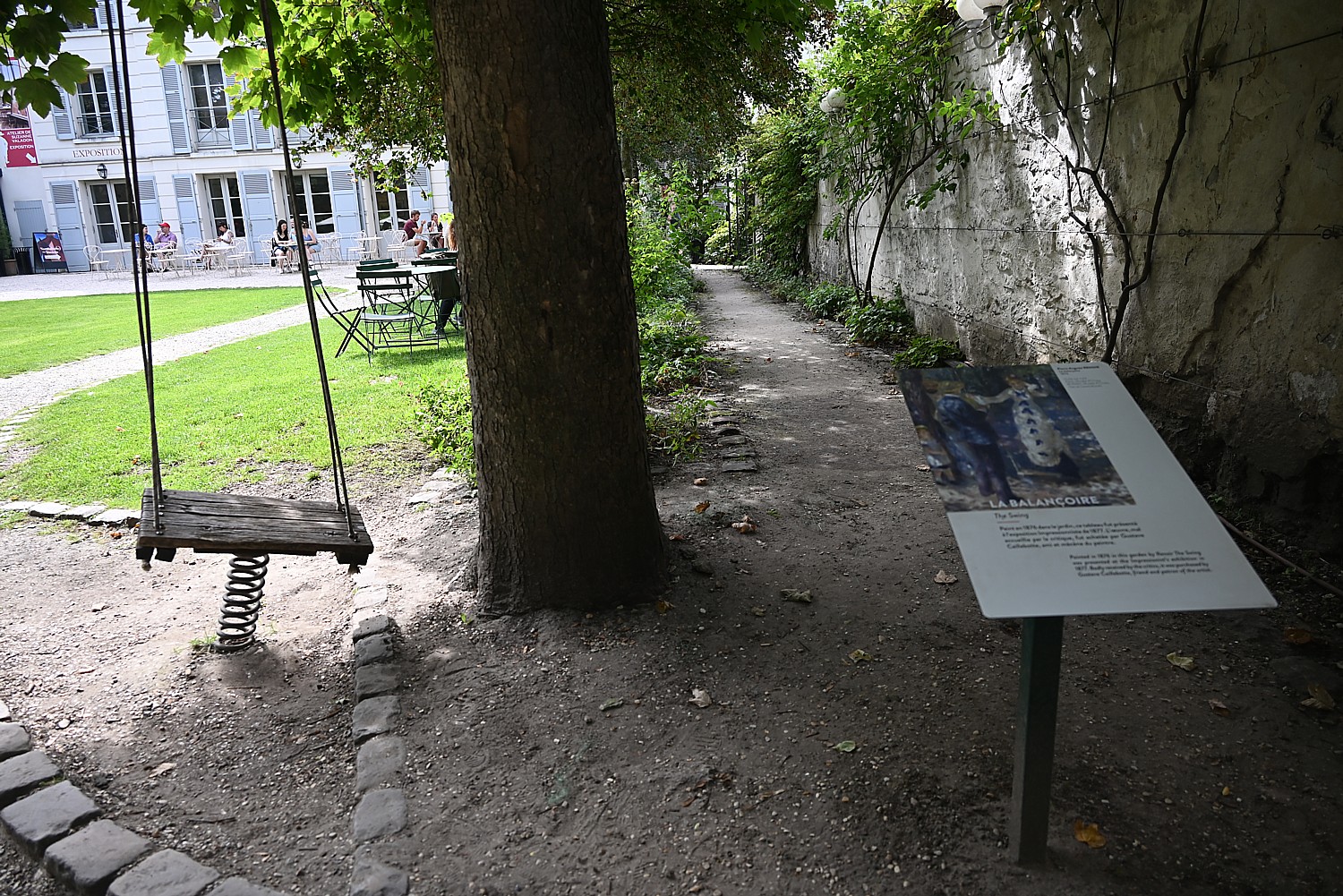
But the most special part of this place is the garden immortalized by Auguste Renoir in his paintings including La Balancoire (“The Swing”) – you can even see same swing hanging from a tree branch that he painted. The impressionist painter lived on this very site between 1875 and 1877m where he painted several masterpieces including the famous le Bal du Moulin de la Galette (“The Moulin de la Galette Ball”) and Jardin de la rue Cortot (“Rue Cortot Garden”). You easily see the scenes that he immortalized – there is even a lily pond.
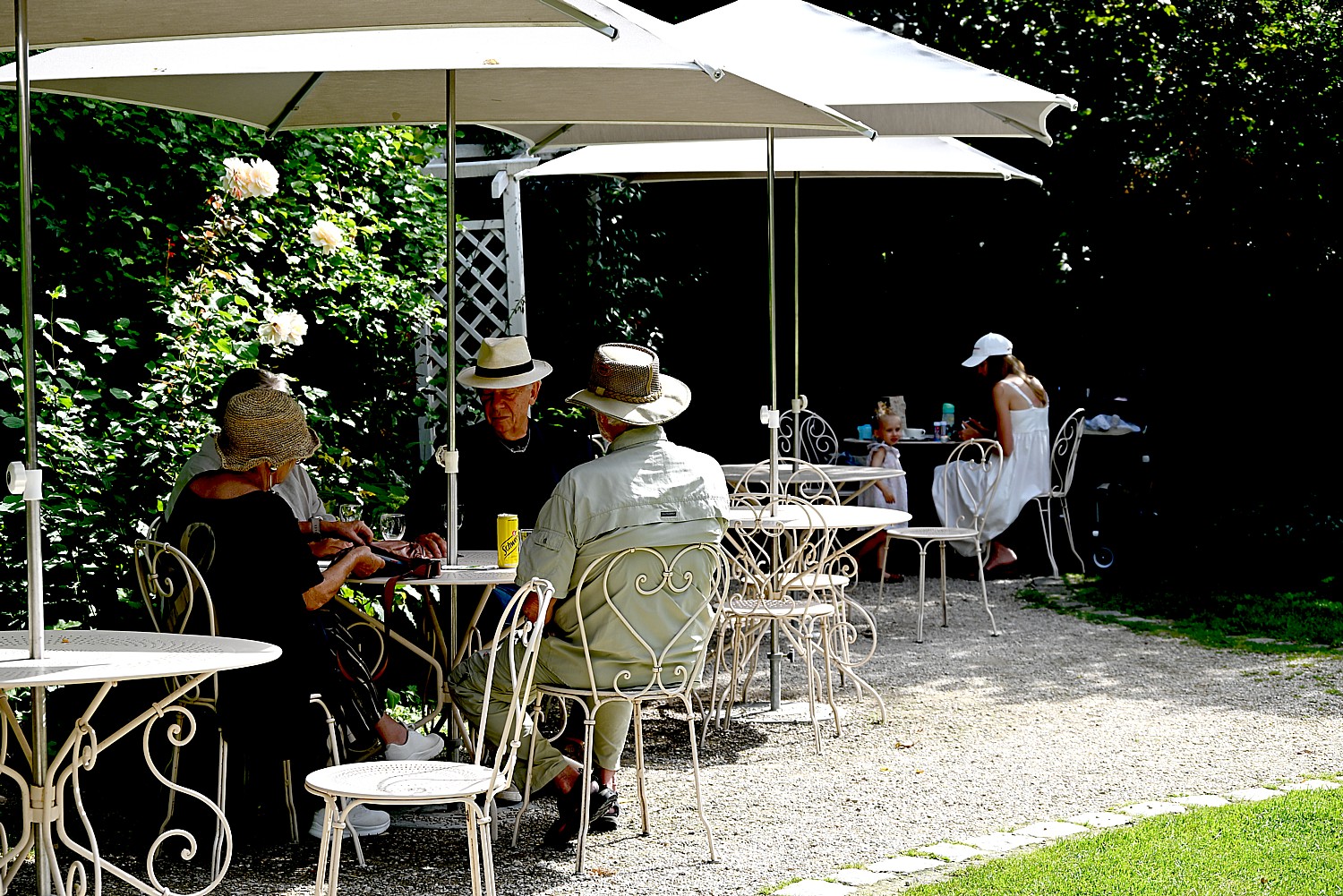
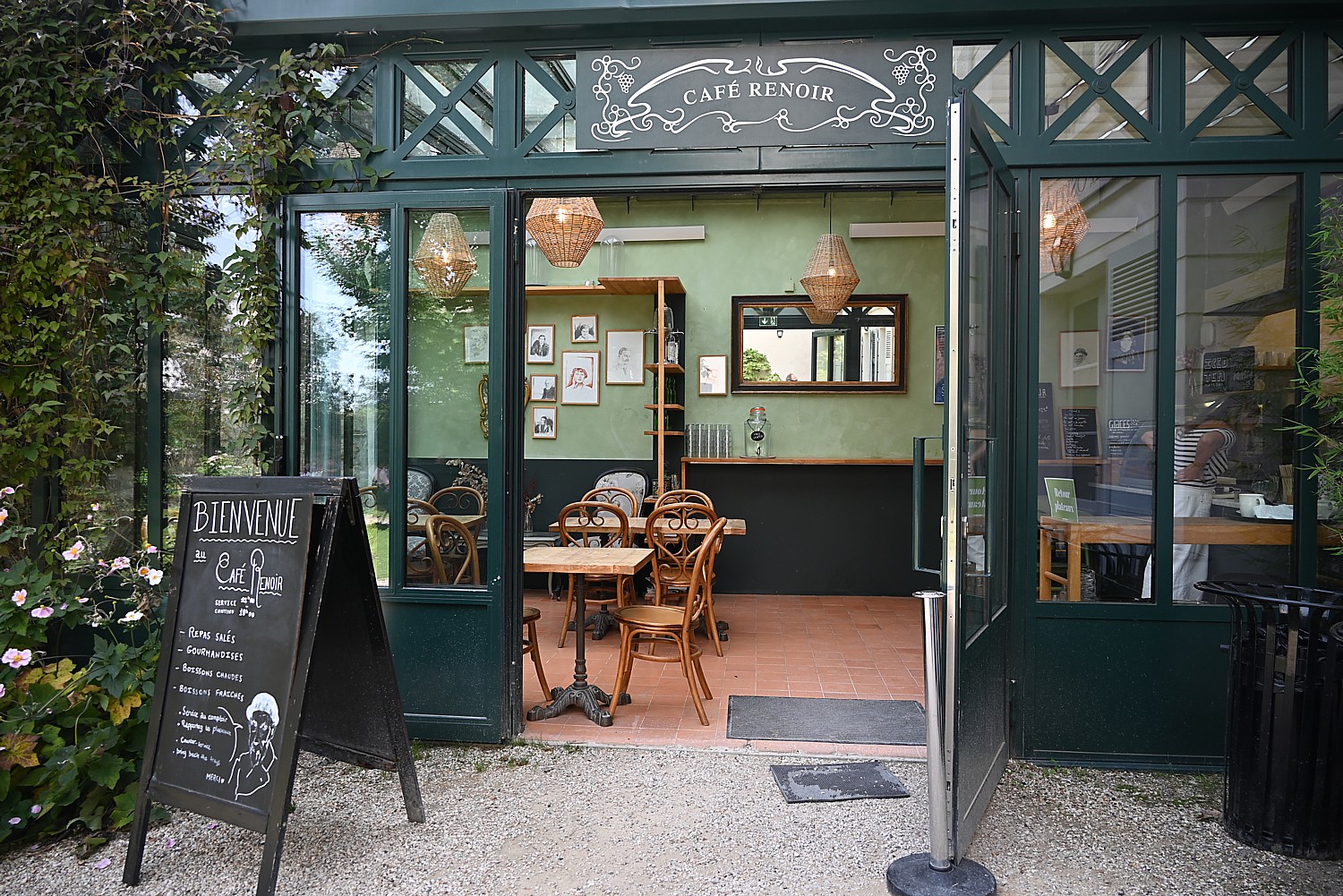
This truly is like a Woody Allen “Midnight in Paris” moment where time has rolled back. An oasis of peace and tranquility, you can sit and enjoy refreshments from the Café Renoir and feel you have floated into Renoir’s canvas.
Here in the garden, you find Café Renoir, its glass roof decorated in the manner of a winter garden. The incredible peace of this place, where I enjoy lunch, is such a luxury, especially when you leave, walk the few steps toward the bustling Sacre-Coeur or Place du Tertre.
The tranquility of the Museum, and the undeniable feeling of going back in time, is in contrast to the bustle and press of tourists that snap you back into the present day at Sacre-Coeur and Place du Tertre. But that is where I go next (how can you not?).
There are scores of artists, in the tradition of Montmartre trying to eke out a living, selling their paintings or drawing your portrait or caricature, piggybacking the romance attached to the 19th century artists.
I miss out on seeing Le Bateau-Lavoir, a collection of small apartment buildings in Montmartre that served as the homes and studios of several artists, including Picasso, in the early 20th century.
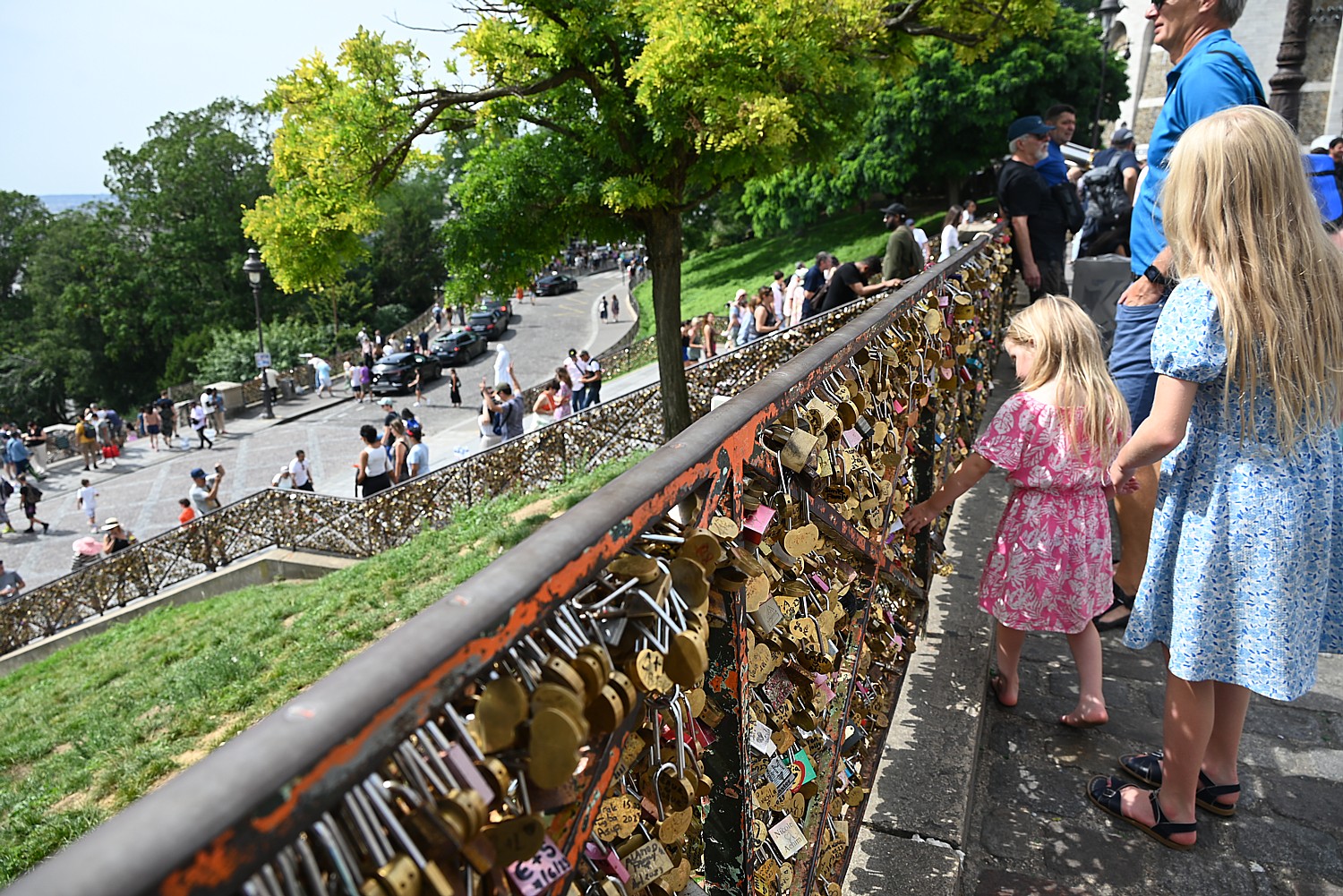
Next, I go to marvel at the Sacré-Cœur Basilica, a masterpiece of grace and grandeur. Built at the end of the 19th century in the Romano-Byzantine style, it houses the largest mosaic in France, measuring at 480 sq. meters, and is still actively used as a place of worship.
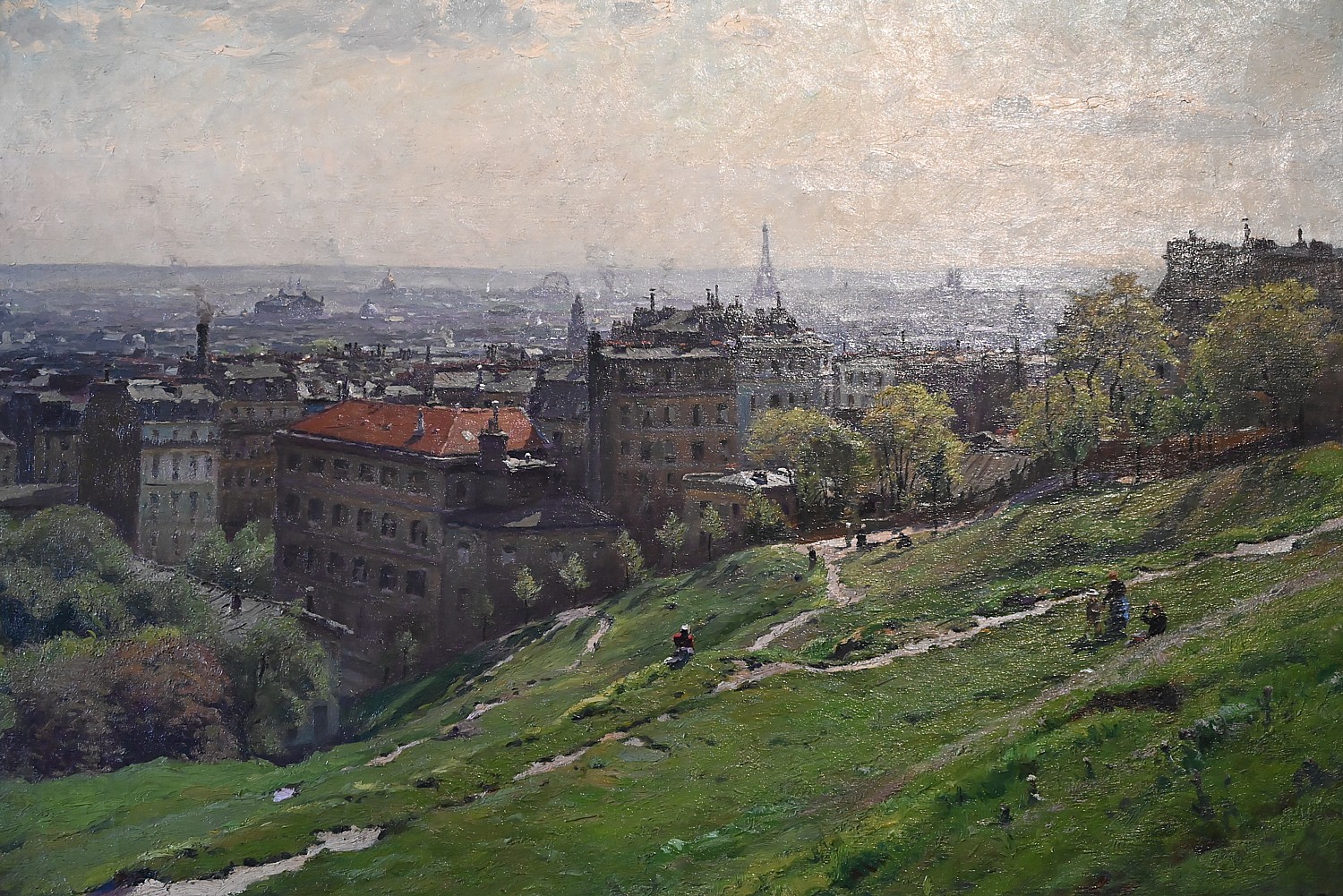
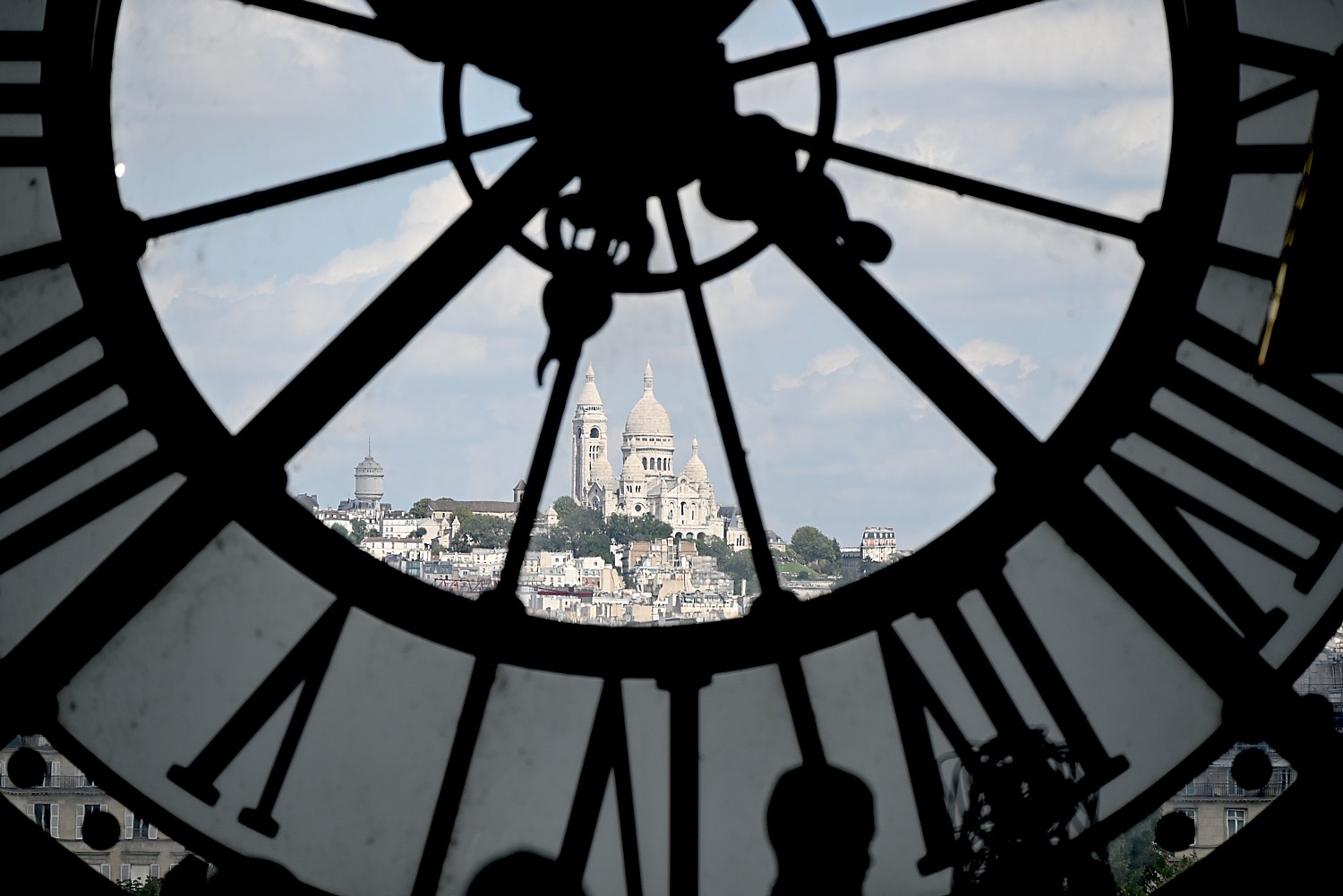
The forecourt of Sacre-Coeur (or if you are game, climb the 325 steps to the top of the majestic dome), provides an amazing view of Paris – which I note is like one of the paintings at the museum by Renaudin painted in 1899, depicting a landscape from this exact hilltop over Paris – how much has changed, and yet, the same. There is a continuity.
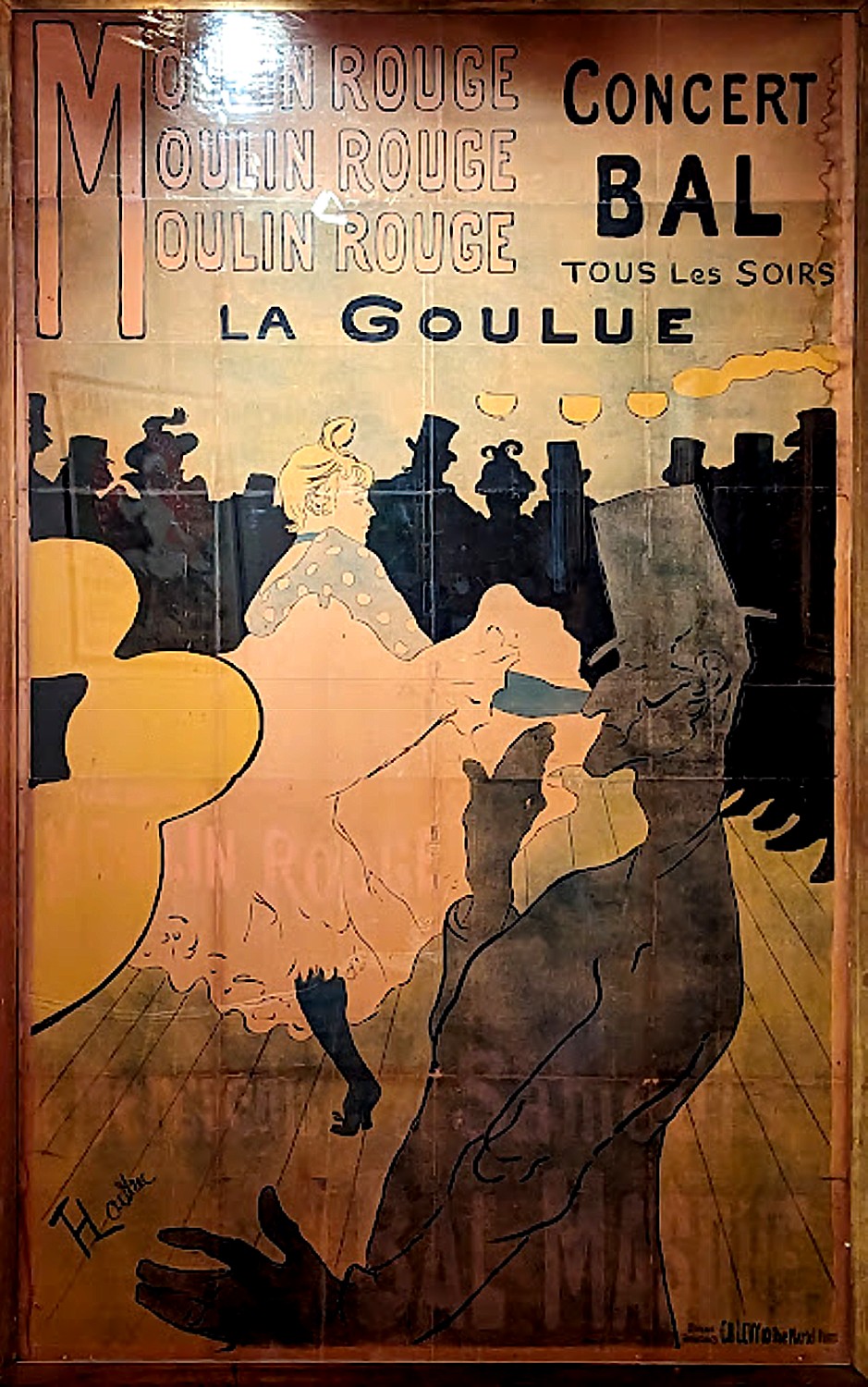
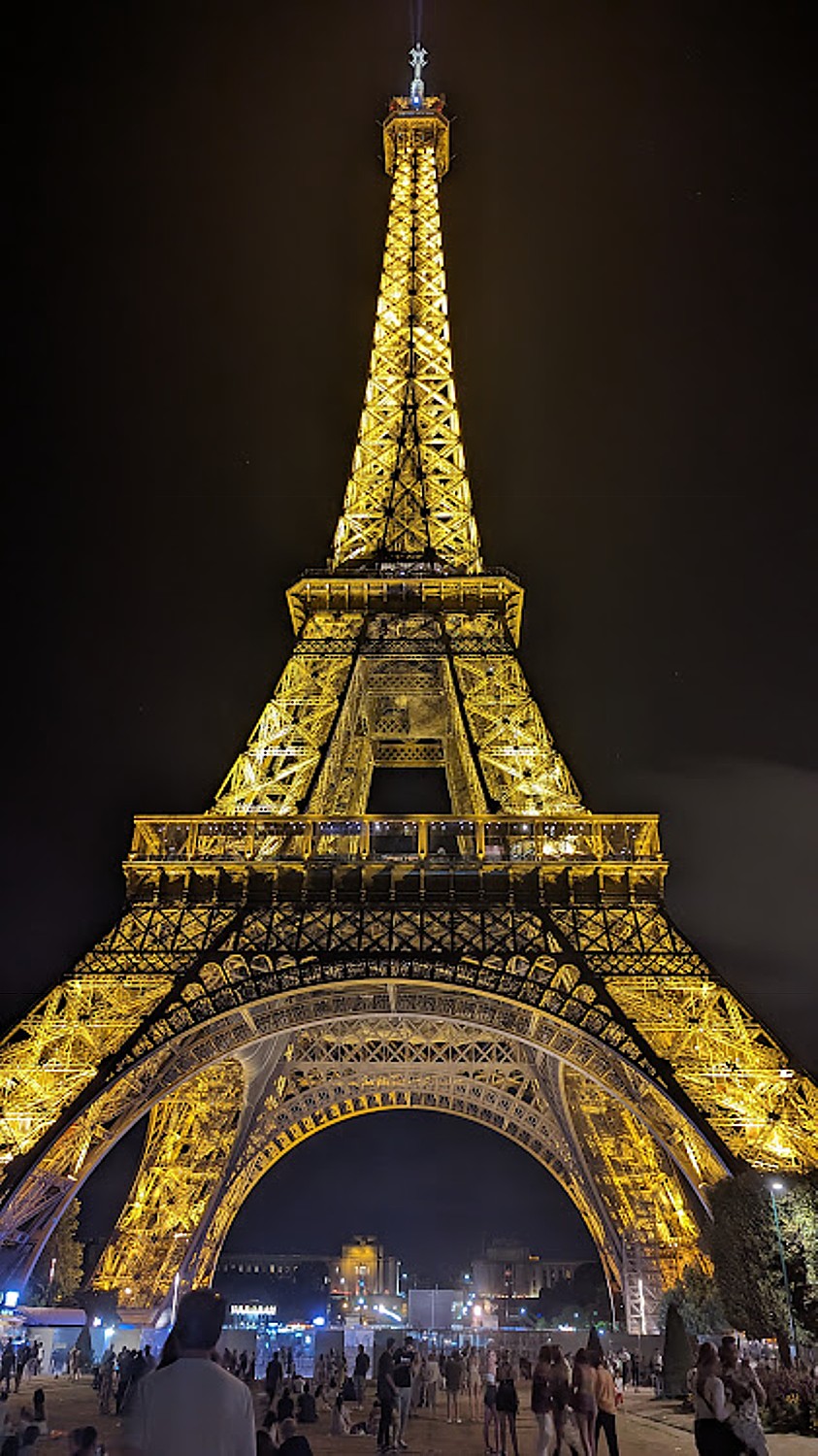
Had I been able to stay longer, I would have delighted to see the Moulin Rouge, perhaps the most famous cabaret on the planet. It first opened in 1889 for the same world’s fair that brought Paris the Eiffel Tower, and for more than 125 years, 7 days a week, audiences of 1,800 have the delight of seeing the 60 performers including the 40 Doriss Girls maintain this tradition. In its day, you might see artist Toulouse-Lautrec who found inspiration in the Moulin Rouge’s audiences as well as the performers, among them La Goulue, Jane Avril or Yvette Guilbert stars of the French music hall. (I had seen Toulouse-Lautrec’s posters and photos of the can-can dancers at the Museum.) The cabaret endeavors to preserve the style of the original creators of the Moulin Rouge, Joseph Oller and Charles Zidler, but still offer a modern take on the original music hall style. (Le Moulin Rouge, 82 Boulevard de Clichy 75018 Paris, https://www.moulinrouge.fr/en/)
I make it back to the hotel, Le 20 Prieure Hotel in the Marais district, at 3 pm (I left at 9:30 am), in time to pick up my bags and treat myself to an Uber (instead of two metros) to Charles de Gaulle Airport for my flight home.
Planning is crucial to fully enjoy your visit to Paris, especially this year, with the Olympics scheduled (July 26-August 11) and Paralympics (August 28-Sept. 8. Other events to keep in mind: Tour de France, from June 29 to July 21; and Tour de France Femmes, from August 12 to 18.
Tourists can buy a Paris 2024 transit pass costing €16 a day, or €70 per week, allowing travel across the Île-de-France region, including to and from Charles de Gaulle and Orly airports. And if you are planning to go to venues outside of Paris requiring train travel, book in advance (raileurope.com).
This avoids having to queue up at a ticket machine and being confused about what zone ticket to purchase. Go to the helpful visitor information center right when you land at Charles de Gaulle where you can purchase the ticket, and therefore avoid the first line at the airport machines. The airport has excellent train links to the city but also the TGV trains to other parts of France (check raileurope.com).
Many of the attractions I visit during my four-day stay are included in the Paris Museum Pass, http://en.parismuseumpass.com/ and Paris Pass (ParisPass.com), which also features experiences and attractions like the Seine bateaux mouches cruises.
Be aware that Paris is abuzz with Olympics this summer (July 26-August 11), many of the venues will be in the center city – transportation will be affected (when I visited, the city was doing a drill on closing streets).
Much of the activity will be in the heart of the city itself, as well as throughout the Ile-de-France region. In all, there are 35 venues.
Many Paris iconic landmarks are being transformed into sporting arenas to offer spectators an unparalleled experience and provide an outstanding backdrop.
These include: the Eiffel Tower Stadium, Trocadéro, La Concorde Stadium, Hôtel de Ville, Alexandre III Bridge, Parc des Princes, Bercy Arena, South Paris Arena, Porte de La Chapelle Arena, Grand Palais, Champs de Mars Arena, Invalides, and Roland-Garros Stadium,
The Games will also take place throughout the Ile-de-France region, from Les Yvelines to Hauts-de-Seine, Seine-et-Marne and Seine-Saint-Denis. Seine-Saint-Denis will be home to the Olympic and Paralympic Village, the Media Village and six sports events. In addition, Seine-Saint-Denis is the venue for two Paralympic events – the Paralympic marathon and Paralympic road cycling.
Specific venues include: Le Bourget Sport climbing venue, Yves-du-Manoir Stadium, North Paris Arena, Stade de France, Aquatics Centre, Clichy-sous-Bois, Paris La Défense Arena in Nanterre, Château de Versailles, Vaires-sur-Marne Nautical Stadium, Saint-Quentin-en-Yvelines Velodrome, Saint-Quentin-en-Yvelines BMX stadium, Golf National, Elancourt Hill,
The Paris 2024 Games will extend to the whole of France, promoting the country’s rich and diverse heritage. The football (soccer) tournament will be played at six stadiums across France: Bordeaux, Nantes, Lyon, Saint-Etienne, Nice and Marseille. The handball’s final phases’ games will be played in Lille, while sailing will head to the Mediterranean, in Marseille. For the first time in history, the Games will even benefit overseas territories and their communities, with the Teahupo’o site in Tahiti to stage the Olympic surfing competition on one of the most beautiful waves in the world.
On the third and last full day of my stay in Paris, I could have planned a visit to Versailles, but I just want a day to wander without a plan. Still, I have on my list several places that I keep seeing street signs for in this fascinating Marais district where I have cleverly chosen a hotel.
The Marais District is a colorful combination of the venerable and contemporary, trendy cafes, a mélange of architecture and historic, heritage and cultural sites, all packed into a relatively small (walkable) area. It is particularly wonderful to wander because the narrow, winding streets are a bit of a maze, and you keep coming upon architectural jewels – even a medieval tower – that span the centuries, trendy cafes and shops, street art, and historic places, especially sites that recall that the Marais was once a Jewish neighborhood. The main thoroughfare is Rue Vielle du Temple, and another is Rue du Temple. I had already come upon the Memorial de la Shoah, and have yet to find the Square du Temple-Elie Wiesel, le Carreau du Temple, a former clothes market that was transformed into a cultural center in 2014, or the Jardin Anne Frank.
I go in search of Place des Vosges, described as the oldest public square in Paris and an “early urban planning marvel”.
I get lost and instead come upon Parvis des 260 Enfants – a plaza where a marker recalls 260 Jewish school children were deported and murdered in the Holocaust. Behind a locked gate is the “Ecole Primaire Commudej Garcons Israelites Mode Mutuel.”
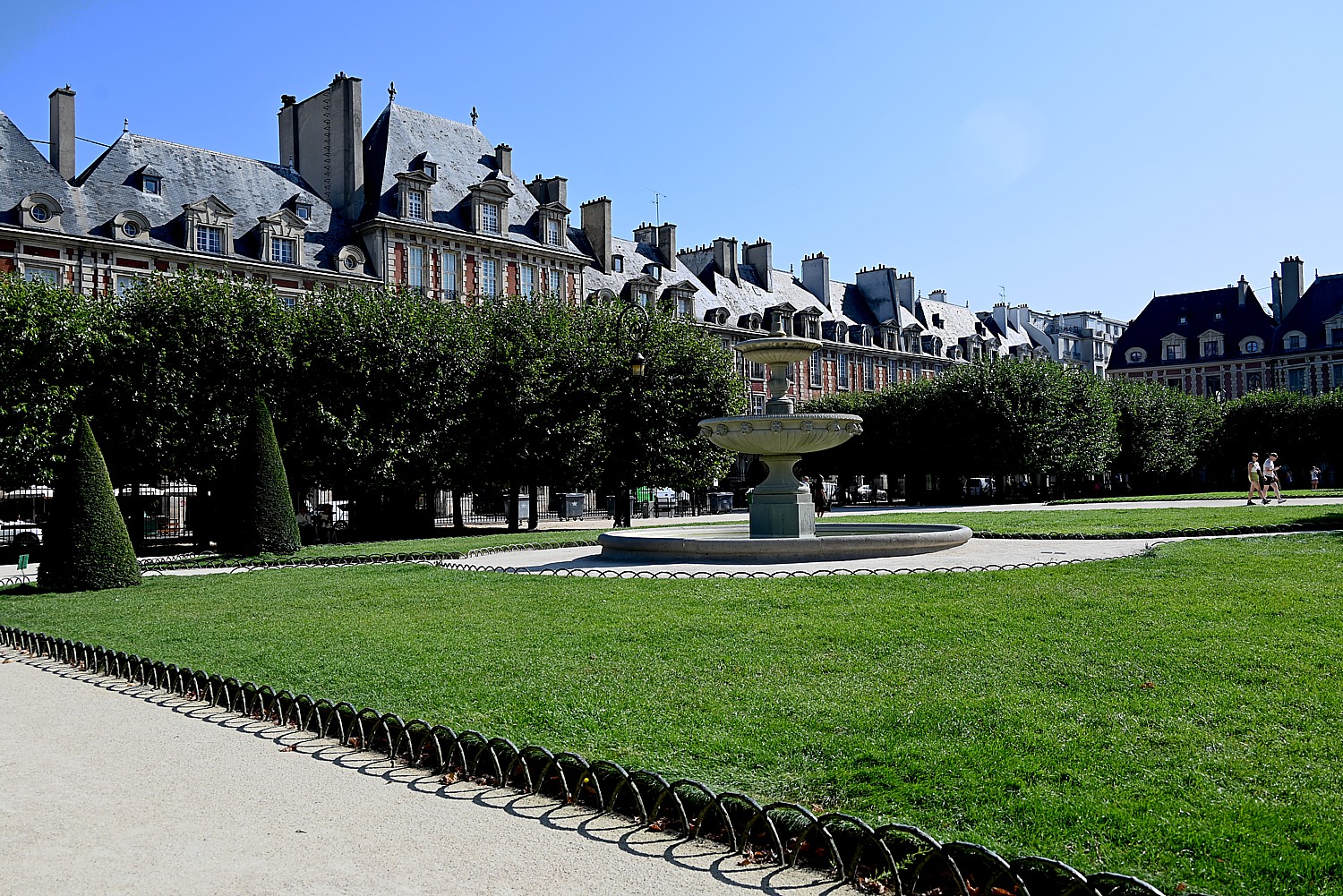
I finally find the Places des Vosges – which strikes me as reminiscent of Gramercy Park in Manhattan with townhouses all around. It was built for a king for jousting and festivals – the townhouses came later. It isn’t what I expected.
Though I have on my mental wish list to visit the Victor Hugo Museum, I don’t realize that it is actually one of these townhouses on Places des Vosges. (Years ago, I actually visited Victor Hugo’s “home in exile” on the quaint Channel Island of Guernsey and found it fabulous). But I get distracted and forget to look for it when I leave the square.
This is a huge regret – “Discover the private world of Victor Hugo. Get to know the man, the visionary artist, the proactive thinker and, of course, the writer of genius,” the museum promises. The museum incorporates the apartment that Victor Hugo rented from 1832 to 1848 is located on the 2nd floor of 6, Place Royale (now Place des Vosges). Its layout takes you through his life by means of the furnishings, objects and works of art that he created himself, owned, or are related to his writing.
While living in this apartment, Hugo wrote some of his major works: Mary Tudor, Ruy Blas, Les Burgraves [The Commanders], Les Chants du crépuscule [Songs of Twilight], Les Voix intérieures [Inner Voices], Les Rayons et les Ombres [Beams and Shadows], a large part of Les Misérables, and the beginning of The Legend of the Ages and Contemplations.
More than the writer’s house, the Maison de Victor Hugo is an important museum with a collection of 50,000 works of art- paintings, drawings, sculptures, prints, photographs, objects, a library, and collection of manuscripts and archives, all bearing witness to the life and work of Victor Hugo.
(Booking in advance is not required but is recommended. Admission to the museum’s permanent collections is free; an admission is charged for special exhibitions.)
(Add to my regret: I discover too late that in the Marais district is an Henri Cartier-Bresson Foundation, celebrating the ground-breaking photographer and founder of Magnum and photography, at 79 Rue des Archives, 75003 Paris, www.henricartierbresson.org)
Musee Carnavalet
But leaving the Square in the opposite direction from Maison de Victor Hugo (why I didn’t see it), I happen upon the Musee Carnavalet, dedicated to recounting the history of Paris and its inhabitants. It is absolutely fabulous – for the story, the artifacts, the art it presents, and it answers the question I had been wondering about: how Paris, as fabulous a city as it is, came to be.
The museum occupies two neighboring historic mansions: the Hôtel Carnavalet, was purchased by the Municipal Council of Paris in 1866 and opened to the public in 1880 (the oldest of Paris city museums); and the former Hôtel Le Peletier de Saint Fargeau which was annexed and opened to the public in 1989. Both are exquisite.
The Carnavalet, which dates from the 16th century, contains stunning furnished rooms from different periods of Paris history, historic objects, and a huge collection of paintings of Paris life depicting the city’s history and development, as well as its notable characters. There is a huge collection of antiques and artifacts from the French Revolution that bring this era to life in your mind (I note a portrait of Ben Franklin); from the Second Republic of 1848, and the siege of the commune in 1870 (the era depicted in Hugo’s “Les Miserables”). The horror of the Nazi occupation is also represented.
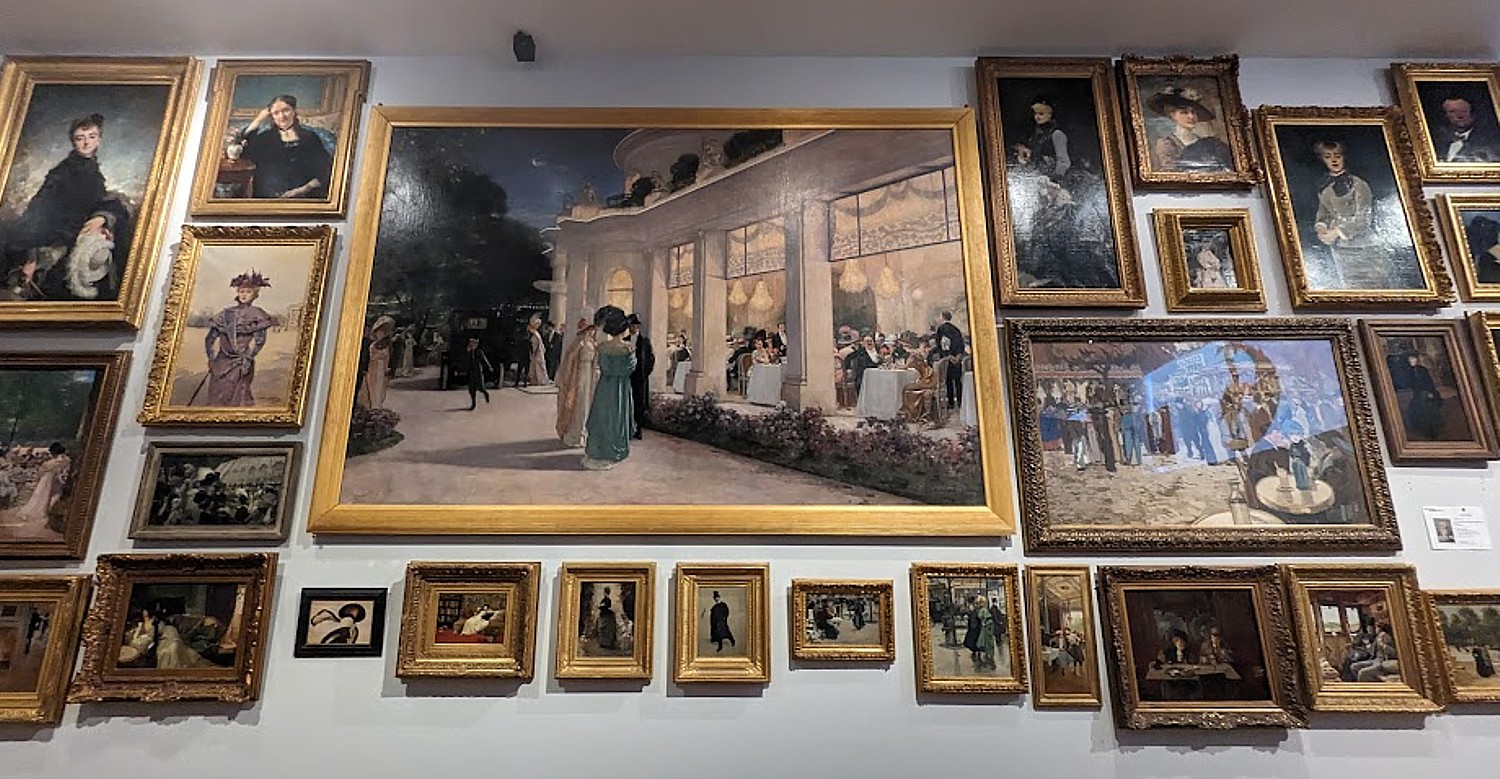
You come to a grand room that looks like the 19th century art salons the painters would exhibit in, with its walls filled with works by artists including Joos Van Cleve, Frans Pourbus the Younger, Jacques-Louis David, Hippolyte Lecomte, and Simon-Auguste.
“At the crossroads of archaeology and history, the decorative arts and fine arts, urban history and social anthropology, the museum provides the keys to understanding the history of this unique city-capital-metropolis.”
It houses both well-known masterpieces along with little known treasures that tell the complex story of Paris, from its origins to present day, spanning 8,500 years and holds a mind-boggling 625.000 objects, presented in 85 permanent exhibition rooms
You need to spend at least two hours here. (Tuesday-Sunday, 10-6)
Carnavalet Museum, which proves a highlight of my Paris stay and the best reason for just wandering around, is one of the 14 City of Paris’s museums that have been incorporated since January 1, 2013, in the public institution Paris Musees. Others include: Catacombes de Paris, Crypte archéologique de l’Ile de la Cité, Maison de Balzac, Maison de Victor Hugo – Hauteville House (and in Guernsey), Petit Palais City of Paris Museum of Fine Arts, Musée d’Art Moderne de la Ville de Paris, Musée Bourdelle, Musée Cernuschi, Museum of Asian Art, Musée Cognacq-Jay, Musée Galliera, Museum of the General Leclerc and the Paris’ Liberation – Jean Moulin Museum, Musée de la Vie Romantique, Zadkine Museum
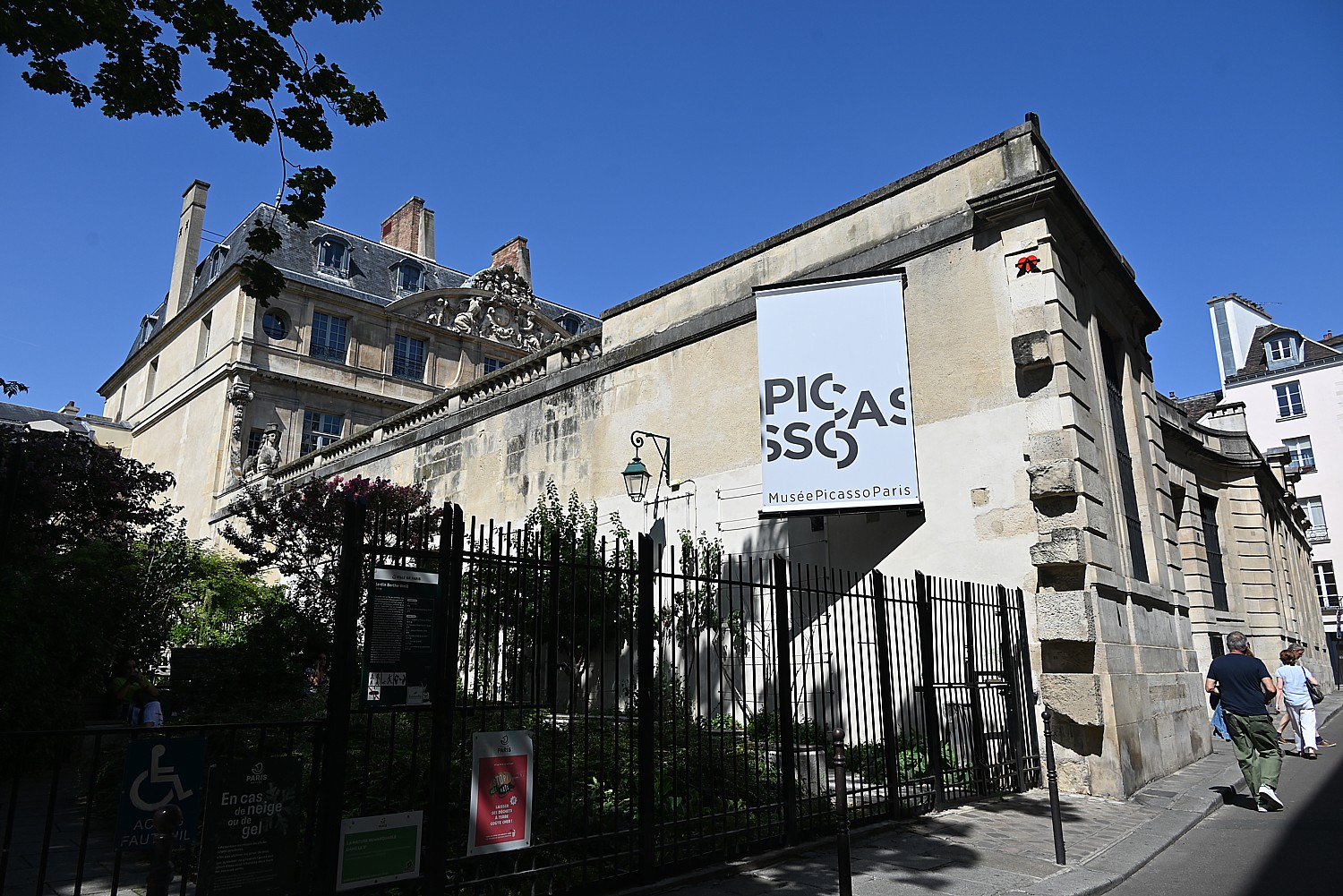
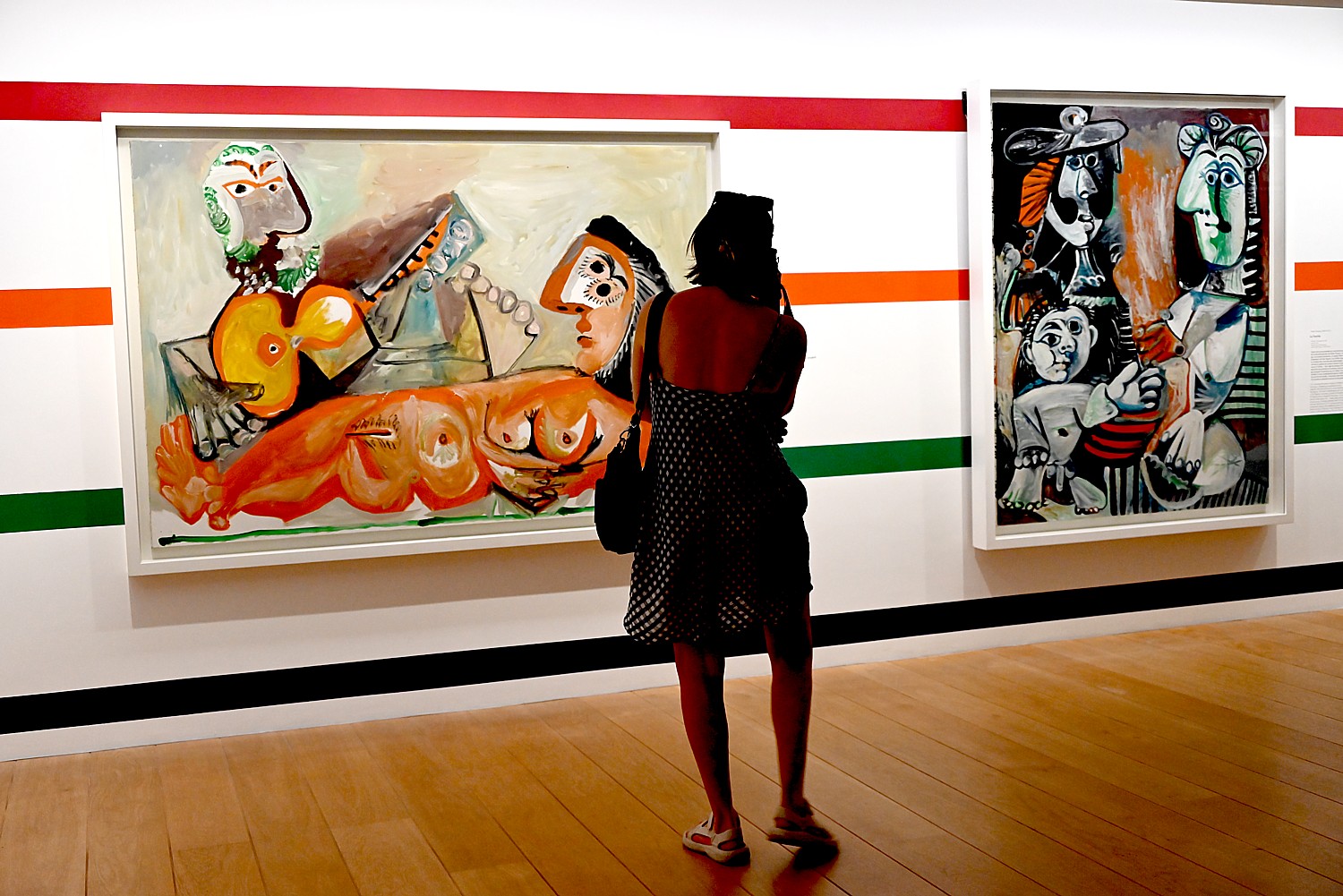
I set out next for the The Musée Picasso-Paris which is also in the Marais district – housed incongruously (considering Picasso’s art) in another classic historic mansion. The museum makes the claim to “the world’s richest public collection on Picasso” with 297 paintings, 368 sculptures and 3D works, 200,000 archived items, 92 illustrated books by Picasso. It also boasts a collection of 50 pieces of furniture by Diego Giacommetti.
Musée National Picasso-Paris, 5 rue de Thorigny, 75003 Paris, https://www.museepicassoparis.fr/en
Museum of Jewish Art & History
From the Picasso Museum, I find my way to the Musée d’Art et d’Histoire du Judaïsme (Museum of Jewish Art & History).
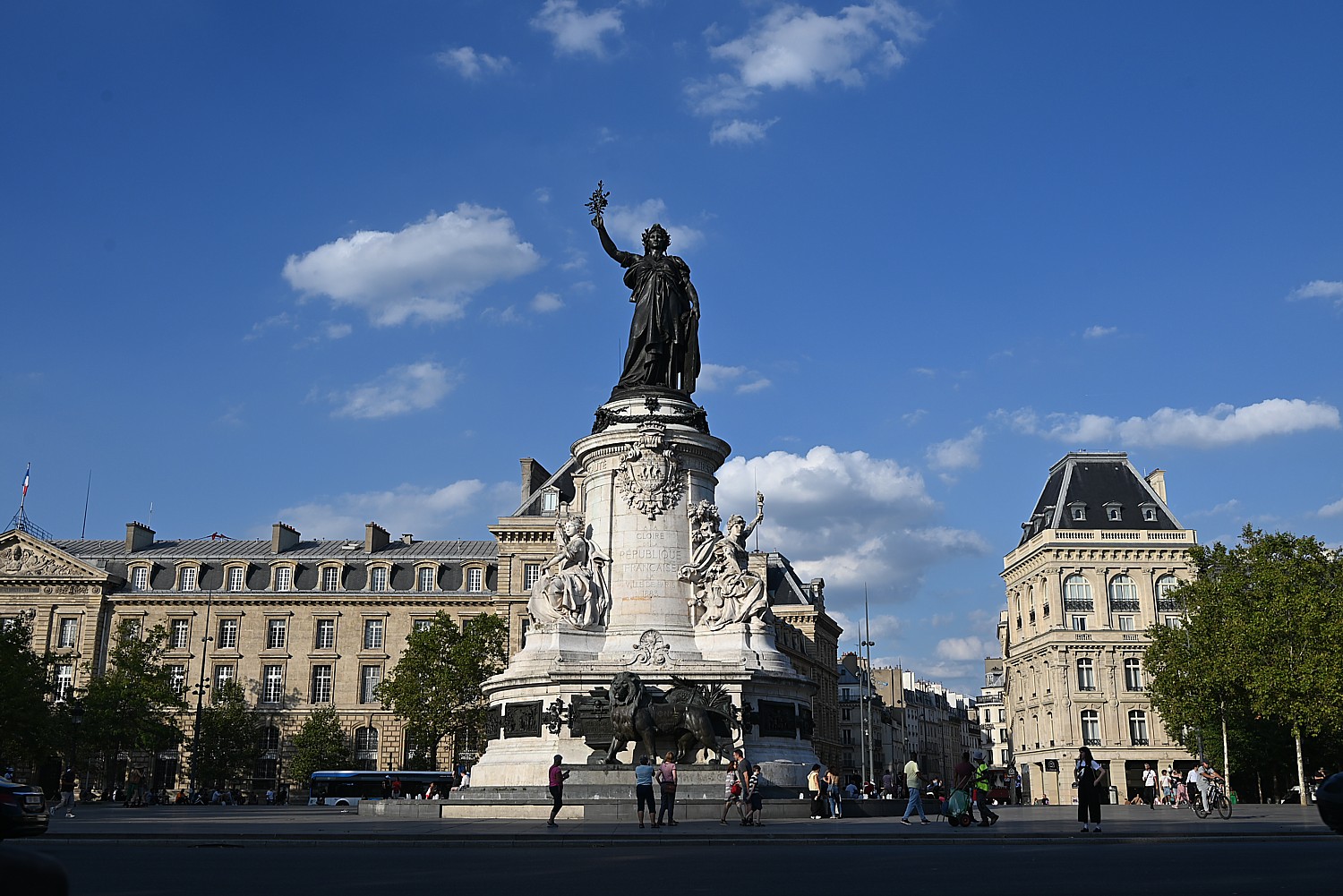
As I walk up Rue de Place Republic to Rue de Temple, I find a marker that says 76,000 Jews were deported by Nazis to concentration camps; 2000 returned. Among those who were deported were the residents of 71 Rue de Temple, a 17th century historic mansion which today houses the Jewish Museum (mahJ), and when you first go in, there is a sort of tribute to them.
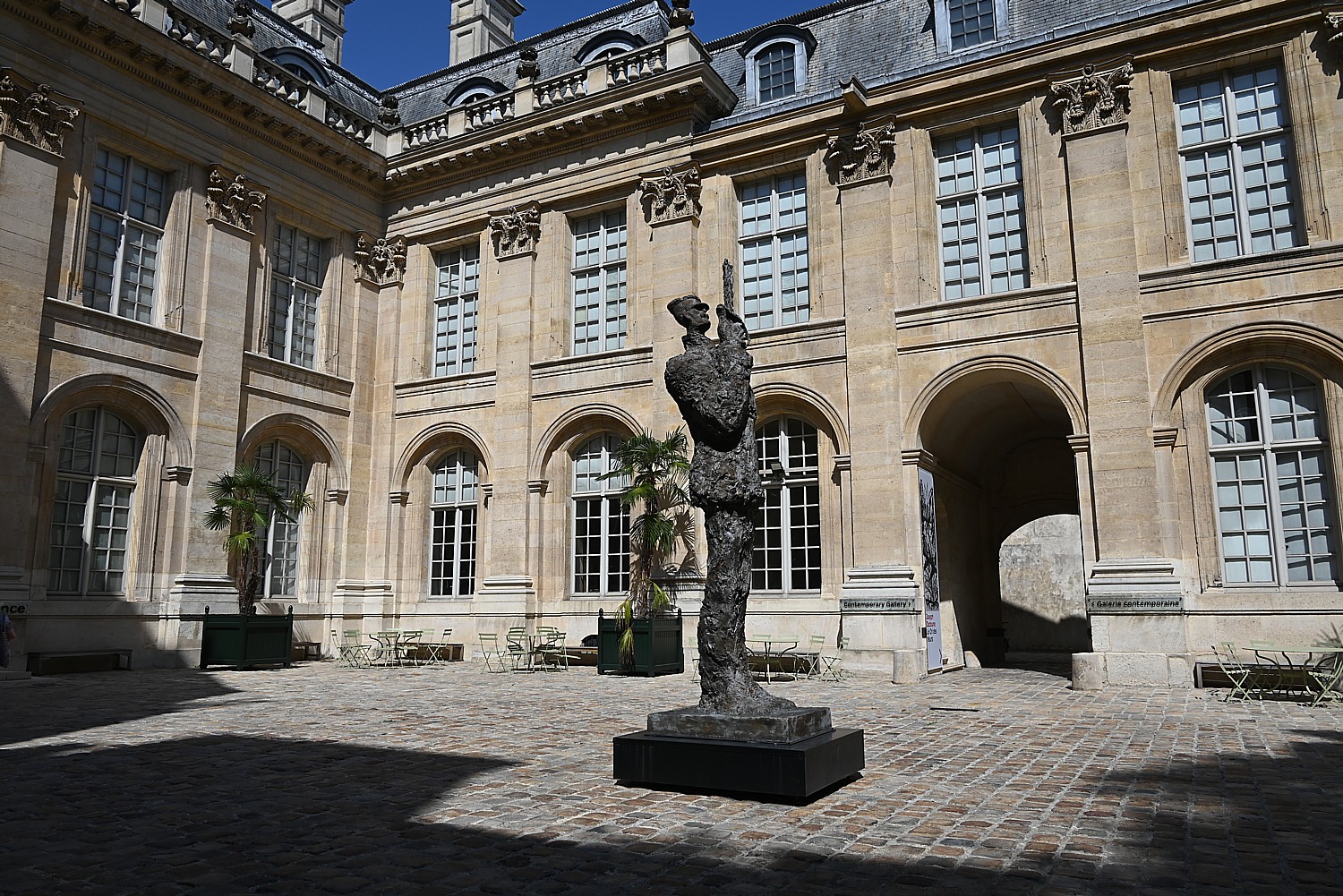
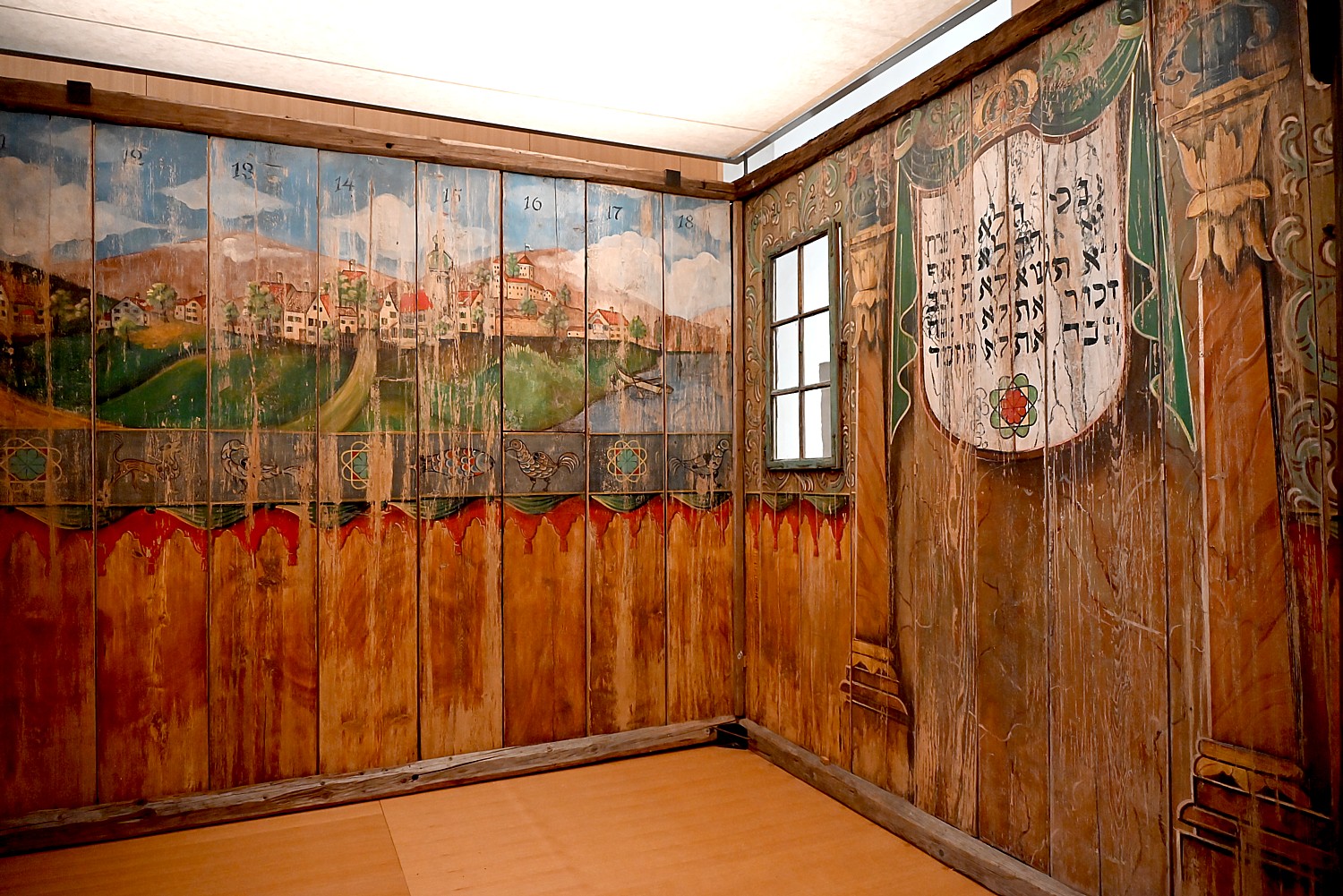
The museum traces Jewish artistic and cultural heritage, focusing on the history of the Jews in France since the Middle Ages to the 20th century, and evoking the communities of Europe and North Africa. Its collection, which it boasts is one of the finest in the world, comprises religious objects, manuscripts, textiles, and archival documents, such as concerning the Dreyfus Affair. (A statue of Dreyfus is in the courtyard at the entrance to the museum).
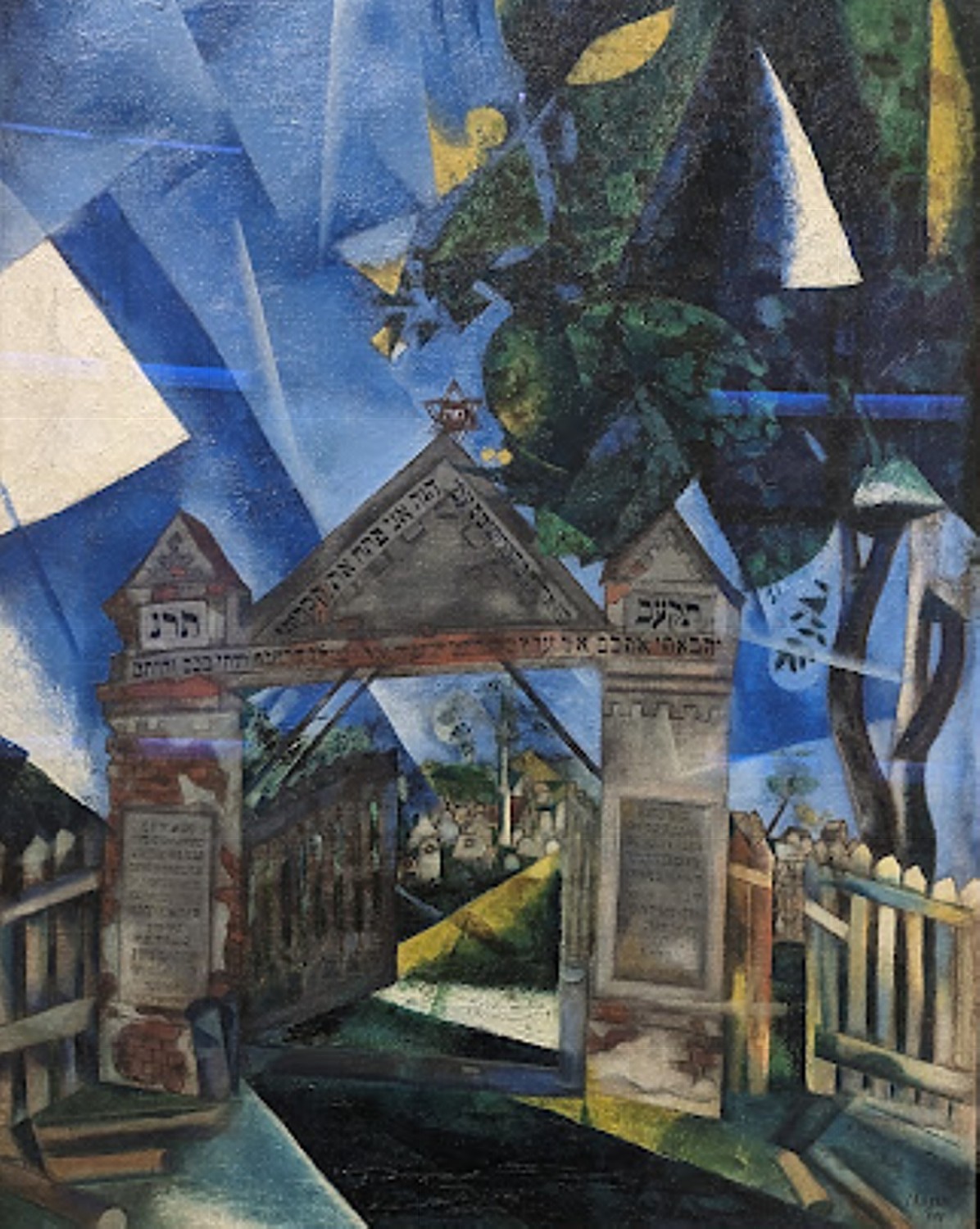
Special emphasis is given to the Jewish presence in the arts. The museum’s collections include works of art from painters of the School of Paris, Marc Chagall, Kikoine Soutine and Amedeo Modigliani and contemporary artists such as Christian Boltanski and Sophie Calle.
I find the exhibit more about Jewish ritual objects and such, than it is about Jewish history, culture and art – but I am really at a disadvantage in understanding since there are no English translations.
Musée d’Art et d’Histoire du Judaïsme, Hôtel de Saint-Aignan, 71 Rue du Temple, 75003 Paris, France, https://www.mahj.org
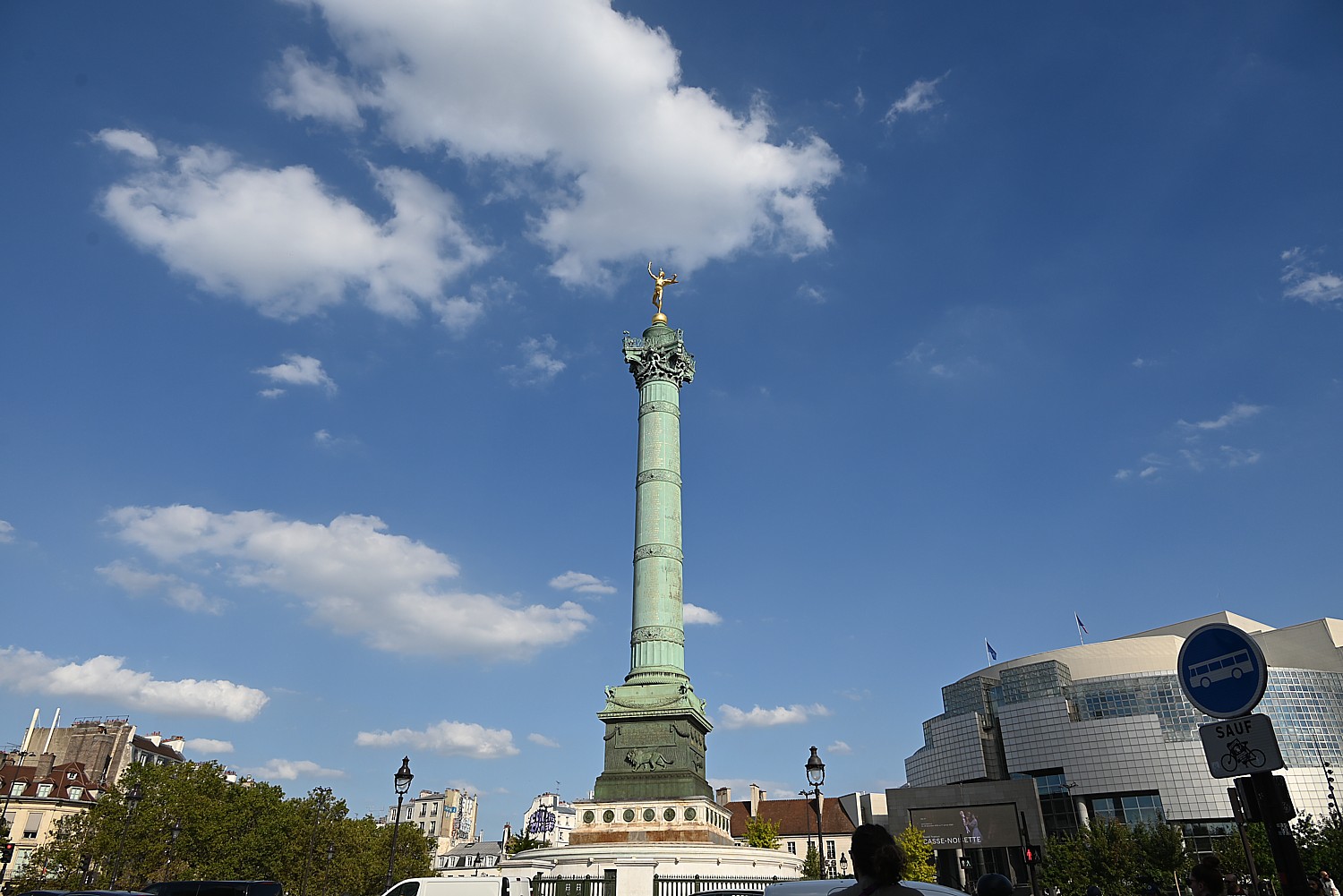
Next I head toward the Place de la Bastille where the notorious Bastille prison once stood, until it was stormed and destroyed between 14 July 1789 and 14 July 1790 during the French Revolution. No vestige of the infamous prison remains. Instead, the July Column (Colonne de Juillet) commemorating the July Revolution (1830) at the center of the square and the Opera house.
And while the square is now the site of concerts, cafes and nightclubs, it is also often the centerpiece for political demonstrations.
Another square, the Place Royale, which is close to my hotel, Le 20 Prieure Hotel, is also important for France’s history, but today is a place for skateboarders, misting station who seem to be completely unimpressed by the fabulous plaques, reliefs and inscriptions that decorate the statue at its center.
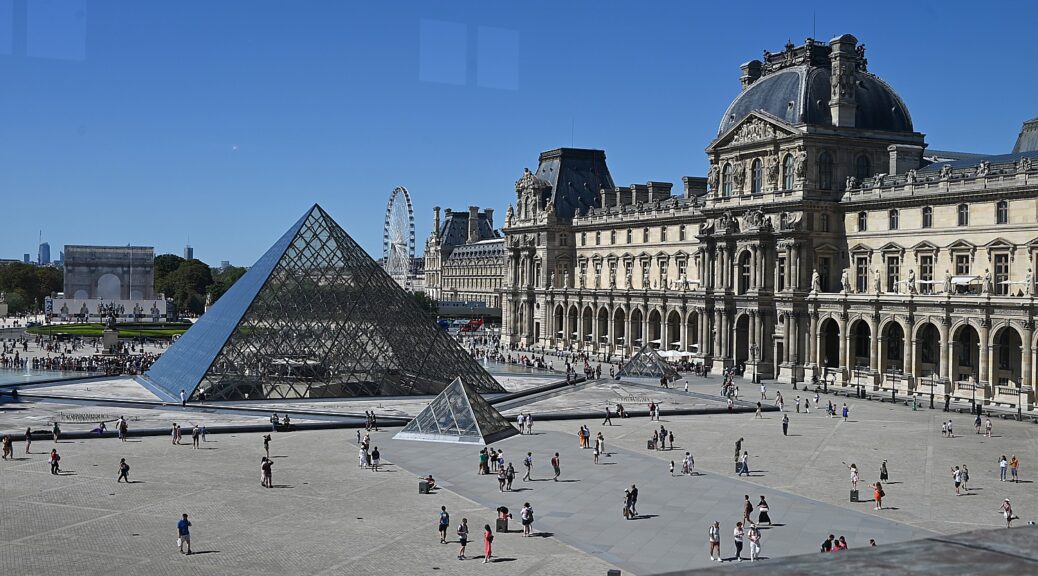
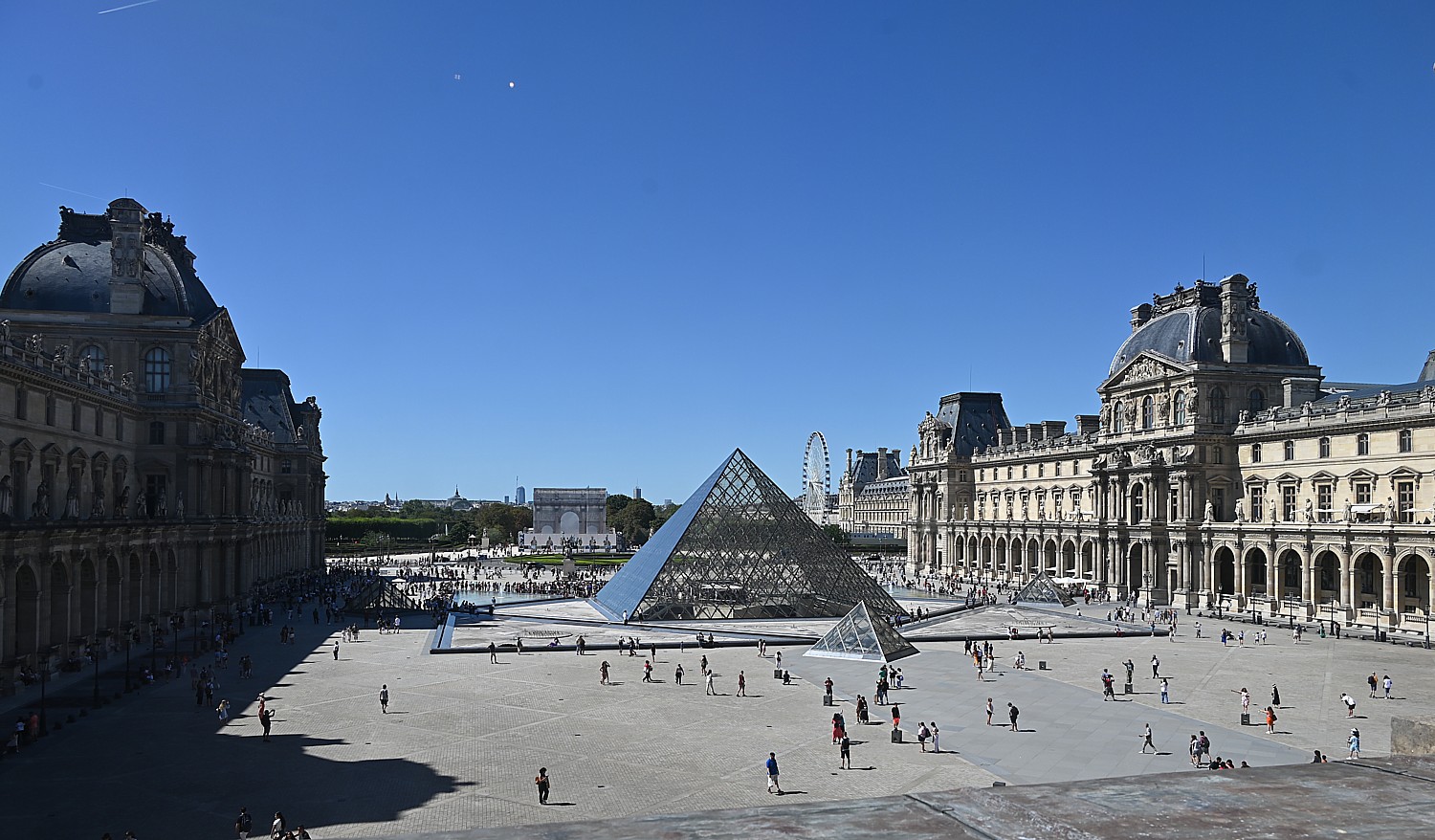
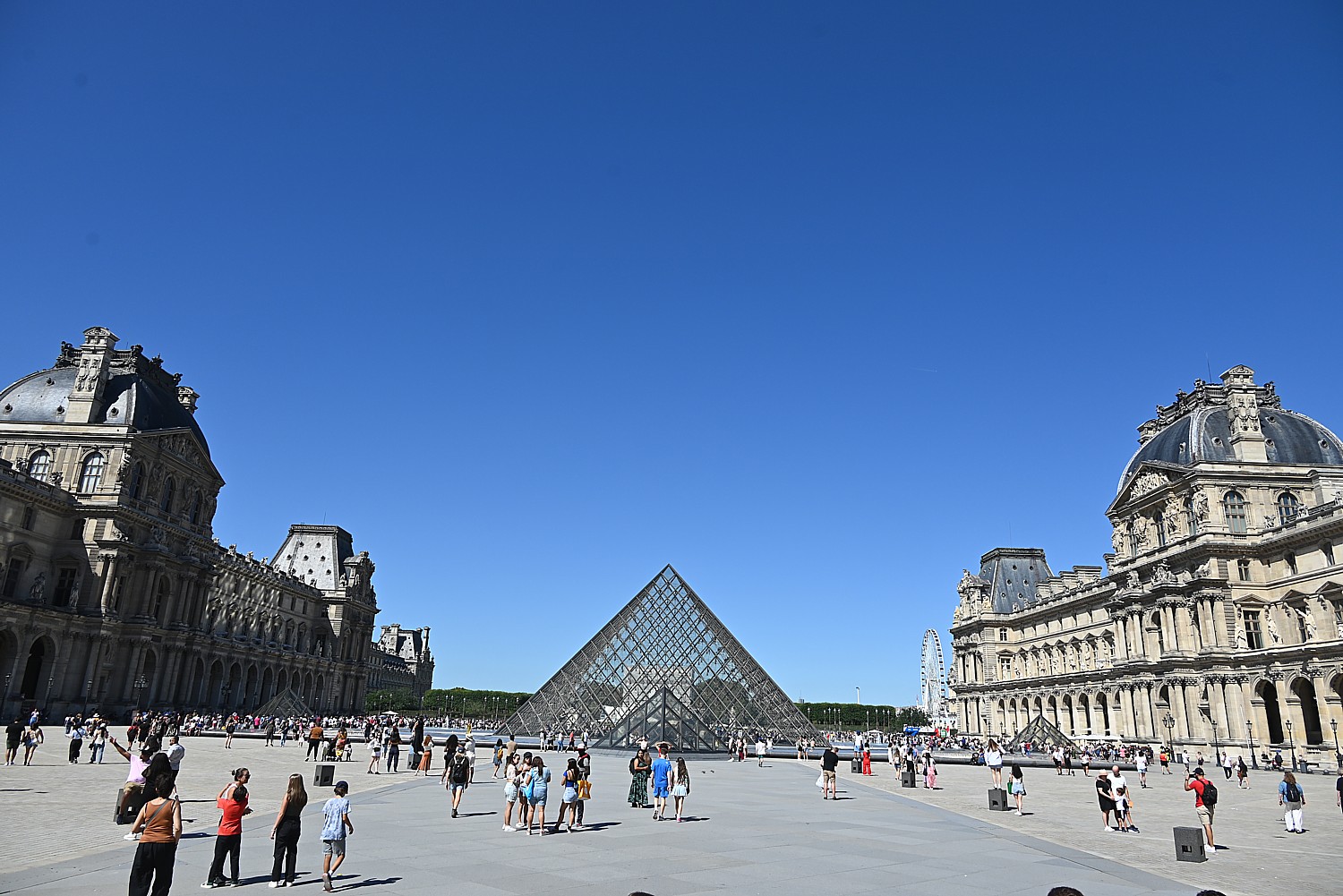
Le Louvre is SOOO big, so famous and so very popular – in fact, the world’s largest art museum at 652,300 sq. ft., housing some 35,000 objects from prehistory to the 19th century – the best strategy is simply to just surrender to it, go with the flow, and be surprised.
In 2018, the Louvre welcomed 10.2 million visitors, 3.5 million more than the Vatican Museums which is the second largest in Europe. The collection is valued at well over $35 billion plus another $10 billion for the building!
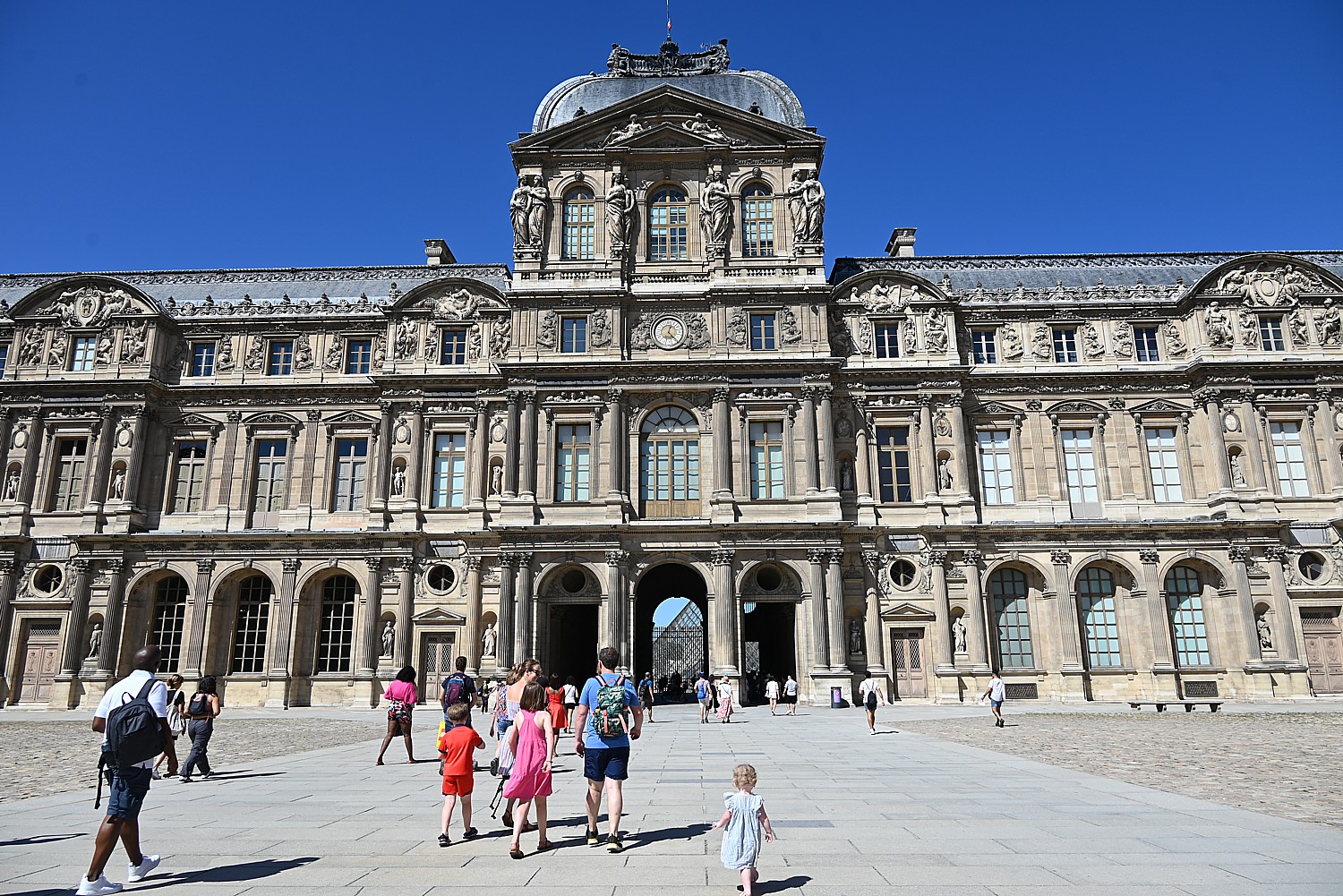
Once the home to French Kings including Louis XIV, this monumental palace began as a fortress built in the late 12th century under King Philip II. It was converted to a museum during the French Revolution in the late 18th century. (Hence my observation that such magnificent structures that make Paris so fabulous could only have been built by a monarchy, but opened to the public by a democracy.)
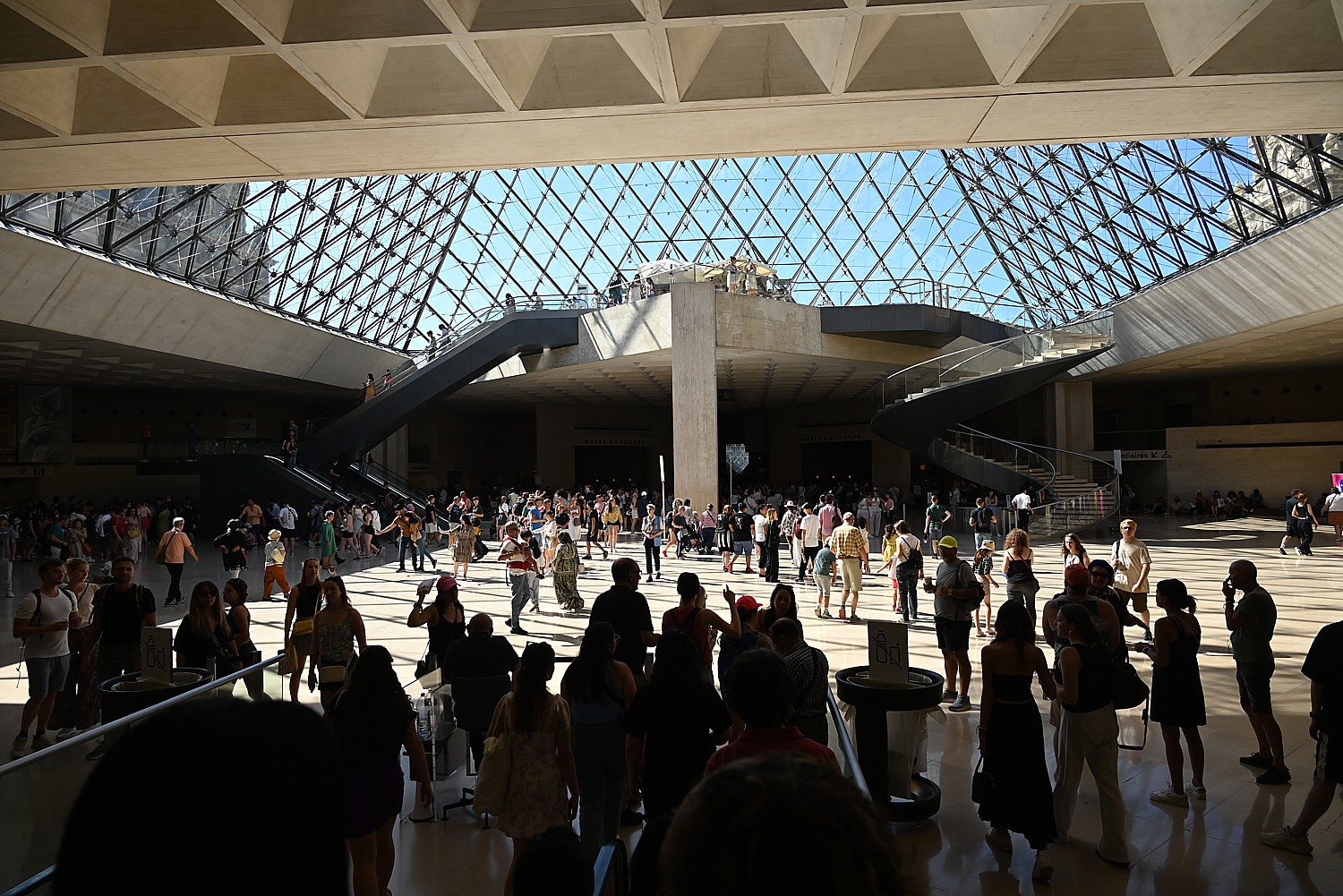
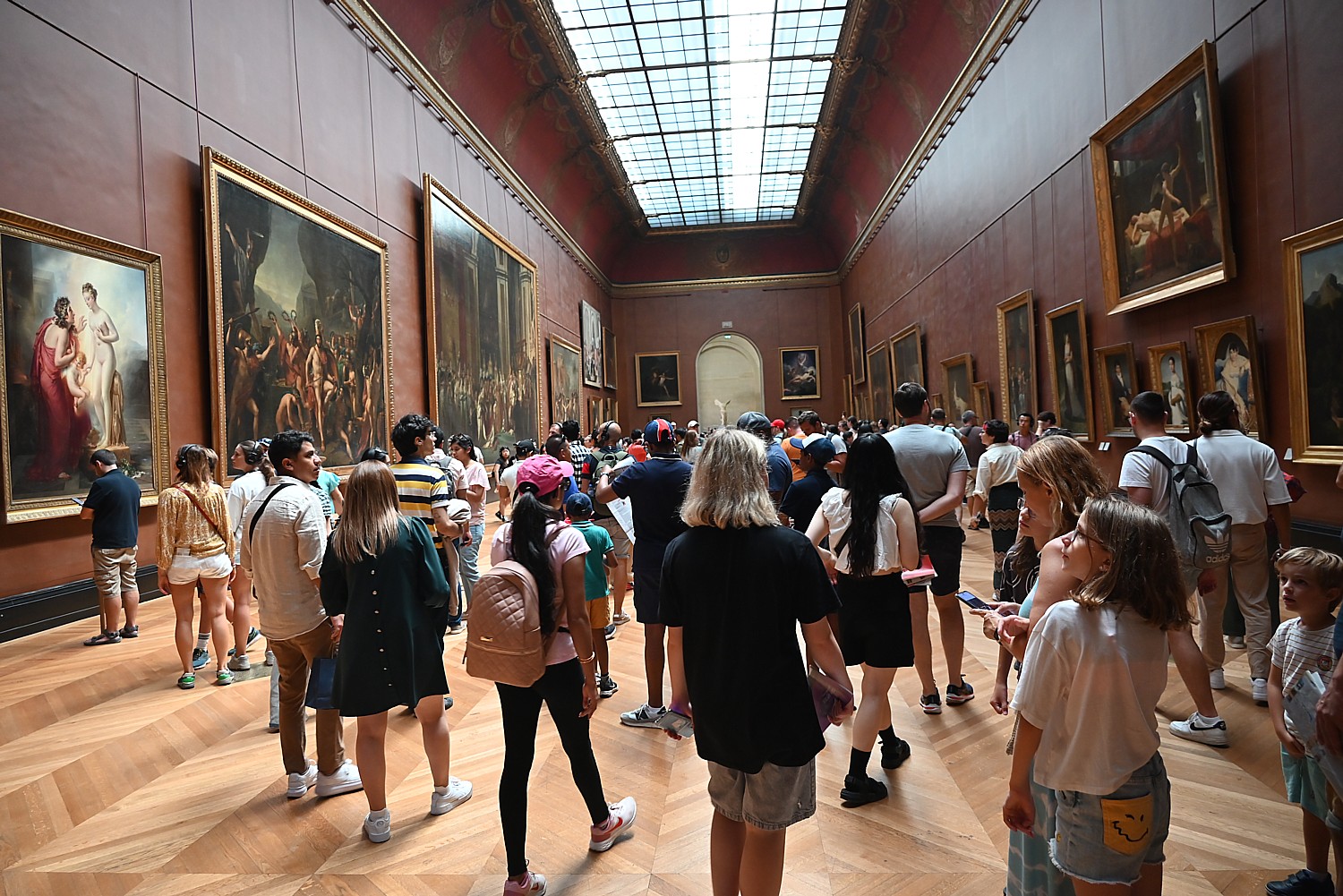
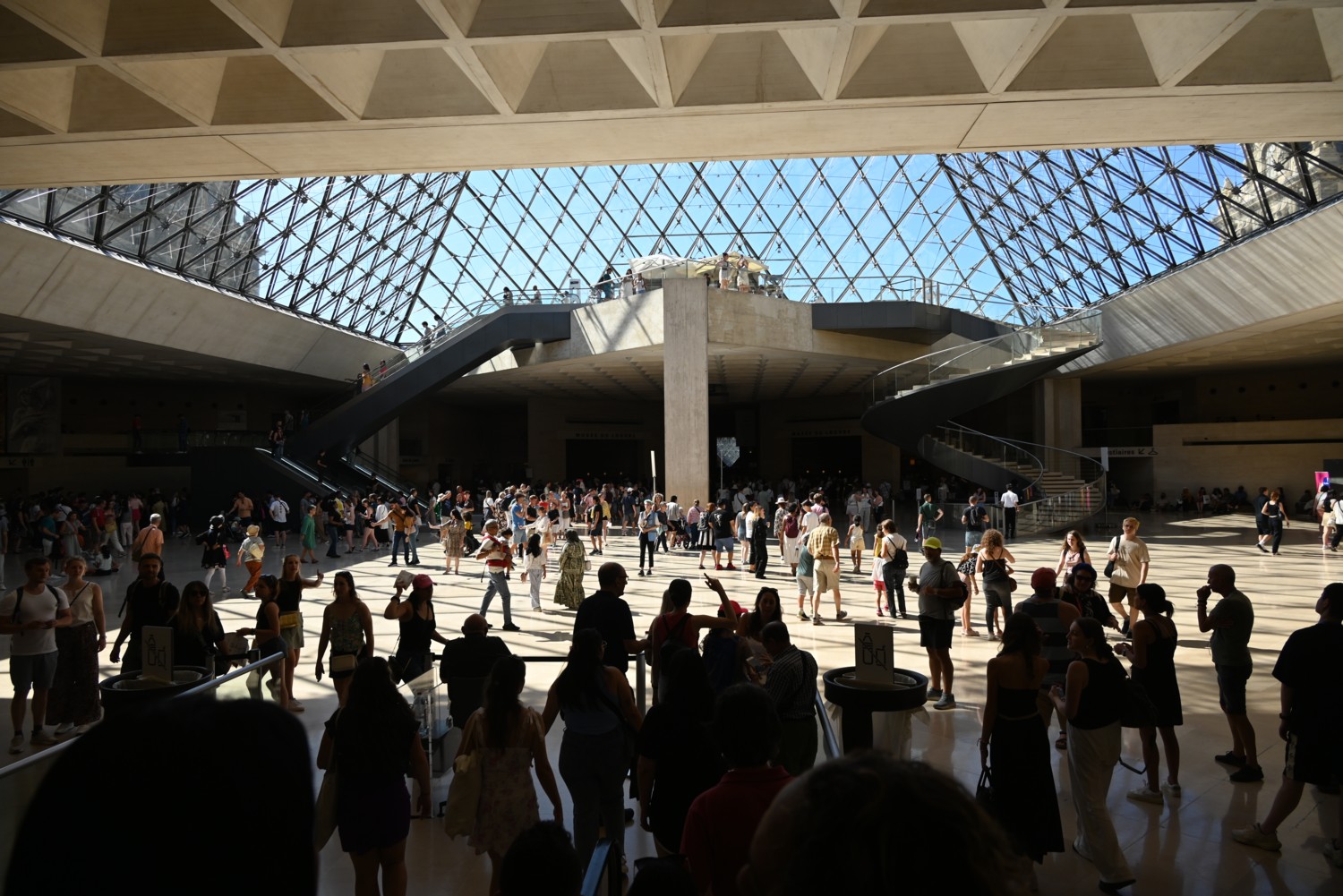
The galleries span 15 acres, which is why, except for the Mona Lisa and some of the other majorly famous items, it is possible for 15,000 people a day to come through and you can still have some areas almost to yourself.
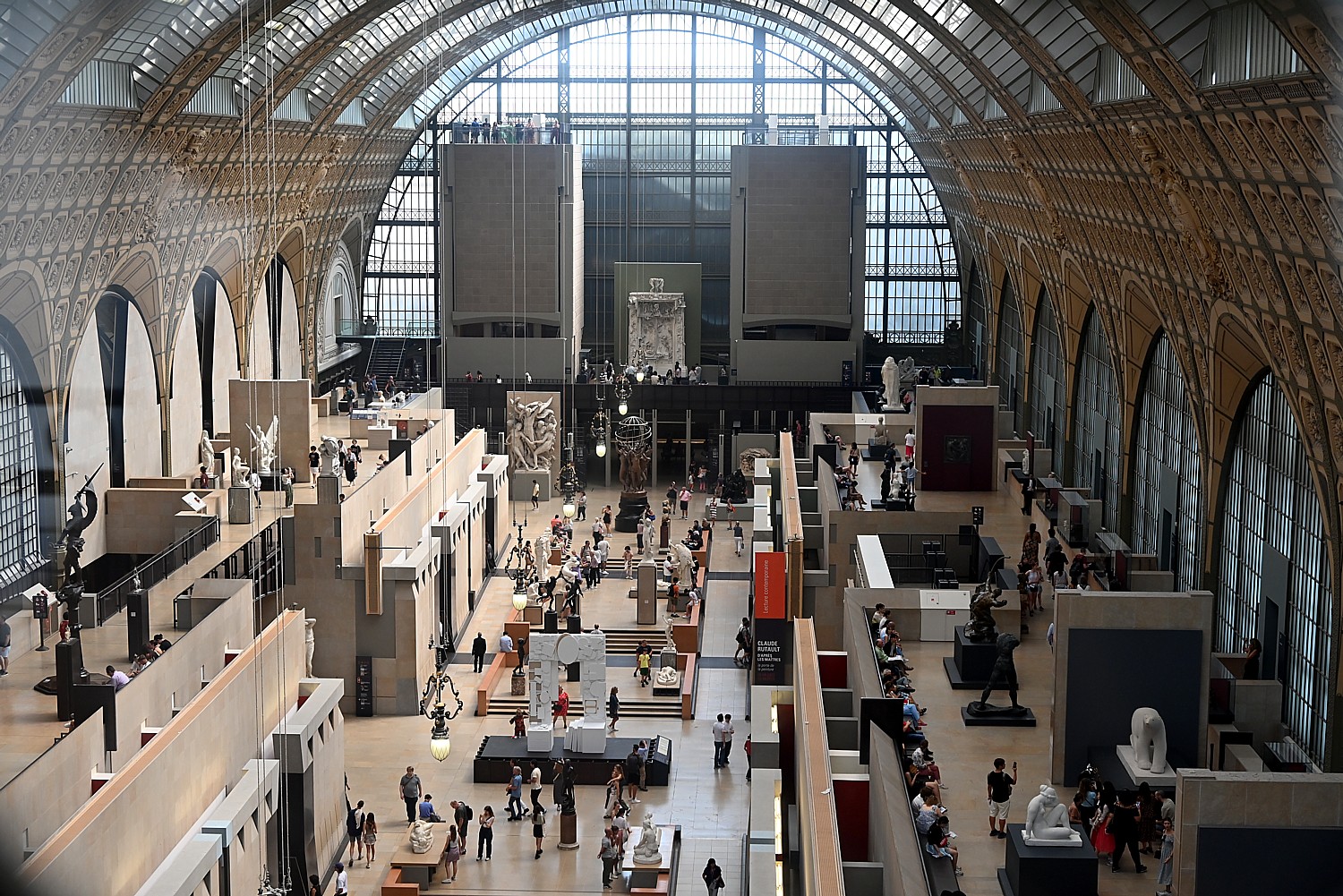
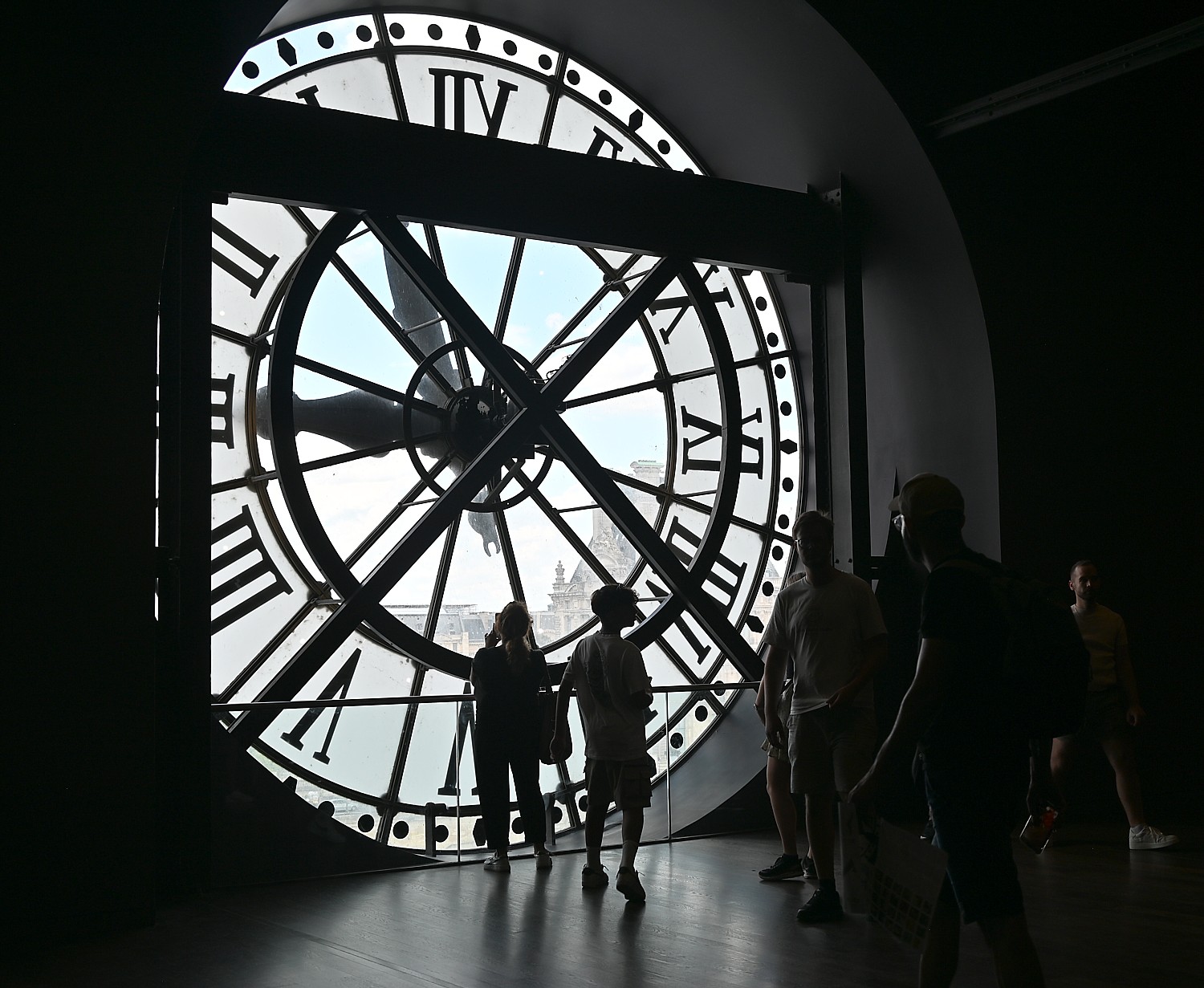
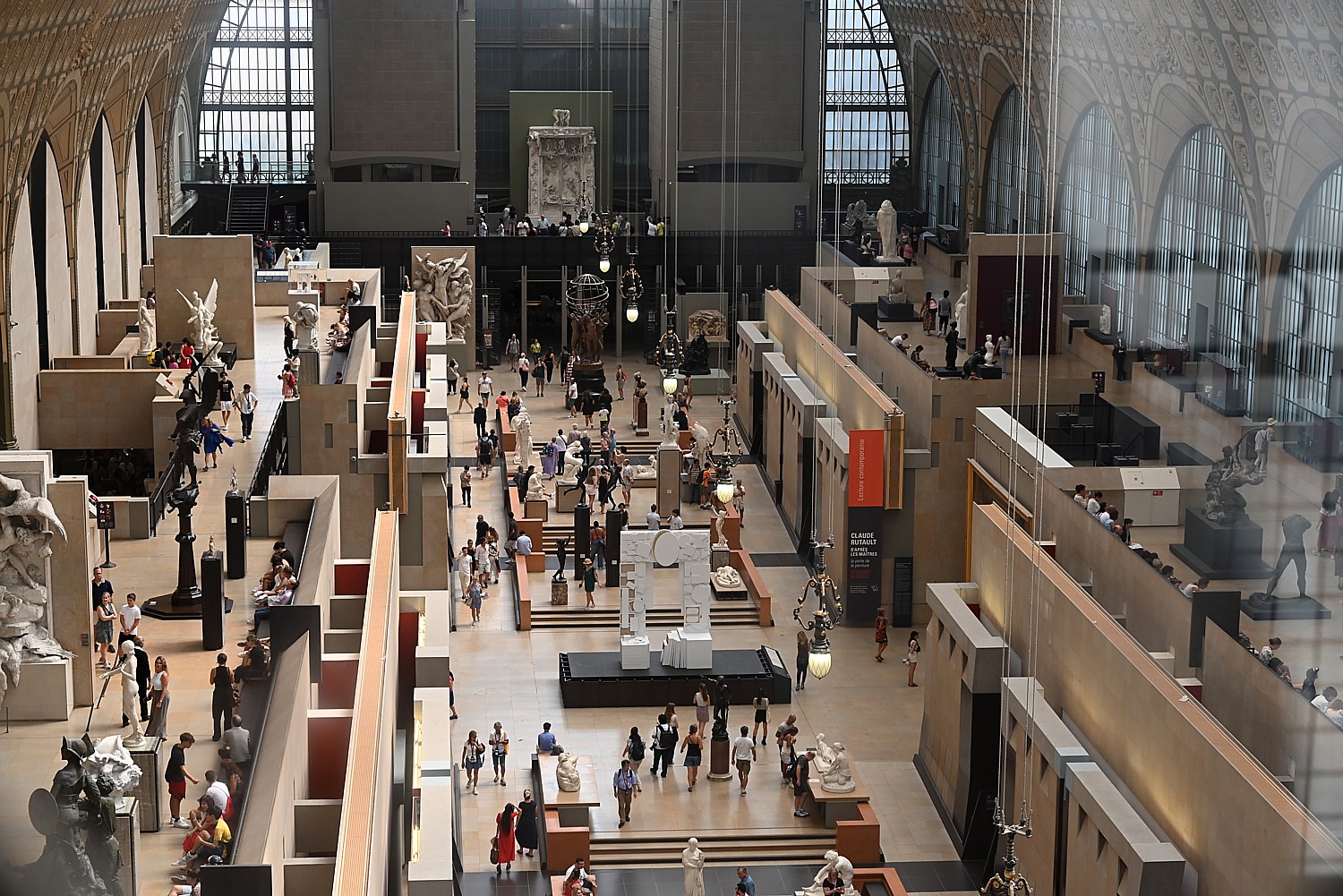
It is massive and overwhelming – like culture shock, really, especially after having visited the comparatively calm Musee D’Orsay the day before. The connecting rooms through three wings of the palace that surround the massive courtyard seem to go on and on and on.
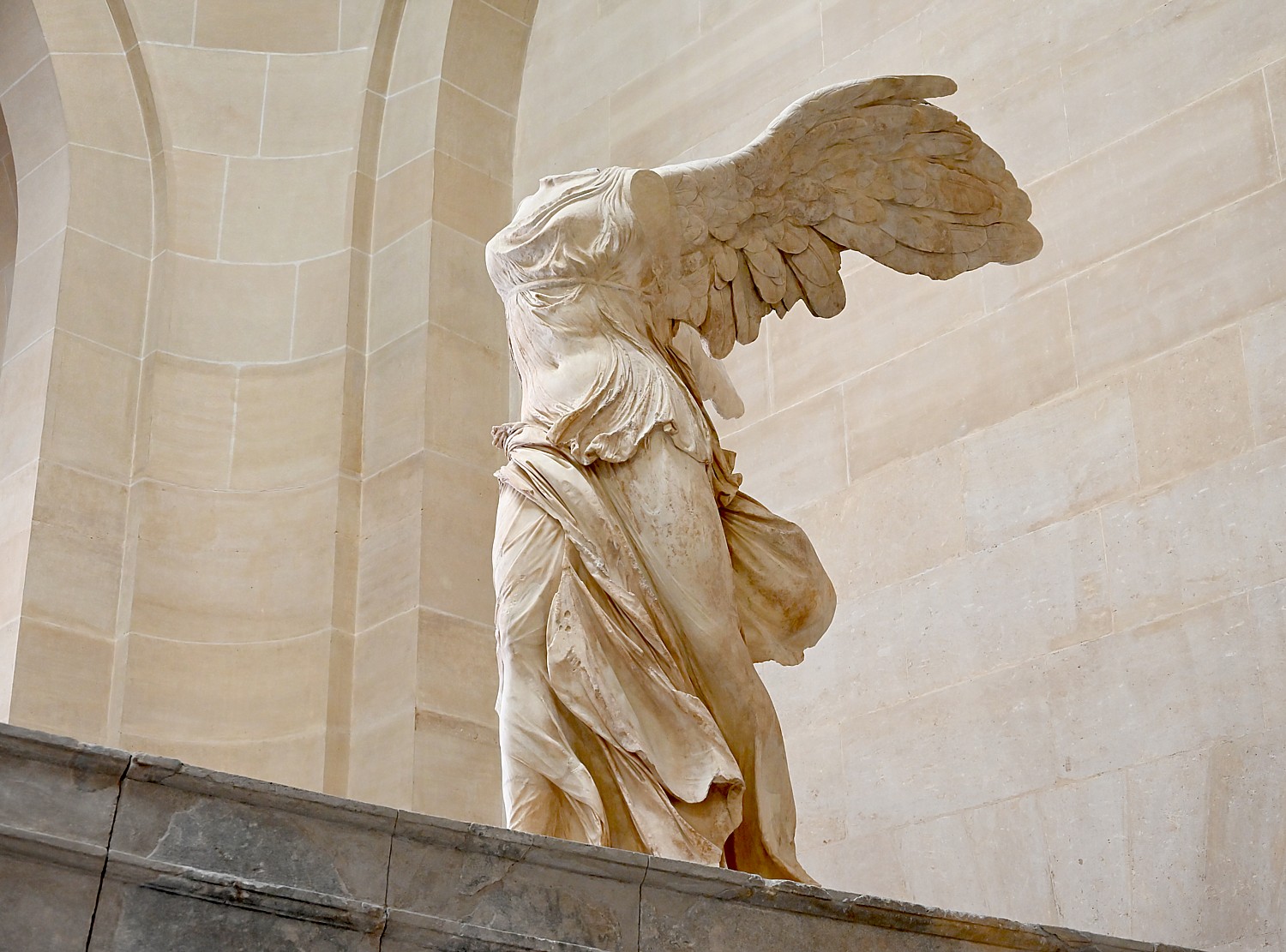
Considering that it would take 100 days to see all the art in Le Louvre, I decide the best thing is to just go with the flow – and get the Mona Lisa out of the way – and then just wander and be surprised. (Besides the Mona Lisa, the other blockbuster attractions are Venus de Milo, and the Winged Victory.)
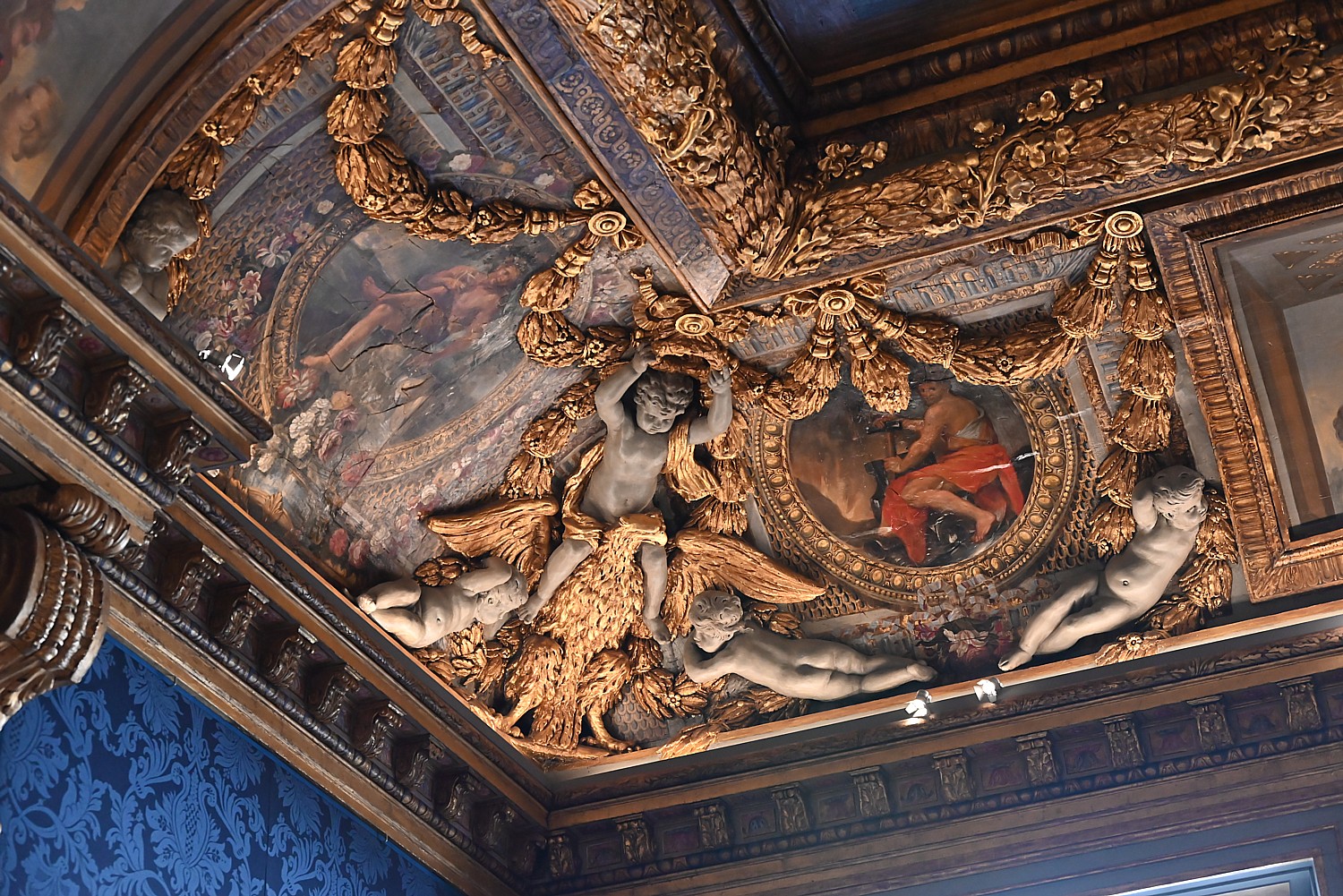
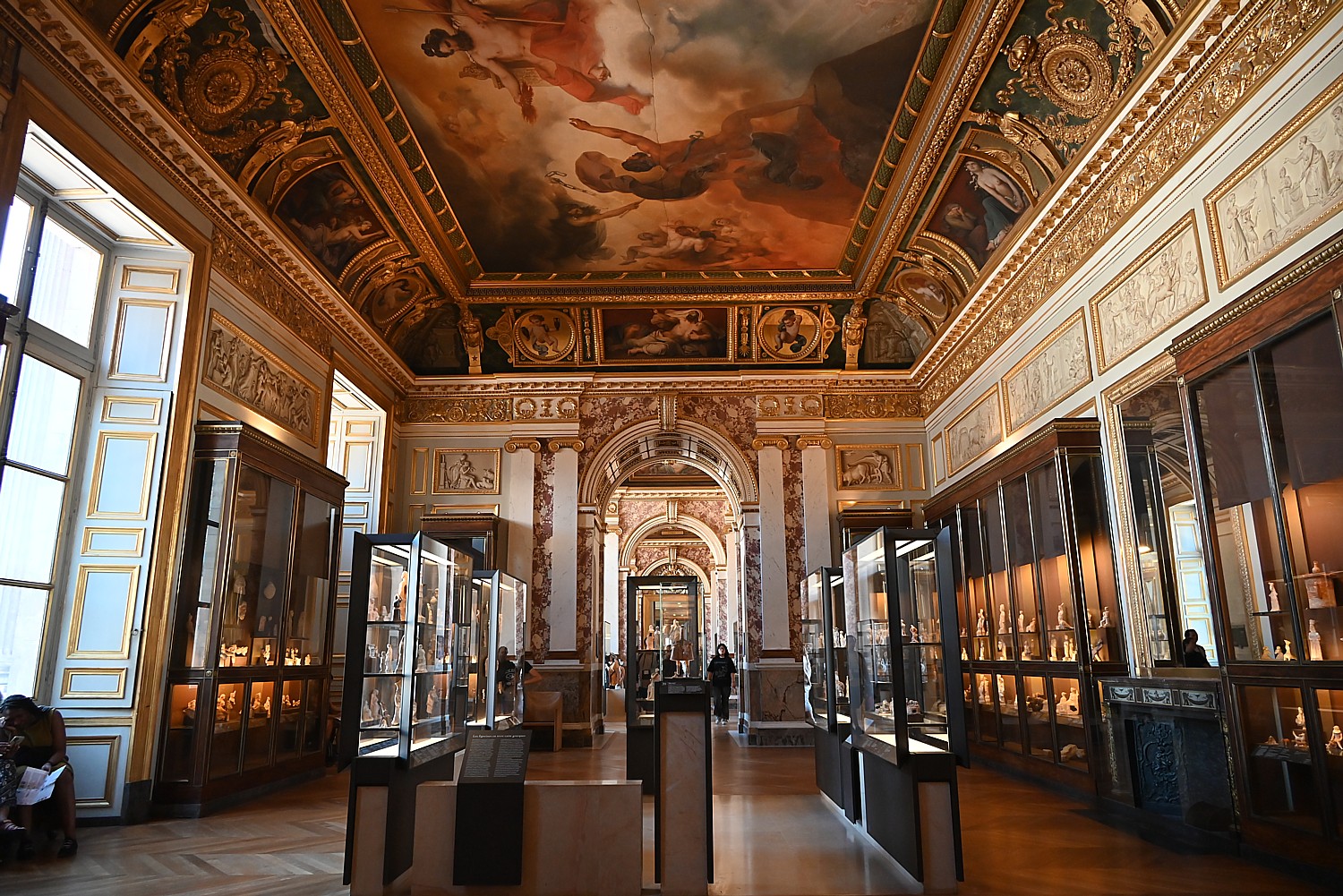
It is also one of the most fabulous buildings you will ever have the chance to visit, and just going room by room (be sure to look up at the decorated ceilings), is thrilling.
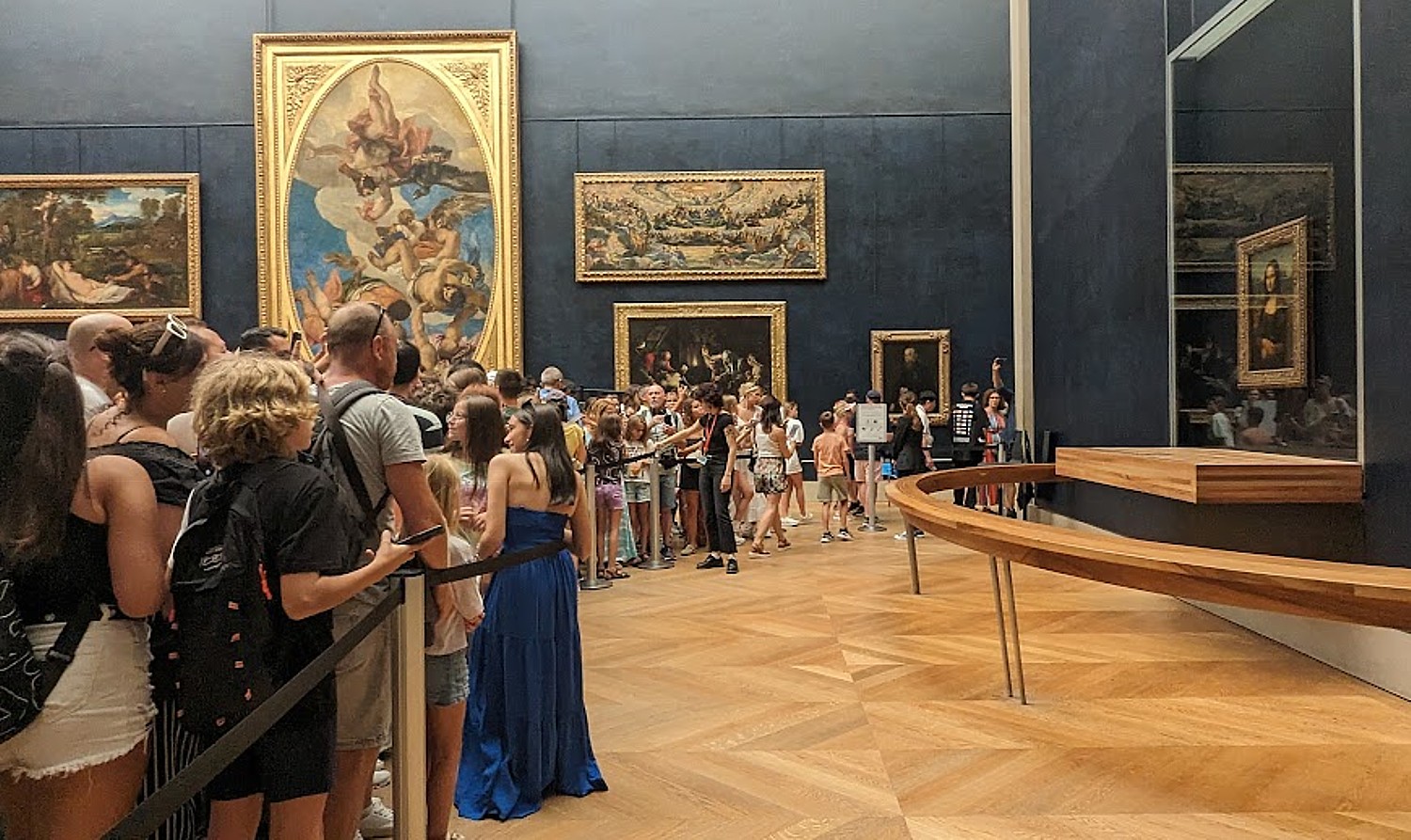
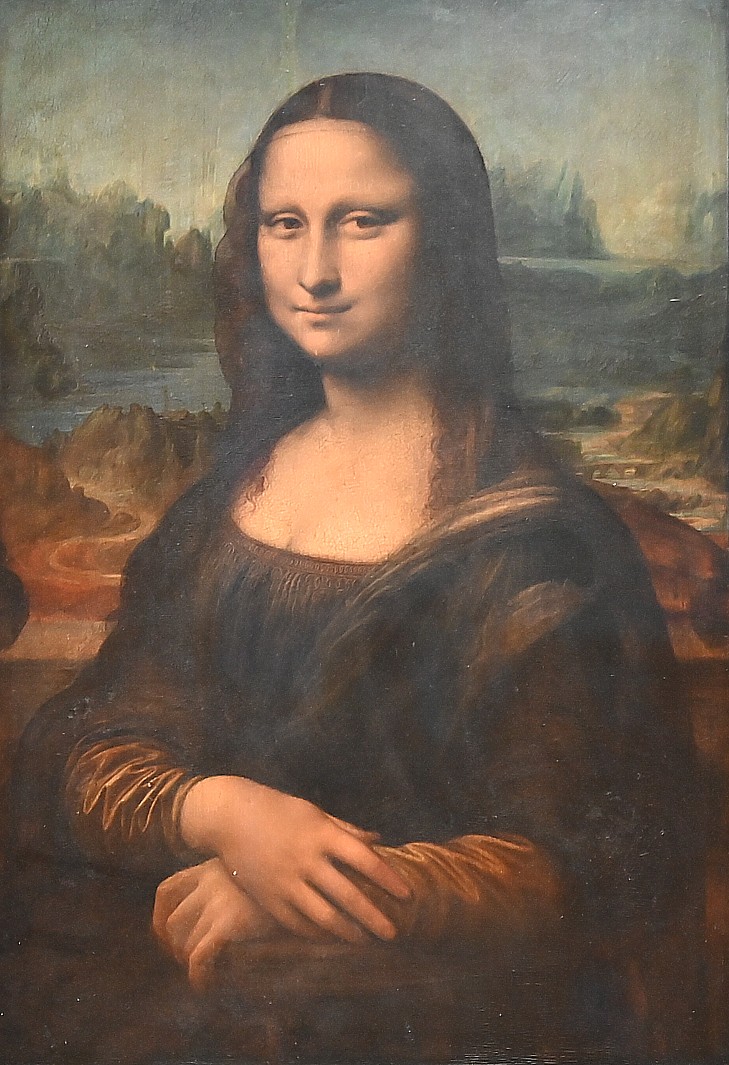
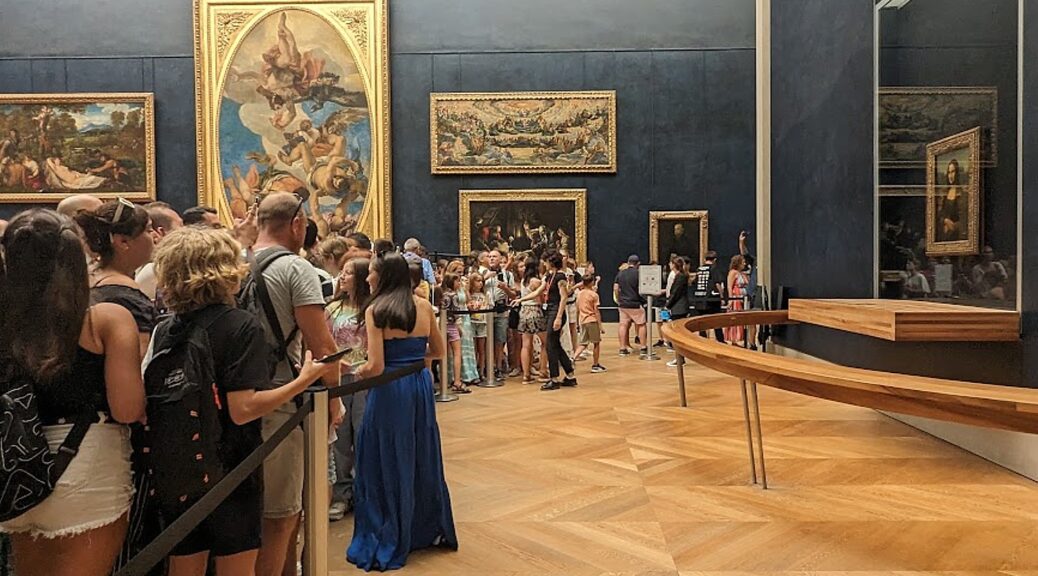
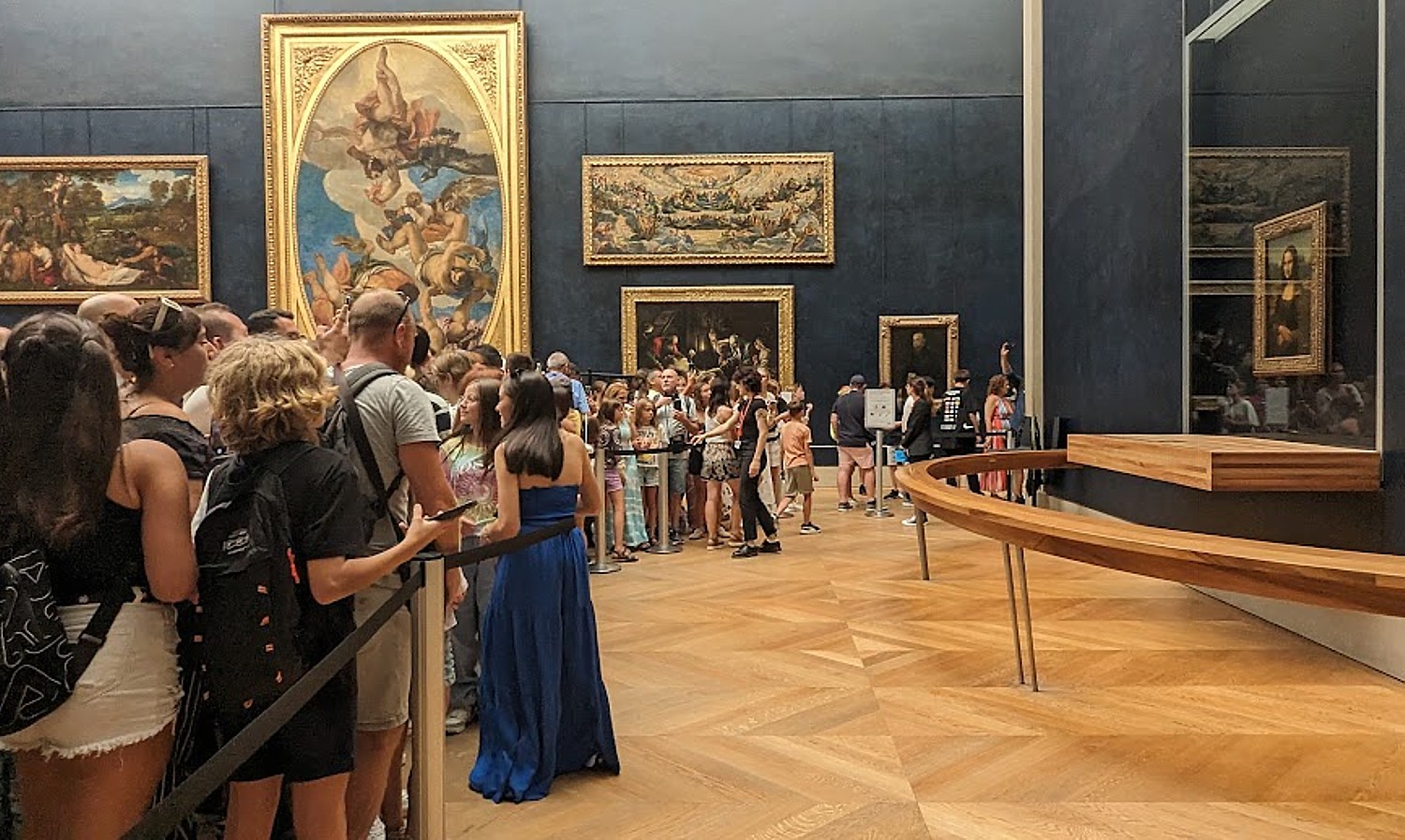
I follow the signs –and the crowd – into the hall with the MonaLisa, “La Gioconda.”
It’s a bit of a jungle to make your way to the painting (they could have alleviated by putting up ropes that guide you along, like they do outside at the ticket counter, which would also give everyone their turn at seeing the painting from all angles). I move through the middle, row by row.
The sitter for the portrait is believed to be Lisa Gherardini (1479-1542) who lived in Florence, the wife of Francesco del Giocondo, a wealthy silk merchant. “Leonardo aimed to bring his portrait to life by depicting Lisa as if she were naturally turning to welcome us. Her upper body is in three-quarter view, but her gently smiling face is frontal,” a poster analyzing the painting notes.
I learn that Leonardo da Vinci used the afumato painting technique of applying multiple layers of pigments bound in oil to create subtle transitions from shadow to light, which is how he brought his model’s gentle smile to life.
I also learn that the landscape is imaginery – “Leonardo mastered so-called ‘atmospheric perspective’ using different shades of blue to blur the outlines and give the scene a striking depth. A path on the left draws our gaze to mountains bordered by lakes. This wild majestic landscape suggests the slow formation of the Earth, the battle of the elements and the erosion caused by time.”
Leonardo began this partially experimental painting around 1503 and never finished it. Yet, it is intriguing to learn that he took it with him everywhere he went, until his final trip to France in 1516 at the invitation of King Francois I. The king bought the painting, which is how the “Mona Lisa” entered the French royal collection.
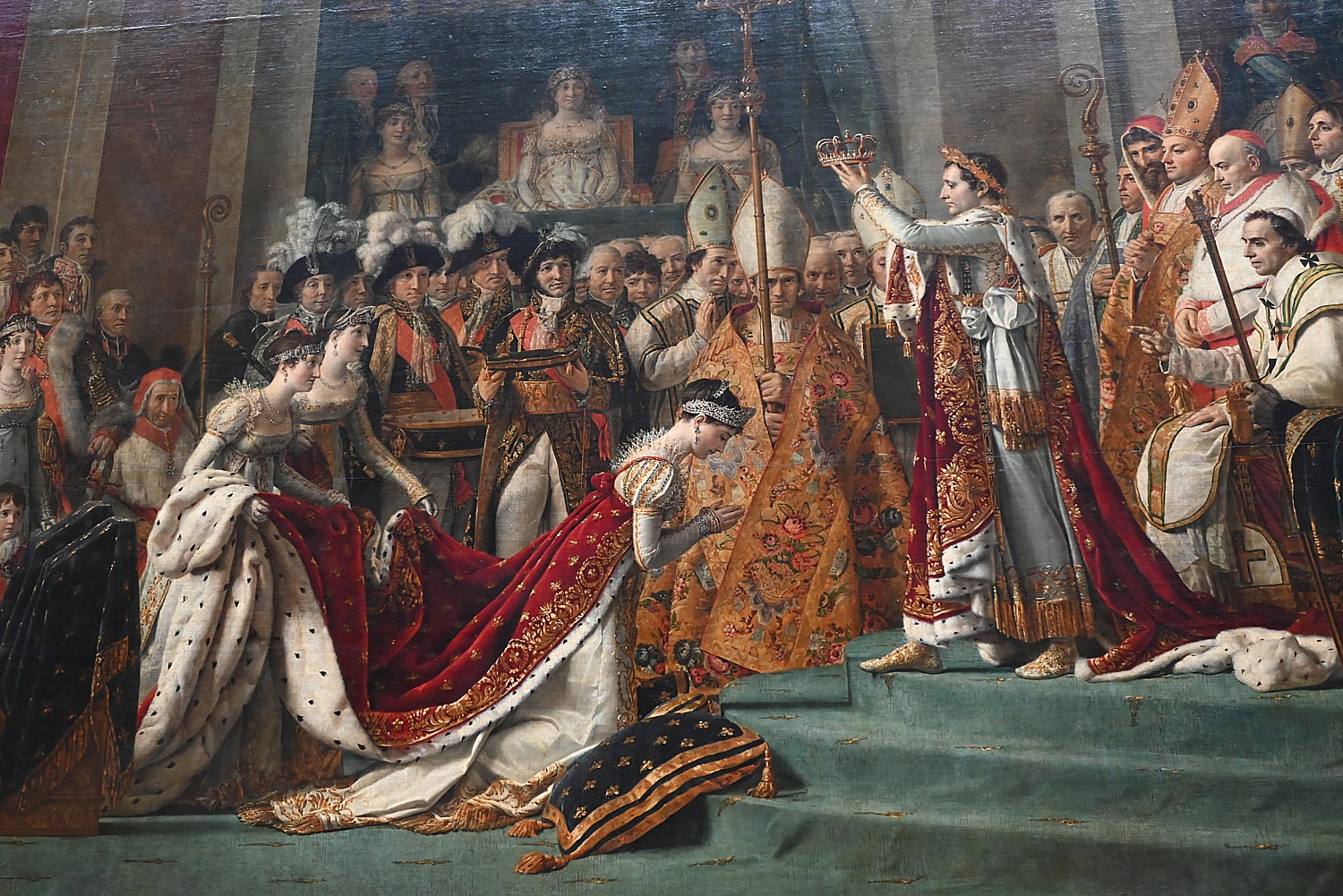
Near to where you exit from Mona Lisa is a great hall lined with monumental historical paintings.
There is one where Emperor Napoleon is crowning the Empress Josephine. Another depicting Napoleon at the Battlefield of Eylau (9 February 1807), a battle Napoleon’s troops won against Russians and Prussians but paid a high price in lives.
“For the purposes of propaganda, the artist Antoine Jean Gros (who painted it in 1808) depicted Napoleon as a compassionate conqueror ensuring aid for the wounded enemy soldiers. The zeal of the doctors and the emperor’s serenity temper the horrors of war.”
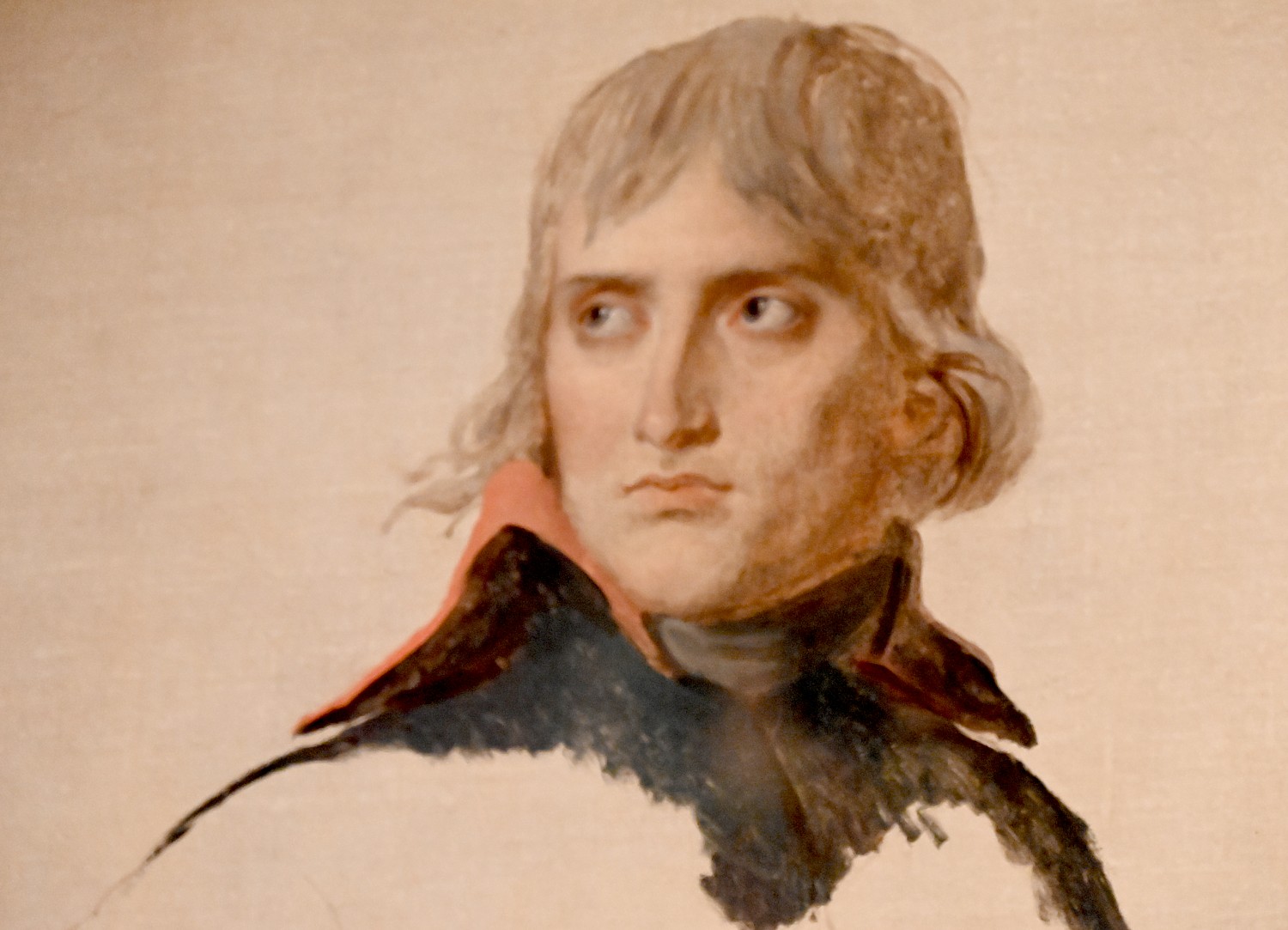
There is also Jacques-Louis David’s a portrait of Napoleon Bonaparte (1769-1821) painted when he was a young dashing fellow (1797-1798).
You realize that such paintings (as well as statues, busts, coins and stamps) were the only way people could record what someone looked like or a historic event (and therefore eminently exploitable for propaganda).
After getting the Mona Lisa under my belt, I just kind of wander, with no specific plan, just being surprised as I go through palatial rooms. (As a general rule, the further away from the Mona Lisa you get, the less crowded until you find rooms that you can have almost to yourself.)
As it happens, I practically fall upon another of Le Louvre’s famous statues, “The Winged Victory of Samothrace,” that graces the top of the monumental Daru staircase. Dating from 190 BC, “Winged Victory” is of major importance because it is one of the few surviving examples of original Hellenistic sculpture.
But at one point, I decide to search for the Venus de Milo – the third in the triumvirate of Le Louvre’s iconic works – get lost, and, instead, find myself amid Mesopotamian, Greek and Roman artifacts, instead (I never find Venus).
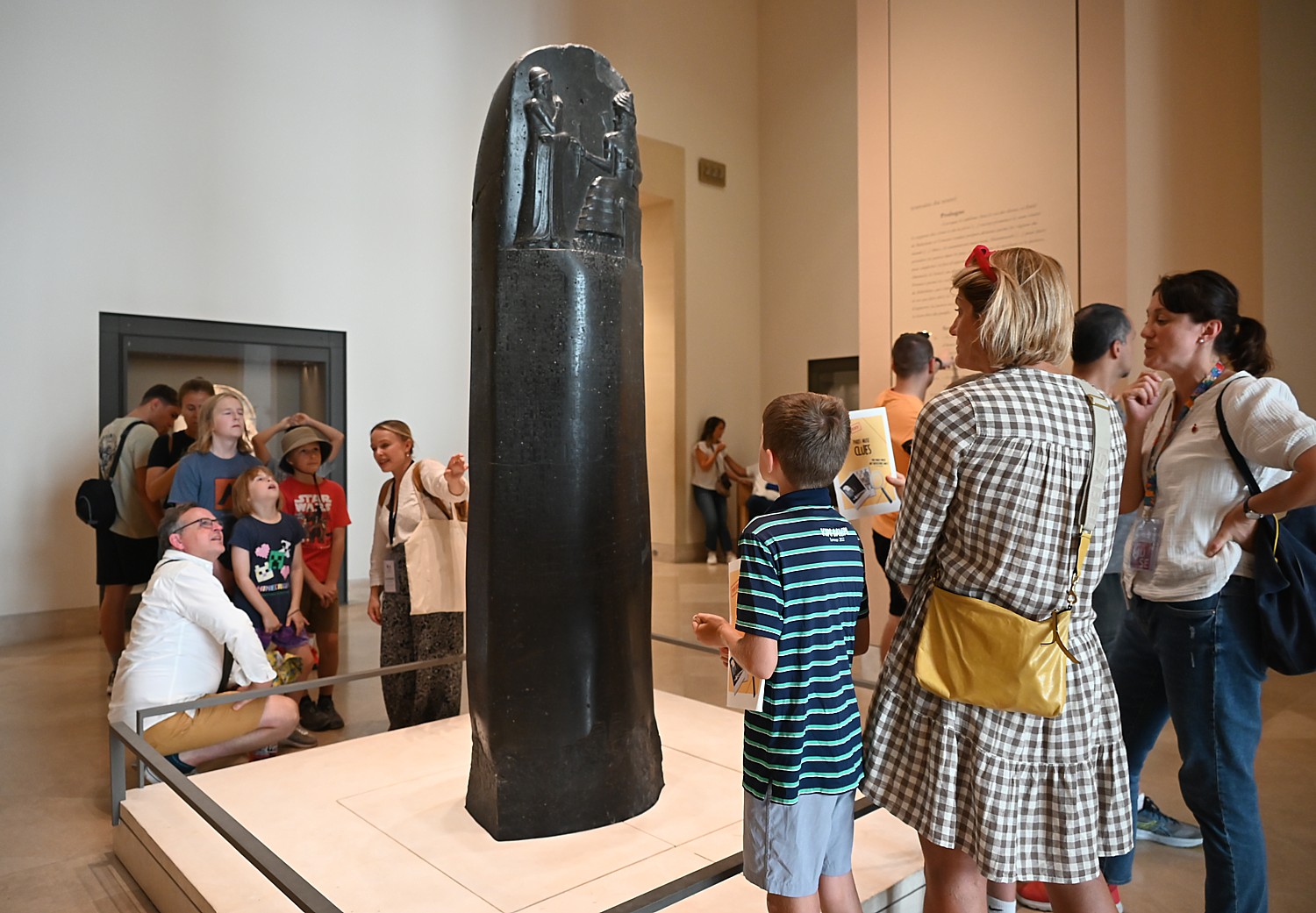
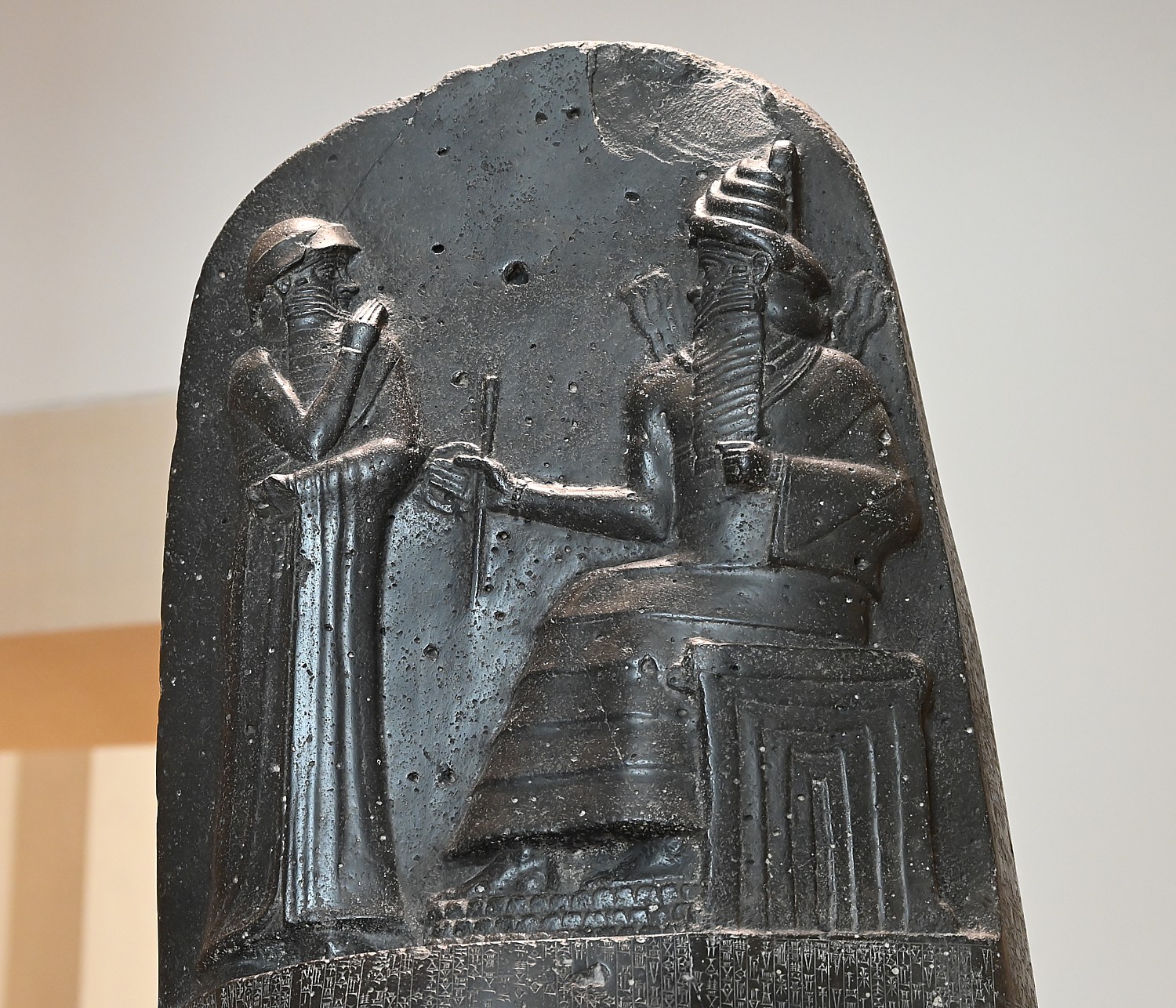
In fact, I am stunned when I stumble upon the Code of Hammurabi – in fact, one of the most exciting works in the Louvre. This black stele of basalt stands over two meters high and is engraved with the earliest collection of written laws in human history. It was engraved in Babylon (today’s Iraq) around 1760 BC and recovered in 1901 in Susa (present-day Iran). (The Ten Commandments is dated between 16th and 13th centuries BCE.)
Hammurabi was the first sovereign who decided to convert rules formerly passed on through oral tradition into an actual code of laws. The upper part of the stele depicts Hammurabi himself, symbolically receiving the laws from the sun god Shamash, the patron of Justice. The lower part is the text documenting 282 laws. The most prominent (famous) is establishing the legal standard of retaliation – the right to inflict damage in equal measure on those who intentionally harmed you (“an eye for an eye and a tooth for a tooth,” though equality of punishment took into account the same social level), according to an article by Stefano Zuffi e Davide Tortorella (https://mywowo.net/en/france/paris/louvre-museum/hammurabi-stele-richelieu-wing-hall-3)
Le Louvre is really a palace – one of the grandest you have ever seen or have the opportunity to be in. Just walking through the galleries, so opulently decorated from floor to ceiling, the ornamentation is quite fabulous.
You need at least 4 hours to visit.
If your schedule allows and you book early enough, visit the Louvre Museum at night when the vibe is less frenetic and the famous pyramid is illuminated. (Wednesday and Friday, open until 9:45 pm.). Otherwise try to book a morning time as early as possible.
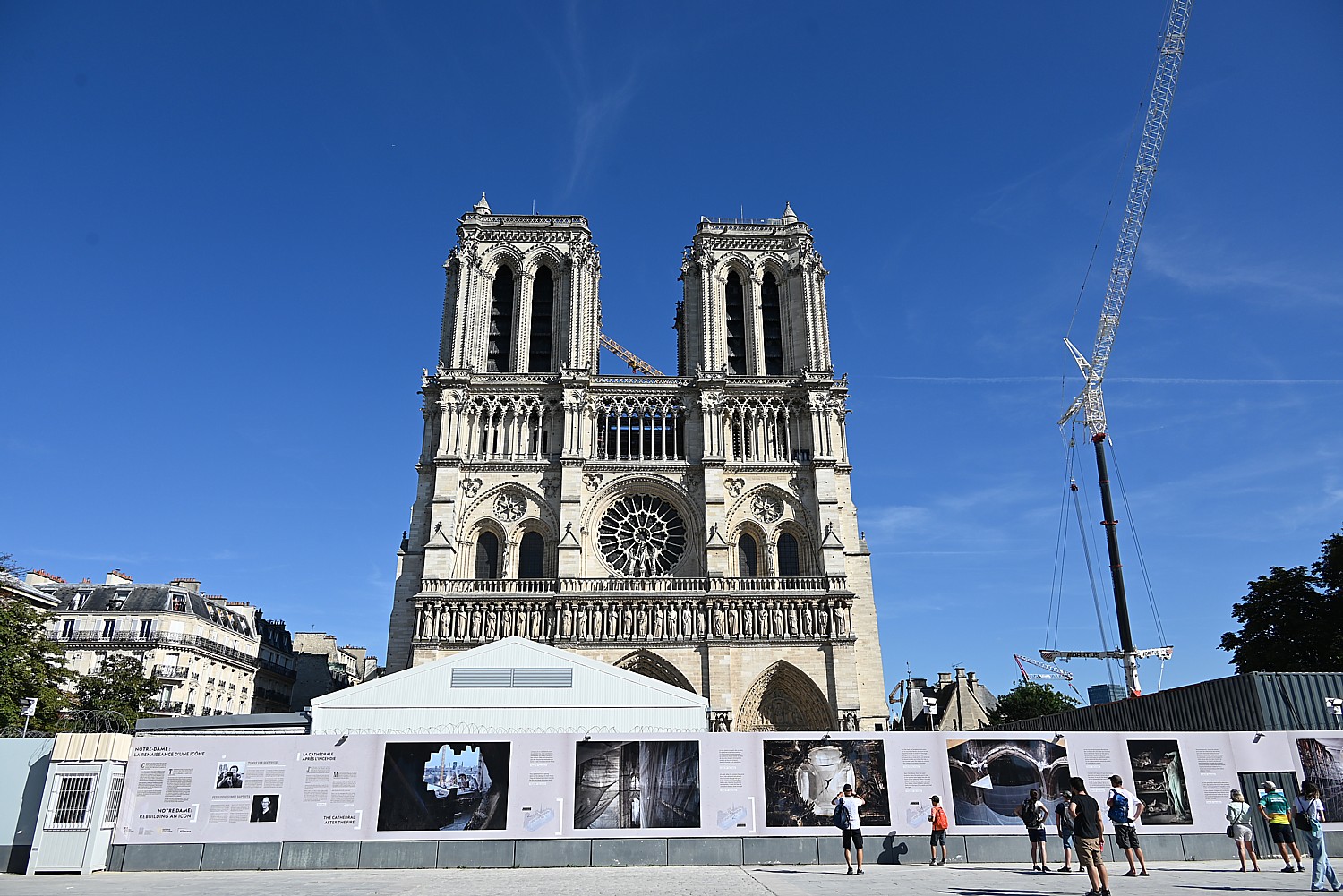
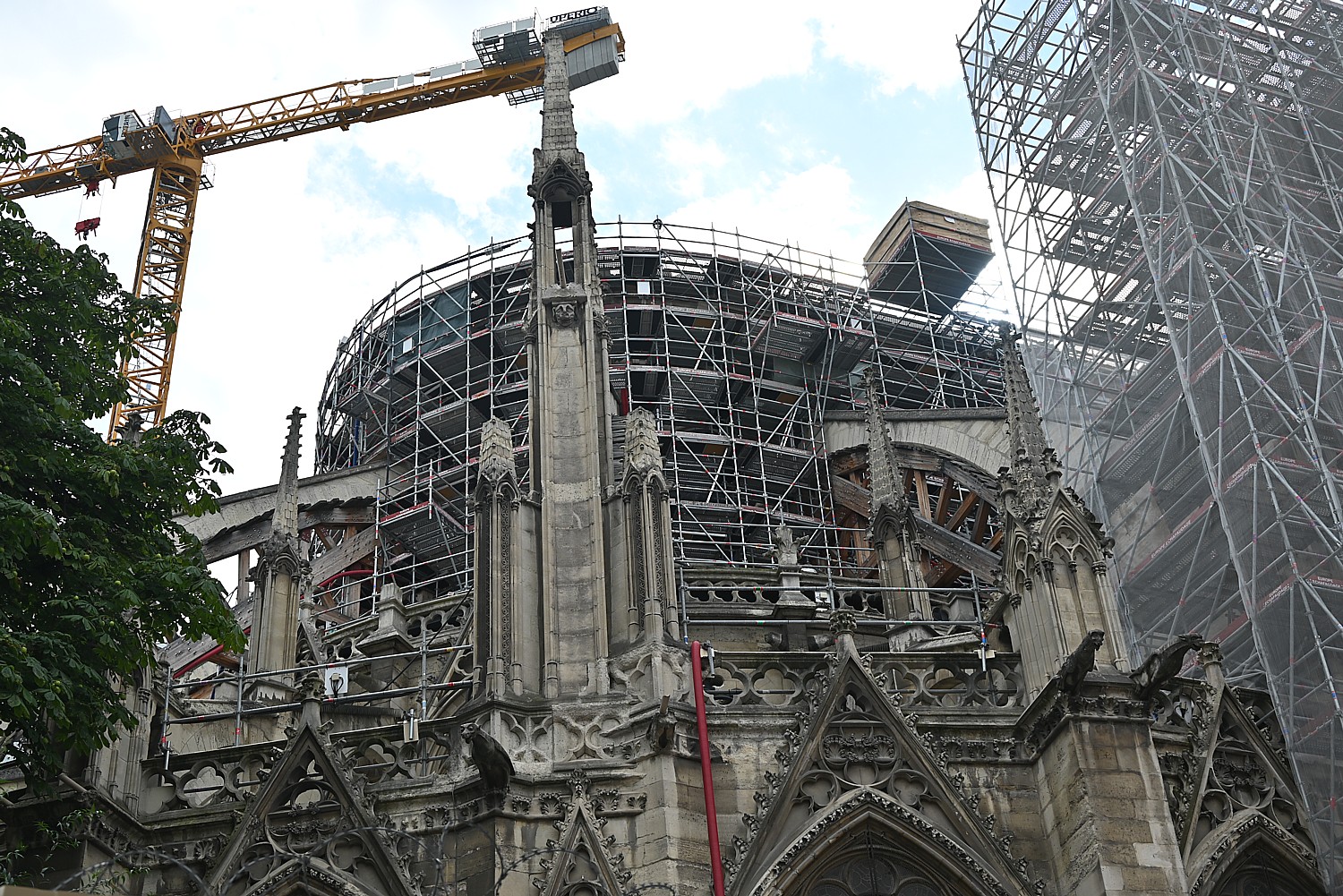
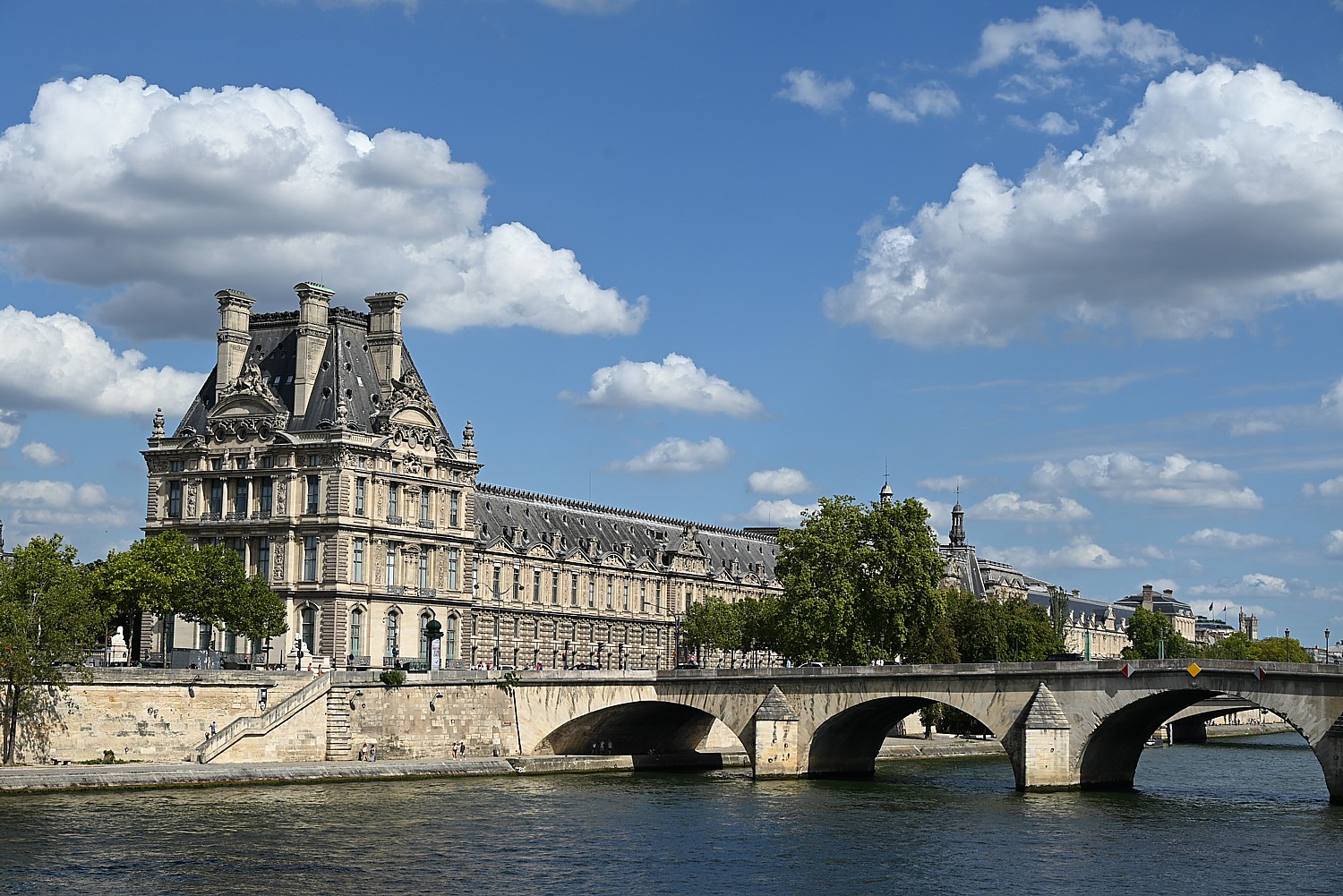
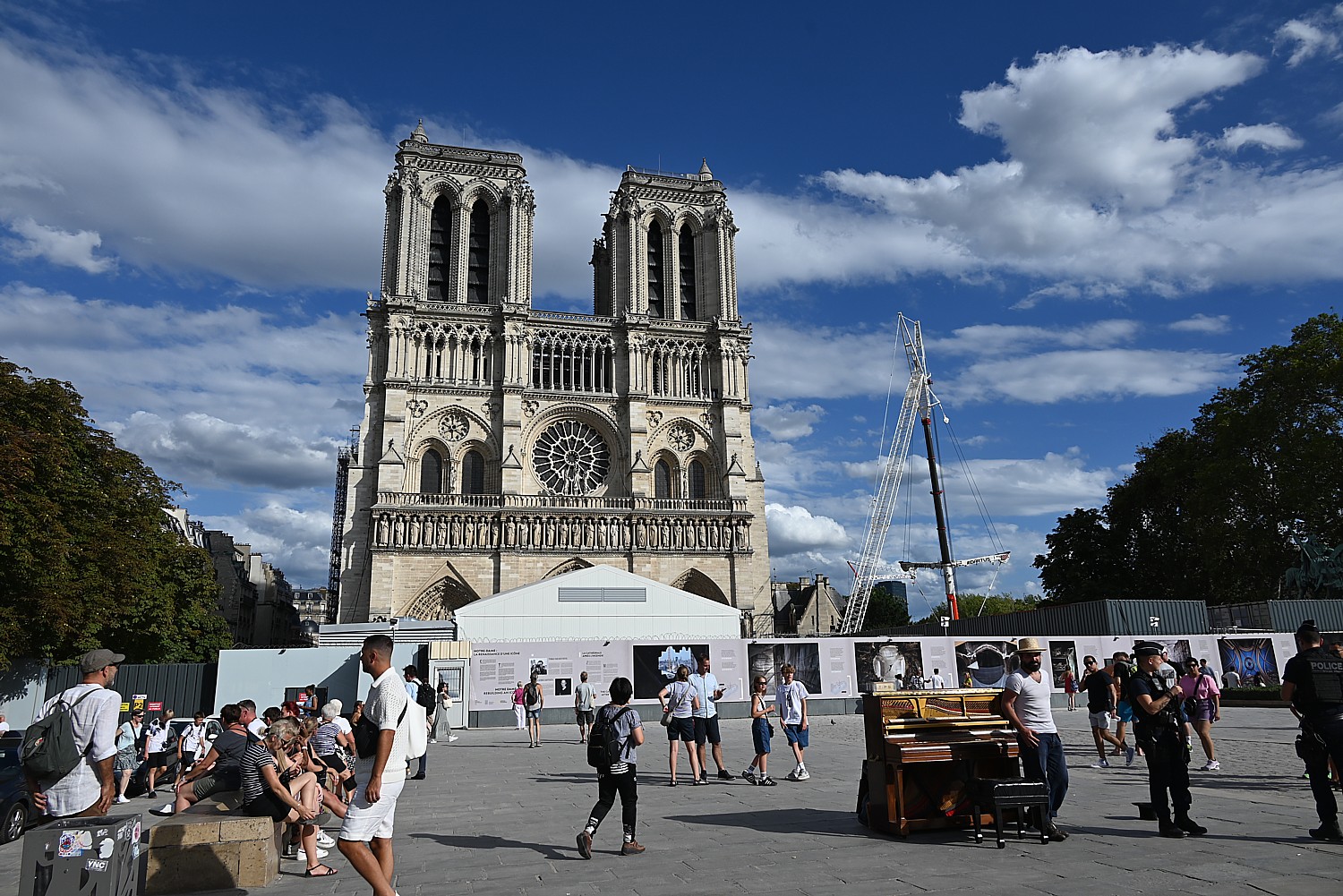
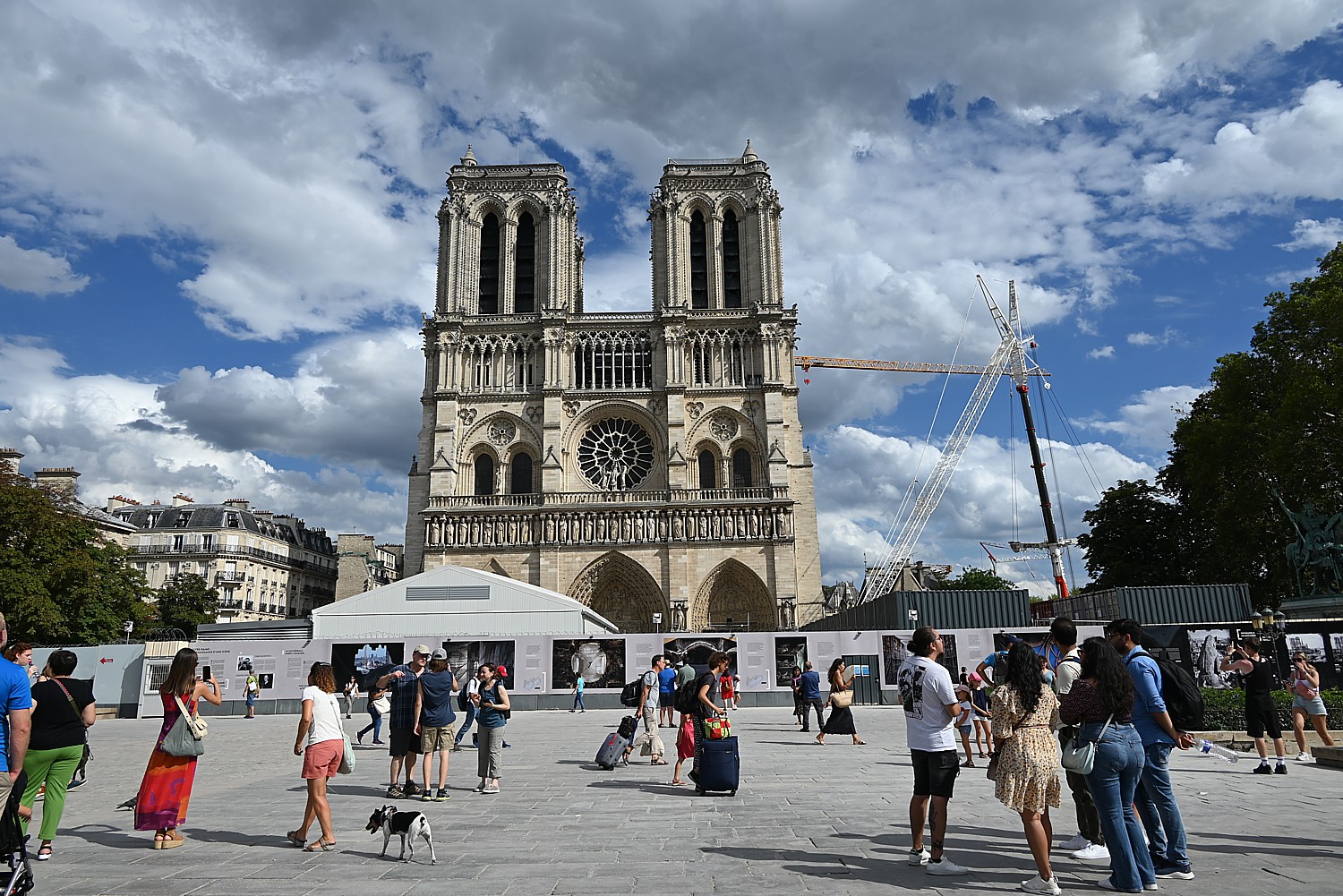
I cross the Seine on the Pont Royale and walk along the Quai Voltaire to return to the Isle de Cite for another look at Notre-Dame Cathedral, hoping to see workmen on a Monday.
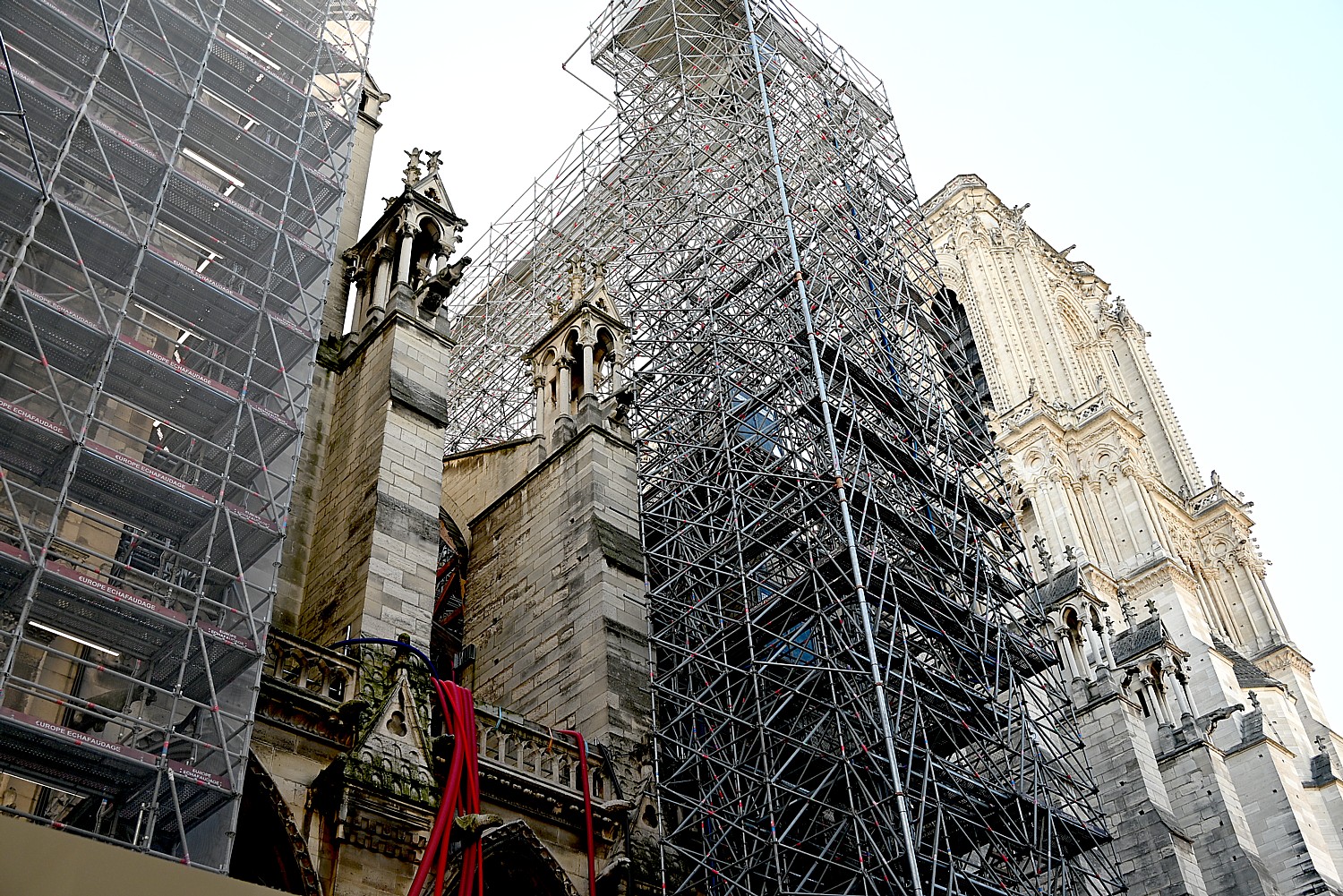
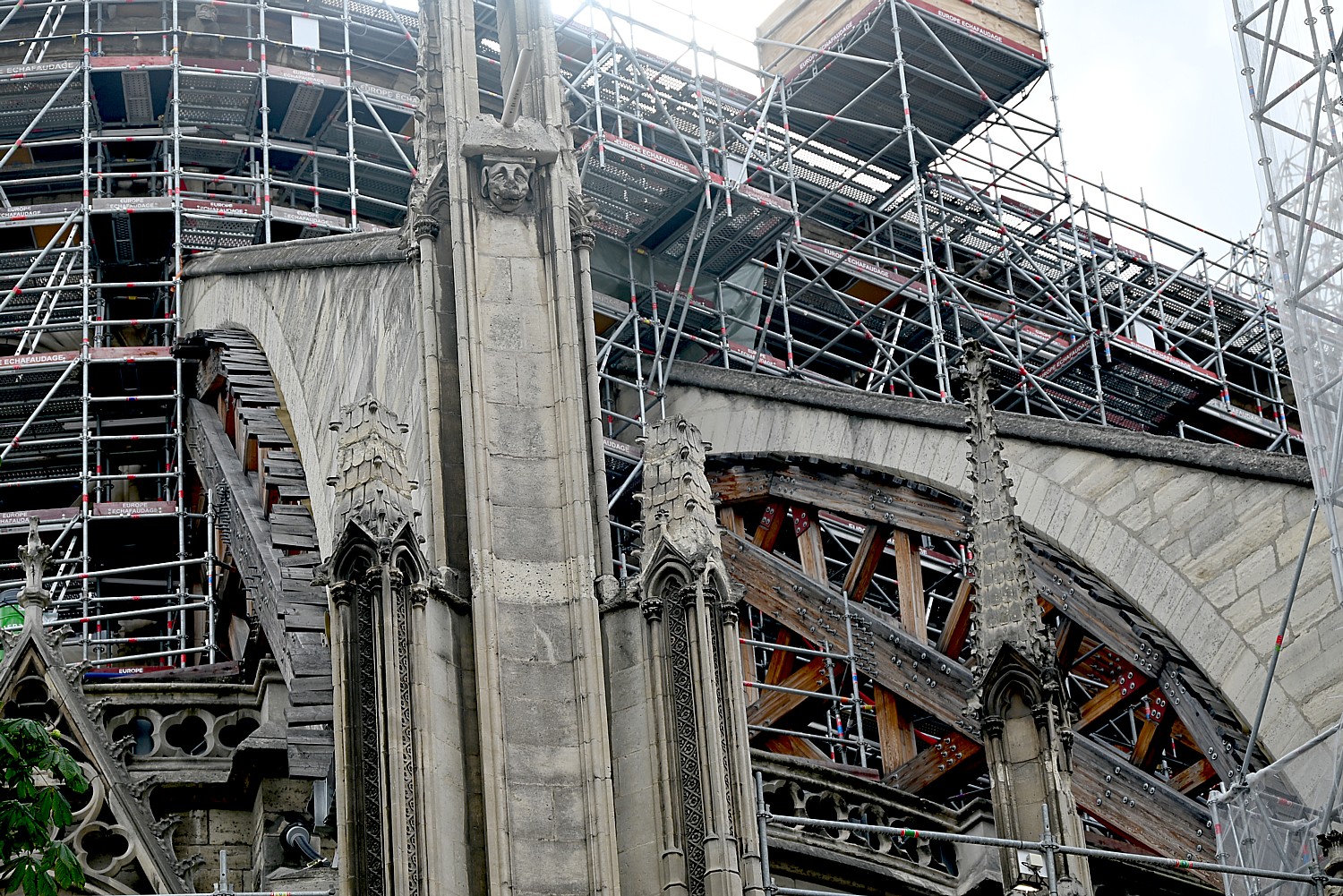
The tragic fire in April 2019 destroyed so much of the iconic 860-year-old limestone and the latticework of ancient timbers that formed Notre-Dame’s attic, melted the roof’s lead sheath, and endangered the stability of the stone structure. The cathedral’s spire was sent crashing into the interior. It has since been raised again, “one of the most visible and most potent symbols of the cathedral’s rebirth,” a newspaper account states.
There is an outstanding photo exhibit by photographer Tomas van Houtryve with notes documenting the dramatic story of Notre-Dame’s restoration.
“I trained with teams of rope technicians, perched on ancient stones above the abyss, to access the heights of the cathedral,” Photographer Tomas van Houtryve relates. “It felt more like being on an alpine expedition than in the center of Paris. Bit by bit, the technicians carefully removed debris and consolidated stones.”
While I am standing in front of this exhibit, I learn that Jean-Louis Georgelin, the French general in charge of Notre-Dame’s reconstruction, had died just three days before, on August 18, in a fall while trekking in the Pyrenees mountains; he was 74 years old. Regarded as the architect of Notre-Dame’s rebirth, “The nation has lost one of its greatest soldiers,” President Emmanuel Macron said of him.
In an interview with the newspaper Le Monde in April, General Georgelin had insisted that “everything is being rethought.” Innovations include “cutting-edge” fire prevention technology like misting systems, thermal cameras and fire-resistant doors, as well as a recovery system to treat rainwater running off the lead roof before it goes into Paris’s sewers. “We are rebuilding Notre-Dame identically,” Georgelin had stated. “But we are building a 21st-century cathedral.”
I wonder if this tragedy would also put a monkey wrench into the restoration efforts. So far, the plan is to reopen in December (it would have been a miracle to reopen in time for the Olympics this summer). But renovation work — especially on the exterior — will continue for years after the cathedral reopens for religious services and visitors (12 million used to visit every year).
There are signs that acknowledge and express gratitude to the worldwide community that has contributed to the restoration.
From Île de la Cité, I cross Pont Saint-Louis to Île Saint-Louis – more of a residential neighborhood with pleasant boulangeries, quaint cafes and delightful ice cream shops, and find a small park overlooking the Seine to enjoy my ice cream.
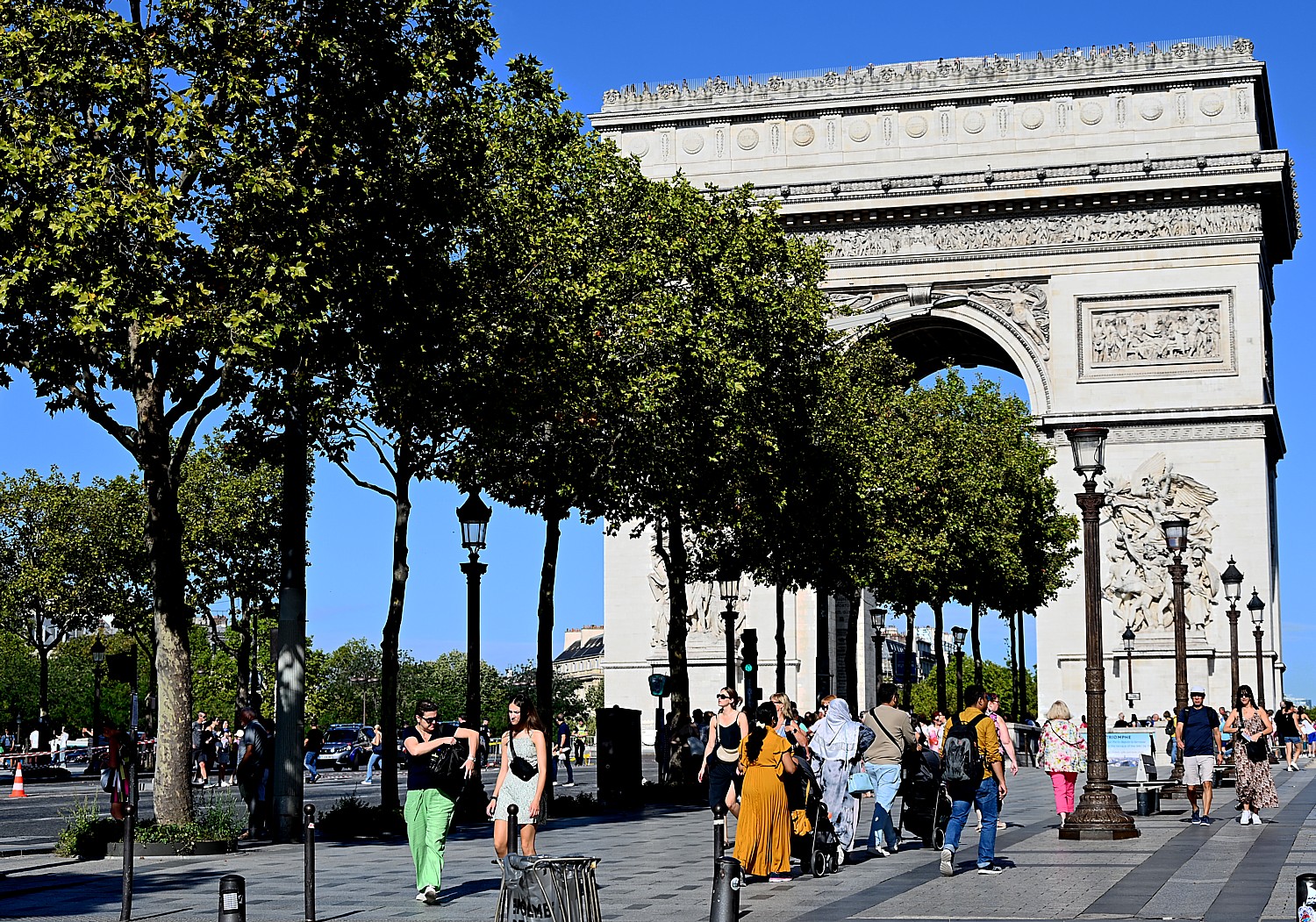
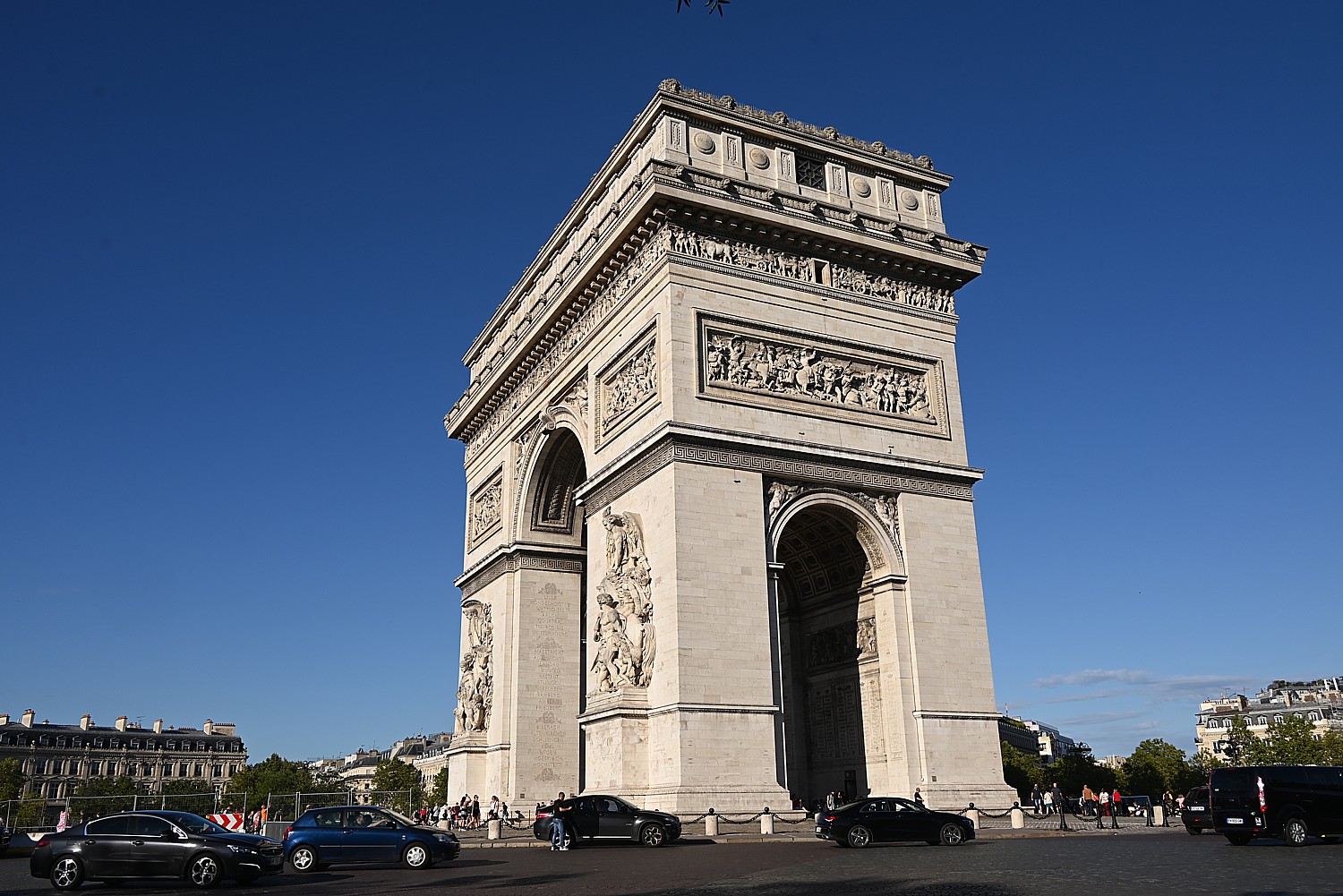
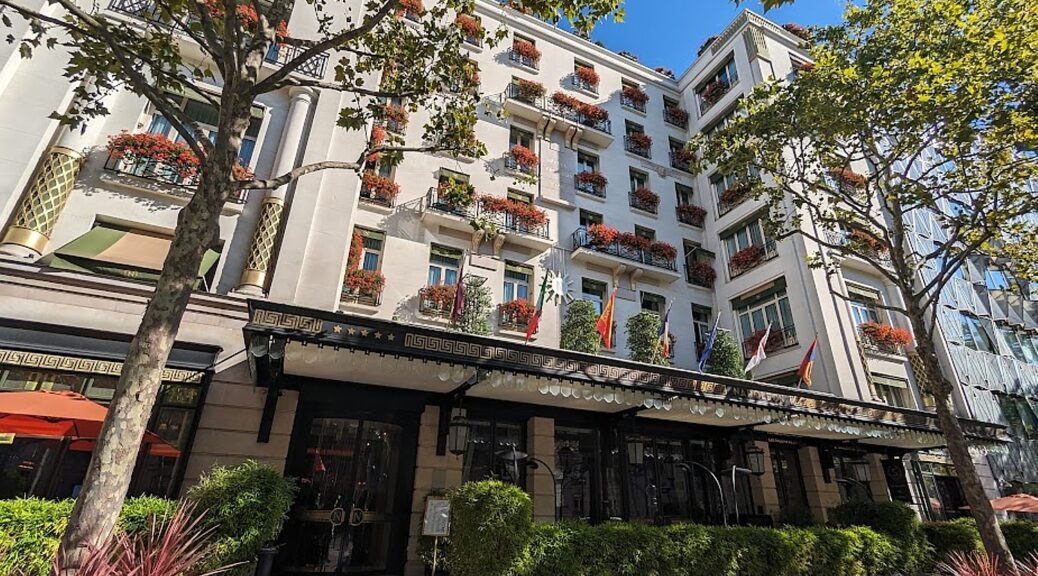
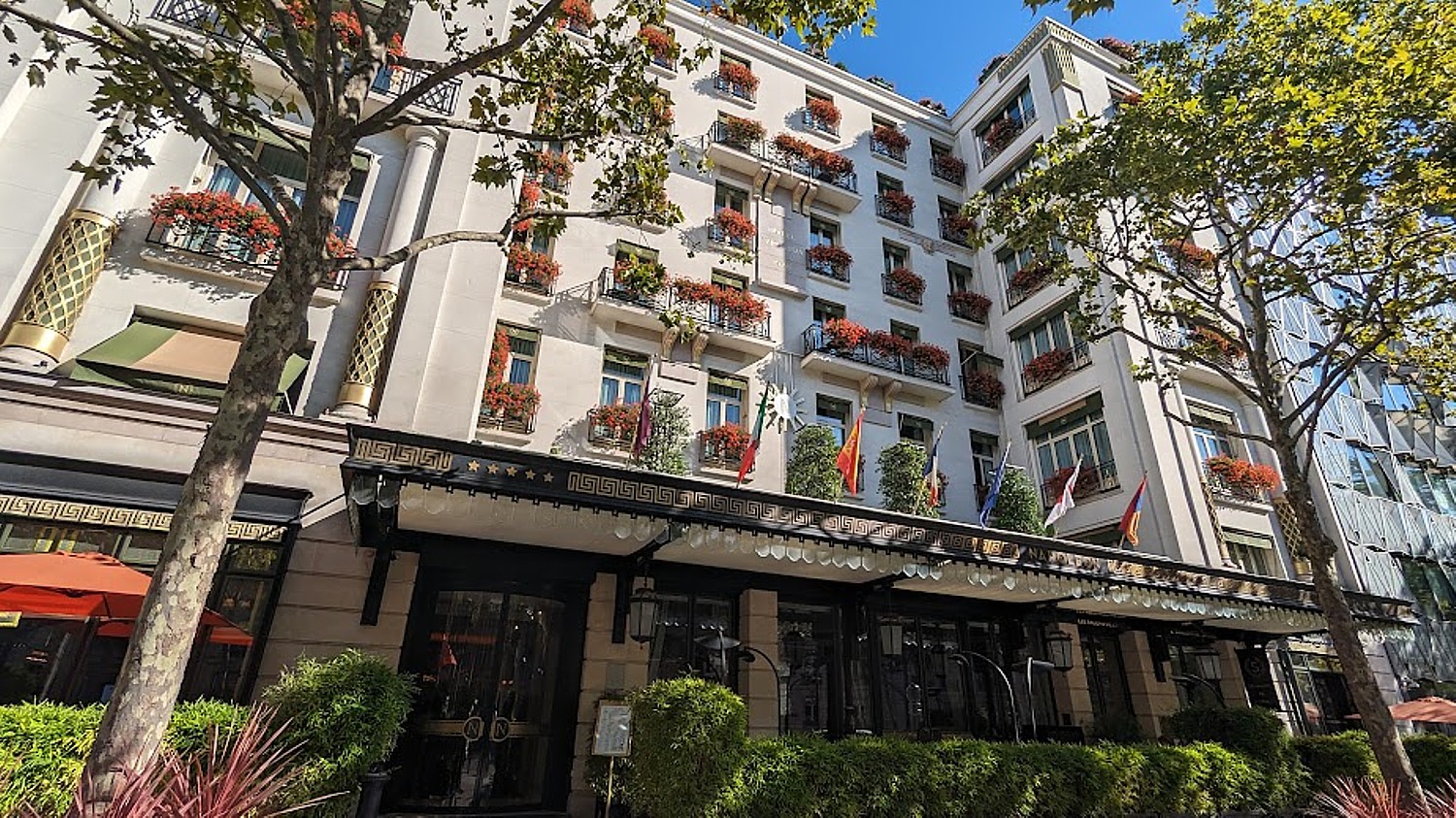
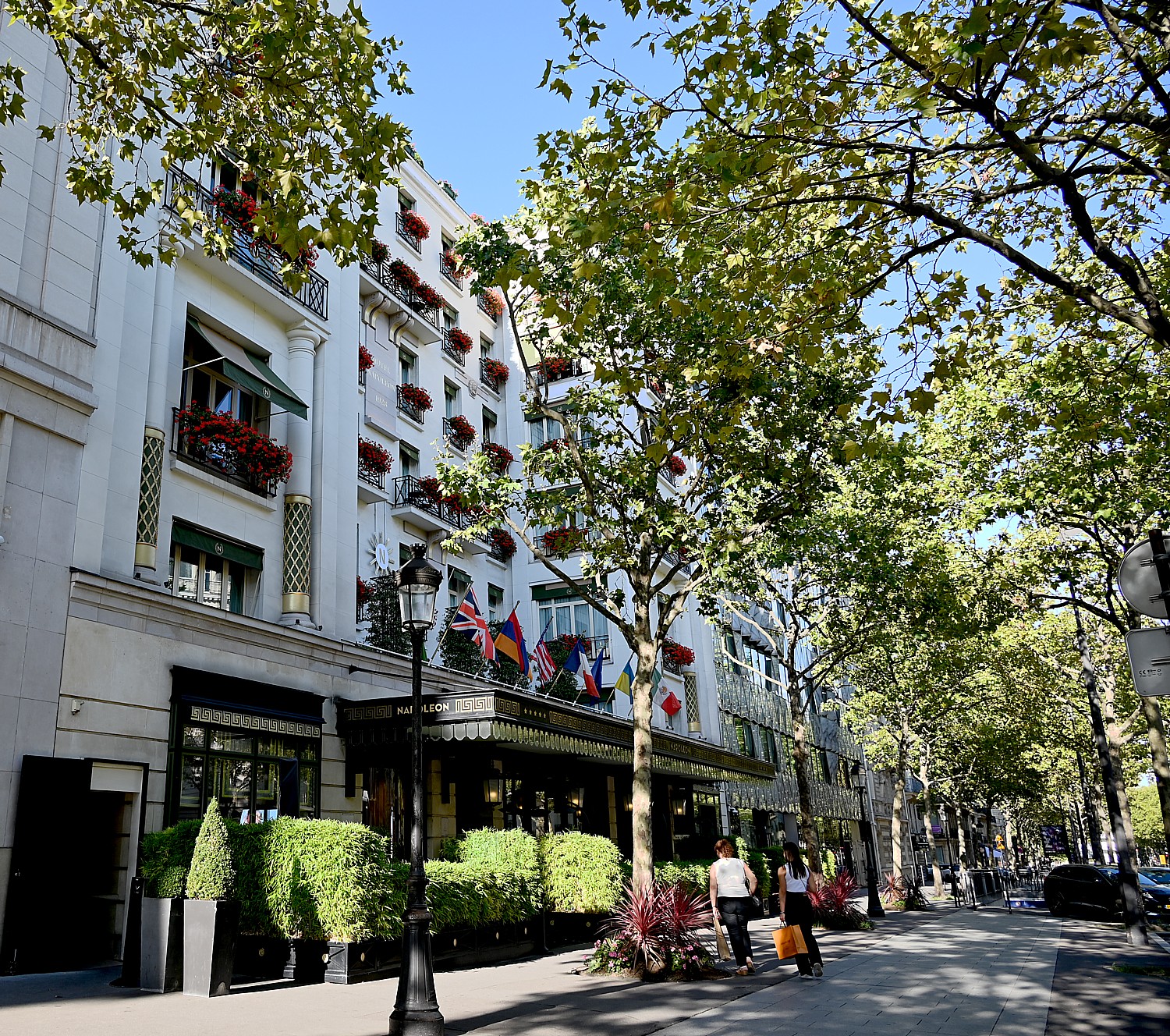
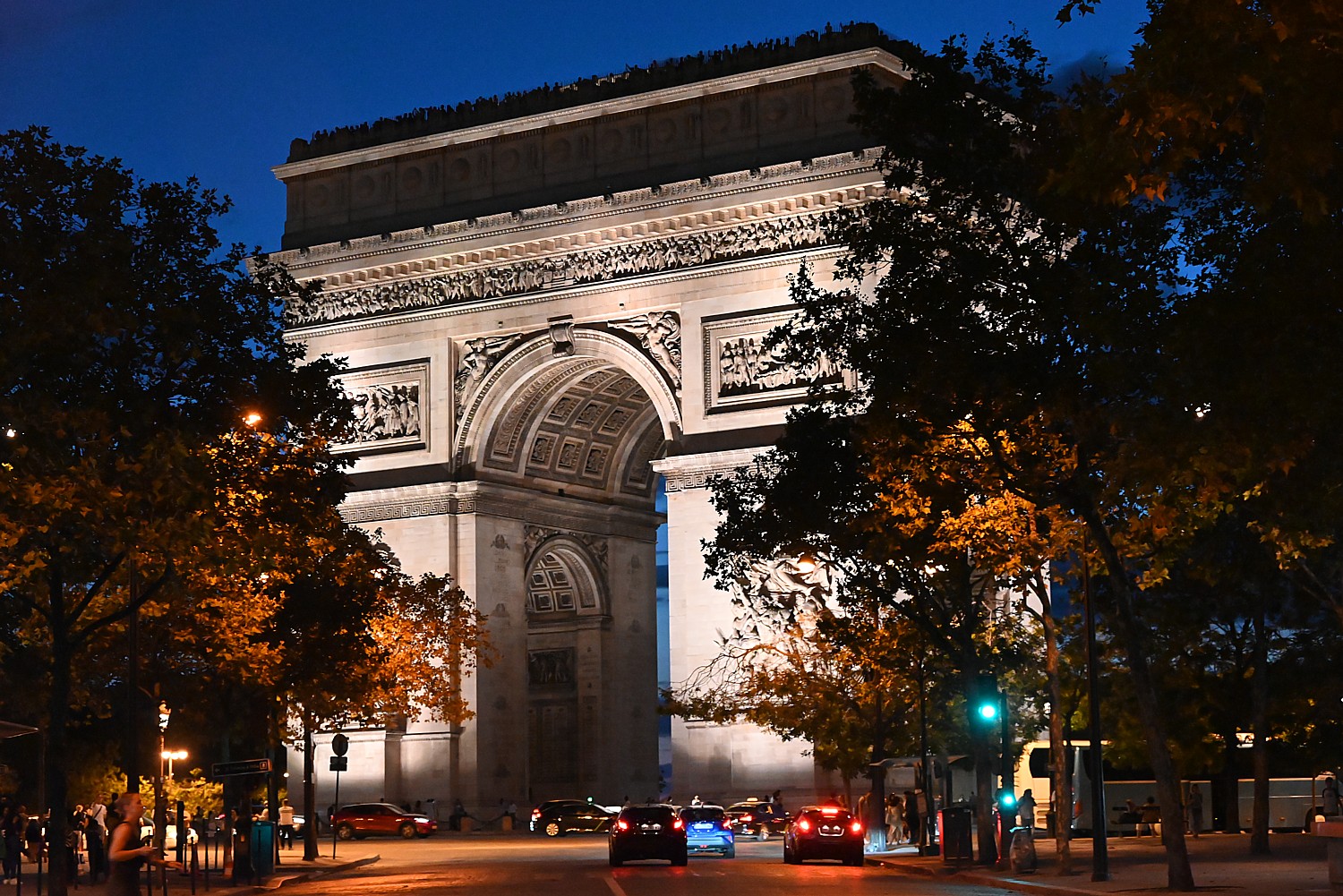
For a different Parisian experience, I had checked out my junior suite in the five-star boutique luxury historic Hotel Napoleon just steps away from the Arc de Triomphe in the tony 8th Arrondisement, and took an Uber to my hotel for the second part of my Paris visit, Le 20 Prieure Hotel, a modest but pleasant three star in the Marais district which I find on hotels.com (my booking includes breakfast).
From here the Ile Saint-Louis, it’s a mostly straight shot walking across the bridge and up Rue Vielle du Temple Boulevard to my hotel, Le 20 Prieure Hotel (20 Rue du Grand Prieuré, 75011 Paris, https://www.hotel20prieure.com/en/) about two miles through the Marais District.
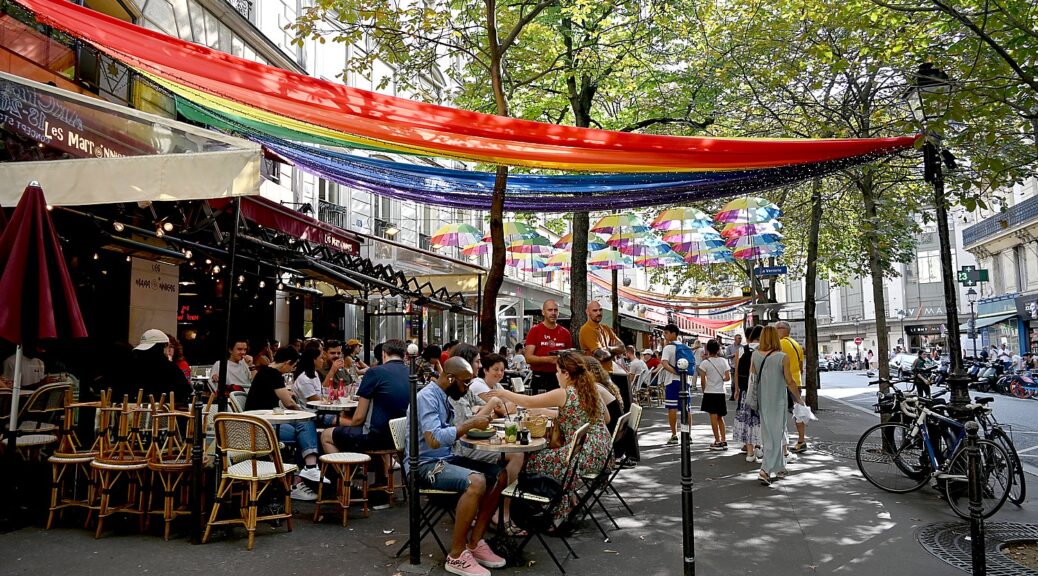
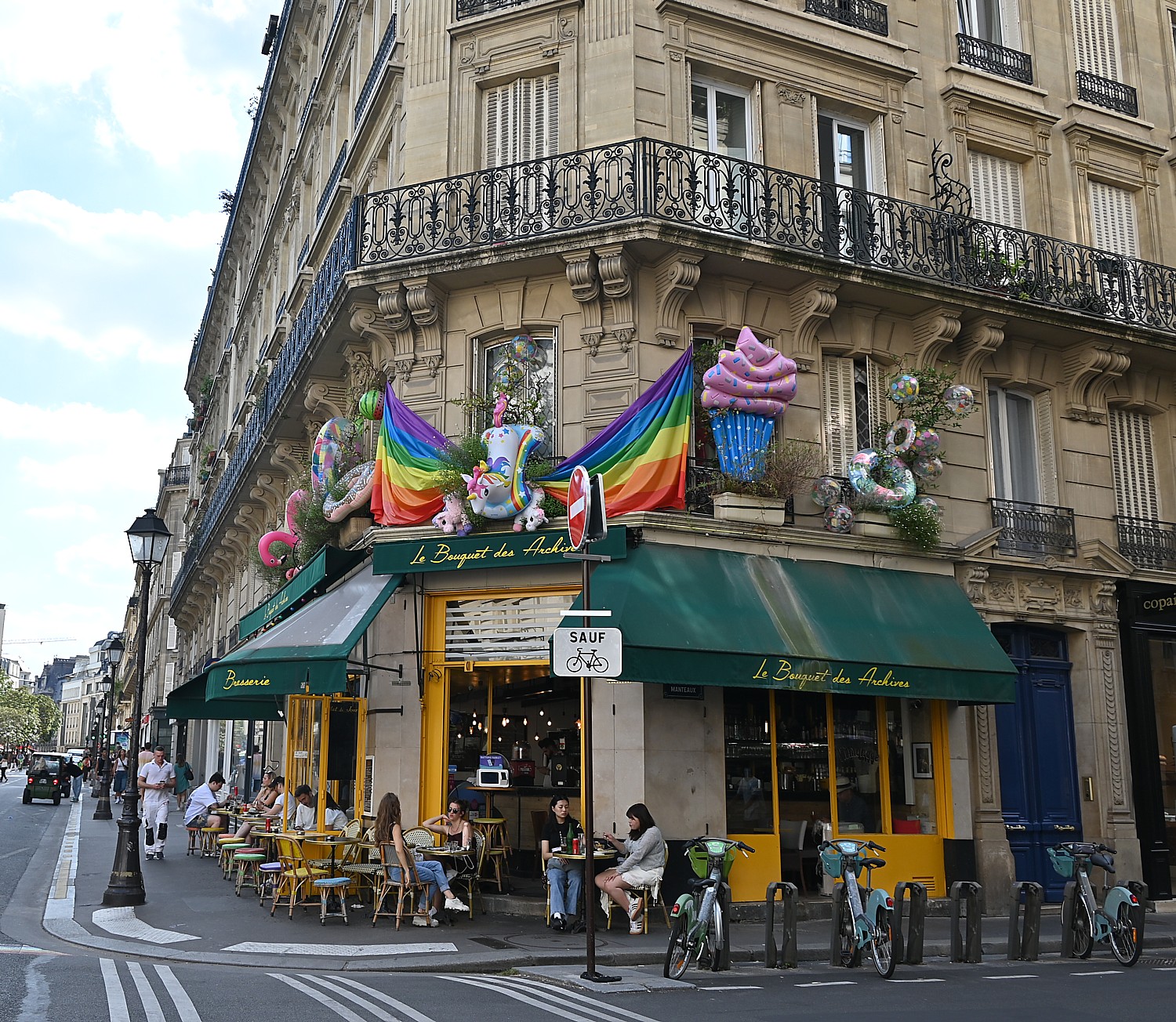
Today, Le Marais district is considered “trendy” with charming streets full of hip cafes, boutiques, and bookstores, Gay Pride flags and rainbow-painted crosswalks, and street art.
The Marais, though, was once a predominantly Jewish neighborhood, that still has the marks, remnants, and scars of being uprooted in the Holocaust.
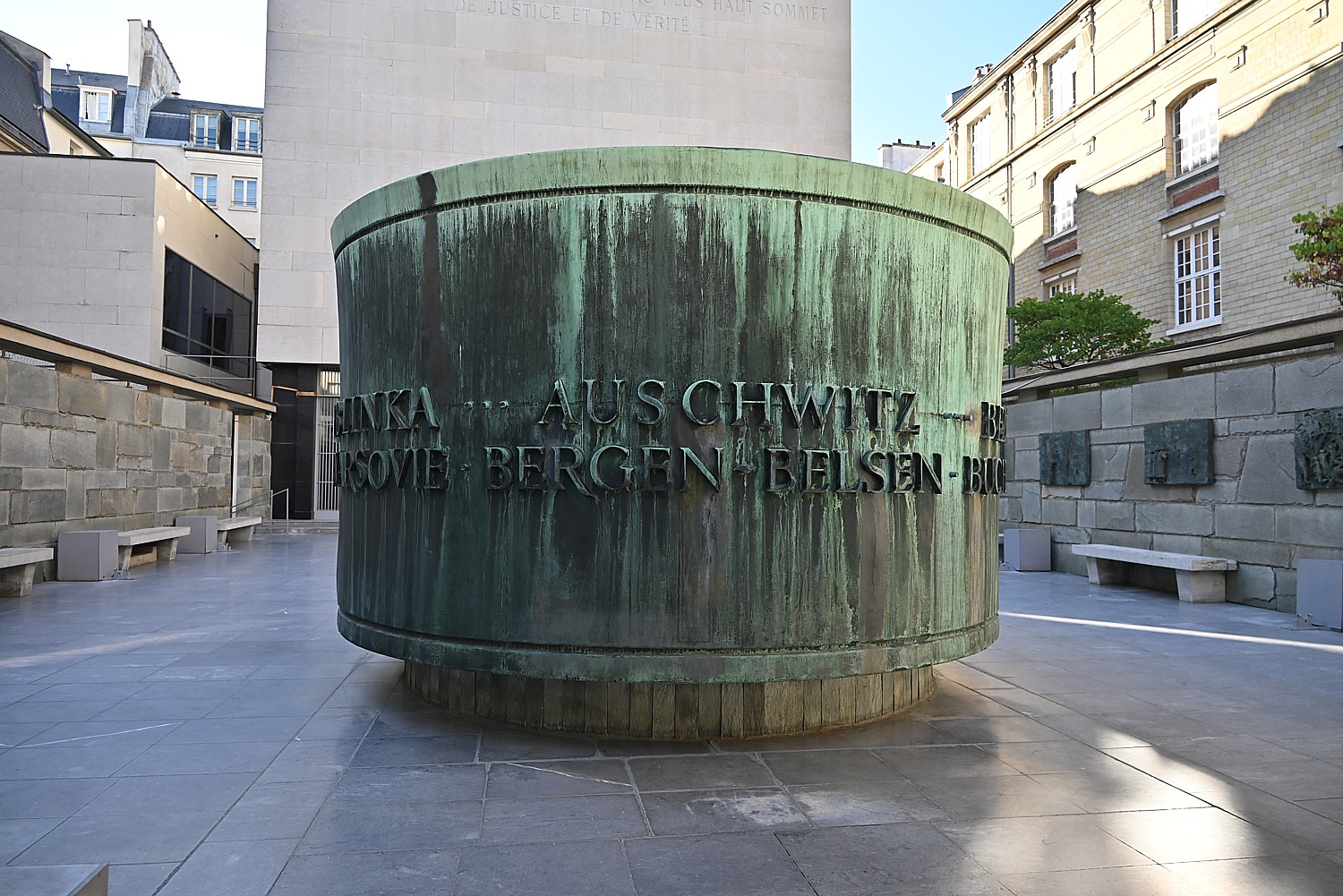
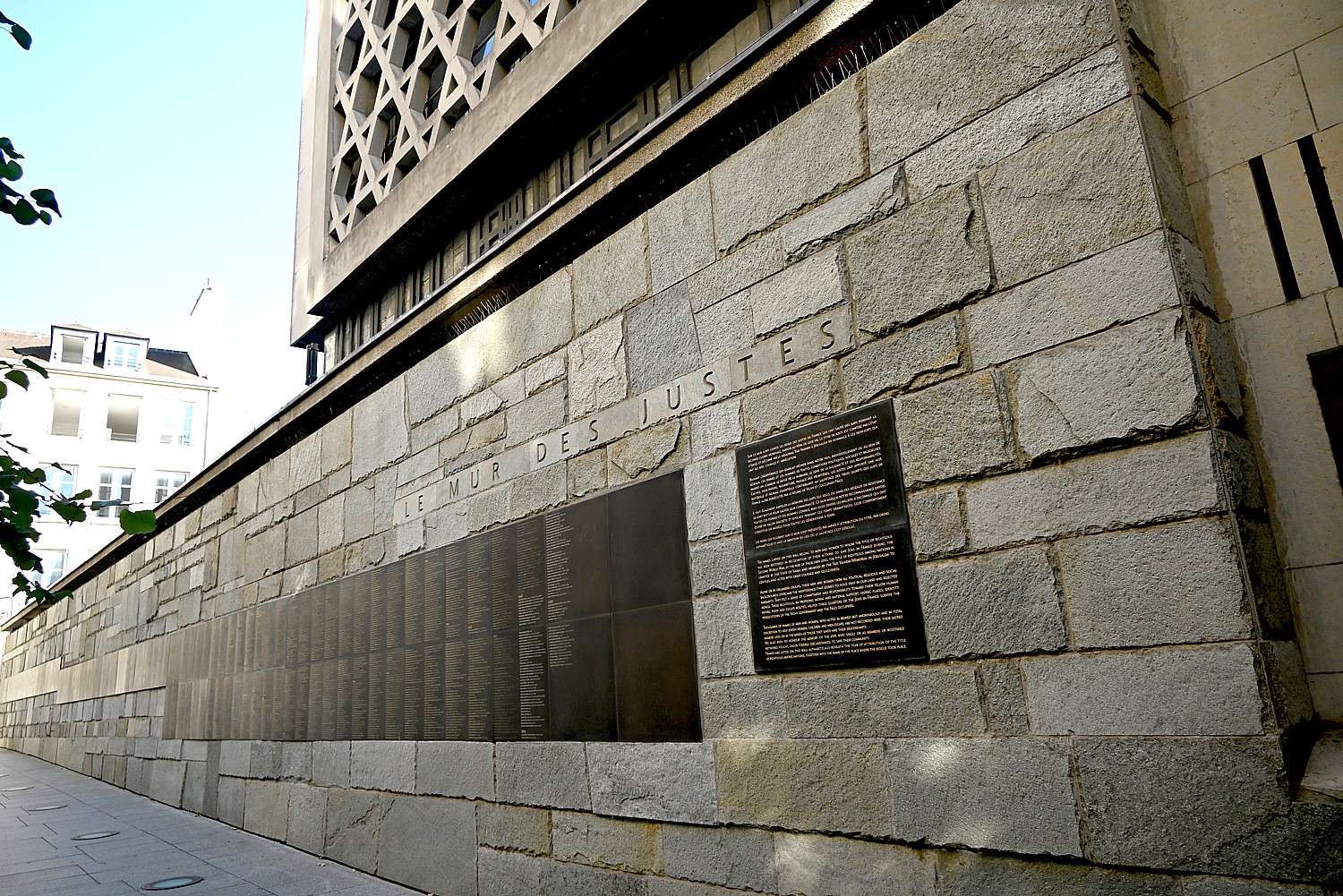
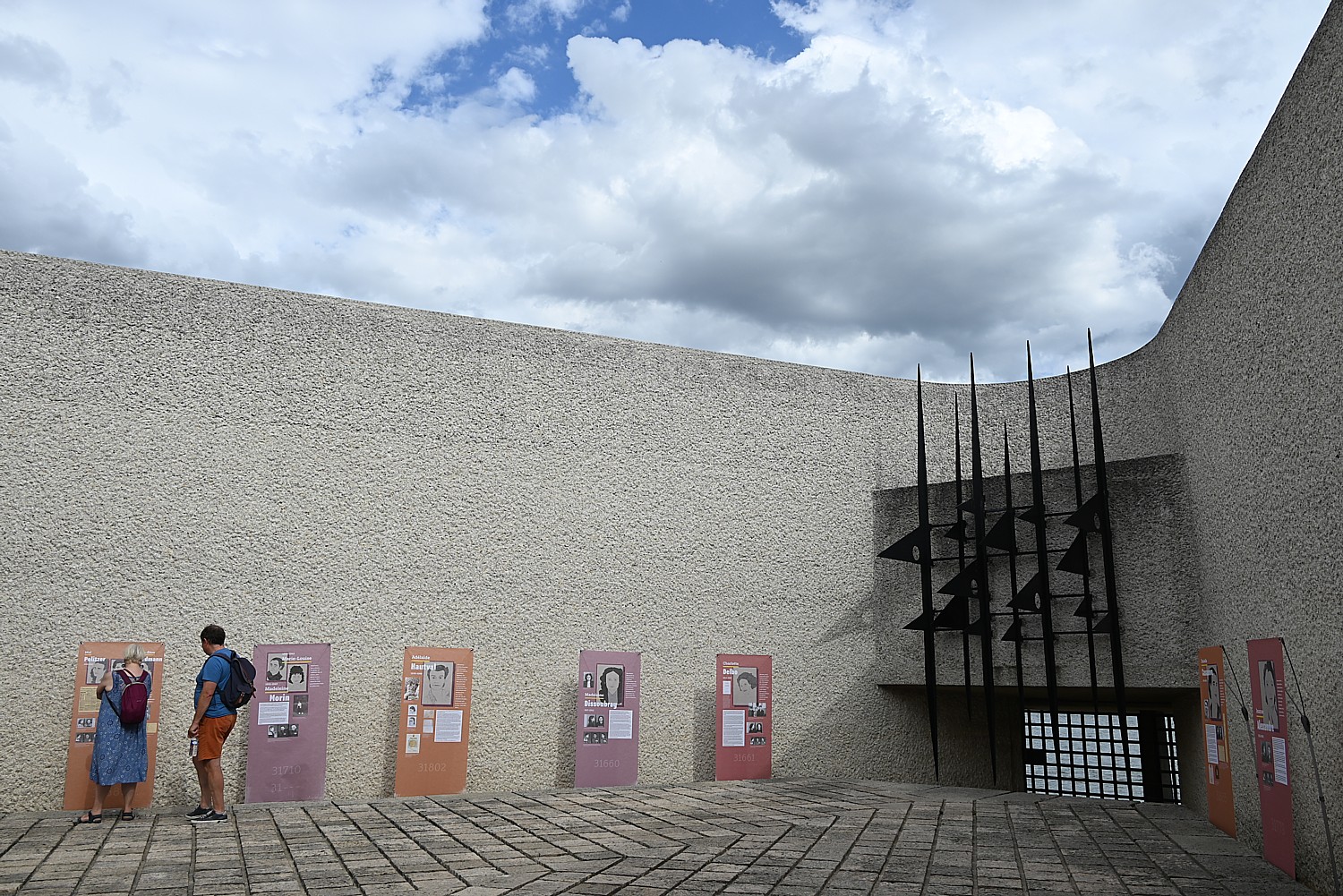
I come upon Allee Des Justes Parmi Les Nations, which I quickly realize borders the Shoah Memorial Center, a museum, information and research center on the history of the genocide of the Jews in World War II.
This 60 meter section of the rue Grenier sur l‘Eau was transformed into the ‘Allée des Justes’ 12 years ago, and refers back to the “Righteous Among the Nations,” a title awarded by the World Holocaust Center in Jerusalem, Yad Vashem, to non-Jews who risked their lives during World War II by helping Jews to hide, flee or survive. The memorial lists the names of the French ‘Justes’ and the locations of their deeds. One side remembers the Jewish victims on the ‘Wall of Names’ and the other side, the “Wall of the Righteous,” the French rescuers of Jews. Since Yad Vashem still awards this title to people throughout the world each year, French names continue to be added. On January 1 2012 France counted 3.513 Justes. (The Netherland has 5,204, Poland has 6,339).
As I walk about the district, I note on schools and certain public institutions, France’s credo, “Liberte, Equalite, Fraternite” (so much better than America’s relatively recent motto, “In God We Trust” adopted in 1956 in reaction to Communism.)
On one building, there is also a plaque dated December 2001 which I translate, “Arrested by the police of the Vichy Government, complicit with the Nazi occupiers, more than 11,000 children were deported from France between 1942-1944 and sent to Auschwitz because they were Jews.”
There is a street sign pointing the way to the Museum of Jewish Art & History, and I put it on my list to visit.
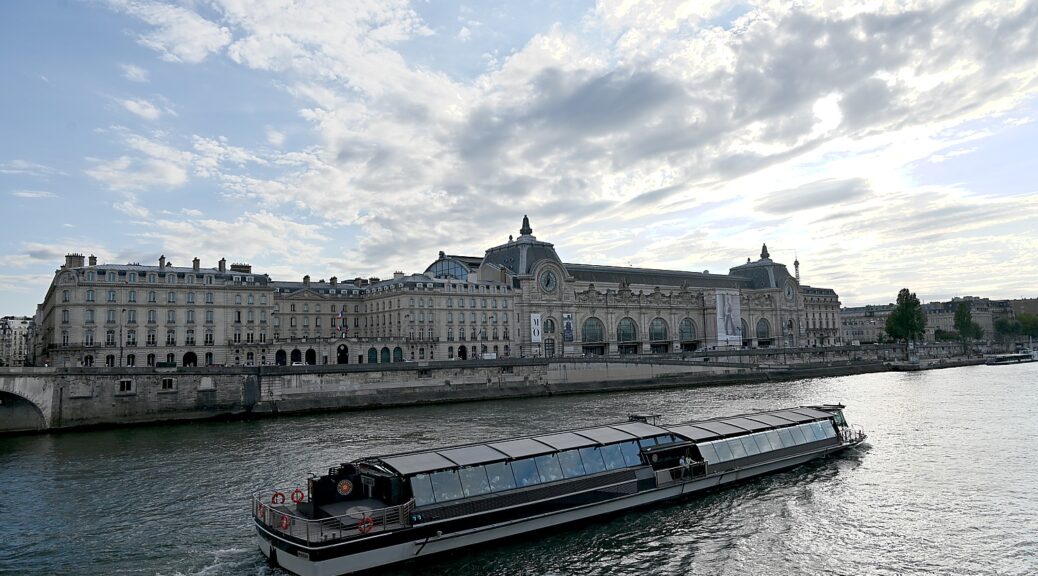
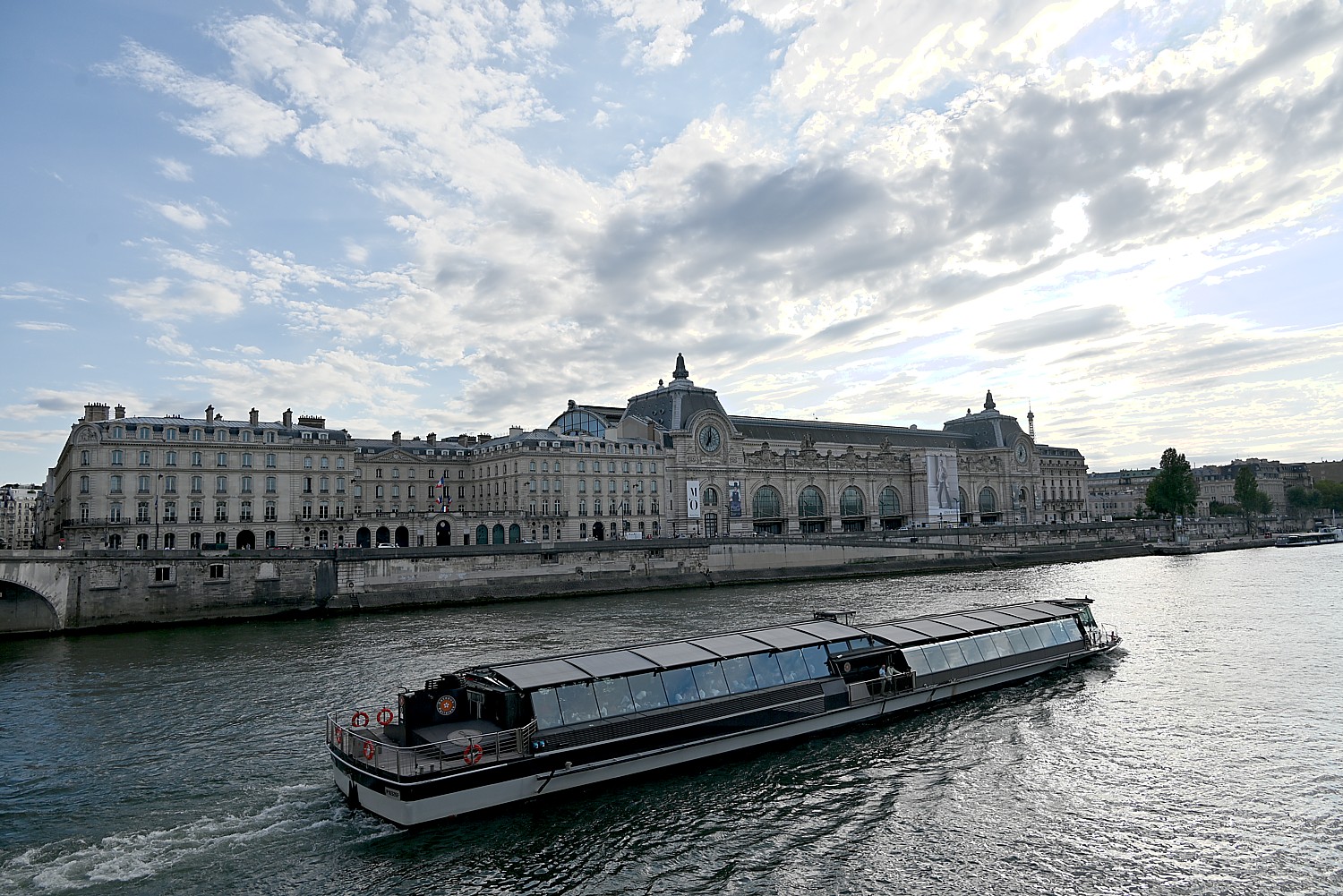
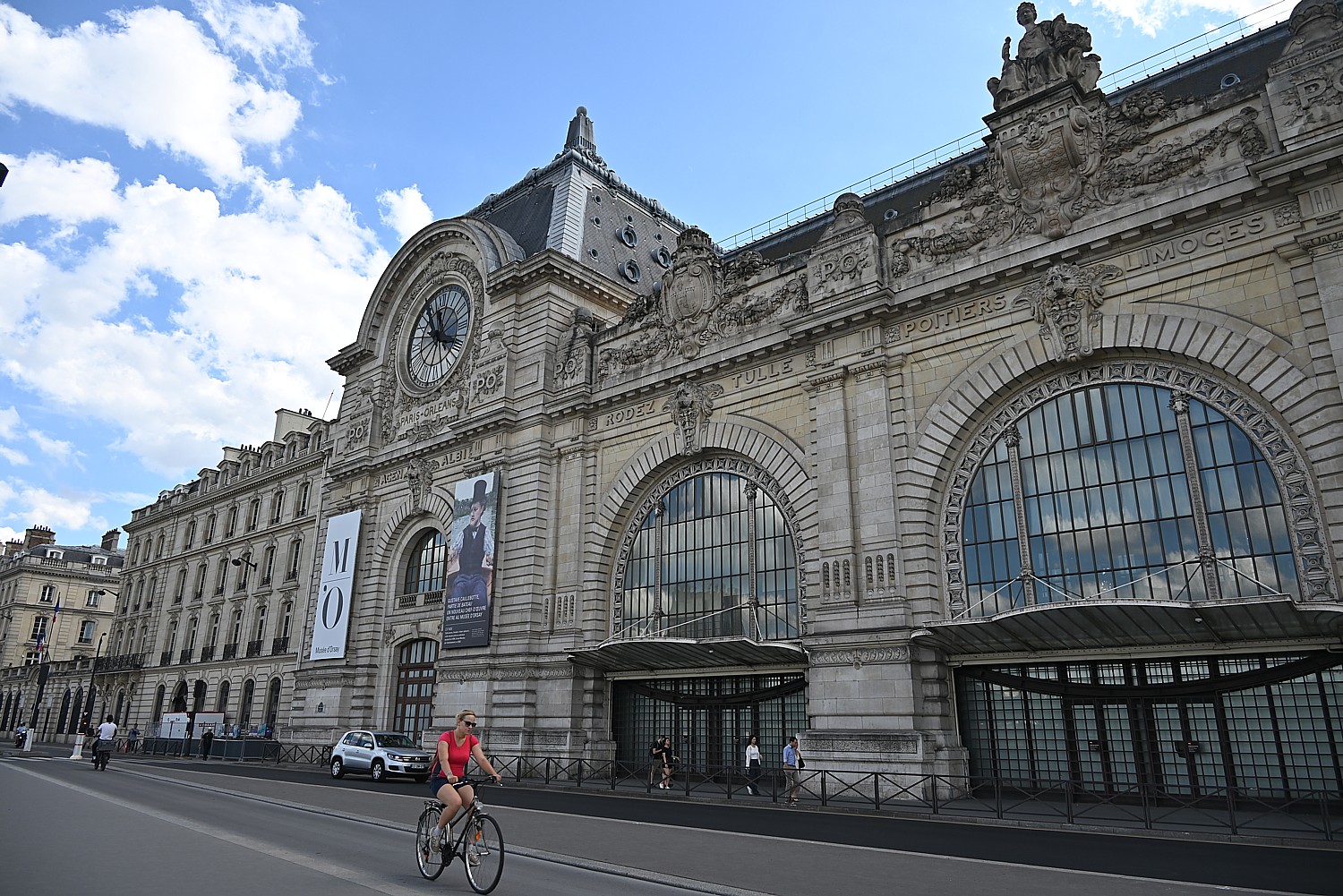
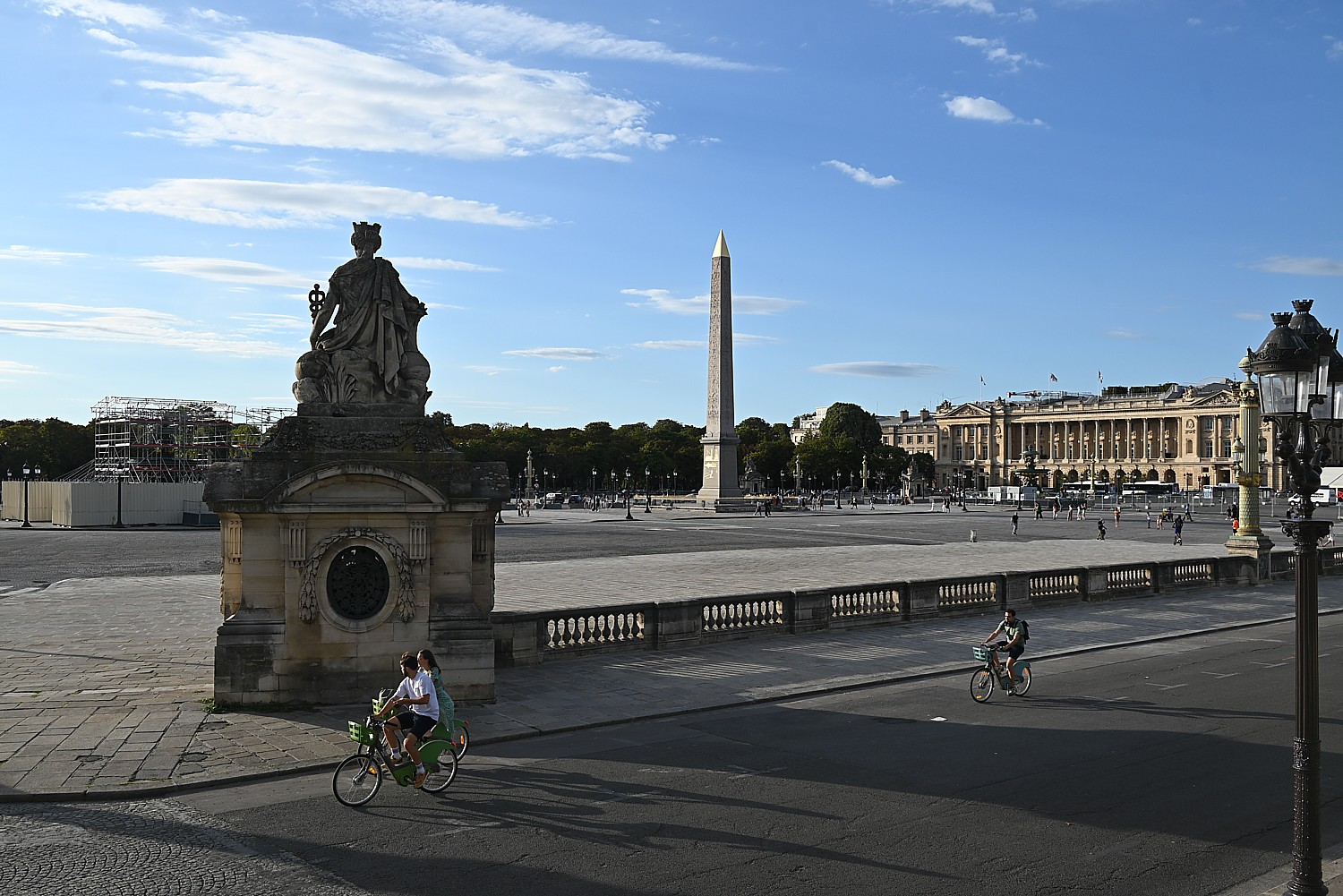
On my first morning in Paris, as I set out from the Hotel Napoleon just across from the Arc de Triomphe in the tony 8th Arrondisement, at 10 am for a beautiful walk down Champs-Elysee to Place de la Concorde, passed the Grand Palais, across the Seine, passed the National Assembly to my destination, the Musee d’Orsay, I am immediately under the city’s spell.
Paris is regal. Majestic. Monumental. The scale of the boulevards, the buildings, the structures. It is big and bustling, but curiously, you don’t feel choked or overwhelmed – probably because no structure is taller than the Eiffel Tower and you can see out, and because the city is designed around open spaces –the wide boulevards, gigantic plazas, parks, the Seine flowing through. There are places to sit, even water fountains and misting stations, while the smaller neighborhoods, with their narrow twisting roads, are quaint and quiet (little traffic).
The level of grandeur is breathtaking, and for a moment I am thinking that only a monarchy could have built this, a democracy never would have. But in the next, I am reminded that only the Revolution opened them for public purpose.
I walk everywhere and Paris makes it easy (and safe). Paris is one of the most beautiful cities in the world, making strolling ideal. But for getting around, Paris is also a biking city with superb bike lanes, traffic signals (get preference over cars, in fact), and huge number of bike share stations.
It is helpful to have paper map, and not just rely on cell phone GPS (remember to download maps when you have WiFi so can access offline – I keep forgetting), but it is part of the joy of the travel experience to rely on the kindness of locals to point you in the right direction, even with limited French.
It is essential to plan your visit to Paris’ top museums and attractions in advance, and pre-purchase timed ticket, or book a time if you have the Paris Museum Pass (http://en.parismuseumpass.com/) or Paris Pass (parispass.com), and try to book as early a time as possible, or evening hours.
And though it is better to try to visit on weekdays, considering that the Musee D’Orsay is closed on Monday (I book my Le Louvre visit for that day), I pre-booked my visit for Sunday.
The Musee d’Orsay is housed in what had been a truly grand train station, a Beaux-Arts jewel built for the Universal Exhibition of 1900. It is famous for its fabulous collection of French art from 1848 to 1914 – paintings, sculpture, furniture, photography – including the largest collection of Impressionist and post-Impressionist masterpieces in the world.
Here you can experience for yourself (in relative peace, mind you) the exquisite works of Van Gogh, Monet, Manet, Degas, Renoir, Cezanne, Seurat, Sisley, Gaugain and Berthe Morisot – actually it seems just about all my favorite paintings by my favorite artists, as well as being introduced to outstanding works I am unfamiliar with.
The layout of the galleries is exquisite, and the views from the fifth floor gallery where the Van Goghs are displayed and from the Restaurant (you look through the massive clock to Sacre Coeur on Montmartre, like those scenes in the movie, “Hugo”) take your breath away.
Though the Musee D’Orsay is one of the largest museums in the world and the second most popular to visit in France after Le Louvre, it doesn’t feel large or crowded or intimidating. The clever layout – a warren of smaller galleries off a main, open hall – makes it feel more intimate and calm, even as I stand in front of such a popular painting as Van Gogh’s “Starry Night” (I think this is the equivalent of the Mona Lisa in Le Louvre). The way you realize just how vast the museum is – at any time about 3,000 art pieces are on display – is by realizing you’ve been there for four hours. Time melts away, like the humongous clocks you get to see through to Paris’ magnificent skyscape.
The Van Gogh gallery on Level 5 has an added attraction: the most magnificent views across the Seine of Le Louvre to Montmartre from one set of windows, the Eiffel Tower from another.
There are 81 Renoirs including “The Swing” (significant when I visit the Musee de Montmartre and see the spot where he painted it!), and 18 by Toulouse-Lautrec, plus James McNeill Whistler’s famous “The Artist’s Mother’, better known as “Whistler’s Mother.”
As I go through galleries of portraits, I wonder whether the sitters contemplated becoming immortal, that their visages would be admired and their personas wondered about for centuries.
Besides seeing “in person” the art works that are among the most famous in the world (and it seems just about all my favorites), there are masterpieces by artists that may not be as “top of mind” to explore and discover as well. One, “A Street in Paris,” by Maximilien Luce, that is so haunting, depicting “Bloody Week” of May 21-28, 1871, and the brutal suppression of the Commune, a revolutionary movement that emerged from the political chaos after the French defeat in the Franco-Prussian War of 1870 and the fall of the Second Empire, events immortalized in Victor Hugo’s “Les Miserables” and the musical “Les Mis” which Luce painted 30 years after the event that so affected Luce.
It is a further demonstration of the power of art to document history, events, and bring faraway places to people, especially before photography.
Thank goodness, the really excellent notes are presented in French and English (not so in many other places).
The atmosphere of the museum is like putting yourself into the canvas.
Besides the full-service restaurant, there is an absolutely delightful café in the lower level – reasonably priced and very comfortable, where I get refueled.
Towards the end of my visit, I find myself in a grand ballroom which feels weird.
From the Musee D’Orsay, I stroll down the quai along the Seine, with the marvelous book/magazine sellers, to the Pont Neuf (the oldest bridge in Paris) to Île de la Cité, a small island in the center of Paris where Notre-Dame and Sainte-Chapelle are found. It is the historic heart of Paris.
Also close to Notre Dame on the Ile de Cite is Sainte-Chappelle, famous for its stained glass windows.
Sainte-Chapelle is considered one of the finest examples of Rayonnant period of Gothic architecture. Built between 1238-1248, the royal chapel was commissioned by King Louis IX to house his collection of Passion relics, including Christ’s Crown of Thorns – one of the most important relics in medieval Christendom. It served as the residence of France’s kings until the 14th century.
A curious chart outside the chapel shows that Sainte-Chappelle cost 266,000 gold francs for the elevation of its spire and the restoration of the roof, equivalent to 1.06 million Euros, total weight 232.4 tons, 75 meters high from ground level, work done between 1853-1855.
Notre Dame Cathedral: cost 500,000 gold francs for the elevation of its spire, equivalent of 2 million euros today; total weight 750 tons, 96 meter high from ground, work from 1859 to 1860.
Adjacent to Sainte-Chapelle is La Conciergerie, the palace where Marie-Antoinette was held before her execution (it’s closed by the time I arrive).
Walking back to the Hotel Napoleon, I stroll alongside the full length of Le Louvre museum – once a palace – stunned by how large, and how exquisitely ordained it is (I will be visiting the next day), through Tuileries Garden to the Place de la Concorde, the largest square in Paris, where King Louis XVI, Marie Antoinette and Robespierre were executed by guillotine during the French Revolution.
I walk by the Petit Palais (where there is a Sarah Bernhardt exhibit I wish I could have seen; free admission to the collections!), to the Champs-Élysées. (There is really good signage that direct you to the places visitors most want to see.)
The view from across the Seine – with the Bateaux Mouches (sightseeing boats) passing by – is enchanting enough, but seeing the Tower from its base is breathtaking.
The Eiffel Tower is one of most beautiful structures in world – so elegant, so graceful, seemingly as light, delicate and intricate as filigree. I am surprised to learn that the design was criticized, even ridiculed when Gustave Eiffel, the engineer whose company designed and built the tower from 1887 to 1889, proposed it.
Nicknamed “La dame de fer” (“Iron Lady”), it was constructed as the centerpiece of the 1889 World’s Fair, and to crown the centennial anniversary of the French Revolution. (The tower also was supposed to be a temporary installation, but Eiffel pushed to have its lease extended and ultimately, became a permanent fixture of the city.)
We marvel at its beauty but in 1889, the tower was celebrated more as a historic feat of engineering: the first structure in the world to surpass both the 200-meter and 300-meter marks in height. At 330 meters (1,083 ft.) high, the Eiffel Tower is equivalent to an 81-storey building, and still is the tallest structure in Paris, dominating the skyline from wherever you are. During its construction, the Eiffel Tower surpassed the Washington Monument to become the tallest man-made structure in the world, a title it held for 41 years until dethroned by New York City’s Chrysler Building in 1930.
The tower has three levels that visitors can reach, with restaurants on the first two. The top level’s upper platform is 276 m (906 ft) above the ground – the highest observation deck accessible to the public in the European Union.
It is fascinating to learn that the top level was actually a private apartment built for Gustave Eiffel’s personal use, which he decorated with furniture by Jean Lachaise and invited friends such as American inventor Thomas Edison. Today, you can’t visit the entire apartment, but there is a reconstruction of Gustave Eiffel’s office. Through the windows, you can see wax figures of Gustave Eiffel and his daughter Claire being visited by Edison.
There is also a new immersive experience that takes you inside Gustave Eiffel’s office (accessed by scanning a QR code on the first floor). While waiting for the lift on the first floor, you can also peruse historical documents with monitors, tactile screens, display cases, digital albums and photocopies of objects.
There are also new guided tours which must be booked online
The Eiffel Tower is one of the highlights of visiting Paris – in fact, one of the most-visited pay-to-enter monuments in the world, with almost 6 million visitors a year. It is almost essential to book a timed ticket ahead of time.
The wait for tickets – if they are not totally sold out – can be long. If you have interest in going to the top, book your tickets as soon as you know your dates for Paris. (Online tickets go on sale 60 days in advance for the elevator.)
But for a completely different experience (and if tickets for the elevator are sold out), you can also climb the stairs – from ground level to the first level is over 374 steps, and 300 more to the second, making the entire ascent 674 steps – about 20 minutes per level.
Stairway tickets for the second floor are sold online (up to 10 days in advance) or sold on-site.If you want to go to the top, you would need to purchase “stairway + lift” tickets. These tickets are only sold on-sitein the South leg of the tower, guaranteeing minimal queueing times (only the most gung-ho visitors), where you take the stairs up. In peak periods, another leg may be opened for stairway ascents.
Other experiences: Madame Brasserie offers a lunch and dinner menu on the first floor (reservations strongly advised; the reservation includes the ascent to the 1st floor of the Eiffel Tower, but not to visit to the 2nd floor or to the top).
Reservations for dining or eating at the Jules Verne (2nd floor) must be made on the dedicated website. If you make a reservation for the Jules Verne, a private lift in the south pillar will take you directly to the restaurant when you arrive. The visit of the Eiffel tower is not included.
You can book your ticket for the top of the Eiffel Tower and add a glass of champagne at the champagne bar. The champagne bar at the top is open every day, from 10.30 am to 10.30 pm.
I would say the most enchanting time to experience the Eiffel Tower is at night.
I stand in a park at the tower’s base, where there is a festive atmosphere among the throngs of people gathered – but for the Olympics, there will be a stadium built in front of the tower, before walking back to the Hotel Napoleon.
What a day – I must have walked 12 miles plus 3 hours worth in the museum. Here’s where I went:
If you are planning to visit Paris his year, it is especially important to make plans really early, lock in reservations to visit the sites, attractions, restaurants, hotels, even train or bus transportation you most want to include if you are going outside Paris.
Paris (with 85,000 hotel rooms) is expecting about 15 million visitors as it hosts the Olympics (July 26-August 11) and Paralympics (August 28-Sept. 8. Other events to keep in mind: Tour de France, from June 29 to July 21; and Tour de France Femmes, from August 12 to 18.
The fact is, Paris is so popular (for good reason), there is no longer the “shoulder” season or “off season” (especially as more travelers seek the comparative comfort of cooler seasons, known as “coolcationing”). No matter when you travel, to get the most out of your visit, it is essential to do pre-planning. The days of just strolling into the major attractions are well gone, so advance purchase of timed- and capacity-controlled tickets will still be essential. Book online as soon as you know your dates of travel. In that way, you can avoid wasting valuable time and money waiting on line for tickets (followed by the line for security). Moreover, having a set time to visit the key attraction on your list will help you structure your day – while still allowing for serendipitous experiences and discoveries.
I must admit that my decision to spend four days in Paris at the end of my European Waterways canal boat cruise in the Alsace-Lorraine was a bit spontaneous and I didn’t have as much time as I would have liked to do the research and preparation which I am recommending here. (So I didn’t get to go up the Arc de Triomphe or the Eiffel Tower.) And planning out my visit for a city as big (and yet, as I found, not so big that I couldn’t walk everywhere), with as many highlights, was intimidating from a logistics point of view. So I began as I would hope other travelers do: I consulted what other travel writers have written about “four days” in Paris, and checked the various lists of “top attractions” like on tripadvisor.com.
Listen, while most travel writers will focus on the “off the beaten track” and “hidden gems” and “local favorites,” if, like me, you haven’t been to Paris in eons or ever, you want to experience what everyone else is talking about. They are the top attractions for a reason. But by preparing in advance in order to reduce wasting time waiting on lines, you will (I guarantee) have those serendipitous discoveries of “hidden gems” and “less known” that you can then boast discovering.
I had my list of top attractions, but how to organize in the best way?
I started with figuring out the priority attractions – Le Louvre, Musee D’Orsay – that would require advance, timed tickets, and made each of them the centerpiece of a day. Musee D’Orsay is closed on Monday; Le Louvre is closed on Tuesday. Then I looked to what was around, but much of how I spent my day after was pretty spontaneous.
The city was hopping with visitors this year – as tourism recovered globally after pandemic closures and it seems the world decided never to put off again their dream destinations. I visited in late August, a very busy time in any year, and the city is already preparing for the Olympics (I happened upon a city-wide practice run for security street closures.)
And most surprising to me, was how easy it is to get around Paris – especially walking and by bicycle (with loads of bicycle share stations), with its special biking lanes and traffic signals, and traffic signals and crossings that favor pedestrians. For those who prefer, the superb metro and bus system has multi-day tickets.
I walked everywhere – because it is the whole of Paris that is the attraction – the architecture, the people, the street activity, and the sheer beauty of the city, absolutely one of the most beautiful, enchanting in the world. And not just around the stunning sites of the Eiffel Tower, Le Louvre, Musee D’Orsay and Notre Dame (which you can see as it is restored), but neighborhoods that are so picturesque, interesting, and full of character. So I plot the walking time into my day.
But walking around, is the best way to come upon those “hidden gems” that no one else knows about. You have a cascade of serendipitous experiences, compelling places and surprises around every corner. It’s like surrendering yourself to the universe, or in this case, the city, and let it find you. And sometimes, when you set out in search for something, all these other things emerge.
(GPS is only helpful when you already have internet, but you should plot your route and then download so you have the maps offline or at least download the Paris map, which I kept forgetting to do, so I often relied on actual maps and the kindness of wonderful strangers, even with my very limited French, to point me in the right direction.)
During my four days in Paris, I visited:
Arrival afternoon:
Arc de Triomphe
Stroll the quais along the Seine for the magnificent views of Eiffel Tower at sunset into the night
Day 1: (Sunday)
Musee D’Orsay
Isle de la Cite (to see the restoration of Notre Dame)
Sainte-Chappelle
Tuileries Gardens
Place de la Concorde
Stroll the quai along the Seine to the Eiffel Tower at night
*
Day 2 (Monday)
Le Louvre
Notre Dame (again)
Isle de France
Marais District/Holocaust Memorial
*
Day 3 (Tuesday)
Marais District/Holocaust memorials
Place des Vosges
Museum of Paris History (a highlight)
Musee d’Art D’Histoire du Judaism
Musee Picasso-Paris
Bastille monument
Place Royale
*
Day 4 (Wednesday)
Montmartre
Musee Montmartre
Dali Gallery
Sacre Coeur
(Not on my list: Versailles, which I visited many years ago but any first-timer should visit)
And here are my regrets at having missed out: Victor Hugo’s House (turns out I was right there but didn’t know to look); Petit Palais which has marvelous exhibits (couldn’t time it right); the Crype Archeologique de L’Ile de la Cite (right beside the Notre Dame, but I never time it right to visit); and Catacombs (intriguing!). And yes, I regret not climbing the stairs up the Eiffel Tower (didn’t realize you can get that ticket on the spot) and seeing the museum and climbing inside the Arc de Triomphe
Yes, these are the most popular sites, but they are popular for very good reason, and if you are not a frequent visitor to Paris, you would be doing yourself a disservice not to experience them yourself. But there are ways to make the experience your own. Your list of “highlights” might be different – like the bateaux mouches cruise on the Seine (included in the Paris attractions pass).
I highly recommend getting the Paris Museum Pass (https://www.parismuseumpass.fr/t-en, which provides admissions to 34 museums in Paris and 11 more in the region) or the Paris Pass (parispass.com) which not only makes attractions and experiences more affordable, but will absolutely add to what you see and do, and also provides such helpful information as hours, location, proximity to where you are. When booking, try to book the earliest available times or evening times, and midweek over weekend.
You are likely to arrive in Paris at the Charles de Gaulle Airport, which has easy train connection to downtown – purchase your metro ticket in advance at a wonderful visitor information office as you walk out, and even a multi-day ticket. This will cut down on wasted time waiting on line to buy a ticket and the confusion of knowing what zone you need. And it saves quite a lot of money. But the best part is you don’t think about how much you are spending – it all seems free.
Coming from Strasbourg by train at the end of my six-day canal cruise of the Alsace Lorraine aboard European Waterways’ Panache, I arrived at Gard d’Est and made my way on the metro (after going in the wrong direction on the metro) to a stop just in front of the Arc de Triomphe. My hotel, the Hotel Napoleon Paris, a five-star boutique hotel which put me perfectly into the atmosphere of Napoleon’s Empire period, is not even a half-block away, and one boulevard over from the magnificent Champs Elysee. (Note: book train tickets in advance, www.raileurope.com)
It was afternoon, and I quickly checked in to this charming boutique hotel, dropped my bag, and went out to explore the Arc de Triomphe.
This iconic symbol of France is set in the middle of a roundabout (the Place D’Etoile, like a star”) where 12 busy boulevards converge, including the magnificent Champs Elysee which is aligned with its center. Don’t even think about trying to cross the roundabout – you must walk through underground passageways to get across the busy boulevards that encircle the monument (There’s a pedestrian tunnel at Place Charles de Gaulle on the north side of the Champs-Élysées that will take you down to the arch.)
Building the Arc de Triomphe began in 1806 on Napoleon’s orders. Just a year earlier, in 1805, Napoleon’s forces won a decisive victory over Russian and Austrian troops at the Battle of Austerlitz. French architect Jean-François-Thérèse Chalgrin took his inspiration from the great arches of the world and designed Triomphe to be the largest in the world. The arch is 164 feet tall, and twice a year, the sun sets directly in the center. It took 30 years to complete the arch which was officially opened by King Louis-Phillipe on July 29, 1836.
In the years since, soldiers have marched past the arch as a victory lap – France and its allies did in 1918, 1944 and 1945; Germany in 1871 and 1940. Every year, a ceremony at the Tomb of the Unknown Soldier, buried below the arch, marks the anniversary of the armistice signed on Nov. 11, 1918.
Today, the Arc de Triomphe is more of a symbol of peace and is very recognizable as the end point for the Tour de France cyclists. For the French, the Arc de Triomphe goes well beyond being commemorative, but is foundational in the French national psyche.
In 1921 the Tomb of the Unknown Soldier was incorporated into the monument, and today the tomb’s flame is rekindled every evening at 6.30 p.m. to show respect for All of France’s fallen.
I was transfixed by the arch, the spectacular bas-reliefs of historic events that grace each pillar – The Entry of Napoleon, The Conquest of Alexandria and The Battle of Austerlitz. The most famous of them, The Departure of the Volunteers, also known as La Marseillaise, was created by the Romantic sculptor François Rude in 1792. The others were crafted by two other sculptors, Antoine Etex and Jean-Pierre Cortot Plaques list the names of hundreds of generals and battles.
Admittedly, I didn’t know that you could enter the monument and climb the 284 steps to to the terrace (an elevator is available for those who require it) for a view, or that there is a museum inside – The Permanent ‘Great Moments of French History’ exhibition which traces the story of the Arc de Triomphe and explains the architecture, friezes and sculptures. So I definitely did not book tickets in advance. But the line to purchase tickets was ridiculous so I happily contented myself to just study the stunning reliefs and be transfixed by the arch’s form. (Having a Paris Museum Pass would have provided free admission without the need to reserve a time.)
What I missed though was the dramatic view from the top: looking down the Champs-Élysées to the Louvre, out to La Defense, around to the Eiffel Tower. And you look straight down at one of the world’s largest round-abouts, where the 12 avenues come together.
I continued my walk well into the evening, following the route the concierge at the Hotel Napoleon laid out for me: strolling down the Champs Elysee, turning onto the Avenue George V (and passed the famous Hotel George V), to the Seine.
Paris is truly magical, truly the City of Light and romance. Couples walk along the quai, attach a lock to just about any wrought iron they can find, pose for a selfie.
That first view of the Eiffel tower from across the Seine, the bateaux mouches sailing by (I’m seeing Audrey Hepburn and Cary Grant in “Charade”) as the sky takes on the rosy tones of sunset, fills you with a giddiness that can be described as joie de vivre. By the time I headed back along the quai, passing couples in amorous embraces, night has descended and the views of the lighted tower, bridges, and reflections on the river take your breath away.
Walking back to the Hotel Napoleon on a tony residential street just off the Champs Elysee, I felt more like I am going back to my swank Parisian apartment rather than a hotel. I get another view of the Arc de Triomphe as I turn the corner.
Romance is at the heart of the Hotel Napoleon in Paris, the City of Love. Romance is in its genes.
The Hotel Napoleon, just steps away from the Arc D’Triomphe off the Place d’Etoile in Paris’ fashionable 8th Arrondisement, began with a love story that continues to this day.
Built on the site of the former Tolstoy family mansion in Art Deco style in 1928 by architect Henri Porteau, shortly after its opening, it was bought by Alexander Pavlovitch Kliaguine, a wealthy businessman from Russia, as a wedding present for his bride. A young Parisian student of literature, they had met at a salon, and fell in love at first sight. Kliaguine wanted to provide his bride a place to entertain Parisian high society (she later became the Baroness de Baubigny) and both resided there all their lives.
To this day, the Hotel Napoléon Paris is owned by the Kliaguine family, and a new generation Kliaguine, now the general manager, still lives in the hotel with his family. Indeed, the hotel, a member of Historic Hotels Worldwide, was named to its The 2022 Top 25 Historic Hotels Worldwide Most Romantic Hotels
And as Kliaguine had promised his bride, the Hotel Napoleon became a popular gathering place for Paris’ social elite and illustrious artistic and literary expatriates (“The Lost Generation”): F. Scott Fitzgerald, Gertrude Stein, Ernest Hemingway, John Steinbeck, Salvador Dali, Pablo Picasso, Orson Welles, Errol Flynn (who nicknamed the Napoleon “The Place”), Miles Davis, Josephine Baker and Ella Fitzgerald, who signed its Golden Book.
This all prompts images of Woody Allen’s “Midnight in Paris,” (where a nostalgic screenwriter finds himself mysteriously going back to the 1920s every day at midnight), and the Algonquin Hotel in New York (famous for its Algonquin Round Table of New York City writers, critics, actors, and wits) to dance in my mind.
The hotel has appeared in movies, such as Jean Gabin’s 1930’s movies and even had a star turn in, Le Cave se rebiffe (1961), where the character played by Jean Gabin, one of French cinema’s greatest stars, declares he is staying at The Napoléon, “as always”.
The exterior of the seven-story hotel may be Art Deco, but the atmosphere of this luxury boutique hotel will put in mind not of the Jazz Age or Art Deco, but the elegance of the Empire Period of Napoleon.
The Napoléon Bonaparte opened in 1928 as a “hôtel de charme” (a small distinctive hotel or boutique hotel) and only a year later, in 1929, reached the grade of “petit palace” and was renamed Napoléon Paris for its location steps away from the Arc de Triomphe. It was designated a five-star hotel by the French Agency of Tourist Development in 2013.
It is perfection that the historic Hotel Napoleon is just steps away from the Arc D’Triomphe, along Avenue de Friedland, one of the 12 boulevards that radiate from the Place Etoile and just one over from the famous Champs Elysee in the toniest of Parisian neighborhoods, you might as well be in “Midnight in Paris,’ the way you feel transported back into France’s Empire period of Napoleon with its furnishings and collection of 400 historic paintings.
The boutique hotel is elegant, yet intimate and comfortable. You feel more like you are invited to into a gracious mansion or even that you are occupying your own grand Paris flat in the toniest of Parisian neighborhoods, the fashionable 89th Arrondissement. The Napoleon has remained an undeniably romantic retreat, offering private terraces with views of the Eiffel Tower or Arc de Triomphe and an enviable location in the Triangle d’Or.
You can’t help but swoon at the collection of art which is also featured in the sumptuous guestrooms and suites inspired by Parisian Empire design by interior design firm Malphettes & Biz.
The Napoleon boasts more suites (57) than hotel rooms (39), recently refreshed and renovated. Each is individually decorated and blends the extravagance of Empire design with contemporary elegance. Each has fine furnishings, sumptuous linens, grand drapery, lush fabrics and wallpaper, striking artwork, and luxurious marble-and-mahogany bathrooms, stocked with Nuxe luxury skincare products.
Some of the terrace suites overlook the Arc de Triomphe or the Eiffel Tower, while others provide views of Avenue de Friedland or the flowers of the inner courtyard. Seven of the rooms have a terrace and four have a balcony.
Suite 319-320 is opulently decorated with Chinese black-and-gold wallpaper. The most luxurious suite, 618, is named for Josephine – not Napoleon’s wife, but Josephine Baker.
There are niceties including a refrigerator stocked with snacks and soft drinks and juice that are replenished each day at no charge and free WiFi.
A battery of concierges who are members of the prestigious Les Clefs d’Or readily share knowledge of the city, make you feel really at home and get the most of the precious time you have in Paris. The hotel can even arrange child care. And small pets are welcome.
The Napoleon has a gracious lobby, a lovely dining room (which before COVID served as a restaurant, but is where breakfast is served), and a lovely bar, the 1807, with outdoor terrace which serves as an outdoor café.
The tradition of celebrities staying at this intimate hotel is maintained, with a photo gallery of autographed photos of sports heroes– some who stayed here, some who were friends of the owner – outside the 7th floor fitness room (and what a fitness room it is!).
The Napoleon Hotel offers a selection of massages and treatments, available in the spa or in your room (daily from 9am to 9pm) and can be booked before your arrival or directly with the concierge.
There is also a very pleasant (and private) courtyard and for convenience of guests. Another luxury: a number of parking spots in front of the hotel (41E/day) and EV charging stations.
Hotel Napoleon Paris offers packages, such as Romance in Paris includes Champagne, chocolates, and flowers; the Family package features connecting rooms.
The hotel is walking distance to everything on the first part of my four-day itinerary.
And so, on this first afternoon after I arrive by train from Strasbourg at the end of my European Waterways canal cruise through the Alsace Lorraine and pop out of the metro station at Place Etoile, I drop my bags in my room and set out to explore the Arc d’Triomphe, stroll the Champs Elysee, and walk along the quai of the Seine for the exquisite views of the Eiffel tower at sunset into the night.
I stroll back to the hotel along the grand Champs Élysées– the view up to the Arch at night is so dramatic – and for my brief time in the city, live a very Parisian experience. And the Empire ambiance completes the fantasy.
The Hotel Napoleon is a member of Historic Hotels Worldwide since 2011, the sister collection of Historic Hotels Worldwide®, a prestigious collection of more than 350 legendary historic hotels including many that were once castles, chateaus, palaces, academies, haciendas, villas, monasteries spanning ten centuries. Historic Hotels Worldwide recognizes authentic cultural treasures that demonstrate exemplary historic preservation and their inspired architecture, cultural traditions, and authentic cuisine, and in this way, preserves them.
To be nominated and selected for induction into Historic Hotels Worldwide, historical lodging properties must be at least 75 years old; utilize historic accommodations; serve as the former home or be located on the grounds of the former home of famous persons, or be a significant location for a historic event; be located in or within walking distance of a historic district, historically significant landmark, place of a historic event, or a historic city center; be recognized by a local preservation organization or national trust; and display historic memorabilia, artwork, photography, and other examples of its historic significance.
These historic hotels are in diverse cultural settings: a 12th-century castle set among the rolling hills, prehistoric monuments, and Celtic landmarks of Ireland’s Ancient Eastin, (Kilkea Castle, Castledermot Ireland, circa 1180); a medieval village nestled in the Tuscan countryside that dates back to the 11th century (La Bagnaia Golf & Spa Resort Siena, Curio Collection by Hilton, Siena, Italy circa 1081), a 1650 manor house which was the former summer residence of Eugénie de Montijo, Empress of France and wife of Napoleon III (Hotel Claude Marbella, Marbella, Spain).
Travelers can find and book these historic hotels them at HistoricHotels.org, which since 2012 has served as a global travel website, or call 1-800-678-8946. The Annual Directory can be found by visiting HistoricHotels.org/Directory. More information at HistoricHotelsWorldwide.com.
Must Plan in Advance
The days of just showing up in a city as popular and as culturally rich as Paris are over – and not just because the Olympics are coming to Paris this summer. There is no longer a “shoulder” or “off” season. Lines for tickets at attractions can take literally hours, or you can be shut out altogether as capacity is reached. And this caveat is especially the case this year: Paris (with 85,000 hotel rooms) is expecting about 15 million visitors as it hosts the Olympics (July 26-August 11) and Paralympics (August 28-Sept. 8. Other events to keep in mind: Tour de France, from June 29 to July 21; and Tour de France Femmes, from August 12 to 18.
As soon as you know your dates for travel, book your hotel, and pre-purchase timed tickets directly with the attractions you most want to see.
Even better, purchase a Paris Museums ticket, which provides admission to 55 different museums (34 within Paris and another 11 in the Paris region), including the Arc de Triomphe, the Eiffel Tower, Le Louvre and Musee d’Orsay – but you still need to pre-book a timed ticket and go through security (which also takes time). You can purchase the pass according to the number of days: 2 (E35), 4 (E70), and 6 (E85), which not only saves time (priceless), but money on buying tickets individually (https://www.parismuseumpass.fr/t-en).
There is also a Paris Pass through GoCity.com, which adds on attractions and experiences (the Paris Museum pass is included) for a total of 90. Among the experiences: Seine river cruises on the famous bateaux mouches (E18 if purchased separately); Perfume mini workshop by Fragonard (29E);French wine tasting at Les Caves du Louvre (E36); and even Ballon de Paris Generali, where you fly over Paris on the world’s largest balloon at 150 meters altitude (E20 ticket value).
The pass can save up to 50 percent off purchasing tickets individually. It comes with a GoCity app that lets you plan your visit and book your ticket. You sync your All-Inclusive Pass with the Go City app and download your Paris Museum Pass (parispass.com).