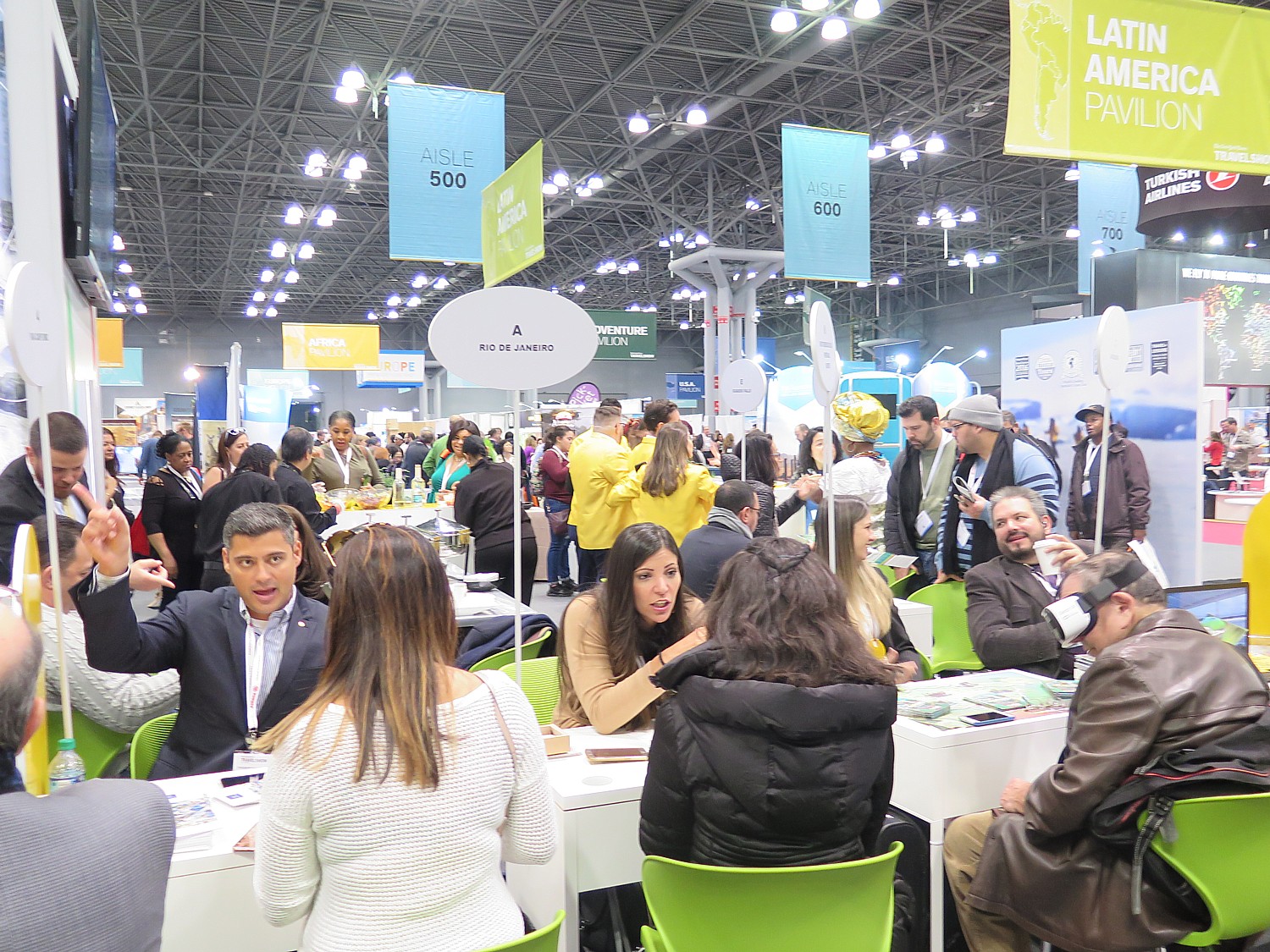
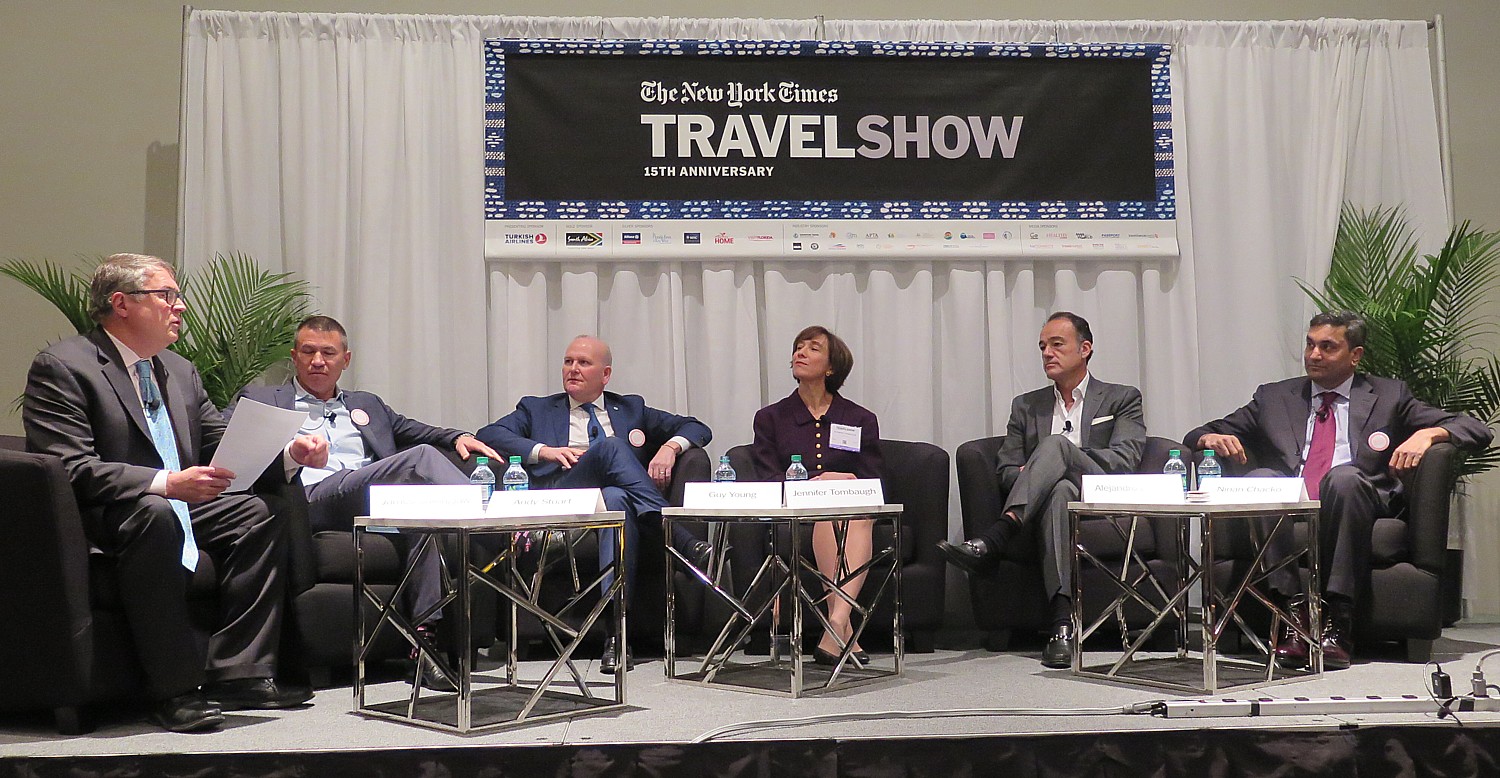
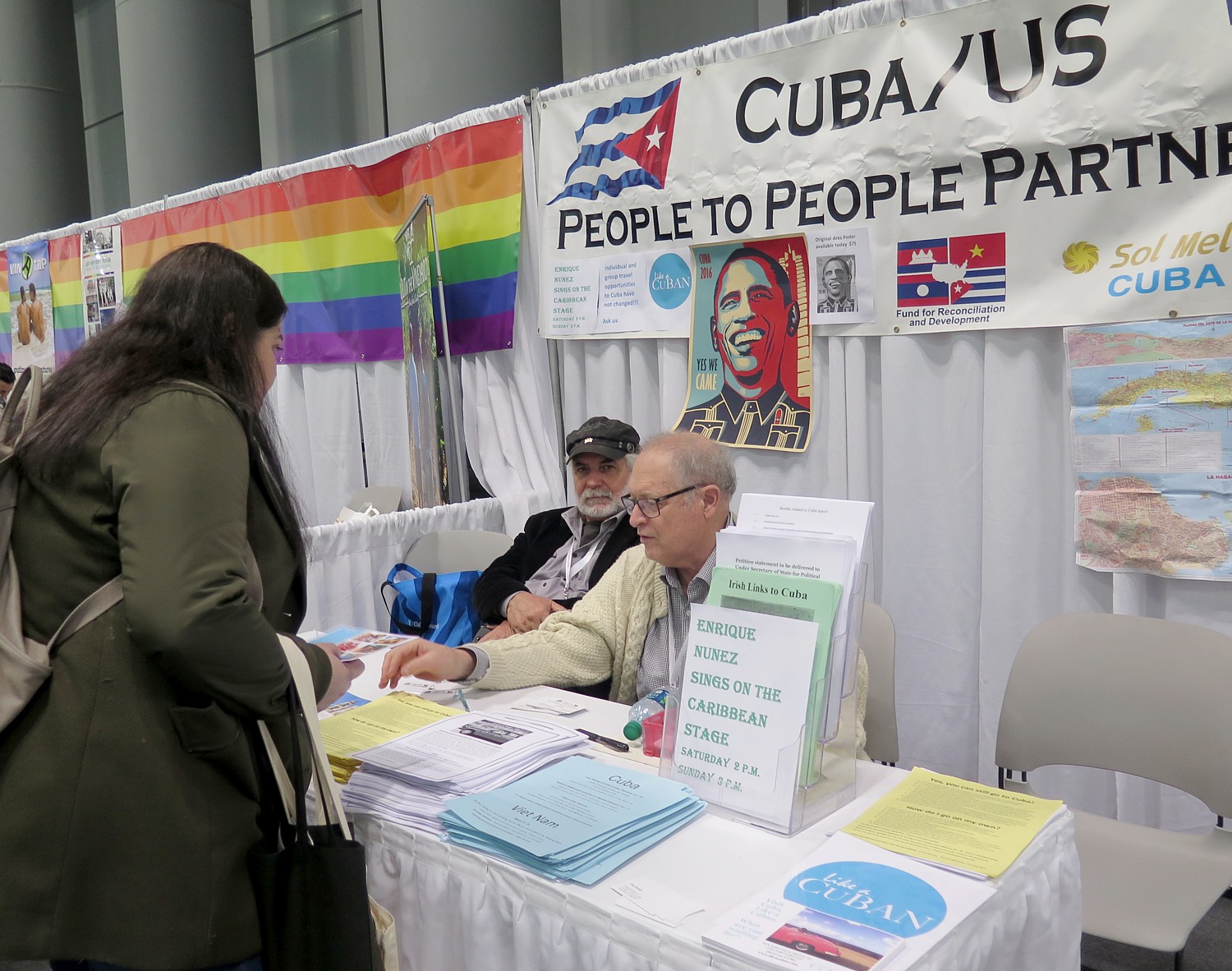
Travel professionals at the New York Times Travel Show had somewhat mixed feelings to the US State Department’s new travel advisory and alert system (travel.state.gov) because of the newness and how consumers are processing the information. Some said they appreciated the greater specificity, but others felt that destinations were unfairly tarnished. But they observed with some amazement at the resilience of American travelers to return to destinations that have had some crisis like a natural disaster or terror attack.
“When we had those [terror attacks] in London last summer, within 48 hours we were back to normal booking patterns,” said Guy Young, global brand engagement officer of The Travel Corporation.
Jennifer Tombaugh, president of Tauck Tours, said the tour operator used to plan for up to 12 months for tourism to recover to an area that suffered from some kind of travel disruptor. Now, it only takes three months for a rebound.
“We see, whether it’s been a natural disaster or a terrorism event or just overall economic disruption that all of our guests are rebounding much, much more quickly than they did in the past,” Tombaugh said.
“For better or for worse, there is a resilience about the American traveler that we haven’t seen in a long time,” she said. “I think we’re sort of redefining what uncertainty means, and I’m not quite sure if that word even resonates for people even more. I think they’re saying, ‘The world is crazy. Life is short. Let’s go out and explore.'”
But resilience might actually reflect the high degree of confidence that travelers have in travel professionals – the tour operators, cruiselines and travel agents who are there to advise them more accurately when they book, provide more security when they travel and handle emergencies should they arise.
Citing robust advance bookings, the panel – reflecting a cross-section of travel entities – were all highly optimistic of strong sales for 2018, coming off a record 2017 for just about every destination, bolstered by a strong global economy. However, the United States, was one of only two destinations showing a downturn, with international arrivals down about 4 to 6 percent –representing a $4.5 billion hit to the economy and loss of some 46,000 jobs. They said inbound travel was hurt by Trump’s rhetoric, the travel ban, concern about gun violence, and a general discomfort to visit the US. The United States, once the most desirable destination for international travels, slipped to #3, and dropped the 8 in terms of international arrivals.
On the other hand, outbound travel by Americans is strong.
Ninan Chacko, CEO of Travel Leaders Group; Alejandro Zozaya, CEO of Apple Leisure Group; Andy Stuart, president and CEO of Norwegian Cruise Line; Guy Young, global brand engagement officer of the Travel Corporation; and Tombaugh of Tauck reported the strongest advanced bookings in years – with travelers booking as much as a year ahead.
“2018 looks like a fantastic year, the best on record if bookings continue at the same pace,” said Guy Young, global brand engagement officer of the Travel Corporation, which has 30 brands in its portfolio, ranging from youth travel to luxury travel, and travel products all over the world. “Every destination is up except for the United States. In a given year, some brands are up, others are down, but in 2018, everything is up. It will be a phenomenal year.”
Get a Passport: Hilton Passport Project
Hilton Hotels & Resorts, in collaboration with the US State Department, has launched the Hilton Passport Project.
It turns out that having a passport is good for you.
Hilton Hotels & Resorts undertook a study and found that 53% of Americans with passports are content with their lives, compared to 34% of those who do not possess a passport.
Hilton, in collaboration with the US State Department, has launched the Hilton Passport Project, an initiative aimed at inspiring more Americans to apply for passports.
“For nearly 100 years, we’ve witnessed the profound impact travel has on the lives of our guests,” said Stuart Foster, vice president, global brand marketing. “With more than 570 hotels in the heart of the world’s most incredible destinations, Hilton Hotels & Resorts makes travel within reach. The Hilton Passport Project is our way of helping more Americans unlock the power of travel and realize the benefits a passport can bring them – whether that’s becoming more content with their lives or enjoying new experiences and opportunities.”
Every few weeks, a Hilton location in the United States hosts a Passport Concierge booth, where guests and the general public can have their passport pictures taken for free and apply for or renew a passport. Between one and three employees from the State Department will be on hand to answer passport-related questions and help fill out applications. For a list of coming locations, visit facebook.com/Hilton.
First-time applicants pay $110 and a $25 application fee. Passport renewals cost $110 and expedited passports are an additional $60. If you’re renewing your passport, you can do it by mail, but if you’re getting a new passport or if yours has been lost or stolen, you must apply in person.
There are more than 8,000 passport application locations around the country. Around 60 percent are post offices while the rest are courthouses and libraries. Visit the State Department’s Where to Apply link for more details. In addition, there are 27 passport agencies, where travelers can apply for rush passports – for example, if you are traveling within two weeks’ time.
On January 10, 2018, the Department of State launched changes in how information is shared with U.S. travelers, replacing Travel Alerts and Warnings for countries that warrant them to a new system where every country has a Travel Advisory with a level ranging from 1 to 4. The advisories are hosted in a redesigned hub for traveler information, travel.state.gov.
“These changes are intended to provide U.S. citizens with clear, timely, and reliable safety and security information worldwide,” the State Department stated in a press advisory.
Level 1 – Exercise Normal Precautions: This is the lowest advisory level for safety and security risk. There is some risk in any international travel. Conditions in other countries may differ from those in the United States and may change at any time.
Level 2 – Exercise Increased Caution: Be aware of heightened risks to safety and security. The Department of State provides additional advice for travelers in these areas in the Travel Advisory. Conditions in any country may change at any time.
Level 3 – Reconsider Travel: Avoid travel due to serious risks to safety and security. The Department of State provides additional advice for travelers in these areas in the Travel Advisory. Conditions in any country may change at any time.
Level 4 – Do Not Travel: This is the highest advisory level due to greater likelihood of life-threatening risks. During an emergency, the U.S. government may have very limited ability to provide assistance. The Department of State advises that U.S. citizens not travel to the country or leave as soon as it is safe to do so. The Department of State provides additional advice for travelers in these areas in the Travel Advisory. Conditions in any country may change at any time.
The Travel Advisories for each country replace previous Travel Warnings and Travel Alerts. While the State Department will issue an overall Travel Advisory level for every country, levels of advice may vary for specific locations or areas within a country. For instance, U.S. citizens may be advised to “Exercise Increased Caution” (Level 2) in a country, but to “Reconsider Travel” (Level 3) to a particular area within the country. Detailed Travel Advisories also will provide clear reasons for the level assigned, using established risk indicators, and offer specific advice to U.S. citizens who choose to travel there:
C – Crime: Widespread violent or organized crime is present in areas of the country. Local law enforcement may have limited ability to respond to serious crimes.
T – Terrorism: Terrorist attacks have occurred and/or specific threats against civilians, groups, or other targets may exist.
U – Civil Unrest: Political, economic, religious, and/or ethnic instability exists and may cause violence, major disruptions, and/or safety risks.
H – Health: Health risks, including current disease outbreaks or a crisis that disrupts a country’s medical infrastructure, are present. The issuance of a Centers for Disease Control Travel Notice may be a factor.
N – Natural Disaster: A natural disaster, or its aftermath, poses danger.
E – Time-limited Event: A short-term event, such as an election, sporting event, or other incident that may pose a safety risk.
O – Other: There are potential risks not covered by previous risk indicators. Read the country’s Travel Advisory for details.
The State Department stated it will review and update each Travel Advisory as needed, based on changes to security and safety information. Additionally, U.S. embassies and consulates will now issue Alerts to replace the current Emergency Messages and Security Messages. Alerts will inform U.S. citizens of specific safety and security concerns in a country, such as demonstrations, crime trends, and weather events.
Revamped Website, Travel.State.Gov
The Department’s newly-redesigned hub for traveler information,travel.state.gov, will host all Travel Advisories, recent Alerts issued for each country, and an interactive map in mobile friendly formats.
Country pages on the site will continue to include all travel information currently available, including details about entry/exit requirements, local laws and customs, health conditions, transportation, and other relevant topics.
To receive security and other important updates while traveling, U.S. citizens can enroll their travel plans in the Smart Traveler Enrollment Program (step.state.gov), and follow on Twitter (@travelgov) and Facebook (facebook.com/travelgov).
We posed additional questions to a spokesperson for the Department’s Bureau of Consular Affairs:
How was the new Travel Advisory system created? How has it been received by travel professionals and travelers?
“Over the past year, we received feedback about our consular safety and security messaging from State Department colleagues throughout the world and from our many outreach activities to the public and other government stakeholders. This feedback helped us tailor our new Travel Advisories to the information travelers need most.
“The revisions to consular safety and security messaging improve the Department’s ability to inform the public in an efficient and comprehensive manner. Information is easier to find, understand, and use. Travel Advisories ensure U.S. citizens receive important advice for every country, applying a consistent worldwide standard.”
“Our goal was to improve our communications with U.S. citizen travelers to provide clear, timely, and reliable safety and security information worldwide. So far, the feedback was been positive.
“One thing I’d point out: it’s important to read the full Travel Advisory for the country your visiting. In some cases, we have different Advisory levels for different parts of the country. Mexico, for example, is a Travel Advisory Level 2 – Exercise Increased Caution, but some areas of Mexico are Level 3 and 4. So it’s important to read each Advisory carefully.”
How do you determine the overall level for a country?
“We consider many factors to determine the Travel Advisory level for each country, including crime, terrorist activity, civil unrest, health, natural disaster/weather, and current events. We clearly explain the reason for the Travel Advisory level and describe the safety and security concerns.
“The information used to formulate Travel Advisories is collected from a range of sources, such as crime statistics and other information that is publicly available, information gathered from U.S. government sources, as well as assessments by our embassies and consulates. Travel Advisories also take into account decisions made to protect the security of U.S. government personnel overseas and ensure that U.S. citizens receive appropriate security information.
“This analysis is undertaken without regard to bilateral political or economic considerations. Travel Advisories represent our commitment to protect U.S. citizens traveling and residing abroad by providing them important safety and security information.
“Travel Advisories are based on safety and security conditions that could affect the lives and interests of U.S. citizens abroad, not on political considerations.”
During the Obama administration there was an attempt to make it easier for travelers to come into US. How has the Trump Administration changed the way visitors are treated? Travel into the US from abroad is down 4-6% in 2017 – an otherwise a banner year for international travel – which is estimated to cost the US economy $4.5 billion and the loss of 40,000 jobs. Is this something the State Dept is concerned about?
“The Department of State remains committed to efficiently processing applications for legitimate travel to the United States.
“At the same time, every visa decision is a national security decision, and we must ensure that applicants do not pose a security risk to the United States. We have never hesitated to spend additional time evaluating visa applications to this end.
“However, we do recognize the importance of international travel and tourism to the U.S. Economy. 75.6 million visitors traveled to the United States in 2016. These visitors spent $244.7 billion and supported 1.2 million jobs here in the United States in 2016. The U.S. travel industry (international and domestic) is a substantial component of U.S. GDP and employment, contributing $1.6 trillion in economic activity.
“Together with other agencies, we are in contact with industry groups and work with them regularly to discuss concerns and opportunities.”
Some 15 countries around the world have travel alerts about travel to the United States because of gun violence. Can you comment?
“Our responsibility is to provide information for U.S. citizens traveling overseas. We’re aware that some countries have their own travel alerts, including regarding the United States, but we’d have to refer you to those countries for information on how they develop their alerts.”
During the Obama Administration, there also were programs to facilitate and encourage young people to travel abroad, take foreign internships, join programs like Peace Corps, coordinated through the State Department. Can you comment on such programs under the Trump Administration?
“Again this year, the Open Doors student mobility numbers showed an increase in American students studying abroad, topping more than 325,000 American students in academic year 2015/16. Increasingly, U.S. colleges and universities are making study abroad an integral component of the higher education experience for Americans. And more U.S. students than ever before are taking advantage of study abroad opportunities in a wide range of countries.
“To help facilitate this growth, the State Department launched the U.S. Study Abroad Office in 2015 with the goal of further increasing and diversifying U.S. participation in study abroad, including diversity of study, geographic representation and diversity of institutional types, as well as diversity of study abroad destinations around the globe. We work with U.S. and foreign institutions to expand opportunities and highlight the value of studying abroad. Our Benjamin A. Gilman Scholarship Program increases participation in study abroad by providing resources to federal Pell grants recipients, and Critical Language Scholarship Programs provide training in over a dozen foreign languages critical to U.S. foreign policy priorities.
“Study abroad helps students understand the perspectives and values of others, enabling them to succeed in our diverse workplaces, communities and educational institutions. The State Department supports American colleges and universities in their efforts to increase study abroad. You can find more here:https://studyabroad.state.gov.”
What is the position from the State Department about the benefit of international travel – Americans going abroad and foreigners visiting the US – in terms of fostering people-to-people understanding?
“All of us who work in this field know how vital exchange programs and international study is to our shared future. It is one of the key means for the next generation of global leaders to gain the knowledge and skills they need to succeed in our global economy, foster progress in our societies, and address shared challenges.
“When people go abroad, they make connections that broaden their worldview. They become part of an international network of individuals with the shared experience of navigating new and unfamiliar languages, cultures and institutions, as they gain knowledge and develop resourcefulness and critical thinking skills. This experience is especially crucial for young people who will increasingly compete and interact in an interconnected world.
“The State Department sponsors exchange programs to increase mutual understanding and respect between the people of the United States and the people of other countries, as a goal of U.S. foreign policy. These include the International Visitor Leadership Program and Fulbright Program, our flagship exchanges, the Benjamin A. Gilman International Scholarship Program, Critical Language Scholarships, high school exchanges, as well as support for the global network of EducationUSA educational advising centers that provides information on U.S. study to international students worldwide.”
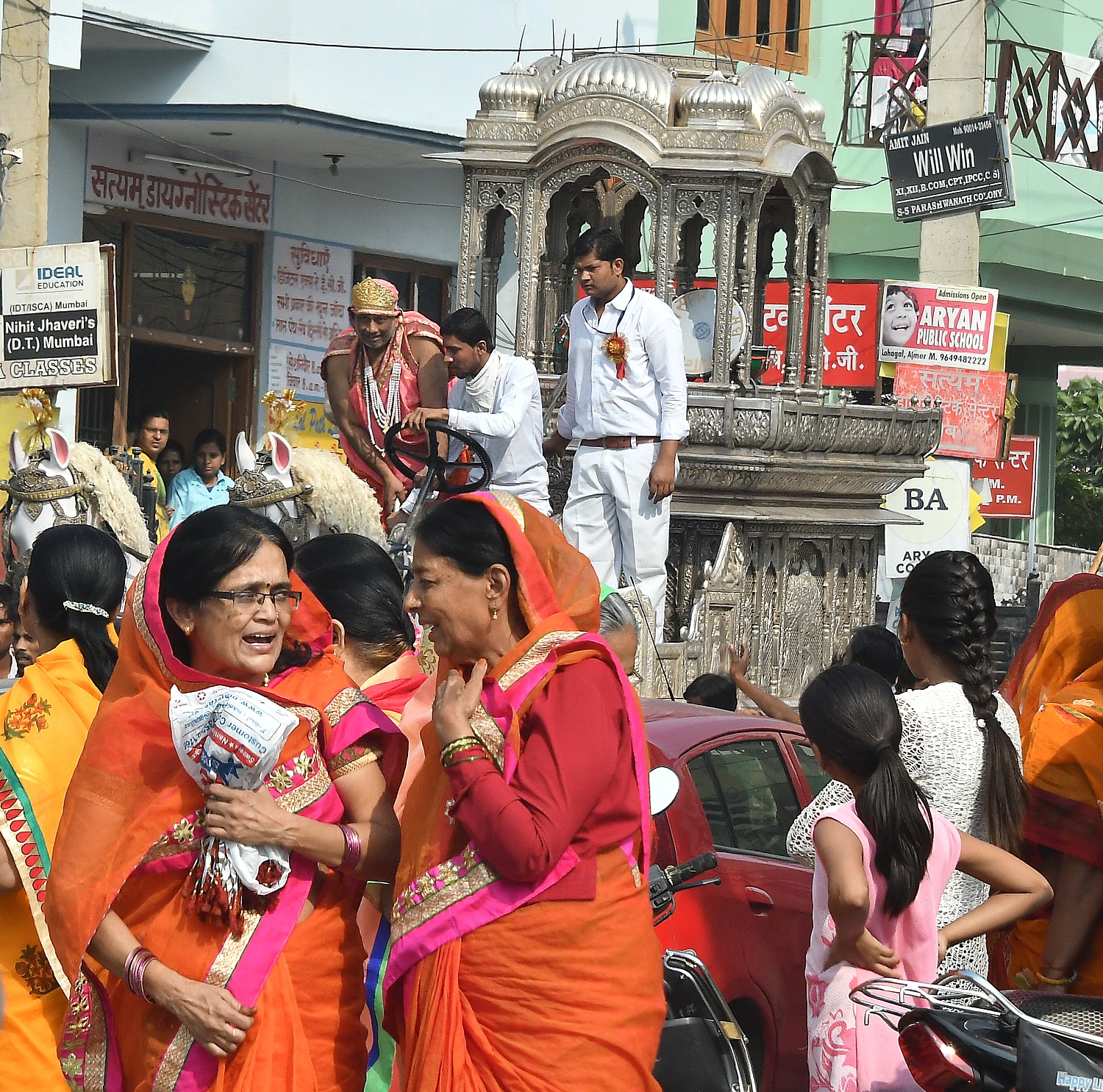
The Pushkar Horse and Camel Fair and Festival of Brahma takes place over a 10-day period in October/November every year, timed to take place during one of Rajasthan’s holiest festivals; the exact date varies on the western calendar but always falls during the full moon of the Indian lunar calendar month of Kartik. Pushkar is the only place in the world where Lord Brahma, the Hindu God of Creation, one of the Holy Trinity, is worshipped. A place of pilgrimage, the camel and horse fair developed out of this massive annual gathering.
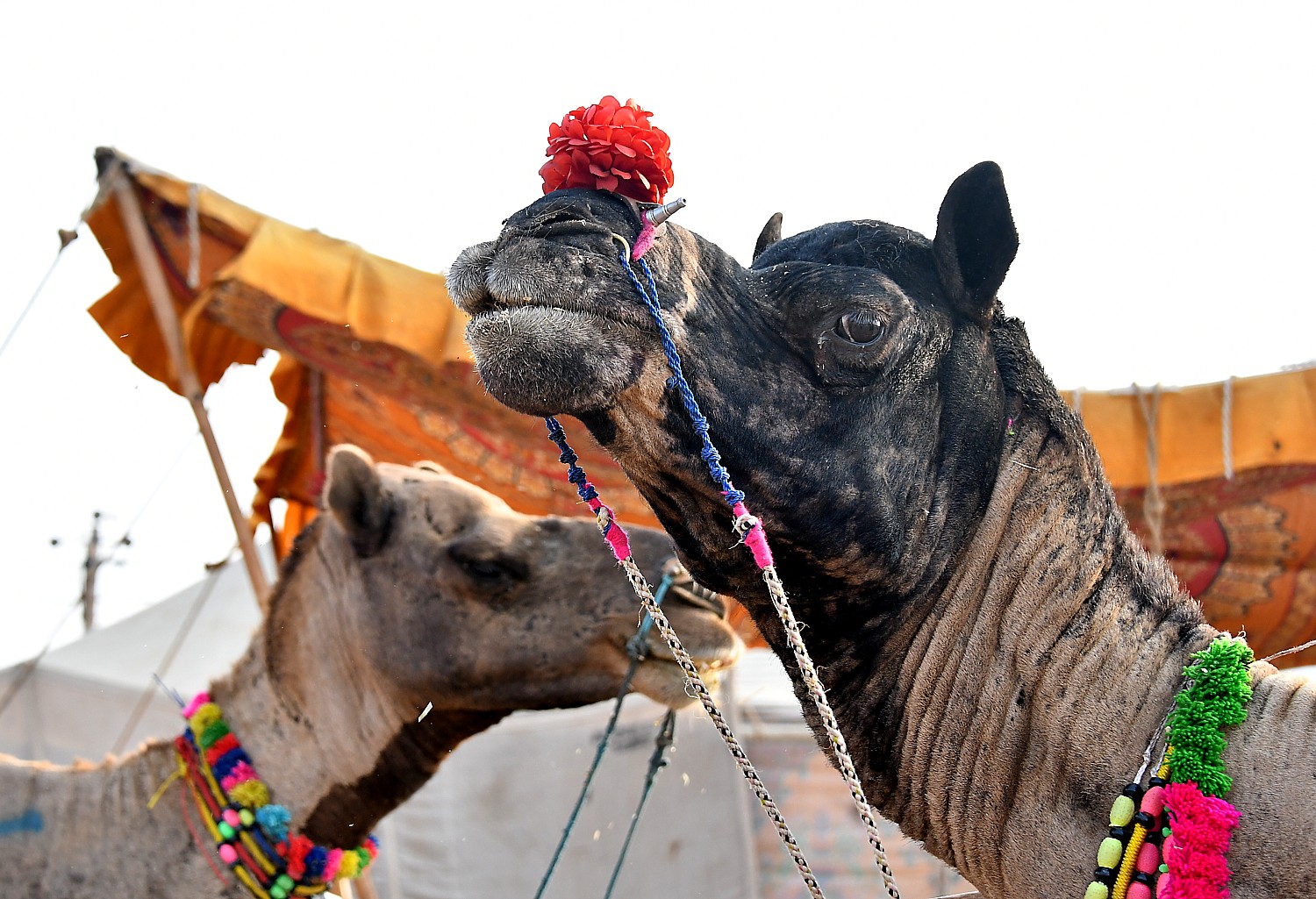
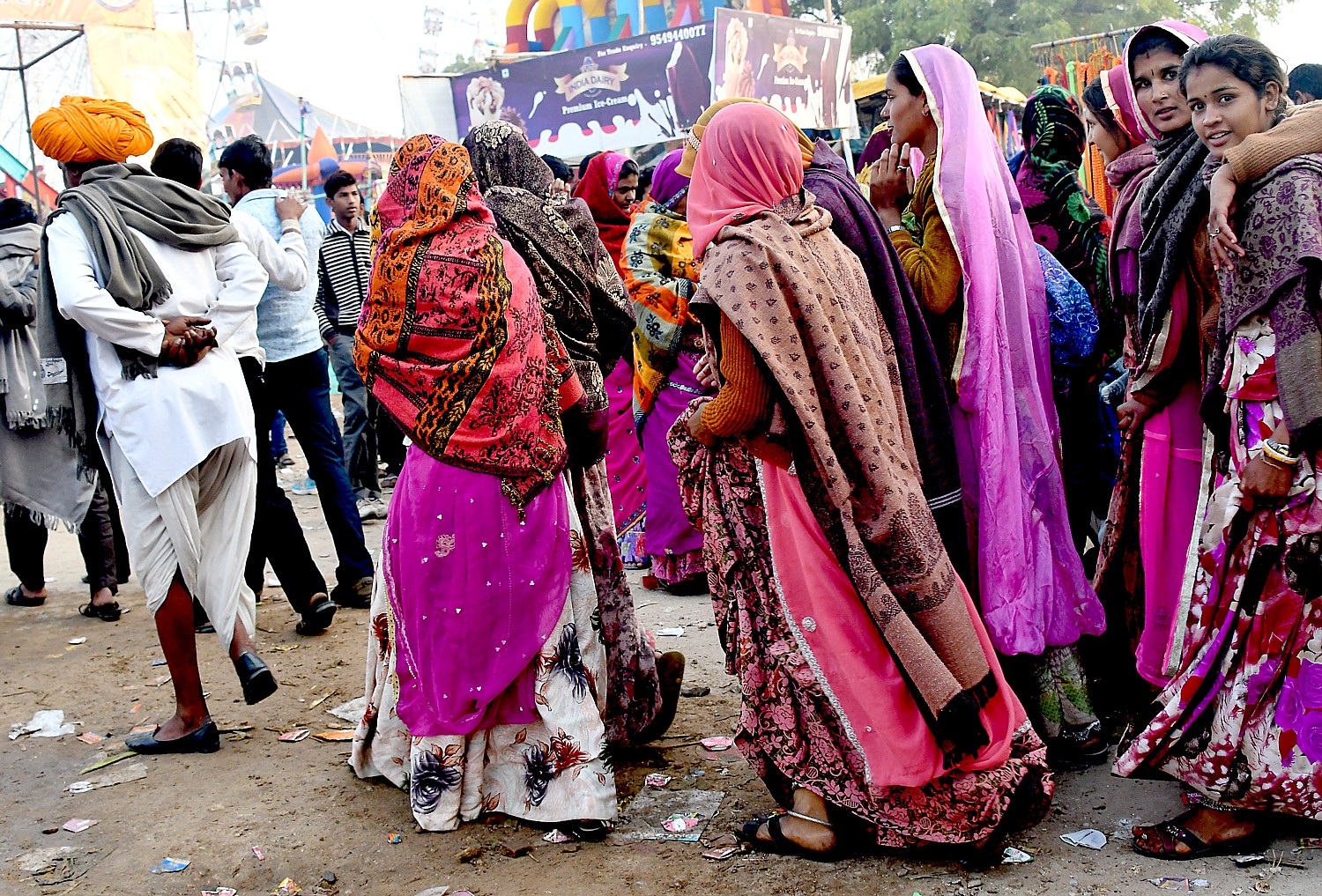
The fair is a kaleidoscope of color, a swirl of motion, a cacophony of sound, unexpected up-close encounters (as with a camel), the crush of crowds.
One of the greatest spectacles anywhere, in my mind the Pushkar Camel Fair is a combination of state fair, carnival and pilgrimage with a smidgeon of circus thrown in. There are snake charmers, musicians, dancing horses, magic show, ferris wheels. You can buy anything and everything – household items, decorative reins for camels and horses; street vendors selling drinks made from sugar cane, merchants selling every manner of goods from stalls and from blankets sprawled out on the road.
Traveling by Train
Our trip to the Pushkar Camel Fair starts with a fantastic six-hour train journey from New Delhi, enhancing the movie-quality of the experience.
We speed through the streets from the Sheraton Hotel, dark and amazingly vacant at 5 am compared to the chaotic snarl of traffic we navigated through when we arrived the evening before from Kanha National Park, flying from Jabalpur to New Delhi.
We pull in across from the train station and out of nowhere, fellows appear who will porter our luggage (on their heads) to the train. We follow briskly after – going through the airport-style security that we have come to expect at every hotel – and are immediately grateful for their help when we realize how we have to climb up stairs to a bridge that takes us to our track. We have time to wait – there are hundreds of people who have basically camped out on the platforms.
Our train departs just after 6 am. A porter comes through our first class car with newspapers, then tea and coffee, and then breakfast (the omelet was very good). Our Royal Expeditions guide creates a WiFi hotspot for us.
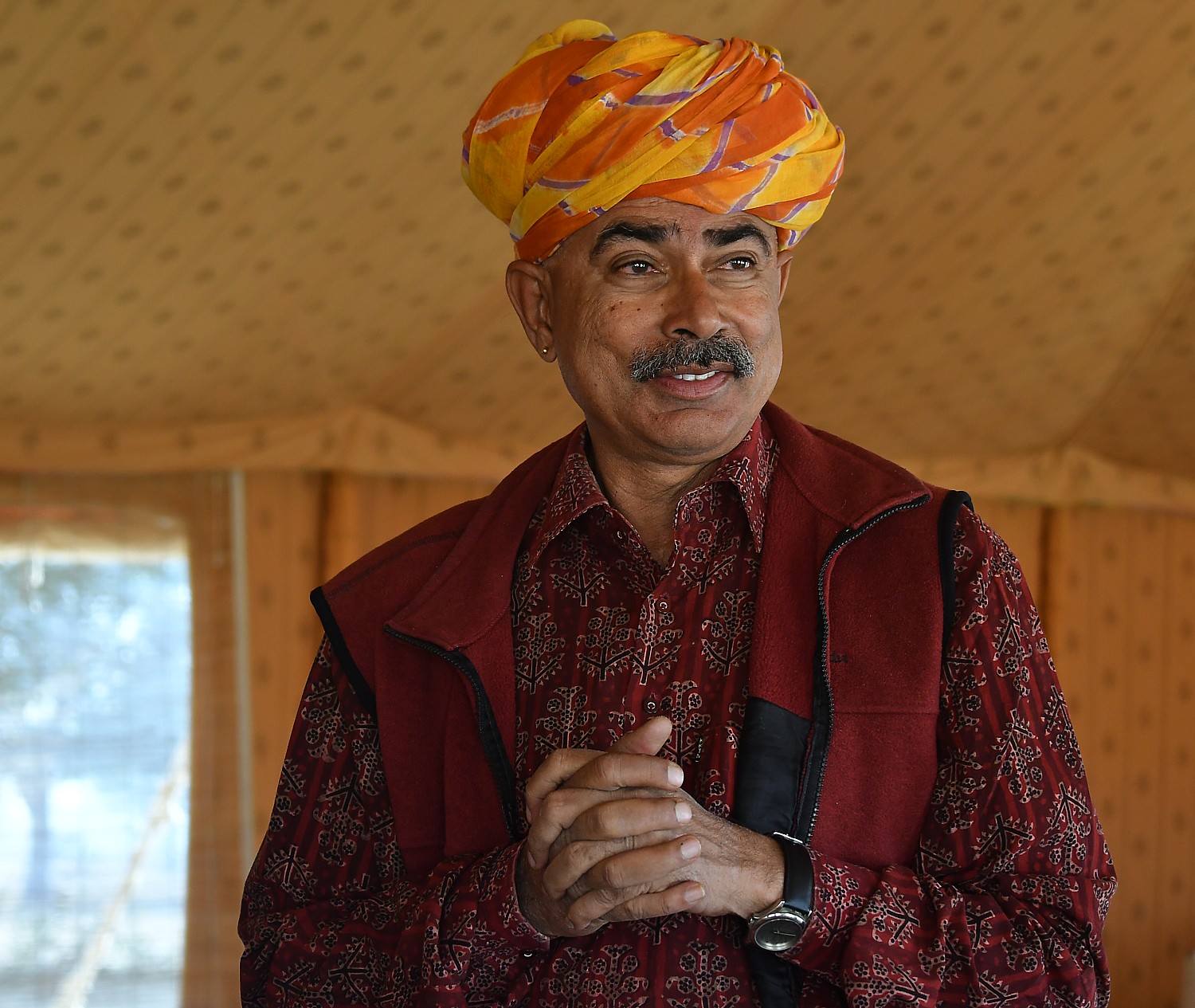
Our guide who will take us around the fair, Thurka Durga Singh, comes aboard and begins orienting us to what we will see at the fair. He is a regal looking gentleman, descended from the Warrior Class, who carries himself with grace and dignity. His voice is sonorous, and I soon discover, he is very much a poet and a storyteller, steeped in India’s traditions and culture.
Indeed, as he would describe himself, Durga “is a keen observer of history, culture, religion, current affairs, and is a bank of knowledge so vast that he has a point of view on anything under the sun. He is what one could call a modern traditionalist, actively seeking the use of modern technology and methods to support the principles of traditional living. The inquisitive can have endless conversations with him on a number of his projects like rain – water harvesting, biogas plant, solar heating and, even, healthy cooking.” It only takes a simple question for him to launch into an entrancing narration.
“Before trains, buses, cars, all citizens traveled by animals – camel, horse. From the 11th to the15th day of the waning moon, pilgrims would come by the thousands on horses and camels from near Delhi to have a holy day. A fair developed. If you come during the first eight to 10 days of the Pushkar Camel Fair, you see more animals; in the last three days, there are more pilgrims. (Indeed, Dugar had just come from guiding a horse-riding safari to the fair.)
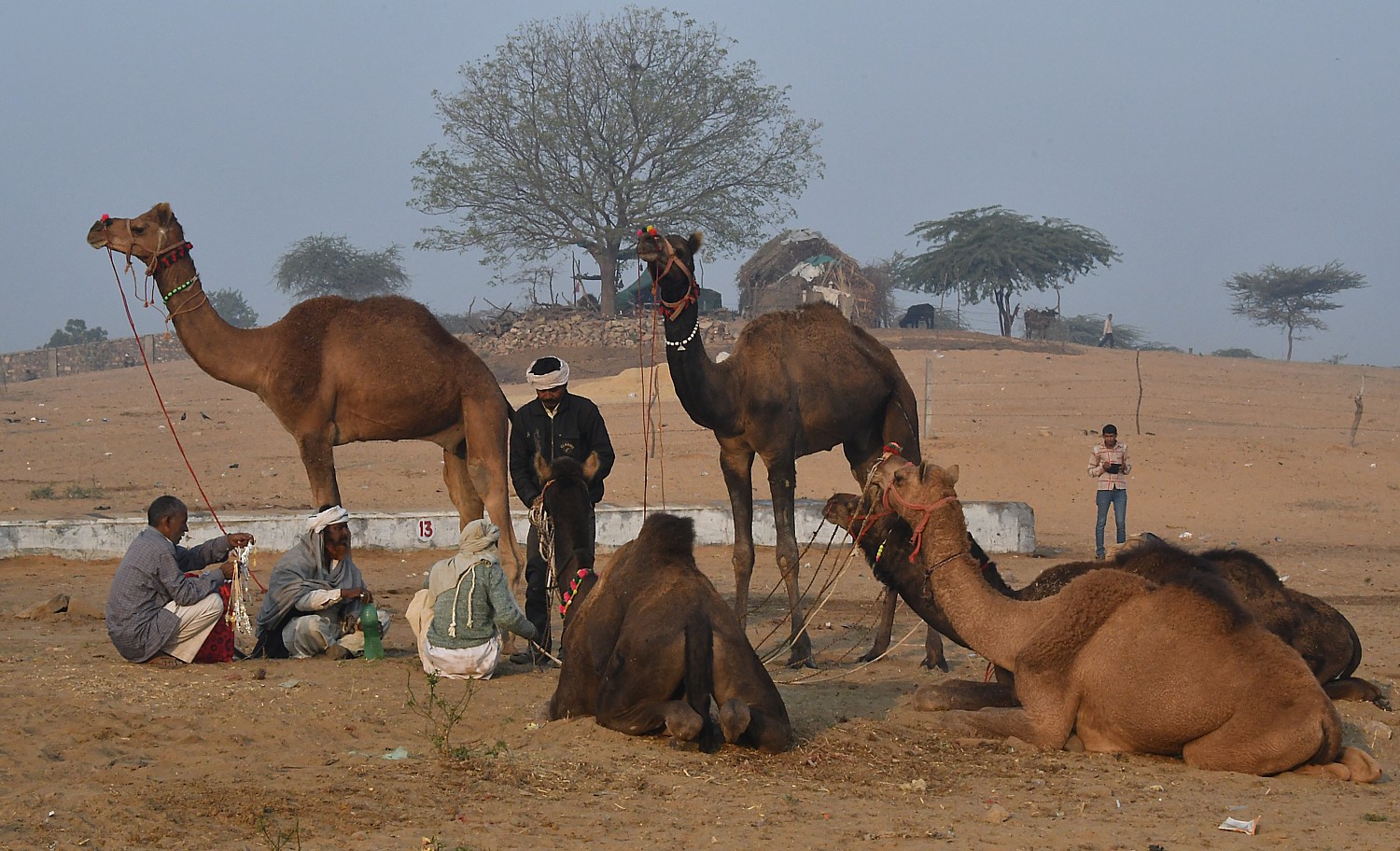
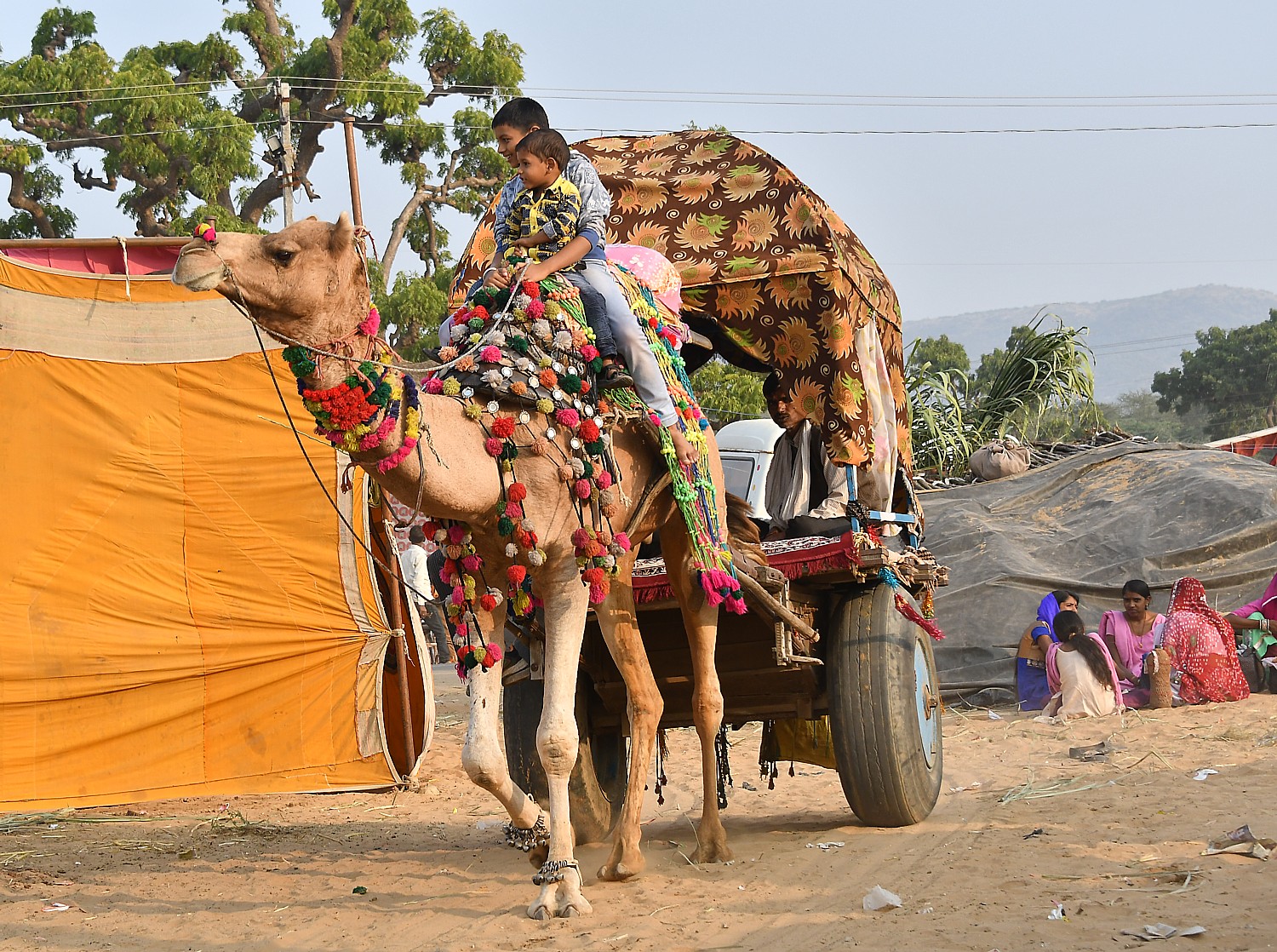
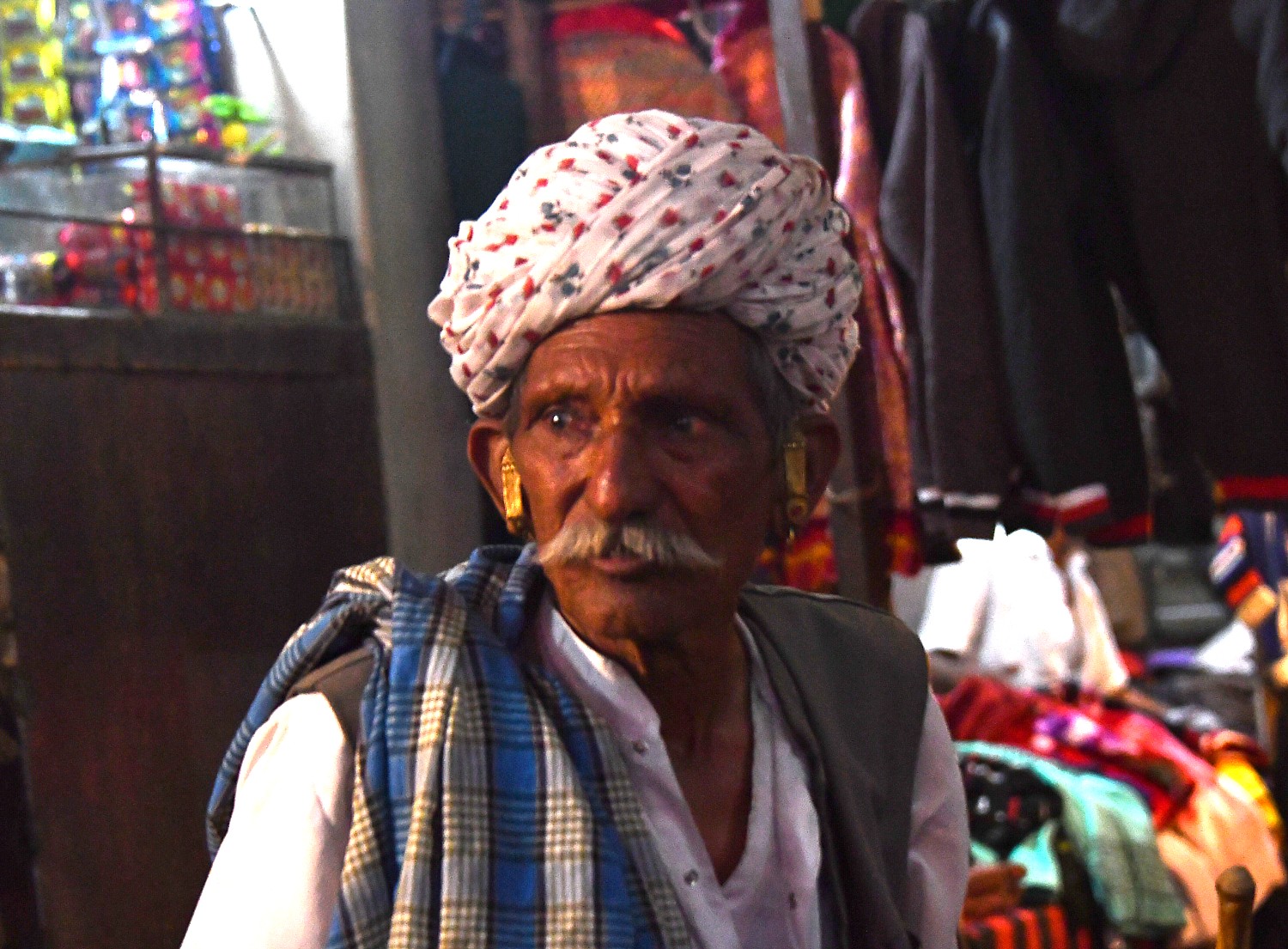
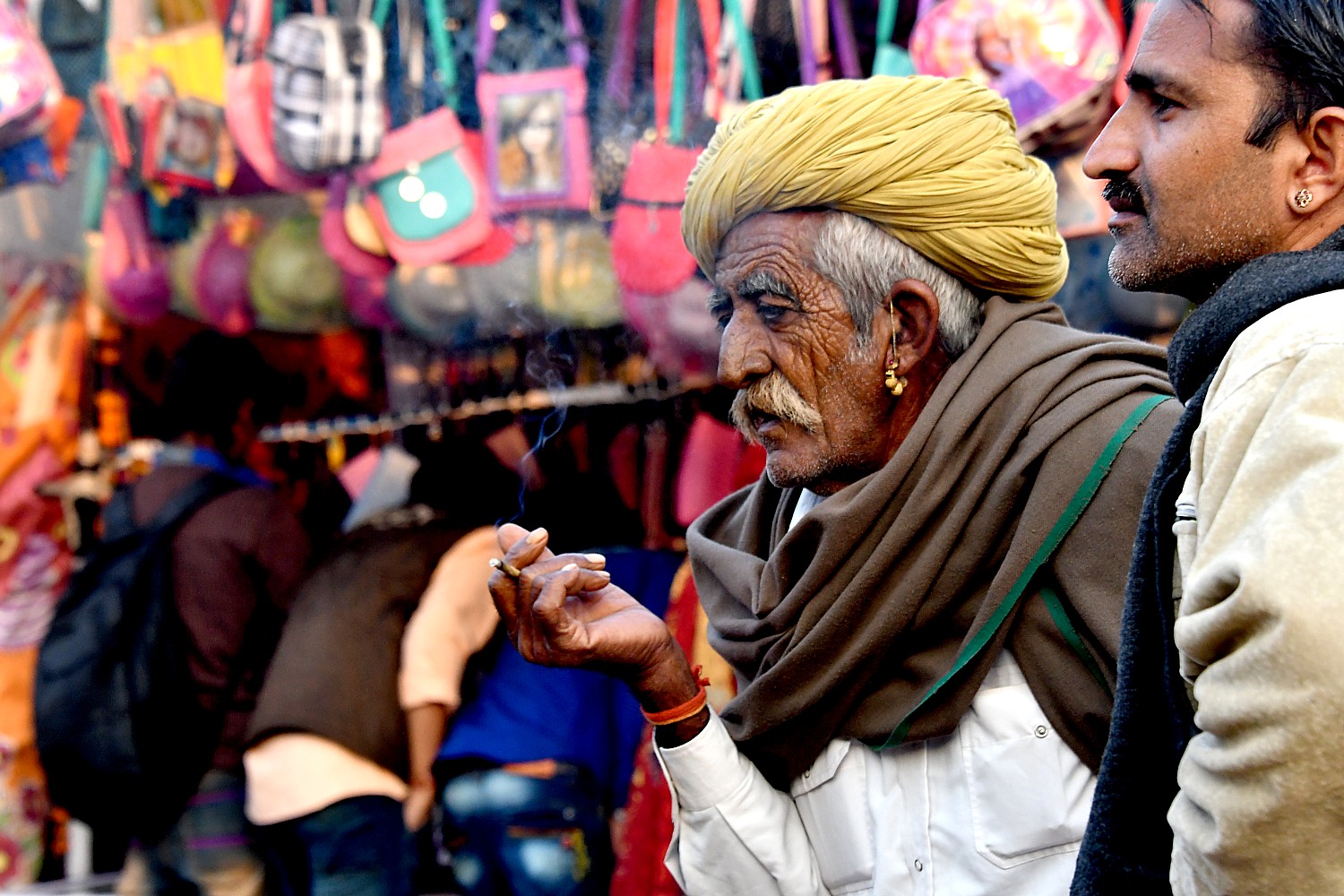
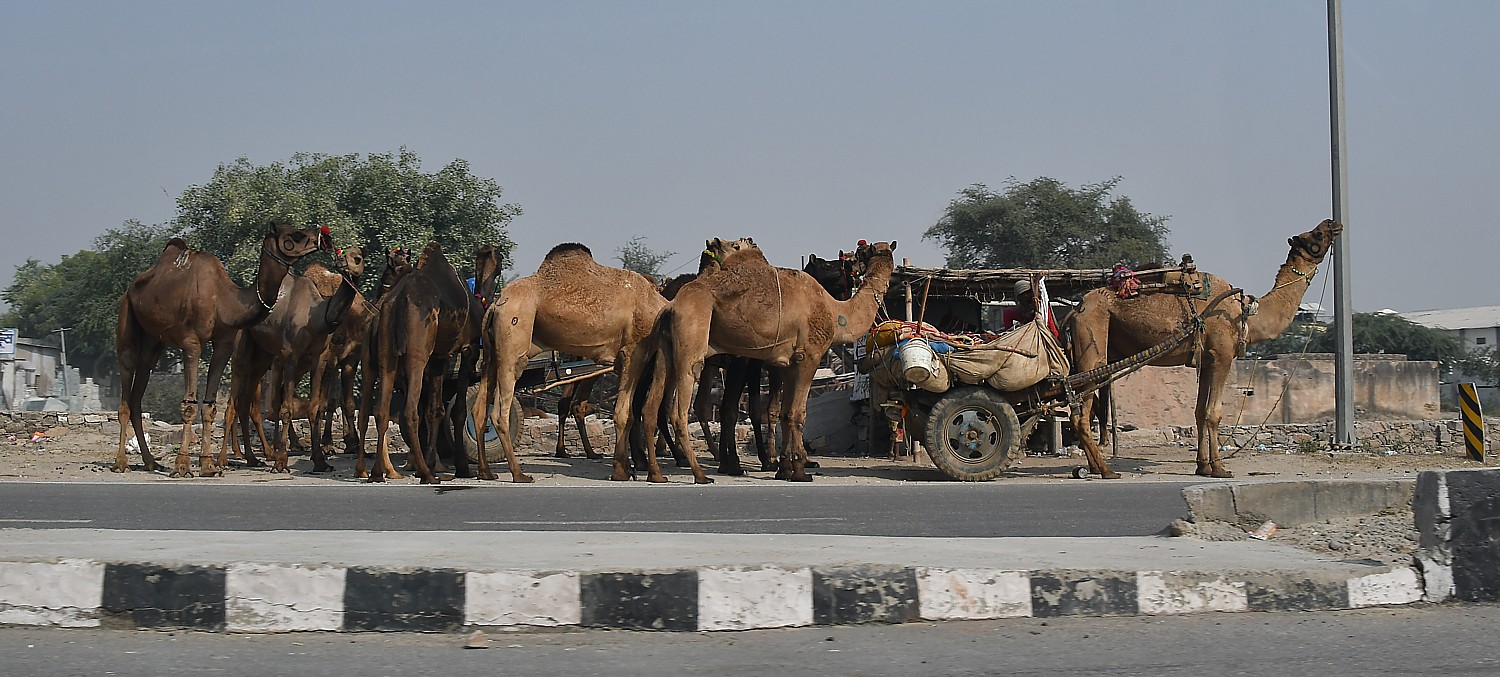
Rural farmers still use camels and horses as work animals and the Pushkar fair is one of the biggest camel, horse and live-stock fairs possibly anywhere, attracting buyers and sellers from all over the country, as well as visitors from around the world. At the peak of the fair, there might be 11,000 camels and 400,000 people coming from far and wide, dressed in their traditional and regional clothes. For days before the fair and after, you can see herders driving their camels and horses along the highway.
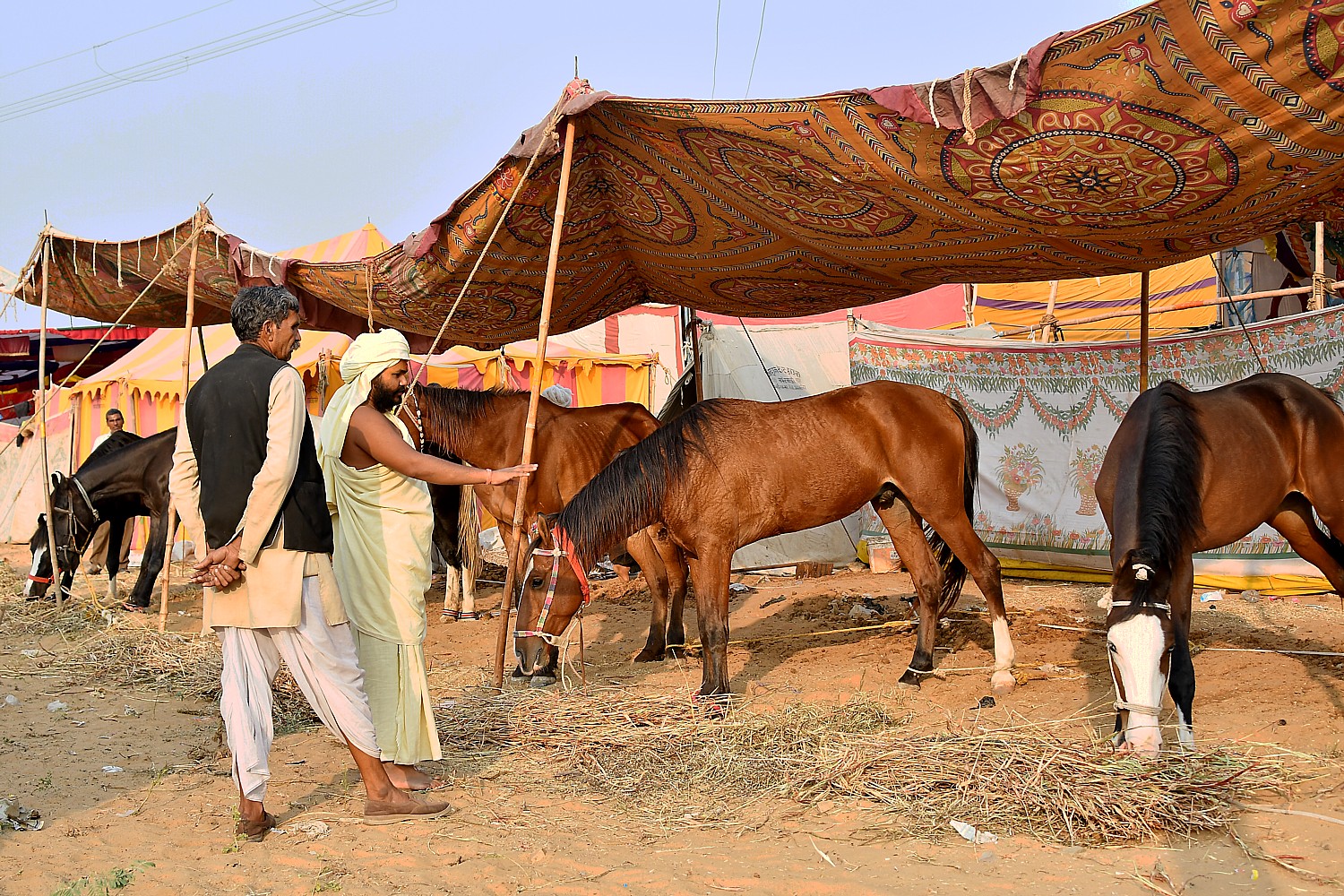
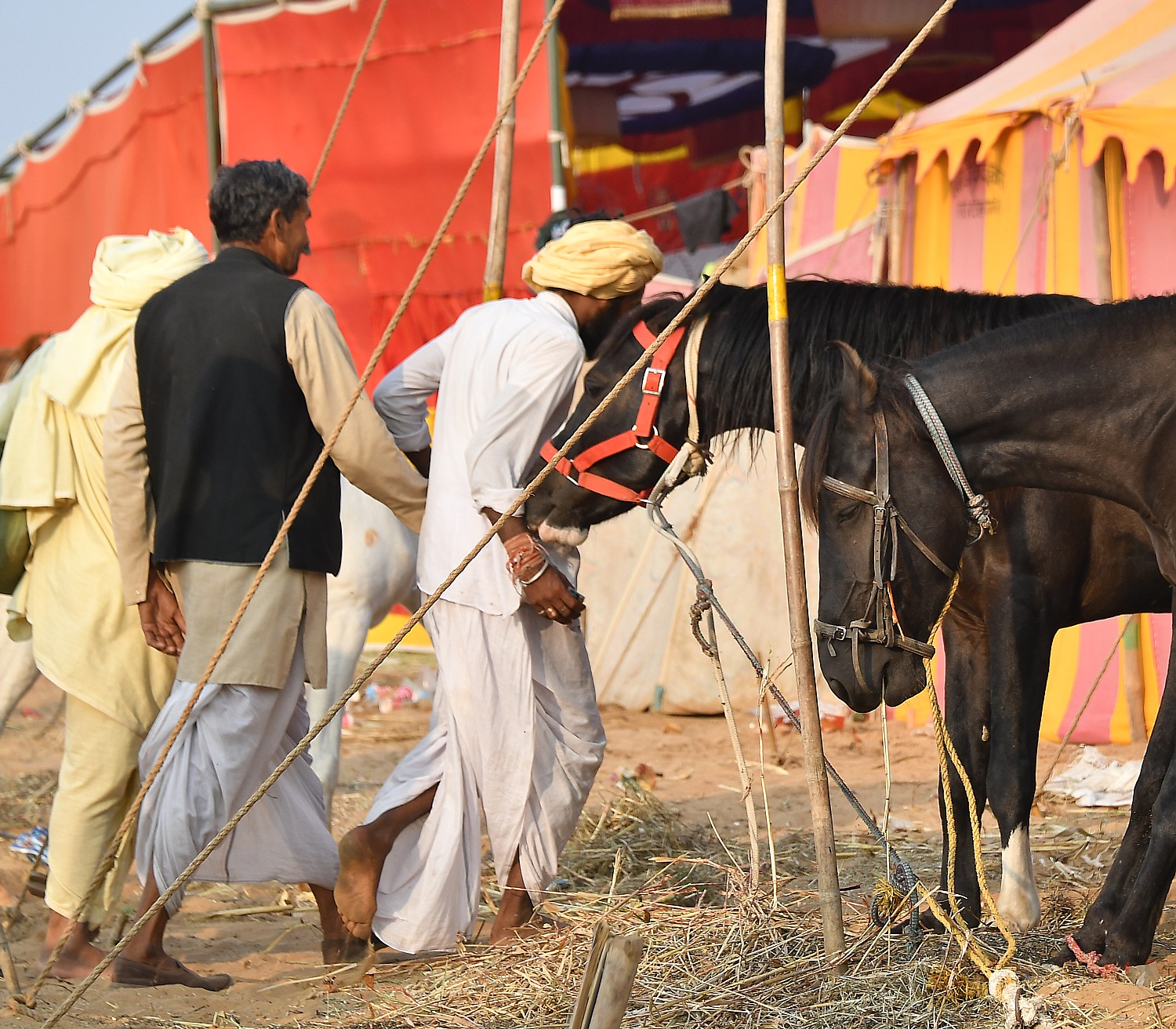
”At the fair, everything is everybody’s business. Our sense of privacy is different. Eavesdropping is a custom of the fair. People standing around give their unsolicited opinion – ‘Good horse’.” (We actually find ourselves doing this exact thing). “Now the deal is getting serious. Now the seller and the buyer don’t want others giving opinion. They clasp hands to clinch deal. Now bystanders have even more curiosity. ‘What is it your business?’ ‘I just wanted to know.’”
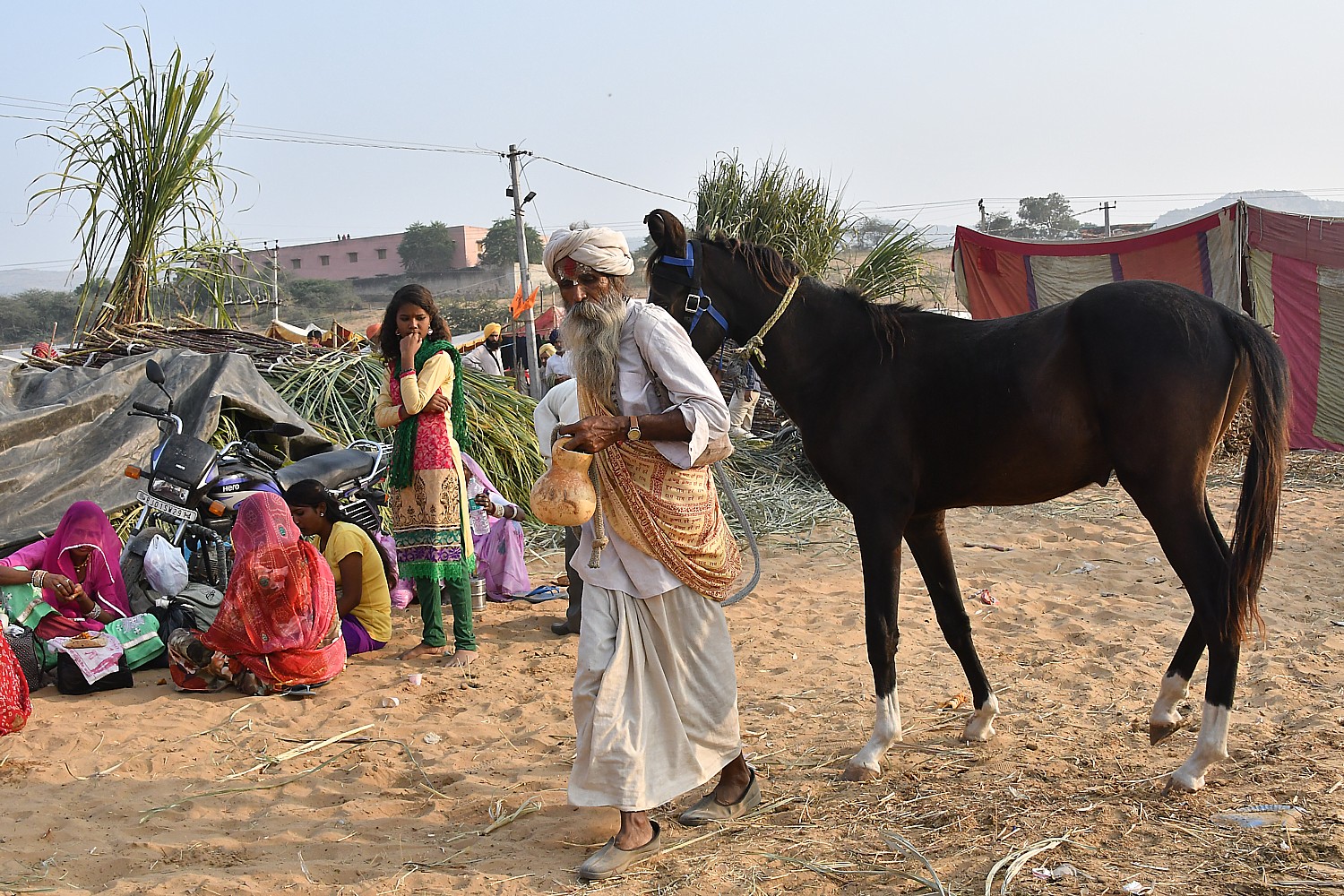
An ancient tradition is that when the horse is sold, it is never given with reins “because that would declare he would never have that horse again. So the buyer puts his own reins on [you can see stands that sell decorative reins.] Then the seller has money and gives a little money back, to get the horse extra food, a parting gift to the horse.
“In the western mind, business is business, there is no sentiment [recall the expression: It’s business. Not personal.]. In the Eastern mind, it is etiquette to offer tea. A Westerner would feel obligated to buy, but not an Easterner.
He gives us a tutorial on the different types of camels and how they are still used as work animals and why the reputation of camels as being mean and spitting isn’t really fair. One kind “can go sunrise to sunset, 60 km and has more stamina than horse. It can go without water for weeks. Camels live 26 years; 4-16 year olds work, 16-24 year olds still work but not as hard. Five minutes before it drops dead, it still doesn’t refuse work, then it drops dead.”
I ask how much a camel costs: a young camel, 2 ½ years old (they start training and work at three years old) might cost 14,000-15,000 Rupees ($205-$220); a grown, trained camel might cost 55,000-100,000 rupees ($735-$1500).
“The camel is God’s blessing to us. It browses, eats species that others don’t, like the thorny bush. He doesn’t compete for food, but he is plow, car, tractor.”
But things are changing, he says. Alas, “Young people don’t want to be stuck with an animal. They prefer a tractor…. It’s likely the Pushkar Camel Fair will disappear in 10 years.”
In India’s cash economy (they don’t use credit cards or checks), there may be 15 million rupees in cash at the fair, in bags, clothes. “There are no locks, no safes.” So men wear a vest that has a hidden pocket and put a shirt over that. “A man may have 1 million rupees and no one knows. He can’t be pick-pocketed.”
The state must collects its tax, but since there are no written records of transactions, the tax department charges a flat rate when people enter the fair.
This year, is unusual, he says. We are there just as the Modi government without warning canceled the 500 and 1000 rupee bills in circulation that are the basis for an economy that still runs on cash.
“The Fair has gone into a difficult time. There are many unsold animals, owners sitting desolate. They spent money to buy the animals but have no money to bring them back. Many will leave the animals behind.”
We should also look out for the camel’s haircut. “They decorate their camel like fellows decorate their motorcycles. You wine and dine the barber – it can cost 2000-3000 rupees. The Barber used to make lovely design – a lotus flower – but the Barber has gotten quite old, he is about to go to heaven. He made peacock design; an Islamic barber makes a geometric pattern. Now you see a Sikh shearer from Punjab who works fast.”
Farmers used to collect the camel wool to make rugs, sacks; “Now nobody collects.” Well at least one group does, who we come upon in the market, Camel Charisma.
He bemoans the disappearance, one by one, of traditions (“20 years ago, women would sing folk songs. No more: girls go to school now and don’t learn folk music”).
If you come during the first eight to 10 days of the Pushkar camel fair, you see more animals; in the last three days, there are more pilgrims. “Now pilgrims come in jeeps, buses – groups of pilgrims, in different dress.”
He paints pictures of what else we will see, and lo and behold, when we arrive at the fair later that afternoon, we see for ourselves exactly what he has foretold:
“When you go to cinema, you eat popcorn – well, for desert people, sugar cane is big – trucks and trucks of sugar cane come in from the neighboring state of Pradesh.” We see stalls (a little like cotton-candy machines) crushing sugar cane into a juice add lemon and ginger.
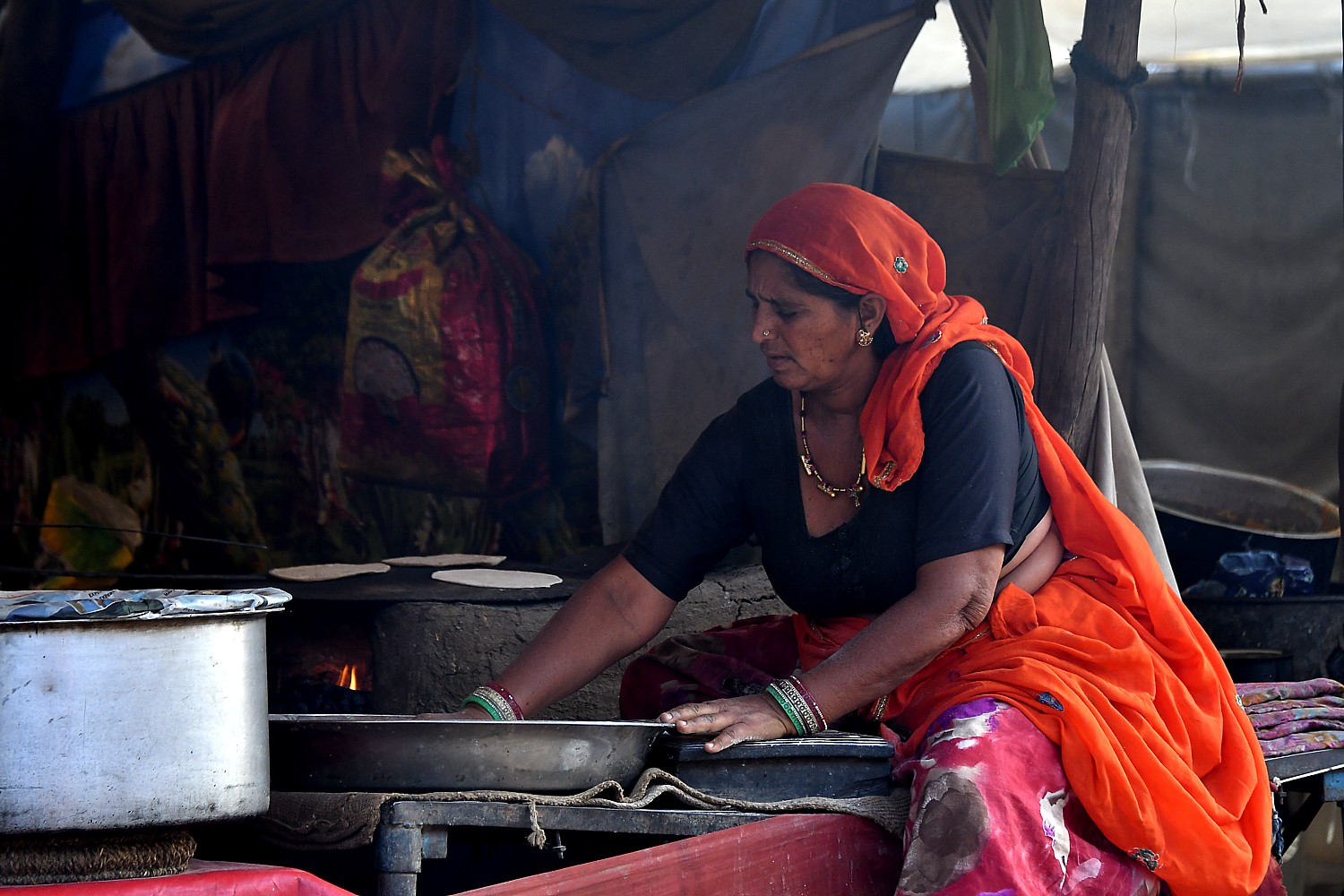
We will see the “normal” food of the Indian countryside. “Who goes to the countryside? Hunters, nomads, pilgrims and animal trader and armies. They have to cook and eat in countryside. So they will collect dried cow droppings for cooking fuel (it’s free) [but you can actually buy cow dung patties on Amazon, I’m told] to prepare balls of wheat flour, served on a plate made of leaves.
“You light up a cow dung fire. When the fire dies down, you roast bread on the embers. It’s clean because after a half-hour of cooking, the cow dung is sterilized. Stores sell this round chat-patti fried wheat bread. It’s street food. The village pilgrims relish this food.”
The camel fair also involves a sprawling market (like a flea market), with all manner of goods for sale.
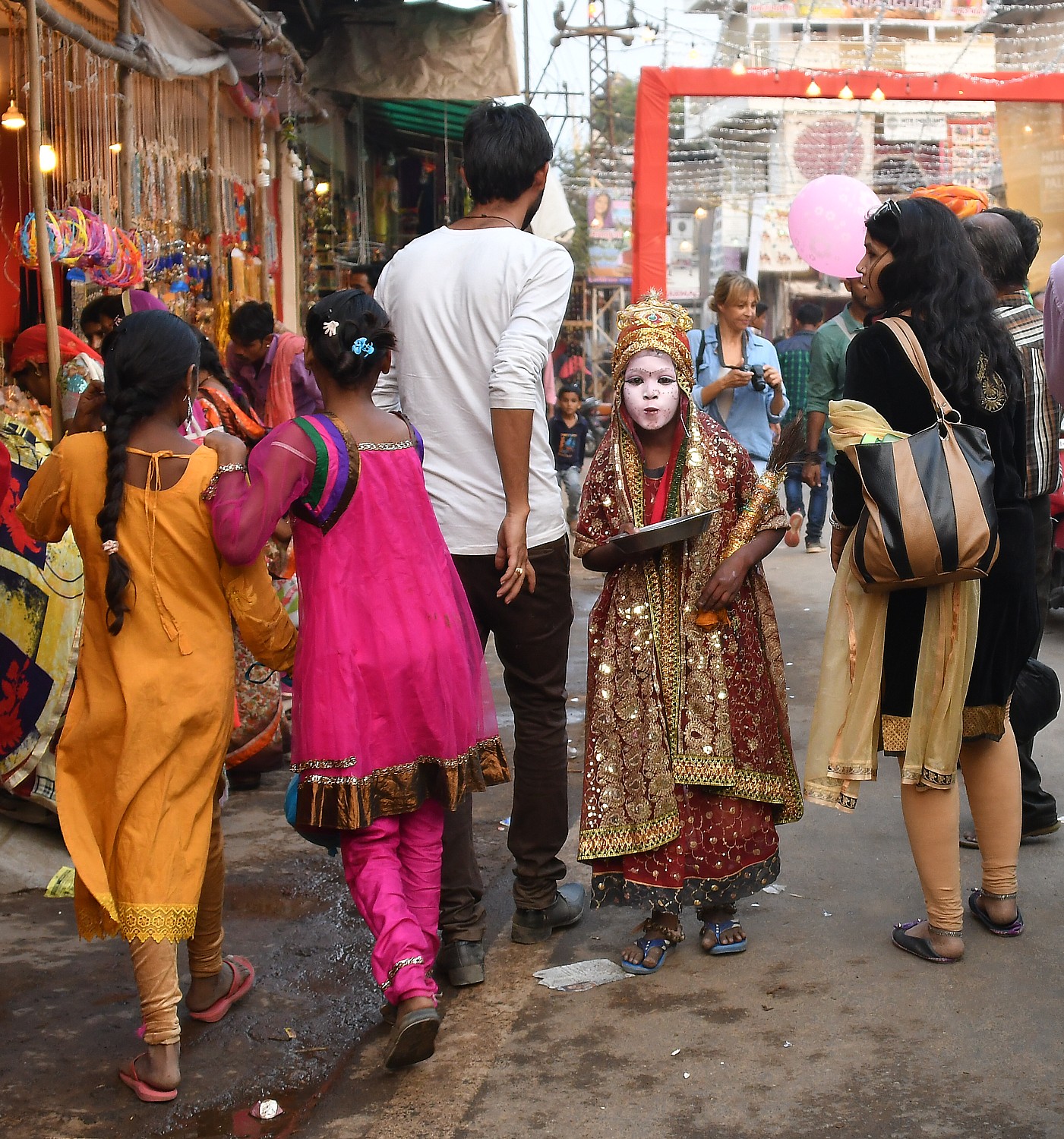
He also alerts us that we can photograph regular people –they don’t take money – but there are also “professional” photo subjects – they dress like in various costumes and you are expected to pay 100-200 rupees to take a picture (kind of like the naked cowboy in Times Square).
He warns us that “skunks” spoil the visit for Indians and foreigners. They solicit money – “Mafia like” =saying they want to take you to the lake. Tell them ‘We have been to the lake.”
He says he will take us to the roof of a restaurant to see the lake and watch the rituals.
The beauty of the fair is its randomness, a kaleidoscope of colors, a swirl of activity, he says. “No guidebook will tell you this aspect.”
His narration has made the hours spent on the train fly by. Before we know it, we pull into Ajmir.
Ajmir, A Holy City
We arrive in Ajmir and once we are underway in our van for the half-hour ride to Pushkar, Durga has us join in reciting a Hindu blessing, since Ajmir is one of the holiest places for Hindus, Buddhists and Jains.
The story goes that when Sati died, Shiva cried so much and for so long, that his tears created two holy ponds – one at Pushkara in Ajmer in India and the other at Ketaksha, which means “raining eyes” in Sanskrit.
One of India’s first cities, Ajmir was the Chahamana capital ruling all India until the defeat of Prithviraja lll in 1192 when the city came under Muslim rule. And when India was under British rule and divided into 526 Maharajah states, the Viceroy, the direct link to the British Crown, was based in Ajmir.
Ajmir also has one of the most important Sufi shrines, “next to Mecca and Medina, one of the holiest for Muslims.”
Moinuddin Chishti, an important Iman practicing the Sufi form of Islam, came to Ajmir from Iran, developing a large following, and gaining the respect of the residents of the city. Chishti promoted understanding between Muslims and non-Muslims.
Sufism is a Muslim movement which arose in the 8th-9th centuries, whose followers seek to find divine truth and love through direct encounters with God. Sufis, Durga explains do not believe that nonbelievers are infidels (like the more extreme Wahabis). Every individual is God’s children. Music is an important part of worship, connecting worshippers to the divine. He has as much a following among Hindus as Muslims. Many Muslims live here.”
In some ways, it seems Ajmir is like Jerusalem in that it is the confluence of these different religions.
During our brief ride, Durga explains reincarnation, predestination and freewill (no mean feat), connecting reincarnation to Darwin. “Darwin talks of physical evolution, Einstein of the soul transfiguring. There is a zero balance account when you are born – that’s free will. Now you start creating your karma; that brings you back again and again. The aim of life is to go back to the Godhead, to break the cycle of birth and rebirth.” Reincarnation, rebirth and nirvana, he says, is not that much different than Christianity’s belief in resurrection and heaven. “There are many commonalities.”
Free will and destiny are not contradictory. “Destiny is that you find a note, then free will is what you do with it. You receive your past and create your future – that is the secret of happiness. In the East, there is no place for guilt” because actions have repercussions in future life.
As for why cows are sacred, it basically comes down to a very practical reason: people depend on the cow. “The cow was revered before it became holy.” We see cows with their horns that had been painted for the Diwali Festival.
We make our way slowly through a snarl of humanity, traffic cops doing their best to organize. Because of the traffic during the fair, we are led the long way around, traveling around the lake and over Nag Pahar, the Snake Mountain, separating Pushkar from Ajmer. We don’t mind at all because we get to see more of the city and landscape.
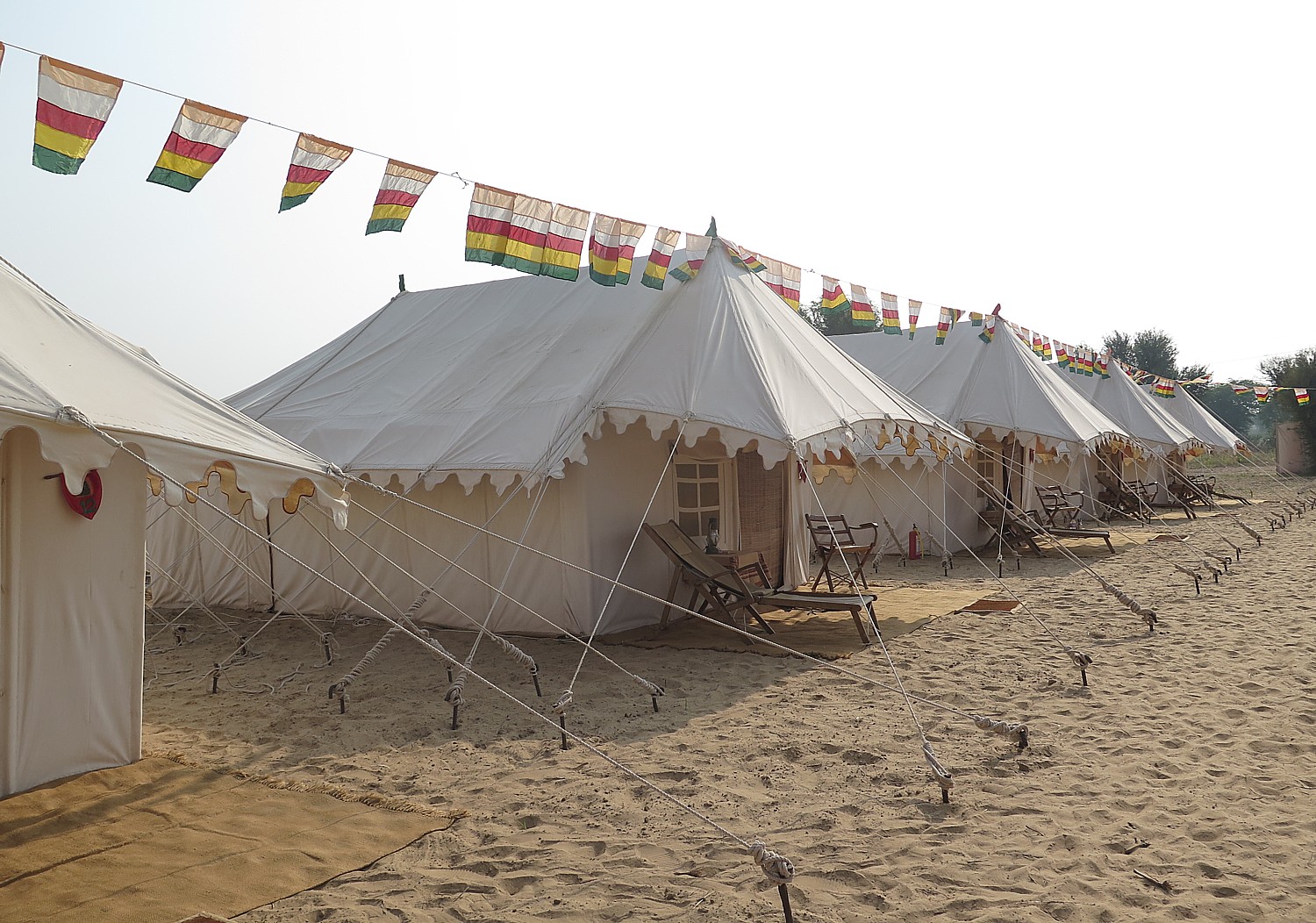
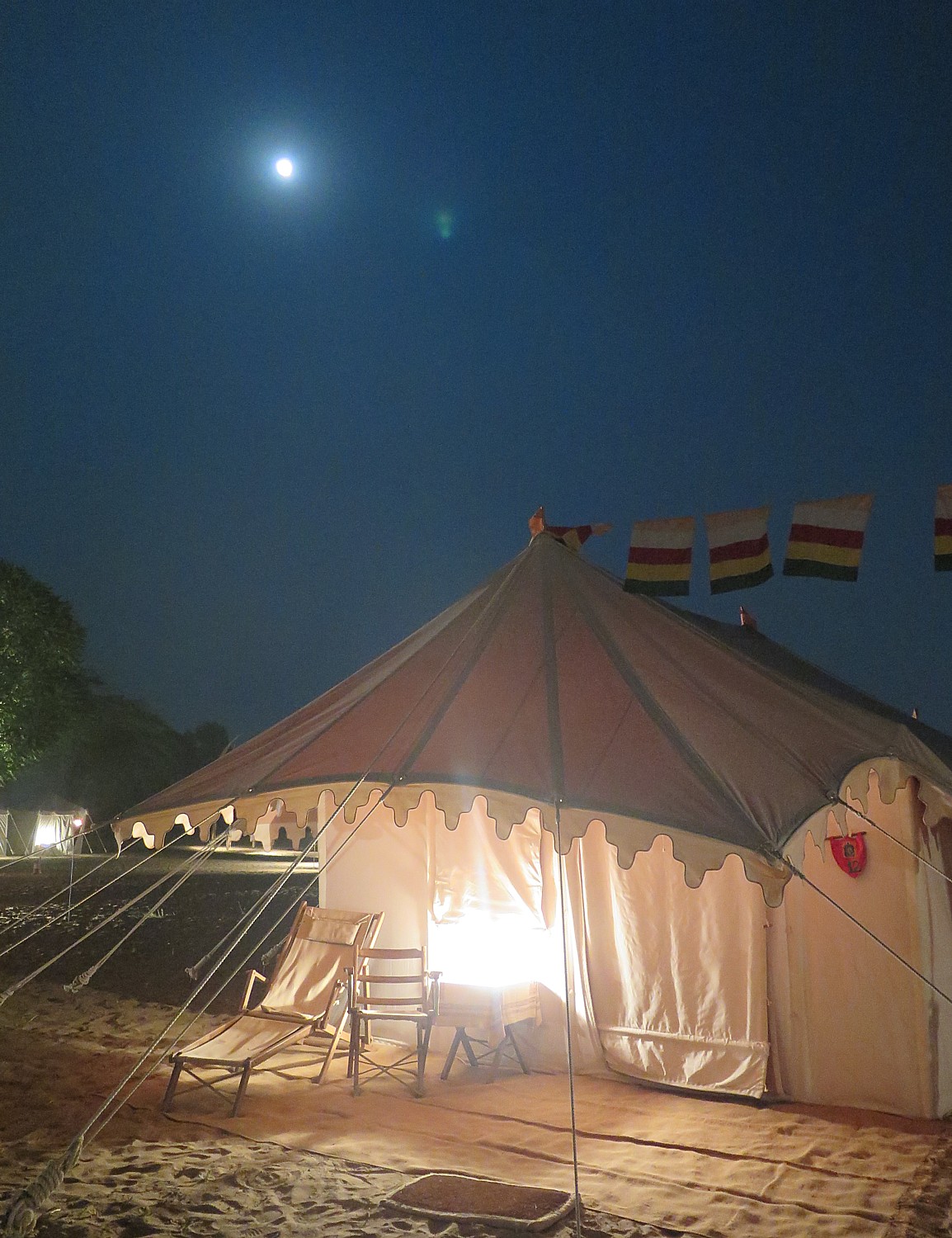
Coming into Pushkar, we bypass the entrance to the fair – it is wall-to-wall people, since it is toward the end of the fair now mostly pilgrims as opposed to camel and horse buyers – enroute to the Royal Tents, a luxurious tented camp set up by The Royal Jodhpur Camps specifically for the fair, where we stay.
The Royal Jodhpur Camp is set up as a traditional “shikar” style camp: at a time when only royalty was allowed to hunt, these camps were set up to accommodate them. Ours consists of rows of elegant and luxurious twin bedded tents with verandahs with deck-chairs in front and attached bathrooms with running hot and cold water (even a shower), set out over an expansive sandy plain. There are electric lights, an electric heater, rugs on the ground. There is also a spacious Mughal-style dining tent and a recreation tent which serves as a lounge. It is set on expansive private grounds surrounded by rolling mustard fields in flower and rocky hills, a walk or camel ride away from the fair.
It is the ultimate in glamping. We can tie a triangular flag to a rope outside the tent to signal if we want service (room service, hot water). We can order coffee delivered in the early morning.
We feel much as the royal entourage who would come on hunting expeditions and stay in these elaborate camps. The operative word is “royal.”
Indeed, The Royal Jodhpur Camps actually has a family connection to Royal Expeditions, the tour company that has organized our Jungle Book Wildlife Safari and Cycling Adventure and this extension to the Pushkar Camel Fair, Jaipur and Agra. Royal Expeditions was founded by a royal family of Jodhpur related to a Princess who also served in Parliament and as India’s Minister of Culture, and the Royal Jodhpur Camps is her brother’s enterprise. It makes it all the more fantastic. And like our other accommodations – the Pench Tree Lodge and the Kanha Earth Lodge during our time doing wildlife safaris in the national parks – it enhances our Camel Fair experience.
We have a superb lunch in an enormous dining tent (complete with ceiling fan), before setting out for our visit to the fair.
Day into Night at Pushkar Camel Fair
Durga has timed it so we arrive at the fair in the afternoon and will be here after dark, to get the full color and atmosphere.
Soon we are caught up as we watch a transaction for a horse, just as Durga foretold we would during our train ride: “At the fair, everything is everybody’s business.” And just as he described, we watch a fellow eyeing a horse. And just as he described, soon we find ourselves chiming in as if it is our business, “Oh, that’s a fine-looking horse.” And just as Durga had described, moments later, the seller grabs the customer’s hand and pulls him inside the tent, where he most likely will be plied with tea so the negotiations can commence out of the gaze of prying eyes and gossipy critics.
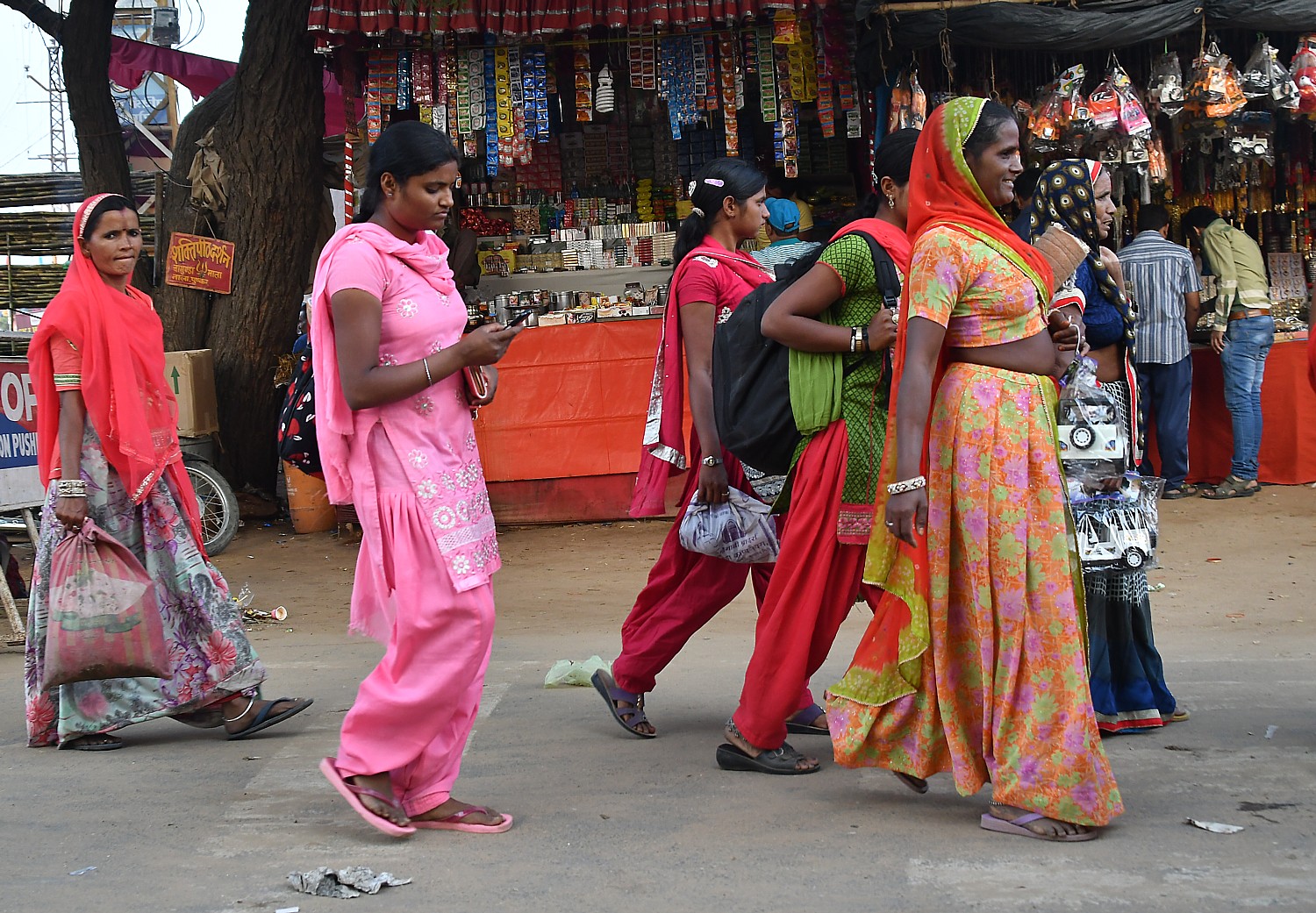
Durga leads us through a vast market with just about every item you can imagine for sale: shoes, scarves, household items; saddles and decorative reins and leashes for the camels and horses.
We see albino horses for sale, which Durga says are used for weddings. He introduces me to Bakshu, a prominent horse breeder he knows from Gudrash, and Raika, a professional camel breeder.
We pass by a tent where there is magic show on our way to the market.
He takes us to what is probably the most distinctive shops at the fair, Camel Charisma, where you can buy paper out of camel dung; scarfs form discarded camel hair (and silk), 2500 R ($36), fresh camel milk, camel milk soap and just about anything you can imagine from camel. We taste chai made of camel milk. He takes us to his favorite textile stall (I’m still kicking myself for not buying an embroidered wool wrap for $25).
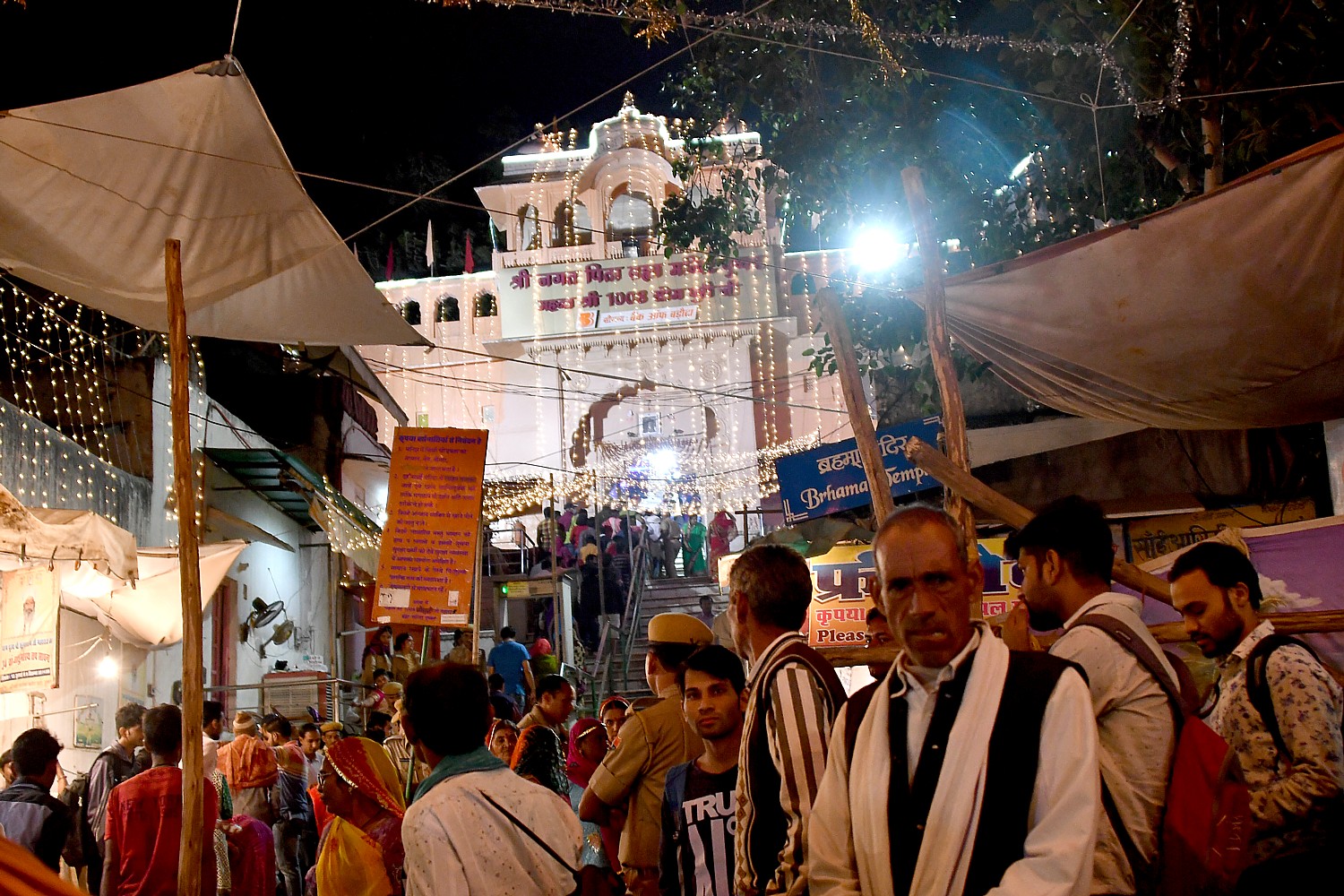
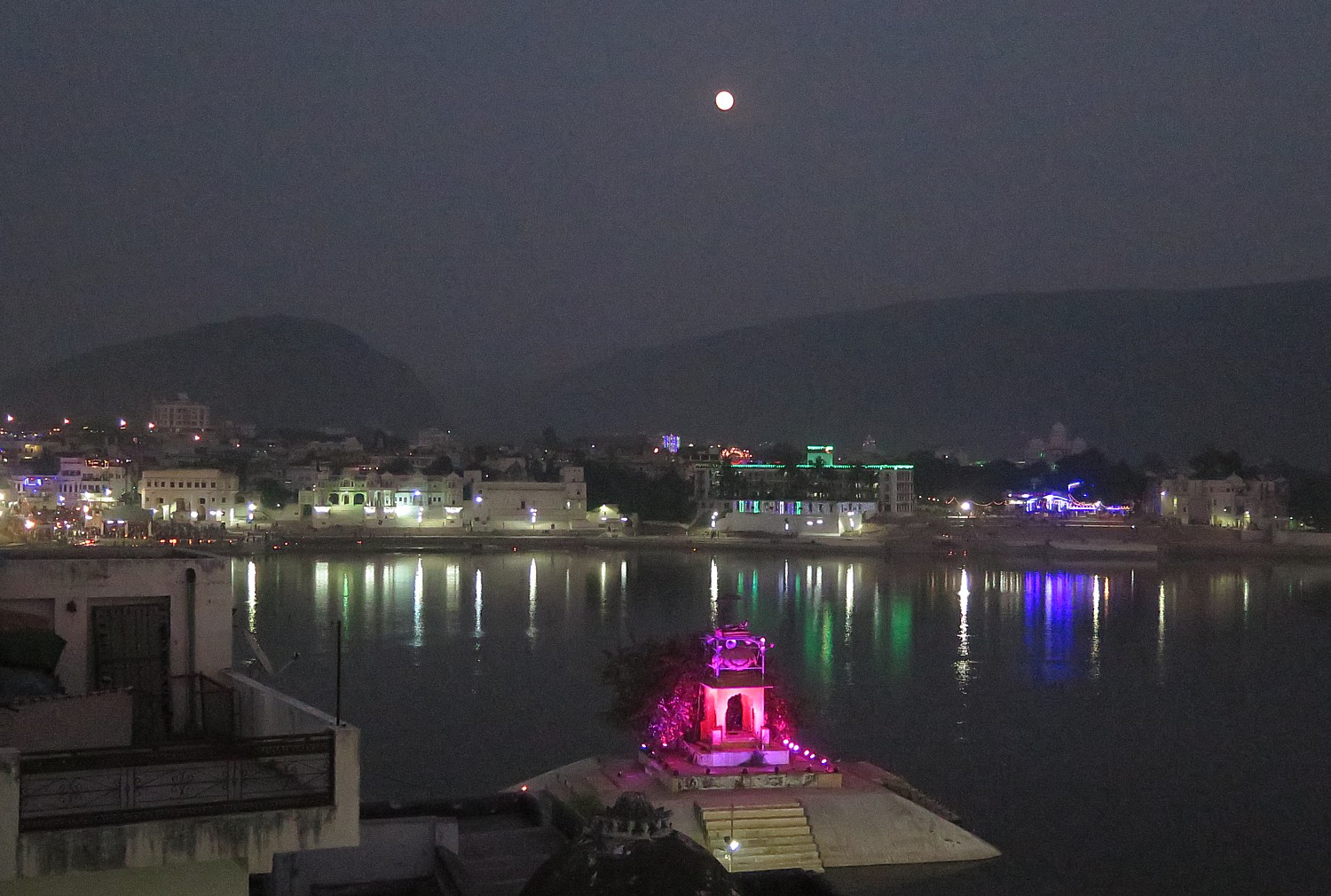
He takes us passed temples, jam-packed with worshippers, to where we can go to a rooftop to look down on the holy lake and the religious rituals underway. We watch as the sun sets, the lights come on and a super moon rises over the Pushkar Lake.
Pushkar is the only place in the world where Lord Brahma, the Hindu God of Creation, one of the Holy Trinity, is worshipped. The Brahma Temple, which officially is dated from the 14th century but is believed to be 2000 years old, is set on the lake, and during the night, lights of changing colors come on. In the distance, on a hilltop, we can make out the Savitri Temple, dedicated to Brahma’s consort, Savitri, but to visit involves an hour long trek uphill.
Around the lake are numerous bathing ghats, where thousands of pilgrims take their holy dip in the sacred waters of Lake Pushkar, as religious chanting and pealing bells resound. We get to peer down on these activities from our perch on the roof, watching people gather around open fires.
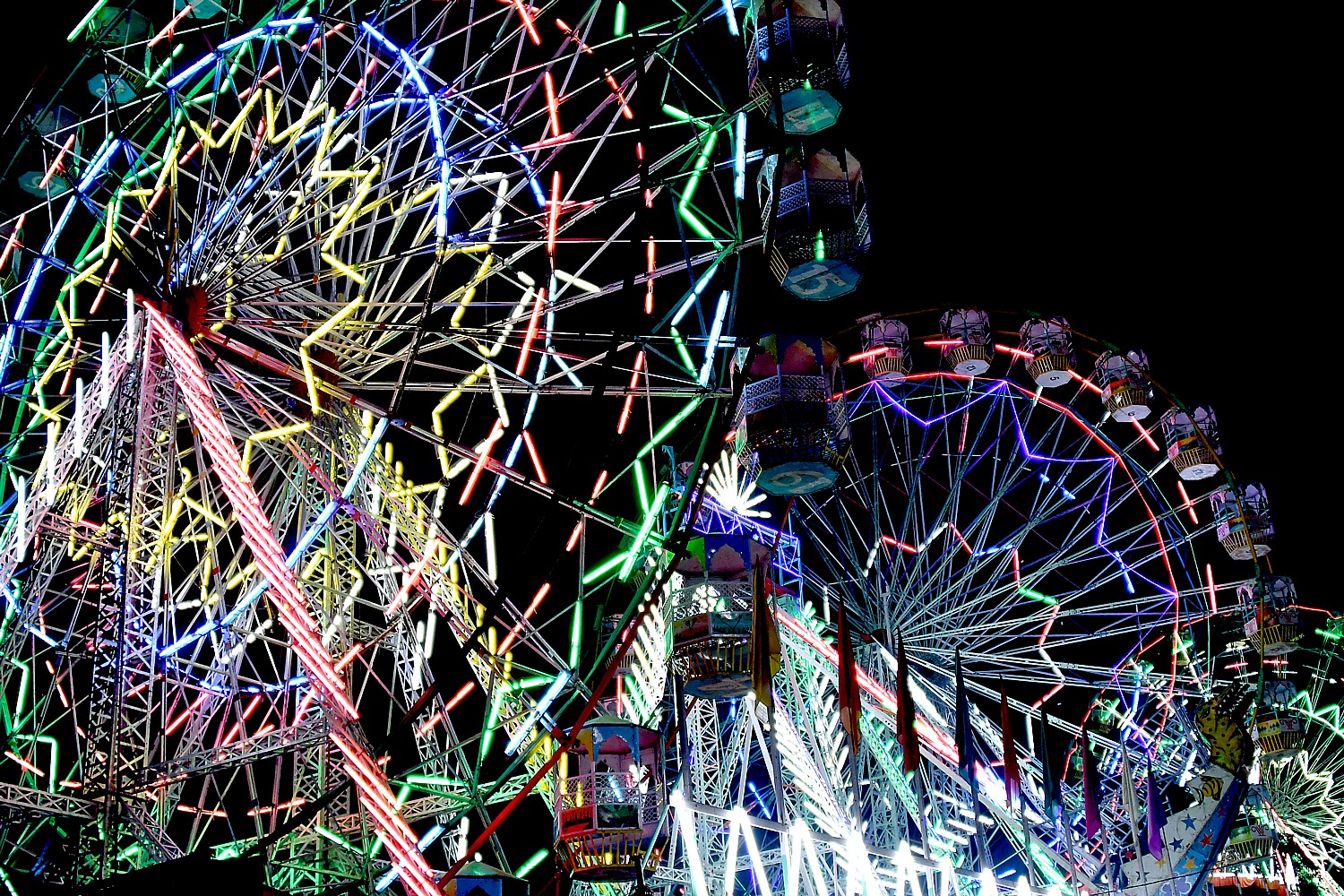
We make our way back through the market and the carnival, now lighted up and festive, with five giant ferris wheels looming over the fair. We pass a crowd watching a dancing horse.
When we return to the tented camp, where we have a marvelous dinner (with Sula champagne!).
We comment on how good the papadom is – a seasoned dough made with mung bean flour fried or cooked with dry heat. “In my grandmother’s day, they used to invite women for lunch, sing, everyone came with a rolling pin, they would sing and make the papadom and put it out in the sun to dry,” Durga says.
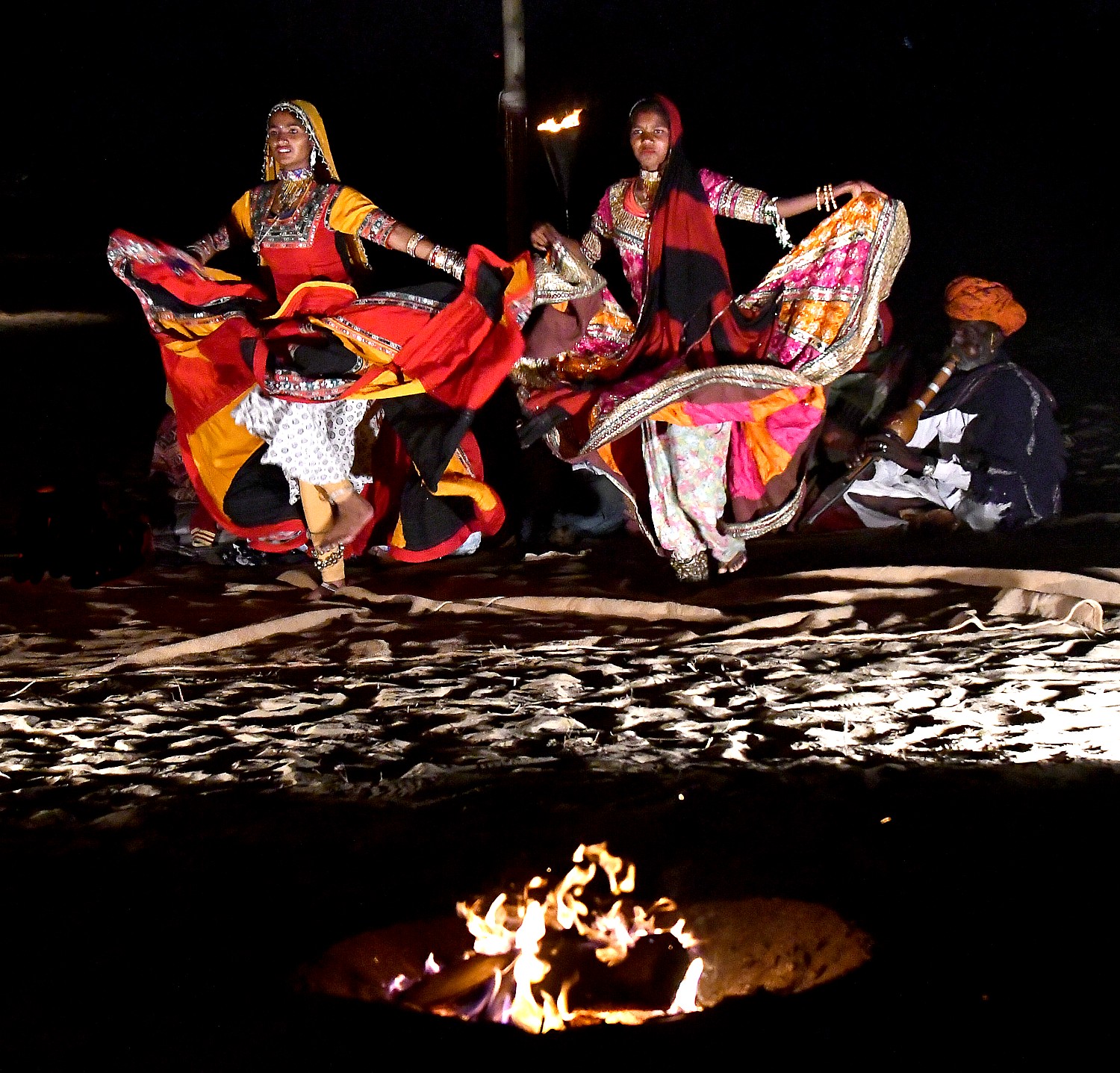
There is a fireeater, musicians and dancers to entertain us around a bonfire.
I return to the fair the next morning by myself. Durga has arranged for the driver to pick me up at 7 am. As we pull up, I watch as a hot air balloon rises over the fair. (Hot air ballooning is a relatively new adventure activity in India and the desert state of Rajasthan is the most popular place.)
I get to the fair and just wander around – I am one of a scant few Westerners at this point. It is amazing to me how busy it is even this early in the morning. There are only a few camels left for sale and I watch what looks like the end of a transaction.
Leaving the fair, I see pilgrims arriving in open-back trucks, and in trucks that have been outfitted with bunkbeds.
Durga has told us that it can take 10 days to travel from Agra with the camels, and that we will see people in their camel carts traveling along the highway, as we drive to our next destination, Jaipur. And we do!
In Jaipur, we learn more about this regal gentleman and his family, when we visit his boutique guesthouse, Dera Mandawa – his family’s century-old estate which, back in the day, accommodated dignitaries when they visited the Maharajah. The family lost their property and position when India nationalized such estates in the 1949, and families like his were forced to turn their estates and palaces into commercial enterprises or see them torn down. Instead of the path of a warrior as his ancestors would have taken, Durga has been involved in tourism for 35 years. (www.deramandawa.com)
It is approaching 5 pm, the final moments of our fifth and final game drive in six days of exploring India’s Pench and Kanha national parks, famous for tiger. So far, though we have seen amazing animals, birds, insects, the ultimate prize of a tiger sighting has eluded us. I have new appreciation for how elusive they are, particularly with the massive amount of forest territory and the fact they tend to be active before 8:30 am, then settle down in the jungle, coming out again in the evening in this season which is approaching winter.
I have also come to suspect they have also figured out the schedule for our safari vehicles which announce our coming with loud rumbling sounds.
The light is fading. This entire drive hastily arranged in Kanha by Royal Expeditions because none of us had spotted the tigers after the four scheduled game drives so far. Nara, our naturalist/guide from Taj Safaris, is laser-focused on finding a tiger for us. We have already gotten to see most of the animals for which these parks are famous – it has been thrilling to see them in such close proximity (I even got a brief sighting of a leopard!). But we have yet to catch even a glimpse of the star attraction: the tiger.
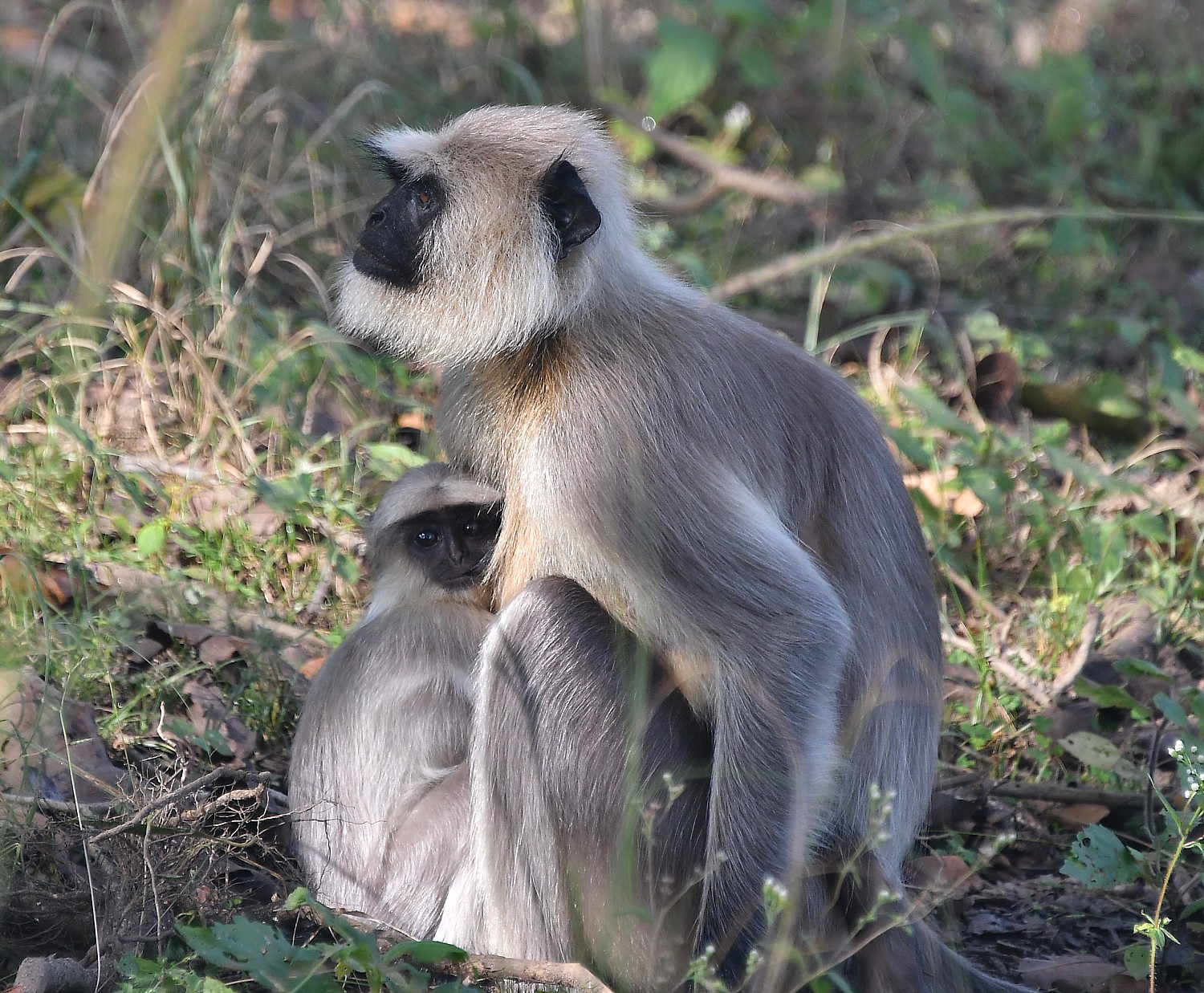
We have seen and followed tracks left on the sandy road; listened to the “alarms” sent up by the black-faced langur monkeys (that look like wise men) that provide our guide and naturalist the best clues as to the location and movement of the tigers. The scene is quite fantastic, in fact, when one guide gives a scouting report to another, and we all tear off at great speed.
But we have yet to have the luck of being in exactly right place, right time to view.
We only have 2 hours this afternoon, so he races to get to the most likely territory known for tiger – it takes 20 minutes to travel there from the entrance gate even driving so fast, bumping on the rough road and holding on tightly to the railing in the open vehicle, the park is so vast. It is quite a thrill ride.
Periodically, especially where the trails cross each other, he stops, turns off the engine, and just listens. Sometimes there is just complete (eerie) silence, but soon a fantastic cacophony jungle sounds come into focus. We hear various bird calls, which Nara identifies for us, and we find ourselves searching the trees and the sky, contenting ourselves with shooting photos of fantastic birds.
Nara and the park guide examine prints in the trail – and can tell how long ago they were made, whether a male (more rounded) or a female (more rectangular and pointed).
It is just after the rainy season, so the forest is thick, verdant and cool (actually cold in the morning); but in the intense summer heat and drought, the forest becomes dry and brown and the tigers come out to water holes (some made by the park) more predictably. So while the conditions are generally more pleasant this time of year for viewing, sightings are trickier.
Nara and the park guide who is assigned to us confer. We move on.
If we meet up with another jeep (there aren’t as many in this section of the park), they share intel, sometimes strategizing.
Whenever he stops, Nara explains his strategy for finding the tiger, based on its patterns, which is really insightful.
Other safari goers we chance to meet during our drives- particularly where we stop for breakfast – tell of their luck. A British woman makes us jealous when she shows photos she snapped off a tiny point-and-shoot camera of a mother tiger with her cub, while we are there armed with our superduper DSLRs and 300 and 400 mm lenses, with nothing to show.
The best time to see the tiger is either very early – moments after arriving in the park (when I chance to spot a leopard on a ridge), or late in the afternoon. The park doesn’t open before 6 am, so we head out from the lodge by 5:30 am (they send us off with hot coffee and tea and biscuits, plus a blanket and hot water bottle for the safari vehicle), and it can take 40 minutes waiting at the gate in the surprisingly cold air, before we are processed, assigned a guide and a zone in the park, and allowed to enter.
So we race to get to some spot that our naturalist and guide believe has a good likelihood for spotting tiger. Of course, along the way and throughout our tour, we see an amazing array of animals and the guide patiently waits for us to take our shots before moving on, imparting information about the various animals we see. The landscape is really beautiful, and in the morning and afternoon light, dramatic. You never know what you will spot or when, so it is constantly thrilling – you are literally hunting (with a camera).
In the first couple of game drives, we all were a lot more casual, so spent a lot of time with the langur monkeys, rhesus monkeys, the jackals, the wild dogs, the wild pigs, the spotted deer and the swamp deer, and the myriad birds, not to mention the insects and trees that prove quite fascinating. But as we realized our window of opportunity for seeing the tiger closing, we were a lot more single-minded in that pursuit, rushing passed scenes of animals we had already seen before.
The naturalist and guide who accompany us are earnest to the point of frantic to succeed for their tourists. “Until people see a tiger, they can’t relax or do other things,” he tells us.
So when they get a hint of a tiger, they race with unbelievable speed, even dashing in reverse (hold on!) despite how crude the road (more of a trail) to get to a spot. Sometimes so many vehicles converge in both directions no one can move (this is particularly the case on a day that school and scout groups have come out by the dozens) – but the driver manages somehow to maneuver with tremendous skill.
This happens repeatedly with no sightings (which is why you will typically organize 3-5 game drives during your visit).
But here we are, at 5 pm, when Nara picks up on the alarm sent up by the langur monkeys. He says a steady alarm means the tiger is moving; intermittent means the tiger has stopped.
It’s our last game drive, hastily arranged by our tour company, Royal Expeditions (no small feat since permits have to be applied for in advance), our last chance. We follow the ‘alarm’ sent up by the monkeys. When their calls are not continuous, Nara can tell that the tiger has stopped moving, and calculates that it is in the middle of the forested area.
Nara has to guess which direction the tiger will move. After about 10 minutes waiting and listening (while we happily shoot photos of birds gathering in trees above us), he picks up again and goes to the last best spot, in the direction of a meadow with tall grass that leads to the water.
Several vehicles are already parked there and in an instant, excitement:
“People lose their minds when they spot a tiger.” The naturalist tells us. The drivers, also.
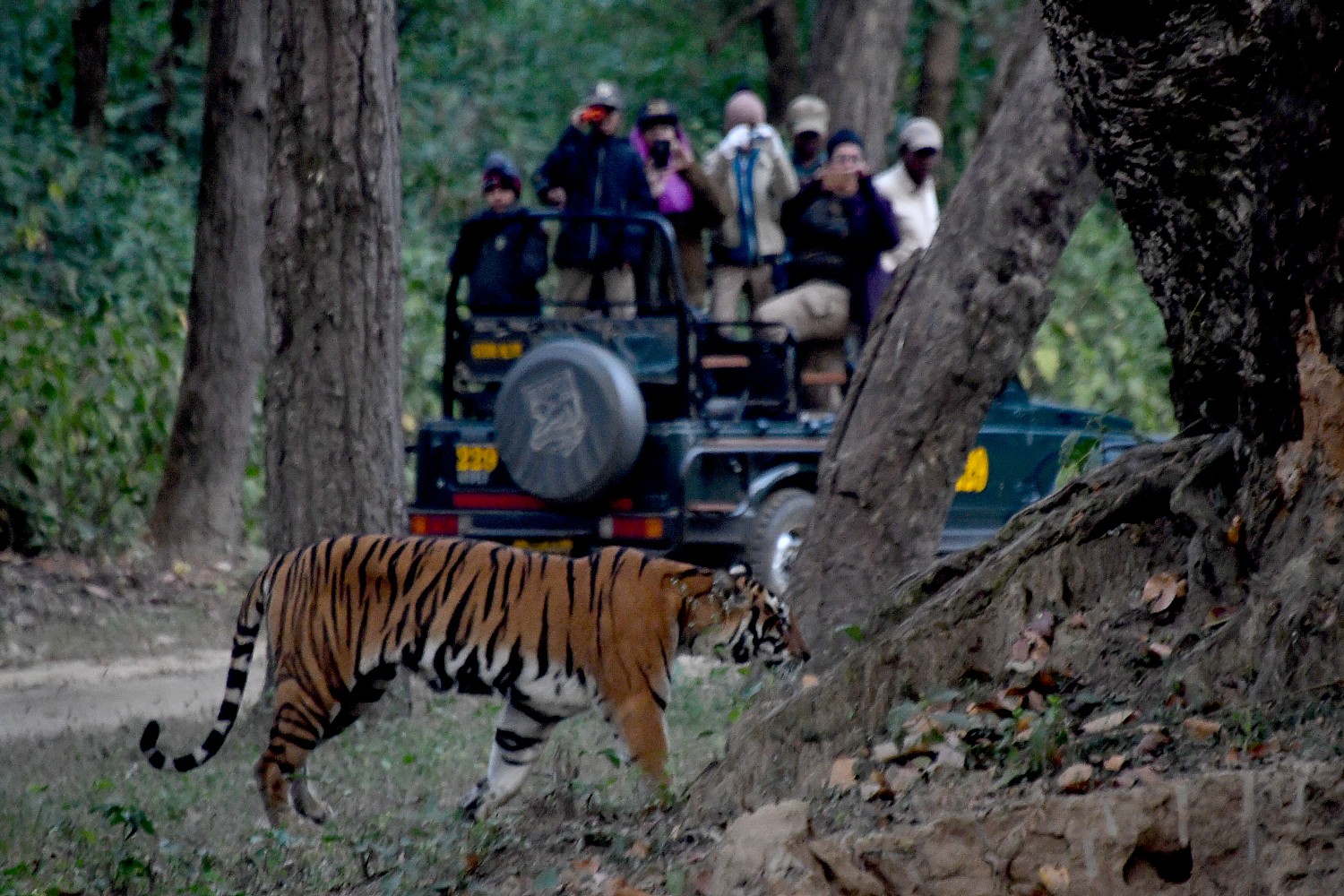
Just then, the tiger emerges from the forest and crosses the road, just a few feet from the vehicle ahead of us – but we aren’t in great position to see and I am thinking how ironic this is to finally be where the tiger is, but not to actually see it.
But Nara is not to be thwarted. He maneuvers our vehicle through this enormous crowd, going off the trail into the thicket, to get us into a good position.
Meanwhile, we are holding on in open vehicles, trying to snap shots before the tiger disappears again into the forest growth.
I snap, snap, snap – get a shot (I am thinking it isn’t great, but a shot nonetheless, but actually, afterward I see I got more than a few) –before the tiger disappears into the woods.
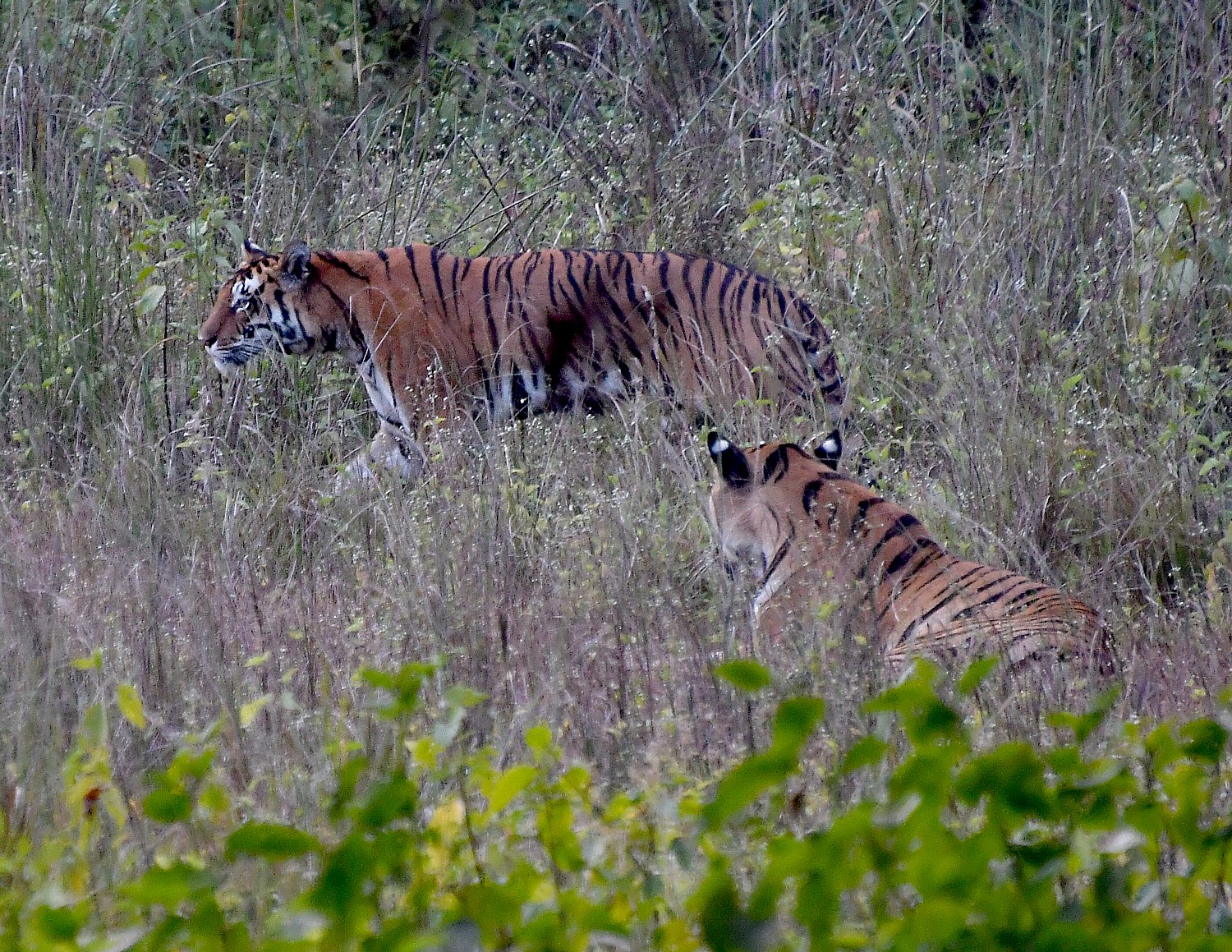
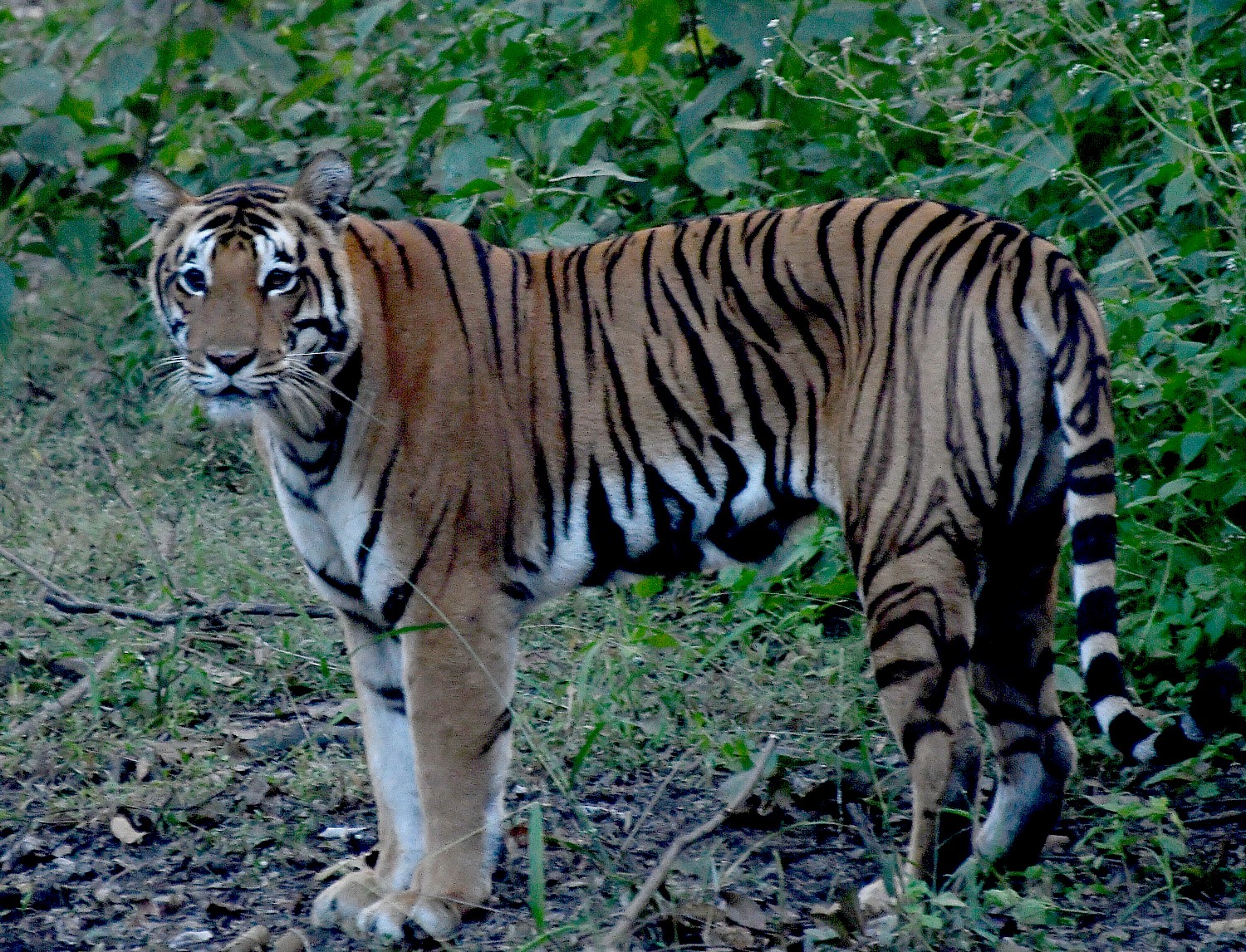
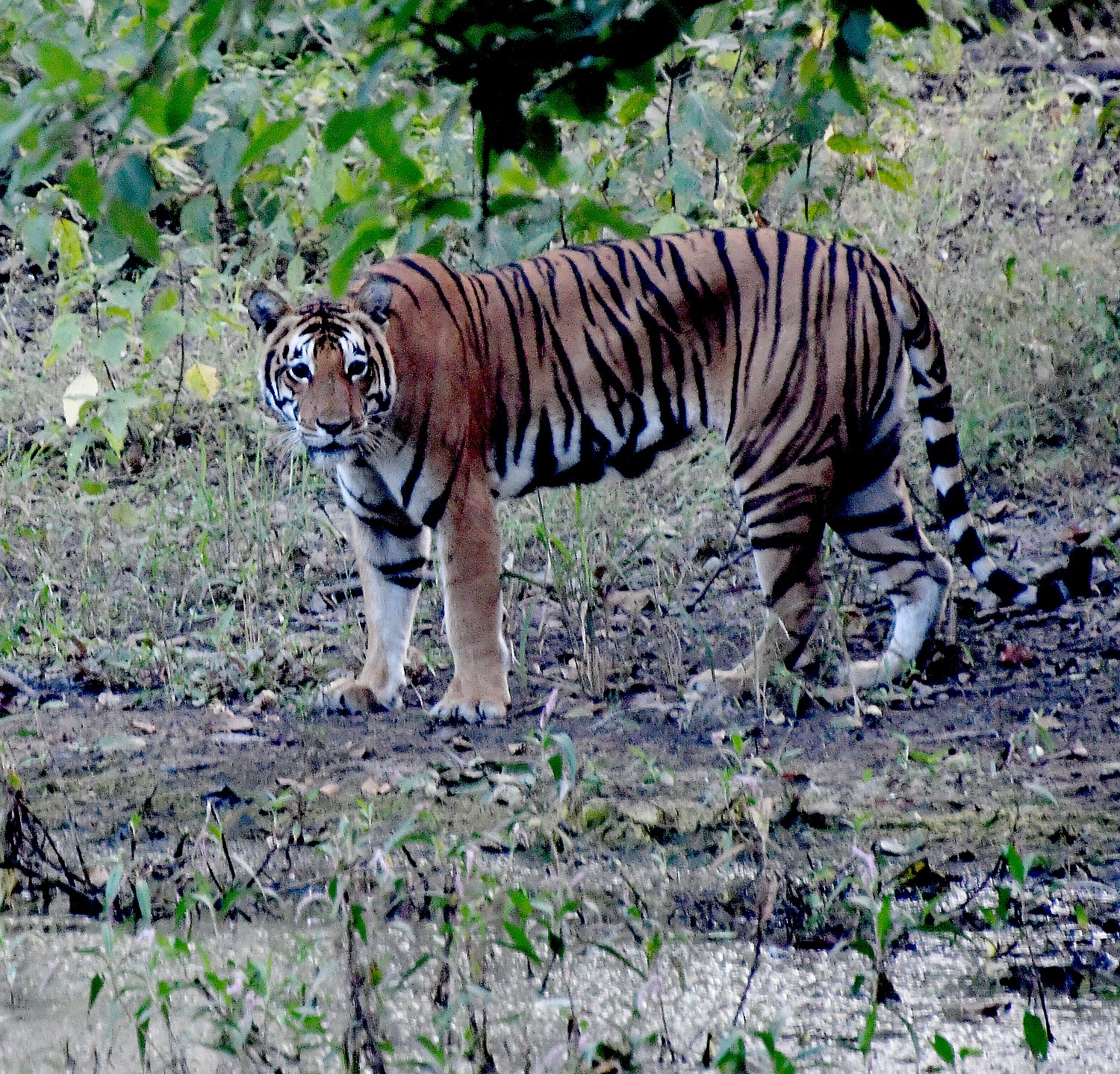
Nara moves the vehicle again and lo and behold, the tiger remerges from the wood, now crossing the road directly between our vehicle and another one, to a grassy area on her way to the water. Amazingly, a male tiger emerges and walks after her.
Most of the other vehicles have already headed out because it is literally closing time and the drivers are fined if they are late to the gate. But Nara stays. We get shot after shot as the light fades to dusk. I’m lucky, standing up on the highest perch, to get some shots of both tigers together.
I shoot frantically, not knowing how many moments I will have. I can’t even take the time to check if my setting is right. I’m going on instinct. I fight between needing fast exposure and high ISO to compensate for fading light, the darkness of the woods, and the tigers’ motion, and fear I might actually be overexposing.
By now, we are the only vehicle still remaining. We watch as the female sits in the grass, looking back at the male as he approaches her. It is quite a scene.
Finally, Nara says we have to leave and he tears off at great speed to make it back in time, while we are giddy with our good fortune: We saw not one, but two tigers!
It’s an intense, thrilling feeling. I realize I have barely taken a breath.
The game drives have been fascinating. It is thrilling to not know what you will see, or when. Then momentary, serendipitous flashes.
Seeing the animals in their habitat, all sorts of questions and considerations come to mind.
And the landscapes are just beautiful.
Kanha’s Abundance of Animals
It is remarkable how this short distance away from Pench National Park where we spent the first three days of our “Jungle Book Wildlife Safari and Cycling Adventure,” the ecology changes so much. The Kanha forest (“jungle is the Hindi word for forest) is much thicker, and because of the higher elevation, is much cooler. The Kanha National Park spans nearly 2000 sq km (only one-fifth open to tourists), and currently has an estimated 49 tigers.
Instead of a teak forest like Pench, this forest is mainly sal – a wood that was used for railroad ties; three kinds of bamboo (bamboo gets flowers only once in its life, then dies), the saga tree (the tree, with bark that looks like crocodile hide, is worshiped by the people who harvest water from it to drink when necessary); and the Mahua tree (the flowers are made into a liquor which is a big money-maker for locals. “People only collect the flowers that have fallen from the tree, which drop after midnight, to make liquor. If animals eat the flowers, they also get drunk – that’s why you might see a drunk monkey.”
The first evening at the Kanha Earth Lodge, where we stay during our time here, there is a slide presentation by the naturalist about the animals in the park”
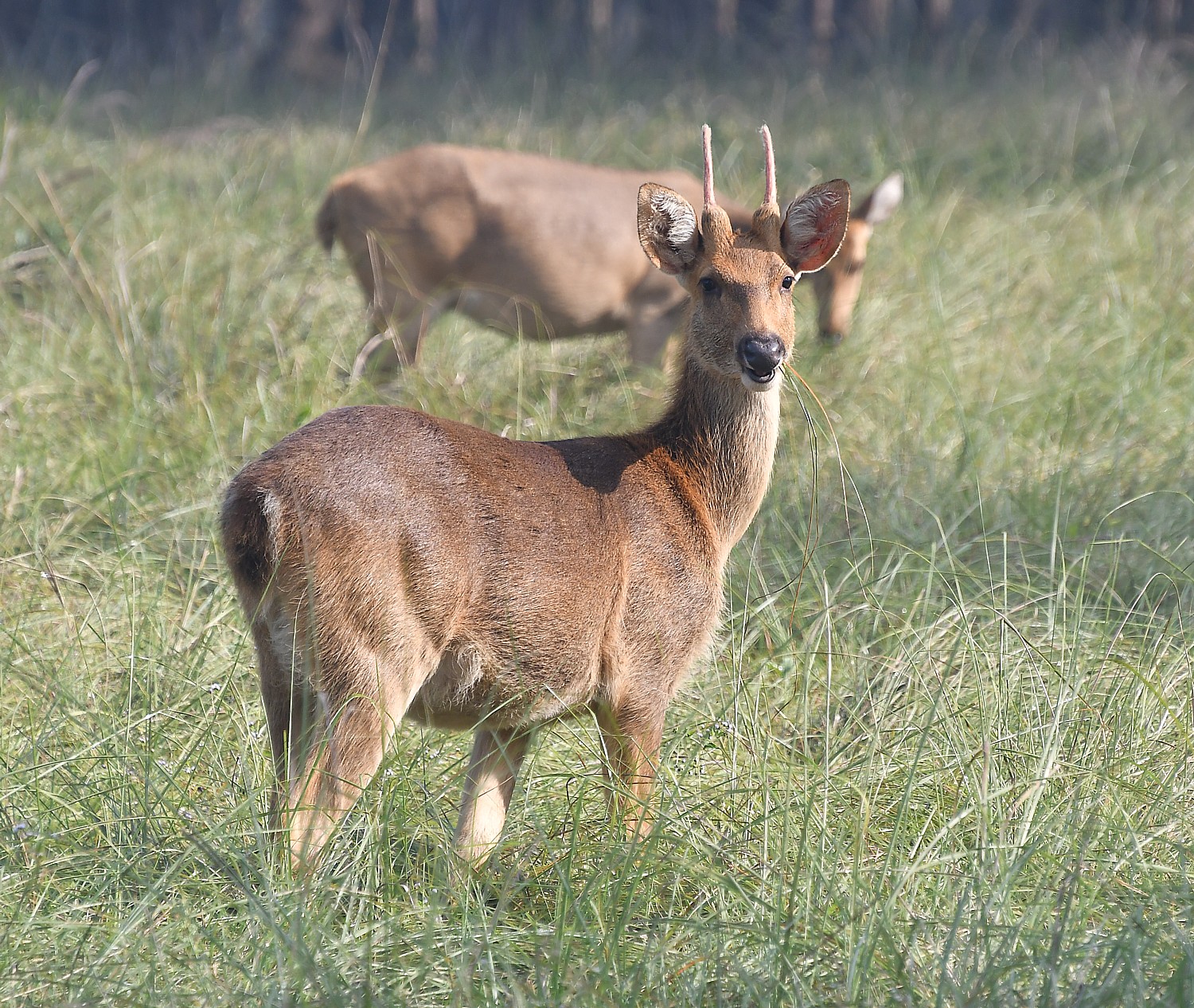
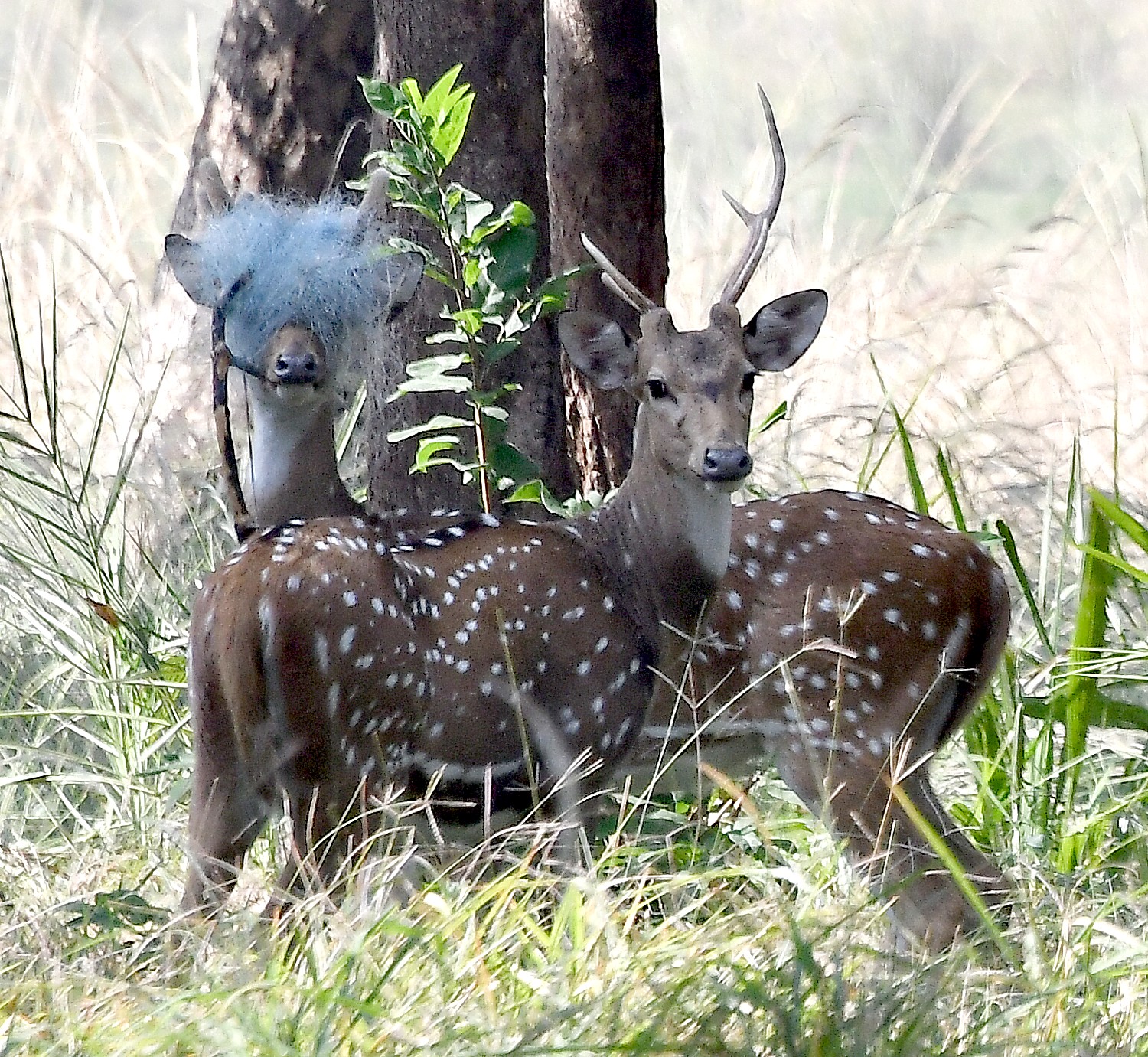
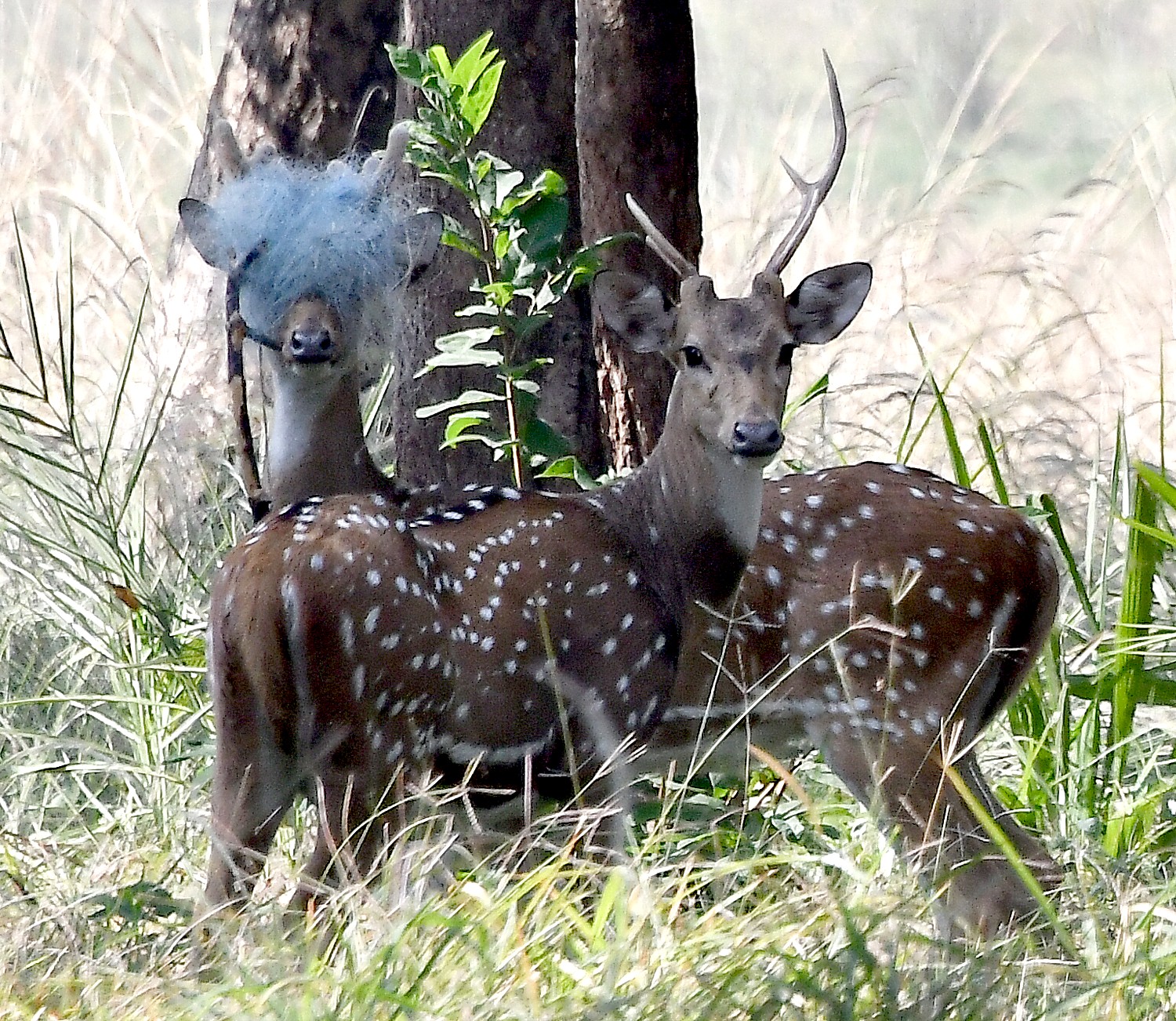
The male spotted deer (chital) has antlers to attract a female. “He will put grass into the antler to look more handsome.” (I actually saw one which had managed to find some blue plastic string for decoration).
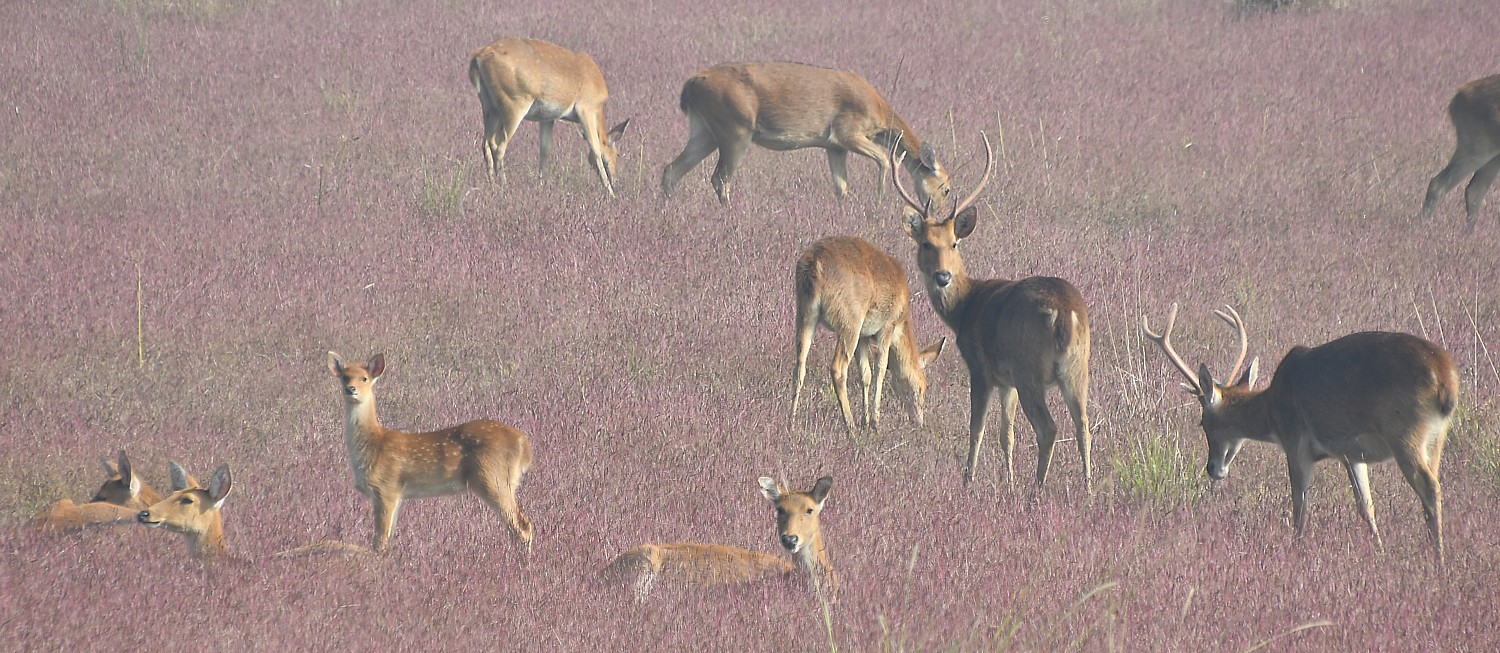
This park also has sambar (Asia’s largest deer, it depends on its sense of smell, but will foolishly go right up to a tiger to smell it); the Indian Muntjac (barking deer), which is only found in a bamboo forest. We even get to see all of these, including the Barasingha (swamp deer) which was endangered in 1970s when there were only 66 left (it only gives birth to one baby a year, but at Kahna, they made breeding pairs and are repopulating).
There are also wild pig; gaur (like a big bull with horns), jackal (they can get drunk eating the Mahua flowers; dhole (wild dogs; only the alpha male and alpha female are allowed to mate); sloth bear.
There are more leopards than tigers, and unlike the tigers, are not endangered.
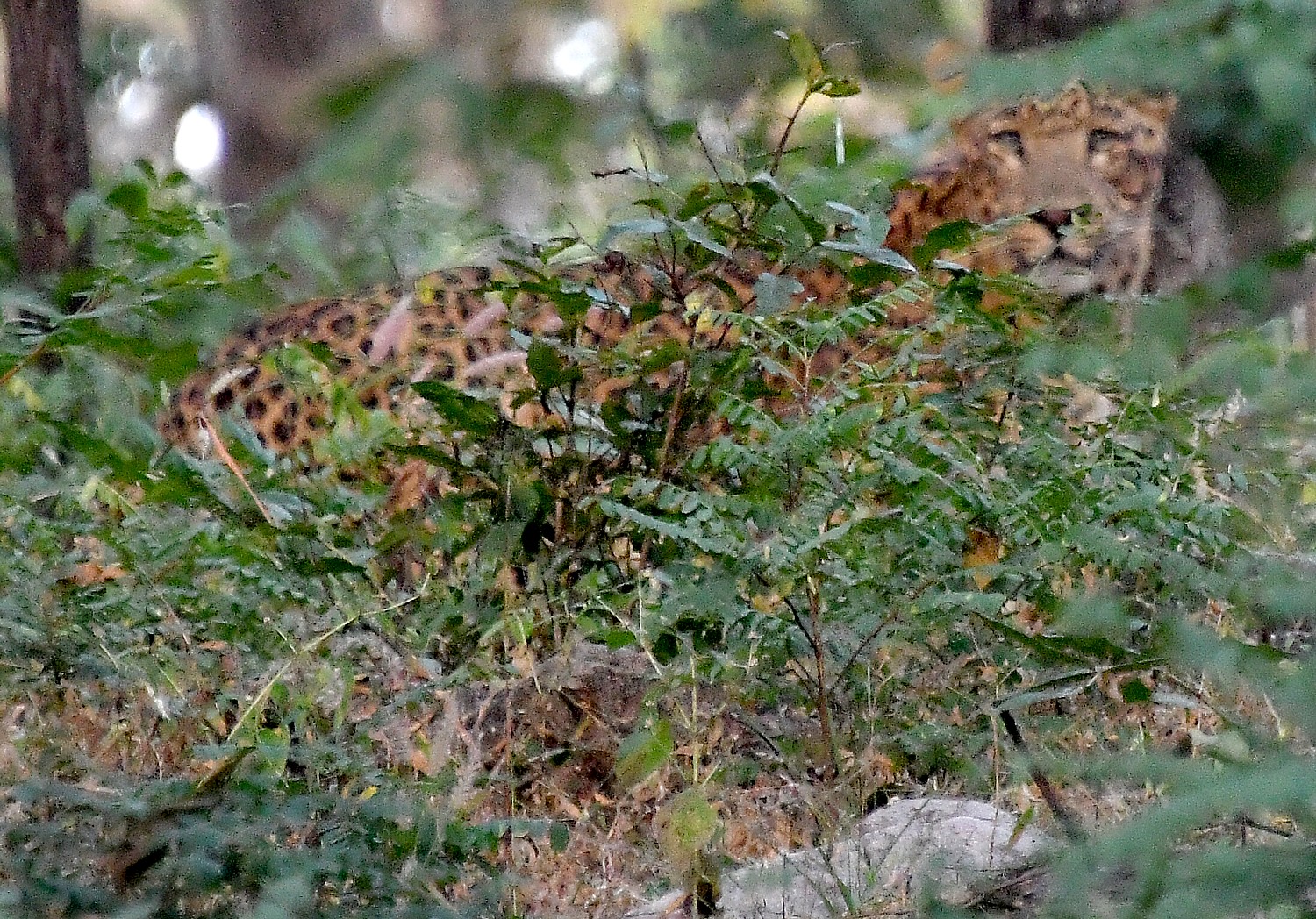
Leopards are sly, he tells us – they eat dogs, goats on periphery (that is, in the villages). They can climb trees so have more food options (monkeys) and hunt at night (which is why they are harder to spot during the day). “They call the leopard the ‘Ghost of the Jungle’ because one minute you see it and the next, disappears.”
Meanwhile tigers are more discriminating about mating – the male can mate with three females (depending upon food) and if the female he wants to mate with has cubs, he will kill the cubs in order to mate with her.
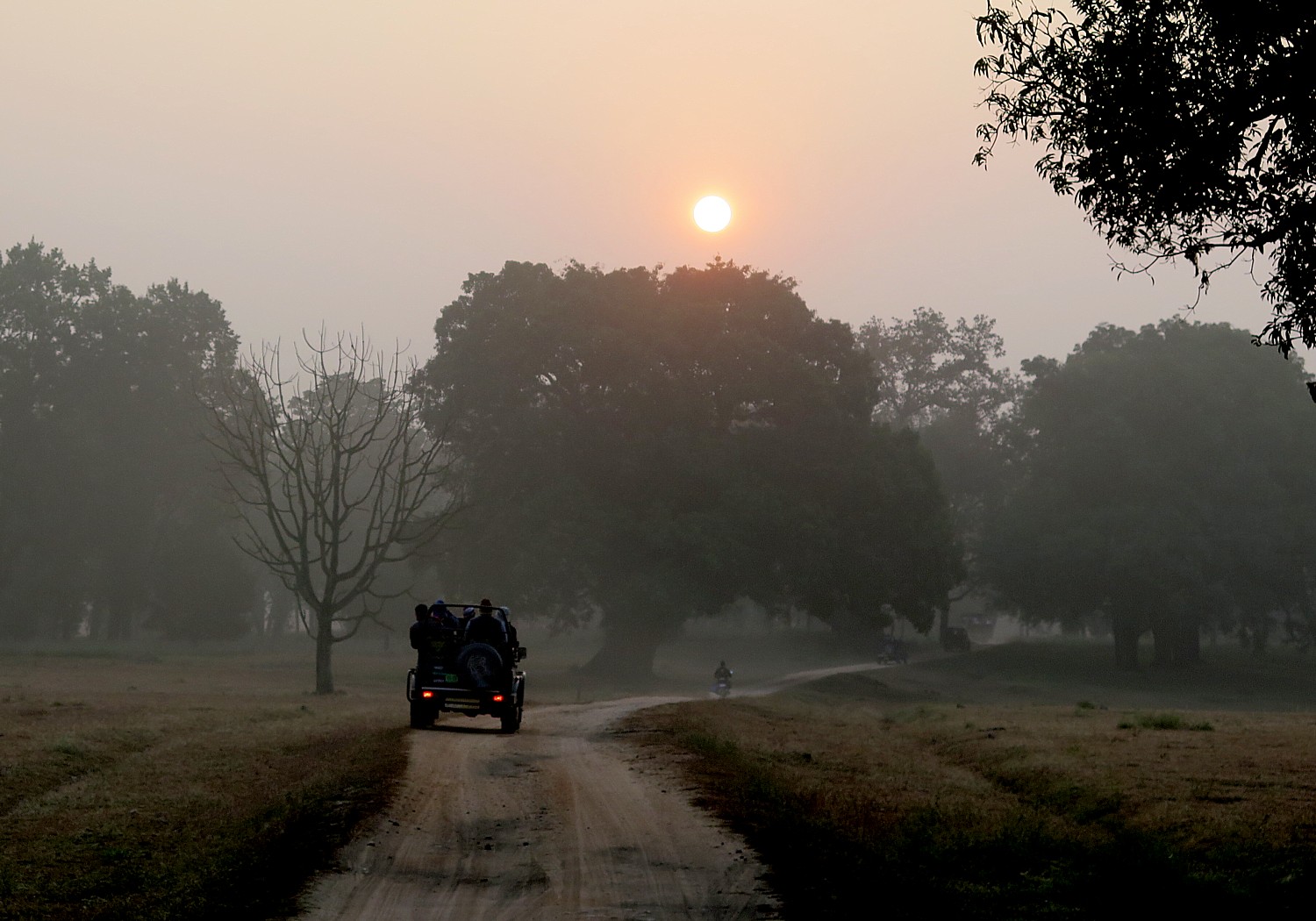
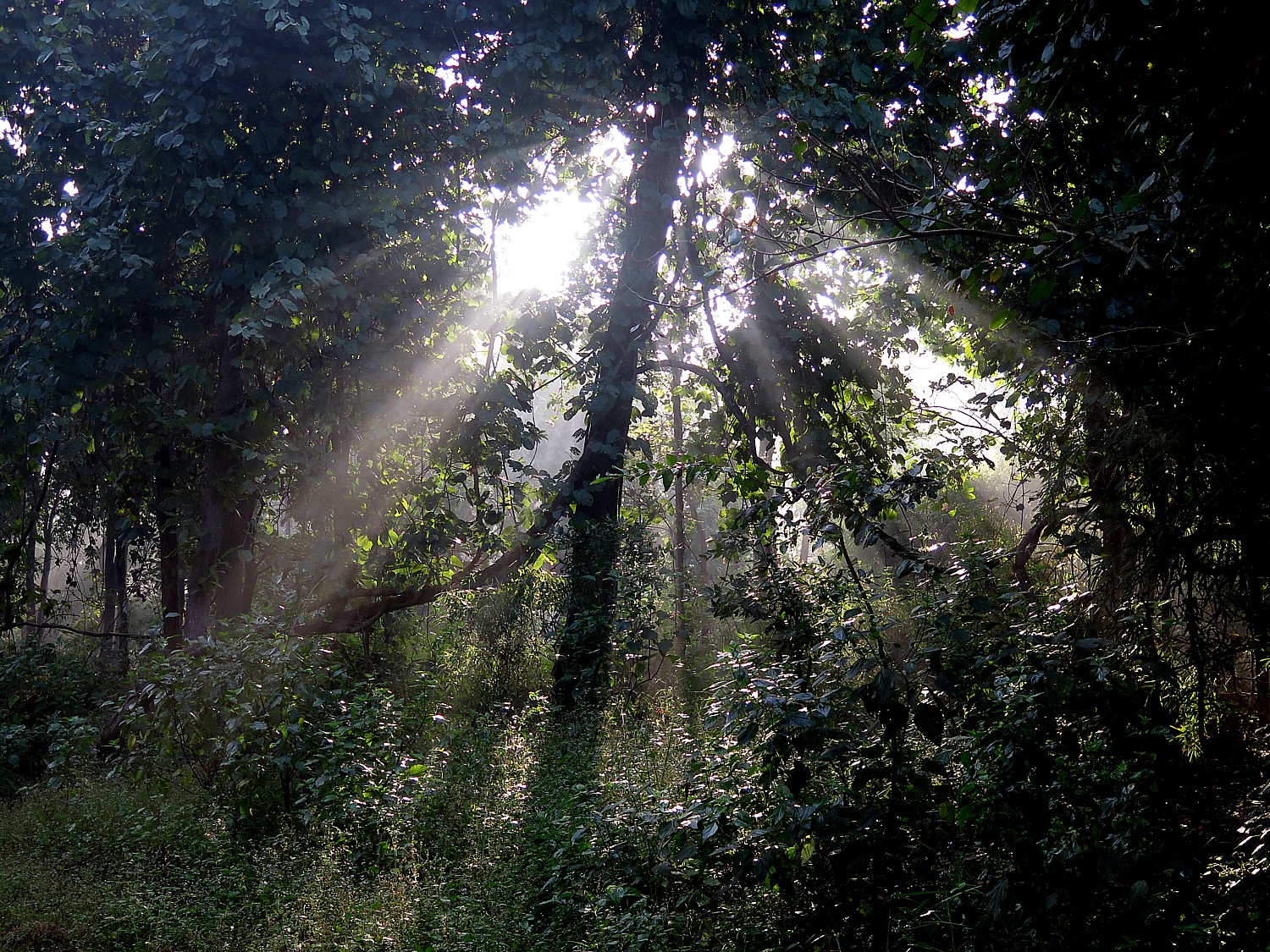
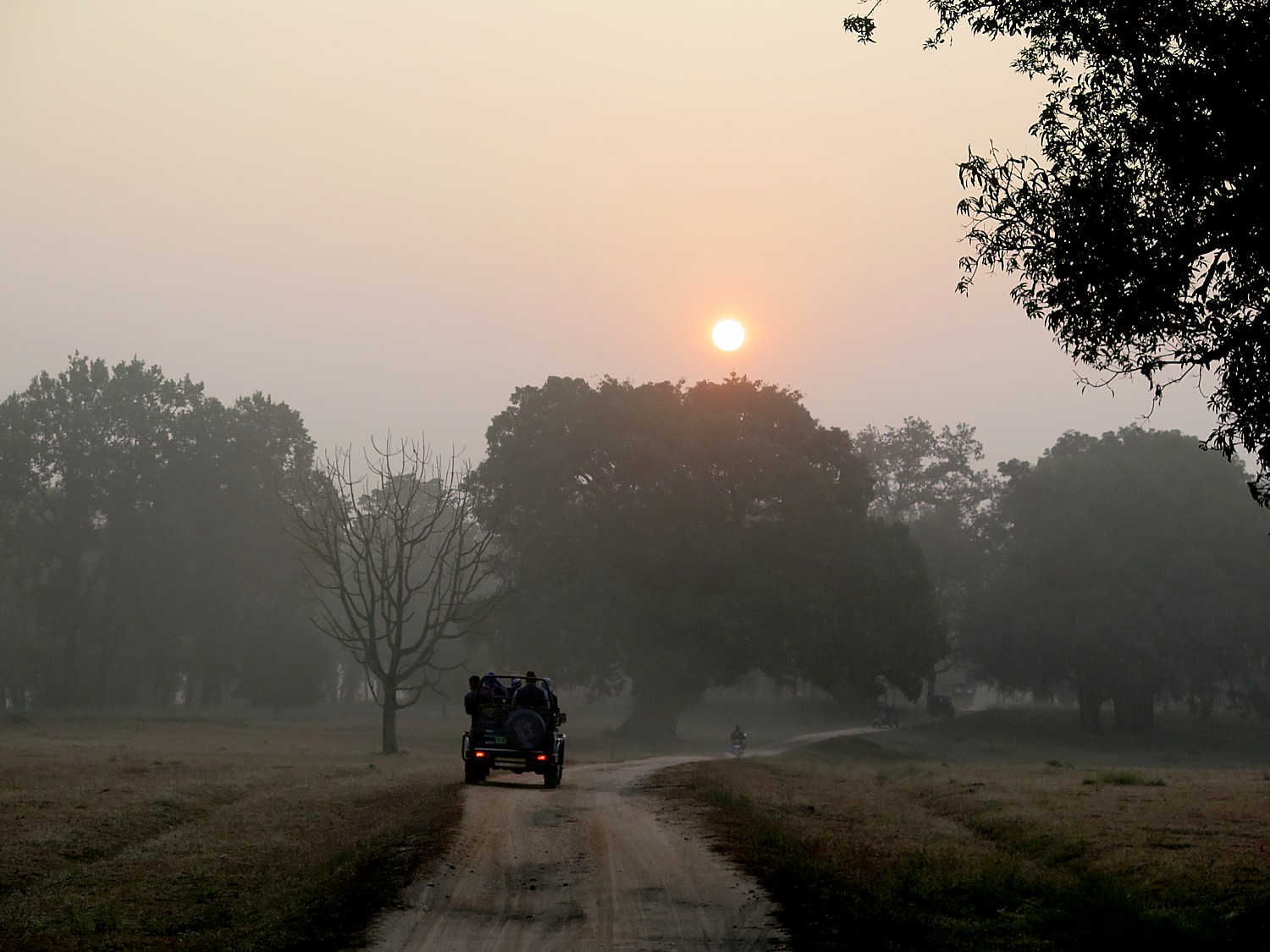
We are up before dawn for our first game drive in Kanha, which is supposed to be our last (we’ve had three in Pench National Park so far). It is quite an experience to be at the park as the sun rises, and we head out on these dusty dirt roads with the red sun in our face, mist on the meadow, and later, as the sun filters through the trees.
We are so earnest to spot tiger, we tell our naturalist/guide not to bother with the breakfast gathering, but that we want to spend as much time as possible in our hunt to see the tiger.
He thinks there is a sighting and speeds off, frantically. There are five jeeps doing the same thing, one driving backwards at a furious pace.
Then we all stop still. Listen. A hand signal, and we all take off again.
A young cub crossed road, the guide announces. We missed it.
We hear an “alarm” from the langur monkeys and speed off again, bouncing, rocking,
No tiger. But we content ourselves with a sighting of White throated kingfisher and a gathering of hard ground swamp deer found only in Kanha – a female and one young male (with just the beginning of antlers) and two babies (as adults, the males stay separate from the females).
As we leave the park, we actually meet Munna, the park guide for whom the park’s famous tiger was named. “Munna” means “small child” and the fellow never liked the name very much. He had a limp, and the tiger was injured and had a limp, so they named the tiger “Munna” also. “After a tiger was named after him, he didn’t mind his name.”
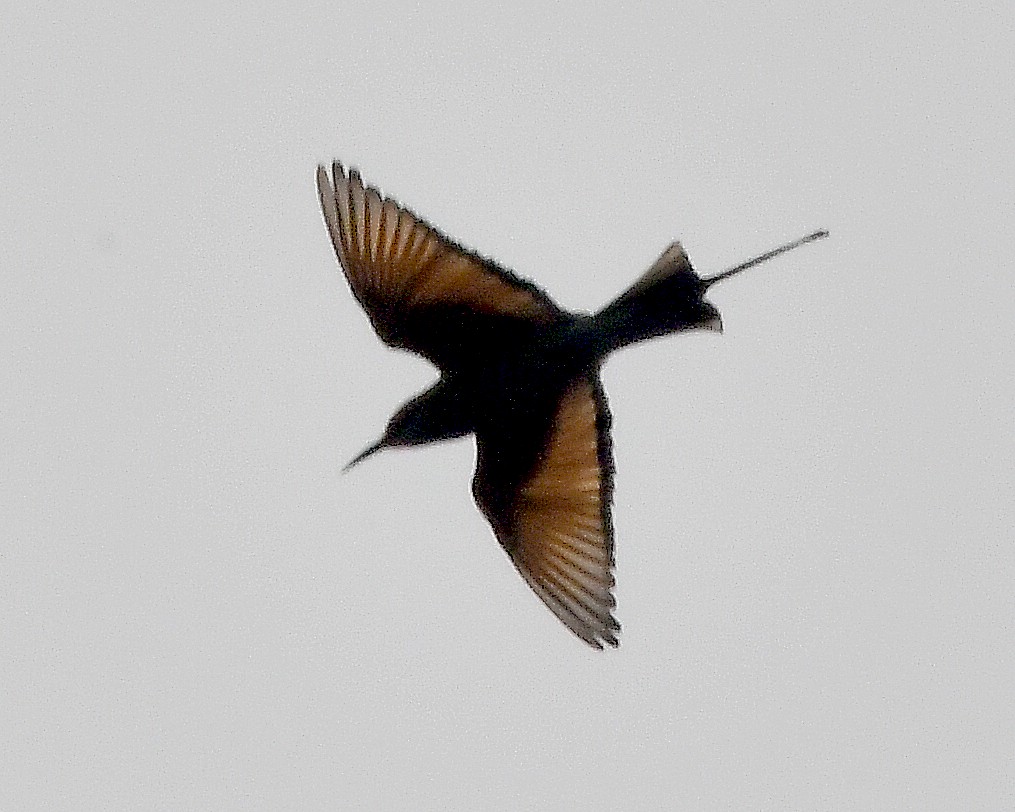
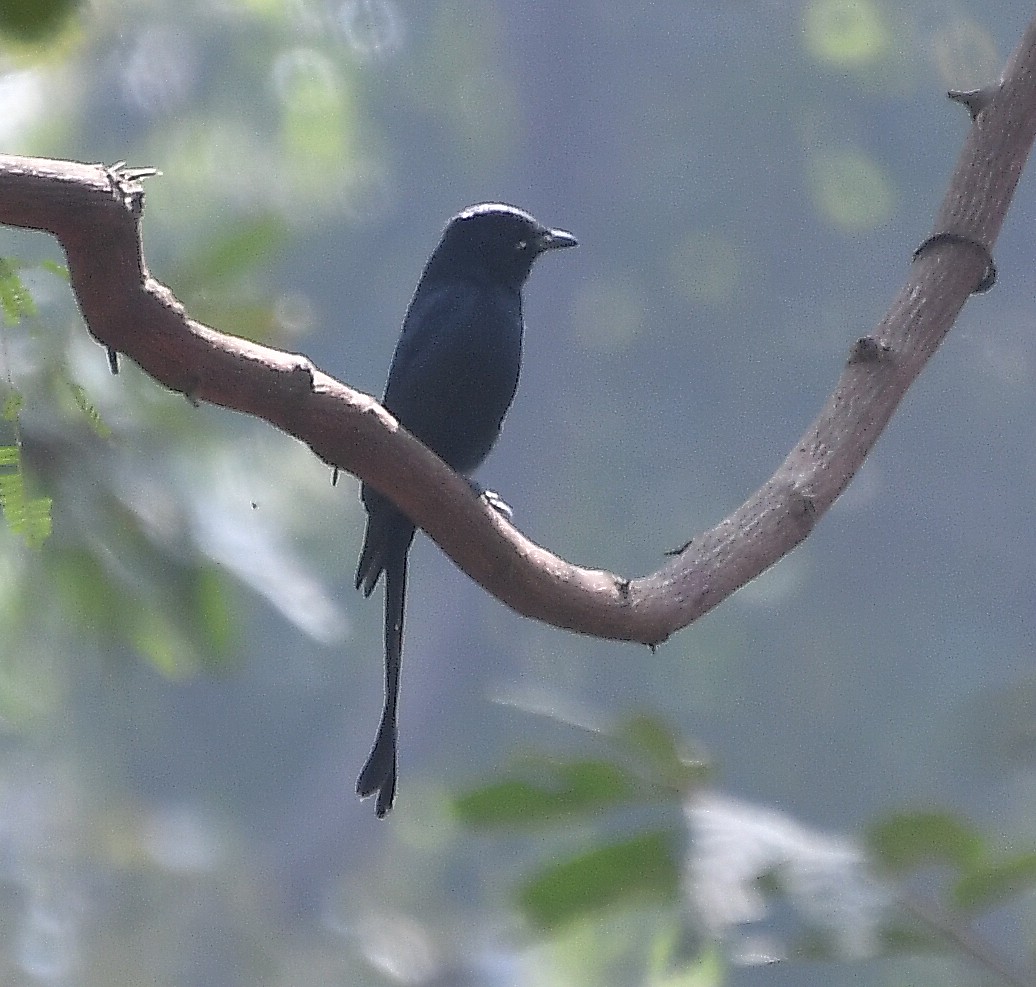
On our way driving back up the forest road to the Kanha Earth Lodge, I spot the Greater Racket-tailed Drongo – the bird I have been dying to photograph – and our guide pulls over. We become engaged in chasing after this bird, then another, then a staggering array of birds: a scarlet minuet (male), a black-hooded Oriole, a Lesser Golden-backed woodpecker – more birds in this small area than you might see in an aviary. He tells us it is a hunting flock.
While seeing leopards or tigers might be the brass ring, just being on this carousel is sheer delight – the number and variety of animals we see at close range, the birds, even the insects are fascinating.
Kanha National Park Kanha, one of the first tiger reserves established by India under Project Tiger (1973), is also one of India’s largest National Parks, encompassing nearly 2,000 sq. km of deciduous forest, grasslands, hills and gently meandering rivers and home to literally hundreds of species of animals and birds. Prior to this, the whole area was one enormous regal hunting ground, its game the exclusive preserve for high-ranking British army officers and civil servants seeking trophies for their colonial bungalows. One vast plain where we see a herd of deer used to be a village of 500 people, who were relocated when they created the park.
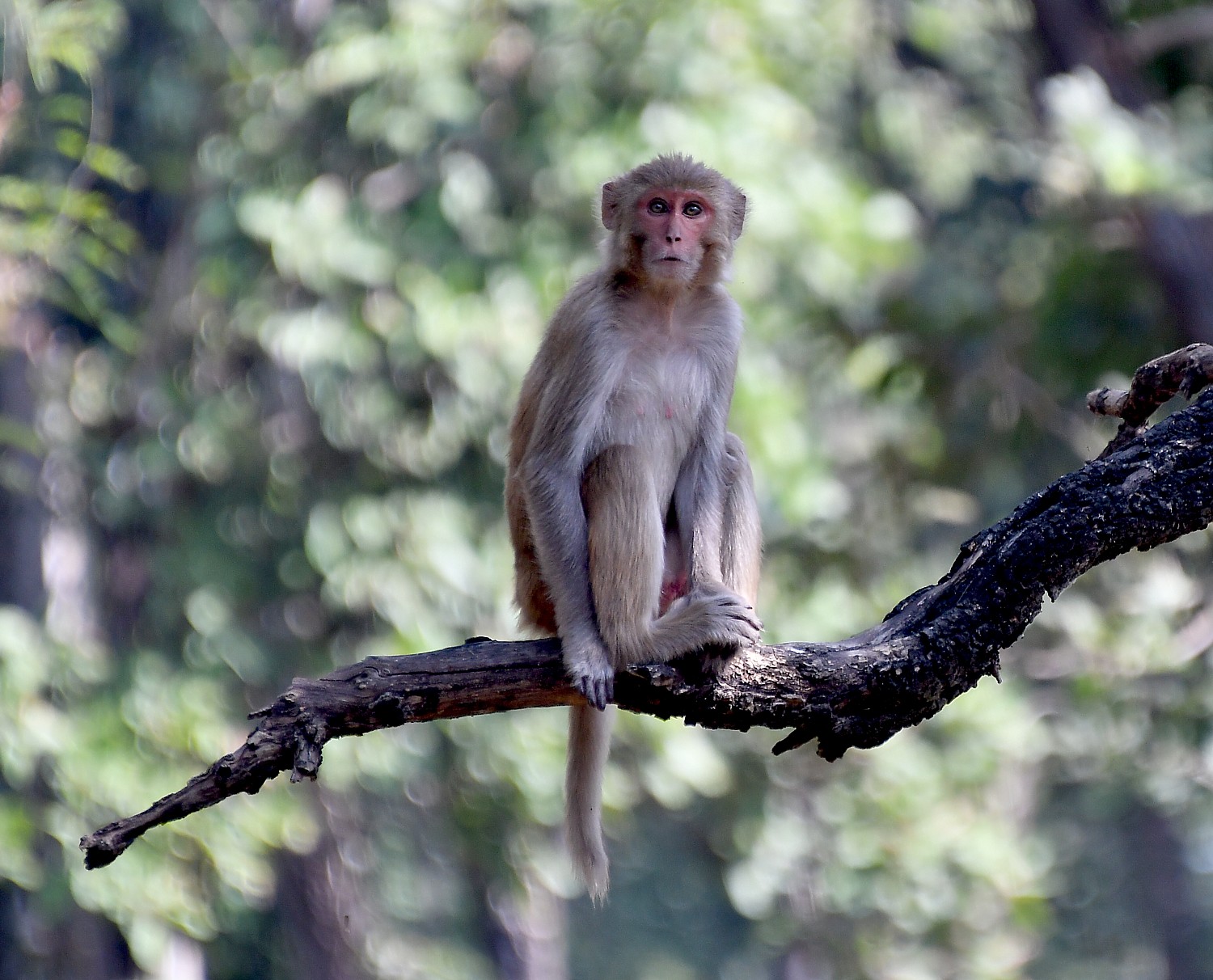
This picturesque reserve presently boasts of having large tiger population, as it has the ideal habitat. The meadows (called maidans) are surrounded by thick forests that create ideal grazing spots for the hundreds of chital deer, barasingha and sambar deer, which means they are ideal hunting ground for tigers, leopards, jackal and wild dogs (all of which we get to see). Kanha offers the last remaining habitat of the hard ground barasingha (swamp deer), which was brought back from the brink of extinction (which we get to see). During our visit, we also get to see many of the other animals that live here: wild pig, Rhesus Macaque, Langur monkey (my favorite). I think I even got a glimpse of a gaur (Indian Bison) before it retreated into the woods.
Other animals that are here but we don’t get to see include sloth bear, striped hyena, muntjacs (barking deer), chousingha (four-horn antelope), jungle cat and mongoose.
This diverse landscape also supports more than 250 species of Indian birds including migratory species. The Indian jungle fowl, which is the ancestor of domestic hens, is common here.
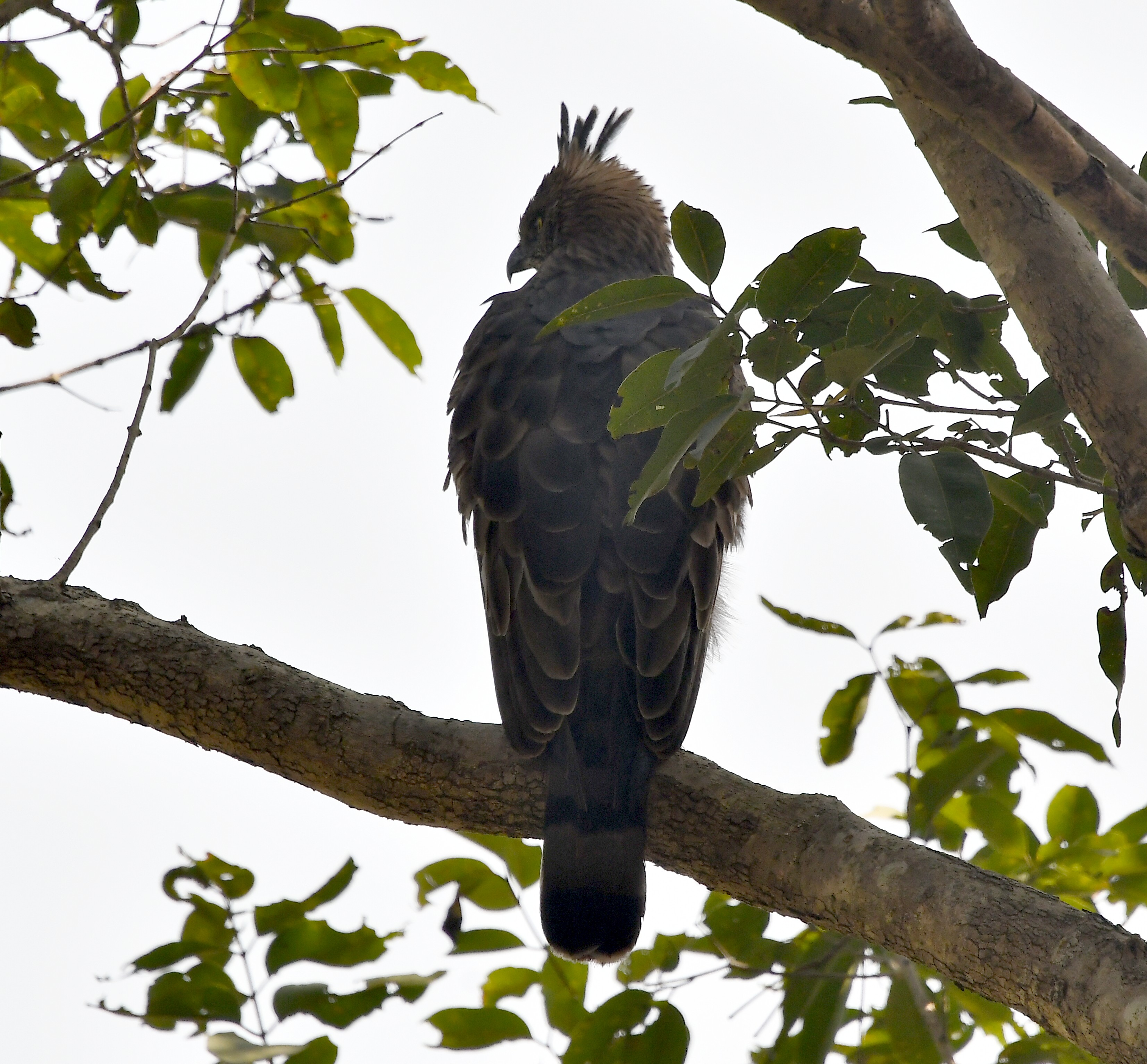
For bird watchers and photographers, Kanha’s diverse landscape also supports more than 250 species of Indian birds including migratory species, a mind-boggling number we actually get to see during our brief time: Green Footed Pigeon, Pygmy Woodpecker and Tickell’s Blue Flycatcher. Little Minivet, Scarlet Minivet and Long Tailed Minivet can be seen at Parsa Toala grasslands. Resident common raptors as the Crested Serpent Eagle, Crested Hawk Eagle, Crested Honey Buzzard, White Eyed Buzzard, Shikra and Common Kestrel can be sighted hunting and nesting in tall trees.
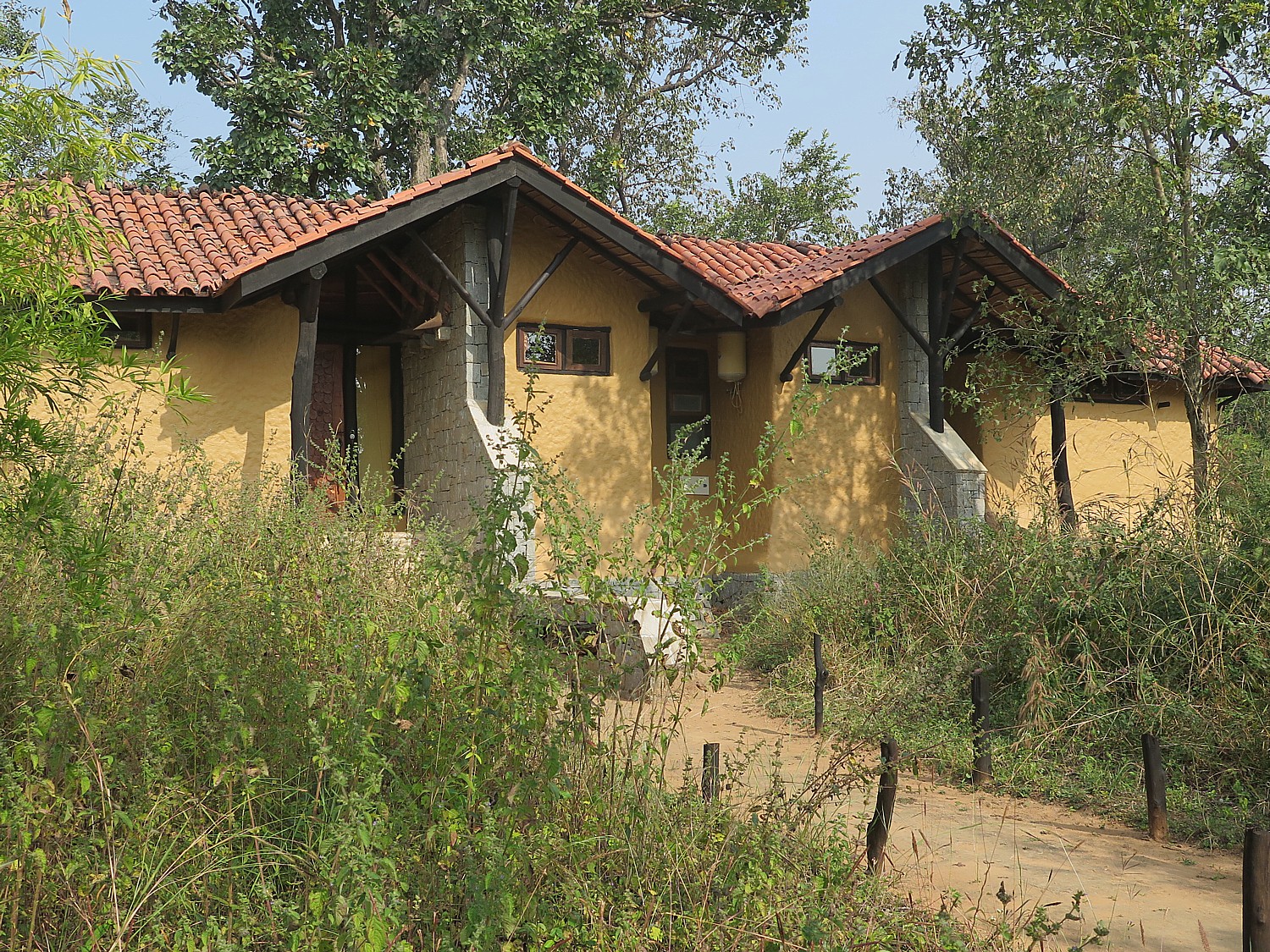
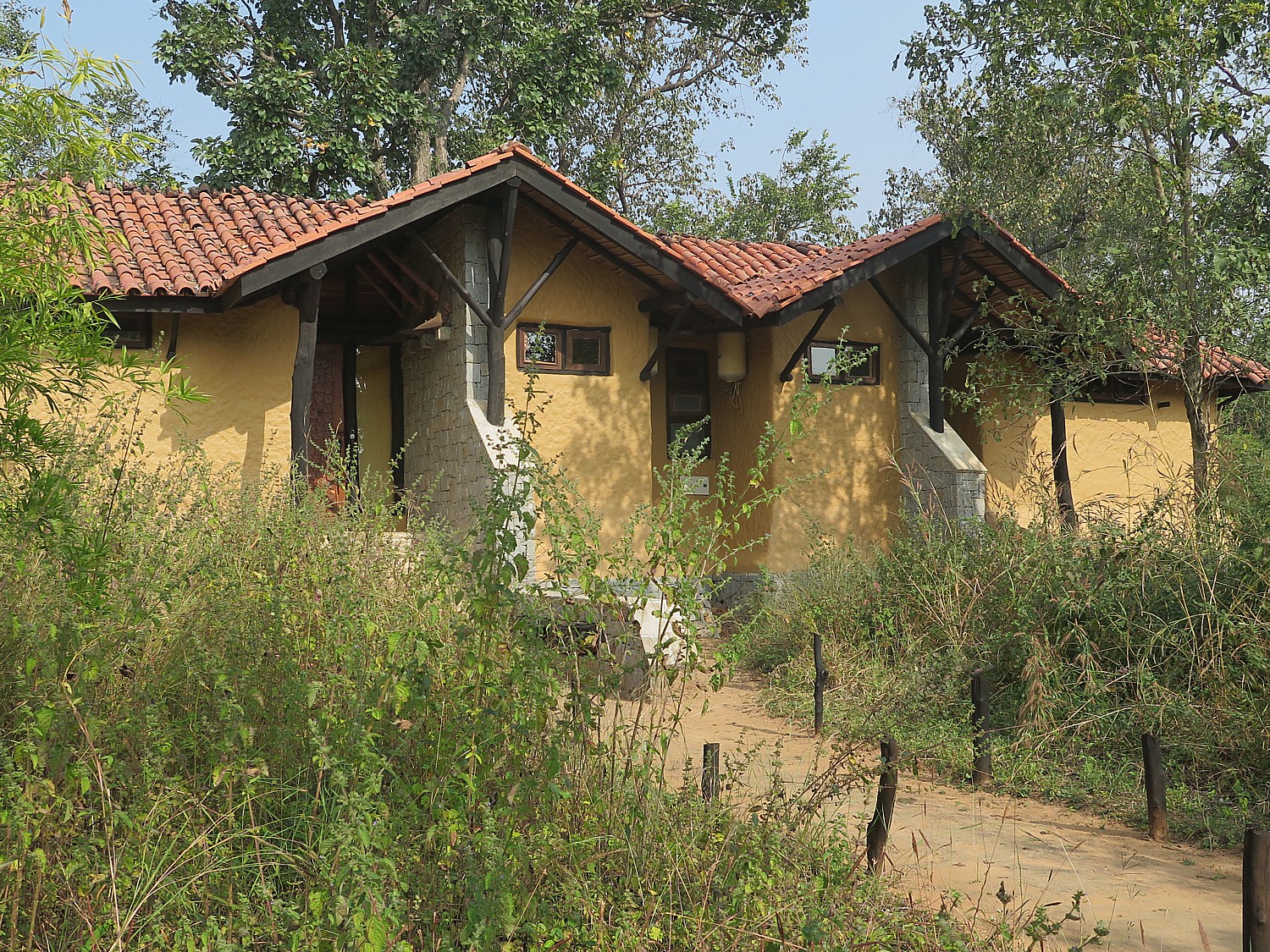
Like the Pench Tree Lodge which we enjoyed during our time at the Pench National Park, the Kanha Earth Lodge (www.kanhaearthlodge.com) enhances our safari experience. It is also an ecolodge made of all natural materials that is stunning in its design that blends so perfectly without adverse impact on the environment, uses local and traditional art (there is even a fellow who paints tigers), has its own organic garden and a lovely swimming pool, a stunning lodge (WiFi available in the office), and each night, offers fascinating presentations by a naturalist about the wildlife and the national park, while serving appetizers.
The dining room reminds me of a castle, actually, with the stone and wood, vaulted ceiling, candelabra and local artwork.
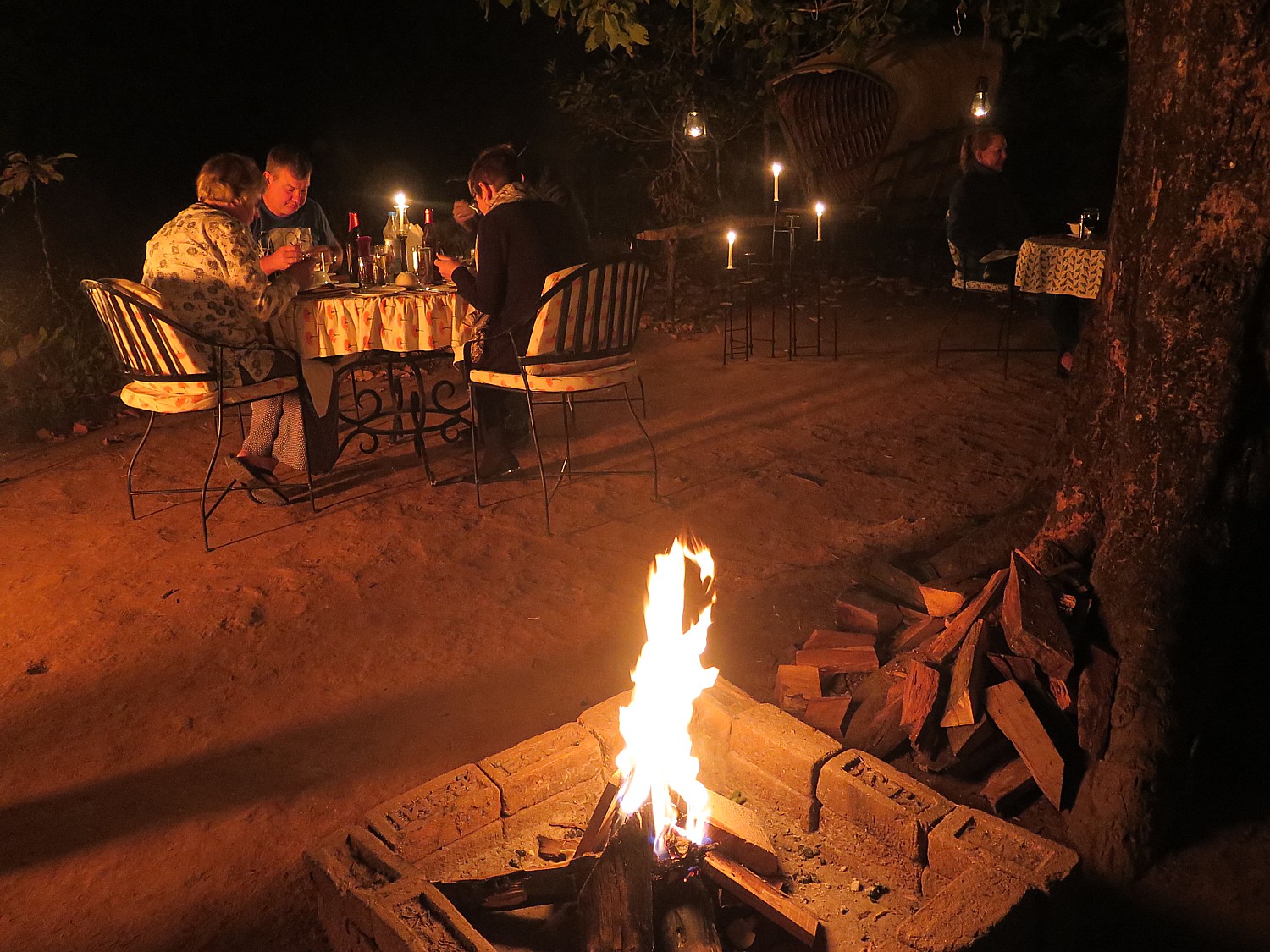
One evening, dinner is served outside in a garden by firelight. The food –and presentation – is superb.
The service is impeccable, which you note immediately with the staff on hand as our van pulls up, with moist towels and a refreshing beverage. The lodge supplies coffee and tea and bottled water in the rooms. When we leave for our game drives at around 5:15 am, they have coffee and tea and biscuits on hand, blankets and even hot water bottles for us in the jeeps.
The room is actually an entire villa, with massive living spaces and has its own patio that faces out to the forest.
In the evening, with the turn-down service, they provide a hot water bottle, and we are told that our rooms are inspected for possible intruders which might have hidden away in dark places.
The lodge is located away from a very busy tourist area – you feel you are in the national park – but very close to villages and farms, so you feel very much a part of the local culture. At night, we hear drumming of a festival.
Both ecolodges (only operated October to June) that we enjoyed are part of Pugdundee Safaris (www.pugdundeesafaris.com), which operates six ecolodges (Kings Lodge and Tree House Hideaway in Bandhavagarh; Denwa Backwater Escape in Satpura; Ken River Lodge, Panna; as well as Barahi Jungle Lodge in Chitwan, Nepal) as well as wildlife safaris, which means a kind of seamless quality.
Royal Expeditions new “Jungle Book Wildlife Safari and Cycling Adventure” is set in the land of Rudyard Kipling’s fantastic tale of Mowgli, the boy raised by wolves, and his nemesis, Shere Khan, the tiger. During the course of our six days at Pench National Park and Kanha National Park, in central India, we see many of the characters that populated his story and the landscape (“jungle” is the Hindi word for forest) in which they thrived. And much to my amazement, I learn that there may be some truth to the fantastical adventure.
Over the course of our six days – three each at Pench and Kanha – we are scheduled for four game drives, and I soon realize why you need multiple chances if your goal is to spot a tiger: they are really hard to spot.
Even without spotting a tiger, each game drive is its own adventure – the landscape of verdant, forest, the serendipitous encounters with animals not even a stone’s throw away, with nothing between you and them. And never knowing what you will encounter and when, or what’s beyond the next bend.
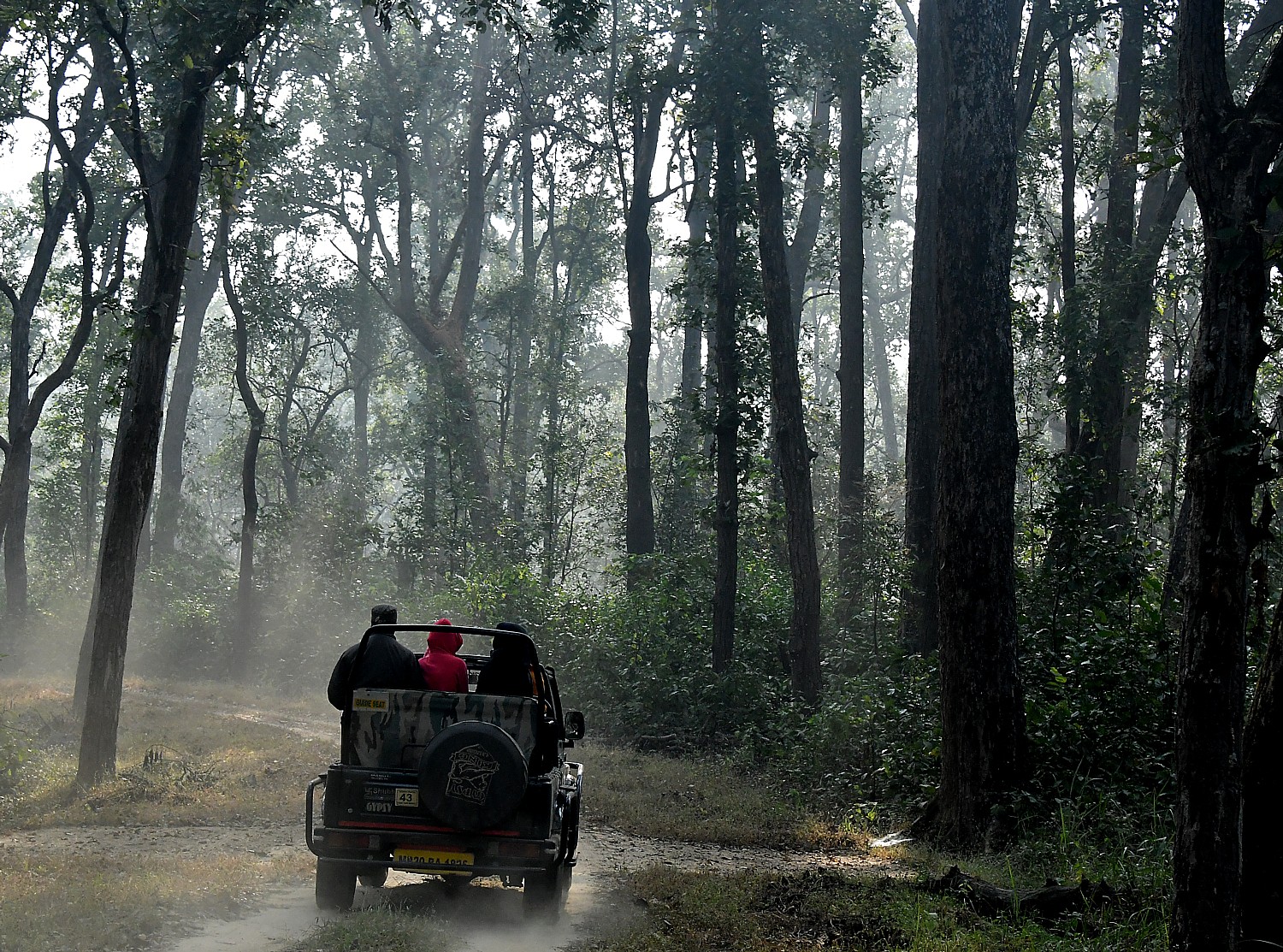
The “hunt” is thrilling: the way the guides track the tigers, looking for tiger tracks in the sandy trail, stopping where the trails cross to listen for “alarms” from the langur monkeys, or the signs of urgency from the herds of spotted deer (their tails go up when they are anxious). When the guides think they hear an alarm, they take off at fast speed, leaving us to bounce around and hold on to avoid being thrown out of the open vehicles.
In all my years as a travel writer, this is my first wildlife safari, so the experience is completely new. I am told by my fellow travelers who have much more experience doing safaris in Africa (but never before in India), that there are certain similarities to the structure, the way you experience the animals, largely because of the topography, is very different.
The first thing that is surprising is how early we get up: 4:45 am for a 5:30 am departure, sending us off with hot coffee, tea and biscuits, in order to be lined up at the entrance to the park by the 6 am opening (we will have a full hot breakfast in the park at around 8:30 am, which is an experience itself). It is quite cold – we dress in layers and the Pench Treehouse Lodge gives us blankets (Kanha National Park, at a higher altitude, is actually colder and the Kanha Earth Lodge where we stay next gives us a hot water bottle along with a blanket).
We line up with perhaps 40 other safari vehicles, while our driver (who is also the lodge naturalist) brings our permit (we have to be registered in advance) and shows our passports . We are assigned a park guide and one of four zones where we can explore (only 292 sq km of the 1180 sq km Pench Tiger Reserve is open to the public). Our vehicle comes from the lodge but when additional ones are needed, they hire locals who have their own safari vehicle.
Access to the parks is heavily restricted because they are already overrun with tourists – about 90% of them Indian people versus foreign tourists (and these are mostly British, with a smattering of Europeans and Americans).
As we enter, there is this incredible scene as we watch the orange globe of the sun slowly rising just in front of us and spreading its light through the moisture of the trees.
We are lucky on our first drive – my group gets to spot a leopard on a ridge poking out from bushes (the others in our group, in another vehicle, weren’t so lucky). The leopard is there for a few moments but I manage to get off some shots. Leopards are particularly hard to spot – they are called the “ghost” of the jungle – because they primarily hunt at night.
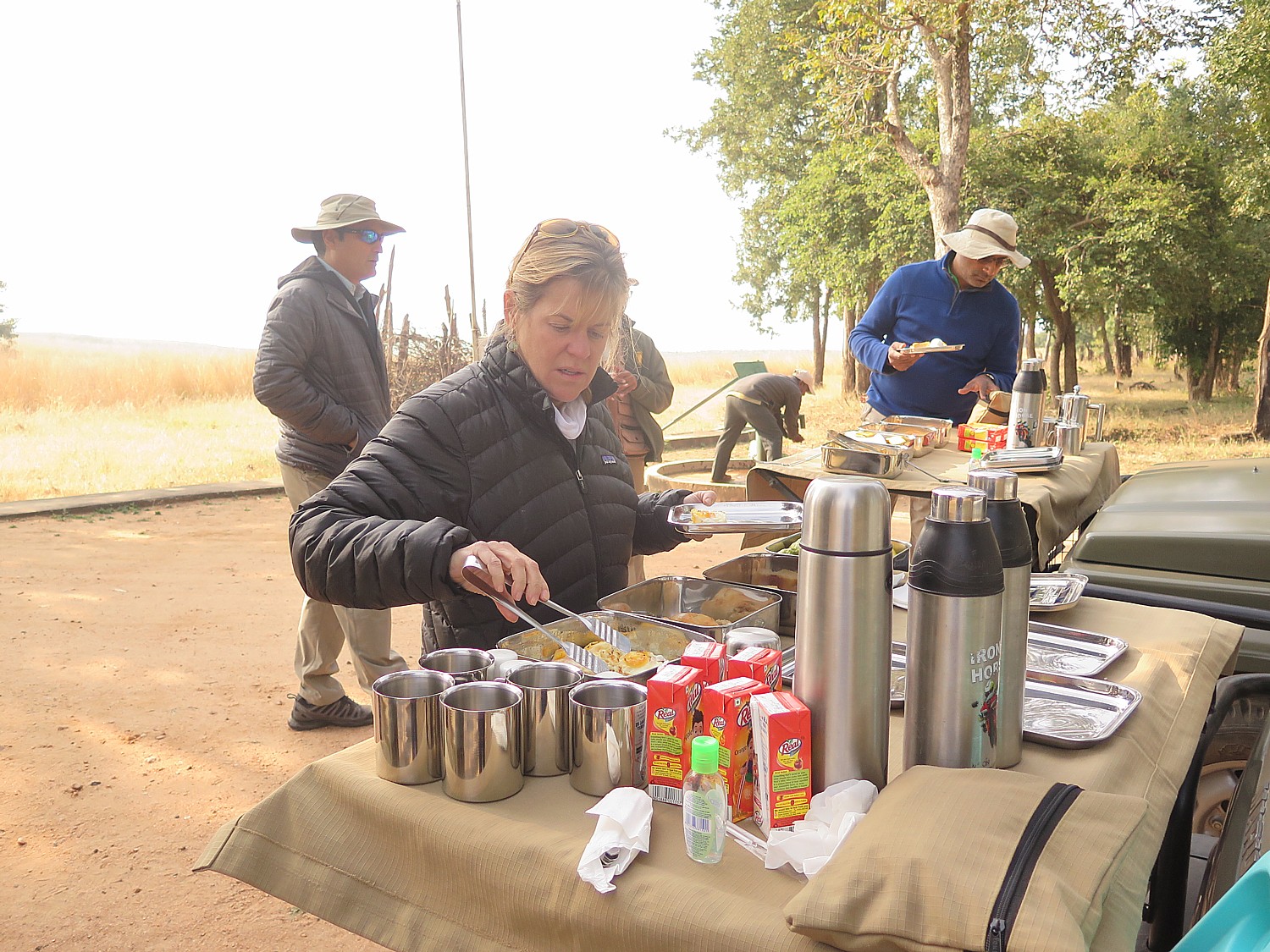
Around 8:30 am, we gather at an appointed place for breakfast – a fantastic meal the lodge has sent along with sunny side-up eggs, pastries, coffee and tea, fresh fruits and juice – which we enjoy in an open area where we see the lake that separates the two national parks, and a vast open area where there is a herd of deer and an assortment of birds. (All the safari vehicles follow the same routine, stopping at around 8:30 am to provide breakfast for their guests.)
Continuing on, we spot a group of jackals – one has a bone in its mouth and makes displays of dominance.
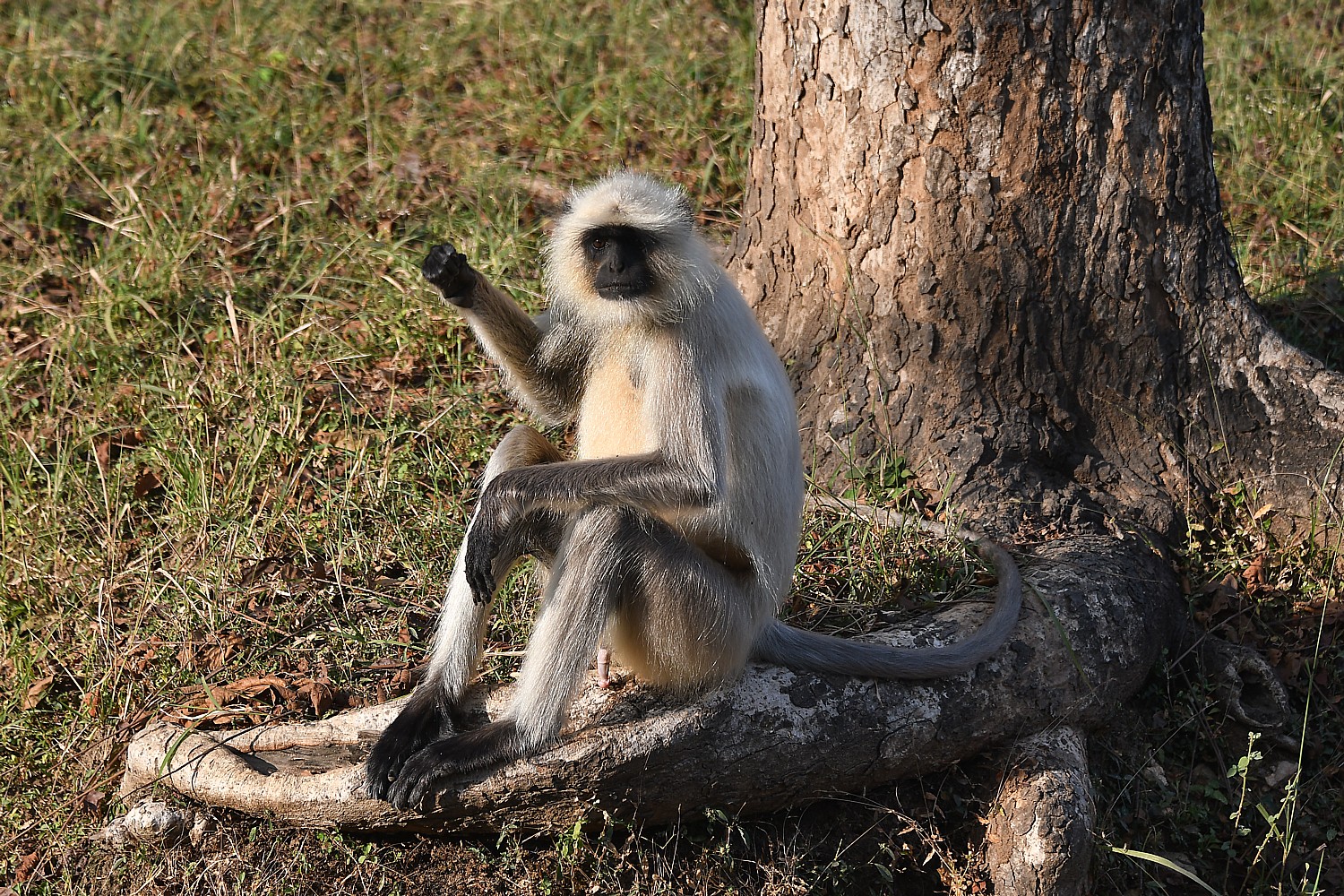
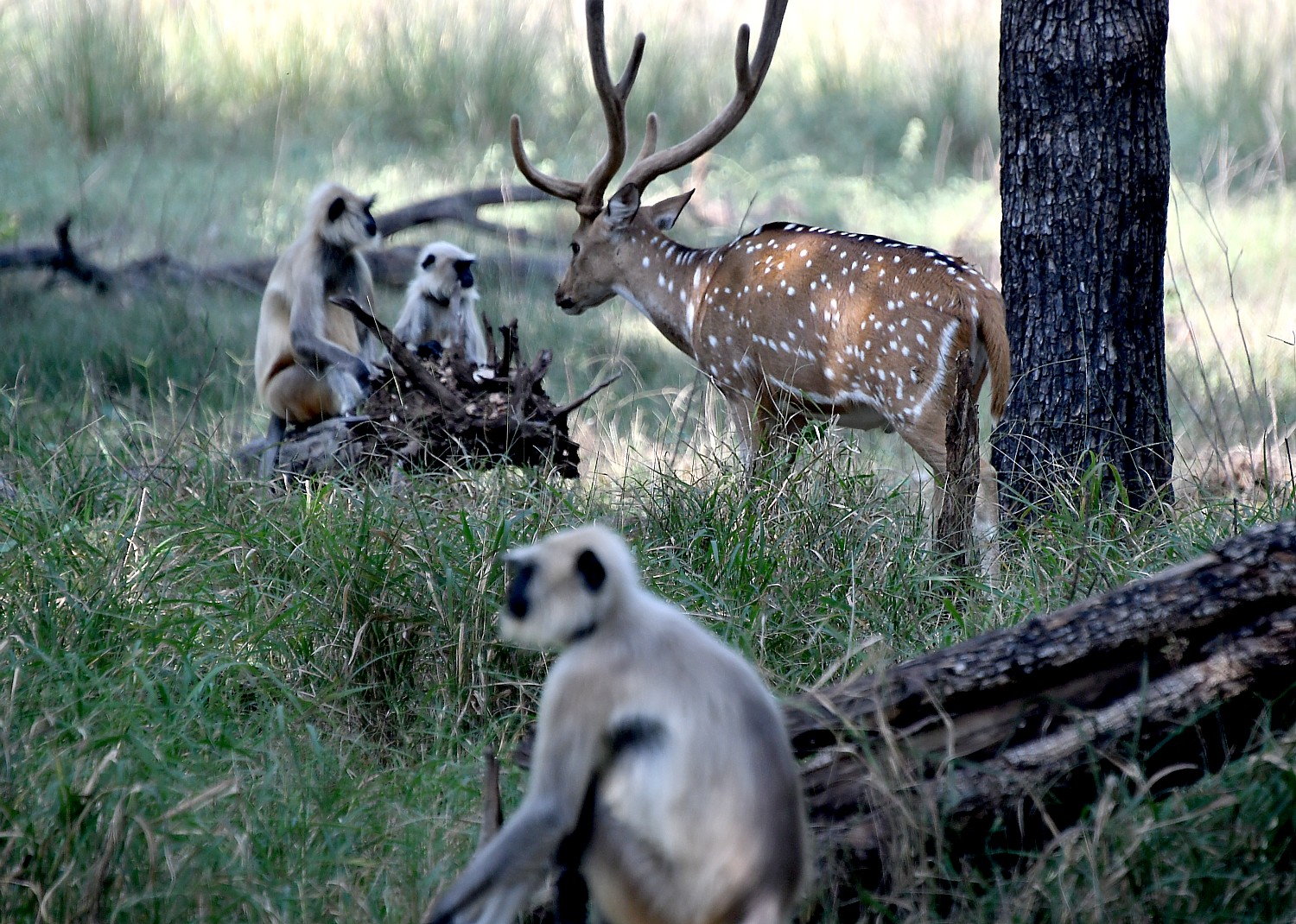
We come to an area with langur monkeys (my favorite jungle inhabitant) – with black faces with defined, expressive features and silvery fur. One sits on a tree root, posing like an old wise man (Jack Benny also comes to mind). Later we find a group of langur monkeys together with a herd of spotted deer.
“They are best friends,” Sagor Mahajan, our naturalist from the Pench Treehouse Lodge, tells us. There is a symbiosis between them: the langur sends down leaves and fruit from the trees for the deer to eat and sends off alarms when a predator approaches, while the deer are easier prey than the langur.
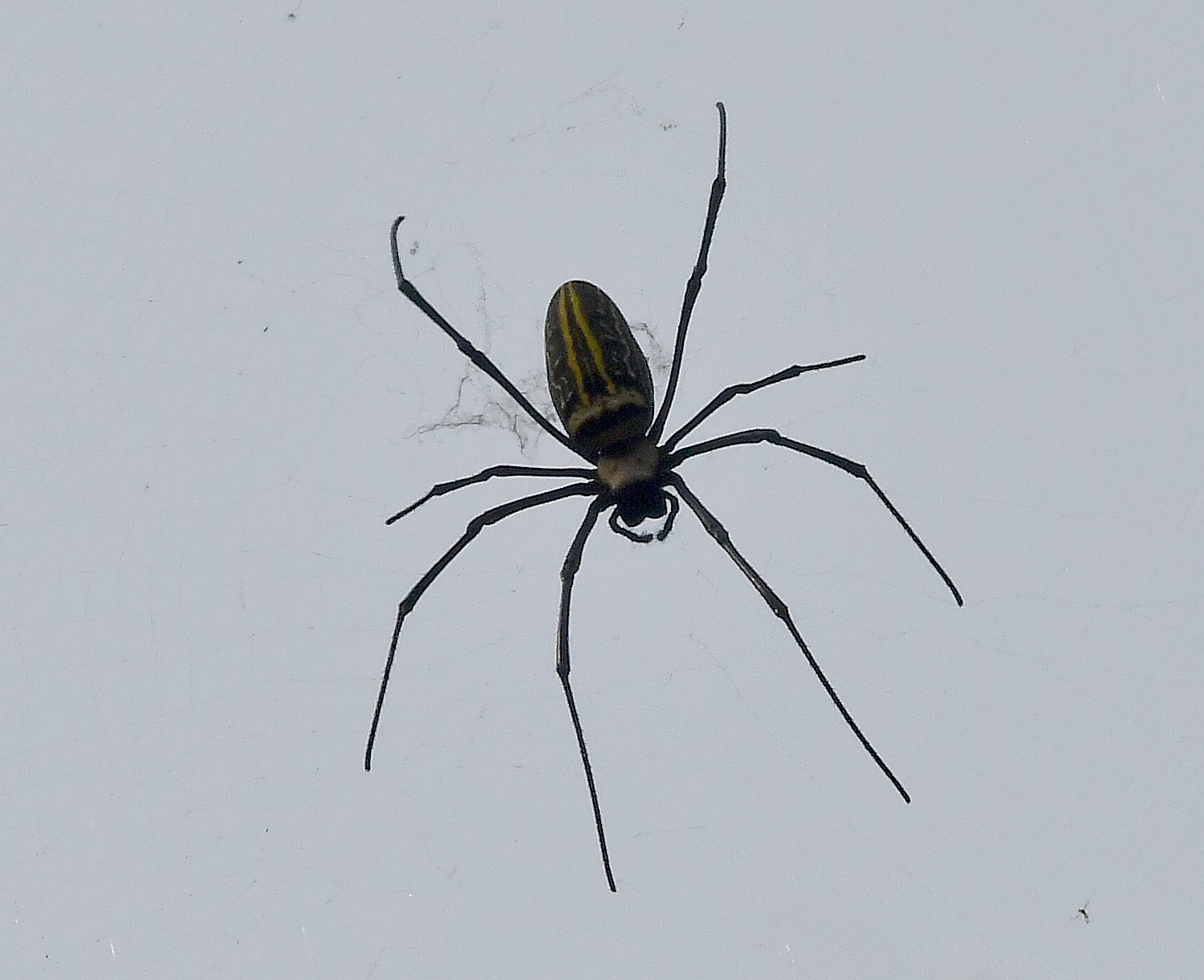
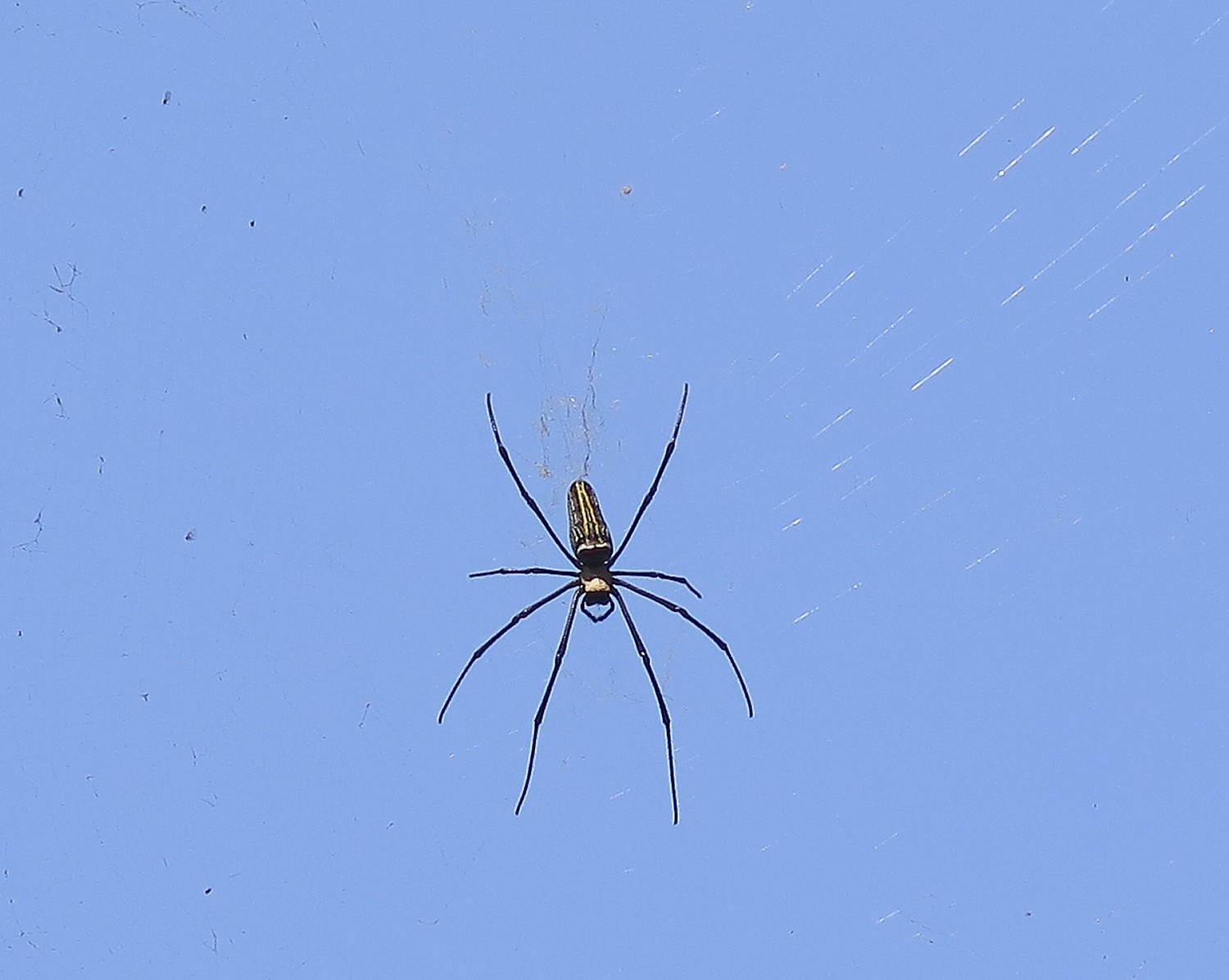
We drive under a massive spider web with a giant wood spider (that’s its name, and for good reason– black and yellow stripes, perhaps 2-3 inches wide. Sagor tells us that the male is tiny by comparison and that the female eats the male after they mate (unless she has something better to eat). For once in my life, I am more fascinated than fearful seeing such a creature so close at hand.
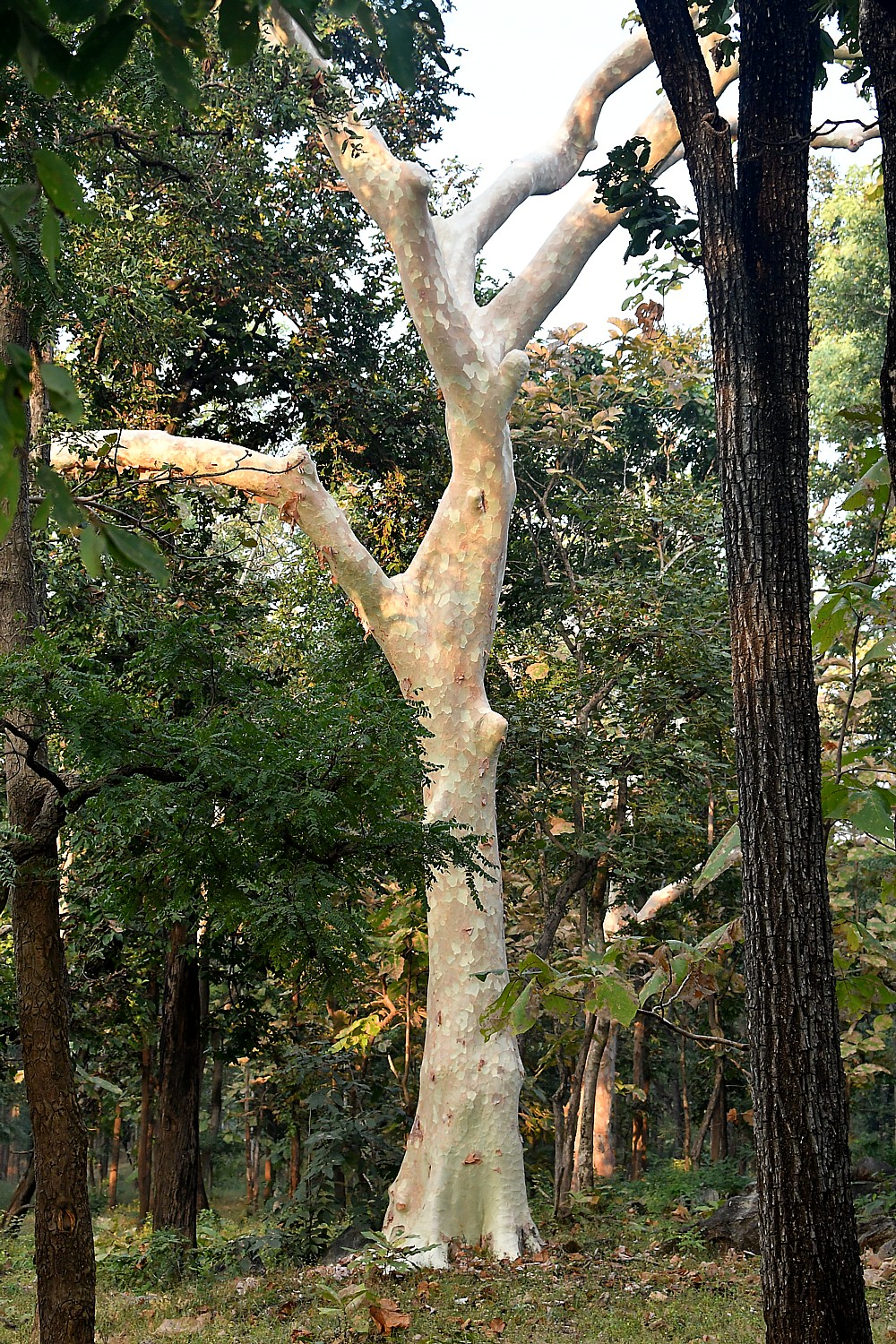
He points out the “ghost tree” – it is starkly white, standing apart from the other trees. This tree changes color with the seasons– white, red, green; it gets its name because especially in the moonlight, it looks like a ghost walking in jungle, its tree limbs looking like arms flailing about wildly; the wood is used to make toys and musical instruments and the gum is used as a laxative and as a thickening agent. “People used to eat the roasted seeds when they were hungry,” he says. He points out the “crocodile tree” – Saga- with bark that resembles a crocodile’s hide. “The tribe here worships the tree; if there is no water, they harvest water from the Saga tree.”
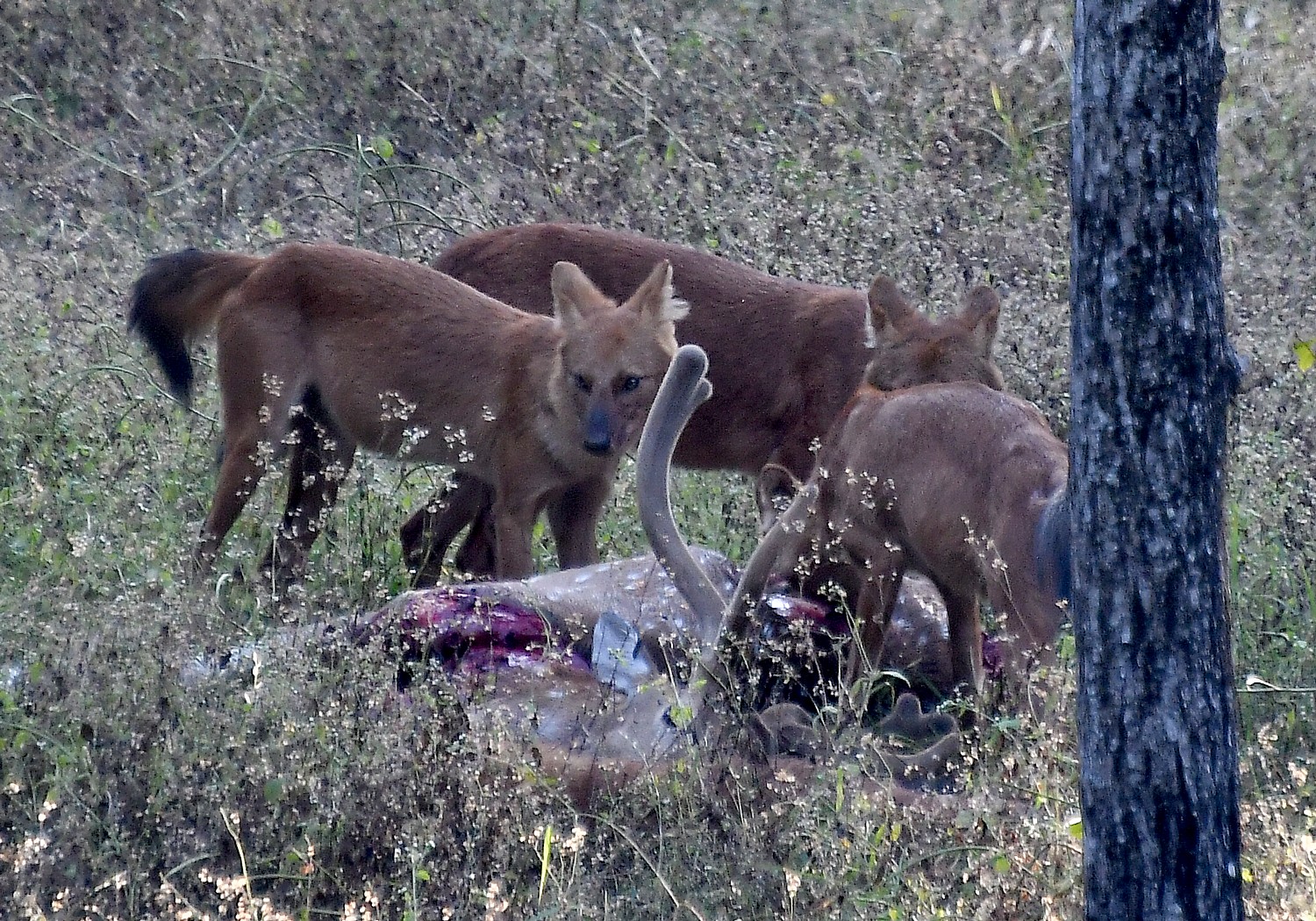
We come upon a pack of wild dogs – actually a rare sight – devouring a deer carcass. It is amazing to watch their teamwork: a couple stand like sentries, facing out, while the others tear at the carcass, switching off. Watching the dogs, I wonder why we don’t see more bones around – I learn that the bones are degraded by bacteria and fungus, taking about a year before they are reduced to nothing.
There are 60,000 spotted deer in Pench – the largest concentration in India – in fact, too many, we are told. But they provide the food source for the tigers, leopards and other predators.
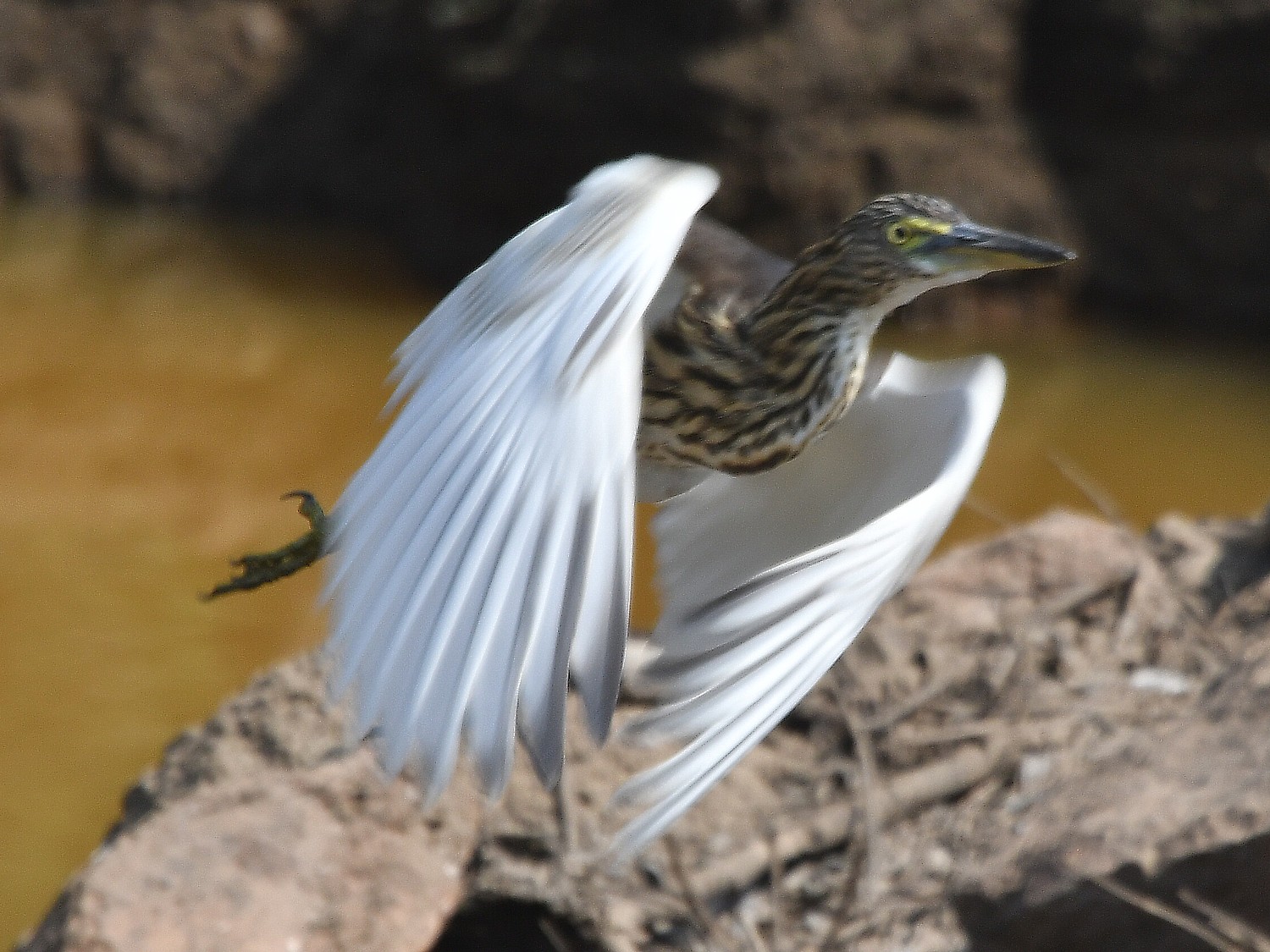
The profusion of birds is unbelievable: in the course of our visit, we see most of the “star attractions”: the Greater Racket-tailed Drongo (my favorite, a blue-black bird with two hanging tails); the White-rumped Shama, the Gold-fronted leafbird, the Indian Roller, the streak-throated woodpecker, the Changeable Hawk-Eagle, the Coucal (big bird, brown and green, red eye), peacocks (they sleep in trees at night; the male loses its feathers during monsoon, then grows new ones), the white-eyed buzzard, the Indian Pond Heron (also called “magic bird” , it looks white when it flies); green parakeet; Crested serpent eagle (feeds on snakes); the Rufus tree pie (known as a tiger bird because has the same colors); and the Red Jungle fowl (the first chicken in the world) and the Crested serpent eagle (feeds on snakes).
Sagor says he has personally spotted over 100 species in Pench; there are over 200 in the region.
It is amazing to me what an eye Sagor, our guide, has – he spots two tiny Indian Scops owls the exact color of the knot-hole in a tree, and stops the vehicle. We can barely see it.
He tells us that Pench, which is named after a nearby river and was designated a wildlife sanctuary in 1983, has about 43 tigers. That they are methodical (something that helps poachers): they are out until about 8:30 am, then sleep until evening in the winter. They only live about 13-14 years.
Only 292 sq km of the 1180 sq km Pench Tiger Reserve is open to the public as Pench National Park, on the border of Madhya Pradesh and Maharashtra states, where a number of endangered species are protected. The tiger is the dominant predator here, The other predators include leopard, dhol (Indian Wild Dog), wolf, hyena, jackal and jungle cat. The prey species include chital (spotted deer), sambar deer, muntjac, gaur, wild boar, langur monkey and rhesus macaques. There is a rich birdlife with over 300 recorded bird species, including parakeets, hornbills, kingfisher, barbets, minivets, orioles, wagtails, and a host of raptors; the crested serpent eagle, crested hawk eagle and white-eyed buzzard. (Amazingly, we see most of these during our visit).
The Real Jungle Book
On the way into Pench National Park for our morning game drive, as we pass villages, Sagor Mahajan, the naturalist from the Pench Tree Lodge, tells us that though this is land is the setting for Kipling’s Jungle Book, Kipling never actually visited here –it was his father who spent time here and inspired his son with his stories. But then Sagor shocks me by saying that the story could have had a basis in fact, of an actual boy brought up by wolves.
“There are two stories about Kipling: in the first story, Rudyard Kipling’s father visited often, loved it, and would narrate stories to Rudyard – that’s how young Rudyard Kipling was inspired, but never visited,” he tells us as we rumble along the road.
“In the second story: two British guys roaming around a nearby village learned of a story about a young boy who was rescued, who had been brought up by wolf pack. He couldn’t speak human, walk like a human, nothing about him was like a human. The boy was actually found and rescued, but he died two or three years after. Both of them wrote separate books about it.” Kipling, he says, likely read the stories.
This is utterly fascinating – but surely, such a fantastical legend must be part of that village’s folklore, passed down from generation to generation?
I’m intrigued enough to do my own research, finding an article in the Times of India by a reporter who did trace the original stories and visited the village.
While Kipling’s was a work of fiction, it’s said to have been inspired by Sir William Henry Sleeman’s pamphlet, An Account of Wolves Nurturing Children in Their Dens, which describes a wolf-boy captured near Seoni in 1831. Sleeman was a British soldier and administrator and is known for his work in suppressing thuggery. We found a mention of the wolf-boy named ‘Seeall’ in Mervyn Smith’s Sport and Adventure in the Indian Jungle, which describes his capture and behaviour in captivity. “I have reason to believe that he was the original of Rudyard Kipling’s Mowgli,” the author writes.
Mowgli is still a “pervasive theme” in the district – there are caricatures on bus stands, an annual Mowgli Mahotsav, Keswani finds, but is not, apparently, a folk story that is widely shared.
“The only clue is talk about a cave on the outskirts of Kanhiwada, a village that finds mention in the original tale,” Keswani reports. But in his investigation, he could not find any local people to give credence to it.
“In the book, Mowgli may have been the target of Shere Khan, but today the tigers of Pench are the ones in danger,” he writes.
While we don’t actually see any wolves, we do get to see a pack of wild dogs tearing apart the carcass of a deer, and over the course of our visits into the parks, see many of the animals that animated the Jungle Book characters. But after our three game drives in Pench, we have yet to see the tiger. But we still have our visit to Kanha National Park, where we go next.
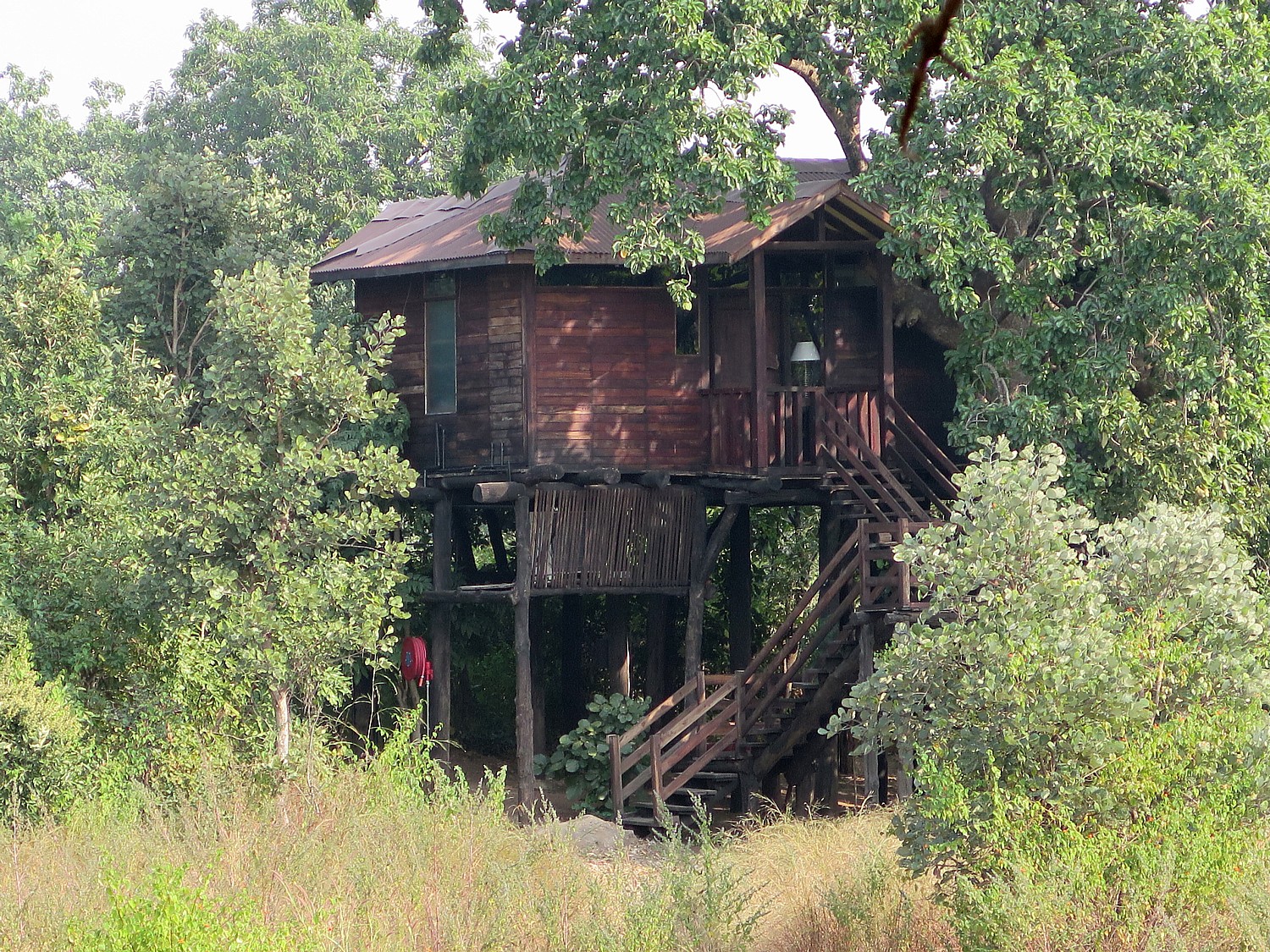
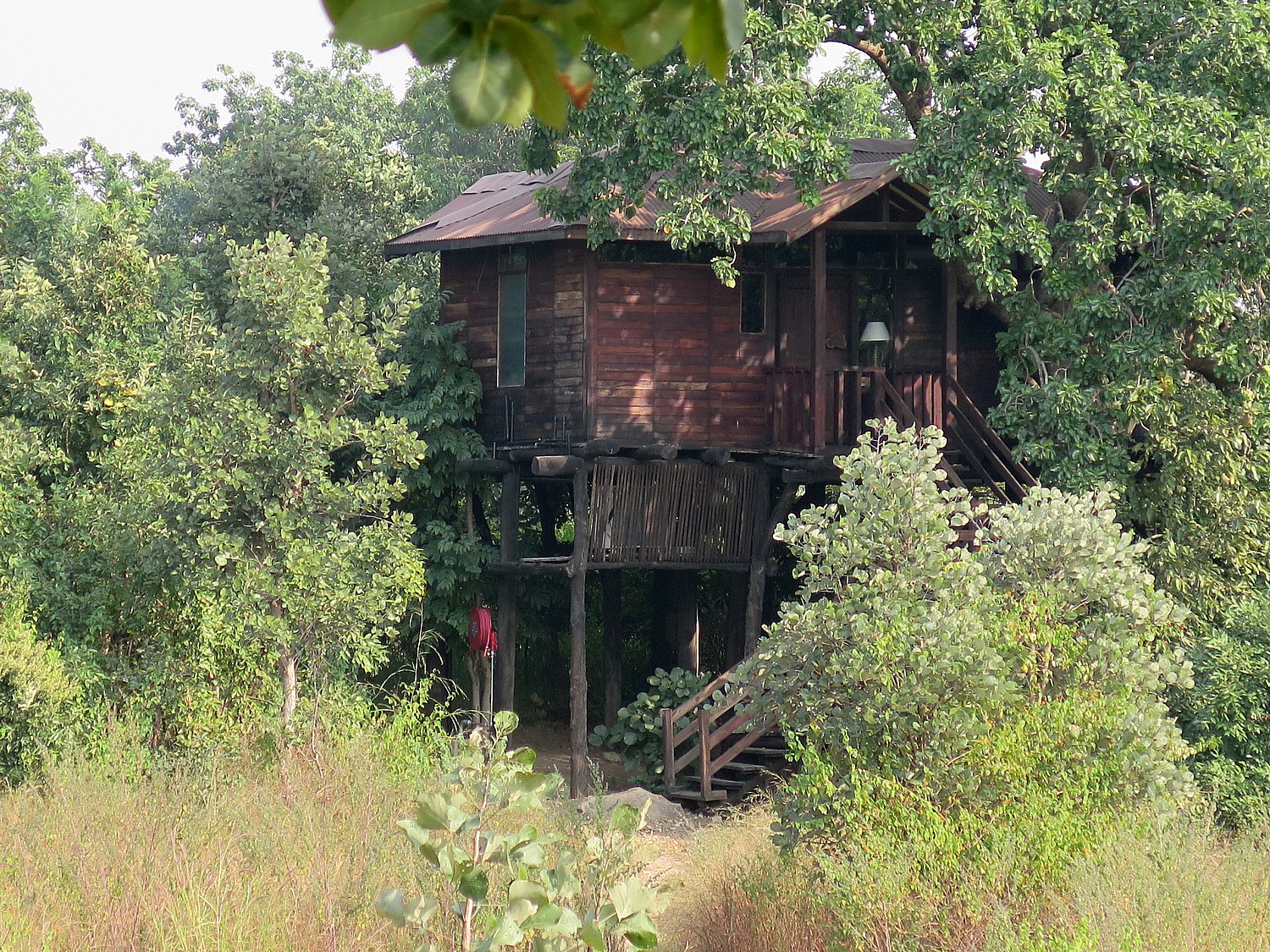
What makes the experience all the more special are the accommodations: Pench Tree Lodge (www.PenchTreeLodge) which only opened in 2016, is literally a tree house, built of all natural materials, but with stunning design, local and traditional art, and every comfort and amenity you could crave. There are just six of these tree house accommodations spread over 16 acres.
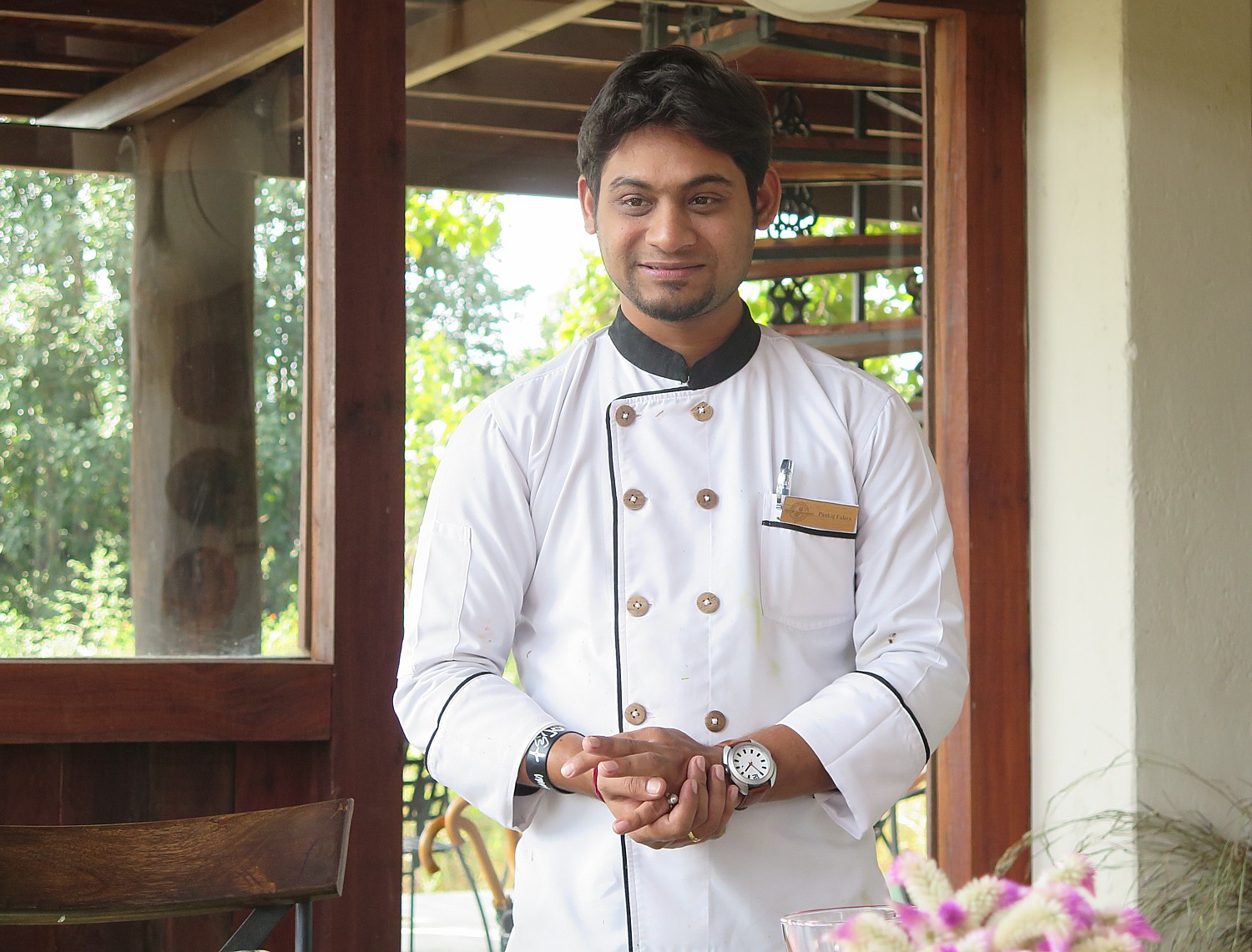
There is a gorgeous dining lodge and the restaurant is headed by sensational chef, Chef Pankaj Fulera who was runner-up for Best India Chef) who is equally adept at traditional Indian cuisine as a fusion Continental (cooking classes and a tour of the kitchen can be arranged). Every dish is served with stunning presentation. The dining lodge has two different dining rooms, plus a lounge area.
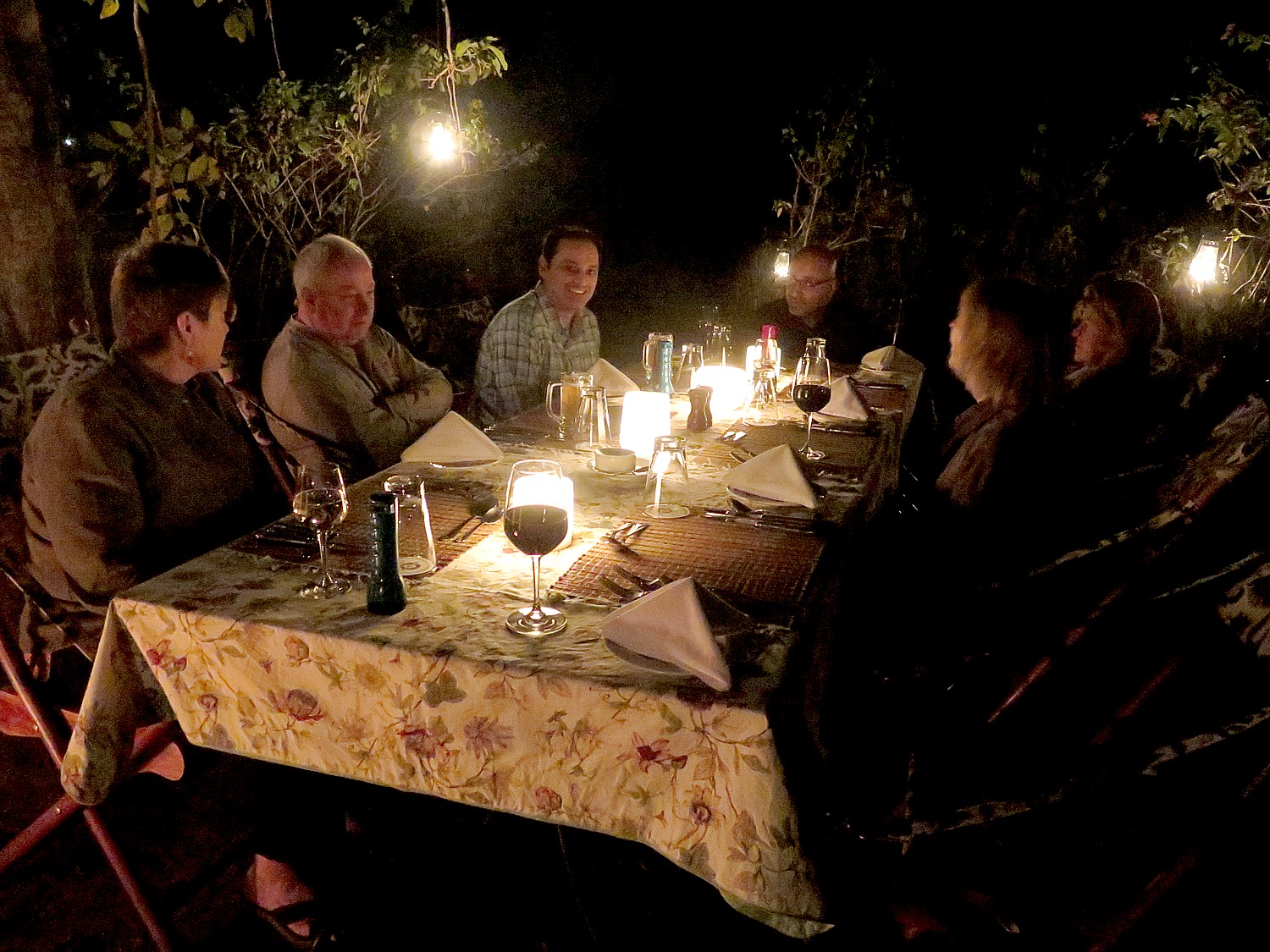
One night, our dinner is served outside, under a tree that I have taken to think of as The Tree of Life. The atmosphere is breathtaking. We are there just as they are replanting the lodge’s organic garden, which supplies the kitchen.
Our tree houses have a balcony (mine has an enormous Mahua tree, the dropped leaves of which are turned into a liquor), and a stunning bathroom.
They both are absolutely perfect- luxurious, comfortable, sophisticated and gorgeously designed, but designed to blend perfectly with the environment, and support the local tribal people. They enhance the experience.
There is also a fantastic lap-size swimming pool (so much fun to swim and watch the green parakeets flying above).
Pench Tree Lodge offers impeccable service, which you note immediately with the staff on hand as our van pulls up, with moist towels and a refreshing beverage – cold when it is hot in the afternoon and hot when it is cold at night. You really get some of that vibe as if we were a royal hunting party (okay, we are out for photos, not trophies).
Our rooms are supplied with coffee, tea and bottled water (flashlights, too). When we leave for our game drives at around 5:15 am, they have coffee and tea and biscuits on hand, blankets in the jeeps.
At the Pench Tree Lodge, between dusk and dawn, we must call for someone to escort us to and from our tree house (the lodge is, after all, contiguous with the national park, and I think it also has to do with snakes) and each tree house has a device that emits a high-pitched sound that can’t be heard by humans, that deters rodents from entering. We are warned that at night we might hear the sound of monkeys jumping on the roof and when that happens, I am grateful for the warning.
The dining lodge has two different dining rooms, plus a lounge area. (Cooking classes can be arranged).
One of the reasons Pench National Park is so popular with tourists is that it is the closest tiger park to a well-connected commercial airport in India -Nagpur is about 3 hours drive. Karmajhiri gate (where we stay at the Pench Tree Lodge) and Jamtara entrance gate of Park are at the furthest points, so get fewer visitors. More significantly, you really feel immersed in local life.
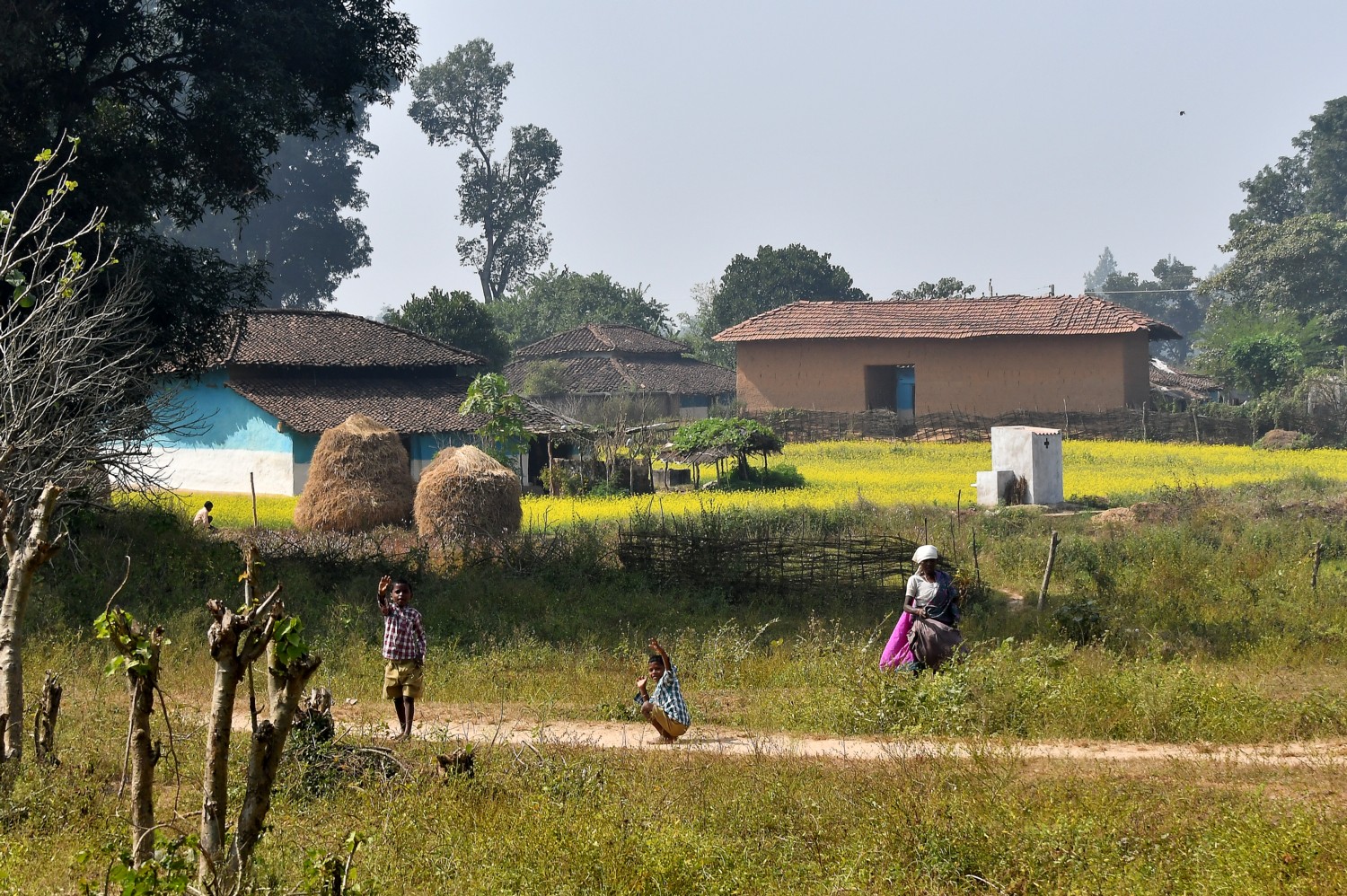
Apart from the wildlife, the Royal Expeditions “Jungle Book” tour also provides distinctive opportunity to experience rural life in India – the “soul of India” is in its villages, where 60% of the 1.2 billion people still live -and meet with local people who live in harmony with wildlife. Just how much in harmony? We see thatched, raised platform shelters so that the farmers sleep in their fields at night to guard against encroaching animals.
On our way back from our game drive in Pench, looking out over the fields being tended by farmers, Sagor Mahajan, our naturalist from the Pench Treehouse Lodge, tells us that the villagers here have lived here for generations – they are descended from people who migrated from South Africa in the 17th century.
I’m thinking how interesting that is, because of his description of the dragonflies we see, Wandering Gliders, which, he says, migrate back to South Africa, taking four or five generations to complete the trek, the longest migration of any insect.
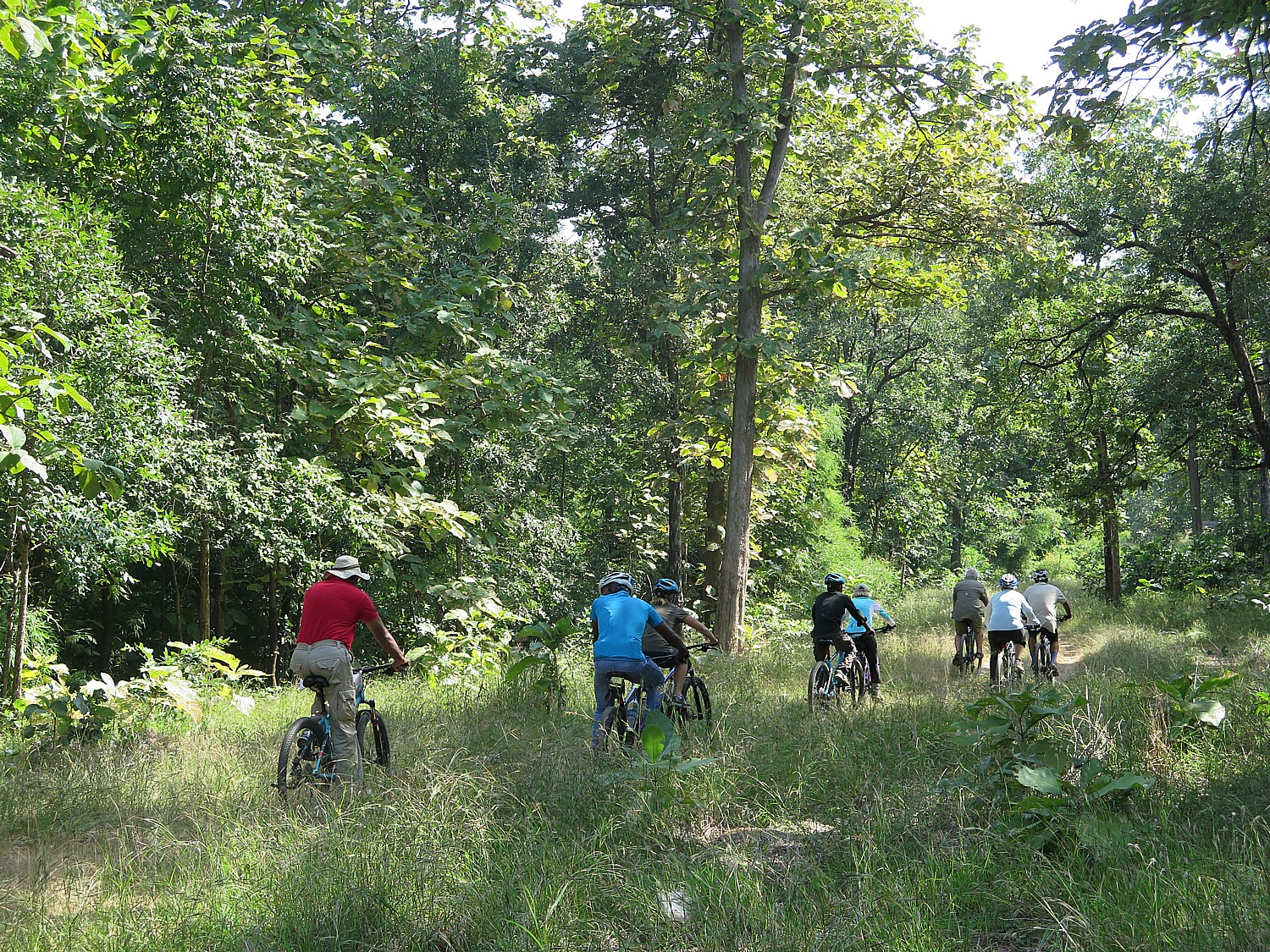
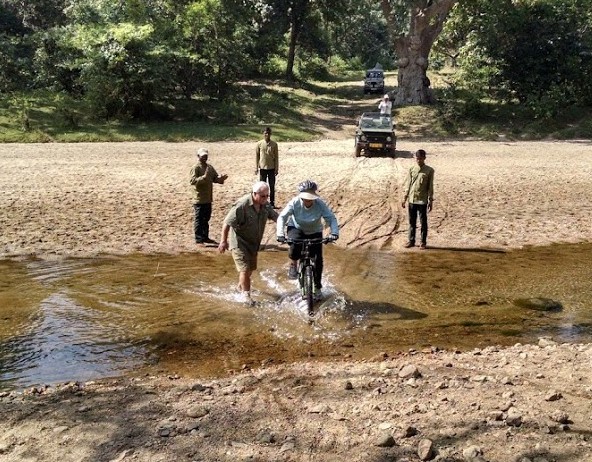
Our 25 km cycling trip through the Forest Corridor sanctuary between Pench and Kanha national parks in central India – literally the locale for Rudyard Kipling’s 1895 classic “Jungle Book” – is the most challenging ride of the aptly named new “Jungle Book Wildlife Safari & Cycling Adventure” offered by Royal Expeditions (see story). But the most colorful, scenic and interesting ride comes during our stay at the Kanha Earth Lodge (another fantastic ecolodge), alongside the national park, when we ride through villages and alongside farms.
After an exciting game drive in the Kanha National Park in the morning (still no sighting of the tiger, though) and lunch at the lodge, we set out on a 14.9 km route that circles back to the lodge. It is a mix of road and single-track off-road (though the cars don’t drive on anything better), and involves some technical riding (sand, gravel, rocks).
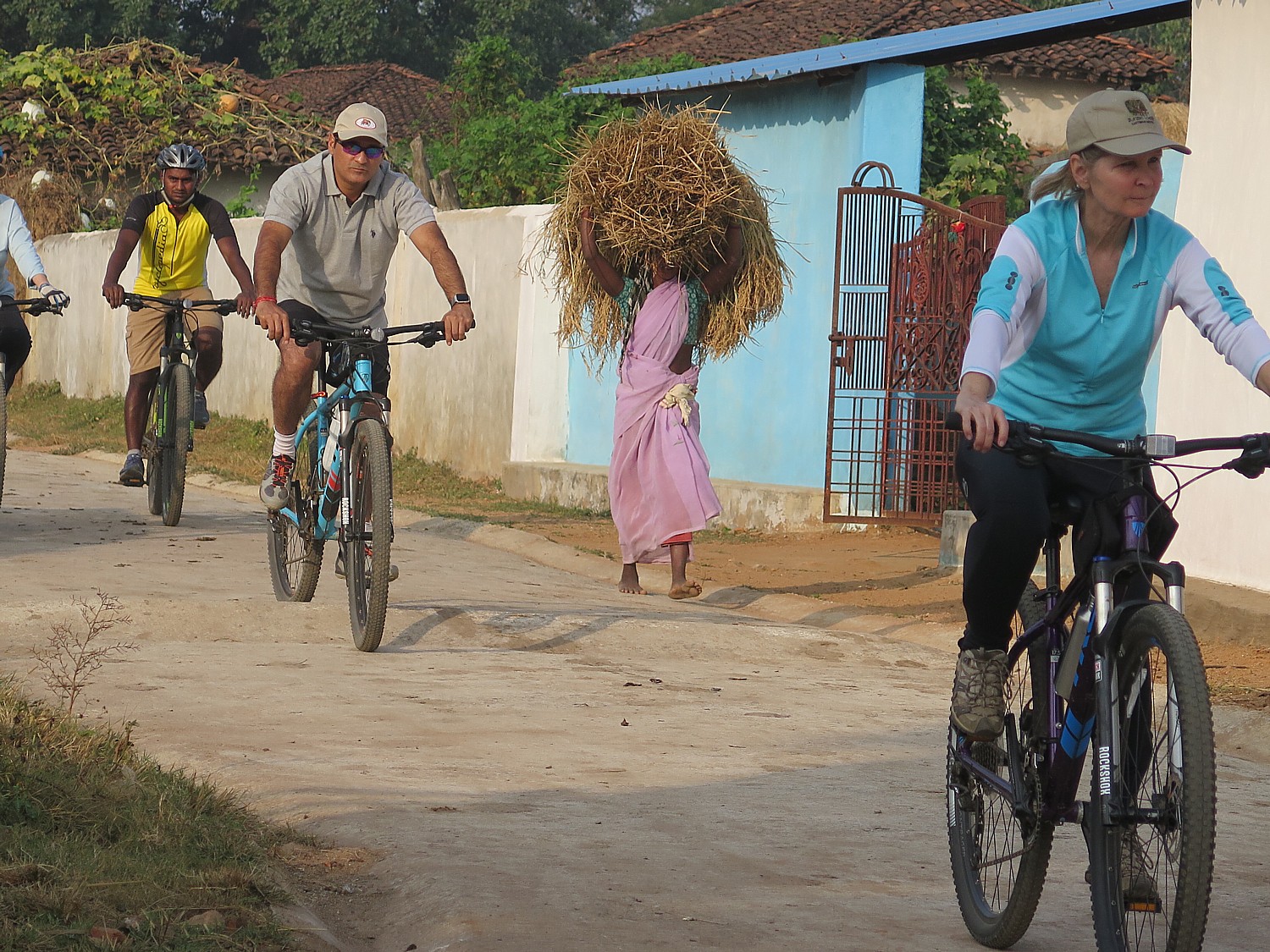
What is so special about cycling is that it brings you into local communities, at a pace and perspective, perched on the bike saddle, to really see things, to be in the scene, not just a spectator looking through glass, and with the ability to stop, look around, and interact.
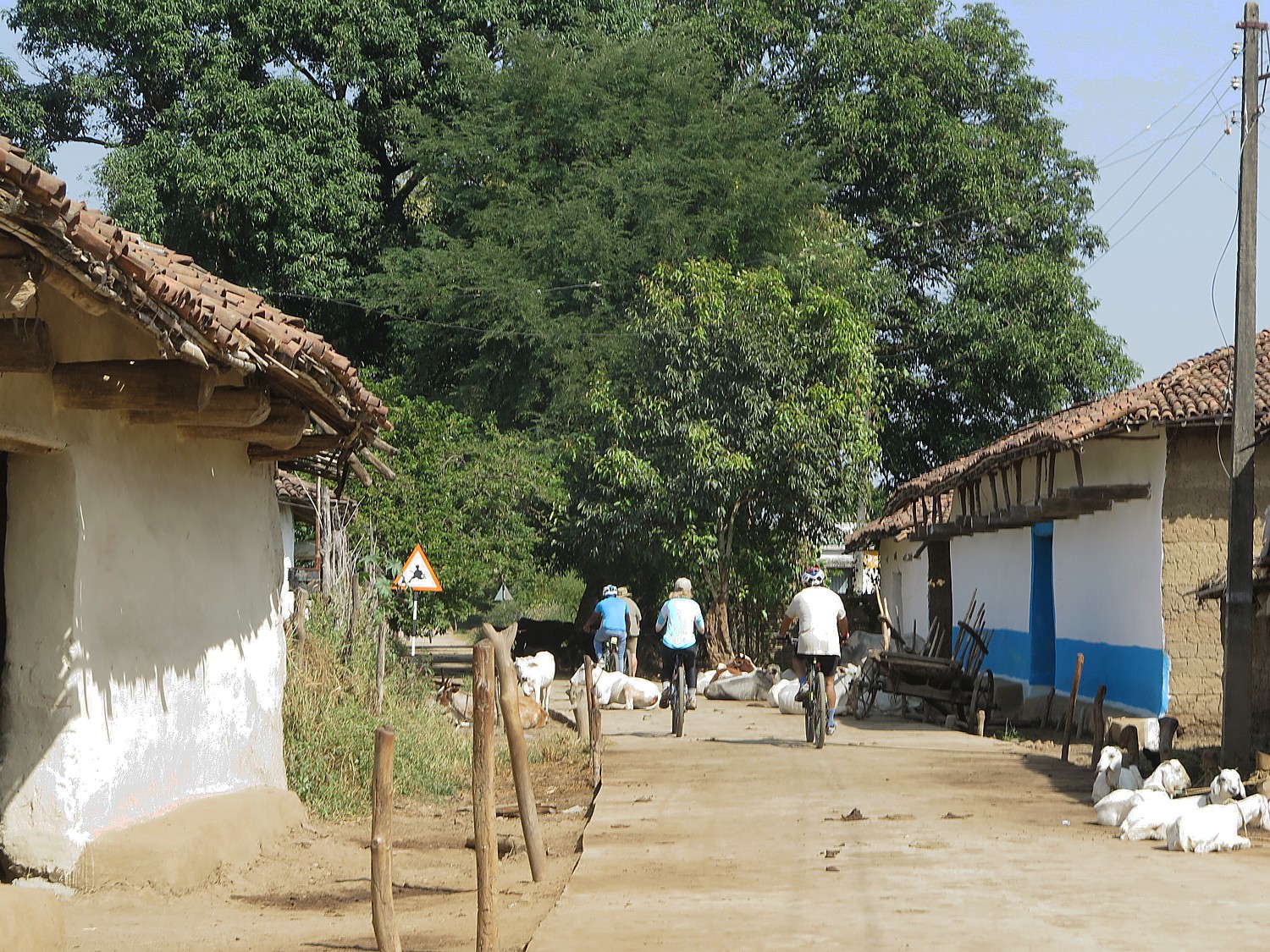
Not too far from the Kanha Earth Lodge we come into a village, where our guide invites us into a home to see what it looks like on the inside. A father and son are there, looking a little mystified at this sudden intrusion. There are cows and goats in pens in a front courtyard (in this community, the animals are kept in front of the house and not usually in pens, as a sign of wealth and status, Vishal Singh, the managing director of Royal Expeditions who accompanies our small group, tells us). It is dark and spartan inside – there is electricity and a small, old television set. Most homes do not have indoor plumbing. There is a beautiful garden in the back.
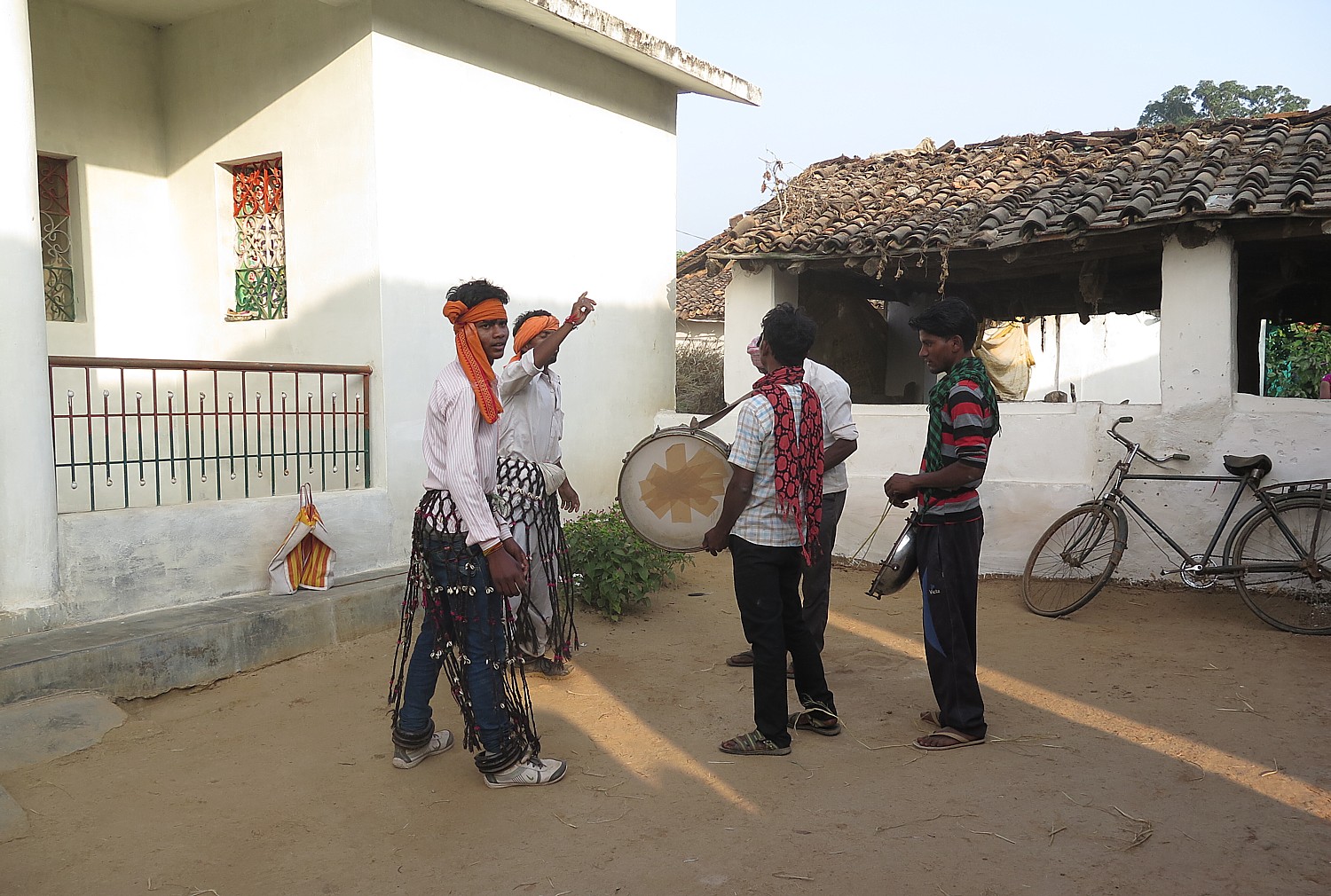
We ride a little further and hear drumming so we ask to go inside and come upon a band of shepherds rehearsing with dancing and singing, getting ready for a competition that is part of the Diwali harvest festival underway.
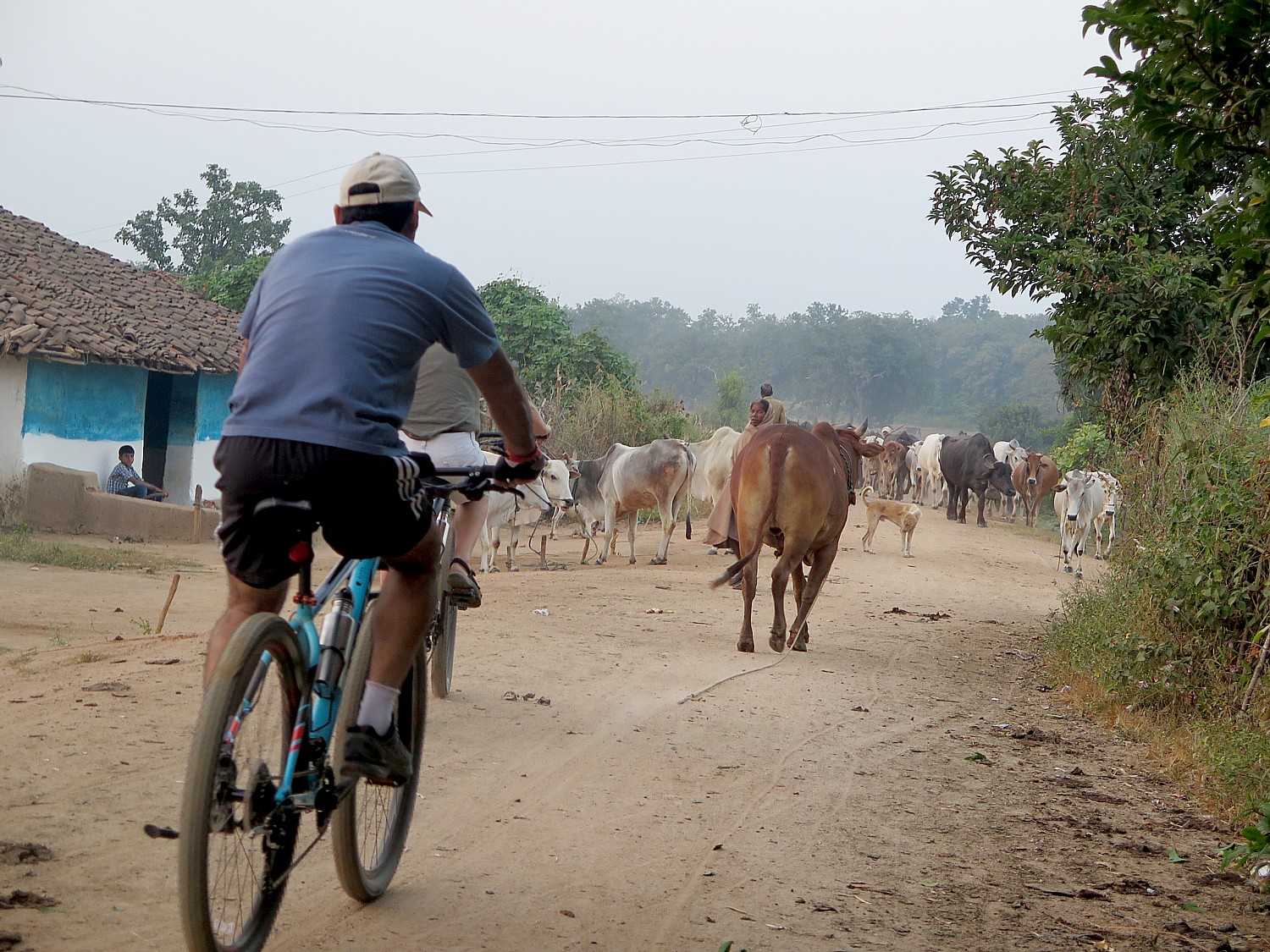
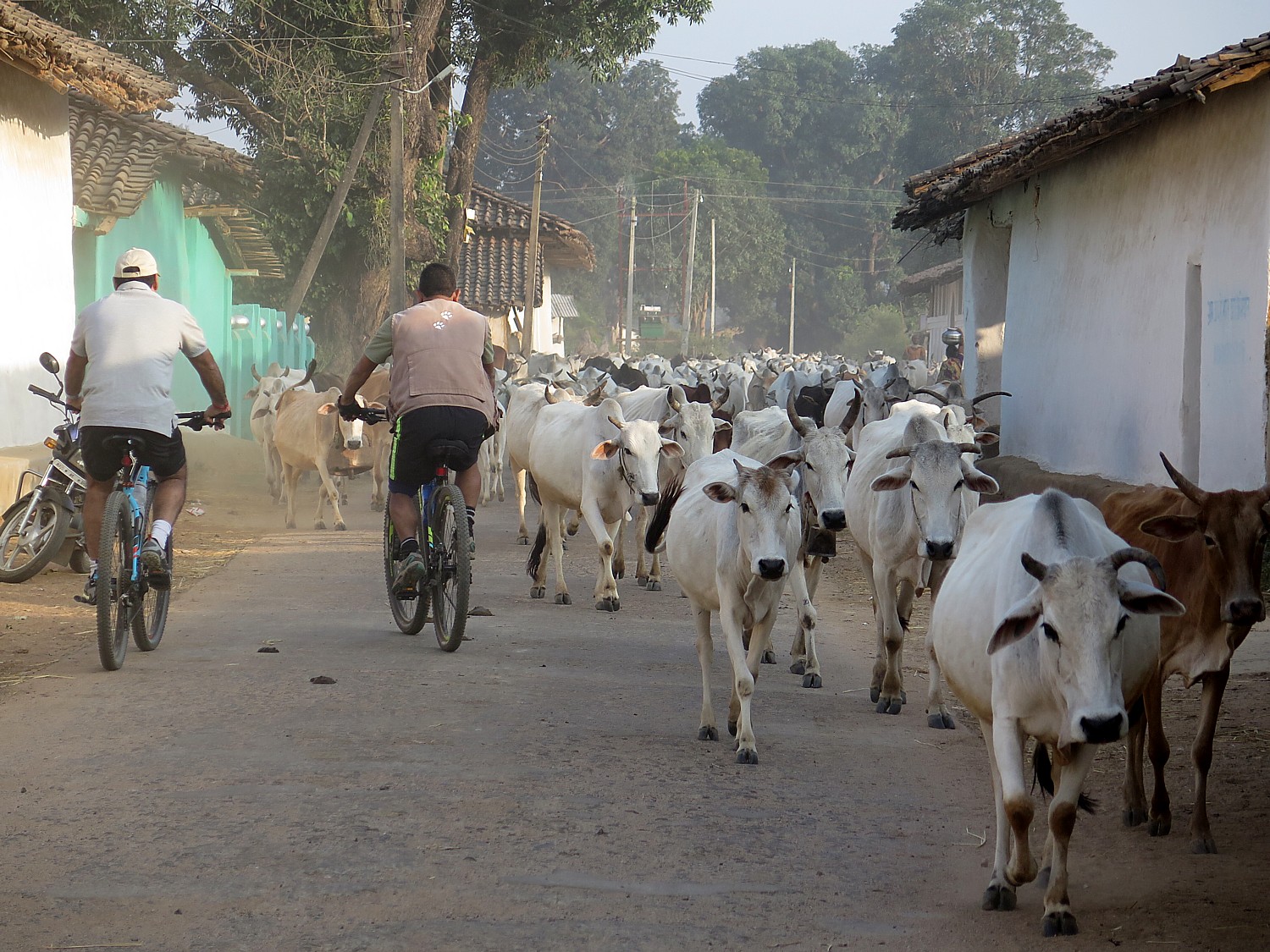
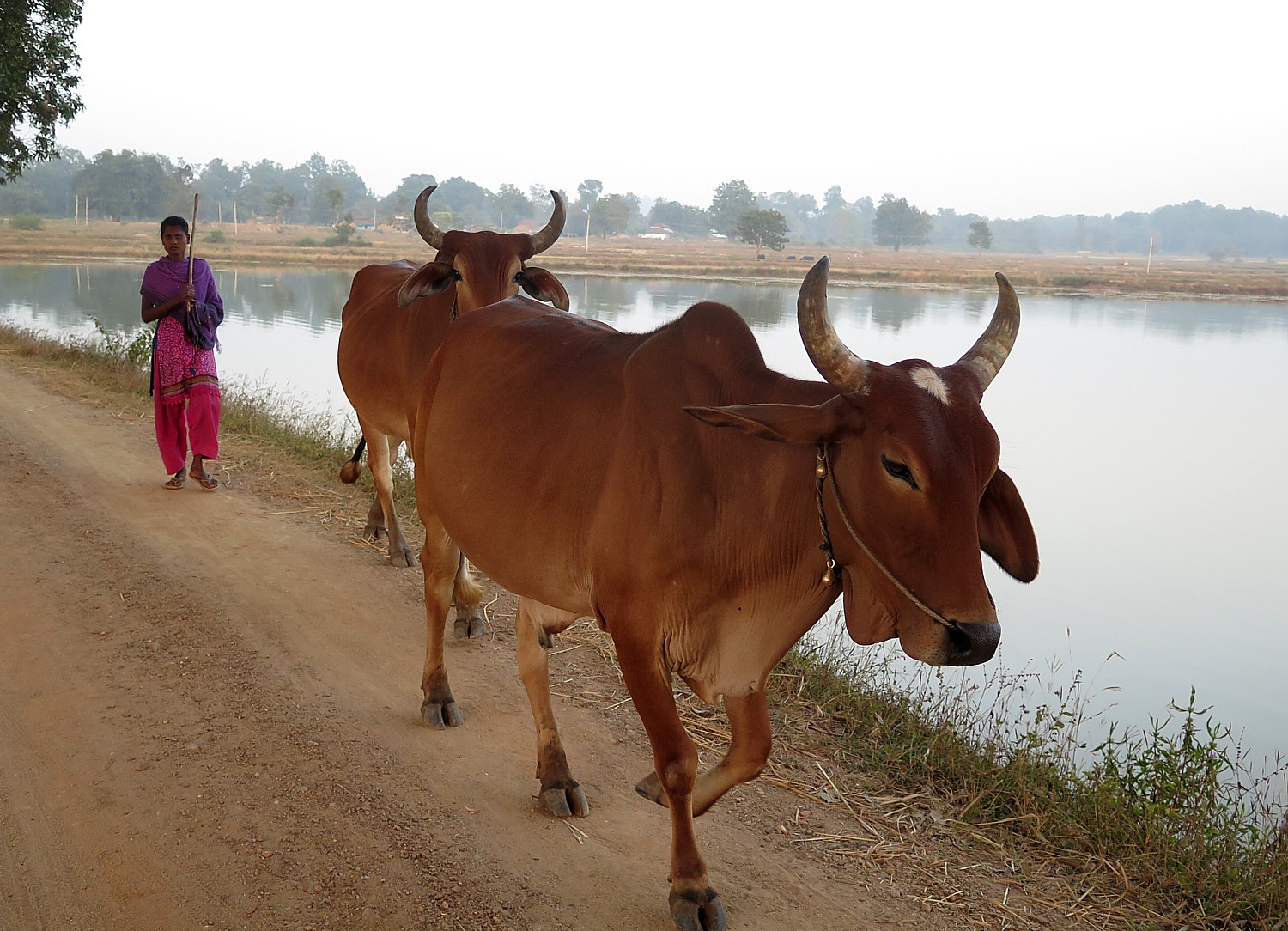
As we set out to continue on our ride, we find ourselves going against a massive herd of cattle (with horns, no less) that fills the narrow street, with no choice but to bike straight through. The cows, it turns out are used to people, and as we come mere inches in front, turn slightly to make way for us. There is a shepherd at the back of the herd, but we are told that the cows find their way to their own homes for the night.
People cycle all over India, but not in the manner or style that we are riding, so we are curiosities. In fact, it is astonishing to see the loads that people carry with a basic bike, though scooters and motorcycles are extremely popular (and we’ve saw as many as four people on a motorbike). When you see people biking with a load of sugar cane or batches of wood or pipe on a regular bike – not the mountain bikes or hybrids with 24 gears that we have – it is awe-inspiring.
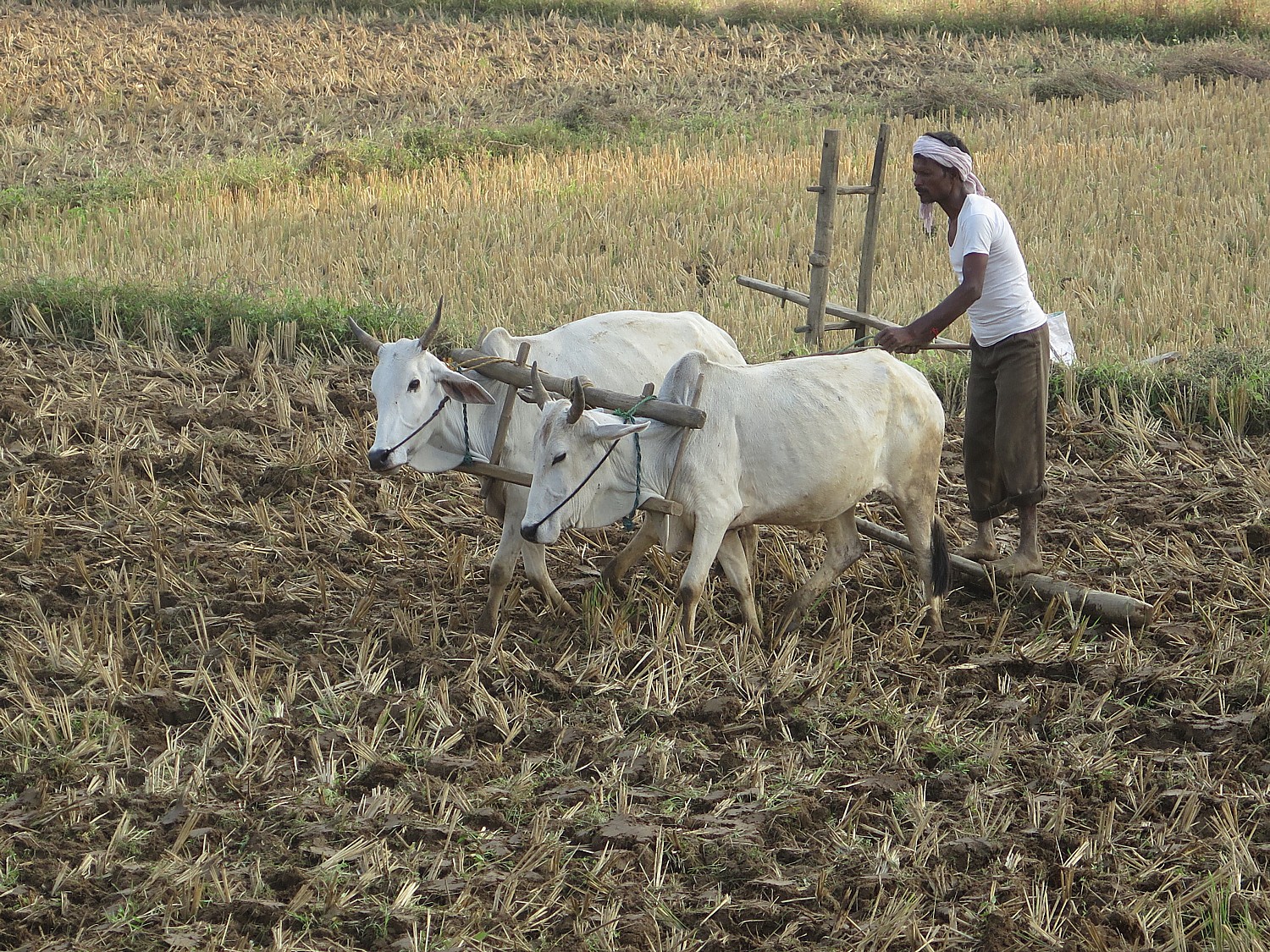
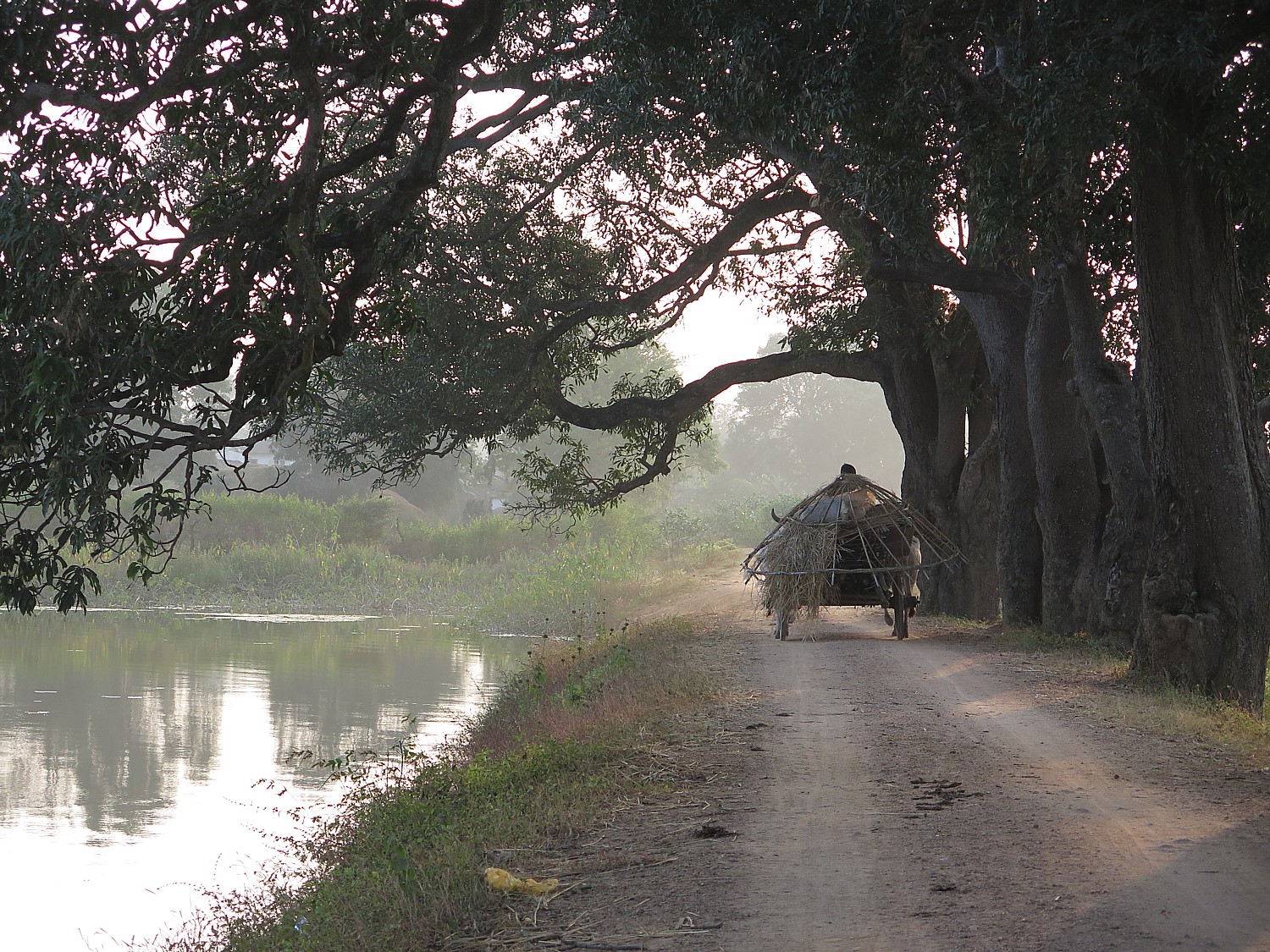
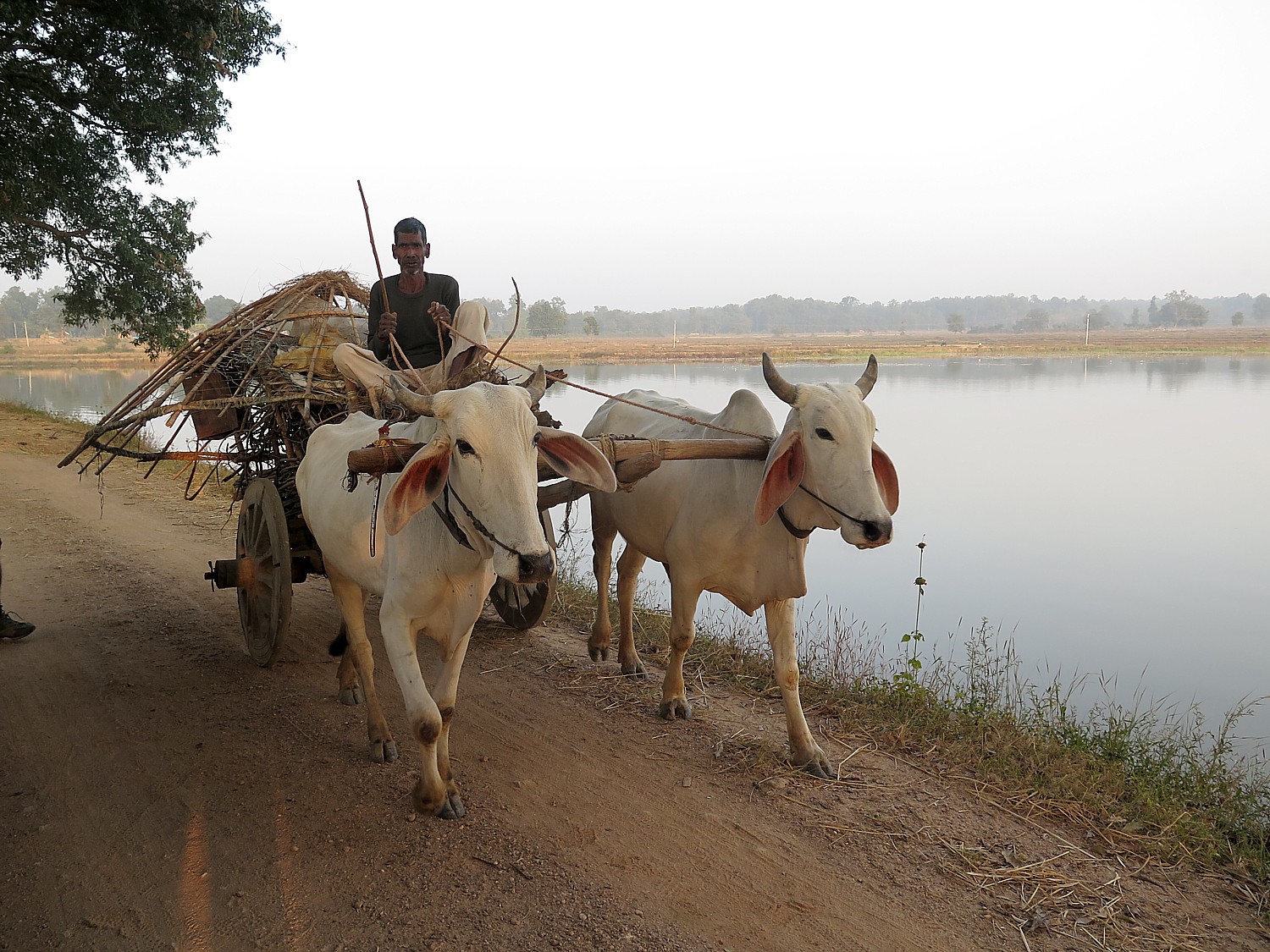
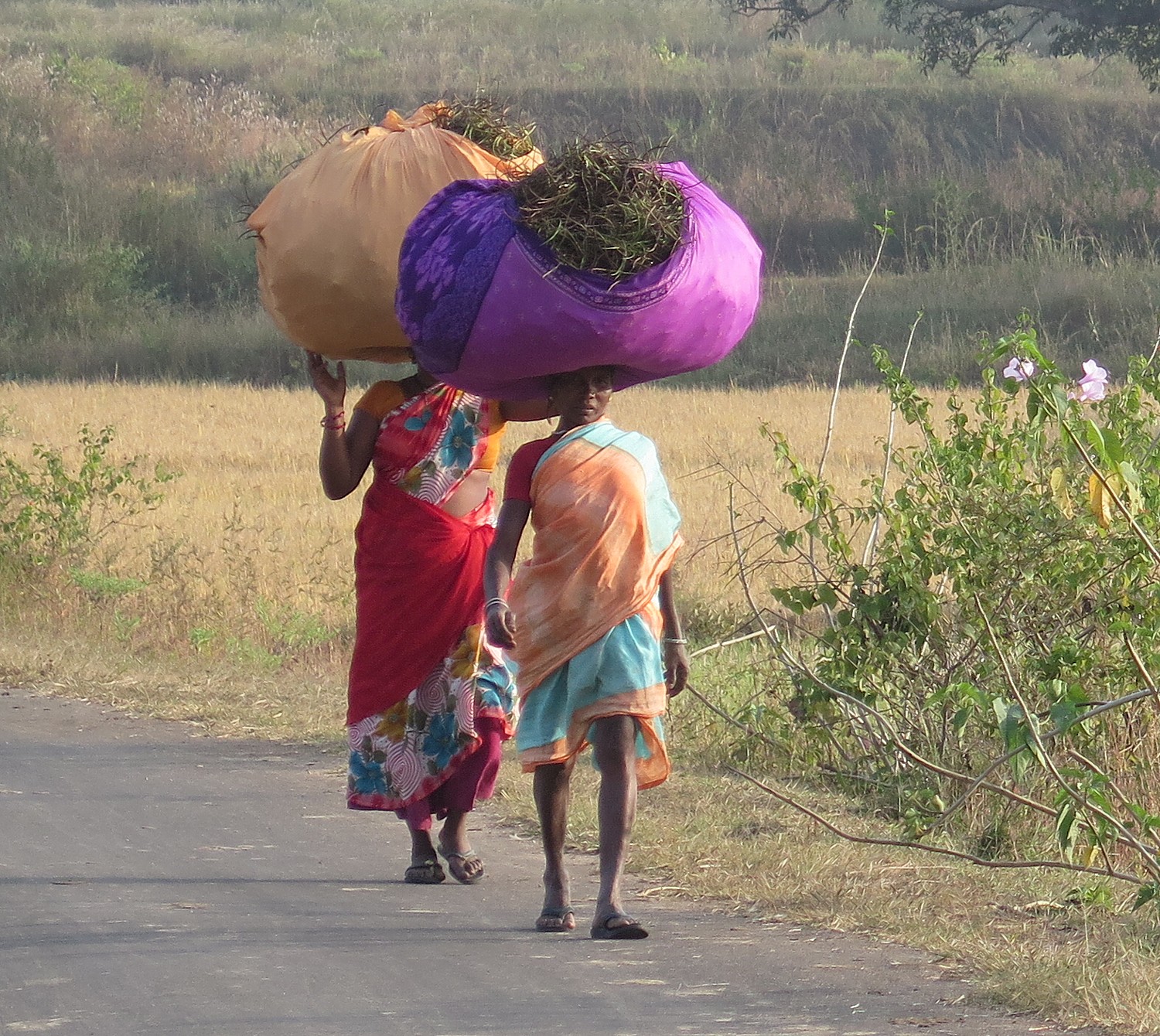
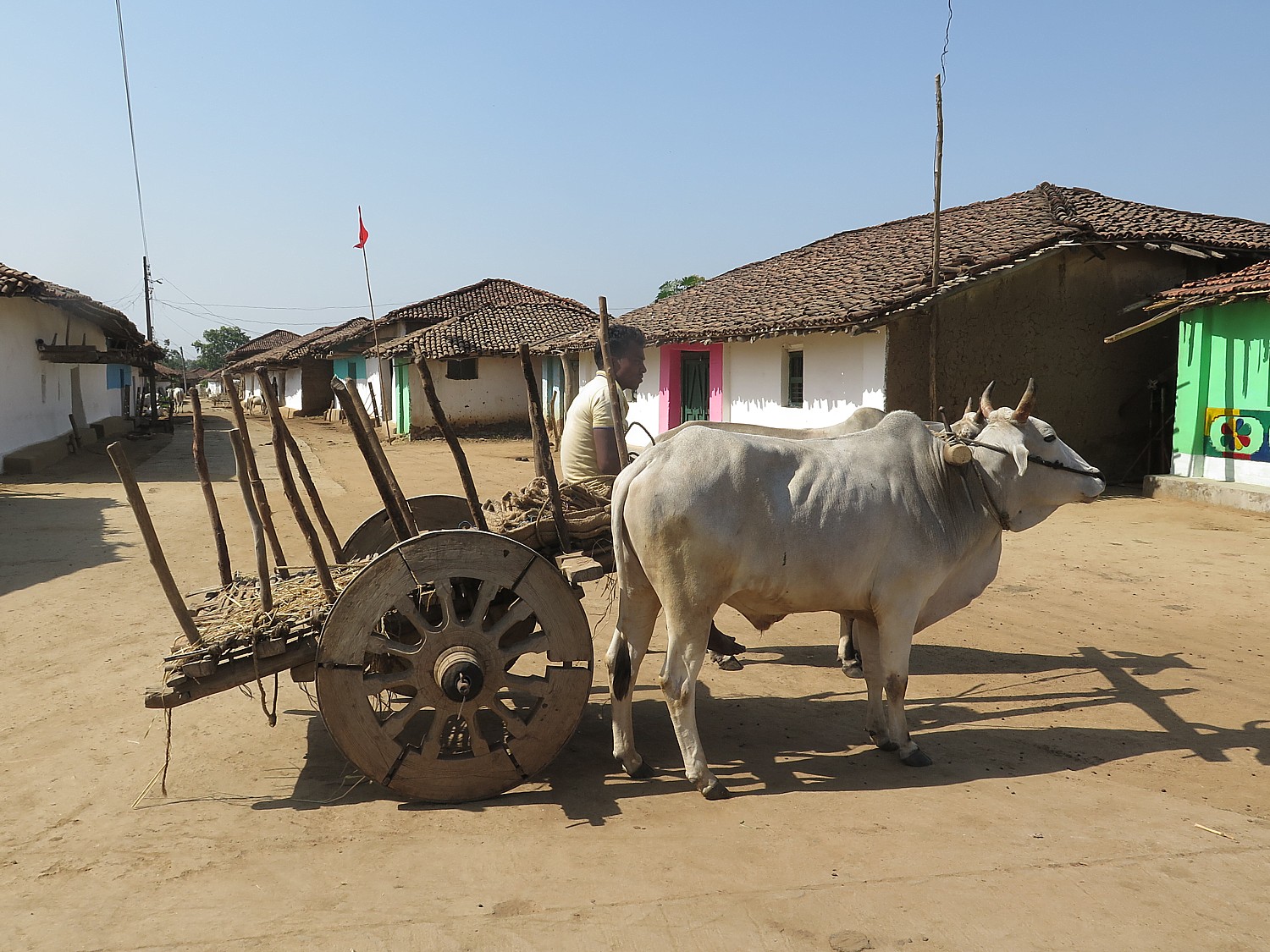
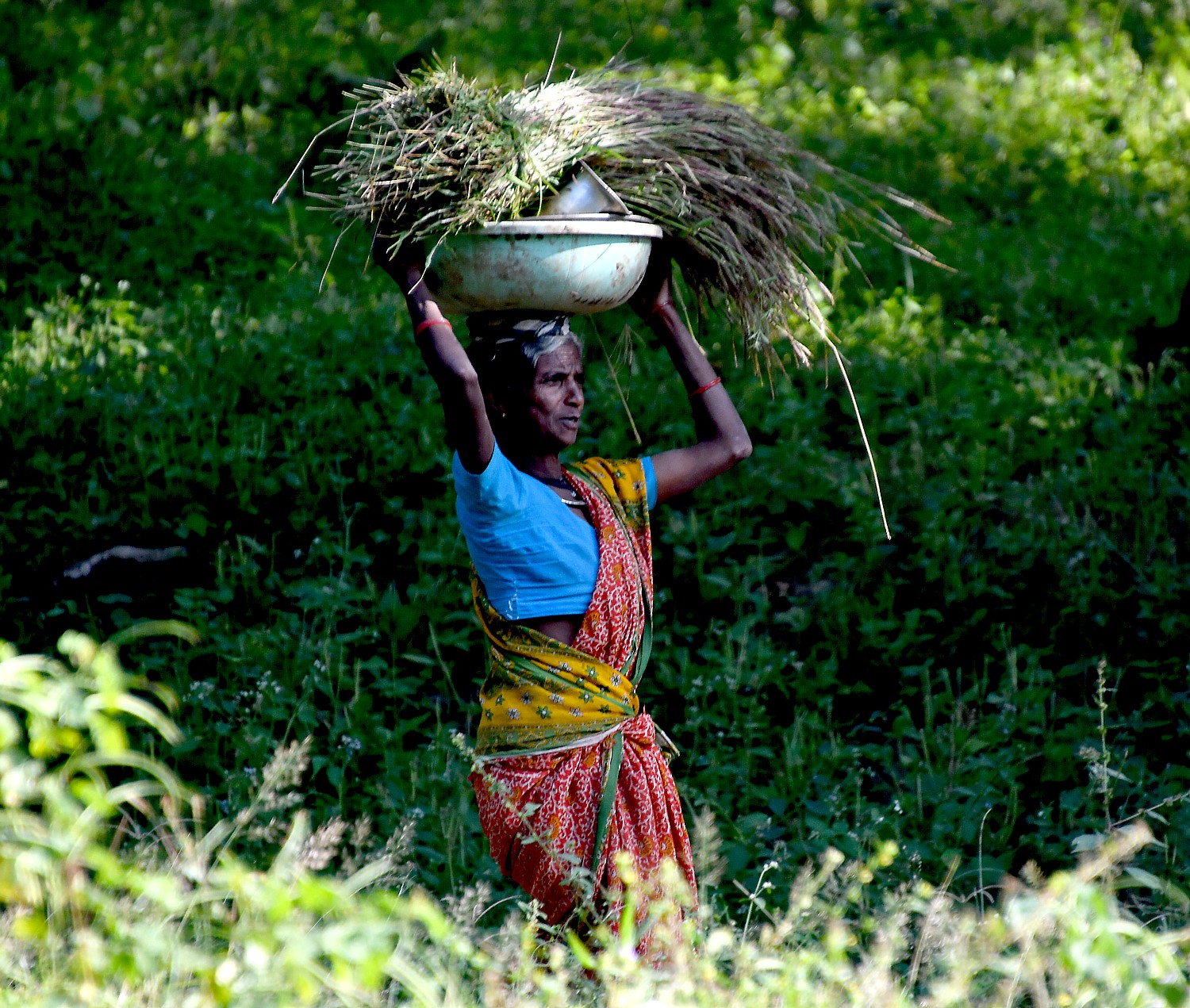
We become immersed in these scenes of everyday life and fields and farms: women are carrying massive loads on their heads, walking with the grace of a model in an etiquette school; men driving carts pulled by cows; school girls in their neat uniforms riding bicycles home (the government gives girls a bicycle when they matriculate to high school); a fisherman who has just returned with his catch.
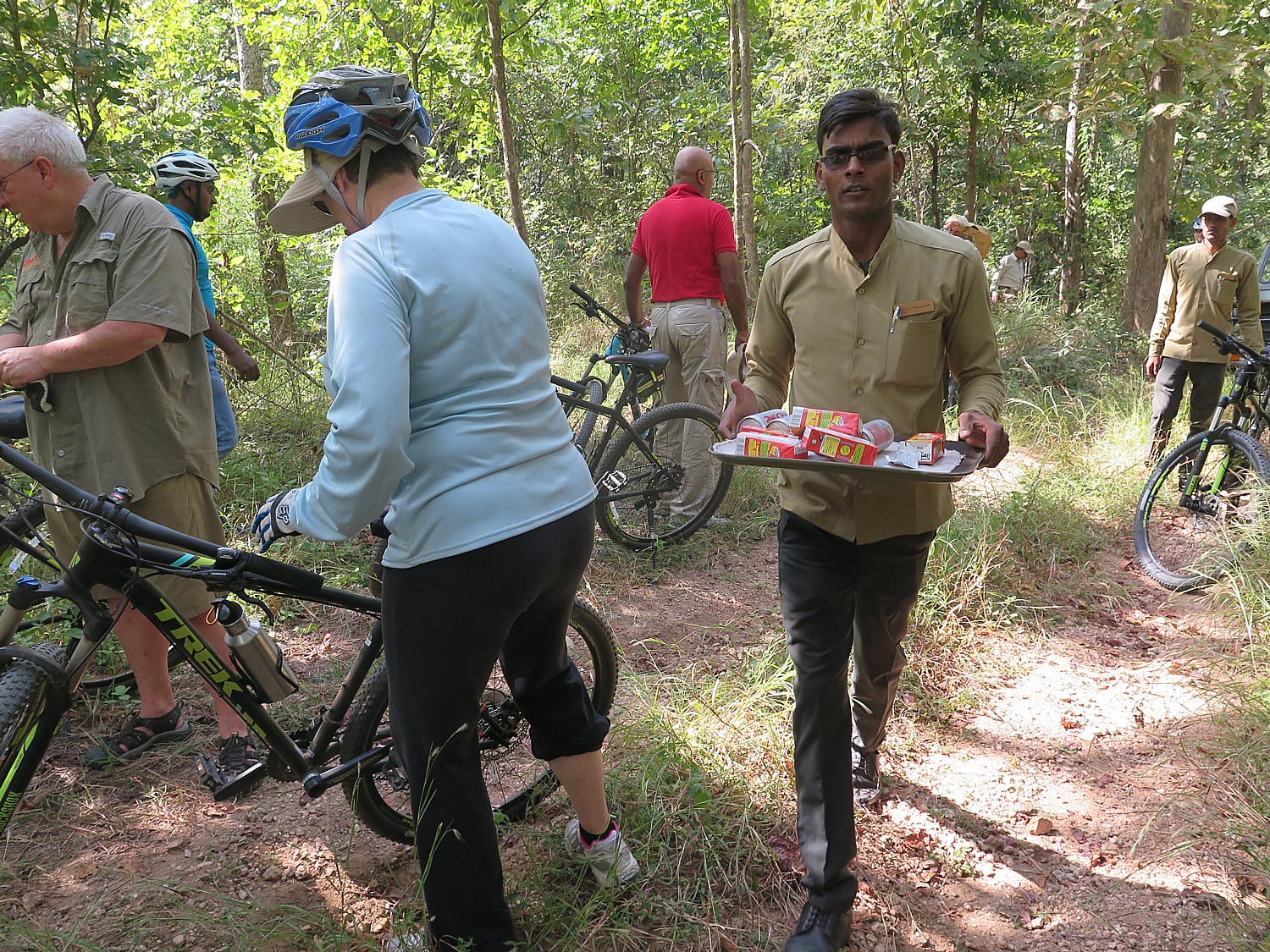
Then toward the end of the ride, on a berm overlooking gorgeous rice fields on one side and a small lake with water buffalo on the other, trees along the border completing the picturesque setting as the sun begins to set, the Kanha Earth Lodge fellows set up a snack using the front of the jeep as a table – offer soda, coffee, tea, water, a kind of fried onion (tasty!).
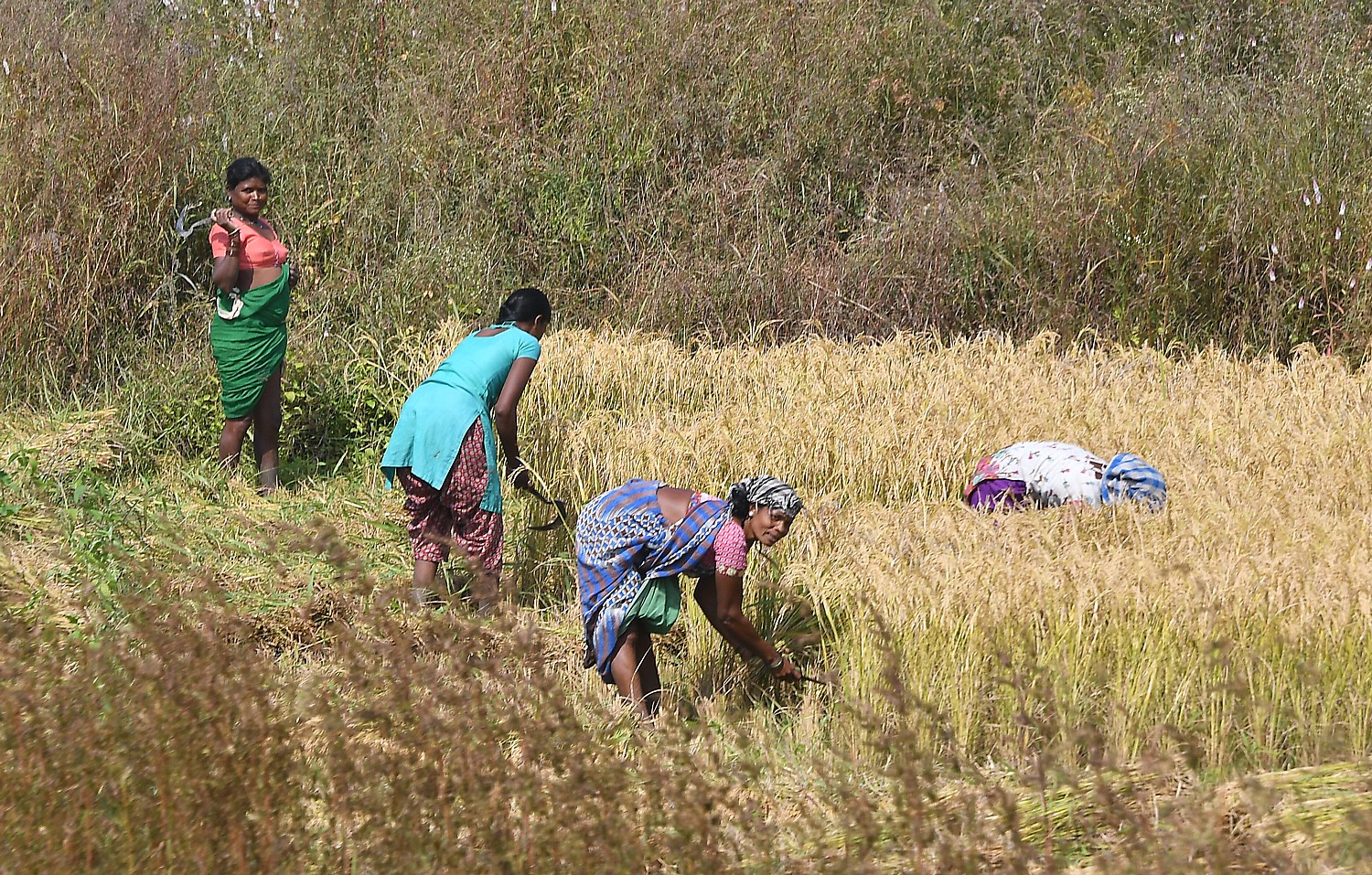
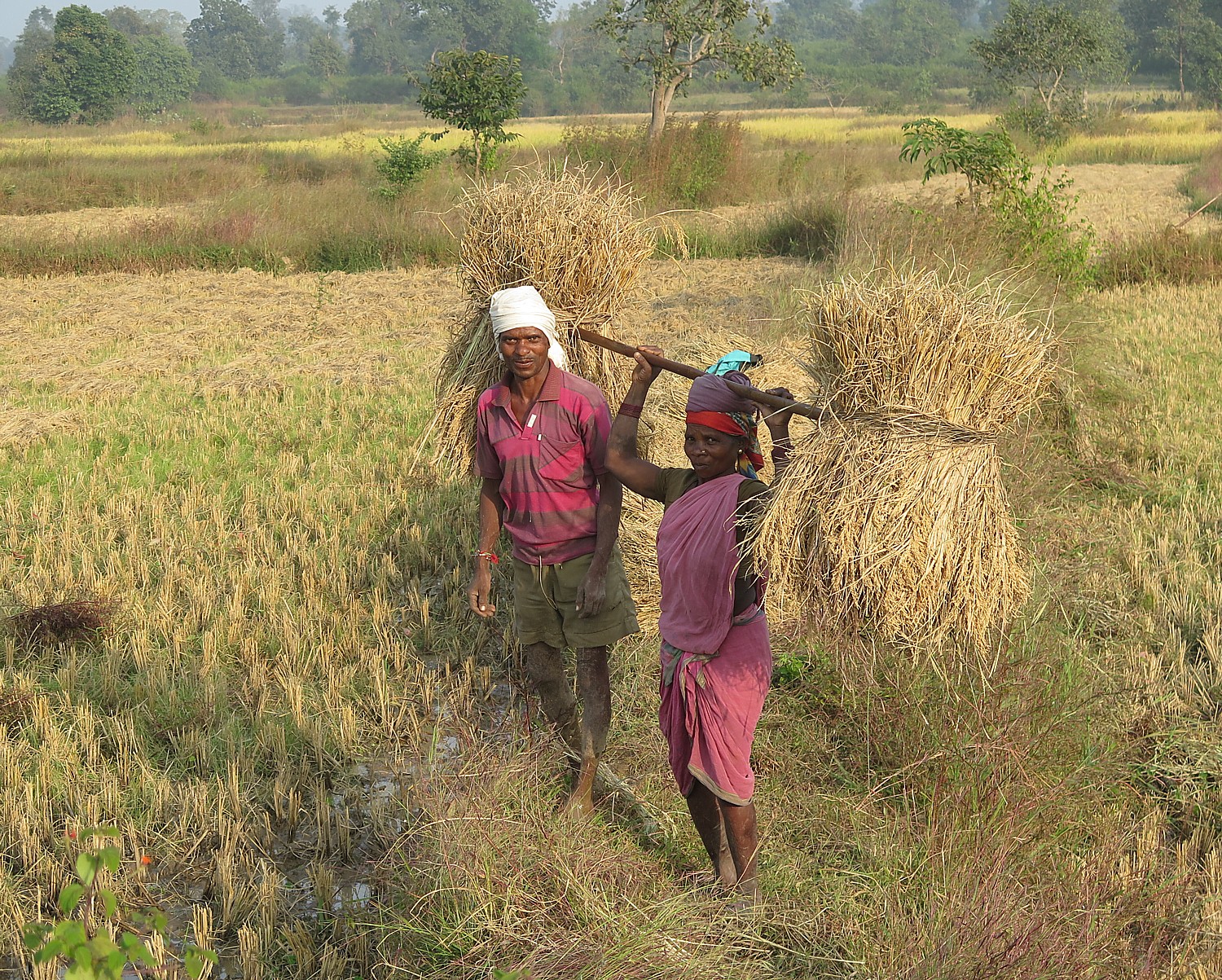
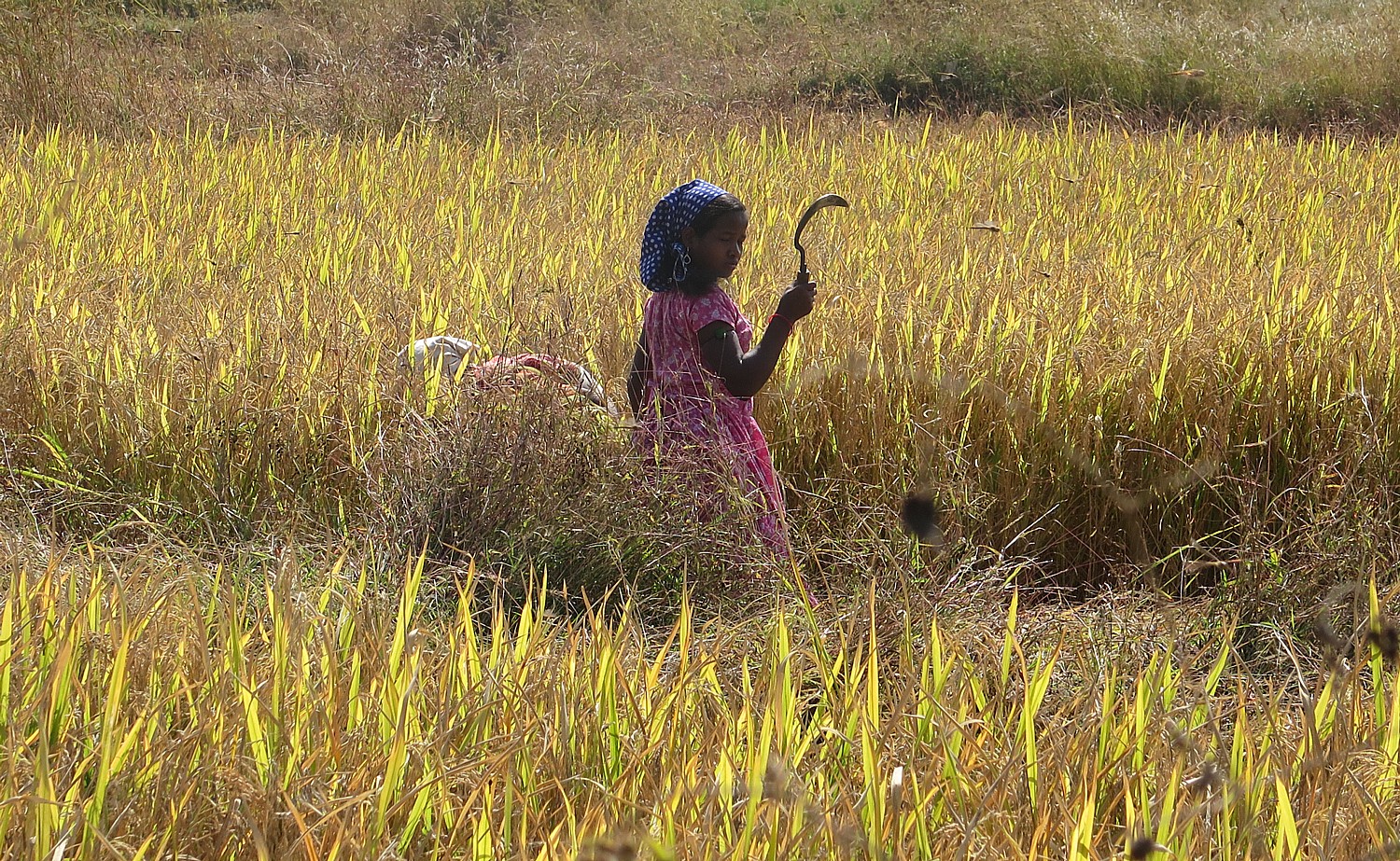
We snack leisurely while watching people cutting down the rice stalks with scythes; others take huge clumps in yokes on their shoulders to great mounds growing ever higher with each new contribution, to dry before being threshed. Soon, a woman comes along who we had met in the village earlier, engages in conversation and takes photos with us.
The sun is a blazing red-orange when we set out on the last leg on a sandy road. I get one shot just before it disappears into a line of clouds. As dusk sets in, the temperature becomes much cooler as we make it back to the hotel just before dark – greeted with a wash towel and refreshing lime juice.
Photo tip: For biking, I use a Canon G16, a small point-and-shoot I can keep around my neck and pull out with one hand. It is remarkably fast and responsive, has a terrific zoom lens that is wide enough for landscapes, long enough for close-ups, has an enormous ISO range plus built-in flash if necessary, sensitive sensor that gives rich color, and has image stabilization. It also takes video. I’ve taken shots in horribly low light using the Automatic setting.
Market Day in Kanha
The Royal Expeditions trip is designed to really immerse us in the cultural experience.
On our third day, we have a morning game drive at Pench, then lunch at the Pench Tree Lodge, then drive a couple of hours to Kanha National Park, which will be our venue for the next three days for game drives and cycling. The drive gives us a superb view of local life – Vishal notes that in India, “Daily life is lived in public” as we see a fellow brushing his teeth in the street. Vishal times the trip so we arrive in time for a weekly village market underway, just at the base of the forest road to the Kanha Earth Lodge.
Madhya Pradesh is dominated by tribal groups, remarkably untouched by development in other parts of India. The differences in the tribal community, spread over various parts of the state, are based on heredity, lifestyle and cultural traditions as well as social, economic structure, religious beliefs, language and speech.
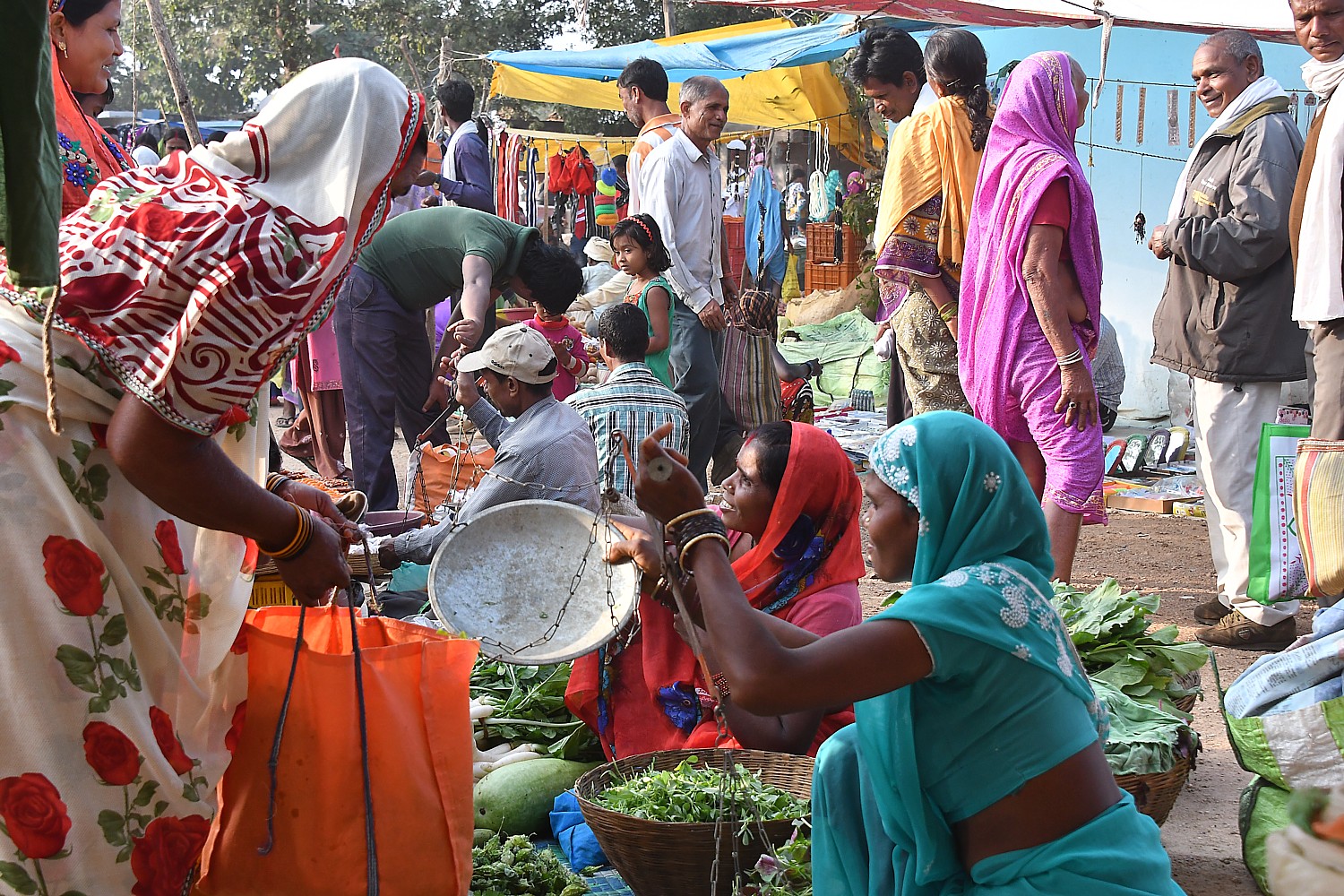
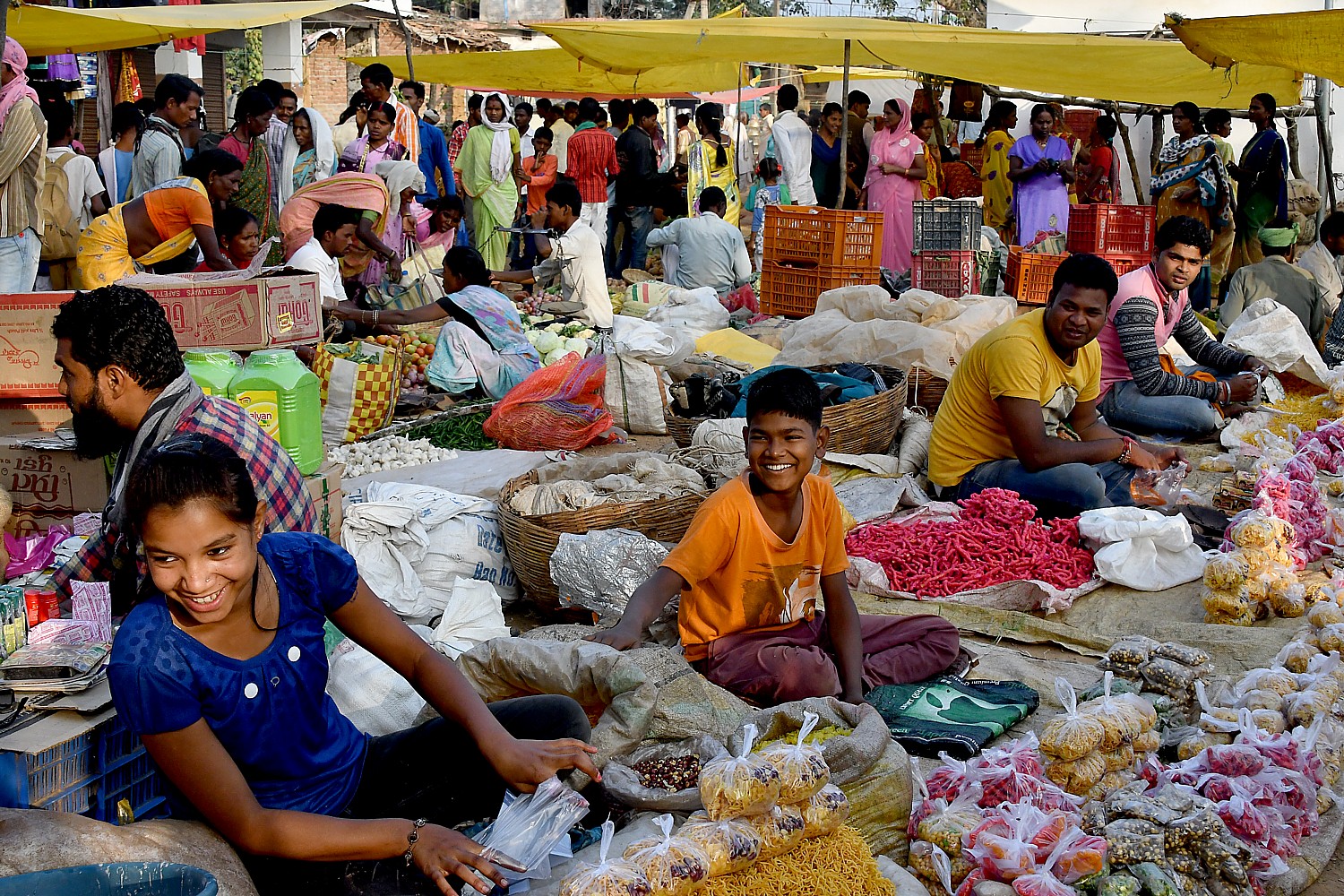
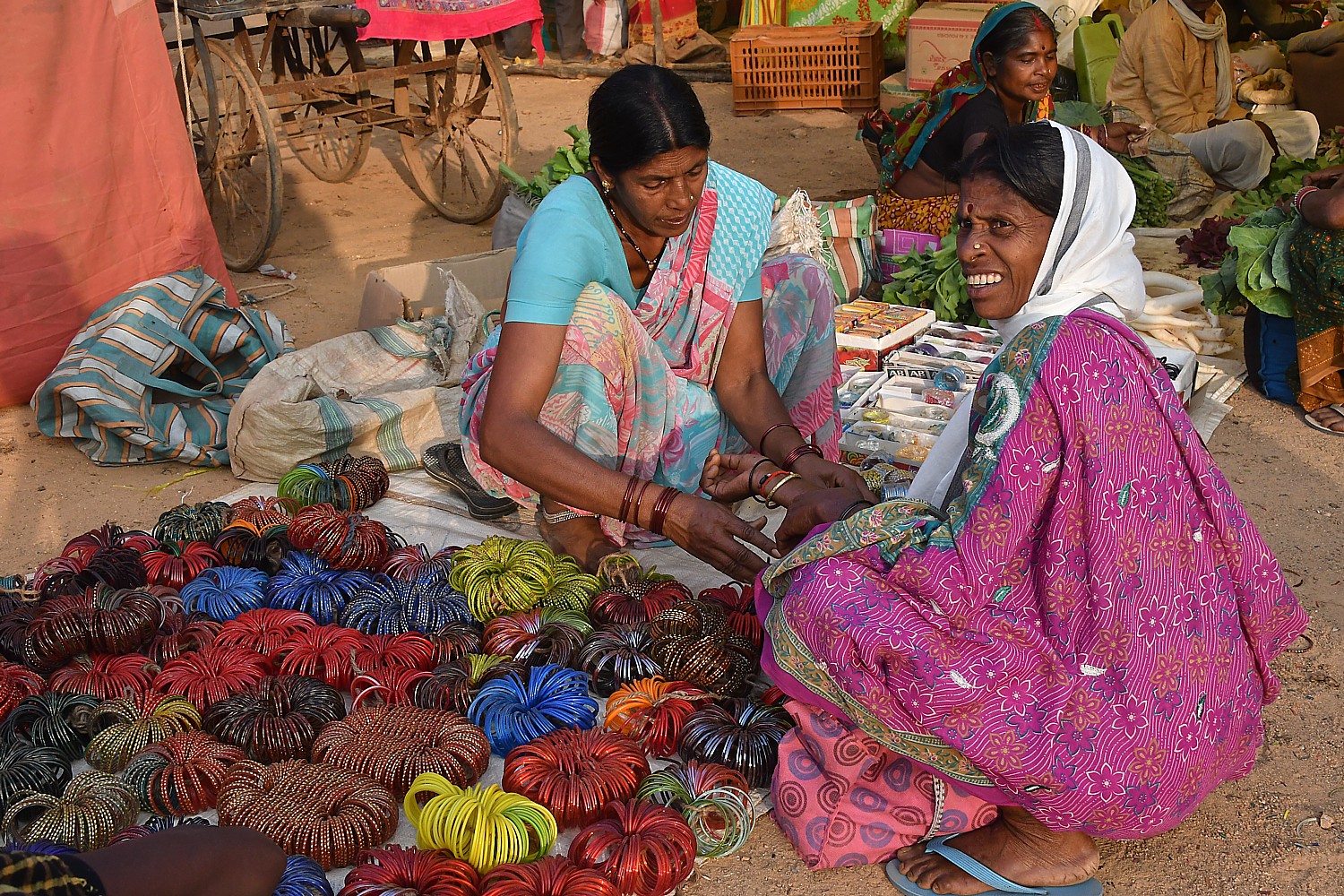
This is most apparent in the market. It is a swirl of color, sound and activity.
Merchants spread out food produce and wares on cloth on the ground – have their scales to weigh. They hawk their wares. People crowd around to buy. Cash money is exchanged. It is a kaleidoscope of color: the women in vibrant saris, the fresh produce.
Cows roam freely in the market- one snatches a potato from a pile and the merchant yells and reaches over to swat it with a switch to get it to move on.
We are here at around 4 pm and the warm light makes for gorgeous photos. Indeed, Royal Expeditions offers a photography tour that goes from village to village for their markets.
There are the photos I’ve seen in my mind –that I have wanted to take my whole life. The colors and contours of the bright saris against the brown fields, or the colors of the mud homes, newly painted in broad horizontal stripes – white and blue or pink or green – for the Diwali Festival, the Festival of Lights celebrating the last harvest before winter, against the field of bright yellow mustard (canola) flowers.
In these settings – even shooting from a moving vehicle and especially for wildlife – I use my new Nikon D500 DSLR with a 28-300 mm lens with image stabilization, which I find wide enough for landscape scenes, but close enough. The camera’s best virtue is how fast it responds, its enormous ISO range (I even shoot village scenes at night as we drive back to the lodge). In general, its 20.9 megapixel CMOS sensor produces rich tones though I am still trying to figure out how to get the best exposure readings. It takes cinematic 4K UHD video and is WiFi capable. It is relatively light compared to other professional-grade cameras and fits ergonomically in my hand, which is a comfort when you are shooting for hours at a time.
Royal Expeditions’ new “Jungle Book Wildlife Safari & Cycling Adventure” program combines all my favorite activities: biking, immersive cultural and wildlife experiences and photography.
It’s hard to overstate how unusual this trip is – the whole idea of being able to bike where wild animals can also roam, when people are not allowed to step out of their safari vehicles, normally. The trip is result of a creative insight as well as the tour company’s connections with the preserve officials to get the permits to bike into the sanctuary.
Indeed Royal Expeditions has royal connections: the tour company, which specializes in luxury, customized and special interest trips, was founded in 1993 by the Princess of Jodhpur, who served in Parliament and as the nation’s Minister of Culture (see http://royalexpeditions.com/)
Notably, our trip, which covered about 25 km of the Forest Corridor, was immediately followed by a fascinating 160 km fundraising ride, produced by Tour Operators For Tigers (TOFT) along this same forest corridor that we traveled, linking Pench with Kanha national parks, where wild animals freely roam. Singh is a founder of the group which has about 150 members now. This year, about 20 people took part in the 4-day/3-night ride which raises money to hire local people as village guardians, providing them with smart phones so they can alert authorities to illegal poaching. But I see the ride as a major lure for cyclists from around the world because of its unique setting and challenge (the “road” is more of a mountain bike trail, especially so soon after the rainy season), as well as the opportunities to stay in guesthouses in these villages, not to mention the mission. “Authentic” doesn’t even begin to describe the experience.
Like the Pench Tree Lodge which we enjoyed during our time at the Pench National Park, the Kanha Earth Lodge (www.kanhaearthlodge.com) enhances the wilderness experience. It is an ecolodge made of all natural materials that is stunning in its design that blends so perfectly without adverse impact on the environment, uses local and traditional art (there is even a fellow who paints tigers), has its own organic garden and a lovely swimming pool, a stunning lodge (WiFi available in the office), and each evening, during cocktail hour, the in-house naturalist offers fascinating presentations about the wildlife and the national park,.
For more information, contact Royal Expeditions Pvt. Ltd. www.royalexpeditions.com, tours@royalexpeditions.com, or Royal Expeditions’ North American representative: kiki@wanderlustportfolio.com, 720-328-8595.
Next: Tiger Tiger! On Safari in Kanha National Park
When I signed on to Royal Expeditions’ new “Jungle Book Wildlife Safari & Cycling Adventure” in India, I couldn’t believe or even visualize the concept of cycling through a wildlife sanctuary populated with tigers, leopards, sloth bears, wild dogs, langur monkeys and jackals. And Royal Expeditions which devised this innovative, out-of-the-box trip, set in the same region as Rudyard Kipling’s beloved 1895 story, didn’t ask how fast I could ride (or, for that matter, whether I had any experience in single-track off-road biking). But here I am, on a rough cut, overgrown, rolling trail that serves as a forest corridor between the two national parks known for tigers – Pench and Kanha – where animals, including tigers, roam freely. This is confirmed when a naturalist who rides along with us points out tiger pugmarks (paw prints) in a sandy section of the trail we are riding.
At one point, I find myself (inexplicably) well ahead of our group (which has as many guides, cycle experts and leaders as we tourists), including a jeep and a van loaded with supplies with snacks and our lunch that will be set up at the end of a ride in a guesthouse.
Here I am, in a stretch of high, dense grass that reaches up to my knee, with dense forest on both sides. I decide this isn’t the place to be alone – after all, the naturalist said that the tigers who live here (there are 8 who live in the corridor, and about 120 between the two national parks) are craftier, more intelligent, because they have less food (that is, not as many deer and monkeys to munch), that they take advantage of the denser forest growth to surprise their prey, and are less used to humans (which I take to mean less afraid of humans and I am not particularly reassured that tigers don’t like the smell or taste of humans – how do they know?). Putting that together, I realize I am the slowest prey around, so I ride back to meet up with the riders, recalling that old adage: you don’t have to be the fastest, just faster than someone else.
That thought plays around in my mind, adding to the adventure and sense of bravery – courage – that I’ve known only a couple of times in my life – that makes the exhilaration you feel after the ride- and not just from the physical challenge – all the sweeter and richer. It’s a sense of personal triumph, of overcoming fear (of course, the danger was minimized by the safari vehicles which followed us and the guides who accompanied us, outnumbering our small band, not to mention we are here in mid-day when the scariest animals are least likely to be out and about and hunting. Still.
That 25 km ride proves the most challenging cycling of Royal Expeditions’ unique and creative “Jungle Book Wildlife Safari & Cycling” tour. Vishal Singh, who designed the trip, said it was more challenging than expected because it was so soon after the rainy season. But it is exhilarating and thrilling and totaling fabulous – that sense of actual adventure and physical challenge – that also includes crossing a stream (I chicken out and find a place to walk across rocks).
Most of the rides we take are challenging in their own way, but go through villages and past farms, giving us a unique perspective on local life.
The itinerary is set in the same region that provided the setting for Rudyard Kipling’s “Jungle Book” which he published in 1895, in central India, cycling through the same jungles (the word is Hindi for “forest”).
This corridor, we are told, plays an important part in the conservation of the tigers – by linking the two national parks, which between them have about 120 tigers, helps promote diversity in the gene pool, and provides protected habitat for their long-term survival. Other tiger habitats in India are fast becoming islands and there is little change in genetic pool of the tiger population. The landscape also supports diverse land use, and traditional forest dwelling tribal communities.
Our visit, we are told, also has the function of raising awareness among local communities of the part they play in wildlife conservation (indeed, just days after our visit, Vishal Singh is leading a 160 km fundraising ride that goes along the entire forest corridor linking Pench and Kanha, to supply locals with smart phones so they can alert authorities to poaching).
A safari vehicle and van follow behind us (in case somebody can’t finish the ride). Every time we stop, a couple of fellows guys jump out, smartly dressed in their Pench Tree Lodge uniforms, and refill our water bottles, offer drinks in glasses, and offer snacks on a silver tray.
Our ride is accompanied by Sagor Mahajan, our naturalist from the Pench Tree Lodge, who stops along the way (as much as to give us a rest as to impart wisdom) to point out spiders interesting trees and plants, and tell us about work been done by conservation organizations to save this critical landscape.
For once in my life, I’m more fascinated than afraid of these gigantic insects: he points to a funnel web spider which makes an elaborate funnel and lives inside; and a giant (really gigantic) female wood spider (the male is much smaller and the female eats the male after mating unless there is some better food available). He says they make bullet-proof jackets out of its web that is four times stronger than stainless steel. He points out Wandering Gliders – dragonflies that are the longest migrating insect, traveling from India to southern Africa, taking four to five generations to cover the distance; many bird species depend on the migrating gliders for food. As for how they know where to go? The wind temperature and humidity give them the direction and some suggest that the magnetic induction of the earth plays a part, like for sea turtles.
He points out lichen on a tree, which is a sign that there is no pollution in this forest (significant considering that while we are in India, New Delhi has had to close its schools because the air pollution is so severe); indeed, the clear, crisp air is one of the reasons so many Indian people escape to these parks for relief.
When we come upon tiger pugmarks, he shows us how to identify that it is male (more rounded toes), while the female’s is more pointed.
I learn that tigers are endangered while leopards are not, and it has a lot to do with the way they have evolved. Leopards can climb trees so have access to more prey like monkeys, and hunt mainly at night. A tiger male will only mate with a few females, and if she has cubs, will kill them in order to mate.
The last 5 K of the 25K ride takes us through villages and passed farms where we watch people working in the fields, using scythes to cut down rice, and plows pulled by bulls. Our ride ends at the Sakata Forest Rest House, built in 1903 for the officers who patrolled the area (tourists can rent rooms here), where the staff of the Pench Tree Lodge sets up a fantastic lunch which we enjoy under a thatch-covered pavilion.
We are among the first to do this cycling trip through this sanctuary – when you think about it, people are not allowed out of the safari vehicles otherwise, but here we are, on our bikes, or walking about with nothing between us and the wild animals who live here. Vishal Singh, the managing director of Royal Expeditions, who accompanies us on this trip, has used his personal connections (his company was founded by a royal family of Jodhpur and connected to a Princess who also served in Parliament and as the Minister of Culture), to convince the officials who control the sanctuary to issue permits for our cycling adventure.
Some experiences are billed as “adventure” and wind up being as tame as a Disney themepark ride (though I have new respect for Disney’s Animal Kingdom safari ride). This really is adventure – even more than I had imagined it would be – actual mountain biking where we need to navigate rocks, sand, gravel, ruts, tall grass, descents and some climbs, and a small stream.
After lunch, Vishal offers us the option of biking back along the same forest corridor – that is, 25K back, and this time, mostly uphill through the same high grass and broken, sandy and gravel trail. Not to mention it is already about 3 pm in the afternoon and it took about 4 hours to get here. We are really quite tuckered from what we have done, so everyone opts to pile onto the safari vehicle which has followed after us, along with the van that has been carrying the bike trailer (in case someone couldn’t finish the ride). We take satisfaction in the fact that it is even a difficult, rumbling ride back in the vehicle – and really can’t believe we did this by bike.
Pench Tree Lodge
What makes the experience all the more special are the accommodations: My room at Pench Tree Lodge (www.PenchTreeLodge) which only opened in 2016, is literally a tree house, built of all natural materials, but with stunning design, local and traditional art, and every comfort and amenity you could crave. There are just six of these tree house accommodations, spread over 16 acres (including a fantastic lap-size swimming pool (so much fun to swim and watch the green parakeets flying above). Meals, prepared by a sensational chef, Pankaj Fulera, (he was runner-up for Best India Chef and is equally adept at traditional Indian cuisine as fusion Continental, are served in a charming dining lodge where there are also lovely sitting areas. One night, they set up a dinner outside, under the boughs of a tree I call the Tree of Life, with firelight.
Pench Tree Lodge is located near the Karmajhiri gate into Pench National Park, which is gets a lot less tourist traffic and you really feel immersed in local life.
The forest region (“jungle” is the Hindi word for forest) is where Rudyard Kipling set his story of Mowgli, the boy raised by wolves, and his nemesis, Shere Khan, the tiger. During the course of our visit in Pench, which includes game drives into Pench National Park, we see many of the characters that populated his story and the landscape in which they thrived. Later, I learn that there may be some truth to the legend.
For more information, contact Royal Expeditions Pvt. Ltd. www.royalexpeditions.com, tours@royalexpeditions.com, or Royal Expeditions’ North American representative: kiki@wanderlustportfolio.com, 720-328-8595.
By Karen Rubin, Travel Features Syndicate, goingplacesfarandnear.com
Here’s my dilemma: A chance to see Albania by bike, a country that is steeped in mystery having been secluded behind an Iron Curtain for decades, but so mountainous, it may be too difficult to make the enormous climbs. Or, I could set aside pride and principle and use an e-bike – an electric bike that uses a battery to give an extra push to your pedaling.
I’m a purist and enjoy the physical challenge of biking. I had had an amazing time on Biketours.com’s bike/boat trip in the Greek Isles the year before and know the pain (and accomplishment) of burning lungs that come with tackling the steepest, longest climbs of my life. But the BikeTours experts say that the Greek Isles was a Class 3 ride and Albania would be a Class 4 – with even steeper, longer climbs (and when I look over the day-by-day elevations, one day stands out at being the equivalent of a mile in total elevation gain). So if the Greek Isles was my physical limit, I’m not so sure I can do Albania.
But I also believe that the best way to engage, to discover a destination like Albania is by bike. Cars, buses would never come to these back country roads, roads that have been bypassed by more recently constructed highways, or through villages and neighborhoods. They would go too fast to get any sense at all of moments that, on a bike, you can snatch up and savor, and looking through glass windows puts a layer of unreality. But from the perch of a bike saddle, you move at just the right pace to see things, hear the sounds of cows mooing, the bells attached to goats, the cicadas; you can smell the wild sage growing beside the road, and feel the moist coolness as you ride through a forest. You can stop at a bend in the road to take in the breathtaking views or just get your breath. You can stop – even chat – with a shepherd edging his flock across the road. People wave and call out hello as we ride through a village and we wave and say a cheery “hello” as back. Most important of all, you can stop when you want (as I did most frequently) to take photos.
And, finally, I believe ardently in the quest for knowledge and understanding and ambassadorship that is the essence of travel and particularly, the style of travel of a bike tour, so if the only way to experience Albania is to use an e-bike, I will set aside my pride and principle.
And actually, the e-bike is part of the new experience and I discover a whole new dimension of possibility.
For one thing, I discover other advantages of using an ebike: I can stop for pictures and know I can catch up with the group; I don’t suffer or need to focus exclusively on the ride; I don’t lose sleep over the worry of whether I can manage the next day’s ride. What is more, I discover I can make the ride as challenging as I want (I simply don’t go into an easier setting), so I still get the workout I want and feel the satisfaction of conquering a climb. But most importantly, the priority of this trip is to experience a culture and explore a destination, not a physical work-out or just getting from point A to B.
And finally, what I realize is that the e-bike extends horizons and lifespan for adventure and exploration for many of us who have reached an age where we appreciate biking but are unsure of doing the distance or the hills.
And so I opt for the e-bike for the first time. It takes me about two minutes to figure it out and three minutes to get comfortable.
The e-bike is not like a scooter – you still have to pedal. But to me, it takes the hill out of the climb, making it like pedaling on flat surface (unless you want to retain the challenge, as I did, and keep it at an “Econ” setting, the lowest of three “speeds”, “Norm” and “Sport” being the others). In “Econ”, I find, it makes my hybrid bike, which with the added weight of the battery (about 12-15 pounds) feels like a mountain bike, ride like a road bike.
The e-bike that I ride is so responsive – it changes gears immediately, efficiently, at the push of a button (up arrow, down arrow) and I could change speeds if necessary, from “Econ” to “Norm” on a dime, smoothly, without any hesitation or resistance.
I find that on the big hills, by keeping the setting at Econ I still have that physical effort of climbing, but I don’t wind up with burning lungs. And of course, I can just zip up the hills by going to the Norm and for an even greater push, the Sport setting (I never use the Sport setting, and only use Norm a couple of times, when the climb seems never ending).
It makes me feel as if I have superpowers.
The cycling company that BikeTours.com has selected for our tour, Cycle Albania, is relatively new and may in fact be the only company offering bike tours in the country. We attracted attention as we zipped through villages because we were such an oddity.
I am really impressed with the quality of the bikes, manufactured by the Taiwan-based Giant company, which Cycle Albania purchased from the Netherlands. Each of the bikes – the regular hybrids and the e-bikes (probably the only ones in the entire country) – are the best quality, valued at thousands of dollars (in a country where the median income is $5000 a year). They have hydraulic brakes, suspension. (You can bring your own seat and pedals if you want, as does a couple from Oregon, used to climbing hills).
My pedals have screw heads that grip the soles of my sneakers for the extra push without toe clips.
And boy are we grateful for suspension and hydraulic brakes on the Day 6 ride, when we come down a road more like a mountain trail – broken gravel, rocks, potholes, gravel, steep with winding hairpin turns.
I use the e-bike feature of my Giant bike for the first time on the second day of cycling, when we are leaving Ohrid, in Macedonia, one of the oldest human settlements in Europe, and are on the last third of a 35-mile ride. We have three progressively longer and harder hills to climb on our way back into Albania. I just whisk up the hills like nothing – and am only in the “Norm” setting – I didn’t even use the “Sport” setting which gives even more thrust to each pedal stroke.
But that’s what it is – it’s like taking the hill out of the ride. You feel like you are riding on flat. You still pedal each stroke, change the gears but each stroke is magnified. You hear a tiny whir of a motor but it isn’t like riding a scooter.
The e-bike is a superb alternative for anyone who has denied themselves the opportunity to discover a destination by bike – the best way in my opinion – because they were afraid they could not go the distance or manage hills. The e-bike is a godsend: destinations and experiences that seemed out of reach can now be conquered. If you felt you had aged out of managing 35 to 50 miles a day on anything but flat rail-trails, e-bikes open up a whole new world, and a whole new dimension.
Many of the BikeTours.com offerings now give an e-bike option.
BikeTours.com 1-877-462-2423 or 423-756-8907, 1222 Tremont St., Suite 100, Chattanooga, TN 37405, biketours.com.
(I travel to Albania with BikeTours.com’s President Jim Johnson on a specially constructed “President’s Tour” itinerary that modifies the regular “Albania’s UNESCO Sites with Rivers, Valleys, and Gorges” trip. (See: Come to Albania Now to See Emergence of a Young Country-Best Way to Experience Albania is on Bike Tour. This is 7th in the series.)
After our tour of the National Park of Butrint, the extraordinary archaeological site that lets us travel through five époques of civilization, from the Hellenic to Roman, to Ottoman to Venetian, we continue riding our bikes into Saranda, one of the most popular beach towns along Albania’s Riviera, the end of a 70 km ride.
Draped along a curving bay with a narrow strip of beach, Saranda immediately reminds me of some of the smaller, non-posh beach towns of the French Riviera. Riding in, there are any number of new-built apartment houses, many not yet finished (housing bubble, anybody?). We ride down to the beach level where lovely hotels abound, and there is a gorgeous promenade.
Our bike tour turns into a beach holiday, and we get to see a different side of Albania – Albanians at play.
Saranda immediately reminds me of some of the smaller, non-posh beach towns of the French Riviera. Riding in, there are any number of new-built apartment houses, many not yet finished (housing bubble, anybody?). We ride down to the beach level where lovely hotels abound, and there is a gorgeous promenade.
Saranda, formerly known as Porto Edda, named after Mussolini’s daughter, has emerged as a major beach resort on the Ionian Sea, just opposite the Greek island of to Corfu (we watch major cruise ships sailing in the distance toward Corfu). Indeed, it has that cosmopolitan flare we found in Korca, owing to the fact many foreign day-trippers come by ferry from Corfu. There is a very festive atmosphere – and didn’t exist during the Communist reign. Indeed, most of its buildings are post-1990.
Still, Albanian most southern coastal city, only recently accessible, remains unpretentious.
I get the idea that this would be a great place for some Americans looking for an inexpensive place to retire where there is a very pleasant, relaxed, welcoming atmosphere (like in “Best Exotic Marigold Hotel”). It is cheap to live here, where I calculate living costs at about one-fourth to one-fifth of what we expect to pay in the US, and where the median annual income is $5000 (though Albania’s medical infrastructure gets mixed reviews).
Our bike tour turns into a beach holiday, and we get to see a different side of Albania – Albanians at play.
I drop my stuff at our hotel, a very pleasant place which is directly above this marvelous promenade with gorgeous views from my balcony to the beachfront and marina, and go for a swim.
Instead of soft white sand, though, the beach is made of pebbles (bring water shoes, not just flip flops).
Strolling along the promenade after dinner, I mix in with the crowds of people – couples holding hands, groups of friends, families with young children excitedly leaning up to an ice cream stand. There is a gay, carefree spirit.
This could be Coney Island, Brighton Beach, Long Beach, Jones Beach.
Across the water there is a loud dance place, with bright lights flashing; they shoot off fireworks.
(I subsequently learn that just before we arrived here, the city unveiled a bust to Secretary of State Hillary Clinton, but I did not know to look for it.)
Today’s ride, the last of the cycling portion of our specially arranged President’s tour of Albania, is the most arduous and challenging, with a total elevation gain of 1064 meters (and an equal drop), over a distance of 54 km.
We cycle up out of Saranda, along the Albanian Riviera heading north toward Himare, a small Communist-era fishing village. We have mountains to the right and coastal views to the left before descending to the long beach and bay of Potam where we get to swim in the brilliant aquamarine waters of the Ionian Sea, just across the street from our hotel.
This ends the biking portion of our trip and I am frankly sad to see our bikes (especially my e-bike, which I have become very attached to) being hauled off in the van by Bato, our wonderful driver. The next two days, we will be traveling by kayak – another special feature of this specially tailored Presidents’ tour.
Seeing the coastline from the kayak is stunning – the blue-to-aquamarine-to-emerald colored water, so clear when you look down; the rocky cliffs that drop straight into the water.
We paddle about 6 km, pulling into secluded beaches and coves, and get to peak into a couple of small caves. There are any number of these beaches where there are but a handful of people, some of whom are camping out.
Our last two days are spent in Dhermi – a small village that is considered Albania’s #1 beach town – providing us with an unexpected time to just relax and stay put.
This is like the Riviera without any of the pretension. Lounge chairs and umbrellas are neatly laid out; a waiter comes to take drink orders; the roadway (sometimes asphalt, sometimes cobblestone and sometimes dirt and rock) lined with hotels and restaurants.
Here we get more opportunity to hang out with ordinary Albanian families. I am struck to see how parents dote over their kids, how tender, attentive and adoring fathers are with their toddlers, how women are every bit on equal footing with the men, without any kind of self-consciousness. It just is. And how scant the bathing suits. So much for a Majority Muslim country.
On our last evening, Junid, our guide, drives us up to the actual town, Dhermi,built into the hillside, where there is a delightful tavern that has an exquisite view of the sunset.
The next day, on our way back to Tirana, the capital city, where the Mother Theresa International Airport is located, he takes us up to an even higher promontory on the mountain pass, where we get to watch a paragliding club take off and soar down to the seacoast.
It is hard to imagine these scenes 35 years ago or even 20 years ago.
This is the new Albania, the young Albania. It is a very different place from even 10 years ago and one only can imagine what it will be like in 10 years time.
“It’s Europe’s best-kept—and maybe last—secret,” says Jim Johnson, president of BikeTours.com. Few foreigners have visited this mysterious country due to decades of Communist rule, dictatorship and isolationism. But since the country opened its borders in 1991, visitors have been awestruck by its untouched nature and rich culture and the overall uniqueness of this truly special place.
“Albania still remains undiscovered by mass tourism, setting it apart from other European destinations. In Rome, you’ll throng elbow to elbow with tourists vying for views of ancient ruins. In Albania, you’ll often have them all to yourself. In Butrint National Park, for example, our small group roamed nearly alone among acres of ruins dating from Greek, Roman, Byzantine, and medieval times. Even just to the north in Croatia, tourists clog the beaches. In Albania, we could dip our toes into turquoise waters along the pristine coastline with not another person in sight.
“Albania is the best place no one has been to yet,” he says. “See it now” before it comes on to travelers’ radar.
Bike Touring: Best Way to Travel
I’ve been touring Albania for just two weeks – before it was a complete unknown to me, and I expect most Americans. But I believe that I have really come to know the country, its culture and its people and that’s mainly because of the way we travel: by bike.
Bike touring is the best way to engage, to really discover a destination even in a short period of time. Cars and tour buses would never come to these back country roads, roads that have been bypassed by more recently constructed highways; they would never come through these villages and neighborhoods as we have. They would go too fast to get any sense at all of moments that, on a bike, you can snatch up and savor, and looking through glass windows puts a layer of unreality.
I have found, over a lifetime of travel, that bike touring is my favorite style of traveling. The pace is perfect to really see things – I really like the physical aspect (as opposed to sitting in a car or bus to get point-to-point), with the ability to stop and really look around, have a conversation with a local person, take a photo. The word “authentic” has been bandied about, but bike touring affords one of the more “authentic” travel experiences. Typically, the routes go into villages, through neighborhoods, and along country roads that would not typically be traveled by a tour bus.
And now, with the availability of e-bikes (which are not scooters, but basically provide an electronic boost to your pedaling), especially in hilly destinations, you really don’t have to worry about being able to manage the distance or climbing the hills.
Exercising your body (biking versus sitting in a car or bus) also gets your brain working, and you find yourselves really thinking about what you are seeing, really absorbing.
And what you feel at the end of the trip is a combination of exhilaration, satisfaction and personal growth.
BikeTours.com President Jim Johnson, who is leading this special “President’s Tour” of Albania (and who is providing some counsel to USAID on how to develop sustainable tourism, like bike trips), says that too many people have a misconception of what bike tours are about.
“They think they will be biking 100 miles in a day.” In fact, the distances each day were more in the range of 25-50 miles, depending upon the difficulty, and are broken up with coffee stops and lunch.
More significantly, the bike tour itinerary is constructed so that the distances are manageable (there are classes of guided bike-tours which indicate the difficulty), and the emphasis is on enjoying and appreciating the destination, as opposed to racing or training for the Olympics. The day’s rides are designed to feature the best scenery and sites. And each day, we finish biking early in the afternoon and have time for sightseeing, or visit sites along the way, still arriving early in the afternoon at our destination. (Admissions are typically included and the visits are guided.)
Also people assume that on a guided tour, they will have to ride in a pack. In fact, we ride at our own pace.
Also, even though this is a guided group trip, we ride at our own pace – the guide or the group typically will take a water break to allow the slower rider (me) catch up, and there will always be someone to wait for the following rider if there is a turn. When there are larger groups, there is typically a guide at the front and at the back. (Once I inexplicably wound up as the lead rider and came to a fork in the road, and was just consulting my map when I hear shouts to tell me I was on the wrong side of the fork.).
In the Greek Isles on Biketours.com’s bike/boat trip, when we had a dozen in our group, there was a guide leading and another following; here in Albania, with only five riders, we had a guide and are followed by a van (Bato keeps a distance so we barely notice him) – and if any of us would have felt we couldn’t finish a climb, could have just hopped in.
The rides are supported – the van carries our luggage (that is a key difference with traveling on your own) as well as a supply of water.
Guided bike tours are a terrific advantage, especially if you are traveling on your own – you get to join a group. But you also have the benefit of a guide to lead, who knows the territory, speaks the language, has mapped the best route both for riding as well as sights), and can explain things. Equally important, there is the benefit of the support van that carries luggage and is available in case someone feels they can’t climb the hill. You have the benefit of arranged coffee stops, lunch places, quaint accommodations, admissions to sites and attractions. On your own, you would need massive amounts of time to research the route, find lodging, not know the quality of the road or how long it would take to get to the destination.
Self-guided trips: Apart from guided tours (as the Albania trip and the boat/bike tour of the Greek Isles), there are self-guided trips, where you travel on your own, say with a friend or family or your own small group (which I did on the Danube Bike Trail with my two adult sons). But you still have the benefit of a mapped-out route (you can do at your own pace and pleasure), the maps with the route, itinerary, the bike rentals, and vouchers for the pre-arranged accommodations. You can choose your style of accommodation, from modest inns to luxury hotels (if available). The ride is supported – they pick up your luggage and deliver it to the next inn, which is a tremendous advantage. And there would be help available if you needed it along the way.
In both cases, you benefit from the expertise of the local tour operators, as well as their buying power to book accommodations at favorable rates.
BikeTours.com is basically a broker that has cataloged the best tours operated by local companies. I have typically found the programs to provide excellent value for dollar. Their pre-trip preparation materials are excellent, and their logistical coordination (pick up at airport, transfers, for example) are really well done.
Beginning with next season’s brochure, the company is returning to its roots and concentrating its offerings on Europe, rather than the entire world.
The biketours.com website is really user-friendly, but if you have trouble deciding where you want to go, you can check out the Gold Star Tours, which is a compendium of the most popular (for different reasons), and the Founders Tour (which I took this year to Albania), which is specially done.
The key advantage of working with BikeTours.com advisors is that they know the destinations and the biking programs and can give the kind of advice to make the best choices (based on interest, goals, ability) and prepare for the trip (everything from a superb packing list to organizing transfer, pre- and post-trip hotels).As BikeTours motto says, “Life begins at the end of your comfort zone.”
Go for it.
BikeTours.com 1-877-462-2423 or 423-756-8907, 1222 Tremont St., Suite 100, Chattanooga, TN 37405, biketours.com.
(I travel to Albania with BikeTours.com’s President Jim Johnson on a specially constructed “President’s Tour” itinerary that modifies the regular “Albania’s UNESCO Sites with Rivers, Valleys, and Gorges” trip. (See: Come to Albania Now to See Emergence of a Young Country-Best Way to Experience Albania is on Bike Tour. This is 6th in the series.)
On this, the seventh day of our cycling through Albania (8th day of our trip), we have our longest distance ride, at 70 km, but it is mostly downhill: just 725 meter gain in elevation and a total of 1285 meters drop, and mostly along the coast, giving us our first spectacular views of the Ionian Sea, with the Greek island of Corfu in the distance.
But today’s attraction is an absolute highlight among the many fascinating places we have already visited in Albania: the National Park of Butrint is a 2000-year old Hellenic-Roman-Byzantine city, reclaimed from forest overgrowth and an earthen tomb by Italian archaeologists beginning in 1924, nearly 100 years ago. Indeed, Butrint is the most visited cultural tourist destination in Albania, and for good reason.
The setting is exquisite, the ruins most impressive, and for me, the connection to Asclepius (the Greek God of Healing or more accurately the father of Medicine), and to Anthony and Cleopatra (defeated in the battle Actium nearby by Augustus who is immortalized with busts created during his lifetime which can be seen in the museum), makes this place all the more profound.
But to get there, we have a fantastic ride.
After the past few days riding in the mountains (affording magnificent views), we reach the seacoast. Albania’s coastline extends over two seas: from the Adriatic Sea in the north to the Ionian Sea in the south, where we are.
We start with a 45 minute transfer in the van to Muzina Pass in the mountains that brings us to the seacoast. We start descending just before the turnoff to Saranda which is our ultimate destination today (we will double back to Saranda, a beach resort city, by the end of the day) and continue south toward the southernmost tip of Albania, near the Greek border.
We pass a fascinating triangle-shaped fort on our way to a small “improvised” ferry – a wooden raft pulled by cables that calls to mind Huckleberry Finn – to Butrint, a UNESCO World Heritage Site, one of Albania’s most important archeological treasures.
Before visiting the site, though, we enjoy a terrific lunch just next door at the Livia Restaurant (named for Emperor Augustus’ wife, as I learn later in the museum at Butrint) – mussels, calamari, sea bass, dining outside under a canopy, across the road from the water.
Butrint’s history dates back to Greek times (in fact, this whole area was part of Greece), and was an important coastal city.
Roman writer Virgil said the legendary founder of the city was the seer Helenus, a son of the King Priam of Troy who moved West after the fall of Troy. Greek Historian Dionysius of Halicarnasseus, as well as Virgil, in his epic poem “Aeneid”, wrote that Aeneas visited Bouthroton after he escaped the destruction of Troy.
What is so fascinating is that there were five civilizations that occupied this town, and you can peel away the centuries and eras, one by one. The city was hidden underground until 1924 when Italian archaeologists began to excavate. Most of what we see is thanks to the Italian Archaeological Mission, headed by Luigi Maria Ugolini, who worked for a decade in Butrint (1928-1939). What has been uncovered shows the stamp of Hellenistic, Roman, Byzantine, Venetian and Ottoman cultures and civilization, and the artifacts are presented in an astonishing museum.
According to notes, Butrint (also called Buthrotum or Bouthroton) was originally within the region of Epirus, and one of the main centers of the Greek tribe of Chaonians who had close contacts to the Corinthian colony of Corcyra (Corfu).
The earliest archaeological evidence of settled occupation dates between 10th and 8th centuries BC. The occupied original settlement likely sold food to Corfu and had a fort and sanctuary. It occupied a strategic position due to its access to the Straits of Corfu. The geographer Hecataeus of Miletus described Buthrotum as an important port and trading center on the main Adriatic waterway.
Around 380 BC the ancient settlement was surrounded with defensive walls, fortified with a new 870 meters long wall, with five gates, enclosing an area of four hectares.
By the 4th century BC it had grown in importance as a cult center, and included a sanctuary to Asclepius, the Greek god of healing, on the southern slope of the Acropolis hill, an agora and a theater – there is even an inscription from the 4th century BC on one of the seas of the theater that credits donations of religionists that supported construction.
In 228 BC, Buthrotum (Bouthroton) became a Roman protectorate and later, in the 1st century BC, a part of the Roman province of Macedonia. In 44 BC, Caesar designated Buthrotum as a colony to reward soldiers who had fought with him against Pompey, naming in Colonia Julia Buthrotum. In what sounds like it could be ripped from the headlines of today, the local landholder Titus Pomponius Atticus objected to his correspondent Cicero who lobbied against the plan in the Roman Senate. As a result, Buthrotum received only a small number of colonists.
In 31 B C, Emperor Augustus, fresh from his victory over Mark Antony and Cleopatra at the battle of Actium mere meters away from here, renewed the plan to turn Buthrotum into a veterans’ colony.
Under Emperor Augustus, the city, now known as Colonia Augusta Buthrotum, experienced its greatest development, doubling the size of the town – temples, fountains, baths (thermae), villas (private residences), a forum complex, and nyphaeum ( a monument consecrated to the nymphs, especially those of springs, typically natural grottoes, which were believed to be where local nymphs lived), a new water supply and a bridge linking the two banks of the Vivari canal. (We see these ruins clearly, and even the nyphaeum the mere thought of which had piqued our curiosity.)
In the 3rd century AD, an earthquake destroyed a large part of the town. By the 6th century, it became the seat of a bishop and new construction included a large baptistery, one of the largest Paleochristian buildings of its type, and a basilica. We see some of the gorgeous mosaic floor of the baptistery, laid out in 8 rings with columns, which, we are told, is a rare treat and a bit of luck because the mosaic usually cannot be seen, kept under protective sand. But because they were in the process of changing out the sand, we get to see half of the floor exposed. So far, eight other churches have been uncovered, the most important of which is in Vrina plain on the other side of the Vivari canal.
Butrint followed the historical pattern seen in other Balkan cities, with the 6th to 7th centuries being a period of transformation of the Roman world into the Early Middle Ages.
By the beginning of the 9th century, Butrint had become a small fishing settlement. Around 1807, in the outfall of the Vivari canal, Ali Pasha built a fortress to guard against French attacks coming from Corfu. After his death, Butrint fell under Ottoman Rule, until the Declaration of Independence in 1912.
What is so impressive about Butrint is that it is at once a place of these extraordinary historical monuments that clearly depict these époques of civilization, but also the natural setting and landscape and the scale.
Pathway Through Time
Our visit begins at a Venetian tower built in the 15th and 16th century and a chapel of the 4th century BC dedicated to the god of Asclepius.
Junid, our Biketours.com guide on this two-week cycling trip through Albania, leads us on a path through the woods to the 300-seat theater where plays were performed and there was public discussion (they still hold festivals here).
Buthrotum was as much a healing place (or in modern terms, a spa retreat) as a religious center, dedicated to Asclepius, god of heating because in those days, the earliest form of medicine involved spiritual healing.
I am particularly fascinated with Asclepius, who I first encountered on the island of Epidaurus in Greece on a previous Biketours.com tour. Asclepius is regarded as the God of Healing, by virtue of being the son of Apollo and the human princess Coronis, but who incited the wrath of Zeus (who would have been Asclepius’ grandfather). Zeus struck Asclepius dead with a thunderbolt because Asclepius had the audacity of cheating death – Asclepius used his powers of healing to restore people to life, usurping Zeus’ power. To me, though, Asclepius is the first doctor, the first to use the scientific method – testing what worked and what did not; he kept notes and refined his technique. (The medical symbol still used today is the staff of Asclepius.)
In this period of time, though, “medicine” or “healing” was all wrapped up with spiritualism (faith). So, just like at the temple at Epidaurus, Butrint has a great amphitheater because Greeks believed in the connection between spiritual, emotional, mental and physical health (theater as well as athletics were part of religious experience).
The sick usually had to spend one or more nights in Asclepius’ sanctuary so that remedy for their ailment could be revealed in their dreams. Priests and physicians would perform rituals to interpret their dreams so an appropriate cure or treatment could be devised (or surmised).
We come to the remains of a really magnificent Roman Forum – it is astonishing to learn that it was only unearthed as recently as 2005.
We go by a structure that is thought to be a gymnasium (a high school, still the word that is used in Albania today for high school).
We come to the Baptistry and Junid, points out the mosaic floor (partially exposed). The use of mosaics, he says, meant that it was a place of importance. It was designed in a series of eight circles (we see the columns). Junid notes that the mosaic is usually covered with sand and the only reason we are fortunate enough to see even part of the art is because workers are changing the sand.
We walk further through the forest path and come to the Basilica, constructed in 6th century, which Junid notes has an altar facing east.
The historic markers (in English), are really well done.
We come to the Lake Gate, a beautiful setting on the water, then walk through the woods again, along the outer fortress wall, until we come to Lion’s Gate – where there is a big stone with a relief of a lion devouring a bull’s head. Junid notes the odd position and how the boulder stands out from the rest – an indication that the stone may have been taken from a temple (but that doesn’t answer why it was positioned too low for a door frame).
Remarkably, only half of Butrint has been excavated so far. “They want to leave something for next generation of archeologists,” Junid tells us.
The museum was established in the 1950s to house the finds from Italian archeologists who first excavated 1928-40. In 1988, the museum was enlarged, and in 2005, it was completely renovated, updated and reopened under the aegis of the Albania Institute of Archeology, Butrint Foundation, AG Coventis Foundation, Packard Humanities Institute and Butrint National Park.
The museum is absolutely astonishing – it presents a chronological overview of the history of Butrint starting from the Bronze Age to the Late Middle Ages, and displays artifacts that have been uncovered from the archaeological digs.
In 1992, the ancient city was designated a UNESCO World Heritage Site. Butrint is also a national park comprising 9400 hectares and since 2003 has also been designated a wetland area of international importance (RAMSAR area). There are some 800 kinds of plants among them 16 which are considered endangered and 12 as rare; 246 species of birds; 105 species of fish and 39 species of mammals.
There are still some scheduled departures left this year for “Albania’s UNESCO Sites with Rivers, Valleys, and Gorges,” 9 nights, Level 4, averaging 37 miles/day (950E or about $1050) (www.biketours.com/albania/albania-UNESCO-tour).
BikeTours.com 1-877-462-2423 or 423-756-8907, 1222 Tremont St., Suite 100, Chattanooga, TN 37405, biketours.com.