One of the most heavenly experiences in Ninh Binh, Vietnam, is to visit Tam Coc (three caves), a peaceful valley set amid karst hills. Here we are rowed along a gentle river between paddy fields and through the trio of caves on a traditional wooden boat where the oarsperson paddles using her legs and feet. It is inexplicable how the oarsmen (most are women) are able to maneuver.
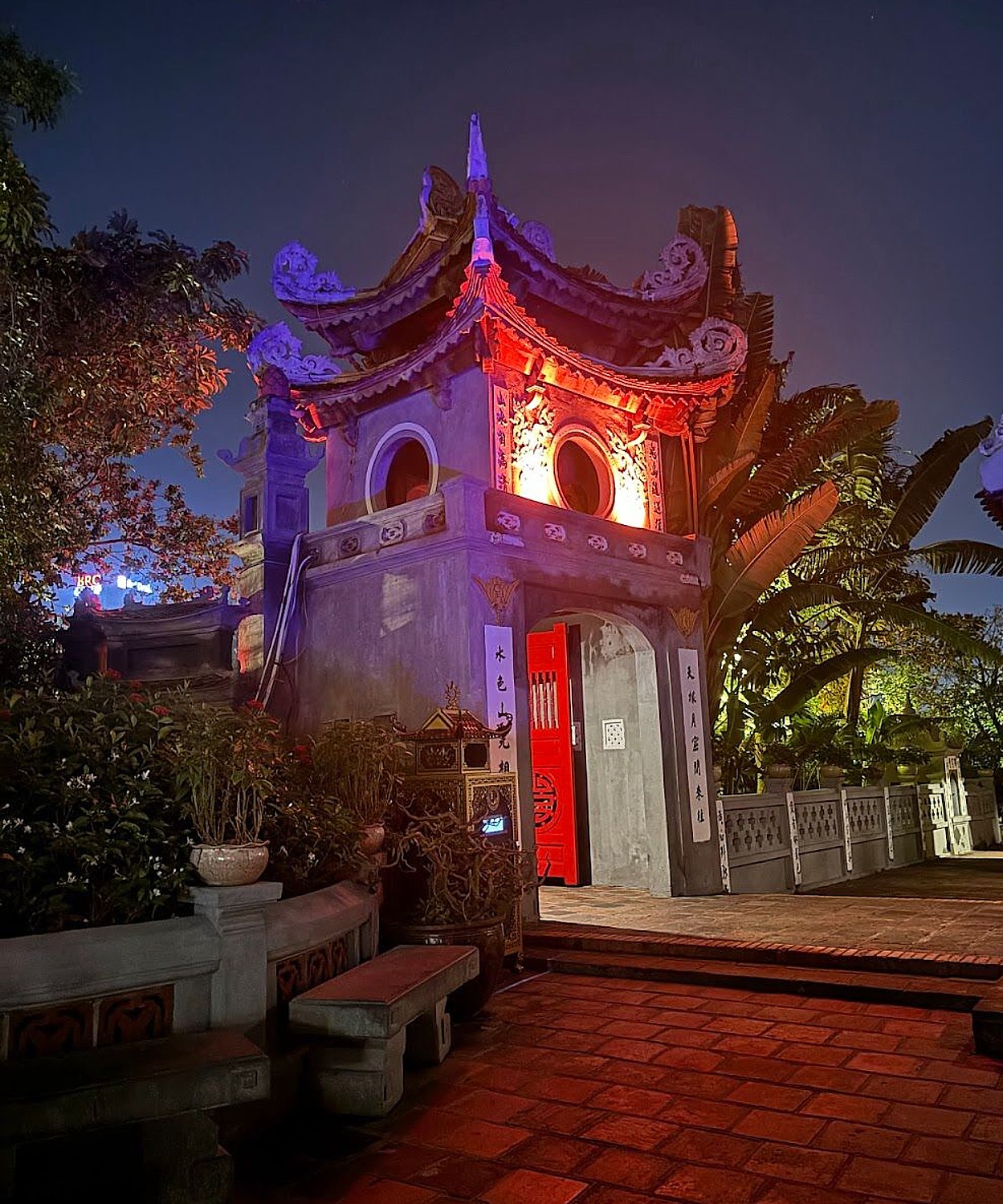
The endpoint of this thrilling and gorgeously scenic water route is a Tran Dynasty temple where Saint Quy Minh Dai Vuong, an earth and water deity, and his wife are worshipped. It is mind-blowing to realize the temple was first constructed 1000 years ago during the Dinh dynasty.“The Temple contains four stone pillars, each of which is a piece of art that our forefathers left behind for posterity, but which remain a mystery, with clever, artistically carved patterned borders. The spirits were known to the ancients as Long (dragon), Ly (Qilin, a unicorn, part dragon, part horse), Quy (turtle) and Phuong (phoenix) – indeed, the four sacred animals we had seen during the Water Puppet cultural show in Hanoi.
This is our third morning on Discovery Bicycle Tours’ 12-day Vietnam cultural tour, and after a fabulous breakfast at the Emeralda Ninh Binh Resort, we travel by bus through the picturesque countryside. It will also be our first day biking in Vietnam.
We turn off local roads to cycle among the rice paddies and our guide, Nguyen Hong Phong, stops to explain the rice culture that has been so fundamental to Vietnam for 4000 years. (I can see how the “water puppets” we saw in Hanoi reflect this wet rice culture.)
Before 1986, communal farming prevailed – the property was owned by the government and the farmers earned a share (theoretically equal but apparently not really, Phong suggests). But production wasn’t sufficient and people didn’t get enough rice.
Phong tells us that when he was a boy, his biggest wish at the Lunar New Year was to have enough food and clothes without stitches. When there wasn’t enough rice, they would mix in corn, tapioca, and “privately, secretly” catch snails, snakes, rats from the rice paddies. Even dogs and cats were protein for people.
But a new law in 1986 allowed private ownership and open markets. The government divided up the land among the farmers. By 1996, Vietnam produced enough rice not only to feed its own population but to export, becoming one of the biggest rice exporters in the world.
But a new problem has arisen because young people can make more money in factories than on the farm, and farms are being abandoned or farmers have to hire workers.
Phong explains the process: dropping a seed and the sprout grows, within one month to 20 cm high, then the sprout is uprooted and transplanted. They have to build fences to keep out rats, mice, and fill with water to stop snails. After 3 ½ months growing, the rice plants are put into a nursery for one month more. By the time the plant is one meter tall, ripened to yellow, it is cut by hand or machine.
We learn how every part of the rice crop is utilized. But what I don’t understand is why white rice prevails even through the lean years of hunger and deprivation, when brown rice would be more nutritious and less costly to produce.
We stop along our cycling route to visit a community cemetery for war soldiers. Between 1945 and 1975, 3 million died in war, including one million soldiers. “Each community has a memorial, with the remains and the name of the person who died for freedom.” July 27 is the Day of the War Soldier, when families come and burn incense. A white flower on the grave indicates the soldier died without a family, a yellow flower denotes the soldier had family. We see the ages of these fallen soldiers, some as young as 18.
Biking to Hoa Lu, Ancient Capital City
After pedaling through several villages set amid a landscape of magnificent limestone peaks, we reach Hoa Lu. Hoa Lu was the capital of Vietnam from 968 to 1009 during the first two imperial dynasties of Vietnam: the Đinh founded by Đinh Tiên Hoàng, and the Early Lê founded by Lê Đại Hành. When the Lê dynasty ended, in 1010, Lý Công Uẩn, the founder of the Lý dynasty, transferred the capital to Thăng Long (now Hanoi),60 miles away, and Hoa Lư became known as the “ancient capital.”
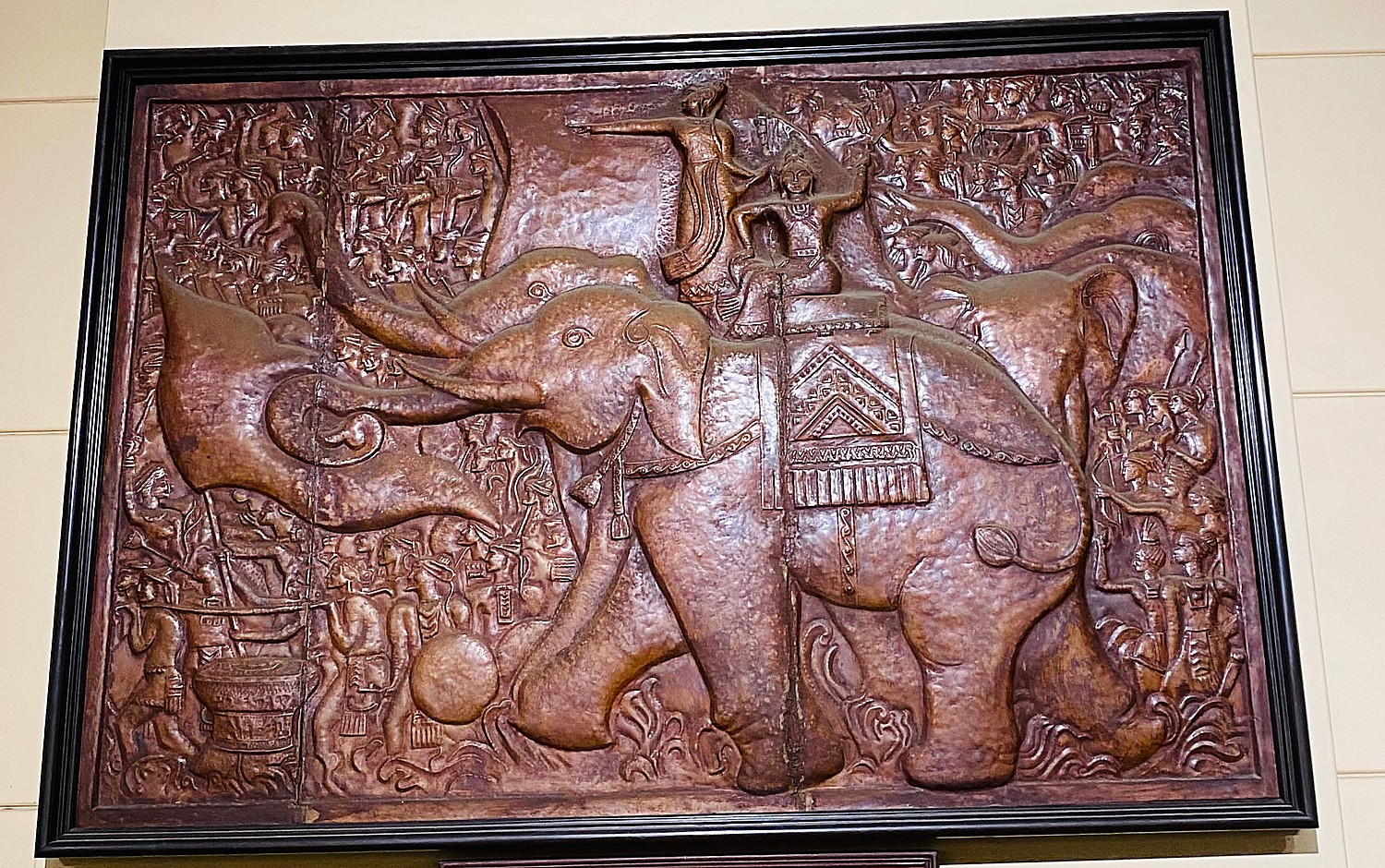
At the entrance is the “stone dragon bed,’ where the king would have gotten off his elephant transport and walked the central path through the archway into the temple, while the mandarins entered through the sides.
Phong relates that in a feudal society, when a king passes away, they build several mausoleums so people don’t know where his actual body is buried – those that buried him are killed to keep the secret.
The thought occurs to me: To go from a king who can execute and torture at will to a dictator, even one who imprisons, tortures, and kills dissidents to preserve power but nonetheless is focused on bettering the lives of his people rather than his own aggrandizement, was a step up for the Vietnamese. But for us who are used to “rule of law”, “due process”, “equal rights”, “no man is above the war,” “justice without fear or favor,” and the ability to vote out an elected official, to find ourselves under the thumb of a dictator who politicizes justice, rules by violence, extortion, intimidation and oppression for his own benefit, is horrifying.
Also, what a difference peace makes to progress and quality of life.
We have a brief visit to the Old Palace.
We continue biking and stop at a cemetery– one of many we see in these rice paddies. Phong tells us it is common for the families to build a tomb for their ancestors within their allotment.
Driving on the highway, we stop at one of several modern rest stops which also house handicraft shops employing people with disabilities. This one employs some 500 people and specializes in really fine embroidery (others specialize in painting, sculpture, lacquerware and other crafts)
The manager who greets us explains that these handicraft shops were opened in 1996.”Before they worked here, they stayed at home and couldn’t work. Now they get trained and can support themselves and their family. They have housing and are bused from home.”
We watch how these craftspeople embroider these magnificent scenes that match a photo. The manager says it can take 2 ½ months to make one smaller embroidery, 4 months for medium sized and 8 months for large; 65% of the purchase price goes to the worker.
These folks have really perfected capitalism. The general manager finishes his introduction saying, ‘It’s the new year. We give good price. No tax.” They make it easy to spend US dollars, use credit cards and ship purchases home.
It’s a private company but gets support from government, so I ask Phong, “so this is a private non-profit”? “Nothing is ‘nonprofit’” he replies with a note of cynism. (He made a similar reply when describing how after the Communists took over government, ostensibly to give equal portions, he snidely inserted, “of course, nothing is really equal.”)
Later I ask Phong about taxes people pay and am surprised that they are similar structure to what we pay: under $500 income, no tax, then a progressive rate up to 35% based on income that includes their equivalent of social security, plus 2% for health care. With health care, they also have some covered and some out-of-pocket expense but I can imagine the cost of their health care is a fraction of what we pay in the US.
We stay for a second glorious night at the magnificent Emeralda Resort, sprawling like its own village with a palace-like entrance, outdoor and indoor pools, kids club, restaurants, and rooms the size of apartments. I get in a swim before enjoying a fabulous dinner together at the restaurant.
The next morning, we head to Bai Tu Long Bay for an overnight cruise on the Dragon Legend.
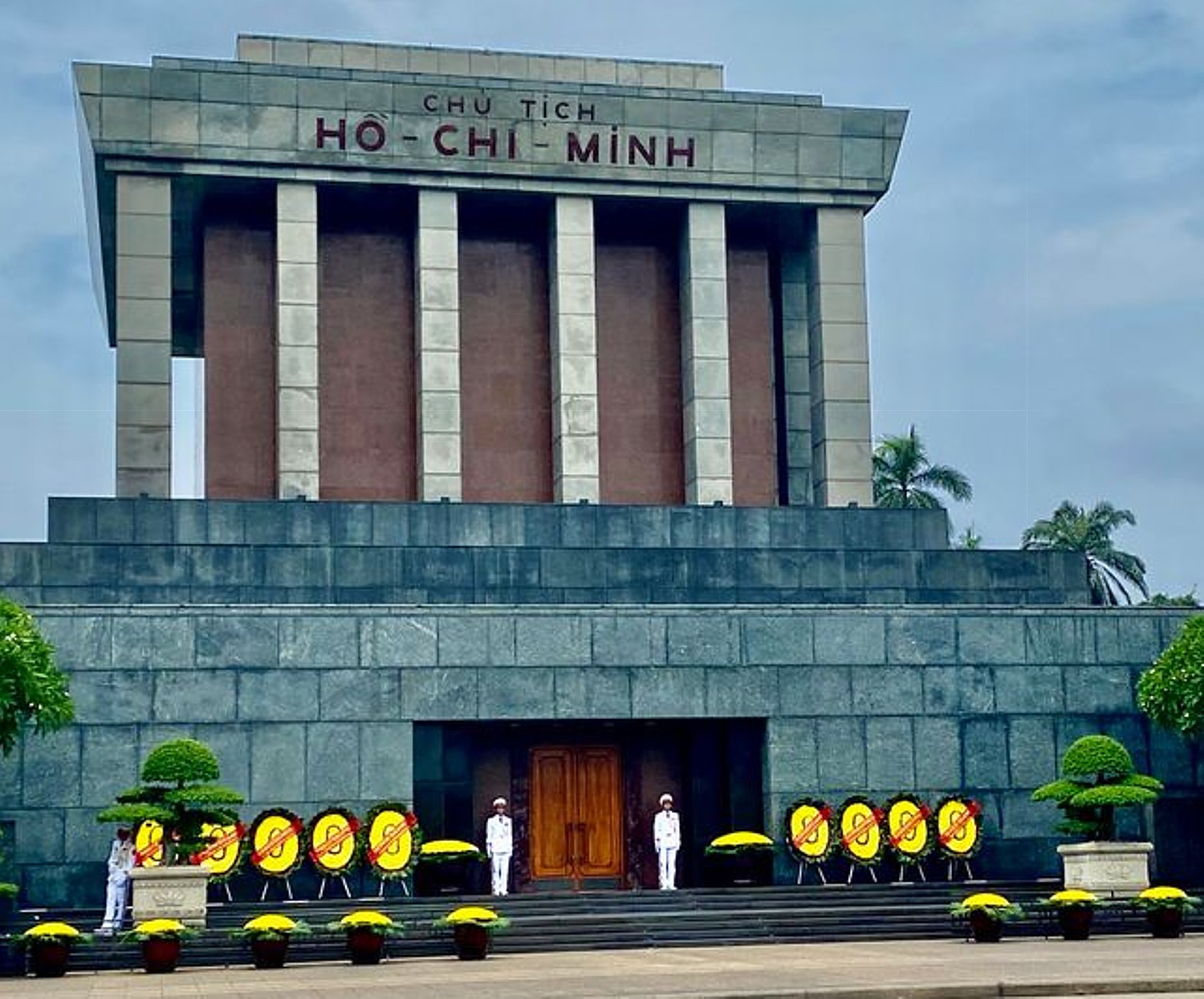
Visiting the Ho Chi Minh Mausoleum in Hanoi is a profound experience – revelatory, even. I had not expected to see the great liberator of Vietnam’s actual body, lighted from above. And shortly after, standing outside the Soviet-built mausoleum, I realize as we listen to our guide, Nguyen Hong Phong, that I had no actual understanding of who Ho Chi Minh was. Combing the recesses of my mind, I realize I saw Ho Chi Minh simply as the enemy and likely a brutal dictator (more like China’s Mao Tse-Tung). And even though I had lived through the Vietnam War (known here as the American War), I really hadn’t understood that either.
But here in Hanoi on Discovery Bicycle Tours’ Vietnam tour, I can see how Ho Chi Minh is justifiably venerated as a hero to his people – George Washington, Lincoln and FDR rolled into one. Visiting is like a pilgrimage with rules that accord him maximum respect. We walk up the stairs into the mausoleum, and slowly walk around his actual body, lit from above, as if he is merely sleeping – the still sleeping Liberator.
Ho Chi Minh, Phong tells us, “is the most respected in Vietnam. People changed their name to Ho. He is worshipped like a god in homes. He overcame the French, Japanese, Chinese and Americans for independence and freedom. Now we live in a peaceful country because of Ho Chi Minh.”
Our Discovery Bicycle Tours group at the Ho Chi Minh mausoleum
Coming back to the front of his mausoleum (built by the Soviets), Phong relates that Ho Chi Minh was born in 1890 into an educated family – his father was a Mandarin, working for a royal family. In feudal society, only men went to school and women stayed at home. He and his brother went to a French school.
He attended college in Saigon in 1911, studying culinary arts and applied to work as a cook in France. He wound up working on a ship, traveling to America, Britain, France, Russia and in 1928, went to China. Seeing the world in this way is what cultivated his revolutionary ideology and zeal to liberate Vietnam from foreign imperialists. On Feb 3 1930, he gathered party leaders and set up the Communist party.
“What he really learned was the importance of making Vietnam independent. He left Vietnam to learn enough about the French to kick them out,” Phong tells us.
He returned to Vietnam in 1941, having been away for 30 years. In 1944, Ho Chi Minh and General Japp (also a national hero) set up the Viet Minh, to resist foreign occupation by theFrench and Japanese during World War II.
When the Japanese and the French (who had occupied Vietnam since 1868, introducing Roman alphabet to replace Chinese characters the people used for 1000 years) left in 1945 at the end of World War II, on Sept 2, 1945, Ho Chi Minh declared the independent Democratic Republic of Vietnam. But after only one year, in 1946, the French attacked, forcing Ho Chi Minh into the mountains and retaking control.
“He wanted peace and agreed to divide the country in two for two years. They agreed to divide along the 17th parallel. It was supposed to be temporary. Five million people (mostly Catholic), fled south while one million southerners moved north. Then there was supposed to be national elections.”
But the US blocked the election (claiming concern for a “domino effect” of Chinese-led Communism spreading across IndoChina) and set up a puppet government in the south
When the war ended in 1975, Vietnam was united under the Communist regime.
The South Vietnamese who worked for the Americans were terrified of retribution and left (they were the “boat people”)
But Vietnam was still not at peace. China set up a new government in Cambodia that attacked South Vietnam. Fighting continued from 1979-1988.
Vietnam has only had real peace since 1988.
In 1986, the government implemented a “revision policy”: “We close the past, and look to the future,” Phong tells us. “The state still owned industry but allowed people to own their own businesses, allowed private enterprise and open markets. The rice fields were divided so you worked for yourself.”
From the mausoleum, we visit the complex where he lived – the Presidential Palace taken over from the French (Ho Chi Minh refused to live in it and only used the palace as an office and to receive dignitaries). Instead, from 1944-48 he insisted on living in a modest one-bedroom house, then moved to a house on stilts (reminiscent of where he lived with a Thai family), which again, was absolutely beautiful, but very modest.
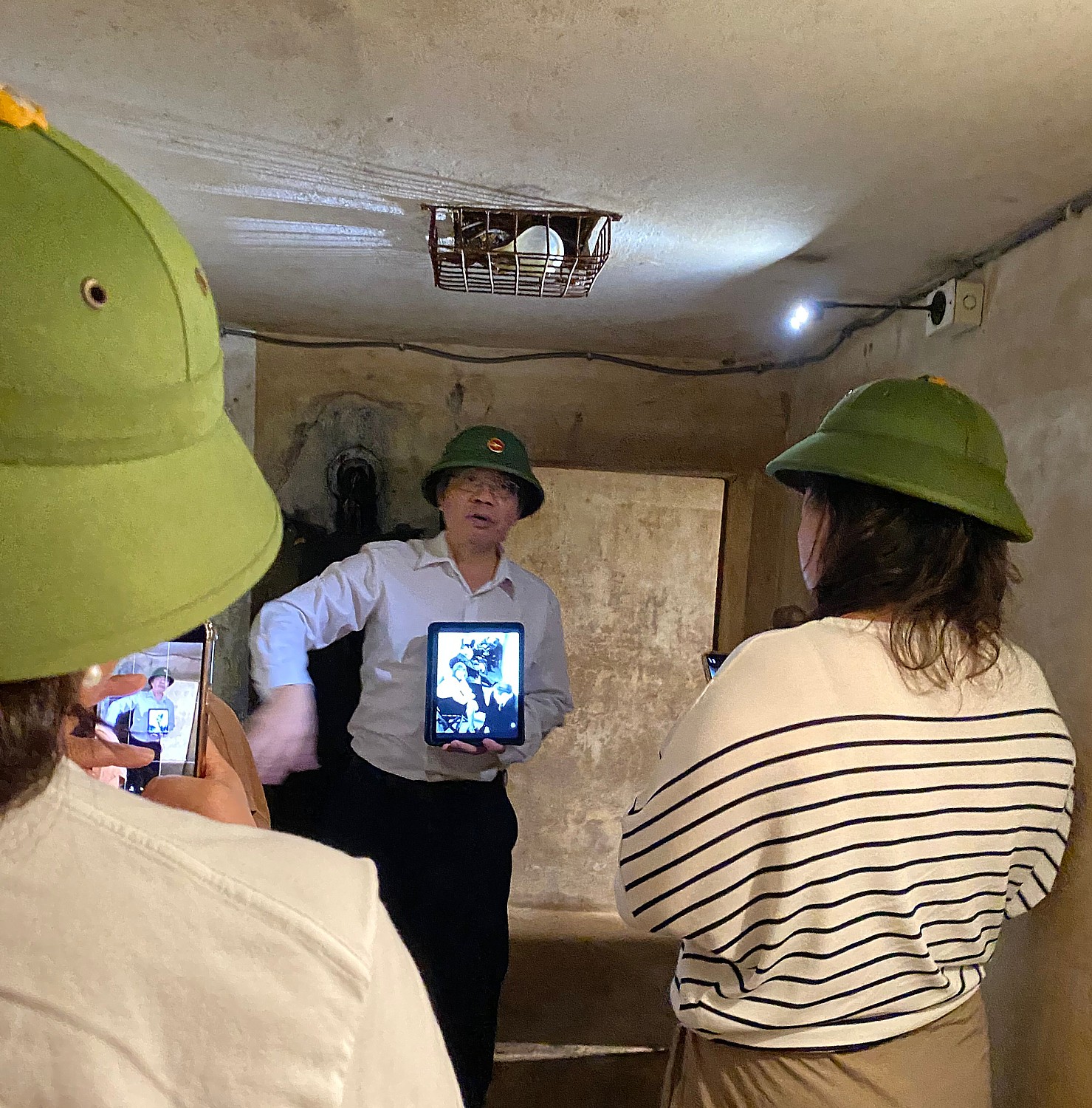
In 1967, Ho Chi Minh became sick with lung cancer and was moved into another house, steps away from his house on stilts. This one looks camouflaged like a bunker, and was connected to underground bunker because by then, the US was bombing Hanoi. When he died in 1969, at the age of 79, the location of his body was kept secret and moved multiple times. His body was kept inside a cave until 1973, when the US left, and then asked Russia to build a complex. Until 1977, they moved his body nightly, keeping the coffin hidden underground. Peering through the windows of his homes provides a window into who Ho Chi Minh was in life.
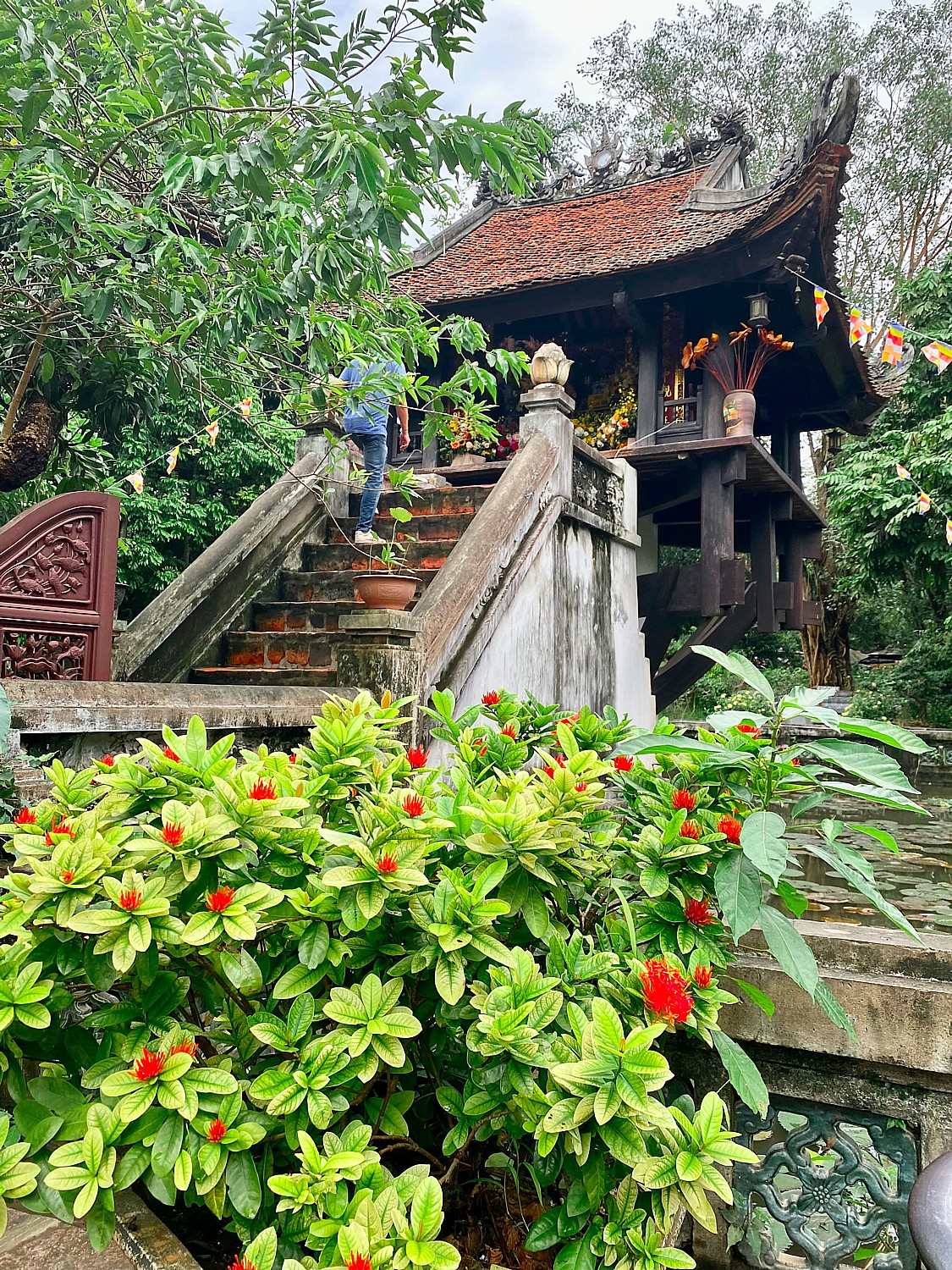
Before we leave the complex, we visit the One Pillar Pagoda, which dates back to 1049. The French destroyed it in 1954, but the Vietnamese rebuilt it in 1955. There is a billboard that lays out the moral “do’s” and ”don’ts” of Buddhist/Confucian/Taoist society.
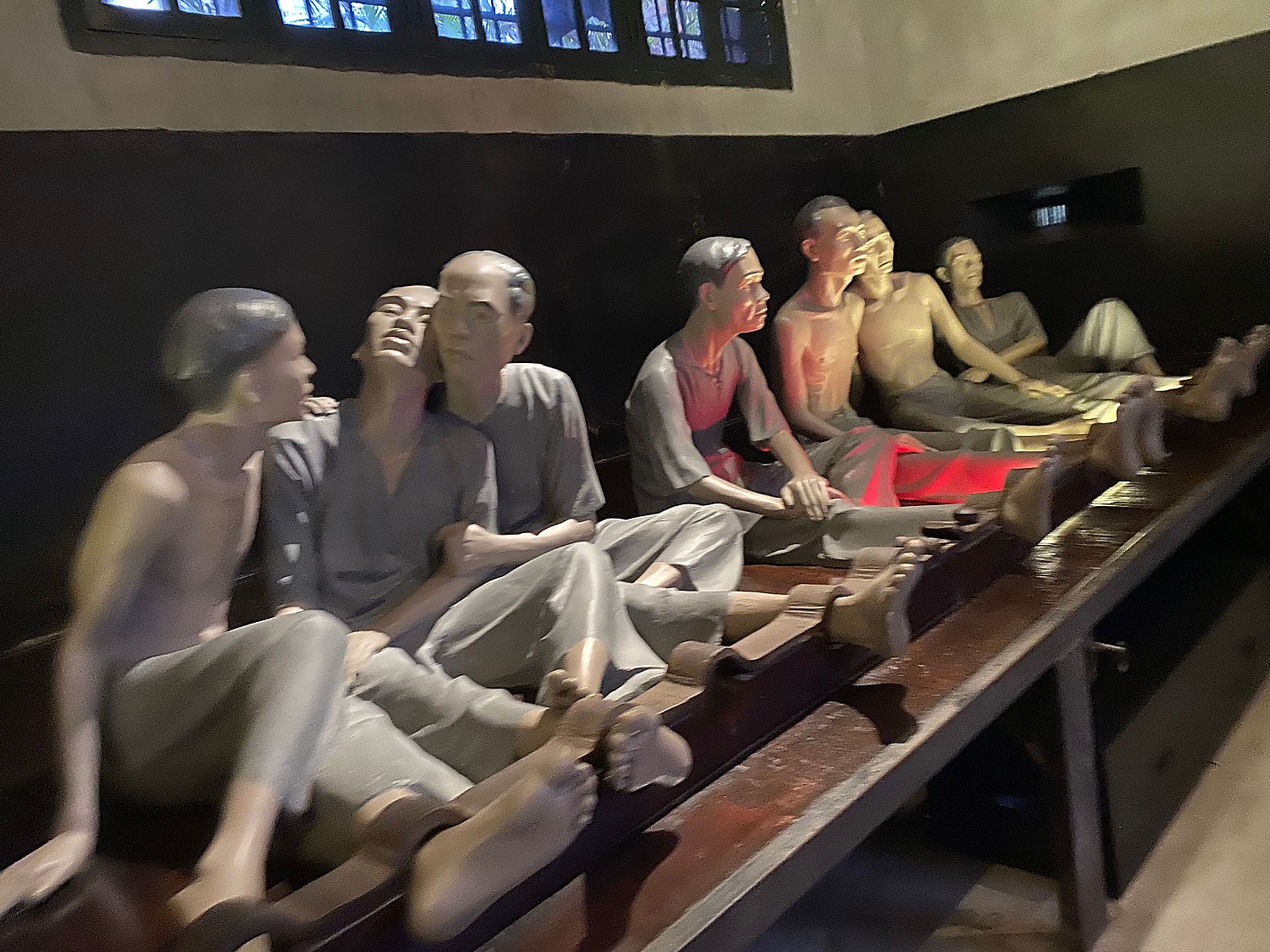
If I had questioned how Americans would be received in Vietnam, I soon get my answer standing in front of a monument to John McCain at the lake where McCain’s plane was shot down in 1967. McCain began six years as a prisoner in the dreaded Hoa Lo Prison, infamously known as the “Hanoi Hilton” – famously refusing to leave until his comrades were also freed. (We don’t get to visit but today it is a historic museum which has an exhibit devoted to the American prisoners, but is mostly showcasing French colonialism, see “Museum Hopping and Shopping in Hanoi”). The monument dates from 1992, when John McCain became one of the first Americans to come to Vietnam to heal relations; President Bill Clinton established relations in 1993 and helped revive Vietnam’s economy.
In December 1972, American B52s bombed Hanoi, surrounding villages and hospitals. As we look around Hanoi today, there is little evidence of that.
If Vietnamese still resent Americans you do not feel it at all. When I ask our guides about that, I am told “We are a Buddhist country. We do not look to the past; we look to the future.” If anything, though, there is still resentment between North and South Vietnamese, similar to the cultural divisions that remain between north and south since America’s civil war.
“The Vietnamese love Bill Clinton, the first US president to visit after the war, and we love John McCain. The United States is one of seven countries with the best relations,” Phong says – US, France, Australia, and Russia. “We close the past and look to the future.” Interestingly, considering one of the excuses for the US to enter the Vietnam War – the “domino theory” that China would take over IndoChina – is that Vietnam is wary of China, which had dominated Vietnam for 1000 years. “Local people feel cautious about China’s ambition to invade.”
It is our second day on Discovery Bicycle Tours’ 12-day Vietnam tour, and we’ve come to the Mausoleum after stopping first at the bike rental shop owned by Mr. Trung, a 70-year old former national champion and president of the Giant UNCC (he poses with us and shows magazines that feature him), where we are fitted for bikes that we will use in Ninh Binh, Hue and Hoi An.
From here, we drive a couple of hours to the Thung Nham Ecotourism Zone (I enjoy looking out to the scenery, how soon we find ourselves amid rice paddies and farms). It is sunset when we are taken by traditional boat into a bird sanctuary. Flocks of birds – storks, herons, teals, tropical starlings – take their positions in the tree tops over the Thung Nham wetland. There is a stunning resort set within the preserve, all the more gorgeous as lights and lanterns come on as the sun sets.
Discovery Bicycle Tours’ Biking Vietnam tour is designed along the best principles of travel: to explore, discover, learn, make connections, be present, experiential, meaningful and revelatory, and do it in a way that maximizes the benefits and minimizing the negative impacts of tourism.
Of the 12 days we spend in Vietnam, traveling from north, to central, to south (flying between regions), we bike on six of them. That might seem odd for a biking tour, but you don’t travel 30 hours to Vietnam and miss the important highlights, like Ho Chi Minh’s mausoleum in Hanoi, taking a traditional row boat through the caves of Ninh Binh; cruising overnight on the Ha Long Bay; discovering the Citadel and Imperial City of Hue; walking the colorful markets and enjoying the nightlife of Hoi An; or touring the War Remnants Museum, the historic Ben Thanh Market, or miss the experience of street food in Saigon (Ho Chi Minh City) because you are obsessive about biking. We get to do all of these, and also bike through villages, stopping to learn about traditional crafts, and amid the rice paddies to learn about Vietnam’s 4000-year old wet rice culture and ancestor worship.
Riding in the bus between destinations lets us see the countryside (and I have set myself a challenge to get photos of people working in the fields and four people riding a motor scooter); the way the homes are laid out, the ancestral tombs in the fields, the occasional tractor, the massive, new industrial parks under construction. You see progress unfolding at the speed of the bus, all the more impressive when you realize what a young country Vietnam is, having proclaimed independence in 1945 but only “reunified” in 1975.
The essence of this tour is about familiarizing us with the Vietnamese people (who, we learn, are a mosaic of 54 different tribes), the rich cultural heritage and today’s achievements in overcoming literally millennia of conflict, war, oppression, colonialism. When we bike, hike or walk, we barely have to think a question, let along ask it, before our guide, Nguyen Hong Phong, stops and answers. “This is normal for me, curious for you,” he tells us at the outset, as we sit for tea in the Apricot Hotel on our first afternoon together in Hanoi. “When you are curious, just ask,” he adds.
2025 marks the 50th anniversary since the Fall of Saigon that so abruptly ended an interminable war (and reunification as an independent country). You can’t escape the fact of the “American War” (which frankly was the tail end of a decades long war for independence before the United States interceded), but our tour seems to sidestep the past in favor of the present. This is probably a reflection of Discovery Bicycle Tours’ primary focus for its guests: “You’re on vacation!”
(There are several important sites that are not included in this tour that I would recommend setting up pre and post days: the Hoa Lo Prison in Hanoi, infamously known as “Hanoi Hilton” and the Chi Chi Tunnels which is an excursion from Saigon. Even the War Remnants Museum, a must-see in Ho Chi Minh City, was not on the itinerary but we visit when we could not visit the Reunification Palace as planned.)
Still, there is no escaping the past: in Hanoi when we visit Ho Chi Minh’s 1968 residence, built like a camouflaged bunker with escape tunnels and learn they moved his body regularly when he died in 1969; when we visit the John McCain Monument where the American hero’s plane went down and he was captured; when we see the bullet holes in the Citadel in Hue and are shown photos of fighting that took place on the very spot where we stand; and when we visit My Son, a sacred historic site outside of Saigon, and learn that the Vietnamese appealed to President Nixon to stop bombing. I think Americans who visit Vietnam have an obligation to see what was done in our name, especially because it is so important to learn from history so not to make the same mistakes, and not be duped by an administration determined to go to war for its own political agenda.
I frankly didn’t know how I would react coming to Vietnam – I am the generation that lived through the Vietnam War (known here as “The American War”), or how Americans would be received. My questions are soon answered – the Vietnamese warmly welcome us Americans (and French and Chinese and a list of nationalities that have oppressed Vietnam). Vietnam is nothing like what I expected – in a good way. It’s in this capacity that one of the important attributes of travel come to fore: we travelers are ambassadors, promoting mutual understanding and connection.
In Vietnam today, you can see the impact of peace, free markets, free enterprise have to achieve prosperity – a lesson to all those who are inciting conflict and war. You see the benefits of trade and globalization – a lesson for those who would disrupt and unravel alliances and build barriers instead of bridges.
Old Hanoi
Since our group is first meeting together at 1 pm for a walking tour, I have the morning to myself to explore. I walk across the street from our luxury hotel, The Apricot, to the park that rings the small, picturesque lake.
We are here during the month-long Lunar New Year celebration, made even more festive because of the 50th anniversary of reunification – everywhere that is possible has decorations reminiscent of how we celebrate Christmas. People dress in their formal, traditional costumes and pose for photos taken by professional photographers. People travel on holiday. There is a festive atmosphere everywhere.
There are political symbols, posters, flags and such but no more than the giant advertising billboards and the Starbucks, KFCs, McDonalds, Burger Kings. Also, I am flabbergasted at the proliferation of motorscooters and the paucity of bicycles. Crossing any street takes fortitude and a measure of fatalism, but where there are traffic signals, the systems are sophisticated and effective. Also, cell phones are ubiquitous.
I head into the Old Quarter where I am intrigued at the “old propaganda posters” shops, the coffee shops (who knew Vietnam was such a major producer and exporter of coffee?), and massage parlors as common as nail salons at home.
The Propaganda Poster Shop seems more to satisfy the American and European tourists who visit (“Make Art Not War”).
But here at the Propaganda Poster Shop I happen to see many postcards for Train Street (reminding me of Lisbon) which suggests it is an important site and inspires me to go in search of this place.
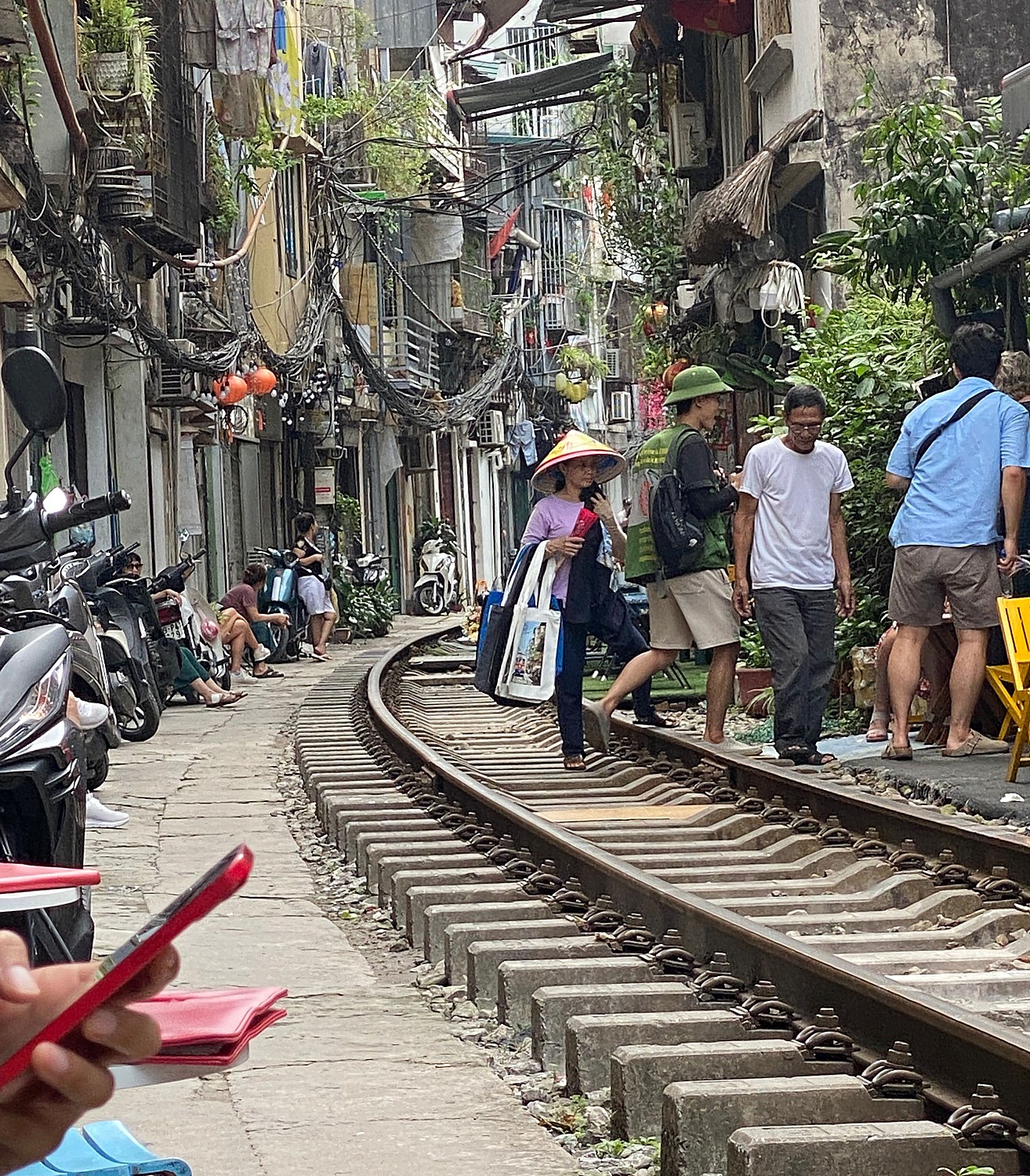
After getting lost (my WiFi isn’t working and I can’t figure out the map) and stopping numerous people to point me in the right direction, I look up and am drawn to colorful lanterns, walk up a staircase and find myself quite literally on the train tracks. Train Street!
People have set themselves at café tables and chairs and are even hanging out on the tracks taking photos. It is all the more amazing because it turns out it is just 5 minutes before the train is due (and I am so lucky because only a few trains come through a day). With 5 minutes to go, there is even a baby playing on the track!
I am standing alongside the track and a lady yells at me to sit down in one of the plastic chairs, like a kid’s chair. As the train comes tearing through at what seems a very fast speed, it is so close that had I held out my hand, it would have been taken off. I reflexively suck in my breath and try to make myself as small as possible until it passes. Unbelievably thrilling.
I feel proud of myself for being able to find my way back to the hotel by 1 pm in time to meet our Discovery Bicycle group for our first activity together, a walking tour of the Old District. I have already been traveling with 8 of the group for Discovery Bicycle’s four-day Cambodia pre-tour and now we meet the other 10.
Phong leads us to the St. John Cathedral, the oldest church in Hanoi. Built on the site of the biggest, most sacred Buddhist pagodas of the Ly-Tran Dynasties, the cathedral was constructed at the end of the 18th century of wood, then reconstructed with baked clay in 1884-1888. Phong tells us that Catholics are a minority; the biggest religion in Vietnam, he says, is “triple religion” – a mix of Buddhism, Confucianism and Taoism (ancestor worship).We will see evidence of this everywhere we go.
Phong volunteers that the Communist government “allows free religious worship and free press” (though I question what he means by “free press”), then adds that protest against the Communist Party is not allowed; nor is there an opposition candidate in elections. Vietnam has been a one-party government since 1954, but in 1986 introduced new freedom in commerce and open markets.
“We have more freedom than in China. They block media there, here they block the BBC but we can get CNN.” Whatever they block, he says, people get curious and have their ways of accessing.
“Society is improving for ordinary people. Since 1988, we are living in peace. We feel more freedom, a peaceful country. We are now friends with Russia, Ukraine, the European Union. The USA is one of seven strongest friends. Peace is good for people, good for the country. [Tourists want to] come to a peaceful country.”
Phong tells us he learned English (as well as French and Chinese) at university where he studied tourism, but today, children are taught English as early as 3 and 4 years old in school. Public school is free he tells us, even in the mountains where parents are actually given a money incentive to send their kids to school.
We walk through Hanoi’s Old Quarter where the name of the street may well describe what enterprises take place there, established generations ago by the people who resettled in the city: Tin Street, Silver Street, Basket Street, Copper Street.
We return at 3 pm for tea at the Apricot Hotel – an elaborate affair – that includes an introduction and orientation to our 12-day tour (with biking!) with Phong as our lead guide.. Indeed, we will go first thing the next morning to get sized for our rental bikes which we will use for five of the days (the driver and bike mechanic who travels will us will travel 2 ½ days to Hue, when we fly), and will pick up a different bike in Ho Chi Minh City (way too far to drive and return).
I realize that we have just enough time to see the 5:15 pm traditional Water Puppet Theater cultural show just across the street from the hotel, before we meet again to go to dinner.
I had seen this heritage show when I was in Ho Chi Minh City six years before, so was enthusiastic to see it here, and encourage my traveling companions to come.
Most of our group from the four-day Cambodia pre-tour (we really bonded) are game and we actually purchase the last tickets for this immensely popular program. The show is a cultural treasure that utilizes this traditional art form, with musicians performing with traditional musical instruments and song, fables and folk stories enacted by these marvelous puppeteers (yes, the puppets are in a pool of water!).
Captions and notes about the theater and the scenes are flashed on the walls beside the stage. Vietnam water puppetry, I learn, was born from the rice civilization in the Red River Delta, so agriculture is vividly depicted by the puppets, with farmers and familiar images such as riding buffalo, plowing, harrowing, transplanting rice, slapping water, harvesting. (Later, when we bike among the rice paddies, we will see how this tradition originated.)
One of the scenes enacts “The Legend of Returning the Sword by King Le Loi” where LeLoi caught a holy sword by chance as he led the resistance war. After defeating the invaders, he proclaimed himself king. King Le Li goes out boating on the Green Water Lake, when suddenly a large turtle surfaced, took the sword from King Le Loi’s belt, and dived back into the depths, carrying the glowing sword in his mouth. (This is all enacted with puppets in the water).
The humor that is integral to the culture is displayed where the puppets enact an old farmer “Chasing fox away from the flock of ducks”. “It creates Vietnamese optimistic farmers,” the notes say.
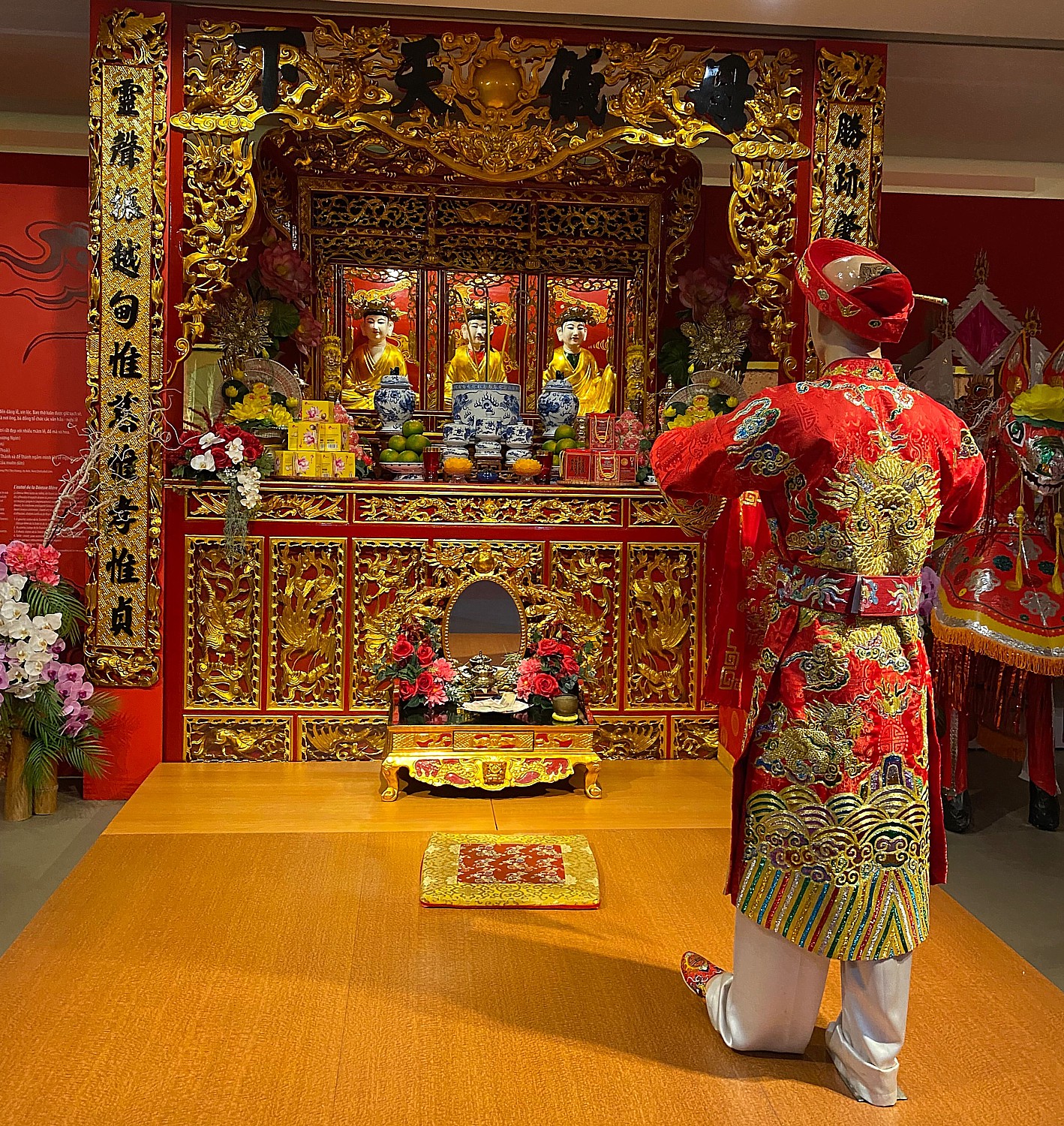
The notes for “The Spirit Mediums Spiritual Dance,” say that “Vietnam’s Mother Goddess worship has been honored by UNESCO as an intangible cultural heritage of humanity. In today’s life, Mother Goddess worship is mainly known to the community through the concept of ‘The Spirit Mediums’. Traditional cultural elements such as costumes, music, dance and folk performances imbued with Vietnamese cultural identity are created, developed and passed on from generation to generation.”
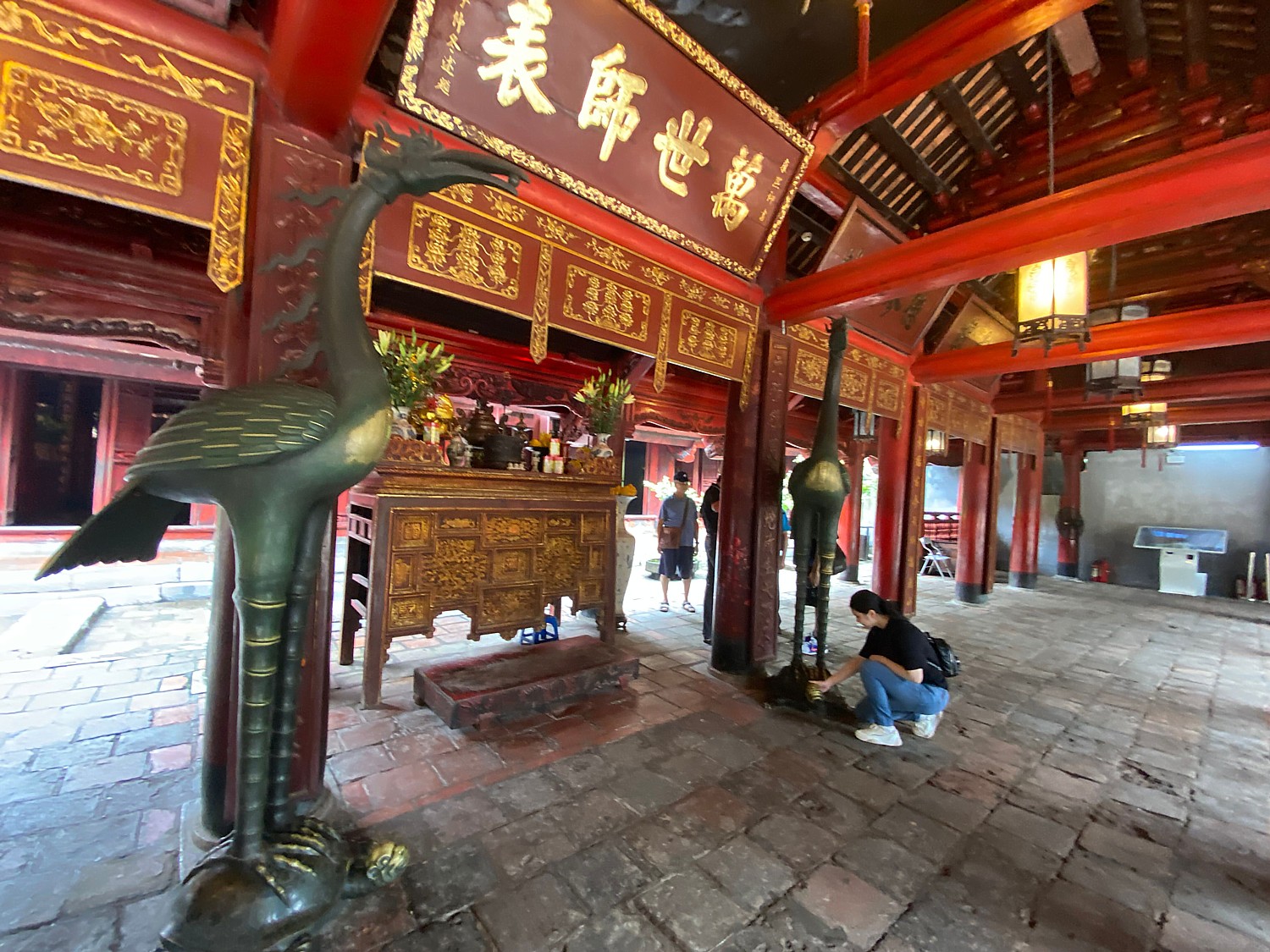
The ”Four Sacred Animals Dance” brings together Long, Ly, Quy and Phuong (Dragon, Unicorn, Tortoise, Phoenix) “praising the nature of heaven and earth, hoping for a peaceful state and a peaceful and happy life.”
There are fire effects and of course water effects and amazing choreography – you actually cannot figure out how the puppeteers coordinate so well (and underwater!) – and then the puppeteers appear for their curtain call, up to their waist in water.
The show finishes just in time for us to walk together to dinner in a charming restaurant in the Old District.
A note on the table about the apple cider makes us giggle: “Cider drinkers get more refreshment and excitement while still keeping their sanity. Especially suitable for women.”
Our lunches and dinners at restaurants are typically pre-ordered and served family style, with multiple courses so that we typically have chicken, beef, seafood, vegetable, rice, soup dishes – always with more than enough to satisfy even American appetites, and to get a really excellent idea of the cuisine.
Exploring the Apricot Hotel (we will be leaving early in the morning after breakfast), we discover an exquisite rooftop indoor pool and bar with a giant video screen. The artwork around the hotel, the elegant (French-inspired) furnishings are gorgeous.
By Karen Rubin, Travel Features Syndicate, goingplacesfarandnear.com
On Day 8 of our Boat Bike Tours’ Islandhopping Netherlands tour, we wake up in Enkhuizen, back where we started. We have breakfast and have to disembark by 9:30 am but we are able to leave our luggage on board for a couple of hours, giving me time to explore a bit before I need to take the train back to Amsterdam and the Schiphol Airport. I really appreciate this bit of time since I hadn’t a chance to explore Enkhuizen when we first arrived (I recommend coming a day before the ship sails so you have more time), and though I had some time to explore in the evening, i really enjoy myself wandering around this morning.
I find myself at the Zuiden Kerk (church) – magnificent yet simple and unpretentious, awesome yet approachable; ancient yet modern, the painted wooden ceiling shaped like the upside down bottom of a boat. It is Sunday morning and people are gathering for service as the organmeister plays Pacobel.
I find my way to the Zuiderzee Museum, an open-air living history museum village that re-creates daily life around the Zuiderzee before the sea was turned into a lake (the Ijsselmeer where we have just sailed) – when the dam was built in 1932. You stroll the cobble streets and explore 140 historic buildings collected from the former Zuiderzee region.
The outdoor museum was opened by Queen Beatrix in 1983 as an extension of the indoor Zuiderzeemuseum, which opened in 1950 (the indoor museum doesn’t open until noon so I have to miss it). Most of the buildings are authentic while others are reconstructed replicas of actual buildings. A complete village, you can wander around and visit a windmill, lime kilns, fish-smoking house, steam laundry, drugstore, pharmacy, basketmaker, blacksmith, cheese warehouse, school (where wooden shoes are lined up outside the classroom), even a hairdresser, and visit the working post office. The harbor is a replica of its layout on Marken. From April to November you can see life in the village of Urk as it was in 1905, meet residents and watch traditional activities, like games and building clog boats, and demonstrations of crafts such as rope-making, cooperage, basket making and herring being smoked.
The Indoor Museum, “a treasure house of the Zuiderzee,” consists of a string of 17th century buildings (original and replicated), some of which were used by the Dutch East India Company. Here, various collections are presented with a modern approach: you can dive into a ‘Sea of Stories’ and experience life on the former Zuiderzee in this interactive exhibition. A popular attraction is the ‘Schepenhal’ (ship’s hall), which allows visitors a close-up view of historic ships. The indoor museum also displays artifacts from the Zuiderzee cultural past, including paintings, furniture and traditional local costumes (‘klederdracht’). (Unfortunately, it opens at noon and I do not have the time to visit.)
Both indoor and outdoor museums have several restaurants located in National Heritage sites, like the Hindeloopen Pub, the Amsterdam House and the Pepper House on the Wierdijk.
Admission is 22E (56E for a family); plan to spend at least 3 hours at the outdoor museum. [Note: if you are extending the boat bike tour with a stay in Amsterdam, you may want to get the Iamsterdam city card (www.iamsterdam.com), which includes admission to the Zuiderzee Museum, https://www.iamsterdam.com/en/whats-on/calendar/museums-and-galleries/museums/zuiderzee-museum]
Zuiderzee Museum, Wierdijk 12-22, 1601 LA Enkhuizen, https://www.zuiderzeemuseum.nl/.
I am relieved to see how amazingly easy it is to get to/from the embarkation point in Enkhuizen from Amsterdam’s Schiphol Airport (especially since I arrived by plane on the same day as the boat departed): just walk down to the train (every 15 minutes) to the Central Station, a quick switch to the train to Enkhuizen (every half hour) for the hour-long, comfortable and scenic ride. The trick is to “check in” with a credit/debit card using the app, or purchase a ticket (14-16E) before you go through to the train by tapping on a pole (a conductor will double check on the train), then when you depart the train, tap it on the pole again, and the correct amount is debited. (If you don’t pre-purchase, the conductor can charge you an extra 50E; I did forget but the conductor was extremely kind in helping me buy the ticket online.) Then it’s just a five minute walk from the train station to the ship. You can purchase tickets in the vending machines at the stations or online on https://www.ns.nl/en/journeyplanner#/. The website can also be used to check the timetable.
Getting back to the airport is equally easy – we are asked to leave the ship by 9:30 am (but I am able to store my luggage there, so I could visit the city until 11).I time my touring to get back to the ship, pick up my stuff to get the 11:39 am train to Central Station in Amsterdam, then a quick switch to the train to Schiphol with more than the three-hours before my flight at 7:05 pm.
This was my second trip with Boat Bike Tours (I had the best time on their Bruges-Amsterdam boat-bike-tour – utter perfection with the biking, the boat, the sights along the way; be sure to plan to spend at least a day in Bruges before the bike tour to appreciate its enchantment).
Boat Bike Tours, which is based in Amsterdam, got its start when Channel Cruises Holland, a barge tour operator founded in 1977, added biking to its itineraries in response to guests asking for traditional Dutch activities. The new cruise-and-cycle concept was so successful that it was spun off as its own brand in the mid-1990s. Between 2000 and 2020, the company added more itineraries and ships. Last year, Boat Bike Tours merged with Islandhopping, a Croatia-based operator which also specializes in cruise-and-cycle travel (I loved the boat-bike trip in Greece that I took with Islandhopping some years ago). Together, the merged company, while operating under their own names, offers more than 70 itineraries in 15 countries, and has opened a North American sales office in Fairfield, Connecticut.
“With half of our guests coming from North America now, it makes sense to have an office here,” said Jana Tvedt, Director of Sales, North America for Boat Bike Tours. “We’re available when needed and familiar with what Americans and Canadians are looking for in destinations, experiences and ships. And we’re always happy to work with travel advisors, groups and charters.”
Each season, the company contracts some 50 ships including barges, motor yachts and sailing ships, ranging in category from comfortable to superior. Biking styles include guided for casual riders and independent (self-guided) for seasoned cyclists, with touring bikes, e-bikes and mountain bikes available depending on the destination.
Itineraries range from five to 15 days, with most being eight days, and cater to a variety of budgets and interests, from historic cities and landmarks to picturesque natural landscapes and the world’s best wines. The Boat Bike Tours concept is to enable guests to connect with local people, culture and nature, while traveling by smaller boat and by bike also takes guests beyond tourist hotspots and minimizes environmental impacts. (Our sailing ship, Leafde fan Fryslân, uses biodiesel.)
The big news is that Boat Bike Tours will be offering a newly built ship for 2026, Magnifique X, an all-suite ship accommodating 32 passengers, giving the company a new deluxe, superior category. In addition to the bigger cabin, the itinerary is also enhanced with upgraded amenities, support van, included lunches, and more sightseeing inclusions. The itinerary goes from Amsterdam to Paris with one night hotel stay in Amsterdam, then biking to Bruges, then a motorcoach transfer to Paris where there is a hotel stay. (Bookings are open.)
Among its most popular itineraries for North American travelers:
Amsterdam to Bruges: Cruise and ride through the Dutch countryside of Zeeland and western Flanders in Belgium. Tour world-famous cities such as Amsterdam, Antwerp, Ghent and Bruges, as well as picturesque villages, a Dutch cheese farm, the windmills of Kinderdijk and the magnificent natural landscape along the Schelde River.
Split to Dubrovnik: Hop from island to island in the South Dalmatia region of Croatia by boat and e-bike. See the town centers of Split and Dubrovnik, and experience the culture and nature of more sparsely populated islands like Brač, Hvar, Korčula, Lastovo, Mljet and Šipan. E-bikes help with hilly and mountainous terrain.
Cochem to Metz: Follow the Moselle River through Germany, France and Luxembourg, passing endless vineyards and stopping to taste local wines. See enchanting old cities like Cochem and Bernkastel, the once-imperial Roman Trier, the stunning waterfalls of Saarburg, the Gothic cathedral of Metz and welcoming villages in between.
The merger of the Boat Bike Tours and Islandhopping means that clients of either one can take advantage of a 3% loyalty discount when booking. Notably, bike tours prove superb for the burgeoning number of solo travelers, and each departure offers at least one cabin with a reduced single supplement.
By Karen Rubin, Travel Features Syndicate, goingplacesfarandnear.com
Day 6 on Boat Bike Tours’ eight-day Islandhopping tour of northern Netherlands is a case when the hype doesn’t even begin to match the reality of the experience. Today’s ride will take us either 29 or 36 miles (depending on our choice of short or long routes) from Harlingen to Franeker, through the Frisian countryside and rural villages to Bolsward and into Makkum on the eastern bank of lake Ijsselmeer. Boat Bike Tours doesn’t just curate the cycling routes, they also curate experiences. In this case, our bike tour turns into an exploration of the solar system through an 18th century lens.
We set out biking first to the historic center of Franeker to visit the Koninklijk Eise Eisinga Planetarium (Royal Eise Eisinga Planetarium) – the oldest continuously operating planetarium in the world and a UNESCO World Heritage site. I had never heard of Eise Eisinga or his planetarium, but am instantly amazed.
Eise Eisinga was a wool-comber and largely self-taught scientist and astronomer who spent seven years, from 1774 to 1781, building a remarkable planetarium in his house! – in his living room/bedroom/dining room to be precise. We see the cupboard where he would have slept with his wife under the mechanism, the pull-out trundle bed where his children would have slept, the dining table. Above, on the ceiling, we see where he constructed a solar system where the six known planets in exact scale follow their rotation around the sun with remarkable precision even by today’s standards, using today’s instruments. The fact that the mechanism is still in working order is evidence of the ingenuity and foresight of its maker, who left detailed instructions for its maintenance.
While waiting for the English-language presentation, we visit the fascinating exhibits that take up the rest of his home, starting with a delightful video interview between “Eise Eisinga” and an actual Dutch astronaut and another superb video about Eisinga’s life.
When I learn about Eise Eisinga’s biography, I am awed by his genius, bringing to my mind Leonardo DaVinci.
Eise Eisinga was born in 1744 in Dronrijp where he attended primary school. Like many children in those days who worked at home, he worked in his father’s wool combing establishment. In addition to his father’s profession, he inherited his father’s interest in astronomy and mathematics. Eise was so determined to learn that he would travel every week to Franeker, a major center of learning, to study Euclidean math with Willem Wijtses, a wool dyer. When he was 24, Eisinga married Pietje Jacobs and settled in Franeker in 1768, working as a wool comber.
On May 8, 1774,a local newspaper published a prediction from a preacher that the confluence of Mercury, Venus, Mars and Jupiter and the moon would result in the mutual forces of these celestial bodies knocking the earth off its path and cause it to be burned up by the sun (“the end of time!”). That set off a panic and seems to have been an impetus for Eisinga to begin building his model of the solar system to show the extreme unlikelihood of planets colliding.
It took Eisinga seven years to construct his planetarium – a real triumph of craftsmanship to carve the wood (his father, a woodcarver, helped), create 6,000 precision nails for the cogs, and the exquisite painting. Eise would have finished sooner, but in a critical development, he had to adjust the placement of the pendulum that kept everything in motion, because his wife drew the line on allowing him to cut a hole in the floor (it was their bedroom, after all), so he had to recalculate everything and replace all 6,000 nails.
The power (and motion) for the entire mechanism comes from a clock, “like the beating heart of the machine,” our guide explains. The mechanism is powered by a system of nine weights – one for clock and 8 for different axels of system
All is built to scale to fit into the space – an astonishing 1 to 1 trillion – and everything is turning so slowly, you can’t detect motion visually. Every planet has its own calculated speed, so Mercury takes 88 days to make one full rotation; Venus takes 224 days; Earth takes 365 days plus 76 hours while the moon takes 29 ½ days to go around the earth (it shows the phases of the moon); Mars takes 687 days; Jupiter, with four moons (the number known at the time), takes 11 years, 315 ⅓ days for its rotation; and Saturn, the furthest known planet at the time, actually has rings and 5 moons and takes 29 years plus 164 days for its rotation.
How do they know the planetarium is still working when everything moves so slowly?
“Everything is connected, so we check what moves daily: the date, zodiac sign, day of week.” On December 31, a special nail pushes the gears into motion to flip to the new year.
Eise Eisinga was such a visionary, two years after finishing his remarkable machine, he wrote a 90-page manual explaining how to maintain it.
“Every 22 years, we follow 5 steps – take board down, sand down, paint the years, let the paint dry, then replace it in the attic,” our guide says. The wheels are so big and move so slowly, they clean the gears once or twice a year.
Eisinga’s son took over when he died, and the planetarium remained in the family for 140 years until 1922 when his great granddaughter was the last in the family to maintain the planetarium. Then the City of Franeker took over its management.
Most of the mechanism is original (Mercury had to be replaced after being damaged in World War II) but they have had to change the ropes for the gears and pulleys.
After the presentation, we are able to climb the stairs to the attic to peer into where the wheels and gears are laid out.
Eisinga came to Franeker with his wife because it had the second largest university in the country and was a center for learning that drew famous scientists. But you can appreciate how trade with the world not only gave Netherlands the wealth to pursue science and innovation, but the access to and transfer of knowledge, not to mention a culture of Enlightenment that was open to new ideas and discovery. And Eise Eisinga was wealthy enough that he could afford to make natural science a hobby.
It is a humbling experience to imagine such expertise and craft hundreds of years ago, before the tools and instruments we have today.
The museum offers several permanent exhibits: Eisinga’s former wool combing establishment, an extensive collection of historical astronomical instruments, Eisinga’s mathematical and astronomical manuscripts which you can digitally peruse, all marvelous juxtapositions to an interactive permanent exhibition, De Ruimte (Space) that opened in 2016, as well as that delightful video conversation between “Eise” and a modern-day Dutch astronaut (English subtitles).
I peek into a room to see the finishing touches on a new temporary exhibit: a spectacular astronomical cabinet from 1771 by Jean Paulus and Prof. Ghiesbregt. “After long wanderings, this Belgian instrument came into possession of Bert Degenaar, a famous Dutch antique collector. On his behalf, the instruments were completely restored and made functional again by horologist Pieter de Ruiter. The 3 meter wide and over 2.5 meter high cabinet is equipped with various globes, planetariums (including an unprecedented representation of the 5th-century worldview of Martianus Capella) and the 16th-century heliocentric worldview of Copernicus. A number of dials provide information about various time indications, calendars, the position of the planets, the phases of the moon, and the orbit of Jupiter’s four largest moons.” The exposition also includes a large collection of original drawings of the various instruments.
All of this goes to serve as a literal display of what The Enlightenment was all about, which largely due to mass printing and trade, made its way to the New World, as well, and was foundational to the Founders of the United States.
Admission to Eise Eisinga’s planetarium is 6E (a HUGE bargain).
We continue on our 36-mile bike route which follows much of the a famous 11-city, 200-km bike tour, and in the course of two days, we will visit six of the 11 and have the opportunity to collect stamps (like passport stamps) on postcards our guides have provided.
By the time we ride into Bolsward, one of the Eleven Frisian Cities, the rain has stopped. Here we see one of the art installations we have been told about – this one looks like Toothless from “How to Train Your Dragon.”.
Bolsward is really beautiful, and I am entranced by the magnificence of The Court of Justice building, now a museum, where I get to climb into the tower built on top of the Court in 1617 (a really improbable and unsafe construction).
But this is the first day when I see why people would get an e-bike in the Netherlands – I’m guessing I am pushing through or against 15 mph winds.
In the evening, our guide, Edith, leads a walking tour of Makkum– it’s just me and a couple from Alberta, Canada. Edith points to homes that have a Coat of Arms or some indication of who lived there, when the fellow shows us his ring with a Coat of Arms. He turns out to be a descendent of the Trip family, one of the wealthiest, most powerful families in Netherlands.
He relates more of his family’s fascinating story as we sit in a historic pub with centuries old Delpht tiles of great 17th century trading ships, noting more than once than the family fortune had been long gone and his branch of the family emigrated to Canada. It’s like having someone from that time tell their story.
Trip’s family’s coat of arms, he relates, has three zoltbommel (wooden shoes) – a nod to the fact that the family started by manufacturing wooden shoes.
Then, brothers Jacob and Elias Trip went into river barges, got rich, then expanded into sea trade. They had a connection with an iron factory which they parlayed into weapons manufacture, arming the Dutch rebels against the Spanish in its 80-year war for independence, 1568-1648 (apparently selling arms to both sides).
Trip was among the original investors of the Dutch East India Company (Verenigde Oost-indische Compagnie, VOC), in 1602, the first public company to issue stock and the first truly multinational corporation, transforming global commerce and trade (at its peak, the company would have been worth $7 trillion in today’s dollars, the most valuable company in history). The VOC was granted a monopoly on Dutch trade with Asia and also possessed the power to wage war, make treaties, govern territories, and even mint its own currency, as if a nation-state. So much of what we experience on our trip goes back to the Dutch East India Company.
Meanwhile, the Trips became one of the richest and most important families in Netherlands. Portraits painted by Rembrandt of his relatives Jacob Trip (1576-1661) and his wife, Margaretha de Geer, are in the National Gallery and Ryksmuseum. Their sons, Louis and Hendrick Trip, became fabulously wealthy arms merchants, and built the Trippenhuis in 1662 once the widest residence in Amsterdam and on the list of top 100 Dutch heritage sites.
Edith adds that the Netherlands was one of the first republics in the world and makes the claim that its declaration of independence in 1581, provided a model for Thomas Jefferson in 1776, and was printed on paper from a Dutch paper mill.
“We are now a kingdom, but we started as a republic. Our constitution limits the power of king, our monarchy is more about public relations, like the United Kingdom.”
The first king of the Netherlands, Napoleon’s brother Louis who reigned from 1806-1810, started an art collection, which he brought to TrippenHuis – in essence the first Ryksmuseum. Trippenhuis was where Rembrandt’s “Night Watch: hung until 1851 and since 1887, has housed the Royal Netherlands Academy of Arts and Sciences.
Day 7’s ride takes us from Makkum to Stavoren, from where our ship, Leafde fan Fryslân, will sail across lake IJsselmeer to Enkhuizen, the endpoint of our trip. There is a prediction of rain today and strong wind, so the guides suggest I do the shorter ride (19 miles) and promise I won’t miss out on anything I will regret (the longer route, 30 miles, goes along several Frisian Lakes).
Among the highlights of the ride are coming across a house deliberately built in an upside-down version of a traditional Frisian home (a bit surreal and you have to wonder), and a historic windmill, De Nylannermole, which the sign says dates from 1784, though its history goes back to 1624 (I’m trying to figure out the Dutch). At one point, I see the windmill with a wind turbine in the distance behind it, and later, we see windsurfers and sailboats – all reflections of how the Dutch have embraced wind.
We stop for lunch in a tiny little village as rain comes (we sit under umbrellas outside), and then continue on to Hindeloopen (where we should have cycled for lunch), an old trading town famous for a traditional decorative painting style. Hindeloopen seems to be the epicenter for cycling.
I finish the ride 1:15 pm, hoping I made the right choice in biking the shorter route, and have some time to explore Stavoren before we sail.
There is yet another one of the art installations (this one a giant fish), but I am particularly intrigued by the sculpture of “The Lady of Stavoren” here, and the moral to the story it offers.
“The Lady of Stavoren” legend dates from when the city was the largest and richest in Friesland. Many of the merchant ships were owned the Lady of Stavoren who ordered one of her captains to “Bring me the finest treasure in the world.” He brought back a grain that transformed into pure gold in the midday sun. She forced him to throw it into the sea. A fisherman foretold that she would be punished and at some point beg for grain. Later, two of her ships were lost at sea and she became a beggar woman, while the place where the grain was tossed turned into a sandbank, where a plant that grew ears of corn grew up but yielded no grain.
We have an enjoyable sail back to Enkhuizen, a gala farewell dinner, and then I go off to explore the historic town, which is really worth more time than I will have before I have to return to Schiphol Airport early the next day. (Suggestion: arrive the day before the ship sails to give yourself some time to enjoy Enkhuizen.)
By Karen Rubin, Travel Features Syndicate, goingplacesfarandnear.com
Day 3 of Boat Bike Tours’ eight-day Islandhopping tour proves to be my favorite, most perfect day – the biking, the attractions, the scenery, the gestalt of the island of Texel, even the weather, all combining for a thrilling experience. We will be biking roundtrip from and back to Oudeschild with a choice of a 26 mile or 30 mile route. We soon discover the treasures harbored on The Texel Roads.
We start off biking together to Ecomare, a seal sanctuary and ecology center with superb displays, exhibits and notes (with English) that teach about ecology, climate change, animal and environmental conservation, focused on the local area, making clear what these existential planetary changes mean for the people living here.
I start in the room with skeletons of actual whales – enormous, suspended so that they look like they are swimming – then move to an aquarium where you can see rescued seals swimming under water. You go outside to the various habitats where there are excellent explanations of why the seals were rescued (and the steps they take to avoid “rescuing” a seal that is merely resting on the beach), what their prognosis is to be re-released into the wild or whether some condition, like blindness, will require them to stay.
We see areas where baby animals are nurtured, where medical procedures are conducted, where seal pups are raised until they can be released (I wonder how they learn how to hunt for themselves), and where animals are quarantined (the sign says it’s a good thing if this area is empty!).
Our stay is timed so we get to see a feeding, before heading out again.
I stick with my group doing the longer ride (41 km), until we reach a delightful town of Dun Berg, where there is a huge event going on with a military band and seniors in wheelchairs who have been gathered for the concert that turns out to be the May 20 celebration of Texel’s Independence (different from the Netherlands, because it marks the day they finally expelled the German occupiers).
I spend about a half-hour wandering the lovely town center before breaking off on my own in order to arrive back in Oudeschild in time to visit the Museum Kaap Skil. I feel very brave but use the RideGPS to give me the route, even though I find myself double-checking that I have selected the right route to follow. Because it stays light so late (till nearly 9 pm), I figure even if I get lost, I can still get back during daylight.
I find myself so delighted to be doing these 12 miles on my own – it is idyllic pastoral scenery that compels me to stop to take photos – then I ride through a couple of villages, then onto the path along the dyke with the ocean on one side and the high berm with sheep (who keep the grass shorn) on the other, that takes me right to the harbor and the ship.
I make it back in under two hours, by 3:15 pm, with just enough time to really enjoy this astonishing Museum Kaap Skil (do not miss it!), in which the historic windmill, so prominent in the landscape, is the centerpiece.
I quickly drop my things in my cabin, then climb the stairs up and over the dyke, down below sea level to the village and the museum.
The museum has a small village of outdoor attractions including the historic windmill and a ship, Texelse Blazer, dated 1894, that is being restored, and authentically furnished cottages, beachcomber’s shed and smithy, gives you a realistic view of island life during the Netherlands’ Golden Age of Sail.
On Tuesdays and Thursday when volunteers dress in period clothes, you can watch wool being spun, fishnets being mended, ropemaking, and taste a smoked fish (tastiest smoked fish I’ve ever had), visit the grocery store and walk into homes furnished as they would have been.
I save the indoor exhibits in the modern museum for last (the outdoor village closes at 4 pm, the museum at 5 pm). These extraordinary exhibits of artifacts rescued from shipwrecks in the Wadden Sea that were so plentiful off this port – an indication of how important a port Texel was during the Golden Age of Sail – are a fitting climax to the visit.
I start on the upper floor, in “World Voyage,” where you can follow specific ships to their destination and see artifacts obtained from them.. A centrally located compass shows the way and Texel folk from the past tell their stories, assisted by shipwreck finds. People such as Albert Gronders, who sailed the Baltic Sea yearly to buy grain in the 17th century, narrates the north shipping. about Baltic Sea shipping. If you go east, then Jacob Schagen, who, as a 15-year-old Texel man, sailed for the Far East aboard the VOC ship De Jonge Lieve in 1762, narrates about the eastern shipping routes. Texel folk from the past also tell their stories about journeys west and southbound.
Alongside the adventurous and positive aspects of seventeenth century trade for Texel, World Voyage also explores its “shadow sides:” “Adventure, wealth, trade and romance, but also exploitation, danger, slavery and poverty. Global trade in the 16th and 17th century knew many faces,” reads a self-aware note.
A section themed “A Complex History,” acknowledges the violence, greed and role in the slave trade that enabled Holland’s seafaring empire. Among the artifacts displayed are tools destined for slaves to use on a sugar plantation in Suriname alongside luxury objects meant to guarantee the plantation owners a comfortable life, salvaged from a ship that sunk near Texel, never having reached the destination.
The displays are sensational, with many having interactive elements (the notes in English are much appreciated: I also enjoy reading about “The Women Who Stayed Behind”.
The stellar attraction in Museum Kaap Skil is a 17th century silk dress “of royal allure,” salvaged from a shipwreck at the bottom of the Wadden Sea. Given the name ‘Palmhoutwrak‘ (Palmwood wreck), this was a merchant ship carrying luxurious goods, that must have been wrecked on the Texel Roads around 1650. The precious garment is still in amazingly good condition despite having lain on the seabed for almost four centuries. “It is a unique find worldwide; hardly any clothing from the seventeenth century has been preserved. Scientists expect to need years to answer all the questions that the dress has raised.” It is now on display with other textiles and artifacts in a new exhibition at the Museum Kaap Skil, kept in a protectiveairtight display cases, filled with nitrogen, especially designed for the fragile textiles in this exhibition.
“Every find from the Palmwood Wreck is important, but the dress has been dubbed “the ‘Nightwatch’ of the textile world.”
The findings were so extensive that researchers had been working for years to make an inventory and only recently discovered that a second dress from the Palmwood Wreck was most probably a wedding dress, adorned with silver. This dress was less well-preserved but you can see it as well as what it would look like “restored” to its glory in an animation
The Palmwood finds are divided into four themes in the exhibition: wealth, worldly, intimate and stylish. Together they show how valuable, tasteful and exclusive the cargo was: a calf leather bookbinding and a gilded silver cup bearing the English royal family Stuart’s coat of arms in gold print; objects gathered from all corners of the globe: like an oriental rug and a caftan; intimate objects like a toiletry set, knitted silk stockings and a red silk bodice.
Merchant vessels, warships, whalers: they all anchored on what was known as “the Texel Roads.” In the 16th and 17th century this was the place to load, unload and wait for favorable winds, the notes explain. But many ships were lost in storms, which is why there are dozens of shipwrecks lying in the seabed near Texel and how it comes to be that so many of these artifacts can now be viewed at Museum Kaap Skil with such interesting detail. You have more of a personalized connection to each object.
In the exposition ‘Ship in Sight – the Roads of Texel and the World’, the Roads of Texel come alive. A dimension has been added to what is claimed to be “the world’s largest maritime scale model.” The hidden stories about the 160 ships have become visible, thanks to new technique. They show that the Roads of Texel was the logistic hub of the 17th century.
So I find myself in this enormous room – I’m guessing over 100-feet long – that has a model of the city with all the various ships in the harbor (you can use a telescope to zero in on anything, then look up the back story of 160 ships and what happened to that particular ship). Then, extending the full length of the room, an animated film so realistically created of the ships sailing into port, finishes with a massive storm hitting, and you watch how fast one of the ships sinks.
On large touchscreens, you see the ship models very close up, down to the smallest details. There is the Seven Provinces, the ship with which Dutch admiral Michiel de Ruyter won many navel battles, and the Petronella, a fluyt ship we learn was headed to Riga to buy grain. You can learn about the ship’s features, the routes sailed, personal stories, special facts and important events.
The exhibits make the point just how important the Roads of Texel was as the logistic hub of the 17th century.
You know what – it is spectacular to see first hand, but if you cannot visit, check out the website, https://kaapskil.nl/en/ (You can actually watch the thrilling and fascinating hour-long video on the museum website, https://kaapskil.nl/en/discover/expositions/ship-in-sight-the-roads-of-texel-and-the-world/.)
In the evening, after dinner, our Boat Bike Tours guide Edith leads a walking tour of Oudeschild. After, I wander around the harbor and walk along the dyke, the colors absolutely stunning in the setting sun.
By Karen Rubin, Travel Features Syndicate, goingplacesfarandnear.com
The Netherlands has to be the best destination on the planet for biking. It isn’t just the ubiquitous biking culture (you are greeted at Schiphol Airport with the sign, ”There are more bikes in the Netherlands than people”) and infrastructure that gives as much, if not more, preference to bikes over cars; the mostly flat landscape, but on top of all are the stunning landscapes, the architecture, the quaint villages, and how the Dutch show such pride and honest reflection in their heritage, culture and history.
This is my second trip with Boat Bike Tours, a Netherlands-based operator with decades of experience combining biking with boating. I loved the Bruges to Amsterdam bike-boat trip so much, I eagerly signed on for its eight-day Islandhopping Premium tour that would bring me north on a four-masted sailing ship to bike the ports and islands of Lake Ijsselmeer and the Wadden Sea, so central during the Netherlands’ Golden Age of Sail.
I expect to see stunning pastoral scenes and bike through quaint villages, and to be astonished by the preservation of architecture from the 1600s (the dates and decoration proudly displayed). But I am (yet again) delighted by the cultural sites and excursions Boat Bike Tours organizes, particularly Ecomare, a marvelous seal sanctuary we visit on our ride around Texel that offers superb lessons in ecology and climate change (I race back using the RideGPS app in time to visit the Museum Kaap Skil in Oudeschild where the ship is docked, which features mind-blowing artifacts rescued from 400-year old shipwrecks) and the utterly astonishing Eise Eisinga Planetarium in Franeker, the oldest working planetarium in the world, built on the living room ceiling of its genius creator that continues to amaze (and still works!) just as it did when Eisinga finished it in 1781. (Also, be sure to arrange time – 2-4 hours – either before you embark or after you disembark in Enkhuizen to visit the Zeidersee Museum, which is a living history museum formed as an entire village. Best to arrive in Enkhuizen the day before.)
And then there is the pure joy of biking on the most extensive, expansive network of biking paths and roads probably anywhere in the world (even when you ride in town with cars, drivers are very considerate). For the most part, the paths are flat, though I must admit, I did not consider the force of the wind on the northern islands when I chose to ride a regular hybrid when most everyone else has an e-bike. (It’s Netherlands, I thought to myself, how hard could biking be? The fact that Netherlands is so identified with its historic windmills and sailing ships, and today’s battalions of wind turbines should have been a clue.) But I power through, cheered by my newly acquired and supportive brethren (I estimate I only slow them down by five minutes or so.)
Biking epitomizes the appeal that has become a trend of “slow” (and “responsible”) travel at a perfect pace to be constantly interested in what is around, slow enough to really see and even “smell” the roses. Indeed, without a window as a barrier, you can feel the fresh air; hear the wind and the sea, the bleating of sheep and goats as we ride passed; smell the trees and the fields. Meanwhile, the physicality of biking after 20-35 miles– even with an e-bike (which is not like a motor scooter but just boosts the power of your pedaling) sets the endorphins firing and gives you a physically satisfied sensation when you complete the ride.
Slow travel also maximizes the benefits of travel while minimizing the adverse impacts of tourism on the local population and environment.
The only thing better than biking in the Netherlands is biking by boat, compounding the advantages of “slow travel,” especially with a ship that uses biodiesel You can certainly enjoy biking in the Netherlands with an inn-to-inn itinerary, guided or self-guided. But doing it by boat adds an extra dimension, an ambiance (not to mention you don’t have to pack/unpack each day).
Seeing Netherlands by boat adds to the experience because sailing – that is global trade – was so important to the Netherlands and you see the islands, villages, ports as they were meant to be seen. Indeed, I am astonished when I arrive at the embarkation port, Enkhuizen and see scores of sailing ships – tjalks, fluyts, sloeps, aaks, botters, skutsjes, the traditional flat-bottomed ships designed for navigating the shallow waters of the Frisian Lakes – some 100 years old, that instantly make you think you have been transported back to the Golden Age of Sail.
Our ship, Leafde fan Fryslân, claims to be the only four-masted schooner in Dutch waters. It didn’t start out that way, though. Built in 1962 to carry freight on the Baltic Sea, the barkentine was converted into a luxury three-mast passenger ship in 2006. Then, over the winter of 2023-2024, it was cut into two and extended with a 14-meter (46 ft.) section and a fourth mast installed. The ship is now 210 ft. long, 24 ft. wide, with a sail surface of 2494 sq ft.
Our captain, Age, would have been right at home in that Great Age of Sail. We are in awe how he maneuvers this huge ship into the tight corners to park at the dock in a crowded harbor (another wonderful feature of this tour is that we always are able to walk on/off the ship into the village and have walking tours in each place).
The captain is helped by his all-purpose first mate, Lukasz, who lets us help raise the sails after giving us a safety speech that basically says he will do all the tough stuff, and describes himself as a “monkey” (we soon see why). On the days when we are able to sail (one day is spent sailing not biking), we are able to experience the exquisite, peaceful feeling of being under sail while the sea swirls.
The 38-passenger ship is very comfortable with 20 cabins including 4 suites on the upper deck (that have double glass sliding door and a small private balcony); all with private bathroom and air conditioner. There is a very pleasant dining room/bar on the middle deck where we enjoy sumptuous meals prepared by Chef Peter, served with white linen tablecloths, cloth napkins and beautiful china and crystal. There is also a cozy lounge area in what would have been the wheelhouse. I am surprised by how good the Wi-Fi is.
There is always coffee, tea and hot chocolate available, and we can help ourselves to wine and beer on an honor system, paying the bill on the last day.
Everyone agrees that the cuisine prepared by Chef Peter, who I would have to say is the most unpretentious gourmet chef I have ever encountered, is remarkable. He prepares dishes with scrumptuous flavor (but not overly so) and gorgeous presentation befitting a fine-dining restaurant, and then would come out with a platter to ask if anyone wanted seconds.
Each evening after dinner we are given an orientation to the next day’s program and then typically invited to join a walking tour of the village.
Each day, we set out after breakfast, having packed snacks and lunch, and are able to choose long or short routes, or we can bike on our own using the itinerary loaded on the RideGPS app. We divide into two groups – for long or short rides – each led by one of the guides with one of us volunteering as “sweep.”
Each afternoon, we typically have time to wander about the village (if we are not sailing to the next destination) and help ourselves to a snack, coffee, tea and hot chocolate, before dinner.
On a guided bike tour besides the benefit of a guide who may modify the route for the weather or point out significant sights, you have the camaraderie of the group. And for some reason, bike tour people tend to be the nicest, kindest, most open and interested in all that they experience
Our group on this Islandhopping tour is particularly great, instantly melding into a community supporting each other. This is especially interesting because we come from various parts of Britain, Germany, Canada (French and English speaking, East and West), Denmark, and from the East, Midwest and West United States. The Germans, the Dane and the Quebecois all are kind enough to speak English when we are together. And instead of sticking to their own nationality, everyone mixes up at meals, with the couples taking in the three of us traveling solo (bike tours are ideal for solo travelers). In the evening, there would be raucus laughter as people play games and share stories (two couples discovering they shared their wedding anniversary and how they both met at a disco).
More amazingly, I subsequently learn during an evening walking tour of Makkum, that a fellow traveler is descendent of the Trip family – one of the founding members of the Dutch East Indies Company (the first company to issue public stock) and munitions manufacturers that supplied the Dutch revolt against Spain, becoming one of Netherlands’ most powerful and fabulously wealthy families. He even has an actual coat of arms and portraits of his ancestors Jacob Trip (1576-1661) and his wife, Margaretha de Geer, painted by Rembrandt are in the National Gallery and Ryksmuseum. He is like the embodiment of the history that we see around us. He relates his family’s fascinating story as we sat in a historic pub with centuries old Delpht tiles of great sailing ships, emphasizing that the family fortune had long gone and his side of the Trip family emigrated to Canada.
Getting to the ship in Enkhuisen proves extremely easy from Amsterdam’s Schiphol Airport (instead of arriving the day before as I usually do, I take a chance and just arrive the same day). From the airport, you walk to the train that takes you into the Central Station (every 15 minutes) then change at the Central Station for a train leaving every half hour for the hour-long trip to Enkhuisen. (Be sure you buy the ticket in advance online or at a ticket machine and “check in” on a pole before you get on the train, otherwise you can be charged an extra 50E for the 16E fare if the conductor has to issue the ticket; I know because I didn’t and the conductor was extremely nice in helping me buy the ticket onboard),
The harbor is right at the station, and the ship about a five-minute walk.
We are told to arrive on the ship by 2 pm and they mean it, because the ship sails this afternoon to Medemblik. Two couples are touch and go to make it on time.
There is great excitement as we cast off and set sail to our first destination, Medemblik. It is exciting to see the landscape from the water, and when we pull into port, the sun is low enough to make gorgeous silhouettes of the historic windmill.
Because we are heading into the wind, we use the motor (biodiesel!) instead of raising the sails (Captain Age explains a ship of this size would take a mile each time it had to tack). I am extremely happy I remembered my warm jacket.
Each evening after dinner there is an orientation to the next day’s biking and touring, and then typically an 8 pm walking tour.
And so we are met with a two local guides who walk us about, explaining the history and significance of this place.
We learn that William II came with army against farmers in 1256 and in 1289, Medemblik was made a city. William built the castle that is a prominent feature here that was less about keeping out invaders and more about keeping the citizenry inside. Most of the castle remains – one of only two castles that have survived from the 12 William built. Rembrandt’s famous “Night Watch” was kept here for protection during World War II.
Despite invading this land, William wound up being a popular ruler because he built the dykes that reduced flooding and produced better farm yields – turning the land into the shape of a bathtub – and built a court and prison.
Medemblik became an important trading city in the 1500-1600s during Netherlands’ Golden Age, with tall ships sailing to Eastern Europe and Scandinavia.
But in 1932, when the dam was built, splitting the Zuiderzee into Lake Ijsselmeer, Medemblik lost most of its trade because the big sailing ships could not get in; the water turned from salt to fresh (they had to devise a system to allow for fish migration. (I wonder how the people reacted to entire economy being remade.)
Eight years ago, the city built a 250-meters high wind turbine, apparently the biggest in Europe (I gather the locals aren’t thrilled, especially since he says the electricity produced is used mainly by Google and Amazon).
Our guide shows us churches that changed from Catholic to Protestant after Holland’s independence from Catholic Spain, and the orphanage and the housing for widows the church community built.
The church dates from 1100 but was built to a grand scale in 1400; then in 1517, the city was invaded by the Frissons who burned the city down. The church was rebuilt but its steeple leans (like Piza). This church dates from 1570.
Churches were typically built on the highest points in town – which in this case is two meters below sea level – so if the city should flood, everyone would go there to seek shelter. In 1945, the Germans bombed the dykes, flooding the city.
In 1800, Napoleon conquered the Netherlands, which had been a republic (first in the world! our guide Anya tells me) and made his brother, Louis, the first King of The Netherlands.
Day 2: Medemblik (17 mi. or 24.8 mi. roundtrip) then sailing to Texel
This is our first cycling day – each day we have a choice of a long and a short route and today we can choose 24.8 or 17 miles with a group and guide, or go on our own using the RideGPS app.
Medemblik proves to be so idyllically scenic with classic Dutch pastoral scenes. Our “rest stop” is at a farm, where the farmer has left out a serve-yourself coffee maker and provides a lovely bathroom. I note an interesting playground that is inhabited by goats (really anxious to get snacks from us) and chickens.
We soon appreciate how water management has been a singular preoccupation of the Dutch for centuries and how they have become masters at it. This entire community is below sea level – built behind dykes – as if a bathtub. The quaint, centuries-old wooden windmills were part of that water management system and today there is even a separate government agency and tax devoted to water management.
We ride through the picturesque village of Twisk, a former peat mining town.
We finish the long ride about 2:15 pm, so I still have some time to wander about the charming village center before the ship sails at 4 pm for Texel (we will have dinner while we sail)..
Sailing is picturesque and dramatic – we go by the dam that split the sea, through a lock, and sail into Texel as the sun is starting to drop behind its historic windmill, making for a stunning scene.
I go out for a walk – you literally climb stairs to get over the dyke, then down stairs into the town of Oudeschild (below sealevel), then, a few steps beyond, to vast fields with sheep and back again to stroll along the dyke as the sun goes down.
Hanoi is the last stop on a 16-day journey through Vietnam and Cambodia with my 30-year-old daughter. We built our itinerary around a one-week AmaWaterways Mekong River cruise (AmaWaterways.com) which began with a pre-cruise stay in Ho Chi Minh City and finished with a post-cruise stay in Hanoi. Here are highlights of Hanoi:
We check into our hotel, the Sofitel Legend Metropole Hanoi, happy we decided to spend three days here before flying back to the U.S. The hotel’s Heritage Wing, where we are staying, completed a full renovation last year, maintaining its luxurious French Colonial feel. We are thrilled to find that our Metropole Suite is actually comprised of three rooms—a living room with comfy chairs and a couch that is a sofa-bed, a parlor/office and a master bedroom with a king-size bed, plus two oversized bathrooms with Toto smart toilets. A nice surprise are the two balconies with great city views. (www.sofitel-legend-metropole-hanoi.com)
The oldest continuously operating hotel in Hanoi, the Sofitel Legend Metropole has a central location that allows us to walk to everything we want to do and offers a lovely pool and spa for recharging. Most of all, we love that the hotel’s rich history, decor, art collection and permanent “Path of History” exhibit create a kind of live-in history museum where we can relax and still feel immersed in the city.
The hotel served as the official guest house for government guests and delegations under Ho Chi Minh. Walking through the hotel’s “Path of History” hall, we see that its list of past guests reads like a Who’s Who of the 20th and 21st century, from writers Somerset Maugham and Graham Greene to U.S. presidents. Photos of more recent political conclaves hosted here include a 2019 meeting between President Trump and Kim Jong Un.
In addition to the actual history exhibit, over the course of our stay, we take in the entire hotel as we would an art museum, studying the sculptures and scenes of contemporary and historic Hanoi that decorate the stairwells, lounges, and other public spaces of the hotel.
A tour of the hotel’s historic bomb shelter, free to hotel guests, turns out to be a much broader lesson in history. Our guide shows us photos of visiting diplomats and other hotel guests huddled in the small underground space during the Vietnam War (known as the American War in Vietnam); sometimes they were roused to retreat to the shelter multiple times a night. We also see heart-wrenching photos of the effects of the war on the city, its surroundings and its people.
Especially haunting is standing in the shelter and listening to the song “Where are you now, my son?” by Joan Baez, putting words to her experience when she emerged to witness the devastation caused by bombings.
We come to the Hoa Lo Prison expecting to learn about the American POWs held here during the Vietnam War, most famously John McCain. Facetiously called the “Hanoi Hilton” for the torture and harsh treatment that McCain and other American soldiers received here, the small area of displays and videos of happy Christmas moments and proclamations of how well they were treated is startling.
But that exhibit is only a smidgen of the museum. Its main message is the cruelty of French colonial days. We learn that the prison was built by the French Colonial government in 1896 for political prisoners. We see a portable guillotine, torture instruments and a life-size recreation of a room lined by prisoners shackled side-by-side on long concrete slabs. The museum is mainly dedicated to the horrific treatment of the Vietnamese at the hands of the French, to the heroes who lived and died here, and to the communist education and revolutionary fervor that fomented here, making the Hoa Lo Museum a proud Vietnamese heritage site.
As we walk through the grand Gate of the Temple of Literature, we are amazed to realize that we are entering a university that was founded in 1070. The school was first open to members of the Royal families and later to exceptional students of other social classes. It stopped serving as a university in 1779, but it has never veered from its purpose to honor, worship and provide a place to learn the wisdom of Chinese philosopher Confucius. Students and their parents still come here to burn incense, make offerings and pray for success before important exams. We see people waiting their turn to touch a statue of a crane standing on the back of a turtle. We’re told that rubbing the belly of the crane and the head of the turtle bring good luck, and not just on exams. Never wanting to pass up a chance for positive energy, we respectfully take our turns as well.
Throughout our travels in Vietnam and Cambodia, we’ve come to appreciate how much architecture in this region is imbued with symbolic meaning. A great example is One Pillar Pagoda which dates back to 1048. The pagoda, which sits on a single pillar on a small lake, is designed to give form to a lotus flower like the one in a legendary dream by an 11th-century heirless emperor. He dreamt that the Buddhist goddess of mercy sat in a lotus flower on a lake and handed him an infant son.
When he did indeed have a son, he had this pagoda built in gratitude. The number three, which represents fertility, is symbolized by the three figures on the roof: two dragons (representing yang) gazing at a moon (representing yin). Inside, eight beams represent the eight petals of the lotus. The number of steps to the main hall—13—represents fertility and wealth. Although the temple has been rebuilt several times over the centuries, the architecture still embodies the spirit of the shrine. We observe a number of women placing offerings of flowers, fruit, wine, and trios of incense sticks in front of a shrine to the goddess of mercy to pray that they too will have a child.
From what we’d read and seen on this trip, Ho Chi Minh–“Bac (uncle) Ho” as he is affectionately called—was a beloved selfless leader. Interestingly, he had stated in his will that he wanted to be cremated with his ashes buried in three regions of the country. But in 1969 when he died, his followers embalmed his body and built the grand mausoleum we are visiting today. We pass through security to enter the grounds of the Presidential Palace where the Ho Chi Minh Mausoleum is located. We wonder why there are no lines to enter and file past his glass coffin where people come to pay their respects and we learn that the mausoleum is closed for its annual maintenance.
Nevertheless, we’re impressed by the grandeur of the Ho Chi Minh’s Mausoleum, which was inspired by and resembles Lenin’s Tomb, but with Vietnamese flourishes, and we sense the reverence it inspires. The setting is also impressive. The Mausoleum is across a large plaza/parade ground from the National Assembly and down the green we see the imposing Presidential Palace, built by the French during Hanoi’s colonial days. Uncle Ho declined to live there as he said it was too grand for a man of the people. Instead, a traditional stilted house was built for him on the grounds of the Palace.
I had just read “Bronze Drum” by Phong Nguyen, a historical novel about the Trung Sisters who led a women’s uprising to overthrow the Han Chinese in 40 A.D., so I am excited when my daughter points out an exhibit devoted to them at the Vietnam National Museum of History. The sisters had used bronze drums to inspire and communicate with their warriors, and we admire an array of drums with intricate carvings.
The museum is divided into two buildings. The main building takes us from the first humans through the end of the Nguyen Dynasty in 1945 and is a great consolidation of the history we’ve been learning throughout our journey. The second building takes us from 1858 and the struggle against the French colonial government to the present.
As we admire the sculptures and artifacts of the many ethnic groups and cultures throughout Vietnam’s history, we get a sense of the depth and diversity of its people today. A constant theme is the nation’s long history of fighting to maintain and develop their own unique civilization and pushing back invaders.
The second building takes us from 1858 and the struggle against the French colonial government to the present. Photos, documents, artifacts and profiles of heroes tell the story of the struggle for independence and the rise of the Vietnamese Communist Party and then, the shift in 1985 to “Doi Moi,” the fast-growing, market-oriented economy that continues to this day.
At the Vietnamese Women’s Museum, among the fascinating customs, we learn that in some Vietnamese ethnic groups, men must move into their bride’s home for several years after marriage. In others, there is a trial sleepover when the prospective groom stays in a guest room at the bride’s home. And in at least one matriarchal group, women choose their groom, he moves to her home, and the children take her last name.
Detailed exhibits cover women’s roles in family life, heroic women in history, and both ethnic and high women’s fashion. It’s among the best small museum’s we’ve seen; it’s well organized, well-labeled with short videos, and there’s an excellent audio tour.
Its mix of architectural styles, parks and shopping make Hanoi a great walking city. One minute, we are on a wide tree-shaded boulevard lined by elegant turn-of-the-century French buildings, the next we are in a twisting medieval alley in the Old Quarter, where many streets still have the names of ancient trades. Some, like Hang Gai (Silk Street), still reflect their current shops. The huge, buzzing Dong Xuan Market sells everything imaginable, but the goods seem oriented to locals and don’t match what we saw in Ho Chi Minh City for style or price.
We head to the elegant shopping streets and dip into some luxury brand shops expecting bargains, but prices seem higher than back home. We decide the best values are found in the artisan shops. We are especially drawn to the wonderful hand-made lacquerware at Hanoia, a small boutique near our hotel, and Tired City, which sells prints, bags and t-shirts featuring the art of over 200 local artists who receive 10% of every sale.
We take a coffee break at quirky “Train Street”, timing our visit for a train passage. This narrow ancient street is lined by small eateries with barely enough space for the train to zip through and it is fun to watch as we sip our new favorite drinks—hot or cold Vietnamese coffee made with condensed milk.
Our anchor as we explore Hanoi is Hoan Kiem Lake, just a few blocks from our hotel. Every evening, we join locals for a stroll around the lake. One night, we cross the pretty red Rising Sun (Huc) Bridge, where young couples pose for photos with the city lights as a backdrop. The bridge leads to the Ngoc Son Temple (Temple of the Jade Mountain), which sits in the middle of the lake. We are surprised to find a gatekeeper on duty at night. We pay the small admission fee and enjoy tranquil views of the city reflected in the lake. Inside, carvings depict Vietnamese history, folklore and Confucian literature.
From its start, this temple has honored both warriors and scholars, and stands as a symbol of Vietnamese resilience and pride. Built in the 19th century, the temple is dedicated to Van Xuong De Quan, a deity in charge of examination and education, and to the 13th century hero Tran Hung Dao (1231 – 1300), who led the Vietnamese army to repel two Mongol invasions.
A sign near a giant embalmed turtle and shrine explains how the lake got its name. According to legend, a god in the form of a turtle gave a magic sword to Le Loi, a l5th century leader of the Vietnamese rebellion against the Ming Chinese occupation. The sword empowered him to outsmart and defeat the Chinese. After his success, he returned to the lake and the turtle god reclaimed its sword. The lake became known as Hoan Kiem, “Lake of the Returned Sword”. The legend is also commemorated in a picturesque monument, Turtle Tower, which sits on its own islet in the lake, one of the iconic symbols of Vietnam’s capital.
We leave Hanoi wishing we could stay longer. Another deep-tissue spa treatment. More time to relax in one of the ubiquitous cafes. More time to take in the vibes of this vibrant capital and to explore the history and legends of this fascinating and welcoming country.
Travel Tips
Many museums and sites close for lunch so check hours in advance. Also check for special shows and exhibitions; the Mother Goddess exhibition had specific but limited show times that we learned about too late.
Get the required visa at Vietnam’s website (evisa.gov.vn), where the fee is $25 (if you use a visa service it costs something like $197), and at Cambodia’s website (evisa.gov.kh), where the fee is $30, but give yourself enough time to get the confirmation. When filling out visa applications, flight and hotel reservations, note that dates in Vietnam and Cambodia are written day/month/year. I almost booked my flight for the wrong date. (April 1, 2025 should be written 01/04/2025).
My 30-year-old-daughter and I are on a week-long AmaWaterways Mekong River cruise. Our journey starts with two pre-cruise days based at the Sofitel Saigon Plaza exploring Ho Chi Minh City, Vietnam before setting out on AmaWaterways’ five-star, 64-cabin AmaDara. We have completed the Vietnam portion of our cruise, featured in Part 1, and have crossed the border into Cambodia. Here, in Part 2 of our three-part series, we share highlights from our cruise through Cambodia and our stay in Siem Reap.
On day three of our AmaWaterways Mekong River cruise, we wake up to find our ship docked in Phnom Penh, where we will spend the next two nights. During our time in Vietnam, we anchored mid-river and tendered ashore; we are excited that for the next two nights we are docked right in town near a lively riverside park and can walk or take a tuk tuk (motorized rickshaw-style taxi) to the market, temples and other sites when we are not touring.
The Royal Palace complex, our first destination in Cambodia, takes our breath away with its gilded storybook Khmer architecture. Cambodia is a constitutional monarchy and this complex is the official royal residence as well as a key religious and educational center. Finn, our guide, explains the religious icons and the meaning woven into the architecture. For example, Nagas, which often take the form of multi-headed semi-divine snakes, are used to form balustrades and climb the steep, slanted roofs of buildings, symbolically connecting earth and the heavens. We learn more at our next stop, the National Museum, where Finn shares important Hindu and Buddhist stories behind the sculptures and bas reliefs on display.
In the afternoon, we tour Sleng S21 Detention Center, now a Genocide Museum, where AmaWaterways has arranged for us to meet with one of only seven men known to have survived this torture camp. He has written a book about the horrors he’s seen. Our next stop, as it was for many S21 prisoners, is the infamous Choeung Ek Killing Fields, an extermination camp where the inhumanity is even more startling. Here, mass graves labeled with the number of men, women and children they contain and the skull-filled memorial tower are among the shocking things we witness there.
Most of us were aware of the Khmer Rouge genocide, but the scale and cruelty are unfathomable. It’s believed that at least 1.5 million Cambodians—about a fourth of the population—were murdered from 1975 to 1979 and many more died under the harsh conditions of forced labor camps. It is amazing to realize that most Cambodians alive today either lived through the genocide themselves or have relatives who survived (or perished) during that terror-filled period.
Our moods lift that evening at a pre-dinner performance by a local Khmer dance troupe, whose stylized hand gestures and movements tell classical and folkloric stories.
The positive spirit carries into our next day at the Oudong monastery. As we enter its impressive prayer hall, awash in brilliant religious paintings, a giant Buddha statue seems to look down benevolently at us. We seat ourselves on the temple floor. Buddhist monks walk in and sit cross-legged facing our group. Before bestowing a blessing on us, one of the monks, in perfect English, answers our questions and tells us about their lives and the importance of blessings in Cambodian life, where more than 93 percent of the population is Buddhist. During the 15-minute blessing ceremony, their chanting resounds hypnotically through the grand temple, drawing to a close with a gentle scattering of lotus flowers.
Over the next few days, we get a sense of rural and religious life on visits to a number of temples and small villages. Highlights include an ox-cart ride to a small temple, a visit to a school where we pair off with students to practice their English and a stop at “Silk Island” where we are shown the painstaking process of weaving silk fabric, from mulberry trees and silk worms to cocoons. We watch cocoons being “reeled” into thread that is dyed, set into hand looms and woven into iridescent scarfs, ties, and other products.
One of my favorite excursions is to Angkor Ban, a small agricultural village where people live in wooden homes raised on stilts, and we are guests of a friendly local couple who show us around their home and talk about their children and grandchildren. Leading us along its dirt roads, Finn points out the offerings families place at the small gilded ancestor shrines set on posts in their front yards, the oxen, tethered or fenced near many of the homes, and the daytime activities, many of which take place in the shady under stories of the stilted houses.
Our last stop is Kampong Cham. We dock next to a riverside park where we see locals picnicking, exercising to music in small groups, and socializing. We are sad that our cruise is coming to an end. One of the things we love about AmaWaterways is that we tour in small “families” and our guides—one for each country—travel on board with us. The continuity helps fosters a deeper understanding of the culture as our guides build on their narratives. It also creates a familial feeling with them and our fellow travelers. Many of us exchange addresses. Marveling at how much we have seen and done, it’s hard to believe we have only been cruising for a week. We leave the AmaDara with a sense of life in the Mekong region that we could never have fathomed on our own.
AmaWaterways transports us by bus to Siem Reap, where we check into the Raffles Grand Hotel D’Angkor, a cultural icon that blends French Art Deco architecture with Khmer (Cambodian) art and design. It also showcases ancient Khmer art as well as contemporary Khmer art curated by gallery owner Nat Di Maggio, who offers guided art tours for hotel guests. Other hotel activities include daily monk blessings, morning yoga, and botanical, history, garden and other tours. (www.raffles.com/siem-reap)
Across the street is one of the royal residences of the King Norodom Sihamonia. We stroll through the public Royal Gardens and stop to listen to the prayers at a popular shrine where people come with candles, incense sticks, lotus flowers and other offerings. We return to the hotel in time for afternoon tea—or in my case, the condensed-milk sweetened Cambodian coffee I have come to love—and then head around the corner to the Angkor National Museum which presents a cultural history of the Khmer civilization that proudly conveys how far-reaching and advanced the Khmer Empire once was.
That evening we indulge in a memorable tasting menu of Cambodian specialties, including corn cake with coconut sauce and snow fish with sweet and sour sauce, at the hotel’s gourmet restaurant,1932. The restaurant takes its name from the year the Raffles Grand Hotel D’Angkor opened to satisfy the burgeoning interest in Angkor Wat, just a few miles away. After dinner, we walk to the lively nightlife area, a chic modern area of bars, restaurants and sidewalk cafe-style eateries.
We set our alarm for 4 a.m. so we can watch the sun rise over Angkor Wat, a long-standing tradition. Seeing the reddish hues sweeping over the temples and reflected in the huge surrounding moat is well worth early wake-up and we enjoy the generous backpack breakfast Raffles sends with us. We’ve arranged for a private tour, which allows us to go at our own pace and tour several nearby temples, including Banteay Srei. We’re amazed at how well preserved it is – its exquisitely detailed 10th century carvings seem untouched by time.
We visit at the atmospheric Ta Prohm site, where trees have intertwined with the temple, during the filming of a movie. @GeriBain
The 800-year-old Ta Prohm Temple, a.k.a “Tomb Raider Temple” feels especially wonderful—not because the site starred in the the 2001 film starring Angelina Jolie—but because climbing around it gives me the feeling that we are explorers discovering something for the first time. Here, tree roots are spreading over and digging into the stone buildings, and I can imagine how archaeologists felt when they first began discovering the many temples in this region.
After sniffing me with its trunk, an elephant pauses to pose with me on a walk through the Kelen Elephant Forest.
Before leaving Cambodia, we spend a morning at the Kulen Elephant Forest, where elephants that once worked under cruel conditions at Angkor Wat are protected and lovingly cared for. We notice torn ears and other evidence of their hard past; now they seem happy to be among people. Their handlers show us how to make treats that they eat from our hands and then we stroll with these gentle giants through the forest, watching them interact with each other. We stop at along the way and allow them to sniff us with their trunks as we pet their rough, thick skin and feed them a treat. These elephants, that have been through truly horrific times, seem to harbor no grudges and to be striding resiliently into the future, much like the people of the region. My short voyage through Vietnam and Cambodia has not been a sightseeing trip; it has been a timeless journey into resilient cultures that will live within me forever.
Next, we fly back to Vietnam and spend three days exploring Hanoi, which you can read about in our next installment.
The basics:
In 2025, AmaWaterways offers one-week Mekong River trips, except during May, June, and July, traveling between Ho Chi Minh City, Vietnam and Siem Reap, Cambodia. Prices start at around $2,320 and include transfers between the ship and Ho Chi Minh City and Siem Reap and all sightseeing, wi-fi, meals, and on-board programs. Airfare (discounted fares are available), visa fees, bar drinks (alcoholic beverages with meals are included), port charges (about $210 per person) and suggested tips ($80 per person for the crew) and $20-$25 for the cruise manager are extra. AmaWaterways also offers a choice of all-inclusive pre- and post-cruise options. The most comprehensive is eight nights, including Ho Chi Minh City, Siem Reap/Angkor Wat, Hanoi, and Ha Long Bay, priced at $2,779 per person. (AmaWaterways.com)
Credit cards are accepted most places, but not everywhere. In Cambodia, where the U.S. dollar is an official currency, you’ll find it helpful to have small bills on hand.
Be sure to check with your doctor or a travel medicine specialist for recommendations on vaccinations and other health precautions, and the U.S. Department of State, CIA.gov and the CIA World Factbook for helpful country information.
Note when filling out visa applications, flight and hotel reservations that dates in Vietnam and Cambodia are written day/month/year. I almost booked my flight for the wrong date. (April 1, 2025 would be written 01/04/2025).
Silently, our rowboat glides through waters thick with lotus flowers, water lilies, and vegetation and along narrow passageways lined by towering evergreen cajuput (melaleuca) trees whose outstretched branches host hundreds of nesting birds. Later, we hike to an observatory tower for panoramic views of the 2100-acre Tra Su Cajuput Forest and Bird Sanctuary, which shelters over 70 bird species.
We are in Vietnam, and this is one of many amazing tours my 30-year-old-daughter and I enjoy on a week-long AmaWaterways Mekong River cruise. We are traveling on the five-star AmaDara. Our cruise begins in Ho Chi Minh City in Vietnam and ends in Siem Reap, Cambodia. Here, in the first of a three-part story, we share highlights from our journey through southern Vietnam.
Our trip begins with two pre-cruise nights at the Sofitel Saigon Plaza Hotel in Ho Chi Minh City. The hotel is within walking distance of almost everything we want to see, and its rooftop pool and Bremiere spa are great for unwinding after our 26-hour journey from New York City.
The Sofitel reflects the city’s blend of French Colonial and traditional and modern Vietnamese influences in its decor, service and dining. The lobby has a croissant/pastry cart as well as an area displaying and selling fine local lacquerware and other crafts. It has both French and Vietnamese restaurants, and an extensive breakfast buffet that features Pho (soup) made to order, a croissant and pastry station and extensive selections of foods from around the world.
Our favorite meal in Ho Chi Minh City is at ST25 by KOTO, our hotel’s tony Vietnamese restaurant. It is popular with locals and guests for its ambiance and its creative twist on traditional dishes like spiced Barramundi (fish) roasted in banana leaves with mắm tôm sauce (fermented shrimp paste). It takes its name from the acclaimed Vietnamese rice variety, ST25.
One of the wonderful things about this restaurant is that it trains, hires and supports at-risk and disadvantaged youth, and the training is in life-skills, not just hospitality. Everyone working there has come through the program, including our personable maitre d. The service is impeccable and every dish is an artfully presented unique treat, from the yellowtail kingfish in avocado puree and black sesame appetizer to the Barramundi, a delicious fish roasted in banana leaves with chili, turmeric, spring onion and a mắm tôm sauce (fermented shrimp paste).
A friend had advised us to pack lightly and bring an empty suitcase because Vietnam prices warranted buying a whole new wardrobe. The values are definitely there; two shopping experiences stand out.
The first is Phuong Giang, a small shop that came highly recommended, where we page through style books, select a fabric and get measured; the dress is delivered to our hotel the next day for a follow-up fitting at the time we request. The cost is under $75.
Also memorable is Ben Thanh Market, a bustling, clean and orderly indoor market that sells everything from running track suits to suitcases at jaw-droppingly low prices. For example, Nike shirts and shorts are about $5. I buy a chic pleated maxi dress for $18 USD that is similar to ones I’d seen for more than $100 in the U.S.
Happily, the museums in Ho Chi Minh City we visit have excellent English signage. We start out at Independence Palace, a.k.a. Reunification Palace, the opulent former seat of French Colonial and South Vietnamese governments, where we see the stately meeting rooms where diplomats and heads of state were greeted, held important meetings and were entertained, and the War Remnants Museum, where news clippings, photos, munitions and other artifacts reveal the ravages of the “American War.”
Since we’re especially interested in learning more about the cultural and historic roots of Vietnam, we visit two other excellent museums: the Museum of South Vietnamese Women, which focuses on women’s roles in farming, family and war during more than 1,000 years of foreign invasions, and the History Museum of Ho Chi Minh City, whose exhibits start with prehistoric times. We spend about two to three hours in each and they provide great context for the sights we will see during our cruise.
AmaWaterways’ Mekong River cruise takes us deep into the cultures of southern Vietnam and Cambodia (Photo courtesy of AmaWaterways)
On our third morning, we meet up with our AmaWaterways group in the hotel lobby and board buses for a lively, informative ride to our home for the next seven nights, the AmaDara. Built in Vietnam, the five-star, 62-cabin river cruise ship reflects the Mekong’s French Colonial and Asian aesthetic in its hardwood floors, wood furnishings, and colorful artwork depicting local life.
Exploring the ship, we find a small air-conditioned workout space, three spa treatment rooms, a plunge pool, large indoor and outdoor cocktail/coffee lounges and a large dining room. Before dinner, Huy, our energetic and knowledgeable cruise manager, provides the first of our daily talks about the destinations we’ll visit. We begin getting to know some of our crew members, who are almost all from the region.
We appreciate that the dining room always serves a choice of several regional foods like sweet and salty pork bowl and fish “amok”, cooked in a rich, spiced coconut milk sauce, as well as international dishes. And we love that menu items are plated and displayed with a list of ingredients as we enter the dining room—especially helpful for some less familiar dishes.
After dinner, a group of folk musicians comes aboard to perform. The music is unlike Western music and each musician demonstrates their instrument before performing. Then, after the performance, we are invited to chat with the musicians and if we like, try out their instruments.
The next morning, I join a pre-breakfast stretch class on the sundeck with Hanna, the ship’s wellness coach. She offers a surprising number of daily yoga, qigong and other classes, and I can still hear her gentle reminders to breathe deeply and take in the healthy air of the Mekong.
Our next two days in Vietnam are packed with adventure and our days take on a rhythm of morning excursions, a refreshing midday break and lunch on board the ship in air-conditioned comfort, and then a second set of activities in the afternoon. We opt for the active excursions which have more walking or add a second site to the standard tour.
After breakfast, we head out in sampans (traditional small boats) to a candy and rice-paper workshop in Cai Be, where we watch and sample each step of the candy process, see rice paper being made by hand, and visit their small local crafts shop. We taste some local liquors, but on the advice of our guide, we skip the snake wine.
Active travelers continue on for a guided walk through Dong Hoa Hiep, an ancient village of fruit tree groves and ornate historic homes. The highlight is Mr. Kiet’s Ancient House, a faithfully restored upper-class 1838 home with intricately carved wooden archways and doors and a fine collection of antique furnishings, many with luminescent inlaid nacre. Recognized by UNESCO as a World Cultural Heritage site, the home is still occupied by the widow of Mr Kiet, who operates a small restaurant in the orchard garden.
Phuc, our guide, points out the three impressive ancestor shrines in the entry room which include photos of deceased relatives, religious statues, candles, incense burners and offerings of fruit and other items. He tells us that most Vietnamese homes have ancestor shrines near their entrance or in a prominent location; the richer the family, the more elaborate the shrine. He explains that departed family members are thought to watch over their descendants and offerings at the altars allow the living to show their gratitude and remain connected. The three shrines here are quite grand.
Our afternoon tour takes us to the wet market in Sa Dec, where we see live eels, snake fish, snails and duck embryos, still in the shell, which are a local delicacy. From there, we board sampans and boat over to the Cao Dai Temple, where brilliant paintings and sculptures illustrate the beliefs of this home-grown Vietnamese monotheistic religion. Combining elements of Confucianism, Buddhism, Taoism, Christianity, Vietnamese folk religions and other practices, the Cao Dai religion is now the third largest religion in Vietnam.
On our last morning in Vietnam, we have two options: a trishaw tour of a village, stopping at silk and rattan workshops and a home visit, or an excursion to the Tra Su Cajuput Forest and Bird Sanctuary. Based on conversations with fellow passengers over dinner that evening, there was no wrong choice. We opt for nature, and are thrilled to have the chance to see this pristine eco-system.
This afternoon, we are required to remain on-board as the boat clears customs into Cambodia. AmaWaterways has collected our passports, arranges our visas and takes care of all the details. We take the opportunity to experience the region’s special deep-tissue massage spa treatments and join a cooking class.
It’s only been three days since we set out on AmaWaterways’ AmaDara, but it feels like much longer because of all we’ve seen and done. Our guide, Phuc, who lives in Ho Chi Minh City, must leave us at the border. He has been more than our guide; he has shared stories about his family and taught so much about Vietnamese culture and everyday life in the Mekong. We are sad to bid him farewell as we prepare to sail across the border to Cambodia. At the same time, we are excited for tomorrow, when we will wake up in Cambodia’s exotic capital, Phnom Penh.
The basics:
In 2025, AmaWaterways offers one-week Mekong River trips, except during May, June, and July, traveling between Ho Chi Minh City, Vietnam and Siem Reap, Cambodia. Prices start at around $2,320 and include transfers between the ship and Ho Chi Minh City and Siem Reap and all sightseeing, wi-fi, meals, and on-board programs. Extra charges include airfare (discounted fares are available), visa fees, bar drinks (alcoholic beverages with meals are included), port charges (about $210 p.p.) and suggested tips ($80 per passenger for the crew and $20-$25 for the cruise manager). AmaWaterways also offers a choice of all-inclusive pre- and post-cruise options. The most comprehensive is eight nights, including stays in Ho Chi Minh City, Siem Reap/Angkor Wat,, and Ha Long Bay, and all transportation, priced at $2,779 per person.
Flights from the U.S. can take well over 20 hours. As with all cruises, it’s important to arrive at least a day early in case of flight delays. Considering the time change and potential for jet lag, I’d suggest a minimum two-night pre-cruise cushion—more if you have time.
Bargaining in markets is expected. Generally, when we tell a merchant we will think about it and start to walk away, the price drops. Then, we may ask if that is the best they can do, and the price sometimes drops again. If it’s a big purchase, it’s smart to stop at a few booths to get a sense of pricing and quality.
Be sure to check with your doctor or a travel medicine specialist for recommendations on vaccinations and other health precautions, and the U.S. Department of State, CIA.gov and the CIA World Factbook for helpful country information.
Note when filling out visa applications, flight and hotel reservations that dates in Vietnam and Cambodia are written day/month/year. I almost booked my flight for the wrong date. (April 1, 2025 would be written 01/04/2025).
Get the required visa at Vietnam’s website (evisa.gov.vn), where the fee is $25 (if you use a visa service it costs something like $197), and at Cambodia’s website (evisa.gov.kh), where the fee is $30, but give yourself enough time to get the confirmation.