By Karen Rubin, Travel Features Syndicate, goingplacesfarandnear.com
On Day 8 of our Boat Bike Tours’ Islandhopping Netherlands tour, we wake up in Enkhuizen, back where we started. We have breakfast and have to disembark by 9:30 am but we are able to leave our luggage on board for a couple of hours, giving me time to explore a bit before I need to take the train back to Amsterdam and the Schiphol Airport. I really appreciate this bit of time since I hadn’t a chance to explore Enkhuizen when we first arrived (I recommend coming a day before the ship sails so you have more time), and though I had some time to explore in the evening, i really enjoy myself wandering around this morning.
I find myself at the Zuiden Kerk (church) – magnificent yet simple and unpretentious, awesome yet approachable; ancient yet modern, the painted wooden ceiling shaped like the upside down bottom of a boat. It is Sunday morning and people are gathering for service as the organmeister plays Pacobel.
I find my way to the Zuiderzee Museum, an open-air living history museum village that re-creates daily life around the Zuiderzee before the sea was turned into a lake (the Ijsselmeer where we have just sailed) – when the dam was built in 1932. You stroll the cobble streets and explore 140 historic buildings collected from the former Zuiderzee region.
The outdoor museum was opened by Queen Beatrix in 1983 as an extension of the indoor Zuiderzeemuseum, which opened in 1950 (the indoor museum doesn’t open until noon so I have to miss it). Most of the buildings are authentic while others are reconstructed replicas of actual buildings. A complete village, you can wander around and visit a windmill, lime kilns, fish-smoking house, steam laundry, drugstore, pharmacy, basketmaker, blacksmith, cheese warehouse, school (where wooden shoes are lined up outside the classroom), even a hairdresser, and visit the working post office. The harbor is a replica of its layout on Marken. From April to November you can see life in the village of Urk as it was in 1905, meet residents and watch traditional activities, like games and building clog boats, and demonstrations of crafts such as rope-making, cooperage, basket making and herring being smoked.
The Indoor Museum, “a treasure house of the Zuiderzee,” consists of a string of 17th century buildings (original and replicated), some of which were used by the Dutch East India Company. Here, various collections are presented with a modern approach: you can dive into a ‘Sea of Stories’ and experience life on the former Zuiderzee in this interactive exhibition. A popular attraction is the ‘Schepenhal’ (ship’s hall), which allows visitors a close-up view of historic ships. The indoor museum also displays artifacts from the Zuiderzee cultural past, including paintings, furniture and traditional local costumes (‘klederdracht’). (Unfortunately, it opens at noon and I do not have the time to visit.)
Both indoor and outdoor museums have several restaurants located in National Heritage sites, like the Hindeloopen Pub, the Amsterdam House and the Pepper House on the Wierdijk.
Admission is 22E (56E for a family); plan to spend at least 3 hours at the outdoor museum. [Note: if you are extending the boat bike tour with a stay in Amsterdam, you may want to get the Iamsterdam city card (www.iamsterdam.com), which includes admission to the Zuiderzee Museum, https://www.iamsterdam.com/en/whats-on/calendar/museums-and-galleries/museums/zuiderzee-museum]
Zuiderzee Museum, Wierdijk 12-22, 1601 LA Enkhuizen, https://www.zuiderzeemuseum.nl/.
I am relieved to see how amazingly easy it is to get to/from the embarkation point in Enkhuizen from Amsterdam’s Schiphol Airport (especially since I arrived by plane on the same day as the boat departed): just walk down to the train (every 15 minutes) to the Central Station, a quick switch to the train to Enkhuizen (every half hour) for the hour-long, comfortable and scenic ride. The trick is to “check in” with a credit/debit card using the app, or purchase a ticket (14-16E) before you go through to the train by tapping on a pole (a conductor will double check on the train), then when you depart the train, tap it on the pole again, and the correct amount is debited. (If you don’t pre-purchase, the conductor can charge you an extra 50E; I did forget but the conductor was extremely kind in helping me buy the ticket online.) Then it’s just a five minute walk from the train station to the ship. You can purchase tickets in the vending machines at the stations or online on https://www.ns.nl/en/journeyplanner#/. The website can also be used to check the timetable.
Getting back to the airport is equally easy – we are asked to leave the ship by 9:30 am (but I am able to store my luggage there, so I could visit the city until 11).I time my touring to get back to the ship, pick up my stuff to get the 11:39 am train to Central Station in Amsterdam, then a quick switch to the train to Schiphol with more than the three-hours before my flight at 7:05 pm.
This was my second trip with Boat Bike Tours (I had the best time on their Bruges-Amsterdam boat-bike-tour – utter perfection with the biking, the boat, the sights along the way; be sure to plan to spend at least a day in Bruges before the bike tour to appreciate its enchantment).
Boat Bike Tours, which is based in Amsterdam, got its start when Channel Cruises Holland, a barge tour operator founded in 1977, added biking to its itineraries in response to guests asking for traditional Dutch activities. The new cruise-and-cycle concept was so successful that it was spun off as its own brand in the mid-1990s. Between 2000 and 2020, the company added more itineraries and ships. Last year, Boat Bike Tours merged with Islandhopping, a Croatia-based operator which also specializes in cruise-and-cycle travel (I loved the boat-bike trip in Greece that I took with Islandhopping some years ago). Together, the merged company, while operating under their own names, offers more than 70 itineraries in 15 countries, and has opened a North American sales office in Fairfield, Connecticut.
“With half of our guests coming from North America now, it makes sense to have an office here,” said Jana Tvedt, Director of Sales, North America for Boat Bike Tours. “We’re available when needed and familiar with what Americans and Canadians are looking for in destinations, experiences and ships. And we’re always happy to work with travel advisors, groups and charters.”
Each season, the company contracts some 50 ships including barges, motor yachts and sailing ships, ranging in category from comfortable to superior. Biking styles include guided for casual riders and independent (self-guided) for seasoned cyclists, with touring bikes, e-bikes and mountain bikes available depending on the destination.
Itineraries range from five to 15 days, with most being eight days, and cater to a variety of budgets and interests, from historic cities and landmarks to picturesque natural landscapes and the world’s best wines. The Boat Bike Tours concept is to enable guests to connect with local people, culture and nature, while traveling by smaller boat and by bike also takes guests beyond tourist hotspots and minimizes environmental impacts. (Our sailing ship, Leafde fan Fryslân, uses biodiesel.)
The big news is that Boat Bike Tours will be offering a newly built ship for 2026, Magnifique X, an all-suite ship accommodating 32 passengers, giving the company a new deluxe, superior category. In addition to the bigger cabin, the itinerary is also enhanced with upgraded amenities, support van, included lunches, and more sightseeing inclusions. The itinerary goes from Amsterdam to Paris with one night hotel stay in Amsterdam, then biking to Bruges, then a motorcoach transfer to Paris where there is a hotel stay. (Bookings are open.)
Among its most popular itineraries for North American travelers:
Amsterdam to Bruges: Cruise and ride through the Dutch countryside of Zeeland and western Flanders in Belgium. Tour world-famous cities such as Amsterdam, Antwerp, Ghent and Bruges, as well as picturesque villages, a Dutch cheese farm, the windmills of Kinderdijk and the magnificent natural landscape along the Schelde River.
Split to Dubrovnik: Hop from island to island in the South Dalmatia region of Croatia by boat and e-bike. See the town centers of Split and Dubrovnik, and experience the culture and nature of more sparsely populated islands like Brač, Hvar, Korčula, Lastovo, Mljet and Šipan. E-bikes help with hilly and mountainous terrain.
Cochem to Metz: Follow the Moselle River through Germany, France and Luxembourg, passing endless vineyards and stopping to taste local wines. See enchanting old cities like Cochem and Bernkastel, the once-imperial Roman Trier, the stunning waterfalls of Saarburg, the Gothic cathedral of Metz and welcoming villages in between.
The merger of the Boat Bike Tours and Islandhopping means that clients of either one can take advantage of a 3% loyalty discount when booking. Notably, bike tours prove superb for the burgeoning number of solo travelers, and each departure offers at least one cabin with a reduced single supplement.
By Karen Rubin, Travel Features Syndicate, goingplacesfarandnear.com
Day 6 on Boat Bike Tours’ eight-day Islandhopping tour of northern Netherlands is a case when the hype doesn’t even begin to match the reality of the experience. Today’s ride will take us either 29 or 36 miles (depending on our choice of short or long routes) from Harlingen to Franeker, through the Frisian countryside and rural villages to Bolsward and into Makkum on the eastern bank of lake Ijsselmeer. Boat Bike Tours doesn’t just curate the cycling routes, they also curate experiences. In this case, our bike tour turns into an exploration of the solar system through an 18th century lens.
We set out biking first to the historic center of Franeker to visit the Koninklijk Eise Eisinga Planetarium (Royal Eise Eisinga Planetarium) – the oldest continuously operating planetarium in the world and a UNESCO World Heritage site. I had never heard of Eise Eisinga or his planetarium, but am instantly amazed.
Eise Eisinga was a wool-comber and largely self-taught scientist and astronomer who spent seven years, from 1774 to 1781, building a remarkable planetarium in his house! – in his living room/bedroom/dining room to be precise. We see the cupboard where he would have slept with his wife under the mechanism, the pull-out trundle bed where his children would have slept, the dining table. Above, on the ceiling, we see where he constructed a solar system where the six known planets in exact scale follow their rotation around the sun with remarkable precision even by today’s standards, using today’s instruments. The fact that the mechanism is still in working order is evidence of the ingenuity and foresight of its maker, who left detailed instructions for its maintenance.
While waiting for the English-language presentation, we visit the fascinating exhibits that take up the rest of his home, starting with a delightful video interview between “Eise Eisinga” and an actual Dutch astronaut and another superb video about Eisinga’s life.
When I learn about Eise Eisinga’s biography, I am awed by his genius, bringing to my mind Leonardo DaVinci.
Eise Eisinga was born in 1744 in Dronrijp where he attended primary school. Like many children in those days who worked at home, he worked in his father’s wool combing establishment. In addition to his father’s profession, he inherited his father’s interest in astronomy and mathematics. Eise was so determined to learn that he would travel every week to Franeker, a major center of learning, to study Euclidean math with Willem Wijtses, a wool dyer. When he was 24, Eisinga married Pietje Jacobs and settled in Franeker in 1768, working as a wool comber.
On May 8, 1774,a local newspaper published a prediction from a preacher that the confluence of Mercury, Venus, Mars and Jupiter and the moon would result in the mutual forces of these celestial bodies knocking the earth off its path and cause it to be burned up by the sun (“the end of time!”). That set off a panic and seems to have been an impetus for Eisinga to begin building his model of the solar system to show the extreme unlikelihood of planets colliding.
It took Eisinga seven years to construct his planetarium – a real triumph of craftsmanship to carve the wood (his father, a woodcarver, helped), create 6,000 precision nails for the cogs, and the exquisite painting. Eise would have finished sooner, but in a critical development, he had to adjust the placement of the pendulum that kept everything in motion, because his wife drew the line on allowing him to cut a hole in the floor (it was their bedroom, after all), so he had to recalculate everything and replace all 6,000 nails.
The power (and motion) for the entire mechanism comes from a clock, “like the beating heart of the machine,” our guide explains. The mechanism is powered by a system of nine weights – one for clock and 8 for different axels of system
All is built to scale to fit into the space – an astonishing 1 to 1 trillion – and everything is turning so slowly, you can’t detect motion visually. Every planet has its own calculated speed, so Mercury takes 88 days to make one full rotation; Venus takes 224 days; Earth takes 365 days plus 76 hours while the moon takes 29 ½ days to go around the earth (it shows the phases of the moon); Mars takes 687 days; Jupiter, with four moons (the number known at the time), takes 11 years, 315 ⅓ days for its rotation; and Saturn, the furthest known planet at the time, actually has rings and 5 moons and takes 29 years plus 164 days for its rotation.
How do they know the planetarium is still working when everything moves so slowly?
“Everything is connected, so we check what moves daily: the date, zodiac sign, day of week.” On December 31, a special nail pushes the gears into motion to flip to the new year.
Eise Eisinga was such a visionary, two years after finishing his remarkable machine, he wrote a 90-page manual explaining how to maintain it.
“Every 22 years, we follow 5 steps – take board down, sand down, paint the years, let the paint dry, then replace it in the attic,” our guide says. The wheels are so big and move so slowly, they clean the gears once or twice a year.
Eisinga’s son took over when he died, and the planetarium remained in the family for 140 years until 1922 when his great granddaughter was the last in the family to maintain the planetarium. Then the City of Franeker took over its management.
Most of the mechanism is original (Mercury had to be replaced after being damaged in World War II) but they have had to change the ropes for the gears and pulleys.
After the presentation, we are able to climb the stairs to the attic to peer into where the wheels and gears are laid out.
Eisinga came to Franeker with his wife because it had the second largest university in the country and was a center for learning that drew famous scientists. But you can appreciate how trade with the world not only gave Netherlands the wealth to pursue science and innovation, but the access to and transfer of knowledge, not to mention a culture of Enlightenment that was open to new ideas and discovery. And Eise Eisinga was wealthy enough that he could afford to make natural science a hobby.
It is a humbling experience to imagine such expertise and craft hundreds of years ago, before the tools and instruments we have today.
The museum offers several permanent exhibits: Eisinga’s former wool combing establishment, an extensive collection of historical astronomical instruments, Eisinga’s mathematical and astronomical manuscripts which you can digitally peruse, all marvelous juxtapositions to an interactive permanent exhibition, De Ruimte (Space) that opened in 2016, as well as that delightful video conversation between “Eise” and a modern-day Dutch astronaut (English subtitles).
I peek into a room to see the finishing touches on a new temporary exhibit: a spectacular astronomical cabinet from 1771 by Jean Paulus and Prof. Ghiesbregt. “After long wanderings, this Belgian instrument came into possession of Bert Degenaar, a famous Dutch antique collector. On his behalf, the instruments were completely restored and made functional again by horologist Pieter de Ruiter. The 3 meter wide and over 2.5 meter high cabinet is equipped with various globes, planetariums (including an unprecedented representation of the 5th-century worldview of Martianus Capella) and the 16th-century heliocentric worldview of Copernicus. A number of dials provide information about various time indications, calendars, the position of the planets, the phases of the moon, and the orbit of Jupiter’s four largest moons.” The exposition also includes a large collection of original drawings of the various instruments.
All of this goes to serve as a literal display of what The Enlightenment was all about, which largely due to mass printing and trade, made its way to the New World, as well, and was foundational to the Founders of the United States.
Admission to Eise Eisinga’s planetarium is 6E (a HUGE bargain).
We continue on our 36-mile bike route which follows much of the a famous 11-city, 200-km bike tour, and in the course of two days, we will visit six of the 11 and have the opportunity to collect stamps (like passport stamps) on postcards our guides have provided.
By the time we ride into Bolsward, one of the Eleven Frisian Cities, the rain has stopped. Here we see one of the art installations we have been told about – this one looks like Toothless from “How to Train Your Dragon.”.
Bolsward is really beautiful, and I am entranced by the magnificence of The Court of Justice building, now a museum, where I get to climb into the tower built on top of the Court in 1617 (a really improbable and unsafe construction).
But this is the first day when I see why people would get an e-bike in the Netherlands – I’m guessing I am pushing through or against 15 mph winds.
In the evening, our guide, Edith, leads a walking tour of Makkum– it’s just me and a couple from Alberta, Canada. Edith points to homes that have a Coat of Arms or some indication of who lived there, when the fellow shows us his ring with a Coat of Arms. He turns out to be a descendent of the Trip family, one of the wealthiest, most powerful families in Netherlands.
He relates more of his family’s fascinating story as we sit in a historic pub with centuries old Delpht tiles of great 17th century trading ships, noting more than once than the family fortune had been long gone and his branch of the family emigrated to Canada. It’s like having someone from that time tell their story.
Trip’s family’s coat of arms, he relates, has three zoltbommel (wooden shoes) – a nod to the fact that the family started by manufacturing wooden shoes.
Then, brothers Jacob and Elias Trip went into river barges, got rich, then expanded into sea trade. They had a connection with an iron factory which they parlayed into weapons manufacture, arming the Dutch rebels against the Spanish in its 80-year war for independence, 1568-1648 (apparently selling arms to both sides).
Trip was among the original investors of the Dutch East India Company (Verenigde Oost-indische Compagnie, VOC), in 1602, the first public company to issue stock and the first truly multinational corporation, transforming global commerce and trade (at its peak, the company would have been worth $7 trillion in today’s dollars, the most valuable company in history). The VOC was granted a monopoly on Dutch trade with Asia and also possessed the power to wage war, make treaties, govern territories, and even mint its own currency, as if a nation-state. So much of what we experience on our trip goes back to the Dutch East India Company.
Meanwhile, the Trips became one of the richest and most important families in Netherlands. Portraits painted by Rembrandt of his relatives Jacob Trip (1576-1661) and his wife, Margaretha de Geer, are in the National Gallery and Ryksmuseum. Their sons, Louis and Hendrick Trip, became fabulously wealthy arms merchants, and built the Trippenhuis in 1662 once the widest residence in Amsterdam and on the list of top 100 Dutch heritage sites.
Edith adds that the Netherlands was one of the first republics in the world and makes the claim that its declaration of independence in 1581, provided a model for Thomas Jefferson in 1776, and was printed on paper from a Dutch paper mill.
“We are now a kingdom, but we started as a republic. Our constitution limits the power of king, our monarchy is more about public relations, like the United Kingdom.”
The first king of the Netherlands, Napoleon’s brother Louis who reigned from 1806-1810, started an art collection, which he brought to TrippenHuis – in essence the first Ryksmuseum. Trippenhuis was where Rembrandt’s “Night Watch: hung until 1851 and since 1887, has housed the Royal Netherlands Academy of Arts and Sciences.
Day 7’s ride takes us from Makkum to Stavoren, from where our ship, Leafde fan Fryslân, will sail across lake IJsselmeer to Enkhuizen, the endpoint of our trip. There is a prediction of rain today and strong wind, so the guides suggest I do the shorter ride (19 miles) and promise I won’t miss out on anything I will regret (the longer route, 30 miles, goes along several Frisian Lakes).
Among the highlights of the ride are coming across a house deliberately built in an upside-down version of a traditional Frisian home (a bit surreal and you have to wonder), and a historic windmill, De Nylannermole, which the sign says dates from 1784, though its history goes back to 1624 (I’m trying to figure out the Dutch). At one point, I see the windmill with a wind turbine in the distance behind it, and later, we see windsurfers and sailboats – all reflections of how the Dutch have embraced wind.
We stop for lunch in a tiny little village as rain comes (we sit under umbrellas outside), and then continue on to Hindeloopen (where we should have cycled for lunch), an old trading town famous for a traditional decorative painting style. Hindeloopen seems to be the epicenter for cycling.
I finish the ride 1:15 pm, hoping I made the right choice in biking the shorter route, and have some time to explore Stavoren before we sail.
There is yet another one of the art installations (this one a giant fish), but I am particularly intrigued by the sculpture of “The Lady of Stavoren” here, and the moral to the story it offers.
“The Lady of Stavoren” legend dates from when the city was the largest and richest in Friesland. Many of the merchant ships were owned the Lady of Stavoren who ordered one of her captains to “Bring me the finest treasure in the world.” He brought back a grain that transformed into pure gold in the midday sun. She forced him to throw it into the sea. A fisherman foretold that she would be punished and at some point beg for grain. Later, two of her ships were lost at sea and she became a beggar woman, while the place where the grain was tossed turned into a sandbank, where a plant that grew ears of corn grew up but yielded no grain.
We have an enjoyable sail back to Enkhuizen, a gala farewell dinner, and then I go off to explore the historic town, which is really worth more time than I will have before I have to return to Schiphol Airport early the next day. (Suggestion: arrive the day before the ship sails to give yourself some time to enjoy Enkhuizen.)
By Karen Rubin, Travel Features Syndicate, goingplacesfarandnear.com
Day 3 of Boat Bike Tours’ eight-day Islandhopping tour proves to be my favorite, most perfect day – the biking, the attractions, the scenery, the gestalt of the island of Texel, even the weather, all combining for a thrilling experience. We will be biking roundtrip from and back to Oudeschild with a choice of a 26 mile or 30 mile route. We soon discover the treasures harbored on The Texel Roads.
We start off biking together to Ecomare, a seal sanctuary and ecology center with superb displays, exhibits and notes (with English) that teach about ecology, climate change, animal and environmental conservation, focused on the local area, making clear what these existential planetary changes mean for the people living here.
I start in the room with skeletons of actual whales – enormous, suspended so that they look like they are swimming – then move to an aquarium where you can see rescued seals swimming under water. You go outside to the various habitats where there are excellent explanations of why the seals were rescued (and the steps they take to avoid “rescuing” a seal that is merely resting on the beach), what their prognosis is to be re-released into the wild or whether some condition, like blindness, will require them to stay.
We see areas where baby animals are nurtured, where medical procedures are conducted, where seal pups are raised until they can be released (I wonder how they learn how to hunt for themselves), and where animals are quarantined (the sign says it’s a good thing if this area is empty!).
Our stay is timed so we get to see a feeding, before heading out again.
I stick with my group doing the longer ride (41 km), until we reach a delightful town of Dun Berg, where there is a huge event going on with a military band and seniors in wheelchairs who have been gathered for the concert that turns out to be the May 20 celebration of Texel’s Independence (different from the Netherlands, because it marks the day they finally expelled the German occupiers).
I spend about a half-hour wandering the lovely town center before breaking off on my own in order to arrive back in Oudeschild in time to visit the Museum Kaap Skil. I feel very brave but use the RideGPS to give me the route, even though I find myself double-checking that I have selected the right route to follow. Because it stays light so late (till nearly 9 pm), I figure even if I get lost, I can still get back during daylight.
I find myself so delighted to be doing these 12 miles on my own – it is idyllic pastoral scenery that compels me to stop to take photos – then I ride through a couple of villages, then onto the path along the dyke with the ocean on one side and the high berm with sheep (who keep the grass shorn) on the other, that takes me right to the harbor and the ship.
I make it back in under two hours, by 3:15 pm, with just enough time to really enjoy this astonishing Museum Kaap Skil (do not miss it!), in which the historic windmill, so prominent in the landscape, is the centerpiece.
I quickly drop my things in my cabin, then climb the stairs up and over the dyke, down below sea level to the village and the museum.
The museum has a small village of outdoor attractions including the historic windmill and a ship, Texelse Blazer, dated 1894, that is being restored, and authentically furnished cottages, beachcomber’s shed and smithy, gives you a realistic view of island life during the Netherlands’ Golden Age of Sail.
On Tuesdays and Thursday when volunteers dress in period clothes, you can watch wool being spun, fishnets being mended, ropemaking, and taste a smoked fish (tastiest smoked fish I’ve ever had), visit the grocery store and walk into homes furnished as they would have been.
I save the indoor exhibits in the modern museum for last (the outdoor village closes at 4 pm, the museum at 5 pm). These extraordinary exhibits of artifacts rescued from shipwrecks in the Wadden Sea that were so plentiful off this port – an indication of how important a port Texel was during the Golden Age of Sail – are a fitting climax to the visit.
I start on the upper floor, in “World Voyage,” where you can follow specific ships to their destination and see artifacts obtained from them.. A centrally located compass shows the way and Texel folk from the past tell their stories, assisted by shipwreck finds. People such as Albert Gronders, who sailed the Baltic Sea yearly to buy grain in the 17th century, narrates the north shipping. about Baltic Sea shipping. If you go east, then Jacob Schagen, who, as a 15-year-old Texel man, sailed for the Far East aboard the VOC ship De Jonge Lieve in 1762, narrates about the eastern shipping routes. Texel folk from the past also tell their stories about journeys west and southbound.
Alongside the adventurous and positive aspects of seventeenth century trade for Texel, World Voyage also explores its “shadow sides:” “Adventure, wealth, trade and romance, but also exploitation, danger, slavery and poverty. Global trade in the 16th and 17th century knew many faces,” reads a self-aware note.
A section themed “A Complex History,” acknowledges the violence, greed and role in the slave trade that enabled Holland’s seafaring empire. Among the artifacts displayed are tools destined for slaves to use on a sugar plantation in Suriname alongside luxury objects meant to guarantee the plantation owners a comfortable life, salvaged from a ship that sunk near Texel, never having reached the destination.
The displays are sensational, with many having interactive elements (the notes in English are much appreciated: I also enjoy reading about “The Women Who Stayed Behind”.
The stellar attraction in Museum Kaap Skil is a 17th century silk dress “of royal allure,” salvaged from a shipwreck at the bottom of the Wadden Sea. Given the name ‘Palmhoutwrak‘ (Palmwood wreck), this was a merchant ship carrying luxurious goods, that must have been wrecked on the Texel Roads around 1650. The precious garment is still in amazingly good condition despite having lain on the seabed for almost four centuries. “It is a unique find worldwide; hardly any clothing from the seventeenth century has been preserved. Scientists expect to need years to answer all the questions that the dress has raised.” It is now on display with other textiles and artifacts in a new exhibition at the Museum Kaap Skil, kept in a protectiveairtight display cases, filled with nitrogen, especially designed for the fragile textiles in this exhibition.
“Every find from the Palmwood Wreck is important, but the dress has been dubbed “the ‘Nightwatch’ of the textile world.”
The findings were so extensive that researchers had been working for years to make an inventory and only recently discovered that a second dress from the Palmwood Wreck was most probably a wedding dress, adorned with silver. This dress was less well-preserved but you can see it as well as what it would look like “restored” to its glory in an animation
The Palmwood finds are divided into four themes in the exhibition: wealth, worldly, intimate and stylish. Together they show how valuable, tasteful and exclusive the cargo was: a calf leather bookbinding and a gilded silver cup bearing the English royal family Stuart’s coat of arms in gold print; objects gathered from all corners of the globe: like an oriental rug and a caftan; intimate objects like a toiletry set, knitted silk stockings and a red silk bodice.
Merchant vessels, warships, whalers: they all anchored on what was known as “the Texel Roads.” In the 16th and 17th century this was the place to load, unload and wait for favorable winds, the notes explain. But many ships were lost in storms, which is why there are dozens of shipwrecks lying in the seabed near Texel and how it comes to be that so many of these artifacts can now be viewed at Museum Kaap Skil with such interesting detail. You have more of a personalized connection to each object.
In the exposition ‘Ship in Sight – the Roads of Texel and the World’, the Roads of Texel come alive. A dimension has been added to what is claimed to be “the world’s largest maritime scale model.” The hidden stories about the 160 ships have become visible, thanks to new technique. They show that the Roads of Texel was the logistic hub of the 17th century.
So I find myself in this enormous room – I’m guessing over 100-feet long – that has a model of the city with all the various ships in the harbor (you can use a telescope to zero in on anything, then look up the back story of 160 ships and what happened to that particular ship). Then, extending the full length of the room, an animated film so realistically created of the ships sailing into port, finishes with a massive storm hitting, and you watch how fast one of the ships sinks.
On large touchscreens, you see the ship models very close up, down to the smallest details. There is the Seven Provinces, the ship with which Dutch admiral Michiel de Ruyter won many navel battles, and the Petronella, a fluyt ship we learn was headed to Riga to buy grain. You can learn about the ship’s features, the routes sailed, personal stories, special facts and important events.
The exhibits make the point just how important the Roads of Texel was as the logistic hub of the 17th century.
You know what – it is spectacular to see first hand, but if you cannot visit, check out the website, https://kaapskil.nl/en/ (You can actually watch the thrilling and fascinating hour-long video on the museum website, https://kaapskil.nl/en/discover/expositions/ship-in-sight-the-roads-of-texel-and-the-world/.)
In the evening, after dinner, our Boat Bike Tours guide Edith leads a walking tour of Oudeschild. After, I wander around the harbor and walk along the dyke, the colors absolutely stunning in the setting sun.
By Karen Rubin, Travel Features Syndicate, goingplacesfarandnear.com
Get out of the heat this summer and feel your blood boil – come to The New York Historical’s new exhibit, “Blacklisted: An American Story” and be horrified when you recognize that the assault on free speech, free association, free press, democracy, due process and Rule of Law happening today has happened before in the United States, and not all that long ago.
The intersection of politics, art, and culture that shaped America’s Red Scare is showcased in Blacklisted: An American Story, a traveling exhibit created by the Jewish Museum Milwaukee, on view at the New York Historical through October 19. Expanded by The Historical, the exhibition builds on the story of the Red Scare and the blacklisting of screenwriters and directors known as the Hollywood Ten, along with countless others who were impacted. Blacklisted shows how global politics and concerns over the Cold War were used to justify antisemitic, racist and anti-worker crackdowns domestically, and how the government crushed artistic expression in the 1940s and 1950s to reverse social justice movements simply by branding everything and anyone “Communist.”
“Our aim with Blacklisted is to prompt visitors to think deeply about democracy and their role in it,” stated Dr. Louise Mirrer, president and CEO of The New York Historical. “The exhibition tackles fundamental issues like freedom of speech, religion, and association, inviting reflection on how our past informs today’s cultural and political climate.”
When the exhibit was first developed in 2016 by the Jewish Museum Milwaukee and opened in 2018, “no one could have anticipated” how uncomfortably close to what is taking place in the United States today, with book bans, loyalty oaths, people seized from the street by masked men without badges or warrant, shutting down of research and education, and the attacks – a la Cultural Revolution – on academics, scientists, intellectuals, lawyers and journalists, while political violence and terror is allowed to surge.
“We also couldn’t have anticipated the rise of antisemitism now, as then,” Mirrer said at the opening reception. “This is an uncannily timely and meaningful show that hopes to teach about courage and American traditions, and how precious our democracy is.” She said she hoped the exhibition would spark “discourse as we think about who we are as Americans. History has power to change lives.”
Civil Rights Congress, America’s “Thought Police”: Record of the Un-American Activities Committee, 1947. Courtesy of the Unger Family
The exhibit, which makes starkly clear the connection between the “anti-Communist” crusade and the link with antisemitism, racism and anti-unionism, generated some revelations for the Jewish Museum Milwaukee exhibit curator Ellie Gettinger, who we met at an opening reception at New York Historical in front of the section noting the Blacklist never actually ended, it just gradually faded into disuse.
“People think the Red Scare was McCarthy, but we showed it was not one individual, it was so many – in government, in industry, so many throughout American society,” Gettinger said. Why weren’t the people who were persecuted protected by the First Amendment? “Because it wasn’t the government doing the blacklisting. It was the industry. Even the Hollywood studios controlled by Jews.”
She reflected, “In 2018, so many were shocked [by the exhibit and parallels to today]. People are really disturbed now, feeling politically impotent and overwhelmed. We have to keep fighting.”
Just as today, a culture that engendered empathy, compassion and understanding of others became the enemy of those who wanted to keep power and profit. It is no accident that Trump and the MAGAs have effectively rendered illegal so-called DEI (diversity, equity, inclusion) and CRT (critical race theory) in school curricula, admissions and hiring, going after academia, corporations, research institutions, legal firms, and media.
The Blacklist was largely antisemitic because Eastern European immigrant Jews were social justice activists at their core, were identified with Bolshevik Russia, and were considered the rabble rousers for workers rights, union rights, civil rights and voting rights. Jewish immigrants led the formation of the International Ladies’ Garment Workers’ Union (ILGWU), in 1900, organizing major strikes in 1909 and 1910 and reaction to the Triangle Shirtwaist Factory fire in 1911 which lead to better wages, working hours, and safety standards for garment workers and advocated for social needs, educational opportunities and health services – issues that then as now were branded “communist.”
“The Blacklist flourished when political and corporate interests superseded First Amendment rights. Freedoms of speech, association and assembly – all protected under the First Amendment – became casualties. Each of the three branches of government – executive, legislative and judicial-prioritized national security over civil liberties. Their actions exposed the dangers of unchecked political power in the US. Numerous industries purged employees suspected of being sympathetic to communism. Hundreds of people lost their jobs, and thousands stood by silently, afraid of jeopardizing future employment.
“Supporters and critics of the Blacklist both claimed they were fulfilling their patriotic duty. The Hollywood Blacklist shaped the nation’s political and cultural landscape for decades to come.”
The parallels to today are terrifying – including the capitulation of media moguls like Mark Zuckerberg (Facebook), Jeff Bezos (Washington Post); Shari Redstone (who controls CBS) and Robert Iger (CEO of The Walt Disney Company, which owns ABC).
Impact of the Blacklist: “I’m a man of a thousand faces, and all of them are Blacklisted,” stated actor Zero Mostel.
The Blacklist impacted, even destroyed lives but also society in its quest to assert White Christo Fascist cultural foundation (they could call it whatever they like, but that’s what it was).
We meet Julie Garfield in front of the portrait of her father, John Garfield, she lent to the exhibit, an acclaimed, dashing Hollywood leading man who starred in such patriotic films as “Pride of the Marines” (the uniform he wore in that movie is on display). She wrote her father’s blacklisting “killed him, it really killed him. He was under unbelievable stress. Phones were being tapped. He was being followed by the FBI. He hadn’t worked in 18 months. He was finally supposed to do ‘Golden Boy’ on CBS with Kim Stanley. They did one scene. And then CBS cancelled it. He died a day or two later.”
There is a list of those who “whether by heart attack or suicide, all were killed by the relentless pressures of inquisition,” wrote Alvah Bessie, screenwriter and one of the Hollywood Ten.
Blacklisted features more than 150 artifacts, including historical newspaper articles, film clips, testimony footage, telegrams, playbills, court documents, film costumes, movie posters, scripts, and artwork.
Among the personal objects on view are Blacklisted screenwriter Dalton Trumbo’s Academy Award Oscars for Roman Holiday— originally awarded only to co-writer Ian McLellan Hunter since Trumbo was prohibited from working in film under his own name—and The Brave One, awarded to the fictitious Robert Rich (one of his pseudonyms). Trumbo finally received his Oscar for “The Brave One” in 1975, 20 years after it had been awarded and his wife, Cleo Trumbo, accepted his Oscar for “Roman Holiday” posthumously in 1993, 40 years after the film’s release.
Also on view is Lauren Bacall’s costume from How to Marry a Millionaire, a 1953 film released during the height of the Blacklist. Bacall was one of the founding members of the Committee for the First Amendment, which initially supported the Hollywood Ten. Unlike other committee members, Bacall was able to work steadily until her death.
The exhibit draws clear connections between antisemitism and racism at the heart of the “Red Scare” “The House Committee on Un-American Activities (HUAC) included avowed segregationists and antisemites, with the larger objective of “the preservation of the established social order disrupted by New Deal initiatives and World War II,” On display is a pamphlet, “Today…Hollywood. Tomorrow…the Whole Country.”
“HUAC members Rep. John Rankin (D-Mississippi) and Rep. John S.Wood (D-Georgia) advanced a reactionary white supremist agenda.” Rankin defended the Ku Klux Klan’s racial violence and terror, asserting “the KKK is an old American institution.” Wood added “threats and intimidations of the Klan are an old American custom, like illegal whiskey-making.”
But the Red Scare did not begin in the post World-War II era with fear of the Soviet Union getting the nuclear bomb. The first Red Scare came after World War I (simultaneous with the Bolshevik Revolution in Russia), with a crackdown on immigrants and political dissidents. The Espionage Act of 1917 became the basis for censoring publications; a year later, the Sedition Act made it illegal to speak or write about the US government with “contempt, scorn or disrepute” – legislation the Trump administration is drawing upon to deport migrants and quash dissent.
In 1919 and 1920, the crackdown on dissent and free speech intensified (note: the war had already ended in 1918) and was used the power to go after union organizers and those upholding workers rights, many of whom were Eastern European Jewish immigrants. Attorney General A. Mitchell Palmer authorized federal raids of labor and “radical” organizations, arresting more than 5,000 and deporting hundreds of immigrant activists, including Emma Goldman.
We associate the era with Senator Joseph McCarthy, but as the exhibit points out, McCarthy “was only one of many who used the politics of Red-baiting to gain political leverage and power.” (McCarthy’s claim to fame was his crusade to root out alleged communists in the State Department, but he actually had little to do with the Hollywood blacklist.)
The creatives who became known as the Hollywood Ten were largely successful film industry people. During World War II, each contributed to the war effort in meaningful ways, developing films that combined patriotic plots with a social conscience such as “Tender Comrades” written by Dalton Trumbo; “Pride of the Marines,” written by Albert Maltz and starting John Garfield; and ‘Crossfire,” produced by Adrian Scott and directed by Edward Dmytryk. But all 10 had at some point been members of the Communist Party of the USA (CPUSA) because of its advocacy of workers’ rights and social justice. The list included Alvah Bessie, Herbert Biberman, Lester Cole, Ring Lardner Jr., John Howard Lawson, Samuel Ornitz, and Adrian Scott in addition to Dmytryk, Maltz and Trumbo.
The Hollywood Ten were found in contempt of Congress for refusing to answer questions, and sentenced to prison for up to one year. The claim of First Amendment protection was rejected by the lower court and by the time their case reached the Supreme Court, two liberal members died and the Court declined to hear their case.
“Guilty until proven innocent,” one section proclaims unnervingly in light of today’s events, as we see people being rounded up by masked goons and thrown into jails or deported to third countries without the ability to prove their innocence or exercise the Constitution’s right to due process. “The role of hearsay and the assumption of guilt in the hearings became central to the ongoing operation of the Hollywood Blacklist throughout the 1950s…HUAC’s targets had no recourse, they could not sue for libel or challenge the damage to their reputations and livelihoods.” They were even blacklisted if they asserted their Fifth Amendment right.
It is shocking to see films that were tagged for blacklisting:
“The Best Years of Our Lives” that won seven Academy Awards was blacklisted, prompting Gene Kelly to write, “Were you subverted by it? Did it make you Un-American?” The FBI analysis drew upon producer Cecil B. Demille’s assessment that “this picture portrayed the ‘upper class in a bad light.’” The FBI noted, “The banker was portrayed as a mean, avaricious individual,” and that the film contained communist propaganda and “subversive half-truths.”
Imagine, “It’s a Wonderful Life,” was deemed “subversive!” “This picture represents a rather obvious attempt to discredit bankers,” the FBI analysis stated.
Best picture winner “Gentleman’s Agreement,“ starring Gregory Peck, Dorothy McGuire and John Garfield, in which Peck plays a journalist who poses as a Jew to expose antisemitism, was blacklisted. It’s blacklist connections included Director Elia Kazan (who named names), and blacklisted actors John Garfield (who was actually Jewish) and Anne Revere. It ran afoul, the FBI analysis claimed, because “A Police Lieutenant is party to antisemitism and as such is subjected to much criticism…This was a deliberate effort to discredit law enforcement.”
“Pride of the Marines” was blacklisted for screenwriter Albert Maltz and actor John Garfield. The FBi Analysis noted “’Maltz’ had the actors say everything possible to ‘provoke doubts’ concerning representative government and free enterprise; they accused employers of everything from racial prejudice to a conspiracy to scuttle the GI Bill of Rights.”
Even “High Noon,” starring Gary Cooper who won Best Actor, was blacklisted because its screenwriter, Carl Foreman, “invoked his privilege under the Fifth Amendment… in connection with this Communist affiliations.”
This being New York City, the New York Historical put its own stamp on the exhibit with a reference to the 1920s anti-immigrant (antisemitic) Palmer raids and Emma Goldman’s deportation, and a whole section on New York Theater and the Blacklist, in which it is shown that the city’s theater community pushed back.
“Broadway and the theater became a vital space for creative expression and social commentary. Though many Blacklisted artists still struggled financially, theater became an indispensable source of employment for those barred from movies and television. Some also performed for receptive audiences at labor unions, local synagogues, and community organizations across New York City.”
Playwright Arthur Miller, so famous for his Tony Award-winning play, ”The Crucible,” in which the Salem witch trials were a metaphor for McCarthyism, wrote, “We are at times ruled by the collective fear of each other and of those who may take away our rights and persecute us.”
Broadway and the broader theater community, we learn, never adopted a formal Blacklist. The labor union Actors Equity Association charted a different path from that the forcefully anti-communist Screen Actors Guild (SAG ). While there were anticommunist factions among the membership, Actors Equity passed a resolution in 1951 condemning the Blacklist, arguing that blacklisting “by its very nature is based on secrecy and prejudiced judgment and results in conviction by accusation.’ The following year, Actors Equity began including anti-Blacklist language in its contracts, a practice that continues to this day.”
So while there are those who look at what is happening as people are grabbed off the street by thugs without badges wearing masks, without court order or anything resembling due process, effectively guilty without the ability to prove innocence and say “this isn’t who we are as Americans,” the truth is, yes it is. There has always been this strain of bigoted, racist, sexist, anti=democratic evil, often masquerading as “religion” and “patriotism”. The task is for the forces of the “all are created equal” faction to beat it back and reestablish the civil liberties we claim make America “exceptional.”
The New York Historical, 170 Central Park West (77th Street), New York, NY 10024, 212-873-3400, nyhistory.org.
Jewish Museum: Social Activist Ben Shahn and “The Book of Esther in the Age of Rembrandt”
A brilliant companion to “Blacklisted,” is the exhibit at the Jewish Museum, Ben Shahn, On Nonconformity, who used his art for social justice in ways that are unnervingly relevant today. The 175 artworks and objects from the 1930s to the 1960s show how this prolific and progressive artist chronicled and confronted crucial issues from the Great Depression to the Vietnam War, to Civil Rights and Workers Rights. (On view through Oct. 12).
Also, a phenomenal exhibit, “The Book of Esther in the Age of Rembrandt,” (on view through Aug. 10) shows how the story of Queen Esther resonated with the Dutch in this time. “The Dutch interpreted the story of Esther’s bravery as a symbol of the Netherlands’ newly won independence from Spain. Rembrandt was part of a larger cultural trend that reimagined this story for the new century, new secular art market, and new national purpose,” write Abigail Rapoport, curator of Judaica Jewish Museum, and Michele Frederick, curator of European Art, North Carolina museum of Art, Raleigh.
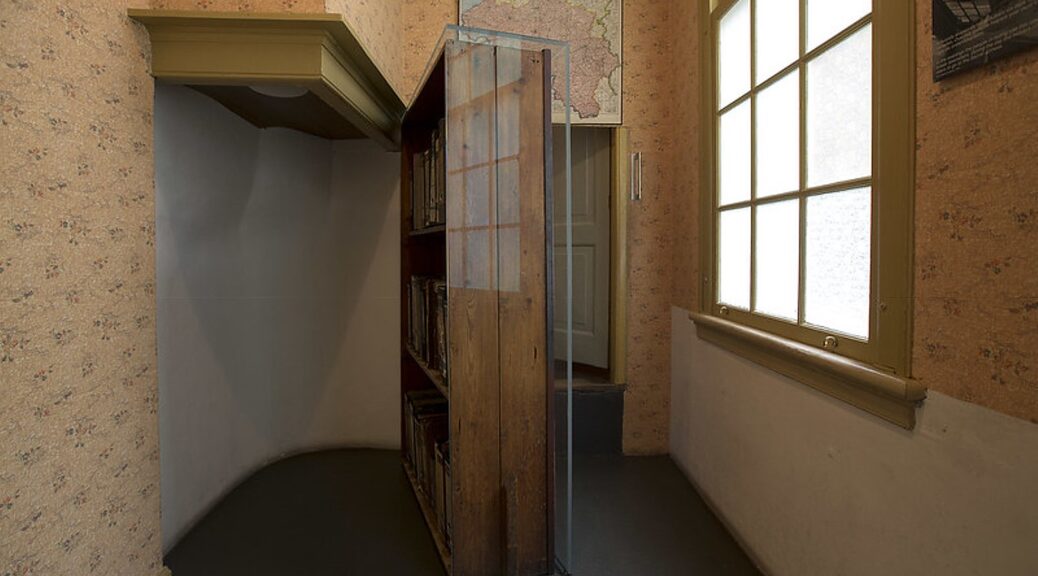
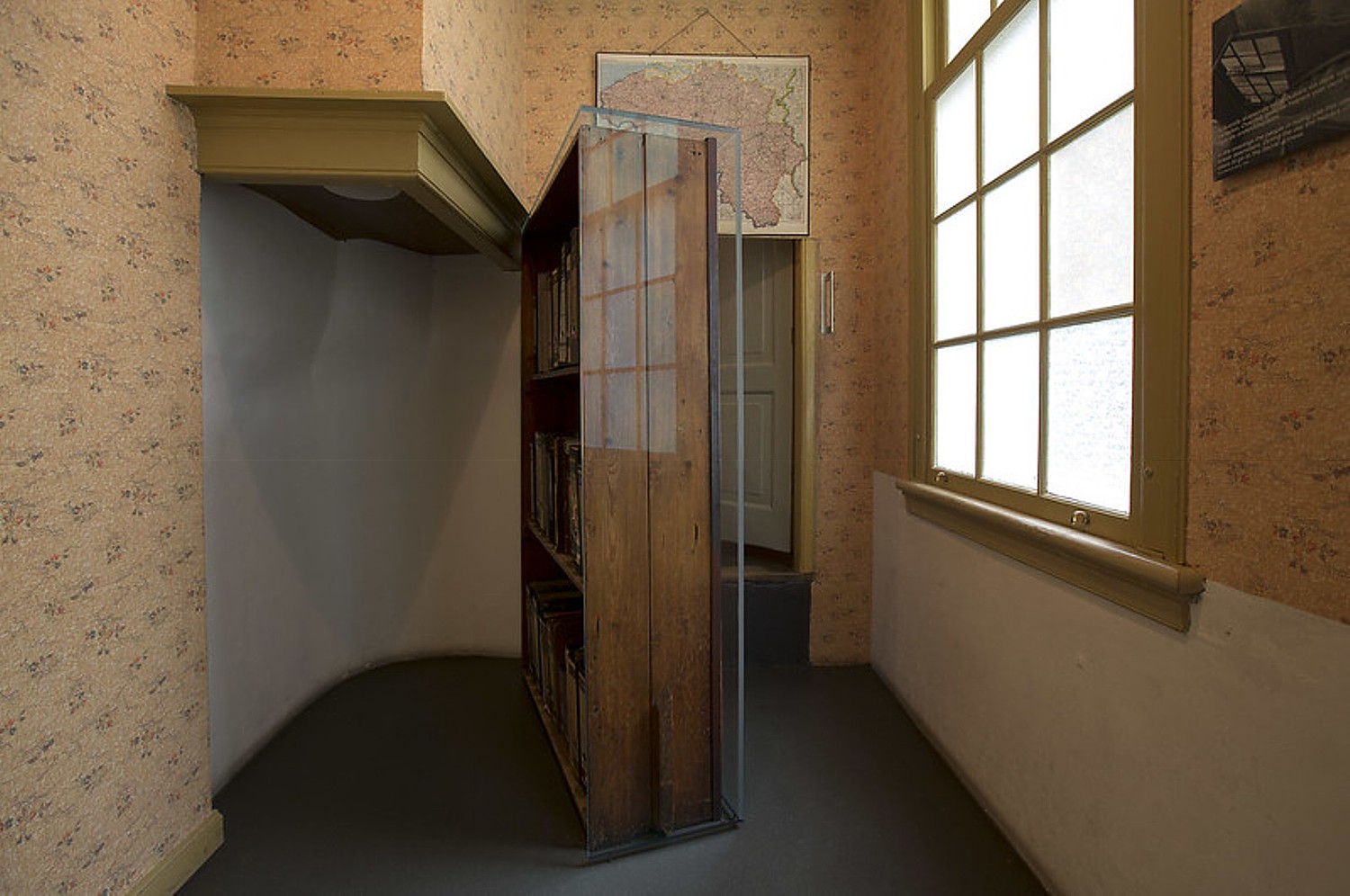
Anne Frank The Exhibition, on view at the Center for Jewish History through October, is the first time that the Anne Frank House presents a pioneering experience outside of Amsterdam to immerse visitors in a full-scale recreation of the Annex rooms, fully furnished, where Anne Frank, her parents and sister, and four other Jews spent two years hiding to evade Nazi capture. Four exhibition galleries immerse visitors in place and history through video, sound, photography, and animation; and more than 100 original collection items from the Anne Frank House in Amsterdam. Anne Frank The Exhibition provides an opportunity to learn about Anne Frank not as a victim but through the multifaceted lens of her life—as a girl, a writer, and a symbol of resilience and strength. Tickets at AnneFrankExhibit.org. Center for Jewish History, 15 West 16th Street, New York, cjh.org.
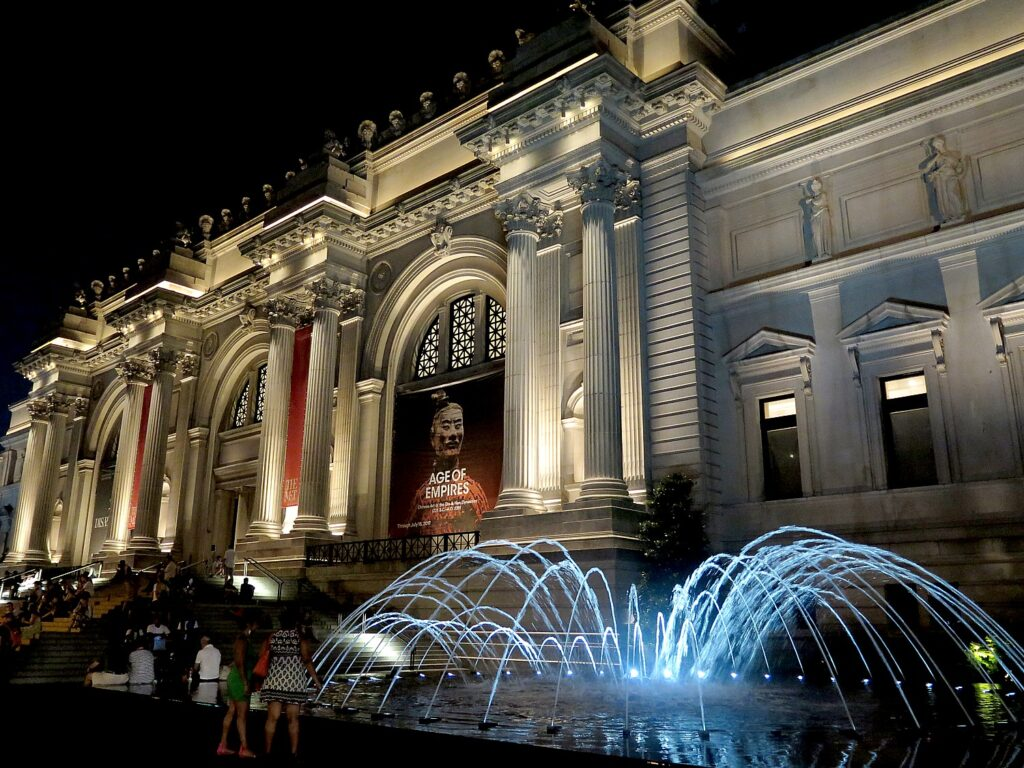
New York City’s summer cultural season kicks off with the 47th Annual Museum Mile Festival – the Big Apple’s “biggest block party”–on Tuesday, June 10, from 6 to 9 pm, rain or shine. Walk the mile on Fifth Avenue between 82nd Street and 104th Street and visit eight of New York City’s finest cultural institutions, open free during these extended hours: The Metropolitan Museum of Art (82nd St); Neue Galerie New York(86th St); Solomon R. Guggenheim Museum (89th St); Cooper Hewitt, Smithsonian Design Museum (91st St); The Jewish Museum (92nd St); Museum of City of New York (mcny.org,103rd St.); El Museo del Barrio (104th St.); and The Africa Center (109th St). Neighbohood partners participating include the New York Academy of Medicine, the Church of the Heavenly Rest, Asia Society, and AKC Museum of the Dog join in this celebration. Arrive early and target your priority museums first because this extremely popular event draws huge crowds, which makes the fabulous street entertainment all the more appreciated. Children’s activity guides (and chalk for street art!) available. (https://www.nyctourism.com/events/museum-mile-festival/)
Jazz Age Lawn Party on Governors Island (11 am-5 pm, June 14-15 and August 9-10. 11 am-5 pm), starts with a magical ferry ride from Battery Park or the Brooklyn Navy Yard. People come dressed to the 9s in 1920s/Gatsby-style outfits, bringing picnics and take part in the music and zeitgeist of the 1920s. With music and dancing led by festival founder and host Michael Arenella & His Dreamland Orchestra and a score of other entertainers. Entertainments are interspersed with fun events like dance lessons and a period bathing suit contest. This isn’t free. Tickets and info at https://jazzagelawnparty.com. (Reserve a ride on the ferry, from South Street or Brooklyn to access the location, https://www.govisland.com/plan-your-visit/ferry)
The New York Philharmonic Concerts in the Parks, Presented by Didi and Oscar Schafer, take place June 4–7, 2025. Gustavo Dudamel leads the series for the first time. Dudamel conducts the NY Phil in four free outdoor concerts at the Great Lawn in Central Park, Manhattan (June 4); Van Cortlandt Park, Bronx (June 5); Prospect Park, Brooklyn (June 6); and Cunningham Park, Queens (June 7); program to be announced. These performances begin at 8:00 p.m. and conclude with fireworks. (Following the Concerts in the Parks, New York Philharmonic musicians perform a free indoor concert,on June 8, at 4 p.m., at St. George Theatre in Staten Island.)
Lincoln Center’s fourth annual Summer for the City, offers hundreds of free and Choose-What-You-Pay performances and cultural activities from June 11–August 9, including performances of the Festival Orchestra of Lincoln Center at Choose-What-You-Pay prices. (Schedule, https://www.lincolncenter.org/series/summer-for-the-city.
Public Theater’s cherished FreeShakespeare in the Park, returns to the iconic, revitalized Delacorte Theater in Central Park after a nomadic season, performing ‘Twelth Night” August 7-Sept. 14. The star-studded cast includes stars b (Antonio), Bill Camp (Sir Toby Belch), Khris Davis (Orsino), Peter Dinklage (Malvolio), Jesse Tyler Ferguson (Andrew Aguecheek), Junior Nyong’o (Sebastian), Lupita Nyong’o (Viola), Sandra Oh (Olivia), Daphne RubinVega (Maria), and Moses Sumney (Feste). Famously, tickets are available for that day at distribution points in Central Park and the boros, a daily digital lottery (TodayTix), and standby line at the Delacorte. But you can get a reserved seat by becoming a Supporter Plus with a gift of $300 or more (with year-round benefits). To learn more, or to make a contribution: 212.967.7555 or visit publictheater.org, https://publictheater.org/productions/season/2425/fsitp/twelfth-night/
The Delacorte reopens in July with a full schedule of tours, special events, and performances (For a full list of reopening events, visit publictheater.org/about/forever-public.)
In June 2025, the Public Theater’s Mobile Unit will tour a new production of Much Ado About Nothing, directed by Rebecca Martinez, across all five boroughs. From August 28 – September 1, Public Works will present an adaptation of PERICLES, with music and lyrics by Troy Anthony and directed by Carl Cofield at The Cathedral of St. John the Divine.
A very different Shakespeare-in-the-park experience comes from New York Classical Theatre, which creates and reinvigorates audiences for the theater by presenting free productions of popular and forgotten classical plays in public spaces throughout the City. This season, see Shakespeare’s “All’s Well that Ends Well”. Free performances are Tuesday-Sunday, 7 pm, at Central Park (June 3-22, with special evenings June 4, Bring Your Dog Night at 6:30; Family Nights, June 12, 21, 26, July 1; Pride Night, June 20); Carl Schurz Park (June 24-29), and Battery Park (July 1-6). Tickets are free, but you need to reserve.Nyclassical.org, info@nyclassical.org.
City Parks Foundation’s 2025 season of Capital One City Parks Foundation SummerStage, New York City’s iconic outdoor performing arts festival, is bringing more than 70 free and benefit shows to Central Park and 13 neighborhood parks across the five boroughs. Returning for its 39th year, the festival showcases established and emerging artists, highlighting an expansive array of talent, from diverse performances from across the globe to artists serving as curators to iconic DJs showcasing cultural sonic journeys and features a multitude of genres including jazz, hip-hop, indie-rock, salsa, reggae, Afrobeat, soul, pop, global, contemporary dance. Performances are free and open to the public, with the exception of ticketed benefit concerts in Central Park (www.SummerStage.org).
Bryant Park’s Picnic Performances, presented by Bank of America, is a free summer concert series May 30-Sept. 13 featuring music, dance, theater performances and movie screenings offering a diverse lineup of artists and performances from NYC cultural institutions (https://bryantpark.org/activities/picnic-performances)
Highlights:
New York City Opera (June 26 & 27, Opera Goes to Hollywood; Sept. 4, 5, Carmen)
Contemporary Dance (June 5-Limon Dance Company; June 6, 13; )
The High Line isn’t only one of the city’s most enchanting places – an elevated garden trail lined with art installations that zigs and zags amid modern windowed high rises – it is also an open-air theater, music and events venue (Star Gazing, Vinyl Nights, docent-led High Line Tour), throughout the year. A perpetual “happening.” (https://www.thehighline.org/art/performances/) or doNYC
Hudson River Park turns its four-mile riverfront into a cultural mecca with hundreds of free and exciting events, from sunset dance parties and live music to hands-on science and waterfront workouts. Expanded offerings this summer include six nights of Broadway-caliber performances with Broadway By The Boardwalk at Clinton Cove, and the debut of Science After Dark, a new series that invites curious adults to explore local ecology and learn from experts while socializing in unique Park settings. The crowd-favorite series, Jazz at Pier 84 presents star-studded musicians bringing smooth tunes to the Park at sunset. Pier 45 offers Dance Is Life! in July hosted by The Ladies of Hip Hop. Sunset Salsa returns to Pier 76 in July with lessons led by world-renowned dancers, offering instruction to everyone, from novices to advanced dancers, followed by an open dance party. https://hudsonriverpark.org/, https://hudsonriverpark.org/the-park/piers-and-places/
Little Island is a magical place that must be experienced (really recommend you listen to the free audio tour describing its landscape design). From June through September, Little Island presents over 110 performances across dance, music, theater, dance and opera ($25 tickets at littleisland.org and https://www.todaytix.com/nyc/category/little-island). In addition, there are free concerts Wednesday-Sunday in the Glade. With over 110 performances across music, theater, dance, opera and more, it’s the ultimate outdoor stage for New York’s best artists. (Tickets, https://www.todaytix.com/nyc/category/little-island)
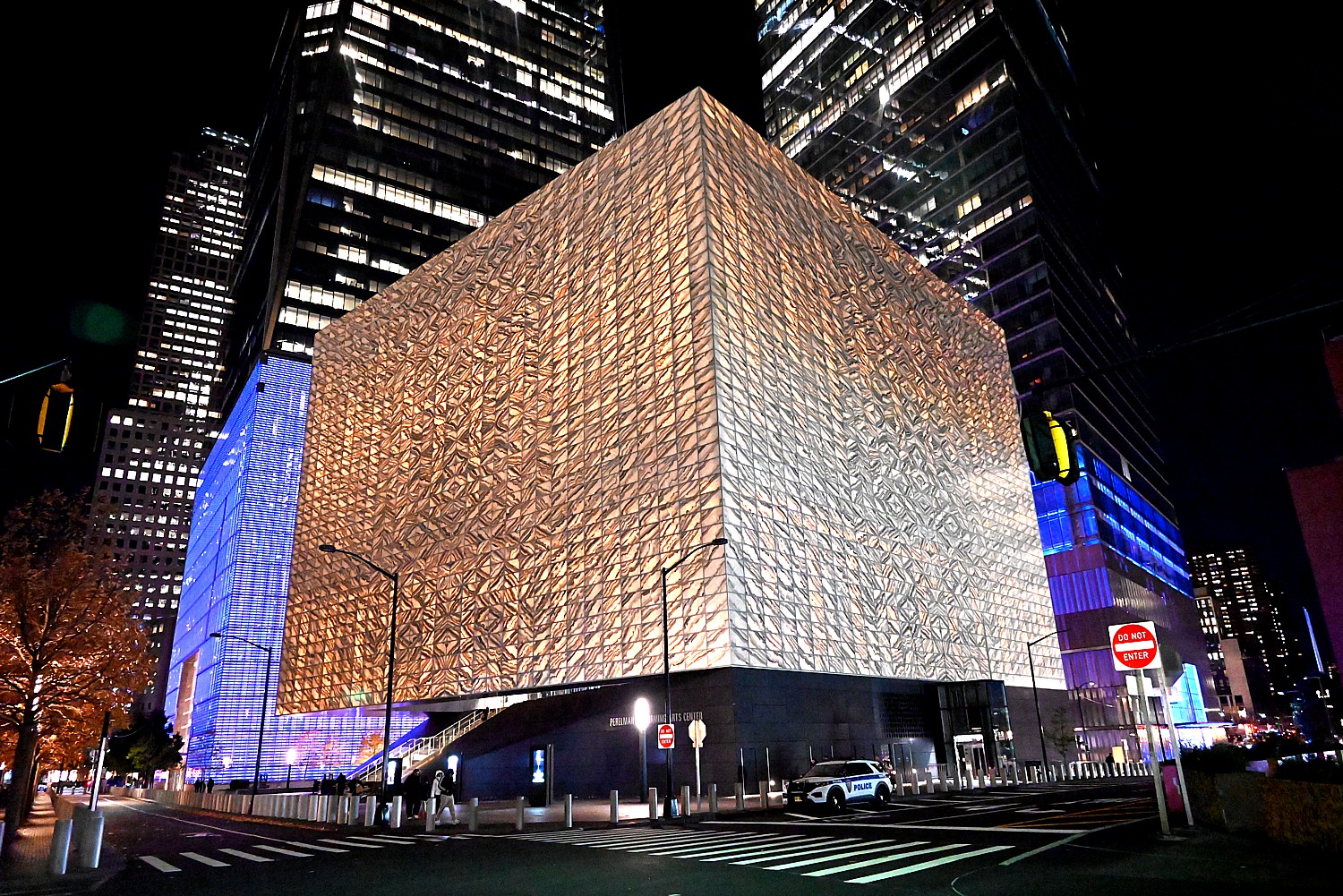
The Perelman Performing Arts Center (PAC NYC) is presenting the New York premiere of Passengers, a theater, circus and dance experience written, directed and choreographed by Tony Award® nominee Shana Carroll (Water for Elephants). Performances begin June 12 with an opening on June 15, for a limited run through June 29, 2025. Montréal’s acclaimed contemporary physical theater troupe The 7 Fingers express their hopes and dreams through an astonishing blend of cirque, music, and dance, telling human stories with superhuman skills. Poetic goodbyes. Anticipatory reunions. Fateful encounters. Each moment unfolds with breathtaking wonder and heartwarming storytelling. Performances are at PAC, 251 Fulton St. Tickets start at $30 and are available online at PACNYC.org or by calling 212-266-3000. (PAC NYC offers $30 ticket savings programs for audiences under 30, responders and educators. Student discounts of up to 50% are also available.)
No surprise that in response to overwhelming demand, the Anne Frank House is extending its world premiere presentation of Anne Frank The Exhibition at the Center for Jewish History in New York City through October 31, 2025. Originally scheduled for just three months, tickets sold out within one week of opening on January 27, 2025, demonstrating the demand for this extraordinary experience. Anne Frank The Exhibition is the first time the Anne Frank House presents a pioneering experience outside of Amsterdam to immerse visitors in a full-scale recreation of the Annex rooms, fully furnished (unlike Amsterdam), where Anne Frank, her parents and sister, and four other Jews spent two years hiding to evade Nazi capture. Four exhibition galleries immerse visitors in place and history through video, sound, photography and animation; and more than 100 original collection items from the Anne Frank House in Amsterdam. Anne Frank The Exhibition shows Anne Frank not as a victim but through the multifaceted lens of her life—as a girl, a writer, and a symbol of resilience and strength. This is a story inspired by one of the most translated books in the world. Timed entry tickets are available at AnneFrankExhibit.org. Center for Jewish History, 15 West 16th Street, New York, N.Y. between 5th and 6th Avenues, https://goingplacesfarandnear.com/landmark-anne-frank-the-exhibition-in-nyc-personalizes-holocaust-as-never-before/
Opening June 13, The New York Historical highlights the intersection of politics, art, and culture that shaped America’s Red Scare in Blacklisted: An American Story, on view June 13-October 19, 2025 (credit: Civil Rights Congress, America’s “Thought Police”: Record of the Un-American Activities Committee, 1947. Courtesy of the Unger Family)
The New York Historical’s newest exhibit, Blacklisted: An American Story, an Exhibition Examining the Red Scare, the Hollywood Blacklist, and Its Impact on American Culture, on view June 13 – October 19. Blacklisted captures the tensions of the domestic Cold War, revealing how global politics infiltrated America’s entertainment industry in the late 1940s and 50s through a government crackdown on artistic expression. New York’s first museum, New York Historical (formerly New-York Historical Society) is a leading cultural institution covering 400 years of American history. A museum of museums and a collection of collections (the Tiffany lamps are exquisite), it is home to the Patricia D. Klingenstein Library, the Center for Women’s History, the DiMenna Children’s History Museum, and the future American LGBTQ+ Museum. The New York Historical, 170 Central Park West (77th Street), New York, NY 10024, 212-873-3400, nyhistory.org.
The American Museum of Natural History is presenting Apex: The Largest Stegosaurus Ever Discovered, one of the largest and most complete stegosaurus fossils ever found, a 150-million year old stegosaurus measuring 27 feet long and 11.5 feet tall, discovered in Dinosaur, Colorado, through 2028. A destination that takes you to other worlds, Richard Gilder Center for Science, Education, and Innovation at the American Museum of Natural History offers fabulous innovative exhibitions. Admission by timed entry, reserved online. Open daily, 10 am–5:30 pm. American Museum of Natural History, 200 Central Park West, 212-769-5606, amnh.org.
If Summer in the City starts with the Museum Mile Festival, for me, it finishes with the US Open Tennis Championships, the fourth and final Grand Slam tournament of the year. The tournament dates back to 1881, and since 1978, the tournament has found its home at the USTA Billie Jean King National Tennis Center in Queens’ Flushing Meadows Corona Park, a magnet for the best tennis talent worldwide .The tournament takes place August 24–September 7. Insiders tip: the week before, it is free to watch the thrilling play of the qualifiers’ tournament, and see the tennis stars practice. (usopen.org, https://tickets-center.com/search/US-Open-Tennis-tickets/)
For more to do and see in New York City, including information on free museums and exhibits and walking tours and arts and entertainment on a budget, visit nyctourism.com.
Hanoi is the last stop on a 16-day journey through Vietnam and Cambodia with my 30-year-old daughter. We built our itinerary around a one-week AmaWaterways Mekong River cruise (AmaWaterways.com) which began with a pre-cruise stay in Ho Chi Minh City and finished with a post-cruise stay in Hanoi. Here are highlights of Hanoi:
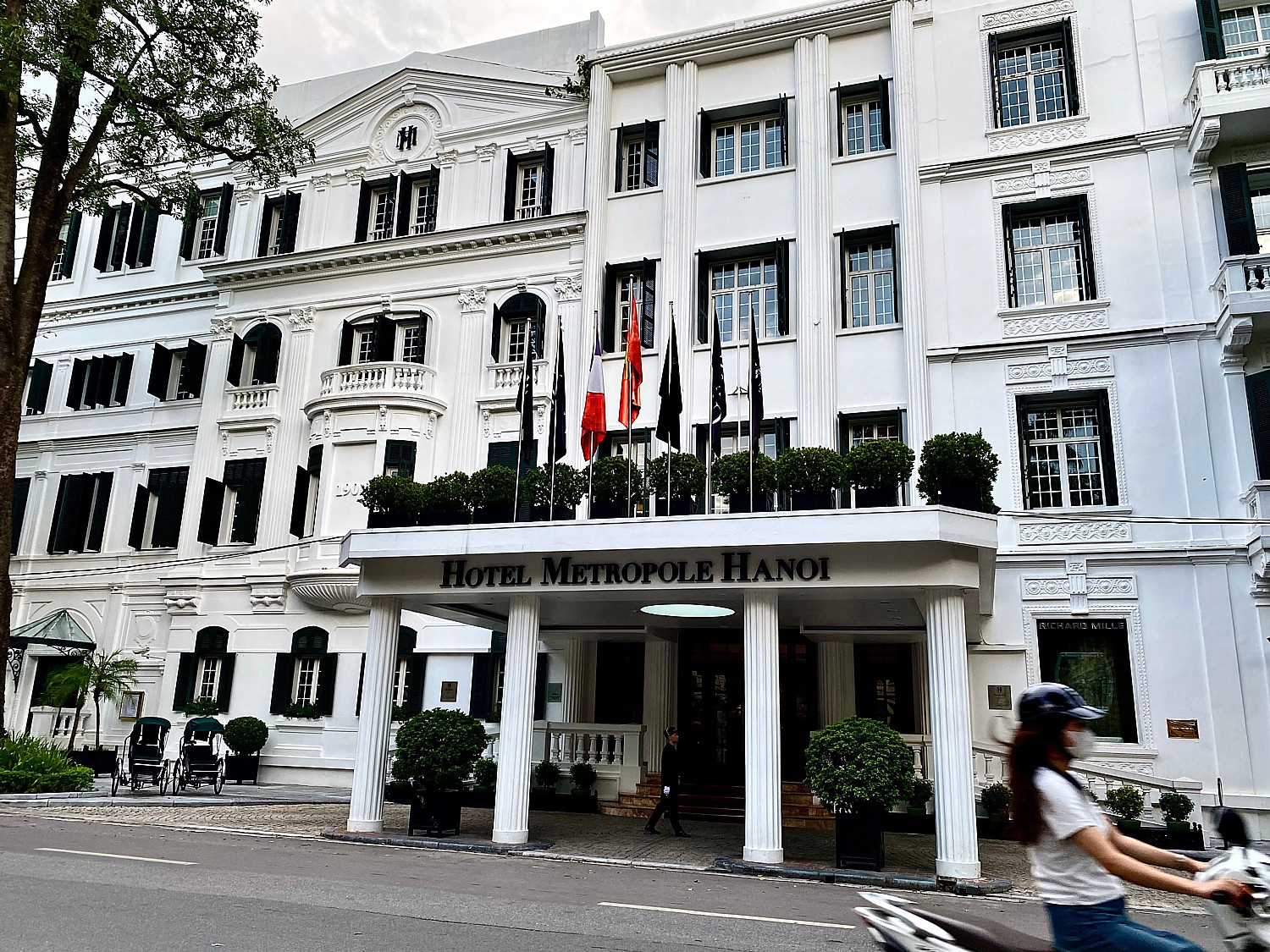
We check into our hotel, the Sofitel Legend Metropole Hanoi, happy we decided to spend three days here before flying back to the U.S. The hotel’s Heritage Wing, where we are staying, completed a full renovation last year, maintaining its luxurious French Colonial feel. We are thrilled to find that our Metropole Suite is actually comprised of three rooms—a living room with comfy chairs and a couch that is a sofa-bed, a parlor/office and a master bedroom with a king-size bed, plus two oversized bathrooms with Toto smart toilets. A nice surprise are the two balconies with great city views. (www.sofitel-legend-metropole-hanoi.com)
The oldest continuously operating hotel in Hanoi, the Sofitel Legend Metropole has a central location that allows us to walk to everything we want to do and offers a lovely pool and spa for recharging. Most of all, we love that the hotel’s rich history, decor, art collection and permanent “Path of History” exhibit create a kind of live-in history museum where we can relax and still feel immersed in the city.
The hotel served as the official guest house for government guests and delegations under Ho Chi Minh. Walking through the hotel’s “Path of History” hall, we see that its list of past guests reads like a Who’s Who of the 20th and 21st century, from writers Somerset Maugham and Graham Greene to U.S. presidents. Photos of more recent political conclaves hosted here include a 2019 meeting between President Trump and Kim Jong Un.
In addition to the actual history exhibit, over the course of our stay, we take in the entire hotel as we would an art museum, studying the sculptures and scenes of contemporary and historic Hanoi that decorate the stairwells, lounges, and other public spaces of the hotel.
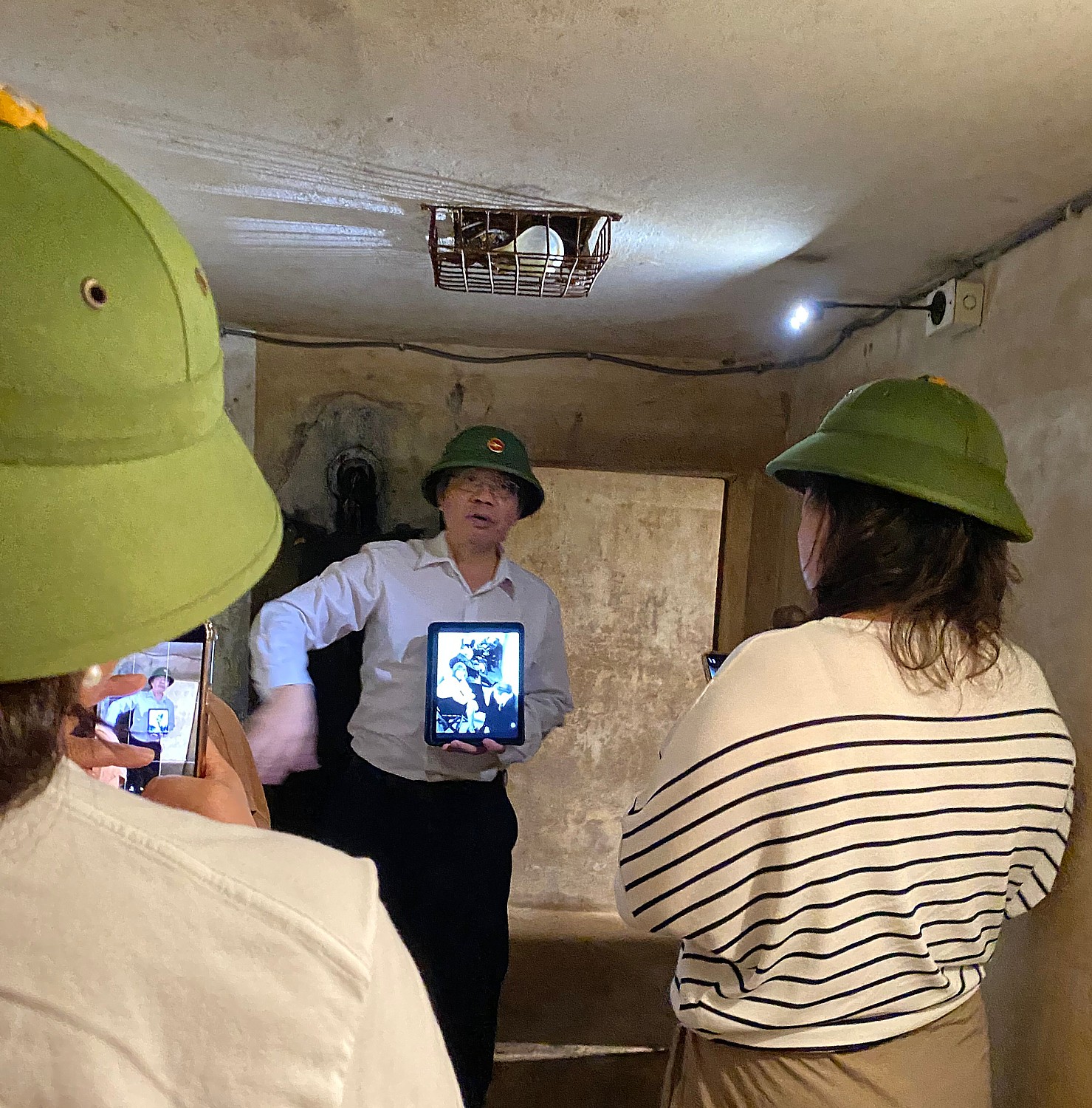
A tour of the hotel’s historic bomb shelter, free to hotel guests, turns out to be a much broader lesson in history. Our guide shows us photos of visiting diplomats and other hotel guests huddled in the small underground space during the Vietnam War (known as the American War in Vietnam); sometimes they were roused to retreat to the shelter multiple times a night. We also see heart-wrenching photos of the effects of the war on the city, its surroundings and its people.
Especially haunting is standing in the shelter and listening to the song “Where are you now, my son?” by Joan Baez, putting words to her experience when she emerged to witness the devastation caused by bombings.
We come to the Hoa Lo Prison expecting to learn about the American POWs held here during the Vietnam War, most famously John McCain. Facetiously called the “Hanoi Hilton” for the torture and harsh treatment that McCain and other American soldiers received here, the small area of displays and videos of happy Christmas moments and proclamations of how well they were treated is startling.
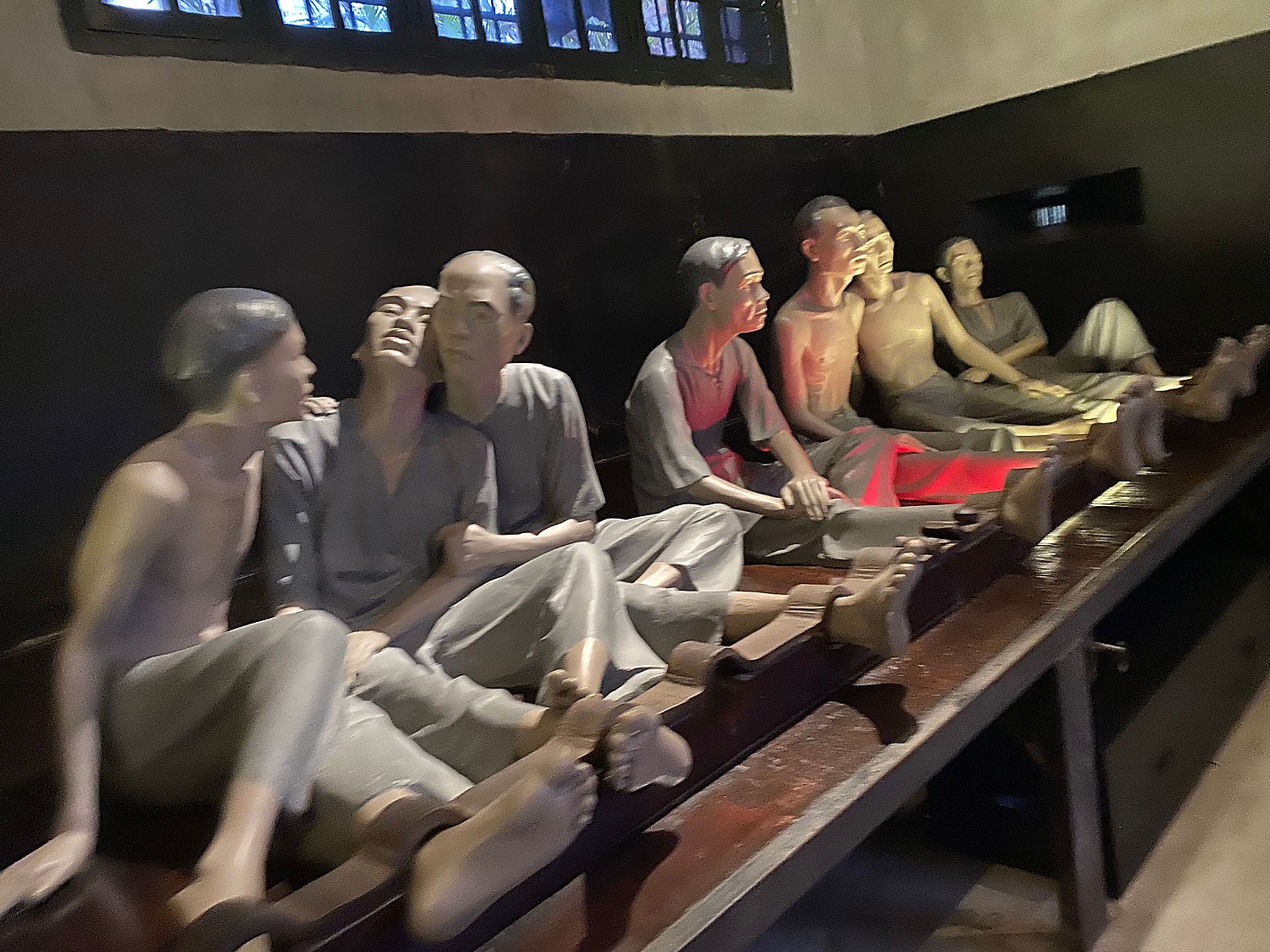
But that exhibit is only a smidgen of the museum. Its main message is the cruelty of French colonial days. We learn that the prison was built by the French Colonial government in 1896 for political prisoners. We see a portable guillotine, torture instruments and a life-size recreation of a room lined by prisoners shackled side-by-side on long concrete slabs. The museum is mainly dedicated to the horrific treatment of the Vietnamese at the hands of the French, to the heroes who lived and died here, and to the communist education and revolutionary fervor that fomented here, making the Hoa Lo Museum a proud Vietnamese heritage site.
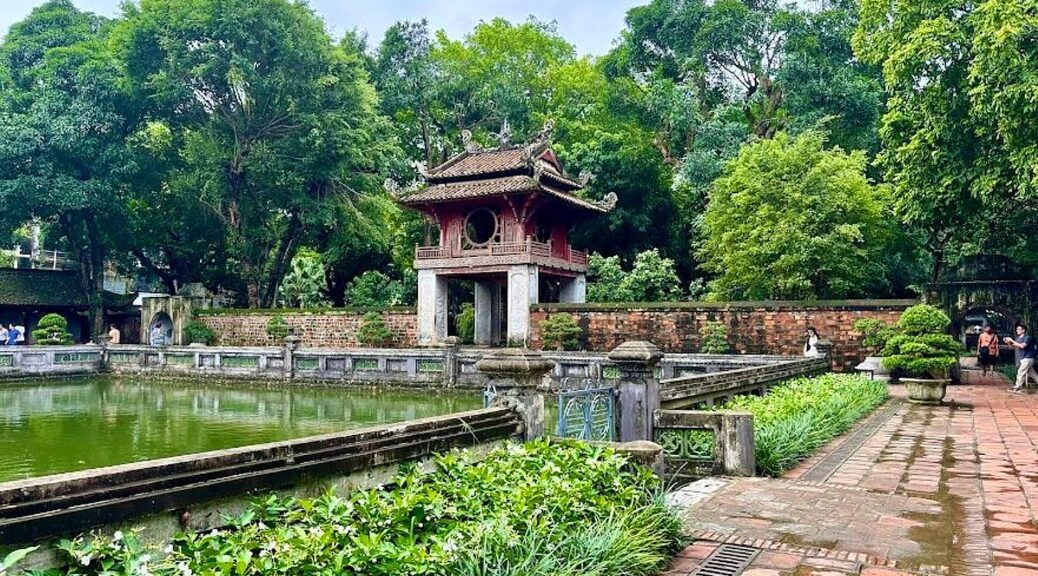
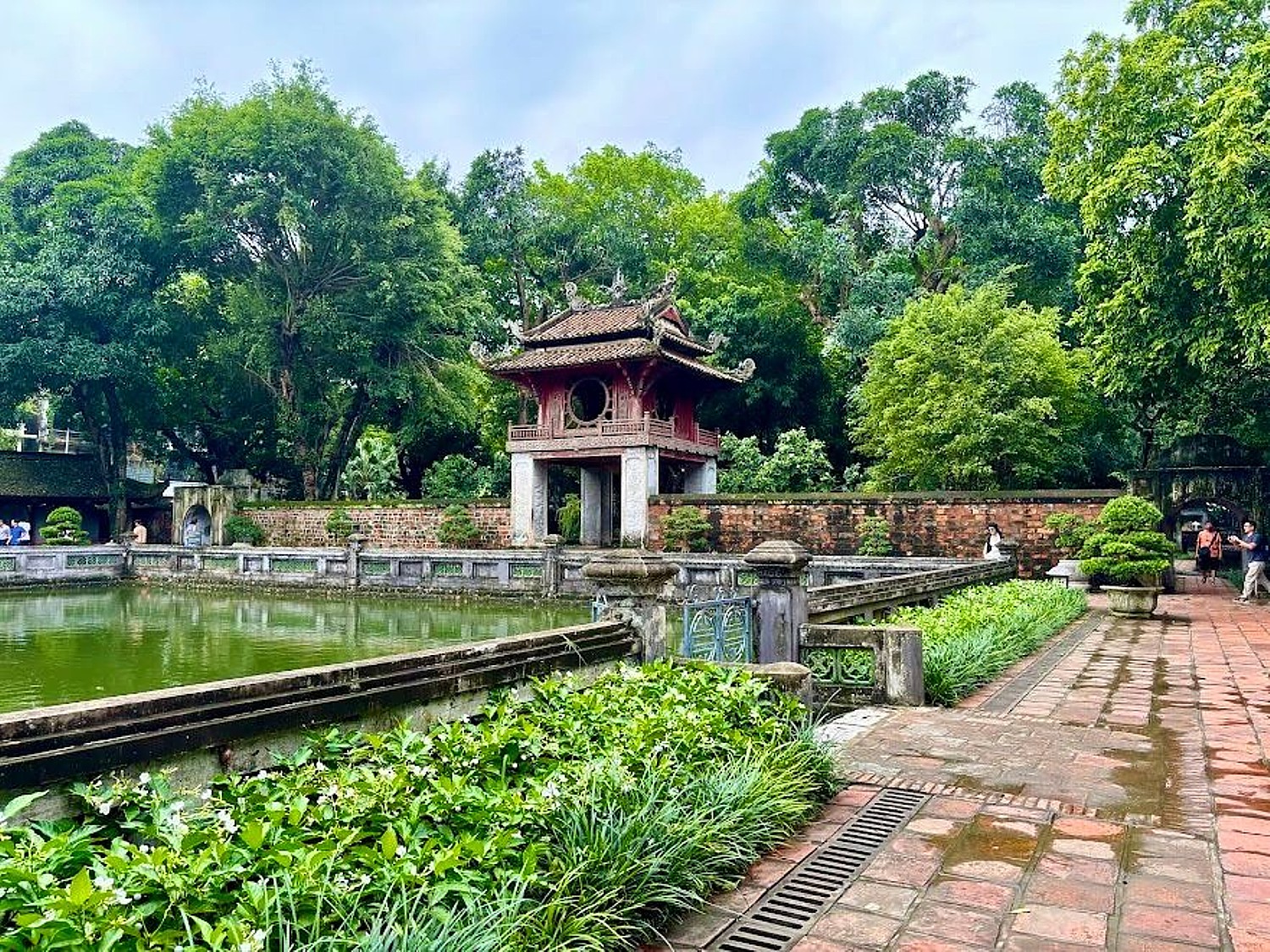
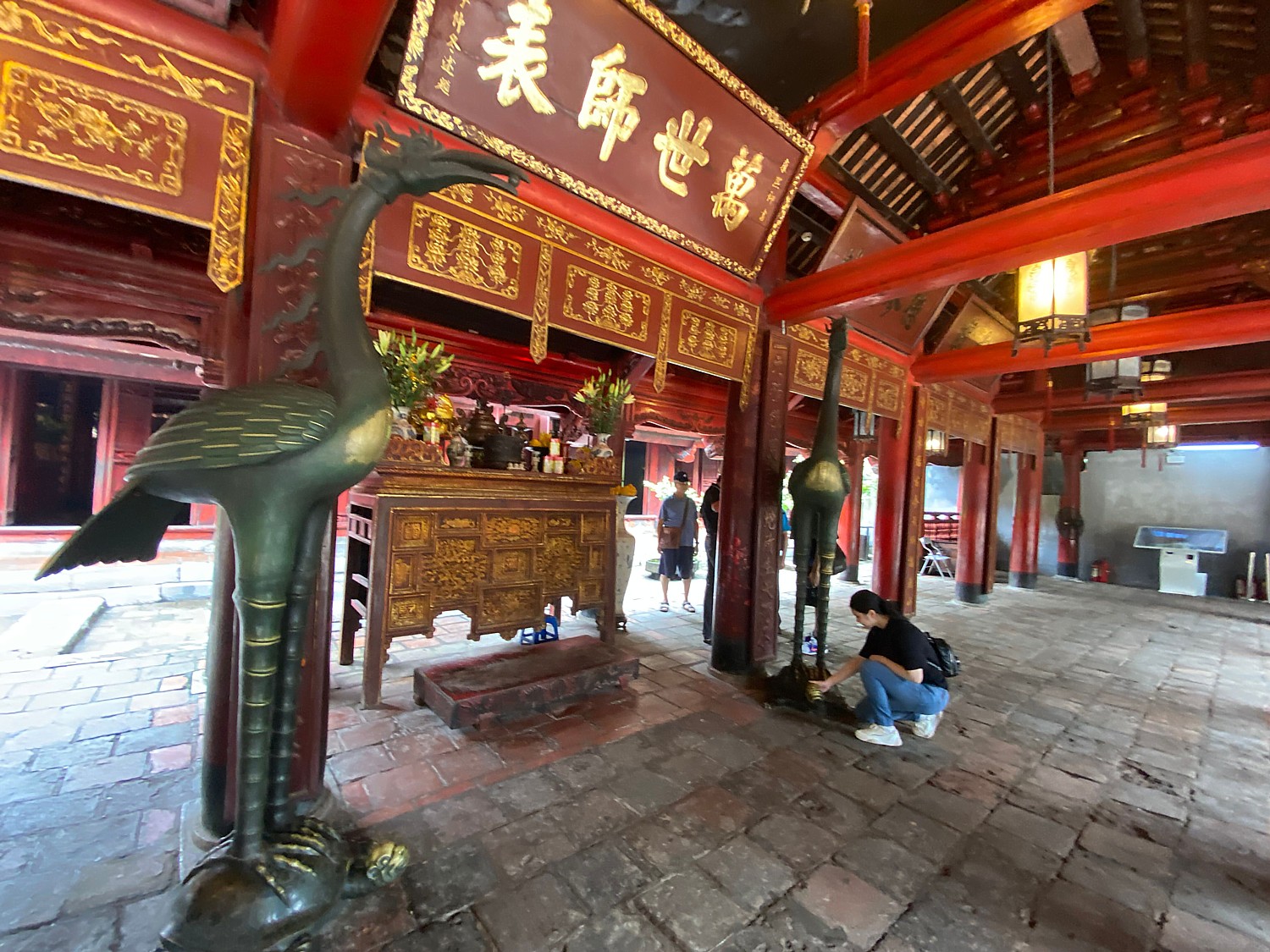
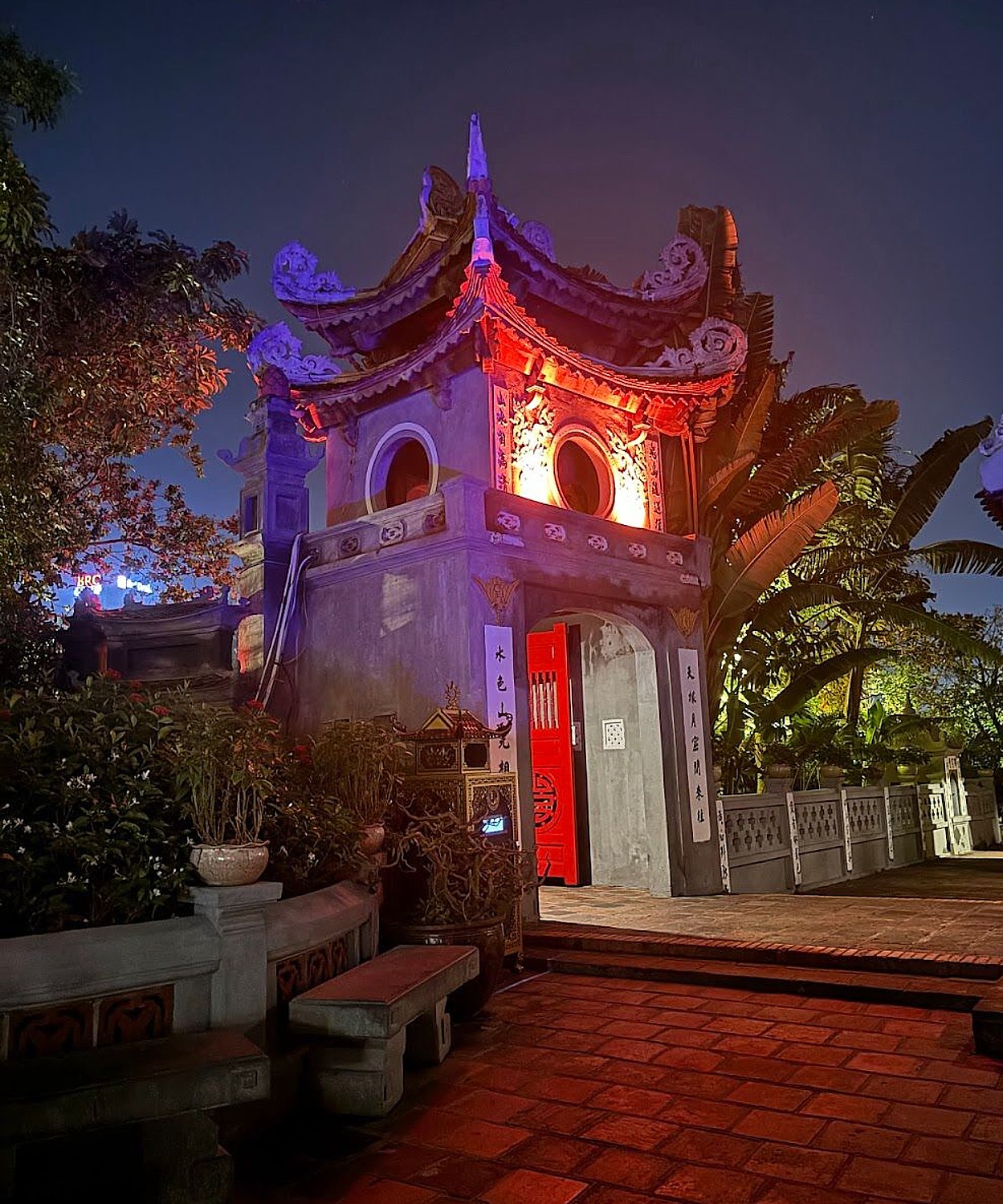
As we walk through the grand Gate of the Temple of Literature, we are amazed to realize that we are entering a university that was founded in 1070. The school was first open to members of the Royal families and later to exceptional students of other social classes. It stopped serving as a university in 1779, but it has never veered from its purpose to honor, worship and provide a place to learn the wisdom of Chinese philosopher Confucius. Students and their parents still come here to burn incense, make offerings and pray for success before important exams. We see people waiting their turn to touch a statue of a crane standing on the back of a turtle. We’re told that rubbing the belly of the crane and the head of the turtle bring good luck, and not just on exams. Never wanting to pass up a chance for positive energy, we respectfully take our turns as well.
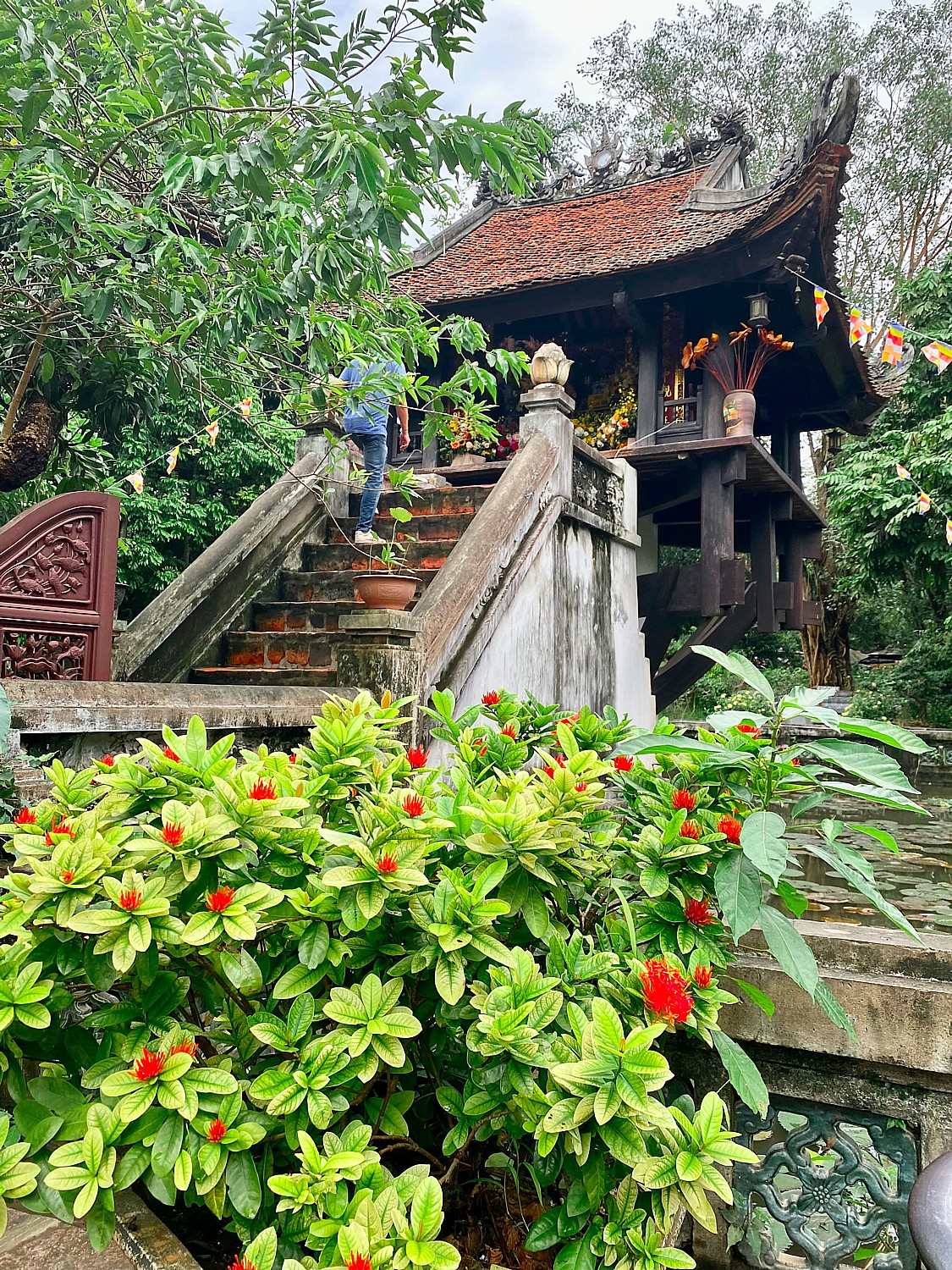
Throughout our travels in Vietnam and Cambodia, we’ve come to appreciate how much architecture in this region is imbued with symbolic meaning. A great example is One Pillar Pagoda which dates back to 1048. The pagoda, which sits on a single pillar on a small lake, is designed to give form to a lotus flower like the one in a legendary dream by an 11th-century heirless emperor. He dreamt that the Buddhist goddess of mercy sat in a lotus flower on a lake and handed him an infant son.
When he did indeed have a son, he had this pagoda built in gratitude. The number three, which represents fertility, is symbolized by the three figures on the roof: two dragons (representing yang) gazing at a moon (representing yin). Inside, eight beams represent the eight petals of the lotus. The number of steps to the main hall—13—represents fertility and wealth. Although the temple has been rebuilt several times over the centuries, the architecture still embodies the spirit of the shrine. We observe a number of women placing offerings of flowers, fruit, wine, and trios of incense sticks in front of a shrine to the goddess of mercy to pray that they too will have a child.
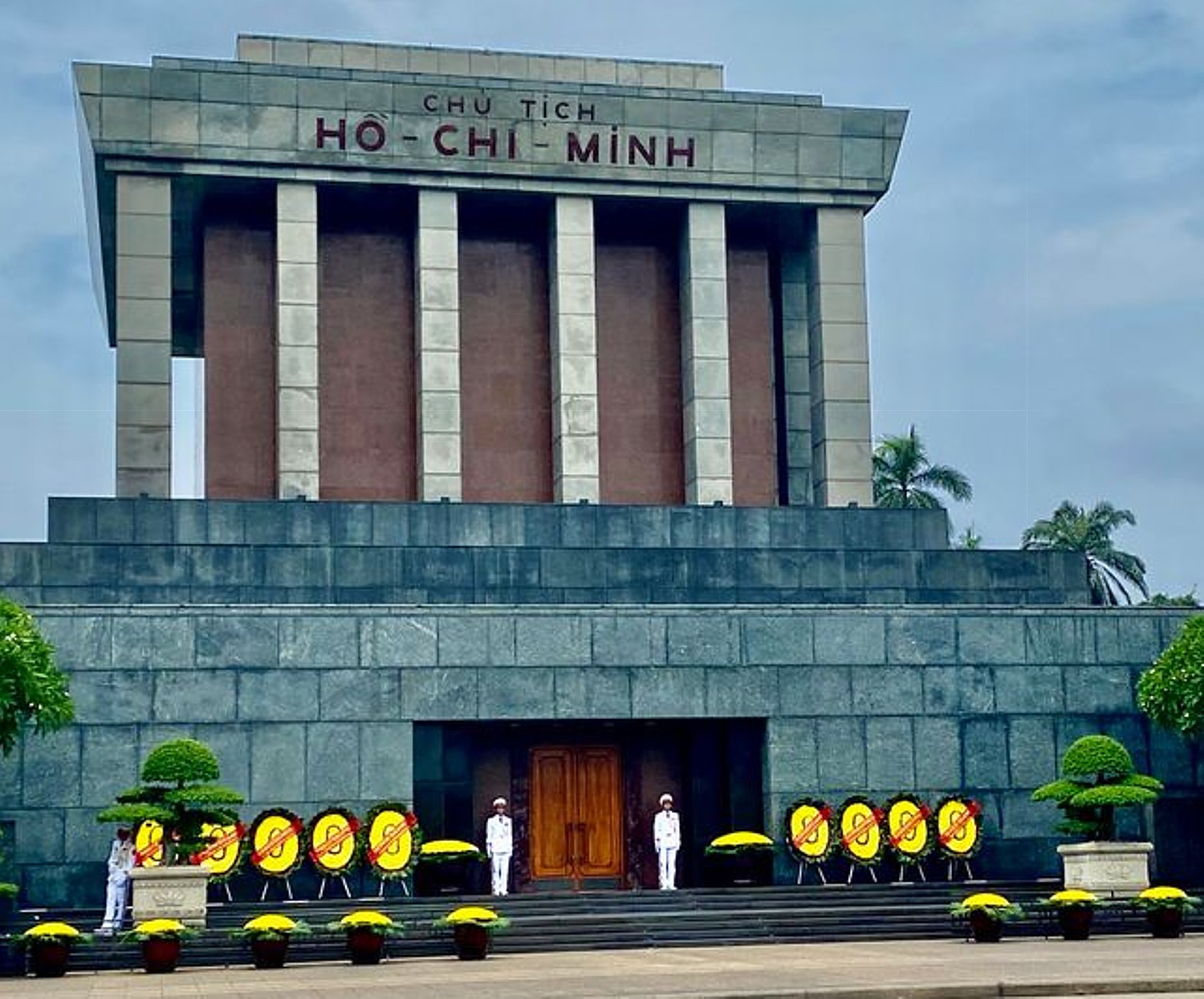
From what we’d read and seen on this trip, Ho Chi Minh–“Bac (uncle) Ho” as he is affectionately called—was a beloved selfless leader. Interestingly, he had stated in his will that he wanted to be cremated with his ashes buried in three regions of the country. But in 1969 when he died, his followers embalmed his body and built the grand mausoleum we are visiting today. We pass through security to enter the grounds of the Presidential Palace where the Ho Chi Minh Mausoleum is located. We wonder why there are no lines to enter and file past his glass coffin where people come to pay their respects and we learn that the mausoleum is closed for its annual maintenance.
Nevertheless, we’re impressed by the grandeur of the Ho Chi Minh’s Mausoleum, which was inspired by and resembles Lenin’s Tomb, but with Vietnamese flourishes, and we sense the reverence it inspires. The setting is also impressive. The Mausoleum is across a large plaza/parade ground from the National Assembly and down the green we see the imposing Presidential Palace, built by the French during Hanoi’s colonial days. Uncle Ho declined to live there as he said it was too grand for a man of the people. Instead, a traditional stilted house was built for him on the grounds of the Palace.
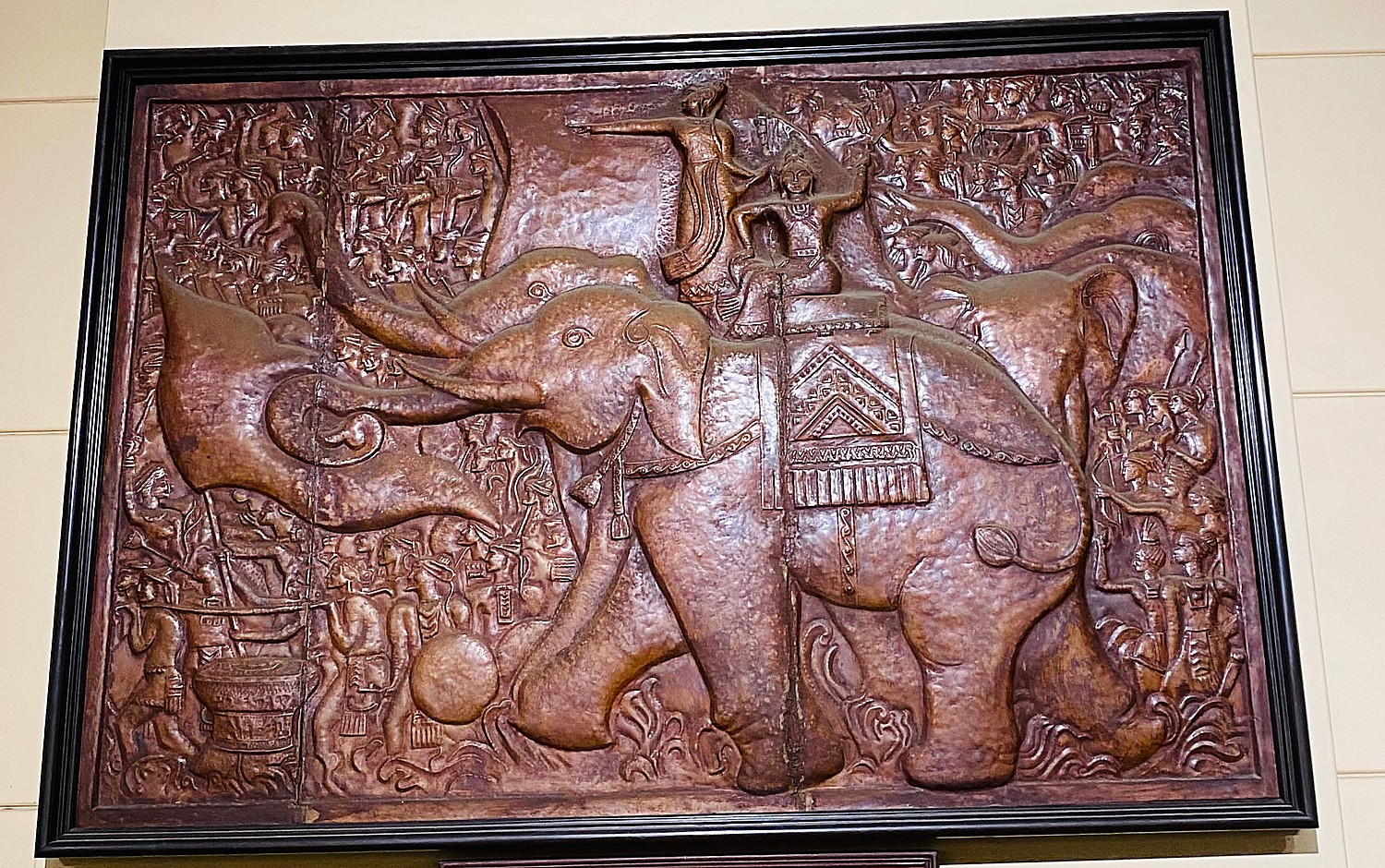
I had just read “Bronze Drum” by Phong Nguyen, a historical novel about the Trung Sisters who led a women’s uprising to overthrow the Han Chinese in 40 A.D., so I am excited when my daughter points out an exhibit devoted to them at the Vietnam National Museum of History. The sisters had used bronze drums to inspire and communicate with their warriors, and we admire an array of drums with intricate carvings.
The museum is divided into two buildings. The main building takes us from the first humans through the end of the Nguyen Dynasty in 1945 and is a great consolidation of the history we’ve been learning throughout our journey. The second building takes us from 1858 and the struggle against the French colonial government to the present.
As we admire the sculptures and artifacts of the many ethnic groups and cultures throughout Vietnam’s history, we get a sense of the depth and diversity of its people today. A constant theme is the nation’s long history of fighting to maintain and develop their own unique civilization and pushing back invaders.
The second building takes us from 1858 and the struggle against the French colonial government to the present. Photos, documents, artifacts and profiles of heroes tell the story of the struggle for independence and the rise of the Vietnamese Communist Party and then, the shift in 1985 to “Doi Moi,” the fast-growing, market-oriented economy that continues to this day.
At the Vietnamese Women’s Museum, among the fascinating customs, we learn that in some Vietnamese ethnic groups, men must move into their bride’s home for several years after marriage. In others, there is a trial sleepover when the prospective groom stays in a guest room at the bride’s home. And in at least one matriarchal group, women choose their groom, he moves to her home, and the children take her last name.
Detailed exhibits cover women’s roles in family life, heroic women in history, and both ethnic and high women’s fashion. It’s among the best small museum’s we’ve seen; it’s well organized, well-labeled with short videos, and there’s an excellent audio tour.
Its mix of architectural styles, parks and shopping make Hanoi a great walking city. One minute, we are on a wide tree-shaded boulevard lined by elegant turn-of-the-century French buildings, the next we are in a twisting medieval alley in the Old Quarter, where many streets still have the names of ancient trades. Some, like Hang Gai (Silk Street), still reflect their current shops. The huge, buzzing Dong Xuan Market sells everything imaginable, but the goods seem oriented to locals and don’t match what we saw in Ho Chi Minh City for style or price.
We head to the elegant shopping streets and dip into some luxury brand shops expecting bargains, but prices seem higher than back home. We decide the best values are found in the artisan shops. We are especially drawn to the wonderful hand-made lacquerware at Hanoia, a small boutique near our hotel, and Tired City, which sells prints, bags and t-shirts featuring the art of over 200 local artists who receive 10% of every sale.
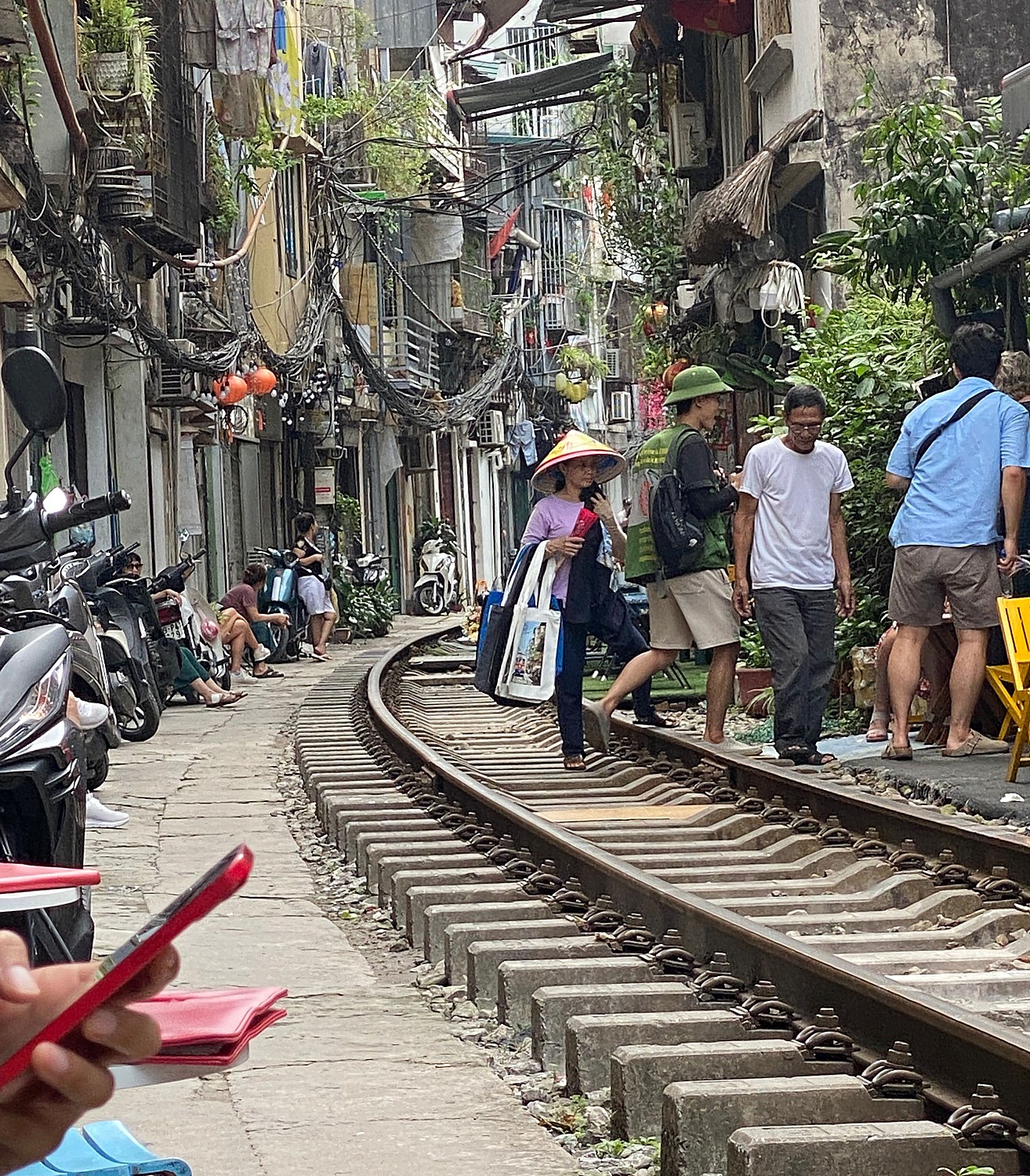
We take a coffee break at quirky “Train Street”, timing our visit for a train passage. This narrow ancient street is lined by small eateries with barely enough space for the train to zip through and it is fun to watch as we sip our new favorite drinks—hot or cold Vietnamese coffee made with condensed milk.
Our anchor as we explore Hanoi is Hoan Kiem Lake, just a few blocks from our hotel. Every evening, we join locals for a stroll around the lake. One night, we cross the pretty red Rising Sun (Huc) Bridge, where young couples pose for photos with the city lights as a backdrop. The bridge leads to the Ngoc Son Temple (Temple of the Jade Mountain), which sits in the middle of the lake. We are surprised to find a gatekeeper on duty at night. We pay the small admission fee and enjoy tranquil views of the city reflected in the lake. Inside, carvings depict Vietnamese history, folklore and Confucian literature.
From its start, this temple has honored both warriors and scholars, and stands as a symbol of Vietnamese resilience and pride. Built in the 19th century, the temple is dedicated to Van Xuong De Quan, a deity in charge of examination and education, and to the 13th century hero Tran Hung Dao (1231 – 1300), who led the Vietnamese army to repel two Mongol invasions.
A sign near a giant embalmed turtle and shrine explains how the lake got its name. According to legend, a god in the form of a turtle gave a magic sword to Le Loi, a l5th century leader of the Vietnamese rebellion against the Ming Chinese occupation. The sword empowered him to outsmart and defeat the Chinese. After his success, he returned to the lake and the turtle god reclaimed its sword. The lake became known as Hoan Kiem, “Lake of the Returned Sword”. The legend is also commemorated in a picturesque monument, Turtle Tower, which sits on its own islet in the lake, one of the iconic symbols of Vietnam’s capital.
We leave Hanoi wishing we could stay longer. Another deep-tissue spa treatment. More time to relax in one of the ubiquitous cafes. More time to take in the vibes of this vibrant capital and to explore the history and legends of this fascinating and welcoming country.
Travel Tips
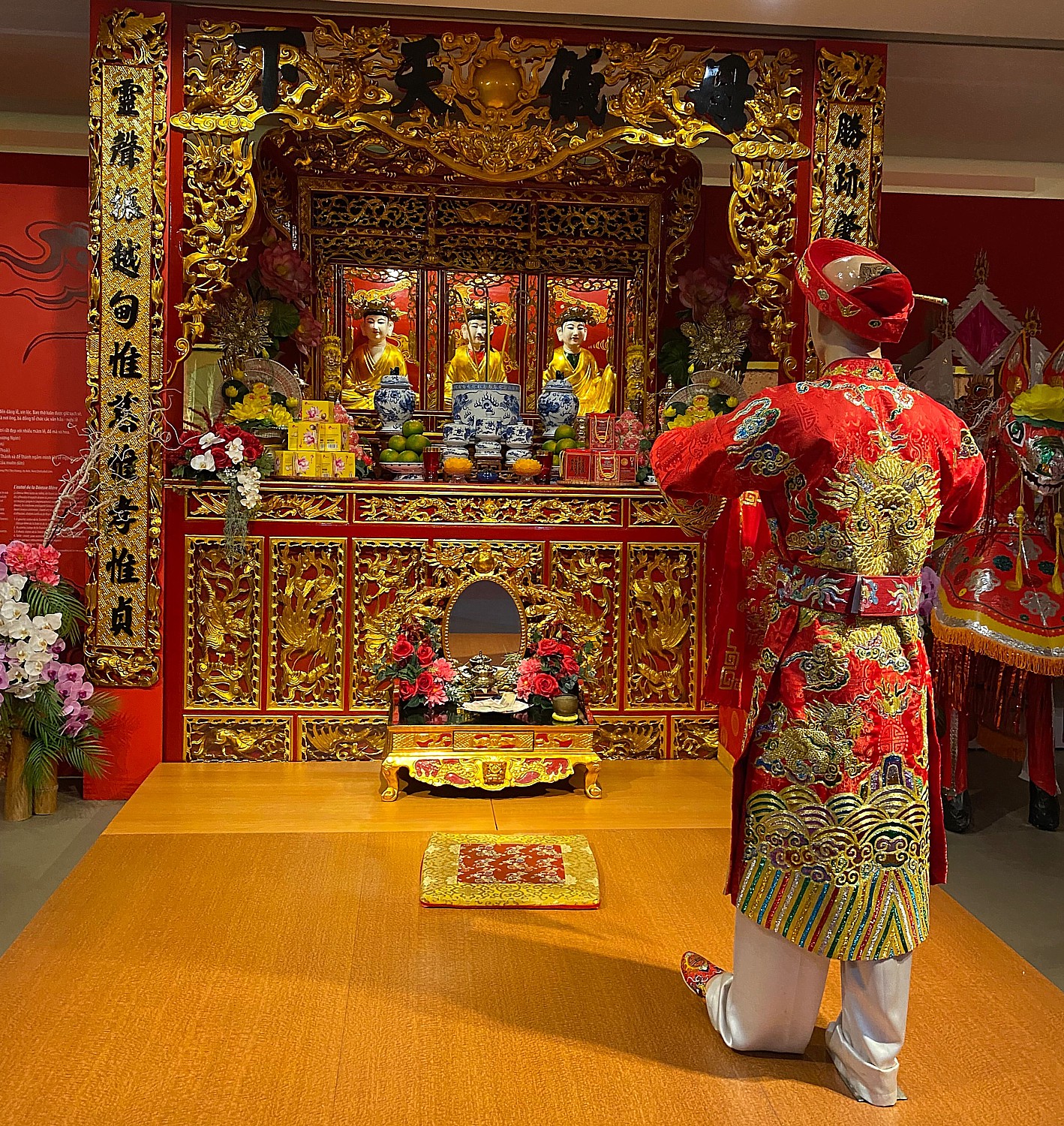
Many museums and sites close for lunch so check hours in advance. Also check for special shows and exhibitions; the Mother Goddess exhibition had specific but limited show times that we learned about too late.
Get the required visa at Vietnam’s website (evisa.gov.vn), where the fee is $25 (if you use a visa service it costs something like $197), and at Cambodia’s website (evisa.gov.kh), where the fee is $30, but give yourself enough time to get the confirmation. When filling out visa applications, flight and hotel reservations, note that dates in Vietnam and Cambodia are written day/month/year. I almost booked my flight for the wrong date. (April 1, 2025 should be written 01/04/2025).
It is surreal, extraordinarily intimate, overwhelmingly emotional to find yourself standing in Anne Frank’s tiny room exactly as she had lived in it, in secret hiding for two years, just before she was taken away by Nazis to the concentration camp where she died just a few months before she would have been saved.
There are the photos she clipped from newspapers to put on her wall, to preserve some connection to a normal life, her life before the Nazis took over Germany, then invaded the Netherlands, where her family had sought refuge. You see the plaid-cloth covered diary she began to write the day she received it, on her 13th birthday, who she sometimes wrote to as “Dear Kitty” and treated as her closest friend and confidant, revealing things her father later admitted he never knew about his daughter despite being close and living in such constant proximity.
As you stand in this space, the tiny bedroom where she sat at this desk to write, you hear her words, “When I write, I can shake off my cares, my sorrow… my spirits soar…. But will I ever be able to write something great? Will I ever be able to be a journalist or writer? Oh, I hope so.” And then, “Writing allows me to record everything – thoughts, ideals, fantasies.”
This is the remarkable Anne Frank The Exhibition, opening at the Center for Jewish History in New York City on January 27, coinciding with International Holocaust Remembrance Day and the 80th anniversary of the liberation of the Auschwitz death camp where one million Jews were exterminated.
For the first time, visitors outside of Amsterdam will be able to experience the Anne Frank House, one of the most visited historical sites in Europe, but in a very different way: whereas in Amsterdam, the rooms are empty as they were after the Nazis left it, here, visitors are immersed in a full-scale re-creation of the complete Annex, furnished as it would have been when Anne and her family and four other Jews spent two years hiding to evade Nazi capture.
You see the pictures clipped from newspapers she put on her wall – a semblance of normalcy of a teenager. You hear her words from her diary as you walk through those rooms.
But there is another important difference: before and after you roam through this meticulously re-created Annex, you are immersed in her life and the lives of millions of others as you see the rise of Hitler and the Nazis, how the Holocaust was set into motion and what it was like to live with such terror– giving a broader context and meaning to Anne Frank’s story, resonating with chilling effect today.
Created in partnership between the Anne Frank House and the Center for Jewish History, this astonishing, Anne Frank: The Exhibition kicks off the Center‘s 25th anniversary season.
“We are absolutely thrilled to partner with the Anne Frank House on this landmark exhibition,” said Dr. Gavriel Rosenfeld, President of the Center for Jewish History. “As we approach the 80th anniversary of the liberation of Auschwitz in January, Anne Frank’s story becomes more urgent than ever. In a time of rising antisemitism, her diary serves as both a warning and a call to action, reminding us of the devastating impact of hatred. This exhibition challenges us to confront these dangers head-on and honor the memory of those lost in the Holocaust.”
The exhibition, he said, “dovetails with CJH’s mission. We don’t just preserve Jewish history, we mobilize to address today’s challenges. Public programs foster understanding in a world that needs it more than ever.”
“When students learn to identify hate, learn to confront with empathy, critical thinking, they will champion justice and equality,” Ronald Leopold, the director of the Anne Frank House in Amsterdam, said at the press preview. “An exhibition like this serves as powerful reminder of the importance of confronting hate through education and understanding.
“The exhibition is a beacon of remembrance, of education, of awareness. It arrives at a very critical moment. We are living in a time when antisemitism and other forms of group hatred are on the rise, not only in this country, but my country, the Netherlands, and around the globe.” He referred to terrible incidents as recently as the day before, in Sydney, Australia.
“Anne Frank’s story is known to many but what you will experience at this exhibition goes beyond her tragic fate. The exhibition hopefully will also offer a deeper, multifaceted view of who Anne Frank was- not just a victim of the Holocaust, but just a girl, a teenager, a writer, and an enduring symbol of resilience and strength.”
The Anne Frank House, was established in 1957 in cooperation with Otto Frank, Anne Frank’s father, as an independent nonprofit organization entrusted with the preservation of the Annex and bringing Anne’s life story to world audiences in order to serve as a place for teaching and learning about the Holocaust. Each year, the Anne Frank House, welcomes 1.2 million visitors, but many are turned away (you have to reserve tickets weeks, even months in advance), and requires visitors to come to Amsterdam.
“This exhibition is not just about the past,” Leopold said at a press preview. “It is important to learn about the past, but more important to learn from the past. That is the educational mission Anne’s father, the only one of the 8 Jews in hiding at the Annex who survived, gave us when Anne Frank House opened to the public in 1960.”
Leopold held up two photos, side by side. One is easily recognizable: Anne Frank. Next to her on the page is a photo a boy no one has heard of. He was born June 12, 1929, the same day as Anne, lived one block from where she lived, a 3 minutes walk. Their paths might have crossed – we don’t know. We know everything about this little girl, Anne Frank, we think, but there is no one in the world today who knows anything about this young boy except for his name, David Spanyeur, his date of birth, address and when and where he was murdered, on February 12, 1943 in Auschwitz.”
“If we bring Anne Frank to New York, and we go to remember her on International Holocaust Remembrance Day, we also bring, David Spanyeur to New York, and remember him, as we will remember 1.5 million Jewish children’s lives cut short by human beings for the single reason they were Jewish. This is the message we try to bring, that goes beyond Anne Frank.
“We will remember David Sponyeur, we will remember Anne Frank, may their memories be a blessing. As we stand in presence of Anne’s legacy, we are reminded of our shared responsibility to carry this message forward.”
Philanthropic support has made it possible for the Anne Frank House to subsidize visits for students from New York City public schools and all Title 1 public schools throughout the United States. A special curriculum has been created for distribution to 500,000 children, and there is a 28-minute film at the center that is geared to school children.
So far, tens of thousands of already purchased tickets in advance of the opening; 150 schools have already scheduled visits from as far as California.
A Normal Teenager
Anne Frank was one of 1.5 million children murdered in the Holocaust – who, like Anne, had dreams, talents, hopes that were snuffed out. Anne is the one who is most and best known because of the sheer miracle of her keeping the diary and her journals being saved, Miep Gies, one of the people who protected the Franks in the Annex, finding it after the Nazis had ransacked their rooms, and keeping Anne’s writings safe because she knew how much writing meant to her, then reconnecting with Otto Frank, who was determined to fulfill his daughter’s dream of becoming a published writer, then a publisher recognizing how important the diary was because too many did not see the commercial value, or perhaps, the political correctness.
There is so much that is astonishing about this exhibit – certainly being able to stand in this exact, full-scale re-creation of Anne Frank’s secret hiding place furnished as if they had just left, before the Nazis stripped everything out. Indeed, that is how you experience The Anne Frank House in Amsterdam, totally empty. (The people from Anne Frank House in Amsterdam remarked how strange it was to see the rooms they know so well as empty, now furnished. “But we have the original diary, you have a facsimile!”) Also, it is what the exhibit is wrapped around with – the context surrounding Anne Frank’s experience and the experience of the 6 million Jews, including 1.5 million children exterminated in the Holocaust.
The exhibit features some 100 artifacts – some rarely if ever viewed in public – including an extraordinary exhibit of the family’s personal effects from their comfortable life in Frankfurt where Otto was a banker, before the Nazis and the Holocaust – even their china, a wooden desk from 1796, and Anne’s first photo album (1929-1942). You see family photos and photos of a normal life, a playful child with a fetching smile. There is even a video of a wedding couple leaving their apartment building that happened to capture Anne peering out from a second-story window.
This exhibit wraps Anne Frank’s personal story with context: the rise of Hitler, democratically elected Chancellor, and the Nazi domination of Germany, the invasion of the Netherlands, France and Belgium, and the implementation of the Final Solution – systemic genocide of Jews, known as the Holocaust.
We walk through the bookcase, and are in the hiding place in the Annex. Throughout the exhibit, you have an audio guide that you can activate, but here, in the hiding place, is where what you hear is most affecting – not just the description of the place and what their lives were like for the two years they hid away, but Anne’s own words from her diary.
“When I write, I can shake off my cares, my sorrow… my spirits soar…. But will I ever be able to write something great? Will I ever be able to be a journalist or writer? Oh, I hope so.” And then, “Writing allows me to record everything – thoughts, ideals, fantasies.”
Anne decorated her tiny cramped room with pictures – Hollywood and Royalty, like any 13-year old. But by the time she was 15, her interests shifted and deepened -she favored art and history and more serious things.
We visit all their rooms – you feel you are intruding, actually – even the bathroom, where you hear that at the stroke of 8:30, there could be no running water, flushing toilet, walking around, no noise whatsoever.
The kitchen, where the Pels slept, served as the communal kitchen and living room, and is where they played games at night and celebrated holidays like Yom Kippur and Chanukah.
Anne describes how one moment they are laughing at the comical side of their hiding, the next, feeling frightened. “Fear, tension and despair can be read on our face.”
Then, on a fateful day, the audio guide relates, a man came up the stairs with a revolver and told them to “pack their bags, you have to leave.” They were taken to prison and on to the camps.
In the next rooms, you see how the Holocaust unfolded – photos of Jews pulled from their homes, crowded into the streets and loaded onto cattle cars, deported to labor, concentration and death camps. You see soldiers shooting masses of Jews in pits dug by the victims themselves.
This room has a glass floor over a map of Europe with red flags denoting where the death camps and places of genocide were and hear names recited. As you come to the end, most affecting of all, is a projection of the 1935 photo of Anne Frank in her kindergarten class of 32 students, of whom 15 were Jews, which you saw in the first gallery. As you hear their names ticked off, one by one these adorable, innocent faces are disappeared from the photo and you hear their age when their lives were snuffed out: 12, 13, 14, 15. Only 5 of the 15 survived – by going into hiding or escaping. Anne was 15.
The next part follows Otto’s improbable journey from the camp when it was liberated in January 1945. Otto was the only one to survive of the eight who hid in the Annex, though he had yet to learn the fate of his family. All of his worldly possession fit into a tiny canvas bag the size of a book.
For Otto, it was just 10 months after being arrested that he returned – all of those who helped them in the Annex survived, though two men were arrested and sent to concentration camps but survived.
You actually see a video of Miep Gies, one of the Dutch citizens who hid and protected the Franks in the Annex (she lived to 100 years old), relating how she went into it after the Nazis ransacked it and found Anne’s diary and notebooks, keeping them safe because she knew how important her writing was to her. She re-creates how she reached into her desk and presented Otto with Anne’s volumes.
In an interview, Otto related that at first it was difficult for him to read the diary because of his grief, but when he started reading, he couldn’t stop. To honor her wishes of becoming a published writer, he set out to find a publisher – you see his letters and the replies from editors.
“Anne Frank’s diary, ‘Untergetaucht,’ [The Annex] impressed me deeply,” one editor writes back, “a monument to the sufferings of all people in Holland during the war…. If conditions were more nearly normal, I would recommend that we undertake an English translation…”
But ultimately Anne’s diary was published in English, “Anne Frank: The Diary of a Young Girl” – you see the first edition which includes a forward by Eleanor Roosevelt – and translated into 70 languages, selling 35 million copies – and made into a play and movie (winning Shelly Winter’s an Oscar for her performance as Auguste van Pels).
The exhibition closes quoting Anne Frank, “I’ll make my voice heard, I’ll go out into the world and work for mankind!”
Otto Frank is quoted saying in 1973, “Anne’s Diary made you think about the cruel persecution of the Jews during the Nazi regime, but I want to stress that even now there is in our world a lot of prejudice leading to discrimination and everyone of us should fight against it in his own circle.”
Michael S. Glickman, CEO of jMUSE, a former director of the center, said, “This institution, one of the great Jewish archives and libraries in the world, will house singularly the most important Jewish exhibition presented in this country. It is such a privilege, honor to be involved in this exhibition that carries the memory, legacy, and future of the Jewish people in such a powerful and poignant way…. As we open, we do so in memory of 6 million Jews and the 1.5 million Jewish children murdered.”
The exhibition is designed for children (ages 10 and older) and adults. All general admission tickets include the exhibition audio guide. Plan to spend two hours.
Individual tickets: Timed entry tickets, Monday through Friday: $21 (17 and under, $16); Sunday and holidays: $27 (17 and under, $22); Flex tickets, Monday through Friday: $34; Sunday and holidays: $48
Family tickets (2 adults + 2 children under 17 years): Timed entry tickets, Monday through Friday: $68 (additional 17 and under ticket, $16); Sunday and holidays: $90 (additional 17 and under ticket, $22) Flex tickets, Monday through Friday: $95 (additional 17 and under ticket, $18); Sunday and holidays: $135 (additional 17 and under ticket, $25).
Educational visits to the exhibition, as well as Individual and Family ticket purchases, can be scheduled by visiting AnneFrankExhibit.org.
Anne Frank The Exhibition is a limited engagement, scheduled to close on April 30, 2025. For a list of upcoming programs, visit https://www.cjh.org/.
Genealogy, Holocaust Records at the Center
The Center for Jewish History also has Geneology Research Center, with genealogists on hand who can help you trace your family’s history, has formed a new-multiyear partnership with Ancestry® to open the Ancestry Research & Reflection Room, a new space and initiative to collect, preserve and share family histories of Jewish communities worldwide.
Ancestry®, which is committed to preserving the memories of Holocaust victims and survivors and ensuring that these records are freely accessible to future generations, together with the Arolsen Archives, one of the world’s leading institutions for Holocaust documentation, expanded its Holocaust-related resources by adding 7.5 million more documents to its resources, including Germany, Incarceration Records, 1933–1945.
Ancestry enables free searches of Holocaust documents. These records can be searched for free at a newly opened Ancestry Research & Reflection Room at the Center for Jewish History – a new space and initiative to collect, preserve and share the family histories of Jewish communities worldwide. (Photo provided by Ancestry)
These records can be searched for free at a newly opened Ancestry Research & Reflection Room at the center – a new space and initiative to collect, preserve and share the family histories of Jewish communities worldwide. It is opening to the public on January 27, coinciding with the opening of the Anne Frank exhibition, International Holocaust Remembrance Day and the 80th anniversary of the liberation of Auschwitz.
Center for Jewish History 15 West 16th Street, New York, 212.294.8301,cjh.org, info@cjh.org.
By Karen Rubin, Travel Features Syndicate, goingplacesfarandnear.com
New York is one of the premier cultural capitals of the world and fall is when the culture calendar gets into gear. But here’s a heads-up: the blockbuster exhibit of the year – the opportunity to tour a full-scale re-creation of Anne Frank’s Annex as it stands in Amsterdam – opens January 27, 2025, and tickets are on sale now. Here are highlights of what’s ahead on the culture calendar:
Groundbreaking Full-Scale Re-Creation of Anne Frank’s Annex
Amsterdam and New York – The Anne Frank House, one of the most visited historical sites in Europe, is presenting a pioneering experience: the opportunity to walk through an exact replica of Anne Frank’s hiding place where she wrote her famous diary. Anne Frank The Exhibition opens in New York City on January 27, 2025. Considering that tickets to visit the Anne Frank House in Amsterdam book up three months in advance, tickets for this exhibit are now available at AnneFrankExhibit.org.
This is the first time the Anne Frank House will present this opportunity for visitors outside of Amsterdam to be immersed in a full-scale recreation of the rooms where Anne Frank, her parents and sister, and four other Jews spent two years hiding to evade Nazi capture.
As a nonprofit organization helping to shape global understanding of the Holocaust and its contemporary relevance, including lessons on modern day antisemitism, racism, and discrimination, the Anne Frank House is entrusted with the preservation of the Annex where Anne Frank and her family hid during World War II. This exhibition, presented in New York City in partnership with the Center for Jewish History in Manhattan, opens on International Holocaust Remembrance Day, January 27, 2025, to mark the 80th commemoration of the liberation of Auschwitz.
Anne Frank The Exhibition is a first-of-its-kind, full-scale recreation of the complete Annex, furnished as it would have been when Anne and her family were forced into hiding. Moving through the exhibition, visitors will be able to immerse themselves in the context that shaped Anne’s life—from her early years in Frankfurt, Germany through the rise of the Nazi regime and the family’s 1934 move to Amsterdam, the Netherlands, where Anne lived for ten years until her 1944 arrest and deportation to Westerbork, a large transit camp in the Netherlands, then to Auschwitz-Birkenau, a concentration camp and killing center in Nazi-occupied Poland, and eventually to her death at Bergen-Belsen concentration camp in Germany when she was 15 years old.
Designed for audiences who may not have the opportunity to visit the Netherlands, the new exhibition in New York City is anticipated to draw massive attendance for what will be among the most important presentations of Jewish historical content on view in the United States. Through the recreated Annex; exhibition galleries immersing visitors in place and history through video, sound, photography, and animation; and more than 100 original collection items from the Anne Frank House in Amsterdam, Anne Frank The Exhibition will provide an opportunity to learn about Anne Frank not as a victim but through the multifaceted lens of her life—as a girl, a writer, and a symbol of resilience and strength. This is a story inspired by one of the most translated books in the world.
The New York City exhibition will occupy over 7,500 square feet of gallery space in the heart of Union Square. This marks the first time dozens of artifacts will be seen in the United States—many have never been seen in public.
Artifacts in the exhibition include:
Anne Frank’s first photo album (1929-1942);
Anne Frank’s typed and handwritten invitation to her friend for a film screening in her home (by 1942, anti-Jewish measures prohibited Jews from attending the cinema); and
Handwritten verses by Anne Frank in her friends’ poetry albums.
“Anne Frank’s words resonate and inspire today, a voice we carry to all corners of the world, nearly eight decades later,” Ronald Leopold, Executive Director of the Anne Frank House, said. “As a custodian of Anne’s legacy, we have an obligation to help world audiences understand the historical roots and evolution of antisemitism, including how it fueled Nazi ideology that led to the Holocaust. Anne’s legacy is remarkable, as represented in the diary she left us, and as one of the 1.5 million Jewish children who were murdered at the hands of Nazi officials and their collaborators. Through this exhibition, the Anne Frank House offers insights into how this could have happened and what it means for us today.
“The exhibition provides perspectives, geared toward younger generations, that are certain to deepen our collective understanding of Anne Frank and hopefully provide a better understanding of ourselves. By bringing this exhibition to New York—a place with many ties to Anne’s story— the Anne Frank House is expanding the reach of our work to encourage more people to remember Anne Frank, reflect on her life story, and respond by standing against antisemitism and hatred in their own communities.”
Anne Frank The Exhibition is a limited engagement, scheduled to close on April 30, 2025. Public programming and educational initiatives tied to the exhibition will be announced when the exhibition opens to the public.
Timed entry individual and family tickets are available at AnneFrankExhibit.org. The exhibition is designed for children (ages 10 and older) and adults. All general admission tickets include the exhibition audio guide. Visitors should plan to spend approximately one hour at the exhibition. Last entry is one hour before closing.
Center for Jewish History, 15 West 16th Street, New York, N.Y. between 5th and 6th Avenues
Edges of Ailey (Whitney Museum of American Art, New York, September 25, 2024-February 9, 2025). Courtesy of Whitney Museum of American Art; Photo by Natasha Moustache.
Edges of Ailey at the Whitney Museum of American Art through February 9, 2025, is the first large-scale museum exhibition to celebrate the life, dances, influences, and enduring legacy of visionary artist and choreographer Alvin Ailey. This dynamic showcase brings together visual art, live performance, music, a range of archival materials, and a multi-screen video installation drawn from recordings of Alvin Ailey American Dance Theater (AAADT) repertory to explore the full range of Ailey’s personal and creative life. Described as an “extravganza” by curator Adrienne Edwards, Edges of Ailey is the must-see event of the NYC fall/winter season. The landmark exhibition is on view only in NYC.
Presented at the Museum in multiple parts, Edges of Ailey consists of an immersive exhibition in the Museum’s 18,000 square-foot fifth-floor galleries that includes artworks by over 80 artists and never-before-seen archival materials. Artists featured in the exhibition include Jean-Michel Basquiat, Faith Ringgold, Alma Thomas, Jacob Lawrence, Kara Walker, and many others. A recent acquisition of Eldren Bailey and new works by Karon Davis, Jennifer Packer, Mickalene Thomas, and Lynette Yiadom-Boakye will be presented for the first time in honor of this landmark exhibition.
Edges of Ailey is part of a ‘Season of Ailey’ in New York City, which includes the Alvin Ailey American Dance Theater company’s annual engagement at New York City Center, December 4-January 5.
Also at the Whitney:
Opening November 1, Shifting Landscapes explores how evolving political, ecological, and social issues motivate artists’ representations of the world around them. The 120 works by more than 80 artists—including Firelei Báez, Jean-Michel Basquiat, Jane Dickson, Gordon Matta-Clark, Amalia Mesa-Bains, andPurvis Young—depict the effects of industrialization on the environment, grapple with the impact of geopolitical borders, and give shape to imagined spaces as a way of destabilizing the concept of a “natural” world.
On view through January 5, 2025, Survival Piece #5: Portable Orchard marks the first standalone museum presentation of the fully realized indoor citrus grove conceived and designed in 1972 by artists Helen Mayer Harrison and Newton Harrison. Stretching across the Museum’s eighth-floor gallery, this installation of 18 live citrus trees explores the need for a productive and sustainable food system in an imagined future where natural farming practices are obsolete and cannot be taken for granted.
This fall, the Perelman Performing Arts Center [PAC NYC] is staging its inaugural PAC NYC ICONS OF CULTURE FESTIVAL presented by BNY from Tuesday, October 29 – Saturday, November 2, 2024.
PAC NYC ICONS OF CULTURE FESTIVAL will bring audiences into the room with trailblazers in art, music, comedy, film, sports, and more to talk about pushing boundaries, making a mark, and elevating the everyday to the iconic.
Icons to appear in conversation at the festival include Misty Copeland, The Dogist, Alex Edelman, Renée Fleming, Michael Imperioli, Baaba Maal, Philippe Petit, Questlove, Marcus Samuelsson, Kathleen Turner, Serena Williams, andVanity Fair’s Little Gold Men Live!
Art Deco City: New York Postcards from the Leonard A. Lauder Collectionat Museum of the City of New York, East Harlem, through February 17, 2025: Featuring over 250 postcards alongside decorative arts, fashion, and architectural models, the exhibition highlights the role postcards played in popularizing Art Deco landmarks like the Empire State Building, the Chrysler Building and Rockefeller Center.
Make Way for Berthe Weill: Art Dealer of the Parisian Avant-Garde at Grey Art Museum, Noho, Manhattan, through March 1, 2025: Berthe Weill, the first woman modern art dealer, championed artists like Picasso, Matisse and Modigliani. This survey features around 110 works shown at her gallery in the early 20th century and highlights her work as a gallerist and advocate.
Pets and the City at The New-York Historical Society, Upper West Side, Manhattan, October 25, 2024—April 20, 2025: Featuring a diverse range of art, objects, memorabilia and media clips, this exhibition highlights pets’ lives in NYC, from early Indigenous cultures to today’s pampered companions. It also examines the growing pet population and addresses topics such as pet adoption and the importance of service animals. Also:
Most people think of Paul Revere solely as a silversmith, but his work as a printer and an artist was key to his role as a patriot seeking to break with Great Britain. His print of the Boston Massacre was significant to organize public opinion against the British. Paul Revere, The Bloody Massacre Perpetrated on King Street, Boston. Hand colored engraving, 1770. American Antiquarian Society. Gift of Nathaniel Paine.
From Paul Revere to Edward Hopper: Treasures from the Leonard L. Milberg Collection of American Prints, Drawings, and Watercolors, through October 27, 2024, showcases more than 140 prints, drawings, and watercolors from one of the most admired collections of historical American works on paper
Scenes of New York City: Selections from the Elie and Sarah Hirschfeld Collection, through October 27, 2024: The inaugural display in the new Hirschfeld Gallery and Hall presents a selection of artworks from an extraordinary promised gift to New-York Historical by prominent philanthropists and art collectors Elie and Sarah Hirschfeld, who have amassed a stunning collection honoring their hometown. The collection features renowned artists—both national and international—and presents vivid snapshots of Gotham and its streetscapes.
Enchanting Imagination: The Objets d’Art of André Chervin and Carvin French Jewelers, through January 5, 2025: This dazzling exhibition of meticulously created objets d’art is on view to the public for the very first time. André Chervin (born 1927 in Paris), with his New York atelier, Carvin French, is one of the most acclaimed makers of handcrafted fine jewelry in the world.
A Billion Dollar Dream: The 1964-1965 New York World’s Fair on its 60th Anniversaryat Queens Museum, Flushing Meadows Corona Park, Queens, November 3, 2024—March 9, 2025: A Billion Dollar Dream celebrates the 60th anniversary of the 1964–1965 New York World’s Fair by examining its legacy through social, political and environmental lenses. Featuring materials from the Queens Museum’s collection, the exhibition highlights the Fair’s promotion of progress and nationhood while reflecting contemporary issues, including civil rights and the women’s liberation movement.
Solid Gold at The Brooklyn Museum, Prospect Heights, Brooklyn, November 16, 2024—July 6, 2025: Solid Gold celebrates the allure of gold, presenting over 500 works that explore the color and material’s significance in art, fashion, film and design throughout history. Opening for the Brooklyn Museum’s 200th anniversary, the exhibition features stunning pieces from renowned designers like Christian Dior and Yves Saint Laurent, alongside gold-ground paintings, sculptures and jewelry by notable artists such as Alexander Calder and Bulgari.
Flight into Egypt: Black Artists and Ancient Egypt, 1876–Nowat The Metropolitan Museum of Art, Upper East Side, Manhattan, November 17, 2024—February 17, 2025: Flight into Egypt: Black Artists and Ancient Egypt, 1876–Now examines how Black artists and cultural figures have engaged with ancient Egypt through art, literature and performance over nearly 150 years. Featuring 200 works, the exhibition explores themes like the creation of a unifying identity and the contributions of Black scholars. It also includes a dedicated gallery for performance art, featuring live performances on select days.
Lillie P. Bliss and the Birth of the Modern at The Museum of Modern Art, Midtown Manhattan, November 17, 2024—March 29, 2025: The Museum of Modern Art will host this exhibition in celebration of one of its founders and her crucial role in promoting modern art in the US. The exhibit marks 90 years since Bliss’s contributions to MoMA and will feature about 40 works. The exhibition will also display archival materials, highlighting her lasting impact on the museum and the acceptance of modern art in America.
Ceremonies Out of the Air: Ralph Lemonat MoMA PS1, Long Island City, Queens, November 14, 2024—March 25, 2025: Showcasing over 60 works by Ralph Lemon, this exhibition presents dance, sculpture, video and more. Ceremonies Out of the Air will highlight his storytelling through movement and features the central installation Rant redux (2020–24). It will also include a series of live performances that enhance the immersive experience.
Magazine Fever: Gen X Asian American Periodicals at The Museum of Chinese in America, Nolita, Manhattan, through March 30, 2025: Magazine Fever: Gen X Asian American Periodicals examines the impact of Asian American magazines in shaping identity during the 1980s and ’90s. Featuring over 80 rare issues from notable publications like A. Magazine and Hyphen, the exhibition showcases how these magazines provided a platform for Asian Americans to assert their narratives and portray their identities.
FUTURA 2000: BREAKING OUT at The Bronx Museum of the Arts, South Bronx, Through March 30, 2025: FUTURA 2000: BREAKING OUT is a retrospective of the legendary NYC artist’s career. Running through winter 2025, it showcases five decades of his work, including sculptures, drawings, prints and new installations. The exhibition highlights his signature techniques, science-fiction motifs and the iconic 1980 graffiti piece, Break, which cemented his influence in the art world.
New York Gilbert & Sullivan Players Celebrates 50th Anniversary Season: New York Gilbert & Sullivan Players (NYGASP), America’s preeminent professional Gilbert & Sullivan repertory company, announces a Golden Jubilee, celebrating its 50th anniversary season and honoring 150 years of the wit and wonder of Gilbert & Sullivan. The celebrated full company and orchestra will perform “Ruddigore” on Nov. 23– 24, 2024; “The Pirates of Penzance” on Jan. 4– 12, 2025; and “Iolanthe” on April 5–6, 2025 at the Gerald Lynch Theatre at John Jay College. Info and tickets at www.nygasp.org.
‘Billy Joel – My Life, A Piano Man’s Journey’ Exhibit at LIMEHOF Extended: The Long Island Music and Entertainment Hall of Fame (LIMEHOF) has is extending the run of the first ever exhibit dedicated exclusively to LIMEHOF Inductee and Legendary Long Island Musician Billy Joel through spring 2025. Billy Joel- My Life, A Piano Man’s Journey spans Joel’s life and career from growing up in Hicksville to his legendary run at Madison Square Garden. It includes over 50 years of Billy Joel’s most cherished items including rare memorabilia, behind-the-scenes video, dozens of awards, rare audio and video recordings, vintage instruments and historic photos, many donated by Billy Joel himself. Timed entry and VIP tickets and special holiday packages and gift cards are available at www.TheBillyExhibit.com(LIMEHOF, 97 Main Street, Stony Brook, Long Island, www.limusichalloffame.org).
By Karen Rubin, Travel Features Syndicate, goingplacesfarandnear.com
The Olympic spirit is everywhere in Lake Placid. You can almost hear the fanfare playing. It is infectious, and fun – and what is even better, you get to participate, to see and experience it for yourself.
While so many other Olympic venues shut down after the event, Lake Placid, which hosted one of the first winter Olympics, in 1932, and then again in 1980, the facilities have not just been upgraded, enhanced and once again entice World Cup and international sports events. Lake Placid is very much a four-season destination, an outdoors paradise where you can actually experience the same Olympic venues, attractions and activities year-round, along with the athletes who live and train here, and the world-class athletes who compete here.
It offers an ideal mix of activities to appeal to the most athletic and active, to those who prefer to spectate rather than participate – perfect for our three-generation family – skiers and nonskiers and infant.
The best way to experience Lake Placid, we discover, is with the Olympics Legacy Sites Passport, which provides access to the four Olympic venues and experiences – so even if you don’t ski, you can take the Cloudsplitter Gondola up to the summit of Little Whiteface to enjoy the spectacular view of the Adirondacks high peaks; go to the top of the highest ski jumping tower at the Olympic Jumping Complex to see what the ski jumpers see (terrifying); tour Mt. Van Hoevenberg where the sliding sports (bobsled, skeleton and luge), Nordic skiing, and Biathalon are held; and tour the Olympic Center, where you visit the museum that houses one of the best collections of Olympics memorabilia in the world, as well as the skating arenas. (The passport includes one admission to the four venues plus 10% off shopping and dining at all the Legacy Sites, https://olympicjumpingcomplex.com/legacysitespassport/)
But if you haven’t visited Lake Placid in the last few years, you wouldn’t know about any of these experiences. So much has changed. So much is new. So much is so special.
The New York State Olympic Regional Development Authority (ORDA, now more familiarly known as the Olympic Authority), which owns and manages the facilities here in Lake Placid (as well as Gore Mountain and Belleayre ski areas), since 2018 has not only upgraded and massively improved the facilities in order to continue to host major international competitions (providing opportunities to watch the competition, training and even meet athletes), but has added attractions and activities so that we can experience much the same thrill and excitement as the athletes, year round. We even get to see their sport through their eyes.
At the Olympic Jumping Complex, we ride a new, scenic Skyride Gondola to the base of the towers (athletes used to have to take a chairlift), then walk a short distance to the glass-windowed elevator that takes us up to the top of the highest ski jump tower for the view that the jumpers get (terrifying), and the setting amid the High Peaks Region (open daily but subject to weather conditions).
Today, this facility is the only sanctioned ski jumping facility in North America for winter and summer competition and training. For warm-weather practices, there is a kind of plastic grass that is sprayed with water, that apparently athletes like even better because it is more consistent than snow.
That is a really good thing because climate change will make Lake Placid one of only four premier winter facilities that will be able to host a winter Olympics by 2050, my ORDA guide, Jaime Collins, tells us.
The World Cup will be held here again in February 2025.
Here at the Olympic Jumping Complex, you can also ride the new Sky Flyer Zipline adjacent to the ski jumps – and if the ski jumpers are practicing, you can seemingly fly alongside. ($20 off ticket price with the Legacy Passport).
New Coaster Ride, Bobsled Experience at Mt Van Hoevenberg
At Mt Van Hoevenberg, home to the three sliding sports – bobsled, skeleton and luge – the Legacy Passport provides a tour that starts in the newly built Mountain Pass Lodge and the push track where you learn about elite athlete development, then taken by bus up the track for a guided walk inside the sliding track.
Be sure to take in the view from the start area which offers the only place where you can get a view of all the Olympic venues at once: the Ski Jump complex, Whiteface Mountain, the track and Nordic center, and the Olympic Center in downtown Lake Placid. (Open daily; check daily updates pagefor current conditions and trail offerings.The pass also provides 10% off at Mt Van Hoevenberg’s 81-18 Café, Mountain Pass Mercantile and Swix Store.)
As it happens, our visit coincides with preparations for the final International Bobsled & Skeleton Federation (IBSF) World Cup competition of the 2023-2024 season and we get to watch some of the two-man bobsled practice and meet some of the athletes.
We learn that this track – with 17 curves and a vertical drop of 365 feet – is considered one of the most difficult and has one of the most famous and challenging turns in the world. Turn 10 winds 180 degrees into a 20 foot-high wall that, if hit right, can slingshot the sled for a gain 6 mph. “The G forces are so severe, that they can only practice 4-5 times a day,” our ORDA guide, Jaime Collins tells us.
When the track isn’t being used for practice or competition, you can take the Bobsled Experience, where you are driven down the track with real bobsledders. You get to go through that famous Turn 10 but from Start 4, so it comes soon into the ride before you get going too fast, but you still reach speeds up to 50 mph on the lower half-mile of the track. (Be sure to reserve in advance; in summer, the bobsled uses wheels on concrete; $125/9+; $100/military, https://mtvanhoevenberg.com/todo/bobsled-experience/).
The track is set up so spectators get a real close-up view (pro tip: the best place is where the track is shaped as a heart).
Mt. Van Hoevenberg is also the Olympic Nordic ski area and we just miss watching practices for the Junior National Nordic races at the Nordic stadium on the side of the lodge.
But non-Olympians can do cross-country skiing here, as well as actually experience the Biathlon, an Olympic event which combines shooting and cross-country skiing.
In summer, Mt. Van Hoevenberg becomes a mountain biking center – you can rent bikes and take lessons.
In fact, Lake Placid was selected as the only U.S. venue to host the World Cup mountain bike competition, which will be held September 27 – 29.
Here at Mt Van Hoevenberg you not only get to see the Olympic bobsled track but you can ride alongside on the Cliffside Coaster, the longest coaster in North America, which opened in 2020. As you ride up to the top, you hear the Olympic history of the track but once at the peak, you are in the driver’s seat and control the speed, navigating sharp corners, cliffside banks and long winding stretches (open daily in season but weather dependent; make reservations in advance; 31 Van Hoevenberg Way, Lake Placid, NY 12946, https://mtvanhoevenberg.com/todo/cliffside-coaster/).
Skiers, NonSkiers Treated to View at Whiteface Mountain
At Whiteface Mountain, the Legacy Passport enables even nonskiers to experience the 15 minute ride on the scenic, eight-passenger Cloudsplitter Gondola from the Main Base Lodge to the top of Little Whiteface to enjoy the gorgeous view of the Adirondacks that the skiers get. (Open daily. The Legacy Passport gets you 10% off at these locations: 10% off at Whiteface: 4610’ Grille, Castle Gift Shop, Legends Café, and Brookside Apparel.)
Another activity included on the Legacy Sites Passport is to drive (or bike) the Veterans’ Memorial Highway that rises over 2,300 feet in five miles, with scenic stops along the way. An elevator or 15-minute hike takes you to the summit of New York’s fifth highest peak. (Open daily, but subject to daily weather conditions, visit Whiteface Conditions).
Immersive New Museum at Olympic Center
The Olympic Center, in downtown Lake Placid, is really special. The Legacy Passport gives you admission to the Lake Placid Olympic Museum, which has one of the world’s largest collections of Winter Olympic memorabilia, and brilliantly tells the story of Lake Placid’s role in the development of winter sports and the Olympics.
The state-of-the-art museum, which only has been opened two years, features interactive and engaging displays, 3D visualizations, experiential learning exhibits, marvelous videos, and interesting and intriguing artifacts. It is especially inspiring to see the names of local Olympians, some who are multi-generational.
The 3D and interactive displays are really superb. In one, you sit in a real bobsled and virtually speed down the actual bobsled track (thrilling); you can see exactly what the ski jumper sees flying off the jump.
The climax is sitting in a screening room to watch a 12-minute video of the highlights of the 1980 “Miracle on Ice” when the USA hockey team beat the Soviet Union. (Each year, there is a1980 Miracle on Ice fantasy camp – where participants get to play with the actual members of the team.)
In the museum, you get to really immerse into the personal stories of the Olympians, especially those with connections to Lake Placid.
You learn that it wasn’t just good fortune why Lake Placid hosted one of the first winter Olympics, in 1932. Lake Placid really began America’s love affair with winter sports.
The first “modern” Olympics was held in 1896, and by the early 1900s, a Norwegian man known as “Jack Rabbit” introduced alpine and Nordic skiing to the Lake Placid area. The Lake Placid Club was formed by the strongest advocates of winter sports.
The high jumping venue, originally known as Intervales, hosted the first international ski jump competition here in 1921, drawing 3000 spectators – more than the local population.
The first winter Olympics was held in 1924, and the first gold medal was actually awarded to Charles Jewtraw, a speed skater, from Lake Placid .
The first gold medal won at the Lake Placid games was won by Lake Placid local, Jack Shea for speed skating (he won two gold in 1932,and was instrumental in the games returning to Lake Placid in 1980). His son, Jim Shea was a 1964 Olympian cross country skier, and his grandson, Jim Shea, Jr., was the men’s skeleton champion aat Salt lake City in 2002 (Jack Shea was killed by a drunk driver just two weeks before).
You get to tour the famous ice arena, named for Herb Brooks, and the 1932 skating rink (really tiny seating area), and even go down to the locker room.
These historic skating rinks are open to the public for skating year-round, and we see some adorable kids starting their long journey to gold (open Tuesday – Saturday).
(The Olympic Center is open daily. The pass also provides 10% off at Olympic Center Roamers Café and Miracle Moments Store.)
Just across from the center is the Olympic speed skating oval, where Eric Heyden made history in 1980 for winning all five speed skating events. (He only agreed to one commercial endorsement, for Crest Toothpaste, to finance medical school and became an orthopedic surgeon.). In season, you, too, can skate on the Olympic oval well into the night (weather permitting.)
The Olympic Legacy Passport is $69/adult, $59 ages 19+, military and seniors and can be purchased at any of the venues (, https://lakeplacidlegacysites.com/legacysitespassport/). Lake Placid Legacy Sites, 518-523-1655, https://lakeplacidlegacysites.com/
It’s March – spring skiing – and David, Laini and Karen get the ultimate Olympic experience of skiing Whiteface Mountain – even if you are stuck on the green and blue trails. David and Laini, though, were able to tour much of the mountain, tackling the advanced trails, and loved the long runs and sweeping mountain views. With the spring melt already underway, the alpine creek rushed beneath our chairlift rides and the Ausable River at the base had a Galway-esque feel. The lookout atop the Cloudsplitter Gondola was a gorgeous rest stop for us skiers as well as Laini’s non-skiing parents, who were able to enjoy the view and then easily take the gondola down. We discovered the beautiful mid-mountain lodge on our last run – a great lunch spot with high vaulted ceilings and huge pictures windows.
March, when we visit, is often one of snowiest and most spectacular months for outdoor winter recreation, but this year, snow was lacking and it also was the warmest since 1905, so we aren’t able to do several of the winter activities, like riding the toboggan chute onto Mirror Lake, cross-country skiing, skating on the Olympic oval, and snowshoeing the Mt Van Hoevenberg East Trail (a hiking trail in summer).
In summer, Whiteface Mountain offers disk golf, hiking, the scenic gondola, and plans to resume mountain biking.
Food & Lodging
After our visit to the Olympic Center, we stroll Lake Placid’s charming main street and enjoy the shops, cafes, bistros.
We stop for lunch at The Cottage at Mirror Lake Inn, (17 Mirror Lake Dr.) enjoying the meal in one of the actual ski gondolas overlooking Mirror Lake with spectacular views out to the Great Range of the Adirondack High Peaks (17 Mirror Lake Dr., 518-302-3045, mirrorlakeinn.com/dining/the-cottage)
Each night of our stay in Lake Placid, we had a marvelous cocktail/dining experience (so many to choose from and return to Lake Placid for):
Big Slide Brewery, where you eat beside the giant barrels of the brewery in a comfortable dining room and semi-open kitchen. Not your typical pub grub, its menu has pizaazz – snacks like marcona almonds in hop oil and thyme, Cake Placid pretzel nuggets with beer cheese, and tater tot poutine; sandwiches like a shaved steak sandwich with thinly-sliced ribeye, Sugarhouse Creamery Dutch Knuckle cheese, sautéed onions and Mushrooms and Horseradish Aioli; Tomahawk Pork Chop or chicken fried chicken over smoked ham grits; and pizzas cooked in a 700 degree brick oven. Tomahawk Pork Chop or chicken fried chicken over smoked ham grits (5686 Cascade Road, just over a mile from downtown, bigslidebrewery.com, 518) 523-7844.
Smoke Signals, also overlooking Mirror Lake (a gorgeous dining room and there is a patio overlooking the lake for outside dining), offering classic BBQ with some innovative twists, (2489 Main St., 518-523-2271, www.smokesignalsq.com).
We loved our culinary experience at Cafe Rustica, a quaint, old-fashioned (traditional) Italian restaurant (even the music was a throw-back) serving fabulous Northern Italian cuisine, like the Ravioli Carbonara (fresh wild mushroom ravioli, black pepper, organic egg, pancetta, baby peas, parmesan); Cavatelli Bolognese (rustica Bolognese sauce, cavatelli pasta, parmesan, rosemary oil); chicken Mediterraneo (kalamata olive, heart of plan, tomato, lemon, whitewine, capers, pepperoncini, linguini) (1936 Saranac Ave, Lake Placid, NY 12946, 518-523-7511, www.rusticalp.com)
The East Wind Lake Placid Hotel, just a short distance off of Main Street, Lake Placid, proved perfect for our multi-generational getaway – like a small community of lodges and lushnas for a total of 29 units, each homey with dashes of luxury and high-style. My lushna (like a tiny house) was just the width of the (extremely comfortable) queen bed, and had all the comforts of home – refrigerator, coffee maker, bathroom, remote-controlled A/C. David and Laini and baby were comfortable in a spacious room in the house; grandparents Diane and Barry in the lodge.
There are gathering areas – fire pits ringed with Adirondack chairs, a gorgeous reception room (open 24 hours, where coffee, tea and fruit are laid out, you can order breakfast, and there are cocktails and drinks at the bar); a lovely library/salon in one of the buildings (great for taking a conference call).
For a luxury, resort-style experience: the historic Mirror Lake Inn Resort & Spa (77 Mirror Lake Dr, Lake Placid, NY 12946, 518-523-2544, mirrorlakeinn.com; and High Peaks Resort (2384 Saranac Avenue, Lake Placid, NY 12946, 800-755-5598, highpeaksresort.com).
Definitely make time to visit High Falls Gorge, a 22-acre nature park, just a short drive beyond the entrance to Whiteface ski area. It is a 30-minute walk – about a mile – hugging the rockface, where you can go out onto overlooks and bridges and be very close to the series of cascading waterfalls formed by the Ausable River as it drops 115 feet. There is also a trail accessible for strollers or wheelchairs.
Some of the oldest rocks in the world are here – you can touch an Anorthosite boulder 1.5 billion years old (Anorthosite, the base rock for the Adirondacks, is the same rock found on the moon). In season, High Falls Gorge also offers rock climbing, tubing and white water rafting, as well as trails through the forest. (4761 NYS Route 86, Wilmington, NY 12997 518-946-2278, https://highfallsgorge.com/)
It’s a dark night when we pull into our hotel in Cambria, on California’s famous (and fragile) Pacific Highway 1, so it isn’t until I awake in the morning to a moist mist rising after a rain, that I realize what is just across the road from the picturesque Moonstone Beach and a magnificent boardwalk that extends 1 ½ miles over the fragile seagrass, the ocean crashing against the rocky shore just beyond, where a few seals are resting, the sun making a gorgeous sparkling light,
We’ve driven down from the north, starting at San Francisco, to Monterey (made famous by John Steinbeck’s “Cannery Row” and now with a world renowned Aquarium); following the Pacific Highway 1 as much as possible as it hugs the cliffs to Big Sur. We pull over frequently to take in those breathtaking views that look like the edge of the Continent just fell into the ocean. We spend a couple of days hiking and exploring, overnighting at the utterly enchanting and historic Deetjen’s Big Sur Inn (www.deejens.org, 831-667-2377), then have to backtrack to Monterey, driving inland three hours on Highway 101 to come into Cambria.
Cambria is an outstanding base to experience not only its own charms, but to explore Hearst Castle, San Simeon, the Piedras Blancas Elephant Seal Rookery, and even driving north on the Pacific Highway, to Ragged Point, just at the southern end of Big Sur where you can get those dramatic sheer-cliff/crashing waves against the rocky shore views.
Castle Inn, which I found on hotels.com, is a delightful motel that is absolutely perfect for our purpose – the room is spacious and has a beachy (ocean) feel; the motel serves coffee, scones, apples, muffins, oatmeal for breakfast. Later, we will take advantage of its pool and hot tub under the stars, and is so close by to all the things we want to explore – especially having the Moonstone Beach and boardwalk just across the road. (6620 Moonstone Beach Dr, Cambria, CA 93428, 805-927-8605, castle-inn-cambria.hotelsone.com)
We grab coffee and muffins and immediately head out to Hearst Castle just eight minutes up the coastal road from Cambria in San Simeon.
We have to be at the Hearst Castle’s visitor center by 8:40 am for our pre-booked 9 am Grand Rooms tour – the most popular of a selection of tours you can take and the best if you have never visited before (others include “Hearst and Hollywood” “Designing the Dream” “Art of San Simeon,” “Julia Morgan”, “Cottages & Kitchen tour” “Upstairs Suites Tour”, also accessible tours and private tours.)
We get our wristbands and go to “gate” for the bus that takes guests up to the mansion along the long winding road – just as William Randolph Hearst intended his visitors to experience his “Enchanted Hill.”
The tour starts immediately on the bus, with an excellent narration giving the background – history, architecture, biography – and pointing out the sights along the way, accompanied by music of the 1930s and 1940s.
Hearst Castle is so much more than a magnificent mansion home (one of the most spectacular in the world), even more than an architectural jewel and a breathtaking art collection. It is the story of a fascinating man (love him or hate him or something in between, you still have to give the man credit for what he accomplished) who you come to know because everything about Hearst Castle is so personal to him. It is the story of an age – the coming of age of America, the coming of age of Hollywood and ascendancy of American culture. Everything you see is mind-blowing and breath-taking. And this mansion (he called it his country home), which has come to be known as Hearst Castle, is his personal artistic creation – the architecture and the art collection.
The tour is extremely well organized – it manages to be efficient and yet personal (I’m betting the earlier you can visit the better) – you feel as so many of Hearst’s guests must have felt the first time they were invited.
You realize that even if you think you know who Hearst was (and so many imagine Hearst to be the character of “Citizen Kane” but he is only a piece of that fictional character, and Marion Davies, his companion, was a smart, savvy and accomplished woman and quite a fine actress, not at all like the character of Kane’s), you come away with newfound respect and interest – in fact, as compelling a real-life story as the fictional Citizen Kane. (“Citizen Kane” screenwriter Herman J. Mankiewicz was one of Hearst’s guests here.)
You also come to learn – and admire – Hearst’s architect for his castle: Julia Morgan was one of the first female engineering majors at the University of California, Berkeley, the first woman to pass the entrance exam in architecture and graduate the École Nationale Supérieure des Beaux-Arts, Paris – the preeminent architectural school of the time – and was the first licensed woman architect in California. (In 2014, Morgan was posthumously awarded the American Institute of Architects’ Gold Medal in recognition of her pioneering career and dynamic buildings, the first woman to be awarded the medal in its 107-year history, https://pioneeringwomen.bwaf.org/julia-morgan/)
Hearst was inspired to build his castle and collect art when he took the grand tour of Europe when 10 with his mother. And his mother, Phoebe Apperson Hearst. a philanthropist and advocate for women, introduced him to Julia Morgan. Phoebe began a lifelong interest in Morgan’s career when the two women’s paths crossed in Paris. The films and photos you get to see of Morgan, presiding over the dynamiting to level the summit and build the road, reviewing plans with Hearst, are fascinating.
Even though you are walking through the mansion with a tour group, you actually feel like you were one of Hearst’s guests arriving for the weekend – the home is set out as it would have been – most remarkably, in the grand dining room (it may well have inspired Harry Potter’s Hogwarts dining room, and interestingly, the banners on display refer to an Italian horserace), there are bottles of ketchup and mustard because Hearst himself, for all the spectacular grandeur of the art and architecture, wanted a homey feel to his country home.
The art is breathtaking – Hearst collected the pieces himself, and drawing from his European travels with his mother when he was 10 years old, are predominantly Gothic and medieval – a lot of religious art which Hearst appreciated for the art and the period, not the religious significance, the guide tells me.
At the entrance to the Casa Grande – the 68,300 sq ft grand house – we stop in front of the oldest work of art here, an Egyptian statue, 3200-3600 years old of Sekmet, daughter of Ra –with a hieroglyph that translates “Good God, Lord of Two Lands.” The entrance to Casa Grande – has real gold gilding on the door, 1500-year old mosaic tiles, a 600 year old statue.
We are ushered into the grand Assembly Room – 15th century church pews, tapestries, line the wall, and the Venus Italica, one of Hearst Castle’s greatest masterpieces, created by Antonio Canova (1757-1822).
In 1935 his collections were valued at more than $20 million (in the height of the Great Depression!), but then he fell into near bankruptcy, and at the age of 75, and had to sell off two-thirds of his collection, estimated at $15 million, at “fire sale” prices. (Marion Davies, by then extremely wealthy in her own right with movies and real estate investments in places like Palm Springs, lent him $1 million so he could keep Hearst Castle; when she died, her estate was worth $8 million; when he died, she gave the Hearst Company shares he left her back to his family and they promptly kicked her out and refused to let her come to his funeral.)
You can easily picture who Hearst, Davies and Morgan were, and the glorious celebrity life they lived because there are home movies, photos!. It is thrilling to sit in Hearst’s own theater and watch Charlie Chaplin mug for the camera. (Definitely take advantage of the outstanding 40-minute documentary about Hearst’s life in the five-story theater before or after the tour.)
In many ways, William followed in his father’s footsteps.
George was a self-made millionaire, starting as a prospector – he owned interest in three of the largest mines in the U.S., including the Comstock Lode in Nevada, the Homestake gold mine in South Dakota and the Anaconda copper mine in Montana, plus the Ontario silver mine in Utah, then acquired large portions of land throughout the United States, especially in California and the West. One acquisition was 48,000 acre Piedra Blanca Rancho at San Simeon in 1865, when William was two-years old. He later purchased the adjoining Santa Rosa and San Simeon Ranchos – amassing 250,000 acres. This place became a retreat for lavish family camping trips.
Late in his life George Hearst served as United States Senator from California from 1887 until his death in 1891. It was during this time that he acquired the small San Francisco Examiner as a repayment for a gambling debt. Although he had little interest in the publishing business and wanted his only son, William, to take over the family’s mining and ranching holdings, William wanted to run the newspaper.
The newspaper business was William’s passion, and he ultimately amassed a huge publishing empire, and even when he was living at this remote castle in San Simeon, he would get the pages each night by teletype by 1 am, and make editorial changes by phone, well into the night.
William Hearst is probably best known for “yellow journalism” which pressured President McKinley into the Spanish-American War (that also made Theodore Roosevelt’s reputation with his Rough Riders.
And following in his father’s footsteps, he was elected to Congress but unsuccessfully ran for Governor and for President.
In 1919 when he inherited the estate, William Hearst, then 56 years old, hired architect Julia Morgan telling her, ““Miss Morgan, we are tired of camping out in the open at the ranch in San Simeon and I would like to build a little something.”
For the next 28 years, the project that we know as Hearst Castle became his life’s work, his creation and hers and unbelievably, was never actually finished, even though the mansion and villas now comprise 165 rooms atop the 1600 ft. high summit of a hill. Hearst, they say, was never as happy as when he was on his “Enchanted Hill.”
From the bus, we look out over the vast lands where Hearst had assembled exotic animals from around the world, ultimately creating the largest private zoo in America – you would have seen African and Asian antelope, zebras, giraffes, camels, sambar deer from India, red deer from Europe, axis deer from Asia, llamas, kangaroos, ostriches, emus, Barbary sheep, Alaskan big horned sheep, musk oxen and yaks. Though most of the animals were removed by 1937 (when Hearst was near bankrupt during the Great Depression), some that remain are descendents of the original herds, like the Oudads, and get still have 200 head of cattle on the ranch.
We drive the winding road that Julia Morgan designed so that the castle appears, disappears and reappears as you drive around the bends, climbing higher and higher to the hilltop.
Hearst’s guests would have come by private train, but some of Hearst’s guests – like the Vanderbilts, who flew in on a private plane in 1935 to an airstrip below, then would have been driven up these roads.
Hearst created a mile-long pergola of fruit trees, and would ride on horseback through the canopy, “the longest pergola in captivity” Morgan would joke. The fruit trees including oranges and pomegranates, yield 2000 lbs of citrus that are donated to local food bank.
All the food the castle used was produced on site; water was piped in, so the castle was completely self-sufficient.
As we get off the bus, our guide, Gregory Anderson, encourages us to take photos as we see them, because the tour goes in one direction But to a really excellent degree, what we see is what it would have been like to visit in Hearst’s time.
We stop in front of the first villa, Casa del Sol, “medium sized” at 3600 sq ft., built for a sunset view, Bob and Delores Hope honeymooned here; Edward Hubble, who originated the Big Bang Theory, stayed here; Actor Cary Grant requested a different room every time stayed (came 40 times)
We come to the 2500 sq. ft Casa del Mar cottage, where David Niven (“The Pink Panther) and Winston Churchill stayed (in 1929). Up until 1976, this was the villa that Hearst family members would stay. (William had five sons between 1904-1918, and there are some 70 descendents today and the family – the 20th wealthiest in the US – now when they come, they stay at the Senator’s House which the Hearst Corporation still owns).
King Vidor, Howard Hughes, Charlie Chaplin, buster Keaton, Jean Harlow, Carole Lombard, Harpo Marx, Joan Crawford, Greta Garbo were among the celebrities who came.
Hearst loved to take his guests on grueling horseback rides – delighted in seeing how silver screen cowboys would handle real horse.
Our guide tells us that Hearst Castle was Morgan’s 503rd of 700 projects and was one of the few architects who knew how to work with steel reinforced concrete (important for earthquakes).
Notably, she designed a new Fairmont Hotel in San Francisco, still an architectural jewel, which opened within a year after the 1906 earthquake, and propelled her career and her own practice.
Morgan had already designed the block-long Spanish Mission Revival Hearst Examiner Building (1913–15) in Los Angeles. In 1919, following his mother’s death, Hearst inherited the full Hearst estate and decided to build a “modest bungalow” on the hilltop of the ranch at San Simeon – which evolved into the castle.
I find it interesting that Morgan negotiated her commission from 6 percent for architectural services to 8.5 percent to cover the costs of “running the job.” She was providing what today would be called “design-build” services and was responsible for managing workmen, artisans, material suppliers, and warehouses of artifacts – it is fascinating to see the “home videos” of her directing the workers.
The most spellbinding features of the estate are the two pools – the Neptune Pool which has Grecian feel, is actually the third incarnation: 104 feet long, 58 feet wide and 95 feet wide at the alcove. It is 3.5 feet deep at the west end, 10 feet at the drains, and holds 345,000 gallons of water. Other notable aspects of the Neptune Pool include the oil-burning heating system, the Vermont marble that lines the basin, gutters, and alcove, and four Italian relief sculptures on the sides of the colonnades.
The indoor Roman Pool tiled indoor pool decorated with eight statues of Roman gods, goddesses and heroes. The pool appears to be styled after an ancient Roman bath such as the Baths of Caracalla in Rome c. 211-17 CE.
Be sure to make time to see the “Building the Dream” biopic in the 5 story theater (plays every 45 minutes) about William Randolph Hearst’s childhood, his travels to Europe, construction of the castle estate, and his architectural collaboration with Morgan. “They built castle but also created legacy.”
Hearst Castle, which first opened for tours in 1958 and gets 600,000-700,000 tourists/year (in the 1980s, its heyday, a million tourists would come each year), is now a California state park.
Every year from the end of November through the end of December, Hearst Castle offers a “Holiday Twilight Tour” to experience the estate as Hearst’s guests enjoyed it during the 1920s and 1930s during the Christmas season.
Hearst Castle, 750 Hearst Castle Road, San Simeon, CA 93452-9741, 800-444-4445 (8 am-6 pm PT), hearstcastle.org.