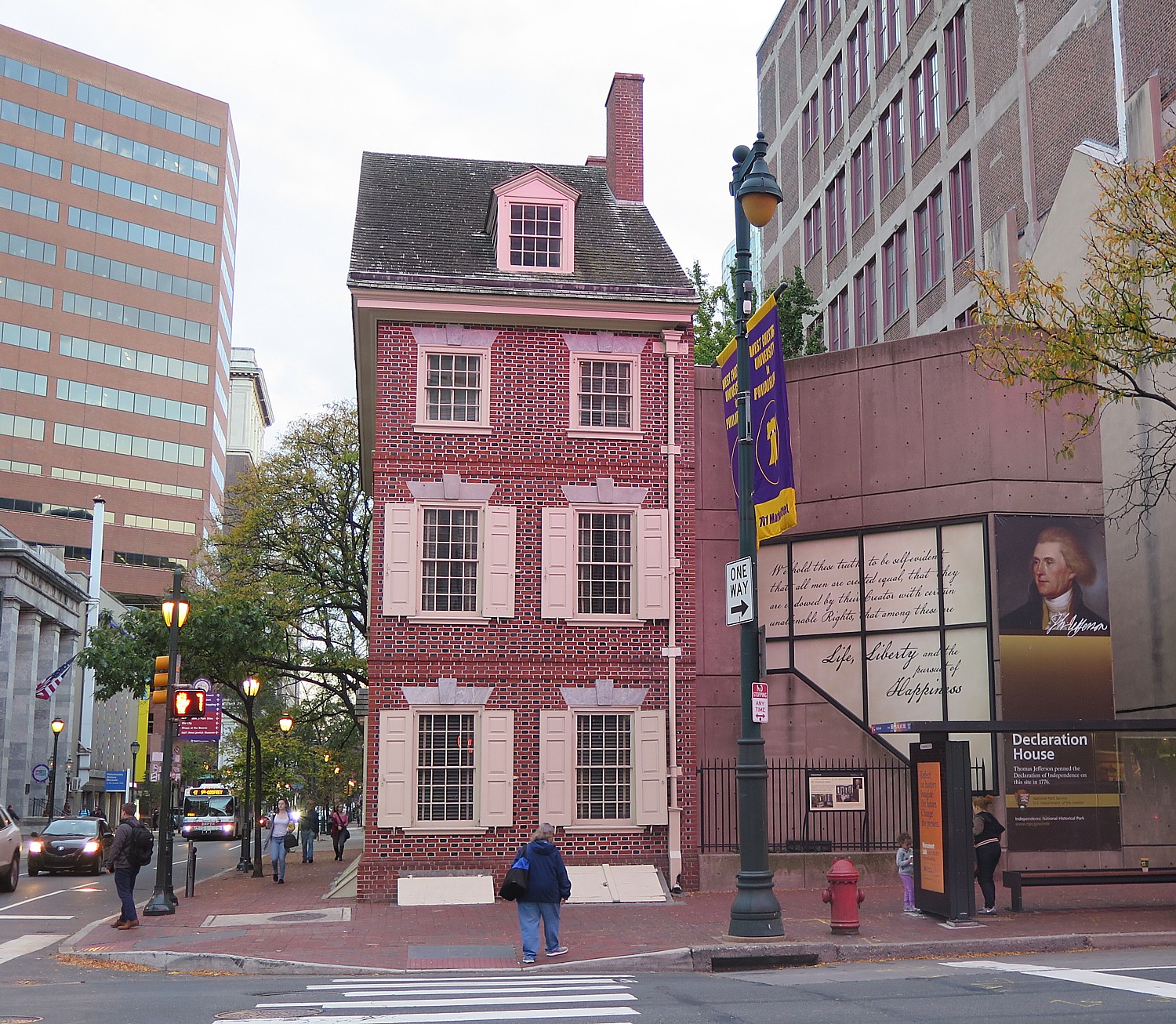
Philadelphia is like hopping from time-capsule to time-capsule because you go from one authentic site where events happened, where the Founders and builders of this nation actually stood, to another. Come, time-travel with me. And the best way to appreciate it – and be wonderfully surprised at ever twist and turn– is to walk. That’s how you come upon things you never considered – the historic markers which point out where Wanamaker’s Department Store was, the Ricketts Circus, the American Philosophical Society (founded by Ben Franklin). I practically fall over what closer inspection tells me is the very townhouse where Thomas Jefferson stayed when he wrote the Declaration of Independence (called “Declaration House”), a short walk from Independence Hall.
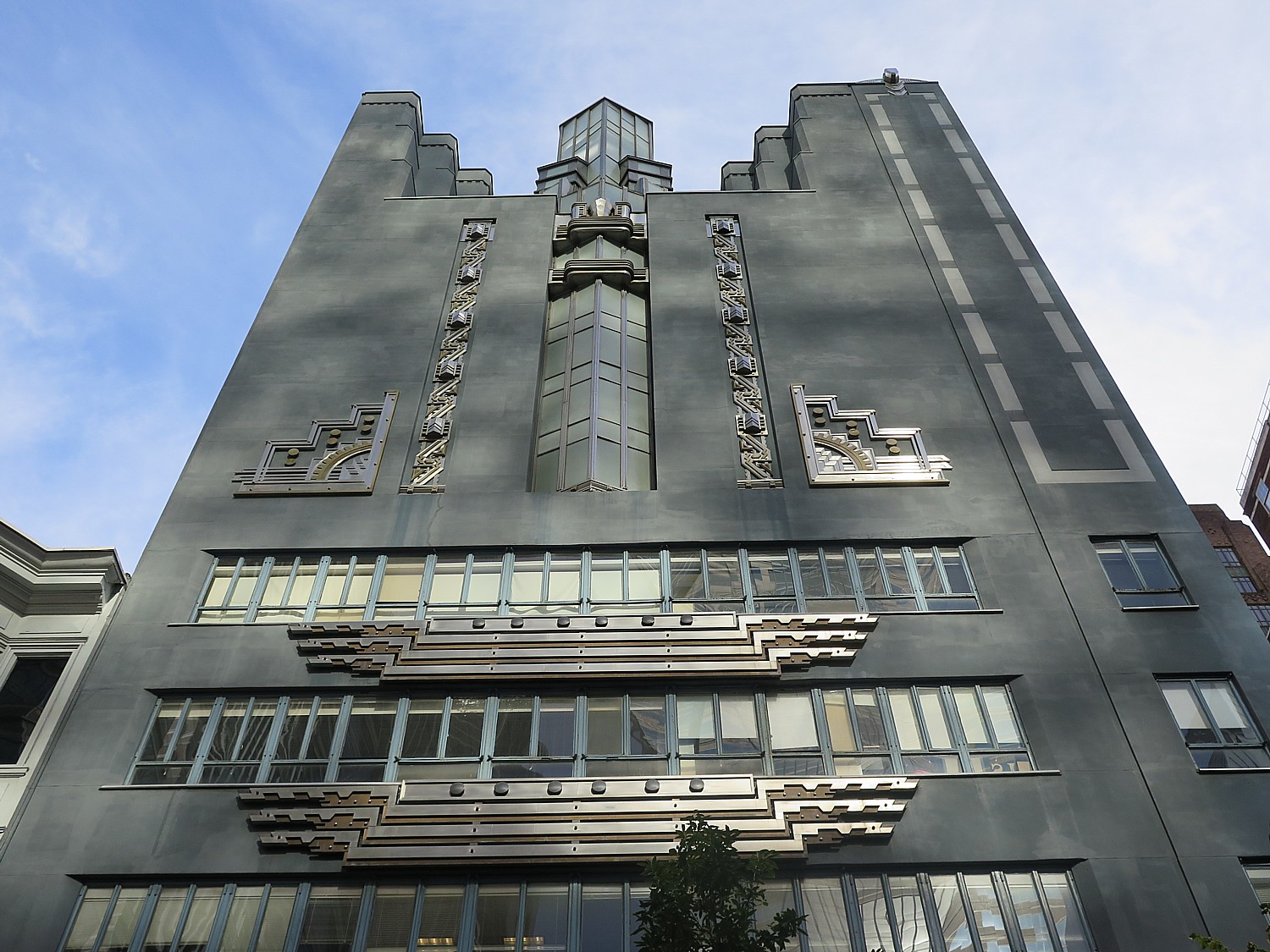
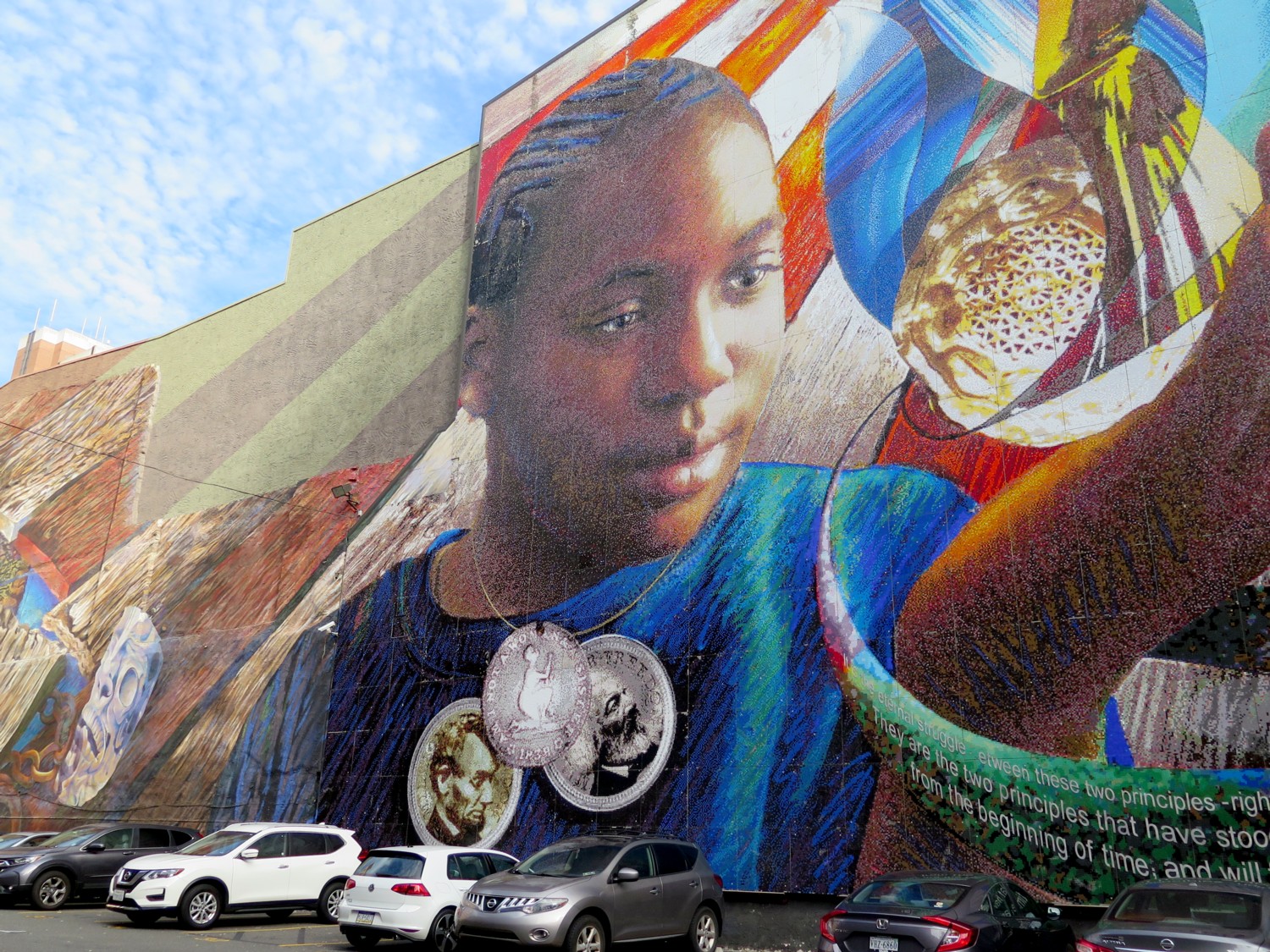
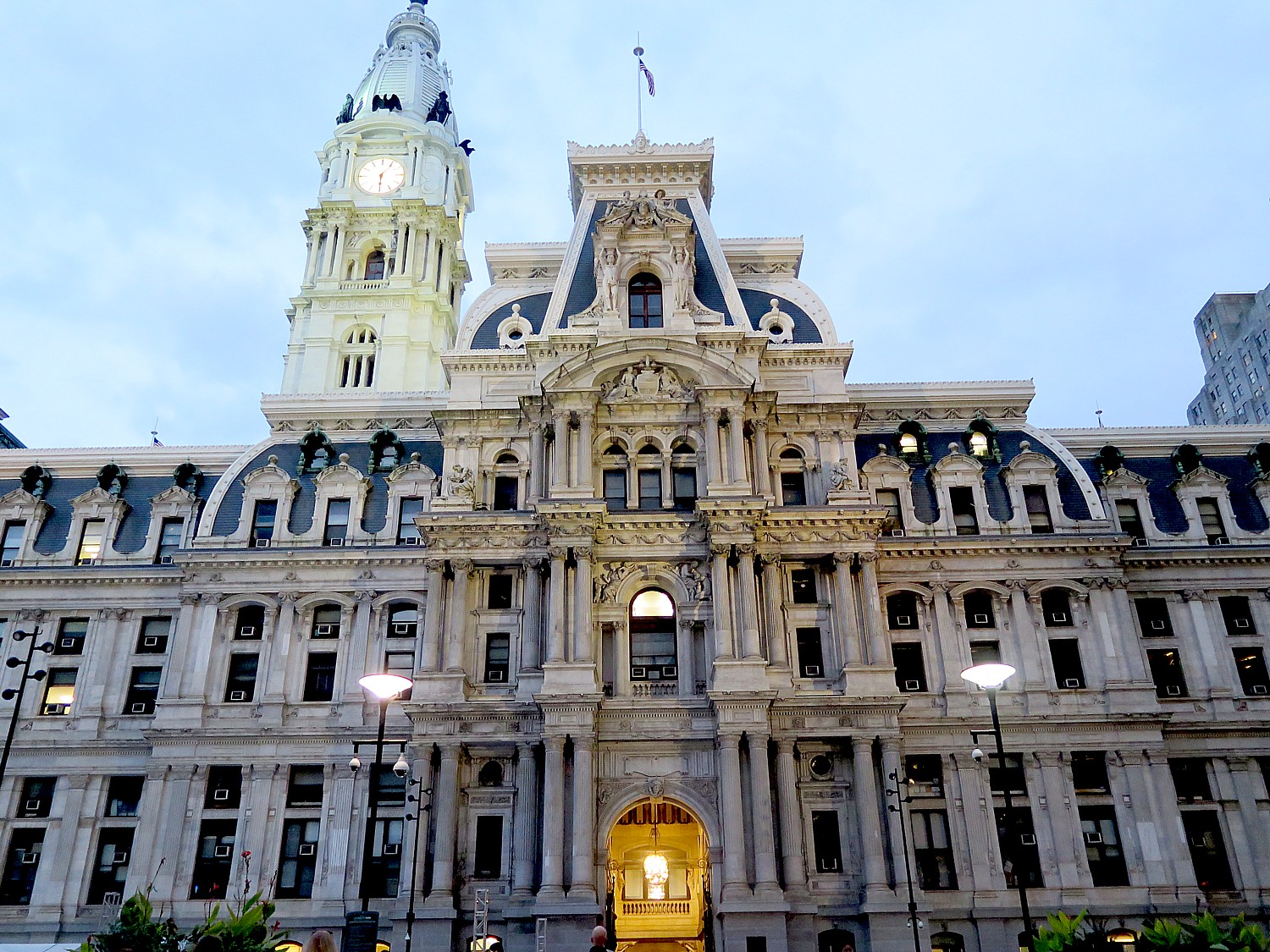
But I soon appreciate something more: an arts tradition that is infused throughout: the breathtaking majesty of City Hall built in the Second Empire Style; an Art Deco “Automat” sign; the stunning Art Deco architecture of a building, gorgeous giant murals that pop up out of nowhere, indeed the streetscape.
This is why it is so terrific that my hotel, the Sonesta Philadelphia Rittenhouse Square, in downtown Philadelphia, is so well located: because it’s only by walking to places that you can really enjoy these visual surprises.
It’s the afternoon when I arrive at the Sonesta (a parking garage is adjacent for added convenience) and after checking in, I have just enough time to explore one attraction on my list.
I set out down Market Street, walking through the magnificent City Hall, designed by John McArthur Jr and constructed between 1871 to 1901 within Penn Square (you can stand on a pedestal placed there to take photos of yourself as a monumental statue) and head down toward the historic district that surrounds Independence Hall. You appreciate the changes in style as traveling through époques.
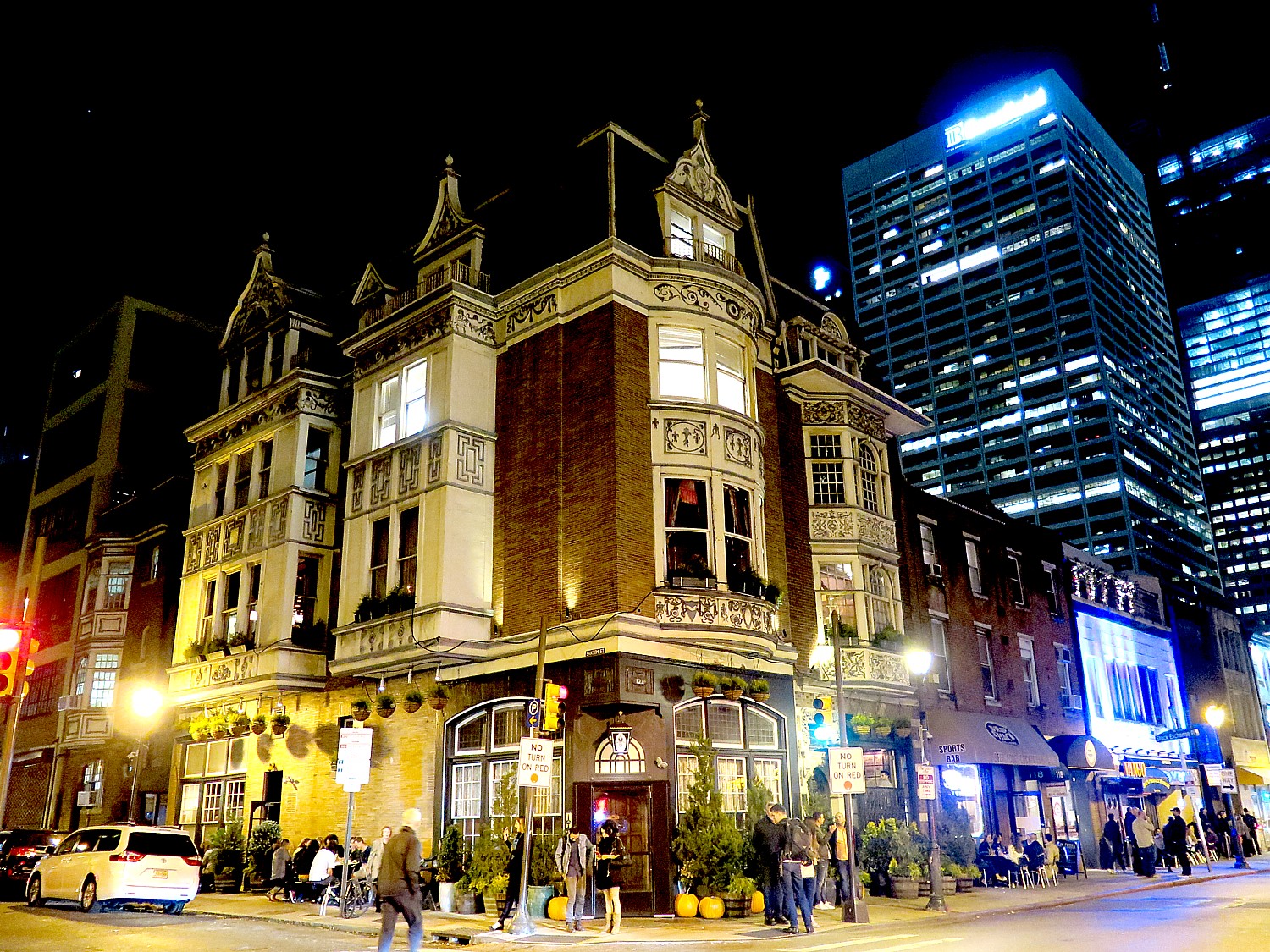
This becomes my route over the course of my three days in this city, each time setting out on foot and delighting in discovering architecture, historic sites, colorful murals painted across entire building facades. And each evening, I find myself drawn to Rittenhouse Square, a few blocks away, which is hopping with activity and color, with quaint restaurants, taverns and shops alongside the charming urban park.
The Sonesta Hotel’s location makes all of this possible.
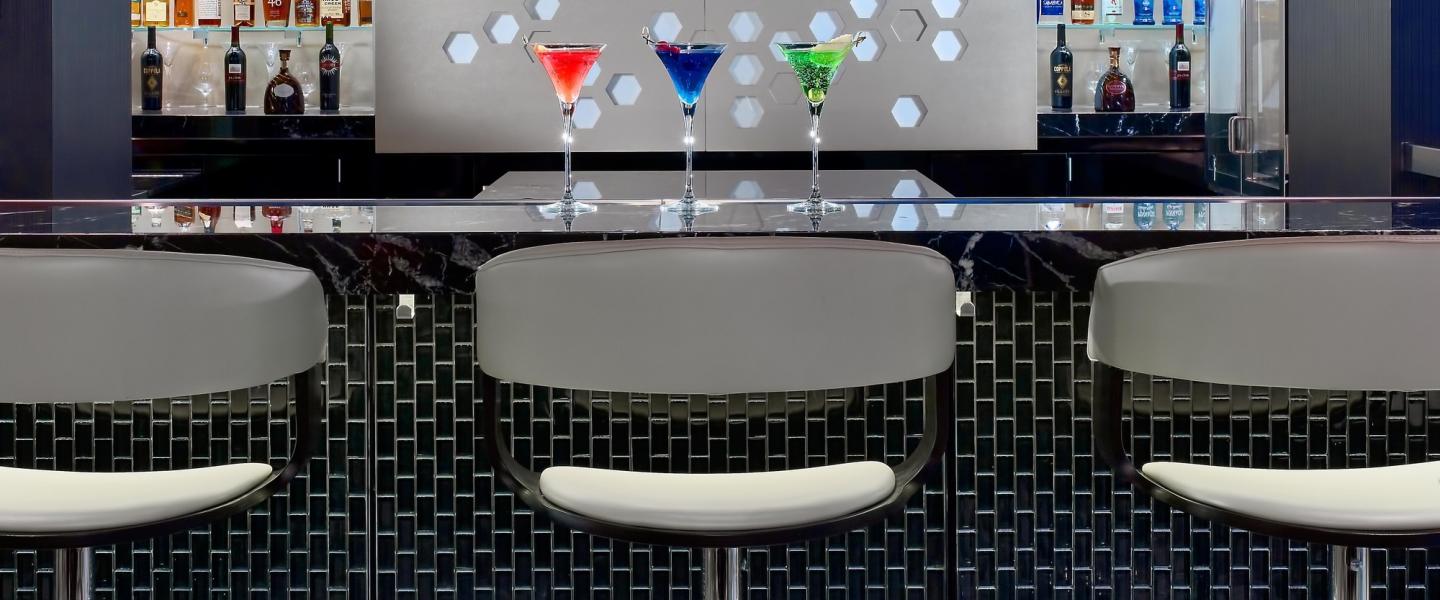
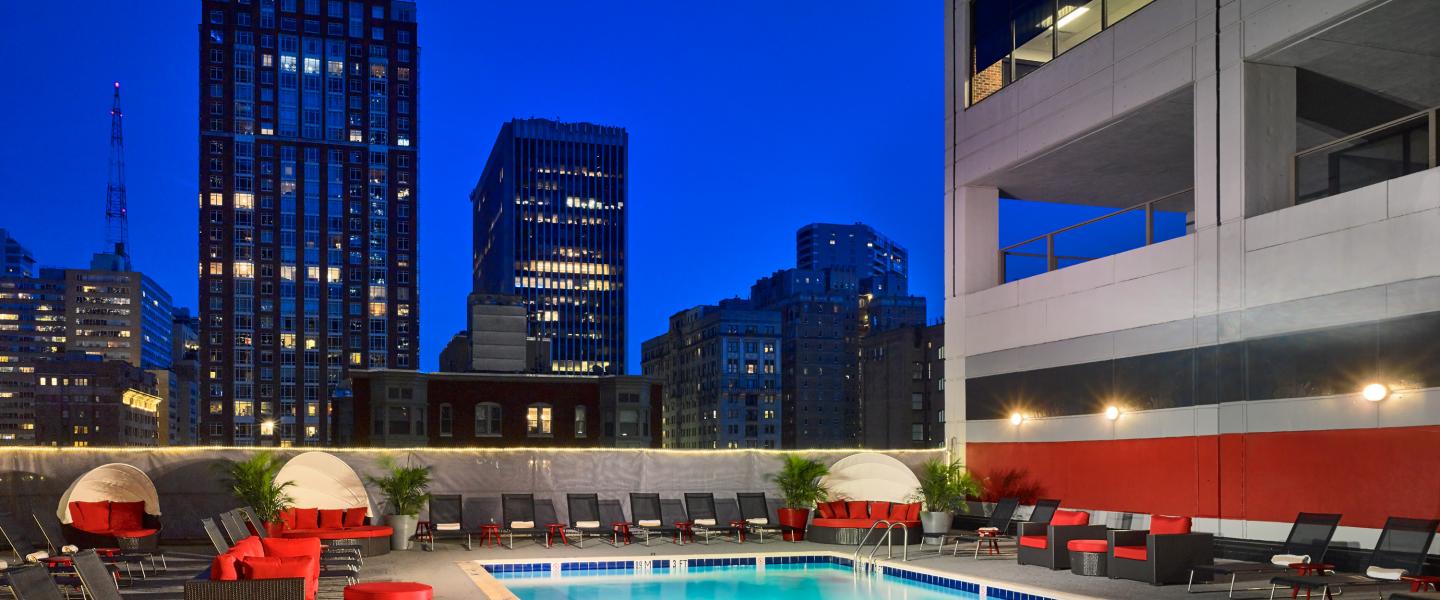
The Sonesta has everything you would want in a city-center hotel (there is even a rooftop swimming pool, in season), an ArtBar where you can have cocktails, Ruth’s Chris Steakhouse for dining, a gallery that showcases local artists. It is ideal as a base for business travelers as well as for those coming for a convention (the state convention center is walking distance) or meetings (it has 16,000 sq. ft. of meeting space and 16 conference rooms), like the conference of literary writers who are in attendance during my visit (I wished I could have hung out more with them). But I am visiting for a family occasion, and looking around at the other guests holding flowers and centerpieces and guest-bags, there are many of us who are similarly celebrating, as well as scores of visitors from around the world who appreciate having such a comfortable hub for our expeditions.
The parking garage, which is independently owned and operated, is attached to the hotel and is valet only, which is really convenient (you can check out and store your bags with the bellman and keep the car there until you are ready to pick it up; some packages include parking or discounts on parking; other options including a municipal lot, are also in the area).
The Sonesta Philadelphia’s rooftop pool, open in season (photo courtesy Sonesta)
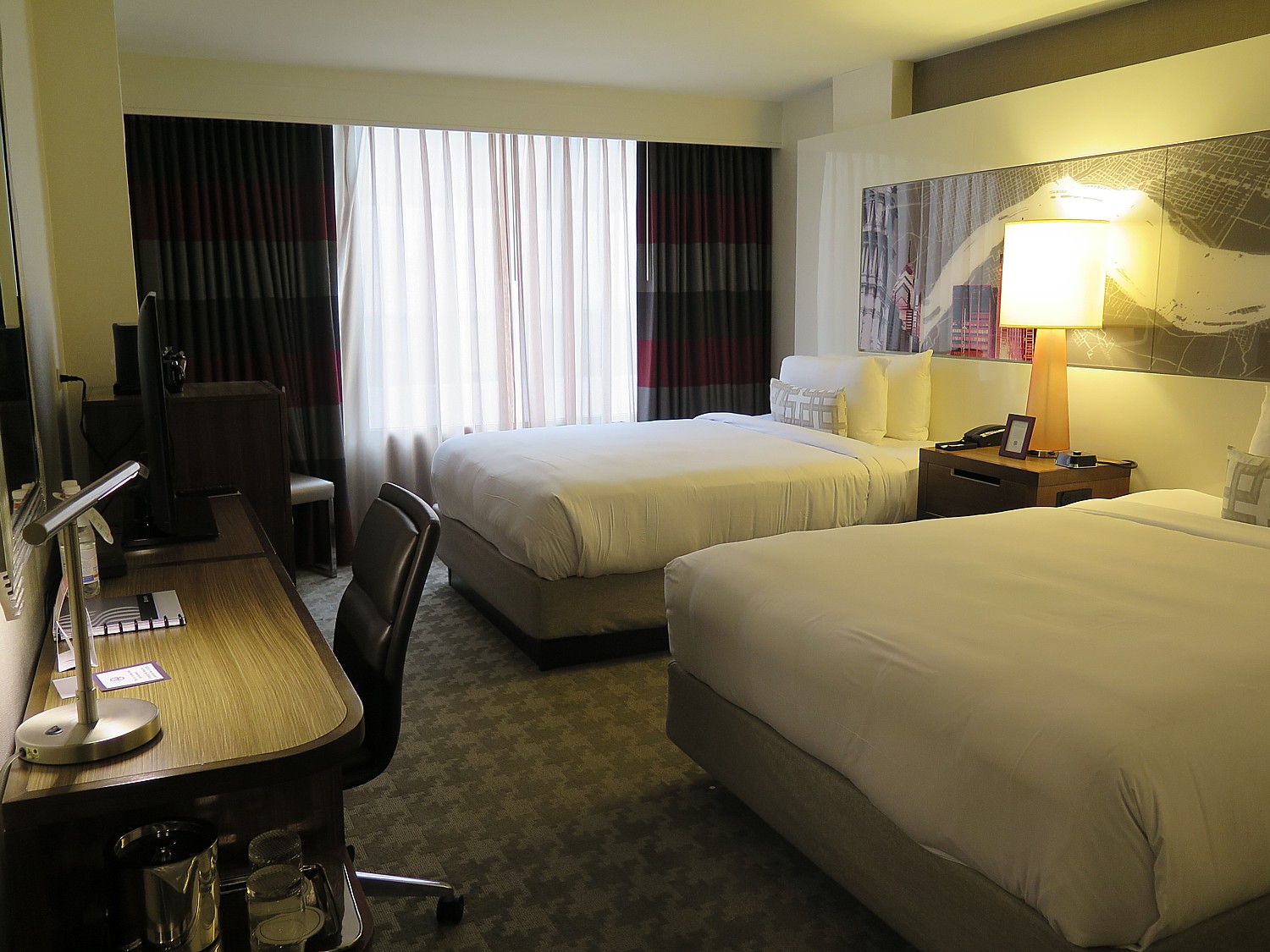
The rooms are spacious, stylishly appointed in what I refer to as “retro modern,” and very comfortable with plush bedding and bathroom amenities (my stay was hosted by Sonesta). All the rooms have been redesigned and include: flat-screen LCD televisions, complimentary wireless internet service, in-room safe, iHome docking station for iPhone 4, coffee maker, and mini-refrigerator. (Feather and fragrance-free rooms are available upon request.)
Club Level Guest Rooms also feature Keurig coffee machine, bottled water, plus access to the Sonesta’s club lounge where you are provided continental breakfast daily (with one hot upgraded item), snacks throughout the day; hot and cold hors d’oeuvres; two adult beverages in the evening.
All the rooms have beautiful views of the city; the Junior One-Bedroom Suites feature a stunning view of City Hall, and has a chic living room with contemporary décor flowing into a separate modern bedroom, Queen sleeper sofa, refrigerator, wet bar, oversized bathroom with dressing area, large work station, bathrobes in addition to the other amenities.
There are also two-room King Suites and a Presidential Suite.
Guests in Executive Club Floor rooms enjoy a complimentary continental breakfast and evening refreshments in a private lounge with their accommodations on weekdays; on weekends, Club Level room guests receive two complimentary drink tickets for beer or wine at the Art Bar and a $10 breakfast voucher in the Art Bar.
Embracing & Promoting Philadelphia’s Arts Tradition
Philadelphia is a city whose appreciation for the arts is legendary, and the Sonesta is helping to promote that tradition, in its architecture, interior design, food presentation, and in its collaborations with the local art community and city.
I soon realize why its lounge is the ArtBar and why the visual arts provide a vibe for the re-designed and art-inspired hotel: it’s more than a theme, it’s a mission. The Sonesta Hotel Philadelphia embraces and fosters the creation of art in the hotel and the community by partnering with the Center for Emerging Visual Artists. Its in-house art gallery located in the lobby, showcases paintings by local artists which are available for purchase; the gallery rotates every 6 months.
It is also promoting the City of Philadelphia Mural Arts Program, with a record-breaking mural, 22-stories high, alongside its façade. The mural was completed in just two weeks time.
“We’re so committed to Art, we tattooed it on our face.”
Philadelphia is a city whose appreciation for the arts is legendary, and the Sonesta Philadelphia has partnered with Open Source on their citywide exhibition that is bringing 14 international artists to Philadelphia. These artists’ practices vary widely, from sculpture to community muralism to street art. They are working with the City of Philadelphia Mural Arts Program to create a new series of public artworks that explore and illuminate Philadelphia’s diverse urban identity. The Sonesta Hotel Philadelphia is a central Open Source venue and a hub for talks, tours, visual documentation, and direct engagement with staff, artists, and curator Pedro Alonzo.
The artist who is executing the mural on the hotel’s 25-story facade is “Momo” from New Orleans, who is regarded as a standard-bearer for abstraction in street art. “Momo” has since transitioned into creating large-scale murals in countries all over the world, including as a perennial participant in Italy’s legendary FAME Festival. (For more information on Open Source Mural Arts, visit http://opensource.muralarts.org/)
The City of Philadelphia Mural Arts Program Is the nation’s largest public art program, “dedicated to the belief that art ignites change. For 30 years, Mural Arts has united artists and communities through a collaborative process, rooted in the traditions of mural-making, to create art that transforms public spaces and individual lives.” Mural Arts engages communities in 50–100 public art projects each year, and maintains its growing collection through a restoration initiative. Each year, 12,000 residents and visitors tour Mural Arts’ outdoor art gallery (including docent-led trolley and walking tours between sites, as well as audio guides and maps for self-guided visitors, which has become part of the city’s civic landscape and a source of pride and inspiration, earning Philadelphia international recognition as the “City of Murals.”
I come upon some of these impressive murals as I walk to the historic district.
I used the opening of the brand new Museum of the American Revolution as the theme for my three-day visit to Philadelphia – a really deep dive probe of the Revolutionary War era, a return to understanding the founding of the nation through, as it were, original documents, materials and artifacts, at a time when we need to be reminded. During this all-too-brief time, I also visited the National Museum of American Jewish History, the Benjamin Franklin Museum, Betsy Ross House and the National Constitution Center. But I can’t wait to return and delve into the city’s rich arts tradition.
Sonesta Philadelphia Hotel Deals Year Round
The Sonesta Philadelphia is located close to the Convention Center, Financial District and Rittenhouse Square, and a pleasant walk to the Historic District. There are numerous special rates and packages geared to business travelers, AAA members, government employees and visiting college students as well as property specific seasonal offers and deals tied to special events
Package deals, which can be found at the website, are available, including Art of Romance Valentine’s Day Package (champagne, breakfast in bed and 2 pm late check out); VisitPhilly Overnight Winter Package, includes valet parking and winter attraction tickets; Bed and Breakfast package; Ruth’s Chris Steakhouse Package includes $100 gift card to the steakhouse (located in the hotel) and free parking. There is also a “best available rate” option. A Winter sale going on now offers 20% off.
Visit Philadelphia provides excellent trip planning tools, including hotel packages, itineraries, events listings: 30 S 17th Street, Philadelphia PA 19103, 215-599-0776, visitphilly.com.
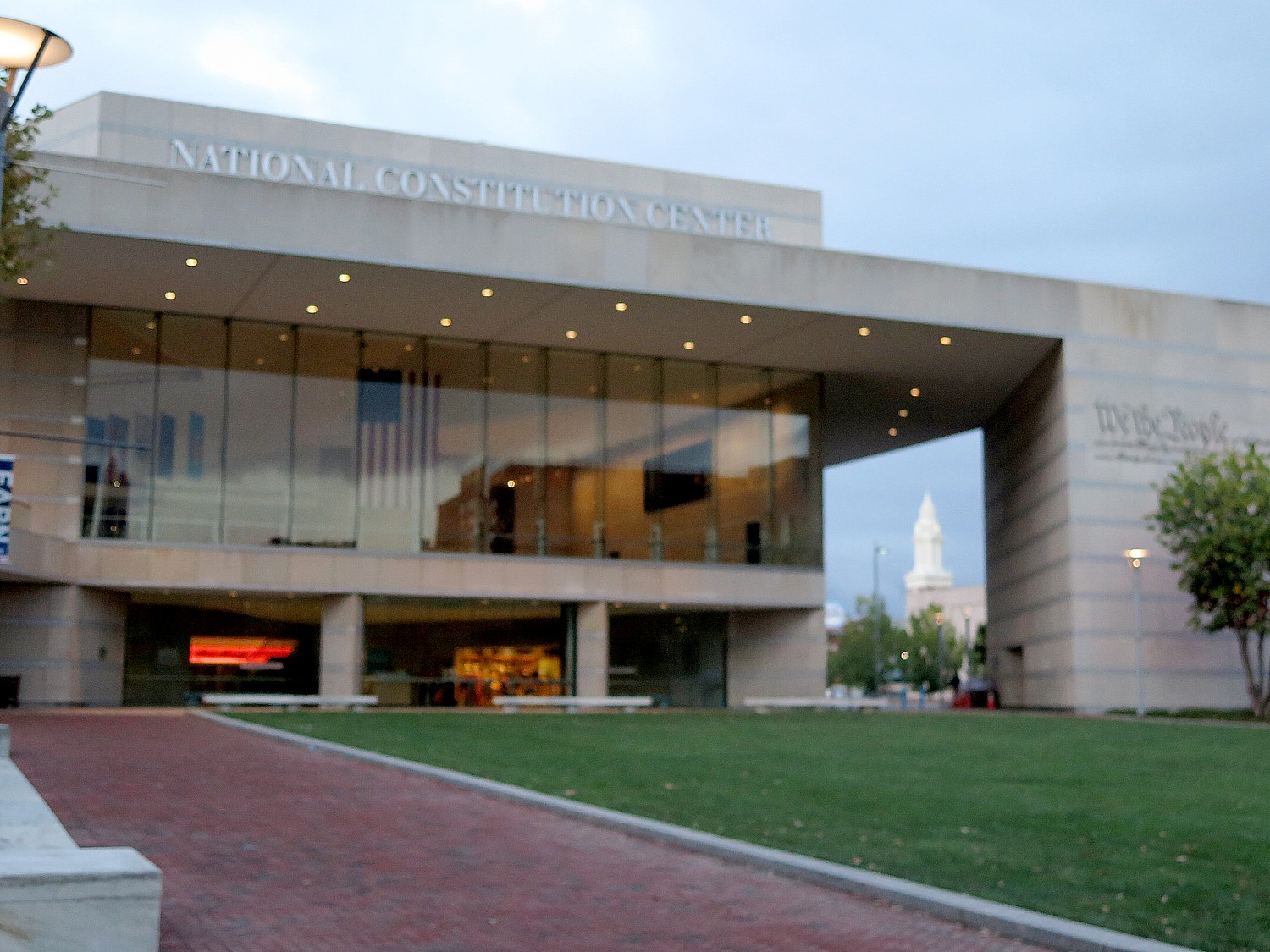
There is a cold, institutional feel to the National Constitution Center – as if you fell into a law book. And oddly, even though this place more than any other, recognizes the impact of words on paper – the decisions, pronouncements, laws – on each and every person’s everyday life, there is that struggle between the “rule of law” without fear or favor, that objective, dispassionate application, and any sense of what is right and good for ordinary people. What emerges is a sense that law and government, like evolution, is not good or bad, but reflects politics and power: look at the restrictions on voting to “white men over 21;” the Dred Scott Decision based on 5th amendment property rights; the evolution of rulings that elevate corporations to the status of people (despite fact “corporation” is not mentioned in the Constitution) including Citizens United which established that cash is equivalent to speech and corporations have a right to spend as much as they want on political speech regardless if it is corporations spending the cash or a person (so speech is not really “free”, but whoever has more cash has more speech) and Hobby Lobby which determined that corporations could possess religious “conscience” in order to deny their female employees access to contraceptives. You realize that the progressive change on behalf of ordinary people occurred during brief episodes.
I used the opening of the brand new Museum of the American Revolution as the theme for my three-day visit to Philadelphia – a really deep dive probe of the Revolutionary War era, a return to understanding the founding of the nation through, as it were, original documents, materials and artifacts, at a time when we need to be reminded – everything from the off-hand comment by Trump Chief of Staff John Kelly that the Civil War could have been averted if only there were compromise (he should go to the National Constitution Center), to the quixotic amazement of a US Treasury official pining on his research into what’s this thing, “The American Dream,” all about before adopting the biggest redistribution of wealth since the Gilded Age, to the pronouncements by some politicians that America is a Christian Nation, to Trump’s remarks about immigrants coming from s-hole countries. I felt a driving need to go back to the beginning, the foundations, remind myself of those values and debates and compromises and circumstances.
So far, during my three-day visit to Philadelphia, I have visited the new Museum of the American Revolution, the National Museum of Jewish American History, the Ben Franklin Museum, the Betsy Ross House, the Old Burial Ground – each one adding to my understanding and appreciation of the founding values of this nation – and now I have arrived at my last stop, the National Constitution Center.
The National Constitution Center, which opened in 2003, is on federal land but is a private, independent, nonprofit, nonpartisan institution. It is the first and only institution in America established by Congress to “disseminate information about the United States Constitution on a non-partisan basis in order to increase the awareness and understanding of the Constitution among the American people.” Its mission is to spark constitutional debates that impact citizens and inspire active citizenship.
“As the Museum of We the People, the Center aims to bring the Constitution to life for visitors of all ages through interactive programs and exhibits that include coming face to face with original documents, rare artifacts and hearing personal stories. As America’s Town Hall, the Center brings the leading conservative and liberal thought leaders together to debate the Constitution on all media platforms. As a center for Civic Education, the Center delivers educational programs and online resources that inspire, excite, and engage citizens about the U.S. Constitution.”
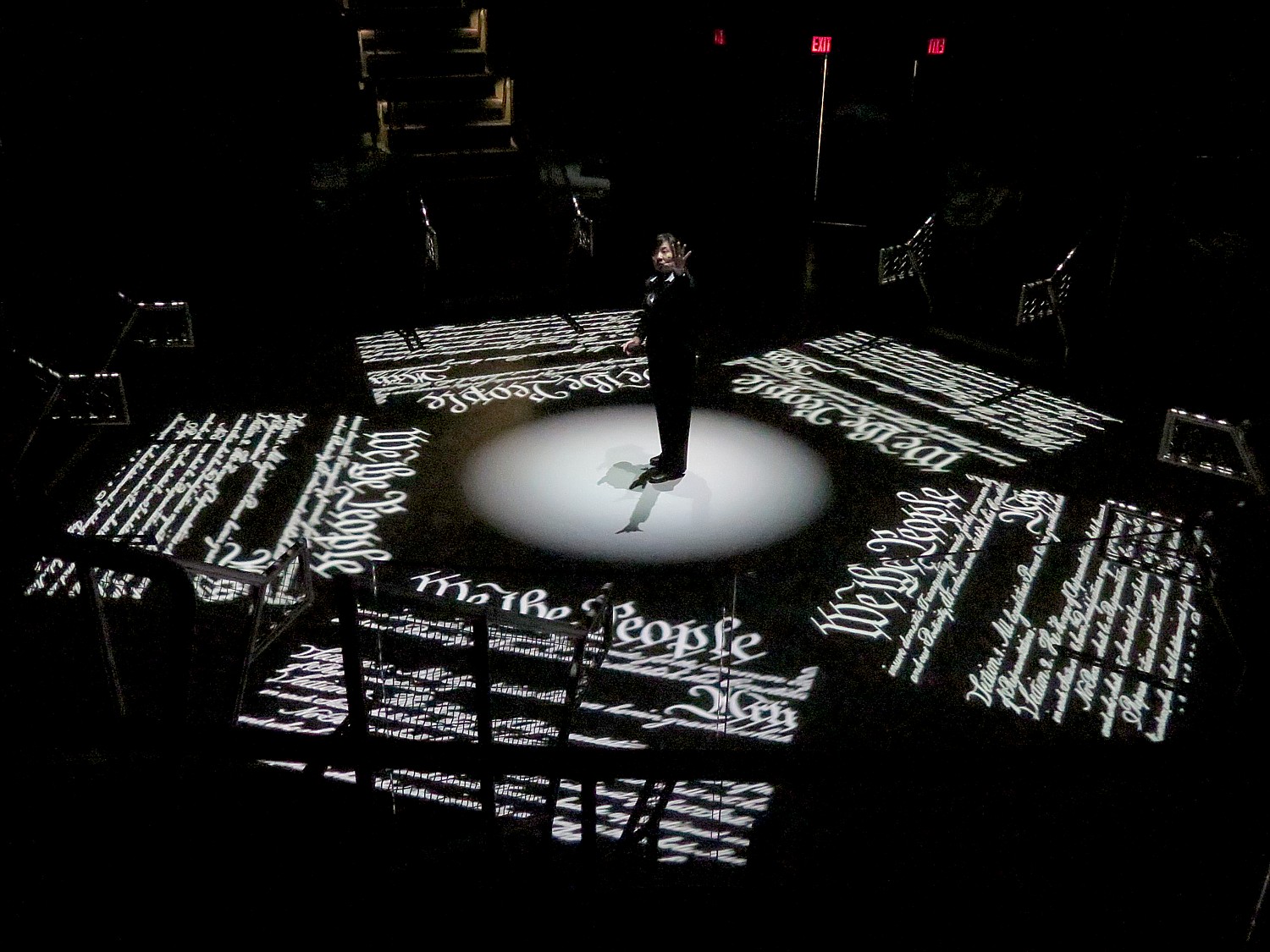
I arrive just in time for a multi-media orientation experience, “Freedom Rising” in a theater that has the metallic feel and design of a 21st century dystopian gladiator arena. For some inexplicable reason there is a live person who is not so much a narrator as a ringmaster as video images flash around the ceiling so you can’t fully see them or process them.
‘Freedom Rising’
“Freedom Rising” is intended to highlight the primary themes of the main exhibit gallery, making an effort to tell the story of “We the People” in two senses of that phrase: First, the Constitution’s vision of “popular sovereignty,” or rule by the people; Second, how the definition of citizenship has expanded over more than 200 years of American history to gradually include those who were left out in the 18th century – white men without property, women, African Americans, other people of color. It rang hollow to me.
You walk out of the arena to the Richard and Helen DeVos Exhibit Hall, which is designed as two concentric rings. The outermost ring is presented chronologically with 13 sections which relate American history through the lens of the Constitution from 1765 until today and a central ring focused on civics and how government operates.
Exhibits along the outermost ring use multiple techniques to bring the story to life: a short general video introduction to each section; text-and-graphic based story panels and reading rails; maps and images; game-like computer interactives; video and audio segments focusing on specific historical moments; selected artifacts; and walk-in immersive environments that render key ideas, moments, and stories in three dimensions.
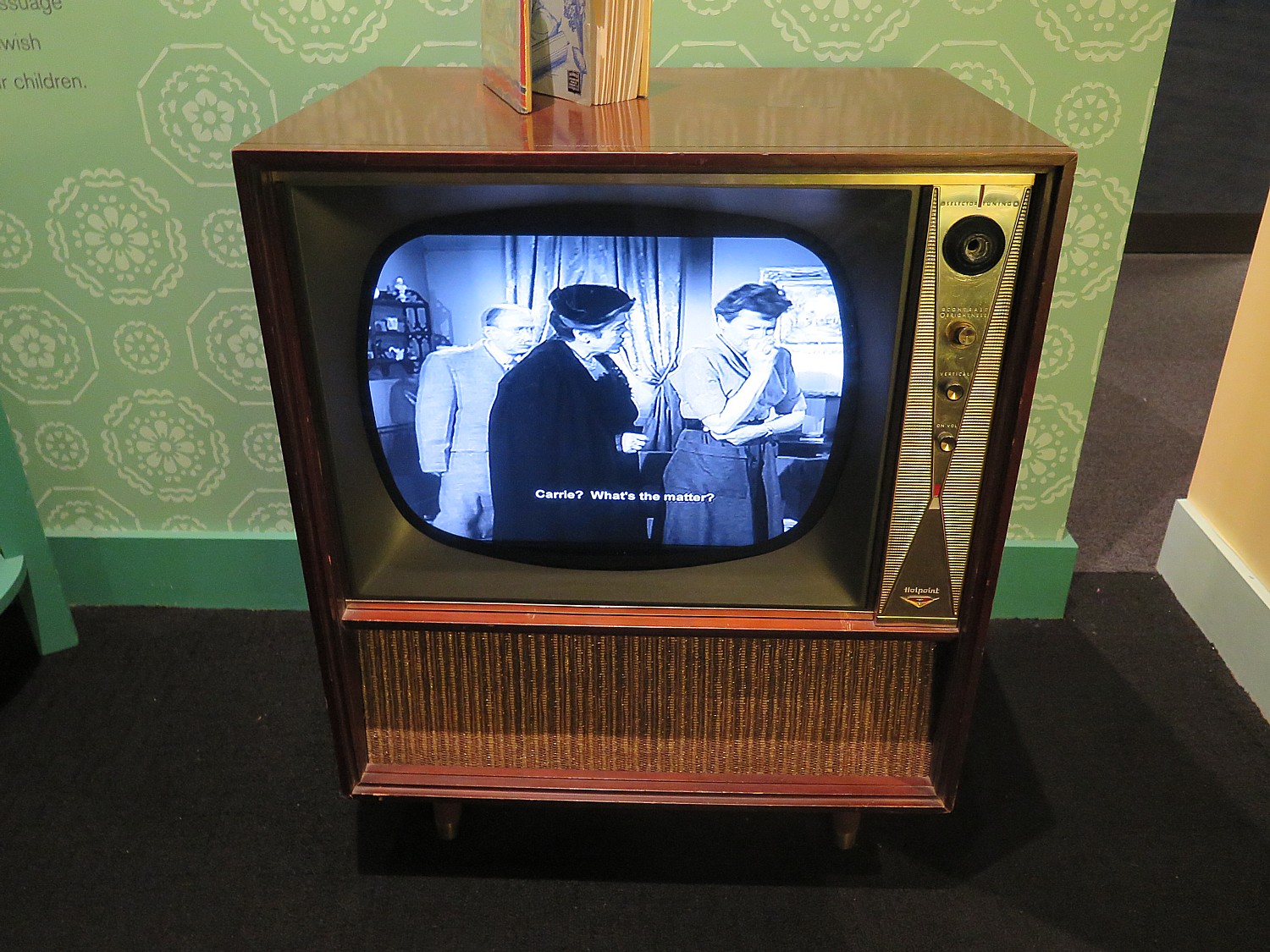
For instance, you enter a re-creation of the floor of the Senate during the impeachment trial of Andrew Johnson and listen to the debate; you can step into a 1940s living room and hear one of Franklin D. Roosevelt’s famous fireside chats playing on the radio.
A device that is used to fairly good effect is presenting a major Supreme Court decision or milestone event as if told as a news story that day, making it more immediate and relevant.
The “Founders’ Library,” presents a sampling of the books that the Library Company of Philadelphia made available to the delegates during the Constitutional Convention – giving visitors a sense of the intellectual origins of the Constitution and make it more accessible.
What’s on that bookshelf that helped shape the Constitution? Jonathan Swift’s Gulliver’s Travels, King James Bible, Magna Carta, Machiavelli, John Locke, Cato’s Letters, Baron Montesquieu, David Hume, Sir William Blackstone, Adam Smith, Thomas Jefferson, Thomas Paine, John Adams, John Dickerson, among others. What’s missing: anything about the Iroquois Confederacy which provided a framework for democratic leadership and a confederation of states, not to mention women’s rights.
Other features include the Civil War alcove, an exploration of the turning point year of 1863, which features a rare copy of the Emancipation Proclamation signed by Abraham Lincoln as well as pages from an autograph book with the only-known Lincoln signature from the day that he gave the Gettysburg Address. Here I encounter a docent who lets us handle some artifacts from the Civil War.
I pose to him my theory that the Civil War could have been avoided had the slave-holding states accepted the entreaty from Zachariah Kingsley, a plantation owner in Florida, which was part of Spain until 1845 when it became part of the United States and subject to its laws regarding slavery; he entreated Congress that the United States use the Spanish model of slavery that was much less cruel (if any form of slavery could be less cruel), that provided a pathway to freedom and did not automatically enslave future generations. It was ignored. (I saw a copy of Zachariah Kingsley’s letter to Congress at Kingsley Plantation on Fort George Island near Jacksonville, Florida which stuck in my mind, “What if…”.)
You also can see a fascinating display of archeological artifacts from the late 1700s that were uncovered at the site of the National Constitution Center between 2000 and 2003, only two blocks from Independence Hall where the Constitution was drafted. These historic treasures illuminate daily life in Philadelphia as a new nation was being born.
The Central Ring through the main gallery explores how the constitutional system works through a series of immersive, interactive exhibits designed with families and school groups in mind. Visitors have the opportunity to learn about the great rites of democracy, such as serving on a jury or voting.
Role-playing is a key component of the central path. In one of the most popular displays, you can stand behind a presidential podium and take the oath of office. You can try on a judge’s robe, sit at a replica of the Supreme Court bench, and decide landmark cases selected to illustrate the broad range of constitutional issues that come before the court: Katz v. United States is a wiretap case involving the Fourth Amendment and issues of privacy; Texas v. Johnson, the flag-burning case, tested the protection of the First Amendment; United States v. Nixon, the Watergate tapes case, involved separation of powers and executive privilege.
The American National Tree, another prominent exhibit, tells the stories of 100 Americans – a few of them well known, but most of them unheralded. By selecting their faces streaming by on touch screens, you can read and hear how these noteworthy Americans have shaped constitutional history.
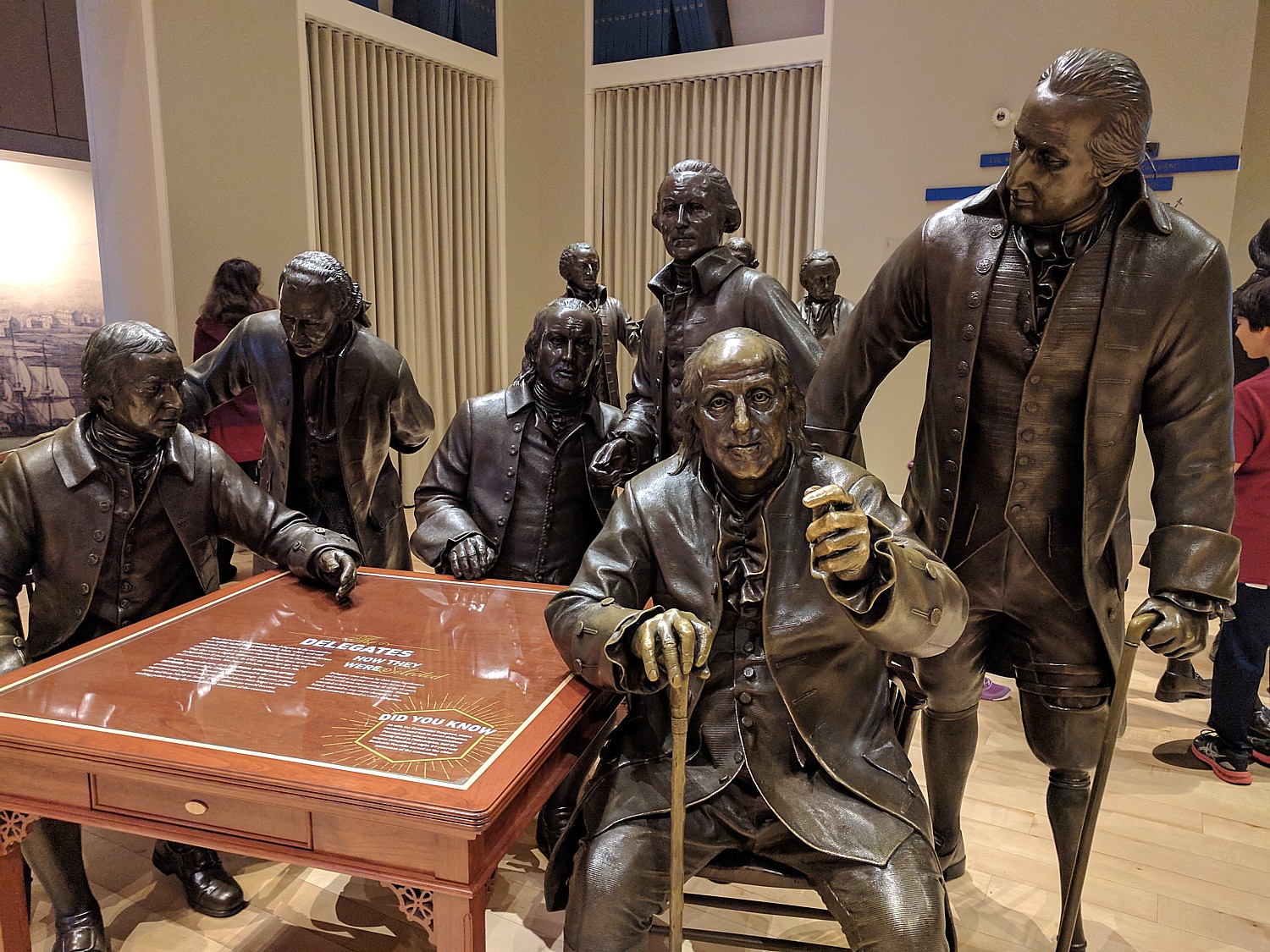
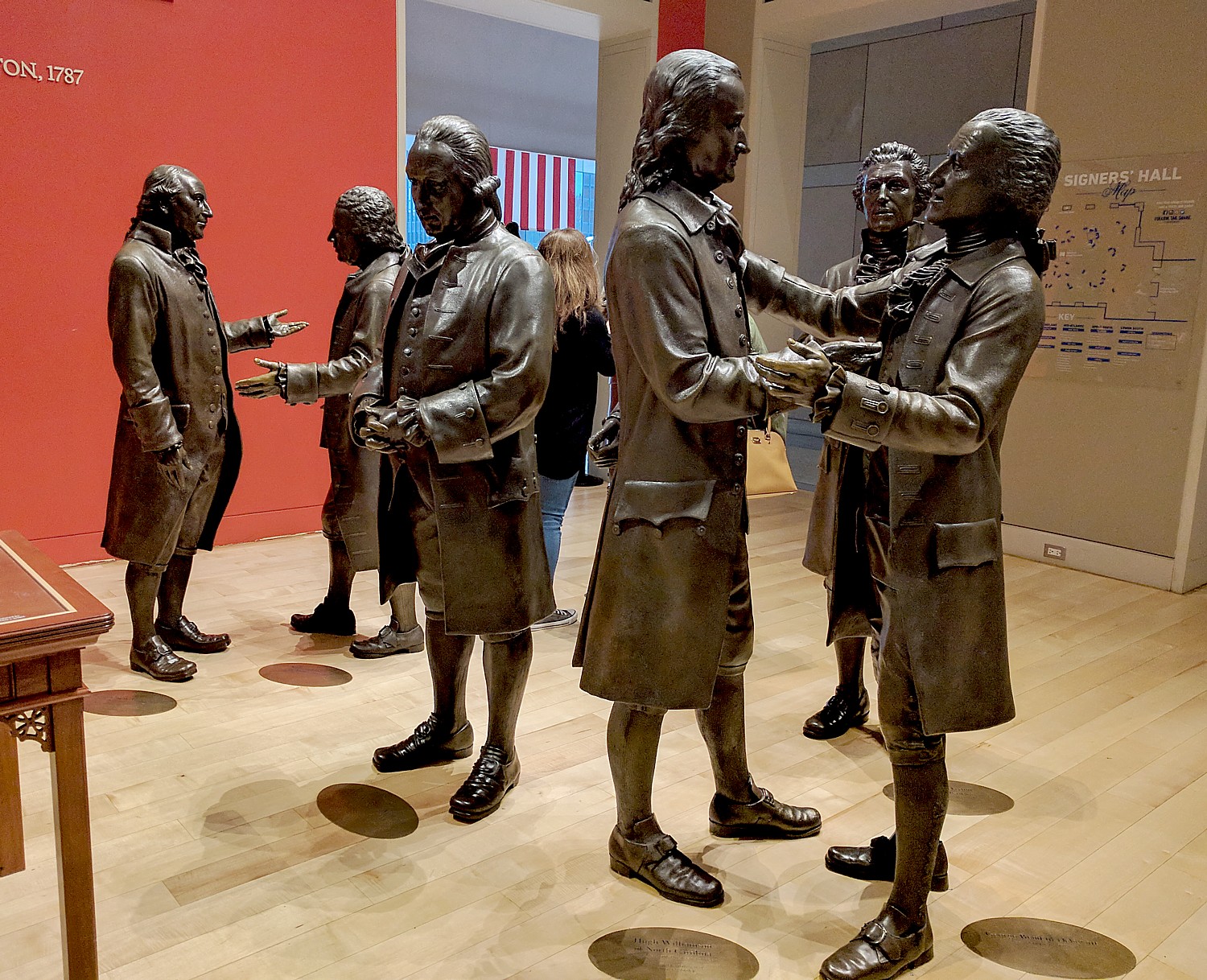
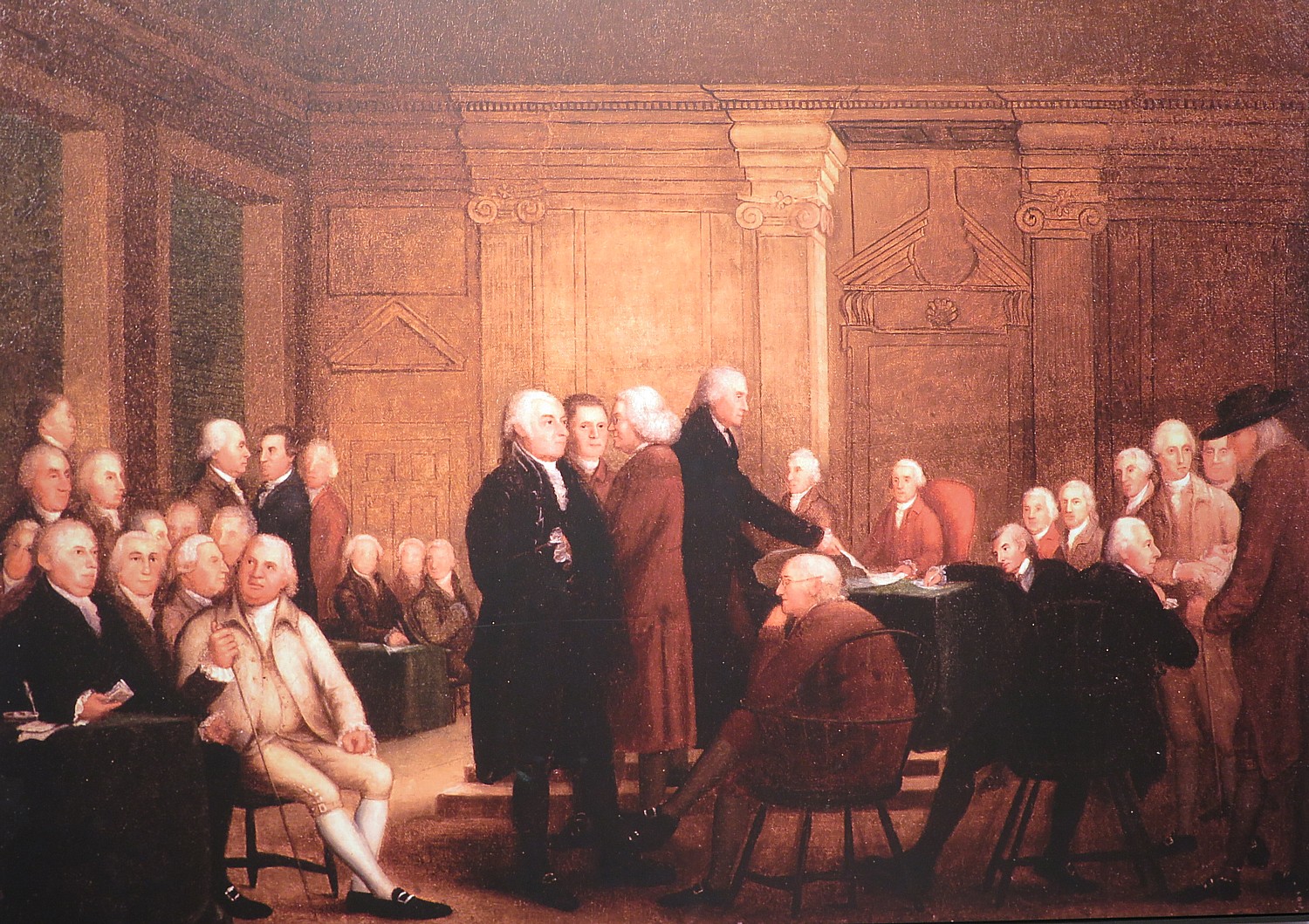
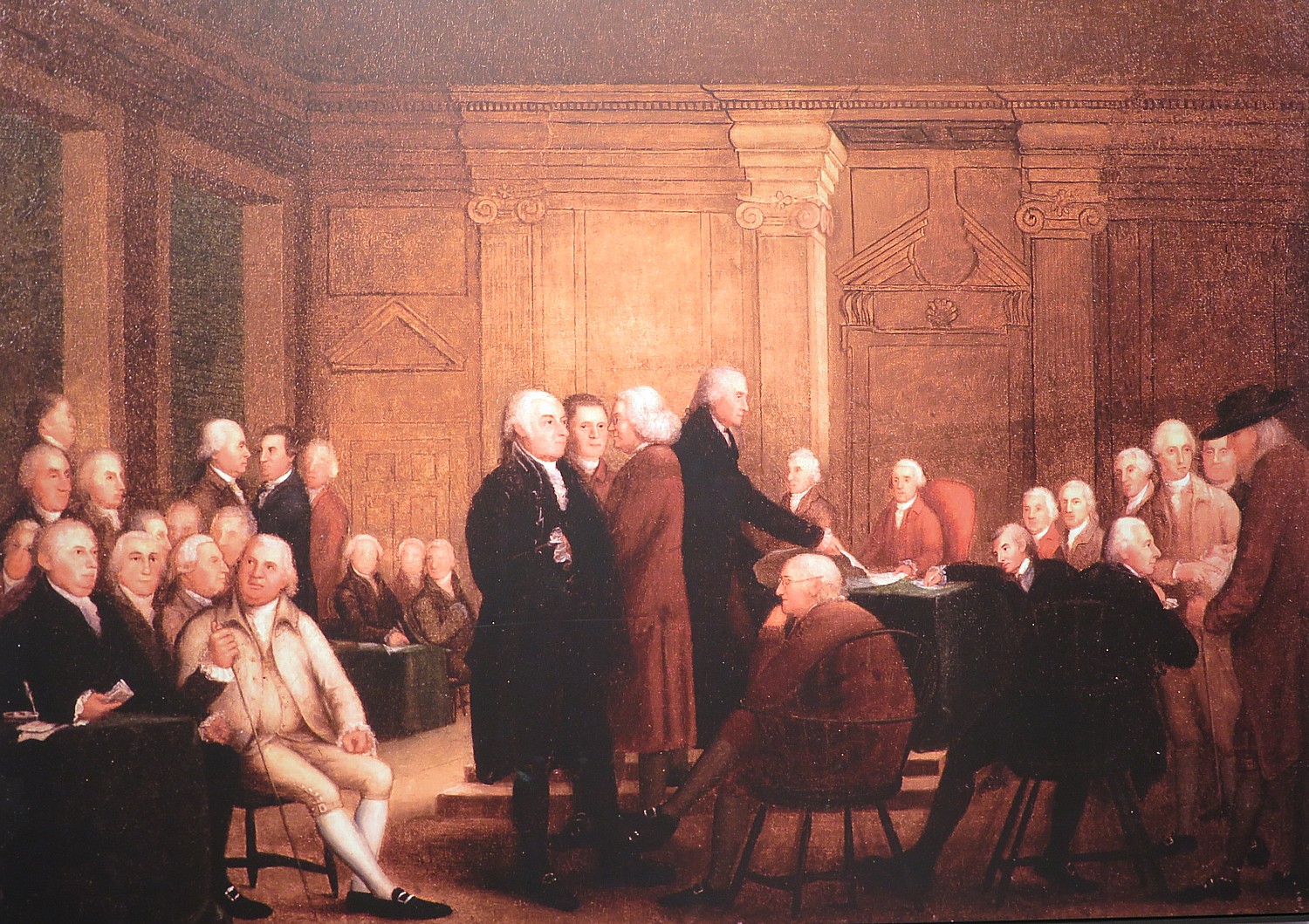
People really enjoyed Signers’ Hall, where you walk into a stylized evocation of the Assembly Room in the Pennsylvania State House, known today as Independence Hall, where the delegates to the Constitutional Convention met in Philadelphia during the summer of 1787. The room is “peopled” with life-sized bronze statues of 42 men: the 39 delegates who signed as well as the three present on September 17, 1787, who refused to sign. We are encouraged to walk among them and to consider them as real people, imaging the dilemma they faced in creating the framework for a new nation founded on “We the People” – choices that still impact the nation, the oldest continuously surviving democratic republic. You also can add your name to a digital version of the Constitution alongside the Founding Fathers’ signatures.
Notably, Thomas Jefferson and John Adams, signers of the Declaration of Independence, are not represented in Signers Hall because they were both serving as ambassadors overseas (Jefferson in France and Adams in England) during the Constitutional Convention. Several other famous Founding Fathers who were not signers of the Constitution include John Hancock, Samuel Adams and Patrick Henry.
The statues in Signers’ Hall were created by some 50 artists – sculptors, designers, costumers, mold makers – at Studio EIS in Brooklyn, who used numerous historical sources, including portraits and written descriptions, to create the most accurate likenesses possible. The project began in early 2001 and was completed in May 2003.
Unanswered Questions: How Democratic are We?
I come away with a few new insights, but few answers to long-lingering questions I have harbored:
Everything George Washington does as president sets a precedent, including doing the unimaginable of stepping down after two terms when many wanted him to be president for life. (But having visited the Museum of the American Revolution, I wonder what would have happened if Washington had been younger and not so anxious to retire to Mount Vernon, if he would have been so interested in giving up presidency.)
We learn that slander and scandals have always been a part of the political process: A Federalist called Jefferson “a Godless man whose election would lead to reign of terror, like France.” Republicans claimed John Adams was “a British-led tyrant bent on enslaving us.”
The Supreme Court’s infamous Dred Scott Decision was based on a ruling which found that Congress in its 1820 Compromise deprived slaveholders of their 5th Amendment property rights.
I learn that 1824 was the first presidential election that counted the popular vote (though I don’t really understand what that means, to “count” the popular vote.) On the other hand, it renews a question that I had ever since visiting the Women’s Rights National Monument in Seneca Falls, NY: Without any change in the Constitution that gave voting rights only to “white men with property,” suddenly, in that election, white men without property were allowed to vote. And yet, it took the 15th amendment in 1870 to give Black men the vote, and the 19th amendment in 1920 to finally give women the vote. I’ve never seen anyone question how without any change in the Constitution, all of a sudden, white men were allowed to vote, and it enabled –Andrew Jackson, who lost in 1824 to John Quincy Adams, to win his election in 1828.
When freed black men also turned up to vote, states passed laws restricting voting to “white men over 21”.
I learn that the Bill of Rights, adopted in 1791 (itself a compromise because there were states that would not ratify the Constitution without a Bill of Rights, which are the first 10 amendments) only applied to federal law. In recent decisions, the Court ruled that their protections apply to states because certain rights are so fundamental, they are incorporated in amendment guarantee of due process.
“Like the preamble of Declaration of Independence, the Bill of Rights at the time of ratification was largely a promissory note. It was not until the 20th century when the Supreme Court vigorously applied the Bill of Rights against the states that the document becomes centerpiece of the contemporary struggle over liberty and equality. It defends the majority against an overreaching federal government but also against overreach by the state.”
What you appreciate, though, is that through all of American history, there have been “firsts” – challenges or unsettled issues of the Constitution. It was never fixed or complete. The Founders designed the Constitution to be a “living” document. So-called “originalists” who pretend to divine what was in the mind of the Founders are just that: pretenders.
A new display is an “Interactive Constitution”, where you can click on the freedoms of the Bill of Rights to see the documents that were used.
There are hands-on materials. For example, you can try on a black robe of a Supreme Court justice.
When I am visiting, I am lucky enough to see an original copy of the Bill of Rights on view in the George H.W. Bush Gallery before it was sent back to New York. It is one of 12 original copies that survive. (North Carolina’s was stolen during the Civil War but was returned in 2003 with the help of the National Constitution Center, which informed the FBI after being told they could have it back for $4 million ransom). This copy, is shared by New York and Pennsylvania which alternates every three years (it now has gone back to New York, where you can see it on camera).
There is also a first-edition Stone Engraving of the Declaration of Independence and an original copy of the US Constitution.
I’m not sure that what I came away with was the message that the Center intended: Instead of assurances that the Framers created mechanisms – fool-proof checks-and-balances – to insure a democratic republic would withstand every challenge, I am shaken by the realization of how wrong those in power, with the ability to set laws, decide laws and implement laws, have been (think Dred Scott, Citizens United). It seems that it has been a matter of luck that has let us survive this long, but one wonders how would we survive a “perfect storm” of various levers breaking down against threats that the Framers could never have foreseen, like an election that was stolen by a foreign adversary, or a president who used his office to personally profit, who sold favors to a foreign government and then defied a subpoena. Andrew Jackson defied the Supreme Court’s ruling that his Indian Removal Act was unconstitutional, daring the court to bring its army to force him to do its bidding.
I went in wondering if it would address some of the questions that I have long harbored: did the Salem Witch Trials play any part in the Founders’ interest in preserving Religious Freedom? What role did the Iroquois Confederacy play in the writing of the Constitution? How does the notion of “originalism” – the pretense of knowing what the Founders intended – carry sway since the Constitution was clearly not perfect, the Founders were not omniscient and could not predict technology of today, were not Gods, knew their own human fallibilities in devising a system of government that had never been seen before, as well as the need to compromise on such issues as slavery in order to forge a union and the fact we have already adopted 27 amendments?
The Constitution already has provision for impeachment (for “high crimes and misdemeanors”), already has an Emoluments clause, more recently adopted a 25th Amendment to provide for a President who is “unable” or unfit, but what provision is there to “re-do” (or nullify) an election that is stolen – votes literally being switched in an e-ballot box – using the advanced technology of today? I wonder about the changes that need to be made in light of expanded population and new technologies, but that are resisted.
For example, the Founders never imagined the powerful role that political parties would play – indeed, had to immediately change the procedure for “electing” the President and Vice President – but the present system almost guarantees a President elected by a minority of voters. The Electoral College, which functions mostly by tradition and not by law, but was created as a check against populism at a time when communications were slow, voting confined to a small elite, has already been demonstrated to be obsolete in its function by twice selecting as President a candidate who lost the popular vote, not to mention that it nullifies the ideal of “one person-one vote” because it gives so much unequal representation to small-population states over high-population states (as does the Senate). The Founders never imagined the fire power of an assault weapon at a time when the most sophisticated personal weapon was a single-ball musket.
I don’t find the answers to my questions.
Constitution Heritage Act
A permanent memorial to the Constitution was first proposed around the celebration of the centennial of the Constitution in 1887. It did not begin to take shape until the idea was proposed again 100 years later during the document’s bicentennial celebration in 1987.
President Ronald Reagan signed the Constitution Heritage Act of 1988 on September 16, 1988. The act directed the establishment of the National Constitution Center, an institution “within or in close proximity to the Independence National Historical Park” that “shall disseminate information about the United States Constitution on a nonpartisan basis in order to increase awareness and understanding of the Constitution among the American people.”
The Center opened on July 4, 2003, at 525 Arch Street (the date itself was significant, translating to May 25, 5/25, the date that the Constitutional Convention began in Philadelphia in 1787) in Philadelphia’s Independence National Historical Park, “America’s most historic square mile.” Designed by the architectural firm Pei Cobb Freed & Partners, the building is made of American products, including 85,000 square feet of Indiana limestone, 2.6 million pounds of steel, and a half-million cubic feet of concrete. The limestone used in the building is from the same quarry as the Empire State Building’s materials.
The National Constitution Center owns a rare, original copy of the first public printing of the Constitution. This printing was published in a newspaper, The Pennsylvania Packet and Daily Advertiser, on September 19, 1787—two days after the Constitution was signed. Since the Constitutional Convention was conducted under an oath of secrecy, this printing represents the first time that Americans (“We the People”) saw the Constitution. (The original signed, handwritten Constitution is at the National Archives in Washington, D.C.)
Now is an especially exciting time for visitors because the Center is displaying the rarest handwritten drafts of the U.S. Constitution through 2019.
In addition to exhibits, visitors can enrich their visit with daily museum programs or a Living News performance.
In Living News, today’s headlines are brought to life in a dynamic performance incorporating video, contemporary music, and current news broadcasts. Featuring three engaging actors who play multiple roles, Living News introduces controversial constitutional issues and encourages audience members to explore their own points of view during a post-show discussion.
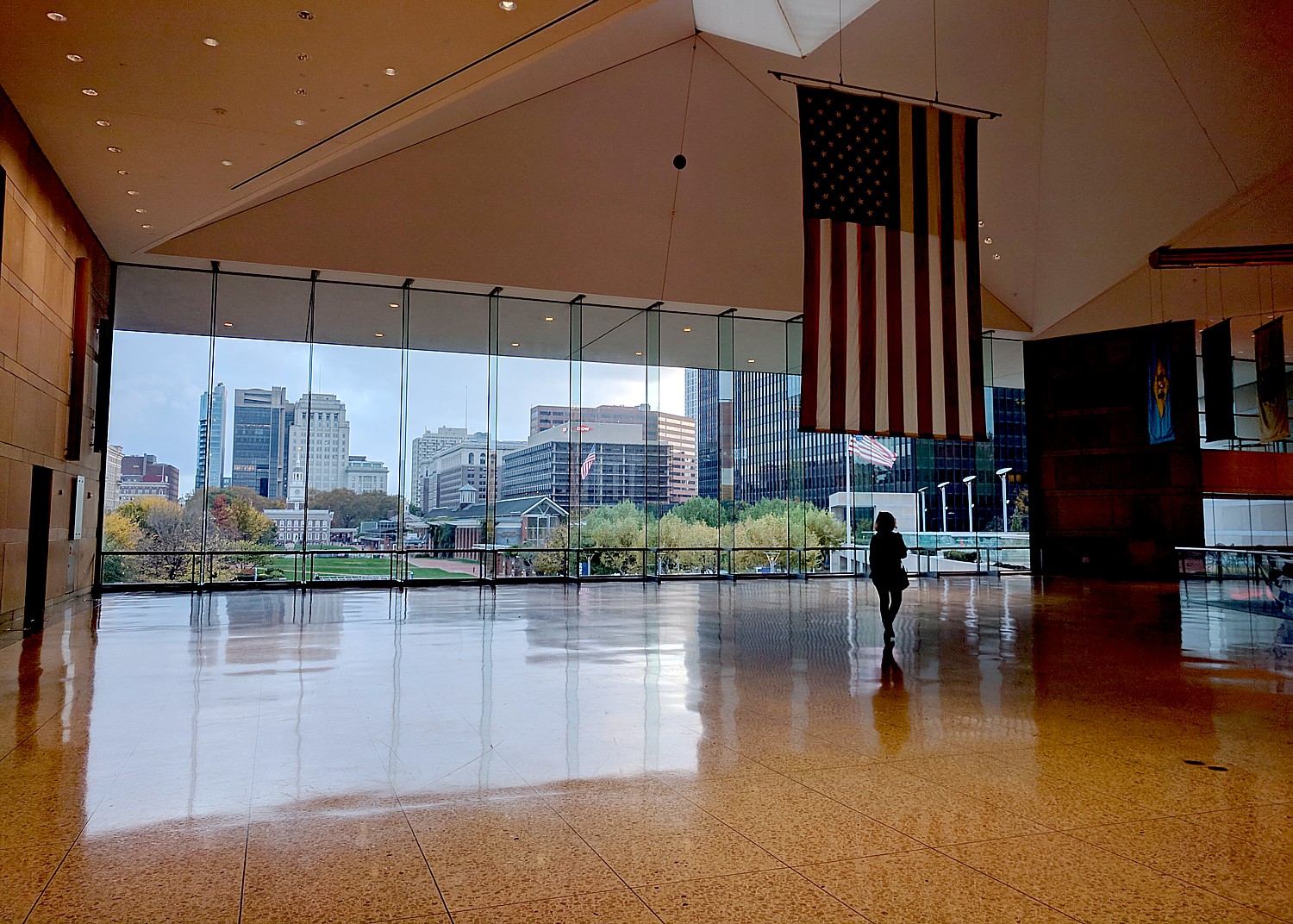
Visitor amenities include The Delegates’ Cafe, a glass-enclosed restaurant providing the backdrop of historic Independence Mall, as well as a Museum Store, offering a wide range of gifts, books, apparel, jewelry, and toys.
The National Constitution Center also houses the Annenberg Center for Education and Outreach, the national hub for constitutional education, which offers cutting-edge civic education resources both onsite and online.
The National Constitution Center is located steps from Independence Hall, where the Constitution and the Declaration of Independence were signed.
You need a minimum of 1 hour to visit, but more likely will spend at least two to three hours.
General Admission to the museum and daily programming: Adults $14.50; Youth (6-18) $11; Students w/ID, Seniors $13. Members, active military personnel, and children ages 5 and under admitted free.
The National Constitution Center, Independence Mall, 525 Arch Street, Philadelphia, Pennsylvania 19106, 215-409- 6700, constitutioncenter.org.
Visit Philadelphia provides excellent trip planning tools, including hotel packages, itineraries, events listings: 30 S 17th Street, Philadelphia PA 19103, 215-599-0776, visitphilly.com.
My third day of my deep-dive into Revolutionary War America in Philadelphia is devoted to exploring key figures and sites that I have never visited before: Benjamin Franklin Museum, the Betsy Ross House and the National Constitution Center. I especially appreciate what I am seeing after my visits to the newly opened Museum of the American Revolution and the National Museum of Jewish American History in the first two days.
Betsy Ross was a pistol.
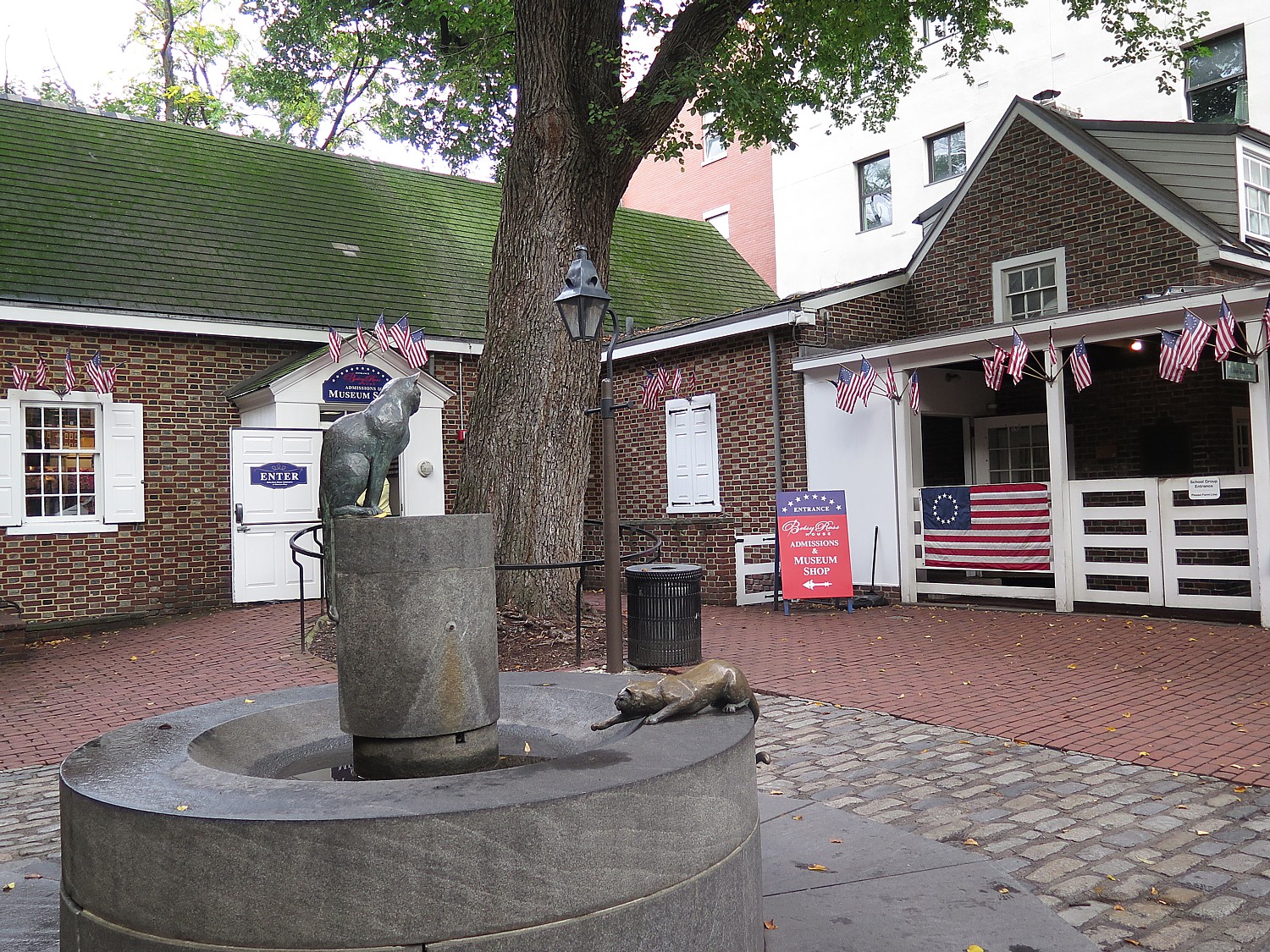
The Betsy Ross House, in Philadelphia’s historic district best known for Independence Hall, proved a real surprise.
I realize that all I know of Betsy Ross is that she created the first American flag. But this museum, which is operated as a private, nonprofit attraction, really conveys what a significant figure she was – independent when few women had any independence at all, a true patriot who was courageous in working on behalf of the Revolution. And, like Ben Franklin, what a modern person she was, who I can believe, would have been at the front of the Women’s Marches waving a feminist flag of her own design.
Her story would be worthy of a drama: She was shunned by her Quaker family for eloping (at age 21) with John Ross, a man of a different faith (the son of an Anglican Reverend) – imagine running off and marrying for love in 1773. She was independent: soon after they were married, John, who had joined the local militia, was killed and she found herself a widow who had to fend for herself. Because they had no children, she was able to keep her property. She rented a room in this townhouse, as well as a shop on the street level where she had her own business sewing upholstery and throughout her life was a savvy businessperson.
She would have known General George Washington from Christ Church which the young couple attended.
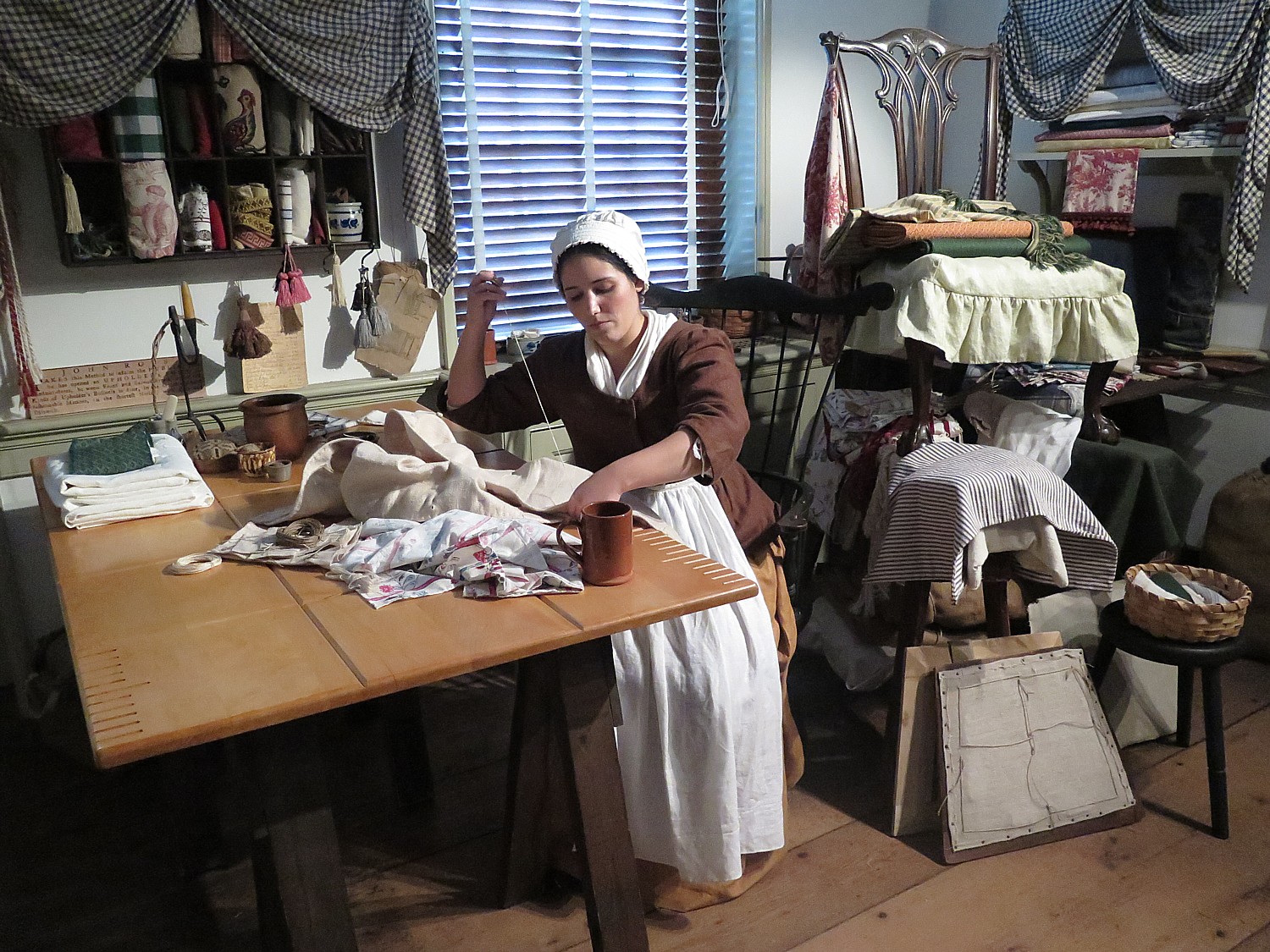
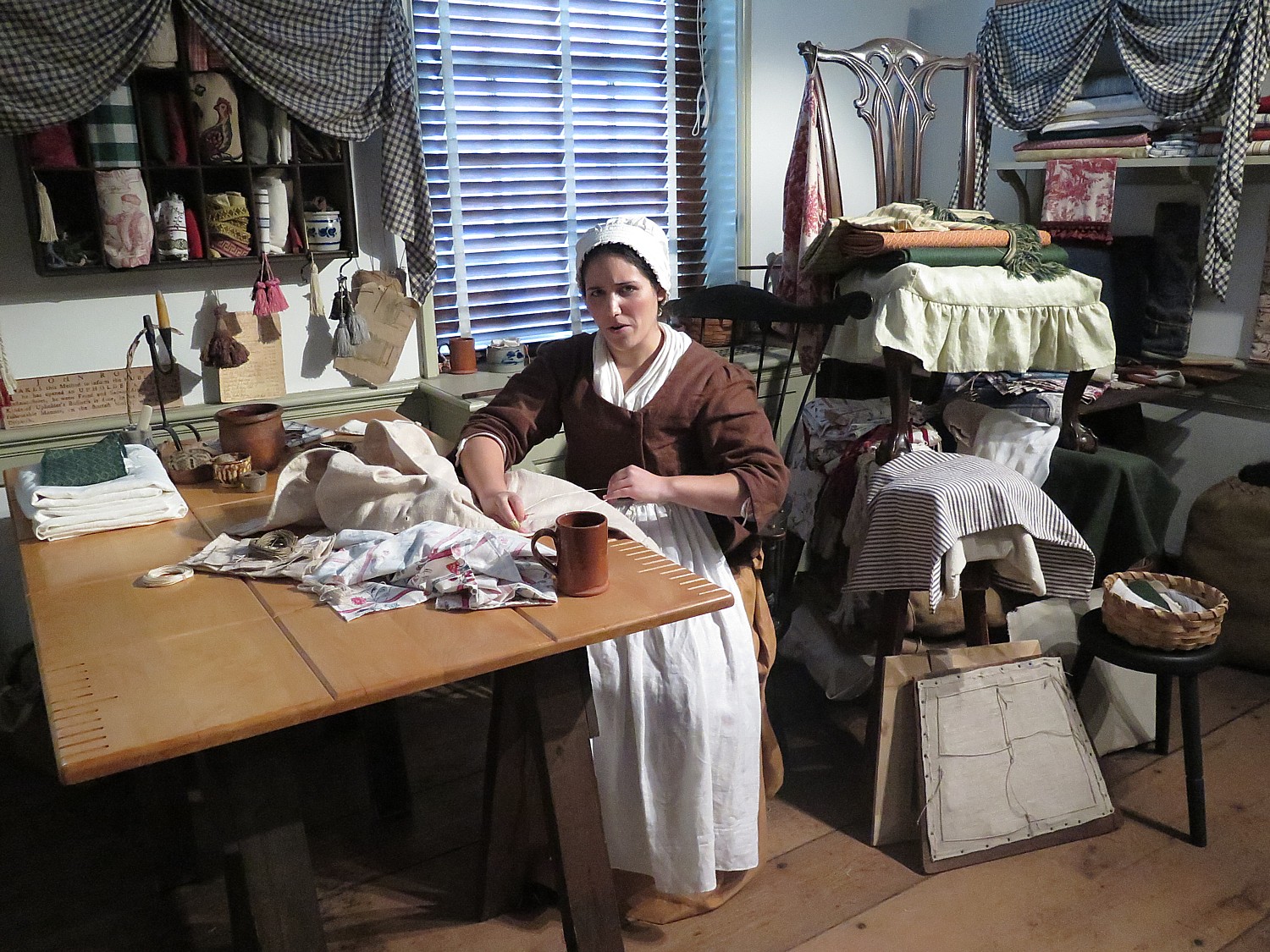
You traipse through the small house – to the room she rented in what was a boarding house (not just women), and realize how unusual this is, and then, as you descend the stairs into the shop, much to my surprise, you meet Betsy Ross herself, sewing some fabric. You get to ask her questions about her life.
I ask her what the date is – Nov. 5, 1776 – and really get into the spirit of the thing, knowing that she will only answer questions up to that point, when I know what comes next.
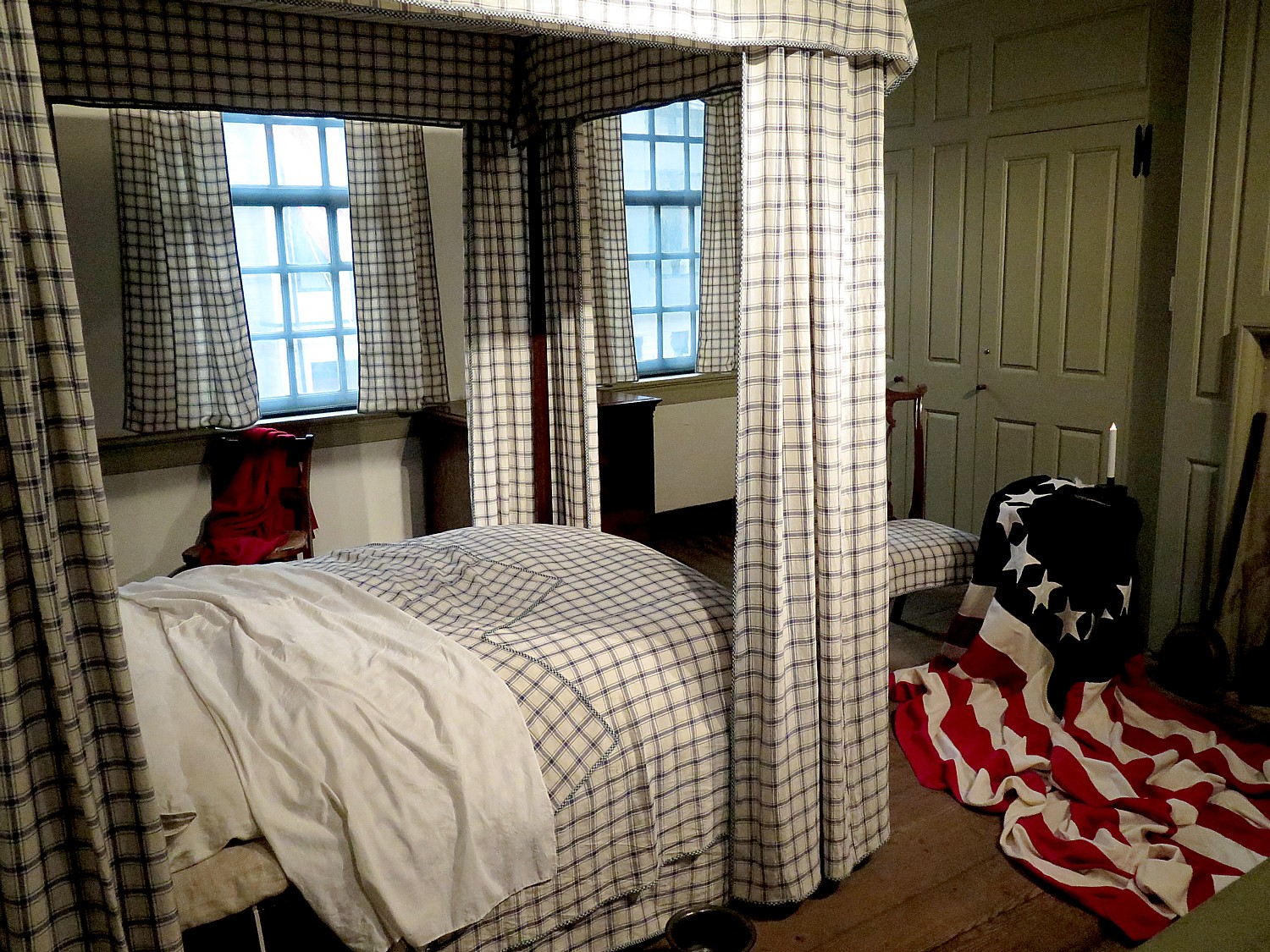
She has been working on the flag in secret, upstairs in the room, where she keeps it hidden under fabric.
Why did she take the risk? “My late husband was a patriot. I wanted to support Washington and make something to allow the spirit of my late husband live. We never had a child. [Creating the flag] this was like giving birth.”
She said that she went from father’s house to her husband’s. Now 24 years old, “the heaviness of a loss forces you to grow up in different manner. Being on my own is more difficult than I would have imagined.”
Her husband, John, passed in January and she moved in March. “This is the Widow Lithgow’s home –she rents to individuals. I rent a room and shop space from her. If I remarry, I will go to different lodging.”
She would have lived here between 1776 and 1779.
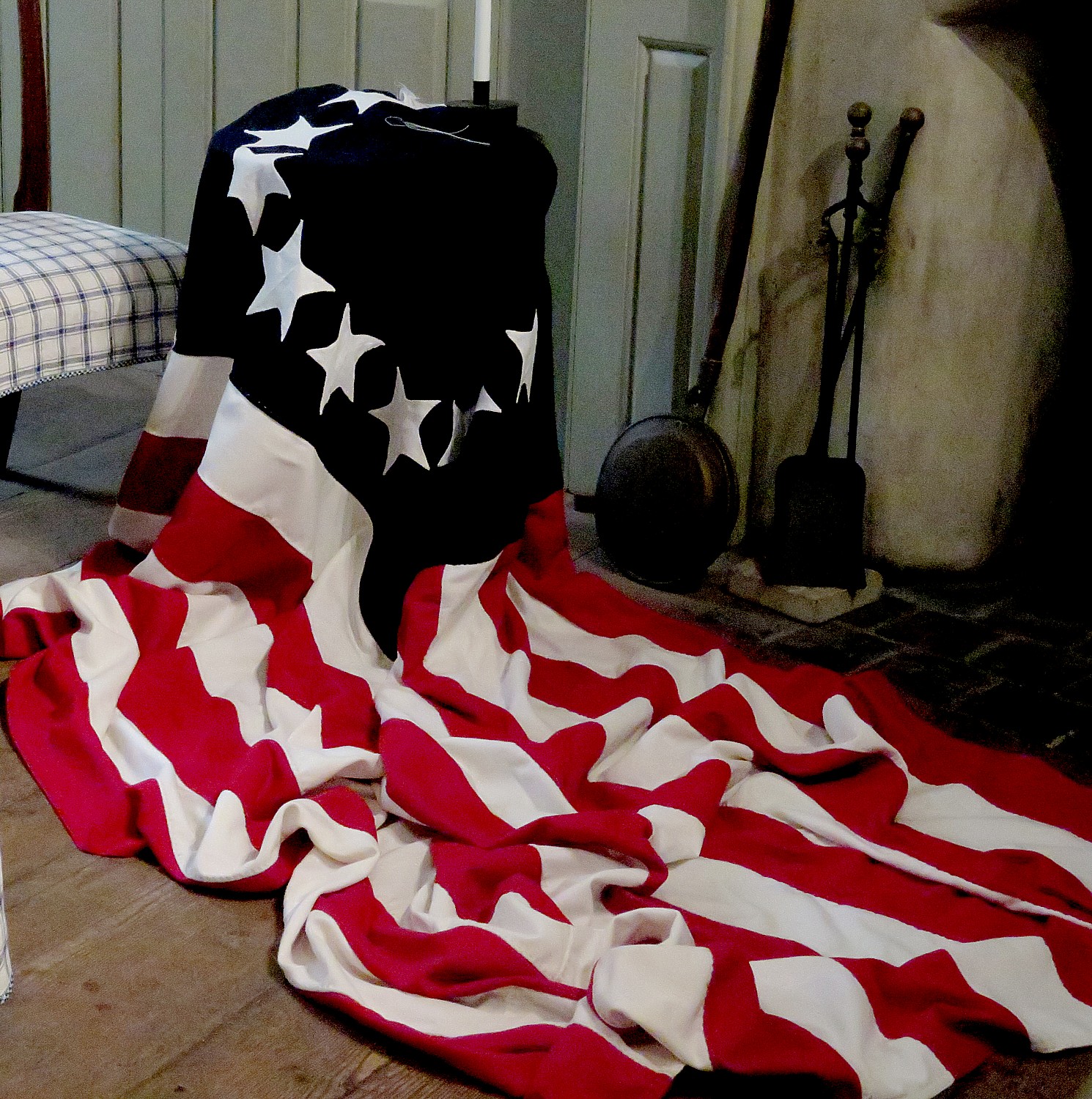
She relates how General Washington had particular design in mind when he came to her in 1776. He was open to suggestions: his original idea for the symbol for American independence had the shape of square rather than rectangle (that was her idea).
Also, Washington had wanted six-pointed stars but Ross pushed to change the shape to five-pointed stars by demonstrating that it was easier and speedier to cut, and how she would sew it in so that the design could be seen on both sides.
She tells me with an appropriate measure of sass in her tone that a trusted messenger brought her flag to Washington rather than he come himself. “He has heavier things on his mind – to win the battle, not a flag.”
I never considered, before “meeting” Betsy Ross how courageous she was to make the flag – she could have been caught and jailed for sedition.
I ask if she has met Ben Franklin (thinking that his printing shop is nearby), but she says that she knows of him but has not met him. “He’s out of town a lot. I hear he is quite taken with squirrels,” she says with a slight smile as she continues to sew.
She actually had a very good business going during the American Revolutionary War, making flags for the Pennsylvania Navy.
Betsy Ross was born in 1752, and after attending a Quaker-run school, her father apprenticed her to an upholsterer. There, she fell in love with John Ross, a fellow apprentice, the son of an Anglican priest at the historic city parish of Christ Church, and the nephew of George Ross Jr. who was a signer of the Declaration of the Independence. The young couple eloped in 1773 when she was 21, marrying at Hugg’s Tavern in Gloucester City, New Jersey. The marriage resulted in her expulsion from the Quaker congregation.
The young couple soon started their own upholstery business and later joined Christ Church, where their fellow congregants occasionally included the visiting Virginia Colony militia regimental commander who would soon become General of a newly organized Continental Army, George Washington, as well as other visiting notaries and delegates who would become leaders of the rebellion and later, members of the Continental Congress.
They were married only two years when John Ross, a member of the local militia, was killed. They had no children.
She continued working in her upholstery business for the Revolution, repairing uniforms and making tents, blankets, and stuffing paper tube cartridges with musket balls for ammunition for the Continental Army.
On June 15, 1777, she married her second husband, Joseph Ashburn, a seaman. In 1780, Ashburn’s ship was captured by a Royal Navy frigate and he was charged with treason (for being of British ancestry, because the British did not recognize American colonial citizenship) and was imprisoned at Old Mill Prison in England. During this time, their first daughter, Zilla, died at the age of nine months and their second daughter, Eliza, was born. Ashburn died in the British jail.
Three years later, in May 1783, she married John Claypoole, who had coincidentally met Joseph Ashburn in the English Old Mill Prison and had been the one to inform her of her husband’s death. (Ross must have really been something, and the young woman playing the part today conveys that spirit.)
Betsy gave birth to five daughters with John Claypoole: Clarissa, Susanna, Jane, Rachel and Harriet (who died in infancy). With the birth of their second daughter, in 1786, they moved to a larger house on Philadelphia’s Second Street, settling down to a peaceful post-war existence. Philadelphia prospered as the temporary national capital (1790–1800) of the newly independent United States of America, with George Washington as the first President,
By 1812, John Claypoole’s war injuries had left him disabled; he died in 1817 after two decades of poor health. Betsy’s young, widowed daughter Clarissa moved into their home with her five children and a sixth on the way. With Clarissa’s help, Betsy continued to run her upholstery shop and flag-making business. But after 50 years in the trade, Betsy’s rapidly failing vision led to her retirement at the age of 76. Betsy eventually became blind. She spent the last three years of her life living with her daughter Jane’s family on Cherry Street in Philadelphia. She died peacefully in her sleep on January 30, 1836, at the age of 84.
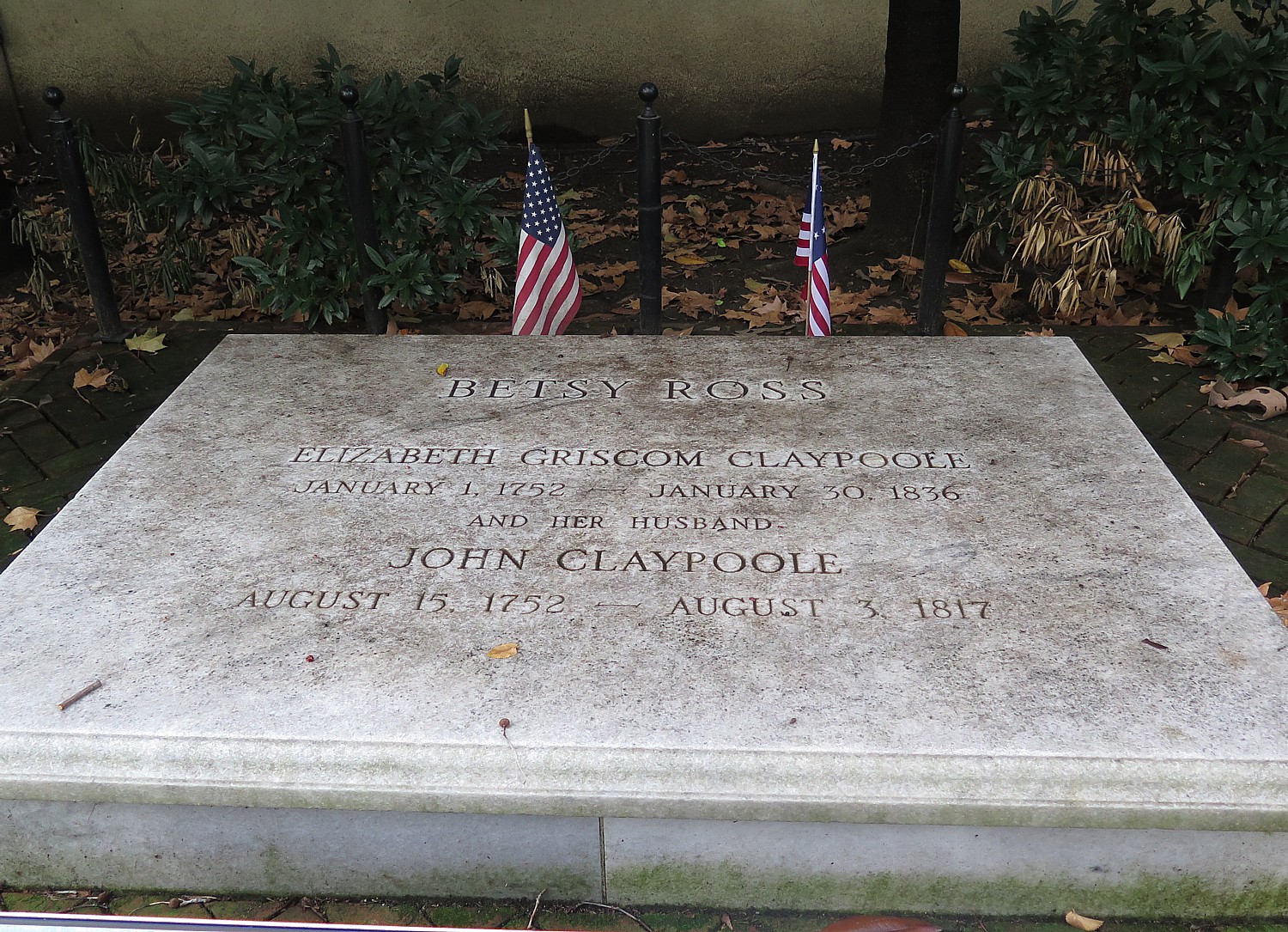
Betsy Ross’s body was first interred at the Free Quaker burial grounds on North Fifth Street in Philadelphia (interesting in that the Quaker’s shunned her); 20 years later, her remains were moved to the Mt. Moriah Cemetery in Philadelphia. Then, in 1975, in preparation for the American Bicentennial, the City ordered the remains moved to the courtyard of the Betsy Ross House. Cemetery workers found no remains beneath her tombstone, but bones found elsewhere in the family plot were deemed to be hers and were re-interred in the grave which we tourists visit at the Betsy Ross House.
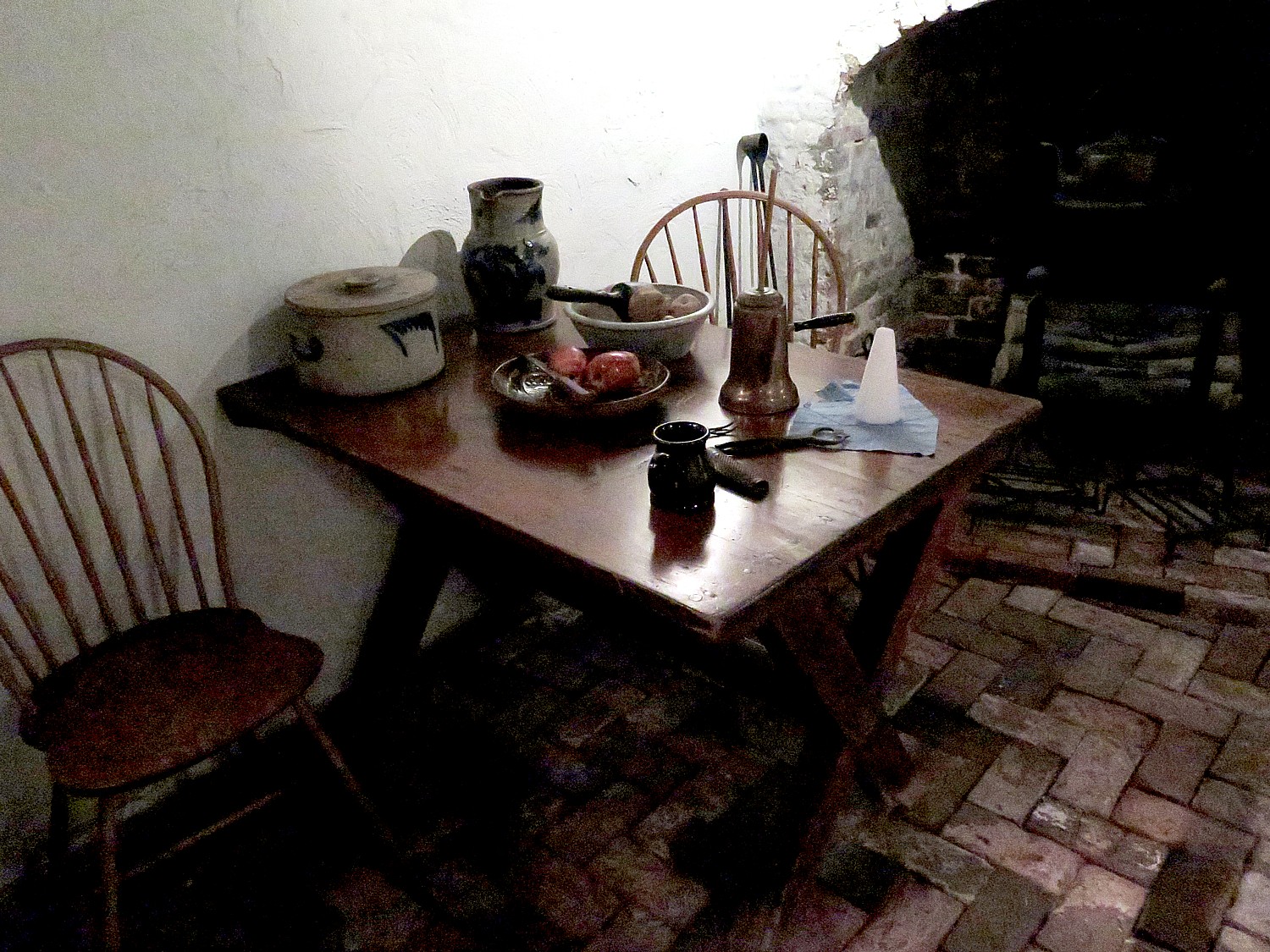
The museum does an excellent job of revealing the situation of women in Revolutionary times, what it was like for the women and children left behind when their men went to war, and how they provided for themselves when they were widowed. I go down to the kitchen area where another woman interprets what it would have been like to have been a Washerwoman – one of the few professions that a woman who had to fend for herself could undertake.
“Working as a laundress was a difficult, low paying job in the 18th century; in early colonial period, many were enslaved or indentured servants; toward the end of the 18th century, most were free black women and widows struggling to support themselves.”
We are introduced to Judath, an African American washerwoman employed by Elizabeth Drinker, a wealthy Quaker woman. Jane Gray, a widowed African American washerwoman, who was a member of the “Black Class” at St. George’s Methodist church and later joined St. Thomas’ African Episcopal church. Susanna Cook, a widow with two children who lived at 3rd & Walnut Streets, whose husband died in the Yellow Fever epidemic of 1793 and to earn a living, rented out rooms and worked as a washerwoman earning $3 a week; she fell ill in 1801 and died impoverished in an almshouse.
There are special exhibits: “Stitching the Story Together: Betsy Ross and the American Flag” opens March 1; “Furnishing the Widow’s Chamber (opens March 1).
Allocate about an hour to visit.
Admission: Self-guided tour: $5/adult, $4/seniors, children, vets, students; add $2 for the audio tour (a child’s audio tour is available).
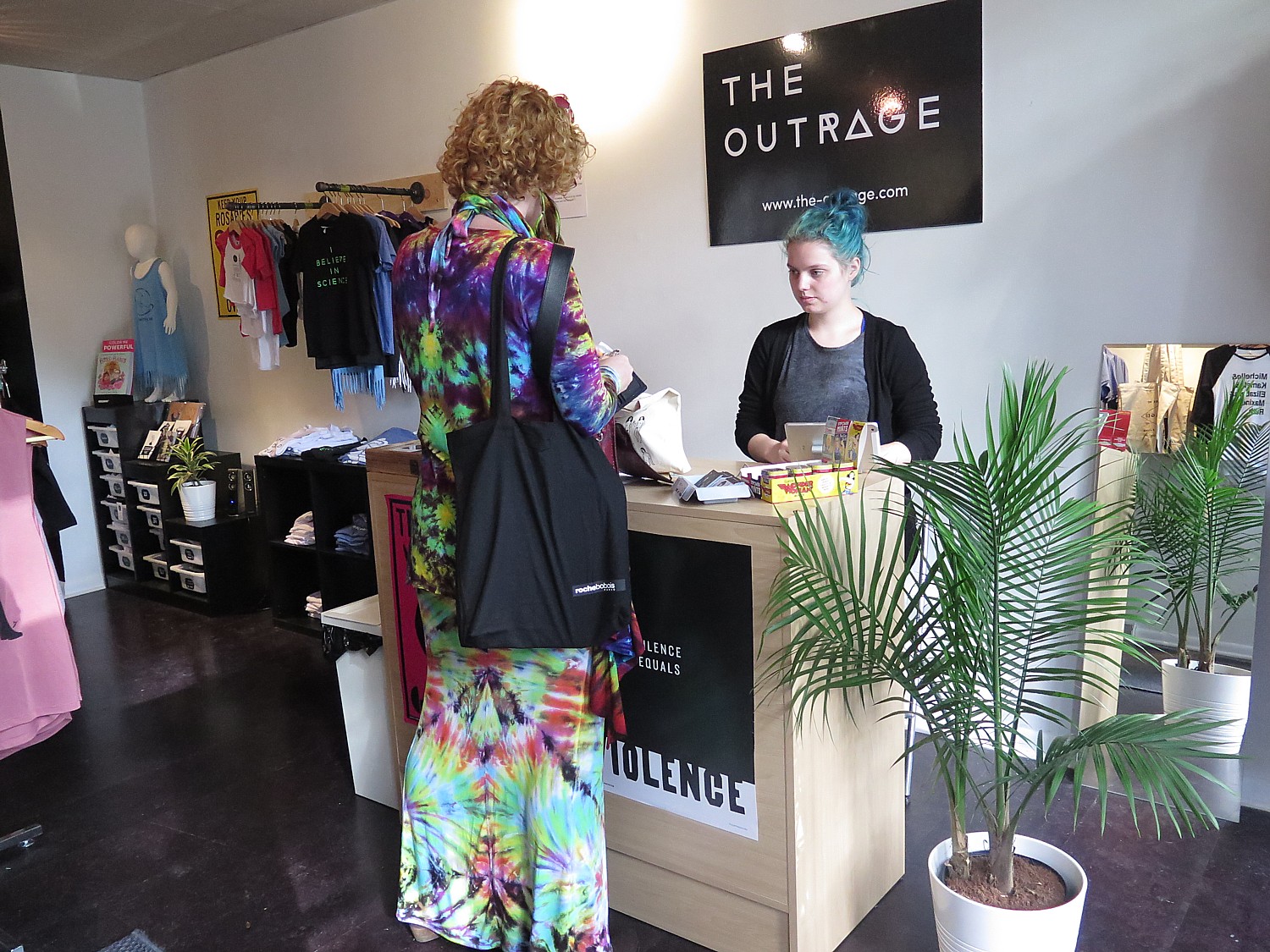
When I leave the Betsy Ross House, I think how appropriate that other clothing/sewing places are also on this block, and just a few doors down, come upon Women’s Resistence – The Outrage (www.the-outrage.com)
The brand was started 2016 – it was supposed to be celebratory for first woman president, but instead, has become an outlet for outrage and resistance for artists and activists. A portion of sales helps benefit organizations – ACLU, Planned Parenthood, 350.org. The first store oened in DC; this one opened this fall, with other outlets planned across the country.
My immersion into Revolutionary War Americana in Philadelphia continues at the Constitution Center.
Visit Philadelphia provides excellent trip planning tools, including hotel packages, itineraries, events listings: 30 S 17th Street, Philadelphia PA 19103, 215-599-0776, visitphilly.com.
My third day of my deep-dive into Revolutionary War America in Philadelphia is devoted to exploring key figures and sites that I have never visited before: Benjamin Franklin Museum, the Betsy Ross House and the National Constitution Center.
Once again, the best way to connect is to walk because you are quite literally walking “in the footsteps” of these iconic individuals, and in so doing weave together the places and events, create a context. It is exciting to happen upon a site – a historic marker, a building keystone – that you would never have thought to seek out.
I am off to visit the Benjamin Franklin Museum, which is relatively new (open four years) and very close to the very new Museum of the American Revolution. The trick here is that you need to walk up an alley (I missed it the first few times I went by). I enter from Chestnut Street, but you can also come through from Market Street, where there is a row of townhomes (“Franklin’s Neighborhood”) that includes the post office, Franklin’s print shop, and looks back at City Hall.
Ben Franklin is, of course, a native son of Philadelphia, and justifiably the most revered figure, and here we learn why that is so deserved, why the city still has his stamp.
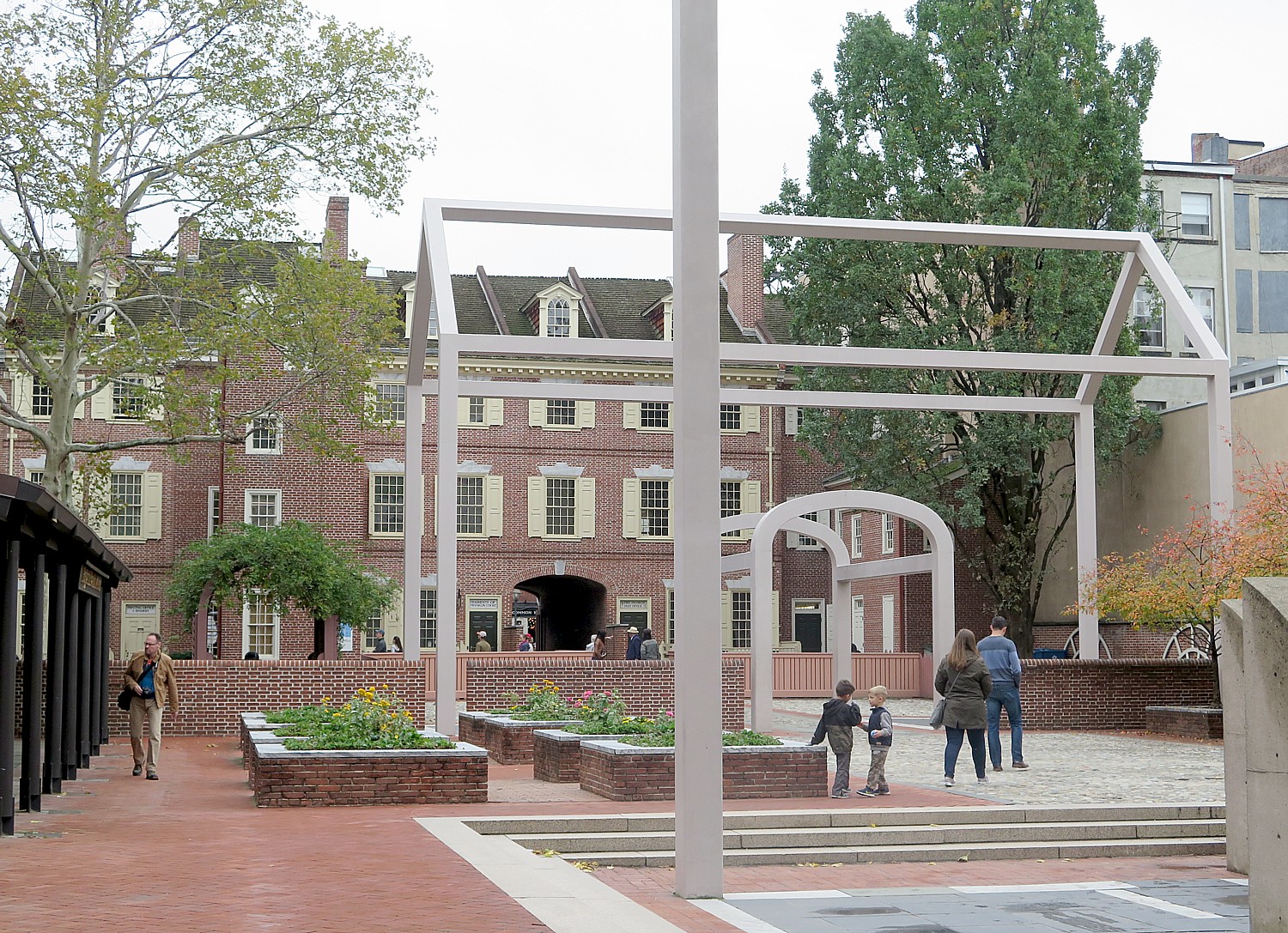
You enter a courtyard and come upon the “Ghost House” – the sculptural frame of Franklin’s home (the museum is actually in what would have been the basement) you can peek into the archeologically preserved remains of the foundation of his house. Franklin’s grandkids, unable to afford the “prohibitive” taxes, tore the house down in 1812 to sell to a real-estate developer. Eventually, a rooming house was built on the site. The National Park Service tore that down in the 1950s in order to restore the Franklin site, and after the Independence Bicentennial in 1976, it became a National Park, administered by the National Park Service.
The exhibit area is divided into five “rooms” with each room interestingly focusing on a particular trait of Franklin’s: ardent and dutiful, ambitious and rebellious, motivated to improve, curious and full of wonder, and strategic and persuasive. There are videos, touch screen interactives, mechanical interactives, and artifacts in each area. An additional area called the “Library” presents a video with excerpts from Franklin’s Autobiography.
The exhibit is well presented to give a total biography of this fascinating Renaissance, self-made man, who so epitomizes the American Dream.
I come to Franklin Museum hoping to learn more of this fascinating man, and was richly rewarded. I did not realize his humble beginnings, or fully appreciate the range of his talents, accomplishments.
But my essential question about Franklin – my theory that it was the Stamp Act (not the tea tax) which imposed taxes on newspapers – that was the key to the colonists taking up arms to “free” themselves from the greatest superpower humankind had known. Franklin was not just a printer, but a newspaper publisher who provided seed money to newspapers throughout the colonies and became (what I consider) the first syndicated columnist, sending out editorials that would have been printed in those papers. My theory (as yet unproved) is that newspaper editors were the ones who turned opinion against British rule, gave the colonists the notion that they could actually win their independence, and gave the colonists from Massachusetts to Virginia, who were then (as now) very different, a sense of unity. Had the British not imposed the Stamp Tax, the newspaper editors may not have been so gung ho for Revolution. If my theory could be addressed at the museum, it was not at all clear to me.
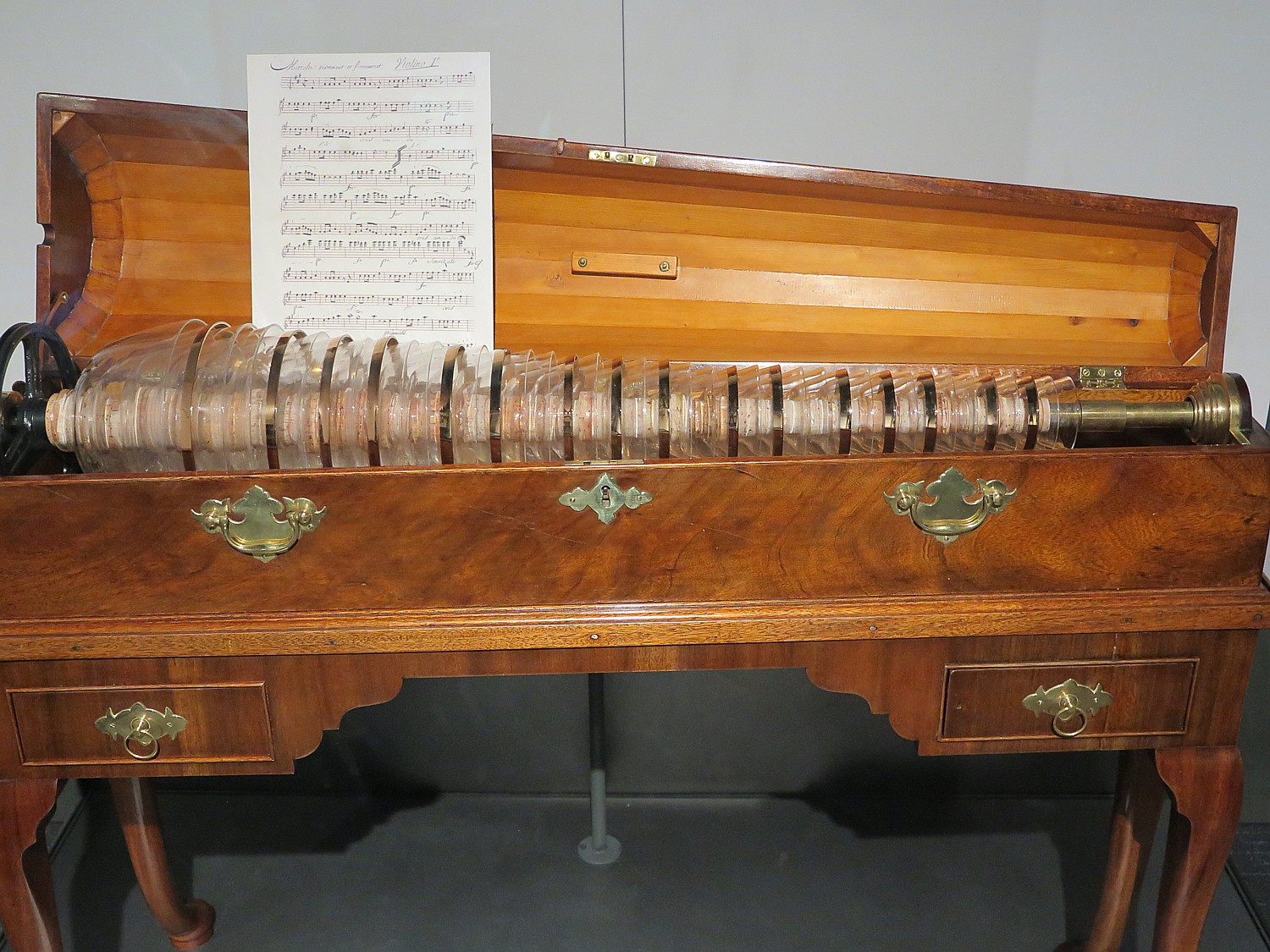
But what is clear is that Franklin lived in the Age of Enlightenment – ideas and innovations were spread by trade and globalism – and people with the wit and wisdom like Franklin – despite having only two years of formal schooling – were encouraged to learn, innovate, invent not just technology (he did experiments with electricity and invented the lightening rod, bifocals, Franklin stove, urinary catheter and glass harmonica and charted and named the Gulf Stream) but civic society (volunteer fire department, the Philadelphia hospital, library, founded what became the University of Pennsylvania) and politics. There was greater willingness to challenge authority and notions of “divine right” – even question institutionalized religion – and class rather than be ruled by them. Colonists – who hailed from many countries in addition to Britain and would not have had loyalty to the Crown – had already lived in the New World for a century, and saw themselves not as British but as Americans. And Franklin knew better than anyone that a person from humble beginnings could ascend the ranks of social status.
I am surprised to learn that Franklin never patented his inventions, believing in the equivalent of what we call “open source.”
He was a key figure in creating the Declaration of Independence – one of the committee of 5 (with Jefferson, Adams, Roger Sherman and Robert Livingston); and along with Adams nominated Jefferson to write the Declaration and made some important changes to Jefferson’s draft.
He was a generation older than Adams and was in his 80s during the Continental Congress – near death and in significant discomfort. He was considered a giant, an elder statesman, “The Sage.”
America’s ambassador to France during the Revolution, he secured critical support of the French.
I was shocked to learn that Franklin initially owned and dealt in slaves (it was a time when that was common place, even in the North) but by the 1750s, he argued against slavery from an economic perspective and became one of the most prominent abolitionists.
His personal background is worthy of a multi-part dramatic series:
Ben Franklin was born in Boston in 1706, one of 17 children of his father. He only attended two years of formal schooling which ended when he was 10; he continued his education through voracious reading.
At 12, he apprenticed to his older brother, James, a printer, who founded the first independent newspaper in the colonies. Ben started publishing columns secretly under a pseudonym (his brother was furious). When James, who was a free thinker, was jailed for three weeks in 1722 for publishing material unflattering to the governor, Ben took over the newspaper and wrote, in the character of his alter-identity Mrs. DoGood, “Without freedom of thought there can be no such thing as wisdom and no such thing as public liberty without freedom of speech.”
In 1723, Franklin escaped his apprenticeship and fled to Philadelphia, making him a fugitive. He took up lodging in the Read home, and at the age of 17, proposed marriage to 15-year old Deborah Read. But her mother refused permission for them to marry. Franklin went off to London for several years and Deborah married John Rodgers, who abandoned her, ran off with her dowry and but without a divorce, left her unable to remarry.
When Ben Franklin returned to Philadelphia, he formed a common-law marriage with Deborah who becomes a mother to Ben’s illegitimate son, William.(William grew up to become a Loyalist and self-exiled himself to London; William too had an illegitimate son who became Ben Franklin’s secretary and aide). Deborah and Ben had two more children together, but his son died at the age of 4 of smallpox; his daughter Sarah married, had children, and took care of Ben in his old age
I hadn’t realized that Franklin spent much of his life abroad, especially between 1757-1775, and as Ambassador to France from 1776-1785.
Franklin returned to the United States in 1787 and is the only Founding Father who is a signatory of all four of the major documents of the founding of the United States: the Declaration of Independence, the Treaty of Alliance (1778) with France, the Treaty of Paris that ended the Revolution (1783) and the United States Constitution (1787), though he was sick and suffering in pain during the Constitutional Convention.
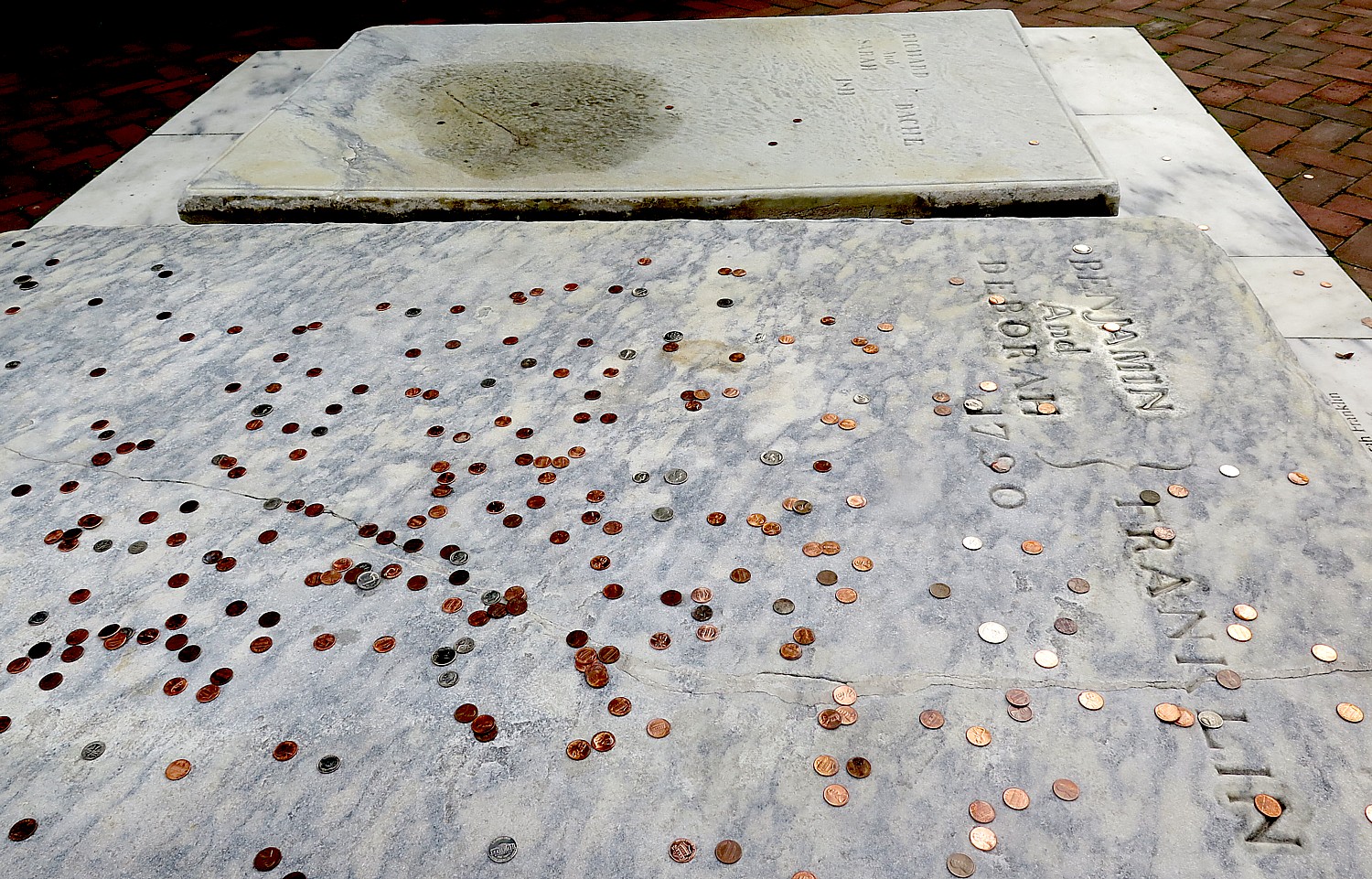
When Ben Franklin died in 1790, 20,000 people attended his funeral. Later, I see where he was interred in Christ Church Burial Ground. It is interesting to note that in 1728, when he was just 22, Franklin wrote his own epitaph: “The Body of B. Franklin Printer; Like the Cover of an old Book, Its Contents torn out, And stript of its Lettering and Gilding, Lies here, Food for Worms. But the Work shall not be wholly lost: For it will, as he believ’d, appear once more, In a new & more perfect Edition, Corrected and Amended By the Author.” But the tombstone simply reads, as he specified in his final will, “Benjamin and Deborah Franklin.”
You leave the museum realizing what a remarkable Renaissance man Franklin was – like Thomas Jefferson in that way – with all the inventions and areas of success. Franklin was very much a modern man; if ever there was a person who could find himself 250 years in the future, he would have been very much at home in the 21st century. And very much Philadelphia’s Favorite Son for good reason.
The Ben Franklin Museum is a very welcoming space that really humanizes and personalizes Franklin. I love Franklin’s witty quotes, the portraits of him that show him throughout his life, even his love letters (to women not his wife).
For children, there is a scavenger hunt for the small squirrel figurines located throughout the exhibits. Franklin delighted in pet squirrels, or skuggs as they were known in his day.
You need at least an hour to visit.
The museum and print shop are operated by the National Park Service as part of the Independence Hall.
Open daily from 9 am to 5 pm. Admission $5/adult; $2/children 4-16.
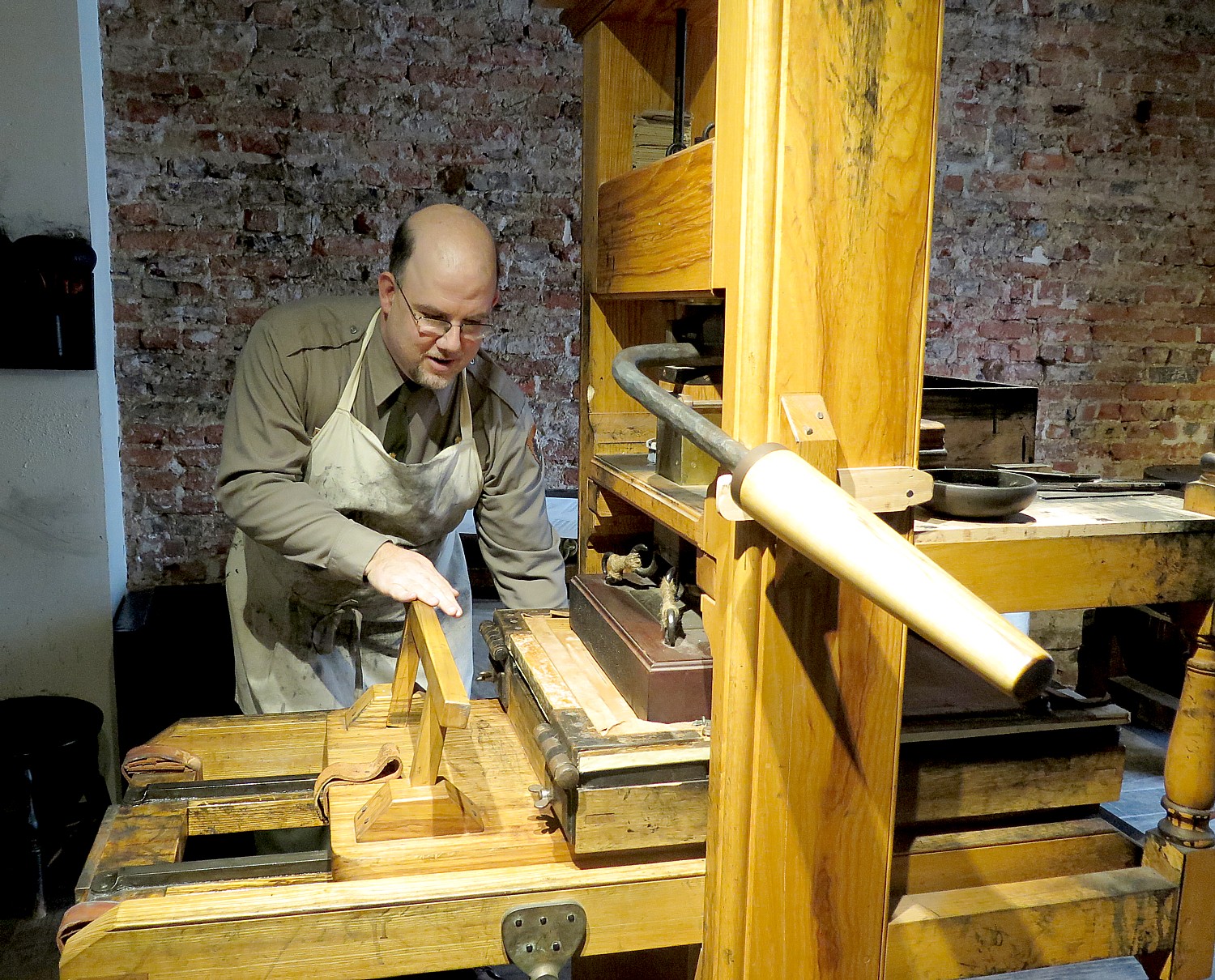
From here, I go back up to the court yard and find my way to Franklin’s print shop, where there is a replica of an old-style printing press (not much different from the days of Gutenberg), where National Park Rangers run off documents (you can buy a printed Declaration of Independence though Franklin never actually printed it). If you are lucky, you may visit when the ranger is in period dress.
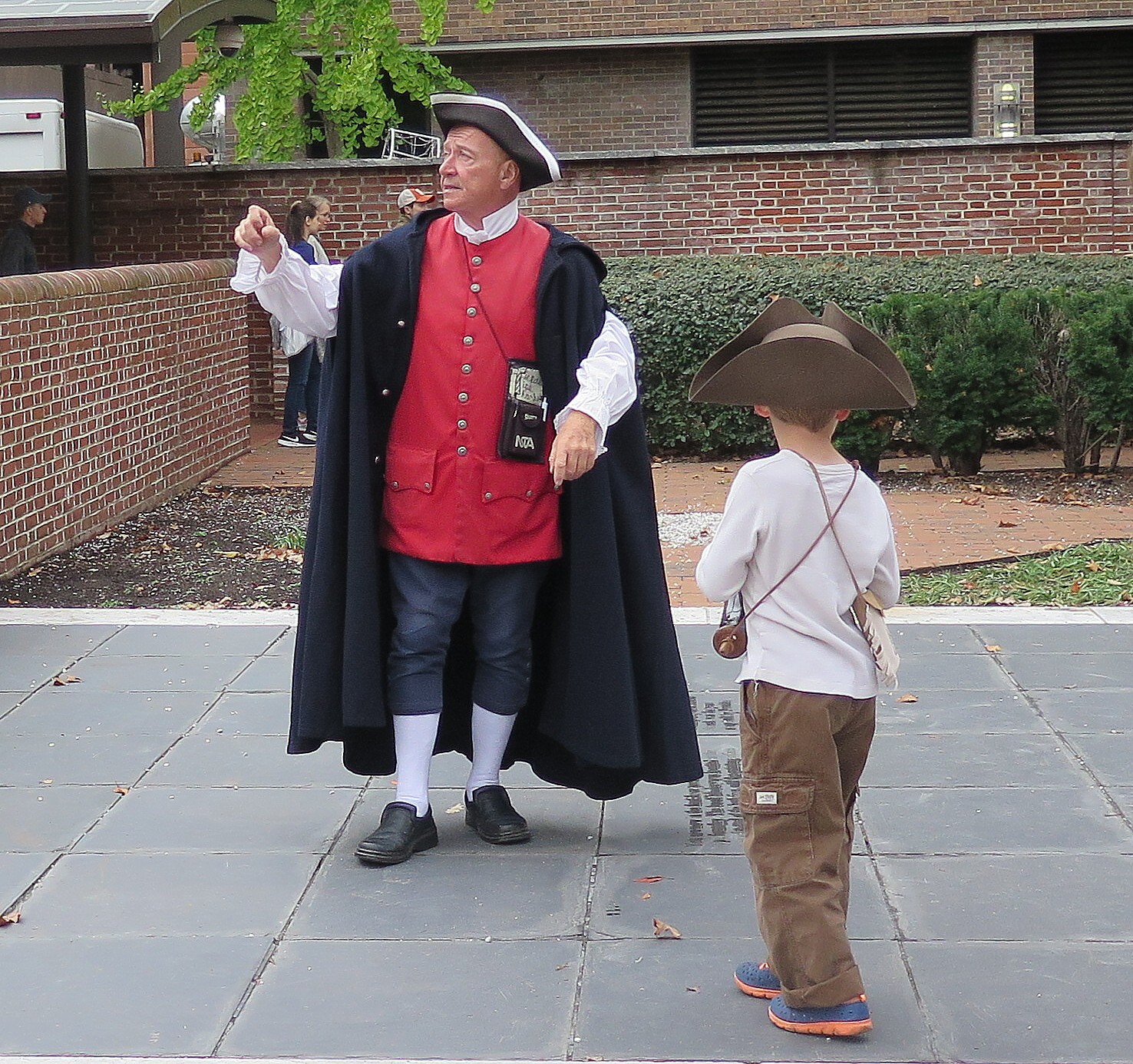
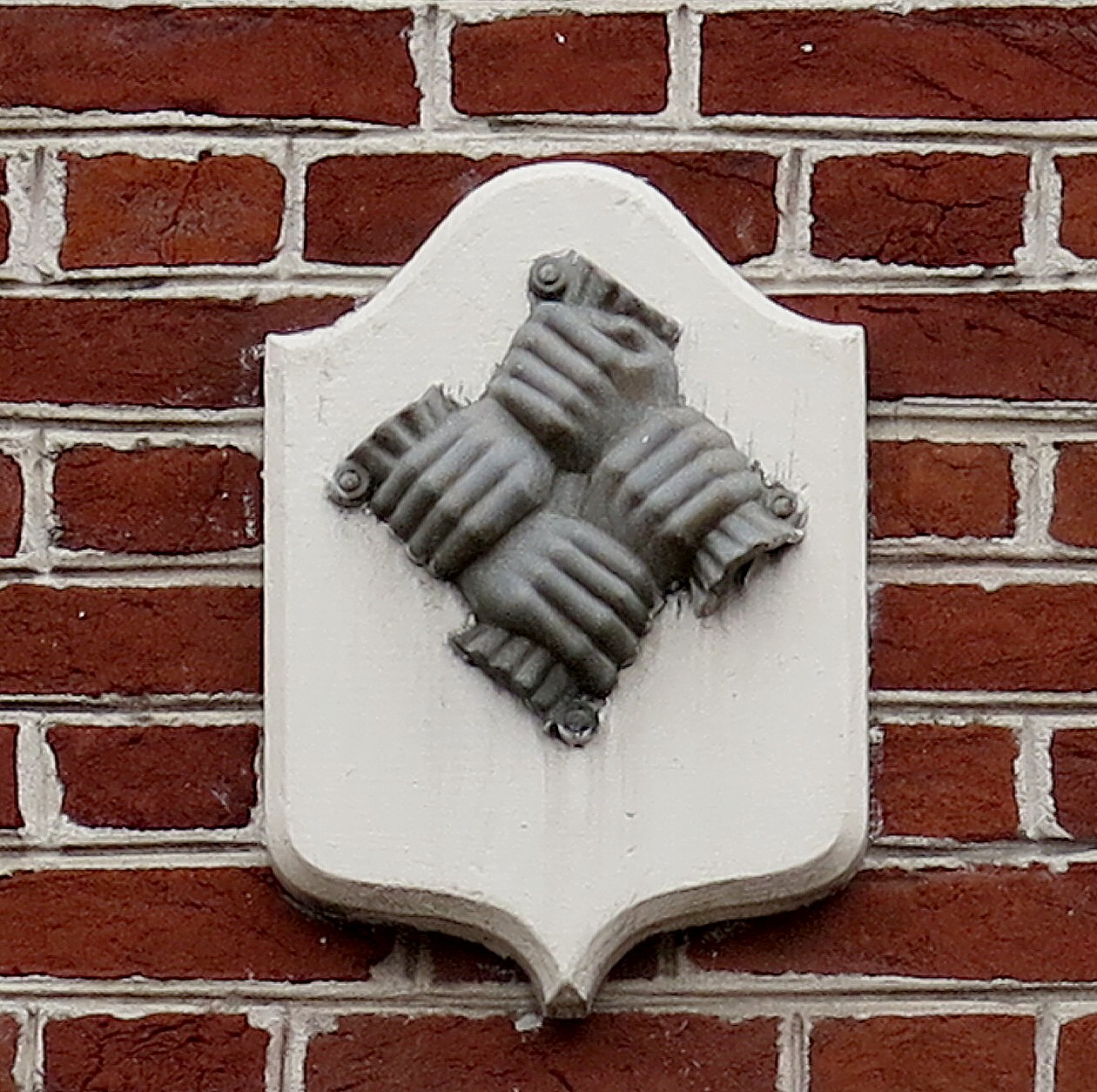
On the Market Street side of Franklin Court, there is the B. Free Franklin Post Office, where you can get postcards hand-stamped just as one would have when Franklin was the first postmaster. The line of attached buildings are very much the way they were when Franklin lived here. You notice on Market Street and then around the historic district townhouses that still have the reliefs that show what fire insurance company protected the house. On this day, the street is closed off for a street festival. After spending some time enjoying the music and festivities.
I also pass a firehouse with a wonderful bust of Benjamin Franklin.
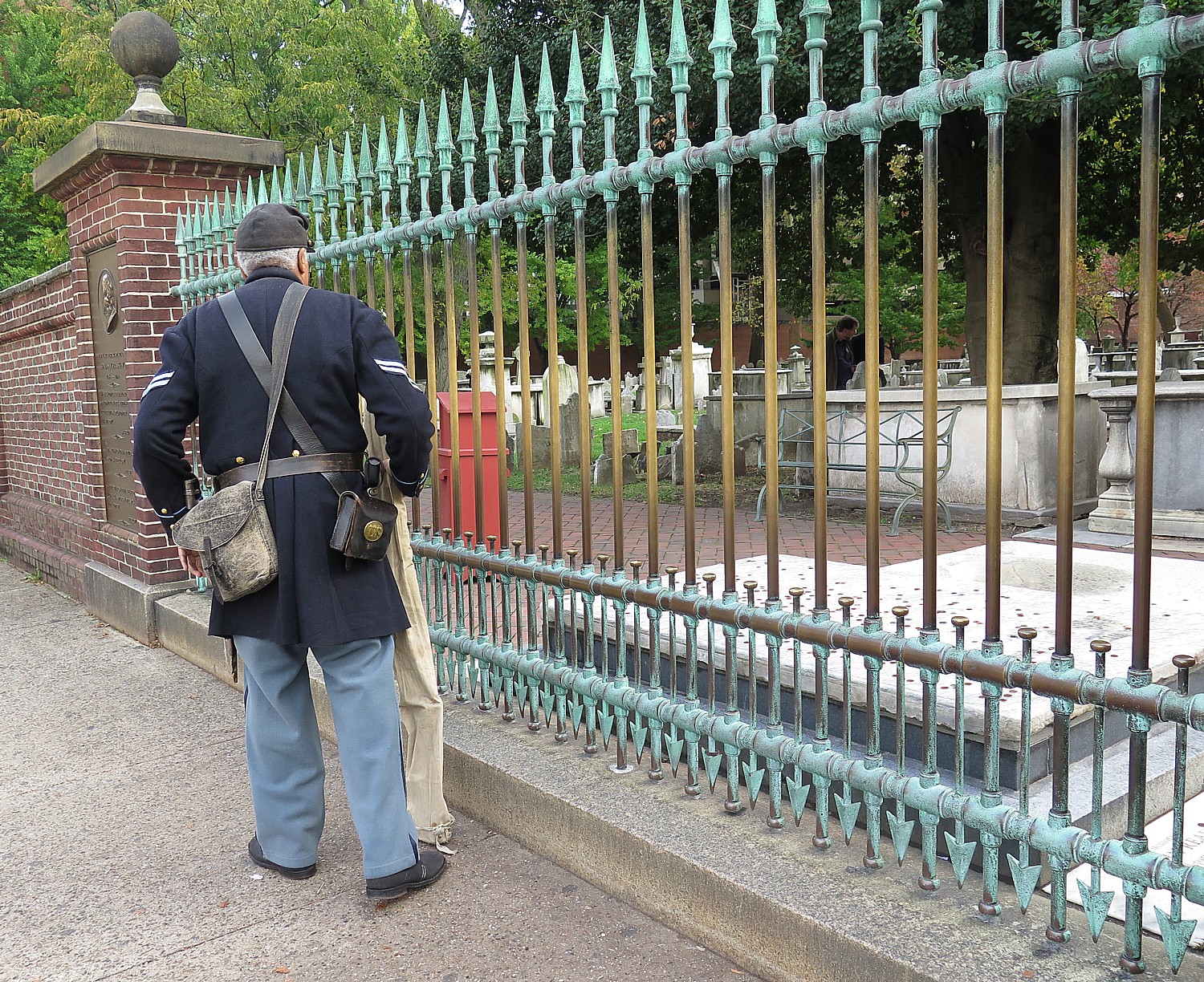
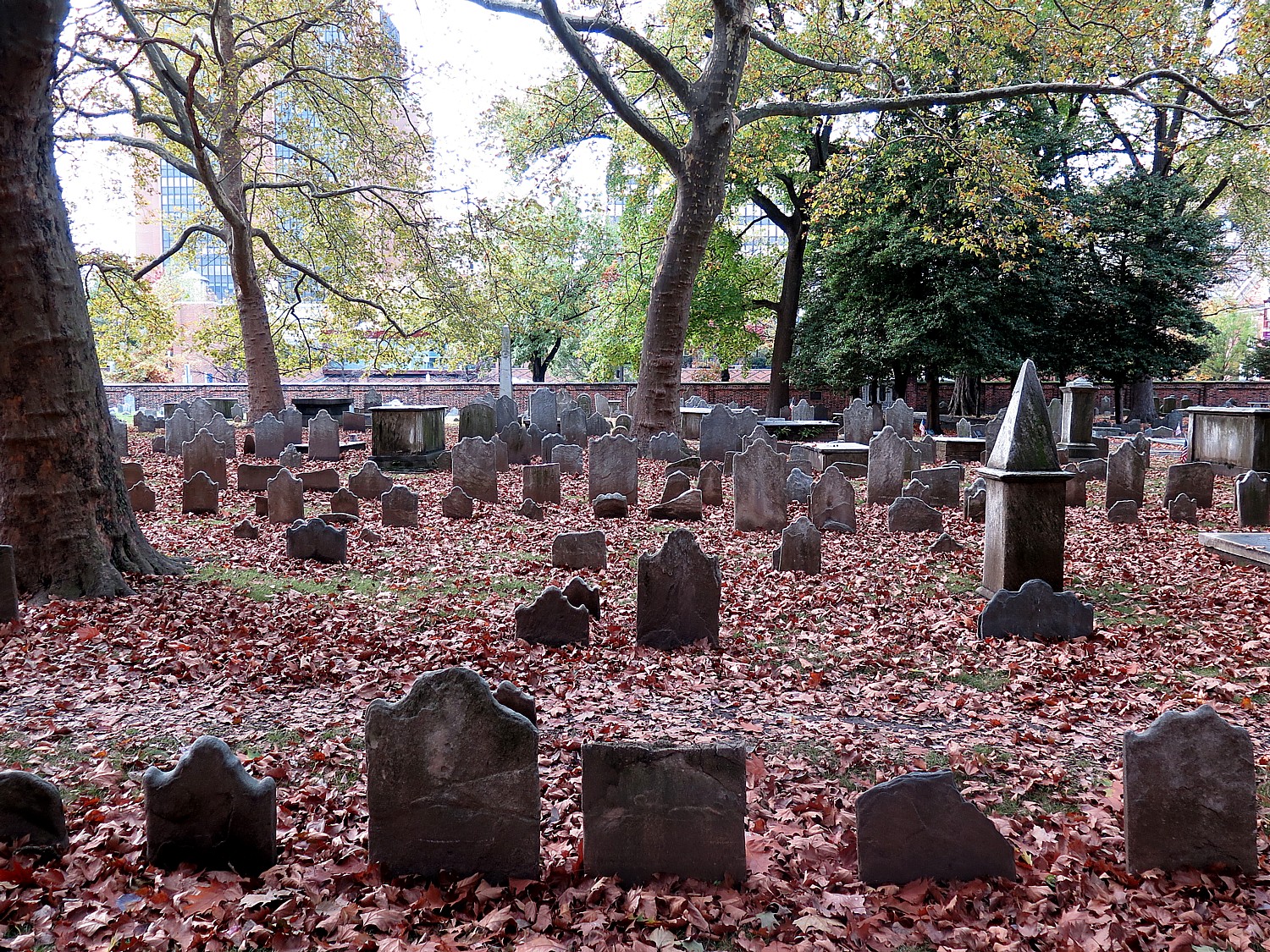
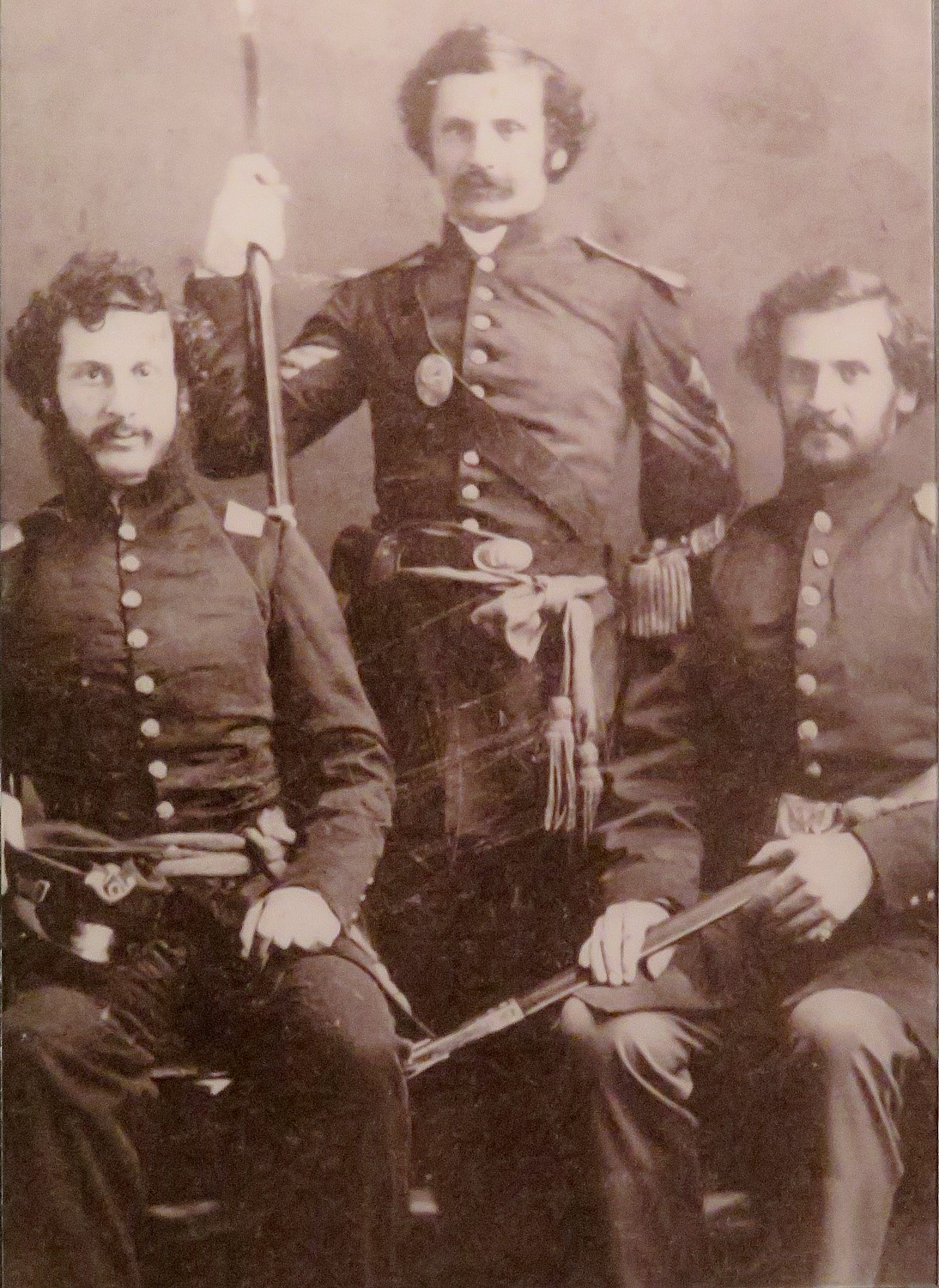
Philadelphia had just held a Veterans Day parade, and just as I pass the Christ Church Burial Ground where Benjamin Franklin and many other Founders are buried, I come upon Civil War re-enactors from the 3rd Regiment: Sgt Major Joseph Lee and Corporal Robert F. Houston.
The Franklins’ tombstones – extremely modest – is easily the most visited (and can be seen through the gate from the sidewalk). People throw pennies onto the tombstone – a nod to Franklin’s motto that “a penny saved is a penny earned,” as well as a symbol of good luck.
Others buried here include John Dunlap, who printed the Constitution and Declaration of Independence, composer and poet Francis Hopkinson and medical pioneers Dr. Benjamin Rush and Dr. Philip Syng Physick. Divided into quadrants, the ground is mapped and plots are identified with markers where the original inscriptions are gone. A book of 50 biographies is available for purchase at Christ Church. (There is an admission to the burial ground, $3 adults/$1 child or $8/$3 with guided tour.) (5th and Arch Streets, Philadelphia 19106, 215-922-1695, ext 30, http://www.christchurchphila.org/about-the-burial-grounds/
VisitPhilly.org, the city’s convention and visitor bureau, offers a marvelous walking tour to discover historic attractions visited by Franklin himself, sites dedicated to his accomplishments and local restaurants that would appeal to one of history’s most prolific men.
The Franklin’s Footsteps Itinerary starts at the Benjamin Franklin Museum, Franklin Court, the Ghost House, the Print Shop and Post Office and continues:
City Tavern (138 S. 2nd St. 215-413-1443), where Colonial America is recreated at this authentic tavern in Old City
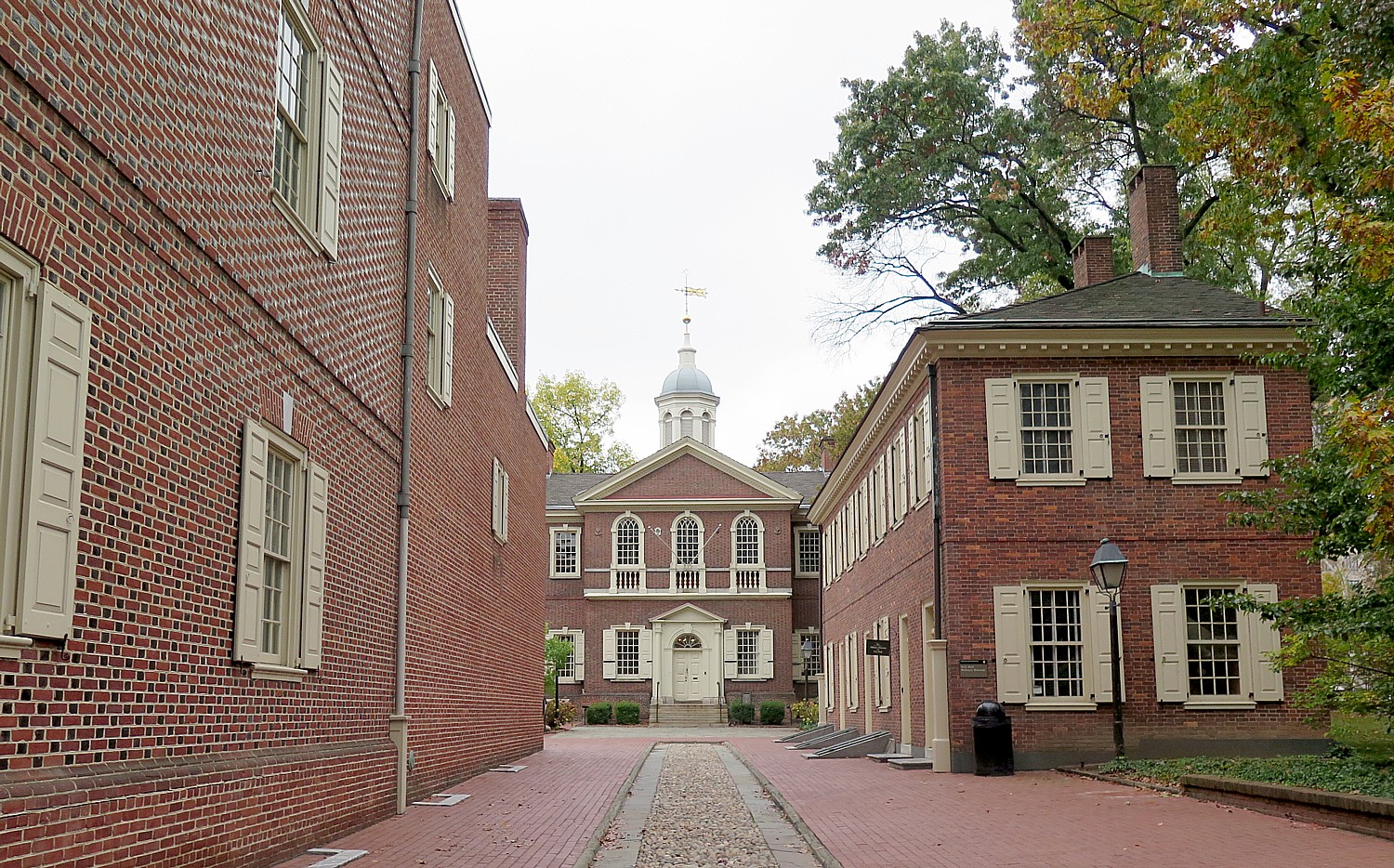
Carpenters’ Hall (320 Chestnut St., 215-925-0167), the site of the First Continental Congress, was once the home of Franklin’s Library Company and the American Philosophical Society (APS), two organizations he founded.
Christ Church (20 N. American St., 215-922-1695), where Franklin and his family attended services, and Christ Church Burial Ground.
Fireman’s Hall Museum, (147 N. 2nd St., 215-923-1438), commemorates the history of firefighting in an old firehouse
The Liberty Bell Center (6th & Market, 215-965-2305), home of the internationally known symbol of freedom (pick up timed tickets for Independence Hall at the Independence Visitor Center, or order them online at recreation.gov).
My immersion into Revolutionary War Americana in Philadelphia, which started with the National Museum of Jewish American History and Museum of American Revolution, continues at Betsy Ross House and the National Constitution Center.
Visit Philadelphia provides excellent trip planning tools, including hotel packages, itineraries, events listings: 30 S 17th Street, Philadelphia PA 19103, 215-599-0776, visitphilly.com.
I used the opening of the brand new Museum of the American Revolution as the theme for my three-day visit to Philadelphia – a really deep dive probe of the Revolutionary War era, a return to understanding the founding of the nation through, as it were, original documents, materials and artifacts, at a time when we need to be reminded. During this all-too-brief time, I also visited the National Museum of American Jewish History, the Benjamin Franklin Museum, Betsy Ross House and the National Constitution Center.
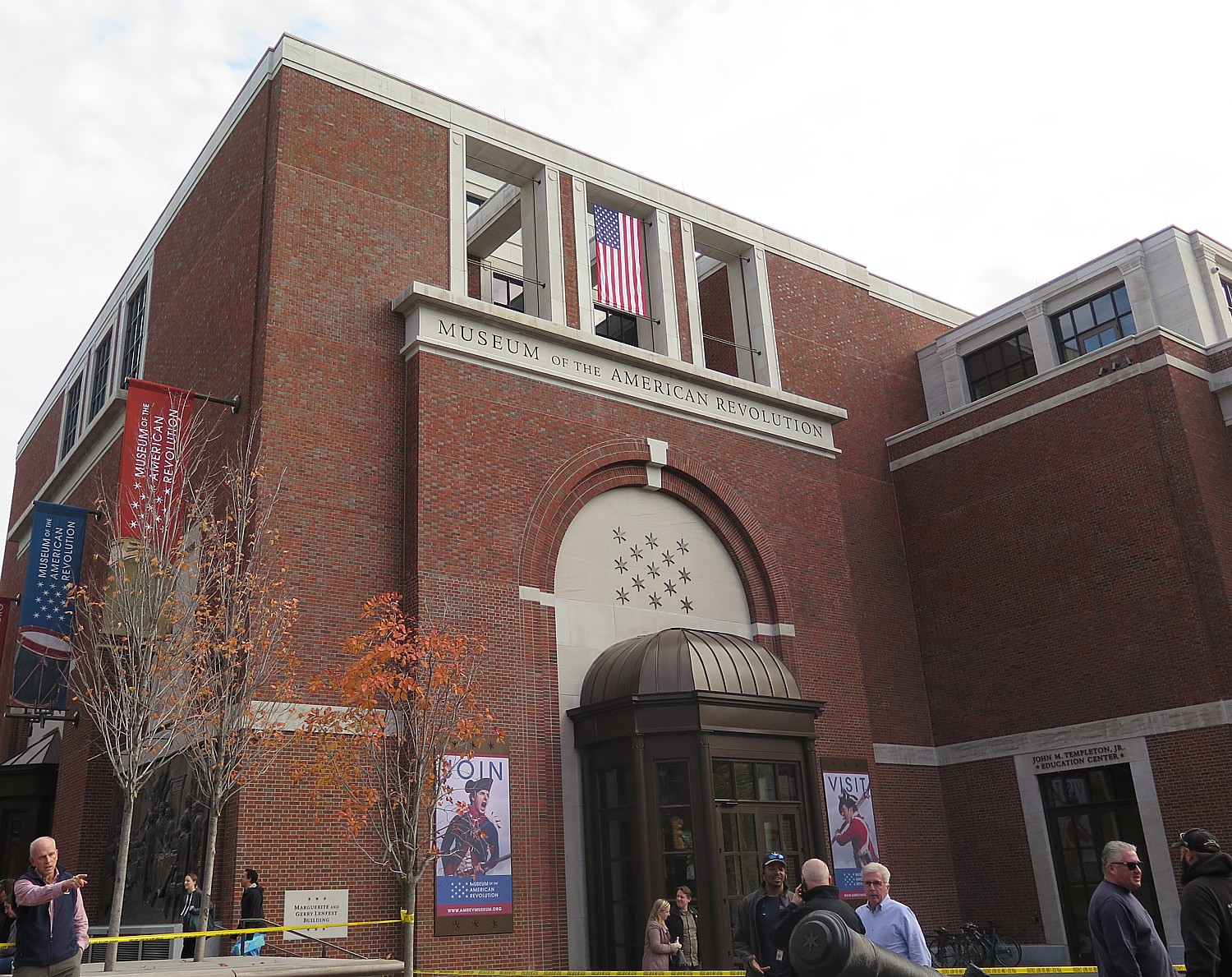
It’s 1770s Colonial America. Anger, resentment against the British Crown is brewing; an independent spirit is growing and spreading among the colonies. Would you have joined the American Revolution and taken arms along with other farmers, shopkeepers and merchants against the most powerful nation that history had ever known with not much more than a musket? The newly opened Museum of the American Revolution, located in the heart of Philadelphia’s most historic district, plunges visitors into the tumult and transformation of the Revolutionary era when colonials took upon themselves a new identity: Americans.
You are challenged to choose sides and it isn’t a simple matter. This was very much a civil war, with families, neighborhoods, villages and towns split in terms of which side they would support: Patriots or Loyalists. But it was a revolution in ways beyond taking arms against ruling institutions: it was every bit a revolution in ideas, in ideals, in the notion of self-governance and civil rights, a revolution the Museum would like you to realize that is still underway.
“We have it in our power to begin the world again,” Thomas Paine, an English immigrant wrote. “These are the times that try men’s souls,” he later wrote.
With thousands of Revolutionary-era artifacts at its core – the crown jewel of which is General George Washington’s actual wartime tent in which he lived on the battlefield with his troops throughout the war – the Museum uses immersive experiences, dynamic theaters, recreated historical moments, and interactive digital installations to make you feel you have time-traveled back to the 18th century, giving context and making the events, people, and ideas that created this nation more immediate and relevant.
A private nonprofit institution founded by Jerry Lendfest who put up $50 million and raised $100 million more from thousands of donors, the Museum of the American Revolution goes beyond the Founding Fathers and well known key figures to explore the personal stories of the diverse range of individuals who were part of establishing our nation, including women, native people, and free and enslaved people of African descent.
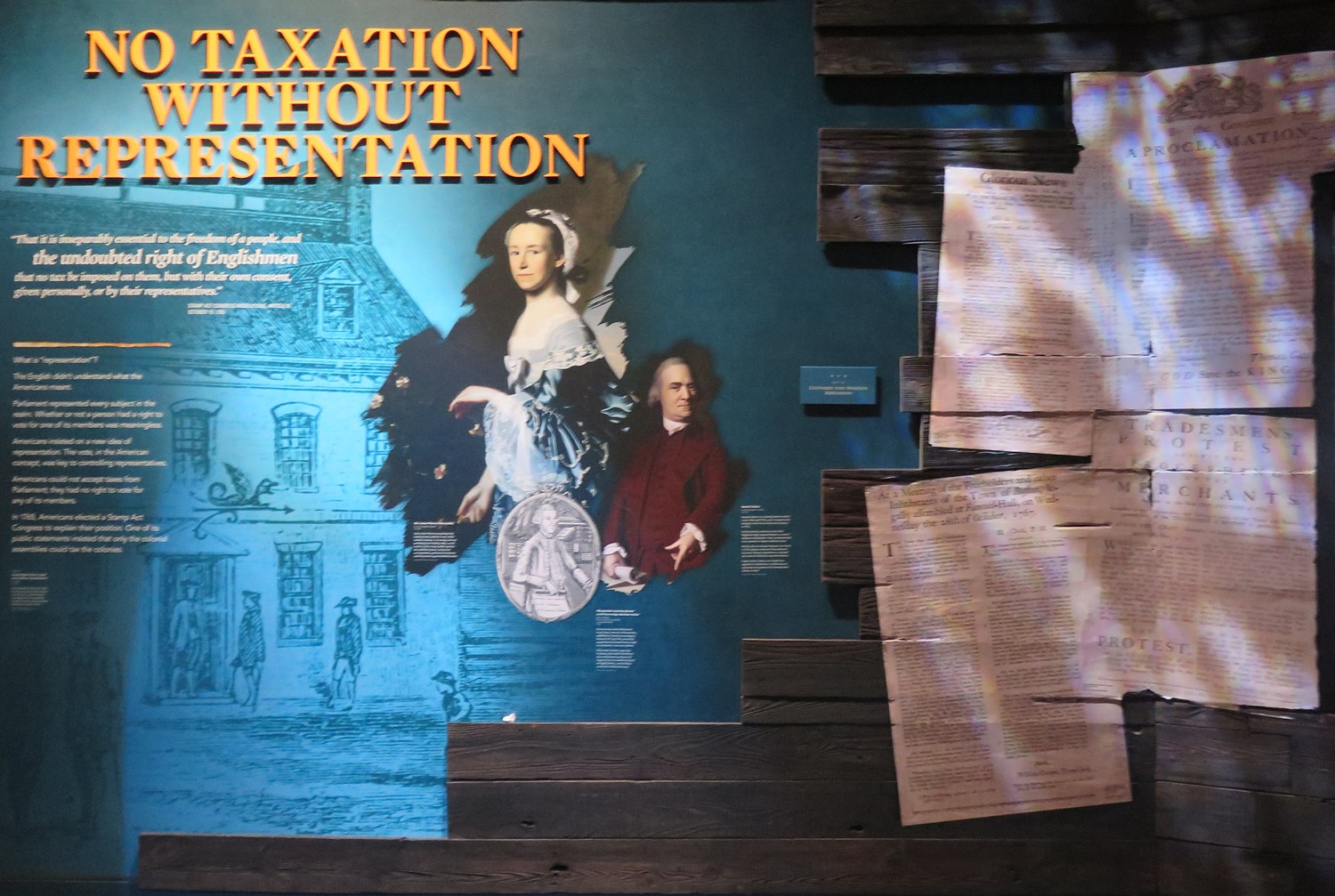
The experience brings you on a chronological journey from the roots of conflict in the 1760s through the creation of the American republic. Along the way, you learn about the rise of the armed resistance to British taxation, the creation of the Declaration of Independence, the long years of brutal warfare and how the Revolution continues to be relevant today.
The museum experience is a journey through time and place and builds to a climax: seeing General Washington’s War Tent, one of the most significant surviving artifacts of the Revolution. (I save this experience for last, and the presentation is so riveting, I sit through it twice.)
It’s not just the history of the war, battle by battle, with amazing detail and with skillful use of multi-media to enhance the dramatic retelling, but even more interestingly, how it overlays the human dimension. These aren’t just places and dates and round numbers, but individuals, some of them heroes whose names are so familiar, and many who were just ordinary people swept up in events. You are able to explore the personal stories of the diverse individuals. There is a wealth of information, but the presentation is so engaging, children of any age will be swept up in the drama.
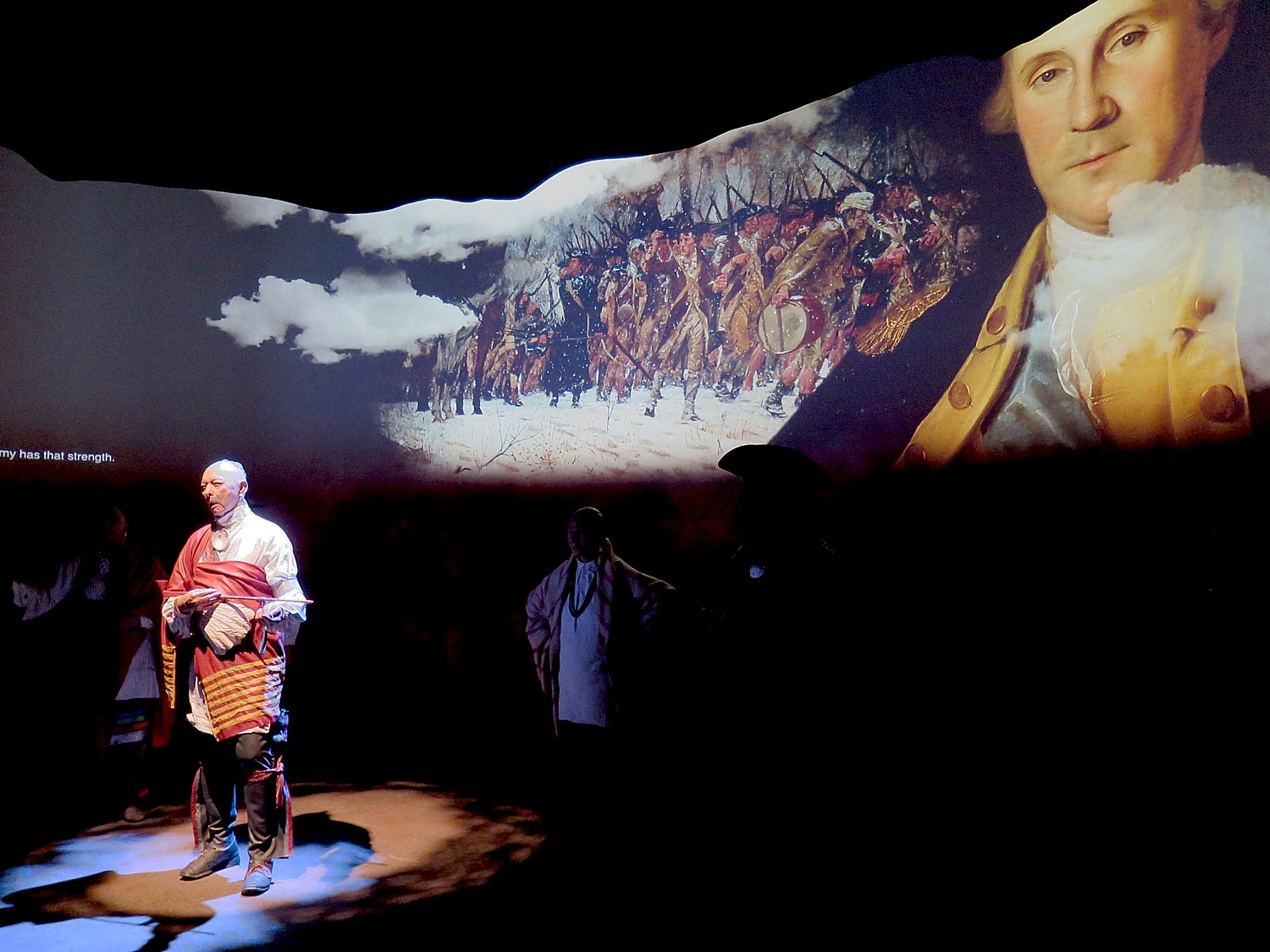
My favorite gallery is the one devoted to the Oneida Indian Nation, where there are life-size figures who you hear debating (as a video provides a visual context) whether to support the Revolutionary cause, the British or stay neutral. Indeed, the Revolutionary War split the Six Nations Confederation.
At the end of the excellent presentation, there are photos of Oneida who have served in the American military in every conflict since the Revolutionary War.
A section devoted to women introduces us to Deborah Sampson who dressed as a man to join the 4th Massachusetts Regiment and fought in New York’s Hudson Valley where she was wounded in the thigh with a musket ball and took the bullet out herself to avoid being found out by the surgeons (she was honorably discharged in 1783 and later published a memoir of her experiences.); and to Esther Reed who published an essay, “Sentiments of an American Woman.”
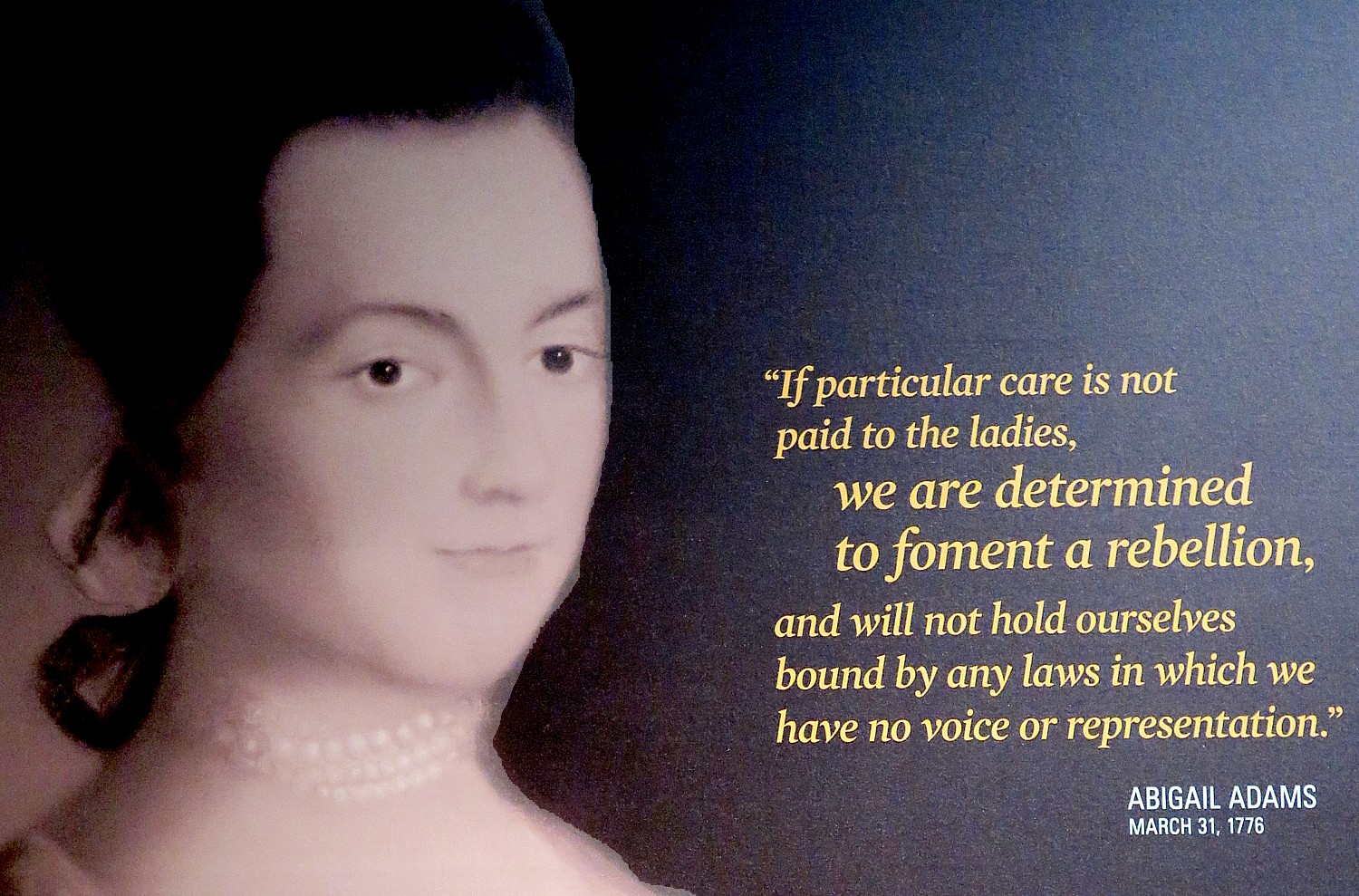
Abigail Adams, wife of John Adams, urged the writers of the Constitution to “remember the women,” and wrote her husband, John Adams, a Congressman at the time, in March 1776, “If particular care is not paid to the ladies, we are determined to foment a rebellion and will not hold ourselves bound by any laws in which we have no voice or representation.” The King’s abuses proved that men were tyrants, she wrote, and only the influence of women could secure reason and liberty. (That revolution clearly is still going on.)
A really interesting character I had never known about before was Baroness von Riedesel who followed her husband into battle and was taken prisoner in 1777 when General Burgoyne surrendered to General Gates at the Battle of Saratoga (a pivotal battle, which had the British won, would have enabled them to separate New York, the breadbasket for the American army, from the rest of the colonies; instead, the American victory enabled Ben Franklin to persuade France to give critical support to the Americans).
She is depicted as a hero: “In the final days of the siege, the Baroness guarded the lives of women, children and wounded men. She barricaded them in a basement as American cannonballs slammed the house. She cared for her own children and the most vulnerable members of the army for six days. For most of this time, the firing was so heavy that they could not leave, and the basement filled with excrement. But she probably saved dozens of lives.” She was taken prisoner along with her husband and nearly 5,000 British and Hessian troops who were moved frequently to prevent their escape or rescue and were not freed until the war ended in 1783.
(You can continue this immersion into women during the Revolutionary War era at the Betsy Ross House a few blocks away.)
The museum does a yeoman’s job of humanizing and personalizing war, revolution and nation-building. For example, we learn that “Hessians, portrayed [by propaganda, which was waged by both sides] as cruel and inhuman but were a lot like Americans: King George hired 20,000 German special troops who came from six European nations and most were poor farmers with families.”
In “Finding Freedom”, you can explore the different experiences of enslaved African Americans in Virginia in 1781 through a multi-kiosk touchscreen interactive based on the lives of five men and women who followed different paths to freedom during the Revolutionary War. The Museum worked with a historical illustrator who used diaries and letters to animate these stories.
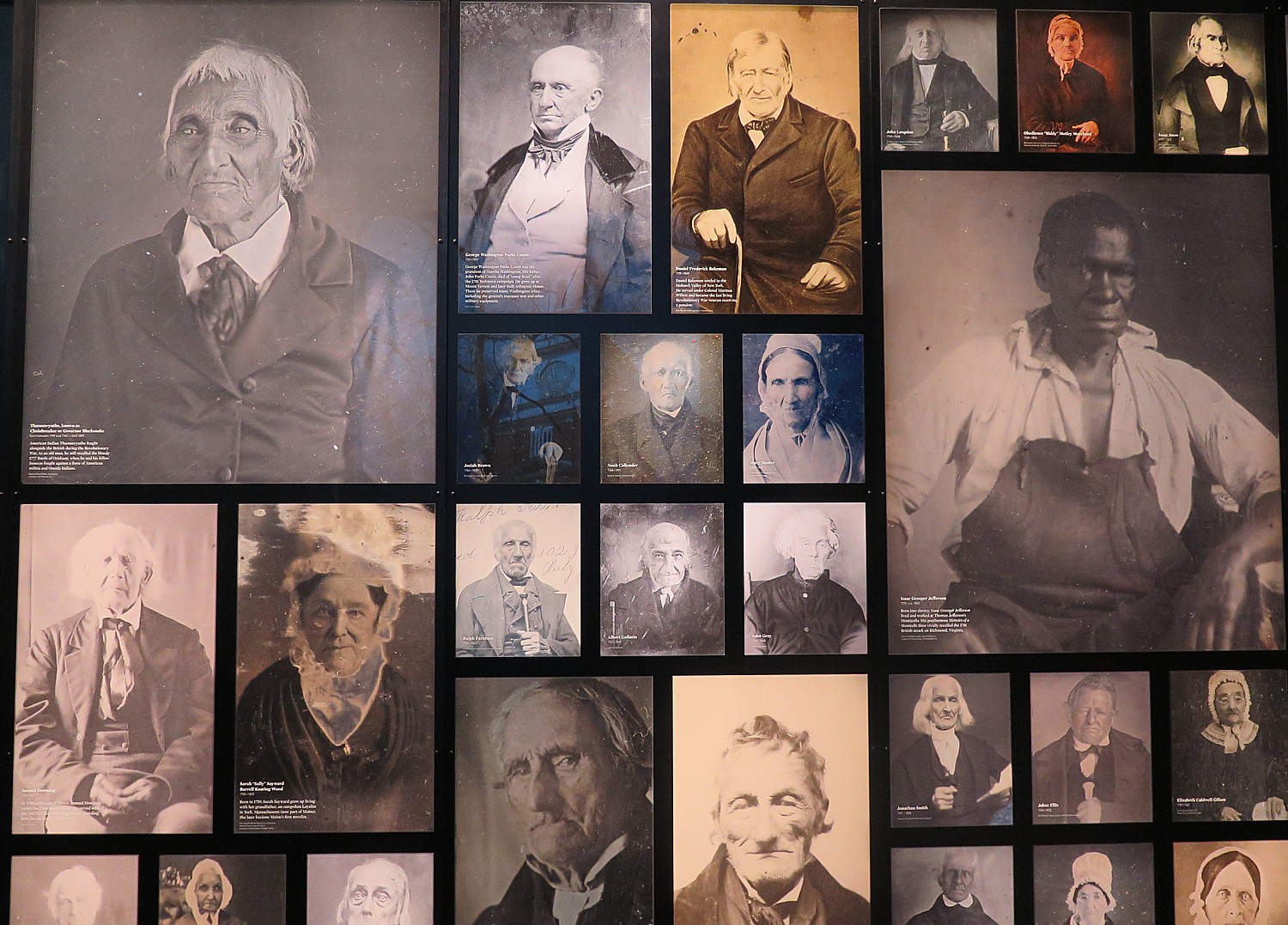
You have an extraordinary opportunity to look into the faces of the Revolutionary generation in a fascinating display of photographs of 70 people who lived through the American Revolution and survived into the age of photography.
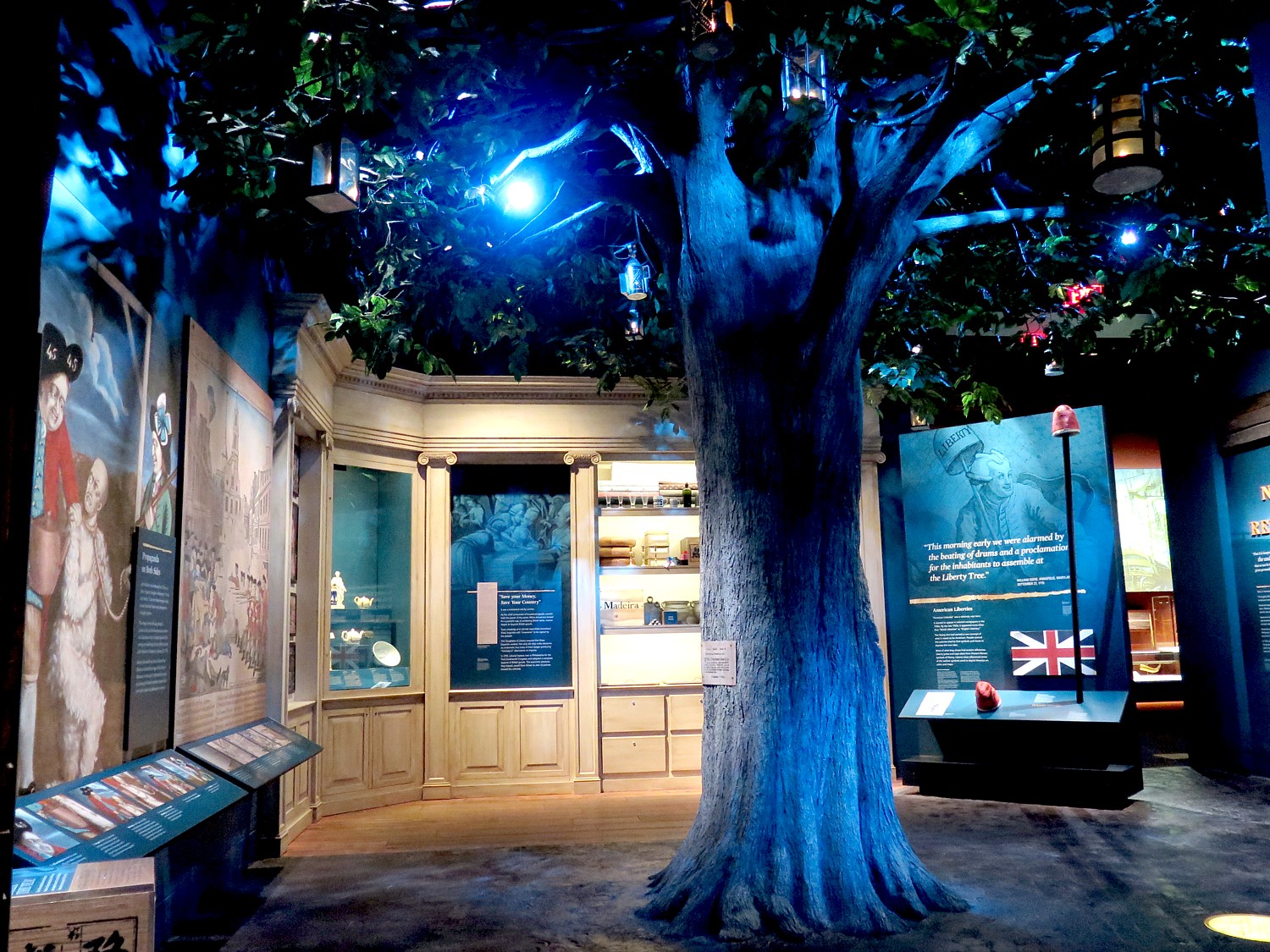
Throughout the museum, there are immersive, multi-media experiences that put you into the action: in the Battlefield Theater, you find yourself on the Continental Army’s front lines facing an attack by British soldiers (with appropriate sound effects, smoke and rumbling floor); you walk beneath the branches of a realistic, life-size replica of Boston’s Liberty Tree and can touch an embedded piece of the Annapolis Liberty Tree, a Tulip Poplar that sheltered Maryland colonists in 1775 which survived until 1999; you can climb aboard a large-scale replica of an 18th century privateer ship like the one on which 14-year-old free African American James Forten volunteered. In the Declaration of Independence Gallery, which evokes Independence Hall, you sit in your own Windsor chair to witness the unfolding debate and decision-making as delegates to the Continental Congress decide whether to declare American independence, then view authentic printings of the Declaration of Independence on display.
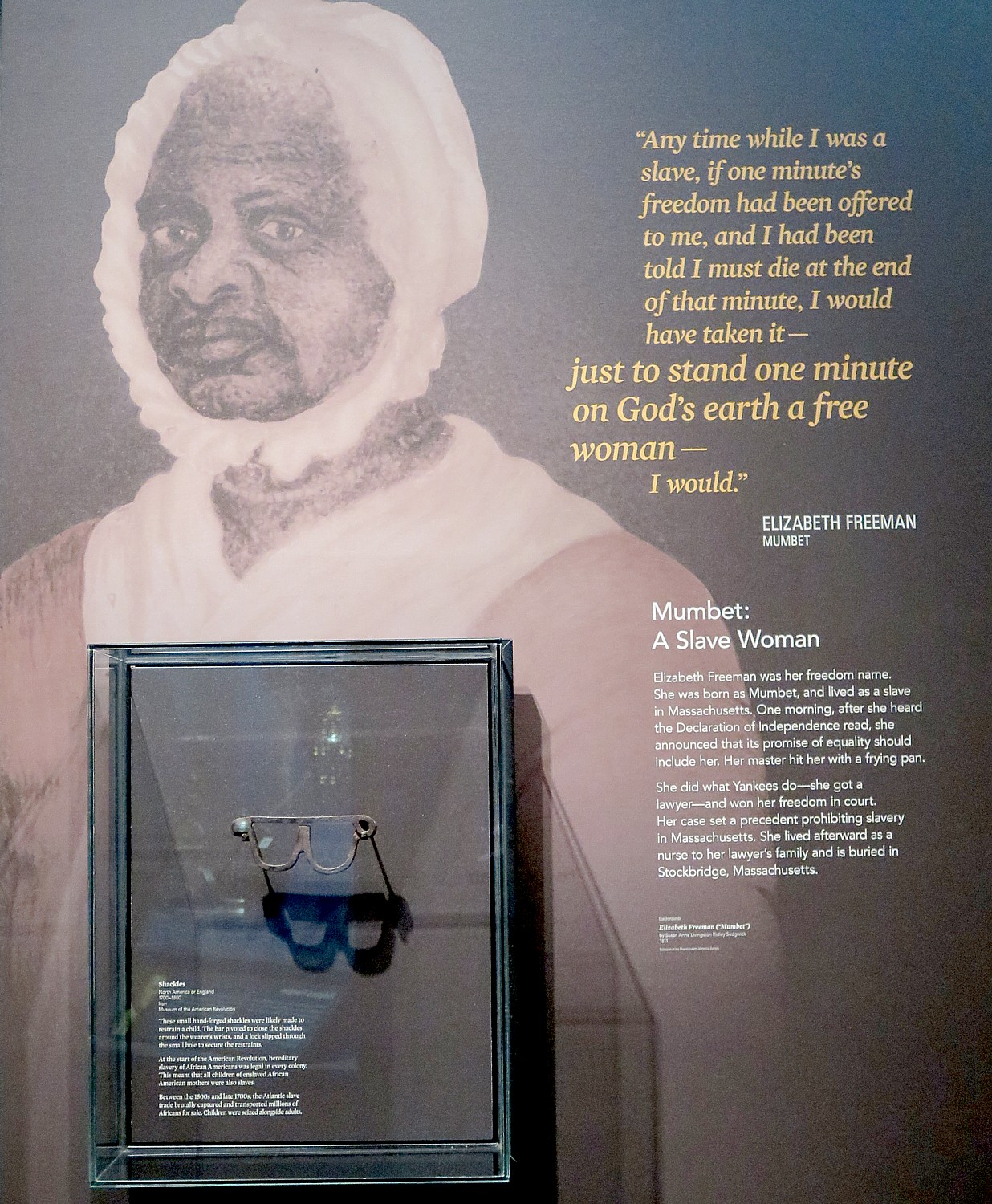
You get to thoroughly engage with the Museum’s rich collection of original historic artifacts. One of the premier collections of its kind, it includes several thousand objects from the Revolutionary period, and includes George Washington’s personal belongings, as well as an impressive assortment of weaponry, soldiers’ and civilians’ personal items, fine art, letters, diaries, and manuscripts. You can examine child-sized slave shackles, an intricately carved woman’s busk (corset piece), and a signed 1773 volume “Poems on Various Subjects” by Phillis Wheatley, America’s first published black female poet.
Arms of Independence: Nearly 50 Revolutionary War-era weapons and artifacts are on display and below them, a multi-kiosk touchscreen interactive enables you to virtually handle them and learn more about their uses, owners, and makers. Using the latest ultra-high definition photography, you get a 360-degree view of the glass-encased weapons and artifacts, most of which have never been displayed before.
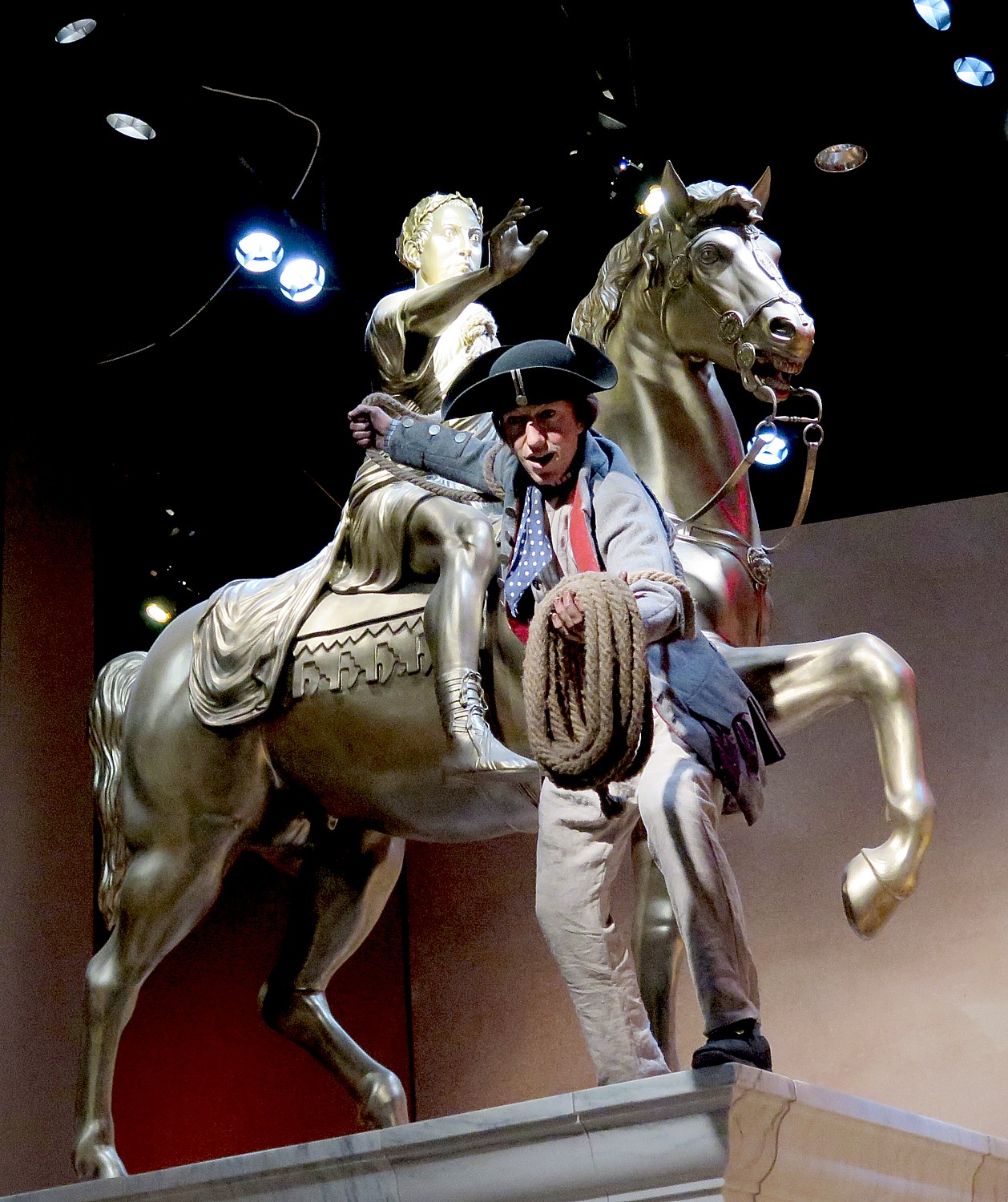
There are more than 20 re-created historical moments with life-like figures, tableaux intended to broaden our view of the people who were central to the Revolution. One of these scenes is a brawl among Revolutionary soldiers that George Washington broke up in Harvard Yard; another portrays the statue of King George III as it is about to be torn down by an angry mob in New York City; another features artist Charles Willson Peale reuniting with his brother James on the banks of the Delaware River in December 1776; there is a view of Independence Hall in disarray during the British occupation of Philadelphia; a pair of Loyalist cavalry troopers in the South; and a conversation between enslaved Virginians and a black Loyalist soldier in 1781.
There are opportunities to participate in the story which is why the exhibits are so engaging for children as well as adults. You can mix-and-match pieces of a soldier’s uniform to learn about how soldiers displayed their loyalties; learn about the common soldiers and their families who endured the harsh winter at Valley Forge with flip-doors that explore the complex workings of a war camp; assume George Washington’s role as President of the Constitutional Convention by sitting in a reproduction of the “Rising Sun” chair; and try hand at an early American stitching lesson through an interactive sampler station in a gallery on the role mothers played in educating children as citizens.
Costumed educators offer a deeper understanding of the lives and times of the Revolutionaries: at the Battlefield Theater, learn to muster before marching into battle; on the Privateer Ship, discover how to load and fire one of the ship’s cannons; at Discovery Carts, handle replica artifacts to learn more about how they were made and used.
All of this builds to the climatic experience: and the crown jewel of the Museum and the original artifact which led to the creation of the museum to begin with: General Washington’s War Tent.
You line up for the timed show in a dedicated theater built to house one of the most iconic surviving artifacts of the Revolution: General Washington’s War Tent, which served as both his office and his sleeping quarters through much of the war. It was within the folds of this tent that key decisions were made that changed the course of history.
I was expecting to walk into an exhibit of the tent. Instead, it is dramatically revealed after a powerful 12-minute video. The movie screen rises to reveal a gauzy sheet which rises to show the tent. With surround-sound track, theatrical lighting, video projection on a front scrim and screen, as well as on a scenic wall behind the tent you see the tent, in different times of day, months, seasons, years as if marching in time.
The presentation makes you really appreciate the meaning of the tent and why it is so iconic – it is a physical link to the man who was, as Henry Lee said, “First in war, first in peace, and first in the hearts of his countrymen.”
Indeed, the tent has its own dramatic story which lives on beyond Washington.
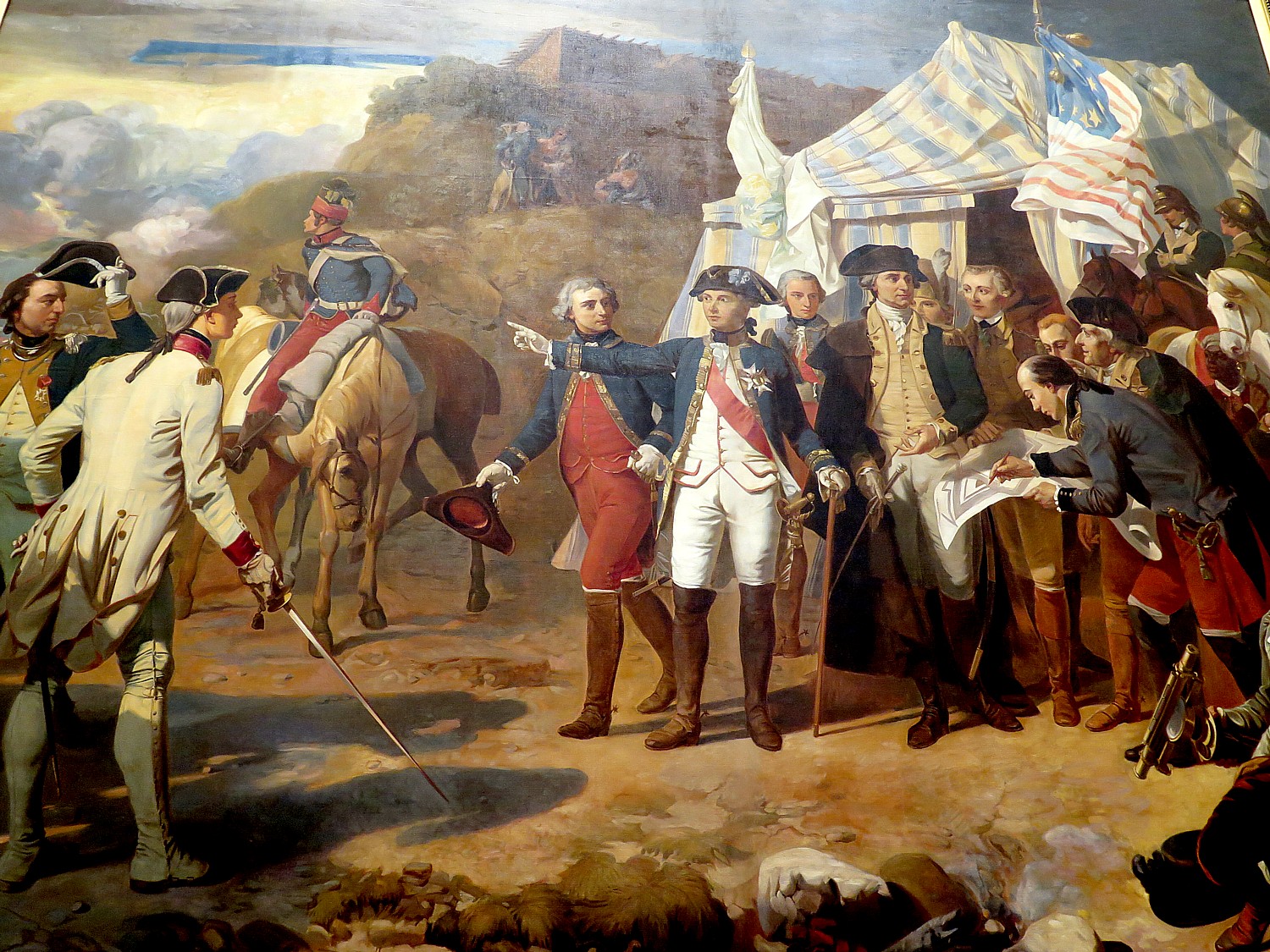
The tent was created for use as a mobile headquarters during the Revolutionary War. It was made in Reading, Pennsylvania, while Washington was encamped at Valley Forge in 1778. He used it until 1783, including throughout the 1781 Siege of Yorktown, the last major land battle of the war. Indeed, throughout the war, Washington spent only a few days back at his Mount Vernon plantation.
The tent covers an area about 23 feet long and 14 feet wide, comprising three small chambers – a central office, a half-circle sleeping chamber for the general, and a small area for luggage and for sleeping quarters for his enslaved African American valet, William Lee, who traveled with Washington through the war.
But the drama of the tent doesn’t end there. After the war, the tent was eventually acquired by Martha Washington’s grandson, George Washington Parke Custis, and was stored at his Virginia estate, Arlington House. It passed to Custis’ daughter Mary Anna, who was the wife of General Robert E. Lee (how ironic was that? – both a revolutionary like Washington, but in pursuit of destroying the nation that Washington won and lead), only to have it seized by federal troops at the start of the Civil War when they took over Lee’s plantation. The tent remained in federal possession for 40 years before it was returned to the Lee family. Mary Custis Lee put the tent up for sale to raise money for Confederate veterans.
In the early 1900s, an Episcopal minister, Rev. W. Herbert Burk, dreamed of creating a museum to tell the story of our nation’s founding. He began collecting historical artifacts, beginning with General George Washington’s War Tent. He raised the $5,000 to purchase the tent from hundreds of ordinary Americans. The acquisition began a century of collecting – a collection which eventually came under the ownership of the Museum of the American Revolution.
Textile conservator Virginia Whelan spent more than 500 hours restoring the priceless hand-stitched, linen tent. “Losses” – small holes which could fray – needed to be stabilized so that original material wasn’t lost. The process involved inserting an extremely fine needle and thread between the fibers of the tent’s weave and using virtually invisible netting to stabilize the holes. The conservation effort also entailed using digital inkjet printing to reproduce new fabric that matched the original material. The new fabric swatches were then used to repair holes, rips, and a large piece that had been cut away. For this, Whelan partnered with faculty from Philadelphia University’s textile design faculty.
One of the challenges of displaying the tent was to keep the drape-like effect of the fabric without putting tension on it. To design a system that would support the artifact without inducing stress in the delicate fabric, the Museum commissioned Keast & Hood, a structural engineering firm that is a nationally recognized leader in the preservation, restoration, and rehabilitation of historic structures.
To protect the centuries-old canvas from rope tension, Keast & Hood worked with a team of conservators, historians, and craftsmen to design an innovative umbrella-like aluminum structure and canvas sub-tent membrane, creates an illusion of the tent draping naturally. The ropes that originally tensioned the tent are now purely aesthetic and representative of the earlier form.
The tent is set behind glass in a 300-square foot climate-controlled object case.
The presentation is so powerful, I watched it twice and both times, the audience applauded at the end.
The museum does an excellent job of tackling complex ideas, the span of history, the intricacies of the battles, while also bringing in a human scale. There is so much to see and absorb, it is a really good idea to take advantage of the fact the ticket is valid for two consecutive days.
Located just steps away from Independence Hall, Carpenters’ Hall, and Franklin Court, the Museum, housed in an impressive three-story state-of-the-art building, serves as a portal to the region’s many Revolutionary sites, sparking interest, providing context, and encouraging exploration. The Museum is a private, non-profit, and non-partisan organization.
Guided Tours: While most visitor tours are self-guided, the Museum does offer several guided tours, including: Early Access Guided Tour, a 60-minute guided tour before the museum opens (Tues, Thurs, Sat at 9 a.m. $50 non-members; limited to 10 people). Guided Highlights Tour, a 60-minute guided tour of key artifacts and stories (daily at 10 a.m. and 4 p.m.; price of admission plus $12; limited to 15 people). Book online or at the museum.
General admission tickets to the Museum can be purchased here and are $19 for adults; $17 for seniors, students, and active or retired military; and $12 for children ages 6 and up. Children ages 5 and under are free. All tickets are valid for two consecutive days. Group tickets for parties of 15 or more are currently available for a discounted price by calling 267.858.3308. Memberships are also available for purchase here or by calling 215.454.2030.
My immersion into Revolutionary War Americana in Philadelphia continues with visits to the Betsy Ross House, the Benjamin Franklin Site, Thomas Jefferson’s Declaration House, the National Museum of American Jews, and the National Constitution Center.
Visit Philadelphia provides excellent trip planning tools, including hotel packages, itineraries, events listings: 30 S 17th Street, Philadelphia PA 19103, 215-599-0776, visitphilly.com.
I used the opening of the brand new Museum of the American Revolution as the theme for my three-day visit to Philadelphia – a really deep dive probe of the Revolutionary War era, a return to understanding the founding of the nation, through, original documents, materials and artifacts, at a time when we need to be reminded – everything from the off-hand comment by Trump Chief of Staff John Kelly that the Civil War could have been averted if only there were compromise (he should go to the National Constitution Center), to the quixotic amazement of a US Treasury official pining on his research into what’s this thing, “The American Dream,” before adopting the biggest redistribution of wealth since the Gilded Age, to the right-wing meme that America is a (white) “Christian Nation.”
Philadelphia is like hopping from time-capsule to time-capsule because you go from one authentic site where events happened, where the Founders and builders of this nation actually stood, to another. Come, time-travel with me. And the best way to appreciate it – and be wonderfully surprised at ever twist and turn– is to walk. That’s how you come upon things you never considered – the historic markers which point out where Wanamaker’s Department Store was, the Ricketts Circus, the American Philosophical Society (founded by Ben Franklin). I see an Art Deco “Automat” sign; the stunning Art Deco architecture of a building, gorgeous giant murals that pop up out of no where. I practically fall over what closer inspection tells me is the very townhouse whereThomas Jefferson stayed when he wrote the Declaration of Independence (called “Declaration House”), a short walk from Independence Hall.
This is why it is so terrific that my hotel, the Sonesta Downtown Philadelphia Rittenhouse Square is so well located (1800 Market St. Philadelphia 19103, 215-561-7500).
It’s the afternoon when I arrive at the Sonesta Hotel on Market Street (a parking garage is adjacent) and after checking in, I have just enough time to explore one attraction on my list.
I am headed to the Betsy Ross House, walking down Market Street, literally through Philadelphia’s magnificent City Hall. Walking, you get to see the markers which discuss the history of this site and how the city was planned out. You also can stand on a podium and have a photo taken of yourself as a monument.
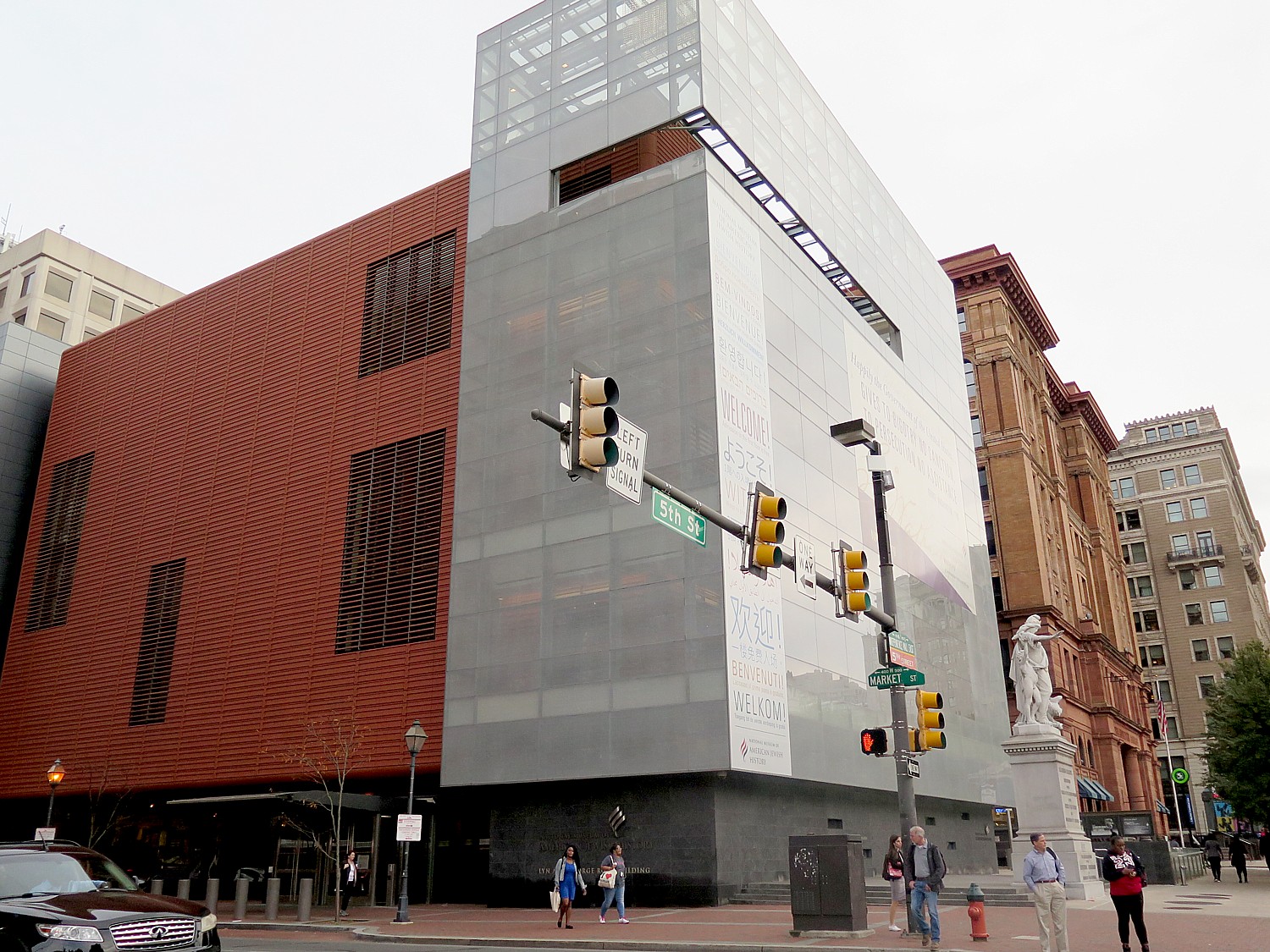
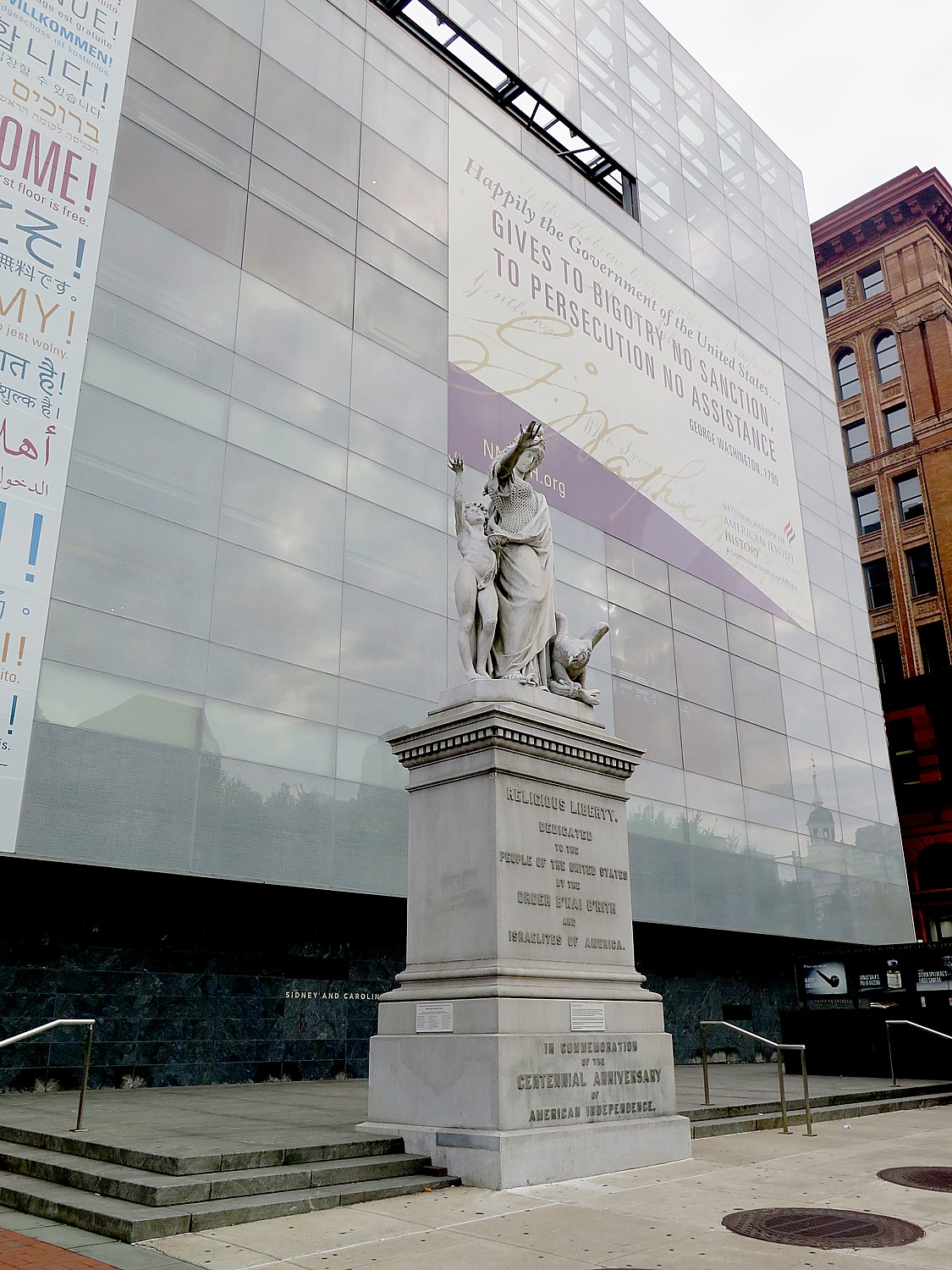
As I walk passed the lawn that is just opposite Independence Hall, I spot a huge banner proclaiming the George Washington’s famous words, “Happily the Government of the United States Gives to Bigotry no Sanction, to Persecution No Assistance,” and a statue, in commemoration of the nation’s centennial, “ dedicated to “Religious Liberty. Dedicated to the People of the United States by the Order B’nai B’Rith and Israelites of America.” Then I see a small banner advertising the National Museum of American Jewish History and realize I am standing in front of it. Who knew there was such a thing?
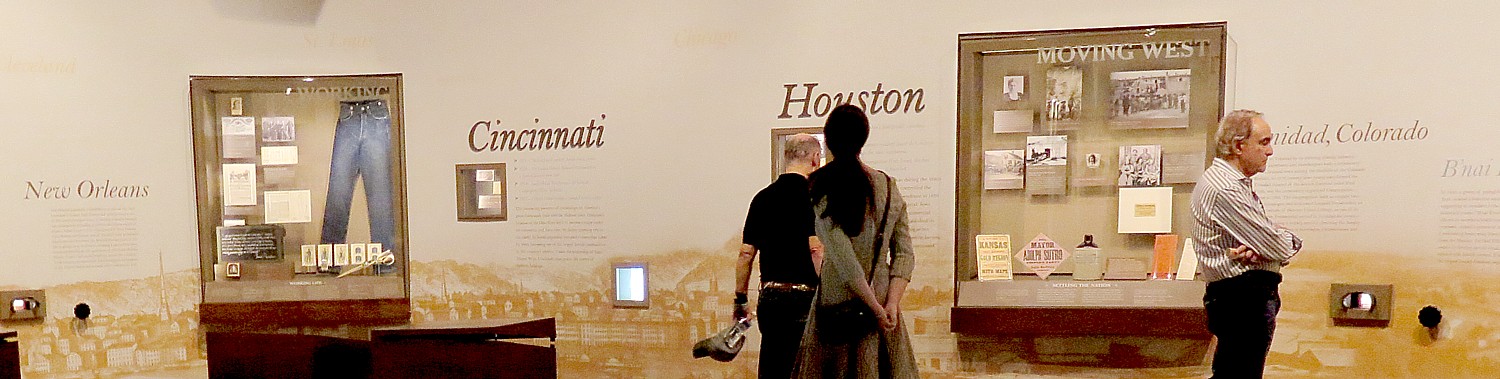
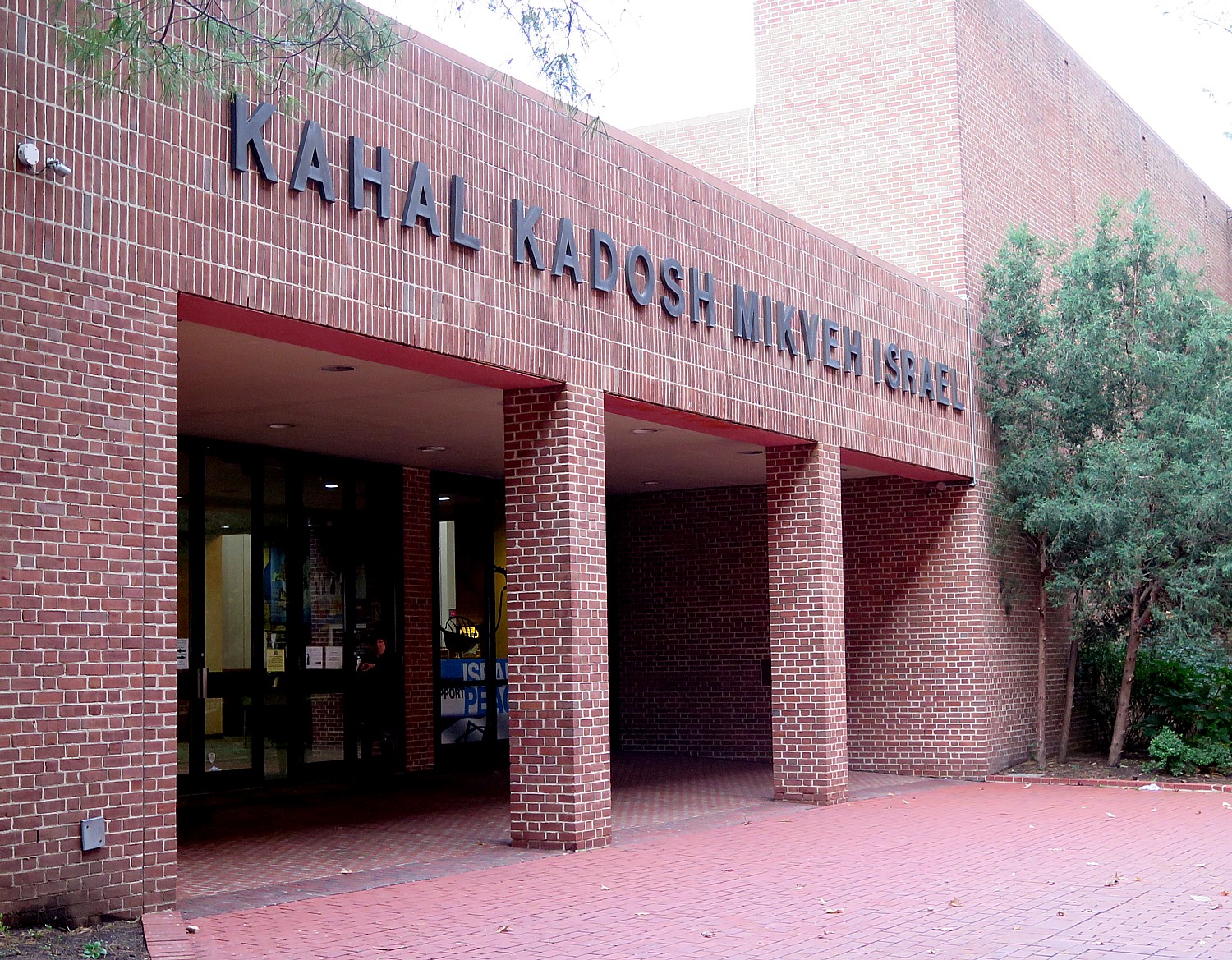
In point of fact, the museum has only been in this building in a prime location in the historic district since 2010; previously, the original collection which formed the basis of this grand museum was housed in Philadelphia’s oldest synagogue, Congregation Mikveh Israel, known as the “Synagogue of the American Revolution,” is the oldest formal congregation in Philadelphia, and the oldest continuously operating synagogue in the United States. It dates back to 1740 when Thomas Penn granted land to Nathan Levy for a burial plot for his son. The current incarnation of the synagogue, a modern building, is only about a block away from the Museum, tucked behind (appropriately enough), the Bible Society Building which is directly across the street from the National American Jewish History museum, and across the street, as it happens, from the National Constitution Center. It all fits together and is most appropriate for my visit to Philadelphia this weekend timed for a family Bat Mitzvah.
I have a little less than two hours before the museum closes, and you need a minimum of 2 ½ (good news: the ticket is good for a two-day visit).
The National Museum of American Jews was a revelation to me – beginning with why it is “National”: it is the only museum of its kind in the nation. That’s why.
I have seen parts of the story in other venues – notably Touro Synagogue in Newport, Rhode Island (www.tourosynagogue.org), the Holocaust Museum in St. Petersburg, Florida; Ellis Island and the Jewish Museum in New York City– but none presented such a comprehensive unfolding of the epic Jewish experience in America that dates back nearly as far as the Puritans in Plymouth (though Jews first settled in the New World since Columbus).
Its exhibits and galleries, the artifacts and commentary brilliantly presented to express complex concepts – the sweep of history, in effect – but taken down to very personal levels of a person, with a face, a name and a genealogy.
It comes down to legitimacy – much as the museums which speak to the Jewish people’s history in Israel – and the illegitimate notion of the United States founded as a Christian nation (See New York Times, Jan. 6, 2018: The Museum of the Bible Is a Safe Space for Christian Nationalists.)
Non-Christians were part of this country’s founding and the Founders, who were humanists, globalists and men of the Enlightenment – among them George Washington, Thomas Jefferson and Ben Franklin – were not only tolerant of other religions but open-minded about philosophies. But what is painfully clear are the strains of anti-Semitism and racism that have persisted throughout American history despite George Washington’s assurances to the Touro congregation (“To Bigotry No Sanction,”), despite the Bill of Rights and the Naturalization Act of 1790 which bar the establishment of religion, an issue as relevant as today’s headlines.
There are four floors which wrap around a huge atrium, each floor devoted to a different era and theme. The displays, including multi-media , interactive stations, and artifacts, are well presented to convey complex, even nuanced concepts, intertwining real people with places, historical events and cultural movements. In some instances, it is the sheer numbers that impress.
Foundations of Freedom: 1654 – 1880
I start on the top floor, “Foundations of Freedom: 1654-1880”. Do most Americans realize that Jews were already settled in the New World colonies from 1654? A giant map shows the trade routes that coincided with Jewish migration, especially after the Spanish Inquisition of 1492, which drove many into the Caribbean islands. (How many people realize that the first white settlement were of Marrano Jews in Jamaica?) Then, when the Spanish took over, a group fled Barbados where they had lived since the 1620s, to Newport, Rhode Island in 1658.
You gaze at a family tree of the first Jewish families, most of Portuguese background.
Asher Levy came to North America in 1654; look down his family tree and you come to Arthur Sulzburger (1881-1964), whose family publishes the New York Times.
By the 1600s, a small group of Jews settled around Charleston, SC; a 1669 constitution, written by John Locke, granted “Jews, heathens and other dissenters” the freedom to worship.
Throughout the displays, there is a kind of running count which puts into perspective Jews in America:
“European laws excluded Jews from most trades except finance and commerce, so they settled in port cities. In 1700, there were 250 Jews among the population of 250,000 white settlers in colonial America; zero synagogues. The population grew slowly, from a mere 250 out of a population of 250,000 to 2500 out of a population of 3.9 million by the end of the 1700s.
In Savannah in 1733, there were 42 Jews – the largest single Jewish group to arrive in colonies up to that time. Among them, was a Jewish doctor who arrived during an epidemic and began caring for ill and dying.
Jews arrived in Philadelphia in the 1730s; by 1760, there were close to 100 Jews.
We learn that Jewish Americans were split (like the colonists) over whether to side with the Patriots or the Loyalists in the American Revolution, based on livelihood, families and aspirations, but “most Jews stood for independence.”
New York’s Jews collaborated with British Loyalists; Jews who sided with Patriots escaped to Philadelphia.
The US Constitution made American Jews citizens in 1790, but some states had laws lasting well into the 19th century barring Jews from holding public office (despite the Bill of Rights’ first amendment which prohibits the establishment of religion).
“To bigotry no sanction, to persecution no assistance” George Washington wrote in 1790 to the congregation of the Touro Synagogue in Newport, founded by Portuguese Jews in 1763 who fled their settlements in the Caribbean when it appeared the Inquisition would be imported there from Spain and Portugal.
Of the 3.9 million population in the fledgling nation, 2,500 were Jews; 9 of 13 states required public officials to be Christian even though the 1790 Naturalization Act contained no religious requirement.
A theme that runs through is of what it means to perpetually be a minority in America.
Innovation & Expansion
A section themed “Innovation & Expansion” is part of the timeline of Jews in America usually ignored entirely, but Jews were very much a part of the Westward expansion and the march to the Industrial Revolution.
From 1820-1870, the United States doubled in physical size, the population quadrupled and the Industrial Revolution transformed society.
For Europeans, America beckoned as a land of opportunity; millions of immigrants crossed to be the laborers that built the factories, railroads, roads, including 200,000 Jews, attracted by promise of economic and political freedom.
The population of Jews during this period mushroomed, from 2500 to 250,000.
Here we see the photos and effects of families, personifying the experience.
There is a large map spread out on the floor where you can play a video that shows the expansion; and a whole room where you see, city by city, how Jews populated them, and particular highlights.
In New York City, in 1823, for example, the first Jewish periodical, “The Jew” began publishing. During the 1800s, New York City became a center of political, economic and cultural life of American Jews. By 1840, a majority of American Jews lived in the city; the population grew to 60,000 by 1860.
Baltimore saw its total population increase from 120,000 to 320,000 during the mid-1800s, with its Jewish population increasing from 100 to over 10,000 by mid-1860s.
Other cities: Cincinnati, where Hebrew Union College opened in 1875;
Trinidad Colorado was where the B’nai B’rith was founded in 1843, modeled after the Masons, Odd Fellows and other fraternal organizations.
With each display, there are specific people who are associated and here, we learn of the “Girl Rabbi of the Golden West: Pioneering female Jewish revivalist” (she gave up preaching when she married).
The Civil War was as traumatic for Jewish Americans as it was for the rest of the country.
Just as Jewish colonists were divided over the issue of joining the Revolution or remaining loyal, there were also splits over supporting Union or the Confederacy, largely based on where they were living and their livelihood. In the section themed, “Union & Disunion,” the Civil War era, it notes, “Jews never unified on issue of secession or slavery: 10,000 Jews fought in the Civil War: 7000 for Union, 3000 for Confederacy. Which side depended largely on where they lived as well as their livelihood.
3rd floor — Dreams of Freedom: 1880 – 1945
You can easily spend two hours just on the fourth floor alone, but I see how limited my time is and go down to the third floor: themed “Dreams of Freedom: 1880-1945”, chronicling the migration of millions of immigrants who came to the United States beginning in the late 19th century who profoundly reshaped the American Jewish community and the nation as a whole.
The first section of this floor considers immigration and integration: getting to America, making a home, the reception immigrant Jews received, and learning to negotiate American society. The second section takes up life after Congress legislated the end of free and open immigration in 1924. Through the lenses of the fine and performing arts, political activism, and religious expression, it explores how Jews defined what it meant to be an American Jew during an insecure period of American, and world, history. The final section of Dreams of Freedom delves into how American Jews experienced World War II.
It addresses the strain of anti-Semitism that has existed throughout American history, going back to colonial times – in Newport (when Lopez was refused American citizenship and had to get it in the Massachusetts colony), and New Amsterdam, when Peter Stuyvesant wanted to throw Jews out but the Hudson Bay Company insisted Jews be given rights, even despite George Washington’s pronouncement and the First Amendment to the Constitution.
So even though the Constitution provided for religious freedom, states denied Jews the right to hold political office; even after World War II, Jews were denied access to housing, hotels, country clubs, college and jobs.
And as the Roaring Twenties was followed by the Great Depression, a virulent strain of anti-Semitism re-emerged leading up to World War II, when many in Franklin Roosevelt’s cabinet and the majority of Americans content to let Hitler and Nazi Germany begin its murderous campaign against European Jews. “No War for Me” characterized mood of Americans not to lift a finger to help Jews during the Holocaust. (Breckinridge Long, assistant secretary of state, pushed for strict immigration controls that blocked Jewish refugees from escaping the Nazis.)
Choices and Challenges of Freedom: 1945 – Today
The Museum’s second floor begins in the immediate postwar period with stories of migration, from war torn Europe, the Middle East, the Caribbean, and the Soviet Union. Within the United States, as well, Likewise, between 1945 and 1965, there was a huge migration: about a third of all American Jews left large urban centers and established themselves in new suburban communities like Long Island. For Jews and non-Jews alike, a suburban home became a sign of success, prestige, and security-a “Shangri-La” for the middle class.
After World War II, American Jews felt comfortable with their identity and Jewish communities thrived in the new suburban communities of the 1950s into the 1960s – 60% of Jewish families belonged to synagogue, twice the percentage as 30 years before. Community synagogues were a locus for Jewish life and Bar and Bat Mitzvahs became legendary affairs; Jewish kids went to Jewish summer camps and families vacationed in the Borscht Belt of the Catskills. You walk through a mock-up of a 1950s suburban house, such as you might have found in Levittown, Long Island, where a black-and-white TV is airing an episode of a Jewish American sit-com, “The Goldbergs.”
Here you see how Jewish American culture went mainstream. The museum incorporates multi-media – videos, sound tracks – there is a small theater where you watch performances by Jewish entertainers going back to early films, theater and television (Fannie Brice, Marx Brothers, George Burns, Three Stooges, Eddie Cantor, Bud Abbott, Sophie Tucker, Al Jolson); a series of changing images of major figures like Simon & Garfunkle, Carole King.
American Jews felt comfortable enough in American society to emerge as activists who championed civil rights, women’s rights and social and political justice, including Gloria Steinem and Bela Abzug.
The first floor houses an Only in America Gallery/Hall of Fame honors 18 Jewish Americans – some well known, others less so, and the choices, challenges and opportunities they encountered on their path to remarkable achievement. Through the lives of real people—some well known, others less so—the gallery, utilizing a combination of multimedia, original artifacts and interactive experiences, weaves compelling stories from the past and present with the larger themes of the Museum.
The first 18 individuals featured in the Only in America Gallery/Hall of Fame are: Irving Berlin, Leonard Bernstein, Louis Brandeis, Albert Einstein, Mordecai Kaplan, Sandy Koufax, Esteé Lauder, Emma Lazarus, Isaac Leeser, Golda Meir, Jonas Salk, Menachem Mendel Schneerson, Rose Schneiderman, Isaac Bashevis Singer, Steven Spielberg, Barbra Streisand, Henrietta Szold, and Isaac Mayer Wise. Recent inductees include Gertrude B. Elion and Julius Rosenwald.
There are also special exhibits: the upcoming one is Leonard Bernstein: The Power of Music, which celebrates the centennial birthday of one of the 20th century’s most influential cultural figures, who personified classical music and produced a rich repertoire of original compositions for orchestra and the theater. “Audiences may be familiar with many of Bernstein’s works, notably West Side Story, but not necessarily how he grappled with his own religious, political, and sexual identity, or how he responded to the political and social crises of his day. Visitors will find an individual who expressed the restlessness, anxiety, fear, and hope of an American Jew living through World War II and the Holocaust, Vietnam, and turbulent social change – what Bernstein referred to as his ‘search for a solution to the 20th‐century crisis of faith’.” The exhibition will feature one‐of‐a‐kind historic artifacts, all brought to life through immersive film, sound installations, and interactive media. (On view March 16 – September 2, 2018.)
Free public hour-long Highlights tours are usually offered daily at 11:30 am and 2:30 pm. (Availability is subject to change, so check at the Admissions Desk on the day of your visit for confirmed times.) Space is limited; interested visitors should request tour badges from Admissions to reserve a spot, which are distributed on a first-come, first-served basis.
More than 30,000 artifacts form the basis of the core exhibition. You can browse selected objects on its site as well as search the Museum’s online collections database, and its Pinterest page.
You need at least 2 ½ hours but the ticket is good for two consecutive days.
National Museum of American Jewish History; 101 South Independence Mall East; Philadelphia, PA; 19106-2517; (215) 923-3811; www.nmajh.org
Mikveh Israel
I am chased out of the museum at closing (they are setting up for a wedding), and am intrigued to visit Mikveh Israel synagogue a short walk away. It is Friday evening and the synagogue, which is Sephardic, is getting ready for Sabbath services.
Mikveh Israel traces its beginning to 1740, when Thomas Penn granted land to Nathan Levy for a burial ground for Levy’s infant son. There, Levy established a cemetery for the Jewish community. Mikveh Israel’s first house of worship was completed in 1782 with financial assistance from Benjamin Franklin, among others. The synagogue has moved several times before returning to its original neighborhood in 1976, the Bicentennial.
Mikveh Israel follows the Spanish-Portuguese (Sephardic) ritual, introduced by Reverend Gershom Mendez Seixas, who, in 1780, came to serve as Hazzan (Congregational Leader). This relatively modern building, not far from its original 1782 redbrick structure on Cherry Street, is its fifth since the synagogue’s founding. (Limited hours to visit. 44 N. 4th St. Philadelphia PA 19106, 215-922-5446, www.mikvehisrael.org/.)
The Jewish cemetery on 8th and Spruce Streets, part of Independence National Historical Park, includes the grave of Rebecca Gratz, who is believed to be the inspiration for the character Rebecca in Sir Walter Scott’s “Ivanhoe,” and memorials to Haym Salomon, who helped finance the American Revolution.
Just outside Mikveh Israel, there is a monument of Uriah Phillip Levy, born in Philadelphia in 1792, a 5th generation American (his great-great grandfather, Dr. Samuel Nunez, arrived in America in 1733 and was a founder of the city of Savannah, Georgia). Levy left for sea when he was 10 years old, returning to Philadelphia for his Bar Mitzvah. He joined the US Navy in 1812, serving with distinction in the War of 1812. During his 50-year career in the Navy, he was court marshaled 6 times and killed a man in a duel – all related to anti-Semitism. He became the first Jewish Commodore of the United States Navy. During the Civil War, he helped repeal the practice of flogging sailors.
Levy was a great admirer of Thomas Jefferson and purchased Monticello in 1834 – at that point, Jefferson’s mansion home was in a terrible state of disrepair. Levy restored and renovated the structure, and opened it for public viewing. but local people were incensed that such a structure was owned by a Jew, they tried to have the property taken away. A World War II destroyer was named in his honor, the USS Levy, as well as the Jewish chapel at Norfolk Naval Base; he is buried at Beth Olam cemetery in Queens (Emma Lazarus is as well).
(Our exploration into Revolutionary War America continues with the Museum of the American Revolution, Ben Franklin Museum, Betsy Ross House and National Constitution Center.)
Visit Philadelphia provides excellent trip planning tools, including hotel packages, itineraries, events listings: 30 S 17th Street, Philadelphia PA 19103, 215-599-0776, visitphilly.com.
One of my favorite ways to bid adieu to the year and begin anew is the annual Concert for Peace at the magnificent Cathedral Church of St. John the Divine,. This is a signature New Year’s Eve event that was founded by Leonard Bernstein in 1984 with the idea of bringing together New Yorkers and visitors from around the world for an evening filled with uplifting music.
This year’s concert, the 33rd Annual Concert for Peace, honored the centennial of Leonard Bernstein’s birth with a performance of two selections from his MASS, Almighty Father and Simple Song, sung by Jamet Pittman, and the magnificent Cathedral Choir and the Cathedral Orchestra under the direction of Kent Tritle, Director of Cathedral Music.
A highlight was the U.S. premiere of “See the Wretched Strangers” by composer Lucas Wiegerink who came up for a bow. The text, written by Shakespeare, is an impassioned commentary on immigration and refugees. “Imagine that you see the wretched strangers./Their babies at their backs and their poor luggage,/Plodding to the ports and coasts for transportation,/And that you sit as kings in your desires…And this your mountainish inhumanity. Imagine.”
It was performed by Amit Farid, piano; Arthur Fiacco, violoncello; Jamet Pittman, soprano; Katie Geissinger, mezzo-soprano; Lee Steiner, tenor; and Enrico Lagasca, bass.
A series of choral songs about our shared Earth continued the theme that has been integral to these concerts of neighborly compassion, inspiring a renewal of hope for the coming year. “Earth teach me to remember kindness./As the dry fields weep with rain./Earth teach me.”
Jason Robert Brown, Tony Award-winning composer and lyricist, performed a new piece which he described as “disco go go girl power anthem” written for an 11-year old named Gabby, called “Invisible.” He was joined by Jesse Warren-Nager, soloist, Gary Sieger, on guitar; Randy Landau on bass; Gabe Violett and Jessica Vosk, back-up vocals.
He also performed, “Hope,” the title and the longing message of a piece he wrote the day after Election Day 2016, out of despair. “When life is crazy and impossible to bear-/It must be there./ Fear never wins./ That’s what I hope,/ See? I said “hope.” The work begins.”
That sense of despair emerged from Judy Collins, Artist in Residence at the Cathedral Church, who fought back that despair by urging “Resist. Resist. Resist. Keep resisting.” She led a mournful, “To Everything, There is a Season, Turn, Turn, Turn” and “Amazing Grace.”
The Right Reverend Clifton Daniel III, the Interim Dean of the Cathedral Church of St. John the Divine, urged, “Pray no one takes for granted out gifts of speech, though, art. Do not take for granted the gifts given by those who came before, or our responsibility to preserve those gifts for the next generation.”
Harry Smith, who has hosted these events for many years, contrasted the celebration of “great leaps forward, when we felt we were moving the earth and its people toward more egalitarianism,” versus other years when there was the backward movement of war and poverty. This year, he added to the list the national scourge of opioids, epic natural disasters, homelessness, refugees.” But a highlight was that women’s voices have been heard as never before, when men were held to account…” But, he said, “Workplaces may be safer, but not equal. But we made an important step forward this year.”
He added, “We fret, worry, obsess over every tweet and prevarication.” But then he described people he met in his travels who have taken matters into their own hands, who are taking action. “People of varying politics and persuasions determined to make lives better. The antidote… is action.”
The evening always concludes with an inspirational lighting of candles – it starts from the back of the enormous hall, and the firelight comes forward until the entire cavernous space glows in the warmth and light.
The Cathedral itself is a marvel. Originally designed in 1888, with construction beginning in 1892, the cathedral has undergone radical stylistic changes and the interruption of the two World Wars. It started out in Byzantine Revival-Romanesque Revival style, but the plan was changed to Gothic Revival in 1909. A major fire on December 18, 2001 caused the cathedral to be closed for repairs until 2008. It remains unfinished with construction and restoration a continuing process – which inside, only adds to the mystique of the place. It boasts being the largest Gothic cathedral, and may be the world’s largest Anglican cathedral and church; it is also the fourth largest Christian church in the world.
The cathedral houses one of the nation’s premier textile conservation laboratories to conserve the cathedral’s textiles, including the Barberini tapestries. The laboratory also conserves tapestries, needlepoint, upholstery, costumes, and other textiles for clients.
There are concerts by the Cathedral Choir and other artists and events throughout the year. Check the website for details.
There are subtle things. Little surprises. Like shortly after our arrival at the Mountain Top Inn & Resort, I peek outside to see the horse-drawn sleigh gliding across the field. It is a signature experience at the inn, a class Vermont scene, but when you see it, you are overwhelmed.
It’s a place that organically brings people together. The low ceilings, the cozy sitting areas (I estimate probably one for each family grouping can be found), fire places, the fire pit with a supply of s’mores.
Even getting there along the narrow winding Vermont country roads to Chittenden, brings you through a Currier & Ives landscape.
Mountain Top Inn & Resort has all the charm, the warmth, the cozy, intimate hospitality of a country inn, and all the luxury, amenities, activities and quality dining of a resort. It is both small and big in the ways you want.
It’s the sort of place that you instantly feel at home, exquisitely at peace. You don’t want to leave. Even the memory of having been there, fills you with longing to return.
The setting is breathtaking – 350 acres surrounded by open fields, a 740-acre lake and mountains beyond, and the Green Mountain National Forest. Indeed, Mountain Top’s name comes from the fact that at nearly 1,800 ft in altitude, the inn may well be the highest non-alpine resort in Vermont.
It is no wonder Mountain Top is so popular for weddings (elopements too!) – it exudes romance (two weddings were scheduled during the holidays). But any family gathering is special here.
I take note of the many, many cozy sitting areas – almost as many as there might have been families staying. The low ceilings and soft lighting, the fire in the fireplace, much more of a living room than a lobby, more of a den than a lounge.
We are here at the holidays and the inn has decorated Christmas trees and lights, fires going in the fireplaces; there is hot coffee, tea and hot chocolate set up in the afternoon.
Mountain Top Inn offers 32 rooms in the main lodge (classic, luxury and luxury suite), four king-bedroom cabins and more than 20 guest houses, each individually decorated, affording stunning views of the Vermont Countryside.
Our Lago Vista Suite is breathtaking – a kind of Colonial Spanish feel with a gas-operated double-sided fireplace separating the sleeping area from a living room area with plush easy chairs, a flat-screen TV, kitchenette. A stunning bathroom done with decorative terra cotta tile. All incredibly warm, like a big blanket enveloping you. And the view! Windows all across the wall out to the open field and the reservoir and mountains beyond. The bedding is so plush, it is a struggle to get out of bed in the morning.
Other suites are notable: The High Meadow Suite, popular as a bridal suite, has 8 windows with views to the lake and mountains, a luxurious bathroom, double-sided fireplace visible from the living room and bedroom, a large kitchenette.
Of these, Ike’s View, on the southern corner of the second floor, is particularly noteworthy. Rich in history, it is named for President Dwight Eisenhower who stayed at the inn during a fly fishing expedition in 1955. Ike’s View can be combined with the adjoining suite, Mamie’s Retreat, to create an expansive two-bedroom/two bath wing with living room, kitchenette and fireplace. Presidential, indeed.
During the holidays, the guests are provided their own s’mores kit (and each evening, a tray of s’mores fixings are left by the fire pit).
The resort also features four newly built luxuriously appointed cabins, which are open-plan, king accommodation living space -inviting and cozy, a perfect mountain retreat for two. Each with its own unique design, and within easy access to all resort amenities. The cabins are located across a quiet country road from the Main Lodge and adjacent Event Barn.
Accommodations also include hearty Vermont buffet breakfast – complete with eggs, bacon, sausage, yogurts and cereals, breads and pastries, fresh juices and coffee.
The Main Lodge rooms and suites are not pet-friendly, but some of the inn’s luxury cabins and guest houses are (and some of the snowshoeing trails also are pet-friendly).
Dining Inn
The inn on this winter day we arrive after a five-hour drive is fairly isolated and we are content to enjoy dinner in its traditional mountain lodge atmosphere. We opt to dine in the nicely appointed Tavern at a table right in front of the fireplace (there is also a dining room, and you can order from either menu). In warmer seasons, you can also dine on the outdoor terrace. In or out, you still have gorgeous views of the mountains, lake and meadow.
The menu and preparations are superb – artfully crafted selections featuring locally sourced ingredients wherever possible. The tavern has an extensive selection of locally crafted Vermont brews on tap. (Reservations are recommended, especially during the holidays, 802-483-2311).
The inn also can prepare picnic lunches – which would be really a good idea for a day cross-country skiing or snowshoeing or hiking.
The Baked Brie, featuring 12 Blythedale Farms Brie in a puff pastry, orange marmalade, blackberry jam, and grilled baguette, was out of this world.
The truffle fries, prepared with Parmesan cheese and truffle aioli was superb.
The Grilled Caesar was prepared with grilled Romaine hearts, capers, croutons, Parmigiano-Reggiano, roasted garlic and house-made Caesar dressing.
The French Onion soup, with Spanish onion, red onion shallots, croutons and baked Swiss cheese, was perfect.
We also enjoyed perfectly prepared burger and short ribs.
The restaurant did a fantastic job of accommodating our gluten free requests and promptly provided delicious gluten free rolls for both dinner and breakfast. The restaurant will also accommodate special dietary needs, including vegetarian, with advance notice.
The dining room serves breakfast and dinner; a children’s menu is available.
During the holidays, there is live music playing.
Staying in one of the guest houses? Special arrangements can be made for one of the chefs to prepare a private dinner in the home. (Advance notice required, pricing based on items chosen.)
So Much to Do!
Inn guests have access to daily afternoon refreshments in the Main Lodge lobby, use of the hot tub, sauna and fitness room, free WiFi, as well as access to seasonal activities. In winter, these include a access to the inn’s 60 km cross-country ski trail network (rentals, lessons available), snowshoe trails, ice skating rink (a small, cleared area on the meadow that is flooded; skate rentals available, $10). Warm weather activities include heated outdoor pool, tennis court, lake-front beach where there are kayks, canoes, paddleboards for guests, disc golf.
We get to enjoy the hot tub on evening – you can see the stars from the outdoor hot tub. When the mist would dissipate, it would open up to a view if the sky. It’s a 15-second walk from the hotel Tavern (wear shoes). It takes a minute to adjust to the temperature of the hot tub (very hot! then it’s perfect). You can call ahead and request that they fire up the tub for you.
With 350 private acres perched at the top of a quiet mountain road, a 740 acre lake, miles of trails, expansive meadows, the Green Mountain National Forest and a full host of activities, there is no shortage of things to do right at the resort.
Nordic Skiing at Mountain Top has been a favorite past-time since 1964, with 60 km of trails plus the meadows, offering varied terrain and sweeping views. Through over 50 years of continuous operation, Olympic Athletes, Vermonters and XC Skiers from all over the country have come to Mountain Top. You can get Nordic ski lesson; learn to ski package; rent equipment. Trails are open 8 am to 4 pm.
Snowshoeing: Whether you’ve been doing it for years, or this is your first try, snowshoeing (one of the easiest new sports to acquire, you just walk) is a wonderful way to explore the woods and meadows and get that cardio going! The team at the Activities Center will provide a trail map and the inn’s chefs can pack you a lunch. There are pet-friendly trails. There are twilight group snowshoeing tours (lamps provided).
Horse drawn sleigh rides, the quintessential Vermont thing to do, are offered mid-December through March (weather permitting); reservations are required for the 30-minute tours; private rides and packages are available (maximum 9 adults & children per ride; $40 adult/ $20/child call 802-483-6089). A Sleigh Ride & Dinner Package (includes sleigh ride, 3-course dinner for two & taxes , can be scheduled ( $150, gratuity & alcohol not included).
Snowmobiling: Hit the VAST trails or tour Mountain Top’s property. You can take a guided 30 minute Snowmobile Tour through the meadows and along some of the trails at the Mountain Top Resort, or stop by for a bite to eat (or overnight stay) as you journey along the VAST Trail System –the Inn is located right on the trail ($60 pp as a driver; $15 as passenger for 30 minutes).
Spa & Salon: Mountain Top’s spa is located on the ground level of The Mountain Top Barn adjacent to the pool and hot tub. With features such as barn board wall paneling, hammered copper pedicure basins, a spacious cedar sauna, custom soapstone sinks, rich leather and wood furniture and views to the mountains and lake – the spa & salon is a perfect example of ‘rustic luxe’ design in a wholly relaxing space. The Spa offers several signature treatments; services include a wide variety of massages, scrubs and wraps, facials, manicures, pedicures and professional hair and make-up for wedding parties. The spa & salon operates seasonal hours – please contact us for a current schedule (Available for special events upon request). (For reservations, call 802.483.2311 ext 404 or spa@Mountain Topinn.com).
The fitness center is equipped with state-of-the-art treadmills, elliptical machines, stationary bicycles and a cable weight system and take a dip in the hot tub, or relax in our sauna, after your workout. (Guests under 18 yrs must be accompanied by an adult; open 7:30am – 9pm).
Activities available for guests at no charge include tennis (you can borrow a racket; the court is available on first-come, first-serve basis); Disc Golf on the inn’snewly designed 9-hole disc golf course which takes advantage of the open meadow space, adjacent woods, spectacular views and finishes just a few steps from the Mountain Top Tavern and terrace (discs can be borrowed from the front desk, and discs and greens fees are included in your stay); heated outdoor swimming pool open (weather permitting) from June into September; the pool-side hot tub is open year-round; 40 miles of hiking trails; sand volleyball.
Private Beach: Less than ¾ mile walk down a private lane from the main lodge, Mountain Top’s exclusive beach is situated on a quiet cove within a 740 acre lake. Available spring through late fall, you can enjoy boating, swim or simply relax on lounge chairs. Kayaks, canoes and paddleboards are available (no charge for guests; lifejackets provided). A beach towel is available from the front desk. You can arrange to take a picnic lunch. (Available spring through late fall.
Guided hour-long pontoon boat rides touring the entire lake are offered daily (weather permitting, through October; reservations are required).
Also available:
Equestrian Center: Mountain Top Inn is the only Vermont resort, and one of only a handful of properties in New England, to offer a full equestrian program, accommodating neophytes and experienced riders. The Equestrian Center is open May through October.
Children’s Adventure Camp is open July through August 14, for children 6-13 years old; the program is offered 9:30 to 3 pm weekdays (minimum 3 children). (802-483-6089).
Fishing: Go fishing for Largemouth Bass, Smallmouth Bass, Walleye, Yellow Perch and Sunfish on the 740 acre lake: you can rent a small fishing boat with electric trolling motor, seating up to four people.
Clay Bird Shooting: Lessons are offered daily by our experienced staff from spring through fall (weather permitting). For safety reasons, we have a maximum allotment of six people per time slot. The minimum age to participate is 15 years old and reservations are required. ($40 per person for 20 shots with instruction).
Golf: Mountain Top Inn & Resort, has several challenging yet fun courses near-by (including Rutland Country Club, Green Mountain National Golf Course, Killington Golf Course and Neshobe Golf Club – all of which are accessible to the public).
Destination Weddings, Elopements, Retreats
For all the reasons – the setting, ambiance, facilities and activities, it is easy to see why Mountain Top is a favorite wedding destination.
Mountain Top Inn can accommodate up to 250 guests in the events Barn and the majority do tend to stay on property –it makes for less travel for guests and everything being pretty much within walking distance and gives family and friends that much more opportunity to be together and share experiences.
The inn also has more intimate spaces on property such as the beach pavilion for rehearsal dinners and events of fewer than 100 guests (where the barn can feel a bit large) and for even more intimate events (an elopement, or corporate dinner) the larger guest houses are ideal.
The houses make for a great option for the weddings because family groups can stay together in one house and have common living space to share amongst themselves. As well as bridal parties or just groups of friends who want to stay together and not have to head back to separate accommodations at night. They can hang out in their pj’s! (With the spa, the inn is also ideal for bachelorette getaways.)
The popular wedding ceremony site in the spring, summer, fall is the knoll up above the lodge (an amazing view). And in winter it’s the terrace outside the tavern (with a similar, but not as high altitude) view. For both, the ‘weather’ ceremony location is the loft in the barn which has lovely floor to ceiling windows that still provide that view. In the warmer months, weddings are also held at the houses and on the beach.
Overcome with the romantic ambiance and want to elope?
The Mountain Top Inn & Resort is the ideal setting for an elopement or intimate wedding. The inn has a dedicated staff of wedding coordinators. And because some elopements are planned with limited lead-time, or are truly a surprise, the inn has a special package which includes many of the elements the couple will need, or can be customized.
The Mountain Top Elopement Package includes two nights lodging; three course candlelit dinner for two; full breakfast each morning; scenic pontoon boat ride (summer) or horse-drawn sleigh ride (winter); one hour massage for both; Champagne and Truffles; bouquet and boutonniere; petite wedding cake ($1550 in classic lodge room; $1775 in luxury lodge room; $1975 for a suite; $200 more for peak dates and holidays).
The Inn is also ideal for corporate retreats, functions and events – having a place that brings people together in a close setting, plus has many activities to engage, dining and meeting venues. Mid-week November through April is when availability is the best. Various venues are used for meeting space including the yoga studio, the barn loft, the beach pavilion (in summer), living areas in larger guest houses for smaller meetings. The barn can seat upwards of 250 for larger conferences and functions.
Hometown Connection: A Distinguished History
The Mountain Top Inn has a marvelous history, and as it turns out, a connection to our Long Island home town.
As we were driving up the country lanes that lead to the Mountain Top Inn, I spotted a library named for Frederic Duclos Barstow, and recognized the name from our Great Neck, Long Island community: he was the son of William S. Barstow (1866-1942) and Frangoise Duclos Barslow (1876-1958) – he was the first mayor of Kings Point and his mansion is now the Merchant Marine Museum on the grounds of the US Merchant Marine Academy. Barstow, who was an important electrical engineer and a partner of Thomas Edison, made a fortune establishing utility companies (including the one in Chittenden) and even electrifying the Brooklyn Bridge. Their only child, Frederic Duclos Barstow, born in 1895, was exposed to poison gas during War War I, and suffered lung damage and from shell shock. He moved to Chittenden, Vermont, believing the clean air would be more healthful to him, but died in 1931, at the age of 35. The Barstows built the Barstow Memorial School in his memory.
William Barstow purchased a farmhouse in Chittenden on his son’s property to serve as a hunting camp (what is now Fox Creek Inn on Dam Road). Here he entertained such notable figures as Thomas Edison, Henry Ford and Harvey Firestone.
In 1939, Francoise Barstow bought the Henry Long Turnip farm, dating from the 1870s, which overlooked the Chittenden Reservoir, renovating the barn as an additional place to entertain her many friends – this is the property that became Mountain Top Inn.
Throughout the ensuing years, improvements and additions to the original barn building were made to accommodate the growing number of visiting friends and family – eventually evolving into a full service Inn & Tavern. While Barstow, an associate of Thomas Edison, was a forward thinker, the couple maintained the integrity of property’s Yankee origins and protected the beauty and ecology of its natural surroundings. Barstow died in 1942.
In 1945, William and Margery Wolfe purchased the Mountain Top Inn. They continued improvements to the property and in 1955 put the Inn on the map when they hosted President Eisenhower and his entourage during a fishing expedition. Photos of the expedition are still displayed in the Main Lodge Lobby. Ike’s View, a luxury room in the Main Lodge in which the President stayed, is named for him and the adjoining room is named for his wife, Mamie’s Retreat.
In 1964, realizing the natural terrain was ideal for winter sports, the Wolfes began to develop a cross country ski center and trail system. Today, one of the oldest in the country, the resort boasts 60 kilometers of trails.
A fire in 1977 destroyed most of the original Inn’s structure. Undeterred, the Wolfes rebuilt the Inn using traditional post and beam construction. Large Douglas fir beams span the lobby and lend warmth and charm to the Main Lodge. Rows of windows and a signature glass “silo” staircase offers the perfect vantage point for stunning views.
This is what accounts for the feeling you get of the Mountain Top Inn, that is both old and new – it is the faithful preservation of the traditional inn, with the modern amenities and materials.
With an appreciation and love for the property and its history, in the early 2000s a small group of investors purchased the Mountain Top Inn & Resort and have carefully nurtured its evolution from small country inn to a premier Mountain Lodge and destination resort.
Winter Family Wonderland package is available for non-holiday periods, and includes three nights accommodation; Vermont country breakfast each morning; horse-drawn sleigh ride for your group; one hour “family” cross country ski lesson with rentals (must be 6 years of age or older to take this lesson; one parent must participate); trail passes; use of resort facilities; tax and resort charge ($1260 for quad occupancy in classic lodge room, $1620 for luxury room; two-bedroom guest houses also available at $1670).
Mountain Top Inn & Resort is also located a short distance (about 20-30 minutes drive) to Killington Mountain for downhill skiing; the inn provides shuttle transportation (8:30 am, returning 4:30 pm); reserve in advance.
Mountain Top Inn & Resort, 195 Mountain Top Road, Chittenden, Vermont 05737, 802-483-2311, www.MountainTopInn.com.
Fire light. That is the common denominator – seeing life in the orange-red glow of candlelight, a fireplace, a bonfire. One of my favorite holiday events is the Old Bethpage Village Restoration Candlelight Evening, and even the bitter cold could not keep me away.
I arrive in time for the candlelight procession into the village, to the gazebo where an 1840s brass band is playing, despite the bone-chilling cold.
The most wonderful thing about the candlelight evenings at Old Bethpage Village Restoration on Long Island, is yes, the sense of stepping back into time, into an idyllic peacefulness such as finding yourself in a Christmas card. But what I love best are the serendipitous moments when you engage the reenactors in conversation- the questions that arise just because you are immersed in that experience.
At the District No. 6 School House, which dates from c. 1845 in Manhasset, there is traditional fiddle music, played on a period instrument, a 150-year old violin that had been made in Prague, that has no chin rest or frets. We learn about the Manhasset School house – children attended the one-room school house six days a week. Music would have been widespread but there were no real professional musicians in Long Island. The school house would have been the venue for music, entertainment, and various gatherings in the evening. He tells me that all of Nassau County used to be part of Queens County, until the residents wanted to separate from New York City. He performs one of the most popular of his repertoire,“The Dancing Man,” to which his wife maneuvers a fascinating puppet-like toy to dance along.
Music was so important to the people of the mid-19th century, the period which Old Bethpage reconstructs. When you think about it, people could only appreciate music live, in the moment.
At the Hewlett House – a grand home high on the hill, which was built by the founder for which the town of Hewlett is named – Max L. Rowland regals on a banjo, reconstructed to its period, and a concertina and because I ask, he talks about the instruments . He says that in the mid-1800s, the concertina was the most popular instrument around – because it was relatively inexpensive (costing less than a violin), and compact, easy to carry and capable of such rich sound and complexity. It was extremely popular with sailors, who could tuck it away in their gear. Rowland can testify to it: this particular concertina has crossed the sea three times with Rowland, who lives on a boat.
There is also popcorn being made in the kitchen fireplace.
At the beautiful Manetto Hill Church, 1857, a Methodist church that originally was located in Plainview, there is singing and storytelling – the origin of holly (representing male), ivy (representing female), so the two entwined are a symbol of marriage; mistletoe and poinsettias.
The Noon Inn, which dates from 1850 and was owned John H. Noon, innkeeper, in East Meadow, is where you can get hot mulled cider and cookies, and climb the stairs to hear a string ensemble.
At the Luyster Store, which dates from c. 1840 and was built by John B. Luyster, a storekeeper in East Norwich, you see the rare craft of broom making (and can purchase the brooms that are made here). The fellow works on a machine from 1840, and you can see how much physical effort goes into it. He explains that a home would have had 2 brooms per room, or 18 per household; an ordinary broom might have cost 24 cents – but that was equivalent to half-day’s wages, or about $50 today (so his price of $20 is a bargain). This also was an enterprise that farmers would do to make extra money, and they would raise the special wheat (called “corn”) for that purpose. An interesting artifact here is the massive safe.
The Layton House is also the General Store dates from c. 1866 and was built by John M. Layton, a storekeeper. It had originally stood in East Norwich. He was fabulously wealthy as you can see by the large rooms and tall ceilings. Here, in the parlor, I meet Santa Claus who seems relaxed after his trip around the world; later, when I come back, there is a choral group. In the next room is the Layton General Store – the Walmart of its day – where you can purchase candy.
The Benjamin House, dating from 1829, was built for William Benjamin, a minister and farmer in Northville, where there is a bass and violin playing holiday melodies that would have been popular at the time – like Deck the Halls, which was a Welsh melody dating back to the 1600s. We discuss Christmas traditions of the time (gift-giving wasn’t yet a tradition, but Queen Victoria had popularized table-top Christmas trees as a loving gesture to Prince Albert).
I stop into the Conklin House last – this house dates from 1853 and was build by Joseph H. Conklin, a bayman in the village of Branch. It is small and I am surprised to see spinning being done in front of the fireplace where there is a roaring fire (so picturesque). She is so patient in explaining how it is done – how common it would have been for a farm woman to have spent some time in the evening spinning, but there were professional spinners (men) and spinsters (women) – spinning, was in fact, one of the ways a woman could have earned money. By the mid-1800s, though, people were importing finished textiles.
I usually save the Schenck House for last because each year, because it is here that I come upon the most unexpected encounters and find it the most illuminating. Instead of interpreting the holiday traditions of the mid 1800s, the Huntington Militia re-create a Colonial Christmas in the 17th century. The Schenck House dates from 1765, owned by a Dutch farmer. Here, our presenters speak in the style of the time, and celebrate Christmas of 1775.
I am swept into its history. I am transfixed talking with “Ambrose Everyman,” a fellow from 1775, an American of English descent really troubled by North Hempstead’s succession from the Town of Hempstead over the issue of rebellion against the King and Crown. His loyalties are clear. He raises the question over how the colonists are made so dissatisfied with the King – and questions the veracity of the crimes and accusations designed to foment rebellion. He notes that since the first Continental Congress, the Massachusetts faction of the Patriots have banned women from going to the tavern, banned theatrical entertainment – in effect, installed the Puritan societal structure on the colonies.
And because of the “attack against one of the colonies is an attack against us all,” he questions whether the attacks in Lexington and Concord, portrayed as a British massacre, really happened that way. “How do we really know?” he tells me (the original “fake news”?). Mr. Everyman was upset with the upstarts in Massachusetts who caused so much trouble, who dared to pretend to be Indians and toss tea into the sea. He called them cowards for hiding behind their disguise. He said he knew war – had fought in the French and Indian War – but was too old to fight again. If there was a break with England, he says,, his business of building and repairing houses, would be destroyed.
The Town of North Hempstead had recently split from the Town of Hempstead over the issue of whether to support “The Cause” or stay loyal to Mother England. North Hempstead, which had a substantial Dutch population, wanted to break with England, while Hempstead, which was populated mainly by English colonists, wanted to stay.
But, he says, he cannot express his feelings: the local Committee is strictly enforcing its ban on English tea and though it had no force of law, someone who broke faith would be shamed in the Gazetteer as “an Enemy of American Liberty,” would no longer get business, and ultimately be forced out of the community. So he keeps his views to himself. Taxes? What difference does it make to pay taxes to England or taxes to the Congress, he said. And doesn’t England deserve to get repayment for the expense of fighting for the colonies. How would those who would break from England confront the greatest army on earth? Would they get aid from foreign powers like France, when France would want to take over the colonies for itself?
He gives me the sense of what a difficult dilemma this was – the prospect of confronting the most powerful nation the world had never known, the superpower of its time – and how while there had never been consensus (New York patriots fled to Philadelphia), the forcefulness with which the revolutionaries pressed their cause, the violence, a literal civil war within communities.
He goes on to show the group of Candlelight visitors that has gathered how the owner of the House, Martin Schenck, would have celebrated St. Nicholas Day (Dec. 6), when the children put out wooden shoes, filled with a carrot to draw the horse that St. Nicholas rides through the sky on, and leaves them treats – an orange that would have been an expensive treat having been imported from Jamaica, and skates for the young girl, a pull-toy for the baby.
Here at the Schenck House, the Huntington Militia – a group of reenactors – are dressed in the style of the militia of this Revolutionary War era. This year they fire Christmas guns – demonstrating the painstaking task of loading their muskets.
Then, at The Barn on the fairgrounds, there are a model train show, contra dancing, a brass ensemble and a delightful performance of “Scrooge’s Dream” – a condensation of Dickens’ “Christmas Carol.”
This year, the Old Bethpage Candlelight Evenings are only five nights, Dec. 26-30, 5-9:30 pm. Old Bethpage Village Restoration, 1303 Round Swamp Road (Exit 48 of the Long Island Expressway), 516-572-8401; Adults/$10, children 5-12/$7 (under 5 are free); and $7 for seniors and volunteer firefighters.
Whoa, what a Christmas present: December has been very kind to Killington which already had a decent base when we arrived just before Christmas, then had nearly two feet more of powder by the end of Christmas Day, much to the delight of skiers and snowboarders who clearly raced away from opening gifts to enjoy the acres and acres of fresh powder snow. With Killington’s elevation and a 3,000 ft. vertical drop, the powder made you feel you were skiing the Rockies.
Killington, known as the “Beast of the East,” is the largest ski area in New England – sprawling across six-mountain peaks, the highest at 4,241’ elevation, affording 1,509 skiable acres, 155 trails totaling 73 miles. Of the 21 lifts, three are gondolas, and of the nine quads, five are high-speed express. (Pico Mountain, Killington’s sister resort (Killington’s ticket is valid there), is its 7th peak; it is not connected by lift but there is shuttle service between the resorts.)
The resort offers multiple terrain features for snowboarders and freeskiers in six terrain parks including The Stash, an all-natural inspired terrain park with more than 65 features, and NeffLand, an outer-space themed terrain park with rocket and planet style jibs, as well as two pipes.
Killington is absolutely phenomenal for black-diamond skiers and skiers who are comfortable regardless of terrain – you can just go and explore and not really care what you wind up on.
Bear Mountain is great for double-black diamond skiers, and is where you will find Outer Limits and Centerpiece (glades).
A fun narrow trail in the trees for daring intermediate (don’t have to be advanced tree skier, but should be comfortable intermediate, slightly more adventurous): Roundabout (rated a black diamond, really fun, narrow, tree experience, don’t have to be a glade skier), shoots out to a long green, Bear Cub, long easy, on the perimeter.
Intermediate skiers will need to plot out their route. One combination that I particularly enjoyed was riding K-1 to the summit and taking Blue Heaven to Bear Trax to Launch Pad (which has a particularly scenic stretch flanked on both sides by trees to Bitter Sweet where you will find a few, short steeps.
I also enjoyed taking the Skyship Gondola up to Great Eastern, a green, (I chickened out of taking the blue trail, Skylark, normally a long fun blue run, because it had a caution, “Advanced skiers only” and I wasn’t in the mood to be challenged), to connect to Cruise Control, a very pleasant blue. From there, you can ride up the Northbrook Quad back up to the Snowshed slope. Skyship tends not to be as crowded and is particularly a good place in the afternoon when it is less likely for the trails to be skied off.
There are great blues at Rams Head but this is also the area that is used for ski school and clinics, so tends to be crowded.
Green trail skiers are more restricted – the Great Eastern is a long trail but you have to watch carefully when it crosses over black and blue trails. Snowshed offers great opportunities on gentle terrain to fine-tune your form, so I didn’t mind riding the chair five minutes for the five-minute run because I enjoyed my skiing there so much. At Rams Head there is another long green trail, Easy Street.
Killington’s Discovery programs utilize Terrain Based Learning, the latest innovation in snow sports education, coupled with the promise of free equipment for skiers and snowboarders at the end of a four-lesson series.
Novel Ways to Enjoy Killington
Snowshed, indeed, is the place for novel mountain activities.
This year, you can rent a ski bike (also known as snow-bike); lessons are available as well. Killington ski bikes operates Friday through Sunday 9 am to 4 pm and daily during holidays, and rentals are offered at the Snowshed base area. Ski biking is permitted on the Snowshed and Ramshead mountain areas which provide optimal beginner to intermediate conditions. Pricing starts at $88 for a half-day rental and includes an access ticket.
It’s also where you will find The Beast Mountain Coaster, a 4,800-foot-long alpine coaster that twists and turns through the woods with 360-degree corkscrews. It hadn’t yet started operation for the season (Dec. 26, 2017-April 1, 2018), but operates 1-4 pm weekend and peak days (operations are weather dependent; check Resort Services Report for updates in real-time. Book with a Ski & Stay Package prior to arrival and save; call 800-621-6867 for reservations.
New attractions include the four-story Skye Ropes Course, Skyeride (seated zip line ride), 5,000 square foot Terra Maze, Roaring Brook Mining for the youngest adventurers, plus motorized mountain tours by Segway and All Terrain Vehicle.
Killington and Pico are catering to increasing popularity of “uphill travel” with guests choosing to reach the peaks of Bear Mountain, Snowdon, Ramshead and Pico via human vs. machine power with designated routes for each mountain area and 24/7 access (when designed routes are open).
Experiential Dining
Killington also has Vermont’s highest elevation structure: the Peak Lodge from where, on a clear day, you can actually catch views of five states plus Canada. The Peak Lodge is the most sustainable building at Killington, with forward thinking approaches to electricity (Cow Power), lighting, recycling, grey water, and refrigeration (Freeaire).
All food at the Peak Lodge is made to order, and ingredients are sourced from local farms to ensure the freshness of all dishes. Fresh local craft beer is also available from the full-service bar with views of gondola cabins cresting the head wall and arriving at the terminal.
At the Bear Mountain lodge, the chef very kindly prepared a gluten-free sandwich.
Also fun: the Waffle Haus at the bottom of Snowshed.
The Long Trail Pub at Snowshed is a great place to finish the day or wind down. The windows open up to see the skiers as they come down.
Experiential dining at Killington ranges from fresh-made fare at the Peak Lodge to snowcat-drawn sleigh rides to the Ledgewood Yurt, a ski-in-ski-out hidden gem during the day that transforms to a cozy, candlelit slice of paradise after hours.
The Motor Room Bar, located in a retired lift tower at the top of Bear Mountain overlooking two of Killington’s most feared double-black diamond runs, is reserved by single parties for an unforgettable apres – complete with private cabin-cat transportation, libations and small bites.
While Killington doesn’t have an actual village, the Killington Access road is as famous for dining institutions like the 50 year old Wobbly Barn steakhouse as it is for high energy nightlife, and the Liquid Art Café .
Casey’s Caboose is Back!
The little toy train runs again! And you can still sit up in the caboose cab, or in a snowplow. All the fun and whimsy has returned, but with seriously improved food for an altogether outstanding dining experience on Killington Road: Casey’s Caboose is back.
It is back with the color, the lights, the spirit, the toy train that runs around the room (it launches when someone hits Goofy with a quarter), and with an outstanding menu all guided by new owners who loved the Killington tradition too much to let it die. The restaurant reopened this past July after being closed for three years.
Built around an 1876 railroad caboose and a 1910 railroad snowplow, fans (like us) will be delighted to see the fun, whimsical interior, with its toy train that still runs around the room and colorful neon lights, its tiny sitting area in the caboose cab (you have to climb up a ladder and step across a space), are even better than we remembered. But the food! That is entirely new. Everything is homemade. The menu has a few nods to one of the new owners, a British gentleman who couldn’t bear to see the restaurant close, with fish and chips that are outstanding (the cod is really flavorful and fresh). The burger selections are out of this world. Who could imagine a New York Deli version, with fresh, homemade pastrami combined with the beef? Or a burger with lobster! Even so, Marco had them make his own version: a burger with egg and jalapenos. My Meat & Mushroom burger (prepared with Portobello mushroom and gruyere cheese) was perfectly prepared and one of the best ever (and served on a warm, not cold bun!). They were extremely accommodating to our requests: gluten free for Daniella; spicy for Marco. Everything is freshly made and beautifully presented. And the prices are still modest. The dessert that had everyone’s eyes popping was like a combination of every edible fantasy: chocolate, pumpkin pie and cheesecake. They also offer 21 draft beers and cider (including Long Trail), a gin kitchen with a surreal selection of gins, tonics and botanicals.
Fun fact: Casey’s Caboose was named after Jonathan Luther “John” “Casey” Jones the great American railroad engineer who died in April 30 1900 saving the passengers on his train. His mother, Mrs Jones is said to have lived near Killington in her youth.
(Opens daily at 3 pm, 1930 Killington Road, 802-422-3795, caseyscaboose.com.)
Ski Rentals
The skis we rented from Peak Performance, just about a half-mile below Snowshed (2808 Killington Road) were fantastic. The Everyone is specifically measured and fitted for boots (Salomon brand). The skis (Fisher) were brand new and after each use are run through the shop’s tuning machine, one of three on the mountain (you have to see it; like a car wash for skis and snowboards) and performed amazingly. Even the poles, Scott brand, were top quality. Reserve online in advance and you get a 15% discount on the already really reasonable rates if you reserve on line – basically just filling out the rental form, you don’t even give a credit card. The website is extremely easy to use. When you arrive, they are ready for you. It is no wonder the shop has been rated the best in New England.
It is surprising to learn that they are also the biggest race ski center in the country, selling more racing skis than anyone, even more than Colorado. Returning was equally easy and stress-free. Peak Performance has been in business for 27 years, and the shop, owned by Fred & Denise Coriell, clearly reflects pure love of the sport. (Peak Performance, 2808 Killington Road, 802-422-9447, info@peakskishop.com, www.peakskishop.com.)
Lodging
There are loads of lodging choices, including several that are managed by Killington such as the Killington Grand Hotel, right at the base.
We absolutely loved our stay at the Mountaintop Inn & Resort, a 30 minutes scenic drive away in Chittenden (the hotel offers a daily shuttle to Killington), as well as its own major cross-country ski center. (Mountain Top Inn & Resort, Chittenden, VT, 802.483.2311, www.mountaintopinn.com).
Killington Resort is a four-season destination set on 3,000 acres in the heart of Central Vermont’s Green Mountains. After the snow melts, Killington features an 18-hole championship golf course, the family-friendly Snowshed Adventure Center, 30 miles of mountain biking trails with expansion underway with Gravity Logic, plus 15 miles of hiking trails. The range of après (snowmobiling, snowshoe tours, sleigh rides, tubing), dining, and lodging options have made Killington a world-class destination for skiers and riders for over 55 years. Killington is part of the POWDR portfolio and participates in the M.A.X. program. Check the website for packages and specials.
You can check ski conditions at killington.com/conditions. For information, 800-621- 6867, www.killington.com.