Category Archives: National Parks

72 Hours in Philadelphia: Ben Franklin, America’s Revolutionary ‘Elder Statesman,’ Would Have been Quite at Home in 21st Century

Benjamin Franklin, “The Sage” is the only Founding Father to have signed all four of the major documents of the founding of the United States: the Declaration of Independence, the Treaty of Alliance (1778) with France, the Treaty of Paris that ended the Revolution (1783) and the United States Constitution (1787), though he was sick and suffering in pain during the Constitutional Convention and died shortly after, in 1790 © Karen Rubin/goingplacesfarandnear.com

By Karen Rubin, Travel Features Syndicate, goingplacesfarandnear.com

My third day of my deep-dive into Revolutionary War America in Philadelphia is devoted to exploring key figures and sites that I have never visited before: Benjamin Franklin Museum, the Betsy Ross House and the National Constitution Center.

Once again, the best way to connect is to walk because you are quite literally walking “in the footsteps” of these iconic individuals, and in so doing weave together the places and events, create a context. It is exciting to happen upon a site – a historic marker, a building keystone – that you would never have thought to seek out.

I set out again from my hotel, the Sonesta Downtown Rittenhouse Square, walking down Market Street, through City Hall, to Chestnut Street.

I am off to visit the Benjamin Franklin Museum, which is relatively new (open four years) and very close to the very new Museum of the American Revolution. The trick here is that you need to walk up an alley (I missed it the first few times I went by). I enter from Chestnut Street, but you can also come through from Market Street, where there is a row of townhomes (“Franklin’s Neighborhood”) that includes the post office, Franklin’s print shop, and looks back at City Hall.

Ben Franklin is, of course, a native son of Philadelphia, and justifiably the most revered figure, and here we learn why that is so deserved, why the city still has his stamp.

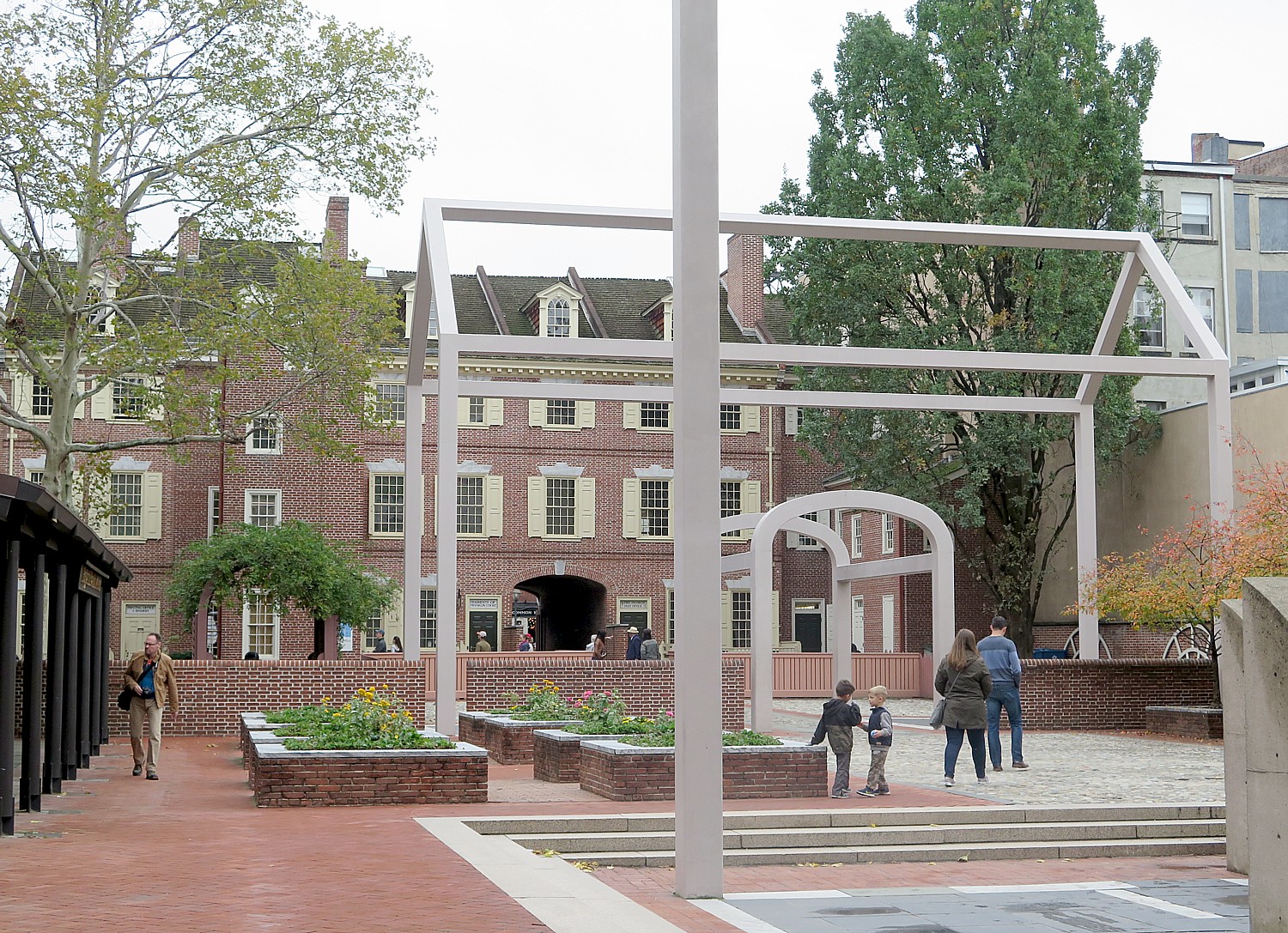
The “Ghost House” frames where Ben Franklin’s house would have stood, in what is now Franklin Court © Karen Rubin/goingplacesfarandnear.com

You enter a courtyard and come upon the “Ghost House” – the sculptural frame of Franklin’s home (the museum is actually in what would have been the basement) you can peek into the archeologically preserved remains of the foundation of his house. Franklin’s grandkids, unable to afford the “prohibitive” taxes, tore the house down in 1812 to sell to a real-estate developer. Eventually, a rooming house was built on the site. The National Park Service tore that down in the 1950s in order to restore the Franklin site, and after the Independence Bicentennial in 1976, it became a National Park, administered by the National Park Service.

The exhibit area is divided into five “rooms” with each room interestingly focusing on a particular trait of Franklin’s: ardent and dutiful, ambitious and rebellious, motivated to improve, curious and full of wonder, and strategic and persuasive. There are videos, touch screen interactives, mechanical interactives, and artifacts in each area. An additional area called the “Library” presents a video with excerpts from Franklin’s Autobiography.

The exhibit is well presented to give a total biography of this fascinating Renaissance, self-made man, who so epitomizes the American Dream.

I come to Franklin Museum hoping to learn more of this fascinating man, and was richly rewarded. I did not realize his humble beginnings, or fully appreciate the range of his talents, accomplishments.

But my essential question about Franklin – my theory that it was the Stamp Act (not the tea tax) which imposed taxes on newspapers – that was the key to the colonists taking up arms to “free” themselves from the greatest superpower humankind had known. Franklin was not just a printer, but a newspaper publisher who provided seed money to newspapers throughout the colonies and became (what I consider) the first syndicated columnist, sending out editorials that would have been printed in those papers. My theory (as yet unproved) is that newspaper editors were the ones who turned opinion against British rule, gave the colonists the notion that they could actually win their independence, and gave the colonists from Massachusetts to Virginia, who were then (as now) very different,  a sense of unity. Had the British not imposed the Stamp Tax, the newspaper editors may not have been so gung ho for Revolution. If my theory could be addressed at the museum, it was not at all clear to me.

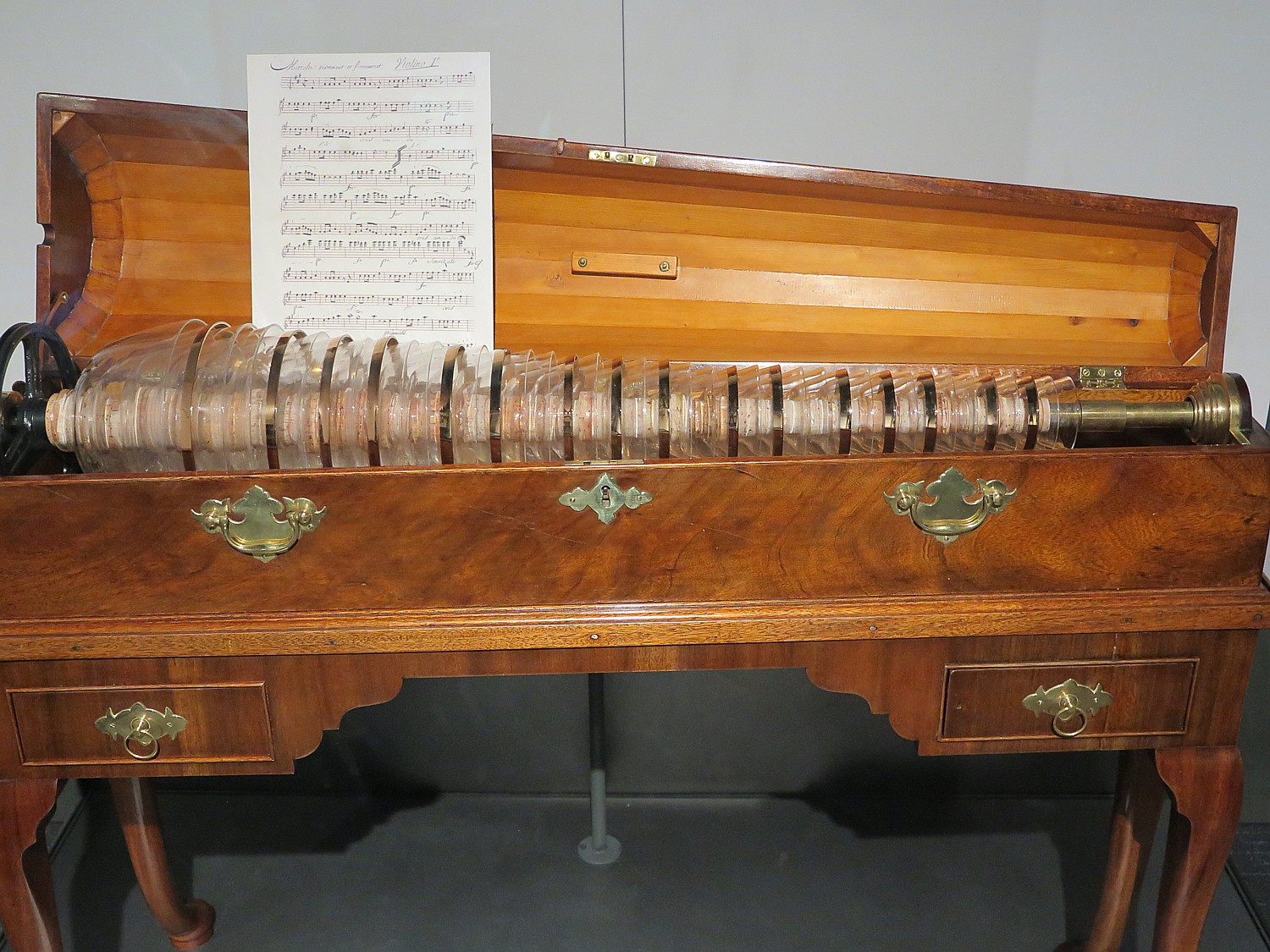
Ben Franklin as inventor: glass harmonica © Karen Rubin/ goingplacesfarandnear.com

But what is clear is that Franklin lived in the Age of Enlightenment – ideas and innovations were spread by trade and globalism – and people with the wit and wisdom like Franklin – despite having only two years of formal schooling – were encouraged to learn, innovate, invent not just technology (he did experiments with electricity and invented the lightening rod, bifocals, Franklin stove, urinary catheter and glass harmonica and charted and named the Gulf Stream) but civic society (volunteer fire department, the Philadelphia hospital, library, founded what became the University of Pennsylvania) and politics. There was greater willingness to challenge authority and notions of “divine right” – even question institutionalized religion – and class rather than be ruled by them. Colonists – who hailed from many countries in addition to Britain and would not have had loyalty to the Crown – had already lived in the New World for a century, and saw themselves not as British but as Americans. And Franklin knew better than anyone that a person from humble beginnings could ascend the ranks of social status.

I am surprised to learn that Franklin never patented his inventions, believing in the equivalent of what we call “open source.”

He was a key figure in creating the Declaration of Independence – one of the committee of 5 (with Jefferson, Adams, Roger Sherman and Robert Livingston); and along with Adams nominated Jefferson to write the Declaration and made some important changes to Jefferson’s draft.

He was a generation older than Adams and was in his 80s during the Continental Congress – near death and in significant discomfort. He was considered a giant, an elder statesman, “The Sage.”

America’s ambassador to France during the Revolution, he secured critical support of the French.

I was shocked to learn that Franklin initially owned and dealt in slaves (it was a time when that was common place, even in the North) but by the 1750s, he argued against slavery from an economic perspective and became one of the most prominent abolitionists.

His personal background is worthy of a multi-part dramatic series:

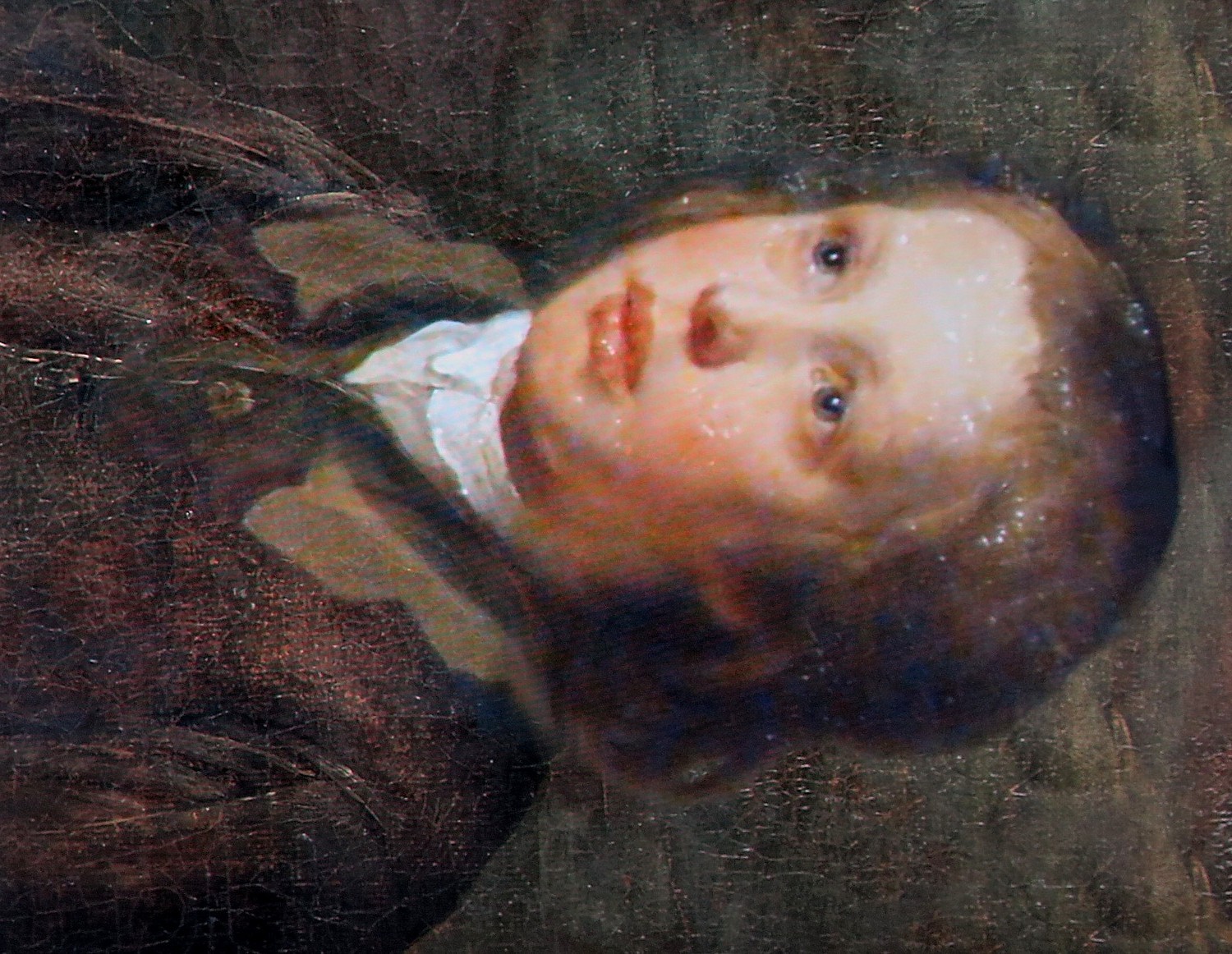
Ben Franklin at 9 years old (artist’s rendering) © Karen Rubin/goingplacesfarandnear.com

Ben Franklin was born in Boston in 1706, one of 17 children of his father. He only attended two years of formal schooling which ended when he was 10; he continued his education through voracious reading.

At 12, he apprenticed to his older brother, James, a printer, who founded the first independent newspaper in the colonies. Ben started publishing columns secretly under a pseudonym (his brother was furious). When James, who was a free thinker, was jailed for three weeks in 1722 for publishing material unflattering to the governor, Ben took over the newspaper and wrote, in the character of his alter-identity Mrs. DoGood, “Without freedom of thought there can be no such thing as wisdom and no such thing as public liberty without freedom of speech.”

In 1723, Franklin escaped his apprenticeship and fled to Philadelphia, making him a fugitive. He took up lodging in the Read home, and at the age of 17, proposed marriage to 15-year old Deborah Read. But her mother refused permission for them to marry. Franklin went off to London for several years and Deborah married John Rodgers, who abandoned her, ran off with her dowry and but without a divorce, left her unable to remarry.

When Ben Franklin returned to Philadelphia, he formed a common-law marriage with Deborah who becomes a mother to Ben’s illegitimate son, William.(William grew up to become a Loyalist and self-exiled himself to London; William too had an illegitimate son who became Ben Franklin’s secretary and aide). Deborah and Ben had two more children together, but his son died at the age of 4 of smallpox; his daughter Sarah married, had children, and took care of Ben in his old age

I hadn’t realized that Franklin spent much of his life abroad, especially between 1757-1775, and as Ambassador to France from 1776-1785.

Franklin returned to the United States in 1787 and is the only Founding Father who is a signatory of all four of the major documents of the founding of the United States: the Declaration of Independence, the Treaty of Alliance (1778) with France, the Treaty of Paris that ended the Revolution (1783) and the United States Constitution (1787), though he was sick and suffering in pain during the Constitutional Convention.

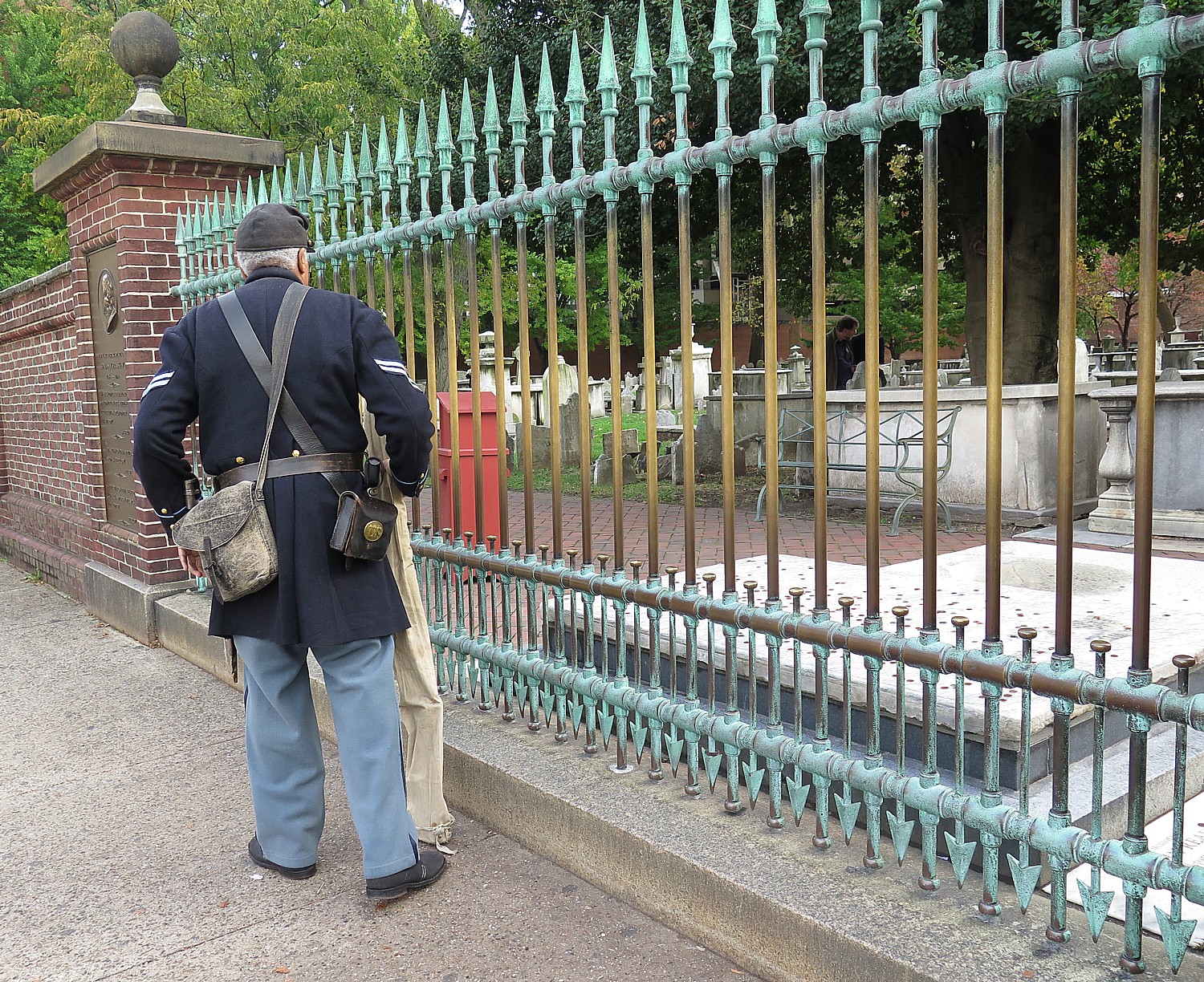
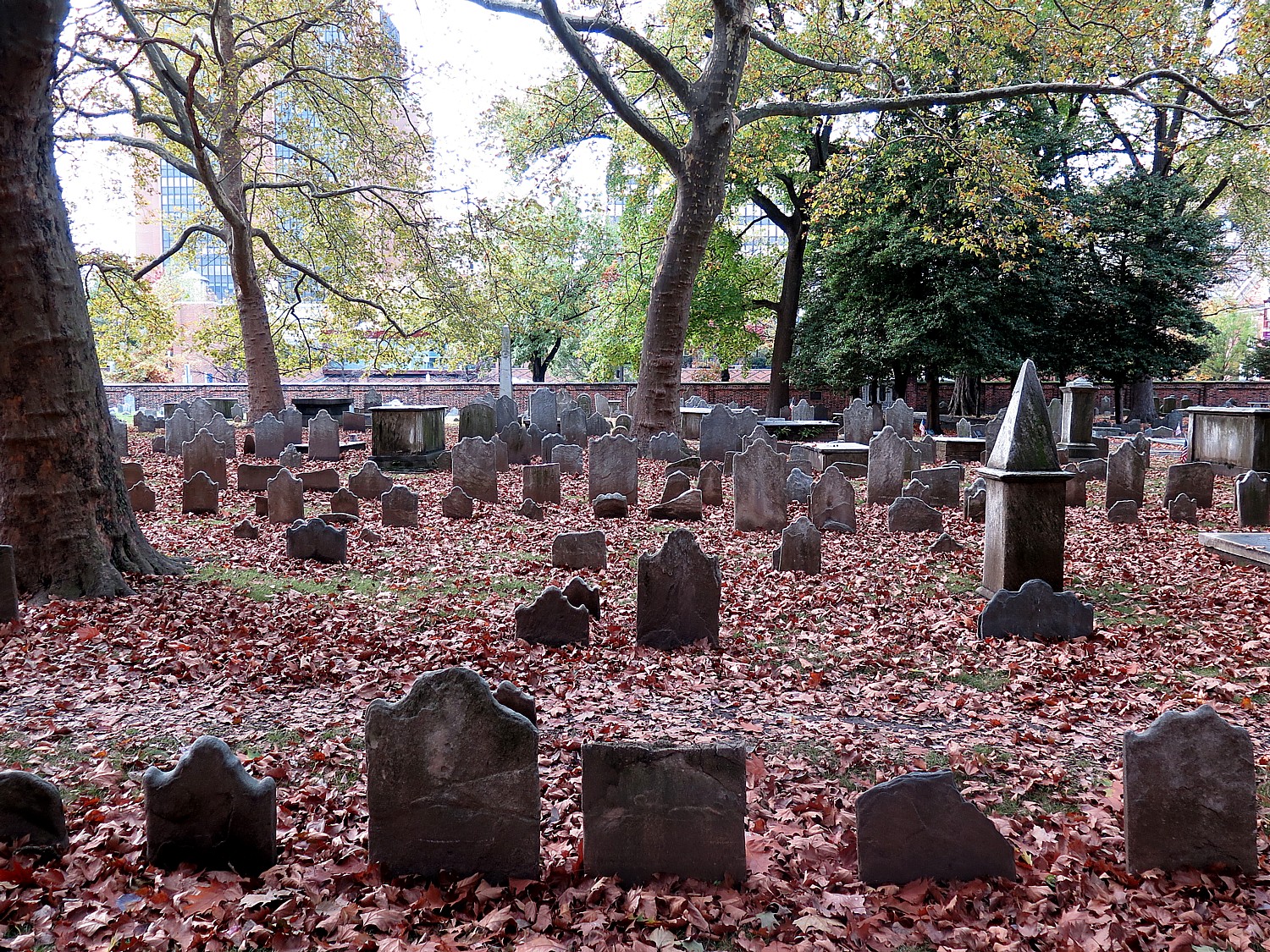
A civil war reenactor at Philadelphia’s Veterans Day Parade peeks in at Franklin’s grave at the Christ Church Burial Ground © Karen Rubin/ goingplacesfarandnear.com

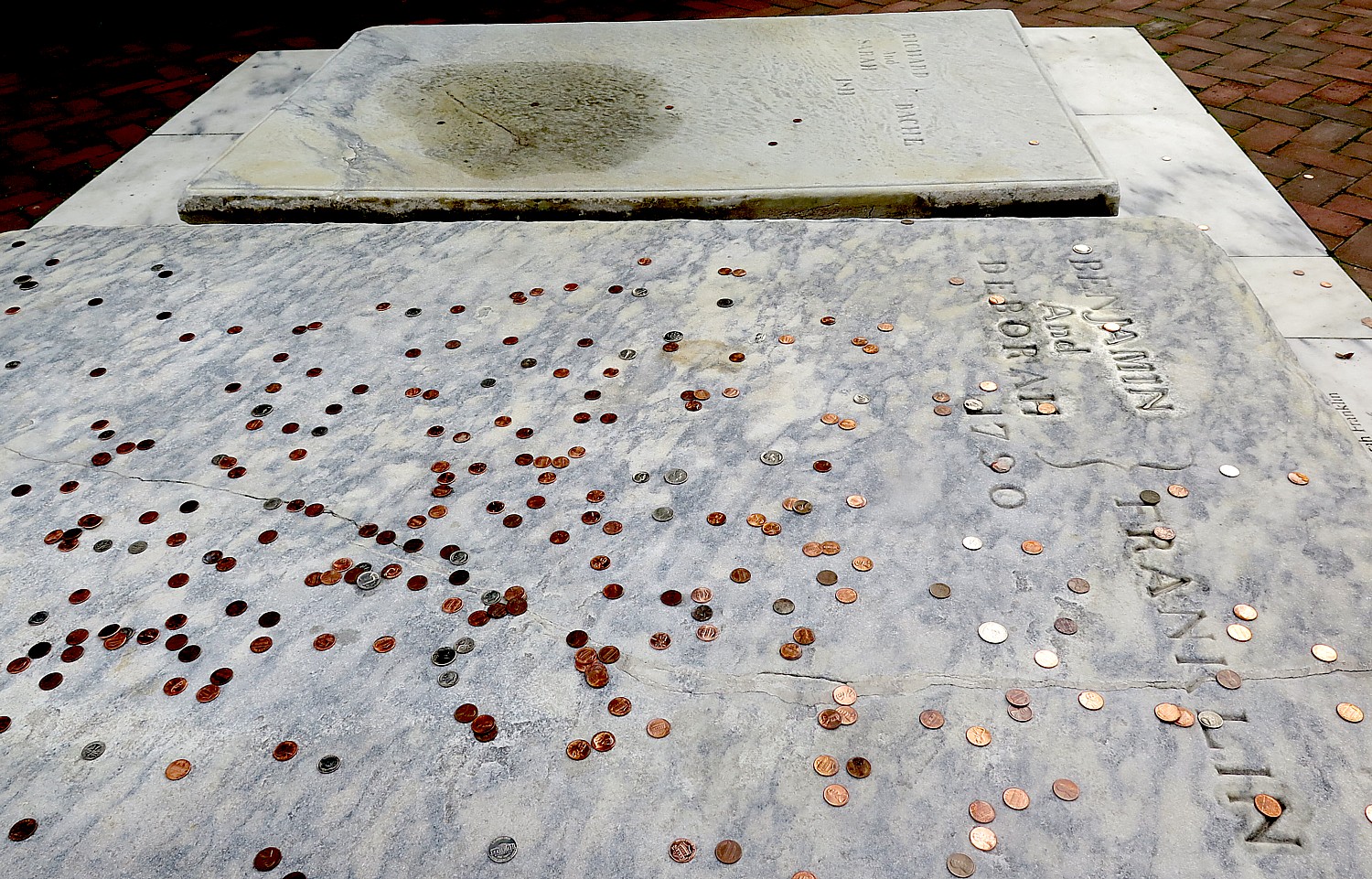
When Ben Franklin died in 1790, 20,000 people attended his funeral. Later, I see where he was interred in Christ Church Burial Ground. It is interesting to note that in 1728, when he was just 22, Franklin wrote his own epitaph: “The Body of B. Franklin Printer; Like the Cover of an old Book, Its Contents torn out, And stript of its Lettering and Gilding, Lies here, Food for Worms. But the Work shall not be wholly lost: For it will, as he believ’d, appear once more, In a new & more perfect Edition, Corrected and Amended By the Author.” But the tombstone simply reads, as he specified in his final will, “Benjamin and Deborah Franklin.”

You leave the museum realizing what a remarkable Renaissance man Franklin was – like Thomas Jefferson in that way – with all the inventions and areas of success. Franklin was very much a modern man; if ever there was a person who could find himself 250 years in the future, he would have been very much at home in the 21st century. And very much Philadelphia’s Favorite Son for good reason.

The Ben Franklin Museum is a very welcoming space that really humanizes and personalizes Franklin. I love Franklin’s witty quotes, the portraits of him that show him throughout his life, even his love letters (to women not his wife).

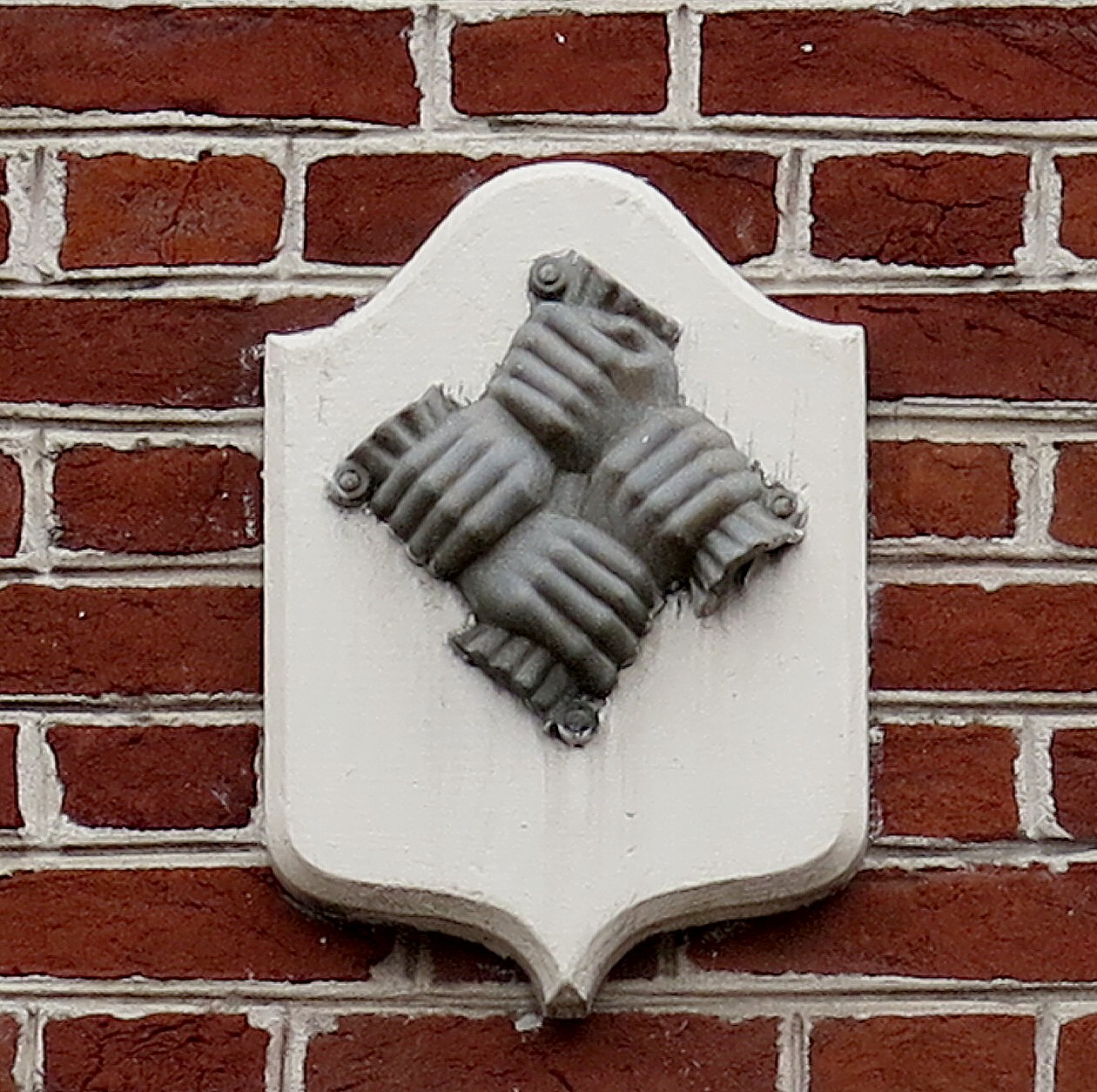
Fire insurance symbol, one of the civic innovations that Ben Franklin introduced, can still be found on Philadelphia houses © Karen Rubin/ goingplacesfarandnear.com

For children, there is a scavenger hunt for the small squirrel figurines located throughout the exhibits. Franklin delighted in pet squirrels, or skuggs as they were known in his day.

You need at least an hour to visit.

The museum and print shop are operated by the National Park Service as part of the Independence Hall.

Open daily from 9 am to 5 pm. Admission $5/adult; $2/children 4-16.

Benjamin Franklin Museum, 317 Chestnut St., Philadelphia 19106, 215-965-2305, https://www.nps.gov/inde/planyourvisit/benjaminfranklinmuseum.htm

Print Shop

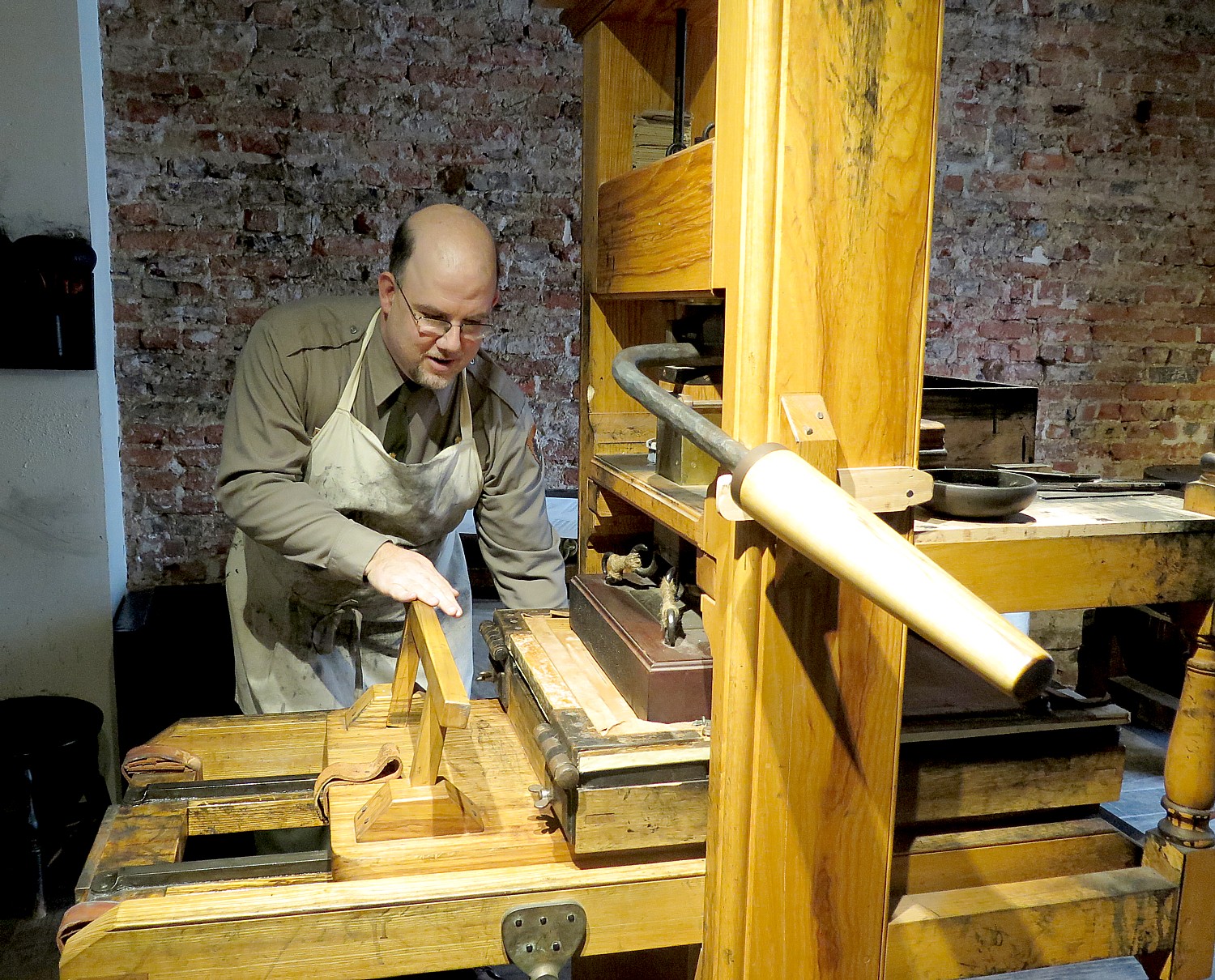
From here, I go back up to the court yard and find my way to Franklin’s print shop, where there is a replica of an old-style printing press (not much different from the days of Gutenberg), where National Park Rangers run off documents (you can buy a printed Declaration of Independence though Franklin never actually printed it). If you are lucky, you may visit when the ranger is in period dress.

The Print Shop where National Park Service rangers demonstrate the printing process that would have been used in Franklin’s time © Karen Rubin/goingplacesfarandnear.com

On the Market Street side of Franklin Court, there is the B. Free Franklin Post Office, where you can get postcards hand-stamped just as one would have when Franklin was the first postmaster. The line of attached buildings are very much the way they were when Franklin lived here. You notice on Market Street and then around the historic district townhouses that still have the reliefs that show what fire insurance company protected the house. On this day, the street is closed off for a street festival. After spending some time enjoying the music and festivities.

I also pass a firehouse with a wonderful bust of Benjamin Franklin.

Philadelphia had just held a Veterans Day parade, and just as I pass the Christ Church Burial Ground where Benjamin Franklin and many other Founders are buried, I come upon Civil War re-enactors from the 3rd Regiment: Sgt  Major Joseph Lee and Corporal Robert F. Houston.

The Franklins’ tombstones – extremely modest – is easily the most visited (and can be seen through the gate from the sidewalk). People throw pennies onto the tombstone – a nod to Franklin’s motto that “a penny saved is a penny earned,” as well as a symbol of good luck.

People throw pennies onto the modest tombstone of Benjamin Franklin and Deborah at Christ Church Burial Ground © Karen Rubin/ goingplacesfarandnear.com

Others buried here include John Dunlap, who printed the Constitution and Declaration of Independence, composer and poet Francis Hopkinson and medical pioneers Dr. Benjamin Rush and Dr. Philip Syng Physick. Divided into quadrants, the ground is mapped and plots are identified with markers where the original inscriptions are gone. A book of 50 biographies is available for purchase at Christ Church. (There is an admission to the burial ground, $3 adults/$1 child or $8/$3 with guided tour.) (5th and Arch Streets, Philadelphia 19106, 215-922-1695, ext 30, http://www.christchurchphila.org/about-the-burial-grounds/

Christ Church Burial Ground © Karen Rubin/goingplacesfarandnear.com

I walk the few blocks to the Betsy Ross House, another Revolutionary character who would have been thoroughly at home in the 21st Century. 

Follow in Franklin’s Footsteps

Take a walking tour and follow in Ben Franklin’s footsteps through historic Philadelphia © Karen Rubin/goingplacesfarandnear.com

VisitPhilly.org, the city’s convention and visitor bureau, offers a marvelous walking tour to discover historic attractions visited by Franklin himself, sites dedicated to his accomplishments and local restaurants that would appeal to one of history’s most prolific men.

The Franklin’s Footsteps Itinerary starts at the Benjamin Franklin Museum, Franklin Court, the Ghost House, the Print Shop and Post Office and continues:

City Tavern (138 S. 2nd St. 215-413-1443), where Colonial America is recreated at this authentic tavern in Old City

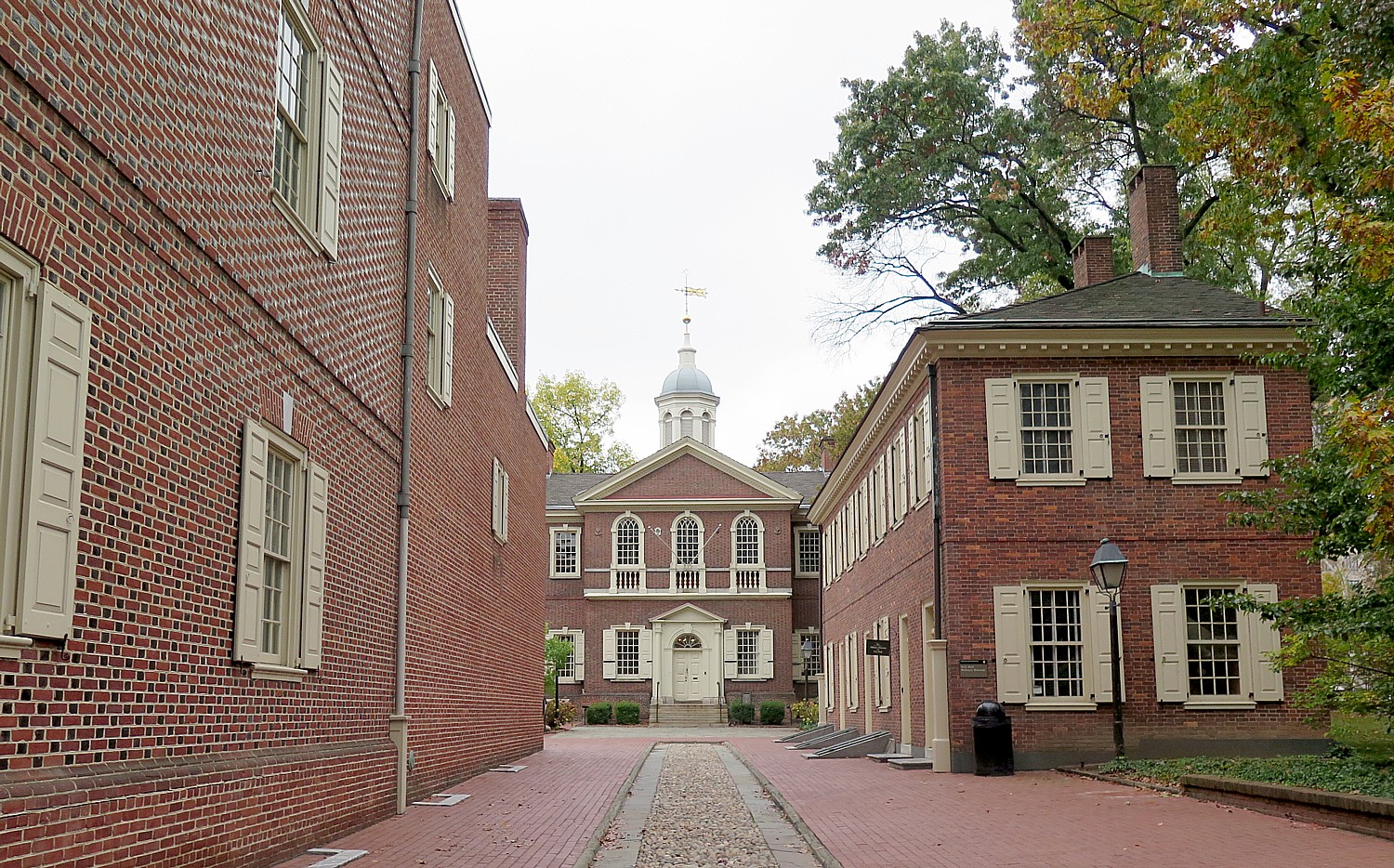
Carpenters’ Hall (320 Chestnut St., 215-925-0167), the site of the First Continental Congress, was once the home of Franklin’s Library Company and the American Philosophical Society (APS), two organizations he founded.

Carpenter’s Hall © Karen Rubin/goingplacesfarandnear.com

Christ Church (20 N. American St., 215-922-1695), where Franklin and his family attended services, and Christ Church Burial Ground.

Fireman’s Hall Museum, (147 N. 2nd St., 215-923-1438), commemorates the history of firefighting in an old firehouse

The Liberty Bell Center (6th & Market, 215-965-2305), home of the internationally known symbol of freedom (pick up timed tickets for Independence Hall at the Independence Visitor Center, or order them online at recreation.gov).

My immersion into Revolutionary War Americana in Philadelphia, which started with the National Museum of Jewish American History and Museum of American Revolution, continues at Betsy Ross House and the National Constitution Center.

Visit Philadelphia provides excellent trip planning tools, including hotel packages, itineraries, events listings: 30 S 17th Street, Philadelphia PA 19103, 215-599-0776, visitphilly.com.

See also:

National Museum of American Jewish History is Unexpected Revelation in Philadelphia 

Philadelphia’s New Museum Immerses You into Drama of America’s Revolutionary War

_____________________________

© 2018 Travel Features Syndicate, a division of Workstyles, Inc. All rights reserved. Visit goingplacesfarandnear.com,  www.huffingtonpost.com/author/karen-rubin , and travelwritersmagazine.com/TravelFeaturesSyndicate/. Blogging at goingplacesnearandfar.wordpress.com and moralcompasstravel.info. Send comments or questions to FamTravLtr@aol.com. Tweet @TravelFeatures. ‘Like’ us at facebook.com/NewsPhotoFeatures


Dolphin Quest Affords Memorable Way to Experience Bermuda

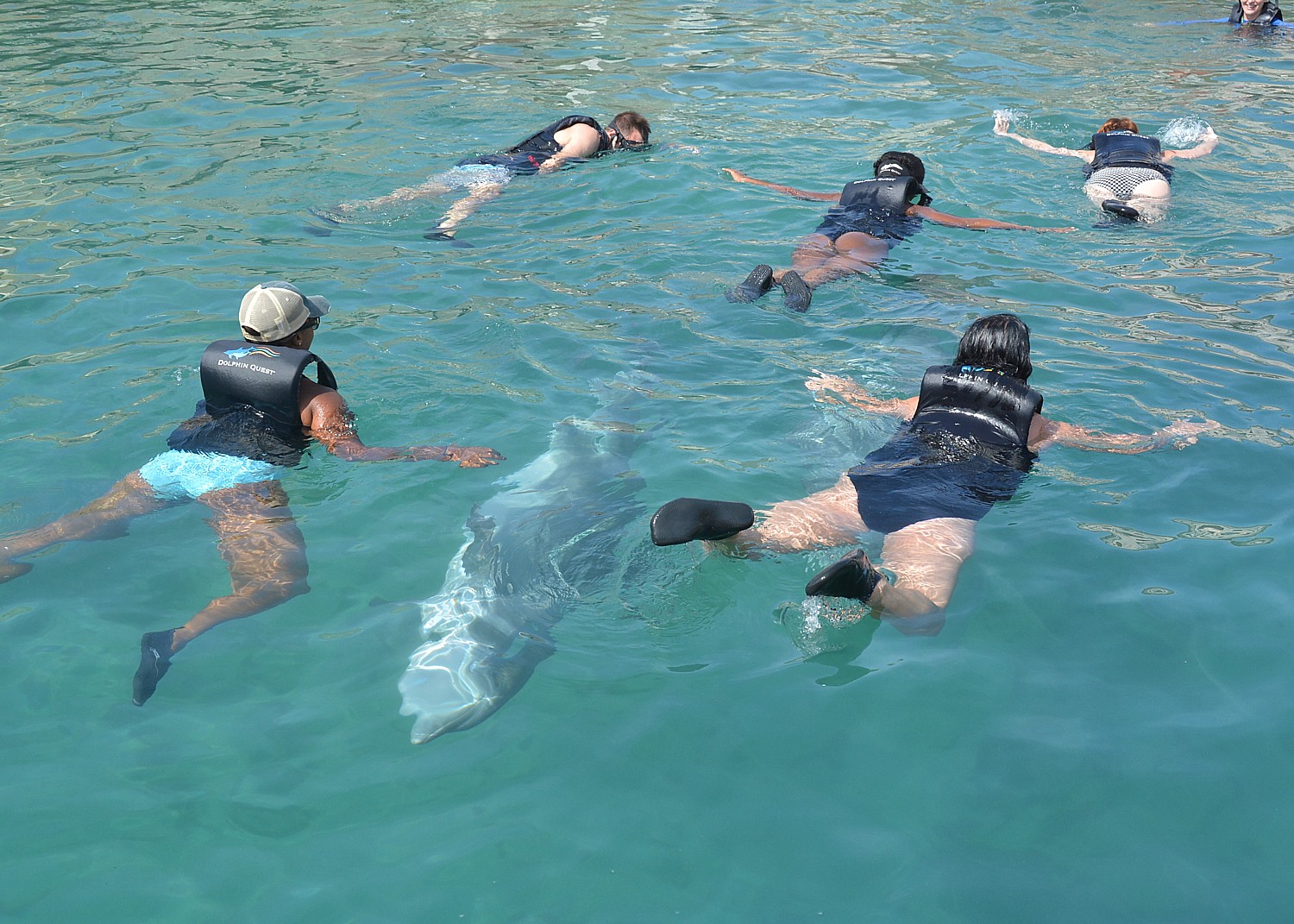
David and Laini with Caliban, the dolphin, at Dolphin Quest Bermuda (photo courtesy of Dolphin Quest).

By David Leiberman & Laini Miranda

Travel Features Syndicate, goingplacesfarandnear.com

Bermuda is a magical place where the beaches have pink sand and the aquamarine water is so clear, you can see amazing marine life and feed fish Cheerios. But one of the most magical experiences of all is Dolphin Quest.

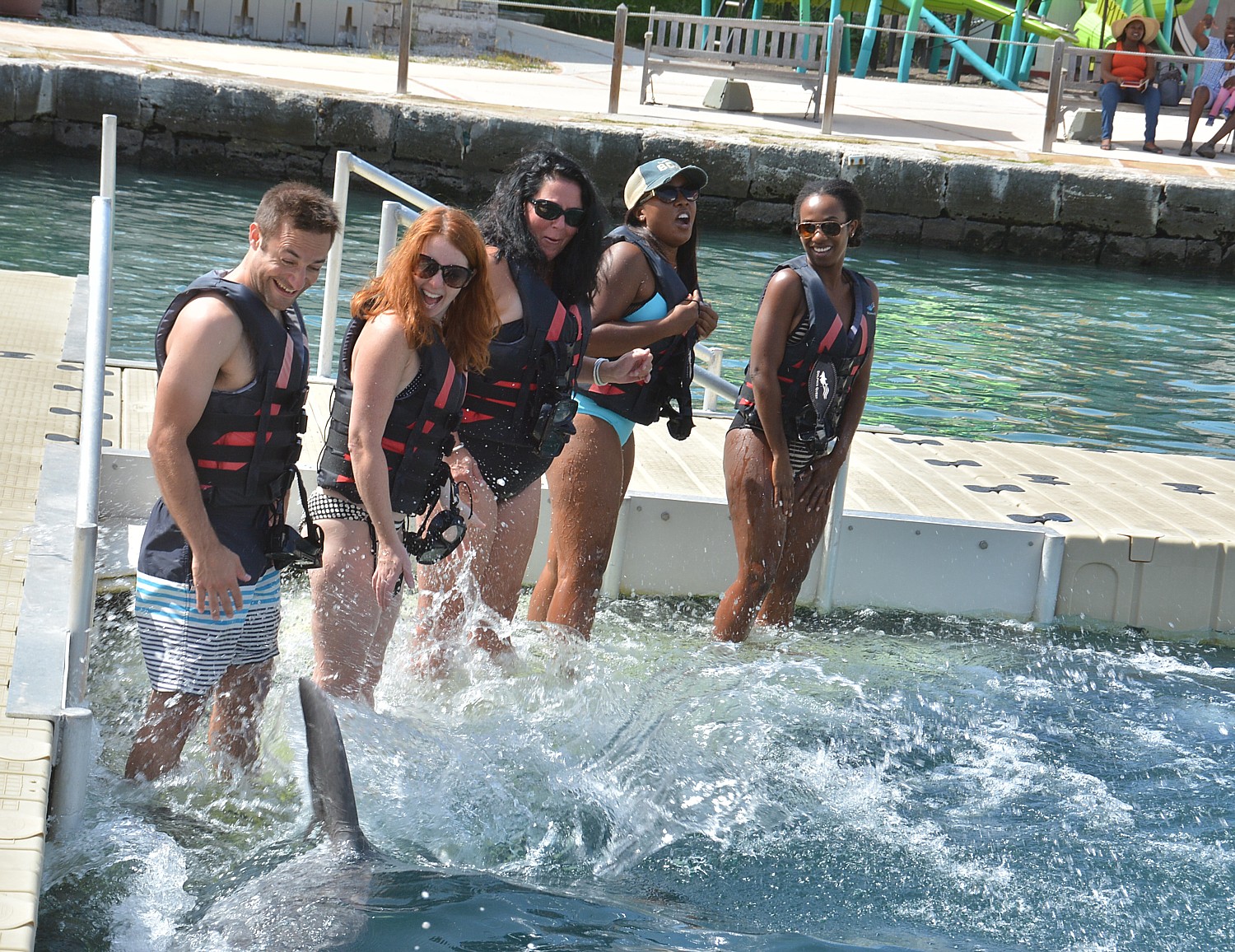
The experience starts off with our own training – shaping our own behaviors in order to properly interact with the dolphin. We join three others for a 30-minute Dolphin Dip – one of several different interactive encounters that are available. Lottie, the cheery dolphin trainer, tells us so much about how the dolphins learn and how they respond to specific calls. She demonstrates some incredible tricks (behaviors) by teaching the five of us how to signal to the dolphins ourselves.

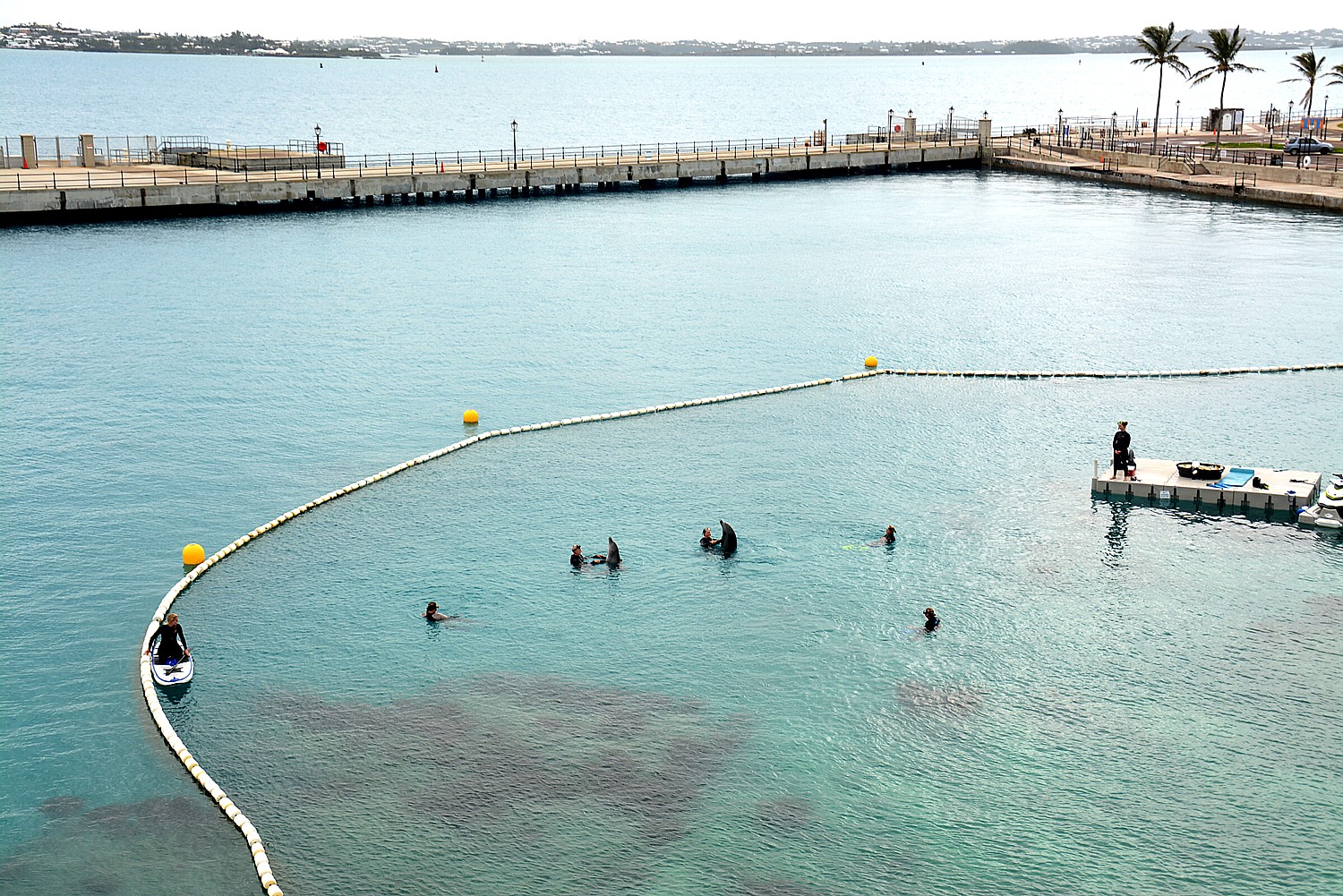
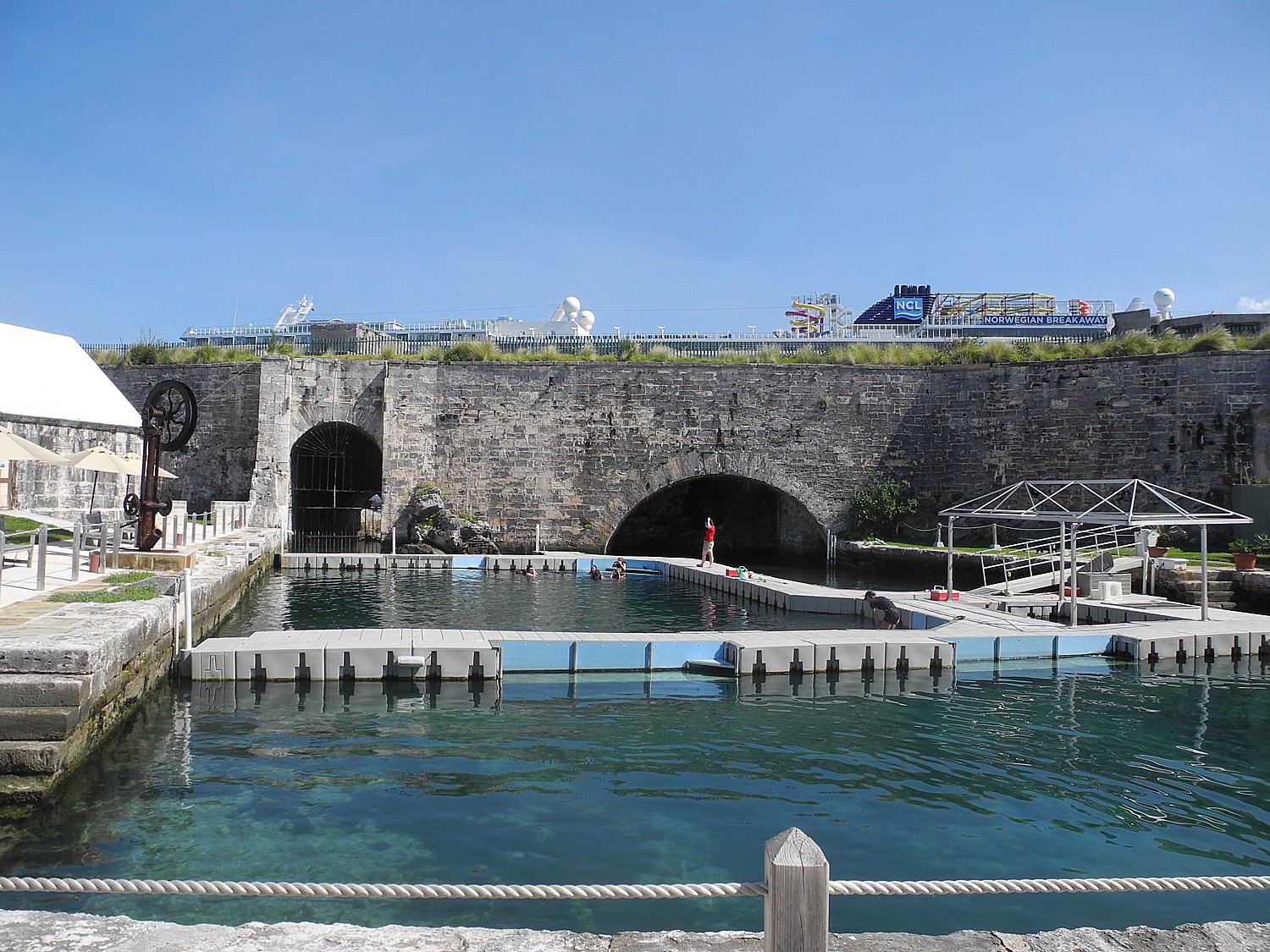
Dolphin Quest organizes small-group encounters with dolphins in their habitat within The Keep at the Naval Dockyard in Bermuda (photo courtesy of Dolphin Quest).

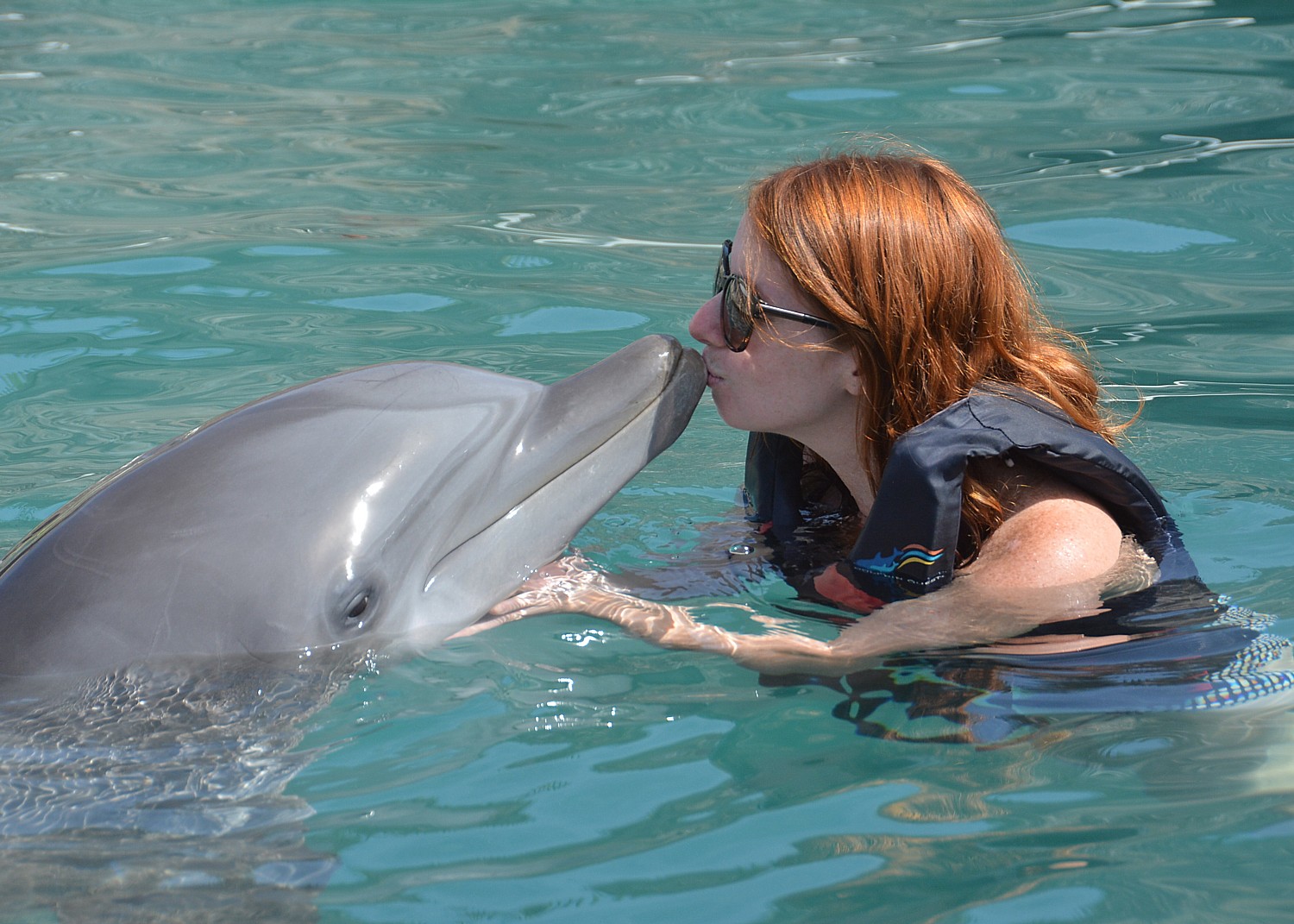
When we are in the large pool, Lottie calls me out to the middle of the lagoon and tells me to bring my hands together with palms facing up on the surface of the water. She blows a whistle and Caliban swims up to me and puts her snout on my hands, seeming to smile up at me with that broad dolphin mouth. Then she tells me to show her my cheek and he kisses me on the cheek!

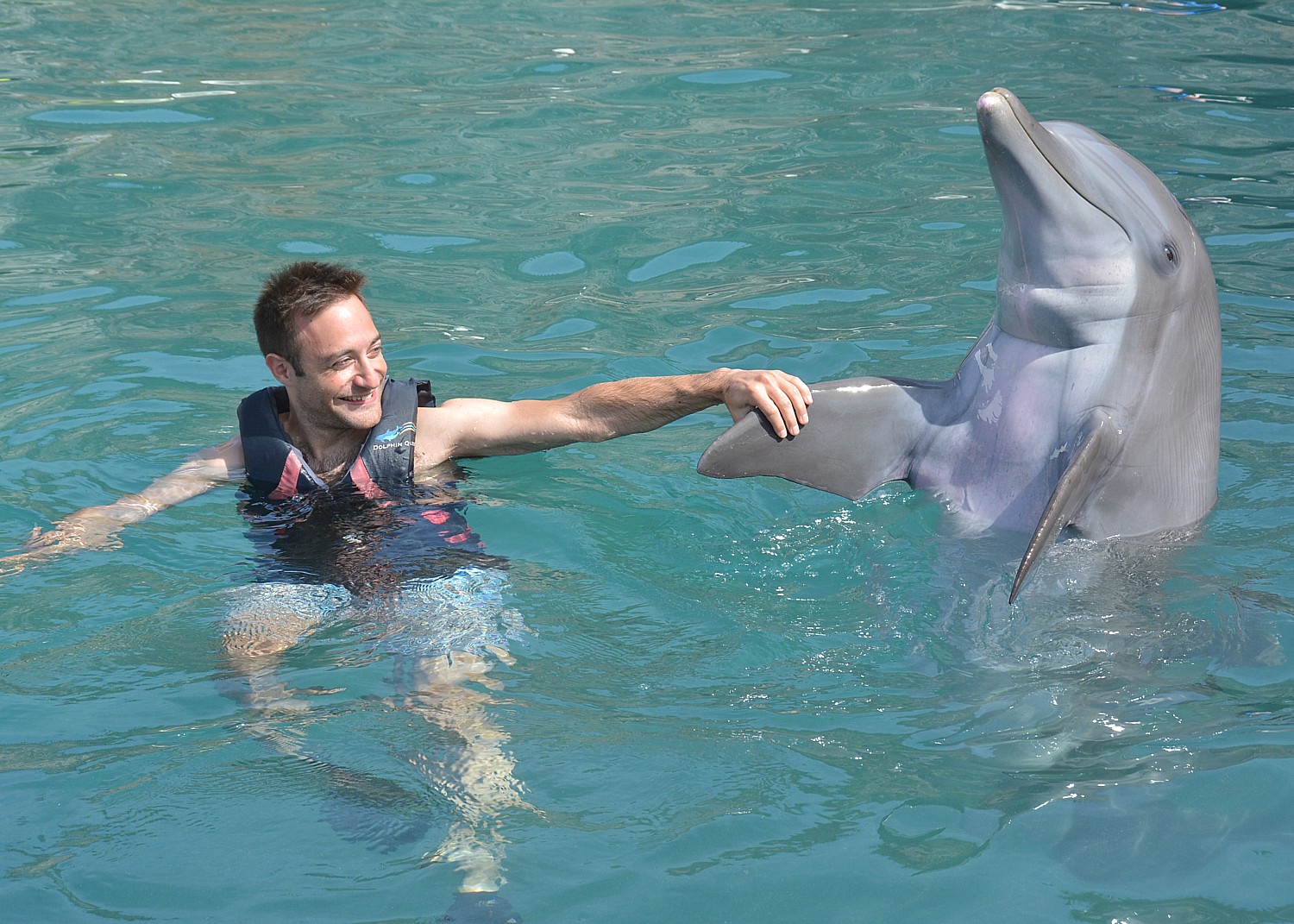
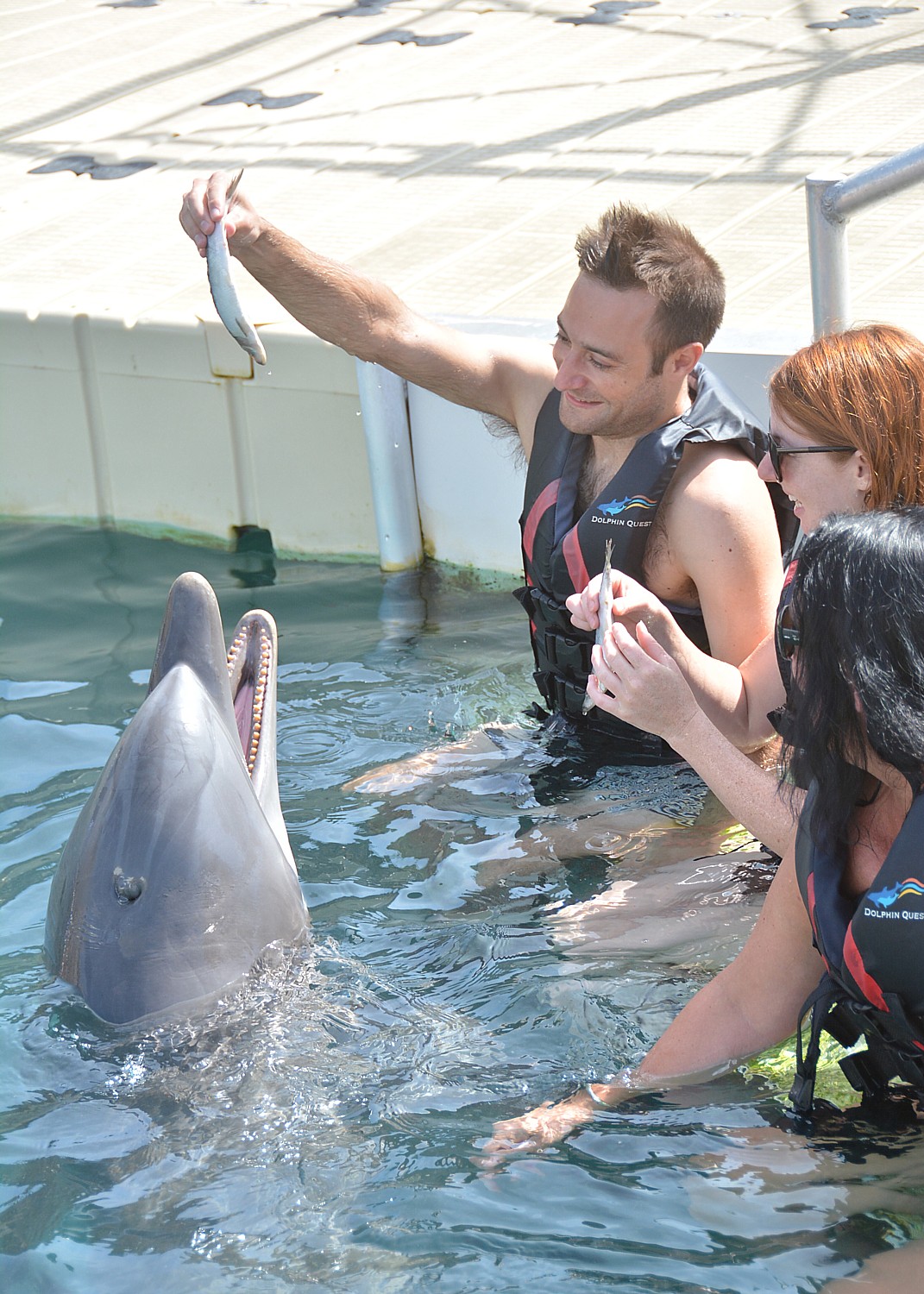
Now it’s Dave’s turn to come out. Lottie tells him to put his hand out to the side. Then Caliban swims up and takes his hand. They practically dance! Then Caliban swims past us, inviting us to stroke her tummy for positive reinforcement. We get to feed her a small fish after each behavior which she seems to really enjoy.

Dancing with the Dolphin: David joins hand to Caliban’s fin (photo courtesy of Dolphin Quest).

Lottie has each of us engage different behaviors with the four dolphins we get to meet, which are all also perfect photo opps. A professional photographer is on hand shooting photos the whole time and capturing so many amazing moments.

The digital and physical copies of the photographs are available for sale through an online portal. They’re pricey, but they capture priceless moments! There is free seating poolside so if anyone in your party is not in the water with you, they have the opportunity to capture their own photos, too.

The photographer is also extremely knowledgeable about the dolphins. He tells us about the 5- star health care they have and that the average lifespan is roughly double for the dolphins in their facility compared to dolphins in the wild. They also have a larger, more natural enclosed swimming area just outside the walls of the maritime museum, though we can’t see it ourselves because it is being cleaned.

It’s $219 for the 30-minute “Dolphin Dip” — pricey, but one of the cooler experiences we’ve had. It’s an amazing gift for someone you want to indulge and celebrate! Family/friends can watch from the sidelines where they can also enjoy seeing the dolphins up-close without paying the premium of being actually in the water with them.

A portion of the proceeds goes towards continued animal research. So far, Dolphin Quest programs in Hawaii, Oahu and Bermuda have contributed more than $3 million in funding, resources and field support to vital marine studies around the globe. University research studies have generated hundreds of published scientific works that are helping researchers find solutions to the threats dolphins and whales face in the wild. These studies also help the marine mammal community better care for dolphins in human care.

But there is something more: Dolphin Quest gives people a rare experience to interact and engage with dolphins, deepening our empathy for marine mammals and raising awareness about conservation programs.

“With our dolphins, we touch the hearts and minds of our guests in a fun and inspirational way, sharing how each of us can play a vital role in protecting our precious ocean ecosystem,” Dolphin Quest says.

Dolphin Quest affords experiences that make lifelong ambassadors on behalf of protecting and conserving marine mammals (photo courtesy of Dolphin Quest).

Our time with the dolphins is not like a performance. We are reminded that dolphins are wild animals; they clearly only engage with us as they like, and seem to genuinely enjoy the intellectual stimulation.

It is an incomparable experience to interact with another species, and especially so with an intelligent marine mammal.

In addition to contributing millions of dollars toward research and conservation programs, Dolphin Quest also contributes essential medical and training support to wild marine mammals in distress through the marine mammal stranding networks in Hawaii and Bermuda. Its team members also hand raise newly hatched endangered sea turtles, releasing them back into the wild when they are large enough through the “Turtle Ambassador Program”.

Dolphin Quest also organizes beach and stream cleanups, recycling efforts, and other environmental stewardship initiatives.

We get to feed Bailey a small fish after each behavior which she seems to really enjoy (photo courtesy of Dolphin Quest).

Indeed, Dolphin Quest’s humane stewardship of the marine animals living in its care is recognized: Dolphin Quest is an accredited member of the Alliance of Marine Mammal Parks and Aquariums, with all three of its locations certified by the American Humane Conservation program.

After the Dolphin Dip (or any of the Dolphin Quest programs), you are given free admission to the Maritime Museum and the National Museum of Bermuda, where you can explore the 200-year-old fort and experience educational maritime and cultural exhibits including: the Commissioner’s House, Shipwreck Island, The Warwick Project, Bermuda’s Defense Heritage and The Hall of History 1000-square-foot mural painted by Bermudian artist Graham Foster, plus an onsite Playground and Playhouse for children.

New Programs in Expanded Ocean Habitat

Dolphin Quest Bermuda has expanded its large ocean water dolphin lagoon inside the walls of the National Museum of Bermuda to include an outer Ocean Habitat. Accessed by a tunnel passageway, this supplemental sea sanctuary provides Dolphin Quest’s dolphins and guests another enriching natural environment to explore.

Accessed by a tunnel passageway, the new expanded Ocean Habitat provides Dolphin Quest’s dolphins and guests another enriching natural environment to explore (photo courtesy of Dolphin Quest).

The outer Ocean Habitat utilizes an environmentally friendly sea pen structure. Its natural underwater terrain and sea life mirrors the shallow bays and estuaries where the coastal ecotype of Atlantic bottlenose dolphins are found in the wild.

“While our dolphins are thriving in their ocean water lagoon within the walls of the museum, it is so fun to be able to introduce them to another area for them to play, socialize and inspire people to care about and protect dolphins in the wild”, says Lauren McWilliams, Supervisor of Marine Animals at Dolphin Quest Bermuda.

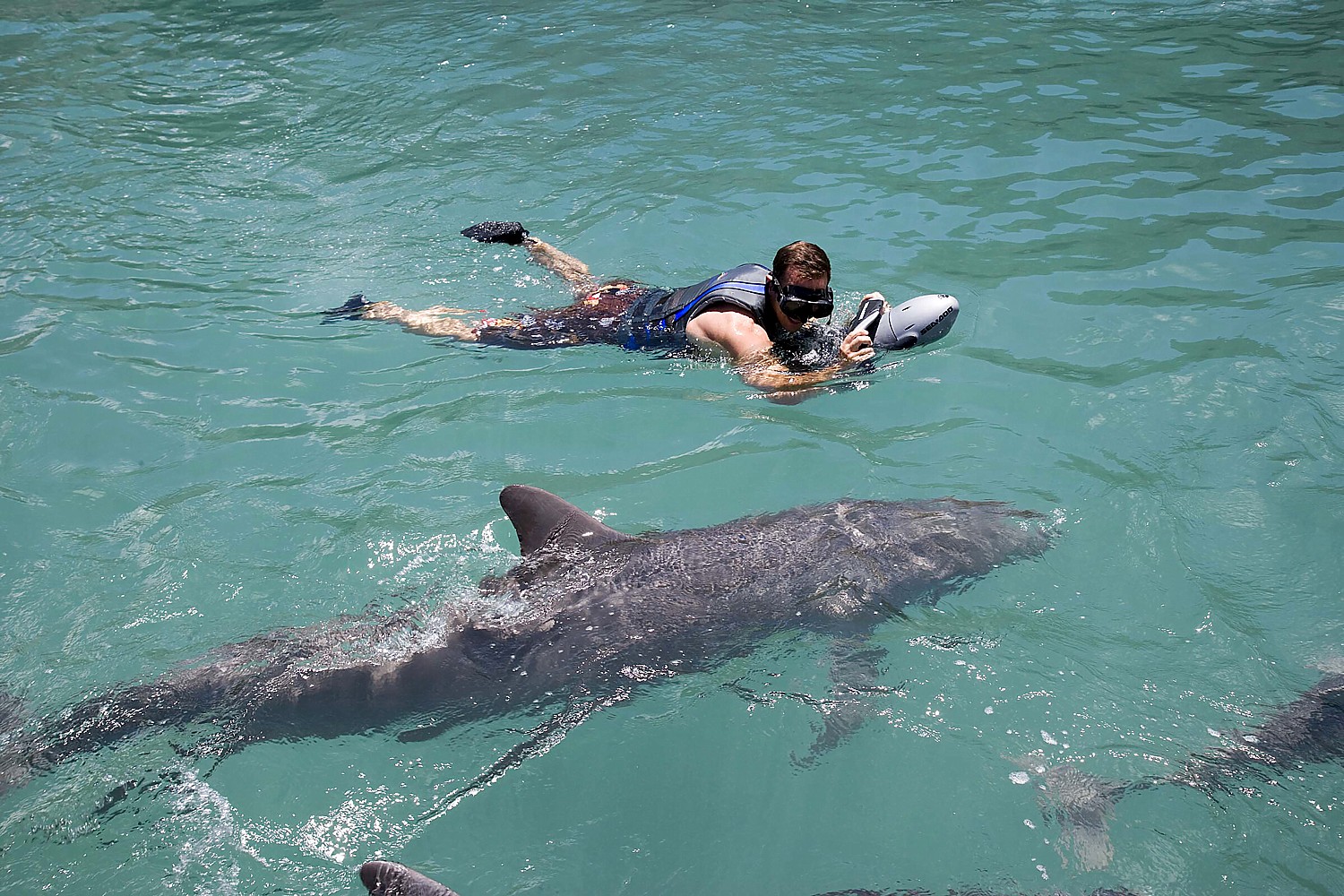
Dolphin Quest has introduced guided water scooter ride with the dolphins in the new Ocean Habitat (photo courtesy of Dolphin Quest).

Founded by two marine mammal veterinarians in 1980s, Dolphin Quest continues to be on the leading edge of advocacy, conservation and research. Back then, Dr. Jay Sweeney and Dr. Rae Stone sought to create an alternative to oceanariums and “dolphin shows.” They set out to create pristine and enriching natural dolphin habitats where visitors could enjoy inspiring and educational dolphin encounters that, in turn, funded wild dolphin conservation.

Since opening their first location at the Hilton Waikoloa Village in Hawaii in1988, Dolphin Quest has become recognized as a leader in establishing large natural habitats for the animals, creating successful dolphin breeding programs and developing innovative interactive dolphin programs that combine fun and learning for the animals and the people, and promoting environmental stewardship.

They opened their first Dolphin Quest in Bermuda in 1996 at the Southampton Princess Hotel, but it was damaged in Hurricane Gert in 1999. The staff battled high winds and rough water to move the animals to a protected area on the most southwestern side of the island, into an area known as The Keep within the Royal Naval Dockyard. This offered a large, protective ocean-water lagoon within a historic fort, with a connected outer habitat that would be safe from hurricanes and weather events. This became Dolphin Quest’s home on Bermuda. 

New innovative and inspiring interactive programs are now available in the Ocean Habitat: “Dive with Dolphins” helmet dive, the “Sea Quest” guided water scooter ride with the dolphins and the “Exclusive Sea Quest” which is a private experience.

Dolphin Quest Programs Year-Round

A variety of programs are offered year-round. The website offers excellent information and an easy-to-follow breakdown of the various programs available by season and by age-appropriateness. Programs include:

Ultimate Adventure, an hour-long program (45 minutes in the water with dolphins), the longest time available, appropriate for ages 6+, available May-October.

SeaQuest, a scooter program, April-October, for ages 8+, 45 minutes

Dolphin Encounter, available November through April, let’s you create your own dolphin experience (30 min., $175).

Underwater Exploration (20 minutes with dolphins, for ages 8+, $100 (maximum 3 people):  You explore dolphins’ natural ocean habitat with underwater scooters and snorkeling; you have the opportunity to interact with dolphins in deeper waters, guided by marine mammal specialists (water scooters and masks provided; you must be a proficient swimmer; no more than 3 people and the trainer). After the program, the  marine mammal specialists are available to discuss dolphins’ care and wellness, animal training, conservation; and you get free full day admission to the National Museum of Bermuda. Winter programs (November- May) provide free wetsuits and booties; and a winter hot tub special (December 15-April 30, limited spaces available).

Swimming with dolphins. Dolphin Quest offers programs year-round at their habitat located within The Keep at the Naval Dockyard (photo courtesy of Dolphin Quest).

Marine Conservation Tour is a two-hour behind-the-scenes program that finishes with a five-minute dolphin touch, but it focuses on training programs, learning about animal care, visiting the medical lab, and watching the dolphins interact and socialize with each other (November-April, $79)

Trainer for a Day, a five-hour program with 60 minutes with the dolphins where you are side-by-side with trainers and dolphins and participate in dolphin health exams, dolphin training sessions, dolphin play time and dolphin programs for guests (lunch included). There is time in the water with the dolphins as well as interacting from the docks. (Wet suit and booties provided, November-May).


National Museum of Bermuda

The fortuitous collaboration between Dolphin Quest and the National Museum of Bermuda greatly enhances the visitor experience, as well, because you are not only given this rare experience to interact with marine mammals, but also become immersed in Bermuda’s rich heritage.

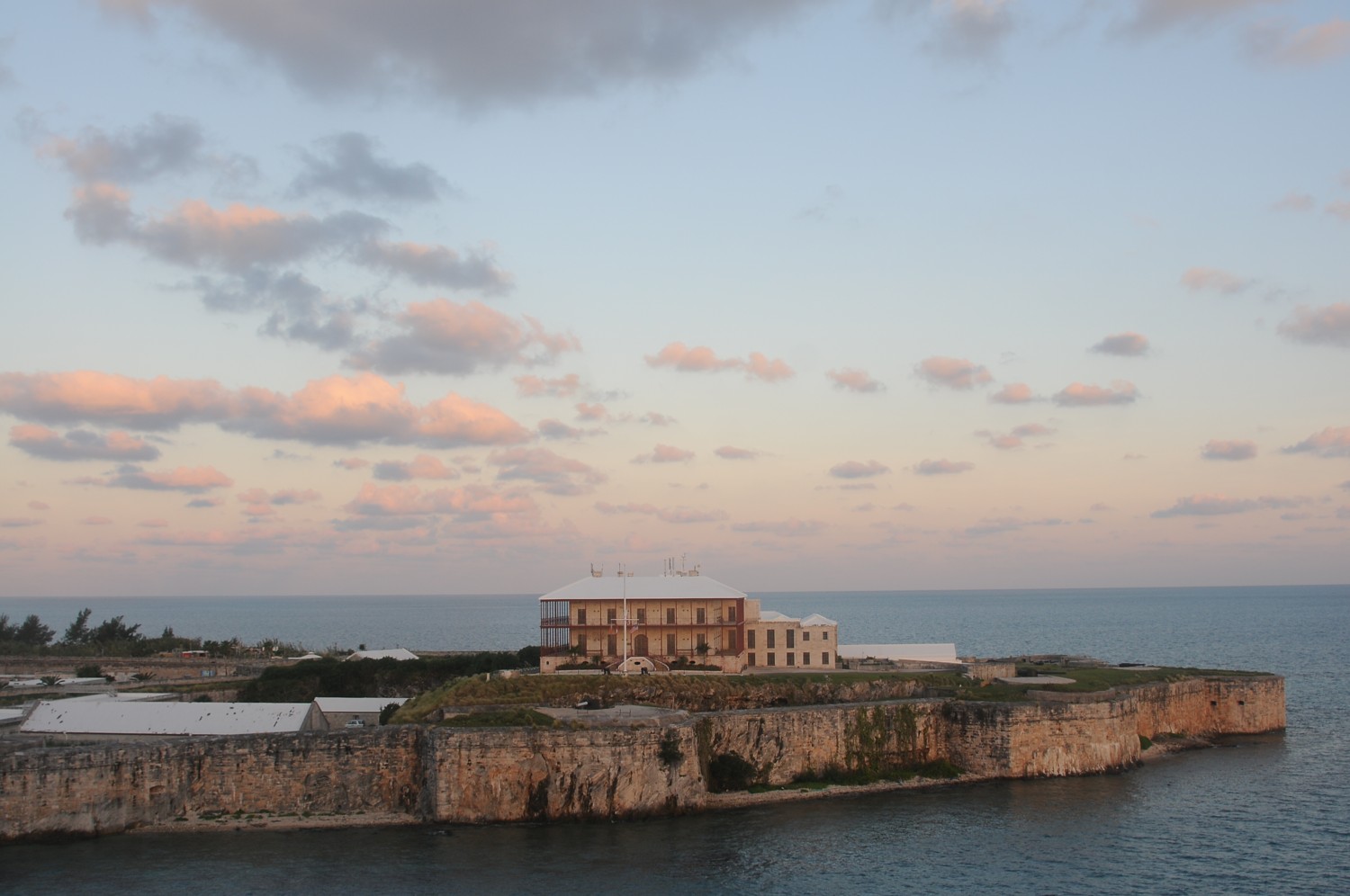
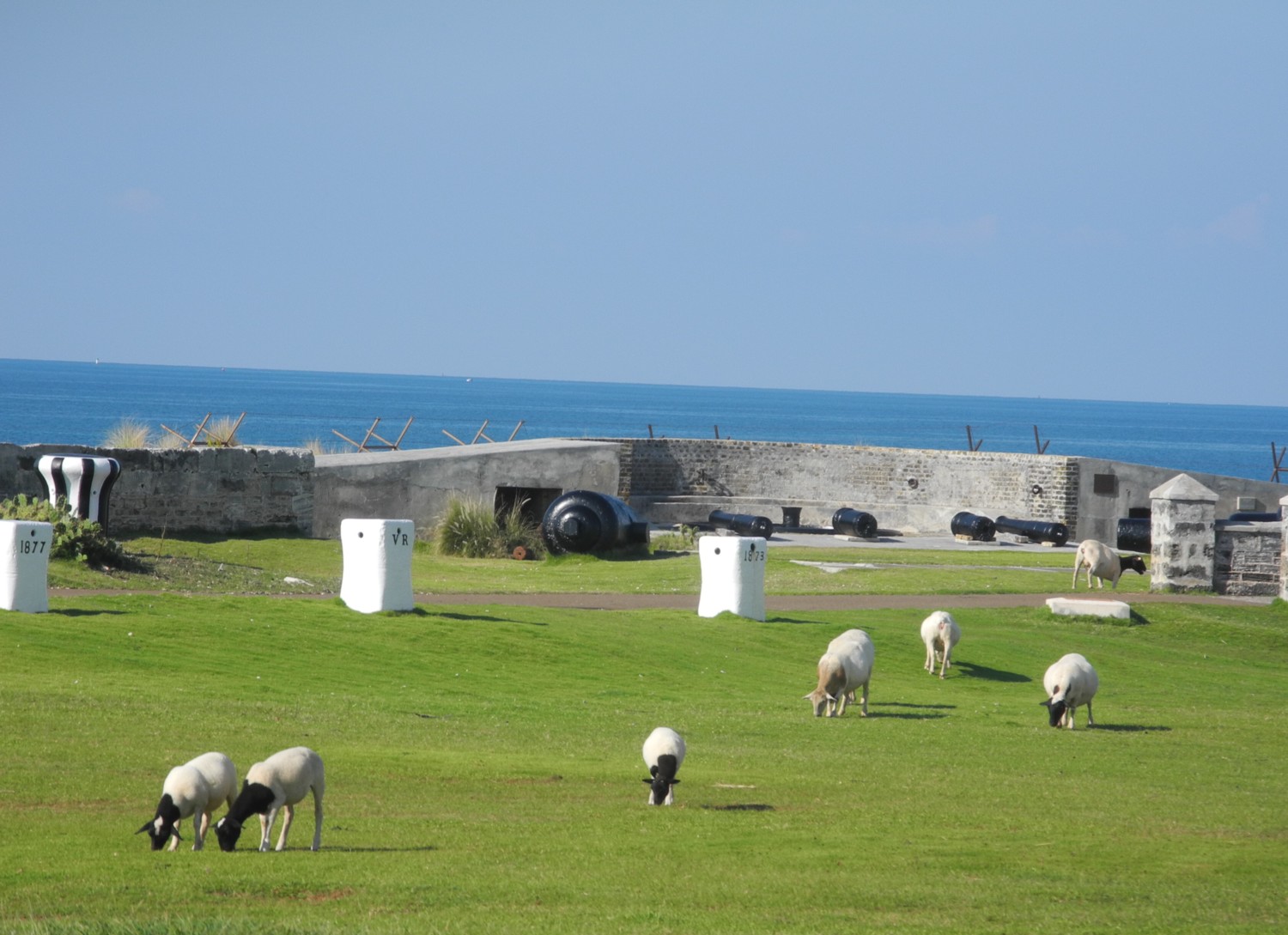
The Keep of the Dockyard is a six-acre historic fort that was designed to serve the naval fleet at anchor in Grassy Bay. It was once one of the most strategic military installations in the world and was heavily protected with a moated entrance, cannons, shell guns, and other weapons.

The Naval Dockyard contains the National Museum of Bermuda as well as Dolphin Quest © Karen Rubin/goingplacesfarandnear.com

It was designed so munitions and provisions could be moved by boat between the large Keep pond and the vessels in the harbor. The grounds and many buildings of the Keep are now home to the National Museum of Bermuda’s exhibits and serve as home base for its highly-regarded maritime research, restoration, and preservation efforts.

“The fort provides probably the world’s most secure home for our dolphins, and we are enjoying exploring the many possibilities for expanding our dolphin programs within this historic context,” Dolphin Quest notes.

It is contained within a 16-acre National Museum of Bermuda with eight exhibit buildings and the most extensive historical collection in Bermuda, including the hilltop commissioner’s house. You can walk along the ramparts.

In 2016, the dolphin’s habitat was expanded to include The Ocean Habitat, a large sanctuary that extends beyond the museum walls and allows the dolphins to swim out into the ocean waters via a connecting tunnel from inside the lagoon. The entire sanctuary is one of the largest and most natural dolphin habitats in the world. Dolphin encounters in this area allow guests to interact with dolphins while riding underwater scooters and they can also explore the Bermuda reefs and bountiful marine life.

Dolphin Quest is contained within The Keep of the Naval Dockyard © Karen Rubin/goingplacesfarandnear.com.

After American independence from Britain, Bermuda was identified as a strategic location for a naval base and dockyard. Construction on the dockyard began in 1809, which involved massive land reclamations and quarrying, first by slaves and then by thousands of British convicts. In its heyday, the dockyard provided facilities for the Royal Navy’s fleet.

The Keep was the citadel of the Dockyard, built to guard the naval base against land or sea attack and as an arsenal. The massive bastions and ramparts were designed by the Royal Engineers and are reinforced at intervals by casemated gun emplacements. Casemates were built in the late 1830’s to house troops manning the Dockyard fortifications. After Dockyard closed in 1951 it became Bermuda’s maximum-security prison from 1963-1994.

It is currently undergoing extensive restoration by the Museum and volunteers.

Walking the ramparts of the Naval Dockyard © Karen Rubin/ goingplacesfarandnear.com

The Museum’s scope has expanded to encompass more than maritime history and today it is a vital custodian of Bermuda’s heritage. It is also a champion for the preservation of Bermuda’s underwater and land-based cultural heritage through collecting, exhibitions, restoration, conservation, research, publication, education, public outreach, and archaeology.

The National Museum of Bermuda’s scope has expanded to encompass more than maritime history and today it is a vital custodian of Bermuda’s heritage © Karen Rubin/goingplacesfarandnear.com

The National Museum of Bermuda is open daily except Christmas Day (Dolphin Quest is still open); admission fees are $15/adult, $12/seniors; under 16 free; admission fee is waived for Dolphin Quest participants.

“Dolphin Quest is committed to protecting our planet and inspiring the next generation of ocean stewards by providing inspirational interactive experiences, educational programs and contributing funding, resources and field support to vital marine studies around the globe.

“With resort partners in Bermuda, Hawaii, and Oahu, Dolphin Quest inspires tens of thousands of guests each year to care about and help protect dolphins in the wild.” 

Dolphin Quest Bermuda. National Museum of Bermuda. 15 The Keep. Sandys, Bermuda MA 01. Tel: 441.234.4464 (local); call 800-248-3316 from US. https://dolphinquest.com/dolphin-quest-bermuda/.

_______________________

© 2017 Travel Features Syndicate, a division of Workstyles, Inc. All rights reserved. Visit goingplacesfarandnear.com,  www.huffingtonpost.com/author/karen-rubin , and travelwritersmagazine.com/TravelFeaturesSyndicate/. Blogging at goingplacesnearandfar.wordpress.com and moralcompasstravel.info. Send comments or questions to FamTravLtr@aol.com. Tweet @TravelFeatures. ‘Like’ us at facebook.com/NewsPhotoFeatures
Fall Getaway in the Catskills: Thomas Cole National Historic Site is Site #1 on the Hudson River School Art Trail

Thomas Cole’s studio at Cedar Grove, a National Historic Site “Where American Art Was Born.” © 2017 Karen Rubin/goingplacesfarandnear.com

By Karen Rubin, Travel Features Syndicate, goingplacesfarandnear.com

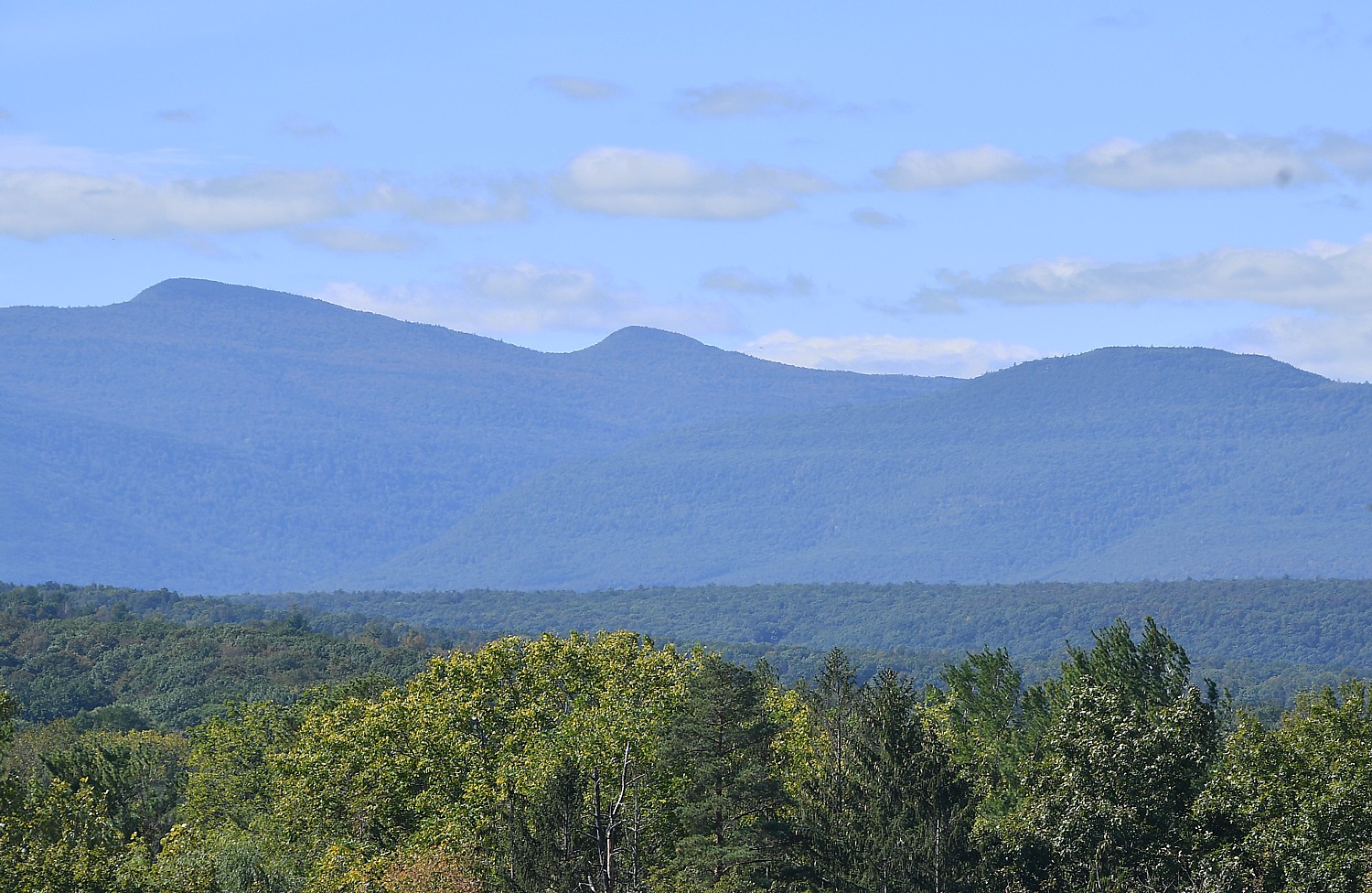
The first thing you notice about the Thomas Cole House, “Where American Art Was Born,” is the view from his porch – out to the ridges of the Catskills Mountains, the Hudson River curving around a bend. It is not hard to imagine that in Cole’s day, there would have been fields between his house and the river. But it is the same scene immortalized in paintings renowned as the “first American art movement.”

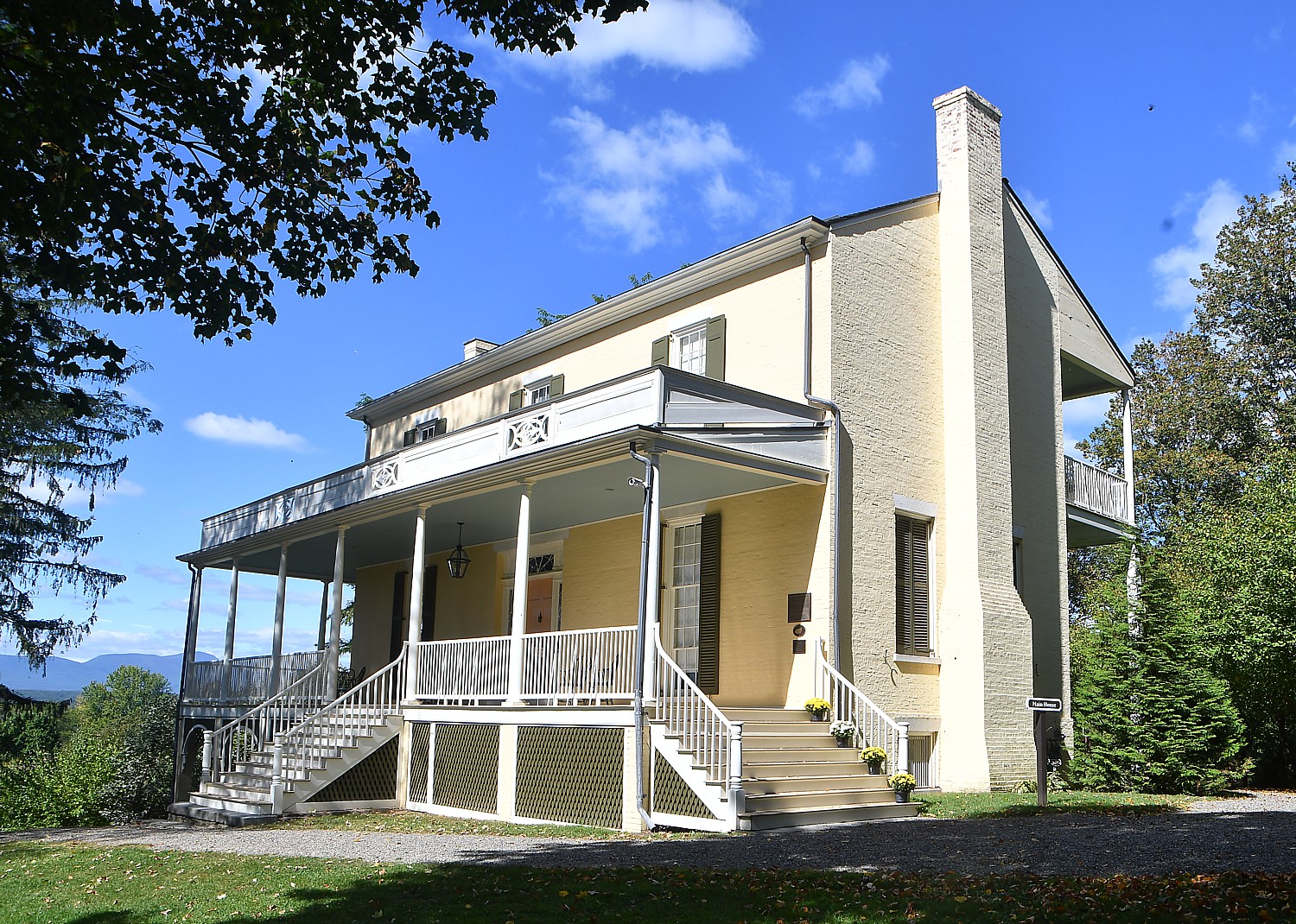
Cedar Grove, Thomas Cole’s home, is where you discover how one man invented a new way of looking at America © 2017 Karen Rubin/ goingplacesfarandnear.com

Thomas Cole’s Cedar Grove, now the Thomas Cole Historic Site and Site #1 on the Hudson River School Art Trail, has been redone since I last visited – more of the house restored to the way it was when Cole, at 35 years old, married 24-year old Maria Bartow, the niece of the man who owned the house and farm where Cole was renting studio space for 10 years..

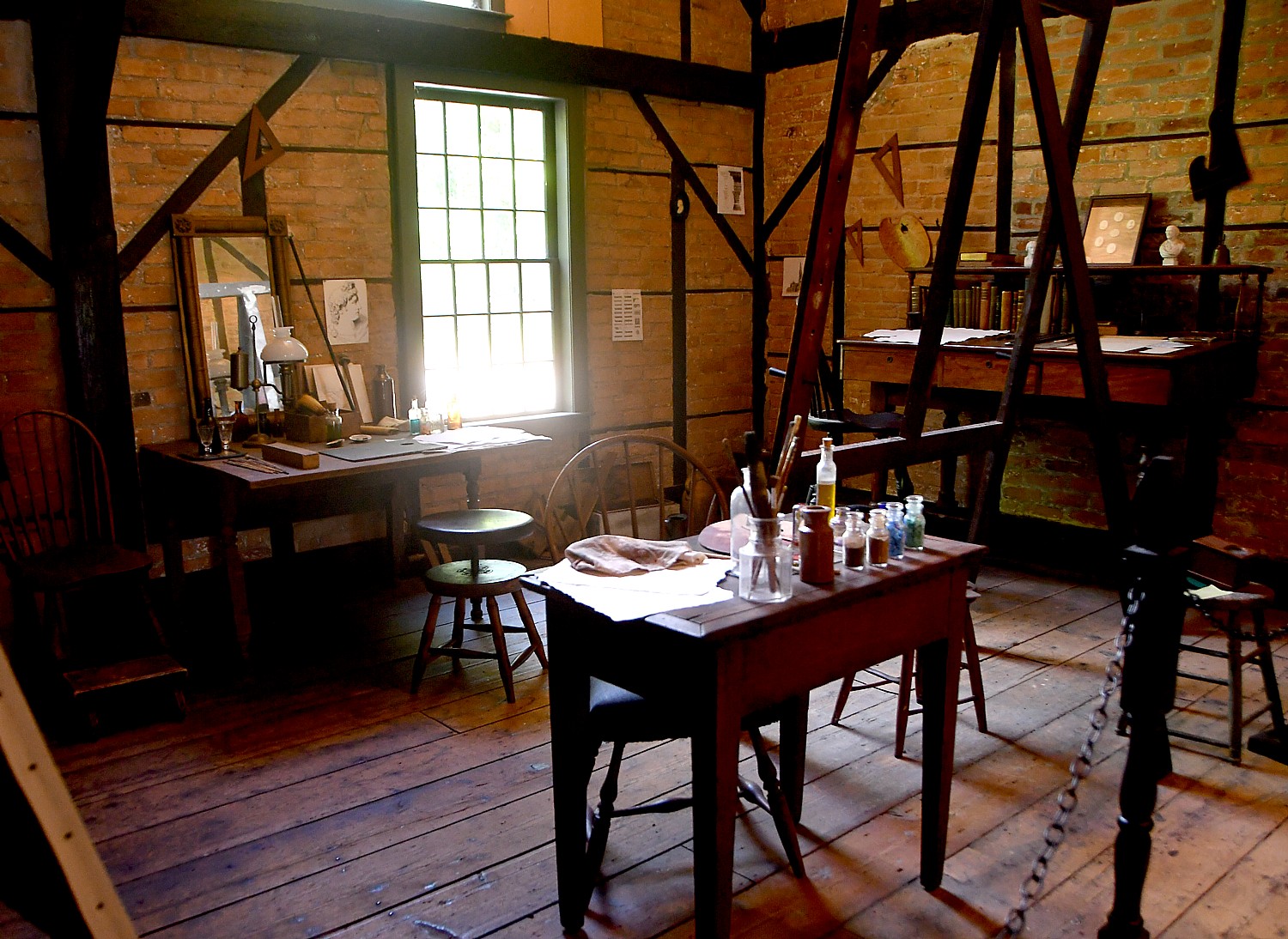
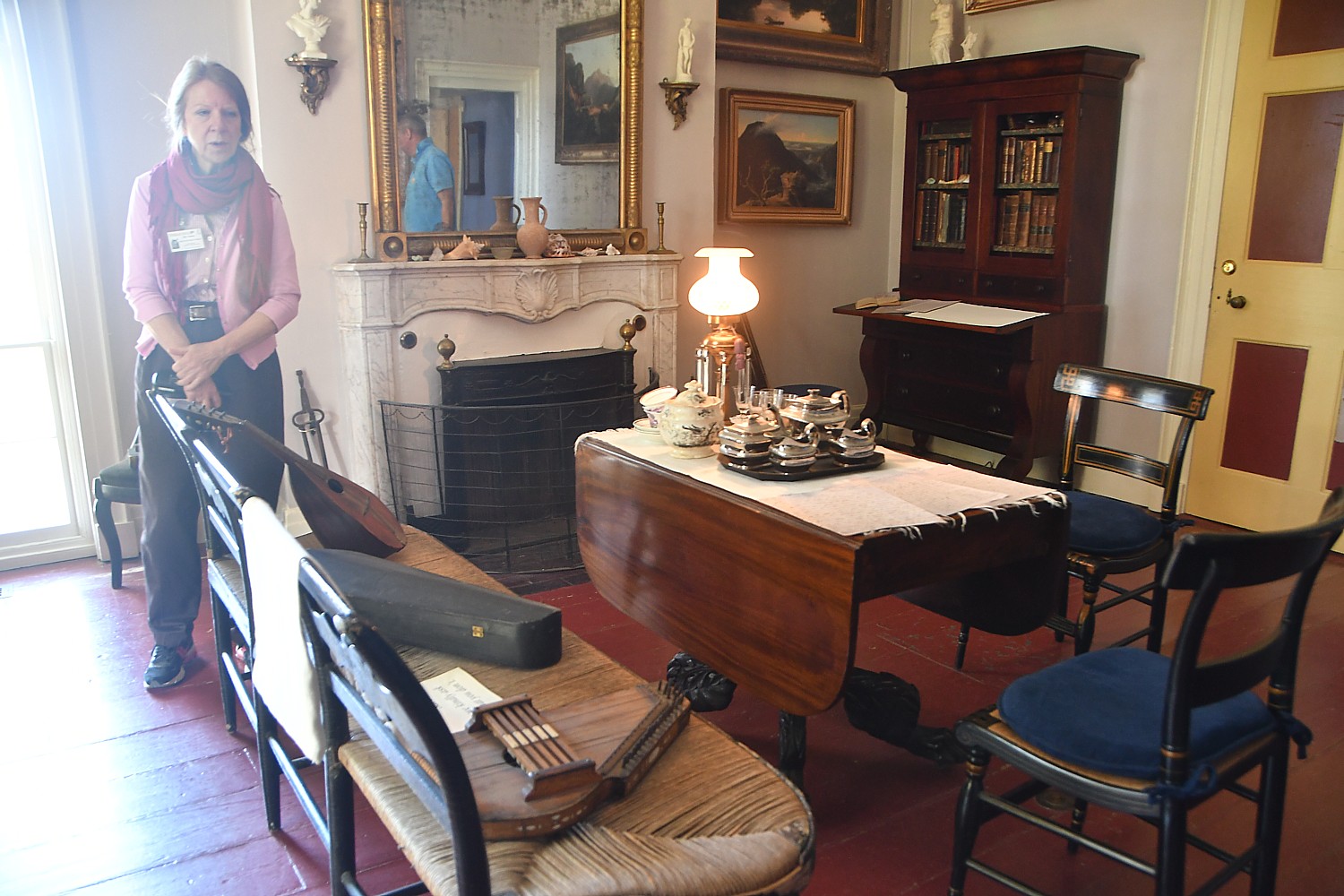
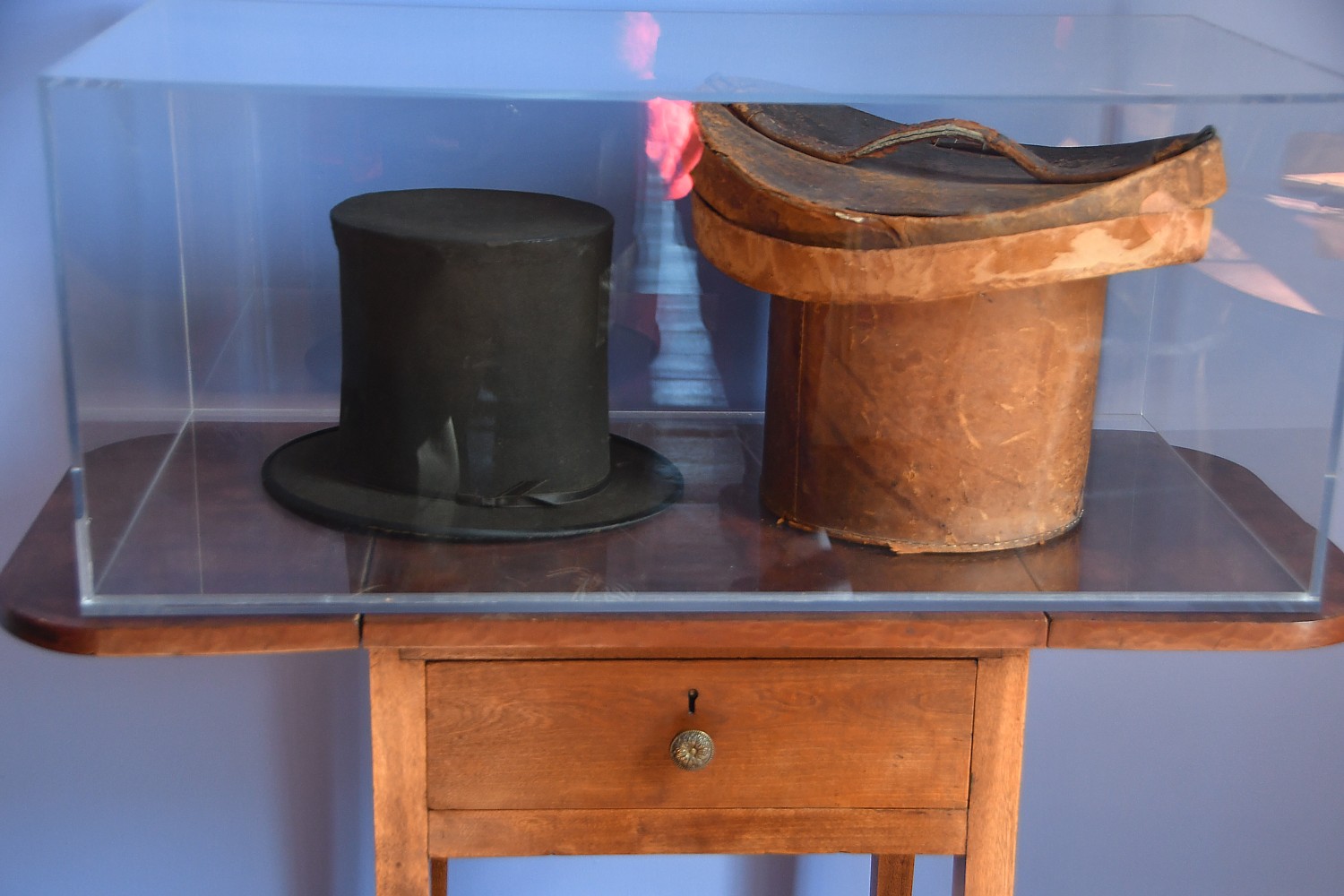
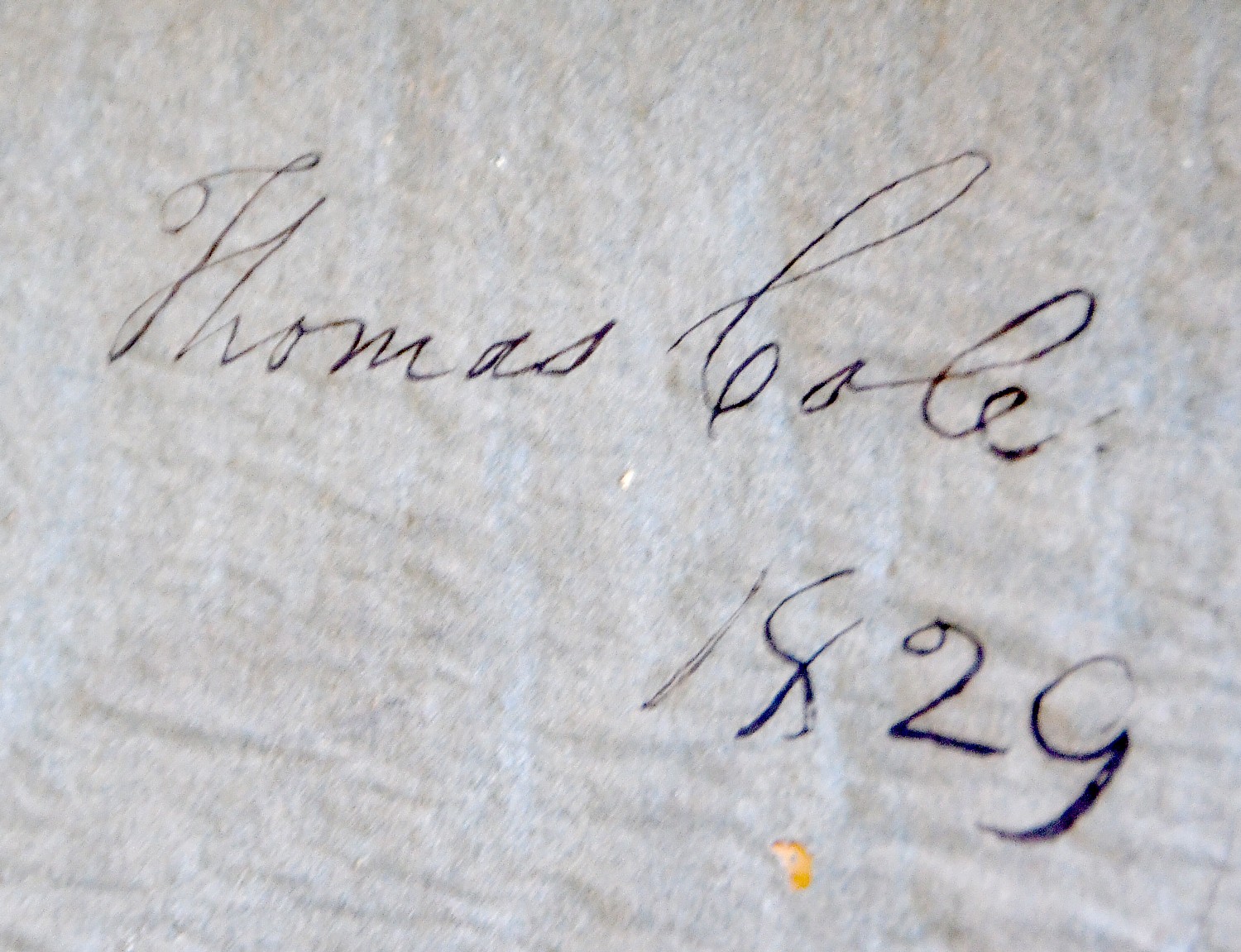
The guided tour has also been revamped with new innovative, multi-media features as well as personal effects – I love seeing Cole’s top hat, his musical instruments which he played and posed, his paint box, his traveling trunk with his signature and date, 1829 – and original paintings, and most especially his studio with his easel and paints and a room devoted to his creative process.

The view of the Hudson River Valley and Catskill Mountains from Thomas Cole’s porch at Cedar Grove © 2017 Karen Rubin/goingplacesfarandnear.com

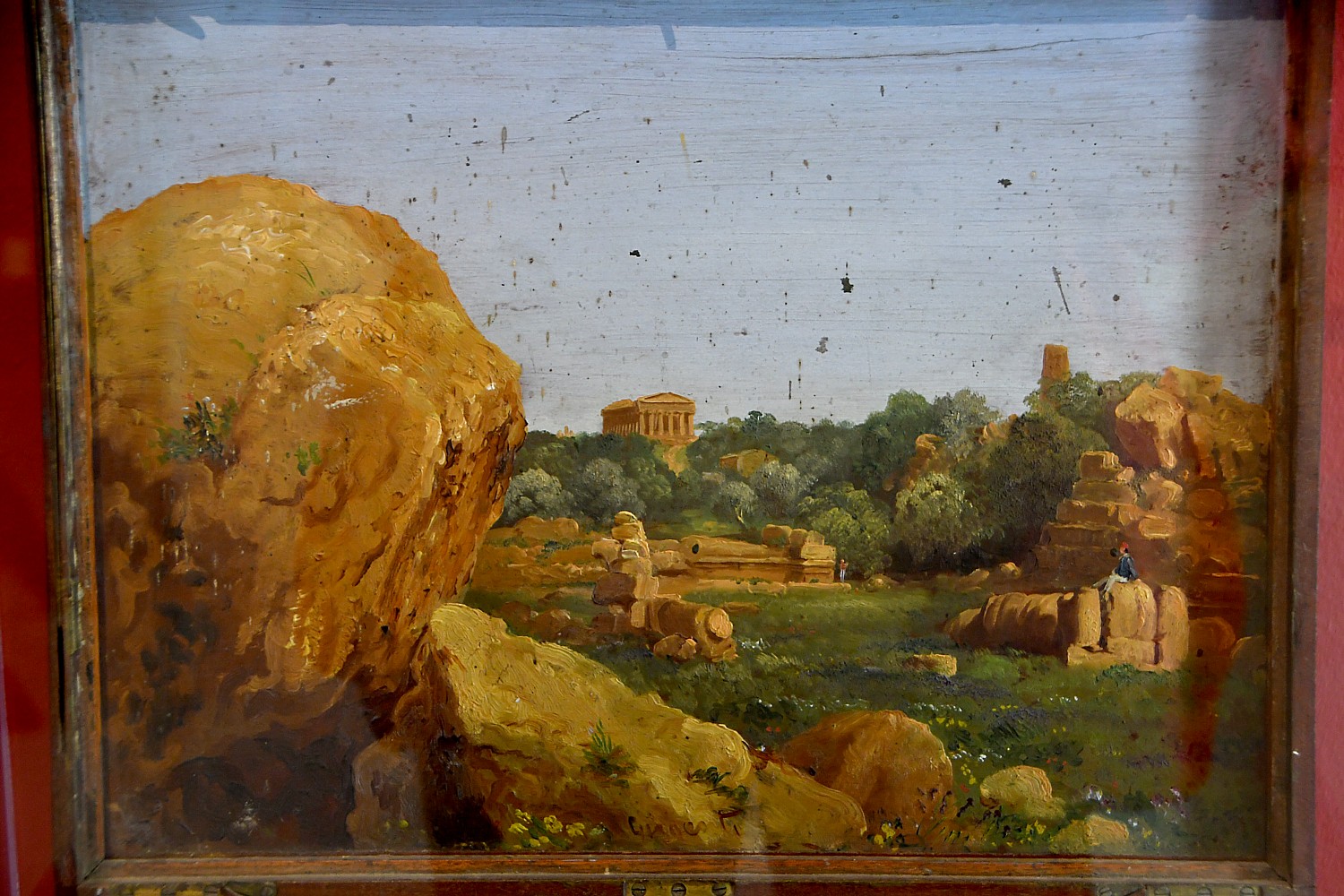
The presentation really personalizes the man, brings him into your presence. You start the guided tour in the parlor that Thompson, who really encouraged Cole, turned into a sales office for the artist. What appears to be Cole’s portrait – a video projection – becomes a slide show of his art as a voice narrates from Cole’s own journal and writings. Around the room are projections or digital reproductions of Cole’s paintings (some of Cole’s original paintings are in upstairs rooms we visit). He describes the inspiration and rejuvenation he feels from this wilderness, how he is “deliriously happy” at having his family, and his outrage over the “ravages of the axe” of progress.

Touring the Thomas Cole’s Cedar Grove, a National Historic Site © 2017 Karen Rubin/goingplacesfarandnear.com

These themes come together in his work: while primarily a painter of landscapes, he expressed his philosophical opinions in allegorical works, the most famous of which are the five-part series, The Course of Empire, which depict the same landscape over generations—from a near state of nature (depicting American Indians) to consummation of empire (Rome), and then decline and desolation, which is now in the collection of the New York Historical Society (and will be on display at the Metropolitan Museum of Art in 2018); and four-part The Voyage of Life, which are reproduced in his studio. (“Thomas Cole’s Journey: Atlantic Crossings” will be on view at the Met, January 30-May 13, 2018, and feature some of his most iconic works, including The Oxbow (1836) and his five-part series The Course of Empire (1834–36, www.metmuseum.org/exhibitions/listings/2018/thomas-cole,).

I appreciate Cole as very possibly America’s first environmentalist, the first to appreciate conservation and raise the alarm over the march of progress at a time when the Industrial Revolution was taking hold and technological progress was worshipped along with capitalism, as he railed against the “copper-hearted barbarians” and “dollar-godded utilitarians.”

“We are still in Eden; the wall that shuts us out of the garden is our own  ignorance and folly,” he says, as a projection of his painting, “Expulsion from the Garden of Eden” (1828) appears.

Cole worried that America’s rapid expansion and industrial development would destroy the glorious landscape – in 1836, he could see the railroad being built through the valley and he bemoaned the loss of forest along Catskill Creek, “the beauty of environment shorn away.”

Cole recognized America as a land in transition – the settled and domesticated juxtaposed with the wild and undomesticated… He witnessed the changes taking place around him.. And in the early 1800s, America was still in process of creating own culture, distinct from the European settlers.

An Immigrant Dazzled by America’s Wilderness

Thomas Cole was born in Lancashire, England, in 1801 and emigrated to the United States with his parents and sister (his father was in textiles) in 1818, settling first in Philadelphia, then Steubenville Ohio, then New York City. He had little formal art training; he picked up the basics from a wandering portrait painter. Cole soon focused on landscape and ultimately, Cole transformed the way America thought about nature and the way nature was portrayed on canvas.

Thomas Cole’s paint box © 2017 Karen Rubin/goingplacesfarandnear.com

As an immigrant, Cole was dazzled by America’s vast stretch of untamed wilderness, unlike anything that existed in Europe. At this point in time, though, most Americans did not appreciate the wilderness – they thought of it as something to be feared or exploited. Instead, America was enthralled with industrialization, technology and progress.

Thomas Cole’s signature inside his trunk © 2017 Karen Rubin/ goingplacesfarandnear.com

Cole was 24 years old when he took one of the new steamships up the Hudson River (it was “the thing to do” at the time). He made a painting which sold immediately, came again to make another painting and that sold immediately, as well. He came so often he looked around for a studio in the village of Catskill. He came to Cedar Grove, John Alexander Thompson’s 110-acre farm with an orchard and a hilltop view out to the Hudson River and the Catskill Mountains – the same view we see today – and for the next 10 years, rented a studio in a structure next door to Thompson’s house (where Temple Israel now stands).

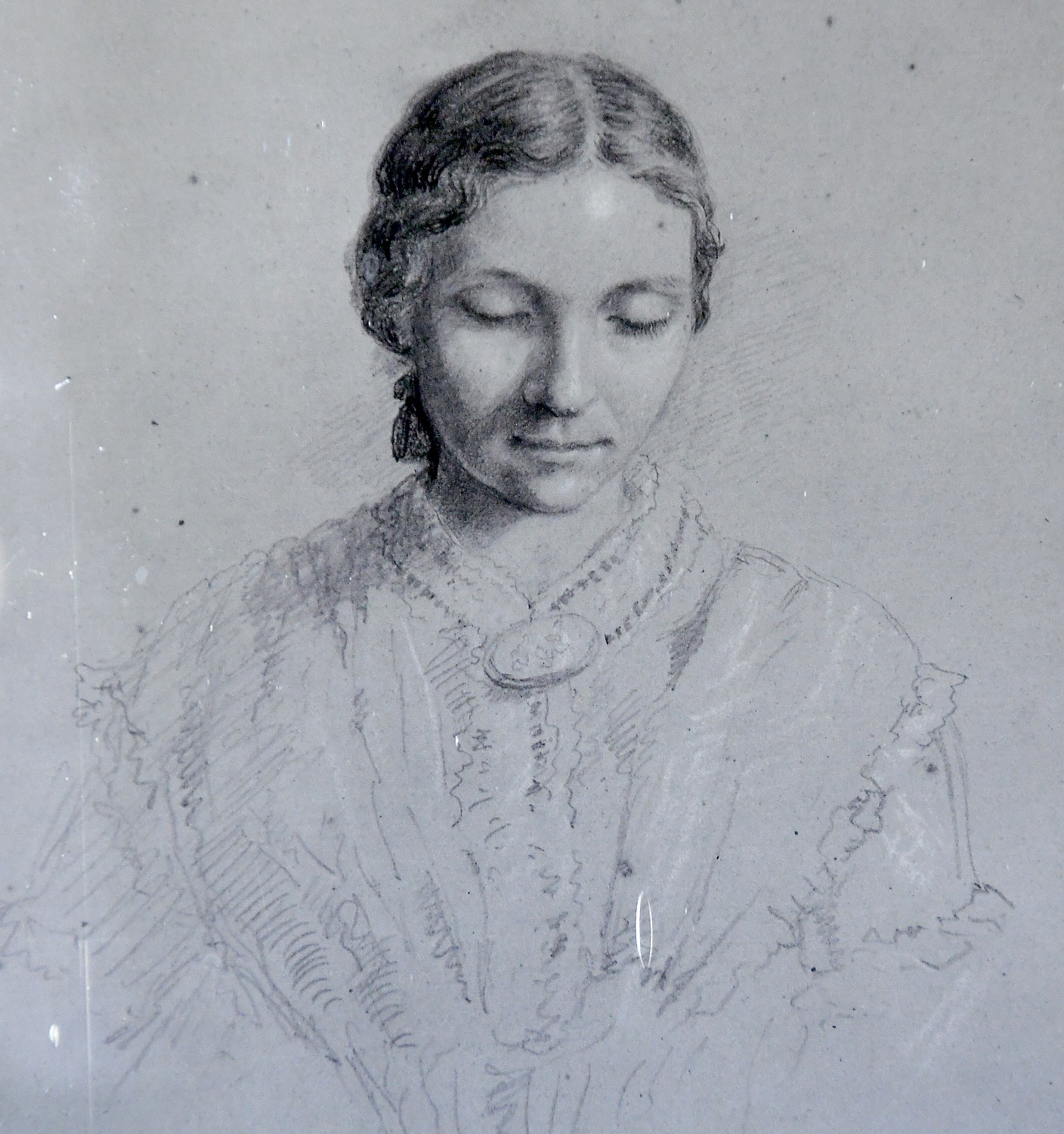
Sketch of Mary Cole

Cole fell in love with Maria Bartow, Thompson’s niece 11 years younger than Cole, then 35 years old, and moved into Cedar Grove permanently, all living together in the modest house which Thompson had built in 1815.

Thompson provided Cole with the two parlors on the main floor to use as “sales rooms” for his painting, and built a studio for Cole, cutting out a window so he would have northern light.

Thompson also built a studio for him with a high window to bring in northern light, and we see his paints and easel as if he had just left the room for a moment.

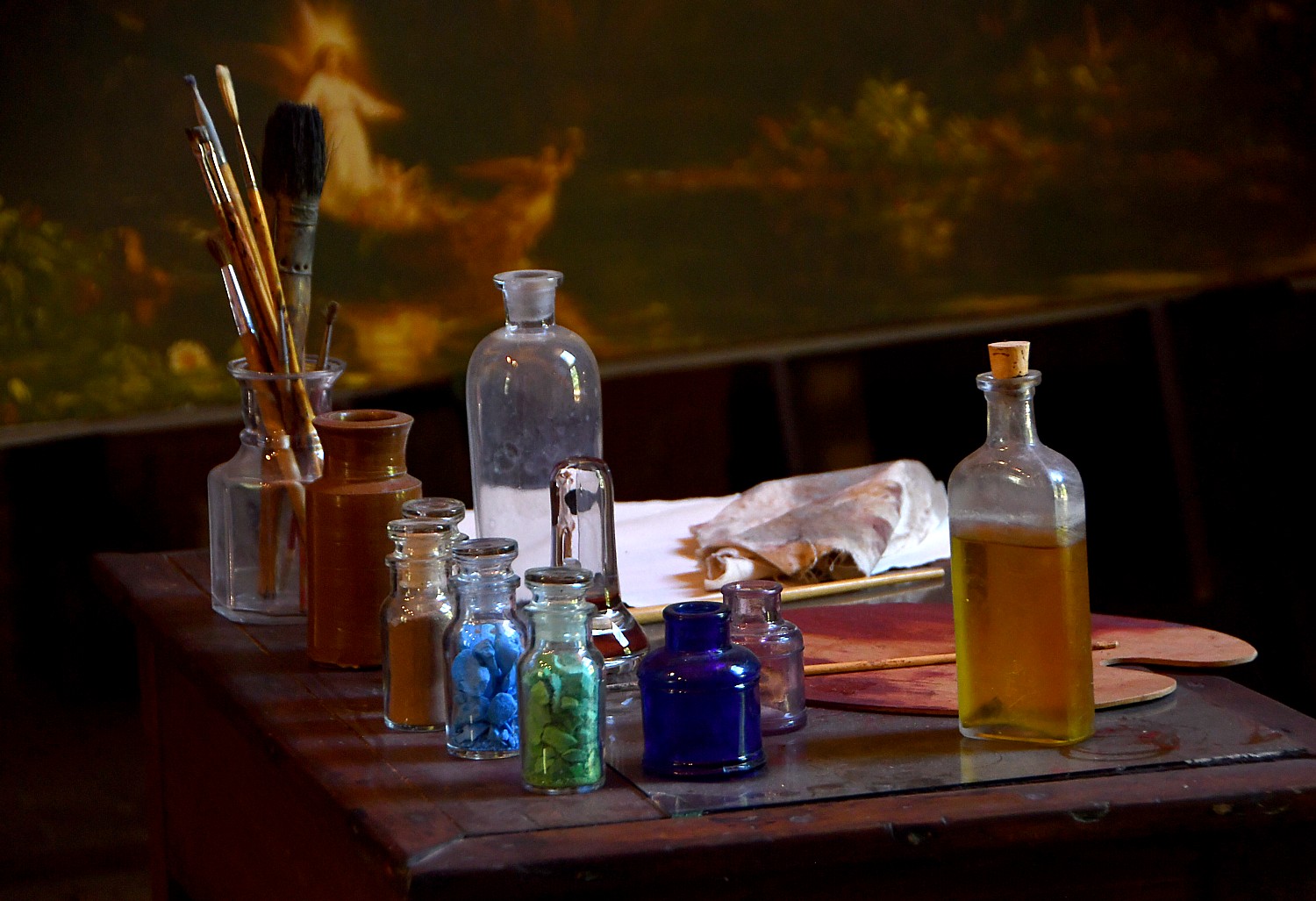
Cole’s studio, which Mary’s uncle made for him, installing a high window to bring in northern light, has been restored. It is where he painted one of his most famous series, the four “Voyage of Life” paintings (he painted eight sets of four; one of the sets is in the New-York Historical Society and will be on display January 2018 at the Metropolitan Museum of Art).  We see his paints and easel as if he had just left the room for a moment.

Thomas Cole’s painting materials, as if he had just left his studio for a moment © 2017 Karen Rubin/goingplacesfarandnear.com

Alas, the studio probably contributed to his early death, at the age of 47, when his wife was pregnant with their fifth child – the studio in winter had little ventilation and he was working with turpentine and paints and had a respiratory illness. He died of pleurisy. Mary named their son Thomas Cole, Jr.

Frederick Edwin Church, recognized as a prodigy, was 18 years old when Cole, then 43, took him on as an art student. Cole would take his six-year old son Theodore out with them painting. Paintings by Church that have a small boy are likely Cole’s son. After Cole died, in 1848, Church, who built his Olana on a hilltop on the opposite shore of the Hudson, helped the family, even hiring Cole’s son Theodore as his farm manager.

Photo of Thomas Cole’s granddaughter below his painting © 2017 Karen Rubin/ goingplacesfarandnear.com

Cole’s Creative Process

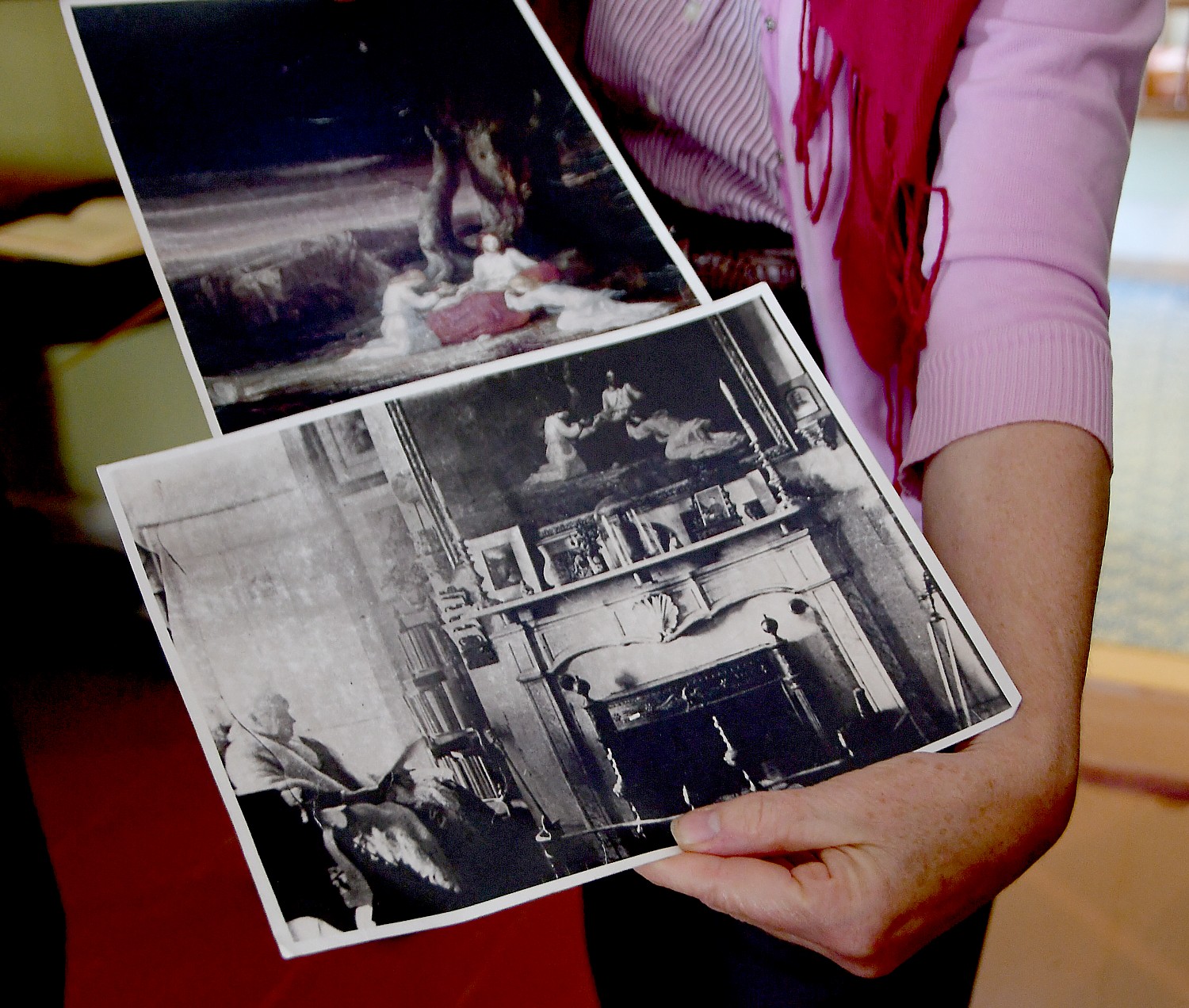
Touring the house is remarkable because it contains many of Cole’s personal effects including several of his paintings, like “Prometheus,” and his special items like musical instruments that he played and used as props for his paintings.

All of this is fairly miraculous because the house was sold in the 1960s and the contents auctioned off – the paintings, the furnishings. Over the years, many of the sold items have since come back, like “Uncle Sandy’s” chair, which we see today, which was purchased by a local postman who donated it back to Cedar Grove.

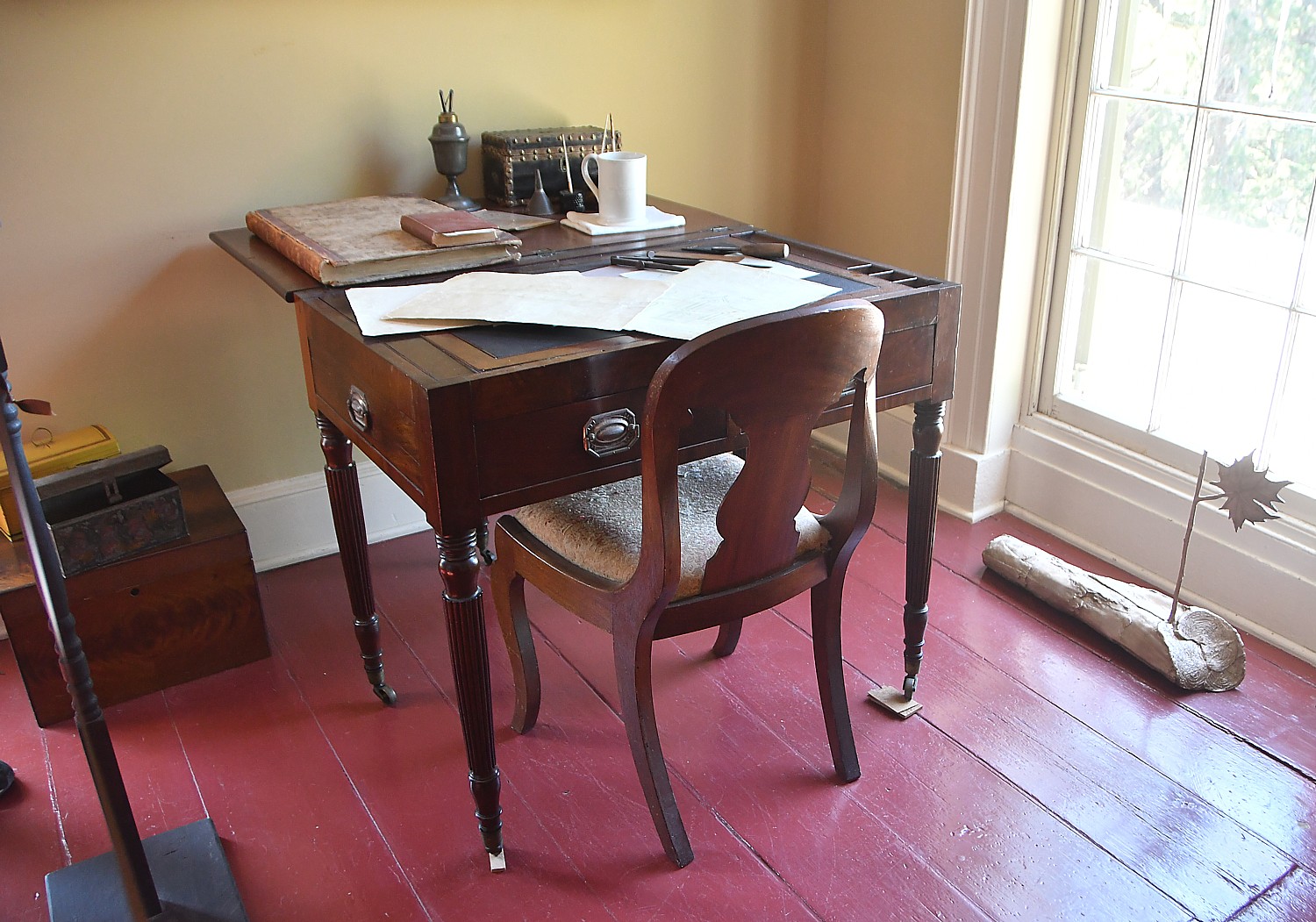
Thomas Cole’s writing desk © 2017 Karen Rubin/goingplacesfarandnear.com

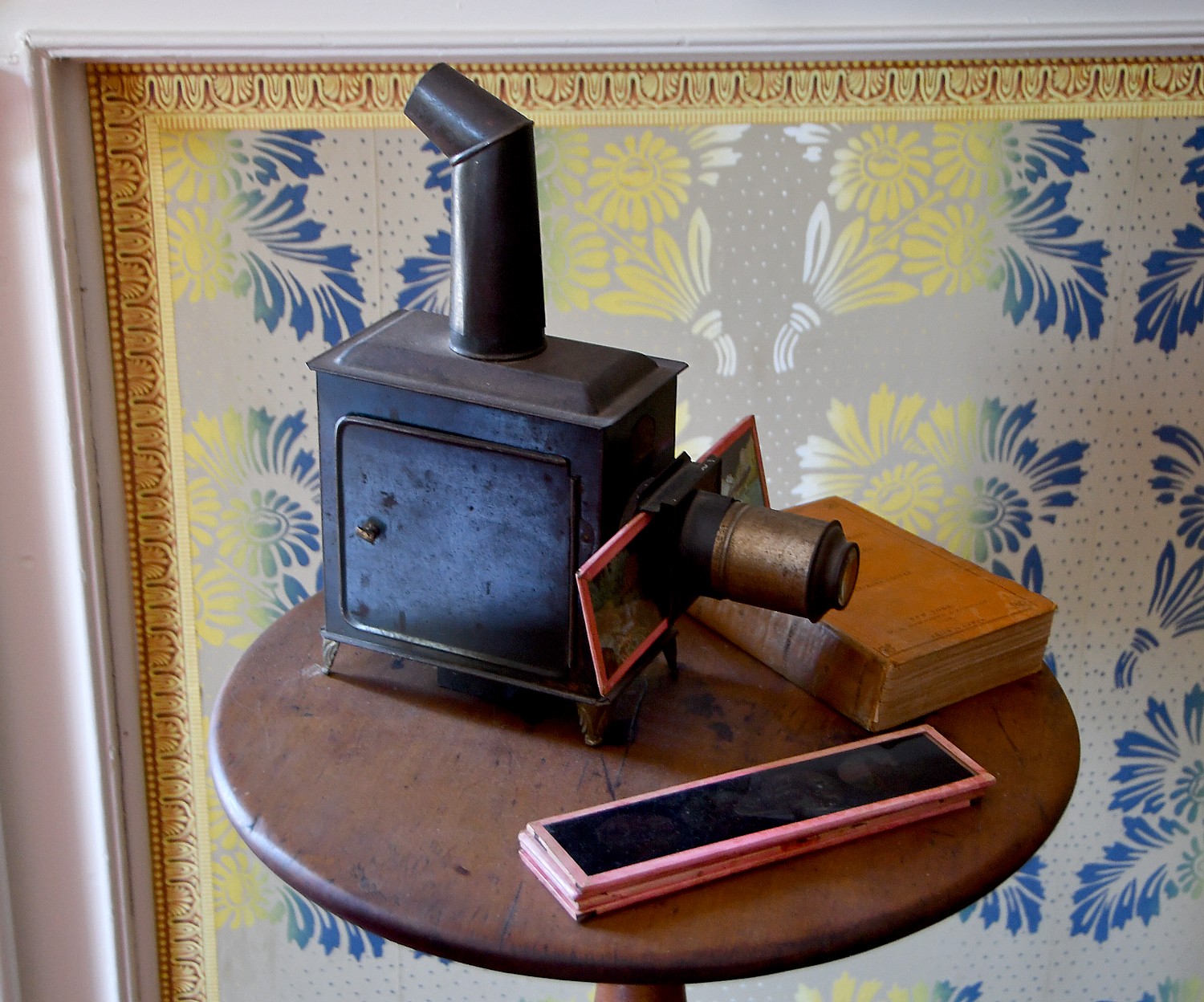
In a living room on the second floor, Cole’s letters “appear” on his actual writing desk (triggered by a motion detector); some of the paintings that decorate the room where they would have been are reproductions (the originals held in museums), but some are originals. There are black-and-white photos of his daughter in her later years, sitting in that very room. I am fascinated to see his “magic lantern” (an early slide projector with hand-painted glass slides) that drew its light from a candle inside. We appreciate Cole as a man of enormous talents –a poet, essayist and musician in addition to an artist and we see some of his instruments. We visit his bedroom and see his traveling trunk which he had made on Pearl Street, with his signature and date.

A magic lantern © 2017 Karen Rubin/goingplacesfarandnear.com

We learn that he was close friends with the novelist James Fenimore Cooper and provided illustrations for his work, including “The Last of the Mohicans” (1827) and “The Pioneers.”

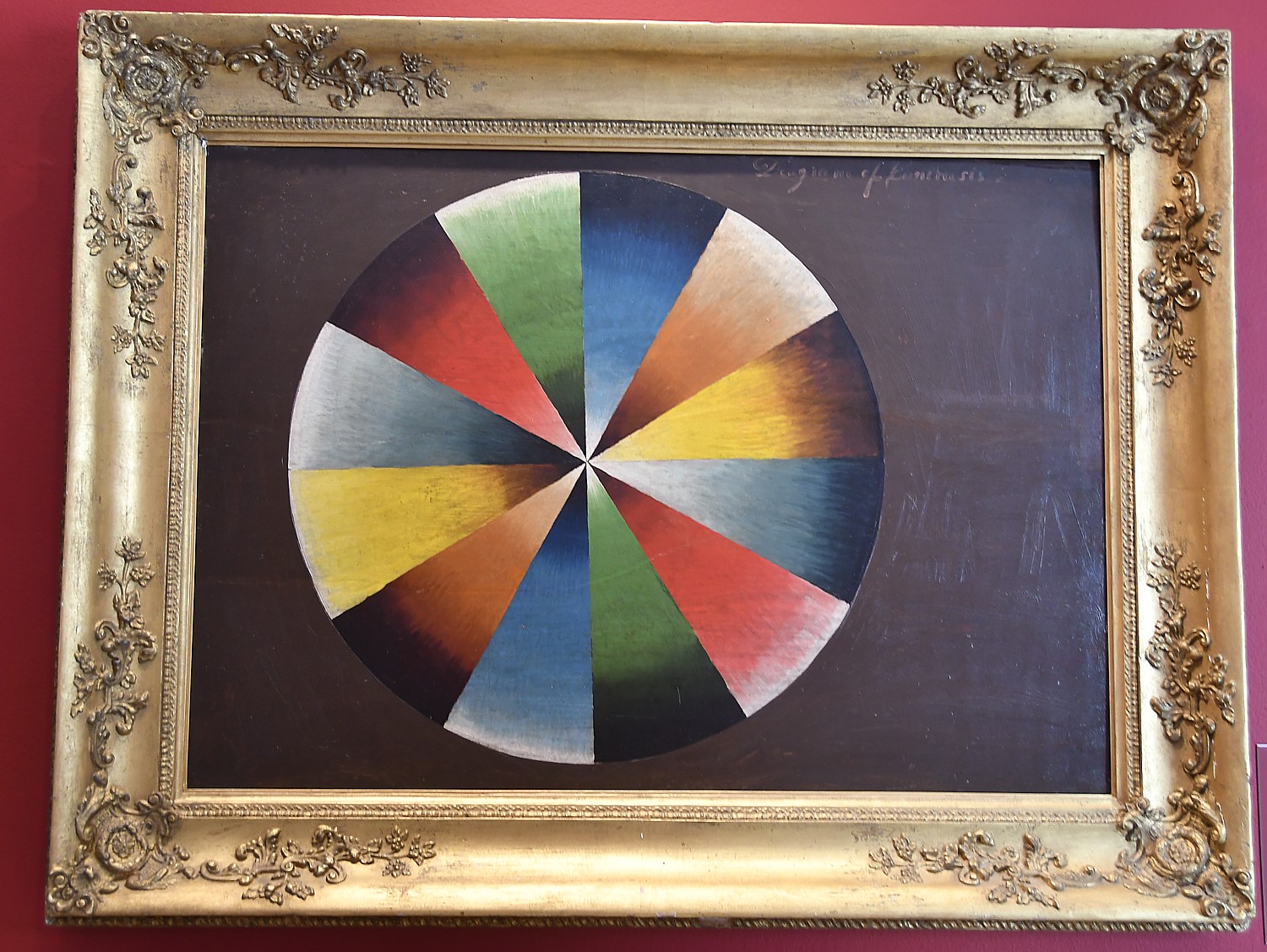
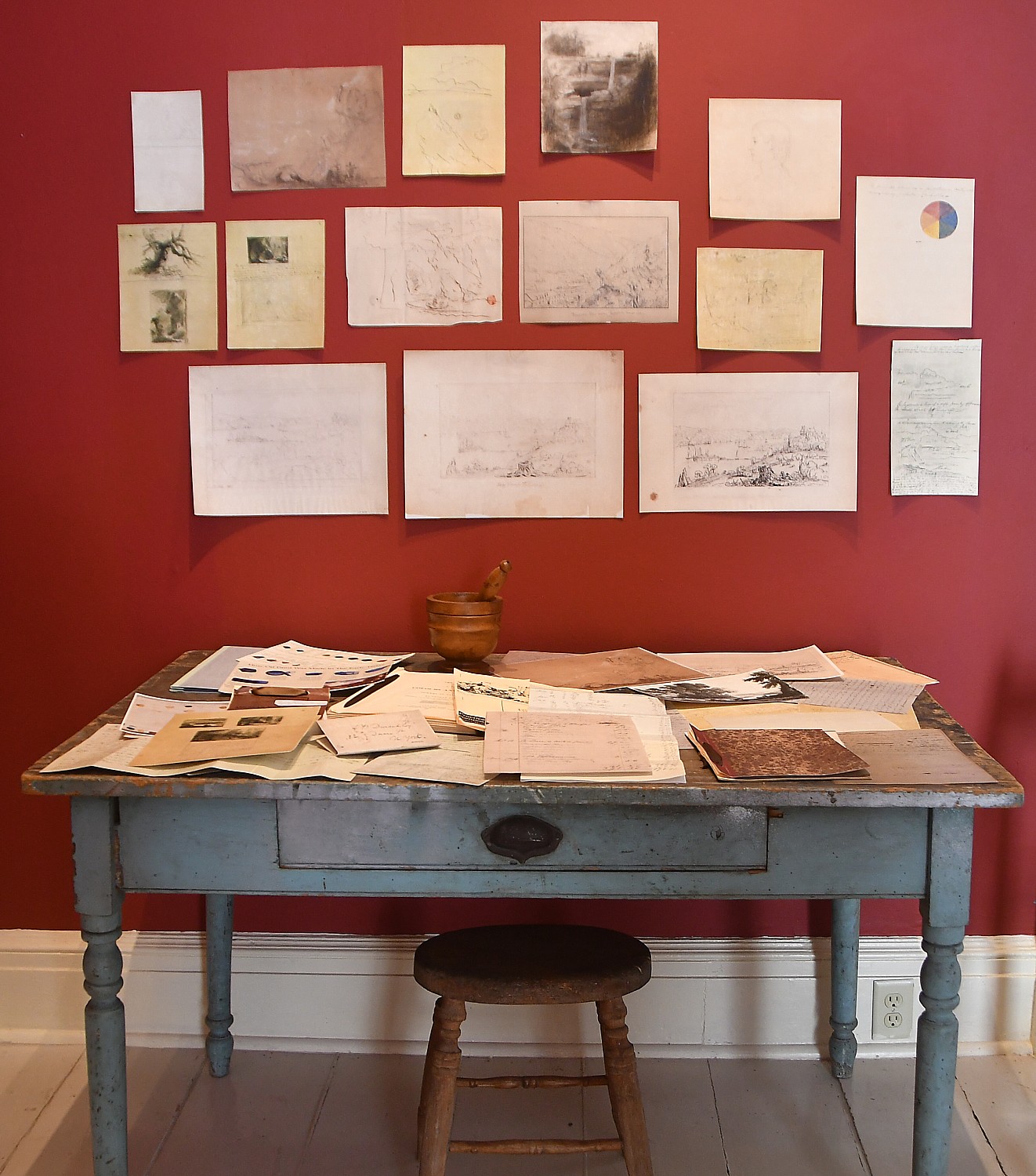
My favorite room is his “Process Room” where we see his actual sketches, his paint box which he decorated with a beautiful painting and papers and his famous color wheel.

On my hikes on the Hudson River School Art Trail, I wondered how Cole would have captured the scenes – the sheer logistics of getting to these remote places that take us 20 minutes to reach by car along paved roads. Cole painted at a time before photography was a handy tool, before capped paint tubes made painting “en plein air” as feasible as it was for the Impressionists decades later.

I learn that Cole hiked with a pocket easel and pencil. He would get to a place like Sunset Rock by dark (a trail which I hike), camp and stay there a few days. He made copious notes of the smallest details – the light, color (he created a color-wheel for himself which we see), the atmosphere, the vegetation and natural forms.

Thomas Cole’s color wheel © 2017 Karen Rubin/goingplacesfarandnear.com

But then he would wait before he painted the scene, for time to pass “to put a veil over inessential detail to turn it into beautiful and sublime…He had a vision of nature as an expression of the divine.”

It is important to realize that at the time, a painting afforded the only way for people to see places without actually visiting for themselves.

He began to turn his landscapes into allegorical exposition. Over a three-year period, he painted “The Course of Empire” a series depicting the same landscape over centuries and generations as civilization rises and falls, from savage to civilized, from glory to fall and extinction. He intended the series as a warning against American unbridled expansion and materialism. It took him three years to create and earned him a veritable fortune in commissions and fame.

Thomas Cole’s top hat © 2017 Karen Rubin/goingplacesfarandnear.com

Cole also became progressively more spiritual – coinciding with a rise in spiritualism in America. – and used his landscape painting as religious allegory. This is manifest in Cole’s “Voyage of Life,” a series of four paintings that show a pilgrim from infancy to old age, led by a guardian angel, which became Cole’s most popular work.

Each year, there are always special exhibits as well – in the Cole house, oddly juxtaposed with Cole’s 18th century works (we even see the wall trim that he painted himself) is a contemporary artist, Kiki Smith. In the New Studio, a separate building, this season is “Sanford R. Gifford in the Catskills.”

A glimpse into Thomas Cole’s creative process © 2017 Karen Rubin/goingplacesfarandnear.com

Most days when you visit the Cole house, you take a guided tour, but on Saturday and Sundays, 2-5, you can tour the house on your own. The house usually closes at the end of October but this year, it is open for three weekends in November.

Thomas Cole National Historic Site, 218 Spring Street, Catskill, NY 12414, 518-943-7465, www.thomasscole.org (Normally open May-October, but will have extended season this year, three weekends in November).

Get maps, directions and photographs of all the sites on the Hudson River School Art Trail at www.hudsonriverschool.org. 

A great place to stay: The Fairlawn Inn, a historic bed-and-breakfast, 7872 Main Street (Hwy 23A), Hunter, NY 12442, 518-263-5025, www.fairlawninn.com.

Further help planning a visit, from lodging to attractions to itineraries, is available from Greene County Tourism, 700 Rte 23B, Leeds, NY 12451, 800-355-CATS, 518-943-3223, www.greatnortherncatskills.com and its fall hub http://www.greatnortherncatskills.com/catskills-fall-foliage

See also:     

3-Day Fall Getaway in the Catskills: Fairlawn Inn is Superb Hub for Exploring the Hudson River Valley

_______________________

© 2017 Travel Features Syndicate, a division of Workstyles, Inc. All rights reserved. Visit goingplacesfarandnear.com,  www.huffingtonpost.com/author/karen-rubin , and travelwritersmagazine.com/TravelFeaturesSyndicate/. Blogging at goingplacesnearandfar.wordpress.com and moralcompasstravel.info. Send comments or questions to FamTravLtr@aol.com. Tweet @TravelFeatures. ‘Like’ us at facebook.com/NewsPhotoFeatures
Yosemite National Park: Surprising Diversity, Dramatic Scenes Hiking Chilnualna Falls Trail, Wawona

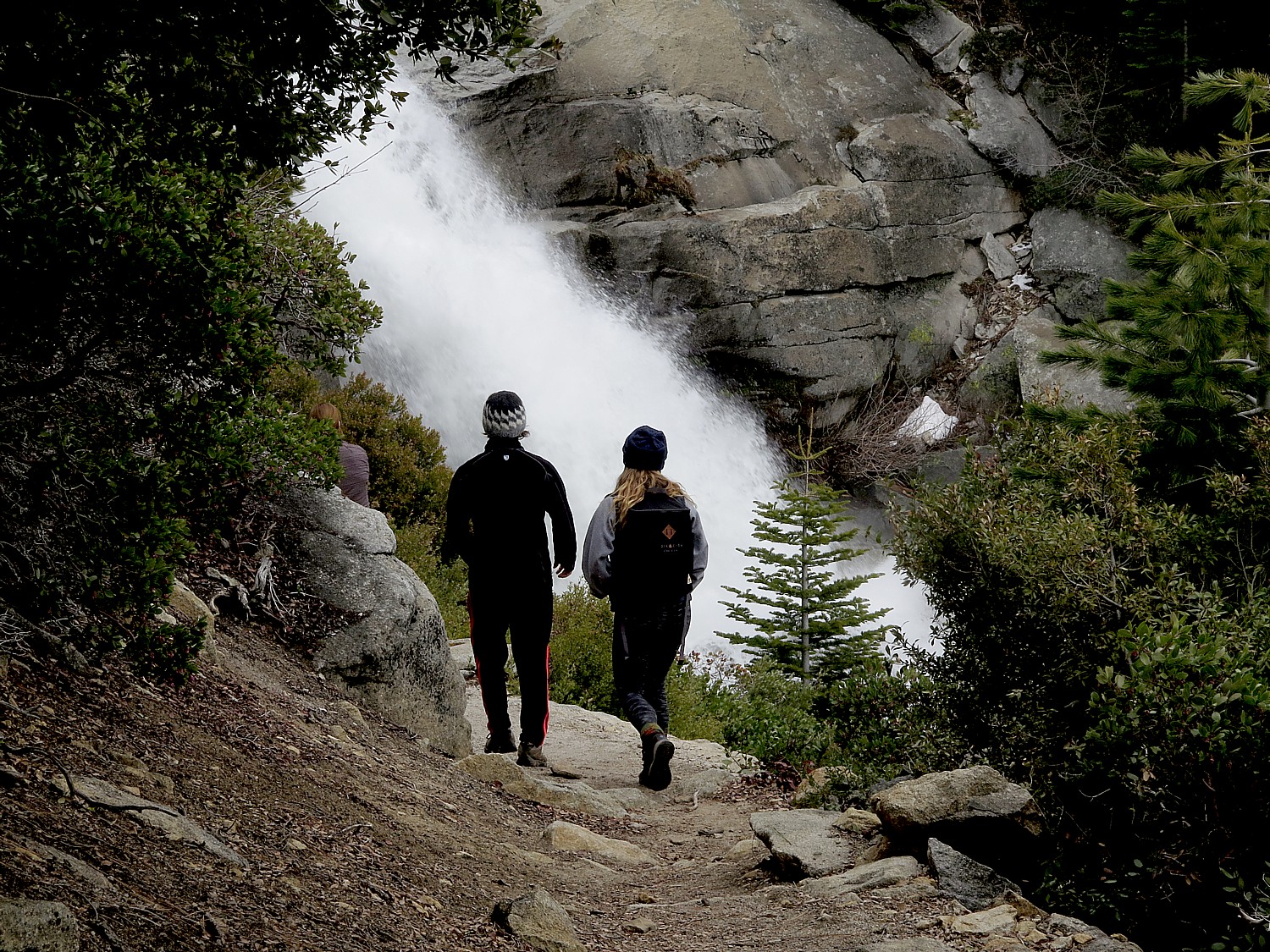
The Chilnualna Falls Trail brings you close to dramatic cascades several times on the way to the top © 2017 Karen Rubin/goingplacesfarandnear.com

By Karen Rubin, Eric Leiberman, Sarah Falter

Travel Features Syndicate, goingplacesfarandnear.com

It’s our second day in Yosemite National Park.

I am surprised at how much we could cover on our first day in Yosemite National Park, spent hiking in Yosemite Valley. This is the most popular and iconic part of this vast park, the size of Rhode Island, but the three trails we chose – Mist Trail, John Muir, Mirror Lake – haven given us a really good sense of the park, despite its size. Since we need to leave the area for San Francisco, 200 miles away, by 4 pm, we cleverly find a hike (thanks to the Tenaya Lodge concierge) that starts from just inside the South Gate, in the Wawona section, thereby cutting out 1 ½ hour drive each way jut to get into Yosemite Valley at the center of the park. We plan this out very well: the Chilnualna Falls Trail is just about 6 miles from the Tenaya Lodge, and is much, much, much less crowded – and yet, we meet some wonderful people from Australia and other places.

It is also sufficiently long hike to take about five or six hours – exactly the amount of time we have, and, we discover, offers dramatic, close-by views of the cascading Chilnualna Falls, the sweeping vistas of the southern  Yosemite, and wonderful diversity of the landscape, as the trail winds through a variety of terrain and habitats. Our choice proves brilliant.

We start out in the village of Wawona (you pass a general store so if you need supplies, this would be a great place), turn onto Chilnualna Falls Road and park at the trailhead (there are restroom facilities here).

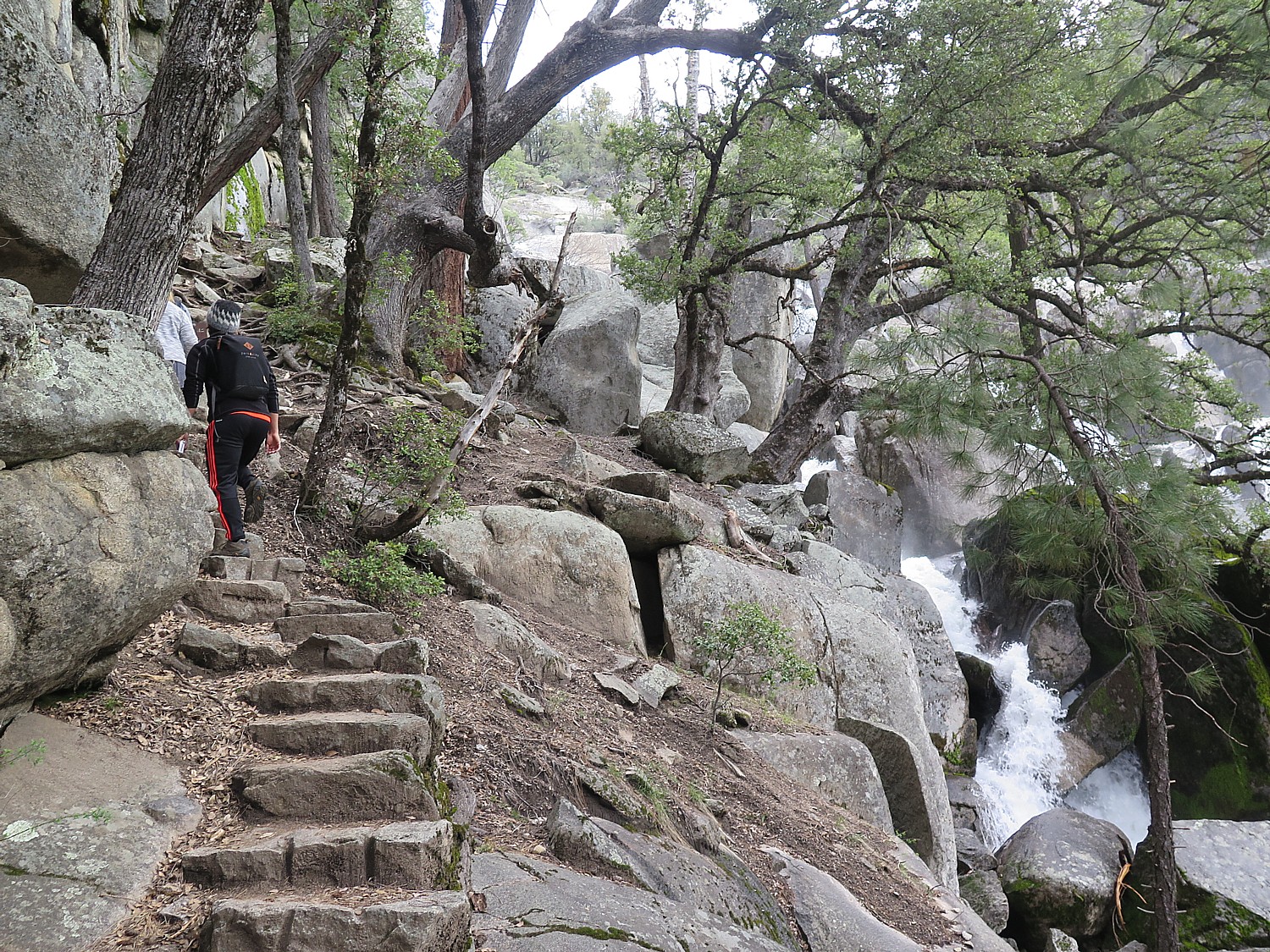
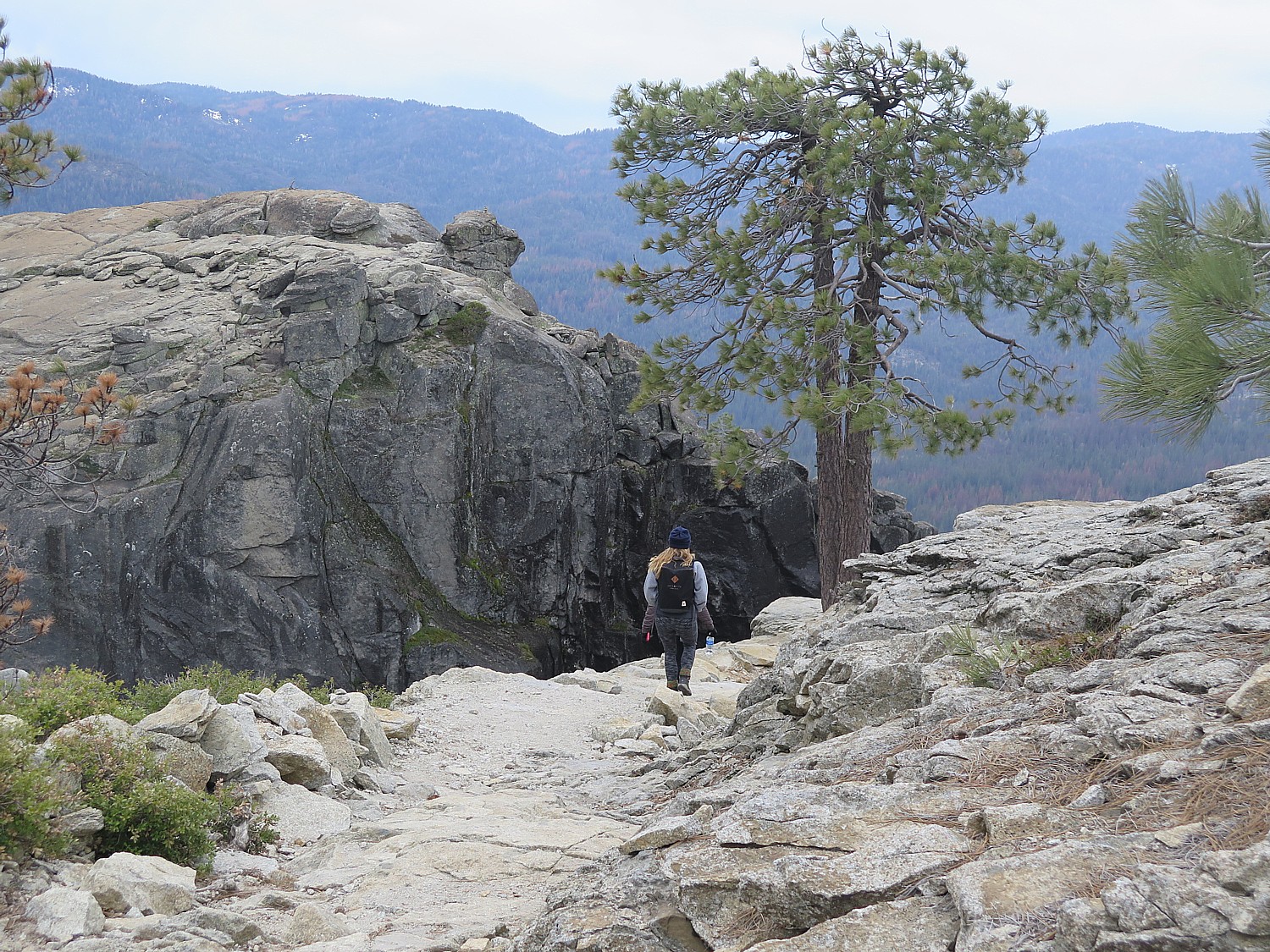
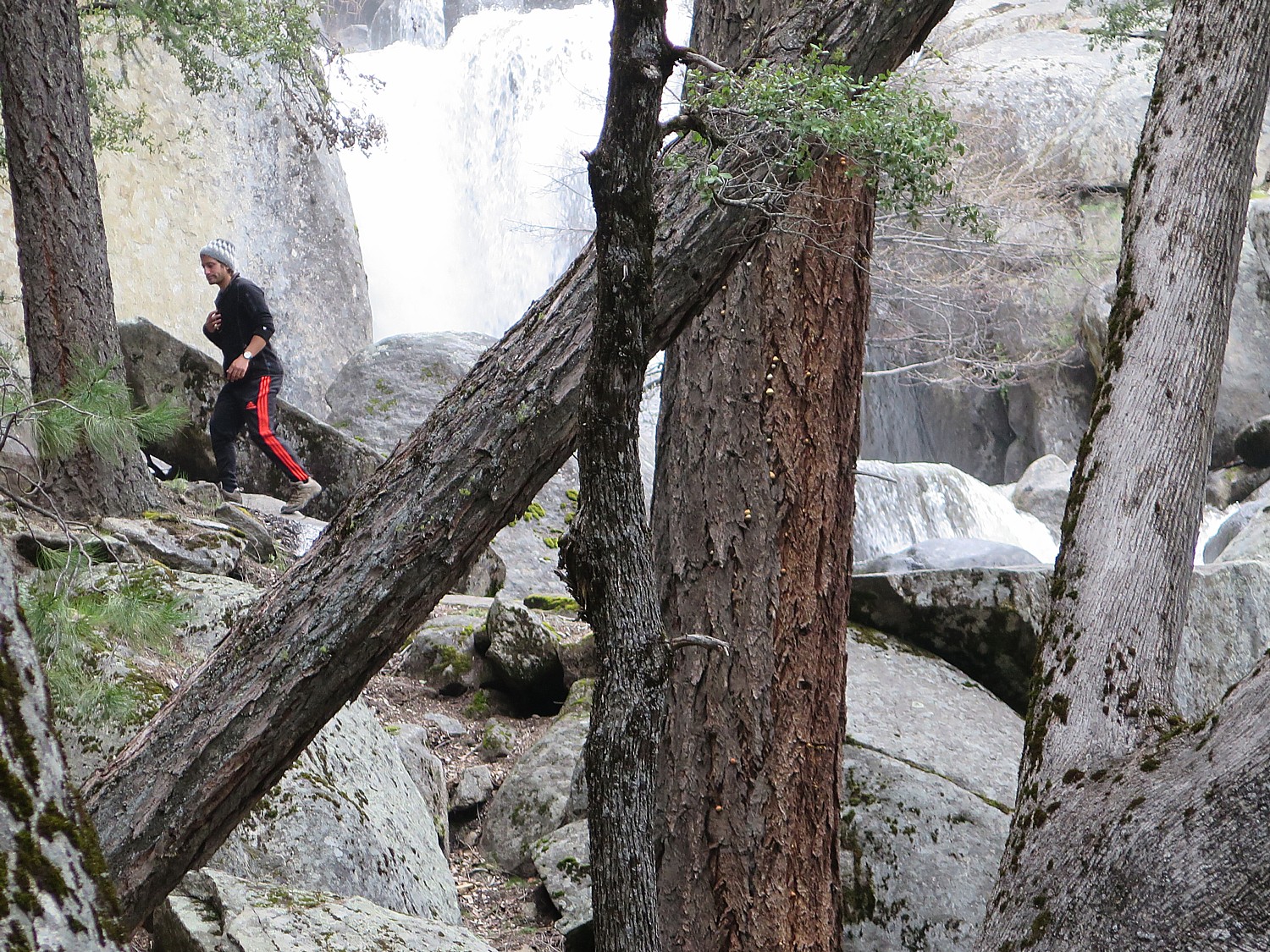
Hiking the Chilnualna Falls Trail, Yosemite National Park © 2017 Karen Rubin/goingplacesfarandnear.com

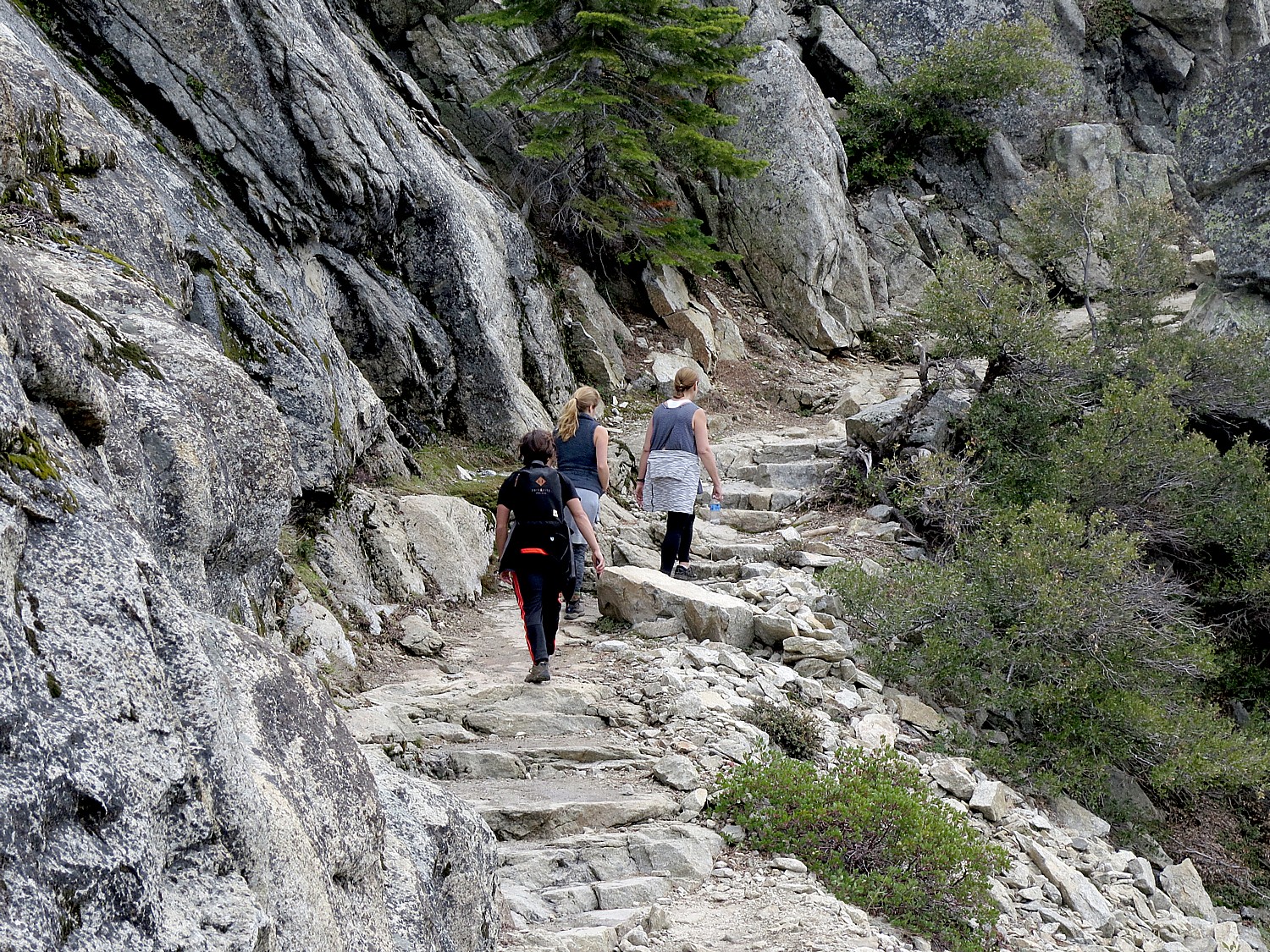
This hike is billed as strenuous – mainly for a fairly steep, nearly mile-long beginning, that includes narrow, high stone steps (with the reward of a gorgeous cascading waterfall). Then it is a steady upward (though mostly gradual) climb for about 4 miles, with a 2,400-foot elevation gain to an altitude of 6,600 feet – that’s what makes the hike tough.

The Chilnualna Falls Trail hike is billed as strenuous – mainly because it is a steady upward climb, with the steepest part at the beginning © 2017 Karen Rubin/goingplacesfarandnear.com

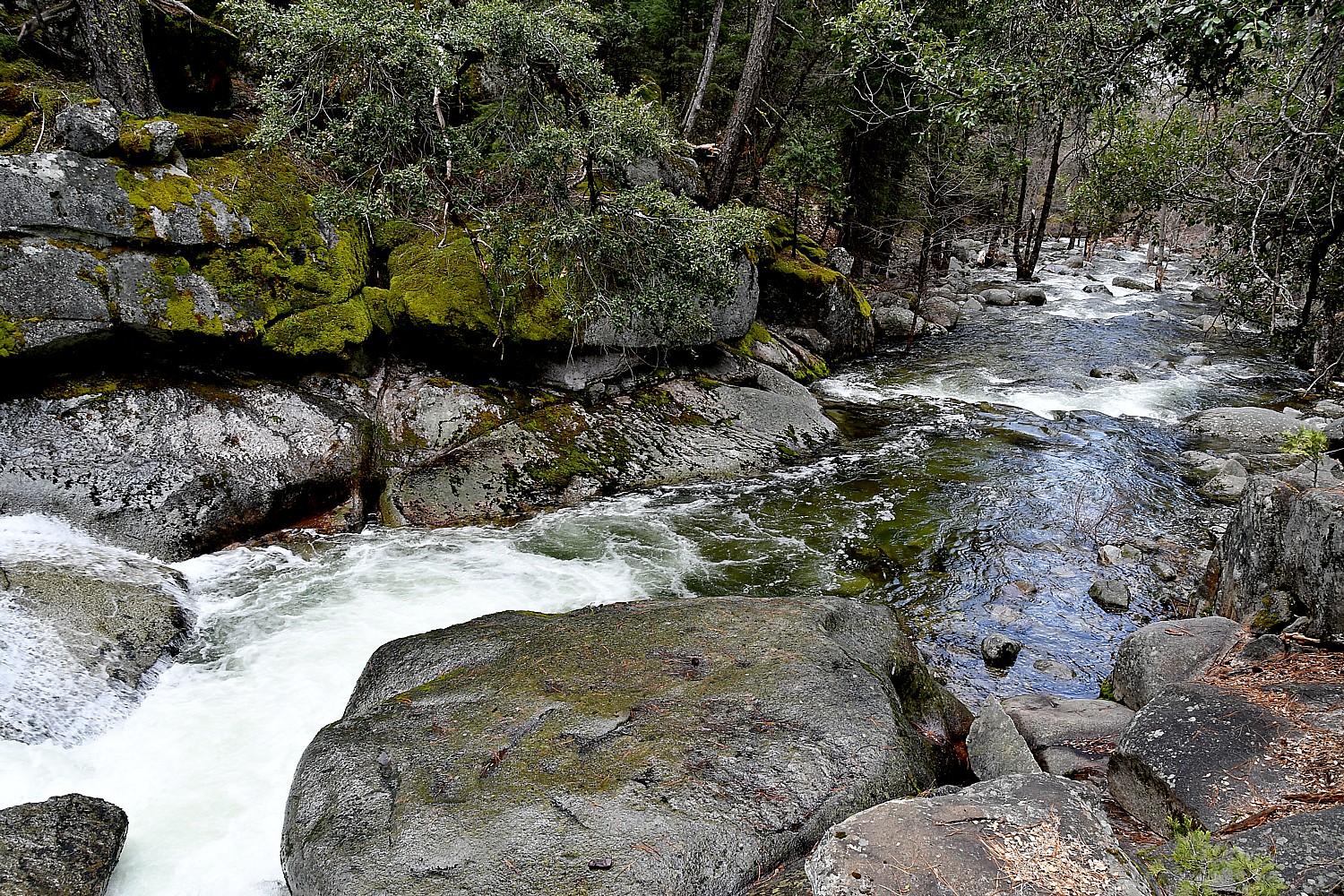
The Chilnualna Falls, which fortunately for us is one of the less known and visited falls (and not accessible by car), consists of five large cascades that slide through and over large granite rock formations – almost like the ruins of a fort, parts of which we get to climb.

At various points we come across the cataracts, up close, and each time, the sound and view is dramatic.

Hiking the Chilnualna Falls Trail, Yosemite National Park © 2017 Karen Rubin/goingplacesfarandnear.com

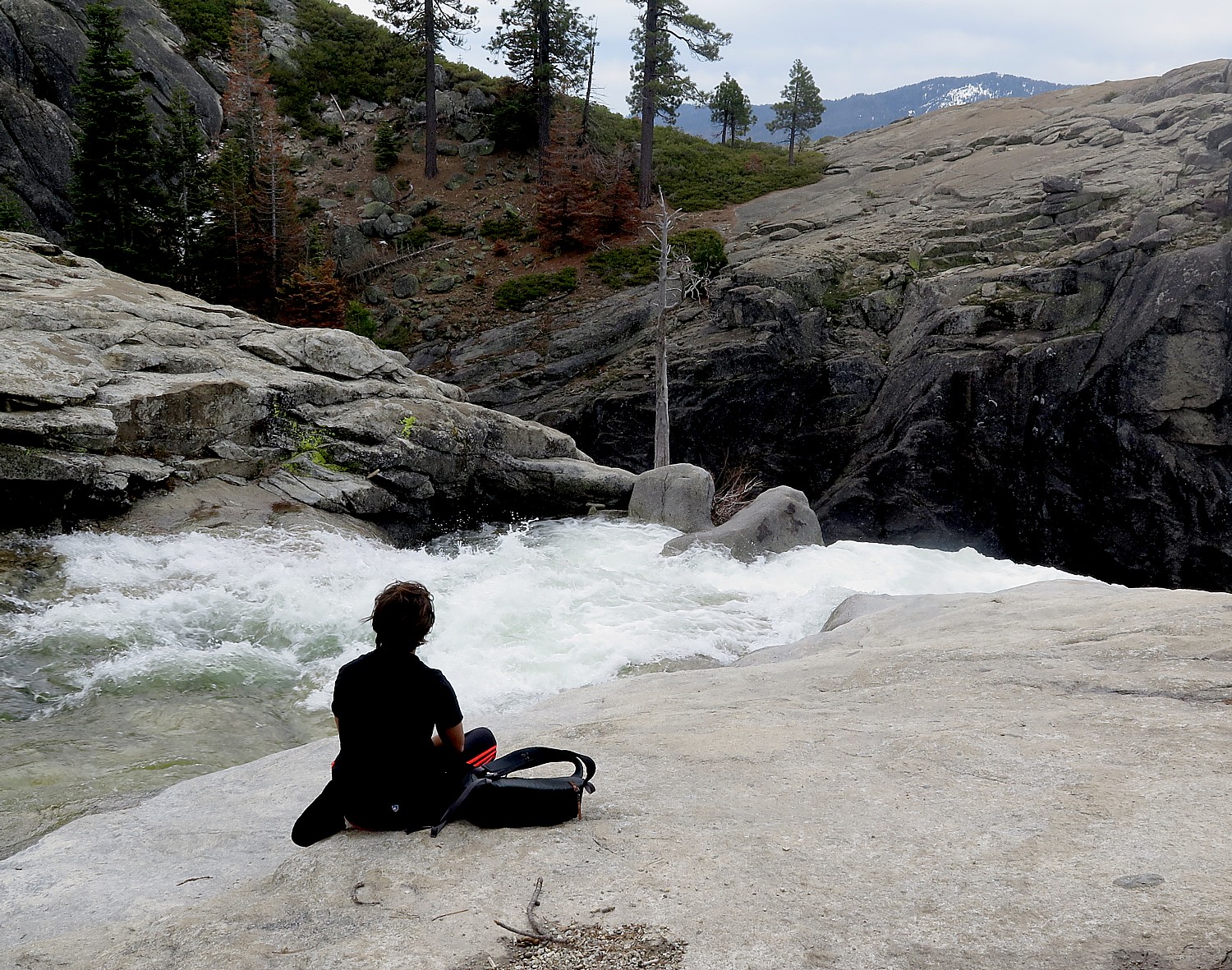
Finally, we come to a beautiful scene where the Chilnualna Falls comes to a ledge before going over a ridge. Here, we sit along some flat rocks right beside the water, and look over the forest and distant mountain peaks of the southern Yosemite and the Wawona Dome.

Peaceful contemplation alongside the Chilnualna Falls, Yosemite National Park © 2017 Karen Rubin/goingplacesfarandnear.com

From here, you can continue on to get to the top of the fall (as well as connect to several other trails that go all the way back to into Yosemite Valley), but considering our time schedule (and looking out at rain clouds flowing in), we head down after a lovely picnic along side the cascading Chilnualna Creek.

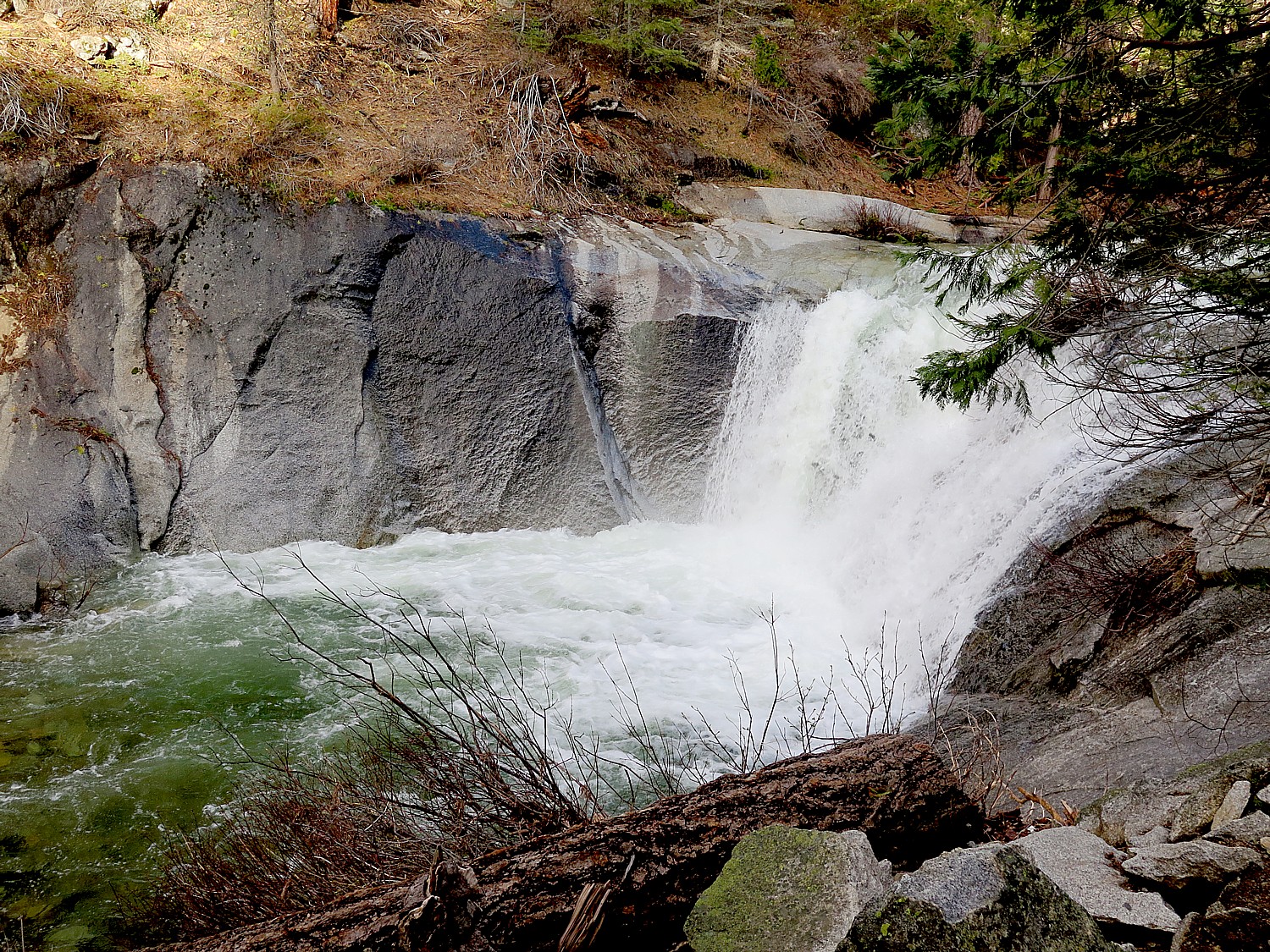
Most of the trail is along the ridge so you have dramatic views of the creek or valley.  Some of it crosses through meadow, so there is wonderful variation. The views of the rushing water and waterfalls are surprising and dramatic.

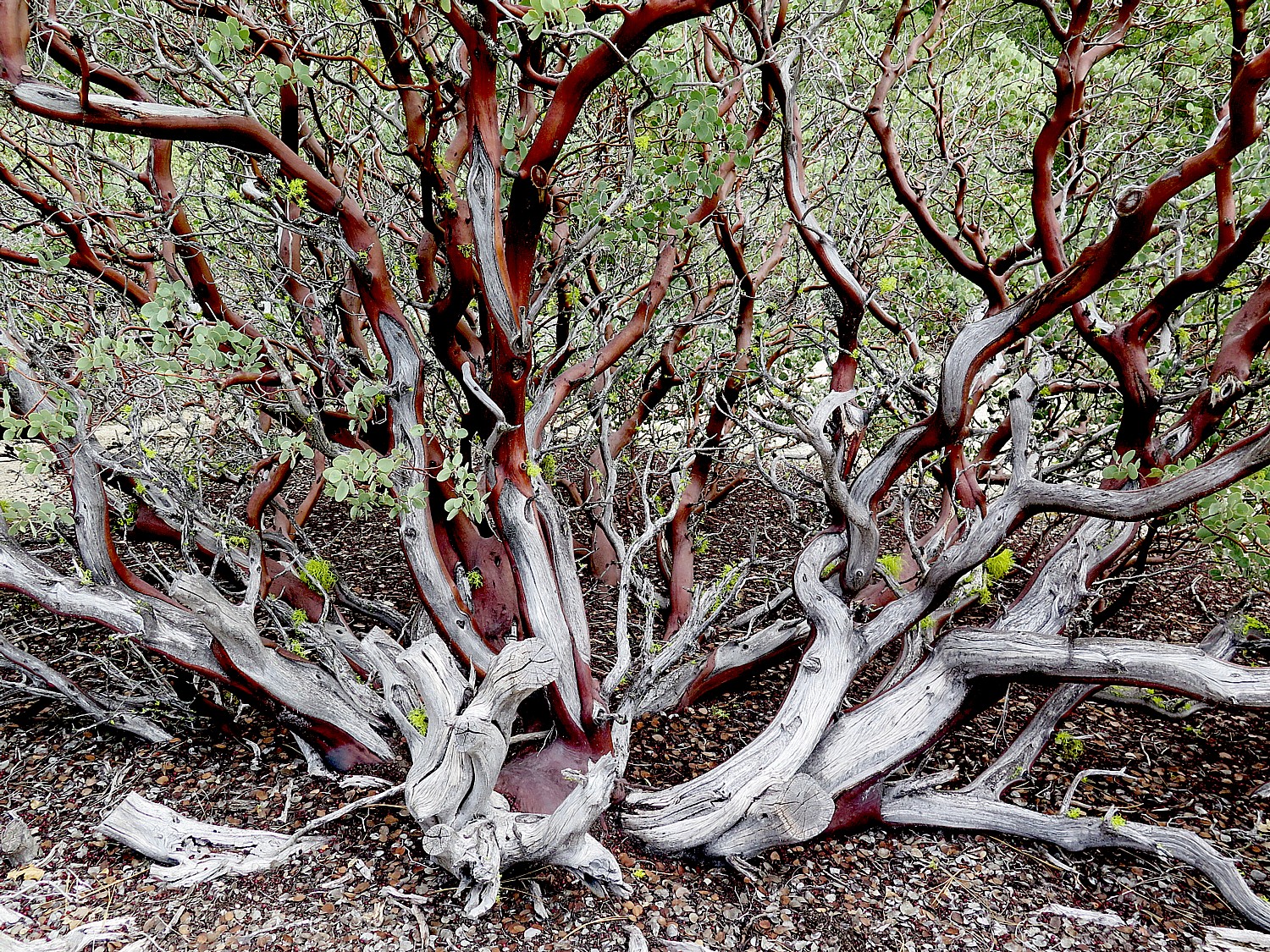
One of the nicest aspects of this trail, as compared to yesterday’s hikes on the Mist Trail, the John Muir Trail and the Mirror Lake Trail, are the opportunities to appreciate some magnificent trees and flowers. After about a half mile (and the first cascade), the trail leaves the creek and heads up switchbacks through manzanita, oak and mixed conifer forest. In the spring, the hillsides are full of Mountain Misery – a spreading plant with beautiful white blossoms, which we get to see. In among the Mountain Misery you may well see Hartweg’s Irises, Indian Pink, Golden Yarrow, Narrow-Leaved Ceanothus, Utah Serviceberry and several more showy flowers. Some of the side seeps might be blooming with Seep Spring Monkeyflowers and perhaps Sunflowers.

In the spring, the hillsides along the Chilnualna Falls Trail are full of Mountain Misery © 2017 Karen Rubin/goingplacesfarandnear.com

The upper cascades of Chilnualna Falls are quite beautiful in high flow, and in the early season they will be flanked with Azaleas, Mountain Pride Penstemmon and Dogwoods, Pussypaws and others.

We don’t necessarily realize it, but we are also passing through territories of deer, coyote, mountain lion, and black bear. There are birds, as well, but we are a bit early to see the western tanager which can be spotted from May through September.

Hiking the Chilnualna Falls Trail, Yosemite National Park © 2017 Karen Rubin/goingplacesfarandnear.com

Finally, as we near the top, we have views over to Wawona Dome and finally of the falls themselves.

We have to climb down a little from the trail to these broad slabs so we have a beautiful view of the falls. It is a perfect place for our picnic lunch.

Coming back is much, much easier – basically a gentle downward slope, and you are looking out at the scenery. Even the obstacles are no concern because we have already done them.

We are down to the steep part when it begins to rain. There are a couple of obstacles – like leaping over flowing water (thank goodness for my hiking sticks!).

We make it all the way back just in time for it to rain in earnest, adding to our feeling of physical satisfaction and accomplishment. All in all, an 8.2 mile hike that takes from 10 am to 3:40 pm.

Eric climbs to get a closer view of the Chilnualna Falls © 2017 Karen Rubin/ goingplacesfarandnear.com

What I love most, after completing this trail, is how different the experience has been from the previous day’s hike in Yosemite Valley – the vegetation, the meadows, the general landscape – and how surprisingly gorgeous the falls and the creek, and especially, the peacefulness without the crowds.

Preparation: bring enough water (2 water bottles) and prepare for changes in weather: bring rain poncho and plastic bags to cover cameras from rain or mist; rain poncho; snacks, moleskin for blisters, hat, sunglasses and sunscreen, camera, extra memory card and battery, cell phone, an extra layer in case it gets cool. I have also found hiking sticks extremely helpful.

For non-hikers, non-DIYers, Tenaya Lodge offers a Yosemite Tour Package, via mini-bus, that includes lunch and narration, and guarantees waterfalls and wildlife and seeing the most popular sights of Yosemite. (Offered May 1-Nov. 30; from $575 spring, $685 summer, $555 fall; call 888-514-2167 or Tenaya Reservations directly at 559-692-8916).

Tenaya Lodge, 1122 Highway 41, Fish Camp, CA 93623, 800-722-8584, tenayalodge.com.

To plan your visit to Yosemite National Park, https://www.nps.gov/yose/planyourvisit/basicinfo.htm, https://www.nps.gov/yose/index.htm. 

Great information for planning your hike at these sites: http://yosemiteexplorer.com/trails

https://outsidehow.com/yosemite-hiking-tips.html

See also:

Yosemite National Park: Best Valley Hikes for First Timers

Tenaya Lodge Provides Luxury Lodging Resort Experience at Gateway to Yosemite National Park

Muir Woods is San Francisco’s Cathedral to Mother Nature

____________________

© 2017 Travel Features Syndicate, a division of Workstyles, Inc. All rights reserved. Visit goingplacesfarandnear.com,  www.huffingtonpost.com/author/karen-rubin , and travelwritersmagazine.com/TravelFeaturesSyndicate/. Blogging at goingplacesnearandfar.wordpress.com and moralcompasstravel.info. Send comments or questions to FamTravLtr@aol.com. Tweet @TravelFeatures. ‘Like’ us at facebook.com/NewsPhotoFeatures
Yosemite National Park: Best Valley Hikes for First Timers

Yosemite National Park, Calif.

By Karen Rubin, Eric Leiberman, Sarah Falter

Travel Features Syndicate, goingplacesfarandnear.com

Yosemite National Park – America’s first – has been on my bucket list for years, so I am beyond excited when we arrive at the Tenaya Lodge, in Fish Camp, just two miles from the South Gate, and immediately start planning for how we will tackle the park the next day. I am intimidated at first by how vast Yosemite is – the size of Rhode Island I am told – and how to organize the logistics if I am going to see for myself the places that are etched in the images in my mind in only two days.

We spend a lot of time with the Tenaya Lodge concierge to get suggestions of where to go, which trails to hike, where to park (there is a bus shuttle system but during our visit, at the very beginning of spring, it wasn’t operating very well).

Because it is so early in the season, some of the areas (like Glacier Point) aren’t even open yet. But it also means that the waterfalls are at near maximum of their cascading flow: all the sound and the fury, the feel of the cool spray, the moist smell. On the other hand, as it happens, we are here on the weekend of National Parks Week, when admission is free, coinciding with Easter, so the park is likely to be especially crowded.

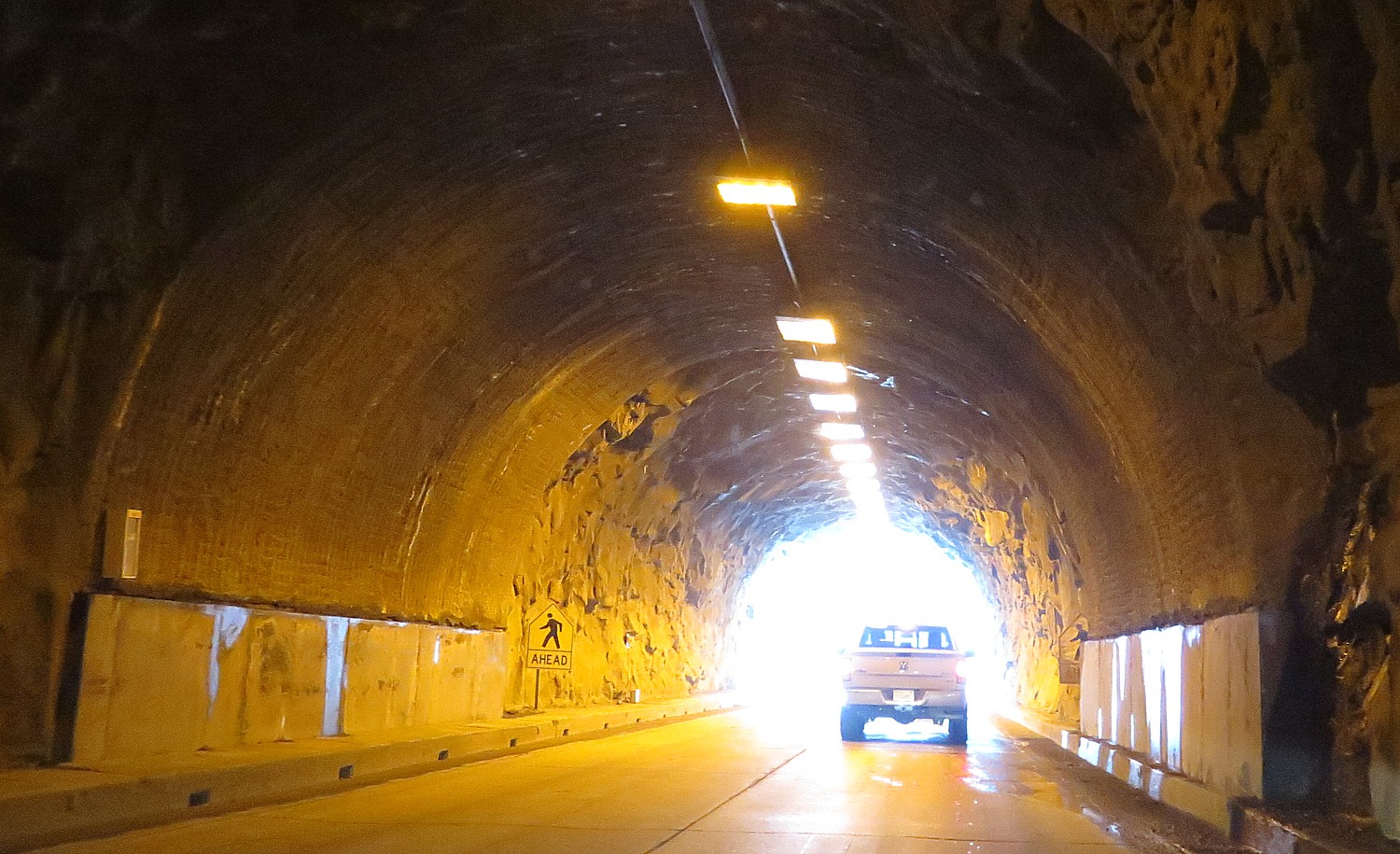
Coming through the mile-long tunnel into Yosemite National Park © 2017 Karen Rubin/goingplacesfarandnear.com

But we pick out the trail for the day: Mist Trail – which is also one of the most popular (we discover) for good reason, especially this early in the season. In one trail, it seems to encapsulate the entire Yosemite experience of a reasonably vigorous hike over a good distance (3 miles roundtrip to Vernal Fall, with 1,000 foot elevation gain, taking about 3 hours), sensational views, proximity to a fantastic waterfall (Vernal) with views of the Nevada Fall (which would be a further 1.3 miles up Mist Trail from Vernal Fall).

Indeed, it is a shock to learn that though the Tenaya Lodge is a mere two miles from the South Gate entrance into Yosemite National Park, it is another 45 minutes drive (30 miles) just to get to the famous Tunnel View, then another 45 minutes drive to get to Curry Village where we will fnd parking for the Mist Trail.

The concierge prepares us well. We know that just outside of the mile long tunnel, to look for the parking lot for the iconic Tunnel View. “Take the first spot” she has advised.

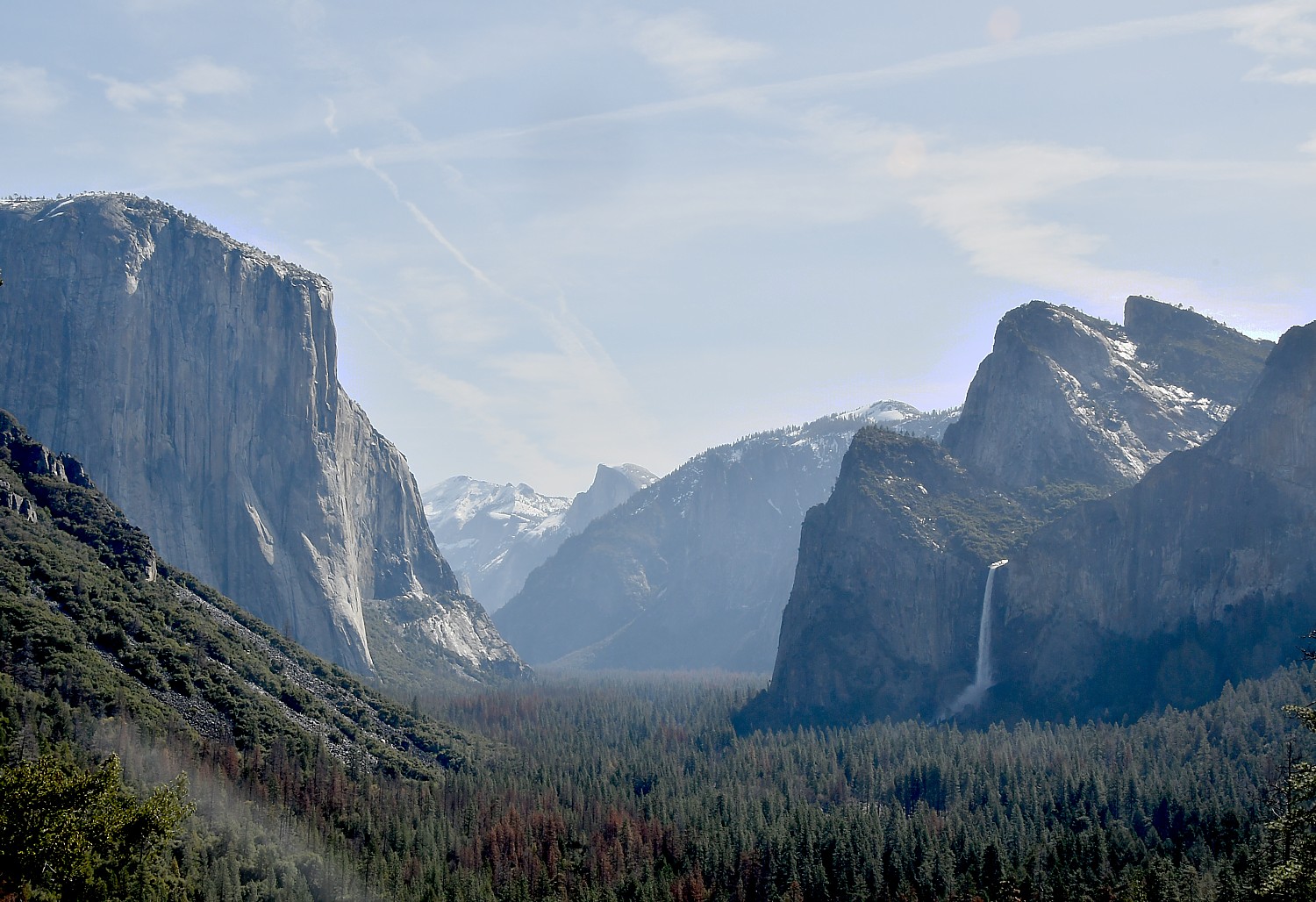
The Tunnel View lookout place, in one image, offers a spectacular view of the quintessential Yosemite sites: Bridalveil Fall, Half Dome, Clouds Rest, El Capitan.

The Tunnel View lookout place, in one image, offers a spectacular view of the quintessential Yosemite sites: Bridalveil Fall, Half Dome, Clouds Rest, El Capitan © 2017 Karen Rubin/goingplacesfarandnear.com

Indeed, the biggest surprise for me is how accessible the iconic features of Yosemite National Park are from the road – I expected them to be more remote, reached only after long, difficult hikes through the wilderness.

And so I shouldn’t have been surprised by the steady stream – wall to wall in some spots – of people, just like us, seeking out the solace and majesty or our natural, national heritage. Indeed, last year saw a record – 331 million visitors to America’s 417 National Park Service sites (contributing $34.9 billion to the U.S. economy in 2016), 5 million alone to Yosemite (Grand Canyon got 6 million).

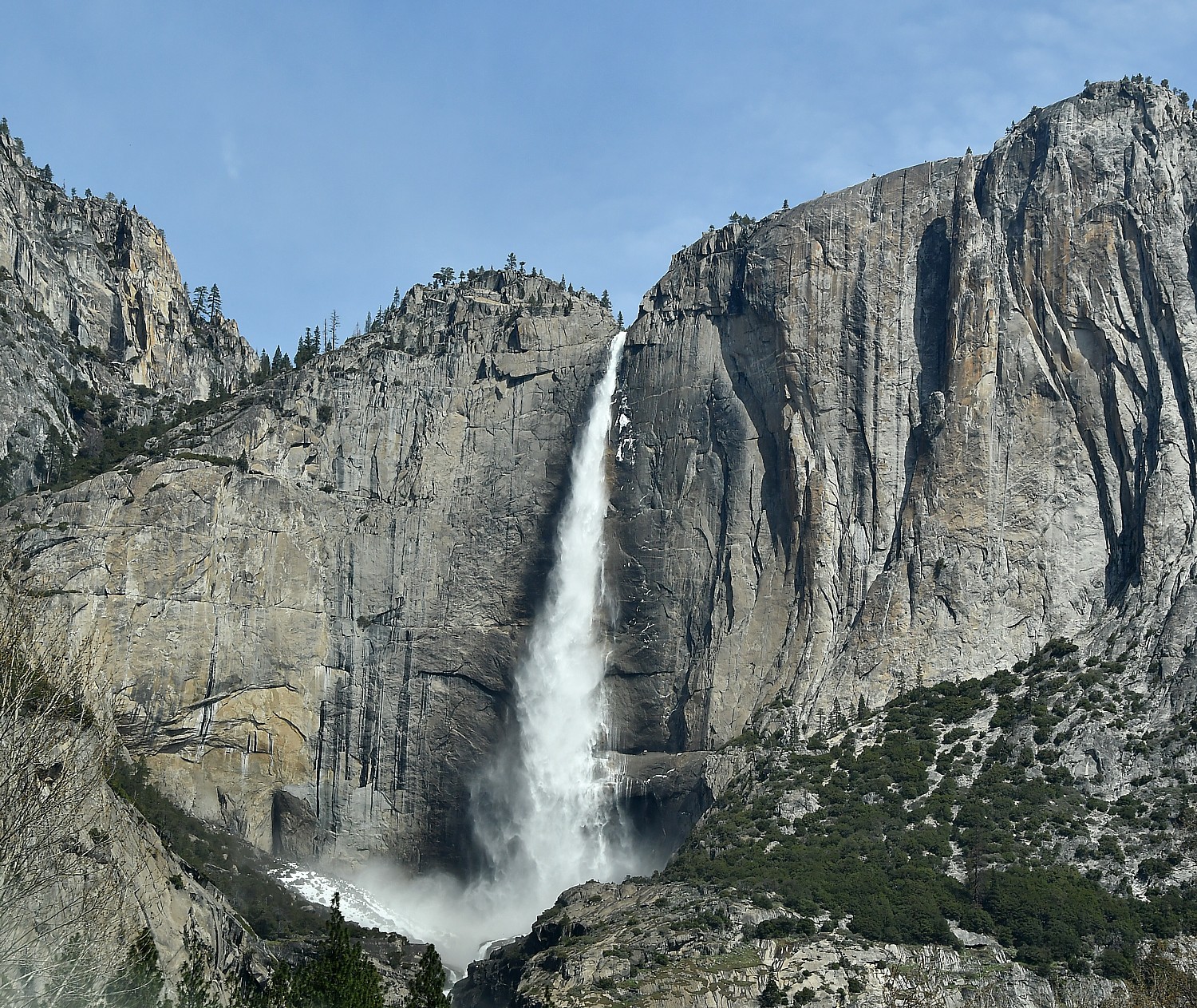
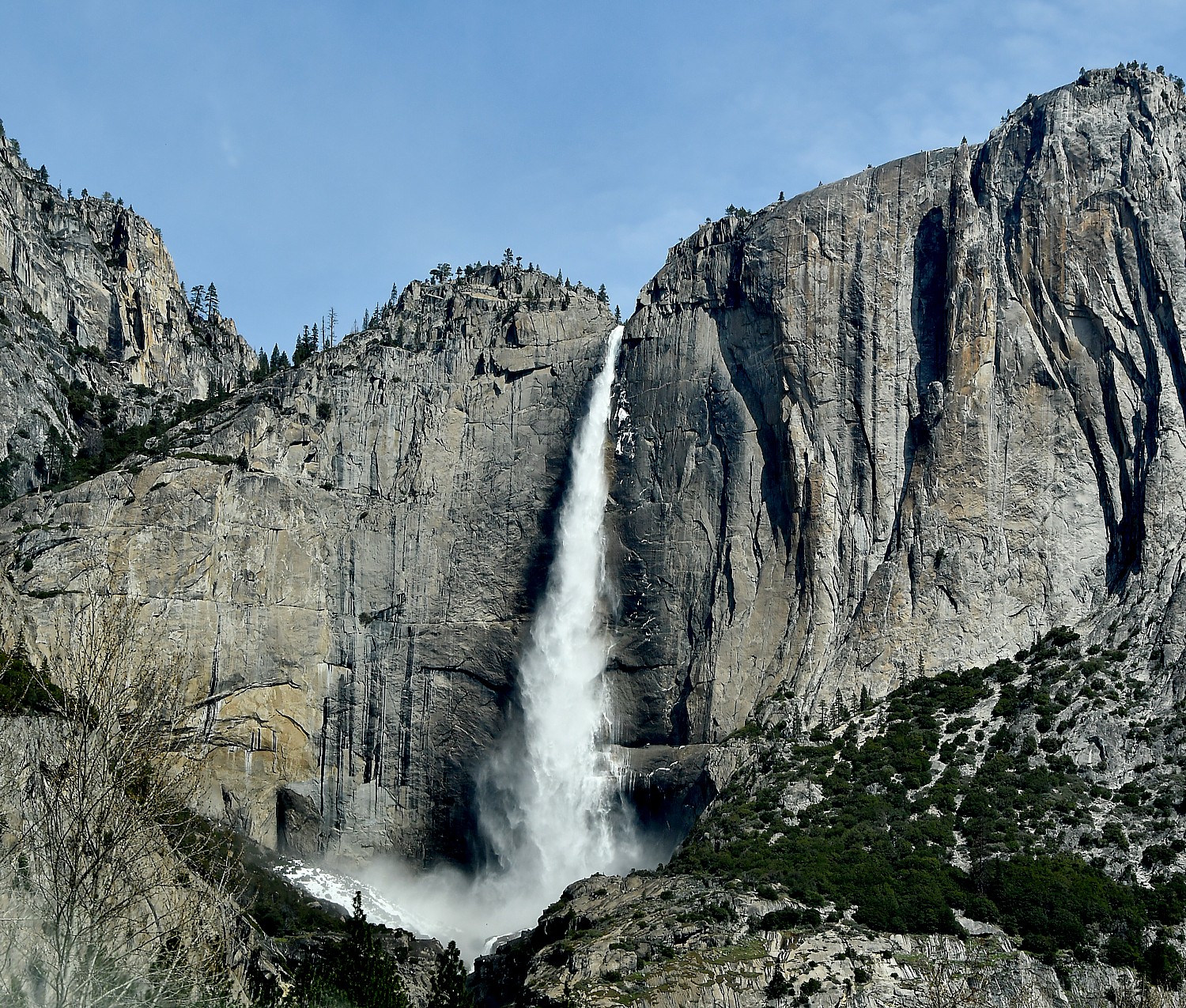
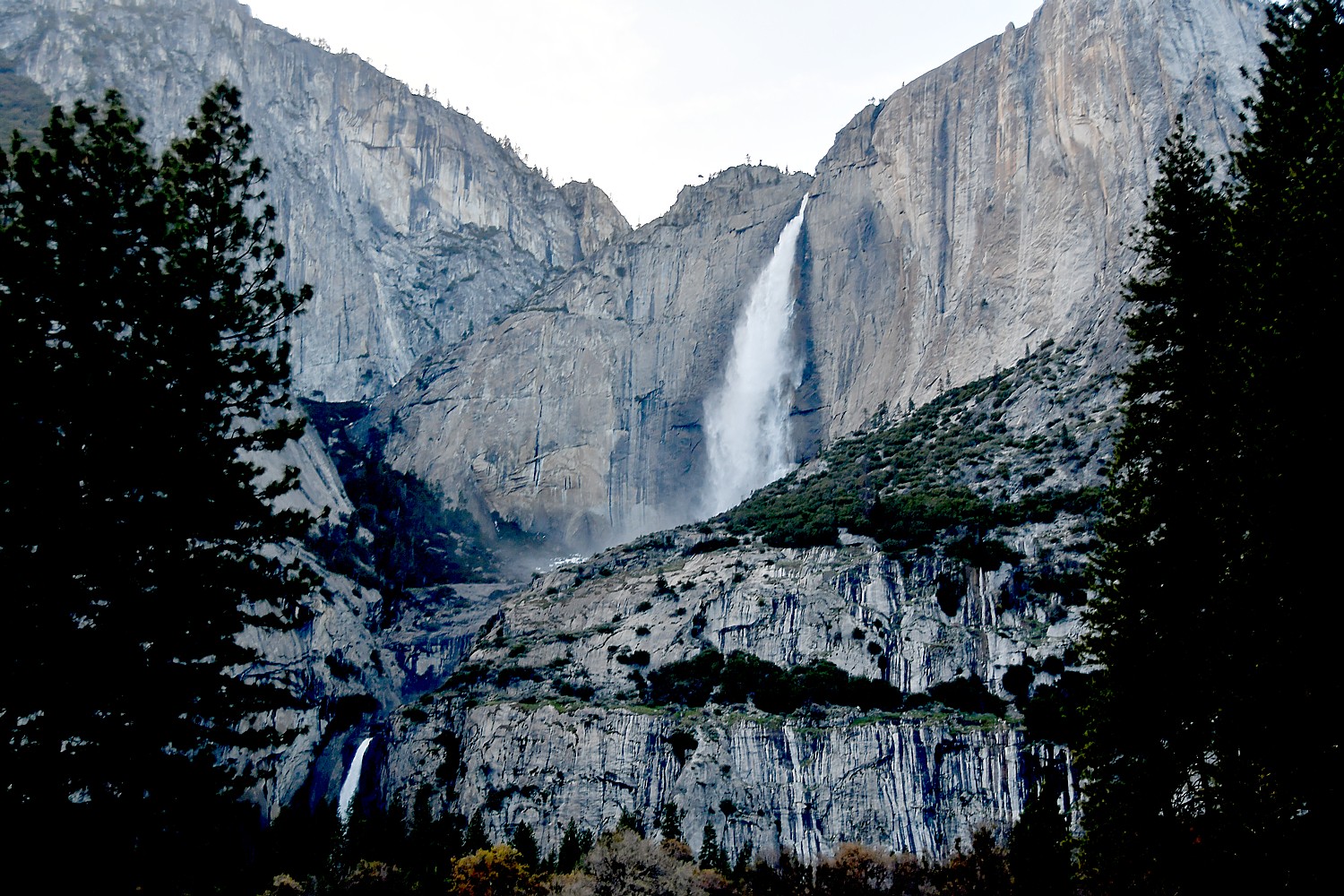
Yosemite’s falls are most dramatic in early spring © 2017 Karen Rubin/ goingplacesfarandnear.com

Just a half mile beyond Tunnel View, you come to Bridalveil Fall – which has to be the second most visited place in Yosemite – and it is just a quarter-mile walk to the waterfall (a key reason it gets MASSIVE crowds that converge in this small spot; I even meet someone who had just been at a wedding right there). The famous Yosemite Falls, also, is visible from the road (we see it on our way out, when it is already getting dark), and the Lower fall is an easy one-mile loop (half of it is wheelchair accessible).

One of the spectacular views as we set out for the Vernal Fall on the Mist Trail © 2017 Karen Rubin/goingplacesfarandnear.com

But we are here to hike! And the trails we have picked out are perfect for the level of physical exertion (and satisfaction), photographic opportunities, and the general appreciation of Yosemite that we are seeking today.

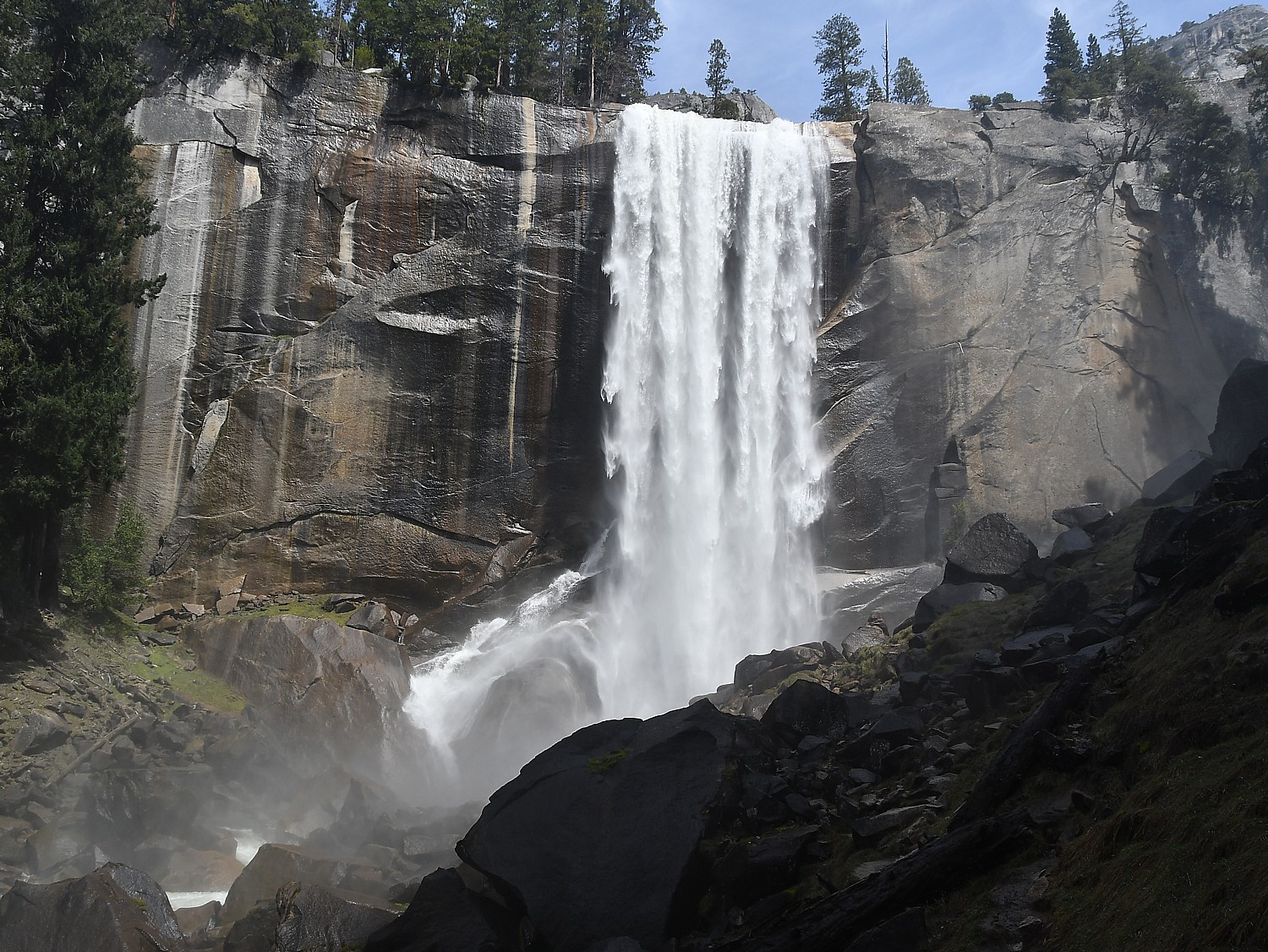
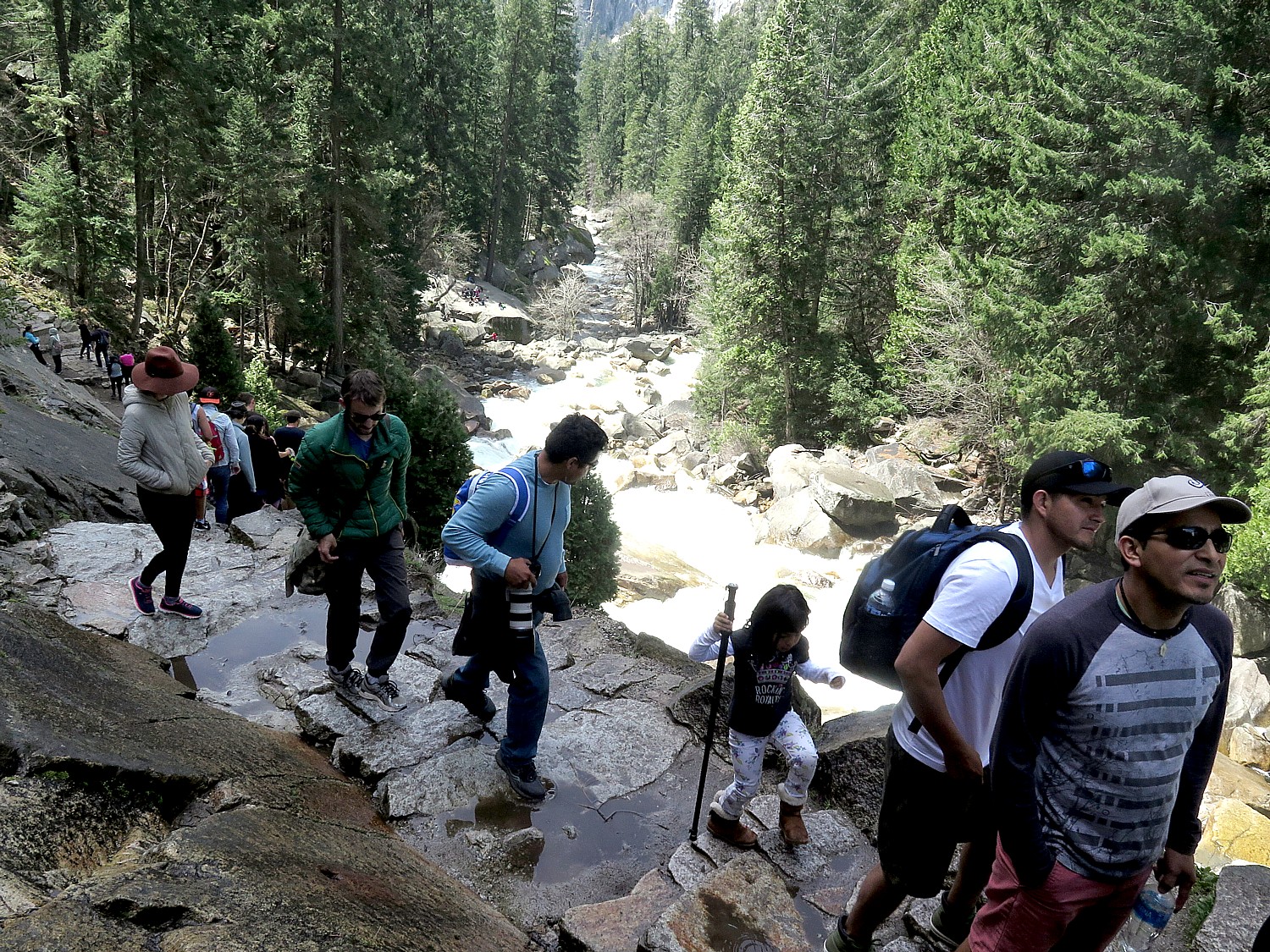
We have set our sights today on the Mist Trail which takes us alongside the Vernal Fall. The trail is both moderately challenging and an ideal distance (not too short, not too long), and unbelievably gorgeous, especially this early in the season, with the fall at maximum flow (especially after a winter where they had twice the normal snowfall; prepare to be sprayed). It is a steep hike beside the waterfall on a series of stone steps – narrow and very crowded, with most people walking up but some people trying to come down this way. (It is better to continue down on the John Muir Trail, which is not as steep or crowded and has fantastic views).

The Mist Trail is one of the most popular in Yosemite, for good reason © 2017 Karen Rubin/goingplacesfarandnear.com

The trail starts off with an .8 mile hike up to the Vernal Falls footbridge (there are restrooms and water fountains here which you should definitely take advantage of before continuing on); and then another mile hike up to the top of Vernal Falls. Along the way, we see a rainbow in the spray at the bottom of the falls.

The Vernal Fall lookout – a series of relatively flat slabs – is about 1000 feet above where we started and is extremely popular spot for picnicking, relaxing and taking selfies. We do the same.

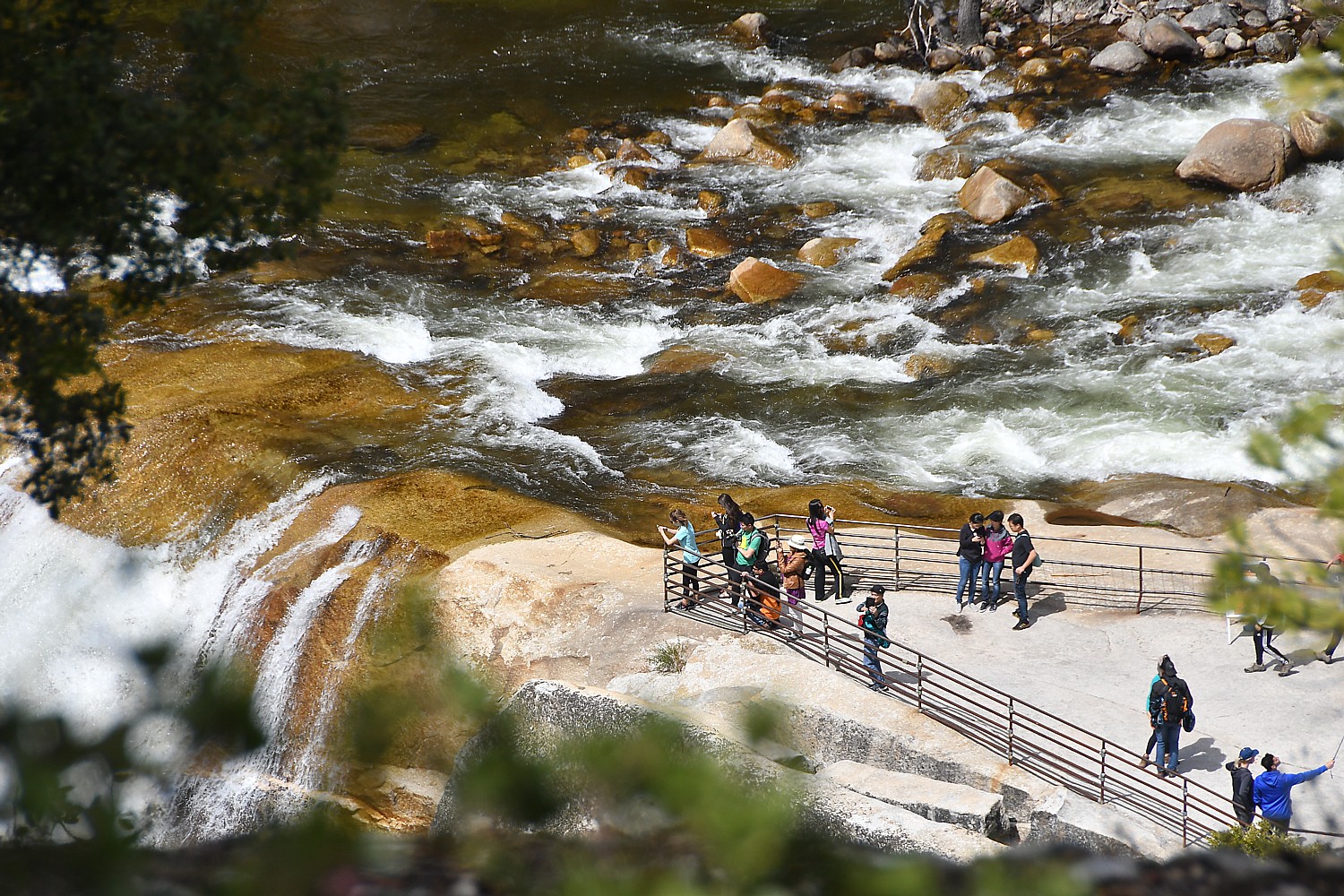
From here it is a short walk up to Emerald Pool which, so early in the season is a rushing torrent rather than the calm pool it will become by late summer.

Top of Vernal Fall, Yosemite National Park © 2017 Karen Rubin/ goingplacesfarandnear.com

It is so scenic and seems so benign, but there are warnings signs not to be so foolhardy as to go near the water or (perish the thought) swim. People are warned to watch out for their children.  The rocks are slippery and this has been the scene of many accidents. I learn that in the summer of 2005, a hiker walked out into the water a bit to fill his water bottle, slipped, got caught in the deceptively strong current and was swept over the falls.

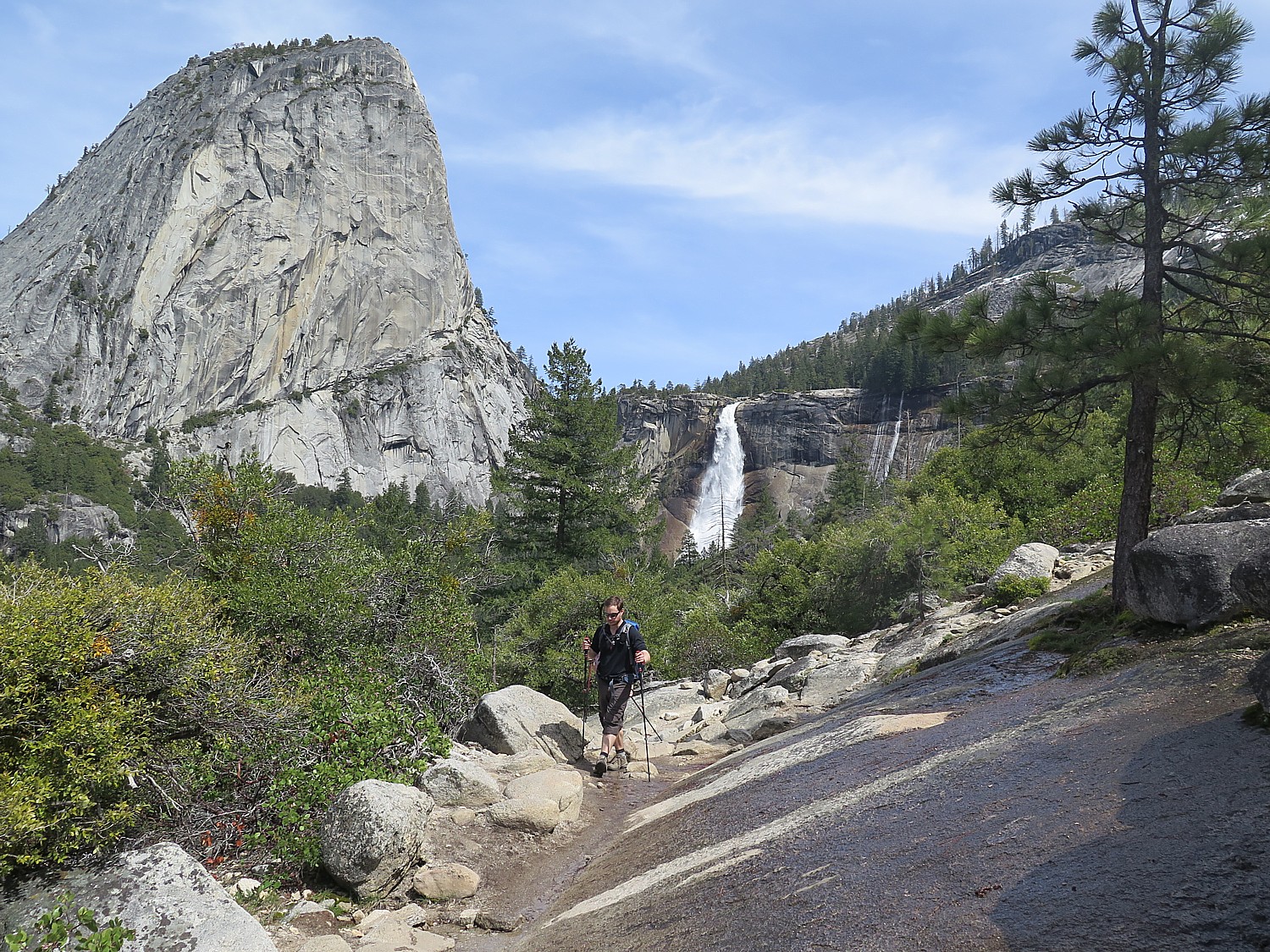
The John Muir Trail gives a wonderful view of the Nevada Fall and Half Dome, © 2017 Karen Rubin/goingplacesfarandnear.com

At this point, you can continue to hike another two miles to the top of the Nevada Fall, but we decide to hike down 3.5 miles along the less-steep John Muir Trail (versus coming back down on the Mist Trail). The John Muir Trail gives us a marvelous view of the Nevada Fall and Half Dome; much of the trail follows along a ridge that opens up to purple mountain majesty.

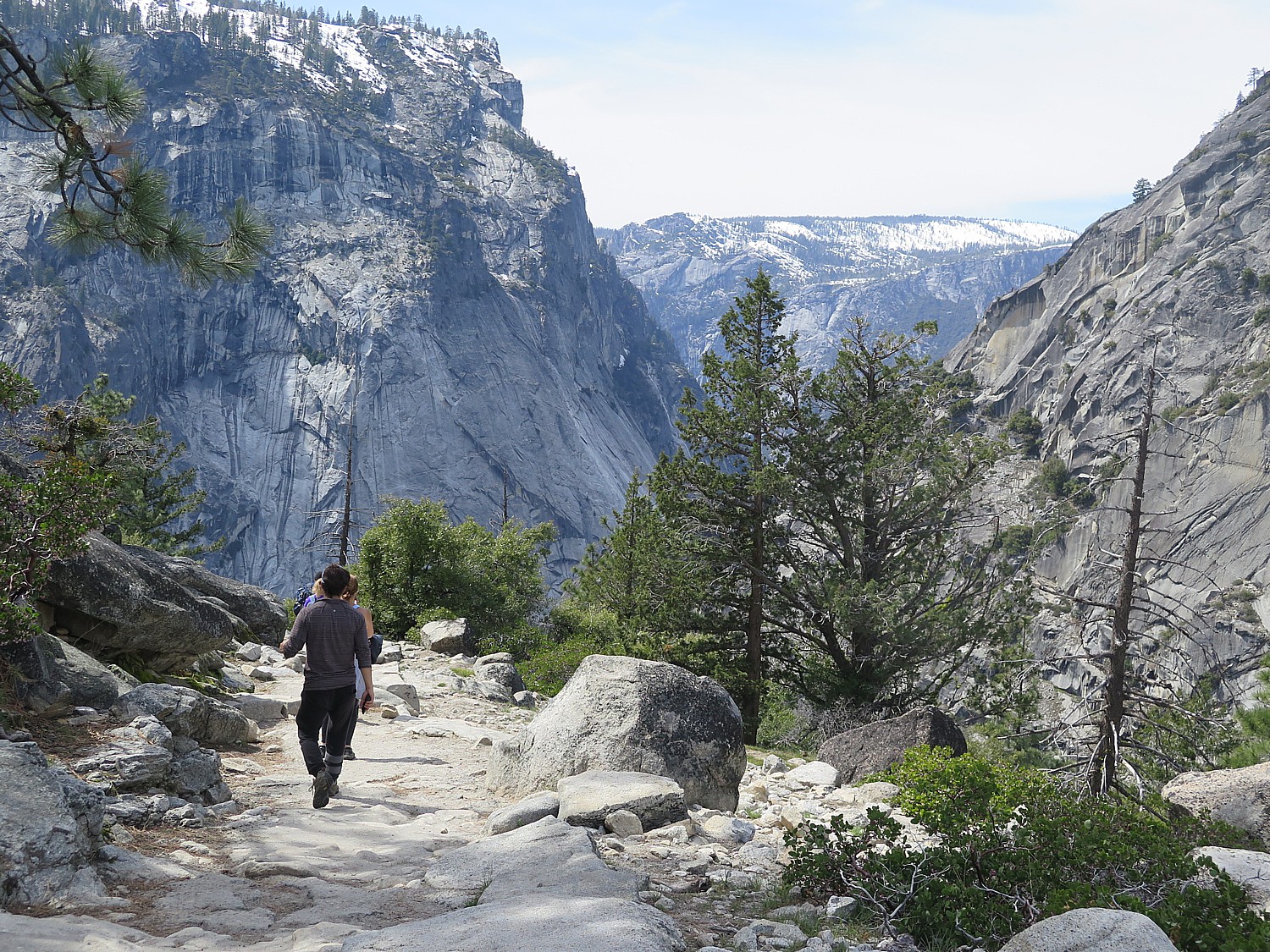
Views of purple mountain majesty from The John Muir Trail, Yosemite National Park © 2017 Karen Rubin/goingplacesfarandnear.com

It’s still early enough in the afternoon when we get back down to the base – delighted with how perfect the Vernal Fall hike was (altogether, we’ve hiked six miles, and climbed 1885 ft. in elevation) that we are excited to try another. We look over the list we have been given for a shorter, easy hike and set out for Mirror Lake.

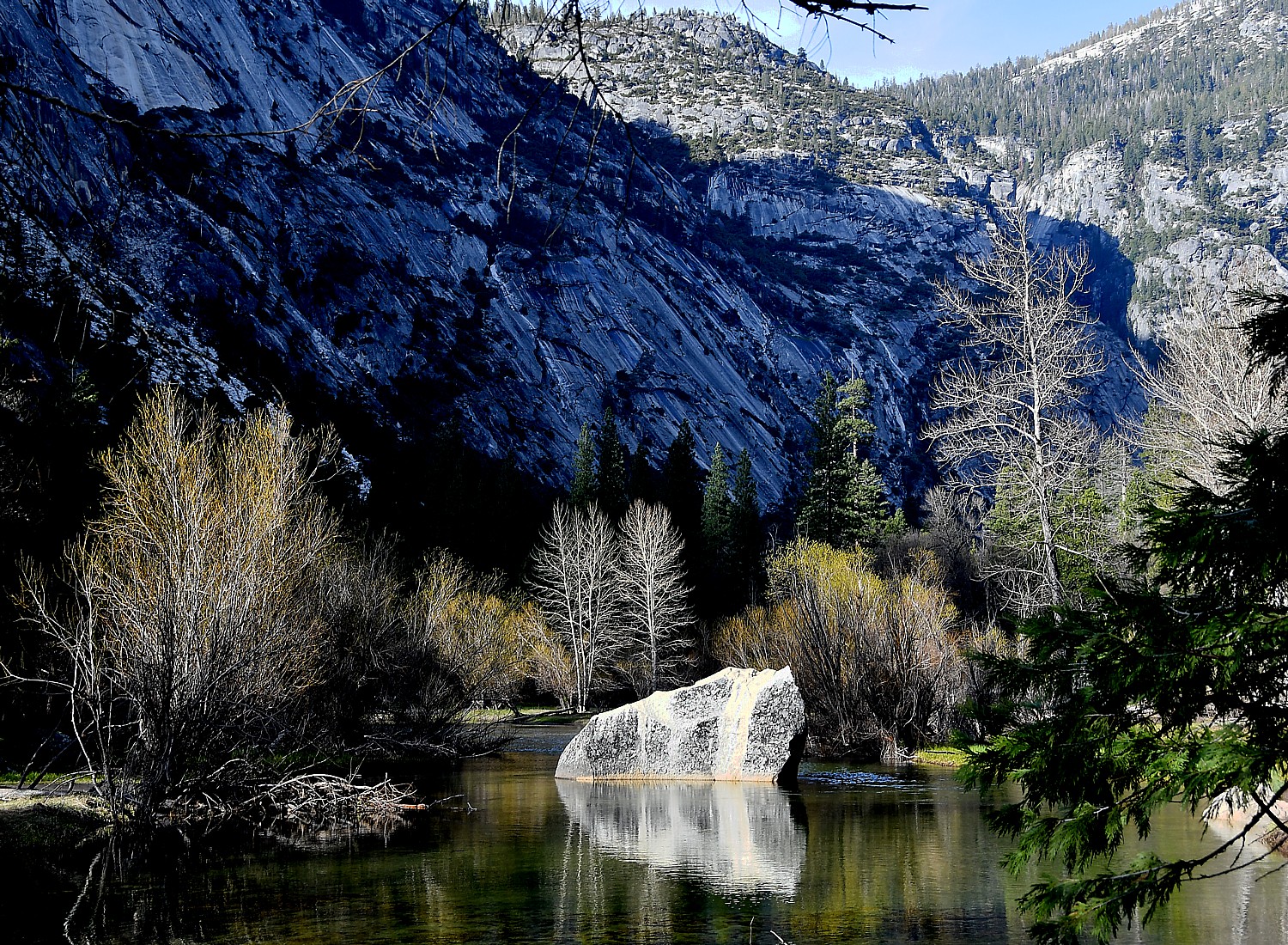
Mirror Lake, Yosemite National Park © 2017 Karen Rubin/ goingplacesfarandnear.com

The Mirror Lake hike is supposed to be two miles round trip (taking one hour), but this is apparently if you just walk along the road. Instead, we take the trail that is apparently part of a five-mile loop around the lake which has more obstacles than I had bargained for. But there are some dazzling scenes along the way, and a stunning scene of the lake, so flat and still that it is literally a mirror reflecting back the stunning backdrop, and affords a closer view of the face of Half Dome.

To walk back by the road, Eric and Sarah scurry on a log across a narrow point which they imagine is a short cut to a road (the option is to hike around the lake). I’m not the scurrying-across-a-fallen-tree type, so I opt to backtrack along the same trial, which turns out to be fun, now that I know what the obstacles are (and that I can do them).

Finally meeting up with everybody in the car (after a MUCH longer walk back from the trailhead toward the parking lot, without seeing a single shuttle bus), which turns out to be a feat because cars are restricted, we set out to return to the Tenaya Lodge.

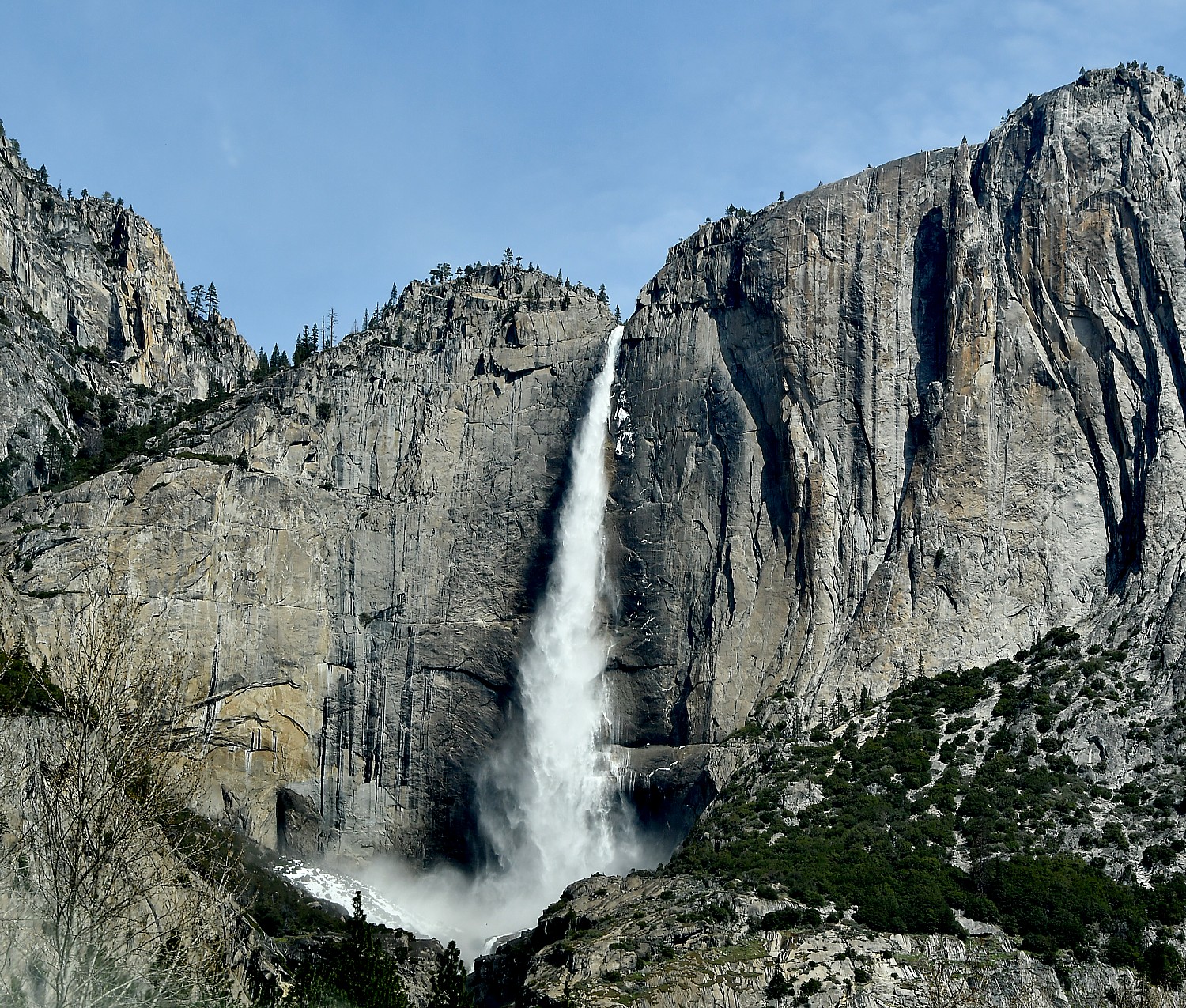
A view of Yosemite Falls © 2017 Karen Rubin/goingplacesfarandnear.com

On the way out of Yosemite, we find ourselves crossing Sentinel Bridge which is supposed to be one of the best photo spots to capture Half Dome over the Merced River (the dusky light doesn’t cooperate, but that’s the element of serendipity that comes with every visit).

Then, the one-way road back to the South Gate passes by Yosemite Falls, agonizingly close (just a quarter of a mile), but it is too late to hike up to it in the fading light. We get a fleeting shot – I am surprised that it is so “exposed” to the access road – I imagined it was tucked inside.See https://www.nps.gov/yose/planyourvisit/valleyhikes.htm

Preparation: bring enough water (2 water bottles) and prepare for changes in weather: bring rain poncho and plastic bags to cover cameras from rain or mist; rain poncho; snacks, moleskin for blisters, hat, sunglasses and sunscreen, camera, extra memory card and battery, cell phone, an extra layer in case it gets cool. I have also found hiking sticks extremely helpful.

For non-hikers, non-DIYers, Tenaya Lodge offers a Yosemite Tour Package, via mini-bus, that includes lunch and narration, and guarantees waterfalls and wildlife and seeing the most popular sights of Yosemite. (Offered May 1-Nov. 30; from $575 spring, $685 summer, $555 fall; call 888-514-2167 or Tenaya Reservations directly at 559-692-8916).

Tenaya also offers an itinerary you can take on your own to hit Yosemite’s highlights in a single day: Half Dome, El Capitan, Yosemite Falls, Bridalveil Fall, Mariposa Grove, Glacier Point, Wawona, Royal Arches, Turtleback Dome, Three Brothers, Leaning Tower, Ribbon Fall, Cathedral Spires, Yosemite Chapel, Vernal and Nevada Falls. In summer, you have to park and use shuttle buses to get around.

Tenaya Lodge, 1122 Highway 41, Fish Camp, CA 93623, 800-722-8584, tenayalodge.com.

To plan your visit to Yosemite National Park, https://www.nps.gov/yose/planyourvisit/basicinfo.htm, https://www.nps.gov/yose/index.htm. 

Great information for planning your hike at these sites: http://yosemiteexplorer.com/trails

https://outsidehow.com/yosemite-hiking-tips.html

Next:

Yosemite National Park: Surprising Diversity, Dramatic Scenes Hiking Chilnualna Falls Trail, Wawona

See also:

Tenaya Lodge Provides Luxury Lodging Resort Experience at Gateway to Yosemite National Park

____________________

© 2017 Travel Features Syndicate, a division of Workstyles, Inc. All rights reserved. Visit goingplacesfarandnear.com,  www.huffingtonpost.com/author/karen-rubin , and travelwritersmagazine.com/TravelFeaturesSyndicate/. Blogging at goingplacesnearandfar.wordpress.com and moralcompasstravel.info. Send comments or questions to FamTravLtr@aol.com. Tweet @TravelFeatures. ‘Like’ us at facebook.com/NewsPhotoFeatures
Tenaya Lodge Provides Luxury Lodging Resort Experience at Gateway to Yosemite National Park

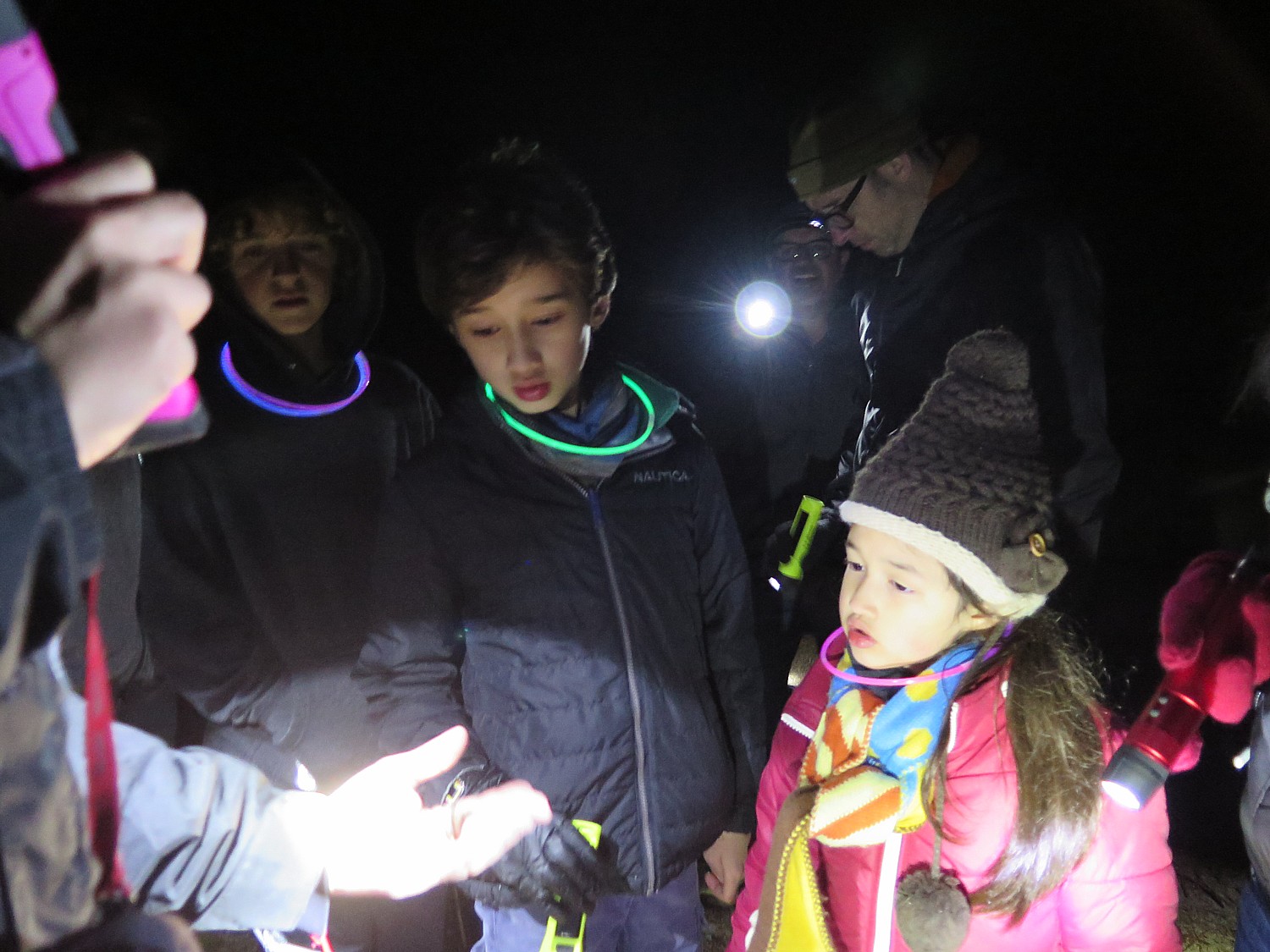
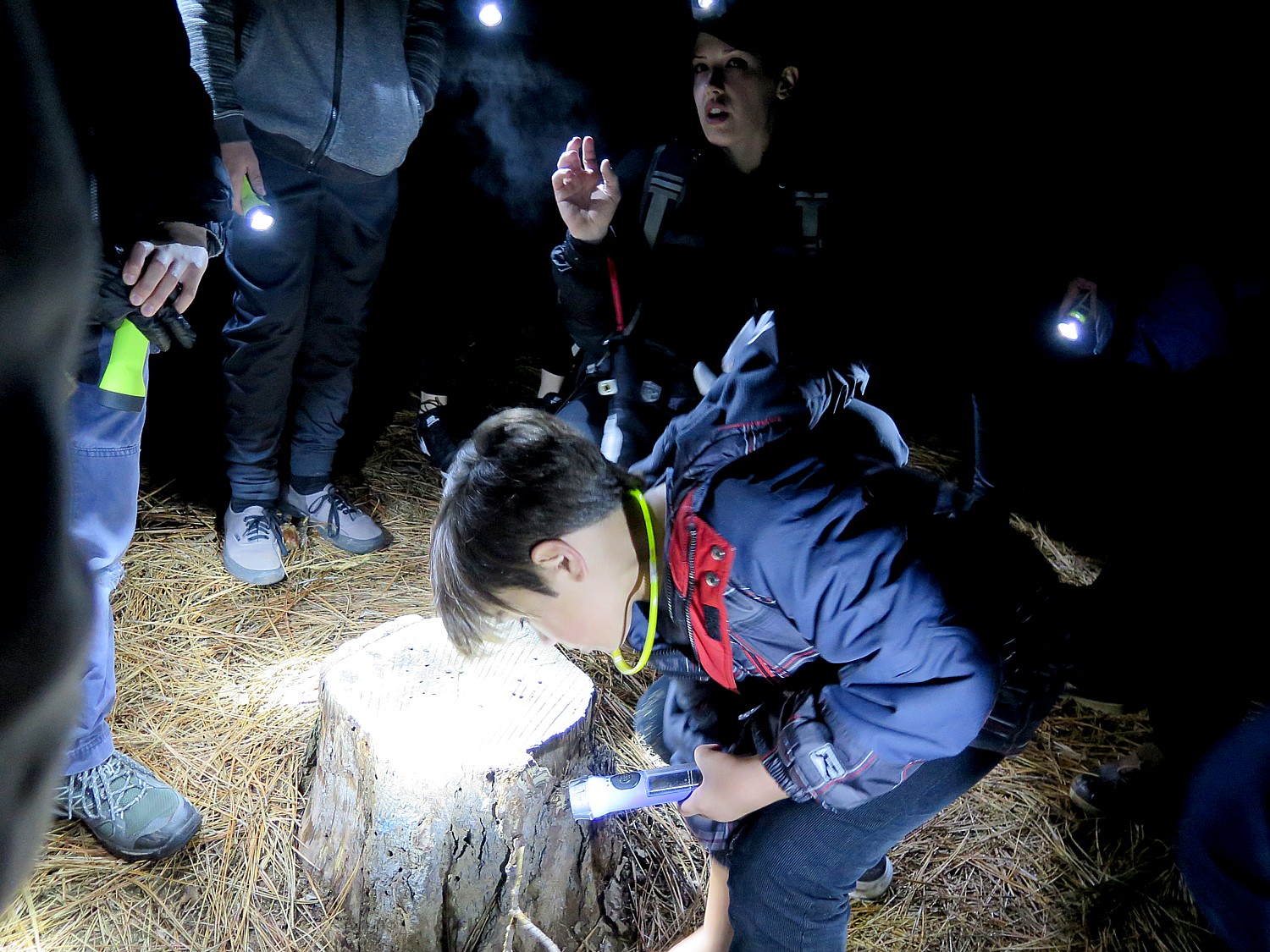
Kids wearing neon-glowing necklaces (as much to keep track of them, along with periodic coyote yells) examine a small seed by flashlight on the nightly walking tour in the forest around Tenaya Lodge © 2017 Karen Rubin/ goingplacesfarandnear.com

By Karen Rubin, Eric Leiberman & Sarah Falter

Travel Features Syndicate, goingplacesfarandnear.com
The description of the Tenaya Lodge nightly Flashlight Hike sounded very tame. A mile-loop in the woods surrounding the resort. Indeed, it is designed for families. But shortly after starting out from the Lodge, flashlights in hand, as the dusk turned to darkness and any light that would have come from the lodge faded as we walked deeper into the forest, we realize this is really an adventure!

Amanda, our guide, introduces herself as a wilderness kid – she grew up in Yosemite National Park, literally next door to the Tenaya Lodge (the Yosemite South Gate is just 2 miles down the road), where her parents both worked, and she has guided horseback riding trips and skiing. Her commentary is absolutely fascinating.

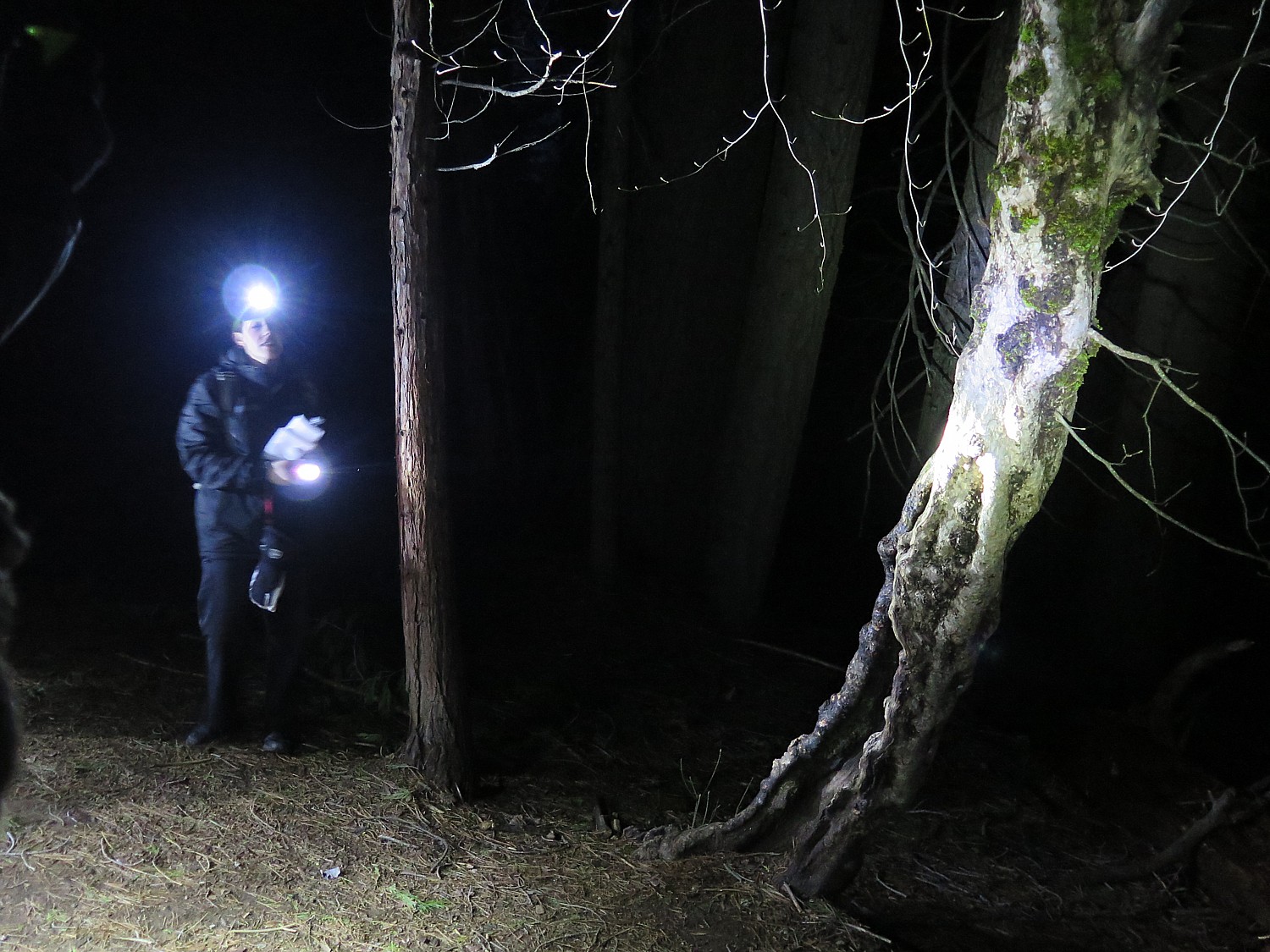
“Trees are like people,” Amanda, the Tenaya Lodge guide leading the Flashlight Tour, tells us, adding a warning about “widow-makers.” © 2017 Karen Rubin/goingplacesfarandnear.com

At the start, she introduces us to ”widow makers” (no joke: the branches that can break off these tall trees and kill), with the moral to the lesson, “Be aware of your surroundings.”

We also learn that trees are like people; that the trees in the forest (Tenaya Lodge is nestled between Yosemite and the Sierra National Forest) have a 600-year life expectancy; that the famous giant sequoias can live 1000 years and as large as they are, they come from a seed the size of a splinter inside a golfball-sized cone that only opens once it has been exposed to fire. The wood is mostly fire resistant and insect repellant and lumbering companies would have cut them down but for pioneering conservationist John Muir who convinced President Theodore Roosevelt to protect Yosemite and turn it into the nation’s first national park.

Native peoples used acorns as a source of food, and turned pine needles into a medicinal tea. She shows us a log that has been “damaged” by a bear pulling out insects (it eats 10,000 insects, or about 5 lbs worth).

We shine our flashlights onto a white thorn bush, where, she says, mule deer hide their young to protect from mountain lion; the babies stay until they hear their mother.

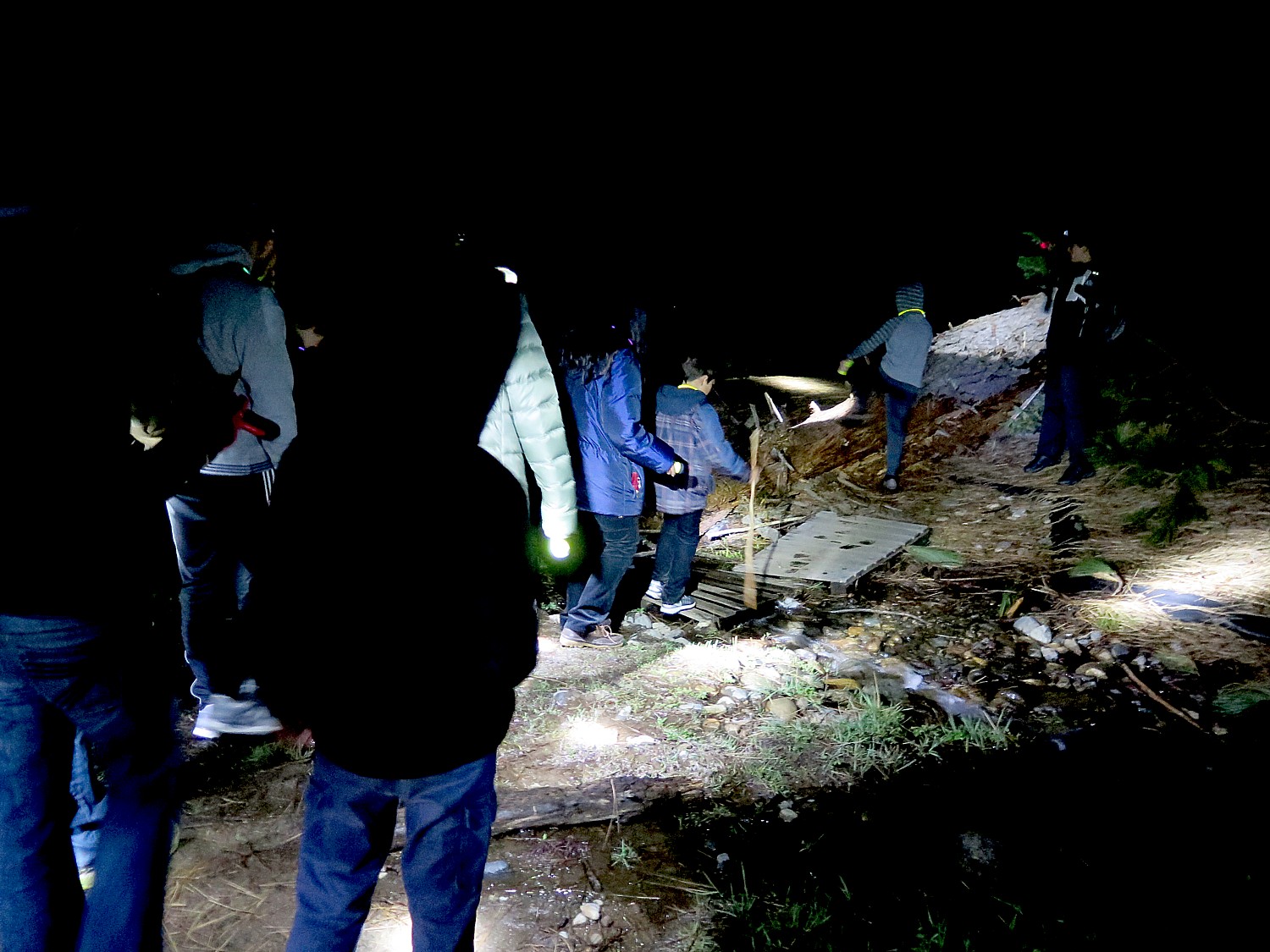
Using flashlights to find our way on the trail, over obstacles, through the forest © 2017 Karen Rubin/goingplacesfarandnear.com

By the light of our flashlights, we cross over a plank over a tiny stream, climb over a fallen tree trunk. At one point Amanda points to a pile of dead wood and warns, “Don’t go into it- rattlesnakes like to play there.” Rattlesnakes, I think to myself??? She shows us where trees have been destroyed by Bark beetle – the tree stops making sap, dries out, and has no protection. “These are ‘one match trees’ – very flammable.”

And she tells us something that we find very helpful when we are out on our own hiking, “moss only grows on the north side of tree.” We feel like we are true outdoorspeople.

Examining tree rings by flashlight for clues as to the history of a tree’s life and the environment, © 2017 Karen Rubin/goingplacesfarandnear.com

Towards the end of the hike, we come to a place where the trees, lifting up to the sky, open up, giving us an expansive view of a billion stars. A boy exclaims, “I’ve never seen the sky like this.”

Amanda says that when we see the stars, we are seeing deep into the past – it takes 1000 years for light to come to earth; sunlight is 8 minutes behind. “The Indians felt that sky was blanket over earth, raven poked holes to see sun… Anytime I am feeling bothered,  I just look up.”

This is just one of the activities available at Tenaya Lodge, and I would say it is a must – book in advance because it fills up; in winter, they offer a Snowshoe Flashlight Tour which must be sensational.

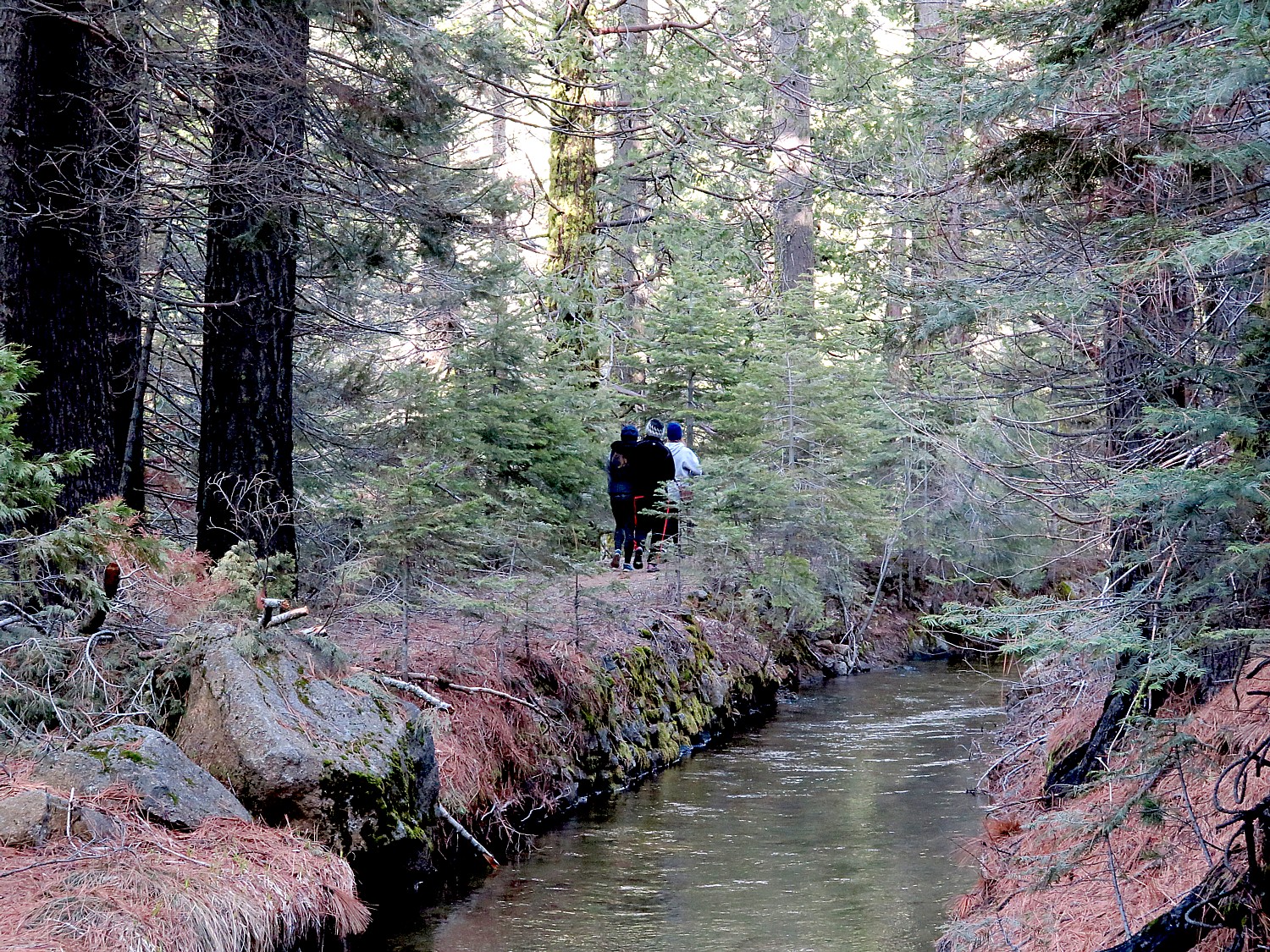
A lovely hike from Tenaya Lodge to the waterfall © 2017 Karen Rubin/ goingplacesfarandnear.com

Actually, this was our second hike of the day, since arriving in the afternoon at Tenaya Lodge, which is located in Fish Camp, California, a 3 ½ hour drive (200 miles) from San Francisco.

Shortly after our arrival, we quickly drop off our luggage in our room, get directions from the concierge, and set out for a hike that starts from the resort’s entrance, up a logging road, about 2 ½ miles to a waterfall. The hike is perfect to acclimate ourselves to the 5,200 ft. elevation. We immediately fill our lungs with rejuvenating pure air, and recharge with the rhythm of a rushing creek.

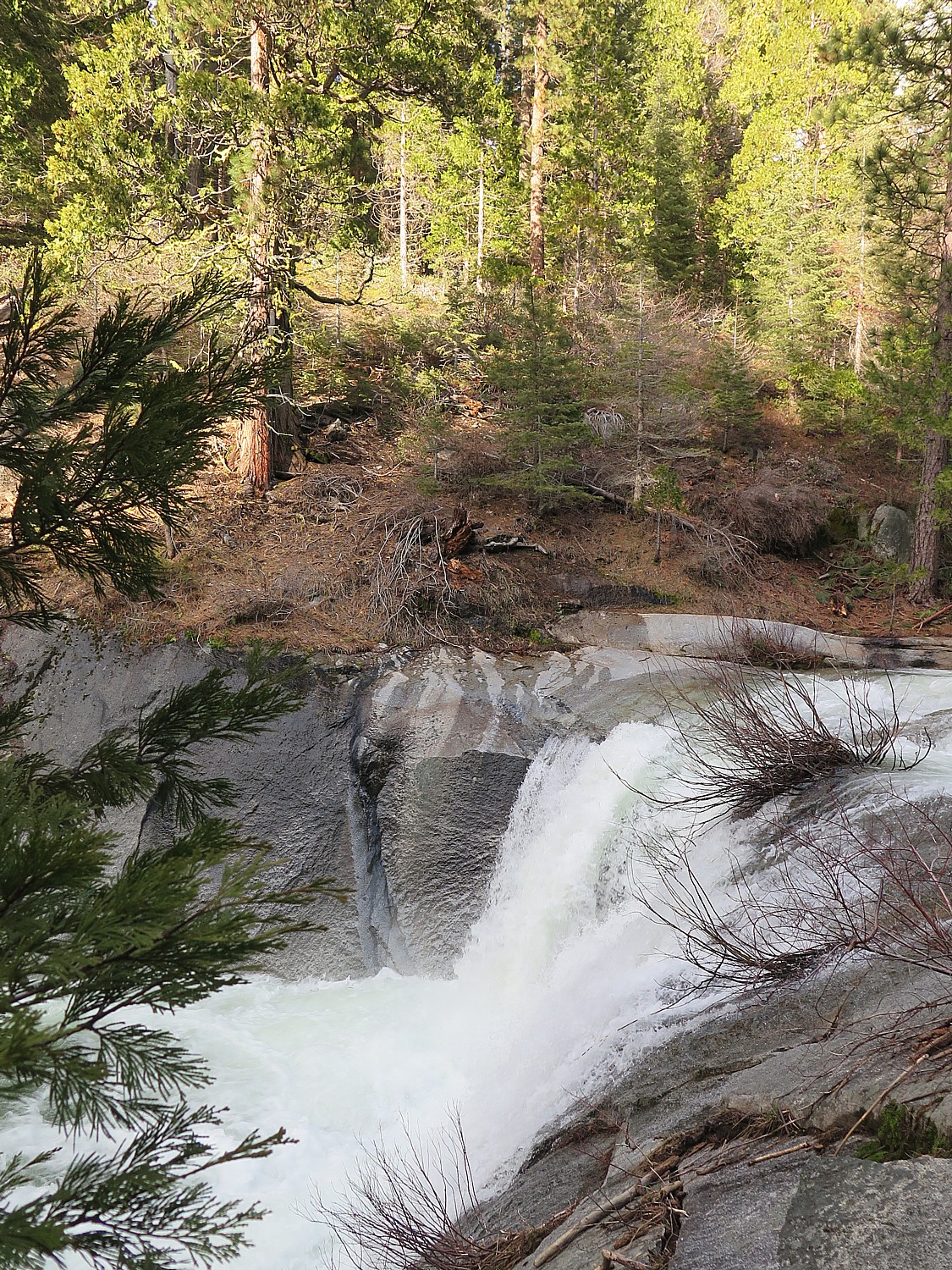
Our hike is rewarded with stunning view of the waterfall, full after record winter snows, in the late afternoon light; Tenaya Lodge is promoting “Waterfall Season” this spring © 2017 Karen Rubin/ goingplacesfarandnear.com

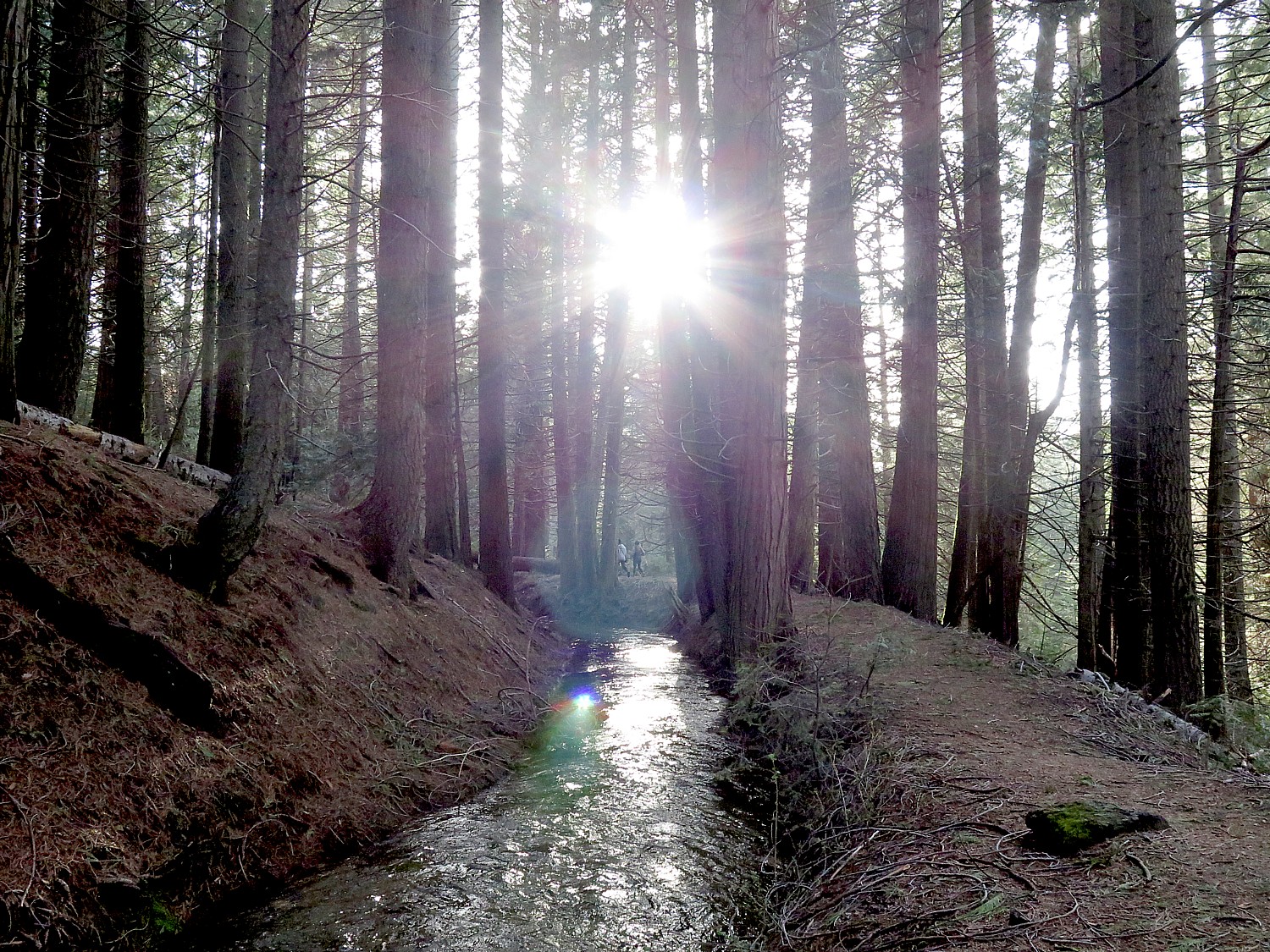
It is so early in the season, there is still snow on sections of the trail, making the rushing creek and waterfall all the more dramatic. We are supposed to turn off at a green building, but actually overshoot (it turns out it isn’t a building, but rather a water management shed with solar panels on it). Retracing our steps, and calculating for the time until dusk, we (bravely) go through a fence, walk past a decaying wood cabin and come to where the trail narrows significantly, following along a canal on one side. There are spots where you can hear and see a rushing stream and distant sound of the waterfall. Following along, we come to a wonderful waterfall. By now, the late afternoon sun is like liquid gold spreading over everything. Magical.

We make our way back to the lodge with minutes to spare before joining the 8 pm Flashlight Hike.

The hike back to Tenaya Lodge from the waterfall © 2017 Karen Rubin/ goingplacesfarandnear.com

Four Diamond Luxury Faithful to Rustic Environs

The Tenaya Lodge is a four-diamond luxury resort with every manner of amenity that nonetheless manages to be faithful to its rustic environs. It is named for Chief Tenaya, of the Miwok tribe of Indians who lived mostly along the foothills of the Sierras.

A rustic motif is faithful to its Yosemite National Park surroundings, but Tenaya Lodge offers four-diamond luxury © 2017 Karen Rubin/ goingplacesfarandnear.com

The Lodge is just two miles from the South Gate of Yosemite National Park, the most popular entrance (it provides year-round access to the park). The lodge makes every accommodation for the guests who will almost certainly find their way into Yosemite for hiking (they even have the moleskin package that is a lifesaver when you are getting a blister); the Deli, that is surprisingly well-stocked.

There is where you can pre-order lunch so you can grab it on your way out the door to hike (really a good idea so you don’t have to find your way to a restaurant in Yosemite).

Tenaya offers a few different dining options, accommodating late-night dining (which helps when you have been hiking in Yosemite all day).

The Sierra Restaurant where we enjoy fuel up on a lavish buffet breakfast before a day of hiking, is a casual restaurant serving breakfast and dinner, with convenient hours to accommodate guests.

Just next door (and providing overflow space at breakfast) is Jackalopes Bar & Grill serving lunch and dinner (conveniently, until very late)

Embers is an upscale, fine dining restaurant which covets a quiet atmosphere (no children), serving a leisurely two to three-hour meal, where they even make salads in front of you.

There is also a pizzeria in the cottages and in season, there is an appropriately named Summerdale restaurant, that is open seasonally off-site, that serves BBQ.

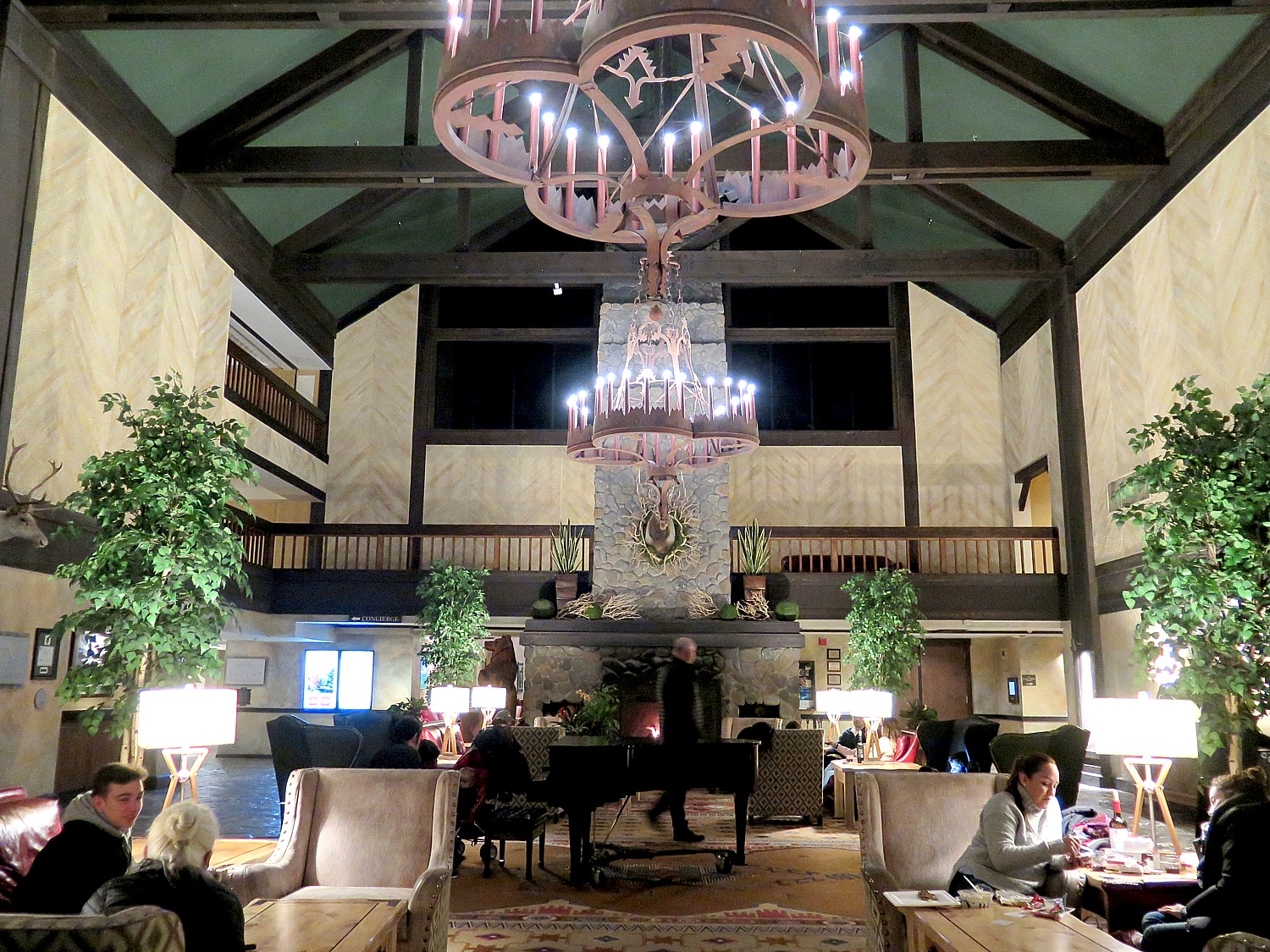
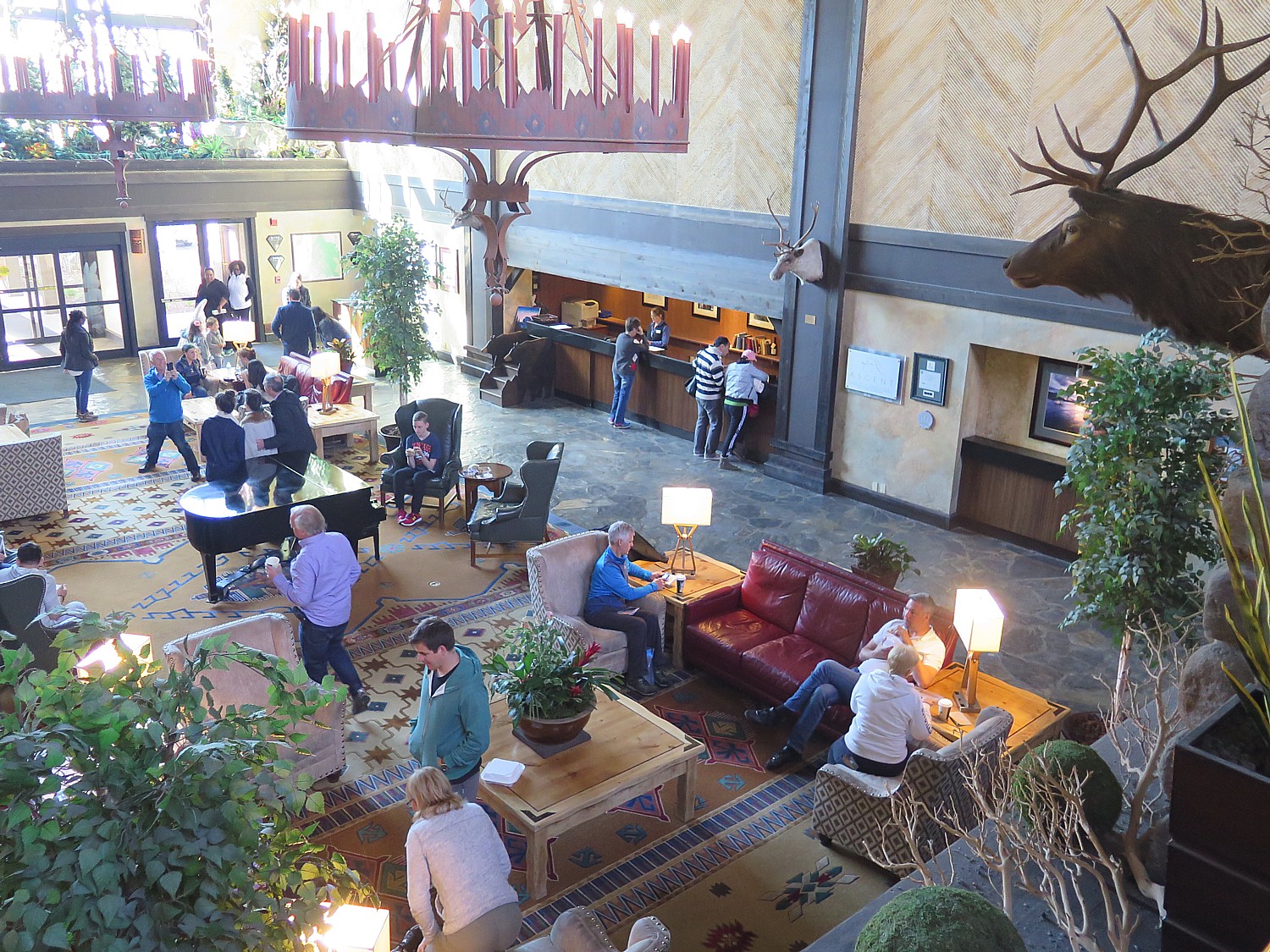
We settle into the cozy leather sofas in the expansive lobby, complete with stone fireplace and mounted deer head, like a true rustic lodge, and order items from Jackolopes for a very relaxing late-night snack. I love the Native American/western décor, and the exquisite photos of Yosemite Park that decorate the walls all through the hotel.

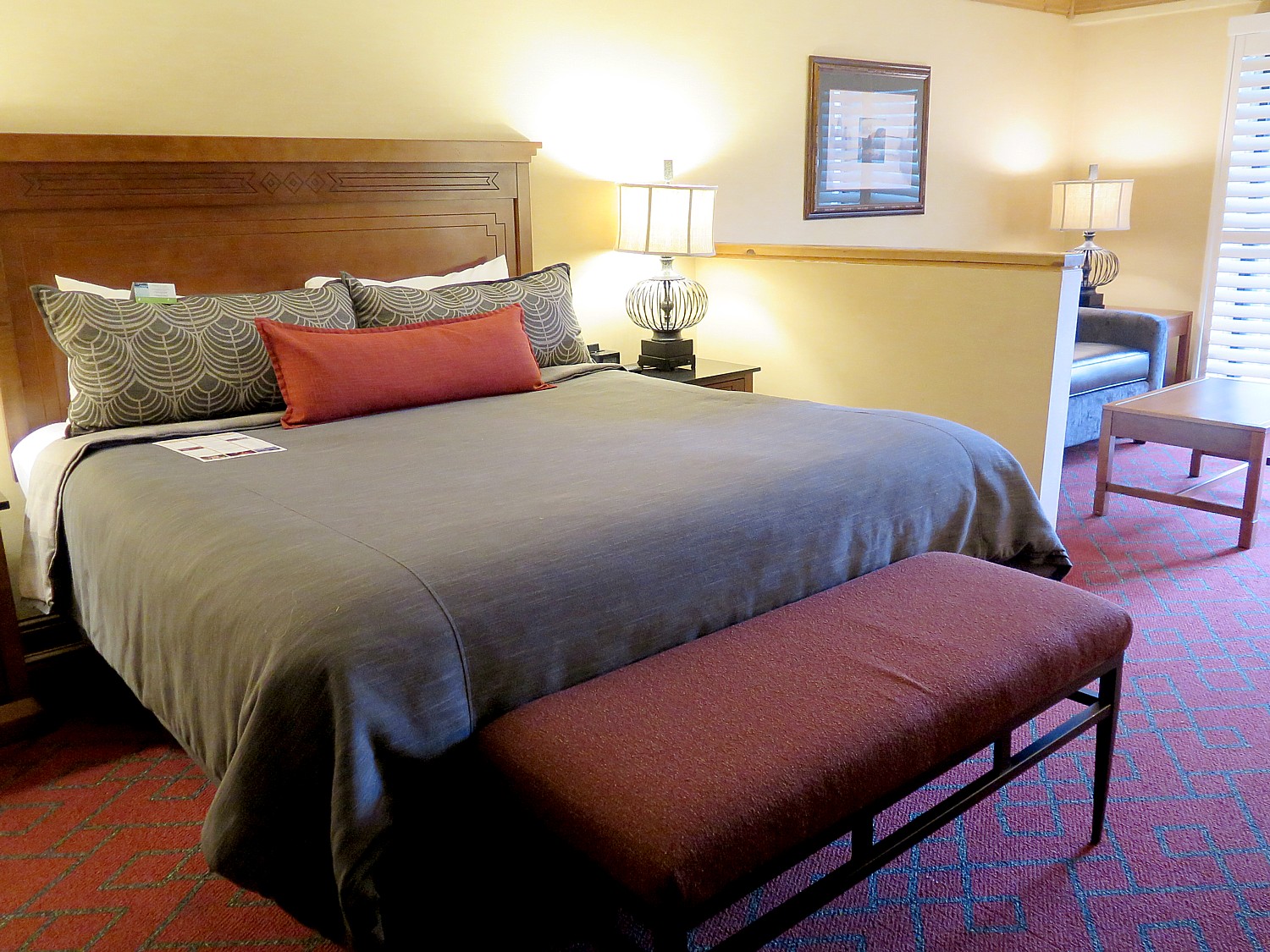
The four-diamond Tenaya Lodge is one of the most luxurious resort properties in proximity to Yosemite, and offers 297 guestrooms, suites and cottages.

Delaware North has spent $5 million renovating and upgrading the Tenaya Lodge since acquiring it in 2001 © 2017 Karen Rubin/ goingplacesfarandnear.com

Tenaya Lodge was originally built 1990; but acquired in 2001 by Delaware North, a vast global hospitality company which, among other things, manages lodgings and concessions in several national parks including the Grand Canyon and Yellowstone national parks and manages Kennedy Space Center Visitors Complex. Delaware North invested $5 million in significant renovations which were completed last year.

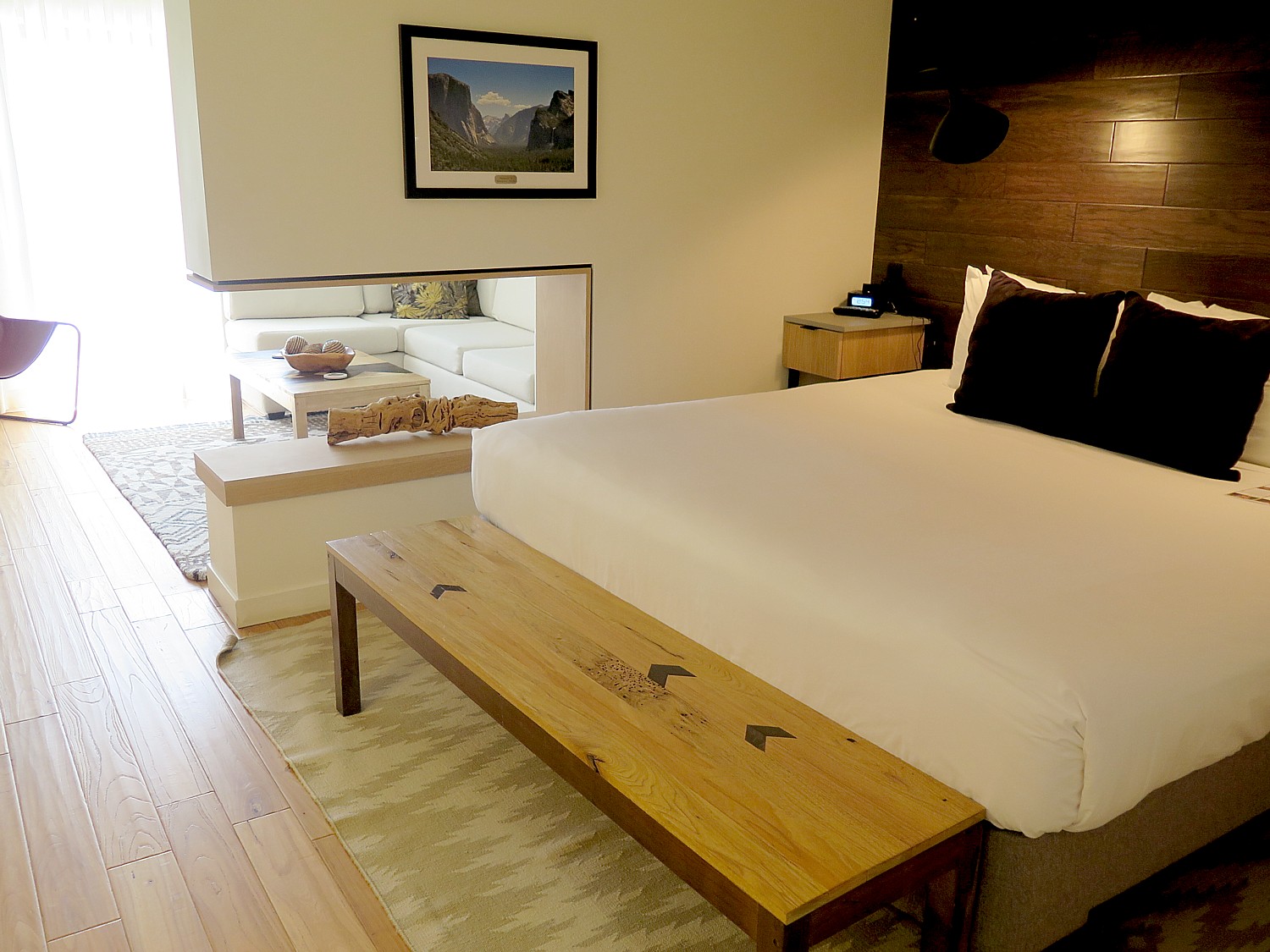
New Scandinavian-styled rooms at Tenaya Lodge © 2017 Karen Rubin/ goingplacesfarandnear.com

Among the innovations are stunning Garden Suites, designed by Piccini Group, SF with a prevailing white Scandinavian modern design, designed to be quiet (so you can understand why adults-only and no pets, though other rooms are pet-friendly).

Contemporary suites have a native ambiance and new “spa rooms” are lavish.

There are also several stand-alone cottages (that were acquired in 2008) that have up to three bedrooms (refrigerator, no kitchen). The lodge has plans to build two-bedroom cabins.

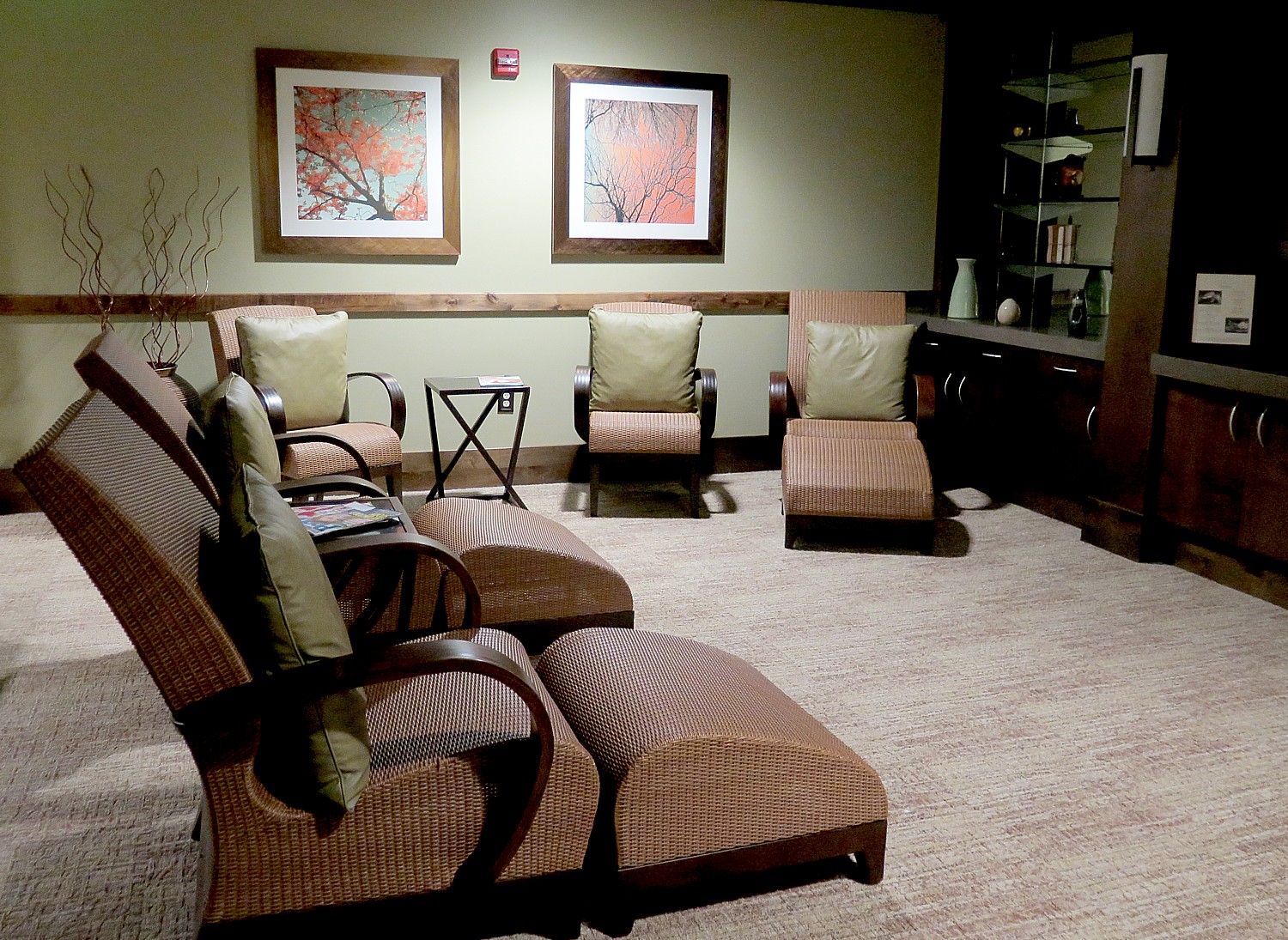
Relaxation room at Ascent Spa at Tenaya Lodge © 2017 Karen Rubin/goingplacesfarandnear.com

Tenaya Lodge is a true resort with every manner of amenity. Delaware North opened Ascent Spa, 10,000 sq ft, with 12 treatment rooms, a relaxation room (you can order sushi, drinks), a mud bath, group relaxation room, and couples massage room.  (Spring spa specials: Receive a complimentary glass of champagne with any 60 or 90-minute spa treatment; a new spring Parafango Slimming Body Treatment “detoxifies and slims the body.”)

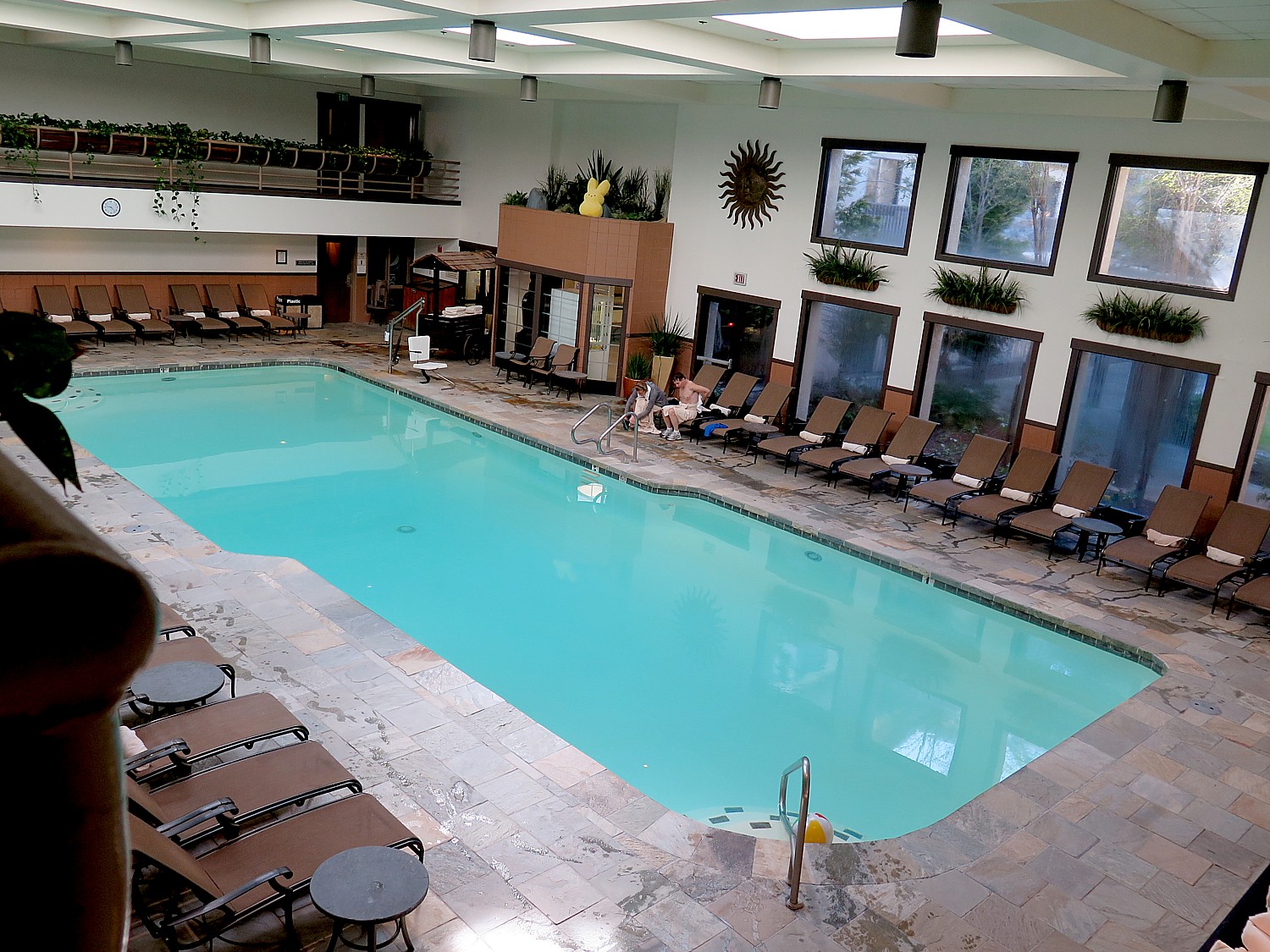
There is also a fitness center with sauna, Olympic-size lap swimming indoor pool, an outdoor pool, archery, rock climbing wall, arcade.

Indoor lap swimming pool at Tenaya Lodge © 2017 Karen Rubin/goingplacesfarandnear.com

There is a robust schedule of activities like the nighttime Flashlight Hike and Paint & Wine evenings  (Thur. & Sat. 7-9, $55 pp), plus special events and activities, like yoga on the patio overlooking the forest. (A resort fee covers fitness room, sauna, fitness room but everything else is a la carte, though there are package offerings.)

In winter, there is an enchanting 3,000-sq. ft. outdoor covered ice skating pavilion (skate rentals available), which in summer becomes suitable for weddings and events.

There is a fire pit (you can order drinks to come down); s’mores kits; a sledding hill and a kiddie slope.

Winter activities also include kids snowmobiling, horse-drawn sleigh rides, snowshoe nature hike, skiing at Badger Pass, California’s original ski resort.

Spring, summer and fall activities include mountain biking, guided hikes, guided rock-climbing excursion, fly-fishing excursion, fishing, Yosemite Valley tours, steam train rides, Summerdale BBQ, gold panning, Bass Lake water sports, golf, horseback riding, white-water rafting. They also offer supervised kids programs, like an adventure camp. (There’s a daily activity schedule.)

Tenaya Lodge lobby lounge is a popular gathering place © 2017 Karen Rubin/goingplacesfarandnear.com

Tenaya Lodge is really family friendly (ideal for multi-generational getaways, family reunions, weddings and family events). When you check in, there is a special place for children to check in (a short staircase to the reception desk); and they go all out for holidays like Christmas and Easter (when we are there); on Easter Sunday, there was a petting zoo and pony rides.

It’s also delightful for all the seating areas where families can gather.

Extremely popular for weddings and functions, Tenaya Ledge has a ballroom that can accommodate up to 850 and 12 meeting rooms.

For the same reason it is so well suited for family gatherings, Tenaya Lodge is ideal for meetings and corporate outings (there is a whole list of special activities that can be built in for groups, from rock climbing classes and  whitewater rafting excursions, to culinary classes and competitions, guided fly-fishing trips and group geo-challenges).

Notably, Tenaya Lodge won LEED Silver building certification. (I note that there are 8 Tesla charging stations for electric cars outside). 

Nearby Activities 

Tenaya Lodge is right at the South Gate to Yosemite National Park; the lodge offers a mini-bus tour that takes in the highlights © 2017 Karen Rubin/ goingplacesfarandnear.com

There are any number of activities just beyond the Tenaya Lodge door, which the lodge can pre-arrange:

In winter, the lodge offer snowshoeing; in warm weather they offer mountain biking on its own forest trails, while a short drive away,  the Sierra National Forest offers some of the finest single-track riding anywhere, from easy to technical. (The concierge can provide detailed maps.). Half-day and full-day bike rentals available for adults and kids ready to explore the forest trails.

A short distance down the road is Miller’s Landing which has fishing; horseback riding is also nearby.

We came just a little too early in the season to experience the Yosemite Mountain Sugar Pine Railroad. a one-hour, narrated excursion through the Sierra  National Forest on historic narrow gauge Shay locomotives over tracks once used for logging trains at the turn of the century.

The ride travels over four miles on the historic Madera Sugar Pine Railroad. There is a brief stopover in the Lewis Creek Canyon to see the locomotive up close, or explore the outdoors before your return trip to the station.  You travel along the historic right-of-way of the Madera Sugar Pine Railroad where mighty lumberjacks felled the timber and flumes carried the lumber to the town of Madera. The conductor tells of the history of the line, the trees, and the wildlife native to the area.

The line operates two historic geared steam locomotives called Shays. Both locomotives were from the Westside Lumber Company in Tuolumne, California. These two locomotives represent the original shays that worked this line from 1874 to 1931. The original Madera Sugar Pine Shay locomotives burned wood for fuel, while our two Westside Shay locomotives burn oil. Shay #10 was built in 1928 and weighs in at 84 tons, while Shay #15 was built in 1913 and weighs 59 tons. They also demonstrate how to pan for gold (you get to keep it!). And you can visit the Thornberry Museum which illustrates logging camp life at the turn of the century.

There is also a three-hour Moonlight Special, which starts with a BBQ dinner before boarding the logger steam train for a ride to the campfire sing-a-long program hosted by the Sugar Pine Singers. At the conclusion of the evening, you will re-board the train for a memorable trip up the mountain in the night.

Daily rides are available all summer. (The schedule varies seasonally and usually alternates with Jenny car rides. Reservations recommended.)

Yosemite Mountain Sugar Pine Railroad, 56001 Hwy 41 Fish Camp, CA 93623, 559 683 7273, Ymsprr.com; (www.tenayalodge.com/things-to-do/resort/steam-train-rides.

We have come to Tenaya Lodge for the express purpose of hiking in Yosemite National Park, but for non-hikers, non-DIYers, Tenaya Lodge offers a Yosemite Tour Package, via mini-bus, that includes lunch and narration, and guarantees waterfalls and wildlife and seeing the most popular sights of Yosemite. (Offered May 1-Nov. 30; from $575 spring, $685 summer, $555 fall; call 888-514-2167 or Tenaya Reservations directly at 559-692-8916).

Other tours are available as well.

We were so fortunate to arrive as the winter snows were melting. Indeed, after almost five years of drought, the waterfalls are fuller than ever this year. Tenaya Lodge is offering special Waterfall Season Hot Dates, now through June 26. (Go to https://www.tenayalodge.com/packages/hot-date-deals for promo code to get the special rate).

Tenaya Lodge is promoting “Waterfall Season” this spring © 2017 Karen Rubin/goingplacesfarandnear.com

Tenaya Lodge (like Yosemite) is very much a four-season resort (the South Gate, the most popular entrance to Yosemite, is open year-round), 55 miles north of Fresno Yosemite International Airport, 3 ½ hours drive from San Francisco Bay area and 4 ½ hours from the Greater Lost Angeles Area.

Tenaya Lodge, 1122 Highway 41, Fish Camp, CA 93623, 800-722-8584, tenayalodge.com.

Next:  Yosemite National Park: Best Valley Hikes for First Timers 

See also:

Muir Woods is San Francisco’s Cathedral to Mother Nature

____________________

© 2017 Travel Features Syndicate, a division of Workstyles, Inc. All rights reserved. Visit goingplacesfarandnear.com,  www.huffingtonpost.com/author/karen-rubin , and travelwritersmagazine.com/TravelFeaturesSyndicate/. Blogging at goingplacesnearandfar.wordpress.com and moralcompasstravel.info. Send comments or questions to FamTravLtr@aol.com. Tweet @TravelFeatures. ‘Like’ us at facebook.com/NewsPhotoFeatures.