By Karen Rubin, Travel Features Syndicate, goingplacesfarandnear.com
On Day 8 of our Boat Bike Tours’ Islandhopping Netherlands tour, we wake up in Enkhuizen, back where we started. We have breakfast and have to disembark by 9:30 am but we are able to leave our luggage on board for a couple of hours, giving me time to explore a bit before I need to take the train back to Amsterdam and the Schiphol Airport. I really appreciate this bit of time since I hadn’t a chance to explore Enkhuizen when we first arrived (I recommend coming a day before the ship sails so you have more time), and though I had some time to explore in the evening, i really enjoy myself wandering around this morning.
I find myself at the Zuiden Kerk (church) – magnificent yet simple and unpretentious, awesome yet approachable; ancient yet modern, the painted wooden ceiling shaped like the upside down bottom of a boat. It is Sunday morning and people are gathering for service as the organmeister plays Pacobel.
I find my way to the Zuiderzee Museum, an open-air living history museum village that re-creates daily life around the Zuiderzee before the sea was turned into a lake (the Ijsselmeer where we have just sailed) – when the dam was built in 1932. You stroll the cobble streets and explore 140 historic buildings collected from the former Zuiderzee region.
The outdoor museum was opened by Queen Beatrix in 1983 as an extension of the indoor Zuiderzeemuseum, which opened in 1950 (the indoor museum doesn’t open until noon so I have to miss it). Most of the buildings are authentic while others are reconstructed replicas of actual buildings. A complete village, you can wander around and visit a windmill, lime kilns, fish-smoking house, steam laundry, drugstore, pharmacy, basketmaker, blacksmith, cheese warehouse, school (where wooden shoes are lined up outside the classroom), even a hairdresser, and visit the working post office. The harbor is a replica of its layout on Marken. From April to November you can see life in the village of Urk as it was in 1905, meet residents and watch traditional activities, like games and building clog boats, and demonstrations of crafts such as rope-making, cooperage, basket making and herring being smoked.
The Indoor Museum, “a treasure house of the Zuiderzee,” consists of a string of 17th century buildings (original and replicated), some of which were used by the Dutch East India Company. Here, various collections are presented with a modern approach: you can dive into a ‘Sea of Stories’ and experience life on the former Zuiderzee in this interactive exhibition. A popular attraction is the ‘Schepenhal’ (ship’s hall), which allows visitors a close-up view of historic ships. The indoor museum also displays artifacts from the Zuiderzee cultural past, including paintings, furniture and traditional local costumes (‘klederdracht’). (Unfortunately, it opens at noon and I do not have the time to visit.)
Both indoor and outdoor museums have several restaurants located in National Heritage sites, like the Hindeloopen Pub, the Amsterdam House and the Pepper House on the Wierdijk.
Admission is 22E (56E for a family); plan to spend at least 3 hours at the outdoor museum. [Note: if you are extending the boat bike tour with a stay in Amsterdam, you may want to get the Iamsterdam city card (www.iamsterdam.com), which includes admission to the Zuiderzee Museum, https://www.iamsterdam.com/en/whats-on/calendar/museums-and-galleries/museums/zuiderzee-museum]
Zuiderzee Museum, Wierdijk 12-22, 1601 LA Enkhuizen, https://www.zuiderzeemuseum.nl/.
I am relieved to see how amazingly easy it is to get to/from the embarkation point in Enkhuizen from Amsterdam’s Schiphol Airport (especially since I arrived by plane on the same day as the boat departed): just walk down to the train (every 15 minutes) to the Central Station, a quick switch to the train to Enkhuizen (every half hour) for the hour-long, comfortable and scenic ride. The trick is to “check in” with a credit/debit card using the app, or purchase a ticket (14-16E) before you go through to the train by tapping on a pole (a conductor will double check on the train), then when you depart the train, tap it on the pole again, and the correct amount is debited. (If you don’t pre-purchase, the conductor can charge you an extra 50E; I did forget but the conductor was extremely kind in helping me buy the ticket online.) Then it’s just a five minute walk from the train station to the ship. You can purchase tickets in the vending machines at the stations or online on https://www.ns.nl/en/journeyplanner#/. The website can also be used to check the timetable.
Getting back to the airport is equally easy – we are asked to leave the ship by 9:30 am (but I am able to store my luggage there, so I could visit the city until 11).I time my touring to get back to the ship, pick up my stuff to get the 11:39 am train to Central Station in Amsterdam, then a quick switch to the train to Schiphol with more than the three-hours before my flight at 7:05 pm.
This was my second trip with Boat Bike Tours (I had the best time on their Bruges-Amsterdam boat-bike-tour – utter perfection with the biking, the boat, the sights along the way; be sure to plan to spend at least a day in Bruges before the bike tour to appreciate its enchantment).
Boat Bike Tours, which is based in Amsterdam, got its start when Channel Cruises Holland, a barge tour operator founded in 1977, added biking to its itineraries in response to guests asking for traditional Dutch activities. The new cruise-and-cycle concept was so successful that it was spun off as its own brand in the mid-1990s. Between 2000 and 2020, the company added more itineraries and ships. Last year, Boat Bike Tours merged with Islandhopping, a Croatia-based operator which also specializes in cruise-and-cycle travel (I loved the boat-bike trip in Greece that I took with Islandhopping some years ago). Together, the merged company, while operating under their own names, offers more than 70 itineraries in 15 countries, and has opened a North American sales office in Fairfield, Connecticut.
“With half of our guests coming from North America now, it makes sense to have an office here,” said Jana Tvedt, Director of Sales, North America for Boat Bike Tours. “We’re available when needed and familiar with what Americans and Canadians are looking for in destinations, experiences and ships. And we’re always happy to work with travel advisors, groups and charters.”
Each season, the company contracts some 50 ships including barges, motor yachts and sailing ships, ranging in category from comfortable to superior. Biking styles include guided for casual riders and independent (self-guided) for seasoned cyclists, with touring bikes, e-bikes and mountain bikes available depending on the destination.
Itineraries range from five to 15 days, with most being eight days, and cater to a variety of budgets and interests, from historic cities and landmarks to picturesque natural landscapes and the world’s best wines. The Boat Bike Tours concept is to enable guests to connect with local people, culture and nature, while traveling by smaller boat and by bike also takes guests beyond tourist hotspots and minimizes environmental impacts. (Our sailing ship, Leafde fan Fryslân, uses biodiesel.)
The big news is that Boat Bike Tours will be offering a newly built ship for 2026, Magnifique X, an all-suite ship accommodating 32 passengers, giving the company a new deluxe, superior category. In addition to the bigger cabin, the itinerary is also enhanced with upgraded amenities, support van, included lunches, and more sightseeing inclusions. The itinerary goes from Amsterdam to Paris with one night hotel stay in Amsterdam, then biking to Bruges, then a motorcoach transfer to Paris where there is a hotel stay. (Bookings are open.)
Among its most popular itineraries for North American travelers:
Amsterdam to Bruges: Cruise and ride through the Dutch countryside of Zeeland and western Flanders in Belgium. Tour world-famous cities such as Amsterdam, Antwerp, Ghent and Bruges, as well as picturesque villages, a Dutch cheese farm, the windmills of Kinderdijk and the magnificent natural landscape along the Schelde River.
Split to Dubrovnik: Hop from island to island in the South Dalmatia region of Croatia by boat and e-bike. See the town centers of Split and Dubrovnik, and experience the culture and nature of more sparsely populated islands like Brač, Hvar, Korčula, Lastovo, Mljet and Šipan. E-bikes help with hilly and mountainous terrain.
Cochem to Metz: Follow the Moselle River through Germany, France and Luxembourg, passing endless vineyards and stopping to taste local wines. See enchanting old cities like Cochem and Bernkastel, the once-imperial Roman Trier, the stunning waterfalls of Saarburg, the Gothic cathedral of Metz and welcoming villages in between.
The merger of the Boat Bike Tours and Islandhopping means that clients of either one can take advantage of a 3% loyalty discount when booking. Notably, bike tours prove superb for the burgeoning number of solo travelers, and each departure offers at least one cabin with a reduced single supplement.
By Karen Rubin, Travel Features Syndicate, goingplacesfarandnear.com
Day 6 on Boat Bike Tours’ eight-day Islandhopping tour of northern Netherlands is a case when the hype doesn’t even begin to match the reality of the experience. Today’s ride will take us either 29 or 36 miles (depending on our choice of short or long routes) from Harlingen to Franeker, through the Frisian countryside and rural villages to Bolsward and into Makkum on the eastern bank of lake Ijsselmeer. Boat Bike Tours doesn’t just curate the cycling routes, they also curate experiences. In this case, our bike tour turns into an exploration of the solar system through an 18th century lens.
We set out biking first to the historic center of Franeker to visit the Koninklijk Eise Eisinga Planetarium (Royal Eise Eisinga Planetarium) – the oldest continuously operating planetarium in the world and a UNESCO World Heritage site. I had never heard of Eise Eisinga or his planetarium, but am instantly amazed.
Eise Eisinga was a wool-comber and largely self-taught scientist and astronomer who spent seven years, from 1774 to 1781, building a remarkable planetarium in his house! – in his living room/bedroom/dining room to be precise. We see the cupboard where he would have slept with his wife under the mechanism, the pull-out trundle bed where his children would have slept, the dining table. Above, on the ceiling, we see where he constructed a solar system where the six known planets in exact scale follow their rotation around the sun with remarkable precision even by today’s standards, using today’s instruments. The fact that the mechanism is still in working order is evidence of the ingenuity and foresight of its maker, who left detailed instructions for its maintenance.
While waiting for the English-language presentation, we visit the fascinating exhibits that take up the rest of his home, starting with a delightful video interview between “Eise Eisinga” and an actual Dutch astronaut and another superb video about Eisinga’s life.
When I learn about Eise Eisinga’s biography, I am awed by his genius, bringing to my mind Leonardo DaVinci.
Eise Eisinga was born in 1744 in Dronrijp where he attended primary school. Like many children in those days who worked at home, he worked in his father’s wool combing establishment. In addition to his father’s profession, he inherited his father’s interest in astronomy and mathematics. Eise was so determined to learn that he would travel every week to Franeker, a major center of learning, to study Euclidean math with Willem Wijtses, a wool dyer. When he was 24, Eisinga married Pietje Jacobs and settled in Franeker in 1768, working as a wool comber.
On May 8, 1774,a local newspaper published a prediction from a preacher that the confluence of Mercury, Venus, Mars and Jupiter and the moon would result in the mutual forces of these celestial bodies knocking the earth off its path and cause it to be burned up by the sun (“the end of time!”). That set off a panic and seems to have been an impetus for Eisinga to begin building his model of the solar system to show the extreme unlikelihood of planets colliding.
It took Eisinga seven years to construct his planetarium – a real triumph of craftsmanship to carve the wood (his father, a woodcarver, helped), create 6,000 precision nails for the cogs, and the exquisite painting. Eise would have finished sooner, but in a critical development, he had to adjust the placement of the pendulum that kept everything in motion, because his wife drew the line on allowing him to cut a hole in the floor (it was their bedroom, after all), so he had to recalculate everything and replace all 6,000 nails.
The power (and motion) for the entire mechanism comes from a clock, “like the beating heart of the machine,” our guide explains. The mechanism is powered by a system of nine weights – one for clock and 8 for different axels of system
All is built to scale to fit into the space – an astonishing 1 to 1 trillion – and everything is turning so slowly, you can’t detect motion visually. Every planet has its own calculated speed, so Mercury takes 88 days to make one full rotation; Venus takes 224 days; Earth takes 365 days plus 76 hours while the moon takes 29 ½ days to go around the earth (it shows the phases of the moon); Mars takes 687 days; Jupiter, with four moons (the number known at the time), takes 11 years, 315 ⅓ days for its rotation; and Saturn, the furthest known planet at the time, actually has rings and 5 moons and takes 29 years plus 164 days for its rotation.
How do they know the planetarium is still working when everything moves so slowly?
“Everything is connected, so we check what moves daily: the date, zodiac sign, day of week.” On December 31, a special nail pushes the gears into motion to flip to the new year.
Eise Eisinga was such a visionary, two years after finishing his remarkable machine, he wrote a 90-page manual explaining how to maintain it.
“Every 22 years, we follow 5 steps – take board down, sand down, paint the years, let the paint dry, then replace it in the attic,” our guide says. The wheels are so big and move so slowly, they clean the gears once or twice a year.
Eisinga’s son took over when he died, and the planetarium remained in the family for 140 years until 1922 when his great granddaughter was the last in the family to maintain the planetarium. Then the City of Franeker took over its management.
Most of the mechanism is original (Mercury had to be replaced after being damaged in World War II) but they have had to change the ropes for the gears and pulleys.
After the presentation, we are able to climb the stairs to the attic to peer into where the wheels and gears are laid out.
Eisinga came to Franeker with his wife because it had the second largest university in the country and was a center for learning that drew famous scientists. But you can appreciate how trade with the world not only gave Netherlands the wealth to pursue science and innovation, but the access to and transfer of knowledge, not to mention a culture of Enlightenment that was open to new ideas and discovery. And Eise Eisinga was wealthy enough that he could afford to make natural science a hobby.
It is a humbling experience to imagine such expertise and craft hundreds of years ago, before the tools and instruments we have today.
The museum offers several permanent exhibits: Eisinga’s former wool combing establishment, an extensive collection of historical astronomical instruments, Eisinga’s mathematical and astronomical manuscripts which you can digitally peruse, all marvelous juxtapositions to an interactive permanent exhibition, De Ruimte (Space) that opened in 2016, as well as that delightful video conversation between “Eise” and a modern-day Dutch astronaut (English subtitles).
I peek into a room to see the finishing touches on a new temporary exhibit: a spectacular astronomical cabinet from 1771 by Jean Paulus and Prof. Ghiesbregt. “After long wanderings, this Belgian instrument came into possession of Bert Degenaar, a famous Dutch antique collector. On his behalf, the instruments were completely restored and made functional again by horologist Pieter de Ruiter. The 3 meter wide and over 2.5 meter high cabinet is equipped with various globes, planetariums (including an unprecedented representation of the 5th-century worldview of Martianus Capella) and the 16th-century heliocentric worldview of Copernicus. A number of dials provide information about various time indications, calendars, the position of the planets, the phases of the moon, and the orbit of Jupiter’s four largest moons.” The exposition also includes a large collection of original drawings of the various instruments.
All of this goes to serve as a literal display of what The Enlightenment was all about, which largely due to mass printing and trade, made its way to the New World, as well, and was foundational to the Founders of the United States.
Admission to Eise Eisinga’s planetarium is 6E (a HUGE bargain).
We continue on our 36-mile bike route which follows much of the a famous 11-city, 200-km bike tour, and in the course of two days, we will visit six of the 11 and have the opportunity to collect stamps (like passport stamps) on postcards our guides have provided.
By the time we ride into Bolsward, one of the Eleven Frisian Cities, the rain has stopped. Here we see one of the art installations we have been told about – this one looks like Toothless from “How to Train Your Dragon.”.
Bolsward is really beautiful, and I am entranced by the magnificence of The Court of Justice building, now a museum, where I get to climb into the tower built on top of the Court in 1617 (a really improbable and unsafe construction).
But this is the first day when I see why people would get an e-bike in the Netherlands – I’m guessing I am pushing through or against 15 mph winds.
In the evening, our guide, Edith, leads a walking tour of Makkum– it’s just me and a couple from Alberta, Canada. Edith points to homes that have a Coat of Arms or some indication of who lived there, when the fellow shows us his ring with a Coat of Arms. He turns out to be a descendent of the Trip family, one of the wealthiest, most powerful families in Netherlands.
He relates more of his family’s fascinating story as we sit in a historic pub with centuries old Delpht tiles of great 17th century trading ships, noting more than once than the family fortune had been long gone and his branch of the family emigrated to Canada. It’s like having someone from that time tell their story.
Trip’s family’s coat of arms, he relates, has three zoltbommel (wooden shoes) – a nod to the fact that the family started by manufacturing wooden shoes.
Then, brothers Jacob and Elias Trip went into river barges, got rich, then expanded into sea trade. They had a connection with an iron factory which they parlayed into weapons manufacture, arming the Dutch rebels against the Spanish in its 80-year war for independence, 1568-1648 (apparently selling arms to both sides).
Trip was among the original investors of the Dutch East India Company (Verenigde Oost-indische Compagnie, VOC), in 1602, the first public company to issue stock and the first truly multinational corporation, transforming global commerce and trade (at its peak, the company would have been worth $7 trillion in today’s dollars, the most valuable company in history). The VOC was granted a monopoly on Dutch trade with Asia and also possessed the power to wage war, make treaties, govern territories, and even mint its own currency, as if a nation-state. So much of what we experience on our trip goes back to the Dutch East India Company.
Meanwhile, the Trips became one of the richest and most important families in Netherlands. Portraits painted by Rembrandt of his relatives Jacob Trip (1576-1661) and his wife, Margaretha de Geer, are in the National Gallery and Ryksmuseum. Their sons, Louis and Hendrick Trip, became fabulously wealthy arms merchants, and built the Trippenhuis in 1662 once the widest residence in Amsterdam and on the list of top 100 Dutch heritage sites.
Edith adds that the Netherlands was one of the first republics in the world and makes the claim that its declaration of independence in 1581, provided a model for Thomas Jefferson in 1776, and was printed on paper from a Dutch paper mill.
“We are now a kingdom, but we started as a republic. Our constitution limits the power of king, our monarchy is more about public relations, like the United Kingdom.”
The first king of the Netherlands, Napoleon’s brother Louis who reigned from 1806-1810, started an art collection, which he brought to TrippenHuis – in essence the first Ryksmuseum. Trippenhuis was where Rembrandt’s “Night Watch: hung until 1851 and since 1887, has housed the Royal Netherlands Academy of Arts and Sciences.
Day 7’s ride takes us from Makkum to Stavoren, from where our ship, Leafde fan Fryslân, will sail across lake IJsselmeer to Enkhuizen, the endpoint of our trip. There is a prediction of rain today and strong wind, so the guides suggest I do the shorter ride (19 miles) and promise I won’t miss out on anything I will regret (the longer route, 30 miles, goes along several Frisian Lakes).
Among the highlights of the ride are coming across a house deliberately built in an upside-down version of a traditional Frisian home (a bit surreal and you have to wonder), and a historic windmill, De Nylannermole, which the sign says dates from 1784, though its history goes back to 1624 (I’m trying to figure out the Dutch). At one point, I see the windmill with a wind turbine in the distance behind it, and later, we see windsurfers and sailboats – all reflections of how the Dutch have embraced wind.
We stop for lunch in a tiny little village as rain comes (we sit under umbrellas outside), and then continue on to Hindeloopen (where we should have cycled for lunch), an old trading town famous for a traditional decorative painting style. Hindeloopen seems to be the epicenter for cycling.
I finish the ride 1:15 pm, hoping I made the right choice in biking the shorter route, and have some time to explore Stavoren before we sail.
There is yet another one of the art installations (this one a giant fish), but I am particularly intrigued by the sculpture of “The Lady of Stavoren” here, and the moral to the story it offers.
“The Lady of Stavoren” legend dates from when the city was the largest and richest in Friesland. Many of the merchant ships were owned the Lady of Stavoren who ordered one of her captains to “Bring me the finest treasure in the world.” He brought back a grain that transformed into pure gold in the midday sun. She forced him to throw it into the sea. A fisherman foretold that she would be punished and at some point beg for grain. Later, two of her ships were lost at sea and she became a beggar woman, while the place where the grain was tossed turned into a sandbank, where a plant that grew ears of corn grew up but yielded no grain.
We have an enjoyable sail back to Enkhuizen, a gala farewell dinner, and then I go off to explore the historic town, which is really worth more time than I will have before I have to return to Schiphol Airport early the next day. (Suggestion: arrive the day before the ship sails to give yourself some time to enjoy Enkhuizen.)
By Karen Rubin, Travel Features Syndicate, goingplacesfarandnear.com
Day 3 of Boat Bike Tours’ eight-day Islandhopping tour proves to be my favorite, most perfect day – the biking, the attractions, the scenery, the gestalt of the island of Texel, even the weather, all combining for a thrilling experience. We will be biking roundtrip from and back to Oudeschild with a choice of a 26 mile or 30 mile route. We soon discover the treasures harbored on The Texel Roads.
We start off biking together to Ecomare, a seal sanctuary and ecology center with superb displays, exhibits and notes (with English) that teach about ecology, climate change, animal and environmental conservation, focused on the local area, making clear what these existential planetary changes mean for the people living here.
I start in the room with skeletons of actual whales – enormous, suspended so that they look like they are swimming – then move to an aquarium where you can see rescued seals swimming under water. You go outside to the various habitats where there are excellent explanations of why the seals were rescued (and the steps they take to avoid “rescuing” a seal that is merely resting on the beach), what their prognosis is to be re-released into the wild or whether some condition, like blindness, will require them to stay.
We see areas where baby animals are nurtured, where medical procedures are conducted, where seal pups are raised until they can be released (I wonder how they learn how to hunt for themselves), and where animals are quarantined (the sign says it’s a good thing if this area is empty!).
Our stay is timed so we get to see a feeding, before heading out again.
I stick with my group doing the longer ride (41 km), until we reach a delightful town of Dun Berg, where there is a huge event going on with a military band and seniors in wheelchairs who have been gathered for the concert that turns out to be the May 20 celebration of Texel’s Independence (different from the Netherlands, because it marks the day they finally expelled the German occupiers).
I spend about a half-hour wandering the lovely town center before breaking off on my own in order to arrive back in Oudeschild in time to visit the Museum Kaap Skil. I feel very brave but use the RideGPS to give me the route, even though I find myself double-checking that I have selected the right route to follow. Because it stays light so late (till nearly 9 pm), I figure even if I get lost, I can still get back during daylight.
I find myself so delighted to be doing these 12 miles on my own – it is idyllic pastoral scenery that compels me to stop to take photos – then I ride through a couple of villages, then onto the path along the dyke with the ocean on one side and the high berm with sheep (who keep the grass shorn) on the other, that takes me right to the harbor and the ship.
I make it back in under two hours, by 3:15 pm, with just enough time to really enjoy this astonishing Museum Kaap Skil (do not miss it!), in which the historic windmill, so prominent in the landscape, is the centerpiece.
I quickly drop my things in my cabin, then climb the stairs up and over the dyke, down below sea level to the village and the museum.
The museum has a small village of outdoor attractions including the historic windmill and a ship, Texelse Blazer, dated 1894, that is being restored, and authentically furnished cottages, beachcomber’s shed and smithy, gives you a realistic view of island life during the Netherlands’ Golden Age of Sail.
On Tuesdays and Thursday when volunteers dress in period clothes, you can watch wool being spun, fishnets being mended, ropemaking, and taste a smoked fish (tastiest smoked fish I’ve ever had), visit the grocery store and walk into homes furnished as they would have been.
I save the indoor exhibits in the modern museum for last (the outdoor village closes at 4 pm, the museum at 5 pm). These extraordinary exhibits of artifacts rescued from shipwrecks in the Wadden Sea that were so plentiful off this port – an indication of how important a port Texel was during the Golden Age of Sail – are a fitting climax to the visit.
I start on the upper floor, in “World Voyage,” where you can follow specific ships to their destination and see artifacts obtained from them.. A centrally located compass shows the way and Texel folk from the past tell their stories, assisted by shipwreck finds. People such as Albert Gronders, who sailed the Baltic Sea yearly to buy grain in the 17th century, narrates the north shipping. about Baltic Sea shipping. If you go east, then Jacob Schagen, who, as a 15-year-old Texel man, sailed for the Far East aboard the VOC ship De Jonge Lieve in 1762, narrates about the eastern shipping routes. Texel folk from the past also tell their stories about journeys west and southbound.
Alongside the adventurous and positive aspects of seventeenth century trade for Texel, World Voyage also explores its “shadow sides:” “Adventure, wealth, trade and romance, but also exploitation, danger, slavery and poverty. Global trade in the 16th and 17th century knew many faces,” reads a self-aware note.
A section themed “A Complex History,” acknowledges the violence, greed and role in the slave trade that enabled Holland’s seafaring empire. Among the artifacts displayed are tools destined for slaves to use on a sugar plantation in Suriname alongside luxury objects meant to guarantee the plantation owners a comfortable life, salvaged from a ship that sunk near Texel, never having reached the destination.
The displays are sensational, with many having interactive elements (the notes in English are much appreciated: I also enjoy reading about “The Women Who Stayed Behind”.
The stellar attraction in Museum Kaap Skil is a 17th century silk dress “of royal allure,” salvaged from a shipwreck at the bottom of the Wadden Sea. Given the name ‘Palmhoutwrak‘ (Palmwood wreck), this was a merchant ship carrying luxurious goods, that must have been wrecked on the Texel Roads around 1650. The precious garment is still in amazingly good condition despite having lain on the seabed for almost four centuries. “It is a unique find worldwide; hardly any clothing from the seventeenth century has been preserved. Scientists expect to need years to answer all the questions that the dress has raised.” It is now on display with other textiles and artifacts in a new exhibition at the Museum Kaap Skil, kept in a protectiveairtight display cases, filled with nitrogen, especially designed for the fragile textiles in this exhibition.
“Every find from the Palmwood Wreck is important, but the dress has been dubbed “the ‘Nightwatch’ of the textile world.”
The findings were so extensive that researchers had been working for years to make an inventory and only recently discovered that a second dress from the Palmwood Wreck was most probably a wedding dress, adorned with silver. This dress was less well-preserved but you can see it as well as what it would look like “restored” to its glory in an animation
The Palmwood finds are divided into four themes in the exhibition: wealth, worldly, intimate and stylish. Together they show how valuable, tasteful and exclusive the cargo was: a calf leather bookbinding and a gilded silver cup bearing the English royal family Stuart’s coat of arms in gold print; objects gathered from all corners of the globe: like an oriental rug and a caftan; intimate objects like a toiletry set, knitted silk stockings and a red silk bodice.
Merchant vessels, warships, whalers: they all anchored on what was known as “the Texel Roads.” In the 16th and 17th century this was the place to load, unload and wait for favorable winds, the notes explain. But many ships were lost in storms, which is why there are dozens of shipwrecks lying in the seabed near Texel and how it comes to be that so many of these artifacts can now be viewed at Museum Kaap Skil with such interesting detail. You have more of a personalized connection to each object.
In the exposition ‘Ship in Sight – the Roads of Texel and the World’, the Roads of Texel come alive. A dimension has been added to what is claimed to be “the world’s largest maritime scale model.” The hidden stories about the 160 ships have become visible, thanks to new technique. They show that the Roads of Texel was the logistic hub of the 17th century.
So I find myself in this enormous room – I’m guessing over 100-feet long – that has a model of the city with all the various ships in the harbor (you can use a telescope to zero in on anything, then look up the back story of 160 ships and what happened to that particular ship). Then, extending the full length of the room, an animated film so realistically created of the ships sailing into port, finishes with a massive storm hitting, and you watch how fast one of the ships sinks.
On large touchscreens, you see the ship models very close up, down to the smallest details. There is the Seven Provinces, the ship with which Dutch admiral Michiel de Ruyter won many navel battles, and the Petronella, a fluyt ship we learn was headed to Riga to buy grain. You can learn about the ship’s features, the routes sailed, personal stories, special facts and important events.
The exhibits make the point just how important the Roads of Texel was as the logistic hub of the 17th century.
You know what – it is spectacular to see first hand, but if you cannot visit, check out the website, https://kaapskil.nl/en/ (You can actually watch the thrilling and fascinating hour-long video on the museum website, https://kaapskil.nl/en/discover/expositions/ship-in-sight-the-roads-of-texel-and-the-world/.)
In the evening, after dinner, our Boat Bike Tours guide Edith leads a walking tour of Oudeschild. After, I wander around the harbor and walk along the dyke, the colors absolutely stunning in the setting sun.
By Karen Rubin, Travel Features Syndicate, goingplacesfarandnear.com
The annual eight-day Parks & Trails Cycle the Erie Canalway bike tour from Buffalo to Albany is 400 miles and 400 years of history but this year’s ride July 12-20, 2025 is particularly special because it marks the 200th anniversary of the opening of the Erie Canal in 1825. An engineering marvel of its time that transformed the United States, all along the way, riders will enjoy special events and celebrations.
The Erie Canal propelled the Industrial Revolution, opened the frontier, united the country, birthed canal towns and cities, and made New York City a financial capital of the world.
You see all of this unfolding from the first mile out of Buffalo and over the course of eight days of riding (averaging 50 miles a day), filled with activities and camaraderie.
Cycle the Erie Canalway participants experience one of the best trails in America as they cycle through historic canal villages and discover the small-town charm of upstate New York that makes people like us Downstaters marvel, “This is New York!” Along the way, canal historians and local experts will introduce riders to the people, places and things that make the Erie Canal so important to the history of New York and the nation during its Bicentennial Year. Cyclists pedal between 40 and 60 miles per day on the mostly flat (but it seems the campsites tend to be at the highest point of a town) and mostly traffic-free Erie Canalway Trail, and visit some of Upstate New York’s most iconic attractions, such as the Women’s Rights National Historic Park in Seneca Falls and Fort Stanwix in Rome, a full-scale fort recreation from the French and Indian War.
The Parks & Trails NY tour is actually one of my favorite bike rides in the world – for the scenery, the sights along the way, the activities like lectures and museum visits that are arranged, the camaraderie of camping and riding together with some 650 cyclists from all over the country and all over the world, and the Erie Canalway itself –a 356 mile-long car-free recreational path that is the west-east part of New York State’s new 750-mile Empire Trail Network (the north-south trail network connects Battery Park at the tip of Manhattan to the Canadian border). Between the relatively flat nature and superb support provided, Cycle the Erie Canal offers unparalleled cycling for all ages and abilities (I’ve seen families with little ones in trailers or car seats and riders as young as 10 and as old as 92 bike on their own.)
Though there are bike tour operators (such as Wilderness Voyageurs and Pocono Biking) that offer inn-to-inn bike tours on portions of the Erie Canalway, this annual supported biking/camping trip, in its 27th year, is organized by Parks & Trails New York, which for decades has successfully advocated to open these recreational trails and improve parks.
Each day’s ride is highlighted by fascinating attractions all along the Erie Canalway
In Lockport, see the original engineering marvel that made the entire Erie Canal possible: the famous “Flight of Five”, a staircase of five locks built to elevate boats through the then-impossible 50-foot Niagara Escarpment; take a cruise through the modern lock (the GE motors that run it are over 100 years old), explore underground sluiceways, caves and the “Upsidedown Bridge.”
Leaving the historic village of Medina, look for the tunnel under the Erie Canal, where you see that the Erie Canal is really like a bathtub.
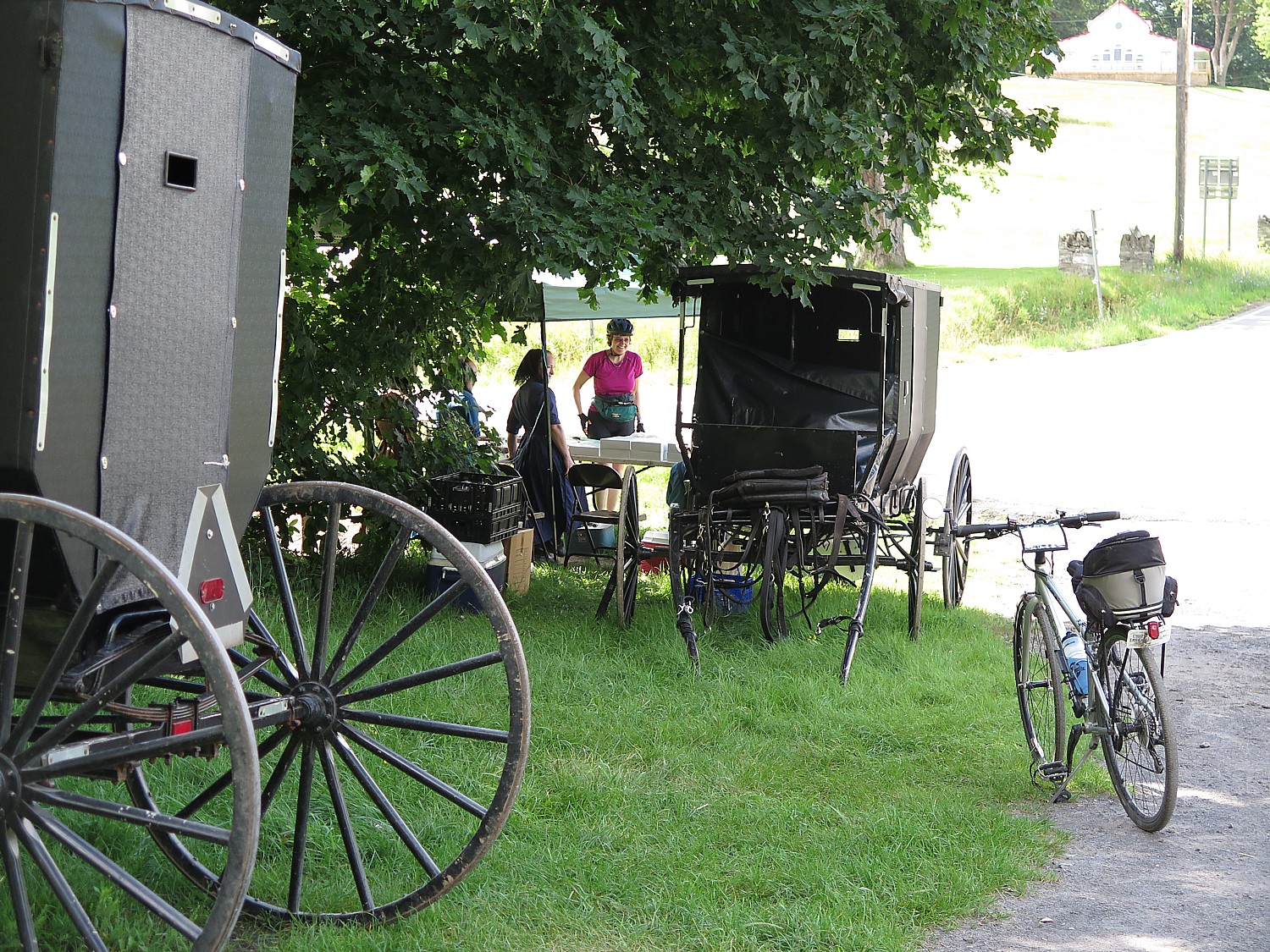
Ride through New York’s Amish Country (who knew!) on the way to Seneca Falls, birthplace of the modern Women’s Rights movement and visit the Women’s Rights National Historic Park, National Women’s Hall of Fame (housed in a former knitting mill) and the Elizabeth Cady Stanton home (the museums stay open for us).
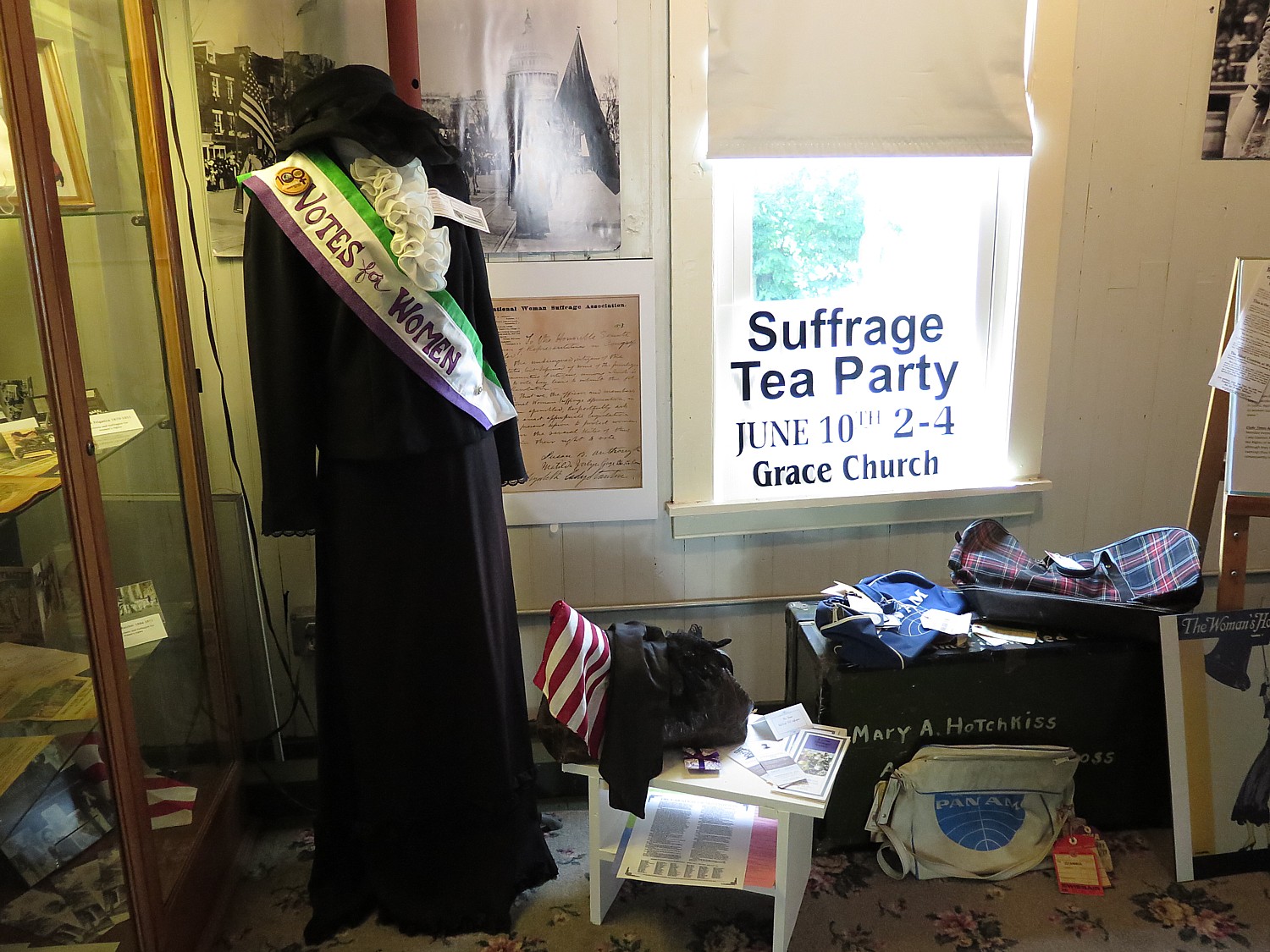
You also get a taste of the women’s movement at the Peppermint Museum in Lyons (don’t miss it!) where you learn about the inventor, Hotchkiss’s daughter, a suffragist, who took over the company.
On the way to Syracuse, stop at the Visitors Center at the Old Erie Canal Heritage Park at Port Byron, then pedal through the authentic enlarged Erie Canal Lock 52 to the c. 1895 Erie House Saloon, Blacksmith Shop, and Mule Barn; visit the Jordan Historical Society Museum, and ride on the towpath on an original aqueduct over Skaneateles Creek which takes you to Camillus’ Erie Canal Park where you stop at Sims Store, a re-creation of a 19th century general store (where riders are cheered for passing the half-way mark at 200 miles)
In Syracuse, visit the zoo, and the next morning, the Erie Canal Museum, the best of the Canal Museums along the way (they open especially for the cyclists)
On the way to Rome, visit the Chittenango Canal Museum and dry docks and the Canastota Canal Town Museum and see the spot where the first shovel of dirt was turned for “Clinton’s Ditch” (deliberately in the middle of the canal). Chittenango was also the birthplace in 1856 of L. Frank Baum, famous throughout the world as the creator of The Wizard of Oz and his mother-in-law Matilda Joslyn Gage, was a prominent women’s rights advocate, abolitionist, and writer, known for her radical views, derived largely from the Oneida women and her work alongside Susan B. Anthony and Elizabeth Cady Stanton in the women’s suffrage movement).
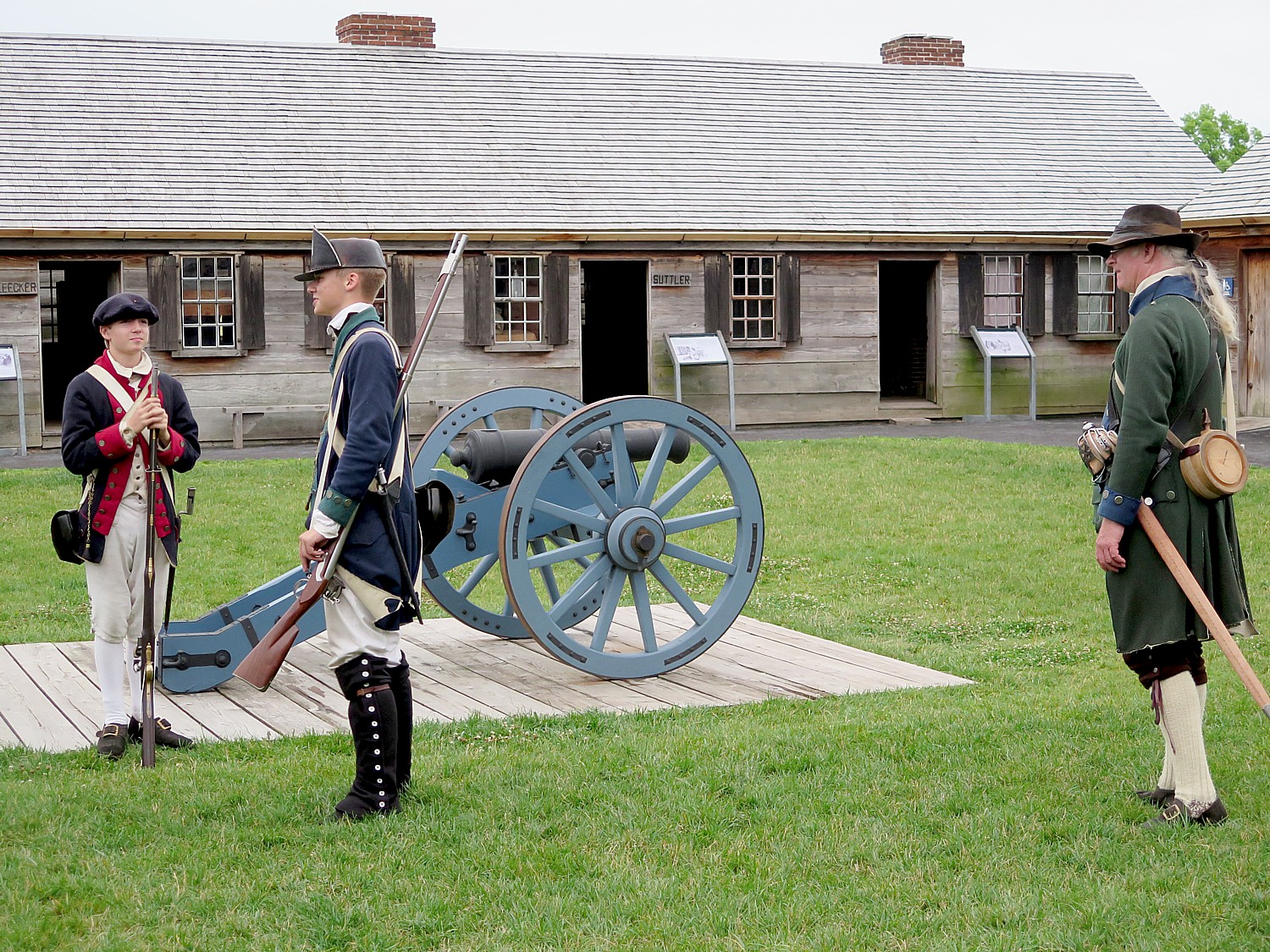
In Rome, camp at the restored Fort Stanwix National Monument, built during the French and Indian War, populated with costumed interpreters, and learn how seemingly minor battles actually shaped the outcome of the American Revolution.
In Little Falls, explore the glacial potholes of Moss Island, a National Natural Landmark, and tour Revolutionary War General Herkimer’s home.
At Schoharie Crossing State Historic Site, once a trading post and a fort (they found the footprint after a hurricane), look where you can see all three Erie Canals (yes, 3 Erie Canals have been built).
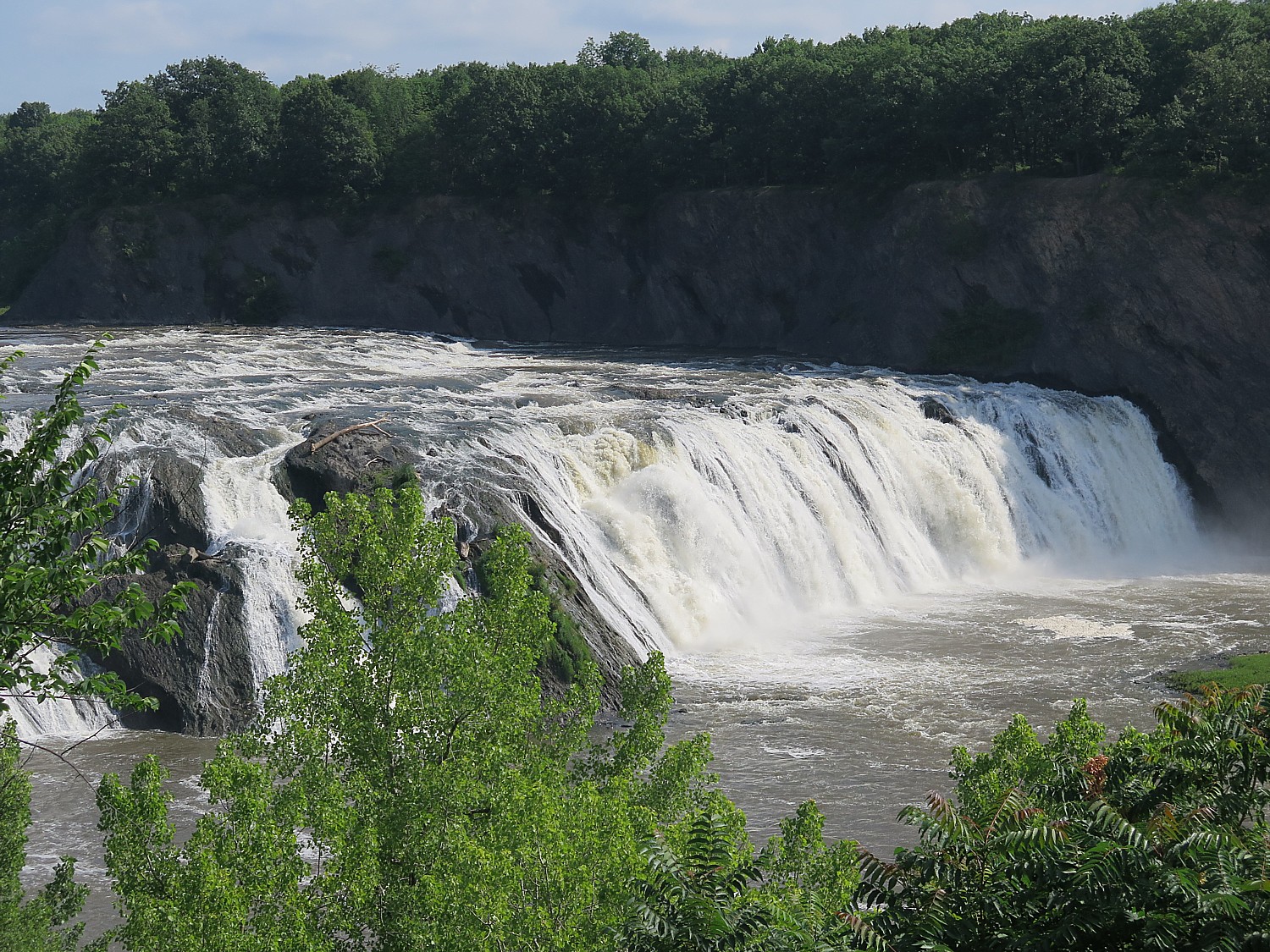
Coming from Schenectady to the finish line in Albany, stop at Cohoes Falls, one of the most powerful falls east of the Rockies and a major challenge for Erie Canal engineers (a wonderful bookend with Niagara Falls in the west); visit Peebles Island State Park, where, during the Revolutionary War, American forces prepared defenses to make a final stand against the British, and finally, bike along the Hudson River into downtown Albany, New York State’s 300-year-old capital.
Registration for Cycle the Erie Canal includes camping accommodations each evening with restrooms and showers (even swimming pools and charging stations and the possibility of indoor camping); eight hearty breakfasts and six delicious dinners; two refreshment stops daily stocked with fruit, snacks and beverages; SAG support and baggage transport; daily cue sheets and marked routes; entertainment and historic presentations every evening; and guided tours of the Canal, historic sites, museums, other attractions, and expanded celebrations for the Canal’s 200th Anniversary.
The price for the eight-day ride, July 12-20, Buffalo to Albany is $1,300/adult, $700 (youth age 6-17), $300/child (5 and under). There is also a four-day version with an optional shuttle.
(Note: they arrange for parking in Albany ($120, at the Quackenbush Garage July 12-20, 2025), and a shuttle bus to Buffalo on July 12 ($120/rider), or oppositely, parking in Buffalo ($25) and a shuttle back from Albany to Buffalo at the end of the tour.)
Parks & Trails New York, which is celebrating its own 40th anniversary this year, is a leading statewide advocate working to create a network of parks, trails, and greenways so that New Yorkers can enjoy the outdoors close to home. Cycle the Erie Canal supports Parks & Trails New York’s work on the Erie Canalway Trail and on trails in communities throughout New York State.
The New York State Canal Corporation, the agency charged with operating, maintaining and promoting New York’s Canal System and the Canalway Trail, is the Premier State Sponsor of Cycle the Erie Canal. The Erie Canalway National Heritage Corridor is the event’s Heritage Sponsor.
For more information on Cycle the Erie Canal, visit www.ptny.org/canaltour, email eriecanaltour@ptny.org or call 518-434-1583.
Erie Canal Bicentennial Events
The Cycle the Erie Canal bike tour, July 12-20, is one of the biggest events honoring the canal’s bicentennial, but there are many events happening in various towns and cities along the Canal:
On Fri., May 16, 2025, the Bicentennial Navigation season will kick off in Waterford, where the Canal meets the Hudson River, with a parade of vessels.
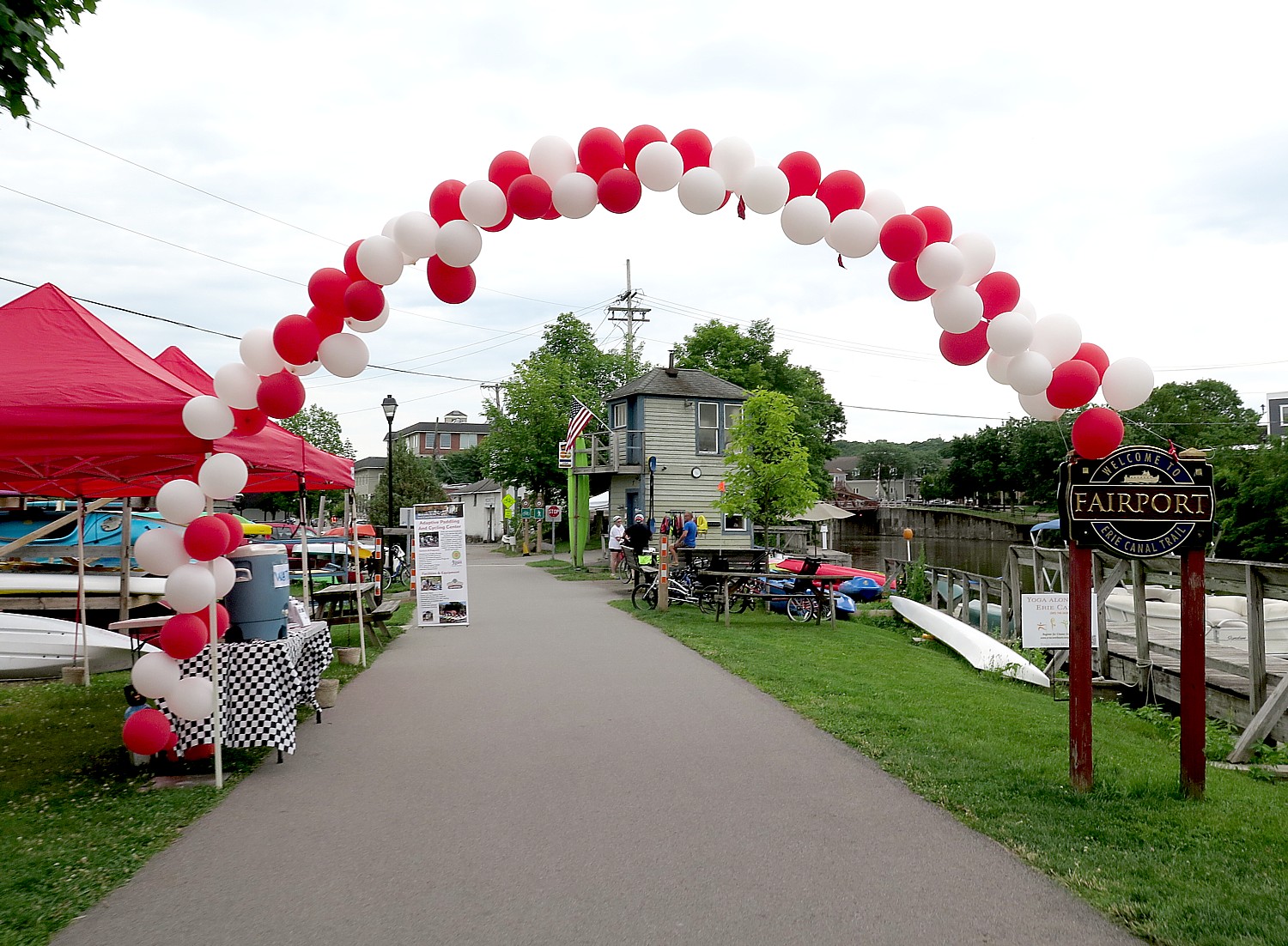
Fairport, NY, the jewel of the Erie Canal, celebrates its 48th Canal Days from June 6-8, 2025. One of New York’s premier arts festivals features artisans, music, local cuisine and fun for all ages, and brings more than 100,000 visitors to this Rochester suburb.
Canal enthusiasts, historians, engineers, environmentalists, artists and travelers from around the world can attend The 2025 World Canals Conference from Sept. 21-25, 2025 in Buffalo, NY, complete with canal-themed excursions for participants, in addition to hours of learning, discussion and networking.
The Water Music NY: More Voices Festivalreturns in Summer 2025, with The Albany Symphony Orchestra performing free concerts across the entire New York State Canal System. The project is a collaboration of composers, local arts partners, cultural & educational institutions and community members fusing arts, cultural heritage, and contemporary issues to re-envision the past, present, and future of people and communities bordering the historic waterway.
For the grand finale, a replica of Seneca Chief, the boat Governor Dewitt Clinton used for his inaugural Erie Canal journey to open the Canal in 1825, will set sail on September 24 and recreate the maiden voyage from Buffalo Canalside to the New York Harbor, making multiple stops along the way with celebratory events at each community stop including flotillas and a grand commemoration in New York City on October 25.
Can’t make it to the Parks & Trails NY Cycle the Erie Ride? The bike tour company, Wilderness Voyageurs offers a four-day inn to inn ride, New York Erie Canal West, that begins in Lockport and stays in places like the historic Genessee Country Inn (2025 tour dates: 6/30, 7/27, 8/10, 800-272-4141, wilderness-voyageurs.com).
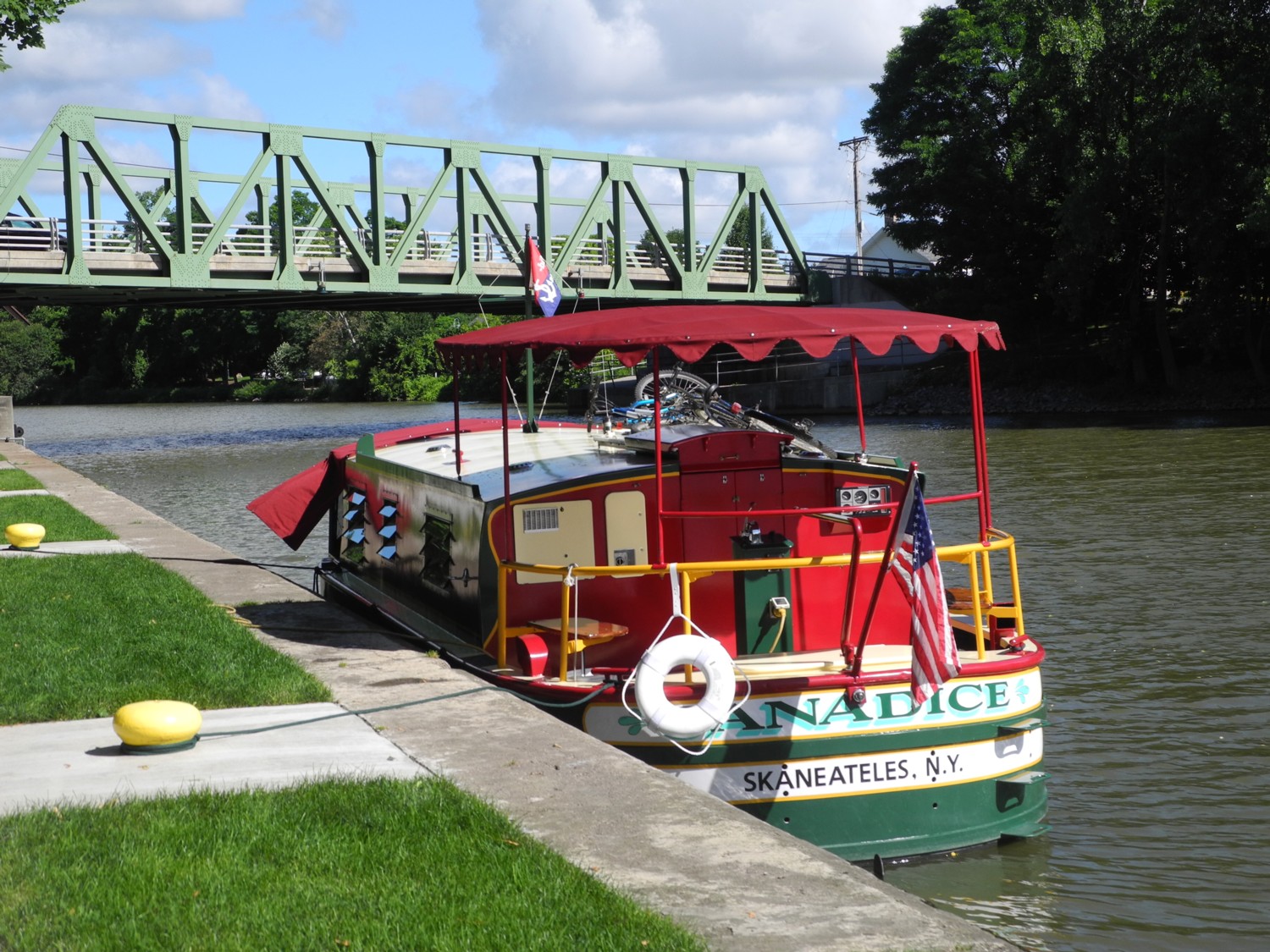
Another extraordinary way to experience the Erie Canal is by a live-aboard canal boat! This European-style self-skippered houseboat that was specifically designed for the Erie Canal let’s you make your own way on the Erie Canal, going through locks and under the lift bridges, and experience the 200th anniversary of the canal just as it was then, by boat and bike. Erie Canal Adventures provides this one-of-a-kind experience with live-aboard, fully-equipped canal boats. Accommodating 2 to 6 people, each of these charming, easy-to-pilot boats features cozy bedrooms, kitchens, and bathrooms – cooking utensils, linens, fuel, mobile app and bikes. You get 3-4 hours of training, including safety training, systems, and navigational training (and how to go through the locks which are SO fun. You learn how to work the radio to call up to the lockmaster and the bridge operators to lift the bridges. And you tie up where you like. Erie Canal Adventures, 1125 Marina Parkway, Macedon NY 14502, (315) 986-3011, Option 1, allie@eriecanaladventures.com, ericcanaladventures.com.
“This year, New York State is rich with opportunities to experience major milestone anniversaries, stay in new hotels and explore new museums and exhibits,” I LOVE NY Executive Director of Tourism Ross D. Levisaid. “The Bicentennial of the Erie Canal‘s completion can be celebrated throughout upstate communities, while downstate, New York City commemorates its 400th anniversary. The 100th anniversary of the Great Gatsby can be explored at Gold Coast mansions on Long Island, where the famous novel was set. For more information, visit iloveny.com
by Geri Bain for Travel Features Syndicate, goingplacesfarandnear.com
If you had asked me whether I knew about Boston’s role in the American Revolution before my recent exploration of the Freedom Trail, I would have unthinkingly said, “Of course.” Hasn’t every American heard the story of Paul Revere’s Midnight Ride and the Boston Massacre in their history classes? Even people who don’t know who the current president is could probably tell you what happened at the Boston Tea Party. But just as visiting the Roman Forum expands your view of the ancient past, a thoughtful visit to Boston’s Freedom Trail will forever deepen and perhaps change your view of American history.
And it’s fun. You won’t need any maps or preparation. While most tourism routes use the term “trail” figuratively, Boston’s Freedom Trail is an actual 2.5 mile “trail” marked by a red brick line that you can follow to some of the most iconic sites in the birth of our country. Detailed historic markers all along the way make it easy to dip into the stories of our past on your own.
For those who prefer a more structured visit, there’s a wide array of guided tours that provide a more interactive approach. The Freedom Trail Foundation’s several daily 90-minute group tours are led by costumed guides (thefreedomtrail.org) and based on what I heard in passing over the course of my time in Boston, the tours are lively and informative. The Foundation also offers a free online brochure that can act as a self-guided tour. There are also free apps from the National Park Service (nps.gov/boston) with recorded commentary for major sites and apps focused on Black heritage and other themes.
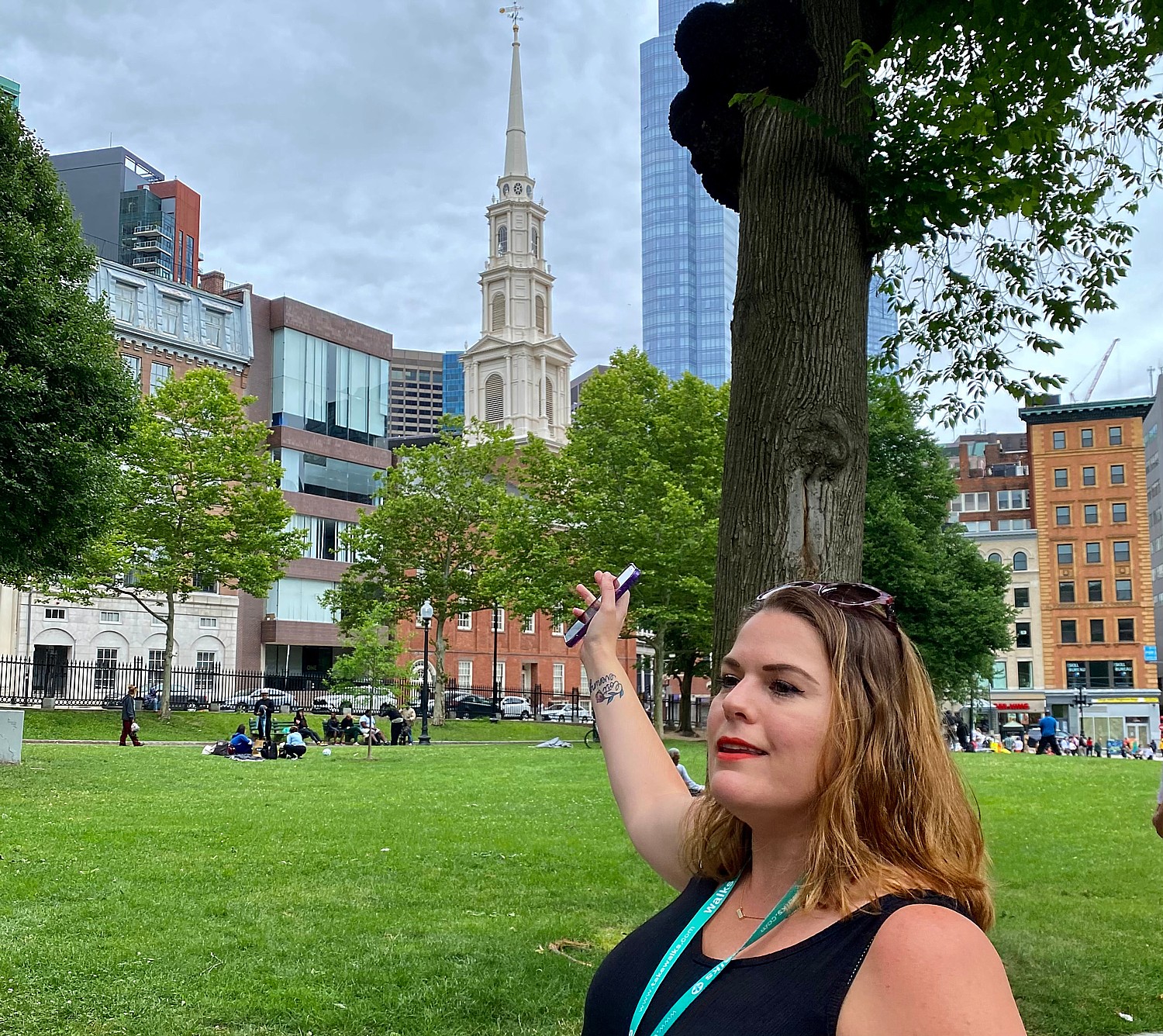
DAY ONE: To get grounded, I chose a three-hour VIP Freedom Trail Tour by Walks (booked through City Experiences (www.cityexperiences.com/boston) which limits its group size to 15 people. The day I went, it was just me and a family of four. Our guide, Alexandra (Alex) Smith, was a theatre artist and history buff (who was currently directing “Revolution’s Edge,” a historical drama that was playing at the Old North Church). She used anecdotes and questions to capture our imaginations.
Standing in the Boston Common, she pointed out that the corner where the Park Street Church stands was dubbed Brimstone Corner both for the fiery sermons given at the church and because of the gunpowder stored there during the War of 1812.
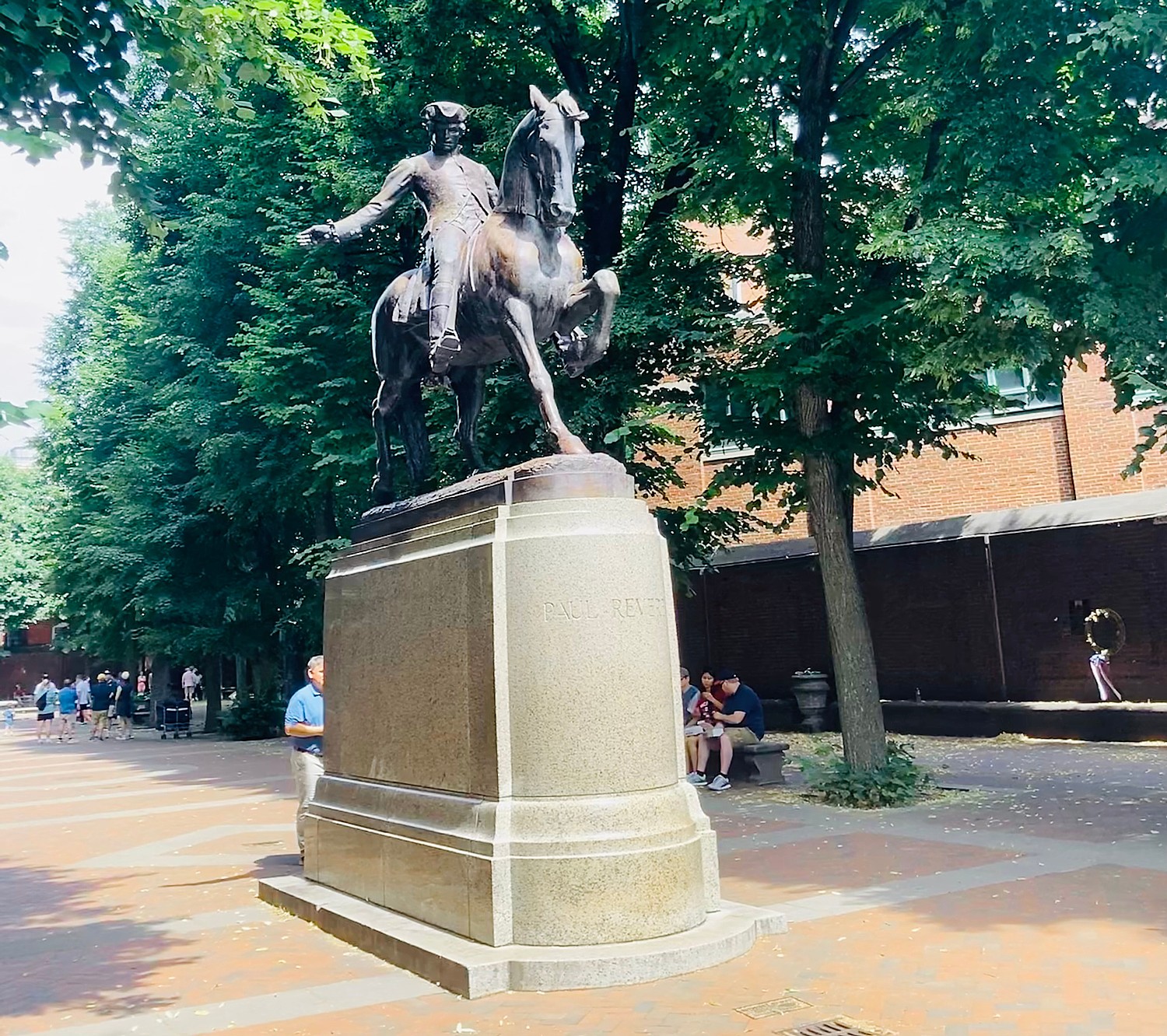
When we got to a statue of Paul Revere, Alex asked the two school-aged kids in our group if they’d heard about Paul Revere racing to Concord and shouting the warning “The British are coming”? They nodded.
“Well that’s not true.” They looked puzzled. First, she explained, all Bostonians considered themselves British back then, so those wouldn’t have been the words he would use. And second, the mission was a stealth operation so he wouldn’t have ridden through the streets yelling. And most important, the King’s soldiers were on patrol that night and Paul Revere was stopped and held for questioning before he could deliver his message to Concord. Wisely, he was not the only messenger who rode out that night, so the message got through.
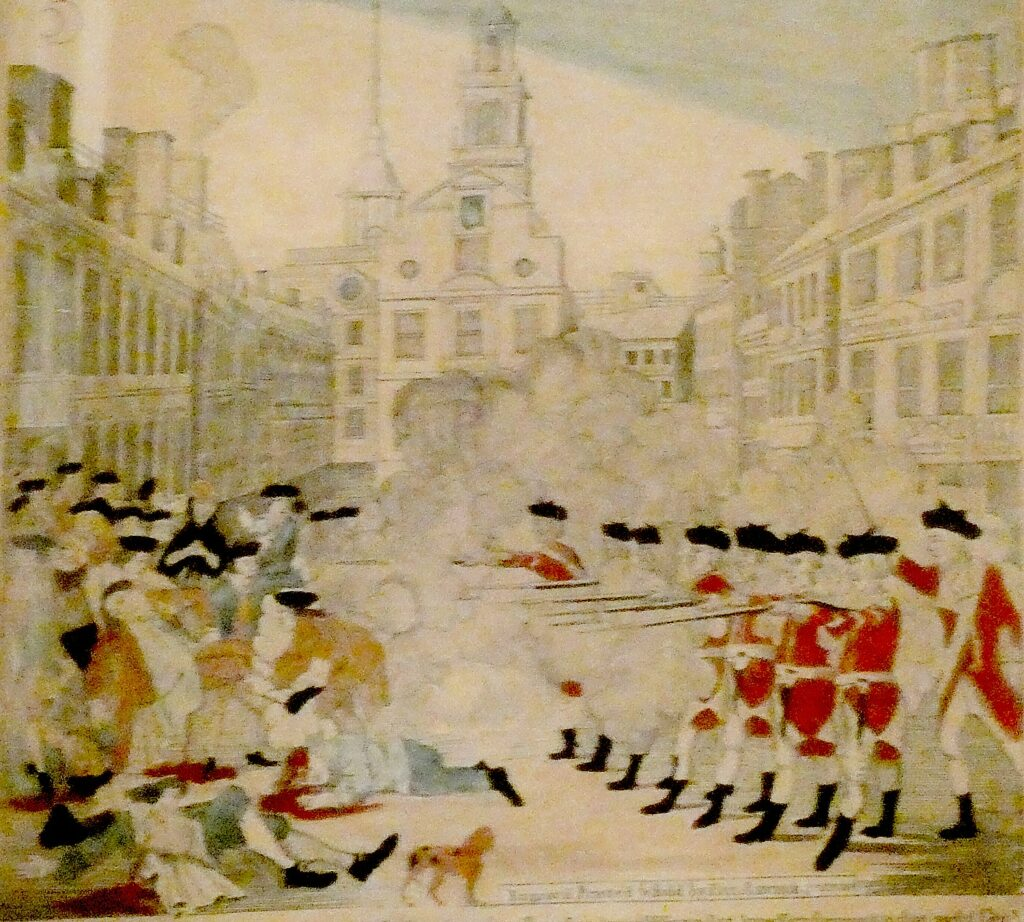
Most people think of Paul Revere solely as a silversmith, but his work as a printer and an artist was key to his role as a patriot seeking to break with Great Britain. His print of the Boston Massacre was significant to organize public opinion against the British. Paul Revere, The Bloody Massacre Perpetrated on King Street, Boston. (Hand colored engraving, 1770. American Antiquarian Society. Gift of Nathaniel Paine.)
“So why does Paul Revere get the credit?” Alex asked us. She paused, then explained, that Henry Wadsworth Longfellow wanted to create a dramatic hero for America so he took artistic license in his poem The Midnight Ride of Paul Revere. It makes for a relatable and patriotically-motivating story to have a single hero.
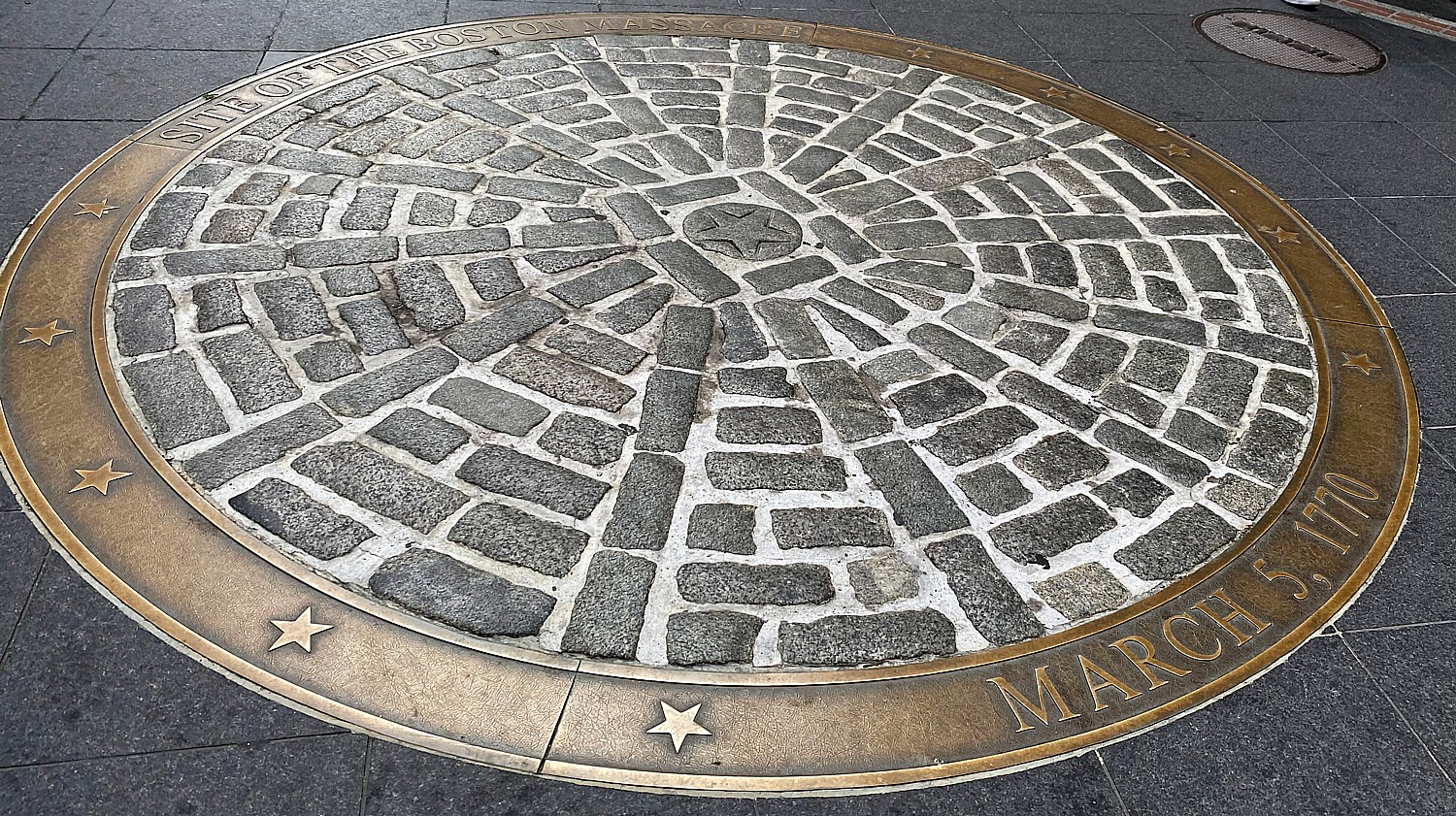
Another example of drama trumping truth took place at the Old State House. Pointing out the plaque that commemorates The Boston Massacre, Alex showed us a picture of British soldiers shooting into the crowd. That image, engraved by Paul Revere and sent to all the Colonial newspapers turned the “Boston Massacre” into a rallying cry against the British Crown. However, like Wadsworth’s poem, the engraving took poetic license.
Tensions had been building between Boston residents and the growing number of soldiers sent there to enforce new taxes but also taking jobs from local workers. One argument between a soldier and a colonist escalated, with soldiers and Bostonians gathering into a standoff. The soldiers, under attack by the crowd with snowballs, clubs, and other objects, were told to hold their fire, but one of them panicked and shot and then another joined in. Five people were killed.
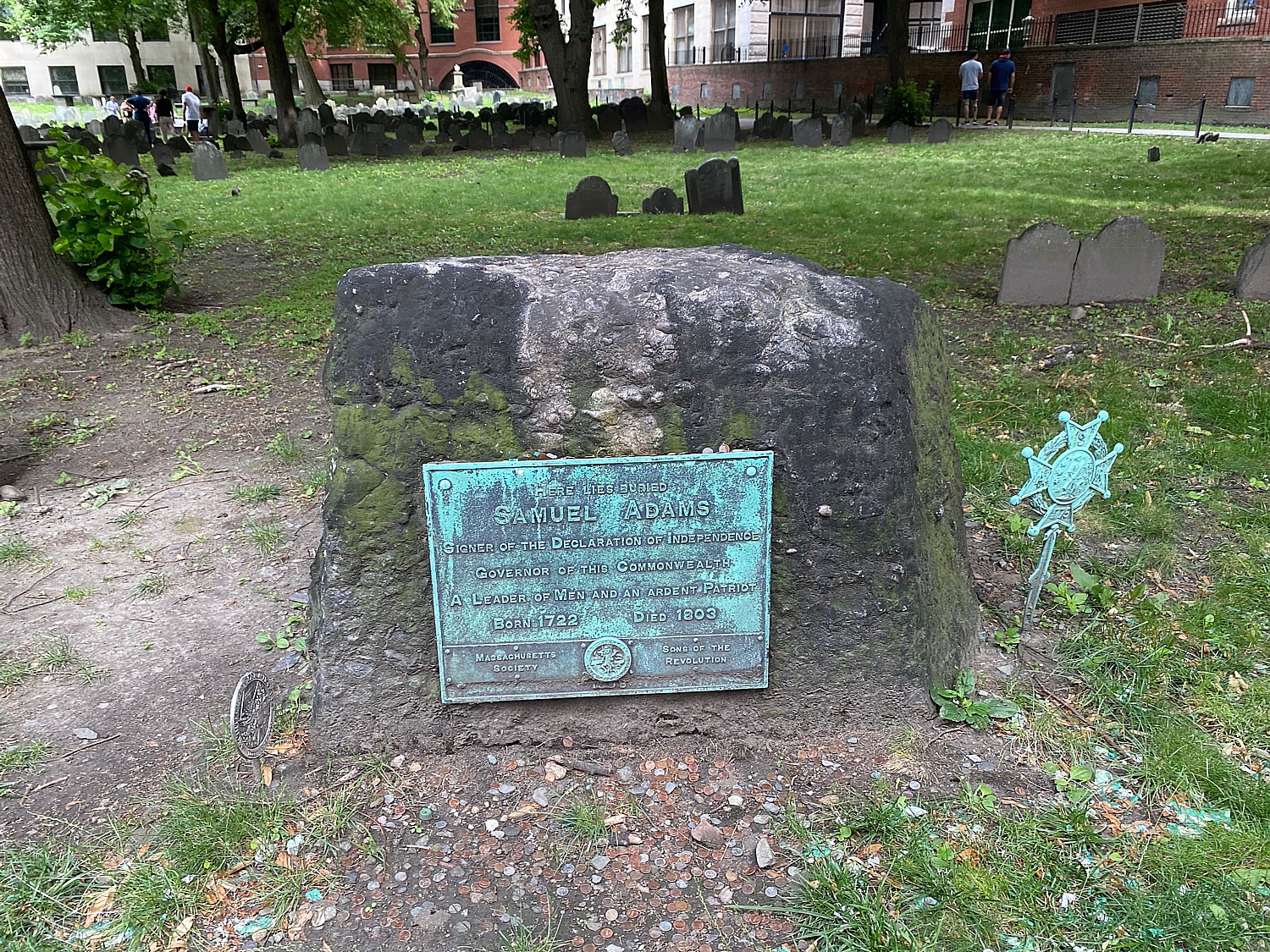
Sam Adams arranged and funded a huge funeral parade for the five victims of the Boston Massacre and paid for the five victims to be buried in his plot in the Granary Burying Ground where he now lies as well. The parade made a big impression both on the British soldiers and on the residents of Boston, Alex said. “Great propaganda!”
That’s just one of many stories waiting to be told at the Granary Burying Ground. Once the very edge of 17th century Boston, this small patch of cemetery is now like a who’s who of the American Revolution. For example, across the grounds from Adams is the tombstone of James Otis, who coined the phrase “Taxation without representation is tyranny.” Otis was one of the great minds behind the Revolution but he suffered from periods of insanity which kept him out of the limelight.
The cemetery is also the final resting place of Paul Revere, John Hancock, the parents of Benjamin Franklin and an estimated 5,000+ other people. We asked Alex how so many people could fit in such a small space and learned that bodies were often buried one on top of the other.
The tour also included a visit to the Old North Church, and strolled through Little Italy, where Alex explained the difference between the two most popular cannoli spots. Along the way, Alex also shared tips on exploring the city, how to learn about free concerts and events at the Boston Common, and a list of her favorite eateries, making us feel a bit like insiders in the city.
DAY 2: My husband and I were joined by his cousins for a leisurely stroll along the Freedom Trail. We stopped to read the signs at spots that grabbed our attention and toured Paul Revere’s home, where we learned that the Wadsworth poem might have been quite different had his dad not anglicized his Huguenot name from Appolos Rivoire to Paul Revere. (Rivoire is a harder name than Revere to rhyme.)
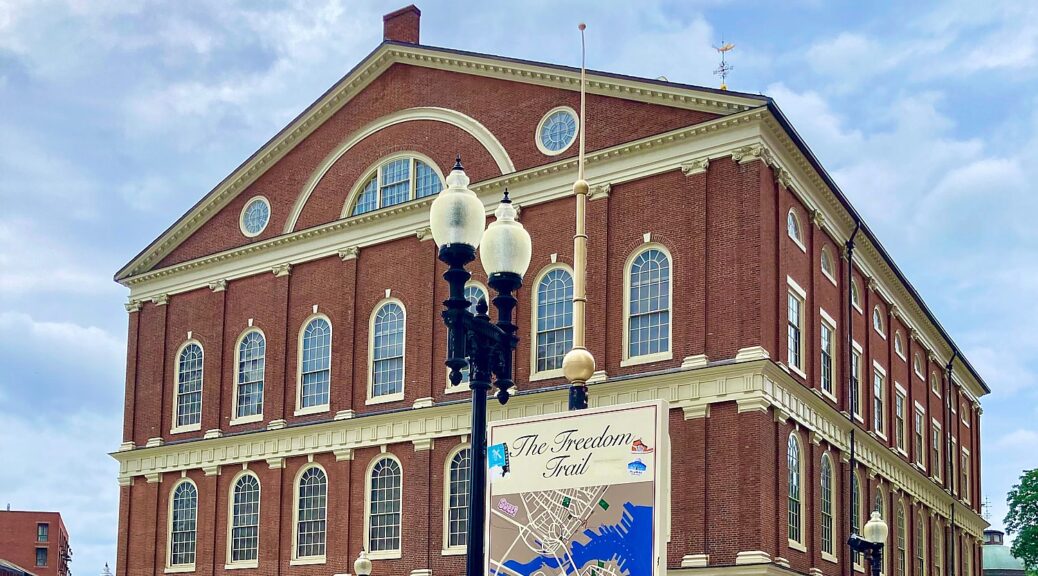
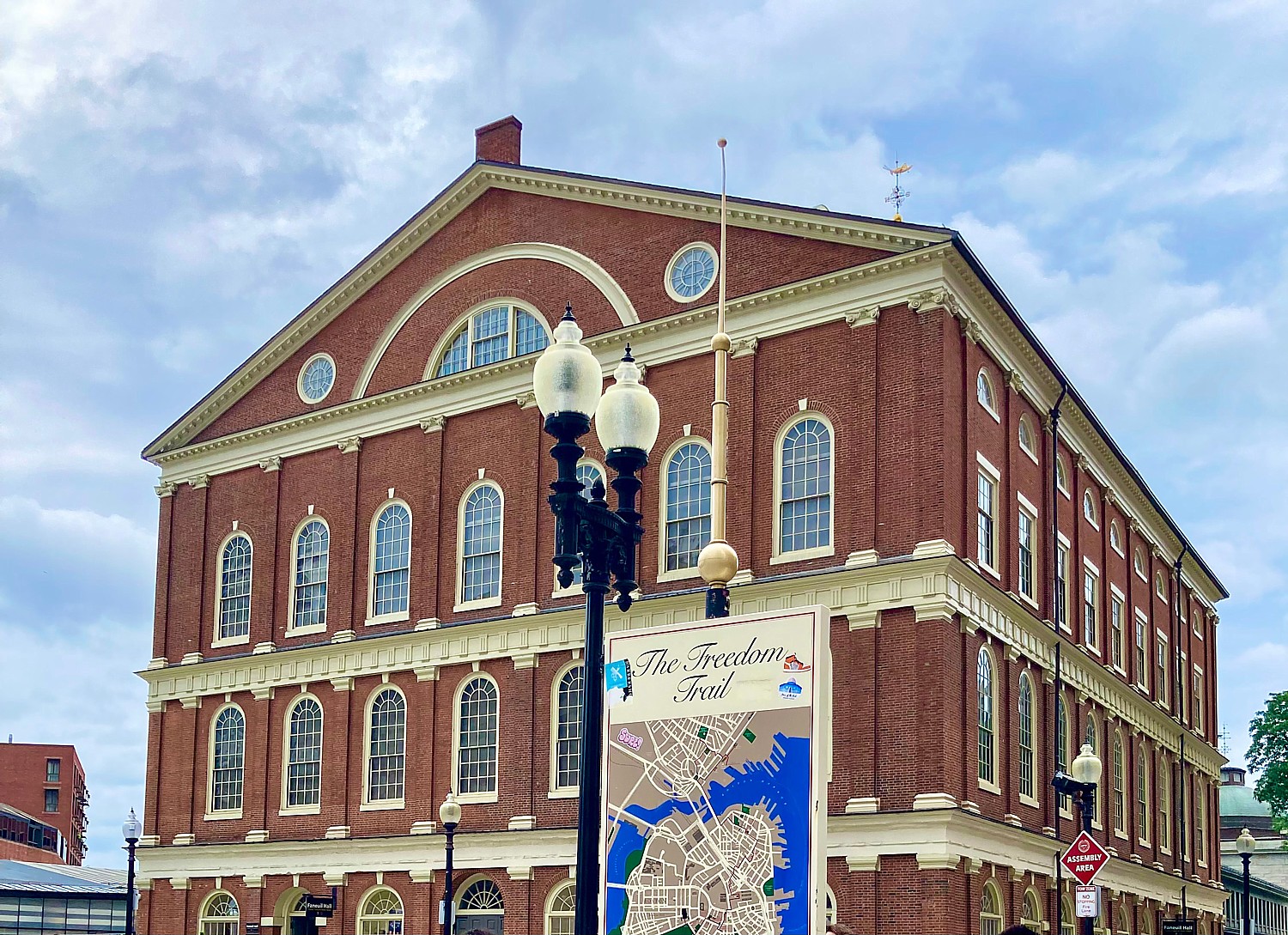
We also spent some time in Faneuil Hall, which was built and gifted to the city of Boston in 1743 by philanthropist Peter Faneuil to serve as a meeting hall and a marketplace. It was where the “Sons of Liberty”— and activists ever since—gathered and gave speeches.
The hall now houses a moving exhibit called “Slavery in Boston” underscoring how much of Peter Faneuil’s and Boston’s wealth came from goods produced by enslaved labor and slave trafficking. The exhibit also looks at the lives of individual enslaved Africans. One of the most touching was the story of Caesar, an enslaved Black boy, “owned” by one of Boston’s richest families, serving them and children including a son who was his age.
Not far from Faneuil Hall is another stirring site, the New England Holocaust Memorial, (www.nehm.org), an outdoor space that takes you by surprise if you’re not expecting it. As we were walking through Carmen Park, I noticed steam rising from between towering plates of glass that line a black granite path. Walking towards it, I began reading quotes from Holocaust survivors etched into the glass and realized that the steam is a reminder of the smokestacks of the crematoriums at the Holocaust death camps. Looking down through the metal grates, I saw small lights that represent the charred embers of those murdered in the gas chambers. Signs told me that the glass towers represent the smokestacks and the Menorah-like lights atop them are symbols of strength and endurance. It was an impressive experience.
On a lighter note, a great spot for recreation or simply a relaxing sit-down is the Rose Kennedy Greenway, (www.rosekennedygreenway.org/). It was built as an over-the-highway park linking the waterfront to the city. It was a great spot to sit and socialize and our visit was enriched by reading the self-guided tour (available on the website), which provided fun information. For example, the dirt removed to make the Greenway possible could fill a stadium to its rim 16 times, and the concrete used to create it is equivalent to laying a sidewalk three feet wide and four feet thick roundtrip from Boston to San Francisco three times It’s amazing to think about that when you’re strolling through the lovely gardens. We also enjoyed the free (ever-changing) contemporary art installations and exhibitions and food trucks.
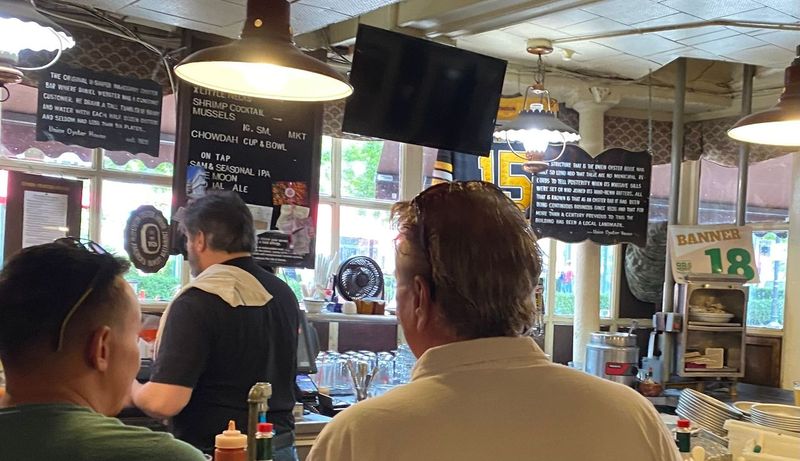
For lunch, we chose the Union Oyster House, an attraction in its own right. It’s the city’s oldest restaurant and a National Historic Landmark. The brick line of the Freedom Trail passes right in front of it. More importantly, it serves some of the best seafood in the city in a genuine historic and unpretentious setting. In fact, in 2023, the restaurant earned a spot among the Taste Atlas Top 50 Most Legendary Restaurants in the World.
Our six-person hardwood booth was across from one with a plaque memorializing the one reserved for John F. Kennedy and family when they dined there. We took quite some time to look around after we ate; the restaurant is filled with fascinating memorabilia and its walls are covered with paintings, photos and newspaper clippings about the famous people—from Daniel Webster to Meryl Streep—who have been patrons here over the centuries. My husband and I liked the restaurant so much that we dined there again the next day.
Day 3: Before leaving Boston, we went for one last stroll through the Rose Kennedy Greenway. We stopped to observe a tai chi group and to watch children scrambling to get on their favorite hand-carved animals which included a peregrine falcon, a green sea turtle and imaginary creatures that were chosen from a fun project drawing on the imaginations of local children.
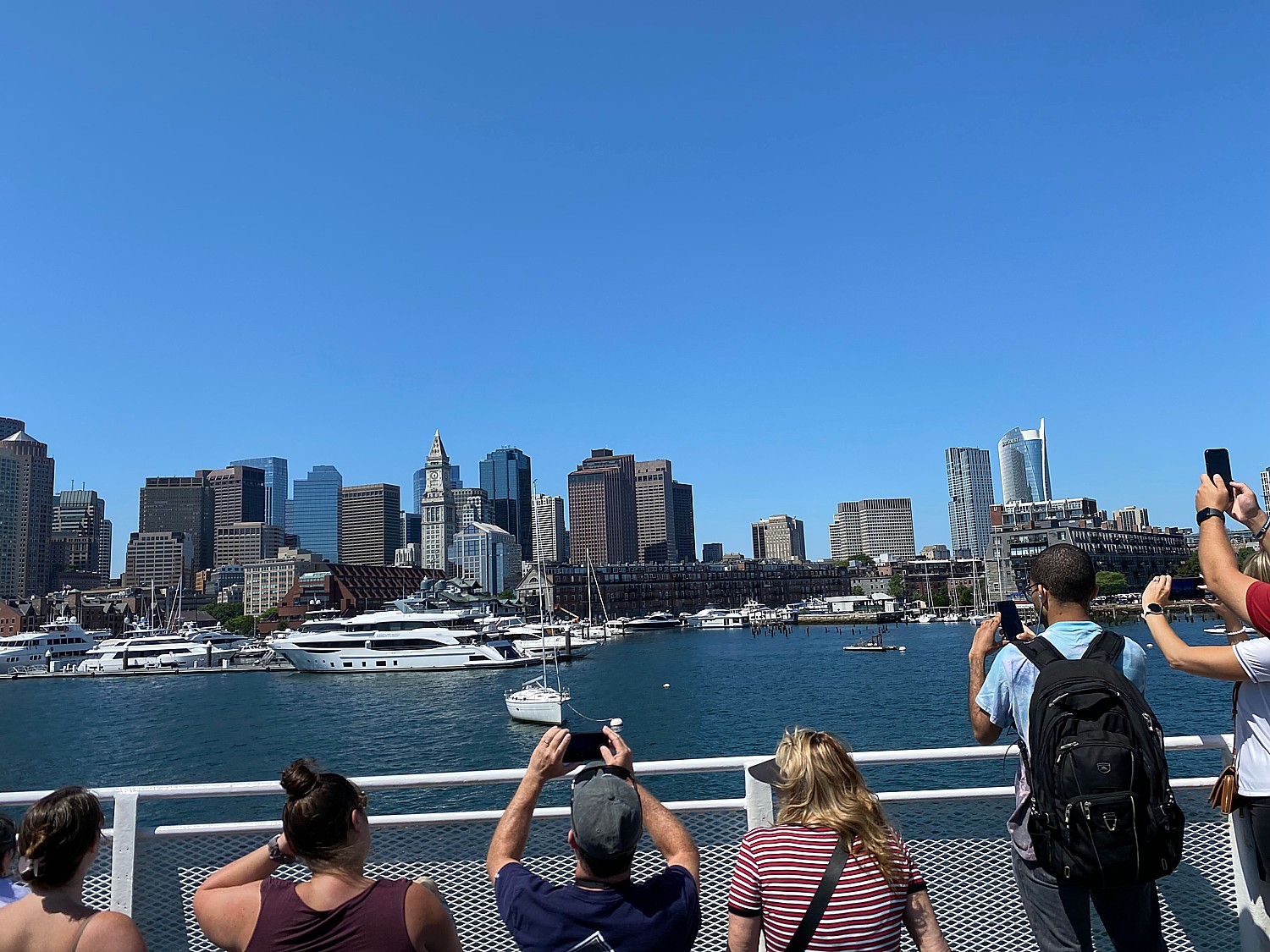
A harbor cruise offers a lovely perspective on the city.
We then took an enchanting one-hour narrated Historic Boston Harbor Cruise, where our guide pointed out how much land was created by landfill, including Back Bay, the Seaport and parts of downtown and Logan Airport. In fact, one-sixth of the city is landfill—a process that began in the 1700s. (The cruise and a hop-on/hop-off bus pass we used, were part of an all-inclusive GoCity.com/boston pass that included entry into more than 45 attractions.
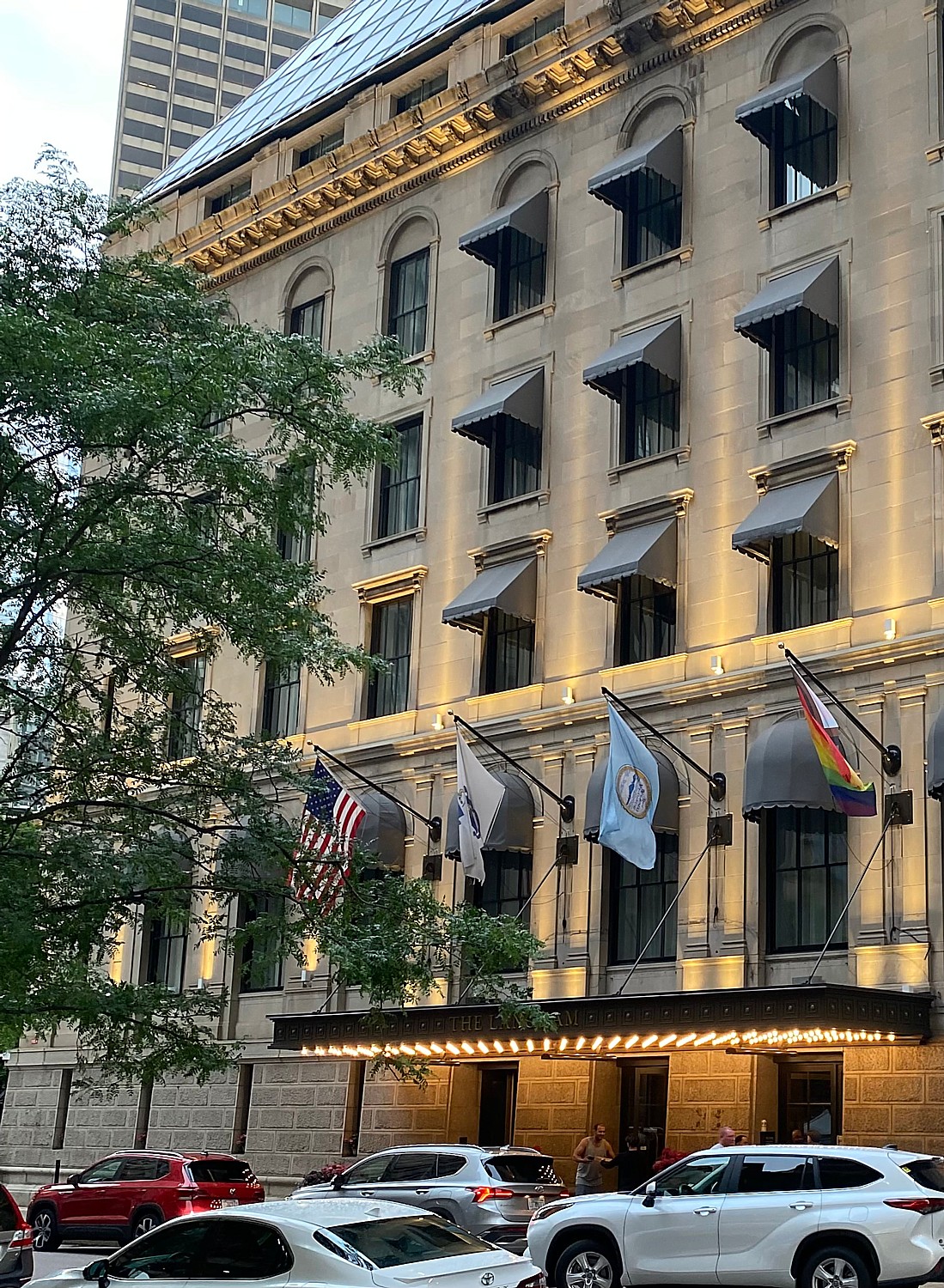
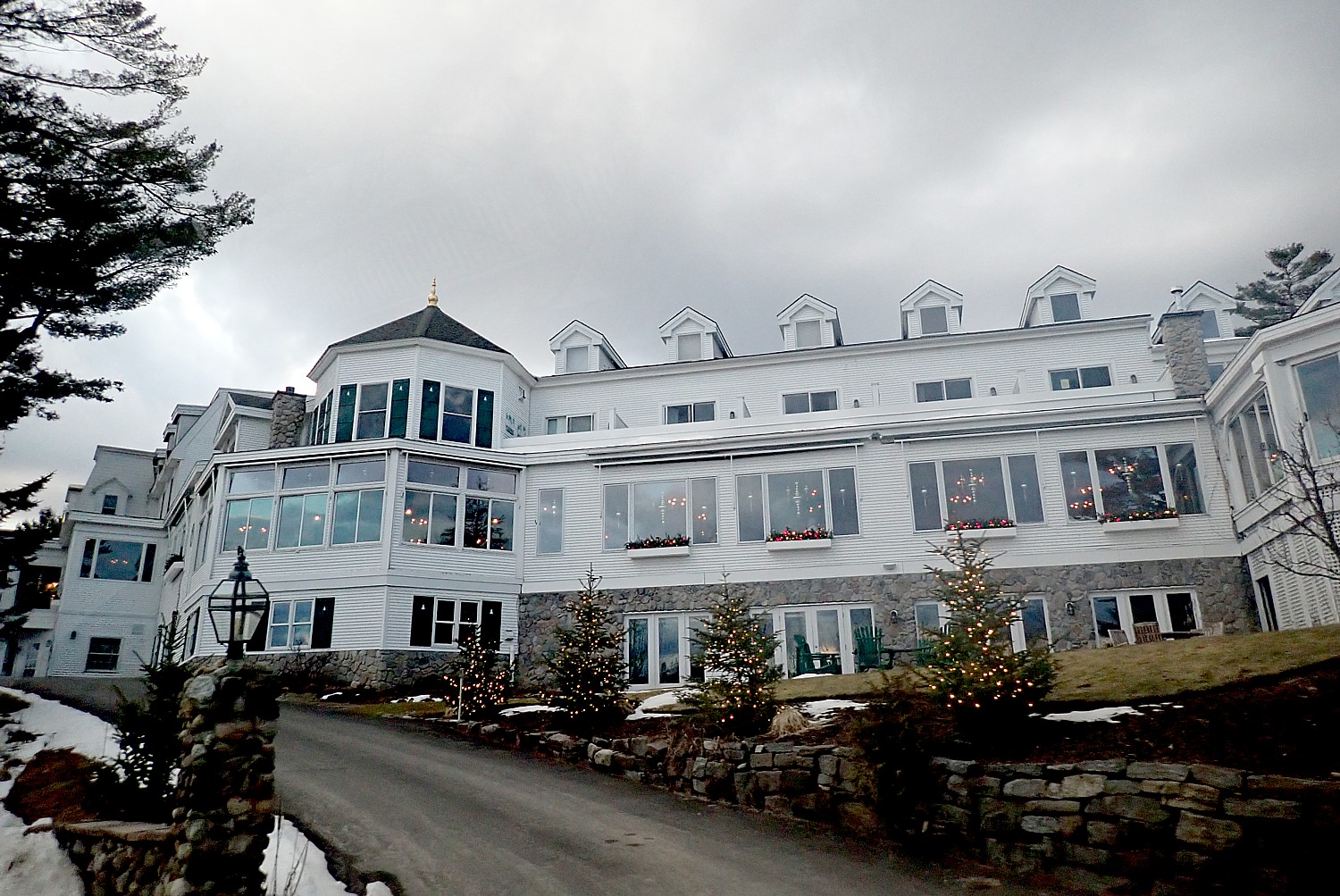
The Langham, Boston combines elegant architecture with modern art and an inviting pool.
As you might expect, historic hotels abound in Boston. The Omni Parker House is where Longfellow drafted his poem about Paul Revere. The former Boston Police Department headquarters is now the AKA Back Bay Hotel, and a former jail has embraced its past as the Liberty Hotel.
We stayed at The Langham, Boston, a five-star hotel that is just a short walk from the Freedom Trail and the waterfront and is itself a National Historic Monument. Built in 1922, it was home to the Federal Reserve Bank of Boston until 1977. Its banking past lives on in details like the green bank-style lamps, the tweed furnishings, and the lock box-style drawers behind the concierge desk.
It’s also a great choice for art lovers. Two N.C. Wyeth murals commissioned by the bank are still in their original spots and The Grana restaurant, which occupies the former grand hall, still has the Federal Reserve Bank emblem at its center, and portraits of eight Fed presidents grace its walls. The hotel also has an extensive collection of modern art, with a series of videos, cued by QR codes, of the artists explaining their works.
One of the best things about staying at The Langham (LanghamHotels.com/Boston was unwinding in the pool, hot tub and sauna after a day of delightful surprises on the Freedom Trail.
Useful Links:
theFreedomTrail.org; provides great info plus special interest and Freedom Trail tours, apps, and more
By Karen Rubin, Travel Features Syndicate, goingplacesfarandnear.com
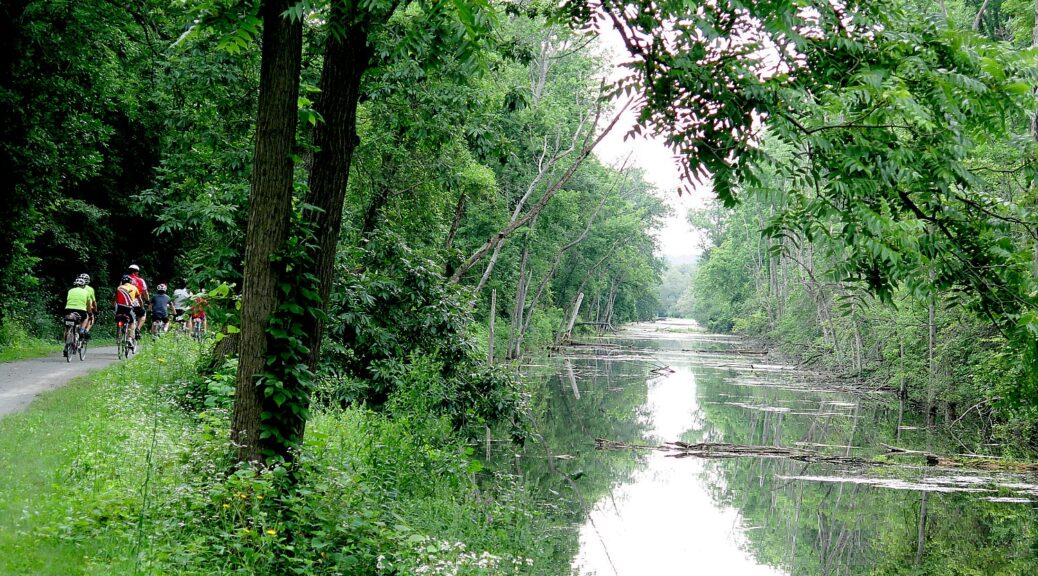
The Olympic spirit is everywhere in Lake Placid. You can almost hear the fanfare playing. It is infectious, and fun – and what is even better, you get to participate, to see and experience it for yourself.
While so many other Olympic venues shut down after the event, Lake Placid, which hosted one of the first winter Olympics, in 1932, and then again in 1980, the facilities have not just been upgraded, enhanced and once again entice World Cup and international sports events. Lake Placid is very much a four-season destination, an outdoors paradise where you can actually experience the same Olympic venues, attractions and activities year-round, along with the athletes who live and train here, and the world-class athletes who compete here.
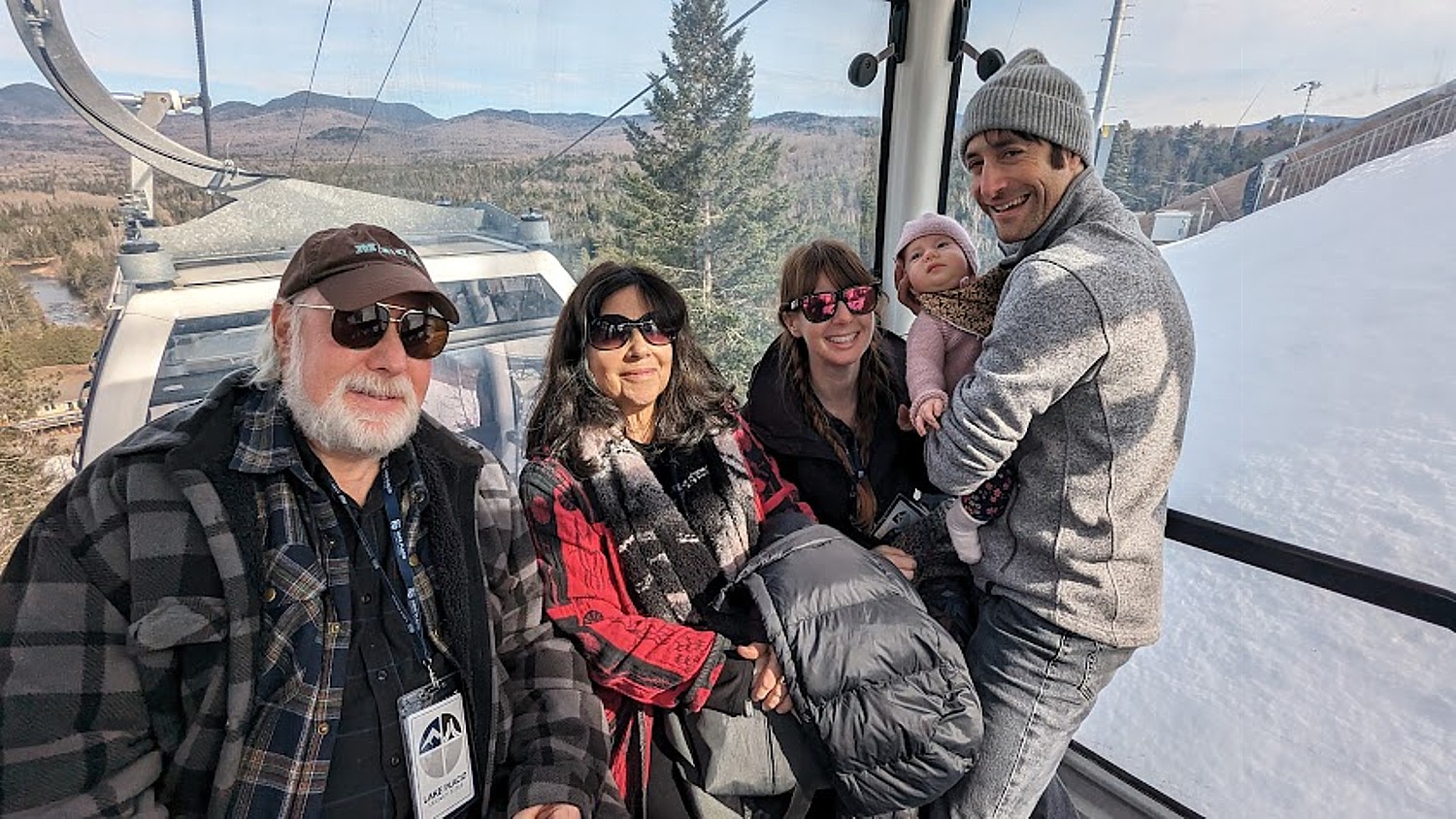
It offers an ideal mix of activities to appeal to the most athletic and active, to those who prefer to spectate rather than participate – perfect for our three-generation family – skiers and nonskiers and infant.
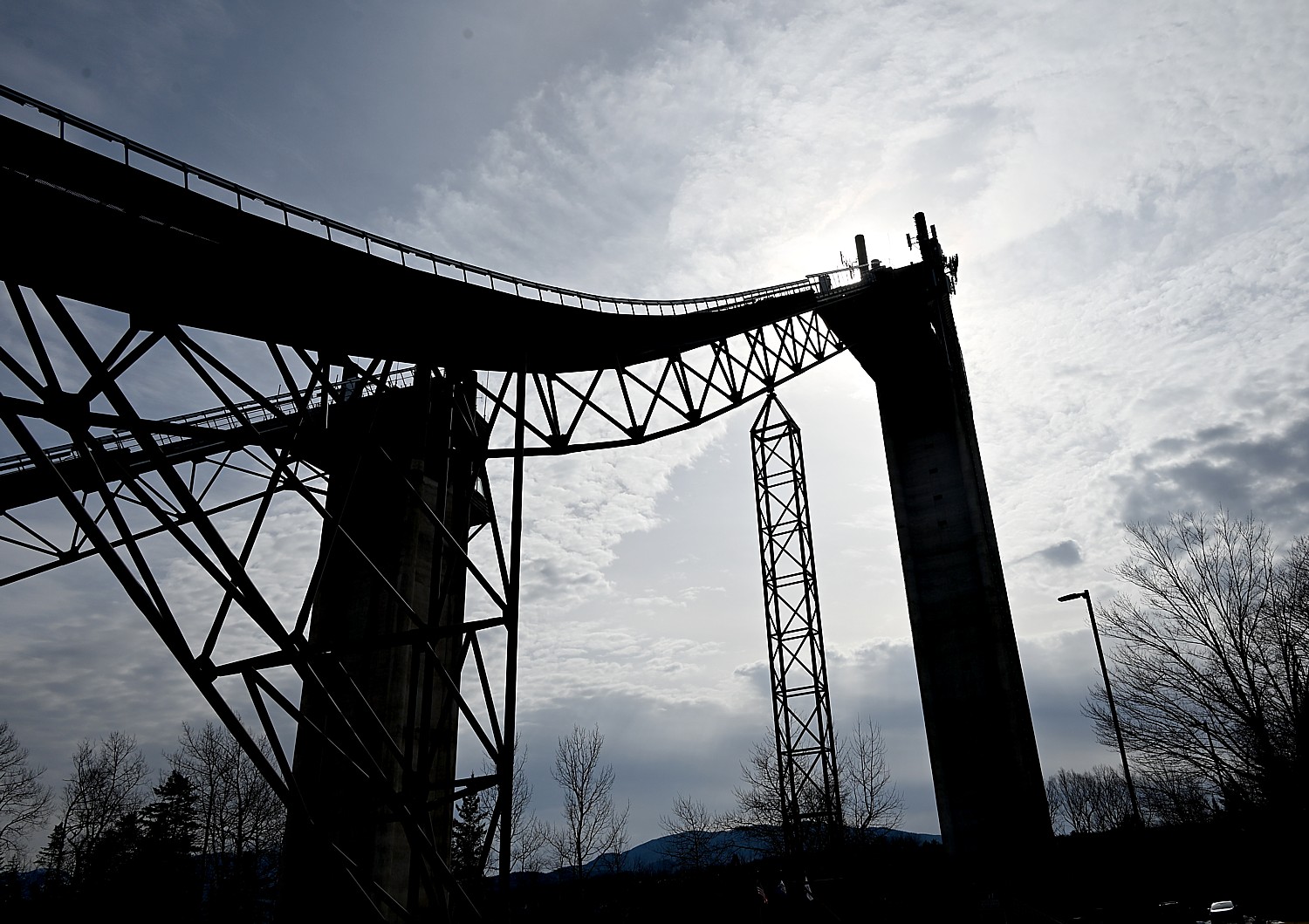
The best way to experience Lake Placid, we discover, is with the Olympics Legacy Sites Passport, which provides access to the four Olympic venues and experiences – so even if you don’t ski, you can take the Cloudsplitter Gondola up to the summit of Little Whiteface to enjoy the spectacular view of the Adirondacks high peaks; go to the top of the highest ski jumping tower at the Olympic Jumping Complex to see what the ski jumpers see (terrifying); tour Mt. Van Hoevenberg where the sliding sports (bobsled, skeleton and luge), Nordic skiing, and Biathalon are held; and tour the Olympic Center, where you visit the museum that houses one of the best collections of Olympics memorabilia in the world, as well as the skating arenas. (The passport includes one admission to the four venues plus 10% off shopping and dining at all the Legacy Sites, https://olympicjumpingcomplex.com/legacysitespassport/)
But if you haven’t visited Lake Placid in the last few years, you wouldn’t know about any of these experiences. So much has changed. So much is new. So much is so special.
The New York State Olympic Regional Development Authority (ORDA, now more familiarly known as the Olympic Authority), which owns and manages the facilities here in Lake Placid (as well as Gore Mountain and Belleayre ski areas), since 2018 has not only upgraded and massively improved the facilities in order to continue to host major international competitions (providing opportunities to watch the competition, training and even meet athletes), but has added attractions and activities so that we can experience much the same thrill and excitement as the athletes, year round. We even get to see their sport through their eyes.
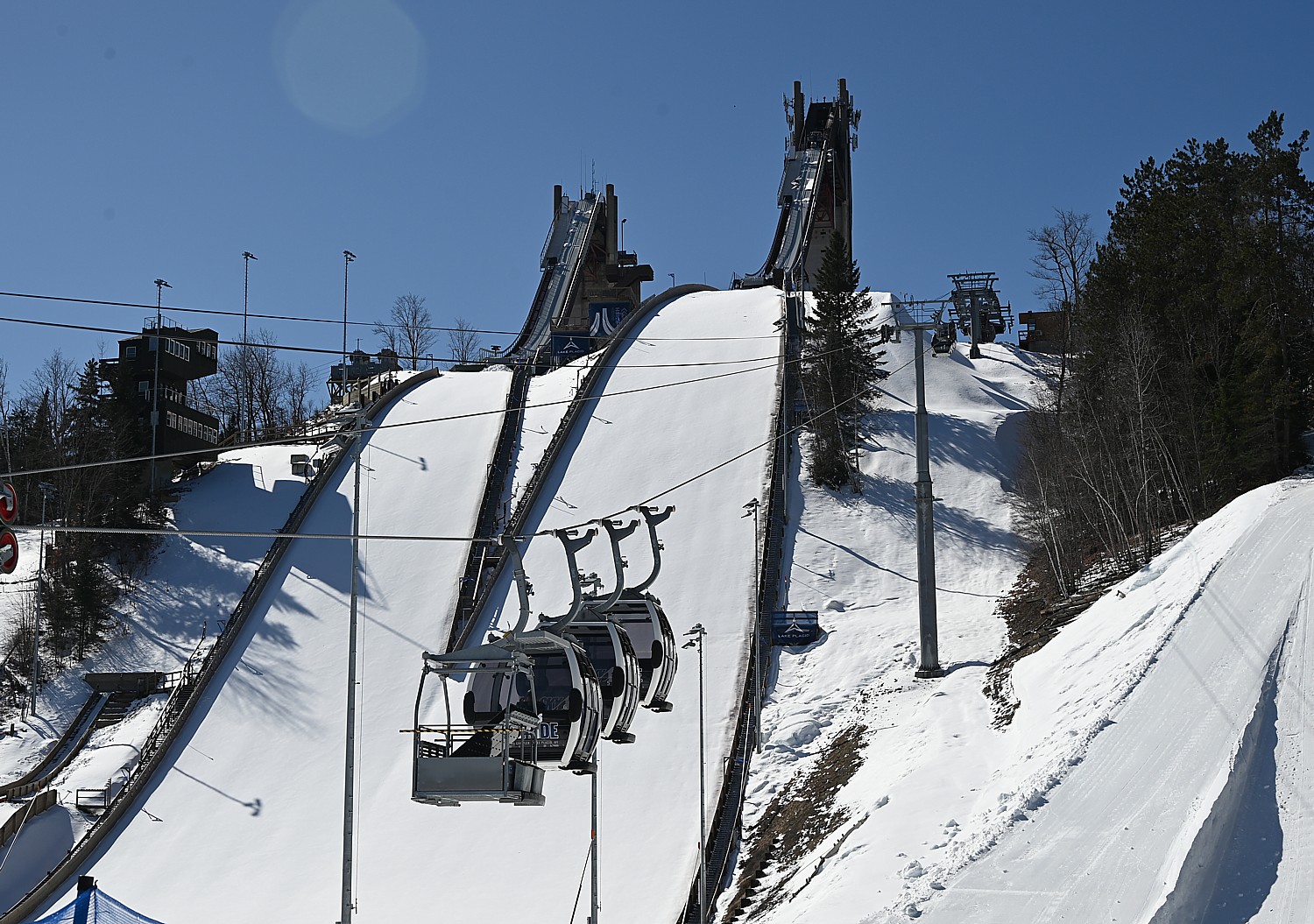
At the Olympic Jumping Complex, we ride a new, scenic Skyride Gondola to the base of the towers (athletes used to have to take a chairlift), then walk a short distance to the glass-windowed elevator that takes us up to the top of the highest ski jump tower for the view that the jumpers get (terrifying), and the setting amid the High Peaks Region (open daily but subject to weather conditions).
Today, this facility is the only sanctioned ski jumping facility in North America for winter and summer competition and training. For warm-weather practices, there is a kind of plastic grass that is sprayed with water, that apparently athletes like even better because it is more consistent than snow.
That is a really good thing because climate change will make Lake Placid one of only four premier winter facilities that will be able to host a winter Olympics by 2050, my ORDA guide, Jaime Collins, tells us.
The World Cup will be held here again in February 2025.
Here at the Olympic Jumping Complex, you can also ride the new Sky Flyer Zipline adjacent to the ski jumps – and if the ski jumpers are practicing, you can seemingly fly alongside. ($20 off ticket price with the Legacy Passport).
New Coaster Ride, Bobsled Experience at Mt Van Hoevenberg
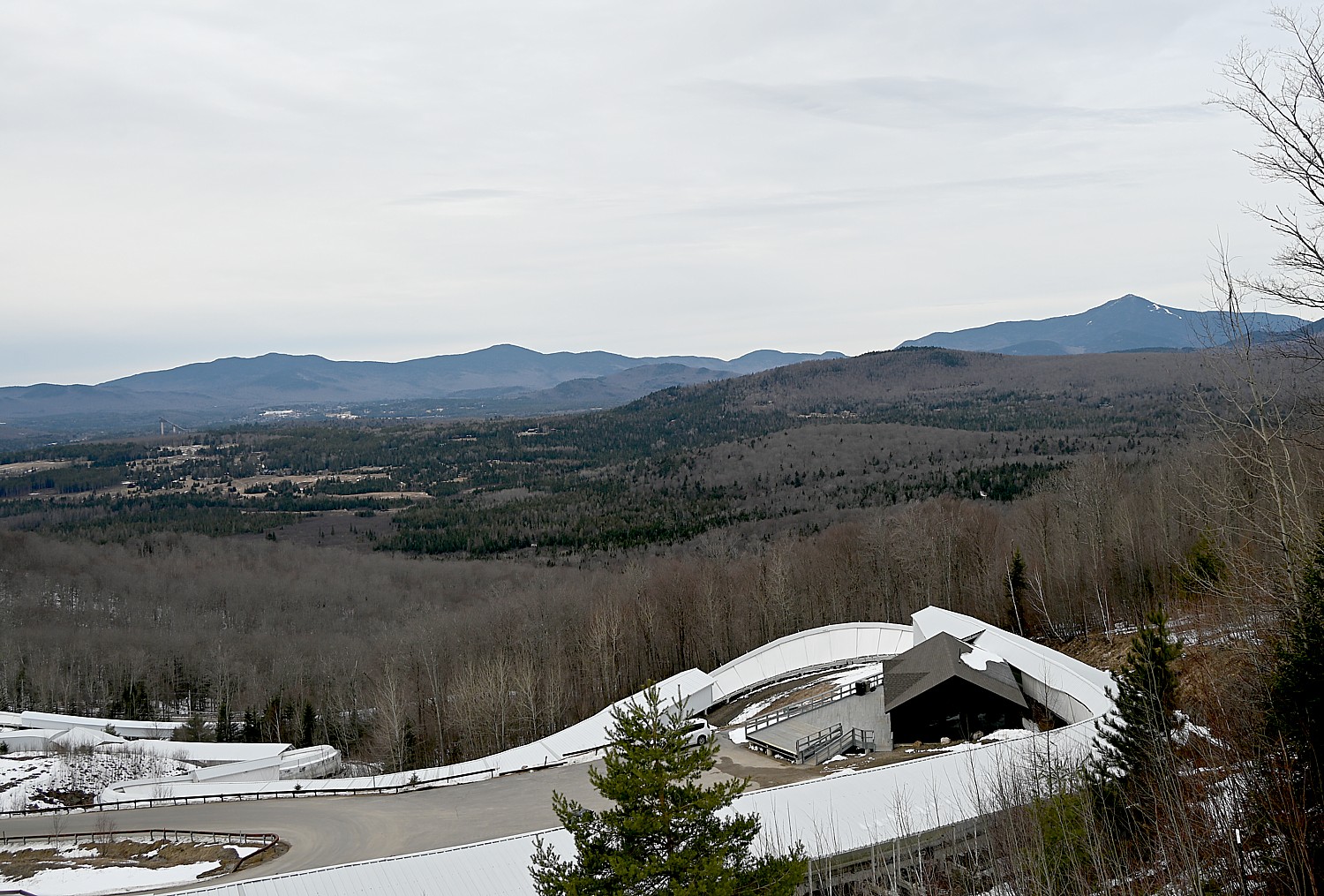
At Mt Van Hoevenberg, home to the three sliding sports – bobsled, skeleton and luge – the Legacy Passport provides a tour that starts in the newly built Mountain Pass Lodge and the push track where you learn about elite athlete development, then taken by bus up the track for a guided walk inside the sliding track.
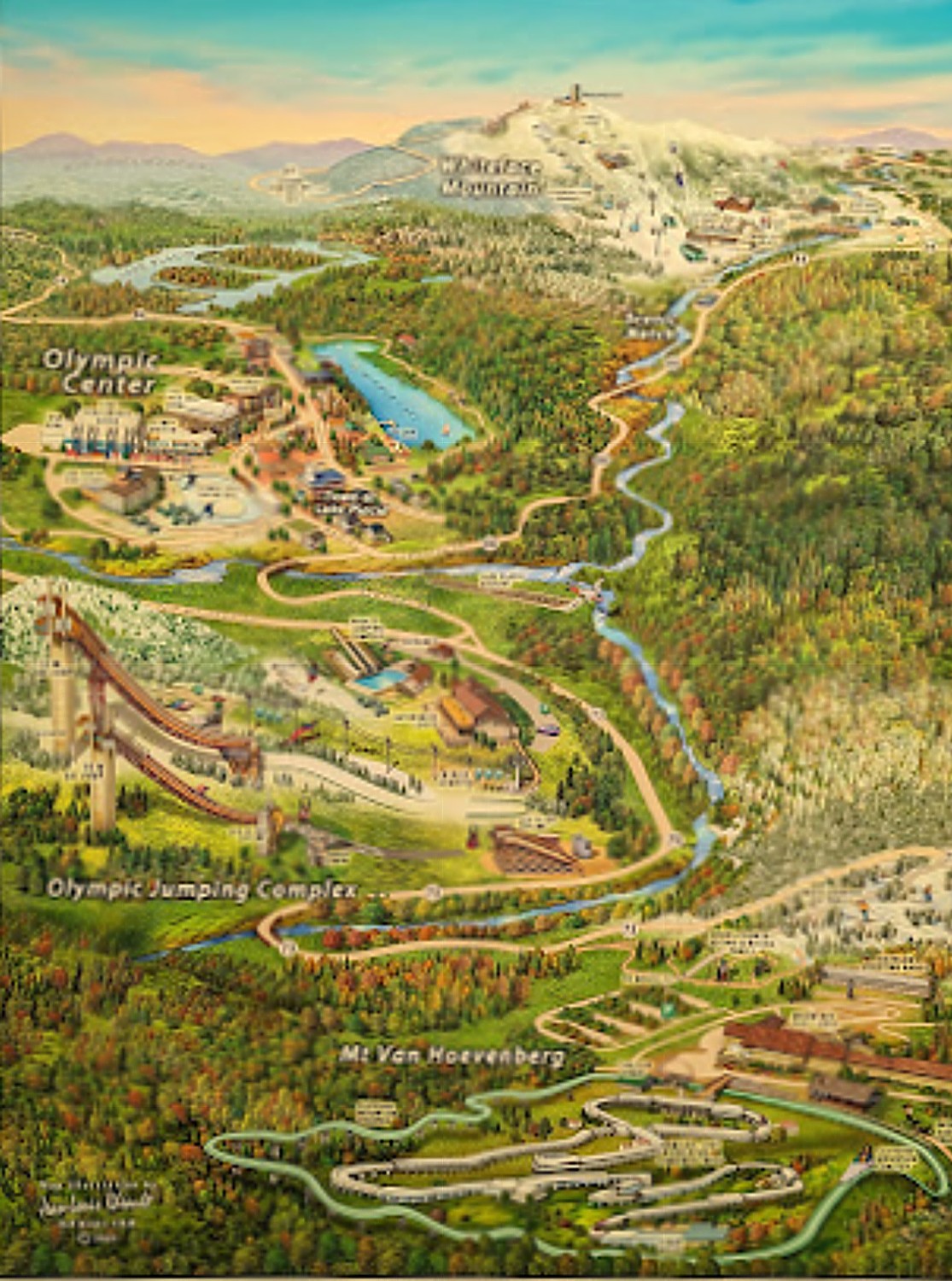
Be sure to take in the view from the start area which offers the only place where you can get a view of all the Olympic venues at once: the Ski Jump complex, Whiteface Mountain, the track and Nordic center, and the Olympic Center in downtown Lake Placid. (Open daily; check daily updates pagefor current conditions and trail offerings.The pass also provides 10% off at Mt Van Hoevenberg’s 81-18 Café, Mountain Pass Mercantile and Swix Store.)
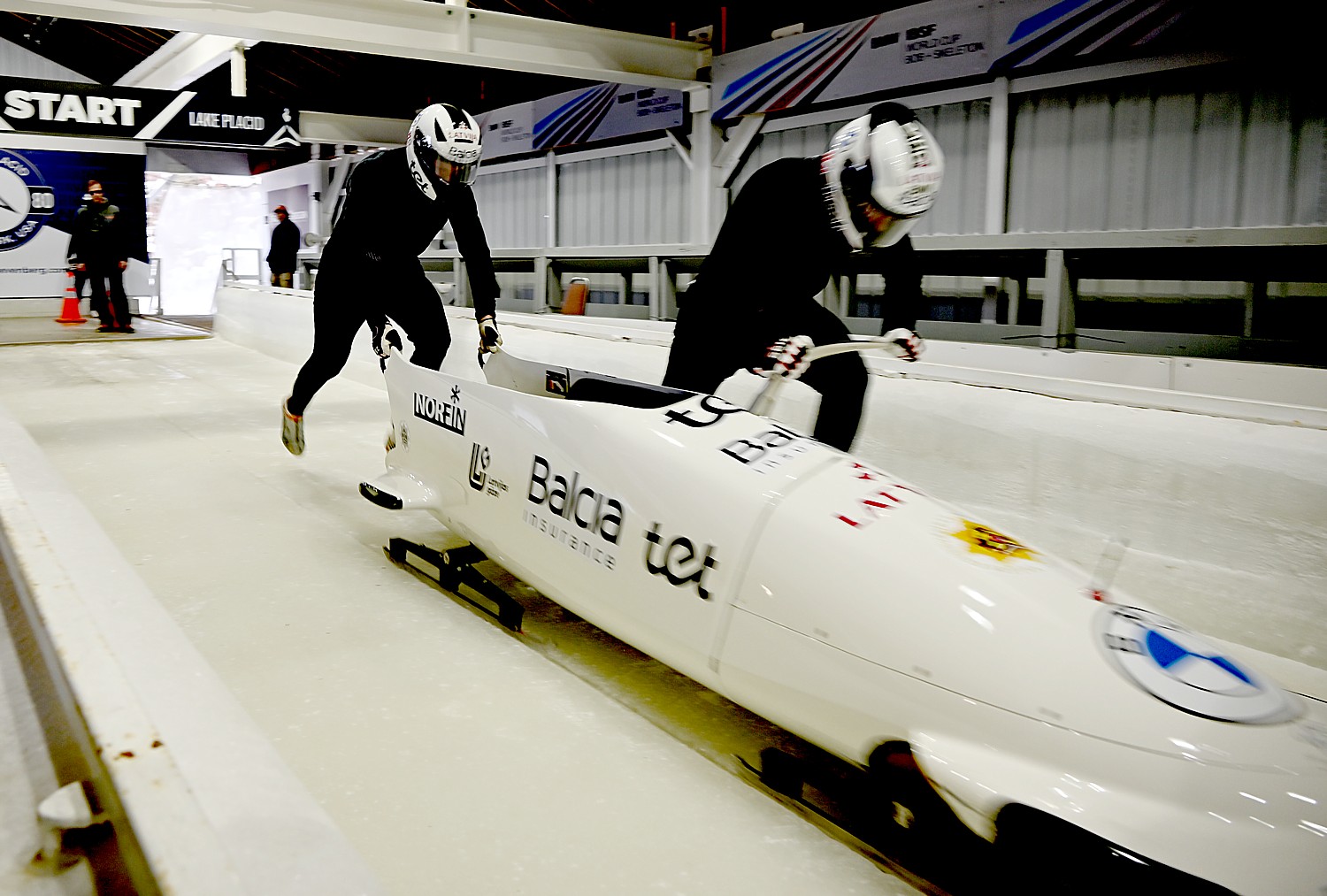
As it happens, our visit coincides with preparations for the final International Bobsled & Skeleton Federation (IBSF) World Cup competition of the 2023-2024 season and we get to watch some of the two-man bobsled practice and meet some of the athletes.
We learn that this track – with 17 curves and a vertical drop of 365 feet – is considered one of the most difficult and has one of the most famous and challenging turns in the world. Turn 10 winds 180 degrees into a 20 foot-high wall that, if hit right, can slingshot the sled for a gain 6 mph. “The G forces are so severe, that they can only practice 4-5 times a day,” our ORDA guide, Jaime Collins tells us.
When the track isn’t being used for practice or competition, you can take the Bobsled Experience, where you are driven down the track with real bobsledders. You get to go through that famous Turn 10 but from Start 4, so it comes soon into the ride before you get going too fast, but you still reach speeds up to 50 mph on the lower half-mile of the track. (Be sure to reserve in advance; in summer, the bobsled uses wheels on concrete; $125/9+; $100/military, https://mtvanhoevenberg.com/todo/bobsled-experience/).
The track is set up so spectators get a real close-up view (pro tip: the best place is where the track is shaped as a heart).
Mt. Van Hoevenberg is also the Olympic Nordic ski area and we just miss watching practices for the Junior National Nordic races at the Nordic stadium on the side of the lodge.
But non-Olympians can do cross-country skiing here, as well as actually experience the Biathlon, an Olympic event which combines shooting and cross-country skiing.
In summer, Mt. Van Hoevenberg becomes a mountain biking center – you can rent bikes and take lessons.
In fact, Lake Placid was selected as the only U.S. venue to host the World Cup mountain bike competition, which will be held September 27 – 29.
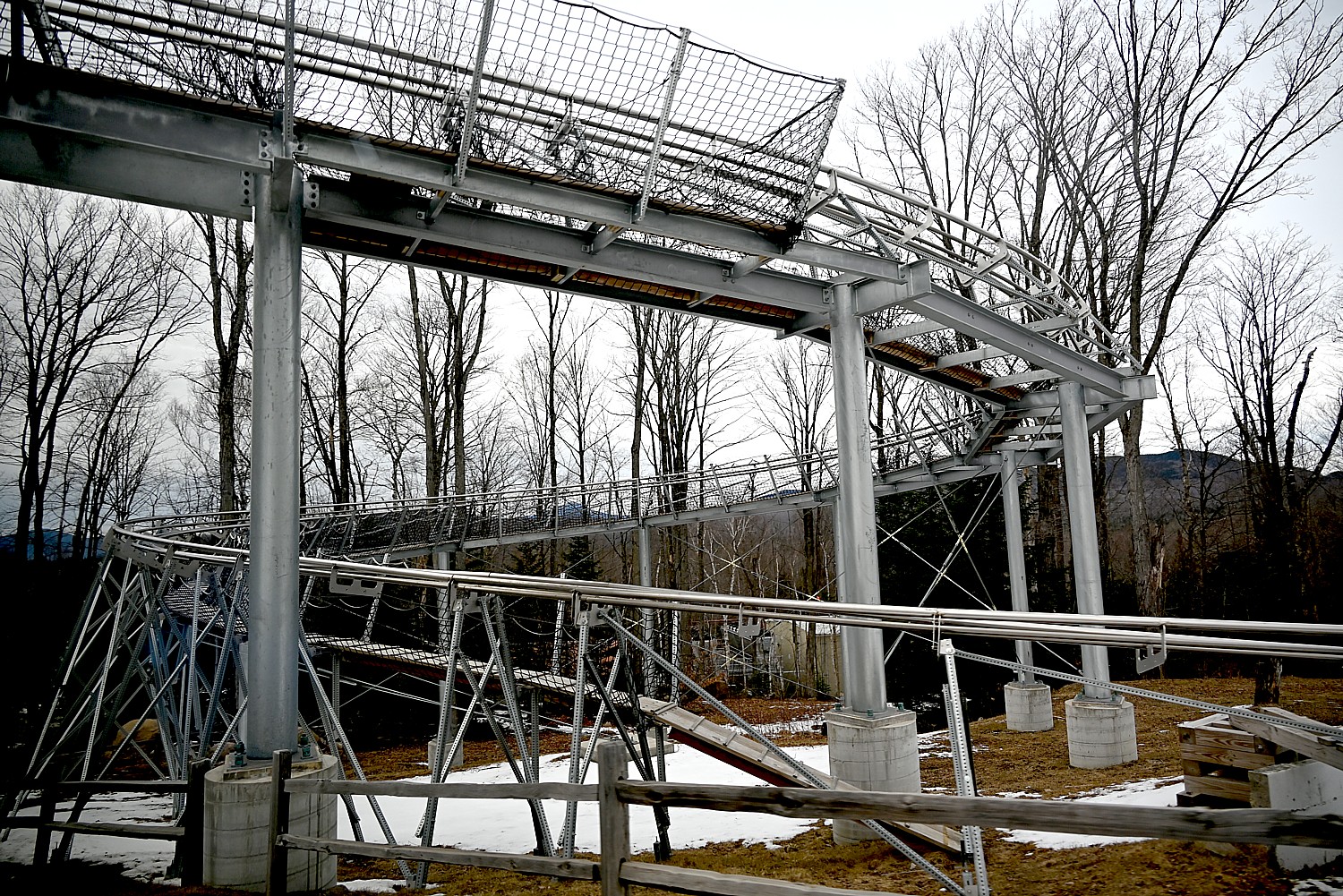
Here at Mt Van Hoevenberg you not only get to see the Olympic bobsled track but you can ride alongside on the Cliffside Coaster, the longest coaster in North America, which opened in 2020. As you ride up to the top, you hear the Olympic history of the track but once at the peak, you are in the driver’s seat and control the speed, navigating sharp corners, cliffside banks and long winding stretches (open daily in season but weather dependent; make reservations in advance; 31 Van Hoevenberg Way, Lake Placid, NY 12946, https://mtvanhoevenberg.com/todo/cliffside-coaster/).
Skiers, NonSkiers Treated to View at Whiteface Mountain
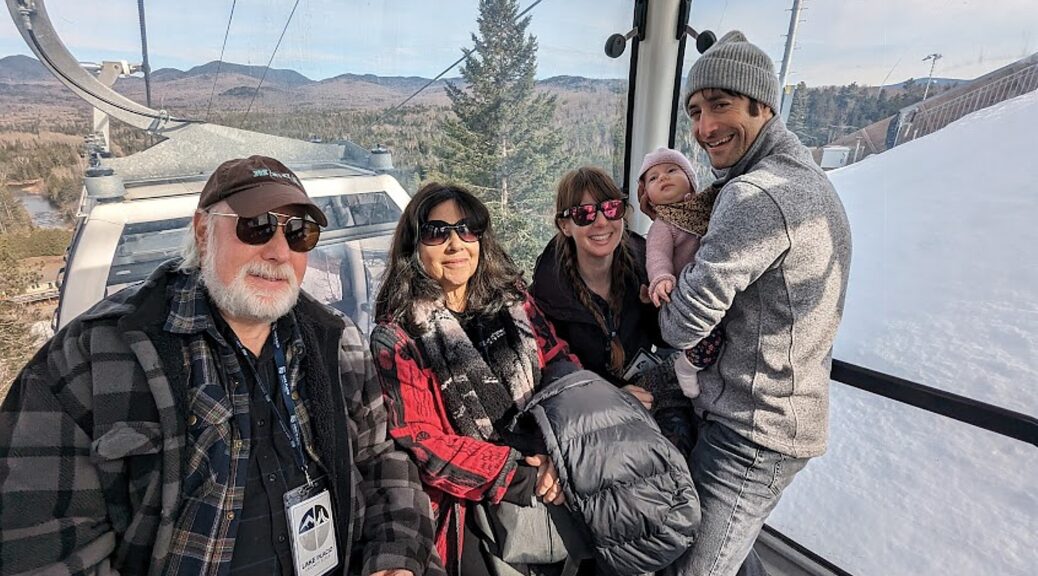
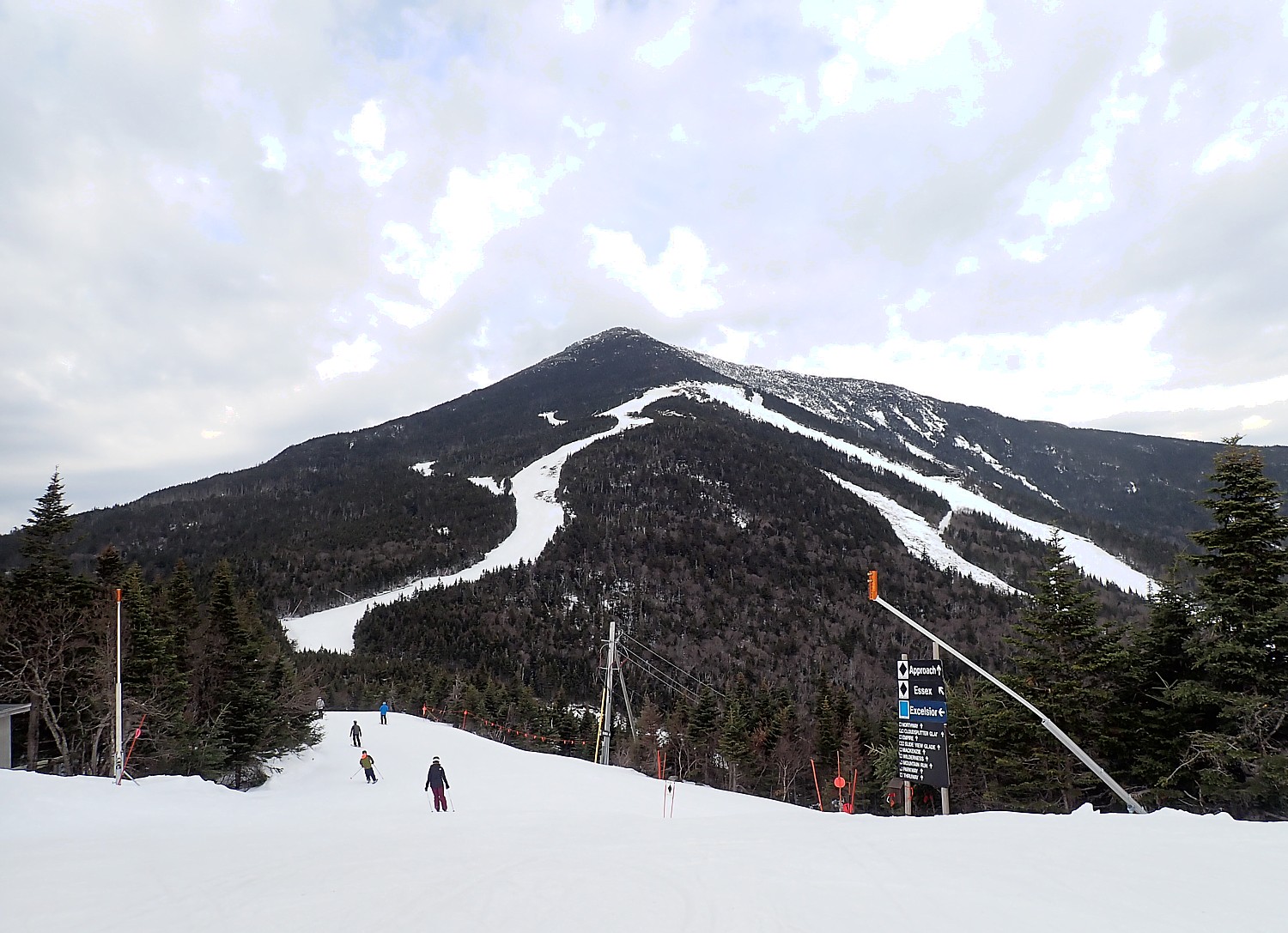
At Whiteface Mountain, the Legacy Passport enables even nonskiers to experience the 15 minute ride on the scenic, eight-passenger Cloudsplitter Gondola from the Main Base Lodge to the top of Little Whiteface to enjoy the gorgeous view of the Adirondacks that the skiers get. (Open daily. The Legacy Passport gets you 10% off at these locations: 10% off at Whiteface: 4610’ Grille, Castle Gift Shop, Legends Café, and Brookside Apparel.)
Another activity included on the Legacy Sites Passport is to drive (or bike) the Veterans’ Memorial Highway that rises over 2,300 feet in five miles, with scenic stops along the way. An elevator or 15-minute hike takes you to the summit of New York’s fifth highest peak. (Open daily, but subject to daily weather conditions, visit Whiteface Conditions).
Immersive New Museum at Olympic Center
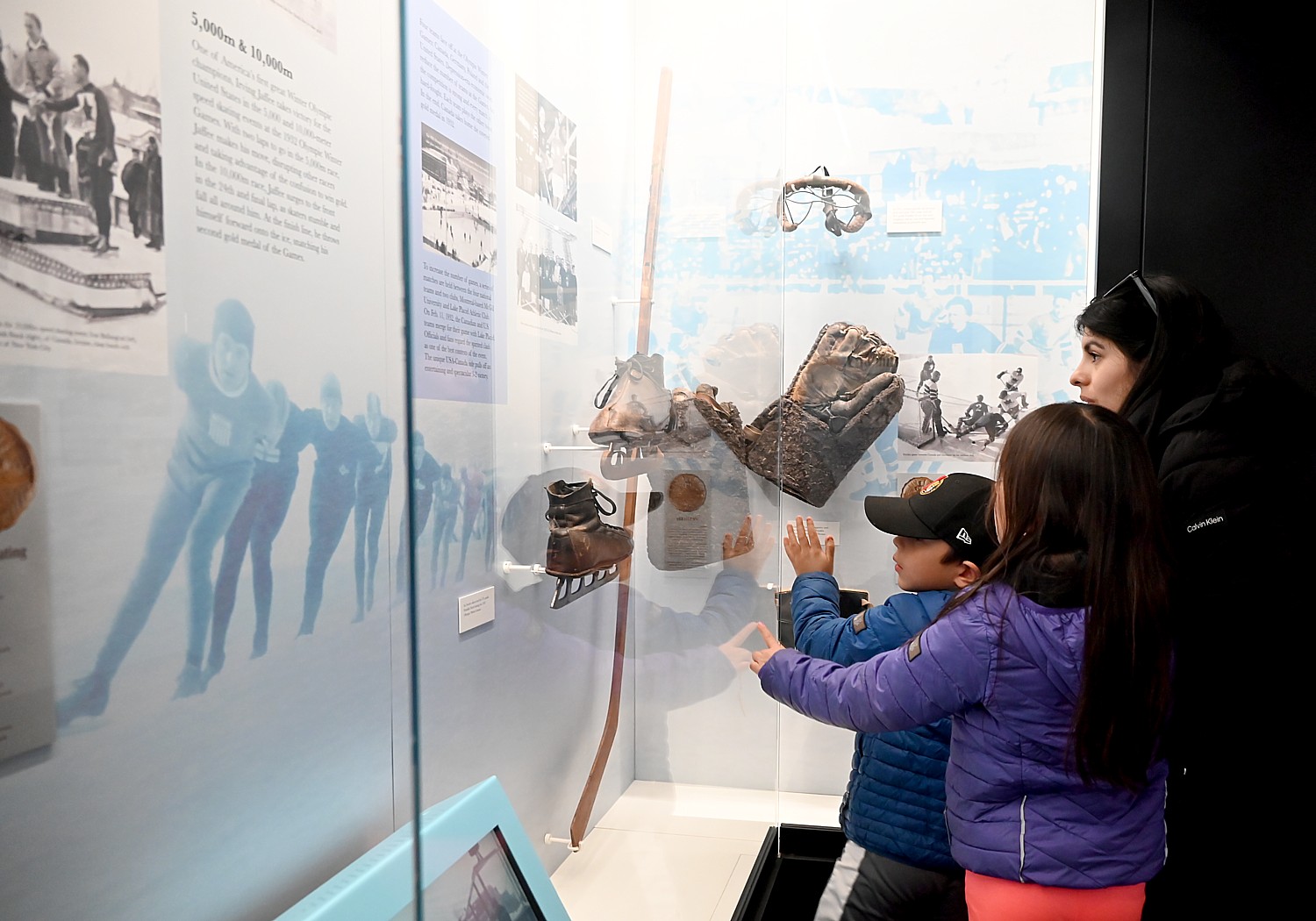
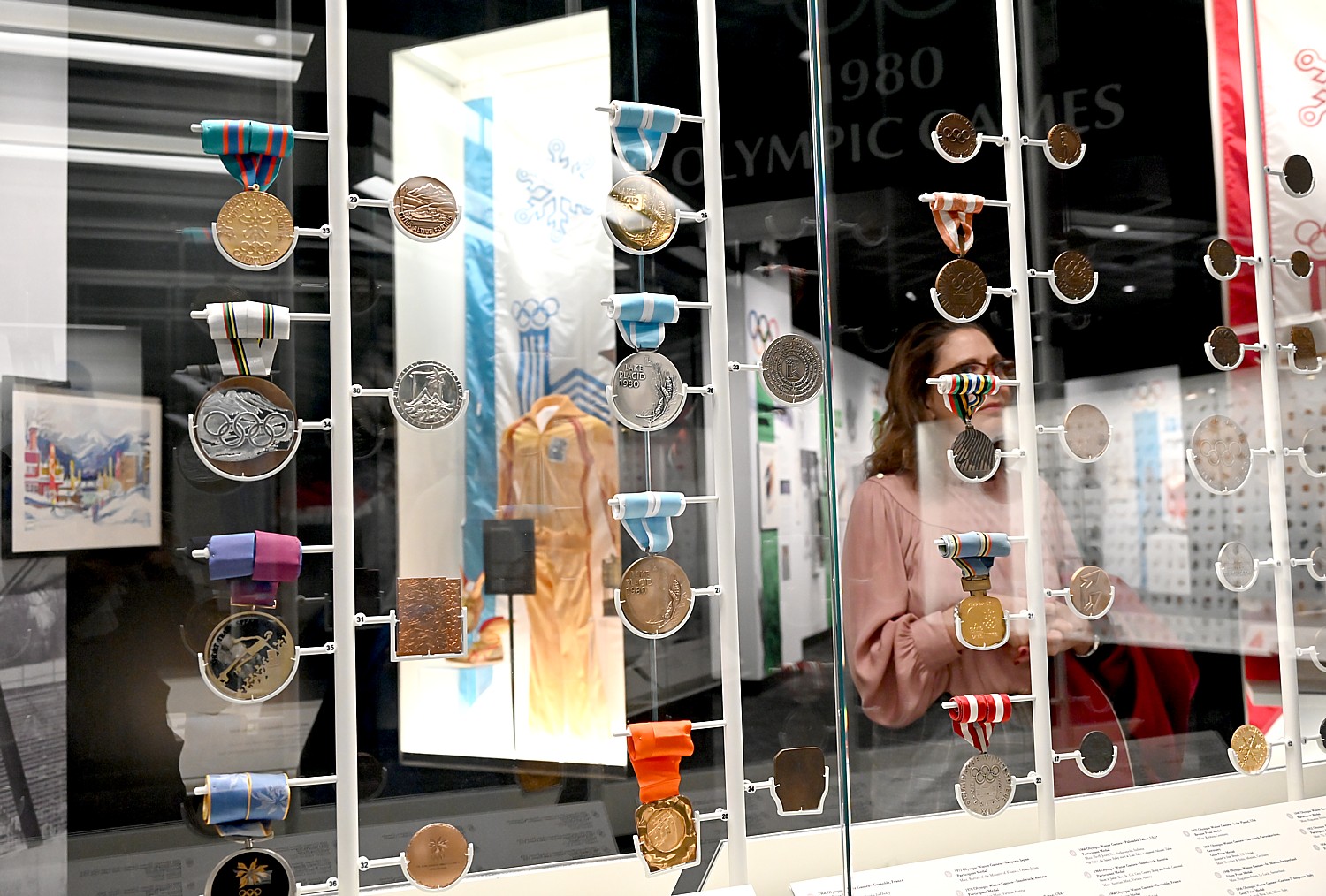
The Olympic Center, in downtown Lake Placid, is really special. The Legacy Passport gives you admission to the Lake Placid Olympic Museum, which has one of the world’s largest collections of Winter Olympic memorabilia, and brilliantly tells the story of Lake Placid’s role in the development of winter sports and the Olympics.
The state-of-the-art museum, which only has been opened two years, features interactive and engaging displays, 3D visualizations, experiential learning exhibits, marvelous videos, and interesting and intriguing artifacts. It is especially inspiring to see the names of local Olympians, some who are multi-generational.
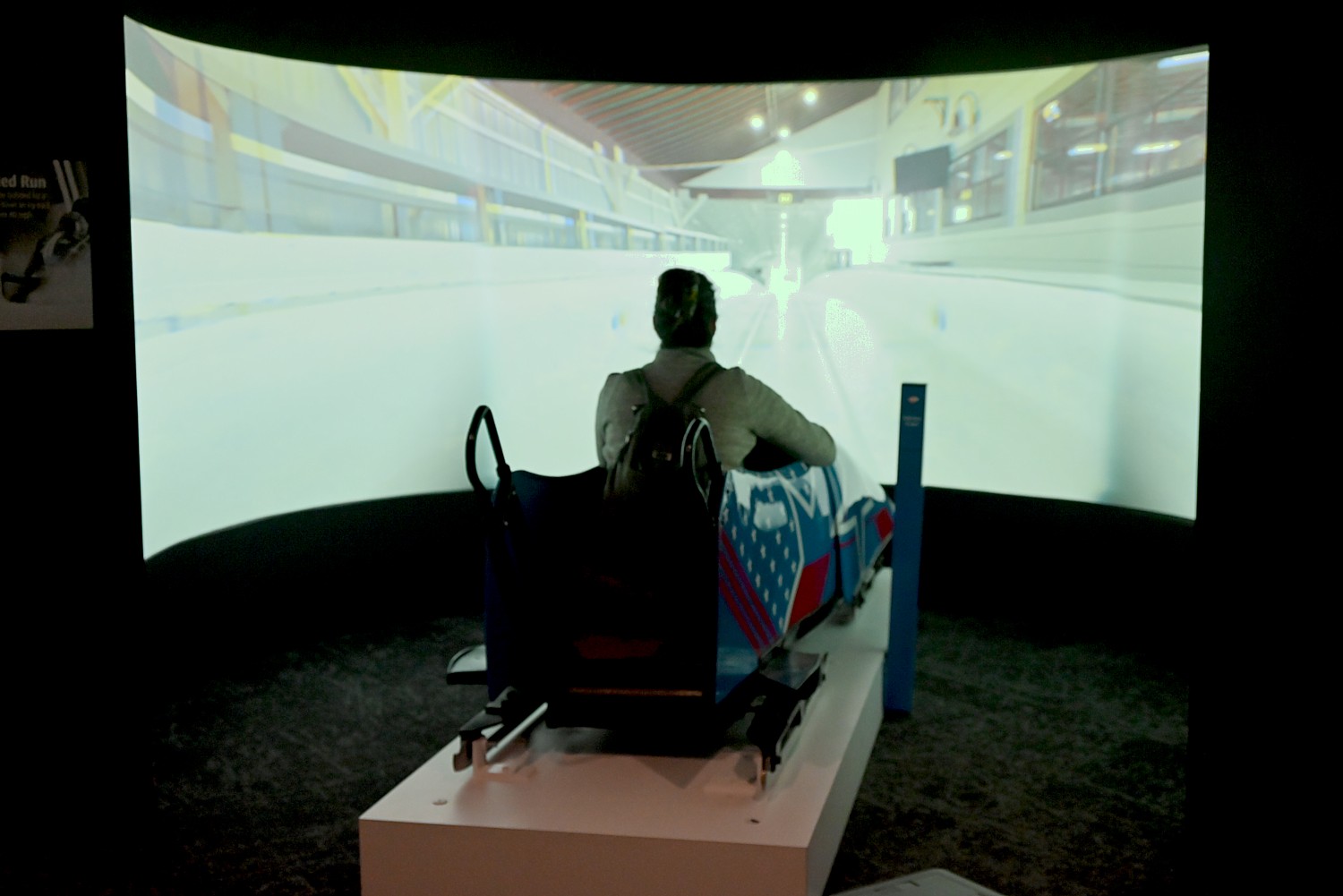
The 3D and interactive displays are really superb. In one, you sit in a real bobsled and virtually speed down the actual bobsled track (thrilling); you can see exactly what the ski jumper sees flying off the jump.
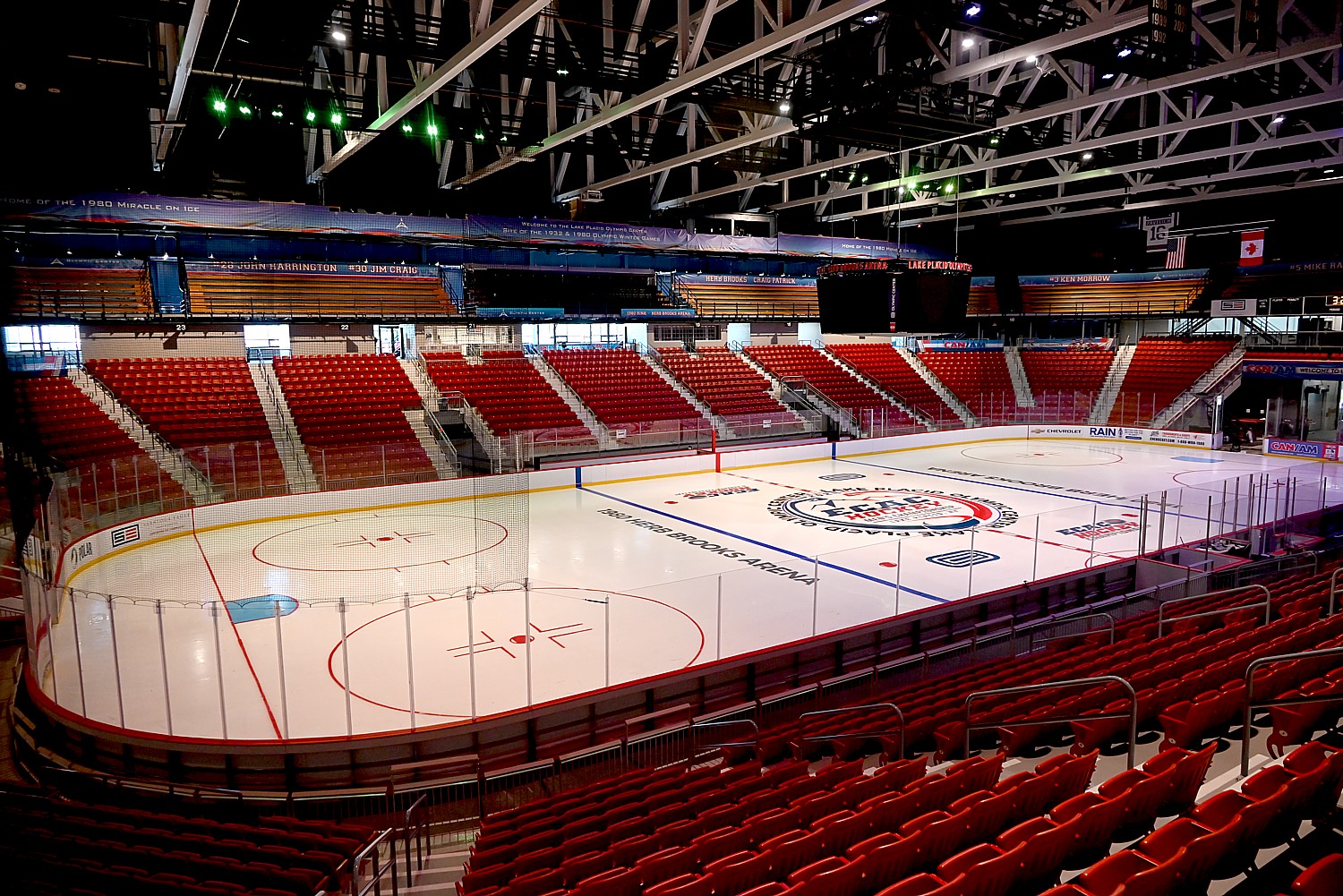
The climax is sitting in a screening room to watch a 12-minute video of the highlights of the 1980 “Miracle on Ice” when the USA hockey team beat the Soviet Union. (Each year, there is a1980 Miracle on Ice fantasy camp – where participants get to play with the actual members of the team.)
In the museum, you get to really immerse into the personal stories of the Olympians, especially those with connections to Lake Placid.
You learn that it wasn’t just good fortune why Lake Placid hosted one of the first winter Olympics, in 1932. Lake Placid really began America’s love affair with winter sports.
The first “modern” Olympics was held in 1896, and by the early 1900s, a Norwegian man known as “Jack Rabbit” introduced alpine and Nordic skiing to the Lake Placid area. The Lake Placid Club was formed by the strongest advocates of winter sports.
The high jumping venue, originally known as Intervales, hosted the first international ski jump competition here in 1921, drawing 3000 spectators – more than the local population.
The first winter Olympics was held in 1924, and the first gold medal was actually awarded to Charles Jewtraw, a speed skater, from Lake Placid .
The first gold medal won at the Lake Placid games was won by Lake Placid local, Jack Shea for speed skating (he won two gold in 1932,and was instrumental in the games returning to Lake Placid in 1980). His son, Jim Shea was a 1964 Olympian cross country skier, and his grandson, Jim Shea, Jr., was the men’s skeleton champion aat Salt lake City in 2002 (Jack Shea was killed by a drunk driver just two weeks before).
You get to tour the famous ice arena, named for Herb Brooks, and the 1932 skating rink (really tiny seating area), and even go down to the locker room.
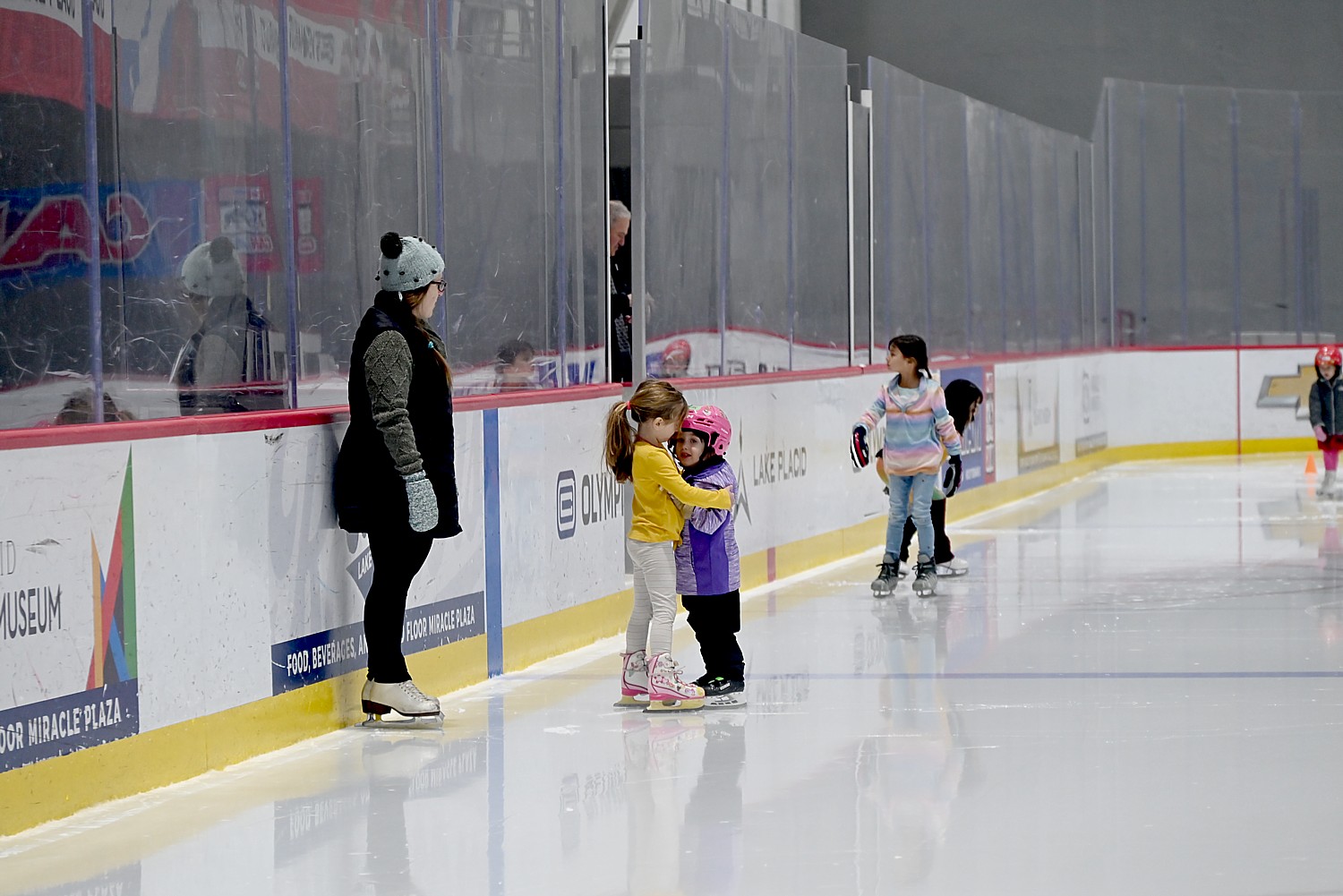
These historic skating rinks are open to the public for skating year-round, and we see some adorable kids starting their long journey to gold (open Tuesday – Saturday).
(The Olympic Center is open daily. The pass also provides 10% off at Olympic Center Roamers Café and Miracle Moments Store.)
Just across from the center is the Olympic speed skating oval, where Eric Heyden made history in 1980 for winning all five speed skating events. (He only agreed to one commercial endorsement, for Crest Toothpaste, to finance medical school and became an orthopedic surgeon.). In season, you, too, can skate on the Olympic oval well into the night (weather permitting.)
The Olympic Legacy Passport is $69/adult, $59 ages 19+, military and seniors and can be purchased at any of the venues (, https://lakeplacidlegacysites.com/legacysitespassport/). Lake Placid Legacy Sites, 518-523-1655, https://lakeplacidlegacysites.com/
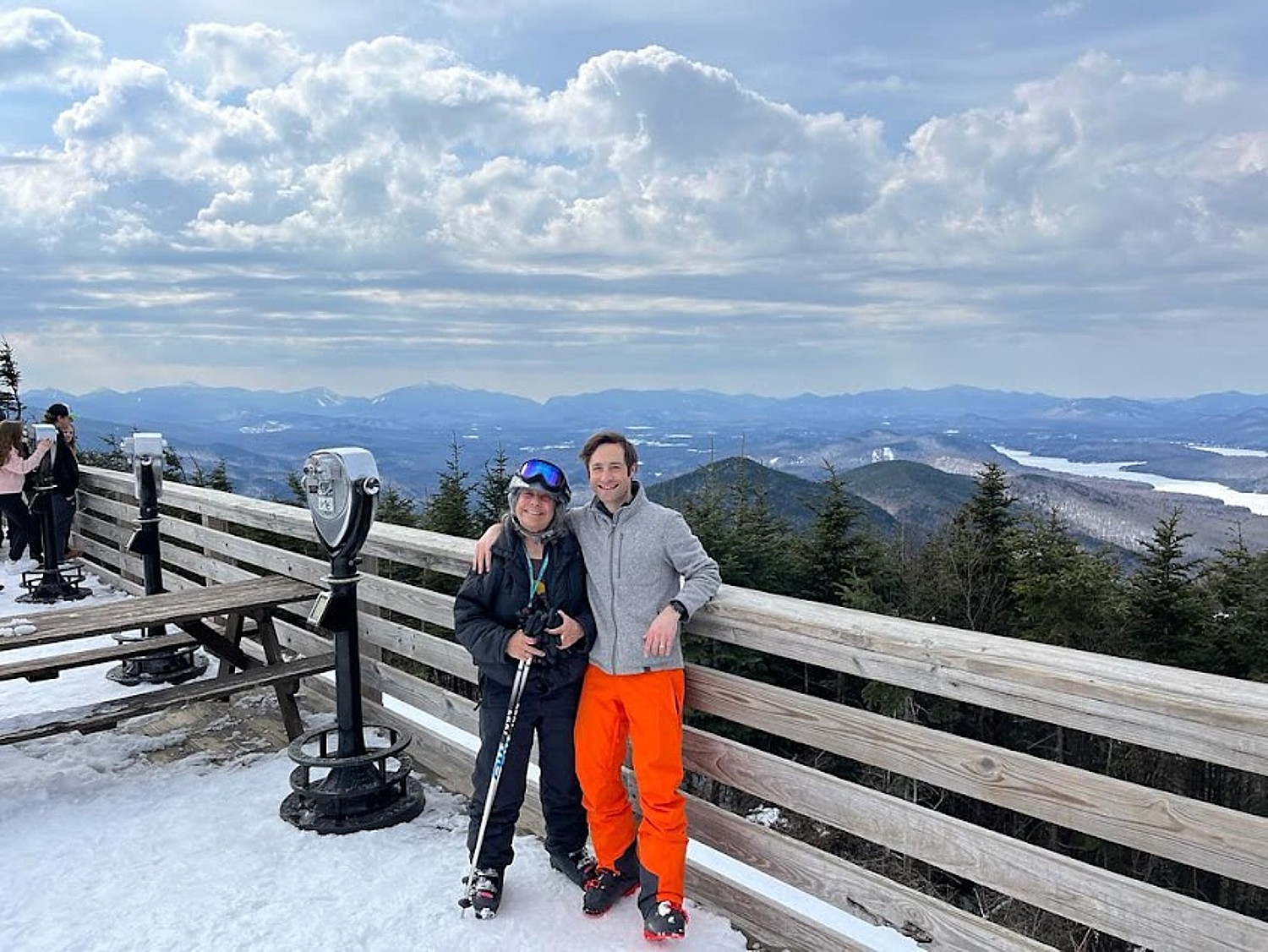
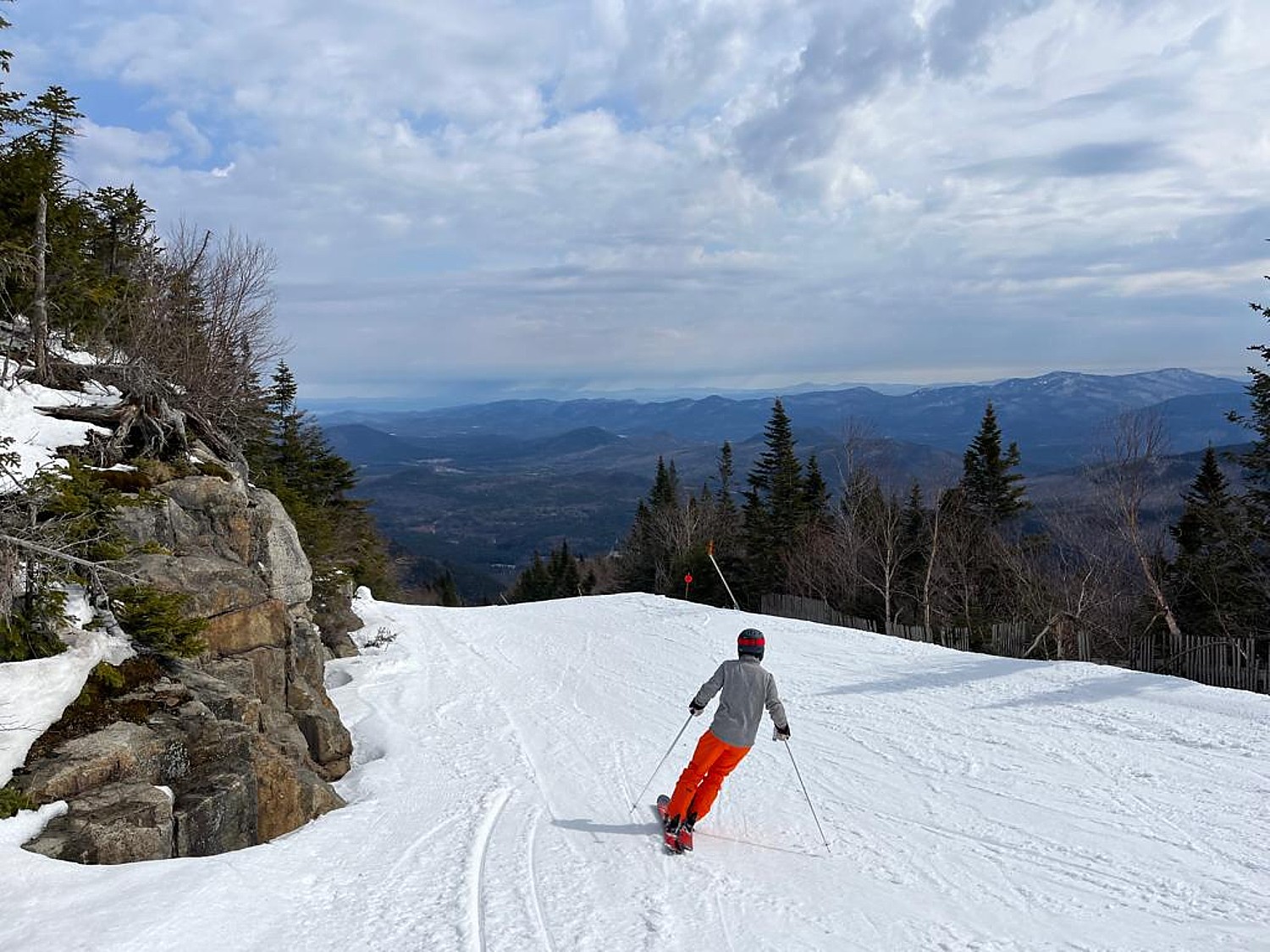
It’s March – spring skiing – and David, Laini and Karen get the ultimate Olympic experience of skiing Whiteface Mountain – even if you are stuck on the green and blue trails. David and Laini, though, were able to tour much of the mountain, tackling the advanced trails, and loved the long runs and sweeping mountain views. With the spring melt already underway, the alpine creek rushed beneath our chairlift rides and the Ausable River at the base had a Galway-esque feel. The lookout atop the Cloudsplitter Gondola was a gorgeous rest stop for us skiers as well as Laini’s non-skiing parents, who were able to enjoy the view and then easily take the gondola down. We discovered the beautiful mid-mountain lodge on our last run – a great lunch spot with high vaulted ceilings and huge pictures windows.
March, when we visit, is often one of snowiest and most spectacular months for outdoor winter recreation, but this year, snow was lacking and it also was the warmest since 1905, so we aren’t able to do several of the winter activities, like riding the toboggan chute onto Mirror Lake, cross-country skiing, skating on the Olympic oval, and snowshoeing the Mt Van Hoevenberg East Trail (a hiking trail in summer).
In summer, Whiteface Mountain offers disk golf, hiking, the scenic gondola, and plans to resume mountain biking.
Food & Lodging
After our visit to the Olympic Center, we stroll Lake Placid’s charming main street and enjoy the shops, cafes, bistros.
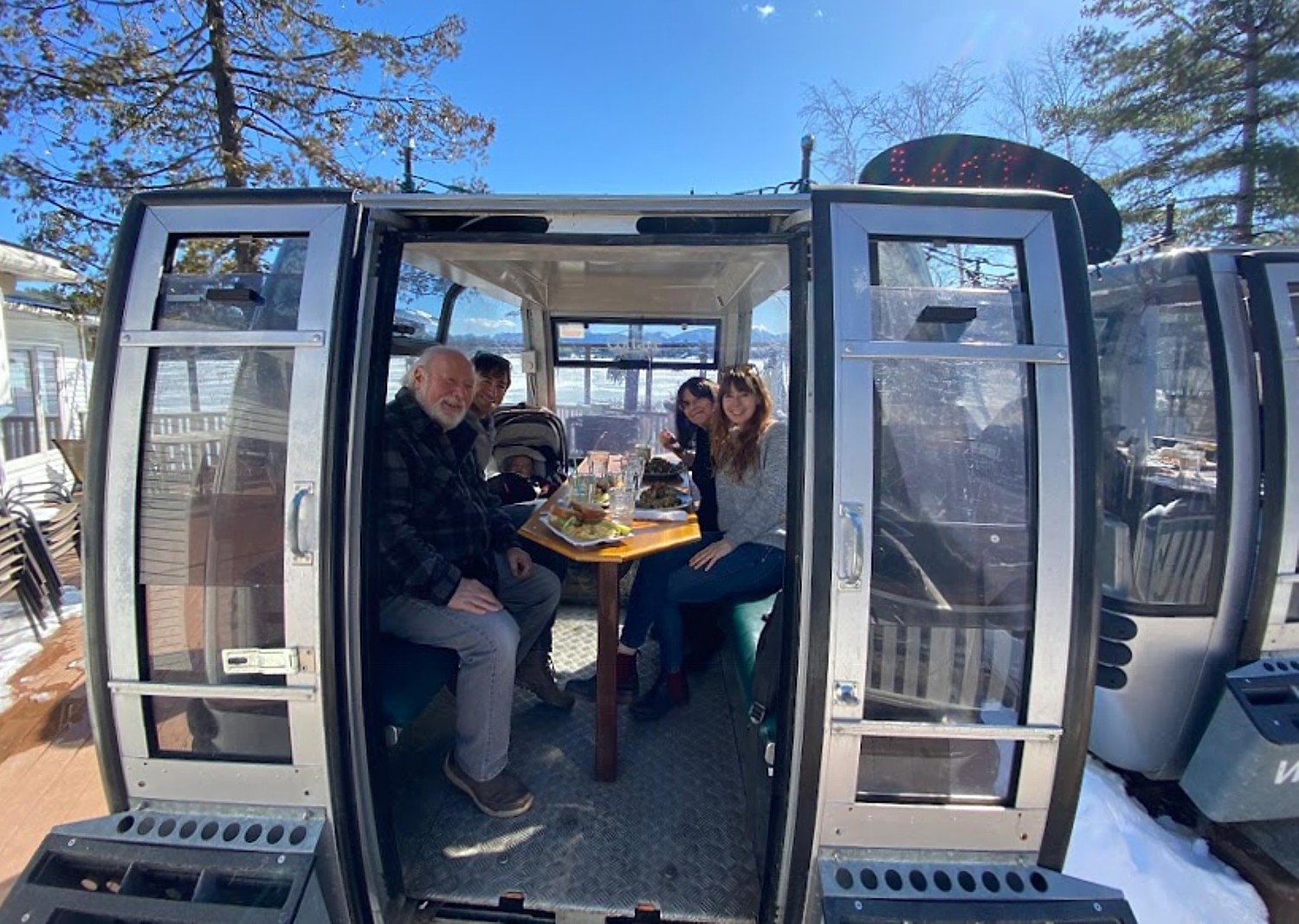
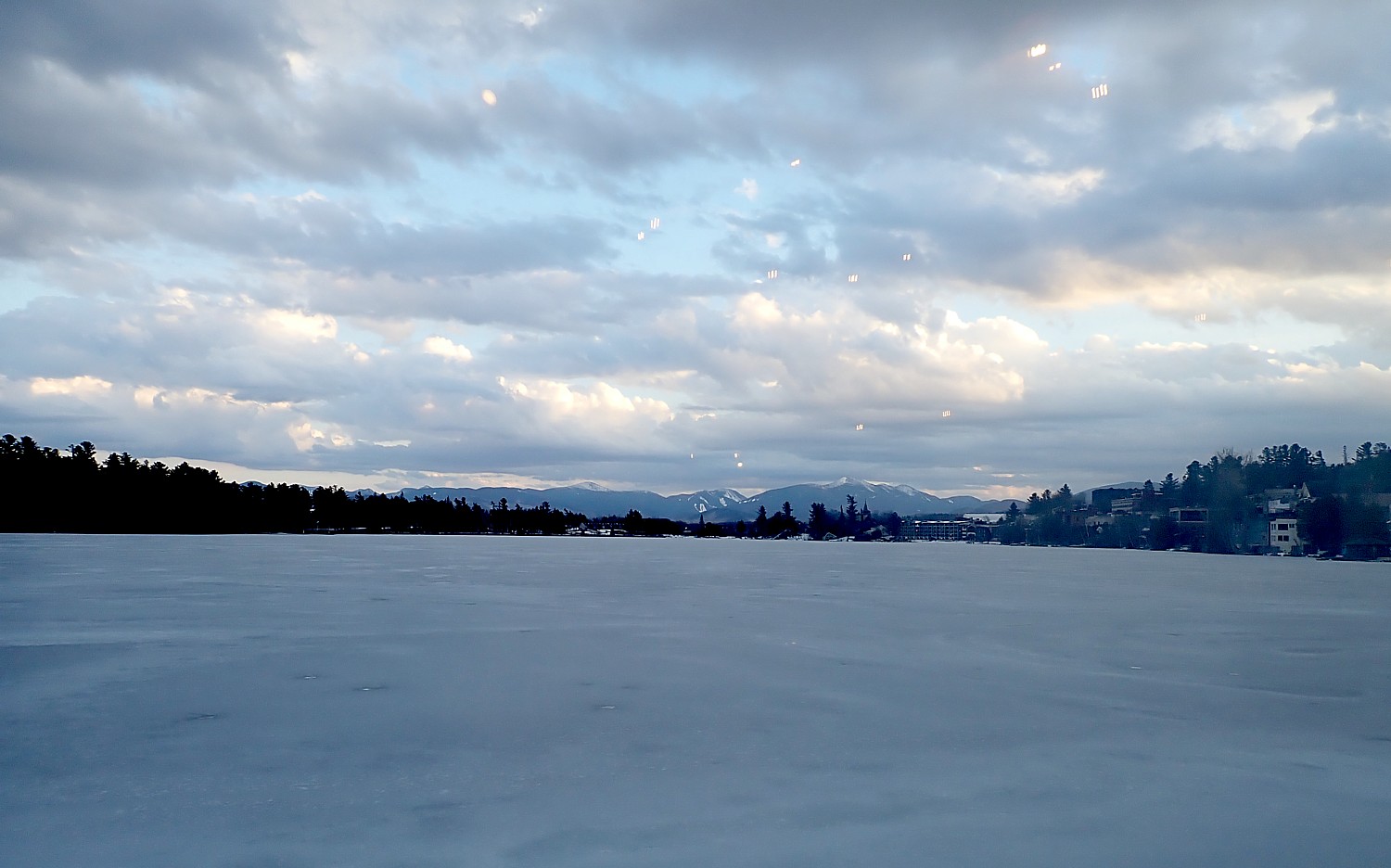
We stop for lunch at The Cottage at Mirror Lake Inn, (17 Mirror Lake Dr.) enjoying the meal in one of the actual ski gondolas overlooking Mirror Lake with spectacular views out to the Great Range of the Adirondack High Peaks (17 Mirror Lake Dr., 518-302-3045, mirrorlakeinn.com/dining/the-cottage)
Each night of our stay in Lake Placid, we had a marvelous cocktail/dining experience (so many to choose from and return to Lake Placid for):
Big Slide Brewery, where you eat beside the giant barrels of the brewery in a comfortable dining room and semi-open kitchen. Not your typical pub grub, its menu has pizaazz – snacks like marcona almonds in hop oil and thyme, Cake Placid pretzel nuggets with beer cheese, and tater tot poutine; sandwiches like a shaved steak sandwich with thinly-sliced ribeye, Sugarhouse Creamery Dutch Knuckle cheese, sautéed onions and Mushrooms and Horseradish Aioli; Tomahawk Pork Chop or chicken fried chicken over smoked ham grits; and pizzas cooked in a 700 degree brick oven. Tomahawk Pork Chop or chicken fried chicken over smoked ham grits (5686 Cascade Road, just over a mile from downtown, bigslidebrewery.com, 518) 523-7844.
Smoke Signals, also overlooking Mirror Lake (a gorgeous dining room and there is a patio overlooking the lake for outside dining), offering classic BBQ with some innovative twists, (2489 Main St., 518-523-2271, www.smokesignalsq.com).
We loved our culinary experience at Cafe Rustica, a quaint, old-fashioned (traditional) Italian restaurant (even the music was a throw-back) serving fabulous Northern Italian cuisine, like the Ravioli Carbonara (fresh wild mushroom ravioli, black pepper, organic egg, pancetta, baby peas, parmesan); Cavatelli Bolognese (rustica Bolognese sauce, cavatelli pasta, parmesan, rosemary oil); chicken Mediterraneo (kalamata olive, heart of plan, tomato, lemon, whitewine, capers, pepperoncini, linguini) (1936 Saranac Ave, Lake Placid, NY 12946, 518-523-7511, www.rusticalp.com)
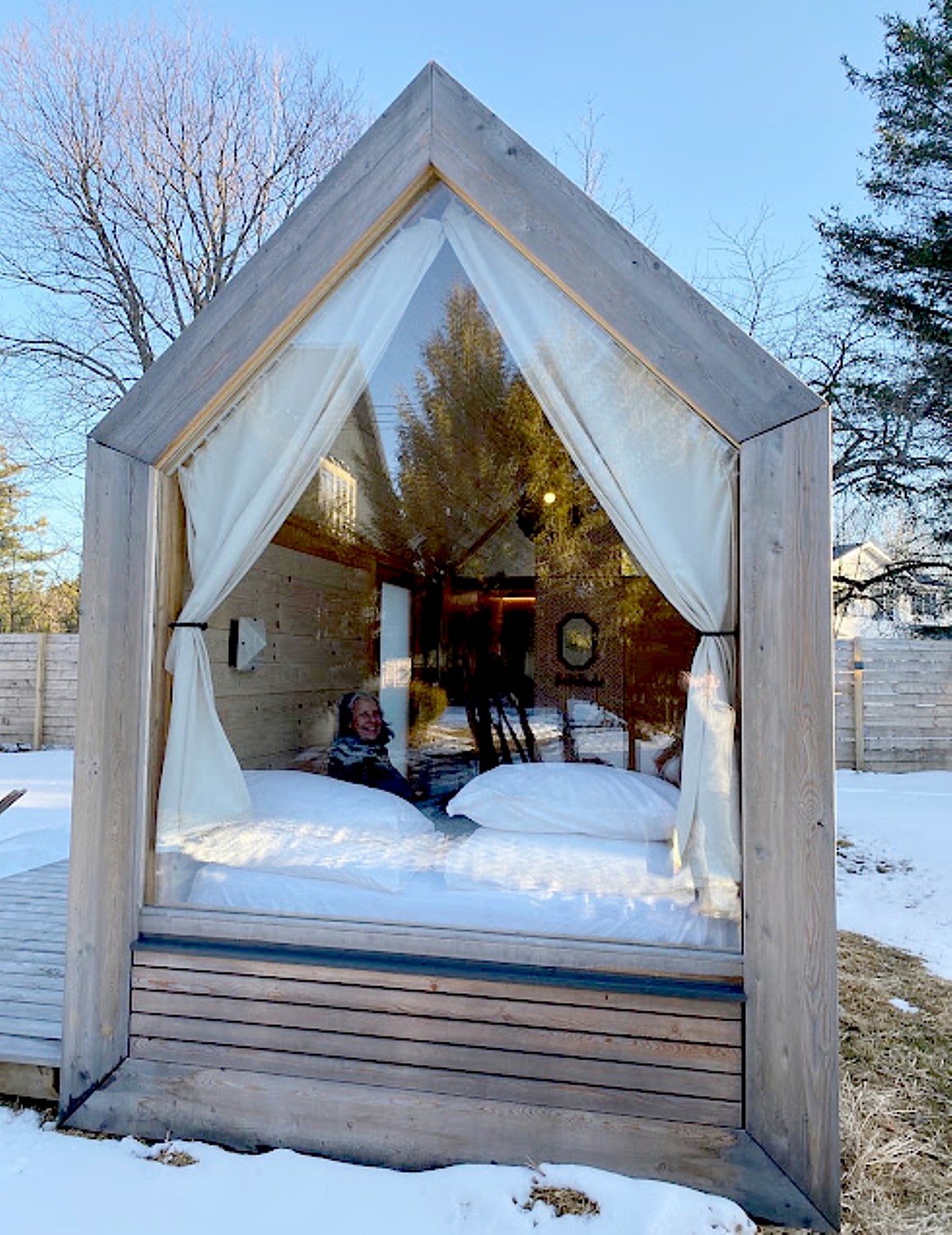
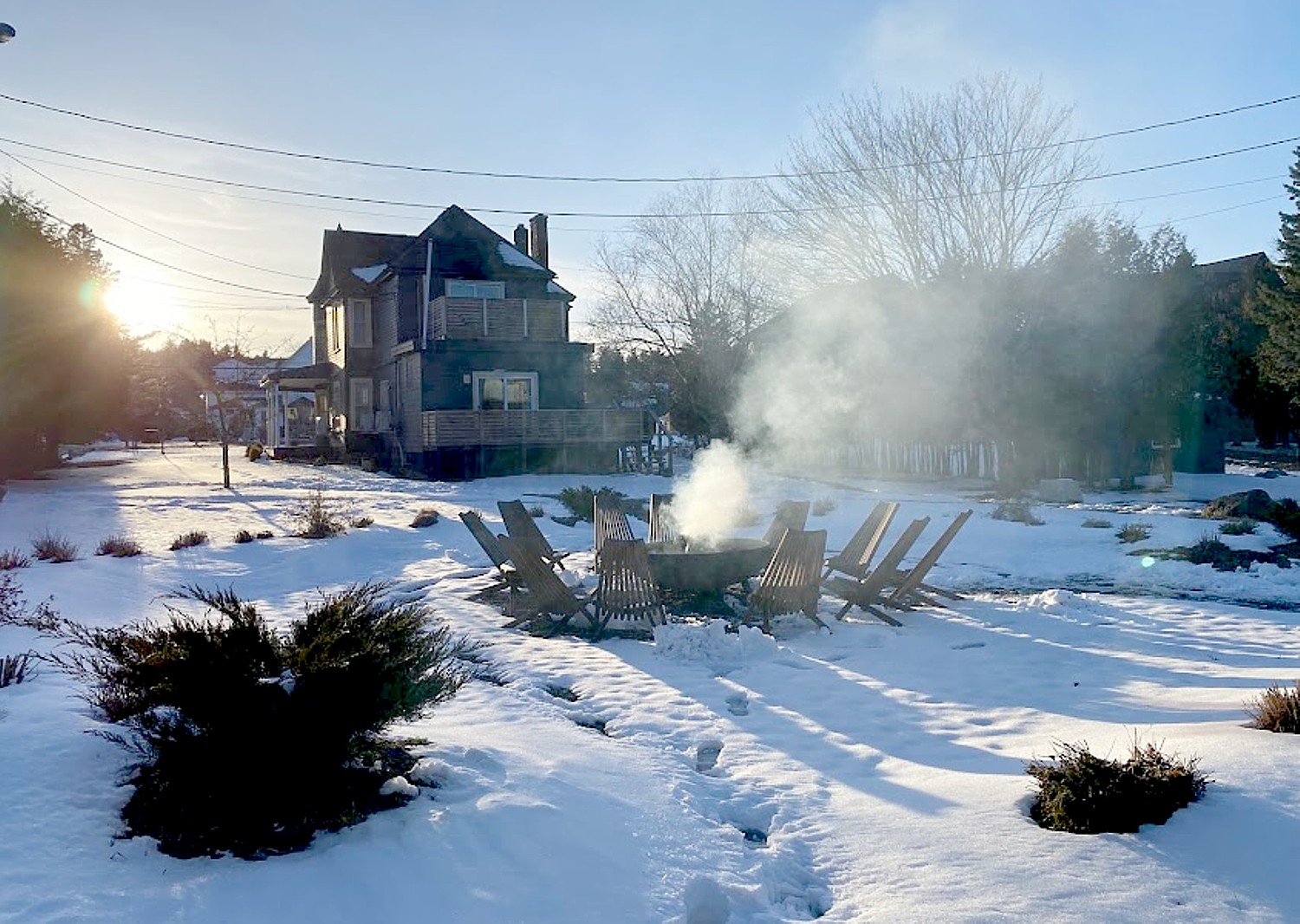
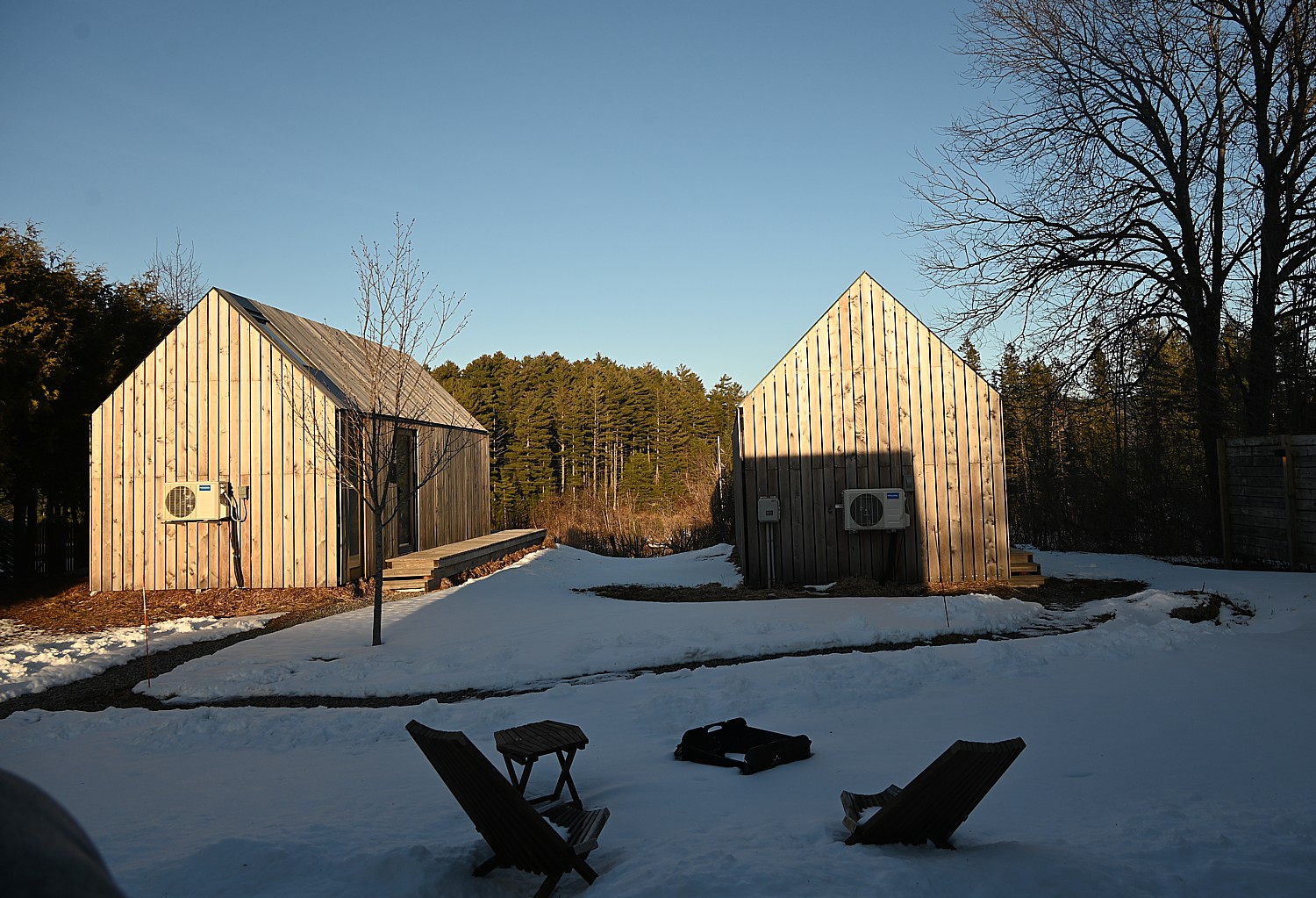
The East Wind Lake Placid Hotel, just a short distance off of Main Street, Lake Placid, proved perfect for our multi-generational getaway – like a small community of lodges and lushnas for a total of 29 units, each homey with dashes of luxury and high-style. My lushna (like a tiny house) was just the width of the (extremely comfortable) queen bed, and had all the comforts of home – refrigerator, coffee maker, bathroom, remote-controlled A/C. David and Laini and baby were comfortable in a spacious room in the house; grandparents Diane and Barry in the lodge.
There are gathering areas – fire pits ringed with Adirondack chairs, a gorgeous reception room (open 24 hours, where coffee, tea and fruit are laid out, you can order breakfast, and there are cocktails and drinks at the bar); a lovely library/salon in one of the buildings (great for taking a conference call).
For a luxury, resort-style experience: the historic Mirror Lake Inn Resort & Spa (77 Mirror Lake Dr, Lake Placid, NY 12946, 518-523-2544, mirrorlakeinn.com; and High Peaks Resort (2384 Saranac Avenue, Lake Placid, NY 12946, 800-755-5598, highpeaksresort.com).
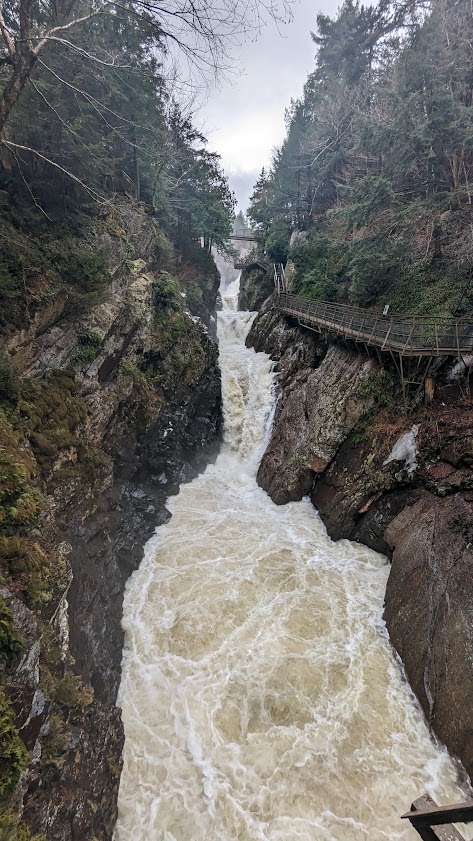
Definitely make time to visit High Falls Gorge, a 22-acre nature park, just a short drive beyond the entrance to Whiteface ski area. It is a 30-minute walk – about a mile – hugging the rockface, where you can go out onto overlooks and bridges and be very close to the series of cascading waterfalls formed by the Ausable River as it drops 115 feet. There is also a trail accessible for strollers or wheelchairs.
Some of the oldest rocks in the world are here – you can touch an Anorthosite boulder 1.5 billion years old (Anorthosite, the base rock for the Adirondacks, is the same rock found on the moon). In season, High Falls Gorge also offers rock climbing, tubing and white water rafting, as well as trails through the forest. (4761 NYS Route 86, Wilmington, NY 12997 518-946-2278, https://highfallsgorge.com/)
By Karen Rubin, Travel Features Syndicate, goingplacesfarandnear.com
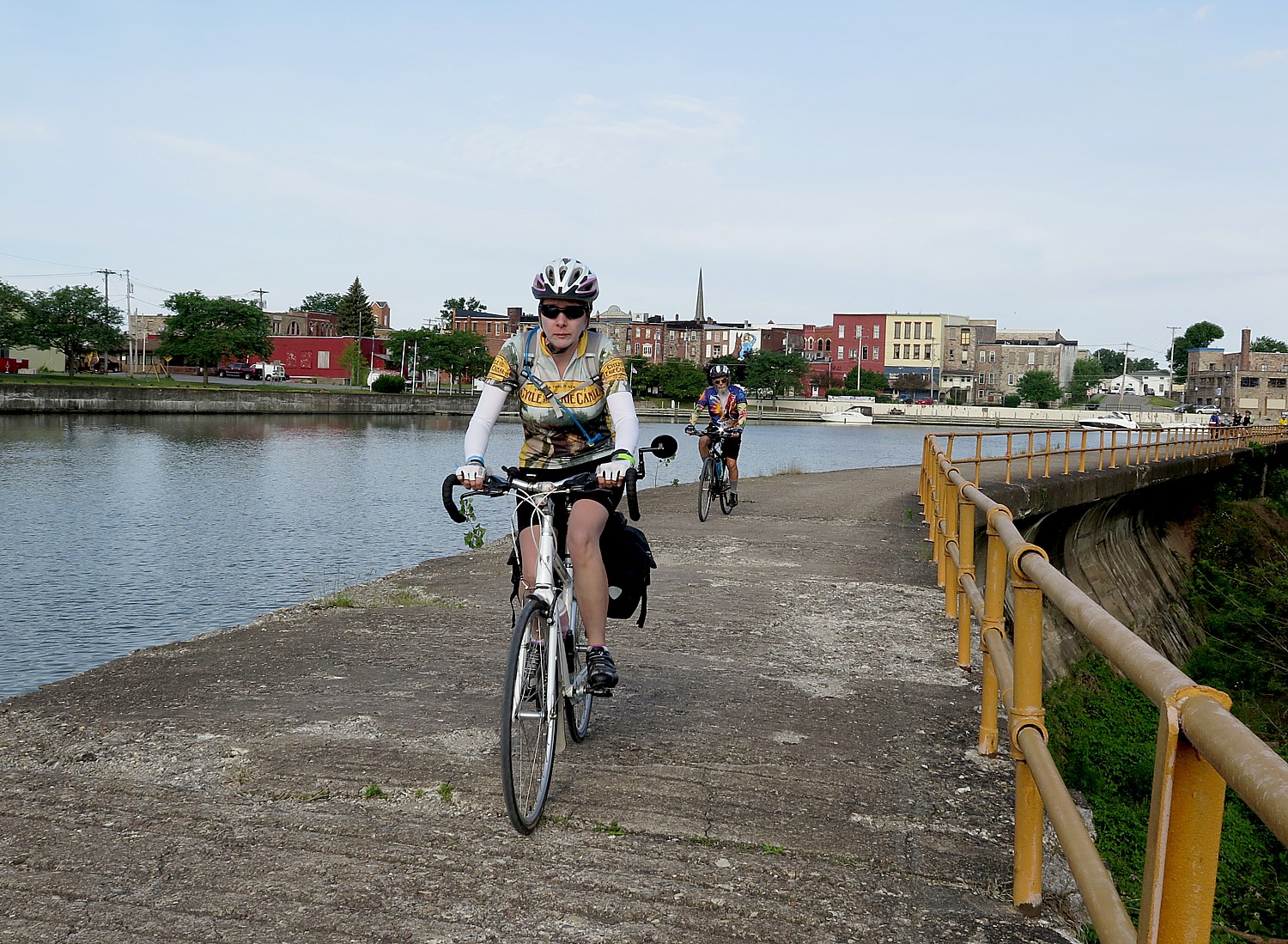
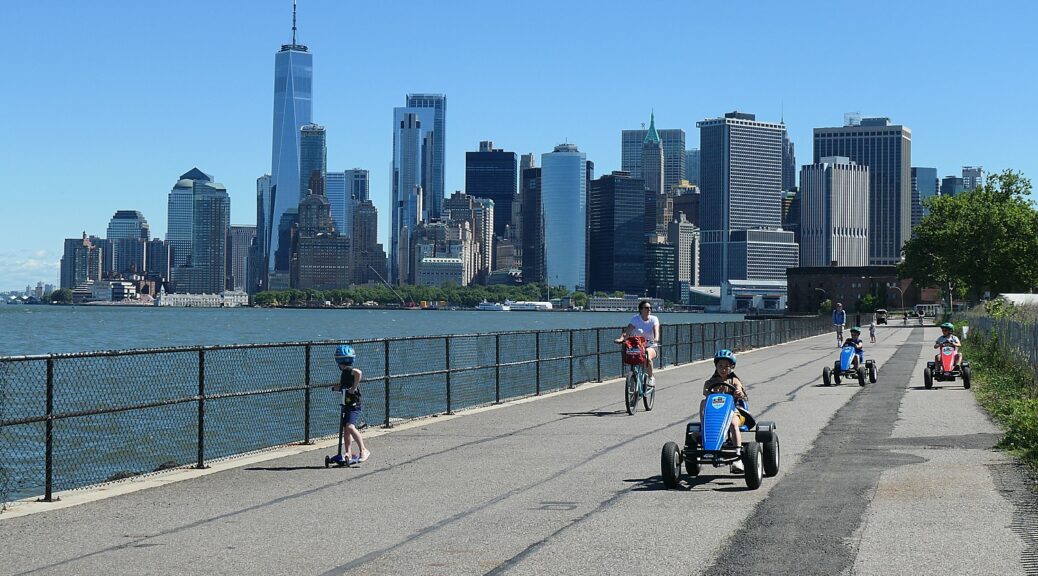
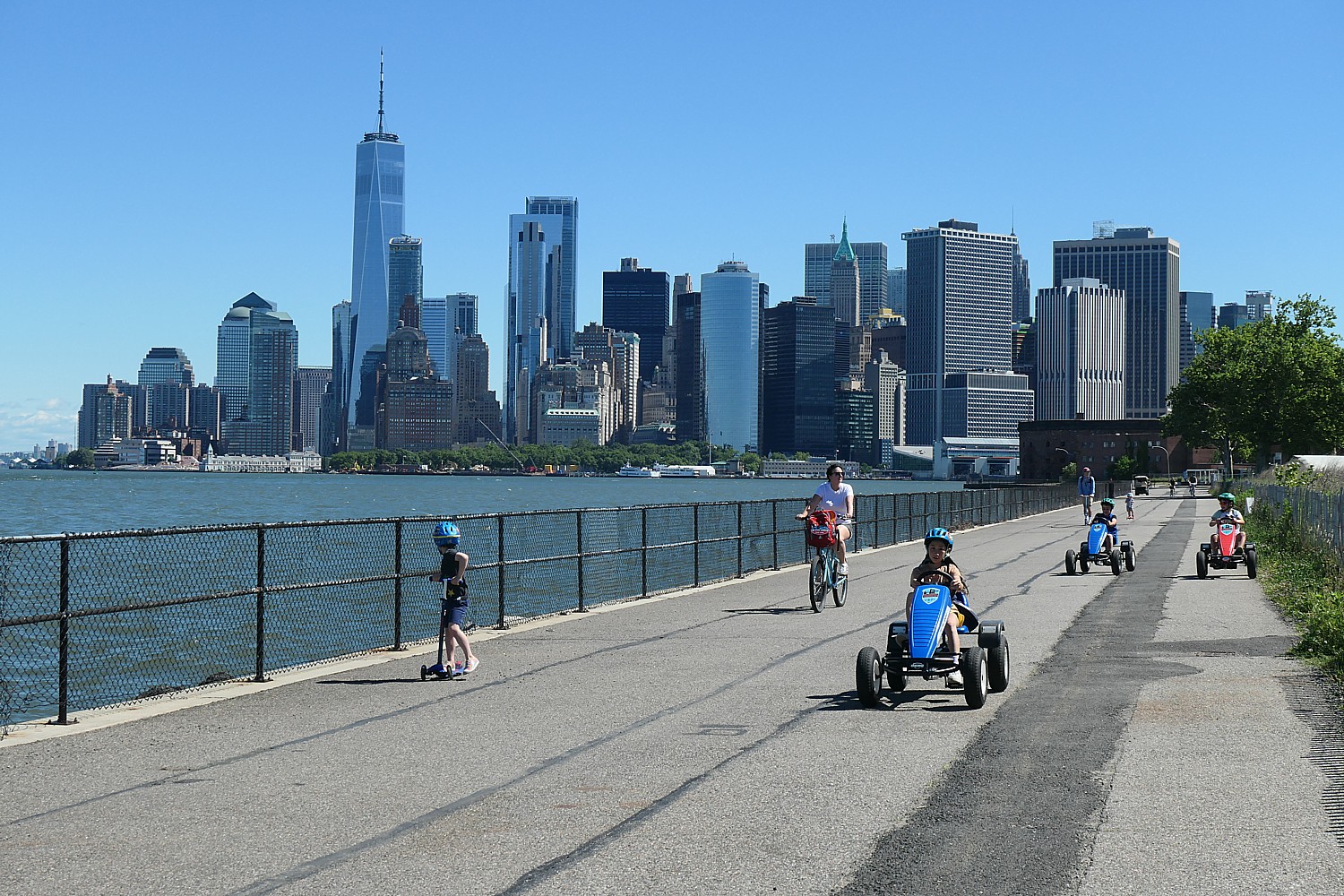
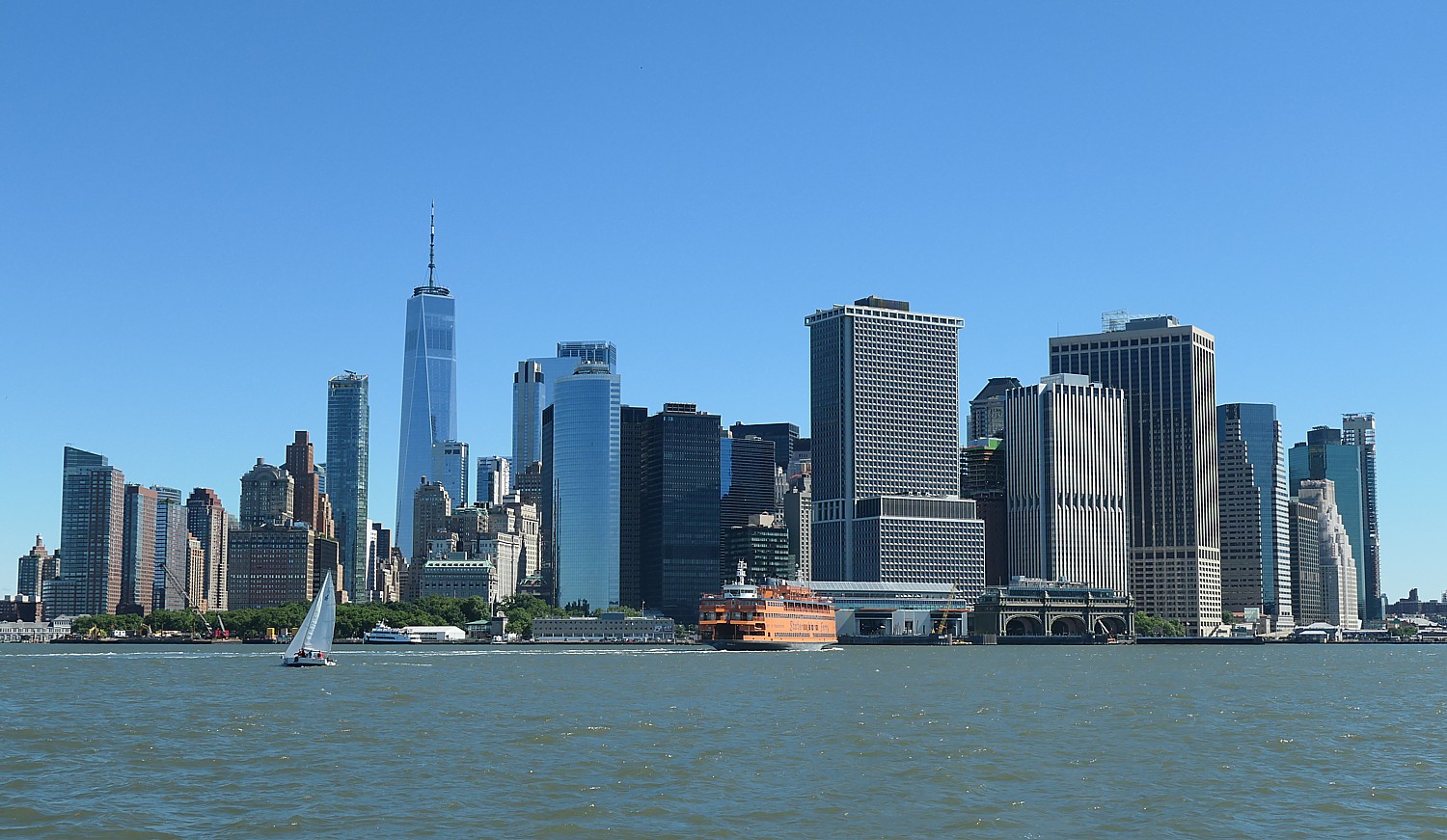
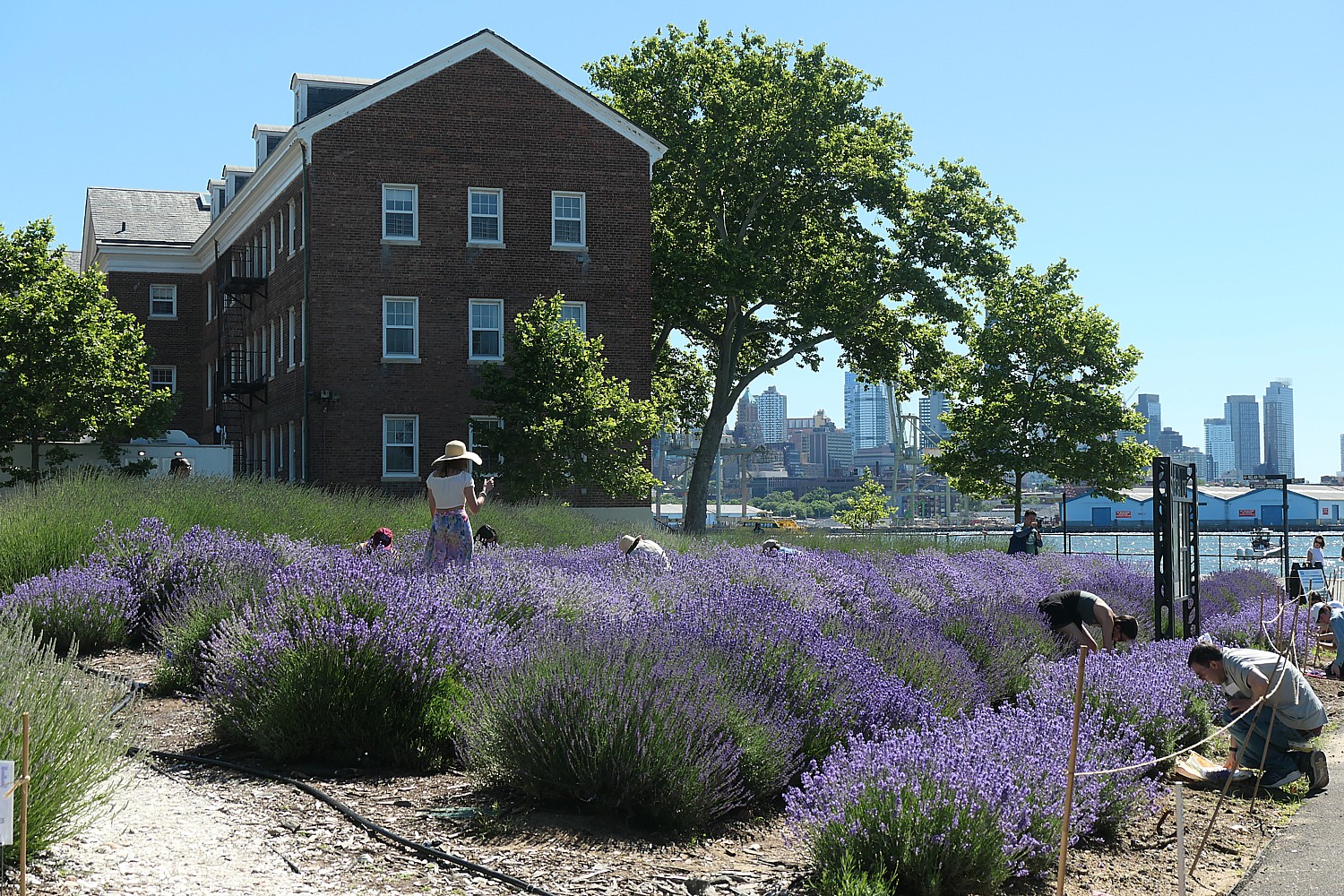
Governors Island has become a destination all its own, where just 8 minute ferry ride away from Battery Park or Brooklyn, New Yorkers can feel as if they have traveled far, far away in both time and place.Just 800 yards off the southern tip of Manhattan, the 172-acre island is a world away.
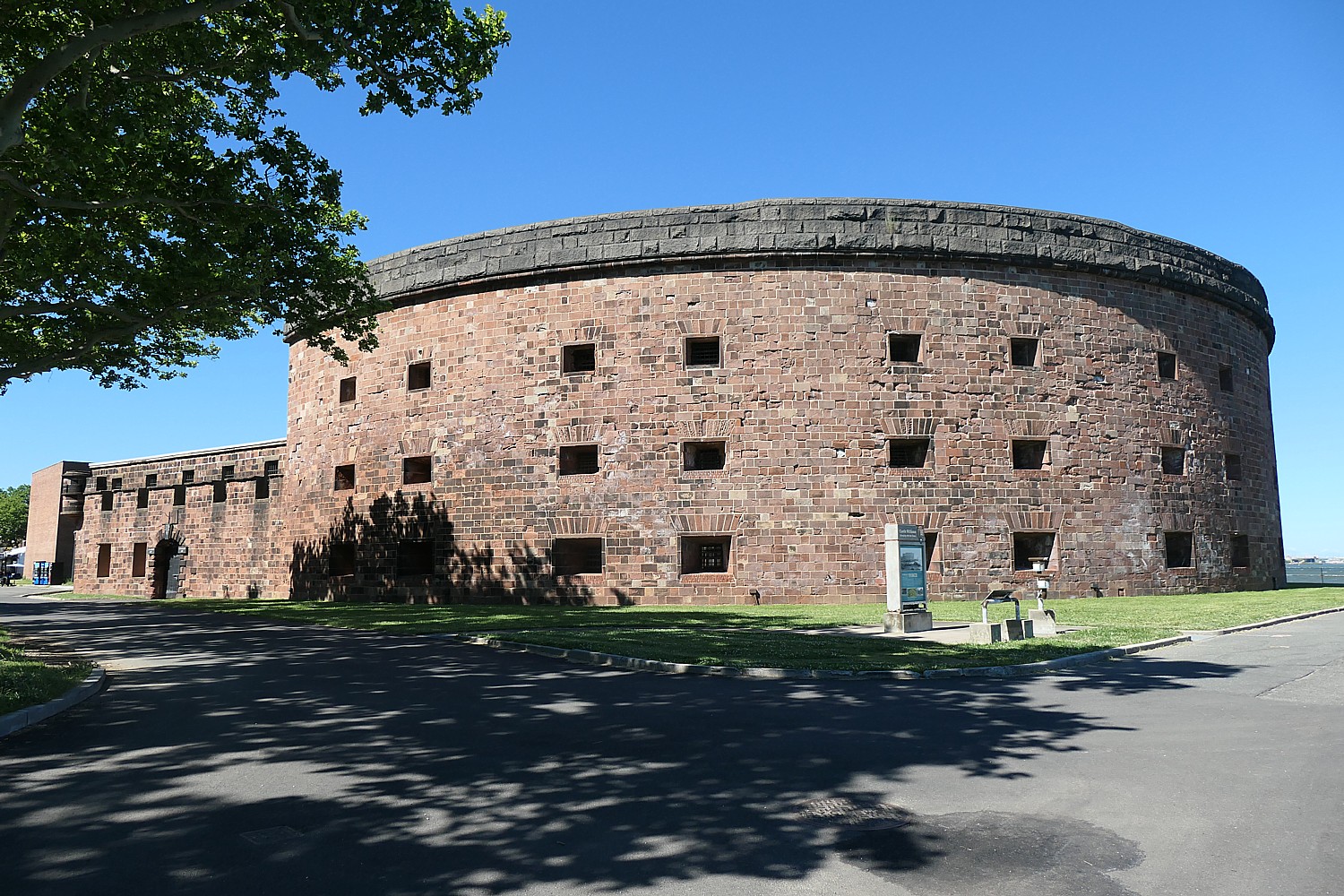
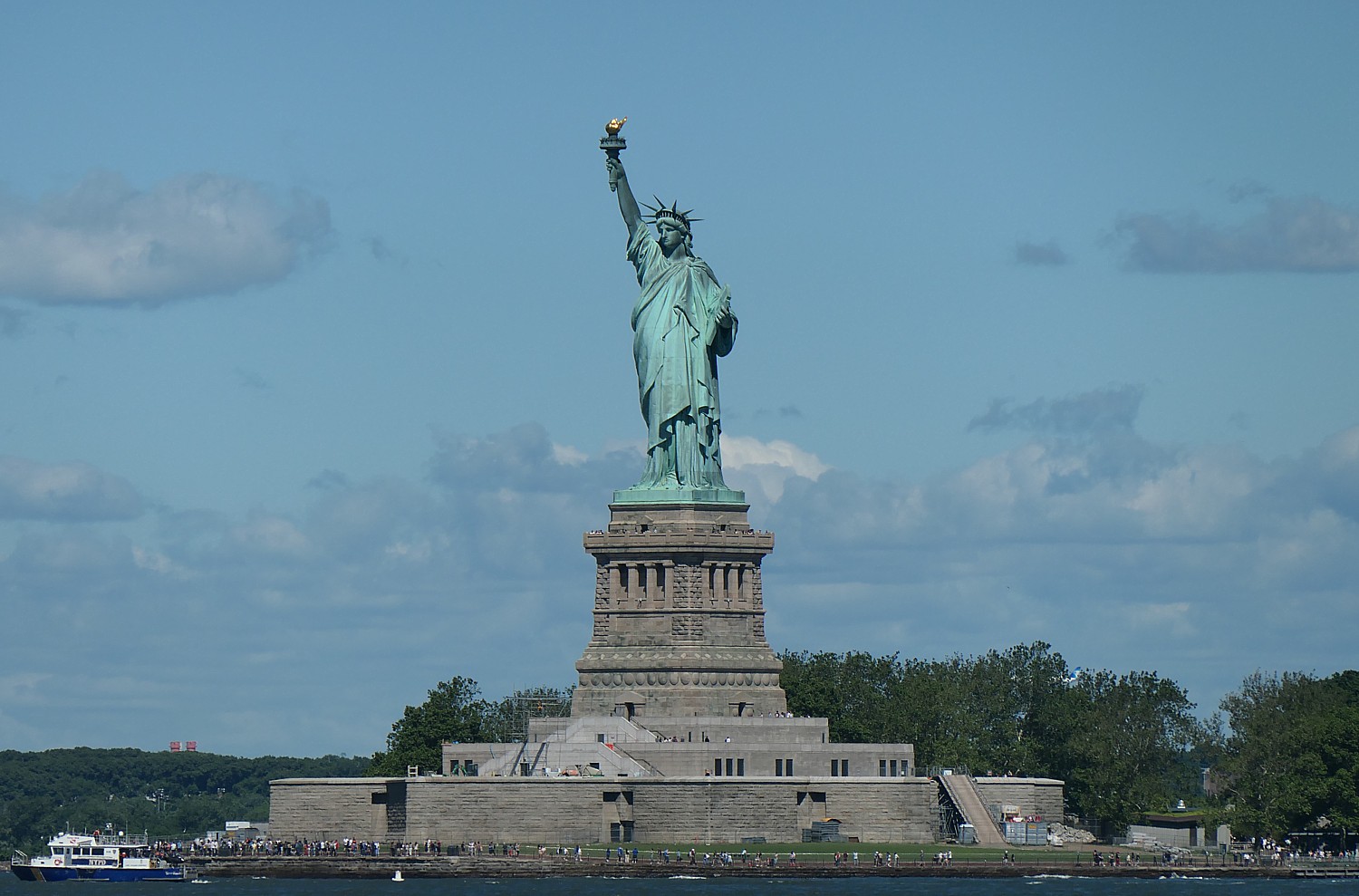
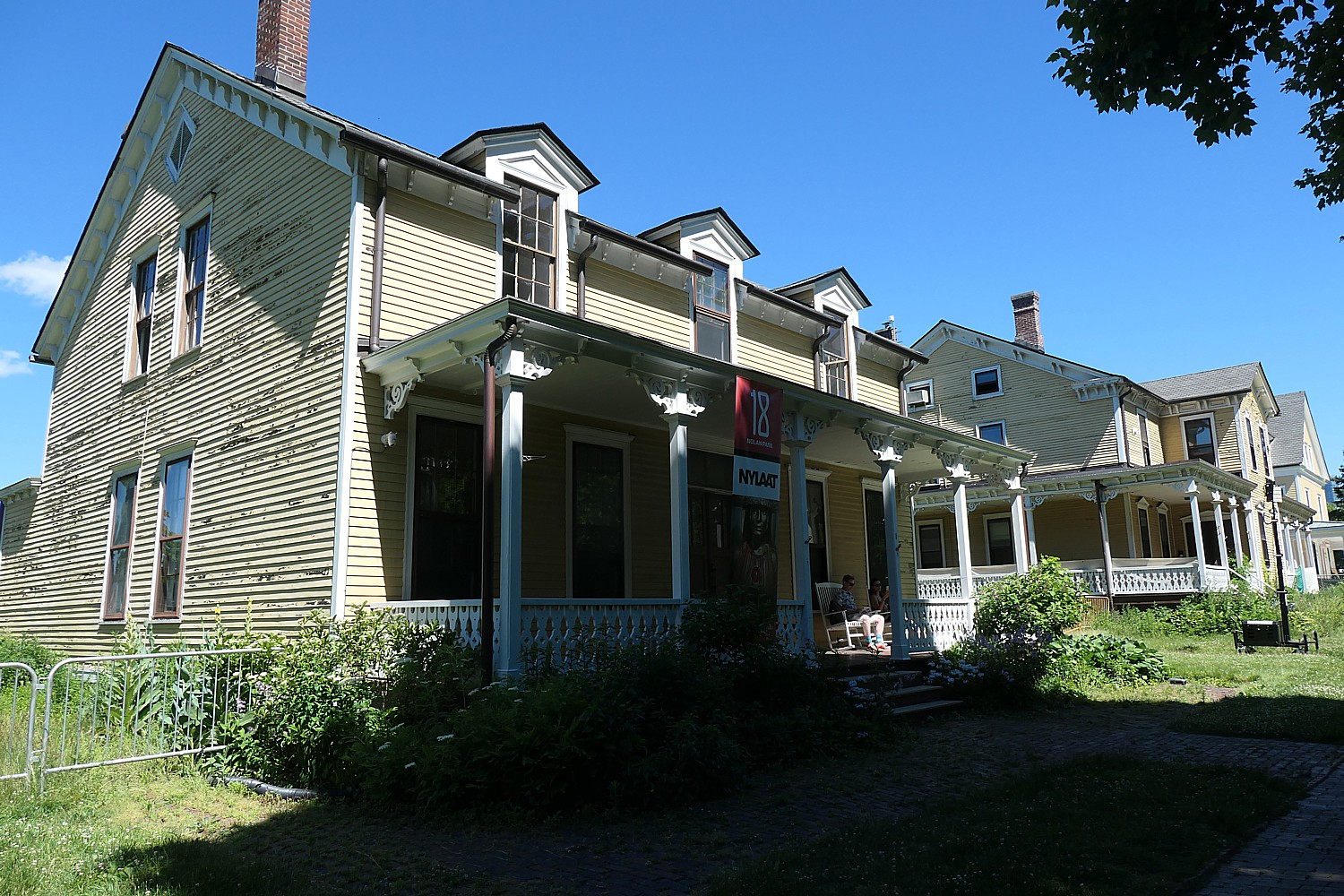
You can rent bikes, pedal coaches, visit the 200-year old Castle Williams, a 22-acre National Monument managed by the National Park Service and learn its history (it helped save New York from British Invasion during the War of 1812 and was used as a prison during the Civil War and Fort Jay. The island had been a military base – my father was based there during World War II, and now is a Coast Guard headquarters). Biking around the island, you have the best view of the Statue of Liberty and the Manhattan skyline.
Governors Island was originally an egg-shaped rock covered in nut trees, utilized as a fishing and ground for the Lenape tribe and early New York settlers. Governors Island’s long military history began when the colonial militia constructed an earthen-work fort, later to become Fort Jay, in 1775. Castle Williams, the second of three historic forts on the Island, was built in 1811, and with the other two forts that defended New York’s Harbor, successfully discouraged the British from invading during the War of 1812.
The island is in the midst of a transformation from an abandoned former military base to a year-round destination for recreation, culture and innovation.
Today, Governors Island has been revitalized as an award-winning park and laboratory for sustainability and cultural enrichment, with year-round educational and cultural facilities and programming.
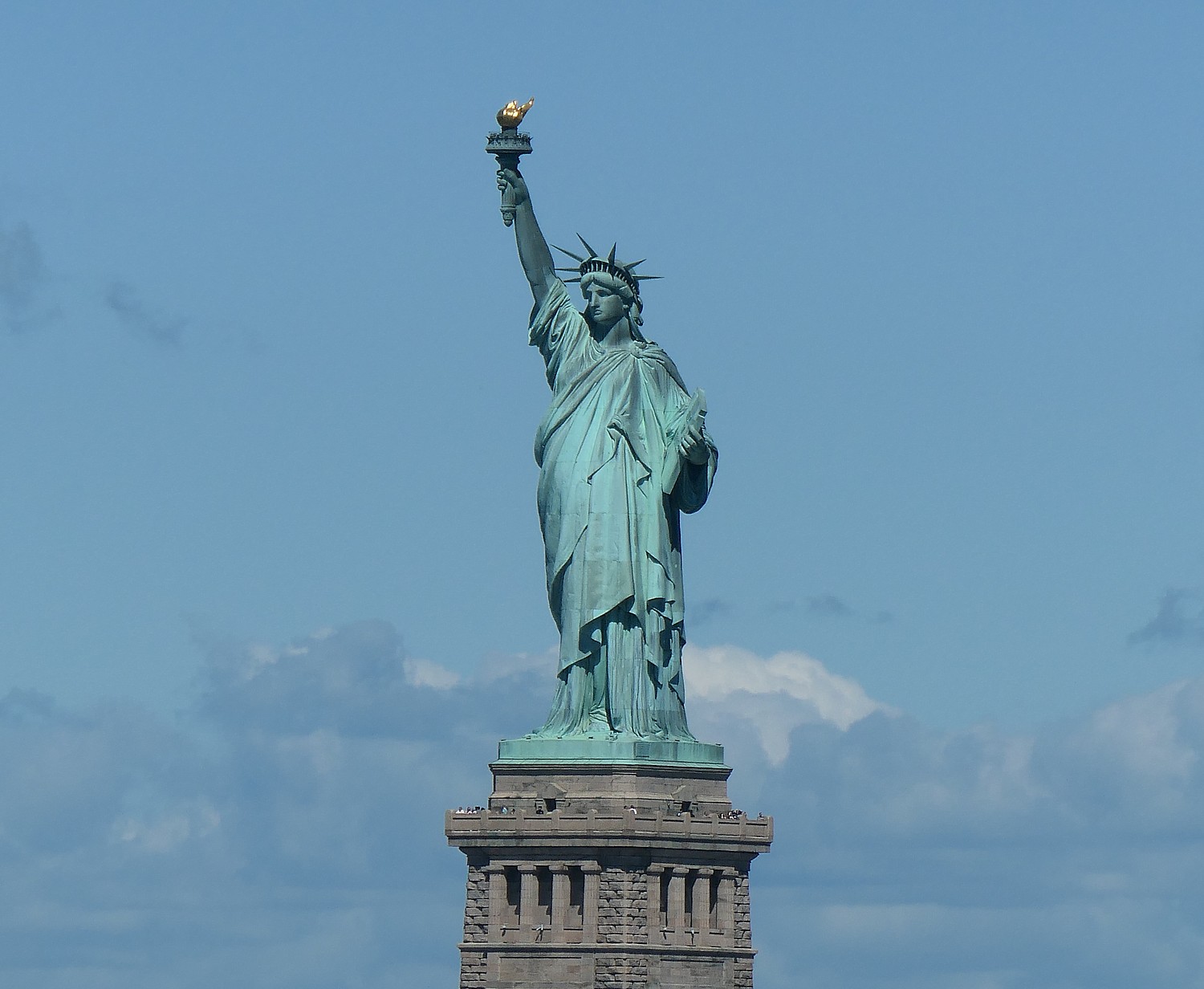
A key area is The Hills, rising 70 feet above sea-level, offering breathtaking – and never-before-seen – views of the Statue of Liberty and New York Harbor.
Slide Hill, rising 40 feet, has four slides, including New York City’s longest slide at 57 feet. Grassy Hill, rising 25 feet, offers gentle slopes and views overlooking 30 acres of the new park. Discovery Hill, rising 40 feet, features ornamental trees and shrubs, as well as Cabin, a permanent site-specific installation by acclaimed British artist Rachel Whiteread, commissioned through Governors Island Arts. Outlook Hill, rising 70 feet, offers both a winding, accessible path to a plaza at its summit, and a granite ‘scramble’ for those who seek a quicker ascent, and be rewarded with 360-degree views of the Statue of Liberty, New York harbor, Verrazano-Narrows bridge and city skyline.
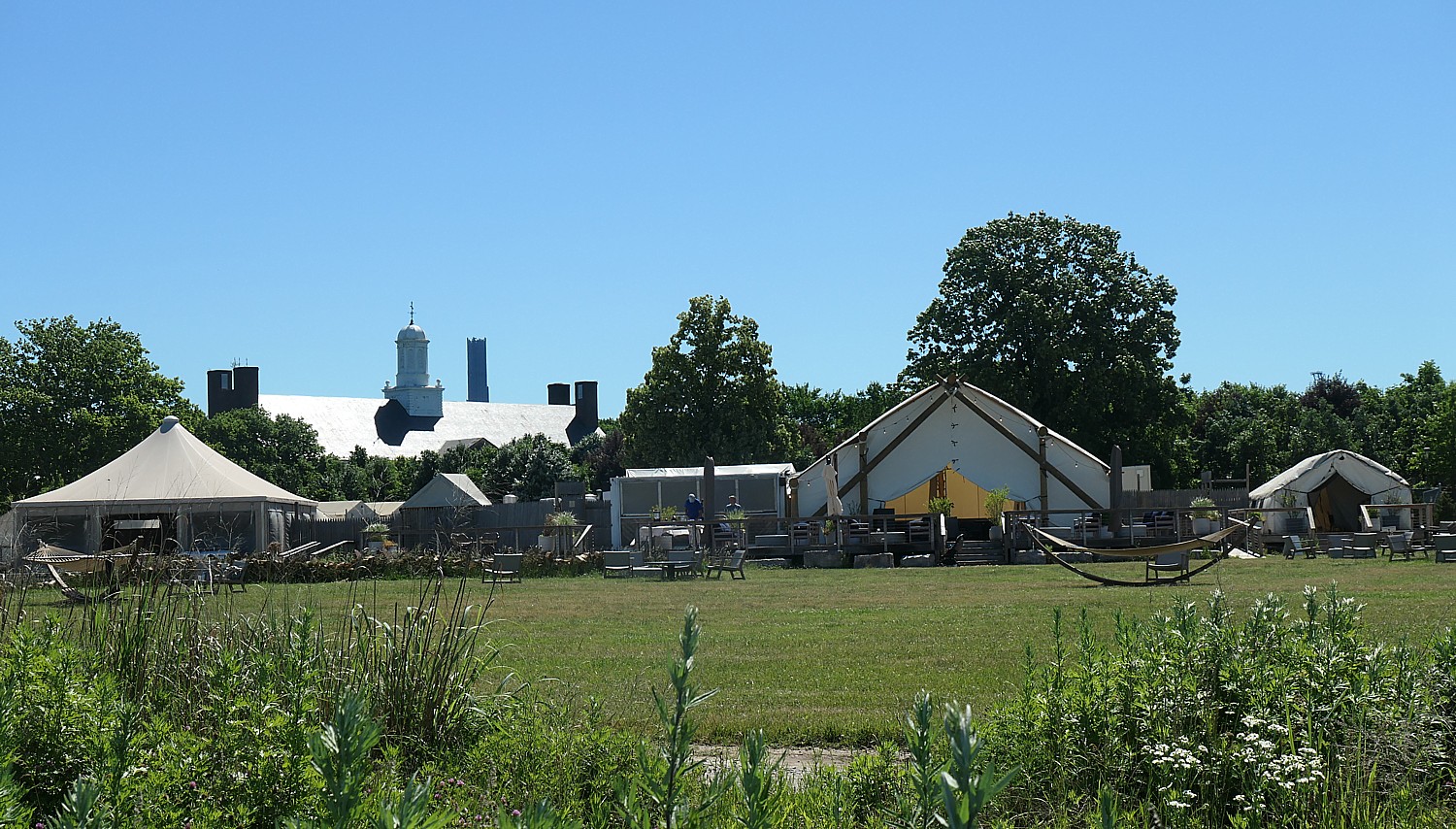
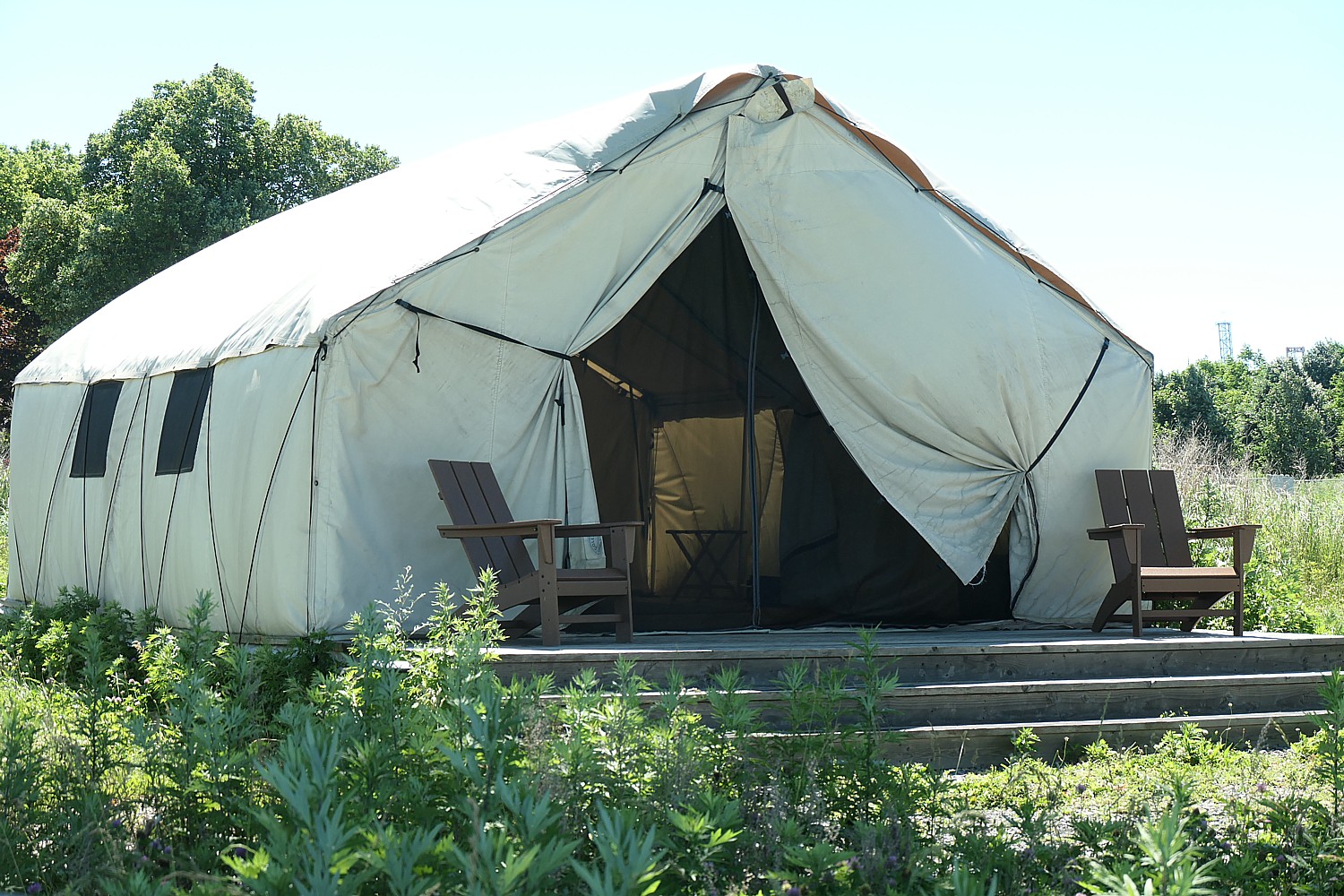
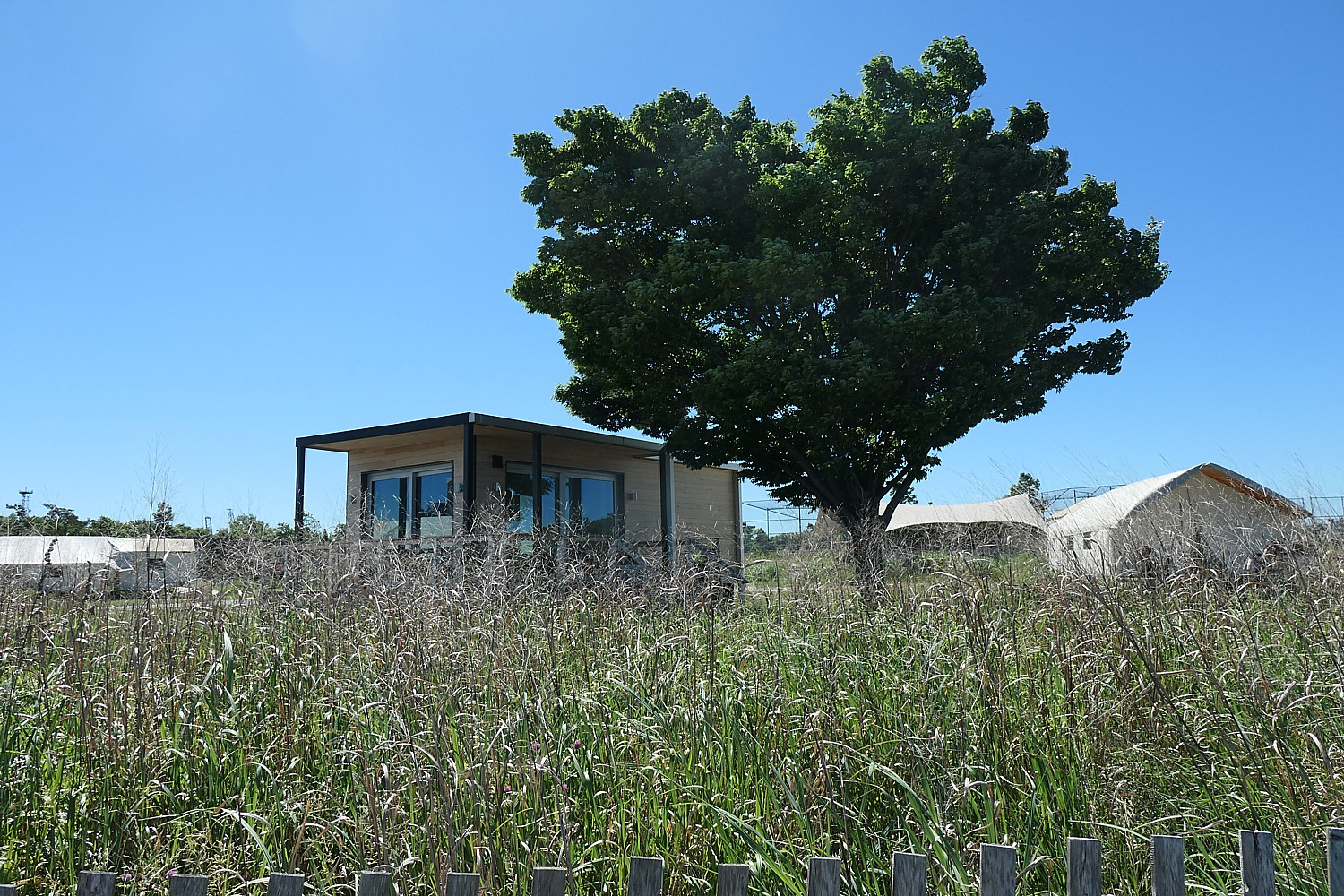
Collective Retreats, based in Colorado, operates a luxury glamping retreat with tents and tiny-home-style accommodations, enhanced with morning yoga; spa offerings at QC NY (located adjacent to Retreat); live music every evening; cocktail hour on the sunset terrace; chef-driven farm-to-table dining; and Historic Governor’s island adventuring by bike.
Accommodations have everything you’d expect from a five-star hotel: from plush beds with high thread count linens to bathrooms with luxury bath amenities. Daily continental breakfast baskets, filled with yogurt, fresh fruit, pastries, juice, and protein bar is delivered to your tent, and farm-to-table, wood-fired dinners are available every evening at its Three Peaks restaurant.
The retreat features a variety of accommodations: Summit Tents, with king-size bed or two single beds made up with high-thread-count linens, private en-suite bathrooms, plush towels, boutique bathroom amenities, and private decks with Adirondack chairs; smaller Journey Tents with king or two twin configuration, fine linens, plush towels, various in-tent amenities and communal bathrooms; Outlook Shelters, which are like tiny homes fully sheltered from the elements with climate control, with bedroom, en suite bathroom with luxury spa soaking tub, a living/lounge space with coffee table, as well as mini bar / mini fridge and two private decks with Adirondack chairs.
Both overnight and non-overnight guests are invited to enjoy its Wood-Fire Grill menu and a la carte menus in addition to an extensive selection of specialty beer, classic cocktails, and wine offerings. Walk-ins are welcomed for dinner. Pair any dining option with a classic cocktail, wine, or beer from The Sunset Terrace Bar.
You can see massive restoration going on all around the island, with a goal to expand year-round public access by enlivening it with transformative public art and culture, extraordinary recreational and open space, and research and education dedicated to addressing the global climate crisis.
Governors Island is open to the public daily year-round (pay attention to the ferry schedule). From Memorial Day Weekend through Labor Day Weekend, the Island is open from 7am-10pm Sunday through Thursday and 7am-11pm Friday and Saturday, with the South Island Park (including Picnic Point, the Hills, Hammock Grove, and the Play Lawns) closing at 6pm every day. All other times, the Island is open daily from 7am-6pm.
From Manhattan: Ferries operated by the Trust for Governors Island run daily from the Battery Maritime Building, located at 10 South Street in Lower Manhattan. Click here for schedules and tickets. Evening ferries are available for Governors Island tenants and guests, which includes visitors to QC NY, Island Oyster, Taco Vista, and Gitano. Tickets to evening ferries can only be purchased in person at the Battery Maritime Building.
From Brooklyn: Seasonal ferries operated by the Trust for Governors Island run Saturdays, Sundays, and Holiday Mondays from May 25-September 2, 2024 from two Brooklyn locations: Pier 6 in Brooklyn Bridge Park and Red Hook/Atlantic Basin. Click here for schedules and tickets.
NYC Ferry, the City’s public ferry service, also serves Governors Island daily year-round,with stops on the Lower East Side, Wall Street, and along the Brooklyn waterfront..For to the NYC NYC Ferry site (click here) for NYC Ferry information, ticketing, and schedules.
By Karen Rubin, Travel Features Syndicate, goingplacesfarandnear.com
Colmar, in France’s Alsace-Lorraine region, is a storybook village – its buildings literally decorated to tell a story. And when you wander around its narrow, twisting streets, you walk through 500 years of history, lose all sense of what century you are in and fall totally under its spell.
Almost miraculously, the city has managed to remain mostly unscathed through centuries of wars. So as you stroll around, you come upon architectural jewels from the Middle Ages and the Renaissance. (You can follow a self-guided historic walking tour of silver Statue of Liberty figures in the pavement.)
I became curious about visiting Colmar when I saw a short report about it being the childhood home of Frédéric Auguste Bartholdi, the sculptor who created the Statue of Liberty, and the images of how colorful and charming it was. I had to see if for myself.
So I take advantage of the ease of visiting Colmar from Strasbourg, the starting point for a European Waterways canal cruise through the Alsace Lorraine on its luxury hotel barge, Panache. It is just 45 minutes on the train, every half hour, a most enjoyable, comfortable and scenic ride, 28E roundtrip, no need to reserve – and join the hordes of day-trippers exploring this fairytale-like place.
It’s a short, pleasant walk from the Colmar train station into Le Petit Venise (Little Venice), the historic district (really similar to Strasbourg’s Le Petit France), and I am immediately enchanted.
Colmar is famous for its half-timbered houses and richly decorated merchants’ mansions. Some date from the Middle Ages, such as the Adolf House, the oldest in Colmar, built in the second half of the 14th century; and the “Huselin zum Swan” on Schongauer Street.
The Renaissance is on display in one of Colmar’s most magnificent structures, Maison Pfister with ornate bay windows (oriels), long wooden gallery and exquisitely painted murals, which has become a symbol of the city. Maison Pfister was built in 1537 for Ludwig Scherer, a wealthy hatter from Besancon. The paintings that decorate the façade, attributed to Christian Vacksterffer, represent 16th century Germanic Emperors, Evangelists, Church Fathers, allegorical figures and biblical characters and scenes. It is named for the merchant Francois-Xavier Pfister who acquired the mansion in 1841.
I come upon a house at 34, rue des Marchands with a plaque dated 1435 and a note that says this was the residence of master painter Caspar Isenmann “(Zum Grienen hus”). Another marvelous structure is “Cour du Weinhof,” at 12-16 rue des Marchands, which is a medieval 14th century granary.
So many of the buildings are adorned with beautiful, even playful, whimsical decoration – as if there is a competition for who can have the prettiest or cleverest or most festive, or perhaps a public ordinance that requires everyone to be incredibly festive and clever. I wonder.
I go in search of the intriguingly named House of Heads. Built in1609 in German Renaissance style, it has a three-story bay window, and a façade embellished with 111 heads and masks.
You walk through a fabulous pedestrian zone -a listed “protected sector” – that takes you from the Middle Ages to the 18th century, from “Little Venice” to the Tanners district with its grand white-fronted houses.
Similar to Strasbourg, there are districts, or neighborhoods, built around trades.
The Poisonnerie quay where fish caught mainly in the River Ill were stocked and sold, dates from the 14th century. Part of this district was damaged in a major fire in 1706 but some houses were rebuilt. The whole area underwent urban revitalization from 1976 to 1981.
The Tanners Quarter, rounded by the Rue de Montagne Vertne, Rue des Tripiers, Rue des Tanneurs and place de l’Ancienne Douane, is the epicenter of the protected old town center. Its tall, timber-framed houses built during the 17th and 18th centuries, often have a final open-worked level which was used by craftsmen to dry their pelts. The district was restored 1968-1974.
The Koifhus (Old Customs house) completed in 1480, is the oldest public building in the city. The ground floor was used as a warehouse, where imported and exported goods were taxed. The floor was used for meetings of the deputies of the Décapole, the federation of the 10 imperial cities of Alsace, formed in 1534 and for the Magistrate. When the Revolution abolished commercial privileges, the building was used for other purposes. Around 1840, the building was used as a theater and in 1848, the first office of the discount bank. The Koïfhus was occupied by the Chamber of Commerce and Industry from 1870 to 1930 and by a Catholic boy school and an Israelite school in the late 19th century. Today it is used for various public activities.
A marvelous place is The Covered Market, especially to pick up picnic fixings for lunch or snack. Designed in 1865, this building is made of bricks, with a metal frame has had several functions until being returned to its original purpose of market hall. About 20 merchants offer high quality products: fruits and vegetables, butchery, cheese dairy, bakery and pastry, fish and other terroir delights – yet another example of what is old becoming new again. (13 rue des Ecoles, Quartier de la Petite Venise).
I find a sensational patisserie that has the best croissants, which I munch just outside in a tiny park.
Musee Unterlinden
I wander a bit aimlessly, just soaking in the atmosphere, and find myself at one of Colmar’s most important museums, Musee Unterlinden.
Founded in 1906, Musee Unterlinden is housed in a 13th century convent building that was linked to the former municipal baths building by architects Herzog & de M Meuron, who added a contemporary extension. Within you wander through 7,000 years of history, culture and art from the prehistoric era to 20th century.
The museum is mainly known as a showcase of Rhenish Art, displaying a remarkable collection of paintings and sculptures of the Colmar region of the 15th and 16th centuries, a Golden Age for the Upper Rhine.
But its star attraction is the celebrated altarpiece of Isenheim, an exquisite polyptych created between 1512 and 1516 by the artists Niclaus of Haguenau (for the sculpted elements) and Grünewald (for the painted panels). It was created for the Antonite order’s monastic complex at Isenheim, a village about 15 miles south of Colmar, where it decorated the high altar of the monastery hospital’s chapel until the French Revolution.
The Isenheim Altarpiece is housed in the museum’s Medieval cloister, where you find the art of the Middle Ages and the Renaissance, with works by Martin Schongauer, Hans Holbein and Lucas Cranach. The former baths building that opened in 1906 is used for special exhibitions, while the works of major 20th century artists including Monet, de Staël, Picasso and Dubuffet have a new showcase in the contemporary wing.
I wander down to the cellar of the former convent, and am fascinated to see its extensive archaeology section, with artifacts of the Haut-Rhin region dating back thousands of years. The collection has been expanding because of ongoing regional excavations. One section is devoted to prehistory and protohistory, the neighboring rooms to the Roman and Merovingian periods.
The extensive collection of historical objects and artifacts from domestic life and funerary contexts, mostly from the northern Haut-Rhine, presents an almost complete overview of the different stages of the region’s cultural evolution.
I find it interesting to learn Unterlinden was founded by a man who was convinced of the importance of “making a contribution to forming and developing a sense of taste and beauty” and of “providing the lower classes with an opportunity to benefit from the knowledge and pleasures they are so often denied.” In 1847, Louis Hugot, archivist and the city librarian of Colmar since 1841, was inspired by his love of graphic art to establish the Martin Schoengauer Society with other local scholars. Two years later, the society published its plan to transform the Unterlinden Convent into a museum.
The climax for my enchanting tour of Colmar comes when I (finally) find my way to the Musee Bartholdi (I seem to have overshot it a couple of times, even though everything is really close, even though there are metal markers in the street leading to the museum). The museum is housed in the childhood home of sculptor Frederick Auguste Bartholdi (1834-1904), who created the statue we know as the Statue of Liberty, but was actually named “Liberty Enlightening the World,” unveiled in New York in 1886.
Bartholdi was the son of a councilmember who died in 1836 when he was just two years old. The family residence was built in the 15th century and transformed in the 18th century into an elegant hotel particulier (town mansion).
When Bartholdi died, his widow defied his wishes (he wanted her to create a museum for sculpture) and turned his Colmar family home into a museum as a tribute to him. Opened in 1922, the Bartholdi museum is entirely dedicated to presenting the artist’s work as well as his process, so you see models, drawings, engravings and photographs. You also see family furniture and personal mementos.
You enter through an inner courtyard, where you see Bartholdi’s inspiring statue, “Grand soutiens du monde” – four women holding up the world (bronze 1902).
The collection is presented on three floors of the mansion and walking through the family’s rooms lets you see Bartholdi as a person, how his idealism was manifested in his art, and you realize that his true genius is how his art inspires that same idealism in the viewer.
A whole room (surprisingly small, but that makes it more intimate) is dedicated to the Statue of Liberty – you see his inspirations and some early designs, and fantastic historic photos of its production in Paris. It is thrilling to see Bartholdi’s process for the Statue of Liberty, which he titled Liberty Enlightening the World.
Indeed, Bartholdi’s colossal Lady Liberty famously celebrates freedom, and most Americans believe his symbols refer to the American Revolution and independence from tyranny, especially since it was dedicated in New York 1886, a little over a century after the Declaration of Independence. But Bartholdi intended Liberty to commemorate America’s abolition of slavery as a result of the Civil War in 1865 – the idea for the monument originated in 1865 but was pursued only after the Third French Republic was established in 1870. We see a model of the statue that has Lady Liberty’s foot stepping on chains, as if to crush the chains of bondage.
Lady Liberty stands 151 feet tall, and the top of her torch brings the statue up to 305 feet – the largest statue that had ever been completed up to that time.
There are also his models for Bartholdi’s monumental statue, Lion of Belfort, which is as precious to France as Lady Liberty is to America. Bartholdi served in the Franco-Prussian War and took part in the defense of Colmar. I read that Bartholdi was distraught over Alsace’s defeat and over the years, constructed monuments celebrating French heroism in its defense against Germany. Lion of Belfort, which he created from 1871-1880, symbolizesthe French resistance against Prussia’s assault during the 103-day Siege of Belfort, December 1870 to February 1871.
Colmar had always celebrated its native son, Bartholdi, and he had erected statues in the city, including his earliest works. But in the 1890s, German authorities restricted Bartholdi’s residency permit in Alsace, because several of his public monuments demonstrated support for a French Alsace. The sculptor found it increasingly difficult to travel to Colmar. In light of this, the Schoengeuer Society’s decision to set up a Bartholdi Room in the Unterlinden Museum in 1898 was a courageous move.
Bartholdi collaborated with the Schoengauer Society early on – his first major sculpture was created for the Unterlinden Museum when he was just 18 years old – a plaster statue of the founder of the Unterlinden Convent, Agnes de Hergenheim (1852), as well as the monumental fountain in honor of Martin Schongeuer, erected in the cloister of the former convent (1863). Bartholdi donated several works to the society which were transferred to the Bartholdi Museum when it opened in 1922.
Following the re-annexation of Alsace and Moselle by Nazi Germany in June 1940, Colmar was once again under German rule. The museum was shut down. The German forces destroyed Bartholdi’s monuments in the city – the statue of General Rapp was smashed on September 9, 1940; the Bruat fountain was dismantled. Figures of the four continents in red Vosges sandstone were crushed.
But some Colmar residents managed to get to the site to save the four heads and a part of the foot, which they hid in their cellars. The fragments were returned to the city after the war (they are on view in the museum) and a new version of the fountain was erected in 1958.
The museum reopened in 1979, very likely spurred by preparations for celebrating the Statue of Liberty Centennial.
(We can see his works in the United States also: Marquis de Lafayette in Union Square, NYC; Bartholdi Fountain in the Botanic Garden, Washington DC.)
There is also a 12-meter high replica of the Statue of Liberty, sculpted to commemorate the 100th anniversary of sculptor Auguste Bartholdi’s death, located at the northern entrance to the town.
The museum has a brochure (in French) with a map of where you can find Bartholdi statues and monuments around Colmar: Monument du Général Rapp – 1856 (first shown 1855 in Paris. Bartholdi’s earliest major work); “Fontaine Schongauer” – 1863 (in front of the Unterlinden Museum); “Fontaine de l’Amiral Bruat” – 1864; “Fontaine Roeselmann” – 1888; “Monument Hirn” – 1894; “Fontaine Schwendi”, depicting Lazarus von Schendi – 1898; Les grands soutiens du monde − 1902 (statue in the courtyard of the museum).
Another site I miss is the Synagogue. Built 1839-1842 on the site of an old farm, the synagogue of Colmar is the seat of the Israelite Consistory and the Grand Rabbinate of the Haut-Rhin.
I learn that the Jewish community was expelled in the 16th century, but returned to Colmar during the Revolution. The Rabbi was transferred from Wintzenheim to Colmar in 1823. The synagogue of Colmar was renovated in 1885 and an annex added in 1936. Used as an arsenal during the German occupation, the synagogue was restored after the war. It is the only synagogue in the region which has a bell tower. (3 rue de la Cigogne,)
Unfortunately, I leave Colmar before seeing its Illumination. The town is illuminated from nightfall on Fridays and Saturdays year-round and every evening during major events in Colmar such as the International Festival, Regional Alsace Wine Fair and Christmas in Colmar.
Staying over in the historic city of Strasbourg in France’s Alsace-Lorraine region, means that you can go out in the early morning, before the daytrippers crowd the streets, and soak in the atmosphere.
I walk through Tanners Row, which in this early morning hour, is peaceful. A guy on a bike rides through, a reminder that this is still a neighborhood, a community.
I go to explore Strasbourg’s Les Ponts Couverts and the Vauban Dam, located a short distance from each other.
Les Ponts Couverts (covered bridges) are three bridges spanning the River Ill, dominated by three imposing square towers, vestiges of the 13th-century city walls. A bit further, there’s a fourth tower nicknamed “the executioner’s tower.”
While I fruitlessly look for covered bridges, I finally realize that they were replaced in 1865 by these stone bridges without a roof (so not covered),where I am standing. As I observe the beautiful views from the bridge, a fellow tells me you can walk on the Panoramic Terrace on top of the Vauban Dam – in fact, the views from there are spectacular.
A short walk from the bridge is the Vauban Dam. “The Great Lock” was built between 1686 and 1700 based on plans of Louix XIV’s military engineer, Vauban. Built with 13 arches, it was constructed so that they could flood part of the city to defend against an enemy attack. It is fascinating to walk through – some sculptures just hanging about gathering cobwebs – but most marvelous is a rooftop terrace, laid out in 1965, which you can walk over for a spectacular panoramic view of the old city.
From here, you can see the fingers of the River Ill coming together below you. (Pro tip: though amazing to see in the morning light, you are looking into the sun – the reflections on the water are amazing – but check it out in the late afternoon.)
One of the many jewels of Strasbourg is the Palais Rohan. Constructed between 1732 and 1742 from blueprints by Robert deCotte, First Architect to the King, it was built for Cardinal Armand-Gaston de Rohan-Soubise, Prince-Bishop of Strasbourg, modeled after Paris’ grand mansions.
Following the French Revolution, the palace became the Emperor’s royal residence, and after 1870, a museum. Today, the Palais Rohan houses three stellar museums: the Archeological Museum, the Museum of Decorative Arts and the Fine Arts Museum – just walking through the palace to the various rooms where the exhibits are displayed is a phenomenal experience.
(I have to rush through in the couple of hours before I need to get to the Regent Petit France Hotel where we are getting picked up for the European Waterways canal cruise aboard the Panache. It would have been better to have four hours.)
The art and artifacts are gorgeously presented in an exquisite palace. Definitely follow the helpful “My First Visit…” brochures which detail where to find the highlights.
The Museum of Fine Arts presents a fascinating overview of European painting up to 1870. Located on the first floor of the Palais Rohan, the museum offers a tour through the centuries and schools: Italian and Flemish Primitives (Giotto, Memling); Renaissance and Mannerism (Botticelli, Raphael, Veronese, Lucas de Leyde, El Greco); Baroque, Naturalism and Classicism in the 17th and 18th centuries (Rubens, Vouet, Zurbarán, La Belle Strasbourgeoise de Largillière, Canaletto, Tiepolo, Goya); 19th century (Delacroix, Chassériau, Corot, Courbet).
Among the highlights is La Belle Strasbourgeoise, from 1703, a portrait of a woman from one of Strasbourg’s important families in the time of Louis XIV with her imposing two-cornered hat in black lace, painted by one of the best portrait painters of the time, Nicolas de Largilliere. Though the woman has never been identified, the painting has become a symbol of the museum, much as the Mona Lisa is to Le Louvre.
Museum of Decorative Arts is set in the historical apartments – so you visit the chambers of the King and the Bishop-Prince, with exceptional examples of “the princely style of life under the monarchy.” It continues into the wing of the old stables with a tour of rooms housing decorative arts collections tracing the diversity and development of applied arts in Strasbourg from 1681 to 1870 – world-famous Hannong ceramics, furnishings, sculpture and paintings, timepieces, metalwork, silver and goldsmith art, and a selection of mechanical toys from the Tomi Ungerer Foundation.
The most interesting section is the Chamber of the Bishops – the suite of rooms forming the King’s apartments. Originally, there would have been portraits of bishops but in 1793, the paintings were burned by revolutionaries who replaced them with allegorical figures of the Civic Virtues, which is what we see today. One of the paintings dates from the First French Empire and displays the monogram of Napoleon I and the Empress Josephine.
Among the notable occupants of the King’s bedchamber were Louix XV, himself, who stayed here in October 1744, and the Daughines Marie-Josephe de Saxe in 1747 and Marie-Antoinette in 1770. The wood paneling is among the masterpieces of the French Rocaille style. Elaborately stylized shell-like, rock-like, and scroll motifs, Rocaille is one of the more prominent aspects of the Rococo style of architecture and decoration that developed in France during the reign of King Louis XV (1715–74).
Here, there is a disorienting melding of the old with the new: You go through the Royal Suite – bedchamber, Assembly Room which have been complemented with anachronistic modern art displays.
Seeing my interest, the guide directs me to a room with clockworks – the cock clock originates from the first astronomical clock dating from the 14th century of the Strasbourg Cathedral; in the center of the room are parts of the second astronomical clock designed in the 16th century by mathematician Conrad Dasypodius.
I visit a room that originally was the Prince-Bishops’ bedchamber, but when it was refurbished in the Imperial period, the bedchamber became Emperor Napoleon’s Morning Room and the antechamber of the Prince-Bishop became a small dining room. The decoration was damaged during bombing in 1944.
The entire Palais Rohan is an exhibit of decorative arts – it was built by Armand Gaston, Prince de Rohan Soubise, Bishop of Strasbourg from 1704-1713 who initiated the work. He wanted a building in the style of the Chateau at Versailles and commissioned plans from the King’s chief architect, Robert de Cotte. Construction, decoration and furnishing lasted from 1732-1742.
Archaeological Museum, the oldest of Strasbourg’s museums, was founded in the 18th century. It is fabulous. Housed in the basement of the Palais Rohan, the diversity and wide chronological range of the artifacts on display make it one of the most important archaeological museums in France.
The Archaeological Museum has fascinating exhibits that date back, remarkably, from 600,000 BC through the early Middle Ages (800 A.D.) You get insights into the daily life of Paleolithic hunters and the first neolithic farmers, Bronze Age and Iron Age burials, the everyday life of Gallo-Romans, and jewelry and weapons unearthed from Frankish and Atamanic graves.
Among the highlights: A chariot for traveling through the world of the dead, taken from tombs of Celtic princes from the Iron Age (750 BC-050 BC). And you can see the oldest tool in Eastern France – a chopper made of rock used for slicing or scraping, that was found at Achenheim and dated about 600,000 B.C. There is also a funeral headstone of a Gallo-Roman farming couple wearing their everyday clothes, that dates from the late 3rd Century A.D.
After returning from the canal cruise aboard the Panache and before taking the afternoon train back to Paris, I find my way down this really colorful street off Cathedral Square (that’s saying something in Strasbourg) to the Historical Museum of the City of Strasbourg. It is also not to be missed (and try to see early in your visit).
You wouldn’t believe that the museum, founded in 1920, is housed in what was the Grande Boucherie (the city’s slaughterhouse) built 1587-1588; it was renovated and reopened in 2013.
Entering the Musée Historique de la Ville de Strasbourg is like entering a time machine that transports you to exciting, dramatic periods of France’s history: Gutenberg’s printing press and the rise of a printing/publishing industry in Strasbourg, and what that meant. The French Revolution. The 1870 Commune Revolt. World War I. The Nazi Occupation and resistance. The museum offers an engaging tour lets you discover nine centuries of Strasbourg’s existence through 1700 works on display –paintings, artifacts, possessions – and interactive and digital devices.
Strasbourg was a free city of the Empire, which meant it had its own walls and enjoyed the privilege of holding a market and minting its own coins. Strasbourg did not take an oath of loyalty to the sovereign and did not owe the sovereign taxes or military, except for an escort for his coronation. Such a “free city” was rare. On this basis, Strasbourg had an independent constitution that was considered highly democratic by the standards of the day.
However, among those excluded from burgher status were servants, the poor and Jews, who were massacred in 1349, and after 1388, the survivors were denied the right to live in Strasbourg. The only activity Jews could lawfully engage in was usury (money lending), and certain trades. They could pursue these occupations in the city by day but had to leave in the evening. There is a moving display showing Jewish ritual objects (and as I had seen at the Musee de l’Oeuvre Notre Dame, a collection of Jewish tombstones).
There is an excellent display about Gutenberg, who developed his printing process in Strasbourg between 1434 and 1444 (legend has it he was inspired by seeing a wine press), then returned to his hometown of Mainz where he published his first printed volume in 1454. Gutenberg’s technological revolution spread with lightning speed. In Strasbourg some dozen printing houses sprang up between 1460 and 1480. The first publications were religious books (bibles) , classical texts and calendars.
The invention of printing, arbitrarily dated 1440, was celebrated in Mainz (as of 1837) and in Strasbourg, which raised the statue by David d’Angers honoring Gutenberg in 1840 (the statue we see today in Place de Gutenberg).
In the early days, printing was used to diffuse knowledge as well as criticism of the Church and of society in general. But authorities soon started printing decrees. In Strasbourg, the population was divided into six social classes – the first included servants and unmarried women; second class were day workers; third class were gardeners, and up to the sixth class, representing nobles, the Magistrate and jurists.
Laws promulgated by the municipality from 1531 onwards touched every aspect of life – religion, education, marriage, burial, use of inns, dress, begging, Jews, financial matters, games, behavior in the street, defamation, publishing.
One could say that the printing press enabled the “Rule of Law”.
It is fascinating to travel through time – through the Imperial period, the French Revolution, the Commune, the back-and-forth between being part of France and the German Empire, World War I, World War II and Nazi occupation.
I learn that 22 Novembre – the name of a main boulevard where my hotel, the Hannong, is – was the date in 1918 when the French Army entered Strasbourg. “For President Poincare, the enthusiastic reaction of the population was equivalent to a plebiscite. French became compulsory in schools and the civil service. Strasbourg, the regional capital, had to re-adapt to the French system of departments. Religion, important in both educational and political terms, had to make concessions to the secular state.”
The extensive exhibits focused on the World War II period are intense.
In July1940, once Petain had signed the armistice, Alsatians were encouraged by the Vichy regime to return to their homes – exceptions were Jews, “Francophiles” and French civil servants (30% of the population) – their property was seized, and what followed was “Germanization” of the population (again, since Alsace had gone back and forth between Germany and France).
In November 1944, Strasbourg was liberated from the Germans by General LeClerc. Strasbourg was bombed by both Allies and by Germans after being liberated in 1944.
The European Union was founded in 1992 – three of its institutions are based in Strasbourg: the European Parliament, the European Mediator and the Schengen Information Service.
“A day will come when war will seem as absurd and as impossible between Paris and London, St. Petersburg and Berlin, Vienna and Turin, as today it would be impossible and seem absurd between Rouen and Amiens, Boston and Philadelphia,” Victor Hugo said in the inaugural speech at the Congress for Peace, Paris, August 21, 1849.
I don’t even remember how many hours I spent here – the displays are really captivating.
I’ve come to Strasbourg, France, for a European Waterways canal cruise through the Alsace Lorraine on its luxury hotel barge, Panache. It is my practice now when connecting with a cruise or bike tour, to arrive at least a day early, especially when you have the opportunity to overnight in such a charming historic city as Strasbourg. That way I don’t have to worry about flight or weather delays and I can experience the destination in the morning and evening light, in peace and calm without the daytrippers, and have the time to really explore, discover and become immersed in its cultural riches.
The TGV train ride was absolutely gorgeous. (Less than two hours from Paris, you go from Charles de Gaulle Airport into the Gare de Nord, then take an easy 15 minute walk to Gare L’Est – glad I pre-purchased my train ticket and reserved seat on raileurope.com). It is surprising to see how soon out of the bustling metropolis you are in pastoral countryside. We whisk passed solar arrays, wind turbines, cows in pasture, and see traditional villages at the far end of fields. It’s cinematic.
And I still get into Strasbourg in the afternoon with plenty of time to explore.
There is much to experience in Strasbourg and I will actually have part of four days here. We will be picked up in Strasbourg on the first afternoon and taken to Krafft to board the barge hotel, Panache, and actually cruise back into Strasbourg on its first full day when we will have a walking tour and overnight on the canal. I will have much of a full day again at the end of the cruise, when we are delivered back to Strasbourg from Niderviller, before I take the train to Paris. I do a calculation and decide on my only full day in Strasbourg, after exploring the old city in the early morning, to hop on the train for a 45-minute ride to see Colmar, and still get to enjoy Strasbourg’s beauty at night.
I must say I am clever about seeing Strasbourg, beginning with choosing a charming boutique hotel, the Hannong, which I find on hotels.com, right in the historic district and walking distance from the train station, so walking distance to everything I want to see, even walking back late at night. I am able to book a room ideal for a single person (it’s as big as a walk-in closet but has everything I need) for a very attractive rate. The pleasant stay, hospitable staff, and location add immeasurably to the way I experience Strasbourg and make the best of my time. (Hotel Hannong, 15, Rue du 22 Novembre,67000 Strasbourg, +33 03 88 32 16 22, hotel-hannong.com).
So when I arrive, I find my way to the Hotel Hannong (I’m disoriented and finally find someone to point me in the right direction (I’ve already downloaded directions but I don’t have internet), I drop my bag and go off to immerse myself in the old city’s charm.
It’s just a couple of blocks to where Le Petit France begins, and I wander the narrow cobblestone streets, over bridges over the River Ill, where every turn reveals a picturesque scene of quaint quays and colorfully timbered structures from the Middle Ages, reflected in the blue water. The River Ill, which divides into five arms, is what spurred the construction of mills and the installation of tanneries centuries ago.
So charming and tranquil today, even with the crowds of tourists in midday, Le Petit France, a UNESCO World Heritage Site, in its day would have been the stinkiest, filthiest, poorest part of town, inhabited by tanners, fishermen, and animals, but as you get closer and closer to fabulous Cathedral, the residences become nicer and fancier and is where the wealthiest merchants and officials would have lived.
I come upon Place Gutenberg with a striking monument created by David d’Angers (1788-1856), erected in 1840. It commemorates that the German inventor Johannes Gutenberg developed moveable type that revolutionized access to the Bible, news, information, books, and even the law to the masses, while living in Strasbourg from 1430-1440, spawning an entire printing and publishing industry based in Strasbourg. The bronze statue stands on a granite base with four fascinating bronze relief panels that commemorate that Gutenberg came upon his idea for moveable type inspired by how a wine press worked, and how his invention influenced every corner of the globe.
One of the reliefs, “Detail of America,” depicts Benjamin Franklin and other signatories to the Declaration of Independence along with other famous liberators including General Lafayette and Simon Bolivar. Another, “Africa,” portrays Wilberforce and other abolitionists bringing freedom and enlightenment to the slaves. The third relief, “The Printing Press in Europe,” portrays important figures of the Enlightenment – Erasmus, Chaucer, Milton, Molière, Rousseau, Voltaire, Kant and Schiller (the original plaster panel, which gave prominence to Martin Luther, caused an uproar, I learn). The Asian panel is more weathered, but includes Brahmans exchanging manuscripts for books, and Chinese people reading Confucius
When I get to St. Thomas Church, I come upon an outdoor Punch & Judy puppet show, which traces back to Commedia dell’arte tradition in Italy in the 1660s. (I’m not a fan of the too accurate re-creation of its traditional slapstick humor and the tragicomic misadventures of the characters but the kids love it.)
The Notre-Dame Cathedral of Strasbourg dominates the city, in fact the entire region since it can be seen from great distances. Cathedral Square is a vibrant hub of musicians, vendors, and is ringed with some of the most important sites in the city – reminiscent of St. Marks Square in Venice. I will visit multiple times, and in the course of my visit, experience most of the important sites around the Cathedral. The streets that radiate from it are also full of colorful activity.
Construction of the Cathedral started in 1015, but came into its own as a monumental Gothic structure in the 1260s because of Erwin von Steinbach who designed the Cathedral to be the most modern building of its time in the whole of the Holy Roman Empire. It is still one of the most beautiful examples of Gothic architecture in the world. The hundreds of statues that decorate the Cathedral are incredible.
Finally finished in 1439, the Cathedral, built of pink sandstone from the Vosges, features a 142-meter-tall bell tower, making it the tallest medieval building in all of Europe.
It is an imposing structure inside, as well, with 12th and 14th century Romanesque stained glass windows in mesmerizing geometric patterns. You can climb the 332 steps to the top of the bell tower for a spectacular view and explore an 11th century crypt below the main cathedral.
On Saturday night, after I have rested a bit after coming back from Colmar, I stroll out of the hotel to Cathedral Square for the 10-minute Illuminations de la Cathedrale de Strasbourg, a free laser light show which begins nightly at 10 pm and runs continuously until midnight (in July and August). I find the neon colors jarring, but I love when the white fluttering strobe light gives the Cathedral a ghostly quality.
Just across the square from The Cathedral is the Musee de l’Oeuvre Notre Dame, an absolute must-see, where you walk through seven centuries of art in Strasbourg and the Upper Rhine. Its medieval and Renaissance collections show why Strasbourg is considered one of the most important artistic centers of the Germanic Empire from the 13th to 16th centuries.
During the 13th century, the construction of Strasbourg Cathedral produced some of the most exceptional sculptures of the medieval world. Many of them – such as The Church and the Synagogue statues on the south portal, and the west façade’s Tempter and the Wise and Foolish Virgins, the Virtues Crushing the Vices, and the Prophets – were removed from the edifice in the early 20th century to protect them from bad weather and pollution, and replaced by sandstone replicas. But here you see the original sculptures that decorated the Cathedral. To see them so close, life-sized, so you can really appreciate the artistry in a way you simply can’t by gazing up at the Cathedral, is astounding.
When I visit, the museum is featuring a virtual reality, augmented reality, holograms, videos and touch screens to situate the works where they had originally been set in the Cathedral.
In one grand room, I focus on the two sculptures known as “The Church and The Synagogue,” which I would not have known to look for, just walking about the Cathedral.
So much is embodied in these two statues, and why they were chosen: Positioned on either side of the south transept portal, the statutes of The Church and The Synagogue “each personify a covenant binding God to his people: the New Covenant of the Christian Gospel and the Old Covenant of the Jewish Torah, respectively,” the notes say.
On the left, the Church Triumphant, “wearing a crown and holding in her hands a chalice and a banner surmounted by the Cross, fixes her self-assured gaze on the Synagogue. The vanquished Synagogue, blindfolded and holding a broken lance, averts her head, expressing her inability to recognize the messiah in the person of Jesus. She appears to let fall the tablets of the Law of Moses, symbolizing the supplanting of the Old Testament. But the extreme humanity and beauty of the young woman’s features suggest an awaited revelation rather than the stigma of blindness” [as if to suggest, Jews will come into Christianity’s fold].
Now that I know where to look, later I go out to see the figures at the Cathedral.
In front of these two statues is a relief representing the biblical episode of “The Sacrifice of Isaac” at the hand of his father Abraham. The notes do not mention that this event for Jews, established the covenant with God and Jews as the “Chosen People”.
Besides the statuary, there are incredible paintings, triptychs and religious art – some of the most magnificent in the world – as you walk from room to room, floor to floor.
I follow an interior staircase all the way down and come to an interior courtyard in which tombstones rescued from a Jewish cemetery are displayed respectfully. The notes say that in 1349, Jews were expelled from Strasbourg because of Black Plague.
I climb the staircase to an attic room, where the innovations in architecture and engineering are explained. You also see some of the original architectural drawings of the Cathedral – the oldest architectural drawings of their type – as well as a video.
The museum is housed within La Maison de L’Oeuvre Notre-Dame, which has been the home of the Foundation of the Oeuvre Notre-Dame (the body responsible for administering work on the Cathedral) since the Middle Ages. It is actually two buildings: a Gothic house with its crow-stepped gable (1347) and a Renaissance wing with a scroll gable (1582). Just walking through the rooms is an experience.
Fondation de l’Oeuvre Notre-Dame (Our Holy Lady Work Foundation) was established in 1224 (!!) to improve the administration of donations and legacies for the construction of Strasbourg Cathedral. Every since construction ended, the Foundation has been in charge of restoration and conservation of the monument, a UNESCO World Heritage site since 1988.
Plan on spending several hours wandering around this museum (I actually did it twice).
Musee de L’Oeuvre Notre-Dame/Aarts Du Moyen Age, 3 place duChateau, Strasbourg.
From here, I walk across the square to see the Church and Synagogue portal, before walking back through Cathedral Square (which reminds me of St. Marks Square in Venice) to the fabulous Palais Rohan.
What is so interesting (and fun) about Strasbourg is how the historic city seamlessly integrates – and respects – what is ancient and what is modern: the virtual reality in the Musee de L’Oeuvre Notre Dame, the neon laser lights that bathe The Cathedral for the nightly show, the modern art in Cathedral Square, the really modern art exhibit incorporated into the 18th century Royal Chambers of the Palais Rohan’s Decorative Arts Museum, the light rail that rings the Old City along cobblestone streets.