Cruising into Martha’s Vineyard’s Warm Embrace


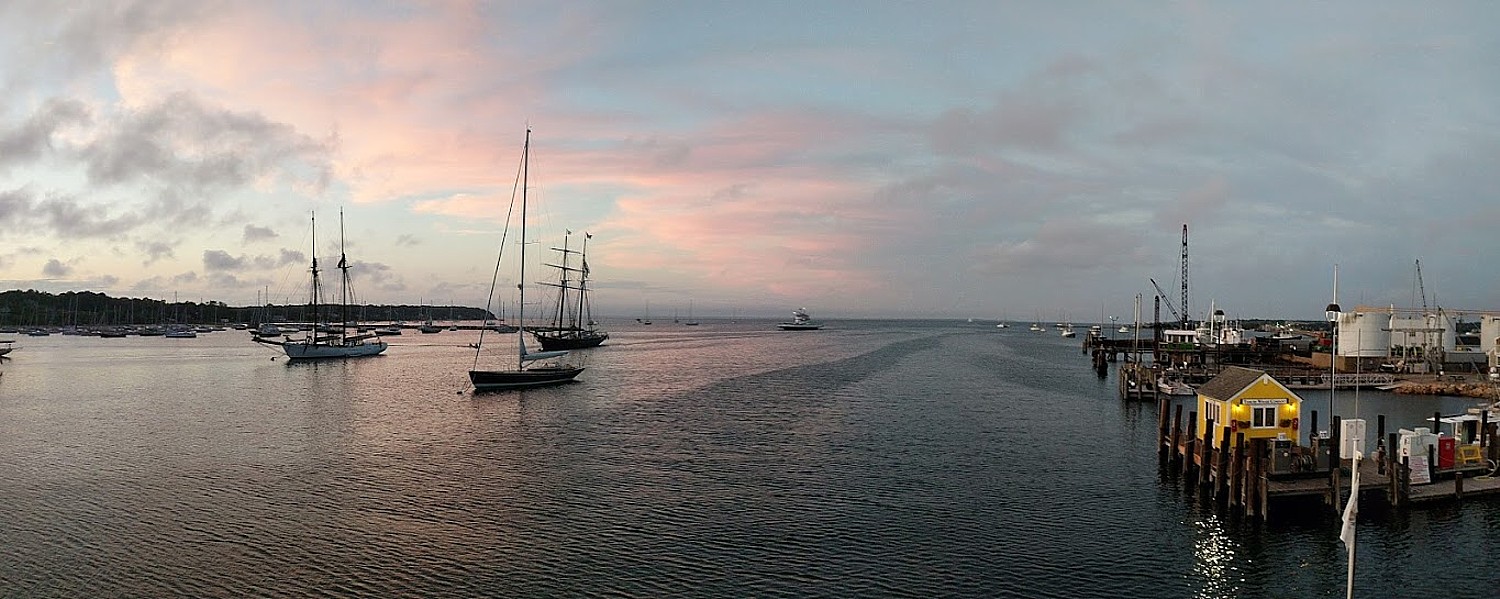
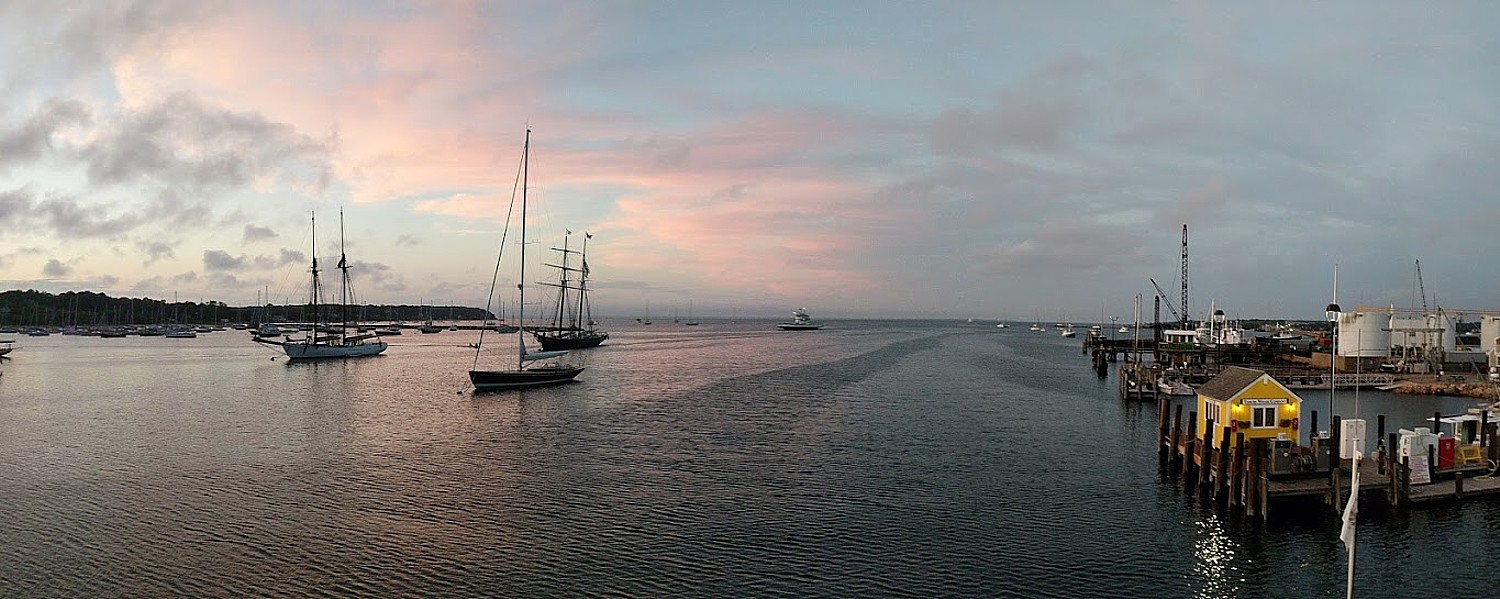
Viewing the sunset over Vineyard Haven, Martha’s Vineyard from the bow of Blount Small Ship Adventures’ Grand Caribe © Karen Rubin/goingplacesfarandnear.com

by Karen Rubin

Travel Features Syndicate, goingplacesfarandnear.com


What I love most about Martha’s Vineyard, Massachusetts, is that this single island, just 100 square miles, holds such diversity of culture, heritage, ecology. You can find a place on this island to suit whatever mood or craving you have – Edgartown’s austere conformity; Oak Bluffs’ color and whimsy; Vineyard Haven’s seagoing tradition; Wampanoag Indian reservation; fishing villages, beaches, nature preserves, lighthouses, farms. Go a few miles and it’s like crossing a border to another state or state of mind.
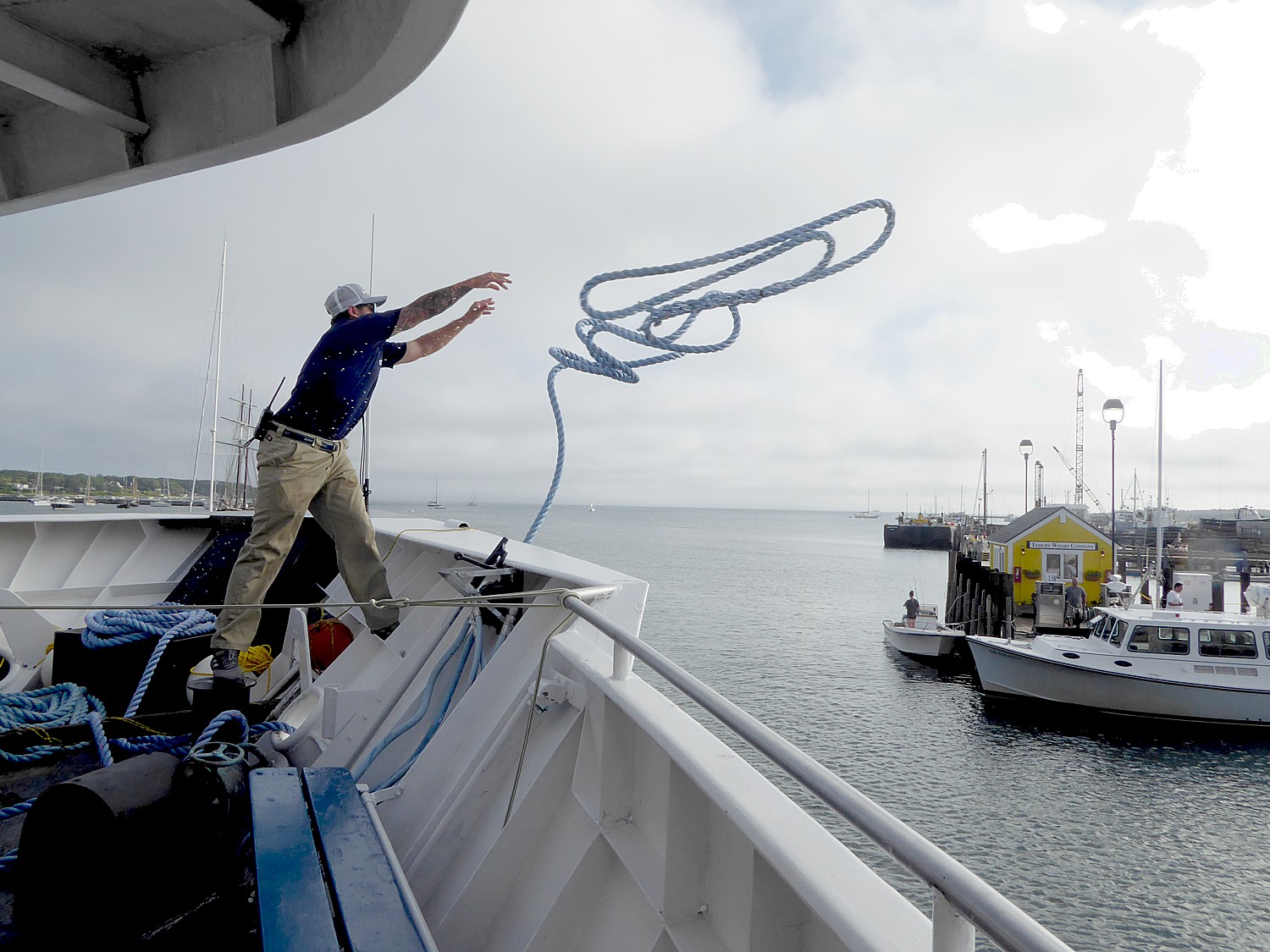
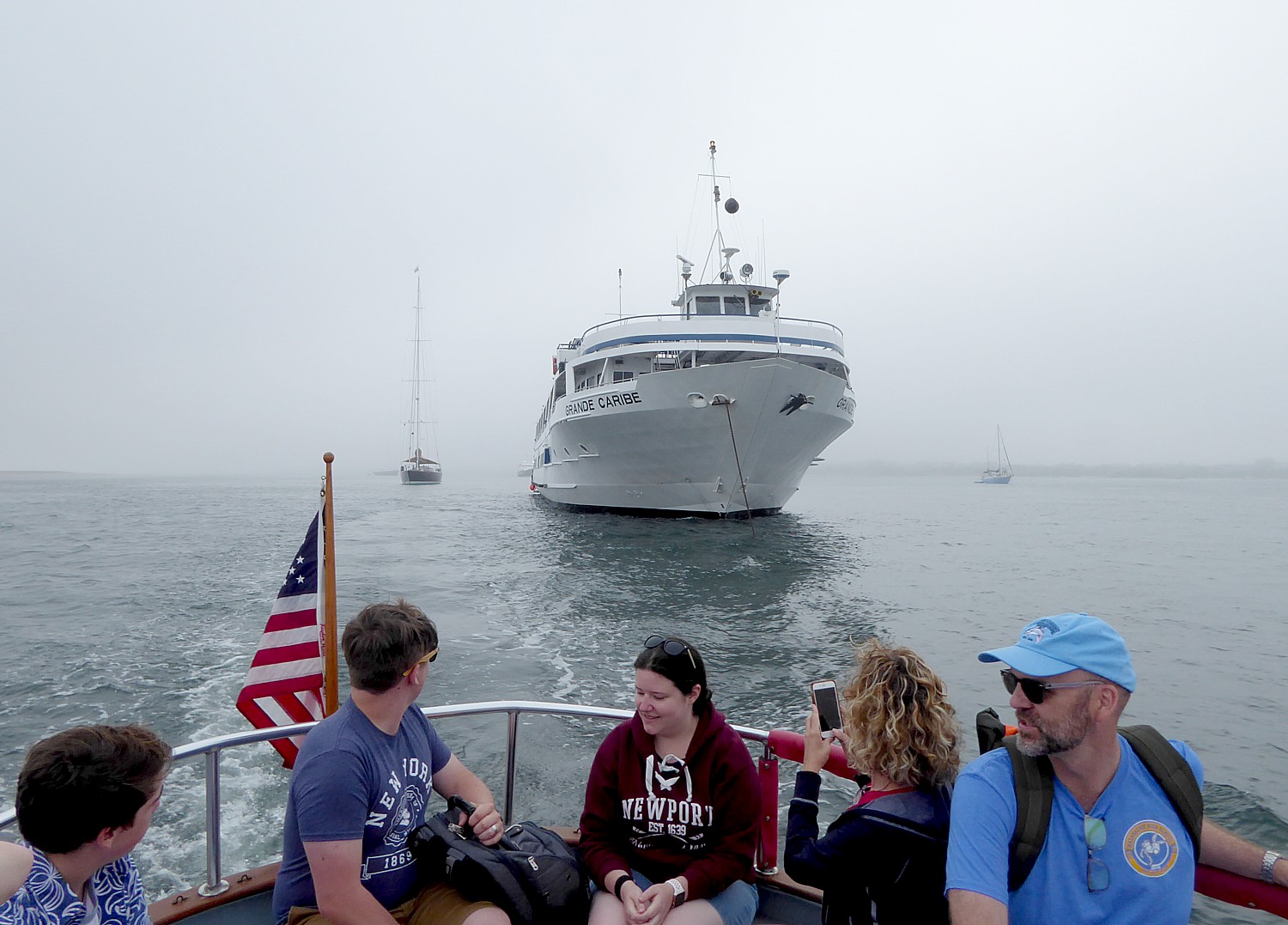
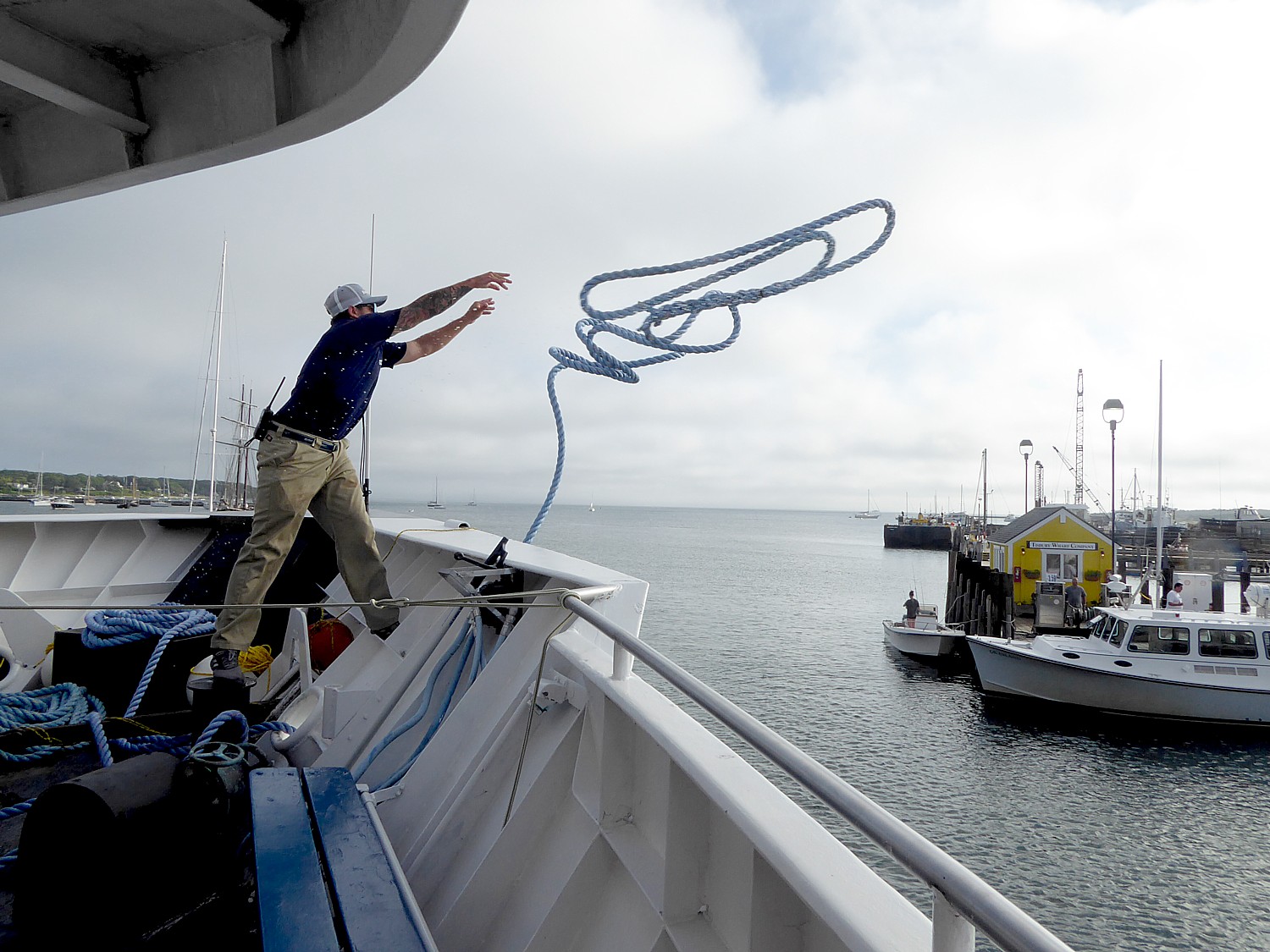
Tossing out the line to dock at Martha’s Vineyard © Karen Rubin/ goingplacesfarandnear.com

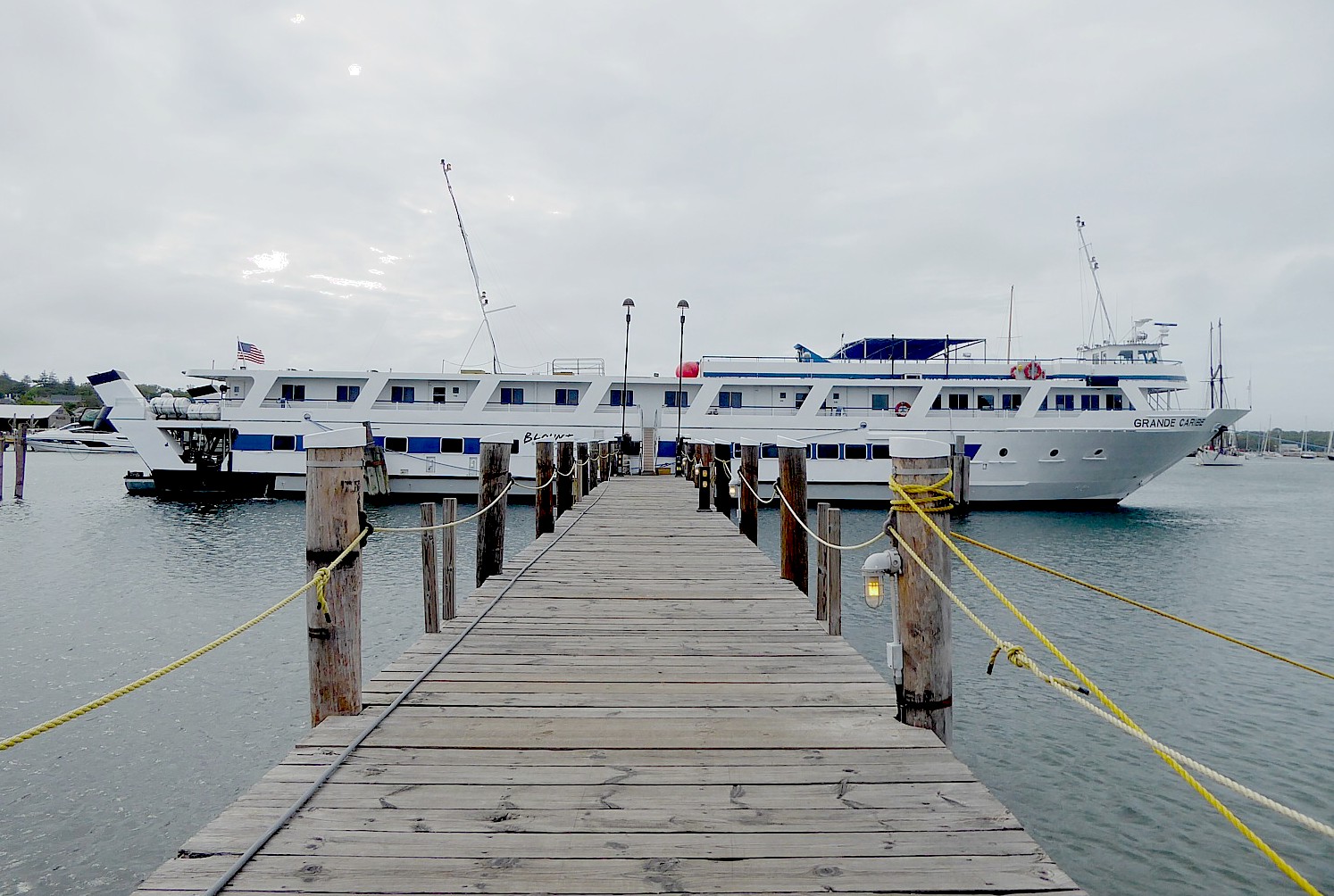
We arrive after a two-hour sail from New Bedford aboard Blount Small Ship Adventures’ Grande Caribe at 7:30 in the morning. I watch with great admiration how Captain Patrick Moynihan maneuvers us into the Tisbury Marina in Vineyard Haven, where billionaires have their yachts (our 84-passenger ship is about the size of the more ambitious of them), swinging us around so we are perpendicular to the pier. The first mate throws out a line to lasso the pylon.

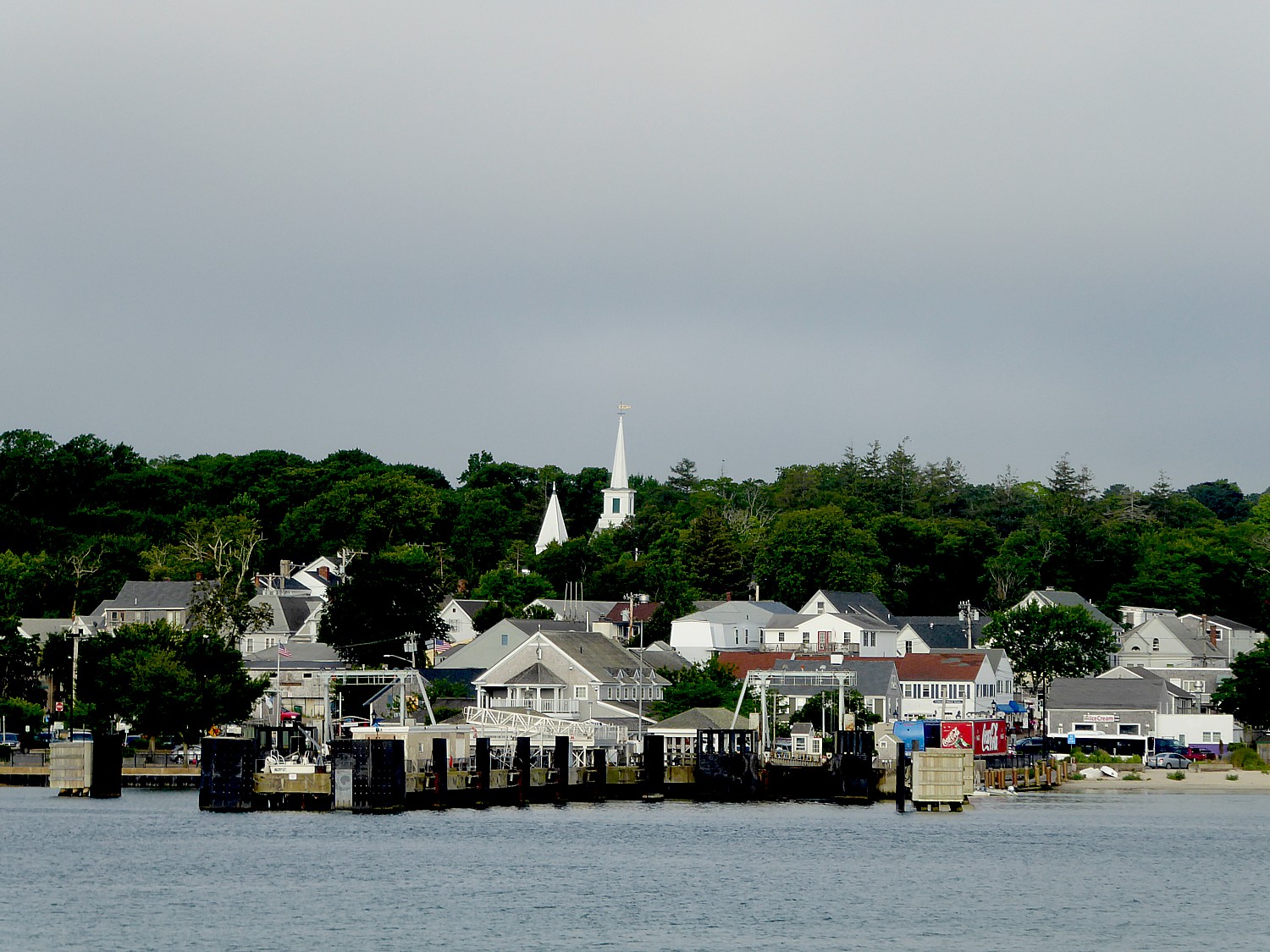
Across the way, we can see where the big ferries come in from Falmouth, Hyannis, Nantucket, New Bedford, MA; Quonset Point, RI and New York.
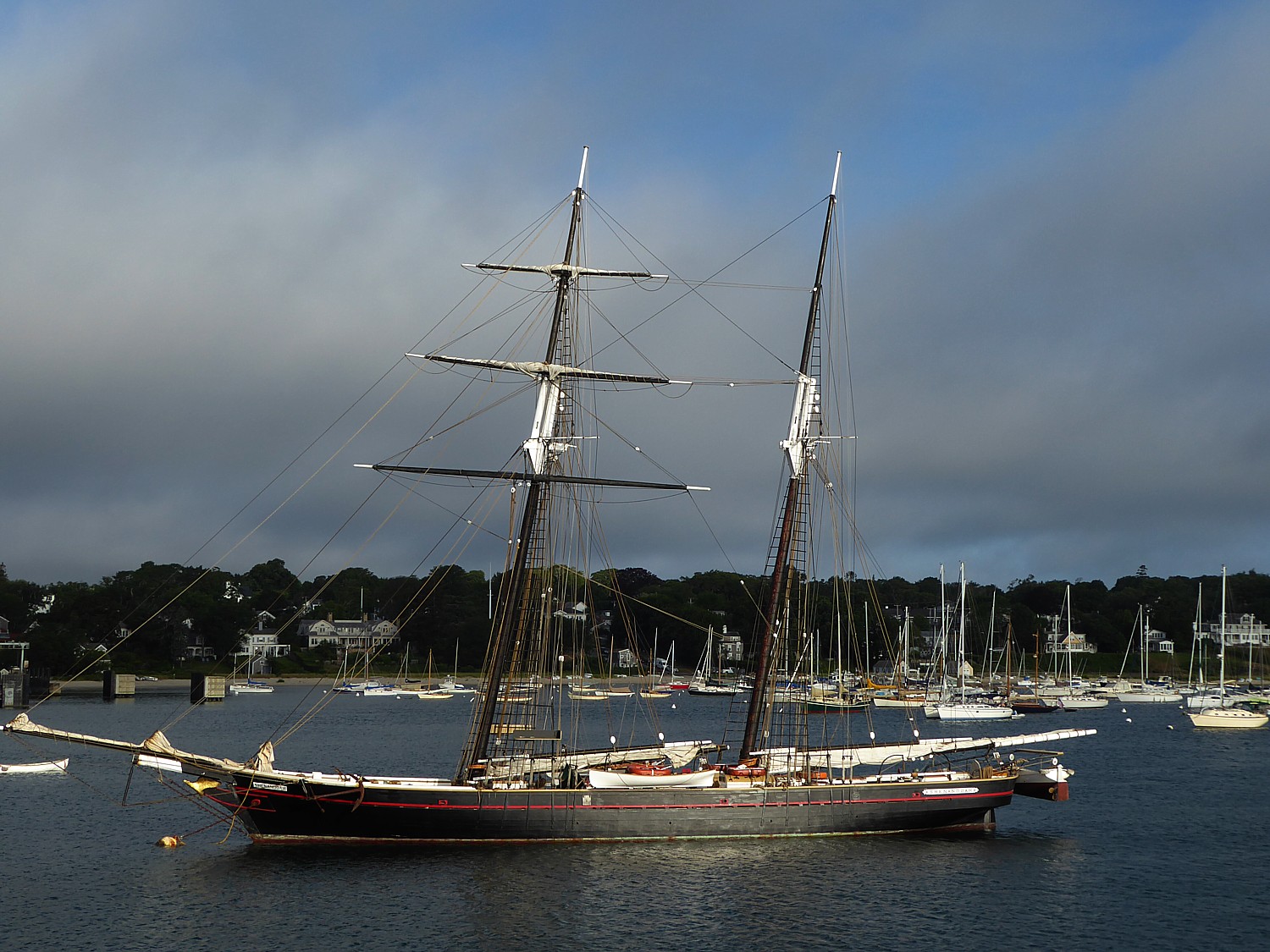
The tall ship, Shenandoah, moored in Vineyard Haven, Martha’s Vineyard © Karen Rubin/goingplacesfarandnear.com

We see historic sailing vessels, like the tall ship Shenandoah, that add to the ambiance. Docked at the marina, we can go on and off the ship at will.It’s our third day of our New England Islands cruise – an itinerary that had to be completely rearranged because of storms at sea.

The best way to experience Martha’s Vineyard if you only have a day and especially if there are mobility issues is with an island tour. I am traveling with my brother who has some difficulty walking. We are recommended to Oak Bluffs Wharf & Land Company’s island tour, and we recommend it for both its length and scope. You come away feeling you really know Martha’s Vineyard from end to end, and more significantly, its people.

The tour company operates out of the Dockside Inn, an absolutely charming place a short walk from the ferry terminal; the inn (which I take note of for a return visit) and the tour company are both owned by John Tiernan (9 Circuit Avenue Ext., Oak Bluffs, MA, 508-684-8595, www.DocksideInnMV.com)

We hail an Uber and arrive at the charming inn in plenty of time to enjoy rocking in a wicker chair on the porch and watching the world go by (at least the people coming and going from the ferry) before we start the tour.

In the course of 2 ½ hours (more like 3) we get to visit all six of the island’s towns and go as far as Aguinnah and the Gay Head Cliffs.

Our guide, Linda, has lived on Martha’s Vineyard for 25 years but says her teenage grandkids still refer to her as a “washashore.” She is vivacious and interesting, as she drives the van and narrates about the points of interest, but also, gives us a real feeling for the people who live here and have been drawn here since the first European settlers arrived in 1642.
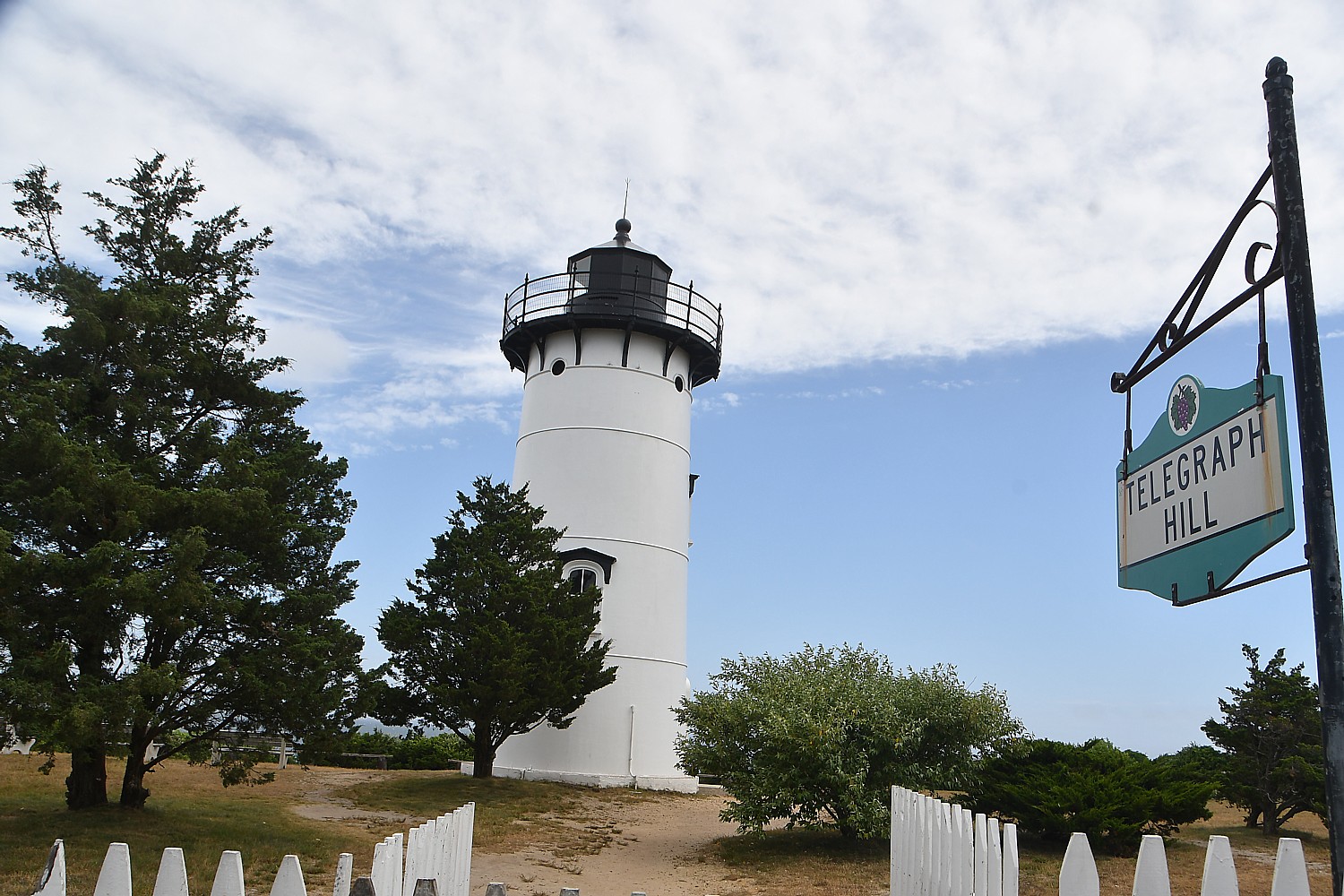
East Chop Lighthouse on Telegraph Hill © Karen Rubin/goingplacesfarandnear.com

Martha’s Vineyard is home to some 17,000 people year-round (I envy them); the population swells to 100,000 in summer. Traffic at the five-corners intersection (there are only two traffic lights on the island and these are on the bridges; no parking meters, neon signs, or billboards either) becomes a dance and a test of neighborly good will.

I could definitely live here. I’d be right at home among all the writers, journalists, musicians, artists, political people – the diversity of their backgrounds is laudable:

There’s Gloria Swanson’s house given to her by Joseph Kennedy. At West Chop, she ticks off prominent people who lived here (I note the media people and writers); Mike Wallace, Walter Cronkite, Lillian Hellman, Carly Simon. She points to where Charles Lindbergh and wife came for respite after their baby was kidnapped and killed; where John Kerry just bought property; She clicks off names of people who live in the area: Diane Sawyer (“Chip Chop” house); Mia Farrow; Katherine Graham (Washington Post), Beverly Sills; here’s where Princess Diana stayed here while divorcing; here’s a horse farm that was owned by James Cagney (still in his family); and here’s Lambert’s Cove, where Carly Simon is a regular (she always stops to ask for directions).

Michael J Fox had a home in Aquinnah, even named his daughter Aquinnah; Jackie Kennedy Onassis bought 400-acre spread, now owned by Caroline Kennedy Schlossberg and Obama, who had regularly vacationed on Martha’s Vineyard during his presidency, just bought a piece of it. Driving through Chilmark, Bob Villa (“This Old House); author David McCullough (“John Adams”), Judi Blum, Susan Bronck, Philip Craig, Tom Clancy, Geraldine Brooks, and Jim Belushi; in Oak Bluffs, Harvard Professor Henry Louis Gates Jr. (PBS “Finding Your Roots”), Obama adviser Valerie Jarrett.

It’s the atmosphere, the vibe, the ingrained culture of this place that makes it so accepting, so comfortable. I see it, feel it myself as I walk about.

It starts with Martha’s Vineyard’s early European settlement – not the Puritans who settled Plymouth, but Quakers who were more tolerant and respectful of the Wampanoag Indians and later the Cape Verdeans who were recruited to whaling, and still later African Americans and Jews who were barred elsewhere.
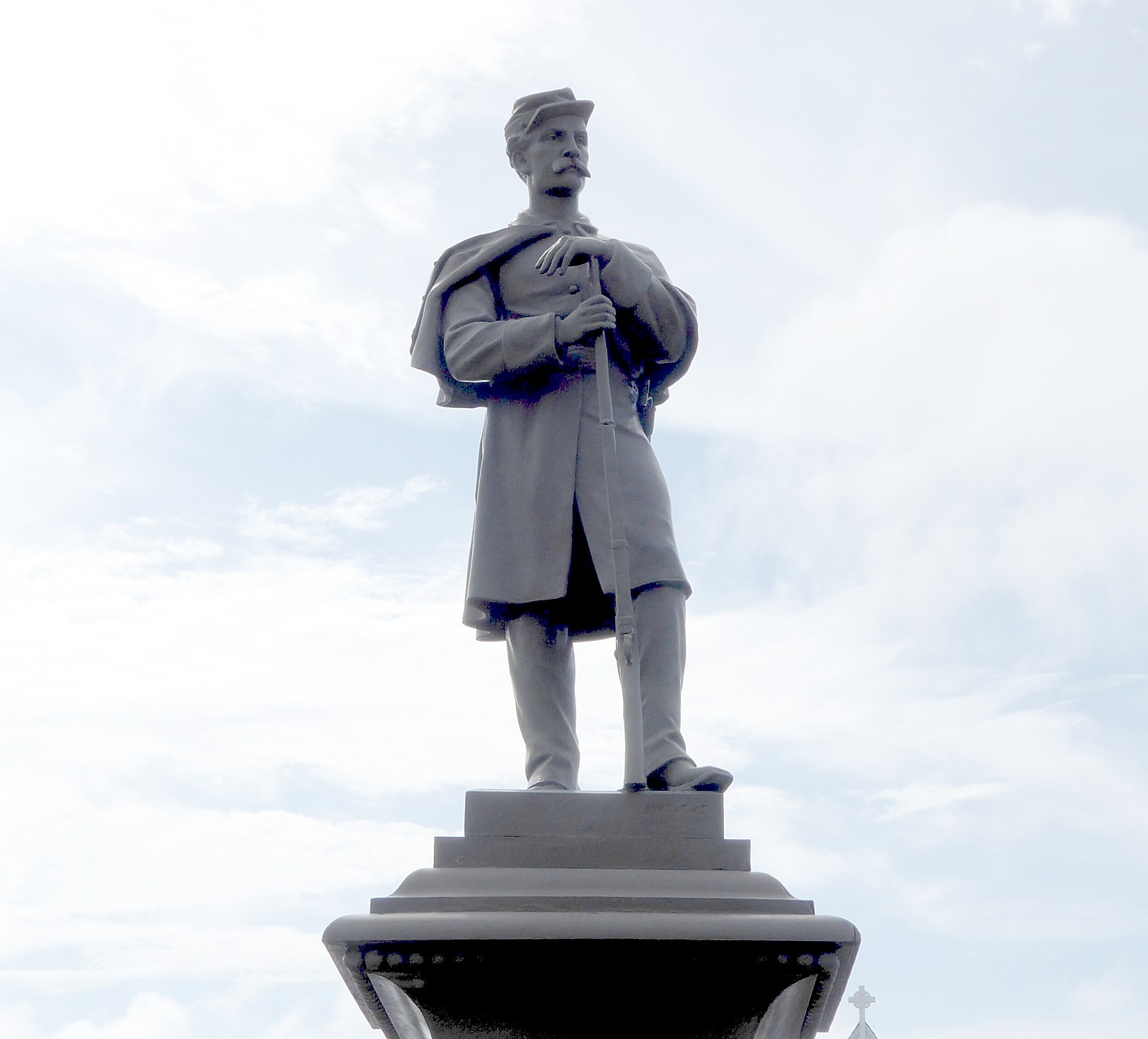
Soldiers’ Memorial Fountain, Oak Bluffs, erected in 1891 by MV Herald newspaper editor Charles Strahan, an ex-Confederate soldier, to honor local Union veterans © Karen Rubin/goingplacesfarandnear.com

It is most emblematic for me when I come upon the statue of a Union soldier in Ocean Park. Soldiers’ Memorial Fountain was dedicated in 1891 by Martha’s Vineyard Herald editor Charles Strahan, who had served in a Virginia regiment of the Confederate Army. He wanted to express gratitude and remorse in his adopted home and erected the statue in honor of local Union veterans. Then, in 1925, residents reciprocated by adding a tablet in recognition of Confederate soldiers. The statue, with a fountain-fed water trough for horses, originally stood at the foot of Circuit Avenue; it was restored in 2001 and rededicated at this site on its 110th anniversary. It is one of the few expressions of reconciliation after the Civil War that I have ever found.

Linda notes that Martha’s Vineyard has a rich African American history; a heritage trail through the island has 20 sites, including the Shearer Cottages, an inn to accommodate African American visitors, which was started by Charles Shearer, a freed slave who came to the Vineyard and started a laundry service, which is still run by his great granddaughter Doris Jackson. There is also Adam Clayton Powell Jr.’s  house. And, Linda later points out when we are in Aquinnah, “The first African American woman to own her own property. Rebecca Amos, was a former slave married to Wampanoag, and when her husband died, she acquired his home.”

Inkwell Beach, the town beach in Oak Bluffs, Linda notes, was the first beach to be integrated. Indeed, when I return on my own, as I look around at the gatherings of people, you see genuine integration, not just neighbors –as in the historic Methodist camp meeting grounds – but in gatherings of friends and multi-racial families along the beach, the promenade, the main street, sitting on a bench at the Union Chapel.

As we travel in the comfortable van, Linda relates the island’s history:

Martha’s Vineyard was visited by Scandinavians as long ago as 1000 AD, naming it Vineland. The Italian explorer Verrazano sighted the island in 1524. But the most significant explorer was Bartholomew Gosnold of Falmouth, England, who in 1602 sailed into the Elizabeth Islands (he named), naming Cape Cod, and Martha’s Vineyard (named for his mother-in-law who financed the voyage).

In October 1641 Thomas Mayhew, an English merchant and settler of Watertown, Massachusetts, bought Martha’s Vineyard, Nantucket and Elizabeth Islands for 40 pounds from Lord Stirling and Sir Ferdinando Gorges, who had been granted ownership by the English Crown. Mayhew, who made himself governor for life, sent his son, Thomas Jr. with a few families to settle the island; Thomas required that the settlers purchase their land from the natives and from all accounts, treated the Wampanoag fairly and with respect. (This is likely why Martha’s Vineyard did not suffer the same violence as Plymouth did in the bloody King Philip’s War, 1675–76, in which native Americans made a final stab at forcing English settlers out of New England). “The diverse peoples lived in peace and the island also became a haven for people of color, those of African and Cape Verdean descent.”

Mayhew sent his son, Thomas Mayhew Jr., a missionary, “to ‘take savage out of natives’ so they would be more forthcoming with land (to sell to settlers),” Linda relates. Mayhew learned to speak Algonquin from an Indian man named Hiacoomes. Mayhew was Quaker, who believed in the “inner light” and that it was not necessary to believe in Jesus (as I subsequently learn in Nantucket). The converted Indians settled in their own village, “Christiantown”, where could live separately. They had their own meeting house and cemetery where Christianized natives were buried.

“Many natives died of disease but not the Christian ones, so they were more amenable to conversion,” Linda says.

Still, their numbers suffered after European settlement: in 1642, there were 3,000 Wampanoag; by 1764, their numbers had dwindled to just 300.

We pass an indigenous great white oak tree simply called “The Oldest Tree”, which is 400 years old (Alfred Eisenstadt took a famous photo of the tree).

Linda points to a dirt road named Tea Lane, the oldest road to the ocean. “Martha’s Vineyard had its own Tea Party – smuggled tea, buried it. Later, during Prohibition, they smuggled rum, and in 1970s, smuggled marijuana.”

We drive into Menemsha, a working fishing village (scenes from “Jaws” were filmed here and the Harrison Ford movie version of “Sabrina” used a charming cottage. Linda, who mentions that she is the daughter of a lobsterman, says it is popular for people to buy a fresh fish dinner and watch the sunset.

As we come into Aquinnah, where the Wampanoag reservation still exists, and where most of the remaining native population live, Linda relates how the whaling captains, knowing of the natives’ prowess harpooning whales that got beached, would try to recruit them. Herman Melville spent a lot of time talking with Amos Smalley, the first Indian to harpoon a whale single-handedly, who was very likely the model for his Queequeg character in “Moby Dick.”

Indigenous Wampanoag (“people of the first light”) have lived on Martha’s Vineyard for millennia. Nearly 1,000 are still listed on tribal rolls and, of these, 150 live in the southwestern 3,400-acre peninsula of Aquinnah, designated a reservation, and another 150 live elsewhere on the island.

The town of Aquinnah ends in cliffs once called Gay Head (because of the ‘gay’ appearance given to it by stripes of variegated clay and sand of which it is composed) and now called Clay Cliffs at Aquinnah. The one mile of exposed cliffs rise dramatically 150 feet feet above sea level.
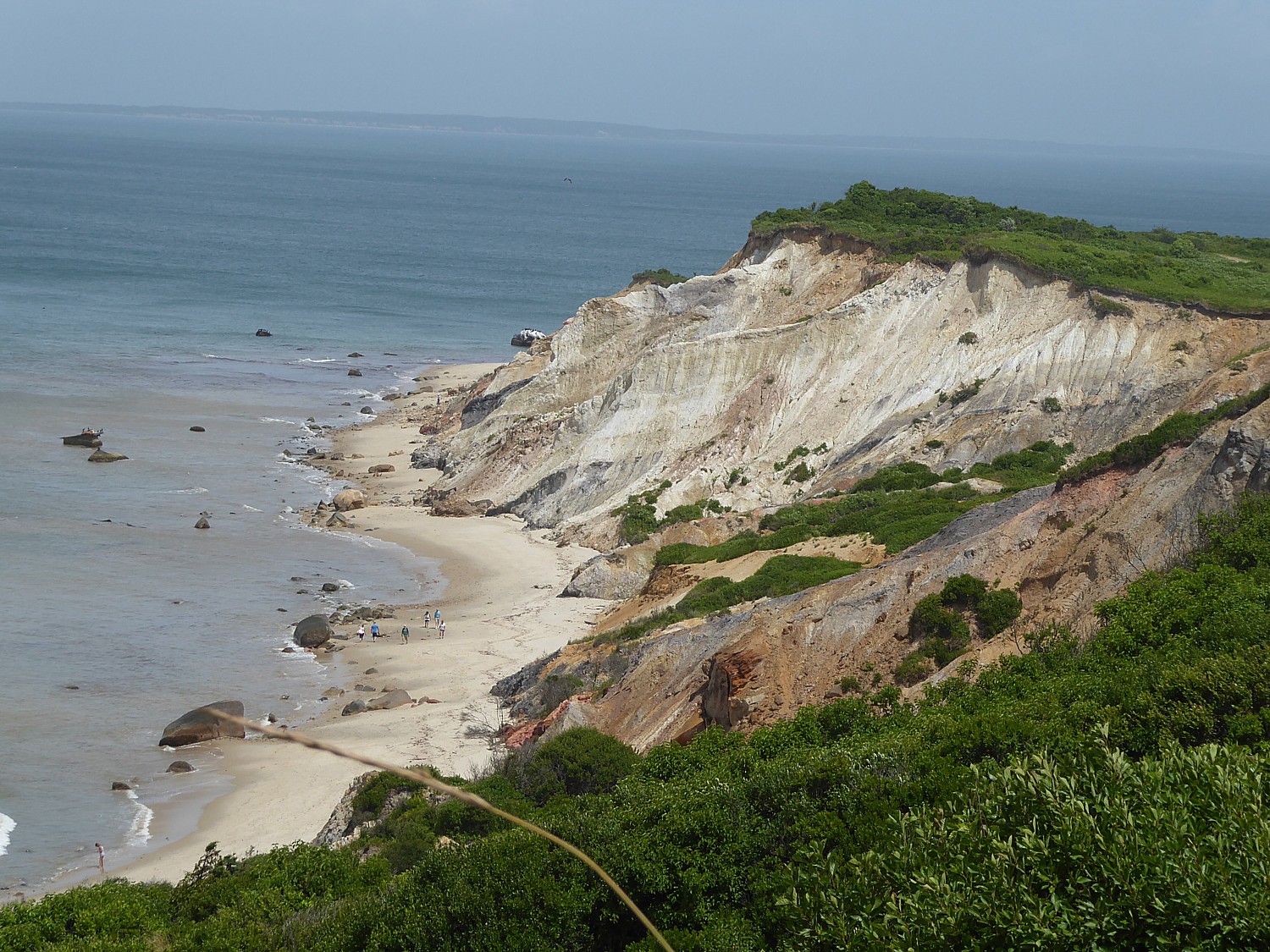
Gay Head Cliffs: the pre-glacial sedimentary formation shows a cross section of strata from the Cretaceous through Pleistocene Ages, documenting geologic phases on the continental shelf from 100 million years ago © Karen Rubin/goingplacesfarandnear.com

The pre-glacial sedimentary formation shows a cross section of strata from the Cretaceous through Pleistocene Ages, documenting geologic phases on the continental shelf from 100 million years ago. The cliffs are one of the Island’s biggest tourist attractions.  Erosion, though, has forced the island to move the lighthouse, at a cost of $2 million.

Linda stops here to let us explore for about a half hour – take in the stunning view that includes a lighthouse (that had to be moved further inland) and visit a small market that includes a shop operated by Wampanoag, the first permanent settlers of the island.
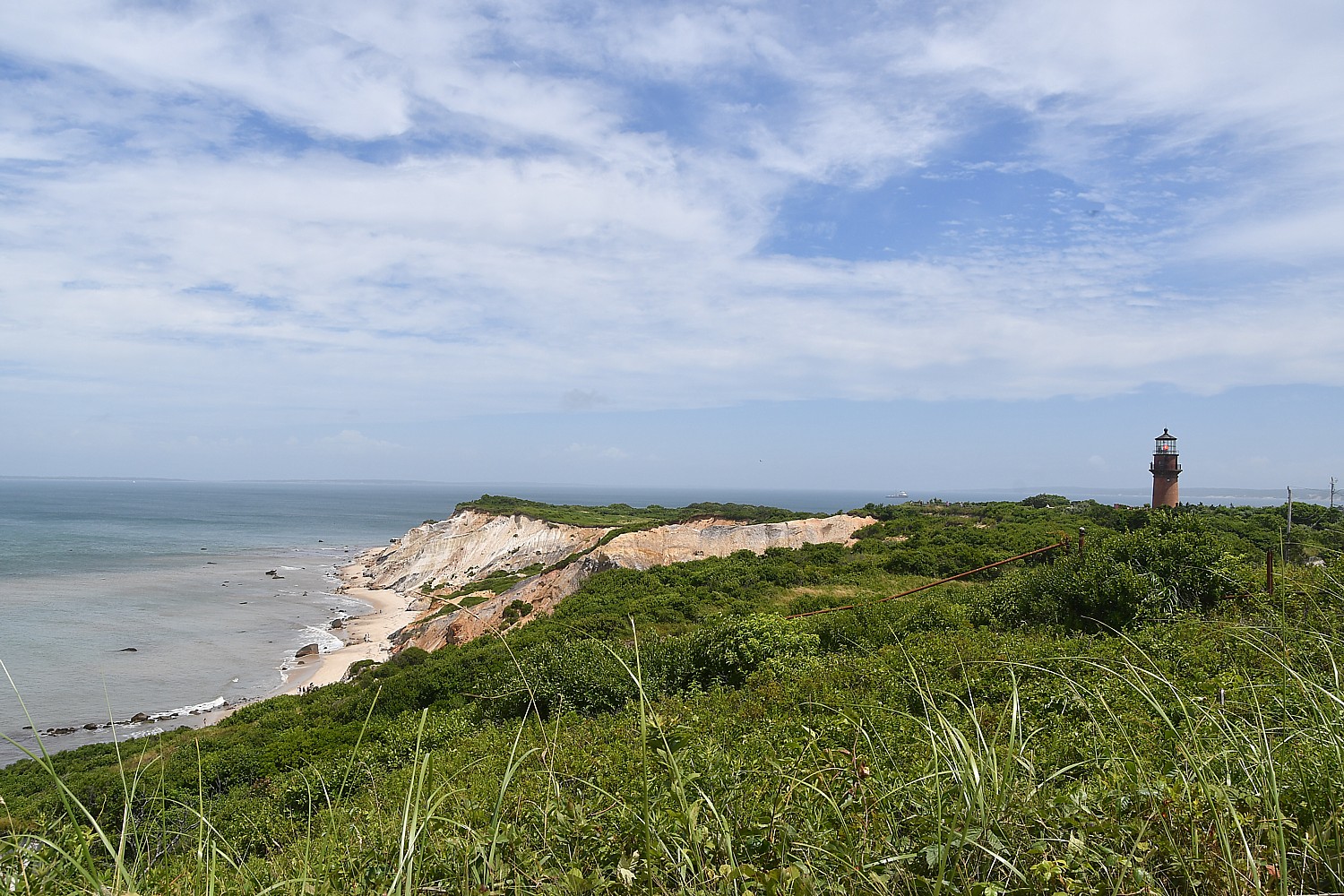
The stunning view of Gay Head Cliffs and lighthouse at Aquinnah © Karen Rubin/ goingplacesfarandnear.com

The hiking sticks (versus a cane as an assist for those who have trouble walking) really come in handy here, to make it up even the short, but pebbly slope. I meet a woman who is also using hiking sticks instead of a cane, and she confirms my theory: they provide better balance, let you stand up erect and walk more naturally, and use the upper body, relieving some pressure on the legs; added benefit: you look more like an athlete. “And I’m a nurse,” she exclaims.

You can buy wampum jewelry in one of the shops at the cliffs, where there are also food stands, and restrooms.

There also is a trail to the lighthouse and you can climb up to the light, or (with more time), hike a steep path down to water. We opt to take the short path that takes us to a fabulous view of the cliffs and the lighthouse.

There is also a relatively new Aquinnah Wampanoag Indian Museum (in what was the Vanderhoop residence, a large Wampanoag family who run a fishing charter business).
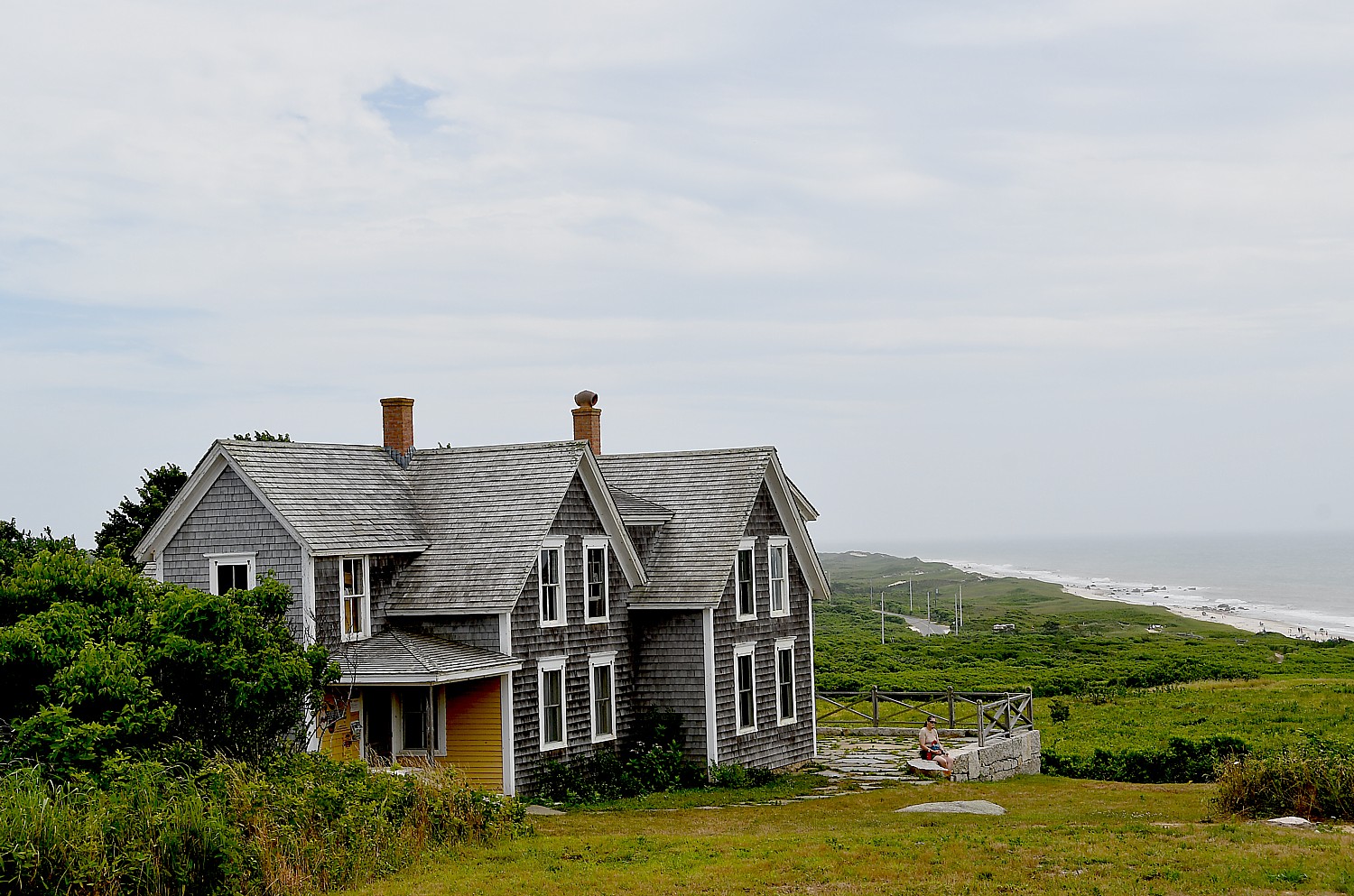
Aquinnah Wampanoag Indian Museum at the Gay Head Cliffs © Karen Rubin/ goingplacesfarandnear.com

“Jackie [Onassis who purchased 400 acres of property in Aquinnah] had to negotiate with Wampanoags for beach access from her property.”

As we drive through Chilmark, known for its sheep, Linda relates how, in September 1778, a British fleet of 40 ships sailed into Vineyard Haven harbor,  after having burned New Bedford and Fairhaven. Soldiers burned and pillaged vessels and farms.

“The British said there wouldn’t be bloodshed in Martha’s Vineyard if the settlers delivered 10,000 sheep and cattle in five days.” They had no choice but to comply, but one, where we pass the Alan Sheep Farm, hid six sheep in the basement (we see descendants of those sheep in the fields today). But the economy was decimated.
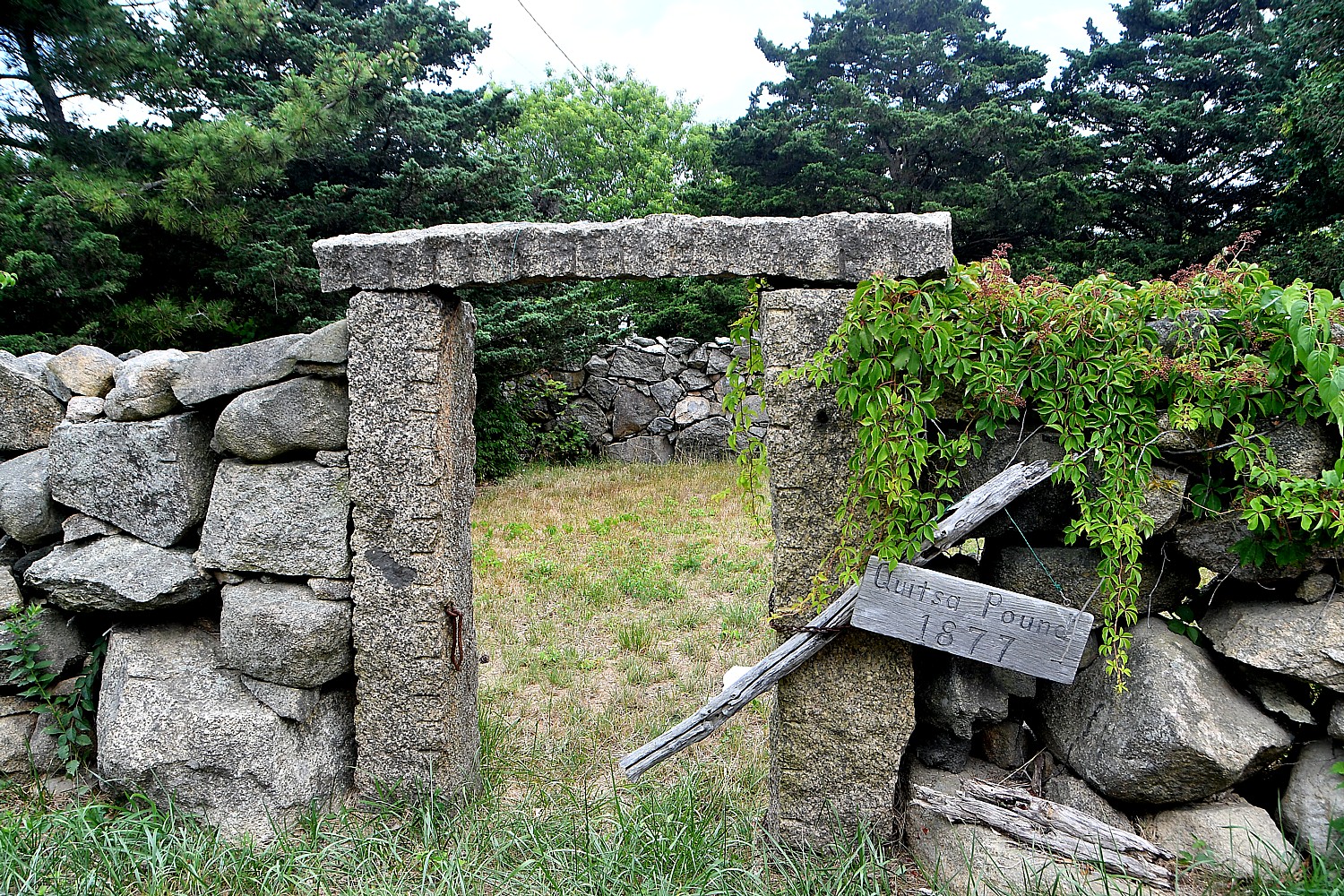
Quitsa Pound, 1877, an animal jail where stray animals would be confined until the owner paid a fine © Karen Rubin/goingplacesfarandnear.com

Linda relates one of the most interesting aspects that go to the heart of Martha’s Vineyard culture: Some early Vineyard settlers carried a gene for deafness (the first known deaf one was Jonathan Lambert, 1694), and over years of marriage, generation after generation was born with hearing loss. At one point, one in four children was born deaf. There were so many deaf people on the Vineyard (the greatest concentration in Chilmark) that they developed a sign language, Martha’s Vineyard Sign Language (MVSL), which was later incorporated with mainland signs to form American Sign Language.

Sign language was so accepted on the Vineyard that a newspaper marveled in 1895 at the way the spoken and signed languages were used by both deaf and hearing residents. People moving to Chilmark actually had to learn sign language in order to live in the community. Deafness was so common, it was never considered to be a handicap. “The intermarriages persisted and the deaf population of Chilmark and the rest of the Vineyard continued to propagate. It would have kept growing if not for the growth of deaf education on the mainland. As deaf Vineyard children attended schools off-island, they tended to settle off-island, married mainland mates, and gradually the deaf Vineyard population died out. The last deaf Vineyard native passed away in the 1950s.”

There are other aspects of Chilmark: Chilmark Chocolates, which attained national renown after Ted Danson and Mary Steenburgen presented a box to Ellen DeGeneres, is notable because the couple that own the chocolate company had a disabled son who enjoyed working in the store; now they only hire disabled.

The island also has Camp Jaberwocky. Founded in 1950 by the Lemb family it was the first overnight camp for children with cerebral palsy. “We see the kids every year. It still costs same as in 1950.” (Later I see the red bus carrying children to the camp.)
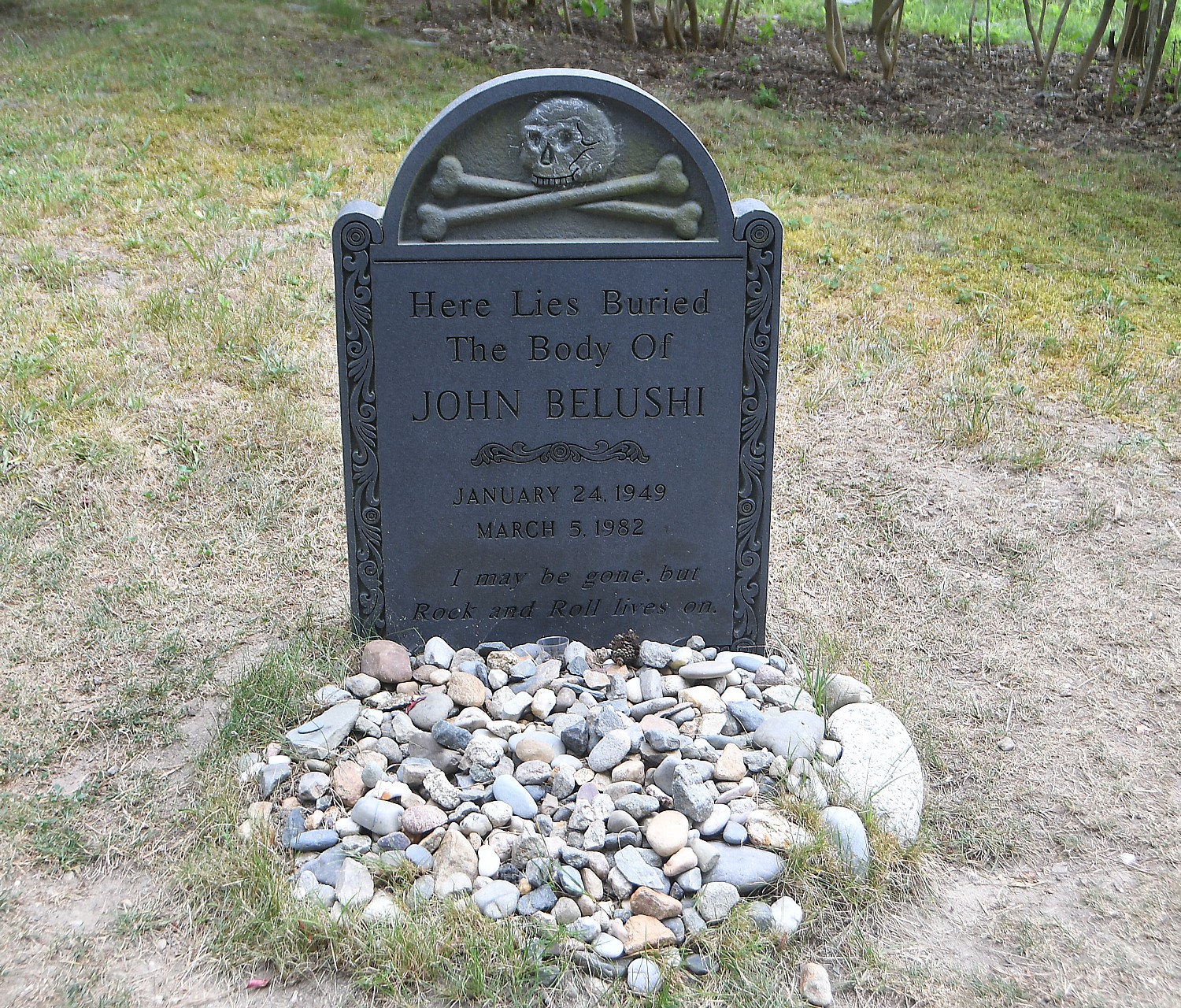
John Belushi’s grave on Martha’s Vineyard: “I may be gone, but/Rock and Roll lives on.” © Karen Rubin/goingplacesfarandnear.com

Linda stops at John Belushi’s grave where people often leave bottles of Jack Daniels and rocks – not because of the Jewish tradition, but a reference to his chosen epitaph: “I may be gone, but/Rock and Roll lives on.”

“He had said, ‘Martha’s Vineyard is the only place I can get good rest’.”

Several of the sights she points out were used in making the movie “Jaws,” (despite the setting supposedly being Nantucket). One of them is a bridge where there is a prominent sign, “No jumping,” that everyone jumps off.

Beginning in 1765, Vineyard men became engaged in whaling, but when the numbers of whales near the island were exhausted, the ships sailed further and further away, with voyages lasting three to five years. By 1850, Vineyard whaling ships were found on every ocean; there would have been 50 ships out of Edgartown at any one time.
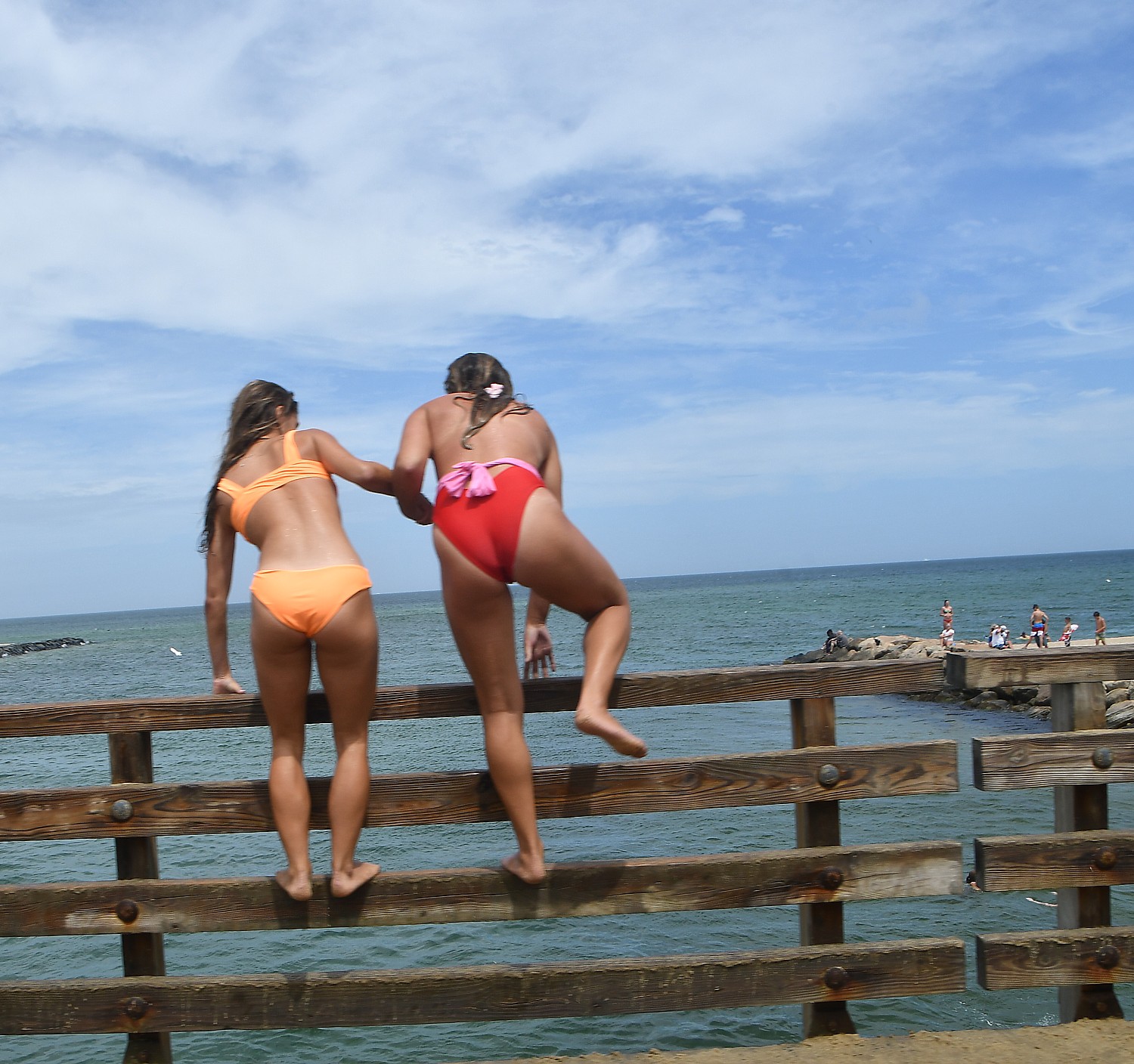
“No jumping.” Jumping off the “Jaws” bridge on Martha’s Vineyard © Karen Rubin/ goingplacesfarandnear.com

Edgartown reflects the Vineyard’s whaling tradition the most – in the many captain’s houses; the Old Whaling Church (now a performance venue); the lighthouse. There is a uniformity in Edgartown that is mandated by town code: the houses have to be white or shingled, the trim can only be black, green or navy blue.
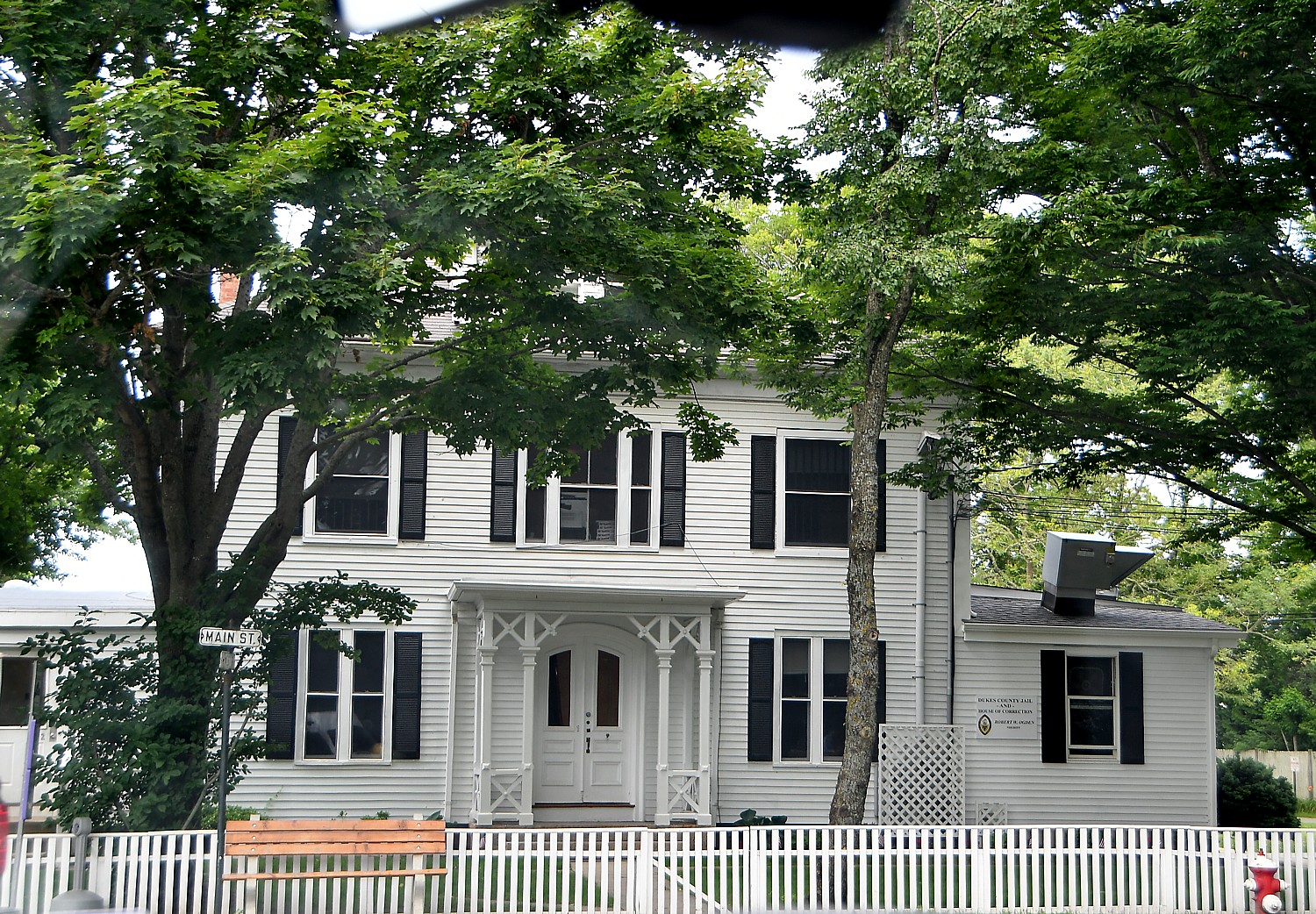
Even Duke’s County Jail and House of Correction, conforms to Edgartown’s architectural regimen © Karen Rubin/goingplacesfarandnear.com

But in the 1860s whaling collapsed – the ships had to travel further and further away, petroleum was discovered in Pennsylvania in 1859, the Civil War came and ships were blockaded – and the Vineyard had to look again for a new industry. It turned out to be tourism. For Martha’s Vineyard, that began in Oak Bluffs.

Perhaps one of the quaintest institutions on the Vineyard is the Martha’s Vineyard Camp-Meeting Association, which held its first camp-meeting in August 1835 in the Wesleyan Grove, in what is today Oak Bluffs where the Tabernacle stands.

Founded by the Methodist church, the campground began with pitched tents, then canvas on wood platforms, and then cottages that were gorgeously decorated in gingerbread patterns (like family crests, the patterns usually make a statement) and gay colors. These homes have been in their families for generations (they own the cottage, but not the land).
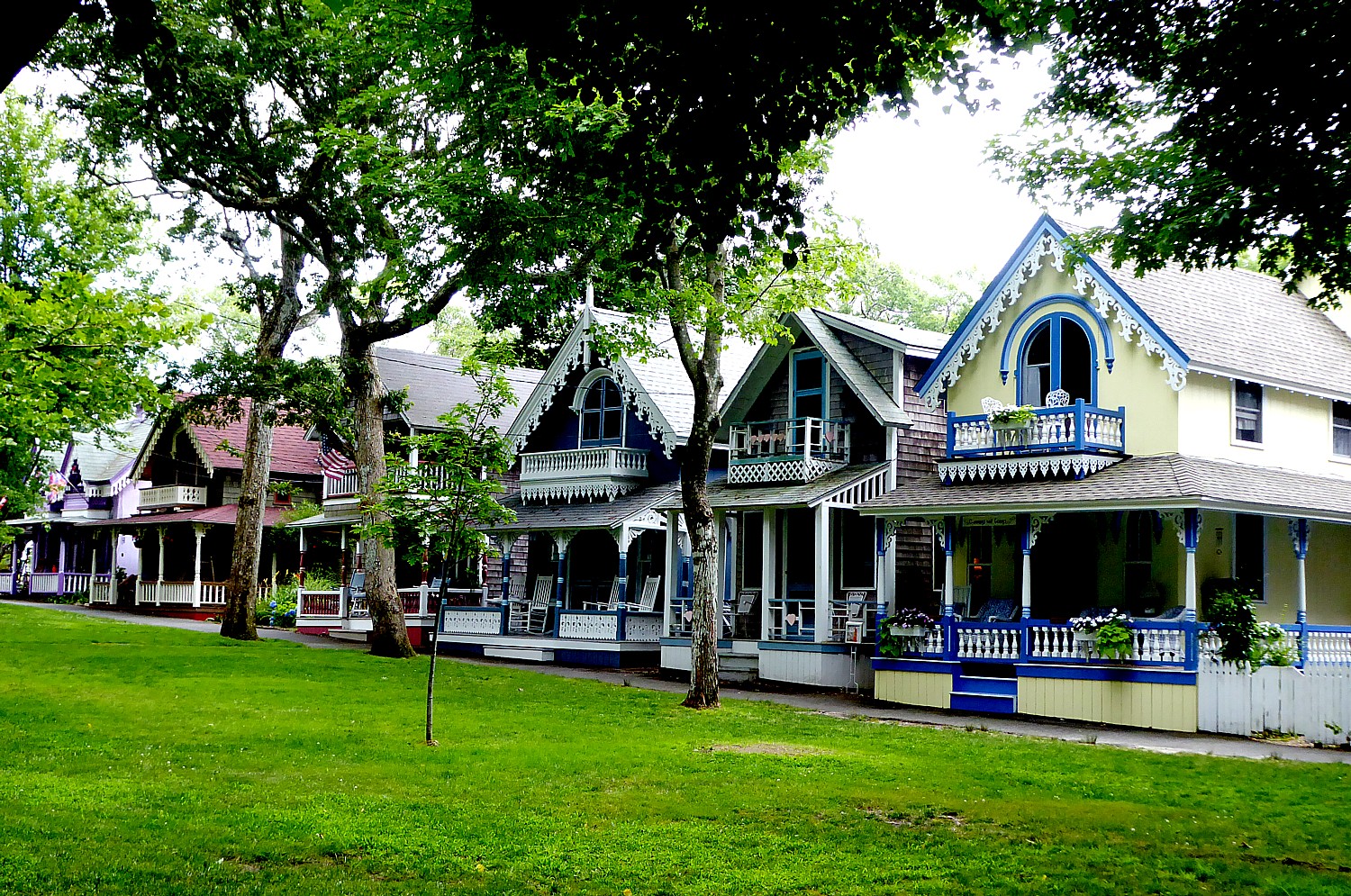
A row of charming cottages of the Camp Ground in Oak Bluffs © Karen Rubin/ goingplacesfarandnear.com

It was, in its way, the beginning of tourism, and when whaling fell apart for Edgartown, Linda says, Edgartown wanted in on Oak Bluffs’ good fortune. A railroad was built in 1874 between Oak Bluffs wharf to Edgartown, then to Katama and on to South Beach (still the best beach on the island). The railroad operated until 1897; eventually, a rail line was linked to New York (discontinued in 1917 and the rails sold to the government for iron). (Today, Martha’s Vineyard has an excellent public bus system.)

We arrive back into Oak Bluffs. Linda points out Inkwell Beach – one of the first integrated beaches in the country. “There is no discrimination here.”

Oak Bluffs, she says, is where Martin Luther King Jr. wrote some of his speeches.

Linda’s tour finishes at the Martha’s Vineyard Campmeeting Association’s Cottage Museum.

Oak Bluffs Wharf & Land Company, 9 Circuit Avenue Ext. Oak Bluffs, MA, 508-684-8595, http://vineyardhistory.com/.
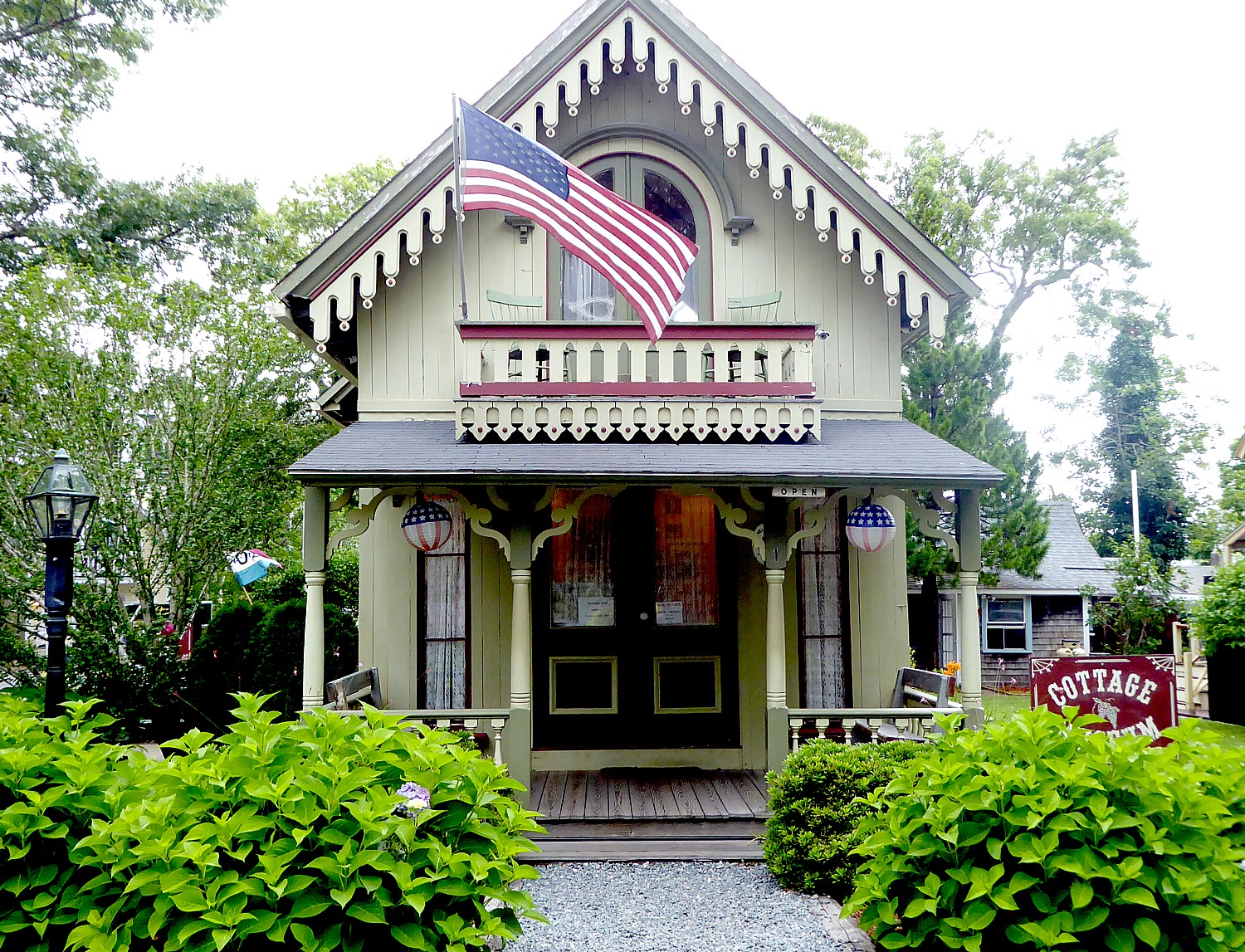
The Cottage Museum, Oak Bluffs © Karen Rubin/goingplacesfarandnear.com

A Free Day

Grand Caribe’s Captain Patrick Moynihan has reshuffled our New England Islands voyage because of a storm which would make reaching Nantucket, 30 miles out to sea, too uncomfortable (10 foot seas) if not outright dangerous. But by staying over in Martha’s Vineyard for an extra day, he expects the weather to improve so we can sail there on Friday, as our last port of call.

The unexpected second day in Martha’s Vineyard is a gift, as if you had been given all these extra hours to do anything you want.

After two active days and anticipating another active day in Nantucket, Marty opts to spend the day relaxing on the ship.
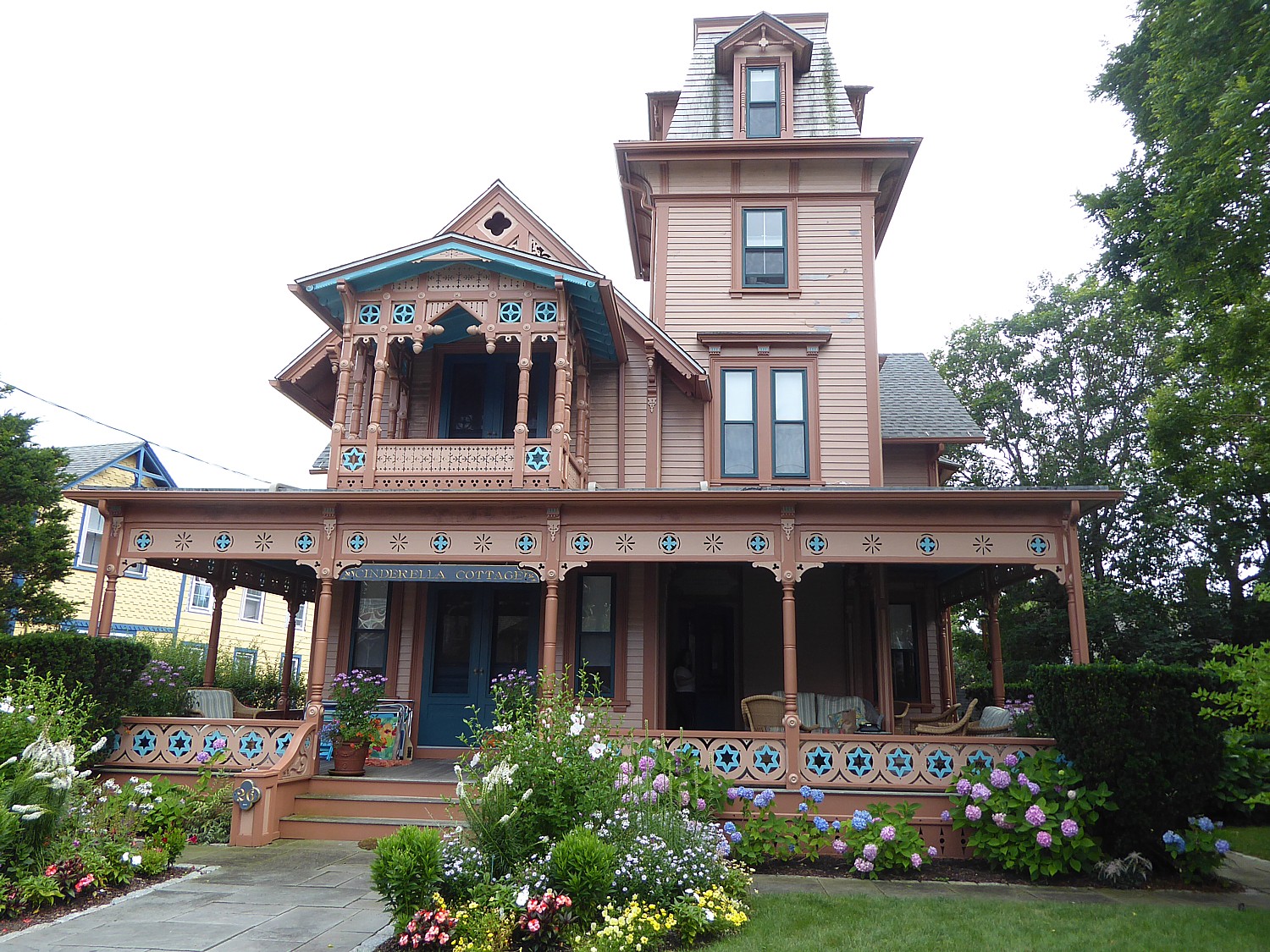
The Cinderella Cottage, one of the points on the self-guided walking tour of Oak Bluffs © Karen Rubin/goingplacesfarandnear.com

I opt to return to one of my favorite places on the planet: Oak Bluffs. I love the color, the whimsy, the vibe. I have never seen a more open, welcoming place anywhere – it isn’t a coincidence that this is where Valerie Jarrett had her summer home, or that President Obama would summer on the Vineyard here every year during his presidency, or that there are so many media stars and celebrities (many who happen to be Jewish) who had vacation homes here.
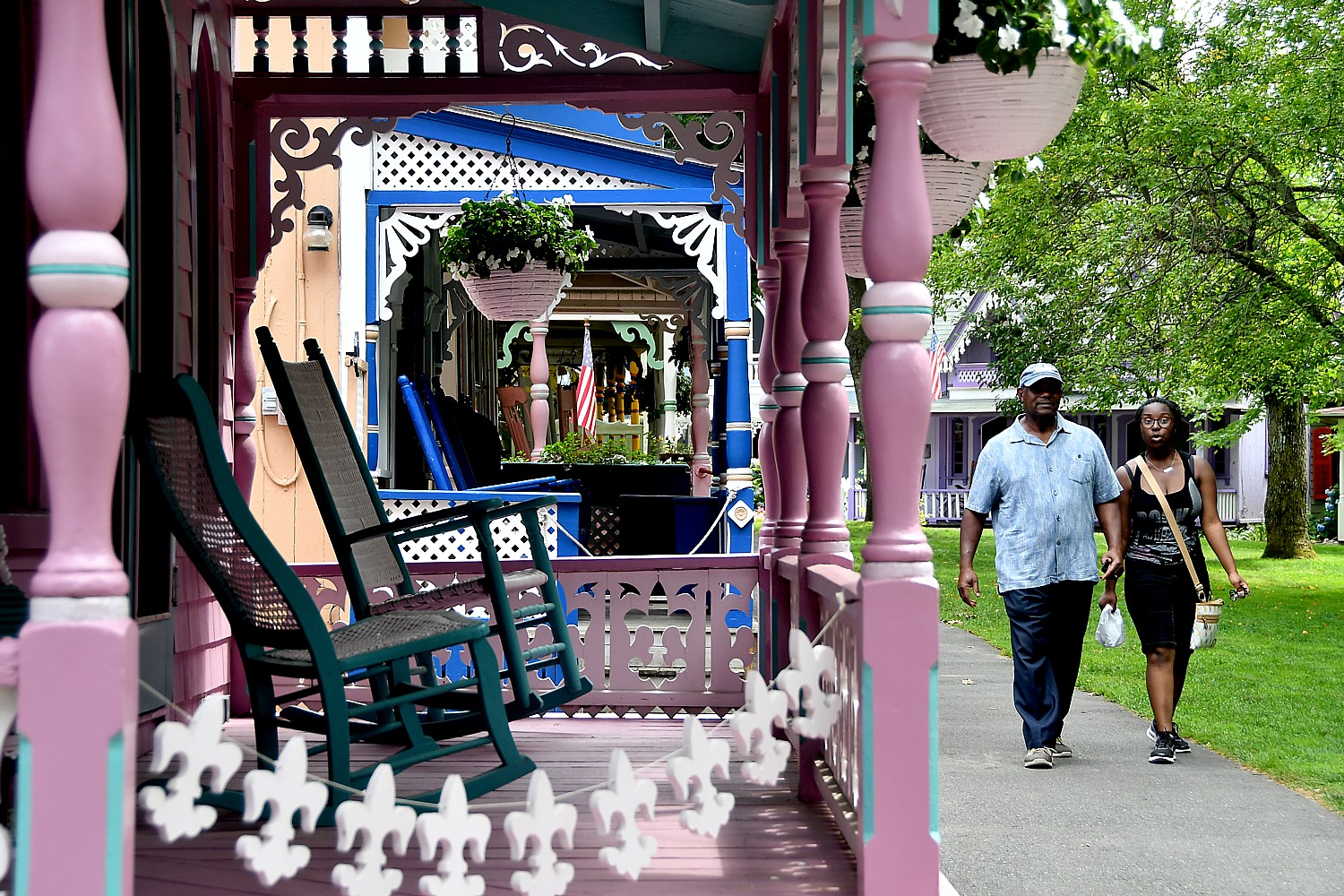
Gorgeous detail of the Victorian cottages in the Camp Ground in Oak Bluffs © Karen Rubin/goingplacesfarandnear.com

I cross the street from the marina where we are tied up at the pier, and hop the #13 bus to Oak Bluffs (it makes a loop to Edgartown).

I pick up the “Historic Walking Tour of Oak Bluffs” brochure from the information center at the bottom of Circuit Avenue, and find myself on what seems a scavenger hunt to find all the places.

I tour of the famous Campground, with all those gorgeous gingerbread cottages with names like Respite, Time Remembered, Alice’s Wonderland, and the Tabernacle, which can seat 2000 for a service.
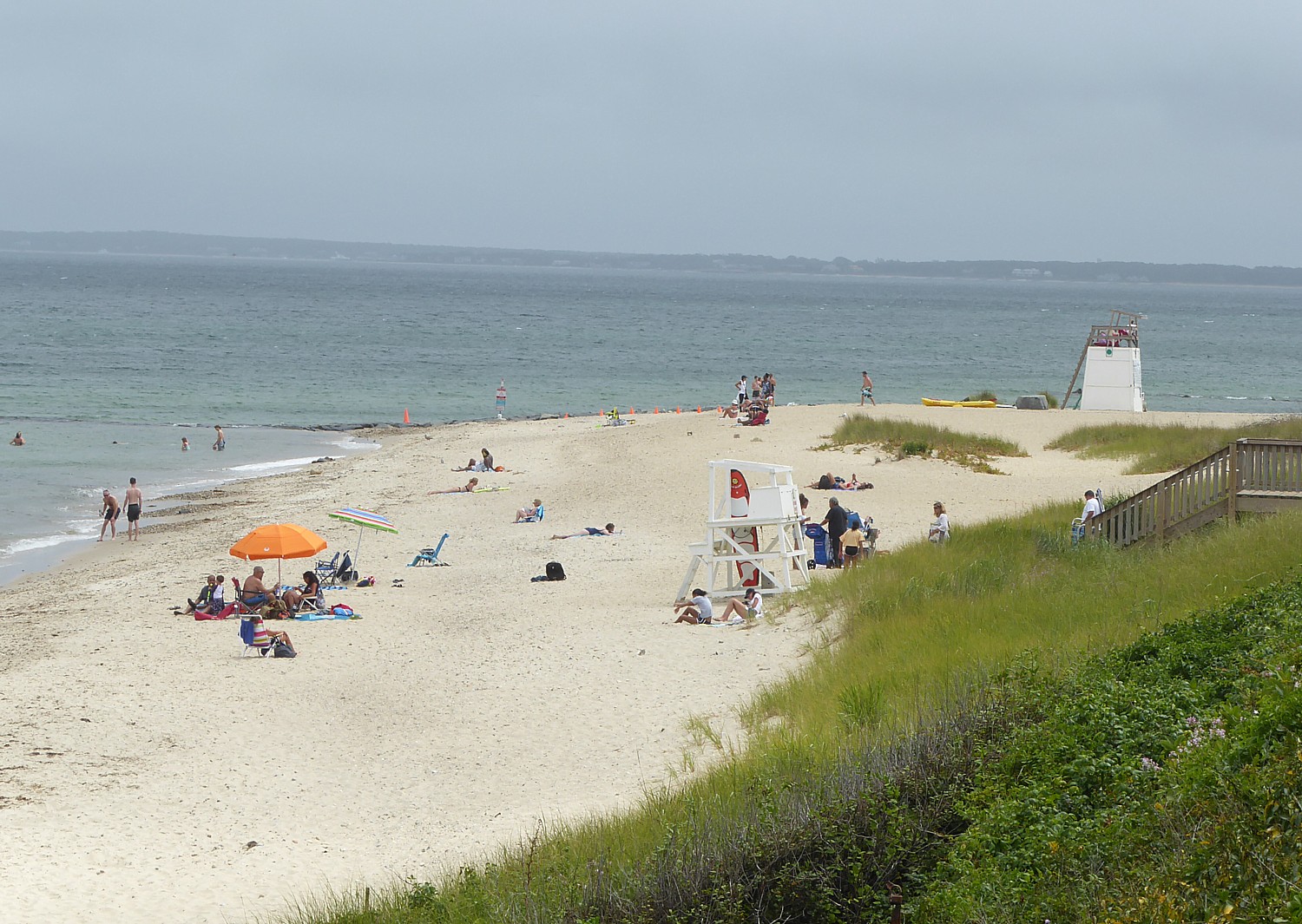
Inkwell Beach, Oak Bluffs © Karen Rubin/goingplacesfarandnear.com

I make most of the 20 sites on the map, enjoying the notes about history, architecture and people.

I enjoy wandering along the Oak Bluffs Harbor promenade, and Inkwell Beach and take in the lovely shops along Circuit Avenue.

I stop in at the Flying Horses Carousel, the nation’s oldest platform carousel (a national landmark), that was constructed in 1876 by Charles Dare, and today is one of only two Dare carousels still in existence. Originally operated as a Coney Island, NY amusement, it was moved to its red barn in Oak Bluffs in 1884, delighting generations ever since. The carousel was acquired by the Preservation Trust in 1986 to prevent it from being dismantled and sold piecemeal to collectors of antique carved horses. The Trust undertook an extensive restoration to return the carousel to its original appearance, complete with the historic panel paintings that were done by a Dare factory artist. The horses were individually restored and feature real horsehair manes and tails, and distinctive objects in their glass eyes. The 1923 Wurlitzer Band Organ plays old-timey tunes on original paper rolls. The highlight of every ride is the chance to grab the lucky Brass Ring to win a free ride.
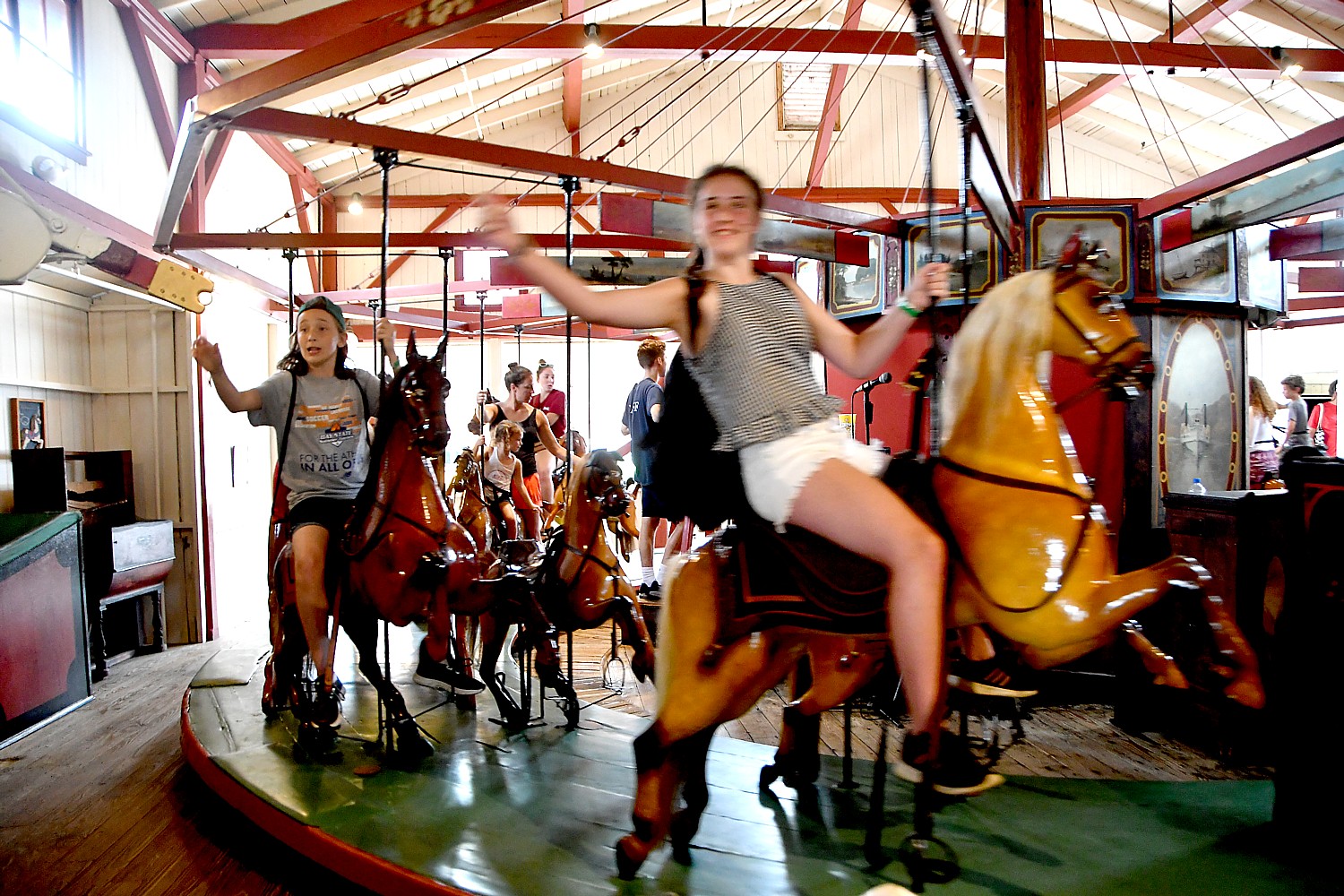
Grab for the brass ring on the Flying Horses Carousel, Oak Bluffs, the nation’s oldest platform carousel © Karen Rubin/goingplacesfarandnear.com

Flying Horses Carousel is one of 20 historic properties owned and managed by The Vineyard Trust. Among them: Alleys and The Grange in West Tisbury; The Old Whaling Church and Daniel Fisher House in Edgartown; and Union Chapel in Oak Bluffs.

I take the bus back to Vineyard Haven, getting off opposite the ferry terminal, and walk up to the village’s main street which has many charming boutiques. The local movie theater has a poster of “Jaws.”

It’s a short walk back to the ship – I pass the Benjamin & Gannon ship building and repair company – actually a small shack, but Linda had mentioned that they are very welcoming to visitors, and sure enough, am invited to look inside.
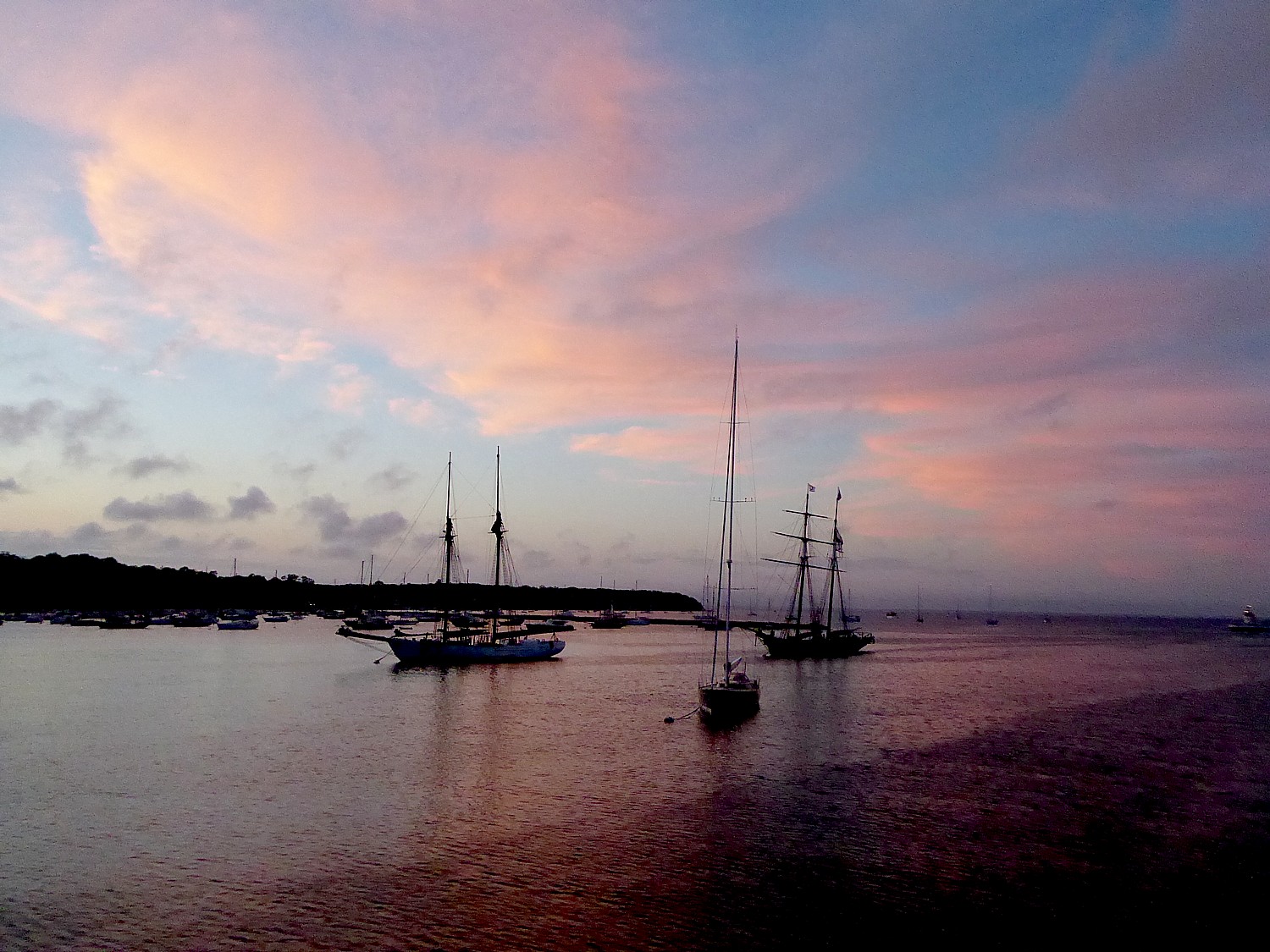
Sunset at Vineyard Haven, Martha’s Vineyard © Karen Rubin/ goingplacesfarandnear.com

There’s so much to do on Martha’s Vineyard: with more time, I would bike (the island has 44 miles of bike and multi-user paths; several of our passengers took advantage of the rental bikes on board); 19 named beaches, 125 miles of coastline, fishing piers, kayaking, canoeing, windsurfing; horseback riding; guided cycling, natural, ecological, birding, historical, ghost and aerial tours; dozens of art galleries and boutiques, potters and artisans workshops and bookstores; visit an alpaca farm; wildlife and nature preserves, reptile and bird park, sanctuaries, arboretums, reservations; take the On-Time ferry to Chappaquiddick Island to explore Cape Poge and Wasque Reservations; visit Mytoi Japanese garden; the Vineyard’s Native American Wampanoag people at the Aquinnah Cultural Center, explore the Wampanoag Way, an Aquinnah Cultural Trail; follow the African American Heritage Trail; take in a performance at Vineyard Playhouse in Vineyard Haven or at the Old Whaling Church in Edgartown; take a cooking, dance, yoga, pilates,  landscape painting class; circumnavigate the island or its surrounding waters aboard a sailboat, schooner, catamaran or motorboat; take a charter fishing or sailing excursion or lesson; attend a film, food & wine, artisans or other festival.
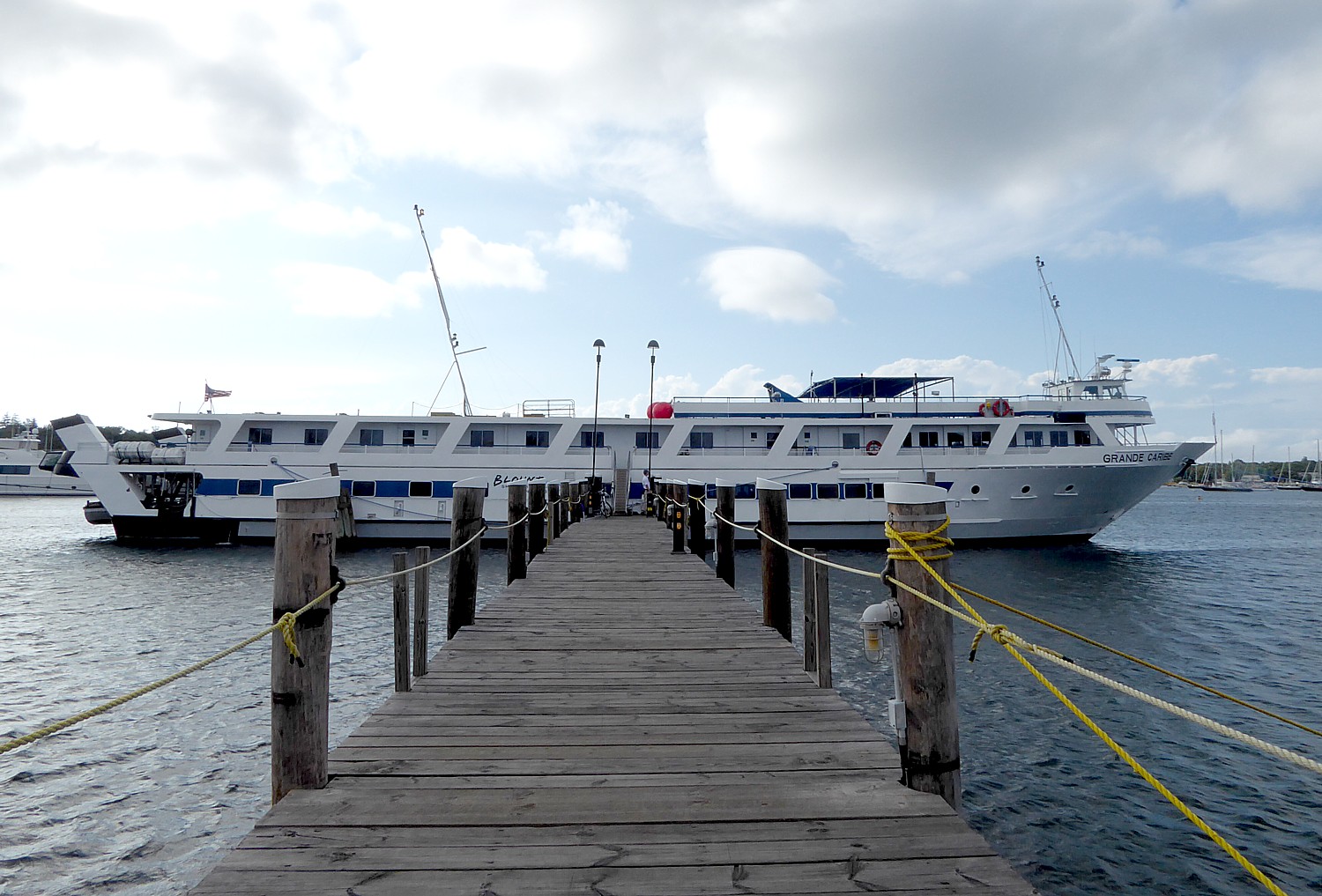
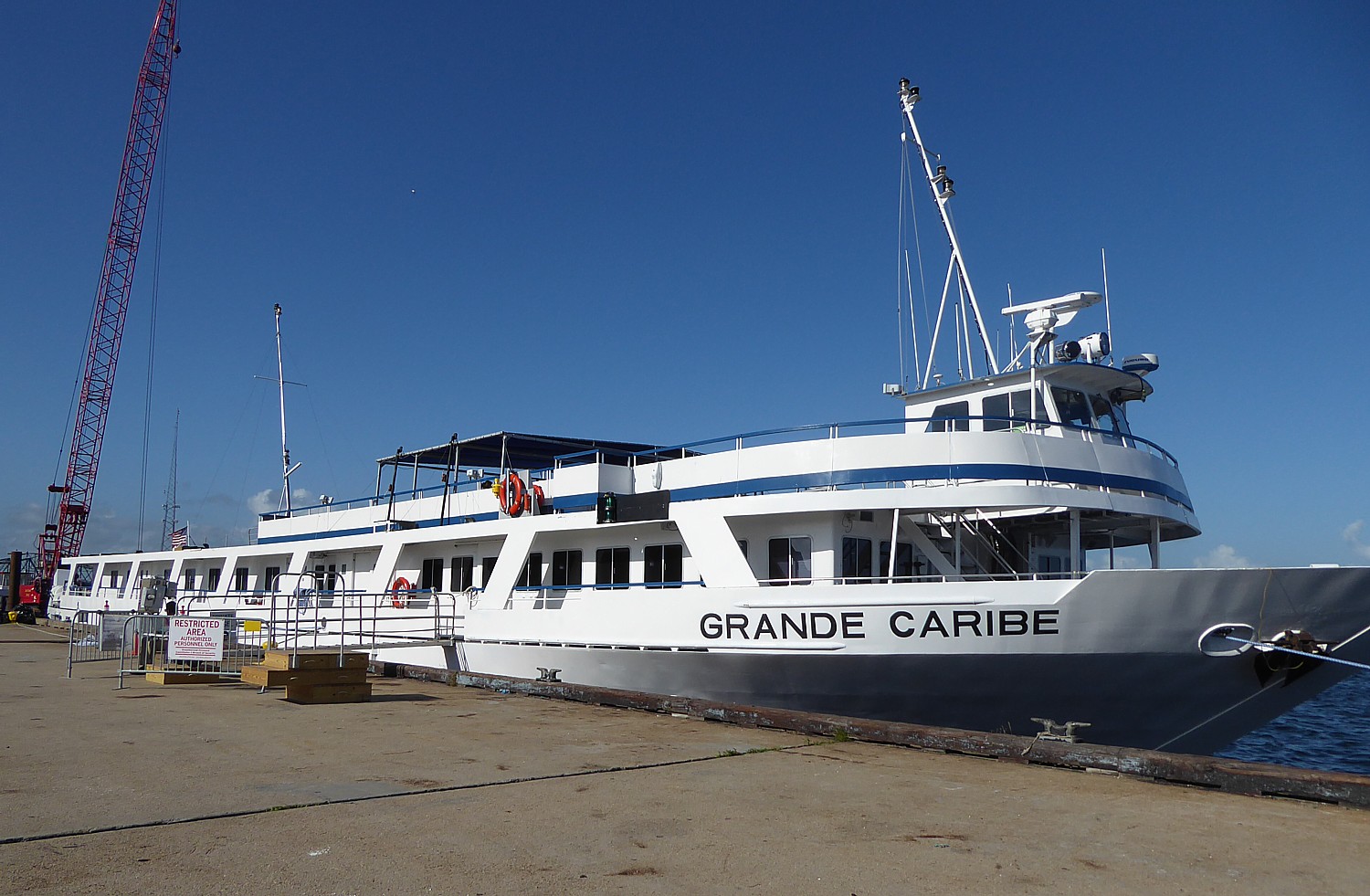
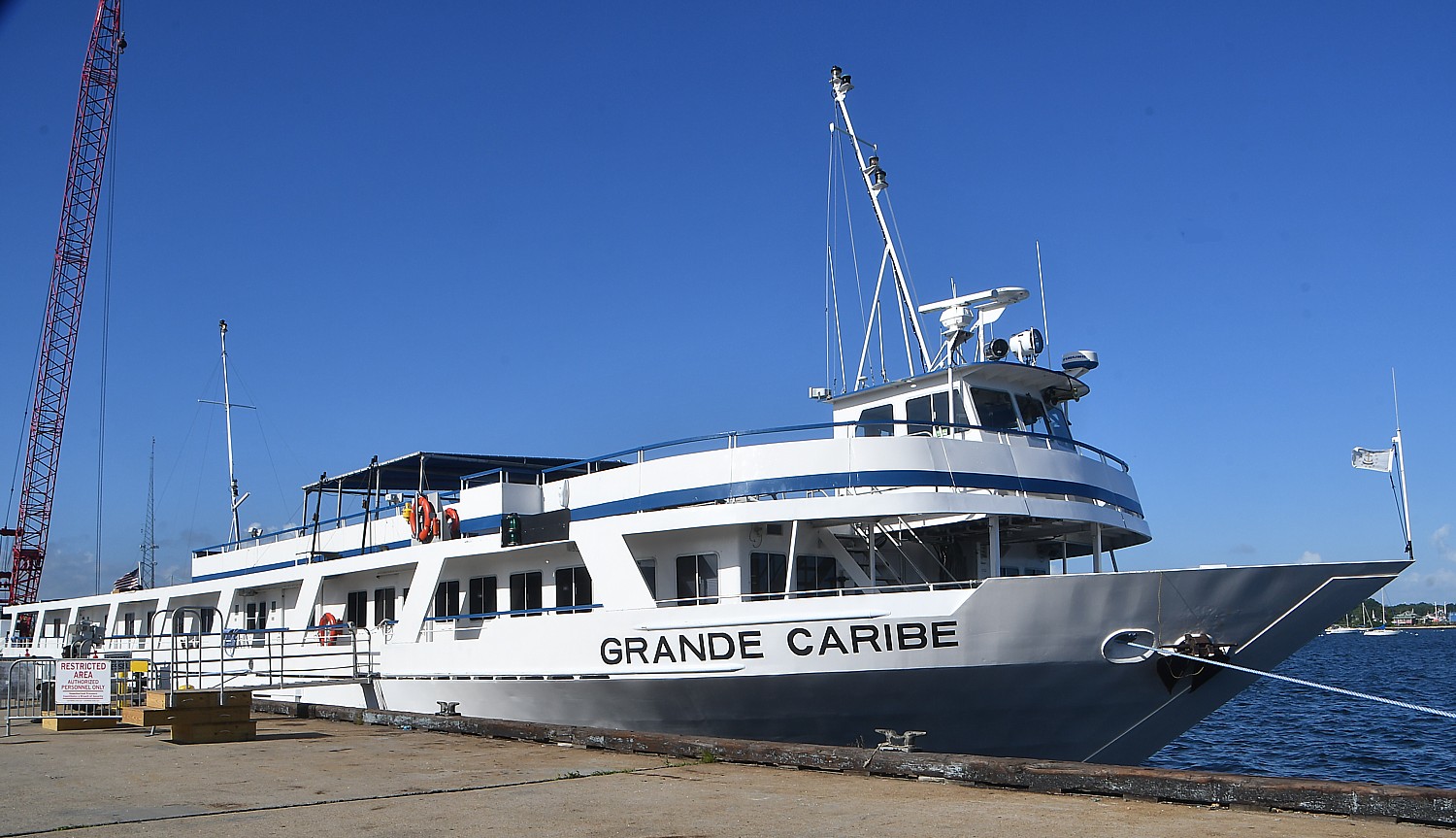
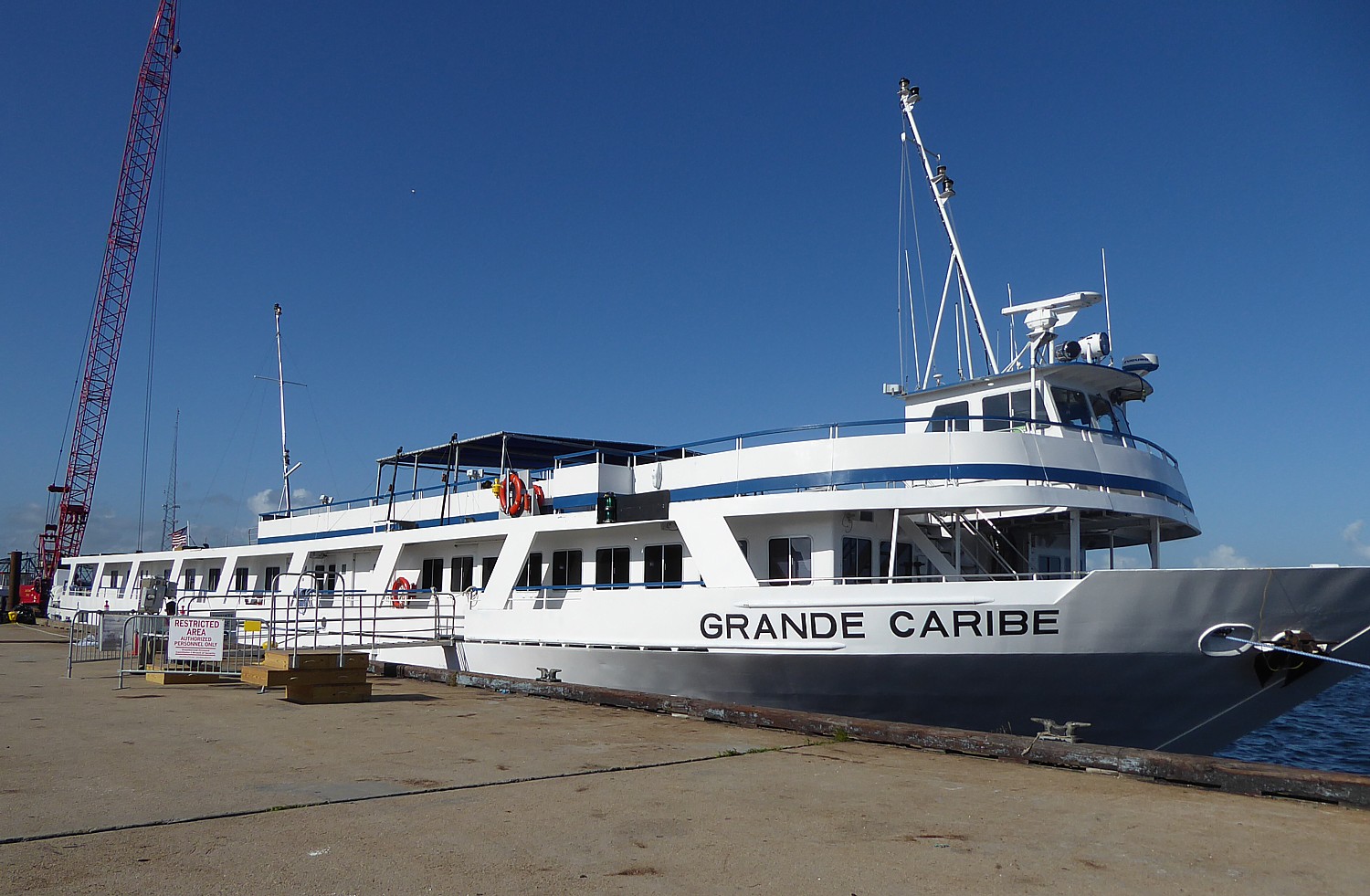
Blount Small Ship Adventures’ Grand Caribe tied to the pier at Tisbury Marina, Vineyard Haven © Karen Rubin/goingplacesfarandnear.com

For more information, and to help plan a visit, contact Martha’s Vineyard Chamber of Commerce, 24 Beach Road, Vineyard Haven, MA 02568, 508-693-0085, 800-505-4815, info@mvy.com, www.mvy.com.

The Grande Caribe sails on to Nantucket. Blount Small Ship Adventures, 461 Water Street, Warren, Rhode Island 02885, 800-556-7450 or 401-247-0955, info@blountsmallshipadventures.com, www.blountsmallshipadventures.com). 

See also:

A Spectacle in Motion: Grand Panorama of a Whaling Voyage ‘Round the World is Once-in-a-Lifetime Must-See at New Bedford Whaling Museum

Blount Small Ship Adventures’ Grande Caribe Voyage to New England Islands Proves Ideal for Babyboomers Who Still Crave Thrill of Travel, Albeit at Slower Pace

Endlessly Fascinating, Newport RI, Playground for the Rich, Makes its Attractions Accessible

_____________________________

© 2018 Travel Features Syndicate, a division of Workstyles, Inc. All rights reserved. Visit goingplacesfarandnear.com,  www.huffingtonpost.com/author/karen-rubin , and travelwritersmagazine.com/TravelFeaturesSyndicate/. Blogging at goingplacesnearandfar.wordpress.com and moralcompasstravel.info. Send comments or questions to FamTravLtr@aol.com. Tweet @TravelFeatures. ‘Like’ us at facebook.com/NewsPhotoFeatures

Endlessly Fascinating, Newport RI, Playground for the Rich, Makes its Attractions Accessible


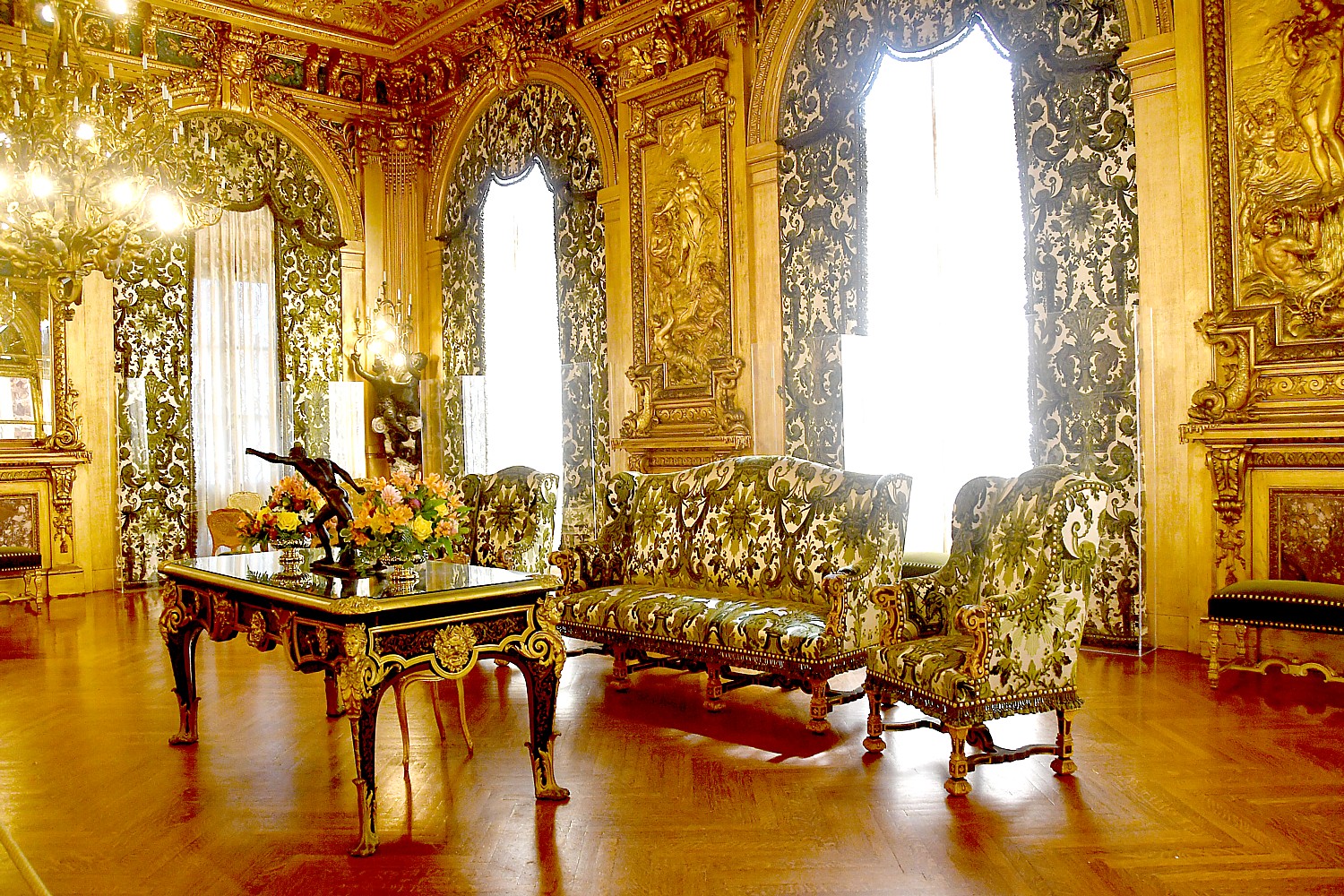
The Gold Room at Alva Vanderbilt’s Marble House in Newport, Rhode Island, epitomizes the Gilded Age © Karen Rubin/goingplacesfarandnear.com


by Karen Rubin & Martin D. Rubin

Travel Features Syndicate, goingplacesfarandnear.com


Each time I visit Newport, Rhode Island, the guided tours of these Gilded Age mansions get better and better, more immersive into the lives upstairs and downstairs, more intriguing, and the relevance to society today more apparent. The gap between rich and poor hasn’t been this great since Cornelius Vanderbilt II built his palatial summer “cottage,” The Breakers.

Newport is still a playground for the rich – it is the reason it is the home to the International Tennis Hall of Fame and considered the sailing capital of the country, why it is so associated with classic cars – but the interesting thing is you don’t have to be rich to play, too.

This most recent visit to Newport comes as a port of call on the second day of Blount Small Ship Adventures’ week-long voyage to New England islands. We have a full day to explore, and sailing in gives a very different perspective.

We also are able to experience Newport from the perspective of how well the destination accommodates visitors with mobility issues.

Our ship, Grand Caribe, docks at Fort Adams State Park, “America’s largest coastal fortification,” a short stroll to a launch or a water taxi to the “downtown”.

Many of our fellow passengers are taking the island tour that the ship offers, which will include a stop at The Breakers, and the cruiseline had also arranged a 2-hour sail aboard an America’s Cup classic yacht (which had to be canceled because of weather). But I have some particular goals for our day in Newport.

We are met by Andrea McHugh from Discover Newport who has organized an itinerary to maximize our time gives us our own island tour (as well as the gossip of which tech billionaire has just bought which house, and how Jay Leno, who visited and attended events at the new Audrain Automobile Museum (which we will visit), passed an oceanfront mansion he liked and bought it on the spot, and now is seen regularly tooling around).

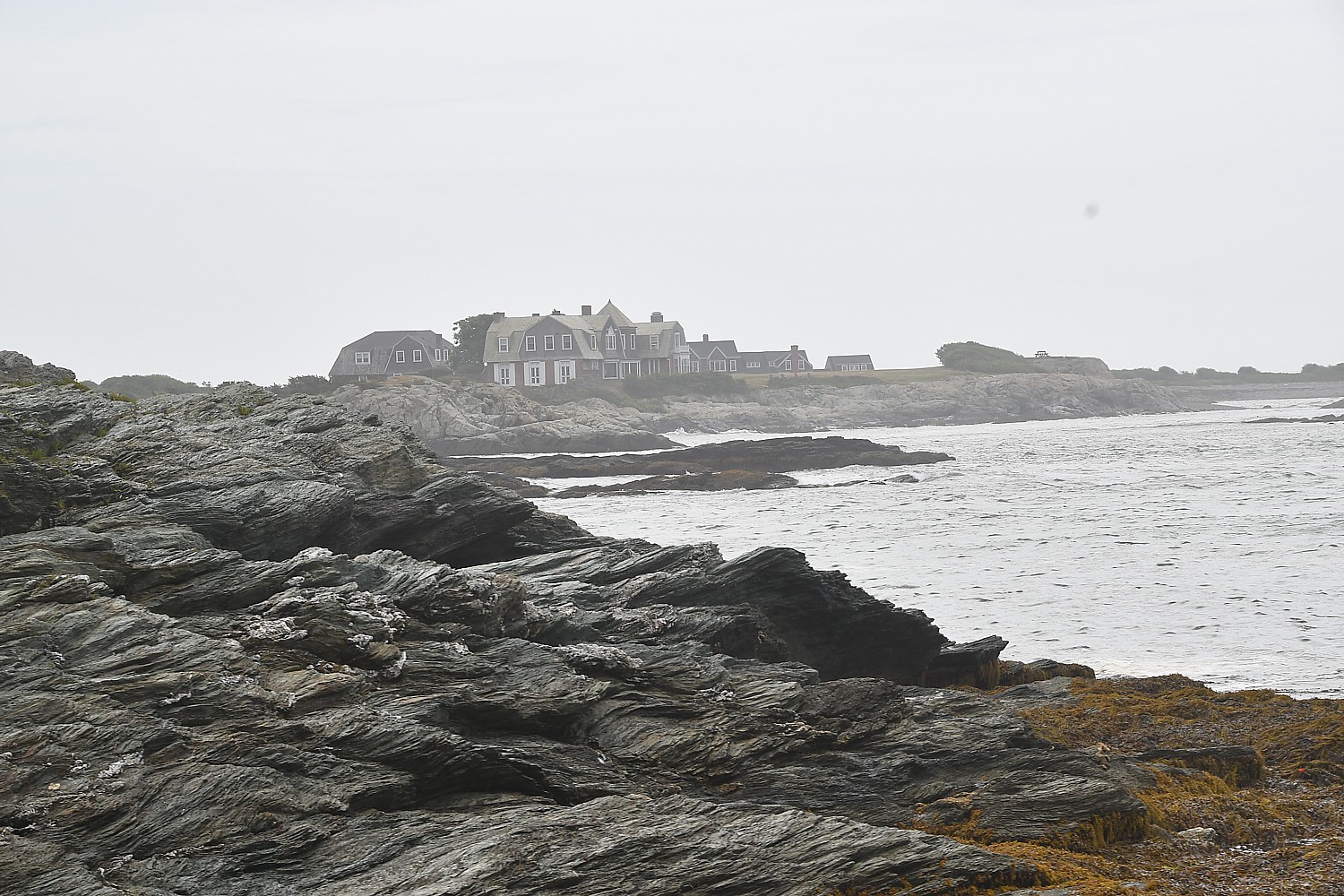
The gorgeous coastal views along Newport’s 10-mile Ocean Drive © Karen Rubin/ goingplacesfarandnear.com

We drive along the magnificent 10-mile long Ocean Drive with its scenic views and rocky shore, and pass the driveway into Hammersmith Farm, the Auchincloss estate where Jackie married John Kennedy. It used to be open to the public with a fantastic exhibit of the Kennedys but was acquired by Peter Kiernan (notable for the Robin Hood Foundation, funded by John Jr.), and is no longer open.

We pass Beechwood, a mansion once owned by the Astors and for many years, where actors played their parts in period dress. It is now owned by Larry Elllison (Oracle), who, we are told, is planning to open part of the mansion as an art museum.

We pass Belcourt, once owned by Oliver H. P. Belmont (who became the second husband of Alva Vanderbilt), which was purchased in 2012, by Carolyn Rafaelian, who has spent a considerable sum on a multi-year restoration and has reopened it for public tours.

The Breakers

The Breakers, the 70-room summer “cottage” built by Cornelius Vanderbilt II in 1895 © Karen Rubin/goingplacesfarandnear.com

We arrive at The Breakers, probably the most famous (and emblematic) of the Newport Gilded Age mansions that line Bellevue Avenue. It has a new visitor center which is really well done – barely visible from the street, it blends in wonderfully architecturally while affording a very comfortable (air conditioned) place to pick up tickets (take advantage of the multi-ticket options offered by The Preservation Society, which operates 10 of these glittering Newport Mansions, each with special exhibitions and presentations (see NewportMansions.org), refresh at a delightful café (sandwiches, $9.95), and utilize accessible restrooms (before, it was difficult for people with mobility issues to access a bathroom on property).

The new visitors center at The Breakers has a lovely café and sitting areas and is particularly helpful for visitors with mobility issues © Karen Rubin/ goingplacesfarandnear.com

Each time I visit, I find new things to appreciate and understand– audio-guides, for example, which replace the scheduled docent-led tours so let you tour at your own pace, are endlessly fascinating with opportunities to click on specialized topics. (A free app, Newport Mansions, let you download the commentary on a smart phone even when you aren’t touring the property.)

(The audio-guide lets you know that people who can’t climb the stairs can ask a docent to escort them upstairs in an elevator.)

Built by Cornelius Vanderbilt II (the grandson of “The Commodore,” the founder of the fortune, who turned a ferry boat into a shipping empire into a railroad empire), this breathtakingly grand, eye-popping, 70-room Italian Renaissance “cottage,” designed by Richard Morris Hunt, replaced a wooden structure that burned down. This was 1895, and the United States was jockeying for a position as an industrial power on the global stage. Hunt, the commentary relates, had a vision for an architecture expressing an American Renaissance, one that was classic, grand in scale, but that which reflected the hope and optimism of America.

Eye-popping grandeur at The Breakers, Newport © Karen Rubin/ goingplacesfarandnear.com

It is mind-boggling to recall when you see the gilding, the carefully carved wood, the marble, the artwork, that this palace (they called it a “cottage”) was only used about eight weeks of the year, during “the season.” The Breakers would have had 40 staff in summer (Newport had 2,000 servants, mostly immigrants).

The Breakers is as much an architectural and artistic treasure as a touchstone to social, cultural and political currents of the Gilded Age.

We learn about the family and the social structure of Newport: Mrs. Alice Claypoole Gwynne Vanderbilt’s bedroom, for example, also functioned as an office from which she ran the home.

Newport was actually run by women, we learn. These grand homes were designed to present their wealthy daughters (heiresses) to be snapped up for a favorable marriage.

Dressing was important. Women would have to change something like seven times a day (a riding habit, tea gown, bathing outfit, tennis, golf, sailing). Newport was the first place women played outdoor sports; whole new fashions were created.

The Breakers had 15 bedrooms and 20 bathrooms (we see one bathtub, carved from a single block of marble that was so cold, it had to be fully filled and drained several times before it would be warm enough to bathe in.)

We see the servants corridors, hidden closets and back stairs. “Female servants were invisible.”

When we arrive in daughter Gertrude Vanderbilt’s bedroom, we learn that she was upset to learn she was an heiress. She preferred to be an artist, and became a sculptor, an art collector and patron and, in 1931, founded the Whitney Museum. (Here, I click the audio guide for more detail on specific things: Gertrude was on the forefront of the New Woman, an educated girl. The idea to become an artist came to her in a dream.)

We come to the mezzanine overlooking the grand staircase. (People who cannot climb stairs can ask to be escorted to an elevator.) “Gilded Age Newport was built, managed, and maintained by women. It was the backdrop for the presentation of women” at a time when a woman’s fortune depended upon making a favorable marriage.

The Breakers’ Grand Staircase – the steps were made two inches shorter so the debutantes would not trip on their gowns © Karen Rubin/goingplacesfarandnear.com

We learn that the grand staircase stairs were built (and even rebuilt) to be two inches shorter, so the young debutantes could be presented in their gowns without fear of tripping.

At this portion of the tour, you can click on the audio guide to hear more detail about how the Vanderbilt’s attained such wealth and privilege (but it is really, really hard to keep the players straight without a scorecard – so many have the same name like British royalty).

The Commodore left the vast majority of his enormous fortune to his eldest son, William Henry Vanderbilt (“Any fool can make a fortune; it takes a man of brains to hold onto it,” Cornelius Vanderbilt said.) Though he outlived his father by just eight years, in that time William doubled the Vanderbilt wealth from $100 million to $200 million.

In the oddest quote on the audio-guide, William Henry Vanderbilt explains why he sold controlling stock of the Vanderbilt empire to a syndicate headed by JP Morgan: “The care of $200 million is too great a load for any brain or back to bear. It is enough to kill a man. I have no son whom I am willing to afflict with the terrible burden.” The commentary adds, “Without a single visionary leader like the Commodore, there was no one to invest in the next new technology. Automobiles and airplanes replaced the railroads, the once vast fortune was split and shared among generations of descendants.”

When we visit the kitchen, we get to appreciate some of the modern innovations of the house. The first Breakers burned down so when Cornelius II rebuilt it, he had the kitchen separated from house and no burners. Zinc, the stainless steel of its day, covered the worktable. There was a separate, smaller room which could be kept cool, for preparing pastry.

The Music Room at The Breakers, Newport © Karen Rubin/ goingplacesfarandnear.com

It is worthwhile to appreciate that as we see the trappings of obscene wealth, privilege and power, we also get to appreciate that the servants – who were mainly immigrants – saw their position in these mansions as improvements, and many were able to embrace the American Dream and move up in station and class.  The Breakers’ chef, we learn, started as a kitchen boy and became known as the Omelette King.

The Butler’s pantry, a two-story affair, had a safe for the butler to lock the silver away. The butler, we are told, was like the captain of ship.

Leaving The Breakers, we walk down to the Cliff Walk, the most visited attraction in Rhode Island, and for good reason. This is a delightful walkway along the cliffs (mostly paved and accessible for someone who uses a cane or, as I urge instead, hiking sticks), behind the grand mansions such as The Breakers, and free to enjoy. It extends 3.5 miles all the way to Doris Duke’s Rough Point (where the walkway becomes more scrappy). Today, we only get a taste of it, in order to conserve time and energy.

The 3.5 mile Cliff Walk goes behind many of the magnificent Newport mansions and provides stunning views of the ocean © Karen Rubin/goingplacesfarandnear.com

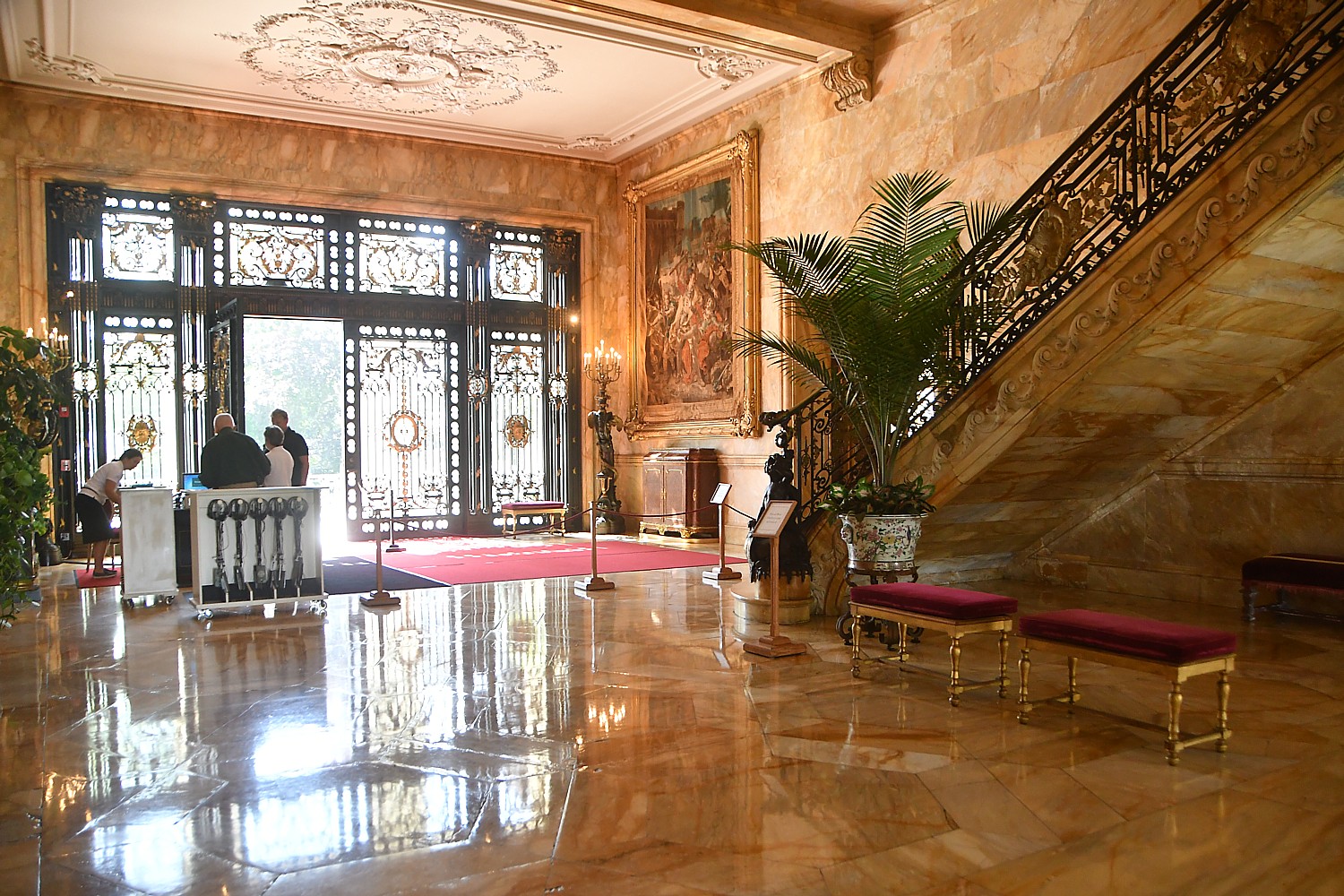
Marble House

If The Breakers is about patriarchal wealth, power and privilege, Marble House, built before The Breakers by Cornelius II’s sister-in-law, Alva Erskine Smith Vanderbilt, tells the story of burgeoning feminism and what happens when a smart, ambitious woman has few outlets for her vast talents beyond making an advantageous marriage.

Of the $11 million spent to build Marble House was built for Alva Vanderbilt, $7 million was spent on 500,000 cubic feet of marble © Karen Rubin/goingplacesfarandnear.com

Marble House (which we reach by hopping Newport’s delightful trolley-style bus) was designed by the architect Richard Morris Hunt (who also designed The Breakers). Inspired by the Petit Trianon at Versailles, Marble House was built between 1888-1892 at a cost of $11 million of which $7 million was spent on 500,000 cubic feet of marble. When it was finished, William Kissam Vanderbilt, the Commodore’s grandson, gave the house to his wife as a 39th birthday present.

Alva built Marble House to be “a cottage like nothing Newport had ever seen.” As it turns out, Alva Vanderbilt was also like nothing Newport had never seen.

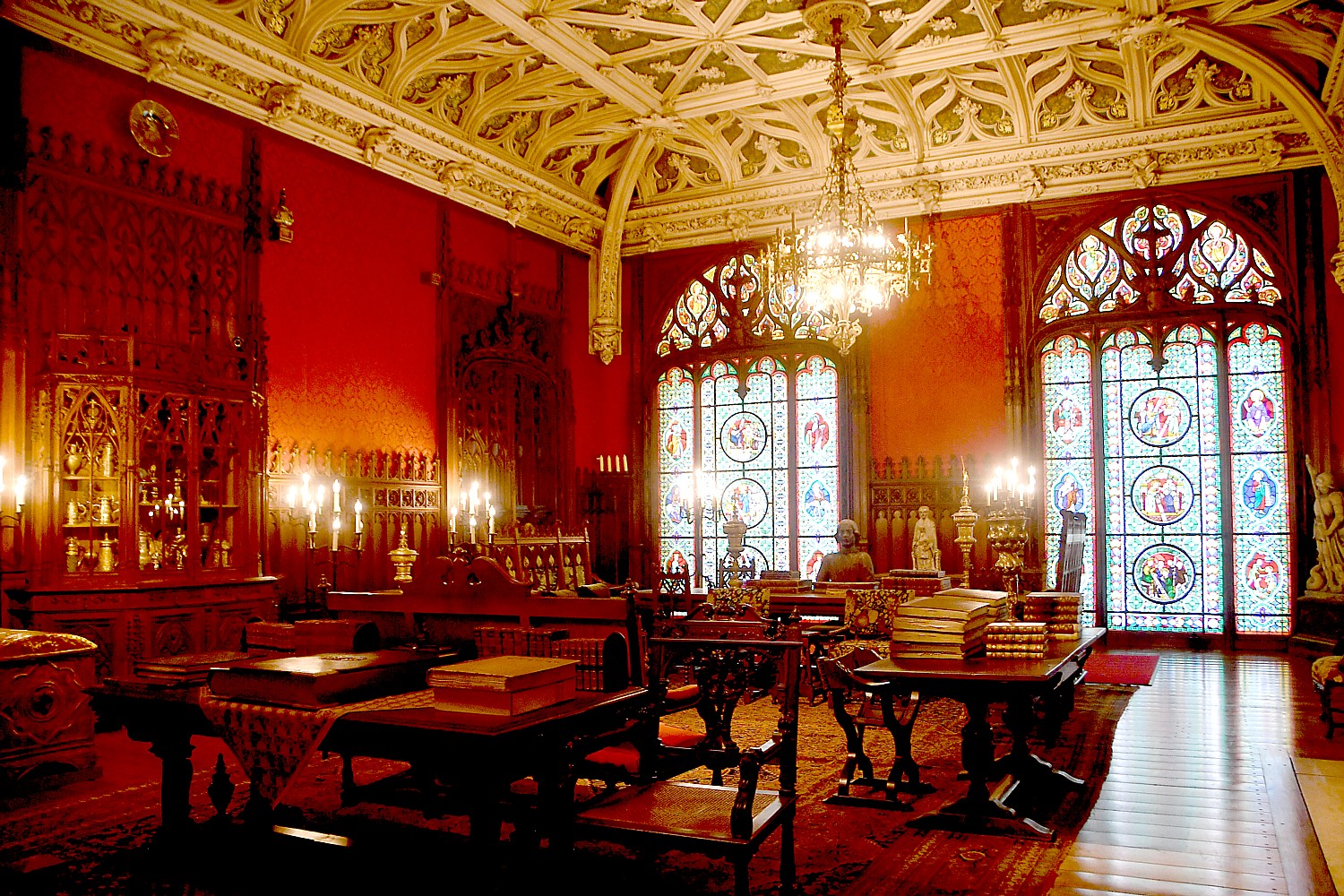
At a time before there were public museums, The Gothic Room at Marble House, which Alva Vanderbilt purchased “en bloc” in Europe, became a private museum © Karen Rubin/goingplacesfarandnear.com

The Gothic Room featured an important Gothic collection from Europe, which Alva purchased “en bloc” – the whole caboodle. “She considered herself equal to European collectors but didn’t want to collect over generations.” The room was designed and executed in Paris – then reassembled here piece by piece.

At a time before there were public museums, this room became a private museum.

The most revealing room into Alva’s soul is the library (the “morning room”), where you see photos of Alva’s children and a portrait of Harold, born when her oldest, Consuelo was 7, who came back one day to find she had a baby brother and was told “God had sent him to us.”

The room is Alva’s feminist declaration, decorated with images of goddesses representing beauty, wealth and power. She wove into the frame and the fabric of the room images of women’s accomplishment – women holding a quill pen, Cleo, the Greek muse of history, female images of learning and the arts – the four corners showing (mythical) women in chemistry, botany, astronomy.

Part of the ceiling decoration in the Marble House Morning Room, depicting women in intellectual roles, part of Alva Vanderbilt’s declaration of women’s rights. She later was a leader and benefactor of the Women’s Suffrage movement, holding rallies at Marble House © Karen Rubin/goingplacesfarandnear.com

“In education, women have made tremendous strides,” she said. “It is not so long since women freed themselves from their man-made belief that it was unwomanly for a woman to have an idea of her own.”

She also said, “A man’s brain is not half a brain and we are the other half. Blending of the two will make a better whole.”

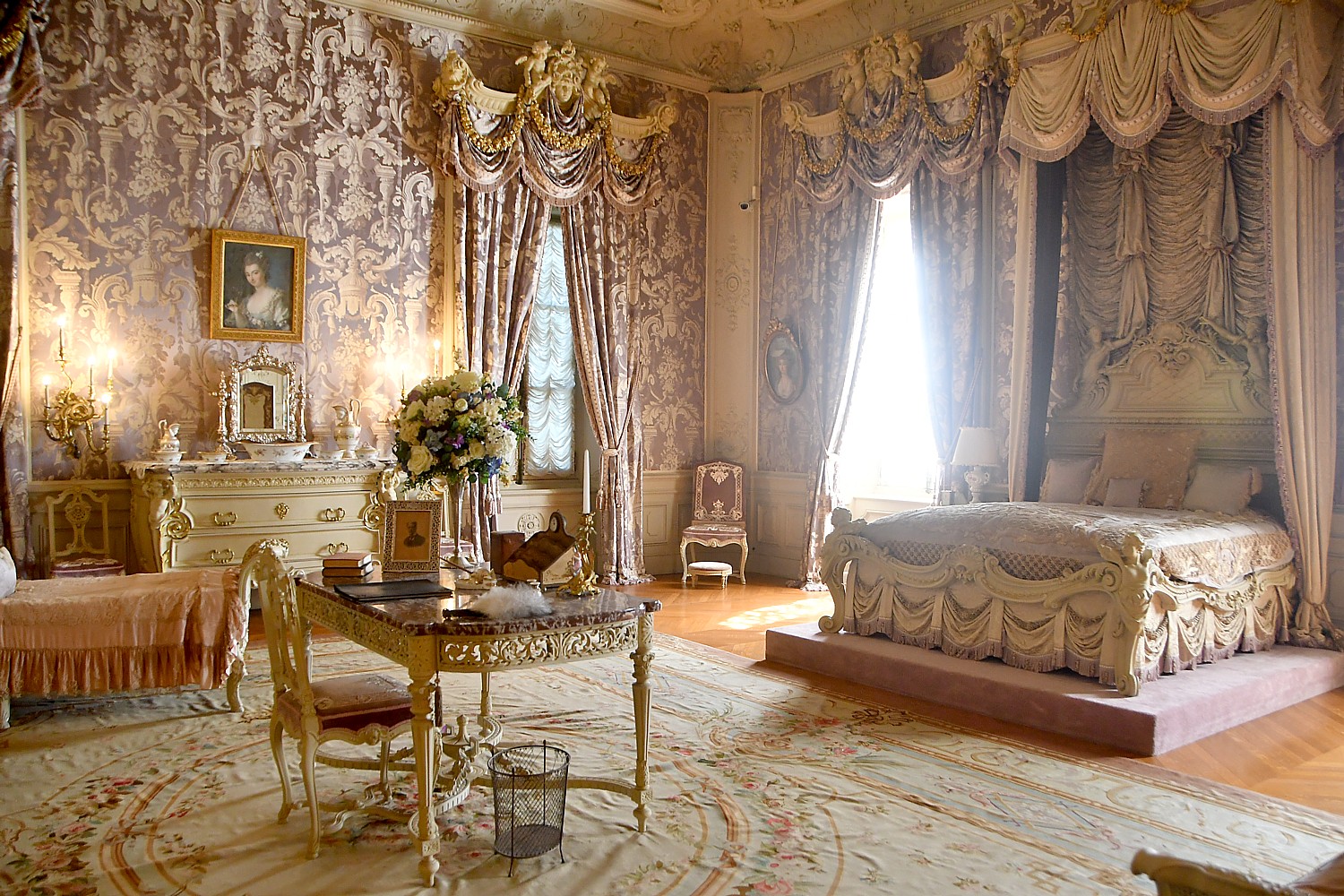
Her bedroom also was a display of the power she coveted – a bed on a throne-like platform, and images of Athena – goddess of wisdom and war.In this period, though, she saw social standing – that is, marriage to wealth – as a woman’s only means to power and independence. She applied this to her daughter, Consuelo, and raised the child to marry royalty.

Alva Vanderbilt’s throne-like bedroom in Marble House © Karen Rubin/ goingplacesfarandnear.com

Consuelo seems to have been Alva’s obsessive focus. You hear how she was groomed to be married off to European royalty – from childhood forced to wear a steel rod from her neck to waist with a strap around her shoulders, to force her to sit up straight.

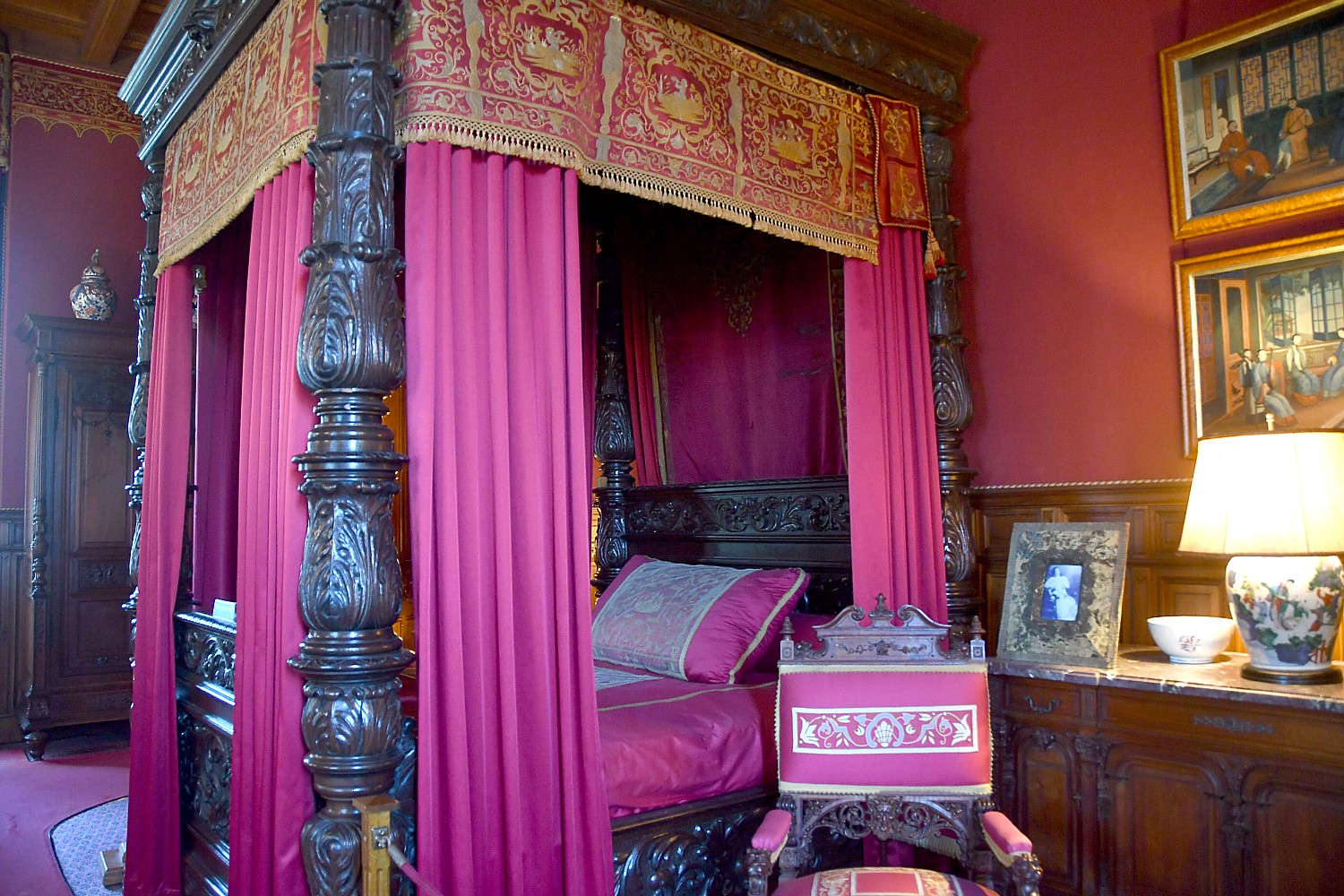
From her quotes, Consuelo seems to be fully aware of how she was being dominated by her mother, yet was a dutiful daughter, very close to her mother and understanding. We visit her  austere room decorated by her mother which, she says, “reflected in my mother’s love of me.”

Consuelo Vanderbilt’s bedroom at Marble House © Karen Rubin/ goingplacesfarandnear.com

We see the guest room – the only one in this fabulous mansion – decorated in rose silk, with an 18th century bed. The most famous guest was, of course, the 9th Duke of Marlborough, Consuelo’s intended. We learn there is only one guest room in the house because people who would visit the house either had their own “cottage,” rented for the season or stayed in a hotel. “Marble House is built for the family.”

Consuelo “reluctantly accepted a proposal from the Duke of Marlborough.” She was one of the “Dollar Princesses,” American heiresses who married foreign royalty.”Consuelo Vanderbilt not the first or the last, but she was the best known.”

These marriages, “were a melding of the old world and the new world. They enabled royalty to maintain property and palaces for another generation.”

Indeed, the Gilded Salon – literally painted in 22 carat gold, the very epitome of Gilded Age – had a featured role in Duke’s marriage proposal.

But after Consuelo was married off to British royalty, Alva acted for herself, divorcing William K in 1895.

My favorite quote from the audio guide, “I was the first of my set to marry a Vanderbilt and the first to get divorced – but not the last.” Alva Erskine Smith of Alabama felt herself a pioneer for her class, a female knight reassuring others. “Mine was the first, but the first of many.”

She ditched William K. Vanderbilt to marry her husband’s best friend, Oliver H.P. Belmont, moving down the street to Belcourt.

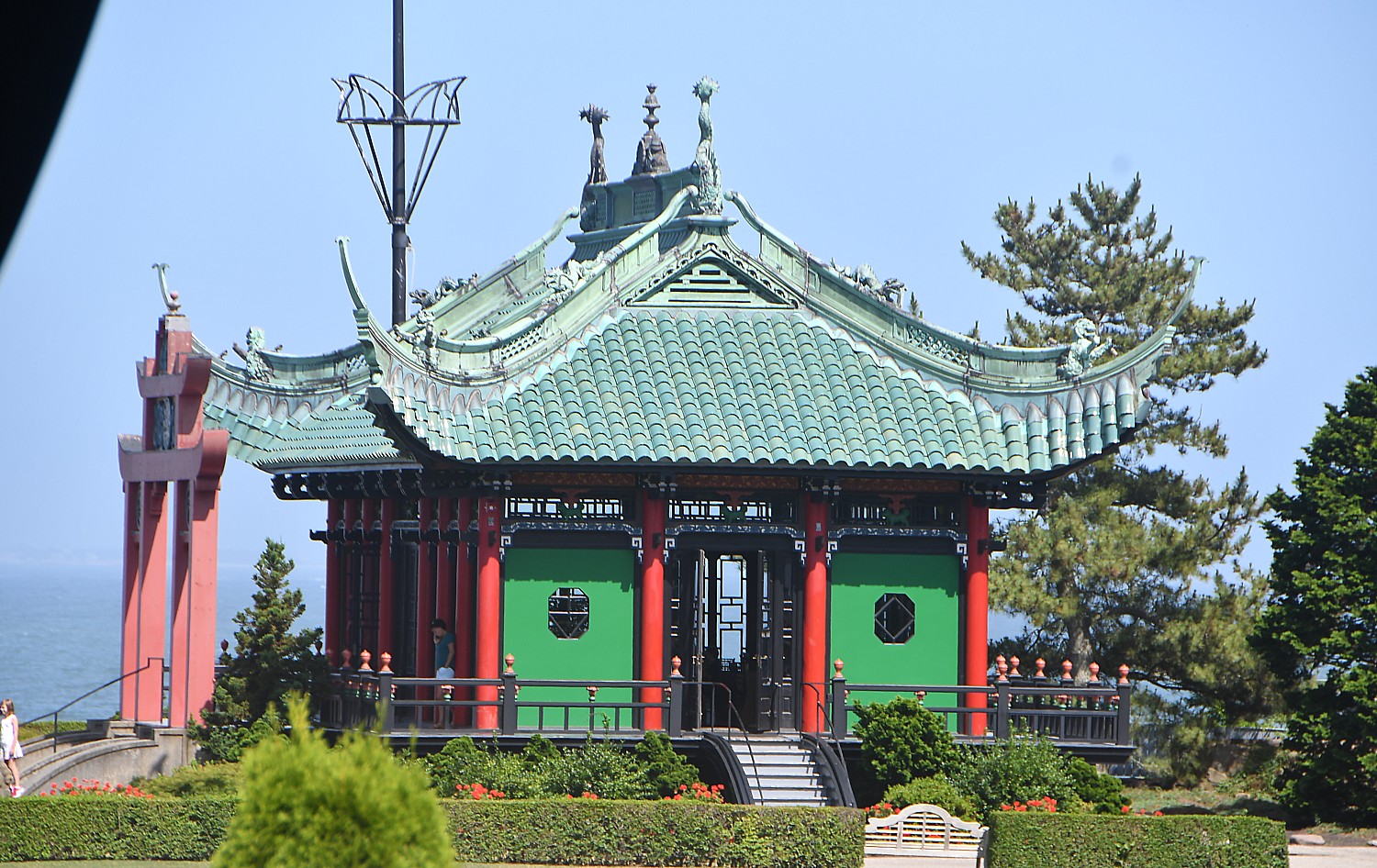
After her second husband’s death, Alva Vanderbilt Belmont reopened Marble House and had a Chinese Tea House built on the seaside cliffs, and held Women’s Suffrage rallies © Karen Rubin/goingplacesfarandnear.com

After Belmont’s death, Alva reopened Marble House and had a Chinese Tea House built on the seaside cliffs. She became active and a major donor to the Women’s Suffrage Movement, holding rallies in 1909 at Marble House.

She raised money for the cause by opening Marble House to the public: “Shop girls could mingle with socialites” for the price of a $5 ticket (which would have been equivalent to $500 in today’s money).

Alva insisted, “Women shouldn’t marry until we get vote,” a pronouncement considered hypocritical for a twice-married woman.

Following her mother’s example, after 26 years as Duchess of Marlborough living in Blenheim Palace, Consuelo ended her loveless marriage in 1921, giving him $2.5 million a year, and married “for love” a French aviator, Jacques Balsan. (More about these personal relationships in a fantastic photo gallery in the basement.)

In stark contrast to the grand (albeit austere) bedroom that Consuelo occupied, her brothers’ rooms were tiny and spartan; Willy K Jr.’s room was occupied by Marble House superintendent, William Gilmour, who joined the household when he was 16 to be Willy K’s companion.

We visit a trophy room (that had been converted from two dressing rooms that were between Alva’s bedroom and Consuelo’s), that recognizes sons William K., Jr.’s role in pioneering the sport of auto racing in America (he created the Vanderbilt Cup auto races and built the Vanderbilt Parkway which starts across from where he had a home in Lake Success); and Harold Stirling, one of the finest yachtsmen of his era who successfully defended the America’s Cup three times and invented the game of contract bridge.  Notably, as chairman of the board of Vanderbilt University, Nashville, Harold supported integration.”He wanted to be associated with positive, progressive thinking.”

In the basement kitchen (capable of feeding 100), we see yet another side of Alva in a quoted segment complaining “how the rich are exploited. When a shopkeeper learned my address, he said he made mistake of the price and added 50%.” This at a time when she paid a French chef (after all, you had to have a French chef), the massive sum of $10,000 (equivalent to $250,000 today).

We see in the cupboard silver trays etched with the children’s names and china made with “Vote for Women.”

In Marble House, too, people who have difficulty climbing stairs can ask to use an elevator, and the docents will find a place to sit and rest, as necessary.

In summer, the Preservation Society has 10 properties open, all with distinctive presentations and exhibits.

Rosecliff, the 1902 “fantasy in terra-cotta”, is presenting “Bohemian Beauty” celebrating the ideals of the Aesthetic Movement, personified by Oscar Wilde who visited Newport twice, with furniture, ceramics, wallpaper, glass, silver, paintings and clothing (thru Nov 4).

(Plan your visit in advance at The Preservation Society of Newport County, 424 Bellevue Avenue, Newport, RI 02840,  401-847-1000, info@newportmansions.org, www.newportmansions.org.)

In addition, there are the homes and heritage sites operated by Newport Restoration Foundation including Rough Point and Whitehorne Museum (51 Touro St., Newport, RI 02840, 401–849–7300, newportrestoration.org).

Tennis, Classic Cars

Between The Breakers and Marble House, we take in some of Newport’s other distinctive attractions:

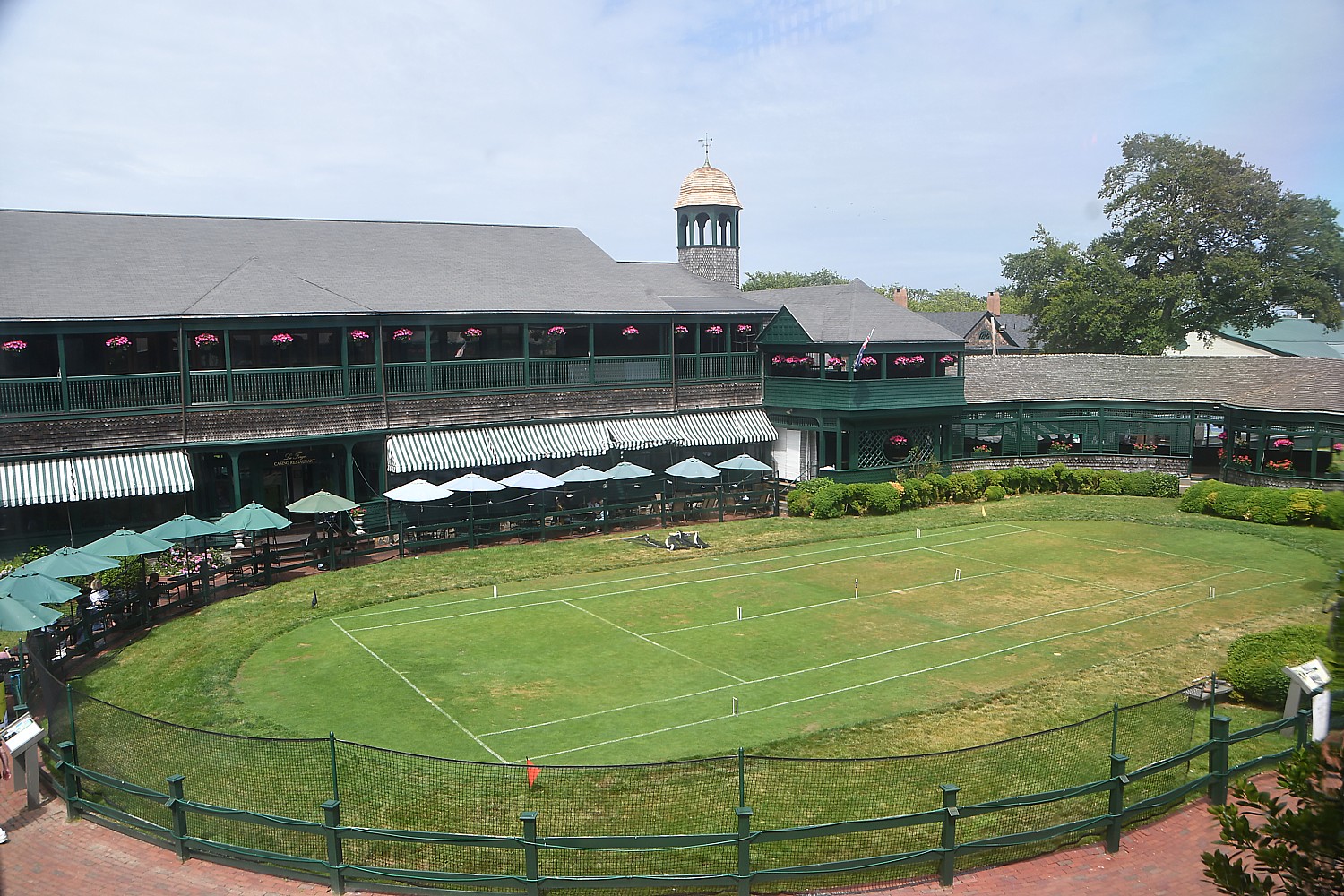
The grass tennis court at the International Tennis Hall of Fame in Newport, where the first US Open tournaments were played. The hall of fame honors tennis champions © Karen Rubin/goingplacesfarandnear.com

The International Tennis Hall of Fame, which features the original grass court where American tennis began. The museum features 2,000 artifacts spanning hundreds of years of tennis history (such as the patent for the game of tennis signed by Queen Victoria in 1874), displayed in redesigned galleries with some interactive exhibits. One of the newest, most novel exhibits features a hologram of tennis legend Roger Federer who offers the top 10 reason why he loves tennis. The Hall of Fame honors hundreds of the most accomplished champions, inducted since 1954. After touring the museum, you can explore the seven-acre historic grounds of what the Vanderbilts’ would have known as the Newport Casino (the Tiffany clocktower and Shingle style building was originally developed by architects McKim, Mead & White in 1880), grass courts of the Bill Talbert Stadium and newly built indoor courts (you can even rent time to play on its grass courts). Here, too, we are able to request the use of an elevator to get up to the exhibits on the second floor. (194 Bellevue Avenue, www.tennisfame.com).

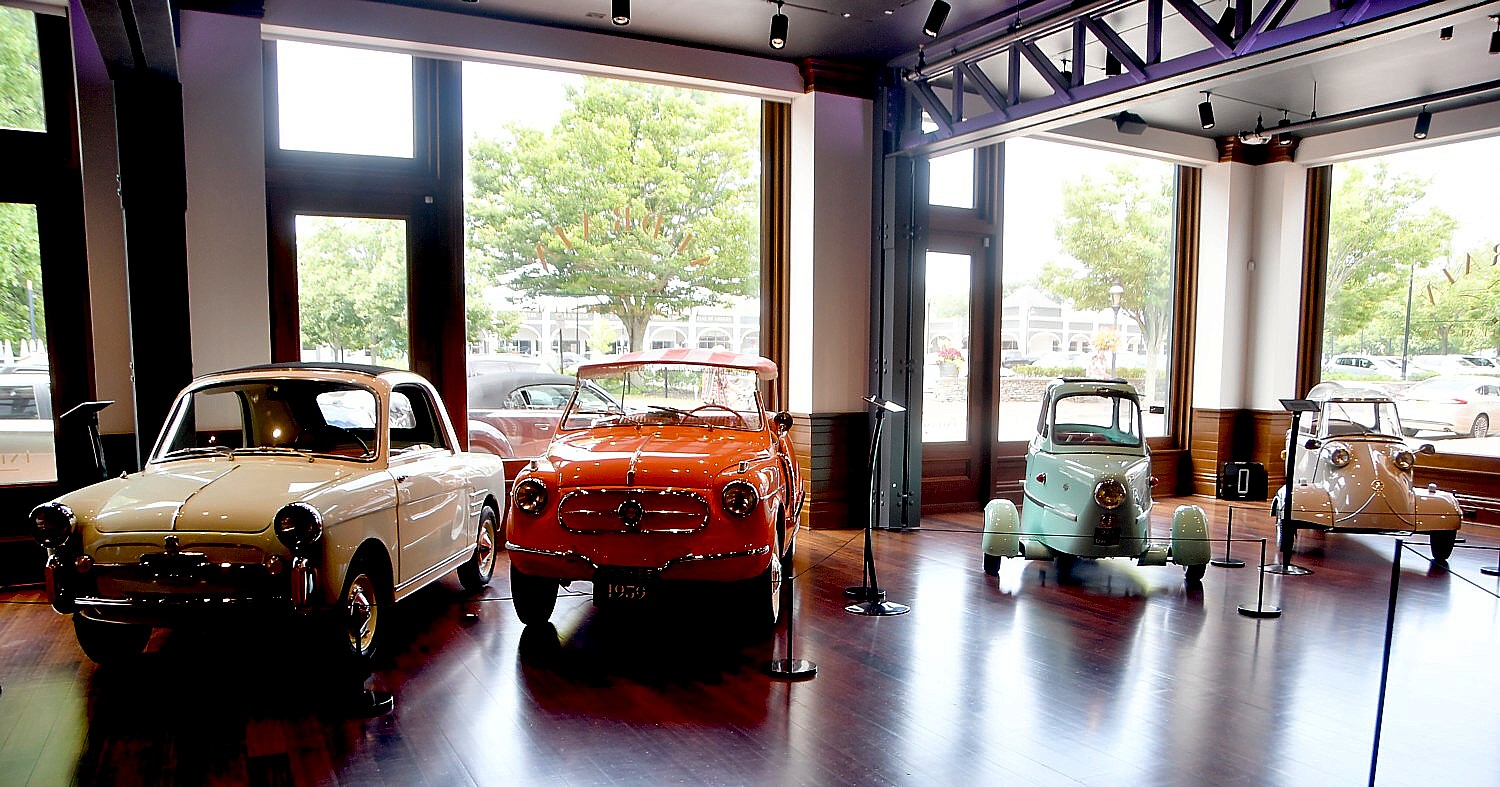
Audrain Automobile Museum offers regularly changing exhibits based on its private collection of 250 cars (every one in working condition), from 1899 to modern day, as well as special events. Ever changing exhibits display 15 to 20 cars at a time around a theme. We had just missed the “Muscle Car Madness” exhibit featuring cars of the 1950s and 1970s, accompanied with surf boards and original art.) On view now are some intriguing cars I had never seen before: Messerschmidt, which after World War II when Germans were no longer allowed to build airplanes, used airplane parts to create a micro-car that basically looks like a cockpit with wheels. A French version is also on view. “They aren’t great to drive,” says the young docent who drove it and says all the cars on display have to be in working condition.  (Audrain Automobile Museum, 222 Bellevue Avenue, 401-856-4420, audrainautomuseum.org)

Audrain Automobile Museum offers regularly changing exhibits based on its private collection of 250 cars; here some of the micro cars produced after World War II that are more like an airplane cockpit (and made from airplane parts) © Karen Rubin/goingplacesfarandnear.com

We enjoy a marvelous lunch at Annie’s bistro café (176 Bellevue Ave., anniesnewport.com) – elegant dining in a casual atmosphere and the best New England clam chowder anywhere –before hopping a trolley-style bus for a short ride to Marble House (you can see the schedule on googlemaps.com on your smartphone).

Andrea returns us to the Grande Caribe, where it is too late to explore inside the fort, but I walk along the Bay Walk (a 2.5 mile  loop with gorgeous views of Narrangansett Bay and Newport Harbor) before returning to the ship for the cocktail hour and dinner.  (Blount Small Ship Adventures, 800-556-7450,  www.blountsmallshipadventures.com).

This was what you could do with one full day in Newport. There is so much more to do, and so deserving of a return multi-day visit. Top on my list: Doris Duke’s Rough Point (newportrestoration.org); Touro Synagogue and Loeb Visitors Center (tourosynagogue.org), Redwood Library and Athenaeum (opened in 1750 and has a collection of more than 200,000 titles, www.redwoodlibrary.org), and The National Museum of American Illustration (americanillustration.org), to list but a few.

See more and plan your visit: Discover Newport, 23 America’s Cup Avenue, Newport, RI 02840, 800-326-6030, 401-849-8048, www.discovernewport.org.

Blount’s Small Ship Adventures’ Grande Caribe © Karen Rubin/ goingplacesfarandnear.com

The Grande Caribe will next sail to New Bedford (see A Spectacle in Motion: Grand Panorama of a Whaling Voyage ‘Round the World is Once-in-a-Lifetime Must-See at New Bedford Whaling Museum) and on to Martha’s Vineyard.

Blount Small Ship Adventures, 461 Water Street, Warren, Rhode Island 02885, 800-556-7450 or 401-247-0955,  info@blountsmallshipadventures.com, www.blountsmallshipadventures.com). 

See also:

Blount Small Ship Adventures’ Grande Caribe Voyage to New England Islands Proves Ideal for Babyboomers Who Still Crave Thrill of Travel, Albeit at Slower Pace

_____________________________

© 2018 Travel Features Syndicate, a division of Workstyles, Inc. All rights reserved. Visit goingplacesfarandnear.com,  www.huffingtonpost.com/author/karen-rubin , and travelwritersmagazine.com/TravelFeaturesSyndicate/. Blogging at goingplacesnearandfar.wordpress.com and moralcompasstravel.info. Send comments or questions to FamTravLtr@aol.com. Tweet @TravelFeatures. ‘Like’ us at facebook.com/NewsPhotoFeatures
 

Blount Small Ship Adventures’ Grande Caribe Voyage to New England Islands Proves Ideal for Babyboomers Who Still Crave Thrill of Travel, Albeit at Slower Pace

Sunset in the port at Vineyard Haven, on Martha’s Vineyard, from the top deck of Blount’s Grande Caribe © Karen Rubin/goingplacesfarandnear.com

by Karen Rubin & Martin D. Rubin

Travel Features Syndicate, goingplacesfarandnear.com


We belong to the backpack generation that bought a Eurail pass and traveled around the continent with “Europe on $5 A Day” as our Bible. No once-in-a-lifetime, “If it’s Tuesday it must be Belgium” grand tour for us, travel has been integral part of our lifestyle, forming a worldview that bursts the borders of our own provincial anchors.

But we are reaching a point where one or both have limitations. Travel can be physically challenging. Still, we crave the excitement of discovery, the adventure of new experiences, serendipitous encounters, that mental and physical exhilaration of travel.

A perfect prescription is small-ship cruising. There are now several cruise companies operating a score of small-ships that ply rivers, canals, seaways and some designed to tackle the pounding waves of oceans have arisen, and carry us directly into ports, minimizing the hassle of travel and maximizing the enjoyment. And an ideal destination to explore is America itself – the port cities, towns and islands that harbor fascinating history, natural wonders and cultural charms. What is more, the cruises are easy to access, avoid many of the hassles of foreign travel and long airplane flights, and allay any concern about getting timely medical attention if necessary.

Blount’s Grande Caribe docked in New Bedford. © Karen Rubin/ goingplacesfarandnear.com

We are just back from Blount Small Ship Adventures’ week-long cruise of New England islands – a trip that could only be accomplished with a ship that enabled visits to places you might normally visit individually but woven together in one fantastic itinerary: Newport, New Bedford, Martha’s Vineyard, Nantucket – destinations that offer wonder and interest and importance to the discovery, exploration and development of America as the towns you visit along the Danube.

The voyage proves ideal for accommodating people who have physical limitations (not recommended for wheelchair-bound, though), ideal for a three-generation reunion of 13 family members coming together from Dallas and Nashville to share this Yankee adventure; ideal for a couple where one is blind; ideal for a daughter traveling with her mother who walks with a cane; ideal for me and my brother who also has somewhat limited mobility. Indeed, the passengers  come from as far as California, and as close as Boston; one couple had taken Blount’s cruise to Guatemala and Belize, another is on their third New England Islands cruise with Blount.

The Grande Caribe is very accommodating for people with somewhat limited mobility (there are even stair lifts for those who cannot do stairs) – and an itinerary that gives maximum amount of time to enjoy each port with minimal hassle, while allowing for passengers to be as active or as sedentary as they liked. It is unpretentious and comfortable, having everything you would need.

Each of the New England destinations in this itinerary is a jewel, but can only be visited in this compressed amount of time by cruiseship – cutting out the point-to-point driving (traffic!), ferries, parking, packing/repacking, checking in/out. Rather, every minute of this trip is part of our voyage, our vacation experience. Significantly, all the sights we visit – the grand mansions, museums, historical sites – are accommodating for people who have difficulty climbing steps. (I’m seeing many more people using hiking sticks in place of canes or walkers to get around.)

Taking the launch from Blount’s Grande Caribe anchored in Nantucket’s harbor © Karen Rubin/goingplacesfarandnear.com

We sail in before breakfast, and in each port but Nantucket (where we use a launch service), we are at a dock so we can come and go as we please all day long. We depart in the night, so we have a full day to explore.

The cruise line offers various shore excursions (island tours and such offered at very reasonable cost), and on some itineraries, has bikes or kayaks to rent.

Our strategy is to take an island tour, then visit a couple of attractions. When one of us has enough and wants to relax, it is easy to return to the ship while the other continues to explore.

Because of bad storms at sea, Captain Patrick Moynihan makes a command decision to change around the itinerary, which otherwise would have gone first to Nantucket, which is 30 miles out to sea where there are 10-foot swells. He warns that it is possible we won’t be able to visit Nantucket at all. But we hold out hope.

No one second-guesses his decision when safety of the ship is concerned and sits in rapt attention during the safety video before we depart that shows us what would happen in an emergency. (Also, each day the ship is “sanitized” and there are hand-sanitizing stations as well.)

In the end, we spend an extra full day in Martha’s Vineyard (sensational) and make it to Nantucket on our last full day, but bypass Block Island.

Blount’s specially designed small ships make this itinerary possible; these ships are nimble, even have a patented bow ramp (this is used in places like Belize and Guatemala) and a retractable pilot house (so they can go under bridges on the Erie Canal), both inventions of Luther Blount, who founded the company and was one of the innovators of “small ship cruising” more than 50 years ago, and can come close to shore.

Sailing into Martha’s Vineyard © Karen Rubin/goingplacesfarandnear.com

Jumping from island to island, port to port, we experience these places as they were intended – the sea is what made these destinations and made them powerhouses in the national and global economy. Tiny Nantucket, with a population in the thousands, was known the world over (I love the wall showing distance markers to points around the world); New Bedford sent out hundreds of whaling ships, half of all that sailed the globe, and had 10,000 men at sea at any one time.

We embark in Warren, Rhode Island, which is home base for Blount and where they have been building ships and ferries since 1947. With the change in itinerary because of the weather, our voyage starts in Bristol, then Newport, New Bedford, Martha’s Vineyard (2 days), Nantucket, before sailing back to Warren RI. I have visited all these places in the past, but on this trip, I see them from such a different perspective, it is as if seeing them for the first time.

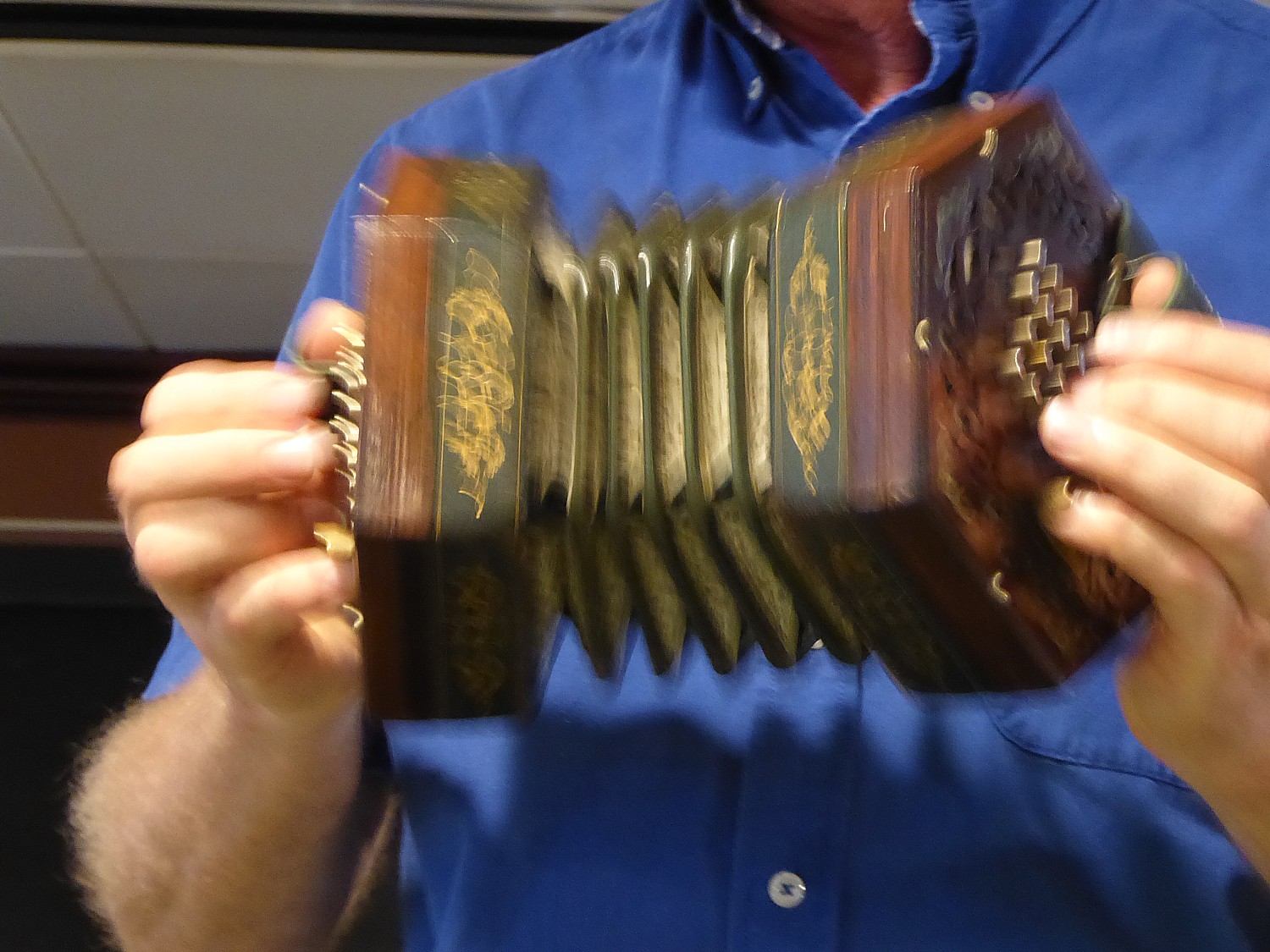
An evenings entertainment aboard Blount’s Grande Caribe: Martha’s Vineyard native, folksinger Mark Alan Lovewell, plays a 164-year old concertina and sings sea chanties, “the work songs of the whalers.” © Karen Rubin/goingplacesfarandnear.com

The days pass so pleasantly: there is an early bird breakfast put out at 6:30 am (coffee and freshly baked goods), breakfast at 8 am. Touring and exploring. Lunch at 12:30 pm (if you want to return to the ship). 5:30 cocktails (it’s BYOB except for welcome and farewell cocktail parties with an open bar and delicious hors d’oeurves); 6:30 dinner; then an evening activity at 8:30 pm– a movie, live performance (we had a trio on one night and a Martha’s Vineyard native, folksinger Mark Alan Lovewell, doing sea chanties before we came to Nantucket), and one night when we played a rollicking game of “LCR” (everyone puts up three $1 bills, rolls dice, and at the end, whoever still has a bill, wins the pot).

To be candid, many of the large cruise ships have such busy schedules that it always seems you are rushing here to there; but on this ship, it feels much more relaxed, not hurried, but with enough to do (or as little as you wanted) that it is never boring. There are always interesting conversations going on, I hardly have any time to read my book. (There is a ship’s library and board games available.). Some itineraries also have guest lecturers and some offer photography workshops.

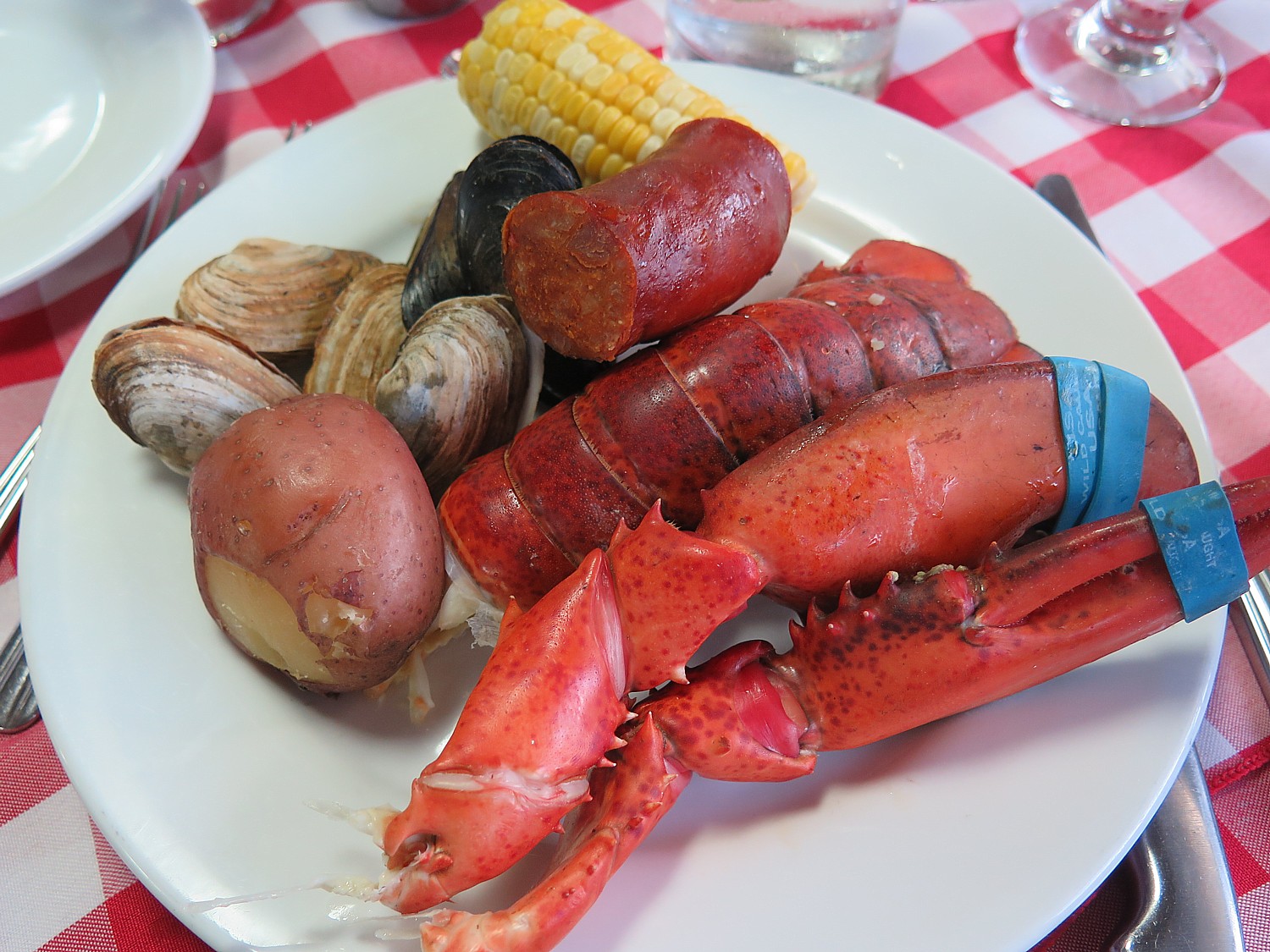
A classic New England dinner of fresh lobster, clams and mussels © Karen Rubin/goingplacesfarandnear.com

The food on board is excellent and the menus, which reflect the region and use locally sourced comestibles, feature New England classics: a lobster bake with clams & mussels was a definite highlight; New England clam chowder; lobster bisque). The baked goods including fresh breads and scones, are outstanding.  Three meals are provided daily. There are beverages and snacks available all day. Dietary restrictions are accommodated.

We are encouraged to Bring Your Own Beverages aboard which we can put in a cooler or at a bar, and each evening there is a 5:30 cocktail hour when all the fixings are provided (house wine and beer are provided at no charge at lunch and dinner), but there is also a welcome aboard and farewell cocktail party with an open bar and delectable hors d’oeurves.

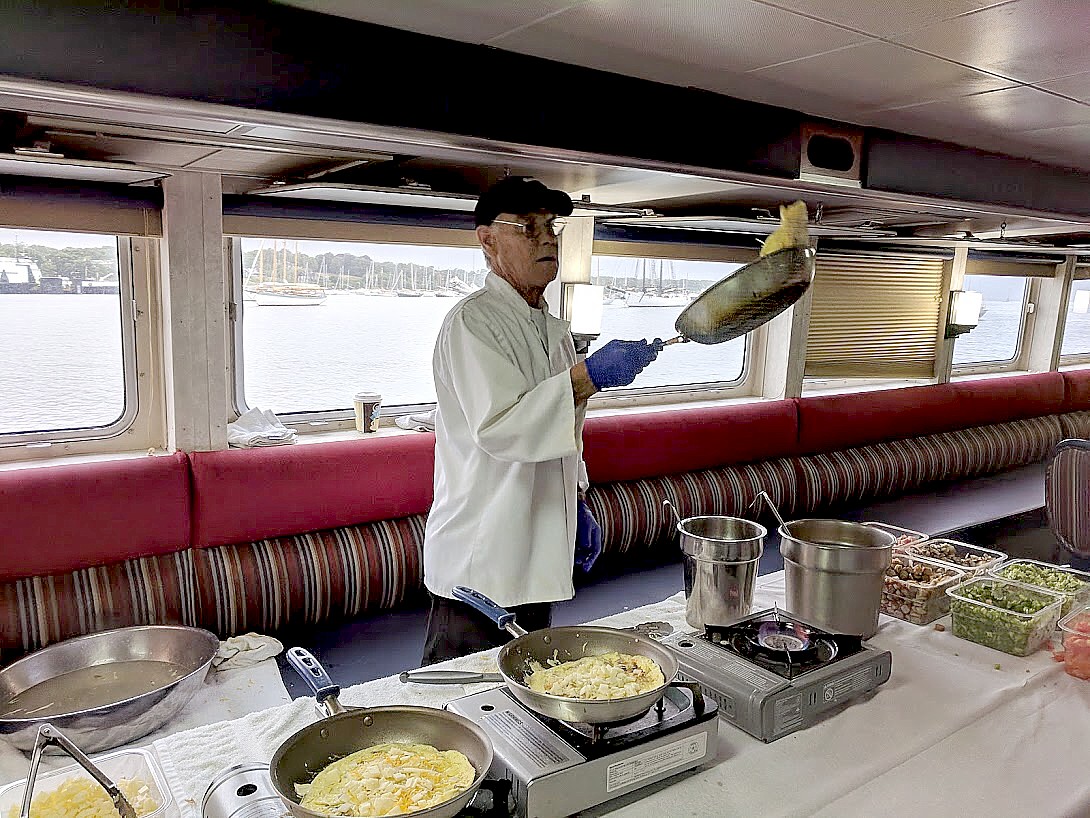
Blount’s Grande Caribe cook prepares omelettes to order for breakfast during our stop in Martha’s Vineyard © Karen Rubin/goingplacesfarandnear.com

The ship is modest, unpretentious, but is very comfortable, very clean and well maintained (it was refurbished in 2009), and has everything you need. There is a pleasant lounge ringed with windows; an expansive dining room (also with windows along the walls on both sides) an open sitting area (with fitness machines) on the back deck, and an open air top deck with lounge chairs and a canvas cover for rain and sun.

The ship offers four categories of smoke-free cabins, all with individual climate-controlled air-conditioning systems, private bathroom and adequate storage. Our cabin (56B) on the upper deck literally down the hallway from the lounge, had a large picture window which we could open for fresh air; air conditioning which we could set; a toilet and sink in a cabinet and a separate shower, two outlets for plugging in.

The Captain lets us know when to expect rocking and rolling and for how long, and to suggest for those so inclined to take advantage of ship’s supply of Bonine or Dramamine. But even though I have been prone to motion sickness, the worst of rocking (one night it was five or six foot seas for about a hour) feels to me like being aggressively rocked in a cradle.

We can follow the ship’s progress on a navigational map on a big screen TV, like watching your plane’s route.

Tossing out the line to dock at Martha’s Vineyard © Karen Rubin/goingplacesfarandnear.com

The ship, with a capacity for 84 passengers, has Interesting people from all over the country – as far as California and Texas, Midwest (Illinois, Tennessee) and North Carolina, as well as New Jersey, Long Island, Boston. But this style of small-ship cruising, and this itinerary in particular is ideal for travelers from abroad to really see America in a compressed timeframe.

The intimacy means you not only get immersed in the destination (versus the floating resort-style cruiseships where the ports are almost an afterthought), but with fellow passengers.

Each evening we are told about the next day’s itinerary – when we sail, where we dock, how to get into town, when and where to go for the shore excursions. There are guides, maps, and various tourist literature laid out. The day’s schedule is posted. Much of this is repeated at breakfast, and Jasmine, the spry cruise director, is very accessible to ask additional questions.There are shore excursions offered at each port – island tours that are conveniently arranged for a pick up at the boat, lasting about 1 ½ hours, at reasonable cost.

Blount’s Grande Caribe tied up at the Tisbury Marina at Vineyard Haven on Martha’s Vineyard © Karen Rubin/goingplacesfarandnear.com

It is remarkable to me how they not only had to switch around the itinerary, but organize dockage or mooring, shuttles, switch around the shore excursions, and do it so that it all seems seamless to us.

Our original itinerary from Warren, Rhode Island, the home base of Blount Cruises, to Cuttyhunk, MA, to New Bedford, to Nantucket, to Martha’s Vineyard, to Block Island, to Bristol, RI, to Newport and back to Warren – is completely revamped because of the 10 foot seas we would have to sail through to reach Nantucket.

Instead, we sail from Warren RI to Bristol to Newport, New Bedford, Martha’s Vineyard (where we stay two full days instead of one), to Nantucket and back to Warren RI.

Sailing into Bristol

On Sunday, after departing Warren, after a short sail we pull into Bristol, Rhode Island (coming this way, I didn’t recognize this town which is at the end of the East Bay Bike Path from Providence that I have biked several times in the past). Just across from where we dock, there is a fascinating boat museum, the Herreshoff Marine Museum and America’s Cup Hall of Fame. It is a shrine to yacht racing and where eight consecutive America’s Cup defenders were built.

An America’s Cup defender, on display at the Herreshoff Marine Museum and America’s Cup Hall of Fame, Bristol, RI © Karen Rubin/goingplacesfarandnear.com

The museum houses dozens of sailing yachts, some that you can climb aboard. A local on the dock walking his dogs tells me that this boatyard is where many of the America’s Cup sailboats were designed and built in the 1930s by John Brown Herreshoff, who was blind, but would create these models based on feel.

According to the museum,  “In 1878, John Brown Herreshoff, a blind boatbuilder from Bristol, Rhode Island, who had been in business since 1863, went into partnership with his younger brother, Nathanael Greene Herreshoff, a naval architect and steam engineer.

“Between 1893 and 1914, for the defense of the America’s Cup, Captain Nat designed and built seven of the largest, most complex and powerful racing sloops the world has ever known. Of these, five were selected to sail as defenders, and all five were victorious. The firm also launched many hundreds of custom designs, both large and small, and a number of one-design classes (among them Herreshoff J12’1/2- and 15-Footers, S boats, and New York 30’s, 40’s, and 50’s) that have never been bettered for all-around sailing excitement and pleasure.” (http://www.herreshoff.org)

He also encourages me to visit Linden Place Museum, an 1810 Federal-style mansion with a stunning spiral staircase and  Hollywood connections: stage and screen star Ethel Barrymore summered here (her movie memorabilia is on display), plus scenes from the 1974 version of “The Great Gatsby” were shot here, with the exterior used as Daisy Buchanan’s parents home. (Alas, it is closed by the time I get there.)

Linden Place Museum in Bristol was where Ethel Barrymore summered and which was one of the locations for the 1974 “Great Gatsby” film © Karen Rubin/ goingplacesfarandnear.comI walk into the town with the most marvelous homes dating back to the early 1700s.

There is also Blithewold Mansion, Gardens and Arboretum, located just outside of downtown, but I don’t make it that far when it starts to rain.

I note the red-white-blue stripe down the center line of the main street: Bristol boasts the oldest Fourth of July celebration in the United States, held continuously since 1785, and it displays its patriotism year-round with the painted traffic lines, as well as flags and such on many of the houses.

Luther’s Legacy 

The Blounts were in the oyster business for generations until the 1938 hurricane destroyed Rhode Island’s oyster beds. Luther Blount was in college at the time studying engineering, and realized he had to set a different course for his future. He moved back to Rhode Island, and promptly invented a way to steam clams that was so efficient, his brother Nelson’s company became the supplier for Campbell’s Soup’s Clam Chowder.

By 1947, Luther had become the Vice President of E.B. Blount and Sons, and began building boats, beginning with an oyster boat.  By 1964, he had built over 100 vessels (including Circle Line boats that take tourists around the Statue of Liberty, and the ferries that one of our passengers from Long Island uses for his Fire Island ferry business). He even had a few patents to his name — patents that would one day become the signature of Blount Cruise ships.

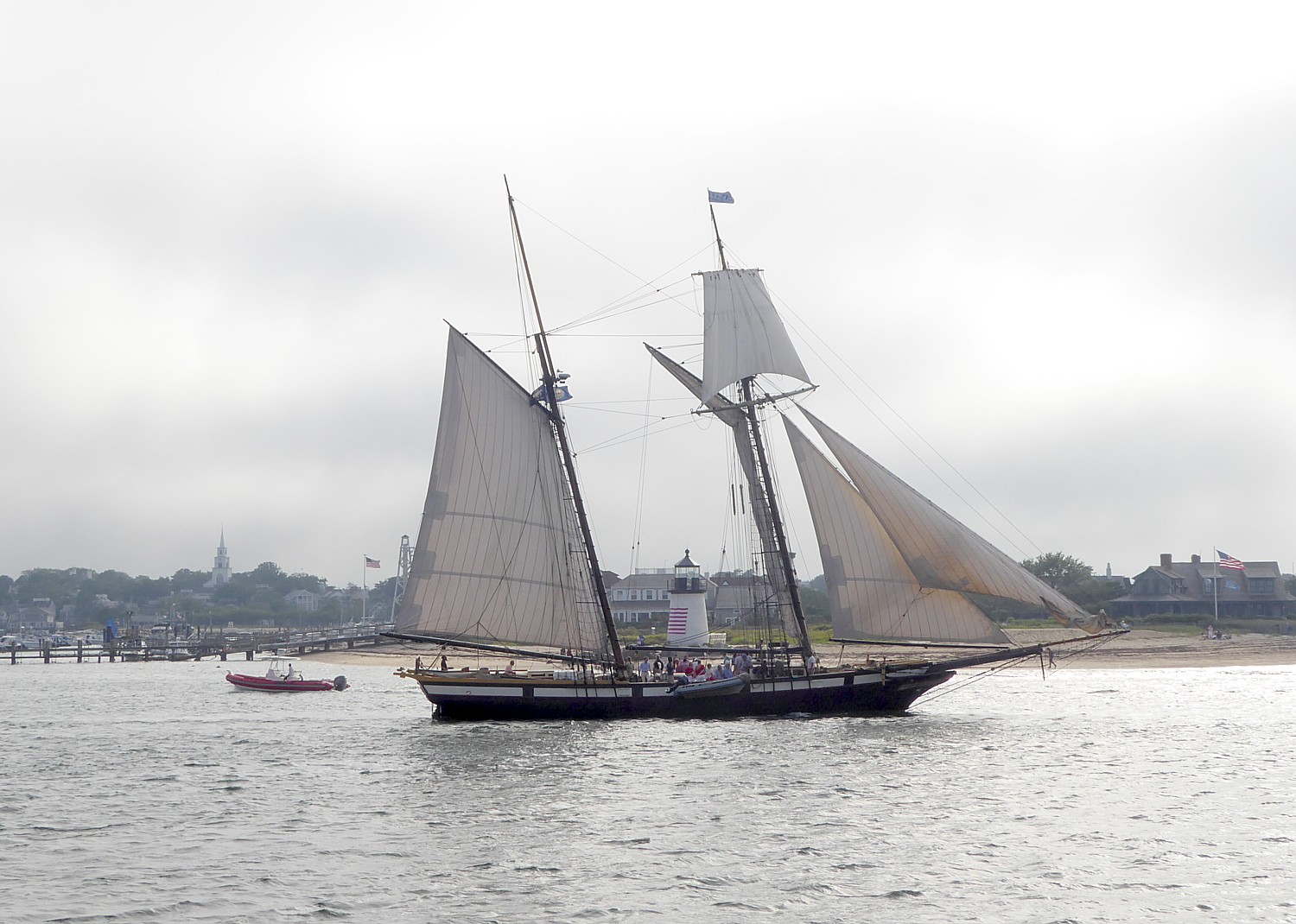
The 1812 privateer, Lynx, operated by the Lynx Educational Foundation, sails past Nantucket’s lighthouse.

Over the course of 20 years, Blount would personally sail the globe to the ships he built. In 1966, Luther decided that he wanted to show his friends and family the places he had been exploring and began building passenger boats. Soon he was offering these trips for others, coining the expression “small ship cruising”.

“He created itineraries for explorers, for those who wanted to tread lightly, going beyond the usual tourist meccas finding experiences you can only have when you get to know a place through its people.”

Meanwhile, Luther, who passed away in 2006, worked to bring the oysters back to Rhode Island, starting with Narragansett Bay. He donated to a local university, charging them with cultivating new oyster beds.  He bought Prudence Island to be used as an oyster regeneration project funded by his foundation.

Today, Luther’s daughter Nancy is at the helm as president of Blount Small Ship Adventures; daughters Marcia and Julie are president and vice president of Blount Boats.

Captain Patrick Moynihan brings the Grande Caribe back to the Blount Small ship Adventures’ homeport in Warren, Rhode Island. Luther Blount invented a retractable pilot house so the ship could go under bridges © Karen Rubin/ goingplacesfarandnear.com

The design of the Grande Caribe and its sister ship, Grande Mariner, enables Blount to bring travelers to places that larger ships simply cannot go. They explore remote islands and traverse scenic waterways like the Erie Canal and St. Lawrence Seaway. They dock where private yachts dock (in fact, our ship is about the same size as the more extravagant yachts).

This style of  cruising appeals to people who are curious, casual, adventurous, who appreciate the ship as transportation for the purpose of exploring destinations, learning about cultures and heritage and communities. The atmosphere is very casual, laid-back, unpretentious, welcoming – as if you were sailing on a friend’s yacht.

Interestingly, even though we visit places that are literally overrun by tourists this season, we dock away from the crowds, and simply slip into the everyday pattern – hopping a local bus, for example at Vineyard Haven to Oak Bluffs or a local beach. The three-generations family of 13 split off for different activities – cousins going one direction – pooling photos on an online album.

Blount Small Ship Adventures offers overnight small ship cruises in the United States, Canada, Central America, Caribbean and Cuba, with itineraries ranging from 7 to 16 days. (View complete schedule on www.blountsmallshipadventures.com).

Blount Small Ship Adventures, 461 Water Street, Warren, Rhode Island 02885, 800-556-7450 or 401-247-0955,  info@blountsmallshipadventures.com, www.blountsmallshipadventures.com.

Next: A Day in Newport

See also:

A Spectacle in Motion: Grand Panorama of a Whaling Voyage ‘Round the World is Once-in-a-Lifetime Must-See at New Bedford Whaling Museum

_____________________________

© 2018 Travel Features Syndicate, a division of Workstyles, Inc. All rights reserved. Visit goingplacesfarandnear.com,  www.huffingtonpost.com/author/karen-rubin , and travelwritersmagazine.com/TravelFeaturesSyndicate/. Blogging at goingplacesnearandfar.wordpress.com and moralcompasstravel.info. Send comments or questions to FamTravLtr@aol.com. Tweet @TravelFeatures. ‘Like’ us at facebook.com/NewsPhotoFeatures
 

A Spectacle in Motion: Grand Panorama of a Whaling Voyage ‘Round the World is Once-in-a-Lifetime Must-See at New Bedford Whaling Museum

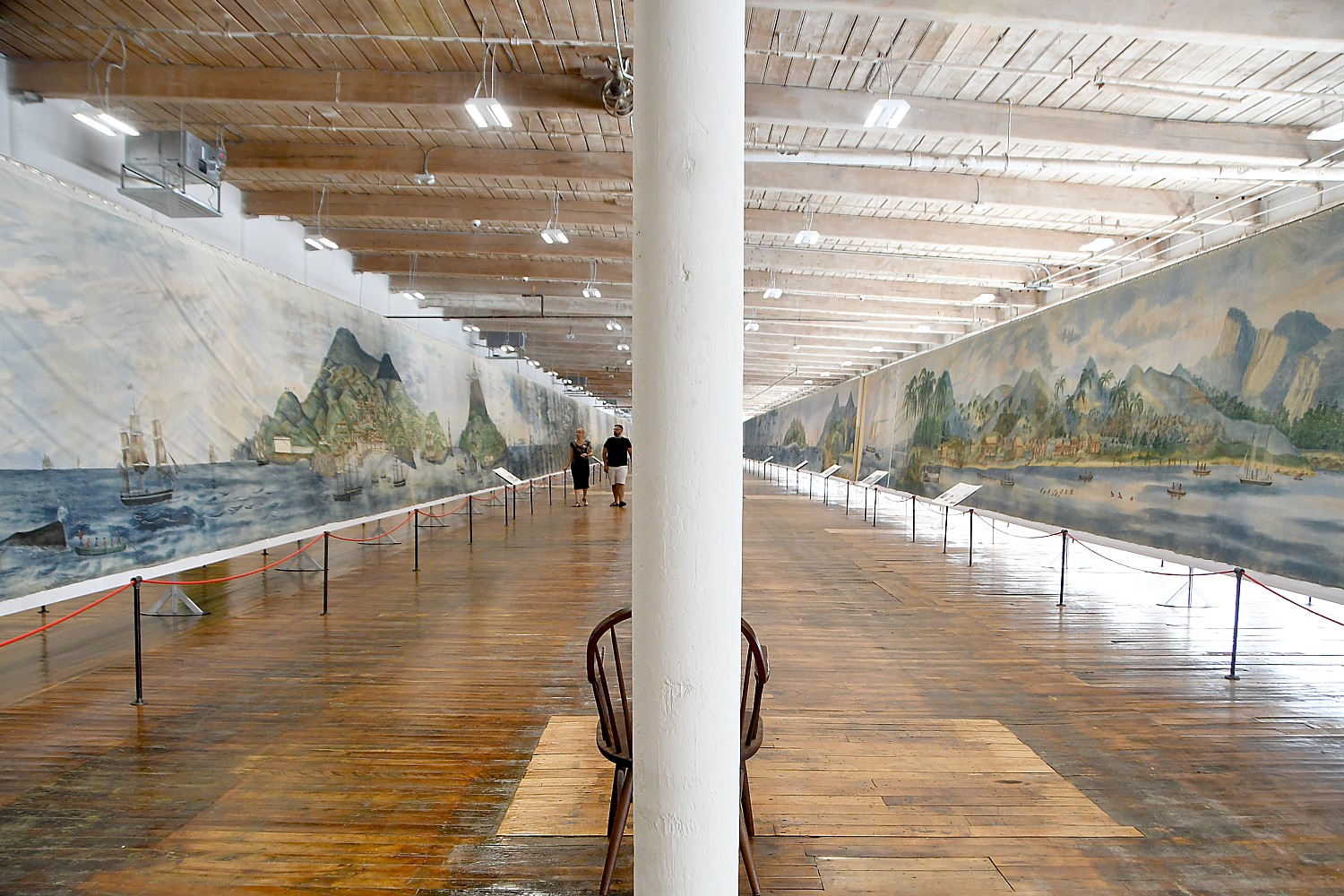
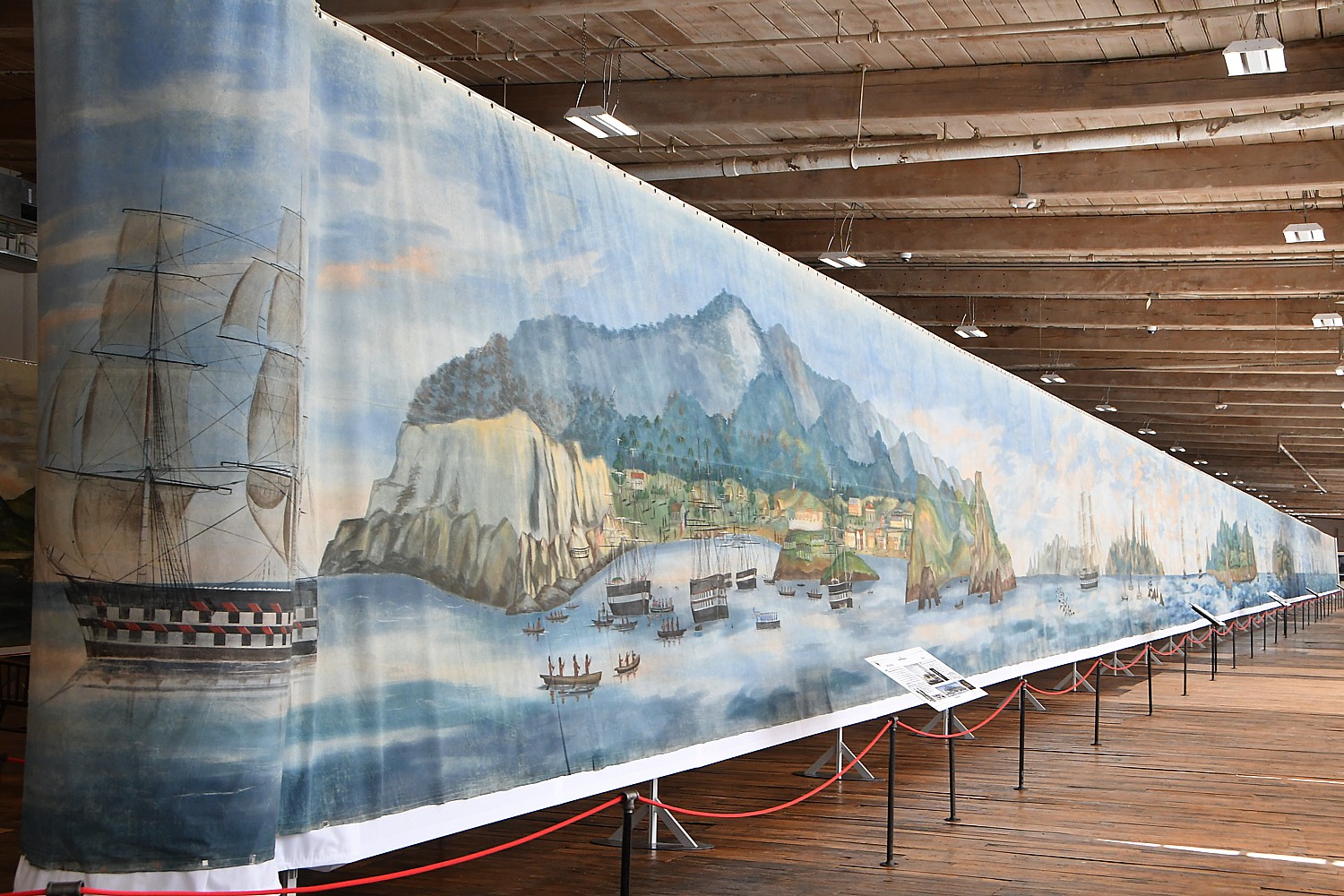
“The Grand Panorama of a Whaling Voyage ‘Round the World” is the longest painting in America, as long as the Empire State Building is tall © Karen Rubin/ goingplacesfarandnear.com

By Karen Rubin, Travel Features Syndicate, goingplacesfarandnear.com

The New Bedford Whaling Museum calls its special exhibition a “A Spectacle in Motion” – a title that proves to be anything but hyperbole. Imagine before documentary, before moving pictures, before photography, where the only way people could see images of places beyond their own experience was through painting, etched drawings in newspapers, or scrimshaw. Now imagine a whaling voyage that starts in New Bedford and travels thousands of miles to Fiji, painted on one mural, nearly one-quarter mile long – the longest painting in America. I can only imagine the sensation “The Grand Panorama of a Whaling Voyage ‘Round the World,” caused when it was first exhibited in 1849.

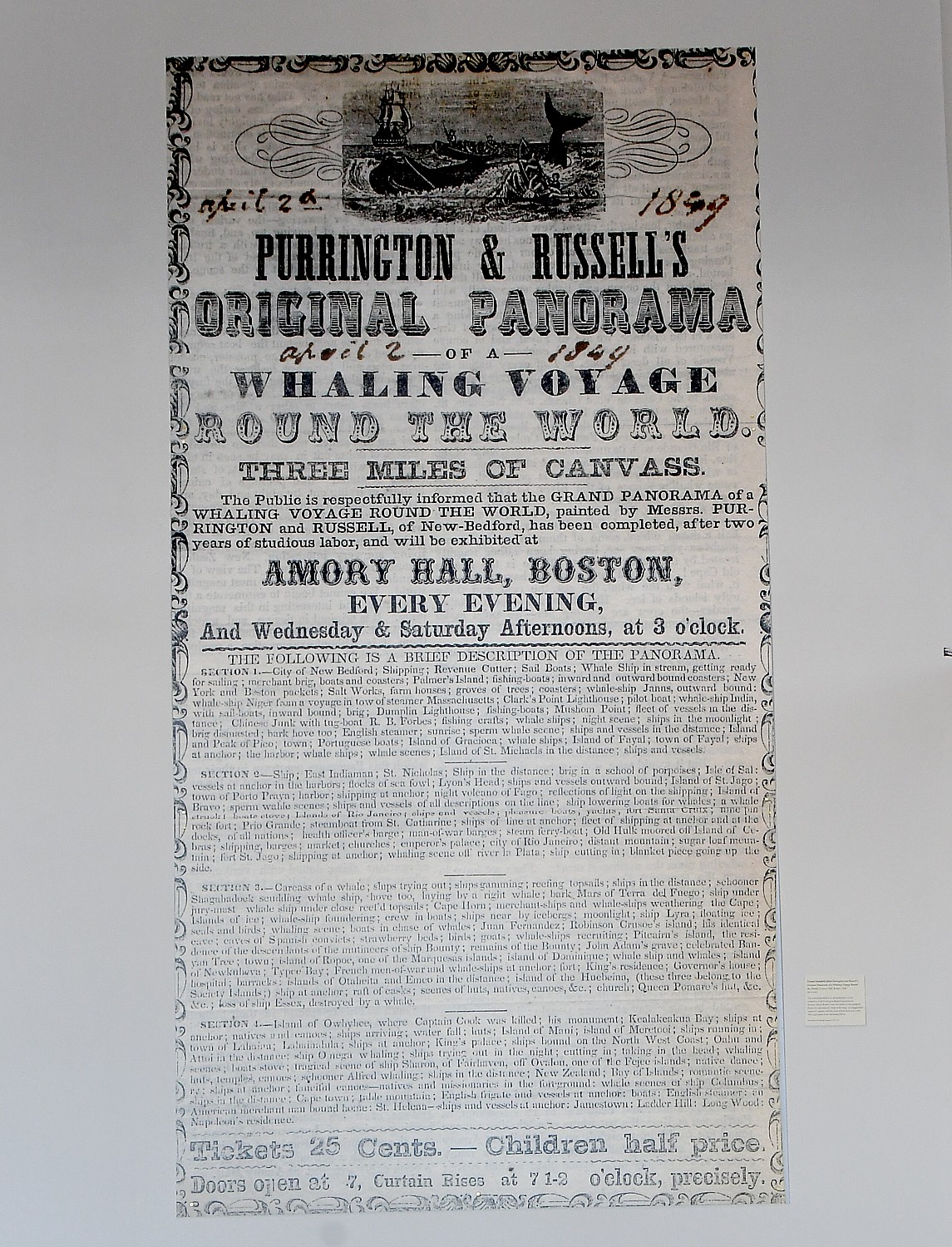
“Purrington & Russell’s Original Panorama: Whaling Voyage Round the World. Three Miles of Canvas” a poster from the Boston showing in 1849 proclaims. “Tickets 25 cents, half-price for children” (at a time when the sailors themselves earned $1 a day).

“A Spectacle in Motion,” a special exhibit of the New Bedford Whaling Museum featuring an extraordinary quarter-mile long mural painted in 1848 (longest painting in America) depicting “The Grand Panorama of a Whaling Voyage ‘Round the World”  was the Virtual Reality of its day © Karen Rubin/goingplacesfarandnear.com

The mural, which is only rarely displayed in its entirety, has not been seen since the 1960s and is only on public view through October 8 by the New Bedford Whaling Museum, in New Bedford, Massachusetts (and very possibly never again), is a documentary of the whaling voyage, and while it stays still, it is you that gives it motion as you walk down the long, long stretch of each of the four panels – altogether nearly one-quarter mile long. But in its day, it was designed to be rolled so that it did in fact create a moving picture.

Coming upon this spectacle was one of the highlights of the Blount Small Ship Adventure cruise of New England Islands, all the more thrilling because it was completely unexpected, as most highlights and adventures are. As I was leaving the New Bedford Whaling Museum, I spotted a flyer saying that there was a free shuttle to “the mural.” I took a leap of faith and within moments, was traveling in the van for the five-minute, two-mile drive to the historic Kilburn Mills,as the van driver (a 47-year veteran of the museum who had a hand in moving it and laying it out to be photographed for the digitized exhibit) explained. Even after he gave me some sense of what the mural was about and why it needed to be housed in such a sprawling building, I was completely unprepared for what I would encounter. Indeed, seeing the Grand Panorama proved to be a thrilling experience and not a mere ‘viewing”. But as I climbed the flights of stairs to the fourth floor and got my first glimpse, it was, OMG. It took my breath away. Titling the exhibit “A Spectacle in Motion” was not over-selling.

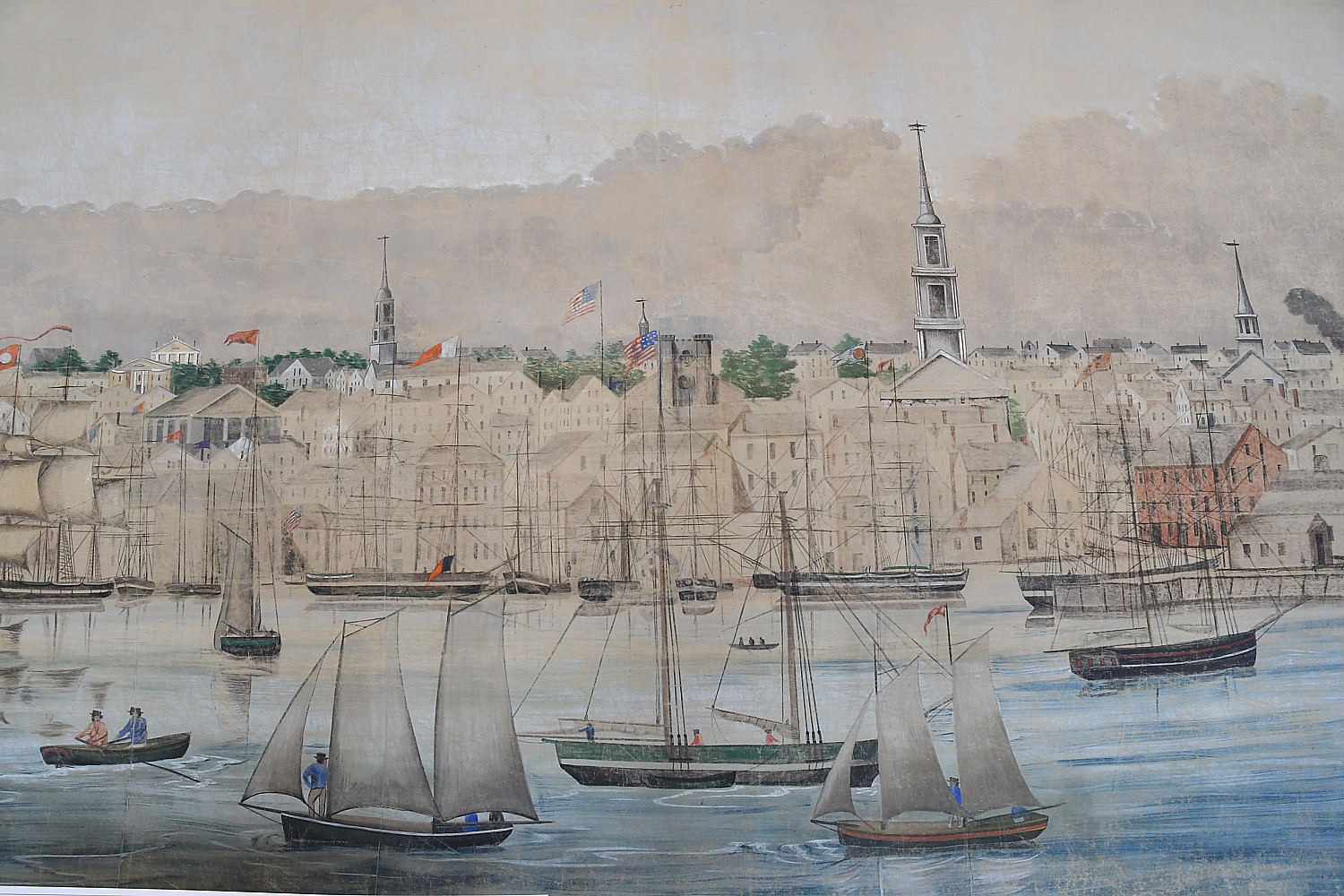
 “The Grand Panorama of a Whaling Voyage ‘Round the World” starts with the departure from New Bedford in scenes that are mimicked today. © Karen Rubin/goingplacesfarandnear.com

The mural, in four panels each that stretches the entire length of the mill, is as long as the Empire State Building is tall; it is the longest painting in America.

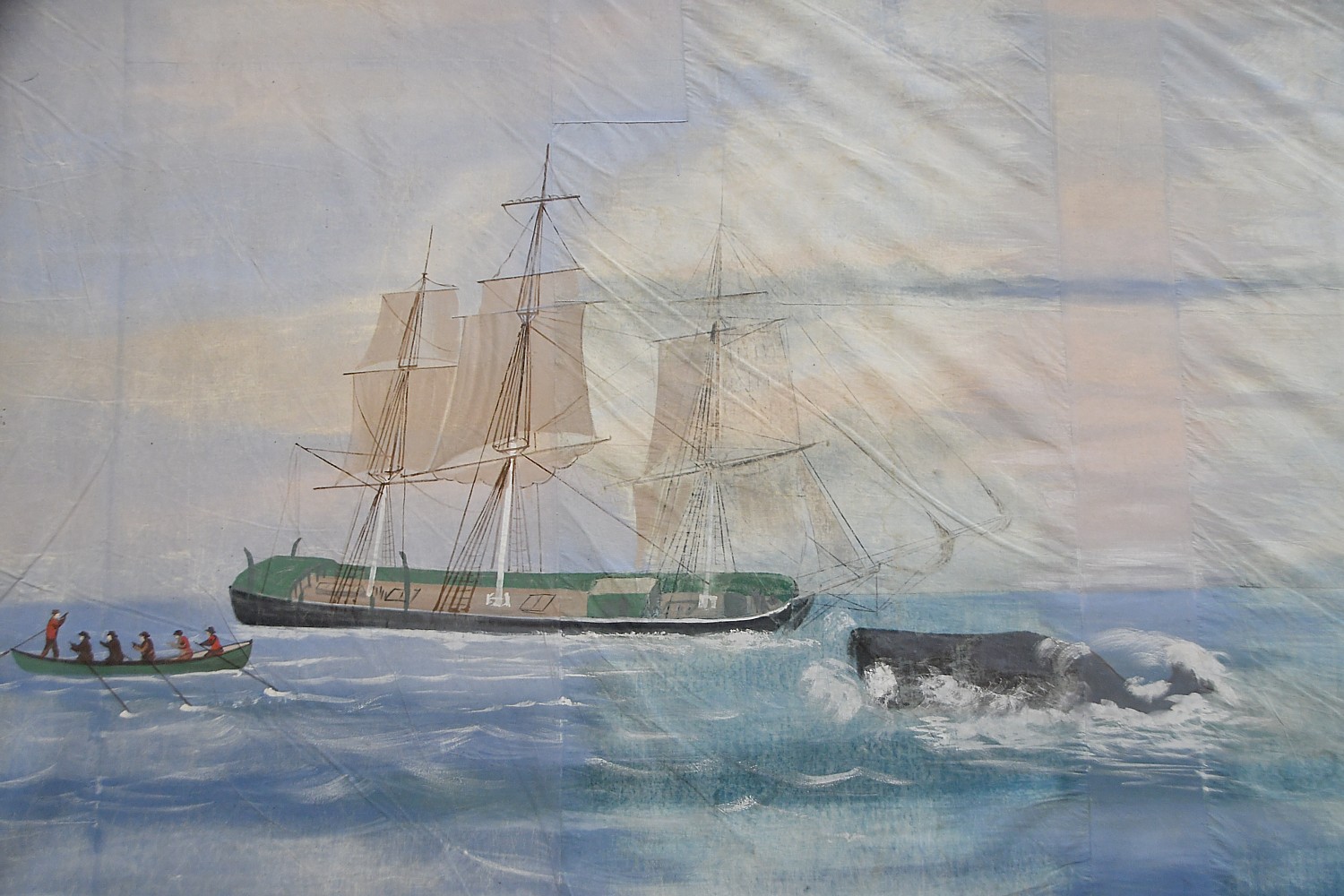
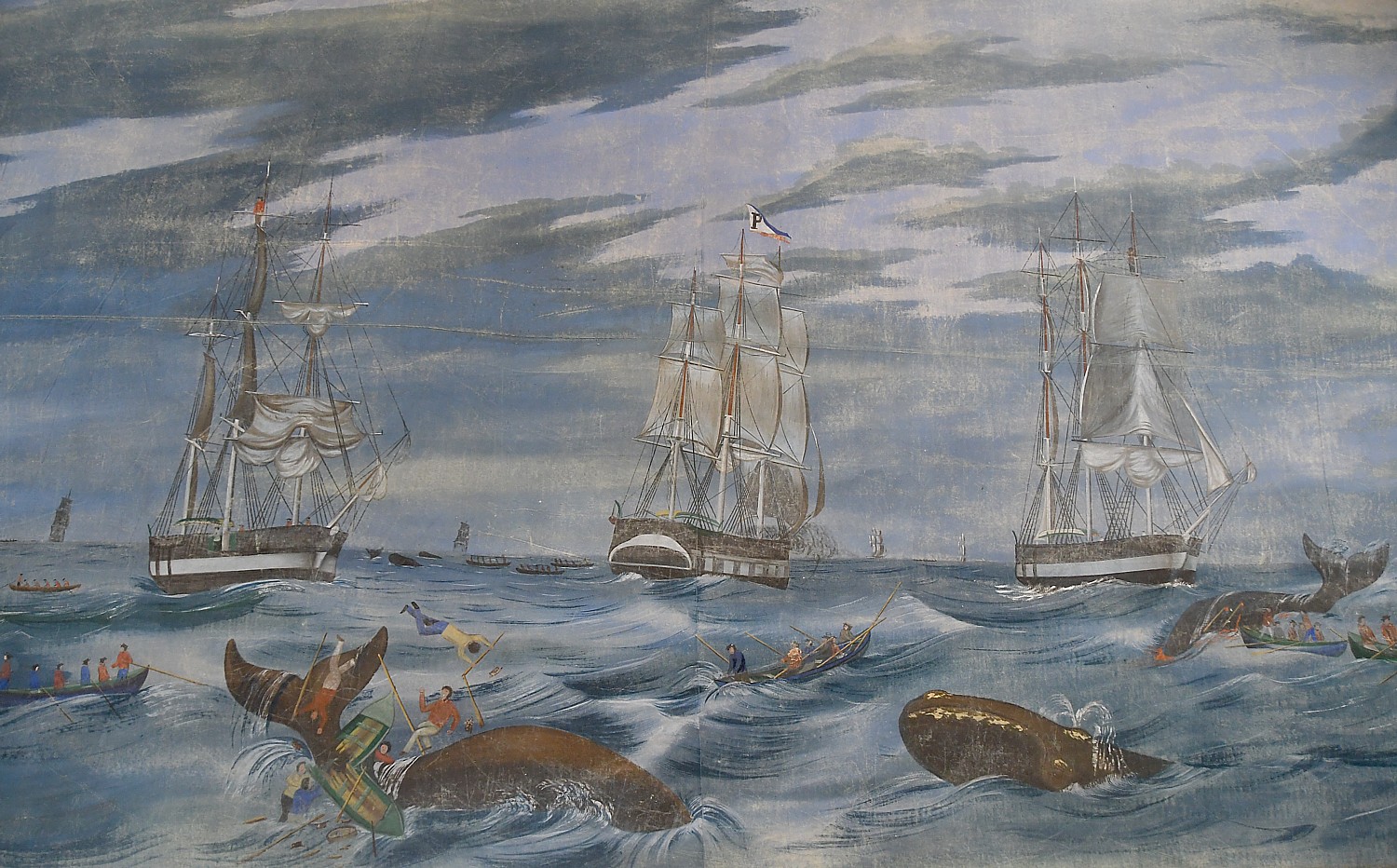
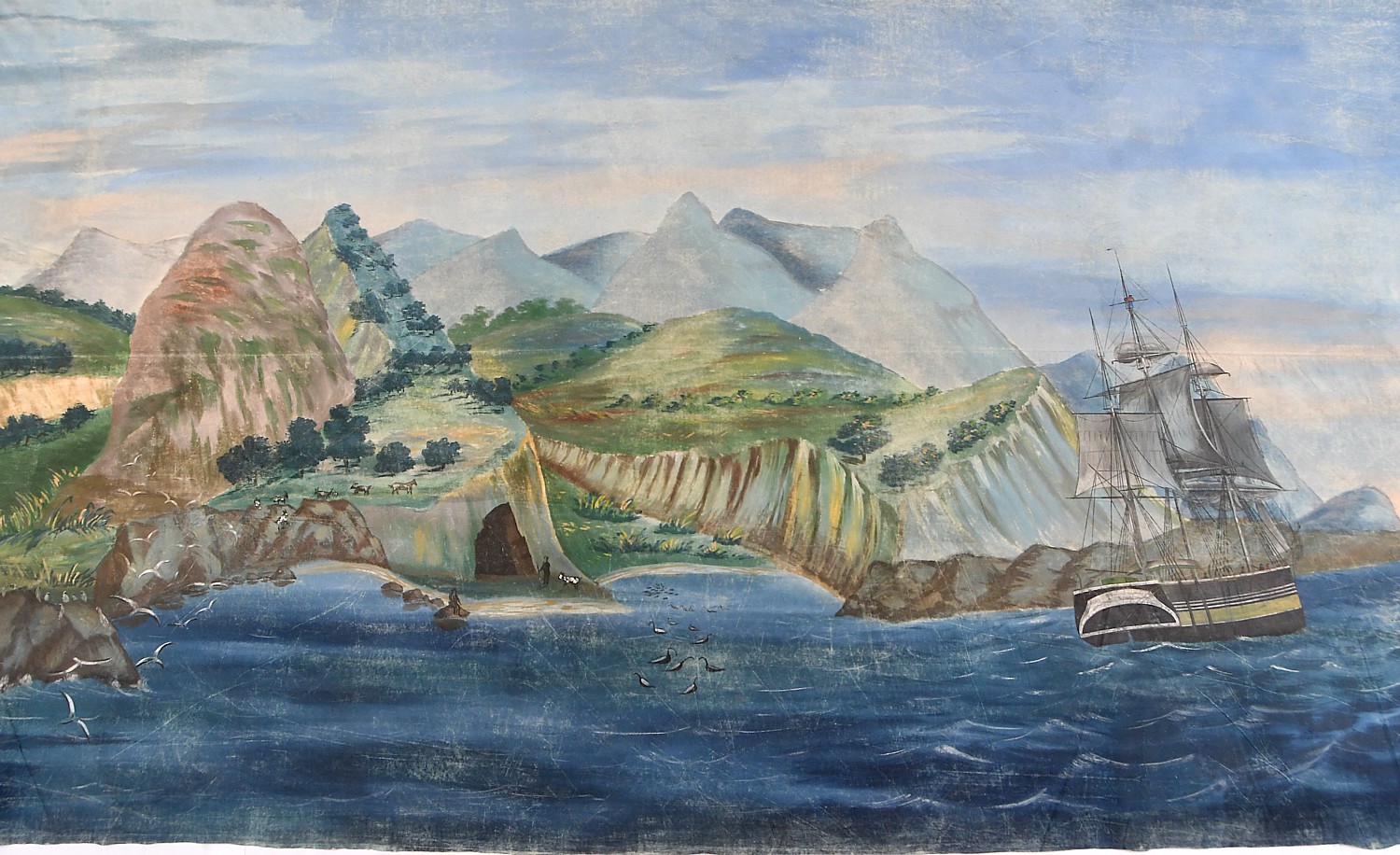
Painted in 1848 by two New Bedford artists, Caleb Purrington and Benjamin Russell based on Russell’s actual around-the-world whaling journey, the mural documents every aspect of the places visited as well as key events. You see Pitcairn, settled by the Mutineers of the Bounty wound up; the scene as the whale rammed the Essex, the 1820 event that inspired Herman Melville’s “Moby Dick”; the island of Juan Fernandez off Chile, the temporary home of castaway Alexander Selkirk who was the model for Defoe’s “Robinson Crusoe.” It shows in gory detail the harpooning of a whale, blood spewing into the water; the danger as whalers are thrown into the churning sea; the 1847 eruption of the volcano at Fogo, Cape Verde, spewing its orange-red lava; sailing through a dark furious storm.

“The Grand Panorama of a Whaling Voyage ‘Round the World” by New Bedford artists Caleb Purrington and Benjamin Russell, depicts important scenes like the whale that rammed the whaler, Essex, the event Herman Melville used in his novel, “Moby Dick.” © Karen Rubin/goingplacesfarandnear.com

The voyage starts in New Bedford, with the first section looking so much as it does from the water as we have seen, coming into port on Blount Small Ship Adventures’ Grande Caribe.

The last scene is in Fiji and the last panel is curious: it seems to depict two women, one giving birth and the other a midwife.

I can only imagine the sensation that The Grand Panorama of a Whaling Voyage ‘Round the World caused when it was first exhibited in 1849 – before documentary, before moving pictures, before photography, when the only way to get a visual impression of some place beyond your own experience was through painted or drawn images. But this goes so far beyond. Over the course of 1,275 feet, the mural documents the entire whaling voyage, from its departure from New Bedford, to Fiji Islands. Along the way, it shows the blood, gore, the dangers and hardships of whaling. And because you move, it is the closest thing to a “moving” picture documentary they would have had.

The final panel of “The Grand Panorama of a Whaling Voyage ‘Round the World” is set in Fiji where there is a curious scene that seems to depict a woman giving birth and a midwife © Karen Rubin/goingplacesfarandnear.com

But where the mural transported these 19th century viewers to places on the globe they had never been – it was the 3D Imax, the Virtual Reality of its day- it transports us back in time. And in its day, it was designed to actually move. Before moving pictures, the scrolls were cranked on either side like reels of film, and displayed on a theater stage.

The New Bedford Whaling Museum calls the exhibit “Spectacle: A Voyage in Motion” in appropriate typeface that shouts its excitement. It is astonishing, captivating, awesome – on so many levels – the sheer size and ambition, the quality of the art – the delicacy and fine line of scrimshaw, stunning use of colors – the insights into the events – the importance of the subject, and on top of that, the achievement of restoring the painting – and finally, the enormity and rarity of the work being displayed at all – just the process of unrolling it and hanging it for display damages the painting.

Reproduction of a poster announcing “The Grand Panorama of a Whaling Voyage ‘Round the World” at Amory Hall, Boston. The mural was first exhibited in 1849. © Karen Rubin/goingplacesfarandnear.com

The museum spent two years restoring the mural, which originally was shown by rolling it so that the images actually did move – and important details of that conservation process, along with historical notes, are provided that are fascinating.

The mural is displayed in four sections that each cover the entire length of an historic textile mill (textile manufacturing displaced whaling when that industry collapsed, and then was replaced itself in the 1950s when climate controls made it possible to manufacture more cheaply in the South, which was then replaced by tourism).

Given the extraordinary length, the fragility of the painting, the sheer cost of moving it, setting it up, and finding a room big enough to display it, this is the first time in generations that the entire Panorama can be seen by the public.

Like a true documentary, “The Grand Panorama of a Whaling Voyage ‘Round the World” by New Bedford artists Caleb Purrington and Benjamin Russell, depicts the blood and gore, the danger and risk of a whaling voyage © Karen Rubin/ goingplacesfarandnear.com

From where it is unfurled in the building two miles from the Whaling Museum, you travel around the world and back in time with the whalers without ever leaving the city. The exhibition’s interpretive panels and kiosks are fascinating to enrich the context and content of the Panorama, as well as to give a fuller appreciation of what went into the two-year restoration project.

The notes from the museum describe the Panorama as “a maritime artwork of national historical importance, authentically depicting a whaling voyage originating from the port of New Bedford in the mid-19th century. It was painted in 1848, by New Bedford artists Caleb Purrington and Benjamin Russell, who traveled it around the country as a commercial enterprise.”

The panorama as a form of public entertainment was developed in Europe in the late 18th century and subsequently made its way to the United States after demonstrating its commercial potential to an armchair traveler audience. Robert Barker, who patented this exhibition style, defined a “panorama” as “all view.”

He felt that spectators should feel like they were “really on the very spot,” that they should feel as if they were part of the scene in a surrogate reality, an imaginary “Grand Tour” of the world.

This is precisely what visitors will experience. It was the Virtual Reality of its day.

In the late 1840’s and early 1850’s, well before the age of cinema, the Panorama was designed and performed as a moving panorama, a form of entertainment where multiple scrolls moved across a stage similar to how a reel-to-reel film would later be shown.

The Grand Panorama depicts the island of Juan Fernandez off Chile, the temporary home of castaway Alexander Selkirk who was the model for Defoe’s “Robinson Crusoe.” © Karen Rubin/goingplacesfarandnear.com

But, “after years on display, the wear and tear on the 170-year old painting was so extensive that it was deemed worthless and impossible to conserve. After decades of conservation planning and method strategy research, the Museum brought this national treasure back to life and is proud to share it with the public. However, due to the extensive conservation efforts that have been invested into the painting, it will no longer be shown in its original format – as a moving panorama – as this would undo the extensive work recently completed.”

The Panorama drew crowds in the era of public entertainment before moving pictures and films. To celebrate this origin, the exhibition is coupled with dynamic and engaging programming all summer long. Live performances, contemporary artistic presentations, and other unique interpretations accompany educational programs and cultural celebrations.

Plan on being dazzled for at least one to two hours.

The exhibit is billed as a “once-in-a-lifetime experience” and is free and open to the public, through Columbus Day, October 8, 9 am to 5 pm at Kilburn Mill (the museum provides a free shuttle service every half hour from 10 am to 5 pm through Labor Day).

The Grand Panorama: The Experience 

As the Panorama was being conserved, it was photographed at high resolution to produce this fully digitized recreation of the entire painting for the first time, allowing the Museum to create a exhibition of The Grand Panorama it calls “The Experience” – recreating the same experience the 19th century audiences had of seeing the original Panorama on a theatrical stage, with music and narration.

You stand on the bow of the world’s largest model whaleship, the Lagoda, and watch the Panorama scroll by in a life-sized digital format projected in a full theatrical setting, and experience what Benjamin Russell and other whalers saw as they left the port of New Bedford and traveled the sea in search of whales. This re-creates the experience that the 19th century viewers would have had, since the mural was originally rolled.

Visitors can stand on the bow of the world’s largest model whaleship, the Lagoda, in the New Bedford Whaling Museum and watch the Panorama scroll by in a life-sized digital format projected in a full theatrical setting, and experience what Benjamin Russell and other whalers saw as they left the port of New Bedford and traveled the sea in search of whales. © Karen Rubin/goingplacesfarandnear.com

The stage set is based on drawings and prints from the period and is installed off the Lagoda’s bow so visitors can experience the performance from the deck, from theater seating on the floor level, or from vantage points to the port and starboard of the iconic whaleship.

Since the original score and narrative have been lost over time, they have been recreated and remastered for the new installation, and includes new research and points of interest.

Visitors are able to dive deeper into the specifics of the Panorama story on a large, touch-screen, interactive kiosk. The kiosk will have thematic tabs on various subjects, including a map of the voyage, related Museum artifacts and paintings, and the Panorama’s conservation history. You will be able to zoom in close to any scene or detail that interests you and get rich context for each section.

Enhancing the experience, artifacts from the Museum’s permanent collections further illustrate Russell’s own global travels and connect locations represented in the Panorama with relevant ethnographic material and objects. Exhibitions that tell the stories of Yankee Whaling, the connections with the Azores and Cabo Verde, as well as the many stories told in the existing Whaling Voyage ‘Round the World exhibition help amplify the content of the Panorama. The Panorama in the context of its own time – the era of the “public spectacle” is explored in the exhibition, and includes complementing pieces from the Museum’s permanent Collection.

While I strongly recommend the incomparable experience of seeing the mural first-hand and this Virtual Reality experience, the museum will also have an online digital version, an interactive designed to expand access to the Panorama and to supplement both the Spectacle in Motion exhibitions, the Original at the Kilburn Mill and The Experience at the New Bedford Whaling Museum. While it will work on a phone or tablet it has been optimized for desktop viewing.

At the New Bedford Whaling Museum, you can look through etched glass to see the exact port where our ship, Blount’s Grande Caribe, is docked today and yesterday © Karen Rubin/goingplacesfarandnear.com

The quality of the collection at New Bedford Whaling Museum – consisting of the merger of two private collections of whaling artifacts – is not to be believed, including what is claimed to be the largest collection of scrimshaw. I love the way the gallery rooms are like a warren – you come upon them.

I love the theming of the rooms: From Pursuit to Preservation: The History of Human Interaction with Whales;  Energy and Enterprise: Industry an d the City of New Bedford; Enlightened Counters: the Two Nations of Manjiro Nakahama  (about a 16-year old Japanese sailor who was rescued and spent eight years in New Bedford, the first Japanese person to live here, then went back to become a major counselor to the Emperor negotiating with the US and England) and The East Unlocks its Gates: American Whalers and Trade in Asia.

The New Bedford Whaling Museum, in New Bedford, MA, a private non-profit museum, has one of the largest collections of scrimshaw in the world © Karen Rubin/ goingplacesfarandnear.com

There is (of course) a Herman Melville room (while Melville never actually visited Nantucket before writing “Moby Dick,” he sailed from New Bedford on his whaling voyage), artifacts collected from around the world brought back by the whalers and opened the New Bedford people to the cultures of the world. There are sections dedicated to the Portuguese from the Azores and the sailors recruited from Costa Verde and how they impacted the diverse community in New Bedford. I am introduced for the first time to Captain Joshua Slocum, the first to solo circumnavigate the world.

An astonishing sight is the skeleton of a whale that is suspended from the ceiling as you enter the Museum, its bones with oily brown patches. It turns out that the bones still have oil which drips out and is collected in a jar below.

Whale skeleton still drips oil from its bones at the New Bedford Whaling Museum © Karen Rubin/goingplacesfarandnear.com

There is the world’s largest model whaleship, the Lagoda, at half-scale that takes up the entirety of the Bourne building, that you can climb aboard. In addition, there is the Mariner’s Home that is used for exhibit, and the Seaman’s Bethel which offers a superb video about whaling.

It drives home the theme that is so pressing today: “Trade: Expand American Ideas” (but also bring ideas back).

New Bedford Whaling Museum, 16 Johnny Cake Hill, New Bedford MA 02740, 508-997-0046, www.whalingmuseum.org. 

They are contained within the New Bedford Whaling National Historical Park, a 13-block historic district of cobblestone streets, historic, stately buildings now juxtaposed with contemporary art galleries and funky restaurants and shops (my favorite: Sanctum – Folklorica: Apothecary and Witchwares, Tarot Reading). At the visitors Center, you can watch a 20-minute orientation movie and take in exhibits about whaling and New Bedford, “The City That Lit the World.” (www.nps.gov/nebe/planyourvisit).

Blount Small Ship Adventures’ Grand Caribe docked at the State Pier in New Bedford, Massachusetts, just steps away from the New Bedford Whaling National Historical Park © Karen Rubin/goingplacesfarandnear.com

This was one of the incredible highlights of our own voyage aboard Blount Small Ship Adventures’ Grande Caribe, on the third day of a seven-day New England Islands cruise. We docked in the port along with the largest fishing fleet on the East Coast, and could look through etched glass of the same port in 1914 of our ship. Arriving by ship – we had come from Warren, Rhode Island to Bristol and had come this morning from Newport and will be going on to Martha’s Vineyard and Nantucket – made this experience even more tangible.

Blount Small Ship Adventures, 461 Water Street Warren, RI 02885, 800-556-7450, www.blountsmallshipadventures.com.

_____________________________

© 2018 Travel Features Syndicate, a division of Workstyles, Inc. All rights reserved. Visit goingplacesfarandnear.com,  www.huffingtonpost.com/author/karen-rubin , and travelwritersmagazine.com/TravelFeaturesSyndicate/. Blogging at goingplacesnearandfar.wordpress.com and moralcompasstravel.info. Send comments or questions to FamTravLtr@aol.com. Tweet @TravelFeatures. ‘Like’ us at facebook.com/NewsPhotoFeatures
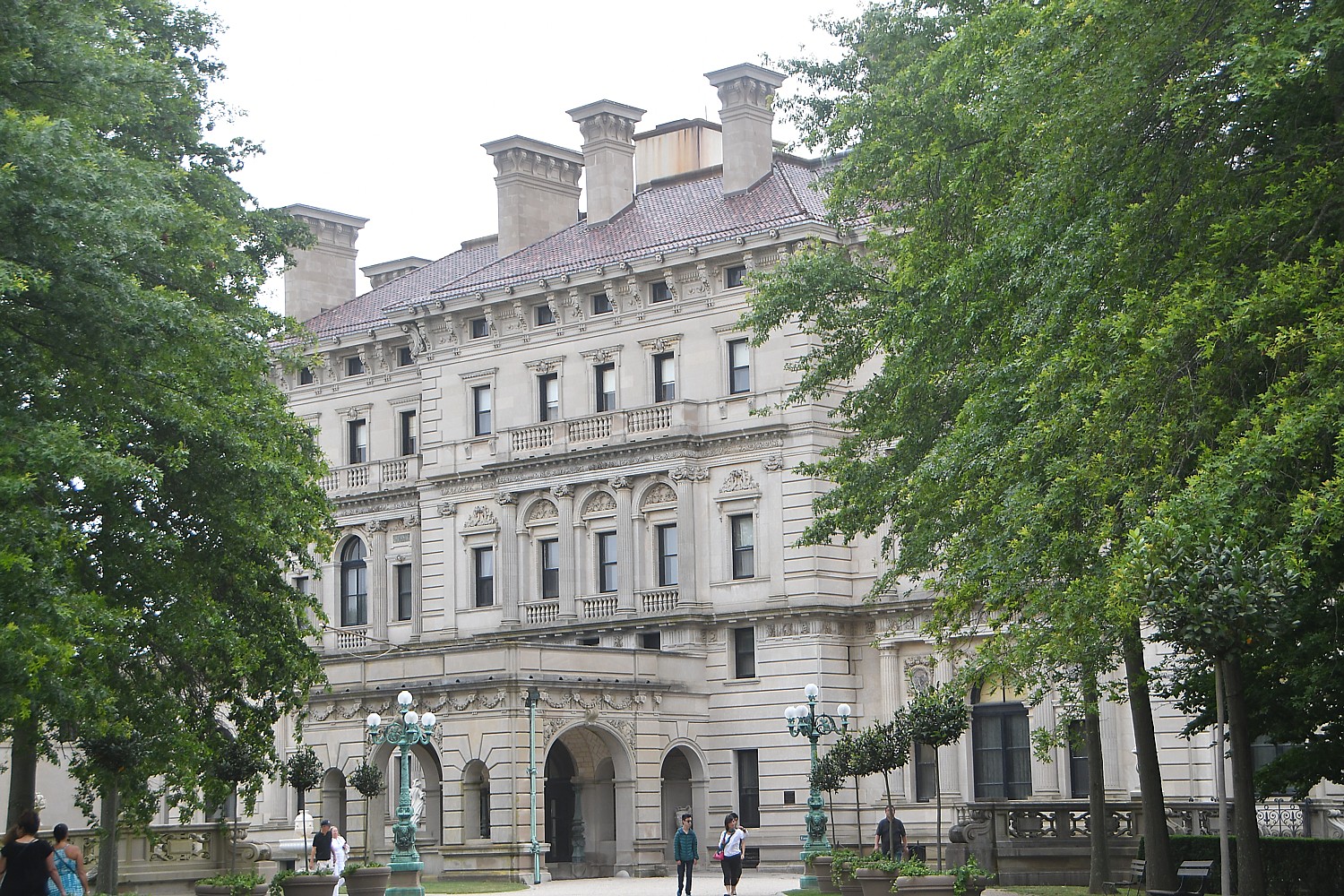
New Boardwalk Café Opens at Jones Beach State Park After 14-Year Absence

Jones Beach Cafe_20180705_165456 (c) Karen rubin
The $20 million Jones Beach Boardwalk Café is finally open for business, bringing back a popular dining option and renewed vitality to Central Mall at the heart of Jones Beach State Park © Karen Rubin/goingplacesfarandnear.com

By Karen Rubin, Travel Features Syndicate, goingplacesfarandnear.com

The $20 million Jones Beach Boardwalk Café is finally open for business after a 14-year absence, bringing back a popular dining option and renewed vitality to Central Mall at the heart of Jones Beach State Park. The revitalization of Long Island’s most-visited state park (and one of the best white-sand beaches in the world) is part of the Governor Andrew Cuomo’s NY Parks 2020 multi-year commitment of $900 million in private and public funding to modernize New York’s state parks.

“The grand opening of the Boardwalk Café highlights New York’s progress in restoring the historic vitality of Jones Beach State Park,” Governor Cuomo said. “I encourage everyone to visit Jones Beach this summer and experience for themselves the transformation that has taken place at one of Long Island’s true natural wonders.”

The new 7,700-square-foot café, featuring an open and airy Market Hall dining concept and distinctive tensile roof, will bring back food and beverage to the Central Mall that has been absent since 2004 (for a long-time it was bogged down in a fight with Donald Trump who wanted to ignore environmental restrictions), when the previous building was demolished due to structural failure. The café will be operated by Centerplate, a concessionaire offering hospitality services at the park. There will also be a Taste NY Grab and Go component to the Café with more than 20 New York-produced items.

The Boardwalk Café anchors newly installed activities including the refurbished East Games Area and the new splash pad adjacent to the Central Mall and the adventure course to be constructed this summer and offers outdoor shaded seating options, with commanding views of the ocean, beach and boardwalk. It was designed to withstand severe coastal storms and flooding with a reinforced design built on piles that elevates the main floor 20 feet above sea level, while honoring the park’s heritage with brick, sandstone and limestone to match those materials utilized in the historic 1920/30s buildings in the park era, a large and historic photo of the Park in the interior, and restored symmetry of the Central Mall.  

Jones Beach_20180705_165022 (c) Karen Rubin-bdwlk
In a change of policy, you can now bike on the Jones Beach Boardwalk during the summer, surprisingly uncrowded on a hot July weekday © Karen Rubin/goingplacesfarandnear.com

Another wonderful improvement to Jones Beach is that the dedicated bike path that starts at Cedar Creek Park and goes alongside the Wantagh Parkway has been extended 3.5 miles along Ocean Parkway, passing by the Bay and Jones Beach Theater. What is more, you can now bike on the boardwalk during the summer (respecting walkers).

Since 2011, State Parks has committed $65 million through 2020 in projects to restore Jones Beach State Park’s historic grandeur, attract new visitors and create new recreational facilities as part of a multi-year revitalization plan. Projects completed include the rehabilitation of the West Bathhouse and Field 6 Bathhouse, restoration of the historic park mosaics, new playgrounds and West Games Area and Zach’s Bay, new gateway signage and boardwalk upgrades.

“Investing in the Jones Beach State Park is a common sense way to help grow the local economy and revitalize our entire community,” Senator John Brooks said. “I commend the Governor for his efforts and I look forward to visiting the Central Mall and enjoying the renovated Boardwalk Cafe. I encourage Long Islanders, and all New Yorkers, to come to Jones Beach State Park this summer and enjoy all of the great activities, restaurants, and natural beauty this community has to offer.”

“The Boardwalk Café is an important part of our area’s history that honors our community’s past with its beautiful Art-deco designs, while also adapting to our present and future needs,” Town of Hempstead Supervisor Laura Gillen said. “We are grateful to Governor Cuomo for making this treasured building more resilient to withstand future storms and open in time for the busy July 4th weekend.”

“Jones Beach is the crown jewel of the south shore of Long Island. No matter the season, locals and tourists come to Jones Beach for the boardwalk, ocean views, concerts, and sporting events,” Assemblywoman Christine Pellegrino said. “The restoration of the Boardwalk Cafe is a welcomed addition and I am grateful to the governor for the investment in this important project.”

“The new Boardwalk Café is a wonderful step towards growing the vision for what Nassau County should look like in the future,” Nassau County Executive Laura Curran said.

For more travel features, visit:

goingplacesfarandnear.com

goingplacesnearandfar.wordpress.com

moralcompasstravel.info

www.huffingtonpost.com/author/karen-rubin

travelwritersmagazine.com/TravelFeaturesSyndicate/

goingplacesfarandnear.tumblr.com/

instagram.com/krubin0830/

instagram.com/famtravltr/

‘Like’ us on facebook.com/NewsPhotoFeatures

Twitter: @TravelFeatures


Caribbean Destinations: Best Way to Help Rebuild is Simply to Come, Enjoy

rcl-liberty-072307-sanjuan 095e2 (c) Karen Rubin
Puerto Rico’s Castillo San Felipe del Morro (also known as “El Morro”), perhaps the most iconic fortification built by the Spanish in the Americas, covers a 140 foot-high promontory at the entrance to the Bay of San Juan. This fortress, a US National Historic Site, consists of 6 levels facing the Atlantic Ocean, all of which were designed to create a devastating artillery fire over enemy ships. By the time of its completion around 1790, it had the reputation of being unconquerable and was the most feared of all the Spanish colonial fortifications. © Karen Rubin/goingplacesfarandnear.com

By Karen Rubin, Travel Features Syndicate, goingplacesfarandnear.com 

For those of us anguished over the destruction of Puerto Rico, Dominica, Anguilla and other Caribbean islands badly battered by category 5 hurricanes Irma and Maria last year, the best way to help is to come down, visit, spend money at the refurbished resorts and hotels and help revitalize the critical tourism industry that so many islanders depend on.

And for those who may feel pangs of guilt luxuriating on the beach and in lavish hotels and want to do more to help rebuild, there are ways to volunteer some of your time working on local projects.

The Wyndham Grand Rio, located literally next door to Puerto Rico’s El Yunque Rainforest, which reopened January, has an arrangement with the rainforest and can shuttle guests who want to help out on projects such as clearing debris. The resort, which has its own generated, is located one hour from the airport in an area that has been fully restored.

Puerto Rico’s tourism website, SeePuertoRico.com, can link you to “meaningful travel” such as through Para la Natural, a local service organization.

“You see the resilience of the island,” said Sara Green Hill, who represents the Wyndham Grand Rio and visited in January. “The service is actually better because people are so happy to have visitors…The island looks good.”

rcl-liberty-072307-sanjuan 117e2 (c) Karen Rubin-dancers
Serendipity: coming upon a dance festival during a visit to El Morro, the National Historic Site in San Juan, Puerto Rico © Karen Rubin/goingplacesfarandnear.com

Dominica Launches ReDiscover Dominica Promotion

On Dominica, so many individual travelers wanted to help after the island was badly hit by Hurricane Maria, that the tourist office set up a “voluntourism” tab on its website, DominicaUpdates.com.

“Voluntourism – or ‘travel with a purpose’-  didn’t start with the hurricanes, and there are some tour operators that run such programs,” said Colin Piper, Discover Dominica. “ But after the hurricane, the tourist office realized it had to fast track these programs, develop an infrastructure to support them.

“Now we realize we need to be more involved. Where people stay, how transported, safety and insurance – a total package. Some want to be part of program, others just want to spend a day as a volunteer, so they can call the tourist board to set up. We hope to grow and expand these programs.”

Meanwhile, Dominica, which calls itself “The Nature Island of the Caribbean,” has launched “ReDiscover Dominica,” using discounts on accommodations and on-island activities to attract nature lovers, “meaningful” travelers, adventure seekers, wellness enthusiasts, educational travelers and leisure travelers to visit.

ReDiscover Dominica eatures one free night on a minimum four-night stay at nine participating hotels. To qualify for the free night, bookings must be made by July 31, 2018 using the promo code DOM2018 and travel between July and December 15, 2018.  Adult visitors age 18 and over will also receive up to US$100 in coupon vouchers redeemable at 15 participating vendors and hotelsActivities include dining, car rentals, horseback riding, island tours, underwater experiences, spa services and duty-free shopping. Visitors are encouraged to book through tour operators within their geographic location or book directly with participating hotels on the campaign website.

For more information on Dominica, contact Discover Dominica Authority at 767 448 2045. Or, visit Dominica’s official website :www.DiscoverDominica.com, see Dominica’s updates on the tourism sector post Hurricane Maria: www.dominicaupdate.com, follow Dominica on Twitter and Facebook and take a look at our videos on YouTube

Villa Viewfort, Anguilla

The timing of a hurricane of historic proportions couldn’t have been worse for Villa Viewfort, a 200-year old family estate that was opened for guests as a luxurious mansion experience (complete with butler service) only two years ago, on Anguilla, an island that is not normally hit by hurricanes. But the eye of Irma hit the island directly, amazingly not doing substantial damage to the historic home, but with winds of 185 mph, gusting to 215 mph, hitting with such force that marble pillars were shattered, steel rods were bent.

After being closed for six months, the estate reopened (“rebirth”) to guests in May.

“It allowed us to build an extra suite, redo the bathrooms and floors.”

ViewFort Estate is where Anguilla’s heritage and modern luxury meld to offer discerning travelers the comforts of home at the Island’s most elegant and historic setting – and the only of its kind – on the beautiful and sought-after destination of Anguilla. It delivers an unmatched ‘at home’ feeling for its guests while providing a window into the best of Anguillian culture and hospitality.

Anguilla is a place where celebrities like Justin Bieber come to get away from prying eyes.

The Gumbs family who owns the estate also owns one of the island’s most popular beaches, Little Bay, as well as a nature reserve, and in addition to curating authentic cultural experiences at the villa and on the island, also can curate voluntourism experiences to help repair the severe damage that Irma inflicted on the island.

Framed by rock walls of a previous generation positioned on the highest point of Anguilla (214 ft.), the Villa owes its authenticity to a beautifully preserved 200-year old structure that has remained in the family, one of the last remaining examples of artisanal work of 19th century Anguilla. The Villa and its 9 characteristically-appointed Suites capture 360-degree panoramic views of the Caribbean Sea, Atlantic Ocean and Anguilla’s neighboring islands and cays. Combined with the feeling and essence of casual elegance the Villa exudes, it was purposefully designed to be unpretentious and deliver a warmth and serenity that comes from the easy-going lifestyle that is signature to the island. “We call this Pure Anguilla, something no other resort, villa or hotel can authentically convey.”

Anguilla-Viewfort Pool2
On Anguilla, the luxurious Villa Viewfort’s infinity pool is where guests enjoy impressive sunsets and 360-degree panoramic views (photo courtesy of Villa Viewfort)

The Villa’s infinity pool spills out into two oversized Jacuzzis surrounded by miles of ocean frontage, where under swaying coconut fronds guests enjoy impressive sunsets and star-filled, moon-lit skies. Main House Suites provide the graceful appointments expected of a 5-star property and living spaces inclusive of a commercial-sized kitchen, library, indoor dining and living room, much like the comfortable luxury of an elegant home. The Villa Suites, separated by green lawns on the estate’s lower level, also have premium appointments but separate sleeping quarters areas for private dining, lounging and outdoor terraces with ocean views.

Classically-trained butlers and staff are available 24/7 to ensure guests enjoy a fully tailored Pure Anguilla experience at every turn.

It is the ideal setting for family vacations, weddings and holidays.

ViewFort Estate offers a “trinity” of attractions: it encompasses 80 acres of the Gumb family’s Katouche Forest, with caves, hiking trails, wetlands and two secluded beaches – Katouche Bay and Little Bay. Katouche, which offers an educational and fun guided hiking and caving/spelunking tour experience, has earned its fame with one of its found artifacts now on display at The Smithsonian.

Little Bay beach, which is hugged by the serene beauty of the protected cliffs, is internationally recognized for its blue crystal waters and powdery sands and outstanding snorkeling, swimming and water-sports.

A signature of Villa Viewfort is the opportunity to enjoy curated experiences. “As the Estate’s native owners and proprietors, the goal is to always bring forth an authentic Pure Anguilla feeling with carefully curated experiences that bring our island’s culture to life.  Ensuring every guest is immersed in the natural beauty, rich culture and proud heritage of this remarkable island is a strong motivator for what brings our guests back over and over again.”

These might include:

       Prepare private Culinary Experiences with Anguilla’s top, Michelin-star, classically trained Chef;

       Handle event planning and entertainment for on-property weddings, parties, celebrations or events;

       Charter a private “hop on/hop off” swim and sand boating tour around the island, complete with crew, music and signature cocktails;

       Host a private Chef’s cooking class in the Villa’s gourmet kitchen with the island’s top Chef(s);

       Organize off-property island activities, ranging from kite surfing to tiger boating to historical tours with a museum visit to shopping island wide to golfing to a culinary “food crawl”;

       Arrange on-property spa services and yoga; and,

       Equip and prepare guests for privately guided Hiking and Caving tours at the Villa’s nearby Katouche Estate, Anguilla’s Rainforest with the Villa’s seasoned local expert.

In the wake of Hurricane Irma’s devastation, Mrs. Gumbs-Connor also founded and runs the Pure Anguilla Foundation, dedicated to advancing education, sports, health, justice and conflict resolution, relieving poverty. One of its first projects is “Return to Happiness,” in partnership with UNICEF, to help alleviate the trauma of the hurricanes to children of the island.

For more information or to make a reservation at ViewFort Estate, contact INFO@viewfortanguilla.com or call 264 497 8713. To learn more about ViewFort Estate’s trinity of offerings, or to learn more about or donate to the Pure Anguilla Foundation, visit www.viewfortanguilla.com

Cayman Islands Offers ‘Worry-Free Hurricane Guarantee’ for Getaways this Season

The Cayman Islands Department of Tourism has introduced a “Worry Free Hurricane Guarantee,” a promise by on-island partners to cover any cancellations made prior to arrival and compensation if vacation time is cut short due to inclement weather during a Cayman Islands getaway.

The Worry Free Guarantee includes a full refund of accommodation fees at participating hotels, condos and villas island-wide, with a maximum one-night penalty at most for cancellations made up to 48 hours prior to check-in as soon as a hurricane watch is issued by authorities. Additionally, many properties on-island are offering a free replacement stay throughout the summer months, allowing guests to rebook for the same duration as the initially-booked stay, regardless of how many days were affected by a hurricane or storm.

An array of hotels, condominiums and villas across Grand Cayman, Cayman Brac and Little Cayman are participating in the Worry Free Hurricane Guarantee. This program is available only through participating hotels and resorts. For a list of properties and their respective policies, go to www.visitcaymanislands.com/en-us/about-cayman/weather/hurricane-guarantee. For detailed property guarantees, please visit the individual property web sites or contact them directly.

Martinique To Host First International Foiling Event 

Martinique will host what is expected to be  the world’s signature international foiling event,and comes in advance of when it becomes an Olympic sport. Organized by the Martinique Tourism Authority (MTA), the Martinique Flying Regatta will take place from November 17 to 24, 2018.

The bay of Fort-de-France is an ideal location to run a race showcasing these hydro-foil sailboats that represent the technological future of competitive sailing. Inducted into the prestigious club of “The Most Beautiful Bays in the World,” the Fort-de-France Bay is vast and protected 28 square miles (72km2) of maritime space, affording speedsters perfect conditions of  the bay’s steady, moderate winds and smooth seas and the island’s low 80s temperatures.

To date, about 40 participants have been registered in this seven series race (or foil types), representing most of today’s hydro-sailing boats. Foil types include the very fun and high-tech Kitefoil and Windfoil—that may soon be seen at the Olympics—the one-man Onefly and the celebrated Moth; the race will also feature bigger crafts like the Flying Phantom, the Easy to Fly and the American favorite, GC32.

The competition will include demonstrations and racing events in the Fort-de-France Bay; residents and guests will enjoy what promises to be a spectacular show. The program will also include races from the bay towards the farther shores of Trois-Ilets, Anse Mitan or Anses d’Arlet.

The event is expected to help showcase Martinique as a sailor’s haven with 350 km of coastline, cliffs and mangroves, a water temp averaging 28 degrees and steady tradewinds year round.

Airlines providing direct service to Martinique include Norwegian Air, American Airlines and Air France.

Packages will be available with lodging and event access tickets.

For more information visit the new website www.martinique-regatta.com

Registration is open until October 17th, 2018 www.martinique-regatta.com/index.php/en/register/ 

American Airlines operates nonstop from Miami to Martinique year-round, increasing from one flight weekly up to six times weekly in high season.

Norwegian Air is increasing US winter seasonal routes to Martinique:  Fort Lauderdale to Martinique service will resume on October 31 with four flights weekly (increased from three flights weekly last year); New York-JFK to Martinique service will resume on October 28, 2018, with six flights, two flights more than the previous season.

‘The Rhythm Never Stops’

CaribbeanTravel_20180607_35e2 (c) Karen Rubin-Dinosio DAguilar
Frank Comito, CEO and Director General, of Caribbean Hotel & Tourism Association; Johnson JohnRose, CTO communications specialist; Dinosio D’Aguilar, chairman of the Caribbean Tourism Organization and Bahamas Minister of Tourism; Hugh Riley, Secretary General of CTO announce The Rhythm Never Stops” campaign © Karen Rubin/goingplacesfarandnear.com

Caribbean tourism interests are optimistic that strong consumer demand for a Caribbean travel experience and increased tourism investments in hotels and airport improvements bode well for the future of tourism, which is exceeding 2018 expectations despite the fact that some hotels in six of the Caribbean’s 32 major destinations are still in rebuilding mode following last year’s hurricanes.

“A growing number of travelers are understanding that the Caribbean is a vast region comprising many diverse destinations all rich in natural beauty but each distinct in its history, music, culture, food and welcoming hospitality,” said Frank Comito, CEO and Director General of the Caribbean Hotel and Tourism Association (CHTA). “Just like a winter blizzard may affect the northeastern United States while people are sunbathing on Miami Beach, a weather incident in one part of the Caribbean does not affect the overwhelming majority of the Caribbean.”

That includes the summer season, which is when hurricanes are most frequent.

“Over the years, we have done number of things in the region to even out seasonality – gone are the days when seasonality curves. There are festivals and events inserted into non-winter to give extra value. Weather events are a fact of life.

“The thing about a hurricane is that it doesn’t surprise you – there is advance notification – people can adjust plans and we can also.”

The Caribbean Tourism Organization (CTO) and Caribbean Hotel & Tourism Association (CHTA) are launching a regional tourism marketing campaign themed, “The Rhythm Never Stops” – a theme that is adaptable for each individual destination to define “rhythm,” to express the spirit, energy and resilience of destinations, while offering a nod to fostering year-round travel and evening out seasonality. The campaign, initially funded with $400,000,  is being supported by private sector partners including Mastercard, Marriott and some airlines, with more partners being sought.

“But we are going to use ‘The Rhythm Never Stops’ in lots different ways so it will have all kinds of meaning to it,” Dinosio D’Aguilar, chairman of the Caribbean Tourism Organization, said at a media briefing in June.”In the Bahamas, the rhythm never stops, in Jamaica the rhythm never stops, in Martinique and in Grenada. And in each of the countries will have its own interpretation of its story and its rhythm and its never-stopness.

“Each country will have own story about its rhythm. The campaign is intended to benefit the entire region- that we are open for business – though affected countries coming back at different rates. We can’t always wait for everything dotted before people come back. The first priority is to protect safety, but how many times do you see a ‘Pardon us while we renovate’ sign? The islands are in various stages (of rebuilding) but the rest of the Caribbean is vibrant.”

_____________________________

© 2018 Travel Features Syndicate, a division of Workstyles, Inc. All rights reserved. Visit goingplacesfarandnear.com,  www.huffingtonpost.com/author/karen-rubin , and travelwritersmagazine.com/TravelFeaturesSyndicate/. Blogging at goingplacesnearandfar.wordpress.com and moralcompasstravel.info. Send comments or questions to FamTravLtr@aol.com. Tweet @TravelFeatures. ‘Like’ us at facebook.com/NewsPhotoFeatures
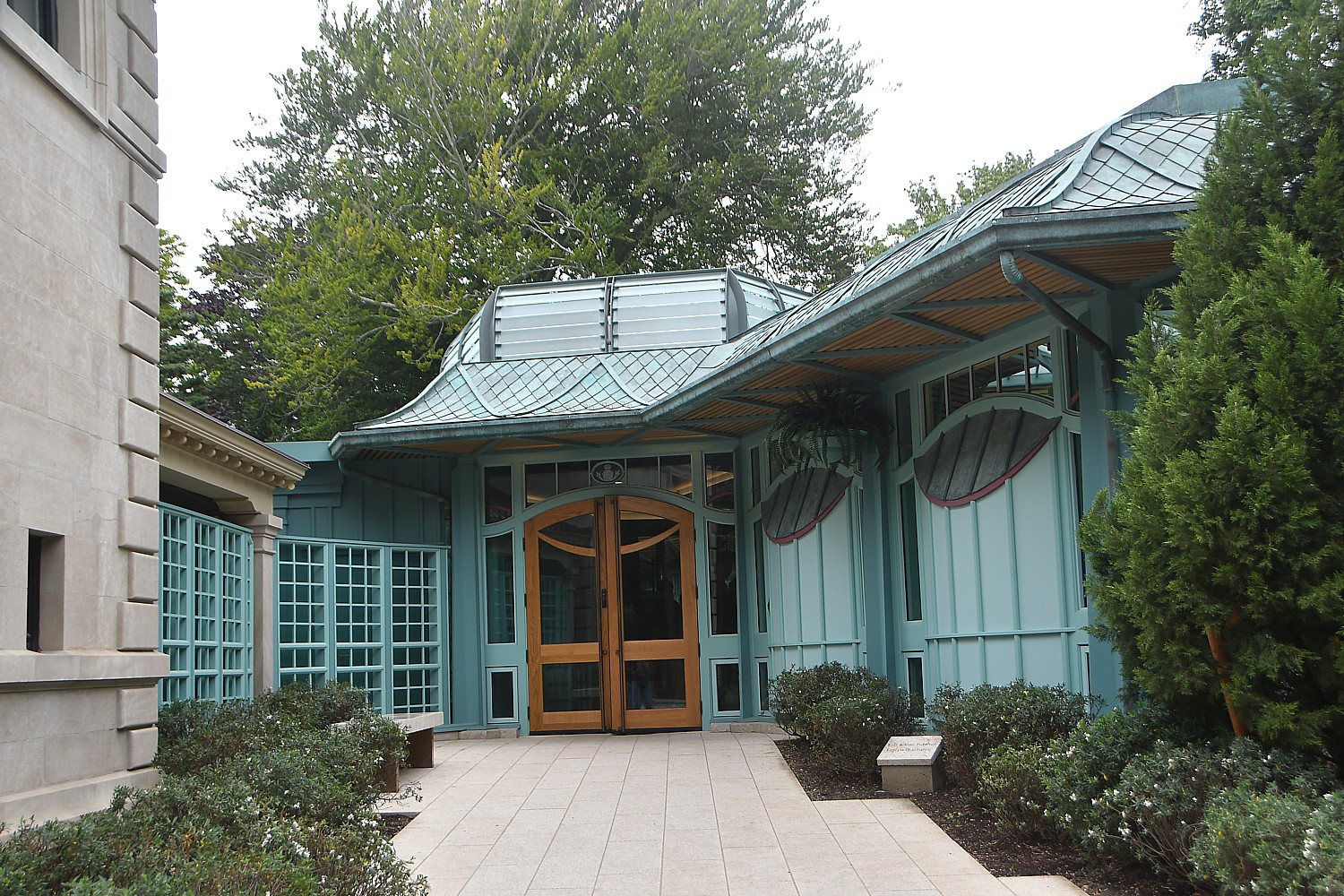


Gatsby-esque Jazz Age Lawn Party is Joyful Escape on Governors Island, New York City’s Island Retreat

Dancing to the 1920s Hot Jazz of Michael Arenella and His Dreamland Orchestra at the 13th annual Jazz Age Lawn Party on Governors Island © 2018 Karen Rubin/goingplacesfarandnear.com

By Karen Rubin, David Leiberman & Laini Miranda

Travel Features Syndicate, goingplacesfarandnear.com

Flappers and Dapper Dans packed the ferry to Governors Island for the 13th annual Jazz Age Lawn Party, June 16 and 17. Take heart if you missed the June weekend festival: there is another opportunity to transport yourself back to the Gatsby Era, on August 25 & 26.

The Jazz Age Lawn Party is a chance to push back the clock to a Gatsby-esque Brigadoon of sorts. It is the best of New York and brings out the best of New Yorkers. The music and atmosphere brings out pure joy -– it is one perennial smile.

For an entire afternoon you are transported – quite literally by ferry from the tip of Manhattan and Brooklyn – to the 1920s era of hot jazz. People of all ages, dressed to the nine’s as flappers and gents, bearing wicker picnic baskets (some with tables, tablecloths and candelabra), stream onto the island, with its forts and structures from the Civil War and World War II. It is but a stone’s throw from Manhattan and Brooklyn, and yet a world and an era away.

Dancing to the 1920s Hot Jazz of Michael Arenella and His Dreamland Orchestra at the 13th annual Jazz Age Lawn Party on Governors Island © 2018 Karen Rubin/goingplacesfarandnear.com

Michael Arenella and his Dreamland Orchestra create this literal dream, with his meticulously recreated music of the 1920s.

There is impeccable faithful reproduction – even the cocktails are Speakeasy-worthy and if you didn’t have appropriate attire, you could rent or buy vintage at one of the stalls, take a tintype photo or a photo sitting on a blue moon with a vintage camera.

Budding Fred Astaire and Ginger Rogers learn to dance The Peabody at the 13th annual Jazz Age Lawn Party on Governors Island © 2018 Karen Rubin/ goingplacesfarandnear.com

Over the years, the regulars have returned, now with babies, now with toddlers, now with their little boys in their caps and suspenders, little girls with hair bows, dresses and patent leather shoes who join in the dancing.

Interlude music is provided on vintage vinyl recordings over antique gramophones.

The only thing that bursts the illusion, to jostle your memory of what year it is, are the ubiquitous cell phones.

Michael Arenella leads His Dreamland Orchestra. He launched the Jazz Age Lawn Party 13 years ago; since then, tens of thousands of people have enjoyed this journey back to the 1920s© 2018 Karen Rubin/goingplacesfarandnear.com

Conductor, composer, musician and crooner Michael Arenella presents a personally transcribed, one-of-a-kind songbook for your listening and dancing pleasure by his Dreamland Orchestra, playing the Hot Jazz of the 1920s.

The Dreamland Follies and Michael Arenella and His Dreamland Orchestra at the 13th annual Jazz Age Lawn Party on Governors Island. Many of the dancers are Rockettes © 2018 Karen Rubin/goingplacesfarandnear.com

The entertainment abounds on two stages (and two dancefloors): The Dreamland Follies evoke Ziegfeld-esque grand dance routines; Roddy Caravella and the Canarsie Wobblers is a fun-loving dance troupe that conjures the rebellious and exuberant spirit of Roaring ‘20s; Queen Esther pays tribute to jazz royalty of yore and Peter Mintun takes the moniker of “world’s greatest piano man”; and the Gelber & Manning Band, feuding vaudevillian lovebirds quarrel, coo and make beautiful music together. Also Drew Nugent and the Midnight Society have come from Philadelphia, presents wry, spry, and certifiably Hot Jazz; The Great Dubini (Gregory Dubin), the resident magician in The McKittrick Follies at The Mandeerlay Bar, presents his unique brand of classic magic.

Roddy Caravella and the Canarsie Wobblers at the 13th annual Jazz Age Lawn Party on Governors Island © 2018 Karen Rubin/goingplacesfarandnear.com

There are fun activities as well which you can join: the event typically starts with a dance lesson (the Peabody was being taught on Sunday), followed in the afternoon by a Dance Contest; a Bathing Beauties and Beaus Promenade, wearing vintage swimming outfits of the age (for entry email: bluevoon@aol.com), and a Children’s parade.

Bathing Beauties and Beaus in vintage outfits at the 13th annual Jazz Age Lawn Party on Governors Island © 2018 Karen Rubin/goingplacesfarandnear.com

The afternoon starts off with dance lessons in the hottest dance steps of the time, like the Peabody or Charleston. You can immortalize the day in your own Vintage Portraits-You Ought To Be In Pictures, perched on a Paper Moons or in tintypes using the same techniques and chemicals (a mixture of gunpowder and ether) as were used more than a century ago; the ultimate family-friendly event also features Kidland carnival games and prizes for junior Gents and Flapperettes. There’s also a 1920s MotorCar Exhibition, where you can get up close and personal with flivvers and Tin Lizzies, and Antique Gramophones that reanimate original recordings from the 1920s.

Roddy Caravella and Gretchen Fenston demonstrate The Peabody © 2018 Karen Rubin/ goingplacesfarandnear.com

And what would a Prohibition-era, speakeasy event be without booze? Julie Reiner presents her Clover club Collection cocktails and VieVité, Côtes de Provence Rosé is the official wine sponsor of the Jazz Age Lawn Party. (Take note: you can’t bring in your own alcoholic beverages to Governor’s Island.)

Picnicking at the 13th annual Jazz Age Lawn Party on Governors Island © 2018 Karen Rubin/goingplacesfarandnear.com

The event typically sells out and tickets are only available for purchase in advance. For tickets and information visit, http://jazzagelawnparty.com/. Purchase tickets at http://jazzagelawnparty.ticketfly.com/.

Here are more highlights:

Learning the Peabody at the Jazz Age Lawn Party on Governors Island, NYC with Michael Arenella and his Dreamland Orchestra © 2018 Karen Rubin/ goingplacesfarandnear.com
Roddy Caravella and Gretchen Fenston demonstrate The Peabody © 2018 Karen Rubin/ goingplacesfarandnear.com
Picnicking at the 13th annual Jazz Age Lawn Party on Governors Island © 2018 Karen Rubin/goingplacesfarandnear.com
Heidi Rosenau & Joe McGlynn, regulars at the Jazz Age Lawn Party on Governors Island, dance to Michael Arenella and His Dreamland Orchestra © 2018 Karen Rubin/ goingplacesfarandnear.com
Eden Atencio and Adam Coren of Brooklyn, winners of the Peabody contest, with Roddy Caravella at the 13th annual Jazz Age Lawn Party on Governors Island © 2018 Karen Rubin/goingplacesfarandnear.com
Kids at the 13th annual Jazz Age Lawn Party on Governors Island © 2018 Karen Rubin/goingplacesfarandnear.com
Jazz Age Lawn Party on Governors Island, NYC with Michael Arenella and his Dreamland Orchestra transports in time. © 2018 Karen Rubin/ goingplacesfarandnear.com
Peter Mintun, “world’s greatest piano man,” at the 13th annual Jazz Age Lawn Party on Governors Island © 2018 Karen Rubin/goingplacesfarandnear.com
Kate Manning of the Gelber & Manning Band at the 13th annual Jazz Age Lawn Party on Governors Island © 2018 Karen Rubin/goingplacesfarandnear.com
Gretchen Fenston and Joe McGlynn dance to the Gelber & Manning Band, “feuding vaudevillian lovebirds quarrel, coo and make beautiful music together” at the 13th annual Jazz Age Lawn Party on Governors Island © 2018 Karen Rubin/goingplacesfarandnear.com
A young flapper at the 13th annual Jazz Age Lawn Party on Governors Island © 2018 Karen Rubin/goingplacesfarandnear.com
Inna Penek of Brooklyn at the 13th annual Jazz Age Lawn Party on Governors Island © 2018 Karen Rubin/goingplacesfarandnear.com
Tanya Fraser, Helene Abiola and Megan Herson of New York City at the 13th annual Jazz Age Lawn Party on Governors Island © 2018 Karen Rubin/ goingplacesfarandnear.com
Michael Arenella leads the Children’s Parade at the 13th annual Jazz Age Lawn Party on Governors Island © 2018 Karen Rubin/goingplacesfarandnear.com
Milo Saidl and Michael Mooney of New York City draw a cheering crowd at the 13th annual Jazz Age Lawn Party on Governors Island © 2018 Karen Rubin/ goingplacesfarandnear.com

Governors Island

Break away from the music and dancing to explore Governors Island, by bike or foot.

A 712-acre island in the heart of New York Harbor, but 800 yards off Lower Manhattan and even closer to Brooklyn, Governors Island is a sensational getaway destination in its own right – historic sites like Fort Jay and Castle Williams, bicycle paths, playgrounds, art venues, and marvelous festive “happenings.”

Be one of the first guests to stay overnight on NYC’s historic Governors Island with Collective Retreats. With unique accommodations including luxury tents (glamping) and designer modular containers, guests enjoy a full-service hotel-style retreat with unparalleled waterfront views of New York City and the Statue of Liberty (collectiveretreats.com).

You can rent bicycles at Citibikes and at Blazing Saddles (which offers a free hour-long ride weekdays before noon) and delightful surreys.

The Trust for Governors Island, also offers a wide variety of programming on public access days. Visit them at www.govisland.com for more information.

Enjoy a surrey ride around Governors Island with spectacular views of Manhattan and the Statue of Liberty © 2018 Karen Rubin/goingplacesfarandnear.com

Access to the island has been greatly improved and time the island open to the public greatly expanded.

This summer, you can stay late on Fridays, when is open until 10 pm (May 25-September 14); you can have cocktails and dinner at the outdoor cafes and bars; outdoor films and other events are scheduled.

Governors Island is open daily May 1-October 31, 10 a.m. to 6 p.m. weekdays, and weekends from 10 a.m. to 7 p.m.,  Fridays from May 25-September 14 until 10 p.m.. You can get ferry schedules here (ferries during Late Fridays will run from the Battery Maritime in Lower Manhattan, located at 10 South Street), https://govisland.com/visit-the-island/ferry.

See also:

Governors Island: New York City’s Island Retreat So Near Yet So Far Away, Introduces Glamping


_____________________________

© 2018 Travel Features Syndicate, a division of Workstyles, Inc. All rights reserved. Visit goingplacesfarandnear.com,  www.huffingtonpost.com/author/karen-rubin , and travelwritersmagazine.com/TravelFeaturesSyndicate/. Blogging at goingplacesnearandfar.wordpress.com and moralcompasstravel.info. Send comments or questions to FamTravLtr@aol.com. Tweet @TravelFeatures. ‘Like’ us at facebook.com/NewsPhotoFeatures
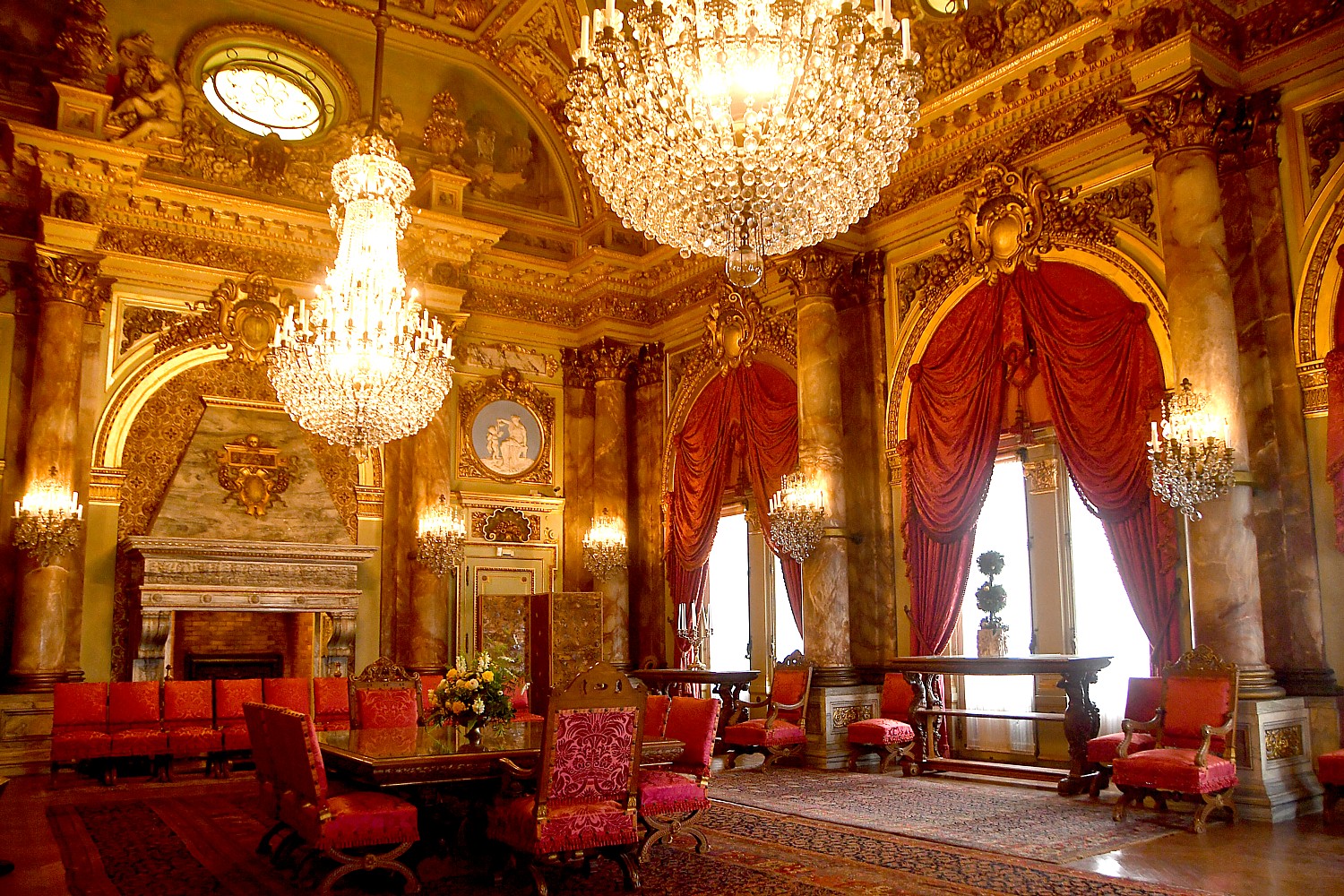
Governors Island: New York City’s Island Retreat So Near Yet So Far Away, Introduces Glamping

Governors Island, reached by ferry from Lower Manhattan and Brooklyn, gives you a getaway to faraway destination, chock full of historic attractions like Castle Williams, a fortification built for the War of 1812, used as a prison during the Civil War. Enjoy festivals like the Jazz Age Lawn Party, then tour the island by surrey. You can rent bicycles too and beginning this year, even camp out © Karen Rubin/ goingplacesfarandnear.com

By Karen Rubin, Travel Features Syndicate, goingplacesfarandnear.com 

Governors Island, a 712-acre island in the heart of New York Harbor, but a mere 800 yards off Lower Manhattan and even closer to Brooklyn, is a sensational getaway destination in its own right – historic sites like Fort Jay and Castle Williams, bicycle paths, playgrounds, art venues, and marvelous festive “happenings.” You never have had to go so near to be transported so far in time or place.

Arriving by ferry at Governors Island © Karen Rubin/ goingplacesfarandnear.com

Be one of the first guests to stay overnight on NYC’s historic Governors Island with Collective Retreats. With unique accommodations including luxury tents (glamping) and designer modular containers, guests enjoy a full-service hotel-style retreat with unparalleled waterfront views of New York City and the Statue of Liberty (collectiveretreats.com).

Be among the first to experience luxury camping (glamping) on Governors Island; dinner and breakfast are included © Karen Rubin/ goingplacesfarandnear.com

You can rent bicycles at Citibikes and at Blazing Saddles (which offers a free hour-long ride weekdays before noon) and delightful surreys.

Governors Island has a fabulous history that goes back to the Native Americans and colonial days of  the Dutch and the British in New York. It has had a military purpose going back to the Revolutionary War. Between 1806 and 1809, the U.S. Army reconstructed Fort Jay and built Castle Williams on a rocky outcropping facing the harbor. During the War of 1812, artillery and infantry troops were concentrated on Governors Island.

Built before the War of 1812, Castle Williams on Governors Island was used to imprison Confederate soldiers during the Civil War © Karen Rubin/ goingplacesfarandnear.com

The island continued to serve an important military function until the 1960s. During the American Civil War, it was used for recruitment and as a prison for captured Confederate soldiers (on one visit, I came upon Civil War reenactors practicing drills, quite a mind-bender from having just come from the 1920s Jazz Age Lawn Party). Throughout World War I and II, the island served as an important supply base for Army ground and air forces (my father was stationed at Fort Jay during the war.)

Civil War reenactors at Fort Jay on Governors Island © Karen Rubin/ goingplacesfarandnear.com

Over the years, Governors Island has served as the backdrop for a number of historic events. In 1986, the island was the setting for the relighting of the newly refurbished Statue of Liberty by President Ronald Reagan. In 1988, President Reagan hosted a U.S.-U.S.S.R. summit with Mikhail Gorbachev on Governors Island, and in 1993, the United Nations sponsored talks on the island to help restore democratic rule in Haiti.

Enjoy stunning views of New York City from Governors Island © Karen Rubin/ goingplacesfarandnear.com

In April 2010, Mayor Bloomberg and Governor Paterson reached an agreement on the future of Governors Island. The City of New York is now responsible for Governors Island and created the Trust for Governors Island, the organization charged with the operations, planning and redevelopment of the Island.

The Island has become known as New York City’s “Playground for the Arts,” hosting cultural events, festivals, concerts, performances throughout the season.

Jazz Age Lawn Party, held 4 times a year, is one of the cultural festivals held on Governors Island © Karen Rubin/ goingplacesfarandnear.com

The Trust for Governors Island, also offers a wide variety of programming on public access days. Visit them at www.govisland.com for more information.

Access to the island has been greatly improved.

This summer, you can stay late on Fridays, when is open until 10 pm (May 25-September 14); you can have cocktails and dinner at the outdoor cafes and bars;  outdoor films and other events are scheduled.

Governors Island is open daily May 1-October 31, 10 a.m. to 6 p.m. weekdays, and weekends from 10 a.m. to 7 p.m.,  Fridays from May 25-September 14 until 10 p.m.. You can get ferry schedules here (ferries during Late Fridays will run from the Battery Maritime in Lower Manhattan, located at 10 South Street), https://govisland.com/visit-the-island/ferry.

_____________________________

© 2018 Travel Features Syndicate, a division of Workstyles, Inc. All rights reserved. Visit goingplacesfarandnear.com,  www.huffingtonpost.com/author/karen-rubin , and travelwritersmagazine.com/TravelFeaturesSyndicate/. Blogging at goingplacesnearandfar.wordpress.com and moralcompasstravel.info. Send comments or questions to FamTravLtr@aol.com. Tweet @TravelFeatures. ‘Like’ us at facebook.com/NewsPhotoFeatures
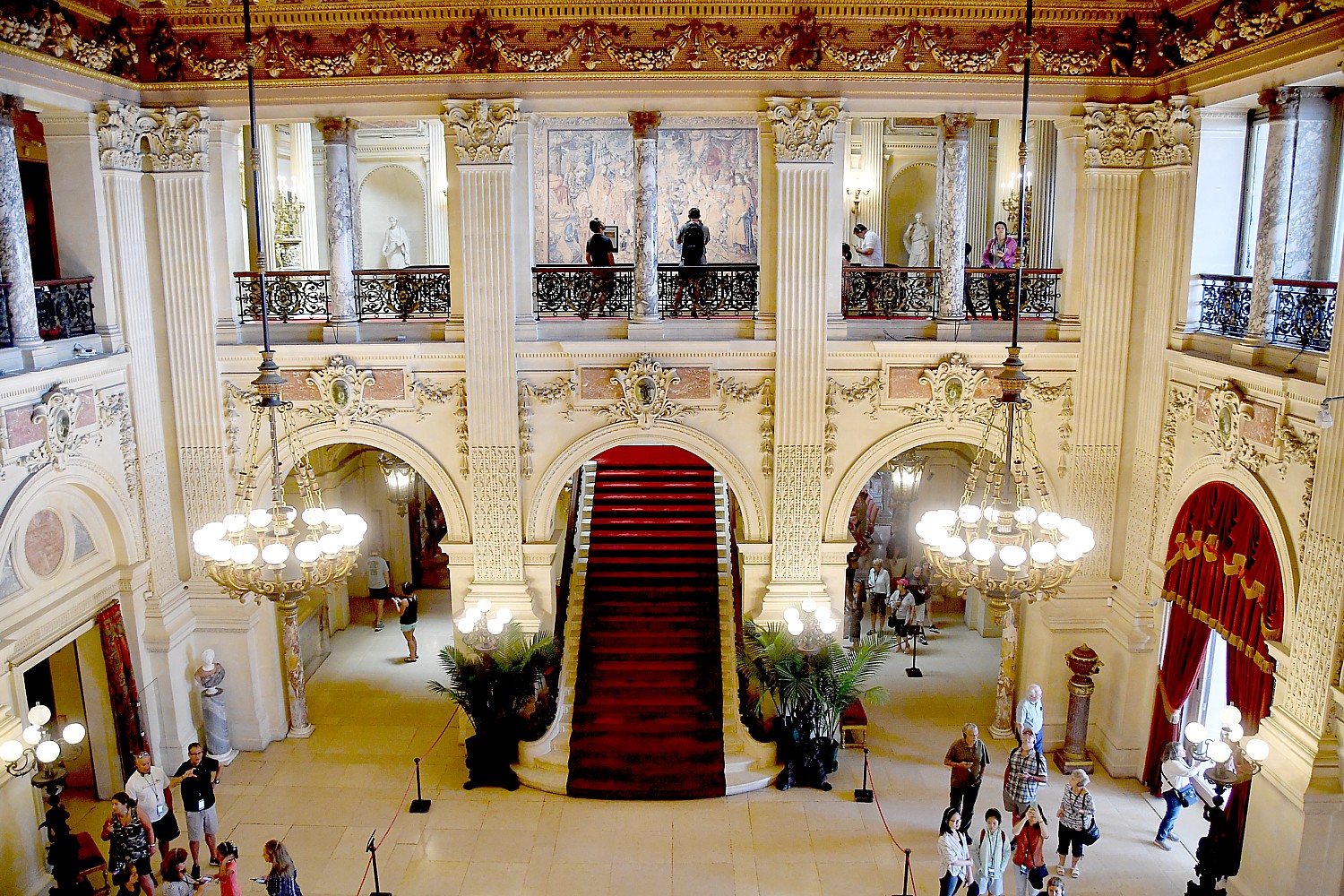
New York Philharmonic Orchestra Brings ‘Priceless’ Music to Free Summer Concert in Prospect Park

New York Philharmonic brought its priceless music, absolutely free to Brooklyn’s Prospect Park as part of the Summer Concerts in the Parks Series Presented by Didi and Oscar Schafer © Karen Rubin/goingplacesfarandnear.com

By Karen Rubin, Dave E. Leiberman, Laini Miranda
Travel Features Syndicate, goingplacesfarandnear.com

The New York Philharmonic’s 2018 Concerts in the Parks, Presented by Didi and Oscar Schafer, provided a stunning introduction to conductor James Gaffigan, a New York native and Brooklynite, leading the orchestra in a program celebrating Laureate Conductor Leonard Bernstein’s centennial, evocative works highlighting the Orchestra’s virtuosity, and compositions by fifth-grade students in the Philharmonic’s Very Young Composers (VYC) program — the first time that VYC works have been performed in the parks concerts.


James Gaffigan conducts the New York Philharmonic in Saint-Saens’ Bacchanale from “Samson et Dalila” in Prospect Park, Brooklyn © Karen Rubin/ goingplacesfarandnear.com

The delightful program, perfect for a summer-concert-in-the-parks, featured Saint-Saëns’s Bacchanale from Samson and Delilah; Bernstein’s Three Dance Episodes from On the Town, a love letter to New York City;and Rimsky-Korsakov’s storybook in symphony, Scheherazade. 

James Gaffigan conducts the New York Philharmonic in Prospect Park, Brooklyn © Karen Rubin/goingplacesfarandnear.com

The concert in Brooklyn’s Prospect Park June 15 featured truly remarkable performances of 2018 works by 11-year-old Very Young Composer Jordan Millar’s Boogie Down Uptown; and 10-year-old Very Young Composer Camryn Cowan’s Harlem Shake. 

New York Philharmonic conductor James Gaffigan with young composers Jordan Millar and Camryn Cowan © Karen Rubin/goingplacesfarandnear.com

James Gaffigan, a proud New Yorker who introduced the concert by asking for applause for public school teachers, showed himself to be the very antithesis of the arrogant orchestra conductor, but rather,  generous of praise, encouragement and exuberant emotion.

James Gaffigan conducts the New York Philharmonic in Rimsky-Korsakov’s Scheherazade in Prospect Park, Brooklyn © Karen Rubin/ goingplacesfarandnear.com

He did not use a baton for the Scheherazade. He waved his hands and arms in grand gestures, not so much conducting as dancing, performing, acting the music, bringing his whole body into it more like an opera singer than the orchestra conductor, giving the piece a staccato-like crisp precision. He conveyed an infectious joy of music. After, he congratulated Frank Huang, the brilliant concertmaster for his angelic violin solo, and then walked into the orchestra to congratulate all the solo performers, before taking the collective bow.

James Gaffigan conducts the New York Philharmonic in Rimsky-Korsakov’s Scheherazade in Prospect Park, Brooklyn © Karen Rubin/ goingplacesfarandnear.com
Conductor James Gaffigan joins applause for New York Philharmonic’s concertmaster Frank Huang © Karen Rubin/goingplacesfarandnear.com

The summer concert series also featured performances at Van Cortlandt Park, Bronx (June 12); the Great Lawn in Central Park, Manhattan (June 13); and Cunningham Park, Queens (June 14). Musicians from the New York Philharmonic also performed Beethoven’s Wind Sextet, Op. 71; Tchaikovsky’s Souvenir de Florence; and the World Premieres of wind sextets by Very Young Composers of New York City — 14-year-old Chi-Chi Ezekwenna’s It’s Almost Summer! and 13-year-old Nicolas Lipman’s Sriracha! — in the Free Indoor Concert in Staten Island at the Music Hall at Snug Harbor Cultural Center & Botanical Garden (June 17).

The performances in the Bronx, Queens, Manhattan, and Brooklyn concluded with dazzling fireworks.

The New York Philharmonic concert in Prospect Park concludes with dazzling fireworks © Karen Rubin/goingplacesfarandnear.com

The summer series is an amazing opportunity to bring “priceless music” to new audiences absolutely free. Since 1965, the summer series has brought joy to more than 15 million New Yorkers and Big Apple visitors.

“We want all New Yorkers to love the Philharmonic as much as we do and the concerts in the Parks are a glorious way to share the Philharmonic’s virtuosity and power,” said New York Philharmonic chairman Oscar S. Schafer, who with his wife, Didi, has underwritten the series.

Here are more highlights from the concert in Prospect Park:

James Gaffigan conducts the New York Philharmonic in Prospect Park, Brooklyn © Karen Rubin/goingplacesfarandnear.com
Conductor James Gaffigan and Very Young Composer of New York City Jordan Millar (b 2006), “Boogie Down Uptown” (2018) © Karen Rubin/ goingplacesfarandnear.com
Conductor James Gaffigan and Very Young Composer of New York City Camryn Cowan (2007), “Harlem Shake” (2018) © Karen Rubin/ goingplacesfarandnear.com
James Gaffigan conducts the New York Philharmonic in Rimsky-Korsakov’s Scheherazade in Prospect Park, Brooklyn © Karen Rubin/ goingplacesfarandnear.com
James Gaffigan conducts the New York Philharmonic in Rimsky-Korsakov’s Scheherazade in Prospect Park, Brooklyn © Karen Rubin/goingplacesfarandnear.com
James Gaffigan conducts the New York Philharmonic in Rimsky-Korsakov’s Scheherazade in Prospect Park, Brooklyn © Karen Rubin/ goingplacesfarandnear.com
James Gaffigan conducts the New York Philharmonic in Prospect Park, Brooklyn © Karen Rubin/goingplacesfarandnear.com

Founded in 1842, the New York Philharmonic is the oldest symphony orchestra in the United States.

At the New York Philharmonic’s website (www.nyphil.org) you can peruse online archives and exhibits, see the concert calendar, get background on the musicians, and purchase tickets.

The summer concerts also inspire visits to see the orchestra at home at Lincoln Center (David Geffen Hall, 10 Lincoln Center Plaza, 212-875-5656). There are various subscription offers – the Philharmonic was offering an opportunity to choose four or more 2018-19 subscription concerts to get one free (promo code CHOOSE4, by June 22).

_____________________________

© 2018 Travel Features Syndicate, a division of Workstyles, Inc. All rights reserved. Visit goingplacesfarandnear.com,  www.huffingtonpost.com/author/karen-rubin , and travelwritersmagazine.com/TravelFeaturesSyndicate/. Blogging at goingplacesnearandfar.wordpress.com and moralcompasstravel.info. Send comments or questions to FamTravLtr@aol.com. Tweet @TravelFeatures. ‘Like’ us at facebook.com/NewsPhotoFeatures
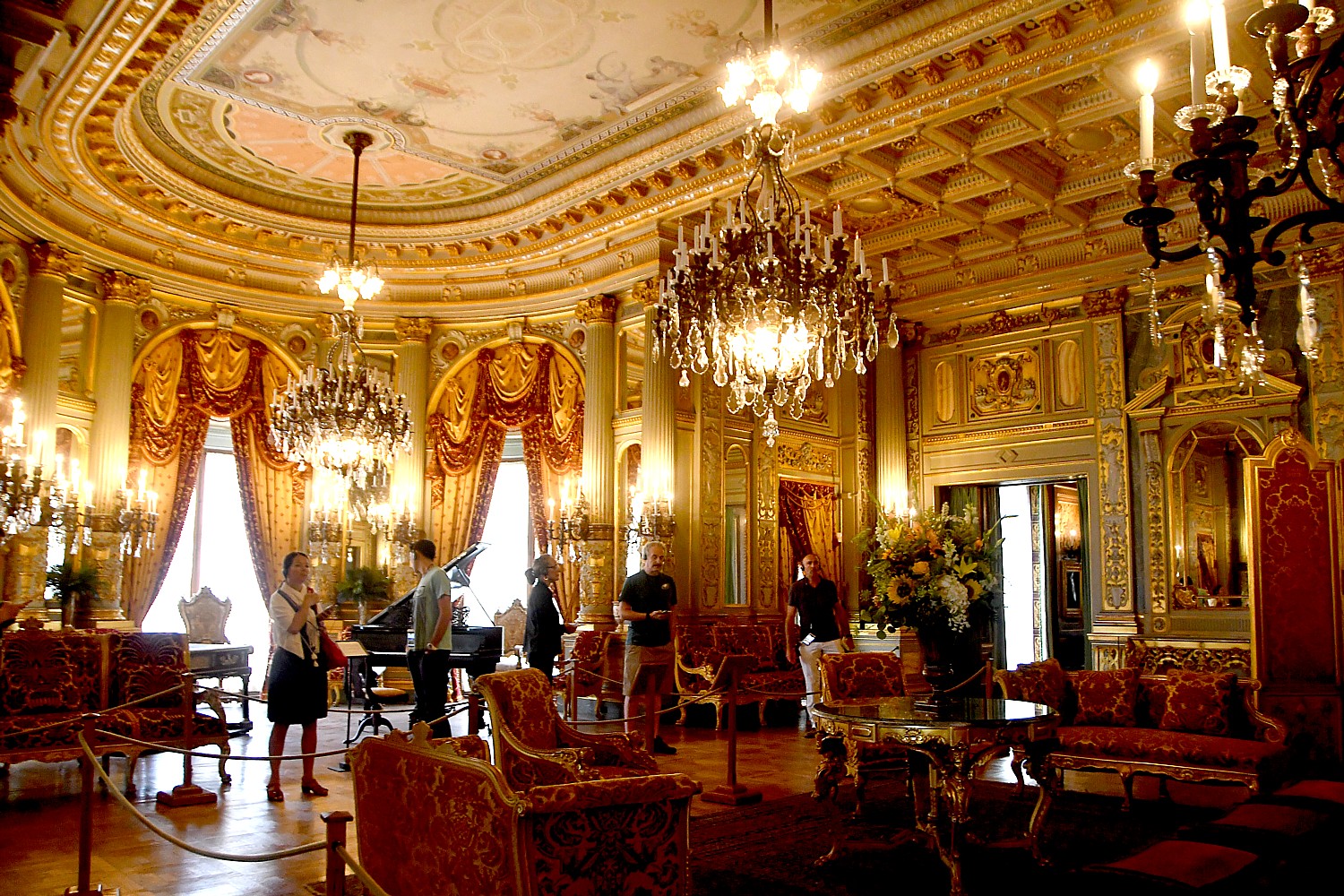


Vail Resorts Continues Expansion with Acquisitions of Okemo, Mount Sunapee, Crested Butte & Stevens Pass

Okemo Mountain Resort in Vermont has always enjoyed a loyal following with a very special feeling of community; the resort, known for outstanding service, was one of the first in New England to offer bubble chairs © Karen Rubin/ goingplacesfarandnear.com

By Karen Rubin
Travel Features Syndicate, goingplacesfarandnear.com

Vail Resorts is continuing its buying spree, giving it more reach and penetration in New England with the acquisition of Okemo Mountain Resort, Vermont, which had been owned and operated by the Mueller family for 36 years. The acquisition from the Muellers also includes Mount Sunapee in New Hampshire and Crested Butte Mountain Resort in Colorado. For good measure, Vail also announced a separate acquisition of Stevens Pass in Washington State.

The acquisition of Okemo and Mount Sunapee vastly increases the value of Vail Resorts’ Epic Pass for eastern skiers, especially with the acquisition last year of Stowe Mountain in Vermont. In recent years, Vail acquired Whistler Blackcomb in Canada (the largest ski resort in North America), Park City and Canyons in Utah (which it combined into one, making it the largest ski resort in the United States). The Epic Pass is also valid its other owned resorts, Vail, Beaver Creek, Breckenridge, Keystone and Arapahoe Basin in Colorado; Heavenly, Northstar and Kirkwood in Lake Tahoe; Afton Alps near Minneapolis, Mt. Brighton near Detroit, Wilmot Mountain near Chicago, and Perisher in Australia. Epic Pass holders also have limited access to 30 European ski resorts including Verbier and Les 4 Vallées in Switzerland, Les 3 Vallées in France; Arlberg in Austria; and Skirama Dolomiti Adamello Brenta in Italy.

Vail Resorts, Inc. (NYSE: MTN) announced today that it has entered into an agreement to purchase Triple Peaks, LLC, the parent company of Okemo Mountain Resort in Vermont, Mount Sunapee Resort in New Hampshire, and Crested Butte Mountain Resort in Colorado. Vail Resorts stated it will purchase Triple Peaks, LLC from the Mueller family for $82 million, subject to certain adjustments. At closing, Triple Peaks will pay $155 million to pay off the leases that all three resorts have with Ski Resort Holdings, LLC, an affiliate of Oz Real Estate, with funds provided by Vail Resorts.

As part of a separate transaction, Vail Resorts will also purchase Stevens Pass Resort in Washington from Ski Resort Holdings, LLC, who was advised on the sale by Houlihan Lokey, for a total purchase price of $67 million, subject to certain adjustments. Both transactions are subject to certain closing conditions, including regulatory approvals.

“Together, the acquisitions of Okemo, Mount Sunapee, Crested Butte, and Stevens Pass will significantly enhance the Vail Resorts’ network of resort experiences, adding even more variety and choice for all of our pass holders and guests. Okemo and Mount Sunapee are terrific complements to Stowe in the Northeast, as is Crested Butte to our four Colorado resorts, and Stevens Pass for our Whistler Blackcomb and Seattle guests,” said Rob Katz, chairman and chief executive officer of Vail Resorts. “Additionally, each of these resorts will individually offer guests from around the world entirely new and distinctive experiences in extraordinary locations from coast to coast.”

“We know our guests and employees will benefit from Vail Resorts’ outstanding track record of resort and community investment, environmental stewardship, and employee development,” said Tim Mueller, president of Triple Peaks, LLC. “We care deeply about the legacy of these resorts, and have absolute confidence in Vail Resorts to celebrate what makes them so special, while also providing long-term stability for the communities.”

“Triple Peaks, LLC and the Mueller family and Karl Kapuscinski, the tenant and operator of Stevens Pass Resort, have been outstanding operators of these resorts and we have valued our association with them,” said Steven Orbuch, founder and president of Oz Real Estate. “We are excited for the opportunities that these transactions create for Vail Resorts and its guests while providing a beneficial outcome for our investors.”

When the transactions close, the 2018-19 Epic Pass, Epic Local Pass, Epic Australia Pass, and Epic Military Pass will include unlimited and unrestricted access to all four resorts, with seven and four unrestricted days for the Epic 7 Day and Epic 4 Day passes, respectively. Whistler Blackcomb Edge Card holders will be able to use any of their U.S. days at Stevens Pass, subject to the restrictions on each card. “We are thrilled that the Epic Pass and our other season pass products will now provide our pass holders around the world with even more variety and unique experiences to choose from,” said Kirsten Lynch, chief marketing officer of Vail Resorts.

After closing of the two transactions, Vail Resorts plans to invest $35 million over the next two years across the four resorts to continue to elevate the guest experience. In addition, annual ongoing capital expenditures are expected to increase by $7 million to support the addition of these four resorts.  Together, these acquisitions are expected to generate incremental annual EBITDA in excess of $35 million in Vail Resorts’ fiscal year ending July 31, 2019.

Closing of Transactions

The transactions are expected to close this summer. Operations at the four resorts for the remainder of the 2018 summer season will continue in the ordinary course of business, as will future winter seasonal hiring. Upon closing, Vail Resorts plans to retain the vast majority of each resort’s employees and will be working with the local leadership teams in the coming months to determine the right long-term management structure for the resorts.

Vail Resorts will, subject to approval, assume the state land leases for Okemo Mountain Resort and Mount Sunapee Resort and will obtain new Special Use Permits from the U.S. Forest Service for Crested Butte Mountain Resort and Stevens Pass Resort. The state land lease transfers in Vermont and New Hampshire are subject to administrative review and consent from their respective states.

About the Resorts  

Crested Butte Mountain Resort, located in southwest Colorado’s Grand Mesa Uncompahgre and Gunnison (GMUG) National Forests, is known for the colorful and historic town of Crested Butte, renowned mountain peaks, and legendary skiing and riding terrain. The resort was established in 1961 and has since passed through three families. The Muellers added Crested Butte to their family of resorts in 2004, following their 1982 acquisition of Okemo Mountain and 1998 acquisition of Mount Sunapee.

Rising above the Vermont village of Ludlow, approximately three hours from Boston and four hours from New York City, Okemo Mountain Resort has developed a reputation for superior guest service, incredible snow quality, grooming, terrain parks, and family programs.

Jackson-Gore at Okemo Mountain Resort, a self-contained base area within the resort, offers ski in/out convenience, a spa, pool, hot tubs, and restaurants © Karen Rubin/goingplacesfarandnear.com

Mount Sunapee, the premier ski area in southern New Hampshire, is just a short 90-minute drive from Boston. The four-season, family-focused ski area has breathtaking views overlooking Lake Sunapee and consistently receives accolades for excellence in snowmaking and grooming.

On the other side of the United States, Stevens Pass, with its exciting terrain and plentiful snowfall, will be the Company’s second resort in the Pacific Northwest. The resort, less than 85 miles from Seattle, sits on the crest of Washington State’s Cascade Range within two national forests, the Mt. Baker-Snoqualmie National Forest on the west side of the crest and the Wenatchee National Forest on the east.

Pass Access Details

Skiing at Park City, Utah, part of Vail Resorts © Karen Rubin/ goingplacesfarandnear.com

Vail Resorts 2018-19 Epic, Epic Local, Epic Australia, Epic 7-Day, Epic 4-Day, and Military Epic Pass holders will offer these benefits, subject to closing of the transactions:

  • Epic Pass™: Ski or snowboard unlimited and unrestricted from opening day to closing day for only $899. The Epic Pass pays for itself in just over four days of skiing or snowboarding. Enjoy full access to Vail, Beaver Creek, Breckenridge, Keystone, Crested Butte Mountain Resort and Arapahoe Basin in Colorado; Park City in Utah; Heavenly, Northstar and Kirkwood at Lake Tahoe; Stowe Mountain Resort and Okemo Mountain Resort in Vermont; Mount Sunapee in New Hampshire; Afton Alps in Minnesota; Mt. Brighton in Michigan; Wilmot Mountain in Wisconsin; Stevens Pass in Washington; Whistler Blackcomb in Canada; and Perisher in Australia for the 2019 season. New for the 2018-19 season, Epic Pass holders will receive seven days of skiing or snowboarding with no blackout dates at Telluride in Colorado; seven days at Resorts of the Canadian Rockies, which includes Fernie Alpine Resort, Kicking Horse Mountain Resort and Kimberley Alpine Resort in British Columbia, Nakiska in Alberta, and Mont Sainte Anne and Stoneham in Quebec; and up to five total consecutive days with no blackout dates at Hakuba Valley’s nine ski resorts in Japan. The Epic Pass also grants limited access to Les 3 Vallées, Paradiski and Tignes-Val D’Isere in France; 4 Vallées in Switzerland; Arlberg in Austria and Skirama Dolomiti in Italy. A child pass (ages five to 12) is $469.
  • Epic Local Pass™: For $669, receive unlimited and unrestricted skiing or snowboarding at Breckenridge, Keystone, Arapahoe Basin, Crested Butte, Okemo, Mount Sunapee, Stevens Pass, Wilmot, Afton Alps and Mt. Brighton with limited restrictions at Park City, Heavenly, Northstar, Kirkwood, and Stowe, plus a combined total of 10 days at Vail, Beaver Creek, and Whistler Blackcomb with holiday restrictions. New for the 2018-19 season, Epic Local Pass holders will receive five total consecutive days with no blackout dates at Hakuba Valley’s nine ski resorts in Japan. The Epic Local Pass pays for itself in just over three days. A child pass (ages five to 12) is $359.
  • Epic 7-Day Pass™: For $669, receive a total of seven unrestricted days at Whistler Blackcomb, Vail, Beaver Creek, Breckenridge, Keystone, Park City, Heavenly, Northstar, Kirkwood, Stowe, Crested Butte, Okemo, Mount Sunapee, Stevens Pass and Arapahoe Basin, plus seven additional free days at Afton Alps, Mt. Brighton or Wilmot Mountain. New for the 2018-19 season, Epic 7-Day Pass holders will receive up to seven days of skiing or snowboarding at Telluride and at Resorts of the Canadian Rockies with no blackout dates as part of their seven total days on the pass. After the seven days, regardless of the resort at which they were redeemed, pass holders can get 20 percent off additional lift tickets at Telluride. A child pass (ages five to 12) is $359. The pass pays for itself in just over three days.
  • Epic 4-Day™: A convenient option for a short ski trip as the pass pays for itself in just over two days and includes a total of four unrestricted days valid at Whistler Blackcomb, Vail, Beaver Creek, Breckenridge, Keystone, Park City, Heavenly, Northstar, Kirkwood, Stowe, Crested Butte, Okemo, Mount Sunapee, Stevens Pass and Arapahoe Basin, plus four additional free days at Afton Alps, Mt. Brighton or Wilmot Mountain. New in 2018-19, Epic 4-Day Pass holders will receive up to four days of skiing or snowboarding at Telluride and at Resorts of the Canadian Rockies with no blackout dates as part of their four total days on the pass. After the four days, regardless of the resort at which they were redeemed, pass holders can get 20 percent off additional lift tickets at Telluride. The Epic 4-Day Pass is $439 for adults and $239 for children (ages five to 12).
  • Military Epic Pass: In celebration of the 10th anniversary of the Epic Pass on March 18, 2018, Vail Resorts is honoring the epic service of the Company’s founders from the U.S. Army’s 10th Mountain Division, and the men and women of the U.S. Armed Forces, Canadian Armed Forces and Australian Defence Force with the introduction of a new $99 Military Epic Pass for active and retired military personnel and their dependents – an almost 90-percent discount to the regular Epic Pass price. Additionally, as the first of its kind in the mountain resort industry, all other U.S., Canadian and Australian veterans and their dependents are eligible for a $499 Military Epic Pass, which offers more than a 40-percent discount off the regular price ($269 for children under 18 years of age). Vail Resorts will donate $1 for every 2018-19 season pass sale to Wounded Warrior Project® to benefit wounded veterans and their families, which would exceed $750,000 based on last year’s sales. Visit www.epicpass.com/military for all details on military pass options.

Vail Resorts’ 2018-19 season passes are on sale now at the lowest guaranteed prices. Visit www.epicpass.com for details and to purchase.

Vail Resorts will continue to honor previously sold 2018-19 season pass products for Okemo, Mount Sunapee, Crested Butte, and Stevens Pass.

Skiing Kirkwood, Tahoe, California © Eric Leiberman/goingplacesfarandnear.com

Vail Resorts, Inc., through its subsidiaries, is the leading global mountain resort operator. Vail Resorts’ subsidiaries operate 11 world-class mountain resorts and three urban ski areas, including Vail, Beaver Creek, Breckenridge and Keystone in Colorado; Park City in Utah; Heavenly, Northstar and Kirkwood in the Lake Tahoe area of California and Nevada; Whistler Blackcomb in British Columbia, Canada; Perisher in Australia; Stowe in Vermont; Wilmot Mountain in Wisconsin; Afton Alps in Minnesota and Mt. Brighton in Michigan. Vail Resorts owns and/or manages a collection of casually elegant hotels under the RockResorts brand, as well as the Grand Teton Lodge Company in Jackson Hole, Wyo. Vail Resorts Development Company is the real estate planning and development subsidiary of Vail Resorts, Inc. Vail Resorts is a publicly held company traded on the New York Stock Exchange (NYSE: MTN). The Vail Resorts company website is www.vailresorts.com and consumer website is www.snow.com.

Letter “To Our Okemo Community”

In a letter addressed “To our Okemo Community,” Tim, Diane, Ethan & Erica write:

“Over the years, we have seen an amazing amount of change in the ski industry. Much of the evolution has been good: improved technologies around ski gear; the onset of snowboarding; grooming equipment; energy efficient snowmaking; and probably the most heartening is how many more people ski and ride or simply come to the mountains now versus three decades ago.

“Our business model has always been somewhat unique in this industry; operating large, successful ski resorts that are family owned.  It is something we have always enjoyed, been proud of, and worked hard to preserve. Another reason this decision has been incredibly difficult for our family.

“When approached by Vail Resorts, all of these thoughts, memories and realities stirred through our heads. What does this mean for us? For our teams? What does this mean for our communities? What does this mean for the mountains that we have poured a lifetime of energy into? We were not naïve in understanding this would mean changes in the future. We spent a lot of time contemplating all of this, and ultimately decided that moving forward with the sale was the best option for Okemo and its future. We realize the idea of a large company like Vail Resorts overseeing operations at each of our unique resorts may feel unsettling. However, the reality is they are mountain operators and run some of the best and most successful resorts in the industry. Putting Okemo in their hands will ensure a good future for the ski area, and will therefore support a good future for the Okemo Valley. They are great operators and good people, and they will invest in the mountain and our community.

“Please know we have entered into this transaction with the best intentions for the ski area, our fellow employees, and the community. If we did not think this was going to bring more opportunity for the resort in the years to come, we would not have made this decision. We feel that Vail Resorts is poised to continue Okemo’s excellence and bolster its legacy. We hope you will be open to their approach and give them the opportunity to prove their good intentions.

“It has been the greatest pleasure of our lives operating and growing this awesome ski area for the last 36 years. Thank you for accepting us into this community so long ago and thank you for sharing the greatest joy of our family’s life.

“With mountains of gratitude”

___________

© 2018 Travel Features Syndicate, a division of Workstyles, Inc. All rights reserved. Visit goingplacesfarandnear.com,  www.huffingtonpost.com/author/karen-rubin , and travelwritersmagazine.com/TravelFeaturesSyndicate/. Blogging at goingplacesnearandfar.wordpress.com and moralcompasstravel.info. Send comments or questions to FamTravLtr@aol.com. Tweet @TravelFeatures. ‘Like’ us at facebook.com/NewsPhotoFeatures
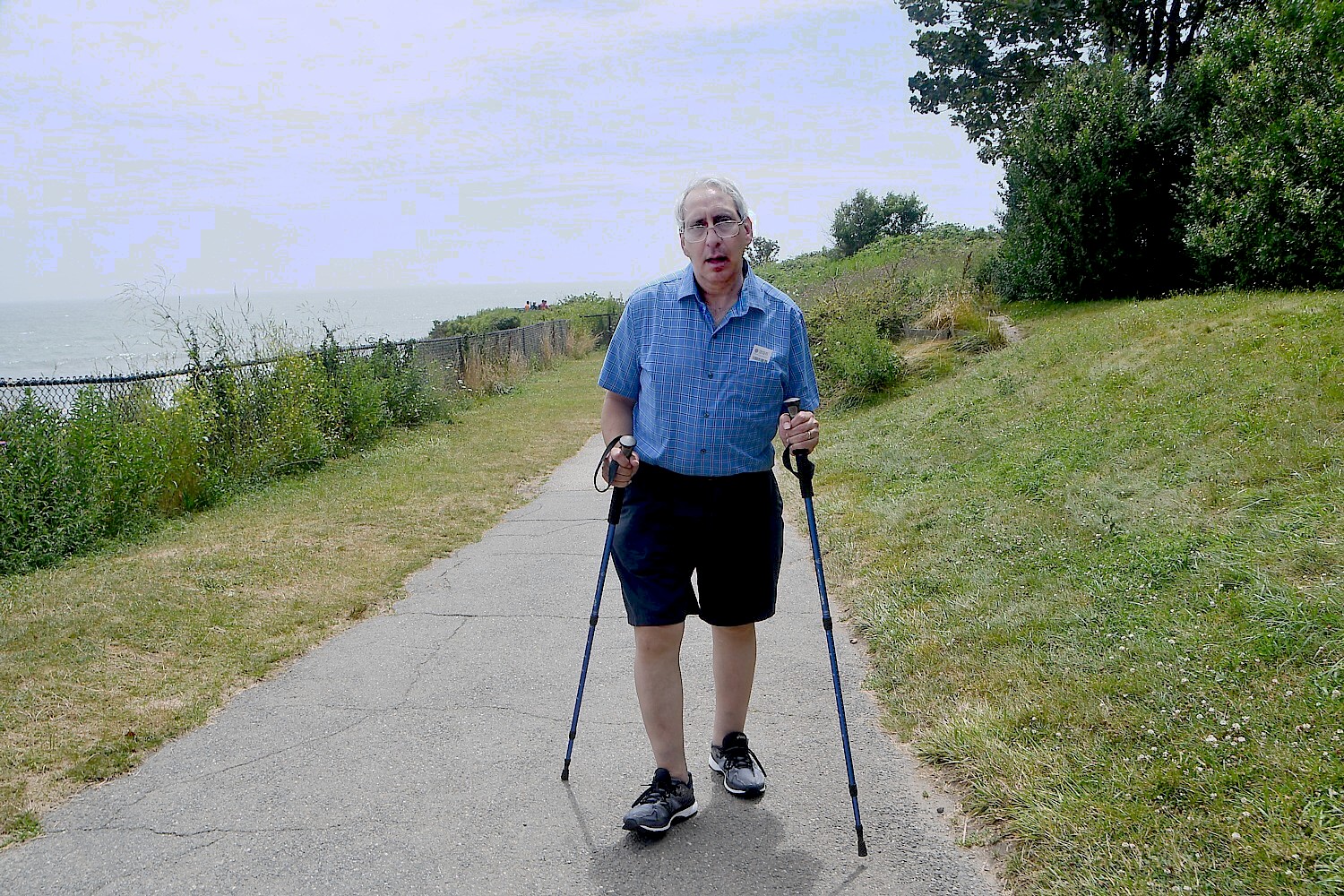


Because travel is a life-enhancing, relationship building, world-changing experience