Category Archives: Attractions

Anne Frank House Coming to New York City Headlines Fall Culture Calendar

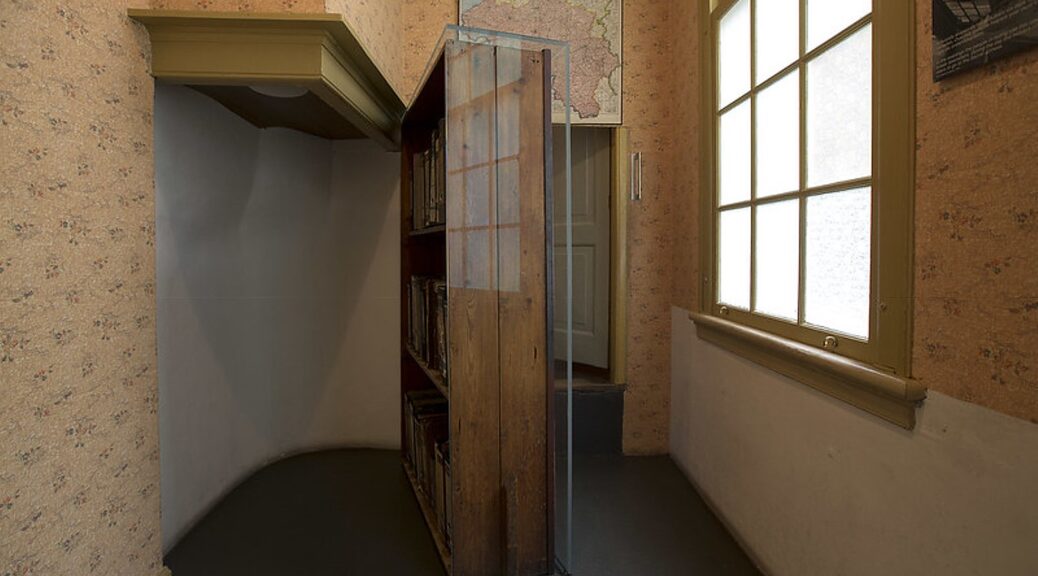
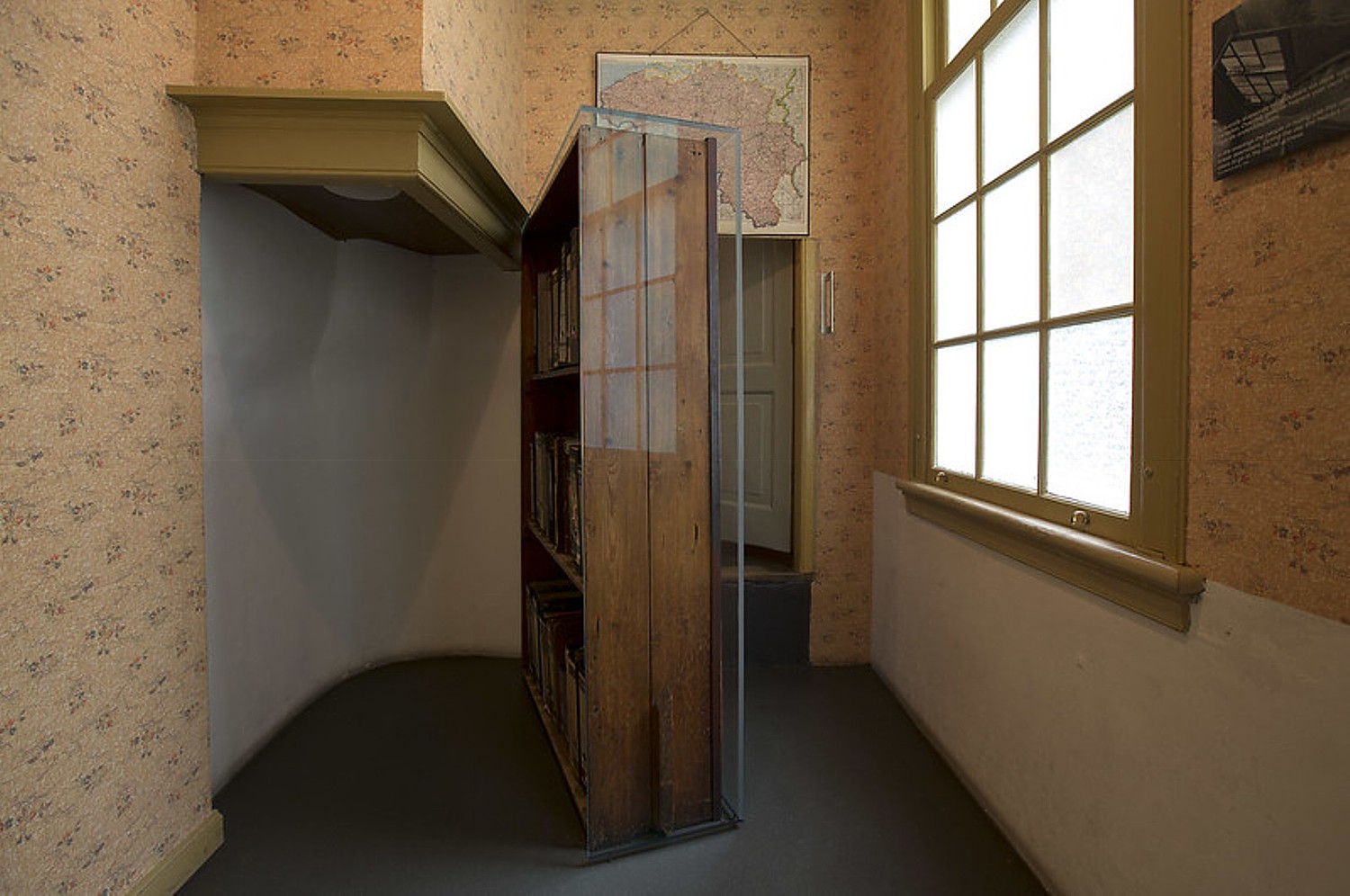
De Boekenkast: bookcase in front of Secret Annex. New Yorkers will have the opportunity to actually tour a re-creation of Anne Frank’s hiding place, never before seen outside Amsterdam (© Anne Frank House, photographer Cris Toala Olivares)

By Karen Rubin, Travel Features Syndicate, goingplacesfarandnear.com

New York is one of the premier cultural capitals of the world and fall is when the culture calendar gets into gear. But here’s a heads-up: the blockbuster exhibit of the year – the opportunity to tour a full-scale re-creation of Anne Frank’s Annex as it stands in Amsterdam – opens January 27, 2025, and tickets are on sale now. Here are highlights of what’s ahead on the culture calendar:

Groundbreaking Full-Scale Re-Creation of Anne Frank’s Annex

Amsterdam and New York – The Anne Frank House, one of the most visited historical sites in Europe, is presenting a pioneering experience: the opportunity to walk through an exact replica of Anne Frank’s hiding place where she wrote her famous diary. Anne Frank The Exhibition opens in New York City on January 27, 2025. Considering that tickets to visit the Anne Frank House in Amsterdam book up three months in advance,  tickets for this exhibit are now available at AnneFrankExhibit.org.

This is the first time the Anne Frank House will present this opportunity for visitors outside of Amsterdam to be immersed in a full-scale recreation of the rooms where Anne Frank, her parents and sister, and four other Jews spent two years hiding to evade Nazi capture.

As a nonprofit organization helping to shape global understanding of the Holocaust and its contemporary relevance, including lessons on modern day antisemitism, racism, and discrimination, the Anne Frank House is entrusted with the preservation of the Annex where Anne Frank and her family hid during World War II. This exhibition, presented in New York City in partnership with the Center for Jewish History in Manhattan, opens on International Holocaust Remembrance Day, January 27, 2025, to mark the 80th commemoration of the liberation of Auschwitz. 

Anne Frank The Exhibition is a first-of-its-kind, full-scale recreation of the complete Annex, furnished as it would have been when Anne and her family were forced into hiding. Moving through the exhibition, visitors will be able to immerse themselves in the context that shaped Anne’s life—from her early years in Frankfurt, Germany through the rise of the Nazi regime and the family’s 1934 move to Amsterdam, the Netherlands, where Anne lived for ten years until her 1944 arrest and deportation to Westerbork, a large transit camp in the Netherlands, then to Auschwitz-Birkenau, a concentration camp and killing center in Nazi-occupied Poland, and eventually to her death at Bergen-Belsen concentration camp in Germany when she was 15 years old. 

Designed for audiences who may not have the opportunity to visit the Netherlands, the new exhibition in New York City is anticipated to draw massive attendance for what will be among the most important presentations of Jewish historical content on view in the United States. Through the recreated Annex; exhibition galleries immersing visitors in place and history through video, sound, photography, and animation; and more than 100 original collection items from the Anne Frank House in Amsterdam, Anne Frank The Exhibition will provide an opportunity to learn about Anne Frank not as a victim but through the multifaceted lens of her life—as a girl, a writer, and a symbol of resilience and strength. This is a story inspired by one of the most translated books in the world.

The New York City exhibition will occupy over 7,500 square feet of gallery space in the heart of Union Square. This marks the first time dozens of artifacts will be seen in the United States—many have never been seen in public. 

Artifacts in the exhibition include: 

  • Anne Frank’s first photo album (1929-1942); 
  • Anne Frank’s typed and handwritten invitation to her friend for a film screening in her home (by 1942, anti-Jewish measures prohibited Jews from attending the cinema); and
  • Handwritten verses by Anne Frank in her friends’ poetry albums

“Anne Frank’s words resonate and inspire today, a voice we carry to all corners of the world, nearly eight decades later,” Ronald Leopold, Executive Director of the Anne Frank House, said. “As a custodian of Anne’s legacy, we have an obligation to help world audiences understand the historical roots and evolution of antisemitism, including how it fueled Nazi ideology that led to the Holocaust. Anne’s legacy is remarkable, as represented in the diary she left us, and as one of the 1.5 million Jewish children who were murdered at the hands of Nazi officials and their collaborators. Through this exhibition, the Anne Frank House offers insights into how this could have happened and what it means for us today.

“The exhibition provides perspectives, geared toward younger generations, that are certain to deepen our collective understanding of Anne Frank and hopefully provide a better understanding of ourselves. By bringing this exhibition to New York—a place with many ties to Anne’s story— the Anne Frank House is expanding the reach of our work to encourage more people to remember Anne Frank, reflect on her life story, and respond by standing against antisemitism and hatred in their own communities.”

Anne Frank The Exhibition is a limited engagement, scheduled to close on April 30, 2025. Public programming and educational initiatives tied to the exhibition will be announced when the exhibition opens to the public. 

Timed entry individual and family tickets are available at AnneFrankExhibit.org. The exhibition is designed for children (ages 10 and older) and adults. All general admission tickets include the exhibition audio guide. Visitors should plan to spend approximately one hour at the exhibition. Last entry is one hour before closing. 

Center for Jewish History, 15 West 16th Street, New York, N.Y. between 5th and 6th Avenues

Edges of Ailey at Whitney Museum of American Art

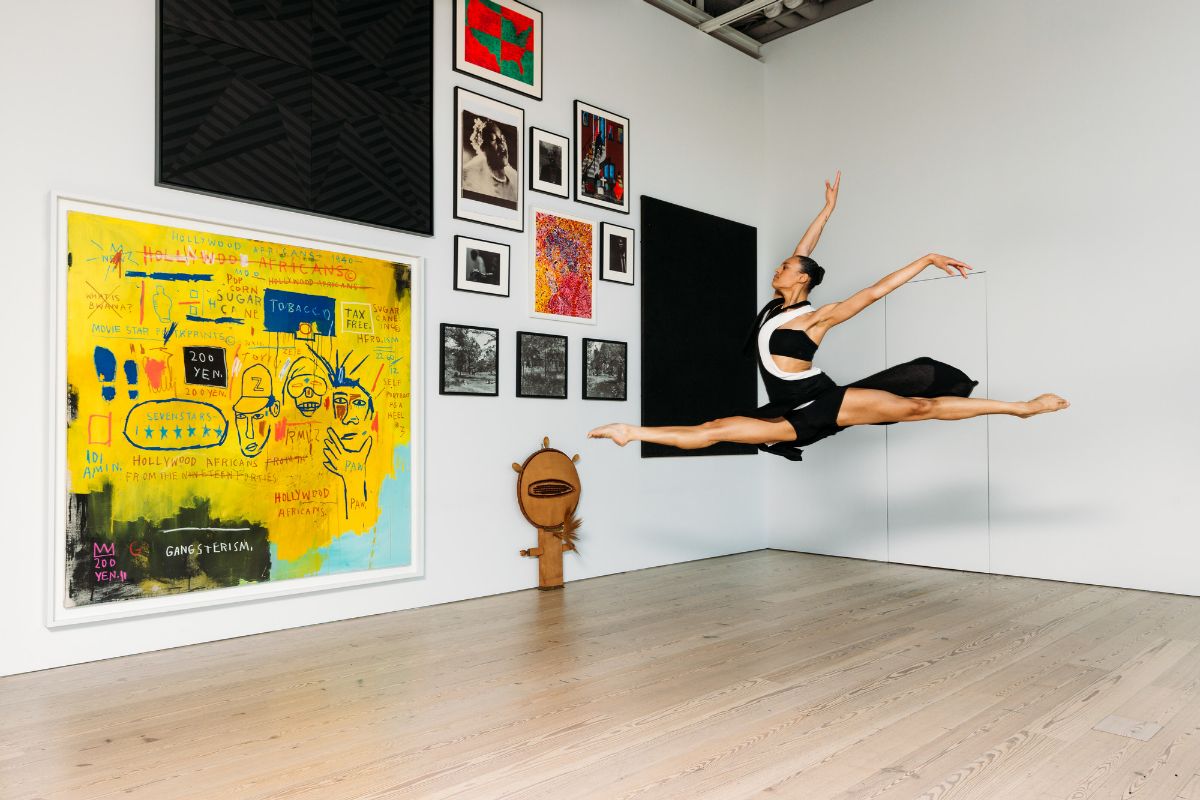
Edges of Ailey (Whitney Museum of American Art, New York, September 25, 2024-February 9, 2025). Courtesy of Whitney Museum of American Art; Photo by Natasha Moustache.

Edges of Ailey at the Whitney Museum of American Art through February 9, 2025, is the first large-scale museum exhibition to celebrate the life, dances, influences, and enduring legacy of visionary artist and choreographer Alvin Ailey. This dynamic showcase brings together visual art, live performance, music, a range of archival materials, and a multi-screen video installation drawn from recordings of Alvin Ailey American Dance Theater (AAADT) repertory to explore the full range of Ailey’s personal and creative life. Described as an “extravganza” by curator Adrienne Edwards, Edges of Ailey is the must-see event of the NYC fall/winter season. The landmark exhibition is on view only in NYC.

Presented at the Museum in multiple parts, Edges of Ailey consists of an immersive exhibition in the Museum’s 18,000 square-foot fifth-floor galleries that includes artworks by over 80 artists and never-before-seen archival materials. Artists featured in the exhibition include Jean-Michel Basquiat, Faith Ringgold, Alma Thomas, Jacob Lawrence, Kara Walker, and many others. A recent acquisition of Eldren Bailey and new works by Karon Davis, Jennifer Packer, Mickalene Thomas, and Lynette Yiadom-Boakye will be presented for the first time in honor of this landmark exhibition.

Edges of Ailey is part of a ‘Season of Ailey’ in New York City, which includes the Alvin Ailey American Dance Theater company’s annual engagement at New York City Center, December 4-January 5.

Also at the Whitney:

Opening November 1, Shifting Landscapes explores how evolving political, ecological, and social issues motivate artists’ representations of the world around them. The 120 works by more than 80 artists—including Firelei Báez, Jean-Michel Basquiat, Jane Dickson, Gordon Matta-Clark, Amalia Mesa-Bains, andPurvis Young—depict the effects of industrialization on the environment, grapple with the impact of geopolitical borders, and give shape to imagined spaces as a way of destabilizing the concept of a “natural” world.

On view through January 5, 2025, Survival Piece #5: Portable Orchard marks the first standalone museum presentation of the fully realized indoor citrus grove conceived and designed in 1972 by artists Helen Mayer Harrison and Newton Harrison. Stretching across the Museum’s eighth-floor gallery, this installation of 18 live citrus trees explores the need for a productive and sustainable food system in an imagined future where natural farming practices are obsolete and cannot be taken for granted.

More information at whitney.org/exhibitions.

Inaugural Perelman Performing Arts Center NYC Icons of Culture Festival 

This fall, the Perelman Performing Arts Center [PAC NYC] is staging its inaugural PAC NYC ICONS OF CULTURE FESTIVAL presented by BNY from Tuesday, October 29 – Saturday, November 2, 2024 © Karen Rubin/goingplacesfarandnear.com

This fall, the Perelman Performing Arts Center [PAC NYC] is staging its inaugural PAC NYC ICONS OF CULTURE FESTIVAL presented by BNY from Tuesday, October 29 – Saturday, November 2, 2024.  

PAC NYC ICONS OF CULTURE FESTIVAL will bring audiences into the room with trailblazers in art, music, comedy, film, sports, and more to talk about pushing boundaries, making a mark, and elevating the everyday to the iconic.

Icons to appear in conversation at the festival include Misty Copeland, The Dogist, Alex Edelman, Renée Fleming, Michael Imperioli, Baaba Maal, Philippe Petit, Questlove, Marcus Samuelsson, Kathleen Turner, Serena Williams, and Vanity Fair’s Little Gold Men Live!  

A calendar of events is available at www.pacnyc.org

Rich Calendar of Cultural Events

The Museum of the City of New York is the premier repository of the city’s 400-plus year story © Karen Rubin/news-photos-features.com

Art Deco City: New York Postcards from the Leonard A. Lauder Collection at Museum of the City of New York, East Harlem, through February 17, 2025: Featuring over 250 postcards alongside decorative arts, fashion, and architectural models, the exhibition highlights the role postcards played in popularizing Art Deco landmarks like the Empire State Building, the Chrysler Building and Rockefeller Center.  

Make Way for Berthe Weill: Art Dealer of the Parisian Avant-Garde at Grey Art Museum, Noho, Manhattan, through March 1, 2025: Berthe Weill, the first woman modern art dealer, championed artists like Picasso, Matisse and Modigliani. This survey features around 110 works shown at her gallery in the early 20th century and highlights her work as a gallerist and advocate. 

Pets and the City at The New-York Historical Society, Upper West Side, Manhattan, October 25, 2024—April 20, 2025: Featuring a diverse range of art, objects, memorabilia and media clips, this exhibition highlights pets’ lives in NYC, from early Indigenous cultures to today’s pampered companions. It also examines the growing pet population and addresses topics such as pet adoption and the importance of service animals. Also:

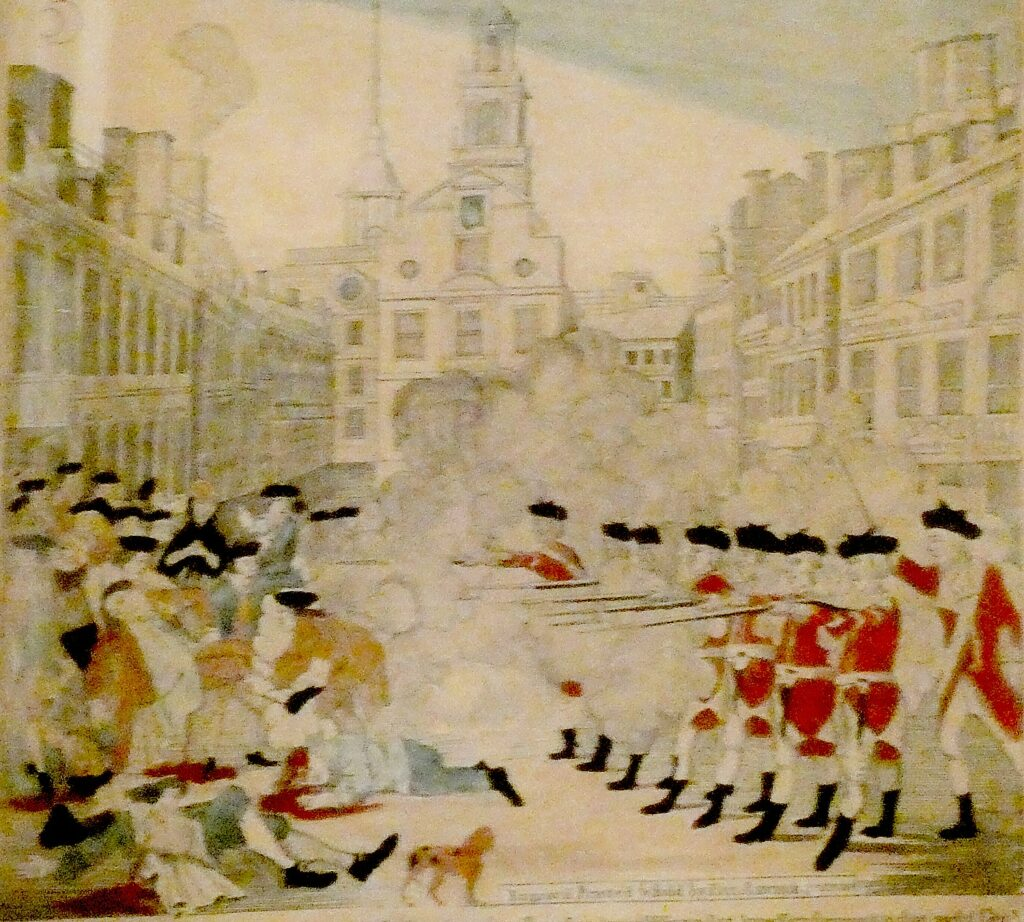
Most people think of Paul Revere solely as a silversmith, but his work as a printer and an artist was key to his role as a patriot seeking to break with Great Britain. His print of the Boston Massacre was significant to organize public opinion against the British. Paul Revere, The Bloody Massacre Perpetrated on King Street, Boston. Hand colored engraving, 1770. American Antiquarian Society. Gift of Nathaniel Paine.

From Paul Revere to Edward Hopper: Treasures from the Leonard L. Milberg Collection of American Prints, Drawings, and Watercolors, through October 27, 2024, showcases more than 140 prints, drawings, and watercolors from one of the most admired collections of historical American works on paper

Scenes of New York City: Selections from the Elie and Sarah Hirschfeld Collection, through October 27, 2024: The inaugural display in the new Hirschfeld Gallery and Hall presents a selection of artworks from an extraordinary promised gift to New-York Historical by prominent philanthropists and art collectors Elie and Sarah Hirschfeld, who have amassed a stunning collection honoring their hometown. The collection features renowned artists—both national and international—and presents vivid snapshots of Gotham and its streetscapes.

Enchanting Imagination: The Objets d’Art of André Chervin and Carvin French Jewelers, through January 5, 2025:  This dazzling exhibition of meticulously created objets d’art is on view to the public for the very first time. André Chervin (born 1927 in Paris), with his New York atelier, Carvin French, is one of the most acclaimed makers of handcrafted fine jewelry in the world.

A Billion Dollar Dream: The 1964-1965 New York World’s Fair on its 60th Anniversary at Queens Museum, Flushing Meadows Corona Park, Queens, November 3, 2024—March 9, 2025: A Billion Dollar Dream celebrates the 60th anniversary of the 1964–1965 New York World’s Fair by examining its legacy through social, political and environmental lenses. Featuring materials from the Queens Museum’s collection, the exhibition highlights the Fair’s promotion of progress and nationhood while reflecting contemporary issues, including civil rights and the women’s liberation movement.  

Solid Gold at The Brooklyn Museum, Prospect Heights, Brooklyn, November 16, 2024—July 6, 2025: Solid Gold celebrates the allure of gold, presenting over 500 works that explore the color and material’s significance in art, fashion, film and design throughout history. Opening for the Brooklyn Museum’s 200th anniversary, the exhibition features stunning pieces from renowned designers like Christian Dior and Yves Saint Laurent, alongside gold-ground paintings, sculptures and jewelry by notable artists such as Alexander Calder and Bulgari. 

The Metropolitan Museum of Art is featuring “Flight into Egypt: Black Artists and Ancient Egypt, 1876-Now” © Karen Rubin/goingplacesfarandnear.com

Flight into Egypt: Black Artists and Ancient Egypt, 1876–Now at The Metropolitan Museum of Art, Upper East Side, Manhattan, November 17, 2024—February 17, 2025: Flight into Egypt: Black Artists and Ancient Egypt, 1876–Now examines how Black artists and cultural figures have engaged with ancient Egypt through art, literature and performance over nearly 150 years. Featuring 200 works, the exhibition explores themes like the creation of a unifying identity and the contributions of Black scholars. It also includes a dedicated gallery for performance art, featuring live performances on select days.  

Lillie P. Bliss and the Birth of the Modern at The Museum of Modern Art, Midtown Manhattan, November 17, 2024—March 29, 2025: The Museum of Modern Art will host this exhibition in celebration of one of its founders and her crucial role in promoting modern art in the US. The exhibit marks 90 years since Bliss’s contributions to MoMA and will feature about 40 works. The exhibition will also display archival materials, highlighting her lasting impact on the museum and the acceptance of modern art in America. 

Ceremonies Out of the Air: Ralph Lemon at MoMA PS1, Long Island City, Queens, November 14, 2024—March 25, 2025: Showcasing over 60 works by Ralph Lemon, this exhibition presents dance, sculpture, video and more. Ceremonies Out of the Air will highlight his storytelling through movement and features the central installation Rant redux (2020–24). It will also include a series of live performances that enhance the immersive experience. 

Magazine Fever: Gen X Asian American Periodicals at The Museum of Chinese in America, Nolita, Manhattan, through March 30, 2025: Magazine Fever: Gen X Asian American Periodicals examines the impact of Asian American magazines in shaping identity during the 1980s and ’90s. Featuring over 80 rare issues from notable publications like A. Magazine and Hyphen, the exhibition showcases how these magazines provided a platform for Asian Americans to assert their narratives and portray their identities. 

FUTURA 2000: BREAKING OUT at The Bronx Museum of the Arts, South Bronx, Through March 30, 2025: FUTURA 2000: BREAKING OUT is a retrospective of the legendary NYC artist’s career. Running through winter 2025, it showcases five decades of his work, including sculptures, drawings, prints and new installations. The exhibition highlights his signature techniques, science-fiction motifs and the iconic 1980 graffiti piece, Break, which cemented his influence in the art world. 

The cast of New York Gilbert & Sullivan Players with NYGASP Founder Albert Bergeret taking bows at last season’s ‘Mikado.” NYGASP celebrates its 50th anniversary and honors 150 years of Gilbert of Sullivan in its 2024-25 season © Karen Rubin/goingplacesfarandnear.com

New York Gilbert & Sullivan Players Celebrates 50th Anniversary Season: New York Gilbert & Sullivan Players (NYGASP), America’s preeminent professional Gilbert & Sullivan repertory company, announces a Golden Jubilee, celebrating its 50th anniversary season and honoring 150 years of the wit and wonder of Gilbert & Sullivan. The celebrated full company and orchestra will perform “Ruddigore” on Nov. 23– 24, 2024; “The Pirates of Penzance” on Jan. 4– 12, 2025; and “Iolanthe” on April 56, 2025 at the Gerald Lynch Theatre at John Jay College. Info and tickets at www.nygasp.org

And on Long Island:

Billy Joel attends the opening of the first exhibit dedicated exclusively to LIMEHOF Inductee and Legendary Long Island Musician. Due to popular demand, the exhibit is being extended through Spring 2025 © Karen Rubin/going-placesfarandnear.com

‘Billy Joel – My Life, A Piano Man’s Journey’ Exhibit at LIMEHOF Extended: The Long Island Music and Entertainment Hall of Fame (LIMEHOF) has is extending the run of the first ever exhibit dedicated exclusively to LIMEHOF Inductee and Legendary Long Island Musician Billy Joel through spring 2025. Billy Joel- My Life, A Piano Man’s Journey spans Joel’s life and career from growing up in Hicksville to his legendary run at Madison Square Garden. It includes over 50 years of Billy Joel’s most cherished items including rare memorabilia, behind-the-scenes video, dozens of awards, rare audio and video recordings, vintage instruments and historic photos, many donated by Billy Joel himself. Timed entry and VIP tickets and special holiday packages and gift cards are available at www.TheBillyExhibit.com  (LIMEHOF, 97 Main Street, Stony Brook, Long Island, www.limusichalloffame.org).

_______________________

© 2024 Travel Features Syndicate, a division of Workstyles, Inc. All rights reserved. Visit goingplacesfarandnear.com and travelwritersmagazine.com/TravelFeaturesSyndicate/. Blogging at goingplacesnearandfar.wordpress.com and moralcompasstravel.info. Visit instagram.com/going_places_far_and_near and instagram.com/bigbackpacktraveler/ Send comments or questions to FamTravLtr@aol.com. Tweet @TravelFeatures. ‘Like’ us at facebook.com/NewsPhotoFeatures 

Great Jack O’Lantern Blaze at Old Bethpage Village Restoration is a Long Island Halloween Treat!

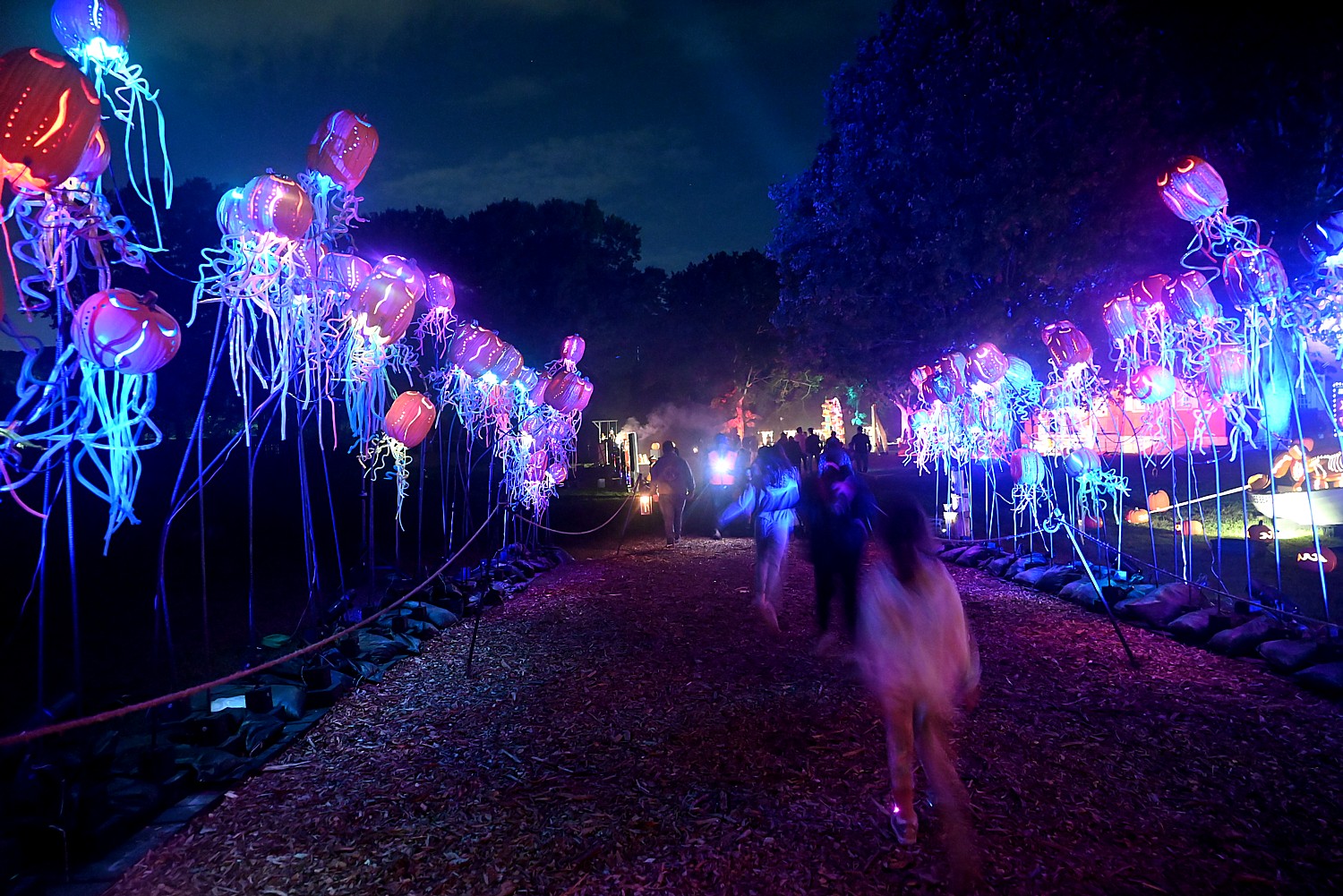
The Great Jack O’Lantern Blaze at Old Bethpage Village Restoration pays tribute to Long Island’s maritime tradition: stroll the trail lined by pumpkin jelly fish © Karen Rubin/goingplacesfarandnear.com

By Karen Rubin, Travel Features Syndicate, goingplacesfarandnear.com

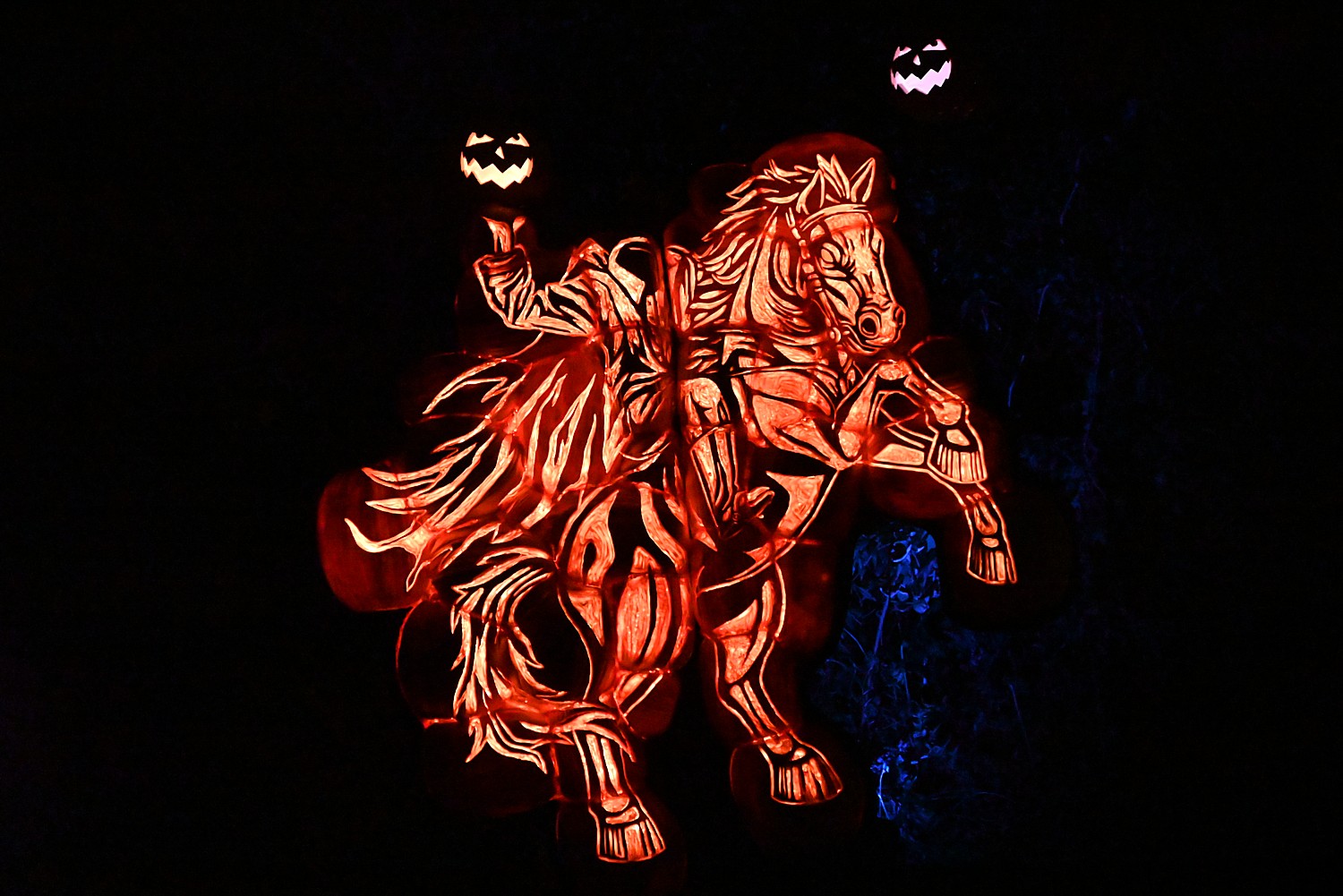
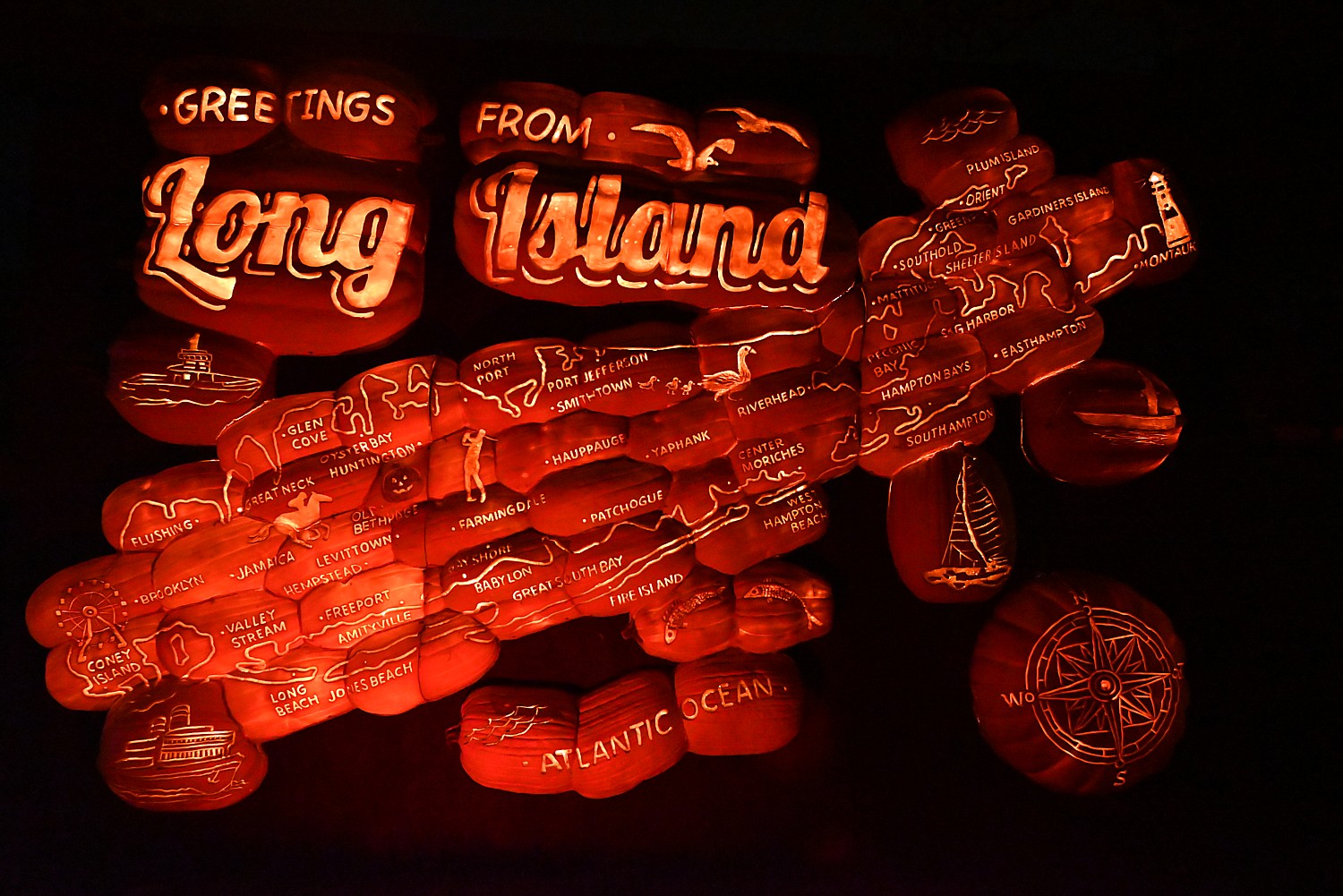
Historic Hudson Valley has brought its enormously popular “The Great Jack o’ Lantern Pumpkin Blaze” extravaganza to Long Island to our most fabulous living history destination, Old Bethpage Restoration Village, for the fifth year. They have brought the extraordinary artistry, charm and delight, and kept Sleepy Hollow’s Headless Horseman, but have tailored the displays and story around Long Island’s history, heritage and culture.  

The Great Jack O’Lantern Blaze at Old Bethpage Village Restoration pays tribute to Long Island’s maritime tradition: stroll the trail lined by pumpkin jelly fish © Karen Rubin/goingplacesfarandnear.com

On view on select nights through November 3, this is a must-see attraction/experience that delights all ages, with more humor than horror.

Old Bethpage Village Restoration, a 209-acre living history museum with homes and buildings that date back to the 19th century, is the perfect setting – the stories marvelously weave a context of reality to the fantasy, which makes them even more spooky.

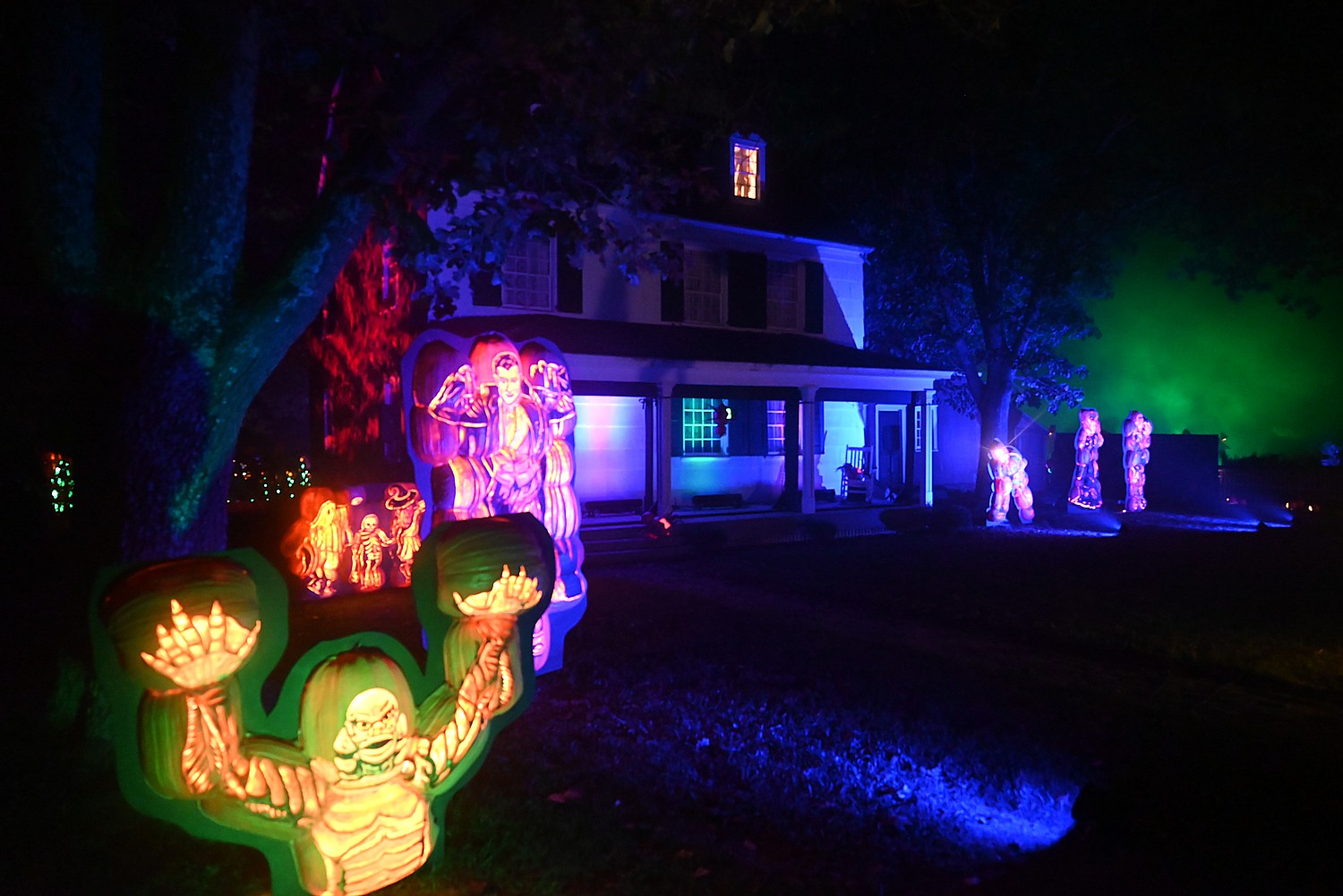
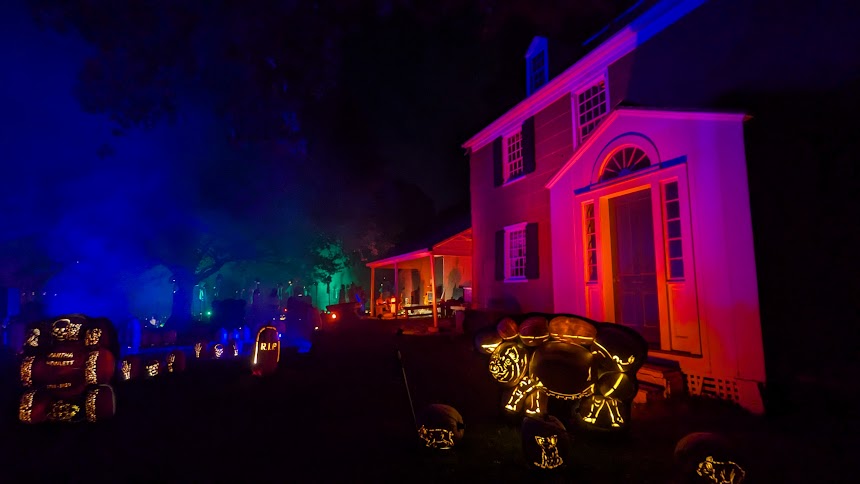
Lots of scary monsters have taken up residence at the Hewlett House for the Great Jack O’Lantern Blaze, one of the Old Bethpage Village Restoration historic homes that are reportedly haunted in their own right © Karen Rubin/goingplacesfarandnear.com

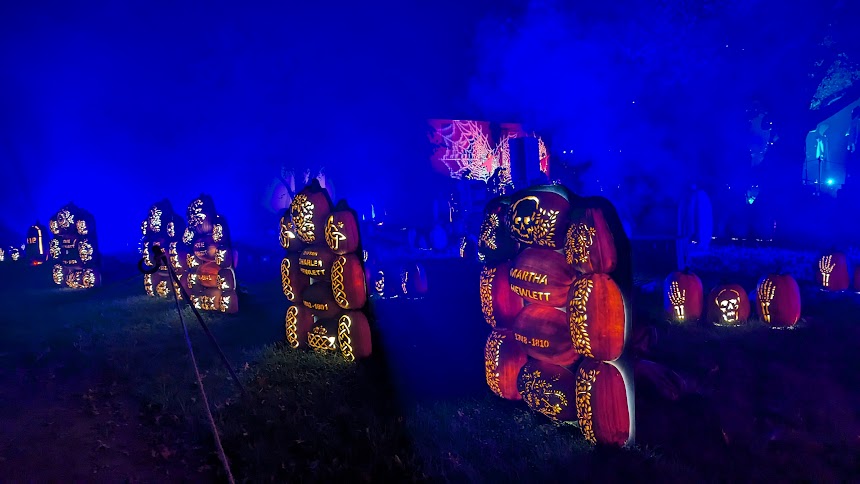
Hewlett House is a stand-in for the Amityville Horror, with similar architecture, but has its own spectral story. The pumpkin cemetery is peopled by the Hewlett family, a prominent farming family who remained loyal to the Crown during the American Revolution whose farm was built in 1794, near Pequot Lane in Woodbury (the house was moved to a hilltop at Old Bethpage in the 1970s). Their actual house is one of several historic houses in Old Bethpage said to be haunted.

For the Great Jack O’Lantern Blaze, the historic Hewlett House from a far built in 1794 by a wealthy farming family, plays the part of the Amityville Horror © Karen Rubin/goingplacesfarandnear.com

The Doomsday Clock outside the house, is an enormous pendulum clock made of pumpkins such as would have been popular in the 19th century and wealthy Long Island families like the Hewletts and Laytons might well have had one. But this one, standing 12 feet tall, features a single hand, ominously counting back the hour.

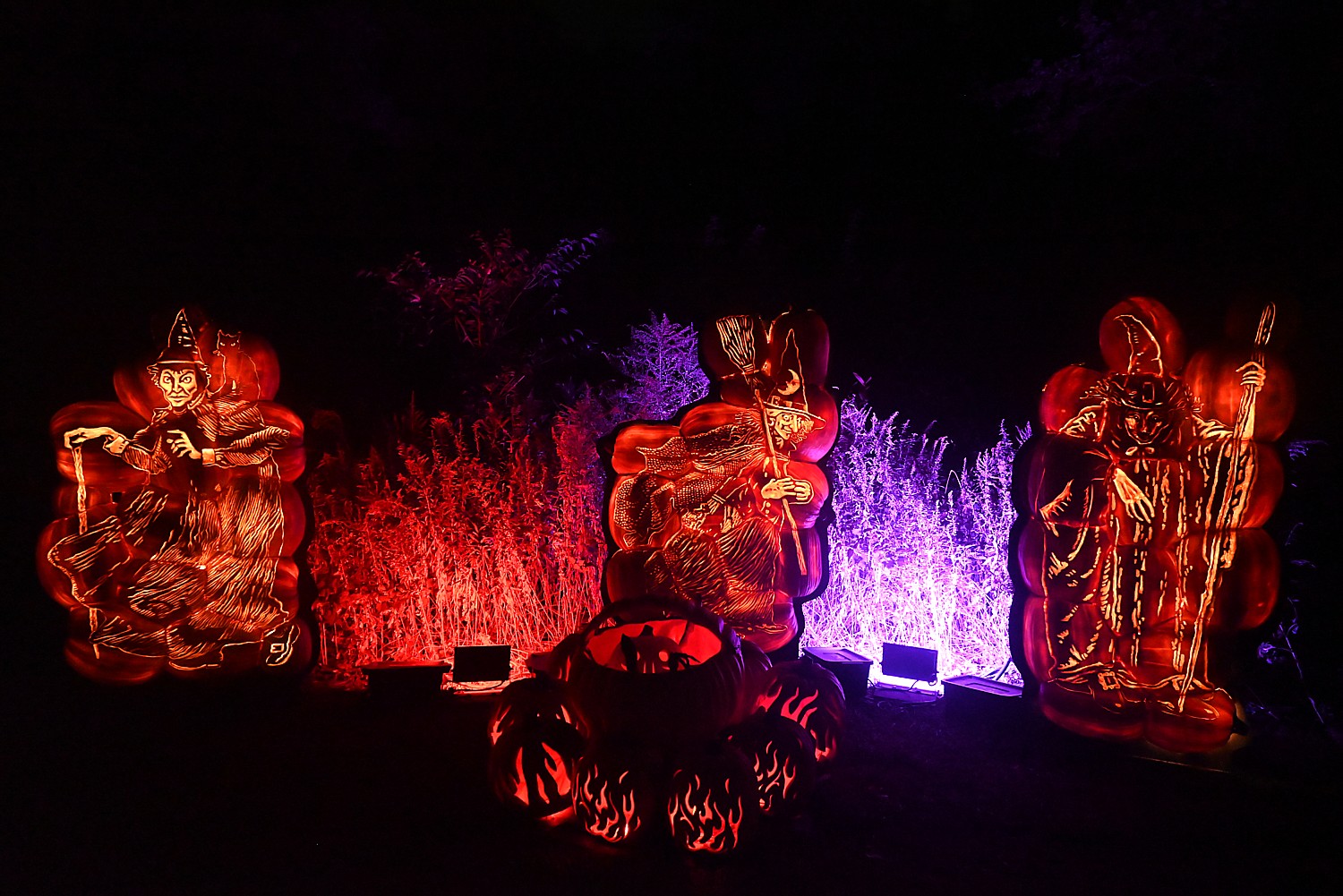
Witches come to Old Bethpage Village Restoration for the Great Jack O’Lantern Blaze; an actual witch trial took place in East Hampton in 1658, 35 years before the Salem witch trials © Karen Rubin/goingplacesfarandnear.com

And in 1658, some 35 years before the Salem witch trials, 16-year old Elizabeth Gardiner Howell of East Hampton was accused of witchcraft – but she was acquitted in her trial.

The Hewlett family cemetery re-created out of carved pumpkins! © Karen Rubin/goingplacesfarandnear.com

And the Blaze Long Island Hall of Fame inside the Visitors Center, before you start your walk on the trail, features intricate pumpkin sculptures of famous Long Islanders (Natalie Portman and Jerry Seinfeld are the newest, joining Billy Joel, Joan Jett, Sue Bird, and Dr. J).

Jerry Seinfeld is immortalized in the Blaze Long Island Hall of Fame © Karen Rubin/goingplacesfarandnear.com

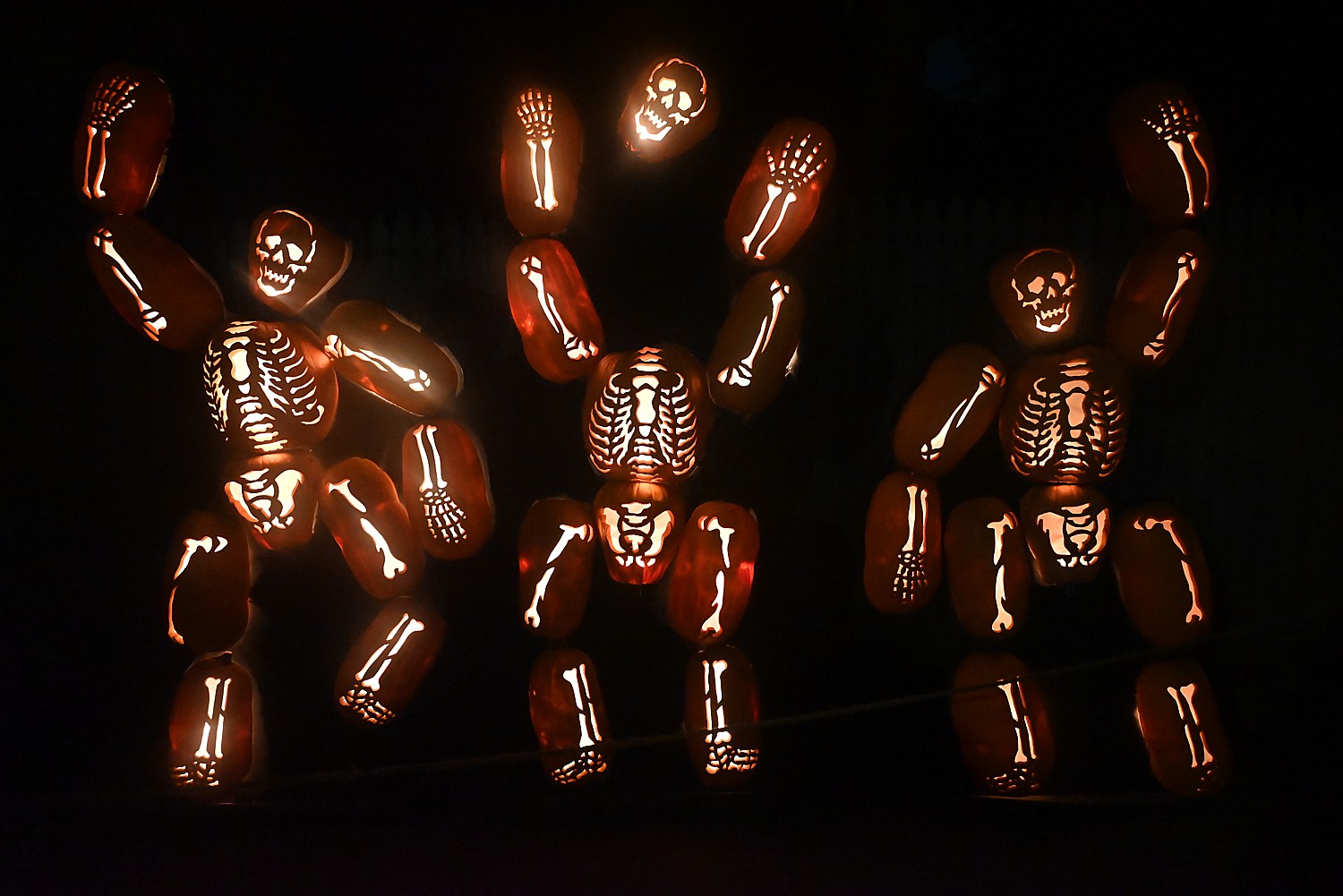
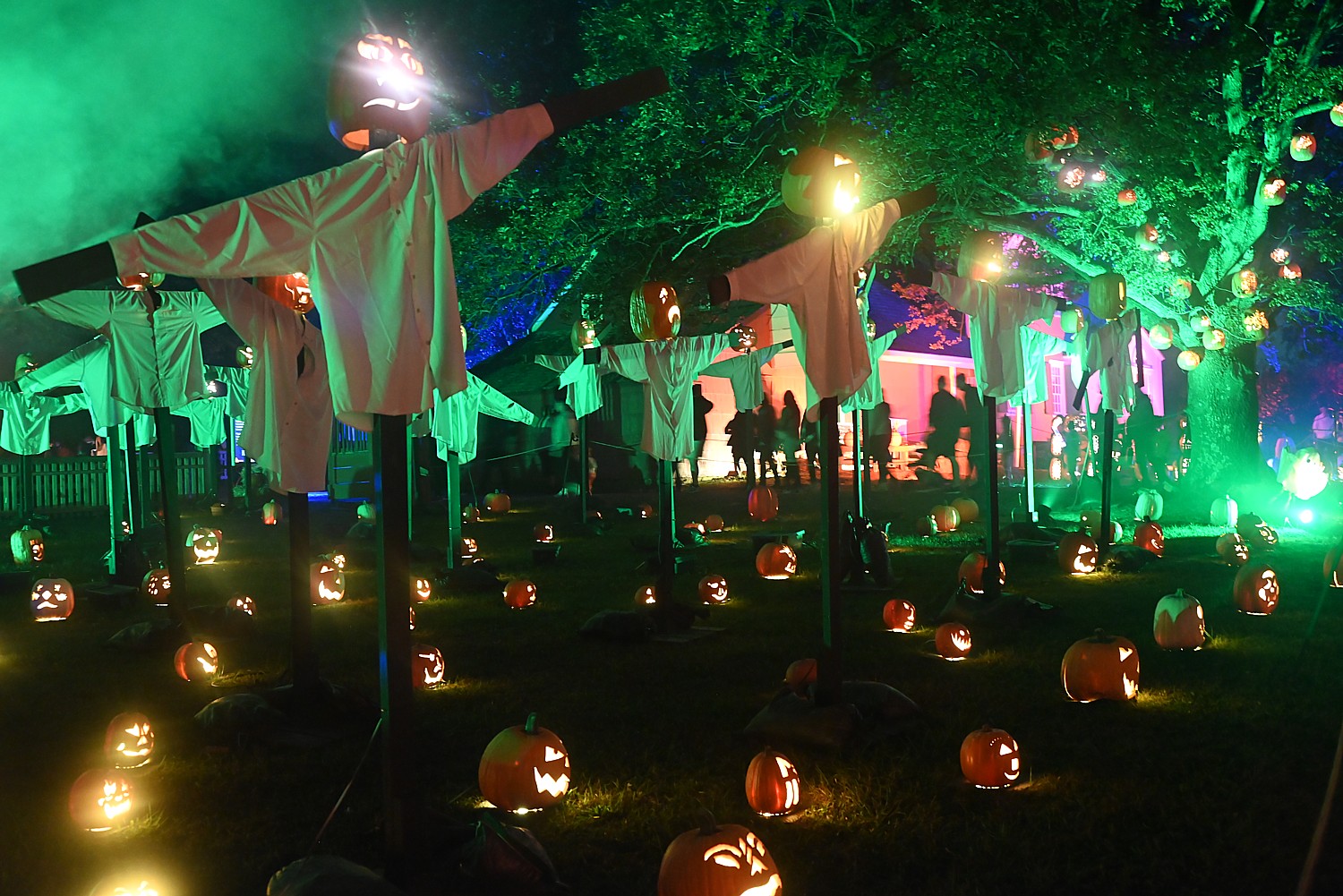
You walk the pumpkin trail through this 19th century village and see more than 7,000 hand-carved jack o’lanterns, all carved by its team of artisans, each one unique.

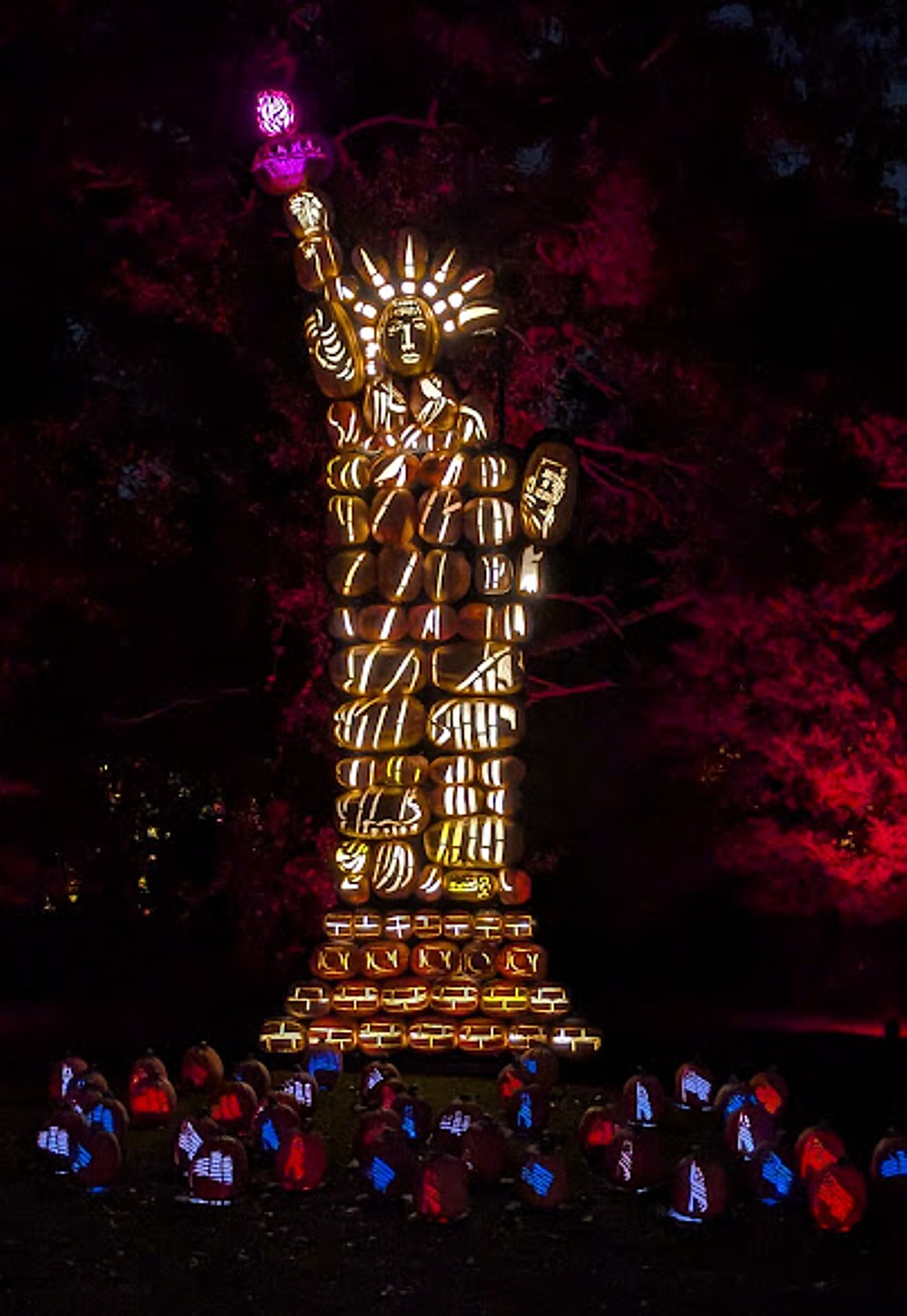
Blaze Long Island’s homage to the Statue of Liberty © Karen Rubin/goingplacesfarandnear.com

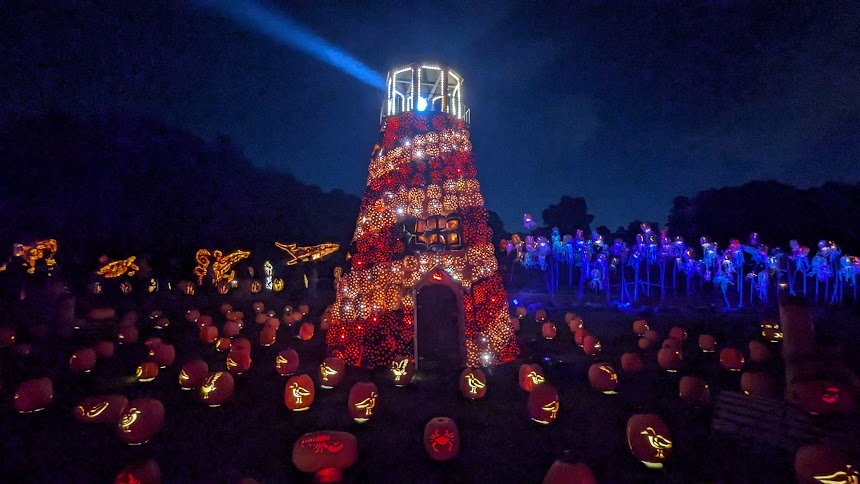
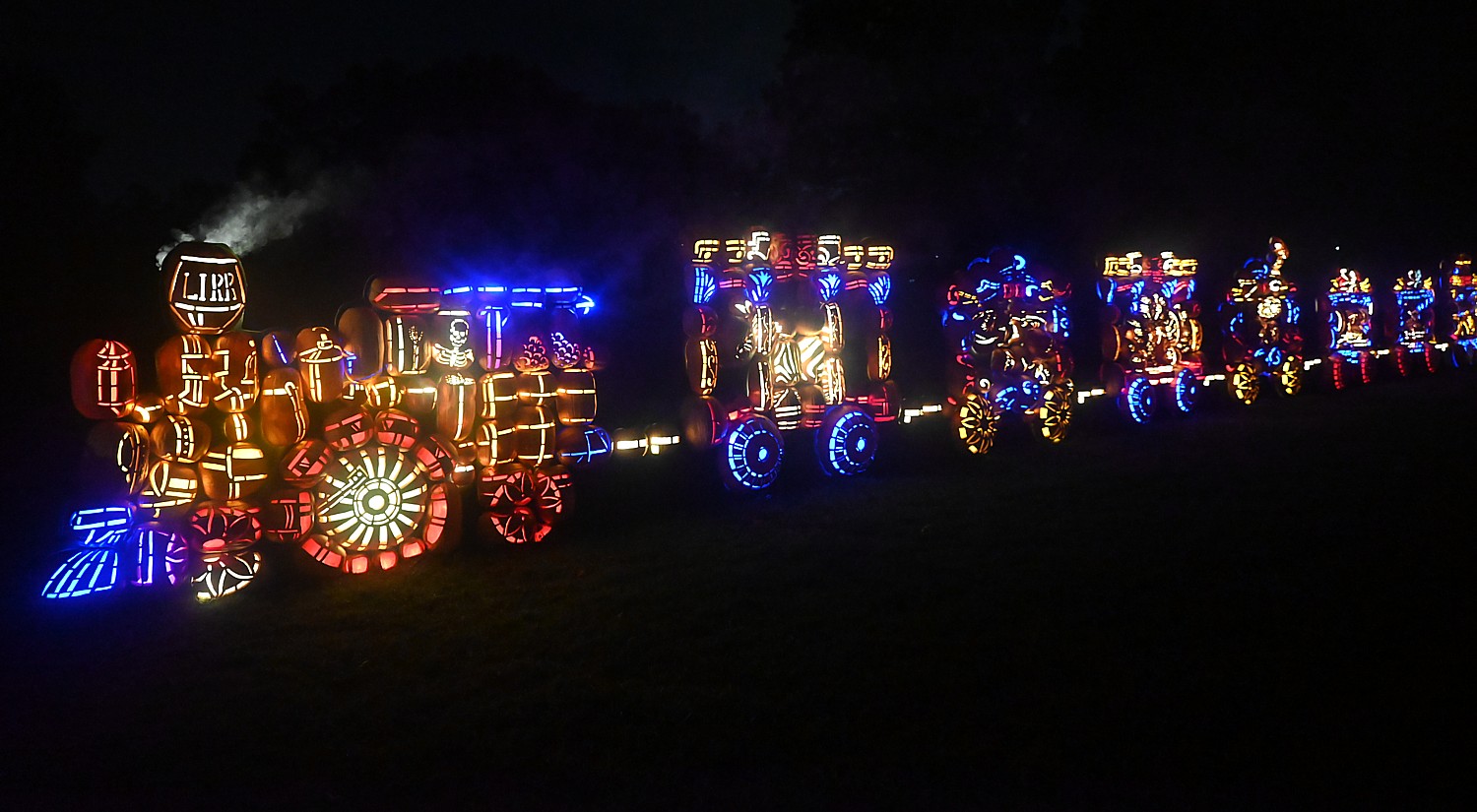
The structures – all built with carved and lighted pumpkins – are absolutely incredible: a display featuring a police car, ambulance, firetruck, firefighter spraying a hose and a firefighter climbing a ladder;  a windmill; a Statue of Liberty as tall as a tree, a lighthouse with a working light (Montauk is Long Island’s most famous but this pays tribute to the lighthouse commissioned by President George Washington himself), an 80-foot long circus train with animal skeletons as passengers (a nod to Ringling Brothers & Barnum & Bailey bringing its circus train to Long Island in 1972 to the newly opened Nassau Coliseum), a working carousel with horse skeletons.

The Montauk Point Light , the first public works project in America, commissioned in 1792 by the 2nd US Congress under president George Washington and completed four years later. Blaze Long Island offers this version, which features a blazing beacon of illuminated pumpkins © Karen Rubin/goingplacesfarandnear.com

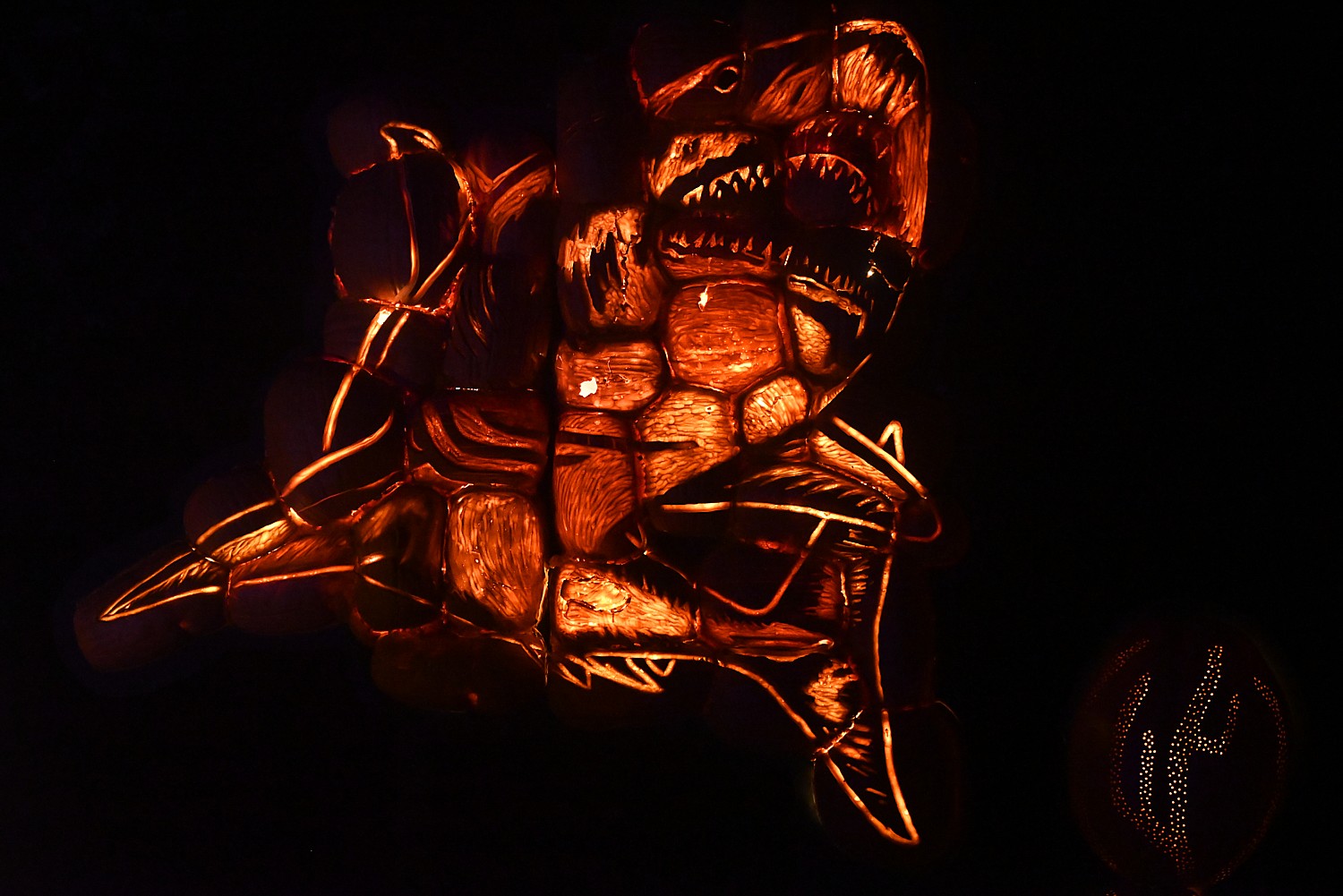
The displays pay homage to Long Island’s farming heritage, its maritime heritage (a whaling center!), and its cultural contributions, from the inventor of one of the first computer games, to the factoid that “Jaws” was inspired by the capture of a 4500 lb white shark off Long Island.

The movie ‘Jaws” Jaws” was inspired by the capture of a 4500 lb white shark off Long Island© Karen Rubin/goingplacesfarandnear.com

There are also a series of displays that trace Long Island’s history, from the Native American tribes who first inhabited, to Long Island’s role in aviation history (Lindbergh took off on his historic flight in his Spirit of St. Louis to Paris in 1927 from Roosevelt Field, and nuclear physicist William Higinbotham’s of the Brookhaven National lab who in 1958 arguably developed the first video game, Tennis for Two, a primitive version of Pong and precursor to Pac-Man and Mario Bros.

The pumpkin Circus Train, harkening to the Ringling Bros & Barnum & Bailey train that came to the newly opened Nassau Coliseum in 1972, is 80 feet long © Karen Rubin/goingplacesfarandnear.com

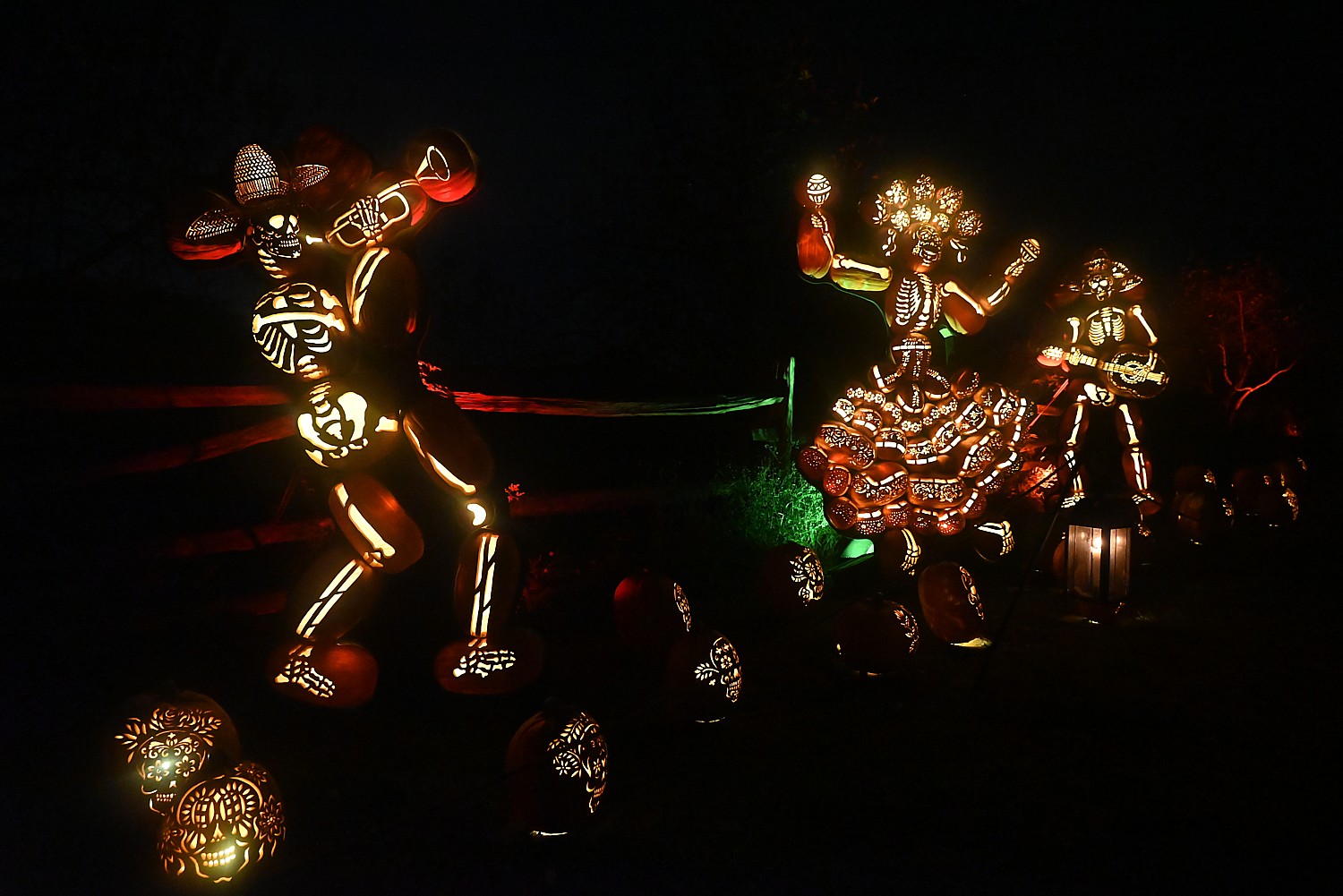
Among the new displays this year is a stunning tribute to the Day of the Dead and a moving ferris wheel.

The sound effects, original musical soundtrack, lights, colors, motion of some of the larger exhibits, even smoke effects and bubbles, are pure delight. The ambiance in such a historic, rural setting is just phenomenal.

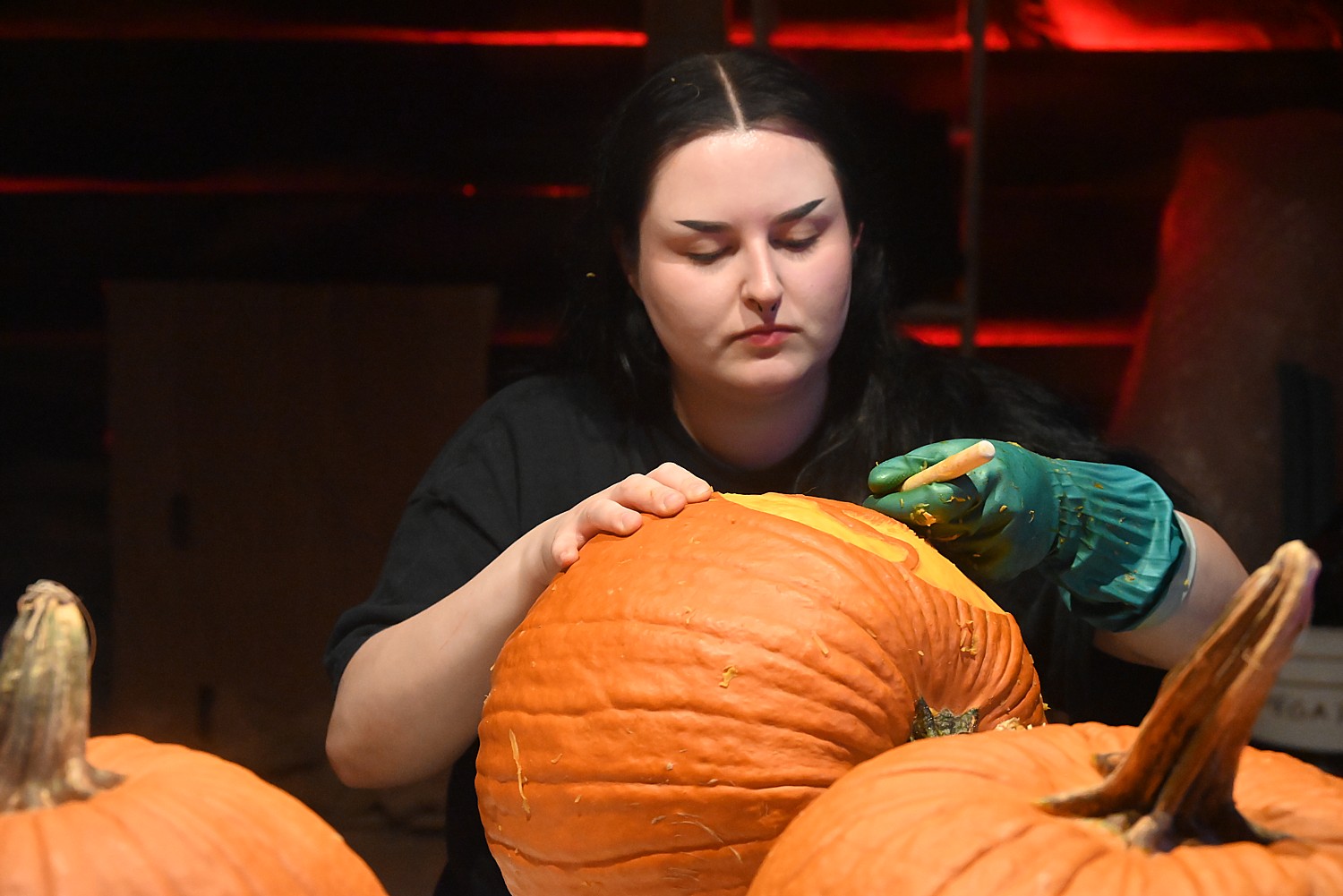
Nicole demonstrates pumping carving at Blaze Long Island © Karen Rubin/goingplacesfarandnear.com

You also get to see actual pumpkin carving and get to talk with the carvers and see the 100+-pound carved winners, a marvelous Blaze Boo-tique featuring seasonal gifts and merchandise, while Café Blaze, features fall treats like cider donuts and pumpkin beer. 

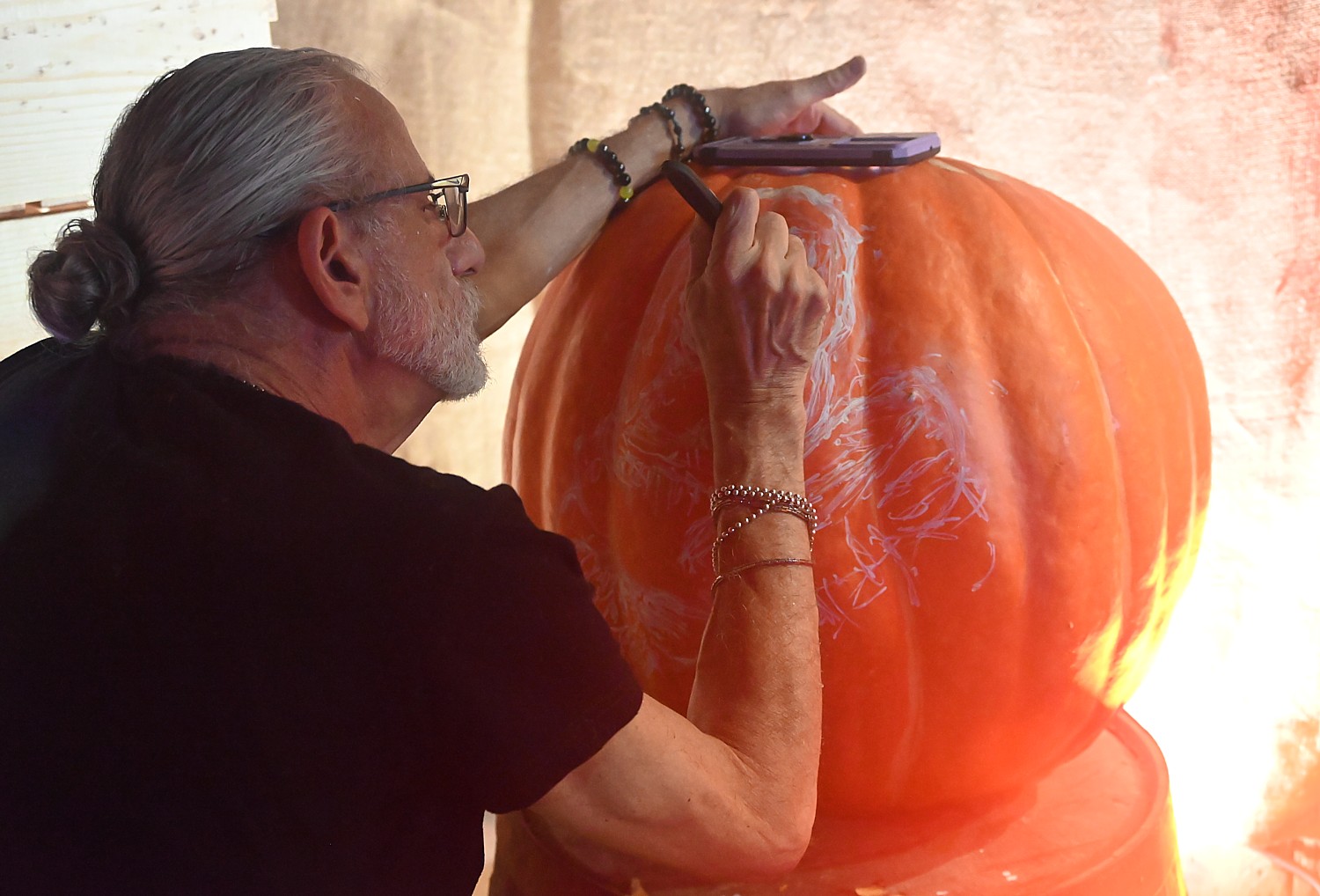
We encounter Rocco, a pumpkin carver, starting his “Bona Lisa” at Blaze Long Island © Karen Rubin/goingplacesfarandnear.com

The photo ops are precious.

Advance online purchase of timed tickets is required; no tickets are sold at the venue; capacity is limited and prices increase if you purchase on the same day.There are also FLEX tickets that allow you to visit at any time, even when it is sold out. (For a small fee, you can exchange a ticket up to 24 hours in advance.) New this year is a $10 flat rate children’s tickets (ages 3-17), valid for every date and every time slot.  

One of the new Blaze Long Island displays is this magnificent tribute to the Day of the Dead © Karen Rubin/goingplacesfarandnear.com

The Great Jack O’Lantern Blaze is open select evenings Oct. 4-Nov. 3 including Halloween.

It’s a pleasant walk along a dirt trail (about half the size of the Village), suitable for strollers – allocate 45-90 minutes to enjoy. (I suggest families try to come as early as possible so the kids aren’t too tired; others come later when it may be less busy, like 8:30 pm – last entry at 9 pm.

Proceeds support the education and preservation efforts of Old Bethpage Village Restoration and Historic Hudson Valley.

The Great Jack O’Lantern Blaze at Old Bethpage Village Restoration features some 7,000 carved pumpkins © Karen Rubin/goingplacesfarandnear.com

The original Great Jack O’Lantern Blaze, celebrating 20 “gourd-eous years” this year, is already underway at Historic Hudson Valley’s Van Cortlandt Manor, Croton-on-Hudson through Nov. 17 (advance purchase tickets necessary, https://pumpkinblaze.org/blaze-hudson-valley.html). And other special Halloween events are underway at Philipsburg Manor and Sunnywide (historichudsonvalley.org)

The Great Jack O’Lantern Blaze at Old Bethpage Village Restoration features some 7,000 carved pumpkins © Karen Rubin/goingplacesfarandnear.com

Sponsored by Catholic Health, the Great Jack O’Lantern Blaze is presented through a partnership of Historic Hudson Valley, Old Bethpage Village Restoration and Nassau County which owns and operates OBVR, with support of the NYS Council of the Arts, NYS Economic Development, and I Love NY.

Old Bethpage Village Restoration, 1303 Round Swamp Rd, Old Bethpage, NY 11804, https://pumpkinblaze.org/blaze-long-island.html.

See also:

HALLOWEEN HAPPENINGS: SPIRITS OF THE SEASON TAKE OVER AREA ATTRACTIONS

_______________________

© 2024 Travel Features Syndicate, a division of Workstyles, Inc. All rights reserved. Visit goingplacesfarandnear.com and travelwritersmagazine.com/TravelFeaturesSyndicate/. Blogging at goingplacesnearandfar.wordpress.com and moralcompasstravel.info. Visit instagram.com/going_places_far_and_near and instagram.com/bigbackpacktraveler/ Send comments or questions to FamTravLtr@aol.com. Tweet @TravelFeatures. ‘Like’ us at facebook.com/NewsPhotoFeatures 
Halloween Happenings: Spirits of the Season Take Over Area Attractions

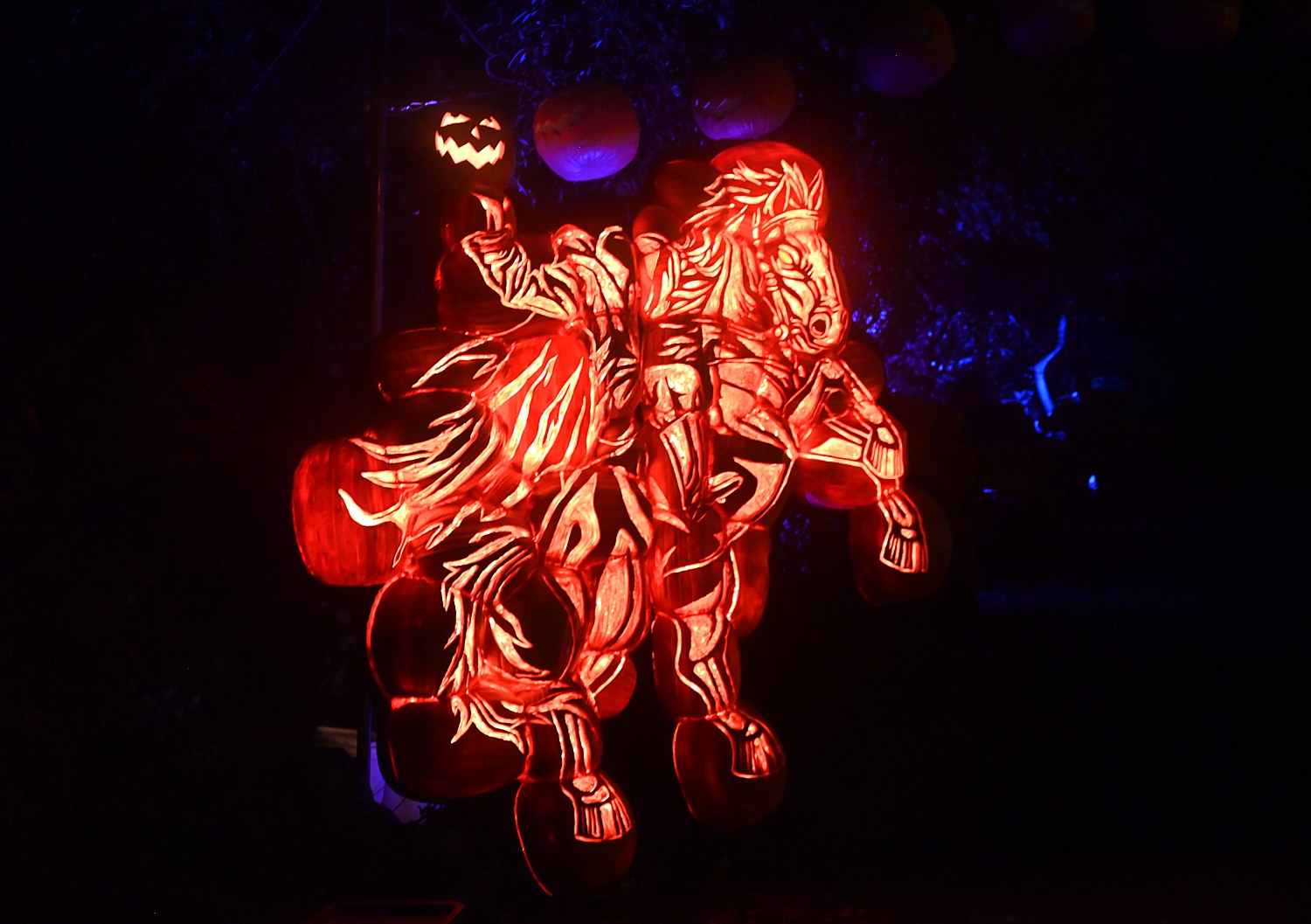
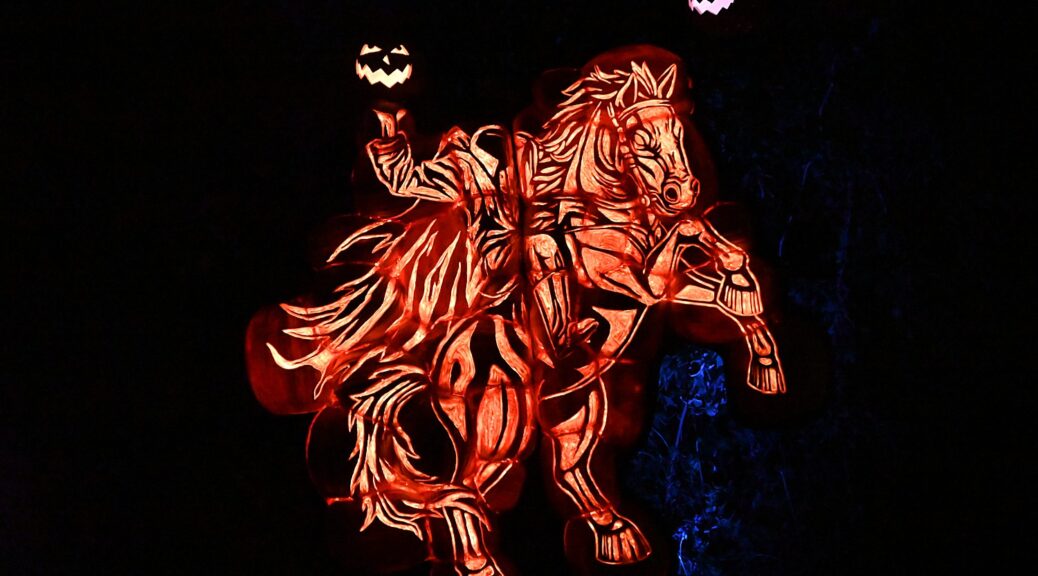
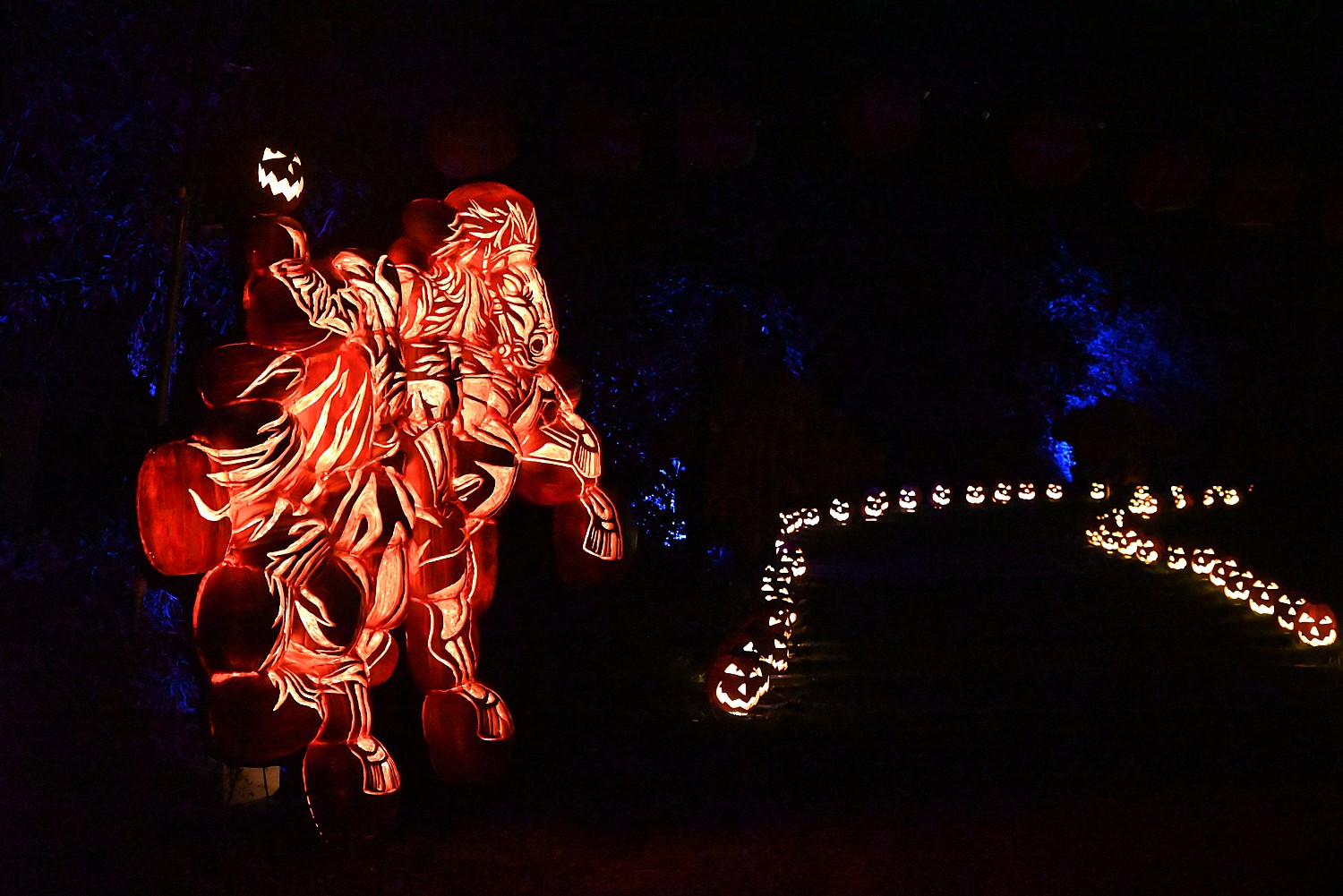
The Headless Horseman (made of jack o’lanterns) rides from Sleepy Hollow to Old Bethpage Village Restoration, Long Island, for The Great Jack o’ Lantern Pumpkin Blaze © Karen Rubin/goingplacesfarandnear.com

By Karen Rubin, Travel Features Syndicate, goingplacesfarandnear.com

Halloween has become a national festival of fantasy and imagination. Here are some of our favorites, from Salem, Massachusetts, to Sleepy Hollow, Historic Hudson Valley, to Old Bethpage,Long Island to New York City’s Village Halloween Parade.

Salem Haunted Happenings

Salem arguably is the birthplace of Halloween festivities, and while the spirits of the season occupy the village year round, they get into a frenzied gear during Salem Haunted Happenings. Because of the Salem Witch Trials of 1692, Salem has the added authenticity and depth to understand how women, in particular, were persecuted as witches (the patriarchy would particularly go after midwives and healers), so Salem understandably later became a haven and a hub for modern-day witchcraft (paganism), which has its roots in women being healers and midwives. You can experience most of this (the whimsy and fantasy but also the sober tragedy) year-round, but it all takes on special resonance – and yes, festiveness – at Halloween.

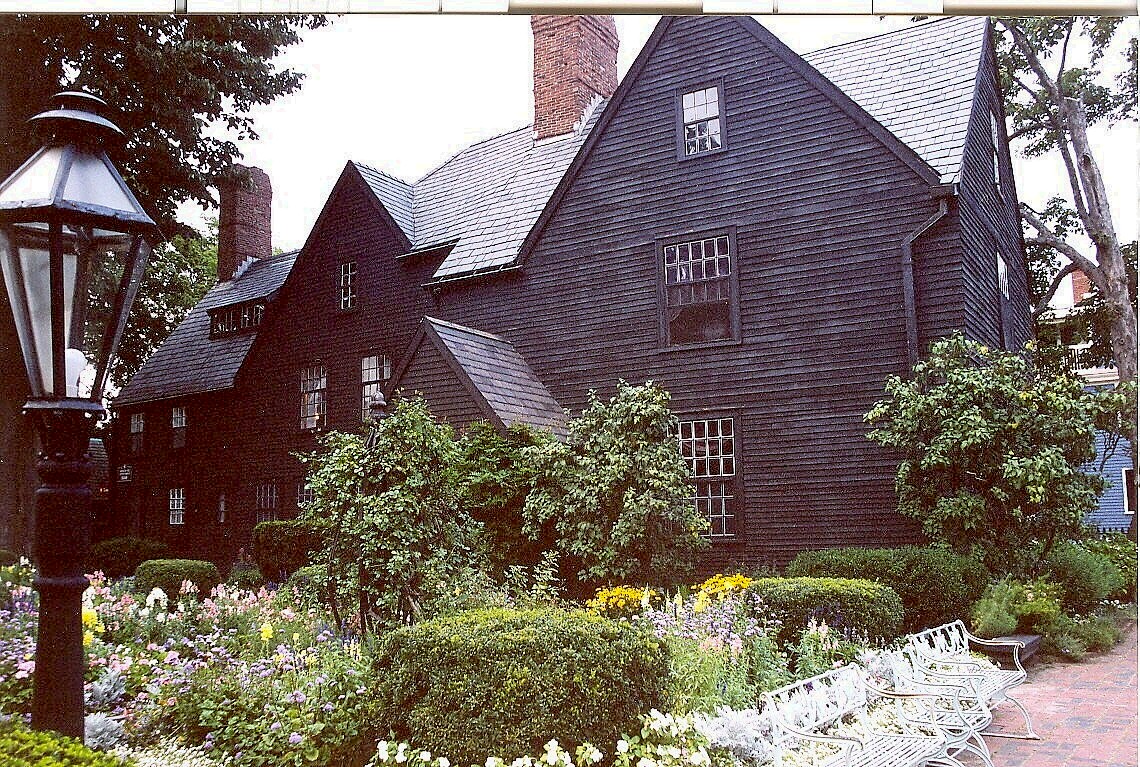
Salem, Massachusetts, may well be the birthplace of Halloween festivities, with its annual Salem Haunted Happenings. The famous House of Seven Gables was the centerpiece of Nathaniel Hawthorne’s novel. Hawthorne’s great-grandfather, Colonel John Hathorne, was the judge that found over a 100 women guilty of witchcraft and oversaw at least 20 hangings that may be visited year round. © Karen Rubin/goingplacesfarandnear.com

There are haunted houses, ghost tours, museums and attractions (the famous House of Seven Gables was the centerpiece of Nathaniel Hawthorne’s novel. Hawthorne’s great-grandfather, Colonel John Hathorne, was the judge that found over a 100 women guilty of witchcraft and oversaw at least 20 hangings), psychics, fairs, séances, trolley and walking tours, recreations of the famous trial.

“Cry Innocent” recreates one of the famous Salem witchcraft trials © Karen Rubin/goingplacesfarandnear.com

Helpful visitor planning information, schedules, descriptions, planning, lodging and dining, even restroom locator at https://www.hauntedhappenings.org/things-to-do/).

Salem is one of my favorite destinations. Year round happenings can be found at Destination Salem, https://www.salem.org/.

Historic Hudson Valley’s Great Jack O’Lantern Blaze

The original Great Jack O’Lantern Blaze, celebrating 20 “gourd-eous years” this year, is already underway at Historic Hudson Valley’s Van Cortlandt Manor, Croton-on-Hudson – a testament to the popularity of the event which continues through Nov. 17 (advance purchase tickets necessary).

Located on the grounds of an 18th-century estate on the banks of the Croton River in Westchester, Van Cortlandt Manor is the picturesque setting for this awe-inspiring fall event. Visitors meander through the heritage gardens filled with hand-carved jack o’lanterns, past the brick ferry house, where they well might get a glimpse of the Headless Horseman, and see the light show at the manor house.

This year, celebrate the festival’s 20th year with a giant birthday cake and Celebration Arch; step into the Gourd & Goblet Tavern, a new VIP experience on the pumpkin trail; spot the giant Kraken rising from the Croton River; meet life-sized dinosaurs; try not to get stuck in the 24-foot spider web, gaze at the stars in the Pumpkin Planetarium, and see a working carousel; get fall-themed sweets and snacks at Café Blaze; and browse the Blaze Boo-tique to find exclusive souvenirs and local finds.

Since 2005, more than 2 million visitors have delighted in this walk-through experience, where thousands of hand-carved pumpkins in elaborate displays light up the night. Now in two New York locations, in Westchester at Van Cortlandt Manor in Croton-on-Hudson and in Nassau County at Old Bethpage Village Restoration in Old Bethpage, this fun fall festival features larger-than-life installations, along with synchronized lighting, and an all-original soundtrack.

Proceeds support the education and preservation efforts of Historic Hudson Valley.

Van Cortlandt Manor,525 S Riverside Ave, Croton-on-Hudson, NY 10520, https://pumpkinblaze.org/blaze-hudson-valley.html

Historic Hudson Valley also presents these iconic Halloween happenings:

At Washington Irving’s Sunnyside, master storyteller Jonathan Kruk casts a spell with his dramatic performances of the classic tale of the “Legend of Sleepy Hollow.” © Karen Rubin/goingplacesfarandnear.com

The Legend of Sleepy Hollow” as you’ve never heard it before: Irving’s ‘Legend’ returns reimagined this fall. Performed outdoors under the stars at Washington Irving’s Sunnyside, master storyteller Jonathan Kruk casts a spell with his dramatic performances of the classic tale. Live music and sound effects by Jim Keyes and an appearance from the Headless Horseman himself make this a spooky spectacular experience for all ages. This experience takes place outdoors in the evening and is seated, but also requires some walking. Tickets $35/adult, $34/seniors, YA, $30/child. Advance purchase tickets required; no tickets sold on site. Select dates from Sept. 27-Nov. 3 (Sunnyside, 3 W Sunnyside Lane, Irvington, NY 10533, https://hudsonvalley.org/events/irvings-legend/)

A Night of Folklore, Fortune, and Festivities: Discover delightful and mysterious creatures who croon creepy tunes, tell your fortune and tall-ish tales of legends and lore, and come face-to-face with the Headless Horseman. Shop for Sleepy Hollow swag at the Halloween night market and enjoy cocktails, mocktails and snacks. Select dates Sept. 27 – Nov. 3 ($30/adults, $29/seniors, young adults, $25/child). (Philipsburg Manor: 381 N Broadway, Sleepy Hollow, NY, https://hudsonvalley.org/events/twilight-village-at-sleepy-hollow/)

At Philipsburg, in Historic Hudson Valley, the locale for Washington Irving’s “Legend of Sleepy Hallow,” you very well may encounter the Headless Horseman himself. © Karen Rubin/goingplacesfarandnear.com

Night of Legendary Magic Featuring Mark Clearview & Nick Wallace: Journey with master illusionists into the realm of the unknown at this spooky supernatural spectacle as they communicate with the spirits of Sleepy Hollow Country like Hulda, Major Andre, and the Headless Horseman himself. New Spirits of Sleepy Hollow Premium option: cabaret style seating with at-seat drink service in the first two rows of the theater. Strongly recommended for ages 10+ only; limited seating. Select dates, Sept. 27-Nov. 3, tickets starting at $60. (Philipsburg Manor: 381 N Broadway, Sleepy Hollow, NY,  https://hudsonvalley.org/events/the-spirits-of-sleepy-hollow-country/)

Walk In the Footsteps of Ichabod Crane! Fun and friendly tour guides take you on a colorful, photo op filled, immersive romp through historic Philipsburg Manor at the historic heart of Sleepy Hollow, where you will see key landmarks of this special place made famous by Washington Irving in The Legend of Sleepy Hollow. This one-hour tour takes you through the hidden corners in the landscape at Philipsburg Manor that inspired settings in Irving’s amazing tale. You’ll encounter a variety of immersive scenes. This illuminating daytime experience is the easiest and most fun way to get deep inside the true Legend!  Discovery Walk ticket also includes admission to a Philipsburg Manor tour, before or after your Discovery Walk, subject to availability. (Recommended for ages 10+ and requires negotiating steep, mixed terrain, not suitable for strollers or wheelchairs.).Select dates Sept. 27-Nov. 3 (adults $40, seniors/young adults $39, children $35). Philipsburg Manor: 381 N Broadway, Sleepy Hollow, NY, https://hudsonvalley.org/events/legend-of-sleepy-hollow-discovery-walk/

In addition to Philipsburg Manor, Washington Irving’s Sunnyside, and Van Cortlandt Manor, Historic Hudson Valley also stewards extraordinary historic sites: Kykuit, The Rockefeller Estate and Union Church of Pocantico Hills.

Historic Hudson Valley, 639 Bedford Road, Pocantico Hills, NY 10591, info@hudsonvalley.org, 914-366-6900, https://hudsonvalley.org/

Great Jack O’Lantern Blaze Celebrates 5th Anniversary on Long Island

Historic Hudson Valley has brought The Great Jack O’Lantern Blaze to Long Island’s Old Bethpage Village Restoragtion© Karen Rubin/goingplacesfarandnear.com

Historic Hudson Valley has brought The Great Jack O’Lantern Blaze to Long Island’s Old Bethpage Village Restoration, the 209-acre living museum village for its 5th year, presented by Catholic Health. Old Bethpage is the ideal setting for Nassau County’s largest fall festival event, The spectacular walk-through Halloween experience features thousands of hand-carved pumpkins in elaborate displays that pay homage to Long Island culture, heritage, history and landmarks, as well as the Halloween season, complete with motion, lighting, and original soundtrack. Stroll the pumpkin trail past 19th century buildings, through historic barns. Enjoy pumpkin carving and see the 100+-pound carved winners, the Blaze Boo-tique featuring seasonal gifts and merchandise, and Café Blaze, an on-site café featuring fall treats like cider donuts and pumpkin beer. 

The Headless Horseman rides from Sleepy Hollow to Old Bethpage Village Restoration, Long Island, for The Great Jack o’ Lantern Pumpkin Blaze © Karen Rubin/goingplacesfarandnear.com

New for 2024:

  • $10 flat rate children’s tickets (ages 3-17), valid for every date and every time slot.  
  • New displays designed to wow (not scare) the whole family, including a moving Ferris wheel with pumpkins and Day of the Dead tribute.
  • Intricate pumpkin sculptures of Natalie Portman and Jerry Seinfeld join other Long Island icons, such as Billy Joel, Joan Jett, Sue Bird, and Dr. J in Blaze’s Long Island Hall of Fame.
  • A new Celebration Arch which serves as a tribute to Blaze: Long Island’s anniversary, ideal for photo ops.  
  • Find your favorite classic Hollywood monster in the Pumpkin Planterium

Advance online purchase of timed tickets or FLEX anytime tickets is required; no tickets are sold at the venue. Select evenings Oct. 4-Nov. 3 including Halloween. Proceeds support the education and preservation efforts of Old Bethpage Village Restoration and Historic Hudson Valley.

Old Bethpage Village Restoration, 1303 Round Swamp Rd, Old Bethpage, NY 11804, https://pumpkinblaze.org/blaze-long-island.html.

Boo at the Zoo Returns to the Bronx Zoo

Bronx Zoo’s Boo at the Zoo takes place weekends through October 27 and Columbus Day, October 14 (photo: WCS)

The Bronx Zoo’s favorite fall tradition, Boo at the Zoo, takes place Saturdays and Sundays from Sept. 28 to Oct. 27 (and Monday, October 14th), when zoo guests can get into the spooky spirit as new and returning Halloween festivities come to life throughout the park.

Fall is one of the best times to spend the day at the Bronx Zoo as stunning autumn colors come to life across its 265-acre hard wood forest and guests enjoy the beauty of nature and wildlife here in New York City. Set in peak leaf peeping season, Boo at the Zoo is the daytime fall event which has enchanted guests for years and is back with entertainment and activities that are perfect for all ages, which is addition to the Zoo’s nighttime event, Pumpkin Nights.

Boo at the Zoo’s new thrills include:

  • Trick or Truth Maze: Explore a maze and complete a scavenger hunt to learn about so-called “spooky” animals and bust some creepy myths. (Astor Court from 11am-4pm) 
  • Face Painting: Transform into a spooky or sweet creature at the Butterfly Patio Pad with free face-painting for children ages 3+, 11am – 4pm.
  • Creepy Crawly Mystery Wall: Touch and feel mysterious textures and materials to learn about animals and other creatures.
  • Halloween Mash Up: Visitors of all ages can dance, sing, and play with the zoo’s fan favorite emcee at Astor Court, 12:30, 1:30, 2:30
  • Boo at the Zoo Mural: Draw a favorite animal or spooky creature at the Boo at the Zoo mural at Astor Court from 11am – 4pm.

Other Boo at the Zoo activities taking over the park include:

  • Costume Parade: Costumed entertainment by animal-themed stilt walkers and Halloween puppets. Guests in Halloween costume join the parade (Astor Court at 12, 1, 2pm)
  • Halloween Crafts: A fan-favorite activity of decorating spooky creature puppets at Giraffe Patio from 11am-4pm, along with the Costume Parade.
  • Magic & Mind Reading: The popular magician is back with an animal-inspired magic and mind reading. (Grizzly Corner at 11am, 12, 2, 3, 4pm)
  • Pumpkin Carving Demos: Expert artists create giant animals and intricate scenes out of pumpkins at Dancing Crane Pavilion from 11am-4pm (speed carving also taking place at 11:30am and 2:30pm!).
  • Wildlife Theater: ‘The Wildlife Witch’s Super Scary Halloween Show,’ a funny short musical featuring a witch and all her creepy crawly friends, takes place at Giraffe Corner at 10:45am, 11:30am, 12:30, 2:30, 3:15 & 4pm.
  • Spooky Stories to Tickle Your Spine: Animal-themed folklore and storytelling at Grizzly Corner; 11:30am, 12:30, 2:30, 3:30pm.
  • Boo Playground: Halloween-themed lawn games at Astor Court from 11am-4pm.
  • Extinct Animal Graveyard: The eerie graveyard of animal species that have gone extinct with education about how to prevent it from happening in the future (Mouse House Lawn, 10am – 5pm)
  • Pumpkin Trail: Hundreds of expertly carved pumpkins (Rhino Trail from 10am – 5pm)

In addition to Boo at the Zoo, Pumpkin Nights, back for its second year, lights up the zoo after dark with 5,000 animal-themed jack o’lanterns. (Thursdays – Sundays, Sept. 26-Oct. 13, 7-10pm, and Oct. 17-27 6:30-10pm. )

Purchase tickets for Boo at the Zoo: BronxZoo.com/Boo-at-the-Zoo

Purchase tickets for Pumpkin Nights: BronxZoo.com/PumpkinNights

RISE of the Jack O’Lanterns

RISE of the Jack O’Lanterns,featuring what it claims is the world’s longest Jack O’Lantern Trail, returns for its 11th season with 10,000 illuminated objects including 7,000 hand-carved jack o’lanterns, 3,000 specialty lanterns, and hundreds of family-friendly Halloween-themed visual displays. This year RISE will be open only 18 select nights between Oct. 4-28.

Discount tickets available by obtaining a promocode at site.

Advanced purchase tickets are required. Tickets are not sold at the door. All tickets are sold here (https://www.jackolanterns.com/cart?promo=GC2024)
(High-demand early timeslots sell out each year, most several weeks in advance, so we recommend purchasing your tickets as early as possible so you can get the date and time of your choice.

RISE of the Jack O’Lanterns at Usdan Summer Camp for the Arts, 185 Colonial Springs Road, Wheatley Heights, NY 11798

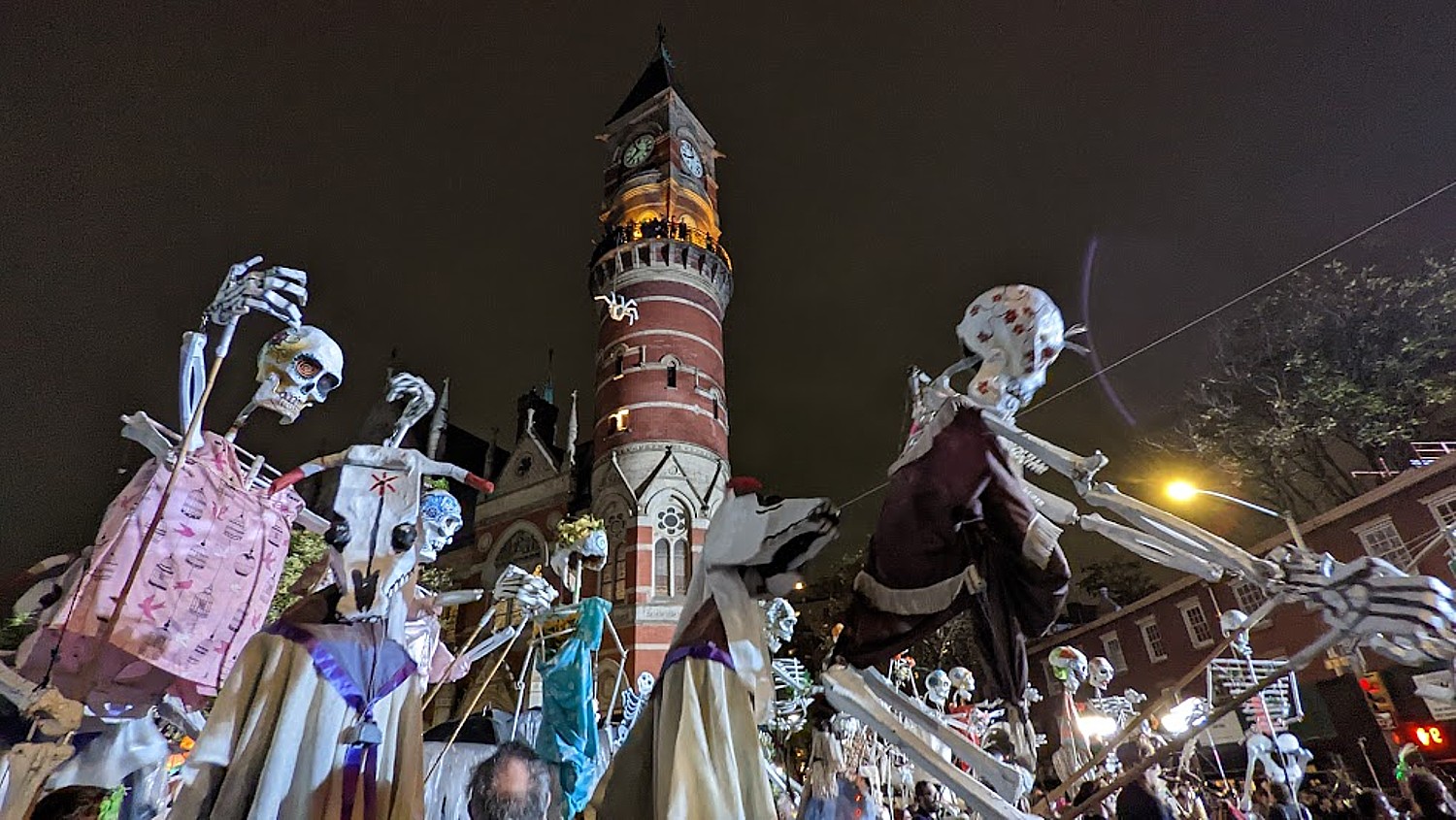
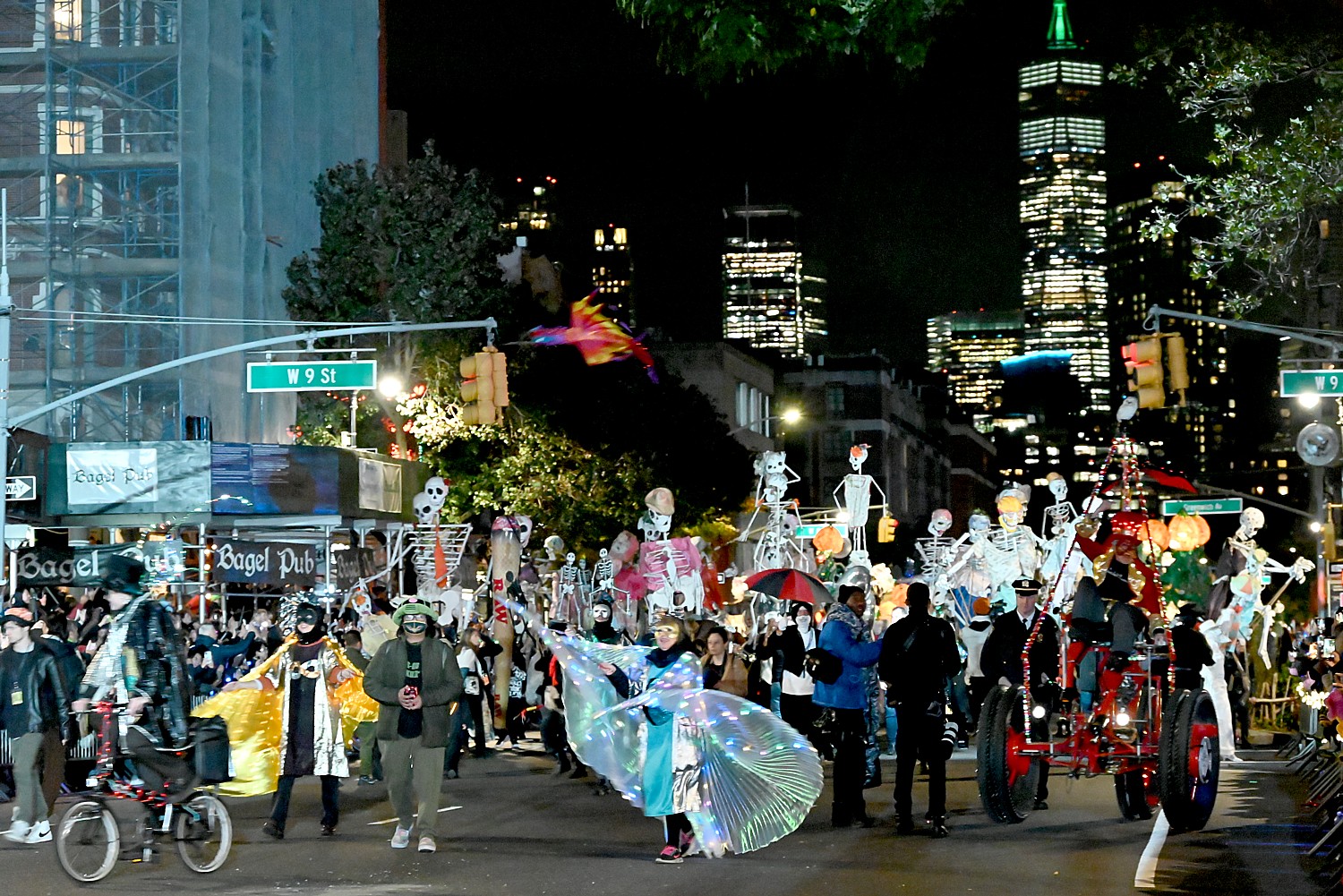
NYC Village Halloween Parade is the Cat’s Meow

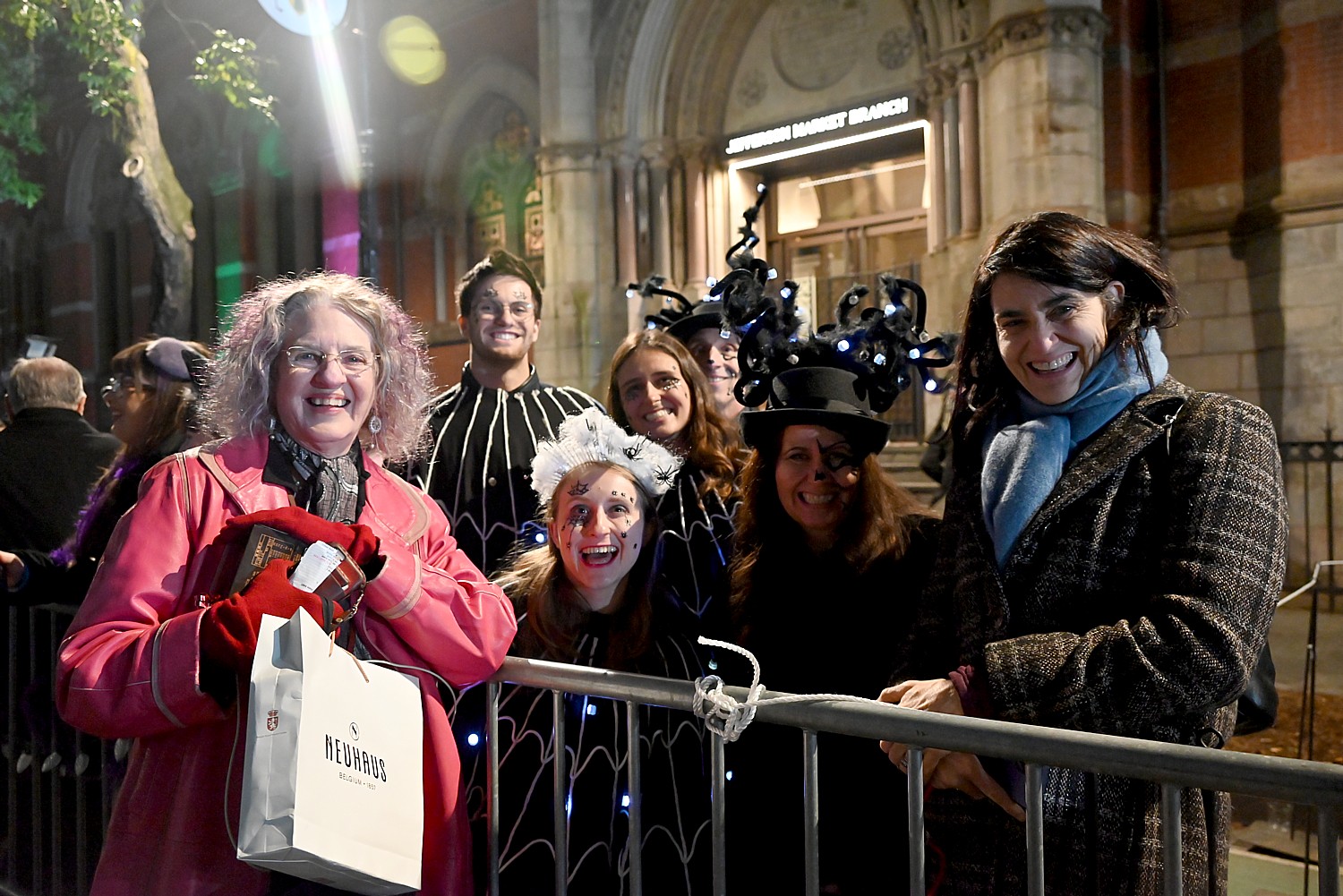
New York City’s iconic Village Halloween Parade is famous for its puppets, creativity, artistry, and joyful vibe. © Karen Rubin/goingplacesfarandnear.com

New York City’s celebration of fantasy, the Village Halloween Parade, is celebrating its 51st anniversary this year with the theme, “Meow.”

“Hallow’s Eve belongs to us, as it always has – to the witch and the Black Cat, to the solitary wise-woman on the outskirts of town (or the upstairs apartment or that white house) and her shape-shifting familiar, to all of us who walk alone and dance together in velvet furs and sharpened claws,” writes Jeanne Fleming, Artistic and Producing Director, announcing this year’s theme. “New York’s Halloween Parade calls on Cat Ladies of every purr-suasion to don your finest tails and whiskers and join the Ball. Led by the puppet creations of Official Parade Puppeteers Processional Arts, whose luminous sweepers return to conjure a quadrille of giant cats, let us take a playful swipe at those who would cross our path – and revel in all that makes us uniquely, inscrutably, un-Cat-egorizably fabulous…. each in our own way, reflecting the tumult of the last few years, and inviting self-reflection.”

The theme for the 51st Village Halloween Parade, an iconic New York City event, is “Meow.” © Karen Rubin/goingplacesfarandnear.com

“Turns out NYC is the epicenter for Cat Ladies!” So, the Parade invites Cat Ladies and Cat Lovers of all stripes and patterns to the Parade. There will be a special section of the Parade for CAT LADIES (must be in costume). This special section comes with after party tickets, Choreography, chants, a TV appearance, a prime place in the Parade line up and a contest to win a spot on a Parade Float.

For those eager to take part or watch in person, this iconic New York City event kicks off at 7 pm ET on Thursday, October 31, 2024, starting from Spring St. and traveling north on Sixth Avenue from Canal Street to 18th Street. The parade is FREE for all to view or join IN COSTUME!  (Tickets for special experiences are available.).

Started by a Greenwich Village mask maker and puppeteer Ralph Lee in 1973, the Parade began as a walk from house to house in his neighborhood for his children and their friends. After the second year of this local promenade, Theater for the New City stepped in and produced the event on a larger scale as part of their City in the Streets program. Today the Parade is the largest celebration of its kind in the world and has been picked by Festivals International as “The Best Event in the World” for October 31.

Now, 51 years later, the Parade draws more than 70,000 costumed participants and some 2 million spectators, including television-viewing audience, live on NY1 beginning at 8 pm.

In 1994, the Mayor of the City of New York issued a Proclamation honoring the Village Halloween Parade for 20 years of bringing everyone in the City together in a joyful and creative way and being a boon to the economic life of the City. “New York is the world’s capital of creativity and entertainment. The Village Halloween Parade presents the single greatest opportunity for all New Yorkers to exhibit their creativity in an event that is one-of-a-kind, unique and memorable every year. New Yorkers of all ages love Halloween, and this delightful event enables them to enjoy it every year and join in with their own special contributions. The Halloween Parade in Greenwich Village is a true cultural treasure.”

Jeanne Fleming, longtime Artistic and Producing Director of the Village Halloween Parade, announcing this year’s theme. “Meow,” said, “New York’s Halloween Parade calls on Cat Ladies of every purr-suasion to don your finest tails and whiskers and join the Ball.” © Karen Rubin/goingplacesfarandnear.com

Join hundreds of puppets, 50 bands representing music from around the world, dancers, artists, and thousands of other New Yorkers in costumes of their own creation in the nation’s most wildly creative public participatory event in the greatest city in the world!

New York’s Village Halloween Parade, halloweenparadeinfo@gmail.com, www.halloween-nyc.com.

_______________________

© 2024 Travel Features Syndicate, a division of Workstyles, Inc. All rights reserved. Visit goingplacesfarandnear.com and travelwritersmagazine.com/TravelFeaturesSyndicate/. Blogging at goingplacesnearandfar.wordpress.com and moralcompasstravel.info. Visit instagram.com/going_places_far_and_near and instagram.com/bigbackpacktraveler/ Send comments or questions to FamTravLtr@aol.com. Tweet @TravelFeatures. ‘Like’ us at facebook.com/NewsPhotoFeatures 
Native People’s Day on Oct. 14 and Native American Heritage Month in November Spark Interest in Indigenous Tourism

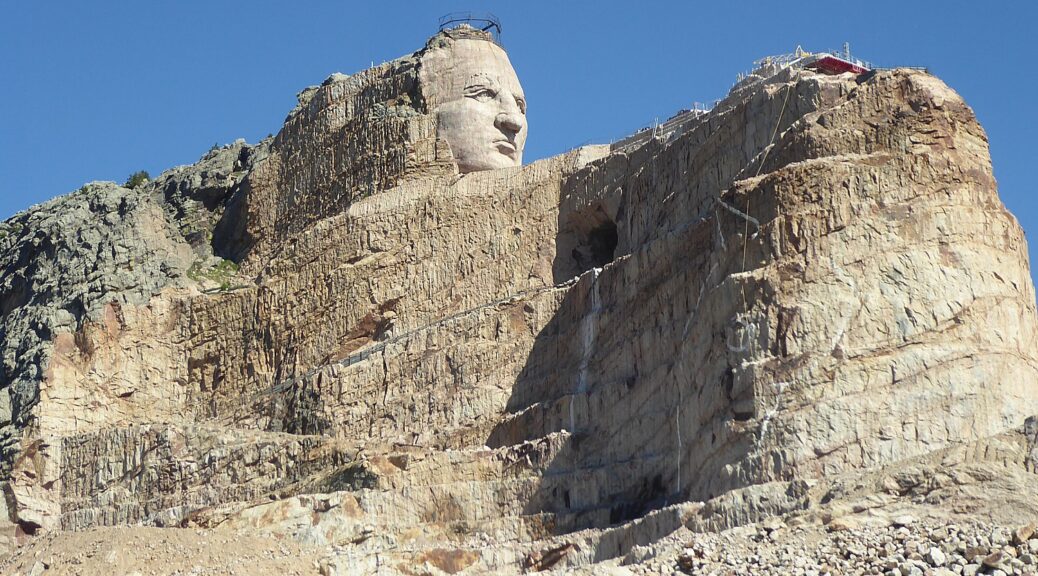
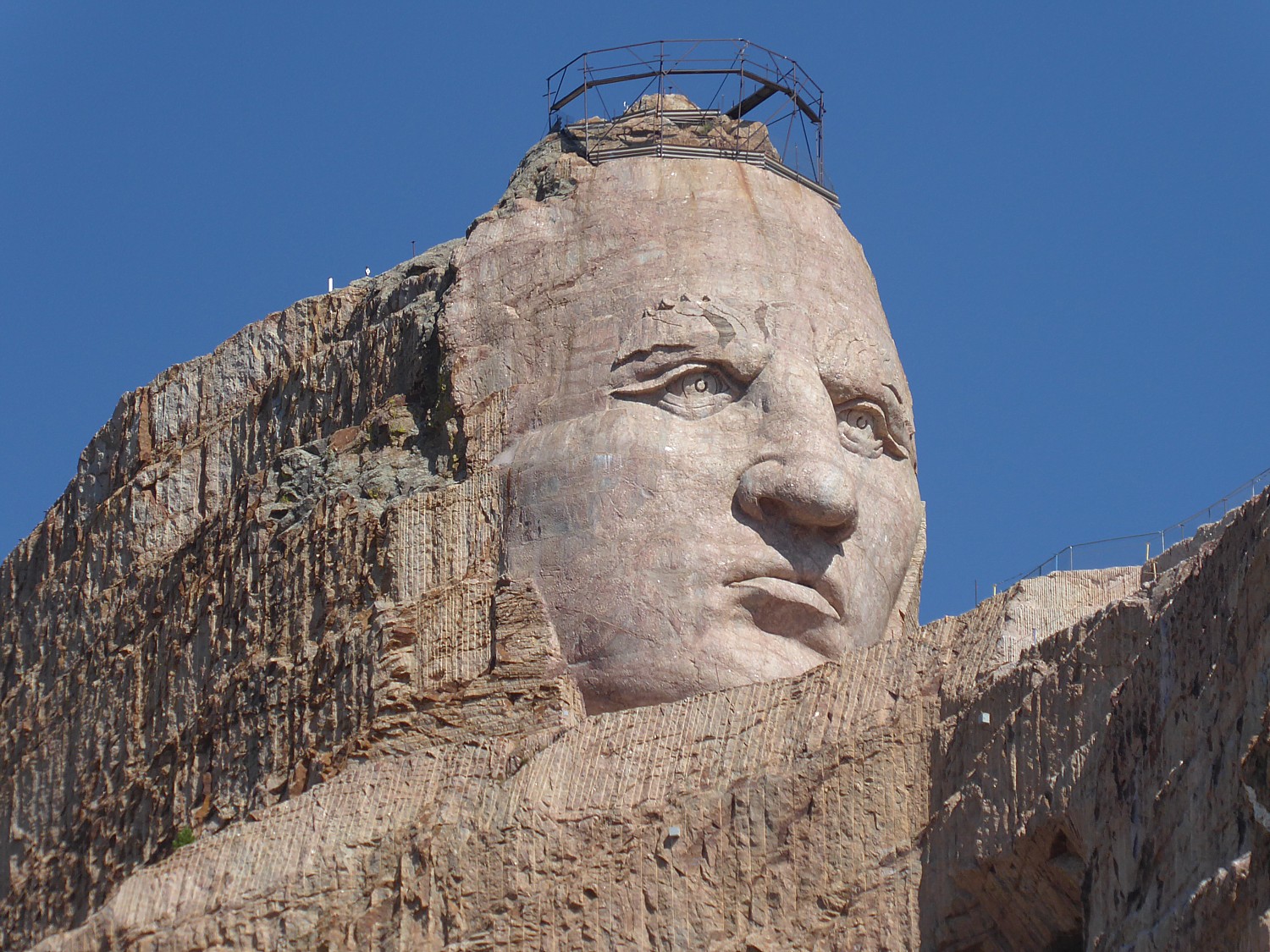
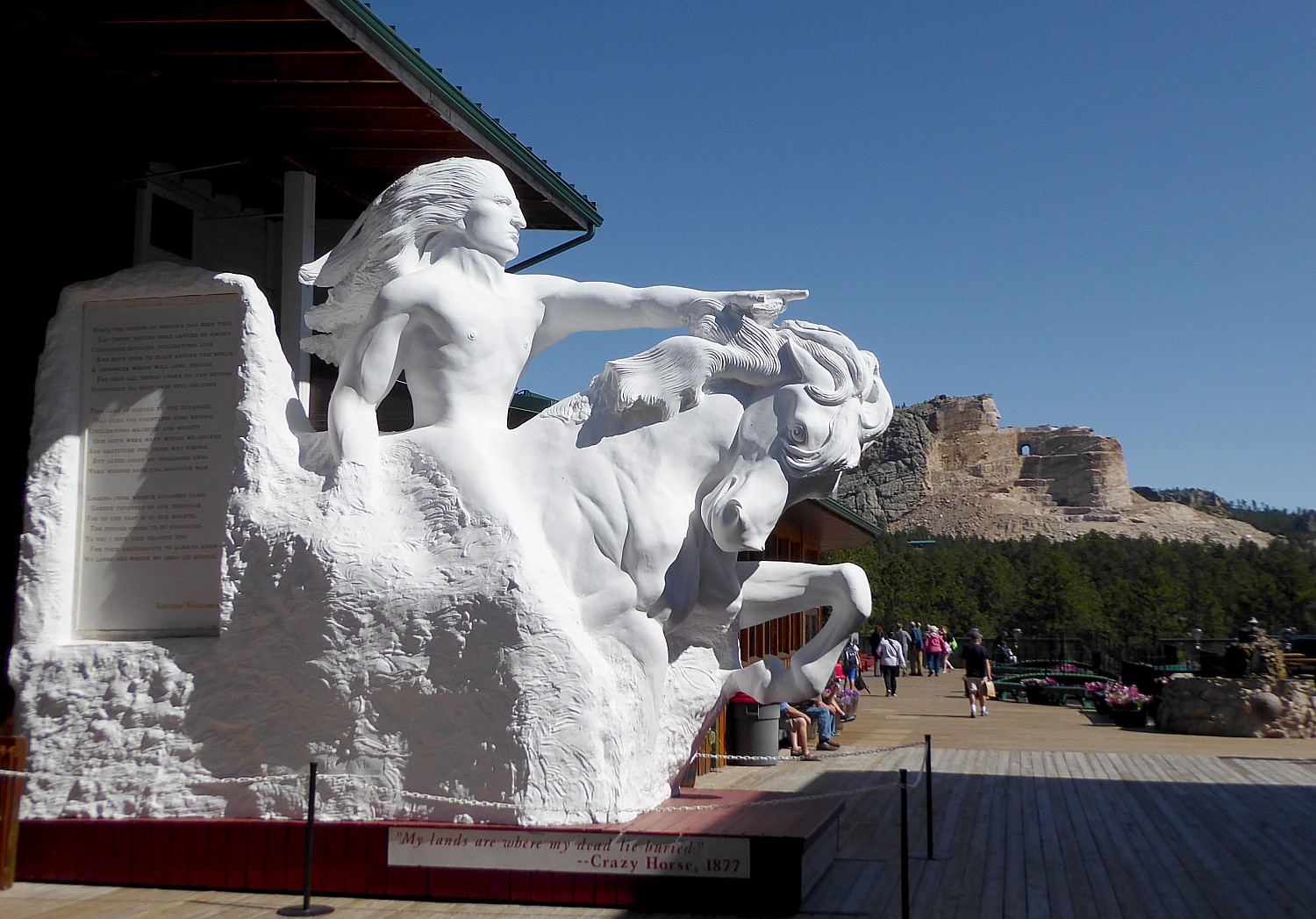
The Crazy Horse Memorial, Mickelson Trail, South Dakota, makes a profound statement about Native Americans © Karen Rubin/goingplacesfarandnear.com

By Karen Rubin, Travel Features Syndicate, goingplacesfarandnear.com

More and more people are finding comfort and wisdom in ancient ways and showing new respect and appreciation for indigenous culture and heritage, especially what they can teach us today about living sustainably and in harmony with nature and each other.

“The interest in Indigenous culture and history has been on the rise for a number of years,” states Elena Junes, Director of Program Operations for Road Scholar, and a member of the Ohkay Owingeh Pueblo. “It is consistent with the rise in eco/sustainable and cultural tourism. Worldwide, although Indigenous peoples make up less than 5% of the total human population, traditional indigenous territories encompass between 22-25% of the world’s land surface, and they coincide with areas that hold 80-90% of the planet’s biodiversity. As travelers seek out new places to visit that are in line with sustainable/experiential tourism, they will find that they are often traveling to traditional indigenous areas. As Road Scholar visits these places, we will always do our best to provide responsible, beneficial experiences with the local communities.

And there are more and more opportunities to embark on this journey of discovery as (colonial) governments are showing new sense of responsibility in making restitution, providing the resources for economic development – infrastructure development and marketing – to enable tribal communities preserve what is left of the heritage and culture.

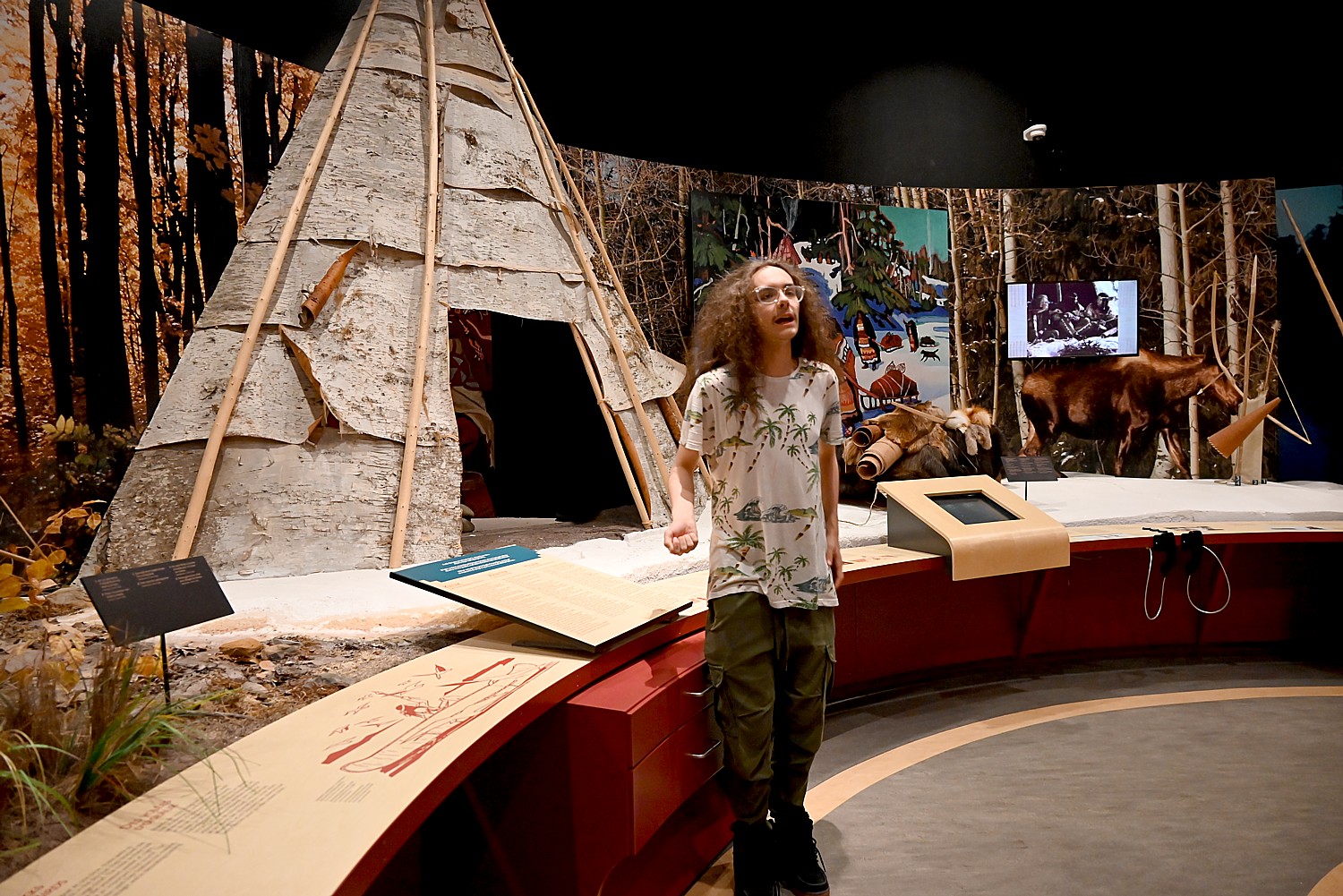
Metepenagiag Heritage Center in Miramichi, New Brunswick, Canada, tribal guide Marcus Alexander LaViolette
discusses how the Mi’kmaq would have lived, season by season © Karen Rubin/goingplacesfarandnear.com

Canada, which has made the most ambitious “Truth and Reconciliation” campaign with its indigenous communities, has excellent programs to link travelers to experiences. The Indigenous Tourism Association of Canada (ITAC) is a national non-profit Indigenous tourism industry organization established in 2015, tasked with growing and promoting the Indigenous tourism industry across the country. Inspired by a vision for a thriving Indigenous tourism economy sharing authentic, memorable and enriching experiences, ITAC develops relationships with groups and regions with similar mandates to enable collective support, product development, promotion and marketing of authentic Indigenous tourism businesses in a respectful protocol. (For information, visit www.destinationindigenous.ca)

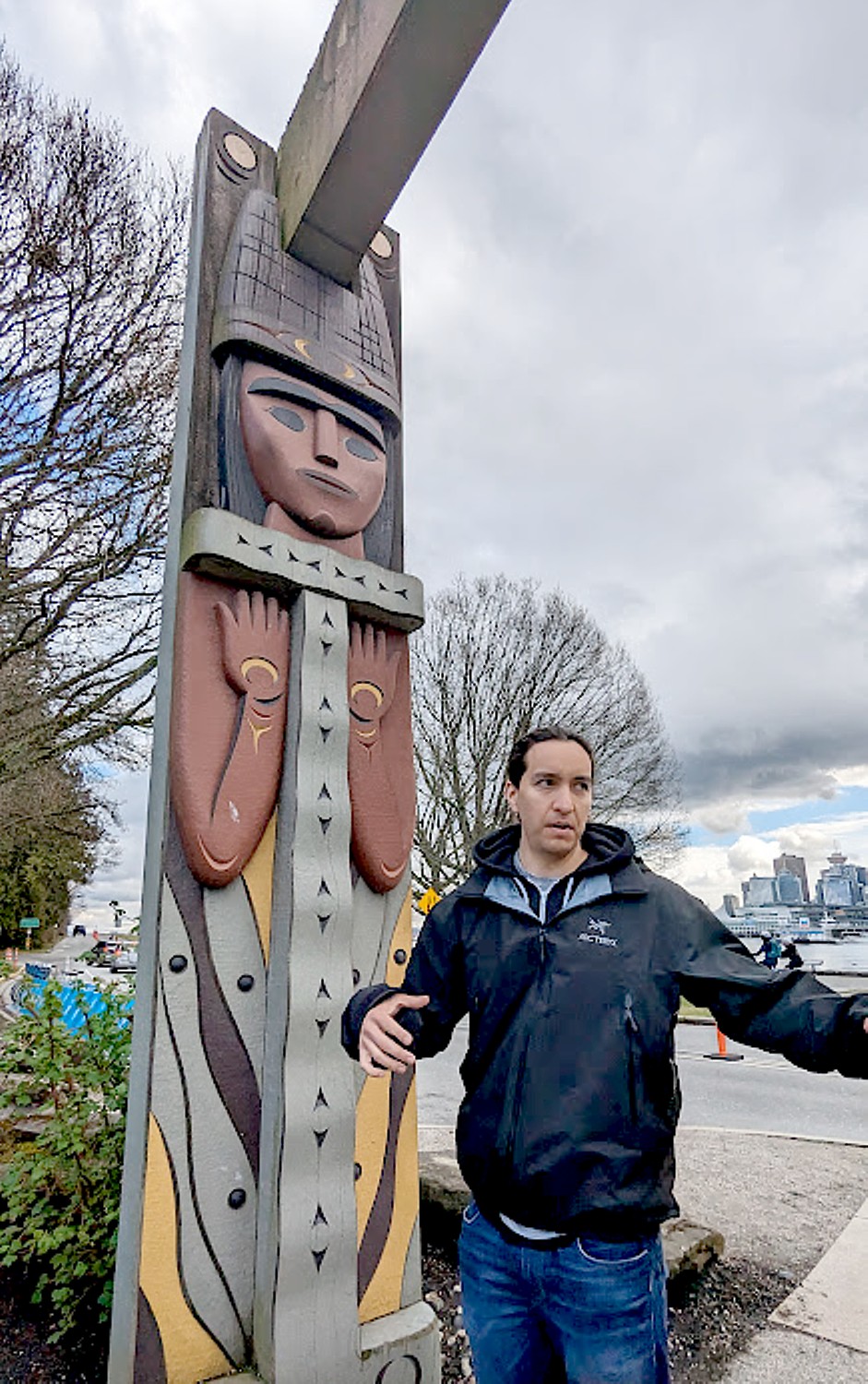
Talaysay Tours guide Patrick explains the significance of the totem poles and gateway portals at Brockton Point during a Spoken Treasures” walking tour of Stanley Park© Karen Rubin/goingplacesfarandnear.com

“Sharing our stories and our history on cultural homeland is an integral part of the experience,” said Clyde Mansell, Tasmanian palawa Aboriginal Elder and founder of wukalina Walk, which is part of Discover Aboriginal Experiences Australia. “It also allows us to increase employment, involve our young people and contribute to our self-determination, by creating more opportunities for the palawa community.

“We’ve had comments over the years where guests have said it’s changed their lives and their whole thinking about how they should relate to Aboriginal people,” Mansell added.

Indeed, the indigenous tourism movement is part of the Sustainable/Responsible Tourism movement. It also dovetails with rising interest in Wellness Travel.

Indigenous healing offerings have gained prominence as part of the broader trend towards holistic wellness and the search for authentic, transformative experiences. These experiences draw on the wisdom and practices of indigenous cultures around the world, offering healing techniques that have been developed and passed down through generations. The interest in and drive behind these retreats are linked to an acknowledgement of indigenous healing practices, the holistic approach, and reconnection with the land, is a significant wellness travel trend, a study by Global Wellness Institute found. 

For example, at Wai Ariki Hot Springs, in Rotorua New Zealand you can discover the ancient healing methods of these indigenous cultures, from the deeply cultural touch of mirri mirri or romi romi massage to the revitalizing power of blessed stones and herbal remedies. Each experience is thoughtfully crafted incorporates local healers and wellness practitioners, herbal medicine practice and ceremonies that honor the community and the land. Asian traditional therapies and medicine are growing in popularity for the wellness traveler across the globe. Traditional Thai, Chinese & Ayurvedic Medicinal offerings encompass rich diagnostic protocols, herbal formulas, and treatment techniques as part of the guest experience. 

Here are just a sampling of the plethora of indigenous experiences available to travelers around the world:

Road Scholar Integrates Immersive Indigenous Experiences into Cultural Programs

Road Scholar, which provides immersive, educational travel programs for seniors, has incorporated immersive indigenous cultural experiences in many of its programs.

“As an educational organization, Road Scholar strives to provide impactful experiences. We recognize that changing narratives will always inform our choice of experience. We choose to visit Indigenous communities and hear about their history and culture from the people who have the lived experience. Whenever possible, we include meals and activities with local community members as a way to encourage dialogue and enhance cultural discourse. When we visit archaeological sites, we include the voices of descendant communities as part of the educational content we provide. We recognize these sites not as “ruins” but as deeply personal and sacred spaces to the people whose ancestors resided there.”

Here is a collection of programs with Native American themes, but this is just a sampling. There are many other Road Scholar programs across the country and around that world that incorporate Indigenous culture and history, even when it’s not explicitly outlined in the itinerary:

In Oklahoma, Road Scholars visit Tahlequah, the capitol of the Cherokee Nation, for a presentation by a Cherokee artist, Traci Rabbit. 

In New Mexico, Road Scholars visit the campus of the Institute of American Indian Arts, a congressionally chartered college for Native students, where a student shows them around campus. They also take in a presentation by Louie Hena, from Tesuque Pueblo, and a traditional meal with his family.

In Wisconsin, Road Scholars visit Wisconsin Point Indian Burial Ground with a local tribal historian and environmental scientists who gives a presentation on the history and culture of the area.

In Louisiana, participants visit the Chitimacha Museum to learn about the first inhabitants of the region through the study of artifacts and find out about the efforts to preserve their tribal language.

Dalilah conducts a “What We Treasure” tour of Squamish Lil’wat Cultural Centre © Karen Rubin/goingplacesfarandnear.com

In British Columbia, participants visit the Squamish Lil’wat Cultural Centre in Whistler to learn from an Indigenous educator about First Nations history, customs, and traditions through dance, storytelling and material artifacts.

In Mexico, Road Scholars stop in a traditional village to get to know the traditions and lifestyle of the Mazahua indigenous people and learn how the women’s clothing helps them maintain their identity.

In Guatemala, participants ferry to Santiago La Laguna village to delve into the way of life of the indigenous community on the shores of Lake Atitlan.

In New Zealand, participants visit Te Puia, the New Zealand Maori Arts and Crafts Institute, to learn how young Maori train in the traditional Maori arts and crafts. Later they experience a hangi, the traditional Maori method of cooking food in the ground, accompanied by a Maori cultural performance that includes the “Haka” war dance. 

Road Scholar is a university of the world inspiring adults to learn, discover and travel, www.roadscholar.org

Celebrate Indigenous People’s Day Where It was First Named a State Holiday: South Dakota

With Indigenous People’s Day fast approaching on Monday, October 14, there’s no better destination to honor and celebrate the holiday than in South Dakota, home to the third-largest Native American population in the US across nine Tribal Nations and the first state to officially replace Columbus Day with Native Americans’ Day as a state holiday in 1990. 

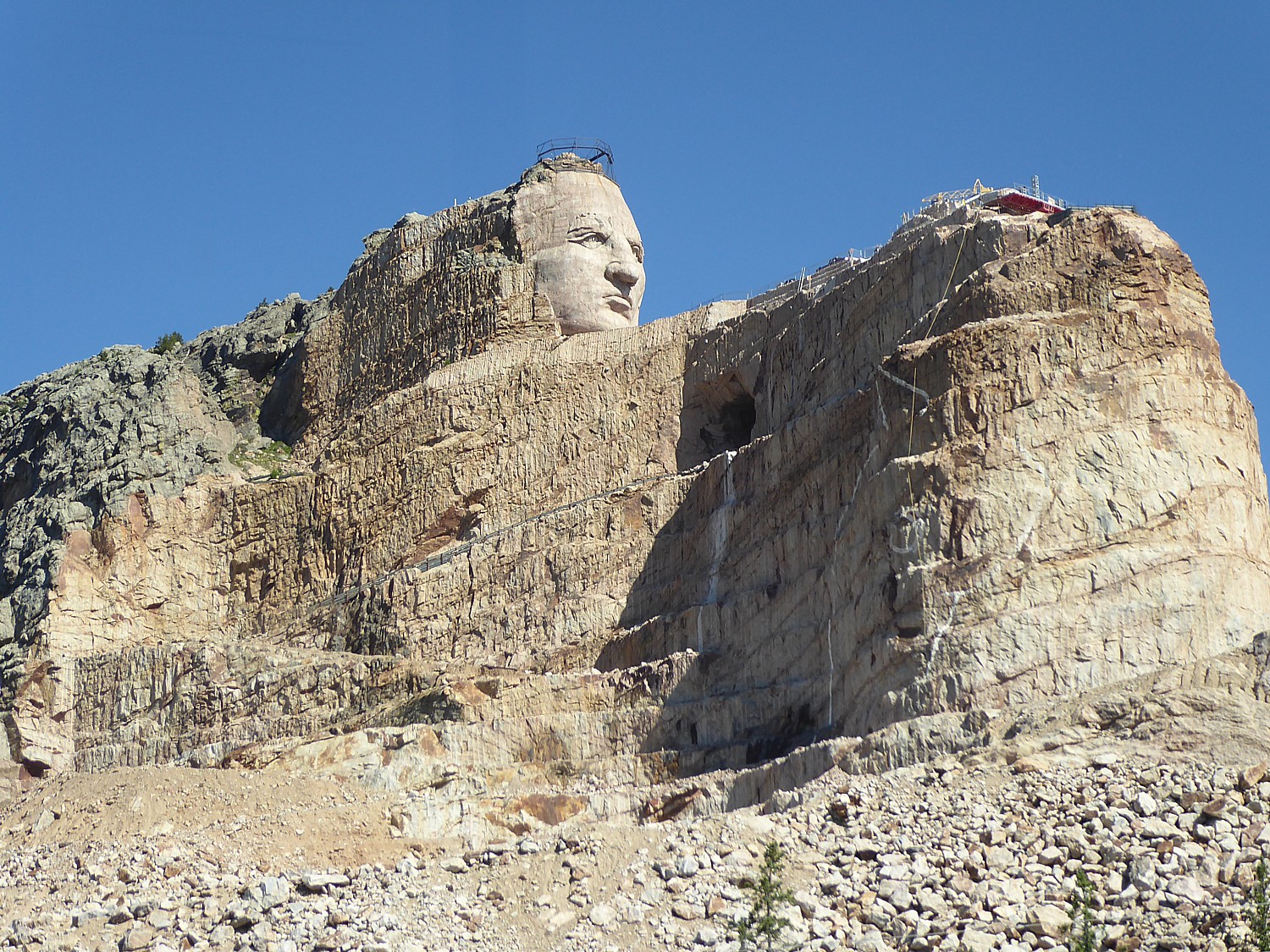
The Crazy Horse Memorial, Mickelson Trail, South Dakota, makes a profound statement about Native Americans © Karen Rubin/goingplacesfarandnear.com

One of the most profound monuments in South Dakota is Crazy Horse Memorial which, it is amazing to learn, is still being carved by the third generation of its original sculptor, Korczak Ziolkowski,  and will soon be the largest mountain sculpture in the world (30x larger than neighboring Mount Rushmore). It was here that the first Native Americans’ Day celebration was held nearly 35 years ago. An incredible attraction and education center year-round, each Indigenous Peoples’ Day celebration brings tradition, immersive performances, artist displays, storytelling, hands-on activities for children, and the naming the Crazy Horse Memorial Educator of the Year honored for significant contributions to Native American education.  

A vision of what the Crazy Horse Memorial, South Dakota, will look like; when completed it will be the largest mountain sculpture in the world © Karen Rubin/goingplacesfarandnear.com

When completed, the Crazy Horse Mountain carving will be the world’s largest sculpture, measuring 563 feet high by 641 feet long, carved in the round. The nine-story high face of Crazy Horse was completed on June 3, 1998; work began on the 22-story high horse’s head soon after.

There is also a superb Museum of Native Americans of North America (it rivals the Smithsonian’s Museum in Washington DC) where you watch a terrific video that tells the story of the America’s indigenous people, and can visit the studio/home of the sculptor, Korczak Ziolkowski.

The visit was a highlight of my six-day Wilderness Voyageurs “Badlands and Mickelson Trail” bike tour of South Dakota. (See: DISCOVERING MARVELS OF CRAZY HORSE MEMORIAL ON BADLANDS, BLACK HILLS & MICKELSON TRAIL BIKE TOUR)

(Crazy Horse Memorial, 12151 Avenue of the Chiefs, Crazy Horse, SD, 605-673-4681crazyhorsememorial.org.)

Access + Education: Travel South Dakota’s Great 8 for Native American Culture is an incredible itinerary to follow for indigenous tourism, with significant places, including: Mitchell Prehistoric Indian Village, South Dakota’s only active archaeological site, and one of the most important in the Great Plains region according to the U.S. Department of the Interior; and Bear Butte State Park, Black Elk Peak and Sica Hollow State Park, all sacred sites to Native Americans.  Other itineraries include the Native American Attraction Trail,  and the Native American National and State Scenic Byway.

Powwows: While Powwows are available to find and attend throughout the state throughout the year, Rapid City is home to one of North America’s largest and premier Native American events, the Black Hills Powwow every October is where thousands of spectators engage with artisans, artists, championship singers and dancers, the He Sapa Win pageant and more. 

Tour Companies:

Tatanka Rez Tours, based on the Pine Ridge Reservation, is the only Native American-owned tour company in South Dakota. Various tour packages give in-depth background on the Ogala Lakota Oyate tribe and provides an experience on the reservation that only those who live there can offer. 

Black Hills Adventure tours teamed up with Tatanka Rez Tours to provide this nine-hour interactive cultural experience, where you listen to traditional stories and songs performed by Tatanka Rez Tours owners Guss, and Tianna and visit the Cultural Art Space, the Pine Ridge Chamber of Commerce, Thunder Valley, Pine Ridge, and the Red Cloud Indian School. Also, a Black Hills Monument Package  departs Rapid City at 8:30am, travels to Mount Rushmore where guests can hike around the monument then to Crazy Horse Memorial, finishing with exploring Custer State Park to see wildlife close up.

Tours are available year-round. 

Arts & Culture:

One of the most incredible ways to experience Native American Culture is through the The Lakota Music Project, the South Dakota Symphony Orchestra’s flagship Bridging Cultures Program. Created between 2005-2008, the Lakota Music Project (LMP) addresses a history of racial tension, builds bridges between Native and non-Native Americans, and creates an environment of openness through sharing music. Essentially, it is a practical demonstration between white and American Indian musicians to advance cultural understanding. The LMP concert program features combinations of South Dakota Symphony musicians, the Creekside Singers, a Lakota drumming group, and Dakota cedar flutist Bryan Akipa, each performing music of their heritages as well as unique repertoire commissioned for the musicians to play together.

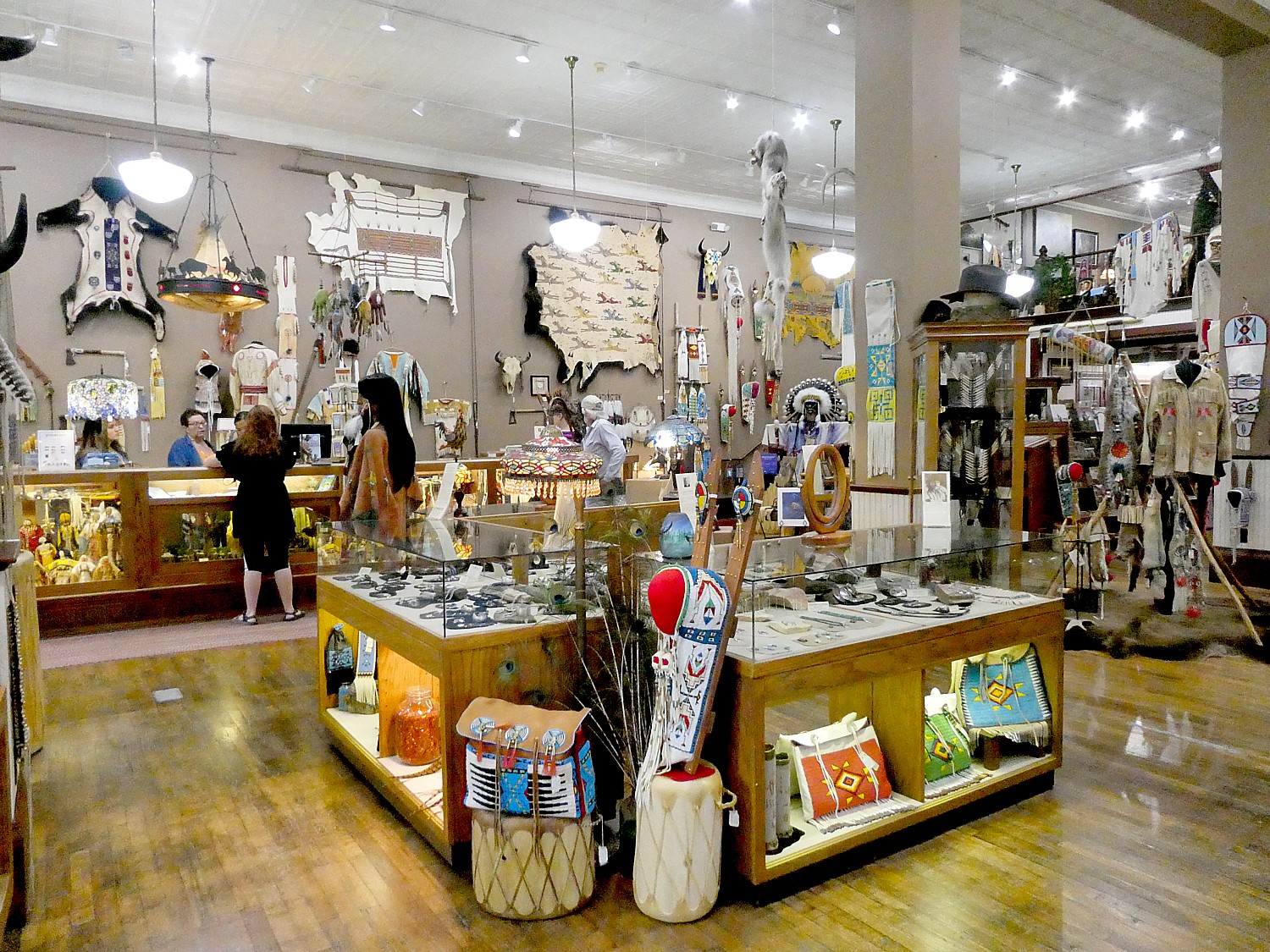
The Prairie Edge & Sioux Trading Post in Rapid City, South Dakota is more of a gallery than a store © Karen Rubin/goingplacesfarandnear.com

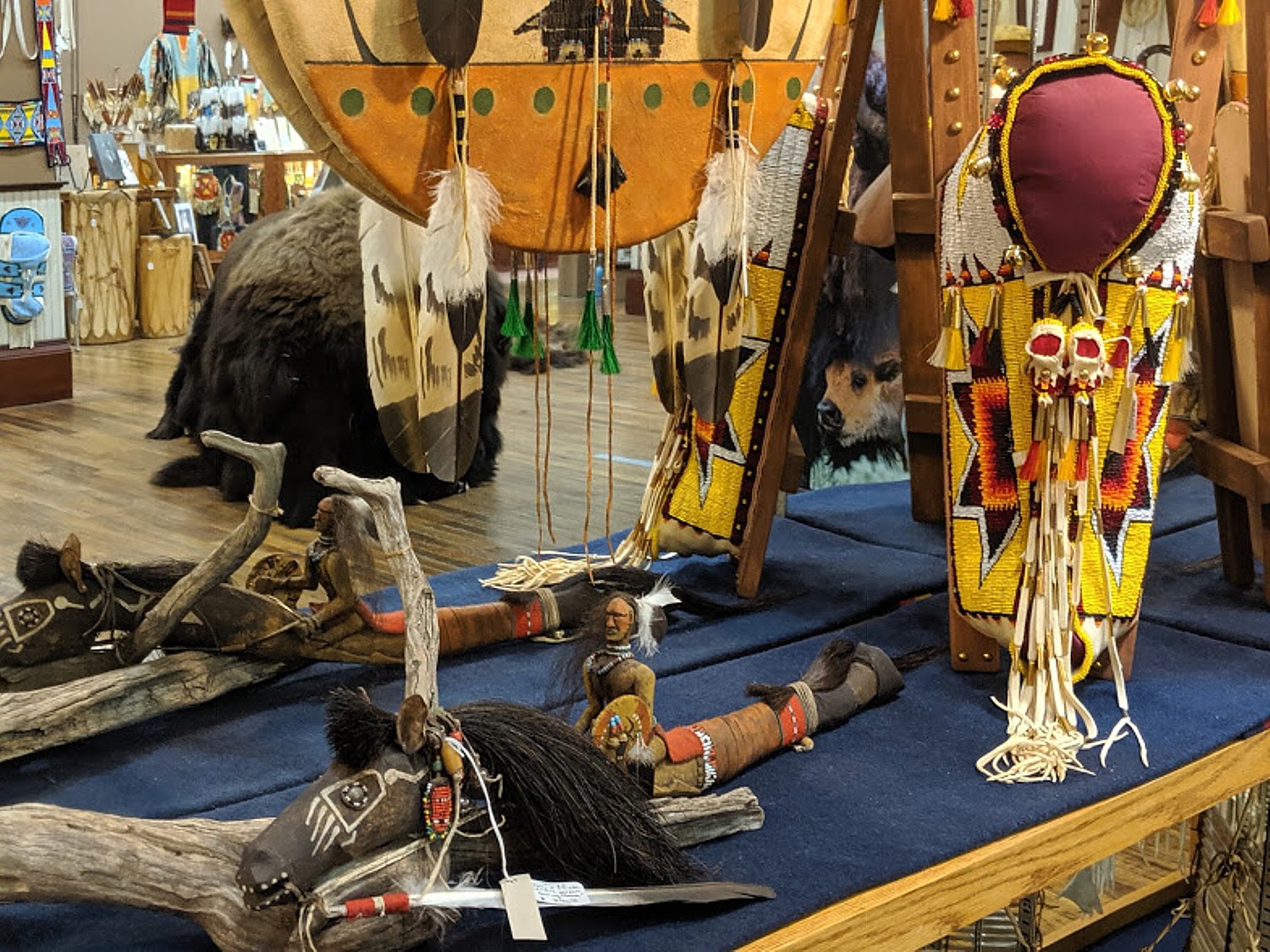
Visit Native American businesses such as Rapid City’s Prairie Edge & Sioux Trading Post and Dakota Drum Company, both of which feature the works of generational Native artists and artisans from buffalo hide canvas paintings to star quilts, bead work. Both are really more like galleries and are marvelous to visit. 

The Prairie Edge & Sioux Trading Post in Rapid City, South Dakota is more of a gallery than a store © Karen Rubin/goingplacesfarandnear.com

For Native American flavors, try food-truck-turned-restaurant Watecha Bowl, known for Indian tacos, and Crow Peak Brewing both in Sioux Falls. Laughing Water Restaurant in Custer, on the site of Crazy Horse Memorial, is also known for its Custer Tatanka Stew made with prime cuts of tender Black Hills buffalo. 

South Dakota’s Guide to Tribal Nations: Oceti Sakowin Homelands, a joint effort between the South Dakota Department of Tourism  and South Dakota Native Tourism Alliance, is a great resource year-round featuring a map of tribal lands, brief history of each tribe, visitor etiquette suggestions, and educational opportunities.  

TIME Names wukalina Walk in Tasmania, Australia to 2024 World’s Greatest Places List

wukalina Walk, a member of Discover Aboriginal Experiences, has been named one of TIME‘s 2024 World’s Greatest Places, an exclusive list of 100 extraordinary destinations to explore, stayand visit produced by its editors and correspondents around the world.

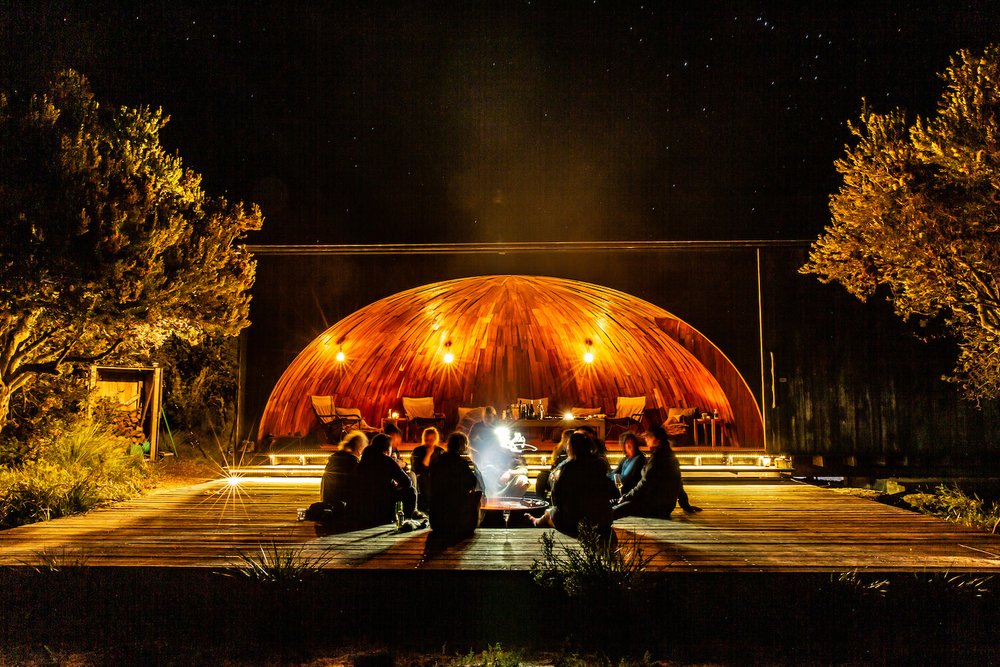
wukalina Walk is a multi-award winning Indigenous/palawa-owned tourism experience. Led by Aboriginal guides, the walk offers a rare window into Tasmania/lutruwita’s Aboriginal culture. A member of Discover Aboriginal Experiences, wukalina Walk, has been named one of TIME’s 2024 World’s Greatest Places (photo: Jillian Mundy)

wukalina Walk is a multi-award winning Indigenous/palawa-owned tourism experience. Led by Aboriginal guides, the walk offers a rare window into Tasmania/lutruwita’s Aboriginal culture.  For the first two nights, hikers sleep at the architecturally designed standing camp, krakani lumi (resting place), in domed-ceiling huts designed to reflect the shape of the palawa shelters that once lined the east coast of Tasmania/lutruwita. The third night is spent in a beautifully repurposed and restored lightkeeper’s cottage at the most northern end of larapuna (Bay of Fires). 

A group of up to 10 people are led on foot by Aboriginal guides to learn about land and sea Country. wukalina guides have lived experience and thousands of generations of Ancestral connections to the knowledge they share. They share their knowledge and perspectives as they lead travelers through bushland and along the coastline of wukalina (Mt William National Park) and larapuna (Bay of Fires). Hikers learn about the colonial history of Tasmania/lutruwita, and the brutal treatment of the palawa people. But the tour highlights their resilience, strength of culture, language and the ongoing connection that the palawa community has to Country.

wukalina Walk is a proudly Blak-owned business and different to anything else offered in Tasmania, and anywhere in the world. wukalina Walk was winner of the 2023 Australian National Tourism Awards for Aboriginal & Torres Strait Islander Tourism Experience.

More Discover Aboriginal Experiences:

Discover Aboriginal Experiences is a flagship suite of some 200 Australian Aboriginal-guided experiences from 48 businesses around Australia. Travelers learn about and connect with the diverse histories, cultures and languages of Aboriginal peoples, which date back more than 65,000 years. Here is a sampling:

Jarramali Rock Art Tours explores a 20,000-year-old outback museum of rock art.   The ‘Magnificent Gallery,’ in Quinkan Country near Laura, Far North Queensland, has been recognized by UNESCO as one of the 10 most significant rock-art sites in the world. Jarramali Rock Art Tours showcases the Quinkan rock art within the so-called ‘Magnificent Gallery’.

Kakadu National Park, in Kakadu, Northern Territory, is a World heritage-listedhome to Aboriginal peoples for more than 65,000 years. It is about half the size of Switzerland and a habitat for approximately a third of all bird species in Australia. Travelers can experience the park and its flora and fauna at night with an indigenous guide on a new Stargazing Boat tour, which intertwines the ancient wisdom of Bininj knowledge with classical constellations. Discover the night life and nocturnal sounds of the billabong while learning the history of the world as told in Dreaming stories and illustrated in the stars.  Alternatively, spend time with the local Indigenous community on the new Kakadu Billabong Safari Camp tour

Wula Gura Nyinda’s 3 day World Heritage Walking Tour at Shark Bay, Western Australia, is a new walking tour of two national parks located in the Shark Bay World Heritage area – Francois Peron National Park and Dirk Hartog Island. Learn about local Aboriginal culture and history, spot wildlife, explore spectacular natural landscapes and sit under the stars listening to the ancient sounds of the digeridoo. This is a rare opportunity to spend time on Country with an Indigenous guide and to really ‘feel Country’

Wintjiri Wiru, a spectacular light show involving 1,000 drones and Anangu culture, at Uluru, Northern Territory, brings to life a chapter of the Mala ancestral story and was developed in close consultation with Anangu custodians. The show was designed and produced by world-renowned media architecture studio RAMUS, with the goal of illuminating the Central Desert with a spectacle of lights, projections and lasers shining on the spinifex and mulga. This is the first time this kind of technology has been used to share Anangu culture and is a new experience for Uluru.

Tali Wiru is fine dining under the Southern Desert sky, with Uluru as a backdrop. Each dish in a four-course meal showcases native produce in an innovative way, using Indigenous herbs and spices. A local Aboriginal storyteller shares insights about Anangu culture and history. Dinner might be pressed wallaby with fermented quandong, or roasted toothfish nestling beside coastal greens, desert oak and fermented muntries.

Discover Aboriginal Experiences, discoveraboriginalexperiences.com 

See also:

COAST TO COAST, CANADA’S HERITAGE, CULTURE, WILDERNESS BECKON ECOTOURISTS IN SUMMER

NEW BRUNSWICK ROADTRIP: METEPENAGIAG HERITAGE CENTER HIGHLIGHTS MIRAMICHI VISIT

ON THE TRAIL TO DISCOVER VANCOUVER’S REVIVED INDIGENOUS HERITAGE

WALKING TOURS, DINING EXPERIENCES REVEAL VANCOUVER’S REVIVED INDIGENOUS HERITAGE

TRAIL TO DISCOVER BRITISH COLUMBIA’S INDIGENOUS HERITAGE WEAVES THROUGH WHISTLER-BLACKCOMB

DISCOVERING MARVELS OF CRAZY HORSE MEMORIAL ON BADLANDS, BLACK HILLS & MICKELSON TRAIL BIKE TOUR

_______________________

© 2024 Travel Features Syndicate, a division of Workstyles, Inc. All rights reserved. Visit goingplacesfarandnear.com and travelwritersmagazine.com/TravelFeaturesSyndicate/. Blogging at goingplacesnearandfar.wordpress.com and moralcompasstravel.info. Visit instagram.com/going_places_far_and_near and instagram.com/bigbackpacktraveler/ Send comments or questions to FamTravLtr@aol.com. Tweet @TravelFeatures. ‘Like’ us at facebook.com/NewsPhotoFeatures 
Cambria is Great Base for California Pacific Highway 1 Roadtrip

The Elephant Seal Rookery at Piedras Blancas is an exciting, accessible and must-see wildlife experience along California’s Pacific Highway 1 © Karen Rubin/goingplacesfarandnear.com

By Karen Rubin with Eric Leiberman, Travel Features Syndicate, goingplacesfarandnear.com

The Elephant Seal Rookery at Piedras Blancas, the Piedras Blancas Light Station,  Old San Simeon Village, Moonstone Beach and Ragged Point are among the attractions and experiences from Cambria, on famously scenic (and fragile) California’s Pacific Highway 1.

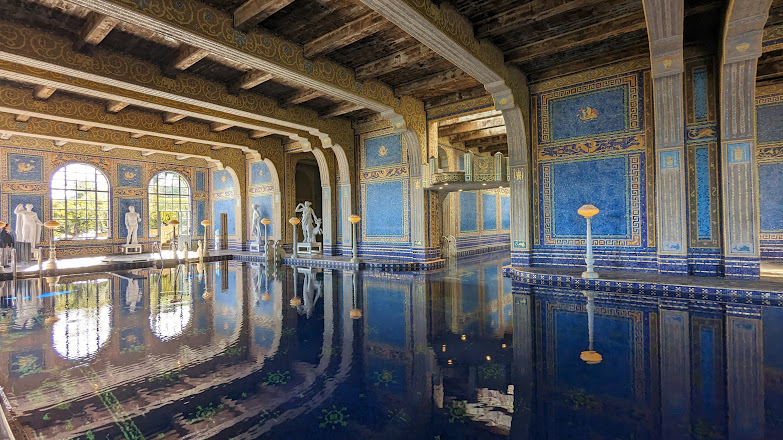
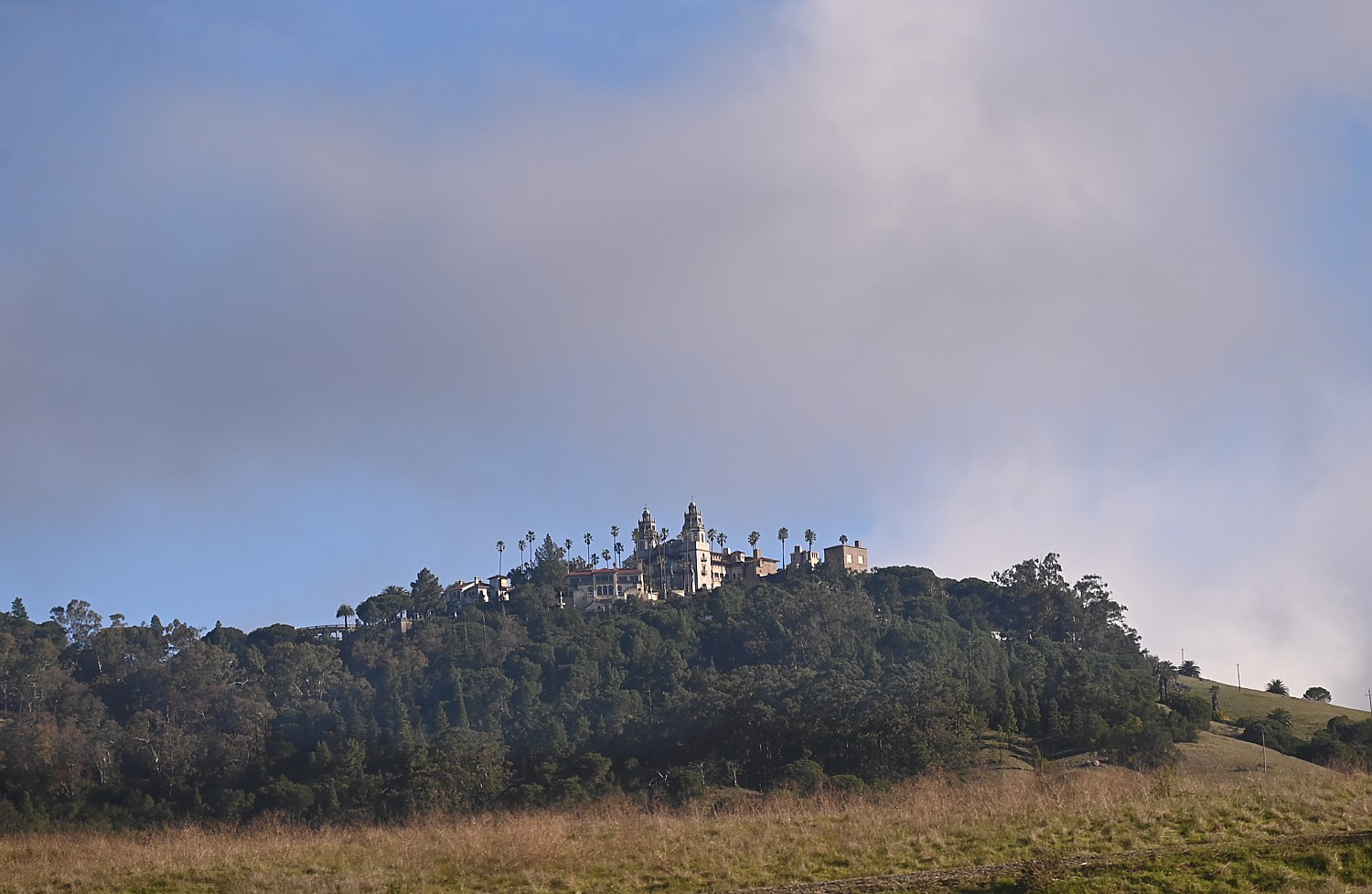
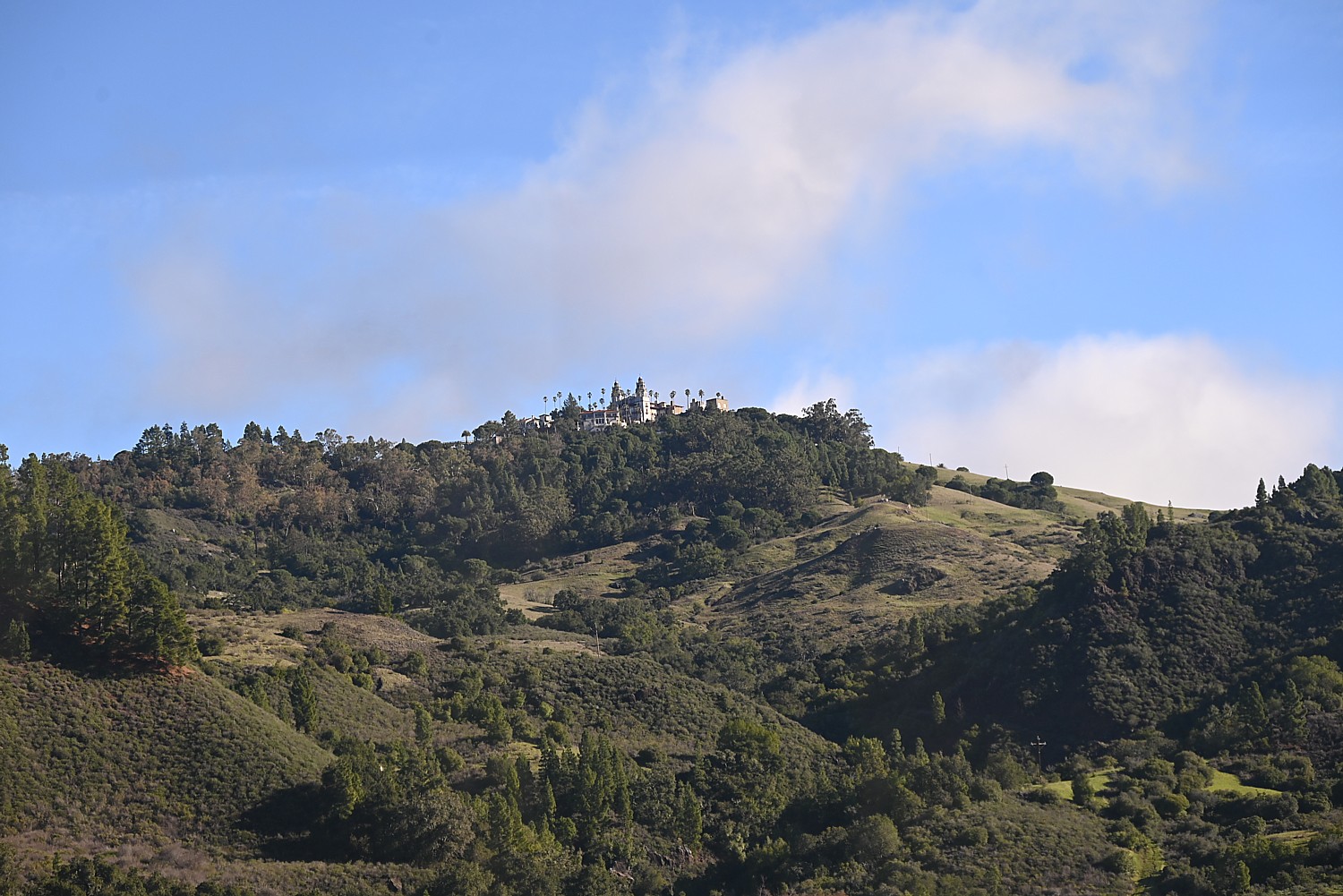
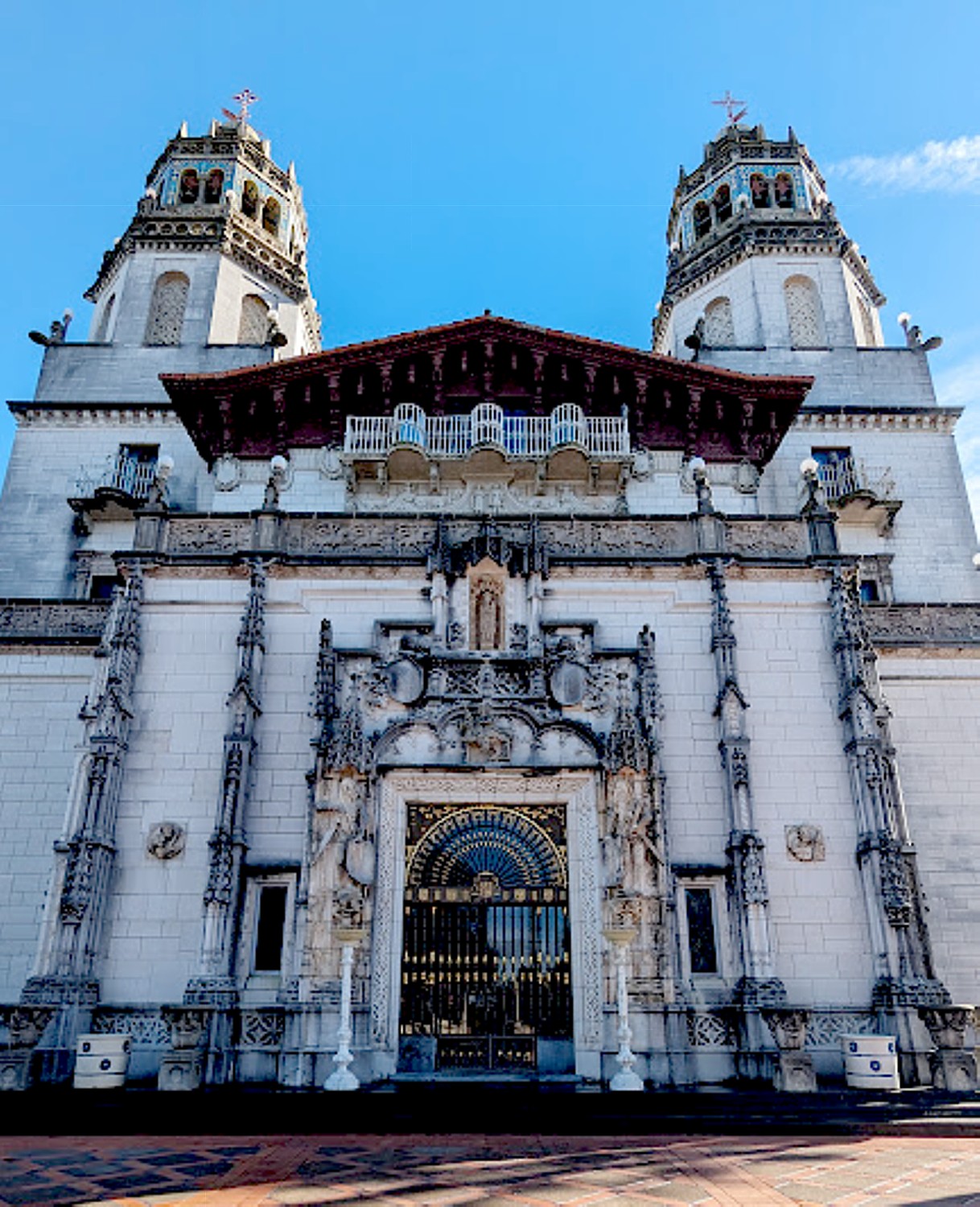
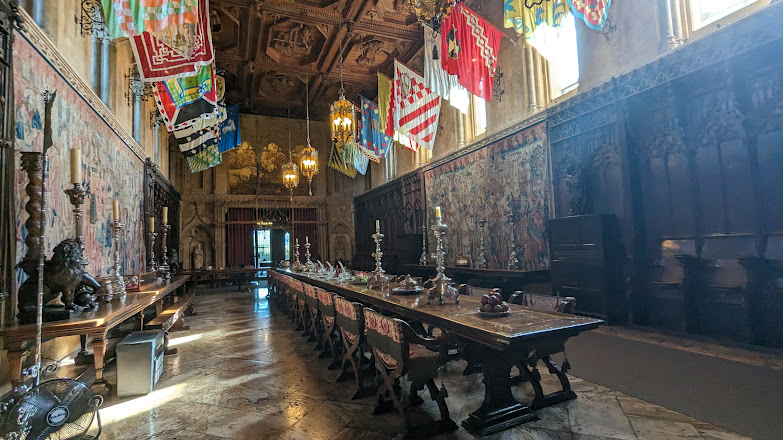
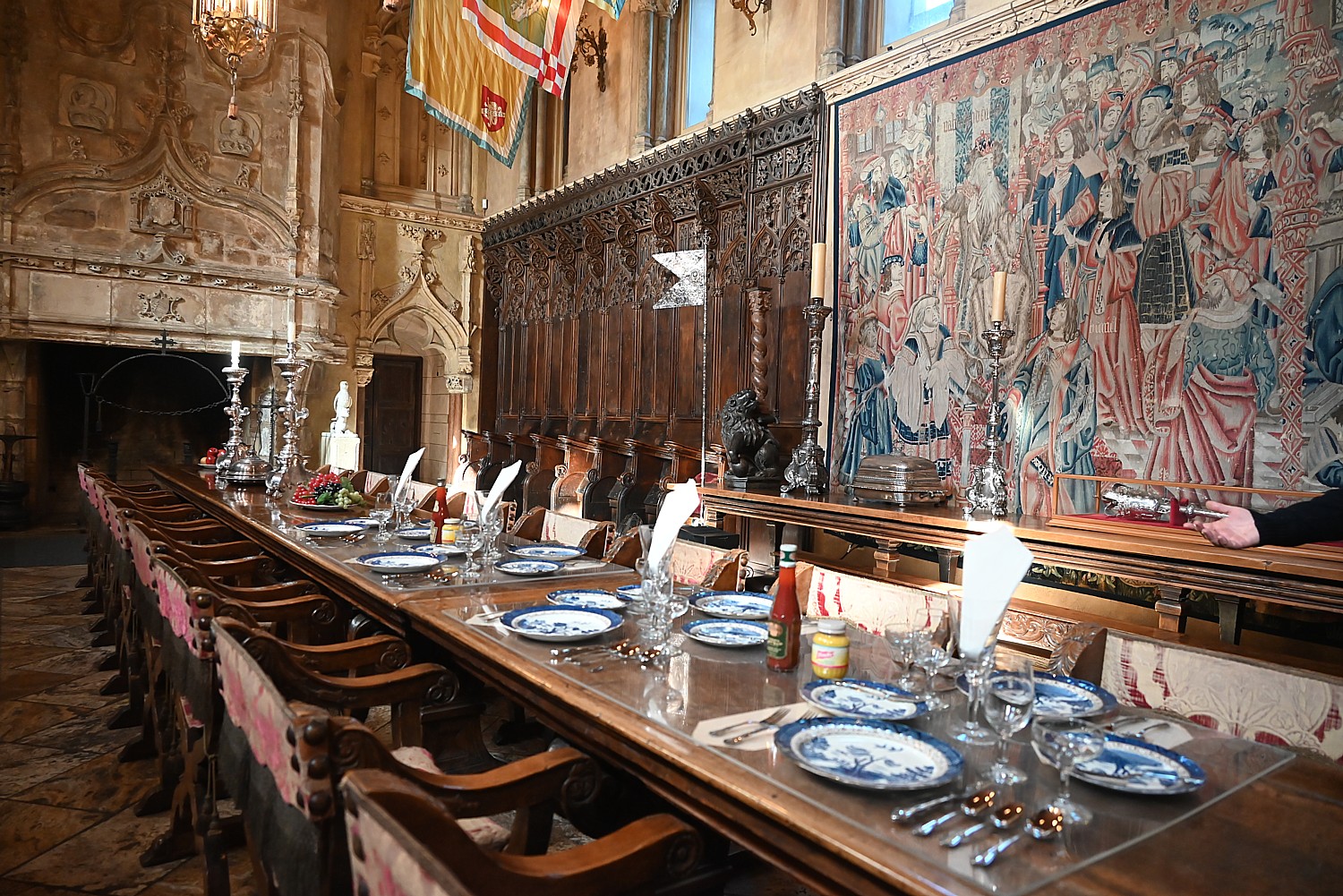
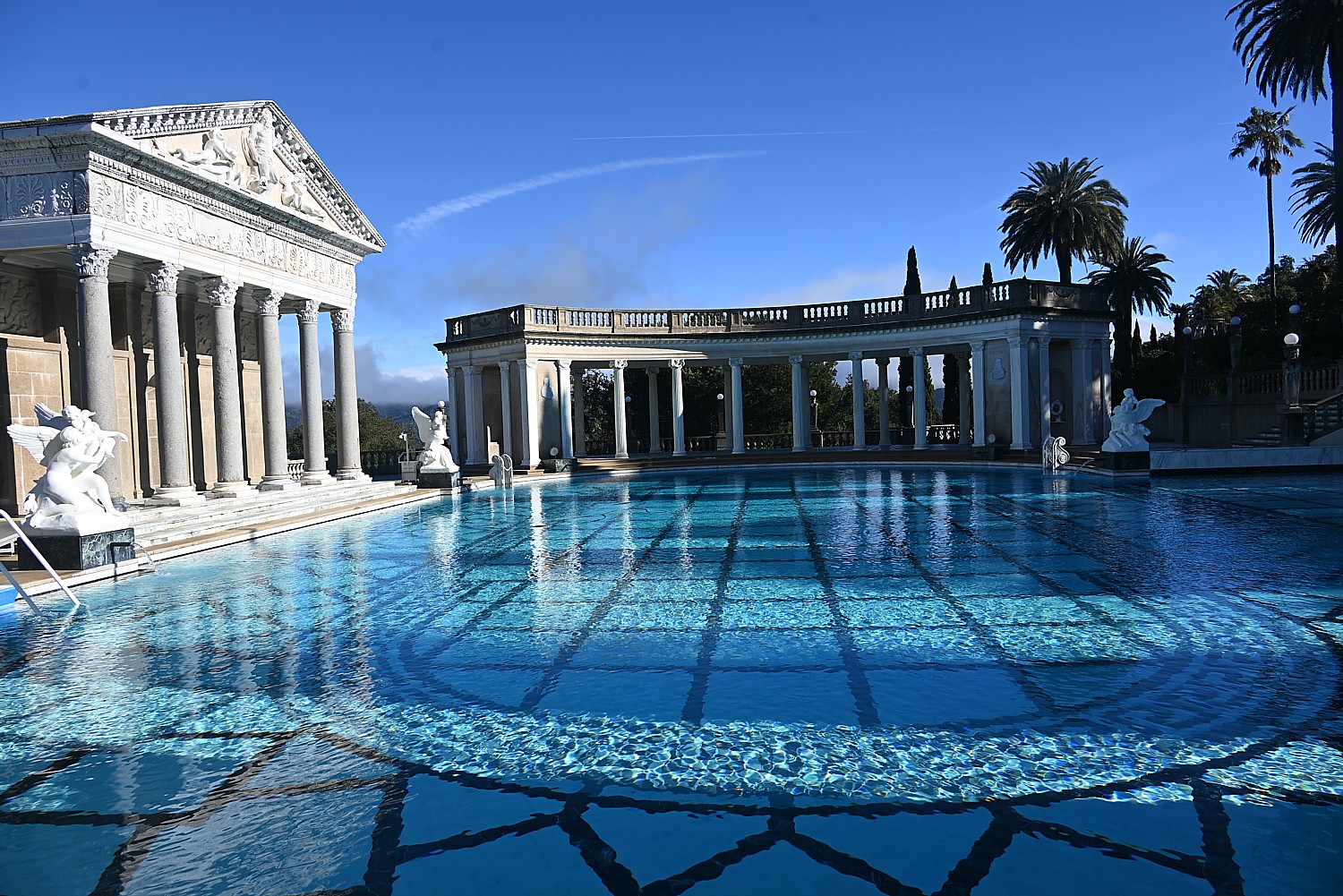
From the opulent Hearst Castle, we drive back down the hill, to the coastal Old San Simeon Village. A whaling village in the 1800s, William Randolph Hearst turned it into a village for his workers who, over the 28 years, constructed his “Enchanted Hill.”

Sebastian’s General Store on San Simeon Bay really encapsulates the history and heritage of the village. Built in 1852 at the peak of the whaling industry, the Sebastian Brothers supplied whalers, fishermen, miners, and neighboring ranches.  Sebastian Brothers General Merchandise was the significant shipping point for whale oil, cheese, butter and other commodities on the Central Coast. Old San Simeon Village boomed with two hotels (the first-class Bay View Hotel built in 1878 had among its famous guests Thomas A. Edison, Winston Churchill and Calvin Coolidge), saloons, a blacksmith, a livery stable, a butcher, schools, a depot for a stage travel to Cambria and a telegraph line to San Luis Obispo.

The town flourished until 1910 and then declined (Hearst began building his castle in 1919), but Sebastian’s General Store has survived – there are even remnants of its post office. The Sebastian family bought the building in 1914 and operated the store for almost 100 years. Today, Sebastian’s offers an absolutely marvelous café (fabulous sandwiches and shop, and is a wine-tasting venue; the Hearst Winery is just across the street). (https://highway1roadtrip.com/things-to-do/sebastian-s-general-store-old-san-simeon-village/)

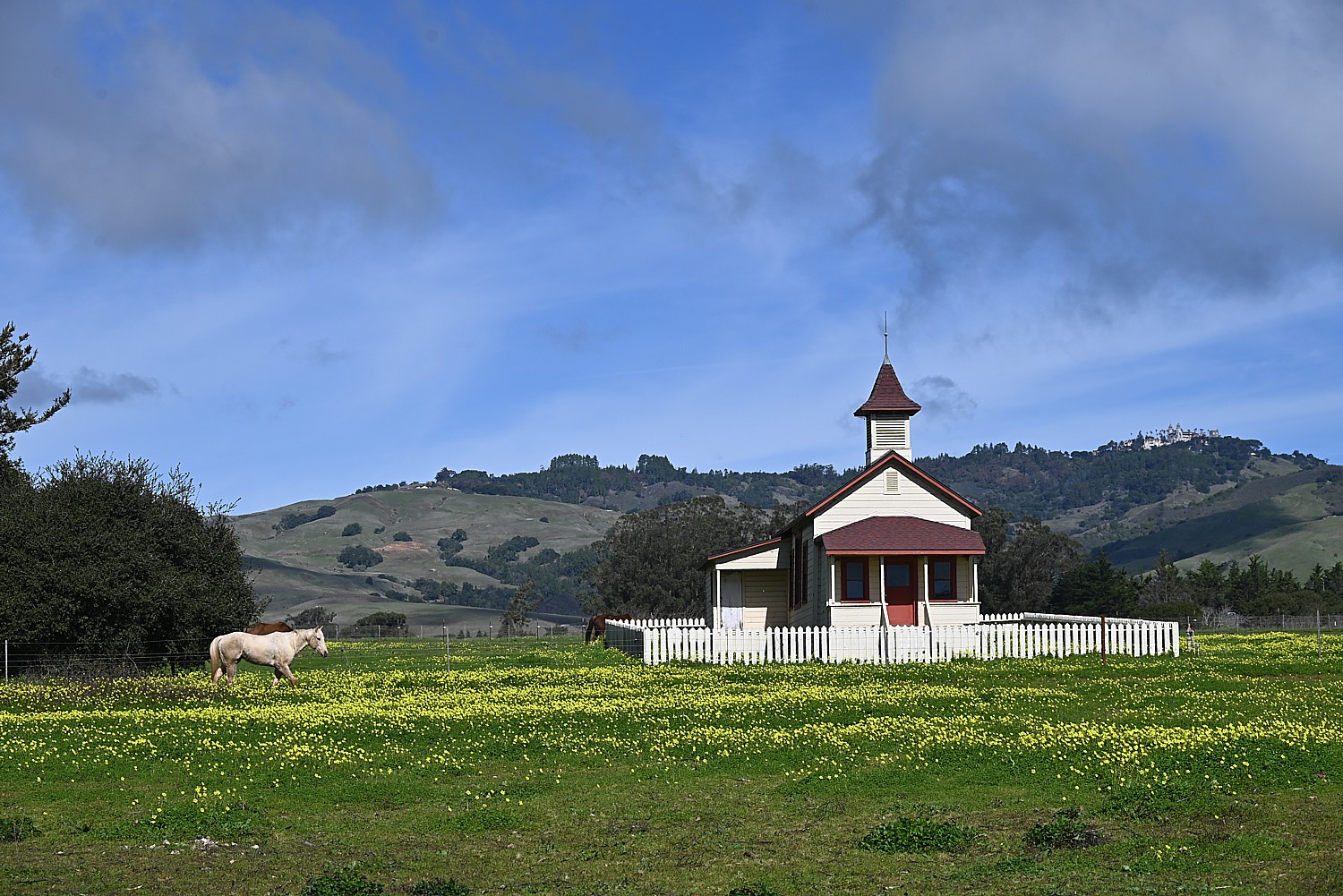
Old San Simeon, with its historic school house, horse pasture, and the Hearst Castle way up the hillside, make for a striking scene for our picnic lunch at Sebastian’s General Store © Karen Rubin/goingplacesfarandnear.com

The setting is adjacent to a gorgeous field filled with wildflowers, surrounding the historic school house, even more picturesque as horses wander through the field, with the Hearst Castle on hilltop in background completing the scene, as we enjoy our picnic lunch.

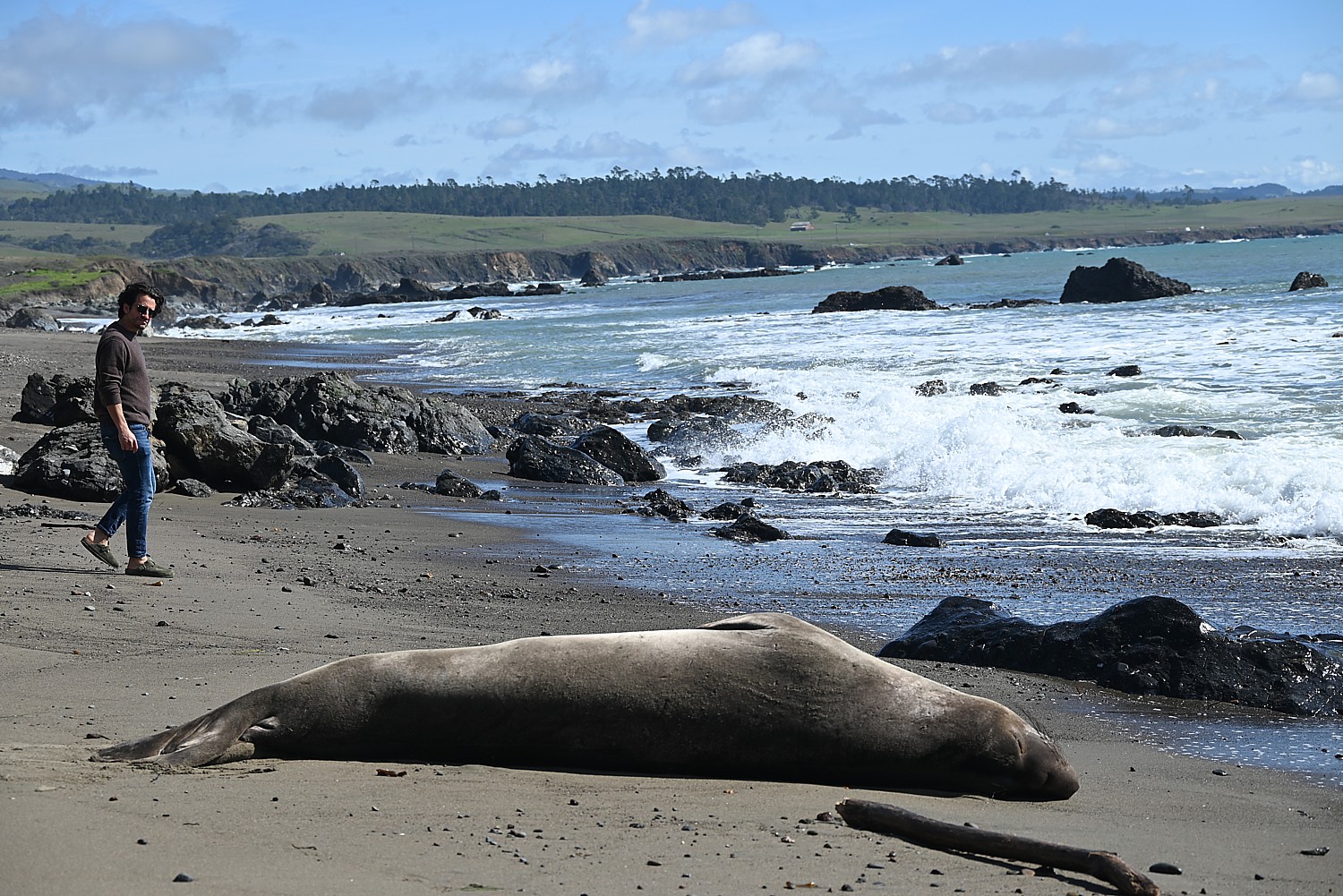
Eric keeps an appropriate distance when he comes upon a dejected male elephant seal at Hearst Beach © Karen Rubin/goingplacesfarandnear.com

We wander across the road and find Hearst Beach where we happen upon a couple of dejected young male elephant seals. Guides are here to keep people an appropriate distance away from them. The guide explains they are young males which were pretty much beaten up by the older more aggressive males, and came here to “sulk” and recuperate. He tells us that almost 25,000 elephant seals are mating, birthing and nursing here along this 8 mile coastal rookery.

The Elephant Seal Rookery at Piedras Blancas is an exciting, accessible and must-see wildlife experience along California’s Pacific Highway 1 © Karen Rubin/goingplacesfarandnear.com

From here, we drive five miles further north on Pacific Highway 1 to the Elephant Seal viewing area at Piedras Blancas (“White Rocks”), a narrow strip of rocky beach where thousands of elephant seals—the West Coast’s largest pinnipeds—are massed. It is widely considered one of the best wildlife experiences in California (and free!), and happens adjacent to the Pacific Highway. President Barack Obama made this site part of the California Coastal National Monument in 2017.

We walk along a boardwalk for amazing views of the scene, where helpful docents from Friends of the Elephant Seal answer our endless stream of questions.

The Elephant Seal Rookery at Piedras Blancas is an exciting, accessible and must-see wildlife experience along California’s Pacific Highway 1 © Karen Rubin/goingplacesfarandnear.com

It is fascinating to watch the huge marine mammals unabashedly breed, birth, molt, nurse and rest. Giant bulls, some as big as 16 feet long and weighing 4,000 pounds, inflate their trunk-like snouts to create a roaring bellow. The smaller females lie about as their pups nurse or just hang out.

The Elephant Seal Rookery at Piedras Blancas is an exciting, accessible and must-see wildlife experience along California’s Pacific Highway 1 © Karen Rubin/goingplacesfarandnear.com

It is astonishing to learn from the guide that the elephant seals don’t eat at all for the weeks they are here – losing as much as 2000 pounds of their weight. Twice a year, the males swim to Alaska, Aleutian Islands, stay in the ocean where they eat, while the females, interestingly, swim to Hawaii, diving 3000 ft. deep to eat. They only come to the Piedras Blancas rookery to mate, give birth and nurse their pup before the process starts all over again.

The Elephant Seal Rookery at Piedras Blancas is an exciting, accessible and must-see wildlife experience along California’s Pacific Highway 1 © Karen Rubin/goingplacesfarandnear.com

We watch males fending off each other; even mating behavior (not at all romantic); and mothers nursing. We see what looks like family groups, but the guide says that while the mother knows her pup (and may nurse a second pup), the male has no relationship at all with a mate or a family.  That gets me thinking why the young males who got beaten up would bother to risk getting beaten up again, why don’t they just hang out on their own? He tells me the urge to propagate is too strong.

Once thought to be on the verge of extinction, elephant seals have rebounded and the Piedras Blancas Rookery has one of the greatest concentrations on the West Coast, with nearly 25,000 © Karen Rubin/goingplacesfarandnear.com

What we see here is all the more remarkable because elephant seals, I learn, were thought to be on the verge of extinction, but have made a dramatic recovery over the last century, bounding back from fewer than 100 to an estimated 210,000-239,000 animals. The rookery of elephant seals at Piedras Blancas has become one of the largest on the west coast with a population estimated at 23,320.

Peak season is December through May though smaller numbers of seals may be seen during other months (https://elephantseal.org/).

The Piedras Blancas Light Station can be seen from the elephant seal rookery viewing area © Karen Rubin/goingplacesfarandnear.com

Off in the distance you can see the 70-foot tall Piedras Blancas Light Station. Built in 1875 and still in operation today, you can take a 2-hour tour of the interior and grounds, year-round. (Access to the light station grounds is by guided tour only.)

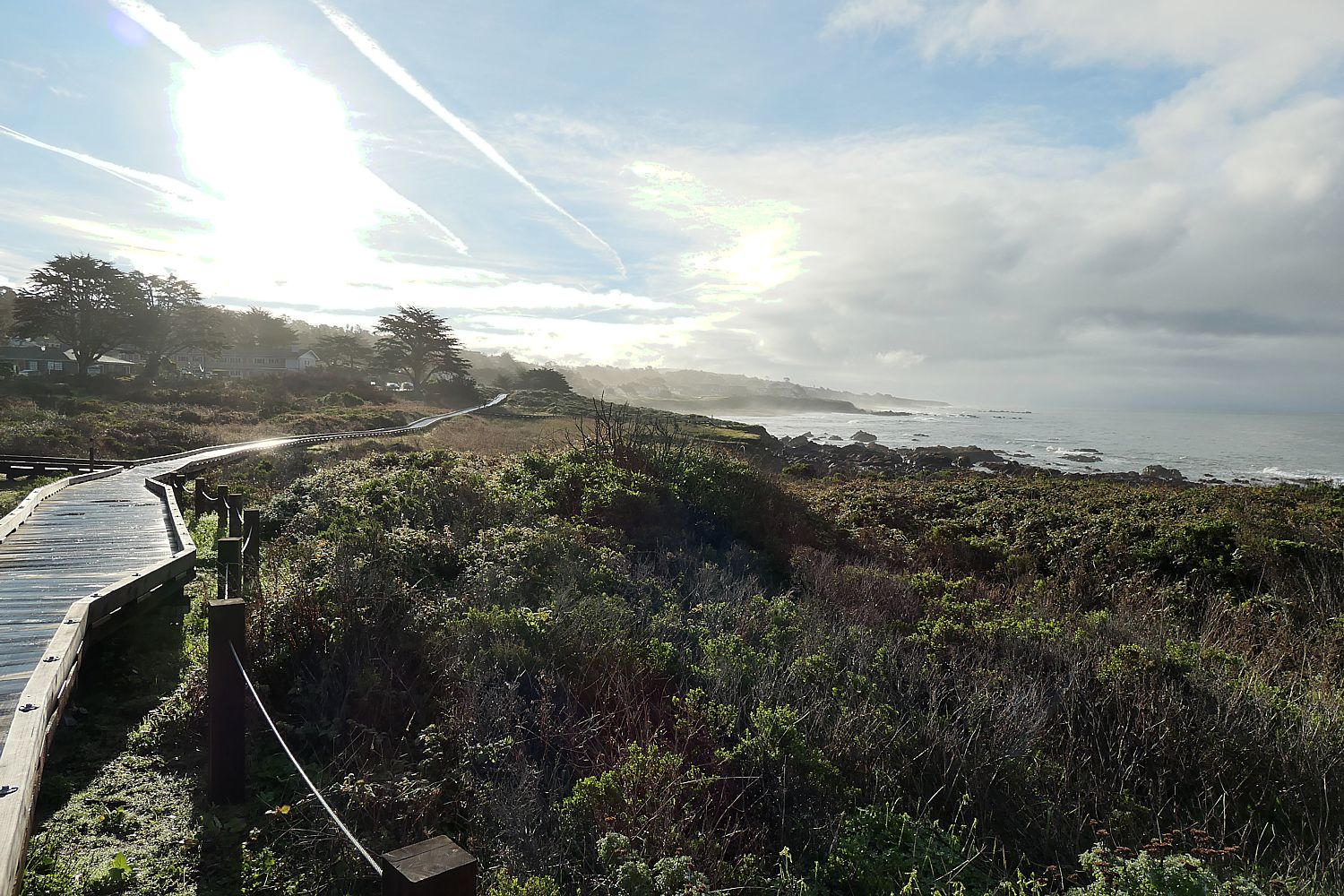
The Moonstone Beach boardwalk is an absolute delight © Karen Rubin/goingplacesfarandnear.com

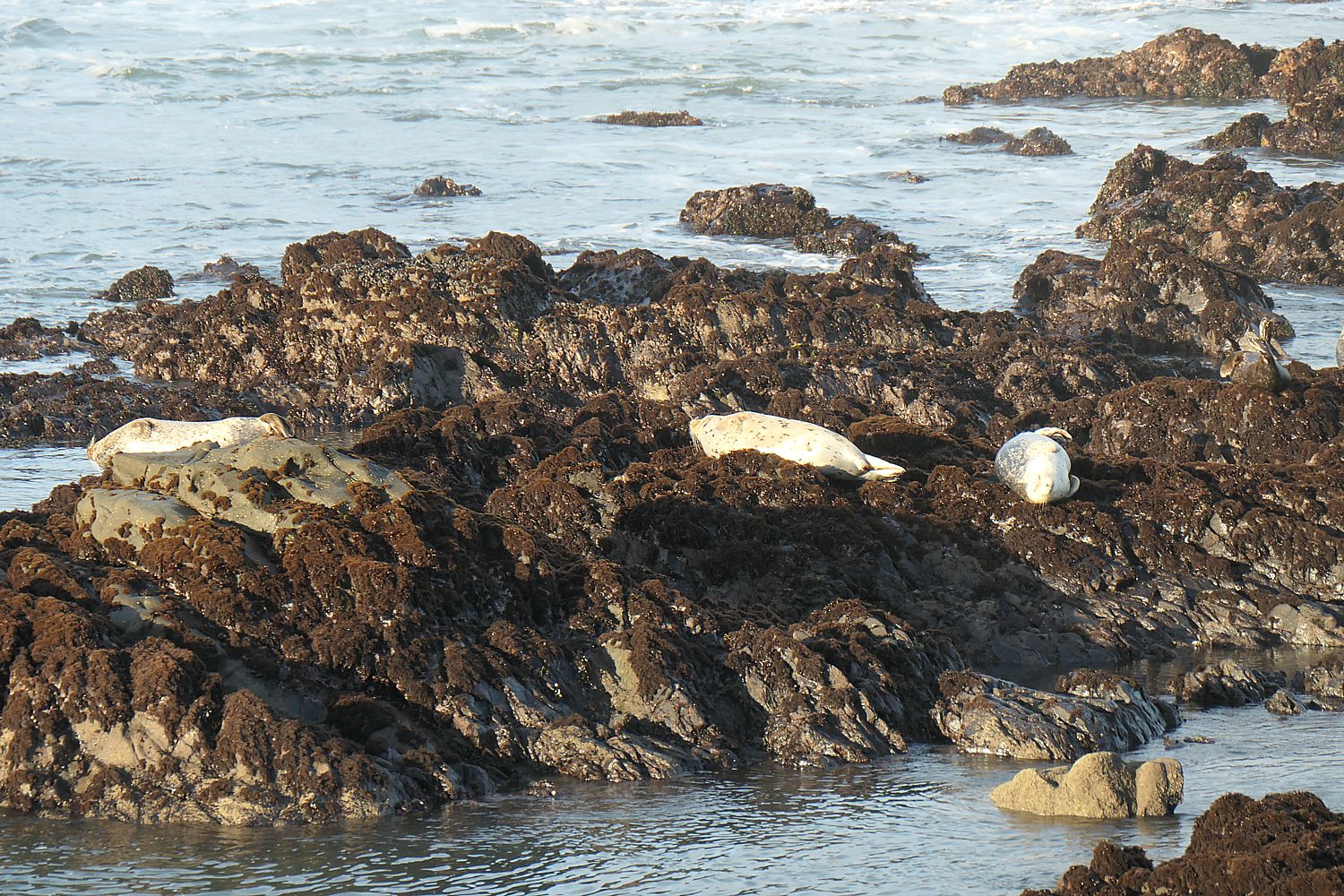
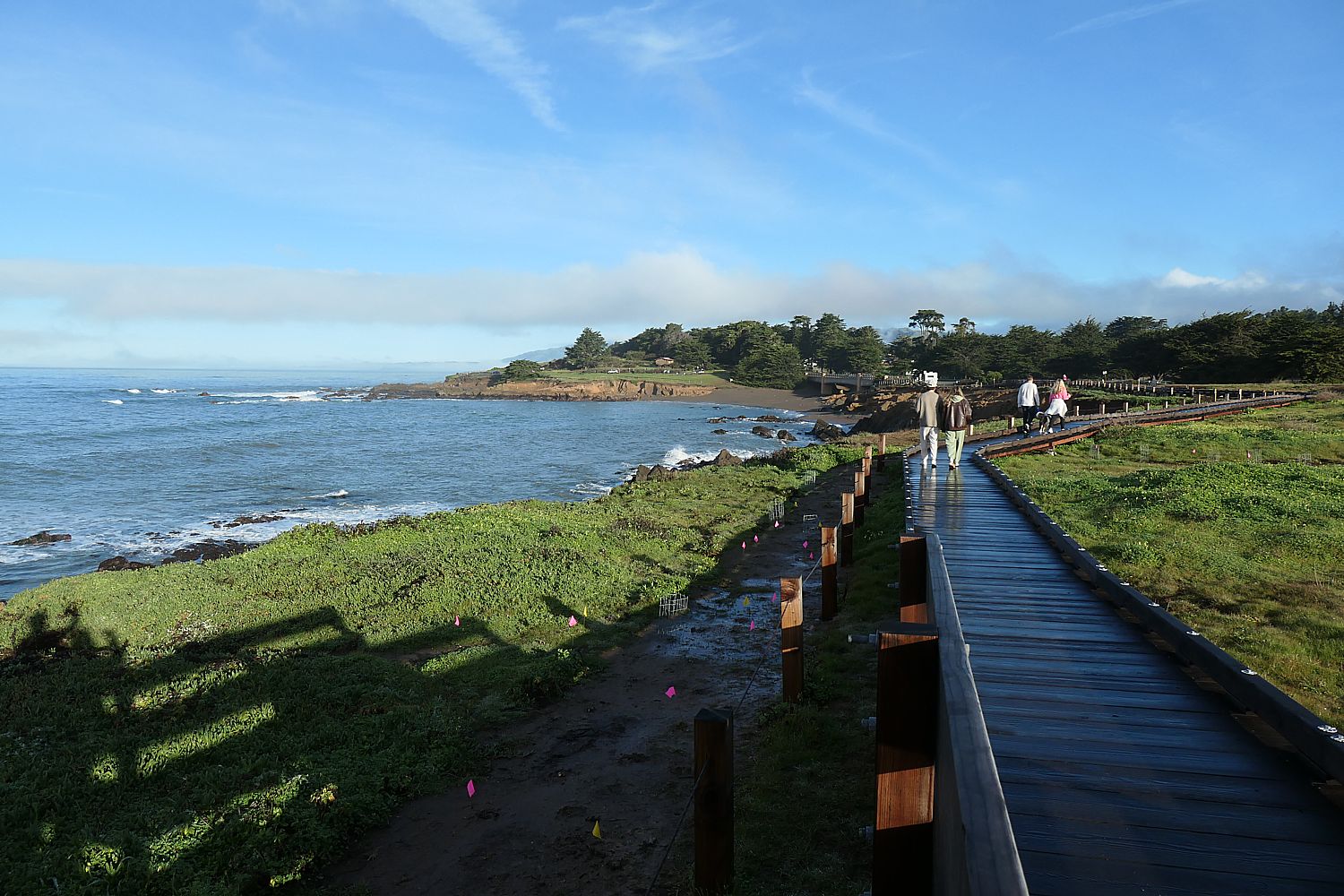
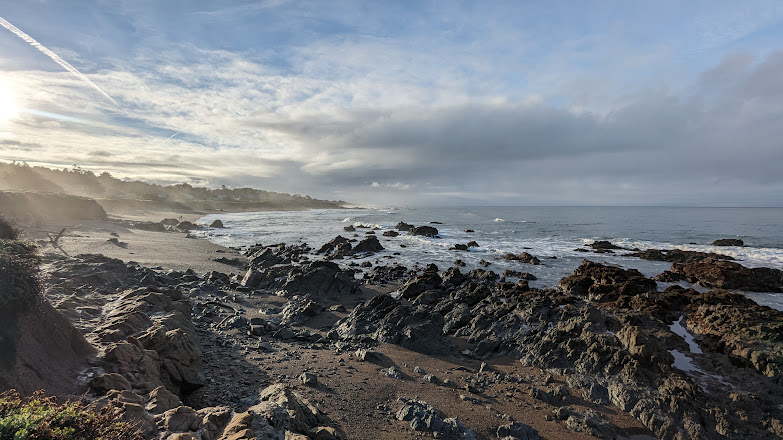
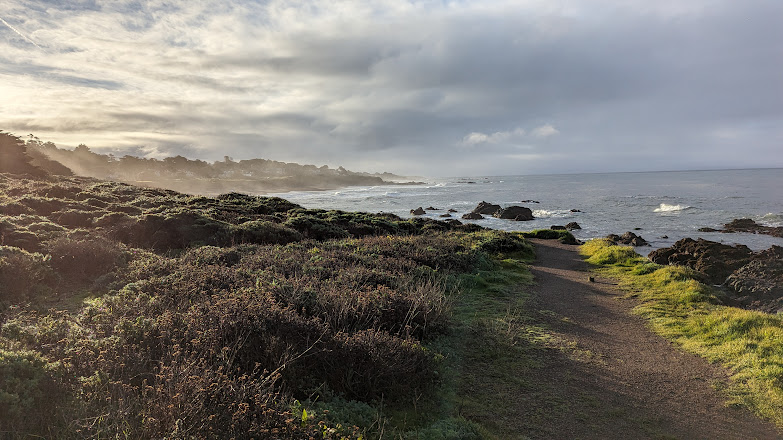
We return to Moonstone Beach, which we explored a bit in the morning, to more fully enjoy this enchanting place. Named for the smooth stones with intricate patterns polished by the tides, Moonstone Beach is considered one of the Central Coast’s best beaches. You feel so completely at peace here. The Moonstone Beach Boardwalk, extending some 1 ½ miles, affords visitors stunning views of the beach from bluffs and is itself artfully constructed to provide gorgeous scenes as you walk. In the north section, you can take paths down to the rocky seashore and tidepools (considered some of the best tidepools on the Central Coast), where you can look for crabs, sea anemones, urchin, sea slugs, and see seals resting on the rocks, especially from the Seal View Beach Deck.

The Moonstone Beach boardwalk has viewing areas to spot seals as well as whales © Karen Rubin/goingplacesfarandnear.com
 

At Shamel Park, on the eastern edge of Moonstone Beach, an interpretive sign from the Whale Trail national organization identifies the lookout from Moonstone Beach as one of the best viewing spots for gray whales, white-sided dolphins, elephant seals, seabirds and sea otters. There are also sections of the beach popular for surfing, which also provides for entertaining viewing.

The Moonstone Beach boardwalk is an absolute delight © Karen Rubin/goingplacesfarandnear.com

After spending more time on Moonstone Beach in Cambria, we head out for our next experience – at Ragged Point which we try to time for the late afternoon light – passing the Piedras Blancas Lighthouse which is gated off – but a short distance beyond, we find a pull-in that gives a view of the lighthouse, as well as many more of the elephant seals on this stretch of beach.

A turnoff where you can get a view of the Piedras Blancas Light Station also provides close-up views of elephant seals on the rocky beach © Karen Rubin/goingplacesfarandnear.com

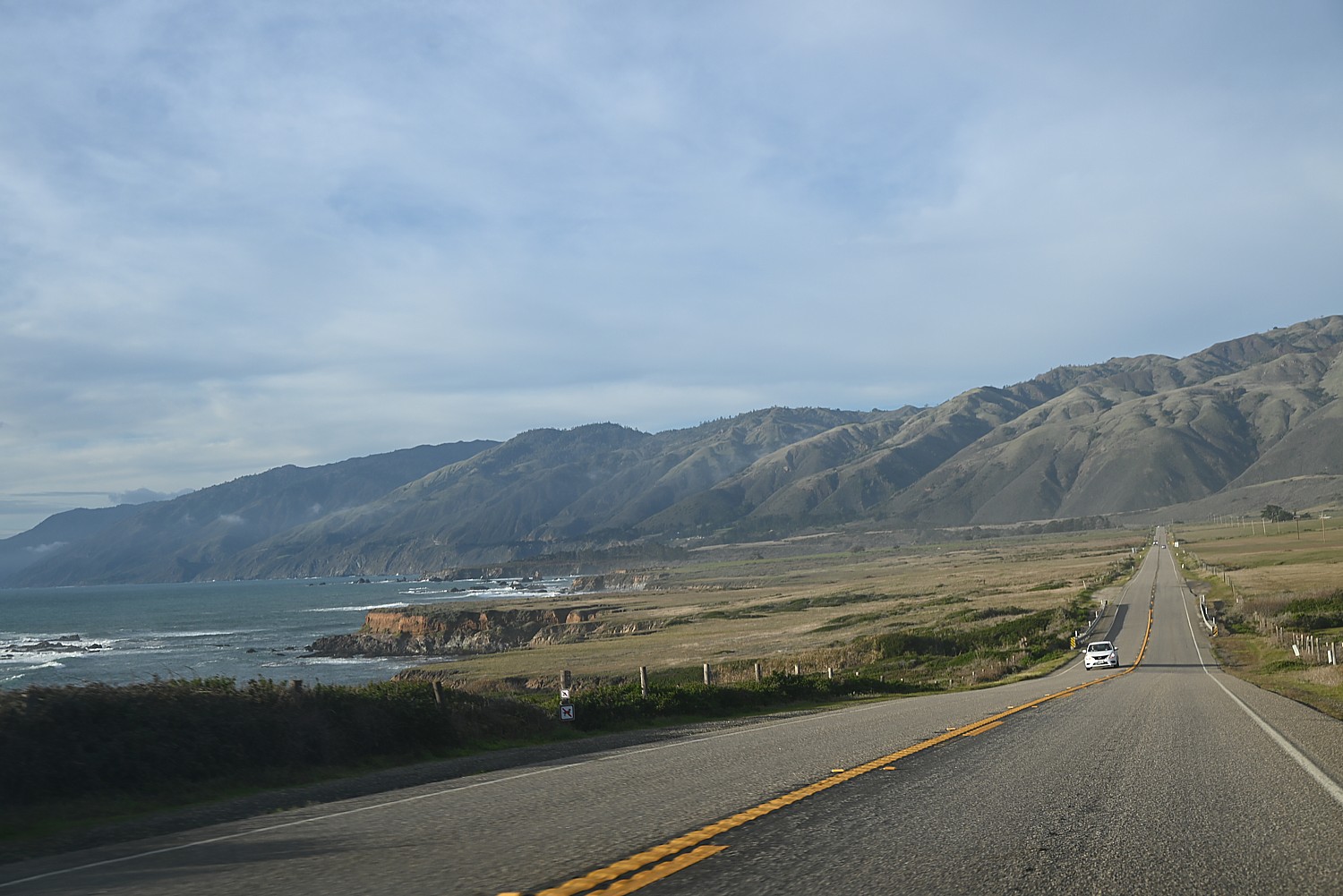
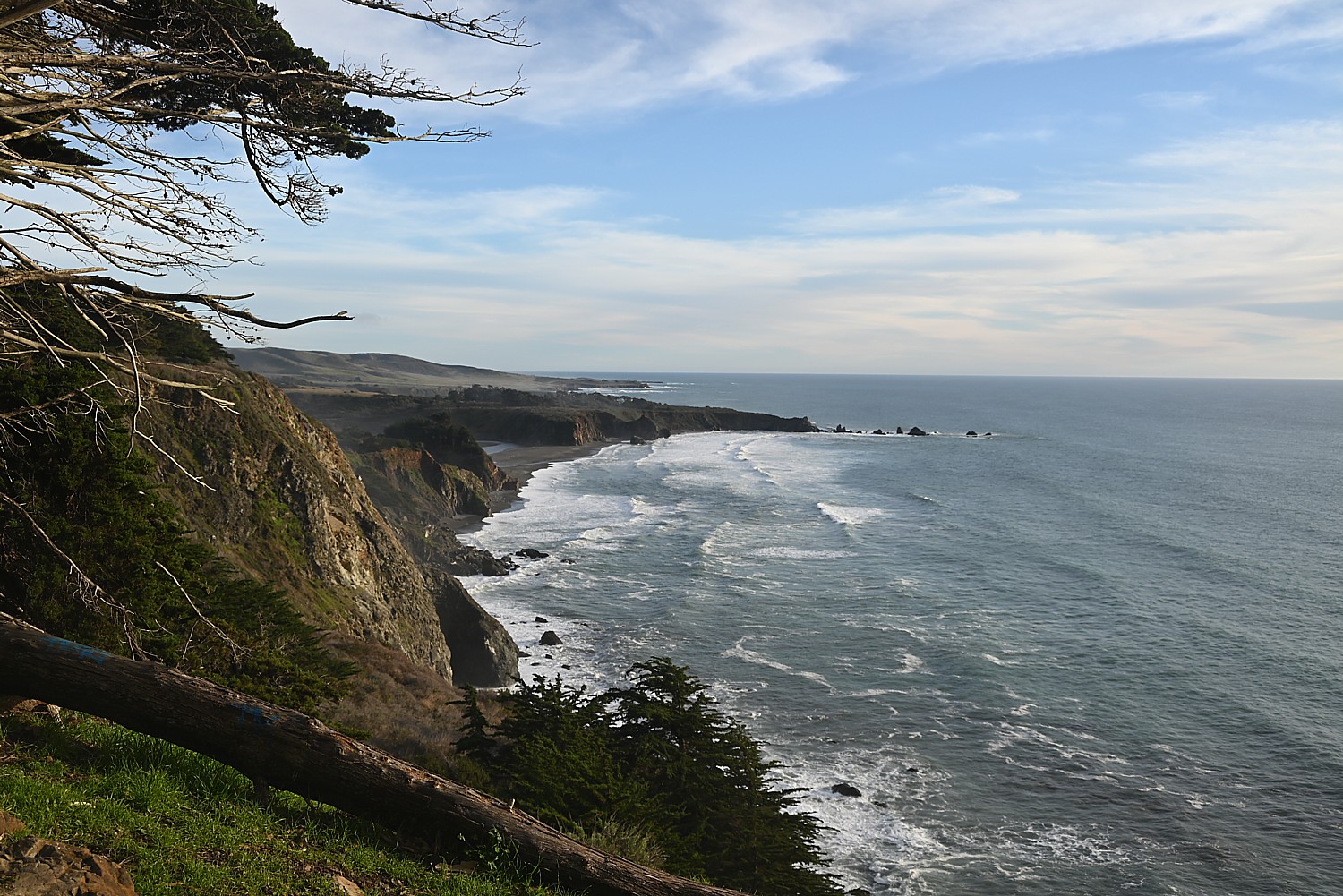
Ragged Point is 11 miles further north along Pacific Highway 1, which actually is at the southern tip of Big Sur (Gorda, about 20 more miles further, was as far north as you could go on Pacific Highway 1 from this direction, before the highway was closed). Here, we are back in the land of high, steep cliffs that make for such dramatic vistas. It is late afternoon, and we find a stunning turn off to take in the view.

Driving on California’s Pacific Highway 1 from Cambria to Ragged Point, you get views of the coast and the hills © Karen Rubin/goingplacesfarandnear.com

At Ragged Point Resort, where we will be having dinner, there is a trail that goes down to the beach to a high waterfall. Eric goes down (it is fairly steep, muddy and close to sunset and I don’t want to hold him back), but I walk along the edge of the resort where there is a partial view of the waterfall, and a great view of the open ocean and sunset.

The view of steep cliffs and ocean along the Pacific Highway 1 at Ragged Point, at the southern edge of Big Sur © Karen Rubin/goingplacesfarandnear.com

We enjoy our dinner at the restaurant – the mushroom bisque is delicious, the rib eye served with bourbon and almond demi-glaze is done perfectly, with wonderful flavor. The chef seems to enjoy interesting flavor combinations. (Ragged Point Inn & Resort, 19019 CA-1, Ragged Point, CA, 888-584-6374, www.raggedpointinn.com).

Driving back to Cambria from Ragged Point, we stop for stargazing just around Hearst Ranch and hear the cacophony, the roar, of the elephant seals. There are breaks in the cloud cover, just clear enough to see constellations.

Sunset from Ragged Point Inn and Resort © Karen Rubin/goingplacesfarandnear.com

There is more to see around Cambria, that unfortunately, we did not have time for since we were continuing on our way down the Pacific Highway:

Fiscalini Ranch Preserve is home to a number of endangered species and species of special concern. The Ranch is bordered by a riparian habitat that encompasses tidal effect zones, seasonal freshwater marshes, and wetlands filled with birds. A dramatic ocean bluff that runs more than a mile along the shoreline of the Monterey Bay National Marine Sanctuary where you can view migrating whales, elephant seals, and other ocean mammals. The Ranch features eight trails that meander through 437 acres of protected forest, riparian habitat, and grasslands. The benches located along the trails are each unique pieces of art that offer stunning ocean views. (604 Main Street Trail access at 2799, Bluff Trail, Cambria, CA 93428, 805-927-2856, https://www.fiscaliniranchpreserve.org/)

Covell’s California Clydesdales: 100 Clydesdale horses roam 2000 acres of pristine Monterey Pine forest and rolling pastures with an exquisite view of the ocean. Much of the forest of Cambria Pines by the Sea Ranch is protected in a nature conservation easement (Cambria Pines by the Sea, Cambria, CA 93428, 805-975-7332, https://www.covellsclydesdaleranch.com/)

Linn’s (for ollaliberry pie!). Since 1989, this little red brick restaurant in Cambria’s historic East Village. has been serving hearty breakfasts, lunches and dinners, but is famous for its ollaliberry pie and treats. (https://highway1roadtrip.com/where-to-eat/linn-s-restaurant/)  

Stepladder Creamery was founded in 1871 and has been family-owned and operated for three generations. As a farmstead creamery, they raise goats on the farm and make cheese from their milk, allowing them to manage every aspect of the cheese production. Their delicious, mild and creamy fresh Chèvre is the ultimate representation of spring cheesemaking. Group creamery tours are available.  (4450 San Simeon-onterey Creek Road, Cambria, CA 93428, https://www.stepladdercreamery.com/)

Morning mist rises from Moonstone Beach, Cambria © Karen Rubin/goingplacesfarandnear.com

Back at the Castle Inn we enjoy the heated pool and hot tub. The motel is perfect for our stay in Cambria, with a refrigerator, free wifi, continental breakfast, across street from Moonstone Beach boardwalk, 10 minutes drive to Hearst Castle, 15 minutes to Elephant Seal Vista Point. (6620 Moonstone Beach Dr, Cambria, CA, 93428, 805-927-8605, castle-inn-cambria.hotelsone.com)

We set out again on the Pacific Highway 1, bound for Redondo Beach.

More information: visitcambriaca.com

_______________________

© 2024 Travel Features Syndicate, a division of Workstyles, Inc. All rights reserved. Visit goingplacesfarandnear.com and travelwritersmagazine.com/TravelFeaturesSyndicate/. Blogging at goingplacesnearandfar.wordpress.com and moralcompasstravel.info. Visit instagram.com/going_places_far_and_near and instagram.com/bigbackpacktraveler/ Send comments or questions to FamTravLtr@aol.com. Tweet @TravelFeatures. ‘Like’ us at facebook.com/NewsPhotoFeatures 
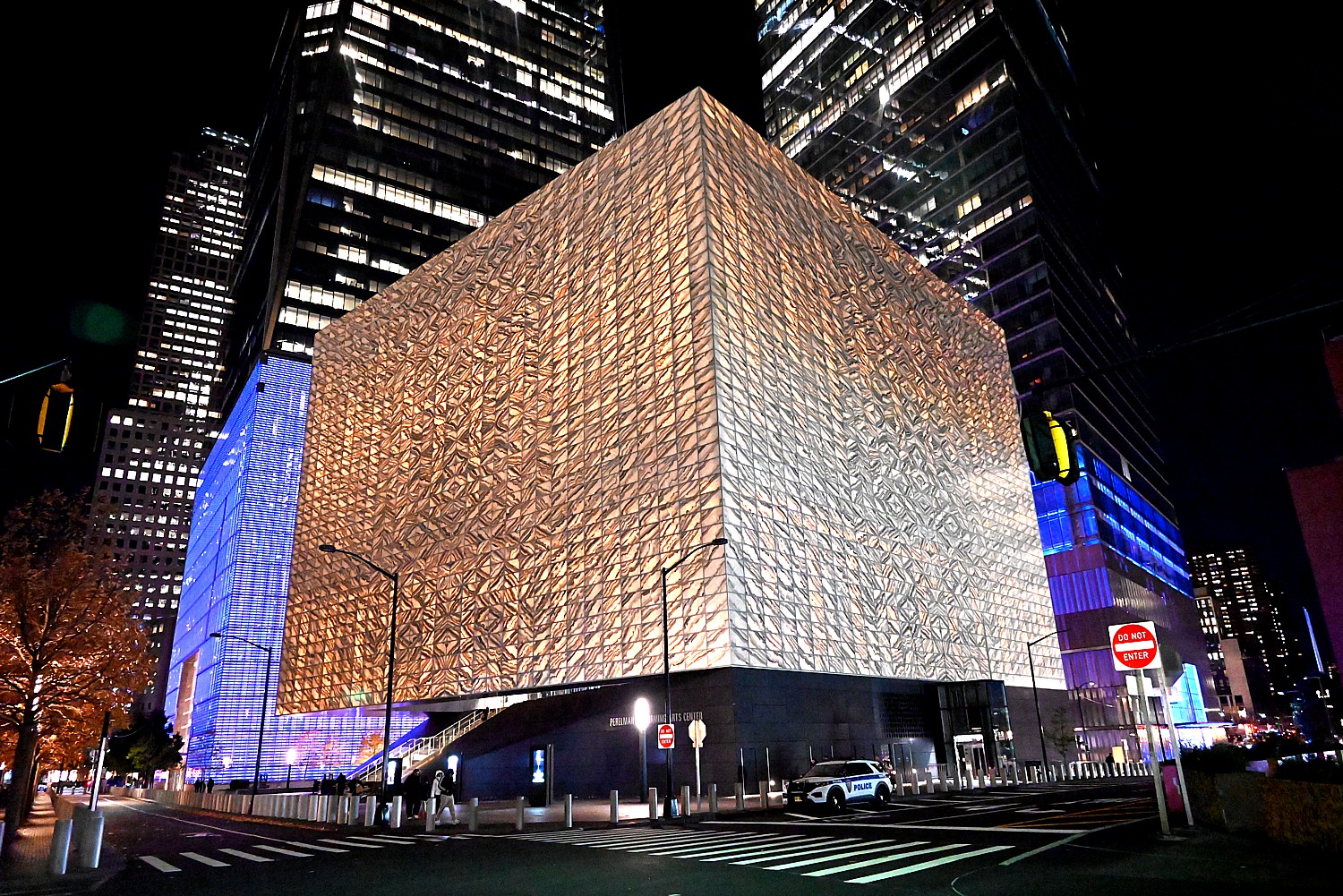
California Pacific Highway Roadtrip: Cambria is Enchanting Base to Visit Hearst’s ‘Enchanted Hill’ 

The view of William Randolph Hearst’s “Enchanted Hill” – Hearst Castle – an architectural and engineering triumph of Hearst and his architect/engineer Julia Morgan.  © Karen Rubin/goingplacesfarandnear.com

By Karen Rubin with Eric Leiberman, Travel Features Syndicate, goingplacesfarandnear.com

It’s a dark night when we pull into our hotel in Cambria, on California’s famous (and fragile) Pacific Highway 1, so it isn’t until I awake in the morning to a moist mist rising after a rain, that I realize what is just across the road from the picturesque Moonstone Beach and a magnificent boardwalk that extends 1 ½ miles over the fragile seagrass, the ocean crashing against the rocky shore just beyond, where a few seals are resting, the sun making a gorgeous sparkling light,

We’ve driven down from the north, starting at San Francisco, to Monterey (made famous by John Steinbeck’s “Cannery Row” and now with a world renowned Aquarium); following the Pacific Highway 1 as much as possible as it hugs the cliffs to Big Sur. We pull over frequently to take in those breathtaking views that look like the edge of the Continent just fell into the ocean. We spend a couple of days hiking and exploring, overnighting at the utterly enchanting and historic Deetjen’s Big Sur Inn (www.deejens.org, 831-667-2377), then have to backtrack to Monterey, driving inland three hours on Highway 101 to come into Cambria.

Moonstone Beach, Cambria, across from our hotel, the Castle Inn © Karen Rubin/goingplacesfarandnear.com

Cambria is an outstanding base to experience not only its own charms, but to explore Hearst Castle, San Simeon, the Piedras Blancas Elephant Seal Rookery, and even driving north on the Pacific Highway, to Ragged Point, just at the southern end of Big Sur where you can get those dramatic sheer-cliff/crashing waves against the rocky shore views.

Castle Inn, which I found on hotels.com, is a delightful motel that is absolutely perfect for our purpose – the room is spacious and has a beachy (ocean) feel; the motel serves coffee, scones, apples, muffins, oatmeal for breakfast. Later, we will take advantage of its pool and hot tub under the stars, and is so close by to all the things we want to explore – especially having the Moonstone Beach and boardwalk just across the road. (6620 Moonstone Beach Dr, Cambria, CA 93428, 805-927-8605, castle-inn-cambria.hotelsone.com)

We grab coffee and muffins and immediately head out to Hearst Castle just eight minutes up the coastal road from Cambria in San Simeon.

We have to be at the Hearst Castle’s visitor center by 8:40 am for our pre-booked 9 am Grand Rooms tour  – the most popular of a selection of tours you can take and the best if you have never visited before (others include “Hearst and Hollywood” “Designing the Dream” “Art of San Simeon,” “Julia Morgan”, “Cottages & Kitchen tour” “Upstairs Suites Tour”, also accessible tours and private tours.)

We get our wristbands and go to “gate” for the bus that takes guests up to the mansion along the long winding road – just as William Randolph Hearst intended his visitors to experience his “Enchanted Hill.”

The view of William Randolph Hearst’s “Enchanted Hill” – Hearst Castle – an architectural and engineering triumph of Hearst and his architect/engineer Julia Morgan.  © Karen Rubin/goingplacesfarandnear.com

The tour starts immediately on the bus, with an excellent narration giving the background – history, architecture, biography – and pointing out the sights along the way, accompanied by music of the 1930s and 1940s.

Hearst Castle is so much more than a magnificent mansion home (one of the most spectacular in the world), even more than an architectural jewel and a breathtaking art collection. It is the story of a fascinating man (love him or hate him or something in between, you still have to give the man credit for what he accomplished) who you come to know because everything about Hearst Castle is so personal to him. It is the story of an age – the coming of age of America, the coming of age of Hollywood and ascendancy of American culture. Everything you see is mind-blowing and breath-taking. And this mansion (he called it his country home), which has come to be known as Hearst Castle, is his personal artistic creation – the architecture and the art collection.

The tour is extremely well organized – it manages to be efficient and yet personal (I’m betting the earlier you can visit the better) – you feel as so many of Hearst’s guests must have felt the first time they were invited.

The entrance to Casa Grande. William Randolph Hearst was inspired to build his castle from his European tour with his mother when he was 10 years old © Karen Rubin/goingplacesfarandnear.com

You realize that even if you think you know who Hearst was (and so many imagine Hearst to be the character of “Citizen Kane” but he is only a piece of that fictional character, and Marion Davies, his companion, was a smart, savvy and accomplished woman and quite a fine actress, not at all like the character of Kane’s), you come away with newfound respect and interest – in fact, as compelling a real-life story as the fictional Citizen Kane. (“Citizen Kane” screenwriter Herman J. Mankiewicz was one of Hearst’s guests here.)

You also come to learn – and admire – Hearst’s architect for his castle: Julia Morgan was one of the first female engineering majors at the University of California, Berkeley, the first woman to pass the entrance exam in architecture and graduate the École Nationale Supérieure des Beaux-Arts, Paris  – the preeminent architectural school of the time – and was the first licensed woman architect in California. (In 2014, Morgan was posthumously awarded the American Institute of Architects’ Gold Medal in recognition of her pioneering career and dynamic buildings, the first woman to be awarded the medal in its 107-year history, https://pioneeringwomen.bwaf.org/julia-morgan/)

The grand dining room at Hearst Castle © Karen Rubin/goingplacesfarandnear.com

Hearst was inspired to build his castle and collect art when he took the grand tour of Europe when 10 with his mother. And his mother, Phoebe Apperson Hearst. a philanthropist and advocate for women, introduced him to Julia Morgan. Phoebe began a lifelong interest in Morgan’s career when the two women’s paths crossed in Paris. The films and photos you get to see of Morgan, presiding over the dynamiting to level the summit and build the road, reviewing plans with Hearst, are fascinating.

Even though you are walking through the mansion with a tour group, you actually feel like you were one of Hearst’s guests arriving for the weekend – the home is set out as it would have been – most remarkably, in the grand dining room (it may well have inspired Harry Potter’s Hogwarts dining room, and interestingly, the banners on display refer to an Italian horserace), there are bottles of ketchup and mustard because Hearst himself, for all the spectacular grandeur of the art and architecture, wanted a homey feel to his country home.

Ketchup and mustard on the table in the grand dining room at Hearst Castle © Karen Rubin/goingplacesfarandnear.com

The art is breathtaking – Hearst collected the pieces himself, and drawing from his European travels with his mother when he was 10 years old, are predominantly Gothic and medieval – a lot of religious art which Hearst appreciated for the art and the period, not the religious significance, the guide tells me.

The oldest work of art at Hearst Castle is an Egyptian statue, 3200-3600 years old, of Sekmet, daughter of Ra © Karen Rubin/goingplacesfarandnear.com

At the entrance to the Casa Grande – the 68,300 sq ft grand house – we stop in front of the oldest work of art here, an Egyptian statue,  3200-3600 years old of Sekmet, daughter of Ra –with a  hieroglyph that translates “Good God, Lord of Two Lands.” The entrance to Casa Grande –  has real gold gilding on the door, 1500-year old mosaic tiles, a 600 year old statue.

The Assembly Room of Hearst Castle gives you your first taste of the opulence and art collection © Karen Rubin/goingplacesfarandnear.com

We are ushered into the grand Assembly Room – 15th century church pews, tapestries, line the wall, and the Venus Italica, one of Hearst Castle’s greatest masterpieces, created by Antonio Canova (1757-1822).

In 1935 his collections were valued at more than $20 million (in the height of the Great Depression!), but then he fell into near bankruptcy, and at the age of 75, and had to sell off two-thirds of his collection, estimated at $15 million, at “fire sale” prices. (Marion Davies, by then extremely wealthy in her own right with movies and real estate investments in places like Palm Springs, lent him $1 million so he could keep Hearst Castle; when she died, her estate was worth $8 million; when he died, she gave the Hearst Company shares he left her back to his family and they promptly kicked her out and refused to let her come to his funeral.)

The Assembly Room of Hearst Castle gives you your first taste of the opulence and art collection © Karen Rubin/goingplacesfarandnear.com

You can easily picture who Hearst, Davies and Morgan were, and the glorious celebrity life they lived because there are home movies, photos!. It is thrilling to sit in Hearst’s own theater and watch Charlie Chaplin mug for the camera. (Definitely take advantage of the outstanding 40-minute documentary about Hearst’s life in the five-story theater before or after the tour.)

In many ways, William followed in his father’s footsteps.

George was a self-made millionaire, starting as a prospector – he owned interest in three of the largest mines in the U.S., including the Comstock Lode in Nevada, the Homestake gold mine in South Dakota and the Anaconda copper mine in Montana, plus the Ontario silver mine in Utah, then acquired large portions of land throughout the United States, especially in California and the West. One acquisition was 48,000 acre Piedra Blanca Rancho at San Simeon in 1865, when William was two-years old. He later purchased the adjoining Santa Rosa and San Simeon Ranchos – amassing 250,000 acres. This place became a retreat for lavish family camping trips.

Only a small portion of the vast estate – once 250,000 acres – assembled by Hearst © Karen Rubin/goingplacesfarandnear.com

Late in his life George Hearst served as United States Senator from California from 1887 until his death in 1891. It was during this time that he acquired the small San Francisco Examiner as a repayment for a gambling debt. Although he had little interest in the publishing business and wanted his only son, William, to take over the family’s mining and ranching holdings, William wanted to run the newspaper.

The newspaper business was William’s passion, and he ultimately amassed a huge publishing empire, and even when he was living at this remote castle in San Simeon, he would get the pages each night by teletype by 1 am, and make editorial changes by phone, well into the night.

William Hearst is probably best known for “yellow journalism” which pressured President McKinley into the Spanish-American War (that also made Theodore Roosevelt’s reputation with his Rough Riders.

And following in his father’s footsteps, he was elected to Congress but unsuccessfully ran for Governor and for President.

In 1919 when he inherited the estate, William Hearst, then 56 years old, hired architect Julia Morgan telling her, “Miss Morgan, we are tired of camping out in the open at the ranch in San Simeon and I would like to build a little something.”

For the next 28 years, the project that we know as Hearst Castle became his life’s work, his creation and hers and unbelievably, was never actually finished, even though the mansion and villas now comprise 165 rooms atop the 1600 ft. high summit of a hill. Hearst, they say, was never as happy as when he was on his “Enchanted Hill.”

Once this pasture would have held the largest private zoo in America © Karen Rubin/goingplacesfarandnear.com

From the bus, we look out over the vast lands where Hearst had assembled exotic animals from around the world, ultimately creating the largest private zoo in America – you would have seen African and Asian antelope, zebras, giraffes, camels, sambar deer from India, red deer from Europe, axis deer from Asia, llamas, kangaroos, ostriches, emus, Barbary sheep, Alaskan big horned sheep, musk oxen and yaks. Though most of the animals were removed by 1937 (when Hearst was near bankrupt during the Great Depression), some that remain are descendents of the original herds, like the Oudads, and get still have 200 head of cattle on the ranch.

We drive the winding road that Julia Morgan designed so that the castle appears, disappears and reappears as you drive around the bends, climbing higher and higher to the hilltop.

Hearst’s guests would have come by private train, but some of Hearst’s guests – like the Vanderbilts, who flew in on a private plane in 1935 to an airstrip below, then would have been driven up these roads.

Hearst created a mile-long pergola of fruit trees, and would ride on horseback through the canopy, “the longest pergola in captivity” Morgan would joke. The fruit trees including oranges and pomegranates, yield 2000 lbs of citrus that are donated to local food bank.

All the food the castle used was produced on site; water was piped in, so the castle was completely self-sufficient.

As we get off the bus, our guide, Gregory Anderson, encourages us to take photos as we see them, because the tour goes in one direction  But to a really excellent degree, what we see is what it would have been like to visit in Hearst’s time.

One of the three villas at Hearst Castle where movie stars, industrial moguls, and political leaders would have stayed © Karen Rubin/goingplacesfarandnear.com

We stop in front of the first villa, Casa del Sol, “medium sized” at 3600 sq ft., built for a sunset view, Bob and Delores Hope honeymooned here; Edward Hubble, who originated the Big Bang Theory, stayed here; Actor Cary Grant requested a different room every time stayed (came 40 times)

We come to the 2500 sq. ft Casa del Mar cottage, where David Niven (“The Pink Panther) and Winston Churchill stayed (in 1929). Up until 1976, this was the villa that Hearst family members would stay. (William had five sons between 1904-1918, and there are some 70 descendents today and the family – the 20th wealthiest in the US – now when they come, they stay at the Senator’s House which the Hearst Corporation still owns).

King Vidor, Howard Hughes, Charlie Chaplin, buster Keaton, Jean Harlow, Carole Lombard, Harpo Marx, Joan Crawford, Greta Garbo were among the celebrities who came.

Hearst loved to take his guests on grueling horseback rides – delighted in seeing how silver screen cowboys would handle real horse.

Our guide tells us that Hearst Castle was Morgan’s 503rd of 700 projects and was one of the few architects who knew how to work with steel reinforced concrete (important for earthquakes).

Notably, she designed a new Fairmont Hotel in San Francisco, still an architectural jewel, which opened within a year after the 1906 earthquake, and propelled her career and her own practice.

Morgan had already designed the block-long Spanish Mission Revival Hearst Examiner Building (1913–15) in Los Angeles. In 1919, following his mother’s death, Hearst inherited the full Hearst estate and decided to build a “modest bungalow” on the hilltop of the ranch at San Simeon – which evolved into the castle. 

I find it interesting that Morgan negotiated her commission from 6 percent for architectural services to 8.5 percent to cover the costs of “running the job.” She was providing what today would be called “design-build” services and was responsible for managing workmen, artisans, material suppliers, and warehouses of artifacts – it is fascinating to see the “home videos” of her directing the workers.

The magnificent Neptune Pool. Julia Morgan had to design and build it three times © Karen Rubin/goingplacesfarandnear.com

The most spellbinding features of the estate are the two pools – the Neptune Pool which has Grecian feel, is actually the third incarnation: 104 feet long, 58 feet wide and 95 feet wide at the alcove. It is 3.5 feet deep at the west end, 10 feet at the drains, and holds 345,000 gallons of water. Other notable aspects of the Neptune Pool include the oil-burning heating system, the Vermont marble that lines the basin, gutters, and alcove, and four Italian relief sculptures on the sides of the colonnades.

The magnificent Roman Pool in Hearst Castle © Karen Rubin/goingplacesfarandnear.com

The indoor Roman Pool tiled indoor pool decorated with eight statues of Roman gods, goddesses and heroes. The pool appears to be styled after an ancient Roman bath such as the Baths of Caracalla in Rome c. 211-17 CE.

Be sure to make time to see the “Building the Dream” biopic in the 5 story theater (plays every 45 minutes) about William Randolph Hearst’s childhood, his travels to Europe, construction of the castle estate, and his architectural collaboration with Morgan. “They built castle but also created legacy.”

Hearst Castle, which first opened for tours in 1958 and gets 600,000-700,000 tourists/year (in the 1980s, its heyday, a million tourists would come each year), is now a California state park.

There are no individual visits to Hearst Castle – you must be registered for a tour. Ticket prices start at $30/adults, $15 children (5-12). (https://hearstcastle.org/tour-hearst-castle/daily-tours/). Reserve tickets online up to 60 days in advance; Reserve online (https://www.reservecalifornia.com/Web/Activities/HearstCastleTours.aspx)

Every year from the end of November through the end of December, Hearst Castle offers a “Holiday Twilight Tour” to experience the estate as Hearst’s guests enjoyed it during the 1920s and 1930s during the Christmas season.  

Hearst Castle, 750 Hearst Castle Road, San Simeon, CA 93452-9741, 800-444-4445 (8 am-6 pm PT), hearstcastle.org.

More visitor information: visitcambriaca.com.

Next: Cambria is Great Base for Pacific Highway Roadtrip

_______________________

© 2024 Travel Features Syndicate, a division of Workstyles, Inc. All rights reserved. Visit goingplacesfarandnear.com and travelwritersmagazine.com/TravelFeaturesSyndicate/. Blogging at goingplacesnearandfar.wordpress.com and moralcompasstravel.info. Visit instagram.com/going_places_far_and_near and instagram.com/bigbackpacktraveler/ Send comments or questions to FamTravLtr@aol.com. Tweet @TravelFeatures. ‘Like’ us at facebook.com/NewsPhotoFeatures 
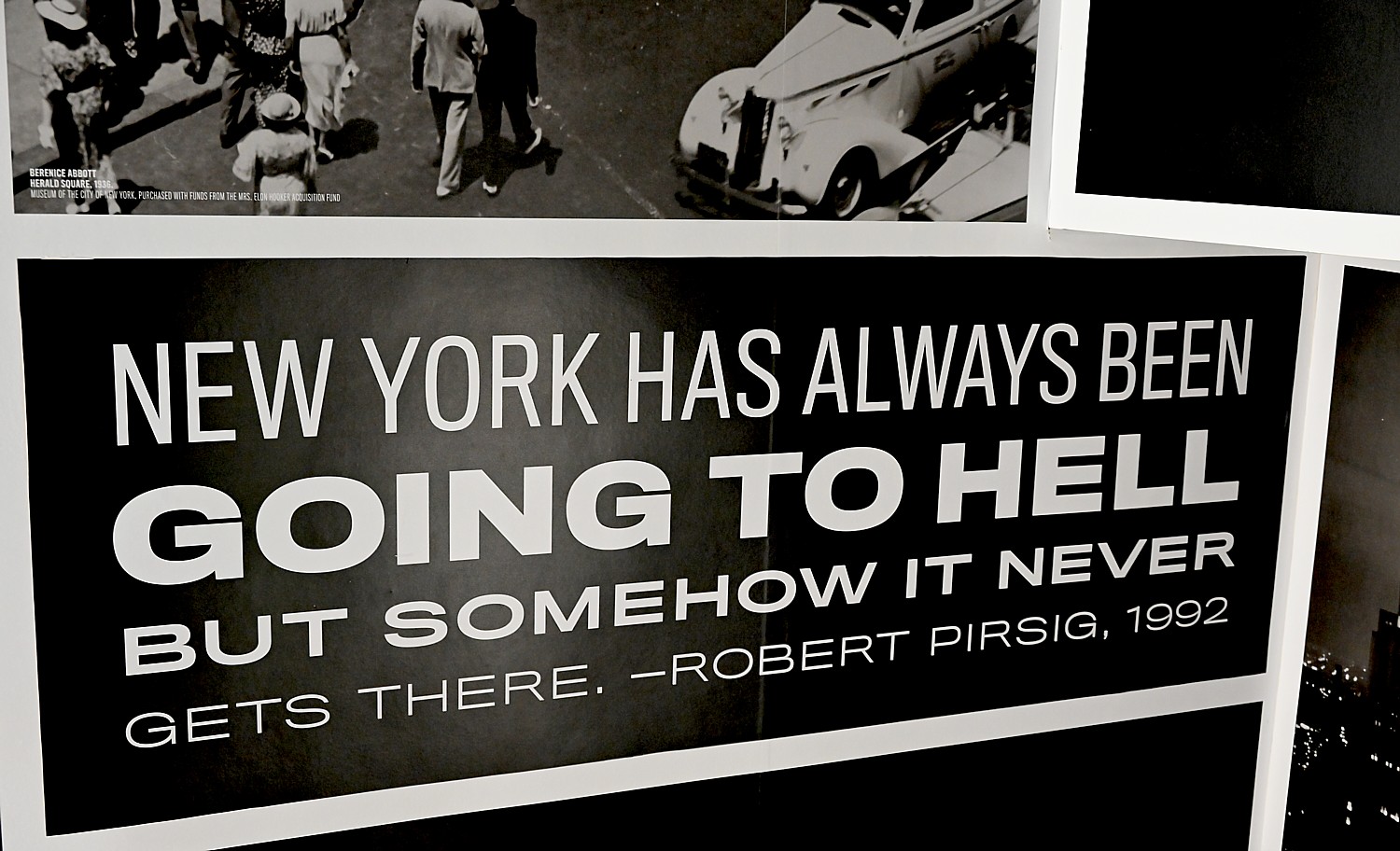
Summer in the City Opens with Museum Mile Festival, Finishes with US Open

The Guggenheim Museum is one of eight major institutions that are free to explore during the annual Museum Mile Festival © Karen Rubin/goingplacesfarandnear.com

By Karen Rubin, Travel Features Syndicate, goingplacesfarandnear.com

New York City’s summer cultural season kicks off with the 46th Annual Museum Mile Festival – the Big Apple’s “biggest block party” –on Tuesday, June 18, from 6 to 9 pm, rain or shine. Walk the mile on Fifth Avenue between 82nd Street and 104th Street while visiting eight of New York City’s finest cultural institutions, open free during these extended hours: The Metropolitan Museum of ArtNeue Galerie New YorkSolomon R. Guggenheim MuseumCooper Hewitt, Smithsonian Design MuseumThe Jewish Museum; Museum of the City of New York; El Museo del Barrio; and The Africa Center. Several neighborhood partners, including the New York Academy of Medicine, the Church of the Heavenly Rest, Asia Society, and AKC Museum of the Dog will also join in this celebration. 

The Museum Mile Festival is the Big Apple’s biggest block party, with street entertainment and free admissions to museums © Karen Rubin/goingplacesfarandnear.com

It’s an electric, eclectic festive atmosphere, with live music and street performers all along the avenue, plus special exhibitions, works from permanent collections and special family-oriented activities inside.

One of our favorite stops is the Museum of the City of New York (celebrating its 100th anniversary this year), where you can visit its newest exhibition Changing the Face of Democracy: Shirley Chisolm at 100 and the send off of its centennial exhibition This is New York: 100 Years of the City in Art and Pop Culture . Grab a Kids’ Activity Guide for the little ones.

Dancing to the 1920s Hot Jazz of Michael Arenella and His Dreamland Orchestra at the Jazz Age Lawn Party on Governors Island © Karen Rubin/goingplacesfarandnear.com

Jazz Age Lawn Party on Governors Island (June 8-9 and August 10-11, 2024, 11 am-5 pm), starts with a magical ferry ride from Battery Park or the Brooklyn Navy Yard. People come dressed to the 9s in 1920s/Gatsby-style outfits, bringing picnics and take part in the music and zeitgeist of the 1920s. With music and dancing led by festival founder and host Michael Arenella & His Dreamland Orchestra, the merriment continues with a score of other entertainers: the bedazzling Dreamland Follies, a 10-lady Art Deco dance spectacle evoking the Great Ziegfeld, the fantastic Queen Esther paying tribute to jazz royalty of yore, Peter Mintun tickling the ivories with his incredible piano skills and the Gelber & Manning band. Enjoy the renowned and fun-loving dance troupe, Roddy Caravella and The Canarsie Wobblers with their scandalous Charleston numbers and rebellious and exuberant spirit of the Roaring ‘20s. Entertainments are interspersed with fun events like dance lessons and a period bathing suit contest. This isn’t free – it’s a ticketed event. Tickets and info at www.jazzagelawnparty.com. (Reserve a ferry ride to access the location.)

The New York Philharmonic returns to Central Park for its free summer concert series © Karen Rubin/goingplacesfarandnear.com

The New York Philharmonic Concerts in the Parks, Presented by Didi and Oscar Schafer, have become an iconic New York summer experience since they began in 1965, transforming parks throughout the city into a patchwork of picnickers enjoying friends, family, and priceless music under the stars, for free! This summer, Thomas Wilkins conducts the Orchestra in a program that ranges from classics by Beethoven, Elgar, and Rimsky-Korsakov to Felix Mendelssohn’s Violin Concerto, with Randall Goosby as soloist, to new music by Carlos Simon and NY Phil Very Young Composers. All outdoor performances begin at 8 PM and conclude with fireworks! (The Free Indoor Concert in Staten Island begins at 4 PM.): June 11 Van Cortlandt Park, Bronx; June 12 Concerts in the Parks: Central Park, Manhattan; June 13, Concerts in the Parks: Cunningham Park, Queens; June 14, Concerts in the Parks: Prospect Park, Brooklyn; June 16 Free Indoor Concert: St. George Theatre, Staten Island.

The New York Philharmonic Summer in the Parks performances finish with a dramatic fireworks display© Karen Rubin/goingplacesfarandnear.com

The cherished Shakespeare in the Park, traditionally held at the Delacorte Theater in Central Park, this year is a traveling show while the Delacorte is undergoing its most significant revitalization of its 62-year history. Instead, this year the Public Theater (Artistic Director, Oskar Eustis; Executive Director, Patrick Willingham) is offering  a “GO PUBLIC!”  festival of of free summer programming taking place across all five boroughs. Its Mobile Unit is presenting a joyful, bilingual (English/Spanish) musical adaptation of “The Comedy of Errors,”  May 28-June 2 – The New York Public Library and Bryant Park on the Fifth Avenue Terrace (Manhattan) June 6-9, June 13-14, June 20-21 – Hudson Yards (Manhattan). Also: A.R.R.O.W. Field House (Queens) J. Hood Wright Park (Manhattan) Maria Hernandez Park (Brooklyn) Roy Wilkins Park (Queens) St. John the Divine (Manhattan) St. Mary’s Park (Bronx) Sunset Park (Brooklyn) Wolfe’s Pond Park (Staten Island).

Next up is Movie in the Parks (July 11–September 6), bringing free screenings of Shakespeare in the Park’s version of Much Ado About Nothing to parks throughout the City. (Can’t make it to any of them? This recording and other Shakespeare favorites are available to stream for free.) Visit the website for specific dates and locations (https://publictheater.org/programs/shakespeare-in-the-park/summer-24/go-public/).

In summer, all the city is a stage, and every lawn a picnic table © Karen Rubin/goingplacesfarandnear.com

Bryant Park is also hosting picnic performances of New York City Opera’s full production of the perennial favorite, Puccini’s Tosca on May 31, June 1, August 23 and 24, at 7 pm. (New York City Opera: Puccini Celebration) as part of a summer-long arts and culture festival, sponsored by Bank of America, from June 6 to September 13, featuring an amazing series of dance, music, theater, movies, plus eateries, shops and a carousel. (https://bryantpark.org/activities/picnic-performances for schedule).

The Hudson River Greenway is a whole destination in itself, and one of the best places to bike. In fact, it is part of the Empire State Trail Network, that goes from Lower Manhattan up to the Canadian border © Karen Rubin/goingplacesfarandnear.com

The Hudson River Greenway is a whole destination in itself, with every imaginable sport (tennis, pickleball, basketball, kayaking), fabulous eateries, even a sand beach, plus along the way, historic and cultural places like the monument to the Irish famine, the Museum of Jewish Heritage, the Whitney Museum, Battery Park and ferry access to the Statue of Liberty and Ellis Island, plus concerts such at two venues within the enchanting “Little Island.”

From June through September, Little Island presents a series of all new work across dance, music, theater and opera in the Amph  ($25, tickets and schedule, https://www.littleislandtickets.com/). In addition, there are free concerts Wednesday-Sunday in the Glade.

Little Island is a unique green space unlike any other in New York City. The award-winning public park is located in Hudson River Park and features two performance venues where visitors can experience cultural events all summer long © Karen Rubin/goingplacesfarandnear.com

The newest experience on the Hudson River Greenway is Gansevoort Peninsula. Located in Hudson River Park between Gansevoort Street and Little West 12th Street, and opposite the Whitney Museum of American Art, which affords an actual sand beach (1200 tons of sand, beach umbrellas, Adirondack-style chairs, even misting stations, and boardwalk)  for lounging. Also look for “Day’s End”, a public art installation by artist David Hammons, donated to Hudson River Park by the Whitney Museum of American Art.  See the full events calendar, https://hudsonriverpark.org/, https://hudsonriverpark.org/the-park/piers-and-places/

New York City has been named the most cultural city in the USA. Here’s what’s of note happening this summer, compiled by the New York City Tourism + Conventions, the official destination marketing organization and convention and visitors bureau:

NYC The Metropolitan Museum of Art is presenting “The Harlem Renaissance and Transatlantic Modernism” through July 28 © Karen Rubin/goingplacesfarandnear.com

Through July 28, The Metropolitan Museum of Art presents The Harlem Renaissance and Transatlantic Modernism, an exhibition exploring how Black artists portrayed everyday modern life during the 1920s–40s in Harlem and across the United States amid the Great Migration. Featuring 160 works including painting, sculpture, photography, film and ephemera, it’s the first art museum survey of its kind in New York City since 1987.

The Whitney Museum of American Art has unveiled the roster for Whitney Biennial 2024: Even Better Than the Real Thing, featuring 69 artists and two collectives. This edition marks the 81st installment of the museum’s esteemed exhibition series, the longest-running survey of American art. The program is now open and runs through August 11. Beginning September 25, The Whitney will unveil Edges of Ailey, a comprehensive exhibition celebrating the life and impact of American dancer Alvin Ailey, featuring daily performances, workshops and a diverse range of artworks and archival materials.

Experience a surreal journey inspired by Alice’s Adventures in Wonderland at the Bronx’s New York Botanical Garden, with Wonderland: Curious Nature, from May 18–October 27Follow iconic characters through whimsical scenes in the garden and explore imaginative horticultural displays inside the Haupt Conservatory, featuring installations from renowned artists including Yoko Ono, Alyson Shotz and Abelardo Morell.

A tribute to Ming Dynasty architecture, the New York Chinese Scholar’s Garden at Snug Harbor Cultural Center & Botanical Garden in Staten Island—one of just two authentic classical outdoor Chinese gardens in the US—is celebrating its 25th anniversary this year. Crafted in Suzhou, China, its elements include roof tiles, pavilions and bridges. Inspired by ancient poetry and paintings, the garden features magnificent rock formations resembling mountains. Visitors can explore pavilions, a bamboo forest path, waterfalls and a koi-filled pond.

The Morgan Library & Museum, which is marking 100 years since its establishment as a public institution by Jack Morgan as a repository of fabulous documents, is exhibiting Beatrix Potter: Drawn to Nature and Walton Ford: Birds and Beasts of the Studio. The next exhibition in the campaign will be Liberty to the Imagination: Drawings from the Eveillard Gift, on view beginning June 7.

Since its inception in 1824, the Brooklyn Museum has become a global cultural center, driven by the innovative spirit of its borough. As it celebrates two centuries of groundbreaking initiatives, the museum invites audiences to explore special exhibitions and events showcasing its vibrant artistic community. Highlights include the launch of immersive exhibitions like Solid Gold and Brooklyn Made. Notably, the museum boasts an in-residence composer, Niles Luther, who scores music for various exhibitions and artwork on-site, making it the only museum in the United States to offer such an immersive experience. Visitors can expect a year of discovery and celebration in honor of its bicentennial—kicking off with a 200th Birthday Bash on October 5.

A destination that takes you to other worlds, Richard Gilder Center for Science, Education, and Innovation at the American Museum of Natural History offers fabulous innovative exhibitions. Admission by timed entry, reserved online. Open daily, 10 am–5:30 pm. American Museum of Natural History,200 Central Park West, 212-769-5606, amnh.org.

Be prepared to be dazzled and fascinated when you visit the American Museum of Natural History and the Gilder Center © Karen Rubin/goingplacesfarandnear.com

New performing arts offerings are revitalizing New York City’s cultural landscape with the expansion of iconic venues and the emergence of new stages. The historic Apollo Theater recently debuted the Victoria Theater, its first expansion in 90 years, which introduced two new stages and created an arts campus in Harlem. The inaugural season promises a diverse lineup including Alex Harsley, Stefon Harris and David Hammons. Meanwhile, in Brooklyn, the newly restored Brooklyn Paramount, now a concert hall, hosts various shows featuring acclaimed acts like Sting, Liam Gallagher, St. Vincent, Orville Peck and many more in its 2024 lineup. Across the East River, the Ronald O. Perelman Performing Arts Center (PAC) stands as a beacon of artistic expression in Lower Manhattan, welcoming emerging and established artists across various disciplines since its launch in September 2023. The PAC’s inaugural 2023–24 season continues this summer with the opening of An American Soldier, The SurvivalCats: “The Jellicle Ball”.

One of New York City’s newest performing arts venues, the Ronald O. Perelman Performing Arts Center, in Lower Manhattan © Karen Rubin/goingplacesfarandnear.com

The Jackie Robinson Museum commemorates the groundbreaking contributions of Jackie Robinson, the first African American to play Major League Baseball and one of the most celebrated baseball players of all time. Robinson’s legacy extends far beyond the baseball diamond, as he also made significant strides in civil rights, economic empowerment and social justice. From now through December 31, the museum is offering a free self-guided walking tour, Jackie Robinson’s Harlem, for visitors looking to dive deeper into Robinson’s connection to the neighborhood.

The Alice Austen House,Staten Island © Karen Rubin/goingplacesfarandnear.com

New York City is the birthplace of the modern LGBTQ+ movement. The Stonewall Inn, site of the historic 1969 riots, stands as a symbol of resilience and is soon to be complemented by a dedicated visitor center opening in June. Other cultural sites include theLeslie-Lohman Museum of Art, which celebrates LGBTQ+ identity through exhibitions and programs that showcase the ever-evolving queer experience, as well as the Alice Austen House Museum, which features the pioneering photographer’s work and has been a National Site of LGBTQ+ History since 2017. On the Upper West Side, the forthcoming American LGBTQ+ Museum at the New-York Historical Society, set to open its doors in 2026, will be the nation’s first museum dedicated to LGBTQ+ history.

One of the best parts of the US Open at the Billie Jean Tennis Center in Flushing Meadows Park, Queens, is getting to see tennis greats like Rafael Nadal practice © Karen Rubin/goingplacesfarandnear.com

If Summer in the City starts with the Museum Mile Festival, for me, the end of New York’s summer comes with the US Open Tennis Championships, the fourth and final Grand Slam tournament of the year. The tournament dates back to 1881, and since 1978, the tournament has found its home at the USTA Billie Jean King National Tennis Center in Queens’ Flushing Meadows Corona Park, a magnet for the best tennis talent worldwide such as reigning champions Coco Gauff, Novak Djokovic, Diede de Groot and Alfie Hewett. The tournament takes place August 26–September 8, 2024. Insiders tip: the week before, it is free to watch the thrilling play of the qualifiers’ tournament, and see the tennis stars practice.

New York City Borough Pass, Citywide: a new sightseeing pass designed to showcase the beauty of the neighborhoods and cultures across all five boroughs. The pass features a diverse roster of popular attractions, museums, performing arts venues, including the Alice Austen House Museum, MoMA PS1, New York Botanical Garden, Van Cortlandt House Museum, Staten Island Children’s Museum. (888-921-5333, https://www.nycboroughpass.com/)

The Go City Pass for New York City offers 100 different options in all five boroughs. For example, the two-day all inclusive pass, giving access to as much as you want/can do from among 105 attractions is $134 – regardless of how much the actual attractions charge (GoCity.com, 800 887 9103).

For all there is to do and see in New York City, visit nyctourism.com.

________________

© 2024 Travel Features Syndicate, a division of Workstyles, Inc. All rights reserved. Visit goingplacesfarandnear.com and travelwritersmagazine.com/TravelFeaturesSyndicate/. Blogging at goingplacesnearandfar.wordpress.com and moralcompasstravel.info. Visit instagram.com/going_places_far_and_near and instagram.com/bigbackpacktraveler/ Send comments or questions to FamTravLtr@aol.com. Tweet @TravelFeatures. ‘Like’ us at facebook.com/NewsPhotoFeatures 
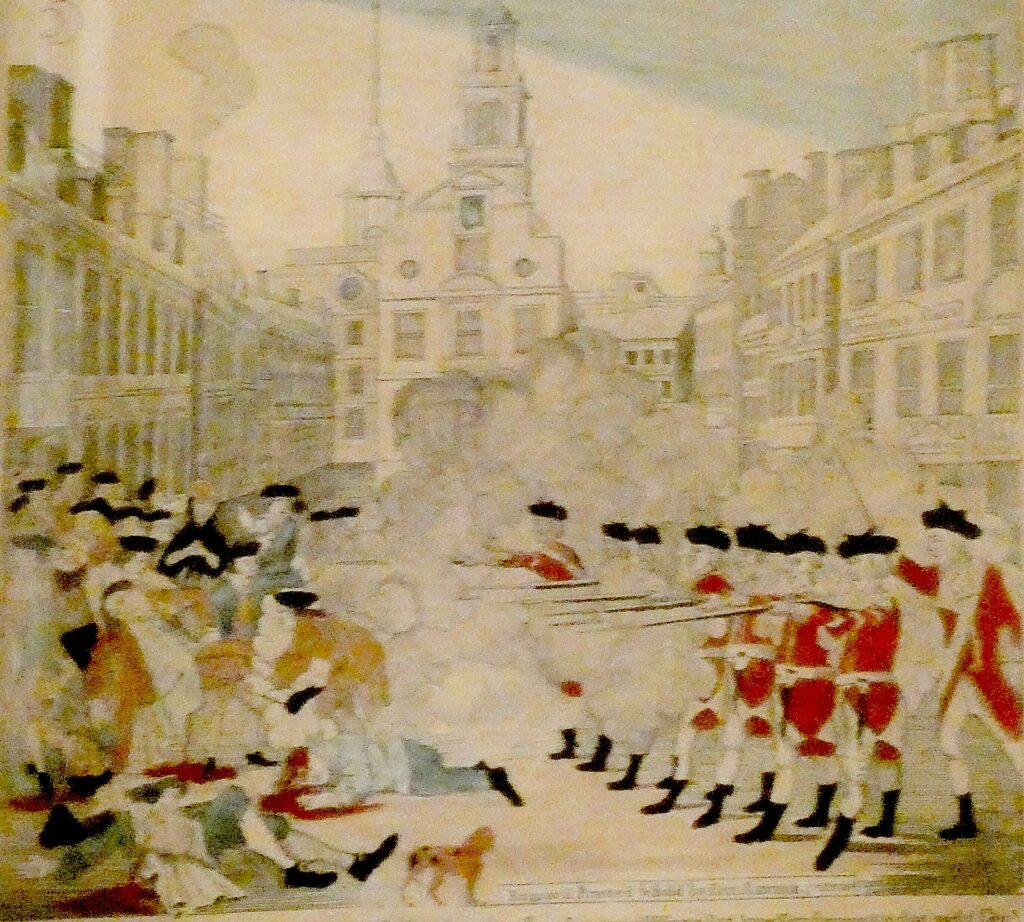
Bethpage Memorial Day Weekend Airshow at Jones Beach Kicks Off Long Island Summer

By Karen Rubin, Travel Features Syndicate, goingplacesfarandnear.com

US Navy Blue Angels headline the 20th anniversary Bethpage Air Show at Jones Beach State Park, Long Island, over Memorial Day weekend © Karen Rubin/goingplacesfarandnear.com

One of the best airshows in the world happens right in our own backyard each Memorial Day weekend: the Bethpage Jones Beach Air Show, celebrating its 20th anniversary, cannot be beat for spectacular aeronautical feats amidst the ambiance of Jones Beach, where you see the action right in front of you, just above the ocean and stretching to the horizon. The intense action is so close, you often can see the pilots in the cockpits, and so fast and daring, it takes your breath away. The event takes place from 10 am to 4 pm on Saturday, May 25 and Sunday, May 26 (insiders tip: there is a rehearsal/practice run on Friday).

US Navy Blue Angels in their F/A-18 Super Hornets demonstrate their legendary precision at the Bethpage Air Show at Jones Beach State Park, Long Island, over Memorial Day weekend © Karen Rubin/goingplacesfarandnear.com

The show this year is headlined and climaxed by the U.S. Navy Blue Angels – a team of six performing their heart-stopping maneuvers in their F/A-18 Super Hornets. They are famous for the Diamond formation, when they fly as close as 18 inches apart, but what most excites me is when the two solos fly extraordinary maneuvers, including coming at each other at 300 mph. Don’t blink or breathe or you will miss it!

US Navy Blue Angels in their F/A-18 Super Hornets demonstrate their legendary precision at the Bethpage Air Show at Jones Beach State Park, Long Island, over Memorial Day weekend © Karen Rubin/goingplacesfarandnear.com

The airshow traditionally opens with the United States Army Golden Knights Parachute Team, who launch out of a plane some 25,000 feet high, stream down at 200 mph, and float down into the crowd on the beach carrying the American and POW flags. The Golden Knights portray the image of being the most formidable parachuting competitors and demonstrators in the world today

The U.S. Army’s Golden Knights parachute team opens the Bethpage Air Show at Jones Beach this Memorial Day weekend © Karen Rubin/goingplacesfarandnear.com

American Airpower Museum Warbirds, flying vintage WWII fighters and patrol planes, pay homage to Long Island’s historic role as the nation’s arsenal of democracy. Republic Aviation, the complex in Farmingdale where the AAM stands now, produced over 9,000 P-47 Thunderbolts, and today the museum’s collection preserves the heritage and history.  The Warbird performance will conclude with a precision aerobatic demonstration of one of the museum’s legendary WWII Fighters.

Three World War II planes from The American Airpower Museum in Farmingdale circle over the crowd including a Douglas C-47, a supply and troop transport plane with stripes on its fuselage so allies knew not to shoot it down. The others were a British Curtis P41 Warhawk and a P-51 Mustang © Karen Rubin/goingplacesfarandnear.com

The American Airpower Museum has events scheduled from Friday through Sunday, and is where you can even see participants in the air show take off and land, and even take flights in vintage aircraft. (More details below, www.americanairpowermuseum.org, 631-293-6398.)   

The US Navy’s F-35 © Karen Rubin/goingplacesfarandnear.com

U.S. Navy F-35C Lightning II Demonstration Team and Legacy Flight shows off the capabilities of this 5th Generation fighter. The F-35C is the world’s most advanced multi-role fighter. With a top speed of 1,200 mph, the F-35C is even capable of setting off sonic booms. The F-35C has the most powerful and comprehensive integrated sensor package of any fighter aircraft in history, giving pilots 360-degree access to “real-time” battlefield information. The demo will feature a Legacy Flight formation, providing a unique comparison between the past and present.

U.S. Air Force A-10C Thunderbolt II Demonstration Team and Heritage Flight showcases the combat capabilities of the A-10 “Warthog”  by performing precision aerial maneuvers.  Additionally, the team brings attention to the Air Force’s history by flying formations with historical aircraft in the Air Force Heritage Flight.

Long Island’s own David Windmiller performs at the Memorial Day weekend Bethpage Air Show at Jones Beach State Park, Long Island © Karen Rubin/goingplacesfarandnear.com

Long Island’s own David Windmiller, who began flying when he was just  14 years old, soloing for the first time on his 16th birthday, performs aerobatics in his Zivko Edge 540, thrilling spectators with seemingly impossible feats. Equipped with a custom built project engine of Teledyne, thrust to weight ratio over 1:1,  Windmiller’s plane has a climb rate of 3,700 feet per minute, and a rote rate of 420 degrees per minute, making his plane the ideal aircraft for aerobatic flight.

Mike Goulian, the most decorated aerobatic pilot in North America, performs at the Memorial Day weekend Bethpage Air Show at Jones Beach State Park, Long Island © Karen Rubin/goingplacesfarandnear.com

Mike Goulian earned the distinction of becoming one of the youngest pilots to ever win the United States Unlimited Aerobatic Champion at the age of 27. His signature air show performance combines the heart-stopping gyroscopic tumbling of modern display flying with the crisp, aggressive, demands of precision competition aerobatics.

Warbird Thunder’s formation aerobatic routine is fast paced and entertaining © Karen Rubin/goingplacesfarandnear.com

Warbird Thunder features the North American SNJ Texan, an aircraft used to train “The Greatest Generation” for WWII and Korean Conflict. The performance features two SNJs, performing formation aerobatics offering a great spectator experience due to the aircraft’s large physical size, beautiful radial engine sound, and fantastic smoke presentation. The SNJ was nicknamed “Ol Growler” because of its distinct deep and throaty roar. Warbird Thunder’s formation aerobatic routine is fast paced and entertaining. The two aircraft perform formation loops, aileron rolls, barrel rolls, and Cuban Eights and thrilling opposing aerobatics.

The world-famous Skytypers, who are based at Republic Airport (and basically invented and patented skytyping) demonstrate thrilling combat maneuvers in their flight squadron of vintage WWII aircraft © Karen Rubin/goingplacesfarandnear.com

The Skytypers – my personal favorite – is a flight squadron of vintage WWII era U.S. Navy SNJ-2 trainers that perform low-altitude precision-formation maneuver mimicking the tactics and maneuvers utilized during WWII air battles. The Skytypers may be most famous for their skytyped messages in the sky which can be seen for nearly 400 square miles.

The world-famous Skytypers, who are based at Republic Airport (and basically invented and patented skytyping) demonstrate thrilling combat maneuvers in their flight squadron of vintage WWII aircraft © Karen Rubin/goingplacesfarandnear.com

Farmingdale State College Aviation Center students demonstrate the prowess learned at  the largest collegiate flight school in the Northeast region, and the only SUNY School to offer a 4 Year Degree Program in Aeronautical Science, the Aviation Center averages 5,800 Flight Hours a Year in Solo and Dual Flight Instruction.

106th Rescue Wing, NY Air National Guard HC – 130 / HH 60 Formation provides a demonstration of how it provides combat search and rescue coverage for U.S. and allied forces worldwide. In December 1994, the 106th established the record for the longest over water helicopter rescue mission when it saved a Ukrainian sailor in the icy waters off the North Atlantic. The 106th may be best known for a mission during a 1991 storm made famous by the movie “The Perfect Storm”. The HH-60 is tasked to perform day and night personnel recovery operations in hostile environments to recover isolated personnel during war, civil search and rescue, medical evacuation, disaster response, humanitarian assistance, security cooperation/aviation advisory, NASA space flight support, and rescue command and control.

Take advantage of the Bethpage Air Show Mobile App. Text ‘Airshow’ to 516-842-4400 to download the app for performer and sponsor information, a site map, helpful FAQs. (Available from the App Store and Google Play.)

The event has drawn as many as 444,000, and last year attendance totaled 351,000, so arrive early (parking fee is $10).

Alternate the experience with a visit to the American Airpower Museum, right across from Republic Airport, where many of the air show participants fly from to the show, where you can see the vintage aircraft in the Heritage Flight and where all weekend long there are special events, including an opportunity to meet members of the USAF A-10 Demo Team from.

American Airpower Museum Offers Close-Up Views, Activities During Memorial Day Weekend Jones Beach Air Show

American Airpower Museum’s “Warbirds” take off for the Memorial Day Bethpage Air Show © Karen Rubin/goingplacesfarandnear.com

Farmingdale, NY– Memorial Day Weekend kicks off American Airpower Museum’s summer with its “Legends of Airpower WWII Warbirds” performing in the Bethpage Jones Beach Air Show, on Long Island, with activities that begin on May 24 (practice day) and continue through the festival weekend May 25-26. 

AAM’s legendary warbirds including the WWII B-25 Mitchell bomber, North American P-51D Mustang, Grumman TBM-3E Avenger Torpedo Bomber, and Curtiss P-40M Warhawk “Flying Tiger,” will take to the skies over Republic Airport on Friday, May 24th, (practice day) plus Saturday to Sunday, May 25th/26th, for the Jones Beach Air Show.  Additional aircraft will be in the air including AAM’s WWII North American AT-6 Trainers, Vietnam era AT-28D Nomad and our Cold War era L-39 Jet Fighter/Trainers. 

Military aviation enthusiasts can share AAM’s WWII C-47 80th Anniversary D-Day Living History Experience, when WWII Airborne reenactors interact with visitors on Saturday, May 25th.

Flight experiences are also available each day on one of AAM’s AT-6 Texans, plus its red WACO Biplane.

Watch AAM’s awe-inspiring aircraft take off to perform practice flybys over Republic all day Friday, May 24th.  Get up close and personal with these historic bombers and fighters of yesteryear.  Then come to AAM to catch more aerial action Saturday and Sunday, as AAM’s warbirds lift off to perform in the air show. 

Throughout the weekend, visitors will be enthralled as US Navy Blue Angels, USAF A-10 “Warthog” and the ever-popular Skytypers, take off and return at Republic Airport. Blue Angels practice on May 24th.  You can witness the museum’s Warbirds and US military aircraft take off and land from its flight line on Saturday and Sunday for the Jones Beach Airshow. 

Visitors to AAM will also have opportunities to meet members of the USAF A-10 Demo Team. The team is appearing at the Jones Beach Air Show for the last time this year before being disbanded, as A-10s are retired from the USAF inventory.  The USAF A-10 Demo Team will operate out of their home base on the American Airpower Museum’s Ramp off New Highway, in Farmingdale, taking off and landing on May 24 (practice day) plus May 25 and 26 for their Jones Beach Airshow performances.  

The A-10 takes off from the American Airpower Museum © Karen Rubin/goingplacesfarandnear.com

Of historical significance is that these Warthogs will be operating from the very grounds they were developed and built on – and with this final performance, they honor the legacy of all those from Long Island who worked at Fairchild Republic.

AAM President Jeff Clyman says the goal for this three-day extravaganza is two-fold.  “To honor the men and women of the ‘Greatest Generation’ who built, maintained and piloted the iconic warbirds of yesteryear, in a bold defense of freedom during WWII, as well as active-duty military, reservists and the national guard, who continue this mission today.”  Clyman said that public support strengthens AAM’s mission to educate the next generation about American military aviation history, and will also help maintain the Museum’s iconic aircraft.  “Help keep ‘em flying,” he added.

As a special promotion, every paying Museum guest (18 and over) Friday through Monday, is entered to win a Cockpit USA “made in the USA” leather flight jacket.  Cockpit USA, sponsor of the American Airpower Museum, is official supplier to the United States Air Force of A-2 leather flight jackets.  Various genuine leather flight jackets and other militaria specially priced and on sale all weekend, can be purchased at AAM’s gift shop.

Park for FREE in AAM’s lot or along New Highway.  Food and Ice Cream trucks are available onsite.  AAM is also open Monday, Memorial Day, closing at 4:00 p.m.

Museum hours are 10 a.m. to 5 p.m. (Monday 4 p.m.). Tickets and preregistration not required.  Regular admission is $15 for Adults, $12 for Seniors and Veterans and $10 for children ages 3 to 12.  

American Airpower Museum at Republic Airport, Hangar 3, 1230 New Highway, Farmingdale, NY 11735, (631) 293-6398,  www.americanairpowermuseum.org.

The American Airpower Museum, Long Island’s only flying military aviation museum (“Where history flies”) is located on the landmarked former site of Republic Aviation at Republic Airport, Farmingdale, NY.  The Museum maintains a collection of aviation artifacts and an array of operational aircraft spanning the many years of the aircraft factory’s history.  The Museum is a 501 (c) (3) Nonprofit Educational Foundation Chartered by the New York State Board of Regents.

Summer on Long Island

Jones Beach State Park © Karen Rubin/goingplacesfarandnear.com

The Jones Beach Airshow is Long Island’s kick-off to summer.

Jones Beach State Park is a world-class beach destination, with 6.5 miles of white-sand beach,  oceanfront, miles-long boardwalk for biking and walking, 2,400 acres of maritime environment. Eat at the Boardwalk Café and at the Gatsby on the Ocean Restaurant and ice cream shop; swim in the pool, enjoy the new WildPlay Adventure Park with zip lines (https://wildplay.com/jones-beach/, 800-668-7771); play miniature golf, shuffleboard, basketball, corn hole, paddle tennis, table tennis, pickleball, playgrounds, splashpad and concerts on the boardwalk and the Northwell Theater; learn about the marine environment at the Jones Beach Energy & Nature Center.

Biking the path along Ocean Parkway from Jones Beach to Captree State Park © Karen Rubin/goingplacesfarandnear.com

Jones Beach is also at the middle of Bike Long Island’s premier bike path, from Cedar Creek Park in Seaford, 5.4 mile ride to Jones Beach’s East Bathhouse on the Boardwalk, then 9.4 miles along Ocean parkway to Captree State Park. (You can also connect with the Bethpage State Park bike path.)

Biking on the Bethpage State Park trail © Karen Rubin/goingplacesfarandnear.com

Other stellar Long Island attractions and events this summer:

Cradle of Aviation Museum was established to commemorate Long Island’s part in the history of aviation and offers 75 air and space craft and galleries chronicling 100 years of aviation on Long Island. a digital planetarium and theater (films “Superhuman Body” and “Cities of the Future”). Charles Lindbergh Blvd, Garden City, NY 11530, 516-572-4111, www.cradleofaviation.org.

The lunar module built on Long Island by Grumman is on view at the Cradle of Aviation Museum, Uniondale © Karen Rubin/goingplacesfarandnear.com

Long Island Children’s Museum offers 14 interactive exhibits plus live theater, art spaces and daily activities to provide hours of exploration, engagement, and enchantment for children. At LICM, a 40,000 sq. foot facility, children discover their passions and their relationship to the world we share through creative educational programs and cultural experiences that accommodate all backgrounds and abilities. Also enjoy the historic Nunley’s Carousel, one of three intact Stein & Goldstein carousels still in existence. (Long Island Children’s Museum, 11 Davis Ave., Garden City, NY 11530, 516-224-5800, www.licm.org)

Creative play at the Long Island Children’s Museum, Uniondale © Karen Rubin/goingplacesfarandnear.com

Old Bethpage Village Restoration, one of my favorite places in the world, is a living history museum, where costumed interpreters and artisans and every home and structure tell a story. Upcoming events include Decoration Day (May 25-26); Revolutionary War encampment Weekend (june 1-2), Marching through History (June 15-16); Cowboy Mounted Shooting Show (June 29, 10 am-2:30 pm); 1864 Independence Day Celebration (July 6-7); Grand Army of the Republic Encampment (July 20; raindate July 21); Olde Time Baseball Tournament (Aug. 3-4); Olde Time Music Weekend (Aug 17-18); Long Island Fair (Sept. 13, 15); 1880s Haunted Halloween (Oct. 26-27). For information and tickets, https://www.oldbethpagevillagerestoration.org/events. (Old Bethpage Village Restoration, 1303 Round Swamp Road, Old Bethpage, 11804, 516-572-8409, Email: oldbethpagevillagerestoration@nassaucountyny.gov).

Long Island Music and Entertainment Hall of Fame is where you can see and appreciate the artistic accomplishments and heritage that have come from Nassau, Suffolk, Queens and Brooklyn, through permanent collection and special exhibits at its first permanent location in Stony Brook. To date, LIMEHOF has inducted more than 120 musicians and music industry executives, and offers education programs, scholarships, and awards to Long Island students and educators.  (97 Main St., Stony Brook, NY 11790, info@limusichalloffame.org631-689-5888, www.LIMEHOF.org)

Adventureland, Long Island’s destination amusement park since 1962, offers 30 adult and kiddie rides, including FireBall, North America’s first and only rollerball coaster, and Turbulence, Long Island’s only spinning roller coaster, and water rides and kiddie rides. Two new rides were unveiled this 2024 season: Moon Chaser and the Jr. Pirate Ship. (2245 Broad Hollow Road (RT. 110), Farmingdale, NY 11735,  631-694-6868, Email: GuestRelations@Adventureland.us, https://adventureland.us/).

Splish Splash, with 96 acres of slides and attractions, is the largest waterpark in the tri-state area, offering 20 water slides including high-speed slides like Bombs Away, Riptide Racer, and Bootlegger’s Run, the first water coaster in New York with breathtaking drops), two wave pools, a large Kiddie Area, lazy river (Located just off the Long Island Expressway, Exit 72 West, Calverton, www.splishsplash.com).

For more summer adventure: Long Island’s Wine Country with more than 75 wine producers along the North Fork, South Fork, and western Suffolk County; Montauk Point, the Hamptons,  Fire Island, plus Long Island’s historic lighthouses and mansions.

More ideas from Discover Long Island, 330 Motor Parkway, Suite 203, Hauppauge, NY 11788, 877-386-6654, Email: tourism@discoverlongisland.com, www.DiscoverLongIsland.com

________________

© 2024 Travel Features Syndicate, a division of Workstyles, Inc. All rights reserved. Visit goingplacesfarandnear.com and travelwritersmagazine.com/TravelFeaturesSyndicate/. Blogging at goingplacesnearandfar.wordpress.com and moralcompasstravel.info. Visit instagram.com/going_places_far_and_near and instagram.com/bigbackpacktraveler/ Send comments or questions to FamTravLtr@aol.com. Tweet @TravelFeatures. ‘Like’ us at facebook.com/NewsPhotoFeatures 
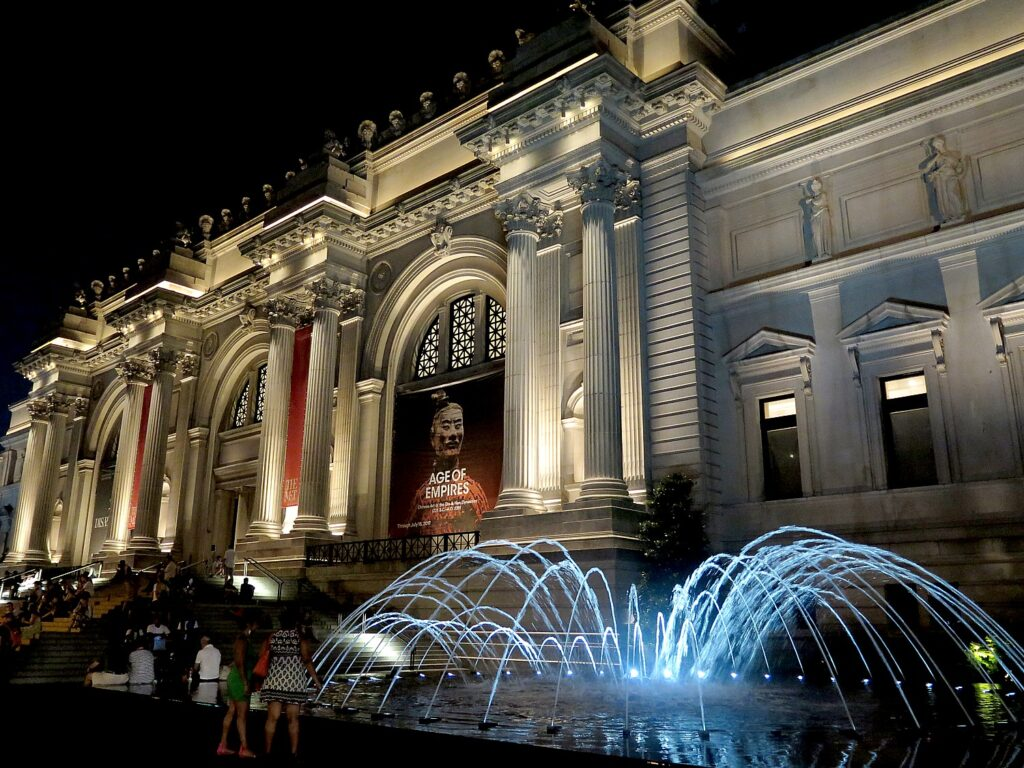
Time-Traveling through Strasbourg in France’s Alsace-Lorraine

The spectacular panoramic view of Le Petit France from the terrace atop Vauban Dam © Karen Rubin/goingplacesfarandnear.com

By Karen Rubin, Travel Features Syndicate, goingplacesfarandnear.com

Staying over in the historic city of Strasbourg in France’s Alsace-Lorraine region, means that you can go out in the early morning, before the daytrippers crowd the streets, and soak in the atmosphere.

A cyclist rides through the Tanners Row, empty of people in the early morning © Karen Rubin/goingplacesfarandnear.com

I walk through Tanners Row, which in this early morning hour, is peaceful. A guy on a bike rides through, a reminder that this is still a neighborhood, a community.

I go to explore Strasbourg’s Les Ponts Couverts and the Vauban Dam, located a short distance from each other.

Strasbourg’s Les Ponts Couverts © Karen Rubin/goingplacesfarandnear.com

Les Ponts Couverts (covered bridges) are three bridges spanning the River Ill, dominated by three imposing square towers, vestiges of the 13th-century city walls. A bit further, there’s a fourth tower nicknamed “the executioner’s tower.”

While I fruitlessly look for covered bridges, I finally realize that they were replaced in 1865 by these stone bridges without a roof (so not covered),where I am standing. As I observe the beautiful views from the bridge, a fellow tells me you can walk on the Panoramic Terrace on top of the Vauban Dam – in fact, the views from there are spectacular.

Statues stored in a cell within the Vauban Dam © Karen Rubin/goingplacesfarandnear.com

A short walk from the bridge is the Vauban Dam. “The Great Lock” was built between 1686 and 1700 based on plans of Louix XIV’s military engineer, Vauban. Built with 13 arches, it was constructed so that they could flood part of the city to defend against an enemy attack.  It is fascinating to walk through – some sculptures just hanging about gathering cobwebs – but most marvelous is a rooftop terrace, laid out in 1965, which you can walk over for a spectacular panoramic view of the old city.

Looking out from the interior of the Vauban Dam © Karen Rubin/goingplacesfarandnear.com
 

From here, you can see the fingers of the River Ill coming together below you. (Pro tip: though amazing to see in the morning light, you are looking into the sun – the reflections on the water are amazing – but check it out in the late afternoon.)

The view of Le Petit France from the terrace atop Vauban Dam © Karen Rubin/goingplacesfarandnear.com

Palais Rohan

One of the many jewels of Strasbourg is the Palais Rohan. Constructed between 1732 and 1742 from blueprints by Robert deCotte, First Architect to the King, it was built for Cardinal Armand-Gaston de Rohan-Soubise, Prince-Bishop of Strasbourg, modeled after Paris’ grand mansions.

Palais Rohan was constructed between 1732 and 1742 from blueprints by Robert deCotte, First Architect to the King, modeled after Paris’ grand mansions.© Karen Rubin/goingplacesfarandnear.com

Following the French Revolution, the palace became the Emperor’s royal residence, and after 1870, a museum. Today, the Palais Rohan houses three stellar museums: the Archeological Museum, the Museum of Decorative Arts and the Fine Arts Museum – just walking through the palace to the various rooms where the exhibits are displayed is a phenomenal experience.

(I have to rush through in the couple of hours before I need to get to the Regent Petit France Hotel where we are getting picked up for the European Waterways canal cruise aboard the Panache. It would have been better to have four hours.)

The art and artifacts are gorgeously presented in an exquisite palace. Definitely follow the helpful “My First Visit…” brochures which detail where to find the highlights.

The Museum of Decorative Arts is set in the historical royal apartments in the Palais Rohan, today with the juxtaposition of a modern art exhibit © Karen Rubin/goingplacesfarandnear.com

The Museum of Fine Arts presents a fascinating overview of European painting up to 1870. Located on the first floor of the Palais Rohan, the museum offers a tour through the centuries and schools: Italian and Flemish Primitives (Giotto, Memling); Renaissance and Mannerism (Botticelli, Raphael, Veronese, Lucas de Leyde, El Greco); Baroque, Naturalism and Classicism in the 17th and 18th centuries (Rubens, Vouet, Zurbarán, La Belle Strasbourgeoise de Largillière, Canaletto, Tiepolo, Goya); 19th century (Delacroix, Chassériau, Corot, Courbet). 

Among the highlights is La Belle Strasbourgeoise, from 1703, a portrait of a woman from one of Strasbourg’s important families in the time of Louis XIV with her imposing two-cornered hat in black lace, painted by one of the best portrait painters of the time, Nicolas de Largilliere. Though the woman has never been identified, the painting has become a symbol of the museum, much as the Mona Lisa is to Le Louvre.

Museum of Decorative Arts is set in the historical apartments – so you visit the chambers of the King and the Bishop-Prince, with exceptional examples of “the princely style of life under the monarchy.” It continues into the wing of the old stables with a tour of rooms housing decorative arts collections tracing the diversity and development of applied arts in Strasbourg from 1681 to 1870 – world-famous Hannong ceramics, furnishings, sculpture and paintings, timepieces, metalwork, silver and goldsmith art, and a selection of mechanical toys from the Tomi Ungerer Foundation.

The Museum of Decorative Arts is set in the historical royal apartments in the Palais Rohan, today with the juxtaposition of a modern art exhibit © Karen Rubin/goingplacesfarandnear.com

The most interesting section is the Chamber of the Bishops – the suite of rooms forming the King’s apartments. Originally, there would have been portraits of bishops but in 1793, the paintings were burned by revolutionaries who replaced them with allegorical figures of the Civic Virtues, which is what we see today. One of the paintings dates from the First French Empire and displays the monogram of Napoleon I and the Empress Josephine.

Louis XV is said to have slept in this bedchamber during his visit to Strasbourg in 1744 and Marie -Antoinette in 1770 © Karen Rubin/goingplacesfarandnear.com

Among the notable occupants of the King’s bedchamber were Louix XV, himself, who stayed here in October 1744, and the Daughines Marie-Josephe de Saxe in 1747 and Marie-Antoinette in 1770. The wood paneling is among the masterpieces of the French Rocaille style. Elaborately stylized shell-like, rock-like, and scroll motifs, Rocaille is one of the more prominent aspects of the Rococo style of architecture and decoration that developed in France during the reign of King Louis XV (1715–74).

Here, there is a disorienting melding of the old with the new: You go through the Royal Suite – bedchamber, Assembly Room which have been complemented with anachronistic modern art displays.

In the Decorative Arts Museum in the Palais Rohan, a room full of fascinating clockworks, including a cock clock and an astronomical clock, designed in the 16th century © Karen Rubin/goingplacesfarandnear.com

Seeing my interest, the guide directs me to a room with clockworks – the cock clock originates from the first astronomical clock dating from the 14th century of the Strasbourg Cathedral; in the center of the room are parts of the second astronomical clock designed in the 16th century by mathematician Conrad Dasypodius.

I visit a room that originally was the Prince-Bishops’ bedchamber, but when it was refurbished in the Imperial period, the bedchamber became Emperor Napoleon’s Morning Room and the antechamber of the Prince-Bishop became a small dining room. The decoration was damaged during bombing in 1944.

Emperor Napoleon’s Morning in the Palais Rohan © Karen Rubin/goingplacesfarandnear.com

The entire Palais Rohan is an exhibit of decorative arts – it was built by Armand Gaston, Prince de Rohan Soubise, Bishop of Strasbourg from 1704-1713 who initiated the work. He wanted a building in the style of the Chateau at Versailles and commissioned plans from the King’s chief architect, Robert de Cotte. Construction, decoration and furnishing lasted from 1732-1742.

Archaeological Museum, the oldest of Strasbourg’s museums, was founded in the 18th century. It is fabulous. Housed in the basement of the Palais Rohan, the diversity and wide chronological range of the artifacts on display make it one of the most important archaeological museums in France.

The Archaeological Museum in the Palais Rohan has burial sites from the Bronze and Iron Age© Karen Rubin/goingplacesfarandnear.com

The Archaeological Museum has fascinating exhibits that date back, remarkably, from 600,000 BC through the early Middle Ages (800 A.D.) You get insights into the daily life of Paleolithic hunters and the first neolithic farmers, Bronze Age and Iron Age burials, the everyday life of Gallo-Romans, and jewelry and weapons unearthed from Frankish and Atamanic graves.

Among the highlights in the The Archaeological Museum in the Palais Rohan is this chariot for traveling through the world of the dead © Karen Rubin/goingplacesfarandnear.com

Among the highlights: A chariot for traveling through the world of the dead, taken from tombs of Celtic princes from the Iron Age (750 BC-050 BC). And you can see the oldest tool in Eastern France – a chopper made of rock used for slicing or scraping, that was found at Achenheim and dated about 600,000 B.C. There is also a funeral headstone of a Gallo-Roman farming couple wearing their everyday clothes, that dates from the late 3rd Century A.D.

Palais Rohan, 2 place du Chateau Strasbourg, +33 (0) 3 68 98 50 00, www.musees.strasbourg.eu.

Musée Historique de la Ville de Strasbourg

After returning from the canal cruise aboard the Panache and before taking the afternoon train back to Paris, I find my way down this really colorful street off Cathedral Square (that’s saying something in Strasbourg) to the Historical Museum of the City of Strasbourg. It is also not to be missed (and try to see early in your visit).

The Musée Historique de la Ville de Strasbourg is housed in what once was the Grande Boucherie (slaughterhouse) © Karen Rubin/goingplacesfarandnear.com

You wouldn’t believe that the museum, founded in 1920, is housed in what was the Grande Boucherie (the city’s slaughterhouse) built 1587-1588; it was renovated and reopened in 2013.

Entering the Musée Historique de la Ville de Strasbourg is like entering a time machine that transports you to exciting, dramatic periods of France’s history: Gutenberg’s printing press and the rise of a printing/publishing industry in Strasbourg, and what that meant. The French Revolution. The 1870 Commune Revolt. World War I. The Nazi Occupation and resistance. The museum offers an engaging tour lets you discover nine centuries of Strasbourg’s existence through 1700 works on display –paintings, artifacts, possessions – and interactive and digital devices.

Strasbourg was a free city of the Empire, which meant it had its own walls and enjoyed the privilege of holding a market and minting its own coins. Strasbourg did not take an oath of loyalty to the sovereign and did not owe the sovereign taxes or military, except for an escort for his coronation. Such a “free city” was rare. On this basis, Strasbourg had an independent constitution that was considered highly democratic by the standards of the day.

A display of Jewish ritual objects on view in Strasbourg’s City Museum. Jews were expelled from the city in 1388. © Karen Rubin/goingplacesfarandnear.com

However, among those excluded from burgher status were servants, the poor and Jews, who were massacred in 1349, and after 1388, the survivors were denied the right to live in Strasbourg. The only activity Jews could lawfully engage in was usury (money lending), and certain trades. They could pursue these occupations in the city by day but had to leave in the evening. There is a moving display showing Jewish ritual objects (and as I had seen at the Musee de l’Oeuvre Notre Dame, a collection of Jewish tombstones).

There is an excellent display about Gutenberg, who developed his printing process in Strasbourg between 1434 and 1444 (legend has it he was inspired by seeing a wine press), then returned to his hometown of Mainz where he published his first printed volume in 1454. Gutenberg’s technological revolution spread with lightning speed. In Strasbourg some dozen printing houses sprang up between 1460 and 1480. The first publications were religious books (bibles) , classical texts and calendars.

Johannes Gutenberg is said to have invented his printing press in Strasbourg, which became a major center for printing and publishing © Karen Rubin/goingplacesfarandnear.com

The invention of printing, arbitrarily dated 1440, was celebrated in Mainz (as of 1837) and in Strasbourg, which raised the statue by David d’Angers honoring Gutenberg in 1840 (the statue we see today in Place de Gutenberg).

In the early days, printing was used to diffuse knowledge as well as criticism of the Church and of society in general. But authorities soon started printing decrees. In Strasbourg, the population was divided into six social classes – the first included servants and unmarried women; second class were day workers; third class were gardeners, and up to the sixth class, representing nobles, the Magistrate and jurists.

Laws promulgated by the municipality from 1531 onwards touched every aspect of life – religion, education, marriage, burial, use of inns, dress, begging, Jews, financial matters, games, behavior in the street, defamation, publishing.

One could say that the printing press enabled the “Rule of Law”.

Historical paintings of Strasbourg are on view in the City Museum © Karen Rubin/goingplacesfarandnear.com

It is fascinating to travel through time – through the Imperial period, the French Revolution, the Commune, the back-and-forth between being part of France and the German Empire, World War I, World War II and Nazi occupation.

I learn that 22 Novembre – the name of a main boulevard where my hotel, the Hannong, is – was the date in 1918 when the French Army entered Strasbourg. “For President Poincare, the enthusiastic reaction of the population was equivalent to a plebiscite. French became compulsory in schools and the civil service. Strasbourg, the regional capital, had to re-adapt to the French system of departments. Religion, important in both educational and political terms, had to make concessions to the secular state.”

The extensive exhibits focused on the World War II period are intense.

In July1940, once Petain had signed the armistice, Alsatians were encouraged by the Vichy regime to return to their homes – exceptions were Jews, “Francophiles” and French civil servants (30% of the population) – their property was seized, and what followed was “Germanization” of the population (again, since Alsace had gone back and forth between Germany and France).

In November 1944, Strasbourg was liberated from the Germans by General LeClerc. Strasbourg was bombed by both Allies and by Germans after being liberated in 1944.

The European Union was founded in 1992 – three of its institutions are based in Strasbourg: the European Parliament, the European Mediator and the Schengen Information Service.

“A day will come when war will seem as absurd and as impossible between Paris and London, St. Petersburg and Berlin, Vienna and Turin, as today it would be impossible and seem absurd between Rouen and Amiens, Boston and Philadelphia,” Victor Hugo said in the inaugural speech at the Congress for Peace, Paris, August 21, 1849.

I don’t even remember how many hours I spent here – the displays are really captivating.

(Information and portal to collections: https://en.musees.strasbourg.eu/museums)

Strolling around the historic district of Strasbourg to take in the fabulous architecture and ambiance takes on new dimension after visiting the City’s museum of history © Karen Rubin/goingplacesfarandnear.com

More information at https://www.strasbourg.info and https://www.visitstrasbourg.fr.

Next: Stepping into the Storybook that is Colmar

See also:

DISCOVERING STRASBOURG FRANCE’S CULTURAL RICHES

_______________________

© 2024 Travel Features Syndicate, a division of Workstyles, Inc. All rights reserved. Visit goingplacesfarandnear.com and travelwritersmagazine.com/TravelFeaturesSyndicate/. Blogging at goingplacesnearandfar.wordpress.com and moralcompasstravel.info. Visit instagram.com/going_places_far_and_near and instagram.com/bigbackpacktraveler/ Send comments or questions to FamTravLtr@aol.com. Tweet @TravelFeatures. ‘Like’ us at facebook.com/NewsPhotoFeatures 
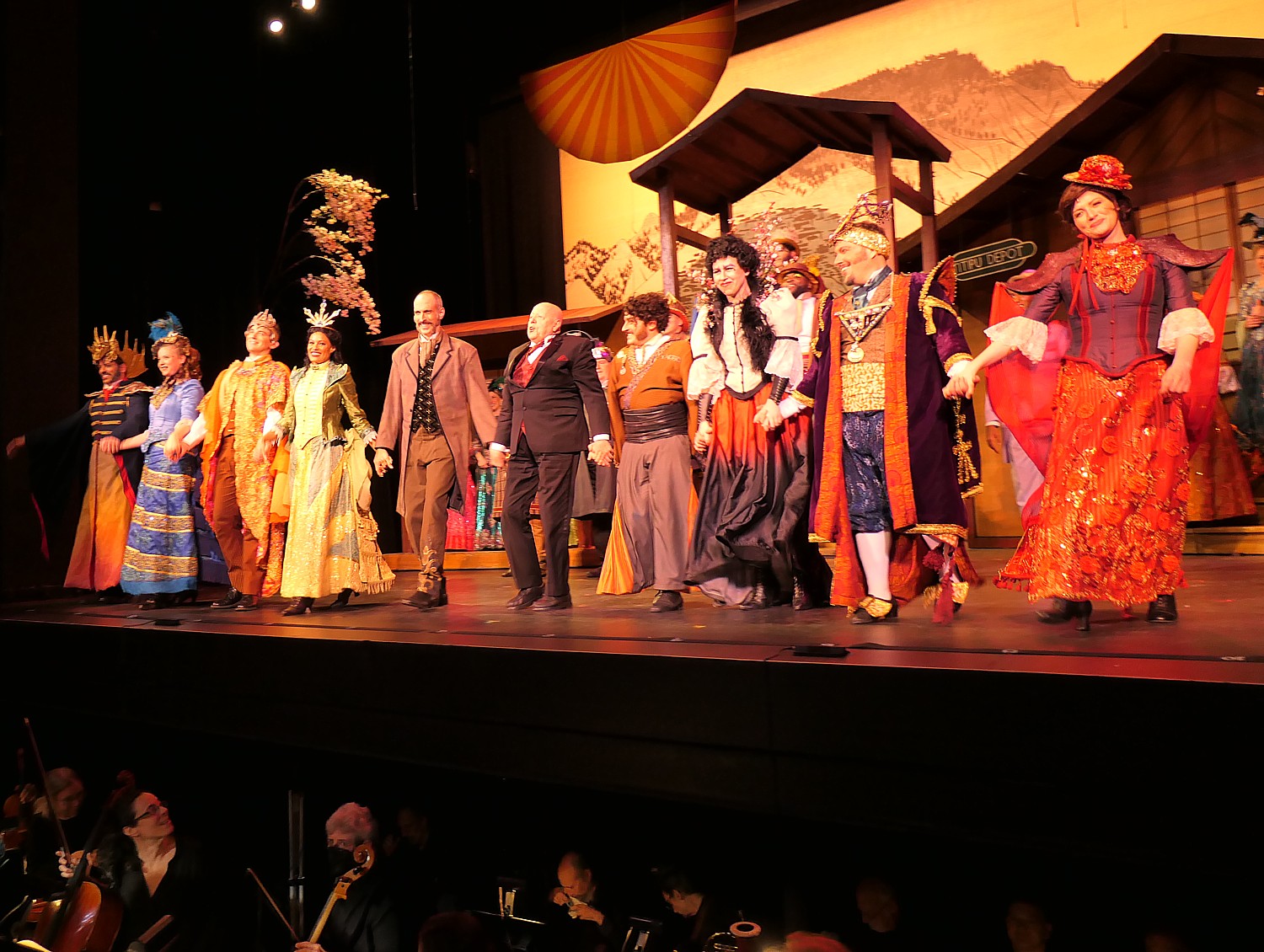
Discovering Strasbourg France’s Cultural Riches

Strasbourg, France’s Notre-Dame Cathedral, as seen through the windows of Musee de l’Oeuvre Notre Dame © Karen Rubin/goingplacesfarandnear.com

By Karen Rubin, Travel Features Syndicate, goingplacesfarandnear.com
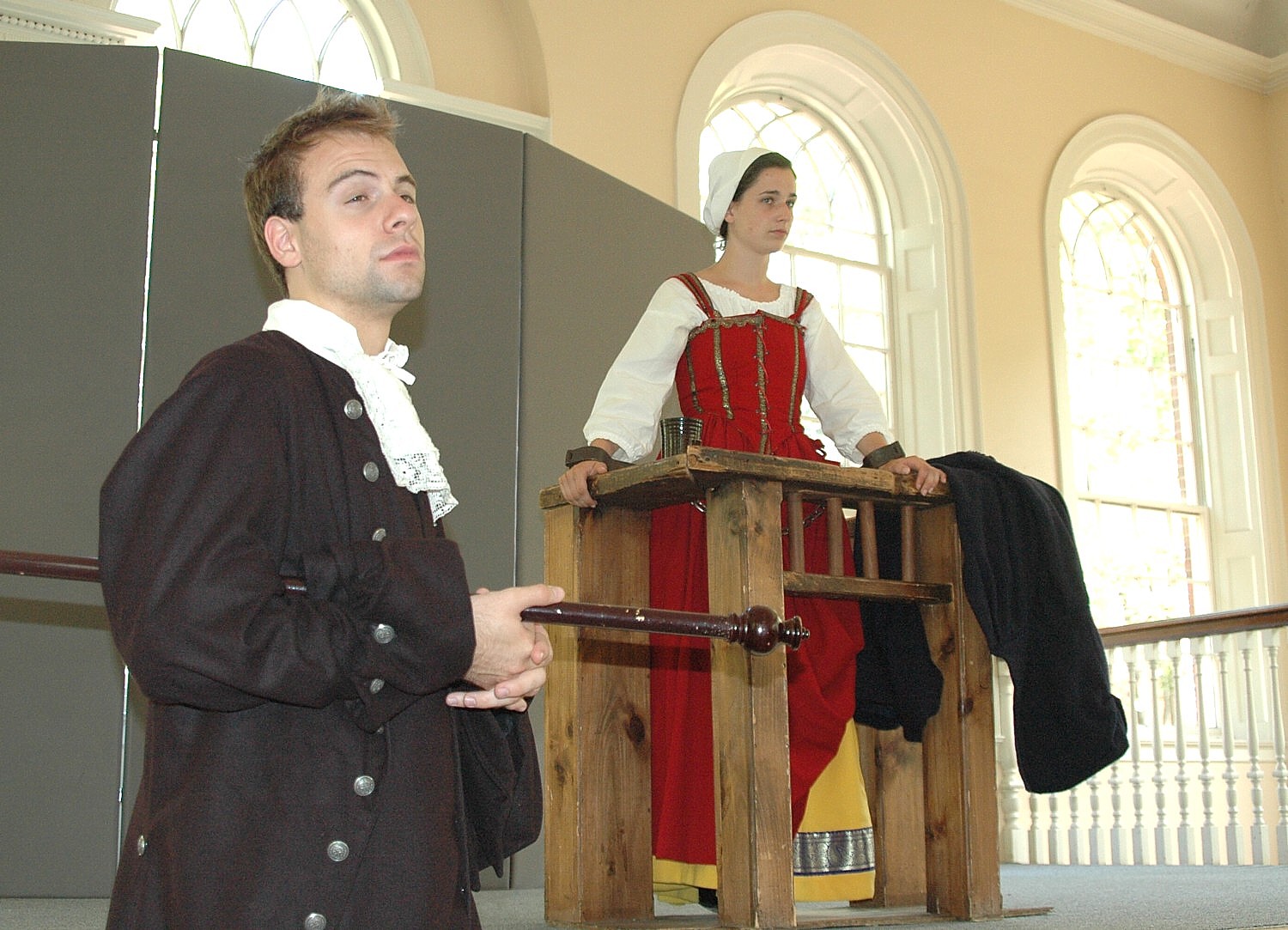
I’ve come to Strasbourg, France, for a European Waterways canal cruise through the Alsace Lorraine on its luxury hotel barge, Panache. It is my practice now when connecting with a cruise or bike tour, to arrive at least a day early, especially when you have the opportunity to overnight in such a charming historic city as Strasbourg. That way I don’t have to worry about flight or weather delays and I can experience the destination in the morning and evening light, in peace and calm without the daytrippers, and have the time to really explore, discover and become immersed in its cultural riches.

The TGV train from Paris to Strasbourg © Karen Rubin/goingplacesfarandnear.com

The TGV train ride was absolutely gorgeous. (Less than two hours from Paris, you go from Charles de Gaulle Airport into the Gare de Nord, then take an easy 15 minute walk to Gare L’Est – glad I pre-purchased my train ticket and reserved seat on raileurope.com). It is surprising to see how soon out of the bustling metropolis you are in pastoral countryside. We whisk passed solar arrays, wind turbines, cows in pasture, and see traditional villages at the far end of fields. It’s cinematic.

Leaving Paris for Strasbourg by train, you are soon in the pastoral countryside © Karen Rubin/goingplacesfarandnear.com

And I still get into Strasbourg in the afternoon with plenty of time to explore.

There is much to experience in Strasbourg and I will actually have part of four days here. We will be picked up in Strasbourg on the first afternoon and taken to Krafft to board  the barge hotel, Panache, and actually cruise back into Strasbourg on its first full day when we will have a walking tour and overnight on the canal. I will have much of a full day again at the end of the cruise, when we are delivered back to Strasbourg from Niderviller, before I take the train to Paris. I do a calculation and decide on my only full day in Strasbourg, after exploring the old city in the early morning, to hop on the train for a 45-minute ride to see Colmar, and still get to enjoy Strasbourg’s beauty at night.

Hotel Hannong is perfectly situated, walking distance to Strasbourg’s historic sites © Karen Rubin/goingplacesfarandnear.com

I must say I am clever about seeing Strasbourg, beginning with choosing a charming boutique hotel, the Hannong, which I find on hotels.com, right in the historic district and walking distance from the train station, so walking distance to everything I want to see, even walking back late at night. I am able to book a room ideal for a single person (it’s as big as a walk-in closet but has everything I need) for a very attractive rate. The pleasant stay, hospitable staff, and location add immeasurably to the way I experience Strasbourg and make the best of my time. (Hotel Hannong, 15, Rue du 22 Novembre,67000 Strasbourg, +33 03 88 32 16 22, hotel-hannong.com).

Strasbourg’s old city © Karen Rubin/goingplacesfarandnear.com

So when I arrive, I  find my way to the Hotel Hannong (I’m disoriented and finally find someone to point me in the right direction (I’ve already downloaded directions but I don’t have internet), I drop my bag and go off to immerse myself in the old city’s charm.

Strasbourg’s picturesque Le Petit France is a UNESCO Heritage Site © Karen Rubin/goingplacesfarandnear.com

It’s just a couple of blocks to where Le Petit France begins, and I wander the narrow cobblestone streets, over bridges over the River Ill, where every turn reveals a picturesque scene of quaint quays and colorfully timbered structures from the Middle Ages, reflected in the blue water. The River Ill, which divides into five arms, is what spurred the construction of mills and the installation of tanneries centuries ago.

The Tanners district in Strasbourg’s Le Petit France dates from 1572 © Karen Rubin/goingplacesfarandnear.com

So charming and tranquil today, even with the crowds of tourists in midday, Le Petit France, a UNESCO World Heritage Site, in its day would have been the stinkiest, filthiest, poorest part of town, inhabited by tanners, fishermen, and animals, but as you get closer and closer to fabulous Cathedral, the residences become nicer and fancier and is where the wealthiest merchants and officials would have lived.

Strasbourg’s picturesque Le Petit France is a UNESCO Heritage Site © Karen Rubin/goingplacesfarandnear.com

I come upon Place Gutenberg with a striking monument created by David d’Angers (1788-1856), erected in 1840. It commemorates that the German inventor Johannes Gutenberg developed moveable type that revolutionized access to the Bible, news, information, books, and even the law to the masses, while living in Strasbourg from 1430-1440, spawning an entire printing and publishing industry based in Strasbourg. The bronze statue stands on a granite base with four fascinating bronze relief panels that commemorate that Gutenberg came upon his idea for moveable type inspired by how a wine press worked, and how his invention influenced every corner of the globe.

The statue for Johannes Gutenberg in Strasbourg’s Place Gutenberg © Karen Rubin/goingplacesfarandnear.com

One of the reliefs, “Detail of America,” depicts Benjamin Franklin and other signatories to the Declaration of Independence along with other famous liberators including General Lafayette and Simon Bolivar. Another, “Africa,” portrays Wilberforce and other abolitionists bringing freedom and enlightenment to the slaves. The third relief, “The Printing Press in Europe,” portrays important figures of the Enlightenment –  Erasmus, Chaucer, Milton, Molière, Rousseau, Voltaire, Kant and Schiller (the original plaster panel, which gave prominence to Martin Luther, caused an uproar, I learn).  The Asian panel is more weathered, but includes Brahmans exchanging manuscripts for books, and Chinese people reading Confucius

Strasbourg’s Guttenberg Plaza © Karen Rubin/goingplacesfarandnear.com

In this plaza, there is also an old-timey Carrousel 1900 that is a delight in the day, enchanting at night.

A traditional Punch & Judy show © Karen Rubin/goingplacesfarandnear.com

When I get to St. Thomas Church, I come upon an outdoor Punch & Judy puppet show, which traces back to Commedia dell’arte tradition in Italy in the 1660s. (I’m not a fan of the too accurate re-creation of its traditional slapstick humor and the tragicomic misadventures of the characters but the kids love it.) 

Families enjoy the traditional Punch & Judy show © Karen Rubin/goingplacesfarandnear.com

Notre-Dame Cathedral of Strasbourg

The Notre-Dame Cathedral of Strasbourg dominates the city, in fact the entire region since it can be seen from great distances. Cathedral Square is a vibrant hub of musicians, vendors, and is ringed with some of the most important sites in the city – reminiscent of St. Marks Square in Venice. I will visit multiple times, and in the course of my visit, experience most of the important sites around the Cathedral. The streets that radiate from it are also full of colorful activity.

Chasing bubbles in Cathedral Square © Karen Rubin/goingplacesfarandnear.com

Construction of the Cathedral started in 1015, but came into its own as a monumental Gothic structure in the 1260s because of Erwin von Steinbach who designed the Cathedral to be the most modern building of its time in the whole of the Holy Roman Empire. It is still one of the most beautiful examples of Gothic architecture in the world. The hundreds of statues that decorate the Cathedral are incredible.

Strasbourg, France’s Notre-Dame Cathedral © Karen Rubin/goingplacesfarandnear.com

Finally finished in 1439, the Cathedral, built of pink sandstone from the Vosges, features a 142-meter-tall bell tower, making it the tallest medieval building in all of Europe.
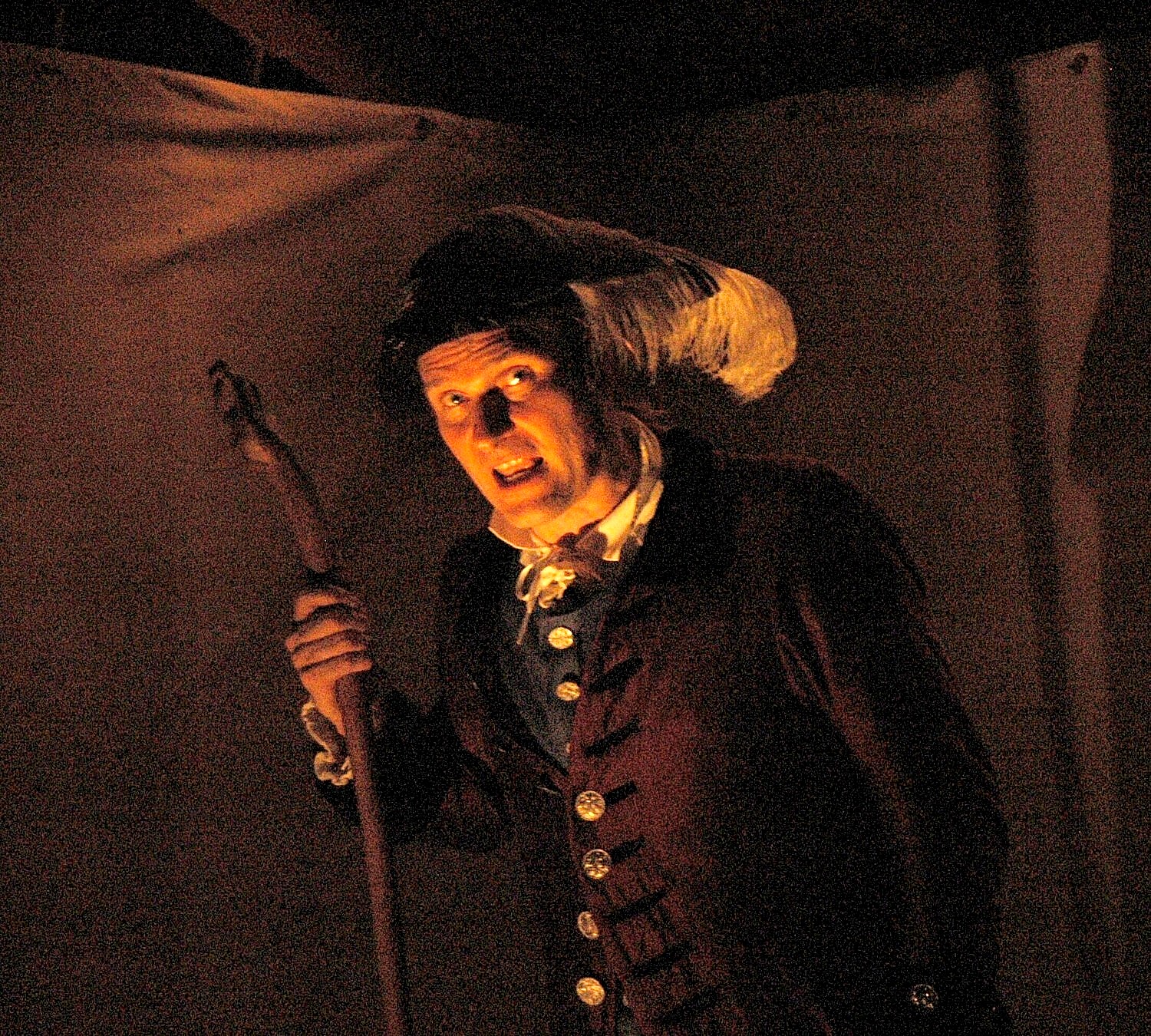
Strasbourg, France’s Notre-Dame Cathedral © Karen Rubin/goingplacesfarandnear.com

It is an imposing structure inside, as well, with 12th and 14th century Romanesque stained glass windows in mesmerizing geometric patterns. You can climb the 332 steps to the top of the bell tower for a spectacular view and explore an 11th century crypt below the main cathedral.

Strasbourg, France’s Notre-Dame Cathedral © Karen Rubin/goingplacesfarandnear.com

On Saturday night, after I have rested a bit after coming back from Colmar, I stroll out of the hotel to Cathedral Square for the 10-minute Illuminations de la Cathedrale de Strasbourg, a free laser light show which begins nightly at 10 pm and runs continuously until midnight (in July and August). I find the neon colors jarring, but I love when the white fluttering strobe light gives the Cathedral a ghostly quality.

Strasbourg, France’s Notre-Dame Cathedral during the Illumination © Karen Rubin/goingplacesfarandnear.com

Musee de l’Oeuvre Notre Dame

Just across the square from The Cathedral is the Musee de l’Oeuvre Notre Dame, an absolute must-see, where you walk through seven centuries of art in Strasbourg and the Upper Rhine. Its medieval and Renaissance collections show why Strasbourg is considered one of the most important artistic centers of the Germanic Empire from the 13th to 16th centuries.

At the Musee de l’Oeuvre Notre Dame, you see up close the stunning artistry of original statues that decorated the Cathedral © Karen Rubin/goingplacesfarandnear.com

During the 13th century, the construction of Strasbourg Cathedral produced some of the most exceptional sculptures of the medieval world. Many of them – such as The Church and the Synagogue statues on the south portal, and the west façade’s Tempter and the Wise and Foolish Virgins, the Virtues Crushing the Vices, and the Prophets – were removed from the edifice in the early 20th century to protect them from bad weather and pollution, and replaced by sandstone replicas. But here you see the original sculptures that decorated the Cathedral. To see them so close, life-sized, so you can really appreciate the artistry in a way you simply can’t by gazing up at the Cathedral, is astounding.

When I visit, the museum is featuring a virtual reality, augmented reality, holograms, videos and touch screens to situate the works where they had originally been set in the Cathedral.

In one grand room, I focus on the two sculptures known as “The Church and The Synagogue,” which I would not have known to look for, just walking about the Cathedral.

So much is embodied in these two statues, and why they were chosen: Positioned on either side of the south transept portal, the statutes of The Church and The Synagogue “each personify a covenant binding God to his people: the New Covenant of the Christian Gospel and the Old Covenant of the Jewish Torah, respectively,” the notes say.

Church Triumphant and The Synagogue Vanquished © Karen Rubin/goingplacesfarandnear.com

On the left, the Church Triumphant, “wearing a crown and holding in her hands a chalice and a banner surmounted by the Cross, fixes her self-assured gaze on the Synagogue. The vanquished Synagogue, blindfolded and holding a broken lance, averts her head, expressing her inability to recognize the messiah in the person of Jesus. She appears to let fall the tablets of the Law of Moses, symbolizing the supplanting of the Old Testament. But the extreme humanity and beauty of the young woman’s features suggest an awaited revelation rather than the stigma of blindness” [as if to suggest, Jews will come into Christianity’s fold].
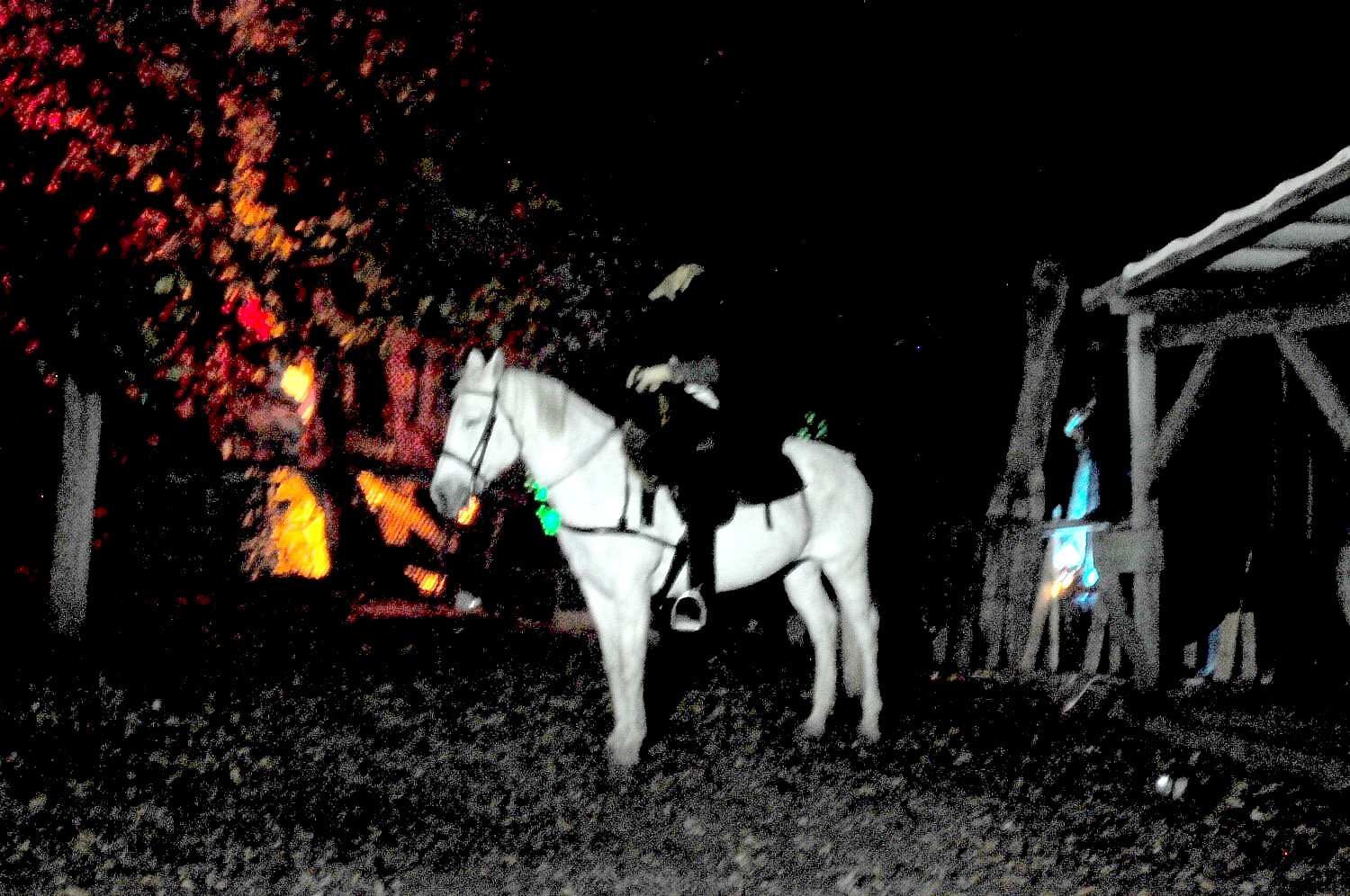
Now that I know where to look, later I go out to see the figures at the Cathedral.

Church Triumphant and The Synagogue Vanquished statues as they are position on the Cathedral’s south portal © Karen Rubin/goingplacesfarandnear.com

In front of these two statues is a relief representing the biblical episode of “The Sacrifice of Isaac” at the hand of his father Abraham. The notes do not mention that this event for Jews, established the covenant with God and Jews as the “Chosen People”.

A relief depicting Abraham’s near sacrifice of his son, Isaac © Karen Rubin/goingplacesfarandnear.com

Besides the statuary, there are incredible paintings, triptychs and religious art – some of the most magnificent in the world – as you walk from room to room, floor to floor.

Jewish tombstones on view at the Musee de l’Oeuvre Notre Dame. Jews were expelled from Strasbourg in 1349, during the Black Plague © Karen Rubin/goingplacesfarandnear.com

I follow an interior staircase all the way down and come to an interior courtyard in which tombstones rescued from a Jewish cemetery are displayed respectfully. The notes say that in 1349, Jews were expelled from Strasbourg because of Black Plague.

I climb the staircase to an attic room, where the innovations in architecture and engineering are explained. You also see some of the original architectural drawings of the Cathedral – the oldest architectural drawings of their type – as well as a video.

La Nativite de la Vierge. At the Musee de l’Oeuvre Notre Dame, you see works that show why Strasbourg is considered one of the most important artistic centers of the Germanic Empire from the 13th to 16th centuries.© Karen Rubin/goingplacesfarandnear.com

The museum is housed within La Maison de L’Oeuvre Notre-Dame, which has been the home of the Foundation of the Oeuvre Notre-Dame (the body responsible for administering work on the Cathedral) since the Middle Ages. It is actually two buildings: a Gothic house with its crow-stepped gable (1347) and a Renaissance wing with a scroll gable (1582). Just walking through the rooms is an experience.

Musee de l’Oeuvre Notre Dame is actually in two buildings: a Gothic house with its crow-stepped gable (1347) and a Renaissance wing with a scroll gable (1582) © Karen Rubin/goingplacesfarandnear.com

Fondation de l’Oeuvre Notre-Dame (Our Holy Lady Work Foundation) was established in 1224 (!!) to improve the administration of donations and legacies for the construction of Strasbourg Cathedral. Every since construction ended, the Foundation has been in charge of restoration and conservation of the monument, a UNESCO World Heritage site since 1988.

Plan on spending several hours wandering around this museum (I actually did it twice).

Musee de L’Oeuvre Notre-Dame/Aarts Du Moyen Age, 3 place duChateau, Strasbourg.

From here, I walk across the square to see the Church and Synagogue portal, before walking back through Cathedral Square (which reminds me of St. Marks Square in Venice) to the fabulous Palais Rohan.

Ancient: La Maison Kammerzell, built in 1467, and converted to Renaissance style in 1589, boasts exquisite carvings, with secular and religious themes, After refurbishing, it became a restaurant celebrated for its lavish frescoes painted by Leo Schnug © Karen Rubin/goingplacesfarandnear.com

What is so interesting (and fun) about Strasbourg is how the historic city seamlessly integrates – and respects – what is ancient and what is modern: the virtual reality in the Musee de L’Oeuvre Notre Dame, the neon laser lights that bathe The Cathedral for the nightly show, the modern art in Cathedral Square, the really modern art exhibit incorporated into the 18th century Royal Chambers of the Palais Rohan’s Decorative Arts Museum, the light rail that rings the Old City along cobblestone streets.

Modern: Strasbourg Museum of Modern and Contemporary Art in Strasbourg’s historic district © Karen Rubin/goingplacesfarandnear.com

So much to see, experience and appreciate. My exploration continues.

More information at https://www.strasbourg.info and https://www.visitstrasbourg.fr,

Next: Time Traveling Through Strasbourg

See also:

EUROPEAN WATERWAYS’ PANACHE HOTEL BARGE CRUISES FRANCE’S ALSACE-LORRAINE CANALS IN LUXURY

EUROPEAN WATERWAYS ALSACE-LORRAINE CANAL CRUISE: STRASBOURG’S CATHEDRAL, WINE TASTING ON ROUTE DES VINS

EUROPEAN WATERWAYS ALSATIAN CANAL CRUISE: MYSTERY OF THE NECKLACE IN SAVERNE, LALIQUE IN LUTZELBOURG

EUROPEAN WATERWAYS ALSACE-LORRAINE CANAL CRUISE: A BOAT GUILLOTINE, TWO TUNNELS AND A MONUMENTAL CHAGALL

_______________________

© 2024 Travel Features Syndicate, a division of Workstyles, Inc. All rights reserved. Visit goingplacesfarandnear.com and travelwritersmagazine.com/TravelFeaturesSyndicate/. Blogging at goingplacesnearandfar.wordpress.com and moralcompasstravel.info. Visit instagram.com/going_places_far_and_near and instagram.com/bigbackpacktraveler/ Send comments or questions to FamTravLtr@aol.com. Tweet @TravelFeatures. ‘Like’ us at facebook.com/NewsPhotoFeatures