Another
perfect day in Myanmar – our fourth and final day on Leg 3 of the Global
Scavenger Hunt, in which we set out from Yangon to travel about the country,
making a triangle that takes me to Bagan and Inle Lake and back to Yangon to
fulfill the Par 5 challenge on this a 23-day around-the-world mystery tour.
The
45-minute taxi ride from the delightful, five-star Sanctum Inle Resort on Inle
Lake is wonderful – I catch people driving oxcarts and donkey carts and people
riding the backs of trucks, villages and pagodas. But I have some trepidation
about Heho Airport because of the snafu in booking my ticket, resolved
long-distance by text to my son in New York to phone the online booking agent,
as I bounced around on the overnight bus from Bagan to Inle Lake. But I arrive,
am checked in to Golden Airlines without incident, and relax during the
45-minute flight back to Yangon.
The
morning flight gives me time to explore Yangon which I didn’t have when we
first arrived on Leg 3 of the Global Scavenger Hunt from Vietnam, and were
given our challenges, to travel around Myanmar and return to the Sule Sangri-la
Hotel by the 6 pm deadline.
Leaving
the airport, I attempt to take the public bus back into downtown, but after two
buses pass me by, I take a taxi instead.
Riding
back, I review a brochure I picked up at the airport which mentions a synagogue
in Yangon – in fact, the last synagogue in Myanmar. So I resolve to find it.
It
turns out it is only a 15-minute walk from our hotel, the Sule Sangri-la,
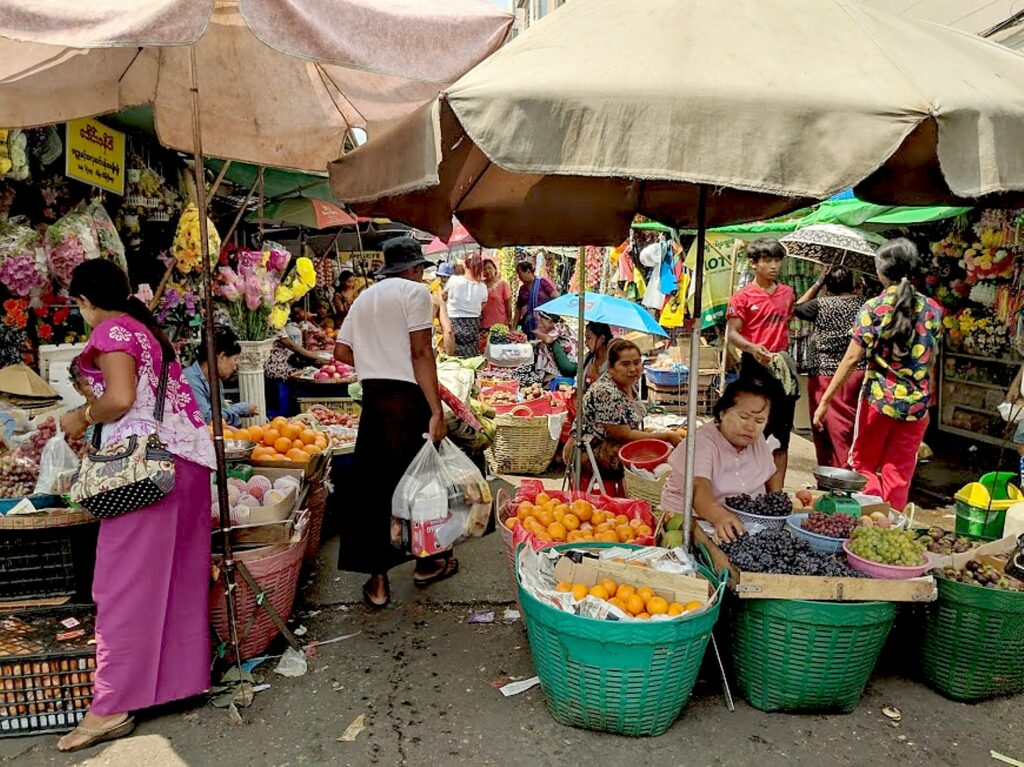
bringing me through various bustling market streets and shopping districts. The
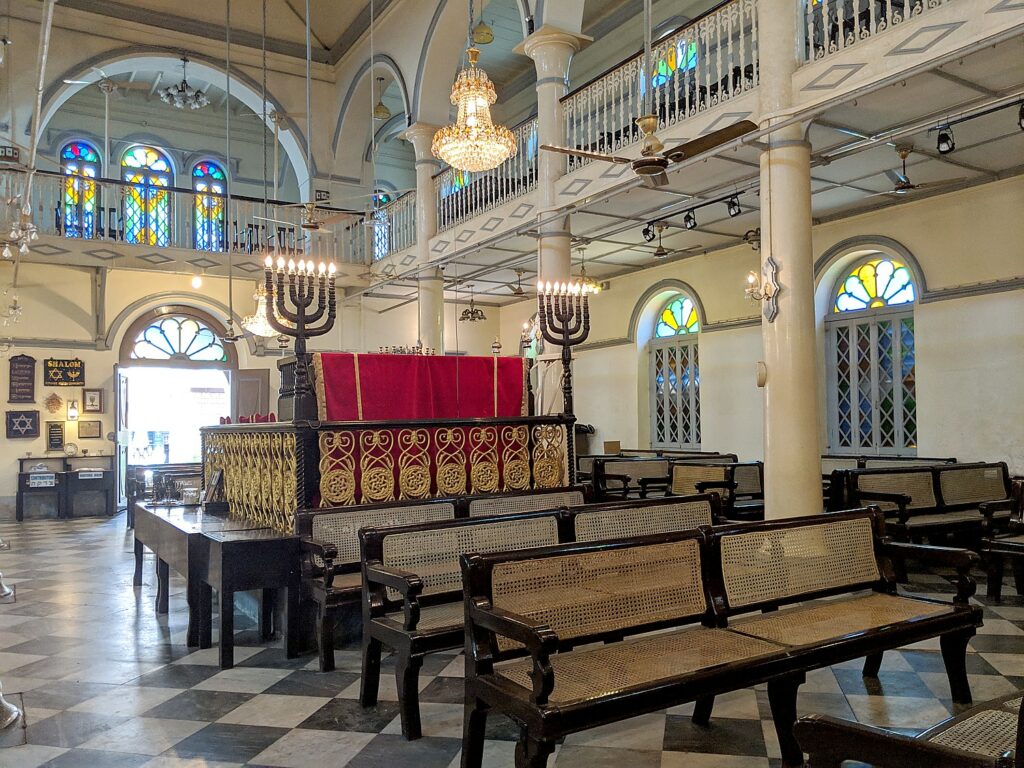
Musmeah Yeshua Synagogue itself is set on a busy market street where there are
chickens and fish for sale – the chickens clucking, the fish squirming to get
out of their container (I see one jump out of its container), the rich scent of
spices, and every other manner of item you can imagine.
By
the time I arrive at Musmeah Yeshua Synagogue, it is 1:40 pm – which proves
extremely lucky because it closes to visits at 2 pm (open daily except Sunday).
Inside, it is a lovely synagogue in the Sephardic style, built in 1896. At one
point, the Jewish community in Yangon numbered 2500 before the mass migration
of WWII; today, there are only 5 families (about 30 people). The Samuels, one
of the last remaining Jewish families, has maintained the synagogue for
generations, a plaque notes.
Perhaps
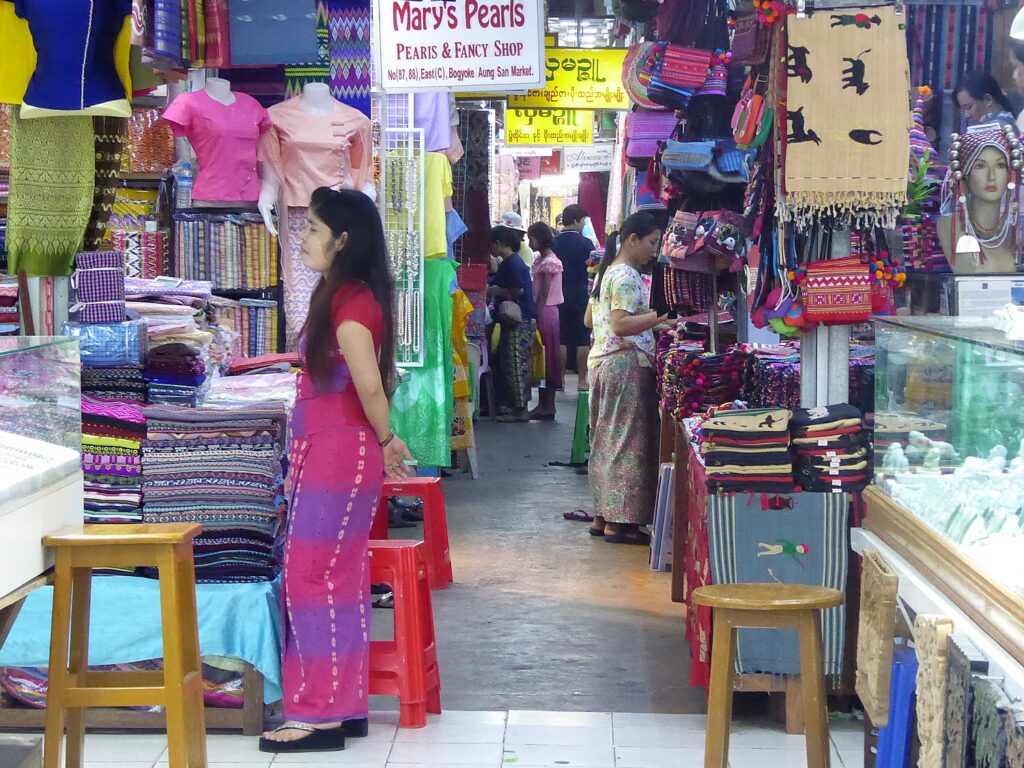
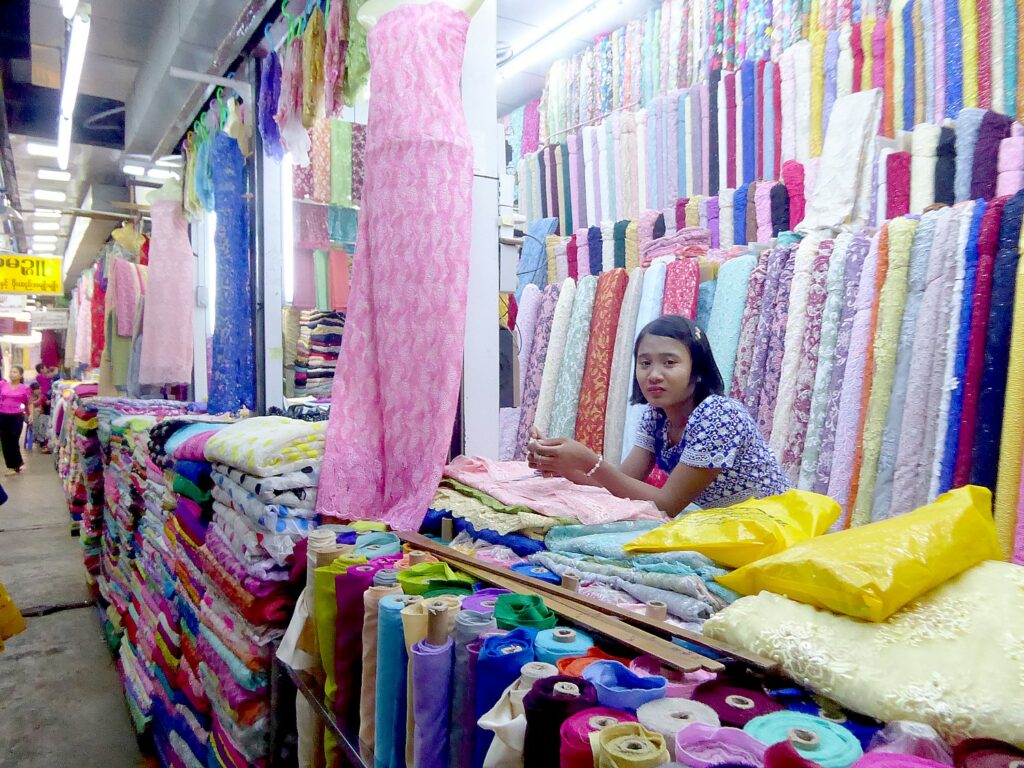
not surprising, a short distance from the synagogue is Bogyoke Aung San Market,
which since 1926 has been the city’s major marketplace. I am surprised to see
all the sellers of jade and jewelry (which is what the market is known for), as
well as traditional longyi, and just about anything else you can think of. I come
upon a seller of interesting post cards, and find the post office on the third
level (one of my traditions of travel is to send home postcards, which not only
have stamps, but mark the date and give some visual and personal notes). Also,
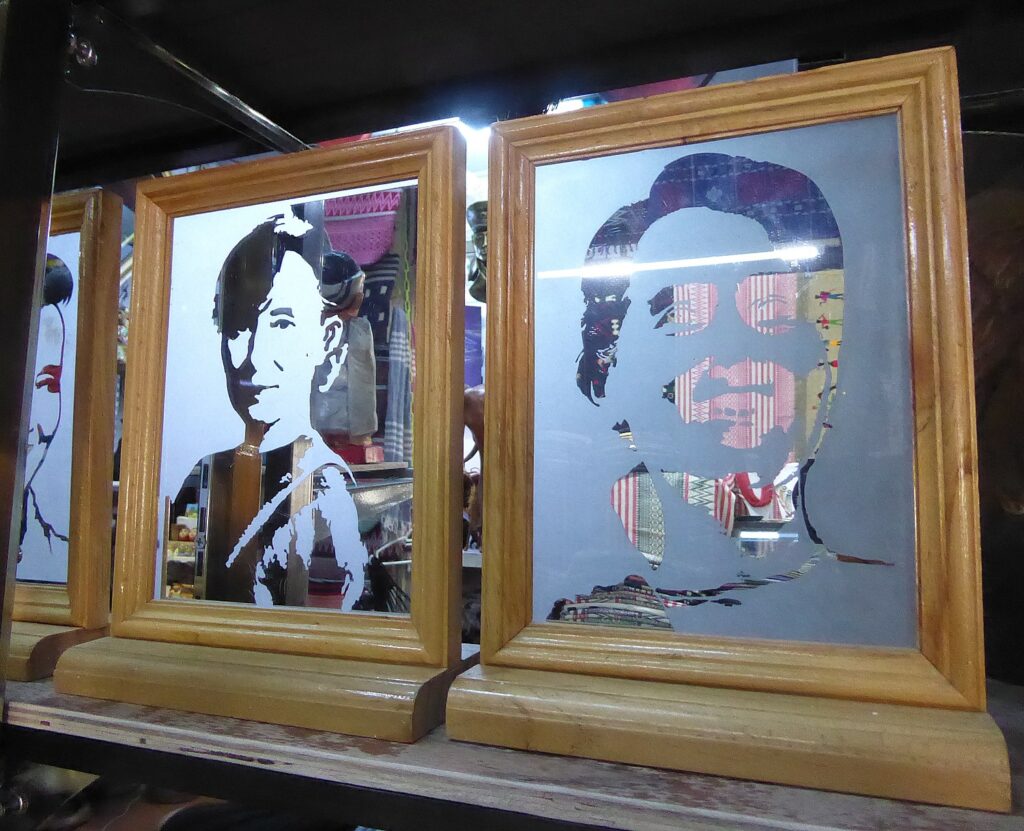
I have been impressed by the absolute lack of political messaging in the streets,
but here in the market is one art seller who has images of Myanmar’s most
famous leader, Aung San Suu Kyi. Wondering about the name, I later learn that Bogyoke
Aung San market is named for her father, Bogyoke (General) Aung
San.
I
walk back to the hotel, just a few blocks away, to refresh (it is 104 degrees),
in order to prepare for a visit to Shwedagon Pagoda, which I have been saving
for the late afternoon (one of the mandatory scavenges of the Global Scavenger
Hunt is to visit at dawn or dusk), so that I will be there at dusk (but back at
the hotel by the 6 pm deadline for the scavenges), but nothing could have
prepared me for the experience of seeing it.
Just
as I am about to leave, my teammate, Margo, who had traveled to Mandalay when I
went on to Inle Lake, walks in. She relates that after a snafu with her airline
ticket, she had to hire a taxi to drive her back to Yangon (ironic because I
couldn’t get the airline to cancel my ticket when I changed my plan to go to
Inle Lake instead, but such mishaps turn into marvelous adventures). We go off
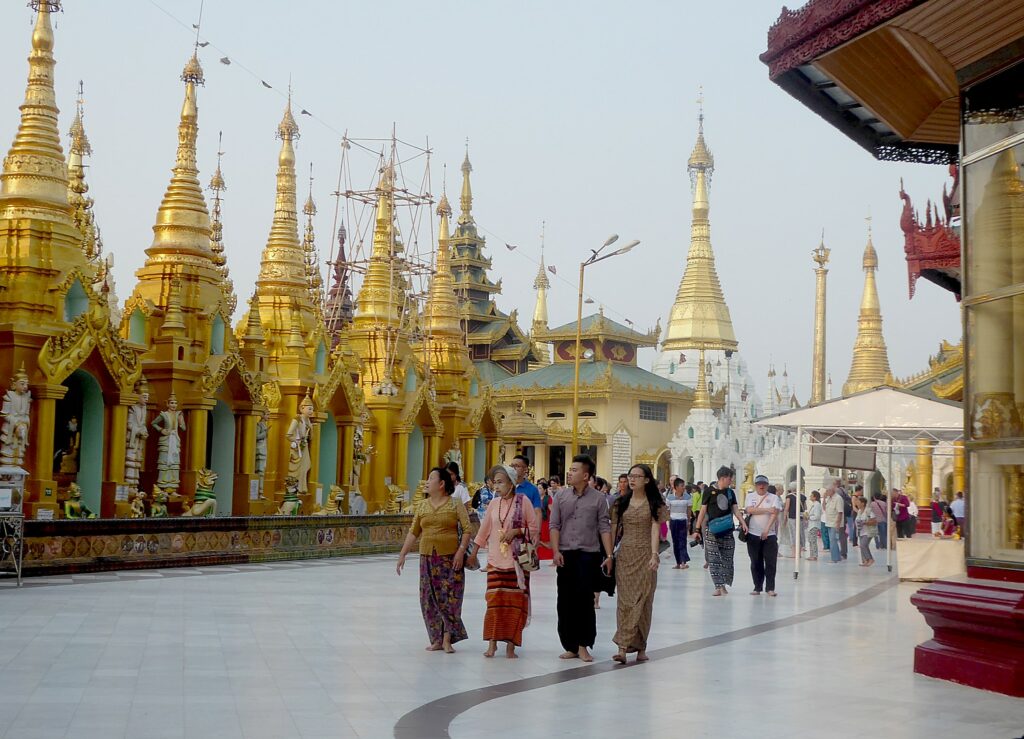
together to Shwedagon Pagoda, which is located west of the Royal
Lake, on the vast, 114 -acre Singuttara Hill.
Margo
cleverly hires a guide to show us around this vast, vast complex and it is
fascinating: this was the first pagoda in the world, he tells us.
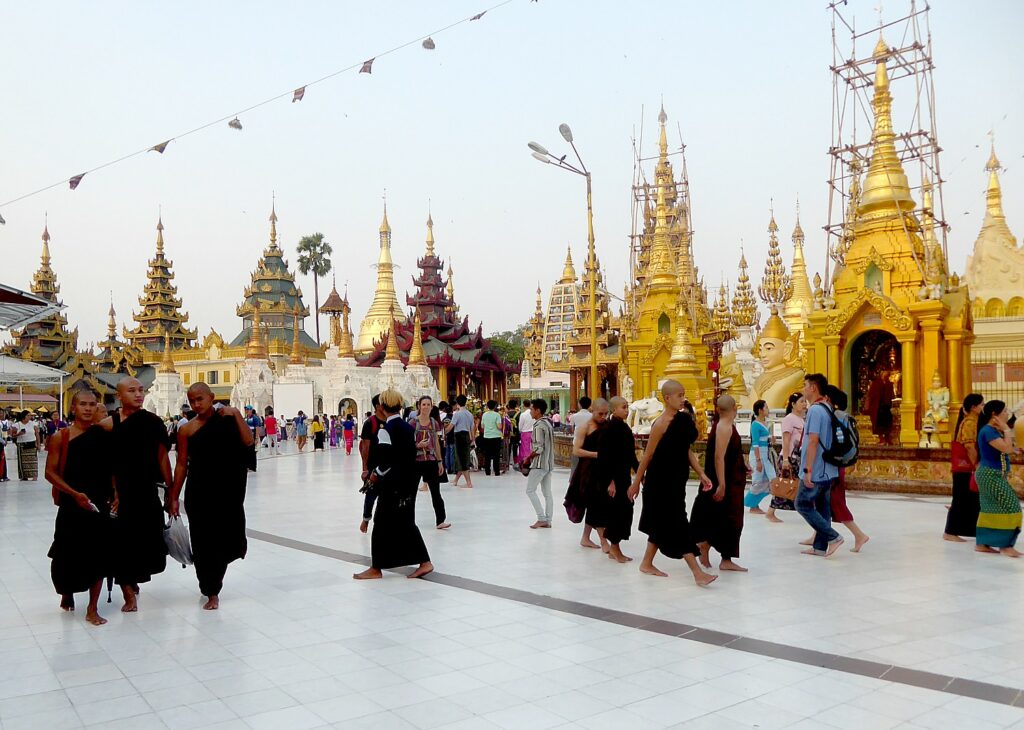
Indeed,
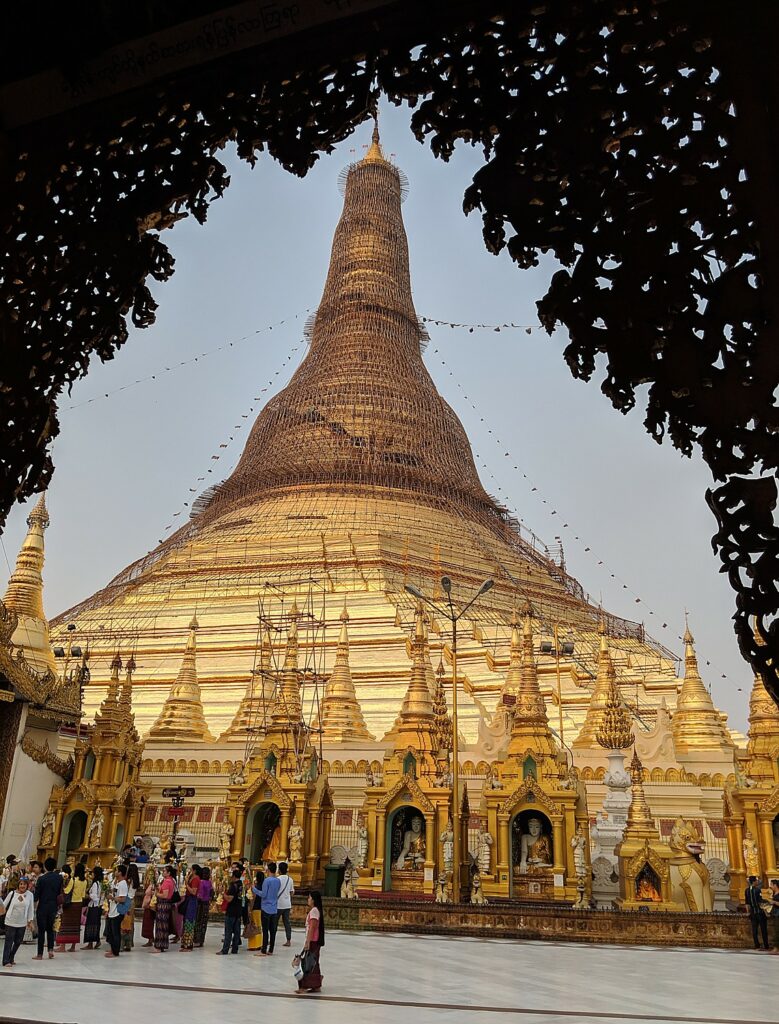
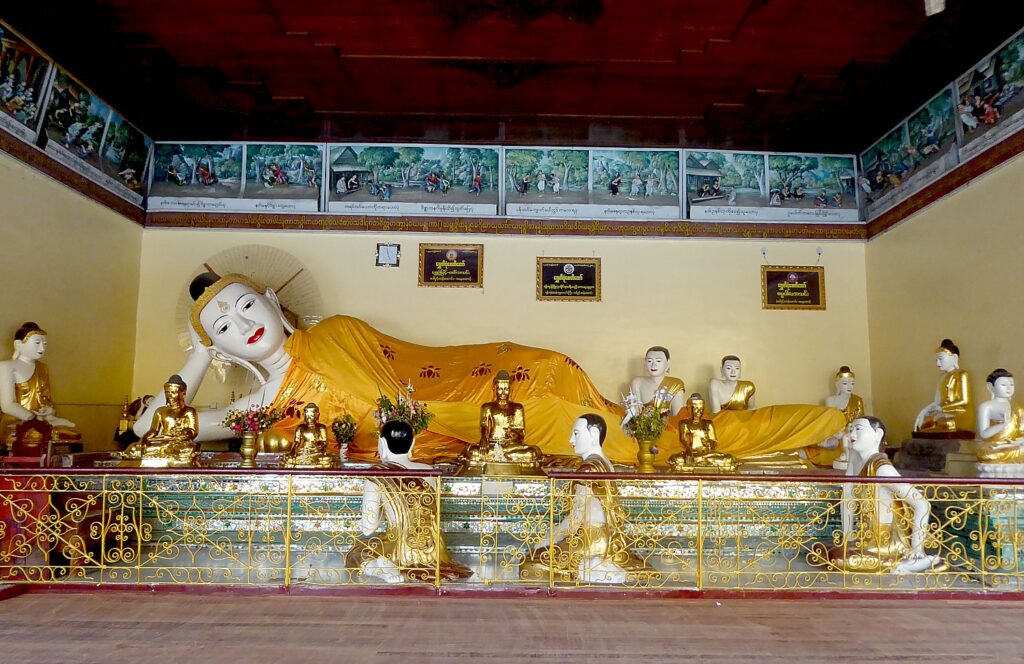
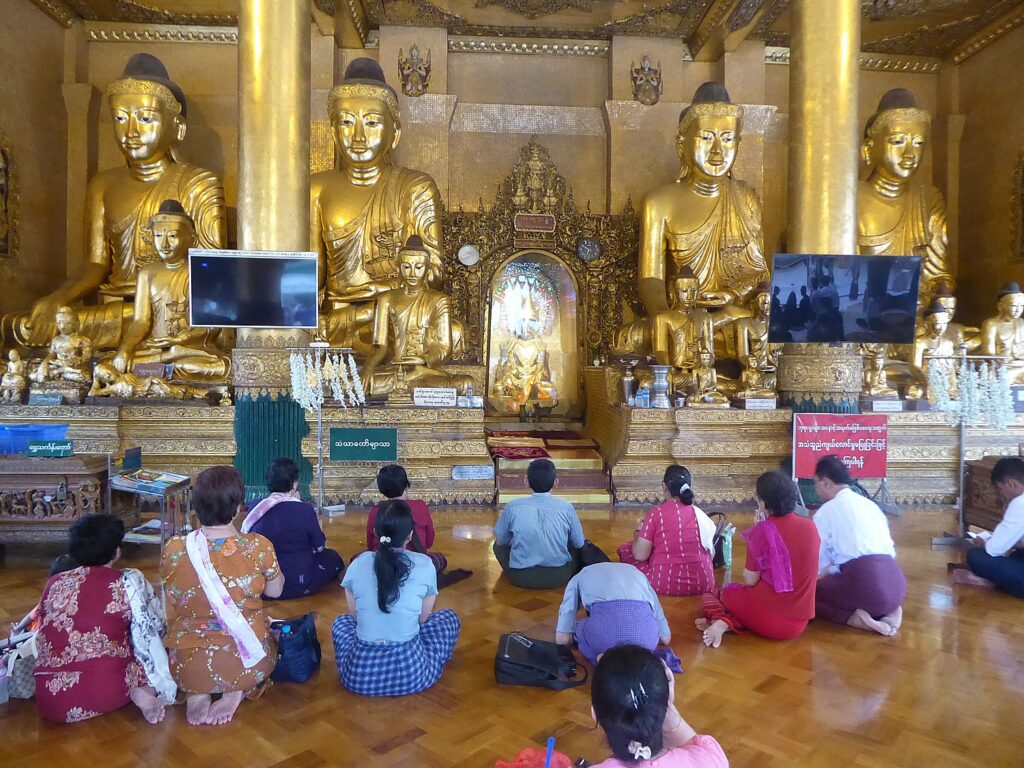
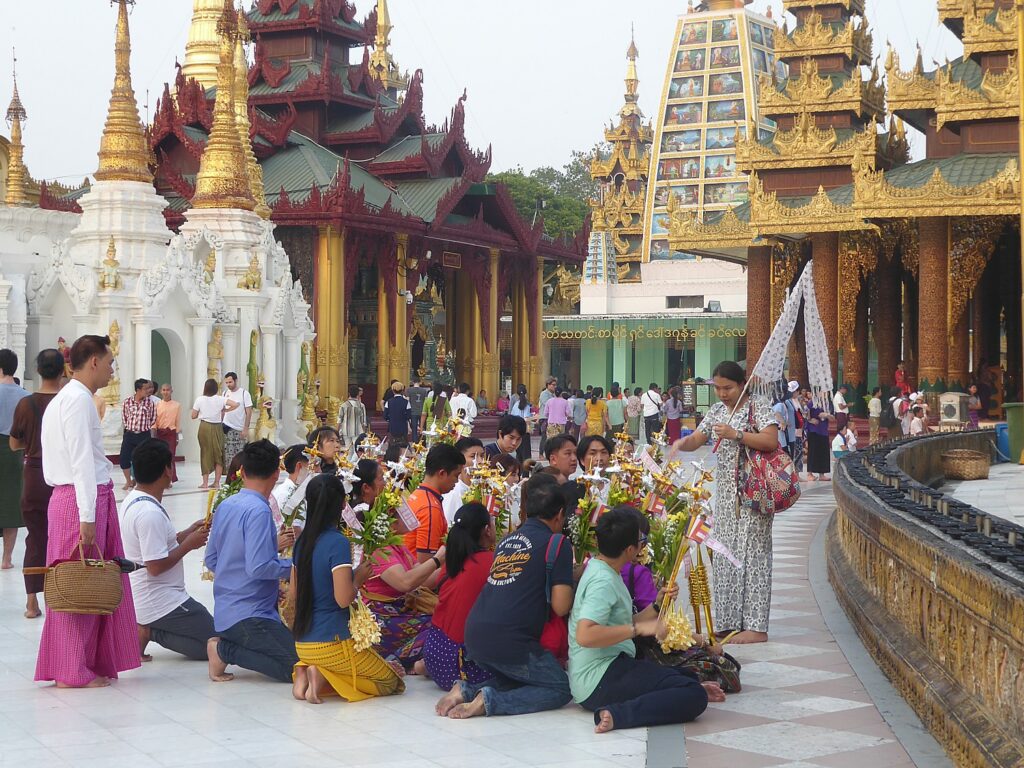
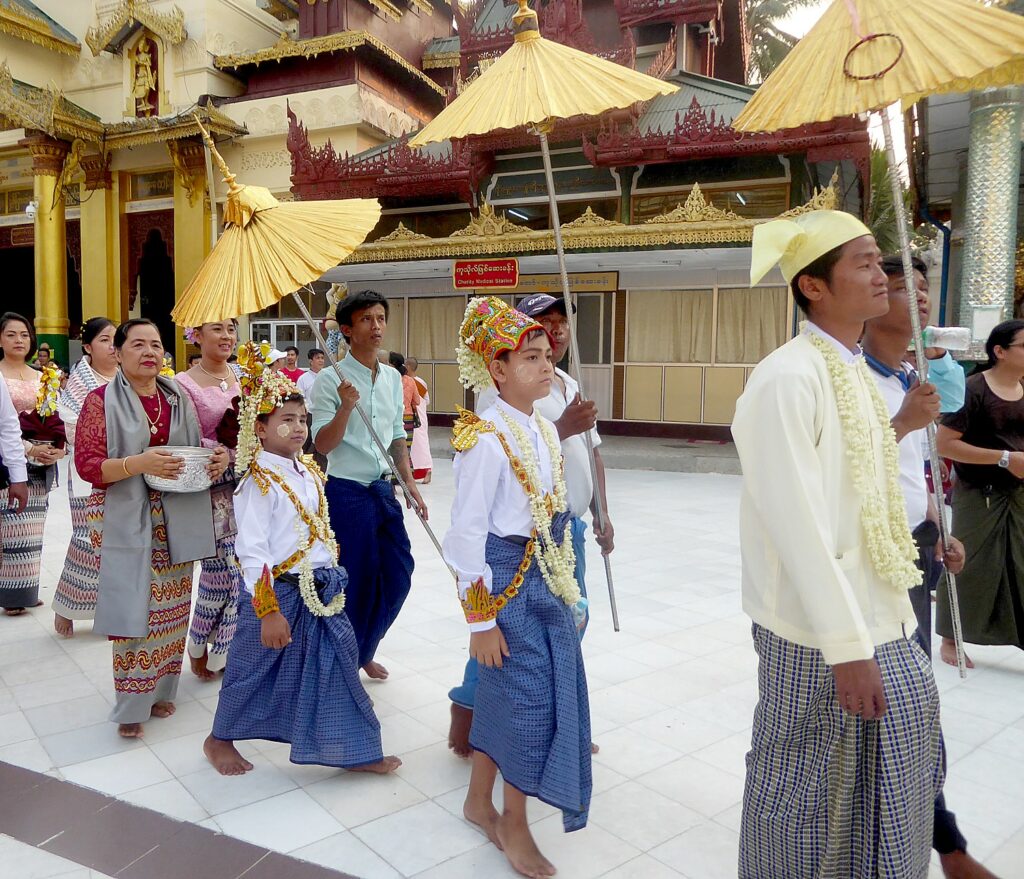
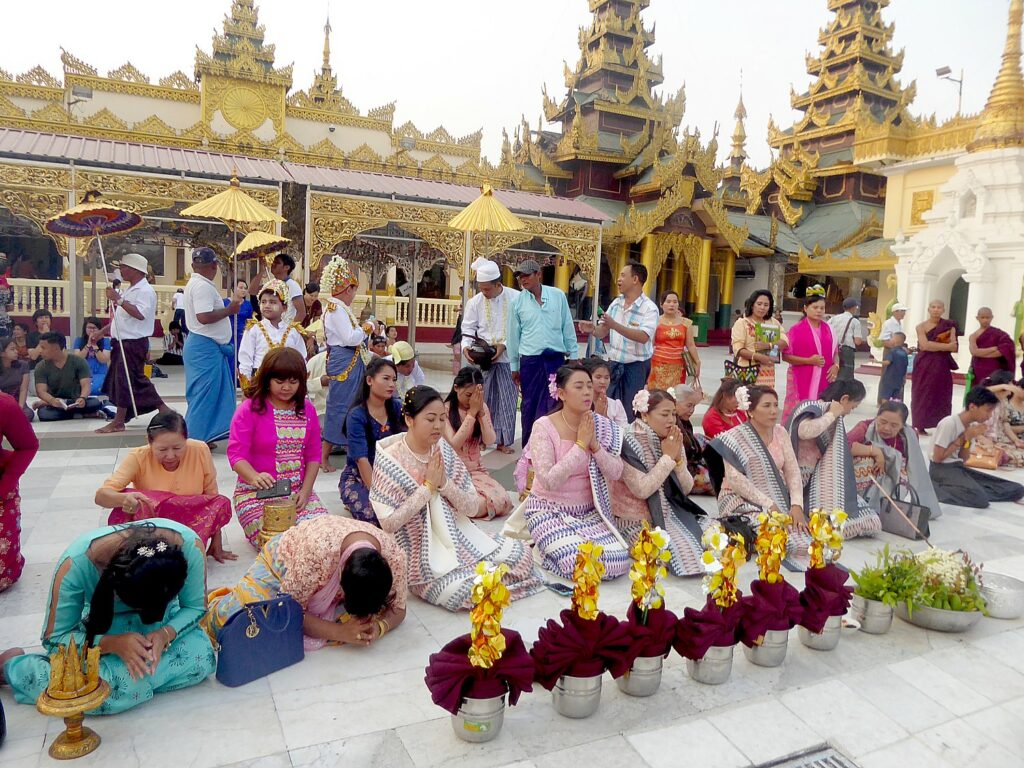
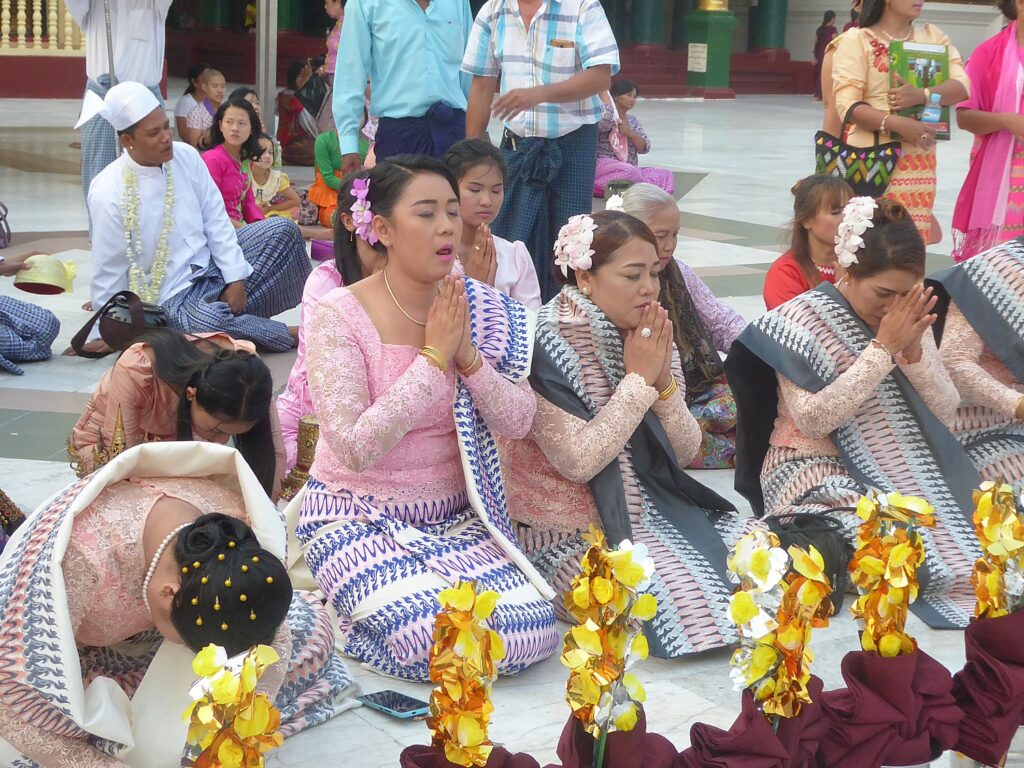
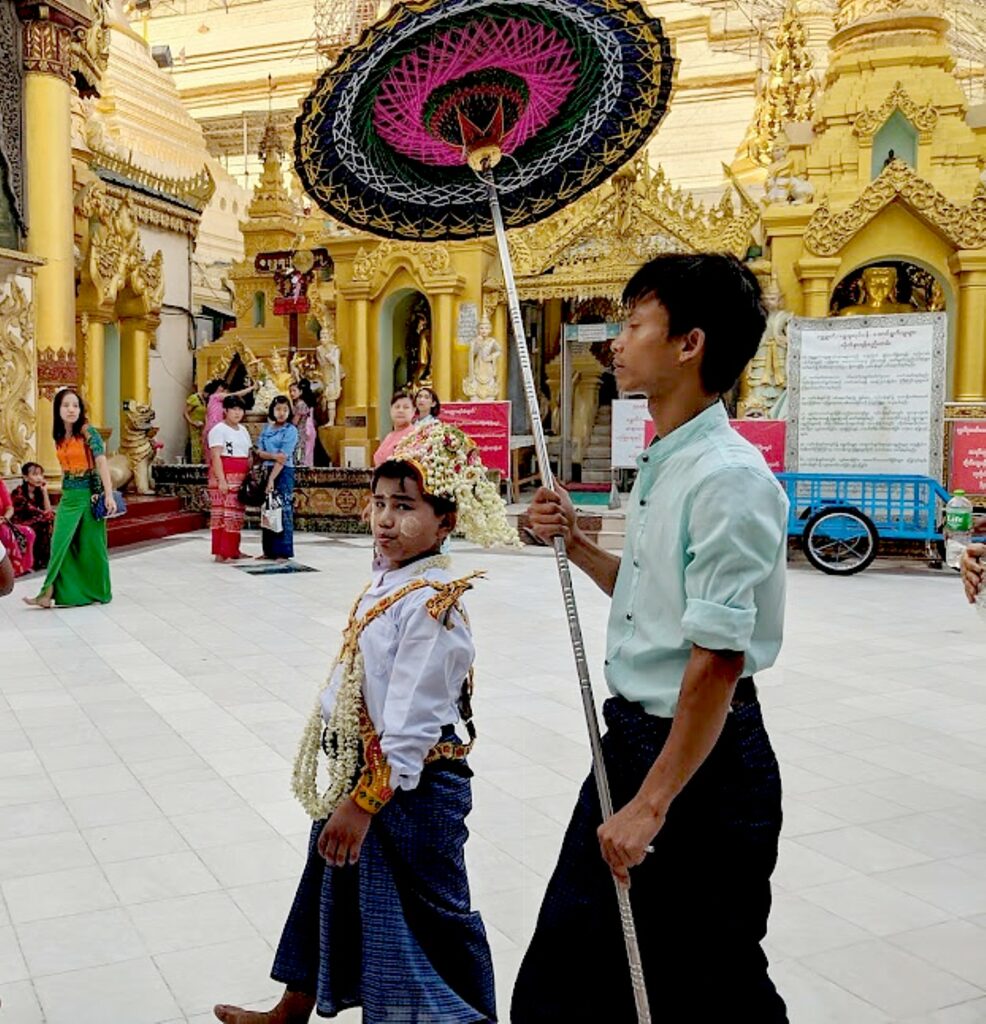
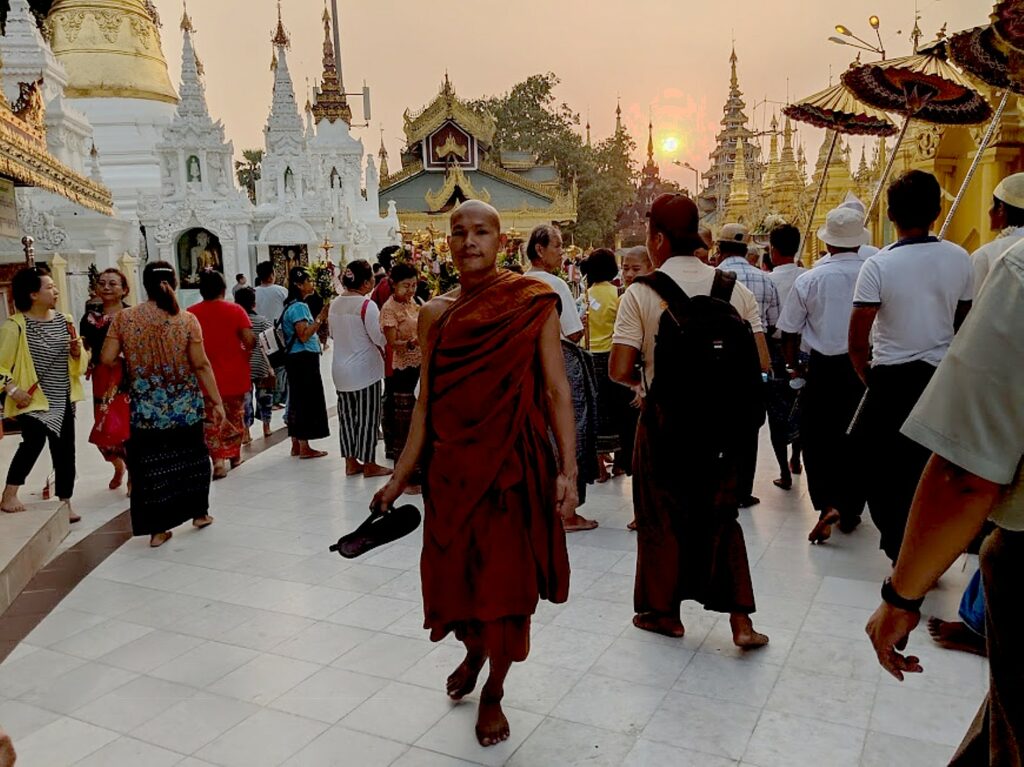
the Shwedagon Pagoda is Myanmar’s most sacred and impressive
Buddhist site. Dating back almost 2500 years, the pagoda enshrines strands of Buddha’s hair and other
holy relics. It is breathtaking.
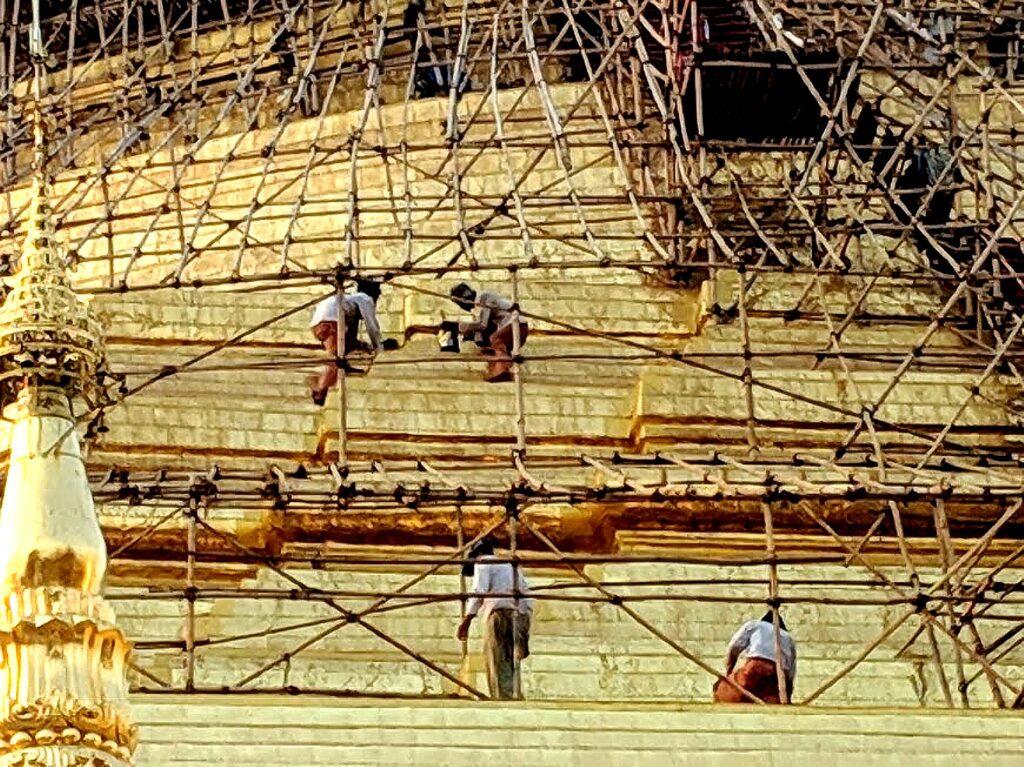
The Shwedagon Pagoda stands 326
feet high, its dome covered in 60 tons of gold (we watch workmen on scaffolding replacing some of the
gold plates). At the very top, too small to be appreciated from where we stand
at the base, is an orb, 22 inches high and 11-inches wide, encrusted with 4531
diamonds, the largest of which is a 72 carat diamond. The base is
surrounded by 64 small pagodas with four larger ones in the center of each side.
There also are four sphinxes, one at each corner, with six leogryphs (a lion-like
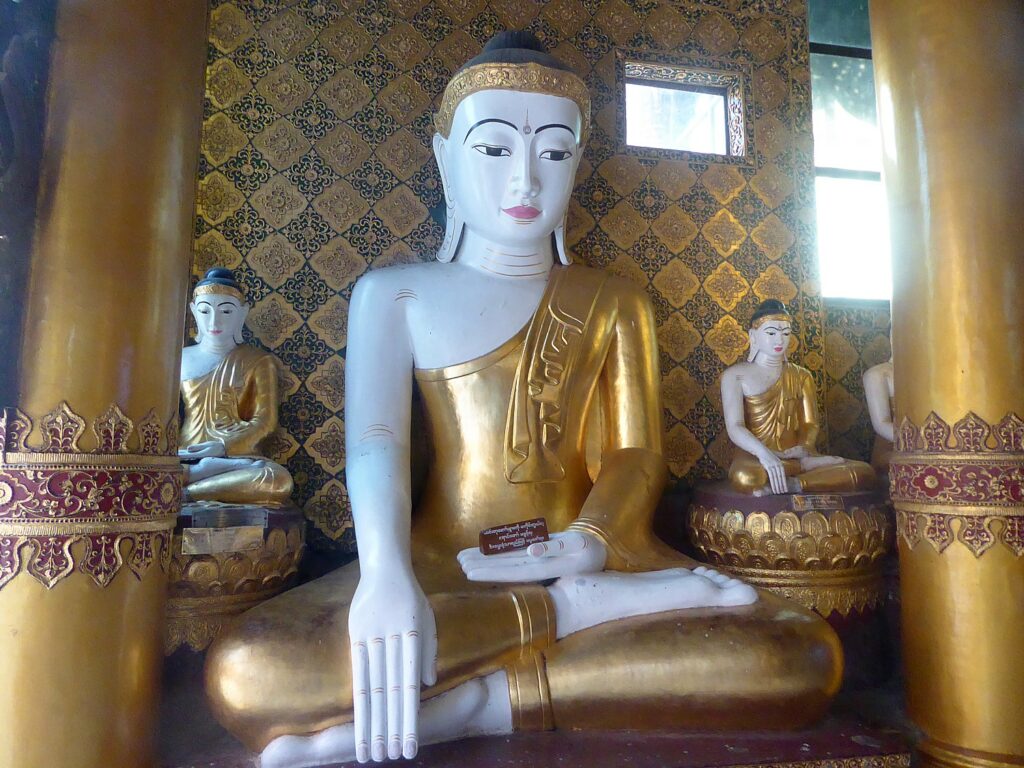
creature). Projecting beyond the base of the Pagoda. are Tazaungs (shrines) in
which are images of the Buddha and where offerings are made.
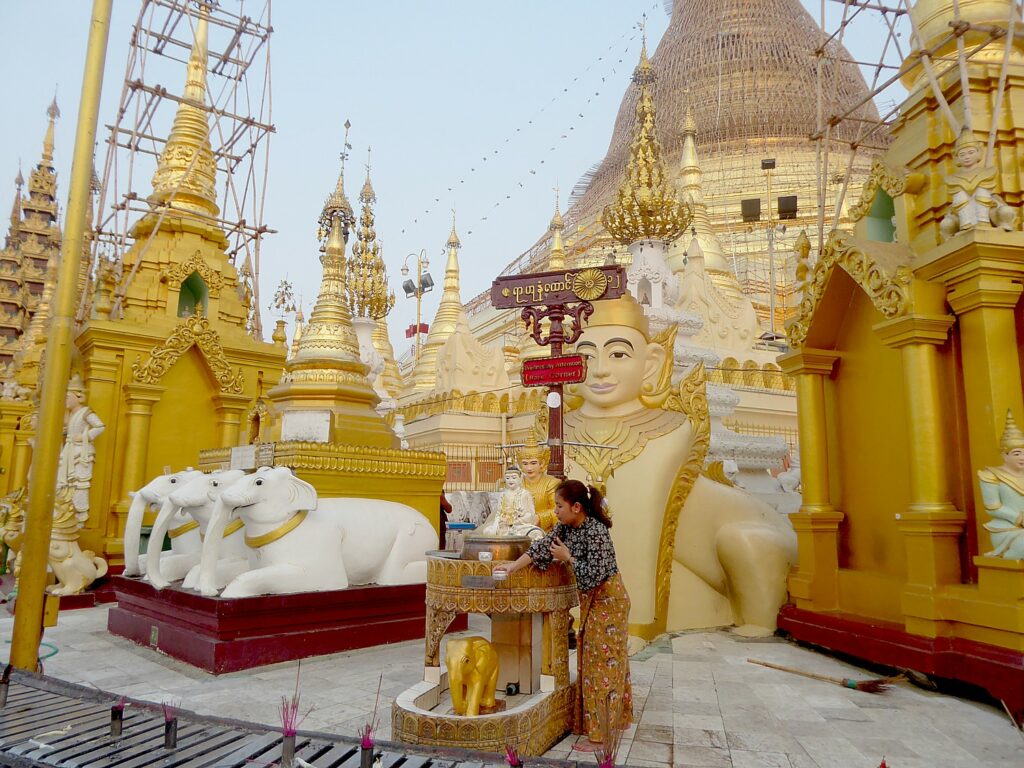
There are also figures of elephants crouching
and men kneeling and pedestals for offerings all around the base. In front of
the 72 shrines surrounding the base of the Pagoda, there are images of lions,
serpents, ogres, yogis, spirits, or Wathundari. Among the most dazzling art is
a Jade Buddha. There are also mystical and mysterious places, like the well
where Buddha’s sacred hair was washed and Buddha’s foot print.
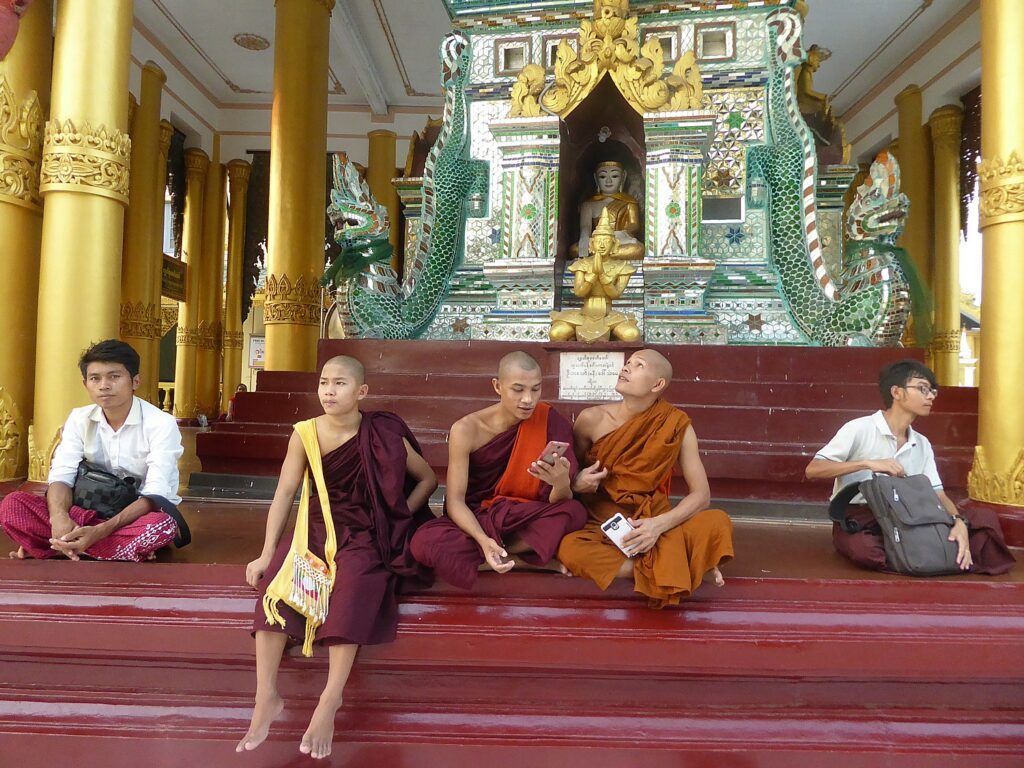
Representing
the highest achievements of Myanmar’s sculpture, architecture and art, there
are hundreds of colorful temples, stupas and statues spanning nearly 2500 years. It
is known as Shwedagon, “the Sanctuary of the Four,” because it contains relics
of four Buddhas who had attained Enlightenment.
(The
Sule Pagoda which I visited the evening we arrived in Yangon – was it just four
days ago? – was also magnificent, but Shwedagon is on a different scale of magnificent.)
You
could easily spend hours here, but we must dash back in a taxi to get back to
the Global Scavenger Hunt group, arriving a few minutes past the 6 pm deadline
(we aren’t competing to win the challenge to be the “World’s Best Travelers,”
so we did not have to turn in our scorecards documenting our scavenges, though,
in fact, we have been doing as many as we can.
At
a hosted dinner at a Japanese restaurant, all of us trade our stories of adventure
and exploration from Yangon and some combination of Bagan, Mandalay and Inle
Lake. One of the scavenges invited the teams to take part in a volunteering
opportunity and Lawyers Without Borders, the team from Houston, volunteered at a
Youth Development monastery in Yangon. “The monks take in, house,
feed and educate orphans from far-flung and remote villages around the
country,” Zoe Littlepage writes on her blog (http://zoeandraineygreatescape.blogspot.com). “My favorite
part was eating lunch with the kids. They sing their prayers before they
can start eating.. magical.” (Zoe Littlepage and Rainey Booth, of Houston, are
on their 12th Global Scavenger Hunt, and are five-time champions,
and their law firm helps support the philanthropic works of the Global
Scavenger Hunt Foundation.)
We
return to the hotel to get our four-hour notice and learn where our 23-day
“Blind Date with the World” mystery tour continues next: an eight-hour layover
challenge in Bangkok and then on to Abu Dhabi – essentially having breakfast in
Myanmar, lunch in Thailand and dinner (or nightcap?) in the United Arab Emirates.
We
are out the door at 5:15 am (the hotel sends us off with breakfast boxes), to
get to the airport.
It
is worth noting that in addition to having a unique alphabet and language,
Myanmar (formerly Burma) asserts its identity by keeping its clocks half-hour
different from its timezone.
I
realize that time is really fluid – not really stable or fixed ordering our day,
a concept rather than an invention. We lost a full day crossing the timezone
during that first flight of more than 14 hours, and have been picking up an
hour or so here as we go.
At the
end of this Par 5, Leg 3 dash through Myanmar, SLO Folks, a team
from central California who are the returning champions from last year’s Global
Scavenger Hunt, earned the second most points with 37 scavenges in Yangon,
Bagan and the point rich area of Inle Lake for 2,055 points; and Lawyers Without
Border, a team from Houston on their 12th Hunt (they have won it
five times) had the most, completing 52 scavenges in Yangon, Bagan & Inle
Lake earning 2,745 points.
The Global Scavenger Hunt is an annual travel program that has been operated for the past 15 years by Bill and Pamela Chalmers, GreatEscape Adventures, 310-281-7809, GlobalScavengerHunt.com.
Having set out from Yangon, Myanmar on
our Par 5 Challenge on the Global Scavenger Hunt, a 23-day around-the-world
mystery tour in which we solve scavenges to amass points in order to win the
title, “World’s Best Travelers,” we arrive at Bagan airport.
Moments
after arriving at the Bagan airport in Myanmar (and paying the mandatory ticket
to the archaeological zone, 15,000 Kyat, or $12), we see why Bagan was only
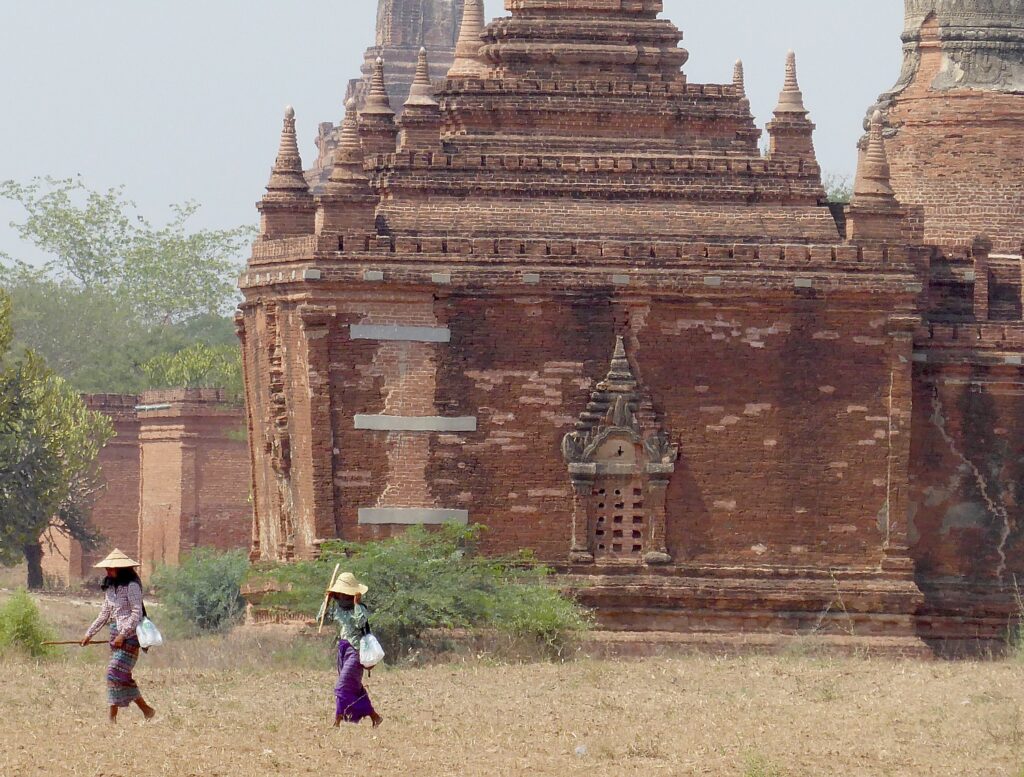
this July was named a UNESCO World Heritage Site: known as the city of Temples,
Bagan has more than 2,000 Buddhist temples and pagodas within 16 square miles,
its ancient ruins rival Angkor Wat in Cambodia, though in Cambodia, the
prevailing colors seem grey and green, while here, they are the red, orange and
beige of sandstone. Temples here are as common as skyscrapers in Manhattan,
dotting the plain.
The profusion of
temples is astonishing. The stunning architecture and the fact that they are
centuries old is mind-boggling. On top of that, you realize they have survived
earthquakes as recent as 2016 when nearly 200 temples were damaged by a 6.8
magnitude quake.
Considering
that Myanmar was shut off from the world for 60 years, only reopening since
2011, Bagan is still relatively unknown and draws fewer tourists than so many
of the world’s great archeological sites that are endangered by their very
popularity. In Bagan, you have the feeling of discovery and authenticity. Here,
local worshippers vastly outnumber Western visitors and you can be immersed in
the rituals.
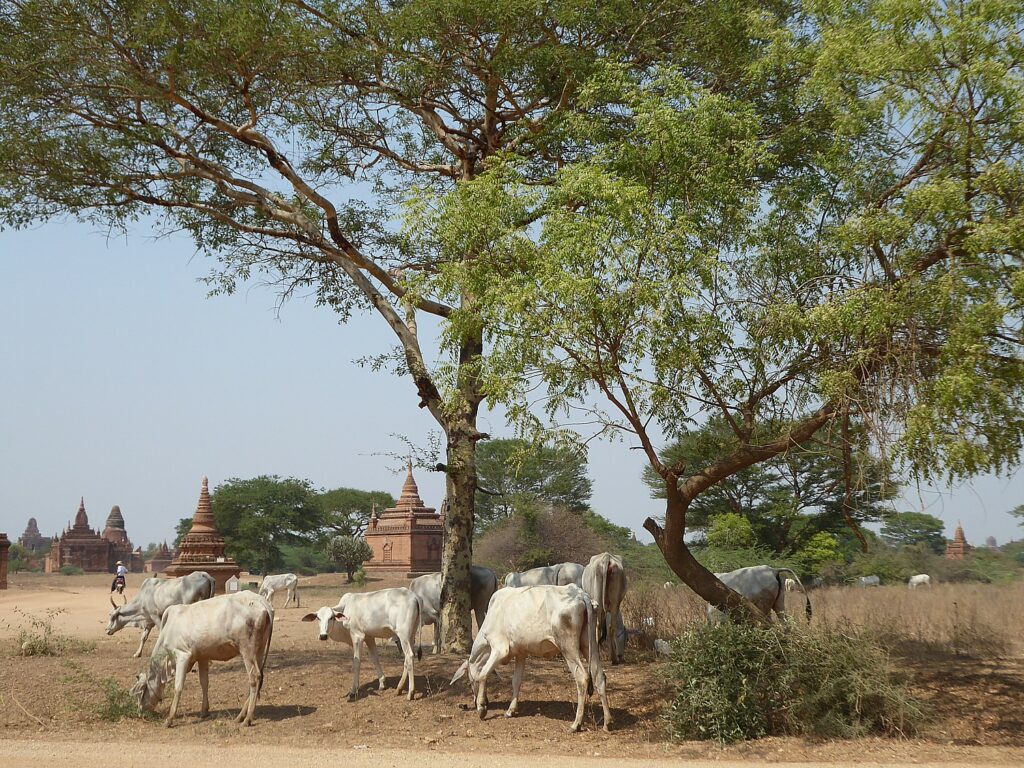
There
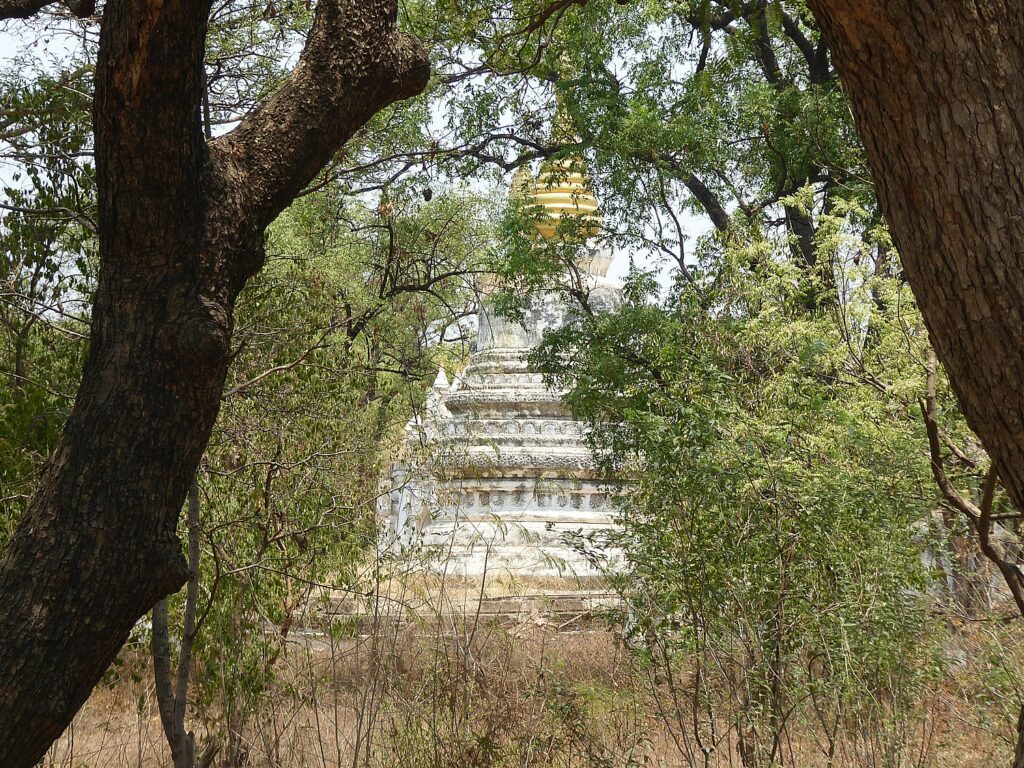
are so many temples, some are just out in overgrowth that makes you think of
fairy tales with the castle buried by a forest. Some of the most breathtakingly
beautiful architecture comes immediately as we set out. We stop the taxi to
explore.
Luen,
the taxi driver who takess us from the airport, is a delightful man who speaks
English very well, and immediately expresses appreciation for us coming to
visit his country. On our way to the hotel, he stops where we ask to take
pictures. We decide to hire him to take us around and make an appointment for
him to come back at a certain time. (Had we been competing for points and to
win the crown, we wouldn’t be allowed to hire a taxi for a whole day or use the
driver as a guide).
The
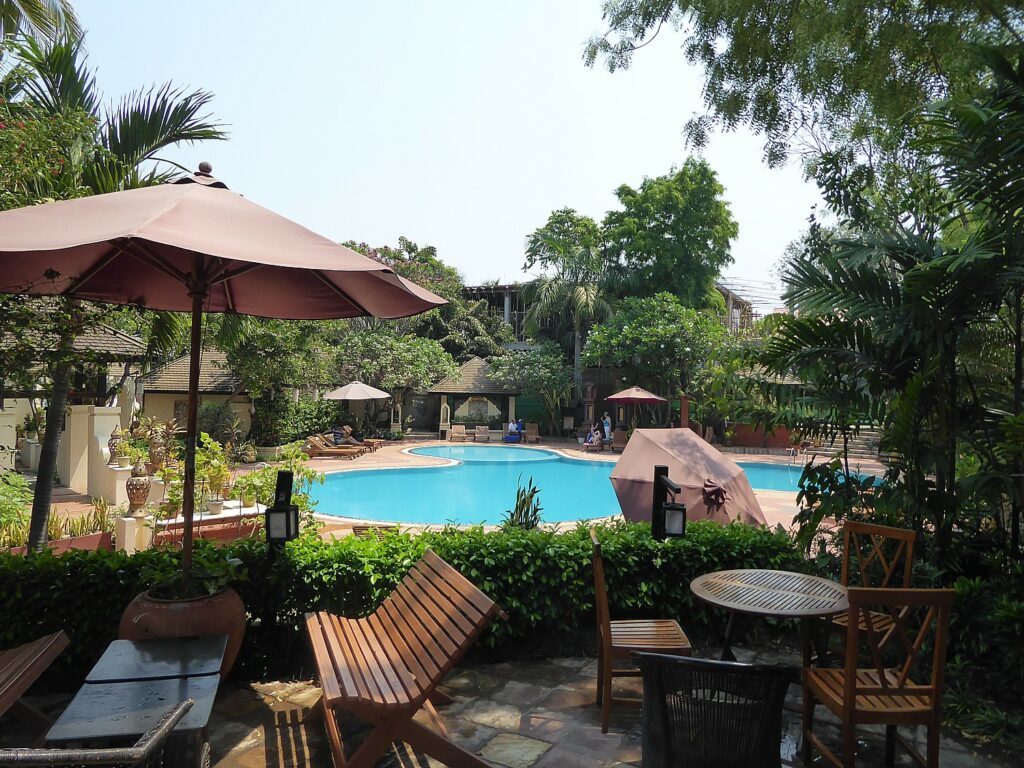
hotel, Aye Yar River View Resort in Old Bagan, inside the city walls, which I
booked on hotels.com, is absolutely lovely – walking distance to several of the
places I want to visit (such as the Archaeological Museum) and some of the
temples, with an absolutely lovely pool (so welcome in the heat that exceeds
100 degrees), and open-air restaurant.
But
instead of racing out to start on the scavenges as other teams have done (some
racing from the airport to Mount Popa, an hour’s drive away), I find myself
losing a frustrating couple of hours trying to switch my travel arrangements
from Mandalay to Inle Lake. Making the reservation on the overnight bus (first
class!) to Inle Lake turns out to be easy on the JJ Bus website,
www.jjexpress.net); booking the hotel which I select from the list Bill
Chalmers, the Global Scavenger Hunt organizer and ringmaster, has provided, on
hotels.com is a cinch, but the flight to get back to Yangon on Saturday in time
for the 6 pm deadline in is the real problem. Because of the national holiday,
I can’t get through to the airline itself, not even the hotel manager who does
her best, in order to change my booking on Golden Airlines from Mandalay. I can’t
even book a new flight. But finally, I make the booking through an on-line
agency.
While
the others are having lunch, I only have to stroll out the front gate of the
hotel to come upon temples and archaeological sites. I wander over to the
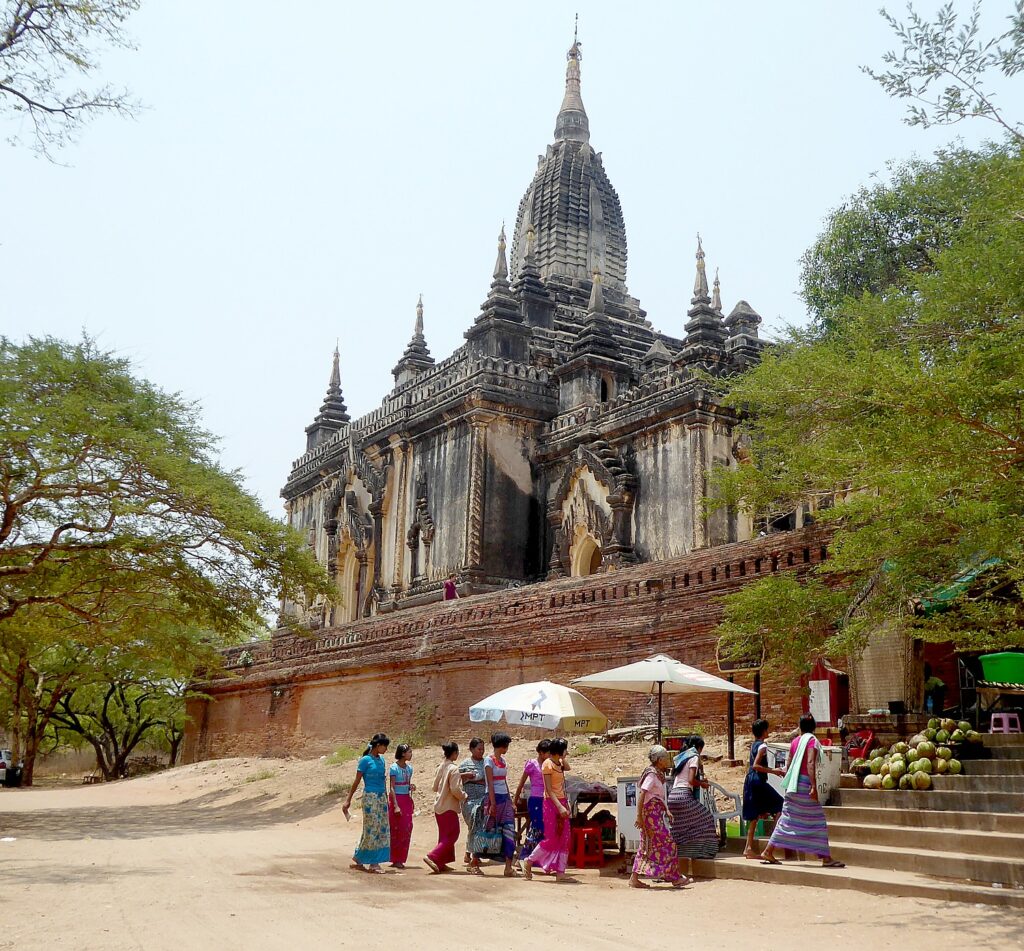
Shwe-gu-gyi Hpaya (temple), which the
sign (in English) notes was built by King Alaungsithu in 1141. The temple is
built on a high platform, topped by a sikhara, or curvilinear square-based dome
and has a projected porch, or vestibule.. A stone inscription describes the
merit of King Bayinnaung in 1551.
Also
in this immediate vicinity, walking distance from the hotel are: Mahabodhia
Pagoda (1215 AD); Shwe Hti Saung Pagoda (11th C), Saw Hlawhan Pagoda
(598 AD), and the Lacquerware Museum.
I
take note of a tourism school and a sign that says, “Warmly Welcome & Take
Care of Tourists.”
Finally,
we set out with our taxi driver, San Luen, to visit some of the notable temples
(there are 2,000 in Bagan) – we only have a day. It’s 108 degrees (116 with
heat index). We set out initially
following some of the scavenges which steer us to prime places and experiences.
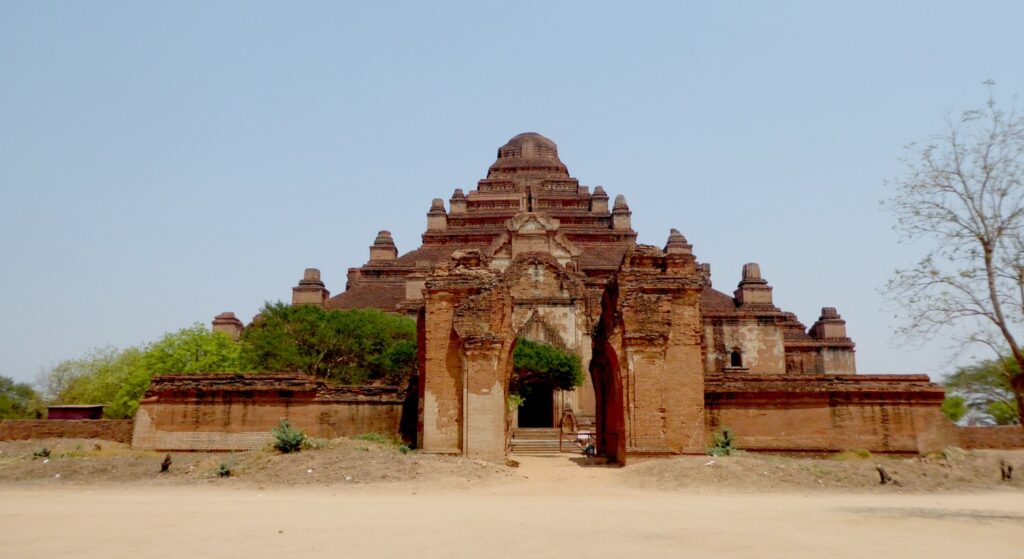
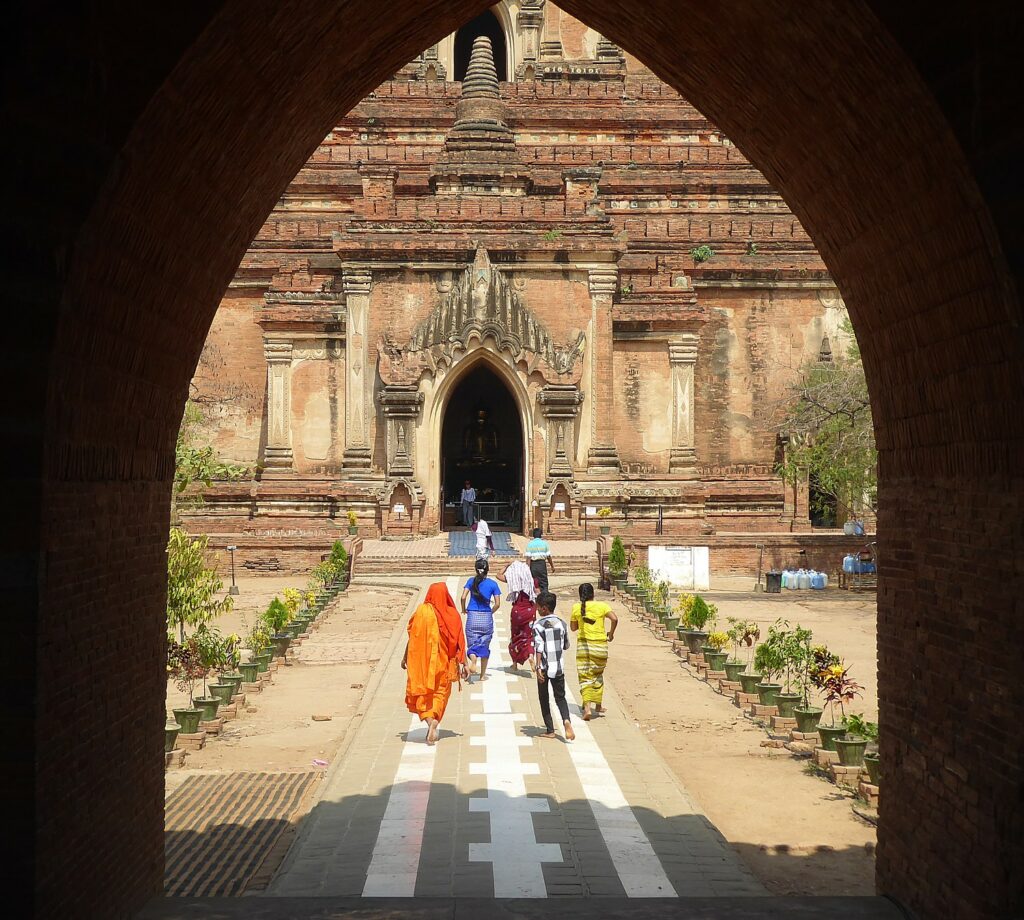
Our first stop is Dhammayangyi
Temple, one of the most massive structures in Bagan and one of the most
popular for visitors. It was built by King Narathu (1167-70), who was also
known as Kalagya Min, the ‘king killed by Indians’. Luen drives us to a side
entrance so we will have a shorter distance to walk over the extremely hot
ground in bare feet (not even socks are allowed in Bagan). Here in this holy
city, strict rules mean we can’t even wear slippers or socks into the temples,
but have to walk over intensely hot sand and stone, baking in the 108 degree heat.
Luen calls it “the Temple of the Evil King. I later learn that
Narathu ascended the Bagan throne by murdering his father, the king, and built
this temple as penance. “It is said that Narathu oversaw the construction
himself and that masons were executed if a needle could be pushed between
bricks they had laid. But he never completed the construction because he was
assassinated before the completion.” Apparently he was assassinated in this
very temple in revenge by the father of an Indian princess who Narathu had
executed because he was displeased by her performance of Hindu rituals.
I guess thanks to Narathu, the interlocking, mortarless
brickwork at Dhammayangyi, is said to rank as the finest in Bagan.
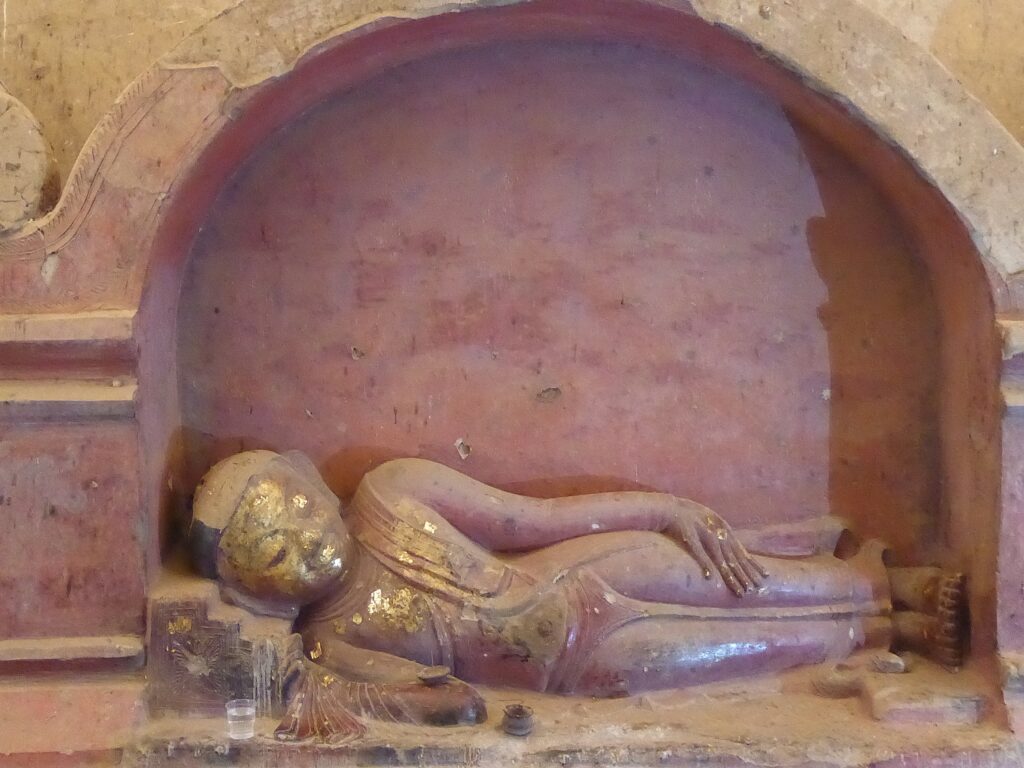
We wander about what feels like a labyrinth of narrow
hallways to discover the art inside. The interior floor plan has two
ambulatories. Almost all the innermost passage, though, was filled with brick
rubble centuries ago. Three of the four Buddha sanctums also were filled with
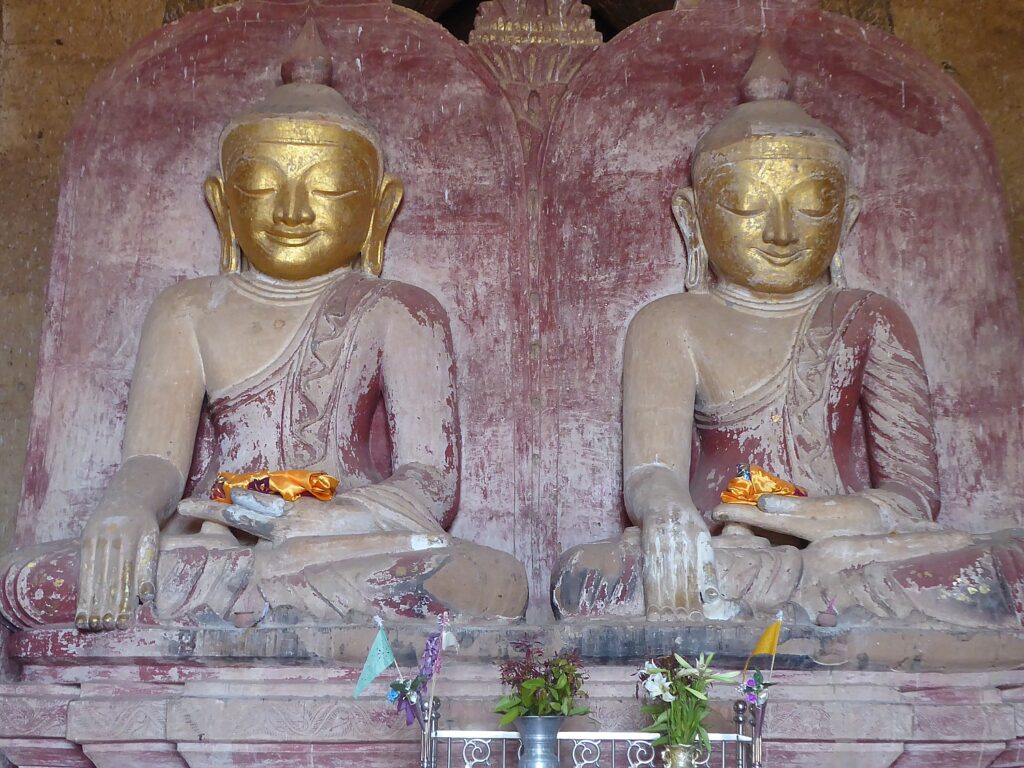
bricks. What we see in the remaining western shrine features two original
side-by-side images of Gautama and Maitreya, the historical and future Buddhas
– they are magnificent.
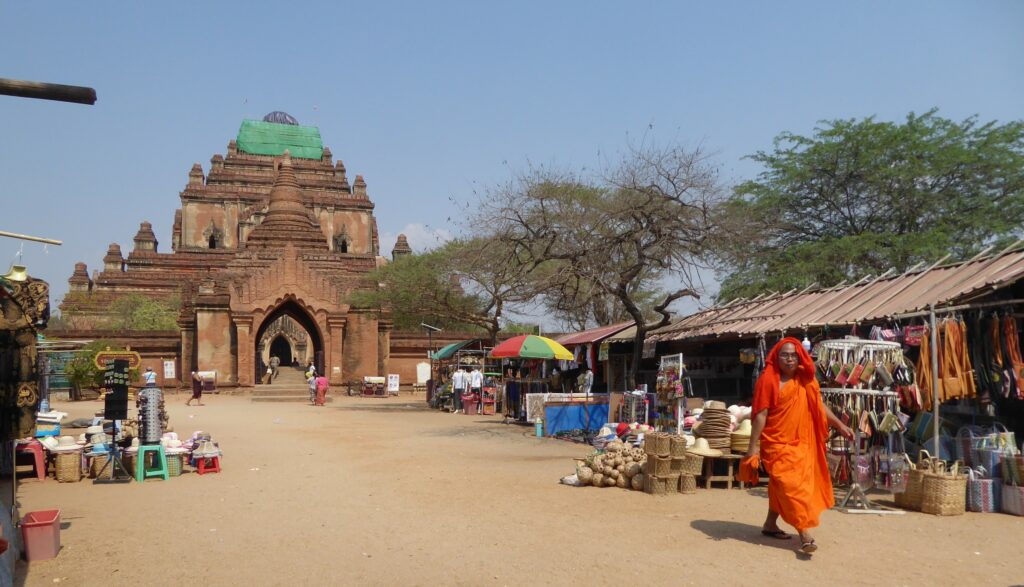
A short distance away is another temple, Sulamani Phaya, “The Ruby of Bagan”, which
dates from 1183 AD. Considered the most frequently visited temple in Bagan, the
Sulamani was built by King Narapatisihu, who found a small ruby on the ground
on the Bagan Plains and built a temple in its place. A description notes, “The
word Sulamani means ‘small ruby’ and is a fitting name for this sand-orange and
elegant ‘crowning jewel’.The temple is surrounded by a high wall; its layers of
terraces and spires give the structure a mystical fairytale appearance. Inside,
intricately carved stucco embellishments adorn the doors and windows.”
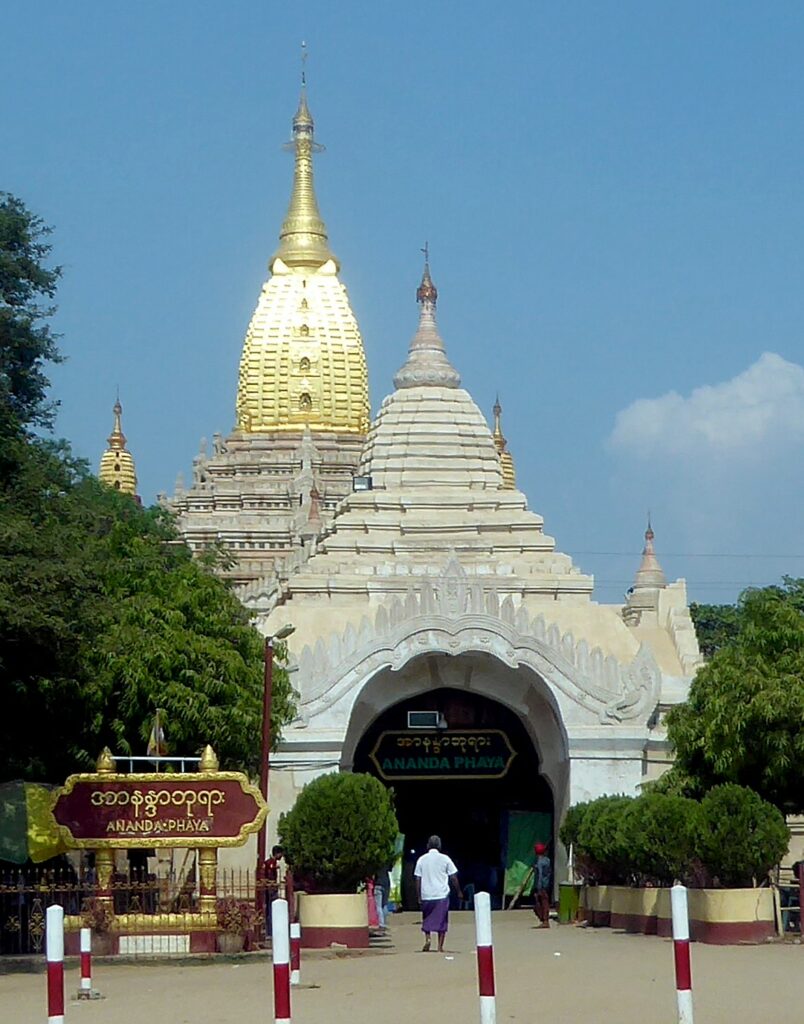
We drive passed
the Ananda Temple, known as the
“Westminster Abbey of Burma” for its elegant and symmetrical design,
intending to return to visit. The golden spire on top can be seen from miles
across the Bagan Plain and is lit up at night by spotlights, creating an
impressive beacon in the sky. The temple is known for its four gold-leaf Buddha
statues, each standing an impressive 30 feet tall. Built in 1090 AD, Ananda
Temple is one of the largest and best-preserved temples in Bagan and is still
very important to local people. The temple was damaged in the earthquake of
1975, but has been fully restored and is well maintained. In 1990, on the
occasion of the 900th anniversary of its construction, the temple spires were
gilded.
Shwesandaw Pagoda is considered one of
the most impressive temples in Bagan. Standing 328 feet high, it is visible
from a great distance. You can climb to the top for a wonderful view of the
plain. It also is an excellent place for interacting with locals as they come
to worship. One of the first to be built with what has become a classical
golden bell shape, Shwesandaw became the model for Myanmar’s pagodas. The
pagoda has survived invasions and natural disasters but has undergone renovations.
Thatbyinnyu Temple is distinctive
because it is one of the earliest two-story Buddhist temples and, unlike many
other temples in Myanmar, is not symmetrical. At over 120 feet tall,
Thatbyinnyu towers above nearby monuments. The area around it is picturesque
and offers a panoramic view of Bagan.
Gubyaukgyi Temple is known for having
the oldest original paintings in Bagan. According to notes, “The interior walls
and ceilings of the temple are covered with ancient murals that tell stories
from the previous lives of Buddha. The murals have been well-preserved because
the temple is lit with natural lighting from large perforated stone walls. Each
mural is paired with a caption written in old Mon. These captions are the earliest
examples of Old Mon in Myanmar making it an important site for the study of the
ancient language. No photography is allowed inside the temple, in order to
preserve the murals for future generations.”
The
heat (114 degrees with the heat index) has gotten to Margo who wants to go back
to the hotel. After a swim in the gorgeous pool at the hotel, I set out again
with Luen at 4 pm to take me to a nearby village known for crafting the lovely
lacquerware. I wander around – seeing the crude living conditions (they don’t
have running water but they have electricity), and am invited in to watch
people as they craft. At the entrance to the village, there is a large retail
shop and workshop of master artisans.
I’m
on my way back from the village, about 5 pm, when I see a message on my phone
from the online booking agent that the airline booking from Inle to Yangon did
not go through – I basically would be stranded. The booking app gives me a
California 24/7 help number to call.
That
interferes with my plan to see the sun set and watch the golden light take over
the dramatic landscape.
The setting of
the temples on the Bagan Plain make for expansive views – one of the reasons
you should look for opportunities to get to a height, preferably at sunrise, or
late afternoon toward sunset, when the light and the colors are most dramatic.
For this reason,
one of the popular ways to see Bagan is taking a hot-air balloon ride is an
incomparable experience to see the thousands of temples scattered across the
Plains of Bagan, Balloon tours
normally begin at 6:30 am, just a few minutes after sunrise. They offer a
bird’s-eye view of the monuments in the misty orange morning light. The
picturesque spectacle of the temples at sunrise from red balloons above, has
become iconic for travelers in Myanmar. Hot-air balloon flights in Bagan
normally cost around $330 per person and are seasonal (from October to March;
book in advance).
Another is to drive about 1 ½ hours outside of Bagan to Mount Popa, an extinct volcano, climb to the top and see down at the whole plain laid out in front and visit the sacred Popa Taungkalat monastery at the top. Several of our group did that, literally racing by taxi from the airport so not to lose valuable time for our all-too-brief stop here on our Global Scavenger Hunt.
There are also river cruises, an archaeological museum, crafts like cotton weaving and lacquerware, oil processing, palm sugar production. Almost none of it am I able to take advantage of because I have abbreviated my time here and frankly, my experience in Bagan proves a lesson in the frustration of poor planning, but a learning experience, none the less.
Many of the
scavenges bring us to these important sites, but also to experiences. Among the
mandatory experiences in Bagan is to try toddy juice or Black Bamboo; finding
the “Rosetta stone of Myanmar” in the Bagan Archaeological Museum, where you
learn the interesting origin of Burmese distinctive alphabet of circles and
curleycues; rent a horse cart for half a day to compete 3 scavenges.
Even
though Bagan is surprisingly compact and it doesn’t take long to travel from
one incredible sight to another, seeing Bagan properly would require planning
and sufficient time. I don’t have either but I chalk up my visit to a preview
for a future visit. You should spend at least two or three days here.
Back
at the Aye Yar River View Resort, the manager again tries heroically and fruitlessly
to reach the airline directly but says the office has already closed. (I highly
recommend the Aye Yar River View Resort, located Near Bu Pagoda, Old Bagan,
Nyaung-U, MM).
I
meet up with Paula and Tom, the SLO Folks team from California who were last
year’s Global Scavenger Hunt champions, who are also going to Inle Lake on the
overnight bus and we go together to one of the two restaurants listed in the
scavenger hunt (more points!). The first is closed; the second is a lot of fun.
(Many of the scavenges involve food.)
Luen,
the taxi driver, picks us up to go to the bus station.
As
I ride on the night-bus to Inle, at 10 pm, bouncing and rolling on the roads
that quickly turn into mountain passes, I text my son in New York to call the
airline in California. The texts go back and forth. “There’s no ticket, no seat.”
“We got you a seat, yay!” “No seat, he made a mistake. Drat.” “A seat, yay!” (On
the same flight as I originally booked! Yay!).
The adventure
continues as I bounce along the overnight bus on twisting, winding roads
through the hills and darkness to Inle Lake.
The
Joyous Journey Express (JJExpress) bus is actually geared for foreign tourists –
first class modern buses with comfortable reclining seats, providing passengers
with a blanket, bottle of water and snack, even some variation of a TV monitor
which I couldn’t figure out (but no onboard bathroom – the driver stops when
necessary). In busy season, they even do a pick-up at your hotel. (www.jjexpress.net)
The Global Scavenger Hunt is an annual travel program that has been operated for the past 15 years by Bill and Pamela Chalmers, GreatEscape Adventures, 310-281-7809, GlobalScavengerHunt.com.
It
is only a two-hour flight from Ho Chi Minh City, Vietnam, to Yangon (formerly
known as Rangoon), Myanmar, the third leg of the Global Scavenger Hunt, a 23-day
around-the-world mystery tour. We arrive at our five-star hotel, the Sule
Shangri-la, around noon. We will have our meeting at 2:30 pm when we will get
our booklets, spelling out the challenges we will face in the Golden Land.
After
60 years closed to the world, Myanmar, formerly known as Burma, was only
reopened to the outside world in 2011, so I am most intrigued to see it for
myself. The country has also received horrible press over the persecution of
the Rohingya people, which raises controversy for Bill Chalmers, who
meticulously organizes the Global Scavenger Hunt. But it encapsulates his
philosophy, bordering on religion, that appreciates travel as a way of forging
understanding, bringing people together and yes, fostering progress and change.
Throughout this Global
Scavenger Hunt, “A Blind Date With the World” – where we don’t know where we
are going next until we are told when to go to the airport or get ourselves
there, and along the way, complete scavenges and challenges – we are
encouraged, even forced, to “rely on the kindness of strangers,” to interact
with local people even when we can’t understand each other’s language. (Towards
this end, using cell phones or computers to research, access maps or GPS is not
allowed.)
Though it is a conceit
to think we can parachute into places and understand the nuances of complex
issues, travel is about seeing for yourself, but also gaining an understanding
of one another, disabusing stereotypes or caricatures, and most significantly,
not seeing others as “other”, which works both ways.
In very real ways,
travelers are ambassadors, no less than diplomats. Isolating people is not how
change happens – that only hardens views and makes people susceptible to
fear-mongering and all the bad things that have happened throughout human
history as a result. “See for yourself,” Chalmers tells us.
Chalmers offers this to ponder: The point of a travel boycott is
to force a government to reform their ways (corruption, human rights, democracy
and such) is based on the concept that tourism income mostly goes into the
hands of government, not the people, so enables their power and policy. But
others believe that tourism is not only economically helpful to locals, giving
them the means to improve their living conditions, but vital to pro-democracy,
humanitarian movements because of the two-way flow of information.
On
balance, Chalmers tells us, “I don’t like the idea of a boycott. Travelers are
serving as ambassadors, doing fact-finding. This country is emerging from decades
of isolation – there are problems, humanitarian problems on a large scale. It
is a troubled country with great suffering.
“Bear
witness for yourself. Enjoy the rich culture, the people, play journalist,
bea reporter, have conversations, learn
and gain perspective. Parachuting in can’t give you full expertise. All acquire
more accurate idea, local perception. Talk with locals, see for yourself.
“The
issue with not coming is you paint a broad picture about everyone. When we
travel, a lot of people disagree with our government but don’t take it out
against us as individuals. We practice diplomacy of engagement. Not coming
won’t change minds but possibly, coming can help change minds.” I contemplate
that point: imagine if the people we meet as we go around the world held us
personally responsible for caging migrant children and keeping parents
separated in conditions that wouldn’t meet the Geneva Conventions requirements
for POWs.
“Myanmar
is breathtakingly beautiful,” Bill tells us. “Say yes to things. There are
extraordinary sights.” But he isn’t naïve. Anticipating the problems,
frustrations we will have, he gives us a list of to-do’s and don’ts (buy food
and water before getting on a train, ferry or bus; Myanmar roads are among the
most dangerous; have a safe word between
teammates that is code for “danger.” Travel,
he says, is about “conquering fears, heat, holidays.” Indeed, the fact it is
Myanmar’s New Year’s Day and many services are closed becomes a major issue for
me.
The Global Scavenger Hunt is also about teamwork, and one of the rules is that you can’t separate from your teammate (Chalmers actually feels very guilty about the possible friction the competition can foment in couples). So, though we are not officially competing for points, I go along with my teammate, Margo, who wants to travel to Mandalay instead of Inle Lake, which I become extremely excited to see after hearing about this enchanting place, after visiting the temple city of Bagan.
We
learn that the Myanmar leg is designated a Par 5 (very tough, the highest is
Par 6). The challenge we are given is to spend the next two nights on our own,
that we have to go to two of the three cities (Yangon, Bagan, Mandalay and Inle
Lake), but can only take two flights (necessitating ground transportation between
two cities of the triangle) and have to be back to The Sule Shangri-la in
Yangon by 6 pm on Saturday. Chalmers spends much of the time spelling out the
special rules for this leg of the contest, the winner of which is designated
“World’s Greatest Traveler”.
“Today the real travel test will begin. Our teams collective travel savvy and travel IQ will be tested here in Myanmar… in this daunting, breathtaking, frustrating, exhilarating haunting, sacred, dynamic, traditional, thrilling, rapidly changing (and I could go on and on) destination! It will be an interesting four days. Have fun and be safe folks,” Chalmers writes on the Global Scavenger Hunt blog.
We spend the next 3 1//2 hours organizing where and how we will travel to Bagan, Mandalay and back to Yangon. Under the rules of the contest, we are not allowed to use our own computers or phones to book flights or hotels, or even the hotel concierge, but have to go out and find a travel agent. That proves problematic because of the holiday, but Kim says that a fellow on the street has told her where there is a travel agency. Sure enough, he is waiting for us on the street (internal warning light goes off) to walk us down dinghy alleys to the agency which looks and smells like a hovel. Another team is already there, handing over a wad of cash, since the agency isn’t accepting a credit card (ostensibly because of the holiday). I get nervous and suggest we leave, and make the bookings on our own (since we are not competing, we can use our computers). But this proves an interesting experience.
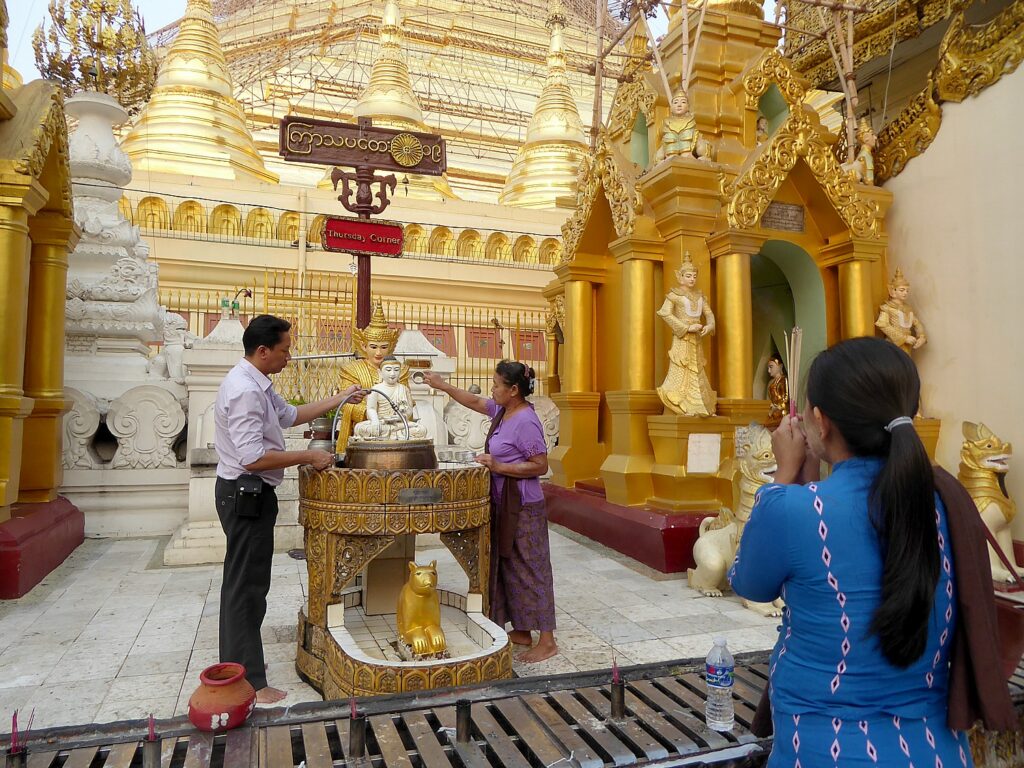
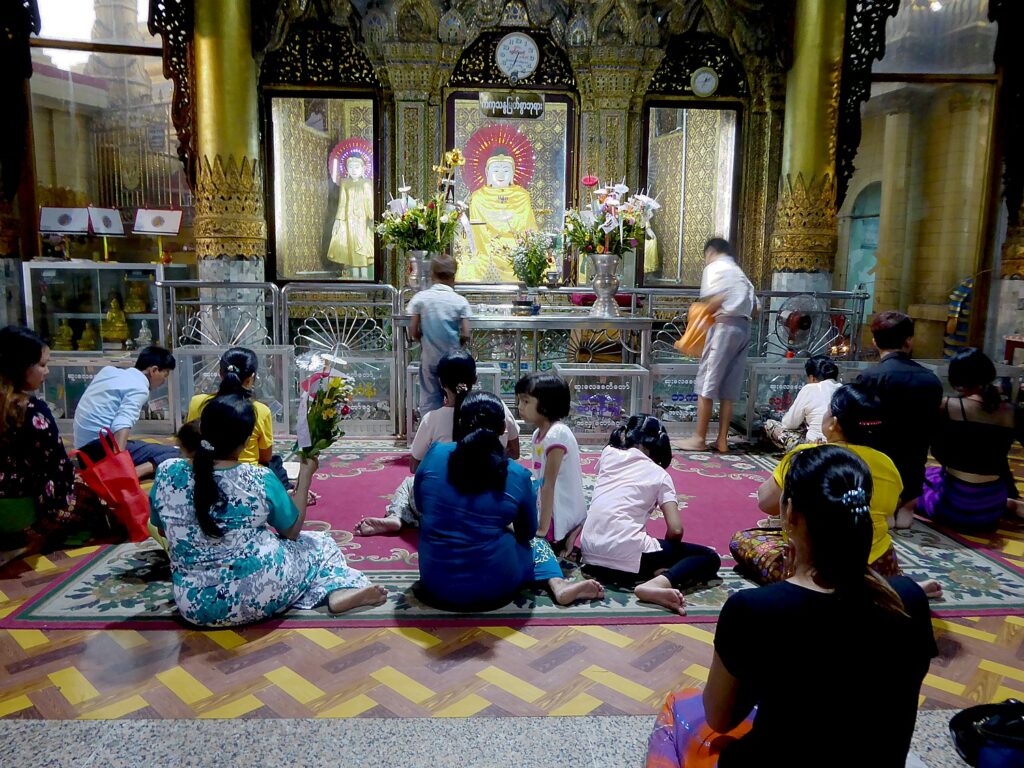
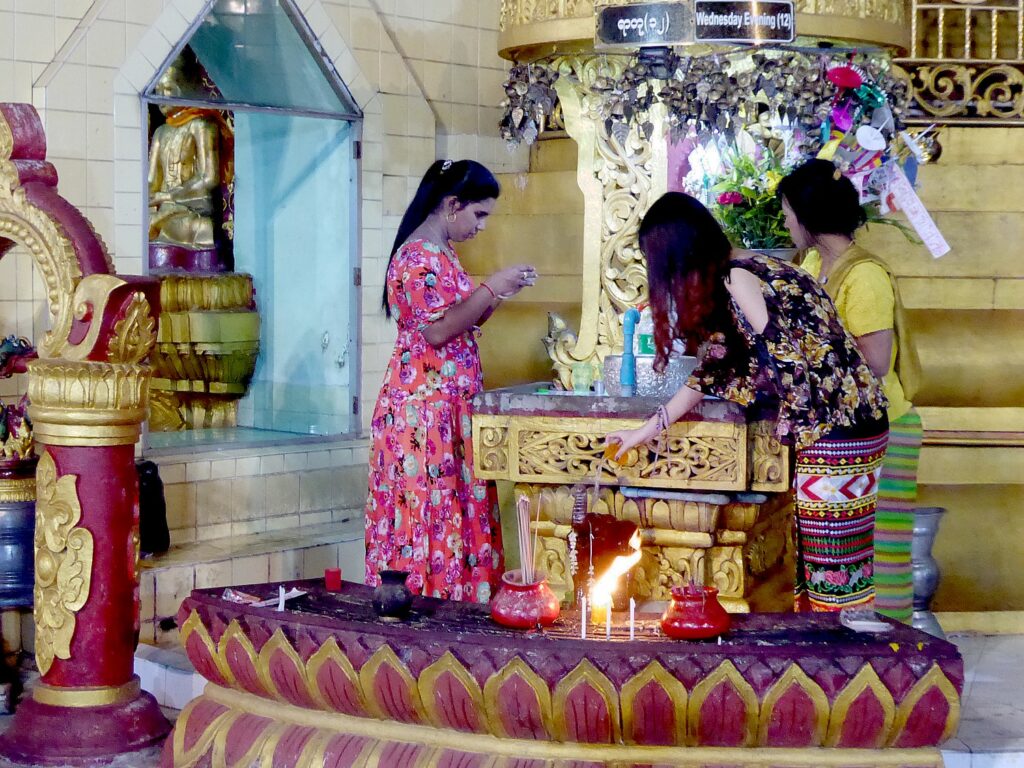
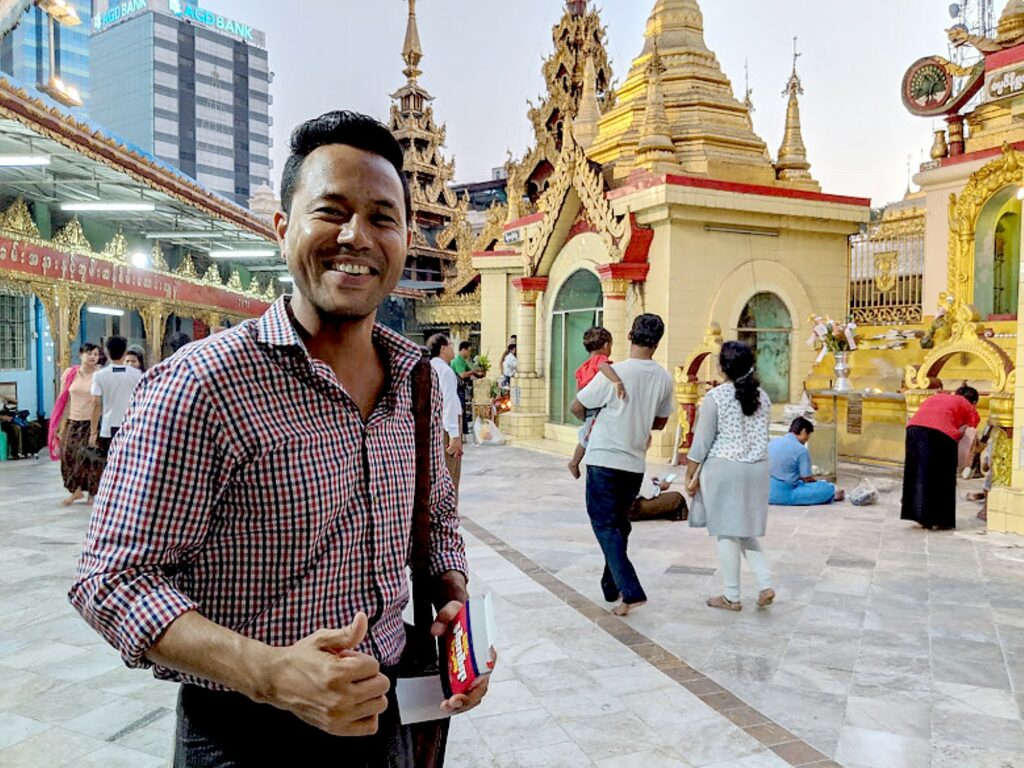
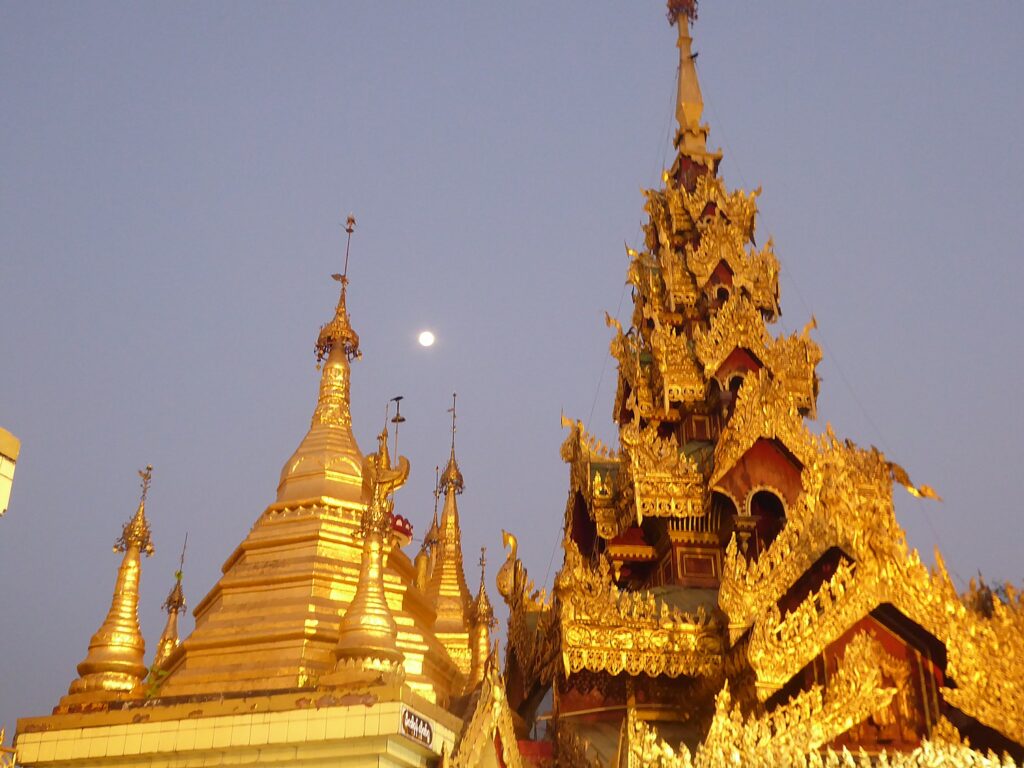
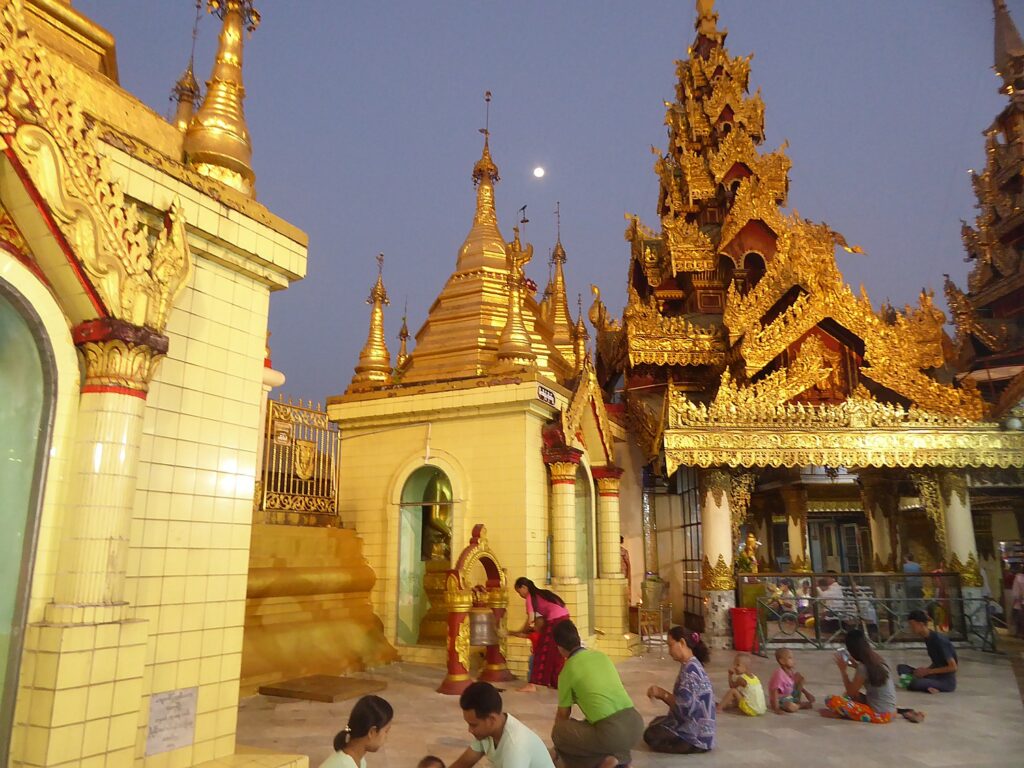
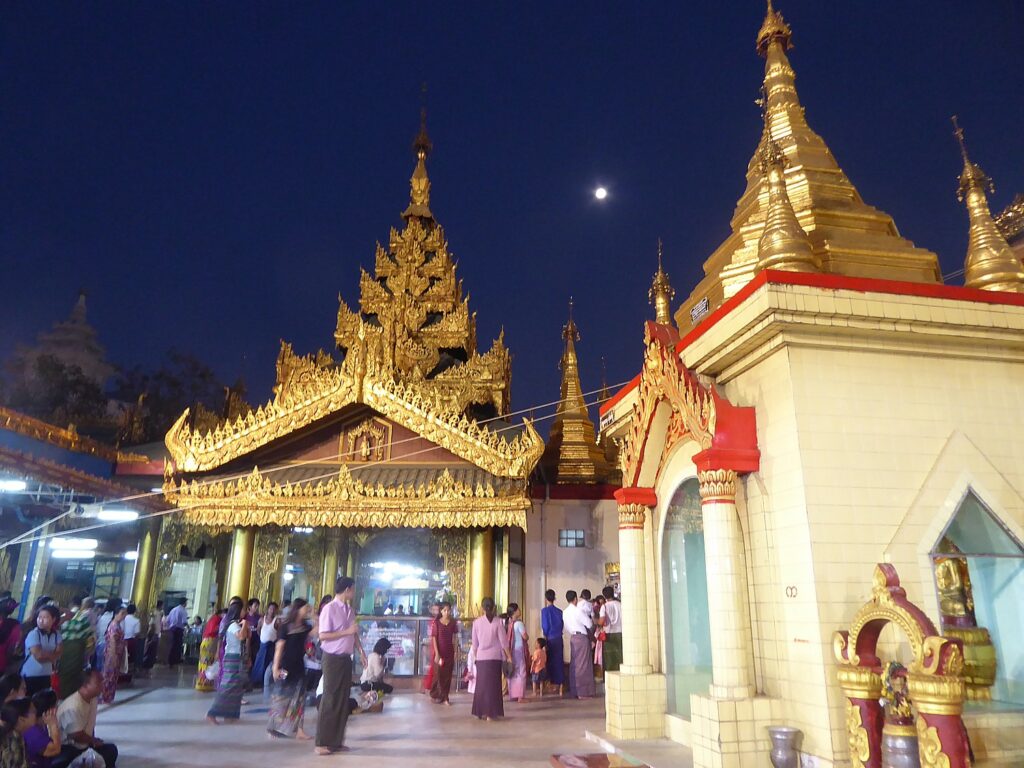
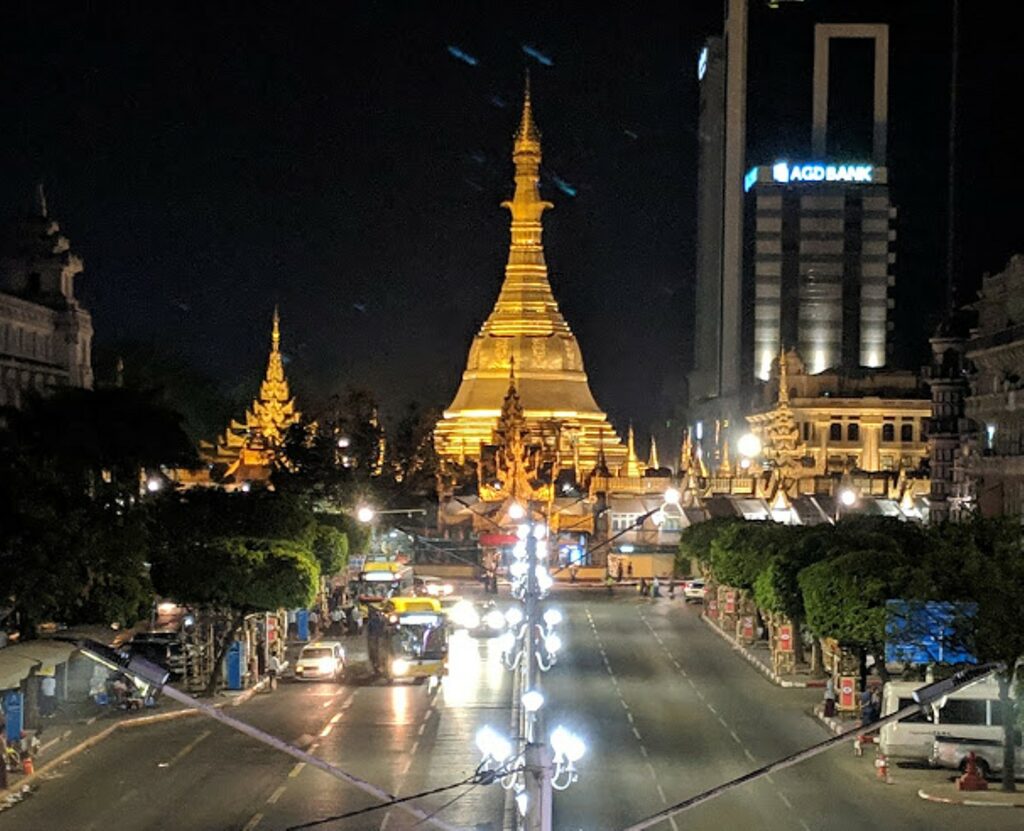
Sule Pagoda
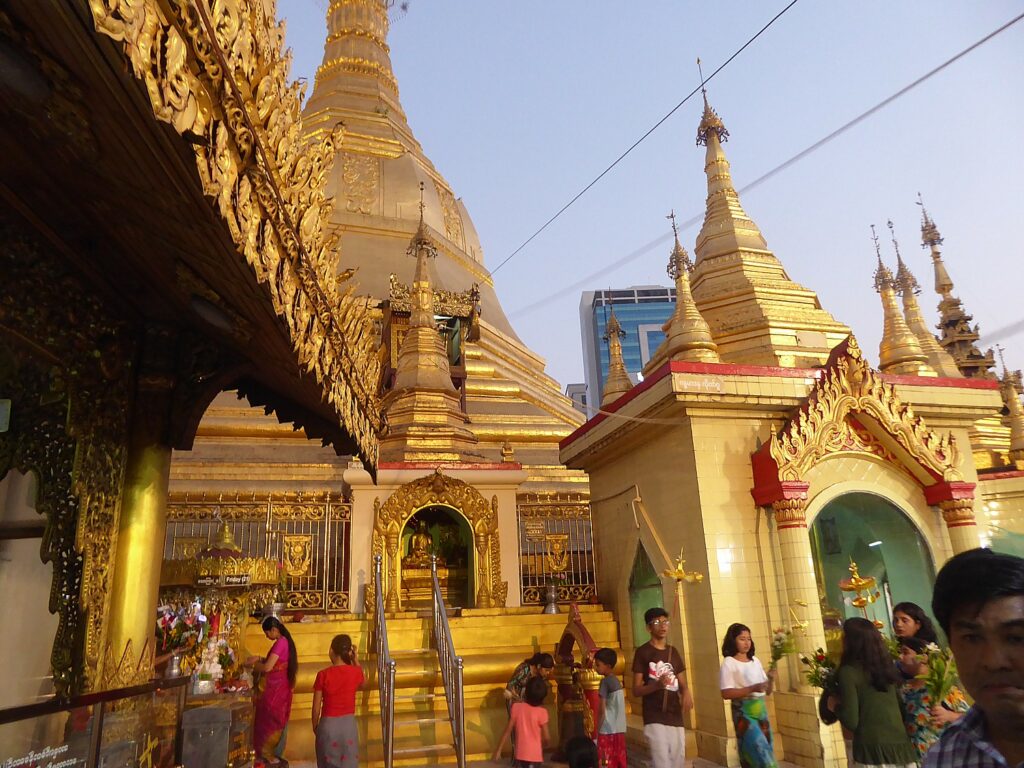
By the time we finish, I only have time to walk down a modern boulevard to the Sule Pagoda, which sits at the center of the city as well as the city’s political and economic life.
According to legend, the stupa was built even before the
more famous Shwedagon Pagoda
during the time of the Buddha, which would make it more than 2,600 years old.
The Sule Pagoda served as a rallying point in both the 1988 uprisings and the
2007 Saffron Revolution.
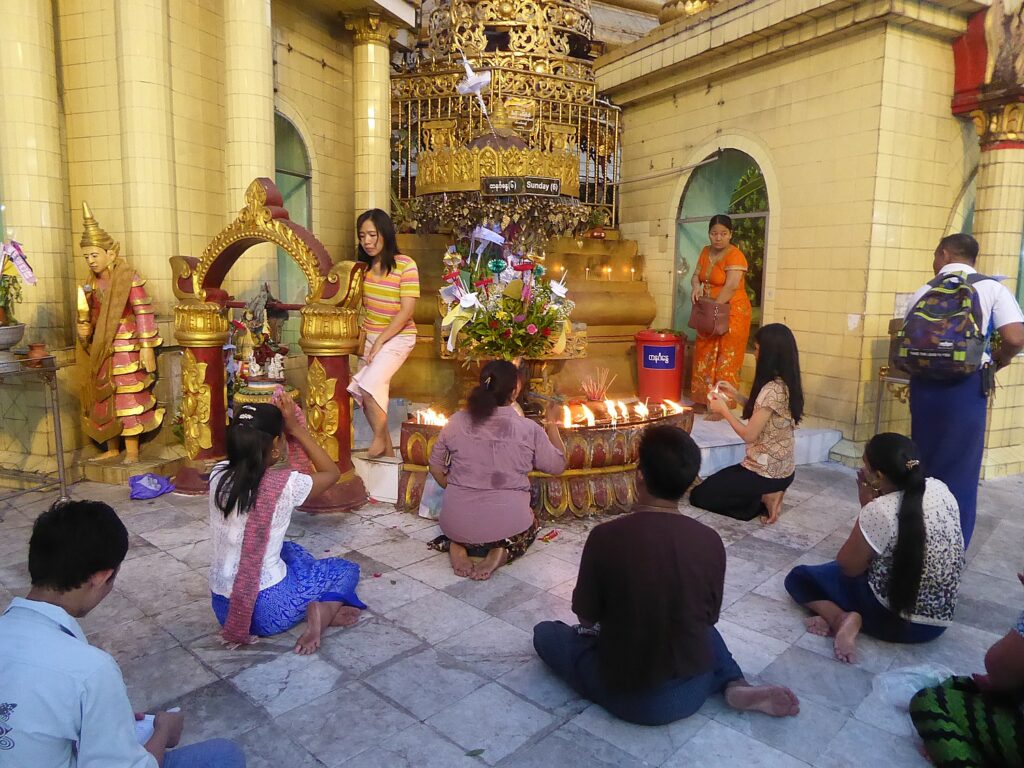
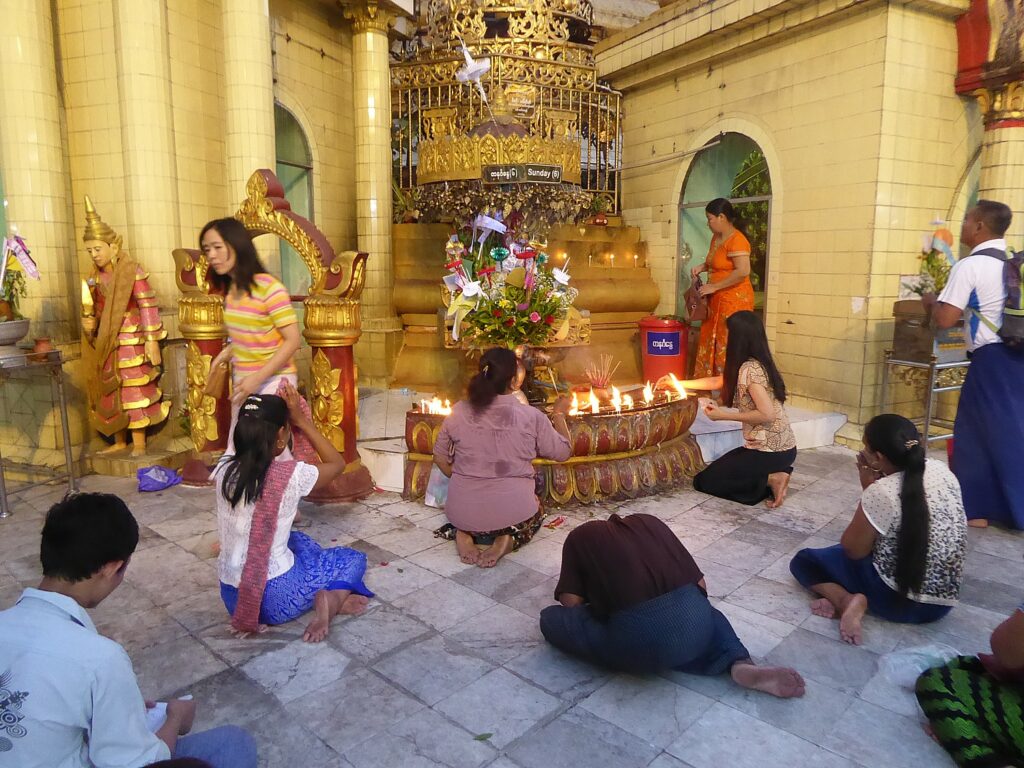
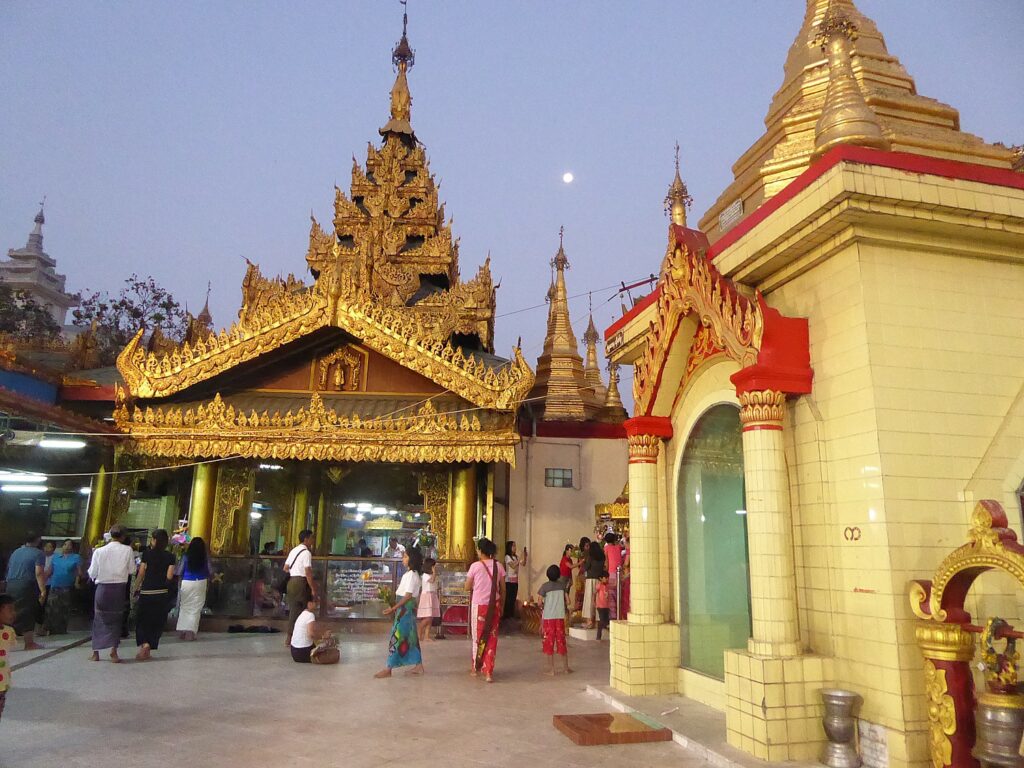
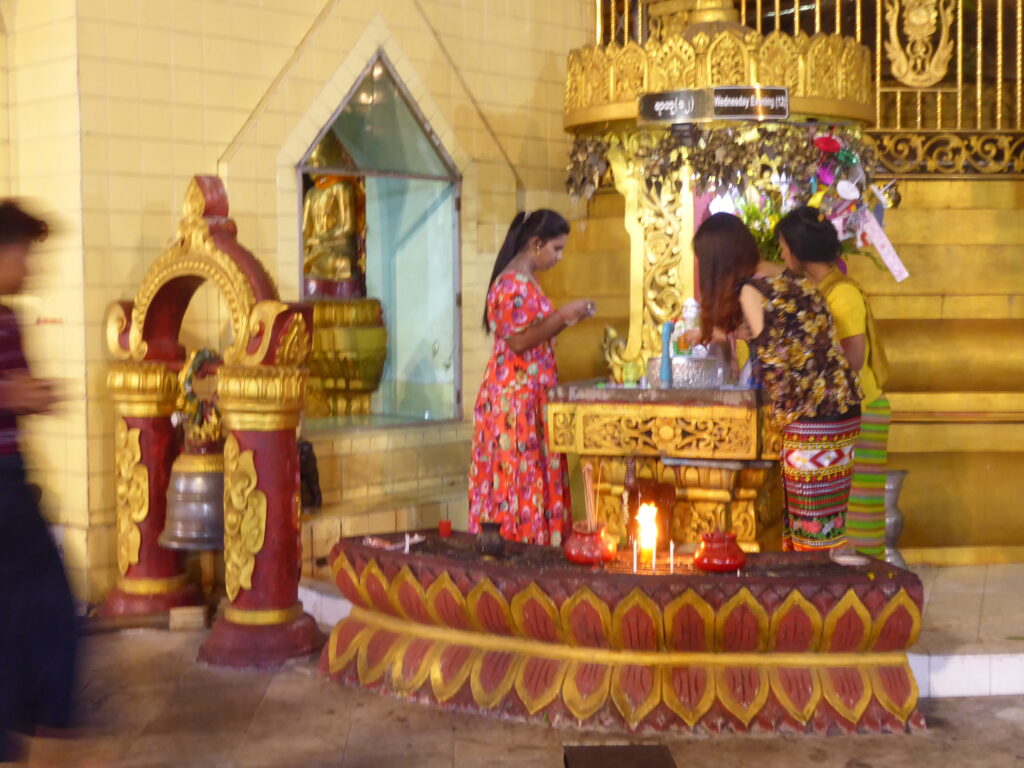
It’s
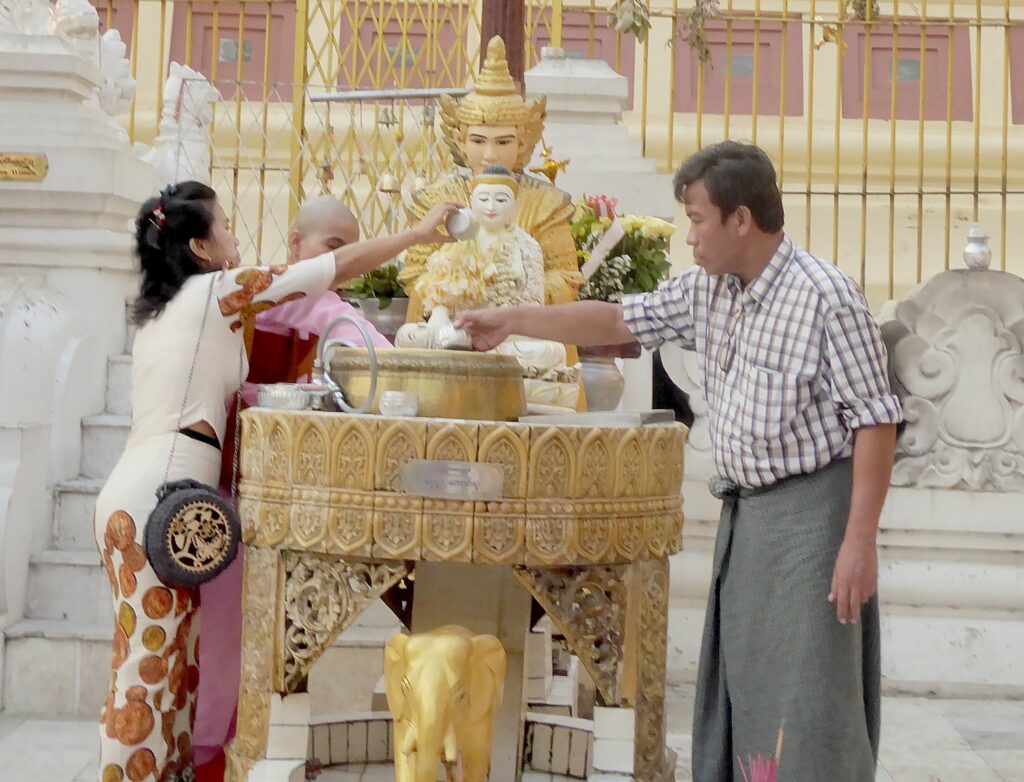
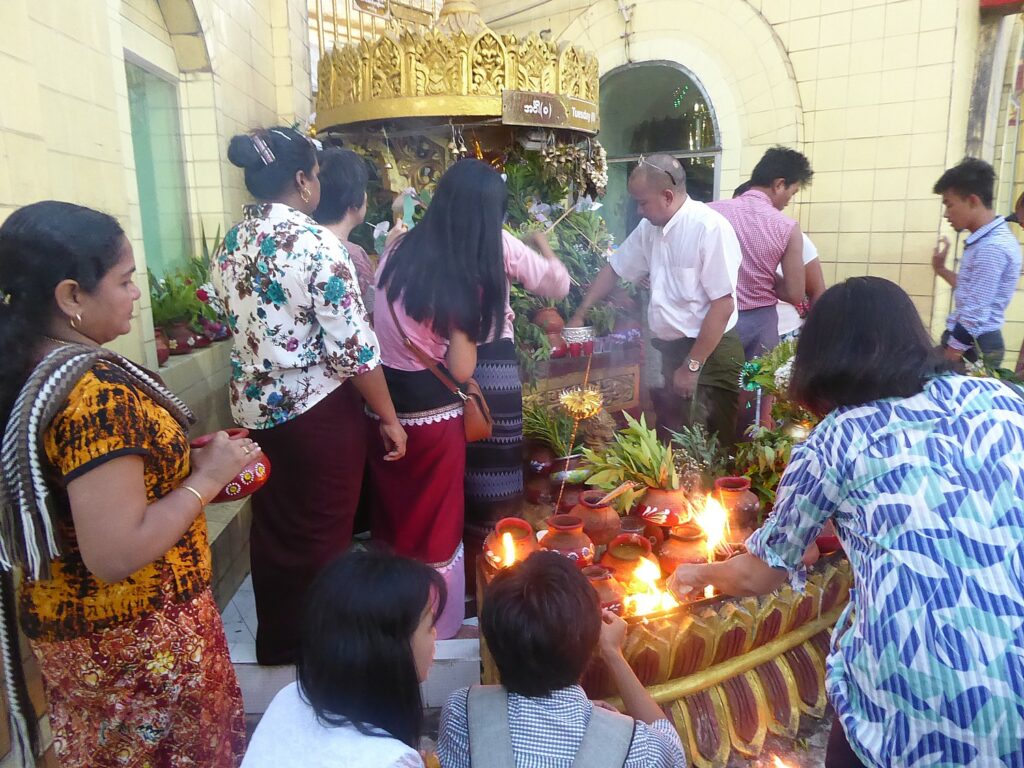
the last day of the New Year celebration and place is packed with people
bringing offerings, lighting candles and spilling water at their Weekday
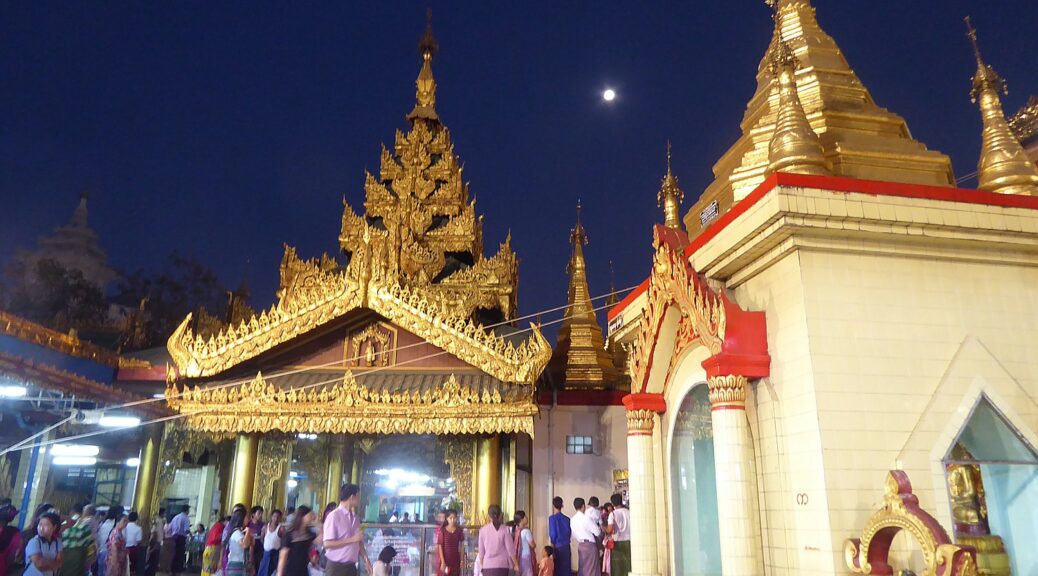
shrine. It is dusk when I arrive, and I watch the moon rise and the sky deepen
in color to azure blue, the brilliant gold of the pagoda a blazing contrast. A
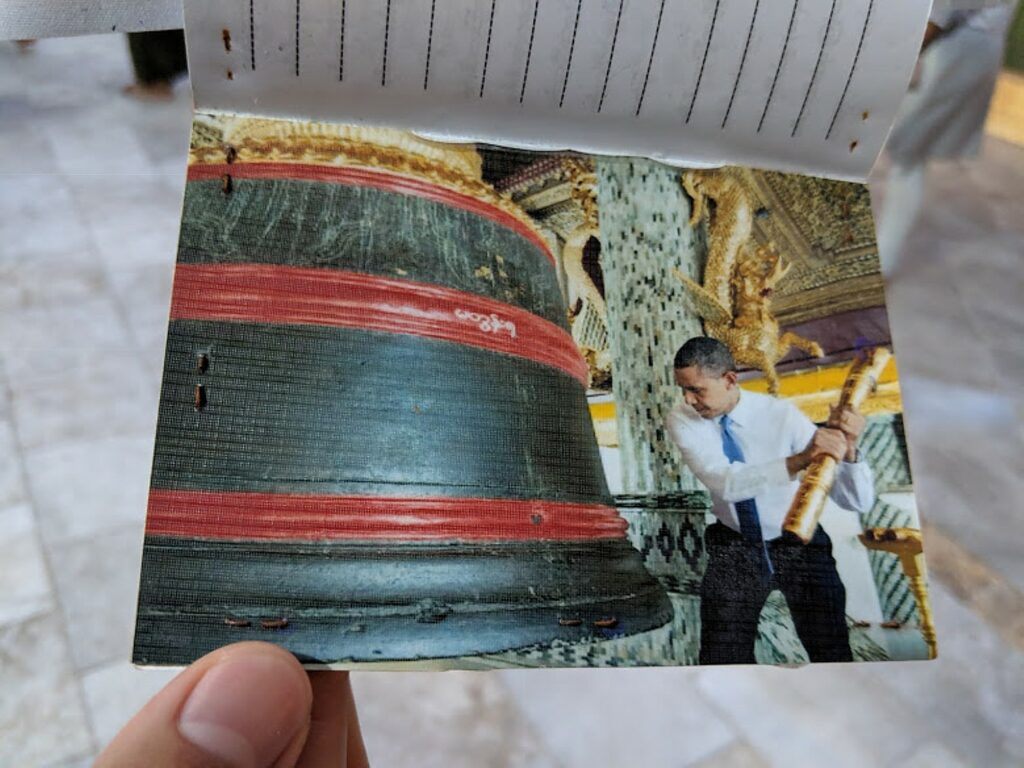
guide immediately comes up to me to offer to take me around and checks his book
to see exactly what day of the week I was born, so I know which is my shrine
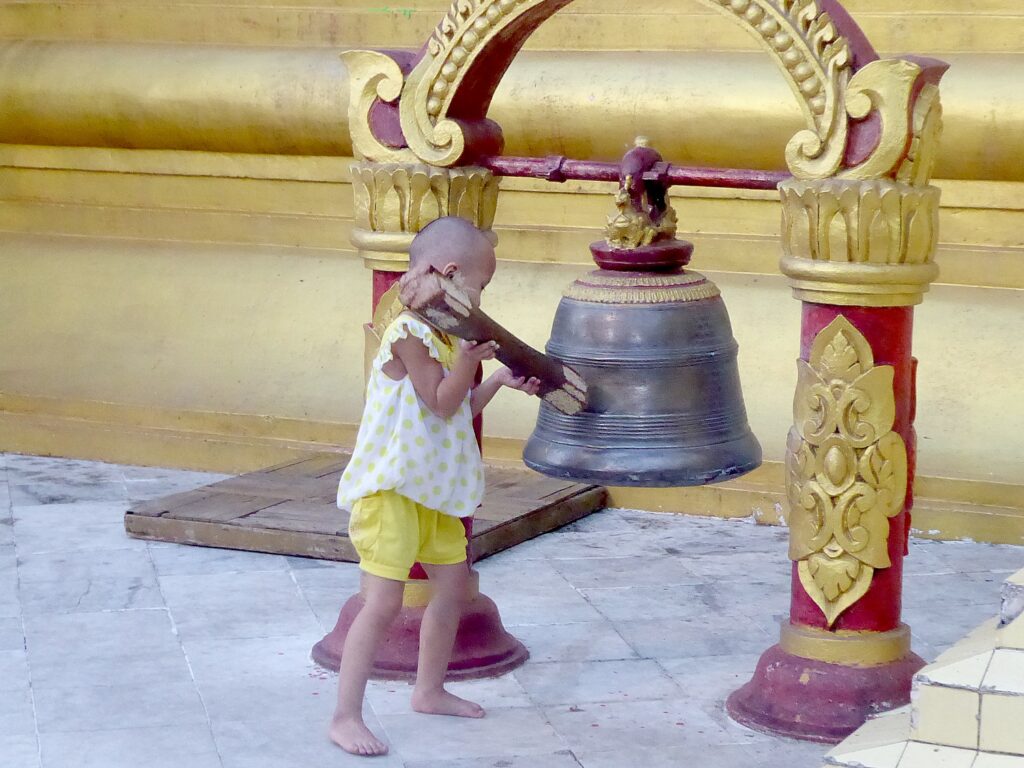
(Thursday is my shrine; the mouse is my animal); he shows me a photo of
President Obama striking one of the bells during his visit here.
I
have yet to see the famous Shwedagon Pagoda. Fortunately, I will have more time
to explore Yangon when we return on Saturday.
We
are up at 4 am to leave at 5 am for the airport for a 7 am flight to Bagan on
Golden Airlines. The hotel has very kindly packed a to-go breakfast. It turns
out several of us are going on the same flight to Bagan.
This
morning in clearer light, having become entranced by the description of Inle
Lake, a villages built on stilts and only accessible by boat, and hearing one
team discuss the overnight bus they will take from Bagan to Inle Lake, I decide
to go on my own to Inle Lake instead of to Mandalay. But that depends on
whether I can get seat on all-night bus, a hotel in Inle Lake and a flight from
Inle Lake on Saturday morning to be back in time for the 6 pm meeting/deadline.
The Global Scavenger Hunt is an annual travel program that has been operated for the past 15 years by Bill and Pamela Chalmers, GreatEscape Adventures, 310-281-7809, GlobalScavengerHunt.com.
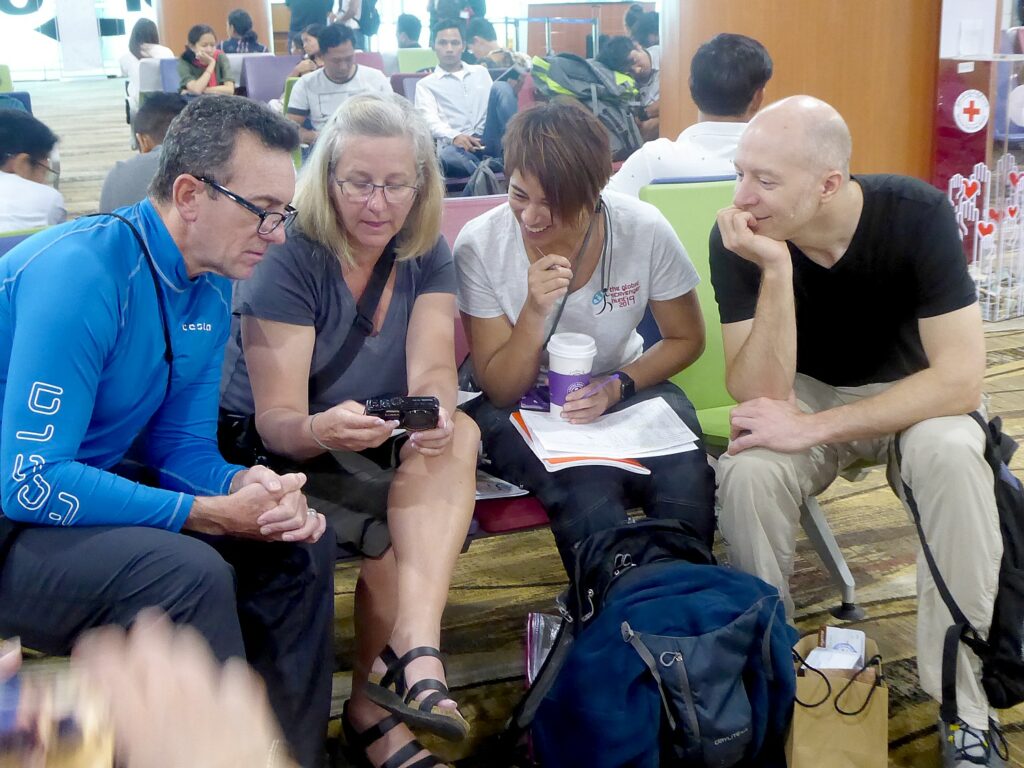
Two of the Global Scavenger Hunt teams, Lawyers Without Borders from Houston, and Lazy Mondays, doctors from California, do their peer review while waiting in the airport for the flight to the next leg of the 23-day, around-the-world mystery tour to determine “World’s Best Travelers.” (c) Karen Rubin/goingplacesfarandnear.com.
Saigon is the second leg of nine
during a 23-day, around-the-world Global Scavenger Hunt, “A Blind Date with the
World,” where we don’t know where we are going until we are given 4-hour
notice. Under the Global Scavenger Hunt rules, you are not allowed to use a
phone or computer for information or reservations, hire a private guide, or
even use a taxi for more than 2 scavenges at a time, since the object is to
force you to interact with locals. Though we were not officially competing for
“World’s Best Travelers,” my teammate, Margo (who I only met on this trip) and
I basically followed the rules in Vancouver and during our first day in Vietnam,
but we had to deviate on the second day.
It is shortly before 4 pm in Ho Chi
Minh City (Saigon), Vietnam, by the time we have received our book of scavenges
from Bill Chalmers, the Global Scavenger Hunt ringmaster (as he likes to be
called), who has ranked Vietnam a “Par 3” in difficulty (on a scale of 1-6),
strategized what scavenges we will undertake, and after a swim in the hotel’s
pool (so hot even the pool was like a bathtub), we head out of the Majestic
Hotel, a five-star historic property, toward Ben Thank Market, one of the
scavenges on the list.
Built in 1870 by the French who
colonized Vietnam for 100 years, it is where then and now, you can find locals
and tourists alike, with row after row after row chock-a-block full of almost
everything imaginable. (Be prepared to bargain aggressively; the shopkeepers
are even more aggressive). I come away with a few things I can’t bear to pass
up, when Margo realizes a second scavenge we can accomplish: tasting three
separate fruits (there is heavy emphasis on “experience” scavenges that involve
food, and Vietnam, Bill says, is one of the great food places in the world).
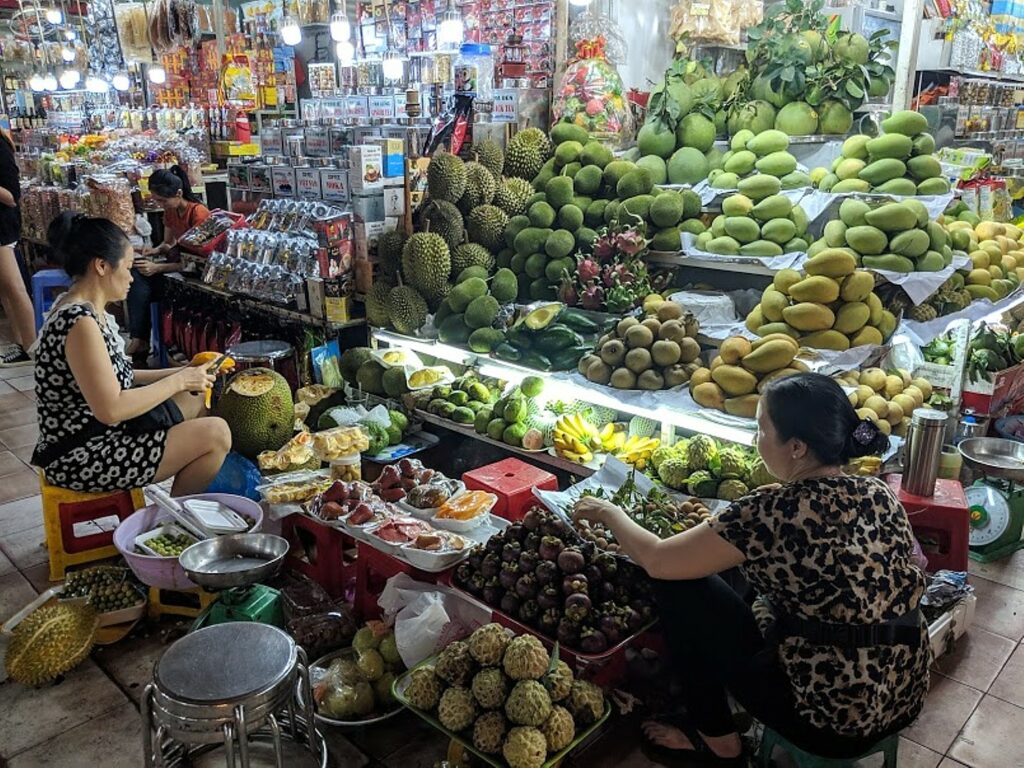
We find a fruit stand and sure
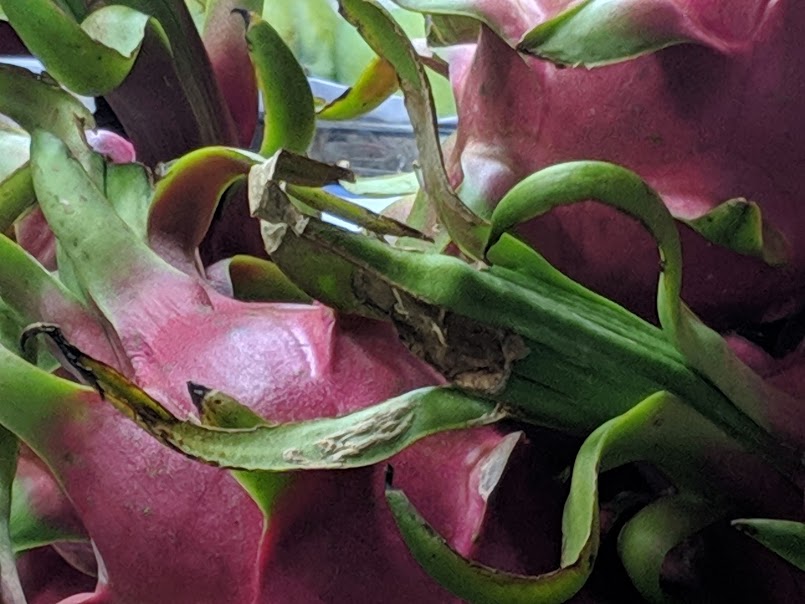
enough, there are fruits I have never seen before, including one, called dragon
fruit, which looks like it was divined by JK Rowling for Harry Potter; the
others we sample: rambutan, mangosteen, longan. We are standing around these
ladies, asking them to cut open the various fruits so we can sample them to
complete the scavenge, taking the photos we need to document.
Among the other scavenges on the
list here in the market: to find a cobra in jar of alcohol; the tackiest
souvenir in market; and a wet market (which befuddles most of us and turns out
to be the meat market which is hosed down).
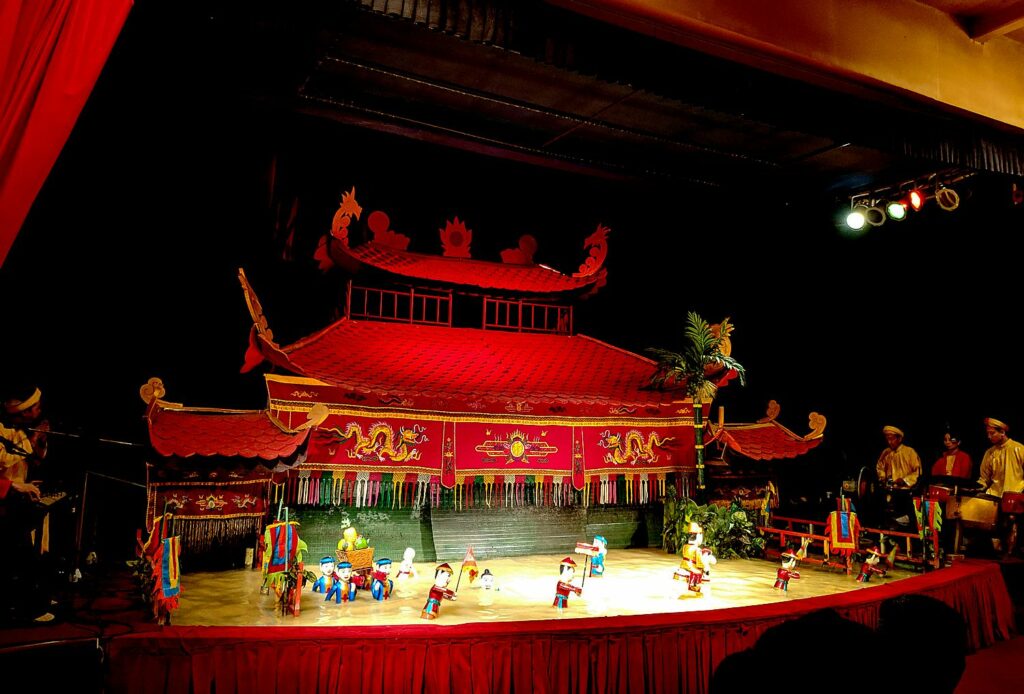
We ask locals for directions to our next stop: the Water
Puppet Show of Vietnam at the Golden Dragon Water Puppet Theater. It seems
walkable but we get lost along the way (technically we can’t use the GPS on the
phone, but we aren’t competing – we still get lost) and are simply amazed at
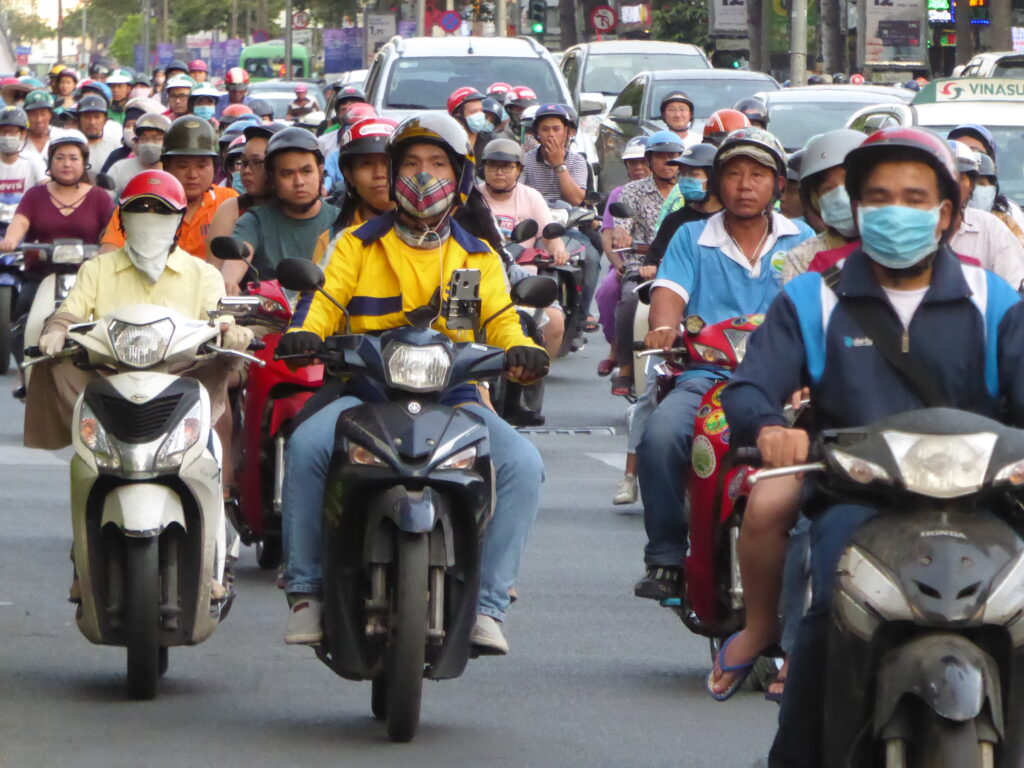
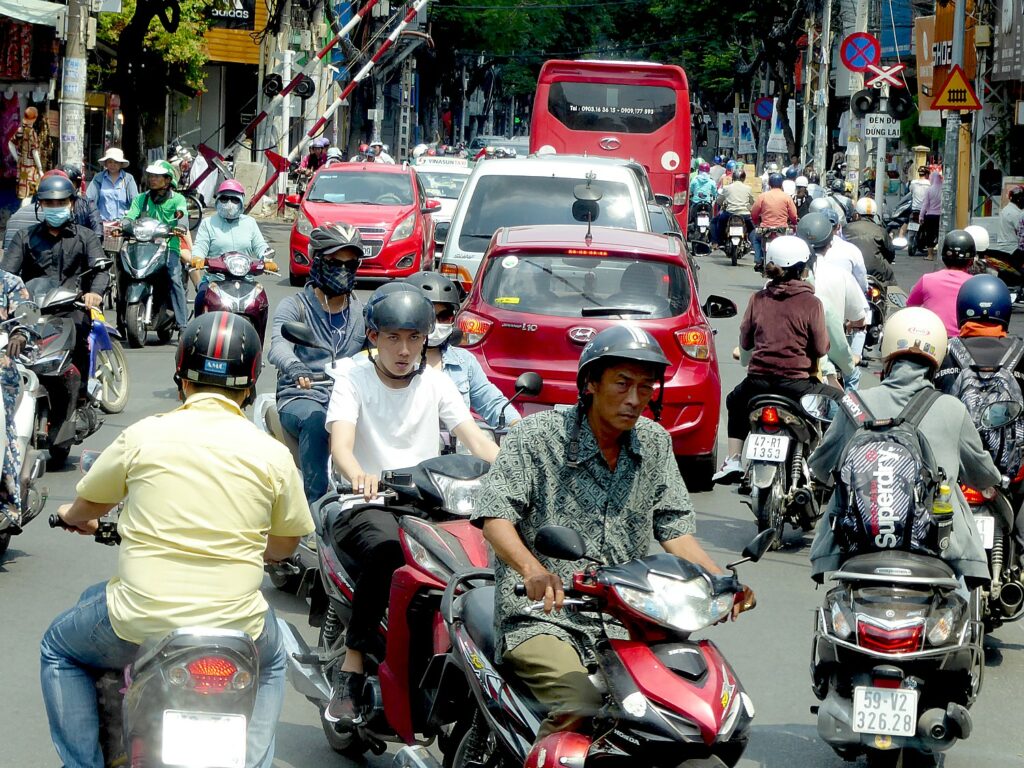
the rush and crush of mopeds (mainly) and cars in this city of 9 million where
there are an estimated 7 million scooters, and the range of what people carry
on them without a second thought. I literally stand in a traffic island to get
the full view.
We are also amazed we are able to
function having departed Vancouver, Canada, for Vietnam at 2 am for a 14-hour
flight to Taipei, followed by an hour lag time before a 3-hour connection to
Saigon. Time has become a very fluid, meta thing.
But we forge on (the secret to
avoiding being taken down by jet lag is to stay up until bedtime). This is also
on the scavenger list and as it turns out, we meet several other teams from our
group.
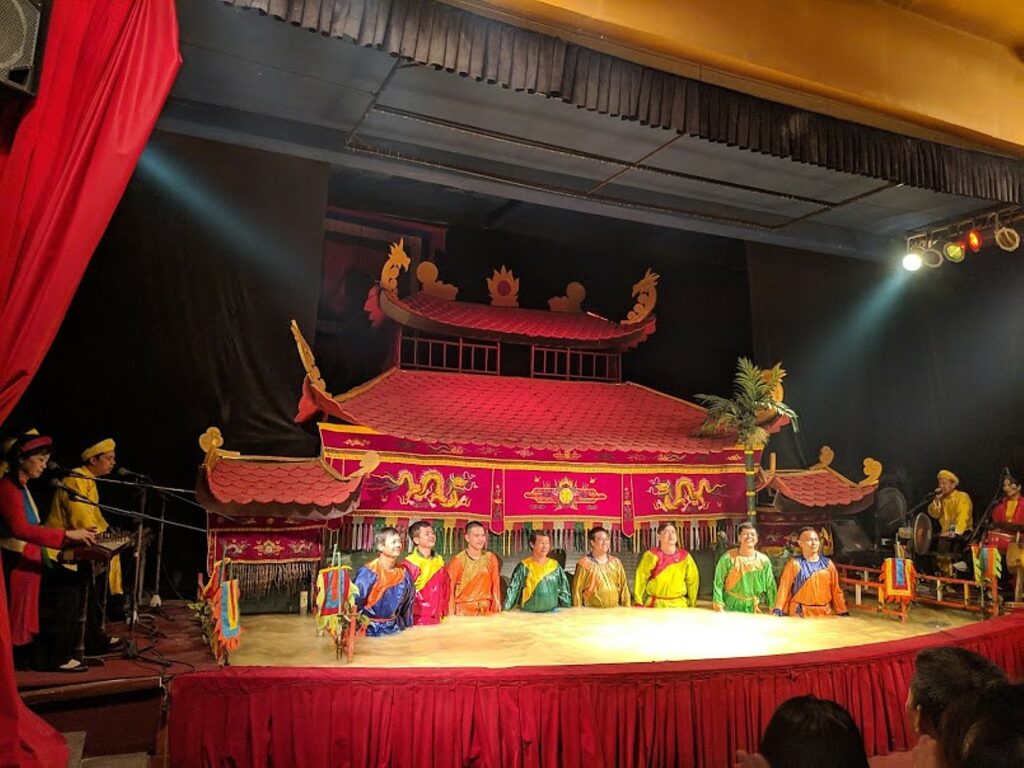
The performance proves fabulous and unexpected – the puppets actually emerge out of water; water is their platform. There is musical accompaniment on traditional instruments and the musicians also become the characters and narrators and sing. This is quite an outstanding cultural performance – the artistry and imaginativeness of the puppets (who swim, fish, plant rice which then grows, race boats, dance, catch frogs and do all sorts of things with incredible choreographed precision, is incredible.
These seem to be folk stories, and the music is traditional. It doesn’t matter if you don’t understand Vietnamese. It confounds me how they do such precise choreography from the water (the puppeteers are behind a gauze curtain; controlling with bubble wands horizontally). The artistry is magnificent and the experience an utter delight. (Golden Dragon Water Puppet Theatre, 558 Ngyuyen Thi Minh Kahi Street, Dist.1, HCMC, www.goldendragonwaterpuppet.com).
From there, we take a taxi to hit
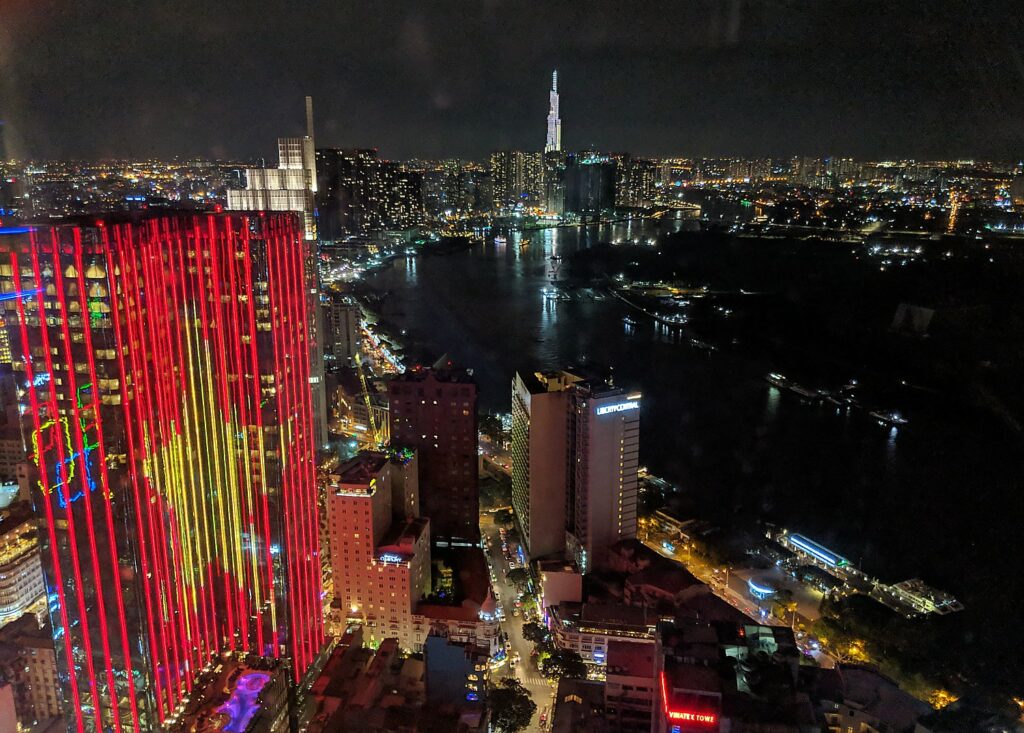
another scavenge, going to the Saigon Skydeck on the 49th floor of the Bitesco Financial Tower, which
affords beautiful scenes of Saigon. From here, all you see is a very modern
city. Many of the buildings below are decorated in colored lights. This is an
example of modern Saigon that is rising. (Skydeck senior rate $5; some places have
senor rates, others don’t, so ask)
Back
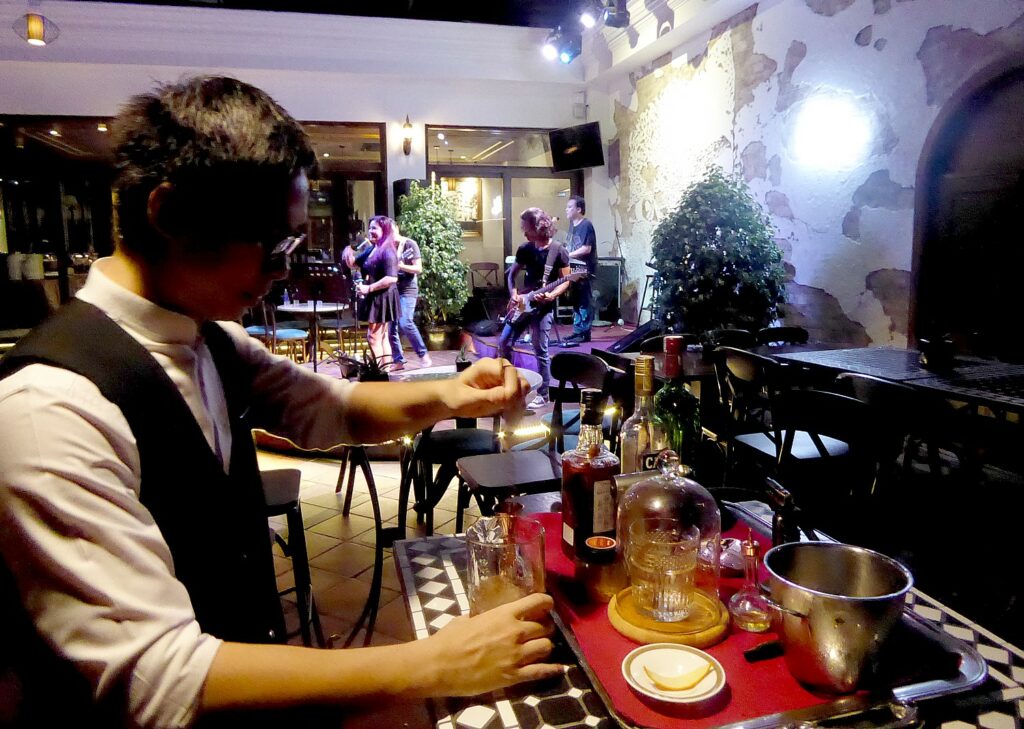
at the Hotel Majestic, we go up to the 8th floor M
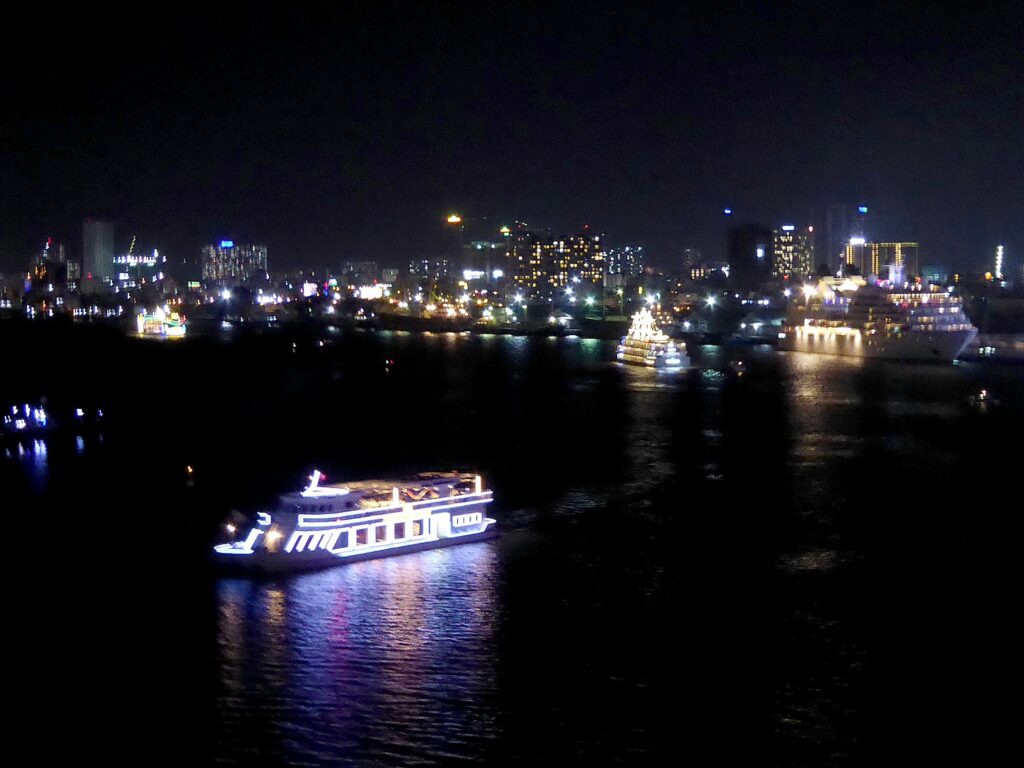
Club, a delightful rooftop bar, where there is a band playing. The open-air
views of the Saigon River and the skyline are just magnificent. Margo orders a
“Majestic 1925” which is Bourbon, infused orange, sweet vermouth, Campari,
orange bitter, orange zest, and smoked – the whole process done on a table
brought to us, as a crowd gathers to watch the mixocologist light a torch to
generate the smoke. Quite a scene.
Whereas
my first afternoon and evening in Ho Chi Minh City was devoted to seeing the
city as it is today – albeit dotted with centuries old buildings, markets and
heritage – the second day is a somber, soul-searching journey back in time.
Indeed, as I wander around the city, you don’t see any obvious scars of the
Vietnam War.
One of the signature sights of a
visit to Ho Chi Minh City is the Cu Chi Tunnels. My teammate Margo has already
been there and doesn’t want to return, but I feel duty-bound to see it for
myself. I wake up early and go down to
the hotel concierge to see if I can get on the 7:30 am half-day trip to the Cu
Chi Tunnels.
The concierge calls the tour company
and says there is room on the bus and that they pick up right at the hotel. I
am off. (545,000
Dong, about $25, www.saigontourist.net, www.e-travelvietnam.com)
As
we travel outside through the city, the guide points out sights and gives us a
history of Vietnam, going back to the Chinese who came in the 1600s, the French
who came later, the Vietnam War and the aftermath, while hardly disguising resentment of the
North Vietnamese who have flooded into the city since the war. Ho Chi Minh City has grown from a city of 2 million to 9
million today, with 7 million scooters (here, instead of Uber car, you summon a
Grab scooter).
It’s
an opportunity to see more of the city and soon we are in the countryside,
traveling through small villages and farms where we see cemeteries, markets,
houses, a few animals, rubber plantations. We see new agricultural techniques
being used on farms and pass an agricultural research center. It is about an
hour’s drive.
The Cu Chi Tunnels are an immense
network of connecting tunnels located in the
Củ Chi District of Ho Chi Minh City (Saigon), which the
Viet Cong used to launch guerrilla warfare against the Americans during the
Vietnam War. The site has over 120 km of underground tunnels with trapdoors,
living areas, storage facilities, armory, hospitals, and command centers, and
were used going back to 1948 against the French, and later against the
Americans.
The visit is profound, and though
the script is written by the victors, is appropriate to represent the side that
wanted to push out colonists (though in retrospect, I realized that there was
no real mention of the fact that the South Vietnamese leadership didn’t want
the Communist North Korean leadership to take over, either – nothing is simple,
especially not in the world of geopolitics).
You have to appreciate the
commitment and courage and sacrifice of the Viet Cong in living the way they
did – creating a virtually self-sufficient underground community, planting
booby traps for the Americans, repurposing unexploded bombs into weapons and
old tires into sandals, cooking only at night and channeling the smoke to come
up in a different place (where it would look like morning steam, so not to give
away the location of the tunnels).
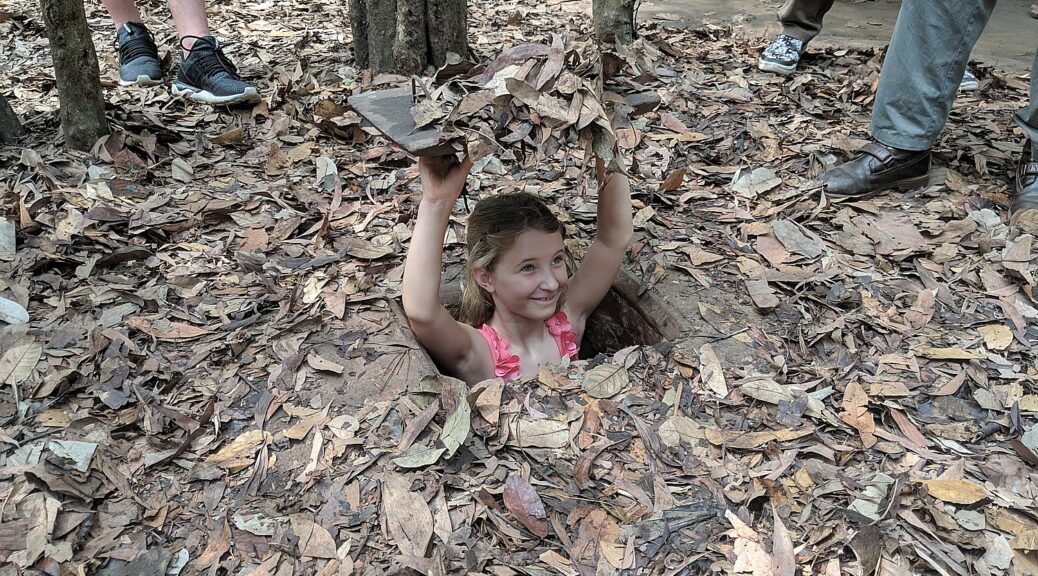
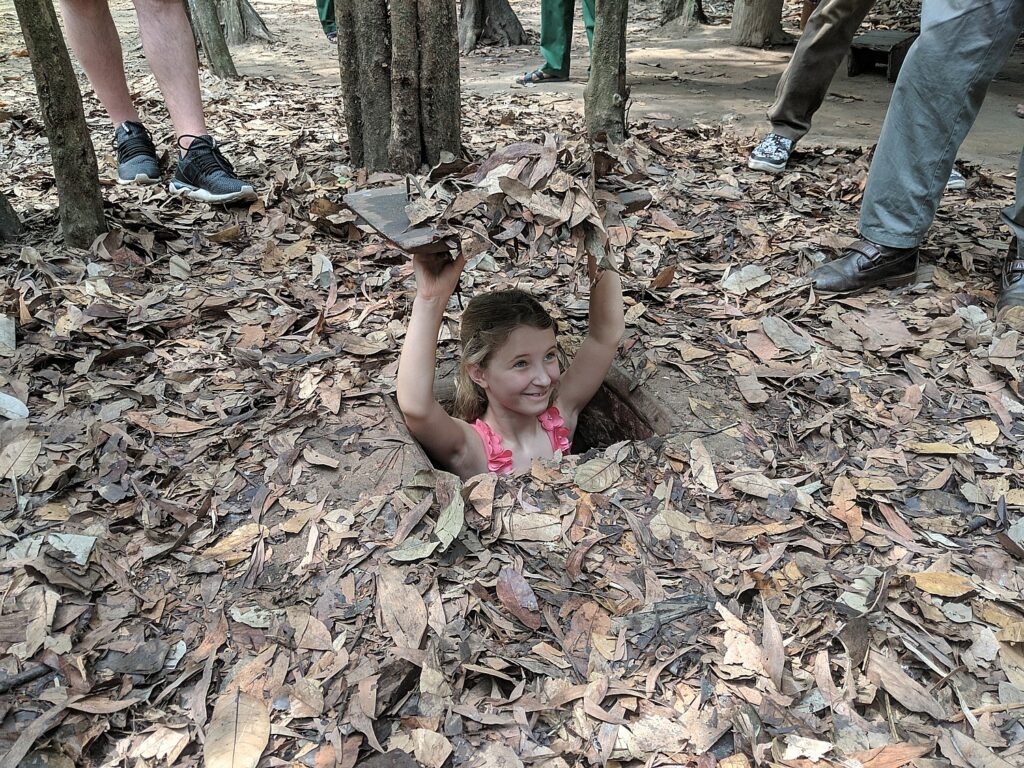
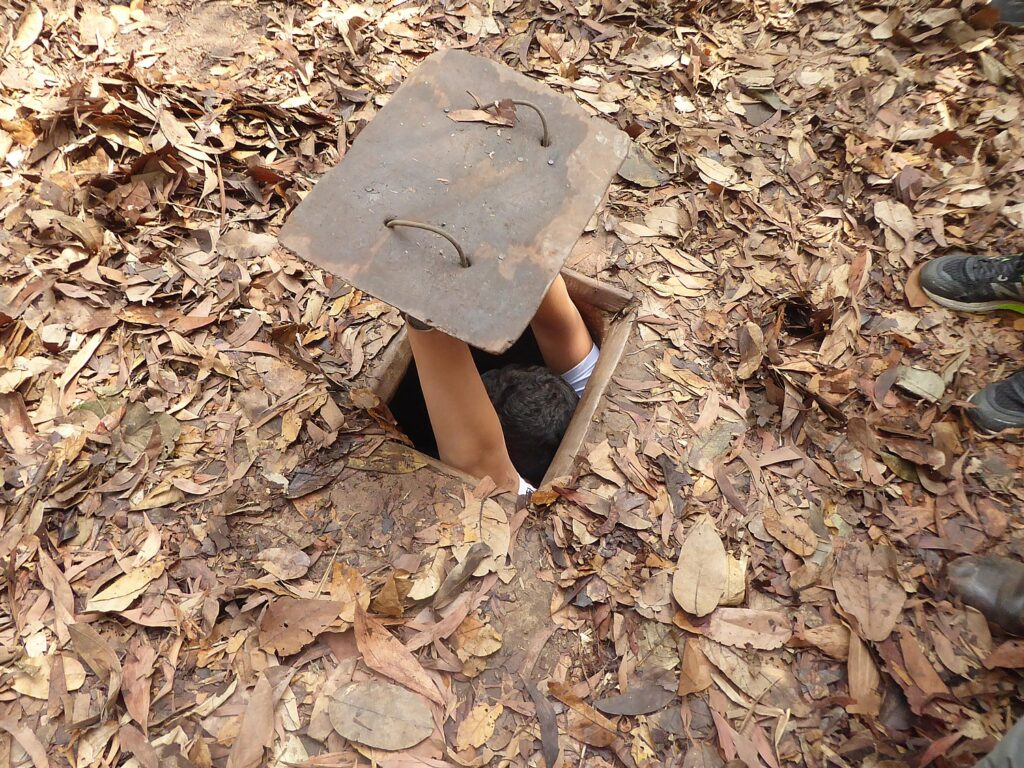
We get to climb into a tunnel, and
can go 20, 40, 60, 80 up to 160 meters, seeing just how tiny they were – you
have to crouch all the way through and sometimes even crawl. It is hot,
uncomfortable, you feel claustrophobic and it is a bit terrifying.
Our tour guide leads us through – he
is incredibly kind and considerate. He gives special attention to the children
who are visiting – grabs them when they want to go down into a tunnel where he
fears there could be scorpions (he shows us carcasses), snakes or rats.
There is also a shooting range where
you can shoot an AK 47 or M16 (extra charge), but the constant sound of gunfire
gives you some sense of what the people were living through. There was a
hospital, a sewing area where they would make uniforms, there is a trap door to
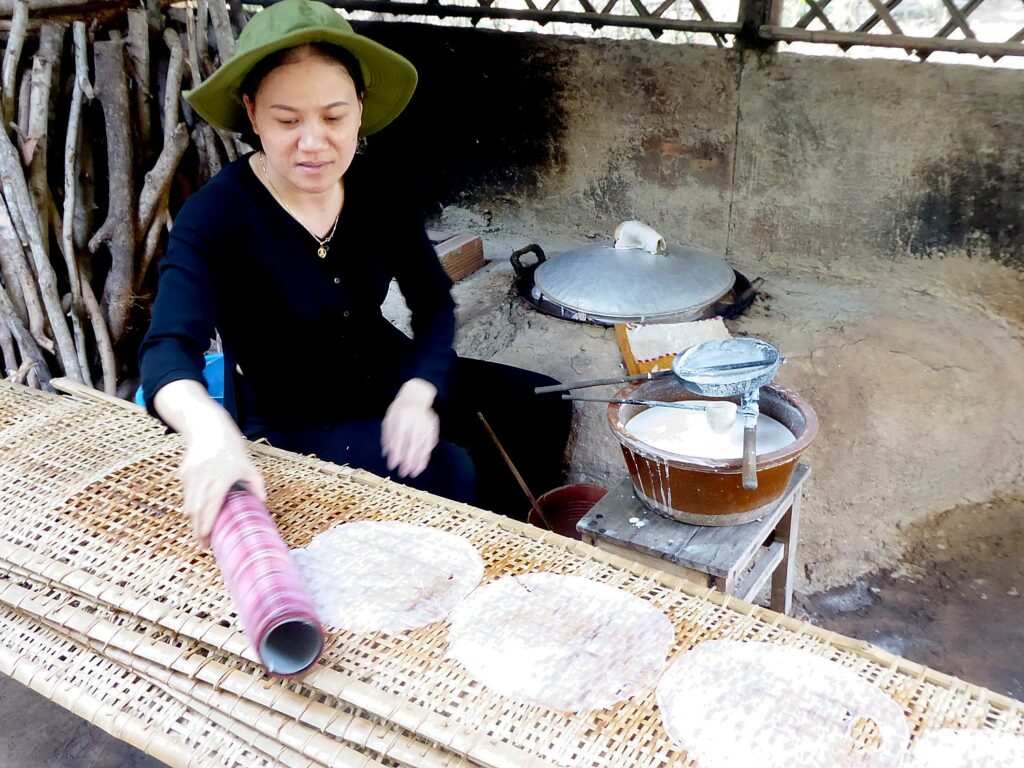
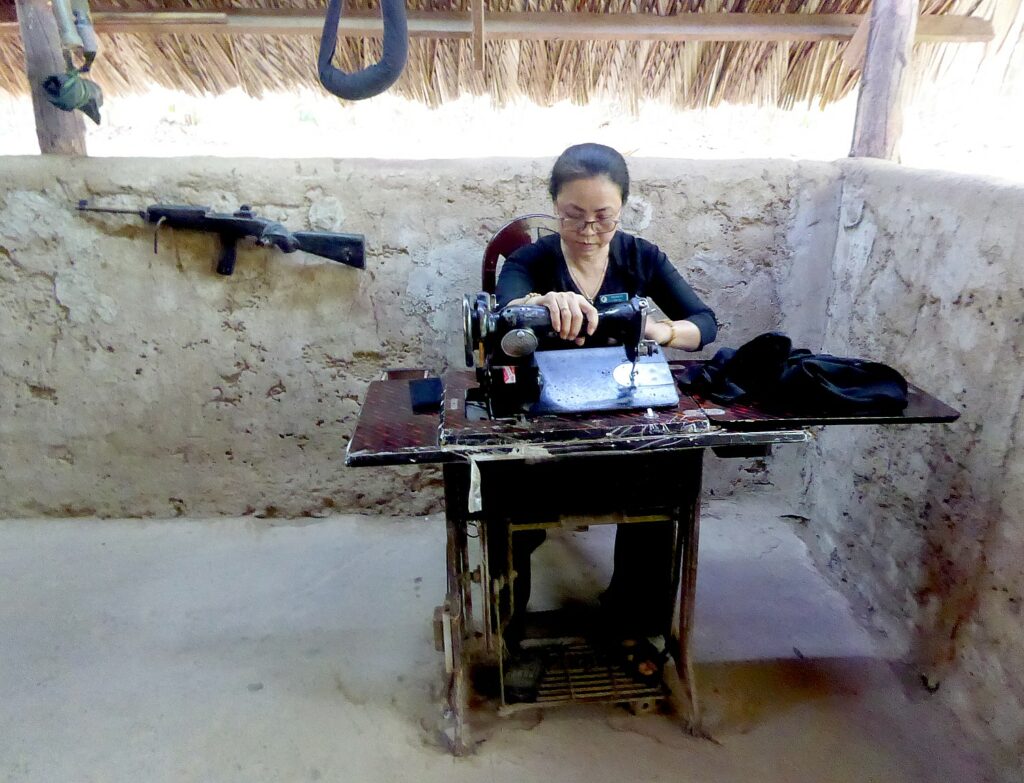
escape. We see where they would have made sandals from old tires. We watch a
woman demonstrate making rice paper; another at a sewing machine where she
would be making uniforms, a rifle hung close by on the wall.
All of these things which we see
above ground are recreated from what they would have looked like underground.
There were also constant bombings –
B-52s could fly from the base in just two minutes time.
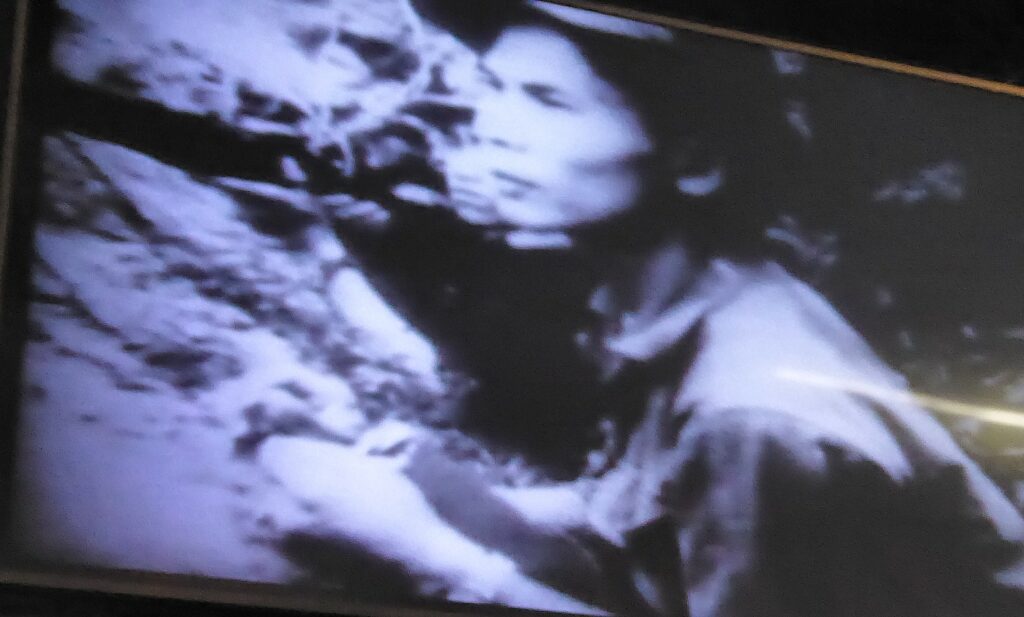
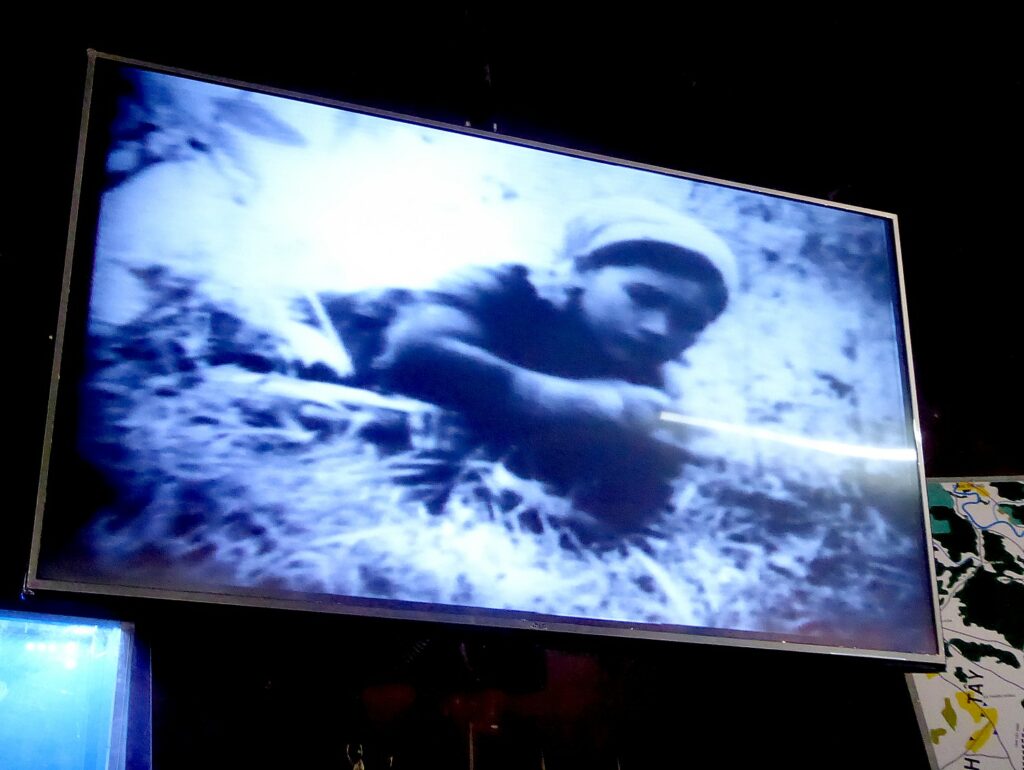
We get a sense of that in
documentary-style films that are presented at the end. The film uses grainy
black-and-white imagery with a narration that spoke of the commitment to save
the Fatherland from US aggression, which basically depicts much of what we have
visited in the tunnels, but as these places were used during the war. I must
say that as gruesome as the film is, the only “propaganda” element is that it
does not discuss the civil war between North and South Vietnam, only that the
war was perpetrated by the Imperialist United States.
Many of the scenes show women and
girls as soldiers. “They took unexploded bombs and turned them into their own
weapons; they took from the Americans the new guns but never stopped using
traditional weapons – the traps devised to hunt animals were used against the
American enemy… Every person can be a hero. They had to live in poverty but
wouldn’t retreat. A rifle in one hand, a plow in the other. Attacked in the
morning, they farmed at night so they had enough food to win the war. The
Americans wanted to turn Cu Chi into a dead zone, but they lived underground.”
But
what we see in the film looks exactly like what was put on view here. We see
people climbing through tunnels to the sound of gunfire.
“Male
and female enrolled to kill enemy..Cu Chi guerrillas would rather die and
become hero for killing Americans… never afraid of hardship to kill
Americans. In hardship, they came together.”
Believe it or not, they actually
make the experience as pleasant and as comfortable as possible, which somehow
masks the terror of the place. Children smile and laugh as they get to descend
through the camouflaged openings in the ground.
We leave the tunnels after spending about two hours here.
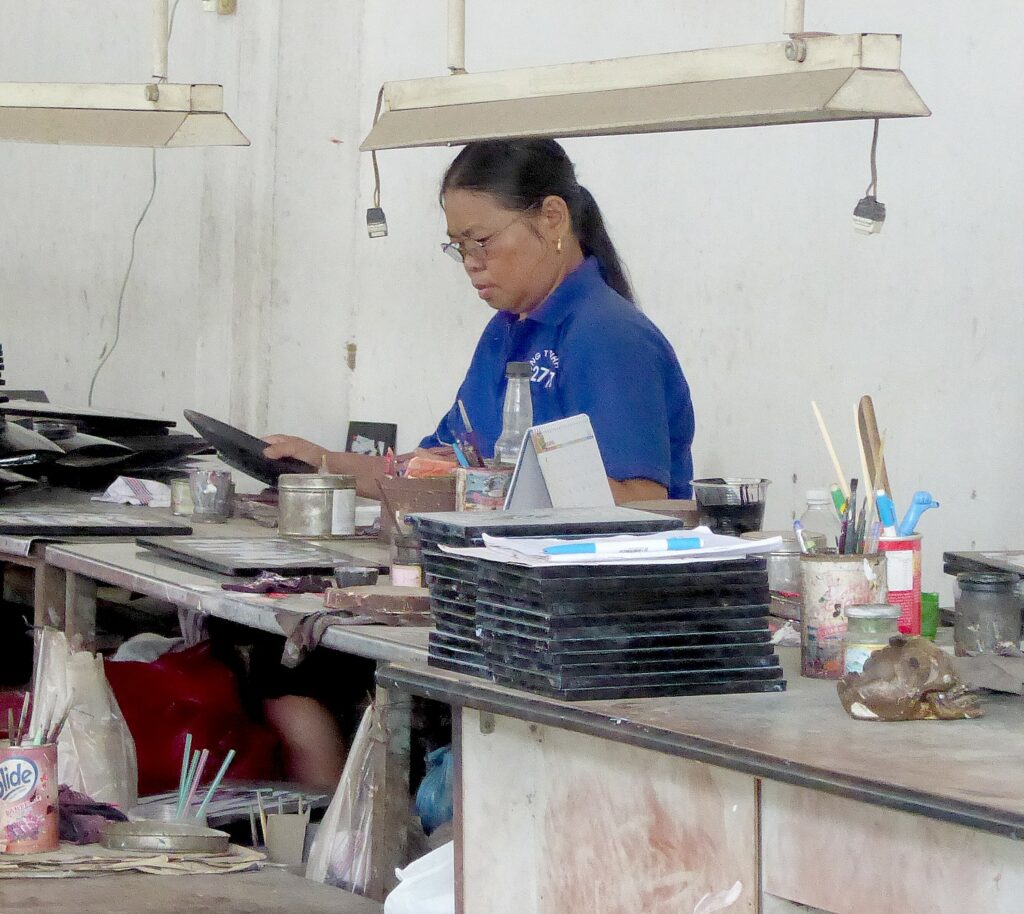
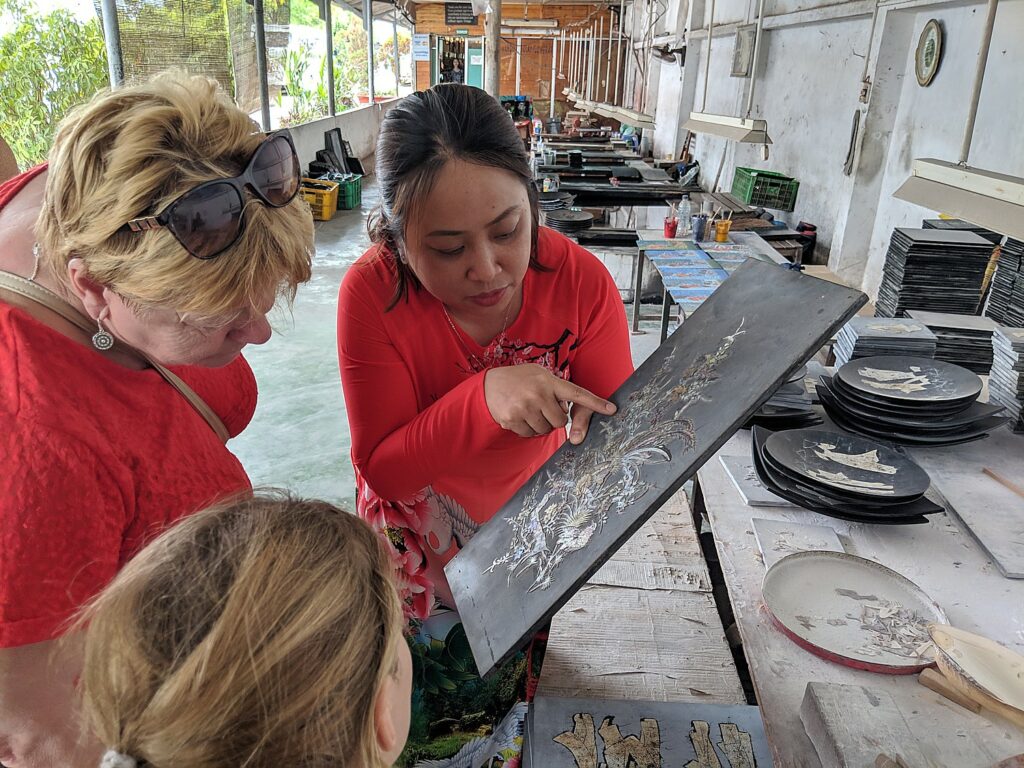
On the way back, the guide asks if we would like to make a detour to visit a factory, created by the government to employ people who were handicapped because of coming upon unexploded ordinance, or who had birth defects as a result of the chemical weapons used against the Vietnamese. Originally the factory, 27-7 HCMC.Co.Ltd, produced cigarettes, but today, Handicapped Handicrafts produce really beautiful handicrafts – mainly lacquered and inlaid items.
After
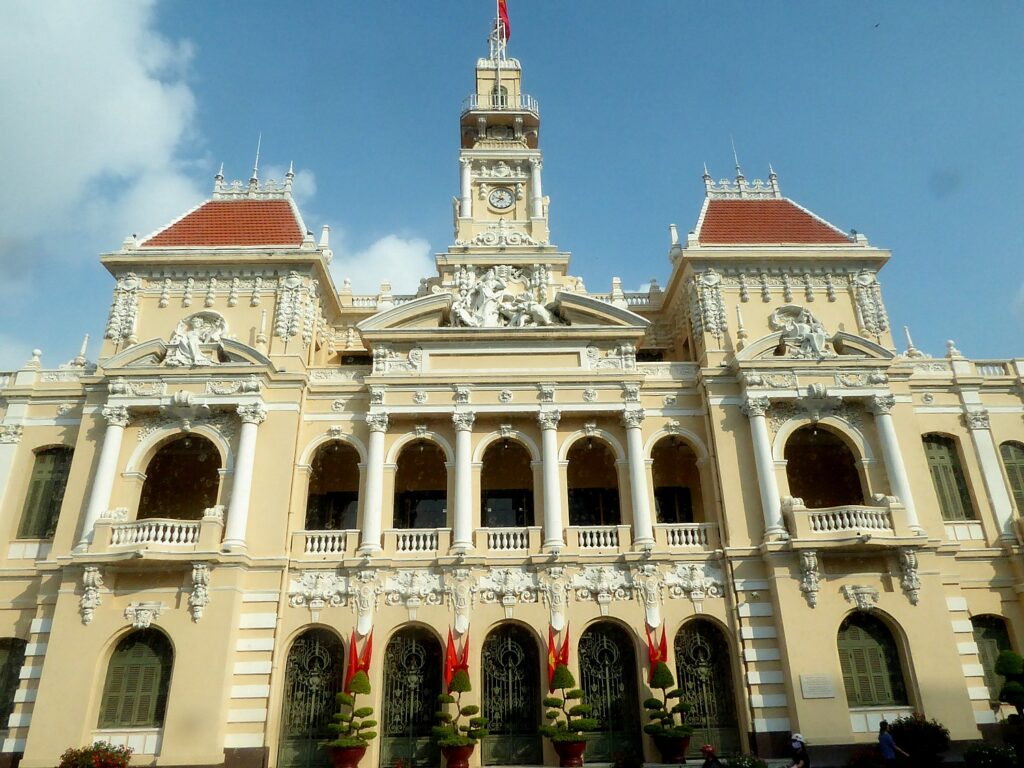
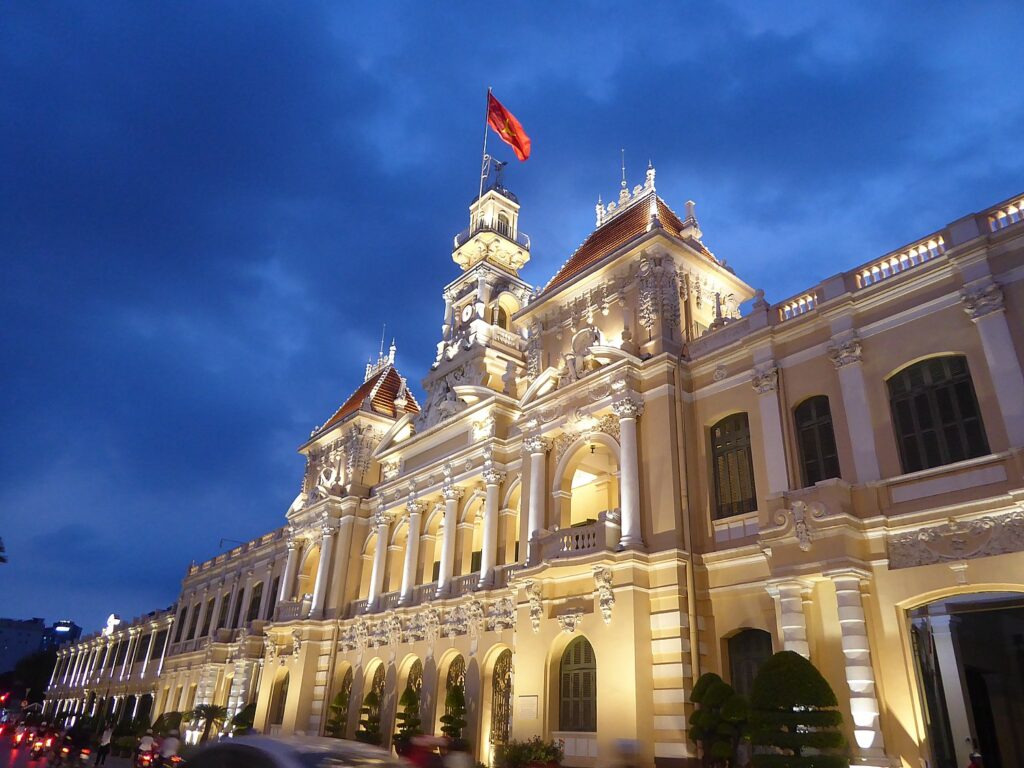
returning to Saigon, I go off to continue my theme – visiting the buildings
that the French built, starting with the magnificent Post Office (where I wind
up spending close to an hour choosing from a stunning array of post cards,
buying stamps and writing the cards, the sweat streaming down my face and
stinging my eyes so that a nice lady hands me a tissue). Then onto the
Reunification Palace (which I thought was open until 5 but closed entrance at
4), so I go on to the War Remnants Museum.
I
have trouble following the map, so when I ask directions of a young man, he
leads me through back alleys to the entrance of the museum, which I visit until
it closes at 6 pm, because there is so much to see and take in.
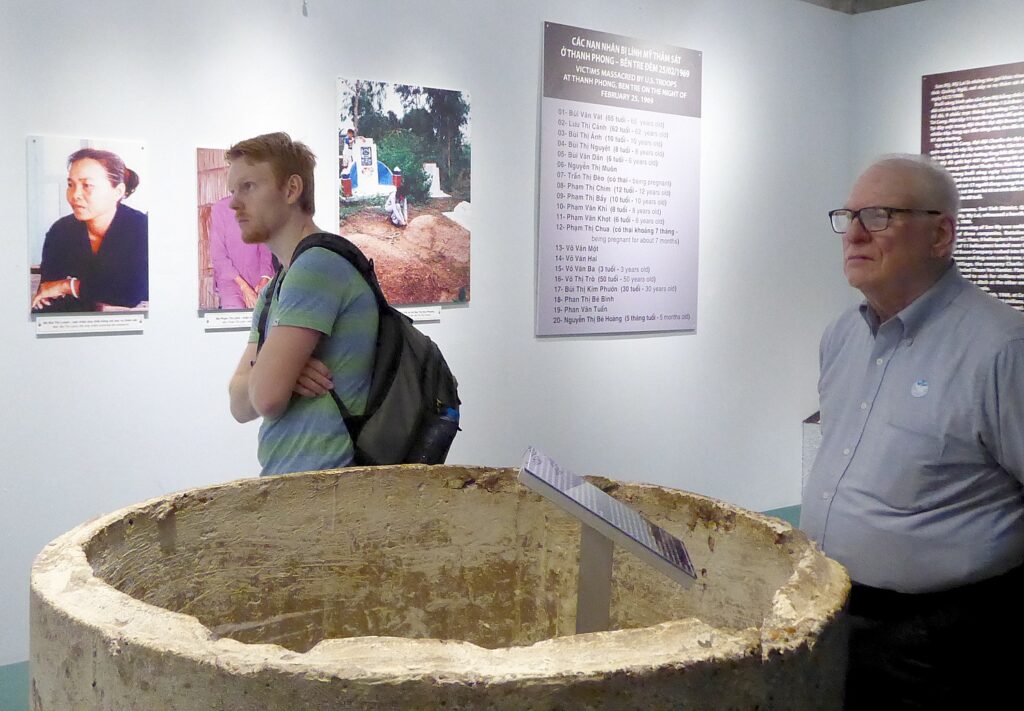
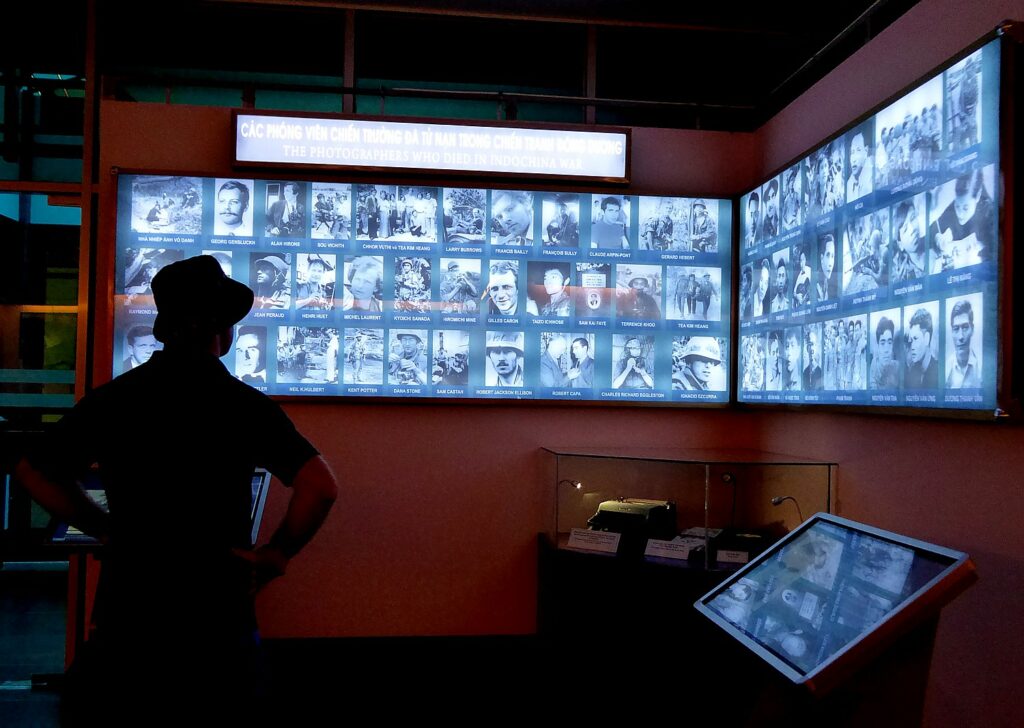
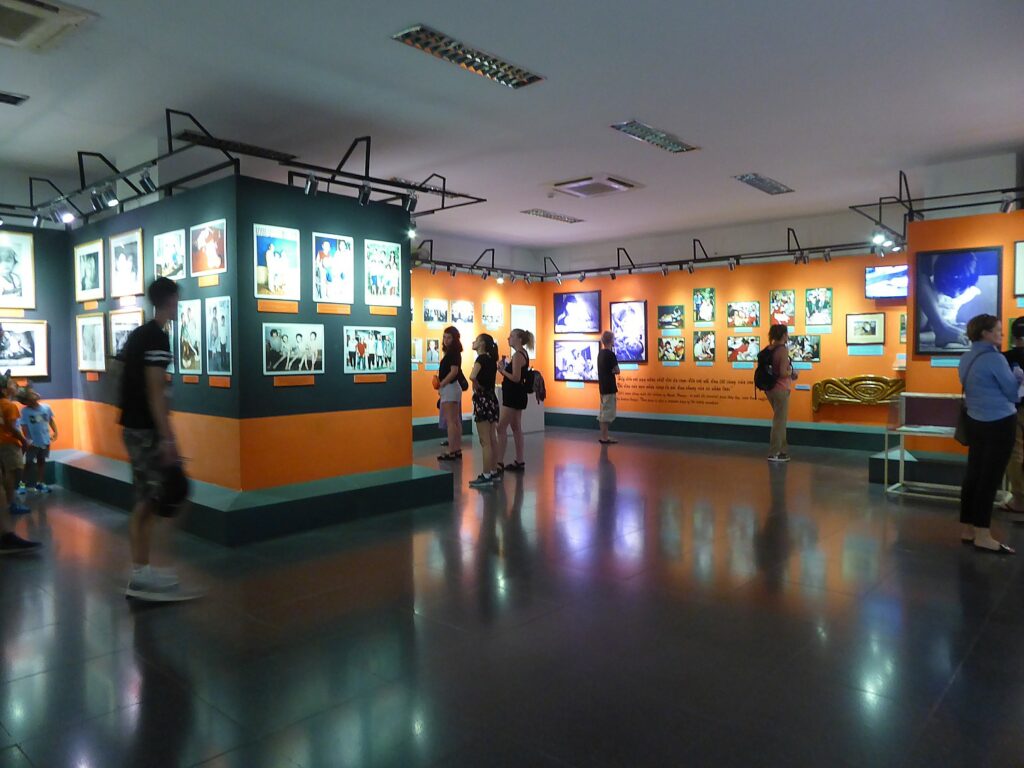
You should begin on the third level, which provides the “historic truths” (actually the background) for the Vietnam War, which more or less accurately presents the facts. On this level is a most fascinating exhibit that presents the work of the multinational brigade of war correspondents and photographers, along with a display of the dozens who were killed in the war.
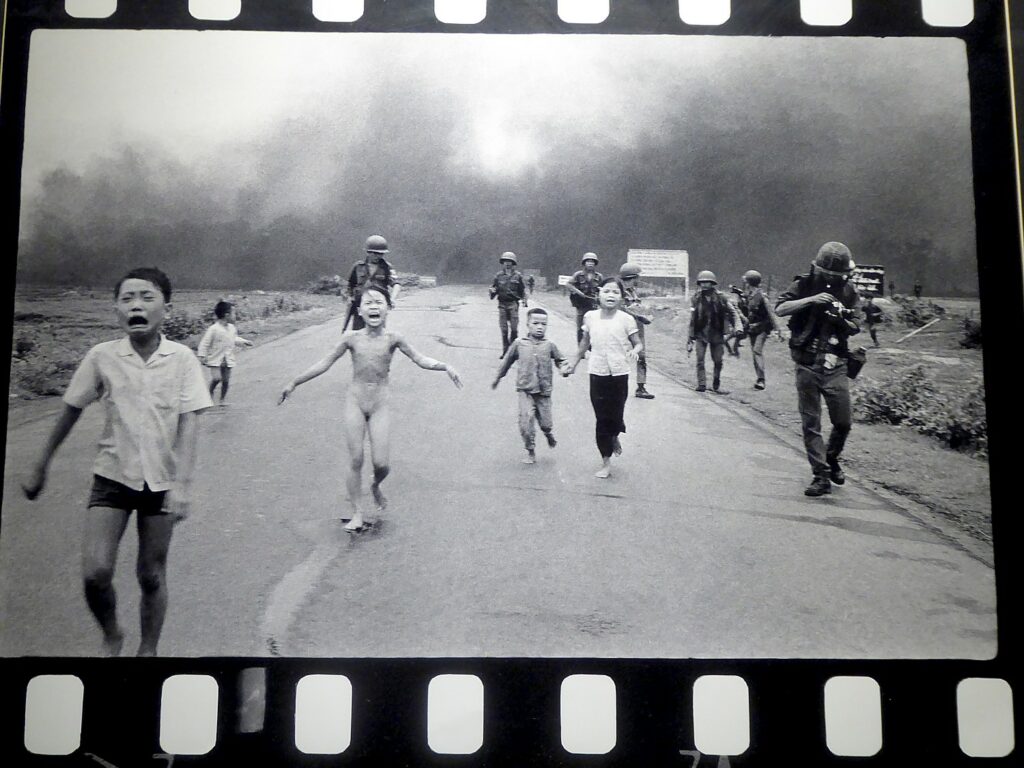
The photos are presented in an extraordinary way: showing the photo, then providing notes about the background, the context of the image, and the photographer. Here too, the language (which was probably produced by the news organizations that put on the exhibit), was accurate. Among them is the famous, Pulitzer-prize winning photo of “Napalm Girl” where, for the first time, I notice the soldiers walking along as this young girl is coming down the road in terror, their demeanor in such jarring contrast to these fleeing Vietnamese. The photos then and now are chilling, but today, they properly evoke shame and wonder why there has never been accountability for war crimes.
It
only gets worse on the second level, where the atrocities committed during war
are provided in the sense of artifacts, and details that could have, should
have properly been used at war crimes trials. But none took place. Another
exhibit documents the effects of Agent Orange.
The first floor, which should be
visited last, addresses the Hanoi Hilton, the place where American prisoners of
war, including Senator John McCain, were kept. Here, though, is where it can be
said the propaganda offensive takes place – there are photos showing a female
nurse bandaging an American’s head wounds, the caption noting how she had put
down her gun in order to care for him. This exhibit brings things up to date,
with the visits of President Clinton in 1994; in another section, it notes that
Clinton’s visit brought the end of economic sanctions, and with the country’s
shift to market economy, produced revitalization, as measured by the boom in
mopeds.
But on the bottom floor, they show
photos of Obama’s visit and most recently of Trump in Vietnam.
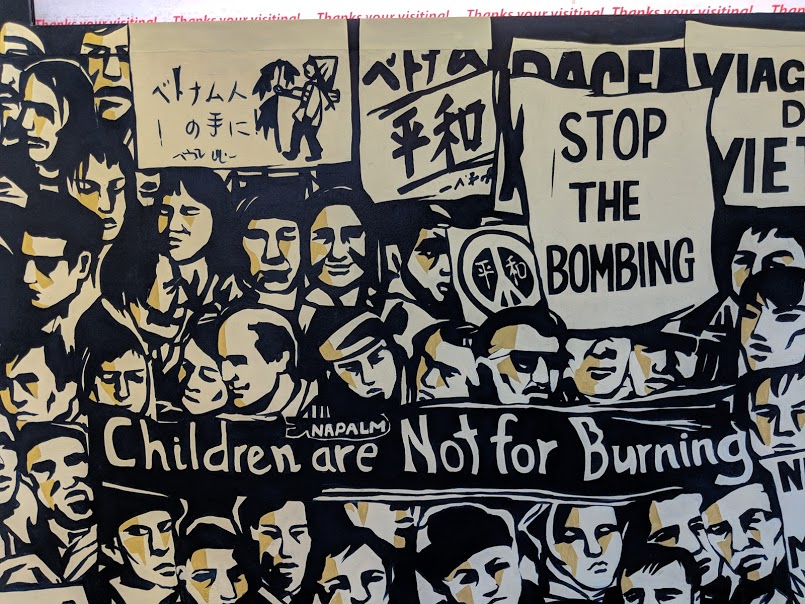
This floor also has an exhibit
devoted to the peace movement in the US and around the world, with some famous
incidents, such as the shooting of the Kent State four. There is a photo of John Kerry, who
went on to be a Senator, Secretary of State and candidate for president, testifying to Congress in his military
uniform, on the necessity of immediate and unilateral. “how do you ask a man to be the last man to
dies in Vietnam? How do ask a man to be the last man to die for a mistake?
A
special exhibition, “Finding Memories” attempts to recreate the struggle of the
people of Hanoi and Haiphong to overcome the pain and loss of war. “It helps
those who haven’t experienced wars to learn more through remarkable and humane
wartime stories, especially the stories about American pilots in the
‘Hilton-HaNoi’. Finding Memories is an opportunity for Vietnamese people to
develop greater pride for their victory – a 20th century miracle;
for American pilots to recall a serene period of their lives; as well as for
each and every visitor to understand the severe destruction and painfully grim
nature of war, in order to call for all people to work together and dedicate
our efforts to build a world of peace and love.”
Outside
are displays of captured American plane, tanks, and other items.
I look around for an American who
might have served in Vietnam to get an impression, but did not find anyone, and
saw a few Vietnamese (most of the visitors were Americans or Europeans), but
only one or two who might have been alive during that time and wondered what
they thought. Clearly the conclusion of the displays was in favor of
reconciliation when just as easily, and using a heavier-handed propagandist
language, could have stoked hatred. The exhibit is careful not to paint all
Americans and not even all American soldiers as monsters but one photo caption
is particularly telling: it shows an American hauling off an ethnic minority,
noting “American troops sent to the battlefield by conscription knew nothing
about Vietnam, thought the Cambodia people of ethnic minorities were living
near Cambodia were collaborators for the enemy.”
I leave feeling that the experience
is close to what you feel visiting a Holocaust Museum. And it is pain and
remorse that is deserved.
We
meet at 8:30 pm to hand in our score sheets and share stories – one team got up
at 5 am in order to get to the floating market; a team was able to get on the
street market food tour, where they take you around by scooter (they only take
8 and it was closed out); another took a cooking class.
We
get our notice of where we are going next:
be up at 6 am for 7 am bus to airport for 9:35 flight…. to Myanmar!
The Global Scavenger Hunt is an annual travel program that has been operated for the past 15 years by Bill and Pamela Chalmers, GreatEscape Adventures, 310-281-7809, GlobalScavengerHunt.com.
By Karen Rubin, Travel Features Syndicate, goingplacesfarandnear.com
I had last visited Vancouver, British Columbia, when it was the departure point for an Alaska cruise, and learned too late (from photos in the airport) about Capilano Suspension Bridge. That image stayed in my mind, and I always felt a loss not having seen it for myself. So, when I learned that our Global Scavenger Hunt – a 23-day around-the-world mystery tour where you don’t know where you are going until they tell you to get to the airport – was starting in Vancouver BC, I wasn’t going to miss an opportunity twice. I arranged to arrive a day ahead to be sure to have time to visit. And even after years of built-up anticipation, the attraction was even better than I imagined.
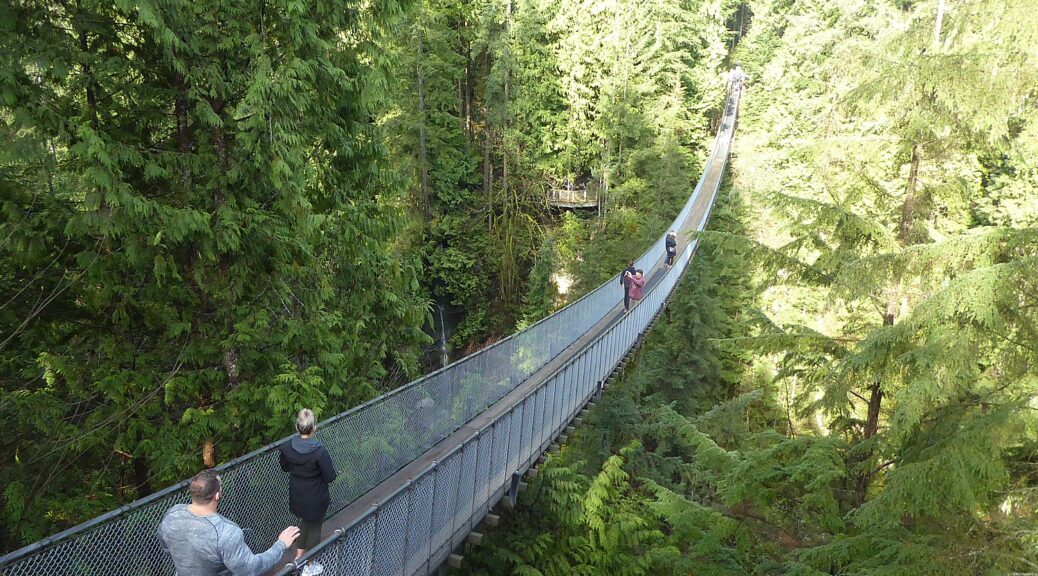
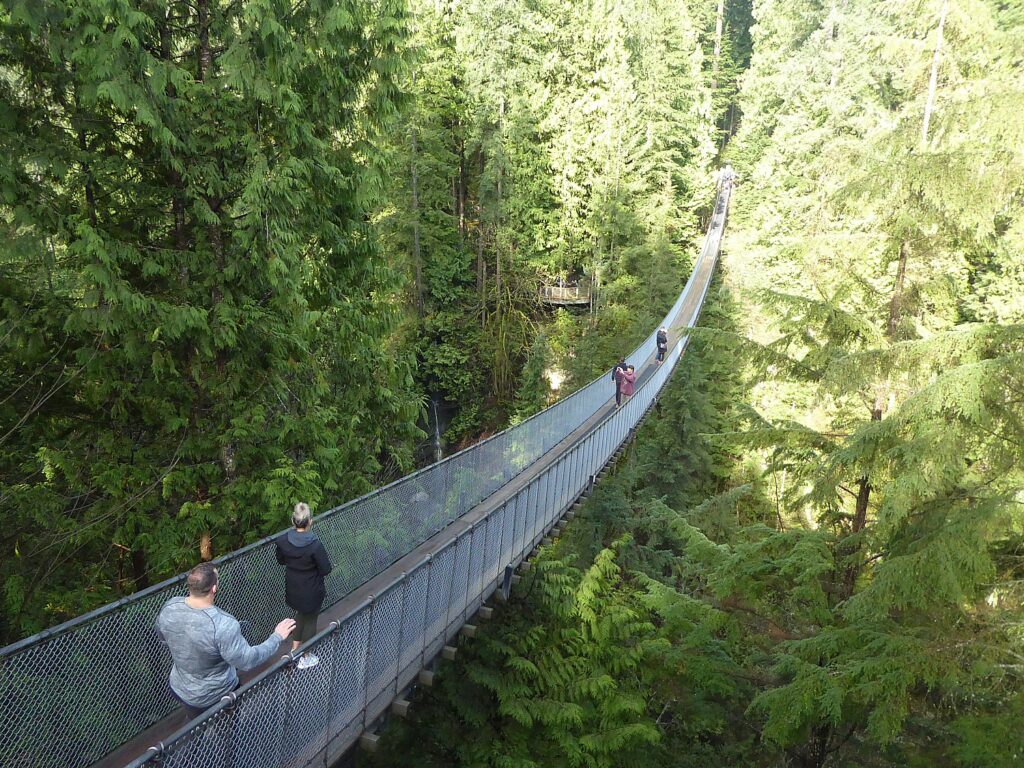
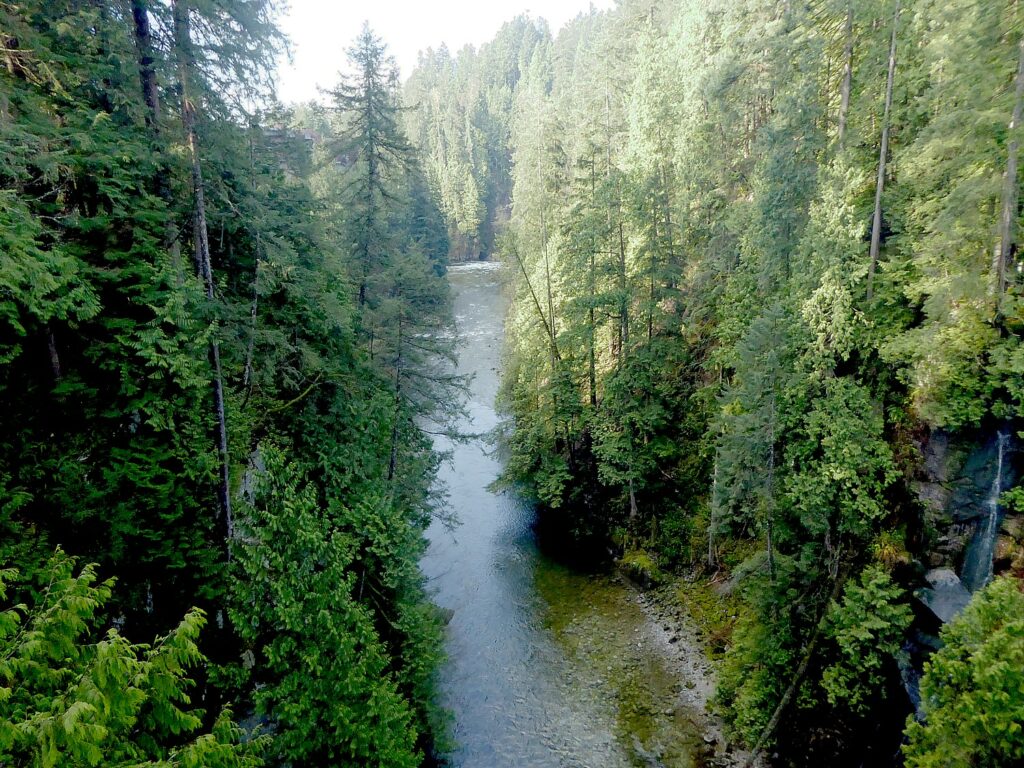
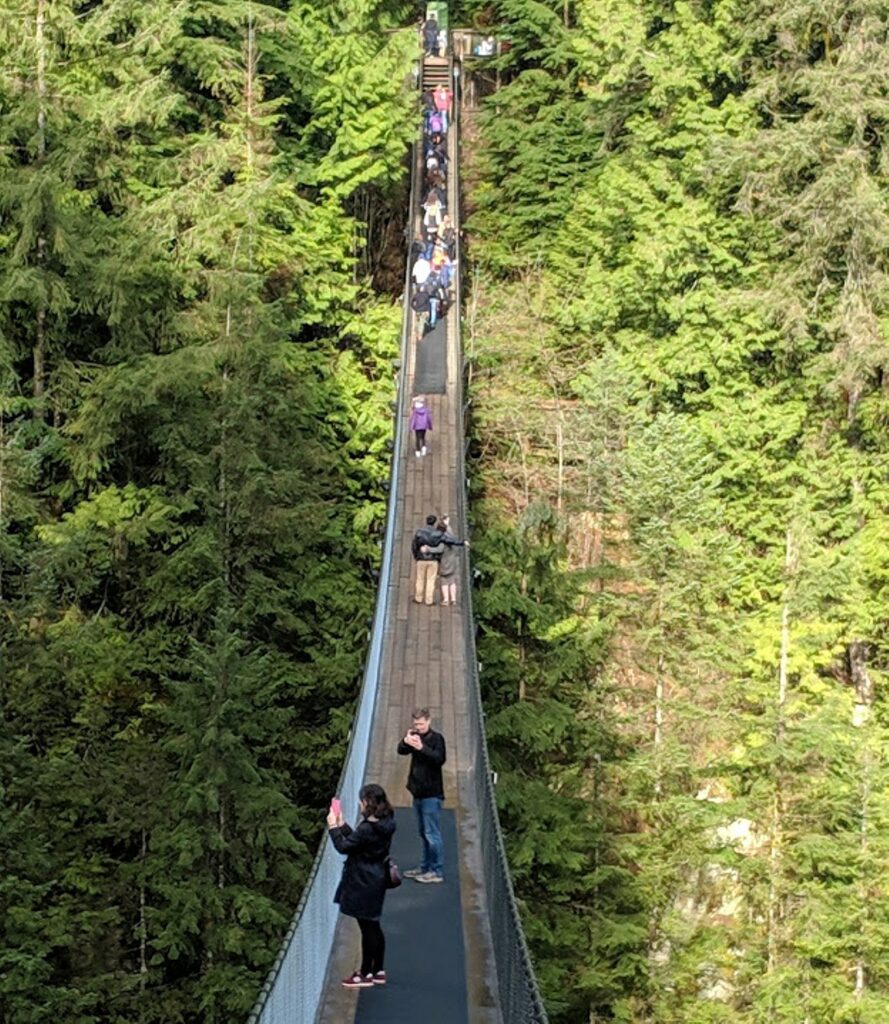
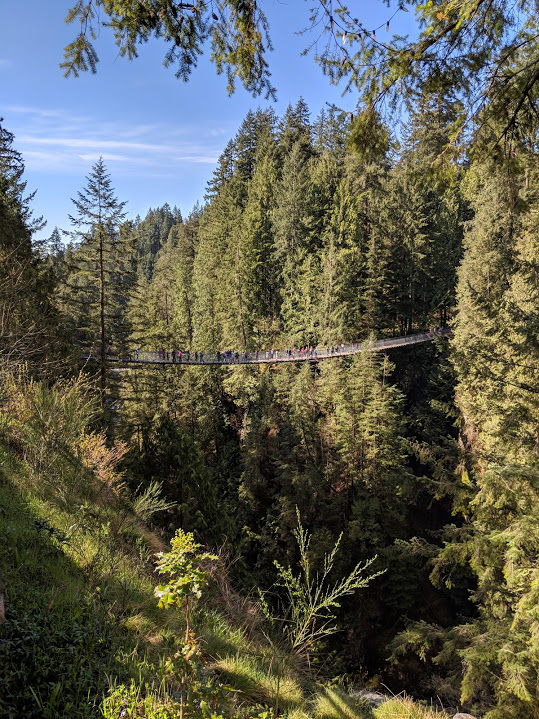
Capilano Suspension Bridge, it turns out, is a sanctuary to nature, and so much more than one (albeit) spectacular bridge, high above a rushing river – it isn’t just the view of the bridge, its setting, but actually walking over it and feeling it bounce and roll that is so sensational. You feel it through your entire body.
The bridge suspends you 230 feet above the Capilano River (that would be shoulder height of the Statue of Liberty), and is 450-feet long. It was built to hold 200,000 lbs. (that is the trepidation most people have as they cross), which means it can hold 1300 people standing on it at the same time, or parade 96 elephants across.
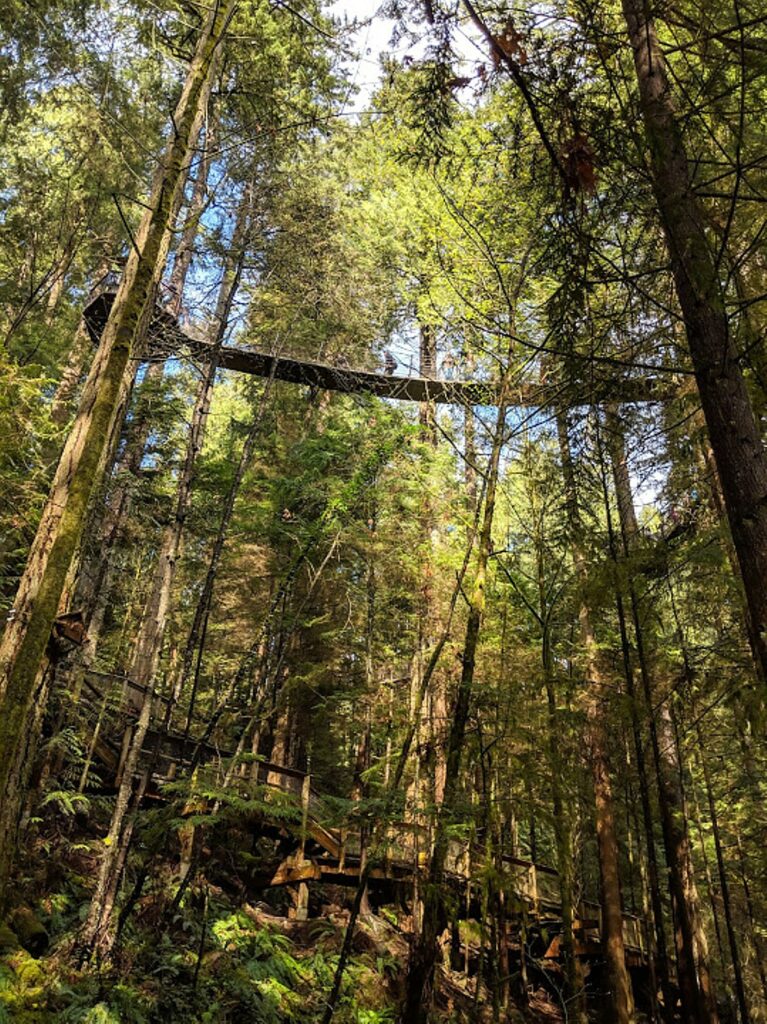
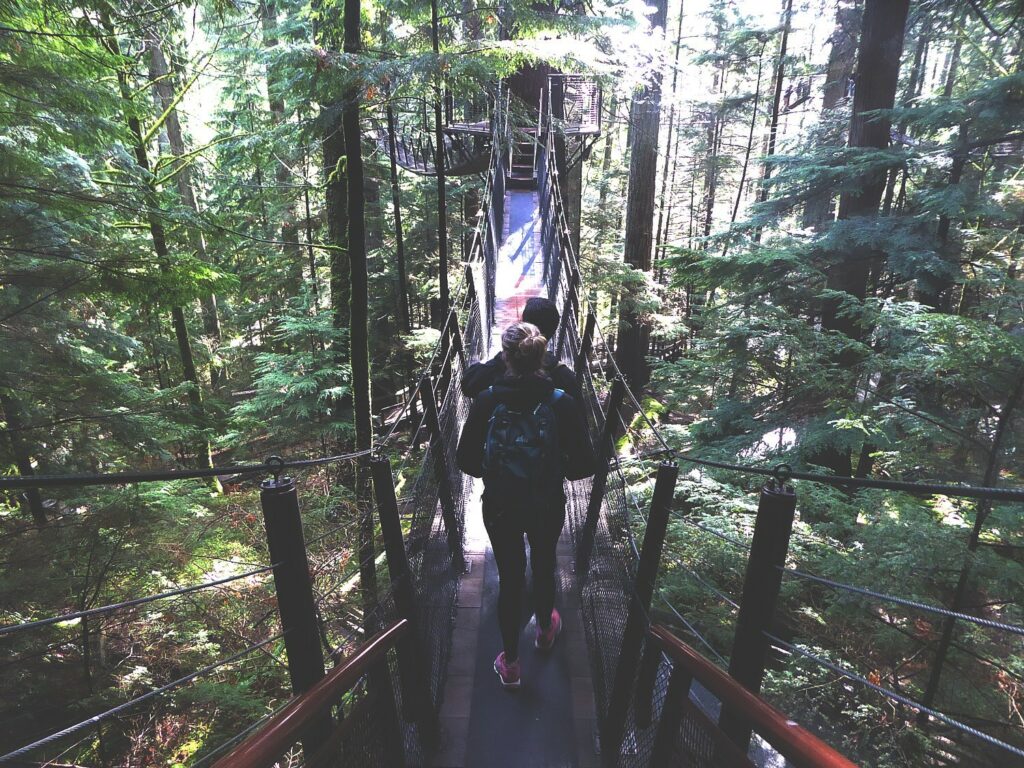
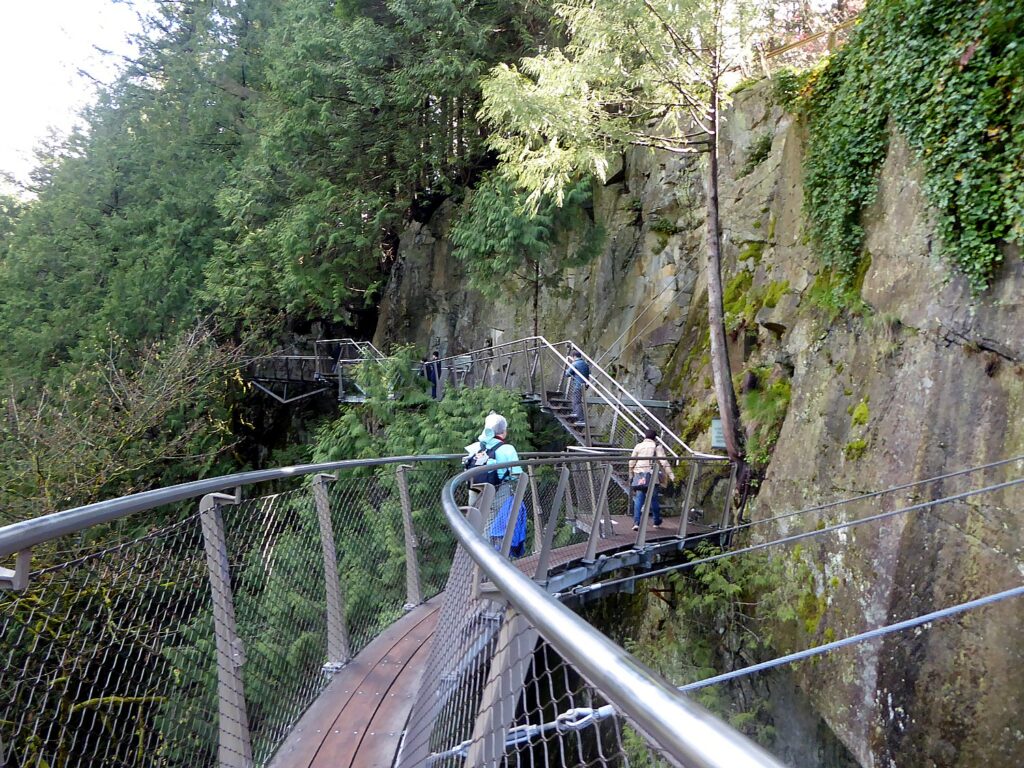
But it turns out that this is an entire nature park, with many “attractions” that enable you to become immersed in nature – the relatively new Tree Tops Adventure, which is a network of bridges that let you walk in the canopy of a rainforest and a new Cliff Walk, another network of bridges set out from the cliffs that make you feel like you are dangling over the gorge. All throughout, there are signposts that inform you about the trees, the rocks. It pays homage to sustainability – not just of nature, but as a tourist attraction that minimizes its impact and promotes consciousness.
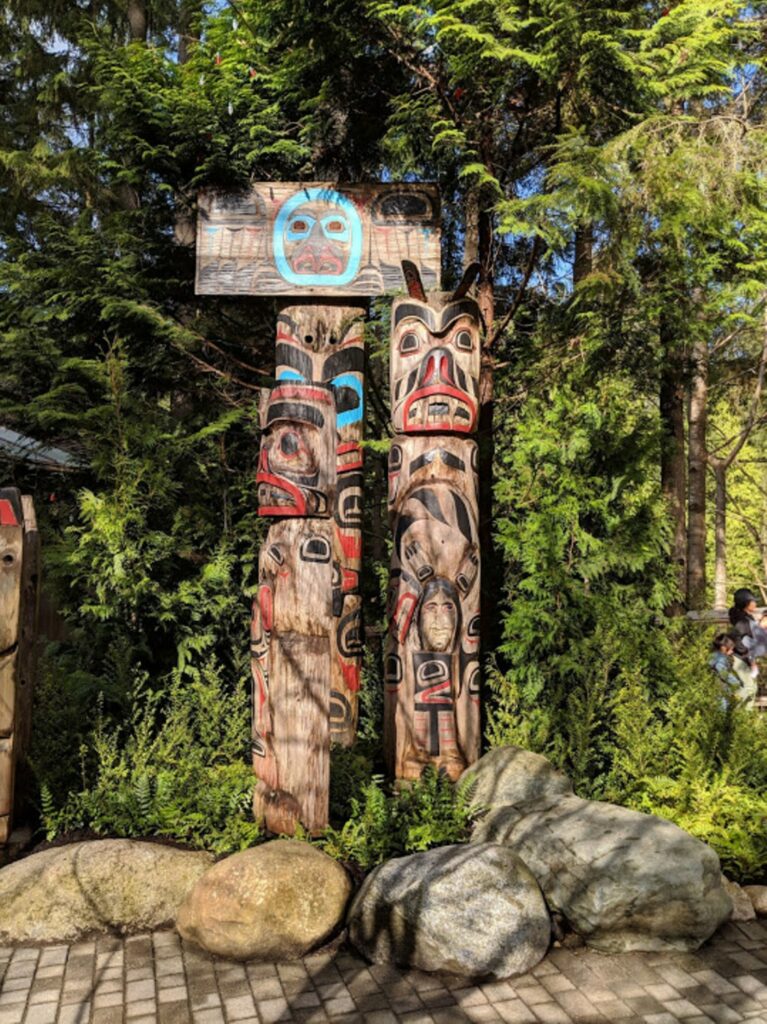
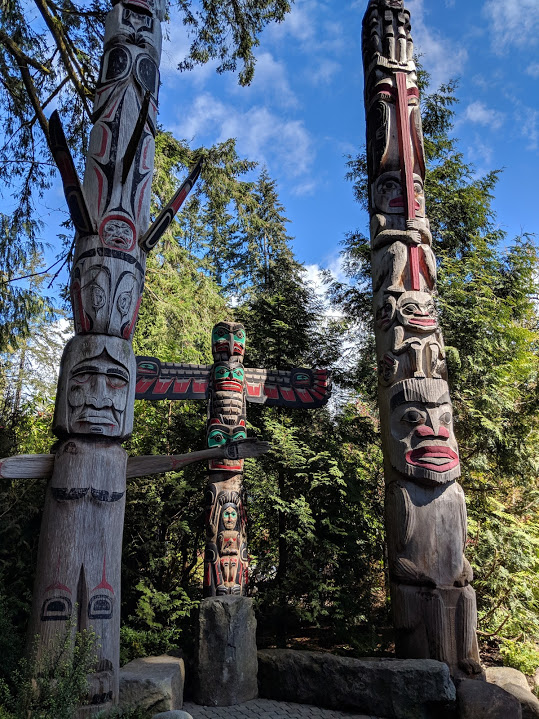
I was surprised at the heritage aspect of Capilano – its homage to the First Peoples who inhabited this area – stunning totem poles in addition to a display about the original founders and how Capilano Suspension Bridge came to be – how the first owner, George Grand MacKay, purchased 6000 acres for $1 in 1889 (the land is now worth over $1 million), and built his house on the wrong side of the river. A civil engineer, he built a rope bridge, and then people wanted to visit. George Grant MacKay was a visionary who, as Park Commissioner for Vancouver, also set aside the land for Stanley Park, North America’s third largest urban park nestled in the heart of Vancouver. He sold off 27 acres to a guy who changed the rope to cable and charged visitors 10c to cross. (There is a wonderful love story that is also part of the history).
It’s been a paid attraction since 1907, employing just a single gatekeeper.
Today’s Capilano Suspension Bridge has been a family-run business for the past 60 years. Nancy Stippard’s father, Rae Mitchell, bought the bridge in 1953 and 30 years later sold it to his daughter.
The bridge was torn down and rebuilt in 1956 with thick cable (it took just five days to install), but under the ownership of Nancy Stippard, beginning in 1983, went through a major transition – her vision was to enable visitors to walk in the trees to get a perspective like a squirrel, so she created Tree Tops Adventure; then in 2010, she had a vision to walk along the cliffs, so created the Cliff Walk.
When Nancy took over the park in 1983, admissions totaled 175,000 visitors a year. Today, the Park sees 1.2 million visitors annually. Vancouver’s oldest attraction is one of its most popular and has won many awards including British Columbia’s Best Outdoor Attraction in 1999 and 2000.
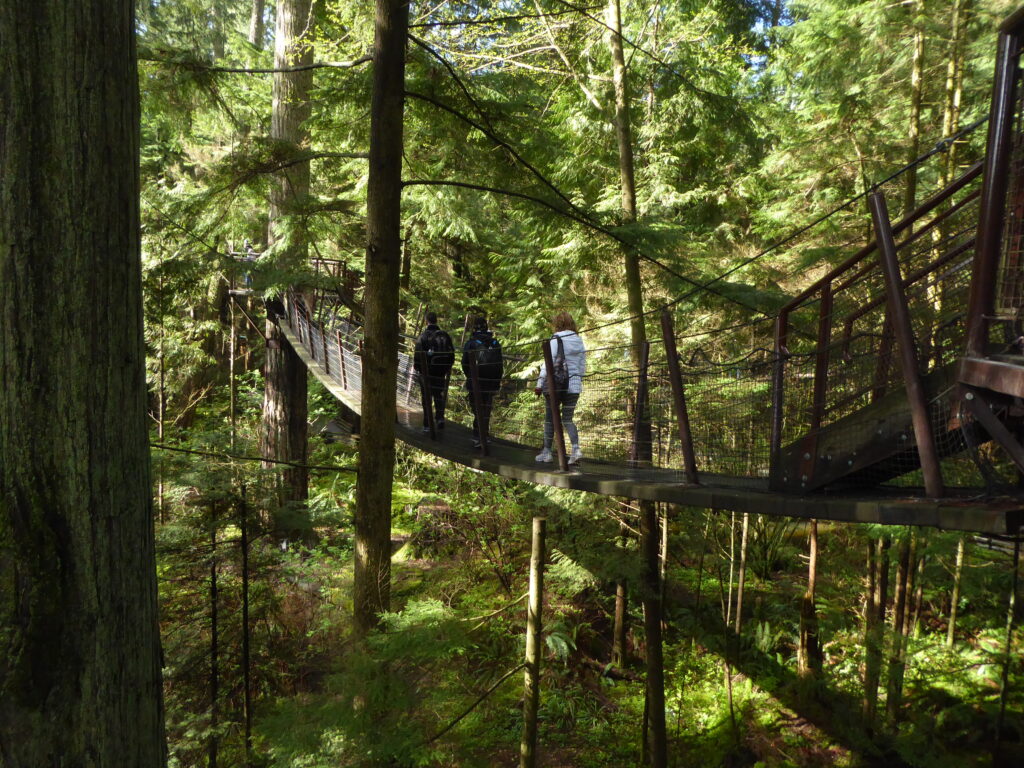
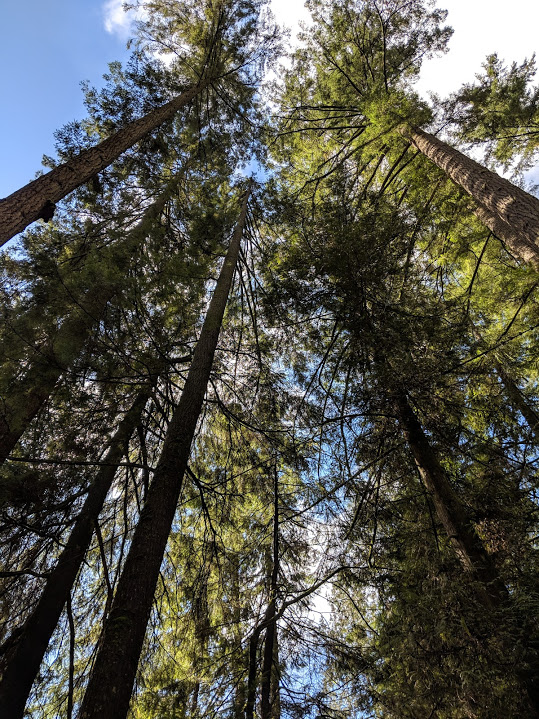
On Treetops Adventure, you venture from one magnificent old growth Douglas-fir to another on a series of seven elevated suspension bridges, some reaching 33-metre (110 feet). Some of the trees, we learn, are 1500 years old; we meet “Grandma Capilano,” the tallest tree at 250 feet high and 1300 years old. History and nature guides, signage and interactive human and natural history exhibits throughout the park help guests in their understanding of rainforest ecosystems and the sustainability of this environment. As I walk, I am literally euphoric breathing in the pure, cool air.
Treetops Adventure was the first of its kind in North America when it opened: some 700 feet of cabled suspension bridges link eight Douglas fir trees; at its highest point, you get the perspective from 110 feet above the forest floor. The towering Douglas-fir trees showcased by the attraction range in height from 130 to 300 feet tall – equivalent to a 20-story high-rise.
To protect the fragile forest during construction, the elements were crafted off-site by hand, then brought into place with pulleys and ropes.
The bridges themselves are constructed of hemp netting, wooden planks protected with environmentally-friendly preservatives and other natural products, reflecting and enhancing its surrounding rainforest environment; antique wooden beams and pegs lend a unique historical flavor to the attraction’s handcrafted, two-story Treehouse.
Treetops Adventure is an engineering marvel: an innovative compression system safely secures each tree’s observation platform using only 20 pounds of force per square inch, or the amount of pressure exerted by pressing your thumb on a tabletop.
There is a lovely café tucked into the forest on a platform amid the Treetops Adventure.
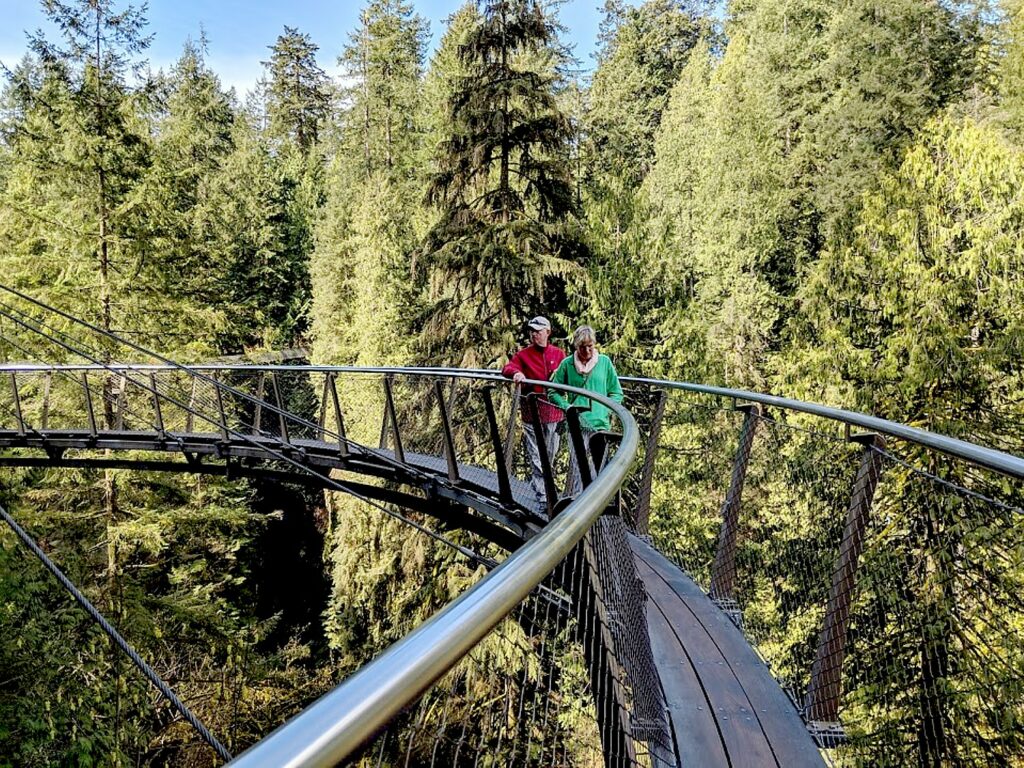
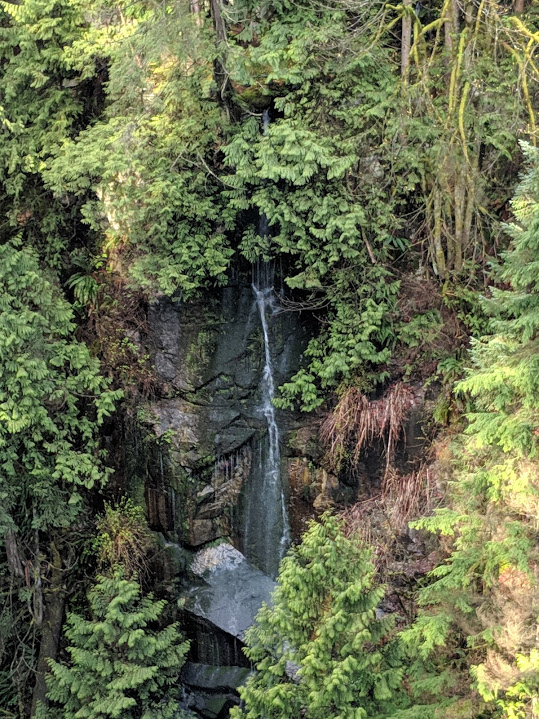
The Park’s newest attraction, Cliffwalk, follows a granite precipice along Capilano River with a series of narrow cantilevered bridges, stairs and platforms extending 700 feet. The granite formations are 160 million years old, dating back to the Mesozoic Age. At the highest point, you are 300 feet above the Capilano River – making for a thrilling experience. Cliffwalk is high and narrow and, in some sections, open metal grates are all that separate guests from the canyon far below. With just an 11-square meter environmental footprint (about as much as a parking stall), Cliffwalk is unobtrusive as it winds its way on a heart-stopping cliff-side journey through rainforest vegetation. Educational signage along the route shares information provided by the David Suzuki Foundation, speaks to the delicate interaction between water, granite, salmon, flora and fauna, broadening the experience.
After rappelling down the east face of Capilano Canyon into jungle-like ferns and mosses, John Stibbard, Capilano Suspension Bridge’s VP of Operations and Nancy’s son, conceived his plan to give this thrilling ecological experience. With only 16 anchor points in the granite cliff supporting the structure; It can support 100,000 pounds, the weight of 35 killer whales.
Cliffwalk is environmentally sensitive. No two bridges, platforms or stairs are alike – each piece of Cliffwalk is custom-fabricated. The signature 7-shaped bridge utilized a first-of-its-kind construction technique that relied upon 3D digital information to establish the geometry for each segment of Cliffwalk.
The visitor facilities are fabulous – really restful and appropriate for the place. There is a trading post (absolutely superb items and crafts), an ice cream shop, a fudge shop, a café, tucked along the cliffs.
Come early in order to maximize the perfect peace of this place.
Capilano operates a free shuttle bus service from downtown Vancouver – five in the off season, up to 11 departures a day in summer that makes it a pleasure to make the day trip (there are also public buses that go). We took the first shuttle at 8:35 am. The driver turned it into a narrated tour for our benefit because of the questions we were asking over the course of a delightful, 40-minute drive. As we cross over the bridge (designed by the same guy who built San Francisco’s Golden Gate Bridge), he tells us to look below to see a First Peoples reservation – or actually a residential community.
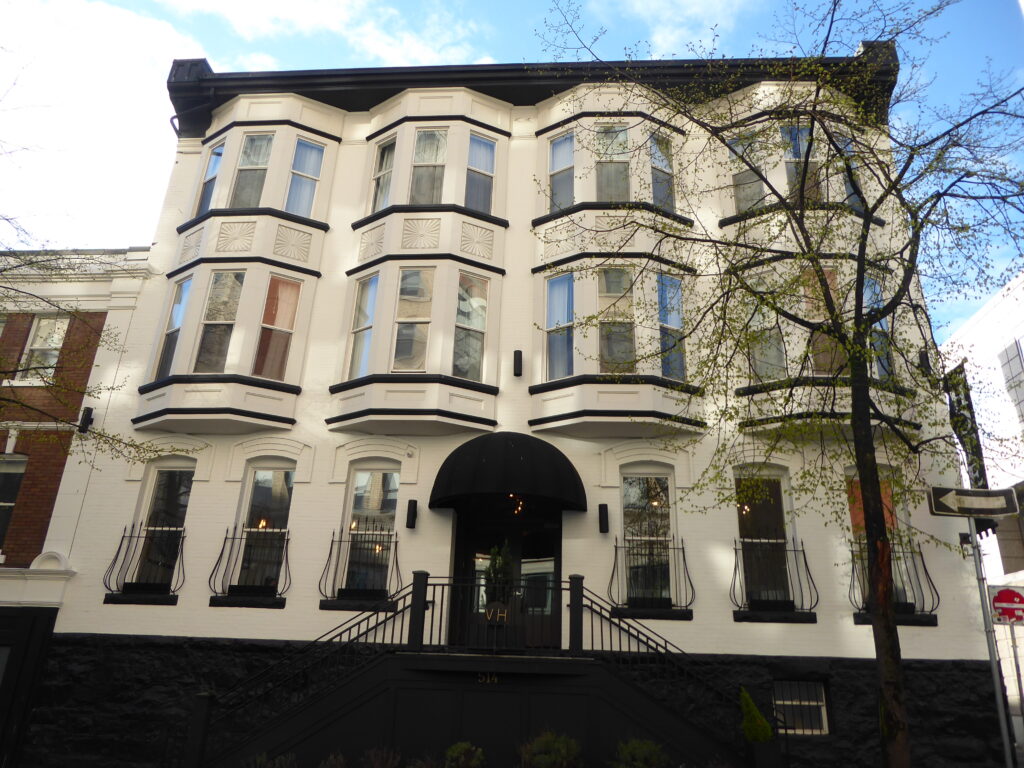
There are several pick-up points. We caught the bus at Library Square (go inside, it is spectacular), just a five-minute walk from the Victorian Hotel (built in 1896, an absolute gem which serves breakfast).
We are among the first to arrive at Capilano and the only sound we hear is the rushing water below the bridge.
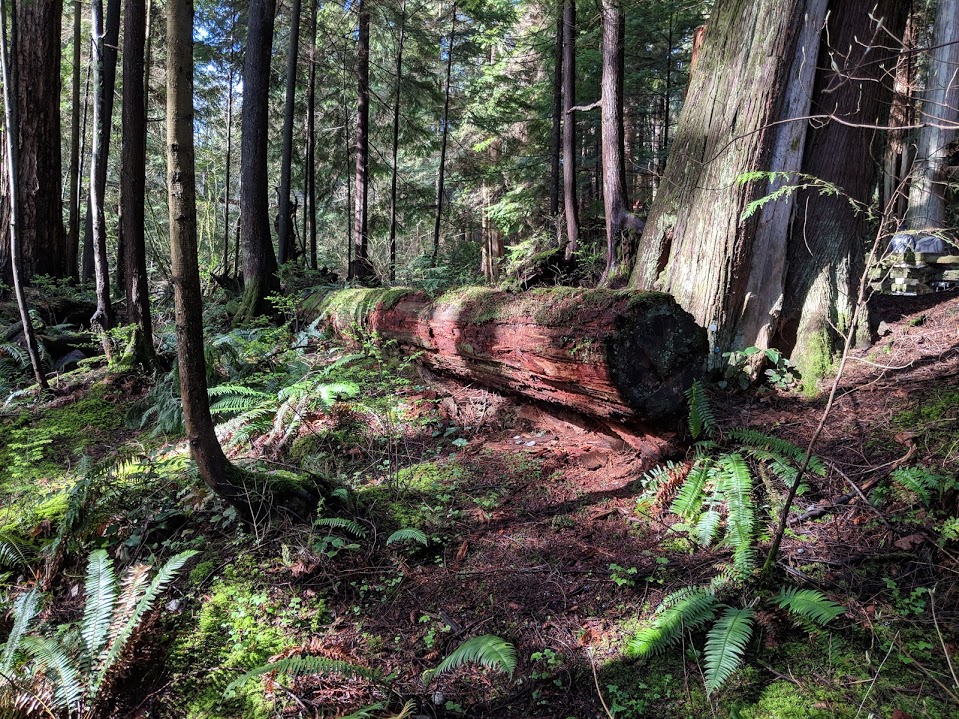
Walking through the forest of Douglas fir, you feel so small. If you are there early, you can feel the peace of the woods that the Native peoples who first lived here must have felt.
The signposts are very informative, and get you in the spirit. “Take a moment.” “Breathe In.” “Water is the lifeblood of the environment.”
Another sign notes that in one year, the Capilano Rainforest of 7 acres can absorb the same amount of carbon that is emitted by a car driven across the continent 19 times.
“Rainforests are sometimes referred to as the Earth’s lungs, and they are responsible for 28% of the world’s oxygen turnover…Just one of these giant trees releases enough oxygen to support a family of four.”
The atmosphere is so vivifying, we saw a marriage proposal during our visit as we walk through the Treetops Adventure.
“It is not so much for its beauty that the forest makes a claim upon men’s hearts, as for that subtle something, that quality of air, that emanation from old trees, that so wonderfully changes and renews a weary spirit,” wrote Robert Louis Stevenson. That is exactly what I am feeling when I find this signpost.
“The tree which moves some to tears of joy is in the eyes of others only a green thing that stands in the way. Some see nature all ridicule and deformity…and some scarce see nature at all. But to the eyes of the man of imagination, nature is imagination itself.” William Blake’s words seem particularly relevant today.
We explore on our own, and then catch one of the complimentary guided tours offered hourly within the park. We take the history tour that offers an interactive synopsis to the attraction’s colorful past including the endeavors of past owners (one chapter is a love story), the involvement of local First Nations and information on the Capilano Suspension Bridge.
There are also guided nature tours, Kids’ Rainforest Explorer program and the Living Forest exhibit; seasonal musical entertainment and First Nations culture.
This place is reminiscent of San Francisco in other ways besides the bridge that takes you to Capilano that was built by the builder of the Golden Gate. Much like Muir Woods is a refuge for the urbanites crammed into the city, Capilano is a refuge for the city dwellers of Vancouver.
Every moment was precious and rejuvenating.
Capilano Suspension Bridge Park, 3735 Capilano Road, North Vancouver, BC, Canada V7R 4J1, 604-985-7474, info@capbridge.com, www.capbridge.com.
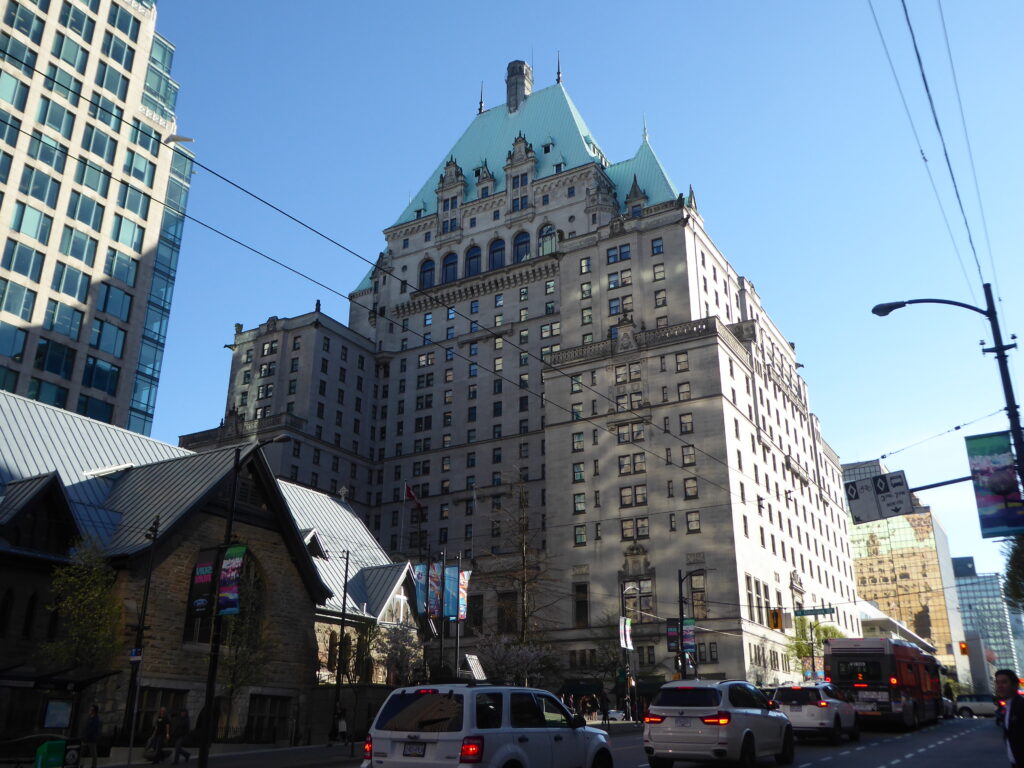
We ride the shuttle bus back to town, pick up our stuff from the Victorian Hotel (stopping for some refreshment they so kindly provide. Victorian Hotel (514 Homer St, Vancouver V6B2V6, BC, CA, 1604-681-6369, which proved a short walk to Gastown and just about every place we wanted to go), and walk over to the Fairmont Hotel Vancouver (900 West Georgia Street, Vancouver, British Columbia, Canada V6C 2W6 , 800-257-7544, 604-684-3131, www.fairmont.com/Hotel-Vancouver) to meet our fellow Global Scavenger Hunt travelers.
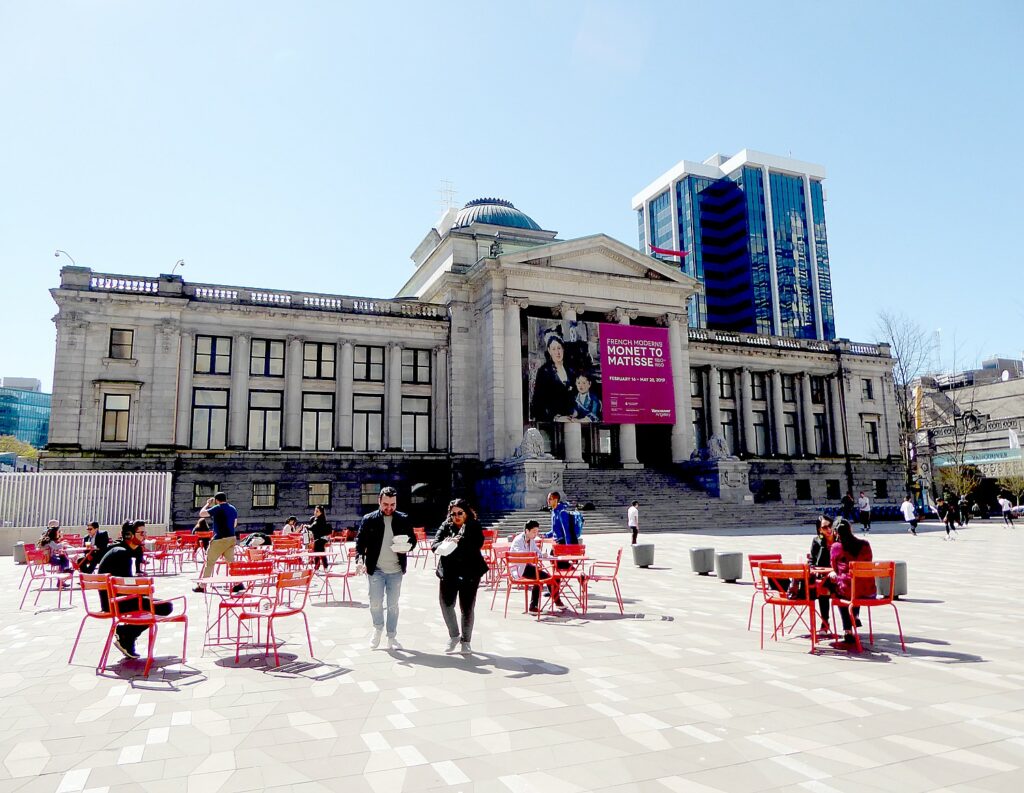
I still have time before the meeting to run across the street from the Fairmont to Vancouver Art Gallery, where I catch a sensational special exhibit of Impressionist Art, with many of the works, ironically, on loan from the Brooklyn Museum. (750 Hornby Street Vancouver, BC, 604.662.4700, www.vanartgallery.bc.ca)
The afternoon meeting is really a meet-and-greet and orientation with Bill Chalmers, the “ringmaster” and Chief Experience Officer of our “traveling circus,” along with his wife Pamela (with cocktails), before we all walk over to a restaurant for dinner.
Our adventure begins the next morning.
We gather at 9 am on the first day of our 23-day Global Scavenger Hunt, a “Blind Date with the World,” where 10 teams of two people each don’t know where we are going until Bill Chalmers, the Global Scavenger Hunt Ringmaster and Chief Experience Officer, gives us our four-hour notice to get to the airport. We have come to the meeting prepared for anything – a notice to pack up to our next destination, perhaps? – and learn that we will spend the day doing a practice scavenger hunt, to level the playing field between newbies (me) and troopers/vets (one of the teams has done it 12 times). He has prepared the same kind of booklet and score sheet as we will get on arrival at every mystery destination.
We can choose the scavengers out of the selections – they each have different points. Among them are a choice of “mandatory” including at least one “experience”. Many have to do with experiencing local foods. During the course of this day, we will have to complete 10 scavengers by 8 pm when we get together again. We are told this is a Par 1 in terms of difficulty, which can go as high as Par 6, so is the easiest we will encounter.
My teammate, Margo (who I have just met upon arriving at Vancouver International Airport) and I start in search of “Affluent Alley” – after all, we are staying in Vancouver’s famous Fairmont Hotel Vancouver in a toney boulevard off Robson Street where we were told you used to have to drive a Rolls or BMW in order to park on the street. We look at a couple of streets which are called Vancouver’s Fifth Avenue and Rodeo Drive. We are only allowed to ask locals – not the hotel concierge or any actual guide (and there are tourism ambassadors on the street)– but no one has heard of Affluent Alley – possibly because everyone we ask is either too young or a transplant. One woman at a bus stop is extremely helpful when we ask where a certain high-end shoe store is located, and about how the bus system works. As for Affluent Alley, I suspect that it actually refers to the opposite (maybe East Hastings), or is the red-herring (and doesn’t exist at all).
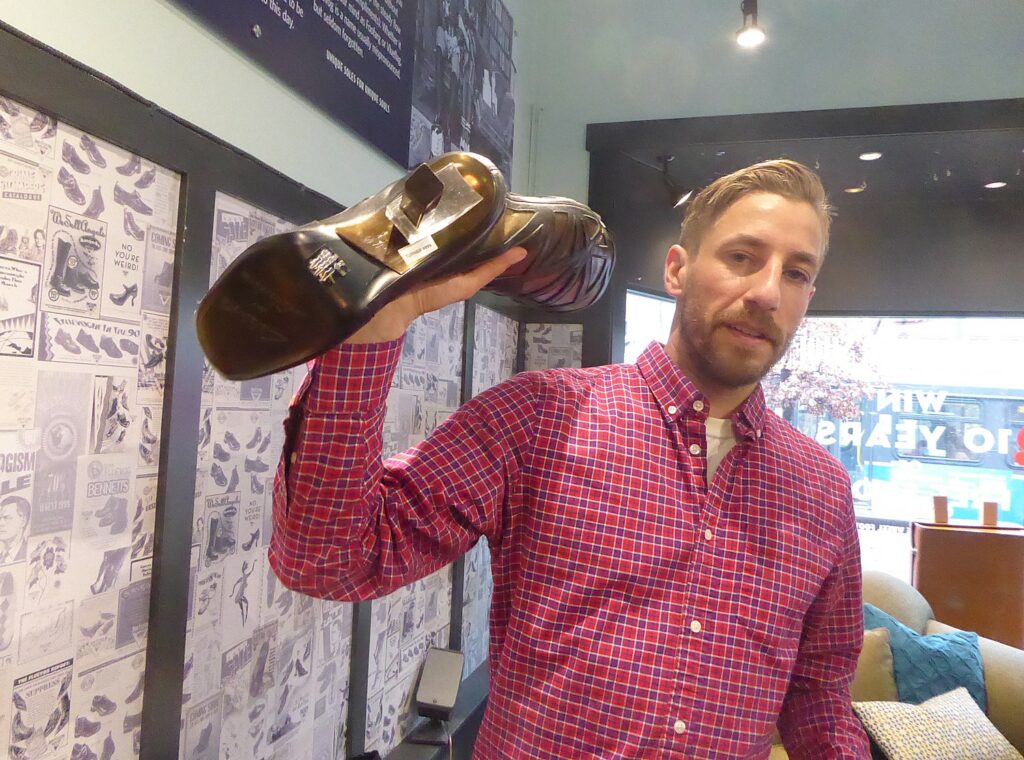
But now we are in search of the high-end shoe store, John Fluevog. We go into several stores, finally Coach, and the salesperson directs us… We walk the several blocks to the store – unbelievably wacky, creative, magnificent (better art than the modern art I had seen at the Vancouver Art Gallery). We learn we are the 6th team to ask
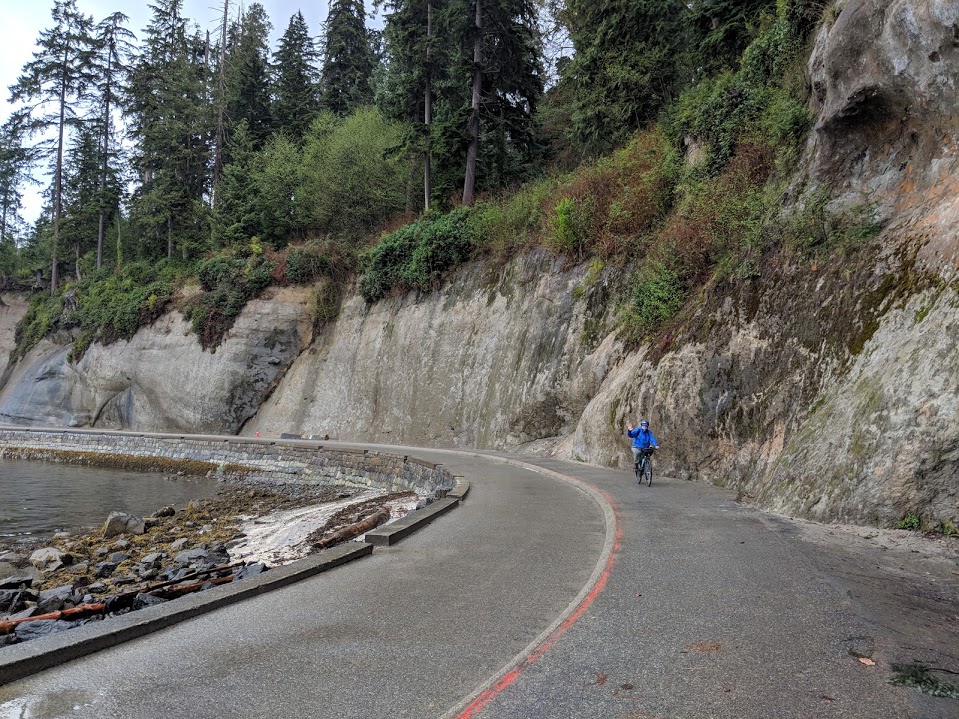
We walk to the Olympic cauldron, take our selfies, record the time. It’s pouring rain now when we walk to the bike rental shop on the list to rent bikes to ride around Stanley Park’s seawall, find the Totem Poles, stop at the Teahouse (fantastic carrot soup to restore our energy and warm our souls).
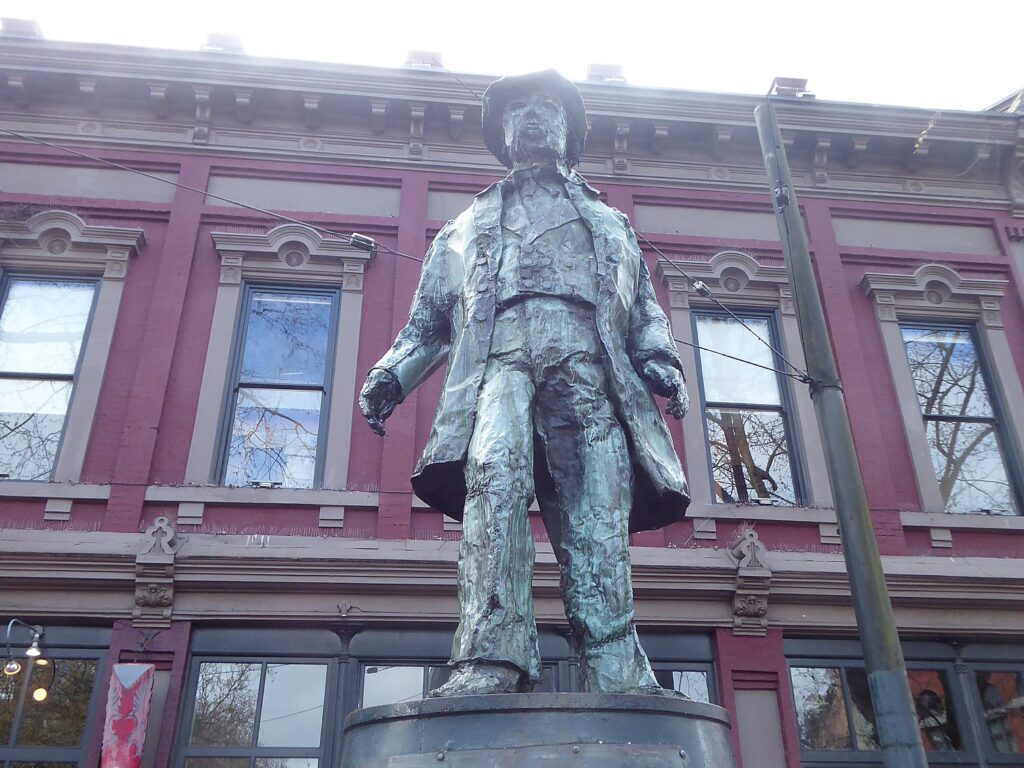
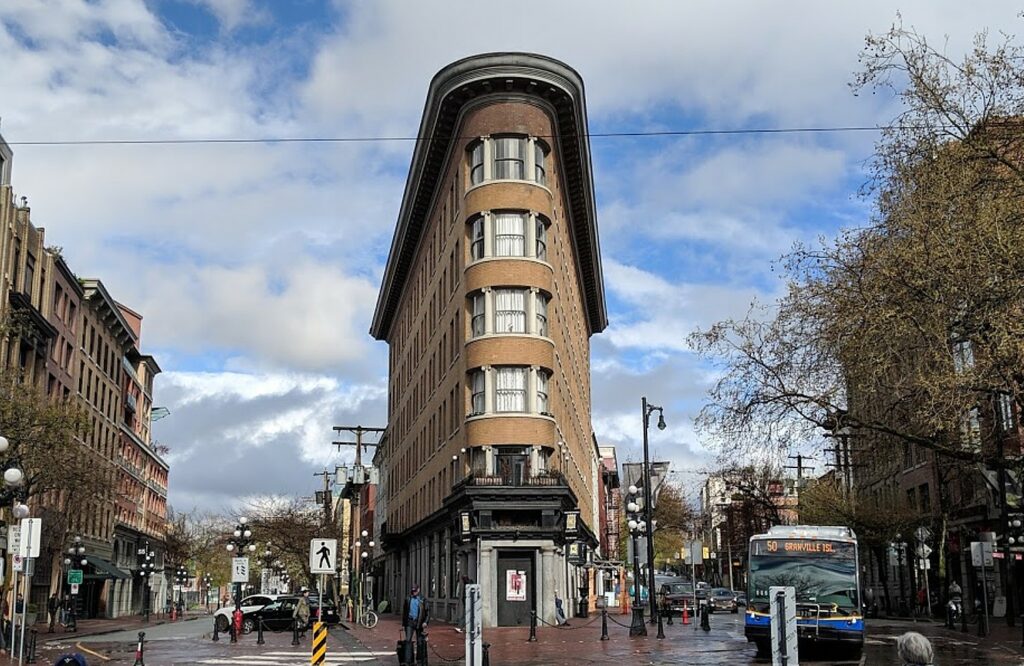
We go to Gastown to find more scavenges – we have the same problem trying to find Hotel Europe, but as we are gazing at the statue of Gassy Jack, the garrulous bartender that gave Gastown its name, and, of course, the steam clock, we turn around and find the building. It turns out that Hotel Europe, built in 1908-9 by Angelo Calori, is no longer a hotel, but now is “social housing.” And haunted, as we discover when a fellow who works in the art store that is now at its street level, takes us on a tour into its basement recesses. The building looks remarkably like a smaller version of the Flat Iron Building in NYC.
Indeed, even this practice session reveals the essence and why the Global Scavenger Hunt is such a different experience. Scavengers give purpose to your wandering – more than that, they become a platform for a completely different perspective on a place and people. The Global Scavenger Hunt is designed to have us interact as much as possible with local people, to trust strangers. That’s what we have been doing all day long, and finding how incredibly friendly and kind the Canadians are (even the many who have come here from all points of the globe and made Vancouver their home. But, as we come to realize, these exercises foster new knowledge about ourselves, self-confidence in our ability to handle the unknown, and personal growth in knowledge and experience.
We gather at 8 pm, the deadline, and Bill tells us we are off tonight on a 2 am flight to Ho Chi Minh City (Saigon), Vietnam, hands us our airline info and visas, and we are off.
The Global Scavenger Hunt is an annual travel program that has been operated for the past 15 years by Bill and Pamela Chalmers, GreatEscape Adventures,310-281-7809, GlobalScavengerHunt.com.
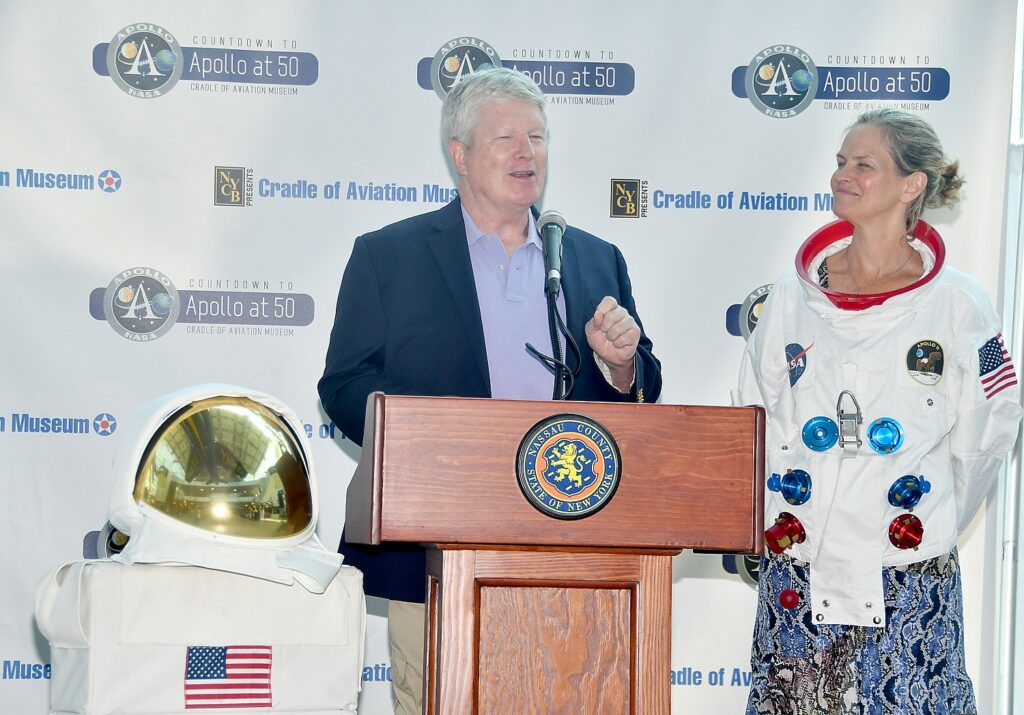
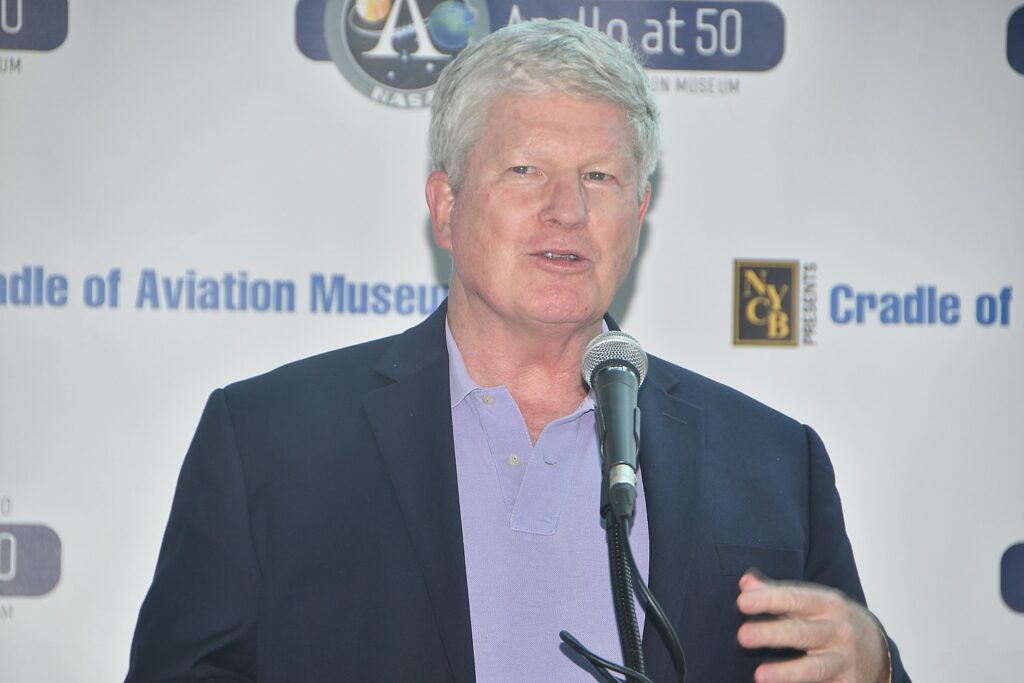
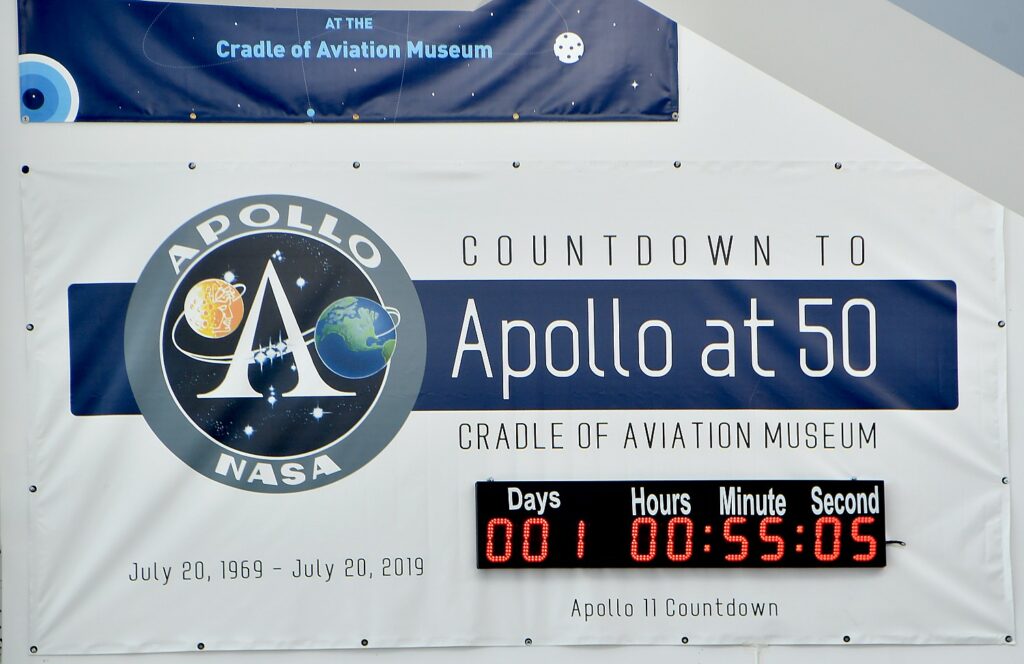
Nassau
County Executive Laura Curran, who donned a replica space suit, and NASA astronaut
Babylon resident Bill
Shepherd were
on hand at the Cradle of Aviation Museum to officially begin the countdown to
the 50th Anniversary celebration of the first lunar landing, July
20, 1969. They were joined by Grumman
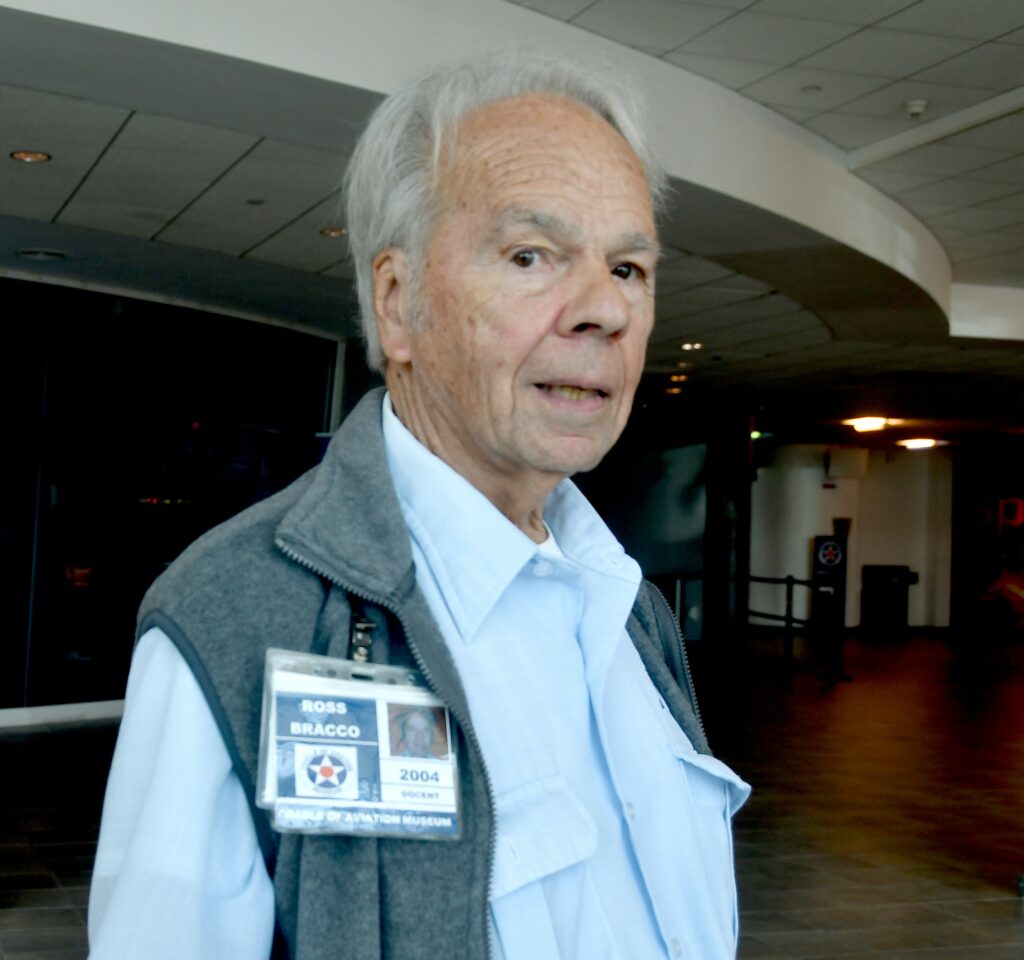
Engineer Ross Brocco, Museum President Andy Parton and Museum Curator Josh Stoff.
“We
will shine a light on one of the greatest
human and technological achievements in history,” Parton said.
The
events that start at 9:30 am reach a climax with a Community Countdown at 4:17
pm to collectively watch, re-experience, and honor as a community, the historic
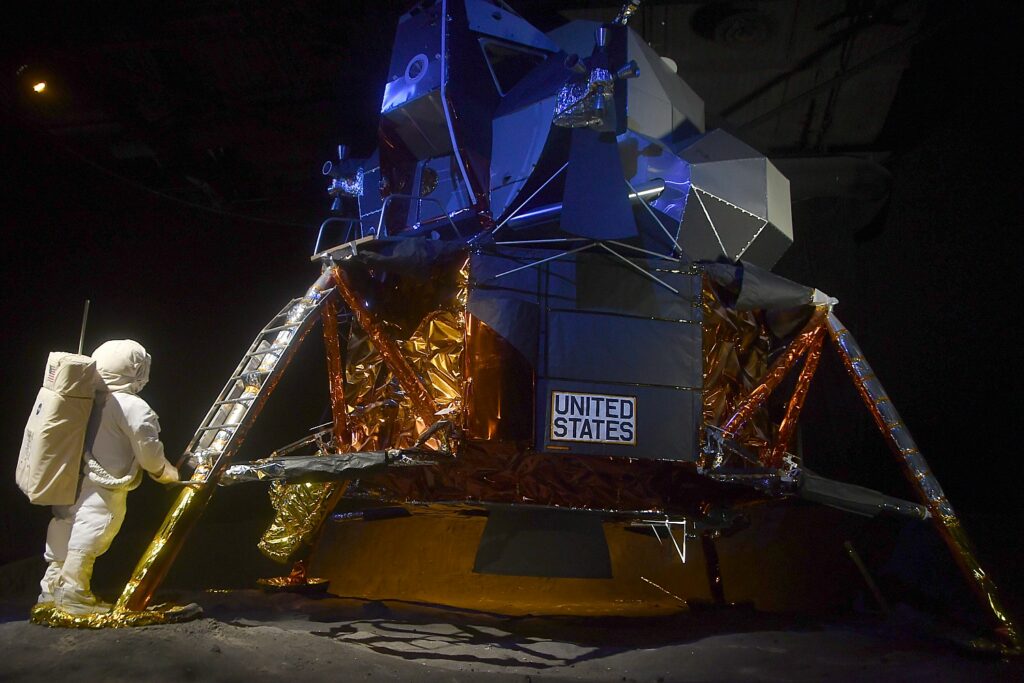
“The Eagle has Landed” Lunar Module landing on the moon. A model of the Lunar
Module will descend from the ceiling, precisely on time.
Astronaut
Shepherd, who was in the first crew on the International Space Station (“We
turned on the lights”) and lived in space for 140 days, sees the importance of
Cradle of Aviation Museum, with its active STEM education programs and the
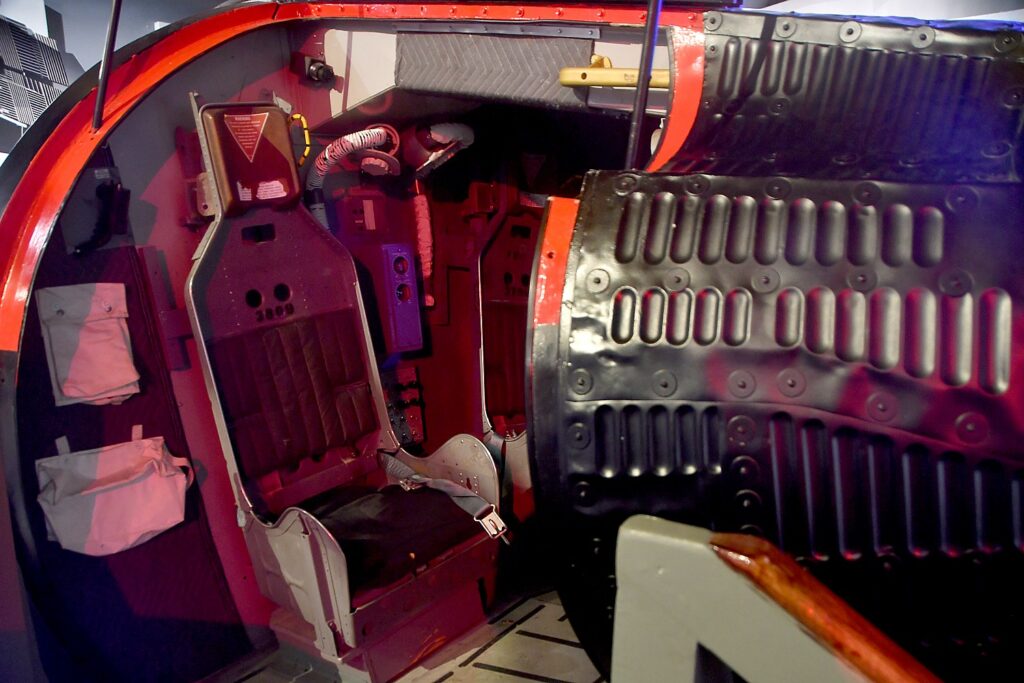
ability for people, young and old, to interact with exhibits – like climb into
a Gemini capsule, land a Space Shuttle, and in the current exhibit, enter a
space habitation on Mars, and the largest collection of Apollo artifacts in the
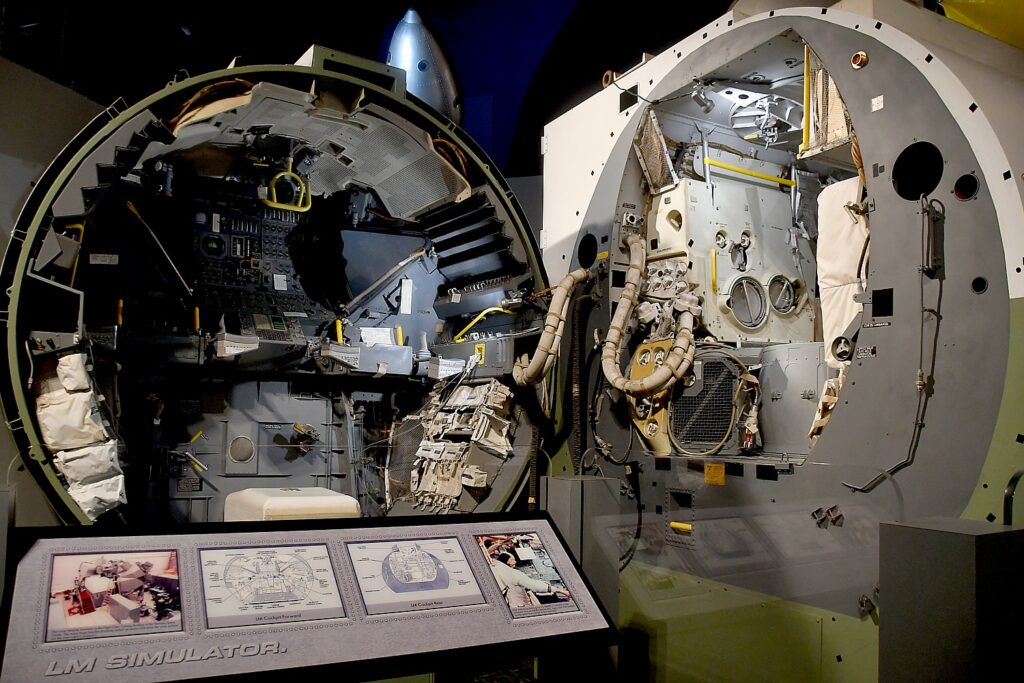
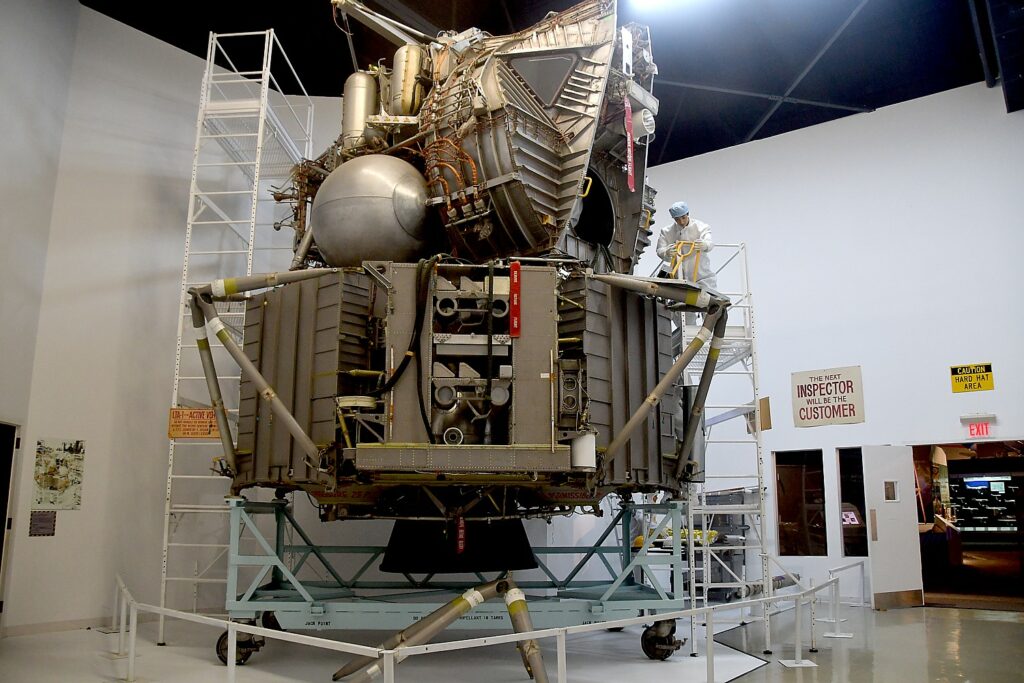
world, including an actual lunar module which was built by Grumman in Bethpage
for Apollo 19, a moon mission that was scrubbed.
“The
lunar landing was one of humankind’s epic achievements,” said Shepherd, who
will be on hand during the day to interact with museum goers. “Beyond Apollo,
it ignited a process that is still going on. NASA is on course to go back to
the moon, a steppingstone to planetary expedition to Mars. Children today may
take part.”
It’s
critically vital, he said, for children to have the opportunity to be exposed
to “first-hand” science, as opposed to watching documentaries on television. “Education
is turning to project-based and experiential learning, versus textbooks. Here,
kids get to see for themselves. The tangible makes learning enjoyable.”
Curran
pointed to the Cradle of Aviation as one of the best museums – even attractions
– on Long Island. “It is such an asset in the heart of our county..
On
July 20, in addition to the Apollo events, there will be former Grumman
engineers and employees who helped build the lunar module and the equipment
that made the space program possible, among them Ross Bracco, a structural
engineer at Grumman who is now a volunteer at Cradle of Aviation Museum.
Shepherd will lead two “episodes” allowing kids to design their own lunar
lander.
Shepherd
noted that the moon, itself, remains a mystery – how it was created more than 4
billion years ago – was it knocked off from earth or form separately? “We don’t
know but maybe some kids here will research.” He said the moon has been static
for 4 billion years, unlike the earth which is “dynamic” and changing, so is a
time piece that can shed light on what the solar system was like 4 billion
years ago. “We are learning about the moon’s relationship to the earth.”
And
you can even get a whiff of what the moon smells like in one of the exhibit.
On Saturday, July 20, 2019,
thousands of people will be joining together at the Cradle of Aviation Museum
to celebrate the 50th anniversary of the historic Apollo 11 mission. The Cradle
of Aviation, home of the Lunar Module, is celebrating all day and night with
two festive events to give the community an opportunity to learn, reflect,
remember, & jointly celebrate, all the wonder, achievement, and pride that
is Apollo.
There
will be events throughout the day:
COMMUNITY COUNTDOWN TO LUNAR
LANDING – Join in a Community Countdown at 4:17 pm to collectively
watch, re-experience, and honor as a community, the historic “The Eagle
has Landed” Lunar Module landing on the moon.
ASTRONAUT ENCOUNTERS with Space
Shuttle Astronauts Bill Shepherd (Babylon) & Charlie Camarda (Ozone
Park), both from Long Island, and Bob Cenker.
MOON BUGGY RACES – Traverse a
lunar obstacle course driving an electric lunar rover. (kids)
VIRTUAL REALITY – Explore the
inside and outside of the Apollo 11 up close and personal with Microsoft’s
Mixed Reality and the Microsoft HoloLens technology.
APOLLO 11 FIRST STEPS in IMAX –
Experience a free showing of the new highly-acclaimed documentary, Apollo
11 First Steps Edition in our immersive Dome Theater.
Playing hourly.
SOLAR TELESCOPES- Explore the
sun with a special purpose solar telescope.
LAUNCH ROCKETS – Build,
decorate, then launch a water bottle rocket.
ROBOTICS DEMONSTRATIONS – View
and interact with student-built robotics from the First Lego
League.
VISITS FROM THE UNIVERSE – The
not-for profit, NY Avengers Cosplayers are assembling at the Cradle to
celebrate the American heroes who contributed to the successful lunar
landing.
Museum opens at
9:30am. Family activities are 12:00 – 4:00pm. Countdown begins at 4:00pm.
Then, from 7-11 pm, is
the Apollo at Countdown Celebration, a lively dinner and champagne toast with
music and dancing, as the community comes together to watch and re-experience
the unforgettable first steps on the moon at 10:56 pm with a special moon
landing viewing and countdown.
Space Shuttle
Astronauts Bill Shepherd (Babylon) & Charlie Camarda (Ozone Park), both
from Long Island, and Bob Cenker, will be in attendance.
Tickets to either
event can be purchased at www.cradleofaviation.org/apollo or
by calling Reservations 516-572-4066 (M-F) 10:00am-4:00pm) Grumman Retirees and
Museum Members, may call Reservations for discounted tickets. Proceeds to
Benefit Museum Education and Preservation Programs.
Cradle of Aviation
But
the reason there is such a world-class space and aviation museum here on
Charles Lindbergh Avenue, named for the famous aviator, is that this is indeed
the cradle of aviation – it is located on what was Mitchel Air Force Base
Field, which, together with
nearby Roosevelt Field and other airfields on the Hempstead Plains, was the
site of many historic flights , most significantly, where Lindbergh set off for
his historic transatlantic solo flight to Paris and it was on Long Island that
so much of the aviation industry and innovations happened. In fact, so many seminal flights occurred in
the area, that by the mid-1920s the cluster of airfields was already dubbed the
“Cradle of Aviation”, the origin of the museum’s name.
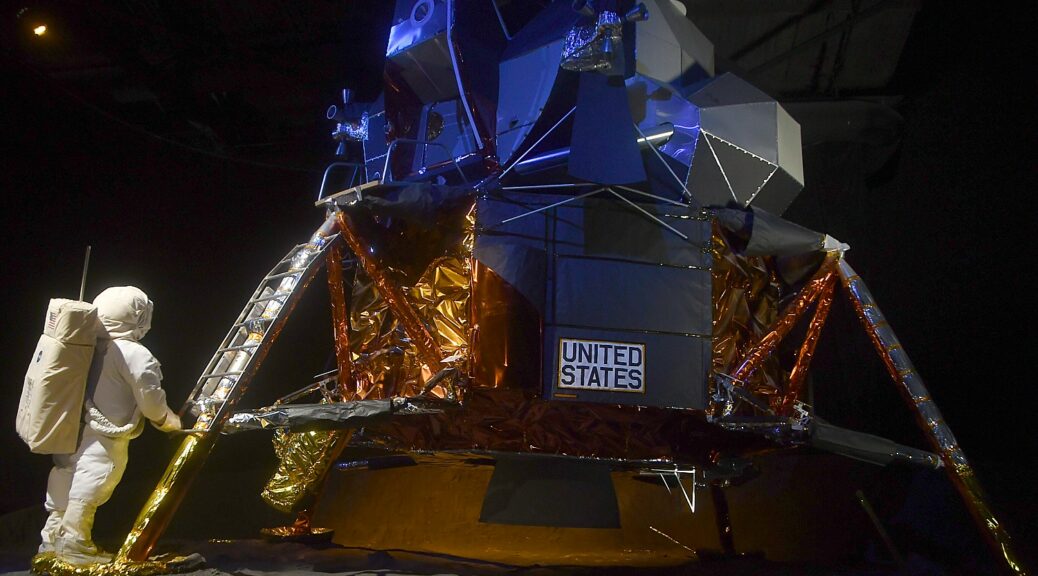
The
events and exhibits also pay homage to Grumman engineers who designed and built
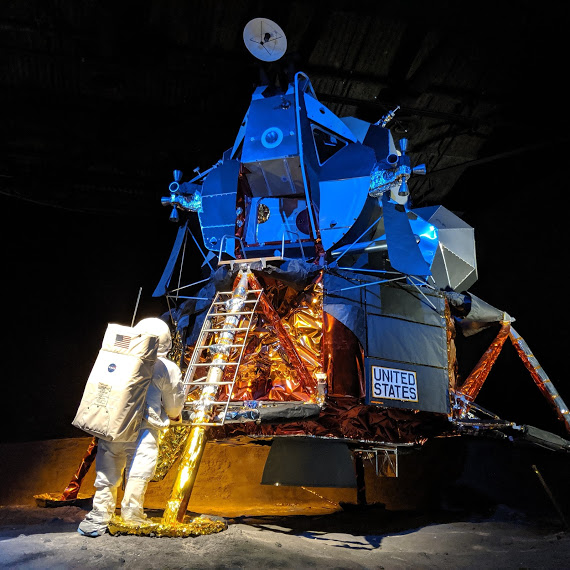
the lunar exploration module (LEM), and there is an actual LEM on exhibit – the
only actual LEM of the three modules on exhibit (the three that went to the
moon remained there). This one was built by Grumman for Apollo 19 but that
mission was scrubbed.
You
can also see mock-ups of Grumman engineers in a “clean room” building a LEM.
Cradle
of Aviation museum has the largest collection of Apollo artifacts anywhere –
the space exhibits are phenomenal and include simulators and a real moon rock.
And
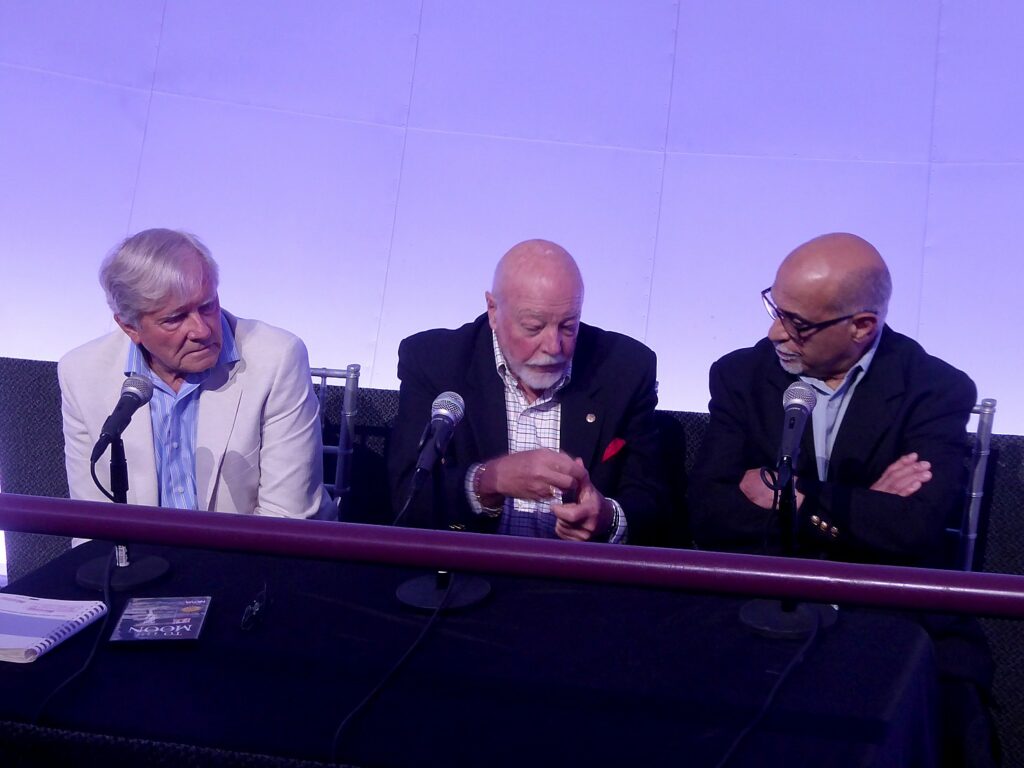
so it was fitting at one of the Apollo 50th events held in recent
weeks, the Gold Coast International Film Festival screening of “First Man,” as
part of its Science on Screen series, three former Grumman engineers who worked
on Apollo project related their experience.
Howard Frauenberger,
who was a co-op engineering intern running technical tests on the Lunar
Excursion Module landing gear and in the Cold Flow area for final ascent &
descent stage system tests before delivery to NASA, reflected, “Had we never had the Apollo1 tragedy, where three astronauts were
lost, the likelihood of doing a successful lunar landing was low…The post-fire evaluation of the design of command
module found so many things inadequately or improperly or stupidly designed-
not the least was the hatch which opened in instead of out so that in a
pressurized environment, it couldn’t open. NASA’s oversight over all the contractors
doubled or tripled. So the prevailing theory is that if that fire hadn’t
happened, design defects could have caused a situation where Apollo 11 couldn’t
land.”
Richard Dunne, who was
the chief spokesman for the Grumman Corporation, which
designed and built the Apollo Lunar Module: “The fire
forced a redesign of everything
in the command module and lunar module.” He also reflected on how close it was
that the United States might not have won the space race at all “Two weeks
before Apollo 11 launched, the Russians attempted moon shot, but it exploded.
The way the United States knew about it was because our spy satellites detected
it.”
Mike Lisa, who worked
as an engineer on the Lunar Excursion Module in 1963 until the program ended
and spent 36 years at Northrop Grumman, said, “The most important thing was to bring the astronauts
back healthy. A device called a tumbler would grab the LEM on both sides and
flip it around – tumble and turn – to shake anything that might have been loose
inside. On this particular day, I was working in a semi-clean room – we wore white
jackets and different hats to show what we working on – and tumbling, there was
a clink and a nut fell on the floor. The NASA inspector was there and shut the
room down for a whole week, but we all had to be on station, 24/7, waiting for
permission to reopen.”
Cradle of Aviation Museum
originally opened with just a handful of aircraft in the un-restored hangars in
1980. A major renovation and expansion program in the late 1990s allowed the
museum to re-open in a state-of-the-art facility in 2002. Additional expansion
plans are currently under development. The museum is an educational center
preserving Long Island’s contribution to aerospace, science and technology by
inspiring future generations through learning.
The Cradle of Aviation Museum and Education Center today is home to over 75 planes and spacecraft representing over 100 years of aviation history and Long Island’s only Giant Screen Dome Theater. The museum has been celebrating “Countdown to Apollo at 50” sponsored by the Robert D.L. Gardiner Foundation, through much of the year, showcasing Long Island and Grumman’s significant role in the Apollo program. The Museum was recently recognized and listed on New York State’s National Register of Historic Places as a significant part of American history. The museum is located on Museum Row, Charles Lindbergh Blvd., in East Garden City. For more information call (516) 572-4111 or visit www.cradleofaviation.org.
By
Karen Rubin, Travel Features Syndicate, goingplacesfarandnear.com
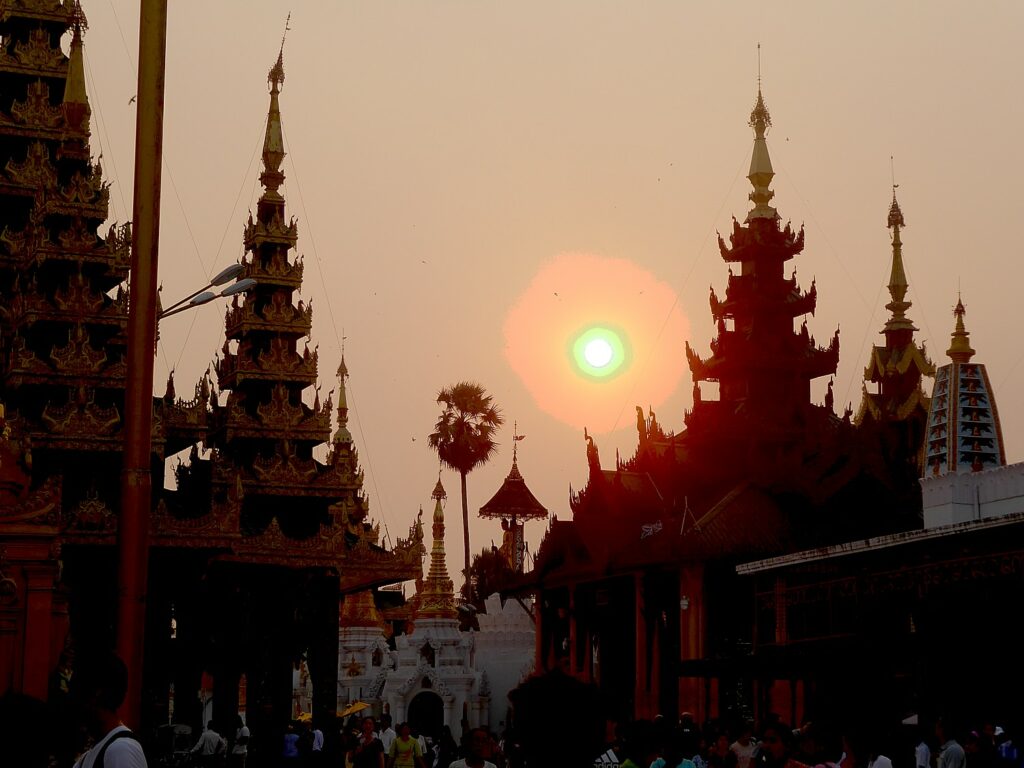
Be
transported in time, place and even space. Immerse yourself into the realm of
ideas and imagination. Come in from the heat or whatever the weather is doing
outside by taking in one of New York City’s museums. Here are just a few
highlights of summer’s blockbuster attractions:
The
Metropolitan Museum of Art is about to welcome a very special visitor: Leonardo
da Vinci’s Saint Jerome. To
commemorate the 500th anniversary of the death of Leonardo da Vinci
(1452–1519), The Met is presenting the artist’s painting Saint Jerome
Praying in the Wilderness (begun around 1483), a special loan from the
Vatican Museums. The exquisitely rendered work represents Jerome (A.D.
347–420), a major saint and theologian of the Christian Church. The scene is
based on the story of his later life, which he spent as a hermit in the desert,
according to the 13th–century Golden Legend. The unfinished painting provides
viewers with an extraordinary glimpse into Leonardo’s creative process; a close
examination of the paint surface even reveals the presence of his fingerprints.
The display of this monumental masterpiece pays homage to one of the most
renowned geniuses of all time. Opening July 15, the painting is on view
through Oct. 6, 2019.
From
the oldest works of art to the first forays of civilization into outer space, ,
the Met Museum is marking the 50th anniversary of the Apollo 11
mission with Apollo’s Muse: The Moon in
the Age of Photography, on view through September 22, 2019. Apollo’s Muse traces the progress of astronomical
photography and attempts to produce ever-sharper images of the moon,
particularly during the 130-year period between the invention of photography in
1839 and the moon landing in 1969 as astronomers and artists capitalized on
technological improvements to cameras and telescopes to create ever more
accurate visual records of the lunar surface. Exhibition highlights include two
newly discovered lunar daguerreotypes from the 1840s, believed to be the
earliest existing photographs of the moon, and works by such pioneers of lunar
photography as Warren De La Rue (1815–1889), Lewis Morris Rutherfurd
(1816–1892), and John Adams Whipple (1822–1891). A stunning photographic atlas
of the moon, produced at the Paris Observatory between 1894 and 1908 by the
astronomers Maurice Loewy (1833–1907) and Pierre Puiseux (1855–1928), will be
displayed for the first time in its entirety.
Alongside
these scientific achievements, the show explores the use of the camera to
create fanciful depictions of space travel and life on the moon, including
George Méliès’s (1861–1938) original drawings for his film A Trip to the Moon (Le Voyage dans la lune, 1902) and
a large selection of “paper moon” studio portraits from the early 20th century.
Also featured will be artists’ evocations of the otherworldly effects of
moonlight, including major works by German Romantic painter Caspar David
Friedrich (1774-1840) and American Pictorialist photographer Edward Steichen
(1879-1973).
The night of the Museum Mile Festival, I popped into the opening of this year’s P.S. Art exhibit, an annual celebration of achievement in the arts in New York City public schools. This juried exhibition of the work of talented young artists showcases the creativity of 122 prekindergarten through twelfth grade students from all five boroughs, including students from District 75, a citywide district serving students with disabilities. The exhibition consists of paintings, prints, sculptures, photographs, mixed-media works, collages, drawings, and video. Each work of art demonstrates personal expression, imaginative use of media, the results of close observation, and an understanding of artistic processes. Some of the works on display are completely astonishing
The
Met is three museums.
At the Cloisters, “The Colmar Treasure: A Medieval Jewish
Legacy,” is on view July 22-January 12, 2020. A cache of jeweled rings,
brooches, and coins—the precious possessions of a Jewish family of medieval
Alsace—was hidden in the fourteenth century in the wall of a house in Colmar,
France. Discovered in 1863 and on view in an upcoming exhibition at The Met
Cloisters, the Colmar Treasure revives the memory of a once–thriving Jewish
community that was scapegoated and put to death when the Plague struck the
region with devastating ferocity in 1348–49. A generous loan of the Musée
de Cluny, Paris, the Colmar Treasure will be displayed alongside select works
from The Met Cloisters and little–known Judaica from collections in the United
States and France. Although the objects on view are small in scale and
relatively few in number, the ensemble overturns conventional notions of
medieval Europe as a monolithic Christian society. The exhibition will point to
both legacy and loss, underscoring the prominence of the Jewish minority
community in the tumultuous fourteenth century and the perils it faced.
At
the Met Breuer,
“Home is a Foreign Place:
Recent Aquisitions in Context,” through June 21, 2020.
(NYS
residents still can pay what they wish, by presenting proof of residence;
out-of-towners need to pay the regular admission).
The iconic Metropolitan Museum of Art is at 1000 Fifth Avenue, on Central Park, (definitely take a Highlights tour when you visit), The Met Breuer (945 Madison Avenue) and The Met Cloisters (99 Margaret Corbin Drive, Fort Tryon Park). Visit metmuseum.org to plan your visit.
Jewish Museum Pays Homage to
Leonard Cohen With Multi-Media Exhibition
“Ring the bells that still can ring. Forget your perfect
offering. There is a crack, a crack in everything. That’s how the light gets
in.” from Leonard Cohen’s song “Anthem”
from the album The Future (1992), provides the title for the special exhibit at the
Jewish Museum,
“Leonard Cohen: A Crack in Everything”.
The contemporary multi-media exhibition devoted to the imagination and legacy
of the influential singer/songwriter, man of letters, and global icon from
Montreal, Canada can be experienced through September 8, 2019.
Leonard
Cohen: A Crack in Everything includes commissioned works by a
range of international artists who have been inspired by Cohen’s life, work and
legacy. A world-renowned novelist, poet and singer/songwriter who inspired generations
of writers, musicians, and artists, Leonard Cohen (1934-2016) supplied the world with melancholy and urgent
observations on the state of the human heart. In songs such as “Suzanne,” “Bird
on the Wire,” and “Hallelujah,” he interwove the sacred and the profane, mystery and accessibility. Collectively, it is
the oddest, most creative biographical tribute. Featured works include:
I’m
Your Man (A Portrait of Leonard Cohen) (2017), a
multi-channel video installation by Candice Breitz, brings together a community
of ardent Cohen fans who pay tribute to the late legend. Each of the 18
participants was offered the opportunity to perform and record his own version
of Cohen’s comeback album I’m Your Man (1988) in a
professional recording studio. At Breitz’s invitation, the album’s backing
vocals were reinterpreted by the Shaar Hashomayim Synagogue Choir, an all-male
choir representing the congregation in Montreal, Canada, that Cohen belonged to
all his life.
Ari Folman’s Depression Chamber (2017) allows one visitor at a
time into a darkened room, where they are confronted by the demons of
depression, a theme that can be traced throughout Cohen’s body of work. After
the visitor lies down, Cohen’s “Famous Blue Raincoat” plays while
the song’s lyrics are projected on the walls, slowly morphing into letters and
icons that symbolize Cohen’s multifaceted thematic universe.
Heard There Was a Secret Chord (after the 2017 work of the same
title, 2018) is a participatory humming experience by the art and design
studio Daily tous les jours that reveals an invisible vibration uniting people
around the world currently listening to Cohen’s Hallelujah. The
work is an exploration of the metaphysical connection between people on a
common wavelength. At the Museum, real-time online listener data is transformed
into a virtual choir of humming voices. The number of voices played back in the
gallery corresponds to the current online listener count, which is visible on
the hanging numerical display. Participants can sit or lie down on the
octagonal structure, and by humming along with the choir into the microphones,
low-frequency vibrations are generated, closing the circuit of collective
resonance with their bodies.
Organized by the Musée d’art contemporain de Montréal (MAC), the exhibition is curated by John Zeppetelli, Director and Chief Curator at the MAC, and Victor Shiffman, Co-Curator. Following its New York showing, the exhibition will tour to Kunstforeningen GL STRAND and Nikolaj Kunsthal, Copenhagen, Denmark (October 23, 2019 – March 8, 2020) and the Contemporary Jewish Museum, San Francisco (September 17, 2020 – January 3, 2021).
During the run of Leonard Cohen: A Crack in Everything, the Jewish Museum will open one hour earlier than usual on Saturdays and Sundays, from 10 am to 5:45pm. Advance tickets are available online at thejewishmuseum.org/buy/general-admission. For questions about ticket sales, email boxoffice@thejm.org or call 866.205.1322.
Founded in 1904, the Museum, on Fifth Avenue’s fabled Museum Mile, was the first institution of its kind in the United States and is one of the oldest Jewish museums in the world. Devoted to exploring art and Jewish culture from ancient to contemporary, the Museum offers diverse exhibitions and programs, and maintains a unique collection of nearly 30,000 works of art, ceremonial objects, and media reflecting the global Jewish experience over more than 4,000 years.
Admission: $18 for adults, $12 for seniors, $8 students, free for visitors 18
and under and Jewish Museum members. Free on Saturdays and select Jewish
holidays. 1109 Fifth Avenue at 92nd Street, New York City, 212.423,3200, info@thejm.orgTheJewishMuseum.org.
Museum
of the City of New York: New York at Its Core
I
make it a ritual to visit the Museum of the City of New York during each year’s
Museum Mile Festival. I never cease to be fascinated and intrigued by the
exhibits:
New
York at Its Core
is the first-ever museum show to comprehensively interpret and present the
compelling story of New York’s rise from a striving Dutch village to today’s
“Capital of the World,” a preeminent global city now facing the future in a
changing world. There are different galleries that tell the story, but most
fascinating is The Future City Lab, where you get to design the city of the
future, tackling the most pressing problems like housing, public spaces, water
supply. You even get to put yourself in the picture.
Not
to be missed: Timescapes, the museum’s popular and
critically-acclaimed multimedia experience, brings the sweeping narrative of
New York City from the early 1600s to the present day. The 28-minute,
award-winning documentary explores how NYC grew from a settlement of a few
hundred Europeans, Africans and Native Americans into the multinational
metropolis of today, re-inventing itself multiple times along the way.
Activist New York, an
ongoing exhibit, examines the ways in which ordinary New
Yorkers have advocated, agitated, and exercised their power to shape the
city’s—and the nation’s—future, from the 17th century to the
present.
City of Workers, City of Struggle: How
Labor Movements Changed New York, traces how New York became the most
unionized large city in the United States.
Cycling
in the City: A 200–Year History, on
view through October 6, 2019, tracex how the bicycle transformed urban
transportation and leisure in New York City and explores the extraordinary
diversity of cycling cultures, past and present.
Housed
in the Frank Lloyd Wright building, a major attraction in itself (just walking
through the spiral is an experience),from June 18 through September 3, the
Solomon R. Guggenheim Museum is open until 9 pm for Summer Tuesdays, offering
music and refreshments in the museum rotunda in addition to exhibitions on view
in the galleries. Films, conversations, and performances enhance opportunities
for visitors to engage with the museum and the Frank Lloyd Wright–designed
building that celebrates 60 years as an architectural icon in 2019. Also
starting in June, Summer of Know, a conversation series addressing urgent
issues through the generative lens of art, returns to the Guggenheim, featuring
artists, activists, and other professionals discussing topics such as LGBTQIA+
rights in a global context, environmental activism, and housing rights. Details
are available at guggenheim.org/calendar.
The Whitney
Biennial has long been one of America’s
foremost showcases of emerging artists. Every two years, the exhibition serves
as a bellwether for the culture, both reflecting on and mirroring the country’s
political and social moods. No surprise, then, to see that this year’s work—on
view now at the Whitney Museum of American Art—offers plenty of tension, with
pieces that focus on gender identity and race, among other issues. Curators
chose the works because they represent “a snapshot of contemporary art making”;
read on for more about a few of our favorites. (See: https://www.nycgo.com/articles/whitney-biennial-2019) (99 Gansvoort
St., Meatpacking district).
Museum
of Natural History Presents T.rex, The Ultimate Predator
At the American Museum of Natural History’s blockbuster exhibit, T. rex: The Ultimate Predator, you encounter a massive life-sized model of a T. rex with patches of feathers—the definitive representation of this prehistoric predator, T. rex hatchlings and a four-year-old juvenile T.rex; a “roar mixer”where you can imagine what T. rex may have sounded like; a shadow theater where a floor projection of an adult T. rex skeleton seems to come to life. At a tabletop “Investigation Station,” you can explore a variety of fossil casts with virtual tools including a CT scanner, measuring tape, and a microscope to learn more about what such specimens reveal about the biology and behavior of T.rex. Finally, you encounter a massive animated projection of aT. rexand its offspring in a Cretaceous-age setting. which reacts to visitors, leaving you to wonder, “Did that T. rex really see me?”
T. rex: The Ultimate Predator is the first major exhibition of the
American Museum of Natural History’s 150th anniversary celebration. Plan your
visit (you could spend weeks in the museum), check out the special programming
and events, and pre-purchase timed tickets at amnh.org.
At
Hayden Planetarium Space Theater, see “Dark Universe” (through December 31,
2019)
Open daily from 10 am – 5:45 pm. American Museum of Natural History, Central Park West at 79th Street, New York, NY 10024-5192, 212-769-5100, amnh.org.
Revolutionary
Summer at New-York Historical Society
The New-York Historical Society, the oldest museum in New
York (and directly across the street from the American Museum of Natural
History on Central Park West), is presenting a Revolutionary Summer. A Museum-wide
exploration of Revolutionary War times, Revolutionary
Summerpresents outdoor events every weekend featuring characters
from the era; 18th-century art and artifacts; a diorama of the Continental Army
and a host of programs for all ages, including trivia nights, DJ evening, and Revolutionary
Drag Tea Party. On select weekends, visitors can explore a replica of George
Washington’s Headquarters Tent at an outdoor Continental Army encampment, meet
Living Historians portraying soldiers and spies, and learn about the many
facets of camp life during the War for Independence. (Through September 15,
2019)
Also on view: LIFE: Six Women Photographers showcases the extraordinary work created
by Margaret Bourke-White, Hansel Mieth, Marie Hansen, Martha Holmes, Nina
Leen, and Lisa Larsen. (through October 6, 2019); Stonewall 50 at New-York Historical Society, through September
22, 2019, commemorates the 50th anniversary of the Stonewall uprising and the
dawn of the gay liberation movement; Hudson Rising explores 200 years of ecological change
and environmental activism along “the most interesting river in America” (through
August 4).
Panoramas:
The Big Picture,
opening August 23 through December 8, 2019, explores wide-angle, bird’s-eye
imagery from the 17th to the 20th century, revealing the influence that
panoramas had on everything from mass entertainment to nationalism to imperial
expansion. Through more than 20 panoramas, the exhibition presents the history
of the all-encompassing medium in New York City, San Francisco and beyond.
New-York Historical Society, 170 Central Park West (77th Street), New York, NY 10024, 212-873-3400, nyhistory.org.
Want a real escape? Visit Spyscape, which offers a different twist on spy museums, and is more of an experiential attraction, immersing you into the psychology and ubiquity of surveillance and espionage, and literally, with the ending “profile” (developed with the a former head of training at British Intelligence) showing you where you might fit into this world (I’m an analyst). SPYSCAPE, which opened in 2018, illuminates secret intelligence, from espionage to hacking, and investigative journalism. It offers a balanced perspective on big issues – privacy, security, surveillance. You get to engage in real spy challenges, including lie-detection in interrogation booths, surveillance in a 360 degree environment and test strategy and agility in special ops laser tunnels. The museum also features quite a good Spy Shop, a Book Shop, Café and multiple Event Spaces. (928 8th Avenue, entrance on SE corner of 55th Street, spyscape.com).
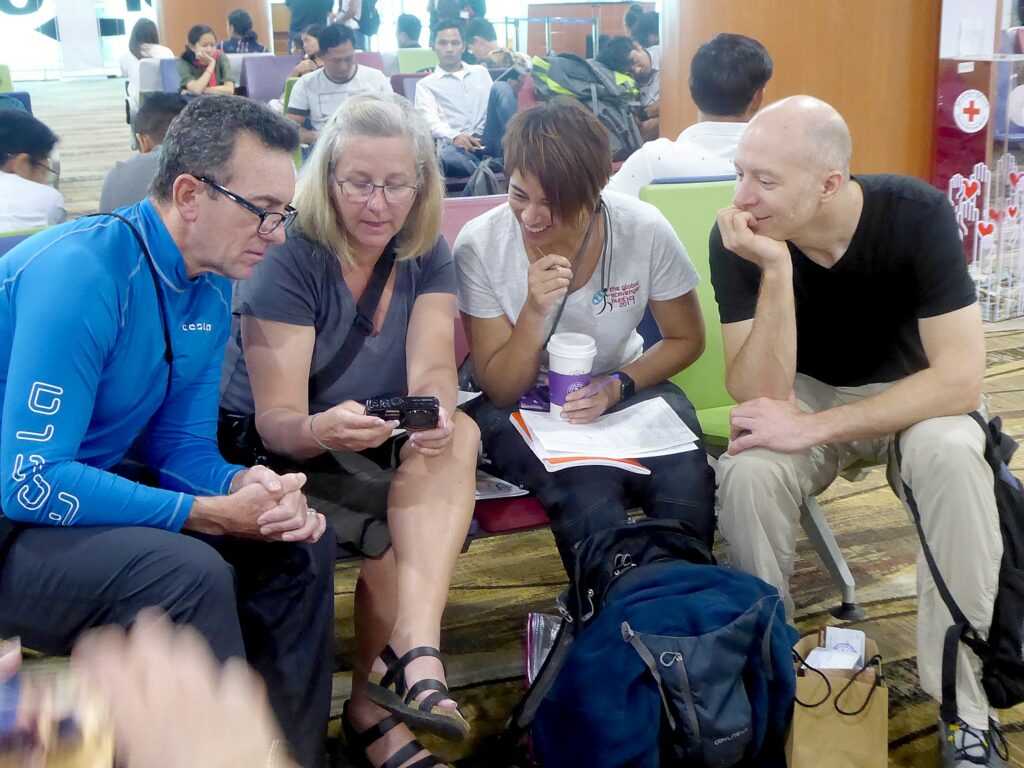
And in a very real Spy v. Spy scenario, a very different
experience awaits at another new entry to New York City’s museum scene: the KGB Museum. This place presents the
artifacts and history of the KGB in a kind of antique-shop setting but the
items are chilling. You realize that the spy movies, even the satirical “Get
Smart,” didn’t so much fabricate as reveal the tools and techniques and
paranoia of Cold War spying. (KGB Spy Museum tickets are available online or in
the museum. (245 West 14th Street, New York,
NY 10011, 10 am -8 Mon-Sun).
The Museum of Illusions, which opened September 2018 in New York City’s West Village, contains three-dimensional illusions on the walls and floors which will mesmerize visitors of all ages. You might assume by its name that it is a children’s museum or about magic which depends so much on illusion. Nor can it be considered an “attraction” although many of the exhibits are interactive and you get to help create the illusions. It is really about educating about the physical and psychological science behind illusion – placards posted near each exhibit provide the explanations for what you sense. And while the museum does not explicitly delve into magic, when you leave, you will have a better understanding of how some magic tricks work. (77th 8th Ave, New York, NY; newyork.museumofillusions.us)
Cradle of Aviation Museum: Countdown to
Apollo at 50
Travel
out of this world, beyond the city limits, to Long Island: The Cradle of
Aviation Museum and Education Center is one of the great space and aviation
museums, home to over 75 planes and spacecraft representing over 100 years of
aviation history and Long Island’s only Giant Screen Dome Theater. Currently,
the museum is celebrating “Countdown
to Apollo at 50”
sponsored by the Robert D.L. Gardiner Foundation, showcasing Long Island and
Grumman’s significant role in the Apollo program. The Museum was recently
recognized and listed on New York State’s National Register of Historic Places
as a significant part of American history. The museum is located on Museum Row,
Charles Lindbergh Blvd., in East Garden City. For more information call
(516) 572-4111 or visit www.cradleofaviation.org.
The Museum of Illusions,
opened September 2018 in New York City’s West Village. You might assume by its
name that it is a children’s museum or about magic, which depends greatly on
illusion — it is neither of these. Nor can it be considered an
“attraction, ” although many of the exhibits are interactive, as you get to
help create the illusions. The purpose of this museum is really about educating
visitors on the physical and psychological science behind illusion. With two-
and three-dimensional illusions on the walls and floors that will
mesmerize visitors of all ages, placards posted near each exhibit provide the
explanations to help you understand what you are viewing and how the illusion
is created. While the museum does not explicitly delve into magic, when
you leave, you will have a better understanding of how some magic tricks work.
We thoroughly enjoyed
this museum with its many surprises. One of our favorite exhibits was a room
with a sloped floor — a monitor shows that you appear to be growing smaller and
smaller as you walk across the floor. Another fun, interactive exhibit is where
a visitor pokes her head out of the middle of the table, but all you see is a
head on top of the table with no body.
Friendly staff are
available to give you clues about the illusions, help you figure out where to
stand to get the most effective view, explain the science behind a particular
illusion, and take your picture. In fact, the museum welcomes photography
because the digital photograph makes it easier to visualize many of the
illusions. At the front of the museum, a staff member is ready to have two of
your party pose as part of an illusion relating to perspective (check out the
photo where Marty is patting Laurie’s head — we are literally a few feet from
each other! And no — Laurie is not that small).
Photography is encouraged at the Museum of Illusions; a photograph makes it easier to visualize many of the illusions. Friendly staff members are available to help take the photo.
The museum is housed in
a bank building dating back to pre-Depression 1920s. Before you leave, be sure
to ask to see the old bank vault.
(Be advised: the only
downside of the Museum of Illusions is that it has mobility limitations – there
is no handrail on the outside steps leading up to the main door and no
alternate ramp. The second floor is only accessible by a narrow staircase with
a banister — there is no elevator. On the other hand, visitors with mobility
issues are admitted free.)
The Museum of Illusions
(77th 8th Ave, New York, NY; https://newyork.museumofillusions.us/) is open Monday – Thursday, 9am to 10pm; Friday
– Sunday 8am to 11pm. To explore with smaller crowds, try to arrive
before noon. Plan for 45 minutes to 1-½ hours to walk the entire museum, and
bring a camera to capture the illusions at their best! Tickets are $19/adult;
$17/senior, military, students with ID; and $15/kids 6-13 years of age (under 6
is free). Tickets may be purchased online with a small service fee.
From its founding in the 1930s to the end of weekly publication in the 1970s, LIFE Magazine elevated and showcased photojournalism. Instead of just being the acoutrement to reporting, the photos were the story, or as Henry R. Luce saw it, the photojournalist as essayist.
During
that time, only six out of 101 full-time LIFE
photographers were women. Now, for the first time, these women – who contributed
so much to the evolution of photojournalism as well as the cultural and
societal trends they spotlighted – are
featured in their own exhibit, LIFE: Six Women Photographers, at the New-York
Historical Society through October 6, 2019.
“For the editors of LIFE—the first magazine to tell stories with photographs rather than text—the camera was not merely a reporter, but also a potent commentator with the power to frame news and events for a popular audience. For decades, Americans saw the world through the lens of the magazine’s photographers. Between the late 1930s and the early 1970s, LIFE magazine retained only six women photographers as full-time staff or on a semi-permanent basis. LIFE: Six Women Photographers showcases the work of some of those women and how their work contributed to LIFE’s pursuit of American identity through photojournalism,” the curators write. The exhibition features more than 70 images showcasing the extraordinary work created by Margaret Bourke-White, Hansel Mieth, Marie Hansen, Martha Holmes, Nina Leen, and Lisa Larsen.
How were these women part of a larger editorial vision? What topics did
they cover, and how did their work reflect—and sometimes expand—the mission of
the magazine? The exhibit reveals these photographers’ important role in
creating modern photojournalism and defining what LIFE editor-in-chief Henry Luce called the
“American Century.” The level of influence that LIFE Magazine wielded was
considerable – at its height, one out of every three Americans read the
magazine each month.
We learn that of the six, three were immigrants of whom two fled Fascist
Europe. In all, they produced 3,000 stories, 325,000 images that curator Sarah
Gordon, curatorial scholar in women’s history at NYHS’ Center for Women’s
History, and Marilyn Satin Kushner, curator and head, Department of
Prints, Photographs, and Architectural Collections, combed through to select
out the 70 images featured in the exhibit. The exhibit, interestingly,
highlights not only the photos that were selected for publication, but photos
out of the series that were not, as well as the contact sheets. There are also
displays with the magazine opened to the page, and notes from the
photographers.
Asked how the six featured stories were selected out of the
photographers’ 3,000, Kushner reflects, “We thought about what we wanted to
show and say – that kept me up at night, how to tie as a thread. The first
thought was to show a woman’s point of view, but then we don’t know how a man
would have treated the same subject. What the women did was illustrate Luce’s
idea, that the photos [depict] the American story.”
Margaret Bourke-White, one of the first four staff photographers, her image of Fort Peck Dam was the cover of LIFE Magazine’s inaugural cover ; she photographed from front lines in World War II, and worked for LIFE until her death in 1971
Yet, except for Margaret Bourke-White’s famous series on the Fort Peck Dam – illustrative of her talent to show Industrial America and technological progress – the photo essays selected for this exhibit predominantly show women and women’s issues – wrestling with their place in society after World War II’s independence, the WACS. And even when there is a story, like the Dam, Bourke-White and others showed a great sensitivity to how ordinary people – families – lived. Bourke-White chose to show shantytowns that developed around the dam, and what Saturday night dancehall was like.
Her telegram to her editor reads, “Swell subjects especially shanty
towns. Getting good nightlife. Nobody camera shy except ladies of evening but hope conquer them
also…. May I give one picture FortPeck Publishing booklet for local sale. Would
help repay their many courtesies. Could choose pattern picture we probably wouldn’t
use anyway.”
How did they get their assignments? “Sometimes the women wrote and
asked for an assignment, but usually were told to ‘do that’” Kushner tells me. Luce
wanted LIFE Magazine to reflect the American Century, and while Bourke-White
documented steel mills and dams – America’s technology and industrial
achievements – she also depicted new towns in the middle of no where, “FDR’s
New Wild West.”
Standing in front of one of the most controversial and substantial
photos in the exhibition – Martha Holmes’ 1949 image of singer Billy Eckstine being embraced
by a white female fan, surrounded by
other gleeful white teenagers – I meet Holmes’
daughter, Anne Holmes Waxman, and granddaughter of the photographer, Martha
Holmes., Eva Koshel Castleton.
“My mother came on when a lot of men were in the war. Born in
Louisville, Kentucky, she was working as a photographer at the Courier-Journal
when Life Magazine came to recruit her to come to New York. “She was shaking in
her boots, just 24 years old. She never went back.”
The exhibit shows the contact sheet with other images of multiracial crowds waiting for tickets and autographs, but the editors chose to publish the more controversial image. They were so concerned that they sought permission from Luce, who agreed with Holmes that the photograph reflected social progress and was appropriate for the story. “Holmes felt the photo was one of her best, claiming ‘it told just what the world should be like.’ The magazine, however, received vicious letters in response and the fallout adversely affected Eckstine’s career.”
LIFE Magazine photographer Martha Holmes.
In the weekly report of letters received for April 24 issue, “Fifty-nine readers are very much upset. ‘That picture of Billy Eckstine with a white girl clinging to him after a performance just turns my stomach. Why a teen-age white girl conducts herself in this manner over a Negro crooner is beyond me. Juvenile delinquency is bad enough in our own race without mixing it up with another.” “The most nauseating picture of the year.” “That picture qualifies as the most indecent picture ever published by LIFE.” “ That picture should have appeared in Pravda Your publication of it leads me to believe that Mr. Chambers was not the only Communist on your staff.” Eight readers cancelled their subscriptions, but nine praised the feature.
(What I notice in the magazine that is featured in the display is the
ad for new Coty eye cosmetics . “Eyes of natural glamour. Newest style in
beauty.”)
I ask her daughter Anne whether her mother got or lost certain
assignments because of being a woman. She related that the only assignment her
mother turned down was when, she was 8 ½ months pregnant with her, in 1956, and
had to refuse an assignment to photograph Elvis Presley. “It was the one job
she couldn’t take.” But she is renowned for her photos of artist Jackson
Pollack and the House on UnAmerican Activities hearings.
LIFE Magazine photographer Nina Leen.
A very interesting series, “The American Woman’s Dilemma” by Nina Leen, published in the July 16, 1947 issue, danced around the issue of “how are you going to get them back on the farm, after they’ve seen Par-ee” – in this case, women who worked traditionally male jobs and had independence during the war, now being shoved back into housework and child-rearing rather than pursue a career. “The essay also reflected cultural anxieties about a ‘return to normalcy’ after the Depression and war. LIFE assumed that all women desired marriage and children but voiced concern that a woman’s time was so stretched, she did not have time to pursue her husband’s interests.
“The article barely acknowledged that many women had no choice but to
find work. It did recognize women’s struggles with child care buit disparaged
separation as creating insecure children.” Only one of Leen’s photos of an unmarried
woman made the cut. “This article represented a clear attempt at setting out
women’s choices in the post-war era of societal realignment.” (The article is
opposite an ad for Singer sewing machines; LIFE Magazine clearly had an
investment in women as homemakers, wanting the latest appliances.)
LIFE Magazine photographer Marie Hansen’s series “The WAACs” (September 7, 1942) helped America accept the idea of women in uniform..LIFE photographer Hansel Mieth.
Hansel Mieth
is represented by her feature on “International Ladies’ Garment Workers: How a
Great Union Works Inside and Out” (August 1, 1938). She worked as a migrant
worker in California when she first emigrated to the US from Germany, and
photographed fellow migrant workers in San Francisco, the city’s neighborhoods
and cultural enclaves before LIFE hired her in 1937, publishing her socially
engaged photo essays over the next seven years.
Among Lisa Larsen’s iconic assignments for LIFE was photographing the John F. Kennedy-Jacqueline Bouvier wedding in 1953.
I am left to wonder to what extent were the projects reshaped by a woman’s perspective, or how much the women photographers were directed to focus on “women’s subjects”. Even Lisa Larsen’s feature, “Tito as Soviet Hero, How Times Have Changed!” (from June 25, 1956) featured a spread, “Wives Materialize to Greet a Visitor.” We would have to see many more examples of the photographers’ assignments to make that appraisal, and hope these topics will be revealed in future exhibits NY-HS’ Women’s Center.
Based on this cursory examination, it seems Luce wasn’t being progressive in having women photographers for their point of view. He was realizing that women were the market for advertisers. And they were used to socialize women back to their pre-World War II prescribed roles – as homemakers and consumers.
The exhibit is curated by Sarah Gordon, curatorial scholar in women’s history, Center for Women’s History, and Marilyn Satin Kushner, curator and head, Department of Prints, Photographs, and Architectural Collections; with Erin Levitsky, Ryerson University; and William J. Simmons, Andrew Mellon Foundation Pre-Doctoral Fellow, Center for Women’s History.
NYHS brilliantly uses its space to maximize an immersion into Women’s
History. Just outside the Women Photographers of LIFE Magazine exhibit is Women’s Voices, a multimedia digital installation
where visitors can discover the hidden connections among exceptional and
unknown women who left their mark on New York and the nation, even going back
to Colonial America. Featuring interviews, profiles, and biographies, Women’s Voices unfolds across
nine oversized touchscreens to tell the story of activists, scientists,
performers, athletic champions, social change advocates, writers, and educators
through video, audio, music, text, and images.
Among the many fascinating profiles featured in Women’s Voices are those of
the first Latina Supreme Court Justice, Sonia Sotomayor; Nobel Prize-winning
scientist Barbara McClintock; civil rights activist and poet Audre Lorde; the
first woman to receive a medical degree in the U.S., Elizabeth Blackwell;
award-winning actress Meryl Streep; Brooklyn-born opera star Beverly Sills;
Seneca leader and artisan Caroline Parker Mountpleasant; trailblazing dancer
and principal ballerina Misty Copeland; the Manhattan Project physicist who was
snubbed by the Nobel Prize committee, Chien-Shiung Wu; Gilded Age novelist
Edith Wharton; and the teacher whose 1854 lawsuit helped desegregate public
transit in New York, Elizabeth Jennings Graham, among others.
There
are also displays about the International Ladies Garment Workers Union (ILGWU),
Women’s Activism and Billie Jean King. And in the middle of the floor is a most
sensational gallery devoted to Tiffany, which includes a fascinating display
about Clara Driscoll, who headed the
Women’s Glass Cutting Department of some 45-55 young women (mainly 16-17
year olds who would work until they went off to be engaged). And who until this
exhibit was unheralded for her role in creating many of Tiffany’s iconic designs.
Revolutionary Summer at New-York Historical Society
Also on view:
The New-York Historical Society, the oldest museum in New York, celebrates Revolutionary Summer, a Museum-wide exploration of Revolutionary War times, Revolutionary Summerpresents outdoor events every weekend featuring characters from the era; 18th-century art and artifacts; a diorama of the Continental Army; and a host of programs for all ages, including trivia nights, a DJ evening, and a Revolutionary Drag Tea Party. On select weekends, visitors can explore a replica of George Washington’s Headquarters Tent at an outdoor Continental Army encampment, meet Living Historians portraying soldiers and spies, and learn about the many facets of camp life during the War for Independence.
“We’re
so excited to welcome visitors to New-York Historical this summer with a full
line-up of fun ways to experience the Revolutionary era,” said Dr. Louise
Mirrer, president and CEO of the New-York Historical Society. “Revolutionary
Summer celebrates the outstanding, revolutionary times that
ignited the birth of our country with everything from a scavenger hunt to the
chance to meet George Washington.”
The centerpiece of Revolutionary Summer is
a replica of George Washington’s Headquarters Tent, on display in New-York
Historical’s outdoor courtyard on select weekends. The original Tent is on
display at the Museum of the American Revolution (MoAR) in Philadelphia. Often
called the “first Oval Office,” the Headquarters Tent was where Washington and
his most trusted staff plotted the strategy that ultimately won the
Revolutionary War. On loan from MoAR, this painstakingly detailed, hand-sewn
replica—made of custom woven linen and wool fabrics—was created as part of a
collaboration between MoAR and Colonial Williamsburg. The Tent is staffed by MoAR
educators, who lead visitors on an immersive tour through history. (On view July
4–7, 26–28, August
16–18, 23–25, September
13–15)
A host of special installations and artifacts are on view at New-York
Historical as part of Revolutionary Summer. One of the
highlights is a recently discovered watercolor painting of the 1782 Continental
Army encampment at Verplanck’s Point, New York—the only known eyewitness image
of Washington’s Headquarters Tent during the Revolutionary War—on loan from
MoAR. Other highlights include a camp cot used by Washington at Valley Forge
during the winter of 1777; John Trumbull’s iconic painting of Washington that
he gave to Martha Washington in 1790; and a pipe tomahawk gifted by Washington
to Seneca Chief Sagoyewatha. Also on display is a diorama depicting the
Verplanck’s Point encampment and the Hudson River shoreline, providing visitors
with a 360-degree view of the scope and scale of Washington’s forces.
Revolutionary Summer also showcases historic documents
from the Gilder Lehrman Institute of American History, including an original
1823 William J. Stone facsimile of the Declaration of Independence; a broadside
from King George III announcing the armistice and officially ending the war;
and a letter by Martha Washington detailing domestic life in the aftermath of
the Revolution.
Independence Day Celebration: Celebrate the Fourth of July
exploring George Washington’s encampment! Enter his Headquarters Tent, meet the
man himself, and experience where the future first president strategized,
dined, and slept while MoAR staff describe his daily life. Also on tap:
singalongs with the Hudson River Ramblers; fife and drum corps music; a
one-woman play about Deborah Sampson, the woman who disguised her gender to
enlist in the Continental Army; family-friendly food for purchase; and Living
Historians portraying soldiers from the Continental Army, as well as John
Adams, who’ll read the Declaration of Independence. Free Admission for
kids age 17 and under
And this fall, the New-York Historical Society explores the life and accomplishments of Paul Revere (1734–1818), the Revolutionary War patriot immortalized in Henry Wadsworth Longfellow’s 1860 poem, “Paul Revere’s Ride.” On view September 6, 2019 – January 12, 2020, Beyond Midnight: Paul Revere separates fact from fiction, revealing Revere as a complex, multifaceted figure at the intersection of America’s social, economic, artistic, and political life in Revolutionary War-era Boston as it re-examines his life as an artisan, activist and entrepreneur. The exhibition, featuring more than 140 objects, highlights aspects of Revere’s versatile career as an artisan, including engravings, such as his well-known depiction of the Boston Massacre; glimmering silver tea services made for prominent clients; everyday objects such as thimbles, tankards, and teapots; and important public commissions, such as a bronze courthouse bell.
Exhibitions
at the New-York Historical Society are made possible by Dr. Agnes Hsu-Tang and
Oscar Tang, the Saunders Trust for American History, the New York City
Department of Cultural Affairs, and the New York State Council on the Arts with
the support of Governor Andrew Cuomo and the New York State Legislature.
New-York Historical Society, 170 Central Park West (77th Street), New York, NY 10024, 212-873-3400, nyhistory.org.
On a grand night at the Cradle of Aviation Museum in Uniondale, Long Island, five of the Apollo astronauts, including three of only 12 men who have ever walked on the moon, and two flight directors who controlled the Apollo missions, reflected on their experiences. It was an epic event in a year of events at the museum marking the 50th Anniversary of the first man to walk on the moon, inspiring interest in space science, which will climax on July 20 at the exact moment when Neil Armstrong made his “giant leap for mankind.”
The
Cradle of Aviation Museum has special meaning to the astronauts, many of whom
have come to the museum over the years to give talks and participate in events.
Not only is it home to one of the world’s most extensive collections of Lunar
Modules,(LM-13, LTA-1), Lunar Module parts and Lunar Module photos and
documentation, but it also is home to the engineers of Grumman Aerospace
Corporation that designed, built and tested the Lunar Modules between 1961-1972
which successfully landed 12 men on the moon between 1969-1972.
Here
are highlights from the discussion of Walt Cunningham (Lunar
Module Pilot, Apollo 7), Rusty Schweickart(Lunar Module Pilot, Apollo 9), Fred Haise(Lunar Module Pilot, Apollo 13). Charlie Duke (Lunar
Module Pilot, Apollo 16), Harrison Schmitt(Lunar
Module Pilot, Apollo 17) and Apollo Flight Directors, Gerry
Griffin and Milt Windler.
Rusty Schweickartwas the first to pilot the Lunar Module, testing the craft on the Apollo 9 mission in 1969 before it was used on the moon in Apollo 11. He was one of the first astronauts to space-walk without a tether, and one of the first to transmit live TV pictures from space. He is also credited with development of the hardware and procedures which prolonged the life of the Skylab space station.
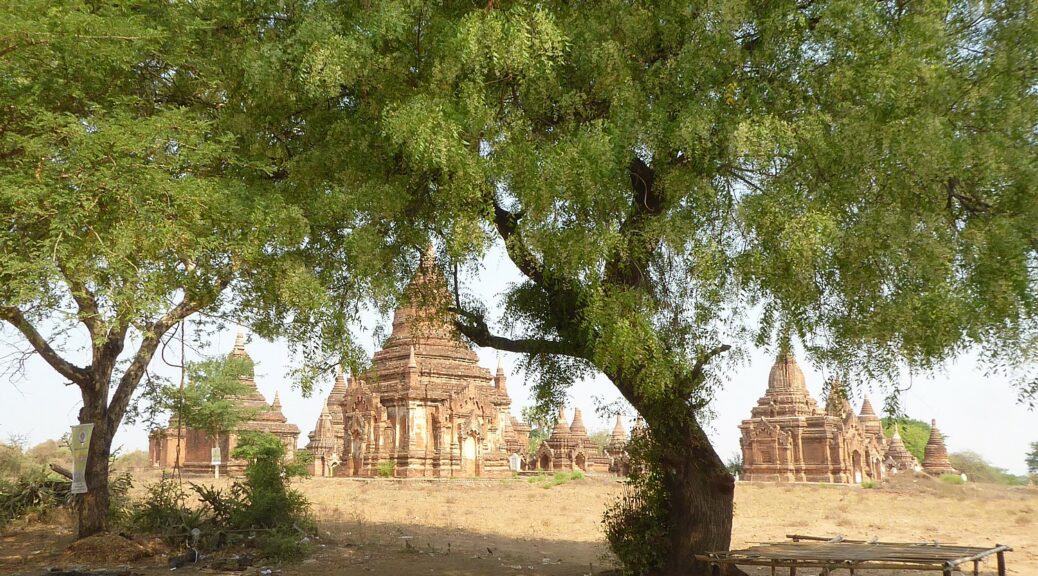
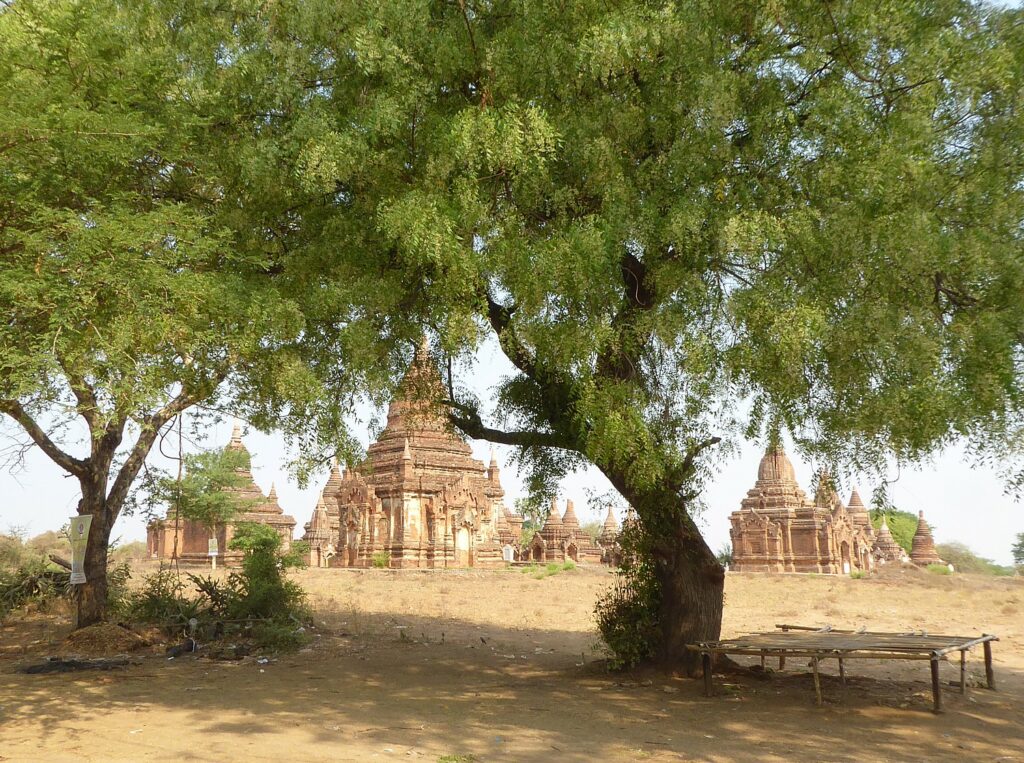
Schweickart reflected on a moment when he was essentially stranded in space. “I turned around and looked at earth, brilliant blue horizon. There was no sound – I was floating inside my suit which was floating. Just hanging out looking at earth, completely silent. My responsibility at that moment was to absorb: I’m a human being. Questions floated in: how did I get here, why was I here. I realized the answer was not simple. What does ‘I’ mean? ‘Me’ or ‘us’. Humanity – our partnership with machines allowed humankind to move out to this environment. 10,000 years from now, it will still be the moment when humanity stepped out to space. While we celebrate something we were part of, it’s one of the events in human history, , that if we don’t wipe ourselves out, we will still have this unique moment in time when life moved out to outer space.”
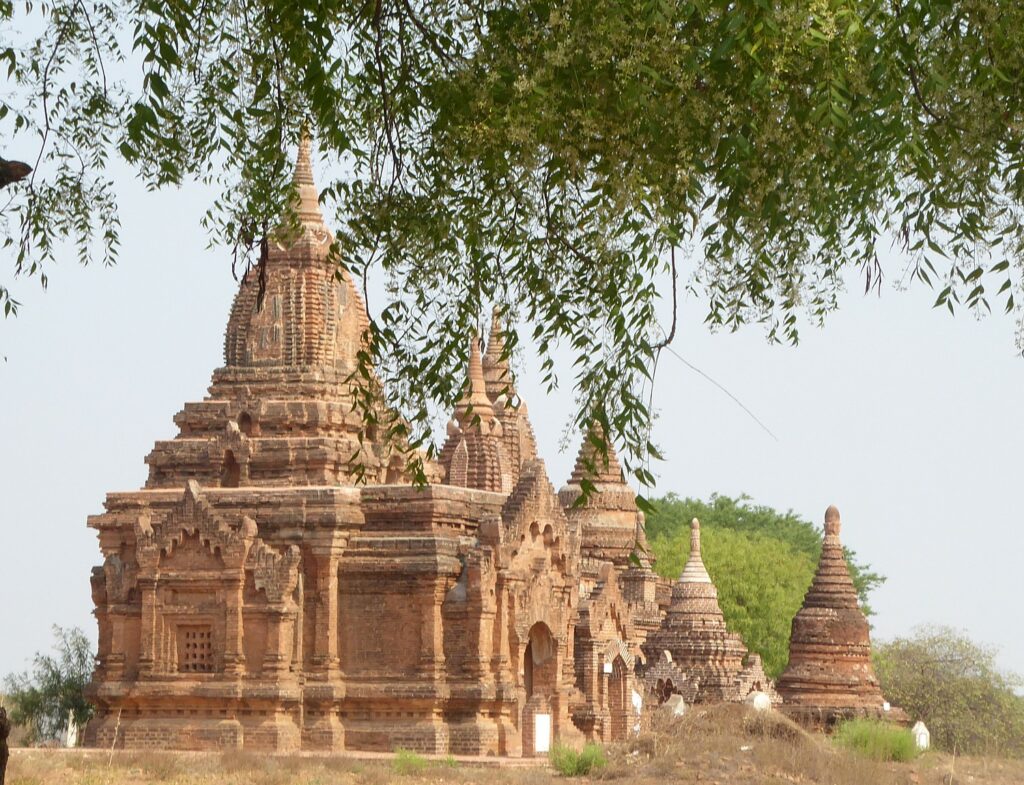
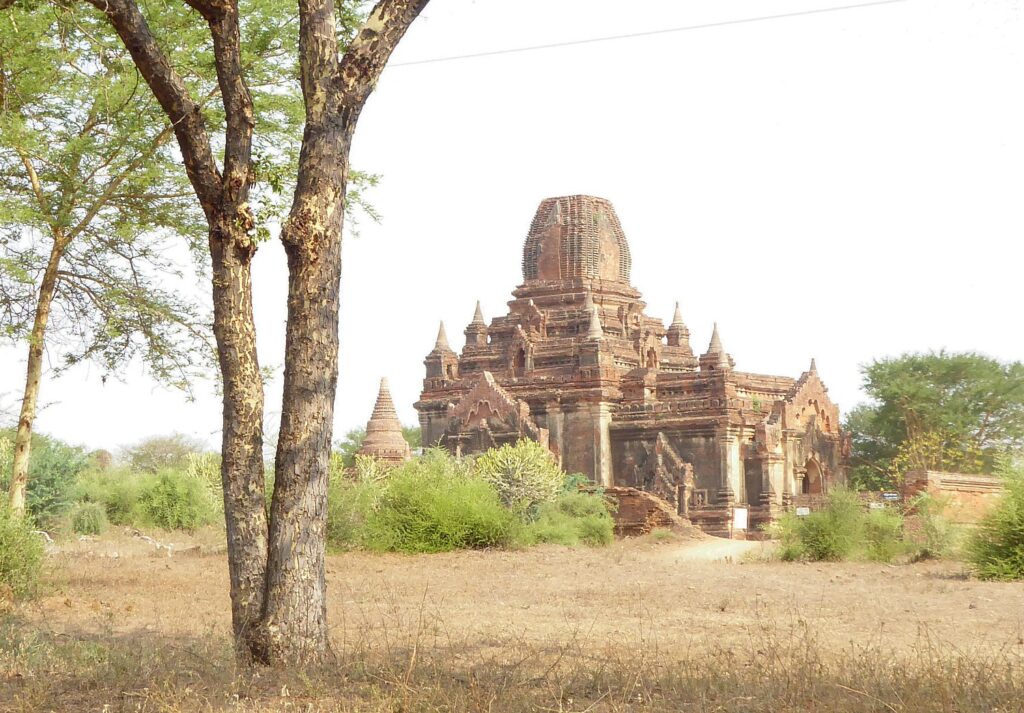
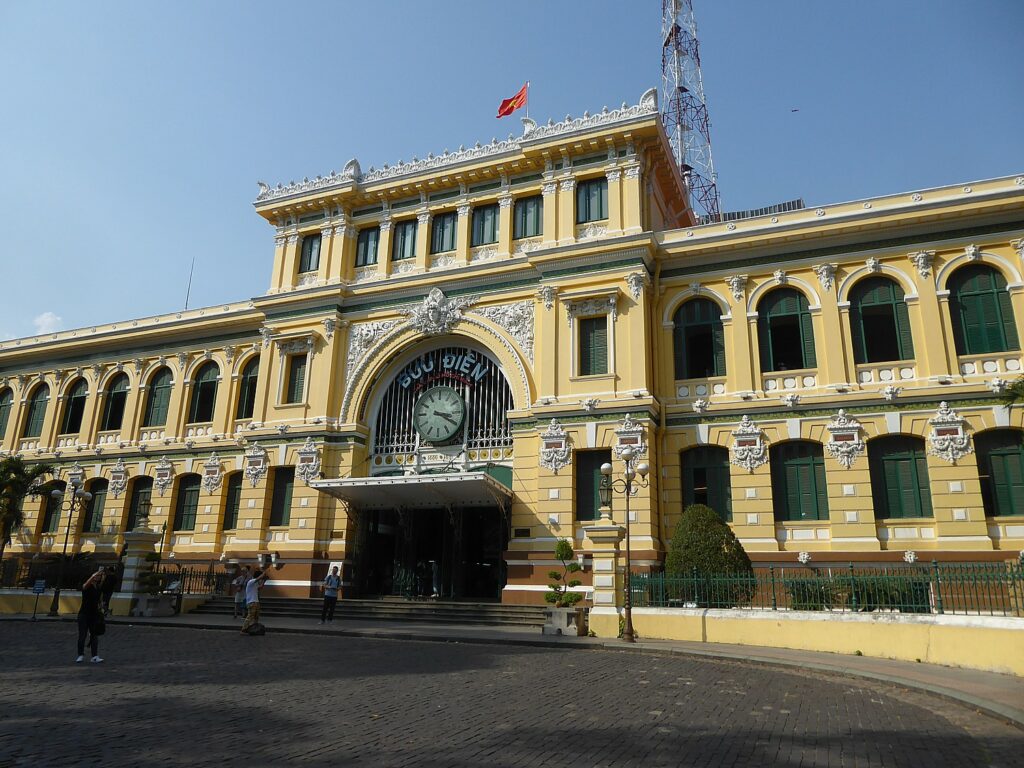
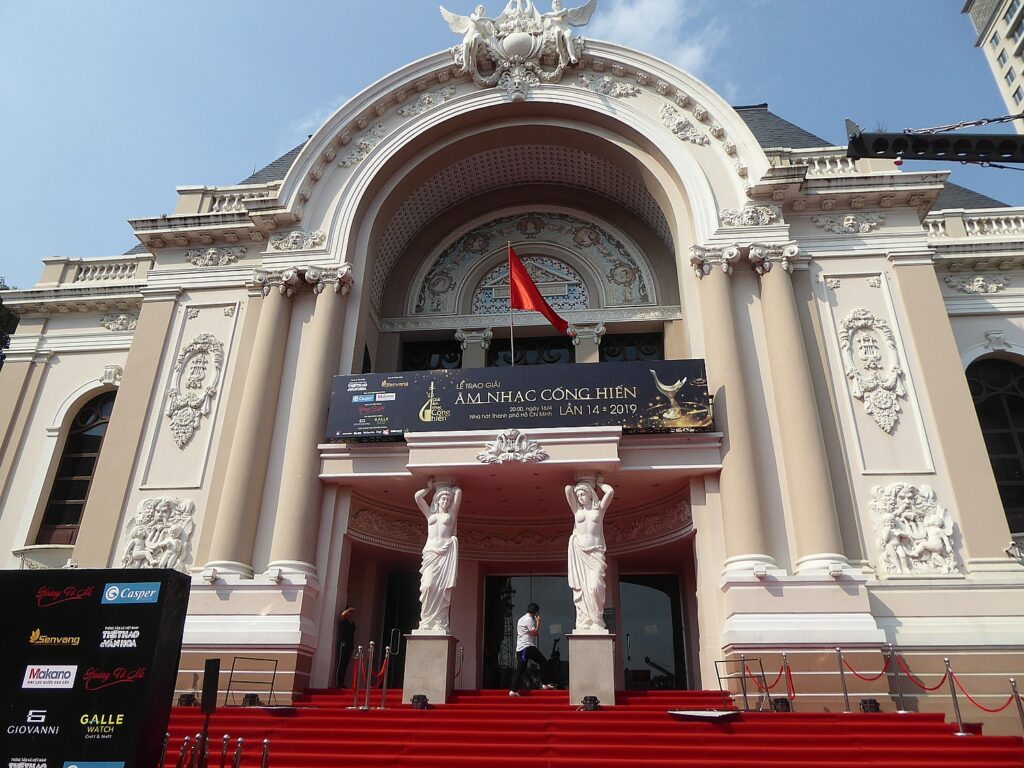
Fred Haise,the Lunar Module Pilot on the Apollo 13 mission, would have been the 6th man to walk on the moon. After the Apollo program ended in 1977, he worked on the Shuttle program, and after retiring from NASA, worked for 16 years as an executive for Northrop Grumman Corporation.
Haise reflected that when JFK made his challenge to go to the moon before the end of the decade, he thought this was mission impossible based on where the technology was. “I saw nothing at hand that would have accomplished that. By then, there was just Alan Shepherd who went up and down, the rockets were invented by Germans in World War II.”
When the disaster struck the Apollo 13 – an oxygen tank exploded, crippling the Service Module which supplied power and life support to the Command Module, he reflected, “We weren’t afraid. All of us in the program did the best we could. We were aware of the problems. Everyone was willing to pay the price to make the mission successful.”
The
situation was not immediately life-threatening . ”Clearly we had lost one tank. I was sick to
my stomach with disappointment that we had lost the moon. It took us almost an
hour to stop the leak in the second tank. “
The Lunar Module was pressed into service as a literally lifeboat and tugboat – a role never anticipated for it.
“The LM bought time. I was never worried. Not sure how it would operate past the two days. Nothing had been damaged in the LM, so I knew we had a homestead we could operate from, and people on the ground were losing a lot of sleep working through the challenges. We never really got to the cliff we were about the fall off.”
Despite great hardship caused by limited power, loss of cabin heat, shortage of cooling water and the critical need to make repairs to the carbon dioxide removal system, the crew returned safely to Earth. It was hailed as the most successful failure.
Charlie Duke (Lunar Module Pilot, Apollo 16, the 10th person to walk on the moon and the youngest, at 36 years old), reflected “Driving over the surface of the moon, we didn’t have TV. I was the travel guide for mission control, 250,000 miles away. So I narrated, ‘Now we’re passing on the right…’ – giving a travelogue – as we drove from point A to point B, and I was taking pictures. My job was to get us A to B and describe for mission control what seeing while John was driving…
“The rover did tremendously well, it revolutionized lunar exploration. Prior, we had to walk everywhere, not the easiest thing. Thankfully the rover was a revolution to see so much. Say to all the Grumman folks here who worked on that, you guys built a great machine. We shared the moon speed record because the odometer only went to 17 mph. Three rovers are up there – if you want an $8 million car with a dead battery.”
Harrison Schmitt(Lunar Module Pilot, Apollo 17) was also a former geologist, professor, US Senator from New Mexico. He was the lunar module pilot on Apollo 17, the final manned lunar landing mission. He was the first scientist and one of the last astronauts to walk on the moon – the 12th man and second youngest person to set foot on the moon.
“The thing about our valley [where the
mission explored], Apollo worked in a brilliant sun, as brilliant as any New
Mexico sun, but the sky was absolute black. That was hard to get used to. We
grow up with blue skies. I never felt comfortable with black sky. But in that
black sky was of course that seemingly small planet Earth, always hanging over
the same part of the valley. Whenever I was homesick, I would just look up –
home was only 250,000 miles away.”
Milt Windler was one of the four flight directors of Apollo 13 Mission Operations Team, all of whom were awarded the Presidential Medal of Freedom by President Richard M. Nixon for their work in guiding the crippled spacecraft safely back to Earth. Formerly a jet fight pilot, he joined NASA in 1959 during Project Mercury. Windler also served as a flight director for Apollo 8, 10, 11, 14, 15 and all three Skylab missions. After Apollo, he worked in the Space shuttle project office on Remote Manipulator Systems Operations until 1978. He is the recipient of the NASA Exceptional Service Medal.
Reflecting on the Apollo 13 mission, he said, “It is a common misconception that flight control was one person all 15 days of a mission. But missions were divided into distinct phases – launch, lunar descent, EVA, rendezvous – and there were teams for each. Each team simulated, practiced problems. One of the things that worked well on Apollo was anticipating what would happen. After a flight, we would discuss lessons learned, to come up with improvements. By the time of Apollo 13 developed a real serious problem, we were a finely honed machine.”
Gerry Griffinjoined NASA in 1964 as flight controller in Mission Control during Project Gemini. In 1968, he was named a Mission Control flight director, for all the Apollo manned mission. Gerry’s “Gold” team conducted half of the lunar landings made during Apollo 14, 16, and 17, and would have conducted the landing of Apollo 13 but played a key role in the safe return of the astronauts. Later Griffin played several Hollywood roles in movies including “Apollo 13, “ “Contact”, Deep Space” and “From the Earth to the Moon,”, as a consultant and even an actor.
The astronauts reflected on the “perfect storm”
of forces and factors that resulted in the incomparable space program that put
a man on the moon within a decade – Griffin, quoting Neil Armstrong, said you
needed four things: threat, bold leadership, public support and resources. “He
said that most of the time, those are out of sequence with each other – you may
have the threat but not the resources. It was a perfect storm when Apollo
happened”: the threat from the Soviet Union taking mastery of space frontier; a
balanced budget not yet weighted down by national debt; bold political
leadership and public support. “You had the resources and human resources,
primarily from World War II from the aviation industry, with Grumman part of
that.
“If
it hadn’t been Apollo, it would have been something else. When the Soviets
launched Sputnik and then Gagarin [became the first man in space], the threat
was clear, and everything else fell into line. I think he’s right. Nowadays, we
have a threat now – China – those guys are good. There is a technological
threat now, and could be more later. Leadership? Draw your own conclusion. Resources?
We haven’t had them. Public support? … But I’m an optimistic. If we are going
to make 2024 – that’s awful tight, but I was like Fred, I didn’t think we could
land on moon in the 1960s, but we did. Maybe if things line up better, we could
do it by 2024, if not 2028.”
Asked why we haven’t been back to the moon, Schweickart said, “You need to be young, innovative, not an aging bureaucracy….
“You
need technological, political courage. The moon was in exactly the right place.
The next steps are not quite that easy . There is a debate between going back
to the moon or on to Mars that has raged for years and still does. There’s not
the same opportunity that we had at that time. In many ways, the most important
thing in terms of a sense of challenge, moving out, moving forward is one of
age. Bureaucracy – corporation or government – where the average age increases
every year, you’re cooked.”
They
are much more encouraged by private enterprise taking over space exploration.
“You don’t see much about Blue Origin and Jeff Bezos, but we will. When you see
[Elon Musks’s] SpaceX launch Falcon 9, Falcon Heavy and bring back two stages
that land in formation, and the cameras show all these kids, 20 years old,
hooping and hollering, they did it! That’s what it takes. NASA used to be that
way. Part of the real juice in space exploration is encouraging private
activities in space. That today is where most of the juice is, getting young
people involved is the key, giving them the opportunity. Jeff Bezos says it
well. His fundamental motivating, commitment to space is to reduce the cost so
more and more can take part and therefore dramatically increase the quality and
opportunity for innovation. As the cost of getting to space drops, the
creativity will dramatically increase. That’s where it’s at in the future.”
Walt Cunningham a fighter pilot before he became an astronaut, in 1968, he was a Lunar Module Pilot on the Apollo 7 mission. He’s also been a physicist, entrepreneur, venture capitalist and author of “The All American Boys.”
“Our society is changing,”
he reflected the next evening when he gave a lecture at the museum. “Back when
Apollo was a story of exploration and adventure – my generation – we had te opportunity
and courage to reach around the moon and to the stars. We were willing to take
risks, didn’t shy from unknown. In those days, it seemed normal to do what we
were doing – exploring the next frontier. Today, the entire world takes pride
in this greatest adventure.”
Sixty years ago, “the
main drive was beating Russians to the moon. They beat us around earth. When
that started a technological fight to finish, not a single American had been in
orbit, but Kennedy was willing to take the risk – not just technological, but
human, economic, political. He took the initiative, the leadership. Today, that
goal is history. Fifty years ago, we never thought of failing –we had fighter
pilot attitude – common dream to test limits of imagination, daring.
“That attitude enabled
us to overcome obstacles. Any project as complex as Apollo required resources,
technology, but most importantly, the will. Driven by the Cold War, all three came
together in the 1960s and we went to moon. Think of it: only three generations separated
man’s first flight off the earth and man’s first orbit around the earth. Only
three generations.”
Somewhat
ironically, on the same day as the astronauts were assembled at Cradle of
Aviation, President Donald Trump was contradicting Vice President Mike Pence
and his own policy, which said that the US would be back on the moon by 2024.
Trump called another moon mission a
waste of money which should be spent, instead to go to Mars.
Trump also has called for the creation of a
Space Force, a new branch of the armed forces, effectively undoing the spirit
of international cooperation in space exploration to advance human knowledge,
with a shift toward militarizing space.