Category Archives: Biking Tours

Boat Bike Tours’ Netherlands Islandhopping: Exploring the Solar System through an 18th Century Lens

The marvelous Eise Eisinga Planetarium, the world’s oldest continuously operating planetarium in the world, dating from 1781, in Franeker visited on Day 6 of Boat Bike Tours’ eight-day Islandhopping tour of northern Netherlands. © Karen Rubin/goingplacesfarandnear.com

By Karen Rubin, Travel Features Syndicate, goingplacesfarandnear.com

Day 6 on Boat Bike Tours’ eight-day Islandhopping tour of northern Netherlands is a case when the hype doesn’t even begin to match the reality of the experience. Today’s ride will take us either 29 or 36 miles (depending on our choice of short or long routes) from Harlingen to Franeker, through the Frisian countryside and rural villages to Bolsward and into Makkum on the eastern bank of lake Ijsselmeer. Boat Bike Tours doesn’t just curate the cycling routes, they also curate experiences. In this case, our bike tour turns into an exploration of the solar system through an 18th century lens.

The marvelous Eise Eisinga Planetarium, the world’s oldest continuously operating planetarium in the world, dating from 1781, in Franeker, was built by the amateur astronomer in his house, now a UNESCO World Heritage site © Karen Rubin/goingplacesfarandnear.com

We set out biking first to the historic center of Franeker to visit the Koninklijk Eise Eisinga Planetarium (Royal Eise Eisinga Planetarium) – the oldest continuously operating planetarium in the world and a UNESCO World Heritage site. I had never heard of Eise Eisinga or his planetarium, but am instantly amazed.

Eise Eisinga was a wool-comber and largely self-taught scientist and astronomer who spent seven years, from 1774 to 1781, crafting his planetarium in his house © Karen Rubin/goingplacesfarandnear.com

Eise Eisinga was a wool-comber and largely self-taught scientist and astronomer who spent seven years, from 1774 to 1781, building a remarkable planetarium in his house! – in his living room/bedroom/dining room to be precise. We see the cupboard where he would have slept with his wife under the mechanism, the pull-out trundle bed where his children would have slept, the dining table. Above, on the ceiling, we see where he constructed a solar system where the six known planets in exact scale follow their rotation around the sun with remarkable precision even by today’s standards, using today’s instruments. The fact that the mechanism is still in working order is evidence of the ingenuity and foresight of its maker, who left detailed instructions for its maintenance.

See exhibits of early astronomical devices at the Eise Eisinga Planetarium in Franeker © Karen Rubin/goingplacesfarandnear.com

While waiting for the English-language presentation, we visit the fascinating exhibits that take up the rest of his home, starting with a delightful video interview between “Eise Eisinga” and an actual Dutch astronaut and another superb video about Eisinga’s life.

When I learn about Eise Eisinga’s biography, I am awed by his genius, bringing to my mind Leonardo DaVinci.

Eise Eisinga was born in 1744 in Dronrijp where he attended primary school. Like many children in those days who worked at home, he worked in his father’s wool combing establishment. In addition to his father’s profession, he inherited his father’s interest in astronomy and mathematics. Eise was so determined to learn that he would travel every week to Franeker, a major center of learning, to study Euclidean math with Willem Wijtses, a wool dyer. When he was 24, Eisinga married Pietje Jacobs and settled in Franeker in 1768, working as a wool comber.

On May 8, 1774,a local newspaper published a prediction from a preacher that the confluence of Mercury, Venus, Mars and Jupiter and the moon would result in the mutual forces of these celestial bodies knocking the earth off its path and cause it to be burned up by the sun (“the end of time!”). That set off a panic and seems to have been an impetus for Eisinga to begin building his model of the solar system to show the extreme unlikelihood of planets colliding.

The fascinating planetarium that Eise Eisinga built in his bedroom/dining room © Karen Rubin/goingplacesfarandnear.com

It took Eisinga seven years to construct his planetarium – a real triumph of craftsmanship to carve the wood (his father, a woodcarver, helped), create 6,000 precision nails for the cogs, and the exquisite painting. Eise would have finished sooner, but in a critical development, he had to adjust the placement of the pendulum that kept everything in motion, because his wife drew the line on allowing him to cut a hole in the floor (it was their bedroom, after all), so he had to recalculate everything and replace all 6,000 nails.

The power (and motion) for the entire mechanism comes from a clock, “like the beating heart of the machine,” our guide explains. The mechanism is powered by a system of nine weights – one for clock and 8 for different axels of system

All is built to scale to fit into the space – an astonishing 1 to 1 trillion – and everything is turning so slowly, you can’t detect motion visually. Every planet has its own calculated speed, so Mercury takes 88 days to make one full rotation; Venus takes 224 days; Earth takes 365 days plus 76 hours while the moon takes 29 ½ days to go around the earth (it shows the phases of the moon); Mars takes 687 days; Jupiter, with four moons (the number known at the time), takes 11 years, 315 ⅓ days for its rotation; and Saturn, the furthest known planet at the time, actually has rings and 5 moons and takes 29 years plus 164 days for its rotation.

The marvelous Eise Eisinga Planetarium, the world’s oldest continuously operating planetarium in the world, dating from 1781, in Franeker visited on Day 6 of Boat Bike Tours’ eight-day Islandhopping tour of northern Netherlands. © Karen Rubin/goingplacesfarandnear.com

How do they know the planetarium is still working when everything moves so slowly?

“Everything is connected, so we check what moves daily: the date, zodiac sign, day of week.” On December 31, a special nail pushes the gears into motion to flip to the new year.

Eise Eisinga was such a visionary, two years after finishing his remarkable machine, he wrote a 90-page manual explaining how to maintain it.

“Every 22 years, we follow 5 steps – take board down, sand down, paint the years, let the paint dry, then replace it in the attic,” our guide says. The wheels are so big and move so slowly, they clean the gears once or twice a year.

Eisinga’s son took over when he died, and the planetarium remained in the family for 140 years until 1922 when his great granddaughter was the last in the family to maintain the planetarium. Then the City of Franeker took over its management.

Most of the mechanism is original (Mercury had to be replaced after being damaged in World War II) but they have had to change the ropes for the gears and pulleys.

After the presentation, we are able to climb the stairs to the attic to peer into where the wheels and gears are laid out.

We are able to climb up to the attic to see the gears that run Eise Eisinga’s fascinating planetarium © Karen Rubin/goingplacesfarandnear.com

Eisinga came to Franeker with his wife because it had the second largest university in the country and was a center for learning that drew famous scientists. But you can appreciate how trade with the world not only gave Netherlands the wealth to pursue science and innovation, but the access to and transfer of knowledge, not to mention a culture of Enlightenment that was open to new ideas and discovery. And Eise Eisinga was wealthy enough that he could afford to make natural science a hobby.

It is a humbling experience to imagine such expertise and craft hundreds of years ago, before the tools and instruments we have today.

See exhibits of early astronomical devices at the Eise Eisinga Planetarium in Franeker © Karen Rubin/goingplacesfarandnear.com

The museum offers several permanent exhibits: Eisinga’s former wool combing establishment, an extensive collection of historical astronomical instruments, Eisinga’s mathematical and astronomical manuscripts which you can digitally peruse, all marvelous juxtapositions to an interactive permanent exhibition, De Ruimte (Space) that opened in 2016, as well as that delightful video conversation between “Eise” and a modern-day Dutch astronaut (English subtitles).

Some of Eise Eisinga’s manuscripts are on view at the Eise Eisinga Planetarium in Franeker © Karen Rubin/goingplacesfarandnear.com

I peek into a room to see the finishing touches on a new temporary exhibit: a spectacular astronomical cabinet from 1771 by Jean Paulus and Prof. Ghiesbregt. “After long wanderings, this Belgian instrument came into possession of Bert Degenaar, a famous Dutch antique collector. On his behalf, the instruments were completely restored and made functional again by horologist Pieter de Ruiter. The 3 meter wide and over 2.5 meter high cabinet is equipped with various globes, planetariums (including an unprecedented representation of the 5th-century worldview of Martianus Capella) and the 16th-century heliocentric worldview of Copernicus. A number of dials provide information about various time indications, calendars, the position of the planets, the phases of the moon, and the orbit of Jupiter’s four largest moons.” The exposition also includes a large collection of original drawings of the various instruments. 

Finishing setting up the new temporary exhibit at the Eise Eisinga Planetarium in Franeker: a spectacular astronomical cabinet from 1771 by Jean Paulus and Prof. Ghiesbregt © Karen Rubin/goingplacesfarandnear.com

All of this goes to serve as a literal display of what The Enlightenment was all about, which largely due to mass printing and trade, made its way to the New World, as well, and was foundational to the Founders of the United States.

Admission to Eise Eisinga’s planetarium is 6E (a HUGE bargain).

Eise Eisingastraat 3, 8801 KE Franeker, phone +31 (0) 517–393 070, info@eisinga-planetarium.nl, https://www.eisinga-planetarium.nl/en/plan-your-visit/, https://www.eisinga-planetarium.nl/en/the-planetarium/

Thankfully, we have enough time to appreciate what’s here at the planetarium (this is important), though I could easily have spent another hour.

The scene along our bike route from Franeker to Makkum on our Boat Bike Tours’ Netherlands Islandhopping tour © Karen Rubin/goingplacesfarandnear.com

We continue on our 36-mile bike route which follows much of the a famous 11-city, 200-km bike tour, and in the course of two days, we will visit six of the 11 and have the opportunity to collect stamps (like passport stamps) on postcards our guides have provided.

The scene along our bike route from Franeker to Makkum on our Boat Bike Tours’ Netherlands Islandhopping tour © Karen Rubin/goingplacesfarandnear.com

By the time we ride into Bolsward, one of the Eleven Frisian Cities, the rain has stopped. Here we see one of the art installations we have been told about – this one looks like Toothless from “How to Train Your Dragon.”.

The magnificently decorated Court of Justice Building in Bolsward © Karen Rubin/goingplacesfarandnear.com

Bolsward is really beautiful, and I am entranced by the magnificence of The Court of Justice building, now a museum, where I get to climb into the tower built on top of the Court in 1617 (a really improbable and unsafe construction).

You can climb into the tower of the Court of Justice Building in Bolsward © Karen Rubin/goingplacesfarandnear.com

But this is the first day when I see why people would get an e-bike in the Netherlands – I’m guessing I am pushing through or against 15 mph winds.

In the evening, our guide, Edith, leads a walking tour of Makkum– it’s just me and a couple from Alberta, Canada. Edith points to homes that have a Coat of Arms or some indication of who lived there, when the fellow shows us his ring with a Coat of Arms. He turns out to be a descendent of the Trip family, one of the wealthiest, most powerful families in Netherlands.

He relates more of his family’s fascinating story as we sit in a historic pub with centuries old Delpht tiles of great 17th century trading ships, noting more than once than the family fortune had been long gone and his branch of the family emigrated to Canada. It’s like having someone from that time tell their story.

Trip shows me his coat of arms as we walk around Makkum, and tells the story of his family, one of the richest and most powerful in Netherlands  © Karen Rubin/goingplacesfarandnear.com

Trip’s family’s coat of arms, he relates, has three zoltbommel (wooden shoes) – a nod to the fact that the family started by manufacturing wooden shoes.

Then, brothers Jacob and Elias Trip went into river barges, got rich, then expanded into sea trade. They had a connection with an iron factory which they parlayed into weapons manufacture, arming the Dutch rebels against the Spanish in its 80-year war for independence, 1568-1648 (apparently selling arms to both sides).

Tiles in a historic pub depict trading ships very likely belonging to the Dutch East India Company© Karen Rubin/goingplacesfarandnear.com

Trip was among the original investors of the Dutch East India Company (Verenigde Oost-indische Compagnie, VOC), in 1602, the first public company to issue stock and the first truly multinational corporation, transforming global commerce and trade (at its peak, the company would have been worth $7 trillion in today’s dollars, the most valuable company in history). The VOC was granted a monopoly on Dutch trade with Asia and also possessed the power to wage war, make treaties, govern territories, and even mint its own currency, as if a nation-state. So much of what we experience on our trip goes back to the Dutch East India Company.

Meanwhile, the Trips became one of the richest and most important families in Netherlands. Portraits painted by Rembrandt of his relatives Jacob Trip (1576-1661) and his wife, Margaretha de Geer, are in the National Gallery and Ryksmuseum. Their sons, Louis and Hendrick Trip, became fabulously wealthy arms merchants, and built the Trippenhuis in 1662 once the widest residence in Amsterdam and on the list of top 100 Dutch heritage sites.

Tiles in a historic pub depict trading ships very likely belonging to the Dutch East India Company© Karen Rubin/goingplacesfarandnear.com

Edith adds that the Netherlands was one of the first republics in the world and makes the claim that its declaration of independence in 1581, provided a model for Thomas Jefferson in 1776, and was printed on paper from a Dutch paper mill.

“We are now a kingdom, but we started as a republic. Our constitution limits the power of king, our monarchy is more about public relations, like the United Kingdom.”

The first king of the Netherlands, Napoleon’s brother Louis who reigned from 1806-1810, started an art collection, which he brought to TrippenHuis – in essence the first Ryksmuseum. Trippenhuis was where Rembrandt’s “Night Watch: hung until 1851 and since 1887, has housed the Royal Netherlands Academy of Arts and Sciences. 

Returning to our ship, Leafde fan Fryslân, after our walking tour of Makkum as the sun sets © Karen Rubin/goingplacesfarandnear.com

Biking Makkum to Stavoren, Sailing to Enkhuizen  

Day 7’s ride takes us from Makkum to Stavoren, from where our ship, Leafde fan Fryslân, will sail across lake IJsselmeer to Enkhuizen, the endpoint of our trip. There is a prediction of rain today and strong wind, so the guides suggest I do the shorter ride (19 miles) and promise I won’t miss out on anything I will regret (the longer route, 30 miles, goes along several Frisian Lakes).

Coming upon a historic windmill, De Nylannermole, which the sign says dates from 1784, with a modern wind turbine in the distance,on our ride Makkum to Stavoren on Boat Bike Tours Netherlands Islandhopping tour © Karen Rubin/goingplacesfarandnear.com

Among the highlights of the ride are coming across a house deliberately built in an upside-down version of a traditional Frisian home (a bit surreal and you have to wonder), and a historic windmill, De Nylannermole, which the sign says dates from 1784, though its history goes back to 1624 (I’m trying to figure out the Dutch). At one point, I see the windmill with a wind turbine in the distance behind it, and later, we see windsurfers and sailboats – all reflections of how the Dutch have embraced wind.

The charming old city of Hindeloopen is a popular hub for cyclists © Karen Rubin/goingplacesfarandnear.com

We stop for lunch in a tiny little village as rain comes (we sit under umbrellas outside), and then continue on to Hindeloopen (where we should have cycled for lunch), an old trading town famous for a traditional decorative painting style. Hindeloopen seems to be the epicenter for cycling.

The charming old city of Hindeloopen is a popular hub for cyclists © Karen Rubin/goingplacesfarandnear.com

This is a very charming village, where I go to explore and find the Grotte Kerk, dating back to the Middle Ages. This building dates from 1632.

One image shows the importance of wind in the Netherlands: sailing ships, wind turbines, wind surfing © Karen Rubin/goingplacesfarandnear.com

As we finish our bike tour, we come across (actually riding through) a major, 150 km, bike race.

Riding through a 150 km cycling race on our way to Stavoren (a humbling experience) © Karen Rubin/goingplacesfarandnear.com

I finish the ride 1:15 pm, hoping I made the right choice in biking the shorter route, and have some time to explore Stavoren before we sail.

There is yet another one of the art installations (this one a giant fish), but I am particularly intrigued by the sculpture of “The Lady of Stavoren” here, and the moral to the story it offers.

“The Lady of Stavoren” legend dates from when the city was the largest and richest in Friesland. Many of the merchant ships were owned the Lady of Stavoren who ordered one of her captains to “Bring me the finest treasure in the world.” He brought back a grain that transformed into pure gold in the midday sun. She forced him to throw it into the sea. A fisherman foretold that she would be punished and at some point beg for grain. Later, two of her ships were lost at sea and she became a beggar woman, while the place where the grain was tossed turned into a sandbank, where a plant that grew ears of corn grew up but yielded no grain.

“The Lady of Stavoren” statue pays homage to a legend that dates from when the city was the largest and richest in Friesland. © Karen Rubin/goingplacesfarandnear.com

We have an enjoyable sail back to Enkhuizen, a gala farewell dinner, and then I go off to explore the historic town, which is really worth more time than I will have before I have to return to Schiphol Airport early the next day. (Suggestion: arrive the day before the ship sails to give yourself some time to enjoy Enkhuizen.)

More information, Boat Bike Tours, www.boatbiketours.com, 203-814-249.

Next: Zuiderzee Museum is Not to be Missed in Enkhuizen

See also:

SETTING SAIL ON BOAT BIKE TOURS’ ISLANDHOPPING TOUR TO THE WADDEN SEA

BOATBIKETOURS’ NETHERLANDS ISLANDHOPPING: THE TEXEL ROADS YIELDS UP ITS TREASURE

BOAT BIKE TOURS NETHERLANDS ISLANDHOPPING: SAILING THE WADDEN SEA, BIKING, EXPLORING TERSCHELLING, HARLINGEN

_____________________________

© 2025 Travel Features Syndicate, a division of Workstyles, Inc. All rights reserved. Visit goingplacesfarandnear.com and travelwritersmagazine.com/TravelFeaturesSyndicate/. Blogging at goingplacesnearandfar.wordpress.com and moralcompasstravel.info. Visit instagram.com/going_places_far_and_near and instagram.com/bigbackpacktraveler/ Send comments or questions to FamTravLtr@aol.com. Bluesky: @newsphotosfeatures.bsky.social X: @TravelFeatures Threads: @news_and_photo_feature

Boat Bike Tours Netherlands Islandhopping: Sailing the Wadden Sea, Biking, Exploring Terschelling, Harlingen

Sailing into Terschelling on our ship, Leafde fan Fryslân, on Day 4 of our Boat Bike Tours’ Islandhopping Netherlands bike tour © Karen Rubin/goingplacesfarandnear.com

By Karen Rubin, Travel Features Syndicate, goingplacesfarandnear.com

Day 4 of our eight-day Boat Bike Tours’ Islandhopping tour of the Netherlands is spent sailing to the island of Terschelling. It takes about six hours to sail across the Wadden Sea, a UNESCO World Heritage site.

Captain Age delicately navigates our ship, Leafde fan Fryslân, out of port © Karen Rubin/goingplacesfarandnear.com

“Big boat, small water,” our captain, Age, says, guaranteeing that the ship is “unsinkable” because the water is so shallow, we would run aground first. (“Wadden” means “mudflats” and the Wadden Sea is a large intertidal area in the North Sea along the coasts of the Netherlands, Germany, and Denmark.)

Raising the sails on the ship, Leafde fan Fryslân © Karen Rubin/goingplacesfarandnear.com

We have a northwest wind so we can raise the sails on our ship, Leafde fan Fryslân, the only four-masted ship sailing in Dutch waters,  instead of just motoring to Terschelling.

First mate Lukacz does most of the work raising the sails on the Leafde fan Fryslân © Karen Rubin/goingplacesfarandnear.com

Lukacz, who I call the first mate, gives us the safety talk and invites us to help raise the sails (we don’t do it very well). He says it is more important to be safe “You are on vacation, a nice time. You can’t have a nice time with a broken hand. Bad pain is bad time.”  But looking around at several of us with boating jackets, says, “I can see this isn’t your first rodeo.” 

‘It’s about being happy,” Lukas says, finishing with “What do you think about my speech?”

We soon see why Lukacz describes himself as a “monkey” as he raises the sails on the Leafde fan Fryslân © Karen Rubin/goingplacesfarandnear.com

Lukacz describes himself as a “little monkey jumping around,” and we soon see why as we watch him leaping around to get the sails unfurled.

We soon see why Lukacz describes himself as a “monkey” as he raises the sails on the Leafde fan Fryslân © Karen Rubin/goingplacesfarandnear.com

The wind is so strong (“Respect the power,” he says), but once the sails are raised, we feel the quiet tranquility of sailing. But having come from Texel, and seeing the scores of shipwrecks of those ocean-going trading ships, I can only imagine what this would feel like in a storm, or how those sailors felt for months, even years crossing vast seas to Asia, Africa, and North America.

We have lunch on board as we sail (tonight, we will be on our own for dinner in Terschelling, armed with a list of recommended restaurants).

The scene is stunning, with several tall sailing ships along the horizon, the swirling green/blue water, the white cottony clouds.

Sailing ships line the horizon as we sail on the Leafde fan Fryslân © Karen Rubin/goingplacesfarandnear.com

It is just 4 pm when we sail into Terschelling, flabberghasted by the finesse Captain Age shows to park our enormous ship, Leafde fan Fryslân, 210 ft. long, 24 ft. wide.

Sailing into Terschelling on our ship, Leafde fan Fryslân, on Day 4 of our Boat Bike Tours’ Islandhopping Netherlands bike tour © Karen Rubin/goingplacesfarandnear.com

We walk off the ship from the crowded harbor crammed with sailing ships tied up two and three abreast and explore the popular village. Huge ferry boats deposit thousands of visitors each day (remarkable considering a mere 9,700 people live on Terschelling).

Terschelling, one of 15 islands in the North Sea and the furthest north we will travel on our Islandhopping tour, is just 30 km long and 4.5 km wide with vast sand beaches, strong winds and wild water – and we will cycle around most of it.  

Terschelling skyline is dominated by the 420 year-old Brandaris lighthouse, standing 388 ft high © Karen Rubin/goingplacesfarandnear.com

The town is dominated by the 420 year-old Brandaris lighthouse, standing 388 ft high that can be seen from far off in the distance. I learn this is the oldest lighthouse in the Netherlands. The first tower was built in 1323 to guide ships on their way to Amsterdam through the Zuiderzee, the narrow opening between Vlieland and Terschelling. A flood destroyed the tower in 1570. Construction on a new tower began in 1592 but the tower collapsed before it was finished because of poor building materials. The tower we see today, remarkably, was built in 1594. It became the first lighthouse in the Netherlands equipped with a rotating Freshnel lens in 1837 and was electrified in 1907.

View from the top of the hill in Terschelling © Karen Rubin/goingplacesfarandnear.com

I meet up with a German couple from our ship and follow them up a path over the dunes to the hilltop for a stunning view of the island and the port as the sun streams through clouds.

Back in the charming village, I come upon a gaggle of girls who, it turns out, are Ukrainians taking refuge here from the war in their homeland.  This brings a jolt of the world and current events to this small, isolated, peaceful place, shocking me back to the present out of my reverie for ages past. But as the historic markers and notes remind, the vast majority of human history has been one invasion, one war, one revolution, one disaster after another, and the nostalgia that sweeps over us looking back has a way of tempering the horror of that time. I think that one reason history is more palatable, less stressful, than present-day events is that we know how that chapter of the story ended.

Cycling Terschelling, Sailing to Harlingen

Setting out on the bike ride on Terschelling along the dyke © Karen Rubin/goingplacesfarandnear.com

While the previous day was all about sailing, Day 5 is all about cycling. Terschelling offers 70 km of cycling tracks and four charming villages to discover. We will cycle 26 miles roundtrip, then, in the afternoon, sail across the Wadden Sea to Harlingen, the most important harbor city of the province of Friesland.

This is the first day of cycling where I appreciate why people get e-bikes in the Netherlands: the paths may be flat but the wind is strong (all the charming historic windmills and now modern wind turbines should have been a clue). I power through and at one point, one of our group becomes very conscientious about riding right in front of me to break the wind a bit (like the Tour de France!).

The Stryper Wyke statue honors a woman whose cleverness saved the town from British invaders © Karen Rubin/goingplacesfarandnear.com

We set out along the dyke, then turn off into villages, farms and fields. Our route takes us to the Stryper Wyke (wife) statue, a short distance from a cemetery. The monument heralds back to the 1666 wars with the English over trade with India. The British declared the North Sea as theirs and invaded this area, burning, raping, killing. The British, the story goes, confronted the Stryper Wyke demanding to know how many defenders there were, to which she replied, “100 standing, 1000 laying down” – referring to the cemetery. The legend goes that the invaders took her literally and retreated, and she is credited with saving the town.

In fact, everywhere we go, there are just such statues, monuments, plaques, placards and historic photos that cherish local history, heritage and culture and show the pride the Dutch have.

The Toesaks Museum (pirates!) is described as “an exciting and pleasantly eccentric museum for kids and adults” offering a collection recovered from shipwrecks © Karen Rubin/goingplacesfarandnear.com

We ride passed an intriguing Toesaks Museum (pirates!) which is described as “an exciting and pleasantly eccentric museum for kids and adults” offering a collection recovered from shipwrecks. The museum is housed in a farmhouse and has a real pirate ship, a tree house and a castle. Owner and wreck diver Hille van Dieren, I learn later, has been collecting recovered inventory pieces from the many shipwrecks around Terschelling since 1975. The museum is full of curiosities from 1650 to the present (https://wrakkenmuseum.nl/).

The wind becomes a factor as you bike on Terschelling © Karen Rubin/goingplacesfarandnear.com

No one else wants to stop to visit, so I take a quick peek inside so I don’t hold up the group. But if it were important to me, I could have left the group and followed the route myself using the RideGPS app that Boat Bike Tours provides. But, the ship is sailing this afternoon and I wouldn’t have known if I could complete the route in time. 

At Koor Hoorn, hiking over enormous dunes which open up to this vast expanse of sand beach © Karen Rubin/goingplacesfarandnear.com
The vast expanse of sand beach at Koor Hoorn © Karen Rubin/goingplacesfarandnear.com

We ride through open fields (battling the wind), through forest and then over a stretch of sand (not fun) and come to Koor Hoorn, hiking over enormous dunes which open up to this vast expanse of sand beach almost completely vacant of people or structures. I walk what seems a quarter mile before I finally reach the actual water, where the sea is swirling with whitecaps and the beach is strewn with a thick white foam that looks like pieces of clouds have fallen from the sky.

A wild swirl of sea and sky at Koor Hoorn © Karen Rubin/goingplacesfarandnear.com

A popular thing to do is take a horsedrawn carriage ride on the beach and we see one of these carriages on the road.

A popular activity on Terschelling is to ride in a horse-drawn carriage on the beach © Karen Rubin/goingplacesfarandnear.com

Leaving the beach, our guide, Edith, leads us through the “Dark Forest” so we can be shielded a bit against the wind.

Biking through the “dark forest” on Terschelling © Karen Rubin/goingplacesfarandnear.com

We get to a charming Cranberry inn (spectacular desserts, all made with cranberry), and walk out to the cranberry field (not a bog).There is a small exhibit and video on a second floor. Just as we are gathering to leave, it starts to rain. Edith checks the weather app and predicts it will only last a few minutes – so I go back inside to get cozy in the upstairs screening room to watch the video about the island and raising cranberry. Sure enough, the rain stops within 15 minutes, and we are on our way. (One of the good things about the strong wind, is that rain rarely lasts long.)

Delectable cranberry desserts © Karen Rubin/goingplacesfarandnear.com

The route takes us up and over dunes, and finally, into the village to the port, where we stop at a monument to those who have been lost at sea.

It’s been a lovely ride – we’re back at about 3:15 pm and the ship soon pulls out of the harbor.

Monument to those lost at sea in the village on Terschelling © Karen Rubin/goingplacesfarandnear.com

We are in awe – along with everyone else on the dock – collectively holding our breath as Captain Age maneuvers out of the tight harbor. We sail across the Wadden Sea to Harlingen, considered the most important harbor city of the province of Friesland.


Sailing across the Wadden Sea to Harlingen © Karen Rubin/goingplacesfarandnear.com
Our ship, Leafde fan Fryslân, sails across the Wadden Sea to Harlingen © Karen Rubin/goingplacesfarandnear.com

We have dinner as we sail, and pull into Harlingen’s port in time to have a 7:45 pm walking tour of Harlingen led by our guide, Anya.

Harlingen

A replica of the historic ship, De Witte Swaen (the White Swan). Is being built in the marina at Harlingen © Karen Rubin/goingplacesfarandnear.com

The first thing we see is a restoration of the De Witte Swaen (the White Swan). This was the famous vessel sailed by16th-century Dutch explorer Willem Barentsz when he discovered the Arctic archipelago of Spitsbergen (now known as Svalbard) and Bear Island. He then sailed onward to the Russian archipelago of Nova Zembla, where, in 1596, the ship got stuck in the ice and they were forced to stay the winter. Barentsz did not survive, but 12 of the 17 crew were saved. Here, in the port of Harlingen, marine archaeologist Gerald de Weerdt is directing volunteers in building a genuine replica of the ship using 16th century techniques and materials. After years of work, his team is planning to finish the ship by year’s end. It will be sailed to Amsterdam and then returned here. Eventually, de Weerdt and his team want to retrace Barentsz’s voyage by sailing the vessel to Spitsbergen and Nova Zembla (hopefully with a better outcome).

Discovering Harlingen © Karen Rubin/goingplacesfarandnear.com

Anya explains the complicated system of dykes and the dam built in 1932 which turned part of the Wadden Sea into a lake and from salt to fresh water, changing the ecology, and what was done to protect the fish migration from the changed ecosystem.

Discovering Harlingen © Karen Rubin/goingplacesfarandnear.com

She points out the architecture – the Celtic tradition of putting a symbol to protect the house from evil – and how 600 buildings in the town are protected for their historic significance.

Magnificent buildings like the elaborate City Hall show the wealth of this town.

Harlingen’s City Hall shows off the city’s wealth © Karen Rubin/goingplacesfarandnear.com

As we have seen before, the biggest building, typically a church, was built on the highest point, to provide safety when the town flooded.  Holland broke with the Catholic Church of Spain and declared religious freedom when it won its independence after an 80-year war.

She notes that under Napoleon, who conquered the Netherlands in 1800 and installed his brother, Louis, as its first king (who ruled 1806-1810), every home had to replace the ornaments that showed a coat of arms or profession with a house number and street, and a registry was kept of names, religion and where they lived.

“In World War II, the Nazis could see where Jews lived” (one of the reasons why today, the Dutch are still concerned to protect private information on the internet).

“Stumbling stones” in front of a house in Harlingen © Karen Rubin/goingplacesfarandnear.com

Today, we see some of the ”stumbling stones” – square copper plates in the sidewalk -documenting the name of the Jews who lived in the home, “the last place they lived in freedom,” before being taken by Nazis to concentration camps. There are some 70,000 of these “stumbling stones” in Europe, about 7,000 in the Netherlands, Anya says.

I am reminded that after declaring its independence from Catholic Spain in 1581, Holland instituted religious freedom and Jews, who suffered Spain’s Inquisition, were able to practice relatively openly. Rembrandt lived in Amsterdam’s Jewish Quarter, a short distance from where the Grand Synagogue was built. When Jews went to New Amsterdam in 1654,then a trading post of the Dutch West India Company. Governor Peter Stuyvesant wanted to evict the Jews, but the company required him to let the Jews stay. (This is all brought back when I visit two exhibits currently on view in New York City: “New York at Its Core: Port City (1609-1898)” at the Museum of the City of New York and “The Book of Esther in the Age of Rembrandt,” at the Jewish Museum.)

More information, Boat Bike Tours, www.boatbiketours.com, 203-814-1249.s

Next: Boat Bike Tours’ Netherlands Islandhopping: Exploring the Solar System through an 18th Century Lens

See also:

SETTING SAIL ON BOAT BIKE TOURS’ ISLANDHOPPING TOUR TO THE WADDEN SEA

BOATBIKETOURS’ NETHERLANDS ISLANDHOPPING: THE TEXEL ROADS YIELDS UP ITS TREASURE

_____________________________

© 2025 Travel Features Syndicate, a division of Workstyles, Inc. All rights reserved. Visit goingplacesfarandnear.com and travelwritersmagazine.com/TravelFeaturesSyndicate/. Blogging at goingplacesnearandfar.wordpress.com and moralcompasstravel.info. Visit instagram.com/going_places_far_and_near and instagram.com/bigbackpacktraveler/ Send comments or questions to FamTravLtr@aol.com. Bluesky: @newsphotosfeatures.bsky.social X: @TravelFeatures Threads: @news_and_photo_feature

BoatBikeTours’ Netherlands Islandhopping: The Texel Roads Yields Up its Treasure

Watching the sun set behind the historic windmill that is the centerpiece of the Museum Kaap Skil in Oudeschild on the island of Texel from the top deck of our ship, Leafde fan Fryslân on Boat Bike Tours’Islandhopping trip  © Karen Rubin/goingplacesfarandnear.com
 

By Karen Rubin, Travel Features Syndicate, goingplacesfarandnear.com

Day 3 of Boat Bike Tours’ eight-day Islandhopping tour proves to be my favorite, most perfect day – the biking, the attractions, the scenery, the gestalt of the island of Texel, even the weather, all combining for a thrilling experience. We will be biking roundtrip from and back to Oudeschild with a choice of a 26 mile or 30 mile route. We soon discover the treasures harbored on The Texel Roads.

Biking on Texel on Boat Bike Tours’Islandhopping trip  © Karen Rubin/goingplacesfarandnear.com

We start off biking together to Ecomare, a seal sanctuary and ecology center with superb displays, exhibits and notes (with English) that teach about ecology, climate change, animal and environmental conservation, focused on the local area, making clear what these existential planetary changes mean for the people living here.

Whale skeletons on view at the Ecomare marine wildlife sanctuary and environmental center on Texel © Karen Rubin/goingplacesfarandnear.com

I start in the room with skeletons of actual whales – enormous, suspended so that they look like they are swimming – then move to an aquarium where you can see rescued seals swimming under water. You go outside to the various habitats where there are excellent explanations of why the seals were rescued (and the steps they take to avoid “rescuing” a seal that is merely resting on the beach), what their prognosis is to be re-released into the wild or whether some condition, like blindness, will require them to stay.

An underwater view of seals at the Ecomare marine wildlife sanctuary and environmental center on Texel © Karen Rubin/goingplacesfarandnear.com

We see areas where baby animals are nurtured, where medical procedures are conducted, where seal pups are raised until they can be released (I wonder how they learn how to hunt for themselves), and where animals are quarantined (the sign says it’s a good thing if this area is empty!). 

Two of the rescued seal pups at the Ecomare marine wildlife sanctuary and environmental center on Texel © Karen Rubin/goingplacesfarandnear.com

I go walking on the dunes and come upon a turf hut (“zoonekeet” or “zooien huus”) of one of dune farmers, named Pagga who lived here until 1909.

Checking out Pagga’s zoonekeet at the Ecomare marine wildlife sanctuary and environmental center on Texel © Karen Rubin/goingplacesfarandnear.com

Our stay is timed so we get to see a feeding, before heading out again.

I stick with my group doing the longer ride (41 km), until we reach a delightful town of Dun Berg, where there is a huge event going on with a military band and seniors in wheelchairs who have been gathered for the concert that turns out to be the May 20 celebration of Texel’s Independence (different from the Netherlands, because it marks the day they finally expelled the German occupiers).

Biking on Texel on Boat Bike Tours’ Islandhopping trip © Karen Rubin/goingplacesfarandnear.com

I spend about a half-hour wandering the lovely town center before breaking off on my own in order to arrive back in Oudeschild in time to visit the Museum Kaap Skil. I feel very brave but use the RideGPS to give me the route, even though I find myself double-checking that I have selected the right route to follow. Because it stays light so late (till nearly 9 pm), I figure even if I get lost, I can still get back during daylight.

The gorgeous landscape as you bike around Texel on Boat Bike Tours’ Islandhopping trip © Karen Rubin/goingplacesfarandnear.com

I find myself so delighted to be doing these 12 miles on my own – it is idyllic pastoral scenery that compels me to stop to take photos – then I ride through a couple of villages, then onto the path along the dyke with the ocean on one side and the high berm with sheep (who keep the grass shorn) on the other, that takes me right to the harbor and the ship.

The gorgeous landscape as you bike around Texel on Boat Bike Tours’ Islandhopping trip © Karen Rubin/goingplacesfarandnear.com

Discovering Museum Kaap Skil’s Treasure Trove

Museum Kaap Skil is a must-see on Texel during Boat Bike Tours’Islandhopping trip © Karen Rubin/goingplacesfarandnear.com

I make it back in under two hours, by 3:15 pm, with just enough time to really enjoy this astonishing Museum Kaap Skil (do not miss it!), in which the historic windmill, so prominent in the landscape, is the centerpiece.

I quickly drop my things in my cabin, then climb the stairs up and over the dyke, down below sea level to the village and the museum.

The historic windmill is the centerpiece of a living history village at Museum Kaap Skil in Oudeschild, just a short walk from where our ship is docked © Karen Rubin/goingplacesfarandnear.com

The museum has a small village of outdoor attractions including the historic windmill and a ship, Texelse Blazer, dated 1894, that is being restored, and authentically furnished cottages, beachcomber’s shed and smithy, gives you a realistic view of island life during the Netherlands’ Golden Age of Sail.

Museum Kaap Skil in Oudeschild on the island of Texel features a living-history village © Karen Rubin/goingplacesfarandnear.com

On Tuesdays and Thursday when volunteers dress in period clothes, you can watch wool being spun, fishnets being mended, ropemaking, and taste a smoked fish (tastiest smoked fish I’ve ever had), visit the grocery store and walk into homes furnished as they would have been.

Museum Kaap Skil in Oudeschild on the island of Texel features a living-history village © Karen Rubin/goingplacesfarandnear.com

I save the indoor exhibits in the modern museum for last (the outdoor village closes at 4 pm, the museum at 5 pm). These extraordinary exhibits of artifacts rescued from shipwrecks in the Wadden Sea that were so plentiful off this port – an indication of how important a port Texel was during the Golden Age of Sail – are a fitting climax to the visit.

I start on the upper floor, in “World Voyage,” where you can follow specific ships to their destination and see artifacts obtained from them.. A centrally located compass shows the way and Texel folk from the past tell their stories, assisted by shipwreck finds. People such as Albert Gronders, who sailed the Baltic Sea yearly to buy grain in the 17th century, narrates the north shipping. about Baltic Sea shipping. If you go east, then Jacob Schagen, who, as a 15-year-old Texel man, sailed for the Far East aboard the VOC ship De Jonge Lieve in 1762, narrates about the eastern shipping routes.  Texel folk from the past also tell their stories about journeys west and southbound.

Knowing which ship these artifacts came from adds so much to the story at Museum Kaap Skil in Oudeschild on the island of Texel © Karen Rubin/goingplacesfarandnear.com

Alongside the adventurous and positive aspects of seventeenth century trade for Texel, World Voyage also explores its “shadow sides:”  “Adventure, wealth, trade and romance, but also exploitation, danger, slavery and poverty. Global trade in the 16th and 17th century knew many faces,” reads a self-aware note.

A section themed “A Complex History,” acknowledges the violence, greed and role in the slave trade that enabled Holland’s seafaring empire. Among the artifacts displayed are tools destined for  slaves to use on a sugar plantation in Suriname alongside luxury objects meant to guarantee the plantation owners a comfortable life, salvaged from a ship that sunk near Texel, never having reached the destination.

The displays are sensational, with many having interactive elements (the notes in English are much appreciated:  I also enjoy reading about “The Women Who Stayed Behind”.

The stellar attraction in Museum Kaap Skil is a 17th century silk dress “of royal allure,” salvaged from a shipwreck at the bottom of the Wadden Sea. “Every find from the Palmwood Wreck is important, but the dress has been dubbed “the ‘Nightwatch’ of the textile world.” © Karen Rubin/goingplacesfarandnear.com

The stellar attraction in Museum Kaap Skil is a 17th century silk dress “of royal allure,” salvaged from a shipwreck at the bottom of the Wadden Sea. Given the name ‘Palmhoutwrak‘ (Palmwood wreck), this was a merchant ship carrying luxurious goods, that must have been wrecked on the Texel Roads around 1650. The precious garment is still in amazingly good condition despite having lain on the seabed for almost four centuries. “It is a unique find worldwide; hardly any clothing from the seventeenth century has been preserved. Scientists expect to need years to answer all the questions that the dress has raised.” It is now on display with other textiles and artifacts in a new exhibition at the Museum Kaap Skil, kept in a protective airtight display cases, filled with nitrogen, especially designed for the fragile textiles in this exhibition.

“Every find from the Palmwood Wreck is important, but the dress has been dubbed “the ‘Nightwatch’ of the textile world.”  

The findings were so extensive that researchers had been working for years to make an inventory and only recently discovered that a second dress from the Palmwood Wreck was most probably a wedding dress, adorned with silver. This dress was less well-preserved but you can see it as well as what it would look like “restored” to its glory in an animation

The Palmwood finds are divided into four themes in the exhibition: wealth, worldly, intimate and stylish. Together they show how valuable, tasteful and exclusive the cargo was: a calf leather bookbinding and a gilded silver cup bearing the English royal family Stuart’s coat of arms in gold print; objects gathered from all corners of the globe: like an oriental rug and a caftan; intimate objects like a toiletry set, knitted silk stockings and a red silk bodice.

Merchant vessels, warships, whalers: they all anchored on what was known as “the Texel Roads.” In the 16th and 17th century this was the place to load, unload and wait for favorable winds, the notes explain. But many ships were lost in storms, which is why there are dozens of shipwrecks lying in the seabed near Texel and how it comes to be that so many of these artifacts can now be viewed at Museum Kaap Skil with such interesting detail. You have more of a  personalized connection to each object.

Watch as a ship is wrecked in a storm in the Texel harbor at the world’s largest marine model, at the Museum Kaap Skil in Oudeschild © Karen Rubin/goingplacesfarandnear.com

In the exposition ‘Ship in Sight – the Roads of Texel and the World’, the Roads of Texel come alive. A dimension has been added to what is claimed to be “the world’s largest maritime scale model.” The hidden stories about the 160 ships have become visible, thanks to new technique. They show that the Roads of Texel was the logistic hub of the 17th century.

So I find myself in this enormous room – I’m guessing over 100-feet long – that has a model of the city with all the various ships in the harbor (you can use a telescope to zero in on anything, then look up the back story of 160 ships and what happened to that particular ship). Then, extending the full length of the room, an animated film so realistically created  of the ships sailing into port, finishes with a massive storm hitting, and you watch how fast one of the ships sinks.

On large touchscreens, you see the ship models very close up, down to the smallest details. There is the Seven Provinces, the ship with which Dutch admiral Michiel de Ruyter won many navel battles, and the Petronella, a fluyt ship we learn was headed to Riga to buy grain. You can learn about the ship’s features, the routes sailed, personal stories, special facts and important events.

The exhibits make the point just how important the Roads of Texel was as the logistic hub of the 17th century.

You know what – it is spectacular to see first hand, but if you cannot visit, check out the website, https://kaapskil.nl/en/  (You can actually watch the thrilling and fascinating hour-long video on the museum website, https://kaapskil.nl/en/discover/expositions/ship-in-sight-the-roads-of-texel-and-the-world/.)

Museum Kaap Skil, Heemskerckstraat 9, 1792 AA Oudeschild, Netherlands, Phone:+31 222 314 956, https://kaapskil.nl/en/ Tickets: 12E (a bargain).

Tall ships in Texel’s harbor evoke the glory days of The Texel Roads © Karen Rubin/goingplacesfarandnear.com

In the evening, after dinner, our Boat Bike Tours guide Edith leads a walking tour of Oudeschild. After, I wander around the harbor and walk along the dyke, the colors absolutely stunning in the setting sun.

Our ship, Leafde fan Fryslân on Boat Bike Tours’Islandhopping trip docked in Texel’s harbor © Karen Rubin/goingplacesfarandnear.com

More information, Boat Bike Tours, www.boatbiketours.com, 203-814-1249.

Next: Boat Bike Tours Islandhopping on the Wadden Sea: Sailing, Biking, Exploring Terschelling

See also:

SETTING SAIL ON BOAT BIKE TOURS’ ISLANDHOPPING TOUR TO THE WADDEN SEA

_____________________________

© 2025 Travel Features Syndicate, a division of Workstyles, Inc. All rights reserved. Visit goingplacesfarandnear.com and travelwritersmagazine.com/TravelFeaturesSyndicate/. Blogging at goingplacesnearandfar.wordpress.com and moralcompasstravel.info. Visit instagram.com/going_places_far_and_near and instagram.com/bigbackpacktraveler/ Send comments or questions to FamTravLtr@aol.com. Bluesky: @newsphotosfeatures.bsky.social X: @TravelFeatures Threads: @news_and_photo_feature

Setting Sail on Boat Bike Tours’ Islandhopping Tour to the Wadden Sea

Biking through the Dutch countryside from Franeker to Makkum on Day 6 of BoatBikeTours’ Islandhopping tour © Karen Rubin/goingplacesfarandnear.com

By Karen Rubin, Travel Features Syndicate, goingplacesfarandnear.com

The Netherlands has to be the best destination on the planet for biking. It isn’t just the ubiquitous biking culture (you are greeted at Schiphol Airport with the sign, ”There are more bikes in the Netherlands than people”) and infrastructure that gives as much, if not more, preference to bikes over cars;  the mostly flat landscape,  but on top of all are the stunning landscapes, the architecture, the quaint villages, and how the Dutch show such pride and honest reflection in their heritage, culture and history.

This is my second trip with Boat Bike Tours, a Netherlands-based operator with decades of experience combining biking with boating. I loved the Bruges to Amsterdam bike-boat trip so much, I eagerly signed on for its eight-day Islandhopping Premium tour that would bring me north on a four-masted sailing ship to bike the ports and islands of Lake Ijsselmeer and the Wadden Sea, so central during the Netherlands’ Golden Age of Sail.

I expect to see stunning pastoral scenes and bike through quaint villages, and to be astonished by the preservation of architecture from the 1600s (the dates and decoration proudly displayed). But I am (yet again) delighted by the cultural sites and excursions Boat Bike Tours organizes, particularly Ecomare, a marvelous seal sanctuary we visit on our ride around Texel that offers superb lessons in ecology and climate change (I race back using the RideGPS app in time to visit the Museum Kaap Skil in Oudeschild where the ship is docked, which features mind-blowing artifacts rescued from 400-year old shipwrecks) and the utterly astonishing Eise Eisinga Planetarium in Franeker, the oldest working planetarium in the world, built on the living room ceiling of its genius creator that continues to amaze (and still works!) just as it did when Eisinga finished it in 1781. (Also, be sure to arrange time – 2-4 hours – either before you embark or after you disembark in Enkhuizen to visit the Zeidersee Museum, which is a living history museum formed as an entire village. Best to arrive in Enkhuizen the day before.)

Biking through the tranquil Dutch countryside on BoatBikeTours’ Islandhopping tour © Karen Rubin/goingplacesfarandnear.com

And then there is the pure joy of biking on the most extensive, expansive network of biking paths and roads probably anywhere in the world (even when you ride in town with cars, drivers are very considerate). For the most part, the paths are flat, though I must admit, I did not consider the force of the wind on the northern islands when I chose to ride a regular hybrid when most everyone else has an e-bike. (It’s Netherlands, I thought to myself, how hard could biking be? The fact that Netherlands is so identified with its historic windmills and sailing ships, and today’s battalions of wind turbines should have been a clue.)  But I power through, cheered by my newly acquired and supportive brethren (I estimate I only slow them down by five minutes or so.)

Biking epitomizes the appeal that has become a trend of “slow” (and “responsible”) travel at a perfect pace to be constantly interested in what is around, slow enough to really see and even “smell” the roses. Indeed, without a window as a barrier, you can feel the fresh air; hear the wind and the sea, the bleating of sheep and goats as we ride passed; smell the trees and the fields. Meanwhile, the physicality of biking after 20-35 miles– even with an e-bike (which is not like a motor scooter but just boosts the power of your pedaling) sets the endorphins firing and gives you a  physically satisfied sensation when you complete the ride.

Slow travel also maximizes the benefits of travel while minimizing the adverse impacts of tourism on the local population and environment.

The only thing better than biking in the Netherlands is biking by boat, compounding the advantages of “slow travel,” especially with a ship that uses biodiesel You can certainly enjoy biking in the Netherlands with an inn-to-inn itinerary, guided or self-guided. But doing it by boat adds an extra dimension, an ambiance  (not to mention you don’t have to pack/unpack each day).

Tall ships in the harbor at Oudeschild on the island of Texel, a testament to Holland’s past and present © Karen Rubin/goingplacesfarandnear.com

Seeing Netherlands by boat adds to the experience because sailing – that is global trade – was so important to the Netherlands and you see the islands, villages, ports as they were meant to be seen. Indeed, I am astonished when I arrive at the embarkation port, Enkhuizen and see scores of sailing ships – tjalks, fluyts, sloeps, aaks, botters, skutsjes, the traditional flat-bottomed ships designed for navigating the shallow waters of the Frisian Lakes – some 100 years old, that instantly make you think you have been transported back to the Golden Age of Sail.

Leafde fan Fryslân, claims to be the only four-masted schooner in Dutch waters and is our floating home for BoatBikeTours’ eight-day Islandhopping trip © Karen Rubin/goingplacesfarandnear.com

Our ship, Leafde fan Fryslân, claims to be the only four-masted schooner in Dutch waters. It didn’t start out that way, though. Built in 1962 to carry freight on the Baltic Sea, the barkentine was converted into a luxury three-mast passenger ship in 2006. Then, over the winter of 2023-2024, it was cut into two and extended with a 14-meter (46 ft.) section and a fourth mast installed. The ship is now 210 ft. long, 24 ft. wide, with a sail surface of 2494 sq ft.

Leafde fan Fryslân’s captain, Age, would have been right at home in that Great Age of Sail © Karen Rubin/goingplacesfarandnear.com

Our captain, Age, would have been right at home in that Great Age of Sail. We are in awe how he maneuvers this huge ship into the tight corners to park at the dock in a crowded harbor (another wonderful feature of this tour is that we always are able to walk on/off the ship into the village and have walking tours in each place).

The captain is helped by his all-purpose first mate, Lukasz, who lets us help raise the sails after giving us a safety speech that basically says he will do all the tough stuff, and describes himself as a “monkey” (we soon see why). On the days when we are able to sail (one day is spent sailing not biking), we are able to experience the exquisite, peaceful feeling of being under sail while the sea swirls.

Sailing the Leafde fan Fryslân schooner on the Wadden Sea © Karen Rubin/goingplacesfarandnear.com

The 38-passenger ship is very comfortable with 20 cabins including 4 suites on the upper deck (that have double glass sliding door and a small private balcony); all with private bathroom and air conditioner. There is a very pleasant dining room/bar on the middle deck where we enjoy sumptuous meals prepared by Chef Peter, served with white linen tablecloths, cloth napkins and beautiful china and crystal. There is also a cozy lounge area in what would have been the wheelhouse. I am surprised by how good the Wi-Fi is.

There is always coffee, tea and hot chocolate available, and we can help ourselves to wine and beer on an honor system, paying the bill on the last day.

Chef Peter offers seconds. Yes please. © Karen Rubin/goingplacesfarandnear.com

Everyone agrees that the cuisine prepared by Chef Peter, who I would have to say is the most unpretentious gourmet chef I have ever encountered, is remarkable. He prepares dishes with scrumptuous flavor (but not overly so) and gorgeous presentation befitting a fine-dining restaurant, and then would come out with a platter to ask if anyone wanted seconds.

Each evening after dinner we are given an orientation to the next day’s program and then typically invited to join a walking tour of the village.

Each day, we set out after breakfast, having packed snacks and lunch, and are able to choose long or short routes, or we can bike on our own using the itinerary loaded on the RideGPS app. We divide into two groups – for long or short rides – each led by one of the guides with one of us volunteering as “sweep.”

Each afternoon, we typically have time to wander about the village (if we are not sailing to the next destination) and help ourselves to a snack, coffee, tea and hot chocolate, before dinner.

On a guided bike tour besides the benefit of a guide who may modify the route for the weather or point out significant sights, you have the camaraderie of the group. And for some reason, bike tour people tend to be the nicest, kindest, most open and interested in all that they experience

The dining room/lounge on the Leafde fan Fryslân schooner © Karen Rubin/goingplacesfarandnear.com

Our group on this Islandhopping tour is particularly great, instantly melding into a community supporting each other. This is especially interesting because we come from various parts of Britain, Germany, Canada (French and English speaking, East and West), Denmark, and from the East, Midwest and West United States. The Germans, the Dane and the Quebecois all are kind enough to speak English when we are together. And instead of sticking to their own nationality, everyone mixes up at meals, with the couples taking in the three of us traveling solo (bike tours are ideal for solo travelers). In the evening, there would be raucus laughter as people play games and share stories (two couples discovering they shared their wedding anniversary and how they both met at a disco).

Playing games in the evening on the Leafde fan Fryslân schooner © Karen Rubin/goingplacesfarandnear.com

More amazingly, I subsequently learn during an evening walking tour of Makkum, that a fellow traveler is descendent of the Trip family – one of the founding members of the Dutch East Indies Company (the first company to issue public stock) and munitions manufacturers that supplied the Dutch revolt against Spain, becoming one of Netherlands’ most powerful and fabulously wealthy families. He even has an actual coat of arms and portraits of his ancestors Jacob Trip (1576-1661) and his wife, Margaretha de Geer, painted by Rembrandt are in the National Gallery and Ryksmuseum. He is like the embodiment of the history that we see around us. He relates his family’s fascinating story as we sat in a historic pub with centuries old Delpht tiles of great sailing ships, emphasizing that the family fortune had long gone and his side of the Trip family emigrated to Canada.

Getting to the ship in Enkhuisen proves extremely easy from Amsterdam’s Schiphol Airport (instead of arriving the day before as I usually do, I take a chance and just arrive the same day). From the airport, you walk to the train that takes you into the Central Station (every 15 minutes) then change at the Central Station for a train leaving every half hour for the hour-long trip to Enkhuisen. (Be sure you buy the ticket in advance online or at a ticket machine and “check in” on a pole before you get on the train, otherwise you can be charged an extra 50E for the 16E fare if the conductor has to issue the ticket; I know because I didn’t and the conductor was extremely nice in helping me buy the ticket onboard),

The harbor is right at the station, and the ship about a five-minute walk.

We are told to arrive on the ship by 2 pm and they mean it, because the ship sails this afternoon to Medemblik. Two couples are touch and go to make it on time.

And We’re Off!

Sailing the Leafde fan Fryslân schooner on Boat Bike Tours’ Islandhopping trip © Karen Rubin/goingplacesfarandnear.com

There is great excitement as we cast off and set sail to our first destination, Medemblik. It is exciting to see the landscape from the water, and when we pull into port, the sun is low enough to make gorgeous silhouettes of the historic windmill.

Because we are heading into the wind, we use the motor (biodiesel!) instead of raising the sails (Captain Age explains a ship of this size would take a mile each time it had to tack). I am extremely happy I remembered my warm jacket.

Each evening after dinner there is an orientation to the next day’s biking and touring, and then typically an 8 pm walking tour.

And so we are met with a two local guides who walk us about, explaining the history and significance of this place.

The castle at Medemblik is one of 12 built by William but one of only two that remains © Karen Rubin/goingplacesfarandnear.com

We learn that William II came with army against farmers in 1256 and in 1289, Medemblik was made a city. William built the castle that is a prominent feature here that was less about keeping out invaders and more about keeping the citizenry inside. Most of the castle remains – one of only two castles that have survived from the 12 William built. Rembrandt’s famous “Night Watch” was kept here for protection during World War II.

Despite invading this land, William wound up being a popular ruler because he built the dykes that reduced flooding and produced better farm yields – turning the land into the shape of a bathtub – and built a court and prison.

The charming architecture of Medemblik © Karen Rubin/goingplacesfarandnear.com

Medemblik became an important trading city in the 1500-1600s during Netherlands’ Golden Age, with tall ships sailing to Eastern Europe and Scandinavia.

But in 1932, when the dam was built, splitting the Zuiderzee into Lake Ijsselmeer, Medemblik lost most of its trade because the big sailing ships could not get in; the water turned from salt to fresh (they had to devise a system to allow for fish migration. (I wonder how the people reacted to entire economy being remade.)

Eight years ago, the city built a 250-meters high wind turbine, apparently the biggest in Europe (I gather the locals aren’t thrilled, especially since he says the electricity produced is used mainly by Google and Amazon).

Following our guide through the charming alleys and streets of Medemblik © Karen Rubin/goingplacesfarandnear.com

Our guide shows us churches that changed from Catholic to Protestant after Holland’s independence from Catholic Spain, and the orphanage and the housing for widows the church community built.

The church dates from 1100 but was built to a grand scale in 1400; then in 1517, the city was invaded by the Frissons who burned the city down. The church was rebuilt but its steeple leans (like Piza). This church dates from 1570.

Churches were typically built on the highest points in town – which in this case is  two meters below sea level – so if the city should flood, everyone would go there to seek shelter. In 1945, the Germans bombed the dykes, flooding the city.

In 1800, Napoleon conquered the Netherlands, which had been a republic (first in the world! our guide Anya tells me) and made his brother, Louis, the first King of The Netherlands.

Day 2: Medemblik (17 mi. or 24.8 mi. roundtrip) then sailing to Texel 

Biking passed the castle at Medemblik © Karen Rubin/goingplacesfarandnear.com

This is our first cycling day – each day we have a choice of a long and a short route and today we can choose 24.8 or 17 miles with a group and guide, or go on our own using the RideGPS app.

Medemblik proves to be so idyllically scenic with classic Dutch pastoral scenes. Our “rest stop” is at a farm, where the farmer has left out a serve-yourself coffee maker and provides a lovely bathroom. I note an interesting playground that is inhabited by goats (really anxious to get snacks from us) and chickens.

Biking around Medemblik on Day 2 of Boat Bike Tours’ Islandhopping trip © Karen Rubin/goingplacesfarandnear.com

We soon appreciate how water management has been a singular preoccupation of the Dutch for centuries and how they have become masters at it. This entire community is below sea level – built behind dykes – as if a bathtub. The quaint, centuries-old wooden windmills were part of that water management system and today there is even a separate government agency and tax devoted to water management.

Biking around Medemblik, we appreciate the importance of water management © Karen Rubin/goingplacesfarandnear.com

We ride through the picturesque village of Twisk, a former peat mining town.

We finish the long ride about 2:15 pm, so I still have some time to wander about the charming village center before the ship sails at 4 pm for Texel (we will have dinner while we sail)..

Going through a lock as we sail from Medemblik to Texel © Karen Rubin/goingplacesfarandnear.com

Sailing is picturesque and dramatic – we go by the dam that split the sea, through a lock, and sail into Texel as the sun is starting to drop behind its historic windmill, making for a stunning scene.

Watching the sunset over Oudeschild on the island of Texel from the top deck of Leafde fan Fryslân © Karen Rubin/goingplacesfarandnear.com

I go out for a walk – you literally climb stairs to get over the dyke, then down stairs into the town of Oudeschild (below sealevel), then, a few steps beyond, to vast fields with sheep and back again to stroll along the dyke as the sun goes down.

More information: Boat Bike Tours, www.boatbiketours.com, 203-814-1249.

Next: Boat BikeTours’ Islandhopping in Netherlands: The Treasure Found on The Texel Roads

_____________________________

© 2025 Travel Features Syndicate, a division of Workstyles, Inc. All rights reserved. Visit goingplacesfarandnear.com and travelwritersmagazine.com/TravelFeaturesSyndicate/. Blogging at goingplacesnearandfar.wordpress.com and moralcompasstravel.info. Visit instagram.com/going_places_far_and_near and instagram.com/bigbackpacktraveler/ Send comments or questions to FamTravLtr@aol.com. Bluesky: @newsphotosfeatures.bsky.social X: @TravelFeatures Threads: @news_and_photo_feature

Rails to Trails Conservancy Highlights Benefits on Celebrate Trails Day, April 26

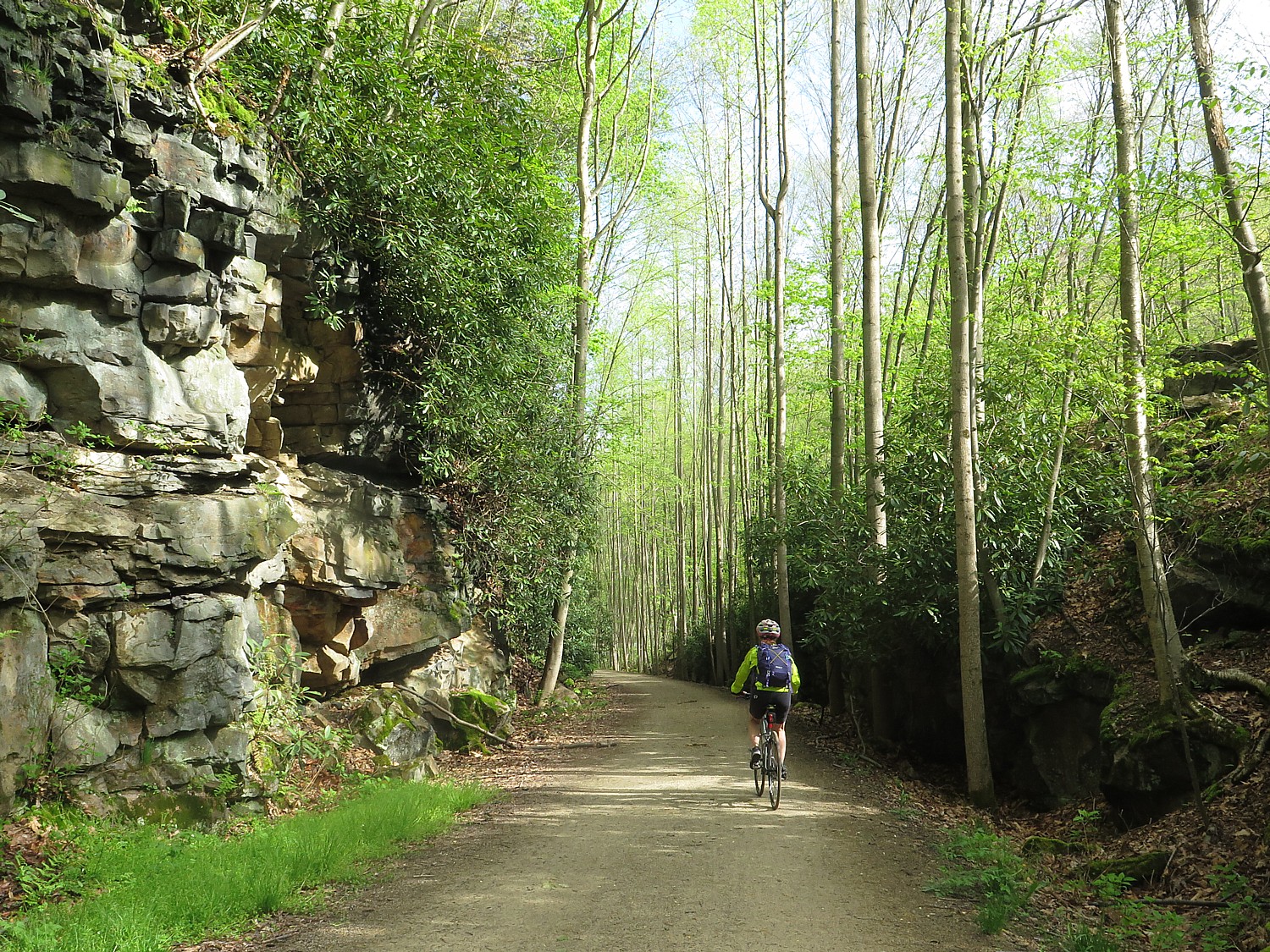
Biking the Great Allegheny Passage trail with Rails to Trails Conservancy. The trail is part of the Great American Rail-Trail that ultimately will create a transcontinental network of trails 3,700 miles from Washington DC to Washington state. Find a trail near you on Celebrate Trails Day, April 26.  © Karen Rubin/goingplacesfarandnear.com

By Karen Rubin, Travel Features Syndicate, goingplacesfarandnear.com

Rails to Trails Conservancy is hosting its Celebrate Trails Day on April 26. This annual spring celebration of America’s trails, which Rails to Trails has organized since 2013 on the fourth Saturday of April, invites one and all to “come outside to experience the joy and impact of America’s trails”.

Every Celebrate Trails Day, RTC teams up with partners—trail groups, agencies, nonprofits, businesses, brands, clubs and every other type of organization in between—to offer scores of events and activities that encourage physical activity, stewardship, community engagement and opportunities to see how fun it is to switch a car trip for a walk or a bike ride and help lower their individual carbon footprint.

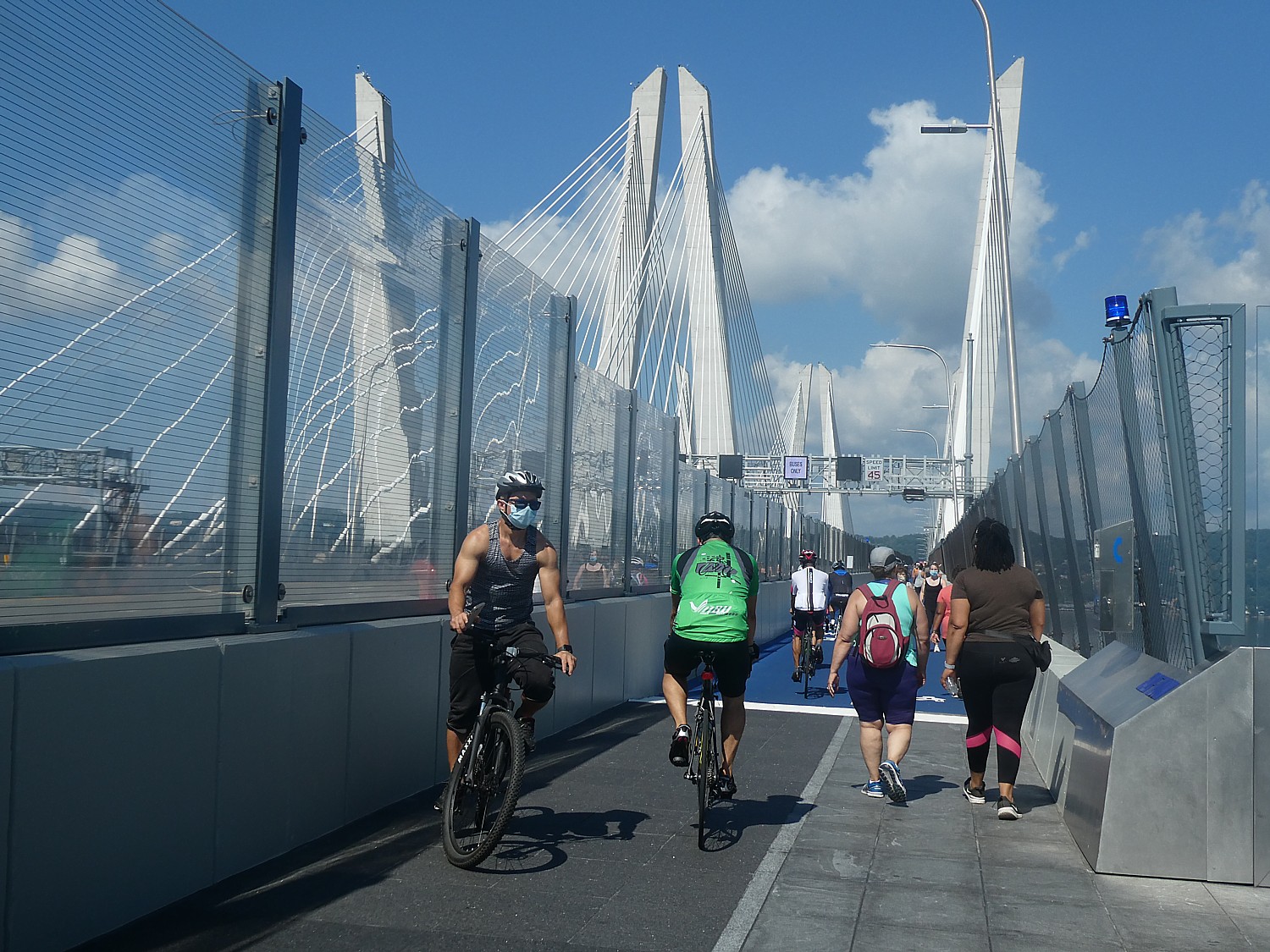
Bike or walk the 2-mile long trail alongside New York’s Cuomo Bridge for a spectacular view of the Hudson River © Karen Rubin/goingplacesfarandnear.com

“Celebrate Trails Day creates a unique opportunity to show off the many ways trails are essential to communities across the country,” said Ryan Chao, RTC’s president. “Thousands of people get outside with us to send the message that when we connect trails, good things happen.”

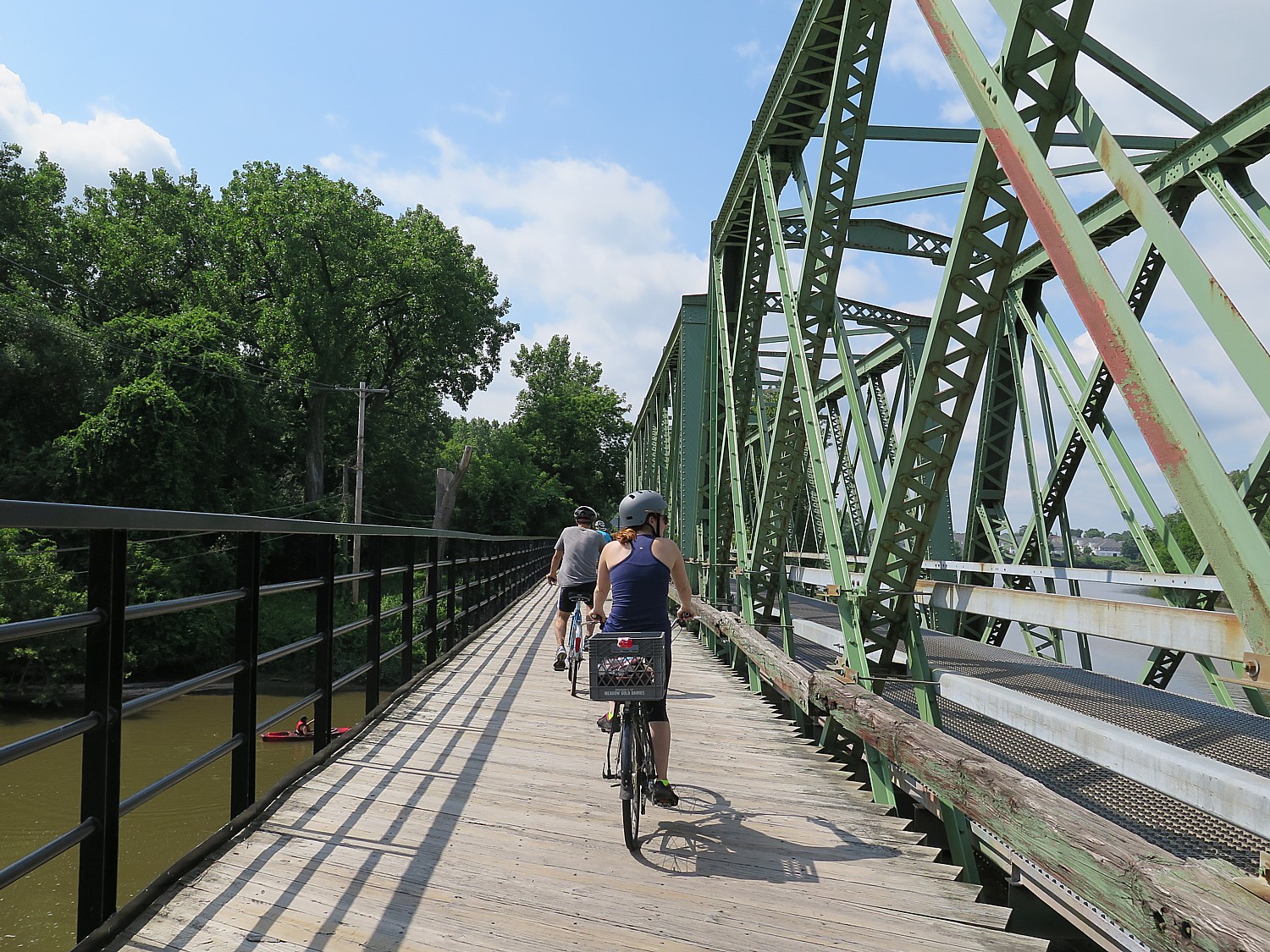
Cycling over what used to be a railway bridge from Peebles Island at the end of Parks & Trails NY’s eight-day, 400-mile Cycle the Erie Canalway biketour © Karen Rubin/goingplacesfarandnear.com

What good things? “The nation’s 42,000+ miles of multiuse trails on the ground nationwide lay the foundation for 150+ trail networks in development means we have space to move our bodies and be active outside, which is good for our physical and mental health. We support our local economy and create new connections in the neighborhoods where we live. And we can get around safely without a car. These spaces bring incredible value to our everyday lives, improving the quality of life where people live, work and play. When we show up on trails, we send a message loud and clear that these spaces are essential to our communities.”

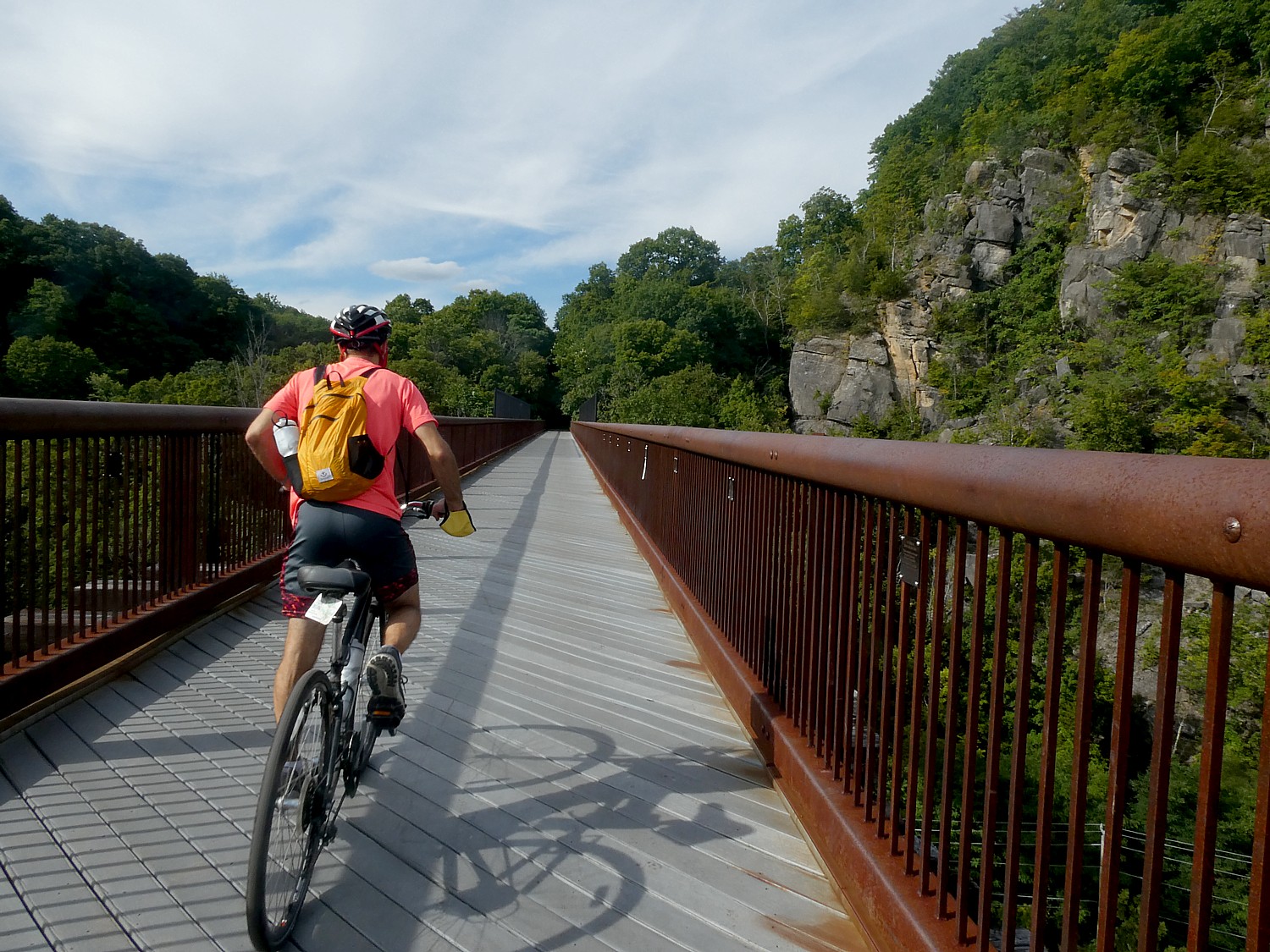
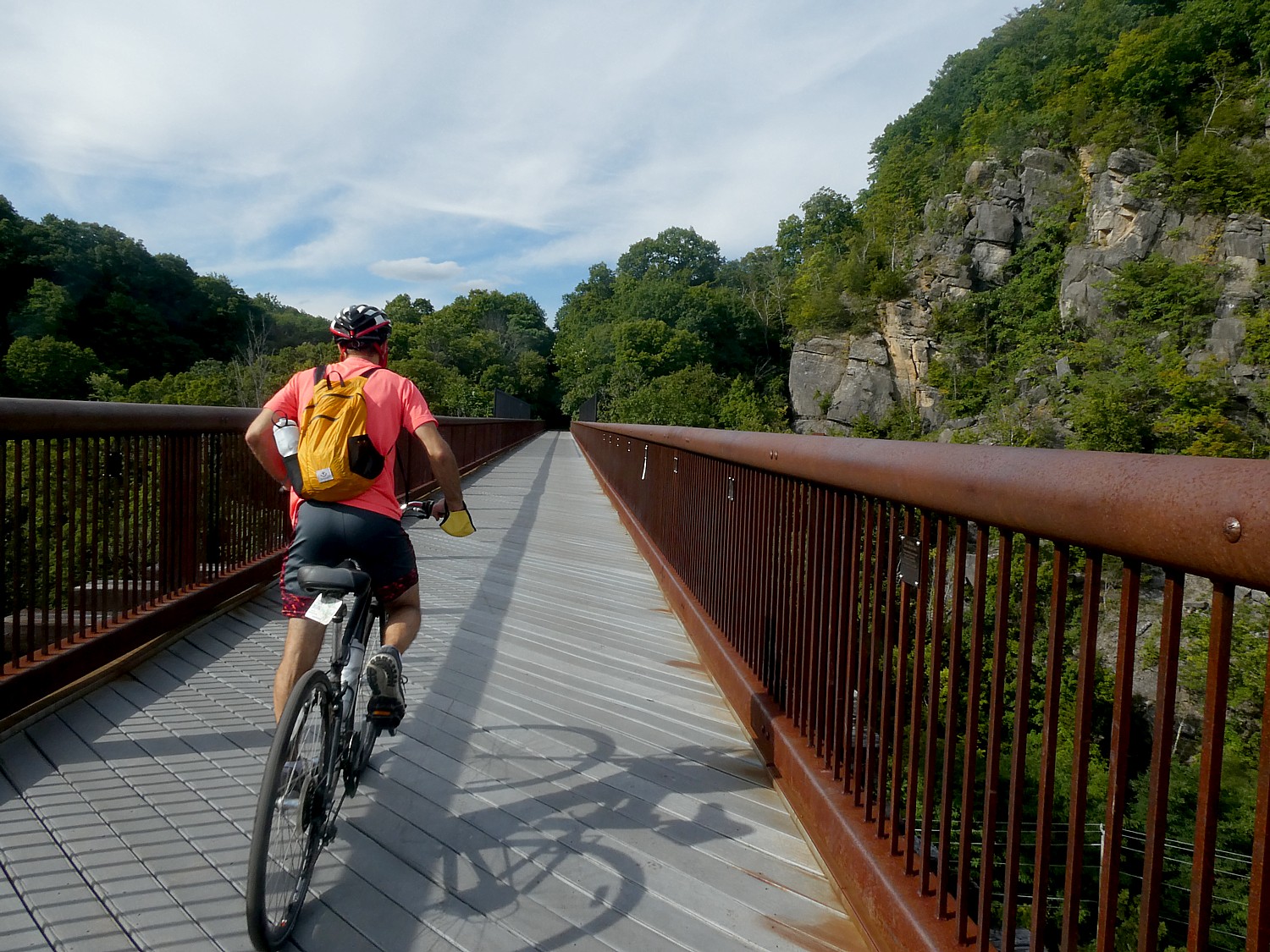
Biking over the famous Rosendale Trestle on the Walkill Valley Trail, now part of New York’s 750-mile Empire State Trail network © Karen Rubin/goingplacesfarandnear.com

RTC has curated resources to help you plan a day of biking, walking, hiking, running and/or exploring outdoors. These include an interactive map to find events near you (more events being added all the time). Using the map, you can find hikes, spring cleanups, group rides, fun runs, family-friendly festival. You can also find organizations hosting events and events where complimentary non-alcoholic beverages are being provided, courtesy of Athletic Brewing Company, the premier sponsor for Celebrate Trails Day. Go to the website, https://www.railstotrails.org/celebratetrailsday/. (You can also find out how to win prizes for participating.)

Find Trails: Any day of the year, you can find trails near you around the nation using RTC’s free trail-guide app and website, TrailLink.

Impact of Trails for People, Places and the Planet

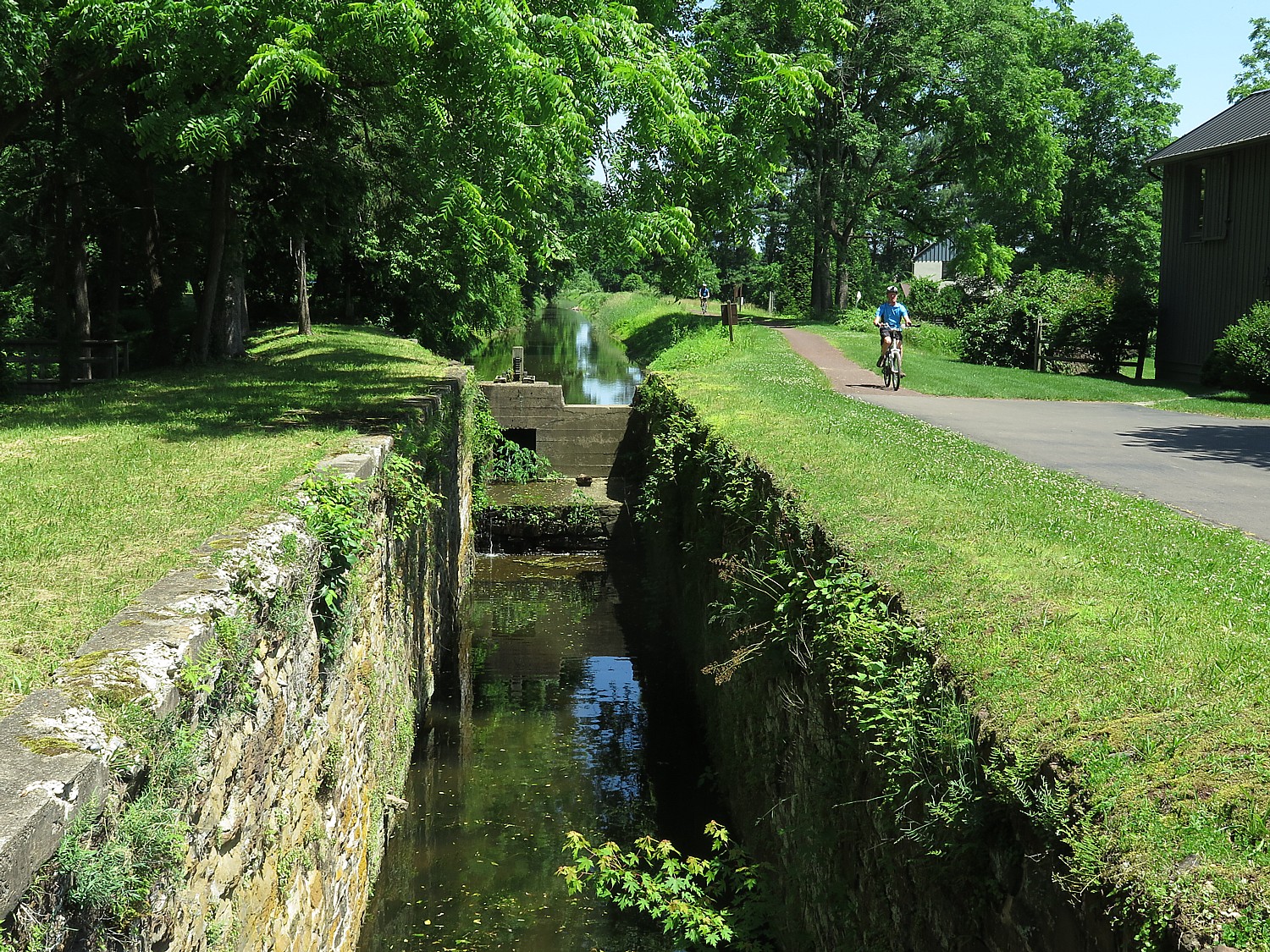
Biking the Delaware-Lehigh Trail on a Rails to Trails Conservancy’s Sojourn  © Karen Rubin/goingplacesfarandnear.com

Many of the more than 240 events taking place on Celebrate Trails Day highlight the return on investment as the nation’s more than 41,000 miles of multiuse trails are connected into trail networks that make it safer and easier for people to be active outside where they live, with the potential to deliver more than $138 billion to the economy each year in health cost savings, climate savings and direct spending.

Last year’s Celebrate Trails Day was a celebration of unprecedented opportunity for trails, walking and biking – in part made possible by the Biden Administration’s Bipartisan Infrastructure Law – and demonstrated the widespread demand and benefit of dedicated and sustained investment in the nation’s trail networks.

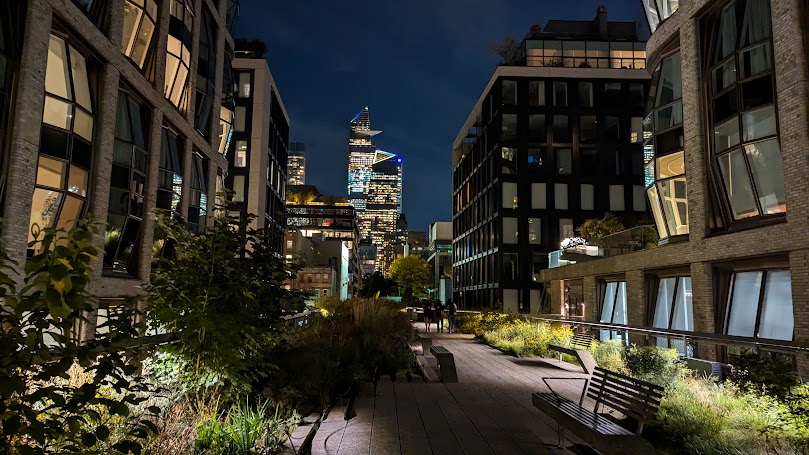
The Highline, the urban art park trail created out of a highway on Manhattan’s west side, is now one of the most popular and used attractions in New York State, and a main artery in a neighborhood it spawned the size of a city © Karen Rubin/goingplacesfarandnear.com

Participants in Celebrate Trails Day reported mental health benefits of time spent being active on the trail (97% of people agree that using trails makes a difference for their mental health and well-being) and the majority say that having events or programming on the trail motivates them to be physically active (85%). More than three-quarters (78%) indicate that they would use trails as part of their everyday routine (e.g., going to the store, school, work or for exercise) and 76% of respondents indicated they chose to swap a car trip for a walk, bike ride or other active transportation on Celebrate Trails Day and at other times in their day-to-day routines.

“Everyone gains from staying active and should have safe and convenient access to trails. It’s also great when these places include green space, welcome all ages and abilities, and include activities like culturally inclusive programs,” said Ken Rose, MPA, physical activity and health branch chief at the CDC. “Good walking and biking trails can help us stay physically and mentally fit by making physical activity a part of our routine. They also bring communities closer together by giving us spaces to meet up and socialize.”

The Centers for Disease Control, which finds increasing physical activity is one of the best things we can do for our health and  recommends 150 minutes of moderate-intensity physical activity a day, reports that only about 1 in 4 adults do. Connected trail and active transportation infrastructure makes it possible for more people to incorporate physical activity into routine, everyday activities, like getting to work or school or running errands. Outcomes from Celebrate Trails Day underscore the impact of park, trail and greenway infrastructure improvements—combined with additional interventions, such as events and programming in these spaces—to increase awareness, enhance access and encourage participation as outlined in recommendations by the Community Preventive Services Task Force to increase physical activity.

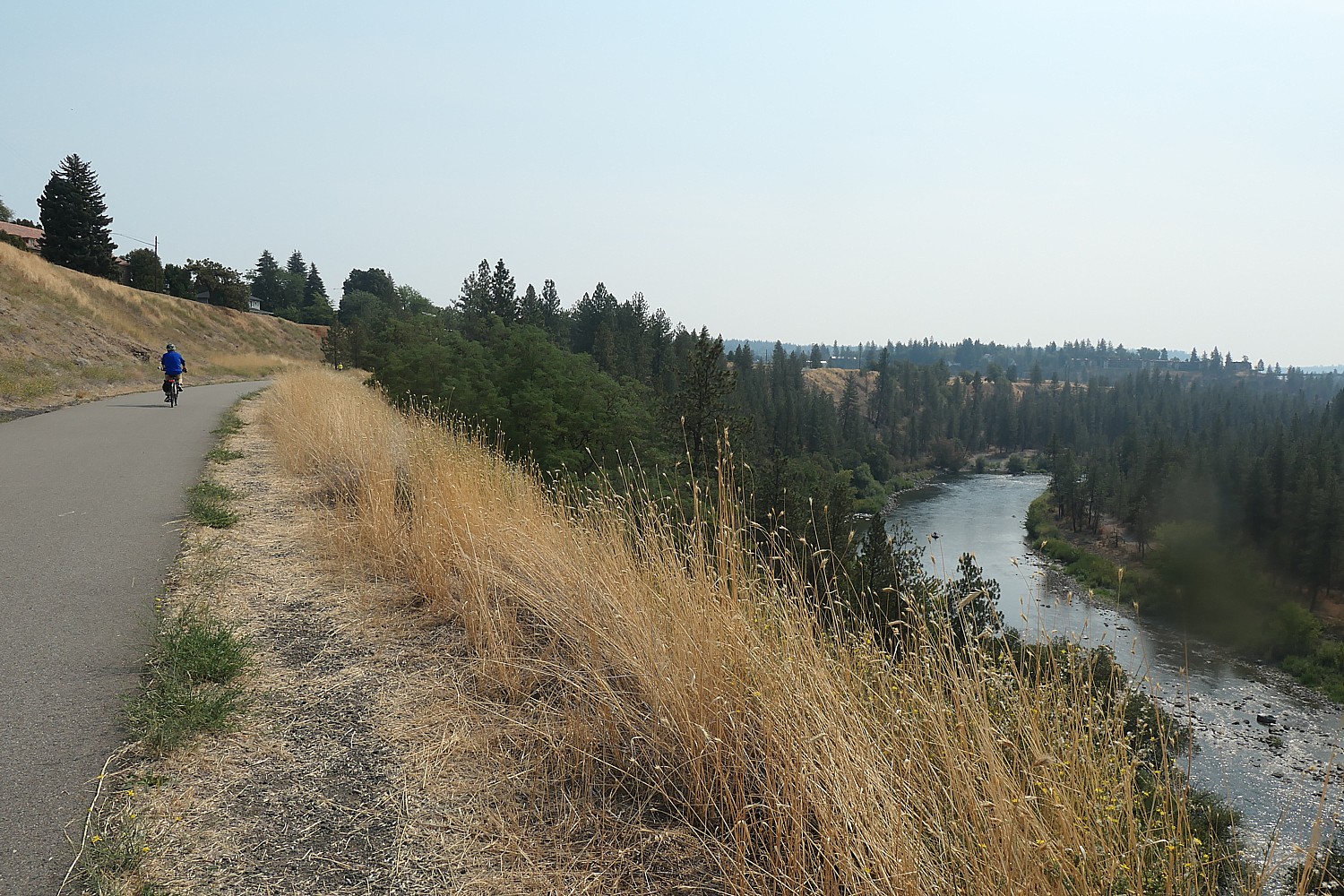
The Centennial Trail from Washington State into Idaho goes through downtown Spokane © Karen Rubin/goingplacesfarandnear.com

Since 1986, Rails to Trails Conservancy, a nonprofit organization with one million members, has been “dedicated to creating a nationwide network of trails from former rail lines and connecting corridors to build healthier places for healthier people.”

“We reimagine public spaces to create safe ways for everyone to walk, bike and be active outdoors.”

RTC’s most ambitious program to date is the creation of the Great American Rail-Trail, that will ultimately connect more than 125 multi-use recreational trails 3,700 miles across the continent, from Washington D.C., through 12 states, to Washington State. (https://www.railstotrails.org/site/greatamericanrailtrail/)

Some iconic trails are already in place along the Great American Rail-Trail route, while communities, nonprofit partners, state agencies and volunteers are working to build trails to benefit their local area by linking up to the trans-continental network.(See the full list here, https://www.railstotrails.org/site/greatamericanrailtrail/content/route/)

As of January, 2025 the Great American Rail Trail – America’s first trans-continental network – is 55% complete with 2,059 miles of trails out of the total 3,700 miles.(see: https://www.railstotrails.org/resource-library/resources/great-american-rail-trail-route-assessment-2024/)

Rails to Trails Conservancy, 2445 M Street, NW, Suite 650, Washington, DC 20037, 866-202-9788, railstotrails.org.

Bike Tour Companies Embrace Rail Trails

Several bike tour operators offer itineraries on segments of the Great American Rail-Trail:

Wilderness Voyageurs already has tours on many segments of the Great American Rail-Trail – indeed, it is actually headquartered on, the famous and picturesque Great Allegheny Passage, one of the primary building blocks of the east-to-west route.  

With the addition of the Iowa Trestles Tour in 2021, Wilderness Voyageurs offers supported rides on more than 820 miles of the route.  Its multi-day, inn-to-inn, bike tours on the Great American Rail-Trail visit 14 different trails in eight states These include:

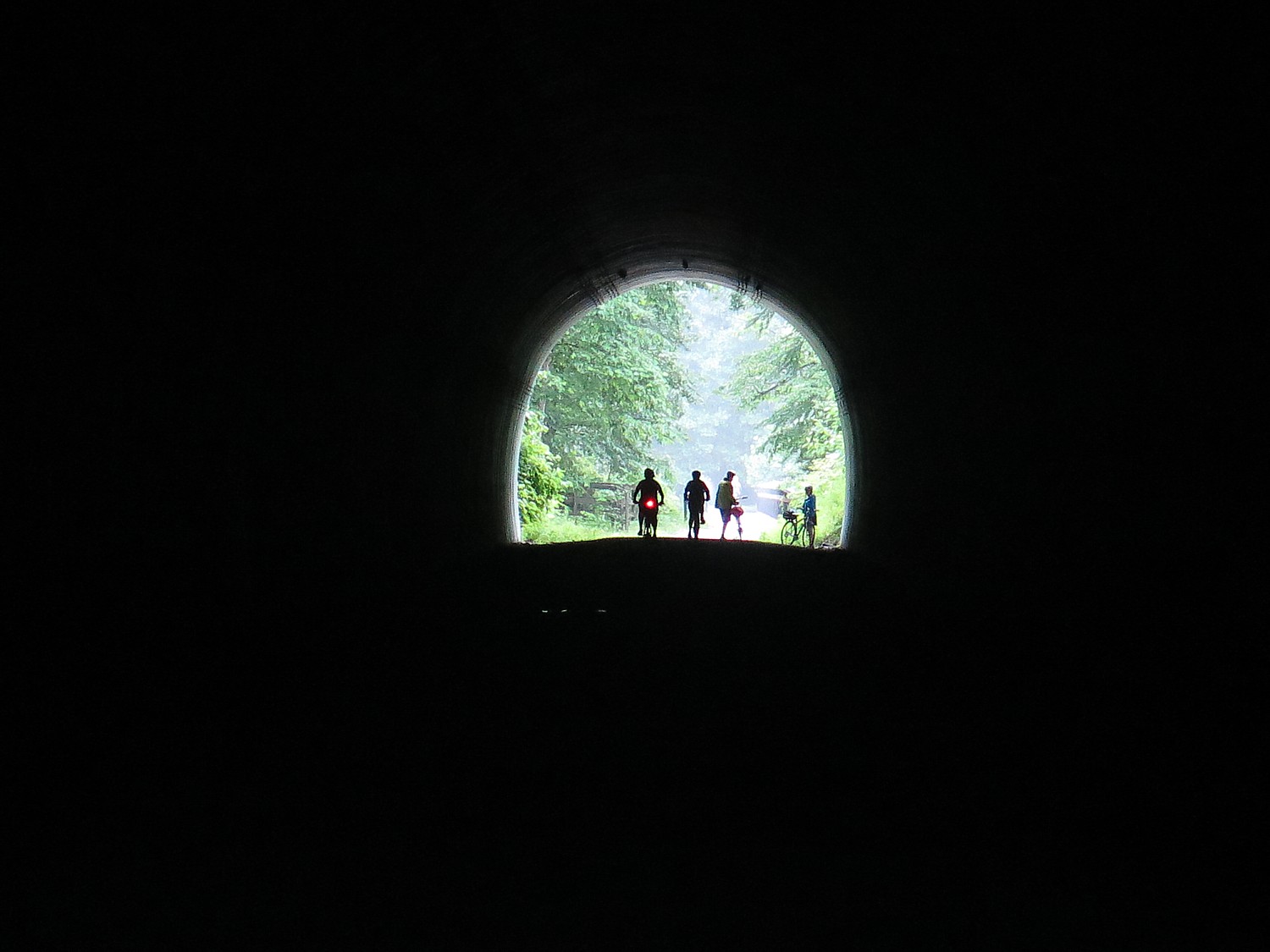
Biking through the Pinkerton Tunnel on the Great Allegheny Passage (GAP), a key part of the Great American Trail 3700-mile transcontinental network Spokane © Karen Rubin/goingplacesfarandnear.com

The Great Allegheny Passage (GAP) is an iconic rail-trail that runs 150 miles from Cumberland, Maryland, to Pittsburgh, Pennsylvania, and was built in partnership between state agencies and many local trail groups and volunteers. The GAP is featured on three different trips: a four-day Great Allegheny Passage tour from Pittsburgh to Cumberland; six-day Pittsburgh to D.C. tour, and Pennsylvania and Maryland Easy Rider tour. (Wilderness Voyageurs is headquartered right next to the trail in Ohiopyle, Check out the Great Allegheny Passage for info and travel tips.)

The C&O Canal Towpath from Cumberland to Georgetown is featured on a six-day Pittsburgh to D.C. bike tour Following the Potomac River, the C&O Canal Towpath traverses the Chesapeake & Ohio Canal National Historical Park for 184.5 miles. Hundreds of original features – locks, lock houses, aqueducts and other canal structures – are reminders of the canal’s role as a transportation system during the Canal Era, which peaked in the mid-19th century. The C&O actually connects with the GAP.

Its Pittsburgh to D.C. bike tour includes an optional ride on the Capital Crescent Trail, a paved trail that parallels the canal towpath. The 11-mile trail follows the former route of the Georgetown Branch rail line of the Baltimore & Ohio Railroad.

Both its Gettysburg and the Civil War bike tour and Shenandoah and Skyline Drive bike tours visit part of the towpath near historic Harpers Ferry.

The Cincinnati to Cleveland Tour features a corridor that will ultimately connect the Ohio River in Cincinnati to Lake Erie in Cleveland. Of its planned 326 miles, more than 270 miles of trail are complete visiting six different trails and many beautiful small towns. Besides knocking out a big chunk of the Great American Rail-Trail, you visit Cuyahoga National Park, one of the newest national parks.

The Iowa Trestles Tour is a 4 day meander that cycles 3 different trails that are part of the GART: the High Trestle Trail, the Heart of Iowa Nature Trail and the 2021 inductee to the Rail Trail Hall of Fame, The Raccoon River Valley Trail.  

Idaho’s Trail of the Coeur d’Alenes, part of the Great American Trail network, is featured on tour programs of Wilderness Voyageurs and Discovery Bicycle Tours, among others © Karen Rubin/goingplacesfarandnear.com

The Idaho Coeur d’Alenes and Hiawatha tour spends time on the NorPac Trail that follows the old right-of-way of the Northern Pacific Railway (hence the trail’s name) in western Montana and the Idaho Panhandle, crossing Lookout Pass. The trail runs from Idaho near Mullan at the trailhead for the Trail of the Coeur d’Alenes, past the East Portal of the Route of the Hiawatha (south of Taft, Montana) and on to the small town of Saltese. The entire trail offers spectacular views of the forested Rocky Mountains as well as lakes and streams.

The Trail of the Coeur d’Alenes covers nearly 72 paved miles through scenic mountains and valleys in Idaho’s Panhandle. The area has a rich mining, railroading and Native American history, and hugs the Lake Coeur d’Alene shoreline, rolling foothills in the Palouse prairie, and goes over the impressive Chatcolet Bridge.

The Washington Olympic Peninsula tour cruises the Olympic Discovery Trail, which is the western terminus of the Great American Rail-Trail. Starting in the Victorian seaport of Port Townsend and ending on the shores of the Pacific Ocean, the ODT is filled with views of snow capped peaks, ocean vistas, fast flowing rivers and pristine lakes, and everywhere the majestic forests of the Pacific Northwest. Olympic National Park, which was established in 1938 by President Franklin Roosevelt, is a UNESCO World Heritage Site. The park is truly special, with 922,650 acres of rain forest, old-growth forest, glacier-topped peaks and alpine meadows. Its forests are home to cougars, bears, deer, woodpeckers, golden eagles, mountain goats and peregrine falcons nesting above the trail on Pyramid Mountain.

(Wilderness Voyageurs has trips on many rail trails in New York, Maryland, Pennsylvania, Florida, Missouri, Wisconsin, Michigan, South Dakota, Idaho and Washington.  (See complete list of rail-trail bike tours

Wilderness Voyageurs, 103 Garrett Street. Ohiopyle, PA 15470, 724-329-1000,  800-272-4141 wilderness-voyageurs.com

Discovery Bicycle Tours, similarly, offers several trips on rail-trails that are part of the Great American Rail-Trail: C&O Canal Trail; Great Allegheny Passage, Pennsylvania; Silver Comet Trail; the Centennial Trail, the Hiawatha Trail and the Trail of the Coeur d’Alenes on its  Idaho Trails tour), as well as many others.

Biking the Trail of the Coeur d’Alenes, Idaho on Discovery Bicycle Tours’ six-day Idaho Trails trip © Karen Rubin/goingplacesfarandnear.com

Other Discovery Bicycle Tours rail trail trips include 200 miles of the Empire State Rail Trail from Battery Park, Manhattan to Albany (part of the 750-mile long Empire Trail Network that goes from Battery Park on the southern tip of Manhattan up to the Canadian border, and east-west on the 360-mile-long Erie Canalway from Buffalo to Albany);  the longest rail trail in New England, the Lamoille Valley Rail Trail; Appalachian rail trails of Virginia and West Virginia; Mickelson Trail, South Dakota, 6-Day Washington Cascades Trails,  and the  P’tit du Nord rail trail in Quebec.

Bike from Battery Park in Manhattan along the Hudson River Greenway, up to Albany, on Discovery Bicycle Tours’ Empire State Rail Trail tour © Karen Rubin/goingplacesfarandnear.com

Discovery Bicycle Tours, 2520 W. Woodstock Rd., Woodstock, VT 05091, 888-459-3265, info@discoverybicycletours.com

_____________________

© 2025 Travel Features Syndicate, a division of Workstyles, Inc. All rights reserved. Visit goingplacesfarandnear.com and travelwritersmagazine.com/TravelFeaturesSyndicate/. Blogging at goingplacesnearandfar.wordpress.com and moralcompasstravel.info. Visit instagram.com/going_places_far_and_near and instagram.com/bigbackpacktraveler/ Send comments or questions to FamTravLtr@aol.com. Bluesky: @newsphotosfeatures.bsky.social X: @TravelFeatures Threads: @news_and_photo_features ‘Like’ us at facebook.com/NewsPhotoFeatures

Annual Cycle the Erie Canalway Bike Tour is All the More Special During 200th Anniversary Celebration

The annual eight-day Parks & Trails Cycle the Erie Canalway bike tour from Buffalo to Albany is 400 miles and 400 years of history but this year’s ride July 12-20, 2025 is particularly special because it marks the 200th anniversary of the opening of the Erie Canal in 1825 NY © Karen Rubin/goingplacesfarandnear.com

By Karen Rubin, Travel Features Syndicate, goingplacesfarandnear.com

The annual eight-day Parks & Trails Cycle the Erie Canalway bike tour from Buffalo to Albany is 400 miles and 400 years of history but this year’s ride July 12-20, 2025 is particularly special because it marks the 200th anniversary of the opening of the Erie Canal in 1825. An engineering marvel of its time that transformed the United States, all along the way, riders will enjoy special events and celebrations.

The Erie Canal propelled the Industrial Revolution, opened the frontier, united the country, birthed canal towns and cities, and made New York City a financial capital of the world.

You see all of this unfolding from the first mile out of Buffalo  and over the course of eight days of riding (averaging 50 miles a day), filled with activities and camaraderie.

Cycle the Erie Canalway participants experience one of the best trails in America as they cycle through historic canal villages and discover the small-town charm of upstate New York that makes people like us Downstaters marvel, “This is New York!” Along the way, canal historians and local experts will introduce riders to the people, places and things that make the Erie Canal so important to the history of New York and the nation during its Bicentennial Year. Cyclists pedal between 40 and 60 miles per day on the mostly flat (but it seems the campsites tend to be at the highest point of a town) and mostly traffic-free Erie Canalway Trail, and visit some of Upstate New York’s most iconic attractions, such as the Women’s Rights National Historic Park in Seneca Falls and Fort Stanwix in Rome, a full-scale fort recreation from the French and Indian War.

The Parks & Trails NY tour is actually one of my favorite bike rides in the world – for the scenery, the sights along the way, the activities like lectures and museum visits that are arranged, the camaraderie of camping and riding together with some 650 cyclists from all over the country and all over the world, and the Erie Canalway itself –a  356 mile-long car-free recreational path that is the west-east part of New York State’s new 750-mile Empire Trail Network (the north-south trail network connects Battery Park at the tip of Manhattan to the Canadian border). Between the relatively flat nature and superb support provided, Cycle the Erie Canal offers unparalleled cycling for all ages and abilities (I’ve seen families with little ones in trailers or car seats and riders as young as 10 and as old as 92 bike on their own.)

Though there are bike tour operators (such as Wilderness Voyageurs and Pocono Biking) that offer inn-to-inn bike tours on portions of the Erie Canalway, this annual supported biking/camping trip, in its 27th year,  is organized by Parks & Trails New York, which for decades has successfully advocated to open these recreational trails and improve parks.

Each day’s ride is highlighted by fascinating attractions all along the Erie Canalway

Cycle the Erie Canalway cyclists are fascinated to see the famous “Flight of Five” series of five locks that brought boats 50 feet, an engineering marvel of its time that made the building of the canal possible. Cyclists on this year’s Parks & Trail NY ride will celebrate the 200th anniversary of the opening of Erie Canal © Karen Rubin/goingplacesfarandnear.com

In Lockport, see the original engineering marvel that made the entire Erie Canal possible: the  famous “Flight of Five”, a staircase of five locks built to elevate boats through the then-impossible 50-foot Niagara Escarpment; take a cruise through the modern lock (the GE motors that run it are over 100 years old), explore underground sluiceways, caves and the “Upsidedown Bridge.”

Leaving the historic village of Medina, look for the tunnel under the Erie Canal, where you see that the Erie Canal is really like a bathtub.

The annual eight-day Parks & Trails Cycle the Erie Canalway bike tour from Buffalo to Albany is 400 miles and 400 years of history but this year’s ride July 12-20, 2025 is particularly special because it marks the 200th anniversary of the opening of the Erie Canal in 1825 NY © Karen Rubin/goingplacesfarandnear.com

Ride through New York’s Amish Country (who knew!) on the way to Seneca Falls, birthplace of the modern Women’s Rights movement and visit the Women’s Rights National Historic Park, National Women’s Hall of Fame (housed in a former knitting mill) and the Elizabeth Cady Stanton home (the museums stay open for us).

The knitting mill in Seneca Falls is fittingly now the home of the National Women’s Hall of Fame © Karen Rubin/goingplacesfarandnear.com

You also get a taste of the women’s movement at the Peppermint Museum in Lyons (don’t miss it!) where you learn about the inventor, Hotchkiss’s daughter, a suffragist, who took over the company.

Get a taste of the women’s movement at the Peppermint Museum in Lyons where you learn about the inventor, Hotchkiss’s daughter, a suffragist, who took over the company. © Karen Rubin/goingplacesfarandnear.com

On the way to Syracuse, stop at the Visitors Center at the Old Erie Canal Heritage Park at Port Byron, then pedal through the authentic enlarged Erie Canal Lock 52 to the c. 1895 Erie House Saloon, Blacksmith Shop, and Mule Barn; visit the Jordan Historical Society Museum, and ride on the towpath on an original aqueduct over Skaneateles Creek which takes you to Camillus’ Erie Canal Park where you stop at Sims Store, a re-creation of a 19th century general store (where riders are cheered for passing the half-way mark at 200 miles)

Parks & Trails NY’s Cycle Erie Canalway tour goes through New York’s Amish country © Karen Rubin/goingplacesfarandnear.com

In Syracuse, visit the zoo, and the next morning, the Erie Canal Museum, the best of the Canal Museums along the way (they open especially for the cyclists)

On the way to Rome, visit the Chittenango Canal Museum and dry docks and the Canastota Canal Town Museum and see the spot where the first shovel of dirt was turned for “Clinton’s Ditch” (deliberately in the middle of the canal). Chittenango was also the birthplace in 1856 of L. Frank Baum, famous throughout the world as the creator of The Wizard of Oz and his mother-in-law Matilda Joslyn Gage, was a prominent women’s rights advocate, abolitionist, and writer, known for her radical views, derived largely from the Oneida women and her work alongside Susan B. Anthony and Elizabeth Cady Stanton in the women’s suffrage movement).

In Rome, camp at the restored Fort Stanwix National Monument, built during the French and Indian War, populated with costumed interpreters © Karen Rubin/goingplacesfarandnear.com

In Rome, camp at the restored Fort Stanwix National Monument, built during the French and Indian War, populated with costumed interpreters, and learn how seemingly minor battles actually shaped the outcome of the American Revolution.

In Little Falls, explore the glacial potholes of Moss Island, a National Natural Landmark, and tour Revolutionary War General Herkimer’s home.

At Schoharie Crossing State Historic Site, once a trading post and a fort (they found the footprint after a hurricane), look where you can see all three Erie Canals (yes, 3 Erie Canals have been built).

Coming from Schenectady to the finish line in Albany, stop at Cohoes Falls, one of the most powerful falls east of the Rockies© Karen Rubin/goingplacesfarandnear.com
 

Coming from Schenectady to the finish line in Albany, stop at Cohoes Falls, one of the most powerful falls east of the Rockies and a major challenge for Erie Canal engineers (a wonderful bookend with Niagara Falls in the west); visit Peebles Island State Park, where, during the Revolutionary War, American forces prepared defenses to make a final stand against the British, and finally, bike along the Hudson River into downtown Albany, New York State’s 300-year-old capital.

Registration for Cycle the Erie Canal includes camping accommodations each evening with restrooms and showers (even swimming pools and charging stations and the possibility of indoor camping); eight hearty breakfasts and six delicious dinners; two refreshment stops daily stocked with fruit, snacks and beverages; SAG support and baggage transport; daily cue sheets and marked routes; entertainment and historic presentations every evening; and guided tours of the Canal, historic sites, museums, other attractions, and expanded celebrations for the Canal’s 200th Anniversary.

The price for the eight-day ride, July 12-20, Buffalo to Albany is $1,300/adult, $700 (youth age 6-17), $300/child (5 and under). There is also a four-day version with an optional shuttle.

(Note: they arrange for parking in Albany ($120, at the Quackenbush Garage July 12-20, 2025), and a shuttle bus to Buffalo on July 12 ($120/rider), or oppositely, parking in Buffalo ($25) and a shuttle back from Albany to Buffalo at the end of the tour.)

Parks & Trails New York, which is celebrating its own 40th anniversary this year, is a leading statewide advocate working to create a network of parks, trails, and greenways so that New Yorkers can enjoy the outdoors close to home. Cycle the Erie Canal supports Parks & Trails New York’s work on the Erie Canalway Trail and on trails in communities throughout New York State.

The New York State Canal Corporation, the agency charged with operating, maintaining and promoting New York’s Canal System and the Canalway Trail, is the Premier State Sponsor of Cycle the Erie Canal. The Erie Canalway National Heritage Corridor is the event’s Heritage Sponsor.

For more information on Cycle the Erie Canal, visit www.ptny.org/canaltour, email eriecanaltour@ptny.org or call 518-434-1583.

Erie Canal Bicentennial Events

The Cycle the Erie Canal bike tour, July 12-20, is one of the biggest events honoring the canal’s bicentennial, but there are many events happening in various towns and cities along the Canal:

On Fri., May 16, 2025, the Bicentennial Navigation season will kick off in Waterford, where the Canal meets the Hudson River, with a parade of vessels.

Fairport, one of the towns “birthed” by the Erie Canal, celebrates its 48th Canal Days June 6-8 © Karen Rubin/goingplacesfarandnear.com

Fairport, NY, the jewel of the Erie Canal, celebrates its 48th Canal Days from June 6-8, 2025. One of New York’s premier arts festivals features artisans, music, local cuisine and fun for all ages, and brings more than 100,000 visitors to this Rochester suburb.

Canal enthusiasts, historians, engineers, environmentalists, artists and travelers from around the world can attend The 2025 World Canals Conference from Sept. 21-25, 2025 in Buffalo, NY, complete with canal-themed excursions for participants, in addition to hours of learning, discussion and networking.

The Water Music NY: More Voices Festival returns in Summer 2025, with The Albany Symphony Orchestra performing free concerts across the entire New York State Canal System. The project is a collaboration of composers, local arts partners, cultural & educational institutions and community members fusing arts, cultural heritage, and contemporary issues to re-envision the past, present, and future of people and communities bordering the historic waterway.

For the grand finale, a replica of Seneca Chiefthe boat Governor Dewitt Clinton used for his inaugural Erie Canal journey to open the Canal in 1825, will set sail on September 24 and recreate the maiden voyage from Buffalo Canalside to the New York Harbor, making multiple stops along the way with celebratory events at each community stop including flotillas and a grand commemoration in New York City on October 25.

Can’t make it to the Parks & Trails NY Cycle the Erie Ride? The bike tour company, Wilderness Voyageurs offers a four-day inn to inn ride, New York Erie Canal West, that begins in Lockport and stays in places like the historic Genessee Country Inn (2025 tour dates: 6/30, 7/27, 8/10, 800-272-4141, wilderness-voyageurs.com).

Another company that offers inn-to-inn supported tour on the Erie Canalway is Pocono Biking (https://poconobiking.com/specialty-trips/6-day-erie-canal-bike-tour/). Also: Great American Bike Tours (949-424-5369, cycletheusa.com); Classic Adventures (800-777-8090, classicadventures.com); Noble Invention Bike Touring (844-424-5342, nobleinventionbiketouring.com); and 718 Outdoors (347-457-5760, 718c.com)

Erie Canal Adventures provides this one-of-a-kind experience with live-aboard, fully-equipped canal boats © Karen Rubin/goingplacesfarandnear.com 

Another extraordinary way to experience the Erie Canal is by a live-aboard canal boat! This European-style self-skippered houseboat that was specifically designed for the Erie Canal let’s you make your own way on the Erie Canal, going through locks and under the lift bridges, and experience the 200th anniversary of the canal just as it was then, by boat and bike. Erie Canal Adventures provides this one-of-a-kind experience with live-aboard, fully-equipped canal boats. Accommodating 2 to 6 people, each of these charming, easy-to-pilot boats features cozy bedrooms, kitchens, and bathrooms – cooking utensils, linens, fuel, mobile app and bikes. You get 3-4 hours of training, including safety training, systems, and navigational training (and how to go through the locks which are SO fun. You learn how to work the radio to call up to the lockmaster and the bridge operators to lift the bridges. And you tie up where you like. Erie Canal Adventures, 1125 Marina Parkway, Macedon NY  14502, (315) 986-3011, Option 1, allie@eriecanaladventures.com, ericcanaladventures.com.

More ways to experience the Erie Canal can be found at the Erie Canalway National Heritage Corridor, https://eriecanalway.org/explore/cycling/cycling-resources

“This year, New York State is rich with opportunities to experience major milestone anniversaries, stay in new hotels and explore new museums and exhibits,” I LOVE NY Executive Director of Tourism Ross D. Levisaid. “The Bicentennial of the Erie Canal‘s completion can be celebrated throughout upstate communities, while downstate, New York City commemorates its 400th anniversary. The 100th anniversary of the Great Gatsby can be explored at Gold Coast mansions on Long Island, where the famous novel was set. For more information, visit iloveny.com

See also:

Cycle the Erie: 400 Miles & 400 Years of History Flow By on Canalway Bike Tour Across New York State

Cycle the Erie, Day 1: In Lockport, See Erie Canal Engineering Marvel, ‘Flight of Five’, Cruise Thru Double Locks, and Go Underground to Fathom Rise of Industrial Revolution

Cycle the Erie, Day 2-3: A Sequence of Charming Canaltowns, Pastoral Landscapes, Punctuated by City Birthed by ‘Mother of Cities’

Cycle the Erie, Day 4: Seneca Falls to Syracuse, Crossing Halfway Mark of 400-Mile Biketour

Cycle the Erie, Day 5: Deep Dive into The Erie Canal: ‘Mother of Cities’, Empire Builder, Wonder of the World

Cycle the Erie: At Fort Stanwix, Rome, Time Travel Back to America’s Colonial, Native American Past

Cycle the Erie, Days 6-7: Erie Canal Spurs Rise of America as Global Industrial Power

Cycle the Erie, Days 7-8: Schoharie Crossing, Mabee Farm, Cohoes Falls to Finish Line in Albany of 400-Mile BikeTour

__________________

© 2025 Travel Features Syndicate, a division of Workstyles, Inc. All rights reserved. Visit goingplacesfarandnear.com and travelwritersmagazine.com/TravelFeaturesSyndicate/. Blogging at goingplacesnearandfar.wordpress.com and moralcompasstravel.info. Visit instagram.com/going_places_far_and_near and instagram.com/bigbackpacktraveler/ Send comments or questions to FamTravLtr@aol.com. Bluesky: @newsphotosfeatures.bsky.social X: @TravelFeatures Threads: @news_and_photo_features ‘Like’ us at facebook.com/NewsPhotoFeatures

Six Days on Discovery Bicycle Tours’ Idaho Trails: Biking the Coeur d’Alenes

Biking the Trail of the Coeur d’Alenes, Idaho on the last day of Discovery Bicycle Tours’ six-day Idaho Trails trip © Karen Rubin/goingplacesfarandnear.com

By Karen Rubin, Travel Features Syndicate, goingplacesfarandnear.com

On Day 4 of Discovery Bicycle Tours’ six-day Idaho Trails trip, after breakfast at our base at the Silver Mountain Resort, we are shuttled to Shoshone Park in the mining town of Mullan for an easy downstream ride through the “Silver Valley,” home to several historic mining communities.

We soon pick up the official start of the Trail of the Coeur d’Alenes, enjoying views of the rocky, forested mountains, as we make our way to the utterly charming “wild west” town of Wallace.

Biking on the Trail of the Coeur d’Alenes to Wallace, Idaho © Karen Rubin/goingplacesfarandnear.com

We have been primed for Wallace’s character (and humor) when we had a talk by a local historian at the Roosevelt Inn in Coeur d’Alene so are prepared for the “history (and some hilarity!) that await us as citizens of Wallace have tenaciously preserved their town amidst an ever changing landscape of fortunes lost and gained.”

Now, we stroll around the town looking for some of the sights she pointed out, like the town’s last brothel, a mining museum, a silver shop, before we join the Sierra Silver Mine Tour that Discovery has arranged for us. It begins with a delightful narrated tour of Wallace in an open-air trolley that takes us up to the mine.

Who knew that Wallace was the “Silver Capital of the World” – some $138 billion worth taken out of these mines –$20 billion of metals just last year (did I hear that right?) – 1 million ounces of silver. In the 1960s, incredulously, Wallace was the “richest little city” in America with the highest number of millionaires per capita, as well as a thriving brothel industry. (The last running bordello was shut down in 1989 when the FBI raided tax dodgers – there is still resentment in the town – but you can visit the Bordello Museum.)

When mining began in 1886, Wallace’s population was 500; at its peak, in 1940, when some 200 mines were operating (quartz, gold, silver, copper, zinc), the population peaked at 4000, but, with the collapse of silver prices in March 1980, most of the mines closed, the miners left and the population fell to the present number of 800. Today, there are still four active silver mines, including the Lucky Friday and the Galina mines, and one gold mine.

In 1890, a chimney fire destroyed most of the town – the buildings we see today date from 1890-1920. Indeed, Wallace has the rare honor of the entire town being listed on the National Register of Historical Places.

Other tidbits: only one sitting president has visited Wallace: Theodore Roosevelt came in 1903 on a campaign whistle stop; the town spent $5000 just on flags to welcome him. There was a shootout on Valentine’s Day, 1951 – one of the tommy guns is on display in the museum. And Wallace’s most famous native is Lana Turner went one day to a grocery store where she was discovered.

You would be forgiven if you thought Wallace was a theme park creation (the 1997 movie “Dante’s Peak” was filmed here), but the history and the heritage are real, as is the miner, “Fast Freddie,” who is our guide into the silver mine.

“Fast Freddie” guides us on the Sierra Silver Mine Tour, Wallace, Idaho © Karen Rubin/goingplacesfarandnear.com

“Fast Freddie” is a colorful character (he looks as if he came from Hollywood casting), with a marvelous sense of humor, amusing and engaging, but most important, he is authentic, speaking of his own experience working 21 years underground in these mines. “You need a good sense of humor in a mine,” Freddie tells us. “We used to play tricks.” 

This mine was only briefly used, he says, because the silver was very low grade and not worth the expense. It was turned into a mining school, where students learned the techniques of mining and could be hired right into a job.

After the collapse of the silver market and the closure of mines, Wallace looked to tourism to compensate. This mine was turned into an attraction, getting as many as 18,000 visitors a year.

A skeleton wearing a hard hat greets us as we enter the Sierra Silver Mine in Wallace, Idaho © Karen Rubin/goingplacesfarandnear.com

As we enter the mine and pass a skeleton sitting on a chair, Freddie tells us that one of the worst mining disasters in history took place on May 2, 1972 when 91 miners lost lives and just 2 survived. ‘It took 2 weeks to recover all of them. They didn’t have a system to know who was down there.’ After that, the Mine Safety Administration mandated a tag system – larger mines have more sophisticated program.

The proverbial canary in a mine. “Fast Freddie” guides us on the Sierra Silver Mine Tour, Wallace, Idaho © Karen Rubin/goingplacesfarandnear.com

We actually see a canary cage – used to let the miners know when oxygen is low (the proverbial “canary in a coal mine.”)

In this mine, future miners were taught to run the jack, the drill, and to blast. The miners work alone at different levels, so each one has to do everything – digging, setting the dynamite charge, moving out the ore. “You have to get everything done so you can blast before the next shift arrives.”

“Fast Freddie” guides us on the Sierra Silver Mine Tour, Wallace, Idaho © Karen Rubin/goingplacesfarandnear.com

How to protect against the noise? “A cigarette butt was ear protection” (not sure he was joking.)

“Fast Freddie” guides us on the Sierra Silver Mine Tour, Wallace, Idaho © Karen Rubin/goingplacesfarandnear.com

The veins of silver go down for miles – in 1964, they were mining at 250 feet. The Lucky Friday Mine, the largest in the area, is operating at 9600 feet below ground. The deeper they go, the hotter it gets – at 9,000 ft, as much as 170 degrees – so they designed a refrigerated ventilation system to cool to 100 degrees.

After being returned by the trolley, we have time to wander around Wallace before biking back on the trail on our own to the Silver Mine Resort.

The last brothel in Wallace, Idaho is now the Oasis Bordello Museum © Karen Rubin/goingplacesfarandnear.com

Wallace is really interesting – like a time warp and not really just “tourist quaint”, quirky and fun.  Just strolling around, you find the Wallace District Mining Museum, the Idaho Silver Shop, Northern Railroad Depot Museum, and everyone’s favorite, the Oasis Bordello Museum.

Wallace, Idaho, claims to be the “center of the universe.” Prove them otherwise. © Karen Rubin/goingplacesfarandnear.com

These folks in Wallace have a sense of humor – and an eye for a profit-making tourism-promoting gimmick: they designated a manhole at the crossroads in the middle of town as the “Center of the Universe” (that’s what is engraved on it). Based on what? “What’s the evidence that it isn’t?” comes the reply.

A mummified mermaid, one of the curiosities and collectibles on view in the Trading Post, Wallace, Idaho © Karen Rubin/goingplacesfarandnear.com

I find a shop that sells guns, antiques, curios, and collectibles. In a glass cabinet is a large mummified “mermaid” (calling to mind a similar fantastical creature displayed in a store in Banff, Canada, and P.T. Barnum’s museum of oddities).

Poster above rifle barrels in the Wallace, Idaho gun shop: Americanism © Karen Rubin/goingplacesfarandnear.com

It’s a delightful bike ride from Wallace to the Silver Mountain Resort in Kellogg, where later we have dinner together in the mountain village base.

DAY 5:  39 or 46 miles, Cataldo Mission and the Coeur d’Alenes

The plan on Day 5 is to set out from the Silver Mountain Resort biking on the Trail of the Coeur d’Alenes, and after 11 miles or so, to visit the Cataldo Mission, Idaho’s oldest standing building, lunch at the Rodehouse before continuing biking, with a choice of 39 or 46 miles of cycling to Harrison, where we are to be shuttled back to the resort for a celebratory dinner in Kellogg for our last night together.  

But it is a drenching rain.

Our guide, Calista Phillips, says “There is no bad weather, only bad clothing” and says her job is to cheer lead for biking, but if we don’t want to, we can choose  to shuttle the first 11 miles instead of bike to the Cataldo Mission. After assuring us we won’t be missing much in the way of scenery and that the portion from Cataldo to Smelterville is the pretty part, we vote to take her up on her offer to drive us to the Mission. (I’m just so grateful it wasn’t raining like this when we did the Route of the Hiawatha, especially when I see another bike tour heading out there this morning.)

The visit at the Cataldo Mission starts with an excellent video that explains how the local tribe invited the Jesuits (“Black Robes”) to come here and build the mission. At the time, the introduction of the horse meant that tribes that had coexisted in their own land before, began to encroach on each other’s territory. The tribe believed that the “Black Robe” missionaries had a superior power, a Great Spirit, who would enable them to triumph over their enemies.

The Mission of the Sacred Art was built in 1850-1853, by Father Pierre Jean De Smet, chief of the “Black Robes” who answered the tribe’s invitation to come, along with Father Ravalli, an Italian-born religious leader who designed the building and supervised construction with simple tools and without nails.

Old Mission church, Cataldo, Idaho’s oldest standing building © Karen Rubin/goingplacesfarandnear.com

The Old Mission church is simple and beautiful – the wood-beamed ceiling painted blue with huckleberries, to make the native people more comfortable since they were used to praying outside. We learn that the walls were decorated with fabric bought from the Hudson Bay Company and a hand-painted newspaper from Philadelphia that Fr. Ravalli had received in the mail. Tin cans were used to create the chandeliers. Both wooden statues were carved by Fr. Rivalli with a knife to look like marble.

What I find most fascinating, though, is the museum there that better represents the tribe’s point of view – how they were initially drawn to Christianity with its values of “comfort, community” the sense of miraculous to be found in nature, and a Great Spirit with power to grant protection, like their own spirits, which seemed (at first) to conform with their own values and beliefs.

The Coeur d’Alene people – the Schitsu’umsh, meaning “Those who were found here” or “The discovered people” – were initially drawn in because the early Jesuits were tolerant of native culture and traditions, even blending the cultures together.

The mission became a stop and supply station for traders, settlers, and miners traveling on the Mullan Road, and a port for boats heading up the Coeur d’Alene River.

Old Mission church, Cataldo, Idaho’s oldest standing building © Karen Rubin/goingplacesfarandnear.com

Over time, the Coeur d’Alene people regretted the decision to give the Black Robes a stronghold when  they realized the Jesuits’ mission was to create an Empire of Christianity. At the same time, white settlers looking to exploit the region’s resources, who brought guns and small pox, were taking territory and pushing out the indigenous tribes. In 1877, even the mission was forcibly relocated from the ‘House of the Great Spirit.”

The museum displays photos and artifacts that show the effort to Christianize and eradicate native heritage and culture – but done in an understated, polite way since this museum, is apparently a partnership between the tribe and the mission. (The Cataldo Mission became a state historic park in 1935, was designated a National Historic Landmark in 1961, and put on the National Register of Historic Places in 1966.)

We have lunch at the Rodehouse, right across the road from the Trail of the Coeur d’Alenes. By this time, the rain has all but ended – it is grey and humid  – and we get back on the trail for the 16-mile ride back to the resort.  The cloud formations make for dramatic scenes.

Biking the Trail of the Coeur d’Alenes, Idaho through marshland © Karen Rubin/goingplacesfarandnear.com

We cycle along an enchanting stretch of wetlands – part of the trail is a berm with marsh on either side. We have been told “just after Metamonk Village (mile 20) to be on lookout for moose.

Biking the Trail of the Coeur d’Alenes, Idaho through marshland © Karen Rubin/goingplacesfarandnear.com

I spot an osprey with fish in its claws so heavy it couldn’t take flight so dropped it; a black furry creature (otter? muskrat?) carrying what looked like a mouse dashes across the path; a flock of blue heron, a family of deer, and finally, when we are almost at the end of the trail, we come upon a moose with her baby.

Finally! We come upon the promised moose and her baby on the Trail of the Coeur d’Alenes © Karen Rubin/goingplacesfarandnear.com

DAY 6: 16 miles to the end of the Trail of the Coeur d’Alenes

Day 6 is our final day of riding. We pack up our luggage, have breakfast, and shuttle to Harrison, the point on the trail where we ended yesterday’s ride. Today, we bike the last section, 16 miles, through a series of chained lakes to the end of the Trail of the Coeur d’Alenes. It is glorious.

Biking the Trail of the Coeur d’Alenes, Idaho on the last day of Discovery Bicycle Tours’ six-day Idaho Trails trip © Karen Rubin/goingplacesfarandnear.com

It’s a perfect day – sunshine, cool temp (60 degrees), a bit of a headwind. We ride along the Lake Coeur d’Alene, then cross over the Chatcolet Bridge, a really interesting bridge which was once a swinging trestle (the challenge is to ride over the hump), then into the forest where we climb for about seven miles, through the Coeur D’Alene reservation, to finish at the trail’s end, at a moving Indian Warriors and Veterans Memorial.

Biking the Trail of the Coeur d’Alenes, Idaho on the last day of Discovery Bicycle Tours’ six-day Idaho Trails trip © Karen Rubin/goingplacesfarandnear.com

Here we have a picnic lunch, feeling extremely satisfied and happy, before we pack into the van again for an hour-drive back at Spokane Airport or downtown.

At the end of Biking the Trail of the Coeur d’Alenes, Idaho is this monument to the Warriors and Veterans © Karen Rubin/goingplacesfarandnear.com

Discovery Bicycle Tours Merges into Active Adventures

Our Idaho Trails group. Discovery Bicycle Tours specializes in small-groups and personalized service. © Karen Rubin/goingplacesfarandnear.com

Discovery Bicycle Tours has just joined Austin Adventures, a Montana-based North America National Parks small group tour company, under the umbrella ownership of Active Adventures, a New Zealand-based small group adventure travel company. These companies primarily offer hiking and multi-sport options, and just like Discovery Bicycle Tours, focus on small groups (averaging 12 guests).

Austin Adventures is a Montana-based North American National Parks expert offering small group tours with personal touches, flexible options to do as much or as little as you want, and “wow” moments. Austin Adventures also specializes in family and multi-generational tours across North America and around the globe. 

Active Adventures, based in New Zealand, has expanded over the past 30 years to South and Central America, Europe, the Himalayas and Africa. They offer small group, inspiring bucket-list adventures worldwide, with a mix of activities ranging from hiking, biking, and kayaking to snorkeling and caving. Each trip is designed to be flexible, so if you’re a little short on time or you’d prefer to skip an activity, they can alter the itinerary to suit you.

The merger means that the teams behind Discovery Bicycle Tours, Active Adventures, and Austin Adventures are located around the world in five countries, 15 cities, and even a campervan.

“Across the three brands, we’ve been running tours in North America for 77 years, Europe for 50 years, New Zealand for 25 years, South and Central America for 20 years, the Himalayas for 14 years, and Africa for five years. That’s a world of knowledgeand deep local experience across our brands,” Scott Cone, Discovery’s owner, stated.

Discovery Bicycle Tours, 800-257-2226, www.discoverybicycletours.com

See also:

Six Days Cycling Idaho Trails with Discovery Bicycle Tours

__________________

© 2025 Travel Features Syndicate, a division of Workstyles, Inc. All rights reserved. Visit goingplacesfarandnear.com and travelwritersmagazine.com/TravelFeaturesSyndicate/. Blogging at goingplacesnearandfar.wordpress.com and moralcompasstravel.info. Visit instagram.com/going_places_far_and_near and instagram.com/bigbackpacktraveler/ Send comments or questions to FamTravLtr@aol.com. Bluesky: @newsphotosfeatures.bsky.social X: @TravelFeatures Threads: @news_and_photo_features ‘Like’ us at facebook.com/NewsPhotoFeatures

Six Days Cycling Idaho Trails with Discovery Bicycle Tours

Biking through the pitch black, 1.66-mile long St. Paul Pass Tunnel the first of nine tunnels, seven trestles on the 14-mile long Route of the Hiawatha, a highlight of Discovery Bicycle Tours’ six-day Idaho Trails trip © Karen Rubin/goingplacesfarandnear.com

By Karen Rubin, Travel Features Syndicate, goingplacesfarandnear.com

It’s pitch black as we make our way 1.66 miles through the first tunnel of the Route of the Hiawatha, except for the light on our bike. Water drips down from the ceiling, the surface is muddy and slippery, adrenalin pumping. It is hugely thrilling.

This is just the first (and the most dramatic) of the 9 tunnels and 7 trestles we go through over the course of 14 miles down, then back through again for 14 miles up. It is also the longest – a full 1.66 miles in total darkness! – but each tunnel, each trestle is exciting. You can immediately appreciate why the Route of the Hiawatha is one of Rails to Trails Conservancy’s Hall of Fame rail trails.

Starting out on the 14-mile long Route of the Hiawatha, a highlight of Discovery Bicycle Tours’ six-day Idaho Trails trip © Karen Rubin/goingplacesfarandnear.com

The experience is but one of many highlights of Discovery Bicycle Tours’ six-day Idaho Trails trip, during which we will do the 111-mile long Centennial Trail, starting in Spokane Washington to Coeur d’Alene; tackle the remarkable Route of the Hiawatha Trail; and the 73-mile long Trail of the Coeur D’Alenes where we immerse in tribal land, history and culture. Along the way, we will also have interesting experiences such as touring a silver mine in the company of a miner and a museum preserving the heritage of the Coeur d’Alene people.

Biking the Centennial Trail from Spokane, Washington, on Discovery Bicycle Tours’ six-day Idaho Trails trip © Karen Rubin/goingplacesfarandnear.com

What I love most about bike tours is that they are cerebral as much as physical. You feel the scenery; you are part of the space you occupy, engaged – not a spectator peering through a glass window, but a participant, able to smell the air, feel the sun, the breeze, the drizzle, hear the birds and the rushing water. The pace is perfect to really get places while the scenery rolls by as if a movie. And you can stop when you want to take in the scene or a photo, read a marker, or peer at a moose. You feel the satisfaction, the sense of accomplishment at the end of a day’s ride – a combination of euphoria and endorphin rush.

Bike tours bring you to towns and villages you likely would never otherwise see © Karen Rubin/goingplacesfarandnear.com

What is more, you get to go through small towns, see regular folks you would not likely see traveling by car or bus, promoting connection and understanding. And you have the added satisfaction of maximizing the benefit of your visit – providing the economic foundation that secures this heritage, these natural places, these experiences – leaving a minimal carbon footprint. This is true if you are touring in the United States or some faraway exotic land.

As we gather together for our first orientation meeting with our guides, I take note that just about every one of our group of 13 riders has taken not just one, two but several trips with Discovery Bicycle Tours.

This is my fourth, and I consistently find Discovery’s whole approach to bike touring ideal – summed up in the phrases “Ride your ride” followed by “This is your vacation!”– and how they make that happen. There are two guides (they take turns driving the van that shuttles our stuff, sets up our snack-stops, and is there if anyone needs assistance; while the other cycles along, bringing up the rear), but most importantly, we bike at our own pace. This is because we have our own Ride with GPS App, customized by Scott Cone (the company’s owner, he calls himself Adventure Consultant) for each itinerary; they even provide a phone holder on our bike.

The accommodations, restaurant choices and food are the perfect mix of charming reflections of the places we tour, and luxury (as much comfort as you would ever want without going over the top), adding immeasurably to the tour. The bikes (five of us use their hybrid, eight others take advantage of the availability of e-bikes at no extra cost) and equipment provided are top notch, and it bears noting that I consistently find Discovery offers excellent value-for-money.

Our guides, Susie Iventosch and Calista Phillips, on Discovery Bicycle Tours’ six-day Idaho Trails trip © Karen Rubin/goingplacesfarandnear.com

Our guides, Susie Iventosch and Calista Phillips, are fantastic – really knowledgeable, supportive, encouraging, accurate (I appreciate having a realistic view of what the day’s ride will be), and flexible when necessary (like when we all vote not to ride during a downpour but shuttle the first 11 miles of the day’s route).

The trips are designed for maximum enjoyment of the ride – we are shuttled when it makes sense to or from the ride, and given options of longer or shorter routes each day. And the routes they choose, as well as the added activities (a lecture one evening, the silver mine tour another day, a visit to a museum another) add dimension. I also appreciate the advance preparation – documents, itinerary – and care they provide before the trip.

Day 1: Setting Out on the Centennial Trail, 36 Miles

Biking the Centennial Trail from Spokane, Washington, on Day 1 of Discovery Bicycle Tours’ six-day Idaho Trails trip © Karen Rubin/goingplacesfarandnear.com

Our first morning starts with an early meet-up at the Hilton Garden Inn close to Spokane Airport, for introductions and orientation, and we are shuttled to Sontag Park, the start of the Centennial Trail, where we are fitted to our bikes, get the Ride with GPS app going, and set out on a really beautiful ride. Suzie notes that this first day will be the most challenging of the tour.

Biking the Centennial Trail from Spokane, Washington, on Day 1 of Discovery Bicycle Tours’ six-day Idaho Trails trip © Karen Rubin/goingplacesfarandnear.com

We start pedaling along the Washington portion of the Centennial Trail in the rocky canyons west of Spokane. The beginning of the trail is in the forest, and soon rises so that we have this gorgeous view of the Spokane River far below. And once you do the first hill, you feel you can do the second (which is the steepest of the day), then the third (the longest, but not as steep – a piece of cake).

Biking the Centennial Trail from Spokane, Washington, on Day 1 of Discovery Bicycle Tours’ six-day Idaho Trails trip © Karen Rubin/goingplacesfarandnear.com

We pass through Spokane’s urban Riverfront Park that I have so enjoyed visiting for the past three days, and end, 36 miles further down, just five miles before the Washington-Idaho state line, where we are picked up by the van and are taken to the charming Roosevelt Inn where we stay for two nights, in Coeur D’Alene. (Our next day’s ride will bring us back to this same spot, so we can ride the five miles into Idaho.)

The charming Roosevelt Inn, our base for two nights in Coeur d’Alene © Karen Rubin/goingplacesfarandnear.com

I adore the Roosevelt Inn – it is so much a part of Coeur d’Alene. Named for President Theodore Roosevelt who came through the area in 1903 on a campaign whistle stop, the building dates from 1905 when it was Coeur D’Alene’s first school, then became offices, and is now a most charming 14-room bnb. Each room is named for someone with a picture and bio, and provides plush robes and towels. The inn offers a hot tub and sauna (open 24 hours), and absolutely gorgeous gardens (life-size chess). There is a lovely parlor with gorgeous painted mural along the three walls, where there is a refrigerator guests can use; a constant supply of coffee, tea and hot chocolate; fruit and usually, something freshly baked. Each morning, we are served breakfast to order,

The charming Roosevelt Inn, our base for two nights in Coeur d’Alene © Karen Rubin/goingplacesfarandnear.com

This first evening we enjoy dinner together at a pub-style restaurant (a celebratory drink is included).

DAY 2: 14 or 27 miles, Centennial Trail

Biking the Centennial Trail along Lake Coeur d’Alene on Discovery Bicycle Tours’ Idaho Trails trip © Karen Rubin/goingplacesfarandnear.com

After breakfast at The Roosevelt Inn on our second day, we shuttle to Lovely Falls Park, the headwaters of the Spokane River. The trail takes us along the majestic shores of Lake Coeur d’Alene.

The ride today is 14 miles out and back to the endpoint of the Centennial Trail at Higgins Point, the endpoint of the Centennial Trail, mostly hugging the gorgeous shoreline of Lake Coeur d’Alene, until we come to one major hill up, then down – which means (if we are biking back) we have an even steeper return.

Enjoying the scenery in Coeur d’Alene © Karen Rubin/goingplacesfarandnear.com

We have the option to ride back in the van, but all of us choose to bike back to The Roosevelt, cycling at our own pace. It is early afternoon when we return, so we have plenty of time to enjoy exploring the charming shops and galleries of Coeur d’Alene (a hugely popular destination), swim in the lake or relax. I find a lovely hiking trail along the cliffs.

Enjoying the scenery in Coeur d’Alene © Karen Rubin/goingplacesfarandnear.com

We are treated to a talk by historian Shauna Hillman give a delightful talk about the town of Wallace, Idaho and the Silver Valley Mine which we will be visiting (‘Murder, mining, prostitution,  the mayor murdered his wife’s lover and got away with it, and was reelected twice!”) as we sit in the inn’s lovely garden – before heading out to have dinner on our own.

DAY 3: 15 or 28 miles, Route of the Hiawatha

Group photo before start biking the Trail of the Hiawatha on Discovery Bicycle Tours’ Idaho Trails trip © Karen Rubin/goingplacesfarandnear.com

After two delightful nights at the Roosevelt Inn in Coeur d’Alene, we pack up in preparation for moving our home base to a mountain resort in Kellogg for the remainder of trip. After breakfast, we shuttle 90 minutes east to the trailhead of the famous Route of the Hiawatha.

Biking the Route of The Hiawatha is an extraordinary experience in the annals of bike trails. Our guides, Suzie and Calista, prepare us extremely well for what we will do, that the first tunnel, the St. Paul Pass Tunnel, is the longest at 1.66 miles long, and is pitch black, damp and a constant 47 degrees. They have put lights on our bikes (you are not allowed to go on the trail without a helmet and bike light).

After we excitedly take group photos at the entrance, we set out at our own pace, with the caveat that we have to start biking back up at 2:30 pm (note there is an hour time change from the start).

Starting out on the 14-mile long Route of the Hiawatha, a highlight of Discovery Bicycle Tours’ six-day Idaho Trails trip © Karen Rubin/goingplacesfarandnear.com

Biking through the St. Paul Pass Tunnel is a surreal experience – you can’t see what is above or on the side, only what is lit by the narrow beam where your light shines.

Biking through the pitch black, 1.66-mile long St. Paul Pass Tunnel the first of nine tunnels, seven trestles on the 14-mile long Route of the Hiawatha, a highlight of Discovery Bicycle Tours’ six-day Idaho Trails trip © Karen Rubin/goingplacesfarandnear.com

When you get out and ride the hard-packed gravel trail, it goes steadily down a 3% grade for 14 miles. The scenery is quite spectacular, especially when you look down at a thin pencil line and realize that is the trestle you will be riding across. It looks so small, so far away and far down. And then you are there, and it isn’t thin at all. The view from the trestle is spectacular, too.

Trestles look like thin pencils from above on the Trail of the Hiawatha © Karen Rubin/goingplacesfarandnear.com

The trestles are so high above where you imagine is the valley floor, you feel you are suspended.

It is 14 miles down on hard-packed gravel to where there is a picnic table where we have a box lunch we had ordered, before riding back up the same 14 miles. If you don’t want to ride back up, you can buy a ticket ($20) to take a shuttle bus. We all bike back. (Notably, there are several bathrooms along the way and water supplied.)

Biking one of seven trestles on the Route of the Hiawatha, a highlight of Discovery Bicycle Tours’ six-day Idaho Trails trip © Karen Rubin/goingplacesfarandnear.com

I must admit I am a bit nervous to ride continuously uphill for 14 miles but it actually isn’t bad at all, and there are all these opportunities to stop for the view, or read the interpretive signs that line the trail that tell the history of the Milwaukee Road Railroad. The view and the fresh air are exhilarating.

Biking through one of nine tunnels on the Route of the Hiawatha, a highlight of Discovery Bicycle Tours’ six-day Idaho Trails trip © Karen Rubin/goingplacesfarandnear.com

The Hiawatha, considered one of the more successful rail-trail conversions in the United States, was named to the Rails to Trails Conservancy’s national Hall of Fame in 2010. It was developed from a railroad line, developed in the late 1800s, that went out of business in the 1980s. 

Biking one of seven trestles on the Route of the Hiawatha, a highlight of Discovery Bicycle Tours’ six-day Idaho Trails trip © Karen Rubin/goingplacesfarandnear.com

One of the historic markers along the way tells of the Great Fire of 1910. One of the most devastating forest fires in American history, it burned 3 million acres of forest in northern Idaho and western Montana. The fire was so huge that a massive cloud of smoke spread throughout southern Canada and the northern United States all the way to the St. Lawrence waterway. The darkness from the smoke was so bad that for 5 days, artificial lighting had to be used from Butte, Montana to Chicago to Watertown, New York. The fire completely devastated the St. Joe River valley and destroyed all of the towns except Avery and Marble Creek, many never rebuilt.

The marker tells of heroic actions by the railroad employees who drove engines and box cars filled with people through the flames to the safety of the longer tunnels, saving 600 lives.

Biking through one of nine tunnels on the Route of the Hiawatha, a highlight of Discovery Bicycle Tours’ six-day Idaho Trails trip © Karen Rubin/goingplacesfarandnear.com

It feels soooo good when I come back through that last, longest (1.66 miles), darkest tunnel, being careful not to ride up on the person in front, or slipping in the muddy surface.

At the end, it is a work out that makes you feel so ecstatic, euphoric when you finish.

You need to have a reserved timed ticket to ride the Hiawatha, which is owned by the U.S. National Forest but operated by Lookout Pass Ski Area. (Discovery Bicycle Trails has taken care of our reservations and the ticket, $20 pp; the shuttle is $20 more.)

Feeling quite elated, we pile back into the van to shuttle to the Silver Mountain Resort in Kellogg, where we stay in spacious and comfortable condo accommodations for three nights.

Discovery Bicycle Tours, 800-257-2226, www.discoverybicycletours.com

Next:  Biking the Trail of the Coeur d’Alenes

_____________________________

© 2025 Travel Features Syndicate, a division of Workstyles, Inc. All rights reserved. Visit goingplacesfarandnear.com and travelwritersmagazine.com/TravelFeaturesSyndicate/. Blogging at goingplacesnearandfar.wordpress.com and moralcompasstravel.info. Visit instagram.com/going_places_far_and_near and instagram.com/bigbackpacktraveler/ Send comments or questions to FamTravLtr@aol.com. Bluesky: @newsphotosfeatures.bsky.social X: @TravelFeatures Threads: @news_and_photo_features ‘Like’ us at facebook.com/NewsPhotoFeatures

Best Road Trips for Leaf Peeping this Fall

Leaf-peeping road trips are popular getaways in fall © Karen Rubin/goingplacesfarandnear.com

By Karen Rubin, Travel Features Syndicate, goingplacesfarandnear.com

Autumn colors invite leaf-peeping by car, bike and campervan. Here are some of the best routes to steer your travels:

Roadtrippers Names Six Lesser-Known All-American Roads for a Memorable Fall Road Trip

There are National Scenic Byways and then there are Think of All-American Roads – a category above. These wholly American thoroughfares pass through 28 states, and automotive travelers can expect extra special features – beyond natural beauty – when they explore them. With fall season fast approaching, the road trip experts at Roadtrippers have compiled a list of six of their favorite routes to explore when the trees change color and the temperature becomes crisp.

To be designated a scenic byway, roads must have one of six intrinsic qualities: archeological, cultural, historic, natural, recreational or scenic. All-American Roads must have at least two of those qualities, and that’s what makes these routes extra special. While both National Scenic Byways and All-American Roads must be designated by the Scenic Byways division of the Federal Highway Administration, becoming an All-American Road means that travel on that road is a major part of the travel experience, or a “destination unto itself.” In other words, it’s not just another road with pretty scenery.

As of 2021, the last time the Federal Highway Administration added to its lineup of Scenic Byways, there are 150 Scenic Byways but only 37 All-American Roads.

“America’s roads are the envy of the world because car travelers have an up-close view of some of the most beautiful and historically significant places on the planet,” said Mary Heneen, CEO of Roadpass, the parent company of Roadtrippers.  “Everyone’s heard of Route 66 and the Blue Ridge Parkway, two of the best-known All-American Roads, but there are lesser-known routes that are equally beautiful and offer a ‘wow factor’ that travelers might not expect.”

Roadtrippers staffers spend their workdays – and often their free time too – thinking about road trips and devising new ways to make the features of the app even more useful to travelers who love their automotive adventures. One of the latest features, introduced this spring, is the app’s new Autopilot feature, which uses patent-pending AI technology to allow users to customize their road trips based on their personal travel style.

The feature is especially useful to travelers planning multi-day trips, as they the app helps find accommodations that suit travelers’ needs, and it identifies roadside stops – called Extraordinary Places – that travelers can select based on their interests.

“By analyzing the data gathered through Autopilot, especially the stops travelers want to make along the way, we can clearly see that the vast number of our users think of the road trip as part of the experience and not just necessary drive time to get to their destination,” noted Heneen. “Travelers who like to explore, learn and reflect will be find many of our All-American Roads a great fit.”

Here are Roadtrippers’ top six picks for an epic All-American Road adventure this fall:

Historic National Road in Illinois, Indiana, Maryland, Ohio, Pennsylvania and West Virginia: This 824-mile Midwestern road – known as U.S. Route 40 – became the first federally funded interstate highway in the U.S. more than 200 years ago. It is historically significant because it opened a route for goods to be transported across the country. The route even has its own headquarters and visitor center located in Uniontown, Pa. Travelers wishing to follow the entire route should plan at least 2½ days to experience some of the classic inns, diners and historic hotels that dot the path.

San Juan Skyway, Colorado: Travelers who are comfortable with some serious mountain driving will find this 233-mile route not only breathtaking in the fall – the region is known for its stunning yellow Aspens – but also a clear reminder of the rich heritage of the indigenous peoples who lived there centuries ago. The aptly named route summits at more than 14,000, offering views of the towering San Juan Mountains. Travelers pass ancient pueblo ruins and travel through classic towns. There are hot springs and even a narrow-gauge railroad for travelers who want to linger in this famed Colorado destination.

Visit New Orleans on the Great River Road © Karen Rubin/goingplacesfarandnear.com

Great River Road, Arkansas, Illinois, Iowa, Kentucky, Louisiana, Minnesota, Mississippi, Missouri, Tennessee, Wisconsin: This 2,069-mile route follows the Mississippi River from the Gulf of Mexico to northern Minnesota, and it reminds travelers of how the mighty river impacted the lives of indigenous peoples such as the Chippewa and Dakota and slaves seeking freedom on the Underground Railroad. Travelers can expect to see numerous Extraordinary Places along the way, such as the Birthplace of Judy Garland, with a fun museum and shop (note: it’s not in Kansas), and the Mastodon State Historic Site. Interestingly, the Great River Road is an All-American Road in eight of the states it traverses but not in Mississippi and Missouri, where the road is designated a National Scenic Byway.

In Vicksburg, Mississippi, visit the restoration of the Civil War era  union ship, USS  Cairo on the Great River Road © Karen Rubin/goingplacesfarandnear.com

North Shore Scenic Drive, Minnesota: The Minnesota’s North Shore Scenic Drive is a terrific way to spend a colorful fall day. The 154-mile route encircles the shoreline of Lake Superior and showcases spectacular scenery throughout the fall. Travelers will see classic lighthouses and gorgeous waterfalls and pass through charming towns with historic inns, shops and museums. 

Chesapeake Country Scenic Byway, Maryland: Although it is called a scenic byway, this 419-mile All-American Road is another good choice for an afternoon drive. Or you can take a few days and explore the many recreational and cultural attractions along the way. The route celebrates the lives of the farmers, shipbuilders, fishermen and others who worked the waters. Summer is a good season to travel the route too, as one of the towns along the way, Eaton, is home to one of the largest plein air festivals in the world, in July.

Tour Baltimore’s Inner Harbor while traveling on the Chesapeake Country Scenic Byway © Karen Rubin/goingplacesfarandnear.com

Northwest Passage Scenic Byway, Idaho: History buffs will enjoy traveling this 202-mile north-central Idaho road showcasing the route of the Lewis and Clark Expedition as they searched for the Northwest Passage. Travelers will also see the places settled by the Nez Perce tribe as well as abundant cultural and recreational attractions.

Roadtrippers road trip planning app is designed to streamline discovery, planning, booking and navigation into an engaging and intuitive process. Roadtrippers has helped millions of users plan more than 38 million trips across 7 million points-of-interest and covering more than 42 billion miles (visit www.roadtrippers.com).

Rails to Trails: Five Top Trails to Bike this Fall

Exploring a new trail by bicycle offers a refreshing way to enjoy nature’s seasonal transition. Rails to Trails Conservancy, which advocates for converting obsolete rail lines into recreational trails and guides cyclists to the trails with its TrailLink, has compiled this list of five fantastic trails from around the country that are ideal in fall:

Banks-Vernonia State Trail : The Banks-Vernonia State Trail meanders 23 miles through forests and pastoral farmland northwest of Portland, Oregon. Thirteen bridges provide amazing views of the Coast Range and a variety of flora and fauna also populates the route. The popular trail also includes access to side paths displaying railroad relics and to a number of rivers and creeks.

Biking on the Farmington Canal Heritage Trail, outside of New Haven, Connecticut, one of Rails to Trails’ recommended scenic railtrails to ride this fall © Karen Rubin/goingplacesfarandnear.com

Farmington Canal Heritage Trail: First a canal, then a railroad, and now a trail, the nearly completed Farmington Canal Heritage Trail has a rich history. Completed segments span Connecticut south to north, from New Haven to the Massachusetts border, for nearly 50 miles. The paved pathway runs through fields, farms and forests, as well as areas of residential and commercial development.

Monon Trail: Stretching across central Indiana, the 27.1-mile Monon Trail connects Indianapolis neighborhoods, Carmel, and the northern suburbs of Westfield and Sheridan. The trail offers a mix of lively Midwest towns and scenic countryside.

Cherry Creek Regional Trail: The Cherry Creek Regional Trail is a picturesque 47.8-mile route that connects downtown Denver with the suburban and rural Arapahoe and Douglas counties. Paralleling Cherry Creek, the trail meanders through urban landscapes, parks, and a variety of suburban and rural areas.

Silver Comet Trail: Situated northwest of Atlanta, Georgia the Silver Comet Trail runs over 60 miles through landscapes of pine stands and farmland in the west, and more residential areas in the east. The rail-trail gets its name from the shiny Silver Comet passenger train that provided luxury service between New York and Birmingham in the mid-1900s. Today, three trestles along the trail provide scenic views of the surrounding landscape.

Get out on any of these amazing trails with Rails to Trails Conservancy’s TrailLink (traillink.com). Rails to Trails’s advocacy has helped create 41,400 miles of multiuse trails across the country – safe, off-road routes for walking, biking and being active; 150 trailnetworks with at least one in eachstate,$24 billion in federal funding for projects and connected 90 million through TrailLink. Its latest project is to advocate for the creation of the Great American RailTrail, which would link Washington DC to Washington State, 3,700 miles on connected railtrail networks. Visit railstotrails.org for information and to get involved.

Three New Routes Added to US Bicycle System, Now 20,000 Miles on the Way to 50,000

The Adventure Cycling Association has announced major expansions to the United States Bicycle Route System, including three completely new routes, bringing the total to top a major benchmark of 20,000 miles. 

The U.S. Bicycle Route System is a developing national network of officially designated, numbered, and signed routes that use existing roads, trails, and other facilities appropriate for bike travel. It will eventually encompass 50,000 miles of routes and open new opportunities for cross-country travel, regional touring, and commuting by bike. It also benefits communities by providing new bicycle routes, enhancing safety, and increasing tourism and economic activity.  

While cycling USBR 95 along the California coast, stop off at the Piedras Blancas Viewpoint for a closeup view of elephant seal rookery © Karen Rubin/goingplacesfarandnear.com

The three new routes are USBR 51 in Arkansas, USBR 76 in Wyoming, and USBR 85 California. USBR 76 will be Wyoming’s first U.S. Bicycle Route. Additionally, Florida extended USBR 15 to go north-south through most of the state and California extended USBR 95 to finish the coastline. 

Digital maps for all designated U.S. Bicycle Routes are available to the public for free on the Adventure Cycling Association website.  

With the new designation and realignments, the U.S. Bicycle Route System now boasts over 22,000 miles of routes in 35 states and Washington, D.C. At least 25 states are currently developing additional U.S. Bicycle Routes.  

“It’s satisfying to see the USBRS network grow and know that we are playing a part in making long distance bicycle travel more accessible to more people through these routes,” said Jenn Hamelman, Director of Routes. “None of this would be possible without new and long-standing partnerships with state departments of transportation and local advocates.” 

The nonprofit Adventure Cycling Association promotes bike travel and is the only organization that coordinates national development of the U.S. Bicycle Route System. Adventure Cycling staff offer technical assistance, volunteer coordination, and outreach to help states achieve official designation of routes. You can see a map of the corridor plan or photos of USBR 15 in Florida here.

The U.S. Bicycle Route System and the Adventure Cycling Route Network are quite different from the Great American Rail-Trail being promoted by the Rails to Trails Conservancy. Both the USBRS and ACRN use existing infrastructure to route cyclists between destinations while the end goal of the Great American Rail-Trail is to establish a 3,700 mile route across the country, east to west, from Washington D.C. to Washington state, entirely using paths and trails separate from automobile traffic.

More information about the U.S. Bicycle Route System: adventurecycling.org/usbrs

3 Must-Ride US Railroads this Fall

There are places in America where you can see a live steam engine run at speed (go fast) in regular service, ride to the top of one of America’s only accessible 14,115-foot mountains (higher than Machu Pichu), and roll on the rails of a Pennsylvania 150-year-old railroad lost and considered a national treasure.

Here’s a look at three of the most interesting, unique railroads in the US: 

THE BROADMOOR, MANITOU and PIKES PEAK COG RAILWAY (Manitou, CO to the summit at Pikes Peak – 14,115 feet)

This is one 14-thousand-foot mountain in the US that you don’t have to climb. You can take a unique train (a cog) at The Broadmoor Manitou and Pikes Peak Cog Railway.  This is America’s highest railway reaching a height of 14,115 feet.  This is where the words to the song “American the Beautiful” were composed.   This iconic railway is one of only two cog railways in the U.S. and runs all year long (it is closed on certain holidays, like Christmas). Originally built in 1891 and owned and operated by The Broadmoor, this historic railway is the highest Railroad in America, the highest cog railway in the world, one of Colorado’s top attractions, and one of the nation’s most unique experiences. For information and reservations, hop onboard at www.cograilway.com 

THE GRAND CANYON RAILWAY (Williams, AZ on Rt. 66 steps from South Rim, Grand Canyon)

The Grand Canyon Railway has been taking people to the South Rim since 1901.

Grand Canyon Railway has been taking people to the South Rim of the Grand Canyon since 1901 before the land was a national park. Built by the legendary Atkinson, Topeka, and Santa Fe (ATSF), the Grand Canyon Railway runs from Williams, AZ, on historic Rt. 66 to within steps of the Grand Canyon South Rim and El Tovar. The pristine train, comprised of railcars from the 1930s, 1940s and 1950s, including luxury dome cars and an open platform observation car, as well as vintage coaches with opening windows, departs at 9:30 a.m. and returns at 5:45 p.m. with a 2.5-hour layover at South Rim of Grand Canyon. The train takes an estimated 70,000 cars off the road. It runs daily nearly every day of the year except on certain holidays such as Christmas.

On select days during the year, the Railway pulls the daily train once a month with a massive 100-year-old steam engine built in 1923, which runs on waste vegetable oil. There is no extra charge. It is believed that the Grand Canyon Railway is the last standard gauge passenger railroad in the US, where steam engines are still scheduled to pull revenue trains.

Visit www.thetrain.com or call 1-800-THE-TRAIN (1-800-843-8724) for updated and current information on the hotel and the train. 

THE EAST BROAD TOP RAILROAD—Orbisonia, Central Pennsylvania

This is one of the true treasures of American railroading. The Smithsonian considers the 150-year old steam railroad an American Treasure and one of the country’s best-preserved examples of 19th-century American narrow-gauge railroads and industrial complexes. 

The East Broad Top Railroad (EBT), located in Orbisonia, PA, is nestled in the rolling hills and farmlands in the central part of the state. The EBT shut down in 1956 and is running again with a century-old steam engine pulling one-hour train rides with space available in comfortable enclosed passenger cars, open-air cars, or even a vintage caboose. Trains run on a nine-mile round-trip ride from the historic station in Orbisonia to a picturesque picnic grove and back and through a classically beautiful Pennsylvania valley, nearly untouched by the rushing, modern and worried world. Guided tours of the Railroad’s remarkably intact late 19th/early 20th-century machine shop complex are also available every day that trains operate. The Railroad runs through October, with holiday trains in November and December.

Reservations are strongly suggested, as this Railroad’s renaissance draws national and international attention. For information and reservations, visit www.eastbroadtop.com or call 814-447-3285.

After Oktoberfest, Take a Scenic Road Trip by Campervan of Bavaria

Munich’s 189th Oktoberfest, taking place in Munich from September 21 to October 6, 2024 will again draw millions to the Bavarian capital for a deep dive into local culture – and some serious beer drinking. But, after days of partying, even the most dedicated will need a refreshing change, and Munich-based roadsurfer RV rental suggests the perfect hangover cure: rent a small, fully-equipped campervan and hit the road to explore Bavaria’s stunning landscapes, castles, and villages.

Passau Germany, a short drive from Munich. Roadsurfer rents fully outfitted campervans for touring Bavaria and throughout Europe, plus West Coast US, Vancouver and Calgary Canada © Karen Rubin/goingplacesfarandnear.com.

Here are their suggestions for a 4, 5, or 6-day post-Oktoberfest road trip:

4-Day Alpine Campervan Round Trip from Munich

Enjoy mountains and castles on this 4-day round trip from Munich. First stop: Garmisch-Partenkirchen, at the foot of the Alps, to explore the Partnach Gorge, or take a cable car up Zugspitze, Germany’s highest peak. Spend the night in the Bavarian Alps.

The next day take the scenic drive to Füssen, home to Neuschwanstein and Hohenschwangau castles. Continue towards Oberstdorf in the Allgäu region, but make sure to stop at King Ludwig’s Linderhof Palace. Camp in Oberstdorf, a hub for hiking and winter sports.

Drive west for your last night to Lake Constance, explore historic Lindau, and enjoy views of the surrounding Alps. Head back to Munich the next day, via a scenic drive to Berchtesgaden, where you can visit the historic Eagle’s Nest or take a boat ride on the Königssee. If time allows, stop at Lake Chiemsee before returning your roadsurfer.

5-Day Fall Trip along the German Alpine Road

This journey takes you along a section of the German Alpine Road, a 280-mile scenic route from Lake Constance to Königssee. On a five-day itinerary you pass through stunning landscapes, past castles, charming villages, and crystal-clear lakes framed by the Alps in their autumnal glory.

Pick up your campervan in Munich and drive to Füssen. Visit Neuschwanstein Castle and enjoy stunning views from Marienbrücke. Explore Hohenschwangau Castle and take a walk around Alpsee before camping near Füssen.

From here, head to Oberammergau to see its famous frescoes and wood carvings. Continue to Garmisch-Partenkirchen, take a cable car up the Zugspitze and explore the dramatic Partnach Gorge.

The next day, drive your roadsurfer to Walchensee for a swim or relax by the lake. Continue to Tegernsee for a boat trip or hike. Overnight near the lake before continuing your Bavaria road trip with stops at Herrenchiemsee Palace on the way to Königssee, where you can take a boat to St. Bartholomew’s Church, explore nearby Ramsau and spend your last night around Schönau.

Hike to Obersee the next morning for lake views, before returning to Munich.

6-Day Romantic Road: Culture and History

This 6-day itinerary offers a well-paced journey through the highlights of the Romantic Road, combining cultural exploration, historical sites, and scenic beauty, all while enjoying the flexibility of traveling by campervan.

Pick up your roadsurfer in Munich and drive to Landsberg am Lech, to explore the historic town square and Gothic Church. Camp near the Lech River and continue to Augsburg the next day (day one and two could be combined). Here visit the Fuggerei, Augsburg Cathedral, explore the town square and stay overnight at a local campsite.

Next day’s highlight is medieval Rothenburg ob der Tauber, where you wander the cobblestone streets, visit the Medieval Crime Museum, and climb the Rathaus tower. Overnight near Taubertal nature reserve.

From Rothenburg continue to Würzburg where you can visit the Würzburg Residence and Marienberg Fortress, before continuing the next day to Dinkelsbühl, with its old town walls, St. George’s Minster, and the colorful houses around Weinmarkt. The next day, drive about 120 miles to Füssen with the must-see Neuschwanstein and Hohenschwangau Castles. Camp near Füssen for the final night.

Camping: For routes and camping spaces go to roadsurfer spots, an app-based booking platform with access to 10,000 individual private camping spots (currently available in Europe only).

Roadsurfer, a Munich-based RV/campervan rental, operates a European network of 70 locations in 14 countries, plus North America stations on the U.S. West Coast, as well as Vancouver and Calgary. The company offers a total fleet of 8000 vehicles, making Roadsurfer a worldwide market leader. Their compact, lifestyle-oriented campervans and RVs are fully equipped and come road trip ready. Bookings include unlimited miles and a free second driver.

More information and booking at https://roadsurfer.com/

_______________________

© 2024 Travel Features Syndicate, a division of Workstyles, Inc. All rights reserved. Visit goingplacesfarandnear.com and travelwritersmagazine.com/TravelFeaturesSyndicate/. Blogging at goingplacesnearandfar.wordpress.com and moralcompasstravel.info. Visit instagram.com/going_places_far_and_near and instagram.com/bigbackpacktraveler/ Send comments or questions to FamTravLtr@aol.com. Tweet @TravelFeatures. Threads @news_and_photo_features ‘Like’ us at facebook.com/NewsPhotoFeatures 

Fall is an Optimal Time for Travel

Stunning scenes delight hikers in New York’s Adirondacks in fall © Karen Rubin/goingplacesfarandnear.com

By Karen Rubin, Travel Features Syndicate, goingplacesfarandnear.com

Post-Labor day, the weather has cooled, crowds have thinned, airfares and hotel rates have dropped precipitously, and tour companies offer discounts, especially on near-term departures. On top of that, Mother Nature puts on a show of autumn colors. Fall can be the best travel time of the year.

Fall is Ideal for Biking

Biking the Great Allegheny Passage Rail Trail © Karen Rubin/goingplacesfarandnear.com

Discovery Bicycle Tours:  Cycle over 200 miles from the tip of Manhattan to through the Hudson River Valley to Albany on its six-day day  Empire State Trail bike tour, along New York State’s network of rail trails, bike paths and bikeways; cycle the Appalachian Rail Trails between Virginia and West Virginia, one of its newest tours; or the six-day P’tit Train du Nord, one of the most scenic rail-trails in Quebec; or for a shorter tour, pedal for 4 days on the GAP Trail Getaway or spend 3 days riding the Vermont Lamoille Valley Rail Trail (discoverybicycletours.com, tours@discoverybicycletours.com, 800-257-2226, 802-457-3553)

Bike tour operators including Discovery Bicycle Tours and Wilderness Voyageurs offer fall trips along New York’s Empire State Trail, riding from the tip of Manhattn, through the Hudson River Valley to Albany © Karen Rubin/goingplacesfarandnear.com

Wilderness Voyageurs: Fall is a great time to travel and experience the season’s beauty around the country. Take advantage of its flash sale on the Sept. 29 departure of the Virginia Shenandoah & Skyline Drive Bike Tour – $150 off and free bike rental. Fall bike trips Include: five-day Kentucky bike & Bourbon; four-day Cycling Chattanooga, six-day Ohio-Cycling Cincinnati to Cleveland; four-day Maryland’s Chesapeake Bay; Colonial Williamsburg; six-day Mickelson Trail & the Badlands; four-day Georgia Gold Coast; and Missouri’s Katy Trail (https://wilderness-voyageurs.com/fantastic-fall-bike-tours/, 800-272-4141)

Stopping for a photo in the Badlands of South Dakota on Wilderness Voyageurs’ “Mickelson Trail & Badlands” biketour © Karen Rubin/goingplacesfarandnear.com

Butterfield & Robinson: Nothing quite says adventure like last-minute plans to get away. The impromptu decision to travel, the excitement of meeting new faces in new places that just weeks ago weren’t even a consideration. Fall is the perfect time to escape from it all, whether you’re headed to the Morocco, riding along famous ancient caravan routes; striding along the Path of the Gods, hiking mountain and coastal trails and then unwinding in luxurious accommodations on the Amalfi Coast on this walking and hiking trip; or immersing in Portugal’s culinary and cultural heartland of Alentejo—biking from historic castles and villages across a farmland landscape of cork trees and olive groves to the gorgeous Atlantic coast.(butterfield.com)

Fall Rafting, Glamping on the Gauley River 

Adventures on the Gorge offers two-day Deluxe Gauley River Overnight package offered throughout Gauley Season in September and October, when the Gauley River is transformed with some 100 rapids – including several Class Vs – within a 25-mile stretch of river. The adventure includes two days of rafting, one night of camping at the resort’s permanent Canyon Doors Campground and gourmet meals prepped fresh by a chef. The campground features hot showers, bathrooms and hot tubs, as well as a huge sandy beach with room for games and story-telling beneath the stars.
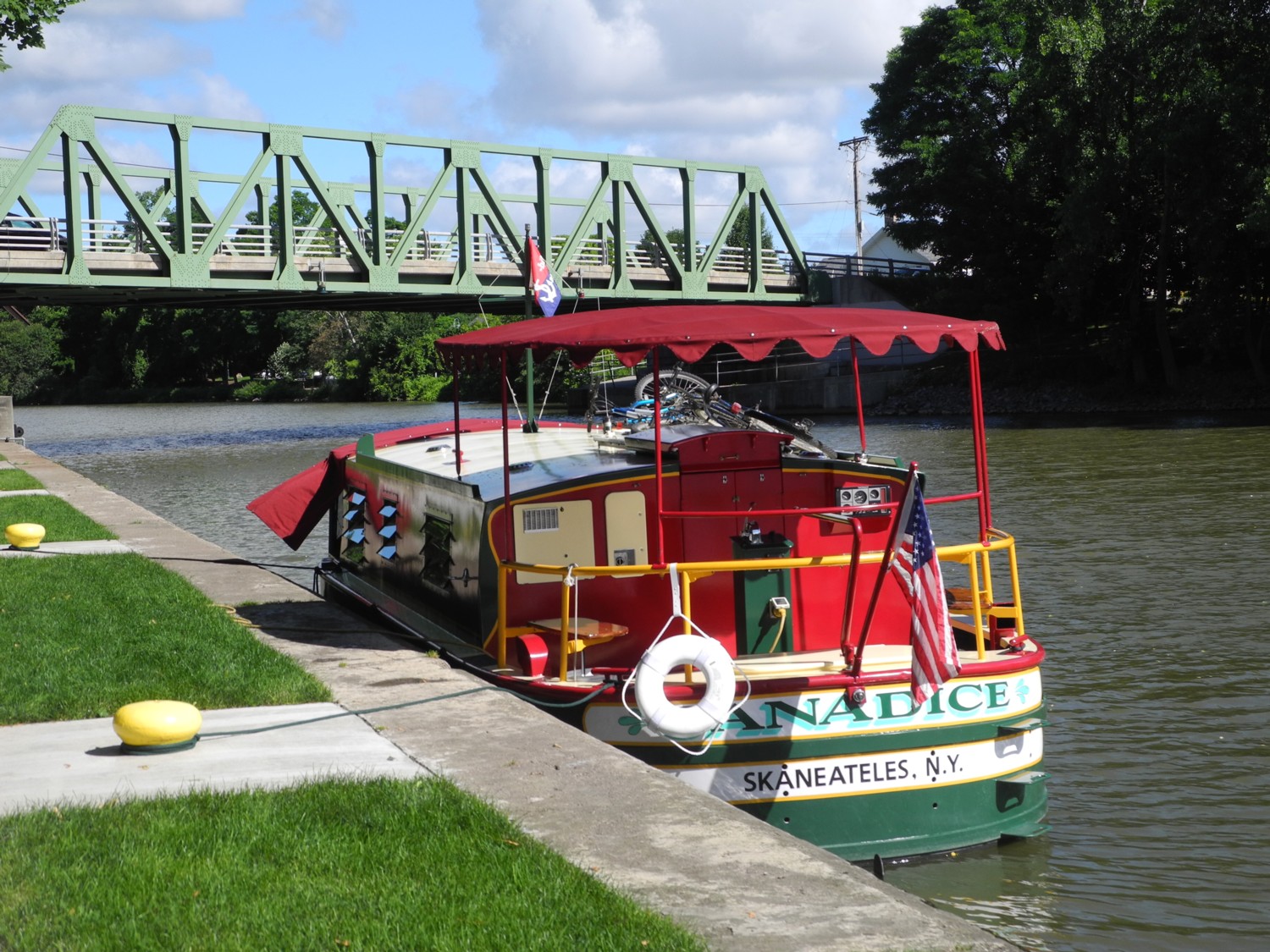
The Upper Gauley starts just below Summersville Dam and drops more than 335 feet in fewer than 13 miles, creating the most intense whitewater on the river and one of the most challenging whitewater experiences in the world. The 12-mile Lower Gauley is slightly less intense, but still extremely challenging, with 70 rapids.

On Gauley Season days, water is released from the Summersville Dam into the river below by the U.S. Army Corps of Engineers. The release is controlled at 2,800 cubic feet per second (CFS), ensuring that the resulting rapids are predictably wild.

As a result of a long-time agreement between the U.S. Army Corps of Engineers and resorts like Adventures on the Gorge, the releases are scheduled for Fridays through Mondays so rafters can plan for long weekends of adventure. Release dates this year are Sept. 6-9, 12-16, 20-23, 27-30 and Oct. 4-6, 12-13 and 19-20.

The minimum age to experience the Deluxe Gauley River Overnight is 16. Pricing of the two-day adventure starts at $439 per person.

The conclusion of Gauley Season coincides with the region’s annual Bridge Day celebration on the third Saturday of October. That’s when the New River Gorge Bridge is closed to traffic and BASE jumpers and rappelers jump from the bridge into the New River below while hundreds of pedestrian celebrants watch the fun.

Adventures on the Gorge is an adventure resort located on more than 350 acres along the rim of New River Gorge near Fayetteville, West Virginia,

Adventures on the Gore offers several options for rafters, including the Upper GauleyLower Gauley and Gauley Reverse 2-Day. Additionally, some rafters run both stretches as part of the Gauley Marathon while others take on the Upper Gauley twice in one day as part of the Double Upper Gauley 1-Day 2-Night package.

Other adventures include rafting on the New RiverTreeTops Zipline Canopy Tour, Bridge Walkrock climbing, and TimberTrek Adventure Park.

One of AOTG’s more popular options is a two-day Upper and Lower Gauley rafting experience broken up by camping at Canyon Doors, a permanent campground on the river featuring a wood-fired hot tub, hot showers, bathrooms and gourmet meals prepared by an expedition chef.

Adventures on the Gorge offers glamping tents, RV sites, tent platforms and a variety of cabins, such as multi-bedroom Cabins on the Gorge, with kitchens, furnished living areas and private hot tubs; bunkhouse style Sportsman Cabins, ideal for families and friend groups; and hotel-style Sunnysides.

Adventures on the Gorge is an adventure resort located on more than 350 acres along the rim of New River Gorge near Fayetteville, West Virginia, in a region with three national parks units including the newest national park in the U.S., New River Gorge National Park and Preserve.

(https://adventuresonthegorge.com/, 1-855-379-8738)

Spacious Skies Campgrounds Along the Fall Color Trail

Spacious Skies Campgrounds has launched a two-week sale on stays during its Fall Color Trail. Guests who book RV sites, lodging and glamping accommodations and tent sites through September 12 will receive a 25 percent discount between now and October 14, 2024 at any of the company’s 15 campgrounds located from Maine to Georgia, which also are staging Themed Weekends throughout the season.

For RVers with time and a love for natural beauty, there’s the Fall Color Trail, a 2,500-mile route that connects the campgrounds from Spacious Skies Balsam Woods in north central Maine to Spacious Skies Savannah Oaks in Georgia and showcases the brilliant progression of fall color over a 2 ½-month period, from early September through mid-November. Along the way there are wide-ranging adventures such as apple-picking farms, golf courses, historic sites, charming towns, national and state parks, museums, shopping and outdoor adventures. 

Many of the campgrounds offer alternative accommodations for travelers who don’t own RVs, including cabins, yurts, tent sites and in select locations, retro trailers. Spacious Skies has also partnered with RV Share so would-be campers and glampers can rent RVs in each location or rent RVs that they can drive from place to place.

Among them:

Lakeside: Cosmos Cottage at Spacious Skies Woodland Hills in Upstate New York’s Taconic and Berkshire Mountain Ranges. The cabin can sleep up to six people – and canine campers too – and it includes two bedrooms, kitchen area stocked with cookware and dishes, coffee machine, two televisions, fire pit, picnic table and private deck overlooking the campground lake. 

Cosmic retro vibe: Also at Spacious Skies Woodland Hills, there are three Riverside Retro Campers that sleep between two or four guests. These glamping faves are great for getaways with a retro vibe but all the modern stuff. Riverside Retro Trailers are also available at Spacious Skies Country Oaks in Dorothy, N.J., Spacious Skies French Pond in Henniker N.H. and Spacious Skies Walnut Grove in Alfred, Maine.

Hiking New York State Adirondacks in fall. © Karen Rubin/goingplacesfarandnear.com

A place for you and 13 of your besties: The Zodiac Lodge at Spacious Skies Adirondack Peaks is just the place for girlfriend getaways, multi-family fun or even corporate retreats. Filled with fittingly lodge-y furniture, a fully equipped kitchen, four bedrooms and two bathrooms, this sprawling cabin in the Adirondacks – open May through October – is just the place for a woodsy getaway.

Moonlight, big sky…and a must-visit place for history nerds: The Quarter Moon at Spacious Skies Shenandoah Views is a four-person yurt at with a private deck and patio, kitchen and bathroom and big-sky views of the Virginia skies and surrounding Blue Ridge Mountains. Located within minutes of Shenandoah National Park, wineries, rafting and ziplines, historic sites and the darling town of Luray, the campground is a go-to place for fans of fall color and outdoor adventure. Nearby attractions include Patsy Cline’s hometown as well as the point a young surveyor named George Washington used as a reference to map the vast land holdings of Lord Fairfax in the 1700s.

A tiny home called Hercules: This quaint little cabin Spacious Skies Walnut Grove in Alfred, Maine, called Hercules is an impressively designed, compact cabin that sleeps six with two full beds and twin bunk beds. Explore the nearby Old Orchard Beach Pier or the landmark L.L. Bean store.

A place to reconnect with your inner compass: The North Star Guesthouse at Spacious Skies Belle Ridge in Monterey, Tenn. between Nashville and Knoxville is a three-bedroom, two-bath retreat that can sleep up to 12 people. Open year-round, guests can explore the 500-acre campground’s trails, backcountry waterfalls, fishing pond and natural spring-fed rock pond for swimming. It’s also the place to be for fall color, with abundant oaks, maples, dogwoods and poplars turning vibrant shades of red, orange and yellow well into mid-November.

To receive the discount, campers can book online and use the promo code FALLTRAIL. The sale ends September 12 and is limited to one usage per customer. For more information, visit www.spaciousskiescampgrounds.com.

Maine Fall Vacation

Crisp beach walks; apple orchards; and brilliant crimson, gold and orange foliage are just a few of the things that make fall a glorious time to visit Maine. Maine’s Tourism office has created helpful lists to facilitate your visit:

A historic Windjammer is a gorgeous way to experience fall in Maine © Karen Rubin/goingplacesfarandnear.com

Outdoor Recreation opportunities include Hiking & Climbing (see Maine Trail Finder for hikes for all abilities). On the Water: take a leisurely sail aboard a historic  Maine Windjammer  or a sea kayaking trip; visit a beach (my favorite, Old Orchard Beach has access to a beachfront amusement park, Palace Playland, with rides and Maine’s largest arcade). Biking (pedal through tunnels of vibrant colors or bike to a breathtaking overlook along Maine’s scenic trails and picturesque routes). Camping. Fall Festivities and Fairs.

Leaf-peeping Opportunities: Peak foliage season varies across the state, but it is typically from the last week of September to the first two weeks of October. Maine has a foliage tracker that starts up in September to help you plan your trip.

Stunning Drives: Maine’s foliage is accessible via the state’s seven National Scenic Byways. These historic drives are designated by the federal government as some of the most beautiful and enjoyable across the country.

Fall Meandering: The newly enhanced Maine Oyster Trail will help you experience Maine’s acclaimed bivalve from the farmer to the raw bar. Get off the beaten path and link to Farms & Fiber Arts Trip Ideas to enjoy a getaway visiting farms, farm stands and specialty shops, or try a workshop where you can learn a variety of skills, like knitting a sweater from Maine wool. Maine Craft Weekend, the first weekend October, is the chance to see private artist studios and meet the artists, visit craft-based schools and craft beer breweries collaborating with artists, and purchase Maine-made goods at pop-up shops.

Arts & Culture: The Maine Art Museum Trail features nine museums and more than 80,000 works of art, (my favorite is the Farnsworth Museum, Rockland, with a fabulous collection of Wyeths). Check out the Art & Ales Trip Ideas for tips on where to find art in Maine in many shapes and forms, from gigantic sculptures to live performances, and sample the art of handcrafted local brews.

Where To Stay: The choices are endless: Campgrounds, Sporting Camps & Wilderness Lodges,  Inns / Bed & Breakfasts, Resorts, Hotels & Motels

More info at VisitMaine.com

Fall in Tennessee

Enjoying fall colors on a cruise on the Tennessee River from Chattanooga © Karen Rubin/goingplacesfarandnear.com

Vivid autumn leaves burst through the trees, new experiences await the fall bucket list, the aroma of apple and pumpkin treats waft through the air and echoes of ghost stories whisper with haunted happenings. Here’s what’s new and trending this fall in Tennessee.

Chattanooga – Rock City’s Fall Colors is an autumn splendor of pumpkins, haybale vignettes and seasonal decorations and live music.

​​Pigeon Forge (Sept. 9-Oct. 28) –. Dollywood’s Great Pumpkin LumiNights illuminates the evening with the whimsical glow of over 12,000 pumpkins.

Nashville (Sept. 14-Oct. 27) – Cheekwood Harvest is a fall wonderland with 75,000 pumpkins and 4,000 chrysanthemums; stroll through the Community Scarecrow Trail, iconic Pumpkin Village, live music in the beer garden.

Nashville –Ghost Tours: Tragedy and Mystery at The Hermitage presents stories of unusual experiences of Andrew Jackson’s family and unexplained incidents on the site, a rare opportunity to see the mansion, grounds and cemetery by lantern light.

Memphis – Each October, visitors can take special tours and attend Soul of the Cemetery to hear stories of Elmwood CemeteryBackBeat Tours shares more historically spooky tales with walking ghost tours through some of the most haunted places in Memphis.

Rugby – Historic Rugby After Dark tours guide guests through original buildings and structures of the Victorian village founded in 1880s..

​​Adams – Experience October at one of the most haunted locations in the country. Hear the folklore at Bell Witch Cave, which offers paranormal tours, cabin tours, daytime hayrides, nighttime haunted hayrides.

McMinnville – The Discovery Walking Tour is an all-new immersive experience surrounded by video, light and sound deep within the cave.

Morgan County – Hike MoCo kicks off the Fall Frenzy Hiking Series Sept. 22. Explore and soak in the scenery along trails of Big South Fork, Frozen Head, Obed, Cumberland Trail.

Visit TNvacation.com

California Colors

Fall is harvest season in Sonoma, California © Karen Rubin/goingplacesfarandnear.com

Fall is harvest season in California wine country so while the wine is flowing, the vineyards have turned orange, maroon and crimson. Sonoma Valley, a 17-mile-long valley within Sonoma County that encompasses the city of Sonoma and the villages of Carneros, The Springs, Glen Ellen, and Kenwood, is the ideal drive to take in stunning rolling hills, gorgeous hotels and resorts, historic attractions and, breathtaking vineyards.

From its dramatic waterfalls, giant sequoias and unbelievably tall, sheer granite towers, Yosemite National Park is one of the most breathtaking places on earth and during the fall, its full of life and colors. Dogwoods, Big Leaf Maples, and the Black Oaks are but just a few that put on a showy display of autumnal color. Fall colors can usually be seen throughout the month of October but have been known to start in September at higher elevations and run into November. 

Fall is ideal time to visit Yosemite National Park, when (hopefully) crowds have thinned out © Karen Rubin/goingplacesfarandnear.com

In El Dorado County, Historic Hwy 49 (which runs the length of historic Gold Country) offers an array of colorful foliage – dogwood, aspen and maple light up the Mother Lode with orange, red and yellow. In Coloma, the  Marshall Gold Discovery State Historic Park affords spectacular views along the American River as well as many stands of colorful trees.

More info at www.visitcalifornia.com.

_______________________

© 2024 Travel Features Syndicate, a division of Workstyles, Inc. All rights reserved. Visit goingplacesfarandnear.com and travelwritersmagazine.com/TravelFeaturesSyndicate/. Blogging at goingplacesnearandfar.wordpress.com and moralcompasstravel.info. Visit instagram.com/going_places_far_and_near and instagram.com/bigbackpacktraveler/ Send comments or questions to FamTravLtr@aol.com. Tweet @TravelFeatures Threads @news_and_photo_features ‘Like’ us at facebook.com/NewsPhotoFeatures