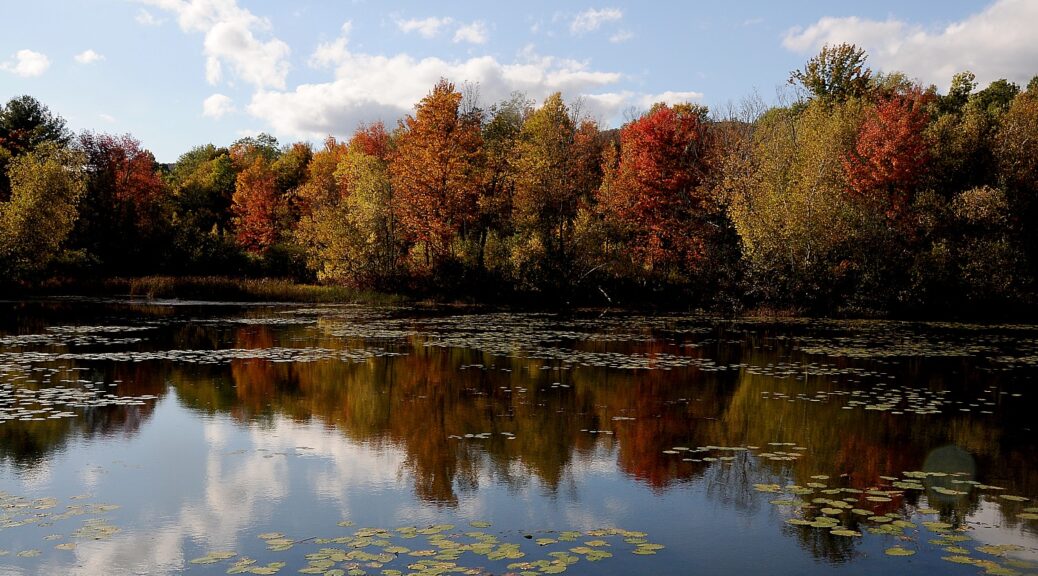
Most Glorious Fall Foliage is Right in Our Neck of the Woods

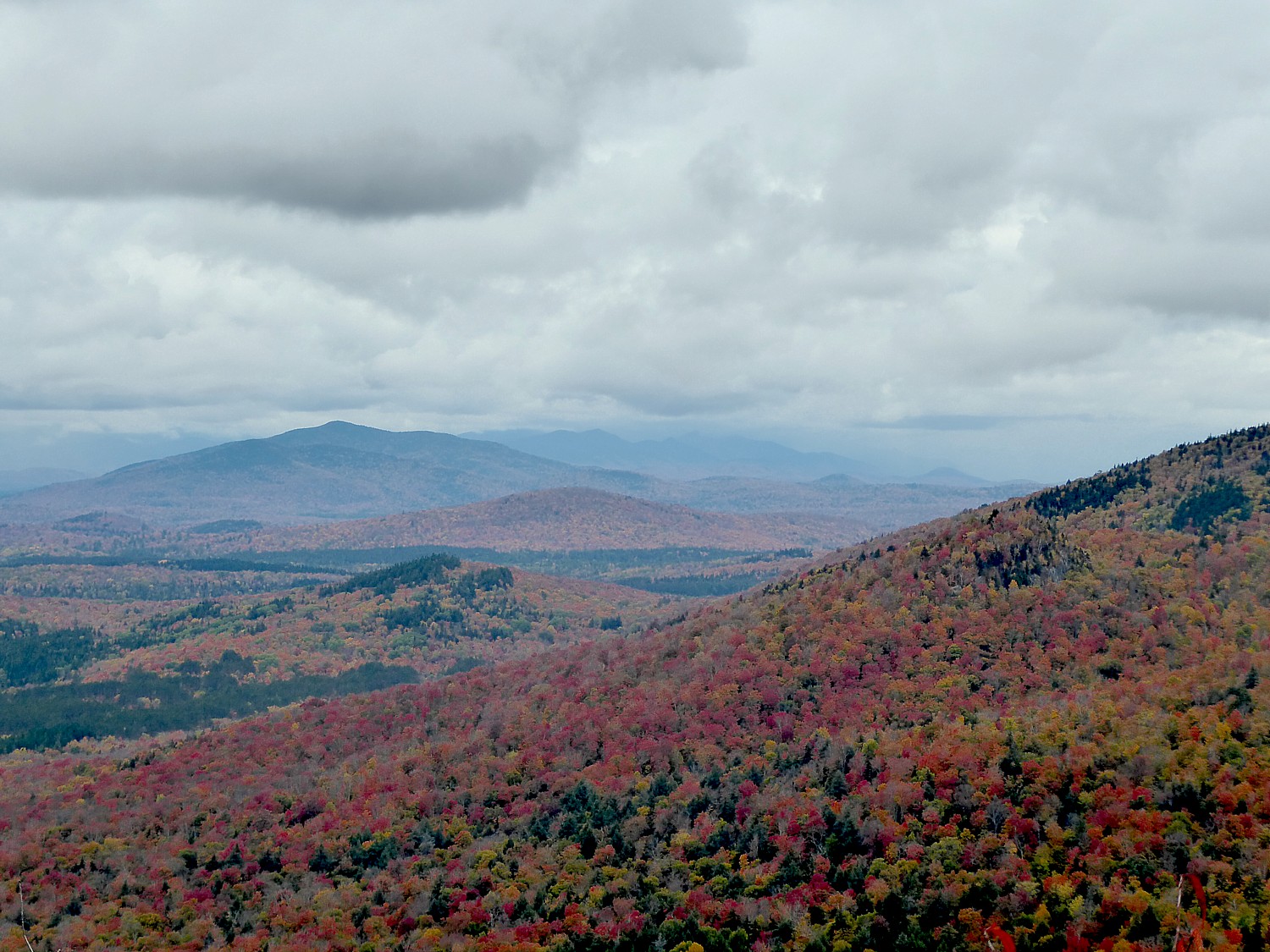
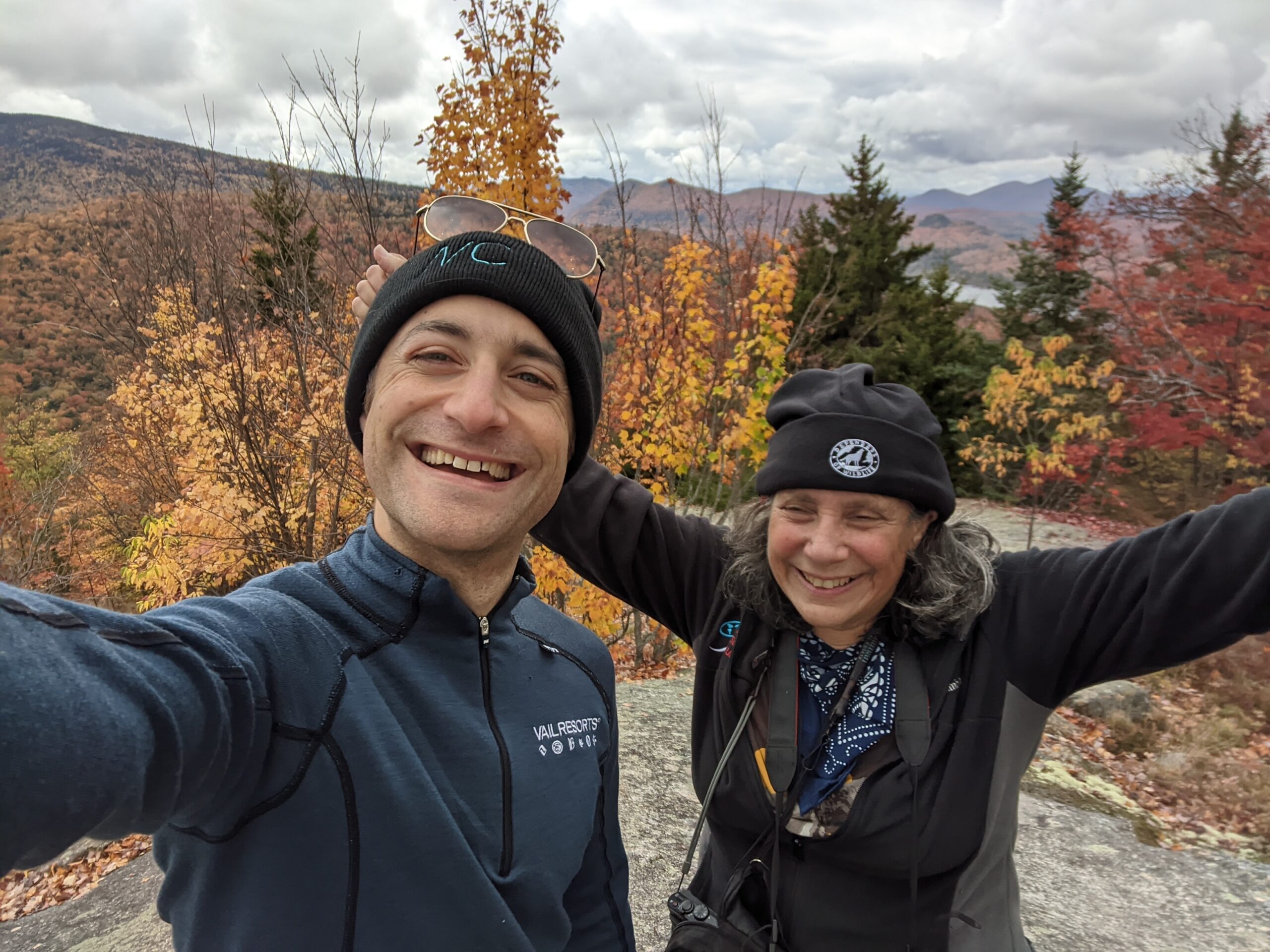
A hike up Chimney Mountain in New York’s Adirondacks to take in the fall colors © Dave E. Leiberman/goingplacesfarandnear.com

By Karen Rubin

Travel Features Syndicate, goingplacesfarandnear.com

Take advantage of the outdoors this fall – hiking, biking, kayaking, pick-your-own apples, pumpkins, and camping!

And New York State really has it all.

The I LOVE NY weekly foliage report is a great tool for visitors looking to plan a seasonal getaway – you can not only follow the progress of the changing colors, but the new interactive fall foliage map, located on the I LOVE NY foliage website, showcases great foliage viewing locations in each of the various regions throughout the state. You can use the map to see what the foliage is like during peak viewing in a given area find nearby, must-see attractions and events, from harvest festivals to Halloween celebrations, craft beverage trails, museums and family fun. Reports and the new interactive map are updated Wednesdays throughout the season at www.iloveny.com/foliage or dial 800/CALL-NYS (800/225-5697).

Thanks in part to its size and location, New York State has one of the longest and most colorful foliage seasons in the country. From late September through mid-November, some part of the state is likely experiencing peak foliage.  

Travelers are invited to share their photos of New York State’s amazing foliage on social media by using the #NYLovesFall hashtag. Submitted photos may be featured on the I LOVE NY fall foliage website and official I LOVE NY social media accounts reaching nearly two million followers. 
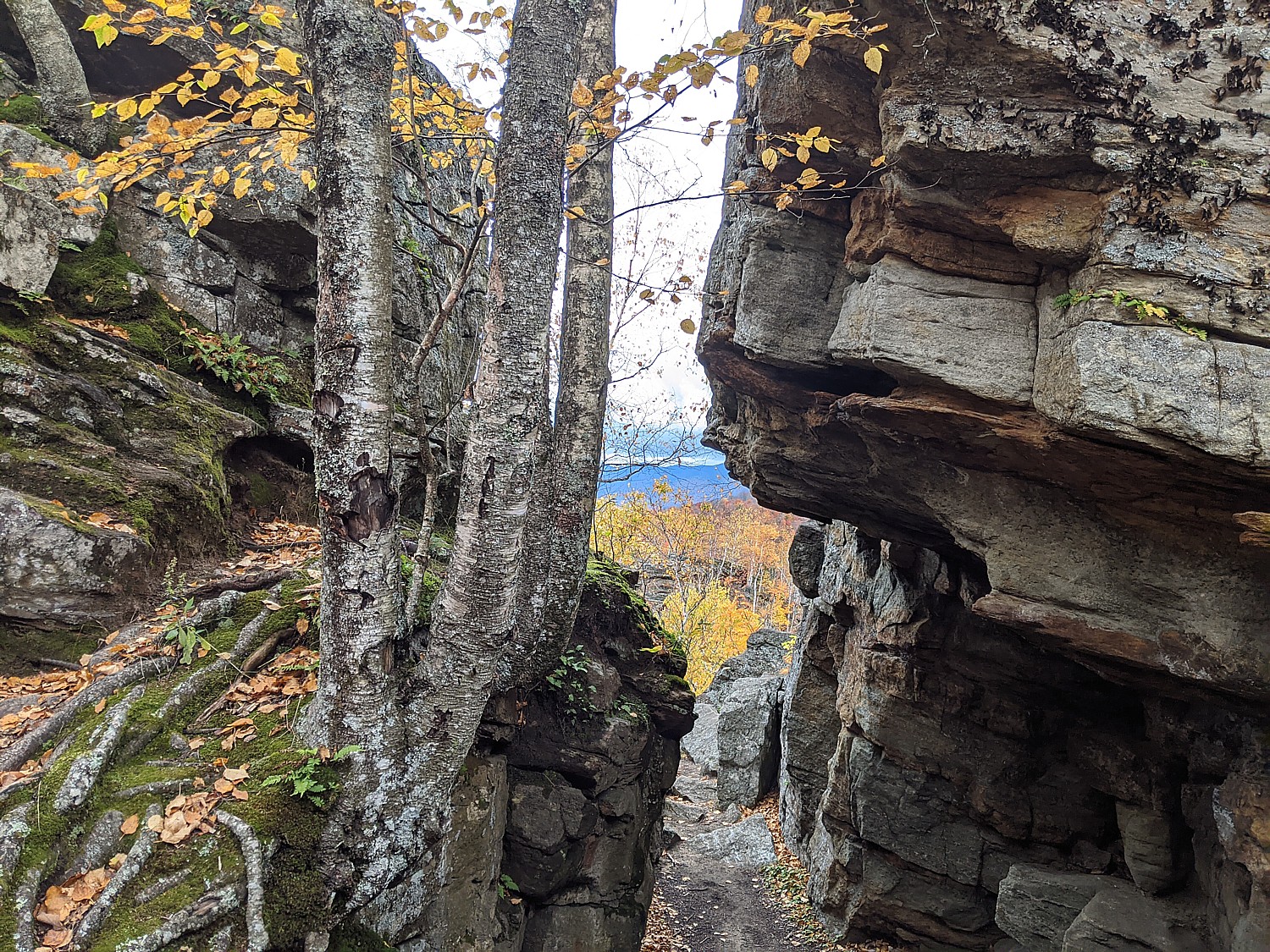
A hike up Chimney Mountain in New York’s Adirondacks to take in the fall colors © Karen Rubin/goingplacesfarandnear.com

The colors are already turning in the ADIRONDACKS, which peaks around Columbus Day weekend. Adirondack Experience lists hikes in categories, one of which is “best summit views” with excellent descriptions (also alltrails.com gives precise maps, elevations).  Last fall, based on their recommendation, we did Chimney Mountain and Castle Rock hikes in one day (www.adirondack.net). The Adirondack Fall Foliage Meter (www.adirondacksusa.com/fall) provides up-to-the-minute fall foliage reports on where the leaves are prettiest and most colorful. More sources: Adirondacks Regional Tourism, visitadirondacks.com; Hamilton County Tourism, adirondackexperience.com, 800-648-5239.
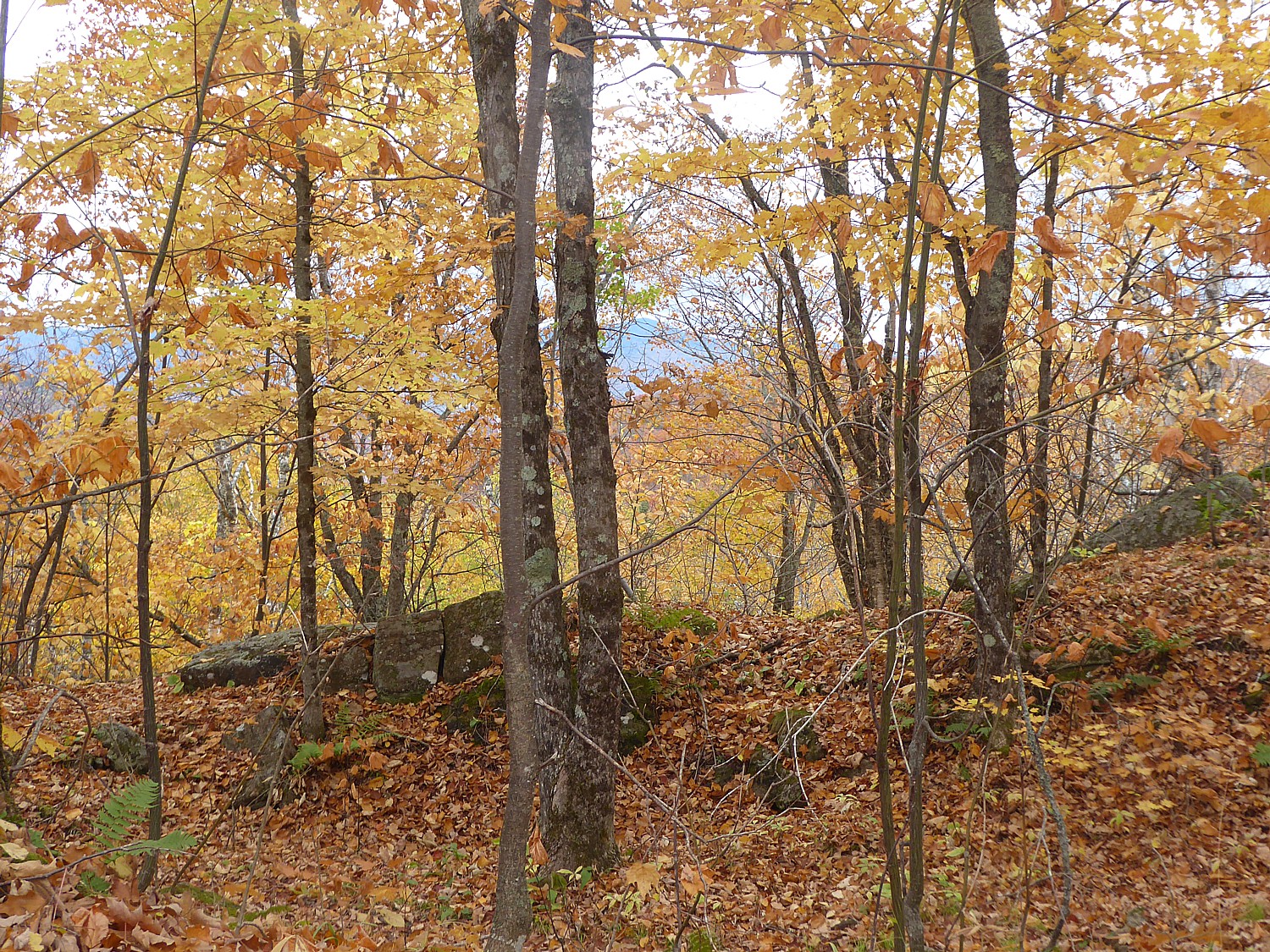
A hike up Chimney Mountain in New York’s Adirondacks to take in the fall colors © Karen Rubin/goingplacesfarandnear.com

A little later in the season, GREENE COUNTY/GREAT NORTHERN CATSKILLS are spectacular (https://www.greatnortherncatskills.com/outdoors) – like hiking through the exquisite North South Campground, which is part of the Hudson River School Art Trail (a network of trails and attractions like Frederic Edwin Church’s Olana, where besides his extraordinary home, you can visit Olana’s 250-acre landscape for free (olana.org) and the Thomas Cole House (thomascole.org). I’m still partial to spending as much time outdoors as possible, so I am happy following the Hudson River Art School Trail (hudsonriverschool.org). (These days, it is best to check the website to make sure indoor attractions are open and if they require advance purchase, timed tickets.)

In Greene County:

Take a Ride:

The Windham Mountain Skyride features a two-mile chairlift to the summit of Windham Mountain, providing incredible panoramic views and is open through October 11th. For additional mountainous scenery, the Hunter Mountain Scenic Skyride offers a two-mile, six-passenger chairlift with views of the Northern Catskill Mountains, open through October 17th.

Explore one of many motorcycle routes showcasing scenic views: ride on the Mohican Trail past the Five State Lookout, the Mountain Clove Run, or another picturesque route in the Great Northern Catskills. Or explore the 120 miles of some of the best mountain biking trails in the country.

Take a Hike:

In Prattsville, Pratt Rock, known as “New York’s Mount Rushmore,” offers a 3.1-mile round trip hike featuring a historical monument dedicated to Zadock Pratt, with summit views overlooking the valley with ample foliage.

For a challenging, yet rewarding ascent, the Hunter Mountain Fire Tower via Spruceton Trail, offers incredible panoramic views of the Catskill Mountains.

For a less intense, yet equally as scenic excursion, the Mountain Top Arboretum in Tannersville offers 178 acres of trails and boardwalks to admire the autumnal beauty.

Visit Local Farms:

Boehm Farm located in Climax offers a pick-your-own produce experience in addition to a variety of farm-grown and baked seasonal goodies. Be sure to call prior to visiting for the most up-to-date information on picking variety availability.

For a family experience, find spectacular views at East Durham Farms in East Durham. Bring home farm-grown produce, local jams, jellies, cheeses and other goods for everyone to enjoy.

To sample fall-grown produce and locally made products, visit Story Farms in Catskill for delicious harvested fruits and vegetables from the family-run farm, or RSK Farm in Prattsville for a variety of fall vegetables available at their farmstand.

(Great Northern Catskills, 800-355-CATS, 518-943-3223, www.greatnortherncatskills.com)
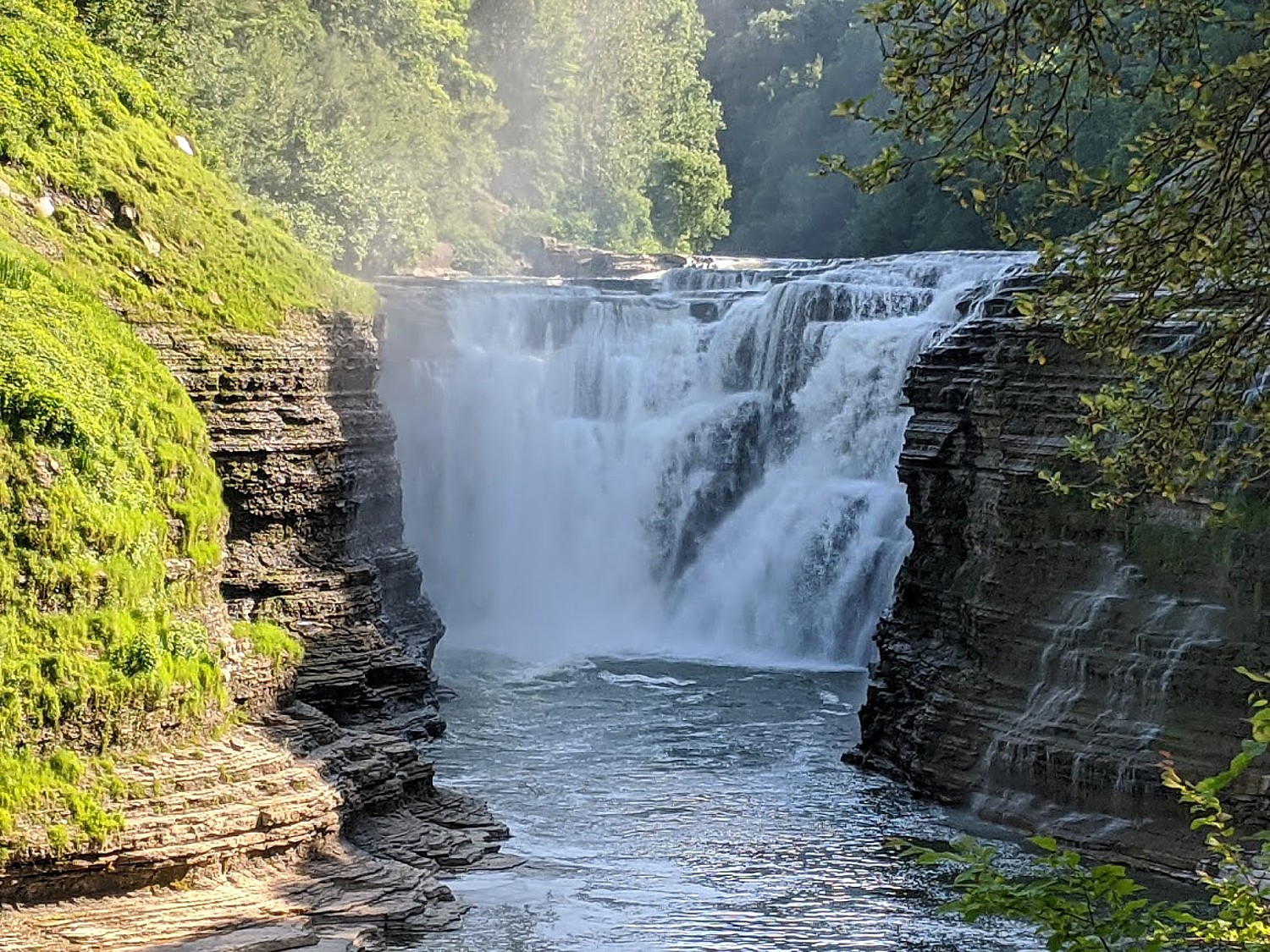
Letchworth State Park, the “Grand Canyon of the East” (where New York State has just opened an innovative autism nature trail) © Karen Rubin/goingplacesfarandnear.com

The Finger Lakes region has over 1,000 waterfalls and gorges, 650 miles of shoreline, more than 16,000 acres of National Forest, and over 2,000 miles of hiking and biking trails – such as we enjoyed in Watkins Glen State Park and Letchworth State Park, the “Grand Canyon of the East” (where the state has just opened an innovative autism nature trail – a one-mile hiking loop that includes eight marked sensory stations, each designed to address a different sensory experience in a safe and supportive environment). Also, vineyards, wineries, breweries, rail-trails. museums, art galleries, historic sites, theaters. Excellent planning aids are available from The Finger Lakes Tourism Alliance, 309 Lake Street Penn Yan, NY 14527, 315-536-7488, 800-530-7488, www.fingerlakes.org. Another excellent source of visitor information is Visit Finger Lakes, 585-394-3915, info@visitfingerlakes.com, www.visitfingerlakes.com.

Watkins Glen State Park © Karen Rubin/goingplacesfarandnear.com

Go totally au natural and camp out (through October). We adored our camping adventures at the in Letchworth State Park and the4 Six Nations Campground in Watkins Glen State Park (https://newyorkstateparks.reserveamerica.com/)

In Coxsackie, Gather Greene is a glamping destination with 17 wooden glamping cabins on 100 acres of rolling hills and fields, each equipped with air conditioning and heating, full bathrooms, a mini-fridge (176 Levitt RoadCoxsackie,  262-448-3683, www.gathergreene.com).

Camp New York is a network of independent campground owners across New York State, from the high peaks of Adirondacks to the majestic Niagara Falls frontier, from the scenic Finger Lakes to the eastern edges of Long Island, and everywhere in between (585-586-4360, www.campnewyork.com). Here are some of their recommendations: For those looking to take scenic fall drives, U.S. Route 20 runs east/west through the heart of NYS, crossing along the tips of several Finger Lakes and offering beautiful rolling hills and sweeping vistas. These websites, https://nyroute20.com/ and https://www.dot.ny.gov/display/programs/scenic-byways/route-20, cover sights to see in the Central New York section. Some popular base camps along the way include Lebanon Reservoir Campground in Hamilton (www.lebanoncampground.com), about 15 minutes off Route 20, and Cider House Campground in Bouckville (www.ciderhousecampground.com), which is located right on Route 20 in the heart of the Madison Bouckville Antiques Community (https://www.ciderhousecampground.com/https://www.madisontourism.com/things-to-do/antiquing/). Families looking for spooky destinations across New York should check out the Haunted History Trail (https://hauntedhistorytrail.com/) and crosscheck the haunts of interest with neighboring campgrounds on CampNewYork.com.

New England Beckons

NEW HAMPSHIRE’s Lakes Region not only offers gorgeous scenery, hiking, biking, but wonderful fall festivals and events.

I have my sights set on the 58-mile long Northern Rail Trail. Set geographically right in the middle of classic New England, it crosses New Hampshire beginning just north of the state’s capitol in Concord, N.H. and extends almost to Vermont in Lebanon, N.H. Now a recreational trail, it was once the rail bed of the Northern Railroad built in 1847, so the gradient never exceeds 1 percent. It traverses rivers, working farms, orchards, horse and alpaca farms, lakes, quaint towns and historic covered bridges and affords classic New England vistas. Railroad buffs will love seeing the historical artifacts that remain: there are the original granite mile markers a couple of old railway stations and noteworthy rock work supporting trestle crossings and culverts. You can easily imagine what New England looked like in the 1850s. Currently the trail has been completed for four-season use from Lebanon, NH through Grafton, NH and Danbury, Andover to Depot Street in Franklin. (The Friends of the Northern Rail Trail group has the goal of extending the tail from Danbury, NH to Boscawen in Merrimack County, NH).  (More information: Friends of the Northern Rail Trail, www.fnrt.org )

New Hampshire innkeepers have made it delightful to turn the Northern Rail Trail ride into an inn-to-inn bike tour. Seven historic inns throughout the Lakes and Dartmouth-Lake Sunapee regions are connected by the trail and offer inn-to-inn packages. For more information, maps and rates, visit Bike the Northern Rail Trail website at: http://bikethenorthernrailtrail.com and find the innkeepers at www.nhcountryinns.com.

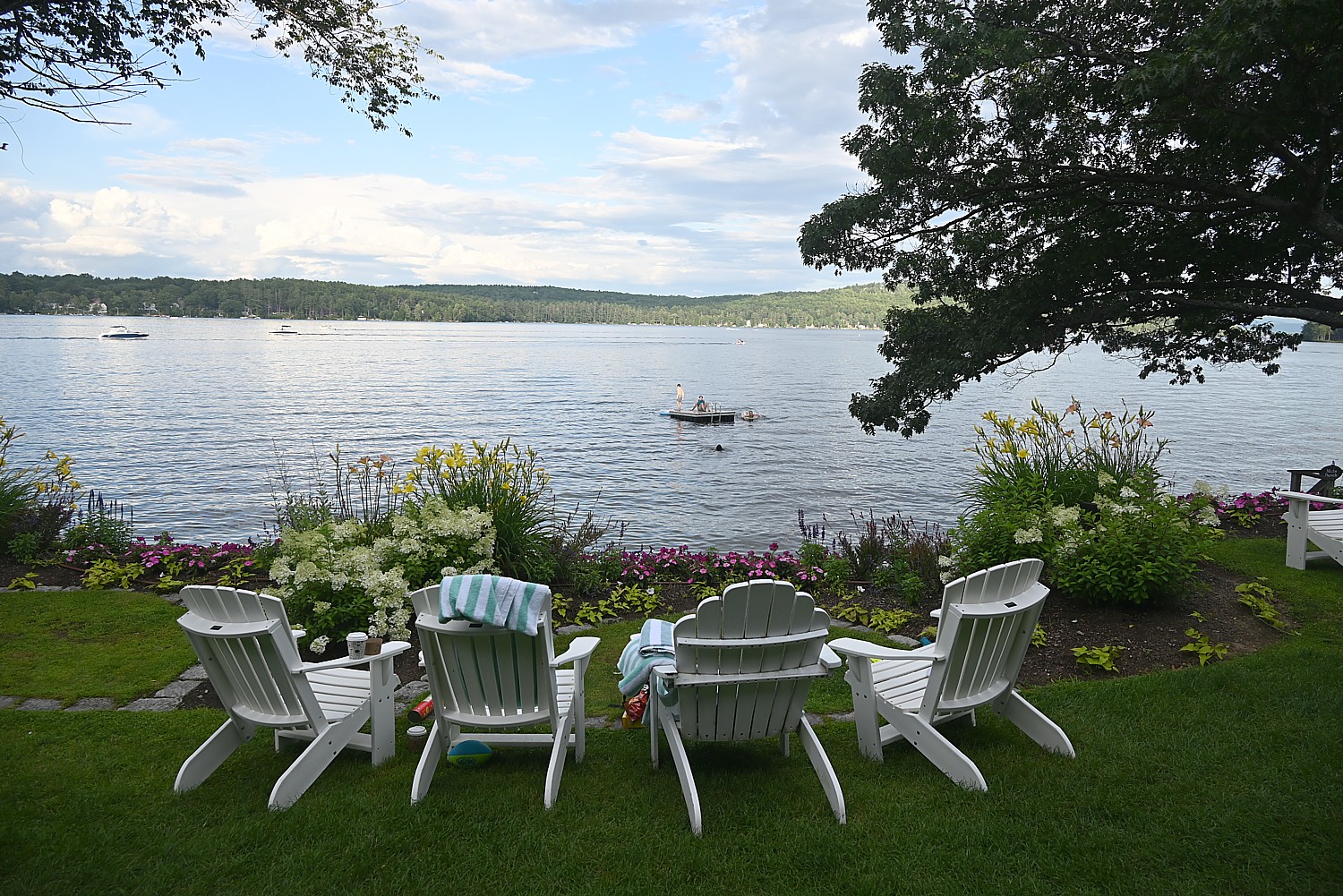
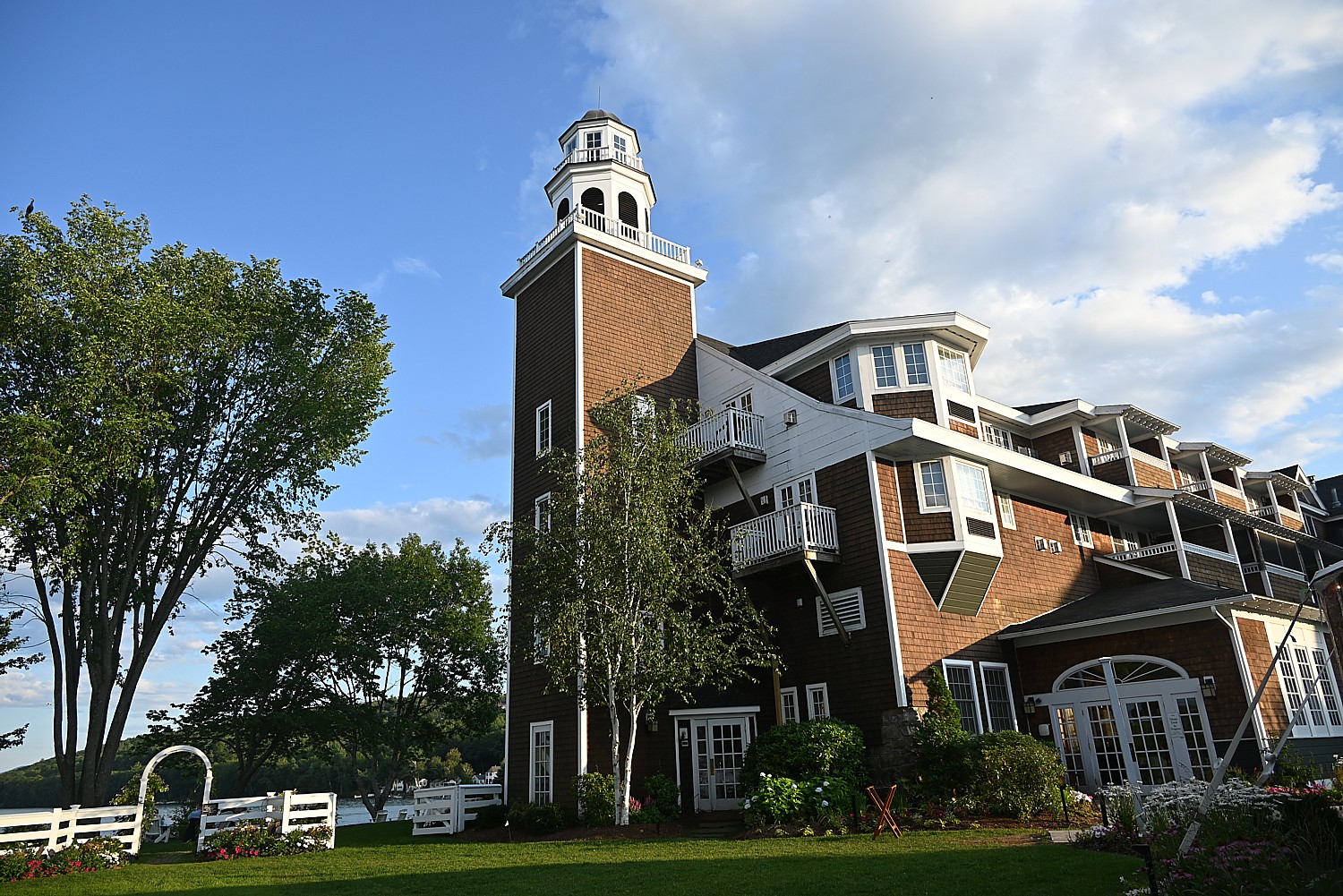
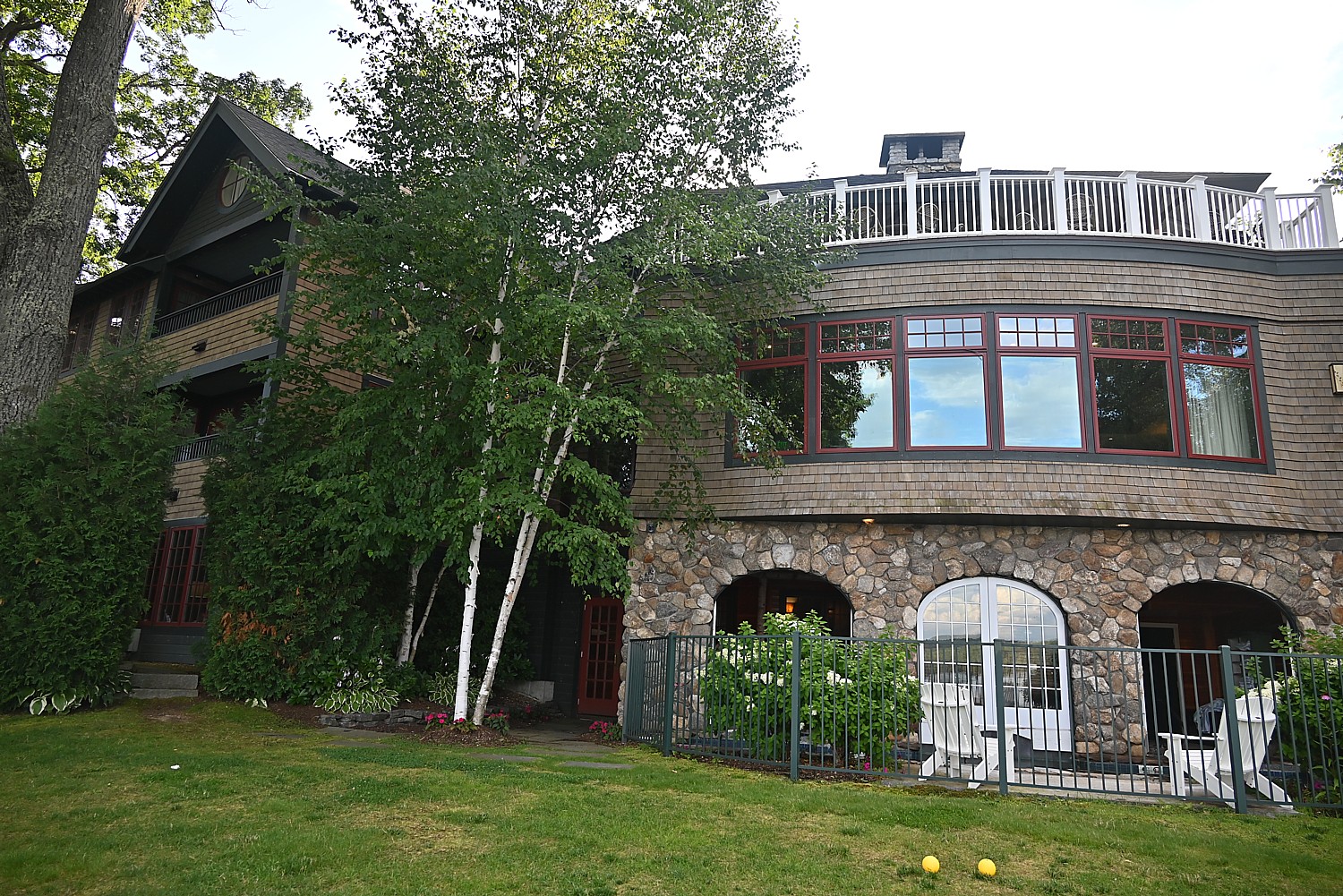
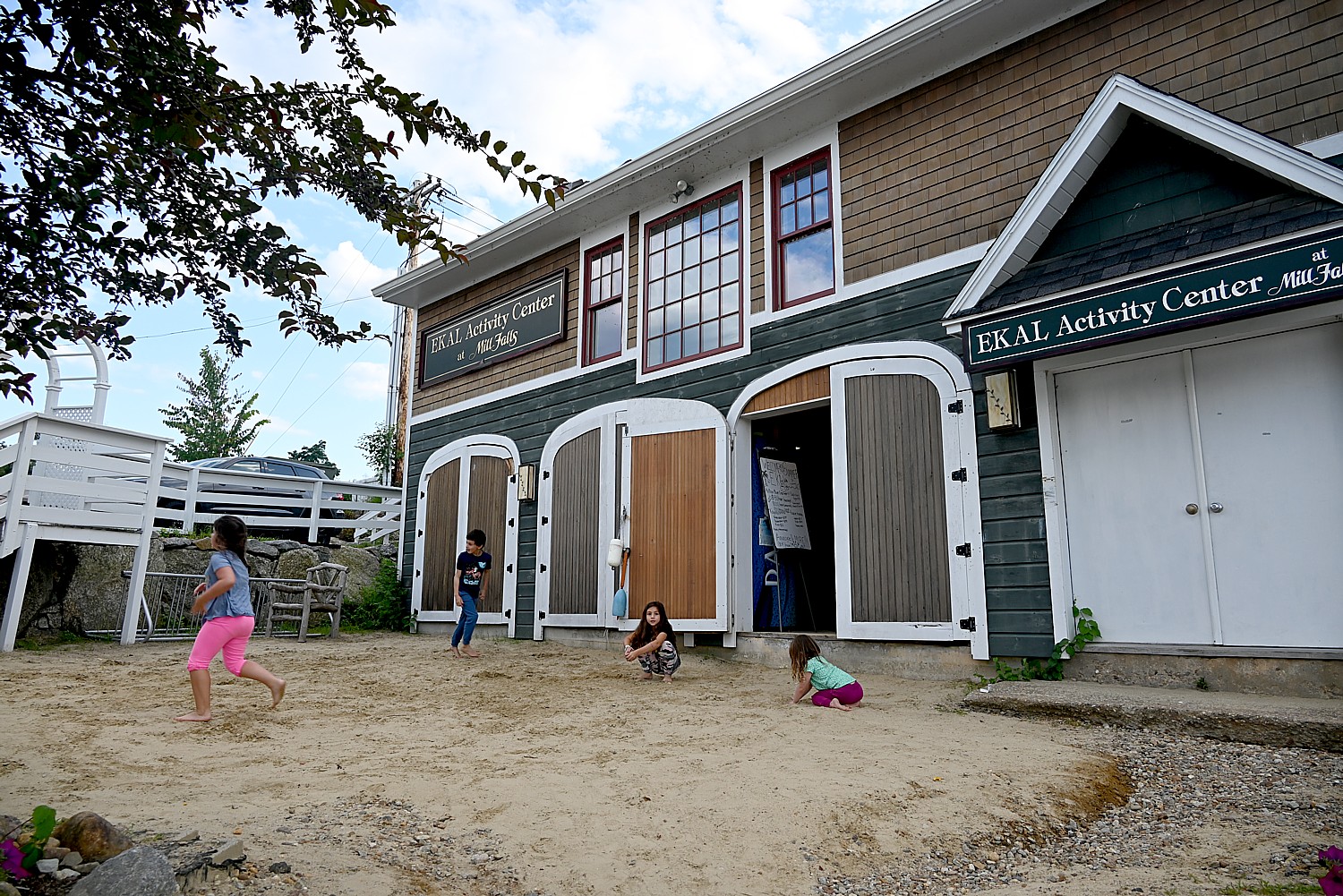
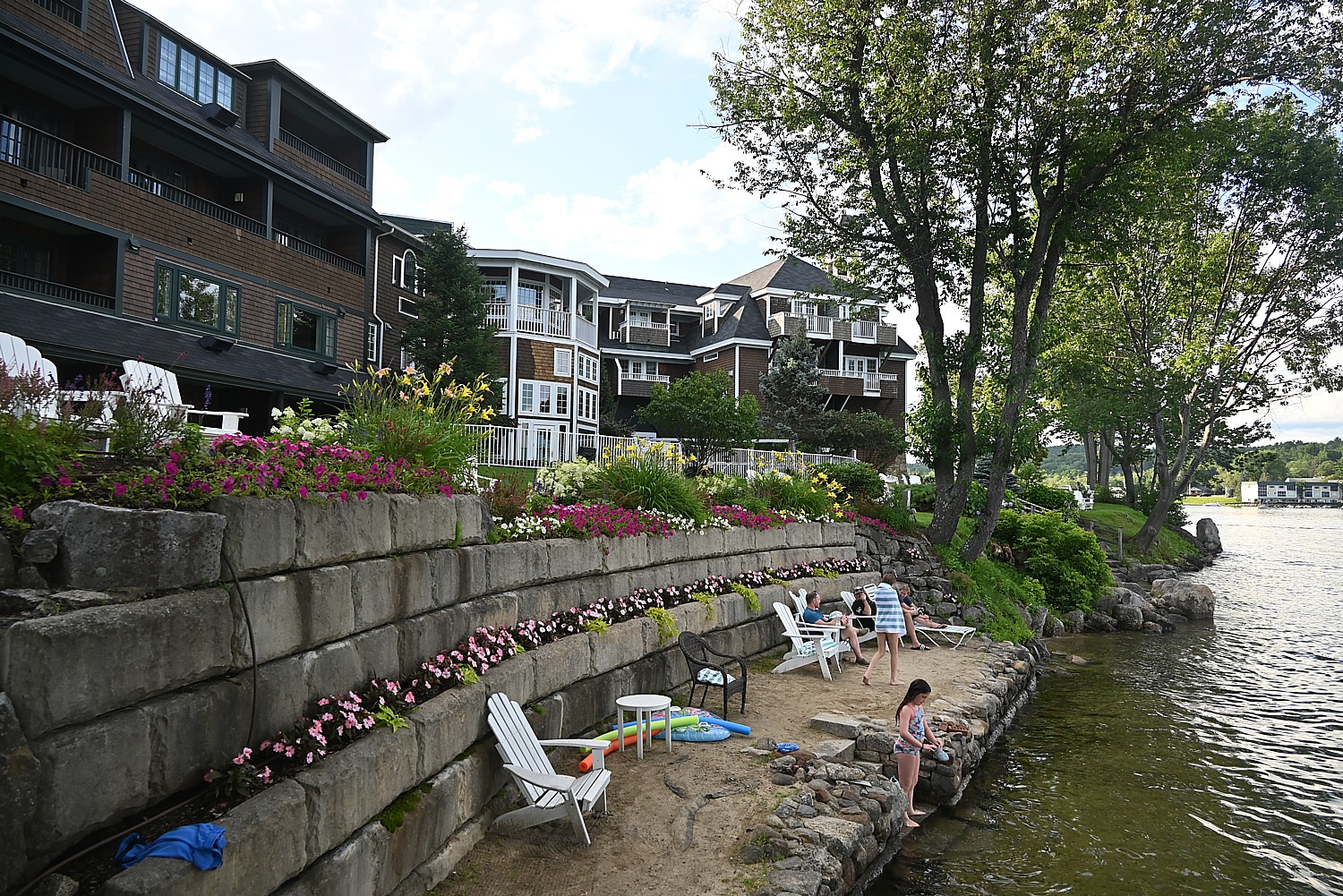
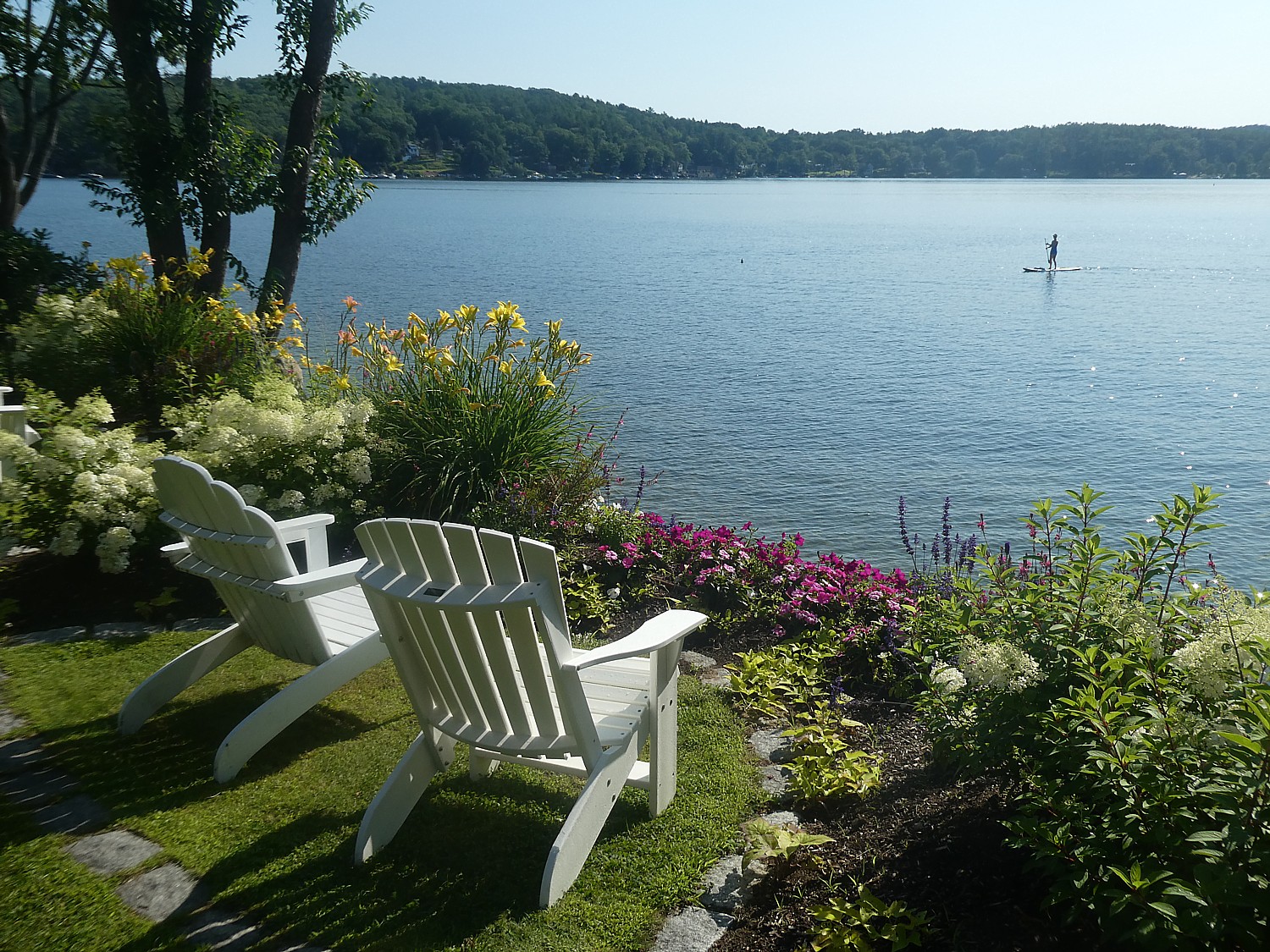
We recently enjoyed our stay at Mill Falls at the Lake (312 Daniel Webster Highway, Meredith, NH 03253, 800-622-6455, 844-745-2931, info@millfalls.com, www.millfalls.com)  , but there are scores of bnbs, cabins, cottages, hotels in the region.

The Lakes Region tourism office has a fantastic site to plan a visit: https://www.lakesregion.org/

Of course, VERMONT has practically trademarked “fall foliage.” Indeed, three-quarters of the state is blanketed with forests, most of it maple trees that turn the vibrant shades of red, orange and yellow. You can track the progress of the color changes with the state’s foliage forecaster and sign up for Vermont’s fall foliage report to get real time updates on where the color is peaking each week.  Find trip planning inspiration, ideas and resources at https://vermontvacation.com/seasons/fall.

There, you can link to Vermont’s 10 federally designated scenic byways routes and roads that take you through Vermont’s forests and farmland to historic villages and towns that are vibrant hubs of culture, commerce and recreation. These byways range in length from 14 miles to 400 miles and provide access to museums, art galleries, antique auctions and curio shops, trail heads, swimming holes, waterfalls, hikes and valley views (https://vermontvacation.com/byways). You can also follow the Vermont Arts Council’s recommendations for arts and foliage viewing destinations along Vermont’s most scenic drives during foliage season (www.vermontartscouncil.org/blog/autumn-and-art).
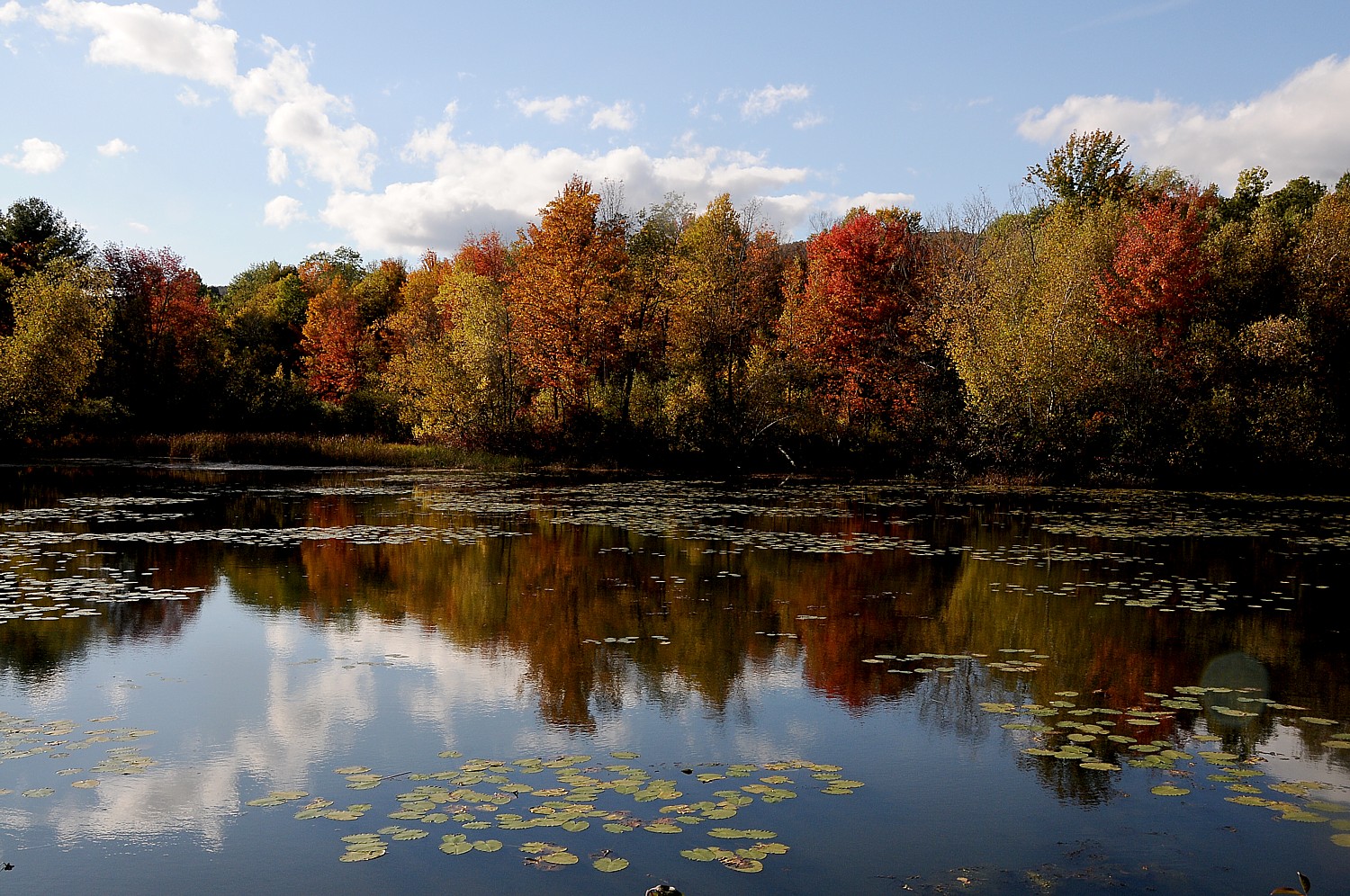
Enjoying the fall foliage biking along the 12.7-mile Ashuwillticook Rail Trail in the Berkshires, Massachusetts © Karen Rubin/goingplacesfarandnear.com

MASSACHUSETTS is the 8th most forested state in the United States, with over 3 million acres of forest, accounting for 62% of the entire state.  Some parts of Western Massachusetts are over 90% forested. Its foliage season stretches from mid-September to early November.  Here are some highlights and “secret gems”:

CAPE & ISLANDS: In Cape Cod, a secret gem is theWest Barnstable Conservation Area, one of the largest conservation parcels (1,114 acres) on the Cape. The entire tract is filled with glorious fall colors from mid-October through November. Better yet, rather than drive, Cape Cod is a paradise for cyclists, with the most wonderful bike paths that basically extend over the entire Cape.

Foliage comes later to Martha’s Vineyard than the rest of Massachusetts, typically peaking for brilliant colors at the end of October into early November. TRAILSMV is a free app that allows visitors to explore the Island’s fabulous network of pristine trails for walking, biking and hiking that make leaf peeping so much fun. 
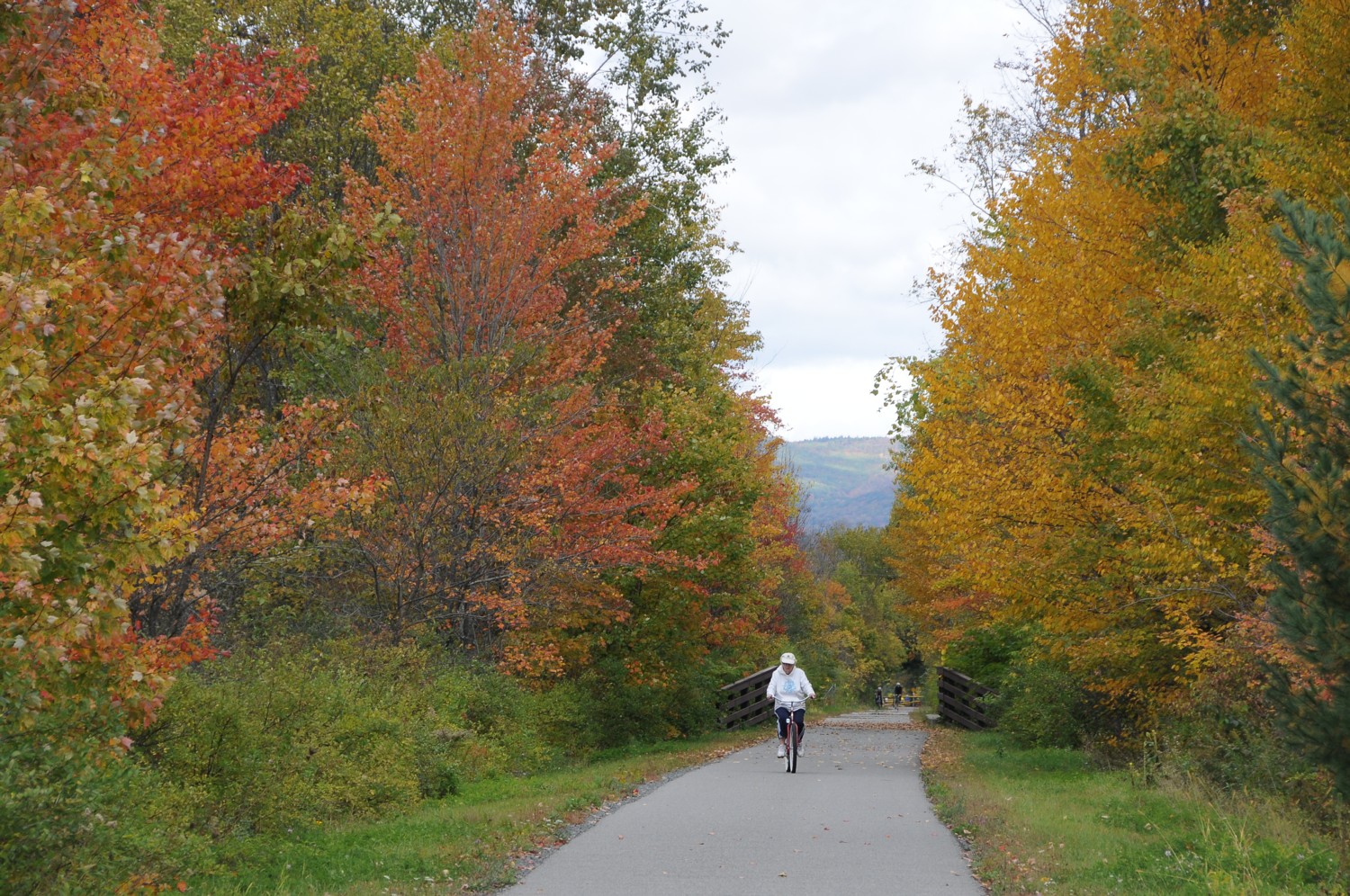
The Ashuwillticook Rail Trail in the Berkshires of Massachusetts is a stunning trail for biking and walking
© Karen Rubin/goingplacesfarandnear.com

WESTERN MA: In the gorgeous Berkshires, find the best fall foliage at this site: https://berkshires.org/four-fabulous-ways-to-enjoy-fall-foliage/#more-82593

Mohawk Trail: Hoosac Range Trail (2441 Mohawk Trail) located at the first summit on the Mohawk Trail features high elevation long views and sublime rock cliffs formed by “glacial plucking” with trees twisted into fantastical forms by wind and ice. Look out for migratory raptors at Spruce Hill and great views over North Adams, Mount Greylock and Florida State Forest. (https://www.bnrc.org/wp-content/uploads/2020/05/Hoosac_Range_trailmap.pdf)

Mount Greylock State Reservation is the highest point in Massachusetts.  At 3,481’, on a clear day, you can see as far as 90 miles away. The middle of September to middle of October with peak season typically Columbus Day weekend. 
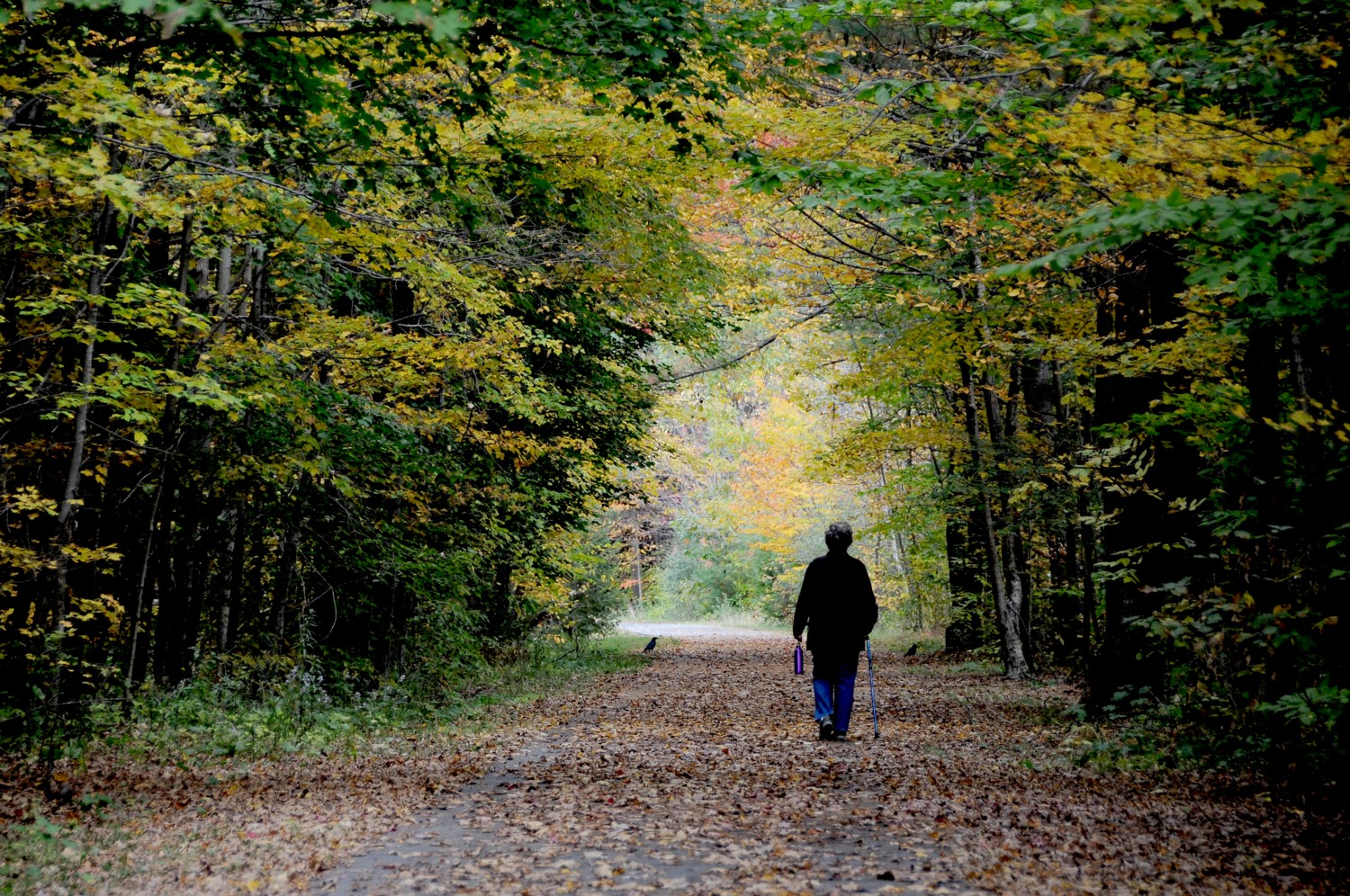
The Ashuwillticook Rail Trail in the Berkshires of Massachusetts is a stunning trail for biking and walking
© Karen Rubin/goingplacesfarandnear.com

NORTH OF BOSTON: Some secret gems are:Harold Parker State Park in Andover; Old Town Hill in Newbury; Ravenswood Park in Gloucester; and Pipestave Hill and Mill Pond in West Newbury.

Merrimack Valley: The Great Meadows Wildlife Refuge is a 12-mile river wetlands conservation area stretching from the towns of Billerica, Massachusetts (downstream) to Wayland, Massachusetts (upstream), along the Concord River and Sudbury River (https://www.fws.gov/refuge/great_meadows/)

Drive the 90-mile Essex Coastal Scenic Byway that links 14 coastal communities from Lynn to Salisbury and features breathtaking vistas, working harbors, quaint villages, world-class art and culture, and distinctive local food, shops, lodging and visitor services. 
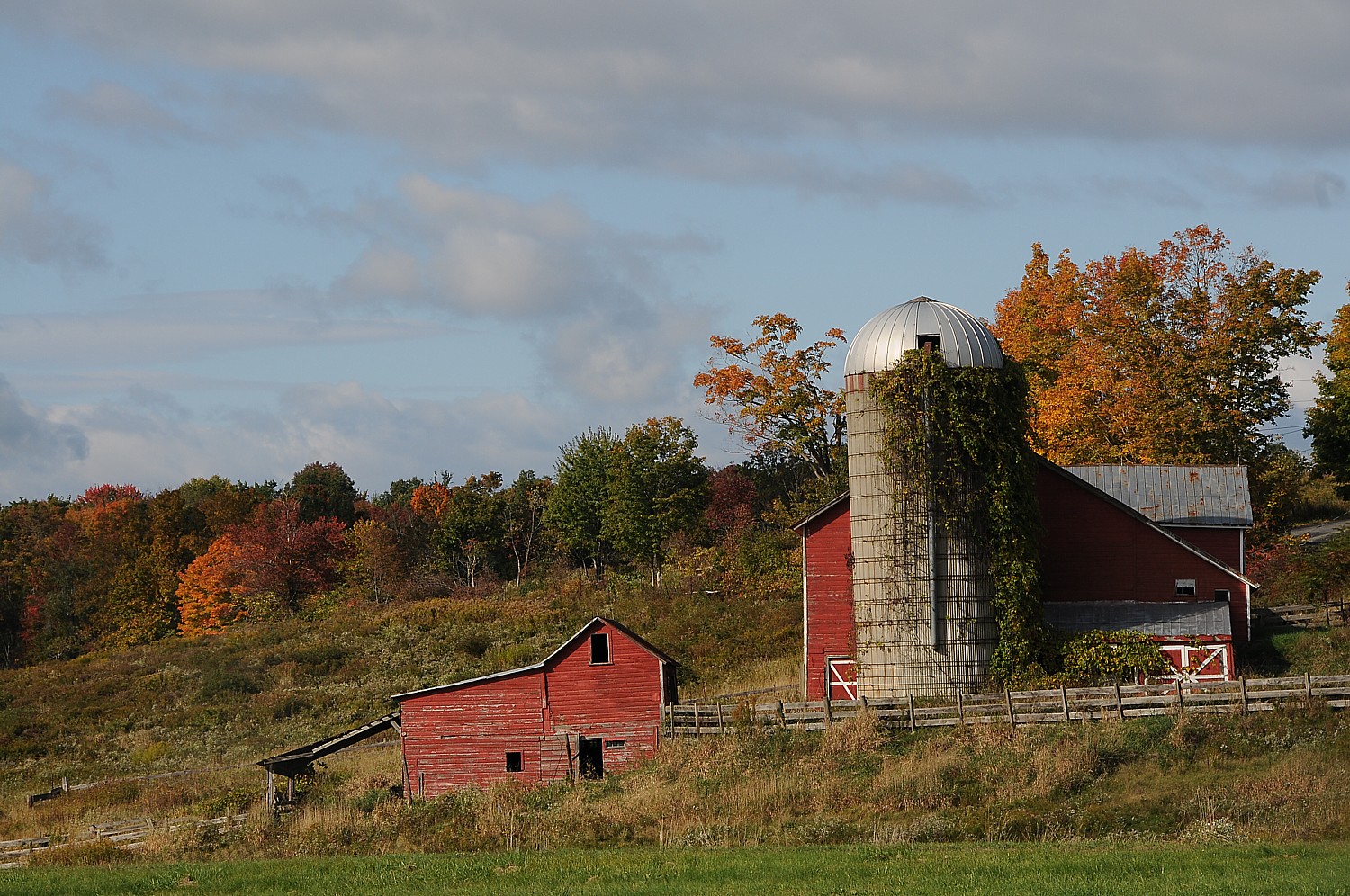
Fall in the Berkshires, Massachusetts © Karen Rubin/goingplacesfarandnear.com

CENTRAL MA: The secret gem here is theTully River Valley: Royalston, Athol, and Orange offers many options for hikers, bikers, and paddlers. A 4.5-mile foot trail loops around Tully Lake and the quarter-mile cascades of Doane’s Falls, and a 7.5-mile mountain bike and hiking trail circles adjacent Long Pond, passing by red maple trees that offer vivid foliage along the water’s edge starting in late September. Access is available at Tully Lake Recreation Area on Route 32, and Tully Lake Campground and Doane’s Falls Reservation on Doane Hill Road (https://thetrustees.org/content/tully-trail/).

Jacob’s Hill Reservation features two vistas with panoramic westerly views across the Tully Valley, and the steep cascades of Spirit Falls, which are especially picturesque after an autumn rain. The entrance is on Route 68 in Royalston, and the reservation may also be reached via the Tully Trail from Long Pond. Across the valley rises Tully Mountain in Orange, where ledges provide a striking view across the region to Mount Monadnock, Wachusett Mountain, and Mount Watatic (https://thetrustees.org/place/jacobs-hill/

Fall in the Berkshires, Massachusetts © Karen Rubin/goingplacesfarandnear.com

NORTH CENTRAL MA: The Mount Wachusett State Reservation located in Princeton and Westminster, offers stunning views of the region. Visitors can also take the skyride at Mt. Wachusett Ski Area. With over 800 farms and orchards in the region, the country roads in North Central Massachusetts provide scenic opportunities to see the bright vivid fall colors. These include routes 119, 13, 2A, 140, 117, 70, 202 just to name a few.  Best time to go: late September/October.

SOUTHEASTERN MASSACHUSETTS has some of the largest cranberry bogs in the nation and is a great place to see foliage alongside the cranberry bogs flooded with crimson berries.

Plymouth/South of Boston: A great experience in Plymouth County is the wet harvesting of cranberries at the height of fall foliage.  The A. D. Makepeace Company in Wareham gives cranberry bog tours starting in late September that takes you into the heart of cranberry country in Massachusetts (www.admakepeace.com)

Freetown-Fall River State Forest offers 5,000 acres of forest and open space, a perfect setting for fall foliage.  It is also the home of the Wampanoag Reservation (the “”eople of the First Light” who were there when the Pilgrims landed at Plymouth Rock. (https://www.mass.gov/locations/freetown-fall-river-state-forest http://visitsemass.com/freetown-fall-river-state-forest/)

GREATER BOSTON:The Emerald Necklace, a ring of green open space created by Frederick Law Olmsted in the 19th century is a great way to enjoy foliage in the city of Boston.  Highlights include Franklin Park in Dorchester, the Arnold Arboretum and Jamaica Pond, Olmsted Park, The Riverway and Back Bay Fens. You complete the Necklace by taking the Commonwealth Avenue Mall into the Public Garden and then to Boston Common (https://www.emeraldnecklace.org/park-overview/emerald-necklace-map/)

To track fall foliage in Massachusetts State Parks, go to https://www.mass.gov/location-details/fall-foliage-season-in-the-parks.

A great guide to visiting Massachusetts is available at https://www.visit-massachusetts.com/state/foliage/.

______________________

© 2021 Travel Features Syndicate, a division of Workstyles, Inc. All rights reserved. Visit goingplacesfarandnear.com, www.huffingtonpost.com/author/karen-rubin, and travelwritersmagazine.com/TravelFeaturesSyndicate/. Blogging at goingplacesnearandfar.wordpress.com and moralcompasstravel.info. Send comments or questions to FamTravLtr@aol.com. Tweet @TravelFeatures. ‘Like’ us at facebook.com/NewsPhotoFeatures


Historical Society’s ‘Notorious RBG’ Pays Homage to New York’s Own Ruth Bader Ginsburg

New-York Historical Society’s “Notorious RBG: The Life and Times of Ruth Bader Ginsburg,” pays homage to the trailblazing Supreme Court justice, on view through January 23, 2022 © Karen Rubin/goingplacesfarandnear.com

By Karen Rubin, Travel Features Syndicate, goingplacesfarandnear.com

No exhibit that looks back into the past has been more timely and relevant than “Notorious RBG” which recently opened at the New-York Historical Society – a homage to the trailblazing Supreme Court justice, lawyer, wife, mother and woman, Ruth Bader Ginsburg, who at age 80, became an internet phenomenon and cultural icon. It is so important to be reminded – through her words, documents, historical artifacts, archival photographs, contemporary art and interactives – of what society was like, what it took to change, and what is at risk today. The SCOTUS with the mostus challenged us to continue her work for a just, equal and compassionate society.

The traveling exhibit, which was organized by the Skirball Cultural Center in Los Angeles and based largely on Irin Carmon and Shana Knizhnik’s book, “Notorious RBG: The Life and Times of Ruth Bader Ginsburg” (which was the source for a documentary),  opened to the public just the day before marches in Washington DC and around the nation in support of women’s reproductive rights. It was also mere days before the start of the Supreme Court’s new term, with a 6-3 conservative majority, including the justice who took her seat, Amy Coney Barrett, gunning to overturn the landmark 1973 Roe v. Wade decision. “Notorious RBG” is on display only through January 23, 2022.

“It is different to be here, knowing she’s not with us,” author Irin Carmon reflected at the press preview of the exhibit. “She intended to visit Skirball but cancelled because of her cancer treatment. When the exhibit came to Philadelphia, she agreed to accept an award and see it more than a year after opened. It was an extraordinary experience of giving her a tour of her life.”

New-York Historical Society Presents “Notorious RBG: The Life and Times of Ruth Bader Ginsburg,”  on view through January 23, 2022 © Karen Rubin/goingplacesfarandnear.com

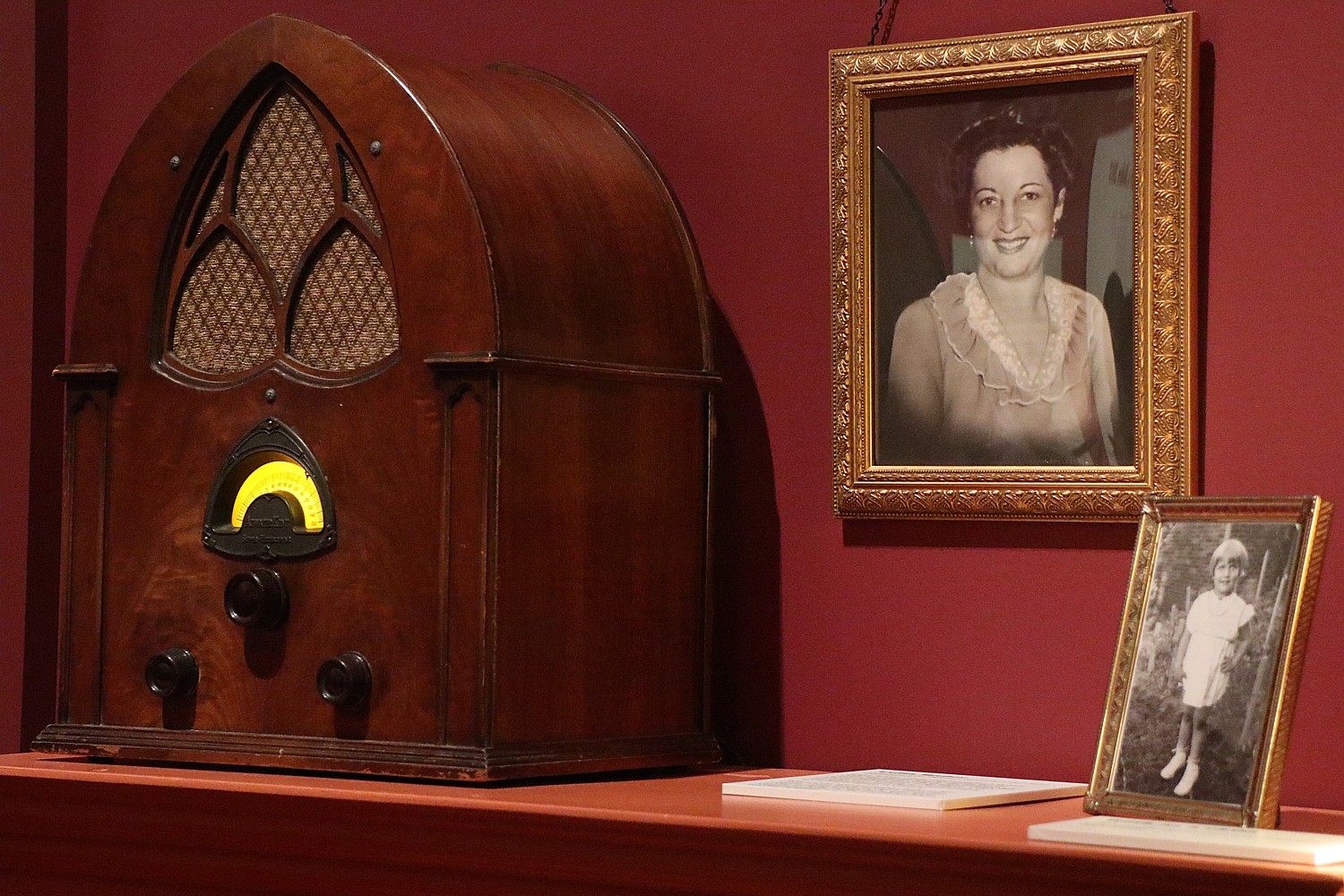
 “We walked her through to an imagined re-creation of her childhood living room. She stopped, as if completely alone, stopped in front of a portrait of her mother – who died just before her high school graduation. Opera was playing on an old fashioned radio. We all fell silent as she gazed. I thought of what she said when she accepted the nomination to the Supreme Court in 1993, standing with President Clinton. I was thinking what her mother would have thought.”

When Ruth Bader Ginsburg toured the “Notorious RBG” exhibit in Philadelphia with author Irin Carmon, she stopped in front of this re-creation of her childhood Brooklyn home to reflect on the portrait of her mother © Karen Rubin/goingplacesfarandnear.com

What RBG said on that day was, “It is to my mother, Celia Amster Bader, the bravest and strongest person I have known, who was taken from me much too soon. I pray that I may be all that she would have been had she lived in an age when women could aspire and achieve and daughters are cherished as much as sons.”

Justice Ginsburg said she would have come to the NYHS’ exhibit, which was supposed to open in 2020, but the exhibit was delayed because of COVID. She died September 18, 2020.

“It falls on all of us who share her values, what she stood for, to carry on her legacy,” Carmon said.

The exhibit traces her life from modest beginnings in Brooklyn, losing an older sister when she was two, her mother sick with cancer from when she was 13 and dying just before her high school graduation.

But you appreciate how Brooklyn was formative to the person she became – the immigrant community of Eastern Europeans, Irish and Italians. Her Jewish heritage inbued in her a commitment to seek justice and compassion, to question, and it triggered her feminism when, in Jewish tradition, she was not counted in the minyan (the quorum of 10 males required) at her own mother’s funeral because she was female.

RBG became “notorious” because of her firey dissent in Shelby v Holder in 2013, when the majority overturned the preclearance requirement in the Voting Rights Act, unleashing a score of voter discrimination laws in states that otherwise would have been curtailed. She charged that overturning the Voting Rights Act would invite violations of the 15th amendment. The decision was 5-4, with Chief Justice Roberts saying it wasn’t needed anymore because (after Obama’s election to the presidency) “things changed.”

In her dissent, RBG said that overturning the provision was like “throwing away your umbrella in a rainstorm because you are not getting wet.” 

We enter the exhibit at the pinnacle – one of her Supreme Court robes and jabots on display, an official portrait of her in her office as only the second woman to have served on the Supreme Court, a PBS News Hour video of her as “Notorious RBG”, and as you wind through, you understand the context, the ecosystem, that forged her character and set her on her path.

Ruth Bader Ginsburg, the modest girl from Brooklyn, was tickled by becoming an internet sensation, the “Notorious RBG” at age 80, and took the association with the Notorious B.I.G. with humor, saying, “We have something in common – we’re both from Brooklyn.” © Karen Rubin/goingplacesfarandnear.com

She took the “Notorious RBG” with humor – in a video of a PBS News Hour appearance, she said, “Notorious B.I.G. and I have something in common – we are both from Brooklyn.”

Very quickly, we are pushed back in time to her childhood in Flatbush Brooklyn, her time at Cornell University where she met Martin Ginsburg, and their decision to pursue law – because she thought lawyers the vanguard of societal change and because Harvard Law School had begun to accept women, albeit precious few.

“Both wanted to marry and keep on working together…Harvard Business School did not accept women. So they settled on law.”

From the beginning, “Their marriage defied gender expectations of the period and embodied her belief that men, women, and families are better when both partners share their lives and goals on equal footing. Marty was a passionate supporter of his life partners’ legal career and shared in child rearing and household responsibilities long before men were expected to do so.”

When Marty got sick with testicular cancer, she took his notes and transcribed his papers so he could stay in the program. And she left Harvard Law to go to Columbia when Marty got a job in New York (she made the Law Review at both.)

When she graduated, no law firm would hire her – “I was Jewish, a mother and a woman” so three strikes against her. She began teaching at Rutgers.

She signed up as a volunteer lawyer at the New Jersey branch of the American Civil Liberties Union, which was being overwhelmed by letters from women. “None of their problems were new. What was new was that anyone thought it was worth complaining about.”

“It was clear to RBG that fighting discrimination one strongly worded letter at a time was like catching the ocean in a thimble. There would always be another sexist law or regulation to take down. Women’s rights advocates needed to think bigger. What the country needed was a broader recognition of gender equality.”

New-York Historical Society presents “Notorious RBG: The Life and Times of Ruth Bader Ginsburg,”  on view through January 23, 2022 © Karen Rubin/goingplacesfarandnear.com

There is a very illuminating list of what women couldn’t do in the 1930s and 1940s – a sort of marker – which women today take for granted:

Practice law in most states or become a judge

Serve on a jury in most states

Get paid the same amount as men for doing the same work

Answer want ads for jobs labeled “men only”

Open a bank account or get a credit card without a husband’s or male relative’s permission (I would add: get a mortgage or a business loan without a man to co-sign)

In some states, own property without having a husband in control as “head and master”

Attend most Ivy League universities

Play school sports on an equal basis with boys

Attend a military academy

Get pregnant without the threat of losing her job

Wear pants on the US Senate floor

Serve in combat in the military

Much of her argument for gender equality was derived from the 14th Amendment – passed after the Civil War’s emancipation of slaves: “No State shall make or enforce any law which shall abridge the privileges or immunities of citizens of the United States; nor shall any State deprive any person of life, liberty, or property, without due process of law; nor deny to any person within its jurisdiction the equal protection of the laws.” (Roe v. Wade was decided based on the “right to privacy” implied by “due process” rather than “equal protection”.)

Marty, a prominent tax attorney, brought her the breakthrough case, Moritz v. Commissioner of Internal Revenue. Charles Mortiz was a businessman who was caring for his 89-year old mother, but the IRS denied him the tax deduction for expenses for her care that was allowed women, widowers or husbands of incapacitated women. But Moritz had never married. “The idea that a man might be a caregiver had apparently never crossed the government’s mind,” Ginsburg wrote.

The Ginsburgs realized that the government was senselessly denying a benefit to someone purely on the basis of sex. “If the court said that was wrong, the precedent would open the door to a broader recognition of gender equality.”

“The line the law drew rested on a stereotype: Women are caregivers, so a daughter would take care of her aging mother but men are out in the world, earning a living, so they don’t take personal care of aging parents. That law was blind to the life Charles E. Moritz lived. We took his case from the tax court to the Tenth Circuit. Marty argued the tax part of it and I argued the equal protection part,” RBG wrote.

And when one of her cases brought her up against her former Harvard Dean Erwin Griswold, who had become Solicitor General of the US, he had counsel prepare an appendix of all the laws that would have to be changed if Ginsburg were successful in her argument about gender discrimination in the law. In other words, you change this law, you have to change all the others. Ruth saw it as a handy roadmap.

Between 1971 and 1981, RBG litigated cases that would set the stage for gender equality (or rather, “neutrality”): widower, pregnancy, forced sterilization of black women; jury, and even the right to buy beer at age 18.

It is important to note in these times as a woman’s reproductive freedom is in question, that the government that can ban abortion – and deny a woman’s right to autonomy over her own body – is also a government that can force sterilization, or require an abortion. This is exactly what the government did to Captain Susan Struck in 1970; the case that RBG took up, Struck v. Secretary of Defense, resulted in the USAF changing its policy of automatically discharging pregnant women who refused to get an abortion, and led to Congress passing the Pregnancy Discrimination Act of 1978.

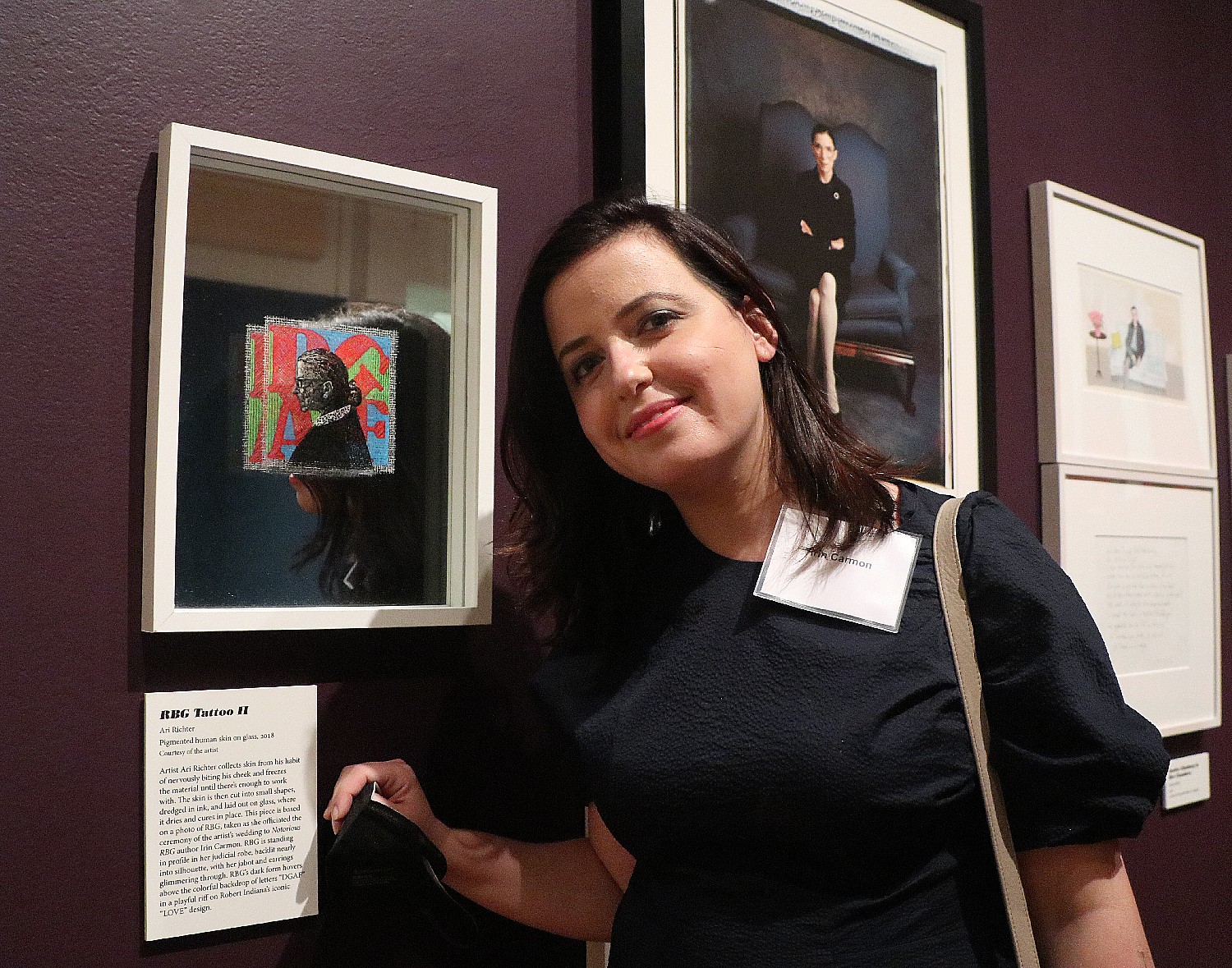
“RBG Tattoo II” by Ari Richter, fashioned of pigmented human skin on glass, is painted based on a photo of Justice Ginsburg taken as she officiated at the artist’s wedding to “Notorious RBG” author Irin Carmon. It is one of the personal items on view at New-York Historical Society’s exhibit “Notorious RBG: The Life and Times of Ruth Bader Ginsburg,”  on view through January 23, 2022 © Karen Rubin/goingplacesfarandnear.com

RBG spearheaded the formation of the Women’s Rights Project at the ACLU to tackle discrimination in education and training programs, prisons and the military, advocate for reproductive freedom and hold accountable institutions that discriminated against pregnant women.

You can listen in on decisions and see original documents and artifacts – for example, Stephen Wisenfeld’s letter to the editor complaining of the discriminatory rule of Social Security that prevented him from getting survivor’s benefits after his wife, the “breadwinner” of his family, died in childbirth; the personal letter from RBG to Stephen Wisenfeld in 1977 about going to DisneyWorld, which is so revealing about her as a person; photos of RBG with Steven’s son Jason Wiesenfeld when she officiated at Jason’s wedding in 1998, and another with Stephen Wiesenfeld and Elaine Harris Wiesenfeld at their 2014 wedding that RBG officiated.

“Wiesenfeld is part of an evolution toward a policy of neutrality – a policy that will accommodate traditional patterns, but at the same time, one that requires removal of artificial constraints so that men and women willing to explore their full potential as humans may create new traditions by their actions.” RBG wrote (she won an 8-0 decision at the Supreme Court).

The 2016 anti-abortion case, Whole Woman’s Health v. Hellerstedt, 2016, struck down a Texas law that required such stringent standards on abortion clinics that they would have had to be shut down. The court ruled 5-3 that this imposed an “undue burden.”

RBG joined Stephen Breyer in his majority opinion but added, “I fully subscribed to everything Breyer said, but it was long and I wanted something pithy…. I wrote to say, ‘Don’t try this anymore.’”

New-York Historical Society’s “Notorious RBG: The Life and Times of Ruth Bader Ginsburg,” features 3-D re-creations of key places in RBG’s life including her desk in her Supreme Court chambers © Karen Rubin/goingplacesfarandnear.com

But we know that they have not stopped trying to chip away at the “undue burden” standard. Now Texas has come up with most brazen assault on women’s rights, without Ginsburg on the bench to challenge, instead, replaced by an ultra-conservative, anti-abortion justice Amy Coney Barrett. In a dire sign of what is to come, the court allowed the Texas law to go into effect – creating a new class of vigilantes and bounty hunters to enforce a blatantly unconstitutional “burden” on women who seek an abortion after six-weeks.

RBG’s last dissent was in 2020, in the “Little Sisters of the Poor v Pennsylvania,” in which the majority, 7-2 allowed religious objectors to be exempted from the Affordable Care Act’s regulatory requirement to provide health plans that include contraceptive coverage.

“Today, for the first time, the Court casts totally aside countervailing rights and interests in its zeal to secure religious rights to the nth degree,” she wrote.

New-York Historical Society Presents “Notorious RBG: The Life and Times of Ruth Bader Ginsburg,”  on view through January 23, 2022 © Karen Rubin/goingplacesfarandnear.com

On her deathbed, Justice Ginsburg told her granddaughter Clara Spera, “My most fervent wish is that I will not be replaced until a new president is installed.”

But Majority Leader Mitch McConnell could care less, and even though the 2020 presidential election had already gotten underway (and he had delayed an Obama nomination more than a year, to give Trump his appointee, Neil Gorsuch in place of Merrick Garland), pushed through his candidate, Amy Coney Barrett to complete a 6-3 radically conservative majority on the court.

And so, people are marching, rallying and protesting again with urgency to protect the rights that were thought to have been won, but now may be overturned. Many carry a sign that reads, “Ruth sent me.”

“Ruth Sent Me” sign at the New York City Women’s March for Reproductive Freedom, October 2, 2021 © Karen Rubin/news-photos-features.com

There are such personal items, including a reproduction of the letter her husband Marty wrote just before he died, in 2010, “My dearest Ruth- You are the only person I have loved in my life…what a treat it has been to watch you progress to the very top of the legal world!!”

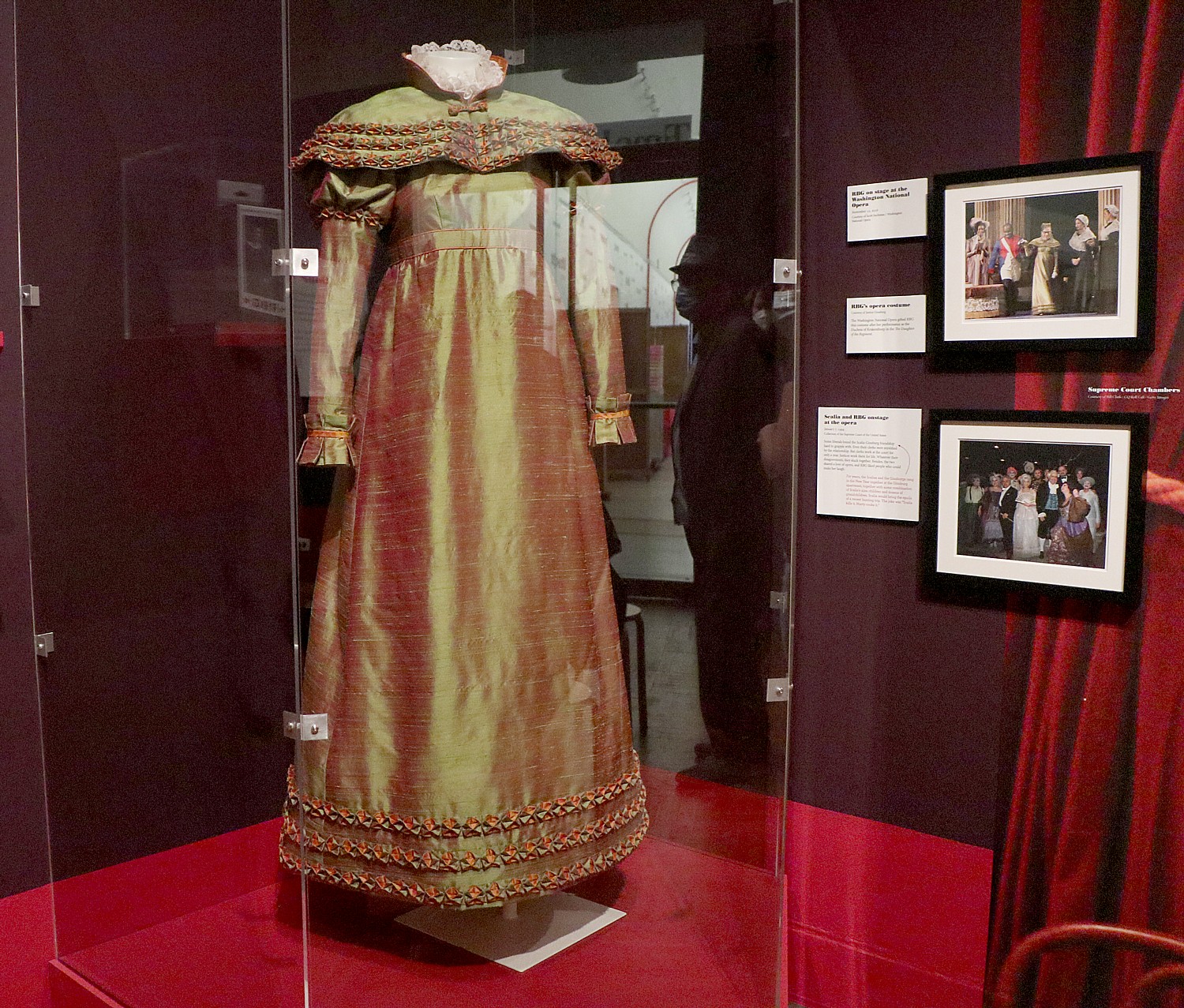
Personal materials range from home movies of RBG with Marty on their honeymoon and in the early years of their marriage to yearbooks from RBG’s academic life—from her Brooklyn high school to Harvard, Columbia, and Rutgers Universities—to a paper that she wrote as an eighth grader exploring the relationship between the Ten Commandments, the Magna Carta, the Bill of Rights, the Declaration of Independence, and the recently formed United Nations Charter, and the costume she wore for her cameo as the Duchess in Washington National Opera’s production of “Daughter of the Regiment.”

The costume Justice Ginsburg wore for her cameo as the Duchess in Washington National Opera’s production of “Daughter of the Regiment” is on view in New-York Historical Society’s “Notorious RBG: The Life and Times of Ruth Bader Ginsburg,”   © Karen Rubin/goingplacesfarandnear.com

Special to New-York Historical’s presentation – and only seen here – are remembrances from RBG’s visit to the museum in 2018 to officiate a naturalization ceremony of 200 new citizens after she learned about New-York Historical’s Citizenship Project which teaches U.S. history and civics to green card holders. (She sent a note,  “I had shingles, not yet diagnosed, on April 10, but would not have missed the oath-taking ceremony. Looking out at the 201 faces of the new citizens, I could hardly hold back the tears. The diversity represented among the new citizens, proudly pledging allegiance, is what the USA means to me. With appreciation, Ruth Bader Ginsburg.”

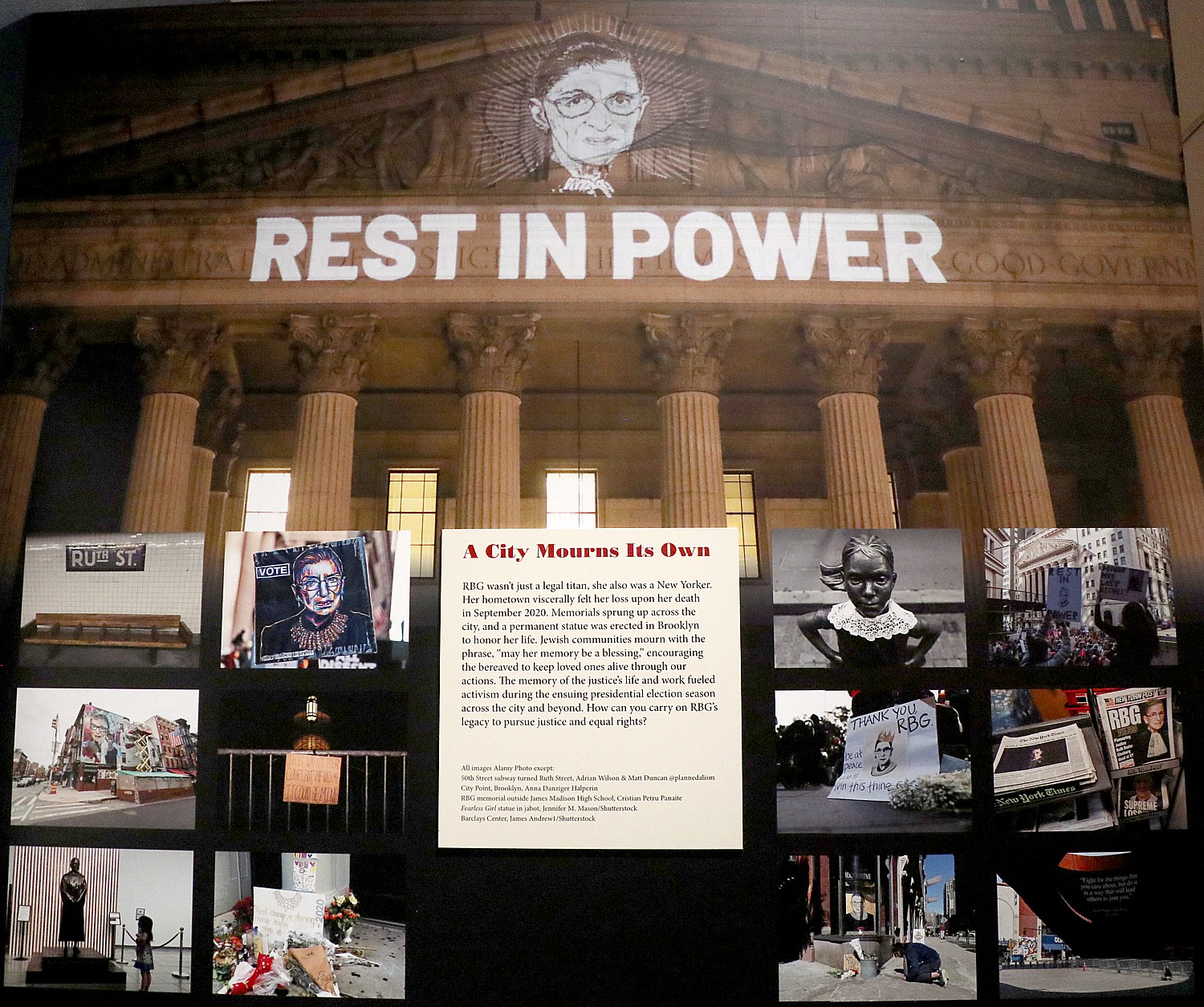
A city mourns one of its own: an overview of the memorials that appeared throughout New York City after Ruth Bader Ginsburg died, September 18, 2020, is a special feature of New-York Historical Society’s presentation of the traveling exhibition “Notorious RBG: The Life and Times of Ruth Bader Ginsburg,”  on view through January 23, 2022 © Karen Rubin/goingplacesfarandnear.com

There is also a video featuring a map and photographs of key places in her life as a New Yorker, and an overview of the memorials that cropped up around her hometown in the wake of her passing, “Rest in Power, A City Mourns Its Own.”

The various RBG iconography on display is fun and fascinating, like the “real life action figure” (you can buy one in the gift shop).

The strangest – and one of the most personal – is the “RBG Tattoo II” by Ari Richter, fashioned of pigmented human skin on glass, painted with a photo of RBG taken as she officiated at the artist’s wedding to “Notorious RBG” author Irin Carmon.

“Notorious RBG: The Life and Times of Ruth Bader Ginsburg,  co-author Irin Carmon poses with “RBG Tattoo II” painted  by her husband, Ari Richter, based on a photo of RBG taken as she officiated at the their wedding © Karen Rubin/goingplacesfarandnear.com

When Irin Carmon asked, “And when the time comes, what would you like to be remembered for?” RBG replied, “Someone who used whatever talent she had to do her work to the very best of her ability. And to help repair tears in her society, to make things a little better through the use of whatever ability she has.”

As part of New-York Historical’s upcoming public program series, on December 8, Supreme Court expert Linda Greenhouse looks at where the courts stand following Justice Ginsburg’s death. Families can explore the exhibition with a specially created family guide, and themed story times will take place throughout the exhibition’s run.

Supreme Court Justice and trailblazer Ruth Bader Ginsburg became a cultural icon, warranting an action hero figure (on sale at New-York Historical Society’s gift shop) © Karen Rubin/goingplacesfarandnear.com

After debuting at the Skirball Cultural Center in 2018, Notorious RBG: The Life and Times of Ruth Bader Ginsburg has toured the country. After its New York run, the exhibition will travel to the Holocaust Museum in Houston (March 2022) and the Capital Jewish Museum in Washington, D.C. (September 2022).

Notorious RBG: The Life and Times of Ruth Bader Ginsburg has been coordinated at New-York Historical by Valerie Paley, senior vice president and Sue Ann Weinberg Director, Patricia D. Klingenstein Library; Laura Mogulescu, curator of women’s history collections; and Anna Danziger Halperin, Andrew W. Mellon Postdoctoral Fellow in Women’s History and Public History, Center for Women’s History.

The New-York Historical Society, 170 Central Park West (77th Street), New York, NY 10024, 212-873-3400,  nyhistory.org. Follow the museum on social media at @nyhistory on FacebookTwitterInstagramYouTube and Tumblr.

______________________

© 2021 Travel Features Syndicate, a division of Workstyles, Inc. All rights reserved. Visit goingplacesfarandnear.com, www.huffingtonpost.com/author/karen-rubin, and travelwritersmagazine.com/TravelFeaturesSyndicate/. Blogging at goingplacesnearandfar.wordpress.com and moralcompasstravel.info. Send comments or questions to FamTravLtr@aol.com. Tweet @TravelFeatures. ‘Like’ us at facebook.com/NewsPhotoFeatures

Our Favorite Hiking & Camping Gear for 2 Months On the Road in our Converted Subaru

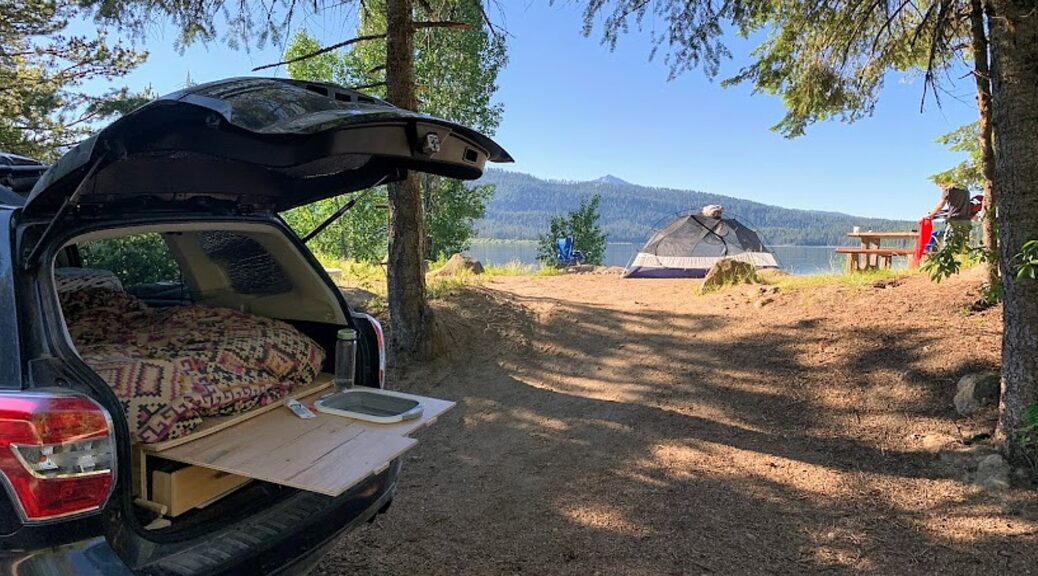
Wild camping in our REI Half Dome 3 Plus tent by Little Payette Lake, ID © Laini Miranda/goingplacesfarandnear.com

*Black Friday & Cyber Monday Deals*

By Laini Miranda & Dave E. Leiberman, Travel Features Syndicate, goingplacesfarandnear.com

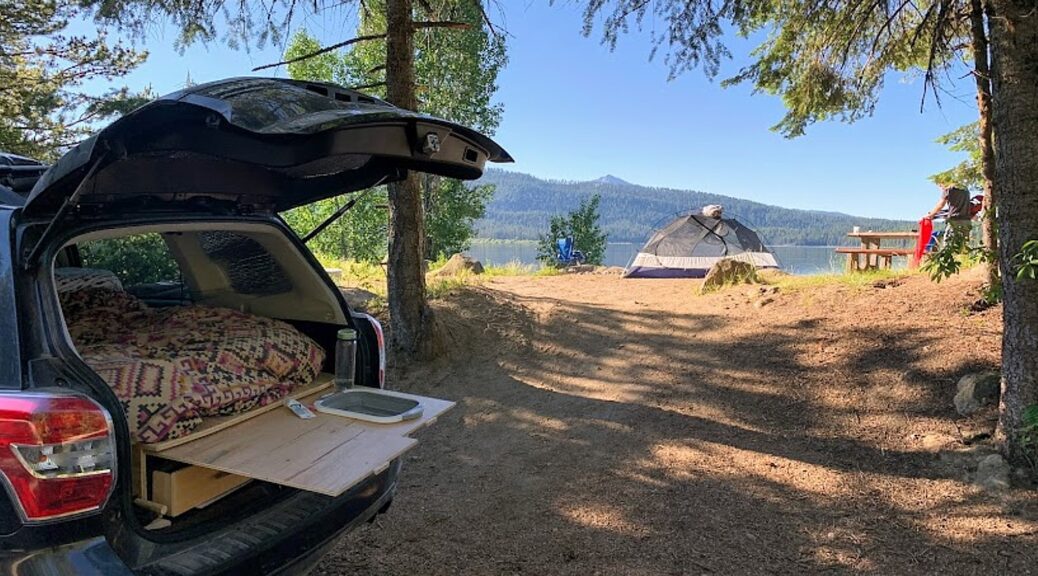
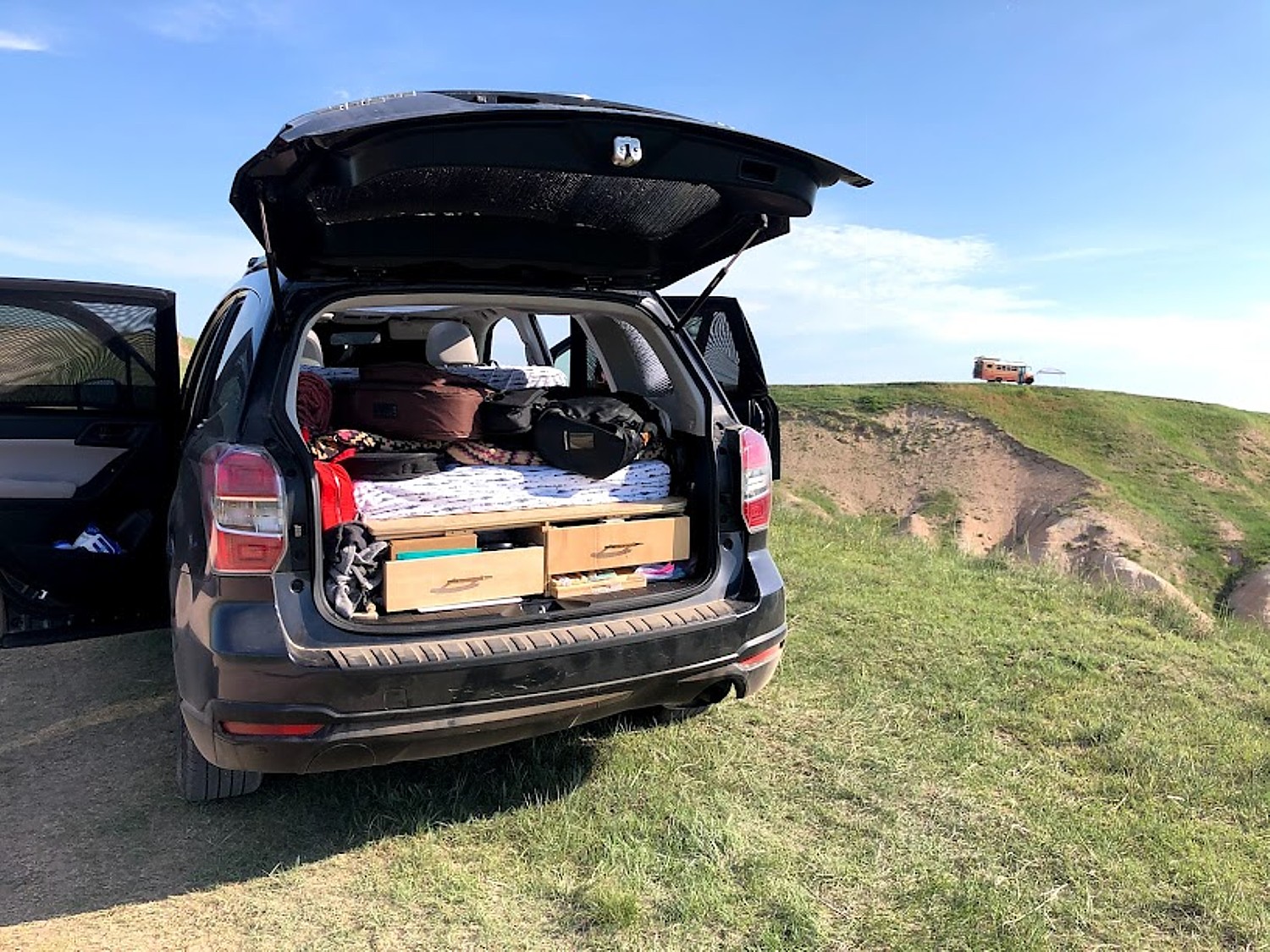
We just returned home from two months living out of our converted Subaru while we traveled 8,300 miles around the country. We outfitted our Subaru Forester with a platform bed and two drawers underneath to maximize storage, which we designed and built ourselves, and brought along enough creature comforts so that we didn’t miss a thing while we were on the road or wild camping.

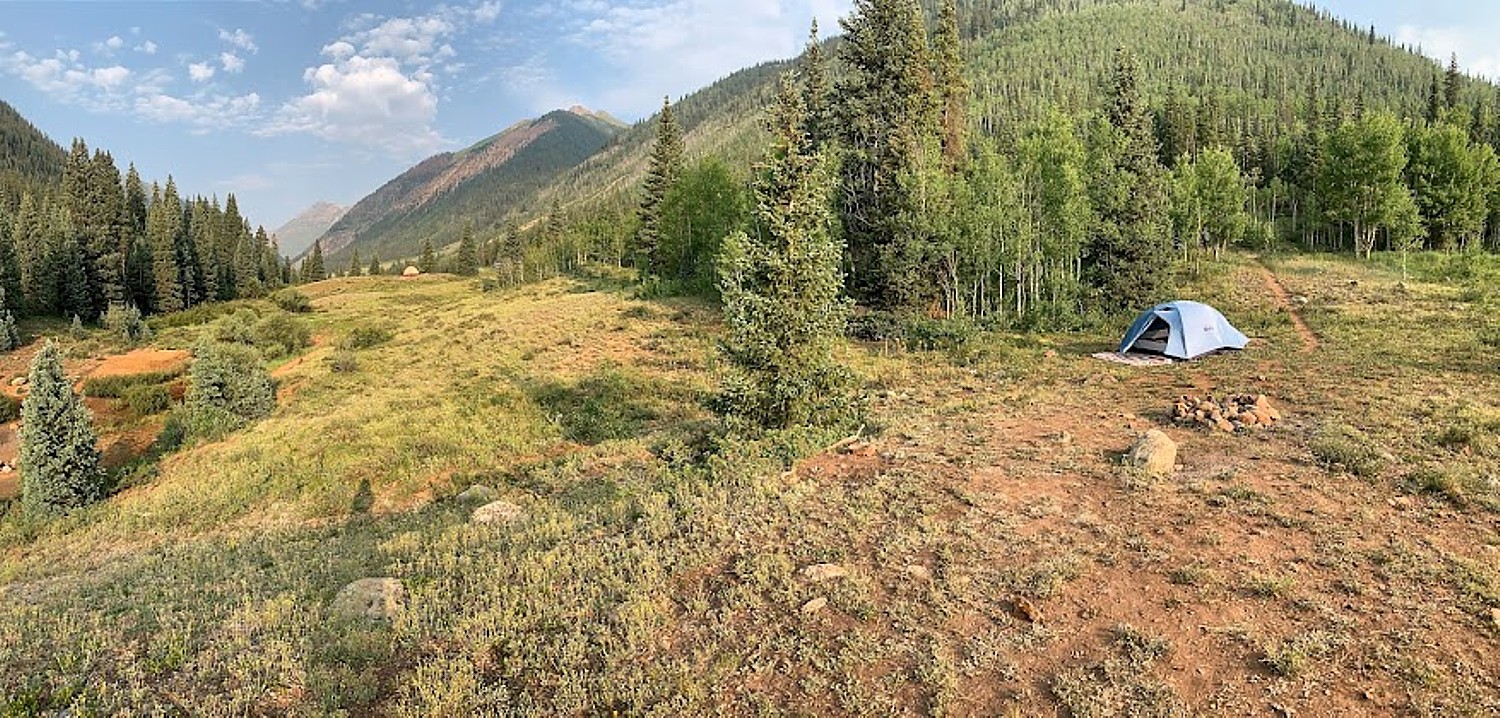
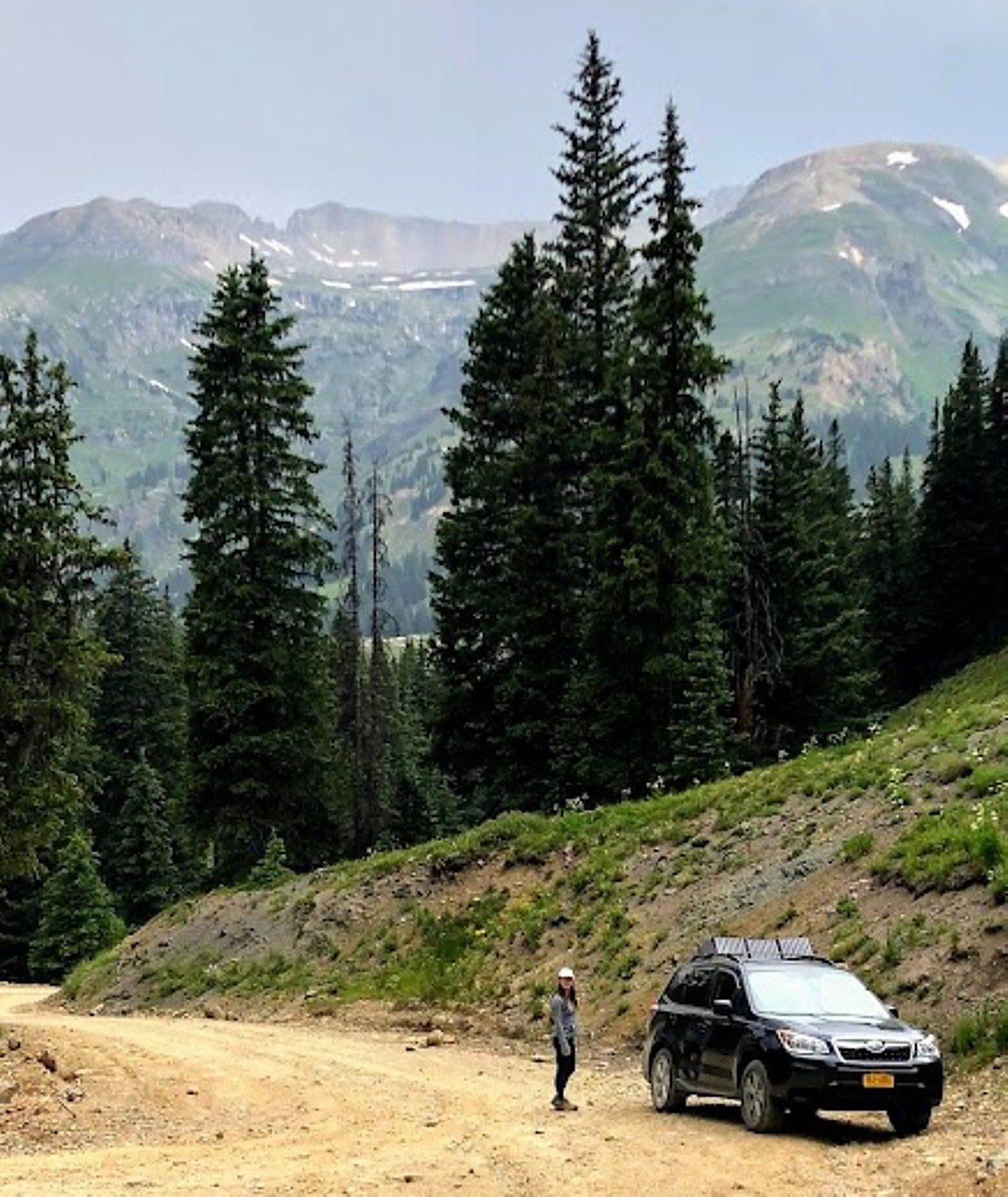
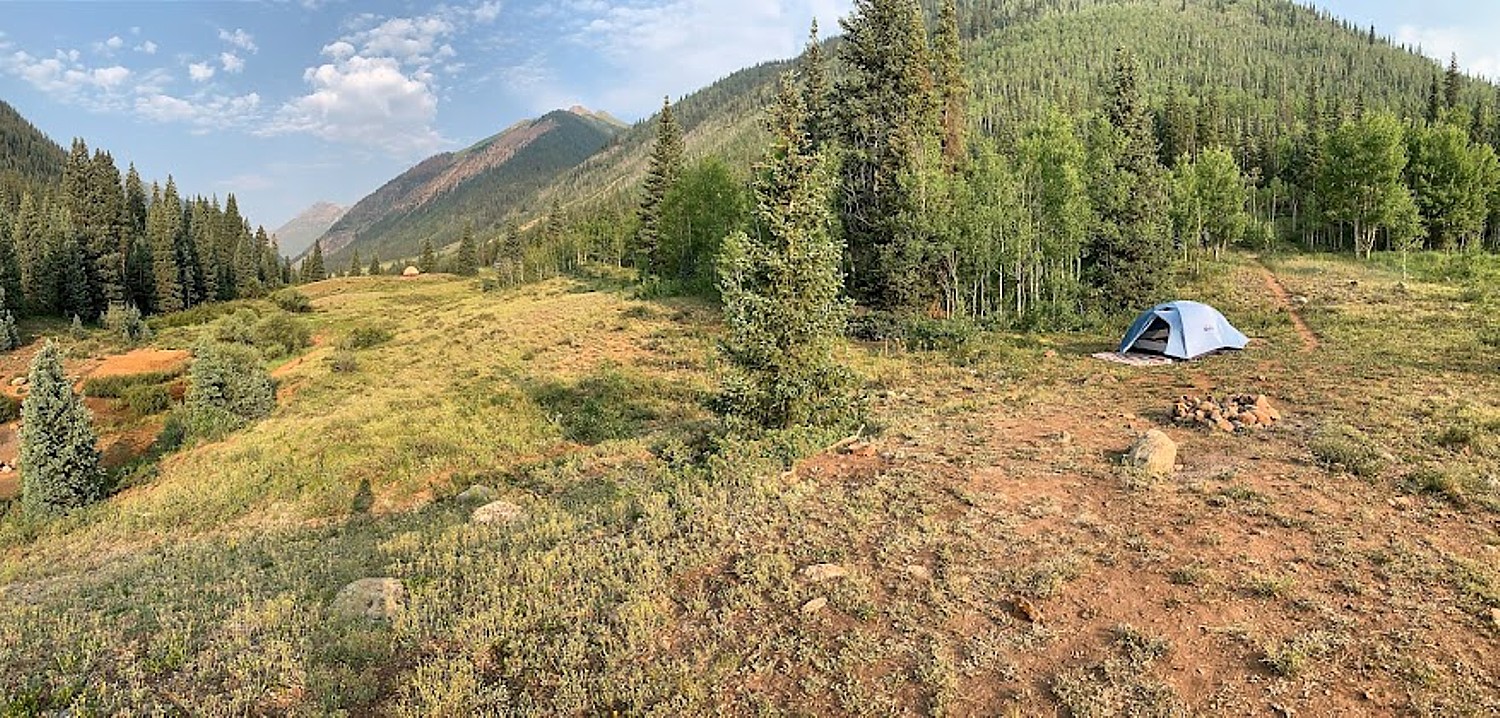
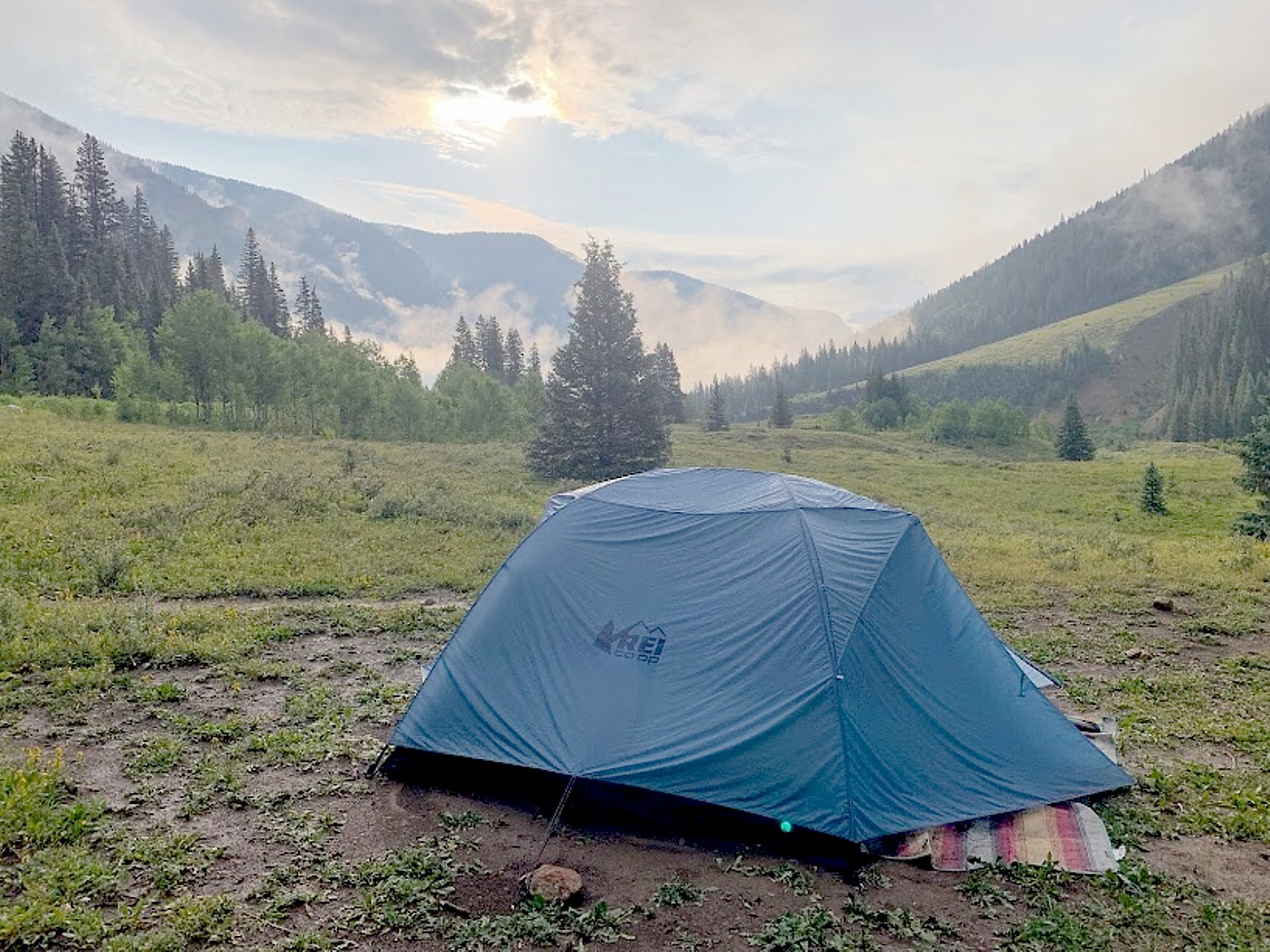
Our wild camp spot outside of Silverton, CO, just before the rainstorms © Laini Miranda/goingplacesfarandnear.com

Here’s more of our round-up of our favorite hiking and camping gear (See also: Car Camping in Comfort: How We Turned our Subaru into Our Home On the Road):

WEARABLES

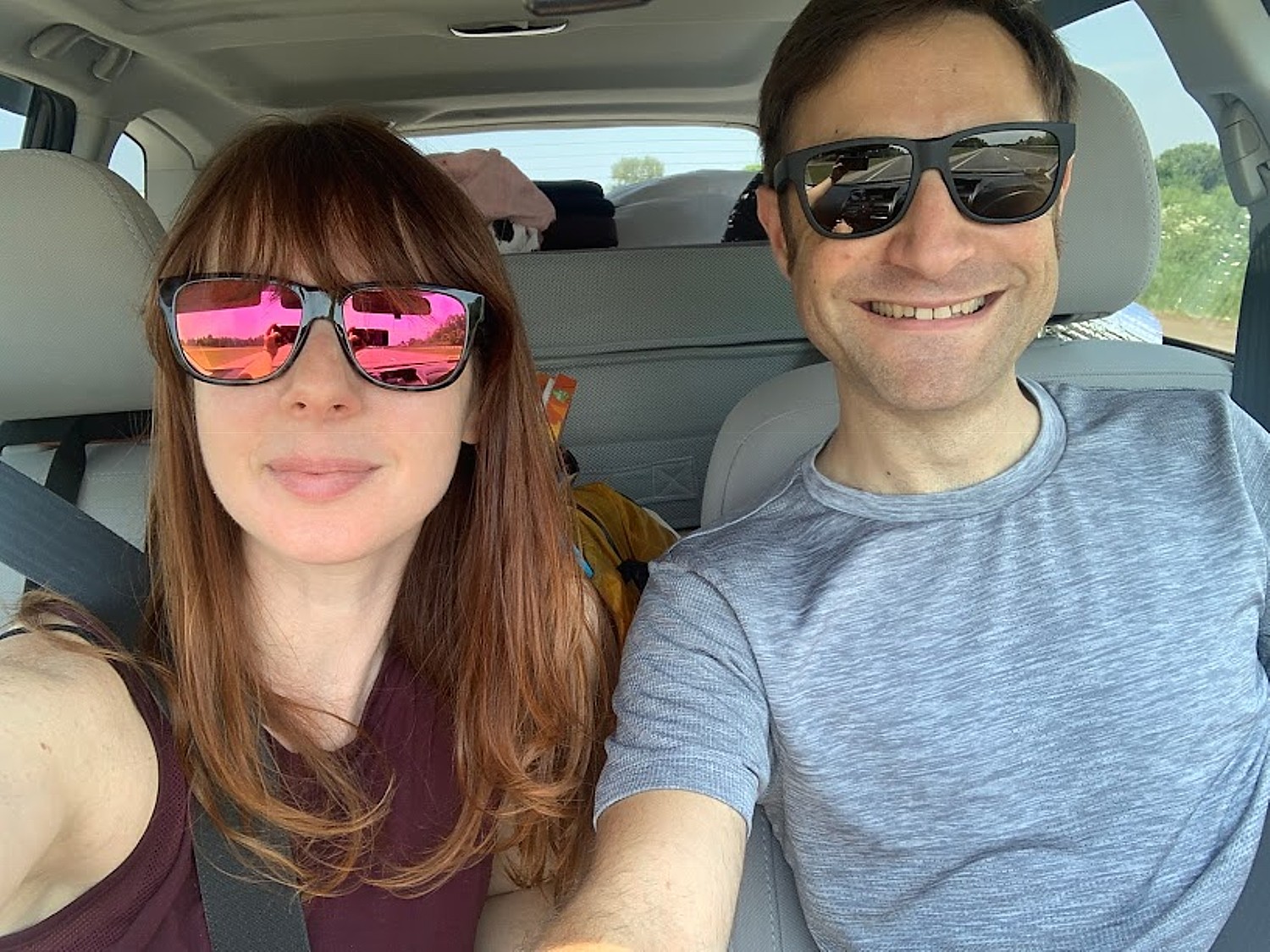
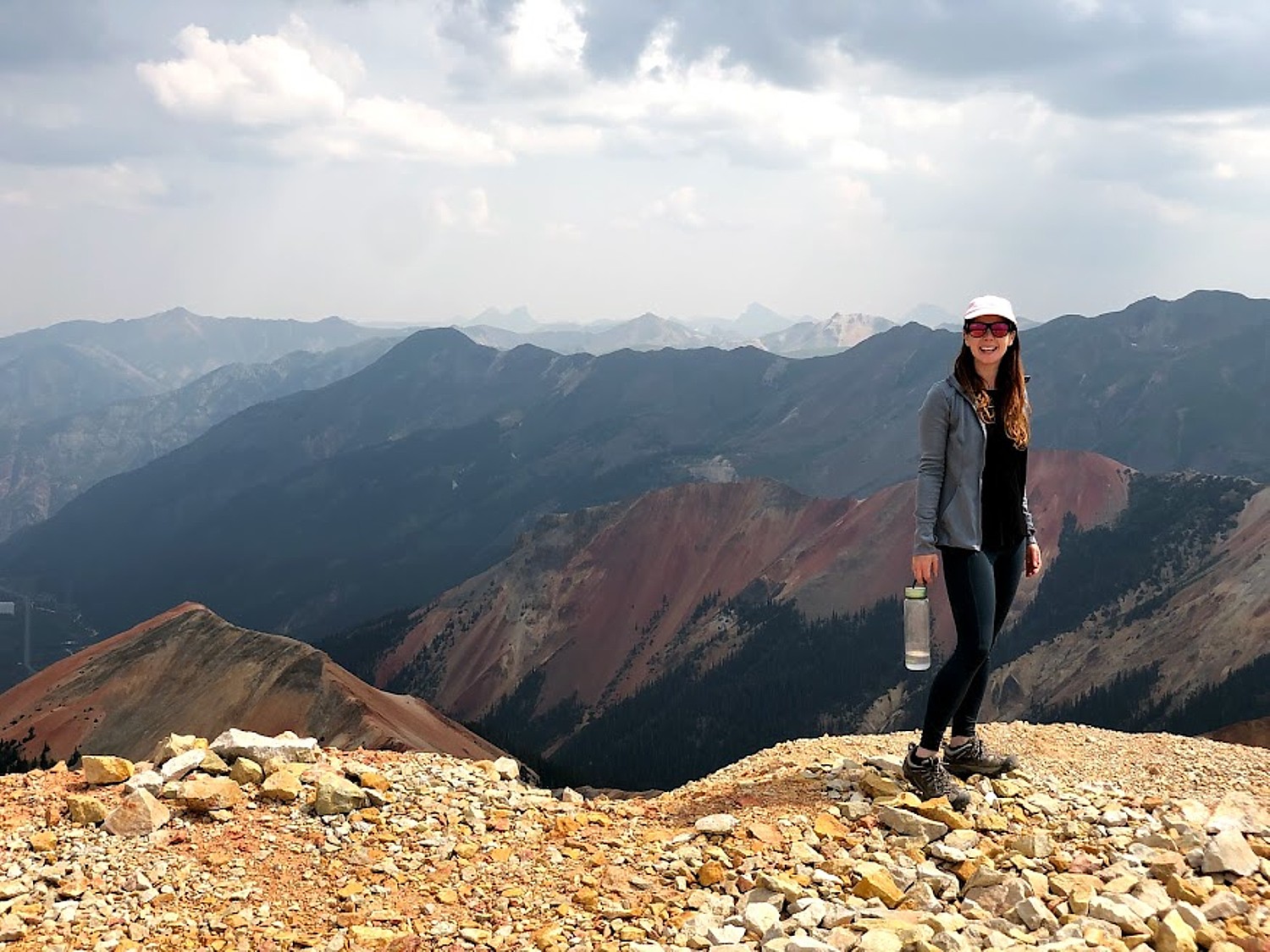
Smith’s Chromapop Lowdown Slim 2 are the perfect polarized sunglasses to enrich every day of our 7 weeks on the road. There’s not a day we spend without these glasses © Laini Miranda/goingplacesfarandnear.com

Smith Chromapop Sunglasses – $179.99

These sunglasses are probably the most important gear we own and the most noticeable improvement to this trip versus our previous desert adventures. Dave has enjoyed Warby Parkers in the past and both of us are usually very happy with our standard >$20 sunglasses. These Smith glasses, however, are game changers. I have the rose gold lenses, Dave the green/grey, and we both love how they don’t change the color of the world outside but just enhance it. The polarization is different from any other “polarized” glasses we’ve tried.

The true otherworldly colors at the Grand Prismatic Spring in Yellowstone National Park come through with our Smith Chromapop Sunglasses © Laini Miranda/goingplacesfarandnear.com

Outside almost all day everyday on this trip, we notice that the way the Smith Chromapop Sunglasses filter intense sun while balancing shadows and contrast throughout the day is nothing short of magic. They are also light enough that you don’t notice you’re wearing them all day. Dave even wore them inside a few times without realizing they were still on.

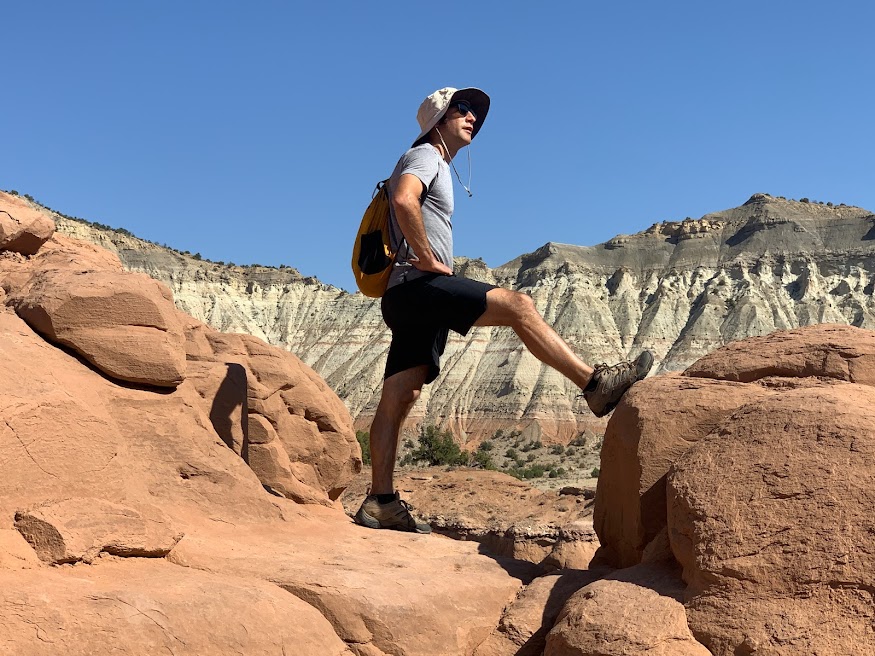
Laini initially bought these Keen Targhees for a 6-day Salkantay trek to Machu Picchu and has sworn by them for the past 11 years © Dave E. Leiberman/goingplacesfarandnear.com

Keen Targhee – $130-150

Merrell Moab Ventilator – $100

Good hiking shoes are everything. Laini initially bought these Keen Targhees for a 6-day Salkantay trek to Machu Picchu and has sworn by them for the past 11 years. The soles have just finally started to come loose a bit, but it wasn’t anything that some Shoe Goo (another recommendation) couldn’t fix. Dave has also owned his Merrels for many years and had a similar issue with his sole towards the end of our road trip. Both shoes provide so much comfort and support that we barely even notice our feet on 7+ mile hikes. We especially love these shoes for their Vibram soles that seem to let us scale pretty vertical slickrock boulders with zero slippage. They are also both waterproof, making them perfect for creek hikes (for deeper or more frequent waters we’d recommend an actual water shoe like Keen’s Newport style).

Dave has been hiking in his Merrels for years and the shoes provide so much comfort and support that we barely even notice our feet on 7+ mile hikes © Laini Miranda/goingplacesfarandnear.com

Darn Tough No show Lightweight Hiking Sock – $17

We bring multiple pairs of socks with us, but find ourselves washing these out overnight to reuse them since they’re the most comfortable, lightest weight socks we’ve tried. The merino wool lets you wear them for two or three days straight before you even need to wash them (we try to stick to no more than two). These work great for our low hiking shoes, but they also make them in mid-calf for boot styles.

HYDRATION

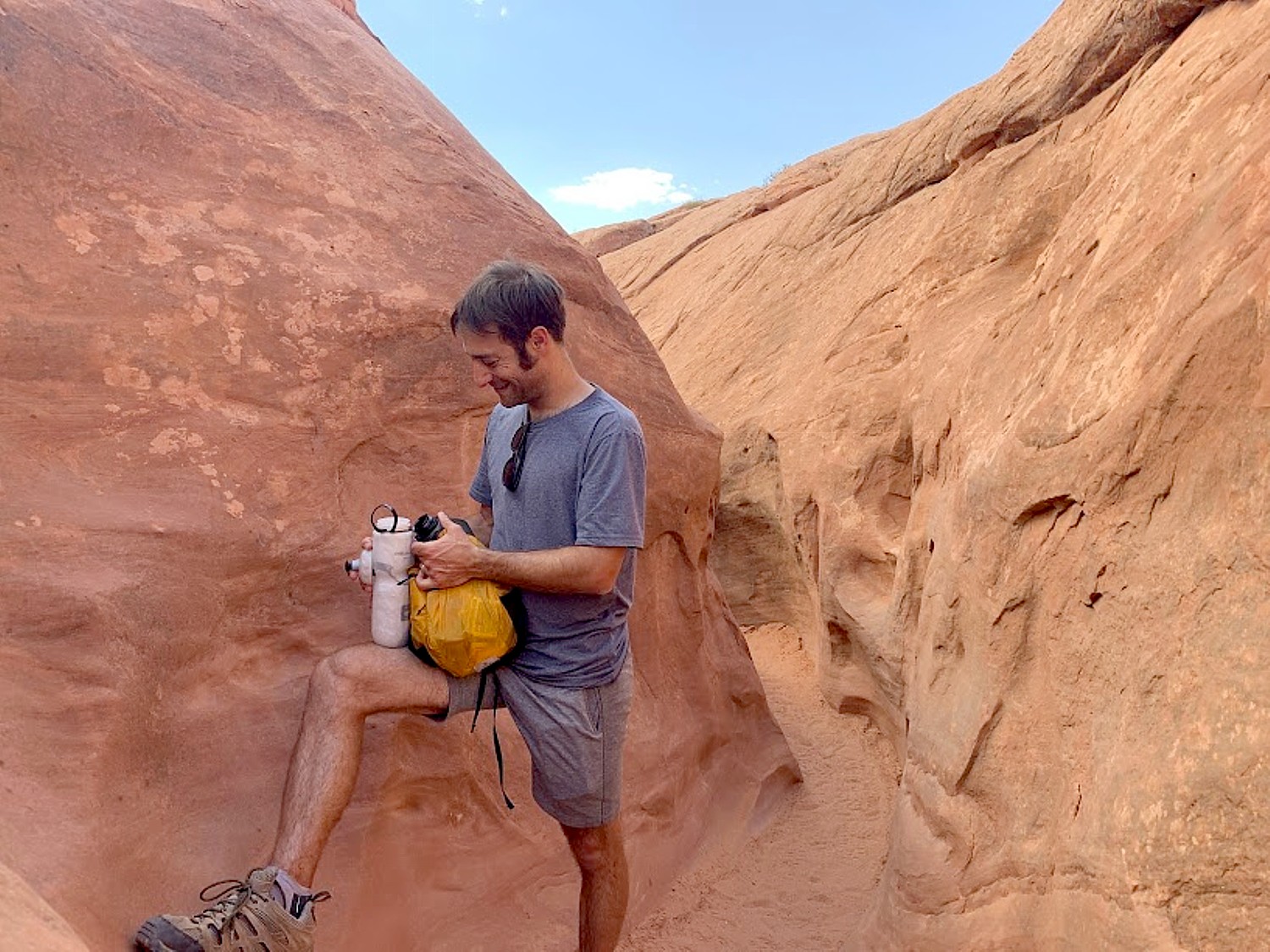
Using our Hydrapak 4L Seeker to fill up water bottles on our hike through the Dry Fork Slot Canyons of Grand Staircase Escalante National Monument © Laini Miranda/goingplacesfarandnear.com

Hydrapak 4L Seeker – $28

This collapsible water bottle/bag is indispensable for us on our long hiking days. We fill up with our water pump, throw it in a backpack on our way out, and roll it up when we’re finished with it. The super durable handle is also useful for clipping to a backpack and the large threaded mouth is both pleasant to drink out of and compatible with most 42mm threaded filters. The BPA & PVC-free material can also be frozen or filled with hot water. Generally this 4L container plus two water bottles hydrates both of us for 6-7 mile hikes. On longer hikes we bring a water cube and stash it after a mile or so. They also sell a handy Plug-N-Play Cap Kit that can turn your Seeker into a solar shower or camp tap.

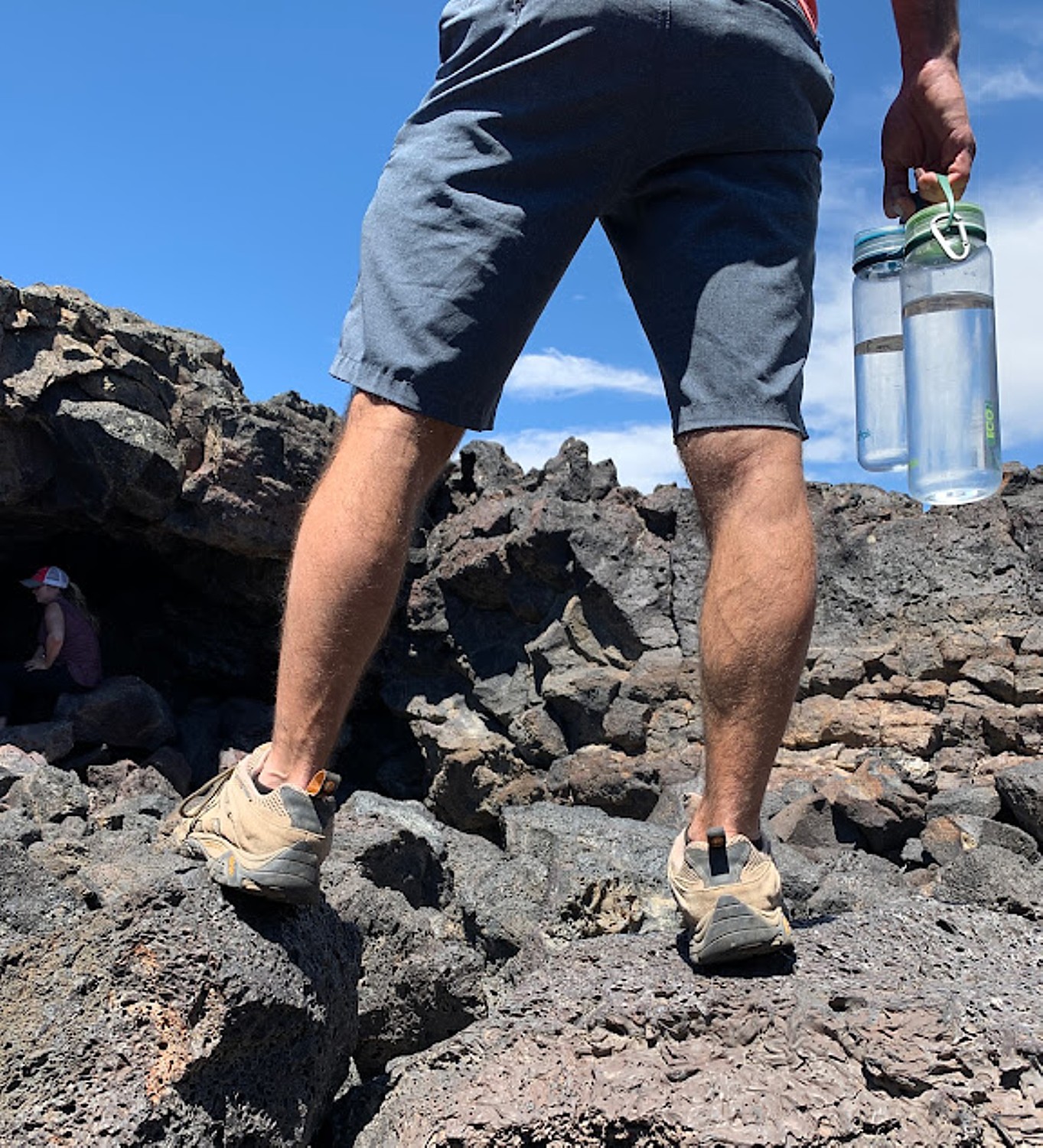
Made from 50% recycled plastic, the Recon Hydrapak water bottle is super lightweight, has a great drinking spout, and doesn’t spill when closed tightly, great for this hike at Craters of the Moon National Monument © Laini Miranda/goingplacesfarandnear.com

Recon Hydrapak Water Bottle – $17

Made from 50% recycled plastic, this water bottle is super lightweight, has a great drinking spout, and doesn’t spill when closed tightly. It touts a “patented twist cap that provides an experience like drinking out of a glass”, and as someone who hates drinking out of Nalgenes, I can attest to that branding. It’s so lightweight and comfortable to carry with its durable and flexible handle, I usually prefer to hold it while hiking instead of clipping to my backpack.

Hiking with the Recon Hydrapak water bottle in hand © Dave E. Leiberman/goingplacesfarandnear.com

FANS

Karacel Battery Operated Rechargeable Fan – $16.99

Rechargeable Tent Fan with Light – $29.99

These fans are indispensable in desert camping. We did a ton of research to find ones that were rechargeable, kept their charge throughout the night, and didn’t make too much noise. We prefer the convenient hook and fan/light combo of the $29.99 model and find that this is all we need for most nights in the tent, but the Karacel is a great second fan for extra hot nights in the tent or car.

COOKING ESSENTIALS

The Classic Coleman 2-Burner Stove with our Stanley Boil & Brew bring comforts of home to our wild camping at Badlands National Park © Laini Miranda/goingplacesfarandnear.com

Stanley Boil + Brew French Press – $25

Does just what the name suggests and makes a delicious cup of coffee. We also love that it’s the same height as a standard 16oz Propane tank and our mess kit so all three fit perfectly side by side in the front compartment of our car kitchen drawer.

Overmont Lightweight Mess Kit – $28.99

This may not be the best mess kit out there, but for the price you really can’t beat it. We’ve used this for the past 3 years and love it. The food-grade anodized aluminum is super lightweight, compact, and everything nestles inside each other to fit in one small carrying case. On our road trip we only take with us the two pots, sponge, and spatula, and keep our mugs inside the pots. 

2-piece Stainless Steel Travel Mugs – $17.99

Again, there are certainly better versions out there, but we love how lightweight and inexpensive these mugs are. They fit perfectly in the pot of our mess kit and can be clipped to our backpack if we’re on the move.

Coleman Classic 2-Burner Stove – $43.99

It’s a classic for a reason. 

PERSONAL CARE 

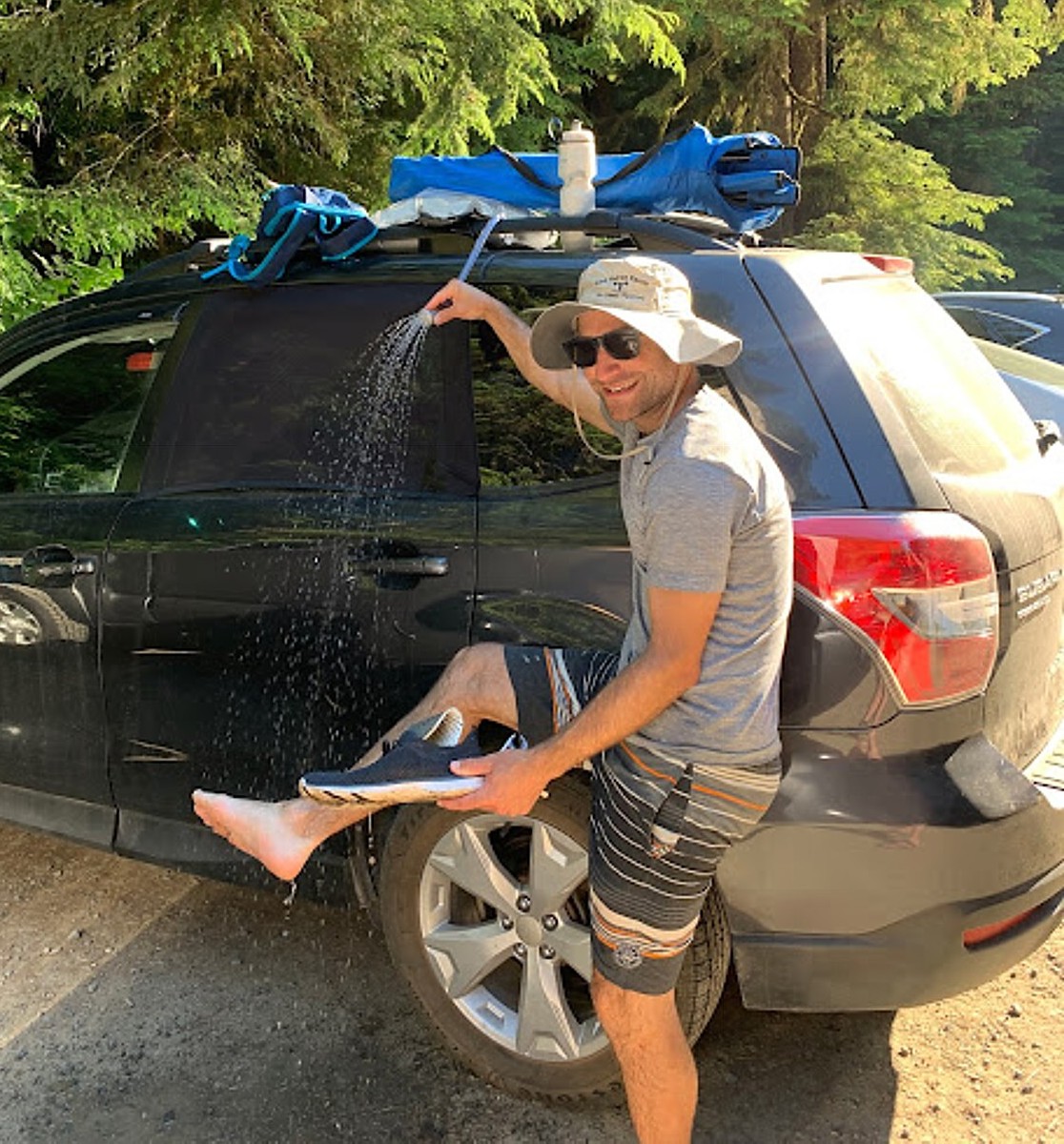
Advanced Elements Solar Shower is also handy for washing our feet after a trip to Third Beach in Olympic National Park © Laini Miranda/goingplacesfarandnear.com

5 Gallon Solar Shower – $34.99

We shopped around a bit, but I ended up going with Wirecutter’s pick for best solar shower. With the hooks on each edge of the bag and some reusable zip ties, we strap this to our roof rack clear-side-up and by the time we reach our campsite the water is as hot as our home shower (sometimes after extra long summer drives we actually need to leave it in the shade for a bit to cool it off before using––the thermometer on the bag is really helpful for this scenario). The durable strap is made to hang from a tree, but we use it just as much from the roof of our car. In the backcountry of the desert when no one else is around for miles you don’t even need to worry about a privacy tent. Pull the nozzle down from the hose to open the valve, push it back up to close. Two of us can shower (one of us with long knotty hair), and we still have water left in the bag.

Triptips Portable Toilet – $38.99

You might wonder where one goes to the bathroom when backcountry camping. If you must know, this portable toilet is actually excellent. The accordion wall design collapses to a mere 2 inches and fits in its own carrying bag when traveling. When we set up camp, we pop in the bottom circle which makes the accordion take its cylindrical form, place the seat over the top, and it can apparently hold up to 330 lbs. The seat is surprisingly comfortable for being so small, and it closes so tightly that you really can’t smell a thing when it’s latched. We use these compostable toilet bags (only for solid waste) and tie them to the roof rack until we get to a dump station. TMI? Sorry.

Our makeshift powder room with “HI NINGER collapsible sink by Little Payette Lake, ID (the sink collapses to a cutting board for food prep) © Laini Miranda/goingplacesfarandnear.com

MISCELLANEOUS

Bamboo Charcoal Air Purifying Bags/Shoe Deodorizers – $14.79/12-pack

This is perhaps the best $15 we spent in our car living. We stick one of these in each shoe when we take it off and don’t even notice we have several pairs of sweaty sneakers and sandals in our car. These things may actually be magic.

Thermarest Compressible Travel Pillow – $25.99 (bought for $14.99 at Mountain Steals)

Ok, so our secret to comfy camping is that we bring our big pillows from home because we generally prioritize our sleep, but a last minute thought to throw one of these in the car was great for our long driving days. We continue to keep this in the car since it compresses into such a compact log, and even becomes a nice lumbar support. In the future we may just bring two of these on longer road trips since they are actually quite comfortable––just make sure you give it enough time for the shredded foam filling to fully expand. The attached cover is so soft you don’t even need an extra pillow case.

The soles of our hiking boots have just finally started to come loose a bit after many years of wear, but it wasn’t anything that some Shoe Goo couldn’t fix © Dave E. Leiberman/goingplacesfarandnear.com

Shoe Goo – $3.98

This 1oz tube is a lifesaver for when you need a quick shoe repair on-the-go. Parts of both of our soles came loose at certain points with all the hiking we do between slickrock and loose dirt. We use this goo at night, hold it in place with some masking tape (painter’s tape, really), and the shoe is good to go the next morning.

Reusable Zip Ties, 100 pack – $13.99

We use these for so many things while camping we can’t leave them off the list. The 10” ties hold up to 50 lbs, and are sturdy enough to secure our solar panels and solar shower to our roof rack even while driving on major highways. 

See also: Car Camping in Comfort: How We Turned our Subaru into Our Home On the Road

____________________

© 2021 Travel Features Syndicate, a division of Workstyles, Inc. All rights reserved. Visit goingplacesfarandnear.com, www.huffingtonpost.com/author/karen-rubin, and travelwritersmagazine.com/TravelFeaturesSyndicate/. Blogging at goingplacesnearandfar.wordpress.com and moralcompasstravel.info. Send comments or questions to FamTravLtr@aol.com. Tweet @TravelFeatures. ‘Like’ us at facebook.com/NewsPhotoFeatures

Car Camping in Comfort: How We Turned our Subaru into Our Home On the Road

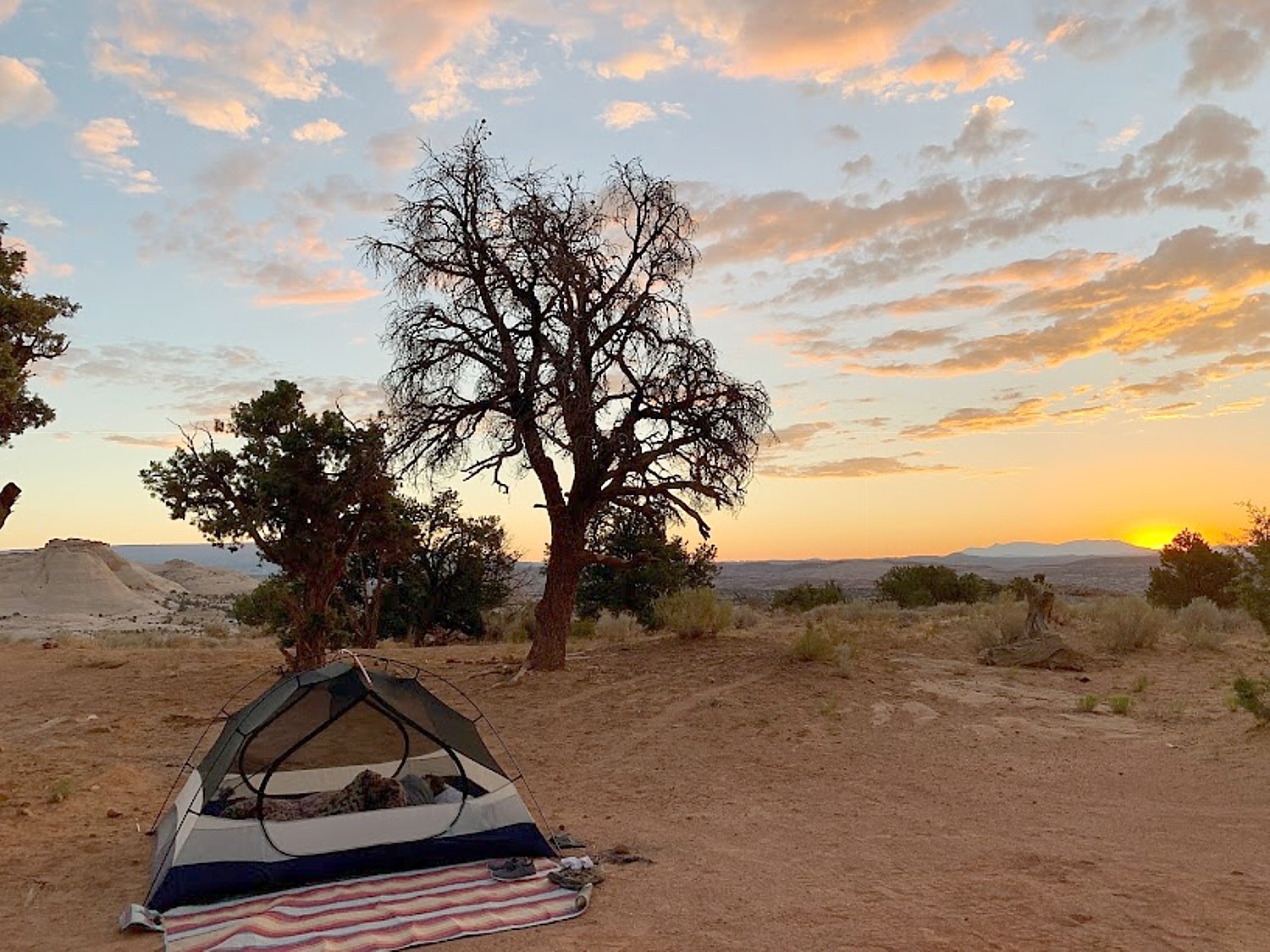
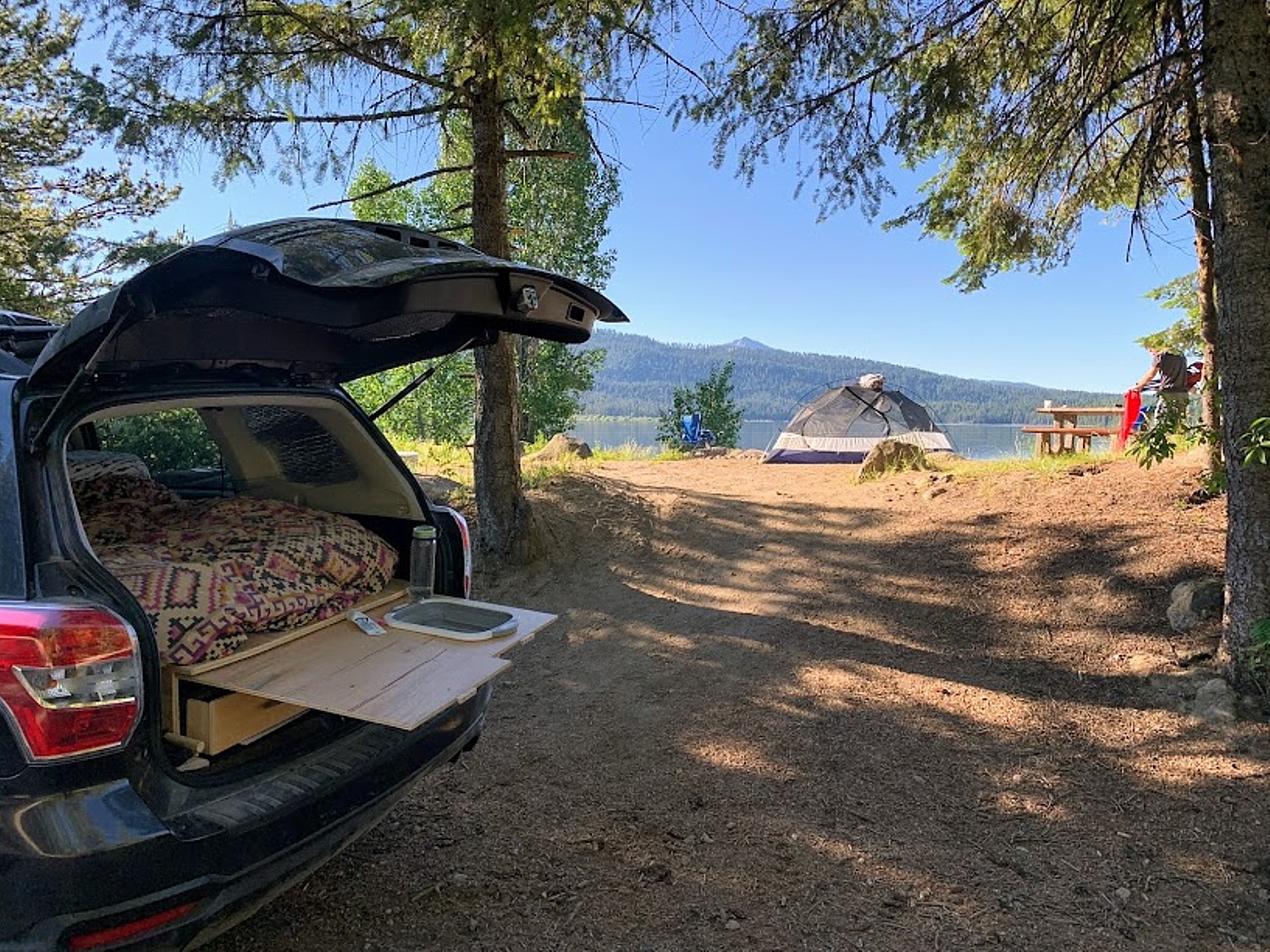
Our wild camp spot at Grand Staircase National Monument, comfy in our REI Half Dome 3+ on our Best Choice 4″ thick Folding Mattress © Laini Miranda/goingplacesfarandnear.com

By Laini Miranda & Dave E. Leiberman

Travel Features Syndicate, goingplacesfarandnear.com

We just returned home from two months living out of our Subaru while we traveled around the country. Without much pre-planning, our route took us 8,300 miles from upstate New York through Wisconsin, South Dakota, Wyoming, Idaho, Washington, The San Juan Islands, Oregon, Utah, Colorado, Missouri, Ohio, Pennsylvania, and back home to New York. 

We outfitted our Subaru Forester with a platform bed and two drawers underneath to maximize storage, which we designed and built ourselves, and brought along enough creature comforts so that we didn’t miss a thing while we were on the road or wild camping (other than friends and family, of course!). 

Here’s a round-up of some of the things we learned we can’t live without, in no particular order:

We outfitted our Subaru Forester with a platform bed and two drawers underneath to maximize storage, which we designed and built ourselves, and brought along enough creature comforts so that we didn’t miss a thing while we were on the road or wild camping © Laini Miranda/goingplacesfarandnear.com

500W Jackery Power Bank  – $499

We keep the Jackery Power Bank on the floor behind our front seats, plugged into the 12V cigarette lighter in the rear of the car. The Jackery powers our car fridge, cell phones, laptop and fans. The 2.4A in the USB outlet charges our phones so much faster than the car USB does, we’ve actually been keeping it in the car even when not on a road trip. While driving any substantial distance, the Jackery stays at a healthy 99% and rarely drops below 50% even overnight when not drawing power from the car. We use the 60W solar panels to top off the Jackery on days we aren’t driving. 

Alpicool C9 Mini Refrigerator – $159.99

Our car fridge sits next to the Jackery on the floor behind the driver’s seat and stays plugged into the 12V plug on the Jackery at all times. We keep the fridge on “Eco” mode, which fluctuates between about 38 and 44 degrees. We opted for the C9 because that was as much space as we could dedicate in our Subaru and it worked well for us, but I definitely see the benefits of the larger C20 model with the raised lid if you have the extra room. Most days our Alpicool stored: 1L milk, 1 block of cheese, turkey, 4 or 5 string cheeses, jam, hot sauce, and 3 beers, with a little room to stuff random things on top if needed. This refrigerator is miraculously quiet. We almost never notice it while driving, and even when sleeping in the car, the compressor isn’t loud enough to be heard over our earplugs, even with it located just below our heads. The great thing about keeping the Alpicool behind the driver’s seat is that the passenger can easily access its contents with the lid on top. We love never having to deal with melted ice as we used to with our cooler, and find that this size fits enough for a week in the desert.

Rockpals Portable Solar Panel is easy to position for optimal sun exposure on top of or beside the car. It then folds up into a slim briefcase we can quickly slide into any free gaps in our car. © Dave E. Leiberman/goingplacesfarandnear.com

60W Rockpals Portable Solar Panel – $159.99

This is a cleverly designed, high quality solar “briefcase” that we use to top up our Jackery when not driving. The 20-25 watts we get with full sun keeps our Jackery from depleting even when powering our Alipicool fridge throughout the day and night. It’s easy to position it for optimal sun exposure on top of or beside the car, especially with the two kickstands attached to the back. It then folds up into a slim briefcase we can quickly slide into any free gaps in our car.

Best Choice Tri-Fold Mattress – $89 at time of purchase

This 4-inch foam mattress is what kept us on the road for 7 weeks and has us wanting to go right back out. The tri-fold feature of this mattress allows us to keep it semi-folded when not in use, and easily move it between the car and our tent to make every night as comfortable as sleeping in our bed at home. The twin is 75 x 39” and perfect for two small adults. We purchased this for $89.99, but it does seem to fluctuate on Amazon so we recommend grabbing it whenever you see a good deal, even if you’re not car camping anytime soon! We plan to use this in place of an air mattress whenever we need an extra guest bed. 

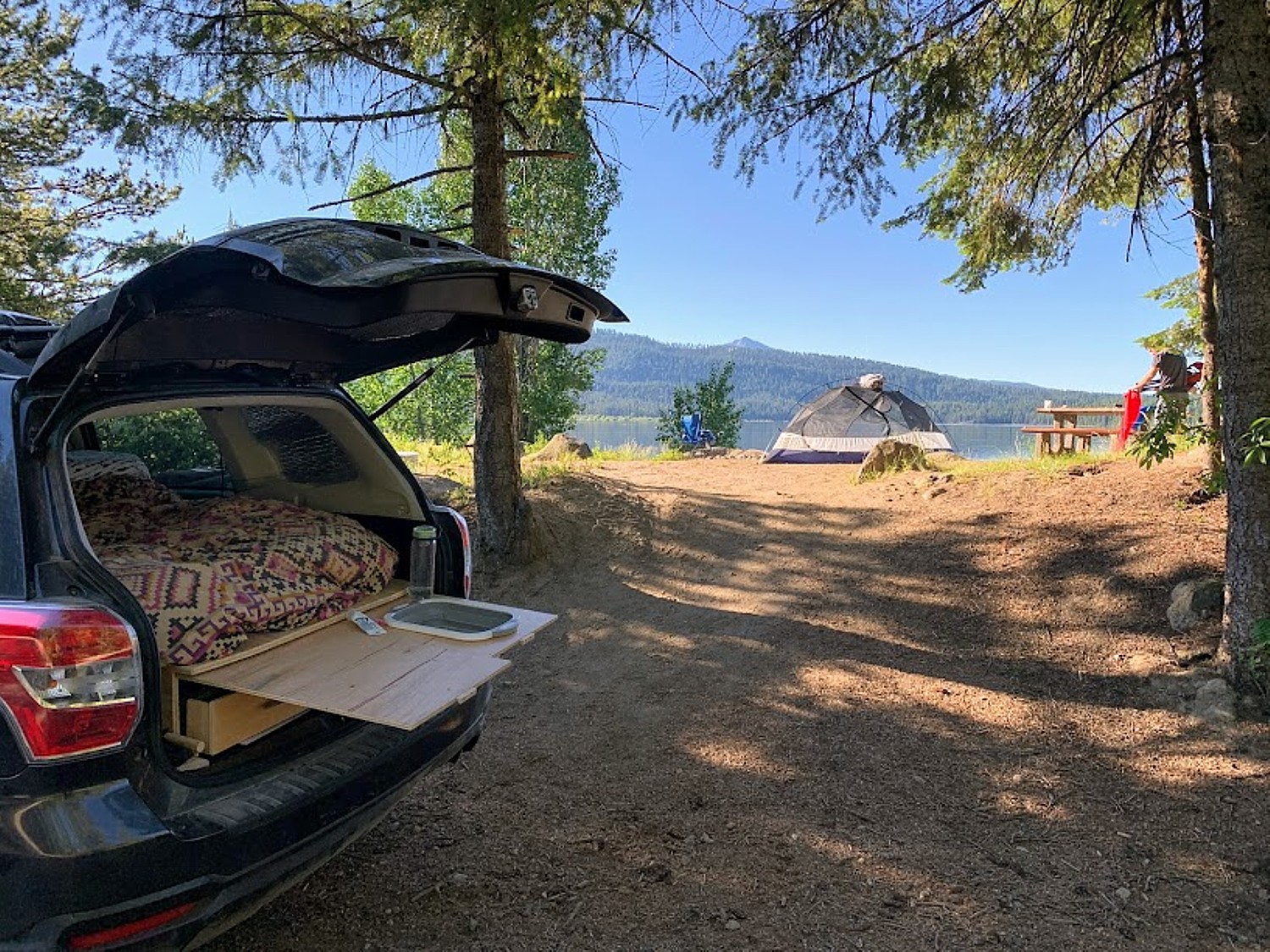
Our Subaru camper car outfitted with collapsible sink, and REI Half Dome 3+ at Little Payette Lake, ID © Laini Miranda/goingplacesfarandnear.com

Collapsible Sink and Cutting Board – $16.99

This is an integral part of our kitchen and bathroom setup. We cut a hole in our pull-out wood counter exactly the size of this sink, pop it in, and immediately have a basin for washing dishes, brushing teeth, doing laundry, and everything in between. It has a push drain to release water when ready, and collapses down to a perfect sized cutting board. At just over an inch collapsed, it’s easy to store anywhere. It does drip a bit with the drain plugged, but since we only use it outside that doesn’t really bother us. We now can’t imagine ever camping without this. 

Wild camp spot outside of Silverton, CO, just before the rainstorms © Dave E. Leiberman/goingplacesfarandnear.com

Wireless Auto Water Pump – $12.99

Did you think you can’t have running water in your car?? We bought a longer silicon tube for this pump, inserted it into our 7 gallon water container and have water on demand. We use this baby constantly–filling up our water bottles while driving or before hikes, making food, washing dishes, brushing teeth, etc., and we only had to charge it ONCE in our 7 weeks on the road. While these water pumps are generally made to be used on top of a water cooler jug, we fashioned a bottom for it with inspiration from a YouTube video by Todd Parker: cut a notch in a roll of electrical tape, stuff that inside the base, add adhesive neodymium rare earth magnets to the bottom, affix a metal plate to the surface you want to hold the pump, and you have a beautiful faucet with running water! We most often use this pump either from the front seat to fill up water bottles during long drives, or affixed to the metal plate next to our pop-in sink in the back of the car for cooking or washing up. We bought this 25-ft braided sleeve so we can move the long hose back and forth without the silicon tube collecting dust and grime, also a brilliant Todd Parker recommendation. (Note: we do not personally know Todd Parker.) 

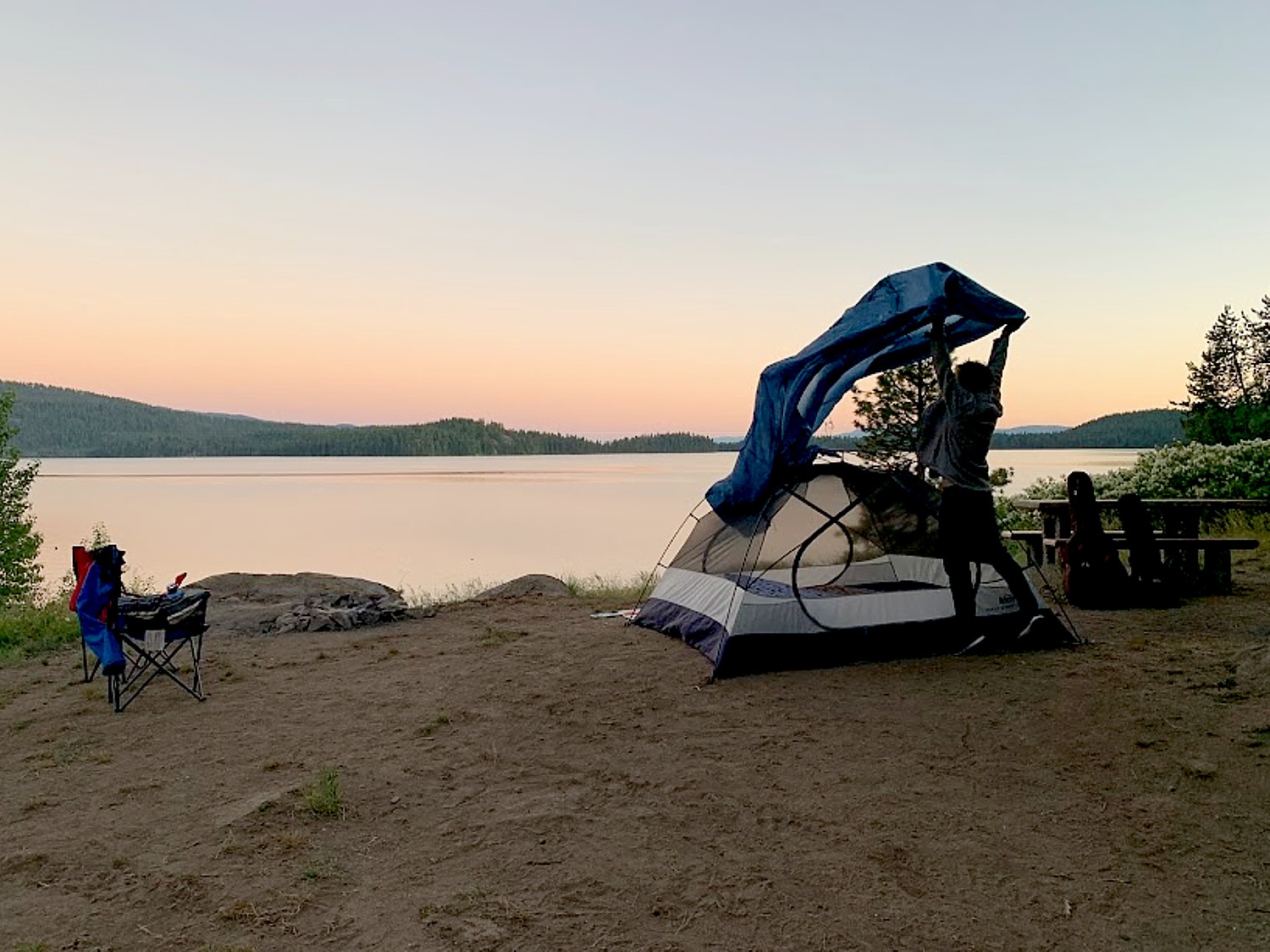
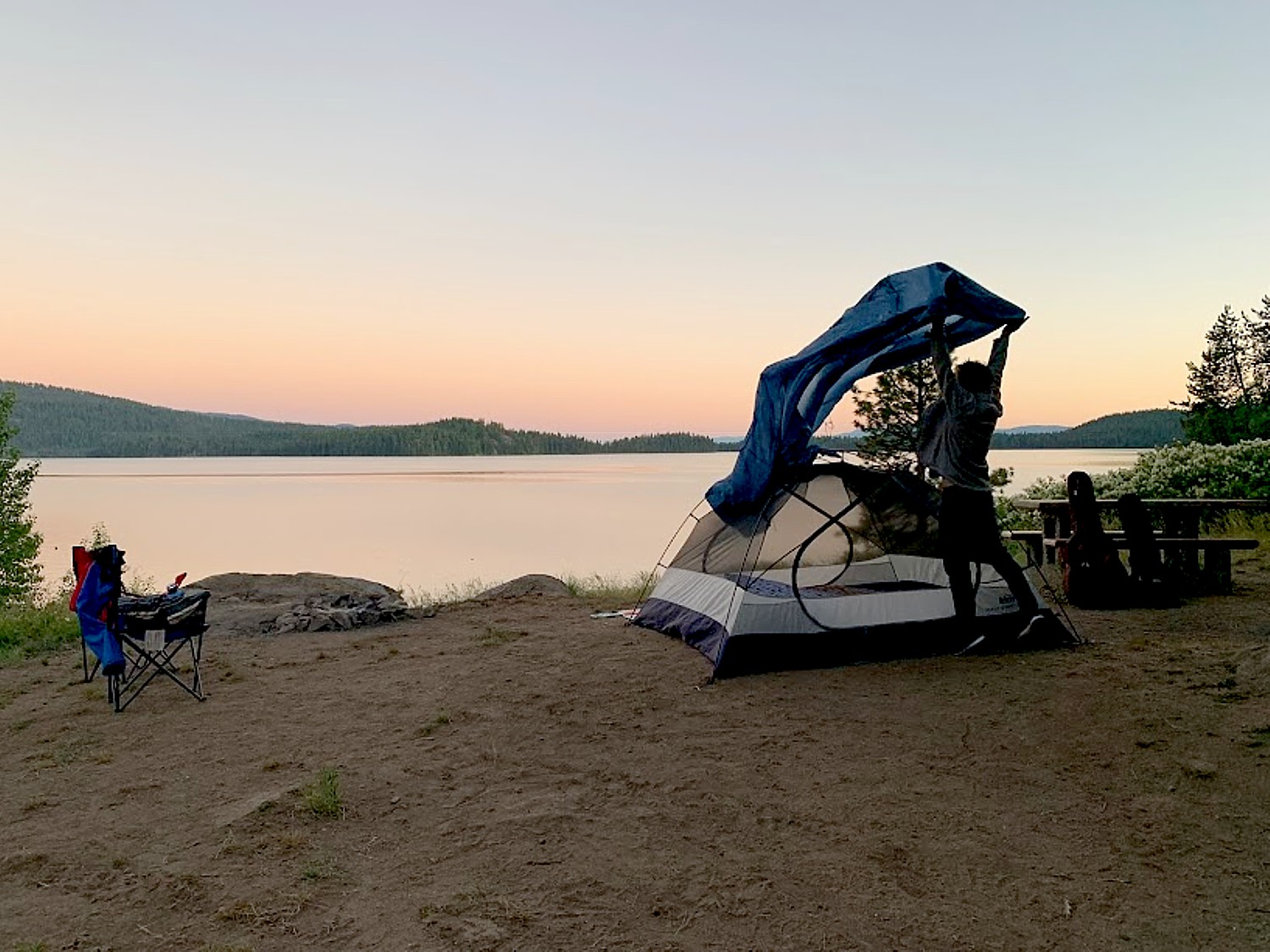
Our REI Half Dome 3 Plus tent by Little Payette Lake, ID © Laini Miranda/goingplacesfarandnear.com

Car Rear Window Shade – 2 pack – $12.99

This is a simple product that lets us turn our car windows into screens. On the nights we opt to sleep in the car instead of setting up our tent, we put one of these window sleeves on each door, open the window, and voila, great airflow without the mosquitoes. We also leave one of these on the rear window above the refrigerator during the PNW heat wave to reduce the heat in the car, but we don’t recommend them on any other windows while driving since they also reduce visibility (an added plus for when you have to sleep in the Cracker Barrel parking lot).

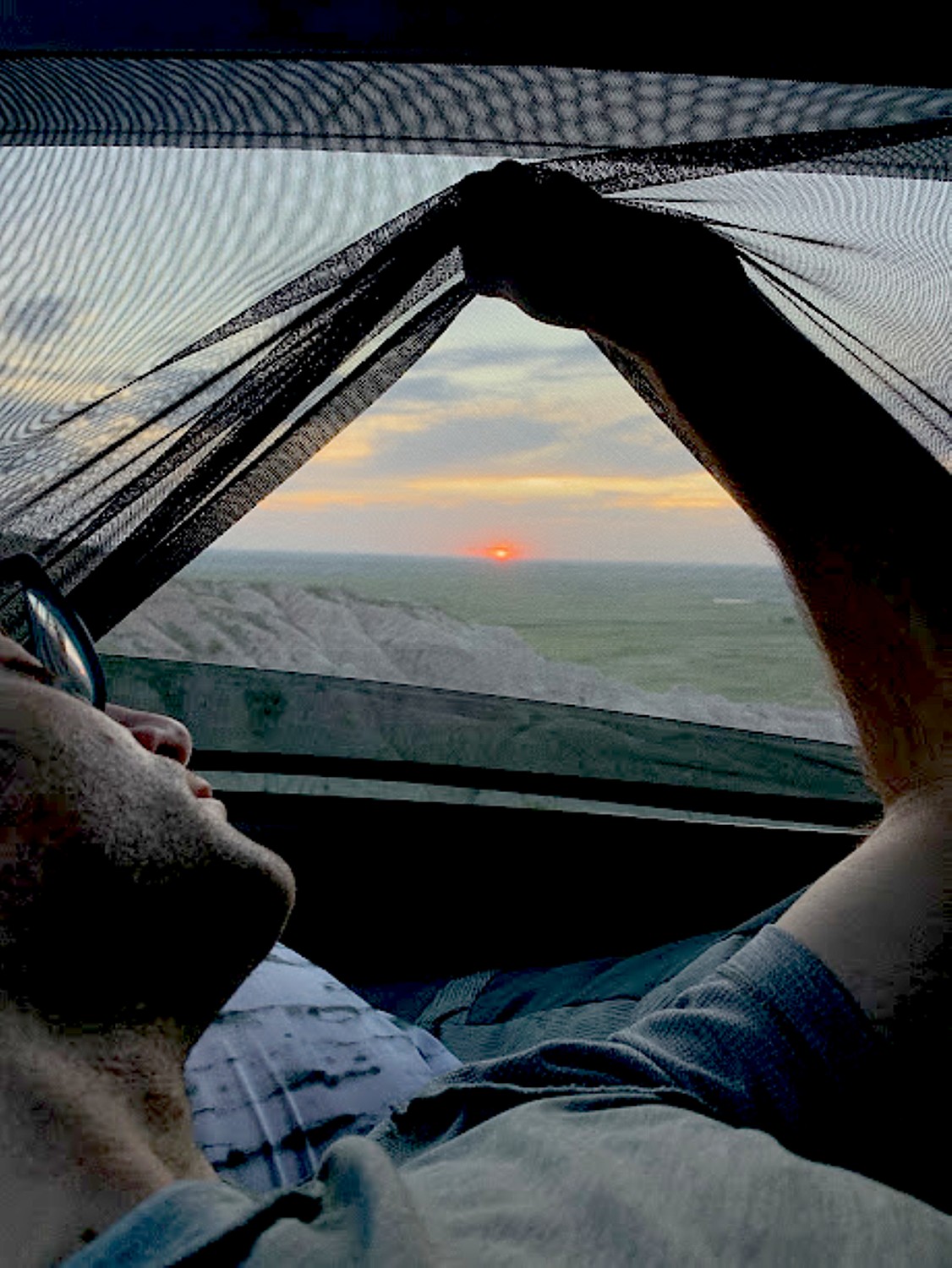
LEMLEON Car Window Shade fits our Subaru Forester windows perfectly. It comes with velcro to secure them to the inside of the car door, though you can still easily raise them to see the sunrise over the Badlands. (OR: “We raise our Lemleon Car Window Shades to catch the sunrise over Badlands National Park” © Laini Miranda/goingplacesfarandnear.com

EzyShade Windshield Sun Shade – $12.97

Sun Shades are a must when leaving the car in the desert sun. We tried two different kinds and like these the best. It takes about 10 seconds to stuff these two rounded rectangular pieces into our windshield and just as long to collapse them back into a small circle that fits in the car door pocket. We use ours so frequently we just keep it in the slot between the seat and the door.

Our trusty REI Half Dome and Nemo blanket after 2 straight days of thunderstorms outside of Silverton, CO © Laini Miranda/goingplacesfarandnear.com

REI Half Dome 3 Plus Tent – $329

This tent is brilliant. Its color-coded poles and ingenious architecture enables us to pitch it in under 2 minutes. Usually one of us pitches the tent while the other starts the fire or preps food. The upper portion of the tent is full mesh, which allows for optimal air flow and viewing of the Milky Way. In the desert we tend to not need the fly, but for the few days of torrential downpours and strong winds we encounter in the Colorado mountains, when we are thrilled at the durability and protectiveness of the fly and footprint. We used to use the 2 Plus model, but the 3 Plus is extra luxurious and easily fits our 4” tri-fold foam mattress plus plenty of room to hang out on rainy nights (Note: the 2 Plus would also fit the twin 4” tri-fold). We also love the location and quantity of pockets and hanging loops for all our tent gear. 

Nemo Victory Blanket – $29.99 (40% off at Mountain Steals at time of writing)

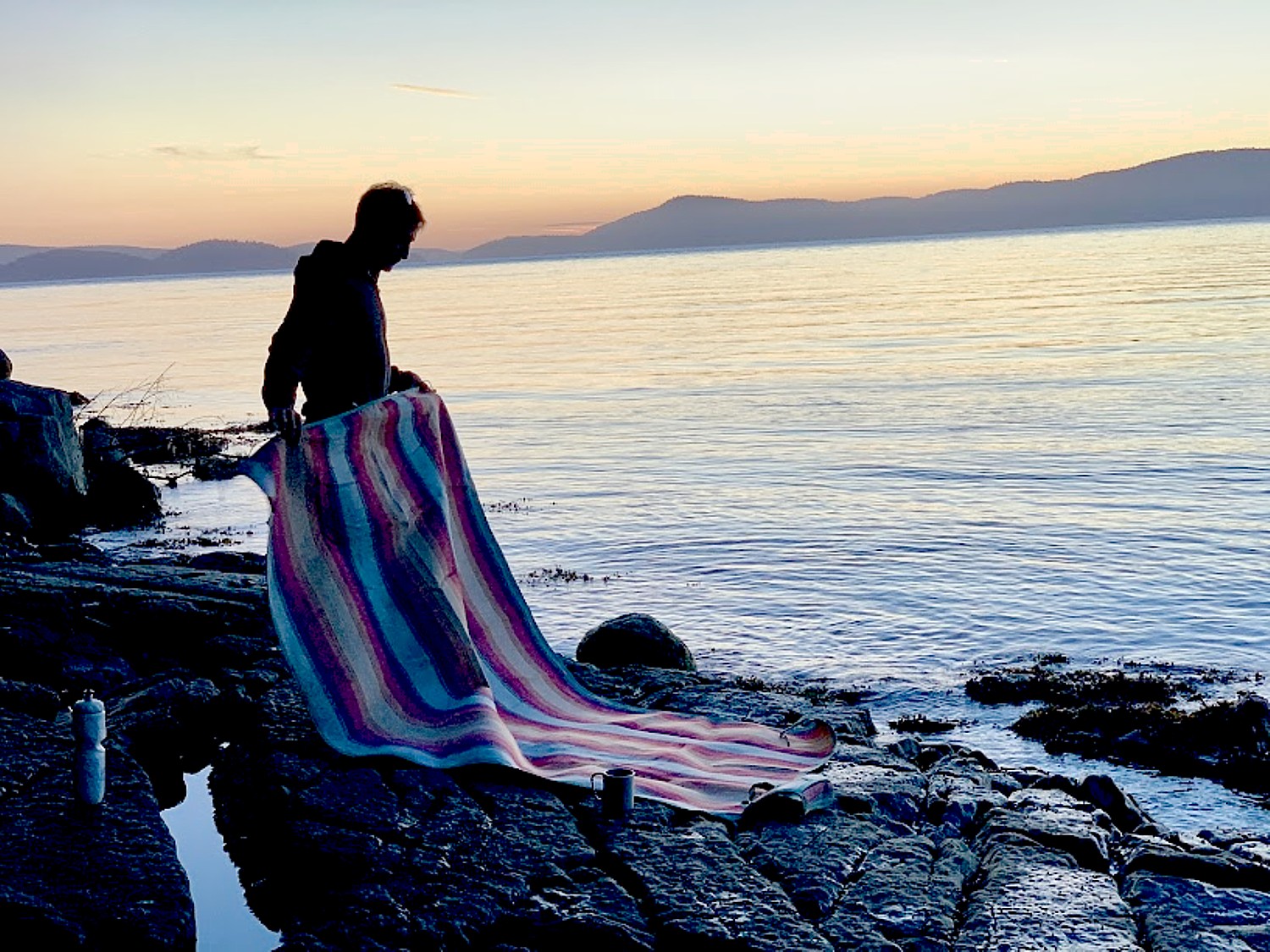
We use this blanket daily, whether it’s the rug by our tent (the 2P is the exact length of our REI Half-dome 3), or a blanket on a pebbly beach. The fabric side is extremely soft and delightful to lay on, while the under-side is waterproof and more durable. Though it is thick enough to keep us comfortable even on a lava rock ground in Craters of the Moon, it is light enough that I barely notice carrying it on a 2 mile hike to Third Beach in Olympic National Park. It even dried remarkably fast after 2 straight days of torrential downpours in Colorado. One of us remarks almost every day about how much we love this blanket.

Our Nemo Victory blanket makes the perfect sunset spot on the wet rocky shores by Washington Park in Anacortes, WA. © Laini Miranda/goingplacesfarandnear.com

MPowerd Solar Lights – $24.95 – $49.95

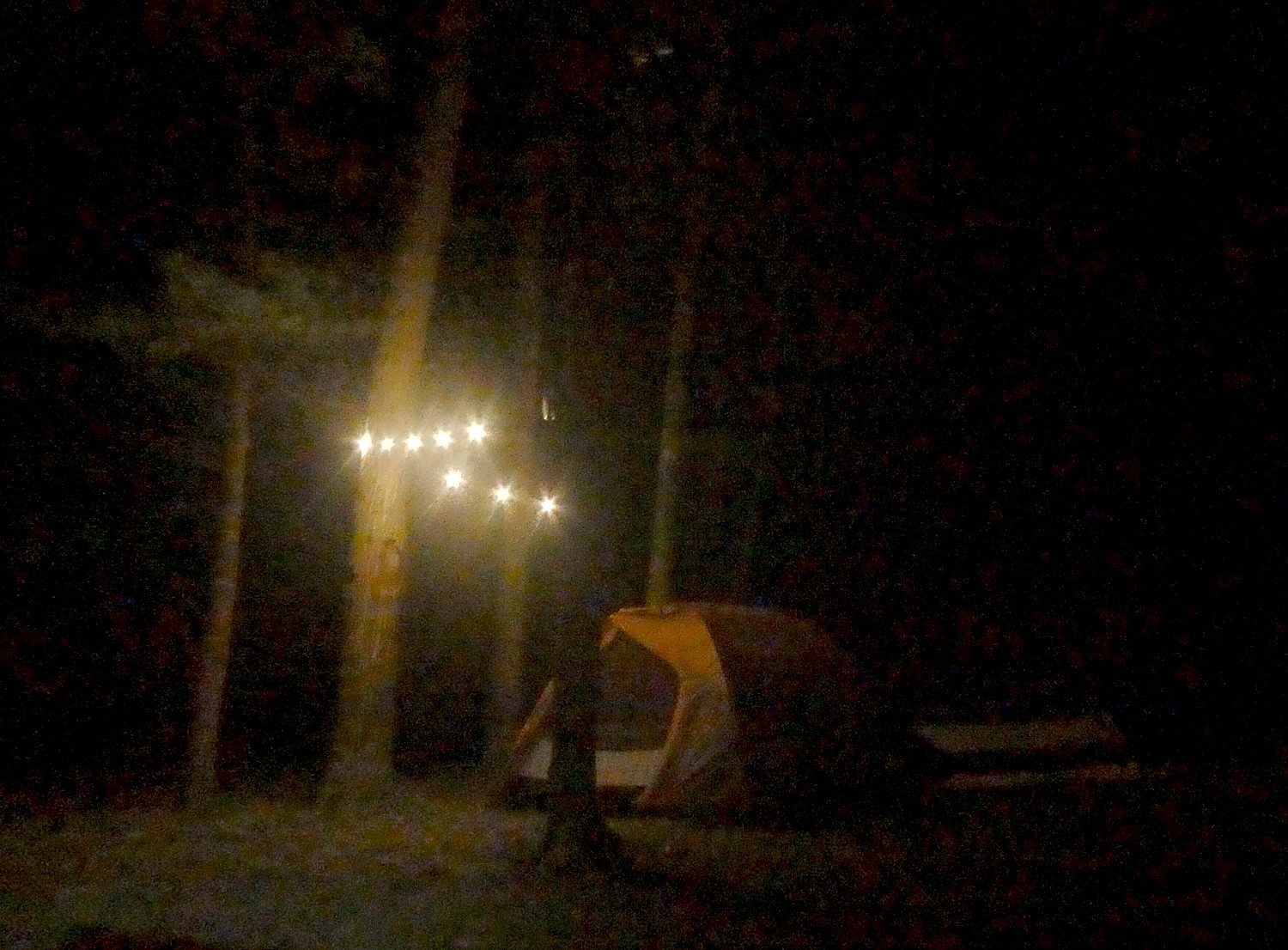
This brand has nailed the compact solar light game. We highly recommend their Luci Solar String Lights and the Luci Lux Inflatable Lantern. Both give off warm light and offer 3 different brightness settings, as well as a battery level indicator. The string lights are long enough to provide light to our tent between a couple trees, and the Luci Lux (which flattens to less than an inch) is the only lantern we now use while camping. The attached strap lets us easily hang it from the opened hatch of our Subaru or the tent ceiling. The lowest setting, warm light, and frosted/matte finish also makes for a perfect pillow-side lamp. 

Luci Solar String Lights gives off warm light and offer 3 different brightness settings, as well as a battery level indicator and is long enough to string between a couple trees. ©Karen Rubin/goingplacesfarandnear.com

Next: More of our favorite hiking & camping gear 

_____________________

© 2021 Travel Features Syndicate, a division of Workstyles, Inc. All rights reserved. Visit goingplacesfarandnear.com, www.huffingtonpost.com/author/karen-rubin, and travelwritersmagazine.com/TravelFeaturesSyndicate/. Blogging at goingplacesnearandfar.wordpress.com and moralcompasstravel.info. Send comments or questions to FamTravLtr@aol.com. Tweet @TravelFeatures. ‘Like’ us at facebook.com/NewsPhotoFeatures
New York’s Watkins Glen State Park is Spellbinding

By Karen Rubin, David Leiberman & Laini Miranda

Travel Features Syndicate, goingplacesfarandnear.com

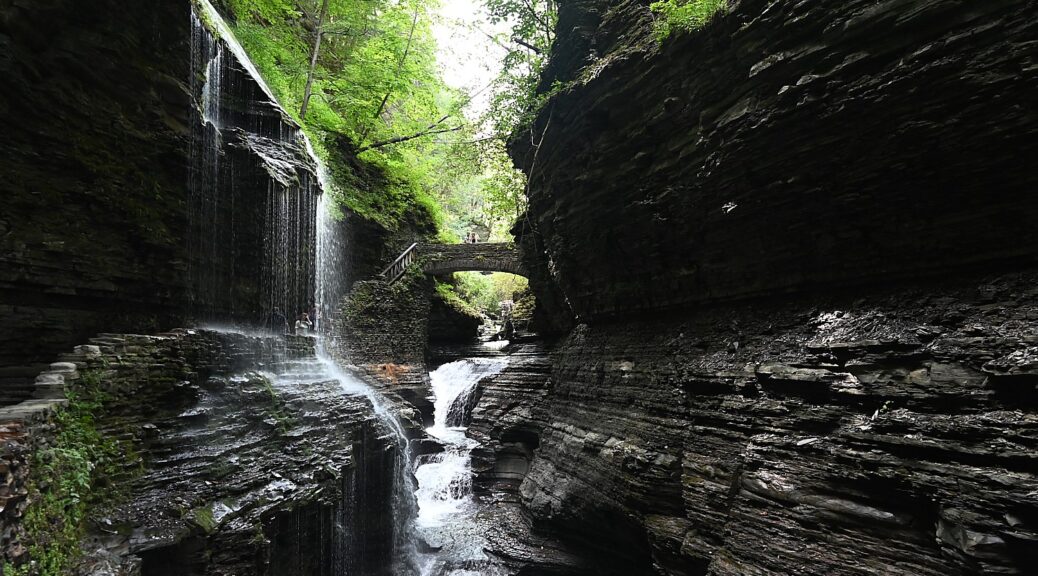
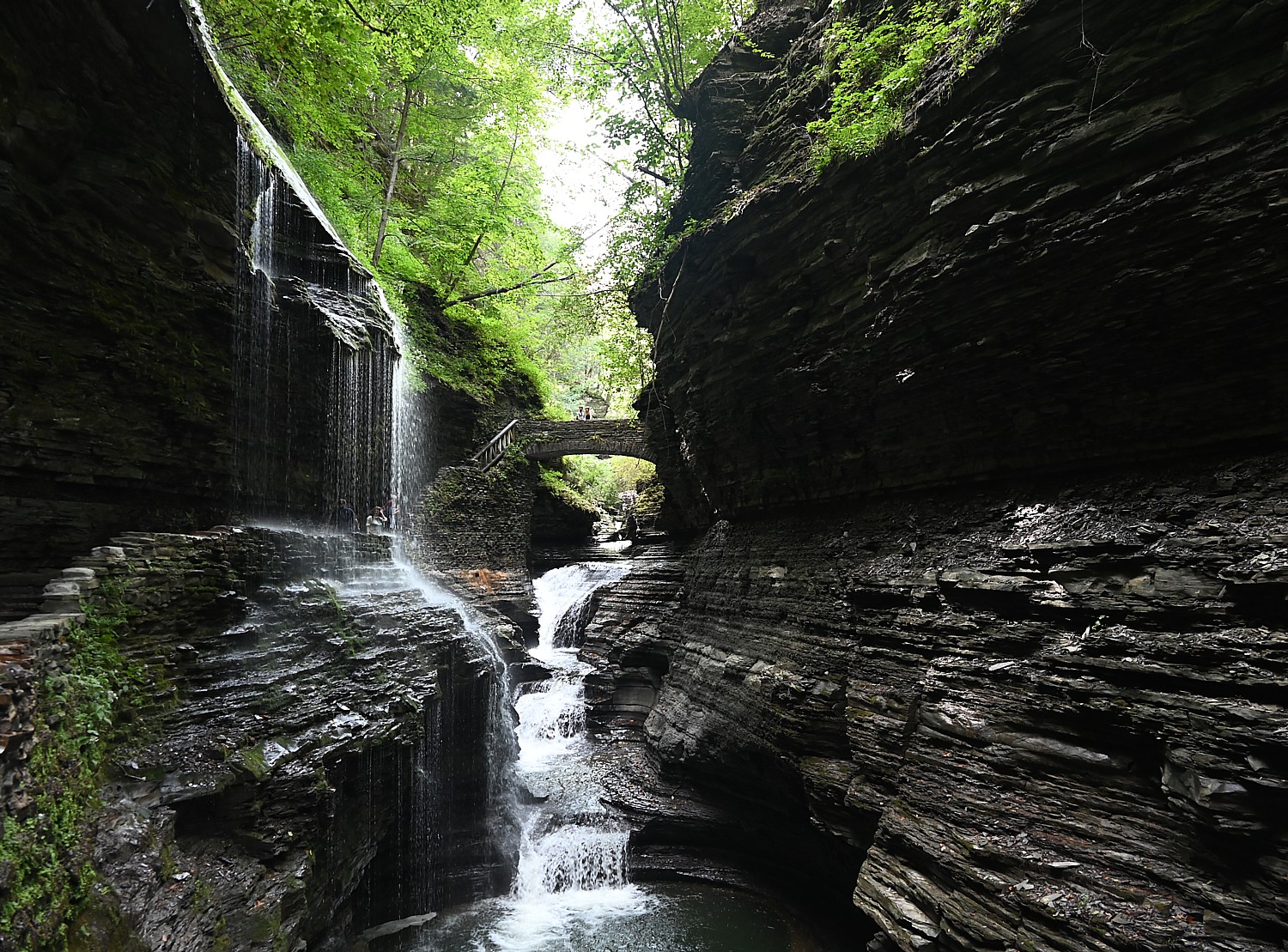
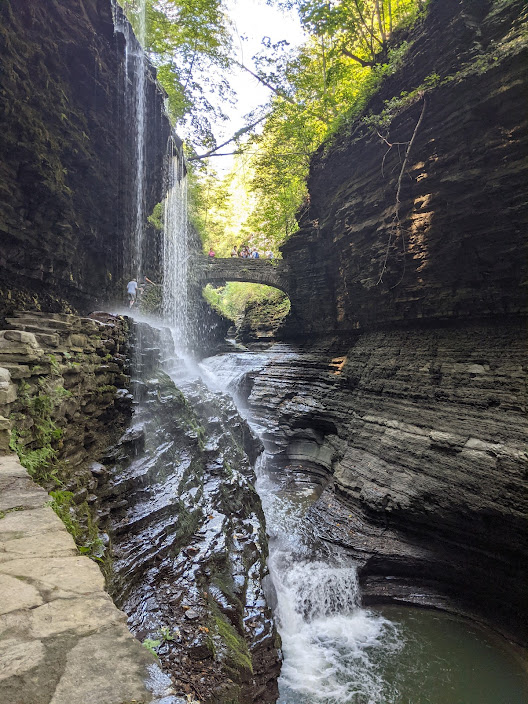
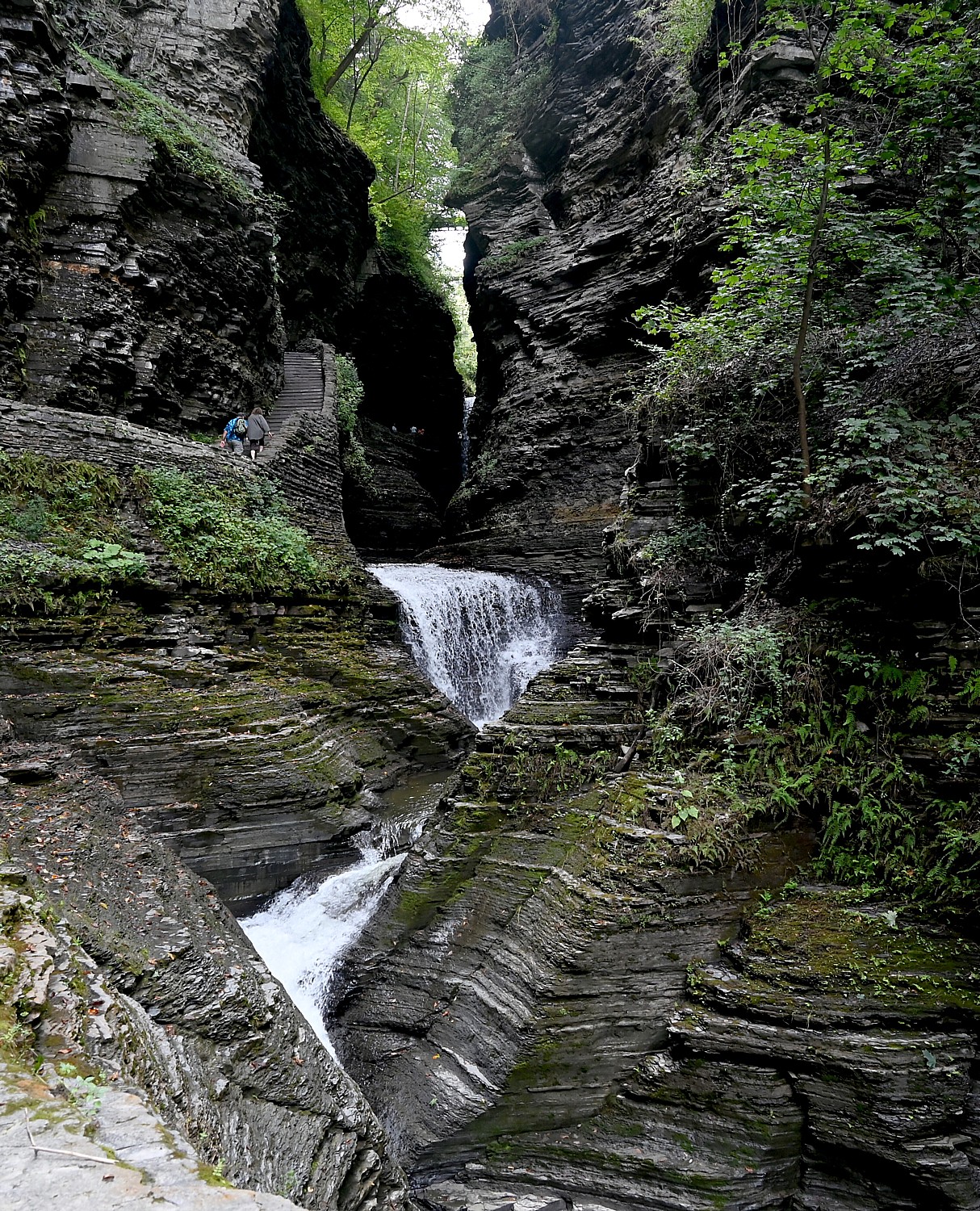
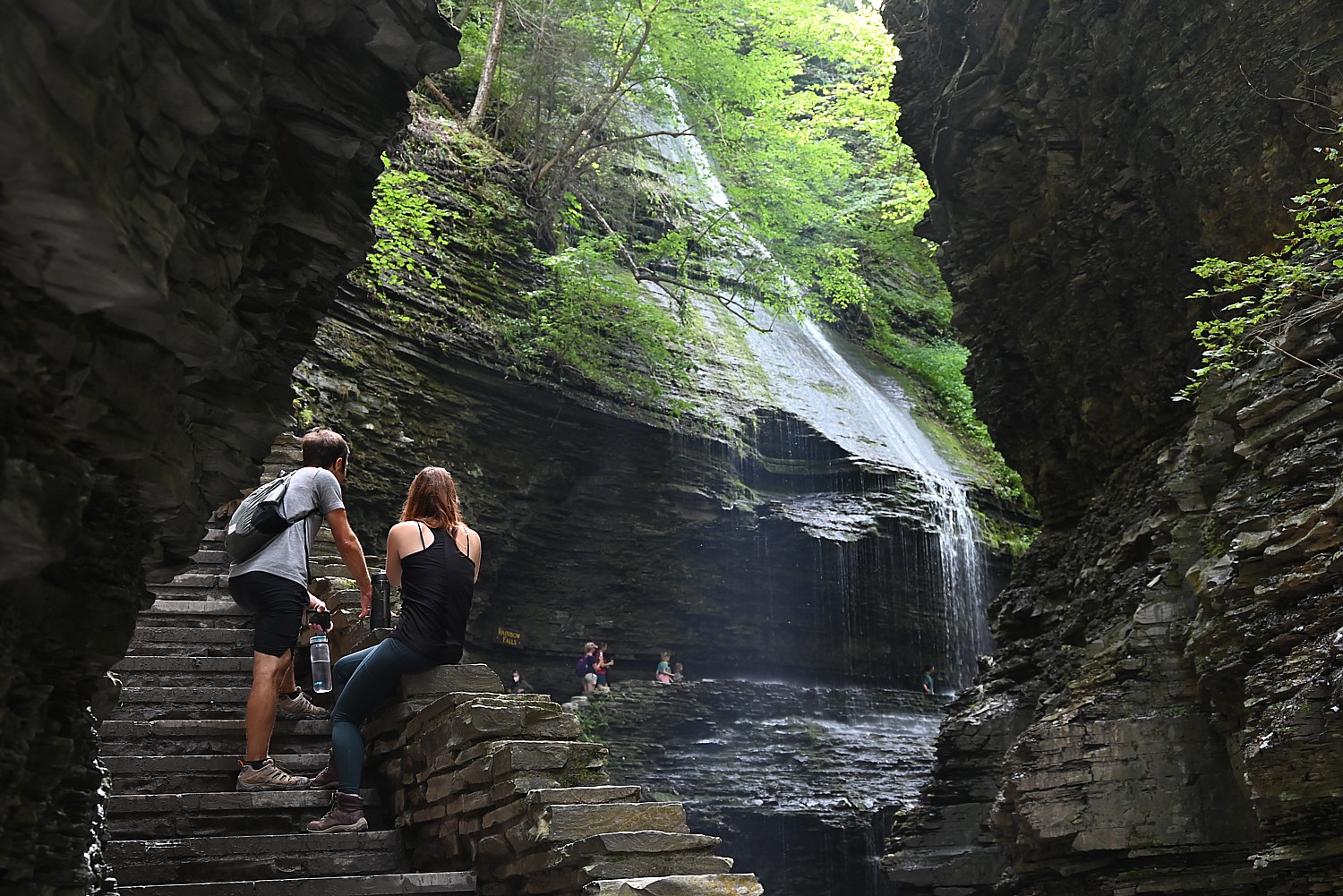
Rainbow Falls, one of the highlights of the Glen Creek Gorge Trail, Watkins Glen State Park, © Karen Rubin/goingplacesfarandnear.com

Walking the Gorge Trail in Watkins Glen State Park in New York’s Finger Lakes is, in a word, spellbinding.

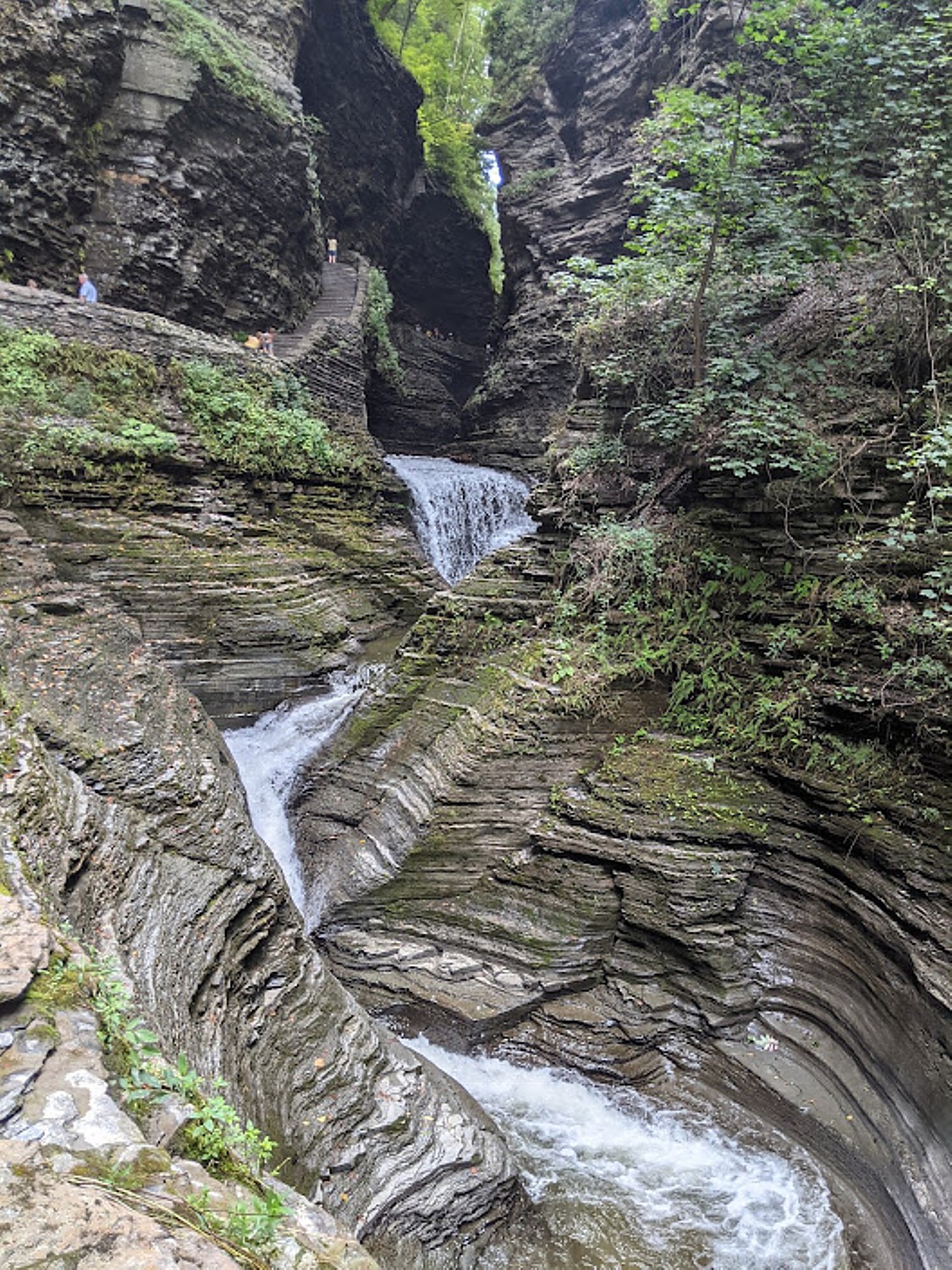
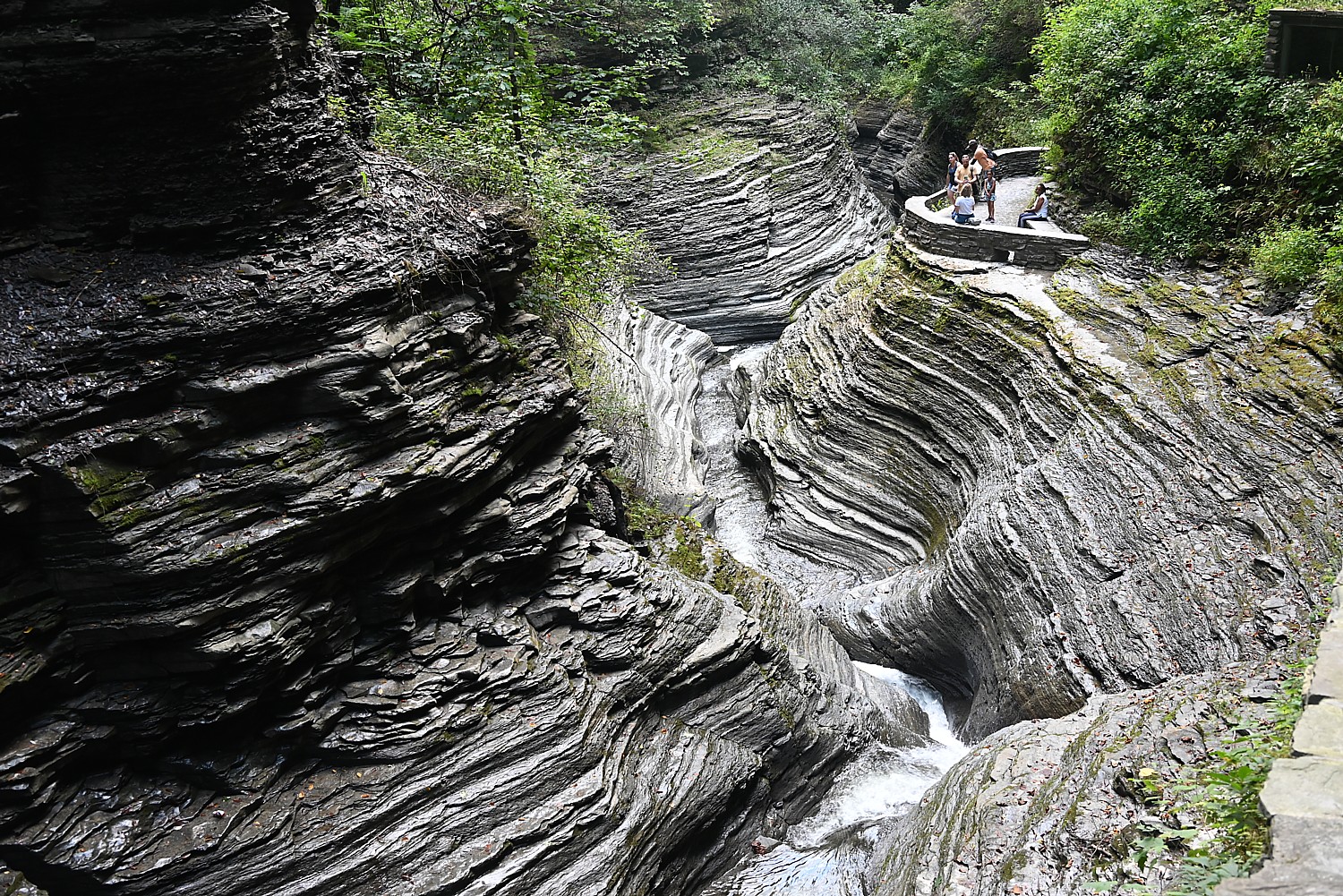
The centerpiece of the 778-acre Watkins Glen State Park is a 400-foot deep, narrow gorge cut by the Glen Creek that was left “hanging” when glaciers of the last continental glaciation, some 12,000 years ago, deepened the Seneca valley, creating rapids and waterfalls through layers of hard rock. The textures and shapes of the soft shales, sandstone and limestone – which erode at different rates – are gorgeous.

If you have ever visited a slot canyon, and marveled at the smooth, twisted, perfectly contoured curves, walk the Glen Creek Gorge Trail, where you can watch Mother Nature working her magic.

Rainbow Falls, one of the highlights of the Glen Creek Gorge Trail, Watkins Glen State Park, © Karen Rubin/goingplacesfarandnear.com

We don’t waste time after arriving at the Six Nations Campground in the park in the afternoon, in order to take advantage of the beautiful sunlight. So we drop out things and rush down to the Gorge Trail for a taste of what we will see more completely the next day.

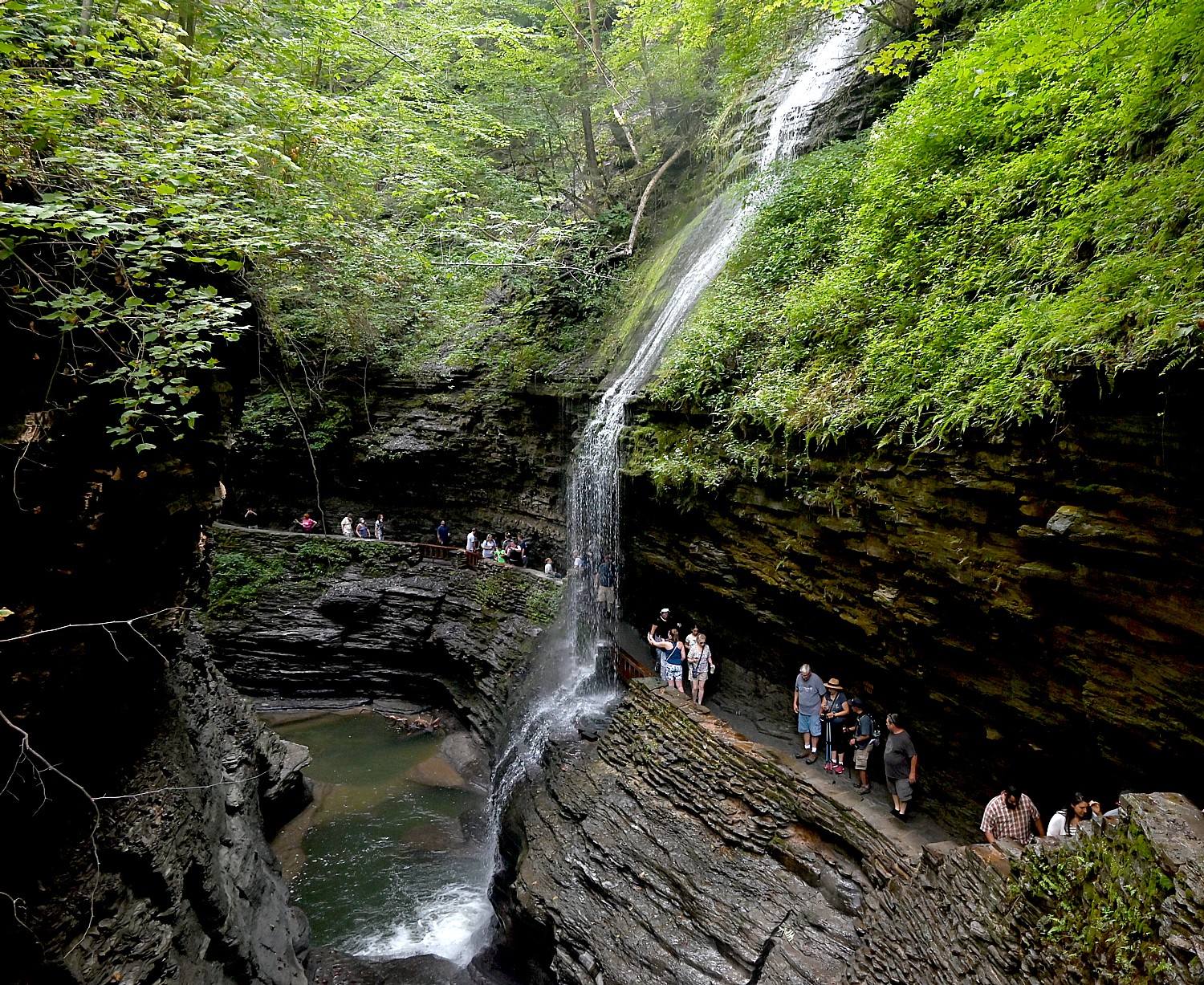
In the course of a 1.5 mile stone trail, with 800 steps and beautiful stone bridges you see 19 incredible waterfalls.

Cascading falls on the Glen Creek Gorge Trail, Watkins Glen State Park, © Karen Rubin/goingplacesfarandnear.com

The waterfalls range from those that flow from dramatic heights of 200 foot-high cliffs, to those that cascade; you see waterfalls coming in together from different directions, cutting through the sedimentary rock of shale, sandstone and limestone, making exquisite, remarkably perfect shapes and cuts that are astonishingly precise and straight or curved, and cascades of falls that twist.

Rainbow Falls, one of the highlights of the Glen Creek Gorge Trail, Watkins Glen State Park, © Karen Rubin/goingplacesfarandnear.com

In this “hanging valley,” we also see “hanging gardens” – the tender mosses, ferns, mosslike plants (liverworts) that drape over the rocks and down the rock walls, the delicate plants that stubbornly grow, albeit slowly in crevasses in the rock walls. They depend on continuous moisture trickling down, and you can see differences in ecosystems based on the amount of sun, shade and moisture that a section of the rock wall gets. (Visitors are told not to pick anything.)

A place of perfect peace, Watkins Glen State Park, © Karen Rubin/goingplacesfarandnear.com

You are enveloped by a feeling of perfect peace – the sound of the flowing water, the cool of the green moss and moist rock, the fresh smell, the late afternoon light that turns the tops of the trees into shades of yellow and gold. The gorge is fairly narrow, so you feel cocooned in this primal, Jurassic Park-like setting.

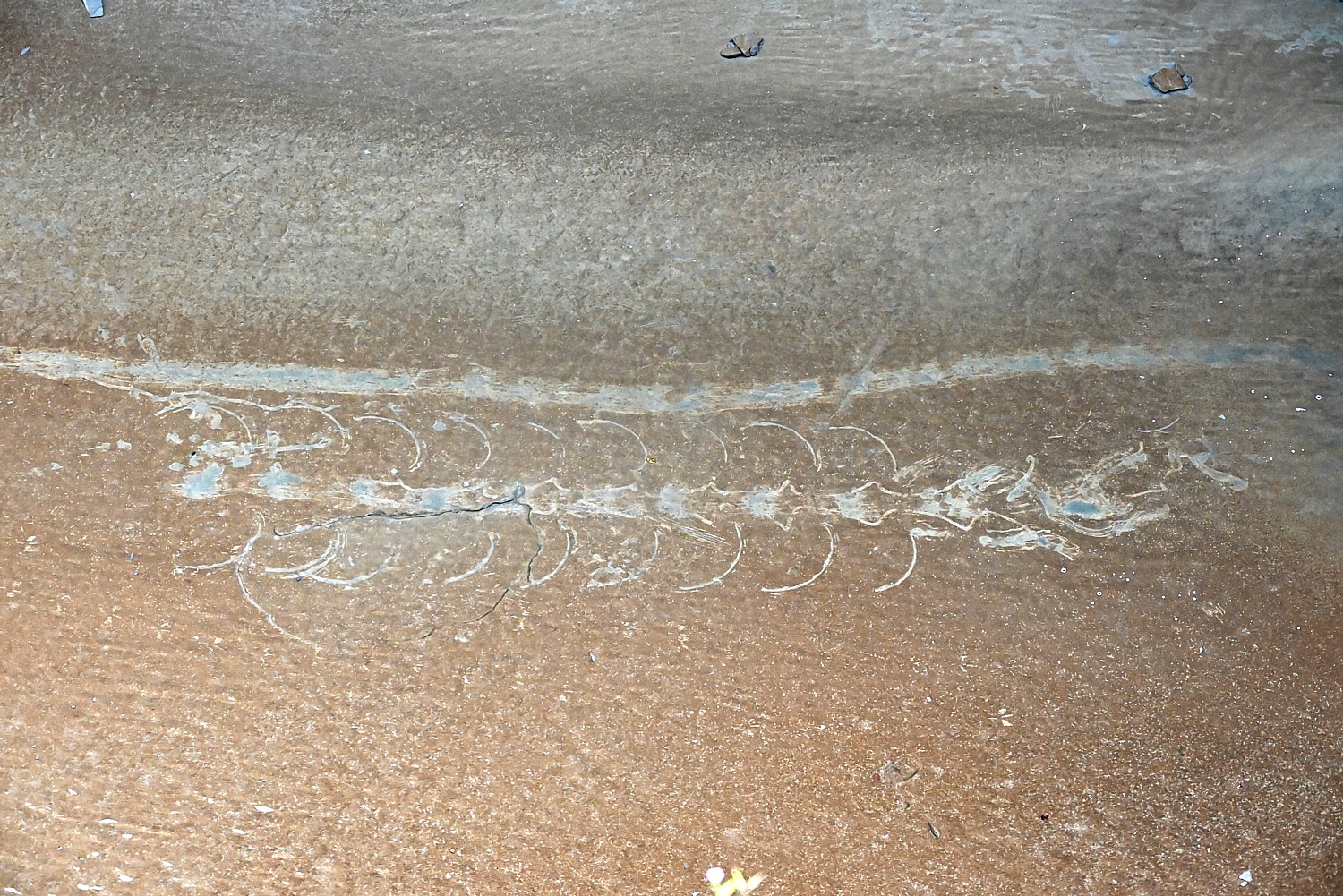
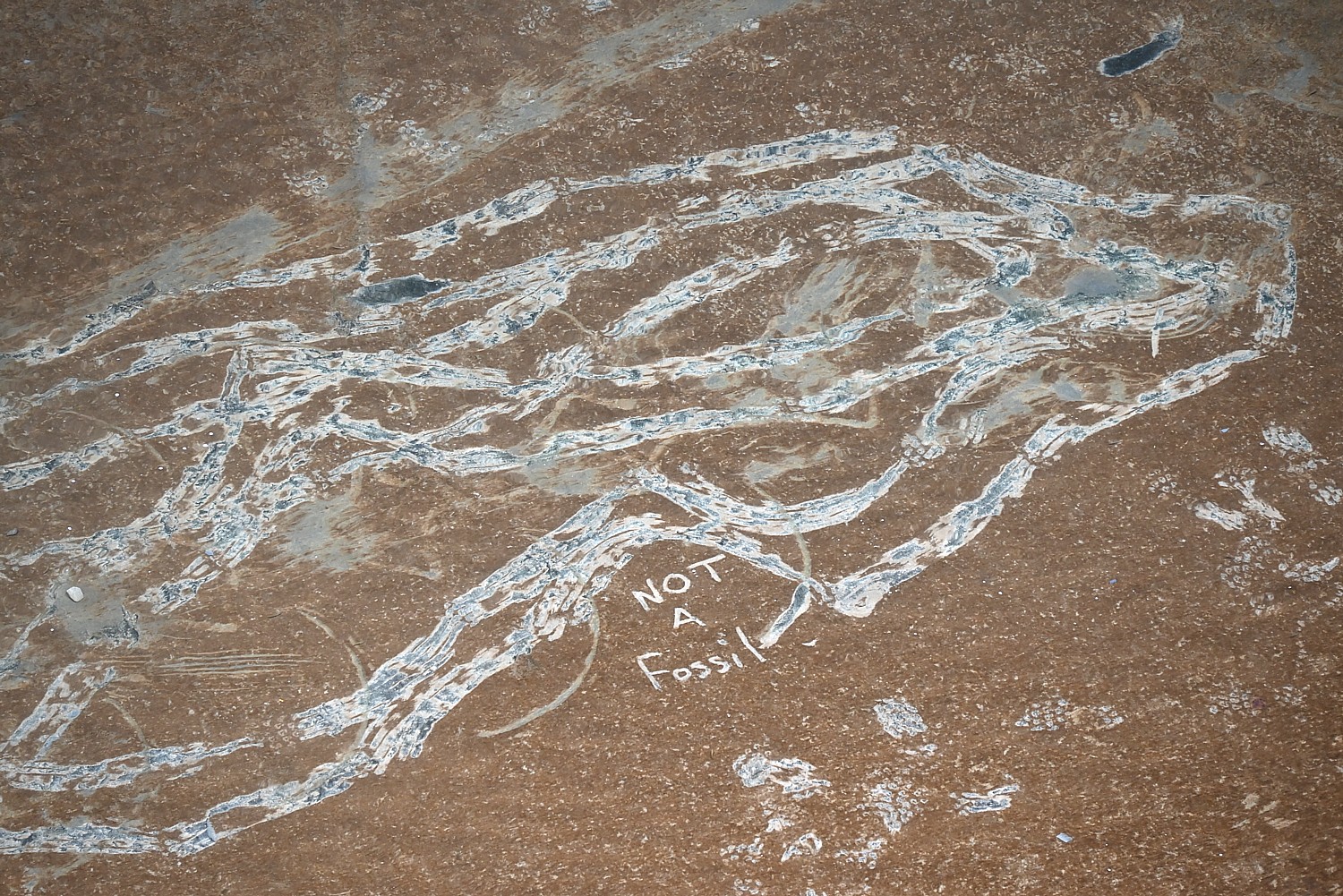
Looking down into where the water flattens out at one point into soil what appeared to be a giant fossil skeleton, exposed in the low water. It is exciting to imagine.

Could this be a titanoboa fossil, only just exposed in the Glen Creek? © Karen Rubin/goingplacesfarandnear.com

We walk back to Mile Point Bridge where we follow the trail back into the Six Nations Campground, after this brief survey mission.

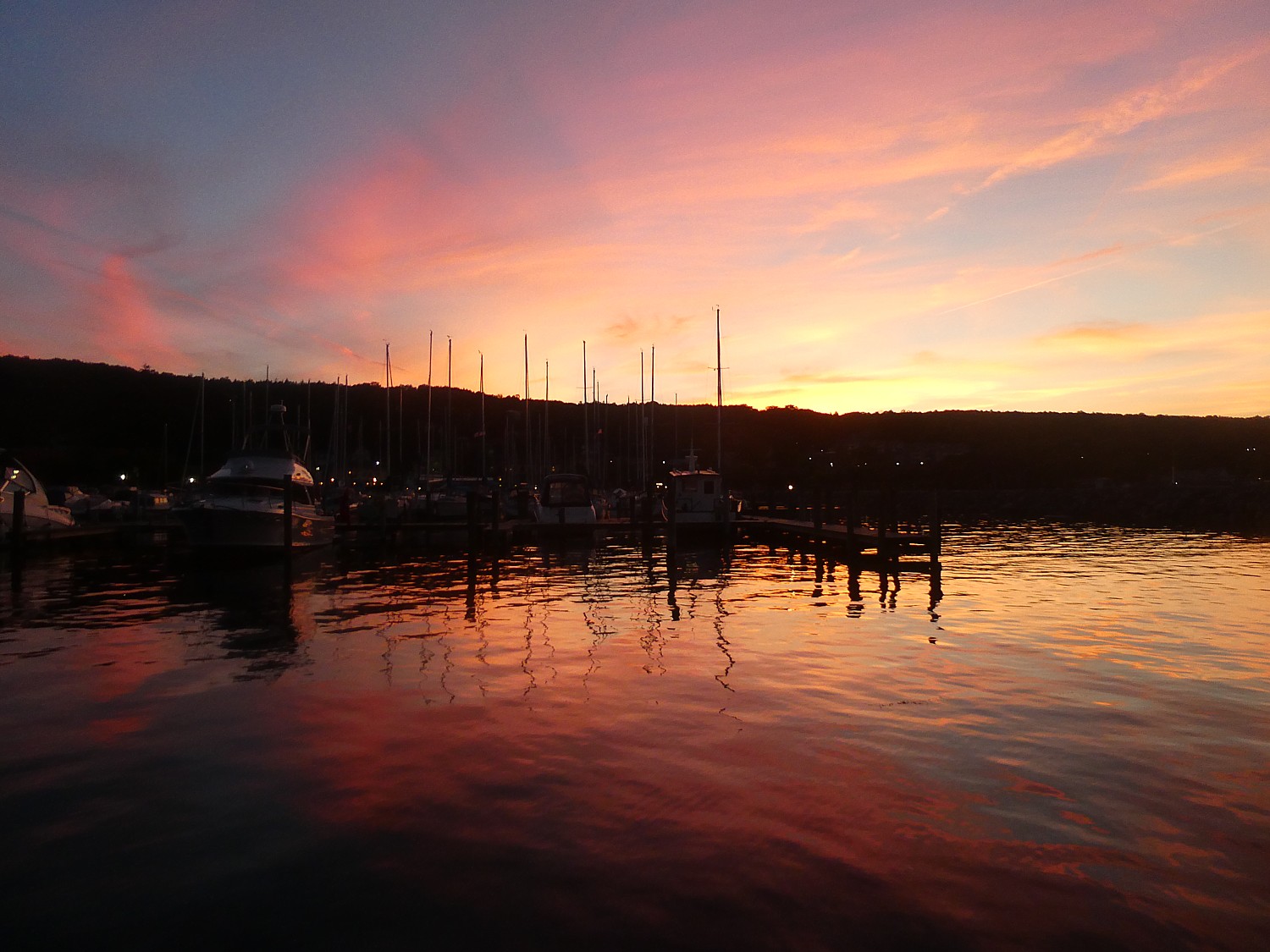
Back at our campsite, we set up our tents and go downtown to where John, who checked us into the campground, had recommended as the best place in Watkins Glen for sunset: the marina on the southern tip of Seneca Lake. There is a rock wall that is very popular for people to walk out to watch. We opt to go to the Village Marina for dinner where we can dine outside and take in the sunset.

Blazing sunset from the Village Marina in Watkins Glen © Karen Rubin/goingplacesfarandnear.com

The colors that blaze through the sky, reflect back in the water, after the sun went behind the hills, are spectacular.

The next day, we stroll down from our campsite to the Gorge Trail.

We enter the Gorge Trail at Mile Point Bridge, giving us our first stunning view. We walk the half-mile to the end, at Jacob’s Ladder (a set of 180 stairs that goes to the Upper Entrance), and then return, choosing to go back along the Gorge Trail rather than connect to the Indian Trail that goes along the rim for views down into the Gorge. Going back this way on the Gorge Trail we go down in elevation towards the Main Entrance in the village (many people who don’t want to do the 1.5 mile trail both ways start park up here, hike down, and take a shuttle bus back, $5).

Glen Creek Gorge Trail, Watkins Glen State Park, is spellbinding © Karen Rubin/goingplacesfarandnear.com

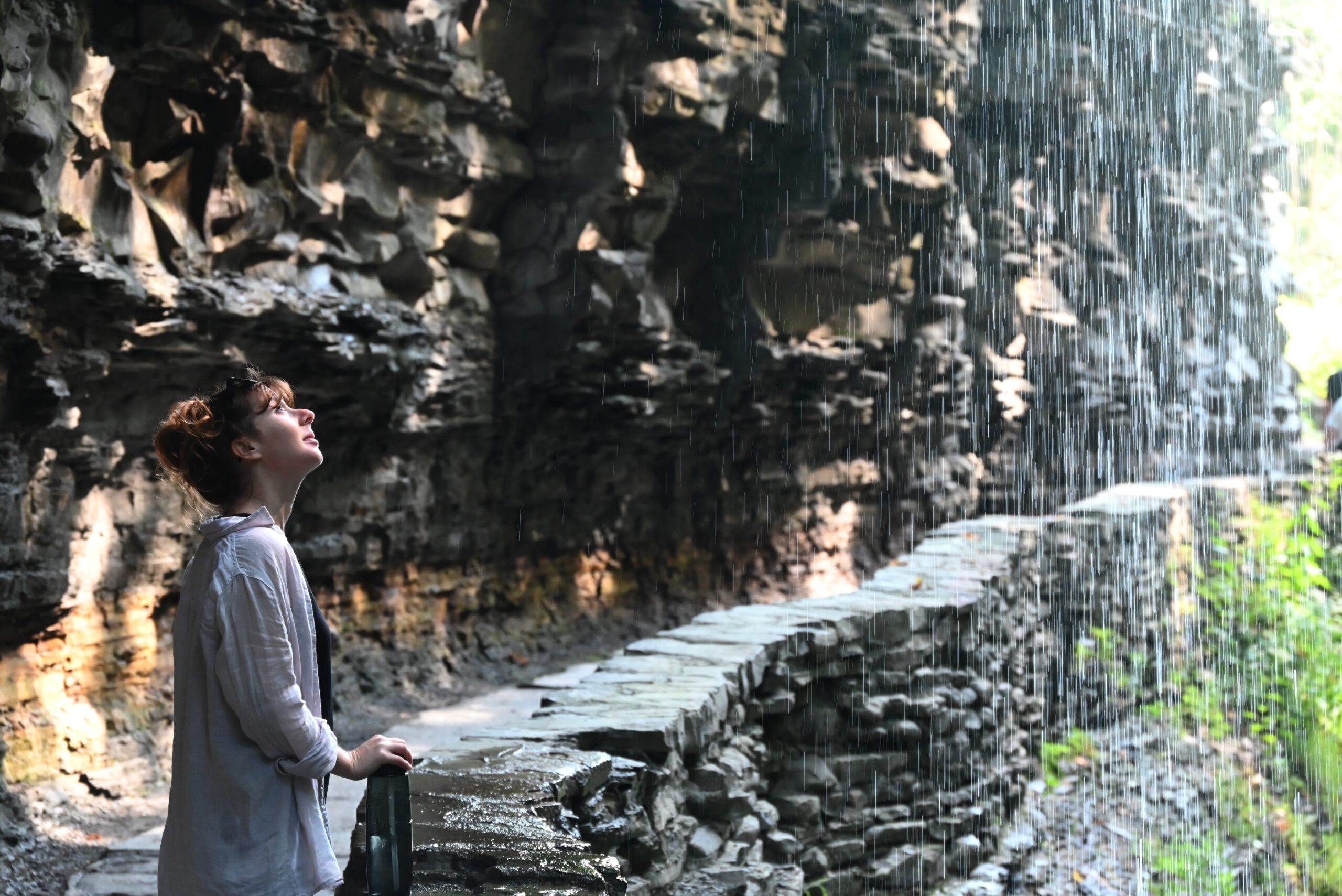
Just beyond the Mile Point Bridge is Frowning Cliff, a gorgeous waterfall, then the climatic scene, Rainbow Falls (most dramatic from the other direction on the way back; you walk behind the falls along the trail), aptly named because, on some afternoons, the sunlight comes at just the right angle to create rainbows.

Rainbow Falls, one of the highlights of the Glen Creek Gorge Trail, Watkins Glen State Park, © Karen Rubin/goingplacesfarandnear.com

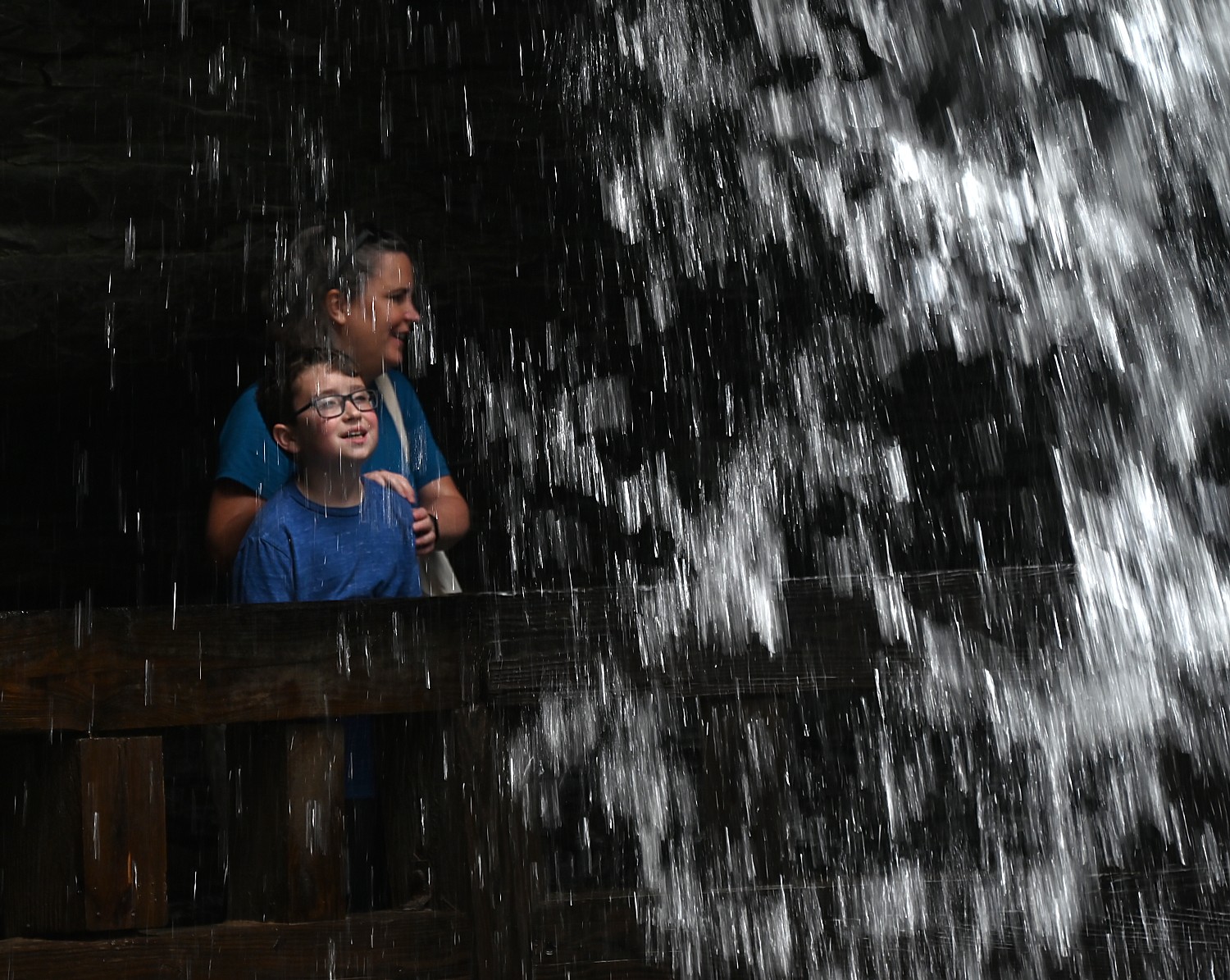
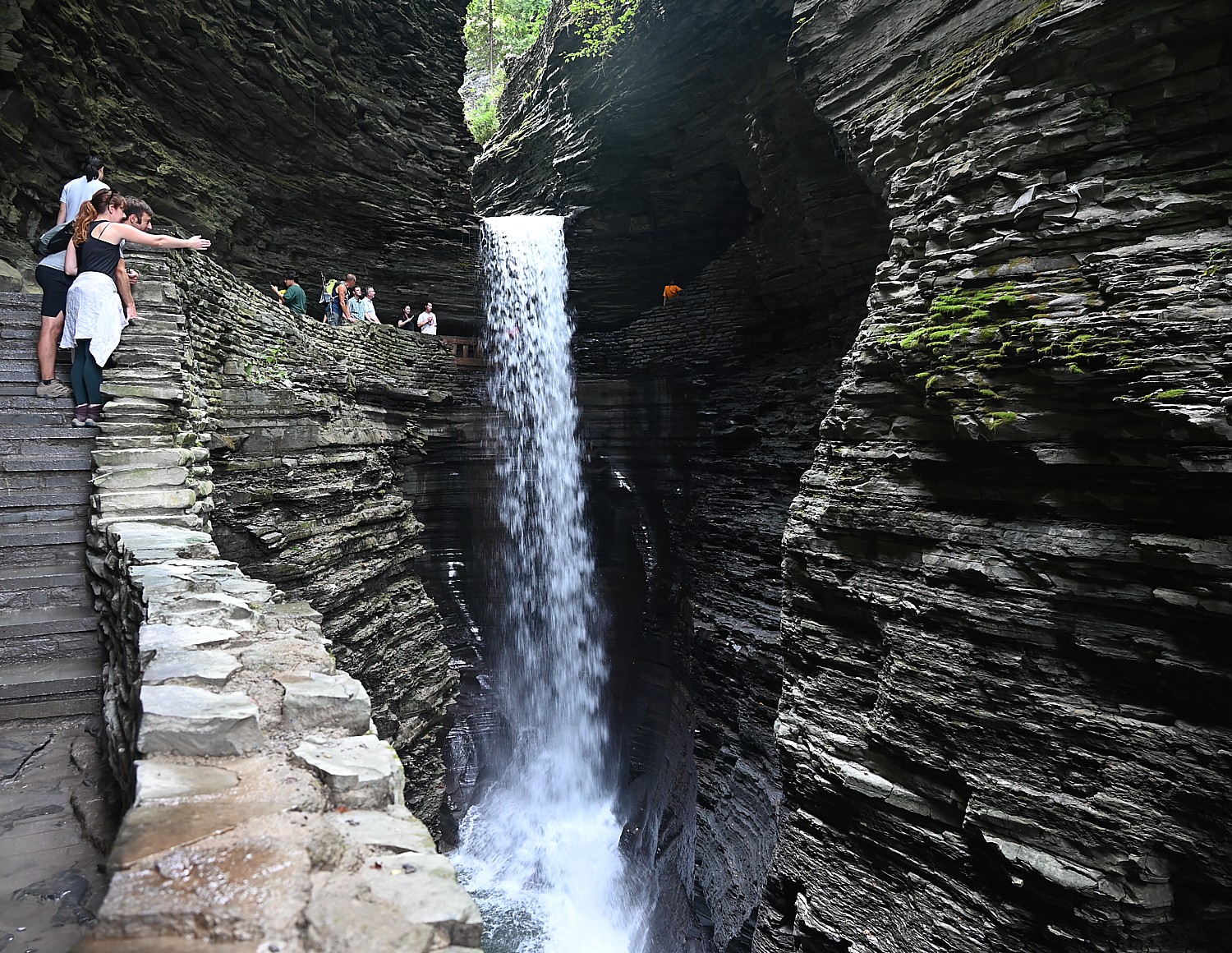
On to the Central Cascade (plunging more than 60 feet, this is the highest waterfall in the Gorge), Glen Cathedral (the horizontal layers of shale were formed 380 million years ago; ripples in the rock were created by wave action at the bottom of an ancient sea floor that eventually turned to stone), then a steeper descent, through the Spiral Tunnel (hand cut in 1927) to the Cavern Cascade, where you again walk behind the waterfall) and across Sentry Bridge (look for a round flume hole in the rock where, in the 1800s, water was once diverted to power a mill where the visitor center now stands) to the new Visitor Center and main entrance on Franklin Street in Watkins Glen.

Cascading falls on the Glen Creek Gorge Trail, Watkins Glen State Park, © Karen Rubin/goingplacesfarandnear.com
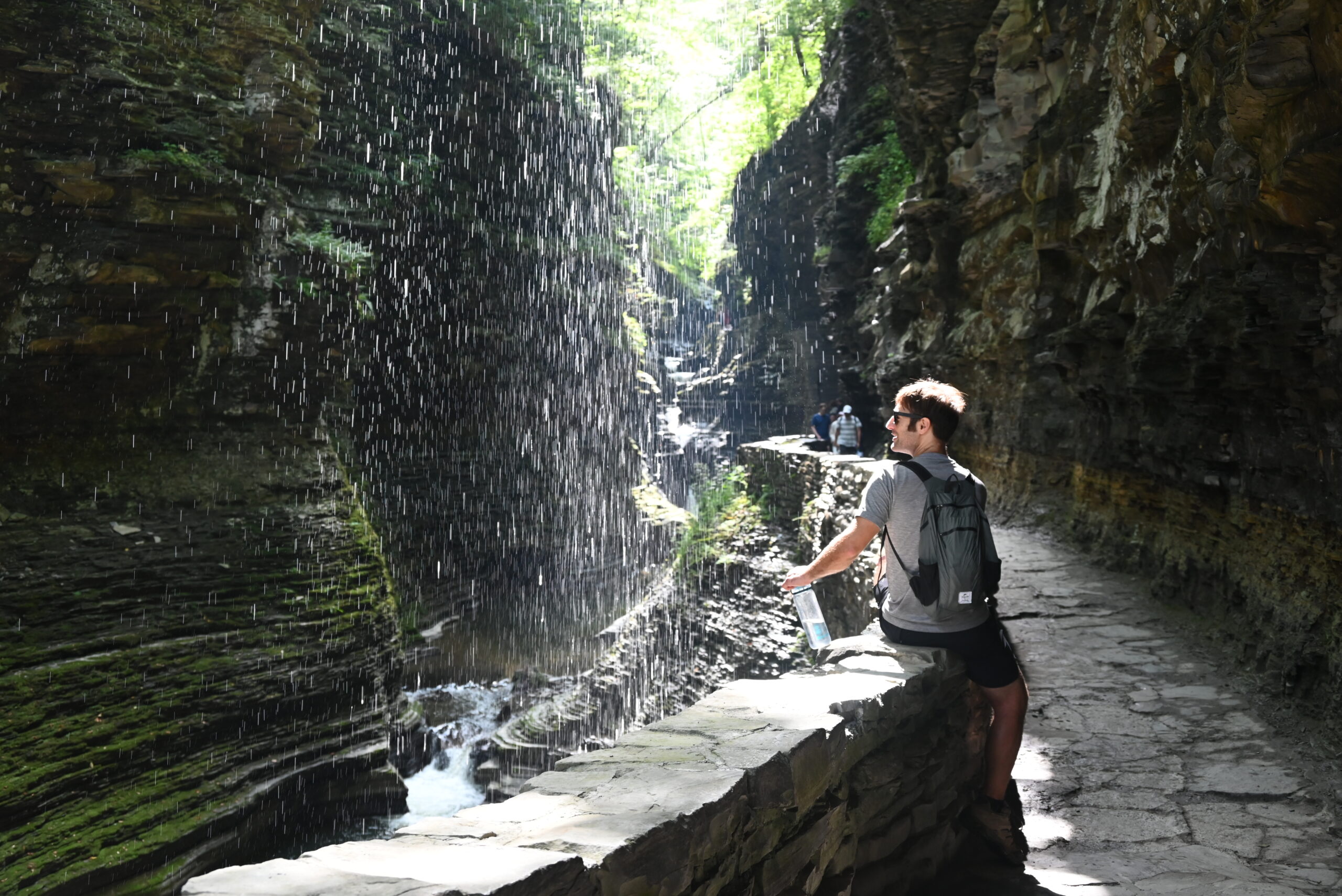
Walk through the Spiral Tunnel (hand cut in 1927) to the Cavern Cascade, where you walk behind the waterfall, Watkins Glen State Park © Karen Rubin/goingplacesfarandnear.com

Along the way, we meet up with a park ranger who we tell about seeing what appeared to be a giant fossil. He tells us that it was exposed only two days before and might well be a titanoboa – a giant sea snake that could be as big as 45 feet long. This exciting news passes from one to another as people come to that spot to view it. Another park ranger tells us that a naturalist is coming to investigate.

For awhile, visitors to Watkins Glen State Park that morning had an extra thrill beyond the breathtaking scenery: the prospect of seeing a newly discovered fossil of a prehistoric sea snake, Monster in the Glen.

A place of perfect peace, Watkins Glen State Park © Karen Rubin/goingplacesfarandnear.com

We finish walking the trail, have a delightful lunch at the Harbor Hotel on the lake. By now it is the afternoon and markedly less crowded (everyone seems to come out early for the walk) as we walk back on the Gorge Trail.

By the time we get back to where the “titanoboa fossil” would have been, we see the naturalist has etched in the soil, “Not a Fossil,” and smudged the image completely away, having revealed the fossil to be a hoax (people had remarked on what they thought were footprints leading to it).

Not a fossil! But now the mystery remains: who created it and how? © Karen Rubin/goingplacesfarandnear.com

So, if we didn’t witness a major fossil discovery, we were witness to the hoax. ow the mystery is: Who created the hoax? How? Anyway, it got everyone buzzing that day.

Also, on my walk I saw in black rock what looked like an ammonite. That too was smudged away on our return.

Glen Creek Gorge Trail, Watkins Glen State Park, is spellbinding © Karen Rubin/goingplacesfarandnear.com

This stunning gorge has been visited by tourists since 1863 and was privately operated as a tourist resort ($1 admission per person, equivalent to $34 today) until New York State acquired the property, in 1906 for a state park. (It is named for Samuel Watkins; “glen” comes from a Greek word meaning “small, narrow, secluded valley”.). After the 1935 flood destroyed the trail, it was rebuilt with a stunning series of stone walks, staircases (there are 800 steps altogether), bridges and tunnels cut through the rock, by Franklin D Roosevelt’s Civilian Conservation Corps between 1935-1940. (You can do the trail one way and take a shuttle bus, $5, back).

The stunning rock formations, created by the rushing water, on the Glen Creek Gorge Trail, Watkins Glen State Park © Karen Rubin/goingplacesfarandnear.com

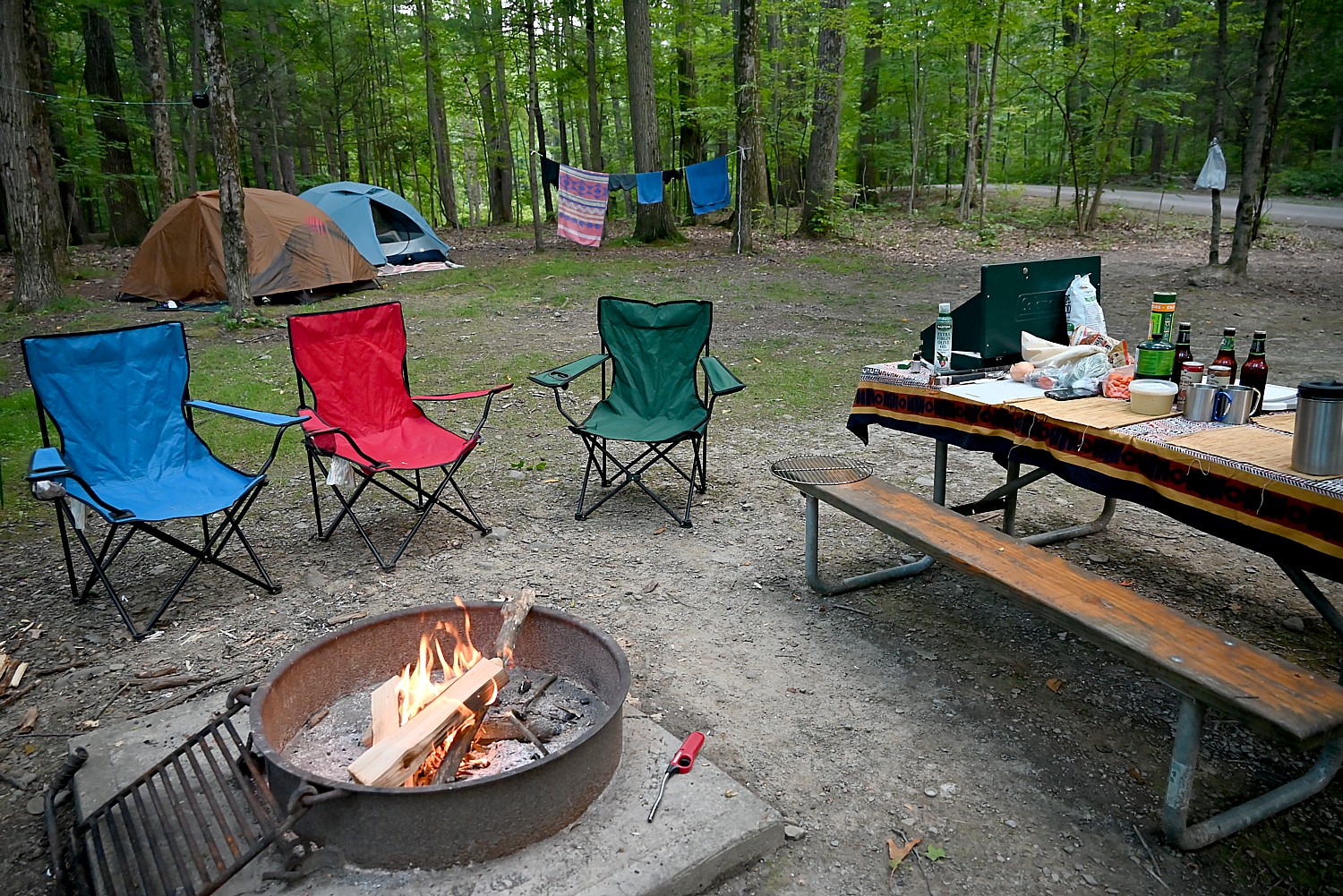
Capping this experience is the beautiful Six Nations Campground – beautiful trees, excellent restroom facilities, and a glorious Olympic-sized pool. There are also a couple of pavilions that can be rented for groups and even the Iroquois Lodge, which is essentially a house that can be rented instead of a campsite (altogether, you can imagine a wedding here, with photos in front of waterfalls; there are also lovely accommodations in town including a luxury Watkins Glen Harbor Hotel, right on Seneca Lake, where we enjoy lunch). Where we camp, we are just a short walk down to the Gorge Trail.

Our campsite at Six Nations Campground, Watkins Glen State Park © Karen Rubin/goingplacesfarandnear.com

Six Nations Campground is named for the Haundenosaunee Confederation, more commonly known to us as Iroquois (Haundenosaunee means “They made the house”), a reminder of whose land this was before the European colonists came. The loops of the campground are named for the nations of the Confederacy: Mohawk, Oneida, Onondaga, Cayuga, Seneca and Tuscarora. The Haudenosaunee Confederacy, the park brochure notes, is renowned for its organization and democratic system, one of the first of its kind (Ben Franklin is said to have drawn upon the Iroquois Confederation for our US Constitution; suffragist Melinda Gage drew upon the Oneida’s matriarchal structure, in which women could be chiefs, own property, have custody of their children in a divorce, to set out demands for women’s rights in 1848).In 1842, what remained of the First Nations were relegated to the Six Nations Indian Reserve. (More information is available at nearby Ganondaganb State Historic Site, 7000 County Rd. 41 (Houghton Hill Rd), Victor, NY 14564).

Walking the stone trail along the Glen Creek Gorge, Watkins Glen State Park © Karen Rubin/goingplacesfarandnear.com

There are seven moderate trails in Watkins Glen State Park ranging from 0.7 to 7.6 miles and from 479 to 1,171 feet above sea level, but we focus all our time on the Gorge Trail (1.5 miles), captivated by the views and the enchantment of the place. Other trails – the Indian Trail (2.4 miles) and the South Rim Trail (2.6 miles) provide views of the Gorge from above. You can connect from the Gorge Trail to Lovers Lane Loop which takes you to a Suspension Bridge for a view above the gorge. You can also do a Gorge Trail, Outer Rim and Finger Lakes Trail combination (7.6 miles, about 3 hours) (see alltrails.com for more detail). (The trail is closed in winter.)

Cavern Cascade, Watkins Glen State Park © Karen Rubin/goingplacesfarandnear.com

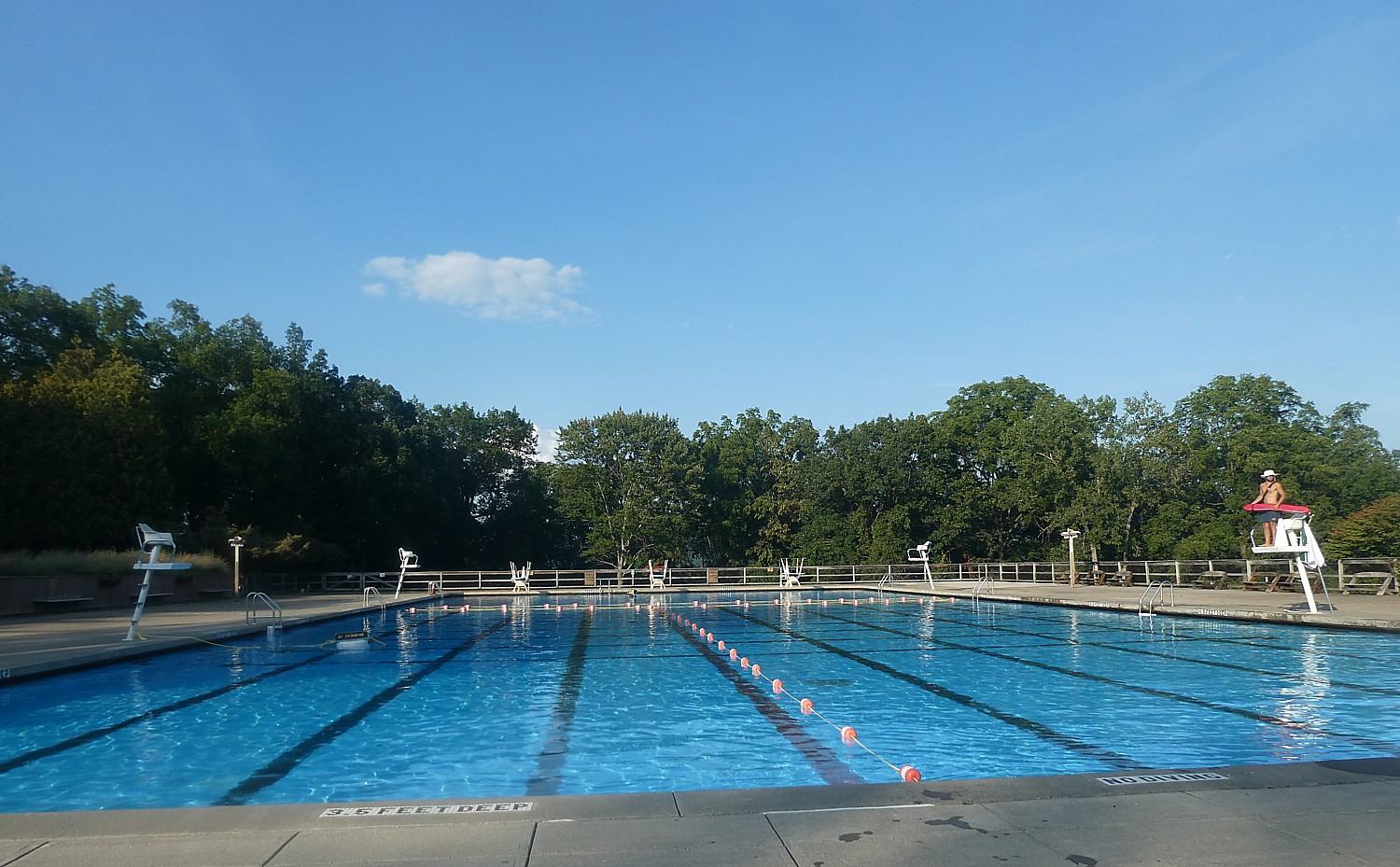
It’s about 3:30 in the afternoon when we return to the campsite. We go to the gorgeous, Olympic-sized pool to refresh before returning to the campsite for an amazing steak dinner David and Laini prepared over the campfire they built for our second night camping.

The gorgeous Olympic-sized pool at Watkins Glen State Park © Karen Rubin/goingplacesfarandnear.com

It is no wonder that Watkins Glen State Park was awarded the third best among 6,000 state parks nationwide in 2015, and is consistently among the state’s top parks.

Watkins Glen State Park, 1009 N Franklin St, Watkins Glen, NY 14891, 607-535-4511, https://parks.ny.gov/parks/watkinsglen/maps.aspx.

There is so much to do in Watkins Glen, in the heart of the Finger Lakes, you could easily make this your base for a week.

Auto enthusiasts know Watkins Glen for its famous NASCAR races. The pavement is dotted with names of winners throughout the years, the crosswalks painted like the race start/finish. Auto racing is still sacred here, with much of the quaint village (the downtown was a recipient of New York State’s $10 million Downtown Revitalization Initiative award) themed for autos.

Wine enthusiasts know Watkins Glen as the southerly point of Seneca Lake, from which you can drive up Winery Trails on both sides.

Nearby is the Corning Museum of Glass; about 1 ½ hours drive away is another jewel,  Letchworth State Park, “The Grand Canyon of the East,” where we camped and hiked last year; a half-hour away is Ithaca.

The Finger Lakes region has over 1,000 waterfalls and gorges, 650 miles of shoreline, more than 16,000 acres of National Forest, and over 2,000 miles of hiking and biking trails. There is plenty to explore indoors at museums, art galleries, historic sites, theaters, wineries, breweries.

With summer turning to fall foliage season (which is amazing here), plan early and secure tickets and lodging.  

Excellent planning aids are available from The Finger Lakes Tourism Alliance, 309 Lake Street Penn Yan, NY 14527, 315-536-7488, 800-530-7488, www.fingerlakes.org.

New York State Begins Weekly ILoveNY Fall Foliage Reports; New Interactive Map

The 2021 fall foliage season is underway in New York State. Fall is one of the most popular travel times in New York, attracting visitors from around the world to explore the state’s unique communities and support local businesses. To help travelers and foliage enthusiasts plan a fall getaway, I LOVE NY has begun issuing its weekly fall foliage reports and will now include a new enhanced interactive progression map (www.iloveny.com/foliage).    

The foliage report is compiled each week using the on-location field observations from I LOVE NY’s team of volunteer leaf peepers. More than 85 spotters extending across the state’s 11 vacation regions are tasked with keeping track of the color change in their area as leaves progress each week. Reports detail the predominant leaf colors, approximate percentage of change, and how much color change has progressed relative to peak conditions.  

View from Chimney Mountain, The Adirondacks. ILoveny.com/foliage report helps you monitor the progress of fall foliage throughout New York State © Karen Rubin/goingplacesfarandnear.com

New this year, I LOVE NY is introducing an enhanced, interactive map that tracks weekly foliage change and progression across the state throughout the season. The map, located on the I LOVE NY foliage website, showcases great foliage viewing locations in each of the various regions throughout the state. Visitors can also use the map to see what the foliage is like during peak viewing in a given area, and learn about nearby, must-see attractions. 

Thanks in part to its size and location, New York State has one of the longest and most colorful foliage seasons in the country. On any weekend from late September through mid-November, part of the state is likely experiencing peak foliage.  

Travelers are also invited to share their photos of New York State’s amazing foliage on social media by using the #NYLovesFall hashtag. Photos submitted to this hashtag have a chance of being featured on the I LOVE NY fall foliage website and official I LOVE NY social media accounts reaching nearly two million followers. Reports and the new interactive map are updated Wednesdays throughout the season at www.iloveny.com/foliage.Reports are also available toll-free by dialing 800/CALL-NYS (800/225-5697) from anywhere in the U.S., its territories and Canada. For more information on how to volunteer for as an I LOVE NY leaf peeper, e-mail your name, address and phone number to foliage@esd.ny.gov.

______________________

© 2021 Travel Features Syndicate, a division of Workstyles, Inc. All rights reserved. Visit goingplacesfarandnear.com, www.huffingtonpost.com/author/karen-rubin, and travelwritersmagazine.com/TravelFeaturesSyndicate/. Blogging at goingplacesnearandfar.wordpress.com and moralcompasstravel.info. Send comments or questions to FamTravLtr@aol.com. Tweet @TravelFeatures. ‘Like’ us at facebook.com/NewsPhotoFeatures

TD Five Boro Bike Tour, ‘A Truly New York City Experience in a Truly Unusual Year’

NYC Police Commissioner Dermot Shea  is in the first wave to kick off the 2021 TD Five Boro Bike Tour © Karen Rubin/goingplacesfarandnear.com

By Karen Rubin, Travel Features Syndicate, goingplacesfarandnear.com

In a stunning demonstration of New York City’s famous resilience and grit, Bike New York, New York City and TD Bank pulled off the 2021 TD Five Boro Bike Tour, hosting 20,000 riders as they rode 40 miles of car-less urban streets and bridges. “A truly New York City experience in a truly unusual year.”

Last year’s ride was cancelled because of COVID-19, and this year’s ride, the 43rd edition of the Five Boro Bike Tour, restricted to 20,000, substantially fewer riders than the 32,000 that typically join the ride because of COVID-19 protocols, was originally set for August 22, but Hurricane Henri had other ideas.

As it turned out, postponing the ride by a week rewarded riders with perfect weather for cycling – overcast, misting and a comfortable 72 degrees.

Participants who came from all 50 states and 16 countries had a ball, and were treated, as has become tradition, to bands welcoming the riders to each borough, well organized rest areas and water stations with the added dimension of COVID-protocols, superbly organized street closures manned by New York’s finest and Bike New York volunteers, excellent signage.  And all on incredibly short notice.

NYC Police Commissioner Dermot at the 2021 TD Five Boro Bike Tour. First cancelled last year, hastily put on for 2021 then postponed because of Hurricane Henri, it could not have happened without the support of NYC police, transportation, sanitation and scores of others © Karen Rubin/goingplacesfarandnear.com

An incredible feat accomplished by numerous New York City agencies, including the Departments of Transportation, Sanitation, and Police.

The route was modified somewhat – possibly because of the short notice for even the August 22 date (the ride wasn’t announced until May), and then it had to be hastily put together for August 29.

2021 TD Five Boro Bike Tour gets underway © Karen Rubin/goingplacesfarandnear.com
Biking up car-less 6th Avenue,2021 TD Five Boro Bike Tour © Karen Rubin/goingplacesfarandnear.com

So we skirted Central Park, riding up Central Park West, instead of going through it, and had our rest stop outside of Triboro Park in Queens.

But the biggest change was where the ride finished: at the new Empire Outlets right at the Staten Island Ferry terminal, where there is also NYC Ferry’s newly launched St. George route (which connects St. George to Battery Park City and West 39th Street on Manhattan’s Westside) and waterfront walk, where the Finish Festival was held.

Biking up car-less 6th Avenue,2021 TD Five Boro Bike Tour © Karen Rubin/goingplacesfarandnear.com
2021 TD Five Boro Bike Tour © Karen Rubin/goingplacesfarandnear.com
We’re only in The Bronx a short time but get to enjoy music by Bombayo © Karen Rubin/goingplacesfarandnear.com

Still, there were those iconic experiences  you only get on the Five Boro Bike Tour, of riding down the FDR, over the Queensborough (59th Street) Bridge, on the Brooklyn-Queens Expressway, and over the Verrazano Bridge, plus the chance to see  neighborhoods in all five boroughs.

Biking down the FDR, 2021 TD Five Boro Bike Tour © Karen Rubin/goingplacesfarandnear.com
A highlight of the TD Five Boro Bike Tour is riding over the 59th Street (Queensborough) Bridge © Karen Rubin/goingplacesfarandnear.com
A scene you can only get by riding the TD Five Boro Bike Tour © Karen Rubin/goingplacesfarandnear.com

Bike New York was scrupulous about maintaining COVID-19 protections- every rider had to show proof of vaccination to pick up the registration packets (but not to ride) and wear masks at the start and finish,  indoors and on the Staten Island ferry but not while riding (unvaccinated individuals could not go inside).

A group from New Jersey on the TD Five Boro Bike Tour at the rest stop in Queens © Karen Rubin/goingplacesfarandnear.com
A Queens band entertains the TD Five Boro Bike Tour at the rest stop in Queens © Karen Rubin/goingplacesfarandnear.com
Taking in a classic Brooklyn view © Karen Rubin/goingplacesfarandnear.com

The number of riders was reduced from 32,000 in past years to 20,000, to allow for more spacing. Also, over the years, the organizers have developed a terrific method of staggering starts by “waves.”

Close to the finish in Staten Island, riders stop to memorialize the scene with the Verrazano Bridge © Karen Rubin/goingplacesfarandnear.com
A festival atmosphere at Empire Outlets and the new NYC Ferry dock in Staten Island at the finish of the TD Five Boro Bike Tour at the rest stop in Queens © Karen Rubin/goingplacesfarandnear.com

Andrew Bregenzer. EVP, Regional President at TD Bank, the title sponsor of the TD Five Boro Bike Tour since 2007, told the riders, “We believe in quality of life for New York. We’ve been a New York bank for 20 years. The ride today has new meaning, perspective. This is the greatest city in the world. Celebrate resiliency of New York City.”

“New York City is proud to celebrate the cycling boom—and the return of iconic events that highlight great neighborhoods in all five boroughs—by welcoming the TD Five Boro Bike Tour this summer,” said New York City Senior Advisor for Recovery Lorraine Grillo. “We look forward to welcoming locals and tourists alike to enjoy a safe, exciting event this year.”

“Given the pivotal role that bikes have played in protecting the health, wellness, and safety of New Yorkers through the pandemic—especially for essential workers commuting to their jobs—it feels right that bikes will also play a part in powering New York City’s economic revitalization,” Ken Podziba, President and CEO of Bike New York, remarked when the 2021 tour was announced in May. “The Tour has been a landmark event for NYC for decades, and it’s a true highlight for international tourism. We hope our ride will continue to support the city we call home as we all strive to come back strong from these hardships. Now more than ever, New Yorkers need a safe and welcoming space to reconnect, to celebrate.”

The ride is a fundraiser for Bike New York – in fact, it is one of the world’s biggest charitable bike rides, along with Bike Expo New York, one of the country’s most attended consumer bike shows. Proceeds from the Tour fund its free bicycle education programs. In 2020 alone, in response to the COVID-19 pandemic, Bike New York taught bike riding and bike safety skills in a virtual classroom to more than 25,000 kids and adults.

The ride also supports Bike New York’s advocacy for safe biking and bike lanes. “We fight for safer, more equitable streets,” said Podziba.

Bike New York provides a completely free, year-round curriculum of classes for children and adults at every stage of their cycling journeys, from first rides and fundamentals to commuting and touring.

The TD Five Boro Bike Tour is Bike New York’s main fundraiser and also supports Bike New York’s advocacy for safe biking and bike lanes. “We fight for safer, more equitable streets,” said Ken Podziba, President and CEO of Bike New York © Karen Rubin/goingplacesfarandnear.com

“We’re dedicated to making cycling more inclusive and accessible, and that’s why we hold free classes in all five boroughs at our Community Bike Education Centers. Students are provided with bikes, helmets, and the insights and knowledge of experienced instructors, creating an encouraging environment for building core riding skills.”

 “When COVID-19 brought the world to a standstill, Bike New York was forced to temporarily suspend its in-person programming. Though cycling events came to a halt, the need for bike resources swelled as a huge influx of people turned to cycling for transportation and recreation. We knew we couldn’t slow down.

Among the luminaries joining the TD Five Boro Bike Tour is NYS Senator John Liu, US Congressman Tom Suozzi, NYC Deputy Transportation Commissioner Leon Heyward and Councilmen© Karen Rubin/goingplacesfarandnear.com

“To address the sudden surge in demand for accessible bike education, we pivoted from teaching in the streets to bringing our lessons to the virtual classroom. Since launching our digital education program and Virtual Bike Education Resource Hub in April, we’ve helped hundreds, if not thousands, of students build their bike skills, confidence, and know how—and with aspiring cyclists from across the country tuning in to our weekly classes, we’re making a difference far beyond the five boroughs.”

Bike New York also has a Recycle-A-Bicycle program, which accepts donations of old, used, and broken bikes, which are completely restored, refurbished, and sold or salvaged for parts, and out of the waste stream. In 2019, RAB reused or repurposed nearly 12 tons of material, which saved 77.95 metric tons of CO2 emissions.

In July 2019, Bike New York celebrated the opening of Brooklyn’s Shirley Chisholm State Park by launching a free bike share pilot program designed to make exploring nature as easy as checking out a library book. The Bike Library hosts a fleet of 84 bikes (refurbished by graduates of Recycle-A-Bicycle’s Earn-A-Bike program) available for park visitors to “check out” for rides around the grounds in the summer and fall.

In the Library’s first three months, park-goers took 8,585 rides along 10 miles of car-free pathways by scenic Jamaica Bay. The Library reopened and expanded for the 2020 season, offering New Yorkers a meaningful way to enjoy the outdoors while social distancing and other pandemic restrictions were in place.

 “We know that one of the best ways to encourage healthy lifestyle choices and regular physical activity in children and young adults is to give them the freedom to explore on two wheels.” Bike New York partners with Woodhull Hospital, Lincoln Hospital, and New York Cycle Club to produce our Kids’ Ride Club, a friendly, fun group ride program for youth cyclists in low-income neighborhoods. And to challenge kids to see what cycling life is like beyond city limits, Bike New York held its inaugural bike touring trip for teenage bike enthusiasts in 2019,
a tristate adventure that pushed them out of their comfort zone to prove just what amazing things they could accomplish together.”

Last year, Bike New York partnered with One Community, a nonprofit dedicated to professional training and employment placement, to pilot an intensive, hands-on bike mechanic training program that helps formerly incarcerated New Yorkers continue down the path of rebuilding their lives through the power of stable employment. The program focuses on the particulars of repair and maintenance for Citi Bikes and prepares participants for a well-paying union job on Citi Bike’s mechanic team. Recycle-A-Bicycle provided 60 hours of instruction, as well as tools, materials, and support, to a cohort of students. (Learn more here.)

In 2019, Bike New York began a concentrated effort to actively engage in and spearhead local-level advocacy initiatives. Within its first year, projects included:

  • Providing expertise and detail to the City Council’s Streets Master Plan Bill, which passed in October of last year. It commits the city to install 50 miles of protected bike lanes per year starting in 2022, and to measure bike network connectivity.
  • Supplying a broad set of ideas for Mayor de Blasio’s “Green Wave Plan,” issued in July 2019. It raises NYC DOT’s target for protected bike lanes from 20 to 30 miles per year in 2020 and 2021. It also calls for more attention to the quality of barriers along protected bike lanes, bike-speed signal timing, and bike parking.
  • Producing a Bike Network agenda to take advantage of congestion pricing.

And in the summer of 2020, Bike New York launched Street Action Now! program to instruct a cohort of students how to analyze unsafe street conditions, perform a street audit, and work with community boards to prompt real change on their blocks.

In addition to supporting Bike New York’s endeavors,  hundreds of riders on the Five Boro Bike Tour were biking in support of charities and organizations including New York Cares, Planned Parenthood, Ronald McDonald House, The Hope Program, Sanctuary for Families, Parent Project Muscular Dystrophy (visit bike.nyc to see the charity partners).

Bike New York made provision for riders who paid their fees but could not come on the rescheduled date of August 29 – they could defer the fee for 2022’s ride or get 50% refund. 

Andrew Bregenzer. EVP, Regional President at TD Bank, the title sponsor of the TD Five Boro Bike Tour since 2007, told the riders, “We believe in quality of life for New York. We’ve been a New York bank for 20 years. The ride today has new meaning, perspective. This is the greatest city in the world. Celebrate resiliency of New York City.” © Karen Rubin/goingplacesfarandnear.com

TD Bank has been the title sponsor since 2007; Manhattan portage is the presenting sponsor. Other sponsors include Bloomberg, Amazon, NYU Langone Health, Trek, New York Bike Lawyers, Nestle Quik New York Times, Con Edison, NYC Ferry, NYC & Company and Empire Outlets.

Pulling off such an ambitious event was further demonstration, “There’s no stopping New York.”

Bike New York, 140 E 45 St., Ste 2002, New York, NY 10017, 212-682-2340, info@bike.nyc, www.bike.nyc.

______________________

© 2021 Travel Features Syndicate, a division of Workstyles, Inc. All rights reserved. Visit goingplacesfarandnear.com, www.huffingtonpost.com/author/karen-rubin, and travelwritersmagazine.com/TravelFeaturesSyndicate/. Blogging at goingplacesnearandfar.wordpress.com and moralcompasstravel.info. Send comments or questions to FamTravLtr@aol.com. Tweet @TravelFeatures. ‘Like’ us at facebook.com/NewsPhotoFeatures

Driveable Getaways: Great Time to Time-Travel in Sandwich, Cape Cod’s First Village

The Dexter Grist Mill in historic Sandwich, Cape Cod, Massachusetts © Karen Rubin/goingplacesfarandnear.com

By Karen Rubin, Travel Features Syndicate, goingplacesfarandnear.com

One of my favorite places for a driveable getaway is Sandwich, Cape Cod’s first village, settled in 1637. Sandwich is an enchanting jewel where history, exquisite architecture, fascinating attractions abound in a compact, walkable area, a short distance from the delightful Sandy Neck beach as well as the Cape Cod Canal biking trail. It is quintessential New England, an idyllic place to visit, to stay, to make your hub for exploring Cape Cod.

All through Sandwich, you see homes that bear the names of the ship captains who commanded the packet ships and clippers that made this area a mercantile center.

Many of these quaint historic houses and buildings (including a church) have been turned into charming bed-and-breakfast inns, but if you want to extend your time travel back to when the Patriots were debating revolution, a wonderful choice is the Dan’l Webster Inn and Spa, at the heart of the village. It is also is the most substantial in size, with 48 rooms, amenities and services that include a full-service Beach Plum Spa, offering the best of past and present.

The present inn sits on property that was once a parsonage, built in 1692 by Rev. Roland Cotton; in the 1750s, it was converted to the Fessenden Tavern, one of the first and most famous of New England’s taverns and a Patriot headquarters during the American Revolution (the Newcomb Tavern, just across the pond, served as Tory headquarters). In the late 1800s, the inn, then known as the Central House, hosted famous visitors including President Grover Cleveland and poet Henry David Thoreau.

In 1980, the Dan’l Webster was acquired by the Catania family’s hospitality company which operates the popular Hearth n’ Kettle Restaurants, as well as the John Carver Inn in Plymouth and the Cape Codder Resort, in Hyannis. Since acquiring the Dan’l Webster, they have restored it with exquisite taste and respect for its heritage – there are antique furnishings and Sandwich glass.

The Conservatory at the Dan’l Webster Inn, Sandwich, MA © Karen Rubin/goingplacesfarandnear.com

The Catania family also acquired the historic house next door. A marker outside the house tells the story: Nancy Fessenden married Capt. Ezra Nye in 1826 and moved into the house following their wedding. She was the daughter of the innkeeper (now the Dan’l Webster Inn). Nye was a famous captain who broke the speed record by sailing his clipper ship from Liverpool in 20 days, in 1829. Restored by the Dan’l Webster Inn in 1982, the house now offers accommodates four luxury suites, each named after prominent people associated with the inn, dating back to 1692.

Historic Fessenden house, now part of the Dan’l Webster Inn, Sandwich, MA © Karen Rubin/goingplacesfarandnear.com

The Dan’l Webster has become an award-winning hotel, spa and dining destination. Recognized as a Distinguished Restaurant of North America (placing it in the top 1% of restaurants in the country) it offers a choice of the casual Tavern at the Inn, the cozy Music Room or the more formal (and romantic) ambiance in a lovely glass enclosed Conservatory.

The Tavern at the Inn is an authentic replica of the two-centuries-old tap room where Daniel Webster made regular visits and which had been a meeting place for local Patriots during the Revolution.

This is an especially good time to visit. The inn is offering a special package, Mosey & Museum Package, that captures the real essence of small-town Cape Cod (through October 3). It includes admission to the Sandwich Glass Museum to appreciate the art of glass making and Sandwich’s contribution to the industrial craft, and to Heritage Museum and Gardens to celebrate their Pollinator Festival. (Check the website for more packages.)

Dan’l Webster Inn & Spa 149 Main Street, Sandwich, MA 02563, 800-444-3566,info@DanlWebsterInn.com, www.DanlWebsterInn.com.

So Much to Do in Sandwich

Heritage Museum & Gardens, Sandwich, Cape Cod, Massachusetts © Karen Rubin/goingplacesfarandnear.com

In a village of many substantial attractions and places of interest, what truly stands out is the Heritage Museum & Gardens – a destination attraction. It hits on a spectrum of cylinders – 100 acres of magnificent grounds and trails on the banks of the Shawme Pond; the vast, stunning and notable gardens that feature internationally important collections of rhododendrons, including those created by Charles Dexter, collections of hydrangeas, over 1,000 varieties of daylilies, hostas, herb, heather gardens, and more than a thousand varieties of trees, shrubs and flowers along beautiful and easily walked paths.

The JK Lilly III collection of vintage cars and folk art at Heritage Museums & Gardens, Sandwich © Karen Rubin/goingplacesfarandnear.com

Also, the JK Lilly III collection of vintage cars and folk art, and  you can take a ride on a delightful working vintage carousel. There is also – imagine this – Hidden Hollow, an enchanting family-friendly outdoor adventure center where you can get a “squirrel’s perspective” of the forest.  You should allocate the better part of a day to visit. (Heritage Museums & Gardens, 67 Grove Street, Sandwich, MA 02563, 508.888.3300, www.heritagemuseumsandgardens.org, open daily through Mid-October.)

See the forest from a squirrel’s eye view at Hidden Hollow at Heritage Museums & Gardens, Sandwich, Cape Cod © Karen Rubin/goingplacesfarandnear.com

What built Sandwich, though (and likely the reason that so many of its magnificent buildings reflect the prosperity of the early-1800s) was that in 1825, Deming Jarves built a glass factory to manufacture glass with a revolutionary process that made it affordable for the masses (Sandwich glass is still a thing). The factory grew rapidly to be one of the largest producers in the country with over 500 workers producing over five million pieces of glass annually by the 1850s. By the 1880s, labor strikes, an economic depression, and new factories being built further closer to natural gas fuel sources forced the factory to close.

Today, you can visit the Sandwich Glass Museum which displays original pieces created during the 1800’s and provides demonstrations of glass blowing techniques. The museum’s theater shows a great documentary of the history of Sandwich. Throughout the village there are several glass blowers and artists with open studios to visit, creating a dynamic center for contemporary glass art (Sandwich Glass Museum,120 Main St., 508-833-1540, www.sandwichglassmuseum.org).

Historic Dexter Grist Mill, Sandwich, Cape Cod’s first village © Karen Rubin/goingplacesfarandnear.com

A short walk from the Dan’l Webster Inn is the Dexter Grist Mill, a working grist mill since 1654 where you can still buy ground cornmeal, or draw fresh water from the well (as many locals do for their personal supply).

The Hoxie House, built in 1675, was lived in until the 1970s but was never modernized with electricity or plumbing. This saltbox is named after a whaling captain who owned the house in the mid-1800s. it is now a wonderful little museum house showing what family life was like in the 1600s.

Benjamin Nye Homestead & Museum, is the 18th-century home of one of the first 50 men who settled in Sandwich.

Also, the Wing Fort House, built in 1641, the oldest house in New England continuously owned and occupied by one family (63 Spring Hill Rd., 508-833-1540).

A short distance away, you can visit the Green Briar Nature Center & Jam Kitchen (6 Discovery Hill Road off Route 6A), which celebrates author and naturalist Thornton W. Burgess, who wrote the Peter Cottontail stories. There are nature programs, nature trails, a working 1903 Jam Kitchen, jam-making classes (508-888-6870, www.thortonburgess.org). 

Scene biking along the Cape Cod Canal © Karen Rubin/goingplacesfarandnear.com
 

One of my favorite things about Sandwich is the proximity to the Cape Cod Canal which offers a 6.2 mile-long paved path (on each side) for biking, roller blading or just walking (the banks of the canal are also popular for fishing). Along the trail, you can visit the Aptucxet Trading Post, built by the Pilgrims in 1627 to facilitate trade with the Dutch at New Amsterdam and the Narrangansett Indians.

The Cape Cod Canal is a marvel (there is a visitor center on the mainland side that tells the history). The canal was constructed in 1914 – up until then, there were a tragic number of ships that were wrecked trying to sail around the peninsula. But it is astonishing to learn that interest in building the canal dated back to the earliest settlers: in 1623, Pilgrims scouted the area as the place best suited for a canal. In 1697 the General Court of Massachusetts considered a formal proposal to build a canal, but no action was taken. In 1776, George Washington, concerned about its military implications, studied the site. But it took until 1909 for construction to start. (60 Ed Moffitt Dr., 508-833-9676, www.capecodcanal.us).

Cape Cod also has the most marvelous network of dedicated bike trails.

Sandwich offers easy access to other marvelous places to visit on Cape Cod, like Falmouth, Wood’s Hole, Hyannis but you should spend at least a day on the other side of the Sagamore Bridge, in Plymouth, to visit a score of historic attractions associated with the Pilgrims, including the Mayflower II and Plimoth Plantation, one of the best living history museums anywhere.

For more information, contact Sandwich Chamber of Commerce, 508-681-0918, info@sandwichchamber.com, www.sandwichchamber.com.

______________________

© 2021 Travel Features Syndicate, a division of Workstyles, Inc. All rights reserved. Visit goingplacesfarandnear.com, www.huffingtonpost.com/author/karen-rubin, and travelwritersmagazine.com/TravelFeaturesSyndicate/. Blogging at goingplacesnearandfar.wordpress.com and moralcompasstravel.info. Send comments or questions to FamTravLtr@aol.com. Tweet @TravelFeatures. ‘Like’ us at facebook.com/NewsPhotoFeatures

Mill Falls Emerges as Destination Resort on New Hampshire’s Famed Lake Winnipesaukee

Mill Falls’ rustic elegance invites guests to immerse in the gracious tranquil ambiance of New Hampshire’s Lake Winnipesaukee © Karen Rubin/goingplacesfarandnear.com

By Karen Rubin

Travel Features Syndicate, goingplacesfarandnear.com

Lake Winnipesaukee, “The Smile of the Great Spirit,” gets its name from a charming and romantic legend of the Abenaki Native American tribe who lived in this New Hampshire Lakes region for 11,000 years. The tranquil setting here indeed, immediately brings smiles to generations of visitors.

And Mill Falls at the Lake, in Meredith, proves a fabulous base for immersing yourself in the pleasures of New Hampshire’s Lakes Region.

With a most picturesque setting on Lake Winnipesaukee, New Hampshire’s largest lake, Mill Falls is a most unusual sort of lakeside resort complex, with four distinct inns – Bay Point and Church Landing on the water, connected by a lakefront boardwalk, and The Inn at Mill Falls and Chase House across a busy boulevard. Mill Falls also offers a full-service Cascade Spa, EKAL Activity Center, five restaurants, 12 shops in a four-story Marketplace housed in the historic mill with a 40-foot waterfall, and a vibrant Main Street community to complete the experience.

Mill Falls invites guests to immerse in the gracious tranquil ambiance of New Hampshire’s Lake Winnipesaukee © Karen Rubin/goingplacesfarandnear.com

Mill Falls’ name pays homage to its heritage – the story told in historic photographs that grace the walls. Meredith started as a mill town powered by the flow of water.

In 1983 Meredith Bay Corporation bought the mill property, raising most of the buildings, but reconstructing the historic old mill into a four-story “Marketplace” shopping experience. Most of the original hand-hewn beams and wide barn boards remain; a half-ton copper cupola acquired from the North Woodstock church tower was hoisted to a new perch on the mill roof. A shopping plaza with three new retail buildings was created and the lovely 54 room Inn with swimming pool was added. The area was beautifully landscaped, incorporating the waterfall.

The opening of the Inn at Mill Falls and the Mill Falls Marketplace was the end of the industrial chapter for Meredith, but the beginning of a new era for the town.

In 1993, the company acquired an office building on the lake, which was reconstructed into the Inn at Bay Point.

Chase Landing at Mill Falls on New Hampshire’s Lake Winnipesaukee © Karen Rubin/goingplacesfarandnear.com

Then, in 2003, after St. Charles parish moved, HHH acquired their old church and waterfront property – a spectacular promontory that juts into Meredith Bay. Rather than raze the church, HHH incorporated the structure into its stunning design in the style of the great shingled camps of the 1880s. Church Landing opened in May 2004.

The Boathouse at Chase Landing is set right on Lake Winnipesaukee shore © Karen Rubin/goingplacesfarandnear.com

In addition to a spectacular new inn, Church Landing added 1,000 feet of boardwalk to create a three-quarter mile contiguous public walkway along Lake Winnipesaukee’s waterfront, connecting Church Landing with The Town Docks Restaurant, The Christmas Loft, two public parks, and the existing walkway system that extends past The Inn at Bay Point. It also includes two 60-foot docks and a public gazebo and pier, which are attached to the existing town docks system. The final and crowning touch to Church Landing is the full-service Cascade Spa.

Three-quarter mile of connected boardwalk and walkways lead from Chase Landing to the Town Dock restaurant to the Inn at Bay Point and beyond © Karen Rubin/goingplacesfarandnear.com

Yet another incarnation has taken place with the acquisition of Mill Falls at the Lake in 2019 by Procaccianti Companies, a New England-based, second generation privately-held real estate investment and hospitality services organization. The property is managed by its hospitality management affiliate, TPG Hotels & Resorts.

The new owners acquired the activities center, EKAL (lake spelled backwards), so has control and access to the rental bikes, kayaks, paddleboards, aquacycles, canoes that are now incorporated into a new daily schedule of programs, including both free activities as well as fee-based ones.

The EKAL Activities Center is central to Mill Falls’ new activities program © Karen Rubin/goingplacesfarandnear.com

The new General Manager Nick Squire and new activities director, Sharon Wells, are turning this lakeside gem into a full-fledged destination resort, and even a wellness retreat.

“Everything I do is sharing wellness,” the aptly named Sharon Wells (her motto, ‘Sharing wellness”) tells me during the ice cream social she is hosting on the Boathouse patio on a Saturday afternoon.

Sharon, who has spent her entire career in wellness, came to Mill Falls in April to create an activities program. Her idea is to expand it with creative and clever ideas.

She organizes a schedule of daily activities that are provided at no extra charge to guests – like pilates, yoga, cardio kick boxing, or meditation on the boathouse lawn; paddleboard yoga, a fun ice cream social on the boathouse patio, jump rope, water balloon toss on the boathouse lawn, Art at the Lake (paint in plein air), a campfire or a fire spinning demonstration. She invites the Coast Guard to give a talk on reading navigation charts, local fisherman to talk about their life, an herbalist to do a plant walk, wild animal demonstrations by the Squam Lake Science Center, a presentation by the Loon Center (there are 26 loon pairs on the lake).

Fire-spinning demonstration, one of the nighttime activities in Mill Falls’ program © Karen Rubin/goingplacesfarandnear.com

A score of activities are available to guests at extra fee – guided hikes, guided bike rides, guided kayaking trips, a sunset cruise on the Mill Falls’ pontoon boat (also available for charter) and in winter, skiing at nearby Gunstock Mountain – that take in the spectacular nearby preserves, mountains and lakes.

Sharon is developing weekend programs organized around wellness, hiking, leaf-peeping and the like, and plans to add Winter Wonderland activities, ice skating for when the lake freezes, snow shoeing, micro-spiking, Nordic skiing, winter hiking (check the website for dates). A group can request customized programs.

“My background is wellness, fitness, health. I came here in a time of need to be healthy. Heart disease, diabetes, cancer, mental illness, obesity, drug addiction, alcoholism – these are top killers in US. The only way to become healthy is to be educated – get outdoors, eat better, meditate, work body-mind-spirit.”

A small beach for swimming in Lake Winnipesaukee at Chase Landing at Mill Falls © Karen Rubin/goingplacesfarandnear.com

She adds, “’Winnipesaukee’ means Smile of the Great Spirit – it’s about experience, memory, enjoying one’s family, exploring and discovering lakes region. True experience is gained through exploration – nature, beauty. I want people to appreciate the larger world beyond you. Let people feel calm, serenity, peace of wilderness. This place offers Yesteryear Simplicity – a place to de-stress, refresh, eat well, live well. We teach how to live a healthy lifestyle,” as she offers returning kayakers her cucumber, ginger and mint smoothie.

After leaving the ice cream social, following Sharon’s suggested route, I take my bike for a 10-mile ride following the lakeshore to get a taste of these neighborhoods.

Lake Winnipesaukee is the largest lake in New Hampshire–25 miles long, 15 miles wide at its widest point, it has 72 square miles of surface, 182 miles to circumvent the lake, and contains some 244 islands, some as small as a quarter acre. (Neighboring Shaum Lake was where “On Golden Pond” was filmed).

Lake Winnipesaukee is 45,000 acres – about as big as Lake Tahoe, but because it is not deep (as Lake Tahoe is) and as little as a few feet deep near the shore, the water is in 70s, comfortable for swimming, and there are beaches.

Mill Falls invites guests to immerse in the gracious tranquil ambiance of New Hampshire’s Lake Winnipesaukee © Karen Rubin/goingplacesfarandnear.com

The setting is incomparable: crystal clear waters of the spring-fed Lake Winnipesaukee at the foothills of the White Mountains, surrounded by three mountain ranges and a the wooded shoreline.

It’s a haven for boaters – and if you don’t have your own, there are many places to rent any manner of boat or watercraft. There are ports all around the lake where you can just tie up and go ashore to enjoy restaurants, go to shops, buy ice cream.

There is much to explore on the shores of Lake Winnipesaukee by boat or by car. Meredith is a restored mill village, where you can browse through antique, art and craft galleries. Weirs Beach has arcades and boardwalks, waterslides, a public beach and an activity center. Wolfeboro is a picture perfect village, right down to its historic Main Street. Center Harbor, Moultonborough, Tuftonboro, Alton, Gilford and Laconia all have their own special flavor. All communities have public parks and docks, and feature varied activities such as fireworks displays and band concerts throughout the year.

Mount Washington Cruises, a New Hampshire tradition since 1872, offers scenic and sunset dinner dance cruises on the 230-ft. M/S Mount Washington and two smaller vessels, the US mail boat, Sophie C., and M/V Doris E.

You can cruise along on the M/V Sophie C – the oldest and one of only two floating United States Postal Service post offices still operating – as it makes its deliveries to eight of Lake Winnipesaukee islands © Karen Rubin/goingplacesfarandnear.com

It is a special experience to cruise along on the M/V Sophie C – the oldest and one of only two floating United States Postal Service post offices still operating – as it makes its deliveries to eight of the lake’s islands.

Floating post office service was started on Lake Winnipesaukee in 1892. The Sophie C. was built by Boston General Ship & Engine Works in 1945 to temporarily replace the Mount Washington, when the Navy commandeered its engines and boilers during World War II and took over the mail route from the Uncle Sam II in 1969. Sophie C. delivers mail Monday-Saturday, June to September, sells postage, and collects and postmarks outgoing mail. Sophie C. also operates as a sightseeing boat, carrying up to 125 people on her two cruises a day as she delivers mail, and sells ice cream and snacks to residents of the islands she serves.

Gazebo on Lake Winnipesaukee © Karen Rubin/goingplacesfarandnear.com

There are any number of places nearby for hiking, biking, mountain biking: Belknap Mountain, Mt. Major, Chamberlain-Reynolds Memorial Forest, West Rattlesnake Mountain, Red Hill, Gunstock Recreation Area, Abenaki Tower, Cotton Valley Trail and Russell C. Chase Bridge Falls Path.

Wakefield, which prides itself on being a bicycle-friendly community, offers six loops ranging from 11 to 52 miles long.

(More information from the New Hampshire Lakes Region Tourism Association including Lake WinnipesaukeeSquam LakeOssipee Lake, Lake Opechee, Mirror Lake, Newfound LakeLake Winnisquam and the White Mountains, 603-286-8008, lakesregion.org.)

Gunstock Mountain, 15 minutes away from Mill Falls, offers hiking trails, treetop adventures, mountaintop yoga classes, and electric biking; ski lifts, which in winter, access217 acres of skiable mountains, are open year-round.

Hermit Woods Winery offers wine tastings and tours (Food & Wine Magazine included it in its 2017 “500 Best Wineries in America”).

The 18-hole Waukewan Golf Club course,designed and opened by Dr. Melvyn Hale in 1958, is a few minutes away from Mill Falls.

Funspot, founded in 1952 by Bob Lawton  offers 600 games including 300 classic arcade games, a 20-lane ten-pin and candlepin bowling center, indoor mini-golf, restaurant and tavern (it was named the largest arcade in the world by the Guinness Book of World Records in 2008). Lawton, who reportedly still works at Funspot, is a former representative to the New Hampshire legislature and revived the Weirs Times in 1992.

The timeless all-seasons resort on Lake Winnipesaukee, Mill Falls offers 171 rooms across all four inns, each with its own special ambiance – Church Landing, Bay Point, Chase House, and The Inn at Mill Falls – with all the elements for a family gatherings, destination wedding, corporate event or wellness retreat.

Indoor/outdoor pool at the Boathouse at Chase Landing at Mill Falls © Karen Rubin/goingplacesfarandnear.com

Church Landing (which includes the Boathouse where I stay) is a luxurious lakefront lodge with 70 rooms and is the best choice for a family or resort stay. It has two indoor/outdoor pools, the full-service Cascade Spa and Salon, stunning grounds and landscaping that just invite you to sit with a book or just gaze out to the lake, a small beach from which you can swim to a dock. You wander through Chase Landing, through lovely libraries and sitting areas, the walls covered with bookcases, stone fireplaces, a stunning mural depicting the lakefront, pool room, a patio with a stunning stone fireplace, wicker furniture, old wood beams. There is also the Lakehouse Grill which serves breakfast, lunch and dinner, and has a lovely bar/lounge, with a lovely Adirondack feel and stunning views to the lake. The atmosphere is just wonderful.

My room, a spacious king suite with a balcony overlooking the lake, in the Boathouse, is a charming stone building with gorgeous wood rafters, and an old timey Adirondack-style rustic elegance  that instills tranquility.

Bay Point is a 24-room inn perched at the end of Meredith Bay with gorgeous views; completely renovated in 2018, it has a nautical ambiance.  

Bay Point at Mill Falls on Lake Winnipesaukee © Karen Rubin/goingplacesfarandnear.com

The original Inn at Mill Falls, with 54 rooms and an indoor pool, is set within a restored 19th-century linen mill with a tumbling 40-foot waterfall.  It is adjacent to the Marketplace shops, restaurants and main street activities.  (Pet friendly rooms are available.)

The newly renovated Chase House, across the street from Meredith Bay, offers 21 guest rooms and the Camp Restaurant with a cabin-style atmosphere, servers embodying camp counselors, and specializes in comfort food. (There is no actual children’s activity camp at Mill Falls)

Town Docks on Lake Winnipesaukee © Karen Rubin/goingplacesfarandnear.com

There are delightful restaurants in each of the lodging buildings – Camp, Lago, Lakehouse Grill, Waterfall Café, Giuseppe’s Pizzeria and Ristorante – are run by The Common Man company.  I thoroughly enjoy breakfast in the charming Lakehouse Grill, in Chase Landing, with a wonderful Adirondack ambiance and views of the lake. There is also the Town Docks restaurant in the midst of the complex– a bustling place each evening, with outdoor lakefront seating.

Mill Falls tent is popular for summertime weddings © Karen Rubin/goingplacesfarandnear.com

Mill Falls on the Lake is exceptionally well set up for wedding, meetings and conferences with several ballrooms (and now, in summer, a permanent tent on the lawn) and meeting rooms.

Mill Falls is very much a four-seasons resort – I see how marvelous it is in summer, I can only imagine how magnificent fall foliage is here, when the colors turn to crimson and gold, then winter white with the lake frozen enough to skate, and then, the pastel colors of spring’s renewal.

Mill Falls at the Lake, 312 Daniel Webster Highway, Meredith, NH 03253, 800-622-6455, 844-745-2931, info@millfalls.com, www.millfalls.com.

______________________

© 2021 Travel Features Syndicate, a division of Workstyles, Inc. All rights reserved. Visit goingplacesfarandnear.com, www.huffingtonpost.com/author/karen-rubin, and travelwritersmagazine.com/TravelFeaturesSyndicate/. Blogging at goingplacesnearandfar.wordpress.com and moralcompasstravel.info. Send comments or questions to FamTravLtr@aol.com. Tweet @TravelFeatures. ‘Like’ us at facebook.com/NewsPhotoFeatures

Discovery Bicycle’s 6-Day Coast of Maine Tour Delights the Senses

Discovery Bicycle Tours’ cyclists bike the carriage roads in Acadia National Park © Karen Rubin/goingplacesfarandnear.com

By Karen Rubin

Travel Features Syndicate, goingplacesfarandnear.com

When I finally reach the summit of Cadillac Mountain, Acadia National Park’s highest point at 1500 ft., having huffed, puffed and sweated my way by bike up the 3.5 mile long, ever-rising winding road, little kids come up with amazement. “We passed you on the road. You rode up here!” I must confess to beam with pride while also taking in the view. Looking down to the ocean, Bar Harbor and the Bar Harbor Inn at sea level where we started our ride some 20 miles and several hours earlier, I realize, “Wait a minute, We rode from there!” (In fact, the ride is mostly uphill from mile 12 to 20) The view is amazing, but having that physical, mental achievement is all the more satisfying.

That is what a bike tour is. The scenery, the attractions, the things you see and do are all amazing, but when you bike, there is that added component of being physically and mentally engaged.

Biking up Cadillac Mountain is the pinnacle of Discovery Bicycle Tour’s six-day Coast of Maine bike tour – and a peak of personal accomplishment – but each day presents its own series of highlights and delights. After all, this is Bar Harbor and Acadia National Park on Maine’s Mount Desert Island, with one of the prettiest seacoasts anywhere. The daily itineraries are outstanding – each day’s route so carefully designed for a great ride, interesting attractions, gorgeous scenery.

John and I revel in having biked up to the summit of Cadillac Mountain.

This means we ride at our own pace, stop for photos or take a breath, take in the view, hike a trail, or just smell the roses. The guides never pressure you to keep with the group or finish the ride at a certain time. One of the two guides rides sweep to make sure everyone is okay, and the other drives the van along the route (where possible). They make every accommodation for riders, so when feasible, even shuttling some to the top of a slope, or on one day, starting three miles further. The two toughest climbs – Day Mountain and Cadillac Mountain are optional.

Stopping to enjoy the view from Thunder Hole in Acadia National Park on Discovery Bicycle’s Coast of Maine tour © Karen Rubin/goingplacesfarandnear.com

Another aspect of the way Discovery designs its itinerary is that it adds a lovely mix of other activities to round out the experience: a sunset sail on the historic schooner, Mary Todd; sea kayaking, a hike (we choose to walk across the land bridge at low tide to Bar Island) and on our last morning, they arrange a 4:30 a.m. drive up Cadillac Mountain in the van (you have to get a reservation to drive up Cadillac) for the sunrise, considered one of the primo-supremo experiences in Acadia. (Unfortunately for me, I miss out when my phone dies and I miss the alarm, but I awake just as the sun is rising out my window and dash down to the Shore Path.)

Boarding the historic schooner Mary Todd from the dock in front of the Bar Harbor Inn for the sunset sail © Karen Rubin/goingplacesfarandnear.com

Both our guides, Cindy Burke and Tom Walsh are long-time veterans and particularly of this Coast of Maine itinerary, and filled us with marvelous insights into the history and people of the island, as well as point out specific parts of that day’s ride. And they have a particular challenge, having to re-jigger the rides inside Acadia after June storms forced the closure of the Eagle Lake carriage roads.

Enjoying the view from Acadia’s Park Loop Road on our way to Cadillac Mountain on Day 5 of Discovery Bicycle’s Coast of Maine tour © Karen Rubin/goingplacesfarandnear.com

Being able to ride at our own pace is key. At the most popular Acadia sights and overlooks – like Sand Beach, Thunder Hole, Bubble Pond, Cadillac Mountain (where cars now need a timed reservation even to drive up), I can just get off my bike and strut over and spend as much time as I like, as when I wait and wait to try to get a photo of a whale’s geyser-like burst of water we spot offshore at Thunder Hole (at high tide, it is said to sound like thunder, but Cindy says most of the time it is a gurgle). Or when I just stop along the road to watch a lobsterman collect the lobsters, throwing back the ones that did not meet the rigid bigger-than-3.5-inches-and-smaller-than-5-inches regulations, and when I just want to get a better image of the stacks of lobster traps and realize Tom is waiting patiently (no judgment!) on the road until I continue the ride.

On our first day, we are encouraged to arrive by 1 pm for an orientation, getting fitted to our bikes, and then an optional 9.9-mile “Schooner Head Overlook Warm-up Ride” on the Park Loop Road in Acadia – except that it is raining. We decide to do it anyway and even when the rain becomes a real downpour, it is wonderful fun (and so fantastic to go into the Bar Harbor Inn’s heated pool and hot tub after). And it shows us, yes, we can ride hills in the rain!

Stopping at Bubble Pond before starting the hardest part of Day 5 ride, up to Cadillac Mountain on Day 5 of Discovery Bicycle’s Coast of Maine tour © Karen Rubin/goingplacesfarandnear.com

For our Day 2 ride, we are ferried in the van to the start at Seal Cove Auto Museum, where they have pre-arranged our admission. I walk in and am completely enthralled. The museum has an outstanding collection that includes automobiles that are the last of their kind (a 1913 Peugeot is worth $3-5 million; a 1905 Pierce Great Arrow is very rare). But what makes the visit even more fascinating is its special exhibit, “Engines of Change: A Suffrage Centennial.”

Who knew? At the Seal Cove Auto Museum, I learn that Bertha Benz, inventor, partner and wife of Karl Benz, was the first person to travel long distance (65 miles) by car. The museum displays the 1886 Benz © Karen Rubin/goingplacesfarandnear.com

Here I learn that Bertha Benz, inventor, business partner and wife of Karl Benz, got fed up with her husband’s endless tinkering so on August 5, 1888, grabbed her children and became the first person to drive an automobile over a long distance (65 miles), field testing the Benz Patent-Motorwagen. Her trip brought worldwide attention for the vehicle and got the company its first sales. (We actually see the 1886 Benz Patent-Motorwagen in the exhibit.)

The notes for the exhibit are fabulous: “In 1873, Harvard doctor Edward Clarke claimed that stimulating a woman’s brain would enfeeble her reproductive organs. Later, when automobiles were invented, it was a common belief that they were far too complicated for women to operate.”

he fascinating “Engines of Change” exhibit at the Seal Cove Auto Museum, shows that bicycles and then automobiles were the major force leading to women’s suffrage. “A girl who rides a wheel is lifted out of herself and her surroundings,” Ellen B. Parkhurst wrote ca. 1890.  © Karen Rubin/goingplacesfarandnear.com

Indeed, by giving women mobility, independence and an opportunity to demonstrate their capability, bicycles and automobiles were the “engines of change” that directly resulted in liberating women and winning the right to vote. Indeed, automobiles were even used in petition drives (we see examples of these cars and photos in the exhibit).

“Before 1900, few women would have had Bertha Benz’s access to an automobile. They did, however, gain greater geographic freedom through the invention of the safety bicycle in the 1880s…Early suffrage leaders credited the bicycle with doing more for women’s emancipation than anything else in the world. Women could more easily go beyond the limited areas where they could walk. This glimpse of a larger world appealed to many women and paved the way for embracing the automobile.”

The fascinating “Engines of Change” exhibit at the Seal Cove Auto Museum, shows that bicycles and then automobiles were the major force leading to women’s suffrage © Karen Rubin/goingplacesfarandnear.com

“A girl who rides a wheel is lifted out of herself and her surroundings,” Ellen B. Parkhurst wrote ca. 1890. (Bicycles also paved the way for new, liberating fashion – bloomers, bicycle pants, and pants that converted to a skirt.)

“The bicycle did more for woman’s equality than anything” and automobiles further bolstered that. On the other hand, the notes say, “the 1917 Spanish flu almost put suffrage out of business.

Meanwhile, automobiles were designed to appeal to women – the electric automobile was clean, noiseless, and slow, versus the fast, loud, gasoline cars oriented to men. (Seal Cove Auto Museum, 1414 Tremond Road, Seal Cove, Maine, 207-244-9242, sealcoveautomuseum.org).

Discovery Bicycle Tours’ Coast of Maine cyclists enjoy a classic view at Thurston’s Lobster Pound © Karen Rubin/goingplacesfarandnear.com

I spend a fair amount of time in the museum before heading out for the day’s mile ride, which takes us to charming coastal villages. A stunning scene is at Thurston’s Lobster Pound.

Bass Harbor on Day 2 of Discovery Bicycle’s Coast of Maine tour © Karen Rubin/goingplacesfarandnear.com

Another highlight is the Bass Harbor Head Lighthouse, the only lighthouse within Acadia National Park (one of the most photographed in Maine). I walk a beautiful trail to a rocky area below the lighthouse where you have to scramble over the boulders to get any view at all of the Lighthouse (the best view here would have been to get further down to the water, but it starts to rain again).

Scrambling over boulders for a view of Bass Harbor Lighthouse on Day 2 of Discovery Bicycle’s Coast of Maine tour © Karen Rubin/goingplacesfarandnear.com

I continue riding, stopping to hike the Ship Harbor trail, pass by the Wonderland Trail, and ride into the scenic Seawall picnic area, where, we are told, Nor’easters have been so powerful, they spray the rocks onto the road.

Stopping for a short hike on the Ship Harbor Trail © Karen Rubin/goingplacesfarandnear.com

Our ride ends in charming Southwest Harbor, where the van returns us to the Bar Harbor Inn.

Day 2’s Discovery Bicycle Coast of Maine ride ends in picturesque Southwest Harbor © Karen Rubin/goingplacesfarandnear.com

Almost all the rides include Acadia on the Park Loop road and on the marvelous carriage trails.

Built so that horses pulling carriages would not be strained (we even see one of the carriages as it returns to the stables in the park), much like rail-trails, they are not particularly steep but are a bit steeper and hillier than rail-trails. A good portion of the rides are also on the roads which can have longer, somewhat steeper climbs.

Discovery Bicycle Tour cyclists are instructed to walk our bikes through Wildwood Stables, so not to spook the horses © Karen Rubin/goingplacesfarandnear.com

There are 45 miles of gravel carriage trails in Acadia – the gift of philanthropist John D. Rockefeller Jr.  who wanted to travel on motor-free byways through the mountains and valleys by horse and carriage. Today, the opportunity to bike through forest is one of Acadia’s special draws.

Discovery Bicycle Tours’ cyclists bike the carriage roads in Acadia National Park © Karen Rubin/goingplacesfarandnear.com

Constructed between 1913-40, the roads were designed to preserve the line of hillsides and save trees, align with the contours of the lands, and take advantage of scenic views – hence the ups and the downs. Some 16 feet wide, they are in the style of broken-stone roads commonly used at the turn of the 20th century. Tom points out the magnificent architecture of the stone bridges that span streams, waterfalls, motor roads and cliff sides (there are 17 of them), the two gorgeous gate lodges, and the granite coping stones used as guardrails that line the roads (which Rockefeller complained were too precise, not natural enough), affectionately nicknamed “Rockefeller’s teeth.”

Biking over one of the beautiful stone bridges on the carriage roads in Acadia National Park © Karen Rubin/goingplacesfarandnear.com

Tom and Cindy had to re-jigger rides almost on the fly because sections of the carriage roads (notably the Eagle Lake carriage roads) they normally ride are closed for re-construction after a major June storm (but we hardly noticed, though I had to almost sneak through a barrier to get a photo of picturesque Eagle Lake). Of the 47 miles of carriage roads, Tom estimates we bike almost half. (I try to imagine how I would have figured out where to go in Acadia without their route maps that say, “Sharp left onto Around-Mountain Carriage Road, Post #14. Stay right at Post #1, right at Post #20, left at Post #19, right at Post #18, Left on Post #13, Left on Post #11, straight at Number #6”)

The access to Eagle Lake carriage roads is closed for reconstruction after a storm, but I manage to snatch a photo © Karen Rubin/goingplacesfarandnear.com

Day 3’s ride also begins with us being ferried to the start – on the “quiet side” of Mount Desert Island, for a delightful ride along the scenic coastal Sargeant’s Drive, passing lovely “cottages” into Northeast Harbor, a quick visit to the Asticou Azalea Gardens before we enter Arcadia National Park and ride the Carriage Roads.  We get to the renowned Jordan Pond House (famous for popovers, but the crowds are ridiculous) and here we can choose to take an 8.2 mile extension to Day Mountain, with a 694-foot elevation. (No one does the extension because there is some possibility of rain.)

Discovery Bicycle Tours arranges a morning of scenic sea kayaking © Karen Rubin/goingplacesfarandnear.com

Wednesday, Day 4, breaks up biking with a sensational day of kayaking and hiking. National Park Sea Kayak Tours does a marvelous job. We kayak about 6.5 miles, spotting harbor seals, porpoise, loons, bald eagles, and are back just in time for low tide which lets us walk the land bridge to Bar Island. (There is something very magical about a land bridge appearing every day, then disappearing back under the water, especially so when as we return, fog rolls in, blanketing the scene.).  Walking back to the Bar Harbor Hotel, you see the same image as depicted in the historic photos, from the 1940s.

There is something magical about a land bridge that opens each day to connect Bar Harbor with Bar Island, especially as fog rolls in © Karen Rubin/goingplacesfarandnear.com

Day 6 (Friday), which is the getaway day, offers a mild 10-mile ride on the Duck Brook Carriage Roads, passing beaver ponds and the scenic Eagle Lake. I take my time, really taking in the landscapes.

Witch Hole Pond offers a gorgeous scene on our last day’s ride © Karen Rubin/goingplacesfarandnear.com
Breakneck Pond, Acadia National Park © Karen Rubin/goingplacesfarandnear.com

But before, they have organized a ride up to Cadillac Mountain for sunrise, which means meeting at the van by 4:30 am (my phone dies and I miss the wake-up, but get up on my own at 5 am for sunrise, so walk along the shore path).

Watching the sunrise from the Shore Path. Cindy noted that the Native Americans who lived here for 12,000 years were called Wabanaki – “People of the Dawnland.” Discovery Bicycle Tours has arranged for us to see the sunrise from the summit of Cadillac Mountain, a highlight experience of visiting Bar Harbor Acadia National Park © Karen Rubin/goingplacesfarandnear.com

We have enough time each afternoon to really enjoy the historic Bar Harbor Inn (it dates from 1887), which hands down has to be one of my very favorite places to stay in Bar Harbor – luxurious but cozy, exquisitely landscaped, a stunning (heated) infinity pool with one of the prettiest views in the world, a spa, a dining room with picture windows out to the water where we have lavish breakfasts (and a choice to have continental-style breakfast in the pool house), magnificently poised on the point overlooking Frenchman Bay and the Shore Path, walking distance to Bar Harbor’s shops and restaurants, and all our rooms are oceanfront with a balcony (www.barharborinn.com).

Discovery Bicycle’s Coast of Maine lets us luxuriate all five nights at the Bar Harbor Inn © Karen Rubin/goingplacesfarandnear.com

Bar Harbor is bustling – some say it is the busiest summer in this popular tourist town since perhaps forever with people making up for last year and not taking a chance on putting off experiences – but we just breeze passed the crowds and the line of cars. Well, maybe “breeze pass” is an exaggeration. We pedal passed at whatever speed we can muster or choose. Also, because our lodging (in the absolutely gorgeous Bar Harbor Inn) and dinner reservations are booked well in advance, we have both when it is obvious that others, traveling on their own, do not.


The historic Bar Harbor Inn occupies the most beautiful setting on the point and looks much as it has since 1887 © Karen Rubin/goingplacesfarandnear.com

Cindy, who is a history buff, regales us with wonderful insights into the places we ride: The interesting, if disturbing, history of American Indians on Mount Desert, the Wabanaki (“People of the Dawnland”), consisting of four distinct tribes—the Maliseet, Micmac, Passamaquoddy and Penobscot – who had come seasonally to Mount Desert Island for 12,000 years to hunt, fish, harvest clams, berries and sweetgrass for basket-weaving. In the early 1900s, they had encampments on Bar Island and at West Harbor and sold baskets and goods and performed as Western Indians for tourists at the hotels. “They were allowed to stay because they had stuff the whites wanted,” Cindy says. She recommends visiting the Abbe Museum, which has a partnership with the Smithsonian Institution and holds the largest and best documented collection of Maine Indian basketry and contemporary Wabanaki craft tradition (abbemuseum.org). (I regret not having the time to visit.)

And before we head out on the Day 5 ride, which starts with a turn onto Schooner Head Road, Cindy tells the story of a woman who perished on Titanic. Her house, High Seas, on Schooner Head Road, may be haunted, Cindy says, relating her personal experience.

Celebrating at our last dinner together, at Café This Way in Bar Harbor, at the end of the Discovery Bicycle’s six-day Coast of Maine tour © Karen Rubin/goingplacesfarandnear.com

Everything about the Discovery Bicycle tour is topnotch – on three nights, we enjoy wonderful dinners in some of Bar Harbor’s best restaurants and for two of our rides, we are provided box lunches we pre-ordered to take with us.

The ride is billed as “easier to intermediate,” but it is best if you do not expect the rides to be easy or expect that “coastal Maine” has anything “flat.”  There are lots of ups and downs – mostly short – and the rides are definitely do-able if you have the right mental framework (“I can do it.”) and the guides do their best to accommodate riders’ ability.

Discovery Bicycle’s Coast of Maine tour lets you become immersed in the scenery © Karen Rubin/goingplacesfarandnear.com

Coast of Maine is a particularly relaxing bike tour – because as much as I enjoy inn-to-inn (or supported camping trips) so that every day you are moving forward to a new destination, this trip spends all the nights at the Bar Harbor Inn. That means we don’t have to pack up each morning to get our luggage out to the van and no matter how thoroughly wet we get, we can luxuriate and relax in a heated infinity pool and hot tub. (Boat/bike tours have the best of both worlds).

Discovery Bicycle Tours’ guides, Cindy Burke and Tom Walsh are long-time veterans leading bike tours, particularly this Coast of Maine itinerary © Karen Rubin/goingplacesfarandnear.com

A bike tour is also one of the best ways to enjoy traveling in these times of concern over COVID-19.

Notably, Thistle Cone surveyed all the tour participants as to our COVID-19 vaccine status and reported back to us that we were all fully vaccinated (which I appreciated knowing). A bike tour also maximizes our time out of doors, socially distanced; our hotel rooms all had our own access and really, the only times we were gathered together inside was for breakfast (if we chose), the morning meeting and the dinners in restaurants, which, notably, were also following COVID restrictions of distancing and capacity.

They are also monitoring and reacting to changes in conditions, for example, recently asking guests to wear masks in the van and where social distancing isn’t practical. “The good news is that your tour deposits are completely refundable (with no penalties for changes) until the final payment date. So you can reserve with confidence.”

There are still several departures of the Coast of Maine bike tour this season.

Also, Discovery Bicycle Tours offers what may be the first to design an itinerary on New York State’s new Empire State Trail, from the tip of Manhattan to Albany (the trail continues north to the Canadian border, and connects with the 353-mile east-west Erie Canalway).

In addition, Discovery has bike tours to Cape Cod; Idaho; Mickelson Trail & Black Hills, South Dakota; Tucson & Saguaro National Park; Lake Champlain Islands; Crater Lake & Scenic Bikeways; Texas Hill Country; as well as abroad including Bike & Barge Moselle River; Catalonia Trails; Chile’s Lakes & Volcanoes; Cotswolds & Stonehenge; and New Zealand Trails.

Discovery Bicycle Tours, 2520 W. Woodstock Rd., Woodstock, VT 05091, 800-257-2226, info@discoverybicycletours.com, www.discoverybicycletours.com.

______________________

© 2021 Travel Features Syndicate, a division of Workstyles, Inc. All rights reserved. Visit goingplacesfarandnear.com, www.huffingtonpost.com/author/karen-rubin, and travelwritersmagazine.com/TravelFeaturesSyndicate/. Blogging at goingplacesnearandfar.wordpress.com and moralcompasstravel.info. Send comments or questions to FamTravLtr@aol.com. Tweet @TravelFeatures. ‘Like’ us at facebook.com/NewsPhotoFeatures
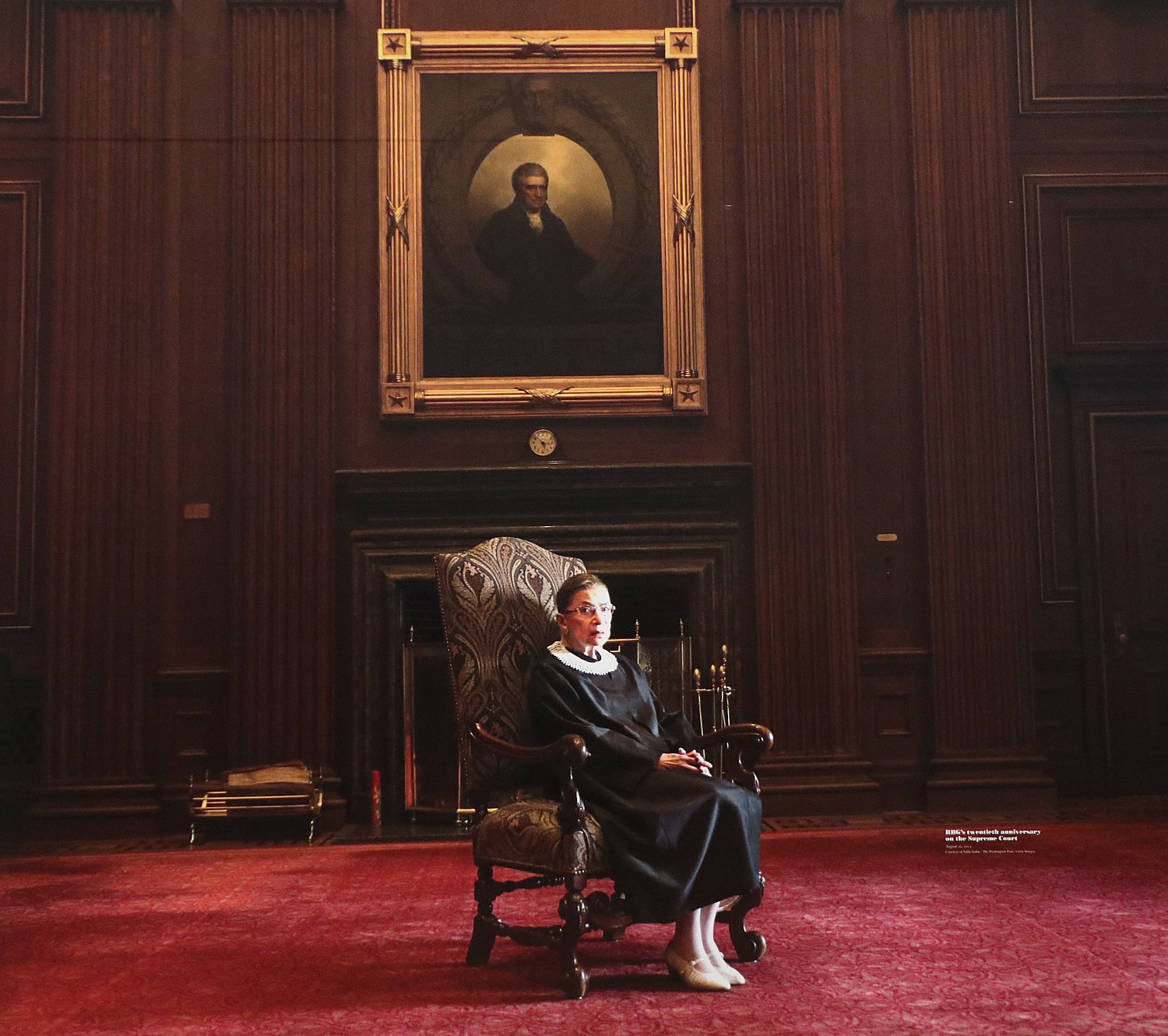
Mystery on the Historic Maine Windjammer Victory Chimes

The historic schooner, Victory Chimes, keeps the legacy of the Great Age of Sail alive © Karen Rubin/goingplacesfarandnear

By Karen Rubin

Travel Features Syndicate, goingplacesfarandnear.com

There is a mystery to be unraveled, as intriguing as an Agatha Christie whodunnit, but without the murder and mayhem: How were the 26 passengers on the historic Maine Windjammer, Victory Chimes, who came from as far as California, Utah, North Carolina, Virginia, and Pennsylvania connected? And who among us is the interloper, unconnected to anyone else? Is it coincidence or providence that brings us together?

The mystery provides marvelous intrigue during the course of the six-day cruise sailing from Rockland, Maine, among the islands of Penobscot Bay.

A windjammer cruise is as much about experiencing the thrill of the Great Age of Sail, when these mighty schooners sailed with the wind and waves to bring the timber, building stones and raw materials that built the nation – literally engines of the economy – as it is about reconnecting with the joys of simple pleasures as basic as conversation and song.

Maine has the largest fleet of historic windjammers in North America. Members of the Maine Windjammer Association fleet come together for the annual Great Schooner Race, re-creating and keeping alive the Great Age of Sail © Karen Rubin/goingplacesfarandnear

Song and storytelling, indeed, are the theme of this sailing (many Windjammer cruises have a theme or focus), which features music on Monday, Wednesday and Friday evenings by singer/songwriters Mike and Amy Aiken. And on another enchanting evening, several of us listen in as Mike and the multi-talented Chef Adam Travaglione (who is also a musician in addition to being a fabulous chef, raised in his family’s restaurant) compose a song honoring the legacy of the Victory Chimes. The Aikens have sailed up to Rockland on the boat they have lived on for the past 21 years from their homeport on the Chesapeake (a clue to solving the mystery).

Harkening back to a simpler age, Mike and Amy Aiken provide evening entertainment aboard Victory Chimes © Karen Rubin/goingplacesfarandnear

Here in Maine are the largest concentration of these historic sailing ships in North America, nine of which are members of the Maine Windjammer Association, sailing out of Rockland and Camden.

Maine has the largest fleet of historic windjammers in North America. Aboard the Victory Chimes, we get to watch he Stephen Taber sail out of Rockland Harbor © Karen Rubin/goingplacesfarandnear

Each has its own story, its own character. And each sailing is different, even on the same ship – the product of the serendipity and alchemy of people (passengers as well as captain and crew), weather (which often provides the drama, whether because of fog or squall), and where we wind up anchoring. There is no itinerary. The captain sets course following the wind, weather and whimsy.

Captain Sam Sikkema, the newest owner/caretaker of the Victory Chimes’ 121-year legacy, reviews the day’s sail, having successfully navigated away from a squall. “The crew really mustered the hell out of that squall.” © Karen Rubin/goingplacesfarandnear

Each afternoon, after we drop anchor in some cove or harbor, Captain Sam Sikkema, the newest owner/caretaker of the Victory Chimes’ 121-year legacy, gathers us around with a map, reviews that day’s route and tells us the back stories of the people and places where we have sailed. In the afternoon or the morning before we set out again, we tender to shore to explore. (Maine has some 3,000 islands and 7,000 miles of coastline.)

Anchored off of Burnt Isle, we get to walk a beautiful trail along the shore © Karen Rubin/goingplacesfarandnear

Deer Island; Little Island; Burnt Isle (privately owned, but we are allowed to walk a shoreline trail); Merchants Run – so named because of the deep water that accommodated the big ships carrying lumber, granite, cattle, which island residents would stockpile and sell to the bigger ships; Crotch Island – named for its notch – is half its original height because so much granite has been taken out to build buildings in New York City and federal courthouses.

Fog envelops the Victory Chimes, anchored in Brooksville © Karen Rubin/goingplacesfarandnear

We watch as fog literally rolls in and envelops the Victory Chimes anchored in Brooksville, as we tender back to the ship. Later, anchored in Pulpit Harbor on North Haven (which, Captain Sam tells us, was mentioned by the explorer Samuel Champlain in 1515 and the osprey nest on a rock that leads into the harbor), we again watch as fog rolls in, making everything around seem to vanish as if by magic.

Towing back to the Victory Chimes, anchored at Pulpit Harbor on North Haven © Karen Rubin/goingplacesfarandnear

The Victory Chimes – the largest in the Maine Windjammer fleet at 128 feet and the only three-masted schooner left in North America out of 4,000 built in the Great Age of Sail – was designed to be sailed by just three, which seems amazing considering how 10 of us line up to help haul in the line to raise the sail.

Victory Chimes passengers get to help raise the sails © Karen Rubin/goingplacesfarandnear

Victory Chimes not only exemplifies the 19th and early 20th century development of large American wooden schooners intended primarily, though not exclusively, for the coasting trade on both east and west coasts, but she is the only surviving example of the ‘Chesapeake ram’ type and one of only two surviving examples of a three masted schooner in the United States.”​

We watch with awe and fascination as Victory Chimes crew work together Victory Chimes passengers get to help raise the sails © Karen Rubin/goingplacesfarandnea

To give you an idea of just how big – and the challenge of keeping such a historic vessel sailing – the masts of Oregon Douglas fir are over 80 feet in height. “A straight tree 110 feet tall is required to get the necessary length a full 21 inches in diameter.”

There is a six-horsepower Sea Gear engine to raise the anchor (the same one that was installed in 1906 to replace the original donkey engine) but no propulsion engine, so now – as then – there is a yawlboat, Enoch, that pushes the ship when the wind is not sufficient. That innovation, indeed, is what made the Victory Chimes such a cash-cow for its original owner, who made back the $12,000 he paid to build her in 1900, in the first year.

The 1906 six-horsepower Sea Gear engine is used to raise Victory Chimes’ anchor  © Karen Rubin/goingplacesfarandnear.com

Designed by JMC Moore, her stout build, simple rig and yawl boat made her one of the most profitable ships ever to sail. The Edwin & Maud (as it was originally named by its first Captain, Robert Riggen for his sons) was one of 30 “Ram” schooners – nicknamed for the way they “rammed through” the Chesapeake and Delaware Canal and through the sea. Victory Chimes is the last one.

Captain Sam joins crew to fix a sail © Karen Rubin/goingplacesfarandnear

The schooner rigging – as opposed to the square rigging of ocean-going ships – was a major American innovation that allowed the vessels to be nimble and fast, and operated with a minimal number of crew for maximum profit for the owner.

Cruising each day, we get to help raise the sails, but it is really a marvel to watch the intricate ballet of the crew performing physically demanding tasks – even daring-do – such as climbing those 80-foot tall masts to repair rigging, or snapping to with agility, strength and precision, to reposition sails and rigging to sail us out of the way of a storm.

Captain Sam or Chief Mate Tripp shout commands or signal with hand gestures and the crew calls back, “Ready throat, ready peak. Mainsail halyards hoist away.”

Victory Chimes passengers provide extra muscle © Karen Rubin/goingplacesfarandnear

We pull rapidly, the line flying through our hands, until the line finally strains. Then comes the order to “Heave,” to which we respond “Ho” as two crew members pull down vigorously on their lines. Heave. Ho. Heave. Ho. Then, “Throat make fast. Peak make fast.”

And finally the call to “ease up” which is our order to take two steps forward followed immediately by the command, to “drop the line”.

Victory Chimes snap together to bring down the sails as the Captain navigates away from a squall © Karen Rubin/goingplacesfarandnear

Things get exciting – and we passengers just stand quietly out of the way, watching in awe and fascination – as the crew races to maneuver Victory Chimes out of the way of a squall. Captain Sam shouts out with urgency:  “Hard left. James start the boat. Ahead 2000. Take in the mizzen. Take in the outer jib, then take in everything else. Bring James his foulies!”

Victory Chimes snap together to bring down the sails as the Captain navigates away from a squall © Karen Rubin/goingplacesfarandnear

Captain Sam navigates far south, tacking to avoid the storm. “The crew mustered the hell out of that squall,” he says later with a combination of pride and relief.

I love the language of sailing – “Scandalize the fore main;” “Cast the jigger right off” – and this description of Victory Chimes’ rigging: “The traditional ‘ram’ rig was a standing jib, flying jib, staysail (also called a forestaysail), foresail, mainsail and spanker (or mizzen), which Victory Chimes carries today. The heads of the fore, main and mizzen sails are supported by gaffs and the feet are laced to booms.”

(It’s amazing how many everyday expressions come from sailing: “Above board.” “Learn the ropes.” “Know the ropes.”)

Built to carry cargo, Victory Chimes was converted to carry passengers in 1946 © Karen Rubin/goingplacesfarandnear

The Edwin & Maud worked carrying cargo through World War I, the Spanish Flu, the Great Depression and World War II. By 1944, still sailing as a merchant vessel out of Baltimore, Edwin & Maud monitored the anti-submarine mine field at Chesapeake Bay and kept a sharp lookout for German U-Boats.

But then, mechanization of the war effort gave rise to bigger ships that made the old wood ships uneconomical.  Hundreds were burned or just left to decay.

By 1946, the Edwin & Maud ended her career transporting cargo – lumber, mainly, but also salt, pumpkins, fish scrap for fertilizer or anything to pay the freight – and was converted into a new concept of “dude cruiser” by Herman Knust of Chesapeake Bay Vacation Cruises.

Originally, where the cargo hold would have been, are now 19 cabins (15 with two-berths, two with four berths and one each with a single and a triple berth) with the main saloon and galley.

Built for maximum efficiency and profit, Victory Chimes was designed to be sailed with just a crew of three, which seems incredible. It is the only three-masted schooner left in North America, out of 4,000 that were built © Karen Rubin/goingplacesfarandnear

In 1954, Capt. Frederick “Boyd” Guild brought the ship to the Maine coast and renamed her Victory Chimes after a Canadian coastal schooner he admired as a boy that had been launched on Armistice Day.

She survived a succession of other owners: A Minnesota bank president wanted to sail it on Lake Superior but couldn’t get certified (his own bank foreclosed). It was purchased at auction in 1987 by Domino’s Pizza and renamed Domino Effect. When Domino’s sold off its fleet, Victory Chimes was slated to be sent to Japan to be converted into a restaurant.

Simple pleasures aboard the Victory Chimes © Karen Rubin/goingplacesfarandnear.com

Captain Kip Files and Captain Paul DeGaeta, who oversaw the Domino’s restoration, purchased the vessel to keep her from leaving the country, changed the name back to Victory Chimes and returned her to the Maine windjammer trade. Maine’s Legislature welcomed her back with a special resolution.

In 1997, Victory Chimes was named an American National Historic Landmark under the Maritime Heritage Program of the National Parks Service, becoming one of only 127 vessels with that designation. (Apparently, though, historic vessels are not entitled to tax credits as historic landmarks.)

I had sailed on the Victory Chimes some years ago in the exciting annual Schooner Race with Captain Kip Files, who was her caretaker for 24 years.

Now Captain Sam Sikkema has the weighty responsibility of being Victory Chimes’ owner/caretaker. He acquired Victory Chimes in 2018 and had a great season in 2019 before being locked down by COVID-19 in 2020 – for perhaps the first year in its long history. PPP funding helped them stay afloat.

Captain Sam Sikkema, who has sailed the world with his cat, Fuji, says, “We are truly honored to be the new caretakers of this vessel and hope to bring new life to her while holding true to the authentic nature of the experience.” © Karen Rubin/goingplacesfarandnear

Captain Sam has had quite a sea-going career that began with sailing dinghies with his father on Lake Michigan. He has sailed around the world, on every ocean, in schooners, square riggers, training ships, yachts, fishing vessels and commercial vessels, as well as worked with maritime museums and shipyards as a carpenter and a rigger. Over the years, he sailed as crew on Niagara, Bounty, Sorlandet, Denis Sullivan, Californian, Red Witch, Nina, Robert C Seamans, Spirit of Bermuda, Alabama, Highlander Sea, Columbia, Victory Chimes and the 1841 Whaling Ship Charles W Morgan (serving as Captain Kip’s Chief Mate)He has been Captain of the sailing vessels Friends Good Will, Lynx, Tole Mour, Harvey Gamage, and the training ship Picton Castle, taking her across the North Atlantic Ocean four times. And he sailed the world with his cat, Fiji, who delights us with her antics.

“Of all the places I’ve sailed, my favorite place to sail is right here on the coast of Maine.”

Captain Sam Sikkema has sailed the world with his cat, Fuji, who delights us with her antics © Karen Rubin/goingplacesfarandnear

“I am truly honored to be the new caretaker of this vessel and hope to bring new life to her while holding true to the authentic nature of the experience you have enjoyed in the past,” Captain Sam writes to past Victory Chimes passengers.

Cara Lauzon joins Mike and Amy Aiken for their last performance on the Victory Chimes, for this music-themed cruise © Karen Rubin/goingplacesfarandnear

Cara Lauzon joins Mike and Amy Aiken for their Friday evening concert, when we are anchored in Rockland Harbor.

We get to watch the creative process as Mike Aiken  and the multi-talented Chef Adam Travaglione  compose a song honoring the legacy of the Victory Chimes © Karen Rubin/goingplacesfarandnear

But on an evening when they aren’t performing, song spontaneously breaks out – starting with commercial jingles of our Baby Boomer youth, then going to popular rock and roll songs (Broadway musicals are not allowed).

When the Victory Chimes anchors, Captain Sam is often the first one out in one of the small sailboats © Karen Rubin/goingplacesfarandnear

For the “A” personalities on board (Sherman, who sailed his own boat up from the Chesapeake to come on this ship, crewed a sailing ship to Antarctica; Karen and Eric were next traveling to Alaska to fish, others share stories about biking trips in Europe), a windjammer cruise provides a rare luxury to just chill out. But each evening when we anchor, Sherman is first to take out the small sailboat (as is Captain Sam), Ed grabs the rowboat, and Glenn jumps into the water for a swim.

When the Victory Chimes anchors, we get to take out a rowboat © Karen Rubin/goingplacesfarandnear

We scan the waters for seals, porpoises, birds. The photographers among us are constantly looking out for picturesque scenes to capture, reminiscent of the great seascapes of Winslow Homer and J.M.W. Turner and the Maine landscapes immortalized by the Wyeths (which we can see in the Farnsworth Museum, in Rockland).

The Angelique provides a lovely seascape © Karen Rubin/goingplacesfarandnear

Even in the rain it is pleasant on board – the crew puts out awnings so we can still stay on deck if we want and the Victory Chimes, the largest of the Maine Windjammers, with a capacity for 40 passengers, has a fairly large mess area, which doubles as a kind of lounge when it is not set up for dining, where it is pleasant to spend time reading in the evening. There is always coffee and tea, fresh fruit out and whatever dessert is left over from lunch or dinner.

Victory Chimes passengers enjoy macramé while sailing © Karen Rubin/goingplacesfarandnear

Eating aboard the ships is one of the distinct pleasures. I can imagine a slight rivalry among the ships for best cook, and Victory Chimes cook, Chef Adam, would easily be among the winners, especially with his freshly baked everything (not too sweet or rich). Chef Adam prides himself on researching alternatives for people who have diet restrictions.

There is a routine to the day around food: coffee is brought up to the deck at 7 am; the bell for breakfast is rung at 8 am, precisely after the flags are raised. Lunch is served at noon. Appetizers are brought up to the deck at 5 pm (there is a cooler for you to store your beer or wine, but wine is served with dinner), and dinner at 6 pm. There is always coffee and tea and fresh fruit available. Meals are served family style – breakfast in the galley, lunch and dinner mostly served on deck.

Chef Adam prepares the fresh (still kicking) lobsters © Karen Rubin/goingplacesfarandnear

While every windjammer cruise is different, there are certain constants – the feeling of being transported back into this Golden Age of Sail and the traditional lobster dinner. Some of the captains do it on a secluded beach; others, like Victory Chimes, serve on board (as elegant as eating lobster can be) but each one is an unmatched culinary experience of the freshest, most succulent and sweetest lobster in unimaginable abundance that spoils you for lobster forever.

The lobster dinner is a highlight and hallmark of every Maine windjammer cruise © Karen Rubin/goingplacesfarandnear

The hours spent sailing are relaxing and chilling out – like a floating beach holiday – reading, playing games like backgammon, scrabble. A group is doing macrame (usually there are knitters or knotters). But a main activity is just chatting, which is key to solving the mystery of what brought all of us together on this particular cruise.

Champagne toast celebrating an anniversary onboard the Victory Chimes, we have all blended into one group © Karen Rubin/goingplacesfarandnear

By the time we depart – having celebrated birthdays and anniversaries as if we have always been joined – Diana has thoroughly investigated and charted the connections, solving the mystery: Just about everybody – through college roommates, music, book club, Philly folk festival, sailing, childhood friendships, neighbors and family, is somehow directly or indirectly connected to the Aikens. Who is the interloper? Me. (See her diagram.)

Diana has solved the mystery of how the Victory Chimes passengers are connected – with one exception © Karen Rubin/goingplacesfarandnear
Passengers on the Victory Chimes © Karen Rubin/goingplacesfarandnear
Captain Sam charts our journey during the six-day sail on Victory Chimes © Karen Rubin/goingplacesfarandnear

You stay overnight on Victory Chimes at the dock before departing Rockland (giving me time to enjoy Rockland and an outdoor Blues festival). On return, you depart usually by 10 am, giving you time to see the sights in Rockland – the not-to-be-missed Farnsworth Museum of Art and Homestead (www.farnsworthmuseum.org); walk the three-quarter mile long breakwater to the Rockland Lighthouse, and visit the Lighthouse Museum. If you overnight in the area (there are lovely B’n’Bs like the LimeRock Inn  where I stayed on a prior visit), visit the Owl’s Head lighthouse (www.lighthouse.cc/owls/) and the Transportation Museum, both in Owl’s Head.

A major attraction in Rockland is to walk the three-quarter mile long breakwater to the Rockland Lighthouse © Karen Rubin/goingplacesfarandnear

Definitely make time to visit the Farnsworth Museum, an absolute gem of an art museum with an extraordinary collection of Wyeths – NC, Andrew and Jamie.  Reopened after the COVID-19 lockdown, it is presently showing stellar exhibits (all on through December, except for “Parallel Visions”, an astonishing exhibit matching Andrew Wyeth’s paintings with George Tice’s photos, which ends in October to make room for the Farnsworth’s annual holiday display), showcasing Maine’s role in American art. Key exhibits include “Betsy’s Gift: The Works of N.C., Andrew, and Jamie Wyeth,” “Women of Vision,” “Betsy Wyeth, Partner and Muse,” and “Transforming the Ordinary: Women in American Book Cover Design,” (Farnsworth Art Museum, 16 Museum Street, Rockland, ME 04841, 207-596-6457, writeus@farnsworthmuseum.org, www.farnsworthmuseum.org).

“Betsy’s Gift” is a major exhibit now on view at the Farnsworth Art Museum, Rockland Karen Rubin/goingplacesfarandnear

For 2021, the Victory Chimes is offering 3, 4, 5, and 6-night cruises through Sept 28.

Schooner VICTORY CHIMES, P.O. Box 1401, Rockland, ME 04841, 800-745-5651,  victorychimesinfo@gmail.com, www.victorychimes.com.

The Maine Windjammer Association represents the largest fleet of traditional sailing schooners in North America: American Eagle, 800-648-4544; Angelique, 800-282-9989; Heritage, 800-648-4544; J. & E. Riggin, 800-869-0604; Ladona, 800-999-7352; Lewis R. French, 800-469-4635; Mary Day, 800-992-2218; Stephen Taber, 800-999-7352 and Victory Chimes, 800-745-5651. For information, 800-807-WIND; or visit www.sailmainecoast.com.

______________________

© 2021 Travel Features Syndicate, a division of Workstyles, Inc. All rights reserved. Visit goingplacesfarandnear.com, www.huffingtonpost.com/author/karen-rubin, and travelwritersmagazine.com/TravelFeaturesSyndicate/. Blogging at goingplacesnearandfar.wordpress.com and moralcompasstravel.info. Send comments or questions to FamTravLtr@aol.com. Tweet @TravelFeatures. ‘Like’ us at facebook.com/NewsPhotoFeatures

Because travel is a life-enhancing, relationship building, world-changing experience